
Submitted:
15 June 2026
Posted:
16 June 2026
You are already at the latest version
Abstract
This study evaluates the effect of the oxidation degree of graphene oxide, understood as the oxygen content and the presumed nature of oxygen-containing functional groups remaining after controlled thermal reduction of GO, on the cyclization of polyacrylonitrile (PAN) in composite PAN/GO membranes prepared by phase inversion. All composite membranes contained the same amount of graphene-based additive, namely 5 wt.% relative to dry PAN, which made it possible to separate the effect of additive loading from the effect of surface chemistry. The GO-based additives were prepared from one initial graphene oxide batch and then subjected to controlled thermal reduction to obtain materials with different oxygen contents. These values were 7.2, 15.3, 24.6, 35.4 and 48.1 wt.% for the additives used in PAN/GO-1, PAN/GO-2, PAN/GO-3, PAN/GO-4 and PAN/GO-5, respectively. DSC analysis showed that, in the PAN/GO-2-PAN/GO-5 series, the maximum temperature of the exothermic PAN cyclization effect decreased from 294 °C to 224 °C as the oxygen content increased. At the same time, the cyclization enthalpy decreased from 506.7 to 404.2 J/g. In contrast, PAN/GO-1, containing the most strongly reduced additive with 7.2 wt.% oxygen, showed the highest cyclization maximum, approximately 316 °C, and the highest cyclization enthalpy, 628.5 J/g. FTIR spectra confirmed the disappearance of the nitrile band at approximately 2240 cm-1 and the growth of C=N/C=C bands assigned to the developing PAN ladder structure. The results indicate that PAN cyclization is governed not only by the total oxygen content but also by the type and reactivity of oxygen-containing groups remaining on the GO surface after thermal reduction.
Keywords:
polyacrylonitrile
; graphene oxide
; thermal reduction
; oxygen functional groups
; cyclization
; cyclization enthalpy
; thermal stabilization
; membranes
1. Introduction
Polyacrylonitrile is one of the most important precursors of carbon materials, especially carbon fibers and carbon nanofibers. A key step in the transformation of PAN into a material resistant to further high-temperature treatment is thermal stabilization, usually conducted in an oxidizing atmosphere. During stabilization, cyclization of nitrile groups, dehydrogenation, oxidation and partial crosslinking occur. Among these processes, cyclization plays a fundamental role because it leads to the formation of a rigid ladder structure [1,2,3,4,5,6].
PAN cyclization is strongly exothermic. In unmodified or weakly activated polymers, it may proceed rapidly over a narrow temperature range, which makes the process difficult to control and promotes local overheating and structural defects. Therefore, considerable effort has been devoted to identifying factors that lower the onset temperature of cyclization, shift the maximum of the exothermic effect and distribute the reaction over a broader temperature range [2,3,4,5,6].
One approach to modifying PAN is the use of graphene-based additives. Graphene oxide (GO) contains hydroxyl, epoxy, carbonyl and carboxyl groups. Therefore, it can not only improve dispersibility in polar solvents but also actively interact with PAN chains. Previous studies have shown that GO lowers the cyclization temperature of PAN, which has been attributed to the initiation of the reaction by oxygen-containing functional groups present on the GO surface [7,8,9,10].
Lee et al. showed by DSC that GO/PAN composites have a clearly reduced cyclization temperature compared with neat PAN, and related this effect to an ionic mechanism initiated by GO functional groups [7]. Gergin et al. discussed the influence of GO on the oxidative stabilization of PAN nanofibers [8], whereas Qiao et al. demonstrated that GO coatings on PAN fibers enhance the degree of pre-oxidation and promote a more homogeneous process [9]. Recent work on PAN/GO nanofibrous membranes has also confirmed the beneficial influence of GO on thermally induced PAN transformation [10].
However, the influence of the GO reduction degree, and therefore the content and nature of residual oxygen-containing groups, on PAN cyclization at a constant graphene-based additive content remains less well understood. This issue is important because thermal reduction of GO usually does not remove oxygen completely. Individual oxygen-containing groups are removed at different temperatures and with different ease, while more stable groups associated with defects or sheet edges may remain after reduction [11,12,13].
In the present work, an experimental approach was adopted to separate the effect of additive loading from the effect of GO surface chemistry. All composite membranes contained the same amount of graphene-based material, equal to 5 wt.% relative to dry PAN, while the variable was the degree of thermal reduction of GO and the associated oxygen content in the initial additive. The aim of this study was to determine whether an increase in the amount of active oxygen-containing groups on the GO surface lowers the cyclization temperature of PAN and whether a strongly reduced material, containing mainly groups that are more difficult to remove, retains a similar initiating activity. Oxygen content was determined for the starting graphene-based additives used to prepare the membranes, not for the final membranes.
2. Materials and Methods
2.1. Materials
The study used polyacrylonitrile in the form of a copolymer containing 93.9% acrylonitrile, 5.8% methyl acrylate and 0.3% allyl methyl sulfonate, with a molecular weight Mw of approximately 85,000 g/mol. N,N-dimethylformamide (DMF) was used as the solvent. The graphene-based additives comprised a series of GO samples differing in the degree of thermal reduction and, consequently, in oxygen content.
2.2. Preparation of GO with Different Oxygen Contents and PAN/GO Membranes
Graphene oxide was prepared by a modified Hummers method [14,15]. After purification and removal of acidic impurities, the obtained GO was subjected to controlled thermal reduction. The GO used for the preparation of all samples originated from a single synthesis batch. Reduction was performed at 300 °C for different times to obtain a series of materials with different oxygen contents. The process was carried out under flowing nitrogen at 5 L/min. Nitrogen was used to remove gaseous deoxygenation products and to limit access of atmospheric oxygen, thereby preventing oxidation or combustion of the reduced material. The GO used to prepare the PAN/GO-5 membrane was not reduced, whereas the additive used to prepare PAN/GO-1 was reduced for the longest time to obtain the lowest oxygen content in the studied series (Table 1).
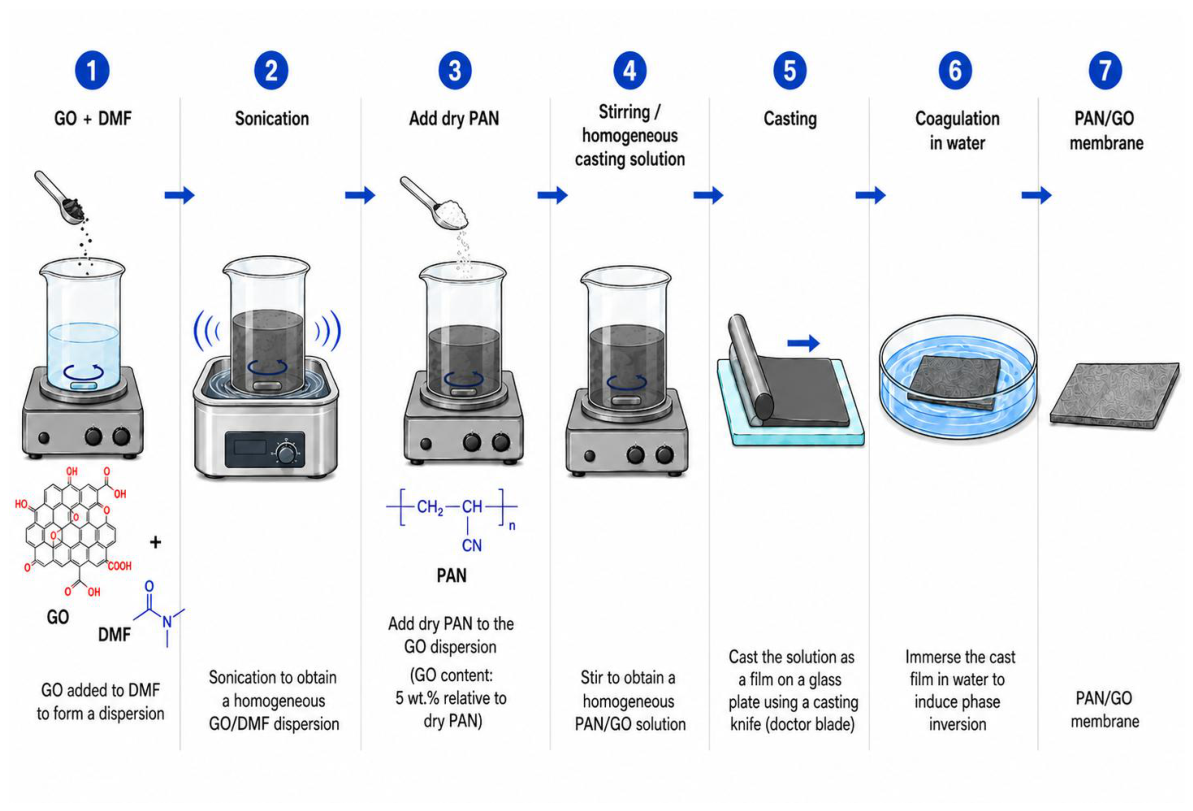
The membranes were prepared by phase inversion. First, a dispersion of a given graphene oxide sample in DMF was prepared and sonicated to achieve as homogeneous a dispersion of GO sheets as possible. Dry PAN was then added to the GO dispersion in an amount corresponding to 5 wt.% graphene-based additive relative to dry PAN. After a homogeneous casting solution had been obtained, a film was cast onto a glass plate and subsequently coagulated in water.
The reference sample without graphene-based additive was denoted PAN-0. The composite membranes were denoted PAN/GO-1, PAN/GO-2, PAN/GO-3, PAN/GO-4 and PAN/GO-5. These designations refer exclusively to membranes containing 5 wt.% graphene-based additive relative to dry PAN and differing in the oxygen content of the initial GO-based material.
Figure 1.
Scheme of PAN/GO membrane preparation by phase inversion. In all composite membranes, the graphene-based additive content was 5 wt.% relative to dry PAN.
Figure 1.
Scheme of PAN/GO membrane preparation by phase inversion. In all composite membranes, the graphene-based additive content was 5 wt.% relative to dry PAN.
2.3. Determination of Oxygen Content by EDS
The oxygen content was determined by EDS for the initial graphene-based additives before their introduction into the PAN solution. These values were treated as indicators of the oxidation degree of the graphene-based material. Therefore, they do not represent the oxygen content in the final membranes, but rather in the starting materials used for their preparation.
EDS values are reported as weight percentages. If an EDS spectrum of a representative GO sample is to be shown in the final submission, it should be inserted in the manuscript or provided as supplementary material.
2.4. DSC Thermal Analysis
Thermal transitions of PAN and PAN/GO membranes were studied by differential scanning calorimetry (DSC). The analysis focused on the position of the maximum of the exothermic effect associated with PAN cyclization and on the cyclization enthalpy, determined by integrating the area of the exothermic effect. Enthalpy values are reported per gram of the analyzed membrane sample.
DSC measurements were performed using a TA Instruments MDSC 2920 differential scanning calorimeter (TA Instruments, New Castle, DE, USA). The measurements were conducted under a nitrogen atmosphere at a gas flow rate of 40 mL/min. Samples were heated from -40 to 320 °C at 10 °C/min. The DSC curves were analyzed using TA Instruments Universal Analysis V4.5A software.
2.5. FTIR Analysis
FTIR spectra were recorded for the membrane components and for the PAN/GO-5 membrane as a function of temperature. Measurements were performed using a Nicolet 6700 FT-IR spectrometer (Thermo Electron Corp., Madison, WI, USA) equipped with an MTEC model 300 photoacoustic accessory. Samples were placed in a dedicated holder for photoacoustic analysis.
Spectra were recorded in the range of 500-4000 cm-1 with a resolution of 4 cm-1 and 64 scans. A DTGS detector (deuterated triglycine sulfate) was used. Data acquisition and preliminary processing were performed using OMNIC v. 8.0 software (Thermo Electron Corp.).
Temperature-dependent FTIR measurements were performed using an accessory enabling controlled heating of the sample from 20 to 300 °C with an accuracy of ±0.5 °C. Spectra were normalized relative to the baseline according to the same procedure for all analyzed spectra. This approach allows relative changes to be compared, although semi-quantitative interpretation of band intensities should be treated with caution.
3. Results and Discussion
3.1. Interpretative Assumptions Resulting from Controlled GO Reduction
A key point for interpreting the results is that the experimental variable was the GO reduction degree, not the amount of graphene-based additive. Since all composite membranes contained 5 wt.% additive relative to dry PAN, the observed differences in cyclization behavior can primarily be associated with the surface chemistry of the graphene-based material.
The additive series was obtained from one GO material by controlled thermal reduction. In this system, a decrease in oxygen content reflects not only a decrease in the number of oxygen-containing groups but also a change in their qualitative distribution. Literature data indicate that more labile groups are removed first during thermal reduction, whereas more stable groups associated with defects in the carbon structure or sheet edges may remain after reduction [11,12,13]. It may be assumed that hydroxyl groups or other stable oxygen forms contribute significantly to these remaining groups, but without XPS analysis this cannot be unambiguously resolved.
For this reason, PAN/GO-1 should not be interpreted as an oxygen-free material. It is the sample with the lowest oxygen content in the studied series, in which mainly more difficult-to-remove groups remained. The absence of a decrease in cyclization temperature, despite the presence of 7.2 wt.% oxygen, suggests that these groups do not exhibit the initiating activity typical of more strongly oxidized GO samples. In practice, this means that the DSC maximum shifts to a higher temperature than in PAN-0, rather than that PAN cyclization is completely suppressed.
3.2. Proposed Mechanism of GO-PAN Interaction
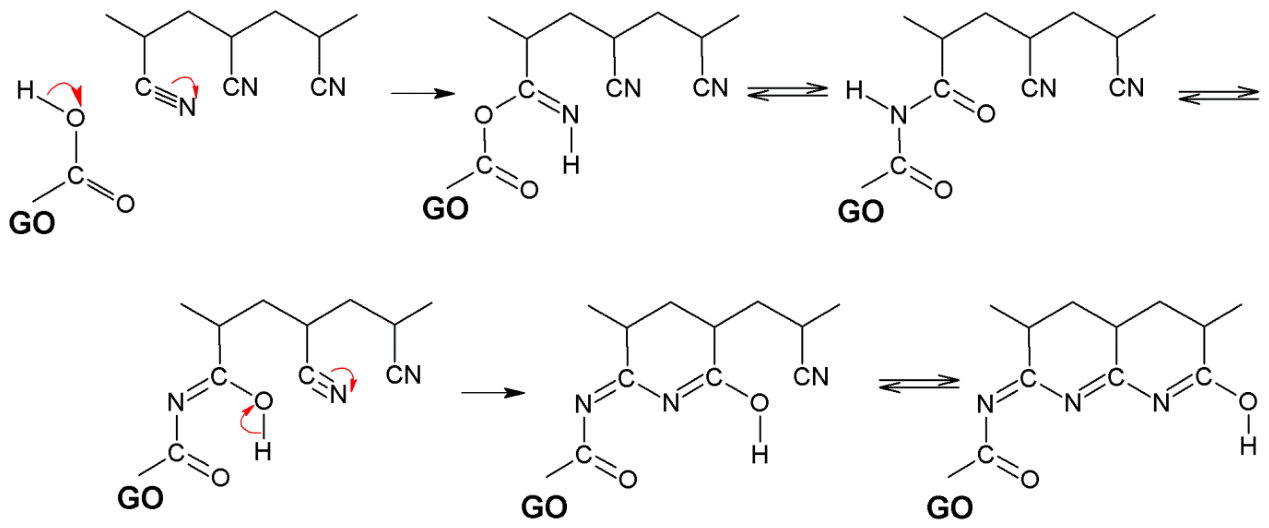
Based on the literature and the obtained results, it can be assumed that GO oxygen-containing groups, especially acidic or strongly polar groups, may participate in the initiation of PAN cyclization via an ionic mechanism. In this interpretation, the GO surface does not act only as an inert filler, but may provide sites for chemical interactions that facilitate ring formation and the development of the PAN ladder structure. At the same time, in PAN/GO-1, which contains the material subjected to the longest thermal reduction, the remaining oxygen-containing groups may be those most difficult to remove and may not display the same initiating activity as the groups present in strongly oxidized GO.
Figure 2.
Proposed scheme for the participation of GO oxygen-containing functional groups in the initiation of polyacrylonitrile cyclization.
Figure 2.
Proposed scheme for the participation of GO oxygen-containing functional groups in the initiation of polyacrylonitrile cyclization.
3.3. Effect of Oxygen Content on PAN Cyclization Temperature and Enthalpy in DSC
Figure 3 shows DSC curves for PAN-0 and membranes containing graphene-based additives with increasing oxygen contents. For PAN-0, the maximum of the exothermic cyclization effect occurs at approximately 293 °C. In PAN/GO-2, containing an additive with 15.3 wt.% oxygen, the maximum occurs at approximately 294 °C, which is practically the same as that of the reference sample. A further increase in oxygen content leads to a clear decrease in the maximum temperature: to approximately 289 °C for PAN/GO-3, 259 °C for PAN/GO-4 and 224 °C for PAN/GO-5.
The behavior of PAN/GO-1 is particularly interesting. Despite the presence of 7.2 wt.% oxygen in the graphene-based additive, the cyclization maximum for this sample occurs at approximately 316 °C, which is higher than that observed for PAN-0. This result indicates that not only the total oxygen content, but also the type and accessibility of oxygen-containing groups, are important for the ability of the additive to initiate cyclization. In the material after thermal reduction, groups that are more difficult to remove but less reactive toward PAN may remain.
To illustrate the relationship between oxygen content in the graphene-based additive and the DSC-derived parameters describing PAN cyclization, the point data for the entire sample series are combined in Figure 4. For PAN/GO-2-PAN/GO-5, a clear trend is observed: as the oxygen content increases from 15.3 to 48.1 wt.%, the cyclization maximum decreases from 294 to 224 °C, while the cyclization enthalpy decreases from 506.7 to 404.2 J/g. At a constant graphene-based additive content, this demonstrates the decisive role of GO surface chemistry.
The cyclization enthalpy determined from DSC curves provides an additional parameter describing the intensity of the exothermic reaction. The values of the maximum temperature and cyclization enthalpy are summarized in Table 2 and graphically presented in Figure 4. For the reference PAN-0 sample, the cyclization enthalpy was 570.7 J/g. In the PAN/GO-2-PAN/GO-5 series, the enthalpy systematically decreased from 506.7 to 404.2 J/g as the oxygen content increased. This means that the more strongly oxidized GO not only shifted PAN cyclization to a lower temperature but also reduced the heat released during the process. From a technological point of view, such behavior may be advantageous because a less intense exothermic effect can facilitate better control of stabilization.
PAN/GO-1 showed a different behavior: its cyclization enthalpy was 628.5 J/g, which is higher than that of PAN-0. This can be interpreted as an effect of delayed cyclization and the accumulation of a larger fraction of unreacted nitrile groups that undergo transformation only at higher temperature. Therefore, the strongly reduced additive does not act as an effective low-temperature initiator and may even increase the thermal concentration of the exothermic transformation.
Figure 5 additionally compares selected DSC curves for PAN/GO-1, PAN-0 and PAN/GO-5, which represent, respectively, the material after the longest thermal reduction, the reference sample and the sample containing unreduced or most strongly oxidized GO. This comparison clearly illustrates the opposite influence of the two extreme additives: the thermally reduced material shifts the cyclization maximum to a higher temperature, whereas strongly oxidized GO lowers it by almost 70 °C relative to the reference sample.
3.4. FTIR Spectra of PAN/GO-5 Recorded as a Function of Temperature
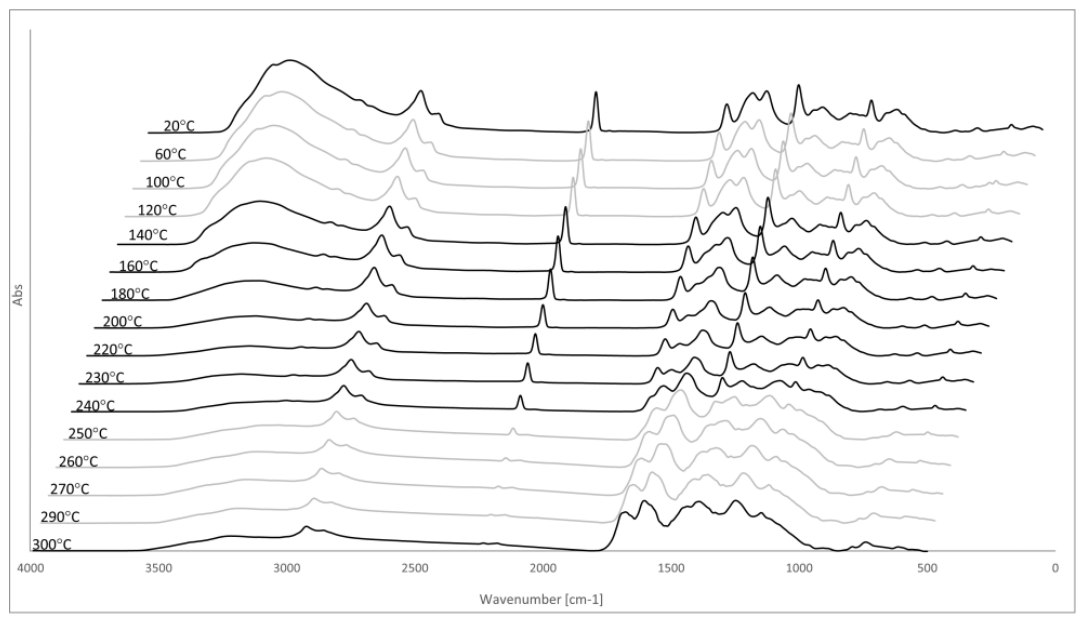
FTIR spectra recorded for PAN/GO-5 as a function of temperature provide direct confirmation of the conclusions derived from DSC. In the starting material, an intense nitrile band (-C≡N) is present at approximately 2240 cm-1, together with bands corresponding to aliphatic PAN groups and oxygen-containing groups of GO. As temperature increases, the intensity of the nitrile band decreases, while the contribution of bands in the 1570-1625 cm-1 region increases. These bands can be assigned to the formation of C=N/C=C structures in the developing PAN ladder structure.
The largest changes occur in the range of approximately 220-260 °C, which corresponds to the temperature interval in which, according to DSC, the main part of the cyclization process occurs in PAN/GO-5. This provides strong evidence that the decrease in the maximum temperature of the DSC effect reflects a real chemical transformation rather than only a change in heat transport conditions in the composite.
Figure 6.
FTIR spectra of the PAN/GO-5 membrane recorded as a function of temperature.
3.5. Comparison of FTIR Spectra of Membrane Components and Heated Membrane
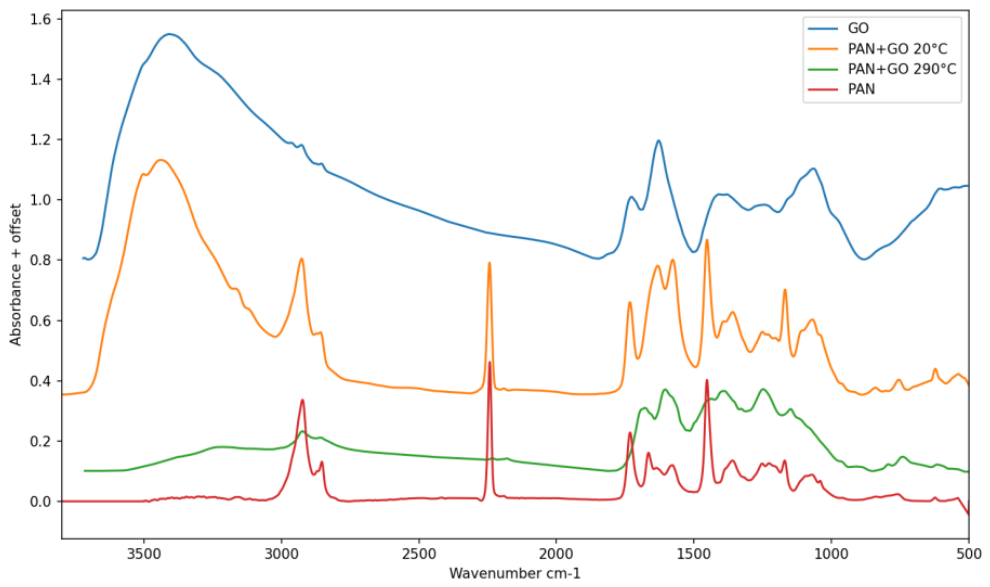
Comparison of FTIR spectra of the graphene-based additive, neat PAN and the PAN/GO-5 membrane before and after heating to 290 °C helps clarify the role of the composite components. The GO spectrum is characterized by a broad -OH band in the range of 3000-3600 cm-1, C=O bands in the range of 1710-1730 cm-1 and C-O/C-O-C bands in the range of 1160-1060 cm-1. In the PAN spectrum, the -C≡N band near 2240 cm-1 and bands assigned to aliphatic groups dominate. The spectrum of the PAN/GO-5 membrane at 20 °C has an intermediate character and contains features of both components.
After heating to 290 °C, the membrane spectrum changes substantially: the nitrile band almost disappears, the contribution of bands associated with hydroxyl groups decreases, and bands characteristic of a more conjugated structure become dominant. This means that the material after thermal treatment is not a simple mixture of PAN and GO, but a system after substantial chemical reconstruction.
Figure 7.
FTIR spectra of the initial GO, neat PAN and the PAN/GO-5 membrane at 20 °C and after heating to 290 °C.
Figure 7.
FTIR spectra of the initial GO, neat PAN and the PAN/GO-5 membrane at 20 °C and after heating to 290 °C.
3.6. Significance of Oxygen Content and Limitations of Interpretation
The collected results indicate that, at a constant graphene-based additive content, the course of PAN cyclization is strongly related to the GO reduction degree. In the PAN/GO-2-PAN/GO-5 series, a higher oxygen content correlates with a lower maximum temperature of the DSC effect and a lower cyclization enthalpy. This means that more strongly oxidized GO can both initiate cyclization at lower temperature and reduce the intensity of the exothermic effect. In contrast, PAN/GO-1 behaves differently, confirming that residual oxygen after thermal reduction is not equivalent to the oxygen-containing groups present in strongly oxidized GO.
The mechanistic interpretation requires caution. EDS determines the total oxygen content but does not identify the type of functional groups. The absence of XPS analysis prevents direct determination of the fractions of hydroxyl, epoxy, carbonyl and carboxyl groups; therefore, conclusions regarding their specific roles should be treated as hypotheses based on correlations among DSC, FTIR and literature data [7,8,9,10,11,12,13].
4. Conclusions
At a constant graphene-based additive content of 5 wt.% relative to dry PAN, the GO reduction degree significantly affected the cyclization behavior of polyacrylonitrile. The series of additives obtained from one GO material made it possible to relate the observed changes primarily to the oxygen content and presumed nature of oxygen-containing groups, rather than to the additive amount.
In PAN/GO-2-PAN/GO-5 samples, an increase in oxygen content in the graphene-based material from 15.3 to 48.1 wt.% caused a systematic decrease in the maximum temperature of the exothermic DSC effect from approximately 294 to 224 °C. Simultaneously, the cyclization enthalpy decreased from 506.7 to 404.2 J/g, indicating a milder and potentially more controllable course of the transformation.
PAN/GO-1, containing the longest-reduced graphene-based material with 7.2 wt.% oxygen, exhibited the maximum effect at approximately 316 °C and the highest cyclization enthalpy, 628.5 J/g. This indicates that oxygen-containing groups remaining after thermal reduction do not show the same initiating activity as those present in more strongly oxidized GO.
FTIR results confirmed the chemical nature of the observed transformations: during heating, the -C≡N band at approximately 2240 cm-1 disappeared, while the contribution of C=N/C=C bands associated with the development of the PAN ladder structure increased. However, identification of the specific groups responsible for this effect requires further studies, especially XPS analysis.
Author Contributions
Conceptualization, R.F., B.F.; methodology, R.F., B.F.; investigation, R.F., B.F.; data curation, R.F.; writing-original draft preparation, R.F.; writing-review and editing, R.F., B.F.; visualization, R.F., B.F.; supervision, B.F. All authors have read and agreed to the published version of the manuscript.
Funding
This research received no external funding.
Data Availability Statement
The data presented in this study are available in the article.
Conflicts of Interest
The authors declare no conflict of interest.
References
- Dalton, S.; Heatley, F.; Budd, P.M. Thermal stabilization of polyacrylonitrile fibres. Polymer 1999, 40, 5531–5543. [Google Scholar] [CrossRef]
- Ouyang, Q.; Cheng, L.; Wang, H.; Li, K. Mechanism and kinetics of the stabilization reactions of itaconic acid-modified polyacrylonitrile. Polym. Degrad. Stab. 2008, 93, 1415–1421. [Google Scholar] [CrossRef]
- Zhang, H.; Quan, L.; Gao, A.; Tong, Y.; Shi, F.; Xu, L. Thermal Analysis and Crystal Structure of Poly(Acrylonitrile-Co-Itaconic Acid) Copolymers Synthesized in Water. Polymers 2020, 12, 221. [Google Scholar] [CrossRef] [PubMed]
- Kakida, H.; Tashiro, K. Mechanism and Kinetics of Stabilization Reactions of Polyacrylonitrile and Related Copolymers III. Comparison among the Various Types of Copolymers as Viewed from Isothermal DSC Thermograms and FT-IR Spectral Changes. Polym. J. 1997, 29, 557–562. [Google Scholar] [CrossRef]
- Ju, A.; Xu, H.; Guang, S. Mechanism and kinetics of stabilization reactions of poly(acrylonitrile-co-β-methylhydrogen itaconate). J. Mater. Res. 2012, 27, 2668–2676. [Google Scholar] [CrossRef]
- Hao, J.; Wei, H.; Lu, C.; Liu, Y. New aspects on the cyclization mechanisms of poly(acrylonitrile-co-itaconic acid). Eur. Polym. J. 2019, 121, 109313. [Google Scholar] [CrossRef]
- Lee, S.; Kim, Y.J.; Kim, D.H.; Ku, B.C.; Joh, H.I. Synthesis and properties of thermally reduced graphene oxide/polyacrylonitrile composites. J. Phys. Chem. Solids 2012, 73, 741–743. [Google Scholar] [CrossRef]
- Gergin, İ.; Ismar, E.; Sarac, A.S. Oxidative stabilization of polyacrylonitrile nanofibers and carbon nanofibers containing graphene oxide (GO): A spectroscopic and electrochemical study. Beilstein J. Nanotechnol. 2017, 8, 1616–1628. [Google Scholar] [CrossRef] [PubMed]
- Qiao, M.; Kong, H.; Ding, X.; Zhang, L.; Yu, M. Effect of graphene oxide coatings on the structure of polyacrylonitrile fibers during pre-oxidation process. RSC Adv. 2019, 9, 28146–28152. [Google Scholar] [CrossRef] [PubMed]
- Kang, Y.; Low, Z.-X.N.; Zhou, K.; Feng, S.; Zou, D.; Zhong, Z.; Xing, W. Graphene oxide induced thermal-oxidation polyacrylonitrile nanofibrous membrane with superior heat resistance and flame retardancy for high-temperature air filtration. J. Membr. Sci. 2025, 725, 123944. [Google Scholar] [CrossRef]
- Acik, M.; Lee, G.; Mattevi, C.; Pirkle, A.; Wallace, R.M.; Chhowalla, M.; Cho, K.; Chabal, Y.J. The role of oxygen during thermal reduction of graphene oxide studied by infrared absorption spectroscopy. J. Phys. Chem. C 2011, 115, 19761–19781. [Google Scholar] [CrossRef]
- Ganguly, A.; Sharma, S.; Papakonstantinou, P.; Hamilton, J.W.J. Probing the thermal deoxygenation of graphene oxide using high-resolution in situ X-ray-based spectroscopies. J. Phys. Chem. C 2011, 115, 17009–17019. [Google Scholar] [CrossRef]
- Peláez-Fernández, M.; Bermejo-Solis, A.; Benito, A.M.; Maser, W.K.; Arenal, R. Detailed thermal reduction analyses of graphene oxide via in-situ TEM/EELS studies. Carbon 2021, 178, 477–487. [Google Scholar] [CrossRef]
- Hummers, W.S.; Offeman, R.E. Preparation of graphitic oxide. J. Am. Chem. Soc. 1958, 80, 1339. [Google Scholar] [CrossRef]
- Marcano, D.C.; Kosynkin, D.V.; Berlin, J.M.; Sinitskii, A.; Sun, Z.; Slesarev, A.; Alemany, L.B.; Lu, W.; Tour, J.M. Improved synthesis of graphene oxide. ACS Nano 2010, 4, 4806–4814. [Google Scholar] [CrossRef] [PubMed]
Figure 3.
DSC curves for PAN-0 and PAN/GO-2 to PAN/GO-5 samples. With increasing oxygen content in the graphene-based additive, the maximum of the exothermic cyclization effect shifts toward lower temperatures.
Figure 3.
DSC curves for PAN-0 and PAN/GO-2 to PAN/GO-5 samples. With increasing oxygen content in the graphene-based additive, the maximum of the exothermic cyclization effect shifts toward lower temperatures.
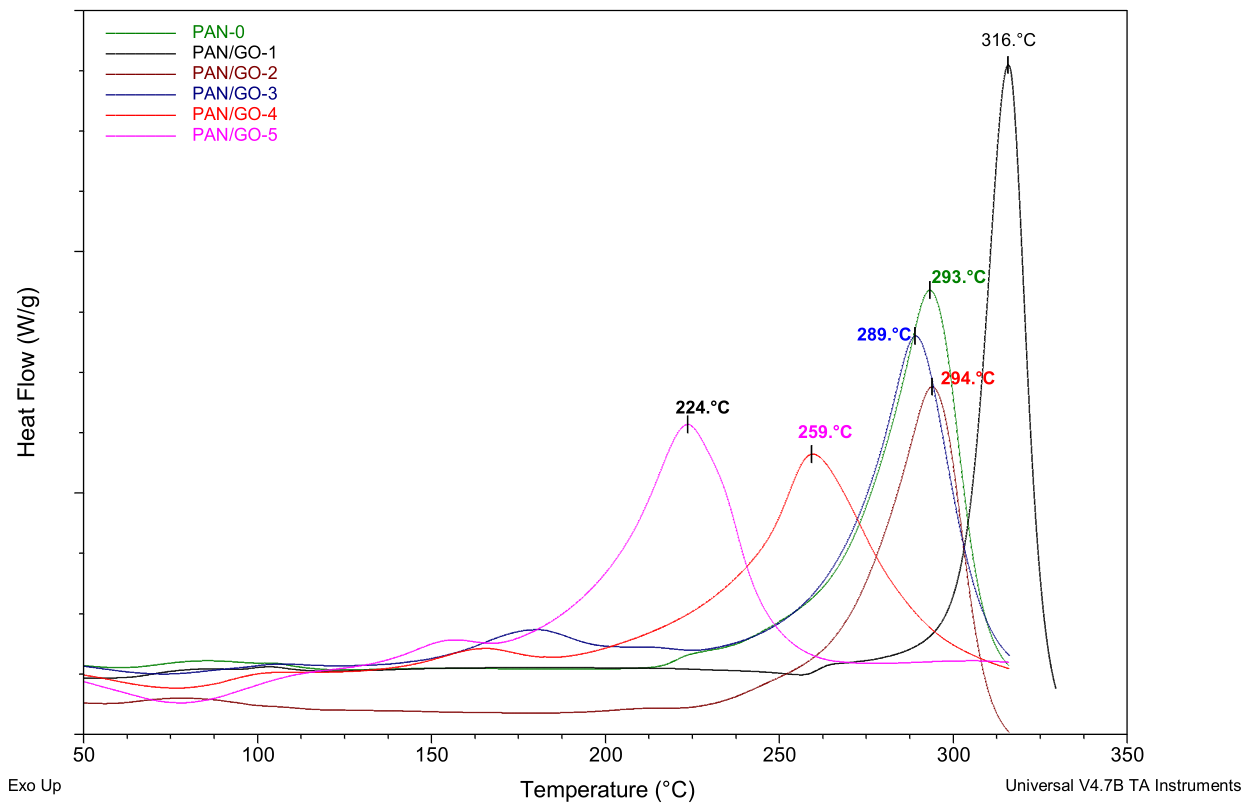
Figure 4.
Combined plot showing the dependence of the maximum temperature of the PAN cyclization DSC effect (left y-axis) and the cyclization enthalpy determined from DSC (right y-axis) on the oxygen content in the initial graphene-based additive. The PAN-0 reference point is shown separately and is not connected to the PAN/GO series.
Figure 4.
Combined plot showing the dependence of the maximum temperature of the PAN cyclization DSC effect (left y-axis) and the cyclization enthalpy determined from DSC (right y-axis) on the oxygen content in the initial graphene-based additive. The PAN-0 reference point is shown separately and is not connected to the PAN/GO series.
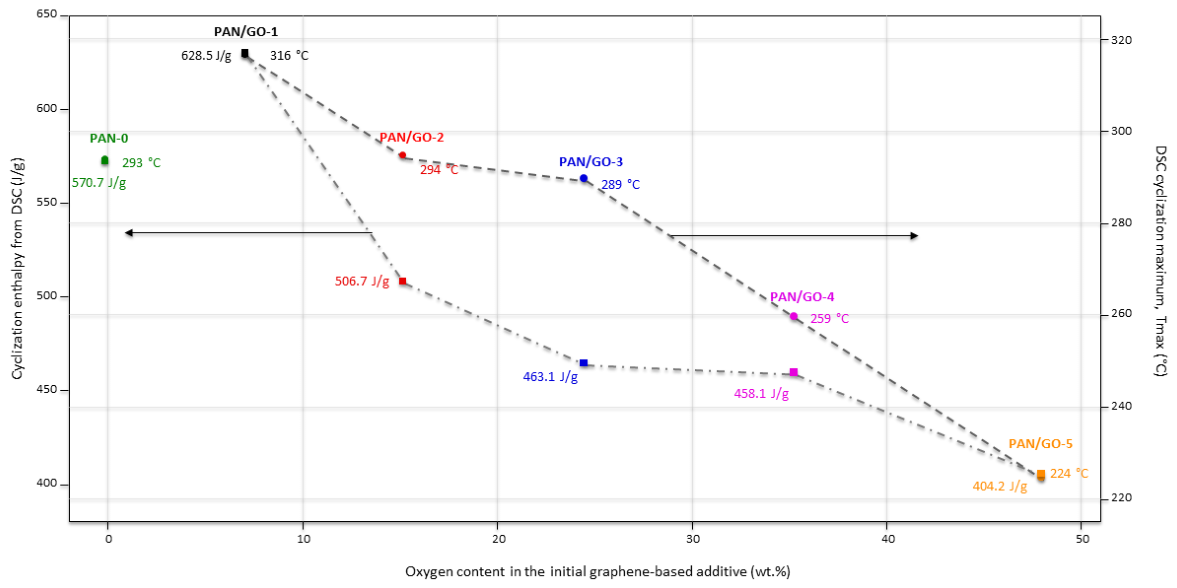
Figure 5.
Comparison of DSC curves for PAN/GO-1, PAN-0 and PAN/GO-5 samples.
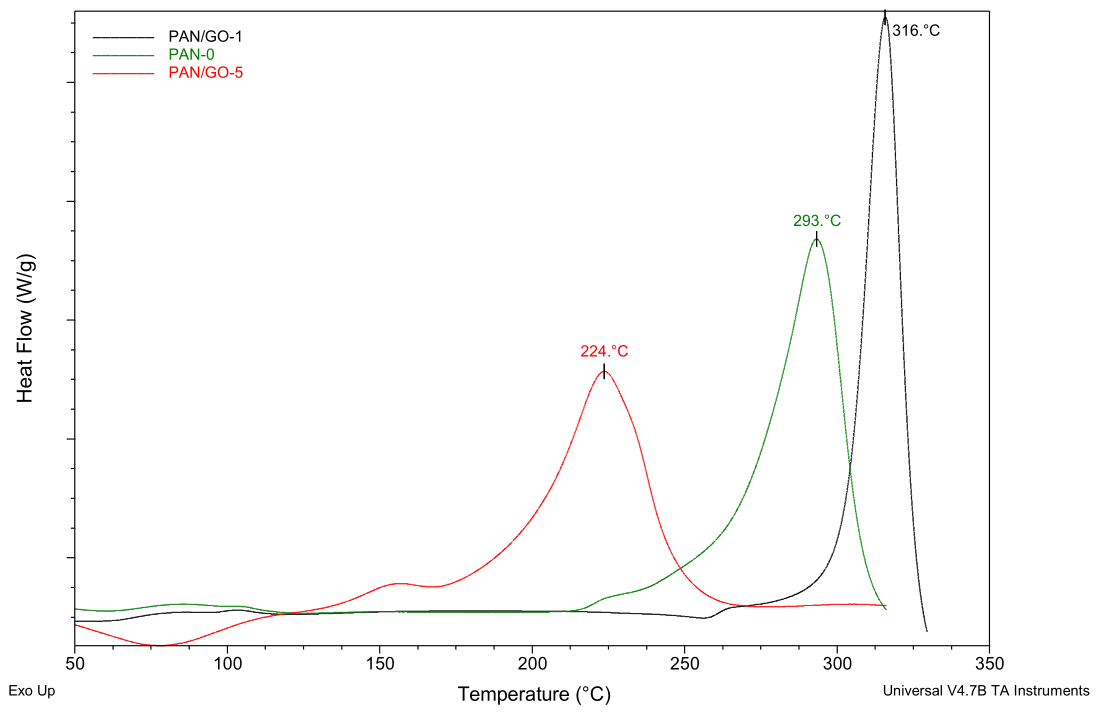

Table 1.
Composition of PAN/GO membranes and oxygen content in the initial graphene-based additives used for their preparation.
Table 1.
Composition of PAN/GO membranes and oxygen content in the initial graphene-based additives used for their preparation.
| Membrane sample | PAN content (wt.%) | GO content (wt.%) | Reduction time at 300 °C (min) | Oxygen content in the initial additive by EDS (wt.%) |
|---|---|---|---|---|
| PAN-0 | 100 | 0 | - | - |
| PAN/GO-1 | 95 | 5 | 60 | 7.2 |
| PAN/GO-2 | 95 | 5 | 30 | 15.3 |
| PAN/GO-3 | 95 | 5 | 15 | 24.6 |
| PAN/GO-4 | 95 | 5 | 5 | 35.4 |
| PAN/GO-5 | 95 | 5 | 0 | 48.1 |
Table 2.
Maximum temperature of the DSC effect and cyclization enthalpy of PAN and PAN/GO membranes.
Table 2.
Maximum temperature of the DSC effect and cyclization enthalpy of PAN and PAN/GO membranes.
| Sample | Oxygen content in the GO additive by EDS (wt.%) | DSC maximum, Tmax (°C) | Cyclization enthalpy from DSC (J/g) |
|---|---|---|---|
| PAN-0 | - | 293.0 | 570.7 |
| PAN/GO-1 | 7.2 | 316.0 | 628.5 |
| PAN/GO-2 | 15.3 | 294.0 | 506.7 |
| PAN/GO-3 | 24.6 | 289.0 | 463.1 |
| PAN/GO-4 | 35.4 | 259.0 | 458.1 |
| PAN/GO-5 | 48.1 | 224.0 | 404.2 |
Disclaimer/Publisher’s Note: The statements, opinions and data contained in all publications are solely those of the individual author(s) and contributor(s) and not of MDPI and/or the editor(s). MDPI and/or the editor(s) disclaim responsibility for any injury to people or property resulting from any ideas, methods, instructions or products referred to in the content. |
© 2026 by the authors. Licensee MDPI, Basel, Switzerland. This article is an open access article distributed under the terms and conditions of the Creative Commons Attribution (CC BY) license (http://creativecommons.org/licenses/by/4.0/).
Copyright: This open access article is published under a Creative Commons CC BY 4.0 license, which permit the free download, distribution, and reuse, provided that the author and preprint are cited in any reuse.


