
Submitted:
15 June 2026
Posted:
16 June 2026
You are already at the latest version
Abstract
Laser Powder Bed Fusion produces geometrically complex metallic components, yet fatigue performance consistently falls below that of wrought counterparts. Surface condition, encompassing as-built roughness, residual stress, porosity, microstructure, and oxide layers, is the dominant factor driving this deficit. This review critically examines surface-driven fatigue mechanisms across Ti-6Al-4V, IN718, AlSi10Mg, and 316L alloys. Post-processing strategies including mechanical polishing, peening, electrochemical polishing, laser polishing, burnishing, and hybrid approaches are systematically evaluated. The mechanistic roles of surface roughness as a stress concentrator, near-surface porosity as crack initiation sites, and compressive residual stress as a crack-closure mechanism are discussed. Emerging burnishing techniques, particularly electrical current-assisted burnishing, demonstrate fatigue life improvements of up to five times relative to as-built components, underscoring the transformative potential of thermo-mechanical surface modification. Finally, this review identifies critical research gaps, notably the lack of standardized surface characterization protocols and the limited understanding of fatigue under multiaxial and variable-amplitude loading for surface-treated L-PBF parts, and outlines directions for future work.
Keywords:
Laser Powder Bed Fusion
; fatigue
; surface roughness
; residual stress
; burnishing
; crack initiation
; surface integrity
1. Introduction
Additive manufacturing (AM) has undergone rapid development over the past two decades, transitioning from rapid prototyping to a production-grade fabrication technology. Among the suite of metal AM processes, Laser Powder Bed Fusion (L-PBF) occupies a particularly prominent position due to its capacity to fabricate near-net-shape components with fine feature resolution, tailored porosity gradients, and complex internal geometries unachievable via conventional subtractive methods [1,2]. The aerospace and biomedical industries have been early adopters: L-PBF-produced titanium implants and nickel superalloy turbine brackets are now in commercial use [3,4].
However, widespread structural deployment of L-PBF components has been constrained by persistent concerns regarding fatigue reliability. Fatigue failure, the progressive, localized damage of a material under cyclic loading, accounts for the majority of in-service structural failures and is thus a critical design criterion [5,6]. Regulatory bodies mandate that fatigue-critical aerospace components maintain compressive residual stress at the surface to achieve required damage tolerance levels [7].
The inherent characteristics of the L-PBF process generate a surface condition that is markedly more detrimental to fatigue performance than that of traditionally processed metals. The layer-by-layer melting of metallic powder produces a rough, irregular surface covered with partially melted powder particles, step-terracing artefacts, and balling defects, all of which function as geometric stress risers [8,9]. Moreover, the steep thermal gradients and rapid solidification kinetics introduce significant tensile residual stresses at and near the surface, which promote crack opening and reduce fatigue crack propagation resistance [10,11].
The relationship between surface condition and fatigue in L-PBF alloys is multi-parametric and non-trivially coupled. Surface roughness, residual stress state, near-surface porosity distribution, microstructural texture, grain morphology at the surface, oxide layer chemistry, and surface integrity collectively determines the fatigue response. The relative weight of each factor varies substantially between alloy systems, build orientations, and loading modes, which complicates the formulation of universal guidelines [12].
An extensive body of experimental literature has accumulated over the past decade examining fatigue in L-PBF alloys, yet the field remains fragmented. Many studies isolate individual surface parameters without systematically controlling others, making mechanistic attribution difficult. Furthermore, the variety of post-processing surface treatments, including mechanical, chemical, thermal, and hybrid approaches, applied across different alloys and geometries has yielded a complex, often contradictory landscape of results [13,14]. The emergence of novel burnishing techniques, such as rotational burnishing, low plasticity burnishing, and electrical current-assisted burnishing, has introduced a new class of surface modification strategies capable of simultaneously reducing roughness, introducing deep compressive residual stress layers, and refining grain structure [15,16].
Figure 1 contrasts the gage section surface morphology of an as-built L-PBF specimen with that of a machined counterpart, illustrating the stark difference between the powder-encrusted, irregular as-built surface and the comparatively smooth machined surface at equivalent magnification [17].
Several comprehensive reviews have addressed fatigue in L-PBF alloys, most notably Zerbst et al. [18], who provided a foundational damage-mechanics-based treatment of defect sensitivity and crack propagation, and Afroz et al. [19], who systematically cataloged fatigue data across multiple alloy systems with emphasis on process-structure-property correlations. While these works have established essential frameworks, the present review distinguishes itself through three specific contributions. First, whereas previous reviews have treated post-processing surface treatments as a secondary consideration, we provide a dedicated, critical synthesis of emerging mechanical surface enhancement techniques that are rapidly gaining traction as post-process strategies capable of simultaneously tailoring roughness, residual stress, and microstructure. Second, an alloy-by-alloy synthesis (Section 6) that goes beyond aggregated trends to resolve alloy-specific mechanistic differences, particularly between α/β titanium alloys (Ti-6Al-4V), nickel-based superalloys (IN718, IN625), and aluminum-silicon alloys (AlSi10Mg) for which the relative importance of roughness versus porosity versus residual stress varies fundamentally is offered. Third, we explicitly integrate emerging burnishing and hybrid treatments into the modeling discussion (Section 8), highlighting where these techniques create new challenges and opportunities for predictive frameworks. By structuring the review around the interplay between as-built surface condition, alloy-specific fatigue mechanisms, and the evolving landscape of post-processing surface engineering, we aim to provide both a practical reference for researchers selecting surface treatments and a critical assessment of remaining knowledge gaps that distinguish this work from prior compilations.
This review aims to consolidate and critically synthesize the current state of knowledge on surface condition driven fatigue in L-PBF alloys. It is organized as follows: Section 2 describes the L-PBF process and the origins of surface features; Section 3 characterizes the surface condition of as-built L-PBF parts; Section 4 reviews fatigue testing methodologies; Section 5 examines the mechanistic roles of individual surface features; Section 6 provides an alloy-by-alloy review of experimental findings; Section 7 evaluates post-processing surface treatments; Section 8 discusses modeling and predictive approaches; Section 9 identifies research gaps; and Section 10 presents conclusions.
2. Laser Powder Bed Fusion: Process Overview and Surface Feature Origins
2.1. Process Fundamentals
In L-PBF, a high-power laser beam selectively scans a pre-spread layer of metal powder following a slice pattern generated from a CAD model [20]. The laser melts and fuses the powder particles during scanning. Rapid solidification occurs through heat conduction into the substrate and surrounding solid metal. The build platform then lowers by one layer thickness, a fresh powder layer is applied, and this cycle repeats until the component is complete [21].
Several critical process parameters influence final part quality, including laser power (P), scan speed (v), hatch spacing (h), layer thickness (t), and spot size (d). These parameters are often combined into a single metric known as the volumetric energy density (VED = P / (v × h × t)), which serves as a useful characterization metric. However, its utility is limited because it does not capture the spatial and temporal thermal history of the process [22]. Additionally, scan strategy plays a significant role in influencing both residual stress distribution and surface morphology [23].
2.2. Origins of Surface Roughness in L-PBF
The surface of as-built L-PBF components is inherently rough due to several interconnected reasons. On inclined and upward-facing (top) surfaces, the staircase effect (the stepped surface contour resulting from discrete layer increments) arises from the layer-by-layer construction: each layer leaves a stepped contour, creating periodic roughness along the build direction. The magnitude of this effect scales with both the layer thickness and the angle of the surface relative to the build platform [24]. The staircase magnitude becomes particularly pronounced for surfaces inclined at angles below 45° from the horizontal, known as upskin (upward-facing) and downskin (downward-facing) surfaces (See Figure 2). Downskin surfaces typically exhibit even greater roughness due to poor heat conduction into the loose powder below, whereas upskin surfaces benefit from better thermal dissipation into the solid part above [25,26].
Partially melted powder particles that adhere to printed parts generate another major source of roughness. During printing, particles that contact the melt pool boundary sinter onto the part’s surface without fully melting. Laser energy density and scan strategy govern particle adherence. Insufficient energy causes incomplete melting at scan boundaries, increasing the number of adherent particles [28]. These adherent particles act as sharp, notch-like features that elevate the stress concentration factor under cyclic loading [29].
Balling, the formation of isolated spherical droplets due to Rayleigh-Plateau instability in the melt pool under excessive scan speeds or insufficient laser power, leaves a highly irregular surface with large peak-to-valley heights. Additionally, spattering of ejected molten material during laser-powder interaction can deposit resolidified droplets onto adjacent surfaces, further increasing roughness and potentially introducing oxide-contaminated particles [30].
2.3. Residual Stress Generation
The residual stress state of L-PBF parts is a complex function of the thermal history and mechanical constraint. The dominant mechanism is the temperature gradient mechanism: the rapidly heated surface layer attempts to expand but is constrained by the cooler substrate, inducing compressive plastic strain. Upon cooling, the plastically deformed layer contracts but is again constrained, resulting in a net tensile residual stress in the as-built surface layer [31]. Successive layer deposition modifies the residual stress distribution, with final stress states that are tensile near the surface and compressive in the interior for many materials and scan strategies. For a wide range of alloys processed by laser powder bed fusion under standard parameters, neutron diffraction and synchrotron X-ray diffraction measurements consistently reveal tensile residual stresses of 200–800 MPa at the surface [32,33]. The scan strategy critically modulates residual stress: island scanning reduces peak stresses relative to continuous meander scanning by limiting the length scale over which thermal gradients accumulate [23].
2.4. Near-Surface Porosity
Porosity in L-PBF arises from three principal mechanisms: lack-of-fusion (LOF) defects from insufficient energy density producing incomplete melting between adjacent scan tracks or layers; keyhole porosity from excessive energy density causing deep vaporization of the melt pool and entrapment of inert gas upon collapse; and gas porosity from dissolved gas in the powder feedstock. LOF pores tend to be irregular, planar, and concentrated near the surface or at build boundaries, making them particularly potent fatigue crack initiators [34,35]. Near-surface pores with openings at the surface can act as pre-existing notches, while subsurface pores just below the as-built surface are often more damaging than interior pores because the local stress state at the surface amplifies crack tip driving forces [36,37].
3. Surface Characterization of As-Built L-PBF Parts
3.1. Profilometric Methods
Accurate surface characterization is a prerequisite for establishing quantitative process-structure-property relationships in fatigue. Contact profilometry using a stylus and non-contact optical methods such as confocal microscopy, focus variation microscopy, and white light interferometry are the primary measurement approaches. ISO 25178 [38] provides a standardized framework for areal surface texture parameters, extending the classical line-profile parameters to areal parameters that better capture the three-dimensional nature of L-PBF surfaces [39].
As generally observed in the literature, the arithmetical mean height of as-built L-PBF surfaces depends on material and process parameters [13,40,41]. This surface roughness parameter is denoted as Ra when measured along a line (profile) and as Sa when measured over an area (surface). However, simple surface roughness height parameters like the maximum valley depth are not sufficient to characterize fatigue performance. The maximum valley depth is denoted as Rv for a line profile and Sv for an area. Instead, the skewness and kurtosis of the surface height distribution are particularly relevant for fatigue [41]. A schematic illustration of these roughness and surface-height distribution parameters is provided in Figure 3. Skewness (Rsk for a line, Ssk for an area) measures the asymmetry of the surface height distribution, while kurtosis (Rku for a line, Sku for an area) measures the weight of the distribution’s tails [41].
Lee et al. studied the fatigue behavior of as-built and polished Ti-6Al-4V specimens and made two key observations. First, as-built surfaces typically show near-zero skewness and low kurtosis, meaning their height distribution is wide and roughly symmetric. Second, after post-process treatments such as polishing, surfaces exhibit negative skewness and high kurtosis. This indicates that the height distribution becomes asymmetric, with more extreme values concentrated in the valleys. These valley features are especially detrimental to fatigue resistance. Standard roughness parameters that rely on the mean height, such as maximum valley depth, can be misleading because mean-based values are influenced by average characteristics that do not necessarily control mechanical performance. To address this limitation in Ti-6Al-4V and potentially other alloys, Lee et al. proposed hybrid parameters that combine the maximum valley depth with three statistical measures: the distance between the mean and the mode, the kurtosis, and the skewness. These hybrid parameters correlate more strongly with fatigue life, regardless of whether the surface has been treated. For complex geometries where area-based measurements are impractical, line-based hybrid parameters measured along the loading direction serve as a valid substitute [41].
3.2. Residual Stress Measurement
X-ray diffraction using the sin2(psi) method is one of the most widely applied techniques for surface residual stress measurement in L-PBF alloys, offering a measurement depth of a few micrometers. Neutron diffraction and synchrotron X-ray diffraction provide volumetric stress maps and are indispensable for understanding the subsurface stress gradient [42]. More recently, focused ion beam ring-core milling combined with digital image correlation has been employed to characterize residual stresses at micron-scale resolution, enabling stress measurement within individual grains and at grain boundaries [43]. Full-width at half-maximum broadening of diffraction peaks provides a complementary indicator of lattice strain and micro-strain introduced by plastic deformation during surface treatment, with broader peaks indicating higher dislocation density and stored strain energy [14].
3.3. Surface Microstructure Characterization
Electron backscatter diffraction (EBSD) has become the standard tool for near-surface microstructural characterization in L-PBF alloys. In Ti-6Al-4V, EBSD maps reveal a fine, acicular martensitic phase at the surface owing to rapid cooling, transitioning to a lamellar microstructure in the interior [44]. In IN718, columnar grains with a strong [001] texture in the build direction is characteristic, with the columnar grain boundary density at the surface influencing crack initiation propensity [45]. Transmission electron microscopy has identified elevated dislocation densities and sub-grain cell structures at and near the L-PBF surface that reflect the high plastic strain rate during solidification [39].
A particularly informative microstructural metric is the geometrically necessary dislocation (GND) density, extractable from EBSD data using kernel average misorientation analysis. GND density is sensitive to plastic strain gradients introduced by mechanical surface treatments, and elevated GND densities in the near-surface region, typically extending 100 to 500 µm below burnished or peened surfaces, correlate with increased resistance to fatigue crack nucleation by impeding dislocation slip [14]. Inverse pole figure mapping combined with pole figure analysis quantifies changes in crystallographic texture with depth, and the multiples of uniform density (MUD) value serves as a quantitative measure of texture intensity: high MUD corresponds to strong texture (columnar as-built grains) and low MUD to near-random texture (equiaxed or heavily deformed grains) [46].
3.4. Chemical State of the Surface
X-ray photoelectron spectroscopy (XPS) and Auger electron spectroscopy (AES) have revealed the formation of thin oxide layers (2 to 20 nm) on as-built L-PBF surfaces. In titanium alloys, TiO2, Al2O3, and mixed TiAlO oxides are present; in nickel superalloys, NiO, Cr2O3, and spinels are identified [47]. These oxides can influence fatigue by promoting embrittlement at crack tips, reducing surface energy, and altering the electrochemical environment in corrosion-fatigue scenarios. The oxide composition and thickness depend sensitively on the inert gas atmosphere quality in the build chamber and powder storage conditions[48].
4. Fatigue Testing Methodologies for L-PBF Alloys
4.1. Specimen Geometry and Preparation
The choice of specimen geometry profoundly influences measured fatigue performance. Hourglass or dog-bone specimens as recommended by ASTM standards E466 and E606 [49,50] are most commonly employed, but the removal of the as-built surface (by machining the gauge section) effectively eliminates the primary fatigue-determining feature, yielding results unrepresentative of real components. Near-net-shape specimens, where the gauge surface retains the as-built condition, are essential for capturing the true structural fatigue behavior, yet introduce variability from build-to-build and within-build surface quality inconsistencies.
Specimen orientation relative to the build direction (horizontal, vertical, or inclined at 45°) is a critical experimental variable because it simultaneously influences grain texture, residual stress gradients, and surface morphology at the gage section. However, the effect of build orientation on fatigue life varies across alloy systems and processing conditions[44,51]. While many studies report superior fatigue resistance for horizontal specimens over vertical ones or vice versa, no trend is universal. For certain alloys or process parameters, vertical or horizontal specimens may exhibit comparable or even better performance due to differences in grain texture, residual stress, or whether cracks initiate at the surface versus internal defects. Therefore, orientation effects must be evaluated on a per-alloy and per-process basis rather than generalized across all additive manufacturing systems.
4.2. Loading Modes and Stress Ratios
Uniaxial tension-tension fatigue with a stress ratio of R = 0.1 and fully reversed tension-compression fatigue with R = -1 dominate the literature [52]. Rotating bending, either four-point or cantilever, is commonly used for high-cycle fatigue testing where fatigue lives exceed 10⁵ cycles. Strain-controlled low-cycle fatigue, typically below 10⁴ cycles, is less frequently reported for L-PBF alloys but remains critical for components that experience significant plastic strain per cycle. Mean stress effects, which are particularly important for AM components because residual stress acts as an effective mean stress superimposed on the applied loading, are described by the modified Goodman, Gerber, or Morrow equations [5].
4.3. S-N Curve Determination and Statistical Treatment
The fatigue scatter in L-PBF alloys is substantially larger than in wrought alloys due to the stochastic nature of defect distributions and surface irregularities. This necessitates larger test matrices to achieve statistically meaningful S-N curves. Methods such as the staircase or the up-and-down method [53,54], and maximum likelihood estimation [55] are used to determine the fatigue limit or endurance strength. ASTM E739 standard [56] provide guidance on statistical treatment of fatigue data, and several recent studies have applied Weibull statistics and extreme value theory to characterize the probability of fatigue failure as a function of defect population [57,58,59].
5. Mechanisms of Surface-Driven Fatigue Failure in L-PBF Alloys
5.1. Surface Roughness as a Stress Concentrator
The most direct mechanism by which surface condition degrades fatigue life is through stress concentration at geometric surface features. The effective stress concentration factor Kf, which accounts for the notch sensitivity of the material, is related to the theoretical Kt by the Peterson equation: Kf = 1 + q(Kt - 1), where q is the notch sensitivity index [60]. For L-PBF surfaces, Kt values are not readily calculable from classical notch geometry formulae because the surface features are irregular and multi-scale. Finite element modeling of actual surface profiles obtained from X-ray computed tomography has revealed significant local stress concentrations at the sharpest notches, particularly at the roots of partially melted particle contacts, where the stress intensity factor at critical valley features could be quantified[61].
The fatigue notch factor concept is complicated in L-PBF materials because the grain size near the surface is often in the same order of magnitude as the critical defect dimensions, reducing the applicability of classical continuum mechanics-based notch sensitivity models [62]. Short crack mechanics, considering the Kitagawa-Takahashi diagram framework, is more appropriate: below the critical crack length, the plain fatigue limit controls; above it, fracture mechanics governs [63,64].
5.2. Residual Stress Effects on Fatigue Crack Propagation
Tensile residual stress at the surface increases the effective mean stress at a crack tip, shifting the Haigh diagram into a less favorable region thereby reducing the fatigue limit. Quantitatively, if σr is the surface residual stress, the effective stress ratio becomes Reff = (σmin+ σr)/ (σmax + σr), and the effective stress intensity range ΔKeff = (Kmax,eff - Kmin,eff) is modified accordingly. For L-PBF alloys with tensile surface residual stresses, the effective stress ratio shift will reduce the fatigue limit relative to a stress-free surface [18].
Conversely, compressive residual stresses, achievable through post-processing such as shot peening, laser shock peening, or burnishing, retard fatigue crack initiation and early propagation by maintaining crack closure at low applied stress intensities. The crack remains partially closed during the loading cycle, reducing ΔKeff below the threshold ΔKth,eff, thereby extending fatigue life. The depth of the compressive layer and its magnitude are critical. For L-PBF alloys, peening processes can induce substantial compressive residual stresses. Various peening methods have been shown to generate high-magnitude compressive stresses, with the compressive influence extending to measurable depths beneath the surface.
Shot peening of Ti–6Al–4V produces maximum compressive residual stresses ranging from −870 to −1000 MPa at approximately 40 μm below the surface, with affected depths of 280–770 μm depending on peening intensity[65] . Laser shock peening (LSP) induces compressive stresses up to −273 MPa in aluminum alloys with work-hardened layers extending to ∼1500 μm depth, while for IN718 surface stresses of -215 to –308 MPa are reported[66]. Ultrasonic impact treatment achieves compressive stress layers of approximately 2.5 mm depth, which can be further deepened by ∼2 mm when accounting for acoustic softening effects[67]. Water jet peening generates maximum compressive stresses of 170–342 MPa in aluminum alloys at depths of ∼117 μm, while in Inconel 718 stresses up to 1042.7 MPa have been achieved with total compressive depths of ∼40 μm[68]. Comparative studies on 316L stainless steel indicate that while shot peening produces the highest near-surface stresses, laser and cavitation peening extend compressive stresses to greater depths[69].
5.3. Near-Surface Porosity as Crack Initiation Sites
Internal defects are potent fatigue crack initiators in L-PBF alloys when they are located at or near the surface. The driving force for crack initiation at a pore of diameter 2a at the surface is characterized by the stress intensity factor Kpore proportional to Δσ √ (ℼ x a), which scales with the square root of the pore size. Surface-breaking pores are particularly severe because they additionally function as notches and provide a direct path for environmental exposure[70]. High-resolution X-ray computed tomography combined with fatigue fracture surface analysis has confirmed that surface and near-surface pores dominate crack initiation in as-built L-PBF specimens even when internal pore populations are present [71]. Burnishing operations that close surface-connected pores through plastic deformation provide a secondary benefit beyond residual stress introduction: the volumetric porosity fraction in the near-surface zone can be reduced via multi-pass low-plasticity burnishing or electric-current-assisted burnishing treatments[16].
The morphology of pores also influences their potency as crack initiators. LOF pores, which are irregular and often planar, have higher effective stress intensity factor ranges than spherical gas pores of the same projected area because of their sharper geometry and preferential orientation normal to the loading axis [72]. Murakami’s parameter, which approximates the pore projected area perpendicular to the principal stress direction, provides a useful metric for fatigue limit prediction in the presence of pores [73].
5.4. Microstructural Effects at the Surface
The near-surface microstructure of L-PBF alloys differs from the interior due to higher cooling rates and different thermal cycling histories. In Ti-6Al-4V, the surface layer frequently contains a higher fraction of fine martensitic or a thin layer of coarser α grains resulting from solid-state recrystallization during repeated thermal cycling by subsequent layer depositions[74,75]. The fine phase has higher strength but lower ductility, making it prone to crack initiation via slip band localization [76]. In IN718, the columnar grain structure at the surface, with grain boundaries aligned parallel to the build direction, provides preferential crack paths along these boundaries, particularly under loading perpendicular to the build direction [77].
Dislocation substructures generated by cyclic plastic deformation during fatigue interact with the pre-existing dislocation networks from L-PBF processing[78]. The high initial dislocation density in L-PBF alloys can accelerate the formation of persistent slip bands, which are precursors to intrusion-extrusion surface damage and fatigue crack nucleation [78]. However, the fine grain size characteristic of L-PBF alloys also provides a higher grain boundary density that impedes dislocation motion, potentially partially offsetting the deleterious effect of high initial dislocation density [79,80]. Mechanical surface treatments that further increase low-angle grain boundary fraction and GND density near the surface can suppress persistent slip bands formation by increasing the critical resolved shear stress for slip activation [78,80].
5.5. Environmental and Oxidation Effects
The surface oxide layer present on as-built L-PBF components plays a dual role in fatigue. On one hand, a stable, adherent oxide (e.g., Al2O3 or Cr2O3) can provide a degree of environmental protection, reducing the oxidation-assisted fatigue crack growth rate observed at elevated temperatures in nickel superalloys[6]. On the other hand, oxide-induced crack closure, where oxide debris forms in the crack wake and reduces ΔKeff, is a beneficial mechanism that is disrupted by the irregular, partially melted surface of as-built L-PBF components, since the rough surface geometry prevents the intimate crack face contact needed for effective closure [81]. In corrosion-fatigue conditions, the increased surface area and the presence of crevices between adherent powder particles accelerate electrochemical dissolution and hydrogen embrittlement, substantially reducing fatigue life in marine or body-fluid environments relevant to biomedical implants [82].
6. Alloy-Specific Fatigue Performance: Effect of Surface Condition
6.1. Titanium Alloys: Ti-6Al-4V
Ti-6Al-4V is one of the most widely studied L-PBF alloys for fatigue, owing to its dominance in aerospace and biomedical applications[19]. The as-built fatigue endurance limit (at 107 cycles, R = 0.1) of L-PBF Ti-6Al-4V is typically 200 to 350 MPa, compared to 500 to 600 MPa for wrought material, representing a reduction of 40 to 60% [83]. Surface condition is the primary cause of this deficit when optimized process parameters and post-build heat treatment are employed. Fatigue studies [29,84,85,86,87,88,89] have demonstrated that machining the as-built surface alone increased the fatigue limit from 200 MPa to 500 MPa, while polishing further improved it to 530 MPa, approaching wrought performance.
The build direction dependence is pronounced in Ti-6Al-4V: vertical specimens fail predominantly at surface-attached partially melted particles and LOF pores at grain boundaries aligned with the loading direction. The anisotropy in fatigue life, often a factor of 1.5 to 3 between horizontal and vertical specimens, is mitigated but not eliminated by surface treatment, indicating both surface and bulk microstructural contributions [90]. In AM alloys generally, and not just in Ti-6Al-4V, hot isostatic pressing combined with surface polishing yields fatigue performance approaching or matching that of wrought material by simultaneously closing internal pores and reducing surface stress concentrations [91,92,93].
6.2. Nickel Superalloys: IN718 and IN625
Inconel 718 (IN718) and Inconel 625 (IN625) are the dominant nickel-base superalloys produced by L-PBF for high-temperature structural applications in gas turbines and aerospace structures. The fatigue behavior of L-PBF IN718 is strongly temperature-dependent: at room temperature, as-built surface roughness governs fatigue crack initiation, while at elevated temperatures (650 and above), oxidation-assisted intergranular cracking becomes dominant and the relative importance of surface roughness diminishes[6,94].
As-built L-PBF IN718 exhibits fatigue endurance limits of approximately 220 to 350 MPa at room temperature (R = -1), compared to approximately 550 MPa for wrought material under the same conditions [95]. Solution annealing and aging heat treatment, which dissolves the Laves phase and precipitates the strengthening γ’’ and γ’ phases, improves the fatigue limit, with heat-treated L-PBF IN718 showing fatigue strengths ranging from approximately 200 to 620 MPa depending on processing parameters and surface condition[95] . When combined with electropolishing, reported fatigue limits increase to approximately 420 to 500 MPa, although this remains somewhat below the scatter band of wrought performance [95]. The strongly textured columnar grain structure in as-built IN718, with elongated grains parallel to the build direction, creates anisotropy in fatigue crack growth and fatigue resistance: cracks propagating across the columnar grain structure encounter higher resistance than those growing parallel to the build direction [95,96].
6.3. Aluminum Alloys: AlSi10Mg and Al6061
AlSi10Mg is the most commonly used aluminum alloy for L-PBF, valued for its castability and good weldability [97,98,99]. However, its fatigue performance is particularly sensitive to surface condition because of the low intrinsic fatigue resistance of aluminum alloys and the presence of interdendritic silicon networks at the surface that act as preferential crack initiation sites[100,101]. As-built L-PBF AlSi10Mg typically exhibits fatigue endurance limits substantially lower than those of comparable cast alloys, with reductions reported in the literature [99,102,103]. The silicon eutectic network, which forms a semi-continuous path along cell boundaries in L-PBF AlSi10Mg, is disrupted by post-build heat treatment: annealing at elevated temperatures spheroidizes the silicon particles, improving ductility and fatigue crack initiation resistance[101,104] . However, heat treatment alone does not address the surface roughness deficit; combined machining and heat treatment yields fatigue limits approaching those of cast counterparts [105]. Shot peening of L-PBF AlSi10Mg introduces compressive residual stresses in the surface layer and cold-works the surface, improving fatigue performance relative to the as-built condition[98,104,106]. However, the improvement is generally less pronounced than for titanium alloys because the lower elastic modulus of aluminum reduces the effectiveness of peening-induced crack closure mechanisms.
6.4. Stainless Steel: 316L
316L stainless steel produced by L-PBF has attracted significant interest for structural and biomedical applications. The as-built 316L microstructure is characterized by a hierarchical cellular-dendritic solidification structure with a dislocation cell network and a strong {011}<011> fiber texture. This as-built microstructure confers high tensile strength (ultimate tensile strength of approximately 650 to 700 MPa) but moderate ductility and fatigue performance[52,107].
Fatigue endurance limits for as-built L-PBF 316L range from 150 to 220 MPa (R = -1), increasing to 280 to 320 MPa upon machining and polishing[108]. A distinguishing feature of L-PBF 316L fatigue is the role of the dislocation cell structure: the cell walls, enriched in Cr and Mo, act as barriers to dislocation glide and delay fatigue crack initiation relative to conventionally processed 316L of the same composition. However, the tensile residual stress at the as-built surface more than offsets this intrinsic resistance advantage, resulting in a net fatigue performance deficit versus machined L-PBF material [109]. Electropolishing has been shown to be particularly effective for 316L, removing the roughest surface peaks and dissolving the oxidized surface layer while introducing a slight compressive residual stress in the near-surface region [110].
7. Post-Processing Surface Treatments and Their Efficacy
The diverse portfolio of post-processing strategies for L-PBF alloys can be broadly classified according to their primary mechanism of action: material removal (machining, electrochemical polishing, abrasive flow machining), microstructural and stress modification without material removal (shot peening, burnishing, laser shock peening), or combined action (laser polishing, hybrid approaches).
7.1. Mechanical Polishing and Machining
Conventional mechanical polishing, using progressively finer abrasive papers, diamond lapping, and electrochemical-mechanical polishing, is the most straightforward method to remove as-built surface roughness. While highly effective (reducing Ra from 10 to 20 µm to less than 0.5 µm), mechanical polishing is time-consuming, inapplicable to internal channels or complex surfaces, and risks introducing tensile residual stresses from abrasive cutting, particularly in soft alloys like aluminum[111]. Computer numerical control machining offers a more controlled material removal route for accessible surfaces and is widely used in industry to finish critical fatigue-bearing regions of L-PBF components.
7.2. Shot Peening and Laser Shock Peening
Shot peening imparts compressive residual stresses and work-hardens the near-surface material through the impact of hard spherical media. For L-PBF alloys, the as-built surface roughness is first partially smoothed by the peening action (though Ra may not decrease substantially if initial roughness is high), and the primary benefit derives from the compressive stress layer. Numerous studies have demonstrated 20 to 80% improvement in fatigue life for L-PBF Ti-6Al-4V, IN718, and 316L via shot peening, with the optimum peening intensity varying by alloy [112,113].
LSP generates deeper compressive layers (1 to 3 mm) than conventional shot peening (0.1 to 0.5 mm) through laser-induced plasma shock waves, making it more effective for large defects and thick-section components[114,115]. LSP-treated L-PBF Ti-6Al-4V has shown fatigue limit improvements of 50 to 100% relative to as-built, and the deep compressive layer effectively prevents crack initiation from subsurface pores [115,116,117]. The limitation of LSP is its cost and the requirement for an ablative coating or water confinement layer, which complicates application to complex geometries[118].
7.3. Burnishing Methods
Burnishing encompasses a family of severe plastic deformation surface treatment techniques that simultaneously improve surface roughness, induce deep compressive residual stress layers, and refine near-surface grain structure without removing material. Unlike shot peening, burnishing achieves nanoscale to submicron surface finish while distributing compressive residual stress to greater depths, making it a highly efficient single-step surface modification method for L-PBF alloys[119].
7.3.1. Slide Burnishing and Roller Burnishing
Slide burnishing employs a spherical or cylindrical tool pressed against the workpiece surface under a controlled normal force, sliding in a predetermined path to plastically deform and smooth the surface asperities. The first stage of the process flattens large undulations from the as-built or ground surface, followed by overall plastic deformation to form a new arc-shaped profile. Applied to L-PBF IN718 after robotic belt grinding, slide burnishing has demonstrated reductions in Sa from approximately 1.0 µm (ground) to 0.3 µm, with the surface acquiring compressive residual stresses in the range of -200 to -600 MPa[15]. A characteristic limitation is that both grinding and slide burnishing involve relative motion in a single direction, resulting in pronounced surface texture orientation (low Str values) and potentially anisotropic fatigue response.
7.3.2. Rotational Burnishing
Rotational burnishing, an innovative development reported by Qi et al. [15] for L-PBF and forged IN718, overcomes the directional limitation of slide burnishing by combining the applied normal burnishing force with high-speed tool self-rotation (typically 600 r/min). The rotational motion induces circumferential material flow at the workpiece surface, generating a more isotropic surface texture and producing the strong frictional self-heating. This heat, which can reach temperatures comparable to or exceeding those during grinding (above 500), further enhances material plasticity and promotes deeper and more uniform plastic deformation.
The surface integrity outcomes of rotational burnishing applied to L-PBF IN718 are exceptional: the method achieves compressive residual stresses exceeding -1000 MPa and microhardness-strengthened layers with depths exceeding 500 µm, with maximum surface microhardness values above 550 HV (more than twice the substrate hardness of approximately 275 HV) [15]. The GND density beneath the rotational burnished surface is significantly higher than beneath the slide burnished surface, and its concentration range extends deeper, reflecting the superior depth of plastic deformation. Comparing the comprehensive surface integrity scores across all evaluated metrics (roughness, GND depth, compressive residual stress, and hardened layer depth), rotational burnishing consistently outperforms slide burnishing for both wrought and L-PBF IN718 substrates, with analogous improvements observed regardless of the material preparation method.
7.3.3. Low Plasticity Burnishing (LPB)
Low plasticity burnishing (LPB), a rolling-contact burnishing technique, applies a fluid-supported ball tool to the surface under a precisely controlled force, inducing controlled plastic deformation without the thermal effects of rotational burnishing. LPB has been established as a post-processing method for L-PBF IN718, achieving Ra values below 0.5 µm from as-built surfaces of 10 to 20 µm, and inducing compressive residual stress layers of 200 to 800 µm depth with magnitudes of -400 to -800 MPa [16,120]. Fatigue testing of L-PBF IN718 processed by LPB (four-point bending, R = 0.1, maximum stress 800 MPa) demonstrated improvements in fatigue life of 47%, 54%, and 63% at applied stress levels of 300, 500, and 700 MPa, respectively, relative to as-built material[16]. The improvement is attributed to three concurrent mechanisms: reduction of surface roughness (removing geometric stress risers), formation of fine grain structure in the near-surface zone through severe plastic deformation, and generation of compressive residual stress at the surface and beneath layers.
A practical limitation of LPB for nickel-base superalloys is the resistance of the material against plastic deformation, which necessitates multiple processing passes to achieve adequate surface integrity and increases production time. Kaya et al. [46] reported that burnishing of L-PBF IN718 with optimal parameters (force, feed, speed, and pass number) achieves surface roughness values competitive with electropolishing while simultaneously introducing beneficial compressive stress, a combination not achievable by electrochemical methods alone.
7.3.4. Electrical Current-Assisted Burnishing (ECAB)
Electrical current-assisted burnishing (ECAB) represents a significant advance in burnishing technology for hard-to-deform alloys such as L-PBF nickel superalloys. By passing a direct electrical current through the workpiece during the burnishing process, the electroplasticity effect reduces the flow stress of the material, facilitating plastic deformation at lower applied forces and enabling the compressive stress zone to extend to greater depths than is achievable with LPB alone [16].
Alharbi [16] systematically investigated ECAB applied to L-PBF IN718 at current densities of 5 and 10 A/mm2, comparing single, double, and triple pass configurations against as-built and LPB-processed samples. The fatigue life improvements achieved by ECAB were substantially greater than those from LPB: three-pass ECAB at 5 A/mm2 and 10 A/mm2 yielded fatigue lives of 1.66 x 10⁵ and 1.75 x 10⁵ cycles, respectively, compared to approximately 3.6 x 10⁴ cycles for the as-built condition. This represents improvements of 4.5 and 4.9 times relative to as-built, respectively. The superior performance of ECAB is attributed to enhanced grain refinement in the near-surface zone (evidenced by more continuous SAED ring diffraction patterns and smaller grain sizes at 10 to 30 µm depth), greater reduction in near-surface porosity (from approximately 0.7% in as-built to below 0.1% after three-pass ECAB at 10 A/mm2), and deeper compressive residual stress distributions confirmed by XRD depth profiling.
Fractographic analysis by SEM confirmed that the ECAB treatment shifted the fatigue crack initiation site from the specimen surface (observed in as-built specimens) to subsurface locations (fish-eye crack initiation), indicating that the surface and near-surface layer had been sufficiently strengthened to prevent surface-driven failure[16]. This transition is a hallmark of effective surface treatment and is also observed in optimally shot-peened and LSP-treated specimens.
7.4. Electrochemical Polishing and Chemical Etching
Electrochemical polishing (ECP) selectively dissolves surface asperities through anodic dissolution, producing smooth surfaces with Ra below 1 µm on complex geometries including internal channels and lattice structures, a capability unavailable to mechanical methods[121]. ECP has been shown to improve the fatigue limit of L-PBF IN718 from approximately 420 MPa to approximately 560 MPa in some studies. However, ECP can introduce tensile residual stresses via preferential dissolution at grain boundary regions and risks over-etching at corners and edges, increasing local stress concentrations. Chemical etching (e.g., HF/HNO3 for titanium) is simpler but less controllable and is primarily used to remove the oxide layer and light surface contamination rather than to reduce roughness significantly[121].
7.5. Abrasive Flow Machining
Abrasive flow machining (AFM) passes a viscous, abrasive-laden polymer medium through or over the surface under pressure, abrading the surface as it flows. AFM is uniquely capable of polishing internal passages and conformal channels in L-PBF components that are inaccessible to other methods [122]. Studies on L-PBF Ti-6Al-4V lattices and turbine cooling channels have demonstrated Ra reductions from 15 to 25 µm to 1 to 4 µm via AFM, with corresponding improvements in fatigue life of 40 to 120%. The degree of polishing is influenced by channel geometry and flow path length, leading to non-uniform removal in complex circuits[123].
7.6. Laser Polishing
Laser polishing uses a defocused or modulated laser beam to remelt a thin surface layer, allowing surface tension-driven smoothing to occur as the melt pool solidifies. The process is fully non-contact, compatible with complex geometries when used with robotic delivery systems, and can be performed in situ during the L-PBF process on each layer or post-build [124]. Ra reductions from 10 to 20 µm to 1 to 5 µm are typical, though residual ripples from solidification remain. A critical concern is that laser remelting alters the near-surface microstructure and residual stress state, often reintroducing tensile residual stresses, which may offset the roughness reduction benefit[125]. Integrated simulation-informed laser polishing, using thermal models to optimize energy dose and scan speed, is an active area of development.
7.7. Hybrid and Combined Approaches
The most effective surface treatment strategies for fatigue enhancement combine roughness reduction with favorable residual stress introduction. The combination of machining (or ECP) followed by shot peening is the most studied hybrid approach and consistently yields fatigue performance close to or exceeding wrought material across alloy systems[126]. Hot isostatic pressing, while primarily aimed at eliminating internal porosity, also partially relaxes tensile residual stresses and, when followed by shot peening, produces synergistic improvements. Thermo-mechanical post-processing routes that combine heat treatment, surface machining, and peening in an optimized sequence represent the current state of practice for fatigue-critical aerospace L-PBF components[127].
Infrared radiation-assisted burnishing offers a further refinement: preheating the workpiece surface to approximately 310 before roller burnishing reduces the flow stress of IN718, enabling deeper plastic deformation and higher compressive residual stress at lower applied burnishing forces compared to room-temperature burnishing[128]. This approach shares mechanistic similarities with ECAB (thermally enhanced plasticity) but uses convective or radiative heating rather than the electroplasticity effect, making it suitable for larger components and more accessible equipment.
Table 1 provides a comparative summary of all the methods reviewed, including their achievable roughness reduction, compressive residual stress depth, fatigue life gain, and suitability for complex geometries.
8. Modeling and Predictive Approaches
8.1. Process-Surface-Fatigue Simulation Chains
The development of integrated simulation chains, coupling L-PBF process models (thermal, fluid dynamics, and solidification) to surface morphology predictions, residual stress models, and fatigue life models, is a major research frontier. Finite element-based process models using moving heat source approaches (e.g., Goldak double ellipsoid) can predict melt pool dimensions, cooling rates, and residual stress distributions with reasonable fidelity for simple geometries[132]. Lattice Boltzmann and smoothed particle hydrodynamics methods capture melt pool flow dynamics and predict surface roughness arising from balling and spattering[133].
8.2. Fracture Mechanics-Based Fatigue Life Prediction
The Kitagawa-Takahashi diagram, augmented with the El Haddad correction for short cracks, provides a framework for predicting the fatigue limit of L-PBF alloys containing surface defects of known size. The approach requires knowledge of the long-crack threshold ΔKth and the plain fatigue limit σe, both of which are influenced by the near-surface microstructure and residual stress state[134]. Probabilistic fracture mechanics approaches, using Monte Carlo sampling of defect size and location distributions obtained from micro-CT scans, enable the construction of probability of failure curves that are directly applicable to damage-tolerant design[135].
8.3. Machine Learning Approaches
The availability of large experimental datasets from the L-PBF fatigue literature has stimulated the application of machine learning (ML) methods for process-to-fatigue property mapping. Artificial neural networks, Gaussian process regression, and ensemble methods (random forests, gradient boosting) have been trained on datasets encompassing process parameters, heat treatment conditions, surface roughness, and fatigue results[136,137,138]. While promising for interpolation within the training domain, ML models extrapolate poorly to novel alloys or extreme conditions, and their physical interpretability remains limited. Physics-informed neural networks[139], which embed constitutive equations into the ML loss function, represent a promising path toward more robust and physically consistent fatigue life predictions.
9. Research Gaps and Future Directions
Despite significant progress, several critical research gaps remain in understanding surface condition driven fatigue in L-PBF alloys. The following priorities are identified based on the current state of the literature and emerging industrial needs.
First, there is a lack of standardized surface characterization protocols for L-PBF fatigue specimens. The field suffers from inconsistent reporting of surface parameters; many studies report only Ra while neglecting higher-order parameters (Ssk, Sku, Sz) that are more mechanistically relevant to fatigue initiation. Adoption of the ISO 25178[38] areal surface texture standard, coupled with systematic fatigue testing, would substantially improve cross-study comparability and enable quantitative structure-property model development.
Second, the fatigue behavior under multiaxial and variable-amplitude loading conditions for surface-treated L-PBF alloys is poorly characterized. Most fatigue data is generated under uniaxial, constant-amplitude loading, whereas real components experience complex loading spectra. The interaction between compressive residual stresses introduced by burnishing or peening and multiaxial stress states, particularly their effect on critical plane orientation in high-cycle and very high cycle regimes, is unresolved.
Third, the thermal stability of peening- and burnishing-induced compressive residual stresses in L-PBF nickel superalloys at service temperatures (600 to 750 ) is a significant concern for gas turbine applications. Residual stress relaxation during elevated-temperature fatigue can rapidly negate the benefits of surface treatment, yet the kinetics of this relaxation in L-PBF microstructures (which differ from wrought microstructures in dislocation substructure and grain texture) have not been systematically studied.
Fourth, the role of surface condition in very high cycle fatigue (VHCF, N > 108 cycles), relevant to components experiencing high-frequency vibrational loading, is largely unexplored for L-PBF alloys. In the VHCF regime, crack initiation typically transitions from surface to subsurface (fish-eye) sites in conventionally processed materials; whether this transition occurs in L-PBF alloys with rough as-built surfaces and near-surface defect populations requires dedicated ultrasonic fatigue investigation.
Fifth, the corrosion-fatigue behavior of surface-treated L-PBF alloys in biologically relevant and marine environments is insufficiently characterized for confident long-life deployment. The effect of surface treatment on corrosion pit formation kinetics, which can dominate fatigue crack initiation in corrosive environments, demands systematic study. The surface wettability changes induced by burnishing, characterized by contact angle measurements, may have practical implications for bio-fouling and corrosion in biomedical implant applications that remain unexplored[15].
Sixth, the scalability and automation of advanced burnishing techniques (rotational burnishing, ECAB) to industrially relevant component geometries and batch sizes has not been demonstrated. The integration of robotic burnishing systems with in-process force and temperature monitoring, as demonstrated for simple flat specimens, needs extension to complex three-dimensional L-PBF geometries such as topology-optimized brackets and heat exchangers.
Finally, closed-loop in-process surface control, using real-time sensing of melt pool characteristics to adjust process parameters and minimize surface roughness during the build, remains aspirational but not yet realized at production scale. Integration of high-speed pyrometry, spatter monitoring, and adaptive control algorithms with L-PBF machines could substantially reduce the post-processing burden and improve part-to-part surface consistency.
10. Conclusions
This review has systematically examined the role of surface condition in governing the fatigue performance of L-PBF manufactured alloys. The following principal conclusions are drawn:
(1) As-built L-PBF surfaces exhibit complex, multi-scale roughness characterized by staircase geometry, adherent partially melted particles, and balling defects that severely degrade fatigue performance relative to wrought counterparts.
(2) Tensile residual stresses at as-built L-PBF surfaces, arising from the temperature gradient mechanism, increase effective mean stresses and reduce fatigue limits. Post-processing strategies that introduce compressive residual stress layers are essential to mitigate this deficit.
(3) Near-surface and surface-breaking porosity, especially irregular LOF pores, dominates fatigue crack initiation even in the presence of internal defects. The Murakami parameter provides a tractable metric for fatigue limit prediction in the defect-controlled regime. Burnishing techniques can reduce near-surface porosity through plastic deformation-driven pore closure.
(4) Surface condition effects are alloy-specific: Ti-6Al-4V is most severely affected by surface roughness; IN718 requires combined attention to roughness and microstructure (Laves phase dissolution); AlSi10Mg is limited by the Si eutectic network and low intrinsic fatigue resistance; and 316L benefits from its dislocation cell structure but is penalized by tensile residual stress.
(5) Burnishing methods, including slide burnishing, rotational burnishing, LPB, and ECAB, represent an important and underutilized class of surface modification strategies for L-PBF alloys. As demonstrated in initial studies, ECAB achieves fatigue life improvements over as-built components and has the potential to exceed the performance of shot peening or LPB by itself.
(6) Hybrid post-processing strategies, combining roughness removal (machining, ECP, or AFM) with compressive stress introduction (shot peening, laser shot peening, or burnishing), are the most effective means of recovering fatigue performance, with the potential to reach or exceed wrought material performance levels.
(7) Significant research gaps remain in multiaxial fatigue characterization, VHCF behavior, thermal stability of burnishing-induced residual stresses at service temperature, corrosion-fatigue of treated surfaces, standardized surface characterization protocols, and the scalability of robotic burnishing to complex L-PBF geometries. These represent priority areas for future research investment.
References
- DebRoy, T.; Wei, H.L.; Zuback, J.S.; Mukherjee, T.; Elmer, J.W.; Milewski, J.O.; Beese, A.M.; Wilson-Heid, A.; De, A.; Zhang, W. Additive manufacturing of metallic components–Process, structure and properties. Prog. Mater. Sci. 2018, 92, 112–224. [Google Scholar] [CrossRef]
- Khorasani, M.; Gibson, I.; Ghasemi, A.H.; Hadavi, E.; Rolfe, B. Laser subtractive and laser powder bed fusion of metals: review of process and production features. Rapid Prototyp. J. 2023, 29, 935–958. [Google Scholar] [CrossRef]
- Haase, F.; Siemers, C.; Rösler, J. Laser powder bed fusion (LPBF) of commercially pure titanium and alloy development for the LPBF process. Front. Bioeng. Biotechnol. 2023, 11, 1260925. [Google Scholar] [CrossRef] [PubMed]
- Day, D.; Kawecki, E.; McNally, J.R.; Rosenbarger, T.J. Development and Material Characterization of an Additively Manufactured Nickel Alloy for Turbine Applications. ASME Turbo Expo 2018: Turbomachinery Technical Conference and Exposition, LOCATION OF CONFERENCE, NorwayDATE OF CONFERENCE.
- Dowling, N.E. Mechanical Behavior of Materials, Fourth; Pearson Education Limited, 2013. [Google Scholar]
- Alfred, S.O.; Amiri, M. High-Temperature Fatigue of Additively Manufactured Inconel 718: A Short Review. J. Eng. Mater. Technol. 2024, 147. [Google Scholar] [CrossRef]
- FAA (2012) Advisory Circular 25 571-1D Damage Tolerance and Fatigue Evaluation of Structure. Advis Circ. 25_571-1D 1, 1–2.
- Mumtaz, K.; Hopkinson, N. Top surface and side roughness of Inconel 625 parts processed using selective laser melting. Rapid Prototyp. J. 2009, 15, 96–103. [Google Scholar] [CrossRef]
- Spierings, A.; Herres, N.; Levy, G. Influence of the particle size distribution on surface quality and mechanical properties in AM steel parts. Rapid Prototyp. J. 2011, 17, 195–202. [Google Scholar] [CrossRef]
- Mercelis, P.; Kruth, J. Residual stresses in selective laser sintering and selective laser melting. Rapid Prototyp. J. 2006, 12, 254–265. [Google Scholar] [CrossRef]
- Lewandowski, J.J.; Seifi, M. Metal Additive Manufacturing: A Review of Mechanical Properties. Annu. Rev. Mater. Res. 2016, 46, 151–186. [Google Scholar] [CrossRef]
- Yadollahi, A.; Shamsaei, N. Additive manufacturing of fatigue resistant materials: Challenges and opportunities. Int. J. Fatigue 2017, 98, 14–31. [Google Scholar] [CrossRef]
- Pegues, J.; Roach, M.; Williamson, R.S.; Shamsaei, N. Surface roughness effects on the fatigue strength of additively manufactured Ti-6Al-4V. Int. J. Fatigue 2018, 116, 543–552. [Google Scholar] [CrossRef]
- Vayssette, B.; Saintier, N.; Brugger, C.; Elmay, M.; Pessard, E. Surface roughness of Ti-6A1-4V parts obtained by SLM and EBM: Effect on the high cycle fatigue life. In Proceedings of the 7th International Conference on Fatigue Design, Fatigue Design; Senlis, France, Lefebvre, F., Souquet, P., Eds.; Elsevier: Amsterdam, The Netherlands, 29–30 November 2017; pp. 89–97. [Google Scholar]
- Qi, B.; Chai, Z.; Huang, X.; Guo, W.; Ren, X.; Chen, H.; Chen, X. Surface integrity improvement of the ground surface of Inconel 718 fabricated by forging and additive manufacturing using a robotic rotational burnishing method. J. Manuf. Process. 2024, 125, 566–579. [Google Scholar] [CrossRef]
- Alharbi, N. Electrical Current-Assisted Low-Plasticity Burnishing of Inconel 718 Built by Laser Powder Bed Fusion: Surface Integrity and Fatigue Life Analysis. Arab. J. Sci. Eng. 2024, 49, 11381–11396. [Google Scholar] [CrossRef]
- Kasperovich, G.; Hausmann, J. Improvement of fatigue resistance and ductility of TiAl6V4 processed by selective laser melting. J. Mech. Work. Technol. 2015, 220, 202–214. [Google Scholar] [CrossRef]
- Zerbst, U.; Bruno, G.; Buffière, J.-Y.; Wegener, T.; Niendorf, T.; Wu, T.; Zhang, X.; Kashaev, N.; Meneghetti, G.; Hrabe, N.; et al. Damage tolerant design of additively manufactured metallic components subjected to cyclic loading: State of the art and challenges. Prog. Mater. Sci. 2021, 121. [Google Scholar] [CrossRef] [PubMed]
- Afroz, L.; Das, R.; Qian, M.; Easton, M.; Brandt, M. Fatigue behaviour of laser powder bed fusion (L-PBF) Ti–6Al–4V, Al–Si–Mg and stainless steels: a brief overview. Int. J. Fract. 2022, 235, 3–46. [Google Scholar] [CrossRef]
- Alsaddah, M.T. Multi-laser powder bed fusion using 808nm sources; 2023; pp. 1–244. [Google Scholar]
- King, W.E.; Anderson, A.T.; Ferencz, R.M.; Hodge, N.E.; Kamath, C.; Khairallah, S.A.; Rubenchik, A.M. Laser powder bed fusion additive manufacturing of metals; physics, computational, and materials challenges. Appl. Phys. Rev. 2015, 2, 041304. [Google Scholar] [CrossRef]
- Bertoli, U.S.; Wolfer, A.J.; Matthews, M.J.; Delplanque, J.-P.R.; Schoenung, J.M. On the limitations of Volumetric Energy Density as a design parameter for Selective Laser Melting. Mater. Des. 2017, 113, 331–340. [Google Scholar] [CrossRef]
- Parry, L.; Ashcroft, I.; Wildman, R. Understanding the effect of laser scan strategy on residual stress in selective laser melting through thermo-mechanical simulation. Addit. Manuf. 2016, 12, 1–15. [Google Scholar] [CrossRef]
- Kumbhar, N.N.; Mulay, A.V. Post Processing Methods used to Improve Surface Finish of Products which are Manufactured by Additive Manufacturing Technologies: A Review. J. Inst. Eng. Ser. C 2016, 99, 481–487. [Google Scholar] [CrossRef]
- Charles, A.; Elkaseer, A.; Paggi, U.; Thijs, L.; Hagenmeyer, V.; Scholz, S. Down-facing surfaces in laser powder bed fusion of Ti6Al4V: Effect of dross formation on dimensional accuracy and surface texture. Addit. Manuf. 2021, 46. [Google Scholar] [CrossRef]
- Le, T.-N.; Chou, K. Surface Formation of Sloping Features in Laser Powder–Bed Fusion by Multi-Track Multi-Layer Simulations. Metals 2023, 13, 976. [Google Scholar] [CrossRef]
- Viale, V.; Stavridis, J.; Salmi, A.; Bondioli, F.; Saboori, A. Optimisation of downskin parameters to produce metallic parts via laser powder bed fusion process: an overview. Int. J. Adv. Manuf. Technol. 2022, 123, 2159–2182. [Google Scholar] [CrossRef]
- Aboulkhair, N.T.; Maskery, I.; Tuck, C.; Ashcroft, I.; Everitt, N.M. The microstructure and mechanical properties of selectively laser melted AlSi10Mg: The effect of a conventional T6-like heat treatment. Mater. Sci. Eng. A 2016, 667, 139–146. [Google Scholar] [CrossRef]
- Edwards, P.; Ramulu, M. Fatigue performance evaluation of selective laser melted Ti–6Al–4V. Mater. Sci. Eng. A 2014, 598, 327–337. [Google Scholar] [CrossRef]
- Ly, S.; Rubenchik, A.M.; Khairallah, S.A.; Guss, G.; Matthews, M.J. Metal vapor micro-jet controls material redistribution in laser powder bed fusion additive manufacturing. Sci. Rep. 2017, 7, 1–12. [Google Scholar] [CrossRef] [PubMed]
- Withers, P.J.; Bhadeshia, H.K.D.H. Residual stress Part 1 – Measurement techniques. Mater. Sci. Technol. 2001, 17, 355–365. [Google Scholar] [CrossRef]
- Laurence, R.C.; Canelo-Yubero, D.; Maawad, E.; Faria, G.A.; Staron, P.; Schell, N.; Ramadhan, R.S.; Cabeza, S.; Paecklar, A.; Pirling, T.; et al. Determination of Residual Stress in Additively Manufactured 316L Stainless Steel Benchmark Parts Through Synchrotron X-Ray Diffraction and Neutron Diffraction. Strain 2025, 61. [Google Scholar] [CrossRef]
- Huang, W.; Garmestani, H.; Liang, S.Y. Microstructure Evolution and the Influence on Material Properties of Residual Stress in Additive Manufacturing with Analytics for a Green Future. TMS Annual Meeting & Exhibition; LOCATION OF CONFERENCE, United StatesDATE OF CONFERENCE; pp. 244–253.
- Sanaei, N.; Fatemi, A. Defects in additive manufactured metals and their effect on fatigue performance: A state-of-the-art review. Prog. Mater. Sci. 2021, 117. [Google Scholar] [CrossRef]
- Afroz, L.; Inverarity, S.B.; Qian, M.; Easton, M.; Das, R. Analysing the effect of defects on stress concentration and fatigue life of L-PBF AlSi10Mg alloy using finite element modelling. Prog. Addit. Manuf. 2023, 9, 341–359. [Google Scholar] [CrossRef]
- Leuders, S.; Thöne, M.; Riemer, A.; Niendorf, T.; Tröster, T.; Richard, H.; Maier, H. On the mechanical behaviour of titanium alloy TiAl6V4 manufactured by selective laser melting: Fatigue resistance and crack growth performance. Int. J. Fatigue 2013, 48, 300–307. [Google Scholar] [CrossRef]
- Wilson-Heid, A.E.; Furton, E.T.; Beese, A.M. Contrasting the Role of Pores on the Stress State Dependent Fracture Behavior of Additively Manufactured Low and High Ductility Metals. Materials 2021, 14, 3657. [Google Scholar] [CrossRef] [PubMed]
- Geometrical Product Specifications (GPS)—Surface Texture: Areal—Part 2: Terms, Definitions and Surface Texture Parameters. ISO 25178-2; International Organization for Standardization. Int Organ Stand. 2008; p. 13.
- Townsend, A.; Senin, N.; Blunt, L.; Leach, R.K.; Taylor, J.S. Surface texture metrology for metal additive manufacturing: a review. Precis. Eng. 2016, 46, 34–47. [Google Scholar] [CrossRef]
- Lee, S.; Pegues, J.W.; Shamsaei, N. Fatigue behavior and modeling for additive manufactured 304L stainless steel: The effect of surface roughness. Int. J. Fatigue 2020, 141. [Google Scholar] [CrossRef]
- Lee, S.; Rasoolian, B.; Silva, D.F.; Pegues, J.W.; Shamsaei, N. Surface roughness parameter and modeling for fatigue behavior of additive manufactured parts: A non-destructive data-driven approach. Addit. Manuf. 2021, 46. [Google Scholar] [CrossRef]
- Prevéy, P.S. X-ray diffraction residual stress techniques. In ASM Metals Handbook; ACM: New York, NY, USA, 2005; pp. 306–310. [Google Scholar]
- Korsunsky, A.M.; Sebastiani, M.; Bemporad, E. Residual stress evaluation at the micrometer scale: Analysis of thin coatings by FIB milling and digital image correlation. Surf. Coat. Technol. 2010, 205, 2393–2403. [Google Scholar] [CrossRef]
- Alfred, S.O. Fatigue Crack Growth Phenomena in Additively Manufactured Ti-6Al-4V. Iran. J. Sci. Technol. Trans. Mech. Eng. 2026, 1–35. [Google Scholar] [CrossRef]
- Dinda, G.; Dasgupta, A.; Mazumder, J. Texture control during laser deposition of nickel-based superalloy. Scr. Mater. 2012, 67, 503–506. [Google Scholar] [CrossRef]
- Kaya, M. Influence of burnishing process on surface integrity of inconel 718 fabricated by laser powder bed fusion additive manufacturing. Sigma J. Eng. Nat. Sci. 2024, 42, 335–343. [Google Scholar] [CrossRef]
- Longhitano, G.A.; Larosa, M.A.; Munhoz, A.L.J.; Zavaglia, C.A.d.C.; Ierardi, M.C.F. Surface Finishes for Ti-6Al-4V Alloy Produced by Direct Metal Laser Sintering. Mater. Res. 2015, 18, 838–842. [Google Scholar] [CrossRef]
- Wang, D.; Liu, Y.; Yang, Y.; Xiao, D. Theoretical and experimental study on surface roughness of 316L stainless steel metal parts obtained through selective laser melting. Rapid Prototyp. J. 2016, 22, 706–716. [Google Scholar] [CrossRef]
- ASTM (2021) Standard Test Method for Strain-Controlled Fatigue Testing E606. i:1–16. https://doi.org/10.1520/E0606.
- ASTM (2021) Standard Practice for Conducting Force Controlled Constant Amplitude Axial Fatigue Tests of Metallic Materials. 03:4–8. https://doi.org/10.1520/E0466-21.
- Uddin, M.B.; Isanaka; Sriram PraneethLiou, F. Bending Fatigue in Additively Manufactured Metals : A Review on Current Research and Future Directions 2025, 1–27. [CrossRef]
- Zhang, Z.; Xu, Z. Fatigue database of additively manufactured alloys. Sci. Data 2023, 10, 1–15. [Google Scholar] [CrossRef] [PubMed]
- Grove, D.; Campean, F. A comparison of two methods of analysing staircase fatigue test data. Qual. Reliab. Eng. Int. 2007, 24, 485–497. [Google Scholar] [CrossRef]
- Wang, Y.; Serra, R.; Argoul, E.P. Adapted Locati method used for accelerated fatigue test under random vibrations. Procedia Struct. Integr. 2019, 19, 674–681. [Google Scholar] [CrossRef]
- Tridello, A.; Niutta, C.B.; Rossetto, M.; Berto, F.; Paolino, D.S. Fatigue Design Curves for Industrial Applications: A Review. Fatigue Fract. Eng. Mater. Struct. 2025, 48, 1001–1021. [Google Scholar] [CrossRef]
- Standard Practice for Evaluating Allowable Properties for Grades of Structural Lumber. ASTM D2915; ASTM. 2002. [CrossRef]
- Tomaszewski, T.; Papuga, J. Predicting the Size-Dependent Fatigue Strength Distributions in Additively Manufactured AlSi10Mg Alloy Specimens Using Extreme Value Statistics. Fatigue Fract. Eng. Mater. Struct. 2026. [Google Scholar] [CrossRef]
- Kousoulas, P.; Guo, Y. On the probabilistic prediction for extreme geometrical defects induced by laser-based powder bed fusion. CIRP J. Manuf. Sci. Technol. 2022, 41, 124–134. [Google Scholar] [CrossRef]
- Tao, Z.-Q.; Wang, Z.; Pan, X.; Su, T.; Long, X.; Liu, B.; Tang, Q.; Ren, X.; Sun, C.; Qian, G.; et al. A new probabilistic control volume scheme to interpret specimen size effect on fatigue life of additively manufactured titanium alloys. Int. J. Fatigue 2024, 183. [Google Scholar] [CrossRef]
- Pilkey, W.D. Peterson’s stress concentration factors; 1997. [Google Scholar]
- Barricelli, L.; Beretta, S. Analysis of prospective SIF and shielding effect for cylindrical rough surfaces obtained by L-PBF. Eng. Fract. Mech. 2021, 256. [Google Scholar] [CrossRef]
- Razavi, N.; Bagherifard, S.; Hafnor, S.; Spiller, S.; Guagliano, M.; Berto, F. Fatigue analysis of as-built and heat-treated severely notched AlSi10Mg alloy specimens made by laser powder bed fusion technology. Int. J. Fatigue 2023, 179. [Google Scholar] [CrossRef]
- Sheridan, L. A modified El-Haddad model for versatile defect tolerant design. Int. J. Fatigue 2021, 145. [Google Scholar] [CrossRef]
- Strauß, L.; Duarte, L.; Kruse, J.; Madia, M.; Löwisch, G. An equivalent stress approach for predicting fatigue behavior of additively manufactured AlSi10Mg. Prog. Addit. Manuf. 2025, 10, 3071–3086. [Google Scholar] [CrossRef]
- Xie, L.; Zhang, J.; Xiong, C.; Wu, L.; Jiang, C.; Lu, W. Investigation on experiments and numerical modelling of the residual stress distribution in deformed surface layer of Ti–6Al–4V after shot peening. Mater. Des. 2012, 41, 314–318. [Google Scholar] [CrossRef]
- Dhakal, B.; Swaroop, S. Effect of laser shock peening on mechanical and microstructural aspects of 6061-T6 aluminum alloy. J. Mech. Work. Technol. 2020, 282. [Google Scholar] [CrossRef]
- Ohta, T. Numerical Analysis of Effect of Pin Tip Radius on Residual Stress Distribution in Ultrasonic Impact Treatment. Mater. Trans. 2018, 59, 656–662. [Google Scholar] [CrossRef]
- Zhang, P.; Gao, Y.; Zhang, S.; Yue, X.; Wang, S.; Lin, Z. The mechanism of the effect of dual-sided waterjet peening on the surface integrity and fatigue performance of 12 mm thick Inconel 718. Int. J. Fatigue 2023, 178. [Google Scholar] [CrossRef]
- Kumagai, M.; Curd, M.E.; Soyama, H.; Ungár, T.; Ribárik, G.; Withers, P.J. Depth-profiling of residual stress and microstructure for austenitic stainless steel surface treated by cavitation, shot and laser peening. Mater. Sci. Eng. A 2021, 813. [Google Scholar] [CrossRef]
- Murakami, Y.; Nagata, J. Effects of Small Defects on Fatigue Properties of Materials, Mechanism of Ultralong Life Fatigue and Applications to Fatigue Design of Car Components. SAE 2002 World Congress & Exhibition, LOCATION OF CONFERENCE, United StatesDATE OF CONFERENCE.
- Tammas-Williams, S.; Withers, P.J.; Todd, I.; Prangnell, P.B. The Influence of Porosity on Fatigue Crack Initiation in Additively Manufactured Titanium Components. Sci. Rep. 2017, 7, 1–13. [Google Scholar] [CrossRef] [PubMed]
- Bonneric, M.; Saintier, N.; El Khoukhi, D.; Bega, J. Influence of the defect size, type, and position on the High Cycle Fatigue behavior of Ti-6Al-4V processed by laser powder bed fusion. Int. J. Fatigue 2024, 193. [Google Scholar] [CrossRef]
- Murakami, Y.; Endo, M. Effects of defects, inclusions and inhomogeneities on fatigue strength. Int. J. Fatigue 1994, 16, 163–182. [Google Scholar] [CrossRef]
- Shchitsyn, Y.; Kartashev, M.; Krivonosova, E.; Olshanskaya, T.; Trushnikov, D. Formation of Structure and Properties of Two-Phase Ti-6Al-4V Alloy during Cold Metal Transfer Additive Deposition with Interpass Forging. Materials 2021, 14, 4415. [Google Scholar] [CrossRef] [PubMed]
- Xu, M.; Li, H.; Liu, Q.; Shan, F.; Zhang, Y.; Guo, W.; Li, F.; Zhang, H. In Situ Tensile Observation of the Effect of Annealing on Fracture Behavior of Laser Additive Manufactured Titanium Alloy. Materials 2023, 16, 3973. [Google Scholar] [CrossRef] [PubMed]
- Bustillos, J.; Kim, J.; Moridi, A. Exploiting lack of fusion defects for microstructural engineering in additive manufacturing. Addit. Manuf. 2021, 48. [Google Scholar] [CrossRef]
- Kirka, M.; Greeley, D.; Hawkins, C.; Dehoff, R. Effect of anisotropy and texture on the low cycle fatigue behavior of Inconel 718 processed via electron beam melting. Int. J. Fatigue 2017, 105, 235–243. [Google Scholar] [CrossRef]
- Pelegatti, M.; Salvati, E.; Grilli, N. Crystal plasticity model for cyclic hardening-softening of 316L steel produced by laser-powder bed fusion including the role of sub-grain structures. Mater. Sci. Eng. A 2025, 946. [Google Scholar] [CrossRef]
- Pelegatti, M.; Brůža, J.; Jambor, M.; Šiška, F.; Man, J. On microstructure evolution and damage onset in 316 L steel produced by laser-powder bed fusion during the early stages of low cycle fatigue loading. Mater. Charact. 2025, 228. [Google Scholar] [CrossRef]
- Toursangsaraki, M.; Du, D.; Wang, H.; Dong, A. Crystal plasticity quantification of anisotropic tensile and fatigue properties in laser powder bed fused Inconel 718 superalloy. Addit. Manuf. 2024, 89. [Google Scholar] [CrossRef]
- Ritchie, R. Mechanisms of fatigue crack propagation in metals, ceramics and composites: Role of crack tip shielding. Mater. Sci. Eng. A 1988, 103, 15–28. [Google Scholar] [CrossRef]
- Froes, F.; Boyer, R. Additive Manufacturing for the Aerospace Industry; Elsevier: Amsterdam, NX, Netherlands; ISBN, 2019. [Google Scholar]
- Shamsaei, N.; Simsiriwong, J. Fatigue behaviour of additively-manufactured metallic parts. Procedia Struct. Integr. 2017, 7, 3–10. [Google Scholar] [CrossRef]
- Wycisk, E.; Solbach, A.; Siddique, S.; Herzog, D.; Walther, F.; Emmelmann, C. Effects of Defects in Laser Additive Manufactured Ti-6Al-4V on Fatigue Properties. Phys. Procedia 2014, 56, 371–378. [Google Scholar] [CrossRef]
- Wycisk, E.; Emmelmann, C.; Siddique, S.; Walther, F. High cycle fatigue (HCF) performance of Ti-6Al-4V alloy processed by selective laser melting. In Advanced Materials Research; Trans Tech Publications Ltd.: Stafa-Zurich, Switzerland, 2013; pp. 134–139. [Google Scholar]
- Greitemeier, D.; Donne, C.D.; Syassen, F.; Eufinger, J.; Melz, T. Effect of surface roughness on fatigue performance of additive manufactured Ti–6Al–4V. Mater. Sci. Technol. 2016, 32, 629–634. [Google Scholar] [CrossRef]
- Greitemeier, D.; Palm, F.; Syassen, F.; Melz, T. Fatigue performance of additive manufactured TiAl6V4 using electron and laser beam melting. Int. J. Fatigue 2017, 94, 211–217. [Google Scholar] [CrossRef]
- Fatemi, A.; Molaei, R.; Sharifimehr, S.; Phan, N.; Shamsaei, N. Multiaxial fatigue behavior of wrought and additive manufactured Ti-6Al-4V including surface finish effect. Int. J. Fatigue 2017, 100, 347–366. [Google Scholar] [CrossRef]
- Ednie, L.; Antonysamy, A.; Parimi, L.; Mani, M.; Thomas, M.; Lancaster, R. Understanding the fatigue behaviour of Ti–6Al–4V manufactured via various additive processes. J. Mater. Res. Technol. 2024, 31, 1337–1354. [Google Scholar] [CrossRef]
- Wycisk, E.; Siddique, S.; Herzog, D.; Walther, F.; Emmelmann, C. Fatigue Performance of Laser Additive Manufactured Ti–6Al–4V in Very High Cycle Fatigue Regime up to 109 Cycles. Front. Mater. 2015, 2. [Google Scholar] [CrossRef]
- Qiu, Z.; Wu, B.; Zhu, H.; Wang, Z.; Hellier, A.; Ma, Y.; Li, H.; Muransky, O.; Wexler, D. Microstructure and mechanical properties of wire arc additively manufactured Hastelloy C276 alloy. Mater. Des. 2020, 195. [Google Scholar] [CrossRef]
- Moran, T.P.; Carrion, P.E.; Lee, S.; Shamsaei, N.; Phan, N.; Warner, D.H. Hot Isostatic Pressing for Fatigue Critical Additively Manufactured Ti-6Al-4V. Materials 2022, 15, 2051. [Google Scholar] [CrossRef] [PubMed]
- Alfred, S.O.; Liou, F.; Amiri, M. Tensile and fatigue properties of Haynes ® 233 Manufactured by wire-arc additive manufacturing. Mater. Lett. 2025, 396. [Google Scholar] [CrossRef]
- Witkin, D.B.; Patel, D.; Albright, T.V.; Bean, G.E.; McLouth, T. Influence of surface conditions and specimen orientation on high cycle fatigue properties of Inconel 718 prepared by laser powder bed fusion. Int. J. Fatigue 2020, 132. [Google Scholar] [CrossRef]
- Mills, M.; Thomas, M. A survey of the high-cycle fatigue performance of additively manufactured alloy 718. Mater. Sci. Technol. 2024, 40, 1235–1244. [Google Scholar] [CrossRef]
- Muhammad, M.; Frye, P.; Simsiriwong, J.; Shao, S.; Shamsaei, N. An investigation into the effects of cyclic strain rate on the high cycle and very high cycle fatigue behaviors of wrought and additively manufactured Inconel 718. Int. J. Fatigue 2021, 144. [Google Scholar] [CrossRef]
- Ahmed, S.S.I. The Effects of Defects on the Fatigue Performance of Laser Powder Bed Fusion AlSi10Mg Alloys. 2024. [Google Scholar] [PubMed]
- Matušů, M.; Stránský, O.; Slaný, M.; Šimota, J.; Džuberová, L.; Rosenthal, J.; Papuga, J. Effect of Laser Shock Peening on fatigue properties of additively manufactured AlSi10Mg. Int. J. Fatigue 2025, 201. [Google Scholar] [CrossRef]
- Pal, R.; Kemerling, B.; Ryan, D.; Bollapragada, S.; Basak, A. Incorporating surface roughness into numerical modeling for predicting fatigue properties of L-PBF AlSi10Mg specimens. Eng. Fail. Anal. 2024, 161. [Google Scholar] [CrossRef]
- van der Rest, C.; Navarrete, R.A.M.; Simar, A.; Poncelet, O. Influence of roughness and subsurface porosity on the fatigue life of AlSi10Mg produced by Laser Powder Bed Fusion. Mater. Sci. Eng. A 2025, 944. [Google Scholar] [CrossRef]
- Zhang, N.; Wang, Y.; Huang, C.; Yang, B.; Chen, Y.; Ge, J. Ductility Control in Laser Powder Bed Fusion (LPBF) AlSi10Mg via Silicon Precipitation and Coarsening During Heat Treatment. Metals 2026, 16, 193. [Google Scholar] [CrossRef]
- Yang, C.; Zhu, K.; Liu, Y.; Cai, Y.; Liu, W.; Zhang, K.; Huang, J. A Comparative Study of Fatigue Energy Dissipation of Additive Manufactured and Cast AlSi10Mg Alloy. Metals 2021, 11, 1274. [Google Scholar] [CrossRef]
- Mfusi, B.J.; Mathe, N.R.; Motibane, L.; Glaser, D.; Lopez-Botello, O.E.; Popoola, P.A. The effect of T6 and hot isostatic pressure thermal treatments on the crack fatigue growth and fracture toughness of AlSi10Mg produced by additive manufacturing. J. Manuf. Process. 2025, 151, 1042–1057. [Google Scholar] [CrossRef]
- Keil, F.; Fliegener, S.; Schubnell, J.; Carl, E.R.; Heiss, A. Optimization of surface characteristics of additively manufactured AlSi10Mg and 316L parts using shot peening. Results Surf. Interfaces 2025, 21. [Google Scholar] [CrossRef]
- Hietala, M.; Rautio, T.; Keskitalo, M.; Jaskari, M.; Arvola, J.; Järvenpää, A. Comparative Analysis of Machined and As-Built Surfaces on the Bending Fatigue Strength of Wire Arc Additively Manufactured Duplex Steel. 2025 International Conference on Power, Energy and Innovations (ICPEI); LOCATION OF CONFERENCE, ThailandDATE OF CONFERENCE; pp. 1–6.
- Konecna, R.; Nicoletto, G.; Kunz, L.; Jambor, M. Notch Orientation and Fatigue Strength of As-built L-PBF AlSi10Mg. Procedia Struct. Integr. 2022, 42, 857–862. [Google Scholar] [CrossRef]
- Wang, Y.M.; Voisin, T.; McKeown, J.T.; Ye, J.; Calta, N.P.; Li, Z.; Zeng, Z.; Zhang, Y.; Chen, W.; Roehling, T.T.; et al. Additively manufactured hierarchical stainless steels with high strength and ductility. Nat. Mater. 2017, 17, 63–71. [Google Scholar] [CrossRef] [PubMed]
- Blinn, B.; Klein, M.; Gläßner, C.; Smaga, M.; Aurich, J.C.; Beck, T. An Investigation of the Microstructure and Fatigue Behavior of Additively Manufactured AISI 316L Stainless Steel with Regard to the Influence of Heat Treatment. Metals 2018, 8, 220. [Google Scholar] [CrossRef]
- Riemer, A.; Leuders, S.; Thöne, M.; Richard, H.; Tröster, T.; Niendorf, T. On the fatigue crack growth behavior in 316L stainless steel manufactured by selective laser melting. Eng. Fract. Mech. 2014, 120, 15–25. [Google Scholar] [CrossRef]
- Tian, Y.; Gora, W.S.; Cabo, A.P.; Parimi, L.L.; Hand, D.P.; Tammas-Williams, S.; Prangnell, P.B. Material interactions in laser polishing powder bed additive manufactured Ti6Al4V components. Addit. Manuf. 2018, 20, 11–22. [Google Scholar] [CrossRef]
- Bagehorn, S.; Wehr, J.; Maier, H. Application of mechanical surface finishing processes for roughness reduction and fatigue improvement of additively manufactured Ti-6Al-4V parts. Int. J. Fatigue 2017, 102, 135–142. [Google Scholar] [CrossRef]
- Kahlin, M.; Ansell, H.; Moverare, J. Fatigue behaviour of notched additive manufactured Ti6Al4V with as-built surfaces. Int. J. Fatigue 2017, 101, 51–60. [Google Scholar] [CrossRef]
- Lesyk, D.A.; Dzhemelinskyi, V.V.; Martinez, S.; Mordyuk, B.N.; Lamikiz, A. Surface Shot Peening Post-processing of Inconel 718 Alloy Parts Printed by Laser Powder Bed Fusion Additive Manufacturing. J. Mater. Eng. Perform. 2021, 30, 6982–6995. [Google Scholar] [CrossRef]
- Clitheroe, S.; Turski, M.; Evans, A.; Kelleher, J. Comparison of Peening Techniques on 304 Austenitic Stainless Steel. ShotpeenerCom 4–8.
- Munther, M.; Martin, T.; Tajyar, A.; Hackel, L.; Beheshti, A.; Davami, K. Laser shock peening and its effects on microstructure and properties of additively manufactured metal alloys: a review. Eng. Res. Express 2020, 2, 022001. [Google Scholar] [CrossRef]
- Kljestan, N.; Balos, S.; Pecanac, M.; McWilliams, B.A.; Knezevic, M. Effects of laser shock peening on fatigue performance of an ultrahigh-strength low-alloy steel fabricated via laser powder bed fusion. J. Mater. Res. Technol. 2025, 37, 3752–3764. [Google Scholar] [CrossRef]
- Bumba, F.; Morais, P.; Batalha, R.; Anes, V.; Reis, L. Review on Laser Shock Peening Effect on Fatigue of Powder Bed Fusion Materials. Metals 2023, 13, 1762. [Google Scholar] [CrossRef]
- Ge, J.; Pillay, S.; Ning, H. Post-Process Treatments for Additive-Manufactured Metallic Structures: A Comprehensive Review. J. Mater. Eng. Perform. 2023, 32, 7073–7122. [Google Scholar] [CrossRef]
- Sayadi, D.; Rangrizian, H.; Khodabandeh, A.; Khosrojerdi, M.; Khajehzadeh, M.; Razfar, M.R. Improving fatigue behavior of selective laser melted 316 L stainless steel by ultrasonic-assisted burnishing. Rapid Prototyp. J. 2024, 30, 1876–1889. [Google Scholar] [CrossRef]
- Yaman, N.; Sunay, N.; Kaya, M.; Kaynak, Y. Enhancing Surface Integrity of Additively Manufactured Inconel 718 by Roller Burnishing Process. Procedia CIRP 2022, 108, 681–686. [Google Scholar] [CrossRef]
- Pyka, G.; Burakowski, A.; Kerckhofs, G.; Moesen, M.; Van Bael, S.; Schrooten, J.; Wevers, M. Surface Modification of Ti6Al4V Open Porous Structures Produced by Additive Manufacturing. Adv. Eng. Mater. 2012, 14, 363–370. [Google Scholar] [CrossRef]
- Han, S.; Salvatore, F.; Rech, J.; Bajolet, J.; Courbon, J. Effect of abrasive flow machining (AFM) finish of selective laser melting (SLM) internal channels on fatigue performance. J. Manuf. Process. 2020, 59, 248–257. [Google Scholar] [CrossRef]
- Duval-Chaneac, M.; Han, S.; Claudin, C.; Salvatore, F.; Bajolet, J.; Rech, J. Experimental study on finishing of internal laser melting (SLM) surface with abrasive flow machining (AFM). Precis. Eng. 2018, 54, 1–6. [Google Scholar] [CrossRef]
- Bhaduri, D.; Penchev, P.; Batal, A.; Dimov, S.; Soo, S.L.; Sten, S.; Harrysson, U.; Zhang, Z.; Dong, H. Laser polishing of 3D printed mesoscale components. Appl. Surf. Sci. 2017, 405, 29–46. [Google Scholar] [CrossRef]
- Rosa, B.; Mognol, P.; Hascoët, J.-Y. Laser polishing of additive laser manufacturing surfaces. J. Laser Appl. 2015, 27. [Google Scholar] [CrossRef]
- Kahlin, M.; Ansell, H.; Basu, D.; Kerwin, A.; Newton, L.; Smith, B.; Moverare, J. Improved fatigue strength of additively manufactured Ti6Al4V by surface post processing. Int. J. Fatigue 2020, 134. [Google Scholar] [CrossRef]
- Ngo, T.D.; Kashani, A.; Imbalzano, G.; Nguyen, K.T.Q.; Hui, D. Additive Manufacturing (3D Printing): A Review of Materials, Methods, Applications and Challenges. Compos. Part B Eng. 2018, 143, 172–196. [Google Scholar] [CrossRef]
- Casarin, S.J.; Sanchez, L.E.D.A.; Bianchi, E.C.; Scalon, V.L.; Fragelli, R.L.; De Godoi, E.L.; Fonseca, M.D.P.C. Effect of burnishing on Inconel 718 workpiece surface heated by infrared radiation. Mater. Manuf. Process. 2021, 36, 1853–1864. [Google Scholar] [CrossRef]
- Duncheva, G.; Maximov, J.; Anchev, A.; Dunchev, V.; Anastasov, K.; Argirov, Y. Effect of Roller Burnishing and Slide Roller Burnishing on Fatigue Strength of AISI 304 Steel: Comparative Analysis. Metals 2024, 14, 710. [Google Scholar] [CrossRef]
- Alharbi, N. Ultrasonic-Assisted Burnishing for Structural Integrity Enhancement of AISI 316 L Additive Manufactured by Laser Powder Bed Fusion. Arab. J. Sci. Eng. 2025, 51, 10185–10203. [Google Scholar] [CrossRef]
- Polte, J.; Polte, M.; Hocke, T. Residual stresses in additive manufactured precision cemented carbide parts. Eur Soc Precis Eng Nanotechnology, 2022; Conf Proc - 22nd Int Conf Exhib EUSPEN 2022, pp. 117–118. [Google Scholar]
- Kik, T. Heat Source Models in Numerical Simulations of Laser Welding. Materials 2020, 13, 2653. [Google Scholar] [CrossRef] [PubMed]
- Khairallah, S.A.; Anderson, A.T.; Rubenchik, A.; King, W.E. Laser powder-bed fusion additive manufacturing: Physics of complex melt flow and formation mechanisms of pores, spatter, and denudation zones. Acta Mater. 2016, 108, 36–45. [Google Scholar] [CrossRef]
- Blochwitz. [CrossRef]
- Romano, S.; Brückner-Foit, A.; Brandão, A.; Gumpinger, J.; Ghidini, T.; Beretta, S. Fatigue properties of AlSi10Mg obtained by additive manufacturing: Defect-based modelling and prediction of fatigue strength. Eng. Fract. Mech. 2018, 187, 165–189. [Google Scholar] [CrossRef]
- Alfred, S.O.; Amiri, M. A data-informed knowledge discovery framework to predict fatigue properties of additively manufactured Ti–6Al–4V, IN718 and AlSi10Mg alloys using fatigue databases. Prog. Addit. Manuf. 2025, 10, 6183–6210. [Google Scholar] [CrossRef]
- Hills, M.A.; Becker, T.H. Machine Learning-Based Prediction of Fatigue Strength in Additively Manufactured Ti-6Al-4V Parts: A Sensitivity Analysis of Input Features. J. Mater. Eng. Perform. 2025, 34, 16801–16821. [Google Scholar] [CrossRef]
- Elangeswaran, C.; Cutolo, A.; Gallas, S.; Dinh, T.D.; Lammens, N.; Erdelyi, H.; Schulz, M.; Muralidharan, G.K.; Thijs, L.; Craeghs, T.; et al. Predicting fatigue life of metal LPBF components by combining a large fatigue database for different sample conditions with novel simulation strategies. Addit. Manuf. 2022, 50. [Google Scholar] [CrossRef]
- Karniadakis, G.E.; Kevrekidis, I.G.; Lu, L.; Perdikaris, P.; Wang, S.; Yang, L. Physics-informed machine learning. Nat. Rev. Phys. 2021, 3, 422–440. [Google Scholar] [CrossRef]
Figure 1.
Mechanical testing samples in the ‘as-built’ and ‘machined’ conditions. Reproduced with permission from Elsevier[17].
Figure 1.
Mechanical testing samples in the ‘as-built’ and ‘machined’ conditions. Reproduced with permission from Elsevier[17].
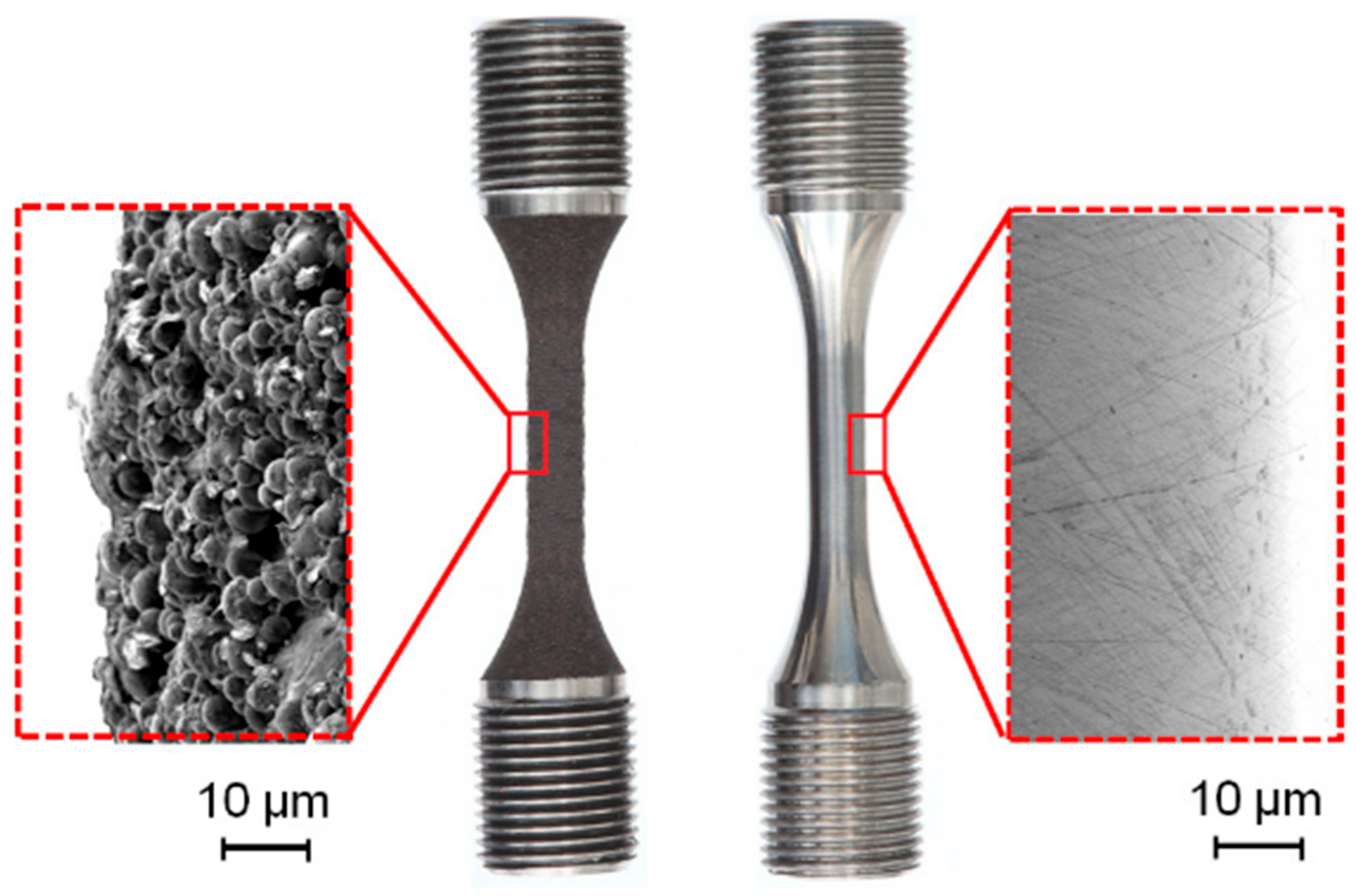
Figure 2.
Schematic of different regions of an AM printed component. Reprinted with permission from Springer Nature [27].
Figure 2.
Schematic of different regions of an AM printed component. Reprinted with permission from Springer Nature [27].
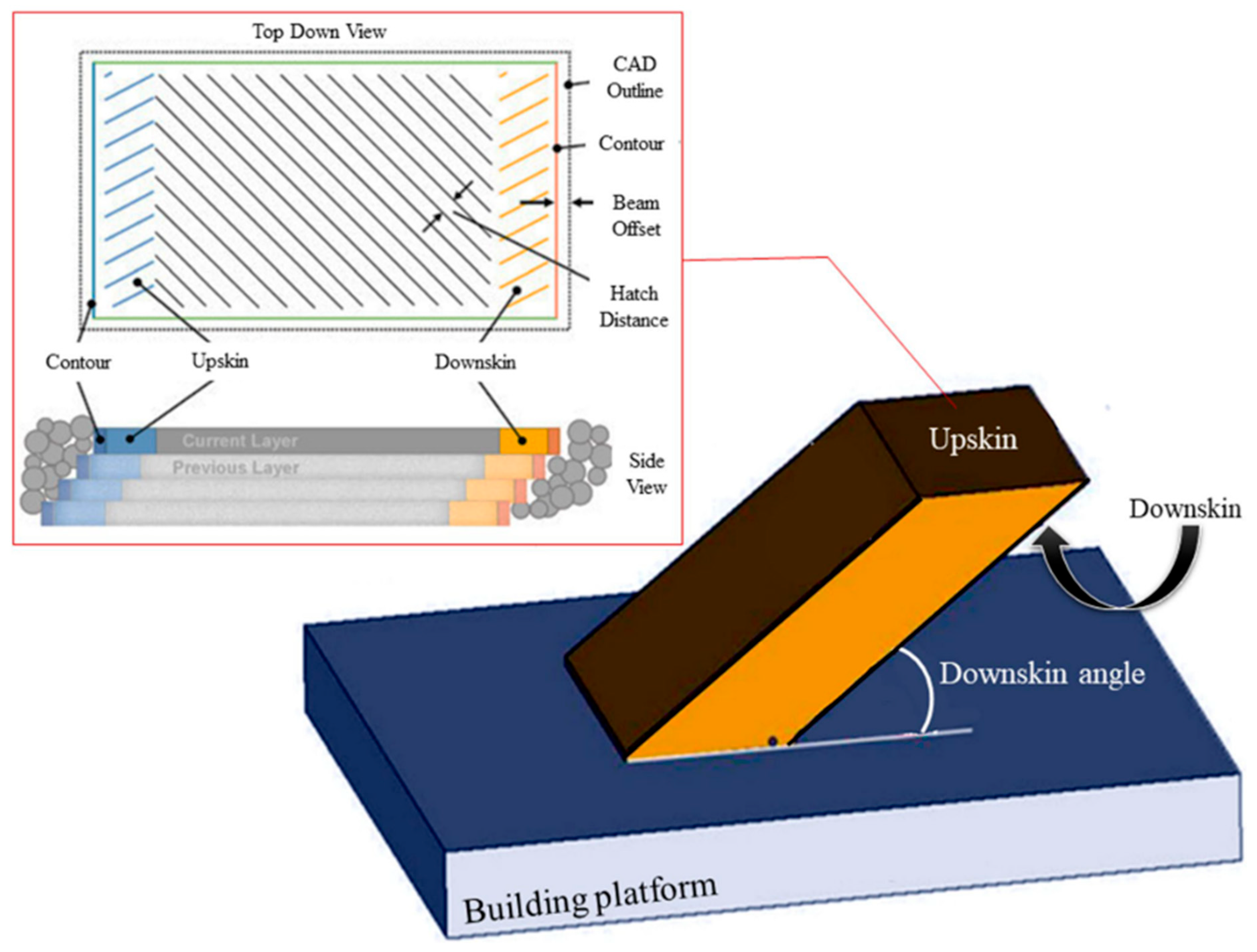
Figure 3.
Schematic illustration of surface topography parameters used to characterize additively manufactured surfaces: (a) profile roughness parameters, including the arithmetic mean roughness (Ra) and maximum valley depth (Rv); (b) areal roughness parameters, including the arithmetic mean surface roughness (Sa) and maximum valley depth (Sv); (c) skewness (Rsk/Ssk), describing the asymmetry of the surface height distribution; and (d) kurtosis (Rku/Sku), describing the prominence of extreme peaks and valleys through the distribution tail weight.
Figure 3.
Schematic illustration of surface topography parameters used to characterize additively manufactured surfaces: (a) profile roughness parameters, including the arithmetic mean roughness (Ra) and maximum valley depth (Rv); (b) areal roughness parameters, including the arithmetic mean surface roughness (Sa) and maximum valley depth (Sv); (c) skewness (Rsk/Ssk), describing the asymmetry of the surface height distribution; and (d) kurtosis (Rku/Sku), describing the prominence of extreme peaks and valleys through the distribution tail weight.
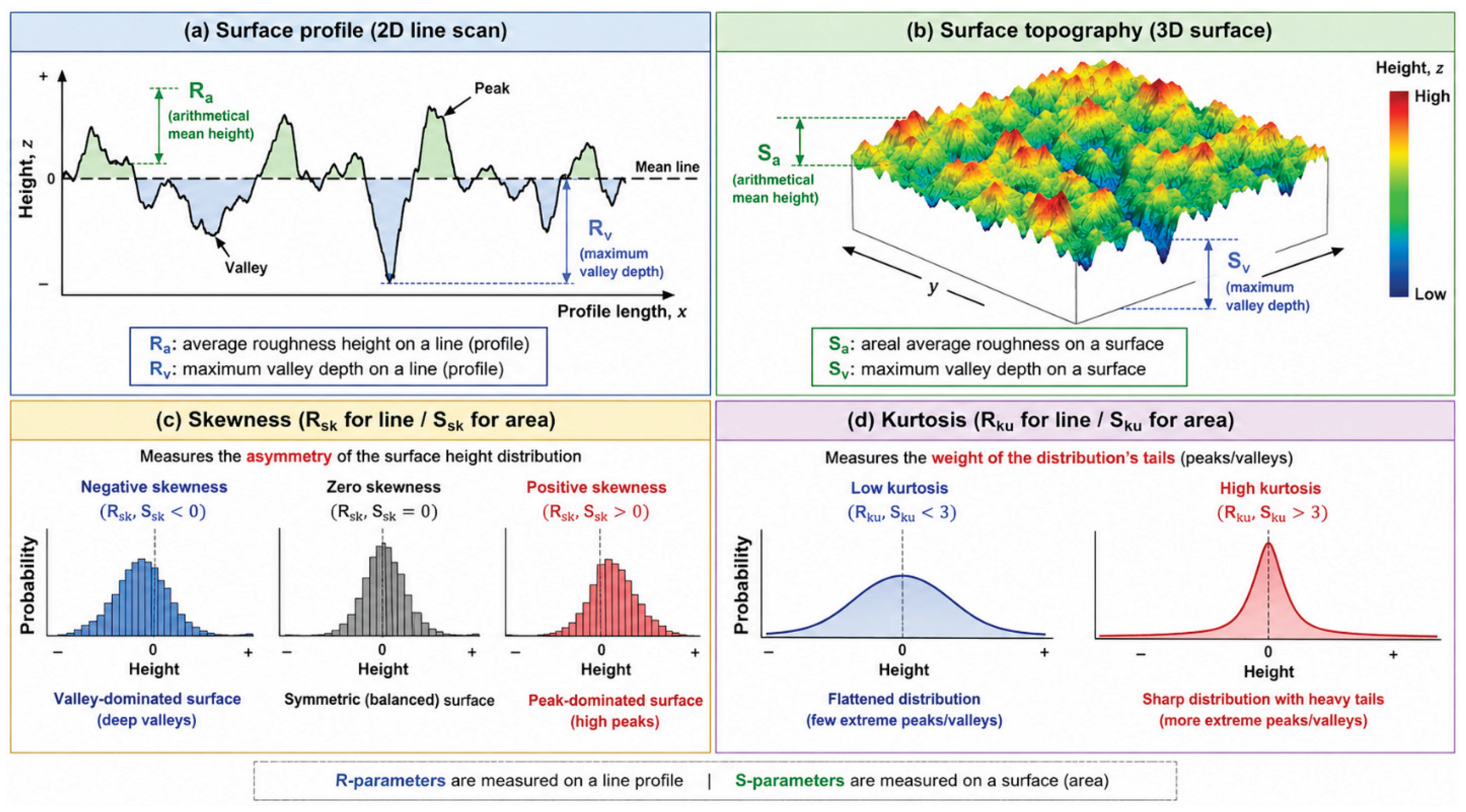

Table 1.
Comparative summary of post-processing surface treatment methods for L-PBF alloys[16,111,113,129,130,131]. Ra reduction is rated qualitatively (* minimal; ** moderate; *** substantial, **** > 95%). CRS: Compressive Residual Stress. CNC: Computer Numerical Control. RS: Residual stress. HIP: Hot Isostatic Pressing.
Table 1.
Comparative summary of post-processing surface treatment methods for L-PBF alloys[16,111,113,129,130,131]. Ra reduction is rated qualitatively (* minimal; ** moderate; *** substantial, **** > 95%). CRS: Compressive Residual Stress. CNC: Computer Numerical Control. RS: Residual stress. HIP: Hot Isostatic Pressing.
| Method | Ra Reduction | CRS Depth | Complex Geometry | Key Limitation |
| Machining / CNC | **** (Ra < 0.5 µm) | Minimal (tensile risk) | Poor | Tensile RS; inaccessible surfaces |
| Shot Peening | * (Ra may increase) | 0.1-0.5 mm | Moderate | Roughness increase; saturation |
| Laser Shock Peening | *(Minimal) | 1-3 mm | Moderate | High cost; ablative coating needed |
| Electrochemical Polishing | *** (Ra < 1 µm) | Slight compressive | Excellent | Tensile RS at grain boundaries |
| Abrasive Flow Machining | *** (Ra 1-4 µm) | Compressive layer | Good (internal) | Non-uniform removal in circuits |
| Laser Polishing | ** (Ra 1-5 µm) | Tensile risk | Good | Residual ripples; tensile RS reintroduction |
| Slide Burnishing | *** (Ra ~0.3 µm) | 0.1-0.3 mm | Moderate | Work-hardening limits; limited depth |
| Rotational Burnishing | *** (Ra ~0.4 µm) | > 0.5 mm; CRS > 1000 MPa | Moderate | Thermal effects; process optimization needed |
| Low Plasticity Burnishing | *** (Ra < 0.5 µm) | 0.2-0.8 mm | Moderate | Multiple passes required for hard alloys |
| ECAB (Current-Assisted) | **** (Ra < 0.3 µm) | > 0.5 mm (enhanced) | Moderate | Specialized setup; current density control |
| HIP + Peening (Hybrid) | *** (after surface step) | 1-3 mm post-peen | Poor for internal channels | High cost; long cycle time |
| Ultrasonic-assisted burnishing | *** (Ra < 0.2 µm) | 0.3-1.0 mm | Moderate | Tool wear; resonant frequency tuning; line-of-sight required |
Disclaimer/Publisher’s Note: The statements, opinions and data contained in all publications are solely those of the individual author(s) and contributor(s) and not of MDPI and/or the editor(s). MDPI and/or the editor(s) disclaim responsibility for any injury to people or property resulting from any ideas, methods, instructions or products referred to in the content. |
© 2026 by the author. Licensee MDPI, Basel, Switzerland. This article is an open access article distributed under the terms and conditions of the Creative Commons Attribution (CC BY) license.
Copyright: This open access article is published under a Creative Commons CC BY 4.0 license, which permit the free download, distribution, and reuse, provided that the author and preprint are cited in any reuse.


