

Submitted:
14 June 2026
Posted:
16 June 2026
You are already at the latest version
Abstract
This study aimed to characterize claudin 18.2 (CLDN18.2) expression in HER2 negative gastric or gastroesophageal junction cancer (GC/GEJC) and to evaluate whether CLDN18.2 status is associated with clinicopathological features and outcomes after first line chemoimmunotherapy. We retrospectively analyzed 189 patients with HER2 negative GC/GEJC treated at our institution from October 2019 to September 2024. CLDN18.2 expression was assessed by immunohistochemistry using two prespecified positivity thresholds: moderate to strong membranous staining (2+) in ≥40% or ≥75% of tumor cells. CLDN18.2 positivity was observed in 92/189 patients (48.7%) using the ≥40% threshold and 69/189 (36.5%) using the ≥75% threshold. PD L1 CPS ≥5 was less frequent in CLDN18.2 positive than in CLDN18.2 negative tumors at both thresholds (≥40%: 8.7% vs. 23.7%, P = 0.003; ≥75%: 8.7% vs. 20.8%, P = 0.019). Among 87 patients receiving first line chemoimmunotherapy, CLDN18.2 status was not associated with significant differences in objective response rate, progression free survival, or overall survival. CLDN18.2 positive tumors showed lower PD L1 expression, but CLDN18.2 status did not identify a subgroup with differential benefit from first line chemoimmunotherapy. These findings support CLDN18.2 primarily as a therapeutic target rather than a predictive biomarker for immune checkpoint inhibitor-based treatment.
Keywords:
Claudin 18.2
; gastric cancer
; gastroesophageal junction cancer
; PD-L1
; chemoimmunotherapy
1. Introduction
Gastric or gastroesophageal junction cancer (GC/GEJC) is the fifth most common cancer and the fourth leading cause of cancer-related death worldwide[1]. Fluoropyrimidine plus platinum chemotherapy remains the backbone of systemic treatment for metastatic GC/GEJC. HER2-targeted therapy and anti-PD-1 antibodies combined with chemotherapy have improved first-line outcomes in selected molecular subgroups, particularly HER2-positive, PD-L1-enriched, or microsatellite instability-high tumors[2,3]. However, many patients have limited or short-lived benefit, and additional therapeutic targets are needed[2,4,5].
Claudin 18.2 (CLDN18.2), a tight-junction protein normally restricted to gastric mucosal epithelial cells, can become exposed on the tumor-cell surface during malignant transformation, making it an attractive and relatively specific therapeutic target in GC/GEJC[6]. The phase II FAST trial first showed that adding zolbetuximab to EOX chemotherapy improved PFS and OS in advanced CLDN18.2-positive G/GEJ adenocarcinoma defined as ≥2+ staining in ≥40% of tumor cells[7]. The phase III SPOTLIGHT and GLOW trials subsequently confirmed survival benefits with zolbetuximab plus chemotherapy in HER2-negative, CLDN18.2-positive disease using the more stringent threshold of ≥2+ staining in ≥75% of tumor cells[8,9]. Beyond monoclonal antibodies, CLDN18.2-directed antibody-drug conjugates and CAR T-cell therapy have shown early clinical activity[10,11,12]. With CLDN18.2-targeted treatment entering clinical practice, the prevalence, clinicopathological correlates, and interaction of CLDN18.2 with established biomarkers such as PD-L1, EBV, and MMR status require further clarification. In particular, whether CLDN18.2 expression predicts response to immune checkpoint inhibitor-based first-line therapy remains uncertain.
To address these questions, we retrospectively analyzed a Chinese cohort of patients with HER2-negative GC/GEJC using both clinically relevant CLDN18.2 positivity thresholds (≥2+ in ≥40% and ≥75% of tumor cells). We evaluated associations between CLDN18.2 expression and clinicopathological or molecular features and examined outcomes among patients treated with first-line chemoimmunotherapy.
2. Materials and Methods
Study Design and Patients
This single-center retrospective study enrolled patients with HER2-negative GC/GEJC who underwent surgery or received systemic therapy at the Second Affiliated Hospital of Soochow University between October 2019 and September 2024. Eligible patients were 18-75 years of age, had histologically confirmed adenocarcinoma, and had available pretreatment primary tumor specimens with CLDN18.2 IHC results. Patients with HER2-positive disease were excluded. Written informed consent was obtained for biomarker testing. The study protocol was approved by the Ethics Committee of the Second Affiliated Hospital of Soochow University (approval number: LK2024059).
Molecular Characterization
Clinicopathological and molecular profiling was performed using formalin-fixed, paraffin-embedded (FFPE) tumor tissue. CLDN18.2 expression was evaluated by IHC with the 43-14A antibody (Roche Ventana). Positivity was defined using two prespecified thresholds: moderate-to-strong (2+) membranous staining in ≥40% or ≥75% of tumor cells. PD-L1 expression was assessed with the 22C3 pharmDx assay (DAKO) and reported as the CPS, calculated as (number of PD-L1-positive tumor cells, lymphocytes, and macrophages / total number of viable tumor cells) × 100; CPS ≥5 was considered positive. HER2 status was determined by IHC with the 4B5 antibody (Roche), and cases scored 3+ or 2+ with confirmatory in situ hybridization were considered HER2-positive. EBV status was detected by EBER in situ hybridization (Ventana INFORM EBER Probe). MMR status was evaluated by IHC for MLH1, MSH2, MSH6, and PMS2 (GeneTech); loss of nuclear expression of any protein was classified as deficient MMR (dMMR), whereas retained expression of all four proteins was classified as proficient MMR (pMMR). All pathological assessments were independently reviewed by two experienced pathologists.
Outcomes and Statistical Analysis
The efficacy endpoints were objective response rate (ORR), progression-free survival (PFS), and overall survival (OS). Tumor response was evaluated according to RECIST version 1.1 in patients with measurable lesions. PFS was defined as the interval from initiation of first-line chemoimmunotherapy to disease progression or death from any cause. OS was defined as the interval from initiation of first-line chemoimmunotherapy to death from any cause or last follow-up.
Categorical variables were compared using the chi-square test or Fisher’s exact test, as appropriate. Survival curves were estimated using the Kaplan-Meier method and compared with the log-rank test. Univariate and multivariate Cox proportional hazards models were used to estimate hazard ratios (HRs) and 95% confidence intervals (CIs). Multivariate models included clinically relevant variables and biomarkers with potential prognostic relevance. Statistical analyses were conducted using SPSS (version 21.0; IBM Corp.) and jamovi (version 2.6.22). Two-sided P values <0.05 were considered statistically significant.
3. Results
A total of 189 patients were included (median age, 69 years; 139/189 [73.5%] male). Tumor specimens consisted of 77 endoscopic biopsies and 112 surgical resections. Using the ≥40% threshold, CLDN18.2 positivity was observed in 92 patients (48.7%), broadly consistent with the FAST trial. Using the ≥75% threshold, 69 patients (36.5%) were CLDN18.2-positive.
At both thresholds, CLDN18.2-positive tumors had a significantly lower prevalence of PD-L1 CPS ≥5 than CLDN18.2-negative tumors (≥40% threshold: 8.7% vs. 23.7%, P = 0.003; ≥75% threshold: 8.7% vs. 20.8%, P = 0.019). No significant differences were observed by age, sex, specimen type, histological type, differentiation, stage, MMR status, EBV status, or HER2 expression category (Table 1 and Table 2).
Among the 189 patients, 135 had evaluable results for all four biomarkers included in the co-expression analysis: CLDN18.2 (using the ≥75% threshold), PD-L1 CPS, EBV status, and MMR status. The distribution and overlap of these biomarkers are shown in Figure 1.
Venn diagram showing overlap among CLDN18.2 positivity (≥75% threshold), PD-L1 CPS ≥5, EBV positivity, and dMMR status. Among 135 evaluable patients, 50 (37.0%) were CLDN18.2-positive, 25 (18.5%) had PD-L1 CPS ≥5, 6 (4.4%) were EBV-positive, and 6 (4.4%) had dMMR. Overlaps included CLDN18.2/PD-L1 (n = 4) and CLDN18.2/EBV (n = 2). Fifty-nine patients had none of these positive biomarkers.
Among the 189 patients, 87 received first-line chemoimmunotherapy. None received zolbetuximab, reflecting real-world practice during the study period. Baseline characteristics by CLDN18.2 status using the ≥40% and ≥75% thresholds are shown in Table 3 and Table 4. Median follow-up in this subgroup was 15.3 months. Three patients lacked evaluable lesions and were excluded from ORR and PFS analyses; therefore, 84 patients were response-evaluable. ORR did not differ significantly between CLDN18.2-negative and -positive groups at either threshold (≥40%: 20/45 [44.4%] vs. 13/39 [33.3%], P = 0.298; ≥75%: 26/61 [42.6%] vs. 7/23 [30.4%], P = 0.308).
Survival outcomes were also comparable by CLDN18.2 status. Using the ≥40% threshold, median PFS was 8.27 months (95% CI, 6.37-10.2) in CLDN18.2-negative patients and 6.97 months (95% CI, 6.27-13.2) in CLDN18.2-positive patients (HR, 0.95; 95% CI, 0.59-1.52; P = 0.828). Median OS was 16.1 months (95% CI, 13.4-19.9) and 14.9 months (95% CI, 12.5-19.8), respectively (HR, 1.00; 95% CI, 0.63-1.60; P = 0.997) (Figure 2A and 3A). Using the ≥75% threshold, median PFS was 8.27 months (95% CI, 6.63-10.2) in CLDN18.2-negative patients and 6.77 months (95% CI, 5.23-15.0) in CLDN18.2-positive patients (HR, 1.15; 95% CI, 0.68-1.94; P = 0.599). Median OS was 16.1 months (95% CI, 13.4-19.5) and 14.4 months (95% CI, 11.9-21.6), respectively (HR, 1.19; 95% CI, 0.71-2.02; P = 0.507) (Figure 2B and 3B).
Kaplan-Meier curves showing PFS in 84 patients receiving first-line chemoimmunotherapy, stratified by CLDN18.2 status using the ≥40% threshold (A) and the ≥75% threshold (B). P values were calculated with the log-rank test.
Figure 3.
Overall survival according to CLDN18.2 expression status.
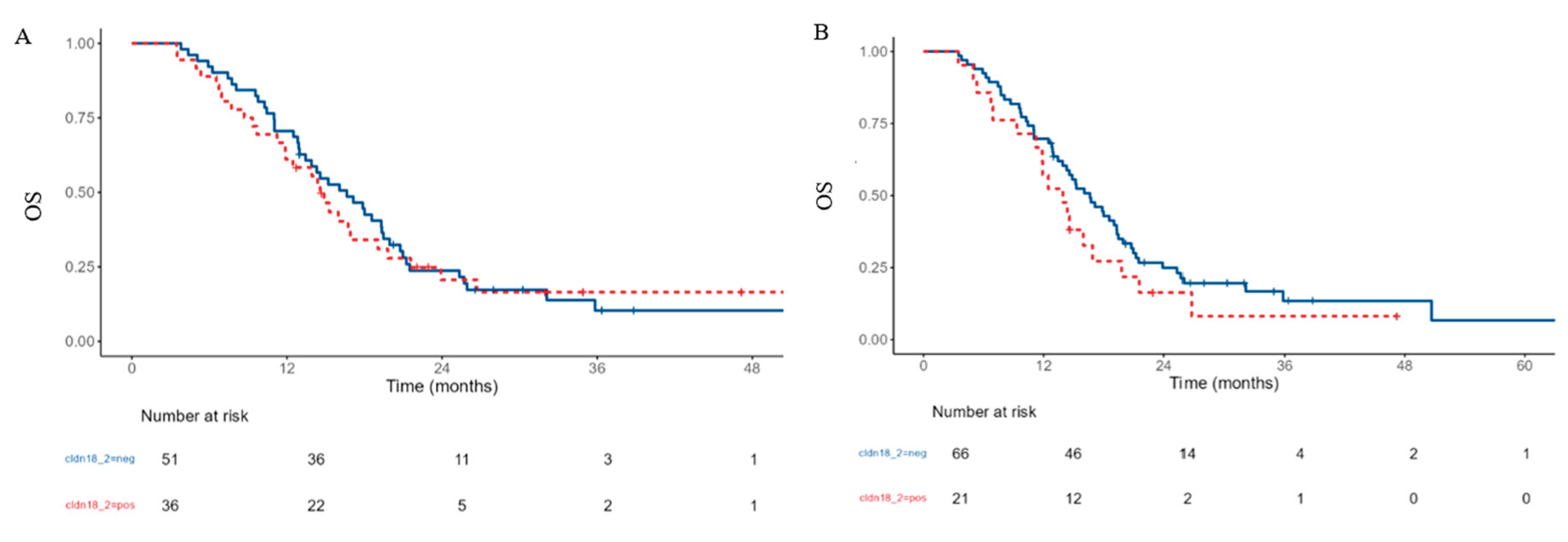
Kaplan-Meier curves showing OS in 87 patients receiving first-line chemoimmunotherapy, stratified by CLDN18.2 status using the ≥40% threshold (A) and the ≥75% threshold (B). P values were calculated with the log-rank test.
4. Discussion
The clinical significance of CLDN18.2 in GC/GEJC remains incompletely defined because published studies differ in disease stage, sampling method, antibody clone, staining platform, and positivity threshold[13,14,15,16,17,18]. In this single-center Chinese cohort of 189 patients with HER2-negative GC/GEJC, we applied both the FAST-derived threshold (≥2+ staining in ≥40% of tumor cells) and the SPOTLIGHT/GLOW threshold (≥2+ staining in ≥75% of tumor cells). The main findings were that CLDN18.2 positivity was common, was associated with lower PD-L1 CPS ≥5 prevalence, and was not associated with ORR, PFS, or OS among patients receiving first-line chemoimmunotherapy.
The CLDN18.2 positivity rate in our cohort was 48.7% using the ≥40% threshold, within the range reported in the FAST trial and Asian real-world series[7,14,16,19]. When the ≥75% threshold was applied, the rate decreased to 36.5%, close to the 38.4% prevalence reported across SPOTLIGHT and GLOW and within the range of other contemporary studies using similar criteria[13,14,15,17,20]. Differences across studies are likely driven by patient ethnicity, disease stage, sampling site, antibody clone, staining platform, and scoring threshold[20,21,22,23]. These factors underscore the need for standardized CLDN18.2 testing and careful reporting of the exact assay and cutoff used.
We did not observe statistically significant associations between CLDN18.2 status and sex, age, Lauren classification, tumor location, differentiation, or stage. Although several studies have linked CLDN18.2 expression with diffuse-type histology, others using contemporary diagnostic antibodies and thresholds have reported broadly similar positivity across Lauren subtypes[13,15,20,24]. Our data therefore support testing for CLDN18.2 regardless of histological subtype, particularly as CLDN18.2-targeted therapies are considered for HER2-negative disease.
Biopsy and surgical specimens showed comparable CLDN18.2 positivity rates in our cohort. This is clinically relevant because treatment decisions in advanced GC/GEJC often rely on endoscopic biopsy material. Prior analyses using virtual biopsies and paired specimens suggest that CLDN18.2 assessment is affected by intratumoral heterogeneity, but diagnostic sensitivity improves as the number of biopsy fragments increases, with limited incremental gain beyond approximately six fragments[13,20]. When CLDN18.2 testing is performed on biopsy material, adequate sampling and careful pathological review remain essential.
An important finding of our study was the lower prevalence of PD-L1 CPS ≥5 among CLDN18.2-positive tumors at both thresholds. In SPOTLIGHT and GLOW, PD-L1 CPS ≥5 was reported in 13.2% and 21.9% of CLDN18.2-positive tumors, respectively, lower than the proportions reported in some first-line immunotherapy trials enrolling patients irrespective of CLDN18.2 status[2,3,8,9,20]. However, retrospective cohorts using similar CLDN18.2 assays have not consistently confirmed an inverse association between CLDN18.2 and PD-L1 expression[13,15]. The lower PD-L1 positivity in our cohort may reflect biological differences, such as an immunologically less inflamed tumor microenvironment, or cohort-specific factors, including referral patterns, local PD-L1 prescreening, and missing PD-L1 data. These possibilities should be tested in larger cohorts with paired immune-microenvironment profiling.
We did not identify a significant association between CLDN18.2 status and EBV or MMR status. Earlier studies suggested enrichment of CLDN18.2 expression in EBV-positive tumors, whereas more recent advanced-disease cohorts have shown similar CLDN18.2 prevalence across EBV and MMR subgroups[14,15,17,20,24,25]. In our cohort, the small numbers of EBV-positive and dMMR tumors limited statistical power; therefore, absence of association should be interpreted cautiously.
Despite lower PD-L1 expression in CLDN18.2-positive tumors, first-line chemoimmunotherapy produced comparable ORR, PFS, and OS in CLDN18.2-positive and -negative patients. This finding suggests that CLDN18.2 status alone should not be used to exclude patients from immune checkpoint inhibitor-based first-line therapy. Our results are consistent with the study by Kim et al., in which outcomes with first-line nivolumab plus chemotherapy did not differ by CLDN18.2 status using the ≥75% threshold[17], and with the broader clinical and molecular analysis by Kubota et al., which found no clear impact of CLDN18.2 on chemotherapy or anti-PD-1 outcomes[15]. In contrast, Qi et al. reported poorer immunotherapy-related PFS and OS in CLDN18.2-positive advanced gastric cancer[14]. Differences in treatment line, PD-1 inhibitor exposure, threshold selection (≥70% vs. ≥75%), sample size, and immune contexture may explain these divergent results. Our cohort adds China-specific real-world data in the first-line chemoimmunotherapy setting and includes both clinically relevant CLDN18.2 cutoffs.
In multivariate analyses, CLDN18.2 was not independently associated with OS or PFS. Age ≥65 years was associated with worse survival, whereas PD-L1 CPS ≥5 was associated with a lower risk of death in the model using the ≥75% CLDN18.2 threshold, with a similar trend in the ≥40% model. These findings are directionally consistent with first-line immunotherapy trials and meta-analyses showing greater benefit from PD-1 blockade in PD-L1-enriched gastric and gastroesophageal junction cancers[2,3,26,27]. Because the treated subgroup was small, these covariate associations should be viewed as exploratory rather than definitive.
The optimal first-line strategy for HER2-negative, CLDN18.2-positive GC/GEJC remains unsettled. Zolbetuximab plus chemotherapy has demonstrated survival benefits in FAST, SPOTLIGHT, and GLOW[7,8,9], but prospective head-to-head comparisons with PD-1-based chemoimmunotherapy are lacking, and real-world data for zolbetuximab-containing regimens are still emerging. For patients with CLDN18.2-positive and PD-L1-low tumors, a CLDN18.2-targeted regimen may be an attractive option; however, dMMR/MSI-H status, EBV status, performance status, toxicity, reimbursement, and planned treatment sequence also need to be considered[18,27,28,29,30]. Future studies should evaluate integrated biomarker algorithms that combine CLDN18.2, PD-L1 CPS, MMR/EBV status, genomic alterations, and digital-pathology or artificial-intelligence-derived immune features[31].
Limitations
This study has several limitations. First, its retrospective, single-center design introduces selection bias and limits generalizability. Second, the first-line chemoimmunotherapy subgroup was modest in size, reducing power for subgroup and multivariate analyses. Third, CLDN18.2 was assessed mainly on archival primary-tumor FFPE samples; preanalytical variation, temporal changes, and intratumoral or intertumoral heterogeneity could influence IHC classification. Fourth, PD-L1, EBV, and MMR results were not available for all patients, and PD-L1 was assessed with a single CPS threshold. Fifth, the study lacked a chemotherapy-alone control group, so it cannot determine whether CLDN18.2 is predictive of incremental benefit from immune checkpoint inhibition. Finally, multiple PD-1 inhibitors and chemotherapy backbones were used in real-world practice, which improves clinical relevance but introduces treatment heterogeneity.
5. Conclusions
In this HER2-negative GC/GEJC cohort, CLDN18.2 expression was common and was associated with lower PD-L1 CPS ≥5 prevalence. However, CLDN18.2 status did not predict ORR, PFS, or OS among patients receiving first-line chemoimmunotherapy and was not an independent prognostic factor after adjustment for clinicopathological variables and biomarkers. These results support CLDN18.2 primarily as an actionable therapeutic target rather than a stand-alone predictive biomarker for immune checkpoint inhibitor-based therapy. Prospective studies using standardized CLDN18.2 assays and integrated biomarker stratification are warranted to guide first-line treatment selection.
Author Contributions
Run Bao and Jing Qin contributed equally to this work. Run Bao and Jing Qin: conceptualization, methodology, investigation, formal analysis, visualization, writing – original draft. Rong Zhang, Zhuo Xu, Jiahao Liu and Jiaofeng Shen: data curation, validation, writing – review & editing. Shunji Zhang, Chunyan Huang, and Yan Lu: data curation, investigation. Yusong Zhang and Hong Zhu: validation, supervision, writing – review and editing. Wangyang Pu and Tianhua Liu: conceptualization, resources, supervision, funding acquisition, writing – review and editing. All authors have read and agreed to the published version of the manuscript. .
Funding
This work was supported by WU JIEPING MEDICAL FOUNDATION (320.6750.2025-06-271), China Zhongguancun Precision Medicine Science and Technology Foundation (GYLZH70), Suzhou Medical College of Soochow University - Qilu Medical Research Fund (24QL200107), and The Second Affiliated Hospital of Soochow University Scientific Research Pre-Research Fund (SDFEYGZ2322).
Institutional Review Board Statement
The study was conducted in accordance with the Declaration of Helsinki and approved by the Ethics Committee of the Second Affiliated Hospital of Soochow University (Approval No. LK2024059). The date of approval is not specified in the approval letter but is available upon request.
Informed Consent Statement
Patient consent was waived due to the retrospective nature of the study and the use of anonymized clinical data.
Data Availability Statement
The datasets generated and/or analyzed during the current study are available from the corresponding author on reasonable request. The data are not publicly available due to patient privacy and ethical restrictions.
Acknowledgments
We thank the patients and their families for their participation, and are grateful to the Department of Pathology and the Endoscopy Center at the Second Affiliated Hospital of Soochow University for their technical support and assistance in sample collection and immunohistochemical staining.
Conflicts of Interest
The authors declare no conflict of interest. The sponsors had no role in the design, execution, interpretation, or writing of the study.
Abbreviations
The following abbreviations are used in this manuscript:
| ADCs | Antibody‒drug conjugates |
| CAR-T | Chimeric antigen receptor T cells |
| CIs | Confidence intervals |
| CLDN18.2 | Claudin 18.2 |
| CPS | Combined positive score |
| dMMR | Deficient mismatch repair |
| EBV | Epstein Barr virus |
| FFPE | Formalin-fixed, paraffin-embedded |
| GC/GEJC | Gastric or gastroesophageal junction cancers |
| HRs | Hazard ratios |
| IHC | Immunohistochemistry |
| MMR | Mismatch repair |
| ORR | Objective response rate |
| OS | Overall survival |
| pMMR | Proficient mismatch repair |
| PFS | Progression-free survival |
References
- Bray, F.; Laversanne, M.; Sung, H.; Ferlay, J.; Siegel, R.L.; Soerjomataram, I.; Jemal, A. Global cancer statistics 2022: GLOBOCAN estimates of incidence and mortality worldwide for 36 cancers in 185 countries. CA Cancer J. Clin. 2024, 74, 229–263. [Google Scholar] [CrossRef] [PubMed]
- Janjigian, Y.Y.; Shitara, K.; Moehler, M.; Garrido, M.; Salman, P.; Shen, L.; Wyrwicz, L.; Yamaguchi, K.; Skoczylas, T.; Campos Bragagnoli, A.; et al. First-line nivolumab plus chemotherapy versus chemotherapy alone for advanced gastric, gastro-oesophageal junction, and oesophageal adenocarcinoma (CheckMate 649): a randomised, open-label, phase 3 trial. Lancet 2021, 398, 27–40. [Google Scholar] [CrossRef] [PubMed]
- Rha, S.Y.; Oh, D.Y.; Yanez, P.; Bai, Y.; Ryu, M.H.; Lee, J.; Rivera, F.; Alves, G.V.; Garrido, M.; Shiu, K.K.; et al. Pembrolizumab plus chemotherapy versus placebo plus chemotherapy for HER2-negative advanced gastric cancer (KEYNOTE-859): a multicentre, randomised, double-blind, phase 3 trial. Lancet Oncol. 2023, 24, 1181–1195. [Google Scholar] [CrossRef] [PubMed]
- Cunningham, D.; Starling, N.; Rao, S.; Iveson, T.; Nicolson, M.; Coxon, F.; Middleton, G.; Daniel, F.; Oates, J.; Norman, A.R. Capecitabine and oxaliplatin for advanced esophagogastric cancer. N Engl. J. Med. 2008, 358, 36–46. [Google Scholar] [CrossRef] [PubMed]
- Chung, H.C.; Bang, Y.J.; C, S.F.; Qin, S.K.; Satoh, T.; Shitara, K.; Tabernero, J.; Van Cutsem, E.; Alsina, M.; Cao, Z.A.; et al. First-line pembrolizumab/placebo plus trastuzumab and chemotherapy in HER2-positive advanced gastric cancer: KEYNOTE-811. Future Oncol. 2021, 17, 491–501. [Google Scholar] [CrossRef] [PubMed]
- Sahin, U.; Koslowski, M.; Dhaene, K.; Usener, D.; Brandenburg, G.; Seitz, G.; Huber, C.; Türeci, O. Claudin-18 splice variant 2 is a pan-cancer target suitable for therapeutic antibody development. Clin. Cancer Res. 2008, 14, 7624–7634. [Google Scholar] [CrossRef] [PubMed]
- Sahin, U.; Tureci, O.; Manikhas, G.; Lordick, F.; Rusyn, A.; Vynnychenko, I.; Dudov, A.; Bazin, I.; Bondarenko, I.; Melichar, B.; et al. FAST: a randomised phase II study of zolbetuximab (IMAB362) plus EOX versus EOX alone for first-line treatment of advanced CLDN18.2-positive gastric and gastro-oesophageal adenocarcinoma. Ann. Oncol. 2021, 32, 609–619. [Google Scholar] [CrossRef] [PubMed]
- Shah, M.A.; Shitara, K.; Ajani, J.A.; Bang, Y.J.; Enzinger, P.; Ilson, D.; Lordick, F.; Van Cutsem, E.; Gallego Plazas, J.; Huang, J.; et al. Zolbetuximab plus CAPOX in CLDN18.2-positive gastric or gastroesophageal junction adenocarcinoma: the randomized, phase 3 GLOW trial. Nat. Med. 2023, 29, 2133–2141. [Google Scholar] [CrossRef] [PubMed]
- Shitara, K.; Lordick, F.; Bang, Y.J.; Enzinger, P.; Ilson, D.; Shah, M.A.; Van Cutsem, E.; Xu, R.H.; Aprile, G.; Xu, J.; et al. Zolbetuximab plus mFOLFOX6 in patients with CLDN18.2-positive, HER2-negative, untreated, locally advanced unresectable or metastatic gastric or gastro-oesophageal junction adenocarcinoma (SPOTLIGHT): a multicentre, randomised, double-blind, phase 3 trial. Lancet 2023, 401, 1655–1668. [Google Scholar] [CrossRef] [PubMed]
- Ruan, D.Y.; Liu, F.R.; Wei, X.L.; Luo, S.X.; Zhuang, Z.X.; Wang, Z.N.; Liu, F.N.; Zhang, Y.Q.; Yang, J.W.; Chen, Z.D.; et al. Claudin 18.2-targeting antibody-drug conjugate CMG901 in patients with advanced gastric or gastro-oesophageal junction cancer (KYM901): a multicentre, open-label, single-arm, phase 1 trial. Lancet Oncol. 2025, 26, 227–238. [Google Scholar] [CrossRef] [PubMed]
- Liu, J.; Yang, J.; Sun, Y.; Gong, J.; Yue, J.; Pan, Y.; Sun, M.; Song, R.; Xiao, X.; Tazbirkova, A.; et al. CLDN18.2-targeting antibody-drug conjugate IBI343 in advanced gastric or gastroesophageal junction adenocarcinoma: a phase 1 trial. Nat. Med. 2025, 31, 3028–3036. [Google Scholar] [CrossRef] [PubMed]
- Qi, C.; Liu, C.; Peng, Z.; Zhang, Y.; Wei, J.; Qiu, W.; Zhang, X.; Pan, H.; Niu, Z.; Qiu, M.; et al. Claudin-18 isoform 2-specific CAR T-cell therapy (satri-cel) versus treatment of physician’s choice for previously treated advanced gastric or gastro-oesophageal junction cancer (CT041-ST-01): a randomised, open-label, phase 2 trial. Lancet 2025, 405, 2049–2060. [Google Scholar] [CrossRef] [PubMed]
- Pellino, A.; Brignola, S.; Riello, E.; Niero, M.; Murgioni, S.; Guido, M.; Nappo, F.; Businello, G.; Sbaraglia, M.; Bergamo, F.; et al. Association of CLDN18 Protein Expression with Clinicopathological Features and Prognosis in Advanced Gastric and Gastroesophageal Junction Adenocarcinomas. J. Pers. Med. 2021, 11. [Google Scholar] [CrossRef] [PubMed]
- Qi, C.; Chong, X.; Zhou, T.; Ma, M.; Gong, J.; Zhang, M.; Li, J.; Xiao, J.; Peng, X.; Liu, Z.; et al. Clinicopathological significance and immunotherapeutic outcome of claudin 18.2 expression in advanced gastric cancer: A retrospective study. Chin. J. Cancer Res. 2024, 36, 78–89. [Google Scholar] [CrossRef] [PubMed]
- Kubota, Y.; Kawazoe, A.; Mishima, S.; Nakamura, Y.; Kotani, D.; Kuboki, Y.; Bando, H.; Kojima, T.; Doi, T.; Yoshino, T.; et al. Comprehensive clinical and molecular characterization of claudin 18.2 expression in advanced gastric or gastroesophageal junction cancer. ESMO Open 2023, 8, 100762. [Google Scholar] [CrossRef] [PubMed]
- Jia, K.; Chen, Y.; Sun, Y.; Hu, Y.; Jiao, L.; Ma, J.; Yuan, J.; Qi, C.; Li, Y.; Gong, J.; et al. Multiplex immunohistochemistry defines the tumor immune microenvironment and immunotherapeutic outcome in CLDN18.2-positive gastric cancer. BMC Med. 2022, 20, 223. [Google Scholar] [CrossRef] [PubMed]
- Kim, H.D.; Shin, J.; Hyung, J.; Lee, H.; Moon, M.; Ma, J.; Park, Y.S.; Ryu, M.H. Survival outcomes of patients with gastric cancer treated with first-line nivolumab plus chemotherapy based on claudin 18.2 expression. Gastric Cancer 2025, 28, 74–82. [Google Scholar] [CrossRef] [PubMed]
- Miyajima, Y.; Kawakami, T. Treatment Selection for Patients with HER2-Negative Metastatic Gastric Cancer Expressing Claudin 18.2 and PD-L1. Cancers 2025, 17. [Google Scholar] [CrossRef] [PubMed]
- Rohde, C.; Yamaguchi, R.; Mukhina, S.; Sahin, U.; Itoh, K.; Tureci, O. Comparison of Claudin 18.2 expression in primary tumors and lymph node metastases in Japanese patients with gastric adenocarcinoma. Jpn. J. Clin. Oncol. 2019, 49, 870–876. [Google Scholar] [CrossRef] [PubMed]
- Shitara, K.; Xu, R.H.; Ajani, J.A.; Moran, D.; Guerrero, A.; Li, R.; Pavese, J.; Matsangou, M.; Bhattacharya, P.; Ueno, Y.; et al. Global prevalence of claudin 18 isoform 2 in tumors of patients with locally advanced unresectable or metastatic gastric or gastroesophageal junction adenocarcinoma. Gastric Cancer 2024, 27, 1058–1068. [Google Scholar] [CrossRef] [PubMed]
- Kayikcioglu, E.; Yuceer, R.O.; Cetin, B.; Yuceer, K.; Karahan, N. Prognostic value of claudin 18.2 expression in gastric adenocarcinoma. World J. Gastrointest. Oncol. 2023, 15, 343–351. [Google Scholar] [CrossRef] [PubMed]
- Arnold, A.; Daum, S.; von Winterfeld, M.; Berg, E.; Hummel, M.; Rau, B.; Stein, U.; Treese, C. Prognostic impact of Claudin 18.2 in gastric and esophageal adenocarcinomas. Clin. Transl. Oncol. 2020, 22, 2357–2363. [Google Scholar] [CrossRef] [PubMed]
- Hong, J.Y.; An, J.Y.; Lee, J.; Park, S.H.; Park, J.O.; Park, Y.S.; Lim, H.Y.; Kim, K.M.; Kang, W.K.; Kim, S.T. Claudin 18.2 expression in various tumor types and its role as a potential target in advanced gastric cancer. Transl. Cancer Res. 2020, 9, 3367–3374. [Google Scholar] [CrossRef] [PubMed]
- Dottermusch, M.; Krüger, S.; Behrens, H.M.; Halske, C.; Röcken, C. Expression of the potential therapeutic target claudin-18.2 is frequently decreased in gastric cancer: results from a large Caucasian cohort study. Virchows Arch. 2019, 475, 563–571. [Google Scholar] [CrossRef] [PubMed]
- Coati, I.; Lotz, G.; Fanelli, G.N.; Brignola, S.; Lanza, C.; Cappellesso, R.; Pellino, A.; Pucciarelli, S.; Spolverato, G.; Guzzardo, V.; et al. Claudin-18 expression in oesophagogastric adenocarcinomas: a tissue microarray study of 523 molecularly profiled cases. Br. J. Cancer 2019, 121, 257–263. [Google Scholar] [CrossRef] [PubMed]
- Xu, J.; Jiang, H.; Pan, Y.; Gu, K.; Cang, S.; Han, L.; Shu, Y.; Li, J.; Zhao, J.; Pan, H.; et al. Sintilimab Plus Chemotherapy for Unresectable Gastric or Gastroesophageal Junction Cancer: The ORIENT-16 Randomized Clinical Trial. JAMA 2023, 330, 2064–2074. [Google Scholar] [CrossRef] [PubMed]
- Zhao, J.J.; Yap, D.W.T.; Chan, Y.H.; Tan, B.K.J.; Teo, C.B.; Syn, N.L.; Smyth, E.C.; Soon, Y.Y.; Sundar, R. Low Programmed Death-Ligand 1-Expressing Subgroup Outcomes of First-Line Immune Checkpoint Inhibitors in Gastric or Esophageal Adenocarcinoma. J. Clin. Oncol. 2022, 40, 392–402. [Google Scholar] [CrossRef] [PubMed]
- Nakayama, I.; Qi, C.; Chen, Y.; Nakamura, Y.; Shen, L.; Shitara, K. Claudin 18.2 as a novel therapeutic target. Nat. Rev. Clin. Oncol. 2024, 21, 354–369. [Google Scholar] [CrossRef] [PubMed]
- Park, Y.G.; Kim, H.D.; Hyung, J.; Park, Y.S.; Ryu, M.H. Factors associated with the efficacy of first-line nivolumab plus chemotherapy in advanced gastric cancer patients with deficient mismatch repair. Gastric Cancer 2024, 27, 840–849. [Google Scholar] [CrossRef] [PubMed]
- Kang, Y.K.; Boku, N.; Satoh, T.; Ryu, M.H.; Chao, Y.; Kato, K.; Chung, H.C.; Chen, J.S.; Muro, K.; Kang, W.K.; et al. Nivolumab in patients with advanced gastric or gastro-oesophageal junction cancer refractory to, or intolerant of, at least two previous chemotherapy regimens (ONO-4538-12, ATTRACTION-2): a randomised, double-blind, placebo-controlled, phase 3 trial. Lancet 2017, 390, 2461–2471. [Google Scholar] [CrossRef] [PubMed]
- Chen, Z.; Chen, Y.; Sun, Y.; Tang, L.; Zhang, L.; Hu, Y.; He, M.; Li, Z.; Cheng, S.; Yuan, J.; et al. Predicting gastric cancer response to anti-HER2 therapy or anti-HER2 combined immunotherapy based on multi-modal data. Signal Transduct. Target Ther. 2024, 9, 222. [Google Scholar] [CrossRef] [PubMed]
Figure 1.
Co-expression landscape of CLDN18.2 with PD-L1, EBV, and MMR status in HER2-negative GC/GEJC.
Figure 1.
Co-expression landscape of CLDN18.2 with PD-L1, EBV, and MMR status in HER2-negative GC/GEJC.
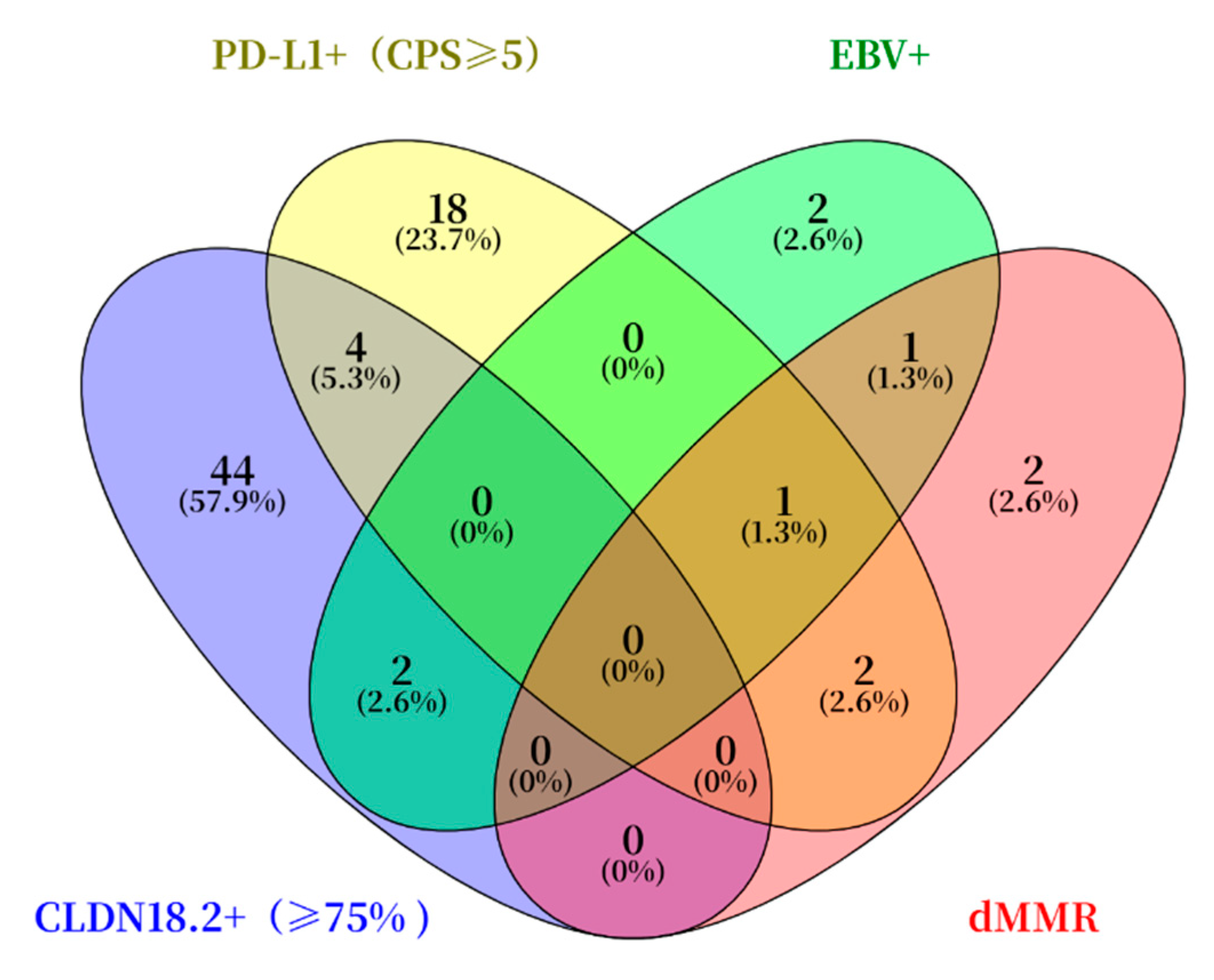
Figure 2.
Progression-free survival according to CLDN18.2 expression status.
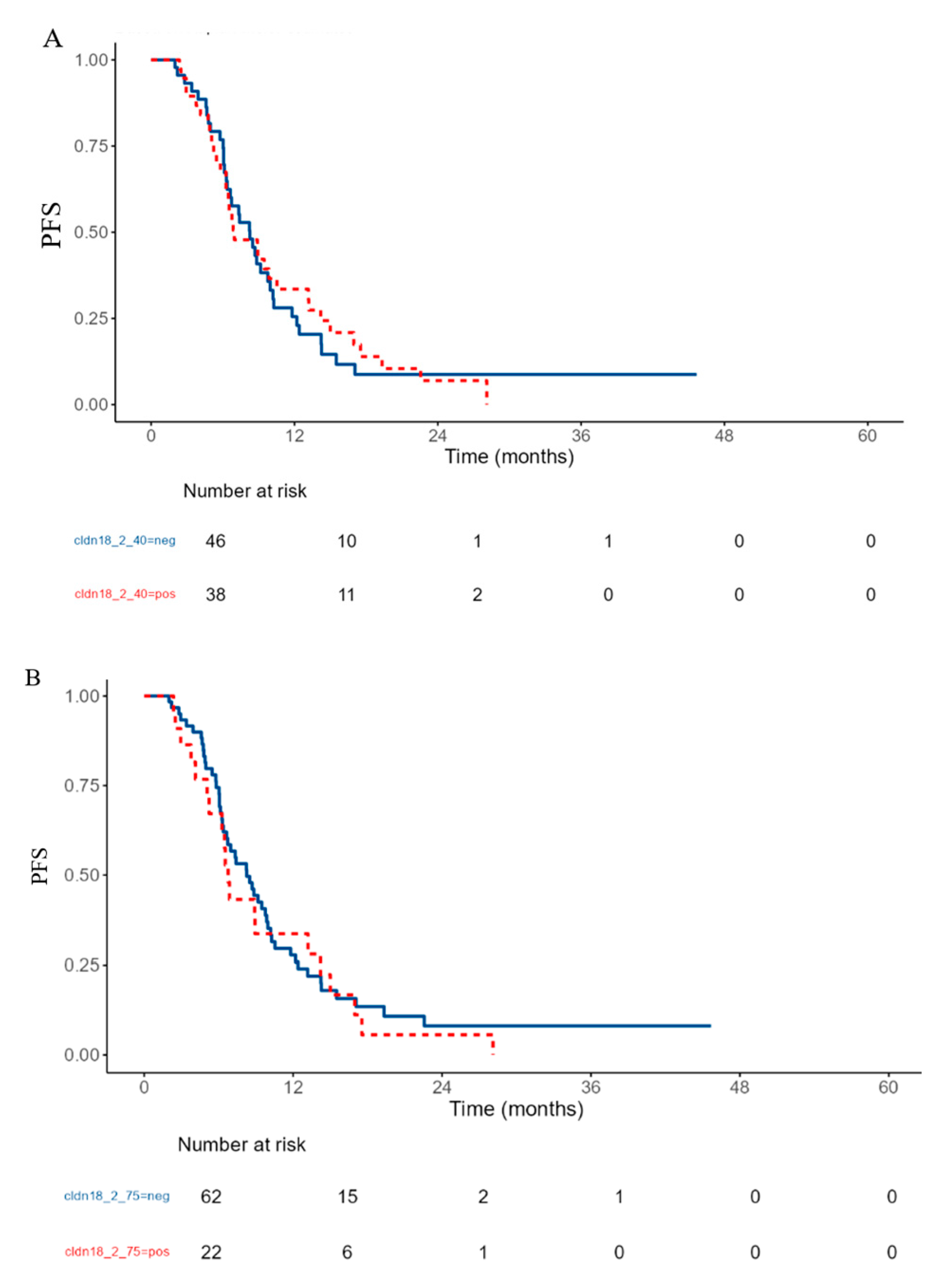

Table 1.
Clinicopathological and molecular characteristics stratified by CLDN18.2 status (cutoff: ≥2+ in ≥40% of tumor cells).
Table 1.
Clinicopathological and molecular characteristics stratified by CLDN18.2 status (cutoff: ≥2+ in ≥40% of tumor cells).
| n (%) | |||
| Characteristics | CLDN18.2+ (n = 92, 48.7%) | CLDN18.2- (n = 97, 51.3%) | P value |
| Age, years | |||
| <65 | 34(37.0%) | 31(32.0%) | |
| ≥65 | 58(63.0%) | 66(68.0%) | 0.47 |
| Sex | |||
| Male | 63 (68.5%) | 76(78.4%) | |
| Female | 29(31.5%) | 21(21.6%) | 0.124 |
| Histological type | |||
| Intestinal | 11(11.9%) | 5(5.2%) | |
| Diffuse | 17(18.5%) | 12 (12.4%) | |
| Mixed | 25(27.2%) | 26 (26.8%) | 0.348 |
| Not available | 39(42.4%) | 54(55.6%) | |
| Primary tumor location at initial diagnosis | |||
| Gastroesophageal junction cancer | 20(21.7%) | 29(29.9%) | 0.201 |
| Gastric cancer | 72(78.3%) | 68(70.1%) | |
| Differentiation | |||
| Moderate | 7(7.6%) | 5(5.2%) | 0.829 |
| Moderate-poor | 15(16.3%) | 13(13.4%) | |
| Poor | 59(64.1%) | 59(60.8%) | |
| Not available | 11(12.0%) | 20(20.6%) | |
| MMR | |||
| pMMR | 89(96.7%) | 92(94.8%) | 0.518 |
| dMMR | 3(3.3%) | 5(5.2%) | |
| EBV | |||
| Positive | 4(4.3%) | 2(2.1%) | 0.312 |
| Negative | 63(68.5%) | 75(77.3%) | |
| Not available | 25(27.2%) | 20(20.6%) | |
| HER2 | |||
| 2+/FISH- | 7(7.6%) | 7(7.2%) | 0.897 |
| ≤1+ | 80(87.0%) | 86(88.7%) | |
| Not available | 5(5.4%) | 4(4.1%) | |
| PD-L1 | |||
| <5 | 81(88.0%) | 67(69.1%) | 0.003 |
| ≥5 | 8(8.7%) | 23(23.7%) | |
| Not available | 3(3.3%) | 7(7.2%) | |
| Stage | |||
| I-II | 4(4.4%) | 7(7.2%) | 0.400 |
| III-IV | 88(95.6%) | 90(92.8%) | |
| Specimen type | |||
| Biopsy | 33(35.9%) | 44(45.4%) | 0.184 |
| Surgical resection | 59(64.1%) | 53(54.6%) | |
Table 2.
Clinicopathological and molecular characteristics stratified by CLDN18.2 status (cutoff: ≥2+ in ≥75% of tumor cells).
Table 2.
Clinicopathological and molecular characteristics stratified by CLDN18.2 status (cutoff: ≥2+ in ≥75% of tumor cells).
| n (%) | |||
| Characteristics | CLDN18.2+ (n = 69, 36.5%) | CLDN18.2- (n = 120, 63.5%) | P value |
| Age, years | |||
| <65 | 26(37.7%) | 40(33.3%) | 0.565 |
| ≥65 | 43(62.3%) | 80(66.7%) | |
| Sex | |||
| Male | 45(65.2%) | 94(78.3%) | 0.060 |
| Female | 24(34.8%) | 26(21.7%) | |
| Histological type | |||
| Intestinal | 8(11.6%) | 8(6.7%) | 0.721 |
| Diffuse | 13(18.8%) | 16(13.3%) | |
| Mixed | 20(29.0%) | 31(25.8%) | |
| Not available | 28(40.6%) | 65(54.2%) | |
| Primary tumor location at initial diagnosis | |||
| Gastroesophageal junction cancer | 17(24.6%) | 32(26.7%) | 0.759 |
| Gastric cancer | 52(75.4%) | 88 (73.3%) | |
| Differentiation | |||
| Moderate | 7(10.1%) | 5(4.2%) | 0.302 |
| Moderate-poor | 9(13.0%) | 19(15.8%) | |
| Poor | 48(69.6%) | 70(58.3%) | |
| Not available | 5(7.2%) | 26(21.7%) | |
| MMR | |||
| pMMR | 68(98.6%) | 113(94.2%) | 0.15 |
| dMMR | 1(1.4%) | 7(5.8%) | |
| EBV | |||
| Positive | 2(2.9%) | 4(3.3%) | 0.942 |
| Negative | 48(69.6%) | 90(75.0%) | |
| Not available | 19(27.5%) | 26(21.7%) | |
| HER2 | |||
| 2+/FISH- | 3(4.3%) | 11 (9.2%) | 0.234 |
| ≤1+ | 62(89.9%) | 104(86.7%) | |
| Not available | 4(5.8%) | 5(4.2%) | |
| PD-L1 | |||
| <5 | 62(89.9%) | 86(71.7%) | 0.019 |
| ≥5 | 6(8.7%) | 25(20.8%) | |
| Not available | 1(1.4%) | 9(7.5%) | |
| Stage | |||
| I-II | 4(5.8%) | 7 (5.8%) | 1.000 |
| III-IV | 65(94.2%) | 113 (94.2%) | |
| Specimen type | |||
| Biopsy | 23(23.3%) | 54(45.0%) | 0.116 |
| Surgical resection | 46(66.7%) | 66(55.0%) | |
Table 3.
Baseline characteristics of patients receiving first-line chemoimmunotherapy stratified by CLDN18.2 status (cutoff: ≥2+ in ≥40% of tumor cells).
Table 3.
Baseline characteristics of patients receiving first-line chemoimmunotherapy stratified by CLDN18.2 status (cutoff: ≥2+ in ≥40% of tumor cells).
| n (%) | |||
| Characteristics | CLDN18.2- (n = 48) | CLDN18.2+ (n = 39) | P value |
| Age, years | |||
| <65 | 10(20.8%) | 17(43.6%) | |
| ≥65 | 38(79.2%) | 22(56.4%) | 0.023 |
| Sex | |||
| Male | 35(72.9%) | 27(69.2%) | |
| Female | 13 (27.1%) | 12(30.8%) | 0.706 |
| Histological type | |||
| Mixed | 6(12.5%) | 5(12.8%) | |
| Intestinal | 1(2%) | 4(10.3%) | |
| Diffuse | 3(6.3%) | 4(10.3%) | 0.335 |
| Not available | 38(79.2%) | 26(66.7%) | |
| Primary tumor location at initial diagnosis | |||
| Gastroesophageal junction cancer | 18(37.5%) | 6(15.4%) | 0.022 |
| Gastric cancer | 30(62.5%) | 33(84.6%) | |
| Differentiation | |||
| Moderate | 28(58.3%) | 24(61.5%) | 0.412 |
| Moderate-poor | 3(6.3%) | 6(15.4%) | |
| Poor | 2(4.2%) | 1(2.6%) | |
| Not available | 15(31.3%) | 8(20.5%) | |
| MMR | |||
| pMMR | 46(95.8%) | 38(97.4%) | 0.684 |
| dMMR | 2(4.2%) | 1(2.6%) | |
| EBV | |||
| Positive | 2(4.2%) | 1(2.6%) | 0.909 |
| Negative | 31(64.6%) | 25(64.1%) | |
| Not available | 15(31.3%) | 13(33.3%) | |
| PD-L1 | |||
| <5 | 31(64.6%) | 34(87.2%) | 0.024 |
| ≥5 | 13(27.1%) | 2(5.1%) | |
| Not available | 4(8.3%) | 3(7.7%) | |
| Prior gastrectomy | |||
| Yes | 8(16.7%) | 12(30.8%) | 0.12 |
| No | 40(83.3%) | 27(69.2%) | |
| Immunotherapy | |||
| Nivolumab | 6(12.5%) | 6(15.4%) | 0.925 |
| Tislelizumab | 6(12.5%) | 4(10.3%) | |
| Sintilimab | 28(58.3%) | 24(61.5%) | |
| Others | 8(16.7%) | 5(12.8%) | |
| Chemotherapy | |||
| Oxaliplatin plus capecitabine/S-1 | 25(52.1%) | 21(53.8%) | 0.716 |
| Paclitaxel plus capecitabine/S-1 | 20(41.7%) | 17 (43.6%) | |
| S-1 | 3(6.3%) | 1(2.6%) | |
Table 4.
Baseline characteristics of patients receiving first-line chemoimmunotherapy stratified by CLDN18.2 status (cutoff: ≥2+ in ≥75% of tumor cells).
Table 4.
Baseline characteristics of patients receiving first-line chemoimmunotherapy stratified by CLDN18.2 status (cutoff: ≥2+ in ≥75% of tumor cells).
| n (%) | |||
| Characteristics | CLDN18.2- (n = 64) | CLDN18.2+ (n = 23) | P value |
| Histological type | |||
| Mixed | 9(14.1%) | 2(8.7%) | |
| Intestinal | 3(4.7%) | 2(8.7%) | |
| Diffuse | 5(7.8%) | 2(8.7%) | 0.831 |
| Not available | 47(73.4%) | 17(73.9%) | |
| Primary tumor location at initial diagnosis | |||
| Gastroesophageal junction cancer | 21(32.8%) | 3(13.0%) | 0.069 |
| Gastric cancer | 43(67.2%) | 20(87.0%) | |
| Differentiation | |||
| Moderate | 34(53.1%) | 18(78.3%) | 0.129 |
| Moderate-poor | 7(10.9%) | 2(8.7%) | |
| Poor | 2(3.1%) | 1(4.3%) | |
| Not available | 21(32.8%) | 2(8.7%) | |
| MMR | |||
| pMMR | 61(95.3%) | 23(100%) | 0.291 |
| dMMR | 3(4.7%) | 0 | |
| EBV status | |||
| Positive | 3(4.7%) | 0 | 0.563 |
| Negative | 41(64.1%) | 15(65.2%) | |
| Not available | 20(31.3%) | 8(34.8%) | |
| PD-L1 status | |||
| <5 | 45(70.3%) | 20(87.0%) | 0.289 |
| ≥5 | 13(20.3%) | 2(8.7%) | |
| Not available | 6(9.4%) | 1(4.3%) | |
| Prior gastrectomy | |||
| Yes | 15(23.4%) | 5(21.7%) | 0.868 |
| No | 49(76.6%) | 18(78.3%) | |
| Immunotherapy | |||
| Nivolumab | 9(14.1%) | 3(13.0%) | 0.619 |
| Tislelizumab | 6(9.4%) | 4(17.4%) | |
| Sintilimab | 38(59.4%) | 14(60.9%) | |
| Others | 11(17.2%) | 2(8.7%) | |
| Chemotherapy | |||
| Oxaliplatin plus capecitabine/S-1 | 33(51.6%) | 13(56.5%) | 0.199 |
| Paclitaxel plus capecitabine/S-1 | 28(43.8%) | 9(39.1%) | |
| S-1 | 3(4.7%) | 1(4.3%) | |
Table 5.
Multivariate Cox regression analysis for progression-free survival.
| Parameters | HR (95% CI) | P value |
| CLDN18.2 cutoff ≥2+, 40% | ||
| Male vs. Female | 0.72 (0.33-1.59) | 0.416 |
| Age ≥65 vs. <65 years | 2.44 (1.13-5.29) | 0.023 |
| GEJ vs. gastric cancer | 0.76 (0.37-1.56) | 0.454 |
| CLDN18.2-negative vs. positive | 0.67 (0.36-1.25) | 0.209 |
| HER2 1+/0 vs. HER2 2+/FISH- | 0.48 (0.18-1.30) | 0.150 |
| PD-L1 CPS ≥5 vs. <5 | 0.41 (0.16-1.02) | 0.054 |
| EBV-negative vs. positive | 0.45 (0.09-2.27) | 0.331 |
| dMMR vs. pMMR | 0.81 (0.16-4.03) | 0.798 |
| CLDN18.2 cutoff ≥2+, 75% | ||
| Male vs. Female | 0.74 (0.33-1.67) | 0.473 |
| Age ≥65 vs. <65 years | 2.57 (1.17-5.64) | 0.018 |
| GEJ vs. gastric cancer | 0.74 (0.36-1.52) | 0.411 |
| CLDN18.2-negative vs. positive | 1.29 (0.63-2.64) | 0.481 |
| HER2 1+/0 vs. HER2 2+/FISH- | 0.40 (0.14-1.10) | 0.075 |
| PD-L1 CPS ≥5 vs. <5 | 0.39 (0.15-1.02) | 0.055 |
| EBV-negative vs. positive | 0.62 (0.13-3.02) | 0.557 |
| dMMR vs. pMMR | 0.71 (0.13-3.79) | 0.691 |
Table 6.
Multivariate Cox regression analysis for overall survival.
| Parameters | HR (95% CI) | P value |
| CLDN18.2 cutoff ≥2+, 40% | ||
| Male vs. Female | 1.13(0.51-2.47) | 0.766 |
| Age ≥65 vs. <65 years | 2.39(1.08-5.28) | 0.031 |
| GEJ vs. gastric cancer | 1.09(0.52-2.26) | 0.826 |
| CLDN18.2-negative vs. positive | 0.90(0.46-1.74) | 0.745 |
| HER2 1+/0 vs. HER2 2+/FISH- | 0.38(0.14-1.07) | 0.066 |
| PD-L1 CPS ≥5 vs. <5 | 0.43(0.18-1.03) | 0.058 |
| EBV-negative vs. positive | 0.49(0.09-2.63) | 0.402 |
| dMMR vs. pMMR | 0.89(0.18-4.42) | 0.887 |
| CLDN18.2 cutoff ≥2+, 75% | ||
| Male vs. Female | 1.15 (0.52-2.53) | 0.728 |
| Age ≥65 vs. <65 years | 2.76(1.20-6.36) | 0.017 |
| GEJ vs. gastric cancer | 1.05 (0.50-2.20) | 0.89 |
| CLDN18.2-negative vs. positive | 1.37(0.62-3.03) | 0.441 |
| HER2 1+/0 vs. HER2 2+/FISH- | 0.63(0.25-1.59) | 0.326 |
| PD-L1 CPS ≥5 vs. <5 | 0.40(0.16-0.98) | 0.046 |
| EBV-negative vs. positive | 0.54(0.10-2.91) | 0.474 |
| dMMR vs. pMMR | 0.85(0.17-4.37) | 0.848 |
Disclaimer/Publisher’s Note: The statements, opinions and data contained in all publications are solely those of the individual author(s) and contributor(s) and not of MDPI and/or the editor(s). MDPI and/or the editor(s) disclaim responsibility for any injury to people or property resulting from any ideas, methods, instructions or products referred to in the content. |
© 2026 by the authors. Licensee MDPI, Basel, Switzerland. This article is an open access article distributed under the terms and conditions of the Creative Commons Attribution (CC BY) license.
Copyright: This open access article is published under a Creative Commons CC BY 4.0 license, which permit the free download, distribution, and reuse, provided that the author and preprint are cited in any reuse.


