
Submitted:
10 June 2026
Posted:
15 June 2026
You are already at the latest version
Abstract
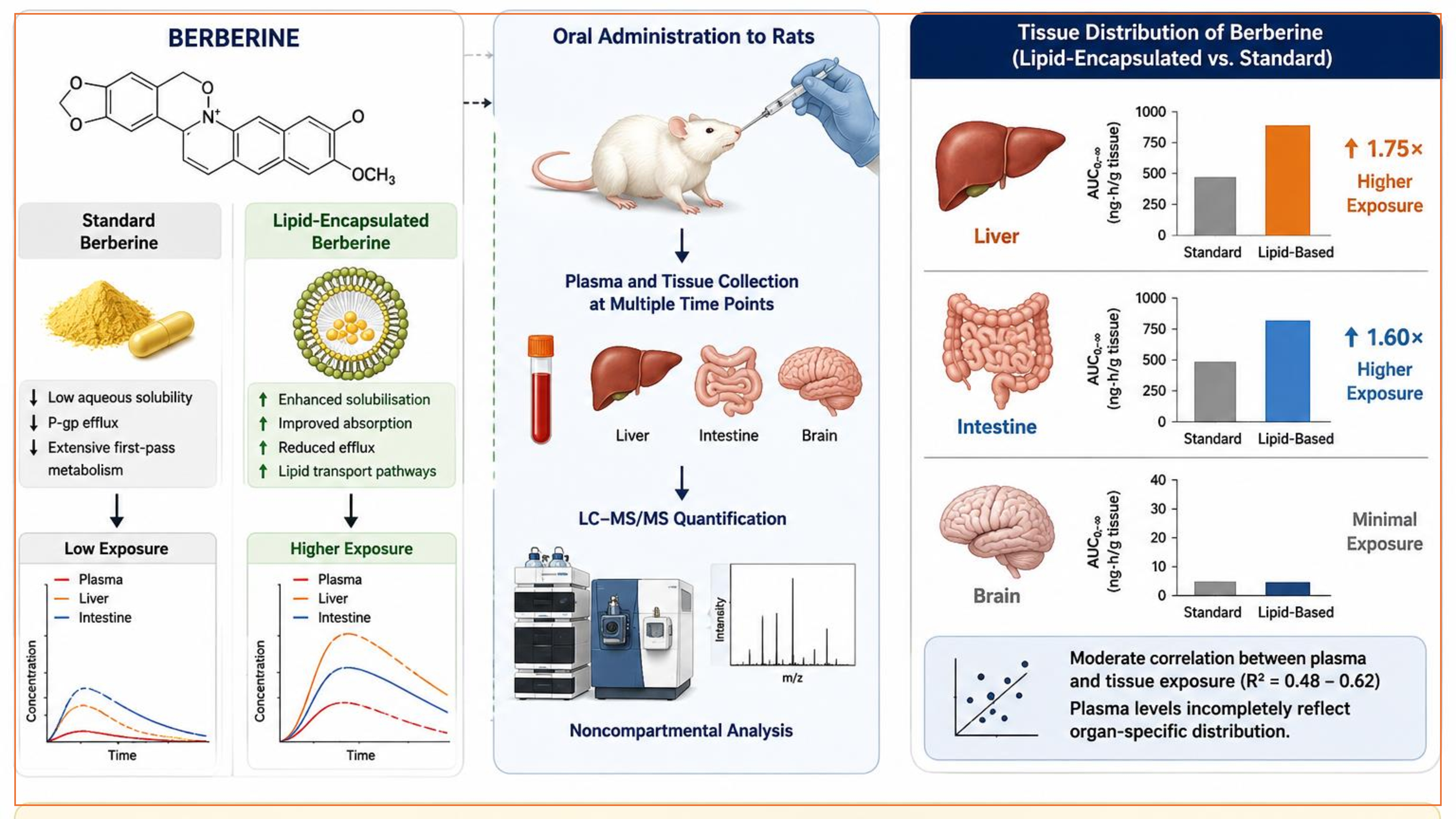
Berberine, a plant-derived isoquinoline alkaloid, is widely recognised for its hypoglycaemic, hypolipidaemic, and insulin-sensitising effects; however, its clinical use is limited by poor oral bioavailability, driven by low aqueous solubility, intestinal P-glycoprotein–mediated efflux, and extensive first-pass metabolism. Emerging evidence suggests that berberine’s pharmacological activity may be more closely linked to tissue exposure in metabolically active organs than to systemic plasma concentrations alone. In this study, the effects of formulation strategies on the plasma pharmacokinetics and tissue distribution of berberine were evaluated using lipid-based and surfactant-assisted formulations. After oral administration to rats, plasma and tissue concentrations (liver, intestine, and brain) were quantified using a validated LC–MS/MS method, and pharmacokinetic parameters were determined by noncompartmental analysis. Among all formulations, the lipid-encapsulated formulation significantly increased tissue exposure, yielding approximately 1.75-fold higher hepatic and 1.60-fold higher intestinal concentrations than standard berberine, along with statistically significant increases in systemic exposure. Increased tissue exposure in these metabolically relevant organs may be linked to berberine’s reported effects on hepatic metabolism and intestinal signalling pathways. Despite these improvements, brain concentrations remained low across all formulations, indicating limited penetration of the blood–brain barrier. Overall, the findings support the concept that tissue-specific pharmacokinetics may provide additional insight into berberine’s metabolic activity beyond plasma concentrations alone, and highlight the importance of formulation strategies that enhance organ-specific exposure.
Keywords:
berberine
; tissue pharmacokinetics
; lipid-based formulations
; hepatic targeting
; intestinal distribution
; oral bioavailability
Copyright: This open access article is published under a Creative Commons CC BY 4.0 license, which permit the free download, distribution, and reuse, provided that the author and preprint are cited in any reuse.


