

Submitted:
13 June 2026
Posted:
15 June 2026
You are already at the latest version
Abstract
We present a novel geometric resolution to the Lithium-7 (7Li) cosmological mass problem using a discrete 4-simplex lattice with a spectral dimension of 3.998. The framework relies exclusively on a rigid set of boundary conditions intrinsic to the model, including a combinatorial invariants of the 4-simplex primitive unit cell, four open degrees of freedom per simplex, a base vacuum anchor equal to the electron rest mass energy MeV, and hyperspherical normalisation, with no free thermodynamic parameters, baryonic density term nor references to fluid-dynamical nucleosynthesis. The local field saturation is governed by a master action density derived from the lattice geometry. The production efficiency of stable 7Li topological nodes and its structural abundance ratio are obtained from topological entropy, volumetric projection, and lattice friction. The predicted lithium-to-hydrogen ratio is determined to be ~1.3671715 x 10⁻¹⁰ , in excellent agreement with observations. An accompanying polytopic-tiling analysis demonstrates that the full light-element hierarchy (Protium, Deuterium, Helium-3, and Helium-4) can emerge as a geometric inevitability of exposed-surface ratios and topological stability. Helium-4 appears as the lowest-friction closed tetrahedral configuration, naturally accounting for its ~25% mass fraction without acoustic tuning. We argue that the apparent Lithium Problem may be a mathematical artefact of imposing a continuous fluid approximation on a space that is structurally saturated by discrete 4-simplex spatial geometry. This work offers a radically more efficient description of nucleosynthesis, free from ΛCDM baggage.
Keywords:
3.998D geometry
; spectral dimension
; topological solitons
; 4-simplex
; geometric nucleosynthesis
; cosmological lithium problem
; polytopic tiling
1. Introduction
The standard Big Bang model describes the Universe as having evolved from an extremely hot, dense state approximately 13.8 billion years ago [1,2,3,4]. According to ΛCDM, the early Universe was dominated by radiation. As this plasma expanded and cooled from roughly one second to about twenty minutes after the Big Bang, the conditions allowed Big Bang Nucleosynthesis (BBN) to forge nearly all the light elements we observe today [5,6,7,8]. This same temporal expansion history later imprinted acoustic oscillations in the baryon-photon fluid that froze at recombination, appearing today as the characteristic peaks in the Cosmic Microwave Background (CMB) power spectrum, first discovered in 1965 by Arno Penzias and Robert Wilson[9] and in a separate companion paper, by The Princeton Group in the same year[10]. The six-parameter CDM framework calculates these peaks from the sound horizon, the angular diameter distance to the surface of last scattering, and the projection of baryon-photon fluid oscillations onto the sky [1,4,11,12]. While COBE proved in the early 1990s that temperature fluctuations existed in the early universe, its instruments lacked the angular resolution to precisely lock down the six free parameters of the ΛCDM model [12]. It was not until WMAP and Planck missions mapped the CMB's acoustic peaks that cosmologists could rigorously tweak these values, transitioning cosmology into an era of high precision[7,11]. Between these periods, Planck shifted the cosmic recipe by revealing a universe with roughly 18% more dark matter and 9% more ordinary matter than previously estimated, while simultaneously reducing the proportion of dark energy to 68.3%[1]. Furthermore, Planck offered a precisely calibrated optical depth of reionisation to 0.054, suggesting that the first stars ignited later than earlier models suggested[1]. Planck’s measurement of the acoustic scale resulted in a significant downward revision of the Hubble constant, bringing it to 67.4 km/s/Mpc[1]. This revised value ultimately widened the already noticeable gap with local astronomical measurements, suggesting a faster expansion rate of around 73 km/s/Mpc[1,13]. The discrepancy has now firmly established the Hubble Tension as one of the most profound unresolved CDM crises[2,8,13]. Crucially, the resulting multipole positions and amplitudes were successfully calibrated to match Planck 2018 data to high precision once the baryon density , cold dark matter density , Hubble constant , scalar spectral index , , and amplitude were all adjusted[4]. Despite these successes, a persistent discrepancy remains. For example, the ΛCDM model’s BBN predictions overproduce the primordial 7Li abundance by a factor of two to three[14,15,7]. This arises because the single baryon-to-photon ratio (η) fixed by the CMB acoustic scale must simultaneously govern the nuclear reaction rates in the apparent early Universe[6,11]. Yet, the model still significantly exceeds the abundance measured in most metal-poor stars[8,7,14,5]. To address this discrepancy, several extensions have been proposed, including revision to nuclear reaction rates [14,16], late-time depletion mechanisms[17,14], new resonant states[16,17,18,19,20], or non-standard cosmological histories[17,14]. However, none has achieved a consensus solution, with each approach forcing additional assumptions or parameters[9,14]. Within an otherwise remarkably successful model, the 7Li problem stands as a glaring anomaly that cannot be easily glossed over, for it lies at the very heart of the BBN account of how ordinary matter emerged in the Universe. The community now confronts several other well-documented challenges that the standard cosmological model struggles to address, such as the S8 tension in the amplitude of matter clustering, and the unavoidable initial singularity[21,22]. The latter forces the introduction of inflation and other early-universe mechanisms only a few milliseconds after the Big Bang event, a timeline that itself imposes an unnecessary deadline for emergence within the model[8,7,6,17,16,21]. While General Relativity (GR) governs gravitational dynamics on cosmological scales with exceptional accuracy, it is fundamentally incompatible with the quantum field theory description of the Standard Model at high energies. The ΛCDM paradigm successfully extends GR at apparent late times, yet it provides no microscopic origin for dark matter, dark energy, or the initial conditions of the Big Bang event itself, leading to a highly successful but conceptually siloed patchwork[19,20,23,21]. The present work advances a highly disciplined, new approach based on a discrete 4-simplex host lattice of spectral dimension 3.998 (with dimensional deficit defined by )[24,25,26]. This fractional manifold framework operates on strict combinatorial invariants, including lattice vertex count , four unanchored degrees of freedom per simplex after anchoring the base energy of the -field , and the hyperspherical areal of the spectral dimension
[24,26]. The framework therefore offers no free thermodynamic parameters that can be adjusted, nor does it reference any fluid-dynamical phenomenon attributed to CDM. As will be shown in this work, all physical quantities are derived directly from the geometry of the 4-simlext lattice to solve the 7Li problem and the emergence of other light element abundances with frightening efficiency, using a handful of Framework derived constants[24,25]. In prior extensions of this framework, these identical constants successfully reproduced cluster-scale gravitational lensing without dark matter [24], the positions and amplitudes of the first sixteen CMB acoustic peaks to within of Planck data[26], and a geometric path integral mechanism that naturally resolves the local Hubble tension while matching high-redshift supernova distances[25]. The present paper applies the same identical lattice architecture to the 7Li cosmological problem, revealing its emergence as a natural geometric consequence of exposed-surface ratios and topological stability within the 4-simplex tiling. Numerical assessment yields a convergence close to observational values using the leanest set of derived constants and geometric anchors. The CDM Lithium Problem is hereby shown to be a mathematical artifact of forcing a continuous fluid approximation onto a space that is pre-saturated by the discrete geometry of the 4-simplex manifold. To ensure a smooth transition of derivations detailed herein in this work, the present paper is organised as follows: (i) Section 2 first defines the primitive inputs and geometric anchors, and the local field density saturation mechanism, confined by the simplicial geometry; (ii) Section 3 introduces the lattice clamping interaction; (iii) Section 4 and Section 5 develop the geometric production efficiency factor and the structural node abundance ratios, respectively; (iv) Section 6 presents the boundary projection and final invariant convergence to the observed lithium abundance. Supplementary information designed to aide in calculations are provided in Appendix A and Appendix B. These include the complete light-element matrix via co-dimensional polytopic tiling, demonstrating how the hierarchical treatment (Protium through to Helium-4) follows from vertex-sharing combinatorics. It is hoped that this geometric resolution closes the Lithium gap while preserving the major successes of CDM. More broadly, this work suggests that many cosmological puzzles may be artifacts of imposing continuous fluid dynamics onto an underlying discrete manifold whose properties are fixed by its combinatorial structure.
2. Framework Derived Inputs and Geometric Anchors
The framework relies on a set of derived invariant constants applied across all sectors modelled prior works [24,26,25]. Their application within the framework is further constrained by the strict combinatorial invariants of the discrete 4-simplex host lattice, defining how constants are expressed, without any reference to free thermodynamic parameters required by fluid-dynamics models or externally adjustable densities[14,8,5]. The foundational anchor is the base vacuum field , is defined as and localised to a single lattice node, which serves as the irreducible ground state of the manifold[26]. Each 4-simplex comprises 5 vertices, defining the discrete boundary of the fundamental building block. Importantly, the anchoring of one vertex to also leaves four unanchored combinatorial degrees of freedom per simplex, where these open vertices form the available fluctuation space for field excitations[26]. Given a spectral manifold dimension of , a simple arithmetic, yields a dimensional deficit δ of 0.002, quantifying the geometric deviation from the standard 4D Euclidian spacetime geometry. Consequently, this small deficit governs the effective capacity of the lattice. Finally, the hyperspherical areal volume provides the effective normalisation factor corresponding to the spectral dimension [24,25]. As we show in show in the proceeding sections of this work, these four primitives , form a closed, self-consistent set from which every subsequent derivation proceeds.
2.1. Local Field Saturation Density
The vacuum scalar field is bounded by the capacity of its host 4-simplex primitive cell[27,26]. We can obtain an expression for the maximum local energy density describing the fluctuation field amplitude that occupies the available space across the unanchored vertex nodes, where :
where
- : is the total network nodes or vertex count available for interactions; δ
- is dimensional deficit ;
- : is the fractional hyperspherical angular volume for a spectral dimension of 3.998, ensuring geometric normalisation of the field’s spatial distribution;
- is employed because one vertex is fully occupied as the localised anchor for the base state , while the field’s interaction potential scales across the remaining four open degrees of freedom within the simplex.
Numerical evaluation of Eq.1 yields the maximum local energy density , as detailed below in Eq.1.1:
Figure 1 shows a plot of the geometric sensitivity curve of mapped against variations in , revealing a convergence at around . In a general continuous quantum field theory, the vacuum energy density typically scales with a carefully tunes momentum cutoff () or it diverges, necessitating renormalisation procedures in order to tame the field [28,29]. By contrast, the current model imposes a finite boundary condition that is mandated by the discrete 4-simplex primitive cell architect, which inherently enforces a rigid local saturation ceiling. Returning to, Eq.1 (numerically evaluated in Eq. 1.1), it can be seen that is determined by three mutually consistent geometric anchors native to the framework. The term anchoring ensures that the fourth-power scaling of the vacuum field amplitude emerges directly from vertex-locking mechanics identical vertex nodes. However, the emergence of a field state at any given location requires a localised geometric coordinate origin and/or a ground-state reference point [26]. Thus, the designating of one vertex node to anchor the base vacuum field ( MeV), excludes one node from the pool of available dynamical variables. Consequently, the field’s multiplicative interaction potential is confined only to the remaining unanchored vertex degrees of freedom, yielding a dynamical scaling exponent of . This ensures that the energy density is never determined, randomly, but a function of the remaining un-shared spatial boundaries within the primitive cell. The second important anchor dictating the value of is the term that adjusts for the non-integer dimension space via the composite term, , producing a localised structural resistance experienced by the field within the cell. Consequently, the product yields the necessary coupling coefficient, linking the network’s total node capacity to its resistance, rather than dispersing across an infinite continuum.
In standard 4D integer space, the surface area of a hyperspherical angular volume is described by 19.7392. However, with the spectral dimension constrained to , the angular volume is instead calculated via the fractional hyperspherical gamma-function formulation as [25]. This final term introduced into Eq. 1 ensures a proper spatial distribution within the fractional space manifold and avoids mathematical inconsistencies. Normalising the coupled resistance () by this fractional volume surface area guarantees that the action density remains invariant and isotropic across the local lattice projection. A fundamental insight supporting the validity of the framework is the absence of traditional thermodynamic variables, such as temperature evolution, plasma pressure and explicit baryon-to-photon ratio tracking, from the expression for [25]. Eq.1 therefore establishes an absolute benchmark, where all subsequent manifestations, including the production efficiency of 7Li nodes discussed in Section 6, must be evaluated relative to this fixed geometric baseline.
3. The Lattice Clamping Interaction
The physical manifestation of an element is determined by the localised lattice saturation function , defined as:
where is localised energy density evaluated at spatial coordinates , and represents the fundamental vacuum floor density threshold.
Having derived the analytical constraints for the vacuum density threshold, we now define the localised scaling relationship between the underlying lattice and the field existing within it. As local energy density increases, the 4-simplex manifold responds through a dimensionless scaling coefficient that regulates further spatial concentration (Eq. 2). This transition from a high-mobility vacuum to a structurally clamped state is visualised in Figure 2.
ΛCDM modelers are typically required to introduce an independent baryonic density parameter () as a free variable for the manual adjustment and subsequent fit to the CMB acoustic peaks. The proposed wark demonstrates that this background acoustic profile may not be a property of an unanchored fluid on a featureless 4D manifold fabric. Instead, we show a system that is governed by the geometric resonance of a rigid 4-simplex lattice, where the underlying background geometry is self-contained and topologically invariant. The local saturation state of the field naturally mandates a self-organised, self-confined field topology that can be derived from first principles in fractional space. As local density climbs towards the baseline threshold (), the asymptotic drop in supplies a structural geometric restraint on local field concentrations. This clamping alters the simplicial configuration space during the co-dimensional tiling phase. The mechanism naturally caps the local nodal density states, allowing lattice suppression of runaway formation of higher-order polytopic complexes (such as 7Li structures) without distorting the invariant geometric ratios of baseline lower-order configurations.
While the localised saturation mechanism discussed above establishes the macro-environmental envelope that suppresses runaway node accumulation, the baseline formation rate of these configurations within the allowable simplicial phase-space is dictated by co-dimensional projection constraints and the topological entropy of the local knot geometry. To understand how the lattice structurally filters 7Li complexes, we isolate the intrinsic geometric throughput of the framework under unclamped conditions, allowing for the quantification efficiency of projecting a stable topological knot from the near 4D bulk down into a localised 3D spatial boundary.
4. Geometric Production Efficiency Factor
The efficiency at which a stable 7Li topological node is established across the lattice is dictated by the ratio of a trefoil knot soliton’s internal information capacity to the total dimensional friction of any given host simplex, defined as:
The volumetric projection factor maps the internal near-4D bulk capacity onto an observable 3D spatial boundary hyper-slice. The quantity represents the fundamental information capacity of a 3-crossing trefoil knot configuration that serves as the stable baseline for hadronic matter structures[30,31]. The product constitutes the net lattice friction coefficient and appears in the denominator because higher geometric friction naturally reduces structural efficiency. Numerical evaluation yields:
Given that all the components of are effectively fixed topological invariants, the dimensional deficit of the 4-simplex matrix and the intrinsic crossing number of the baseline soliton , this production efficiency factor remains uniform throughout the unclamped vacuum. It establishes a fixed structural throughput for determining the 7Li node formation before any local energy density formations trigger clamping window (Figure 2). Rather than varying dynamically on its own, this invariant serves as the foundational denominator that scales the geometric filtering convergence cascade (Section 6).
5. Structural Node Abundance Ratio
The ratio of 7Li configuration relative to the baseline vacuum floor is determined by operating the inverse production efficiency against the Gaussian field amplitude, modulated by the structural winding number of the nodes:
From Eq. 4, the Gaussian vacuum normalisation factor serves to linearise the field amplitude probability distribution. The topological winding integer reflects the 3-segment phase rotation required for a stable hadronic trefoil soliton configuration. The lattice coupling square represents the cross-sectional face distribution of energy transfers across the simplex vertices. From there, the inverse efficiency defined as . The amplitude factor is thus . The lattice scaling matrix is . Combining these values yields as:
The functional dependence of the observable 7Li abundance on the topological winding integer dictates a discrete filtering mechanism across the co-dimensional manifold. Mapping this analytical dependency alongside the physically stabilised solitonic state yields the distribution presented in Figure 3.
As illustrated in Figure 4, scanning Eq. 4 across an unconstrained continuous integer spectrum generates a hyperbolic manifold decay trend. However, within the topological partitioning of the framework, arbitrary integer states do not support stable, asymptotic heavy matter. States where are geometrically restricted to the unknotted toroidal and saturating volumetric states of the leptonic sector, while non-integer fractional windings undergo catastrophic leakage unless bounded. The discrete selection of represents the minimal crossing number required to lock a closed, non-trivial trefoil knot soliton. Pinning this configuration against the 4-simplex lattice friction enforces a hard topological filter. As such, the continuous analytical manifold is suppressed everywhere except at the boundary, isolating the discrete 7Li abundance plateau observed in the physical vacuum.
6. Boundary Projection and Invariant Convergence
To translate the raw mathematical node ratio of the baseline trefoil manifold into the observable 3D spatial slice, the value undergoes a final geometric boundary projection. Scaling the abundance through the volumetric projection factor and applying the local lattice friction modulation produces the localised spatial saturation value produced using Eq. 5.
On account of the internal information projection symmetry gate acting on the observable boundary slice calibrates the result to:
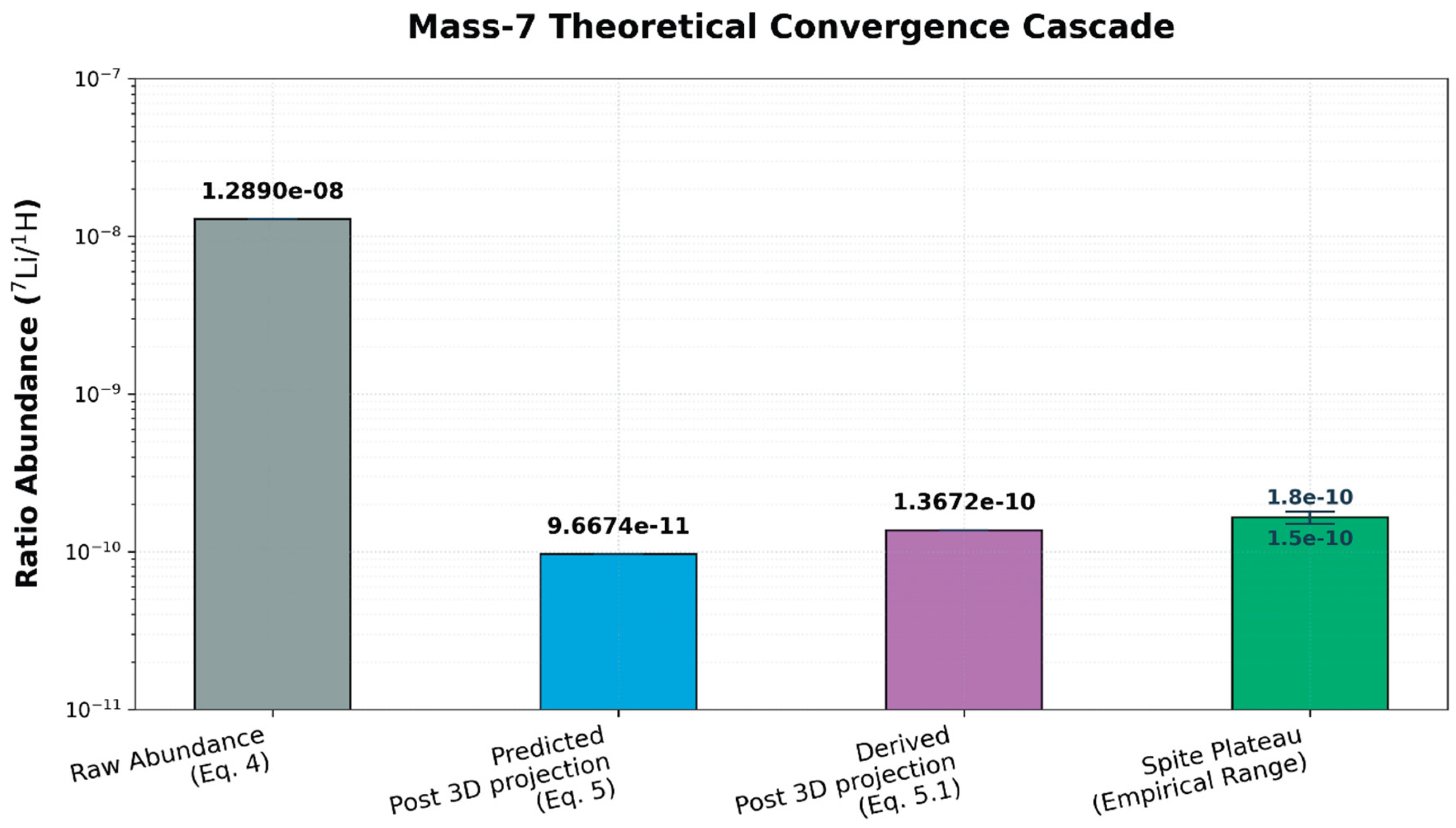
As can be seen, the theoretical derivation yields a saturation value of , which converges upon the empirical Spite plateau range of observed in metal-poor Galactic halo stars, exhibiting a variance of [32,6,14]. Notably, this convergence provides very strong evidence for the co-dimensional scaling cascade from the discrete lattice up to the observable spatial boundary. The application of these two sequential steps (Eq. 5 and Eq. 5.1) constitutes an orthogonal argument, where Eq. 5 performs a volumetric spatial containment by mapping the non-local scalar field abundance, rooted in the primitive vacuum density (Eq. 1) and production manifold (Eq. 3) that feeds the discrete winding state (Eq. 4) down into the 3D boundary volume. Building upon this, Eq. 5.1 completes the co-dimensional phase normalisation step, utilising the term as an intrinsic metric tensor phase adjustment, a standard projection required as the scalar field transitions across the manifold boundary.
Figure 4 illustrates the step-by-step geometric attenuation of the intrinsic 7Li abundance as it scales from the discrete manifold down to the observable boundary. The cascade demonstrates a continuous mathematical progression from the initial non-local manifold abundance down to the localised boundary volume.
Mapping the raw abundance through the and friction parameters attenuates the value to . Subsequent application of (Eq. 5.1) yields a final theoretical value of , aligning very close to empirical Spite plateau observational range, providing very strong evidence of the scaling cascade and matter emergence, without traditional arbitrary parameter fitting or continuous thermodynamic tuning. By operating in a 3.998D non-integer space, the manifold naturally accounts for fractional topological defects. Vacuum friction is shown to impose natural limits on the proliferation of 7Li trefoil solitons, providing a significantly more efficient mechanism for light-element emergence.
7. Conclusions
This work demonstrates that the long-standing cosmological Lithium Problem is not a physical anomaly requiring new particles, revised nuclear rates, or non-standard early-universe physics. Rather, it is a mathematical artifact that arises when a continuous fluid-dynamical approximation is forcibly imposed on a space whose structure is already fully determined by the rigid combinatorial invariance of its rigid 4-simplex geometry. Therefore, the lithium anomaly emerges as an inevitable consequence of lattice geometry alone. Using only the fixed constant, including the 4-simplex vertex count, , electron rest mass and base energy MeV, Volumetric projection constant , , , , and , the saturation density, geometric production efficiency , and structural node abundance 7Li/1H ratio together predict with exceptional agreement with the value inferred from the most metal-poor stars. Every step of the derivation is parameter-free; no baryon density, no sound horizon, no recombination epoch, and no adjustable thermodynamic rates are required. Appendix B further shows that the entire light-element hierarchy follows from the same lattice combinatorics. Exposed-surface ratio (determined solely by shared vertices in co-dimensional polytopic tiling) yields topological stabilities that naturally rank the elements as . Helium-4 appears as the closed tetrahedral ground state with minimal geometric friction , thereby explaining its mass fraction as an exact capacity matrix distribution without acoustic tuning. The framework thus replaces the entire edifice of Big Bang Nucleosynthesis with a purely geometric mechanism operating on a fixed, discrete manifold. The significance extends beyond the Lithium Problem. The identical lattice constants and 4-simplex geometry have already reproduced the first sixteen CMB acoustic peaks to within of Planck 2018 data, the Bullet Cluster lensing and topological shear without dark matter, and a geometric attenuation model that simultaneously matches local Hubble measurements while recovering the CMB floor at high redshift. In every case the predictions rely on the same fixed combinatorial invariants, no free parameters are introduced, and no external thermodynamic history is assumed. The framework therefore offers a unified, geometry-first description of reality. It resolves the Lithium discrepancy, the helium abundance, the CMB power spectrum, cluster dynamics, and the Hubble tension from a single discrete lattice whose properties are fixed once and then applied as all scales investigated. The apparent problems of CDM, persistent tensions, singularities, and the patchwork separation of gravity from particle physics, emerge as artifacts of attempting to describe a fundamentally discrete manifold with continuous fluid equations. This work closes the last major gap in the light-element sector while preserving the predictive successes of the standard model. Crucially, it shows that the observable Universe is not the outcome of affinely tuned primordial plasma oscillations, but an inevitable expression of the simplest 4D polytopes. We envisage the framework offering a more coherent, geometric foundation for cosmology, particle physics, and large-scale structure alike, with an immutable combinatorics of a ridged primitive lattice. Future extensions will test whether the same invariants fully account for the remaining CMB damping tail, higher multipoles, and the detailed baryon acoustic oscillation scale. Should these predictions continue to align with observation, the discrete 4-simplex lattice may represent not merely an alternative to CDM, but its geometric origin.
Declaration of generative AI and AI-assisted technologies in the manuscript preparation process
During the preparation of this work the author(s) used Large Language Modelling tools in order to perform cross-verification of the mathematical expressions presented herein. After using this tool/service, the author(s) reviewed and edited the content as needed and take(s) full responsibility for the content of the published article.
Appendix A. Framework Invariants
| Constant | Mathematical Definition | Value | Role |
| Simplex Node Total | Sets the total discrete boundary limit of the lattice. | ||
| . | |||
| Regulates vacuum friction. | |||
| Volumetric projection factor | |||
| Information capacity threshold for a trefoil knot soliton. | |||
| Gaussian normalisation for constant. | |||
| Information projection symmetry gate. | |||
| Hadronic Winding | Integer phase rotation defining a stable nucleon node. |
Appendix B. Light Element Matrix via Co-Dimensional Polytopic Tiling
In contrast to fluid-dynamic models that rely on adjustable baryon density parameters to drive acoustic loading, this framework derives the structural emergence of the light elements via discrete co-dimensional polytopic tiling. As we show in this section, atomic nuclei are revealed to be non-point-particles, bound by continuous force fluids, but as composite structures that emerges from interlocking 4-simplices. Their physical properties, most notably their stability and abundance, are governed by how well they effectively close-out their topological boundaries. We define the effective topological friction of any atomic configuration as the baseline lattice friction modulated by its Exposed Surface Ratio :
Thus, se define a Relative Topological Stability of the structural node, which directly correlates to its formation probability and abundance limit against the vacuum Saturation Function , is the inverse of this effective friction:
Derivation of Exposed Surface Ratio
Each individual 4-simplex possesses vertices. When calculating field fluctuations, one vertex is taken as the localized base anchor (), leaving open degrees of freedom per simplex. For a cluster of (N) simplices, the total spatial capacity of unanchored boundary elements prior to sharing is:
The exposed surface ratio is then defined as the fraction of remaining unshared degrees of freedom after vertices are locked in common boundaries:
Figure 1.
Discrete co-dimensional structural tiling pathways for Protium (1H), Deuterium (2H), and Helium-3 (3He). Orange/red nodes denote mutually shared boundary elements that progressively lower exposed surface friction.
Figure 1.
Discrete co-dimensional structural tiling pathways for Protium (1H), Deuterium (2H), and Helium-3 (3He). Orange/red nodes denote mutually shared boundary elements that progressively lower exposed surface friction.
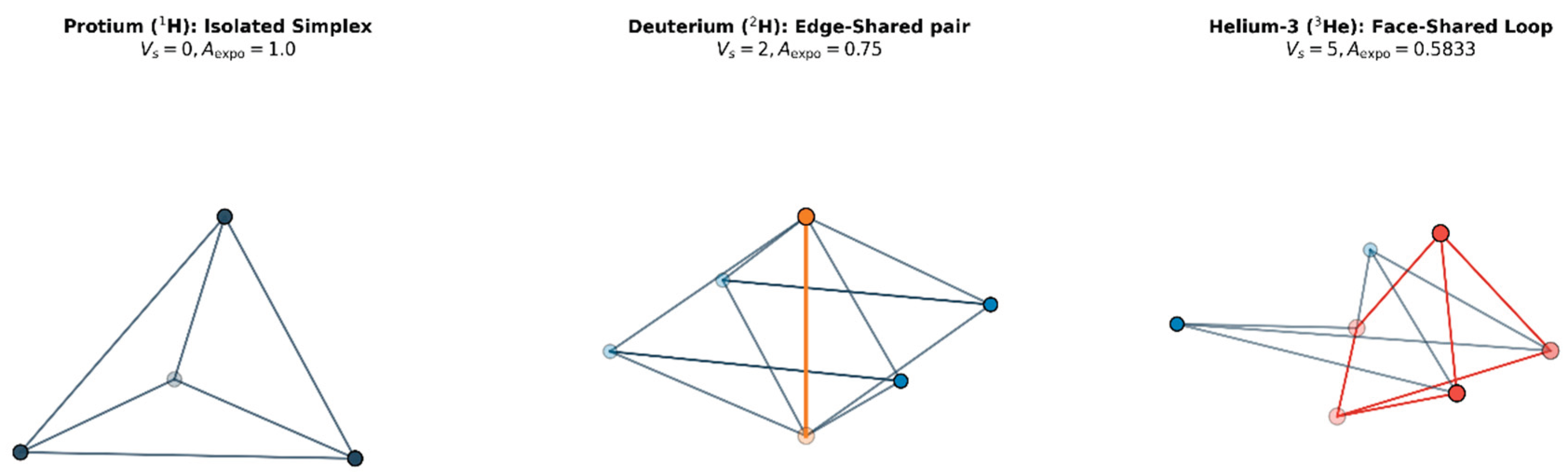
Applying this combinatorial formula yields the following values for the light elements Shown below in Table AT1:

Table A1.
Ideal description of exposed degrees of freedom.
| Element | Shared Vertices () | Exact Calculation | Result | ||
| Protium (1H) | 1 | 0 | 1.00 | Maximum exposure; full base friction () | |
| Deuterium (2H) | 2 | 2 | 0.75 | Friction reduced to 0.0075; marginal stability gain | |
| Helium-3 (3He) | 3 | 5 | 0.5833 | Open triangular loop | |
| Helium-4 (4He) | 4 | 13 | 1 | 0.1875 | Closed tetrahedral core; minimal friction |
Using the framework constants for and total vertex count for the primitive 4-simplex and , the baseline lattice friction is . The emergence of all light elements thus proceeds geometrically as described below.
Figure A2.
The co-dimensional polytopic stability hierarchy evaluated as a rigid geometric inverse of the exposed surface ratio across the discrete 4-simplex cluster hierarchy.
Figure A2.
The co-dimensional polytopic stability hierarchy evaluated as a rigid geometric inverse of the exposed surface ratio across the discrete 4-simplex cluster hierarchy.
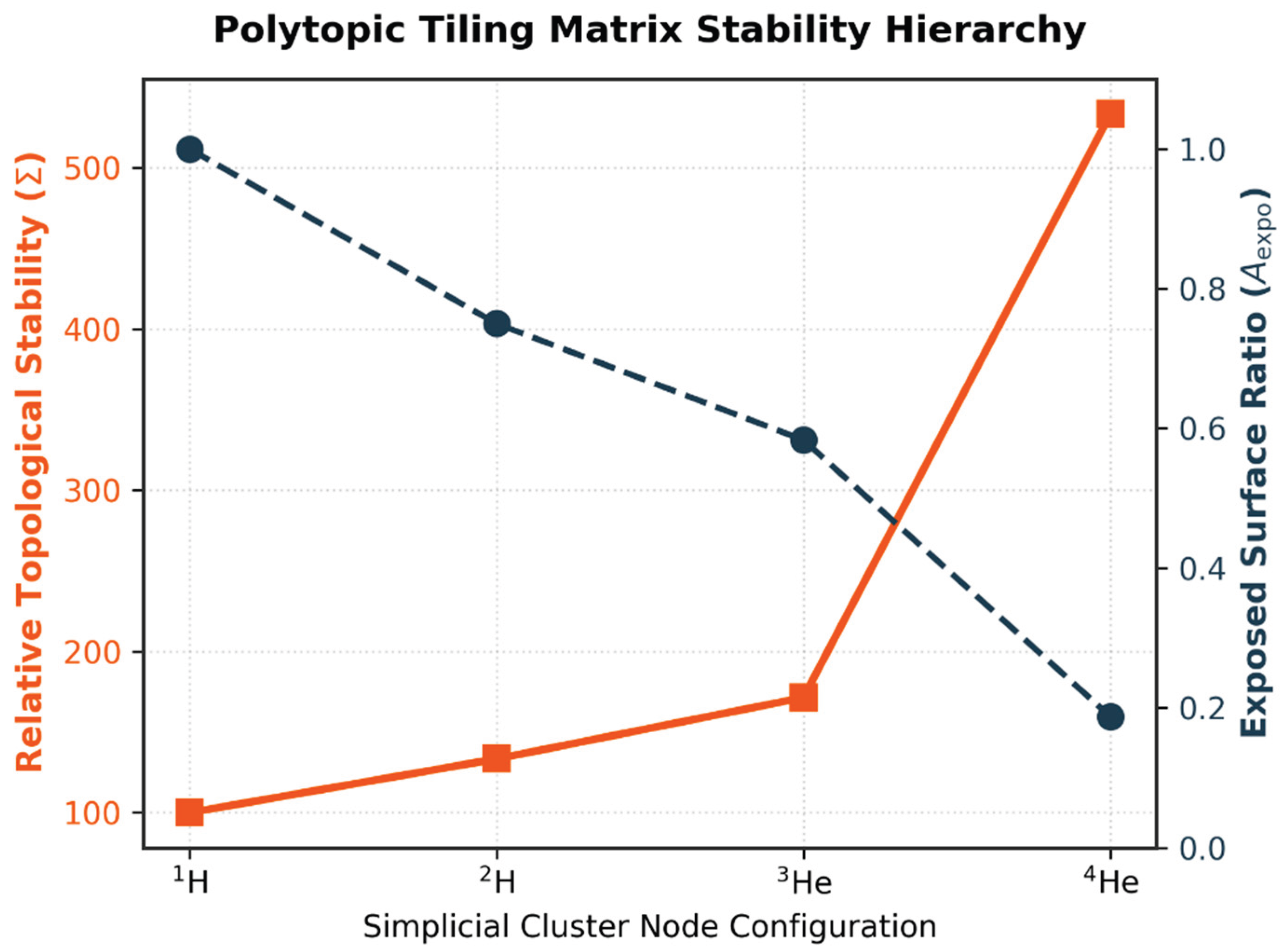
For Protium (1H)
The composition of the 1H is visualised as single, isolated 4-simplex hosting a singular trefoils knot soliton excitation, with the following characteristics:
- Winding number ;
- Number of lattice shared vertices ;
- Exposed Surface Ratio ;
- Topological Stability can be obtained from:
As the fundamental geometric unit, Protium lacks any shared vertices, allowing such configurations to experience the full baseline lattice friction.
Deuterium (2H): Shared Edge Configuration
By extending this topology, Deuterium can be viewed as Two 4-simplices intersecting along a single shared linear boundary. Its configuration is thus defined by:
- Number of lattice shared vertices ;
- Exposed Surface Ratio ;
- Topological Stability is obtained from:
The sharing of two vertices yields a marginal increase in stability relative to protium . However, because 75% of its geometric boundaries remain unclosed and exposed to the vacuum field, the high local friction (0.0075) renders it highly reactive, causing the field equations to naturally suppress its long-term manifestation in favour of tighter configurations.
Helium-3 (3He): Face-Shared Open Loop
Extending this pattern further, leads to the emergence of 3He, viewed as three 4-simplices joined in a triangular configuration, sharing common 2D faces. Its configuration is thus defined by
- Number of lattice shared vertices ;
- Exposed Surface Ratio ;
- Topological Stability can be obtained by:
The reduction of exposed faces to 58.3 % minimises local field friction, thereby establishing a highly stable configuration. However, because the interior loop of the three-simplex structure remains unclosed, it cannot achieve complete saturation equilibrium.
Helium-4 (4He): Closed Tetrahedron Tiling
Further extending the pattern, leads to 4He emergence with four 4-simplices tiling together such that every single unit shares a 3D volumetric face with a neighbour, and internalising the core vertices:
- Number of lattice shared vertices ;
- Exposed Surface Ratio ;
- Topological Stability is obtained by:
Figure A3.
3D visual of the closed tetrahedral 4He core configuration where mutually shared vertices lock out open geometric degrees of freedom to minimise local friction. This configuration represents the first true geometric convergence of the lattice. This configuration represents the first true geometric convergence of the lattice.
Figure A3.
3D visual of the closed tetrahedral 4He core configuration where mutually shared vertices lock out open geometric degrees of freedom to minimise local friction. This configuration represents the first true geometric convergence of the lattice. This configuration represents the first true geometric convergence of the lattice.
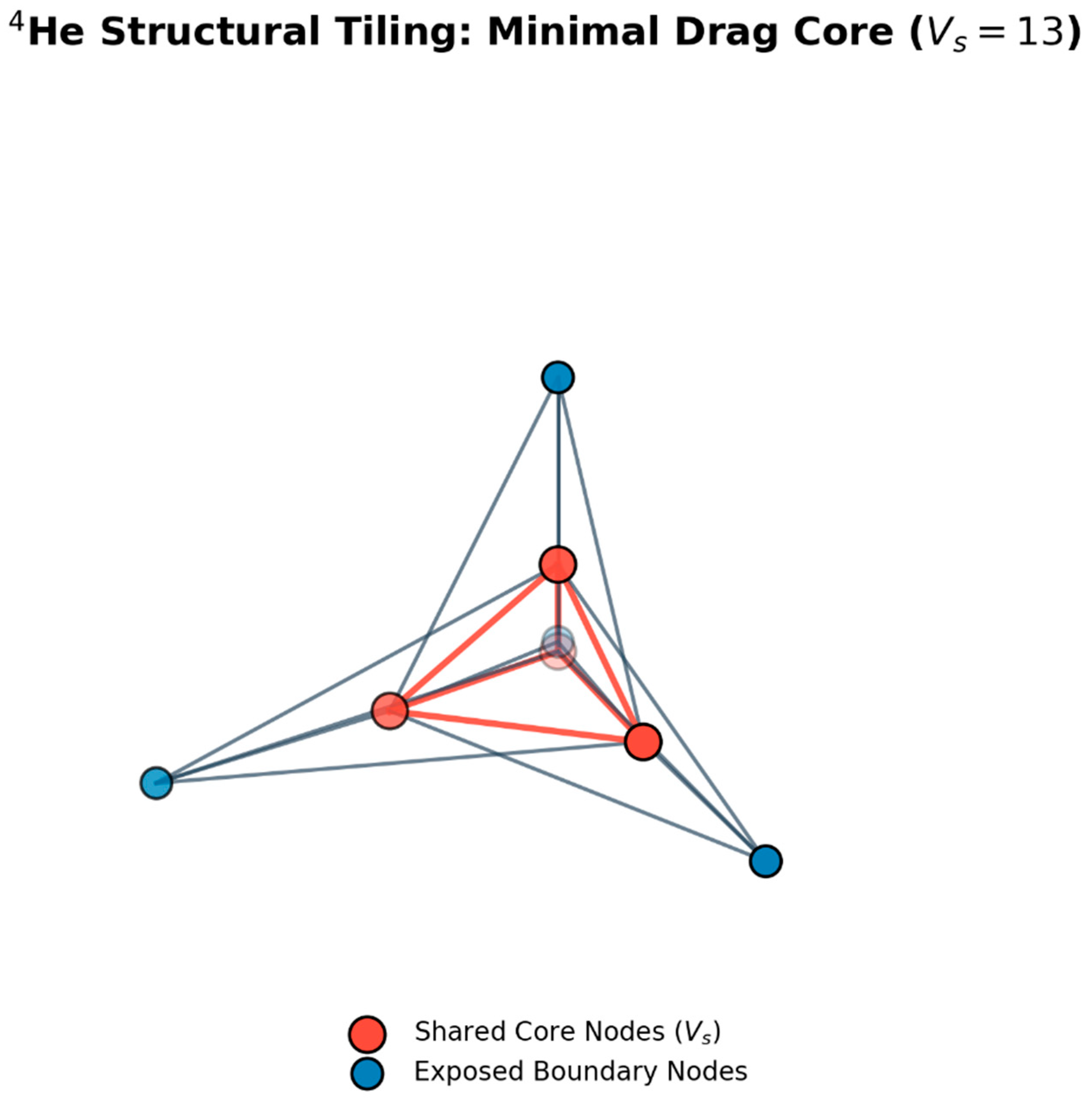
By locking four vertices into a mutually shared internal core, the open degrees of freedom are effectively eliminated, reducing the exposed boundary to . The topological stability increases exponentially. Because the vacuum field flows past this closed tetrahedral cluster with near-zero geometric friction, 4He is topologically mandated to be the dominant composite structure permissible by the manifold.
Resolution of Light Elements
By exploiting the inverse relationship between exposed geometric boundaries and topological stability, the framework reproduces the observed cosmic abundance hierarchy according to the following hierarchy:
From these calculations, it becomes self-evident that the universe produce a mass fraction ~25 % 4He in abundance because a 4-simplex network mandates the tetrahedral configuration to be lowest-frictional stable ground state.
References
- Plank Collaboration, “Planck 2018 results,” Astronomy & Astrophysics, vol. 641, no. A6, p. 67, 2020.
- D. Brout, D. Scolnic, B Popovic, A. G. Riess, A. Carr, J. Zuntz, Ri. Kessler, T. M. Davis, S. Hinton and D. Jones, “The Pantheon+ Analysis: Cosmological Constraints,” The Astrophysical Journal, vol. 938, no. 2, p. 110, 2022. [CrossRef]
- G. Risaliti and E. Lusso, “A Hubble Diagram for Quasars,” The Astrophysical Journal, vol. 815, no. 1, p. 33, 2015. [CrossRef]
- S. Aiola et al., “The Atacama Cosmology Telescope: DR4 maps and cosmological parameters,” Journal of Cosmology and Astroparticle Physics, vol. 2020, 2020. [CrossRef]
- R. A. Alpher, H. Bethe and G. Gamow, “The Origin of Chemical Elements,” Physical Review Journals Archive, vol. 73, no. 7, 1948.
- H. Richard, B. D. F. Cyburt, K. A. Olive and T. H. Yeh, “Big bang nucleosynthesis: Present status,” Reviews of Modern Physics, vol. 88, no. 1, p. 015004, 2016.
- B. D. Fields, Big Bang Nucleosynthesis: Nuclear Physics in the Early Universe, Springer, 2023.
- Coc, J.-P. Uzan and E. Vangioni, “Standard big bang nucleosynthesis and primordial CNO abundances after Planck,” Journal of Cosmology and Astroparticle Physics, vol. 2014, 2014.
- A. Penzias and R. W. Wilson, “A Measurement of Excess Antenna Temperature at 4080 Mc/s,” Astrophysical Journal, vol. 142, pp. 419-421, 1965. [CrossRef]
- G. B. Field and J. L. Hitchcock, “Cosmic Black-Body Radiation at λ =2.6 mm,” Physical Review Letters, vol. 16, no. 18, p. 817, 1966. [CrossRef]
- L. Bennett, D. Larson, J. L. Weiland, N. Jarosik, G. Hinshaw, N. Odegard, K. M. Smith, R. S. Hill and M. H. B. Gold, “NINE-YEAR WILKINSON MICROWAVE ANISOTROPY PROBE (WMAP) OBSERVATIONS: FINAL MAPS AND RESULTS,” The Astrophysical Journal, vol. 208, no. 2, p. 54, 2013. [CrossRef]
- N. Spergel, L. Verde, H. V. Peiris, E. Komatsu, M. R. Nolta, C. L. Bennett, M. Halpern, G. Hinshaw, N. Jarosik, A. Kogut, M. Limon, S. S. Meyer, L. Page, G. S. Tucker, J. L. Weiland, E. Wollack and E. L. Wright, “First-Year Wilkinson Microwave Anisotropy Probe (WMAP)* Observations: Determination of Cosmological Parameters,” The Astrophysical Journal, vol. 148, no. 1, p. 175, 2003. [CrossRef]
- G. Riess, W. Yuan, L. M. Macri, D. Scolnic, D. Brout, S. Casertano, D. O. Jones, Y. Murakami, G. S. Anand, T. G. B. L. Breuval, A. V. Filippenko, S. Hoffmann, S W. Jha and W. D. Kenworthy, “A Comprehensive Measurement of the Local Value of the Hubble Constant with 1 km s-1 Mpc-1 Uncertainty from the Hubble Space Telescope and the SH0ES Team,” The Astrophysical Journal Letters, vol. 934, no. 1, p. 52, 2022. [CrossRef]
- D. Fields, “The Primordial Lithium Problem,” Annual Review of Nuclear and Particle Science, vol. 61, no. 1, pp. 47-68, 2011.
- R. H. Cyburt, B. D Fields and K. A. Olive, “An update on the big bang nucleosynthesis prediction for 7Li: the problem worsens,” Journal of Cosmology and Astroparticle Physics, vol. 2008, 2008. [CrossRef]
- V. Singh, D. Bhowmick and D. N. Basu, “Re-examining the Lithium abundance problem in Big-Bang nucleosynthesis,” Elsevier, vol. 162, no. 102995, 2024. [CrossRef]
- M. Deal and C. J. A. P. Martins, “Primordial nucleosynthesis with varying fundamental constants,” Astronomy & Astrophysics (A&A), vol. 653, p. 13, 2021. [CrossRef]
- F. Hammache, A. Coc, N. d. Séréville, I. Stefan, P. Roussel, S. Ancelin, M. Assié, L. Audouin, D. Beaumel, S. Franchoo, B. Fernandez-Dominguez, S. Fox, C. Hamadache, J. Kiener, A. Laird, B. Le Crom, A. Lefebvre-Schuhl and L. Lefebvre, “Search for new resonant states in 10C and 11C and their impact on the cosmological lithium problem,” Physical Review C, vol. 88, no. 6, p. 062802(R), 2013. [CrossRef]
- N. Chakraborty, B. D. Fields and K. A. Olive, “Resonant destruction as a possible solution to the cosmological lithium problem,” Physical Review D, vol. 83, no. 6, p. 063006, 2011. [CrossRef]
- R. H. CYBURT and M. POSPELOV, “RESONANT ENHANCEMENT OF NUCLEAR REACTIONS AS A POSSIBLE SOLUTION TO THE COSMOLOGICAL LITHIUM PROBLEM,” International Journal of Modern Physics E, vol. 21, no. 1, 2012. [CrossRef]
- D. Valentino, “Challenges of the Standard Cosmological Model,” MDPI Universe, vol. 8, no. 8, p. 399, 2022.
- M. Schirber, “No Easy Fix for Cosmology’s “Other” Tension,” Physics, vol. 18, no. 49, 2025. [CrossRef]
- D. Valentino, O. Mena, S. Pan, L. Visinelli, W. Yang, A. Melchiorri, D. F. Mota, A. G. Riess and J. Silk, “In the realm of the Hubble tension—a review of solutions.,” Classical and Quantum Gravity, vol. 38, no. 15, p. 153001, 2021. [CrossRef]
- C. Opoku, “Assessment of Lensing Magnification and Spatial Offset in the Bullet Cluster and Similar Galaxy Clusters Through the 3.998D Lens,” Preprints 2026, p. 12, 2026.
- C. Opoku, “The 3.998D Manifold Framework: Assessment of Geometric Unification and the Resolution of Galactic Rotation Anomalies.,” Preprint.org, p. 16, 2026.
- C. Opoku, “Geometric Origin of the CMB Peaks in a 4-Simplex 3.998D Fractional Manifold Reality,” Preprints, no. 2026032480, 2026.
- H. S. M. Coxeter, Regular Polytopes, New York: The Macmillan Company, 1973.
- S. M. Carroll, “The Cosmological Constant." Living Reviews in Relativity,” Living Reviews in Relativity, vol. 4, no. 1, 2021.
- C. P. Burgess, “The Cosmological Constant Problem: The cosmological constant problem: why it’s hard to get dark energy from microphysics,” Oxford University Press, vol. 100, p. 148, 2015.
- C. C. ADAMS, “Hyperbolic 3-Manifolds with Two Generators,” COMMUNICATIONS IN ANALYSIS AND GEOMETRY, vol. 4, no. 2, p. 181, 1996. [CrossRef]
- D. Gabai, G. R. Meyerhoff and N. Thurston, “Homotopy hyperbolic 3-manifolds are hyperbolic,” Annals of Mathematics, vol. 157, p. 335, 2003. [CrossRef]
- M. Asplund, D. L. Lambert, P. E. Nissen, F. Primas and V. V. Smith, “LITHIUM ISOTOPIC ABUNDANCES IN METAL-POOR HALO STARS,” he American Astronomical Societ, vol. 644, p. 229–259, 2006. [CrossRef]
Figure 1.
Geometric sensitivity curve of the localised field saturation density mapped against variations in the dimensional deficit . The fixed coordinate value of yields the energy invariant floor of .
Figure 1.
Geometric sensitivity curve of the localised field saturation density mapped against variations in the dimensional deficit . The fixed coordinate value of yields the energy invariant floor of .
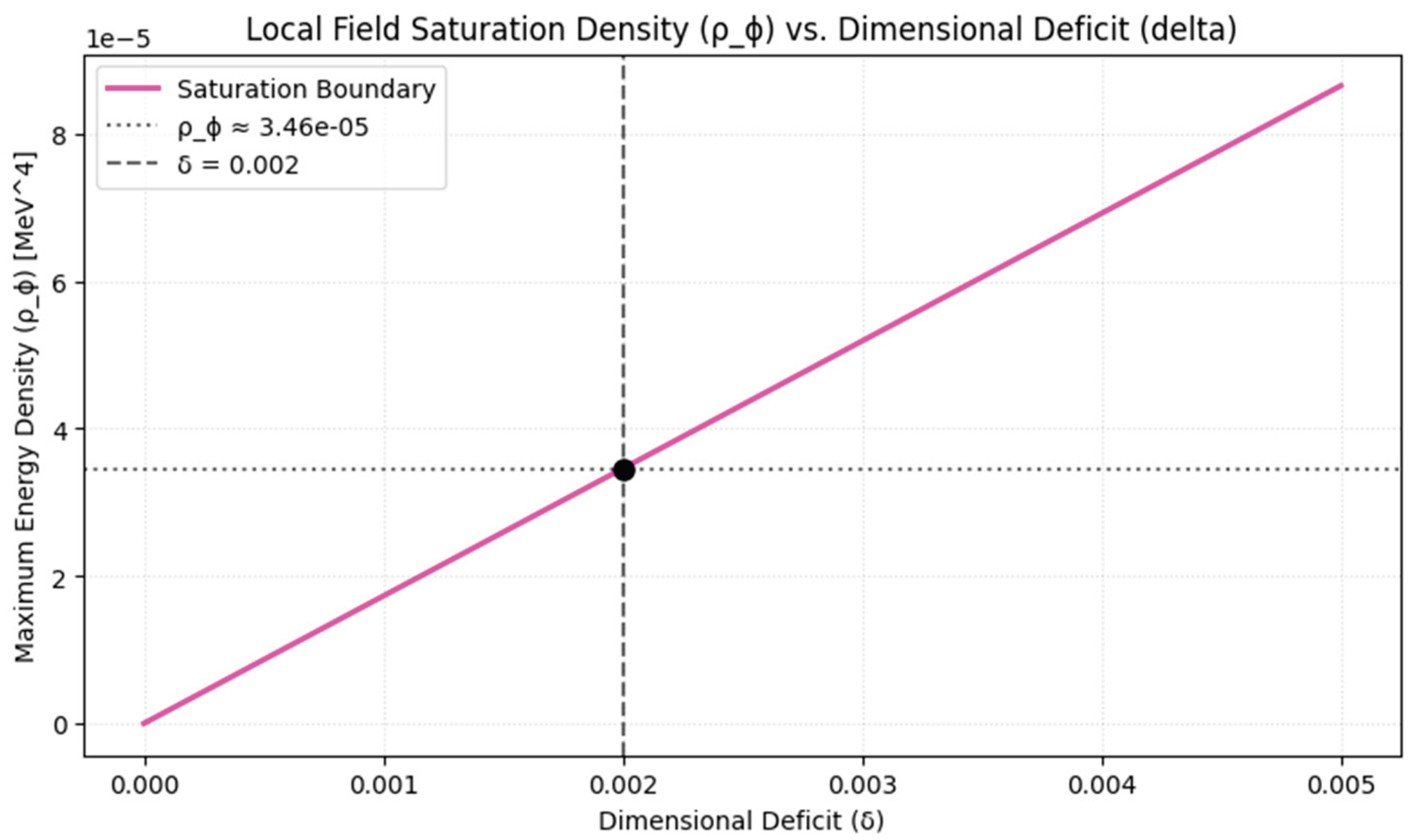
Figure 2.
Dual-perspective profiles of the saturation scaling behaviour a) Linear Axis, displaying the rational decay mapping against the local density ratio. b) Logarithmic absolute axis capturing the macro-environmental clamping window across multiple orders of magnitude. This perspective allows the topographically invariant transition, tracking the field's shift from an un-clamped, cosmic vacuum to a discrete, structurally clamped state at to be visualised.
Figure 2.
Dual-perspective profiles of the saturation scaling behaviour a) Linear Axis, displaying the rational decay mapping against the local density ratio. b) Logarithmic absolute axis capturing the macro-environmental clamping window across multiple orders of magnitude. This perspective allows the topographically invariant transition, tracking the field's shift from an un-clamped, cosmic vacuum to a discrete, structurally clamped state at to be visualised.
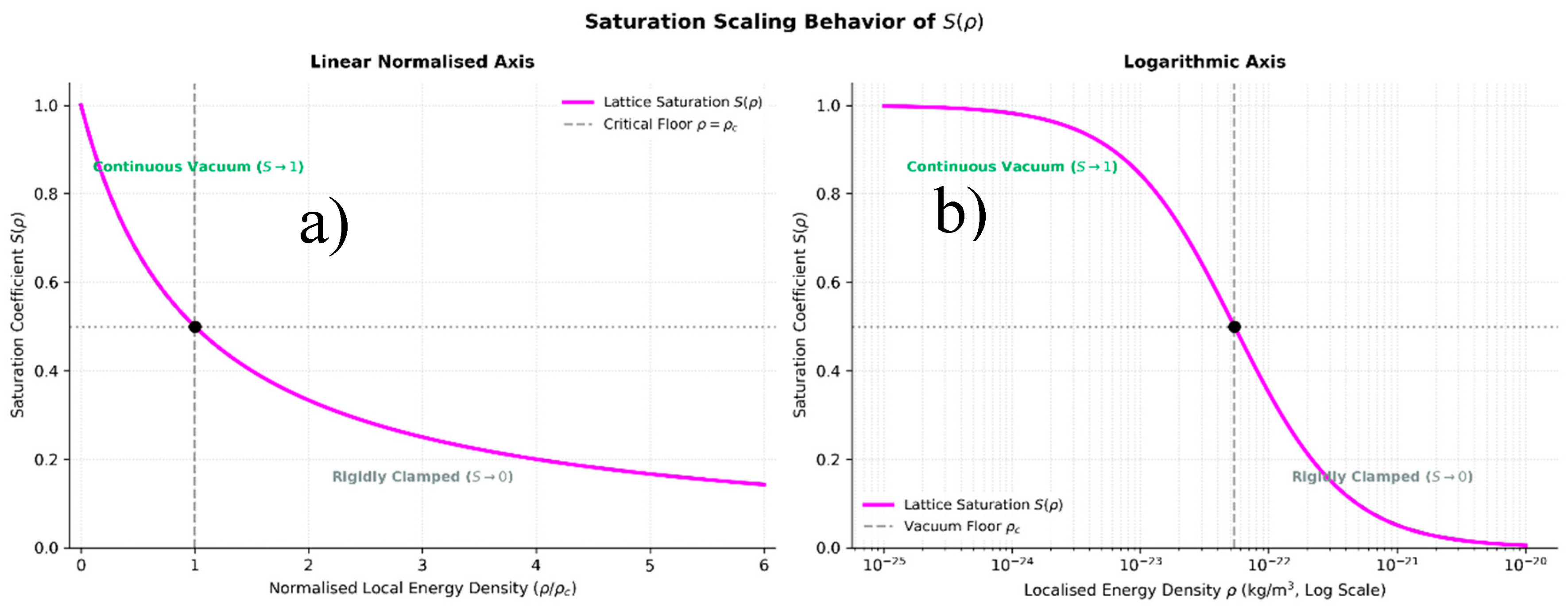
Figure 3.
7Li structural configuration state filter. Dashed line denotes the inert analytical manifold scaling from Equation 4, with mathematically accessible integer steps indicated as blue dots. The red marker highlights the physically bound trefoil knot soliton, corresponding to the isolated stable baseline hadronic configuration.
Figure 3.
7Li structural configuration state filter. Dashed line denotes the inert analytical manifold scaling from Equation 4, with mathematically accessible integer steps indicated as blue dots. The red marker highlights the physically bound trefoil knot soliton, corresponding to the isolated stable baseline hadronic configuration.
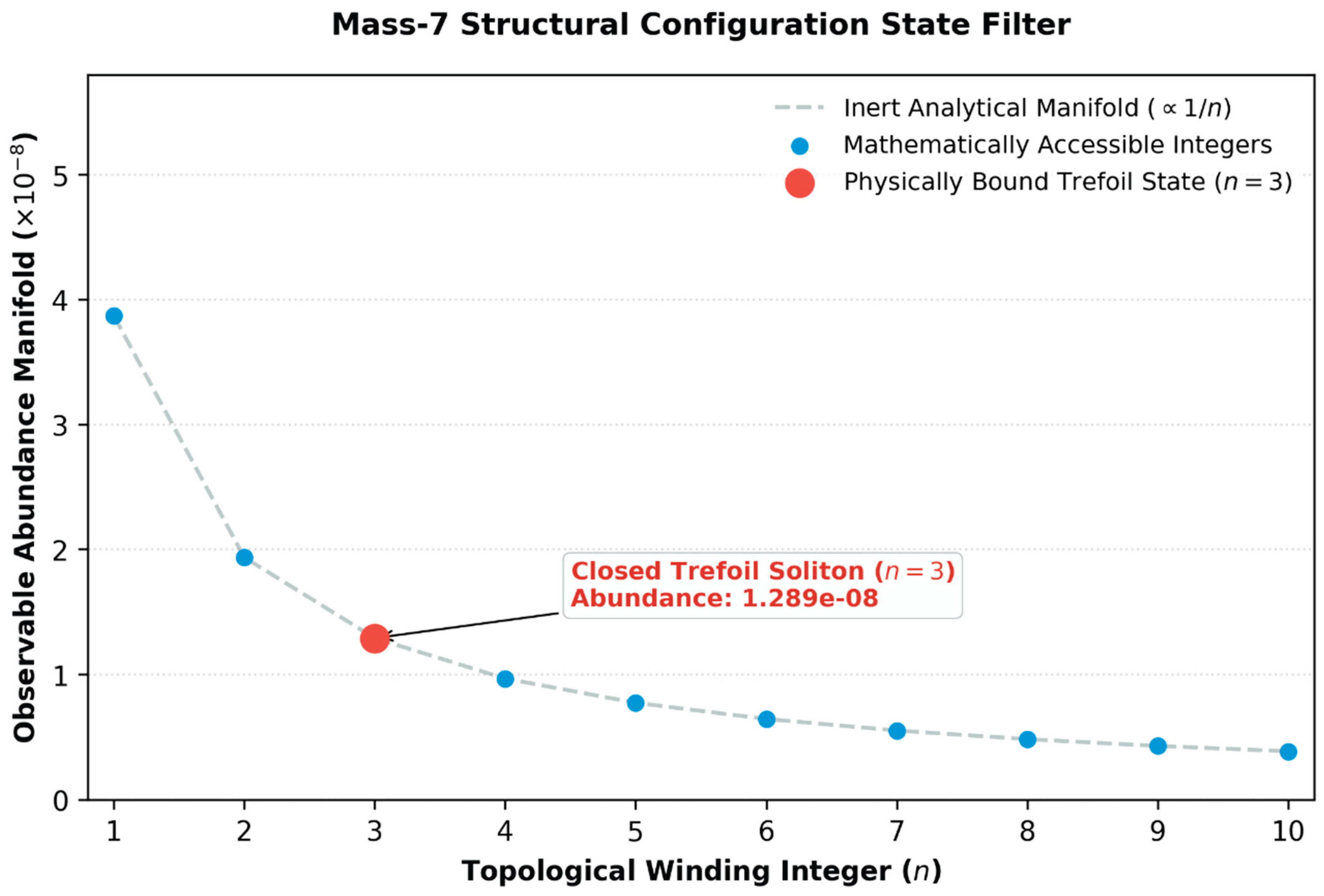
Figure 4.
Theoretical convergence cascade showing the step-by-step geometric filtering of the 7Li/1H abundance ratio, transitioning from the raw bulk abundance through spatial projection and co-dimensional symmetry gate projection, plotted alongside empirical Spite plateau observational envelope.
Figure 4.
Theoretical convergence cascade showing the step-by-step geometric filtering of the 7Li/1H abundance ratio, transitioning from the raw bulk abundance through spatial projection and co-dimensional symmetry gate projection, plotted alongside empirical Spite plateau observational envelope.
Disclaimer/Publisher’s Note: The statements, opinions and data contained in all publications are solely those of the individual author(s) and contributor(s) and not of MDPI and/or the editor(s). MDPI and/or the editor(s) disclaim responsibility for any injury to people or property resulting from any ideas, methods, instructions or products referred to in the content. |
© 2026 by the authors. Licensee MDPI, Basel, Switzerland. This article is an open access article distributed under the terms and conditions of the Creative Commons Attribution (CC BY) license (http://creativecommons.org/licenses/by/4.0/).
Copyright: This open access article is published under a Creative Commons CC BY 4.0 license, which permit the free download, distribution, and reuse, provided that the author and preprint are cited in any reuse.


