

Submitted:
12 June 2026
Posted:
17 June 2026
You are already at the latest version
Abstract
In the 21st century, digital development, which has become an indispensable element of all processes of human life, has a “bi-directional effect” on the efficiency of outputs, “both positive and negative”. This idea has been put forward in the cited studies. The case studies presented in this study reveal the negative effects of digital addiction in various fields. The study focuses on the individual and social damages of digital addiction, as well as its negative impact on productivity, which is our main topic, and discusses the measures and solutions that can be taken at the individual and organisational level. In this study, firstly, the concepts of digital addiction and work productivity will be defined in order to draw a conceptual framework. After drawing the conceptual framework, an overview of the relationship between “productivity and digital addiction” will be presented.
Keywords:
digital addiction
; productivity
; relationship between digital addiction and productivity
1. Introduction
Today, digital has become a must for all vital functions. From the public sector to private enterprises, from the defence industry to the health sector, from education services to security services, from the industrial sector to the agricultural sector, etc. digital development has come to life in all sectoral areas. While digital transformation affects all areas of life, it contributes significantly to the simplification of public services, reduction of stationery and bureaucracy, increase in efficiency, effectiveness, performance, total quality and economy.
Digitalisation, which has positive contributions to all management processes, will have a negative impact on all outputs in case of misuse. For example, the realisation rates of activities will decrease, maximum efficiency will not be achieved in outputs and the principle of economy in resource use will not be realised.
This study examines the effects of digital addiction on employees and managements in business life. Digital addiction can be defined as “the loss of control of individuals in their daily life and work routines” as a result of excessive use of technological tools. Nowadays, while digitalisation provides convenience in many areas such as management processes, production quality, total quality, transportation, storage, service and customer satisfaction in business environments, it poses a serious threat by bringing many health, socio-economic and legal problems that may arise from excessive and abusive use.
Digital addiction stands out as a serious problem that reduces employees work efficiency, increases stress and anxiety levels, causes physical and psychological health problems, and makes work belonging and cooperation difficult. It is important to develop workplace policies that encourage conscious use to reduce employees digital addiction.
It is a known fact that 21st Century administrations aim to maximise their productivity and develop strategies and policies in this direction. In this direction, in order to keep the efficiency obtained in products and services at the maximum level, inferences will be made through some studies in the literature that reveal the negative impact of employees with digital addiction on productivity and minimise this negative impact.
This study aims to make visible “the bi-directional link between digital development and productivity" at the point of minimising the negative impact of digital addiction on productivity in order for managements to achieve maximum efficiency in goods and services produced with the contribution of technology.
After analyzing “the negative impact of digital addiction on business efficiency” through the relationship between “digital addiction and business efficiency”, strategically important suggestions will be made that can lead to a paradigm shift in businesses.
In this respect, it is aimed to make a contribution to academic discussions. In other words, a discussion concept for the literature on maximising productivity, which means the rate of “total output to total input” in management, will be determined. The main goal of this study is to examine “the effects of digital addiction on employees work productivity”.
This study, which is related the basic inference that "digital addiction" can lead to "productivity losses" especially in business life, aims to provide information to increase efficiency in management by evaluating the subject from a scientific perspective.
2. Methodology
On the one hand, while addressing the negative effects of digital addiction on time management, lack of focus and work efficiency on employees working in private or public institutions and organisations in terms of world literatures, on the other hand, suggestions are presented for balancing the use of technology with work efficiency [1].
In the literature study, attention is drawn to strategies that can both increase the welfare of employees and support the productivity of businesses if digital addiction is managed. In this direction, the following research questions are addressed: What effect does digital addiction have on employees' work productivity? Which measures should be taken to minimise the effect of digital addiction on productivity? The research focuses on previous studies on digital addiction and the literature on work productivity. Studies published in the last twenty years, examining the effects of digital addiction on work productivity were preferred to be predominant (2004-2024).
In today's world where technology is increasingly gaining importance, it would be appropriate to analyze the origins of the relationship between dependency and productivity through studies that have an important place in shaping the current understanding of the relationship between "digital addiction and productivity", which has become one of the current discussions of management science. These studies first require a conceptual perspective on addiction, “digital addiction and productivity use. In this section, the concepts of addiction, digital addiction and work productivity”, which constitute the basis of the study, will be defined and information on the types of addiction will be given.
2.1. Addiction
Before addressing the concept of addiction has become “a chronic disease” that needs to be emphasized in our age, which causes a breakdown on both the individual and the society and disrupts the human resource potential and economy of the states, it is necessary to mention the concept of addict, which is the subject of addiction.
The word "dependent" comes from Roman law, where the concept of an individual's dependence on her creditor rather than her ability to pay her debt was applied. In fact, this understanding, which was one of the ways in which the individual became a slave in ancient times, has evolved as a state of being a slave to a substance or an action that has changed its directional tendency. Addicts have little control over their actions and make choices, sometimes healthy and sometimes unhealthy. The unhealthy choices of addicts are divided into “hyperactive and hypoactive”. The hyperactive process is caused by overactivity in the “limbic reinforcement system”. The hypoactive process results from reduced activity in the “prefrontal cortex” [2].
Today, addiction has evolved into a state of being a slave to a substance or an action that has changed its orientation.
In addition, addiction is a chronic disease of epidemic proportions that causes physical, psychological, emotional and spiritual negativities that require continuous and holistic care [3].
Addiction, which is often used as ‘addiction’ or ‘dependence’, according to another definition; it is expressed as the inadequacy to “discontinuance or control” the use of a substance or action [4].
The first meeting of the ‘Society for the Study of Addiction’ was held in 1884. At this meeting, the focus was on the fact that addiction is a medical disease rather than a moral disease. Addiction is an abstract concept that can be caused by many different pathologies, varies in strength, severity and symptoms, and has no objective boundaries [5].
Psychological science currently defines addiction as a condition that occurs when a person takes a substance or engages in an activity. According to the criteria of the “American Psychiatric Association” and the “World Health Organisation”, and must meet at least three of the following conditions defined for addiction according to the World Health Organization:
- Tolerance; increasing use of the substance or abuse of the action.
- Withdrawal; experiencing “physical or emotional” withdrawal when the addiction is stopped.
- Limited control; using more substances or interesting in a specific behaviour than desired.
- Negative consequences; continued substance use or engagement in a particular behaviour despite negative consequences.
- Discontinuing routine activities; postponing or not performing social, recreational, work, educational or domestic activities due to addiction.
- A significant amount of time or energy is spent; a significant amount of time or money is spent "obtaining, using, concealing, planning, recovering from substance use, or engaging in a particular behavior."
- Desire to reduce; the thought and failure to reduce or control substance use or engagement in a particular behaviour.
It is also important to consider social and environmental factors that contribute to addiction and relapse [6]. Factors such as poverty, unemployment, family dynamics, trauma and peer influence all play a role in the development and maintenance of addiction. Therefore, a holistic approach that addresses these social determinants of health is essential for effective treatment of addiction [7].
Substance addiction is a condition in which an individual is unable to control the substance they use and this use negatively affects both their physical and mental health. Substance addiction causes permanent changes in the brain's reward system, making it difficult to stop using substances [8]. The use of natural and synthetic products to alter consciousness is a long-standing practice in human culture. The history of substance use and abuse in general is marked by changing attitudes, cultural biases and personal experiences that influence perceptions and actions towards different substances. It is important to critically examine and question these attitudes in order to understand the complexity of substance use in society [9].
2.2. Types of Substance Addiction
Substance addiction, often referred to as substance use disorder, encompasses a range of dependencies on various substances that can lead to significant impairment or distress. The most common types of substance addiction include alcohol, opioids (such as prescription painkillers and heroin), stimulants (like cocaine and methamphetamine), and sedatives (including benzodiazepines). Each type of addiction can have distinct effects on the body and mind, leading to physical dependence, tolerance, and withdrawal symptoms. Additionally, individuals may develop psychological dependencies, where they feel compelled to use the substance to cope with stress, anxiety, or other emotional challenges. Understanding the different types of substance addiction is crucial for developing effective treatment strategies and supporting individuals on their path to recovery.
2.2.1. Alcohol Addiction
Alcohol addiction is characterized by uncontrolled consumption of alcohol. In the long term, it can lead to liver damage, impaired brain function and social problems [10].
2.2.2. Opiate Addiction
Opiates such as morphine and heroin are powerful painkillers and carry a high risk of addiction. Long-term use can lead to serious health problems due to respiratory depression and addictive effects [11].
2.2.3. Stimulant Addiction
Stimulants such as “cocaine and amphetamines” rise dopamine levels in the brain, leading to addiction. Long-term use can increase the risk of psychosis and cardiovascular disease [12].
2.2.4. Cannabinoid Addiction
Cannabis and its synthetic derivatives are known for their mild sedative and hallucinatory effects. Although addiction is usually mild, long-term use can cause cognitive problems [13].
2.2.5. Nicotine/Tobacco Addiction
Nicotine-containing products, such as cigarettes, are a leading cause of lung and heart disease. Nicotine addiction is one of the most difficult addictions to quit, especially when started at a young age [14]. It is counted among the types of substance addiction.
2.3. Digital Addiction
Although modern technology has positive effects when it comes to the comfort of human life. It is necessary to use technology consciously and in a balanced way, to focus on real life by moving away from technology from time to time and to increase the quality of life by making more use of the positive effects of technology [15]. However, the “obsessive and excessive use of digital devices, digital technologies and digital platforms, the internet, video games, online platforms, mobile devices, digital gadgets and social networking platforms” creates unavoidable problems [16]. The concept of digital addiction is a comprehensive concept that includes internet, social media, technology and video game addiction. In general, digital addiction is conceptually defined as a user's excessive preoccupation with smartphones, the internet or social media sites to the detriment of their health. In today's world, the abuse of digitalization as an action or behavior, which has become the very life itself, brings many chronic problems with it. It is extremely important to emphasize the impact of digital addiction, The goal of this study is to investigate this problem regarding work efficiency and take the necessary steps to prevent it [17].
Studies conducted on employees in different sectors on various types of addiction, including internet, smartphones and social media, have shown that excessive interaction with technology causes significant problems, especially in terms of work productivity, which is worrying in this respect [16].
In addition to the negative effects of digital addiction on work productivity, the physical, psychological, socio-economic, legal and ethical effects on addicts are also problematic issues that need to be addressed and considered in today's world. In this respect, digital addiction is seen as an alarming problem for society [17].
We can say that this type of addiction is a kind of commitment between the individual and digitalization, which is an actional but not chemical one. Of course, it should be noted that not every individual who spends too much time with a digital device is addicted.
2.4. Types of Digital Addiction
Although the concept of digital addiction arising from the inordinate use of digital is seen as an important type of addiction, this addiction is divided into types such as Internet Addiction, Social Media Addiction, Screen Addiction, Online Gaming Addiction, Virtual Betting and Gambling Addiction and Smartphone Addiction. Although Internet addiction includes some of these addiction types, it is analysed separately in this study [18].
2.4.1. Internet Addiction
Internet addiction refers to “a situation in which the use of the Internet becomes compulsive. The Internet user becomes addicted on the Internet for his or her psychological well-being and experiences unpleasant feelings when deprived of the Internet”, which can occur as a result of Internet addiction.
With the rapid advancement of technology, the understanding of welfare and the internet have become synonymous and have become one of the indispensable basic needs for humanity by touching every point of life. However, when such an important phenomenon becomes an abusive behavior, it goes beyond its purpose and turns into a concept that captures the human self. In the analysis of current data, we see that internet use covers an important part of human life. Namely;

Table 1.
Internet use covers an important part of human life [19].
Table 1.
Internet use covers an important part of human life [19].
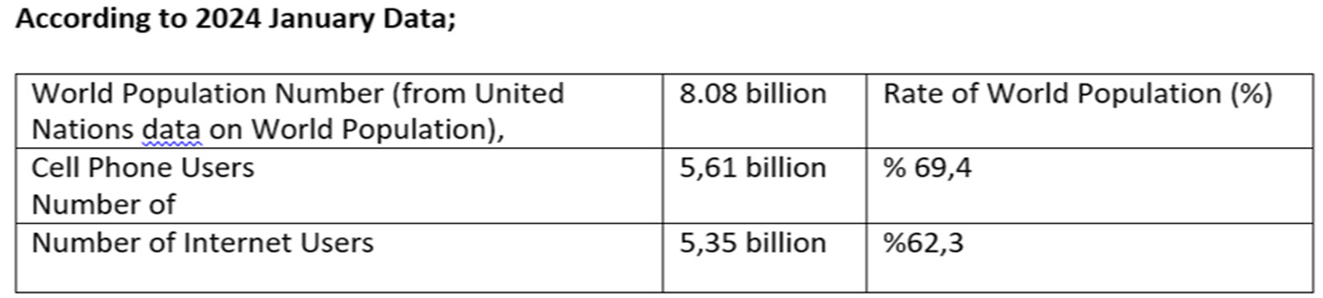 |
While each of these findings has its own implications, the overall takeaway is that digital is playing an increasingly important role in our daily activities. Life balance refers to an individual's ability to effectively manage work responsibilities while attending to personal and family obligations, hobbies and general well-being. Achieving a healthy work-life balance can increase employee productivity [20].
2.4.2. Social Media Addiction
As digital devices have become more portable, the use of social media has increased [18]. However, in this study, it will be discussed in detail as another type of classification rather than studied under the internet addiction. Social media addiction is one of the most common forms of digital addiction and can significantly affect the daily lives of individuals [21]. Social media enables individuals to communicate and share information through online platforms. While its use has positive effects such as strengthening social connections and increasing access to information, it also has negative effects such as social anxiety, low self-esteem and distraction [22,23]. Increased use of social media can increase problems and turn into addiction [24].
Many studies have shown that distractions caused by digital devices in the workplace reduce the productivity of employees. These studies have revealed that excessive use of digital screens and social media negatively affects employees work productivity, prolongs task completion times, increases error rates and negatively affects employees job satisfaction [25].
2.4.3. Screen Addiction
Screen addiction, which is defined as the abuse of behavior related to the use of televisions, tablets, computers, laptops, smartphones, all kinds of devices that record or transmit audio and video, causes people to spend most of their daily time in front of the screen. Screen addiction, which has negative effects on both private and professional life, has become unrecognizable in time and space thanks to the mobileization of screens. Thanks to its online or offline use, negative effects on the work efficiency of employees have also been observed.
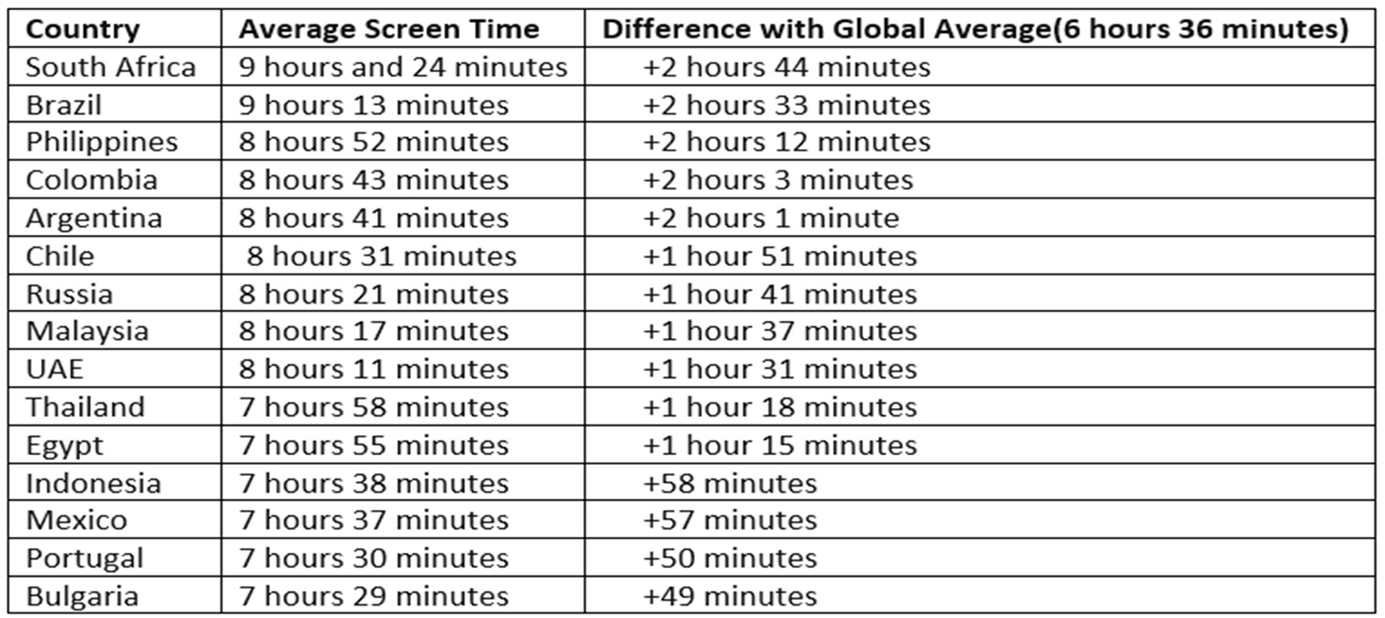
The 15 countries that spend the most time in front of screens (among users aged 16-64) above the global average (around 400 minutes):
Table 2.
The 15 countries that spend the most time in front of screens [26]
Table 2.
The 15 countries that spend the most time in front of screens [26]
 |
Research on how screen addiction affects employees' work productivity and how to improve this situation has shown that screen addiction distracts employees and severely reduces their work performance. It was also noted that prolonged screen use can disrupt sleep patterns and have long-term negative effects on productivity. In order to get rid of screen addiction, it is stated that limiting screen use and digital detox practices at workplaces may be beneficial [27].
In another study on screen addiction, it was found that screen addiction has a significant negative impact on employees performance in the workplace by reducing their daily work routines and long-term productivity, and that employees spend more time completing their tasks because they are constantly in front of the screen, thus increasing their stress levels [28].
Another study, which examined the relationship between screen time and productivity, revealed that screen addiction leads to distraction, that affects work productivity negatively. It was also found that screen addiction increases stress and burnout levels and decreases employees' motivation and ability to focus [29].
2.4.4. Digital Game Addiction
In digital game addiction, gaming behaviours are beyond the control of the individual and lead to loss of functionality in personal, social or academic life. According to the “World Health Organisation (WHO)”, this is defined as “Gaming Disorder” [30].
It is usually more common among men and young people, and it has a negative impact on academic achievement [31], causes distraction and negatively affects work efficiency, especially, efficieny of individuals with game addiction [32].
In recent years, there has been a growing global recognition that certain patterns of digital online gaming can lead to significant impairment and psychological distress in “individual, social, professional or other important areas of functioning” [33].
2.4.5. Virtual Betting and Gambling Addiction
In the legislation of many countries, gambling is considered a form of entertainment characterized by the mechanics of betting/gambling and the ability to win money. Repetitive gambling behavior can lead to physical and psychological problems and, ultimately, addiction.
In today's world, there has been an increasing convergence between gaming and online gambling on different platforms, with a significant influence of the Internet [33].
The ease of access to virtual betting sites with its timelessness and cross-border aspect wherever there is internet access has made it a necessity to take national and international measures on this type of addiction and to determine the limits and impose sanctions. There are strong findings that online virtual gambling platforms, which create an increasing amount of addiction every day, increase work inefficiency as employees turn to these platforms during working hours [34]. Nowadays, the rate of betting during business hours is increasing. Betting during work hours is on the rise [35]. This situation decreases workplace productivity and may cause tension in the work environment. At times, it may lead employees to problematic behaviors such as fraud at work [36].
2.4.6. Smartphone Addiction
The development of the smartphone and its widespread use in our personal and professional lives has narrowed the lines between the two worlds. The main reasons for this widespread use are considered to be meeting social needs, hedonic needs and cognitive needs [18].
Constantly checking the smartphone, worrying when it is not with you, preferring phone communication instead of face-to-face communication, distraction, insensitivity and indifference to the environment, sometimes leads to different accidents, especially traffic accidents due to carelessness and imprudence [37], smartphone addiction, which also causes disconnections in social relationships between people [38], has risen to the forefront of today's digital addiction types. In fact, most of the other types of digital addiction have been reduced to mobile as a result of the evolution of phones into smart mode instead of communication technology and their use through smartphones has become widespread.
Smartphones, which express the combination of computing and communication technology by reducing them to a portable level, have more than one function. People have included smartphones among the indispensables of their lives as “GPS, video and music player, document reader and transmitter, camera, e-mail and chat, or as a multifunctional device” where they receive all kinds of private or public services with the applications they install. According to the research conducted on 395 employees who use smartphones in their work and daily lives; it is understood that smartphone addiction negatively affects work productivity, and it is understood from the literature review that this result is supported by the results of similar studies [39].
2.5. Work Productivity
Although ‘productivity’ generally means efficiency, it is also used as “productivity” in different sources [40]. In the developing process, productivity has become the main subject of discussions in management science with F. Taylor's 1911 work “Principles of Scientific Management” [41]. Productivity, which is among the basic concepts of scientists working in the field of management science, is a recognised criterion that shows that a management is successful as a value corresponding to the rate of output to input [42]. In its simplest form, productivity can be defined as obtaining output at an appropriate value level from all resources used in “production or implementation of activities”. In other words, we can express it as obtaining “the highest output with the least input” [43], “Productivity = Input / Output” [44]. The fact that employees are distracted from their work tasks and spend most of their time in the digital environment reduces the focus time, effectiveness and output quality during working hours, thus reducing productivity [45].
In a study conducted by Priyadarshini on Information Technology (IT) employees in India, It has been determined that "social media addiction" has significant negative effects on employee productivity. It was found that employees lose sleep due to fear of missing out (FOMO) and spending long periods of time chatting or following updates on social media, which leads to neck, back pain and eye strain. It also causes a decrease in “product quality and product delivery quantity” due to loss of time and participation of employees in non-work activities [16].
3. Literature Review on the Effects of Digital Connectivity on Work Productivity
Digital addiction causes many problems that negatively affect work productivity and general welfare, especially in employees. Regarding these problems, the literature review on academic sources is presented under the following topics.
3.1. Literature Review on Focus and Quality Problems and Decline in Work Productivity
In the scientific studies included in this section, it has been determined that the link between digital addiction and productivity leads to lack of attention, ineffective use of working hours, decreases in the total quality of outputs, decreases in the realisation rates of activities and inefficiency in the workplace as a whole. In the literature reviews conducted in this direction, it is understood that this argument continues to be valid.
Time spent on social media applications such as “WhatsApp, Twitter, Skype and Facebook” study conducted by has a negative correlation with employee productivity [46].
In another study on distraction and stress caused by digital addiction, it was found that employees' lack of focus due to digital addiction and their hasty work due to constant digital stimuli increased their error rates, which led to customer dissatisfaction, disruptions in business processes and decreases in product quality [47].
In a study conducted by Parrish et al in Russia, it was found that “the interruption of employees” work with constant social media notifications reduces their focus time and prolongs their work delivery times [48].
In a study conducted by Yamada and Kato in a software company in Tokyo, it was found that 40% of the employees were distracted from their duties at work and work productivity decreased due to social media addiction [49].
In the study conducted by Smith and Brown; it was revealed that screen addiction leads to distraction and this situation negatively affects work productivity [50].
3.2. Literature Research on Psychological and Physical Health Problems
In the long term, digital addiction can cause both “psychological and physical” health problems in employees. Long-term immobility, fixed posture, insomnia and unhealthy nutrition can increase health problems such as eye strain, sleep disorders, back and neck pain. This situation may lead to a decrease in the potential manpower of the enterprises, employees staying away from the workforce and ultimately loss of productivity [51].
In a study conducted by Lee on employees working in a financial company; due to the increase in the time spent by employees in front of the screen, it was understood that most of them had problems such as dry eyes and neck pain, and due to these problems, employees could not fulfil their jobs efficiently [52].
Seeing idealised lives on social media platforms can cause individuals to evaluate their own lives more negatively, which can lead to lack of self-confidence and depression [53].
3.3. Literature Research on Social Isolation, Communication Problems and Disruption of Work-Life Balance
The fact that employees with digital addiction spend most of their time in the digital arena may reduce their face-to-face communication with other employees. Even though virtual communication is mandatory, it negatively affects management processes such as interaction, co-operation and co-ordination.
Kuss and Griffiths revealed that digital game addiction leads to social isolation and inefficiency in the workplace during working hours, and that this loss of productivity is directly related to the level of addiction [54].
In his study, Turkle found that employees with high digital addiction prefer to communicate with digital devices instead of face-to-face communication, which leads to a decrease in social relationships and cooperation skills, resulting in social isolation [55].
In a similar study conducted by Brown and Adams in an advertising agency, it was found that employees with digital addiction focusing on the phone or computer screen instead of interacting with their colleagues at work negatively affected cooperation and teamwork, they participated less in team meetings and social events, and this situation negatively affected team cohesion and cooperation in projects [56].
In the study conducted by Derks and Bakker, it was understood that digital addiction eliminates the boundaries between work and private life, shortens the rest periods of employees due to the desire to be constantly online in the future, this situation leads to burnout syndrome and increased stress levels, employees whose work-life balance is disrupted tend to quit their jobs, which leads to work inefficiency [57].
Khan and Iqbal conducted a study on the impact of excessive smartphone use on work-life balance. In this study, it was observed that individuals with digital addiction, especially smartphone addiction, access work-related content outside of working hours, which causes mental fatigue and loss of productivity in the long term [58].
3.4. Literature Research on the Causes of Low Creativity and Motivation
Digital addiction causes employees to be constantly exposed to external information instead of focusing on their own thoughts. This situation can blunt the creative thinking abilities of employees, because the brain, which is constantly fed with external stimuli, may have difficulty in producing its own ideas.
In a study conducted by Garcia on employees working in a media company, it was found that social media usage addiction has a negative effect on [59] the ability to generate original ideas, which reduces productivity in creative projects [60].
Han and Luo showed that employees digital addictions negatively affect their ability to seek innovations, problem solving and continuous improvement, which is directly related to burnout syndrome and low job satisfaction at work [61].
In a study conducted by Wang and Zhang (2021) in a media company in China, it was observed that employees with social media addiction had difficulty in creative projects [62].
In the study conducted by Nakamura and Yamamoto on employees in Japan who check their e-mails during and outside of working hours with the effect of constant stimuli, it was understood that this situation reduces the capacity for creative thinking and negatively affects family relationships [63].
In another study conducted by Laconi et al., it was found that digital game addiction reduces productivity in the workplace and leads to loss of motivation [64].
The studies compiled in the literature detail the different effects on the basis of countries and the difficulties caused by digital addiction in business life. It is evaluated that studies can play a critical role in minimising the risks that may occur and in determining individual awareness and workplace policies.
4. Discussion
Various strategies and preventive measures can be taken to minimise the negative effects of digital addiction on work productivity. Namely
1. Creating a ‘digital balance time card’: It is important to increase productivity at work and comfort of life in private life by ensuring the balance between special and work life of employees. This contributes to being effective in the management of time phenomenon. In order to adapt the planned timetable to life in a balanced way, it may be necessary to limit the use of digital devices and detoxify from time to time.
2. Training and awareness activities: Employees should be informed about the socio-economic, physical and psychological effects of digital addiction, misuse of digital devices, focus, methods of coping with stress, risk management and time management, and their awareness levels should be increased.
3.Organising the working environment: Freeing the working environment from distracting digital elements allows employees to work more efficiently. It is important to control noise and other distractions.
4.Limiting the use of digital devices or applications: Practices such as restricting access to or limiting the use of smartphones, social media and other digital devices during certain time periods can increase employee focus.
5. Introduce measurement criteria for the use of digital devices in performance, evaluation and motivation systems: Ethically monitoring and evaluating employees' use of non-task-related technology in the workplace can help prevent unnecessary time wastage.
6. Flexible working models: Practices such as teleworking or flexible working hours allow employees to work according to their own rhythm, which can increase productivity.
7.Rehabilitation practices: Identifying employees with digital addiction and implementing the necessary measures for their rehabilitation and bringing them into the workforce as healthy individuals both increases corporate belonging and prevents the waste of trained human resources.
The implementation of these strategies and recommendations can positively contribute to reducing digital addiction in the workplace and thus increasing work productivity.
5. Conclusions
Digital addiction causes many problems that negatively affect work productivity and general welfare, especially in employees. As a result of the literature research on the determination of the negative effects of digital addiction on work productivity, the first question of the research is; what effect does digital addiction have on the work productivity of employees? The answer to this question is; lack of attention and motivation, inability to focus, decrease in product or service quality, social isolation, lack of communication and cooperation, disruption of the balance between work and life, and psychological and physical health problems. In other words, it has been observed that there is a positive relationship between digital addiction and work productivity. Digital addiction can cause many problems such as distraction, blunting of creative thinking, disruption of work-life balance and increase in health problems, and most importantly, reducing work efficiency. It is critical to take precautions against these problematics brought about by digital addiction in advance in order to maintain workplace productivity by managing the processes well and ensuring a balance between work and life. Recognising these effects in advance and taking precautions makes it easier for the business world to cope with such negativities in the future. As seen in the literature research, employers need to develop solutions and strategies to combat digital addiction in order to prevent the emergence of these negativities. Which measures should be taken to minimise “the effect of digital addiction on productivity”? In order to minimise the effects of digital addiction on work productivity, various preventive measures such as creating a digital balance time card, training and awareness activities, free time management, arranging the working environment, limiting the use of digital tools, introducing criteria and limitations for digital use in the criteria of performance evaluation and motivation systems, flexible working models, rehabilitation practices, etcetra. should be taken in cooperation with different disciplines. Implementation of these measures can make a profound contribution to reducing digital addiction in the workplace and thus increasing work productivity, enhancing the bi-directional effect of modern technology with the aspect of increasing work productivity.
References
- Ghislieri, C.; Emanuel, F.; Molino, M.; Cortese, C.G.; Colombo, L. New Technologies Smart, or Harm Work-Family Boundaries Management? Gender Differences in Conflict and Enrichment Using the JD-R Theory. Front. Psychol. 2017, 8, 1070. [Google Scholar] [CrossRef] [PubMed]
- Ross, D.; Kincaid, H.; Spurrett, D.; Collins, P. What Is Addiction? Massachusetts Teknoloji Enstitüsü; MIT Press: Cambridge, 2010; Volume 461, pp. 1–8. [Google Scholar]
- Dupuy, J. Integral Recovery: revolutionary approach to the treatment of alcoholism and addiction; State University of New York Press, 2013; Volume 301, 2. [Google Scholar]
- Günüç, S.; Kayri, M. Türkiye’de internet bağımlılık profili ve internet bağımlılık ölçeğinin geliştirilmesi: Geçerlik-güvenirlik çalışması. Hacet. ÜNiversitesi Eğitim Fakültesi Derg. 2010, 39, 220–232. [Google Scholar]
- West, R.; Brown, J. Theory of Addiction, Second Edition ed; Wiley-Balckwell: London, 2013; Volume 274, pp. 1–14. [Google Scholar]
- Hitchman, Sara Christine. "The Relation Between Number of Smoking Friends and Adult Smoking Cessation Outcomes"; University of Waterloo, 2012; p. 241. [Google Scholar]
- Zhang, X.; Shi, J.; Tao, R. Advances in Experimental Medicine and Biology; Springer: Singapore, 2017; Volume 357, pp. 1–31. [Google Scholar]
- National Institute on Drug Abuse (NIDA). Drug Misuse and Addiction: The Science of Addiction. 2024. Available online: https://nida.nih.gov.
- Newton, D. E. Substance Abuse: A Reference Handbook (Contemporary World Issues); Greenwood Publishing Grup, 2010; Volume 298, pp. 1–7. [Google Scholar]
- Miller, W. R.; Carroll, K. M. Rethinking substance abuse: What the science shows, and what we should do about it; Guilford Press, 2006. [Google Scholar]
- Koob, G.F.; Volkow, N.D. Neurobiology of addiction: a neurocircuitry analysis. Lancet Psychiatry 2016, 3, 760–773. [Google Scholar] [CrossRef] [PubMed]
- Volkow, N. D.; Fowler, J. S.; Wang, G. J.; Goldstein, R. Z. Role of dopamine, the frontal cortex, and memory circuits in drug addiction: Insight from imaging studies. Neurobiol. Learn. Mem. 2003, 78, 610–624. [Google Scholar]
- Hall, W.; Degenhardt, L. Adverse health effects of non-medical cannabis use. Lancet 2009, 374, 1383–1391. [Google Scholar] [CrossRef] [PubMed]
- Benowitz, N. L. Nicotine addiction. N. Engl. J. Med. 2010, 362, 2295–2303. [Google Scholar] [CrossRef] [PubMed]
- Gorman, A. M.; May, M. Integral Recovery: A Case Study Of An Aqal Approach To Addıctıon Treatment, University Psy. D Program In Partial Fulfillment of the Requirements for the Degree of Doctor of Psychology. 2013; pp. 1–152. [Google Scholar]
- Ai, J. T. T.; Ting, C. Q.; Meng, L. L. Effects of digital addiction on work performance among private higher education academic staff in Malaysia. J. Educ. Soc. Sci. 2021, 18, 34–41. [Google Scholar]
- Washington, M. L. The Mediated Effect of Social Media Technology Addiction on Productivity. Bus. Manag. Dyn. Lond. 2021, 10, 1–16. [Google Scholar] [CrossRef]
- Fuciu, M. Is The Addiction To The Online Social Media, Of Some Individuals, Affecting The Business Environment? Rev. Econ. 2019, 71. [Google Scholar]
- https://datareportal.com/reports/digital-2022-motivations-for-using-the-internet.
- Iqbal, K.; Shafiq, M. A.; Singh, S.; Afzal, M. K. Impact of opioid use disorder (OUD) on employee productivity: An empirical investigation. Int. J. Bus. Intell. Big Data Anal. 2023, 6, 23–30. [Google Scholar]
- Tanaka, Y. Dijital çağda yaşam: Teknoloji ve insan davranışı; ABC Yayıncılık: Tokyo, 2020; p. s. 78. [Google Scholar]
- Krause, H.-V.; Deters, F.G.; Baumann, A.; Krasnova, H. Active social media use and its impact on well-being — an experimental study on the effects of posting pictures on Instagram. J. Comput. Commun. 2022, 28, zmac037. [Google Scholar] [CrossRef]
- Chou, H.-T.G.; Edge, N. “They Are Happier and Having Better Lives than I Am”: The Impact of Using Facebook on Perceptions of Others’ Lives. Cyberpsychol. Behav. Soc. Netw. 2012, 15, 117–121. [Google Scholar] [CrossRef] [PubMed]
- Echeburua, E.; Corral, P. Addiction to new technologies and to online social networking in young people: A new challenge. Adicciones 2010, 22, 91–95. [Google Scholar] [PubMed]
- Davis, K.; Wilson, M. The role of digital distractions in the workplace: Exploring the impact of screen addiction on task performance. J. Appl. Psychol. 2022, 101, 123–135. [Google Scholar] [CrossRef]
- https://datareportal.com/reports/digital-2024-global-overview-report.
- Johnson, R. Technology and work efficiency: The effects of screen dependence on productivity; Oxford University Press, 2022. [Google Scholar]
- Lee, H.; Park, S. Digital addiction and productivity: An investigation of the effects of screen use on employee efficiency. Technol. Soc. 2023, 70, 101–110. [Google Scholar] [CrossRef]
- Smith, J.; Brown, A. The impact of screen addiction on workplace productivity: A comprehensive study. J. Occup. Psychol. 2023, 58, 234–245. [Google Scholar] [CrossRef]
- World Health Organization. Gaming disorder. 2018. Available online: https://www.who.int(37).
- Imataka, G.; Izumi, S.; Miyamoto, Y.; Maehashi, A. Gaming Disorders: Navigating the Fine Line between Entertainment and Addiction—Gaming History, Health Risks, Social Consequences, and Pathways to Prevention. J. Clin. Med. 2024, 13, 5122. [Google Scholar] [CrossRef] [PubMed]
- Suzuki, K. Japon gençlerinde dijital bağımlılık: Sosyal medya ve oyunların etkisi. Mod. Psikol. Derg. 2021, 52, 245–260. [Google Scholar]
- World Health Organization. Gaming disorder. International classification of diseases 11th revision (ICD-11). 2020. Available online: https://icd.who.int/.
- Markham, F.; Young, M.; Doran, B. The relationship between online gambling, problem gambling and gambling-related harm. J. Gambl. Stud. 2016, 32, 955–984. [Google Scholar]
- Griffiths, M. D.; Kuss, D. J. The impact of internet gambling on workplace productivity. J. Gambl. Stud. 2011, 27, 395-412. (s. 403-404. [Google Scholar]
- Kindbridge Behavioral Health. How gambling affects the workplace; Kindbridge.com, 2022; pp. s. 7–8. [Google Scholar]
- https://www.iienstitu.com/blog/dijital-bagimlilik-nedir.
- Yamamoto, T. Japonya’da akıllı telefon bağımlılığına karşı önlemler. In Japan Times; 2022; Available online: www.japantimes.com/technology-addiction.
- Kenar, G.; Çetinkaya, Ö. B.; Gürel, E.V. B.; Ekşili, N. The Effect Of Smartphone Addıctıon On Job Performance. Int. Soc. Ment. Res. Think. J. 2019, 5, 1456–1467. Available online: https://www.researchgate.net/publication/341554132.
- Cavlak, H. “Effıcıency, Effectıveness, Productıvıty, Profıtabılıty, Performance: A Conceptual Framework And Comparıson”. J. Res. Bus. 2021, 6(1), 101. [Google Scholar]
- Taylor, F.W. Scientific management policies; Akın, B., Translator; Adres Publications, 2016. [Google Scholar]
- Ekinci, E.; Karakoyunlu, İ. The Relationship Between Efficiency and Artificial Intelligence: A Study on Herbert A. Simon's Management Thought. Turk. Manag. J. 2022, 495, 64–88. [Google Scholar]
- Candan, E. Türk Bütçe Sisteminde Performans Denetimi, Maliye Bakanlığı Strateji Geliştirme Başkanlığı. 2007; pp. 73–74. [Google Scholar]
- Güreler, Ş. Kamuda Etkinlik, Verimlilik ve E-Devlet, Yüksek Lisans Tezi; Dokuz Eylül Üniversitesi Sosyal Bilimler Enstitüsü Maliye Anabilim Dalı Maliye Programı: İzmir, 2011; p. 51. [Google Scholar]
- Smith, A.; Clark, T. The impact of social media on employee productivity in the telecommunications sector. J. Digit. Behav. 2021, 15, 45–59. [Google Scholar]
- Washington, M. L. The Mediated Effect of Social Media Technology Addiction on Productivity. Business Management Dynamics London 2021, 10(Iss. 12), 1–16. [Google Scholar]
- Bailey, B.P.; Konstan, J.A. On the need for attention-aware systems: Measuring effects of interruption on task performance, error rate, and affective state. Comput. Hum. Behav. 2006, 22, 685–708. [Google Scholar] [CrossRef]
- Ratan, Z.A.; Parrish, A.-M.; Bin Zaman, S.; Alotaibi, M.S.; Hosseinzadeh, H. Smartphone Addiction and Associated Health Outcomes in Adult Populations: A Systematic Review. Int. J. Environ. Res. Public Heal. 2021, 18, 12257. [Google Scholar] [CrossRef] [PubMed]
- Yamada, T.; Kato, S. Digital distractions and productivity in Japanese workplaces. J. Occup. Behav. 2020, 32, 89–103. [Google Scholar]
- Smith, J.; Brown, A. The impact of screen addiction on workplace productivity: A comprehensive study. J. Occup. Psychol. 2023, 58, 234–245. [Google Scholar] [CrossRef]
- Cain, N.; Gradisar, M. Electronic media use and sleep in school-aged children and adolescents: A review. Sleep Med. 2010, 11, 735–742. [Google Scholar] [CrossRef] [PubMed]
- Lee, H. Physical effects of prolonged screen exposure in the workplace. J. Occup. Health 2020, 34, 123–138. [Google Scholar]
- Lee, H.; Park, S. Digital addiction and productivity: An investigation of the effects of screen use on employee efficiency. Technol. Soc. 2023, 70, 101–110. [Google Scholar] [CrossRef]
- Gonzales, A.L.; Hancock, J.T. Mirror, Mirror on my Facebook Wall: Effects of Exposure to Facebook on Self-Esteem. Cyberpsychology Behav. Soc. Netw. 2010, 14, 79–83. [Google Scholar] [CrossRef] [PubMed]
- Turkle, S. Reclaiming Conversation: The Power of Talk in a Digital Age; Penguin Press: New York, 2015. [Google Scholar]
- Brown, S.; Adams, K. The impact of digital addiction on workplace social dynamics. J. Corp. Behav. 2023, 11, 72–90. [Google Scholar]
- Derks, D.; van Duin, D.; Tims, M.; Bakker, A.B. Smartphone use and work–home interference: The moderating role of social norms and employee work engagement. J. Occup. Organ. Psychol. 2014, 88, 155–177. [Google Scholar] [CrossRef]
- Khan, K.; Iqbal, M. Association of smartphone addiction with academic performance: Evidence from college students. ERIC, s. 12-14. Erişim adresi: https://files.eric.ed.gov/fulltext.
- Siegl, L. V. The Right to Disconnect: An Intervention Study to Examine the Effect of Constant Connectivity Through Work-Emails on Work-Home Con ict Recovery Burnout and Performance; The University of Manchester: United Kingdom, 2023; Volume 271, p. 107. [Google Scholar]
- Garcia, L. Digital addiction and its effect on creativity in media professionals. Creat. Stud. 2021, 7, 102–118. [Google Scholar]
- Han, J.; Luo, Y. Social Media and Gaming Addiction: Its Correlation with Workplace Burnout and Job Satisfaction. Frontiers in Psychology 2024, s. 12–14. [Google Scholar]
- Wang, L.; Zhang, Y. Impact of social media addiction on creativity in Chinese media professionals. Creat. Innov. Stud. 2021, 15, 89–103. [Google Scholar]
- Nakamura, M.; Yamamoto, K. Work-life balance and digital connectivity among Japanese employees. Asian J. Workplace Stud. 2019, 11, 112–128. [Google Scholar]
- Laconi, S.; Rodgers, R. F.; Chabrol, H. The Measurement of Internet Gaming Disorder: A Critical Review. 2017. [Google Scholar]
Disclaimer/Publisher’s Note: The statements, opinions and data contained in all publications are solely those of the individual author(s) and contributor(s) and not of MDPI and/or the editor(s). MDPI and/or the editor(s) disclaim responsibility for any injury to people or property resulting from any ideas, methods, instructions or products referred to in the content. |
© 2026 by the authors. Licensee MDPI, Basel, Switzerland. This article is an open access article distributed under the terms and conditions of the Creative Commons Attribution (CC BY) license (http://creativecommons.org/licenses/by/4.0/).
Copyright: This open access article is published under a Creative Commons CC BY 4.0 license, which permit the free download, distribution, and reuse, provided that the author and preprint are cited in any reuse.


