

Submitted:
14 June 2026
Posted:
17 June 2026
You are already at the latest version
Abstract
Fruit and vegetable by-products are postharvest crop-derived tissue fractions whose value for plant-based food development depends on tissue identity, quality history, stabilization readiness, and raw-material specification, rather than on recoverable compounds alone. This integrative review synthesizes tissue-level, postharvest, stabilization, and analytical evidence to clarify how fruit and vegetable by-products can be evaluated as zero-waste raw-material candidates rather than as generic residues or compound sources. We integrate crop source, cultivar or maturity, organ/tissue fraction, postharvest history, and stabilization route to evaluate the quality, safety, reproducibility, and application readiness of fruit and vegetable by-products. Brassicaceae crops, including napa cabbage, radish, cabbage, broccoli, and cauliflower, are used as representative leafy, root, stem, and trimming systems in which tissue fragility, sulfur-containing metabolites, water status, and rapid quality loss are especially relevant. Based on this synthesis, we propose a tissue-to-raw-material framework linking crop and organ identity, tissue segregation, postharvest quality diagnosis, stabilization, analytical fingerprinting, specification setting, and route matching. Through this plant-tissue-centered perspective, zero-waste development is presented as a quality-preserving strategy for assigning crop-derived tissues primarily to plant-based food development and, where evidence supports it, to fermentation substrates, edible coating/film systems, or selected secondary material routes when safety, stability, and specifications are met.
Keywords:
fruit and vegetable by-products
; plant tissue traits
; postharvest quality
; crop quality
; plant-based food development
; zero-waste raw-material framework
; brassicaceae
; tissue segregation
; raw-material specifications
; analytical fingerprinting
1. Introduction
Fruit and vegetable value chains generate diverse side-streams during harvesting, trimming, sorting, fresh-cut handling, storage, and processing. In crop-quality terms, these streams are not merely losses at the end of a food chain; many remain identifiable as crop-derived organs or tissue fractions whose quality history can still be partly traced, documented, and managed [1,2,3]. This distinction is important for a plant-science review because the value of these materials depends on botanical source, organ identity, tissue condition, and postharvest physiology before it depends on extraction yield or final formulation.
Peels, pomace, seeds, press cakes, outer leaves, stems, roots, trimmings, and sorting residues differ in anatomy, water status, cell-wall organization, phytochemical localization, respiration potential, microbial exposure, and damage history. They also contain application-relevant constituents, including dietary fiber, pectin, cellulose, hemicellulose, minerals, pigments, phenolics, carotenoids, glucosinolates, proteins, and other secondary metabolites [4,5,6]. However, compound richness alone does not establish raw-material suitability, because the same constituent profile can lead to different stability, safety, sensory, and processing outcomes depending on tissue structure, moisture status, damage history, and stabilization conditions. For plant-based food development, composition therefore needs to be interpreted together with tissue structure, postharvest quality, safety, stabilization history, and processability [2,4,7].
A substantial body of by-product literature has clarified recovery technologies, bioactive fractions, circular valorization routes, and downstream food or material uses [5,8,9]. These contributions provide an important foundation, but they often begin from the recoverable compound, processing technology, or target application rather than from the biological condition of the starting tissue. As a result, crop source, organ identity, maturity, tissue damage, postharvest interval, and stabilization status may remain secondary descriptors, even though these variables can determine whether a by-product fraction can be handled as a reproducible raw material rather than as a generic residue.
Plant tissues are organized through epidermal barriers, parenchyma, vascular bundles, storage and protective tissues, cell-wall networks, water-rich cellular compartments, and localized phytochemical systems. These features influence water loss, softening, browning, lignification, pigment degradation, sulfur-related odor formation, microbial susceptibility, drying kinetics, milling behavior, hydration properties, and sensory constraints [10,11,12,13]. Therefore, a tissue-informed review should ask not only which useful compounds are present, but under what postharvest, stabilization, safety, and specification conditions a crop-derived tissue fraction can be segregated, preserved, standardized, and matched primarily to plant-based food development or, where appropriate, to selected secondary material routes.
This review therefore positions zero-waste raw-material development within plant tissue biology and postharvest quality management. To translate heterogeneous by-product evidence into a crop- and tissue-informed decision logic, the proposed tissue-to-raw-material framework links botanical origin, crop and cultivar background, organ and tissue fraction, maturity, postharvest history, stabilization route, compositional and structural fingerprinting, raw-material specifications, and route matching. Within this framework, zero waste is not treated as an unconditional reuse claim; rather, it is defined as a quality-preserving strategy for assigning recoverable plant tissue fractions to realistic uses only when evidence, safety, stability, and specification readiness support the intended route.
This integrative review focuses on fruit and vegetable by-products generated across production, postharvest handling, sorting, fresh-cut processing, and industrial processing. Fruit residues such as peels, pomace, seeds, and press cakes are considered together with vegetable residues such as outer leaves, stems, roots, trimmings, and nonmarketable tissues. Brassicaceae crops, including napa cabbage (Brassica rapa subsp. pekinensis), radish, cabbage, broccoli, and cauliflower, are used as representative crop systems, rather than as an exclusive taxonomic focus, because leafy, root, stem, core, stalk, and trimming fractions can differ strongly in water status, tissue fragility, sulfur-containing metabolites, glucosinolate-related transformations, odor constraints, and postharvest instability [6,14,15]. The review does not aim to duplicate extraction-technology reviews, health-claim-centered reviews, or final product-formulation studies. Instead, it defines tissue-informed quality determinants, synthesizes stabilization and analytical characterization requirements, and proposes a crop- and tissue-specific zero-waste raw-material framework for evidence-calibrated route matching in plant-based food development.
To keep this broad topic focused, the review is organized around three linked questions: (i) which tissue-level and postharvest traits define the raw-material identity of fruit and vegetable by-products; (ii) how stabilization, safety screening, and analytical fingerprinting can convert unstable tissue fractions into specification-based raw-material candidates; and (iii) how these candidates can be matched conservatively to plant-based food development and selected secondary routes. Fruit and vegetable by-products are therefore not reviewed as generic sources of compounds or as final product formulations, but as crop-derived tissue fractions whose application readiness depends on traceability, quality preservation, and route-specific specifications.
2. Review Approach and Evidence-Mapping Strategy
This review was designed to support a plant-tissue-centered interpretation of fruit and vegetable by-products rather than to catalogue all by-product raw-material studies. Because the topic intersects plant anatomy, postharvest physiology, crop quality, phytochemistry, stabilization, and plant-based food development, a strictly technology-centered or compound-centered structure would be insufficient for the present objective. The review approach therefore combined an integrative literature review with a transparent evidence-mapping strategy. In this context, evidence mapping refers to structured organization of heterogeneous literature across predefined conceptual domains, rather than to a formal scoping-review map or quantitative evidence synthesis. This strategy allowed the literature to be organized by crop source, tissue identity, postharvest state, stabilization requirements, compositional traits, raw-material specifications, and application pathways.
2.1. Review Type
This article is presented as an integrative review, not as a systematic review, scoping review, or meta-analysis. Integrative reviews are appropriate when a field requires conceptual synthesis across empirical studies, theoretical perspectives, methodological reports, and application-oriented literature, particularly when the available evidence is heterogeneous in design, terminology, analytical depth, and endpoint definition [16].
Accordingly, this review does not aim to calculate pooled effect sizes, rank interventions quantitatively, or claim exhaustive retrieval of all published records. Nevertheless, to strengthen transparency and reproducibility, the review type, search domains, inclusion and exclusion criteria, and synthesis logic were explicitly defined; this decision also avoids overstating the manuscript as a PRISMA-based systematic or scoping review while retaining methodological clarity consistent with good review practice [17,18,19].
2.2. Literature Search Domains
The evidence base was constructed by mapping peer-reviewed literature across five interconnected search domains, with priority given to tissue identity, postharvest quality, and stabilization/specification evidence; compositional characterization and application pathways were included when they clarified raw-material readiness or route matching. The first domain covered fruit and vegetable by-products, including terms such as agri-food by-products, side-streams, residues, pomace, peels, press cakes, outer leaves, stems, roots, trimmings, and sorting residues. The second domain addressed plant tissue and postharvest traits, including plant tissue architecture, plant anatomy, cell wall, epidermis, parenchyma, vascular tissue, water status, respiration, browning, spoilage, postharvest quality, and crop quality. The third domain covered stabilization and preprocessing, including washing, tissue segregation, blanching, drying, milling, fermentation, storage stability, and powder properties.
The fourth domain focused on compositional and functional characterization, including dietary fiber, pectin, cellulose, hemicellulose, lignin, pigments, phenolics, carotenoids, glucosinolates, polysaccharides, analytical fingerprinting, microscopy, spectroscopy, and chromatographic profiling. The fifth domain covered application pathways, including plant-based food ingredients, functional powders, fermentation substrates, edible coatings and films, and selected material-route evidence when it clarified raw-material readiness or route matching.
Priority was given to recent peer-reviewed articles indexed in Web of Science Core Collection and Scopus, while earlier seminal papers were retained when they provided foundational concepts for integrative review methodology, plant tissue interpretation, or postharvest physiology. Targeted searches were conducted in Web of Science Core Collection, Scopus, PubMed, and Google Scholar up to June 2026 and were complemented by backward and forward citation screening. Search terms were grouped into three concept blocks: crop/by-product terms, tissue/postharvest terms, and stabilization/characterization/application terms. Representative Boolean combinations, with database-specific syntax adjusted where necessary, included (fruit OR vegetable OR Brassicaceae OR cabbage OR radish) AND (by-product OR by-products OR residue OR residues OR side-stream OR side-streams OR pomace OR peel OR peels OR trimming OR trimmings) AND (“plant tissue” OR anatomy OR “cell wall” OR postharvest OR stabilization OR drying OR milling OR fingerprint OR fingerprinting OR “raw material” OR “raw materials” OR upcycling).
2.3. Inclusion and Exclusion Criteria
Studies and reviews were considered eligible when they addressed fruit- or vegetable-derived plant materials with relevance to at least one of the following dimensions: organ or tissue identity, postharvest quality, stabilization, drying or milling behavior, compositional characterization, safety, functional properties, raw-material standardization, or downstream plant-based food development and selected material-route evidence where relevant. Particular attention was given to studies that reported crop species, cultivar or genotype, organ fraction, tissue type, maturity, processing point, postharvest handling, or storage conditions, because these variables directly affect the interpretation of by-products as plant tissues.
Studies were excluded when they focused only on isolated pharmacological activity without sufficient information on plant source or tissue fraction, when they treated residues only as generic substrates for energy recovery or disposal, or when they addressed animal-derived by-products, cereal milling residues, municipal waste, clinical health claims, or final food formulations without a clear link to tissue-derived raw-material properties. Official reports and policy documents were used only for terminology, food loss/waste context, safety framing, or circular-economy background, not as substitutes for peer-reviewed plant, postharvest, or material-quality evidence.
2.4. Synthesis Logic
The synthesis was organized across six linked axes: crop source, tissue fraction, postharvest state, stabilization route, compositional and structural profile, and application context. First, by-products were classified according to botanical origin, crop group, organ type, and tissue fraction. Second, postharvest risks were mapped in relation to water status, respiration, enzymatic activity, browning potential, microbial susceptibility, tissue damage, and storage history. Third, stabilization and preprocessing routes were interpreted according to their suitability for different tissue types, including high-moisture leafy tissues, fibrous stems and stalks, pectin-rich peels, sugar- or phenolic-rich fruit residues, and sulfur-containing Brassicaceae tissues.
Conflicting findings were not interpreted simply as inconsistencies among studies, but as potential consequences of differences in crop source, cultivar, maturity, organ fraction, tissue segregation, postharvest interval, stabilization method, analytical platform, or application target. This logic is important because fruit and vegetable by-products are often described with broad generic terms even though they may differ substantially in tissue structure, water status, cell-wall composition, phytochemical localization, spoilage susceptibility, and processability [2,4,11,14]. Therefore, the final synthesis was organized to inform a tissue-to-raw-material framework rather than to produce a ranked list of by-product use technologies.
Throughout the review, causal language was used cautiously: terms such as “may support”, “is associated with”, “can influence”, and “is likely to constrain” were used when evidence was emerging or context-dependent, whereas stronger terms such as “determines” or “is critical for” were reserved for relationships repeatedly supported across tissue biology, postharvest behavior, and processing evidence. In this review, “zero-waste” is therefore used as a design-oriented concept for preserving and redirecting plant tissue quality, not as an absolute claim that every residue can be fully converted into a high-value product.
2.5. Distinction from Related Review Streams and Scope Control
To reduce overlap with extraction-centered, chemical-profiling-centered, and food-formulation-centered reviews, the present manuscript treats green recovery, bioactive profiling, fermentation, coatings, films, and selected material-route evidence only when they clarify tissue identity, postharvest quality, stabilization, specification, or route-matching decisions. Accordingly, the main unit of synthesis is the crop–organ–tissue fraction and its postharvest quality trajectory, not the extraction technology, isolated compound class, or final product category. This boundary is intended to keep the review aligned with plant anatomy, postharvest physiology, horticultural crop quality, and plant-based food development while treating downstream material uses as secondary contexts only when they depend on tissue-derived traits.
3. Conceptual Reframing: Postharvest Plant Tissues as Crop-Quality Resources
Fruit and vegetable by-products are often introduced as waste streams, residues, or low-value biomass, but such terminology can obscure the extent to which these materials retain organ-specific structure, metabolism, composition, and deterioration behavior. A tissue-informed view is useful because by-products generated after harvest, trimming, sorting, fresh-cut processing, or industrial processing often remain anatomically recognizable and physiologically labile. Their value for crop innovation and plant-based food development therefore depends in part on how effectively tissue quality can be preserved, stabilized, characterized, and routed toward application-relevant uses. Recent reviews have emphasized the potential of fruit and vegetable by-products for biorefinery, bioactive compound recovery, and sustainable food applications, but they also indicate persistent challenges related to wet residues, microbial safety, sensory acceptability, and processing constraints [2,12,13,14]. Accordingly, this section reframes fruit and vegetable by-products as postharvest plant tissues and clarifies why source identity, tissue condition, and deterioration behavior should be treated as upstream determinants of stabilization, specification setting, and route matching before downstream plant-based food use or selected secondary material uses are considered. This reframing is not a terminology change alone; it shifts the evaluation order from “what can be recovered?” to “what tissue fraction is present, what quality state does it retain, and what route can it safely support?”
3.1. Defining Waste, Residue, By-Product, Side-Stream, and Raw Material
Terminological clarity is important because “waste”, “residue”, “by-product”, “side-stream”, and “raw material” imply different levels of control, responsibility, value, and regulatory readiness. In this review, “waste” refers to plant-derived material that is discarded, intended to be discarded, or required to be discarded; “residue” refers to a remaining plant fraction generated during production, handling, or processing; “by-product” is used operationally for a production-derived plant fraction whose further use can be technically and legally considered, without implying automatic legal by-product status in all jurisdictions; and “side-stream” is used as a value-neutral term for material flows generated alongside the main product stream.
This operational terminology is aligned with broader food loss/waste terminology and, where legal by-product status is relevant, with policy criteria such as those used in the EU waste framework, which distinguish by-products from waste based on defined further use, direct usability under normal industrial practice, integration into a production process, and compliance with product, environmental, and health-protection requirements [3,36,37]. Importantly, this review does not treat by-products as automatically food-grade or application-ready; instead, “raw material” is used for a stabilized, characterized, and specification-based input whose safety, quality, and intended use have been defined.
3.2. Organ Identity and Tissue-Level Heterogeneity in Fruit and Vegetable By-Products
Fruit and vegetable by-products provide a useful context for organ- and tissue-level interpretation because many streams are generated as recognizable plant parts or plant-fraction mixtures during trimming, peeling, pressing, juicing, fresh-cut handling, and industrial processing [2,4,6,14]. Because many of these fractions remain moisture-rich, biologically labile, and anatomically recognizable after separation, their stabilization needs and raw-material behavior are more defensibly interpreted when source identity, tissue condition, and compositional profile are considered together [2,11,12,13].
Organ identity therefore provides a useful early axis for differentiating fruit and vegetable by-products. Fruit peels, pomace, seeds, press cakes, pulp residues, vegetable outer leaves, petioles, stems, stalks, roots, cores, and trimmings differ not only in composition but also in tissue architecture, water status, mechanical strength, microbial exposure, phytochemical localization, and sensory constraints [4,10,11,14]. This distinction is particularly useful for Brassicaceae crops, where edible and discarded fractions may include leafy tissues, stem or stalk tissues, root tissues, floral tissues, and trimming residues with different levels of dietary fiber, pigments, phenolics, glucosinolates and related hydrolysis products, sulfur-containing volatiles, and structural polysaccharides [14,15,38].
For example, outer leaves from leafy Brassica vegetables, radish leaves, radish root trimmings, cabbage cores, broccoli stalks, and cauliflower leaves can be more informatively compared as distinct tissue fractions than treated only under a broad “vegetable waste” category, because their stabilization needs, drying behavior, milling properties, odor profile, and route-matching options may differ. Accordingly, distinguishing tissue fractions at the point of collection, stabilization, or reporting can improve traceability, reduce avoidable batch variability, and support more fit-for-purpose stabilization and application matching.
3.3. Tissue Architecture, Processability, and Structure–Process Compatibility
Plant tissue architecture provides an important structural basis for processability. Epidermal and cuticular barriers, parenchyma cell size, intercellular air spaces, vascular bundle distribution, lignification, cell-wall thickness, pectin–cellulose–hemicellulose organization, and tissue porosity can influence moisture migration, shrinkage, collapse, rehydration, milling resistance, powder flowability, water-holding capacity, and texture formation [7,10,11,39]. This matters because plant cell walls are dynamic polymeric structures that support cell shape, mechanical strength, signaling, and stress responses, while postharvest deterioration in fresh produce is closely linked to cell-wall remodeling, softening, browning, lignification, and related physiological changes [10,11].
Mechanical injury during harvesting, sorting, peeling, pressing, or fresh-cut handling disrupts compartmentation and exposes cellular fluids, enzymes, and nutrients. For raw-material interpretation, the most relevant consequence is altered postharvest behavior: faster water loss, browning, microbial attachment, off-odor development, tissue softening, and sometimes lignification or wound-associated metabolic shifts [11,40,41,42]. Thus, the same compositional marker may have different practical meaning depending on whether it remains in an intact peel, cut leaf, pressed pomace, fibrous root trimming, or lignified stem matrix. A pectin-rich peel, a water-rich leaf, a fibrous root, and a structural stalk may all contain useful components, but their suitability for powder production, fermentation, edible coating or film formation, or selected secondary material routes depends on structure–process compatibility as well as composition.
3.4. Water Status, Respiration, Enzymatic Activity, and Spoilage Susceptibility
Postharvest by-products are often generated from tissues that are metabolically active, mechanically injured, or exposed to microbial contamination during cutting, trimming, peeling, pressing, washing, and storage. Water status is especially important because high-moisture tissues can support respiration, transpiration, enzymatic reactions, pigment degradation, texture loss, off-odor development, and microbial growth, while excessive water loss can reduce appearance, firmness, processability, and raw-material usability. Recent postharvest studies indicate that quality deterioration in fresh produce is associated with cell-wall changes, water loss, respiration, ethylene-related processes, enzymatic activity, and microbial spoilage, particularly in highly perishable leafy and vegetable tissues [11,42].
For zero-waste raw-material development, stabilization is more defensibly framed as a time-sensitive and fit-for-purpose operation rather than as a generic drying or extraction step. At a practical processing scale, an early decision is often whether a separated fraction can be held under controlled temperature, washed or sanitized, blanched, fermented, dried, or routed to a lower-risk option before respiration, browning, off-odor formation, or microbial proliferation compromises specification setting [2,41,43,44]. Leafy residues and fresh-cut vegetable fractions generally benefit from rapid time–temperature control, washing or sanitation management, and, where appropriate, blanching, fermentation, or low-temperature dehydration, whereas fruit pomace and peel-rich fractions may require rapid moisture reduction, browning control, microbial stabilization, and, where relevant, separation of seed, peel, and pulp components. Because industrial by-product streams can be wet, seasonal, bulky, and variable, stabilization choices also need to consider water and energy demand, organic load in wash water, scalability, storage stability, and the intended application route [2,9,41,44]. Such documentation can support assignment of each fraction as a candidate for food-grade evaluation, a lower-risk non-food or selected material route where relevant, or downgrading/exclusion when safety or specification criteria are not met, rather than implying automatic application readiness [2,43].
3.5. Cultivar, Maturity, Growing Conditions, and Harvest Timing
By-product quality is partly shaped before the by-product stream is generated. Cultivar or genotype, maturity stage, growing temperature, light environment, irrigation, mineral nutrition, stress exposure, harvest timing, mechanical injury, and postharvest interval can influence tissue structure, water content, respiration rate, pigment stability, cell-wall composition, phytochemical accumulation, and storage behavior [12,13,38,45,46]. This is particularly relevant for plant-derived raw materials because preharvest and postharvest variables jointly shape the physiology, quality, shelf life, and compositional profile of horticultural products, while Brassica glucosinolate-related traits may vary with genetic background, environmental conditions, and stress-related context [12,13,38,45].
To improve comparability and claim control, future studies on tissue-informed fruit and vegetable by-product raw-material development would benefit from reporting crop species, cultivar or genotype where available, organ and tissue fraction, maturity stage, harvest season or production context, by-product generation point, elapsed time after harvest or processing, storage temperature, stabilization method, and intended application route where relevant. When these variables are not documented, apparent differences in composition or functionality may be attributed mainly to extraction or processing methods, even when they partly reflect differences in plant tissue origin, preharvest background, or postharvest history.
4. Crop- and Tissue-Specific By-Product Classes and Their Raw-Material Potential
This section does not aim to catalogue all possible fruit and vegetable by-products exhaustively; instead, it uses representative source and tissue classes to show why raw-material potential should be interpreted through tissue identity, stabilization risk, specification readiness, and route matching. Broad categories such as “fruit and vegetable waste” or “agro-industrial residues” are useful for describing resource streams, but they can also mask differences among fractions that vary in organ identity, moisture status, tissue architecture, cell-wall composition, phytochemical localization, microbial susceptibility, sensory constraints, and feasible stabilization routes. A crop- and tissue-fraction organization helps avoid treating biologically different fractions as equivalent materials and supports a more defensible interpretation of stabilization needs, raw-material specifications, and route matching for plant-based food development and selected secondary material routes where relevant [2,4,6,14].
4.1. Fruit-Derived By-Products
Fruit-derived by-products include peels, pomace, press cakes, seeds, stones, pulp residues, and clarification or juicing residues generated during fresh-cut processing, juice production, puree manufacture, winemaking, drying, and other fruit-processing operations [2,4,12,13]. Representative streams include citrus peels, apple pomace, grape pomace, mango peels, berry press residues, tomato pomace, and seed-containing fractions; these streams differ in pectin, soluble solids, phenolics, pigments, lipids, aroma compounds, and structural fiber. These materials often contain pectin, cellulose, hemicellulose, soluble and insoluble dietary fibers, organic acids, sugars, polyphenols, carotenoids, anthocyanins, aroma-related compounds, and seed-derived lipids; however, their use as functional powders, color-supporting fractions, pectin- or fiber-rich gelling and film-forming fractions, fermentation substrates, or fortified plant-based food ingredients is defensible only when stabilization, safety, and specification requirements are met [2,4,24,26].
However, fruit-derived by-products are more defensibly interpreted as source- and fraction-specific raw-material candidates than as a single raw-material category. Peel-rich fractions may be structurally and phytochemically different from pomace, seed, or pulp-rich fractions, and their stabilization needs may differ according to sugar content, acidity, enzymatic browning potential, water activity, microbial load, and particle-forming behavior after drying and milling. Fruit pomace, including apple and grape pomace, illustrates this point because pomace streams may be rich in dietary fiber, pectin, phenolics, and residual sugars, while still showing substantial variability depending on cultivar, processing method, peel–pulp–seed ratio, drying history, milling behavior, and storage conditions [2,24,25]. Accordingly, apple pomace and related fruit pomace fractions can be considered conditionally useful raw-material candidates for powders, fiber enrichment, fermentation substrates, or other route-matching options when pretreatment, stabilization, safety, and specification requirements are defined [2,24,25,47].
4.2. Vegetable-Derived By-Products
Vegetable-derived by-products include outer leaves, stems, stalks, petioles, roots, root peels, cores, trimmings, nonmarketable produce, sorting residues, and residues generated during washing, cutting, peeling, fermentation, and fresh-cut processing [14,41,48]. Compared with many fruit-derived by-products, vegetable residues are often characterized by higher moisture content, greater tissue fragility, rapid quality loss, higher exposure to soil- or handling-derived contamination, green pigment instability, fibrous matrices, and stronger sensory constraints such as bitterness, grassy odor, sulfur notes, or astringency [6,14,15].
These features make vegetable residues promising but specification-sensitive raw-material candidates. Leafy tissues may be suitable for powders, fermentation substrates, and pigment- or fiber-rich ingredients, whereas stems, stalks, roots, and trimmings may require different stabilization and size-reduction strategies before being considered for plant-based food ingredients, coating/film systems, or selected secondary material routes where relevant. Brassicaceae vegetable residues, including cabbage, napa cabbage, radish, broccoli, cauliflower, and related leafy or root fractions, illustrate this heterogeneity because they may include high-moisture leaves, fibrous stems or stalks, root trimmings, cores, and nonmarketable tissues with different stabilization needs, sensory constraints, and compositional markers [6,14,15,49].
4.3. Brassicaceae as a Representative Case Lens
Brassicaceae crops provide a representative case lens for tissue-informed by-product raw-material development because they generate leafy, root, stem, stalk, inflorescence, and trimming fractions within a single botanical family while also possessing distinctive phytochemical systems [6,14,15]. Commonly cultivated Brassicaceae crops, including leafy and heading cabbages, radish, broccoli, cauliflower, kale, and related cruciferous vegetables, contain dietary fiber, minerals, phenolics, carotenoids, vitamins, glucosinolates, and glucosinolate-derived products. However, the distribution and transformation of these compounds may vary with crop type, organ fraction, tissue damage, endogenous myrosinase activity, genotype, and postharvest handling [6,14,15]. This framing allows Brassicaceae to be used as a comparative case lens for examining how tissue identity may shape stabilization requirements and application pathways, while avoiding an extract-centered interpretation based solely on bioactive-compound potential.
For example, napa cabbage outer leaves may be interpreted as leafy high-moisture tissues requiring rapid stabilization, radish leaves as nutrient- and phytochemical-rich but underused leafy by-products, radish root trimmings as water-rich root tissues with distinct texture and drying behavior, and broccoli or cabbage stems as fiber-rich structural tissues that may be more compatible with powder, fermentation, fiber-enrichment, or selected secondary material routes where structural traits are relevant, rather than with direct compound-recovery-centered interpretation.
4.4. Why Tissue Segregation Matters
Tissue segregation can be treated as a practical upstream step in source-specific raw-material development because it helps preserve material identity, support traceability, and guide fit-for-purpose stabilization and application matching. When peels, pomace, seeds, outer leaves, stems, roots, and trimmings are pooled into a mixed residue stream, the resulting material may become more difficult to standardize because its moisture, particle size, color, odor, fiber composition, phytochemical profile, microbial quality, and processing behavior can fluctuate across batches. In contrast, segregated or separately reported tissue fractions allow stabilization and application matching to be designed more rationally: pectin-rich fruit peels may be directed toward gelling, film-forming, or fiber-enrichment applications; phenolic-rich pomace may be used for functional powders or fermentation; seed-rich fractions may be evaluated for oil, protein, or polyphenol recovery; leafy vegetable residues may require rapid drying, blanching, or fermentation; and fibrous stems or stalks may be better suited to milling, fiber structuring, extrusion, or selected material routes where structural traits support such use [4,14,26].
The raw-material potential of fruit and vegetable by-products can therefore be more defensibly interpreted using a matrix spanning crop, organ, tissue fraction, postharvest state, stabilization route, and intended application. Fruit-derived by-products are not automatically superior because they contain pectin, pigments, or phenolics; vegetable-derived by-products are not automatically low-value because they are wet, fibrous, or perishable; and Brassicaceae residues are not valuable only because they contain glucosinolates. Each tissue fraction is better assessed through a fraction-specific decision pathway that considers freshness, safety, compositional markers, structural traits, processability, sensory limitations, and intended application. This source-specific perspective also helps constrain overclaiming: in this review, “raw-material potential” refers to conditional application readiness after stabilization, characterization, safety assessment, and specification setting, rather than to an assumption that all by-products can be converted into high-value products.
Taken together, this source-specific and tissue-segregation logic is summarized visually in Figure 2 and translated into Table 2. Figure 2 illustrates the source- and tissue-specific heterogeneity of fruit-derived fractions, vegetable-derived fractions, and Brassicaceae residues, whereas Table 2 compares representative source/tissue classes, dominant tissue traits, compositional or marker features, stabilization and safety risks, conditional route-matching options after screening, and interpretation boundaries. These complementary visual and tabular summaries provide a bridge to the next section, which examines preharvest, harvest, sorting, postharvest handling, fresh tissue quality, and safety considerations as field-to-postharvest decision points for zero-waste raw-material development.
5. Field-to-Postharvest Quality Determinants Before Processing.
Before fruit and vegetable by-products are converted into standardized raw materials, their suitability can be more reasonably interpreted as reflecting a chain of field-to-postharvest factors rather than the effects of downstream processing alone. In a tissue-informed strategy, drying, milling, extraction, fermentation, and formulation are not the only stages that shape raw-material quality; upstream and postharvest factors, including genotype, cultivation environment, harvest timing, mechanical handling, trimming and sorting decisions, storage conditions, microbial exposure, and the interval between tissue separation and stabilization, can also influence the condition of each tissue fraction before processing begins. This perspective connects zero-waste development with crop quality improvement because the same traits that influence fresh-produce quality, shelf life, and postharvest physiology can also influence whether predictable side-stream fractions remain recoverable and useful [11,12,13,45].
5.1. Preharvest Quality-Shaping Factors
Preharvest factors provide an important part of the initial quality context for fruit and vegetable by-product fractions before they are separated, stabilized, and evaluated as raw-material candidates. Crop species, cultivar or genotype, cultivation system, soil condition, irrigation regime, mineral nutrition, light environment, temperature, biotic and abiotic stress, pest and disease pressure, and maturity stage can influence tissue water status, cell-wall composition, pigment accumulation, phenolic metabolism, glucosinolate profile, firmness, respiration potential, and storage behavior [11,38,45]. These variables are relevant because tissues discarded during trimming or processing may still retain crop-, organ-, and maturity-related quality signatures established before harvest. For tissue-informed fruit and vegetable by-product raw-material development, documenting preharvest information as part of the raw-material record may improve traceability, batch interpretation, specification setting, and crop-quality-oriented plant-based food development.
5.2. Harvest and Sorting Quality-Shaping Factors
Harvest and sorting provide practical upstream points for clarifying which tissue fractions enter a by-product stream and for interpreting their physiological and damage status at separation. Harvest timing can influence maturity-related attributes such as firmness, soluble solids, acidity, pigment profile, respiration behavior, and susceptibility to postharvest deterioration, whereas mechanical injury during harvesting, transport, grading, peeling, cutting, or trimming may increase water loss, tissue disruption, enzymatic browning, microbial exposure, softening, and later spoilage risk [41,45,63,64].
Sorting decisions are important because they shape the tissue composition and heterogeneity of the resulting raw-material stream. Outer leaves, root trimmings, peel-rich fractions, pomace, stalks, and visibly damaged tissues may differ in moisture load, microbial exposure, structural integrity, compositional markers, and sensory constraints. When such fractions are pooled without recording their tissue composition, mixing purpose, and intended route, the resulting material may be harder to stabilize, standardize, and compare across batches. Accordingly, reporting whether fractions were segregated, mixed, downgraded, or excluded can improve interpretation of subsequent drying, milling, extraction, fermentation, or material-routing outcomes.
In this context, the commercial edible/non-edible boundary is best interpreted separately from raw-material application readiness. Commercial grading mainly reflects marketability and immediate fresh-use acceptance, whereas raw-material readiness depends on tissue identity, safety status, stabilization feasibility, reproducible quality attributes, and intended application. A fraction rejected from the fresh-market stream may remain a candidate for route-specific evaluation after segregation, stabilization, and safety or specification screening, whereas a visually acceptable fraction may require downgrading or exclusion from a specific plant-based food, fermentation, coating, film, or selected material route if its damage history, microbial status, or stabilization feasibility is unclear.
5.3. Postharvest Handling Determinants
Postharvest handling provides one of the key practical stages for interpreting the rate and direction of tissue-quality change after separation from the main product stream. The elapsed time after harvest or processing, temperature, relative humidity, washing conditions, cutting intensity, packaging atmosphere, storage duration, sanitation practice, and initial microbial load can influence respiration, transpiration, browning, chlorophyll degradation, off-odor development, texture loss, and microbial proliferation [41,42,65]. These considerations may warrant particular attention for high-moisture vegetable tissues and fresh-cut residues, where cutting, peeling, or trimming can compromise protective surfaces, expose cellular fluids and nutrients, and create wounded surfaces that are more susceptible to enzymatic reactions and microbial attachment or growth [41,65,66]. Reviews on leafy-vegetable deterioration and fresh-produce sanitation further indicate that respiration, moisture loss, color change, texture loss, and microbial safety are recurring dimensions of postharvest quality, and that complete decontamination may be difficult once pathogens are established in surface irregularities, crevices, or biofilms [42,43,65]. Accordingly, raw-material interpretation is strengthened when studies report the interval from harvest or processing to stabilization, washing or sanitation conditions, holding temperature and humidity, packaging atmosphere, storage duration, initial microbial status where available, and tissue condition, including whether the material was intact, cut, bruised, pressed, or mixed. Such information helps distinguish tissues that are still suitable for rapid stabilization and route-specific evaluation from fractions that require downgrading, lower-risk routing, or exclusion because postharvest deterioration or microbial uncertainty has already compromised specification setting.
5.4. Fresh Tissue Quality Indicators
Fresh tissue quality indicators provide a practical interface for translating postharvest tissue condition into raw-material specification and route selection. Moisture content, water activity, pH, soluble solids, titratable acidity, firmness, color, respiration behavior, browning tendency, odor, visible tissue damage, and microbial indicators can be used as early screening variables before selecting stabilization or application routes [42,65,67]. In tissue-informed by-product raw-material development, these indicators are more informative when interpreted not only as fresh-market quality traits, but also as evidence for route plausibility: whether a tissue fraction is more compatible with rapid drying, blanching, fermentation, refrigerated holding, extraction, milling, plant-based food use, lower-risk material use, or exclusion from food-grade evaluation when safety or specification requirements are not met.
5.5. Safety and Contaminant Considerations
Safety and contaminant considerations are most useful when addressed before fruit and vegetable by-products are positioned as zero-waste raw-material candidates. Soil contact, irrigation water, pesticide use, fertilizers, manure or compost, harvest containers, cutting tools, washing water, storage surfaces, and processing equipment may introduce, redistribute, or concentrate microbial, chemical, and physical hazards within a by-product stream. For fruit and vegetable by-products, relevant risk categories may include microbial hazards, pesticide residues, nitrate and nitrite accumulation in leafy tissues, heavy metals, plasticizers or other processing-related contaminants, and mycotoxin risks when damaged or mold-prone materials are involved. Recent food-contaminant and circular-food-safety literature supports a biological, chemical, and physical hazard structure and a risk-based monitoring logic, while vegetable-specific studies have identified pesticide residues, phthalates, lead, and cadmium as relevant monitoring targets in fresh produce systems [68,69,70,71].
Nitrate and nitrite may require particular attention in leafy vegetables, including leafy Brassicaceae-derived fractions, because nitrate accumulation is influenced by crop type, nitrogen nutrition, light environment, cultivar, growth stage, and growing or storage conditions, and because nitrite-related safety concerns are evaluated through exposure context and potential N-nitroso compound formation rather than by presence alone. Their occurrence is therefore better interpreted in relation to exposure level, crop and tissue fraction, processing history, intended use, and applicable regulatory context, rather than treated as a generalized exclusion trigger for all leafy or Brassicaceae-derived by-product fractions [72,73].
Accordingly, “zero-waste” is more defensibly used as a risk-aware routing concept than as a blanket claim that all by-products can automatically re-enter food or material chains. A by-product fraction is more defensibly treated as a raw-material candidate when its tissue identity, generation point, postharvest history, microbial condition, contaminant profile, stabilization feasibility, and intended application are sufficiently defined. In this sense, risk-aware raw-material routing is strengthened when risk screening, tissue-specific segregation, contaminant monitoring, microbial criteria, and application boundaries are aligned with the intended plant-based food, fermentation, coating, selected material, lower-risk non-food, or exclusion route.
Overall, field-to-postharvest decision points can influence whether a fruit or vegetable by-product remains a recoverable plant tissue fraction or becomes an unstable, heterogeneous stream with limited specification readiness. Reproducible raw-material development is more interpretable when studies report crop species, cultivar or genotype, cultivation system, maturity stage, harvest date, sorting and trimming criteria, tissue fraction, time after harvest or processing, storage condition, washing and sanitation history, fresh tissue quality indicators, microbial status, and relevant contaminant data when available. Such reporting can improve comparisons across studies, support interpretation of batch-to-batch variability, and guide stabilization choices based on tissue-specific risk and intended application rather than generic waste-utilization assumptions. With these safety, traceability, and reporting considerations established, the next section examines how unstable tissue fractions can be converted into more specification-based raw-material candidates through sorting, washing, segregation, stabilization, drying, milling, and storage design.
6. Stabilization and Preprocessing: Preserving Tissue Quality Before Raw-Material Development
The conversion of fruit and vegetable by-products into raw materials begins before extraction, formulation, or product development. Once plant tissues are detached, trimmed, cut, peeled, pressed, or mixed, they may become more susceptible to quality loss through water migration, respiration, enzymatic browning, pigment degradation, microbial growth, softening, odor development, and compositional instability [41,64,65]. Therefore, stabilization and preprocessing should be understood as tissue-quality preservation steps rather than merely preliminary operations. In this review, stabilization refers to operations that reduce biological, physicochemical, and microbial instability sufficiently to allow a tissue fraction to be evaluated as a characterized and application-relevant raw-material candidate. This framing is important because fresh-cut and by-product streams often involve tissue disruption, high moisture, and product mixing, which can increase contamination risk and accelerate quality deterioration if sanitation, segregation, temperature control, and drying are not properly managed [41,43,74].
6.1. Sorting, Washing, Segregation, and Size Reduction
Sorting, washing, tissue segregation, and size reduction are practical early steps in raw-material development because they help define material identity, reduce avoidable quality or safety risks, and prepare tissue fractions for fit-for-purpose stabilization. Sorting can be used to remove visibly decayed, soil-contaminated, moldy, foreign, or severely damaged tissues and to separate by-products according to crop, organ, tissue fraction, maturity, and processing origin [41,43,74]. Washing can reduce soil particles, cellular exudates, and part of the surface microbial load, but it is better interpreted as a cleaning and risk-reduction step rather than as a sterilization step or a guarantee of food-grade suitability. Fresh-cut vegetable processing literature identifies washing/disinfection as an important stage for both safety and quality, while emphasizing that disinfectant choice, organic load, water management, and environmental trade-offs need to be considered together [41,43].
Tissue segregation can improve stabilization and standardization because mixed residues may combine fractions with different deterioration behavior, microbial exposure, sensory constraints, and processing properties [4,14]. Peel-rich, seed-rich, pomace-rich, outer-leaf, stem, stalk, root, and trimming fractions may differ in water content, enzymatic activity, microbial exposure, fiber structure, phytochemical localization, color, odor, and milling behavior [4,14,64]. For this reason, size reduction is more defensibly treated as a route-specific operation after the incoming material has been sorted and, where possible, segregated by tissue fraction or assigned to a defined mixed-material route. Cutting, slicing, shredding, crushing, or pulping undefined mixed streams may increase exposed surface area, release cellular fluids, spread contaminants across fractions, and accelerate browning or microbial growth; however, smaller particles can still be beneficial when intentionally produced for drying, fermentation, extraction, or milling routes [41,64,65]. From a raw-material perspective, the degree of size reduction should therefore be selected according to the intended stabilization route and specification target, balancing faster drying or fermentation against potential leaching, oxidation, caking, off-odor formation, and compositional variability.
6.2. Blanching, pH Control, and Fermentative Stabilization
After sorting, washing, tissue segregation, and size reduction, stabilization can be further refined by selecting whether a tissue fraction requires enzyme suppression, microbial reduction, pH adjustment, or controlled biological transformation before drying, milling, storage, or direct use. Blanching and related mild thermal treatments may be useful when enzymatic browning, high initial microbial load, slow drying, or tissue permeability limits raw-material standardization. These treatments can reduce enzyme activity and microbial load and may facilitate subsequent drying, but they can also promote softening, pigment loss, leaching of water-soluble constituents, aroma changes, and alteration of thermolabile phytochemicals; therefore, processing conditions are better selected according to tissue type, target marker compounds, and intended raw-material route rather than applied as a generic pretreatment [44,75]. For Brassicaceae-derived leafy, stem, stalk, or trimming fractions, heat intensity, treatment time, tissue disruption, and water contact warrant additional attention because glucosinolates, myrosinase activity, and related hydrolysis products can be altered by thermal processing and leaching [75,76].
pH control and fermentation can be considered as alternative or complementary stabilization routes when immediate drying is impractical or when the intended route involves a fermented substrate, ingredient, or intermediate raw material. Acidification mainly provides a pH-based stabilization approach, whereas lactic acid, alcoholic, acetic acid, or mixed fermentation involves both stabilization and biochemical transformation. Fermentation may be more plausible for high-moisture vegetable residues, sugar-containing fruit by-products, or separated tissue fractions with defined substrate composition, but its interpretation depends on the initial microbial status, native microbiota or starter culture, salt level, oxygen exposure, fermentation time, temperature, pH trajectory, and downstream stabilization or storage conditions [32,48,77].
Accordingly, blanching, pH adjustment, and fermentation are best treated as tissue- and specification-dependent stabilization choices rather than universally beneficial raw-material development steps. Blanching is more defensible when the goal is to prepare enzyme-active or high-moisture tissues for drying and milling; fermentation is more defensible when the tissue matrix and process controls support predictable acidification or biochemical transformation; and lower-risk non-food routing or exclusion may remain appropriate when safety, odor, contaminant, or specification risks cannot be resolved. Studies become more comparable when they report tissue fraction, pretreatment conditions, time–temperature or pH history, microbial or starter information where relevant, downstream stabilization, and the target raw-material specification.
6.3. Drying Behavior Across Tissue Types
Drying is a common stabilization route for fruit and vegetable by-product fractions because it lowers moisture content and water activity and makes the material easier to store, mill, and specify. However, drying is not only a water-removal step. It can also affect color, aroma, texture, phytochemical retention, rehydration behavior, and powder properties, which are directly relevant to the intended raw-material use [78,79,80]. Because plant fractions differ in structure and composition, drying outcomes may vary across leafy residues, fruit pomace, pectin-rich peels, fibrous stems or stalks, root trimmings, and seed-containing residues. Differences in tissue density, cell-wall structure, sugar or pectin content, surface area, and water-binding behavior may influence drying time, shrinkage, browning, stickiness, oxidation, milling behavior, and rehydration.
Hot-air, freeze-, vacuum, infrared, microwave-assisted, radiofrequency, ultrasound-assisted, and hybrid drying can each be useful, but they serve different practical purposes. Freeze-drying may be appropriate when preservation of color, porous structure, thermolabile compounds, aroma, or rehydration capacity is a priority; however, its cost, processing time, energy demand, and batch-scale limitations may make it less suitable as a default method for large-volume by-product streams [80,81]. For zero-waste raw-material development, the drying route is therefore more usefully selected according to the tissue fraction and target specification, including required water activity, acceptable color and odor, marker-compound retention, powder flow or milling behavior, and feasibility for the intended scale and application.
6.4. Milling, Powder Properties, and Storage Stability
After stabilization, milling converts dried tissues into powders or particulate raw materials with defined physical and functional properties. Particle size distribution, bulk density, tapped density, flowability, wettability, dispersibility, solubility, swelling capacity, water-holding capacity, oil-holding capacity, color, odor, hygroscopicity, and caking tendency should be considered as raw-material specifications rather than secondary processing details. Powdered food reviews emphasize that drying method, particle morphology, size, shape, density, surface properties, rehydration behavior, hygroscopicity, and environmental exposure strongly influence powder handling, stability, and reconstitution performance [7,39,82].
For fruit and vegetable by-products, powder properties are closely linked to tissue origin. Pectin- and sugar-rich fruit residues may show stickiness, hygroscopicity, low glass transition temperature, and caking during storage. Fiber-rich stems, stalks, outer leaves, and root tissues may show poor dispersibility, coarse mouthfeel, high water-binding capacity, or variable particle morphology. Pigment-rich tissues may require oxygen, light, and humidity control to maintain color stability, whereas sulfur-containing Brassicaceae tissues may require odor management and packaging strategies. Storage stability should therefore be evaluated through moisture content, water activity, sorption behavior, packaging permeability, temperature, light exposure, oxidation, microbial stability, color change, odor development, and marker-compound retention. A powder should not be described as “stable” only because it is dry; it should be stable under the intended storage and application conditions.
6.5. Trade-Offs in Stabilization and Preprocessing
Stabilization and preprocessing can be understood as route-dependent operations that reduce selected forms of tissue instability while potentially altering other quality attributes relevant to the intended application. More intensive thermal treatment may improve enzyme inactivation and microbial stability, but it can also promote softening, pigment loss, leaching of water-soluble constituents, loss of ascorbic acid or volatile aroma compounds, and changes in phenolics, carotenoids, glucosinolates, and related hydrolysis products. Milder treatment may better preserve thermolabile compounds and fresh-tissue sensory attributes, but it may leave higher residual enzyme activity, microbial risk, or storage instability. These effects are context-dependent because processing responses vary with crop, tissue fraction, compound class, temperature, time, water contact, and downstream stabilization history [44,75,76,83].
These trade-offs are easier to justify when the intended raw-material route is defined before selecting the stabilization method. A whole-tissue powder intended for fiber enrichment may place greater emphasis on water activity, microbial stability, particle size, powder handling, and acceptable color or odor. A phytochemical-rich powder may place greater emphasis on marker-compound retention, reduced oxygen or light exposure, and mild drying. A fermentation substrate may require moisture, fermentable carbohydrates, pH trajectory, salt level, microbial ecology, and downstream storage stability to be controlled or reported. A selected material route may place greater emphasis on fiber integrity, particle morphology, and mechanical or film-forming behavior. These examples are not fixed rules, but they illustrate how stabilization priorities can shift depending on the intended use of the same tissue-derived material.
Accordingly, zero-waste raw-material development may be described as a process that prioritizes application-relevant tissue qualities within acceptable safety, stability, and specification limits, while recognizing that not all quality attributes can be maximized simultaneously. Figure 3 and Table 3 summarize this logic by linking field-to-postharvest risk diagnosis with stabilization choices, traceability variables, interpretation risks when information is missing, and resulting record or specification outputs.
7. Composition, Functionality, and Analytical Fingerprinting: From Tissue Markers to Raw-Material Specifications.
The composition of fruit and vegetable by-products can be more usefully interpreted as a matrix of primary metabolites, structural polymers, secondary metabolites, tissue architecture, safety-relevant markers, and postharvest history, rather than as a simple list of recoverable compounds. Fruit and vegetable by-products may contain proteins, dietary fibers, lipids, minerals, vitamins, phenolic acids, flavonoids, anthocyanins, carotenoids, pigments, polysaccharides, and other functional constituents, but their raw-material value depends on whether these components are retained, localized, stabilized, quantified, and linked to application-relevant properties [4,5]. Therefore, this section distinguishes compositional abundance from raw-material readiness. Although the presence of bioactive compounds can indicate potential value, the application relevance of a by-product fraction is more clearly interpreted when it is considered together with its nutritional matrix, cell-wall biopolymers, analytical fingerprint, tissue-specific functionality, safety-relevant markers, and analytical reproducibility.
7.1. Primary Metabolites and Nutritional Matrix
Primary metabolites and nutritional components form the compositional matrix through which tissue-derived functionality is expressed. Carbohydrates, soluble sugars, organic acids, proteins, lipids, minerals, and ash can influence drying behavior, hygroscopicity, fermentability, pH, color and flavor stability, microbial susceptibility, powder reconstitution, and compatibility with downstream plant-based food development, fermentation, coating/film systems, or selected material routes where relevant [4,7,32]. For example, sugar- and acid-rich fruit residues may be compatible with fermentation or flavor-related routes, but after drying they may also show stickiness, browning, caking, or reduced powder flowability when low-molecular-weight sugars, organic acids, and moisture-driven glass-transition behavior are not controlled [82,84,85]. Conversely, seed- or pomace-containing fractions may contribute protein, lipids, dietary fiber, and related nutritional or techno-functional properties, but lipid- or protein-containing matrices may require attention to oxidation, rancidity, emulsifying behavior, and batch variability [86,87].
Recent reviews on fruit and vegetable processing by-products and agro-industrial by-products indicate that composition-based interpretation is more informative when macronutrients, micronutrients, dietary fibers, and phytochemicals are considered together with the intended use of the material [4,5,88]. Accordingly, route-assignment logic is stronger when proximate composition, sugar profile, organic acid profile, mineral/ash content, pH, and tissue fraction information are reported before a by-product fraction is proposed as a plant-based food ingredient, fermentation substrate, edible coating or film precursor, or selected material-route candidate.
7.2. Cell-Wall Polysaccharides and Dietary Fibers
Cell-wall polysaccharides and dietary fibers provide a key link in tissue-informed raw-material development because they function both as compositional constituents and as structure-forming biopolymers. Pectin, cellulose, hemicellulose, lignin, resistant starch, and soluble or insoluble dietary fiber fractions can influence water-holding capacity, swelling, viscosity, gelation, texture, film formation, fermentability, particle behavior, and storage stability. Plant cell walls are dynamic and complex polymeric structures, and their composition and architecture differ across organs, tissues, developmental stages, and postharvest conditions [10,11].
Pectin-rich fruit peels and pomace may be compatible with gelling, thickening, coating, or film-related applications, whereas cellulose-, hemicellulose-, or lignin-rich stems, stalks, outer leaves, and root trimmings may be more relevant for fiber enrichment, powder functionality, extrusion, or selected material routes [89,90]. However, fiber content alone is not sufficient as a raw-material specification. Soluble/insoluble fiber ratio, pectin degree of esterification, uronic acid content, lignification, particle size, microstructure, hydration properties, and interactions with proteins, lipids, starches, and phenolics can help clarify how tissue composition translates into application-relevant functionality.
7.3. Pigments and Secondary Metabolites
Pigments and secondary metabolites can serve as useful quality, identity, sensory, and functionality markers for fruit and vegetable by-products. Chlorophylls, carotenoids, anthocyanins, betalains, phenolic acids, flavonoids, tannins, glucosinolates, isothiocyanates, and volatile compounds can contribute to color, antioxidant potential, bitterness, astringency, sulfur notes, aroma, antimicrobial potential, and consumer acceptance [4,91,92,93]. Their distribution can also be tissue- and source-dependent: peels, epidermal tissues, outer leaves, vascular tissues, seeds, and pigmented storage tissues may contain different metabolite profiles even within the same crop.
Brassicaceae residues provide a useful case for this interpretation because cabbage, broccoli, cauliflower, radish, napa cabbage, and related crops contain glucosinolates, phenolics, carotenoids, vitamins, minerals, and other phytonutrients, while their sensory and compositional profiles can be altered by tissue damage, endogenous myrosinase activity, blanching, drying, fermentation, and thermal processing [14,15,75,94]. Accordingly, this review considers secondary metabolites not only as recoverable bioactive compounds, but also as tissue-specific indicators that help interpret color quality, sensory constraints, processing sensitivity, and application boundaries. When antioxidant or antimicrobial potential is reported, the claim is most robust when the assay method, extract preparation, concentration, test matrix, and target organism or substrate are clearly specified; without application-level validation, these results are better described as assay-based potential rather than demonstrated functionality in the intended product or material [95,96].
7.4. Tissue-Specific Functional Properties
The functional properties of by-product-derived raw materials arise from the combined effects of tissue structure, particle morphology, hydration state, cell-wall polymers, proteins, lipids, minerals, and phytochemicals within a specific processing or application matrix [7,90,97]. Relevant techno-functional properties include water-holding capacity, oil-holding capacity, swelling capacity, solubility, wettability, dispersibility, viscosity, gelation, emulsification, foaming, film-forming ability, fermentability, and reconstitution behavior. These properties are most informative when they are linked to the intended route, because the same tissue fraction may function differently as a fiber-rich powder, fermentation substrate, coating or film-forming fraction, or selected material-route candidate.
For whole-tissue powders, hydration behavior, particle size, dispersibility, powder flow, and acceptable mouthfeel may be more relevant than maximizing a single phytochemical marker. For fermentation routes, fermentable carbohydrates, pH, buffering capacity, salt tolerance, microbial manageability, and downstream storage stability become more important. For coating or film routes, pectin or polysaccharide continuity, film formation, barrier behavior, and stability need to be connected to the intended food-contact or plant-based food context. For material-oriented fractions, fiber integrity, particle morphology, and mechanical compatibility may be more relevant than extract yield alone. Dietary fiber and powder-structure reviews support this route-specific interpretation, showing that fibers interact with water, proteins, lipids, carbohydrates, and bioactive substances, while powder reconstitution depends on solubility, dispersion of insoluble particles, swelling, and molecular- or particle-level structuring [39,90].
7.5. Analytical and Fingerprinting Methods
Analytical depth helps shift by-product raw-material development from generic composition reporting toward standardized specification setting. Basic composition analysis, moisture content, water activity, pH, colorimetry, particle size distribution, texture analysis, microbial indicators, and contaminant screening can provide first-line quality information, and raw-material interpretation is strengthened when these measurements are combined with targeted and non-targeted chemical characterization.
HPLC or UPLC can be used for targeted quantification of phenolics, carotenoids, anthocyanins, glucosinolates, organic acids, sugars, and other marker compounds; LC–MS and LC–HRMS can support metabolite annotation and untargeted phytochemical profiling; GC–MS can be used for volatiles, aroma-active compounds, and selected derivatized metabolites; and NMR can provide complementary information on primary and secondary metabolites in complex matrices [23].
Spectroscopic approaches such as FTIR, NIR, Raman, and FT-MIR can support rapid fingerprinting, batch comparison, and screening of molecular signatures, particularly when coupled with chemometrics and validated against reference methods [4,23]. Microscopy, histology, confocal laser scanning microscopy, scanning electron microscopy, and image analysis can further link tissue architecture, cell-wall distribution, particle morphology, and component localization with functional behavior during drying, milling, rehydration, gelation, or film formation [10,98].
For raw-material specification, total phenolic content, total flavonoid content, and DPPH or ABTS assays are better used as screening indicators rather than treated as sufficient specifications on their own. A specification becomes more informative when it links tissue identity, stabilization history, compositional markers, structural markers, analytical platform, validation level, batch variability, and intended application context [95].
This composition-to-specification logic is summarized in Table 4. The table links quality and compositional marker classes with tissue localization, application-relevant techno-functional roles, analytical and fingerprinting approaches, raw-material specification relevance, and interpretation boundaries.
8. Tissue-to-Raw-Material Framework for Zero-Waste Raw-Material Development
The tissue-to-raw-material framework is the central output of this review. It organizes the preceding evidence into a conservative decision sequence that begins with plant tissue identity and progresses through postharvest risk diagnosis, stabilization, specification, and route matching. Existing by-product research has increasingly emphasized circular economy, biorefinery systems, extraction technologies, food applications, and packaging or coating materials; building on these contributions, a tissue-to-raw-material framework may help connect crop source, organ fraction, postharvest quality, stabilization route, analytical fingerprint, raw-material specification, and intended route within a single traceable logic [2,9].
The framework proposed here is not intended to replace food safety assessment, hazard analysis, product validation, life-cycle assessment, or techno-economic evaluation. Rather, it serves as a plant-science synthesis tool for identifying which crop-derived tissue fractions may be evaluated as standardized raw-material candidates after appropriate segregation, stabilization, characterization, and safety screening. Conceptually, the framework adapts quality-by-design and functionality-driven ingredient-design thinking in a limited way: it starts from intended use, identifies relevant quality attributes, and links material attributes and process conditions to plant-derived raw-material performance. In this review, this logic is used only as a conceptual adaptation for plant tissue-derived materials, not as a direct regulatory transfer from pharmaceutical development [100,101,102,103].
The proposed tissue-to-raw-material framework is summarized in Figure 4.
8.1. Step 1: Identify Crop Source and Tissue Fraction.
A useful starting point in the framework is to identify the crop source and tissue fraction before interpreting raw-material potential. A practical identity record may include botanical species, common crop name, cultivar or genotype where available, cultivation or production context, maturity stage, harvest or processing point, organ type, tissue fraction, and by-product generation route. This information helps reduce category-level ambiguity, such as treating fruit peel, pomace, seeds, outer leaves, stems, root trimmings, stalks, and mixed residues as equivalent raw materials. The need for this distinction is clear in Brassicaceae crops because napa cabbage, radish, cabbage, broccoli, cauliflower, kale, and related crops differ in edible organ, discarded tissue type, glucosinolate profile, pigment composition, fiber structure, water status, and processing sensitivity [6,15,104].
Within this framework, source identification can be treated as more than a descriptive step because it helps contextualize stabilization needs, analytical markers, safety risks, and application routes. For practical reporting, each by-product stream can be described at two complementary levels. The crop-level identity includes species, cultivar or genotype where available, cultivation condition, harvest season, and maturity stage. The tissue-level identity includes organ fraction, anatomical character, tissue damage, mixing status, and whether the material was generated by trimming, peeling, pressing, juicing, sorting, fermentation, or fresh-cut processing. When these details are not reported, differences among batches may be difficult to interpret: variation in extraction yield, drying behavior, powder properties, or formulation performance may reflect not only the selected processing method, but also differences in tissue source, tissue mixing, maturity, damage history, and postharvest handling.
8.2. Step 2: Diagnose Postharvest Risk
A useful second step is to diagnose postharvest risk before selecting a stabilization or application pathway. Postharvest risk can be considered across biological, biochemical, physicochemical, sensory, and safety-related dimensions. Relevant indicators include time after harvest or processing, temperature history, moisture content, water activity, pH, visible tissue damage, browning potential, respiration activity, enzymatic activity, odor development, microbial load, soil contamination, and whether the tissue was intact, cut, bruised, pressed, washed, or mixed. High-moisture fruit and vegetable by-product fractions may be vulnerable to microbial contamination and chemical or physiological deterioration when handling or stabilization is delayed, and postharvest deterioration can involve tissue-structure changes, cell-wall metabolism, softening, browning, lignification, and wound-associated responses depending on crop, tissue fraction, and storage context [11,12,13,105].
Rather than producing a generic label such as “perishable,” this step can generate a tissue-specific risk profile that supports more transparent route selection. Leafy vegetable residues may require earlier stabilization because of high moisture, exposed cut surfaces, rapid wilting, microbial susceptibility, and pigment instability. Fruit pomace may require rapid handling because of moisture, residual sugars, acidity, browning potential, and seasonal batch generation. Pectin-rich peels may retain strong material potential but may also require attention to enzymatic browning, microbial load, and drying-induced quality loss. Fibrous stems and stalks may release less juice immediately, but they may require more intensive size reduction and longer drying. Brassicaceae tissues may warrant additional consideration of tissue damage, myrosinase-related transformations, sulfur odor, bitterness, and glucosinolate stability. Thus, postharvest diagnosis can guide route selection by indicating whether a fraction is more plausibly suited to short-term fresh use, immediate stabilization, fermentation, drying, extraction-first processing, lower-risk non-food use, or exclusion from route-specific raw-material development when safety or specification risks remain unresolved.
8.3. Step 3: Select Stabilization Route
A useful third step is to select a stabilization route based on the tissue risk profile and intended raw-material function. Stabilization options may include refrigerated short-term use, washing and sanitation control, blanching followed by drying, direct drying, fermentation, acidification, freezing, extraction-first processing, whole-tissue powder production, or assignment to food-grade, fermentation, selected secondary material, lower-risk non-food, or exclusion routes. The selected route can then be designed to retain application-relevant quality attributes while reducing microbial, enzymatic, physicochemical, and sensory instability to acceptable levels. Drying is commonly used for fruit and vegetable by-products because water removal can limit microbial growth and moisture-driven deterioration, but final quality depends on pretreatment, drying temperature, drying time, tissue composition, and target properties [7,12,13,80].
Within this framework, stabilization is treated as a fit-for-purpose routing decision rather than a method ranked as universally good or bad. A high-moisture leafy residue intended for powder production may benefit from washing control, blanching, drying, and oxygen- or light-protective packaging. A sugar-rich fruit pomace intended for fermentation may be more compatible with controlled microbial inoculation than immediate high-temperature drying. A pectin-rich peel intended for film or coating materials may require conditions that preserve polysaccharide functionality, whereas a phenolic- or pigment-rich fraction may benefit from mild drying, freeze-drying, encapsulation, or extraction-first processing when thermal degradation is a concern. A fibrous stem or root fraction may require size reduction, drying, and milling conditions that maintain particle morphology and water-binding behavior. Overall, the framework treats stabilization as a route-selection step informed by tissue diagnosis and target specification, rather than as a uniform preprocessing operation applied identically to all by-product streams.
8.4. Step 4: Define Raw-Material Specifications
A useful fourth step is to define raw-material specifications before linking a by-product-derived material to a specific application claim. Drying, milling, extraction, or fermentation can improve stability or processability, but these operations alone do not demonstrate that the resulting material is standardized, safe, reproducible, or suitable for a defined use. For this reason, specification setting provides a way to connect material identity, stabilization history, quality markers, safety-relevant parameters, storage behavior, and intended application. Depending on the route, a practical specification record may include source identity, tissue fraction, stabilization history, moisture content, water activity, pH, color, particle size distribution, bulk density or flowability where relevant, microbial criteria, contaminant screening, storage condition, stability period, key compositional markers, and intended use [7]. When the material is intended for plant-based food, fermentation, edible coating or film, food-contact packaging, selected secondary material use where relevant, or lower-risk non-food use, these specifications can be refined in relation to the safety, sensory, functionality, and regulatory requirements of that route.
One useful way to describe these specifications is to borrow, in a limited and conceptual sense, the logic of critical material attributes and critical quality attributes, without implying that plant by-product raw materials are regulated in the same way as pharmaceutical products. In quality-by-design and process-analytical-technology systems, product and process understanding is developed by linking material attributes and process parameters to predefined quality targets [100,101]. In powder foods, drying method, microstructure, particle properties, moisture behavior, reconstitution, and storage stability can influence final performance, and recent powder-food literature further emphasizes that drying and storage conditions affect porosity, caking, dispersibility, dissolution, and rehydration behavior [7,106]. For plant tissue-derived raw materials, analogous quality attributes may include moisture, water activity, particle size, color retention, odor acceptability, marker compounds, fiber profile, pectin quality, glucosinolate or phenolic retention, microbial quality, contaminant status, caking tendency, dispersibility, and water-holding capacity. Rather than functioning as a universal checklist, these attributes can be selected and prioritized according to the intended application and the quality risks most relevant to that route.
8.5. Step 5: Match Tissue-Derived Raw Material to Application
A useful fifth step is to match the tissue-derived raw material to an application pathway based on the properties that the stabilized and specified fraction can reasonably deliver. In this framework, application matching is not guided only by the highest perceived value or by current technology trends, but by the fit between tissue-derived attributes and route-specific requirements. For example, whole-tissue powders are more plausible when dietary fiber, color, flavor, minerals, or water-binding properties are relevant to the target plant-based food matrix. Fermentation routes are more plausible when the material provides fermentable carbohydrates, suitable moisture, manageable pH, and a controllable microbial context. Pectin-rich, polysaccharide-rich, or phenolic-containing fractions may support edible coating or film routes when film-forming behavior, compatibility, stability, and food-contact suitability can be demonstrated. Fiber-rich stems, stalks, outer leaves, pomace, or root residues may be more compatible with selected secondary material routes where structural integrity, particle morphology, and mechanical behavior contribute to route-specific performance.
This route-matching logic is consistent with recent reviews showing that fruit and vegetable by-products are being explored as food ingredients, fermentation substrates, preservation-supporting fractions, edible coatings and films, packaging-related materials, and biopolymer-containing systems. However, these routes differ in the evidence required before an application claim becomes convincing. Plant-based food and fermentation routes require strong attention to safety, microbial quality, sensory compatibility, and regulatory context; coating, film, and food-contact packaging routes require validation of film-forming behavior, barrier or active performance, migration safety, and stability; and selected material routes, where relevant, require attention to mechanical performance, processing feasibility, cost, and end-of-life pathway. Thus, application matching is better treated as a route-specific specification exercise rather than as a direct move from compositional richness to high-value use [6,27,29,30,107].
Application matching may also include downgrading, lower-risk routing, or exclusion when the available evidence does not support a food-grade or high-value material route. Fractions with unresolved microbial risk, contaminant concerns, severe off-odor, excessive batch variability, poor stabilization feasibility, or an unclear regulatory pathway may be more appropriately directed toward non-food materials, composting, anaerobic digestion, or other lower-risk routes, depending on regional regulations and safety requirements. This distinction helps keep application claims aligned with the actual readiness of the material: a fraction excluded from food-grade use is not necessarily valueless, but its most appropriate route may differ from the route initially assumed.
8.6. Framework Output
The output of this framework is an integrated tissue-to-application matrix that brings together crop source, tissue fraction, postharvest state, stabilization route, compositional and functional markers, specification targets, and application pathway. In this matrix, each by-product fraction can be described from source identity to application logic by linking crop species and cultivar, organ and tissue fraction, generation point, postharvest risk profile, stabilization route, analytical markers, raw-material specifications, application class, and reporting needs. This structure can make comparisons more transparent because materials are compared according to tissue-informed raw-material readiness rather than only by generic waste category. It can also help indicate where evidence is sufficient, where key information is missing, and where application claims may extend beyond the available data.
The framework can be summarized as follows: crop source and tissue fraction → postharvest risk diagnosis → stabilization route selection → raw-material specification → application matching → tissue-informed zero-waste routing decision. This sequence is deliberately cautious, not because by-product use is undesirable, but because sustainability, safety, scalability, and economic feasibility depend on material identity, process control, and application context. Rather than replacing holistic or circular economy approaches, the framework adds a front-end plant-tissue layer to them: it asks what the material is, how its quality has changed after harvest, and what stabilization and specification evidence is available before circular, biorefinery, or application pathways are selected. In this way, it complements recent agri-food by-product and circular-economy reviews by connecting resource recovery and circularity-oriented goals with tissue identity, postharvest quality, and specification-based route selection [2,9,108].
The following section uses this framework to discuss how stabilized and specified tissue-derived fractions can be routed toward plant-based food ingredients, fermentation substrates, edible coatings and films, selected secondary material routes where relevant, or lower-risk alternatives.
9. Application Pathways: Matching Tissue Traits with Plant-Based Food Development and Selected Secondary Routes
Application pathways for fruit and vegetable by-products can be discussed more precisely when they are organized according to tissue-derived raw-material attributes and route-specific requirements, rather than only according to broad valorization categories. The presence of desirable compounds in peels, pomace, outer leaves, stems, root trimmings, seed fractions, or mixed residues can indicate potential value, but it does not by itself establish suitability for plant-based foods, fermentation substrates, edible coatings and films, or selected secondary material routes where evidence supports them. More informative application matching considers crop source, organ identity, tissue architecture, moisture status, stabilization history, compositional markers, microbial quality, sensory constraints, processability, and regulatory context. Recent studies show that fruit and vegetable by-products can provide dietary fibers, pectin, proteins, lipids, minerals, vitamins, phenolics, flavonoids, anthocyanins, carotenoids, pigments, glucosinolates, and other functional components, while also indicating that chemical characterization, tissue heterogeneity, stabilization state, and intended use play important roles in identifying the most plausible route [4,6,24].
This section is not a final product-formulation review. It uses selected application pathways only to show how tissue-derived raw-material attributes can enable, limit, or redirect route matching before formulation. Whole-tissue powders, fermentation substrates, edible coatings and films, active preservation systems, and selected secondary material routes can therefore be interpreted as conditional outcomes of tissue identity, postharvest quality, stabilization history, compositional and structural fingerprints, and specification readiness. For example, fruit pomace or peel powders may provide fiber, color, phenolics, and matrix-compatible functionality when moisture, water activity, particle behavior, storage stability, sensory compatibility, and microbial quality are sufficiently controlled. Similarly, pectin- or polysaccharide-rich fractions may support coating or film routes when film-forming behavior, barrier performance, migration safety, and application-level stability are demonstrated. This section therefore keeps the focus on plant tissue-derived raw-material quality as the link between source material and downstream plant-based food or material application, rather than on final product development alone [4,7,28].
9.1. Whole-Tissue Powders as Functional Ingredients
Whole-tissue powders represent one of the relatively direct routes for converting stabilized fruit and vegetable by-products into application-relevant raw materials. In this route, the tissue fraction is sorted, stabilized, dried, milled, and specified without necessarily isolating a single compound class. This approach is useful when the target value comes from the combined contribution of dietary fiber, minerals, pigments, phenolics, flavor compounds, water-binding components, and particle-level functionality, rather than from one purified molecule alone [7,25,85].
Fruit pomace, peel powders, carrot residues, leafy vegetable powders, and Brassicaceae trimming powders may be explored for bakery products, beverages, dairy-type matrices, meat products, plant-based foods, sauces, snacks, or fiber-enriched formulations when safety, sensory properties, particle size, hydration behavior, and storage stability are compatible with the target matrix. Fruit pomaces have been reviewed as nutrient-rich materials for functional foods and feeds, and apple or grape pomace has been discussed as an upcycled ingredient that can increase fiber and polyphenol contents while also influencing color, flavor, texture, lipid oxidation, and product hardness [24,25]. To keep functionality claims proportionate, whole-tissue powders are more clearly described first as nutritional and techno-functional raw-material candidates; health-function or disease-related claims are better reserved for cases where clinical, regulatory, or application-level evidence supports that level of interpretation.
9.2. Fermentation Substrates
Fermentation can provide a useful stabilization and transformation route for high-moisture vegetable residues, sugar-rich fruit residues, and selected mixed plant tissue fractions that are difficult to stabilize immediately by drying [32,48]. Lactic acid, alcoholic, acetic acid, fungal, yeast-based, and enzyme-assisted fermentation can convert selected by-products into fermented foods, beverage bases, flavoring materials, starter-supporting substrates, organic acid-rich ingredients, or intermediate raw materials [32,109]. Fermentation may improve nutritional value, digestibility, sensory properties, microbial stability, antioxidant potential, and bioactive compound availability, but these outcomes vary with the plant matrix, native microbiota, starter culture, pH reduction, salt level, temperature, oxygen exposure, fermentation time, and downstream stabilization [2,32,77].
From a tissue-informed perspective, leafy residues, fruit pomace, root trimmings, and Brassicaceae tissues are more usefully considered as distinct fermentation substrates rather than as interchangeable wet residues. Sugar-rich fruit residues may be more compatible with alcoholic or acetic fermentation, whereas high-moisture leafy tissues may be more compatible with lactic fermentation when pH, salt level, microbial safety, and sensory outcome are controlled. Brassicaceae residues may require additional attention to sulfur notes, bitterness, glucosinolate transformation, and myrosinase-related reactions. In this sense, fermentation is best discussed as a controlled stabilization and transformation option whose suitability depends on substrate identity and process control, rather than as a default solution for all by-products.
9.3. Edible Coatings and Films
Edible coatings and films provide another application pathway for tissue fractions rich in pectin, starch, cellulose derivatives, hemicellulose, gums, proteins, phenolics, or pigment-containing extracts. Pectin-rich fruit peels, polysaccharide-rich pomace, phenolic-containing peel fractions, and selected vegetable residues may contribute film-forming capacity, antioxidant activity, antimicrobial potential, color, or barrier modification when the extracted or processed matrix has suitable material behavior [28,29,30].
However, coating and film suitability depends on more than the presence of biopolymers or phenolics. The material also needs to be interpreted through film formation, mechanical strength, flexibility, water-vapor resistance, oxygen barrier properties, adhesion, transparency or acceptable color, controlled solubility, migration safety, sensory compatibility, and storage stability. Recent reviews indicate that plant-based polysaccharides, proteins, and lipids can be used to create films and coatings, and that phenolic compounds or bioactive extracts may contribute antimicrobial, antioxidant, or preservation functions. At the same time, hydrophilicity, weak mechanical properties, swelling behavior, scalability, cost, regulatory acceptance, food-contact safety, and consumer acceptance remain important practical constraints [28,29,110,111]. Therefore, by-product-derived edible coatings and films are more cautiously described as application-specific coating and film systems that benefit from validation of film-forming, barrier, active, safety, and stability properties, rather than as automatic outcomes of extracting pectin, polysaccharides, or phenolics.
9.4. Selected Secondary Material Routes Based on Plant Tissue Traits
Selected secondary material routes may be relevant for fiber-rich, lignocellulosic, pectin-rich, or structurally robust by-product fractions, particularly when the intended use is linked to plant tissue-derived fiber or biopolymer functionality rather than broad material claims. Stems, stalks, outer leaves, root tissues, fruit pomace, peels, seed coats, and fibrous trimmings can provide cellulose, hemicellulose, lignin, pectin, starch, and other biopolymer fractions for films, sheets, hydrogels, foams, molded materials, composite fillers, absorbent matrices, or reinforcement materials [112,113,114]. These routes are secondary to the plant-based food focus of the review, but they are retained because tissue architecture, cell-wall polymers, and structural fibers are plant-science traits that can determine material behavior.
Nevertheless, material applications are not automatically sustainable or application-ready. Their practical value depends on purification or fractionation requirements, chemical modification, mechanical performance, barrier properties, biodegradability, compostability, food-contact safety where relevant, cost, energy demand, and end-of-life route. From a tissue-informed raw-material perspective, fibrousness, rigidity, coarse texture, or structural resilience can be treated not only as limitations for food-grade use but also as potentially useful traits when they contribute to reinforcement, absorbency, particle-network formation, molded structure, or composite performance.
9.5. Application Constraints
Application constraints are as important as application opportunities because tissue-derived raw materials can carry quality limitations into the target matrix. By-product-derived materials may introduce dark color, green or brown hues, bitterness, astringency, sulfur notes, grassy odor, fibrous mouthfeel, gritty texture, hygroscopicity, caking, batch variability, microbial risk, contaminant concerns, or labeling challenges. These limitations are not merely sensory details; they can influence whether a tissue-derived material is more plausibly routed toward plant-based food, fermentation, coating or film use, selected secondary material routes where relevant, lower-risk non-food use, or exclusion from application-oriented development.
Recent reviews on upcycled foods emphasize that sensory quality, consumer acceptance, input variability, regulation, certification, and labeling are major challenges. Reported issues include dark hues, bitter tastes, variable consumer acceptance, fragmented legislation, non-homogeneous input supply, inconsistent quality, consumer skepticism, and the need for transparent certification or labeling systems [99,107,115,116]. These topics are not the main focus of the present plant-tissue review, but they help explain why tissue quality, odor, color, microbial status, and specification readiness must be considered before by-product-derived materials are positioned as plant-based food inputs.
In this review, zero-waste raw-material development is therefore treated as a tissue-informed routing process rather than as an unconditional claim that every residue can become a high-value product. Starting from tissue traits can help identify which quality attributes are worth preserving, which application routes are plausible, and which fractions may be better directed toward lower-risk uses or excluded from application-oriented development. This does not imply that excluded fractions are valueless; rather, it recognizes that the most appropriate route may differ from the initially assumed plant-based food or material pathway.
Overall, matching tissue traits with realistic use conditions can make the application value of fruit and vegetable by-products easier to interpret and compare. Whole-tissue powders are more plausible when nutritional and techno-functional properties remain compatible with the target matrix after stabilization and milling. Fermentation substrates are more plausible when moisture, fermentable carbohydrates, pH trajectory, microbial ecology, and downstream stability can be controlled. Edible coatings and films are more plausible when film-forming, barrier, active, safety, and storage properties are validated at the application level. Selected secondary material routes are more plausible when fiber structure, biopolymer content, or particle morphology contributes to route-specific material performance. This application-oriented interpretation supports the central argument of the review: by-products can be more precisely evaluated and routed when they are first understood as plant tissues, then stabilized and specified as raw materials, and then matched to routes according to evidence. This tissue trait-application matching logic is translated into Table 5. The table compares conditional routes or routing decisions, tissue traits supporting route suitability, candidate tissue fractions after screening, minimum specifications before application claims, application-level validation needs, and main constraints, downgrading, or exclusion triggers. By including lower-risk non-food routing and exclusion from application-oriented valorization, Table 5 helps keep application pathways framed as fit-for-purpose routing decisions rather than generic valorization endpoints.
10. Knowledge Gaps and Critical Discussion
A recurring limitation in fruit and vegetable by-product raw-material development research is the limited comparability of evidence across material identity, postharvest history, analytical depth, raw-material specification, and scale-up context. This gap analysis is used here to convert the tissue-informed framework into a minimum reporting checklist for traceability, specification setting, and claim control. The literature already shows that fruit and vegetable by-products can provide dietary fibers, phenolics, pigments, polysaccharides, proteins, minerals, glucosinolates, and other application-relevant components. However, translation into standardized raw-material development becomes more difficult when the starting tissue, quality history, stabilization conditions, analytical basis, and application requirements are not reported with sufficient detail [2,4,9,119]. This section therefore discusses six recurring gaps that, if addressed, may improve traceability, comparability, specification setting, and claim control in tissue-informed zero-waste raw-material development.
10.1. Terminology Gap
A persistent terminology gap can weaken comparability across studies. Terms such as “waste”, “residue”, “by-product”, “side-stream”, “co-product”, “biomass”, “raw material”, and “upcycled ingredient” are often used interchangeably, even though they can imply different legal, technical, safety, and value-chain meanings. Food loss and waste definitions vary according to supply-chain boundary, edibility, intended use, destination, and measurement perspective, while policy frameworks distinguish waste from by-products according to further use, lawful use, processing requirements, and environmental or health-protection conditions [3,36,37].
For this review, the distinction is operationally meaningful rather than only semantic. A fruit peel, vegetable outer leaf, or pomace fraction is more transparently described as a raw-material candidate when its source identity, stabilization status, safety profile, and intended application have been defined. Conversely, exclusion from the primary fresh or processed food product does not necessarily mean that the material has no recoverable value. Studies are more comparable when they explicitly state whether the material is being evaluated as a disposal stream, recoverable side-stream, potential by-product, stabilized raw material, screening-level ingredient, or application-ready input.
10.2. Tissue Reporting Gap
A second gap concerns tissue-level reporting. Many by-product studies report the crop name or processing origin but provide limited information on organ type, tissue fraction, anatomical characteristics, maturity, cultivar or genotype, harvesting stage, or the degree of tissue mixing. This missing information can make it difficult to compare studies because peel, pomace, seed, stem, stalk, outer leaf, root trimming, and mixed residues may differ in water content, cell-wall architecture, phytochemical localization, fiber structure, microbial exposure, and processability. Plant phenotyping data standards such as MIAPPE emphasize the importance of documenting plant material, variety, environment, treatments, and experimental metadata for data reusability, and a comparable minimum-reporting logic can be adapted for plant by-product raw-material studies [4,120,121].
For Brassicaceae crops, tissue-level reporting is especially useful because leaves, stems, stalks, roots, inflorescence-related tissues, cores, and trimming residues may differ in glucosinolate profile, fiber content, pigments, sulfur notes, water status, and stabilization needs [14,15,104]. Tissue-informed interpretation is strengthened when studies report crop species, cultivar or genotype where available, organ, tissue fraction, maturity stage, by-product generation point, tissue damage, and whether the material was segregated or mixed before processing.
10.3. Postharvest History Gap
A third gap is incomplete reporting of postharvest history. By-products are often analyzed after processing, drying, extraction, or milling, but the time between harvest, trimming, sorting, processing, collection, storage, and stabilization is frequently unclear. This information is important because plant tissues can continue to undergo respiration, water loss, enzymatic reactions, cell-wall remodeling, softening, browning, lignification, microbial growth, and wound-associated changes after harvest, cutting, bruising, pressing, or mixing. High-moisture fruit and vegetable by-product fractions may be vulnerable to microbial contamination and chemical or physiological deterioration when handling or stabilization is delayed, while postharvest deterioration can involve tissue-structure changes, cell-wall metabolism, browning, lignification, and wound-associated responses depending on crop, tissue fraction, and storage context [11,12,13,105].
When postharvest history is not reported, differences in phenolic content, antioxidant activity, color, odor, fiber functionality, powder behavior, or microbial quality may be difficult to interpret. Such differences may reflect extraction or drying methods, but they may also originate from tissue source, maturity, damage history, storage temperature, delay before stabilization, washing or sanitation conditions, or prior mixing. Raw-material interpretation is strengthened when studies record harvest date, processing date, elapsed time after harvest or processing, temperature history, washing and sanitation conditions, storage atmosphere, humidity, cutting or bruising status, and whether the material was stabilized immediately or after a delay.
10.4. Analytical Depth Gap
A fourth gap concerns analytical depth. Total phenolic content, total flavonoid content, DPPH, ABTS, FRAP, and related antioxidant assays are useful screening tools, but they provide limited information when used alone as raw-material specifications. These assays do not identify compound classes, structural biopolymers, metabolite localization, degradation products, sensory-active compounds, contaminant risks, or application-relevant functionality. Recent work on agro-industrial by-products, food metabolomics, spectroscopy, and chemometrics supports combining targeted quantification, untargeted fingerprinting, spectroscopic screening, and multivariate interpretation when complex plant matrices are evaluated for recovery, specification, or application [5,23].
For fruit and vegetable by-products, analytical depth becomes more informative when it includes key marker compounds, polysaccharide or fiber profile, pigment stability, glucosinolate or phenolic fingerprint where relevant, volatile or odor-active compounds, microscopy or image-based tissue characterization, and batch-to-batch variability. Antioxidant or antimicrobial potential is more cautiously interpreted as an assay-dependent property unless the extract preparation, concentration, test matrix, target organism or substrate, and intended application context are clearly specified or validated [95,96].
10.5. Standardization Gap
A fifth gap is incomplete application-specific raw-material standardization. Many studies demonstrate that a by-product can be dried, milled, extracted, fermented, or incorporated into a food matrix, but fewer studies define the route-specific specifications needed for consistent use. For whole-tissue powders, relevant specifications may include moisture content, water activity, particle size distribution, bulk density, flowability, hygroscopicity, caking behavior, color stability, odor, microbial status, storage stability, and reconstitution behavior. Powdered food literature shows that drying method, particle morphology, particle size, density, moisture behavior, stability, and rehydration properties can influence performance, handling, and storage behavior [4,7,106].
For plant-based food, fermentation, edible coating or film, food-contact packaging, selected secondary material routes where relevant, or lower-risk non-food routes, standardization also benefits from safety-related specifications. These may include microbial criteria, pesticide residues, heavy metals, plasticizers or other process-related contaminants, nitrate or nitrite risk where relevant, mycotoxin concerns where damaged or mold-prone tissues are involved, and other biological, chemical, or physical hazards. Circular food-safety frameworks emphasize that circularity can reintroduce, redistribute, or concentrate known and unexpected hazards, making source definition, hazard identification, exposure context, and monitoring particularly important [68,69,70,71,122]. Accordingly, raw-material studies are more interpretable when they distinguish among screening-level material, stabilized raw material, specified raw-material candidate, and application-validated ingredient or selected material-route candidate where relevant.
10.6. Scale-Up Gap
A final gap concerns scale-up. Laboratory studies often use clean, small, manually selected, or freshly prepared by-product samples, whereas industrial by-product streams are more likely to be seasonal, heterogeneous, wet, bulky, rapidly deteriorating, and logistically difficult to collect and stabilize. Scale-up may also require attention to batch variability, supply continuity, sorting and segregation logistics, drying or stabilization cost, energy and water demand, storage, packaging, microbial safety, regulatory compliance, sensory acceptance, and integration with existing processing lines. Recent circular economy, agri-food by-product, and upcycled food reviews indicate that by-product use faces recurring challenges related to input variability, technological feasibility, quality consistency, sensory acceptance, certification or labeling, regulatory support, and transition from laboratory demonstration to commercial implementation [2,9,99,107,108,123].
Laboratory-scale conversion of a residue into a target compound, prototype, or candidate material provides useful feasibility evidence, but it does not by itself establish sustainability, scalability, safety, or economic viability. Scale-up interpretation is strengthened when studies include realistic input variability, mass balance, stabilization yield, energy and water use, storage stability, safety validation, regulatory pathway, techno-economic context, and application performance under conditions that approximate industrial practice [103,124,125].
Taken together, these gaps suggest that future research may benefit from moving beyond generic by-product raw-material development toward tissue-informed raw-material design. The more useful question is not only “Can a target compound be recovered from this residue?”, but also “Can this plant tissue fraction be identified, stabilized, characterized, specified, and matched to an appropriate route safely and reproducibly?” Addressing terminology, tissue reporting, postharvest history, analytical depth, standardization, and scale-up can make zero-waste raw-material strategies more traceable, more comparable, and more compatible with plant science, crop quality improvement, plant-based food development, and circular bioeconomy objectives.
These critical gaps are translated into the minimum reporting checklist proposed in Table 6. The checklist organizes terminology and material status, crop identity, organ and tissue fraction, by-product generation point, preharvest and postharvest history, fresh tissue quality, safety and contaminants, stabilization and preprocessing, analytical fingerprinting, raw-material specifications, application validation, scale-up logistics, and downgrading or exclusion decisions. In doing so, Table 6 converts the gap analysis into a practical reporting tool for improving traceability, comparability, specification setting, and claim control in tissue-informed raw-material studies. These gaps also provide the basis for the future perspectives discussed in the next section.
11. Future Perspectives: Toward Crop- and Tissue-Specific Zero-Waste Raw-Material Systems
Future zero-waste raw-material systems for fruit and vegetable by-products may benefit from moving beyond generic by-product use toward crop- and tissue-specific raw-material design. The next stage of the field is likely to be shaped not only by recovering more compounds or developing more end-use products, but also by improving how plant tissue quality is preserved, documented, specified, and matched primarily to plant-based food development and, where relevant, to selected secondary material routes. This section highlights five future directions that connect plant tissue biology, postharvest quality, raw-material specification, route matching, and crop innovation.
11.1. Quality-by-Design for Plant By-Product Raw Materials
A quality-by-design-informed approach can provide a useful conceptual lens for plant by-product raw-material development, provided that it is adapted carefully and not treated as a direct regulatory transfer from pharmaceutical development. In food-processing QbD/PAT thinking, development begins with an intended product or material profile, identifies critical quality attributes, links them to material attributes and process parameters, and then develops monitoring or control strategies [100,101]. For tissue-derived fruit and vegetable by-products, an analogous approach could begin with intended raw-material use, identify the tissue traits and postharvest risks that matter for that use, and define stabilization, analytical, and safety criteria before making application claims.
The corresponding quality attributes may include source identity, tissue fraction, maturity, postharvest interval, moisture, water activity, particle size, color, odor, microbial status, contaminant profile, marker compounds, fiber profile, phytochemical fingerprint, and storage stability. This approach can reduce the tendency to describe a by-product as “valuable” based only on total phenolic content, antioxidant activity, or extraction yield. Raw-material design becomes more interpretable when studies define the intended quality target first and then select tissue segregation, stabilization, drying, milling, analytical, and storage conditions in relation to that target. This logic is also consistent with recent functionality-driven ingredient-design and plant-based ingredient transition frameworks, which emphasize the connection between material functionality, processing conditions, performance, and environmental–economic trade-offs [102,103].
11.2. Imaging- and Microscopy-Assisted Tissue Classification
Imaging- and microscopy-assisted tissue classification may become an important support tool for future tissue-informed raw-material systems. Hyperspectral imaging, multispectral imaging, RGB imaging, fluorescence imaging, thermal imaging, magnetic resonance imaging, confocal laser scanning microscopy, scanning electron microscopy, and image analysis can help classify tissue fractions, detect bruising or deterioration, evaluate internal structure, identify component distribution, and monitor freshness or quality changes without relying only on destructive chemical assays. Recent reviews indicate that artificial intelligence-augmented nondestructive sensing, including NIR, THz, hyperspectral, X-ray, electronic-nose, and related imaging or sensor-based approaches, is increasingly being explored for fruit quality monitoring, ripeness classification, bruise detection, and postharvest quality assessment [67,127].
At the microstructural level, confocal laser scanning microscopy and related image-analysis approaches can visualize component distribution and food matrix structure, supporting the connection between tissue architecture and functional properties such as hydration, gelation, film formation, and mechanical behavior [10,98]. For by-product raw materials, these methods could be used to classify outer leaves, peels, stems, roots, pomace, seeds, and mixed fractions before stabilization; to detect tissue damage or spoilage risk; and to link anatomical traits with drying, milling, powder behavior, and application performance. Their value is likely to be greatest when imaging outputs are connected to tissue identity, postharvest history, stabilization route, and raw-material specifications rather than used only as stand-alone quality images.
11.3. Digital Raw-Material Specifications
Digital raw-material specifications may become increasingly useful if fruit and vegetable by-products are to move from laboratory-scale raw-material screening toward reproducible industrial use. A future specification system could record crop species, cultivar or genotype, organ, tissue fraction, maturity, production region, harvest date, by-product generation point, postharvest interval, storage temperature, washing or sanitation history, stabilization method, moisture, water activity, particle size, color, microbial criteria, contaminant screening, marker compounds, functional properties, and intended application. Digital traceability systems and governance frameworks are increasingly discussed for agri-food supply chains because they can improve product identity, transparency, compliance, quality control, and supply-chain coordination [121,128].
However, digitalization alone is unlikely to solve the raw-material problem if the recorded data remain limited to logistics, batch code, or product movement. For plant by-product raw materials, the recorded information also needs to capture tissue-level identity, postharvest-quality history, stabilization conditions, and application-relevant specifications. Plant phenotyping standards such as MIAPPE show how structured metadata can improve findability, interoperability, and reusability by defining plant material, environment, treatments, observed variables, and experimental metadata; a comparable minimum-information logic can be adapted for plant by-product raw materials [120,121]. Future databases are likely to be more useful when they connect plant tissue identity with stabilization history, analytical fingerprints, quality specifications, safety criteria, and route-specific outcomes.
11.4. Brassicaceae and Asian Vegetable By-Products as Representative Case Platforms
Brassicaceae by-products, with selected Asian vegetable examples, provide a focused case platform for testing crop- and tissue-specific zero-waste raw-material systems. Napa cabbage, radish, cabbage, broccoli, cauliflower, kale, pak choi, choy sum, and related vegetables generate diverse leafy, root, stem, stalk, inflorescence-related, core, and trimming tissues that differ in water status, fiber structure, pigment composition, glucosinolate profile, sulfur-containing volatiles, bitterness, drying behavior, and sensory constraints. Brassica vegetables are rich in phytonutrients and quality-related constituents such as glucosinolates, vitamins, carotenoids, phenolics, minerals, and related phytochemicals, while recent studies on napa cabbage and radish indicate tissue-, organ-, and leaf-layer-dependent variation in soluble sugars, minerals, carotenoids, vitamin C, flavonoids, glucosinolates, phenolics, and radish leaf phytochemicals [15,58,129].
These crops may be especially relevant in Korean and broader Asian vegetable processing contexts because they generate predictable leafy, root, stem, core, trimming, and nonmarketable fractions that are often handled as low-value residues although they may be considered as candidate fractions for powders, fermentation substrates, plant-based ingredients, edible coatings and films, or lower-risk material routes after appropriate safety and specification screening. Future studies could use Brassicaceae not merely as sources of glucosinolates or phenolics, but as comparative model systems for examining how leafy, root, stem, stalk, core, and trimming tissues differ in stabilization needs, sensory constraints, analytical markers, and route-matching options [6,14,104].
Extending this case lens, crop innovation can be interpreted not only as improvement of yield or primary edible-product quality, but also as the tissue-informed quality design of predictable side-stream fractions generated from the same crop. For Brassicaceae and Asian vegetables, traits usually considered in crop improvement and postharvest quality management—including cultivar or genotype, maturity, organ identity, tissue structure, cell-wall and fiber characteristics, pigment stability, glucosinolate profile, sulfur-related sensory phenotype, and postharvest robustness—may also influence whether outer leaves, stems, roots, cores, trimmings, and nonmarketable tissues can be stabilized and specified as raw-material candidates. This perspective does not imply breeding or cultivating crops for waste production. Rather, it suggests that quality-improvement strategies may benefit from considering the full crop tissue portfolio, including primary edible tissues and predictable side-stream fractions that may support plant-based food ingredients, fermentation substrates, edible coating/film systems, or selected lower-risk material routes after safety and specification criteria are met. By integrating crop-source traits with tissue segregation and postharvest stabilization, Brassicaceae by-products can serve as a model platform for linking crop innovation, quality improvement, quality preservation, and plant-based food development within tissue-informed zero-waste systems [6,14,15,45,104].
11.5. From Zero Waste to Preventing Avoidable Quality Loss
A useful future direction is to reframe the goal from “zero waste” toward “zero quality loss.” Zero-waste language can be effective for communicating circularity, but it may also imply that all residues can or should be converted into high-value products. A more precise scientific objective is to prevent avoidable quality loss by identifying recoverable tissue fractions early, stabilizing them before deterioration, documenting their quality history, and routing them toward realistic application levels.
Freshness phenotype detection, postharvest deterioration biology, and cell-wall-based quality studies indicate that fruit and vegetable quality can decline through water loss, respiration, enzymatic activity, softening, browning, lignification, pigment degradation, microbial spoilage, and wound-associated changes [11,42,67,105]. In this context, zero-waste raw-material development can be more usefully interpreted as a quality-preserving routing system rather than an unconditional reuse strategy. Future systems could first ask whether a tissue fraction can be preserved, specified, and safely matched to an application; the material can then be described more cautiously as an upcycled raw-material candidate when the evidence supports that interpretation. This shift from waste minimization to quality preservation may make by-product raw-material development more compatible with plant science, postharvest physiology, crop quality improvement, plant-based food development, and circular agri-food systems.
12. Conclusions
This review does not position fruit and vegetable by-products as a single broad valorization category; it positions them as crop-derived tissue fractions whose raw-material readiness depends on tissue identity, postharvest quality, stabilization, safety, analytical specification, and route-specific evidence. More specifically, this readiness is shaped by botanical origin, organ and tissue identity, maturity, postharvest history, water status, tissue architecture, cell-wall composition, phytochemical localization, microbial susceptibility, safety status, stabilization behavior, and route-specific requirements. This tissue-informed view connects plant anatomy, postharvest physiology, crop quality, stabilization, and route-specific use without treating residues as chemically uniform or application-ready streams.
The synthesis presented in this review highlights tissue-informed diagnosis and specification-based routing as practical foundations for zero-waste raw-material development. Fruit peels, pomace, seeds, outer leaves, stems, roots, stalks, trimmings, and mixed residues differ in structure, moisture status, deterioration risk, composition, sensory constraints, and processability. When these materials are grouped only under broad categories such as “fruit and vegetable waste” or “agri-food residues,” important differences in stabilization needs, analytical markers, safety risks, and route readiness can be obscured. A by-product fraction can be more convincingly positioned as a raw-material candidate when its crop source, tissue fraction, postharvest condition, stabilization route, analytical profile, safety status, and intended route are defined with sufficient detail.
This review also emphasizes that zero-waste development is more defensibly framed as quality-preserving routing rather than unconditional reuse. Possible routes include whole-tissue powders, fermentation substrates, edible coatings and films, plant-based food ingredients, selected secondary material routes where relevant, lower-risk non-food uses, or exclusion from application-oriented routing when safety and specification requirements remain unresolved. In this framing, “zero waste” does not mean that every residue becomes a high-value product. It means that recoverable plant tissue value is identified early, avoidable deterioration is reduced, and each tissue fraction is routed according to evidence, safety, stability, specification readiness, and route relevance. Moving from a waste-minimization mindset toward the prevention of avoidable quality loss can support more reproducible zero-waste raw-material systems aligned with crop innovation, quality improvement, and plant-based food development.
Author Contributions
Investigation, literature search and source organization, data curation, formal analysis, visualization, and writing—original draft preparation, H.J.W.; conceptualization, methodology, supervision, funding acquisition, and writing—review and editing, A.-J.C.
Funding
This research was funded by the Research Program for Agriculture Science and Technology Development, Rural Development Administration (RDA), Republic of Korea, grant number PJ01733201, and by the 2024–2026 RDA Postdoctoral Fellowship Program of the National Institute of Crop and Food Science (NICS), RDA.
Institutional Review Board Statement
Not applicable.
Informed Consent Statement
Not applicable.
Data Availability Statement
This review synthesizes findings from existing literature, with all sources referenced within the article. No new data were generated or analyzed in this study.
Acknowledgments
The authors would like to express their sincere appreciation to the members of the Food Tech Resources Research Division for their valuable technical support and insightful discussions throughout the study. During the preparation of this manuscript, ChatGPT (OpenAI; GPT-5.5, accessed via the ChatGPT web interface in June 2026) was used only for language polishing, translation assistance, and non-substantive refinement of figure layout and caption clarity. The authors reviewed and edited all outputs and take full responsibility for the content of this publication.
Conflicts of Interest
The authors declare no conflicts of interest. The funders had no role in the design of the review; in the literature search, analysis, or interpretation; in the writing of the manuscript; or in the decision to publish the results.
References
- OECD/FAO. OECD-FAO Agricultural Outlook 2025–2034; OECD Publishing: Paris, France; FAO: Rome, Italy, 2025. [CrossRef]
- Newson, W.R.; Johansson, E.; Papoutsis, K. Holistic approach in the valorization of fruit and vegetable by-products generated through processing and postharvest storage. Critical Reviews in Biotechnology 2025, 45, 1754-1771. [CrossRef]
- Boiteau, J.M.; Pingali, P. Can we agree on a food loss and waste definition? Global Food Security 2023, 37, 100677. [CrossRef]
- Ciccoritti, R.; Ciorba, R.; Ceccarelli, D.; Amoriello, M.; Amoriello, T. Phytochemical and functional properties of fruit and vegetable processing by-products. Applied Sciences 2024, 14, 9172. [CrossRef]
- Saini, R.K.; Khan, M.I.; Kumar, V.; Shang, X.; Lee, J.-H.; Ko, E.-Y. Bioactive compounds of agro-industrial by-products: Current trends, recovery, and possible utilization. Antioxidants 2025, 14, 650. [CrossRef]
- Khaled, L.; Ali, N.M.; Nader, R.; Rolet, N.; Sadek, E.S.; Farag, M.A.; Shoeib, T. Valorization of agri-food crucifer vegetables waste for food, functional food and nutraceuticals applications. Bioresources and Bioprocessing 2025, 12, 50. [CrossRef]
- Ueda, J.M.; Morales, P.; Fernández-Ruiz, V.; Ferreira, A.; Barros, L.; Carocho, M.; Heleno, S.A. Powdered foods: Structure, processing, and challenges: A review. Applied Sciences 2023, 13, 12496. [CrossRef]
- Aït-Kaddour, A.; Hassoun, A.; Tarchi, I.; Loudiyi, M.; Boukria, O.; Cahyana, Y.; Ozogul, F.; Khwaldia, K. Transforming plant-based waste and by-products into valuable products using various Food Industry 4.0 enabling technologies: A literature review. Science of the Total Environment 2024, 955, 176872. [CrossRef]
- Ligarda-Samanez, C.A.; Huamán-Carrión, M.L.; Calsina-Ponce, W.C.; Cruz, G.D.l.; Calderón Huamaní, D.F.; Cabel-Moscoso, D.J.; Garcia-Espinoza, A.J.; Sucari-León, R.; Aroquipa-Durán, Y.; Muñoz-Saenz, J.C.; Muñoz-Melgarejo, M.; Jilaja-Carita, E.E. Technological innovations and circular economy in the valorization of agri-food by-products: Advances, challenges and perspectives. Foods 2025, 14, 1950. [CrossRef]
- Delmer, D.; Dixon, R.A.; Keegstra, K.; Mohnen, D. The plant cell wall-dynamic, strong, and adaptable-is a natural shapeshifter. The Plant Cell 2024, 36, 1257-1311. [CrossRef]
- Li, R.; Rosado-Souza, L.; Sampathkumar, A.; Fernie, A.R. The relationship between cell wall and postharvest physiological deterioration of fresh produce. Plant Physiology and Biochemistry 2024, 210, 108568. [CrossRef]
- Hasan, M.U.; Singh, Z.; Shah, H.M.S.; Kaur, J.; Woodward, A. Water loss: A postharvest quality marker in apple storage. Food and Bioprocess Technology 2024, 17, 2155-2180. [CrossRef]
- Hasan, M.M.; Islam, M.R.; Haque, A.R.; Kabir, M.R.; Khushe, K.J.; Hasan, S.M.K. Trends and challenges of fruit by-products utilization: Insights into safety, sensory, and benefits of the use for the development of innovative healthy food: A review. Bioresources and Bioprocessing 2024, 11, 10. [CrossRef]
- Shinali, T.S.; Zhang, Y.; Altaf, M.; Nsabiyeze, A.; Han, Z.; Shi, S.; Shang, N. The Valorization of Wastes and Byproducts from Cruciferous Vegetables: A Review on the Potential Utilization of Cabbage, Cauliflower, and Broccoli Byproducts. Foods 2024, 13, 1163. [CrossRef]
- Zhang, X.; Jia, Q.; Jia, X.; Li, J.; Sun, X.; Min, L.; Liu, Z.; Ma, W.; Zhao, J. Brassica vegetables - an undervalued nutritional goldmine. Horticulture Research 2025, 12, uhae302. [CrossRef]
- Whittemore, R.; Knafl, K. The integrative review: Updated methodology. Journal of Advanced Nursing 2005, 52, 546-553. [CrossRef]
- Baethge, C.; Goldbeck-Wood, S.; Mertens, S. SANRA-a scale for the quality assessment of narrative review articles. Research Integrity and Peer Review 2019, 4, 5. [CrossRef]
- Page, M.J.; McKenzie, J.E.; Bossuyt, P.M.; Boutron, I.; Hoffmann, T.C.; Mulrow, C.D.; Shamseer, L.; Tetzlaff, J.M.; Akl, E.A.; Brennan, S.E.; Chou, R.; Glanville, J.; Grimshaw, J.M.; Hróbjartsson, A.; Lalu, M.M.; Li, T.; Loder, E.W.; Mayo-Wilson, E.; McDonald, S.; McGuinness, L.A.; Stewart, L.A.; Thomas, J.; Tricco, A.C.; Welch, V.A.; Whiting, P.; Moher, D. The PRISMA 2020 statement: An updated guideline for reporting systematic reviews. BMJ 2021, 372, n71. [CrossRef]
- Tricco, A.C.; Lillie, E.; Zarin, W.; O’Brien, K.K.; Colquhoun, H.; Levac, D.; Moher, D.; Peters, M.D.J.; Horsley, T.; Weeks, L.; Hempel, S.; Akl, E.A.; Chang, C.; McGowan, J.; Stewart, L.; Hartling, L.; Aldcroft, A.; Wilson, M.G.; Garritty, C.; Lewin, S.; Godfrey, C.M.; MacDonald, M.T.; Langlois, E.V.; Soares-Weiser, K.; Moriarty, J.; Clifford, T.; Tunçalp, Ö.; Straus, S.E. PRISMA Extension for Scoping Reviews (PRISMA-ScR): Checklist and Explanation. Annals of Internal Medicine 2018, 169, 467-473. [CrossRef]
- Saini, A.; Panesar, P.S.; Bera, M.B. Valorization of fruits and vegetables waste through green extraction of bioactive compounds and their nanoemulsions-based delivery system. Bioresources and Bioprocessing 2019, 6, 26. [CrossRef]
- Rifna, E.J.; Misra, N.N.; Dwivedi, M. Recent advances in extraction technologies for recovery of bioactive compounds derived from fruit and vegetable waste peels: A review. Critical Reviews in Food Science and Nutrition 2023, 63, 719-752. [CrossRef]
- Khan, R.; Anwar, F.; Ghazali, F.M.; Mahyudin, N.A. Valorization of waste: Innovative techniques for extracting bioactive compounds from fruit and vegetable peels-A comprehensive review. Innovative Food Science & Emerging Technologies 2024, 97, 103828. [CrossRef]
- Cebi, N.; Bekiroglu, H.; Erarslan, A. Nondestructive metabolomic fingerprinting: FTIR, NIR and Raman spectroscopy in food screening. Molecules 2023, 28, 7933. [CrossRef]
- Kumar, H.; Guleria, S.; Kimta, N.; Nepovimova, E.; Dhalaria, R.; Dhanjal, D.S.; Sethi, N.; Alomar, S.Y.; Kuča, K. Selected fruit pomaces: Nutritional profile, health benefits, and applications in functional foods and feeds. Current Research in Food Science 2024, 9, 100791. [CrossRef]
- Gracey, P.R.; Tako, E. Apple and grape pomace: Emerging upcycled functional ingredients in processed meat products, designed to increase polyphenol and fiber contents. Sustainable Food Technology 2025, 3, 861-874. [CrossRef]
- Zamani, S.; Agu, O.S.; Meda, V. Valorization of fruit and vegetable waste and by-products into bioactive-rich powders for functional food applications: A review. Food and Bioprocess Technology 2026, 19, 213. [CrossRef]
- Gupta, R.K.; Ali, E.A.E.; Abd El Gawad, F.; Daood, V.M.; Sabry, H.; Karunanithi, S.; Srivastav, P.P. Valorization of fruits and vegetables waste byproducts for development of sustainable food packaging applications. Waste Management Bulletin 2024, 2, 21–40. [CrossRef]
- Pan, J.; Li, C.; Liu, J.; Jiao, Z.; Zhang, Q.; Lv, Z.; Yang, W.; Chen, D.; Liu, H. Polysaccharide-based packaging coatings and films with phenolic compounds in preservation of fruits and vegetables: A review. Foods 2024, 13, 3896. [CrossRef]
- Gupta, D.; Lall, A.; Kumar, S.; Patil, T.D.; Gaikwad, K.K. Plant-based edible films and coatings for food-packaging applications: Recent advances, applications, and trends. Sustainable Food Technology 2024, 2, 1428-1455. [CrossRef]
- Papoutsis, K.; Shams, Z.; Yazdani, M.; Muneer, F.; Rahmatov, M.; Shariatipour, N.; Villanueva-Gutierrez, E.E.; Sahoo, M. Natural preservation strategies: The potential of bioactive compounds from fruit and vegetable waste to reduce postharvest losses. Food Chemistry: X 2025, 30, 102917. [CrossRef]
- Zaky, A.A.; Witrowa-Rajchert, D.; Nowacka, M. Turning Apple Pomace into Value: Sustainable Recycling in Food Production—A Narrative Review. Sustainability 2024, 16, 7001. [CrossRef]
- Salas-Millán, J.Á.; Aguayo, E. Fermentation for revalorisation of fruit and vegetable by-products: A sustainable approach towards minimising food loss and waste. Foods 2024, 13, 3680. [CrossRef]
- Erskine, E.; Ozkan, G.; Lu, B.; Capanoglu, E. Effects of fermentation process on the antioxidant capacity of fruit byproducts. ACS Omega 2023, 8, 4543-4553. [CrossRef]
- Saud, S.; Xiaojuan, T.; Fahad, S. The consequences of fermentation metabolism on the qualitative qualities and biological activity of fermented fruit and vegetable juices. Food Chemistry: X 2024, 21, 101209. [CrossRef]
- Gangakhedkar, P.S.; Deshpande, H.W.; Törős, G.; El-Ramady, H.; Elsakhawy, T.; Abdalla, N.; Shaikh, A.; Kovács, B.; Mane, R.; Prokisch, J. Fermentation of fruits and vegetables: Bridging traditional wisdom and modern science for food preservation and nutritional value improvements. Foods 2025, 14, 2155. [CrossRef]
- European Commission. Waste Framework Directive. European Commission, Available online: https://environment.ec.europa.eu/topics/waste-and-recycling/waste-framework-directive_en (accessed on 9 June 2026).
- FAO. Food Wastage Footprint: Full-Cost Accounting; Food and Agriculture Organization of the United Nations: Rome, Italy, Available online: https://openknowledge.fao.org/handle/20.500.14283/i3991e (accessed on 9 June 2026).
- Bansal, S.; Lakra, N.; Mishra, S.; Ahlawat, Y.K. Unraveling the potential of glucosinolates for nutritional enhancement and stress tolerance in Brassica crops. Vegetable Research 2024, 4, e015. [CrossRef]
- Ren, Y.; Jia, F.; Li, D. Ingredients, structure and reconstitution properties of instant powder foods and the potential for healthy product development: A comprehensive review. Food & Function 2024, 15, 37-61. [CrossRef]
- Bapary, M.S.; Islam, M.N.; Kumer, N.; Tahery, M.H.; Al Noman, M.A.; Mohi-Ud-Din, M. Postharvest physicochemical and nutritional properties of tomato fruit at different maturity stages affected by physical impact. Applied Food Research 2024, 4, 100636. [CrossRef]
- Raffo, A.; Paoletti, F. Fresh-cut vegetables processing: Environmental sustainability and food safety issues in a comprehensive perspective. Frontiers in Sustainable Food Systems 2022, 5, 681459. [CrossRef]
- Shezi, S.; Ngcobo, M.E.K.; Khanyile, N.; Ncama, K. Physio-Metabolic Mechanisms Behind Postharvest Quality Deterioration in Broccoli (Brassica oleracea var. Italica) and Swiss Chard (Beta vulgaris L. var. Cicla): A Review. Plants 2024, 13, 3174. [CrossRef]
- Jin, Y.; Adhikari, A. Emerging and innovative technologies for the sanitization of fresh produce: Advances, mechanisms, and applications for enhancing food safety and quality. Foods 2025, 14, 1924. [CrossRef]
- Bouhile, Y.; Guo, Y.; Wu, B.; Dai, J.; Song, C.; Pan, Z.; Ma, H. Research progress in the application of infrared blanching in fruit and vegetable drying process. Comprehensive Reviews in Food Science and Food Safety 2025, 24, e70103. [CrossRef]
- De Wit, M.; Liguori, G.; Vastakaite-Kairiene, V. Editorial: Preharvest and postharvest factors affecting fruit and vegetables quality, physiology, and shelf-life. Frontiers in Plant Science 2024, 15, 1522530. [CrossRef]
- Fekadu, A.; Andarege, B. Analysis of the pre-harvest factors that influence on the postharvest quality attributes of tomatoes (Lycopersicon esculentum Mill.): A systematic review. Scientia Horticulturae 2024, 337, 113460. [CrossRef]
- Won, H.J.; Kim, M.J.; Im, P.; Kim, M.; Hwang, K.-A.; Choi, A.-J. Transforming apple pomace into valuable resources: Upcycling for carbon reduction and circular resource utilization. Journal of Environmental Science International 2024, 33, 687-695. [CrossRef]
- Marcelli, A.; Osimani, A.; Aquilanti, L. Vegetable by-products from industrial processing: From waste to functional ingredient through fermentation. Foods 2025, 14, 2704. [CrossRef]
- Yang, H.S.; Kim, D.-H.; Kim, M.; Won, H.J.; Kim, M.J.; Choi, A.-J. Evaluation of the Resource Utilization Value of Vegetable By-Products: Focus on Korean Cabbage and Radish. Journal of the Korean Society of Food Science and Nutrition 2025, 54, 647–658. [CrossRef]
- Habiba, U.; Singh, R.; Pathare, P.B.; Dar, A.H.; Manzoor, M.; Sidiqi, U.S.; Majeed, T. Exploring the bioactive potential of fruit peels: A comprehensive review. Food Chemistry Advances 2025, 9, 101136. [CrossRef]
- Kucuk, N.; Primozic, M.; Kotnik, P.; Knez, Z.; Leitgeb, M. Mango Peels as an Industrial By-Product: A Sustainable Source of Compounds with Antioxidant, Enzymatic, and Antimicrobial Activity. Foods 2024, 13, 553. [CrossRef]
- Rafiq, S.; Kaul, R.K.; Sofi, S.A.; Bashir, N.; Nazir, F.; Nayik, G.A. Citrus peel as a source of functional ingredient: A review. Journal of the Saudi Society of Agricultural Sciences 2018, 17, 351-358. [CrossRef]
- Tama, A.; Karas, M. The Health-Promoting Potential of Fruit Pomace and Its Application in the Confectionery Industry. Applied Sciences 2025, 15, 5790. [CrossRef]
- Grahovac, N.; Aleksić, M.; Trajkovska, B.; Marjanović Jeromela, A.; Nakov, G. Extraction and valorization of oilseed cakes for value-added food components - A review for a sustainable foodstuff production in a case process approach. Foods 2025, 14, 2244. [CrossRef]
- Vichare, S.A.; Morya, S. Exploring waste utilization potential: nutritional, functional and medicinal properties of oilseed cakes. Frontiers in Food Science and Technology 2024, 4, 1441029. [CrossRef]
- Zongo, A.W.S.; Jin, C.; Yu, N.; Cheng, H.; Youssef, M.; Zogona, D.; Nie, X.; Lu, Y.; Ye, Q.; Meng, X. Exploring Camellia oleifera Abel seed cake as sustainable source of protein for food applications: A review. Food Chemistry 2025, 470, 142595. [CrossRef]
- Usman, I.; Imran, A.; Arshad, M.U.; Saeed, F.; Afzaal, M.; Sana, S.; Islam, F.; Siddiqua, A.; Naeem, U.; Islam, S. Valorization of mustard and sesame oilseed cakes for food application through eco-innovative technologies. Food Science & Nutrition 2023, 11, 1818-1825. [CrossRef]
- Zhao, Y.; Wang, H.; Mei, Y.; Yue, Z.; Lei, J.; Tao, P.; Li, B.; Zhao, J.; Hu, Q. Profiling Metabolites Distribution among Various Leaf Layers of Chinese Cabbage. Horticulturae 2024, 10, 988. [CrossRef]
- Kowalski, A.; Agati, G.; Grzegorzewska, M.; Kosson, R.; Kusznierewicz, B.; Chmiel, T.; Bartoszek, A.; Tuccio, L.; Grifoni, D.; Vågen, I.M.; Kaniszewski, S. Valorization of waste cabbage leaves by postharvest photochemical treatments monitored with a non-destructive fluorescence-based sensor. Journal of Photochemistry and Photobiology B: Biology 2021, 222, 112263. [CrossRef]
- Tsegay, Z.T.; Gebreegziabher, S.T.B.; Mulaw, G.; Sagar, N.A. Nutritional Qualities and Valorization Trends of Vegetable and Fruit Byproducts: A Comprehensive Review. Journal of Food Quality 2024, 2024, 5518577. [CrossRef]
- Mei, S.; He, Z.; Zhang, J. Identification and analysis of major flavor compounds in radish taproots by widely targeted metabolomics. Frontiers in Nutrition 2022, 9, 889407. [CrossRef]
- Chae, S.-H.; Lee, O.N.; Park, H.Y.; Ku, K.-M. Seasonal effects of glucosinolate and sugar content determine the pungency of small-type (Altari) radishes (Raphanus sativus L.). Plants 2022, 11, 312. [CrossRef]
- Al-Dairi, M.; Pathare, P.B.; Al-Yahyai, R.; Opara, U.L. Mechanical damage of fresh produce in postharvest transportation: Current status and future prospects. Trends in Food Science & Technology 2022, 124, 195-207. [CrossRef]
- Liu, F.; Hai, M.; Mei, B.; Yi, L.; Xie, S. How does mechanical damage affect the preservability of postharvest fruits and vegetables? LWT 2025, 237, 118781. [CrossRef]
- Faisal, M.; Arshad, N.; Wang, H.; Li, C.; Ma, J.; Kong, X.; Luo, H.; Yu, L. Recent Advances in Technologies for Preserving Fresh-Cut Fruits and Vegetables. Foods 2025, 14, 2769. [CrossRef]
- Qadri, O.S.; Yousuf, B.; Srivastava, A.K. Fresh-cut fruits and vegetables: Critical factors influencing microbiology and novel approaches to prevent microbial risks - A review. Cogent Food & Agriculture 2015, 1, 1121606. [CrossRef]
- Wang, Q.; He, H.; Liu, C.; Wang, C.; Chen, B.; Wang, X.; Niu, Q.; Wang, K.; Zhu, W.; Qiao, Y.; Liu, H. Insights of freshness phenotype detection for postharvest fruit and vegetables. Plant Phenomics 2025, 7, 100042. [CrossRef]
- Duan, K.; Pang, G.; Duan, Y.; Onyeaka, H.; Krebs, J. Current research development on food contaminants, future risks, regulatory regime and detection technologies: A systematic literature review. Journal of Environmental Management 2025, 381, 125246. [CrossRef]
- van der Fels-Klerx, H.J.; van Asselt, E.D.; Berendsen, B.; Focker, M.F. Framework for evaluation of food safety in the circular food system. npj Science of Food 2024, 8, 36. [CrossRef]
- van Asselt, E.D.; Dam, N.; Tao, W.; Meijer, N.; de Jongh, R.M.; Banach, J.L. Reuse of plant-based side streams in food production: Overview of chemical food safety hazards. Future Foods 2025, 12, 100736. [CrossRef]
- Chen, S.; Yao, C.; Zhou, J.; Ma, H.; Jin, J.; Song, W.; Kai, Z. Occurrence and risk assessment of pesticides, phthalates, and heavy metal residues in vegetables from hydroponic and conventional cultivation. Foods 2024, 13, 1151. [CrossRef]
- Bian, Z.; Wang, Y.; Zhang, X.; Li, T.; Grundy, S.; Yang, Q.; Cheng, R. A review of environment effects on nitrate accumulation in leafy vegetables grown in controlled environments. Foods 2020, 9, 732. [CrossRef]
- Dodocioiu, A.M.; Buzatu, G.-D.; Botu, M. Nitrates and nitrites in vegetables and the health risk. Foods 2025, 14, 3037. [CrossRef]
- U.S. Food and Drug Administration. Draft Guidance for Industry: Guide to Minimize Food Safety Hazards of Fresh-cut Produce; U.S. Food and Drug Administration: Silver Spring, MD, USA, Available online: https://www.fda.gov/regulatory-information/search-fda-guidance-documents/draft-guidance-industry-guide-minimize-food-safety-hazards-fresh-cut-produce (accessed on 9 June 2026).
- Narra, F.; Piragine, E.; Benedetti, G.; Ceccanti, C.; Florio, M.; Spezzini, J.; Troisi, F.; Giovannoni, R.; Martelli, A.; Guidi, L. Impact of thermal processing on polyphenols, carotenoids, glucosinolates, and ascorbic acid in fruit and vegetables and their cardiovascular benefits. Comprehensive Reviews in Food Science and Food Safety 2024, 23, e13426. [CrossRef]
- Hanschen, F.S.; Kühn, C.; Nickel, M.; Rohn, S.; Dekker, M. Leaching and degradation kinetics of glucosinolates during boiling of Brassica oleracea vegetables and the formation of their breakdown products. Food Chemistry 2018, 263, 240-250. [CrossRef]
- Niyigaba, T.; Küçükgöz, K.; Kołożyn-Krajewska, D.; Królikowski, T.; Trząskowska, M. Advances in fermentation technology: A focus on health and safety. Applied Sciences 2025, 15, 3001. [CrossRef]
- Calín-Sánchez, Á.; Lipan, L.; Cano-Lamadrid, M.; Kharaghani, A.; Masztalerz, K.; Carbonell-Barrachina, Á.A.; Figiel, A. Comparison of Traditional and Novel Drying Techniques and Its Effect on Quality of Fruits, Vegetables and Aromatic Herbs. Foods 2020, 9, 1261. [CrossRef]
- Belwal, T.; Cravotto, C.; Prieto, M.A.; Venskutonis, P.R.; Daglia, M.; Devkota, H.P.; Baldi, A.; Ezzat, S.M.; Gómez-Gómez, L.; Salama, M.M.; Campone, L.; Rastrelli, L.; Echave, J.; Jafari, S.M.; Cravotto, G. Effects of Different Drying Techniques on the Quality and Bioactive Compounds of Plant-Based Products: A Critical Review on Current Trends. Drying Technology 2022, 40, 1539-1561. [CrossRef]
- Santos, A.A.L.; Leal, G.F.; Marques, M.R.; Reis, L.C.C.; Junqueira, J.R.J.; Macedo, L.L.; Corrêa, J.L.G. Emerging Drying Technologies and Their Impact on Bioactive Compounds: A Systematic and Bibliometric Review. Applied Sciences 2025, 15, 6653. [CrossRef]
- Bhatta, S.; Stevanovic Janezic, T.; Ratti, C. Freeze-Drying of Plant-Based Foods. Foods 2020, 9, 87. [CrossRef]
- Preciado Ocampo, V.; Yepes Hernandez, A.L.; Marratte, R.; Baena, Y.; Gutiérrez-López, G.F.; Ambrose, K.; Carvajal, M.T. Effect of drying methods on the physical and surface properties of blueberry and strawberry fruit powders: A review. Applied Sciences 2025, 15, 13094. [CrossRef]
- Nugrahedi, P.Y.; Verkerk, R.; Widianarko, B.; Dekker, M. A mechanistic perspective on process-induced changes in glucosinolate content in Brassica vegetables: A review. Critical Reviews in Food Science and Nutrition 2015, 55, 823-838. [CrossRef]
- Ruan, R.; Choi, Y.J.; Chung, M.S. Caking in food powders. Food Science and Biotechnology 2007, 16, 329-336.
- Benvenutti, L.; Moura, F.M.; Zanghelini, G.; Barrera, C.; Seguí, L.; Zielinski, A.A.F. An upcycling approach from fruit processing by-products: Flour for use in food products. Foods 2025, 14, 153. [CrossRef]
- Hadidi, M.; Aghababaei, F.; Gonzalez-Serrano, D.J.; Goksen, G.; Trif, M.; McClements, D.J.; Moreno, A. Plant-based proteins from agro-industrial waste and by-products: Towards a more circular economy. International Journal of Biological Macromolecules 2024, 261, 129576. [CrossRef]
- Hennebelle, M.; Villeneuve, P.; Durand, E.; Lecomte, J.; van Duynhoven, J.; Meynier, A.; Yesiltas, B.; Jacobsen, C.; Berton-Carabin, C. Lipid oxidation in emulsions: New insights from the past two decades. Progress in Lipid Research 2024, 94, 101275. [CrossRef]
- Lau, K.Q.; Sabran, M.R.; Shafie, S.R. Utilization of vegetable and fruit by-products as functional ingredient and food. Frontiers in Nutrition 2021, 8, 661693. [CrossRef]
- Barrera-Chamorro, L.; Fernandez-Prior, Á.; Rivero-Pino, F.; Montserrat-de la Paz, S. A comprehensive review on the functionality and biological relevance of pectin and the use in the food industry. Carbohydrate Polymers 2025, 348, 122794. [CrossRef]
- Yu, Q.; Qin, X.; Zheng, B.; Xie, M. Dietary fiber in food industry: Extraction, preparation and component interaction. Agricultural Products Processing and Storage 2025, 1, 25. [CrossRef]
- Wijesekara, T.; Xu, B. A critical review on the stability of natural food pigments and stabilization techniques. Food Research International 2024, 179, 114011. [CrossRef]
- Magalhães, D.; Gonçalves, R.; Rodrigues, C.V.; Rocha, H.R.; Pintado, M.; Coelho, M.C. Natural pigments recovery from food by-products: Health benefits towards the food industry. Foods 2024, 13, 2276. [CrossRef]
- Kamalesh, R.; Saravanan, A.; Yaashikaa, P.R.; Vijayasri, K. Innovative approaches to harnessing natural pigments from food waste and by-products for eco-friendly food coloring. Food Chemistry 2025, 463, 141519. [CrossRef]
- Bell, L.; Oloyede, O.O.; Lignou, S.; Wagstaff, C.; Methven, L. Taste and flavor perceptions of glucosinolates, isothiocyanates, and related compounds. Molecular Nutrition & Food Research 2018, 62, 1700990. [CrossRef]
- Floegel, A.; Kim, D.O.; Chung, S.J.; Koo, S.I.; Chun, O.K. Comparison of ABTS/DPPH assays to measure antioxidant capacity in popular antioxidant-rich US foods. Journal of Food Composition and Analysis 2011, 24, 1043-1048. [CrossRef]
- Galante, M.; Brassesco, M.E.; Maragoni Santos, C.; Beres, C.; Fai, A.E.C.; Cabezudo, I. Grape pomace as a natural source of antimicrobial agents for food preservation. Frontiers in Nutrition 2025, 12, 1650450. [CrossRef]
- Manthei, A.; López-Gámez, G.; Martín-Belloso, O.; Elez-Martínez, P.; Soliva-Fortuny, R. Relationship between physicochemical, techno-functional and health-promoting properties of fiber-rich fruit and vegetable by-products and their enhancement by emerging technologies. Foods 2023, 12, 3720. [CrossRef]
- Bhuiyan, M.H.R.; Yeasmen, N.; Orsat, V. Assessment of food component distribution and structure by confocal laser scanning microscopy: A review. Journal of Cereal Science 2025, 125, 104256. [CrossRef]
- Melios, S.; Johnson, H.; Grasso, S. Sensory quality and regulatory aspects of upcycled foods: Challenges and opportunities. Food Research International 2025, 199, 115360. [CrossRef]
- Rathore, A.S.; Kapoor, G. Implementation of quality by design toward processing of food products. Preparative Biochemistry and Biotechnology 2017, 47, 435-440. [CrossRef]
- Pérez-Beltrán, C.H.; Jiménez-Carvelo, A.M.; Torrente-López, A.; Navas, N.A.; Cuadros-Rodríguez, L. QbD/PAT-State of the art of multivariate methodologies in food and food-related biotech industries. Food Engineering Reviews 2023, 15, 24-40. [CrossRef]
- Lie-Piang, A.; Boom, R.; van der Padt, A. Towards low-impact food products through reverse engineering: A functionality-driven approach. Journal of Food Engineering 2024, 367, 111857. [CrossRef]
- How, S.; Desaulniers Brousseau, V.; Agarwal, D.; Kaye-Blake, W.; Buckow, R.; Weeks, M. Integrative modelling of fractionation, functionality, and environmental-economic trade-offs to support the transition to sustainable plant-based ingredients. Trends in Food Science & Technology 2025, 164, 105257. [CrossRef]
- Dubrovska, A.; Galoburda, R.; Kruma, Z.; Ozola, L.; Straumite, E. Valorization of By-Products from White Cabbage (Brassica oleracea var. capitata) Processing. Foods 2026, 15, 1009. [CrossRef]
- Widjaja, F.; Steensma, P.; Annala, L.; Klami, A.; Kangasjärvi, S.; Lehtonen, M.; Mikkonen, K.S. Non-targeted LC-MS metabolomics reveal shifts from wound-induced enzymatic browning to lignification during extended storage of fresh-cut lettuce in modified atmosphere packaging. Current Research in Food Science 2025, 10, 100959. [CrossRef]
- Jiang, H.; Zhang, N.; Xie, L.; Li, G.; Chen, L.; Liao, Z. A comprehensive review of the rehydration of instant powders: Mechanisms, influencing factors and improvement strategies. Foods 2025, 14, 2883. [CrossRef]
- Swaraj, A.N.; Moses, J.A.; Manickam, L. Sustainable food upcycling: Perspectives on manufacturing challenges and certification requirements for large-scale commercialization. Sustainable Food Technology 2025, 3, 648-664. [CrossRef]
- Boudalia, S.; Symeon, G.K.; Dotas, V.; Gueboudji, Z.; Kouadri, I.; Sehili, B.; Terfa, M.T.; Smeti, S.; Gueroui, Y.; Bousbia, A. The Valorization of Agrifood Byproducts and Waste to Advance the Sustainable Development Goals: Current State and New Perspectives. Sustainability 2026, 18, 2165. [CrossRef]
- Sawant, S.S.; Park, H.-Y.; Sim, E.-Y.; Kim, H.-S.; Choi, H.-S. Microbial fermentation in food: Impact on functional properties and nutritional enhancement - A review of recent developments. Fermentation 2025, 11, 15. [CrossRef]
- Usman, I.; Sana, S.; Jaffar, H.M.; Munir, M.; Afzal, A.; Sukhera, S.; Boateng, I.D.; Afzaal, M.; Urugo, M.M. Recent progress in edible films and coatings: Toward green and sustainable food packaging technologies. Applied Food Research 2025, 5, 101070. [CrossRef]
- Mariño-Cortegoso, S.; Lestido-Cardama, A.; Sendón, R.; Rodríguez Bernaldo de Quirós, A.; Barbosa-Pereira, L. The state of the art and innovations in active and edible coatings and films for functional food applications. Polymers 2025, 17, 2472. [CrossRef]
- Ali, M.Q.; Ahmad, N.; Azhar, M.A.; Abdul Munaim, M.S.; Hussain, A.; Mahdi, A.A. An overview: Exploring the potential of fruit and vegetable waste and by-products in food biodegradable packaging. Discover Food 2024, 4, 130. [CrossRef]
- Kossalbayev, B.D.; Belkozhayev, A.M.; Abaildayev, A.; Kadirshe, D.K.; Tastambek, K.T.; Kurmanbek, A.; Toleutay, G.T. Biodegradable packaging from agricultural wastes: A comprehensive review of processing techniques, material properties, and future prospects. Polymers 2025, 17, 2224. [CrossRef]
- Ayhan, Z.; Arserim-Uçar, D.K.; Alkan, D.; Erunsal, S.C.; Altan, A.; Emir, A.A. Exploring agricultural and industrial fruit-based waste/by-products for eco-friendly multifunctional bio-based food packaging and coating materials. Food and Bioprocess Technology 2026, 19, 225. [CrossRef]
- Lu, P.; Parrella, J.A.; Xu, Z.; Kogut, A. A scoping review of the literature examining consumer acceptance of upcycled foods. Food Quality and Preference 2024, 114, 105098. [CrossRef]
- Thorsen, M.; Mirosa, M.; Skeaff, S.; Goodman-Smith, F.; Bremer, P. Upcycled food: How does it support the three pillars of sustainability? Trends in Food Science & Technology 2024, 143, 104269. [CrossRef]
- Ahmed, M.M.; Nabi, M.H.B.; Mia, M.S.; Ahmad, I.; Zzaman, W. Valorization of plant-based agro-waste into sustainable food packaging materials: Current approaches and functional applications. Applied Food Research 2025, 5, 101368. [CrossRef]
- Socas-Rodríguez, B.; Álvarez-Rivera, G.; Valdés, A.; Ibáñez, E.; Cifuentes, A. Food by-products and food wastes: Are they safe enough for their valorization? Trends in Food Science & Technology 2021, 114, 133-147. [CrossRef]
- Danciu, C.-A.; Mag, A.-G.; Stanciu, C.; Vidu, L.; Stanciu, M. Valorization of plant-based food by-products through green extraction of bioactive compounds for functional food. Molecules 2026, 31, 646. [CrossRef]
- Papoutsoglou, E.A.; Faria, D.; Arend, D.; Arnaud, E.; Athanasiadis, I.N.; Chaves, I.; Coppens, F.; Cornut, G.; Costa, B.V.; Ćwiek-Kupczyńska, H.; Droesbeke, B.; Finkers, R.; Gruden, K.; Junker, A.; King, G.J.; Krajewski, P.; Lange, M.; Laporte, M.A.; Michotey, C.; Oppermann, M.; Ostler, R.; Poorter, H.; Ramírez-Gonzalez, R.; Ramšak, Ž.; Reif, J.C.; Rocca-Serra, P.; Sansone, S.A.; Scholz, U.; Tardieu, F.; Uauy, C.; Usadel, B.; Visser, R.G.F.; Weise, S.; Kersey, P.J.; Miguel, C.M.; Adam-Blondon, A.F.; Pommier, C. Enabling reusability of plant phenomic datasets with MIAPPE 1.New Phytologist 2020, 227, 260-273. [CrossRef]
- Papoutsoglou, E.A.; Athanasiadis, I.N.; Visser, R.G.F.; Finkers, R. The benefits and struggles of FAIR data: The case of reusing plant phenotyping data. Scientific Data 2023, 10, 457. [CrossRef]
- van Leeuwen, S.P.J.; Focker, M.; Berendsen, B.; van Asselt, E.D.; van der Fels-Klerx, H.J. A novel approach to identify critical knowledge gaps for food safety in the transition to circular food systems. npj Science of Food 2024, 8, 48. [CrossRef]
- Zaman, Q.U.; Rossetto, L.; Cei, L. Upcycled foods: What influences consumer responses to a circular economy-based consumption strategy? Insights from a systematic literature review. Foods 2026, 15, 364. [CrossRef]
- Remijnse, M.; Rohmer, S.U.K.; Marandi, A.; van Woensel, T. Optimising agri-food supply chains: Managing food waste through harvest and side-stream valorisation. Journal of Cleaner Production 2025, 503, 145349. [CrossRef]
- Ranundeniya, R.M.N.S.; Stasinopoulos, P.; Shiwakoti, N.; Lockrey, S. A critical review of methodological aspects influencing life cycle assessment results of food waste reduction strategies. Journal of Environmental Management 2025, 393, 127152. [CrossRef]
- European Commission. Guidance on the Interpretation of Key Provisions of Directive 2008/98/EC on Waste; European Commission: Brussels, Belgium, Available online: https://ec.europa.eu/environment/pdf/waste/framework/guidance_doc.pdf (accessed on 9 June 2026).
- Pu, H.; Lin, L.; Sun, D.-W. Principles of hyperspectral microscope imaging techniques and their applications in food quality and safety detection: A review. Comprehensive Reviews in Food Science and Food Safety 2019, 18, 853-866. [CrossRef]
- Precup, G.; Marini, E.; Zakidou, P.; Beneventi, E.; Consuelo, C.; Fernández-Fraguas, C.; Garcia Ruiz, E.; Laganaro, M.; Magani, M.; Mech, A.; Noriega Fernandez, E.; Nuin Garciarena, I.; Rodriguez Fernandez, P.; Roldan Torres, R.; Rossi, A.; Ruggeri, L.; Suriano, F.; Ververis, E.; Liu, Y.; Smeraldi, C.; Germini, A. Novel foods, food enzymes, and food additives derived from food by-products of plant or animal origin: Principles and overview of the EFSA safety assessment. Frontiers in Nutrition 2024, 11, 1390734. [CrossRef]
- Geng, X.; Gong, Z.; Tian, W.; Zhuang, M.; Shang, H.; Chen, Y.; Li, J.; Lv, Y.; Bai, K. Nutritional and phytochemical characterization of radish leaves: A comprehensive overview. Foods 2025, 14, 3270. [CrossRef]
Figure 1.
Conceptual shift from endpoint-oriented by-product use to crop- and tissue-informed raw-material design. (A) Conventional endpoint-oriented by-product use typically begins with a fruit and vegetable by-product stream and proceeds directly toward extraction, processing, formulation, or downstream compounds, ingredients, coatings/films, and materials. In this pathway, crop source, organ/tissue fraction, postharvest history, stabilization status, and safety/specification criteria may remain underused or late-stage considerations. (B) The crop- and tissue-informed raw-material framework instead starts from crop source and organ/tissue fraction, then evaluates postharvest quality state, stabilization route, raw-material specifications, and route matching. By embedding safety and specification early, the framework supports raw-material readiness assessment before route-specific use is assigned. (C) The core interpretation is that fruit and vegetable by-products should first be understood as postharvest crop-derived tissue fractions before they are matched to route-specific uses. This shift frames zero-waste raw-material development as quality-preserving route matching rather than unconditional residue reuse.
Figure 1.
Conceptual shift from endpoint-oriented by-product use to crop- and tissue-informed raw-material design. (A) Conventional endpoint-oriented by-product use typically begins with a fruit and vegetable by-product stream and proceeds directly toward extraction, processing, formulation, or downstream compounds, ingredients, coatings/films, and materials. In this pathway, crop source, organ/tissue fraction, postharvest history, stabilization status, and safety/specification criteria may remain underused or late-stage considerations. (B) The crop- and tissue-informed raw-material framework instead starts from crop source and organ/tissue fraction, then evaluates postharvest quality state, stabilization route, raw-material specifications, and route matching. By embedding safety and specification early, the framework supports raw-material readiness assessment before route-specific use is assigned. (C) The core interpretation is that fruit and vegetable by-products should first be understood as postharvest crop-derived tissue fractions before they are matched to route-specific uses. This shift frames zero-waste raw-material development as quality-preserving route matching rather than unconditional residue reuse.
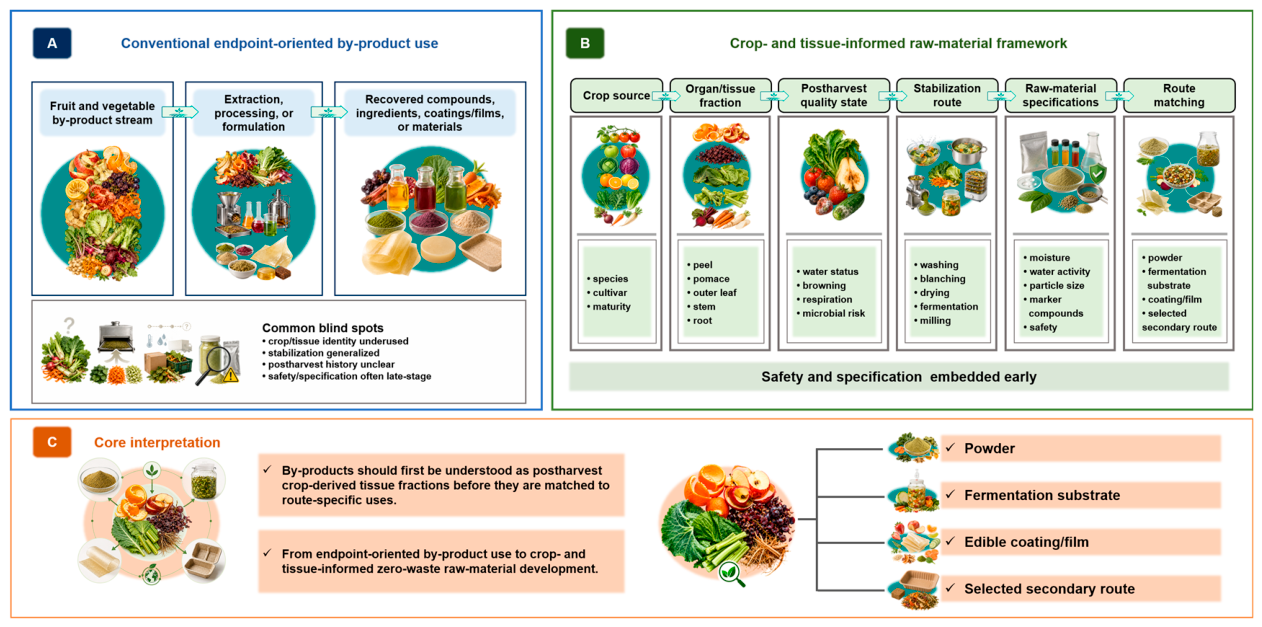
Figure 2.
Source- and tissue-specific heterogeneity of fruit and vegetable by-products. (A) Fruit-derived fractions, including peels, pomace, seeds/press cakes, seeds/stones, and pulp residues, differ in pectin richness, phenolic or pigment localization, sugar/acid matrix properties, browning or stickiness risk, and seed lipid/protein contribution. (B) Vegetable-derived fractions, including outer leaves, stems/stalks, petioles, roots/root peels, trimmings, and nonmarketable tissues, show distinct raw-material constraints such as high moisture, tissue fragility, soil or handling exposure, green pigment instability, fibrous matrices, and sensory limitations. (C) Brassicaceae fractions are presented as a representative case lens, not an exclusive taxonomic focus, because leafy, root, stem, core, stalk, and trimming fractions can differ in glucosinolate-related traits, myrosinase-associated transformations, sulfur notes, tissue diversity, and stabilization urgency. (D) Tissue segregation supports route matching because organ identity, tissue architecture, postharvest risk, and intended route influence stabilization, characterization, standardization, and specification setting. The examples are representative rather than exhaustive, and route relevance depends on stabilization, safety screening, specification setting, and route-specific evidence.
Figure 2.
Source- and tissue-specific heterogeneity of fruit and vegetable by-products. (A) Fruit-derived fractions, including peels, pomace, seeds/press cakes, seeds/stones, and pulp residues, differ in pectin richness, phenolic or pigment localization, sugar/acid matrix properties, browning or stickiness risk, and seed lipid/protein contribution. (B) Vegetable-derived fractions, including outer leaves, stems/stalks, petioles, roots/root peels, trimmings, and nonmarketable tissues, show distinct raw-material constraints such as high moisture, tissue fragility, soil or handling exposure, green pigment instability, fibrous matrices, and sensory limitations. (C) Brassicaceae fractions are presented as a representative case lens, not an exclusive taxonomic focus, because leafy, root, stem, core, stalk, and trimming fractions can differ in glucosinolate-related traits, myrosinase-associated transformations, sulfur notes, tissue diversity, and stabilization urgency. (D) Tissue segregation supports route matching because organ identity, tissue architecture, postharvest risk, and intended route influence stabilization, characterization, standardization, and specification setting. The examples are representative rather than exhaustive, and route relevance depends on stabilization, safety screening, specification setting, and route-specific evidence.
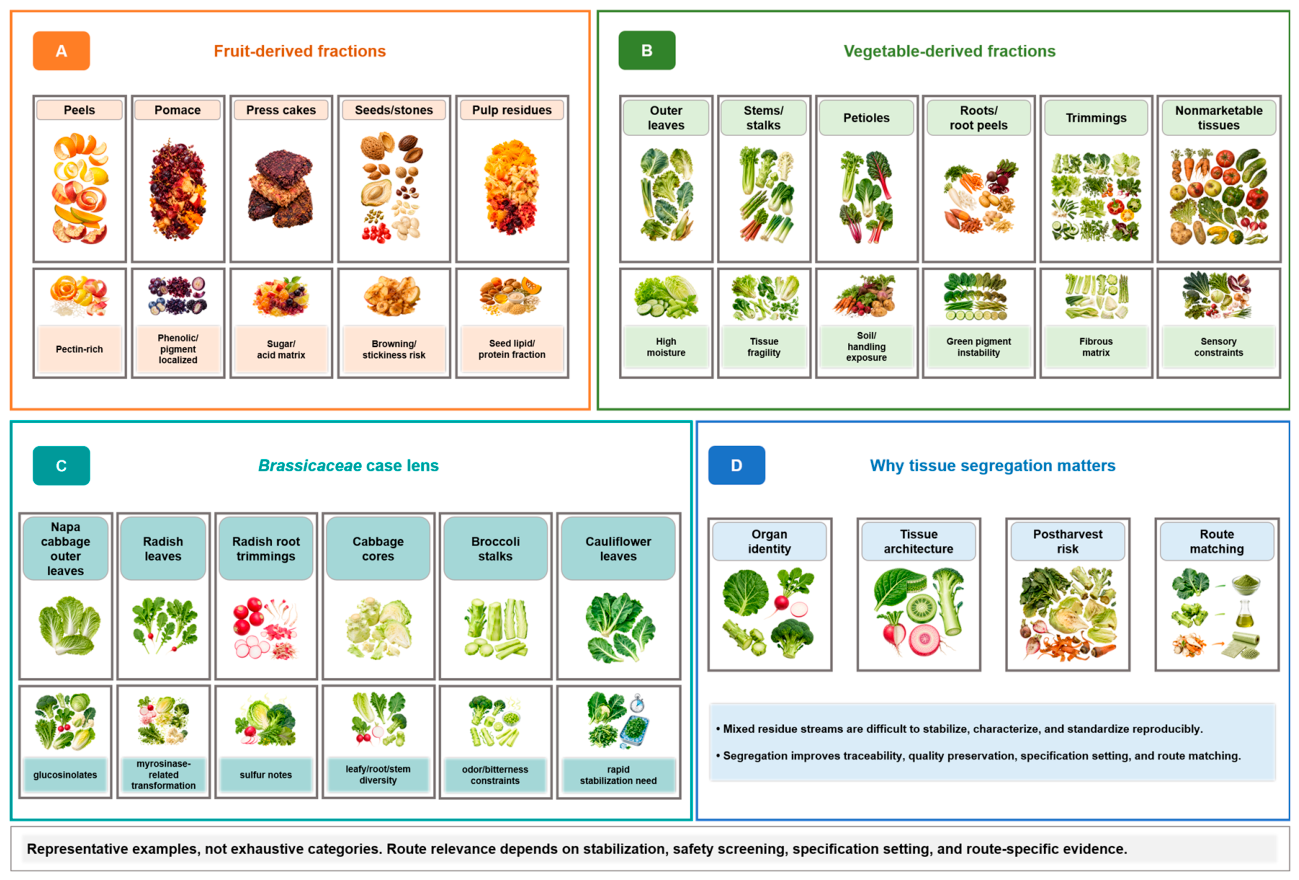
Figure 3.
Field-to-postharvest decision framework for fit-for-purpose stabilization and raw-material readiness of tissue-derived fruit and vegetable by-products. (A) Field-to-postharvest control points include preharvest background, harvest and sorting, postharvest handling, fresh tissue quality, and safety/contaminant considerations. These records provide the traceability basis for interpreting the condition of each tissue-derived fraction before stabilization and route assignment. (B) Tissue-risk interpretation translates these records into key instability profiles, including high moisture or respiration, browning or pigment instability, microbial risk or contamination, odor/bitterness/sulfur notes, fibrous or lignified matrices, and batch variability or traceability loss. (C) The decision logic first asks whether the material is traceable and segregated, then whether safety and screening criteria are acceptable, and finally which instability driver should guide stabilization and route selection. (D) Fit-for-purpose stabilization options include refrigerated holding, washing or sanitation control, blanching plus drying, direct drying, acidification or fermentation, extraction-first routing, size reduction or milling, whole-tissue powder production, selected lower-risk routing, and exclusion or downgrading. (E) The output is a stabilized tissue-derived raw-material candidate defined after traceability review, safety screening, stabilization choice, and route-specific specification setting. The framework is a decision-support schematic, not a regulatory safety protocol; downgrading, lower-risk routing, or exclusion remain valid outcomes when safety, stability, traceability, or specification requirements are not met.
Figure 3.
Field-to-postharvest decision framework for fit-for-purpose stabilization and raw-material readiness of tissue-derived fruit and vegetable by-products. (A) Field-to-postharvest control points include preharvest background, harvest and sorting, postharvest handling, fresh tissue quality, and safety/contaminant considerations. These records provide the traceability basis for interpreting the condition of each tissue-derived fraction before stabilization and route assignment. (B) Tissue-risk interpretation translates these records into key instability profiles, including high moisture or respiration, browning or pigment instability, microbial risk or contamination, odor/bitterness/sulfur notes, fibrous or lignified matrices, and batch variability or traceability loss. (C) The decision logic first asks whether the material is traceable and segregated, then whether safety and screening criteria are acceptable, and finally which instability driver should guide stabilization and route selection. (D) Fit-for-purpose stabilization options include refrigerated holding, washing or sanitation control, blanching plus drying, direct drying, acidification or fermentation, extraction-first routing, size reduction or milling, whole-tissue powder production, selected lower-risk routing, and exclusion or downgrading. (E) The output is a stabilized tissue-derived raw-material candidate defined after traceability review, safety screening, stabilization choice, and route-specific specification setting. The framework is a decision-support schematic, not a regulatory safety protocol; downgrading, lower-risk routing, or exclusion remain valid outcomes when safety, stability, traceability, or specification requirements are not met.
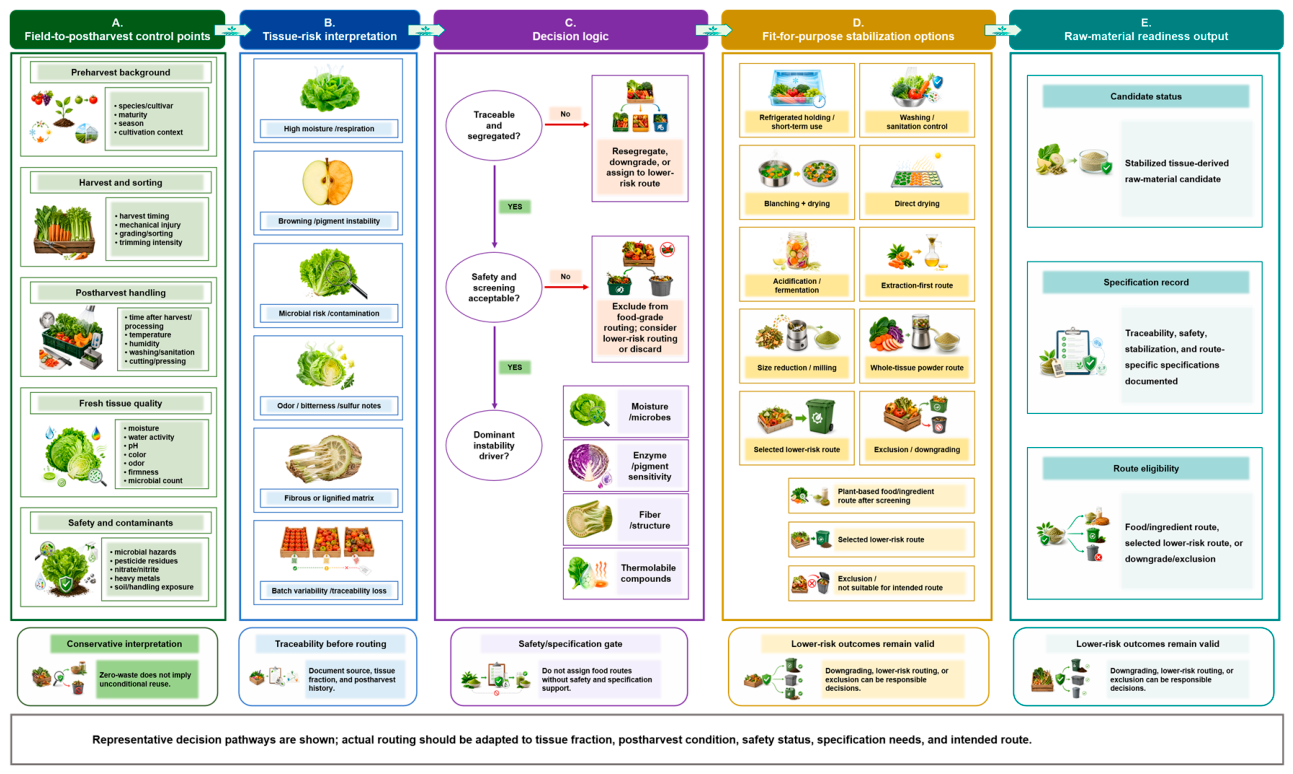
Figure 4.
Tissue-to-raw-material framework for zero-waste raw-material development of fruit and vegetable by-products. The framework summarizes the central decision sequence proposed in this review: (1) defining source and tissue fraction; (2) diagnosing postharvest condition; (3) choosing a fit-for-purpose stabilization route; (4) setting raw-material specifications; and (5) matching the specified material to an intended route. Step 1 generates an identity record that includes species or crop source, cultivar or genotype, maturity/season, organ identity, tissue fraction, generation point, and segregation status. Step 2 produces a risk profile based on moisture and water activity, respiration or enzymatic activity, browning or pigment loss, microbial load, odor/bitterness/sulfur notes, tissue damage, and contaminant risk. Step 3 converts this risk profile into a stabilization plan, including refrigerated short-term holding, washing/sanitation control, blanching plus drying, direct drying, acidification or fermentation, extraction-first routing, whole-tissue powder routing, selected lower-risk routing, or downgrading/exclusion. Step 4 defines route-relevant specifications such as moisture, water activity, particle size, color, pH, microbial criteria, contaminants, marker compounds, fiber/polysaccharide profile, and storage stability. Step 5 assigns the stabilized and specified material to an intended route only when evidence supports that use, including whole-tissue powder, fermentation substrate, edible coating/film, plant-based food ingredient, selected secondary material route where relevant, lower-risk non-food route, or exclusion if unsuitable. The framework output is a crop × tissue × postharvest state × stabilization × composition × functionality × route-matching matrix. Safety/specification gates and conservative interpretation are embedded to emphasize that zero-waste raw-material development does not imply unconditional reuse.
Figure 4.
Tissue-to-raw-material framework for zero-waste raw-material development of fruit and vegetable by-products. The framework summarizes the central decision sequence proposed in this review: (1) defining source and tissue fraction; (2) diagnosing postharvest condition; (3) choosing a fit-for-purpose stabilization route; (4) setting raw-material specifications; and (5) matching the specified material to an intended route. Step 1 generates an identity record that includes species or crop source, cultivar or genotype, maturity/season, organ identity, tissue fraction, generation point, and segregation status. Step 2 produces a risk profile based on moisture and water activity, respiration or enzymatic activity, browning or pigment loss, microbial load, odor/bitterness/sulfur notes, tissue damage, and contaminant risk. Step 3 converts this risk profile into a stabilization plan, including refrigerated short-term holding, washing/sanitation control, blanching plus drying, direct drying, acidification or fermentation, extraction-first routing, whole-tissue powder routing, selected lower-risk routing, or downgrading/exclusion. Step 4 defines route-relevant specifications such as moisture, water activity, particle size, color, pH, microbial criteria, contaminants, marker compounds, fiber/polysaccharide profile, and storage stability. Step 5 assigns the stabilized and specified material to an intended route only when evidence supports that use, including whole-tissue powder, fermentation substrate, edible coating/film, plant-based food ingredient, selected secondary material route where relevant, lower-risk non-food route, or exclusion if unsuitable. The framework output is a crop × tissue × postharvest state × stabilization × composition × functionality × route-matching matrix. Safety/specification gates and conservative interpretation are embedded to emphasize that zero-waste raw-material development does not imply unconditional reuse.
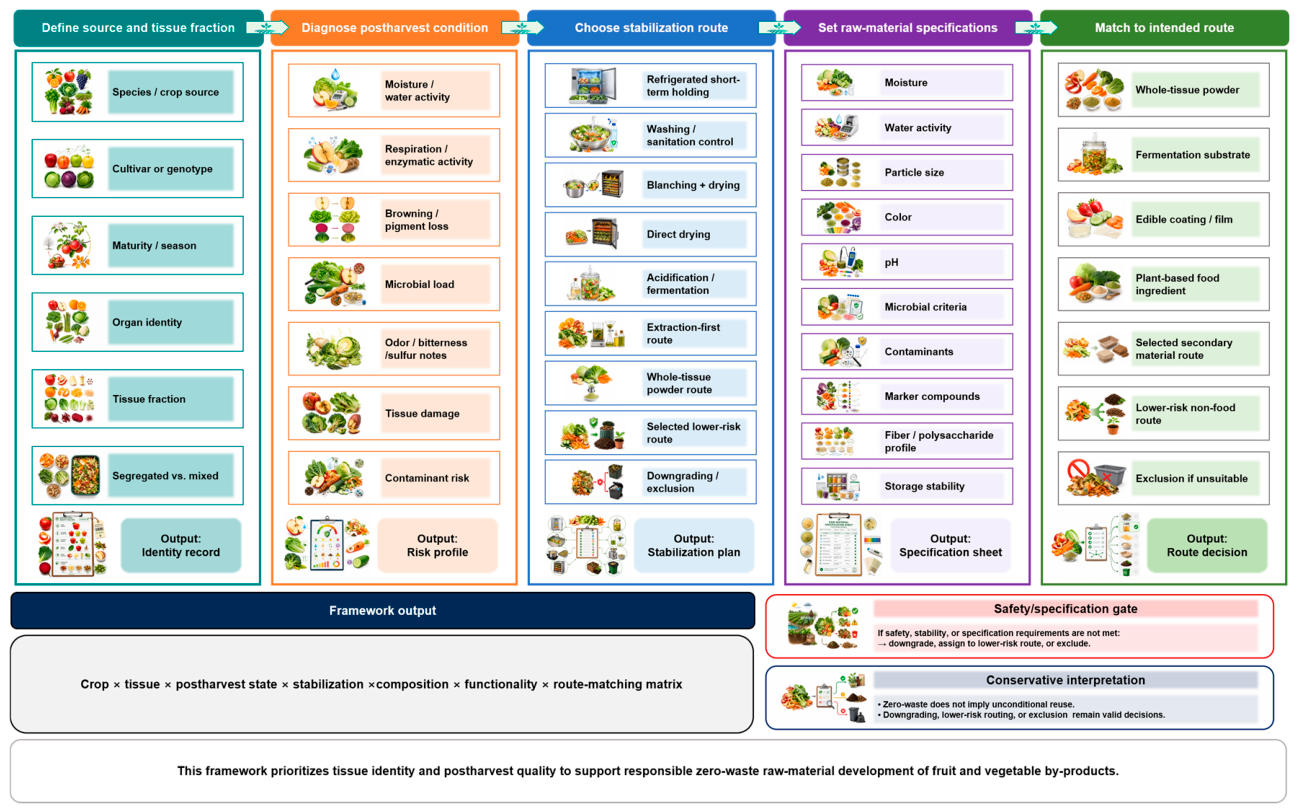

Table 1.
Positioning the present tissue-informed review relative to major fruit and vegetable by-product review streams.
Table 1.
Positioning the present tissue-informed review relative to major fruit and vegetable by-product review streams.
| Existing review streams | Tissue-informed extension | Manuscript linkage | ||||
| Review stream | Typical organizing axis | Usual endpoint or output | Issue less explicitly integrated for tissue-informed raw-material design | Extension in the present review | Relevant sections | Representative references |
| Green extraction and compound recovery | Extraction solvent; enabling technology; extraction yield; process efficiency; target-compound recovery. | Phenolic-, pigment-, antioxidant-, carotenoid-, and pectin-rich extracts or fractions. | Starting-tissue identity, organ fraction, tissue damage, postharvest history, and stabilization status before extraction are often secondary. | Positions crop source, organ/tissue fraction, postharvest quality, and stabilization status before interpreting recovery potential. | 3; 5–7 | [5,20,21,22] |
| Chemical profiling and bioactivity | Compound class; analytical platform; screening assay; compositional richness; assay-based activity. | TPC/TFC values; DPPH/ABTS/FRAP assays; LC–MS or spectroscopic profiles; antioxidant or antimicrobial screening. | Translation from assay response to raw-material readiness, safety, stability, sensory acceptability, and application relevance. | Separates screening indicators from raw-material specifications and links analytical fingerprints to tissue identity, structural markers, and intended route. | 7; 10 | [4,5,23] |
| Biorefinery and circular economy | Multi-output resource recovery; cascade use; supply-chain valorization; circular-economy logic. | Integrated valorization pathways; cascade extraction; multiple product streams; circular bioeconomy strategies. | Tissue-level quality and safety, segregation status, postharvest history, and specification setting within system-level valorization. | Adds crop × tissue × postharvest decision logic and frames zero waste as quality-preserving raw-material design rather than unconditional residue reuse. | 2; 8; 10–11 | [2,4,8,9] |
| Food formulation and functional ingredients | End-use food matrix; formulation or fortification level; sensory response; nutritional or techno-functional performance. | Bakery, beverage, meat, dairy-type, plant-based, feed, and functional food applications. | Pre-formulation tissue diagnosis, pre-stabilization quality, batch variability, and application readiness before incorporation. | Matches tissue-derived properties to application requirements; frames whole-tissue powders as nutritional/techno-functional ingredients only when specifications are met. | 8–9 | [4,24,25,26] |
| Packaging, coating, and selected plant-based material routes | Film/coating composition; barrier or active function; biopolymer performance; material testing. | Edible coatings; active films; biodegradable packaging; molded materials; plant-based biomaterials. | Source variability, tissue fraction, stabilization history, safety screening, and specification gates before material testing. | Links pectin, fiber, phenolics, pigments, and structural biopolymers to tissue origin, stabilization history, validation, and safety/specification gates. | 7–9 | [27,28,29,30] |
| Crop-specific by-product reviews | Single crop, crop family, or representative commodity group; crop-specific composition and applications. | Apple pomace; grape pomace; citrus peel; Brassica residues; cruciferous vegetable waste applications. | Cross-tissue comparison across organ fractions, postharvest risk, and application readiness beyond individual crop depth. | Uses Brassicaceae as a representative case lens and integrates crop-specific evidence into a general tissue-to-raw-material framework. | 4; 11 | [6,14,15,31] |
| Fermentation-based by-product use | Microbial process; starter culture; substrate transformation; bioactive availability; antioxidant capacity; fermented product development. | Fermented foods and beverages; organic acids; probiotic or bioactive-enriched products; sensory or nutritional improvement. | Substrate grouping by process potential; limited pre-fermentation diagnosis of tissue-specific moisture, damage, microbiota, odor, and safety. | Frames fermentation as a tissue- and process-specific stabilization/transformation route and avoids universal valorization framing. | 6; 9 | [32,33,34,35] |
Note: The review streams position the conceptual contribution of the present review relative to major areas of fruit and vegetable by-product literature; they are not intended as an exhaustive or mutually exclusive classification of all review articles. The column “Issue less explicitly integrated for tissue-informed raw-material design” refers to aspects less explicitly foregrounded from the perspective of tissue-informed raw-material development and should not be read as a general critique of the cited reviews. Numbers in the “Relevant sections” column indicate manuscript section numbers. References in the rightmost column are representative examples, not exhaustive reference lists. Abbreviations: ABTS, 2,2′-azino-bis(3-ethylbenzothiazoline-6-sulfonic acid); DPPH, 2,2-diphenyl-1-picrylhydrazyl; FRAP, ferric reducing antioxidant power; LC–MS, liquid chromatography–mass spectrometry; TFC, total flavonoid content; TPC, total phenolic content.
Table 2.
Source- and tissue-specific by-product classes, stabilization risks, and conditional route-matching options.
Table 2.
Source- and tissue-specific by-product classes, stabilization risks, and conditional route-matching options.
| Source and tissue identity | Stabilization-dependent raw-material relevance | Claim boundary and evidence support | |||||
| Source/tissue class | Representative tissue fractions | Dominant tissue-quality and structural traits | Key compositional or marker features | Main stabilization and safety risks | Conditional route-matching options after screening | Interpretation boundary and claim control | Representative references |
| Fruit peels | Citrus, apple, mango, berry, and tomato peels. | Epidermal/protective tissues; often pigment- or pectin-rich; high surface exposure. | Pectin, dietary fiber, phenolics, carotenoids/anthocyanins, and aroma-related compounds. | Enzymatic browning, microbial load, pigment loss, drying sensitivity, and surface-contaminant exposure. | Fiber ingredient; pectin source; edible coating/film precursor; natural colorant or extract fraction after validation. | Claims depend on peel separation, stabilization history, contaminant control, and intended food or selected material route. | [4,50,51,52]. |
| Fruit pomace | Apple, grape, berry, and tomato pomace. | Mixed pulp/skin/seed residues; wet and seasonal; variable particle-forming behavior. | Fiber, phenolics, sugars, organic acids, pigments, and seed lipids when present. | High moisture, sugar-related stickiness, caking, browning, microbial spoilage, and seasonal variability. | Whole-tissue powder; fermentation substrate; phenolic-rich fraction; fiber-enrichment ingredient. | Interpretation depends on processing method, seed/skin/pulp ratio, drying conditions, and storage history. | [2,24,25,53]. |
| Seeds and press cakes | Fruit seeds; oilseed-containing residues; press cakes after oil extraction. | Dense storage tissues; protein/lipid-rich fractions; harder structure than pulpy residues. | Lipids, proteins, phenolics, minerals, fiber, residual oil, and antioxidant compounds. | Lipid oxidation, rancidity, hard milling, antinutritional factors, allergen/sensory constraints, and batch variability. | Oil or protein fraction; antioxidant fraction; plant-protein ingredient; selected material filler after validation. | Food use requires safety, antinutritional-factor, oxidation, allergen/sensory, and regulatory validation. | [54,55,56,57]. |
| Vegetable outer leaves | napa cabbage, cabbage, cauliflower/broccoli leaves, and leafy vegetable residues. | High-moisture leafy tissues; large exposed surface; tissue fragility; chlorophyll-rich fractions. | Chlorophylls, carotenoids, dietary fiber, minerals, phenolics, and glucosinolates in Brassicaceae. | Wilting, microbial load, pigment degradation, off-odor, enzymatic activity, and rapid quality loss. | Leaf powder; fermentation substrate; pigment/fiber ingredient; lower-risk material route when food-grade criteria are not met. | Rapid stabilization and safety screening are needed before food-grade or ingredient claims. | [6,14,58,59]. |
| Vegetable stems and stalks | Broccoli stalk, cabbage core, cauliflower stem, and petiole/stem residues. | Fibrous structural tissues; higher mechanical resistance; possible lignification; coarse particle behavior. | Cellulose, hemicellulose, lignin, insoluble fiber, minerals, and residual phenolics/glucosinolates. | Milling resistance, coarse texture, slow drying, poor dispersibility, and variable particle morphology. | Fiber powder; extrusion or milling material; selected material precursor; fermentation only when substrate traits are suitable. | Food-use limits include texture and mouthfeel; selected material routes require structural advantage and validation. | [4,6,14,60]. |
| Root trimmings | Radish, carrot, parsnip/root peels, and root trimming residues. | Storage/root tissues; high water content; soil-contact surfaces; texture and color vary by tissue layer. | Fiber, sugars, organic acids, phenolics, minerals, pigments, and glucosinolates in radish roots. | Soil contamination, high moisture, browning, microbial risk, peeling/trimming damage, and batch variability. | Fermentation substrate; dried powder; fiber/mineral-rich fraction; lower-risk non-food route when safety criteria are not met. | Route eligibility depends on washing, segregation, soil-related contaminant screening, and postharvest history. | [49,60,61,62]. |
| Brassicaceaeleafy, root, and stem residues | Napa cabbage, radish, cabbage, broccoli, cauliflower, and kale residues. | Leafy-root-stem heterogeneity within one family; sulfur-containing metabolism; tissue-specific enzyme activity. | Glucosinolates, phenolics, carotenoids, dietary fiber, minerals, sulfur volatiles, and vitamins. | Myrosinase activity, sulfur odor, bitterness, glucosinolate loss/transformation, pigment loss, and high moisture. | Powder; fermentation substrate; nutritional/techno-functional ingredient; plant-fiber or selected material route. | Claims should extend beyond glucosinolate content and specify organ fraction, myrosinase state, odor, safety, and stabilization route. | [6,14,15,38]. |
| Mixed residues | Unsegregated trimming/sorting residues; mixed peel-leaf-stem-root fractions. | Heterogeneous and variable; mixed water status, particle structure, microbial exposure, and composition. | Batch-dependent mixture of fiber, pigments, phenolics, minerals, sugars, and tissue-specific metabolites. | Poor standardization, safety uncertainty, uneven drying, odor mixing, contaminant dilution/concentration, and traceability loss. | Further segregation; lower-risk non-food route; composting/anaerobic digestion where appropriate; exclusion if unsafe. | Unsuitable for high-specificity food-grade or bioactive claims without traceability, segregation, safety screening, and specification setting. | [2,4,9,41]. |
Note: Conditional route-matching options after screening indicate directions that become defensible only after stabilization, characterization, safety screening, specification setting, and, where relevant, application-level validation. They do not imply automatic food-grade suitability, high-value application readiness, regulatory acceptance, or universal valorization. Source/tissue classes and fractions are representative examples, not exhaustive categories. “Food-grade” denotes a route requiring appropriate safety, regulatory, and application-level validation. References listed in the rightmost column are representative examples, not exhaustive reference lists.
Table 3.
Field-to-postharvest control points, traceability variables, and fit-for-purpose stabilization decisions.
Table 3.
Field-to-postharvest control points, traceability variables, and fit-for-purpose stabilization decisions.
| Field-to-postharvest traceability | Interpretation risk and tissue sensitivity | Fit-for-purpose routing and specification output |
Representative references |
|||
| Control point | Minimum traceability record | Interpretation risk if unreported | Tissue fractions most sensitive | Fit-for-purpose decision or routing step | Resulting record or specification output | |
| Preharvest determinants | Species; cultivar/genotype; maturity stage; season; cultivation context; major agronomic factors where available (e.g., soil, irrigation, nutrient status, temperature, stress exposure). | Initial tissue quality, composition, and functionality may be misinterpreted as processing effects; cross-study comparisons become weak. | All crop-derived tissues, especially Brassicaceae residues and other tissues where cultivar, maturity, or environment affects water status and metabolites. | Assign crop-level identity before processing; stratify or qualify evidence by species, cultivar, maturity, and production context; avoid pooling unknown sources. | Crop/species/cultivar record; maturity and season metadata; cultivation-context notes. | [12,13,38,45,46]. |
| Harvest and sorting | Harvest date/time; harvest maturity; mechanical injury or bruising; grading/rejection criteria; trimming intensity; segregation point. | The edible/non-edible boundary may be confused with raw-material suitability; damage-induced quality loss may be attributed to processing. | Outer leaves, peels, root trimmings, damaged tissues, fresh-cut residues, and mixed sorting residues. | Segregate by organ/tissue and damage status; re-segregate damaged or mixed streams; downgrade or exclude heavily damaged fractions when necessary. | Tissue-fraction and damage record; sorting criteria; segregation status. | [41,45,63,64]. |
| Postharvest handling | Time after harvest/processing; holding temperature; relative humidity; washing/sanitation history; cutting/pressing; storage atmosphere/packaging; mixing status. | Respiration, browning, microbial proliferation, pigment loss, or odor development may be misattributed to extraction, drying, or formulation effects. | Leafy residues, fruit pomace, high-moisture fresh-cut residues, cut root tissues, and mixed processing residues. | Immediate cooling or controlled holding; controlled washing/sanitation; rapid stabilization; downgrade or reject if delay or handling history is unclear. | Time-temperature-quality record; handling, washing, and sanitation record. | [41,42,43,65,66,67]. |
| Fresh tissue quality | Moisture; water activity; pH; soluble solids; color; firmness; odor; browning potential; respiration proxy where available; microbial count. | The stabilization route may be selected blindly; claims of freshness, stability, or raw-material readiness may be under-supported. | High-moisture leaves, pomace, root tissues, pigment-rich fractions, and tissues with high browning or odor risk. | Select drying, blanching, fermentation, refrigeration, extraction-first processing, or exclusion according to the tissue-quality profile. | Fresh tissue quality profile; go/no-go and route decision. | [11,12,13,42,67]. |
| Safety and contaminants | Soil exposure; visible mold/decay; microbial indicators or pathogen risk; pesticide residues; heavy metals; nitrate/nitrite; mycotoxin risk where relevant. | Food-grade or ingredient claims may be unsafe or indefensible; zero-waste claims may appear to imply unconditional reuse. | Soil-contact roots/root peels, leafy tissues, damaged or mold-prone tissues, high-moisture residues, and mixed streams. | Screen before plant-based food, fermentation, food-contact, selected material, or lower-risk routes; downgrade or exclude when safety criteria are not met. | Safety screening record; contaminant profile; route eligibility statement. | [68,71,72,73]. |
| Stabilization and preprocessing | Sorting/washing; sanitizer and organic load if applicable; blanching or mild thermal parameters; drying method/time/temperature; acidification/fermentation conditions; milling settings. | Batch reproducibility and storage stability cannot be evaluated; stabilization effects may be confused with tissue-source differences. | All stabilized fractions, especially high-moisture leafy residues, fruit pomace, Brassicaceae tissues, and materials intended for powders. | Use a fit-for-purpose route based on the dominant risk driver; document process parameters and avoid treating any stabilization method as universally best. | Stabilization process record; critical process parameters; stabilization yield where available. | [32,41,44,80]. |
| Storage before use | Packaging; storage temperature; relative humidity; light and oxygen exposure; storage duration; moisture/water activity after storage; color/odor change; marker retention. | “Stable powder/material” claims may be unsupported; caking, oxidation, pigment loss, sulfur odor, or microbial rebound may be overlooked. | Powders, pigment-rich fractions, sulfur-containing Brassicaceae residues, hygroscopic fruit powders, and dried fiber-rich fractions. | Define storage conditions and stability window; retest key specifications after storage; route or downgrade if stability is not maintained. | Storage stability profile; shelf/stability window under specified conditions. | [7,12,13,39,82]. |
Note: This table provides a decision-support framework for tissue-informed raw-material development and is not a regulatory safety protocol. Missing field-to-postharvest information can alter the interpretation of composition, functionality, safety, and stabilization outcomes, not merely reduce descriptive completeness. “Raw-material readiness” denotes suitability after stabilization, characterization, safety screening, and specification setting; it does not imply automatic food-grade suitability. Food-grade, food-contact, fermentation, or selected material applications require route-specific safety assessment, regulatory review where relevant, and application-level validation. References listed in the rightmost column are representative examples, not exhaustive reference lists.
Table 4.
Composition–functionality–analytical depth matrix for tissue-derived fruit and vegetable by-product raw-material candidates.
Table 4.
Composition–functionality–analytical depth matrix for tissue-derived fruit and vegetable by-product raw-material candidates.
| Marker identity and tissue context | Functional relevance and analytical depth | Specification and claim boundary |
Representative references |
|||
| Quality/compositional marker class | Typical tissue localization or source fraction | Application-relevant techno-functional role | Recommended analytical and fingerprinting approaches | Role in raw-material specification | Interpretation boundary / claim limitation | |
| Moisture and water activity | All fresh tissues, especially leafy residues, pomace, root trimmings, and other high-moisture fractions. | Stability, microbial risk, drying requirement, caking risk, storage suitability, and initial route selection. | Gravimetric moisture analysis; water activity measurement; sorption behavior when powder storage is relevant. | Core stability specification for deciding whether a material can be stored, dried, fermented, milled, or excluded. | Low moisture alone does not guarantee stability; water activity, microbial status, packaging, and storage conditions must be interpreted together. | [7,11,12,13,68]. |
| Primary metabolites | Pulp, pomace, root tissues, seeds, press cakes, and storage tissues. | Fermentability, pH, flavor, browning tendency, caking, oxidation, nutritional matrix, and downstream compatibility. | Proximate analysis; HPLC/UPLC for sugars and organic acids; mineral/ash analysis; LC–MS or NMR where matrix-level profiling is needed. | Defines the nutritional and physicochemical matrix that influences processing behavior and route matching. | Primary composition should be interpreted with tissue fraction, maturity, processing point, and stabilization history; proximate data alone do not define readiness. | [4,5,23]. |
| Pectin | Fruit peels, pomace, citrus residues, apple pomace, and selected vegetable tissues. | Gelation, thickening, water binding, edible coating/film formation, encapsulation, texture modification, and fiber-related functionality. | Uronic acid analysis; degree of esterification; FTIR/FT-MIR; rheology; chromatographic or spectroscopic profiling where relevant. | Pectin quality marker for gelling, coating, film, or structure-forming routes. | Pectin content alone does not prove film or gel performance; degree of esterification, purity, extraction history, and rheological behavior are critical. | [4,10,89,90]. |
| Cellulose, hemicellulose, and lignin | Stems, stalks, outer leaves, roots, pomace, peels, and fibrous structural tissues. | Fiber enrichment, particle structure, water binding, milling behavior, extrusion suitability, reinforcement, and selected material-route potential. | Dietary fiber analysis; NDF/ADF or related fiber fractionation; FTIR; microscopy/histology; SEM or CLSM for structure where relevant. | Structural biopolymer profile for determining whether a tissue fraction is better suited to powders, extrusion, films, or selected material routes. | High fiber may improve water binding or structure but may impair texture, dispersibility, mouthfeel, or processability in food matrices. | [7,10,11,90]. |
| Soluble and insoluble dietary fiber | Peels, pomace, leafy tissues, stems, stalks, root trimmings, and mixed fiber-rich fractions. | Water-holding capacity, swelling, viscosity, texture modification, powder functionality, fermentation substrate behavior, and nutritional enrichment. | AOAC dietary fiber methods; soluble/insoluble fiber partitioning; hydration, swelling, viscosity, and water/oil-holding tests. | Functional powder specification and matrix-compatibility marker. | Health-related claims require separate evidence; in this review, dietary fiber functionality should be framed mainly as nutritional and techno-functional performance. | [4,7,39,90]. |
| Pigments | Peels, outer leaves, epidermal tissues, pigmented pulp, and other colored plant tissues. | Color, product identity, visual quality, consumer acceptance, stability marker, and antioxidant screening. | Colorimetry; spectrophotometry; HPLC/UPLC for carotenoids, anthocyanins, chlorophylls, betalains, or other pigments; storage-retention tests. | Color and marker-compound stability specification for powders, extracts, coatings, films, or colorant routes. | Pigment retention is affected by stabilization, oxygen, light, pH, temperature, and storage; color does not substitute for compound-level identification. | [4,5,15,75]. |
| Phenolics and flavonoids | Peels, seeds, pomace, outer tissues, epidermal tissues, and selected Brassicaceae residues. | Antioxidant screening, astringency/bitterness, color interactions, antimicrobial screening, active-preservation potential, and batch comparison. | TPC/TFC as screening only; HPLC/UPLC; LC–MS/MS; LC–HRMS; NMR-assisted profiling; spectroscopic fingerprinting with chemometrics. | Marker compounds and batch-comparison profile for phenolic-rich fractions. | TPC, TFC, DPPH, and ABTS are screening indicators, not raw-material specifications; application-level validation is needed for antioxidant or antimicrobial claims. | [4,5,23]. |
| Marker identity and tissue context | Functional relevance and analytical depth | Specification and claim boundary |
Representative references |
|||
| Quality/compositional marker class | Typical tissue localization or source fraction | Application-relevant techno-functional role | Recommended analytical and fingerprinting approaches | Role in raw-material specification | Interpretation boundary / claim limitation | |
| Glucosinolates and isothiocyanates | Brassicaceae leaves, roots, stems, stalks, trimmings, outer leaves, and other tissue fractions. | Brassicaceae identity marker, sensory constraint, sulfur notes, bitterness, bioactivity screening relevance, and processing sensitivity. | HPLC/UPLC; LC–MS/MS; targeted glucosinolate profiling; myrosinase-related assays; processing-retention tests. | Brassicaceae-specific phytochemical fingerprint and processing-sensitivity marker. | Tissue damage, endogenous myrosinase, blanching, drying, fermentation, and leaching can alter profiles; Brassicaceae residues should not be valued only by glucosinolate content. | [14,15,38,75]. |
| Volatiles and odor-active compounds | Brassicaceae tissues, fruit peels, fermented substrates, aromatic residues, and damaged or stored tissues. | Aroma, off-odor, sulfur notes, sensory acceptance, fermentation quality, and application constraints. | GC–MS; GC–O where available; electronic nose or volatile fingerprinting; sensory screening; storage-related volatile monitoring. | Odor-constraint marker for deciding food, fermentation, coating/film, selected material, or lower-risk non-food routes. | Absence of volatile or sensory analysis weakens food-grade claims when bitterness, sulfur notes, grassy odor, rancidity, or off-odor are expected. | [14,32,75,99]. |
| Microstructure and particle morphology | Dried and milled tissues, powders, films, gels, coating materials, fiber-rich fractions, and rehydrated matrices. | Hydration, flowability, dispersibility, swelling, gelation, film formation, texture, milling behavior, and mechanical compatibility. | Light microscopy; histology; SEM; CLSM; image analysis; particle size distribution; texture analysis; rheology where relevant. | Structural specification linking plant tissue architecture, stabilization, milling, and application-level performance. | Representative sampling is critical because powders and mixed residues can be heterogeneous; microstructure should be linked to functional tests rather than shown descriptively only. | [7,10,11,98]. |
| Microbial and contaminant markers | Soil-contact roots, high-moisture leafy tissues, fresh-cut residues, damaged/mold-prone tissues, pomace, and mixed residues. | Food-grade eligibility, safety routing, downgrading/exclusion decision, sanitation need, and regulatory defensibility. | Microbial counts; pathogen screening; pesticide residues; heavy metals; nitrate/nitrite where relevant; mycotoxin screening; physical hazard checks. | Safety specification for deciding whether a material can enter food, fermentation, coating/film, food-contact, lower-risk, or exclusion routes. | Not all materials should enter food routes; zero-waste development must include safety screening, downgrading, lower-risk routing, or exclusion when specifications are not met. | [12,13,43,68,71]. |
Note: Analytical and fingerprinting approaches should be selected according to tissue fraction, stabilization history, intended route, and required validation level; they should not be interpreted as mandatory methods for all by-product fractions. Screening assays, including TPC, TFC, DPPH, and ABTS, should be treated as screening indicators rather than sufficient raw-material specifications. Marker-compound identification, structural characterization, safety assessment, batch comparison, and, where relevant, application-level testing are needed to support defensible raw-material claims. References in the rightmost column provide representative row-level support for the listed marker class, tissue context, analytical approaches, specification role, and interpretation boundary; they are not exhaustive reference lists. Abbreviations: ABTS, 2,2′-azino-bis(3-ethylbenzothiazoline-6-sulfonic acid); ADF, acid detergent fiber; AOAC, AOAC International methods; CLSM, confocal laser scanning microscopy; DPPH, 2,2-diphenyl-1-picrylhydrazyl; FTIR, Fourier-transform infrared spectroscopy; FT-MIR, Fourier-transform mid-infrared spectroscopy; GC–MS, gas chromatography–mass spectrometry; GC–O, gas chromatography–olfactometry; HPLC, high-performance liquid chromatography; LC–HRMS, liquid chromatography–high-resolution mass spectrometry; LC–MS, liquid chromatography–mass spectrometry; LC–MS/MS, liquid chromatography–tandem mass spectrometry; NDF, neutral detergent fiber; NMR, nuclear magnetic resonance spectroscopy; SEM, scanning electron microscopy; TFC, total flavonoid content; TPC, total phenolic content; UPLC, ultra-performance liquid chromatography.
Table 5.
Tissue trait–application matching matrix for plant-based food development, fermentation, edible coating and film routes, and selected secondary material routes.
Table 5.
Tissue trait–application matching matrix for plant-based food development, fermentation, edible coating and film routes, and selected secondary material routes.
| Route decision | Tissue-route matching | Readiness and validation requirements | Claim boundary |
Representative references |
||
| Conditional route or decision | Tissue traits supporting route suitability | Candidate tissue fractions after screening | Minimum specifications before application claim | Application-level validation required | Main constraints, downgrading, or exclusion triggers | |
| Whole-tissue powders | Fiber, color, minerals, water-binding capacity, acceptable particle behavior, and matrix compatibility. | Fruit pomace; peel powders; carrot residues; leafy vegetable residues; Brassicaceae trimmings. | Moisture; water activity (aw); particle size; color; odor; microbial quality; marker compounds; storage conditions. | Storage stability; sensory compatibility; hydration or reconstitution behavior; performance in the target food matrix. | Gritty texture; bitterness or astringency; sulfur notes; caking; hygroscopicity; high microbial load; unstable color; unsupported health-function claims. | [4,7,24,25]. |
| Fermentation substrates | Moisture, fermentable carbohydrates, suitable pH, manageable microbial ecology, and transformation potential. | Fruit pomace; leafy residues; root trimmings; vegetable residues; selected mixed fractions after screening. | pH; sugar profile; salt tolerance; microbial status; contaminant screening; substrate consistency; time–temperature record. | Controlled fermentation; pH decline; starter performance; safety; sensory profile; metabolite or bioactivity changes. | Uncontrolled spoilage; off-odor; pathogen risk; inconsistent substrate; excessive sulfur notes or bitterness; unstable fermentation endpoints. | [2,32,33,34]. |
| Edible coatings and films | Pectin, polysaccharide continuity, phenolic-containing fractions, film-forming behavior, and compatibility with the target food. | Fruit peels; pectin-rich pomace; polysaccharide-rich fractions; selected vegetable residues. | Pectin/fiber profile; viscosity; color; microbial quality; contaminant status; film-forming fraction or extract identity. | Mechanical strength; flexibility; barrier properties; migration safety; adhesion; sensory compatibility; storage stability. | Weak films; hydrophilicity; poor transparency; instability; regulatory uncertainty; limited scale-up feasibility. | [28,29,30,110]. |
| Active preservation systems | Phenolics, pigments, organic acids, antimicrobial or antioxidant screening activity, and tissue-specific bioactive markers. | Peel extracts; pomace fractions; Brassicaceae fractions; pigment- or phenolic-rich residues after stabilization. | Marker compounds; extraction or stabilization history; solvent/residue limits where relevant; microbial and safety status. | Application-level antioxidant or antimicrobial testing in the target matrix; dose–response; sensory impact; mechanism-oriented evidence. | Assay activity may not translate to food systems; excessive color or odor; compound instability; insufficient safety validation. | [5,28,29,30]. |
| Selected secondary material routes | Fiber integrity, lignocellulosic structure, particle morphology, pectin/starch/cellulose content, and mechanical compatibility. | Stems; stalks; outer leaves; root residues; fruit pomace; peels; seed coats; fibrous trimmings. | Fiber profile; particle size; moisture; mechanical compatibility; contaminant status; fractionation or modification history. | Mechanical properties; barrier performance; biodegradability or end-of-life behavior; food-contact suitability if intended. | Chemical modification needs; poor scalability; variable raw material; unclear food-contact safety; insufficient end-of-life data. | [27,28,110,117]. |
| Lower-risk non-food routing | Recoverable material quality but insufficient evidence, safety status, or sensory suitability for food-grade use. | Mixed residues; contaminated but non-hazardous fractions; highly fibrous residues; fractions with severe sensory constraints. | Hazard classification; moisture; stability; contaminant status; intended non-food route; storage and handling requirements. | Route-specific safety, environmental, and technical assessment; regulatory fit; feasibility under realistic input variability. | Unsafe, unstable, legally restricted, or highly variable materials should not be forced into food or high-value claims. | [2,9,107,118]. |
| Exclusion from application-oriented routing | Severe spoilage, contamination, untraceable origin, unacceptable batch variability, or inability to meet safety/specification requirements. | Moldy tissues; highly contaminated residues; unsegregated high-risk residues; materials with unknown history. | Not applicable when safety, traceability, stability, or legal requirements cannot be met. | Not applicable; exclusion decision should be documented rather than reframed as valorization. | Must not be forced into zero-waste claims; disposal, composting, or regulated non-food management may be more appropriate. | [9,99,107,118]. |
Note: Application pathways indicate conditional fit-for-purpose matching routes after stabilization, safety screening, specification setting, and, where relevant, application-level validation; they do not imply that all by-products are suitable for food-grade, high-value, food-contact, or selected secondary material applications where relevant. This matrix is intended as a decision-support tool, not as a regulatory safety protocol. “Food-grade” and “food-contact” routes require appropriate safety, regulatory, and application-level validation. Exclusion from application-oriented routing is included intentionally; downgrading, lower-risk non-food routing, or exclusion remain valid decisions when safety, stability, sensory, traceability, legal, or specification requirements cannot be met. References in the rightmost column provide representative row-level support for the listed pathway, tissue traits, candidate fractions, specifications, validation needs, and claim boundaries; they are not exhaustive reference lists. Abbreviation: aw, water activity.
Table 6.
Minimum reporting checklist for tissue-informed fruit and vegetable by-product raw-material studies: traceability, specification, and claim-control domains.
Table 6.
Minimum reporting checklist for tissue-informed fruit and vegetable by-product raw-material studies: traceability, specification, and claim-control domains.
| Reporting domain and minimum information | Rationale and examples | Reporting priority |
Representative references |
||
| Reporting domain | Minimum information to report | Purpose for reproducibility and claim control | Example reportable variables | ||
| Terminology and material status | State whether the material is waste, residue, by-product, side-stream, stabilized raw material, screening-level ingredient, or application-ready input. | Prevents legal, technical, and value-chain overclaiming; clarifies whether the material is a disposal stream, recoverable side-stream, or specification-based input. | Waste/by-product definition; intended destination; application readiness; legal or policy framing where relevant. | Core | [3,36,37,126]. |
| Crop identity | Report species, common name, cultivar/genotype where available, and production region where relevant. | Explains compositional, physiological, and postharvest variability before tissue fractions are compared across studies. | Napa cabbage; radish; apple; grape; cultivar; genotype; production region. | Core | [4,45,120]. |
| Organ and tissue fraction | Report organ, tissue type, anatomical fraction, and whether the material was segregated or mixed. | Determines tissue architecture, cell-wall composition, water status, stabilization needs, and interpretation of functionality. | Peel; pomace; outer leaf; petiole; stem; stalk; root trimming; seed; mixed residue. | Core | [4,10,14,15]. |
| By-product generation point | Specify where and how the material was generated within production, postharvest handling, fresh-cut processing, or industrial processing. | Distinguishes harvest residues, trimming residues, fresh-cut residues, pomace, press cakes, fermented residues, and industrial side-streams. | Sorting; trimming; peeling; juicing; pressing; fresh-cut processing; fermentation; storage or postharvest handling. | Core | [2,4,32,41]. |
| Preharvest background | Report cultivation system, season, maturity, and environmental context where available. | Explains initial tissue quality and helps separate cultivar, season, maturity, and growing-condition effects from processing effects. | Season; maturity stage; irrigation; light/temperature; stress exposure; production system; harvest region. | Recommended | [12,13,15,38,45]. |
| Harvest and sorting history | Report harvest date, grading criteria, trimming criteria, maturity at sorting, and mechanical damage. | Defines tissue condition before stabilization and prevents confusion between commercial edible/non-edible boundaries and raw-material suitability. | Bruising; cutting injury; damaged tissue; grading standard; trimming intensity; edible/non-edible boundary. | Core | [11,40,41,45]. |
| Postharvest interval and storage | Report time and temperature between harvest/processing and stabilization, plus storage atmosphere, humidity, packaging, and holding conditions. | Prevents misinterpretation of deterioration, browning, microbial growth, softening, or compositional loss as effects of extraction or drying alone. | Time after harvest; time after processing; storage temperature; relative humidity; packaging; intact/cut/bruised status. | Core | [2,11,12,13,42]. |
| Fresh tissue quality | Report basic physiological and quality indicators before stabilization. | Guides whether the material should be dried, blanched, fermented, refrigerated, extracted, downgraded, or excluded. | Moisture; water activity; pH; color; firmness; browning; odor; respiration proxy; microbial count. | Core | [11,12,13,42,67]. |
| Reporting domain and minimum information | Rationale and examples | Reporting priority |
Representative references |
||
| Reporting domain | Minimum information to report | Purpose for reproducibility and claim control | Example reportable variables | ||
| Safety and contaminants | Report microbial, chemical, and physical hazards relevant to tissue type and intended route. | Prevents unsafe zero-waste claims and supports food-grade, lower-risk non-food, downgrading, or exclusion decisions. | Microbial counts; pathogens; pesticides; heavy metals; nitrate/nitrite; phthalates; mycotoxin risk; soil contamination. | Core (food-related use) |
[43,68,71,73]. |
| Stabilization and preprocessing | Report sorting, washing, sanitation, blanching, drying, acidification, fermentation, milling, and storage-preparation conditions. | Allows reproducibility and comparison of stabilization outcomes across tissue fractions and processing systems. | Washing conditions; sanitizer; blanching temperature/time; drying method/time/temperature; fermentation conditions; particle size. | Core | [32,41,43,80]. |
| Analytical fingerprinting | Report targeted/untargeted compositional markers and structural or imaging-based characterization selected according to the claim. | Moves beyond screening-level assays and supports marker compounds, batch comparison, tissue identity, and structural interpretation. | HPLC; LC-MS; GC-MS; NMR; FTIR; NIR; Raman; microscopy; CLSM; SEM; colorimetry; image analysis. | Recommended; claim-dependent / route-specific | [4,23,98]. |
| Raw-material specifications | Define final quality criteria required for the intended use after stabilization and characterization. | Defines when a by-product-derived material can be treated as a standardized raw material rather than a screening-level residue. | Moisture; water activity; particle size; color; pH; marker compounds; fiber profile; microbial criteria; storage stability. | Core | [4,7,39]. |
| Application validation | Report evidence that the material performs under intended plant-based food, fermentation, edible coating or film, selected secondary material routes where relevant, or lower-risk route conditions. | Avoids extrapolating from composition, antioxidant screening, or extraction yield to application or route readiness. | Powder stability; fermentation performance; film strength; barrier properties; sensory compatibility; matrix-level tests. | Claim-dependent / route-specific | [24,27,28,29,32]. |
| Scale-up and logistics | Report supply, seasonality, mass balance, stabilization yield, storage, cost, energy, water use, and industrial integration where available. | Determines whether laboratory-scale raw-material development can translate to heterogeneous, wet, seasonal, and bulky industrial streams. | Batch variability; supply continuity; stabilization yield; energy/water use; storage stability; packaging; processing-line integration. | Recommended | [2,9,99,107]. |
| Downgrading or exclusion decision | State conditions under which material should not enter the intended route or should be assigned to a lower-risk route. | Prevents unconditional zero-waste claims and supports responsible routing when safety, stability, or specification requirements are not met. | Severe spoilage; high contamination; untraceable origin; unacceptable odor; excessive variability; unclear regulatory pathway. | Core | [36,68,99,107]. |
Note: This checklist is proposed as a minimum reporting tool for tissue-informed raw-material studies and is not a substitute for regulatory food safety assessment, hazard analysis, life-cycle assessment, or techno-economic analysis. A by-product should be described as a raw-material candidate only after its tissue identity, postharvest history, stabilization status, safety profile, and intended route are sufficiently documented. Downgrading, lower-risk non-food routing, or exclusion remain valid decisions when safety, stability, traceability, legal, or specification requirements are not met. Reporting priorities are defined as follows: Core = minimum information expected for most tissue-informed raw-material studies; Recommended = information that improves traceability and comparability when available; Claim-dependent/route-specific = information required when the corresponding application, performance, safety, functionality, or regulatory claim is made. References in the rightmost column, including supporting standards or guidance where applicable, provide representative row-level support for the listed reporting domains; they are not exhaustive reference lists. Abbreviations: CLSM, confocal laser scanning microscopy; FTIR, Fourier-transform infrared spectroscopy; GC-MS, gas chromatography-mass spectrometry; HPLC, high-performance liquid chromatography; LC-MS, liquid chromatography-mass spectrometry; MIAPPE, Minimum Information About a Plant Phenotyping Experiment; NIR, near-infrared spectroscopy; NMR, nuclear magnetic resonance spectroscopy; SEM, scanning electron microscopy.
Disclaimer/Publisher’s Note: The statements, opinions and data contained in all publications are solely those of the individual author(s) and contributor(s) and not of MDPI and/or the editor(s). MDPI and/or the editor(s) disclaim responsibility for any injury to people or property resulting from any ideas, methods, instructions or products referred to in the content. |
© 2026 by the authors. Licensee MDPI, Basel, Switzerland. This article is an open access article distributed under the terms and conditions of the Creative Commons Attribution (CC BY) license (http://creativecommons.org/licenses/by/4.0/).
Copyright: This open access article is published under a Creative Commons CC BY 4.0 license, which permit the free download, distribution, and reuse, provided that the author and preprint are cited in any reuse.


