

Submitted:
12 June 2026
Posted:
17 June 2026
You are already at the latest version
Abstract
Background: Injury rate is an important characteristic of any sport, with football occupying one of the leading positions in this indicator. Reducing injury frequency is a primary goal of sports medicine. Objective: To evaluate the impact of the "FIFA 11+" injury prevention program on the frequency and structure of injuries in amateur football players aged 15–17. Methods: A retrospective cohort study was conducted over two time intervals of 4 months each. In the first period warm-ups before training sessions and matches were performed arbitrarily. In the second period the "FIFA 11+" was used. The injury incidence rate (IR), severity, and location of injuries were evaluated. Results: The use of the "FIFA 11+" led to a significant decrease in the overall incidence rate (IR decreased from 31.9 to 17.1). At the same time, injuries decreased mainly due to moderate (p=0.003) and mild (p=0.02) injuries. Furthermore, the analysis of the injury structure within each study period revealed a significant change, showing a shift toward less severe injuries. Conclusion: The application of the "FIFA 11+" program in the training/match process of amateur football players aged 15–17 significantly reduces the incidence rate and lowers the proportion of severe and moderate injuries.
Keywords:
incidence rate
; injury prevention in football
; “FIFA 11+” injury prevention program
Introduction
Football is one of the most popular sports in the world, with more than 400 million people participating annually [1]. Youth engagement in this sport is high across all countries, including Russia [2]. As a contact sport, football occupies one of the leading positions in injury frequency [3,4]. An analysis of children’s and adolescents’ sports injuries showed that about 75% of injuries occur in football, basketball, American football, and baseball, with the highest number of medical visits being linked specifically to football [5]. In addition to contact injuries, athletes perform a large number of high-inertia movements during the game, which leads to an increased risk of non-contact injuries [1,2,3,4,5,6]. Analysis of the football injury structure shows that approximately 60–90% of sports injuries in adolescents occur in the lower extremities, with the ankle joint, knee joint, and thigh being affected most frequently [6,7,8]. The sustained injuries undoubtedly affect the continuity of the training process and the athlete’s professional training. In this regard, methods to reduce injury rates are being developed, one of which is the “FIFA 11+” injury prevention program.
“FIFA 11+” is a comprehensive warm-up program designed to reduce the risk of injuries in football players aged 14 and older. It was created in 2006 jointly by the FIFA Medical Assessment and Research Centre (Switzerland), the Oslo Sports Trauma Research Center (Norway), and the Santa Monica Orthopaedic and Sports Medicine Research Foundation (USA) [9]. The purpose of these exercises is to reduce the number of sports injuries by developing proper body stabilization techniques, including dynamic stabilization, performing eccentric training of the thigh muscles, proprioceptive training, and plyometrics.
Study Aim: To evaluate the impact of the “FIFA 11+” injury prevention program used during warm-ups in the training process and before matches on the frequency and structure of injuries in amateur football players aged 15–17.
Study Objectives:
- To evaluate the frequency and structure of injuries in amateur football players aged 15–17 during a 4-month training and match process without using the “FIFA 11+” program.
- To evaluate the frequency and structure of injuries in amateur football players aged 15–17 during a 4-month training and match process with the use of the “FIFA 11+” program.
- To conduct a comparative analysis of the obtained data.
Study Design
A retrospective cohort study was conducted to analyze injury data among teenage boys aged 15–17 years participating in the “Troparevo” district football league in Moscow. The study took place during the preparatory and competitive periods from September 2025 to April 2026. It was divided into two distinct time intervals. The first period ran from September to December 2025 inclusive, during which pre-training and pre-match warm-ups were performed arbitrarily. The second period ran from January to April 2026 inclusive, during which the warm-up before training sessions and matches was conducted using the “FIFA 11+” program.
Materials and Methods
An analysis was performed on written reports from the coach and medical staff for each training session and game. These records specified the number of players, the duration of the training session or game, as well as the number, location, and severity of injuries sustained. They also included recommendations regarding the recovery period during which the player was sidelined from football activities. Sustained injuries were recorded in accordance with the FIFA Medical Assessment and Research Centre (F-MARC) consensus recommendations on injury data collection procedures in football [10].
Data from 14 amateur football players aged 15–17 years were analyzed. During the first 4 months, the pre-training and pre-match warm-ups lasted 25–35 minutes and included running, strength, balance, and plyometric exercises randomly selected by the coach (such as jump rope, high knees, lunges, squats, planks, and squat jumps). Following a decision by the coaching staff, the warm-ups during the subsequent 4 months also lasted 25–35 minutes but consisted exclusively of exercises from the “FIFA 11+” program [11].
The Incidence Rate (IR) was calculated as the number of injuries per 1000 player-hours of football exposure.
The Incidence Rate (IR) was calculated using the following formula:
where N is the number of injuries in the study group during the study period; ∑PD is the total player-hours of all training sessions/matches during the study period;
where P is the number of players participating in a single training session/match; D is the duration of a single training session/match in hours; n is the total number of training sessions/matches.
IR = (N / ∑PD) x 1000,
∑PD = P₁ x D₁ + P₂ x D₂ + … + Pₙ x Dₙ,
Injury patterns were evaluated by anatomical location (corresponding to the injured body region) and by severity level. Severity was determined by the number of days the athlete was unable to fully train, starting from the day following the injury: Grade I—minimal (1–3 days); Grade II—mild (4–7 days); Grade III—moderate (8–28 days); Grade IV—severe (more than 28 days) [11].
Statistical Methods
Due to the small sample size, the non-parametric Wilcoxon signed-rank test for two related samples was used. Differences in incidence rates and the number of injuries by severity level were determined for the first and second study periods. Changes in the indicators were considered statistically significant at p < 0.05.
Results
During the first study period, total training and match time was 81 hours (972 player-hours), while the second period recorded 78 hours (936 player-hours). Data regarding the number and severity of injuries sustained during these periods are presented in Table 1.
As shown in the presented data, the vast majority of injuries involved the lower extremities and the groin area. Specifically, during the first study period, the highest number of injuries was related to the hamstrings (5 cases), groin ligaments and the anterior lower leg (4 cases each), as well as the knee and ankle joints (3 cases each). Severe injuries were associated with ligament damage in the aforementioned joints (1 case each). In the second study period, injury localization did not undergo significant changes—injuries to the groin area, hamstrings, and the anterior lower leg were also detected most frequently (2 cases each). However, along with the reduction in the total number of injuries, there was a shift in their distribution toward a lower proportion of severe and moderate injuries, and a higher proportion of mild and minor injuries. Notably, the number of mild injuries was the highest in both the first and second study periods. A comparative analysis of overall injury rates and injury severity during the study periods is presented in Table 2.
Thus, when comparing the two periods, a significant decrease in the overall injury incidence rate was observed following the use of the “FIFA 11+” program (IR decreased from 31.9 to 17.1 injuries per 1000 player-hours of training/matches). This reduction in injury rates was mainly driven by a decrease in moderate injuries (p=0.003) and mild injuries (p=0.02). Furthermore, the analysis of injury rates within each study period revealed a substantial change in its structure, showing a clear shift toward less severe injuries (Figure 1).
Discussion
Overall injury status represents an important characteristic of any sport [1,2,3,4,5,6]. Concurrently, one of the primary goals of sports medicine is to reduce the probability of sustaining injuries. To achieve this goal, an international expert panel from medical research centers under the auspices of FIFA developed the “FIFA 11+” injury prevention program, designed for amateur players aged 14 and older. Numerous studies have demonstrated the effectiveness of this program in preventing injuries, particularly non-contact injuries, among football players of various age groups and skill levels [12,13,14,15,16,17]. The positive outcomes of research addressing various aspects of the “FIFA 11+” program, as well as its adaptation to other sports such as basketball, drive significant interest toward a wider implementation of this exercise protocol [12,13,14].
In our study, a relatively high baseline injury rate was noted in the observed cohort, which could be attributed to insufficient physical conditioning of the athletes and the amateur nature of the matches. Analysis of the baseline injury structure revealed a considerably high frequency of mild and moderate injuries, aligning with data from other researchers regarding non-professional players [13,18]. The primary localization of injuries involved the lower extremities and the groin area, which also coincides with literature data [1,2,3,4,5,6,7]. Hamstring injuries occupied a leading position, potentially resulting from inadequate conditioning of the hamstring muscles. Meanwhile, severe injuries were exclusively associated with the joints of the lower extremity.
As a result of implementing the “FIFA 11+” program, the overall injury rate significantly decreased, which aligns with findings from numerous researchers [12,13,14,15,16,17]. Injury localization did not undergo substantial changes. Although lower extremity injuries still played a leading role, the frequency of injuries to the hamstrings, groin area, lower leg, and joints dropped significantly. This reduction could reflect the specialized warm-up and conditioning these structures receive during the “FIFA 11+” program.
Concurrently, the injury structure underwent significant changes, characterized by a complete absence of severe injuries and a reduced frequency of moderate injuries, alongside an increased proportion of mild and minor injuries. This shift could be attributed to increased physical strength in the athletes, improved proprioception, and the development of skills for body position control and load redistribution across the ligamentous and joint apparatus. Our findings align with the results of a study by Marques C. et al., which demonstrated that injury severity directly depends on the players’ training and professionalism levels [18]. Our data also closely concur with the research results published by Soligard T., Silvers-Granelli H. and Thorborg K. [15,16,17].
Thus, the use of the “FIFA 11+” program made it possible to reduce the overall injury incidence rate in the study group and shift its structure toward less severe injuries.
Conclusions
The application of the “FIFA 11+” injury prevention program as a warm-up routine in the training and match process of amateur football players aged 15–17 significantly reduces the incidence of injuries and lowers the proportion of severe and moderate injuries.
Author Contributions
Conceptualization, E.M.; Methodology, M.A.; software, E.M.; formal analysis, E.M.; investigation, E.M.; resources, E.M.; data curation, E.M.; writing-original draft preparation, E.M.; writing-review and editing, M.A.; supervision, M.A. All authors have read and agreed to the published version of the manuscript.
Funding
This research received no external funding.
Institutional Review Board Statement
Ethical review and approval were waived for this study due to its retrospective nature and the lack of direct contact with the participants. Data processing was performed on anonymized, aggregated reports to protect participant identity.
Informed Consent Statement
Participant consent was waived due to the retrospective nature of this study and the absence of direct contact with the participants. Data from the information reports were processed in an aggregated format without identifying the individual participants.
Acknowledgments
The authors express their gratitude to the team coaches and medical stuff for granting access to the data and for sharing their deep and specific knowledge of the sport and their players, which enabled the authors to draw more accurate and insightful conclusions.
Conflicts of Interest
The authors declare no conflicts of interest.:
Abbreviations
The following abbreviations are used in this manuscript:
| FIFA | Fédération Internationale de Football Association |
| IR | Incidence Rate |
| F-MARC | FIFA Medical Assessment and Research Centre |
References
- López-Valenciano, A.; Ruiz-Pérez, I.; Garcia-Gómez, A.; Vera-Garcia, F.J.; De Ste Croix, M.; Myer, G.D.; Ayala, F. Epidemiology of injuries in professional football: a systematic review and meta-analysis. Br. J. Sports Med. 2020, 54, 711–718. [Google Scholar]
- Al’-Dzhaberi, A.S.; Rapoport, L.A. Sports injuries in football according to the age of players. Izv. Tul’skogo Gos. Univ. Fiz. Kul’tura. Sport (In Russian) 2022, 8, 58, 63. [Google Scholar]
- Mazur, A.I. Epidemiology of sports injuries in the aspect of medical rehabilitation. Med. Nov. (In Russian) 2012, 11, 46–50. [Google Scholar]
- Savchenko, I.V.; Avtomonova, T.S.; Martinen, M.S. Features of traumatic injuries in children and the factors that determine them (literature review). Med. Theory Pract. (In Russian) 2021, 6, 46–53. [Google Scholar]
- Bayt, D.R.; Bell, T.M. Trends in paediatric sports-related injuries presenting to US emergency departments, 2001–2013. Inj. Prev. 2016, 22, 361–364. [Google Scholar] [PubMed]
- Rozina, M.A.; Radetskiy AYu Mukharamova, A.M.; Koroleva, I.u.A.; Shesternina, V.S.; Semenov, A.N.; Emelianov, D.S.; Davydov, D.D.; Kuznetsova, O.D. Injuries among young male and female footballers training at the academy. Med. Theory Pract. (In Russian) 2025, 10, 7–15. [Google Scholar]
- Faude, O.; Rößler, R.; Junge, A. Football injuries in children and adolescent players: Are there clues for prevention? Sports Med. 2013, 43, 819–837. [Google Scholar] [CrossRef] [PubMed]
- GabbettTJ The training-injury prevention paradox: should athletes be training smarter and harder? Br. J. Sports Med. 2016, 50, 273–280. [CrossRef] [PubMed]
- Dvorák, J. Give Hippocrates a jersey: Promoting health through football/sport. Br. J. Sports Med. 2009, 43, 317–322. [Google Scholar] [CrossRef] [PubMed]
- Fuller, C.W.; Ekstrand, J.; Junge, A.; Andersen, T.E.; Bahr, R.; Dvorak, J.; Hägglund, M.; McCrory, P.; Meeu wisse, W.H. Consensus statement on injury definitions and data collection procedures in studies of football (soccer) injuries. Br. J. Sports Med. 2006, 40, 193–201. [Google Scholar] [CrossRef] [PubMed]
- FIFA 11+: warm-up programme to prevent injuries. Available online: https://www.rfs.ru/news/222641 (accessed on 12.05.2026).
- Bizzini, M.; Junge, A.; Dvorak, J. Implementation of the FIFA11+ football warm up program: How to approach and convince the Football associations to invest in prevention. Br. J. Sports Med. 2013, 47, 803–806. [Google Scholar] [CrossRef] [PubMed]
- Bangsbo, J.; Hansen, P.R.; Dvorak, J.; Krustrup, P. Recreational football for disease prevention and treatment in untrained men: A narrative review examining cardiovascular health, lipid profile, body composition, muscle strength and functional capacity. Br. J. Sports Med. 2015, 49, 568–576. [Google Scholar] [CrossRef] [PubMed]
- Yang, Jinfeng; Wang, Yang; Chen, Jianxin; Yang, Jinqi; Li, Na; Wang, Chun; Liao, Yuanpeng. Effects of the “FIFA11+ Kids” Program on Injury Prevention in Children: A Systematic Review and Meta-Analysis. Int. J. Env. Res. Public Health 2022, 19, 12044. [Google Scholar] [CrossRef] [PubMed]
- Soligard, T.; Myklebust, G.; Steffen, K.; Holme, I.; Silvers, H.; Bizzini, M.; Junge, A.; Dvorak, J.; Bahr, R.; Andersen, T. Comprehensive warm-up programme to prevent injuries in young female footballers: Cluster randomised controlled trial. BMJ 2008, 337, a, 2469. [Google Scholar] [CrossRef] [PubMed]
- Silvers-Granelli, H.; Mandelbaum, B.; Adeniji, O.; Insler, S.; Bizzini, M.; Pohlig, R.; Junge, A.; Snyder-Mackler, L.; Dvorak, J. Efficacy of the FIFA11+ Injury Prevention Program in the Collegiate Male Soccer Player. Am. J. Sports Med. 2015, 43, 2628–2637. [Google Scholar] [CrossRef] [PubMed]
- Thorborg, K.; Krommes, K.K.; Esteve, E.; Clausen, M.B.; Bartels, E.M.; Rathleff, M.S. Effect of specific exercise-based football injury prevention programmes on the overall injury rate in football: A systematic review and meta-analysis of the FIFA 11 and 11+ programmes. Br. J. Sports Med. 2017, 51, 562–571. [Google Scholar] [CrossRef] [PubMed]
- Marques, C.; Rebelo, M.; Crisóstomo, R.; Honório, S.; Duarte-Mendes, P.; Petrica, J.; Serrano, J. Descriptive analysis of injury types and incidence during futsal preseason across different competitive levels. Front Sports Act. Living 2024, 6, 1363006. [Google Scholar] [CrossRef] [PubMed]
Figure 1.
Structure of injuries by degree of severity.
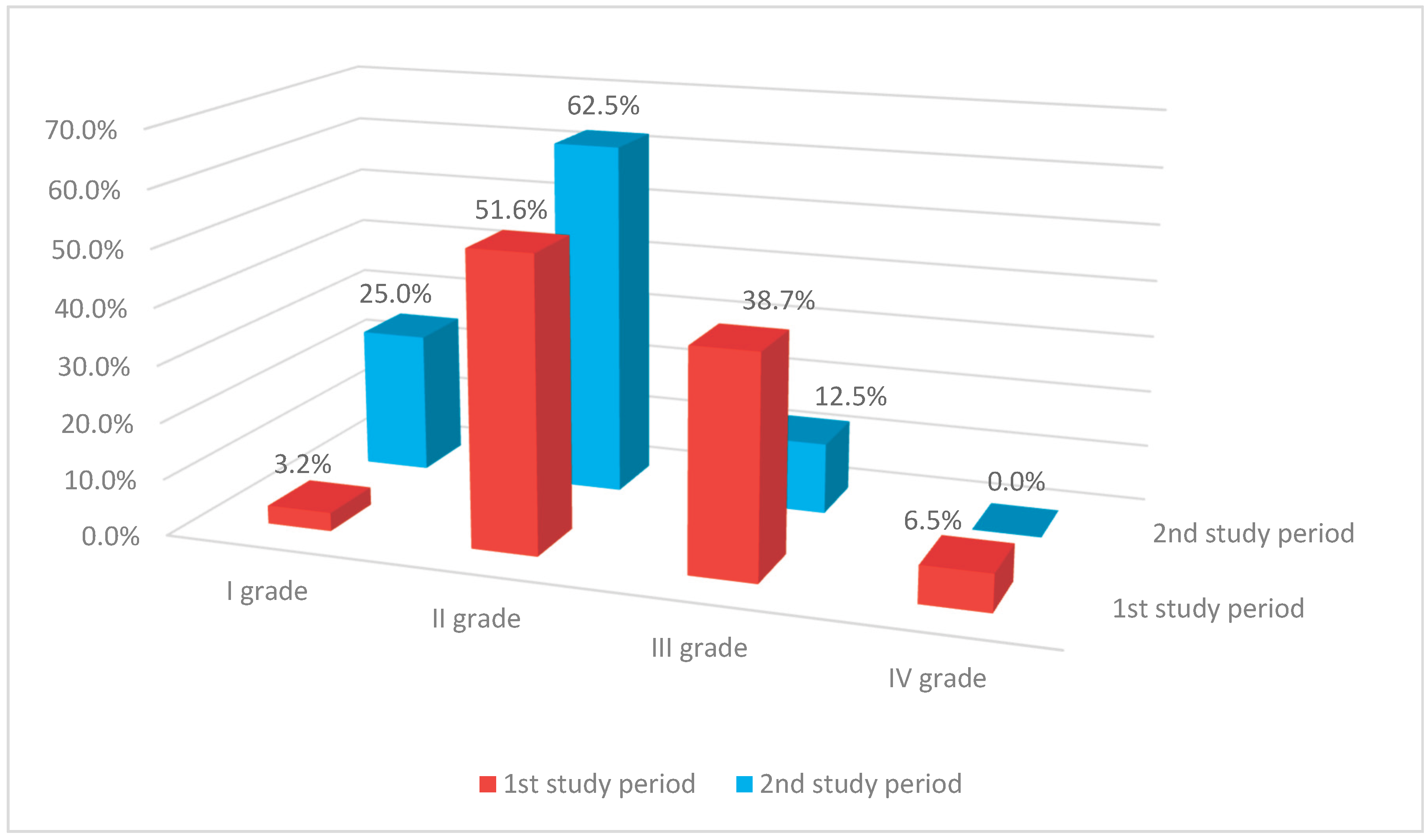

Table 1.
Distribution of Injuries by Anatomical Location and Severity.
| Location | 1st Study Period | 2nd Study Period | ||||||||
| n | Severity, grade | n | Severity, grade | |||||||
| I | II | III | IV | I | II | III | IV | |||
| Head | 1 | 0 | 1 | 0 | 0 | 1 | 0 | 1 | 0 | 0 |
| Shoulder | 1 | 0 | 1 | 0 | 0 | 0 | 0 | 0 | 0 | 0 |
| Forearm | 1 | 0 | 1 | 0 | 0 | 1 | 0 | 1 | 0 | 0 |
| Elbow | 0 | 0 | 0 | 0 | 0 | 1 | 0 | 1 | 0 | 0 |
| Hand | 2 | 0 | 1 | 1 | 0 | 2 | 1 | 1 | 0 | 0 |
| Groin region | 4 | 0 | 2 | 2 | 0 | 2 | 1 | 1 | 0 | 0 |
| Back | 1 | 0 | 1 | 0 | 0 | 1 | 0 | 1 | 0 | 0 |
| Hamstring | 5 | 1 | 2 | 2 | 0 | 2 | 1 | 0 | 1 | 0 |
| Anterior thigh | 2 | 0 | 1 | 1 | 0 | 0 | 0 | 0 | 0 | 0 |
| Knee joint | 3 | 0 | 1 | 1 | 1 | 1 | 0 | 1 | 0 | 0 |
| Anterior lower leg | 4 | 0 | 2 | 2 | 0 | 2 | 0 | 1 | 1 | 0 |
| Posterior lower leg | 2 | 0 | 1 | 1 | 0 | 0 | 0 | 0 | 0 | 0 |
| Ankle joint | 3 | 0 | 1 | 1 | 1 | 1 | 0 | 1 | 0 | 0 |
| Foot | 2 | 0 | 1 | 1 | 0 | 2 | 1 | 1 | 0 | 0 |
| Total | 31 | 1 | 16 | 12 | 2 | 16 | 4 | 10 | 2 | 0 |
Table 2.
Overall Injury Rate and Severity.
| Incidence Rate | Injury Severity Grade, n (%) | |||||
| n | IR | I | II | III | IV | |
| 1st Study Period | 31 | 31,9 | 1 (3,2%) | 16 (51,6%) | 12 (38,7%) | 2 (6,5%) |
| 2nd Study Period | 16 | 17,1 | 4 (25,0%) | 10 (62,5%) | 2 (12,5%) | 0 |
| Wilcoxon test, р | 0,019* | 0.073 | 0.02* | 0.003* | 0,083 | |
*Statistically significant (p < 0.05).
Disclaimer/Publisher’s Note: The statements, opinions and data contained in all publications are solely those of the individual author(s) and contributor(s) and not of MDPI and/or the editor(s). MDPI and/or the editor(s) disclaim responsibility for any injury to people or property resulting from any ideas, methods, instructions or products referred to in the content. |
© 2026 by the authors. Licensee MDPI, Basel, Switzerland. This article is an open access article distributed under the terms and conditions of the Creative Commons Attribution (CC BY) license.
Copyright: This open access article is published under a Creative Commons CC BY 4.0 license, which permit the free download, distribution, and reuse, provided that the author and preprint are cited in any reuse.


