

Submitted:
14 June 2026
Posted:
15 June 2026
You are already at the latest version
Abstract
Describing the formation, evolution, and establishment of steady states in physical systems remains a fundamental problem in modern physics. This paper examines the dynamics of structured bodies in inhomogeneous fields of external forces, represented by systems of potentially interacting material points, using the evolution equation. The evolution of a closed, nonequilibrium statistical ensemble of structured bodies is described using the extended Liouville equation, which describes the change in phase volume due to internal energy transformations. D-entropy, which characterizes the relative change in internal energy, is used as a measure of system evolution. Using the evolution equation, a numerical simulation of the motion of a structured body in a radially inhomogeneous central force field is performed based on the mass-spring model. It is shown that an increase in the internal energy of the system due to the inhomogeneity of the external force field can lead to the formation of a stationary system in the central force field. However, if changes in internal energy are neglected, motion in the central field remains infinite. Attractors do not arise. The obtained results demonstrate the important role of using the evolution equation to describe the processes of structure formation in energy exchange processes and long-term dynamics of systems in inhomogeneous force fields.
Keywords:
structured body
; evolution equation
; internal energy
; D-entropy
; extended Liouville equation
; tidal capture
; stationary states
; central force field
1. Introduction
The motion of bodies, fundamental interactions, and evolution are inherent properties of matter. While the dynamics of bodies and the laws of their interactions have been studied in sufficient detail, describing the evolution of physical systems remains one of the fundamental problems of physics [1]. Understanding the laws of evolution is crucial, as they determine the transition of a system from its present state to its future and underlie the description of the processes of formation, development, and decay of matter structures.
The equations of classical mechanics are invariant under time reversal. They preserve the phase volume determined by the energy of the system’s motion, whereas real physical systems exhibit relaxation, changes in internal energy, and the formation of new stable stationary states. This contradiction between the reversibility of the Hamiltonian dynamics of systems and the irreversibility of macroscopic processes was discussed in the works of Henri Poincaré and subsequently became one of the central problems of statistical physics and the theory of dynamical systems [2,3,4].
This problem is particularly evident in problems of the evolution of gravitationally interacting systems. According to classical mechanics, the motion of a body in a stationary central field remain reversible, and the system’s energy of motion should be conserved [5]. However, observations show the formation of stable, coupled configurations, accompanied by synchronization of rotation, circularization of orbits, and relaxation of systems to a stationary state with decreasing energy of motion. In statistical physics, this process is usually associated with an increase in entropy [6,7,8]. However, the transformation of the energy of motion of systems of material points (MPs) into internal energy in the equations of classical mechanics cannot be described without the use of probabilistic hypotheses.
Modern studies of the tidal evolution of objects in the Universe show that internal deformations play a key role in the dissipative dynamics of gravitationally bound systems. In [9], it was shown that strong tidal interactions are capable of causing the destruction of the ice crust of satellites and the formation of large-scale tectonic structures. The authors of [10] performed a numerical simulation of the tidal evolution of a viscoelastic body using a mass-spring model, demonstrating the transformation of orbital energy into the internal energy of the deformed body. These results indicate that internal degrees of freedom have a significant impact on the long-term dynamics of systems. However, in existing models, dissipation is introduced through empirical viscoelastic parameters and does not follow directly from the fundamental laws of mechanics. This is due to the impossibility of describing irreversible dissipative processes within the framework of the laws of classical mechanics [2,3]. Attempts to explain the mechanism of these processes within the framework of fundamental physics continue to this day [11,12].
The best-known mechanism of irreversibility relies on the instability of Hamiltonian systems and the existence of external fluctuations [3]. A mechanism has also recently been proposed that relies on an extension of classical mechanics based on the principle of symmetry duality. The essence of this principle is that the dynamics of systems is determined not only by the symmetries of space, but also by the symmetries of the bodies themselves [13]. In accordance with this principle , an evolution equation was obtained for a system of potentially interacting MPs. A distinctive feature of this equation is that it takes into account that portion of the work of external forces that goes toward changing the internal energy, assuming conservation of the total energy [13,14,15,16]. This made it possible to link the evolution of the system with a change in its internal state as a result of its motion in a non-uniform field of external forces.
The aim of the work is to study the processes of formation of stationary states of structured bodies (SB) in a central field of forces based on the evolution equation, which takes into account the transformation of the energy of motion into the internal energy of the system. In contrast to the equation of motion of a material point, this equation contains a term describing the transformation of the energy of motion into the internal energy of the system. For a closed nonequilibrium ensemble of structured bodies, the extended Liouville equation is used, which takes into account the change in phase volume due to dissipative processes [21]. To explain the mechanism of formation of structures, a brief explanation of the derivation of the evolution equation is proposed. Based on the evolution equation, the processes of formation of stationary states of systems in a central field of forces are studied on the basis of numerical modeling. The role of internal deformations in the transformation of energy and dissipative relaxation of the system is analyzed. D-entropy, previously proposed in [14,15,16], is used as a characteristic of the internal evolution of the system. Along with the energy of motion, it characterizes the process of evolution of the system. The obtained results demonstrate that the use of the evolution equation, which allows one to take into account the role of the internal structure of the body in its dynamics, makes it possible to describe the processes of formation of stationary systems within the framework of the fundamental laws of mechanics.
2. Energy Equation of a Structured Body
Let us explain how the evolution equation is derived from the total energy for a SB defined by a system of potentially interacting MPs. To do this, we will first demonstrate how Newton’s equation of motion for a single MP is derived from the condition of invariance of the energy of motion, and then explain the derivation of the evolution equation from the total energy of the system. The idea of such a derivation is presented, for example, in [17].
Energy is a scalar quantity. It consists of several additive terms determined by independent coordinates and velocities. The coordinates determine the potential component of energy, while the velocities and mass of the MP determine the kinetic component of energy.
For a single MP, the total energy corresponds to the energy of motion, since the internal energy of the MP is zero. That is, the total energy of the MP coincides with the energy of motion. We will show how to find Newton’s equation of motion for a single MP by differentiating its energy of motion with respect to time, assuming its invariance.
From the condition of homogeneity of time, the equality holds That is, we have:
From here we write:
Because then from (1) we obtain:
Equation (3) means that in a non-uniform space whose properties are independent of the body moving within it, a change in kinetic energy is compensated by a change in potential energy along its trajectory. Moreover, the rate of change of kinetic energy at a given point is proportional to the gradient of the function corresponding to that point . Equation (3) can be identically rewritten as:
Multiplying expression (3a) by , we obtain the product of a scalar function and a vector. For a material point in a potential field, it is assumed that there are no forces that do not work. In this case, the condition for conservation of total energy leads to the equation of motion:
This is Newton’s equation of motion for a mass transport in a potential field of external forces. On the left is the inertial force. On the right is the active force acting from the external field. The equality of these forces follows from the law of conservation of mass transport energy. Thus, in a non-uniform and isotropic space, the change in the mass transport’s kinetic energy is equal to the change in its potential energy. This follows from the condition that the sum of these energy types is constant.
According to equations (3, 4), the gradient of the potential function determines the efficiency of converting the potential component of the MPs energy into its kinetic component. Accordingly, the MPs acceleration is proportional to the potential force.
Thus, when constructing the mechanics of MP based on the law of conservation of energy, forces follow from the energy of motion.
Equation (4) means that the MP moves along the gradient of the potential function. Moreover, the inertial and active forces are equal in magnitude and opposite in sign at any point along the trajectory. This corresponds to d’Alembert’s principle and means that the sum of the active and inertial forces is zero [17]. Since the MP moves along the gradient of the external field potential, the work done along the closed loop is zero. Indeed, the gradient curl is zero. It also follows that the MP dynamics are reversible.
There are no structureless bodies in nature. It can be confidently stated that structure is a property of matter. That is, models of real bodies are systems of potentially interacting MPs. Therefore, the model of a body consisting of a single MP is a significant simplification. Clearly, the equation of motion for a system of MPs must follow from the law of conservation of total energy, just as Newton’s equation of motion for a single MP follows from it.
Let us show how, based on Newton’s equation of motion, we can obtain the equation of evolution, that is, the equation of motion of the SB, consisting of from a set of potentially interacting MPs.
Since energy is additive, the energy of the MP system is determined by the sum of the energies of the MPs. Then, if the external force field is time-independent, the energy of the MP system is equal to the sum of their energies. This can be written as follows:
Here :
– kinetic energy of the system, equal to the sum of the kinetic energies of all MP in the laboratory coordinate system; i = 1,2,3,… N;
- speed and coordinates i -th MP in the laboratory coordinate system;
– potential energy of MPs interactions;
rij = ri - rj distance between i and j of MPs;
– potential energy of the system in the field of external forces, determined by the sum of the potential energies of each MP, – mass of the MP , taken equal to 1.
The energy of each MP consists of its energy of motion, the potential energy of interaction with all MPs, and the potential energy of the MP in an external force field. Each MP, in addition to moving with the system, is in relative motion with respect to one another, determined by the work done by the forces of interaction between the system’s elements and the difference in external forces acting on the various elements of the system. These motions determine the internal energy. An important point to note here: the energy of motion of the SB is independent of the internal energy. If this were not the case, it would be impossible to divide physics into two branches: the first, which studies the dynamics of bodies, and the second, which studies the internal state of bodies. Since internal energy and the energy of motion are determined by MP s, the total energy must be the sum of the energy of motion and the internal energy.
Here
– energy of motion of the system;
– kinetic component of the energy of motion of the system;
– internal energy, where is the kinetic component of internal energy.
Equation (6) is a dual representation of the total energy of a system as the sum of its motional energy and its internal energy. This representation corresponds to the fact that the total energy of a system is equal to the sum of its motional energy and its internal energy. We will show how to find such a dual representation of energy.
Let us take into account that the quadratic function of the total kinetic energy of the system can be written in terms of a quadratic function in which the arguments are the relative velocities of the MP and the velocity of the system’s center of mass. This follows from the equality , where From here we have:
where , - the speed of the center of inertia of the system.
The first term on the right-hand side of equation (7) is the kinetic energy of the system’s motion. The second term corresponds to the kinetic component of the system’s internal energy. Thus, the system’s kinetic energy naturally decomposes into the kinetic energy of the center of mass motion and the internal kinetic energy of the relative motions of the MP.
The variables that determine the motion of the center of inertia of the system will be called macrovariables , and the variables that determine the internal energy will be called microvariables . The interaction energy of MPs is a function of microvariables. It depends on the distances between MPs and is a potential component of the internal energy. The potential energy of the SB in an external field is determined by summing the potential energies of all MP. It has the form: .By bringing together all the types of energy of the system, we obtain an expression for the total energy of the system:
here are coordinates i -th MP relative to the center of inertia , are the coordinates of the center of inertia.
Now we will show that the sum of the kinetic energies of the relative motions of the MP is equivalent to the sum of the kinetic energies of the motions of the MP relative to the center of inertia of the system.
We transform the energy by substituting: = + , where are the velocities of the particles relative to the center of inertia. Since , we obtain: . Here the second term expresses the kinetic energy of motion of all MP s relative to the center of inertia. Since this expression for the total kinetic energy must coincide with expression (7), we obtain : . That is, the second term is equal to the kinetic energy of motion of MP s relative to the center of inertia . Hence we have: . Here the first term on the right-hand side determines the energy of motion of a structured body through macrovariables. The second term determines the internal energy of a structured body through microvariables. From the Pythagorean theorem, which equation (6) satisfies, it follows that micro- and macrovariables are orthogonal and independent. That is, there are two independent subspaces of macro- and microvariables in which the energy of the system is defined. This means that the internal energy and the energy of motion of the system are independent, and its total energy, equal to the sum of the energies of all MPs, can be represented as the sum of the internal energy and the energy of motion of the system.
Thus, the total kinetic energy of the system TN includes the energy of its motion – , and the kinetic energy of the motion of all MPs relative to the center of inertia – , i.e. TN = + , where ,
. Consequently, the internal energy of the system can be written both in relative coordinates and velocities of MPs and in coordinates and velocities of MPs relative to the center of inertia. Hence, the total energy of the system, equal to the sum of the internal energy and the energy of motion of the system in the field of external forces, can also be written as follows:
In equations (8, 9), the potential component of the system’s energy in an external field – the radius vector of each MP, written in the laboratory coordinate system – must be expressed in terms of micro- and macrovariables. Generally, the variables are not separated. This means that as the system moves, both the potential component of the system’s motion energy and the potential component of its internal energy will change. The sum of the kinetic energy of the system ‘s motion and the kinetic component of its internal energy in the dual coordinate system turned out to be equal to the system’s kinetic energy in the laboratory coordinate system.
The fact that the kinetic energy of the system in micro- and macrovariables has decomposed into a sum of independent quadratic functions of velocities is proof of the independence of micro- and macrovariables and the necessity of using the principle of dual symmetry to describe the dynamics of a body.
Thus, we have succeeded in obtaining an expression for the total energy written in a dual coordinate system. The law of conservation of the total energy of a system, in accordance with the principle of dual symmetry, should be defined as follows: the total energy of a system along the trajectory of its center of inertia changes while maintaining the sum of the energy of motion of the system and its internal energy. Micro- and macrovariables are “their” variables that determine the energy structured body.
3. Evolution Equations of the SB
Let’s consider deriving the evolution equation by summing the energy changes of each MP system along its trajectory and transitioning to a dual coordinate system. This method of deriving the evolution equation allows us to immediately separate its right-hand side into forces that change the internal energy and forces that drive the motion of the system as a whole. This allows us to take into account that the change in internal energy is associated with the difference in the forces acting on the MP. This derivation utilizes the condition of additivity of the work done by external and internal forces.
Differentiating with respect to time the energy of the MP system, recorded in the laboratory coordinate system, we obtain:
Here is the external force acting on -th MP; is the force of interaction between and MPs;; .
Note that the holonomic constraint condition used to derive the canonical Lagrange equation is equivalent to the requirement that each bracket in equation (10) be equal to zero. Each bracket then yields an equation of motion for one of the MP s, which follows from the canonical Lagrange equation. This equation has the form:
The equation of motion of the entire system in classical mechanics is obtained by summing equations (11) for each MP. It has the form:
Here ;. Thus, deriving equation (12) by summing equations (11) resulted in a loss of the work of external forces in changing the internal energy. To account for this work, the evolution equation should be derived directly from (10), without requiring each term to be zero. This can be accomplished by moving to micro- and macrovariables and then grouping the terms so as to write the equation in terms of variables describing the motion of the center of mass and the motion of the MP relative to the center of mass.
The transformation of equation (10) to new variables is carried out based on the following equalities:;
;
;
;
. Leaving one term of equation (10) on the left side, which determines the inertial force, and sending all the remaining terms to the right side, taking into account that , we obtain:
Multiplying equation (13) by and dividing by , we obtain the equation of evolution of a structured body:
where :
;
– external force acting on the -th MP ;
; – interaction force and MPs;
. Equation (14) is an evolution equation. In it, the analytical friction coefficient , which determines the fraction of the motional energy that is converted into internal energy, has an analytical form. According to the right-hand side of equation (14), the work of external forces is divided into the work of moving the system and the work of changing its internal energy.
The first term on the right-hand side of equation (14) determines the external force applied to the center of mass. The second term is nonzero in a nonuniform field of external forces. It depends on micro- and macrovariables belonging to the symmetry groups of the system and space. This term determines the transformation of motional energy into internal energy.
According to equations (14), if , then we have dissipative-free dynamics of the system. In the simplest case, this condition can be realized in some cases, for example, during the motion of an oscillator in a central force field, when the difference in external forces is orthogonal to the relative velocities of the oscillator particles. In this case, classical mechanics holds true, and we have stationary rotation of the system around the central field.
From equation (14), it is clear that there exists a velocity at which all the work of external forces is converted into internal energy. This case occurs when the equality . According to equation (14), this equality is satisfied when the frictional force caused by the conversion of motional energy into internal energy is equal to the driving external force. As a result, we arrive at Aristotle’s assertion that the velocity of a body is proportional to the force. In this case, we have a stationary dissipative system, when the work of external forces in moving the system is compensated by dissipative processes.
Newton’s equation of motion states that acceleration is proportional to the external force. According to equation (8), this case is possible only when the external forces are homogeneous, or when the change in internal energy can be neglected. Indeed, when the external force field is homogeneous, we have , and equation (14) takes the form: . This is Newton’s equation. Thus, the mechanics of a structured body generalizes Newtonian mechanics and Aristotelian mechanics.
According to statistical physics, in the local thermodynamic equilibrium approximation, closed nonequilibrium systems can be represented as a statistical ensemble of equilibrium MP subsystems moving relative to one another. For such an ensemble, using the evolution equation in a manner similar to that used in statistical physics to derive the canonical Liouville equation, we obtain the extended Liouville equation. It has the form:
Here - number of the structured body ; - forces acting on i - MP of a structured body ; - velocity, coordinates and momentum of a structured body ; distribution function of the ensemble of SB; .
Equation (15) is applicable to describing the evolution of statistical ensembles taking into account dissipative forces. Its right-hand side, unlike the canonical Liouville equation, is generally nonzero. Equation (15) is applicable to describing the process of establishing equilibrium.
The right side of equation (15) follows from the collective forces that determine the transformation of the energies of relative motions SB into their internal energies. It is not equal to zero due to the presence of force gradients between the SBs. This indicates that the energy of the relative motions of the SBs is transformed into internal energy. The nature of the right-hand side of equation (1) is due to the transformation of the energies of the relative motions of the SBs into their internal energies, which is not taken into account in classical mechanics.
The formal solution of equation (15) is:
Thus, from equations (15, 16) it follows that the distribution function of a closed nonequilibrium statistical ensemble will tend to an equilibrium state in which the relative velocities of the SBs vanish due to the transformation of the energy of their relative motions into the internal energy of the SBs . A similar result was obtained by methods of statistical physics from the requirement of extremality of the entropy of equilibrium systems [18].
4. D-Entropy
Changes in the internal energy of the MP are associated with the work of external forces to increase it. It has previously been hypothesized that this work increases chaos. It was believed that chaotization is probabilistic in nature [19]. In fact, as follows from the evolution equation, chaotization is deterministic. It is associated with the fact that the conversion of motional energy into internal energy of a nonequilibrium system occurs under the condition that the sum of the momenta of the MP relative to the center of mass remains equal to zero. Under the condition of conservation of total energy, this is only possible as a result of changes in the direction of motion of the MP. If the system is in equilibrium, then the increase in internal energy occurs as a result of an increase in the velocity of the MP relative to the center of mass.
To take into account this work on the change in internal energy, the concept of D-entropy was introduced [14,20,21]. It is defined as the ratio of the increment of the internal energy of the system to its total value.
By analogy with the Clausius entropy, we define the D-entropy as the ratio of the increment of the internal energy of a body to the total value of the internal energy:
where is the D-entropy .
D-entropy - a new concept in mechanics. The need to introduce this concept arose in connection with the expansion of classical mechanics, which consists of taking into account the role of the structure of bodies in their dynamics. This consideration makes it possible to describe dissipation processes for moving bodies in the presence of external inhomogeneous force fields.
D-entropy determines the nature of the relationship between the energy of motion and internal energy. This definition of D-entropy is due to the fact that for equilibrium systems, like Clausius entropy, it determines the heating of a body. Indeed, consider a body rolling with friction down an inclined surface under the force of gravity. As a result, the body heats up due to the conversion of the energy of motion into internal energy–heating the body. However, in general, D-entropy is determined by the ratio of changes in internal energy, not thermal energy, as is the case with Clausius entropy. That is, Clausius entropy is a special case of D-entropy. Another difference is that the increment of internal energy due to friction is related to the body’s motion, not its heating, as is the case with Clausius entropy. Importantly, D-entropy is defined analytically.
Thus, D-entropy differs from existing definitions of entropy in that, firstly, it is determined by the total increment of internal energy; secondly, it is deterministic; thirdly, it characterizes the evolution of a dynamic system; fourthly, it is applicable to both large and small systems. Moreover, it can be either positive or negative [21,22,23,24]. In general, D-entropy characterizes the dependence of the internal states of bodies on their dynamics, which makes it applicable to the analysis of both equilibrium and nonequilibrium systems.
5. On the Mechanism of Formation of Systems
Thus, we have demonstrated how the system’s evolution equation is derived from the total energy by differentiating it with respect to time. We have shown that this equation takes into account the change in the system’s internal state as it moves through a non-uniform force field, thereby describing its evolution. We have determined the measure of change in internal energy using D-entropy. We have substantiated the tendency of a nonequilibrium closed ensemble to reach equilibrium.
Below, we will numerically solve the problem of the capture of the MP system by a central force field and the formation of a stationary system. We will show that this capture occurs as a result of the transformation of the energy of the system’s motion relative to the central force field into its internal energy due to the gradient of the central force field. Capture occurs if the scale of the system is commensurate with the inhomogeneity of the gravitational field. We will also show that if we neglect the increase in the system’s internal energy during such motion , then a stationary system or attractor does not arise.
5.1. Modeling Methodology
Numerical simulation of the motion of a structured body in a non-uniform central force field was performed using a two-dimensional mechanical model, representing the body as a set of material nodes connected by elastic elements. This approach has previously been used to describe not only the orbital motion of the object as a whole in a central force field, but also internal deformations, energy redistribution between degrees of freedom, and tidal pumping of internal modes [8,9] . Unlike studying tidal pumping, here we perform calculations of the system dynamics based on the evolution equation. This eliminated the use of any empirical coefficients determining the dissipation of the energy of the system’s motion in a tidal field.
The structured particle was modeled as a filled disk of radius , discretized by a regular square grid with a step size of . Grid nodes were included in the model when the following condition was met:
where are the coordinates of the node in the body’s own frame of reference. Each node had the same mass . The total mass of the structured particle was determined as
where is the number of nodes.
Interaction between nodes was achieved through a system of elastic links connecting each node to its nearest neighbors in orthogonal and diagonal directions, ensuring mechanical connectivity and the ability to simulate internal deformations of the body. Nodes were connected to their nearest orthogonal and diagonal neighbors. A stiffness of was used for orthogonal links , and for diagonal links . The equilibrium length of each link was determined by the initial mesh geometry:
The internal forces were calculated using Hooke’s law. For each bond connecting nodes and , the current length was determined:
after which the elongation was calculated:
The elastic interaction force had the form:
The total force at each node was determined as the sum of all internal and external influences.
The external field was generated by the central mass . To eliminate the singularity of the Newtonian potential, a softened gravitational field with parameter was used .
For numerical stability when passing close to the center of the field, a softened node potential was used:
where is the distance of the node to the center of the field.
The corresponding force was written as
The equations of motion were integrated using a symplectic kick–drift–kick (KDK) scheme, equivalent to a velocity–Verlet integrator. The integration step was chosen to ensure stable resolution of both the orbital motion of the center of mass and the internal vibrational modes of the structured particle. At each time step, the accelerations at the current position of the system were first calculated, followed by a half-step velocity update.
after which the coordinates were updated,
then the accelerations were recalculated in the new position, and the second half-step of updating the velocities was performed,
The use of the KDK integrator is due to its good energy conservation properties and stability during long-term integration of mechanical systems with a large number of degrees of freedom.
To improve computational efficiency, the bulk of the calculations were implemented in Fortran and subsequently integrated into Python via the f2py interface. Node coordinates, velocities, graph edges, and interaction parameters were passed to the Fortran kernel in Fortran-order array format. Within the kernel, batch integration of the system was performed over a large number of time steps.
To accurately preserve the system’s evolution history, a special sampled-output mode was used. Unlike the traditional approach, in which Python only obtains the final state after a large block of steps, the Fortran module performed internal time index checking and automatically saved diagnostic parameters at a fixed interval . This eliminated artificial history interpolation and ensured physically correct reconstruction of the system’s temporal dynamics when using large computational blocks.
At each diagnostic step, the coordinates of the center of mass were calculated:
speed of the center of mass:
as well as the energy characteristics of the system.
The total kinetic energy was defined as:
The kinetic energy of the center of mass motion was calculated using the formula:
The internal kinetic energy was defined as:
The potential energy of the springs was calculated as:
The internal energy of the system was given by the expression:
and the total energy of the system was defined as:
To analyze the capture processes, the effective orbital energy was used:
The state of capture was determined by the condition:
To analyze the processes of internal dissipation and energy redistribution, the power of tidal pumping of internal modes was calculated
On its basis, the D-entropy of the system was determined:
5.2. Control of Accuracy and Reproducibility of Calculations
The accuracy of the calculations was monitored through an analysis of the conservation of the system’s total energy. Throughout the simulation, the relative drift of the total energy was calculated:
and also the absolute deviation:
Monitoring these values made it possible to evaluate the accumulation of numerical errors and the stability of the integration circuit during extremely long calculations.
To eliminate artifacts associated with large computational packages, a sampled-output scheme was implemented. Within the Fortran kernel, diagnostic parameters were calculated directly during the integration process at a fixed step interval, rather than reconstructed post-factum in Python. This approach ensured a physically correct time structure of the system history even when using large computational blocks (effective_block).
The computational part of the model was implemented in Fortran, ensuring high performance when simulating systems with a large number of degrees of freedom. Node coordinates, velocities, and interaction parameters were transmitted in Fortran-order array format, minimizing memory conversion overhead and increasing computational efficiency.
Reproducibility of the results was ensured by a fixed set of model parameters, including the integration step, elastic constraint parameters, structured particle geometry, and external gravitational field parameters. All computational experiments were performed deterministically without the use of stochastic procedures, so rerunning the model with identical initial conditions yielded identical results within the limits of machine accuracy.
To control the correctness of the calculation of internal energy characteristics, an independent check of the consistency of the internal energy value was additionally performed:
where both directly stored values and values reconstructed from internal kinetic and potential energy were compared. This made it possible to identify possible data accumulation errors or energy imbalances during long-term integration.
5.3. Simulation Results
Numerical modeling has shown that the nature of the orbital evolution of a structured body is determined by the efficiency of excitation of internal deformation modes and the redistribution of energy between orbital motion and the system’s internal degrees of freedom. That is, the nature of the system’s evolution is determined by the increase in its internal energy due to the energy of motion. As the stiffness of the internal elastic framework changes, a transition between two qualitatively different dynamic regimes is observed: the effective regime and the dynamic regime. capture and the mode of weak internal deformation, in which the formation of a bound orbit does not occur. Similar results were obtained in the study of tidal capture of bodies [8,9] .
A comparison of the trajectories shown in Figure 1 demonstrates the fundamental influence of the internal deformability of a structured particle on the nature of its orbital evolution. In the case of moderate elastic framework stiffness (Figure 1a), the system experiences effective capture: after the initial close encounter with the central mass, the orbital energy gradually decreases due to the transfer of energy to internal energy. This leads to the formation of a series of bound orbits with gradually decreasing characteristic sizes. In contrast, with high spring stiffness (Figure 1b), the body behaves as a nearly undeformable system.
Internal degrees of freedom are virtually unexcited, energy exchange is suppressed, and the particle maintains its flight path and leaves the interaction region without forming a bound state. The results obtained demonstrate that the ability of the structure to accumulate internal energy is a key condition for the mechanism to materialize.-capture or formation of an attractor .
The establishment of a stationary orbit for the system follows from equation (15). According to this equation, any nonequilibrium system tends toward an equilibrium state by converting the energy of motion of the system into its internal energies . The equilibrium state of the system corresponds to the case when the equilibrium subsystems isolated from it have zero relative velocities.
The evolution of the system is shown in Figure 2. In the effective capture regime (Figure 2a), intense energy exchange is observed between the motion of the center of mass and the internal degrees of freedom. During successive pericentric passages, part of the kinetic energy of the orbital motion is converted into the internal energy of the system, which is manifested in its stepwise growth. Simultaneously, the orbital energy decreases, and the external potential energy becomes increasingly negative, corresponding to a gradual transition to a more bound state.
In the weak internal deformation regime (Figure 2b), the internal energy remains virtually unchanged throughout the simulation. After a brief initial interaction, the kinetic energy of the center of mass and the external potential energy monotonically approach values characteristic of flyby motion. With zero or increasing internal energy, the system does not transition to a bound state, and the orbital energy remains positive throughout the simulation. The total energy of the system remains constant throughout the simulation, indicating the correctness of the integration scheme and the absence of significant numerical drift.
The evolution of the relative drift of the total energy, shown in Figure 3, demonstrates the high stability of the used integration scheme in both simulation modes. However, the magnitude of the numerical deviations is significantly determined by the nature of the system’s internal dynamics. In the case of effective capture (Figure 3a), intense nonlinear deformations and active energy exchange between the orbital motion and the internal degrees of freedom are observed. In the later stages of evolution, this leads to a local increase in numerical errors associated with the increasing complexity of the internal oscillatory structure. However, even in this mode, the relative drift of the total energy remains small and does not exceed a value of about 10 -8 .
At high internal frame stiffnesses (Figure 3b), the excitation of internal modes is significantly suppressed. The system moves in a regime of weak internal deformation, in which energy redistribution between orbital and internal degrees of freedom is virtually absent. As a result, the dynamics remain significantly simpler, and the accumulation of numerical errors is reduced by several orders of magnitude. The relative drift of the total energy in this case remains at a level of approximately 10 -11 , indicating near-perfect fulfillment of the law of conservation of energy.
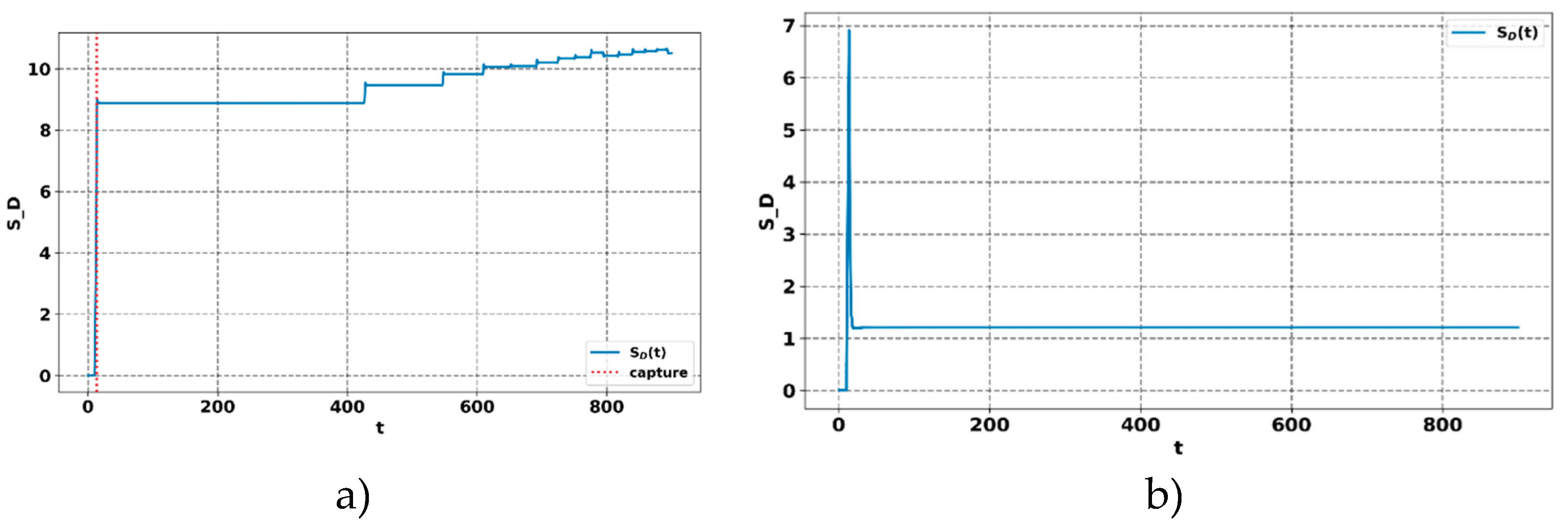
The D-entropy dynamics shown in Figure 4 demonstrate the dependence of the system’s evolution on the rigidity of the structured body. In the effective capture regime (Figure 4a), a steady increase in D-entropy is observed, reflecting the accumulation of internal structural changes and the consistent redistribution of energy between orbital motion and internal degrees of freedom. After the first close approach to the central mass, the value begins to increase stepwise, with each new increment corresponding to the next pumping of internal modes during repeated pericentric passages.
A fundamentally different picture is observed with higher internal frame stiffnesses (Figure 4b). In this case, after a brief initial interaction, the D-entropy quickly reaches a steady-state plateau and remains virtually unchanged. This behavior indicates that the system experiences only a weak, one-time perturbation, after which internal deformation processes are suppressed.
Thus, according to the results of the numerical calculation of the evolution equation, the formation of stationary systems in a central force field is due to the transformation of the system’s motional energy into its internal energy during motion due to the radial inhomogeneity of the central force field. This conclusion is confirmed by the graph in Figure ( 2 ) , according to which the increment in internal energy asymptotically approaches zero when the system reaches a circular orbit. This result also follows from the extended Liouville equation.
6. Conclusion
This paper examines the problem of describing the evolution of structured bodies within the framework of extended mechanics for systems of potentially interacting material points. It is shown that the total energy of such a system is naturally represented as the sum of the energy of the center of mass motion and the internal energy associated with the relative motions of the system’s elements. This allows for a transition to a dual description of the dynamics in independent subspaces of macro- and microvariables.
Unlike the classical equation of motion of a material point, the evolution equation contains a term that describes the transformation of the energy of motion into the internal energy of the system when moving in a non-uniform field of external forces.
To describe a closed, nonequilibrium statistical ensemble of structured bodies, an extended Liouville equation is used, taking into account the change in phase volume associated with internal energy transformations. This equation allows us to consider the ensemble’s relaxation to a steady state as a consequence of the redistribution of energy between collective and internal degrees of freedom.
To quantitatively describe the internal evolution of a system, D-entropy, defined as the relative change in internal energy, is used. D-entropy characterizes the intensity of energy exchange between the motion of the system as a whole and its internal degrees of freedom and can be considered a dynamic measure of structural transformations in nonequilibrium systems.
Numerical simulations of the motion of a structured body in a central force field revealed the existence of two qualitatively different dynamic regimes. With effective excitation of internal modes, part of the orbital energy is irreversibly converted into the internal energy of the system, leading to the transition of the system to a stationary orbit. When internal deformations are suppressed, this mechanism is absent, and the motion remains transient, consistent with the predictions of classical mechanics for quasi-rigid bodies.
The obtained results show that the use of the evolution equation allows us to describe evolutionary processes, dissipative processes, in particular, to describe the evolution of systems to stationary attractors, which include stationary orbits of systems in the central field of forces.
Further development of the work is associated with the study of the properties of the evolution equation, the analysis of its connection with the methods of statistical physics and thermodynamics, as well as with the application of the proposed approach to problems of astrophysical, plasma and space dynamics.
References
- Prigogine, I. Exploring complexity. Eur. J. Oper. Res. 1987, 30(2), 97–103. [Google Scholar] [CrossRef]
- Poincaré, H. L’état actuel et l’avenir de la physique mathématique. Bull. Des. Sci. Mathématiques 1904, 28, 302–324. [Google Scholar]
- Zaslavsky, G.M. Stochasticity of Dynamical Systems; Nauka: Moscow, 1984. [Google Scholar]
- Loskutov, A. Yu.; Mikhailov, A. S. Introduction to Synergetics; Nauka: Moscow, 1990. [Google Scholar]
- Landau, L. D.; Lifshitz, E. M. Mechanics; Nauka: Moscow, 1973. [Google Scholar]
- Landau, L.D.; Lifshitz, E.M. Statistical Physics; Nauka: Moscow, 1976. [Google Scholar]
- Landau, L.D.; Lifshitz, E.M. Physical kinetics; Nauka: Moscow, 1979. [Google Scholar]
- Rumer, Yu. B.; Rivkin, M. Sh. Thermodynamics, Statistical Physics and Kinetics; Nauka: Moscow, 1977. [Google Scholar]
- Quillen, A.C.; Giannella, D.; Shaw, J.G.; Ebinger, C. Crustal Failure on Icy Moons from a Strong Tidal Encounter. Icarus 2016, Vol. 275, 267–280. [Google Scholar] [CrossRef]
- Frouard, J.; Quillen, A.C.; Efroimsky, M.; Giannella, D. Numerical Simulation of Tidal Evolution of a Viscoelastic Body Modeled with a Mass-Spring Network. Mon. Not. R. Astron. Soc. (MNRAS) 2016, 10 Vol. 458(No. 3), 2890–2901. [Google Scholar] [CrossRef]
- Drory, A. Is There a Reversibility Paradox? Recentering the Debate on the Thermodynamic Time Arrow. In Studies in History and Philosophy of Modern Physics; 2008; Vol. 39, pp. 889–913. [Google Scholar]
- Torretti, R. The Problem of Time’s Arrow Historico-Critically Reexamined. In Studies in History and Philosophy of Modern Physics; 2007; Vol. 38, pp. 732–756. [Google Scholar]
- Somsikov, V.M. Limitation of Classical Mechanics and Ways Its Expansion. Proceedings of Science (PoS), Baldin ISHEPP XXII-047, XXII International Baldin Seminar on High Energy Physics Problems, Dubna, 2014; pp. 1–12. [Google Scholar]
- Somsikov, V.M. Fundamentals of Physics of Evolution. In Monograph; Al-Farabi Kazakh National University: Almaty, 2021. [Google Scholar]
- Kapytin, V.; Somsikov, V.; Andreyev, A.; Chsherbulova, Y. D-index: an energy-based diagnostic for detecting dynamical transitions in nonstationary time series. J. Phys. Commun. 2026, 10(2), 025002. [Google Scholar] [CrossRef]
- Somsikov, V.M.; Abylay, A.M.; Kuvatova, D.B. Physics of Evolution and Unity of Physics. J. Phys. Conf. Ser. 2021, Vol. 2094, 022029. [Google Scholar] [CrossRef]
- Lanczos, K. Variational Principles of Mechanics; Mir: Moscow, 1965; p. 408. [Google Scholar]
- Somsikov, V. M. On the limitations of classical mechanics associated with the holonomic constraint condition. Bulletin of the National Academy of Sciences of the Republic of Kazakhstan. Series “Physics” 2013, 5, 144–150. [Google Scholar]
- Fimin, N.N.; Chechetkin, V.M. Irreversibility of transport processes in classical and quantum mechanics ( 2018 ). In Keldysh Institute of Applied Mathematics Preprints; Volume No. 257. 17 p. [CrossRef]
- Somsikov, V. M. Transition from mechanics of material points to mechanics of structured particles. Mod. Phys. Lett. B 2016, 30(04), 1650018. [Google Scholar] [CrossRef]
- Somsikov, V. M. Equilibrium of the hard disk system. IJBC 2004, 14(11), 4027–4033. [Google Scholar] [CrossRef]
- Somsikov, V. M. The role of the structure of matter in its dynamics and evolution. Jpn. J. Res. 2024, 5, 1–10. [Google Scholar] [CrossRef]
- Drossel, B. The Flow of Time and Downward Causality. In Proceedings of the Sixteenth Marcel Grossmann Conference on Current Developments in Theoretical and Experimental General Relativity, Astrophysics, and Relativistic Field Theories (MG16, Online Conference on General Relativity), July 5–10, 2021; 2023; pp. 3631–3645. [Google Scholar]
- Hooft Gerard ‘t, Free Will in the Theory of Everything (2017). arXiv arXiv:1709.02874.
Figure 1.
Trajectories of the center of mass of a structured body during its flight “from infinity” to the potential center of force for different rigidities of the internal structure: (a) capture mode with the formation of a bound orbit; (b) weak internal deformation mode, in which capture is not realized due to an ineffective change in the internal energy .
Figure 1.
Trajectories of the center of mass of a structured body during its flight “from infinity” to the potential center of force for different rigidities of the internal structure: (a) capture mode with the formation of a bound orbit; (b) weak internal deformation mode, in which capture is not realized due to an ineffective change in the internal energy .

Figure 2.
Comparison of the energy evolution of a structured body with different stiffnesses of the internal elastic framework: (a) the regime of effective tidal capture with intensive energy exchange between orbital motion and internal modes; (b) the regime of quasi-rigid flyby, in which the internal energy practically does not increase, and capture is not realized.
Figure 2.
Comparison of the energy evolution of a structured body with different stiffnesses of the internal elastic framework: (a) the regime of effective tidal capture with intensive energy exchange between orbital motion and internal modes; (b) the regime of quasi-rigid flyby, in which the internal energy practically does not increase, and capture is not realized.
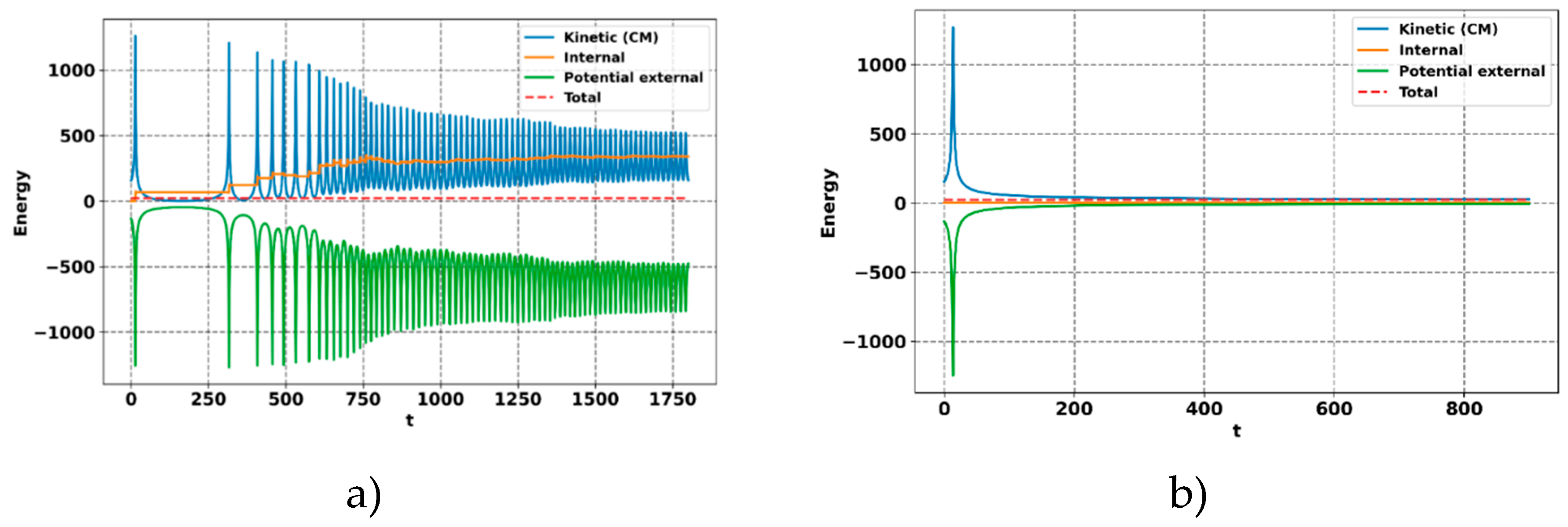
Figure 3.
Comparison of the relative drift of the total energy for different regimes of the dynamics of a structured body: (a) the regime of developed internal deformations, accompanied by effective capture; (b) the regime of weak internal deformation, in which the energy exchange between the orbital motion and internal modes is suppressed.
Figure 3.
Comparison of the relative drift of the total energy for different regimes of the dynamics of a structured body: (a) the regime of developed internal deformations, accompanied by effective capture; (b) the regime of weak internal deformation, in which the energy exchange between the orbital motion and internal modes is suppressed.
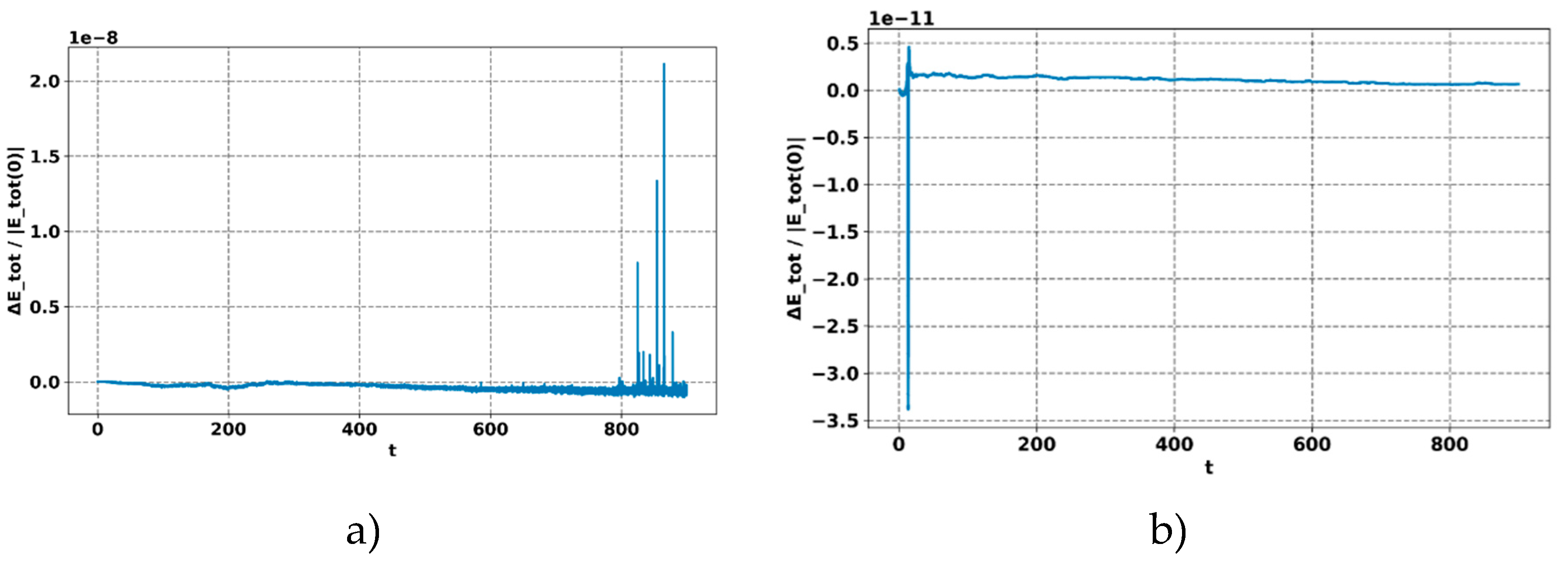
Figure 4.
Comparison of the evolution of D-entropy and the rate of its production for different regimes of the dynamics of a structured body: (a) the regime of effective capture with intense excitation of internal modes; (b) the regime of weak internal deformation .
Figure 4.
Comparison of the evolution of D-entropy and the rate of its production for different regimes of the dynamics of a structured body: (a) the regime of effective capture with intense excitation of internal modes; (b) the regime of weak internal deformation .
Disclaimer/Publisher’s Note: The statements, opinions and data contained in all publications are solely those of the individual author(s) and contributor(s) and not of MDPI and/or the editor(s). MDPI and/or the editor(s) disclaim responsibility for any injury to people or property resulting from any ideas, methods, instructions or products referred to in the content. |
© 2026 by the authors. Licensee MDPI, Basel, Switzerland. This article is an open access article distributed under the terms and conditions of the Creative Commons Attribution (CC BY) license (http://creativecommons.org/licenses/by/4.0/).
Copyright: This open access article is published under a Creative Commons CC BY 4.0 license, which permit the free download, distribution, and reuse, provided that the author and preprint are cited in any reuse.


