
Submitted:
12 June 2026
Posted:
15 June 2026
You are already at the latest version
Abstract
The isoxazole-5-one ring system is a central structure in many synthetic bioactive molecules, showing a wide range of biological activities, including antibacterial, antitumor, anticorrosion, antifungal, antituberculosis, and antioxidant. They are also applied as agrochemical having potential fungicide effects. Given various applications, these pharmaceutically and biologically significant heterocyclic compounds have attracted great attention of the chemistry synthetic researchers. This study aimed to investigate application of glycerol as a reaction medium for the three-component synthesis of arylidenisoxazol-5(4H)-one derivatives. The results of the optimized investigations revealed that 3.0 mL glycerol is the best reaction medium. Evaluation effect of reaction temperature showed that the best temperature for this strategy is 60 °C. In the present environmental friendliness study, the desired heterocyclic compounds were quickly synthesized via a one-pot three-component reaction of two keto-esters with hydroxylamine hydrochloride and a number of aryl/heteroaryl aldehydes. This synthetic approach has significant merits, such as cost-effectiveness of reaction medium, rapid green synthesis, operational simplicity, easy workup, avoid chromatographic purification, sustainability, acceptable yields, relatively inexpensive as well as commercially available starting materials.
Keywords:
isoxazolone
; sustainable synthesis
; glycerol
; carbonyl ester
1. Introduction
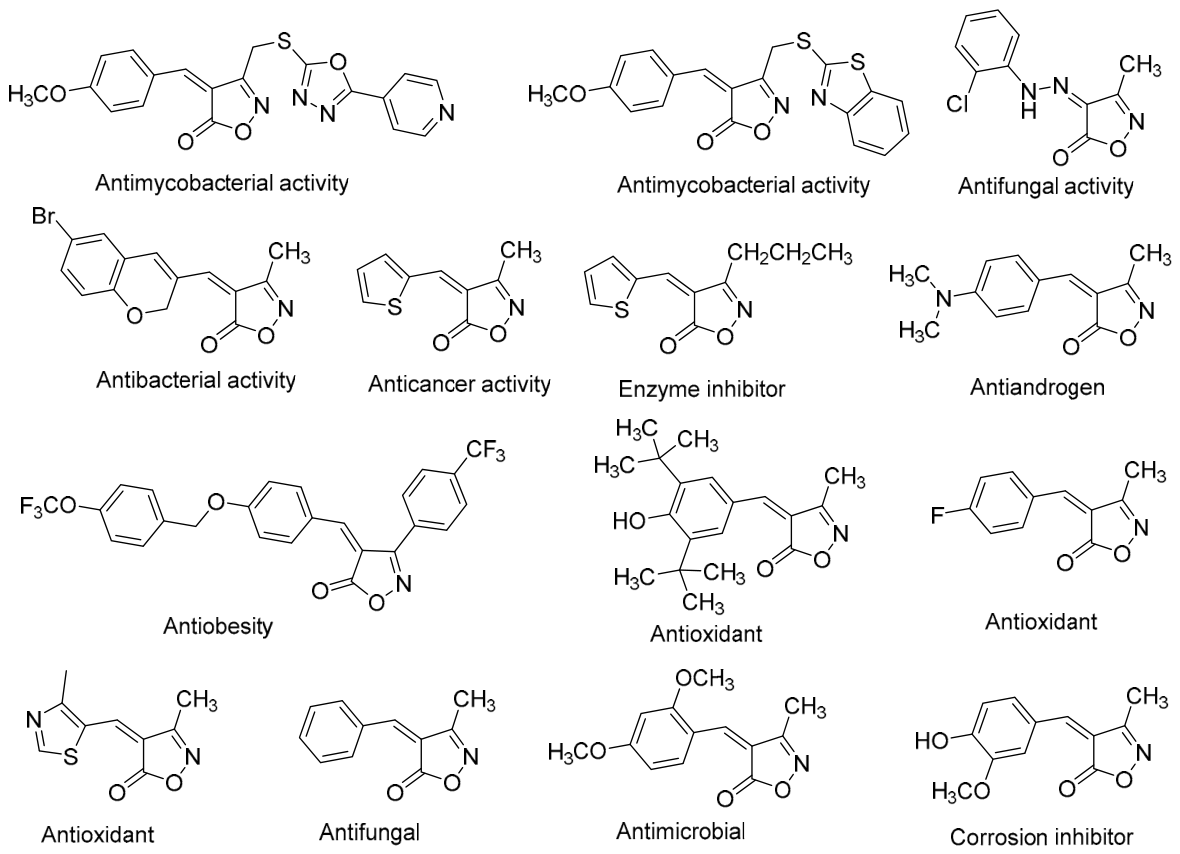
Among N, O-heterocyclic compounds, five-membered rings such as isoxazoles have received special attention due to their potential applications in synthetic chemistry, the pharmaceutical industry, and biological sciences [1]. Among the isoxazole family, arylideneisoxazol-5(4H)-ones and their derivatives have garnered considerable attention owing to their potential as antimycobacterial [2], antifungal [3], anticancer [4,5], antibacterial [6], enzyme inhibitor [7], antimicrobial, antidiabetic, antiandrogen [8], and antioxidant [9] agents. In addition to the aforementioned characteristics, arylideneisoxazole-5(4H)-one derivatives are used as anti-corrosion reagents [10]. The structures of some important arylidene isoxazol-5(4H)-ones are depicted in Figure 1. The five-membered heterocyclic scaffold is an important intermediate for the construction of other heterocyclic products and organic molecules, including polysubstituted pyridines [11], spirocyclic azepino[4,3,2-cd]indole derivatives [12], cyclopentenyl spiroisoxazolones [13], fully substituted pyrrole-2-carboxylic acids [14], imidazoles [15], 4-aryl-3-[(E)-(hydroxyimino)(aryl)methyl]-4,6,7,8-tetrahydroquinoline-2,5(1H,3H)-diones [16], spiro[isoxazole-pyrazoloquinoline]s [17], spirocarbocycles [18], and others [19]. Consequently, in the research community of chemistry and pharmaceuticals, synthesizing arylideneisoxazol-5(4H)-ones has garnered considerable attention. A feasible and widely accepted strategy involves a three-component process that has been catalyzed under various conditions with a variety of catalysts, including water extract of orange fruit peel ash (WEOFPA) in glycerol [4], glutamic acid catalyst in glycerol [5], Cu@Ag−CeO2/chitosan nanocomposite [20], yttrium (III)-MMZ [21], Na2S2O3 [22], Na2SO3 [23], g-C3N4·OH nanocomposite [24], sulfamic acid [25], 1-methyl-3-carboxymethylimidazolium chloride [26], lemon juice [27], FeS1-x-Fe3O4/C nanocatalyst [28], sodium benzoate [29], NaOAc [30], MMWCNT-PEG-PIP [31], sodium lauryl sulfate [32], amine-functionalized cellulose [33], SiO2 NPs [34], urea [35], triphenylphosphine [36], DMAP [37], ruthenium-hydride complex [38], ferrite nanoparticles [39], CeO₂ nanoparticles [40], aqueous extract of Areca nut [41], theophylline hydrogen sulfate [42], CuNPs@N-GQDs@APTES) [43], guanidine hydrochloride [44], and malic acid [45]. Other catalysts for synthesizing arylideneisoxazolones can be found in a recently published review [46].
Propane-1,2,3-triol (glycerol or glycerin, MW = 92.09 g/mol, d = 1.258 g/mL) is the simplest trihydric alcohol and was used as a vital chemical with numerous applications in modern energy, environmental technologies, and the synthesis of value-added products [47]. Glycerol, also termed “organic water,” is readily available, cheap, polar, non-toxic, biodegradable, and easily forms strong networks of hydrogen bonds [48]. Glycerol is found in the “generally recognized as safe” list made by the U.S. Food and Drug Administration [49]. Glycerin is employed in cakes, beverages, pharmaceuticals, skin and hair products, the production of shampoos, soaps, toothpastes, esters, polyethers, detergents, cellophane, and some alkyd resins [50,51]. As compared with the conventional organic solvents, propane-1,2,3-triol reveals many advantages, including low toxicity, non-volatility, inflammability, and low production cost. This polyhydroxy alcohol, as a classic example of a “green solvent,” improves the reaction selectivity and increases the reaction rate [49]. Glycerol not only acts as a phase transfer catalyst but also as a recyclable solvent [52]. This biocompatible polyalcohol was used as an eco-friendliness reaction medium or additive to synthesizing different heterocyclic compounds such as 4-(1H-pyrazol-4-yl)-polyhydroquinolines [49], pyrido[2,3-d]pyrimidines [53], 1,4-dihydropyridines [54,55], functionalized thioamides and 4H-thiopyrans [56], imidazo[2,1-b]thiazoles [57], thiazole Betti bases [58], 2-amino-3-phenylsulfonyl-4H-benzochromens [59], 3-benzoxazol-2-yl-chromen-2-ones [60], 2-amino-4,8-dihydropyrano[3,2-b]pyran-3-carbonitriles [61], 2,3-dihydroquinazolin-4(1H)-ones [62], 6-amino-1,4-dihydropyrano[2,3-c]pyrazole-5-carbonitriles [63,64], 1,4-disubstituted 1,2,3-triazoles [65], 5′-thioxospiro[indoline-3,3′-[1,2,4]triazolidin]-2-ones [66], α-aminophosphonates [67], nitrones [68], 2-arylimidazo[1,2-a]pyrimidine-3-carbaldehydes [69], and others [70].
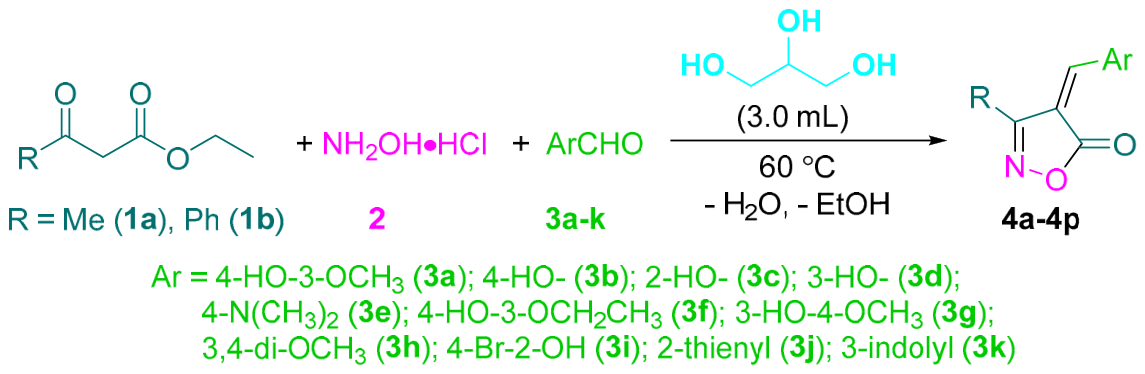
Given the synthetic significance of isoxazolone-containing compounds, the development of a green, efficient, less energy-consuming, faster, more economical, and sustainable method is of interest to many researchers in the field of synthetic organic chemistry. Therefore, it was decided to investigate the synthesis of several isoxazol-5(4H)-one derivatives (Scheme 1) based on our laboratory resources.
2. Materials and Methods
2.1. General
All the essential chemicals and solvents were obtained from commercial sources and used as received. All solvents were distilled before use. The reactions were monitored by thin-layer chromatography (TLC) analysis using pre-coated aluminum sheets (Silica gel G 60 F254, Merck, Germany). TLC was visualized by ultraviolet (UV) irradiation, exposure to iodine vapor, and spray reagent. The melting points were recorded using an electrothermal 9100 melting point apparatus and were uncorrected. 1H- and 13C NMR spectra were recorded on a Bruker Avance 400 MHz spectrometer using CDCl3 or DMSO-d6 as solvent. Splitting patterns are designated as follows: s, singlet; d, doublet; dd, doublet of doublets; and m, multiplet. Chemical shift values are specified in parts per million (ppm). Coupling constant values are reported in hertz (Hz).
2.2. General Procedure for the Synthesis of Target Heterocyclic Compounds (4a-p)
Ethyl acetoacetate (1a, 1 mmol) or ethyl 3-oxo-3-phenylpropanoate (1b, 1 mmol), hydroxylamine hydrochloride (2, 1 mmol), and aryl/heteroaryl aldehydes (3a-3k, 1 mmol) were poured into a round-bottom flask equipped with a magnetic stirring bar, and glycerol (41.0 mmol, 3.0 mL) was added. The reaction was stirred at 60 °C for appropriate times. After the reaction was completed (monitored by TLC analysis), the reaction mixture was cooled to room temperature, and the solvent was removed via filtration. The precipitate of the desired compounds remained on the filter paper. After recrystallization of the precipitates in ethanol, pure heterocyclic products (4a-4p) were obtained.
2.2.1. 4-(4-Hydroxy-3-Methoxybenzylidene)-3-Methylisoxazol-5(4H)-one (4a)
1H NMR (DMSO-d6, 400 MHz): δ 2.25 (s, 3H, CH3), 3.85 (s, 3H, OCH3), 6.96 (d, J = 8.4 Hz, 1H, Ar-H), 7.78 (s, 1H, H-vinyl), 7.91 (dd, J = 2.0, 8.8 Hz, 1H, Ar-H), 8.52 (d, J = 2.0, Hz, 1H, Ar-H), 10.77 (s, 1H, OH); 13C NMR (DMSO-d6, 100 MHz): δ 11.8 (CH3), 56.0 (3H, OCH3), 114.2, 116.3, 117.2, 125.5, 132.1, 147.9, 152.3, 154.3, 172.7 (C=N), 169.5 (C=O).
2.2.2. 4-(4-Hydroxybenzylidene)-3-Phenylisoxazol-5(4H)-one (4m)
1H NMR (DMSO-d6, 400 MHz): δ 6.95 (d, J = 9.2 Hz, 2H, Ar-H), 7.59-7.69 (m, 6H, Ar-H, H-vinyl), 8.45 (d, J = 8.8 Hz, 2H, Ar-H), 11.16 (s, 1H, OH); 13C NMR (DMSO-d6, 100 MHz): δ 113.2, 116.6, 124.9, 127.9, 129.3, 129.4, 129.7, 131.3, 138.5, 153.8, 164.8, 169.4.
2.2.3. 4-(3-Ethoxy-4-hydroxybenzylidene)-3-phenylisoxazol-5(4H)-one (4o)
1H NMR (DMSO-d6, 400 MHz): δ 1.39 (t, J = 6.8 Hz, 3H, CH3), 4.35 (q, J = 6.8 Hz, 2H, OCH2), 6.96 (d, J = 8.4 Hz, 1H, Ar-H), 7.62-7.68 (m, 6H, Ar-H), 7.89 (dd, J = 1.6, 7.6 Hz, 1H, Ar-H), 8.50 (s, 1H, H-vinyl), 10.85 (s, 1H, OH); 13C NMR (DMSO-d6, 100 MHz): δ 15.0 (CH3), 64.4 (OCH2), 113.0, 116.3, 118.5, 125.4, 127.9, 129.3, 129.7, 131.2, 132.6, 147.1, 154.1, 155.0, 164.9 (C=N), 169.6 (C=O).
3. Results and Discussion
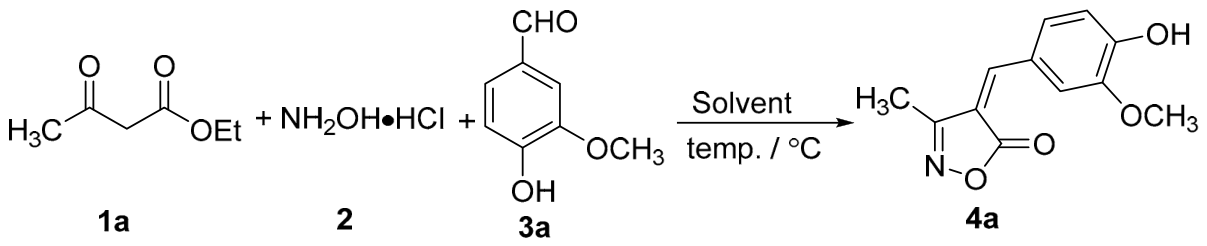
The synthesis of desired heterocyclic compounds was accomplished by the synthetic route illustrated in Scheme 1. To this purpose, the reaction conditions should be optimized using a model reaction. The reaction of ethyl acetoacetate (1a), hydroxylamine hydrochloride (2), and vanillin (3a) was selected as a model reaction (Scheme 2).
The results of the optimization of the reaction conditions under solvent-free and various solvents can be seen in Table 1. At first, the reaction was studied in a solvent-free environment without any additives or catalysts. At room temperature (RT), the yield of the isoxazolone product (4a) was moderate after 60 min (Table 1, Entry 1). Running the model reaction in water (H2O) as a green solvent led to 55% isolated yield after 60 min (Table 1, Entry 2). Performing the same reaction at different temperature conditions, including refluxing H2O, did not lead to satisfactory results (one result is shown in row 3 of Table 1). Changing the solvent from water to ethanol (EtOH) under reflux conditions did not significantly improve the reaction yield (Table 1, Entry 4). After the previous unattractive results, it was decided to check the reaction in other organic solvents such as ethyl acetate (EtOAc), chloroform (CHCl3), n-hexane, dichloromethane (CH2Cl2), and dioxane in the hope that better results might be obtained (Table 1, Entries 5-9). Performing the reactions at different temperatures and boiling points of solvents resulted in disappointing results. That’s why we decided to use a beautiful organic water, namely glycerol, to implement the model reaction. Therefore, the model reaction was explored in the presence of glycerol with different mol%, and an increase in the reaction yields and a decrease in the reaction times were seen in different volumes of glycerol (Table 2, Entries 1-6). The cyclocondensation reaction using 0.6 mL (8.2 mmol) of glycerol leads to the formation of the product 4a in 75% yield after 32 min (Table 2, Entry 1). At RT, when the amounts of glycerol were increased from 0.6 mL (8.2 mmol) to 1.2 (16.4), 1.8 (24.6), 2.4 (32.8), and 3.0 mL (41.0 mmol), the heterocyclic product 4a was formed in good to excellent yield (Table 2, Entries 2-5). The reaction was also tested using 3.6 mL (49.2 mmol) glycerol, but found that the target product was formed in 90% yield (Table 2, Entry 6). So, 3.0 mL (41.0 mmol) glycerol is the ideal medium for the model reaction. To study the impact of temperature on the reaction yields and reaction times, more experiments were carried out in 3.0 mL (41.0 mmol) glycerol at different temperatures (30-80 °C) (Table 2, Entries 7-17). An improvement in yields and reaction times was observed. Raising the reaction temperature from 25 °C to 60 °C significantly decreased the reaction time and also increased the yield of the reaction. Based on the results of the optimization, performing the cyclocondensation reaction in glycerol at 60 °C resulted in a rapid synthesis of the heterocyclic product 4a in a higher isolated reaction yield (Table 2, Entry 13). Increasing the reaction temperature above 60 °C did not lead to notable improvements in the reaction times and the yields (Table 2, Entries 14-17). Accordingly, the best reaction results were obtained at 60 °C in glycerol (Table 2, Entry 13; the optimized conditions).

Table 2.
Optimization of the cyclocondensation reaction using glycerol.1.
| Entry | Glycerol/mL (mmol) | Temp./°C | Time/min. | Isolated yields for 4a /% |
|---|---|---|---|---|
| 1 | 0.6 (8.2) | RT | 32 | 75 |
| 2 | 1.2 (16.4) | RT | 27 | 80 |
| 3 | 1.8 (24.6) | RT | 23 | 85 |
| 4 | 2.4 (32.8) | RT | 17 | 89 |
| 5 | 3.0 (41.0) | RT | 12 | 90 |
| 6 | 3.6 (49.2) | RT | 15 | 90 |
| 7 | 3.0 (41.0) | 30 | 10 | 92 |
| 8 | 3.0 (41.0) | 35 | 9 | 92 |
| 9 | 3.0 (41.0) | 40 | 8 | 93 |
| 10 | 3.0 (41.0) | 45 | 7 | 93 |
| 11 | 3.0 (41.0) | 50 | 6 | 93 |
| 12 | 3.0 (41.0) | 55 | 5 | 94 |
| 132 | 3.0 (41.0) | 60 | 3 | 96 |
| 14 | 3.0 (41.0) | 65 | 3 | 93 |
| 15 | 3.0 (41.0) | 70 | 3 | 90 |
| 16 | 3.0 (41.0) | 75 | 3 | 90 |
| 17 | 3.0 (41.0) | 80 | 3 | 90 |
1 Reaction performed using ethyl acetoacetate (1a, 1 mmol), hydroxylamine hydrochloride (2, 1 mmol), vanillin (3a, 1 mmol), and glycerol (x mL, y mmol), stirred at various temperatures. 2 Optimized conditions.
After optimization of the reaction conditions, to evaluate the generality of the process, the reaction between 1a, 2, and substituted benzaldehydes (3a-3k) and heteroaryl aldehydes was studied in glycerol at 60 °C (Table 3, Entries 2-10). Aryl aldehydes containing electron-donating functional groups like OH, OCH₃, and OC₂H₅, the process was completed, and the target products (4a-4i) were formed in excellent isolated yield after 3-10 min. Under the optimized conditions, the process using substituted benzaldehydes carrying electron-withdrawing substituents, including NO₂ or Cl, did not obtain satisfactory results. Interestingly, the condensation of thiophene-2-carbaldehyde and 1H-indole-3-carbaldehyde with 1a and 2 led to the construction of the heterocyclic molecules (4j and 4k) in excellent isolated yields (Table 3, Entries 10 and 11). The utility of this sustainable cyclocndensation was explored with ethyl 3-oxo-3-phenylpropanoate substrate (1b) instead of 1a. The yields remained high (78-92%), and the reactions remained fast (7-12 min), confirming that our method works well for both types of starting materials. Under the optimized conditions, the reactions yielded the heterocyclic compounds (4l-4p) in high isolated yields and shorter reaction times (Table 3, Entries 12-16).
Table 2.
Green synthesis of arylideneisoxazol-4-ones (4a-4p) in glycerol medium at 60 °C.1.
| Entry | Structure of isoxazolone products (4a-4p) | Yield (%)/time (min) | Melting points observed/reported [ref.] |
|---|---|---|---|
| 1 | 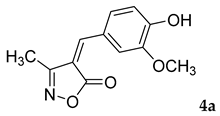 |
96/3 | 214-216/215-216 [33] |
| 2 | 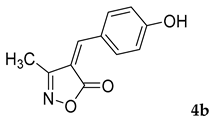 |
90/4 | 210-212/211-212 [33] |
| 3 | 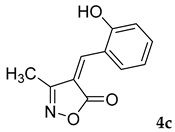 |
84/10 | 198-200/200-202 [33] |
| 4 | 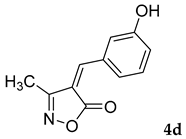 |
85/5 | 200-202/202-204 [33] |
| 5 | 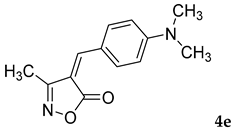 |
89/5 | 222-225/225-227 [33] |
| 6 | 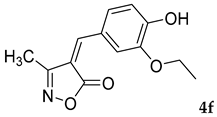 |
95/7 | 138-140/135-137 [33] |
| 7 | 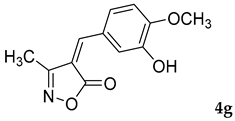 |
85/5 | 184-186/182-184 [36] |
| 8 | 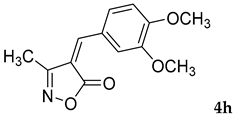 |
93/4 | 124-126/127-128 [33] |
| 9 | 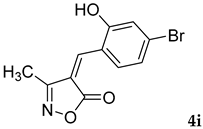 |
75/10 | 214-216 [33] |
| 10 | 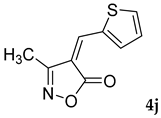 |
90/7 | 142-143/146-148 [33] |
| 11 | 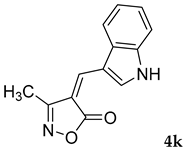 |
85/8 | 238-240/235-238 [45] |
| 12 | 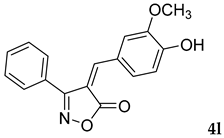 |
90/7 | 215-218/212-214 [37] |
| 13 | 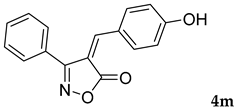 |
85/10 | 208-210/207-210 [34] |
| 14 | 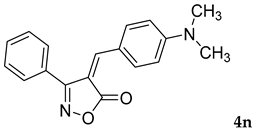 |
79/12 | 203-205/201-202 [34] |
| 15 | 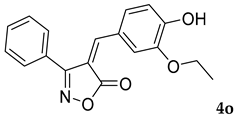 |
92/10 | 152-156/150-152 [37] |
| 16 | 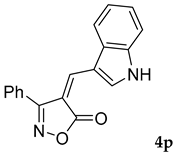 |
78/8 | 215-217/214-216 [37] |
1 Reaction performed using dicarbonyl compounds (1a-1b, 1 mmol), hydroxylamine hydrochloride (2, 1 mmol), various aldehydes (4a-4k, 1 mmol), and glycerol 3.0 mL, 41.0 mmol) stirred at 60 °C.
The structure of the target compounds was confirmed using spectral data. For example, the 1H NMR spectrum of 4o in DMSO-d6 solvent showed the signals at δ 1.39 (t, 3H, CH3 of ethoxy), 4.35 (q, 2H, CH2 of ethoxy), 10.85 (s, 1H, proton of hydroxy group), 6.96 (d, 1H, proton ortho to OH), 7.89 (dd, 1H, proton meta to OH), 8.50 (s, 1H, proton vinyl group between two isoxazolone and aryl ring), 7.89 (d, 1H, proton ortho to ethoxy group), and 7.62-7.68 (m, 6H, phenyl group). Moreover, the 13C NMR spectrum of this compound in CDCl3 displayed four distinct signals belonging to CH3, OCH2, C=O, and C=N, at δ 15.0, 64.4, 169.6, and 164.9 ppm, respectively. The signals of the other carbons resonated at δ 155.0-113.0 ppm (12 distinct signals).
To highlight the merits of the present glycerol-promoted protocol, we compared our optimized conditions with previously reported catalytic systems for the synthesis of 4-arylideneisoxazol-5(4H)-ones. Table 3 summarizes the key features of several representative methods from recent literature. As can be seen from Table 3, the present method offers several distinct advantages over previously reported protocols:
a) Reaction Time: The reaction completes within 3 minutes, which is significantly faster than all other methods listed (ranging from 40 to 180 minutes).
b) Reaction Temperature: The optimized temperature of 60 °C is milder than most reported methods (typically 70-85 °C). Lower energy consumption is an important aspect of green chemistry.
c) Yield: The isolated yield of 96% is among the highest reported for this model substrate, demonstrating the excellent efficiency of this protocol.
d) Operational Simplicity: The one-pot, three-component reaction requires no special apparatus, no inert atmosphere, and no chromatographic separation. The workup involves only cooling, filtration, and recrystallization from ethanol.
e) Green Chemistry Aspects: Glycerol is a non-toxic, biodegradable, renewable, and non-volatile solvent. The method uses glycerol as both the solvent and promoter without any additional catalyst synthesis.
Table 3.
Comparison of different catalytic systems for the synthesis of 4a.
| Entry | Catalyst / [ref.] | Solvent | Temp. (°C) | Time (min) | Yield (%) |
|---|---|---|---|---|---|
| 1 | Na₂S₂O₃ [22] | EtOH | 80 | 40 | 85 |
| 2 | Na₂SO₃ [23] | H2O | 70 | 120 | 88 |
| 3 | Sulfamic acid [25] | H2O | 80 | 60 | 92 |
| 4 | Lemon juice [27] | H2O | RT | 180 | 88 |
| 5 | SiO₂ NPs [34] | H2O | RT | 60 | 90 |
| 6 | Urea [35] | H2O | RT | 45 | 85 |
| 7 | Malic acid [45] | H2O | 50 | 45 | 90 |
| 8 | Glycerol (This work) | Glycerol | 60 | 3 | 96 |
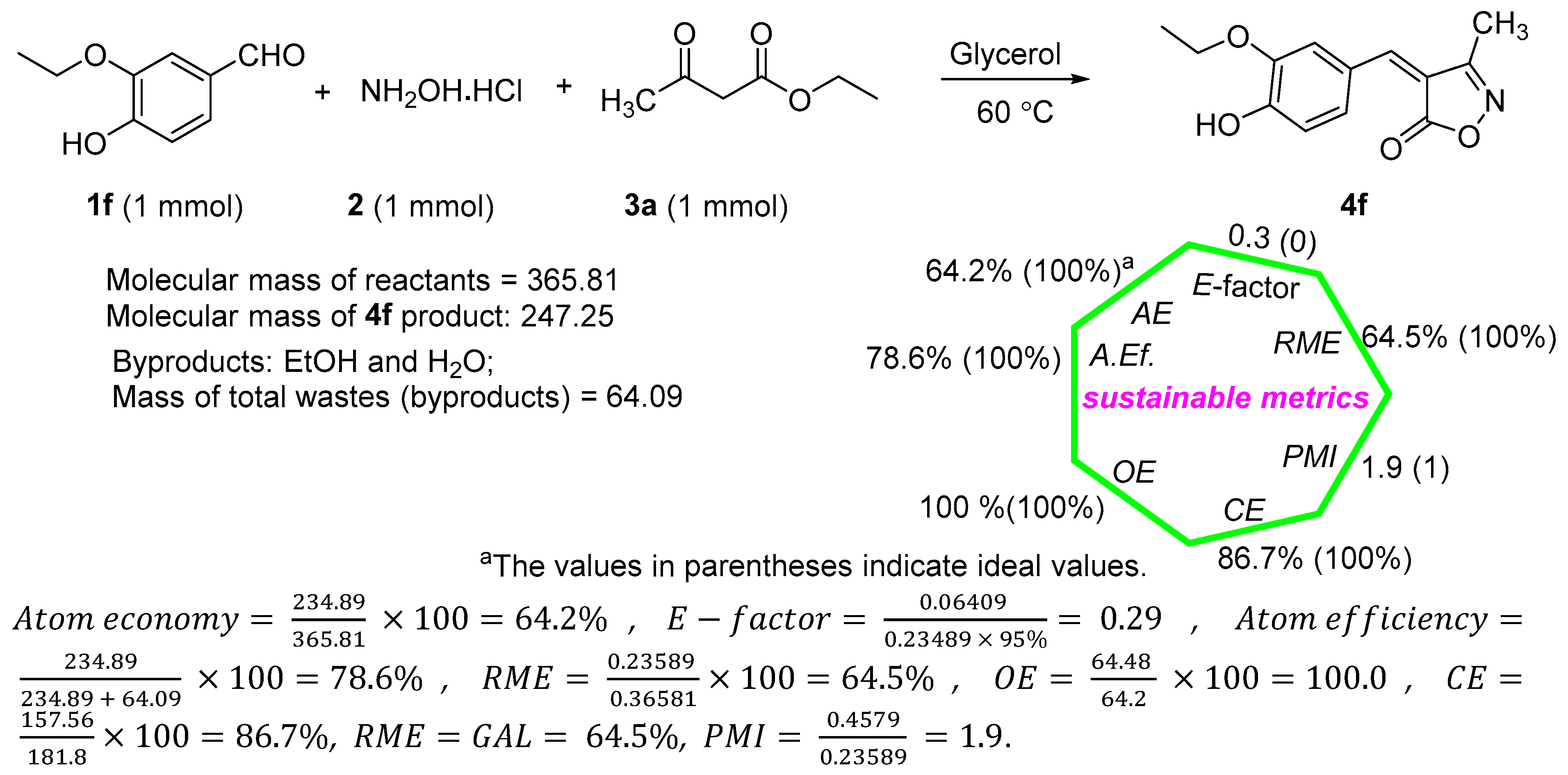
Some sustainable chemistry metrics were evaluated for the formation of compound 4f (Scheme 3). In this case, some parameters such as the environmental factor (E-factor), atom economy (AE), atom efficiency (A. Ef.), the reaction mass efficiency (RME, Curzons definition), optimum efficiency (OE), carbon efficiency (CE), greener atomic level (GAL), and the process mass intensity (PMI) were calculated as follows (1-7 equations) [36].
In view of sustainable chemistry, this reaction has green aspects. Therefore, from the perspective of sustainable chemistry and considering the green metric results, implementing this green reaction for the synthesis of isoxazoles is of great importance (Scheme 3).
Scheme 3.
Some green metrics for the synthesis of 4f.
Based on reports in the literature [53,54,55,62,63,64,69], a reaction mechanism for the synthesis of target heterocycles 4a-4p, promoted by glycerol, is depicted in Scheme 4. At first, ketoesters 1a-1b are protonated by glycerol via hydrogen bonding (H-binding). The nucleophilic attack of hydroxylamine (2) on the activated carbonyl group of 1a-1b led to the formation of the oxime intermediate (A). In the next step, cyclization of the oxime intermediate, along with the elimination of ethanol, led to the formation of isoxazolone B. Isoxazolone B can be enolized using glycerol. The aryl/heteroaryl aldehydes 3 were also activated through H-bonding with glycerol. Activated aldehydes (D) undergo Knoevenagel condensation with enolized isoxazolone (C), resulting in intermediates E. Finally, after elimination of water, the condensed desired heterocyclic products (4a-4p) were obtained (Scheme 4).
4. Conclusions
In summary, glycerol was introduced as a green and effective reaction medium for synthesizing arylideneisoxazol-5-ones via a three-component process. The results have demonstrated that this process enables easy, rapid access to isoxazolone-containing heterocycles in relatively high yields. This method highlights the simplicity and sustainability of the preparation of isoxazole-5-one derivatives. This protocol accommodates many different aldehydes (especially those with electron-donating groups) and two β-ketoesters, delivering desired compounds in short reaction times.
Supplementary Materials
The following supporting information can be downloaded at the website of this paper posted on Preprints.org, and contains the Figure S1–S6: 1H and 13C NMR spectra for compounds 4a, am, and 4o.
Author Contributions
Conceptualization, H. Kiyani; methodology, J.M.M.; investigation, J.M.M.; writing—original draft preparation, J.M.M., H.K., and J.A.; writing—review and editing, H.K.; supervision, H.K.; project administration, H.K. All authors have read and agreed to the published version of the manuscript.
Funding
This research received no external funding.
Institutional Review Board Statement
Not applicable.
Informed Consent Statement
The study did not involve humans.
Data Availability Statement
Suggested Data Availability Statements are available in the section “MDPI Research Data Policies” at https://www.mdpi.com/ethics.
Acknowledgments
We would like to express our gratitude to Shahrekord University.
Conflicts of Interest
The authors declare no conflicts of interest.
Abbreviations
The following abbreviations are used in this manuscript:
| APTES | (3-Aminopropyl)triethoxysilane |
| AE | Atom economy |
| A. Ef. | Atom efficiency |
| CE | carbon efficiency |
| d | Doublet |
| dd | Doublet of doublets |
| DMSO | Dimethyl sulfoxide |
| DMAP | 4-Dimethylaminopyridine |
| E-factor | Environmental factor |
| GAL | Greener atomic level |
| Hz | hertz |
| m | Multiplet |
| MW | Molecular weight |
| NMR | Nuclear magnetic resonance |
| MMWCNT | Multi-walled carbon nanotube |
| NPs | Nanoparticles |
| OE | Optimum efficiency |
| PEG | Polyethylene glycol |
| PIP | Piperazin |
| ppm | parts per million |
| PMI | Process mass intensity |
| QDs | Quantum dots |
| RT | Room temperature |
| RME | Reaction mass efficiency |
| s | Singlet |
| TLC | Thin-layer chromatography |
| UV | Ultraviolet |
| WEOFPA | Water extract of orange fruit peel ash |
References
- Altug, C.; Günes, H.; Nocentini, A.; Monti, S.M.; Buonanno, M.; Supuran, C.T. Synthesis of isoxazole-containing sulfonamides with potent carbonic anhydrase II and VII inhibitory properties. Bioorg. Med. Chem. 2017, 25, 1456–1464. [CrossRef]
- Chavan, A.P.; Deshpande, R.R.; Borade, N.A.; Shinde, A.; Mhaske, P.C.; Sarkar, D.; Bobade, V.D. Synthesis of new 1,3,4-oxadiazole and benzothiazolylthioether derivatives of 4-arylmethylidene-3-substituted-isoxazol-5(4H)-one as potential antimycobacterial agents. Med. Chem. Res. 2019, 28, 1873–1884. [CrossRef]
- Gulati, S.; Singh, R.; Sangwan, S. Fruit juice mediated multicomponent reaction for the synthesis of substituted isoxazoles and their in vitro bio-evaluation. Sci. Rep. 2021, 11, 23563. [CrossRef]
- Badiger, K.B.; Khatavi, S.Y.; Kamann, K. Green synthesis of 3-methyl-4-(hetero)aryl methylene isoxazole-5(4H)-ones using WEOFPA/glycerol: evaluation of anticancer and electrochemical behaviour properties, RSC Med. Chem. 2022, 13, 1367-1377. [CrossRef]
- Mane, R.; Yaraguppi, D.A.; Chandrakala, K.B.; Kamanna, K. Synthesis, Computational, Anticancer, and Electrochemical Behavior Studies of 3-Methyl-4-(hetero)arylmethyleneIsoxazole-5(4H)-one. ChemistrySelect 2024, 9, e202401158. [CrossRef]
- Mishra, D.R.; Panda, B.S.; Nayak, S.; Rauta, N.K.; Mohapatra, S.; Sahoo, C.R.; Padhy, R.N. One-pot multicomponent synthesis of 4-((2H-chromen-3-yl)/(2-phenyl-2H-chromen-3-yl)methylene)-3-methylisoxazol-5(4H)-ones and evaluation of their antibacterial activity. Tetrahedron 2022, 124, 133015. [CrossRef]
- Saleem, A.; Farooq, U.; Bukhari, S.M.; Khan, S.; Zaidi, A.; Wani, T.A.; Shaikh, A.J.; Sarwar, R.; Mahmud, S.; Israr, M.; Khan, F.A.; Shahzad, S.A. Isoxazole derivatives against carbonic anhydrase: synthesis, molecular docking, MD simulations, and free energy calculations coupled with in vitro studies. ACS Omega, 2022, 7, 30359-30368. [CrossRef]
- Petti, A.; Karrasch, M.J.; Chahar, P.; Wessels, F.H.; Holter, N.; Boser, F.; Daniliuc, C.G.; Glorius, F. Cyclic Bifunctional Reagents Enabling a Strain-Release-Driven Formal [3 + 2] Cycloaddition of 2H-Azirines by Cascade Energy Transfer. J. Am. Chem. Soc. 2025, 147, 13276−13285. [CrossRef]
- Kuchana, M.; Bethapudi, D.R.; Ediga, R.K.; Sisapuram, Y. Synthesis, in-vitro antioxidant activity and in-silico prediction of drug-likeness properties of a novel compound: 4-(3,5-Di-tert-butyl- 4-hydroxybenzylidene)-3-methylisoxazol-5(4H)-one, J. Appl. Pharm. Sci. 2019, 9, 105-110. [CrossRef]
- Aslam, J.; Aslam, R.; Alrefaee, S.H.; Mobin, M.; Aslam, A.; Parveen, M.; Hussain, C.M. Corrosion inhibitor, gravimetric, electrochemical, and morphological studies of an isoxazole derivative as corrosion inhibitor for mild steel in 1M HCl. Arab. J. Chem. 2020, 13, 7744-7758. [CrossRef]
- Wang, L.; Li, M.J.; Li, Q.H.; Xu, P.; Chen, S.Q.; Xu, H.; Zhang, Z. Mechanosynthesis of polysubstituted pyridines via FeBr3-catalyzed cascade reaction of arylidene isoxazolones with β-carbonyl esters. Tetrahedron Lett. 2025, 161, 155569. [CrossRef]
- Shen, Y.B.; Zhuang, Q.H.; Wang, X.L.; An, X.D.; Qiu, B.; Shi, T.; Xiao, J. EtOH-mediated cascade C(sp3)–H alkylation via aromatization-driven [1,6]-hydride transfer: green and divergent synthesis of spirocyclic azepino[4,3,2-cd]indoles. Green Chem. 2024, 26, 11899–11907. [CrossRef]
- Peng, X.; Li, M.J.; Diao, H.; Shao, N.; He, Z.Y.; Fan, S.Z.; Zhang, Z.; Xu, H. Chemodivergent and diastereoselective synthesis of syn- and anti-cyclopentenyl spiroisoxazolones under ball-milling conditions. RSC Mechanochem. 2025, 2, 317–321. [CrossRef]
- Li, M.J.; Xiao, H.J.; Xu, P.; Wu, L.T.; Chen, S.Q.; Zhang, Z.; Xu, H. Mechanosynthesis of Pyrrole-2-carboxylic Acids via Copper-Catalyzed Spiroannulation/Ring-Opening Aromatization of 4-Arylidene Isoxazol-5-ones with Enamino Esters. Org. Lett. 2024, 26, 4189–4193. [CrossRef]
- Chen, S.Q.; Li, M.J.; Wu, Y.; Xu, P.; Wu, L.Y.; Wang, L.; Zhou, L.; Li, Q.H.; Li, P.H.; Xu, H.; Zhang, Z. Solvent-Regulated Cyclization of Arylidene Isoxazolones with Amidines for Regiodivergent Synthesis of 4- and 5-Acylimidazoles. J. Org. Chem. 2025, 90, 2093−2099. [CrossRef]
- Vereshchagin, A.N.; Elinson, M.N.; Anisina, Y.E.; Karpenko, K.A.; Goloveshkin, A.S.; Zlotin, S.G.; Egorov, M.P. High diastereoselective amine-catalyzed Knoevenagel–Michael-cyclization–ring-opening cascade between aldehydes, 3-arylisoxazol-5(4H)-ones and 3-aminocyclohex-2-en-1-ones. Mol. Divers. 2018, 22, 627–636. [CrossRef]
- Feng, B.; Xu, J.; Zhang, M.M.; Wang, X.S. A Convenient Synthesis of Spiro[isoxazole-pyrazoloquinoline] Derivatives under Catalyst-Free Conditions. Synthesis 2016, 48, 65–72. [CrossRef]
- Kruthika, S.E.; Permula, P.T.; Balacharandran, C.; Ignacimuthu, S. An easy protocol for the domino synthesis of diversely functionalized spirocarbocycles and their biological evaluation. J. Chem. Sci. 2014, 126, 177–185.
- Abdel Reheim, M.A.M.; Abdou, M.M.; El-Gaby, M.S.A.; Al-Omari, M.H.; Abu-Rayyan, A.; Al-Assy, W.H.; Refat, H.M.; Sarhan, A.A.M.; Abdel Hafiz, I.S. Bioactivity of novel isoxazole-fused heterocycles: comprehensive antimicrobial, antioxidant activities, Swiss ADME predictions, molecular docking, and DFT analysis. Mol. Divers. 2025. [CrossRef]
- Mahajan, A.; Mahajan, A.; Kuznetsov, A.; Gupta, M. Cu@Ag−CeO2/Chitosan Nanocomposite: Green Catalyst for Synthesis of 4-Arylidene-isoxazolidinones and Amidoalkyl Naphthols with Density Functional Theory and Antimicrobial Studies, ACS Sustain. Chem. Eng. 2024, 12, 3419−3438.
- Ilaamirthamani, S.; Kumarraja, M. A New Recyclable Yttrium-Catalyzed Domino Three-Component Approach to the Synthesis of 3-Methyl-4 arylmethylene Isoxazol-5(4H)-ones. Lett. Org. Chem. 2025, 22, 501-509. [CrossRef]
- Bi, Y.; Wang, J.; Bian, X.; Chen, M.; Zhu, G.; Zhang, Y.; Gu, Q. Na2S2O3 Catalyzed Three-Component Synthesis and Anti-Bacterial Activity of 3-Methyl-4-(hetero)arylmethylene isoxazole-5(4H)-ones. Chem. Biodivers. 2024, 21, e202400073. [CrossRef]
- Zine, Y.; Zine, D.; Boulcina, R.; Debache, A. A New One-Pot Synthesis of 4-Arylideneisoxazolones Catalyzed by Na2SO3 in an Aqueous Medium. Org. Prep. Proced. Int. 2024, 56, 429-438. [CrossRef]
- Soni, S., Teli, S., Teli, P.; Manhas, A.; Jha, P. C.; Agarwal, S. Highly efficient synthesis of isoxazolones and pyrazolones using g-C3N4·OH nanocomposite with their in silico molecular docking, pharmacokinetics, and simulation studies. Sci. Rep. 2024, 14, 19123. [CrossRef]
- Boureghda, C.; Krid, A.; Dems, M.A.; Boutebdja, M.; Boulcina, R.; Debache, A. Facile synthesis, crystal structure, Hirshfeld surface analysis, DFT calculations, IR and UV–visible spectra analyses, ADMET and molecular docking studies of arylideneisoxazolone derivatives. J. Mol. Struct. 2024, 1317, 139005. [CrossRef]
- Queiroz, Y.B.; de Freitas, Y.A.; Lima, J.G.M.; Ribeiro, L.; Ramos, L.M. Ionic liquid-catalyzed multicomponent synthesis of isoxazole-5(4H)-ones: in vitro activities and principal component analysis. J. Braz. Chem. Soc. 2024, 35, e-20230188 (1-14). [CrossRef]
- Vane, V.; Mokal, R.; Shirole, G.; Jadhavar, S. Environmentally benign synthesis of isoxazolone derivatives using lemon juice under ultrasonic conditions, Arkivoc 2024, 202412330. [CrossRef]
- Dhirbassi, A.V.; Tangade, A.D.; Kauthale, S.S.; Kotai, L.; Pasinszki, T.; Pawar, R.P.; Tekale, S.U. Environmentally Benign and Expeditious Access to 4-ArylMethylene-isoxazole-5(4H)-Ones Using Magnetically Separable Nanoparticles, ChemistrySelect 2024, 9, e202403387 (1 of 7). [CrossRef]
- Wazalwar, S.S.; Perdih, F. Synthesis, single crystal study, molecular docking, and in vitro anticancer screening of a series of isoxazolone derivatives of chlorovinyl benzaldehyde. J. Mol. Struct. 2025, 1322, 140282. [CrossRef]
- Savickienė, V.; Bieliauskas, A.; Belyakov, S.; Sackus, A.; Arbaciauskienė, E. Synthesis and characterization of novel biheterocyclic compounds from 3-alkoxy-1H-pyrazole-4-carbaldehydes via multicomponent reactions. J. Heterocycl. Chem. 2024, 61, 927-947. [CrossRef]
- Behboudi Laeen, M.; Pourali, A.R. Efficient synthesis of isoxazole-5(4H)-ones and polyhydroquinolines using MMWCNTs-PIP and MMWCNTs-MOR. Res. Chem. Intermed. 2025, 51, 2799–2827. [CrossRef]
- Bhowmik, D.; Kamandar, P.; Gupta, J.; Mete, S.; Hatvate, N. An efficient, green and micellar catalyzed preparative-scale synthesis of 3,4-Disubstituted isoxazole-5(4H)-ones in water. Sustain. Chem. Environ. 2024, 5, 100070. [CrossRef]
- Gharehassanlou, S.; Kiyani, H. Synthesis of Isoxazol-5-One Derivatives Catalyzed by Amine-Functionalized Cellulose. Organics, 2024, 5, 378- 394. [CrossRef]
- Mosallanezhad, A.; Kiyani, H. Green synthesis of arylideneisoxazol-5-ones catalyzed by silicon dioxide nanoparticles. Polycycl. Aromat. Compd. 2024, 44, 5022-5037. [CrossRef]
- Haydari, F.; Kiyani, H. Urea-catalyzed multicomponent synthesis of 4-arylideneisoxazol-5(4H)-one derivatives under green conditions. Res. Chem. Intermed. 2023, 49, 837-858. [CrossRef]
- Daroughezadeh, Z.; Kiyani, H. Arylideneisoxazole-5(4H)-one synthesis by organocatalytic three-component hetero-cyclization. Polycycl. Aromat. Compd. 2024, 44, 3200-3221. [CrossRef]
- Faramarzi, Z.; Kiyani, H. Steglich’s base-catalyzed three-component synthesis of isoxazol-5-ones. Polycycl. Aromat. Compd. 2023, 43, 3099-3121. [CrossRef]
- Selvan, C.S.; Veerappan, T.; Rengan, R. Ruthenium−Hydride Complexes Facilitated Sustainable Synthesis of Isoxazolones via Acceptorless Dehydrogenative Annulation of Alcohols. J. Org. Chem. 2025, 90, 86−97. [CrossRef]
- Ghevade, S.S., Kamble, S.B., Patil, K.N. V. S. Ingale, D. A. Kumbhar, Ultrasound-Promoted Ferrite Catalyzed One-Pot Multicomponent Synthesis of 3,4-Disubstituted Isoxazole-5(4H)-one Derivatives in Water as a Green Solvent with Evaluation of Antimicrobial Activity. Russ. J. Gen. Chem. 2025, 95, 671–678. [CrossRef]
- Hadole, P.; Mondal, S.; Shingda, S.; Ahmed, M.Z.; Mule, A.; Rai, A.R.; Ayub, A.; Alone, H.; Mondal, A. Green and Biogenic Synthesis of Cerium Oxide (CeO2) Nanoparticles: Heterogeneous Catalytic Synthesis of Isoxazol-5(4H)-one Derivatives and Assessment of Their Antibacterial Activity. ChemistrySelect 2025, 10, e202406123. [CrossRef]
- Kharde, A.K.; Kadu, V.R.; Gholap, S.S. Aqueous extract of Areca nut as a sustainable and highly efficient green catalyst for the synthesis of pyrazole and isoxazolone derivatives. Res. Chem. Intermed. (2025). [CrossRef]
- Dhane, N.S.; Patil, R.G.; Pandit, N.T.; Jadhav, S.N.; Pawar, S.P.; Piste, P.B.; Kamble, S.B.; Gaikwad, K.V. Green synthesis of Isoxazole-5(4H)-one derivatives using Theophylline Hydrogen Sulfate as a catalyst. Discov. Chem. 2025, 2, 345. [CrossRef]
- Bagade, K.; Kumbhar, A. APTES immobilized copper-doped nitrogen quantum dots (CuNPs@N-GQDs@APTES) nanocatalyst for synthesis of isoxazol-5(4H)-one, dihydropyrano[3,2-c]chromene and dihydropyrano[2,3-c]pyrazoles in aqueous medium. Res Chem Intermed. 2025, 51, 4625–4645. [CrossRef]
- Hadimani, P.; Bhosale, D.; Raut, D.; Kulkarni, M.; Choudhari, P.; Chaudhari, S.; Patil, V.; Mali, M.; Raut, T.; Waghmode, D.; Lawand, A. Water-mediated one-pot synthesis of novel trifluoromethyl isoxazolones: Anticancer activity and redox behavior. J. Mol. Struct. 2026, 1350, 144051. [CrossRef]
- Tahmasabi, S.Z.; Kiyani, H.; Samimi, H.A.Efficient Synthesis of 4-Arylmethylene-3-methylisoxazol-5(4H)-one Derivatives Catalyzed by Malic Acid. Lett. Org. Chem. 2023, 20, 167-174. [CrossRef]
- Aher, A.D.; Kuthe, D.; Ghodechor, D.; Jopale, M.K.; Lokhande, D.D.; Kategaonkar, A.H. Recent updates in the one-pot multicomponent synthesis of 3,4-disubstituted-isoxazole-5(4H)-ones and its activity: A review. Iran. J. Catal. 2024, 14, 142421. [CrossRef]
- Sandid, A.; Spallina, V.; Esteban, J. Glycerol to value-added chemicals: State of the art and advances in reaction engineering and kinetic modelling. Fuel Process. Technol. 2024, 253, 108008. [CrossRef]
- Wagare, D.S.; Shirsath, S.E.; Shaikh, M.; Netankar, P. Sustainable solvents in chemical synthesis: a review. Environ. Chem. Lett. 2021, 19, 3263-3282. [CrossRef]
- Dattatraya K. Jamale, Santosh S. UndaTRIre, Navanath J. Valekar, Aniket P. Sarkate, Govind B. Kolekar, Prashant V. Anbhule, Glycerol Mediated Synthesis, Biological Evaluation, and Molecular Docking Study of 4-(1H-pyrazol-4-yl)-polyhydroquinolines as Potent Antitubercular Agents. J. Heterocycl. Chem. 2019, 56, 608-618. [CrossRef]
- Pagliaro, M.; Ciriminna, R.; Kimura, H.; Rossi, M.; Pina, C.D. From Glycerol to Value-Added Products. Angew. Chem. Int. Ed. 2007, 46, 4434-4440. [CrossRef]
- Pezzini, A.; Júnior, R.S. Conventional and Biological Direct Glycerol Fuel Cells: Review on Main Experimental and Model-Based Achievements. J. Braz. Chem. Soc. 2025, 36, e-20240223 (1-19). [CrossRef]
- Wang, X.M.; Wang, X.C.; Wang, C.F.; Yang, L. One-pot synthesis of 4-aryl-7,7-dimethyl-5-oxo-3,4,5,6,7,8-hexahydrocoumarin derivatives in glycerol. Green Chem. Lett. Rev. 2017, 10, 134-137. [CrossRef]
- Martinho, L.A.; Andrade, C.K.Z. A greener approach for the synthesis of pyrido[2,3-d]pyrimidine derivatives in glycerol under microwave heating. J. Heterocycl. Chem. 2022, 59, 1417-1429. [CrossRef]
- Saurabh, K.; Tiwari, K.; Shivhare, K.; Patel, M.K.; Yadav, V.; Nazeef, M.; Siddiqui, I. R. A Metal Free, Hantzsch Synthesis for Privileged Scaffold 1,4-Dihydropyridines: A Glycerol Promoted Sustainable Protocol. Polycycl. Aromat. Comp. 2020. [CrossRef]
- Karimirad, F.; Behbahani, F.K. Glycerol-Mediated and Simple Synthesis of 1,8-Dioxo-Decahydroacridines Under Transition Metal-Free Conditions. Polycycl. Aromat. Comp. 2021, 41, 2238-2246. [CrossRef]
- Mitra, B.; Pariyar, G.C.; Ghosh, P. Glycerol: A Benign Solvent-Assisted Metal-Free One-Pot Multi-Component Synthesis of 4H-Thiopyran and Thioamides from Easily Accessible Precursors. ChemistrySelect 2019, 4, 5476-5483. [CrossRef]
- Baranwal, J.; Kushwaha, S.; Singh, S.A. Glycerol promoted, regioselective synthesis of 6-aryl substituted Imidazo[2,1-b]thiazole and imidazo[2,1-b]-1,3,4-thiadiazole through a one-step domino process under green conditions. ChemistrySelect 2024, 9, e202304043 (1 of 8). [CrossRef]
- Shaikh, S.; Ramana, M.M.V. Lipase-catalysed one-pot synthesis of thiazole-based Betti bases and their evaluation as potential cholinesterase inhibitors. Res. Chem. Intermed. 2021, 47, 2731–2750. [CrossRef]
- Morshedi, A.; Shaterian, H.R. Green approach to synthesis of novel and broad-range diversity of 4-(aryl)-3-(phenylsulfonyl)-4H-benzo[h]chromen-2-amine derivatives. Res. Chem. Intermed. 2018, 44, 7219–7230. [CrossRef]
- Gao, J.; Liu, A.; Li, M.; Wang, Y.; Xiao, Y.; Lü, C.; An, Y. Glycerol and acetic acid assisted mild strategy for facile synthesis of 3-heteroarylcoumarins via three-component reaction. Res. Chem. Intermed. 2021, 47, 3179–3187. [CrossRef]
- Kale, A.D.; Pawara, R.H.; Patel, H.M.; Dalal, D.S. A facile and efficient one-pot procedure for the synthesis of 2-amino-4,8-dihydropyrano[3,2-b]pyran-3-carbonitriles in PEG-400 and glycerol. Res. Chem. Intermed. 2024, 50, 853–880. [CrossRef]
- Ramesh, R.R.; Nagasundaram, N.; Meignanasundar, D.; Vadivel, P.; Lalitha, A. Glycerol-assisted eco-friendly strategy for the facile synthesis of 4,4’-(arylmethylene)bis(3-methyl-1H-pyrazol-5-ols) and 2-aryl-2,3-dihydroquinazolin-4(1H)-ones under catalyst-free conditions. Res. Chem. Intermed. 2017, 43, 1767-1782. [CrossRef]
- Vekariya, R.H.; Patel, H.D. Glycerol mediated green and one-pot synthesis of 6-amino-1,4-dihydropyrano[2,3-c]pyrazole-5-carbonitriles under catalyst free conditions. Indian J. Chem. 2016, 55B, 999-1006.
- Mohamadpour, F. Four-Component Synthesis of Dihydropyrano[2,3-c]pyrazole Scaffolds Using Glycerol as Green Reaction Media under Catalyst-Free Conditions, Polycycl. Aromat. Comp. 2021, 41, 2018-2028. [CrossRef]
- Guo, S.; Zhou, y.; Dai, B.; Huo, C.; Liu, C.; Zhao, Y. CuI/Et2NH-Catalyzed One-Pot Highly Efficient Synthesis of1,4-Disubstituted 1,2,3-Triazoles in Green Solvent Glycerol. Synthesis 2018, 50, 2191-2199. [CrossRef]
- Tiwari, J.; Saquib, M.; Singh, S.; Tufail, F.; Singh, J.; Singh, J. Catalyst-free glycerol-mediated green synthesis of 5′- thioxospiro[indoline-3,3′-[1,2,4]triazolidin]-2-ones/spiro[indoline-3,3′-[1,2,4]triazolidine]-2,5′-diones. Synth. Commun. 2017, 47, 1999-2006. [CrossRef]
- Azizi, K.; Karimi, M.; Heydari, A. A catalyst-free synthesis of α-aminophosphonates in glycerol. Tetrahedron Lett. 2014, 55, 7236-7239. [CrossRef]
- Shariatipour, M.; Jadidinejad, M.; Heydari, A. Green synthesis of nitrones in glycerol. J. Chem. Sci. 2019, 131, 102 (1-7). [CrossRef]
- Saeed, H.Y.; Farooqui, M.; Durrani A.N. Convenient and highly efficient microwave-assisted synthesis of 2-Arylimidazo[1,2-a]pyrimidine-3-carbaldehydes in glycerol, Synth. Commun. 2023, 53, 160-168. [CrossRef]
- Abd-Elmonem, M.; Mekheimer, R.A.; Hayallah, A.M.; Abo Elsoud, F.A.; Sadek, K.U. Recent Advances in the Utility of Glycerol as a Benign and Biodegradable Medium in Heterocyclic Synthesis. Curr. Org. Chem. 2019, 23, 3228-3248. [CrossRef]
Figure 1.
Examples of bioactive arylideneisoxazol-5(4H)-ones.
Scheme 1.
Green synthesis of arylideneisoxazol-5(4H)-ones (4a-4p).
Scheme 2.
The model reaction.
Scheme 4.
Proposed mechanism for synthesizing arylideneisoxazol-5(4H)-ones (4a-4p) promoted by glycerol.
Scheme 4.
Proposed mechanism for synthesizing arylideneisoxazol-5(4H)-ones (4a-4p) promoted by glycerol.
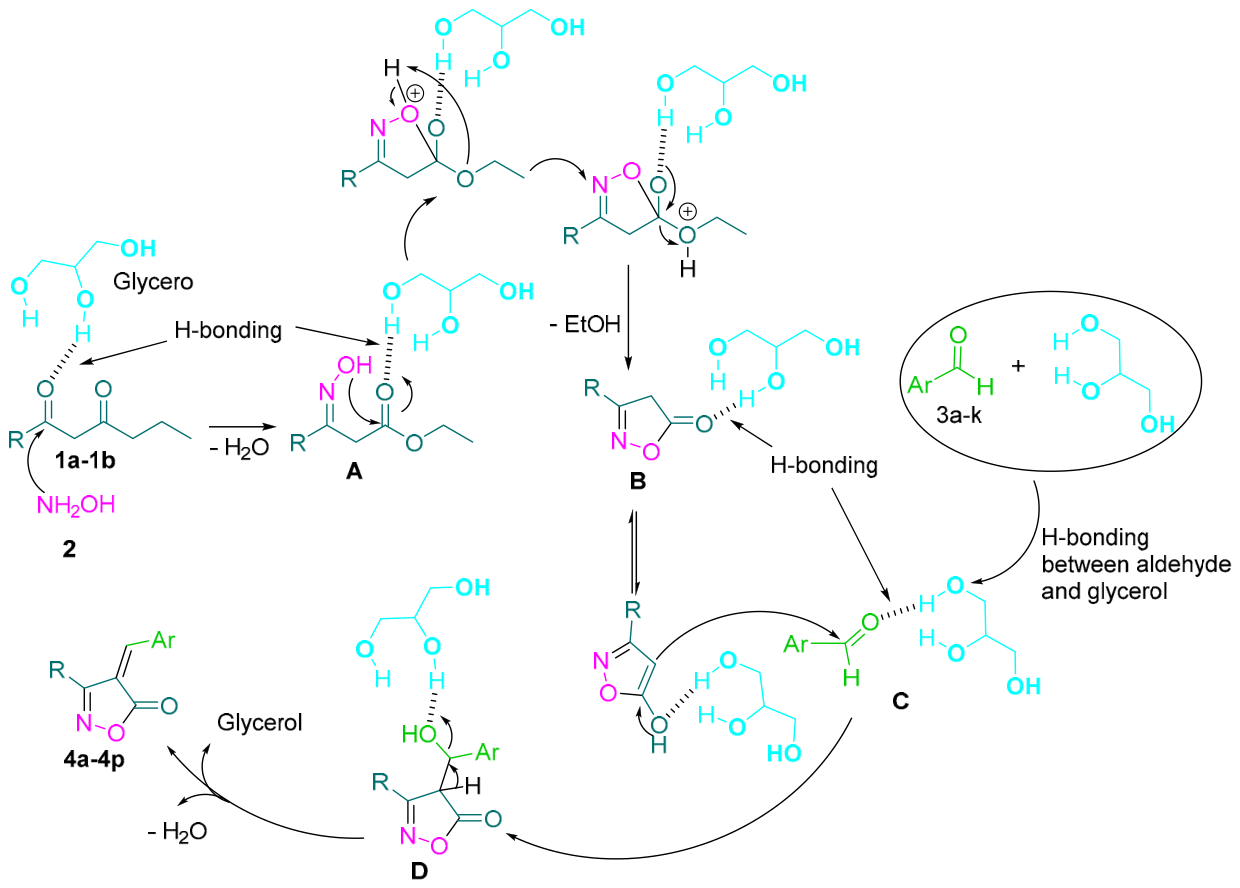
Table 1.
Optimization of the cyclocondensation reaction via Scheme 2 in solvent-free and various solvents.1.
Table 1.
Optimization of the cyclocondensation reaction via Scheme 2 in solvent-free and various solvents.1.
| Entry | Solvent | Temp./°C | Time/min. | Isolated yields for 4a /% |
|---|---|---|---|---|
| 1 | - | RT | 60 | 60 |
| 2 | Water | RT | 60 | 55 |
| 3 | Water | Reflux | 60 | 65 |
| 4 | EtOH | Reflux | 60 | 60 |
| 5 | EtOAc | Reflux | 120 | <10 |
| 6 | CHCl3 | Reflux | 120 | <10 |
| 7 | n-Hexane | Reflux | 120 | <10 |
| 8 | CH2Cl2 | Reflux | 120 | <10 |
| 9 | Dioxane | Reflux | 120 | <10 |
1 Reaction performed using ethyl acetoacetate (1a, 1 mmol), hydroxylamine hydrochloride (2, 1 mmol), vanillin (3a, 1 mmol), in solvent-free and different solvents at various temperatures.
Disclaimer/Publisher’s Note: The statements, opinions and data contained in all publications are solely those of the individual author(s) and contributor(s) and not of MDPI and/or the editor(s). MDPI and/or the editor(s) disclaim responsibility for any injury to people or property resulting from any ideas, methods, instructions or products referred to in the content. |
© 2026 by the authors. Licensee MDPI, Basel, Switzerland. This article is an open access article distributed under the terms and conditions of the Creative Commons Attribution (CC BY) license (http://creativecommons.org/licenses/by/4.0/).
Copyright: This open access article is published under a Creative Commons CC BY 4.0 license, which permit the free download, distribution, and reuse, provided that the author and preprint are cited in any reuse.


