
Submitted:
12 June 2026
Posted:
12 June 2026
You are already at the latest version
Abstract
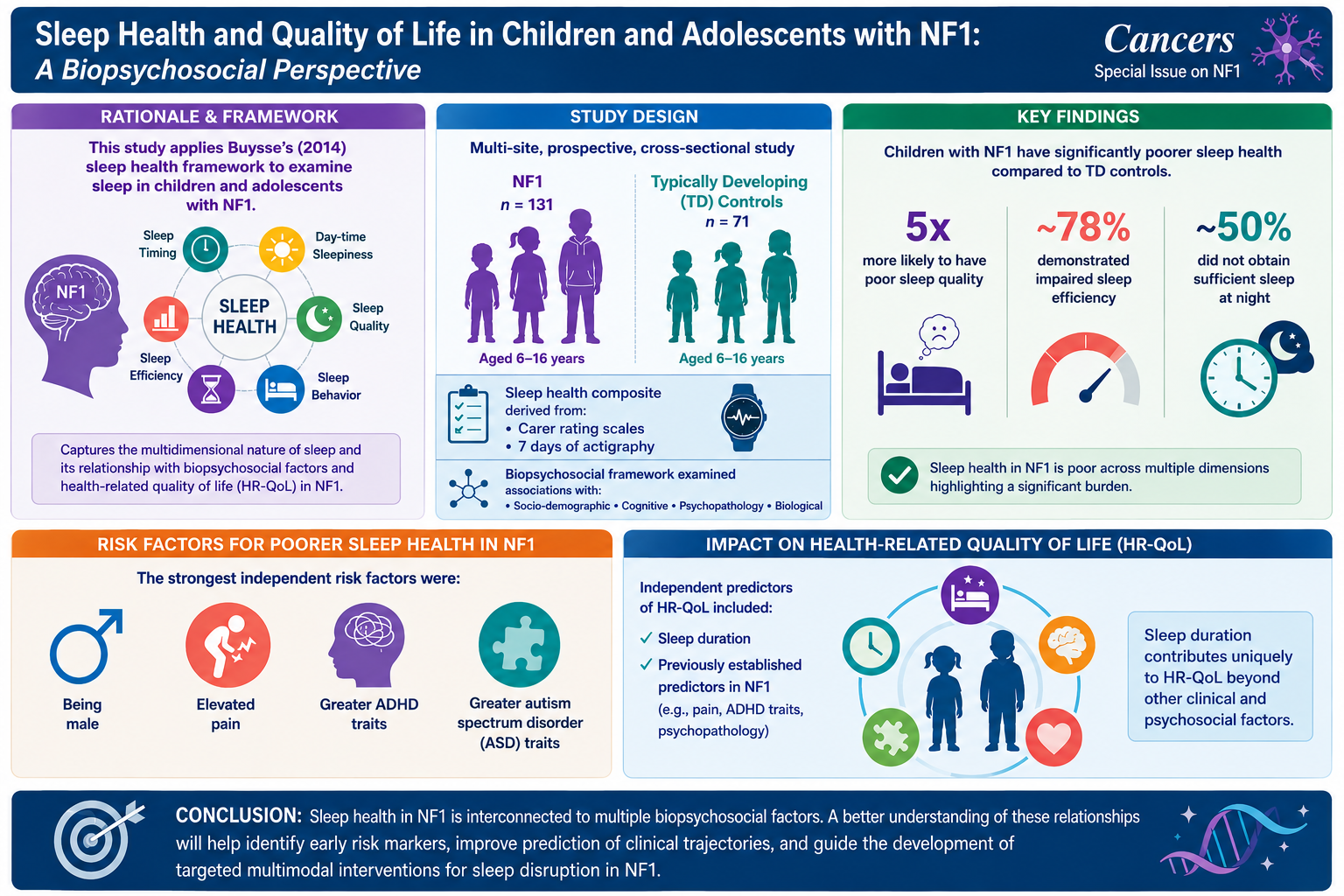
Background: This study applies Buysse’s (2014) sleep health framework to examine sleep in children and adolescents with neurofibromatosis type 1 (NF1). By examining sleep timing, daytime sleepiness, sleep quality, sleep behavior, sleep duration and sleep effi-ciency together, this framework captures the multidimensional nature of sleep and its relationship with biopsychosocial factors and health related quality of life (HR-QoL) in NF1. Methods: This multi-site, prospective, cross-sectional study included 131 children and adolescents with NF1 and 71 typically developing (TD) controls aged 6 to 16 years. A sleep health composite was derived from carer rating scales and seven days of actigra-phy. A biopsychosocial framework was used to examine factors associated with sleep health in NF1, including socio-demographic, cognitive, psychopathology, and biological variables. Independent predictors of QoL were examined, to assess the unique contri-butions of sleep quality, sleep duration and previously established predictors of HR-QoL in NF1. Results: Poorer sleep health was evident in children with NF1. Compared to TD controls, children with NF1 were five times as likely to have poor sleep quality with almost 78% demonstrating impaired sleep efficiency and nearly half not obtaining suf-ficient sleep at night. The strongest risk factors were being male, elevated pain, and having greater levels of ADHD and autism spectrum disorder traits. Conclusions: Findings suggest sleep health in NF1 is interconnected to multiple biopsychosocial fac-tors. A better understanding of these relationships will help identify early risk markers, improve prediction of clinical trajectories, and guide the development of targeted mul-timodal interventions for sleep disruption in NF1.
Keywords:
neurofibromatosis 1
; sleep
; biopsychosocial
; neurodevelopmental
; sex
; quality of life
Copyright: This open access article is published under a Creative Commons CC BY 4.0 license, which permit the free download, distribution, and reuse, provided that the author and preprint are cited in any reuse.


