
Submitted:
11 June 2026
Posted:
12 June 2026
You are already at the latest version
Abstract
The loess gully region is characterized by complex terrain with crisscrossing gullies,where coal mining can readily induce surface subsidence and slope deformation. Such deformation often leads to geological hazards and ecological issues,including collapses,landslides, soil erosion, vegetation dry up,and land degradation.Therefore,understanding the deformation behavior of mining‑induced slopes is essential for the restoration and management of mine geological environments.This study focuses on five slopes within working faces 50205 and 50206 of the Zhen’er Coal Mine in Fugu County.Using a combination of 3DEC numerical simulations and orthophoto-based fracture identification, we systematically investigated mining-induced slope deformation under the complex topographic conditions of the loess gully region.The goal is to answer three key questions: where mining-induced slope deformation primarily occurs,how it evolves over time, and what the main controlling factors are.Spatially,the primary deformation zones and their propagation paths vary significantly among the five slopes.The largest deformation occurs in the slope body directly above the main section of the working face,gradually decreasing toward the edges of the working face. Temporally, mining-induced slope deformation exhibits a time lag, meaning that surface responses lag behind underground mining activities and continue to develop even after the working face is fully extracted.In the loess gully region, slope deformation induced by mining is controlled not only by mining activities but also by topographic factors such as slope shape, aspect,gradient, and height. The spatiotemporal evolution of deformation becomes even more complex for slopes that span multiple working faces. These findings provide a scientific basis for monitoring mining-induced slope deformation and preventing geological disasters in the loess gully region,while also offering practical guidance for safe mining operations and hazard control in similar settings.
Keywords:
mining-affected slopes
; loess gully region
; deformation
; spatiotemporal evolution law
; Zhen’er Coal Mine
1. Introduction
There are substantial coal resources buried in western China, of where more than 60% mines locate in loess gully areas, which mainly distributed in Shaanxi, Shanxi, Gansu, Ningxia, InnerMongolia etc. Gully area, a transition between plain and plateau, is characterized by the narrow and steep channel and the complex engineering geological conditions[1,2].A series of mining damages and geological disasters as well as ecological problems appear in different forms then, such as surface crack, step subsidence, slope slide, local collapse, vegetation dry up, land desertification etc[3].The slope deformation induced by coal mining not only occurs during the extraction period but also may experience residual subsidence or reverse movement after mining ceases or even after the mine is closed. At same time, the mining of a shallow-buried coal seam would easily cause sliding fissures due to the combined effect of the geological mining environment and gully topography in loess gully areas[4,5].Because of mining-induced loess slopes gental tensile strength, loess slopes subsides severely when its stable internal structure is damaged causing by underground coal mining[1]. Therefore, over the past 20 years, connecting with the specific mining engineering practice, some experts, scholars and engineers have done a certain amount of research work on loess slope deformation and failure under underground mining, slope deformation and failure laws were studied with numerical simulation mostly and by model experiment, field monitoring and combined method partly[6,7,8].There into, Zhang[9]presents details of highway slopes affected by a mining subsidence event that occurred in the Yangquan coal mining area of China in 2016.Prof. Sun Shiguo did a great and breaking work. He explored the influence law of slope stability, induced by underground mining area and the relative position and the space and geometry size changes of slope body[10].He also studied the underground mining of slope outer region on slope stability influence characteristic[11].Wen[11]took Hongyu Coal Mine as the engineering background, the volume and slope of the gully landform above the goaf were included in the influence factors of dynamic pressure characteristics, and the analysis framework of topography and geomorphology was constructed. Liu[4] used FLAC 3D numerical simulation software to establish the model of concave slope, convex slope, mixed slope and uniform slope to simulate the influence of underground coal mining on surface morphology. Zhang[7]studied gully slope movements, subject to underground mining, with physical simulation and theoretical analysis. The rules disclose that the slope rock slides horizontally in response to mining in the direction of gullies and rotates reversely with the appearance of a polygon block in mining away from gullies. Li[8]proposes an intelligent slope stability prediction method based on the improved pelican optimization algorithm (IPOA) and the optimization random forest (RF) algorithm to reduce disasters and accidents caused by slope instability. A set of intelligent slope stability prediction systems is created using MATLAB tools and applied to Lala Copper Mine in Sichuan Province. Xu Dongjing[13]proposed a conceptual model, which includes the broken patterns of the overburden strata and the fracture space induced by it. The authors proposed three types of trapezoidal broken models considering the top-down varying pattern of the lateral and longitudinal volume expansion coefficients. Lv[14]analyzed the effects of the fault in controlling the deformation features of the destabilized slope during underground mining by adopting the method of numerical simulation from these perspectives including displacement, stress, strain, among others.
Previous research has made great progress in areas such as the overall response of coal seam mining, the evolution of mining-induced slope deformation, and the integration of monitoring and simulation. However systematic research on mining-induced slope deformation under complex terrain conditions in loess gully regions remains relatively scarce, in particular, there is still a lack of in-depth understanding regarding the differential responses of different slopes, the spatiotemporal evolution patterns, and their corresponding relationships with ground surface deformation. As is well known, the deformation of mining-induced slopes in loess gully regions is jointly controlled by multiple factors such as topographic conditions, mining methods, and overburden structure, leading to complex patterns. Therefore, it is necessary to integrate topographic conditions and comprehensively apply field investigation and numerical simulation methods to conduct systematic research on the deformation laws of mining-induced slopes in loess gully regions.
The propose of this paper is to studying deformation laws on the different type of slopes which located on the coal working face in loess gully regions. In order to better answer questions such as how it changes over time, where it changes in space, and what factors drive its change. This will enable a more comprehensive revelation of the spatiotemporal evolution mechanisms of mining-induced slope deformation, which is crucial for the prevention and control of geological disasters in loess gully regions.
2. Coal Mine Summary
Zhen'er Coal mine is located in FuGu County, ShaanXi Province(Figure 1a).The mining area features crisscrossing gullies, with relatively gentle ridge tops sloping toward the valleys at gradients of 10°to 20°.The gullies are generally 80 to 100 meters deep. Below the gully edge lines, the valley slopes are steeper, ranging from about 60°to 80°.The gully bottoms are relatively flat, flanked by steep sides that locally form cliffs. This area is characterized by typical loess hilly-gully topography. The surface of the mining area is largely covered by Quaternary sediments. The strata, from oldest to youngest, are as follows: the Lower Jurassic Fuxian Formation (J1f),the Middle Jurassic Yan'an Formation (J2y),the Pliocene Jingle Formation of the Neogene (N2j),the Middle Pleistocene Lishi Formation (Q2l),and the Holocene alluvial-proluvial deposits of the Quaternary (Q42al+pl).
Zhen'er Coal Mine is located in the southeastern part of the Northern Shaanxi Slope, a secondary tectonic unit of the Ordos Basin. The geological structure is simple, with no evidence of magmatic activity in the area. The overall structural form is a gently north-dipping monocline, with a dip direction of 5°and a dip angle of less than 1°.Locally,very small-scale nose-shaped uplifts are developed. The regional crust is stable, and historically no major destructive earthquakes have ever occurred in the area. The characteristic period of the ground motion response spectrum in this region is 0.35s,the peak ground acceleration is 0.05g,and the seismic fortification intensity is VI.
The Zhen'er Coal Mine was mined from 2008 to December 2021 and is now closed. The main minable coal seam within its mining rights is the No.5-2coal seam, with thickness varying from 1.45m to 3.58m (average 2.82m),burial depth ranging from 74.37m to 176.86m(typically 90~130m),and floor elevation varying between 1138.25m and 1164.90m.The coal seam dips northward with a dip direction of 5°and an average dip angle of 0.5°.The mining of the No. 5-2 coal seam is divided into three panels:501,502,and 503.Panel 501 is located in the northern part of the mining area, Panel 502 in the central part, and Panel 503 in the southern part(Figure1a).The working faces 50205 and 50206 studied in this research are located within Panel 502(Figure 1b),mined from January to June 2017(50205) and July to December 2019(50206).The mining height of the coal seam is 3m, with an average burial depth of 138m. The advancing direction azimuth is 151°.Each working face has a length of 540m and a width of 200m. The mining method is longwall retreating with full-seam one-pass mining, using fully mechanized mining technology and full caving method for roof management. Based on high-resolution orthophoto images of the study area, through manual identification, taking the main gullies (ignoring smaller secondary gullies) as the main line, combined with ridge lines and slope morphology characteristics, the boundaries of slopes within working faces 50205 and 50206 were delineated. A total of five slopes (B1 to B5) were identified (Figure 1c~Fig1h), with unit areas ranging from 0.125 to 0.352km2.The material composition of all slopes is loess(Q2l).The main characteristics of each slope are shown in Table 1.
3. Methods
3.1. Model
Using the measured terrain of working faces 50205 and 50206 as the prototype, a three-dimensional numerical model capable of realistically representing the complex topographic structure was constructed using the 3DEC discrete element software. In the spatial coordinate system, the X-axis is defined as the working face advancement direction, the Y-axis as the working face dip direction, and the Z-axis as the vertical height direction. The model dimensions are 580 m×460 m×102 m. To eliminate boundary effects, a 20 m protective coal pillar is left on all four sides of the model. Based on geological data, a grid model consisting of 16 layers and 9 types of rock/soil masses was established, comprising 42688 discrete blocks,423295 computational nodes, and 384168 computational grids, as shown in Figure 2.
3.2. Parameter Assignment
3.2.1. Stratigraphic Material Parameters
The mechanical properties of the loess layer were obtained through laboratory tests,the mechanical parameters of the rock were mainly based on previous test results from the mining area.The specific parameter assignments are shown in Table 2.
3.2.2. Setting of Stratigraphic Contact Surface Parameters
To ensure computational stability, the contact surface parameters are assigned following the stiffness matching principle in the 3DEC official manual. The cohesion c is reduced by 15% to 30%,and the tensile strength is set to one-quarter of the cohesion. The internal friction angle is calculated based on the normal stiffness and shear stiffness, using the bulk modulus K and shear modulus G of the stratigraphic parameters. The model contact surface parameters are shown in Table 3.
3.3. Boundary Condition Setting and Calculation Scheme Design
3.3.1. Boundary Conditions
Spatial constraints are implemented by limiting the velocities of boundary grid points. The fine sandstone at the model bottom is restricted from displacement in the X, Y, and Z directions. The lateral sides around the model are restricted from horizontal displacement in either the X or Y direction, allowing vertical free deformation while simulating the lateral confinement effect of an infinite rock mass.
3.3.2. Initial Equilibrium
The initial equilibrium calculation aims to eliminate the influence of initial stratigraphic deformation on subsequent mining analysis, and is a prerequisite for simulating coal seam mining. An equivalent self-weight load is applied according to the natural burial depth conditions of the strata, and local damping is used to accelerate energy dissipation in the model, shortening the convergence time. During the solution process, the maximum unbalanced force ratio threshold is set to 1×10⁻⁵.When the iteration falls below this threshold, the initial equilibrium of the model is considered complete. To eliminate the interference of initial deformation caused by self-weight on subsequent mining analysis, the displacements and velocities of all grid points are initialized to zero via a command, so as to construct a disturbed deformation field solely induced by excavation activities.
3.3.3. Calculation Scheme
The simulated excavation range is set from X=20 m to X =560 m, with a total advancement length of 540m.The step distance during the mining advancement process is set to 10m.At each excavation step,the program automatically deletes the blocks in the corresponding area of the 5-2 coal seam by executing the block excavate command. The model performs preliminary iterations for each excavation step with a step limit of 2000 and a threshold of 1×10⁻³ to simulate the coal seam mining process. After the working face extraction is completed, a secondary equilibrium calculation is carried out with the threshold reset to 1×10⁻⁵,to simulate the residual deformation of the overburden after mining.
4. Results
4.1. Spatial Characteristics of Mining-Induced Slope Deformation
4.1.1. Slope Surface Deformation
The displacement cloud maps of the slope surfaces for B1 to B5 are shown in Figure 3.
When the 50205 working face was excavated to 100~200m(Figure 3a~3b),the slope surface deformation range of the B1 slope was small, occurring only at the slope crest, with a maximum value of about 0.75m.As mining progressed, the deformation zone gradually expanded and extended toward the middle of the B1 slope, where a relatively significant deformation zone first appeared. Meanwhile, deformation gradually spread to the slope toe(Figure 3c~3d),but the region with larger deformation remained at the slope crest, with a maximum value of about 2.75m.After mining reached 500m(Figure 3e~3f),a large deformation occurred in the southwestern part of the B1 slope near the slope toe, reaching a maximum value of 3.128m.During the mining of the 50205 working face, the northern gully area of the B1 slope experienced almost no deformation (less than 0.25m).When the adjacent 50206 working face was excavated to 200m(Figure 3i),deformation began to appear, reaching 0.50m.By the time it reached 300m(Figure 3j),the slope displacement directly above the coal pillar between the two working faces had expanded to about 1m,and thereafter until the completion of mining, it remained basically around 1m(Figure 3k~3n).
During the mining of the 502025 working face, the B2 slope experienced almost no deformation. However, because it is located above the open-off cut of the 50206 working face, significant deformation occurred at the early stage of mining of the 50206 working face. The displacement at the northwest corner was between 0.50 and 0.75m(Figure 3h).When mining advanced to 200m,obvious deformation appeared on the slope surface in the central area, with displacements between 0.50m and 1.00m(Figure 3i).As mining progressed to 300~400m,the subsidence range further expanded, deformation gradually spread from the central area to the entire slope surface and continued to develop toward the slope toe. The slope surface displacements ranged from 0.75m to 2.48m(Figure 3j~3k).When mining reached 500~540m,the overall deformation pattern of the slope was basically formed. In the later stage, deformation continued to increase slowly mainly along the original high-value areas, with slope surface displacements ranging from 0.75m to 2.7m (Figure 3l~3n).
Slope B3 is nearly perpendicular to the mining direction of the 50206 working face, with its center located 230m from the open-off cut along the advancing direction. When mining advanced to 100m,no obvious displacement was observed on the slope surface(Figure 3h).When mining advanced to 200m,noticeable deformation first appeared at the gully at the slope toe, with a maximum displacement of 0.75m.The overall deformation pattern showed a gradually decreasing trend from the toe on both the north and south sides toward the central ridge of the slope(Figure 3i).As mining advanced to 300~400m,deformation had covered the entire slope. High-deformation zones gradually formed at the central ridge and the northern gully, with more significant deformation at the western ridge, reaching a maximum of 3.00m(Figure 3j~3k).When mining advanced to 500~540m,the deformation at the western ridge reached a maximum of 3.27m. The deformation at the north and south gullies was relatively smaller but still reached 1.50 m(Figure 3l~3n).
The center of Slope B4 is located 350m from the open-off cut of the 50206 working face along the advancing direction. During the mining stage of 100~200m,no obvious deformation was observed on the slope surface(Figure 3h~3i).When mining advanced to 300m,deformation began to appear in the northern part of the slope surface, with a maximum displacement of 1.5m(Figure 3j).When mining advanced to 400m,a high-deformation zone developed in the northern area, most prominently at protruding parts and gully incision areas, the maximum displacement reached 3.0m(Figure 3k).In the later mining stage(500~540m),deformation occurred over the entire slope surface, with displacements ranging from 0.5m to 3.27m.The high-deformation zone gradually shifted toward the central part and was mainly concentrated in areas with significant topographic relief on the slope surface (Figure 3l~3n).
Slope B5 spans across the two working faces,50205 and 50206.When the 50205 working face was mined to 100~300m,no obvious deformation was observed on the slope surface(Figure 3a~3c).After the 50205 working face advanced beyond 400m,notic-eable displacement began to appear in the western part of the slope. The high-deformation zone was located at the topographic transition where the slope changed from gentle to steep, with a maximum displacement of 3.13m(Figure 3d~3g).Du--ring the early mining stage of the 50206 working face (100~300 m),because it was relatively far from the open-off cut, no obvious deformation occurred in the eastern part of the B5 slope either. The western part of the slope above the 50205 working face was in a residual deformation stage, with a slight increase in the maximum value to 3.18 m(Figure 3h~3j).In the middle and late mining stages(400~540 m),significant deformation also appeared in the eastern part, with displacement values ranging from 0 to 2.25m.The area with small deformation was located on the coal pillar between the two working faces. The maximum deformation in the eastern part occurred in the southern area, which is close to the subsidence center of the 50206 working face. The maximum displacement in the western deformation zone continued to increase, reaching 3.27m(Figure 3k~3n).
4.1.2. Slope Internal Deformation
To facilitate the analysis of internal deformation within the slopes, one section line is arranged on each slope, named L1 to L5 respectively. The direction of the sections is approximately perpendicular to the contour lines, as shown in Figure 4.
A displacement cloud map slice was created along line L1,as shown in Figure 5. When mining advanced to 100m,the overall internal deformation of the B1 slope was relatively weak, with only a small-scale displacement response occurring above the open-off cut. The maximum displacement was 0.15m,mainly characterized by slow subsidence(Figure 5a).When mining advanced to 200~400m,the internal displacement of the slope gradually concentrated toward the central part, forming a distinct high-displacement zone. This high-displacement zone migrated toward the upper part of the slope and gradually extended to the slope surface, with the maximum displacement increasing from 1.35m to 3.01m(Figure 5b~5d).After mining reached 500m,although the maximum displacement did not change significantly compared with that at 400m,deformation in the lower part of the slope and near the slope toe increased notably(Figure 5e~5f).
A displacement cloud map slice was created along line L2,as shown in Figure 6.At 100m of mining, the overburden displacement had not yet propagated to the B2 slope area, and no obvious deformation was observed inside the slope overall(Figure 6a).After mining reached 200m,the roof began to collapse, and the overburden displacement rapidly transferred to the central part of the slope, forming a relatively distinct deformation zone there, while deformation at the slope toe and crest remained relatively small. The maximum internal displacement in the slope reached 1.05m (Figure 6b).By the time mining advanced to 300m,obvious displacement appeared throughout the slope interior, with displacement values ranging from 1.05m to 2.55m (Figure 6c).As mining advanced from 400m to 540m,because the mining face had passed the B2 slope, the internal deformation of the slope showed no significant change, except that the extent of the high-value zone(2.25~2.55m) increased slightly (Figure 6d~6f).
A displacement cloud map slice was created along line L3,as shown in Figure 7.At 100m of mining, the working face had not yet advanced beneath the slope, and no obvious deformation was observed inside the B3 slope(Figure 7a).When mining advanced to 200m,the working face had already progressed to the lower part of the slope, but the overlying strata had not yet collapsed significantly, only a weak displacement response was exhibited inside the slope, with the central part being most affected, followed by the upper and lower parts. The overall deformation was still relatively small, with a maximum value of 0.75m(Figure 7b).When mining advanced to 300~400 m, the overlying strata began to collapse, and the subsidence displacement of the goaf rapidly transferred into the slope interior. A distinct high-displacement zone first formed in the central part of the slope, reaching a maximum value of 2.85m,and gradually migrated toward the slope surface(Figure 7c~7d).When mining advanced to 500~540 m, the internal deformation of the slope mainly manifested as a continuous increase in the original high-displacement zone (maximum reaching 3.09m) and a slow expansion of the affected area, with the overall change tending to stabilize(Figure 7e~7f).
A displacement cloud map slice was created along line L4,as shown in Figure 8.When mining advanced to 100~200m,the working face had not yet advanced beneath the B4 slope, and no obvious displacement response was observed inside the slope(Figure 8a~8b).When mining advanced to 300m,a relatively clear internal displacement zone appeared in the middle-lower part of the slope. Its distribution pattern was consistent with the subsidence basin above the working face, generally showing larger displacement in the middle-lower part, with a maximum value of 1.00m(Figure 8c).When mining advanced to 400~540m,the displacement in the middle part of the slope continued to increase, with the maximum value changing from 2.75m to 3.17m,and gradually extended toward the slope toe. The internal deformation range rapidly expanded toward the upper part of the slope. Although the slope gradient in the lower part was relatively steep, no significant increase in displacement was observed there, and the overall deformation remained mainly at low values(Figure 8d~8f).
Displacement slices were created along the L5 profile line, as shown in Figure 10. When the 50205 working face was mined to 100~300m,no significant displacement response occurred inside the B5 slope, with a maximum displacement of 0.02m(Figure 9a~9b).When mining advanced to 500m,obvious displacement appeared in the middle-lower part of the slope, with a maximum displacement of 2.75m(Figure 9c).By the end of mining of the 50205 working face(540m),deformation had become continuous in the middle-lower part of the slope, with a maximum deformation value of 3.08m(Figure 9d). During the entire mining process of the 50206 working face, the deformation zone inside the slope caused by mining of the 50205 working face further expanded northward, but the maximum deformation did not increase significantly(Figure 9e~9h).
4.2. Temporal Characteristics of Slope Deformation Induced by Mining
(1)Slope B1
The displacement-time curves of the slope surface monitoring points G1~G10 and the internal slope monitoring points U1~U6 of the B1 slope, along with the deformation values at key time points, are shown in Figure 10 and Table 4.
As can be seen from Figure 10 and Table 4,from January to December 2019,during the mining of the 50205 working face, the deformation of all monitoring points on the surface and inside Slope B1 increased gradually. The deformation rate was relatively large in the early stage and gradually slowed down in the middle and late stages. Since most of Slope B1 is located above the 50205 working face, the deformation rate of the monitoring points on the slope surface during the mining of the 50205 working face was greater than that during the mining of the 50206 working face. For the surface monitoring points, point G8 near the slope toe had the maximum deformation rate of 14.858mm/d during the mining of the 50205 working face, during the mining of the 50206 working face, the maximum deformation rate was 0.185mm/d at point G2 at the slope crest. In the residual deformation stage of the 50205 working face, the maximum deformation amount was 10.37mm at point G9 near the slope toe, while in the residual deformation stage of the 50206 working face, the maximum was 3.62mm at point G1 at the slope crest. The maximum final deformation was 2.78m at point G8 in the middle-lower part of the slope (where the curvature was greatest).During the mining of the 50205 working face, for the internal monitoring points, the maximum deformation rate was 1.239mm/d at U3,and the maximum residual deformation value was 7.45mm at U1.During the mining of the 50206 working face, the maximum deformation rate was 0.246mm/d at U2, and the maximum residual deformation value was 2.58mm at U1.The maximum final deformation inside the slope was 2.71m at point U6.In the same period, a vertical comparison (G5~U3~U5) shows that the deformation on the slope surface was larger than that inside, and the deformation decreased with increasing depth. This indicates that the slope deformation is influenced not only by coal mining, but also by the self-weight gravity component of the slope.
(2)Slope B2
The displacement-time curves and deformation values at key time points for the surface monitoring points G1~G9 and the internal monitoring points U1~U7 on Slope B2 are shown in Figure 10 and Table 5.
As can be seen from Figure 10 and Table 5,from January to June 2017,during the mining of the 50206 working face, the displacement values and deformation rates of all monitoring points on the surface and inside Slope B2 were relatively small, but not entirely zero. The maximum displacement was 0.055m at surface point G3, with a deformation rate of 0.305mm/d, indicating that the mining of the 50205 working face still had a certain influence on Slope B2,which is entirely located above the adjacent 50206 working face. From July to December 2019,during the mining of the 50206 working face, the displacement values of all monitoring points increased rapidly. The maximum deformation rate was observed at internal monitoring point U7, which is located near the strike main section of the 50206 working face, with its displacement reaching 2.483m and a deformation rate of 13.606mm/d. On the slope surface, the maximum displacement was 2.476m at point G6 in the middle-lower part, and its deformation rate was 13.438mm/d, the largest among the nine surface monitoring points, point G5 also had a relatively large deformation rate of 13.121mm/d. In the residual deformation stage after mining, the maximum deformation was 10.44mm at monitoring point G1 at the slope crest. The residual deformation amounts of the slope surface monitoring points were larger than those at the monitoring points in the gully at the slope toe. The maximum final deformation was 2.486m at the internal monitoring point U7.In the same period, a vertical comparison (G1~U1~U2~U5) shows that the deformation on the slope surface was larger than that inside.
(3)Slope B3
The displacement-time curves and deformation values at key time points for the surface monitoring points G1~G10 and the internal monitoring points U1~U6 on Slope B3 are shown in Figure 11 and Table 6.
As can be seen from Figure 11 and Table 6,from January to June 2017,during the mining of the 50205 working face, the displacement values and deformation rates of all monitoring points on the surface and inside Slope B3 were relatively small, but not entirely zero. The maximum displacement was 0.037m at point G7,which is located at the slope toe with relatively large curvature, the maximum deformation rate was 0.209mm/d at point G8 in the gully at the slope toe. This indicates that the mining of the 50205 working face still had a certain influence on Slope B3,which is entirely located above the adjacent 50206 working face. From July to December 2019,during the mining of the 50206 working face, the displacement values of all monitoring points increased rapidly. The maximum deformation rate occurred at surface monitoring point G5,which is located directly above the goaf and near the strike main section of the 50206 working face, with a displacement reaching 2.821m and a deformation rate of 15.492mm/d. The maximum displacement inside the slope was 2.804m at point U5,which also had a relatively high deformation rate of 15.430 mm/d. In the residual deformation stage after mining, the maximum deformation was 8.97mm at monitoring point G1 at the slope crest. The maximum final deformation was 2.826m at surface point G5.In the same period, a vertical comparison (G5~U5~U8) shows that the deformation on the slope surface was larger than that inside, and it decreased with increasing depth.
(4)Slope B4
The displacement-time curves and deformation values at key time points for the surface monitoring points G1~G9 and the internal monitoring points U1~U7 on Slope B4 are shown in Figure 11 and Table 7.
As can be seen from Figure 11 and Table 7,from January to June 2017,during the mining of the 50205 working face, the displacement values and deformation rates of all monitoring points on the surface and inside Slope B4 were relatively small, but not entirely zero. The maximum displacement was 0.075m at point G7,which is located near the slope toe, and the maximum deformation rate was also at G7,at 0.416mm/d. This indicates that the mining of the 50205 working face still had a certain influence on Slope B4,which is entirely located above the adjacent 50206 working face. From July to December 2019,during the mining of the 50206 working face, the displacement values of all monitoring points increased rapidly. The maximum deformation rate occurred at surface monitoring point G6,which is located directly above the goaf and near the strike main section of the 50206 working face, with its displacement reaching 3.140m and its deformation rate also being the largest, at 17.038mm/d. The maximum displacement inside the slope was at point U3,with a value of 2.655m, and its deformation rate was also the largest, reaching 14.606mm/d. In the residual deformation stage after mining, the maximum deformation was 112.59mm at point G5.The maximum final deformation was 3.072m at surface point G5.In the same period, a vertical comparison (G1~U1~U2~U4) shows that the deformation on the slope surface was larger than that inside, and it decreased with increasing depth.
(5)Slope B5
The displacement-time curves and deformation values at key time points for the surface monitoring points G1~G6 and the internal monitoring points U1~U6 on Slope B5 are shown in Figure 12 and Table 8.
As can be seen from Figure 12 and Table 8,from January to June 2017,during the mining of the 50205 working face, the maximum displacement on the slope surface was 2.596m at point G3,where the curvature was greatest, and its deformation rate was also the maximum, at 17.308mm/d. Inside the slope, the maximum displacement was 2.526m at point U3,with a maximum deformation rate of 16.837mm/d, point U5 also experienced relatively large deformation. From July 2019 to December 2019,during the mining of the 50206 working face, the displacement at surface monitoring point G3 was also the maximum, reaching 2.845m,but its deformation rate was not the maximum, the maximum rate was 0.905mm/d at point G1.Inside the slope, the maximum displacement was 2.763m at point U3,but the maximum deformation rate was 0.895mm/d at monitoring point U2.In the residual deformation stage after mining, the maximum deformation was 7.62mm at point U4.The maximum final deformation was 2.845m at surface point G3.In the same period, a vertical comparison (G3~U3~U5) shows that the deformation on the slope surface was larger than that inside, and it decreased with increasing depth.
4.2. Field Investigation Validation
To validate the numerical simulation results, orthophoto images of the mining area (acquired on November 15, 2025) were used to identify fracture distribution, as shown in Figure 13.
Numerical simulation results show that deformation of slope B1 is mainly concentrated near the toe on the western side of the slope, with a high-deformation zone distributed in a band along the slope aspect. Orthophoto crack identification reveals well-developed tensile cracks near the main section of working face 50205, with crack strikes generally consistent with the slope aspect, a maximum extension length of approximately 113 m, local slumping at the toe, and no obvious cracks at the trailing edge of the platform on the slope top. Cracks above the coal pillar are weak, and the surface integrity is relatively good. The numerical simulation results are essentially consistent with the field investigation results. Numerical simulation shows that deformation of slope B2 is mainly concentrated in the middle and upper parts of the slope body, gradually expanding towards the slope top and the gully at the toe. Orthophoto images indicate that the upper and middle-upper parts of this slope are topographically broken, with cracks mainly distributed at the bottom of gullies and on ridge positions, and multiple shallow slumps are observable, which are highly consistent with the locations of high deformation zones from numerical simulation. Numerical calculation shows that the middle-upper part and the southern slope face of slope B3 are the concentrated deformation zones. Crack identification results show that in the gully at the toe of the slope, cracks with strikes generally consistent with the slope aspect have developed, with a maximum extension length of approximately 120 m, obvious slumping signs exist on the slope faces on both sides of the slope, with slumped soil accumulated in the gully. Field investigation shows that two obvious cracks have developed in the southwestern part of slope B4,with crack strikes generally consistent with the slope aspect, consistent with the deformation characteristics revealed by numerical simulation. Field investigation results of slope B5 show that on the slope above working face 50205,multiple cracks extending from the slope top to the toe have developed, ranging from 10 to 20 m in length, with a nearly north-south distribution. On the slope above working face 50206,no obvious large-area cracks are observed, but a transverse crack has developed at the junction between the upper tableland and the slope face, extending into working face 50205 with a length of approximately 180 m, which also shows good consistency with the numerical simulation deformation results
5. Discussion
5.1. Deformation Evolution Law of Mining-Affected Slopes
(1)Slope B1
On Slope B1,the slope surface deformation first appeared near the slope crest, then gradually extended to the middle and middle-lower parts as the working face advanced, and continuously intensified around the subsidence center. After entering the significant deformation stage, the middle-lower part of the slope surface became the primary zone of deformation development, while the gully at the slope toe exhibited a certain lagging response. The internal deformation of the slope displayed a distribution pattern in which the upper part responded first, and the deformation gradually increased in the middle-lower part and transferred toward the slope surface. The high-value deformation zone was mainly located inside the slope above the center of the working face subsidence basin and migrated as the center of the subsidence basin moved.
The temporal evolution pattern of deformation on Slope B1 was characterized by no obvious response in the early stage, rapid development in the middle stage, a tendency to stabilize in the late stage, and re-disturbance by the adjacent working face. The mining of the adjacent working face still had a certain influence on the slope above the old goaf.
(2) Slope B2
Slope B2 is located above the open-off cut. The slope surface deformation exhibited a spatial distribution pattern characterized by rapid initiation, development first in the middle part, followed by expansion to the entire slope surface and migration toward the slope toe. The internal deformation characteristics of Slope B2 were as follows: controlled by the subsidence center, deformation first developed in the middle part and gradually expanded toward the slope toe along the interior of the slope. After the working face advanced beneath the slope, the internal deformation responded rapidly in the middle part of the slope, and the existing high-value zone slowly migrated toward the slope toe as mining advanced.
The temporal evolution pattern of slope surface deformation on Slope B2 was characterized by small deformation in the early stage of mining, rapid increase in the middle stage, and slow stabilization in the late stage, controlled by the development process of the subsidence basin. The temporal evolution pattern of internal deformation on Slope B2 can be summarized as follows: mining influence was transmitted to the interior of the slope through overburden collapse, generating relatively large displacement within a short period, with the characteristics of rapid transmission and concentrated expansion.
(3)Slope B3
The slope surface deformation of Slope B3 generally showed that deformation occurred first at the gully at the slope toe, and then expanded toward the middle part and the ridge, with the high-value zone mainly appearing in the middle region. Since Slope B3 is located in the middle part of the 50206 working face, the internal deformation of the slope was small in the early stage of mining, exhibiting a pattern of relatively weak early response, initial development in the middle part, and rapid intensification after the overburden collapse.
The rapid expansion of slope surface displacement on Slope B3 mainly occurred in the middle stage of mining. In the late stage of mining, the increase in deformation was significantly weakened. The internal deformation was characterized by a sharp increase within a relatively short period.
(4) Slope B4
The slope surface deformation of Slope B4 generally showed that the gully at the slope toe responded first and formed a high-value zone, which then shifted to the middle part and expanded toward the slope crest. The internal deformation of the slope generally exhibited a pattern of weak early response, initial development in the middle part, and subsequent expansion toward the upper and lower parts of the slope. During the early to middle stage of the working face advance, the response was weak, in the middle stage, the displacement increased rapidly, and then gradually transitioned into a state of slow increase.
(5) Slope B5
Slope B5 spans two working faces and is located at the tail end of their advance direction. The deformation overall showed a lagging response in the early stage, gradually increased with the sequential mining of the two working faces, and converged toward the subsidence center of the working faces. In the initial stage, the deformation was mainly controlled by the 50205 working face, with high-value deformation zones concentrated near the subsidence center of the 50205 working face and at the topographic turning parts of the slope surface. With the mining of the 50206 working face, the mining influences of the two working faces gradually superimposed, and the slope surface deformation expanded from a previously relatively independent distribution state to the middle region.
The rapid increase in slope surface deformation on Slope B5 occurred in the middle to late stages of mining of the 50205 and 50206 working faces, while the deformation was slow in the early to middle stages.
5.2. Influencing Factors of Deformation of Mining-Affected Slopes
The underground goaf created by mining is the core driving force for slope deformation and instability, and it is also influenced by factors such as the spatial position relationship between the working face and the slope(the angle with the mining direction),slope gradient, slope aspect, slope height, and slope shape. Concave slopes (B2) are dominated by toppling failure and subsidence, and their maximum deformation is greater than that of convex and linear slopes. On convex slopes (B1,B3,B4),the high-value deformation zones are distributed in the areas of maximum curvature.
The deformation of mining-affected slopes that span working faces is more complex(Slope B2).For example, on slopes located at the open-off cut(Slope B2),deformation initiates rapidly, while the farther from the open-off cut, the slower the initiation.
The angle between the slope aspect of Slope B3 and the mining direction is 80°,close to 90°,which corresponds to a cross-slope mining condition. The slope is subjected to a "sandwich"-type compressive state, resulting in a more complex deformation mechanism, with both tensile deformation and thrust-type deformation occurring simultaneously and a faster deformation rate. The angle between the slope aspect of Slope B4 and the mining direction is 100°,also close to 90°,and its deformation mechanism is basically similar to that of Slope B3.For Slope B5,the angle between the slope aspect and the mining direction is 170°,representing an up-slope mining condition, where tensile fractures develop and toppling collapse may occur toward the gully at the slope toe. The slope aspects of Slopes B1 and B2 intersect obliquely with the mining direction, falling between down-slope mining(angle close to 0°) and cross-slope mining, tensile fractures dominate, and the deformation is mainly characterized by toppling toward the goaf.
The larger the slope gradient, the greater the mining-induced deformation amount and the larger the proportion of the slope area experiencing deformation. For instance, the maximum deformation of Slopes B1 and B2 is greater than that of Slopes B3,B4,and B5.
The sunny slopes (B1/B2) have relatively well-developed vegetation. Their plant roots provide anchoring and reinforcement effects, effectively increasing the shear strength of the slope’s rock and soil mass. Consequently, the maximum slope surface deformation on the sunny slopes is slightly smaller than that on the shady slopes (B3/B4/B5).Therefore, slope aspect has a certain influence on the magnitude of surface deformation of mining-affected slopes.
6. Conclusions
(1)No matter what type of slope, coal mining will increase the amount of slope deformation. How mining-induced slope deformation evolves over time, which parts of the slope are deforming spatially, and what factors drive the deformation are the most fundamental questions that need to be answered in research on mining-induced slope deformation.
(2)Mining-induced slope deformation exhibits a time lag, meaning that surface response lags behind underground mining activities and continues to develop even after the working face has been fully extracted. The temporal evolution of slope deformation(B1,B5) above working face 50205 can be described as: initiation lag, slow accumulation, a brief period of stabilization, and then renewed intensification after the adjacent working face 50206 is mined. In contrast, the slopes(B2,B3,B4) above working face 50206 shows rapid initiation, fast development, and continuous accumulation in the later stage, albeit with a decreasing rate of increase.
(3)Due to the different spatial relationships between the working faces and the slopes, the main deformation zones and their propagation paths vary significantly among slopes. For the five slopes studied here, the deformation consistently occurs first in the area directly above the main section of the working face, the deformation of the slope body and slope surface is the greatest, and then gradually expands outward to both sides, the deformation gradually decreases toward the edges of the working face..
(4)In the loess gully region, mining-induced slope deformation is controlled not only by mining activities but also by factors such as slope shape, slope aspect, slope gradient, and slope height. The spatiotemporal evolution of deformation across slopes that span multiple working faces is even more complex.
References
- Yan, Q.B.; Kong, L.W.; Fang, S.Y. Synergistic Effects of Microbial-Induced Carbonate Precipitation and Modified Biochar on the Engineering Properties of Loess. Crystals 2025, 15, 504. [Google Scholar] [CrossRef]
- Guo, W.B.; Yu, X.Y.; Liu, Z.R. Analysis of mining subsidence disasters in loess gully areas and its control countermeasures. Appl. Mech. Mater. 2015, 737, 456–460. [Google Scholar] [CrossRef]
- Yu, X.Y.; Qiu, Y.X. Analysis of subsidence status formation mechanisms in shallow mining seam of ravine cutting area[J]. J. Xi’an Univ. Sci. Technol. 2012, 32(3), 269–274. (in Chinese). [Google Scholar]
- Liu, N.; Zhao, X.G. Influence of Underground Coal Mining on Surface Morphology and Soil Erosion. IOP Conf. Ser. Earth Environ.Sci. 2019, 237, 032067. [Google Scholar]
- Liu, H.; Deng, K.Z.; Lei, S.G.; Bian, Z.F. Mechanism of formation of sliding ground fissure in loess hilly areas caused by underground mining[J]. Int. J. Min. Sci. Technol. 2015, 25, 553–558. [Google Scholar] [CrossRef]
- Dong, W.; Cao, L.Z. Chunde; Piao; Bai, Runcai. Influence of Underground Mining on Failure Mode and Stability of Counter-tilt Slope in Surface Mines[J]. Adv. Mater. Res. 2012, 594-597, 80–85. [Google Scholar]
- Zhang, D.S.; Fan, G.W.; Wang, X.F. Characteristics and stability of slope movement response to underground mining of shallow coal seams away from gullies[J]. Int. J. Min. Sci. Technol. 2012, 22, 47–50. [Google Scholar] [CrossRef]
- Li, M.L.; Li, K.G.; Qin, Q.C.; Yue, Rui. Slope stability prediction based on IPOARF algorithm: A Case Study of Lala Copper Mine, Sichuan, China[J]. Expert Syst. With Appl. 2023. [Google Scholar] [CrossRef]
- Zhang, C.; Li, T.F.; Han, X.D. Slope failure mechanism affected by mining subsidence: a case study of highway slopes in Yangquan, Shanxi Province, China[C]. IOP Conf. Ser. Earth Environ. Sci. 2020, 570, 022067. [Google Scholar]
- Sun, S.G.; Dong, P.X. Space properties of Effects of slope stability by Underground mining[J]. Adv. Mater. Res. 2012, 472-475, 3171–3177. [Google Scholar] [CrossRef]
- Sun, S.G.; Yang, H.; Zhang, Z.B. Analysis of Influence characteristics on slope stability of underground mining in slope outer zone[J]. Adv. Mater. Res. 2012, 524-527, 255–260. [Google Scholar] [CrossRef]
- Wen, H.H.; Li, Y.J.; Wu, G.Y. Study on overlying strata breaking law and dynamic pressure characteristics of shallow buried coal seam mining under gully landform[J]. Eng. Fail. Anal. 2026, 183, 110276. [Google Scholar] [CrossRef]
- Xu, D.J.; Peng, S.P.; Xiang, S.Y.; He, Y.L. A Novel Caving Model of Overburden Strata Movement Induced by Coal Mining[J]. Energies 2017, 10, 476. [Google Scholar] [CrossRef]
- Lv, Y.Q. Numerical Simulation and Model of Deformation Features of Destabilized Mining Slope Under Fault-Controlled Conditions[J]. Earth Sci. Res. J. 2020, 24(1), 61–69. [Google Scholar] [CrossRef]
Figure 1.
Location of research area and field photos of research slopes(B1~B5).
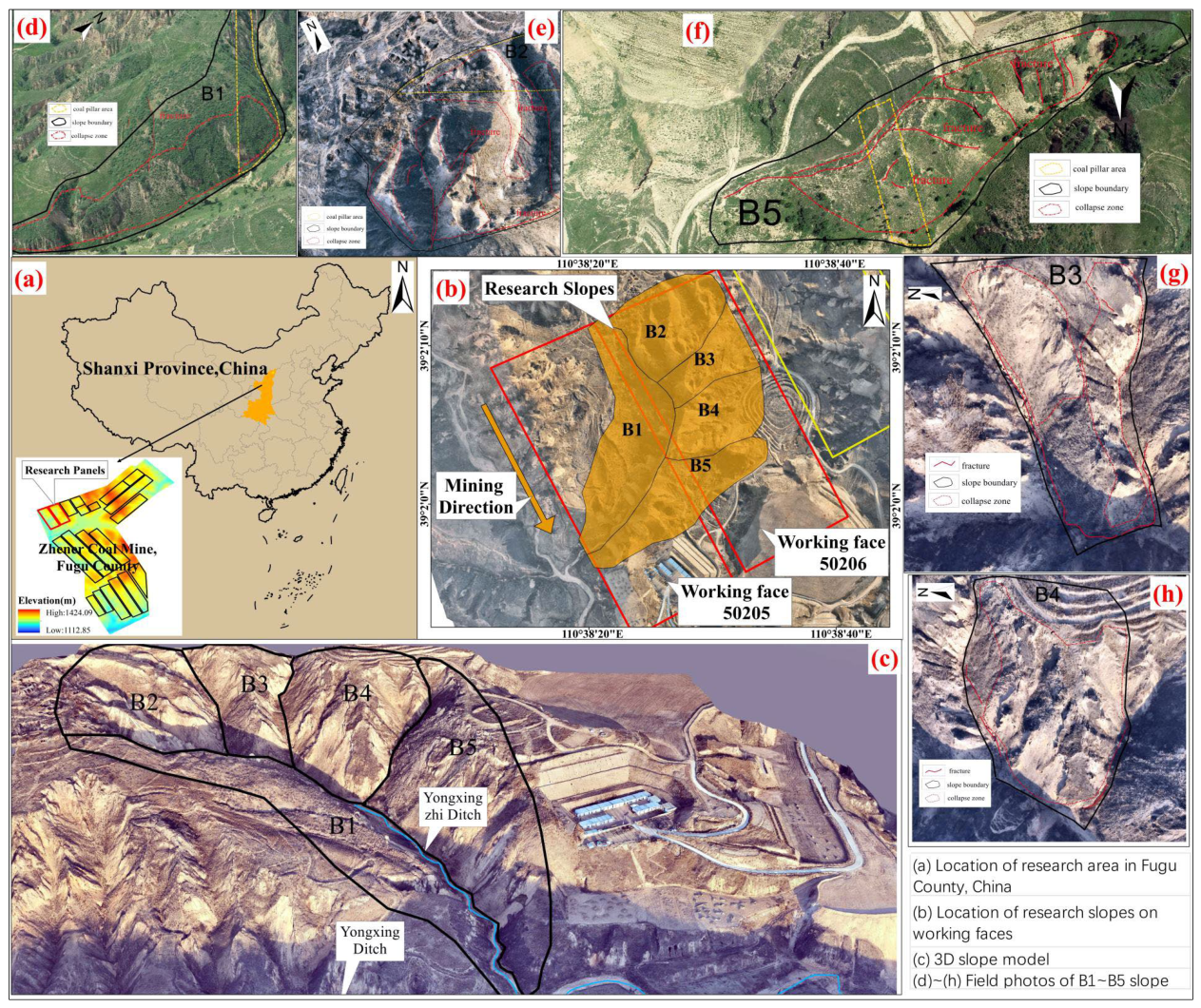
Figure 2.
Three-dimensional numerical model.
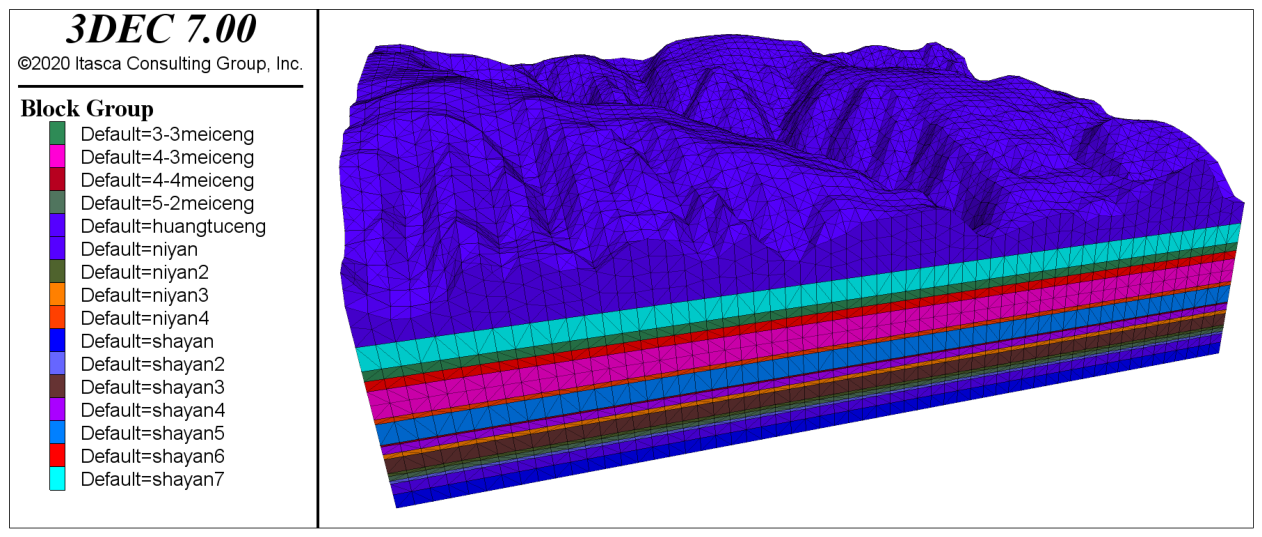
Figure 3.
Cloud map of slope surface displacement.
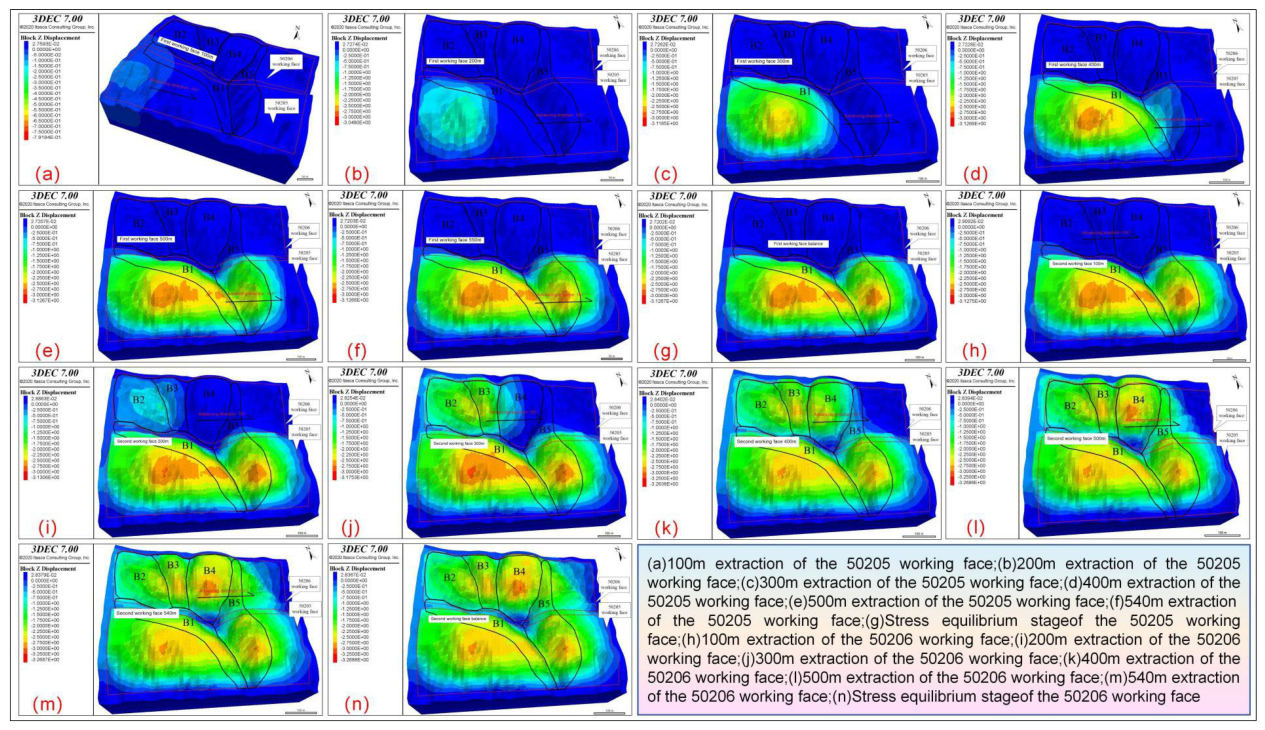
Figure 4.
Slope Unit Division and Secant Line Layout Plan.
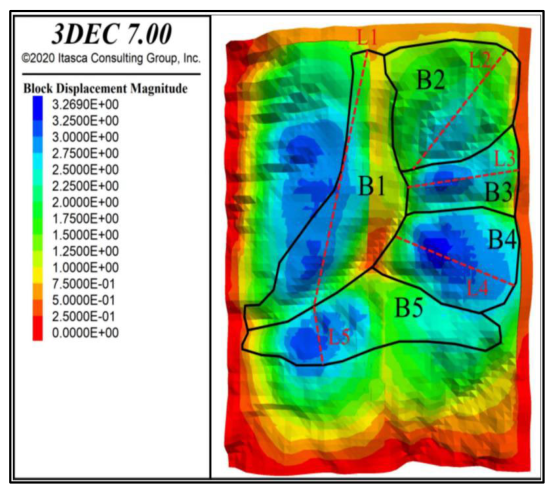
Figure 5.
Deformation profile of Slope B1.
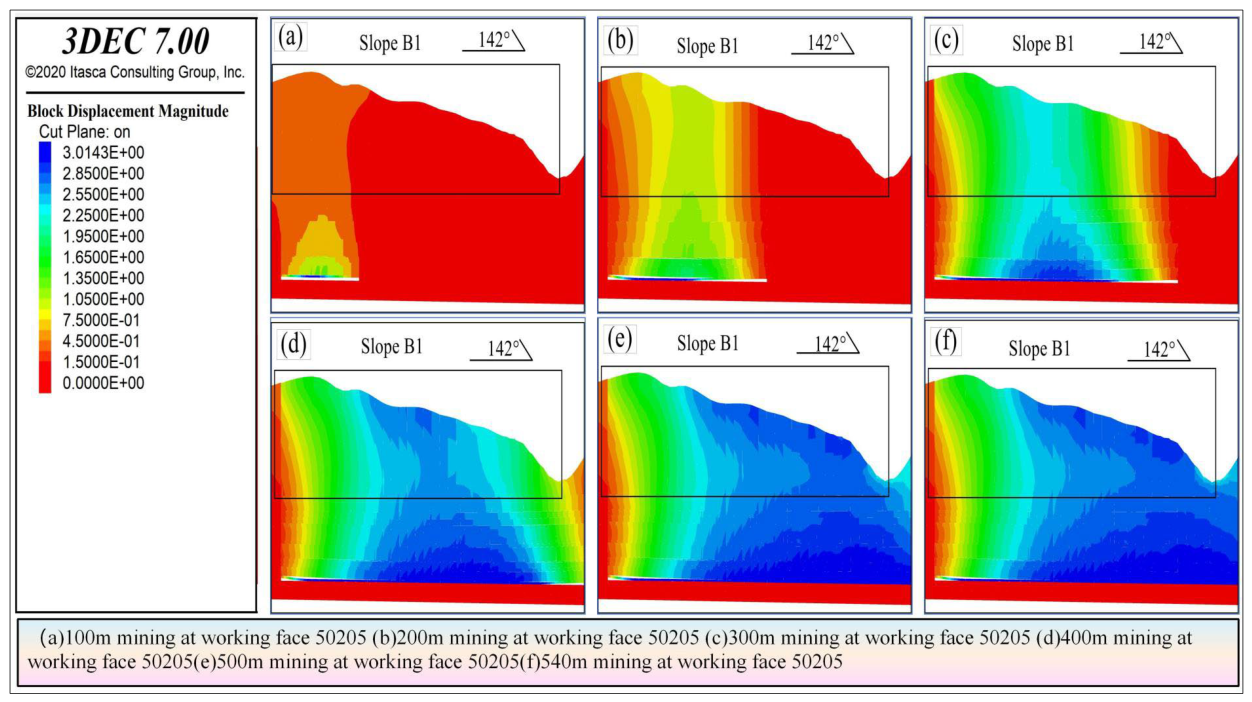
Figure 6.
Deformation profile of Slope B2.
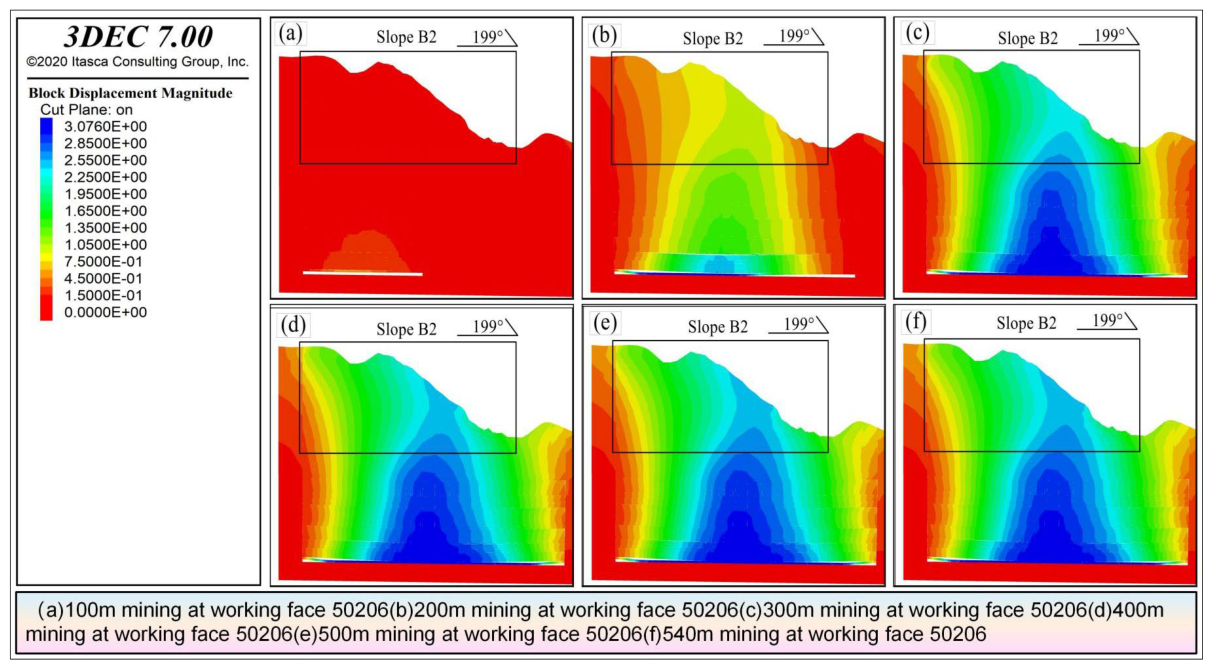
Figure 7.
Deformation profile of Slope B3.
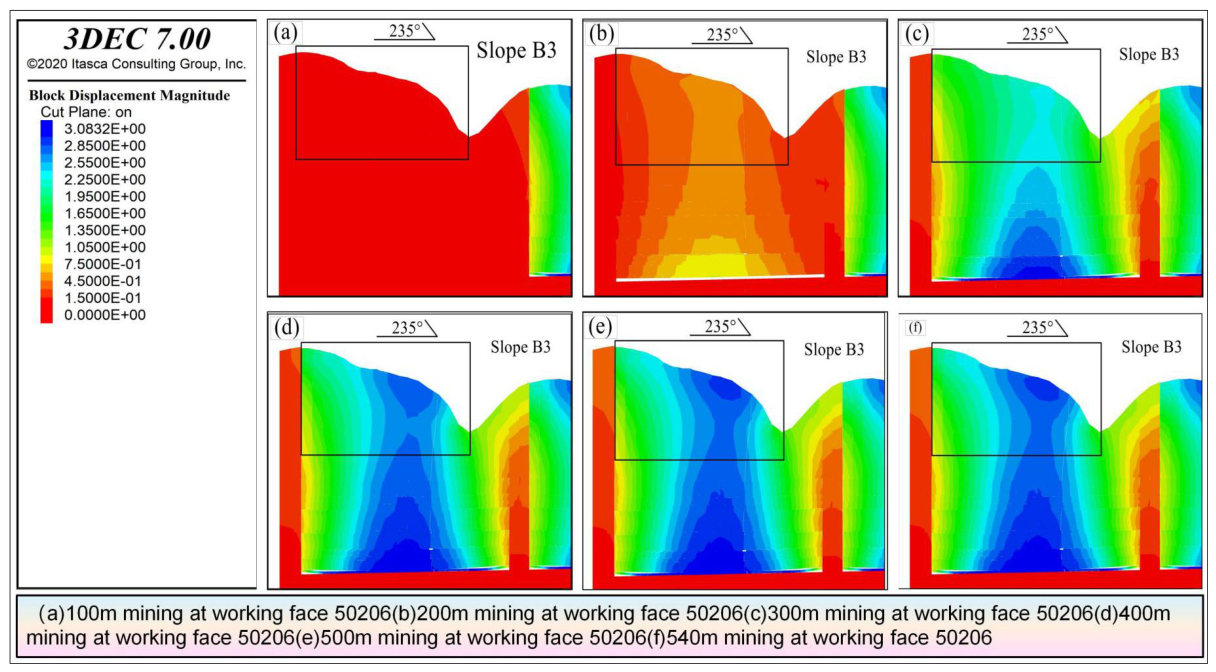
Figure 8.
Deformation profile of Slope B4.
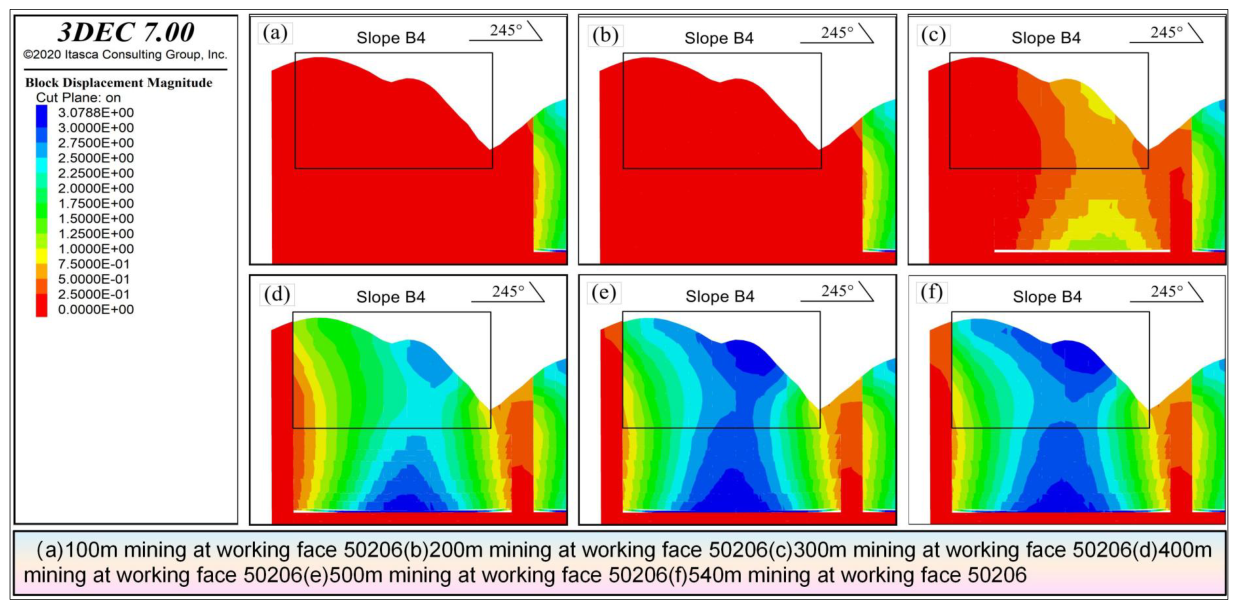
Figure 9.
Deformation profile of Slope B5.
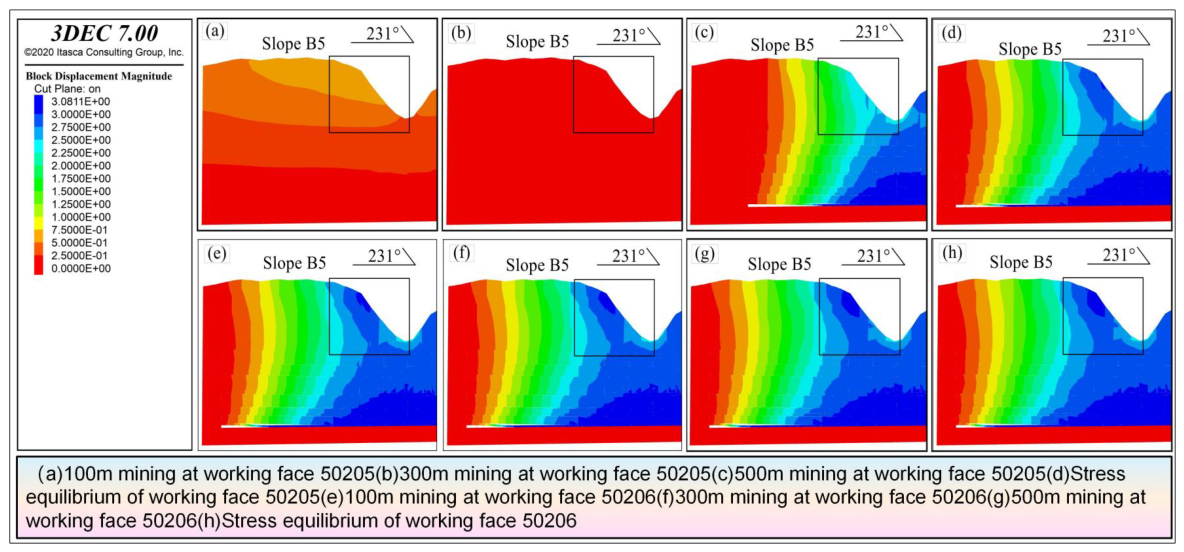
Figure 10.
Locations of monitoring points on slopes B1 and B2 and displacement vs. time curves of individual monitoring points.
Figure 10.
Locations of monitoring points on slopes B1 and B2 and displacement vs. time curves of individual monitoring points.
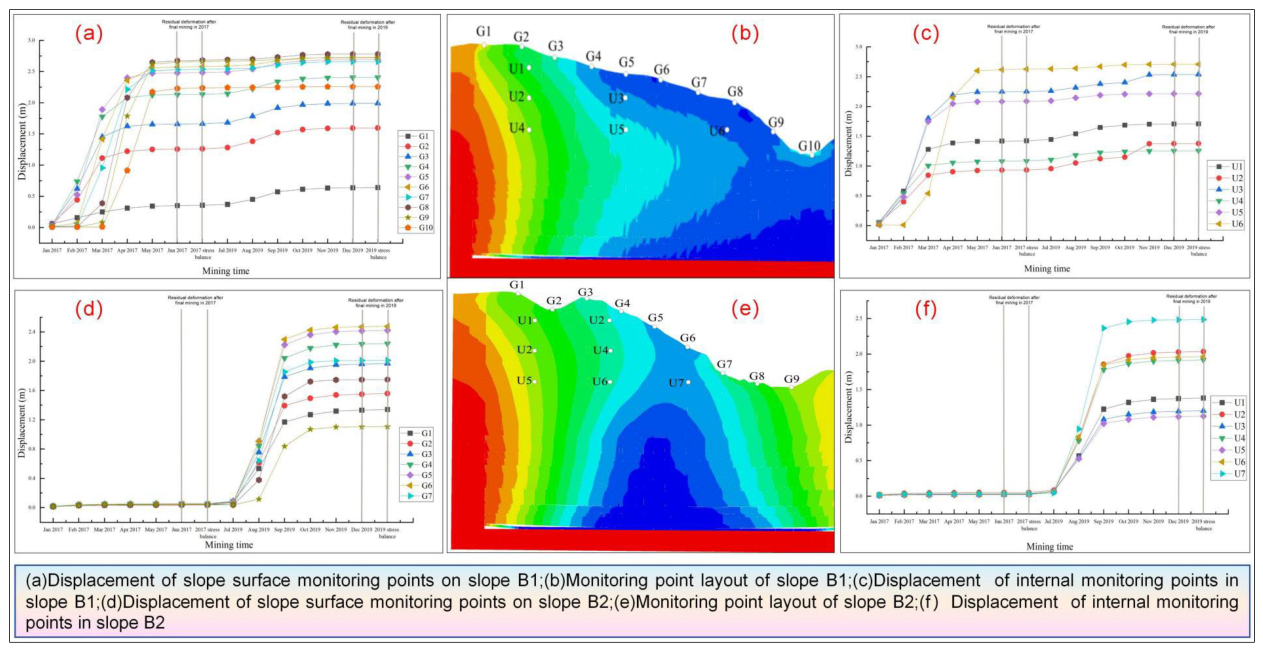
Figure 11.
Locations of monitoring points on slopes B3 and B4 and displacement vs. time curves of individual monitoring points.
Figure 11.
Locations of monitoring points on slopes B3 and B4 and displacement vs. time curves of individual monitoring points.
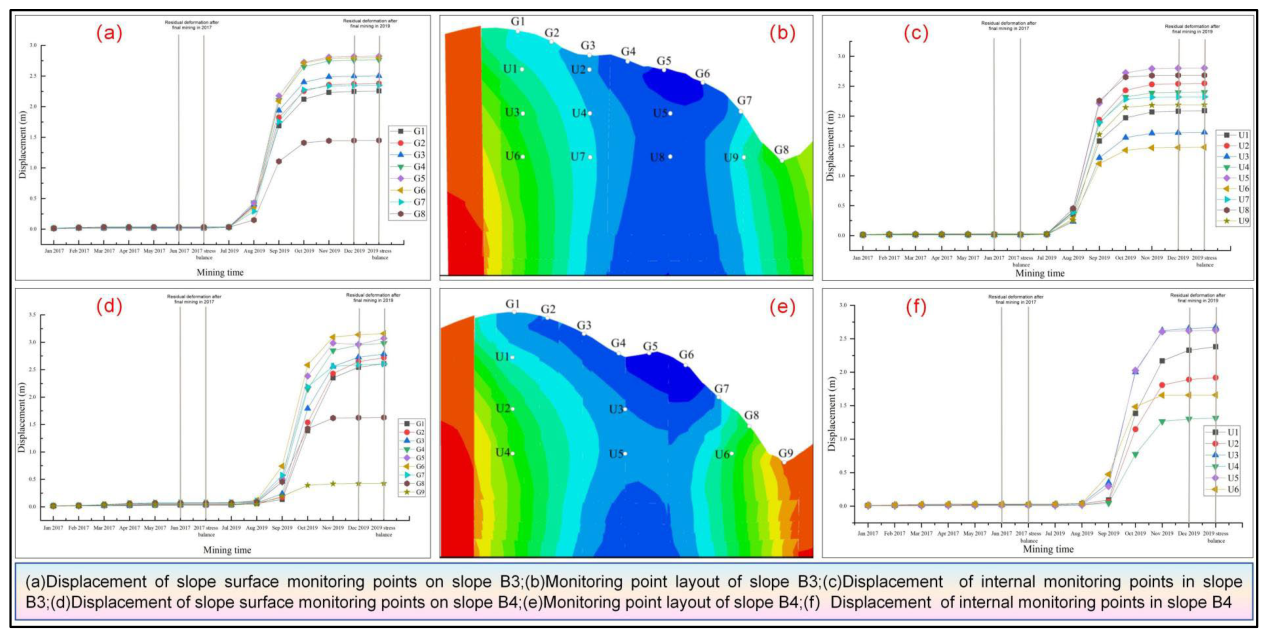
Figure 12.
Locations of monitoring points on slopes B5 and displacement vs. time curves of individual monitoring points.
Figure 12.
Locations of monitoring points on slopes B5 and displacement vs. time curves of individual monitoring points.
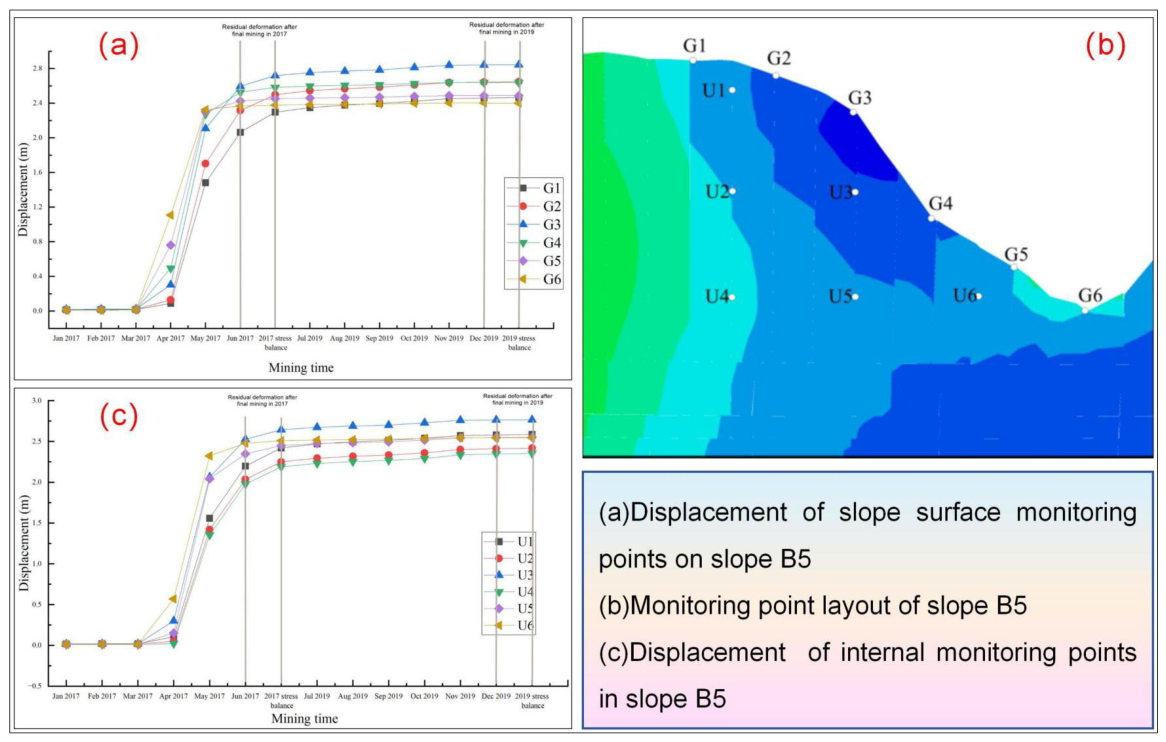
Figure 13.
Distribution of fracture on the slope surface.
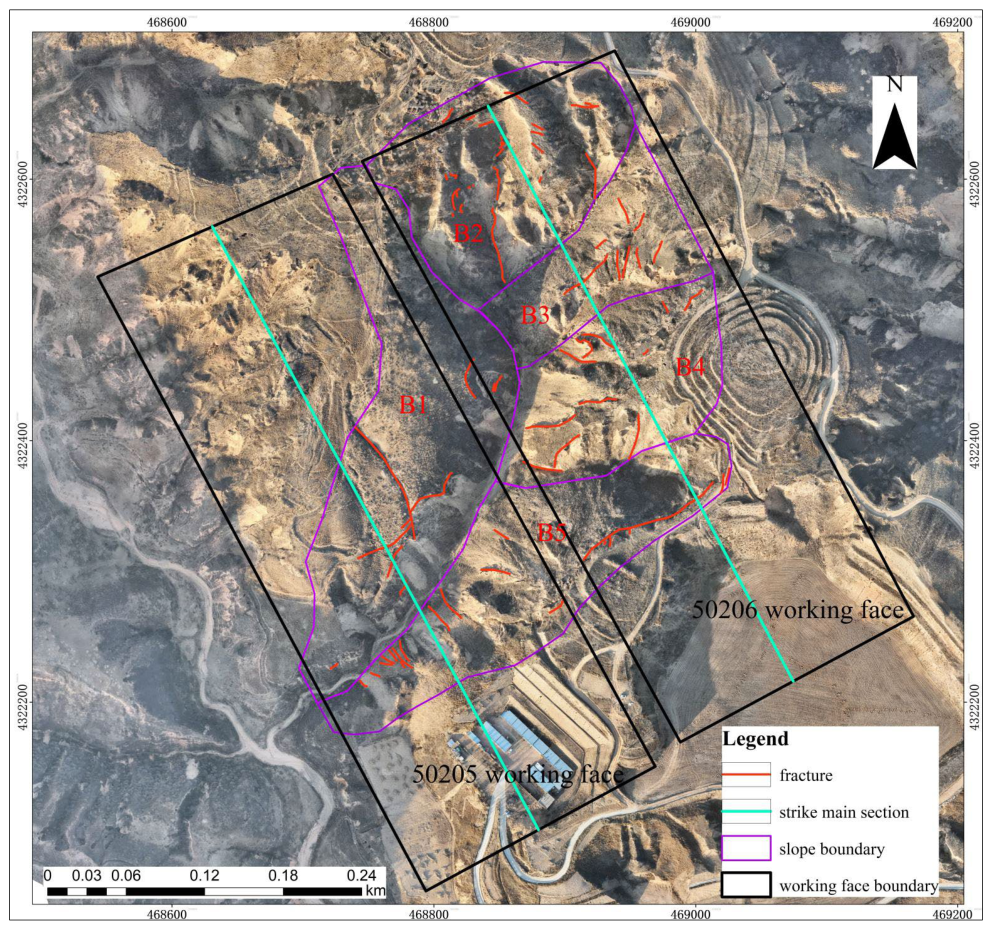

Table 1.
Main characteristics of slopes B1~B5.
| Slope ID | Slope Type | Slope Aspect /° |
Angle Between Slope Aspect and Mining Direction /° |
Slope Gradient /° |
Slope Height /m |
Whether Crossing Working Face |
|---|---|---|---|---|---|---|
| B1 | convex | 117 | 33 | 60 | 100 | YES |
| B2 | Concave | 181 | 31 | 45 | 48 | NO |
| B3 | convex | 230 | 80 | 16.5 | 54 | NO |
| B4 | convex | 252 | 100 | 22.3 | 72 | NO |
| B5 | Straight | 320 | 170 | 31 | 75 | YES |
Table 2.
Physical and Mechanical Parameters of Rock/Soil Masses.
| Strata | Density ρ/kg∙m-3 |
Bulk Modulus K/MPa |
Shear Modulus G/MPa | Cohesion C/kPa | Friction Angle ϕ/∘ |
|---|---|---|---|---|---|
| Loess | 1370 | 30 | 18 | 143.67 | 8.34 |
| Siltstone | 2210 | 1298.3 | 741.9 | 279.5 | 26.4 |
| Fine sandstone | 2360 | 1591.7 | 955.0 | 877.5 | 25.6 |
| Sandy mudstone | 2490 | 2498.5 | 1645.4 | 526.5 | 25.4 |
| 3-3coal seam | 1400 | 5400.5 | 610 | 1810 | 24.8 |
| 4-3coal seam | 1400 | 5400.5 | 610 | 1810 | 24.8 |
| 4-4coal seam | 1400 | 5400.5 | 610 | 1810 | 24.8 |
| 5-2coal seam | 1400 | 5400.5 | 610 | 1810 | 24.8 |
| mudstone | 2540 | 1914.9 | 1148.9 | 383.5 | 24.1 |
| Note: The assignments for the 7 layers of fine sandstone are the same, and the assignments for the 3 layers of mudstone are also the same. | |||||
Table 3.
Summary of Mechanical Parameters for Model Contact Surfaces.
| Interface Position | Bedding Plane Height | Mesh Size | Normal Stiffness /GPa∙m-1 |
Shear Stiffness /GPa∙m-1 |
Cohesion /kPa |
Friction Angle /° |
Tensile Strength /kPa |
|---|---|---|---|---|---|---|---|
| Fine sandstone/sandy mudstone | 9 | 7 | 0.41 | 0.21 | 200 | 22 | 50 |
| Sandy mudstone/fine sandstone | 16 | 2 | 1.43 | 0.72 | 200 | 22 | 50 |
| Fine sandstone/5-2coal seam | 18 | 2 | 0.65 | 0.33 | 100 | 18 | 25 |
| 5-2coal seam/mudstone | 21 | 2 | 1.25 | 0.63 | 100 | 18 | 25 |
| mudstone/Fine sandstone | 23 | 2 | 1.43 | 0.72 | 200 | 22 | 50 |
| Fine sandstone/mudstone | 32 | 3 | 0.95 | 0.48 | 200 | 22 | 50 |
| mudstone/Fine sandstone | 35 | 3 | 0.95 | 0.48 | 200 | 22 | 50 |
| Fine sandstone/4-4coal seam | 40 | 1 | 1.31 | 0.66 | 100 | 18 | 25 |
| 4-4coal seam/Siltstone | 41 | 1 | 1.31 | 0.66 | 100 | 18 | 25 |
| Siltstone/mudstone | 54 | 3 | 0.95 | 0.48 | 200 | 22 | 50 |
| mudstone/4-3coal seam | 57 | 3 | 1.43 | 0.22 | 100 | 18 | 25 |
| 4-3coal seam/Fine sandstone | 74 | 6 | 1.21 | 0.11 | 100 | 18 | 25 |
| Fine sandstone/3-3coal seam | 80 | 6 | 1.22 | 0.11 | 80 | 16 | 20 |
| 3-3coal seam/Fine sandstone | 86 | 6 | 0.48 | 0.24 | 100 | 18 | 25 |
| Fine sandstone/loess | 100 | 14 | 0.20 | 0.10 | 20 | 12 | 0 |
Table 4.
Deformation statistics of Slope B1 monitoring points at key time points.
| Monitoring Point | Deformation at End-January 2017/m | Deformation at End-June 2017/m | Deformation Rate /mm·d-1 |
Residual Deformation of 50205 Working Face/mm | Deformation at End-July 2019/m | Deformation at End-December 2019/m | Deformation Rate /mm·d-1 |
Residual Deformation of 50206 Working Face/mm | Final Deformation Value/m |
|---|---|---|---|---|---|---|---|---|---|
| G1 | 0.061 | 0.352 | 1.955 | 5.660 | 0.372 | 0.639 | 0.156 | 3.620 | 0.642 |
| G2 | 0.063 | 1.258 | 6.986 | 4.390 | 1.282 | 1.594 | 0.185 | 2.920 | 1.597 |
| G3 | 0.051 | 1.660 | 9.223 | 3.840 | 1.682 | 1.990 | 0.181 | 2.440 | 1.993 |
| G4 | 0.039 | 2.131 | 11.837 | 3.870 | 2.147 | 2.405 | 0.150 | 1.950 | 2.407 |
| G5 | 0.023 | 2.481 | 13.781 | 4.460 | 2.493 | 2.690 | 0.114 | 1.720 | 2.692 |
| G6 | 0.017 | 2.573 | 14.295 | 7.050 | 2.588 | 2.726 | 0.081 | 1.490 | 2.727 |
| G7 | 0.015 | 2.530 | 14.056 | 7.680 | 2.544 | 2.657 | 0.066 | 1.210 | 2.658 |
| G8 | 0.014 | 2.674 | 14.858 | 9.510 | 2.691 | 2.779 | 0.053 | 0.670 | 2.780 |
| G9 | 0.012 | 2.651 | 14.730 | 10.370 | 2.668 | 2.721 | 0.033 | 0.010 | 2.721 |
| G10 | 0.008 | 2.229 | 12.382 | 9.550 | 2.243 | 2.257 | 0.011 | 0.400 | 2.257 |
| U1 | 0.056 | 1.422 | 7.900 | 4.100 | 1.447 | 1.708 | 0.157 | 2.580 | 1.711 |
| U2 | 0.048 | 0.932 | 5.178 | 3.630 | 0.959 | 1.378 | 0.246 | 2.130 | 1.381 |
| U3 | 0.019 | 2.250 | 12.499 | 3.350 | 2.262 | 2.537 | 0.157 | 1.340 | 2.538 |
| U4 | 0.053 | 1.083 | 6.014 | 3.550 | 1.109 | 1.256 | 0.095 | 1.930 | 1.258 |
| U5 | 0.018 | 2.086 | 11.588 | 2.490 | 2.097 | 2.215 | 0.070 | 0.760 | 2.216 |
| U6 | 0.012 | 2.620 | 14.557 | 7.450 | 2.634 | 2.709 | 0.045 | 0.550 | 2.710 |
Table 5.
Deformation statistics of Slope B2 monitoring points at key time points.
| Monitoring Point | Deformation at End-January 2017/m | Deformation at End-June 2017/m | Deformation Rate /mm·d-1 |
Residual Deformation of 50205 Working Face/mm | Deformation at End-July 2019/m | Deformation at End-December 2019/m | Deformation Rate /mm·d-1 |
Residual Deformation of 50206 Working Face/mm | Final Deformation Value/m |
|---|---|---|---|---|---|---|---|---|---|
| G1 | 0.015 | 0.038 | 0.212 | 0.47 | 0.081 | 1.332 | 7.184 | 10.440 | 1.342 |
| G2 | 0.016 | 0.035 | 0.197 | 0.37 | 0.075 | 1.550 | 8.414 | 8.250 | 1.559 |
| G3 | 0.020 | 0.055 | 0.305 | 0.66 | 0.089 | 1.961 | 10.587 | 7.460 | 1.969 |
| G4 | 0.020 | 0.054 | 0.302 | 0.61 | 0.086 | 2.235 | 12.109 | 7.090 | 2.242 |
| G5 | 0.021 | 0.052 | 0.291 | 0.53 | 0.078 | 2.415 | 13.121 | 6.770 | 2.422 |
| G6 | 0.021 | 0.051 | 0.283 | 0.48 | 0.065 | 2.470 | 13.438 | 5.190 | 2.476 |
| G7 | 0.019 | 0.043 | 0.242 | 0.37 | 0.046 | 2.011 | 10.931 | 2.160 | 2.014 |
| G8 | 0.017 | 0.039 | 0.218 | 0.30 | 0.039 | 1.749 | 9.494 | 1.590 | 1.750 |
| G9 | 0.015 | 0.043 | 0.241 | 0.33 | 0.039 | 1.105 | 5.897 | 1.850 | 1.107 |
| U1 | 0.014 | 0.031 | 0.170 | 0.29 | 0.071 | 1.374 | 7.464 | 8.410 | 1.383 |
| U2 | 0.020 | 0.052 | 0.291 | 0.57 | 0.085 | 2.028 | 10.971 | 7.320 | 2.035 |
| U3 | 0.012 | 0.022 | 0.123 | 0.13 | 0.066 | 1.195 | 6.514 | 7.450 | 1.202 |
| U4 | 0.017 | 0.035 | 0.195 | 0.28 | 0.068 | 1.911 | 10.420 | 7.040 | 1.918 |
| U5 | 0.011 | 0.020 | 0.114 | 0.12 | 0.069 | 1.120 | 6.105 | 6.910 | 1.126 |
| U6 | 0.015 | 0.028 | 0.157 | 0.19 | 0.063 | 1.958 | 10.719 | 6.550 | 1.964 |
| U7 | 0.017 | 0.034 | 0.189 | 0.27 | 0.045 | 2.483 | 13.606 | 3.100 | 2.486 |
Table 6.
Deformation statistics of Slope B3 monitoring points at key time points.
| Monitoring Point | Deformation at End-January 2017/m | Deformation at End-June 2017/m | Deformation Rate /mm·d-1 |
Residual Deformation of 50205 Working Face/mm | Deformation at End-July 2019/m | Deformation at End-December 2019/m | Deformation Rate /mm·d-1 |
Residual Deformation of 50206 Working Face/mm | Final Deformation Value /m |
|---|---|---|---|---|---|---|---|---|---|
| G1 | 0.013 | 0.018 | 0.099 | 0.10 | 0.037 | 2.248 | 12.390 | 8.97 | 2.257 |
| G2 | 0.014 | 0.019 | 0.106 | 0.10 | 0.031 | 2.371 | 13.064 | 7.53 | 2.378 |
| G3 | 0.015 | 0.023 | 0.125 | 0.12 | 0.032 | 2.498 | 13.752 | 5.65 | 2.504 |
| G4 | 0.016 | 0.027 | 0.148 | 0.14 | 0.034 | 2.758 | 15.176 | 5.41 | 2.764 |
| G5 | 0.018 | 0.032 | 0.177 | 0.16 | 0.037 | 2.821 | 15.492 | 4.66 | 2.825 |
| G6 | 0.018 | 0.034 | 0.191 | 0.18 | 0.036 | 2.796 | 15.343 | 3.57 | 2.800 |
| G7 | 0.018 | 0.037 | 0.203 | 0.22 | 0.037 | 2.345 | 12.826 | 2.75 | 2.348 |
| G8 | 0.016 | 0.038 | 0.209 | 0.29 | 0.035 | 1.448 | 7.836 | 1.79 | 1.450 |
| U1 | 0.012 | 0.016 | 0.090 | 0.12 | 0.030 | 2.083 | 11.482 | 7.83 | 2.091 |
| U2 | 0.015 | 0.023 | 0.125 | 0.12 | 0.032 | 2.542 | 13.998 | 5.98 | 2.548 |
| U3 | 0.009 | 0.011 | 0.060 | 0.12 | 0.017 | 1.723 | 9.509 | 5.72 | 1.728 |
| U4 | 0.014 | 0.020 | 0.110 | 0.13 | 0.025 | 2.398 | 13.210 | 4.16 | 2.402 |
| U5 | 0.017 | 0.026 | 0.145 | 0.18 | 0.029 | 2.804 | 15.430 | 3.64 | 2.807 |
| U6 | 0.008 | 0.009 | 0.052 | 0.11 | 0.016 | 1.476 | 8.145 | 3.64 | 1.479 |
| U7 | 0.012 | 0.015 | 0.083 | 0.13 | 0.018 | 2.321 | 12.812 | 2.25 | 2.324 |
| U8 | 0.015 | 0.022 | 0.121 | 0.18 | 0.023 | 2.683 | 14.784 | 1.56 | 2.685 |
| U9 | 0.017 | 0.031 | 0.171 | 0.24 | 0.029 | 2.188 | 11.986 | 1.65 | 2.190 |
Table 7.
Deformation statistics of Slope B4 monitoring points at key time points.
| Monitoring Point | Deformation at End-January 2017/m | Deformation at End-June 2017/m | Deformation Rate /mm·d-1 |
Residual Deformation of 50205 Working Face/mm | Deformation at End-July 2019/m | Deformation at End-December 2019/m | Deformation Rate /mm·d-1 |
Residual Deformation of 50206 Working Face/mm | Final Deformation Value /m |
|---|---|---|---|---|---|---|---|---|---|
| G1 | 0.015 | 0.030 | 0.169 | 0.81 | 0.034 | 2.546 | 13.970 | 66.11 | 2.612 |
| G2 | 0.016 | 0.034 | 0.188 | 1.01 | 0.039 | 2.649 | 14.522 | 71.04 | 2.720 |
| G3 | 0.016 | 0.037 | 0.205 | 0.99 | 0.042 | 2.729 | 14.948 | 57.2 | 2.786 |
| G4 | 0.017 | 0.045 | 0.248 | 1.01 | 0.050 | 2.949 | 16.130 | 33.75 | 2.983 |
| G5 | 0.018 | 0.063 | 0.351 | 1.08 | 0.069 | 2.960 | 16.086 | 112.59 | 3.072 |
| G6 | 0.019 | 0.072 | 0.398 | 1.1 | 0.078 | 3.140 | 17.038 | 21.34 | 3.161 |
| G7 | 0.019 | 0.075 | 0.416 | 1.07 | 0.080 | 2.591 | 13.975 | 14.78 | 2.606 |
| G8 | 0.019 | 0.069 | 0.383 | 0.83 | 0.073 | 1.626 | 8.645 | 3.97 | 1.630 |
| G9 | 0.013 | 0.047 | 0.261 | 0.41 | 0.046 | 0.426 | 2.101 | 1.73 | 0.427 |
| U1 | 0.012 | 0.022 | 0.123 | 0.55 | 0.023 | 2.330 | 12.820 | 52.09 | 2.382 |
| U2 | 0.009 | 0.014 | 0.078 | 0.32 | 0.012 | 1.891 | 10.428 | 28.73 | 1.920 |
| U3 | 0.015 | 0.025 | 0.140 | 0.38 | 0.025 | 2.655 | 14.606 | 16.08 | 2.671 |
| U4 | 0.007 | 0.010 | 0.058 | 0.28 | 0.009 | 1.303 | 7.180 | 13.67 | 1.317 |
| U5 | 0.012 | 0.017 | 0.093 | 0.25 | 0.016 | 2.620 | 14.462 | 6.19 | 2.626 |
| U6 | 0.016 | 0.033 | 0.181 | 0.35 | 0.033 | 1.659 | 9.036 | 1.59 | 1.661 |
Table 8.
Deformation statistics of Slope B5 monitoring points at key time points.
| Monitoring Point | Deformation at End-January 2017/m | Deformation at End-June 2017/m | Deformation Rate /mm·d-1 |
Residual Deformation of 50205 Working Face/mm | Deformation at End-July 2019/m | Deformation at End-December 2019/m | Deformation Rate /mm·d-1 |
Residual Deformation of 50206 Working Face/mm | Final Deformation Value /m |
|---|---|---|---|---|---|---|---|---|---|
| G1 | 0.017 | 2.065 | 13.766 | 233.600 | 2.350 | 2.461 | 0.905 | 6.15 | 2.468 |
| G2 | 0.019 | 2.318 | 15.453 | 180.960 | 2.546 | 2.645 | 0.809 | 3.69 | 2.648 |
| G3 | 0.019 | 2.596 | 17.308 | 123.390 | 2.755 | 2.843 | 0.684 | 2.19 | 2.845 |
| G4 | 0.017 | 2.527 | 16.848 | 56.320 | 2.599 | 2.641 | 0.317 | 0.31 | 2.641 |
| G5 | 0.012 | 2.427 | 16.181 | 25.220 | 2.461 | 2.488 | 0.196 | -0.09 | 2.487 |
| G6 | 0.008 | 2.370 | 15.798 | 9.560 | 2.384 | 2.402 | 0.127 | -0.55 | 2.401 |
| U1 | 0.018 | 2.197 | 14.648 | 222.810 | 2.469 | 2.579 | 0.884 | 5.46 | 2.585 |
| U2 | 0.015 | 2.035 | 13.569 | 213.550 | 2.294 | 2.410 | 0.895 | 7.16 | 2.417 |
| U3 | 0.017 | 2.526 | 16.837 | 117.380 | 2.674 | 2.763 | 0.666 | 3.23 | 2.766 |
| U4 | 0.011 | 1.978 | 13.189 | 209.770 | 2.231 | 2.346 | 0.878 | 7.62 | 2.354 |
| U5 | 0.011 | 2.347 | 15.647 | 101.530 | 2.473 | 2.547 | 0.549 | 3.47 | 2.551 |
| U6 | 0.011 | 2.477 | 16.516 | 31.390 | 2.517 | 2.545 | 0.199 | 0.35 | 2.545 |
Disclaimer/Publisher’s Note: The statements, opinions and data contained in all publications are solely those of the individual author(s) and contributor(s) and not of MDPI and/or the editor(s). MDPI and/or the editor(s) disclaim responsibility for any injury to people or property resulting from any ideas, methods, instructions or products referred to in the content. |
© 2026 by the authors. Licensee MDPI, Basel, Switzerland. This article is an open access article distributed under the terms and conditions of the Creative Commons Attribution (CC BY) license (http://creativecommons.org/licenses/by/4.0/).
Copyright: This open access article is published under a Creative Commons CC BY 4.0 license, which permit the free download, distribution, and reuse, provided that the author and preprint are cited in any reuse.


