
Submitted:
12 June 2026
Posted:
15 June 2026
You are already at the latest version
Abstract
As the information environment evolves, social media has become the primary channel through which the public accesses and shares information, and perceived credibility has emerged as a critical influence on how users evaluate the credibility of information. Existing research suggests that heuristic credibility cues can enhance users’ perceived credibility, yet the findings remain inconsistent. Consequently, it is necessary for researchers to systematically examine whether heuristic credibility cues can effectively enhance perceived credibility. This study employed a meta-analysis to analyse 18 studies meeting the selection criteria, involving a total sample size of 14,188 participants. The aim was to assess the overall effect of social media heuristic credibility cues on perceived credibility and to explore the influence of potential moderating mechanisms on perceived credibility. The results indicate that manipulating source cues and social cues which serve as heuristic credibility cues on social media significantly increased perceived credibility (g = 0.307, p = 0.000). Effect sizes varied across moderating variables such as the type of heuristic credibility cue, participant type, method of measuring perceived credibility, experimental design, sample size, and year of publication. Among these, the type of heuristic cue and participant type as significant moderators, specifically, authoritative sources were more effective than other types of information sources in enhancing perceived credibility; the impact of different types of social cues on perceived credibility was also significant to varying degrees. Furthermore, student groups were more susceptible to the influence of heuristic credibility cues than non-student groups. These findings provide theoretical and practical insights for the design of information dissemination and the construction of perceived credibility on social media. It should be noted that, given the limited number of studies included in this meta-analysis and the restricted range of moderator variables, the above conclusions require further empirical research to be tested and confirmed.
Keywords:
: social media
; heuristic credibility cues
; perceived credibility
; source cues
; social cues
; meta-analysis
1. Introduction
Perceived credibility on social media refers to an individual’s overall cognitive assessment of the credibility, accuracy and reliability of the information they encounter, based on their own subjective judgement. This concept is rooted in the classic source credibility framework proposed by Hovland and Weiss (1951), which was subsequently extended to the digital media environment by Flanagin and Metzger (2000). Since the 1950s, researchers in psychology and communication studies have been dedicated to defining and measuring source credibility. Early research by Hovland and his colleagues demonstrated that while highly credible sources are more persuasive, information itself is acquired equally from both highly credible and low-credibility sources. Tseng and Fogg (1999) indicate that credibility is not an inherent property of the information itself, but rather a perception of trust constructed cognitively by the user receiving the information.
In the social media environment, perceived credibility is crucial to user behaviour, such as engagement. Because social media platforms rely on mobile and internet technologies, enabling users to conveniently access, create, edit, share and interact. However, users do not always regard information that from social media as reliable information. Compared to traditional media, the public’s perceived credibility remains relatively low (Newman et al., 2023), reflecting widespread concerns in the digital environment regarding misinformation and the credibility of social media (Lazer et al., 2018). Low levels of perceived credibility pose risks to the legitimacy and sustainability of social media. Flanagin and Metzger (2000) arise that, unlike users in traditional media who act as information consumers, social media users may simultaneously assume multiple roles like content creators, disseminators and consumers. Faced with a vast amount of information, the perceived credibility has become increasingly important in the evaluation process and is regarded as a key indicator for predicting users’ attitudes and behavioural intentions.
However, perceived credibility evaluation on social media is considerably more complex than in traditional media environment. This stems from several factors. Firstly, the significant increase in content creators on social media means that users may not only received information from the authorities but also frequently come into contact with content created by opinion leaders, ordinary users and influencers, simultaneously, AI and algorithmic recommendations as a significant role in this processing. Secondly, information spreads rapidly in diverse forms, and during this process, systematic and comprehensive screening and verification are often lacking. Finally, when accessing information on social media, users may confuse the source of the information with the content itself, this situation complicates the assessment of perceived credibility. In addition, the absence of uniform standards for information quality, the susceptibility of information to manipulation and tampering, the lack of clear contextual cues, and the coexistence and mutual influence of multiple credibility assessment targets (such as content, sources and platforms) are also contributing to the relative complexity of evaluating perceived credibility. Against this backdrop, users often have no choice but to rely on their own subjective judgement to form a subjective perception of whether information is credible, reliable or trustworthy, that is perceived credibility (Flanagin & Metzger, 2000; Mitra et al., 2017).
To make judgement in information-rich and uncertain environments, users always using heuristic credibility cues to assessing credibility (Hilligoss & Rieh. 2008). Drawing on heuristic processing theory and research on online credibility, heuristic credibility cues refer to informational or contextual signals that enable users to rapidly assess information credibility while operating under limited cognitive effort (Sundar, 2008). Previous research indicates that perceived credibility assessments tend to rely less on systematic verification and are instead more heavily influenced by heuristic cues such as source, social endorsement, platform availability, visual presentation, and emotional framing (Metzger et al., 2010); among these, source cues and social cues are the two core categories. Among these cues, source-based and social cues have become the most influential core cues in social media credibility research, and continue to be tested and studied.
Source cues refer to heuristic signals related to the information provider’s professional competence, authority, trustworthiness, or institutional legitimacy. Existing research consistently indicates that, in digital media environments, source credibility has been identified as one of the most robust predictors of perceived credibility. Flanagin and Metzger (2007) found that source reputation and perceived authority are the primary heuristic cues used by users when assessing credibility online. Bauer and Clemm von Hohenberg (2021) further noted that perceived news credibility is significantly shaped by both the authenticity of the content and source credibility, while collective social endorsement signals may play a relatively limited role. Similarly, Morris et al. (2012) investigated the relationship between verified Twitter accounts and users’ perceived credibility, finding that verified accounts are one of the most classic source cues and have a significant impact on users’ perceived credibility. Dobber et al. (2023) used traffic-light veracity labels to examine the impact of such labels on source credibility and message credibility, and similarly found that heuristic trust cues have a marked effect on enhancing users’ perceived credibility. Prike et al. (2024) directly manipulated credibility badges and found that such badges can enhance the ability to distinguish genuine information and reduce the spread of misinformation. Javed et al. (2024) and Vu et al. (2025) indicate that users’ perceptions of information credibility depend primarily on the professionalism and trustworthiness demonstrated by the content creators. These studies suggest that source cues as an important role in the assessment of perceived credibility. Except the source cues, social cues also contribute to shaping perceived credibility on social media as well. Social cues refer to indicators formed by the behaviour or social feedback from other users on social media, such as the likes, shares, comments, ratings, recommendations, popularity, and engagement metrics. This heuristic cue type reflect groups attitudes and the degree of social endorsement, users are used to employ them as cognitive shortcuts to assess the credibility of information (Sundar, 2008). Within the MAIN model, the technical characteristics of digital media themselves trigger users’ heuristic processing, thereby influencing credibility, attitudes and behaviour. Subsequent researches also demonstrated that the heuristic cues that ‘Likes’, ‘Shares’, ‘Retweets’, ‘Comments’ and ‘Followers’ on social media serve as conditions for users to enhance perceived credibility (Lin et al., 2016; Wang et al., 2023). This effect is particularly pronounced in highly homogeneous social media where users engage in shallow cognitive processing (Clayton et al., 2020). However, research findings regarding the effectiveness of social cues remain inconsistent. Some studies suggest that the impact of social validation indicators on credibility assessments is unstable. For example, Kuen and Kuen (2025) found that interactivity has a limited direct impact on the perceived credibility of news, but it may indirectly enhance credibility by strengthening users’ perceptions of source reliability and their trust in digital media. Similarly, Millet et al. (2024) observed that when users prioritise the practicality of the platform and the relevance of the information, for some researches, the influence of social cues on perceived credibility is relatively limited.
Within the digital landscape, users find it difficult to systematically verify information on social media and are therefore increasingly reliant on heuristic credibility cues to form rapid judgements of credibility. However, existing empirical findings exhibit significant inconsistencies, making it necessary to systematically integrate the underlying mechanisms. Although previous studies have examined the roles of different types of heuristic cues individually, the literature remains fragmented: most studies focus on a single type of cue, lacking a systematic comparison of the relative efficacy of different heuristic cues; simultaneously, differences in theoretical frameworks, experimental contexts and measurement methods across studies have also made it difficult to reach consistent conclusions. Although meta-analyses have provided an important foundation for understanding online credibility judgements, a mature framework integrating both source-based and social heuristic cues within a social media context has yet to be established. Several meta-analyses examining the role of heuristic cues in perceived credibility have summarised the relationship between the two from various perspectives. These meta-analyses have primarily focused on recent years; Wang et al. (2023) found that certain social cues, such as likes and shares, can significantly influence perceived credibility, although this effect is moderated by contextual factors. Pfänder and Altay (2025), on the other hand, conducted a systematic review and meta-analysis on users’ ability to identify fake news. Their findings indicated that social cues (political congruence) did not have a significant impact on perceived credibility; however, participants exhibited a stronger sceptical attitude towards news items that were politically incongruent. Furthermore, Sharf et al. conducted a meta-analysis on the credibility of online health information, whose findings reaffirmed the mechanisms of credibility assessment in digital media environments. However, their focus was primarily on the identification of fake news or health information contexts, rather than on social media environments, and did not concentrate on heuristic credibility cues.
In summary, the current literature still lacks a systematic meta-analytic framework that focuses on the social media context and, based on heuristic trust cues, compares the effects of source cues and social cues on perceived credibility, particularly with regard to experimental studies. To address this gap, this study employs a meta-analytic approach to examine the overall effect of heuristic cues on perceived credibility in experimental studies, while identifying potential boundary conditions and sources of heterogeneity. It aims to provide systematic and comprehensive theoretical and empirical evidence to understand how users assess credibility in a social media environment characterised by information overload and misinformation.
This study conducts a meta-analysis of experimental research examining how source cues and social cues influence the perceived credibility of social media content. Specifically, this study aims to address the following research questions:
RQ1: What is the overall effect of heuristic cues on the perceived credibility of social media?
RQ2: Which moderating variables have a significant influence on this effect?
Based on this two research questions, this study aims to examines the influence of heuristic cues on perceived credibility by exploring potential moderating variables, include the heuristic cue type, participant type, perceived credibility measurement, experimental setting, sample size and year of publication. To providing a more comprehensive understanding of how users assess credibility in social media environments.
2. Methodology
2.1. Search Strategy
To identify studies that met the inclusion criteria and to ensure transparency and methodological rigour throughout the research process, the literature search was conducted in accordance with the guidelines for meta-analysis. A comprehensive search was carried out for experimental studies examining the relationship between heuristic credibility cues and perceived credibility on social media, covering six major electronic databases: Web of Science, Scopus, PubMed, PsycINFO, Communication & Mass Media Complete, and Google Scholar, in order to collect as many relevant studies as possible. The search was completed on 10 April 2026. The selected databases covered the fields of communication studies, psychology, public health and interdisciplinary social science research, aligning with the focus of this study. The search strategy incorporated four categories of keywords:
Social media (e.g., “social media” OR “social networking site” OR “SNS”); Both “trust” and “perceived credibility” measures targeting social media content were coded as the outcome of interest and treated as conceptually equivalent for effect size calculation. perceived credibility (e.g., “perceived credib*” OR “credib*” OR “trust” OR “believab*” OR “trustworthi*”); heuristic cues (e.g., “heuristic cues” OR “heuristic” OR “cue” OR “source cue” OR “social cue” OR “endorsement cue”); experimental methodology (e.g., “experiment” OR “experimental” OR “RCT”). Boolean operators (AND, OR) and truncation (*) were applied to maximize sensitivity. As an example, the full search strategy used for Scopus was: ((“social media” [Title/Abstract] OR “social networking site” [Title/Abstract] OR “SNS” [Title/Abstract]) AND (“perceived credibility” [Title/Abstract] “credib*” [Title/Abstract] OR “trust” [Title/Abstract] OR “believab* [Title/Abstract] “ OR “trustworth* [Title/Abstract] “) AND (“heuristic cues “ [Title/Abstract] OR “heuristic” [Title/Abstract] OR “cue” [Title/Abstract] OR “social cue” [Title/Abstract] OR “source cue” [Title/Abstract] OR “endorsement cue” [Title/Abstract]) AND (“experiment” [Title/Abstract] OR “experimental” [Title/Abstract] OR “RCT” [Title/Abstract])).
2.2. Eligibility Criteria
This study adopted the PICOS framework (Population, Intervention, Comparison, Outcome, and Study Design) to define the inclusion criteria, drawing on the Cochrane Handbook for Systematic Reviews of Interventions (Table 1). The inclusion and exclusion criteria were defined according to the following seven aspects. (1) The study population consists of general social media users, including adults and adolescents. Studies focusing solely on users of other media platforms or specific non-user groups will be excluded, unless they provide identifiable, distinct data on general social media users. (2) Only experimental studies will be included. Eligible studies must involve the manipulation of social media heuristic cues and expose participants to different conditions. (3) The comparison condition must be social media content that does not present the manipulated heuristic cues for perceived credibility serving as the control group. (4) This study includes research examining the impact of manipulated social media heuristic cues on perceived credibility. Studies primarily focusing on other cognitive, emotional, or behavioral outcomes will be excluded, unless they explicitly measure perceived credibility. (5) Only studies employing one of the following designs will be considered eligible: randomized controlled trials, quasi-experimental designs, or single-group pre-post designs. Survey correlational studies, qualitative studies, and review articles will be excluded. (6) Studies will only be included if they report sufficient statistical information (e.g., means, standard deviations, sample sizes, t-values or p-values) to allow for the calculation of effect sizes. Studies lacking sufficient statistical data will be excluded. (7) Only studies written in English meet the inclusion criteria; studies published in other languages will not be considered.
2.3. Study Selection
Once the literature search of the database was completed, all retrieved articles were imported into EndNote software for management and to remove duplicates. Subsequently, To determine which articles met the inclusion criteria for this study, two independent reviewers (Cao and Norliana) conducted a preliminary screening of the article titles and abstracts, respectively; subsequently, a full-text assessment was carried out on all articles that passed the preliminary screening. Two independent reviewers then examined the full texts against predefined inclusion and exclusion criteria. Studies that did not meet the inclusion criteria were excluded, and specific reasons for exclusion were recorded, including: lack of statistical data required to calculate effect sizes; use of non-experimental research designs; outcome variables irrelevant to this study; or failure to manipulate heuristic credibility cues on social media. Where multiple studies utilised the same sample data, only the study providing the most comprehensive information was retained; where a single study comprised multiple independent experiments, the data set that was most comprehensive and met the inclusion criteria was retained. Both reviewers conducted a detailed review of the full texts; any discrepancies were resolved through discussion and negotiation. Where consensus could not be reached, a third researcher (Saiful) acted as an arbitrator and made the final decision.
2.4. Data Extraction and Quality Assessment
Following the completion of the literature screening, this study systematically extracted relevant information from the included studies and assessed their quality using the QualSyst quality assessment tool developed by Kmet et al. (2004). Data extraction included author details, year of publication, and other relevant information. QualSyst is widely applicable to quantitative research across multiple disciplines; in the context of systematic reviews and meta-analyses within the social sciences or communication studies, its comprehensive assessment criteria facilitate the comparison of different studies, enhance the transparency and consistency of the evaluation process, and provide systematic and reliable assurance. The studies will be scored according to the 14 evaluation criteria established by QualSyst (see Table 2). Each criterion is scored as ‘Yes’ (2 points), ‘Partially met’ (1 point) or ‘No’ (0 points); items not applicable are marked as ‘N/A’ and excluded from the scoring. The final assessment was categorised according to the criteria of Kmet et al. (2004) as high quality (≥75%), moderate quality (55%–74%) and low quality (<55%). The quality assessment was conducted by two independent reviewers (Cao and Norliana). Disagreements were resolved through discussion, and unresolved cases were referred to a third reviewer (Saiful) for adjudication. Inter-rater reliability was expressed using Cohen’s kappa coefficient.
2.5. Data Analysis
This study were using the Comprehensive Meta-Analysis (CMA) software (Version 3) to analysis. With regard to data, studies reported means (M) and standard deviations (SD), effect sizes were calculated directly from these statistics; where included studies did not directly provide usable means and standard deviations, effect sizes were derived from other statistical information, such as t-values and p-values in order to maximise the inclusion of eligible studies. To ensure statistical independence between effect sizes, only one effect size was extracted from each independent sample. Where a single study reported multiple outcome variables or related measures using the same sample, the effect size most relevant to the objectives of this study was selected for analysis (Borenstein et al., 2021; Lipsey & Wilson, 2001). Similarly, where a single construct was measured using multiple instruments, only one effect size was retained for analysis (Thalheimer & Cook, 2002). All effect sizes are calculated with corresponding p-values and 95% confidence intervals (95% CI). Given the differences among the included studies in terms of study design, participant characteristics, and experimental settings, this study employs a random-effects model to estimate the overall effect size, taking into account both within-study and between-study variance to account for the possibility that the true effect size may vary across studies. The final results will be assessed according to Cohen’s (1988) criteria, where an effect size of 0.20 is classified as a small effect, 0.50 as a moderate effect, and 0.80 as a large effect. Subsequently, to examine the consistency of effect sizes across studies, heterogeneity was assessed using Cochran’s Q test and the I2 statistic. Specifically, Cochran’s Q test is used to determine whether the variation in effect sizes exceeds the range attributable to sampling error, while the I2 statistic measures the proportion of total variation attributable to between-study heterogeneity. The results will be interpreted according to the criteria proposed by Higgins et al. (2003), with I2 values of approximately 25%, 50% and 75% indicating low, moderate and high heterogeneity.
Subsequently, to further explore the influence of potential moderator variables on the overall effect size, this study conducted subgroup analysis and meta-regression analysis. The moderator variables included in the subgroup analysis comprised heuristic cue type, participant type, perceived credibility measurement, and experimental setting. Meta-regression analysis were performed for sample size and publication year. In addition, a leave-one-out analysis was conducted to assess the sensitivity of the overall results to individual studies to testing the robustness of the findings.
We conducted tests for publication bias to examine whether the overall effect size was inflated due to the tendency for ‘significant results to be more readily published’ (Rosenthal, 1979). We assess publication bias by examining whether the distribution of effect sizes in the funnel plot is symmetrical, followed by a statistical test for potential publication bias using Egger’s regression test (Egger et al., 1997). The criteria for judgement will be based on: when the significance level of the intercept term reaches statistical significance (p < .05), the funnel plot may exhibit asymmetry, suggesting that the study results may be influenced by publication bias; when the test results are not significant (p ≥ .05), this indicates that no obvious publication bias has been detected. During the interpretation of results, the magnitude and direction of the intercept value are also taken into account, determine the degree of symmetry in the distribution of the effect size by checking whether the intercept is close to 0. At the same time, in order to assess the reliability of the study’s findings, the number of additional studies required to render the overall effect statistically insignificant was also calculated (Lipsey & Wilson, 2001).
3. Results
3.1. Study Selection Procedure
During the literature search, we conducted a comprehensive search of six databases relevant to the research topic (Web of Science, Scopus, PubMed, PsycINFO, Communication & Mass Media Complete, and Google Scholar). Using keyword searches based on specific criteria, we identified a total of 11,560 records. After removing 4,977 duplicate records using EndNote, the remaining 6,583 records proceeded to the title and abstract screening stage. Two independent reviewers (Cao and Norliana) assessed the relevance of these publications against pre-defined inclusion and exclusion criteria. Of these, 5,736 publications did not meet the inclusion criteria, leaving a total of 847 papers to proceed to the full-text eligibility assessment stage. Subsequently, during a detailed full-text review, 829 studies were excluded for the following reasons: 1) insufficient information was provided to calculate effect sizes, such as failure to report relevant data or missing data (n = 428); 2) articles published in languages other than English (n = 49); 3. studies employing research designs that did not meet the requirements of this meta-analysis (e.g., non-experimental designs, qualitative studies, correlational studies; n = 347). Ultimately, a total of 18 independent studies met all inclusion criteria and were included in the analysis following a detailed full-text review. The results are shown in Figure 1.
3.2. Study Quality Assessment
Two reviewers independently assessed the methodological quality of all included studies using the QualSyst quality assessment tool (Kmet et al., 2004). Inter-rater agreement was measured using Cohen’sκ= 0.77. According to the criteria established by Landis and Koch (1977), this indicates a high degree of agreement between the reviewers, suggesting that the scoring process is highly reliable. The evaluation results showed that 16 studies met high-quality standards, 2 were of moderate quality, and no studies were found to be of low quality. Details of the scores for each study and the scores for each dimension are shown in Table 2. Overall, most studies performed well in terms of the rationality of the study design, sample selection and statistical analysis; however, some studies had certain shortcomings regarding the validation of measurement tools and the control of confounding variables.
3.3. Study Characteristics
The meta-analysis included 18 studies involving a total of 14,188 participants. Individual study sample sizes ranged from 80 to 5,400 participants. With regard to the types of heuristic cues, the operationalisation of source cues primarily included expert sources, credible sources and official sources; the operationalisation of social cues covered a variety of types, including public opinion environment cues (consensus vs. control), structural cues (interactivity), temporal cues (recency of updates), conformity cues, emotional cues, visibility cues (high visibility vs. low visibility), and engagement ratio cues (like-to-follower ratio). In terms of participant types, 10 studies used student samples, while 8 studies used non-student samples (such as the general public recruited via online platforms). Regarding trust dimensions, 10 studies employed a single-trust-dimension measurement approach, while 8 studies adopted a holistic-dimension measurement approach. In terms of experimental settings, 4 studies utilised offline measurement methods, while 14 studies employed online measurement methods. Detailed characteristics of each study are presented in Table 3.
3.4. Effect Size and Homogeneity Testing
This study employed a random-effects model to extract data from the 18 eligible studies, ultimately yielding 19 sets of independent effect sizes. The random-effects model was used because it assumes that the true effect sizes across different studies are not entirely consistent; while accounting for inter-study variability, it provides a more generalisable estimate of the overall effect (Borenstein et al., 2021). Table 4 shows the analysis of the 19 independent effect sizes (k = 19) and indicates that heuristic cues have a significant positive effect on perceived credibility, with effect size of Hedges’g = 0.307 and a 95% confidence interval of [0.217, 0.396], the confidence interval does not cross the zero line, this indicates that the positive effect is statistically significant, and the overall effect test shown as a significant result (Z = 6.691, p < .001), the perceived credibility in the experimental group was significantly higher than that in the control group. According to Cohen’ s (1988) criteria for interpreting effect sizes (0.20 = small effect, 0.50 = medium effect, 0.80 = large effect), the overall effect size in this study represents a positive effect ranging from small to moderate. This suggests that manipulating heuristic cues can enhance perceived credibility of information, however, the extent of this influence is relatively limited and does not constitute a decisive factor. As shown from the figure (Figure 2), there is considerable variation in effect sizes across the studies. In some studies, the confidence intervals straddle the zero value (Gearhart et al., 2020; Mena et al., 2020; Millet et al., 2024), indicating that their effects did not reach statistical significance, whereas other studies demonstrated significant positive effects (Nadarevic et al., 2020; Bucy, 2003; Kuutila et al., 2024). This results suggest that there be high heterogeneity among the included studies, a finding further confirmed by the results of the heterogeneity test, which Q(18) = 84.247, p < 0.001, and I2 = 78.634. Notably, the Q-test reached statistical significance (p < 0.001), indicating that the differences in effect sizes observed across studies exceed the range can be explained by random sampling error. Furthermore, the I2 value reached 78.634. According to the criteria established by Higgins et al. (2003), I2 value exceeding 75 indicates a high degree of heterogeneity. This implies that the impact of heuristic credibility cues on perceived credibility varies across studies and may be influenced by factors such as study design, participant characteristics, cue type, and experiment setting. Consequently, it is necessary to conduct subgroup analysis and meta-regression analysis.
Furthermore, given that Tau2 = 0.025 and Tau = 0.158, it is clear that, beyond sampling error, there is indeed a degree of genuine variation in effect sizes across studies. This finding is consistent with the high I2 value; therefore, the use of a random-effects model is justified. In conjunction with the results from the forest plot, it is evident that the effect sizes in most studies are positive, indicating that, following the experimental intervention, participants perceived higher levels of credibility than those in the control group. Effect sizes range from g = −0.012 (Pjesivac et al., 2018) to g = 0.819 (Bucy, 2003), indicating significant variation across studies. Studies with larger effect sizes include: Bucy (2003), g = 0.819; Lin et al. (2016), g = 0.765; Nadarevic et al. (2020a), g = 0.679; and Nadarevic et al. (2020b), g = 0.694. In contrast, some studies reported weaker or even non-significant effects, such as: Pjesivac et al. (2018), g = −0.012; Millet et al. (2024), g = 0.074; and Malhotra & Shin (2025), g = 0.114; although individual studies failed to find significant effects, overall, most effect sizes lie to the right of the zero line.
Overall, these results suggest that exposure to social media content (such as information manipulated through source cues or social cues) can significantly enhance users’ perceived credibility of that content, albeit to a limited extent.
3.5. Sensitivity Analysis
In this analysis, a sensitivity analysis was conducted by recalculating the pooled effect size after sequentially excluding each individual study. The results indicate that, following the sequential exclusion of each study, the pooled effect size remained statistically significant (all p < 0.001), and the estimated pooled effect size ranged from 0.284 to 0.325, showing high consistency with the pooled effect size from the primary analysis (SMD = 0.307, 95% CI [0.217, 0.397]). Specifically, after excluding any single study, the range of the pooled effect estimates was 0.284 to 0.325, with a maximum deviation of approximately ±0.023 compared to the main analysis effect size of 0.307; furthermore, the lower limits of all recalculated confidence intervals were above 0.217. These findings indicate that the meta-analysis results demonstrate good robustness, with no single study exerting an excessive influence on the overall effect size.
3.6. Publication Bias
To determine whether the included studies systematically overestimated or underestimated the true effect size, this study further tested for publication bias. The intercept test in the Egger regression yielded an intercept value of 1.05266, with p = 0.197 > 0.05, indicating that there was no significant publication bias; the difference between the intercept value and zero was not statistically significant. Furthermore, the t-value was 1.34395. This small t-value further supports the conclusion that there is no bias. Additionally, the results of the classic Fail-Safe N test indicated that the number of missing studies (the Fail-Safe factor) was 856.00000. This implies that 856 unpublished studies showing ‘no significant effect’ would need to be added. This figure exceeds 5k + 10 (5 × 19 + 10 = 105) and is far greater than the critical value of 105, indicating that the results of this study are not seriously threatened by potential publication bias. The funnel plot (Figure 3) visually displays a roughly symmetrical distribution, corroborating the results of the quantitative analysis. The majority of studies (19 data points) are distributed between 0.0 and 1.0, with no obvious asymmetry. Although the effect sizes of individual small-sample studies fluctuate slightly, the overall pattern does not suggest the presence of significant publication bias; therefore, the conclusions of this meta-analysis are highly credible and robust.
3.7. Subgroup Analyses
To investigate potential sources of heterogeneity among the included studies and to examine whether the magnitude of the overall effect varies according to study characteristics and experimental conditions (Borenstein et al., 2021), we conducted subgroup analyses based on several theoretical and methodological moderators. Specifically, the included studies were categorised according to the type of heuristic cue (source-based cues vs. social cues), participant type (student samples vs. non-student samples), experimental context (online vs. offline), and the measurement dimensions of trust (unidimensional vs. multidimensional) to examine whether the effect of heuristic credibility cues on perceived credibility varies across different conditions and sample characteristics. The analysis employed the Q-statistic under a random-effects model to assess between-group differences (Hedges & Vevea, 1998), and subgroup analyses were conducted only in categories with a sufficient number of studies to ensure the validity of the results (Borenstein et al., 2021). The relevant results are presented in Table 5.
3.7.1. Heuristic Cue Type
Different types of heuristic cues may influence individuals’ judgement of credibility through distinct psychological mechanisms. This study conducted a subgroup analysis of the differences in effects between source cues and social cues to examine whether there are differences in the impact of different types of heuristic cues on perceived credibility. The results of the subgroup analysis indicate that the type of heuristic cue is a significant moderator of perceived credibility (QB= 7.815, p = 0.005). Specifically, the combined effect size for the 11 source cues was g = 0.406 (95% CI [0.276, 0.536]), representing a moderate effect size, the combined effect size for the 8 social cues was g = 0.185 (95% CI [0.100, 0.269]), indicating a small effect size.
3.7.2. Participant Type
As participants may differ in terms of media usage experience, digital literacy and information processing styles, participant type may influence the effect of heuristic cues on perceived credibility. The study examined and compared the differences in effects between student and non-student samples. The results indicate that this variable exerts a substantial moderating effect (QB = 4.397, p = 0.037). Furthermore, the effect size for the 10 studies involving student groups reached a moderate level (g = 0.427, 95% CI [0.245, 0.610]), while the 9 studies involving non-student groups showed only a small effect (g = 0.210, 95% CI [0.119, 0.300]). The effect size for the student group was significantly higher than that for the non-student group. Both the student group (I2 = 75.558) and the non-student group (I2 = 73.906) exhibited high levels of heterogeneity.
3.7.3. Perceived Credibility Measurement
As a complex construct, perceived credibility has been measured across different dimensions in existing research, which may result in varying degrees of capture of perceived credibility and consequently affect estimates of the heuristic cue effect. Therefore, the studies were categorised into two groups: those using multidimensional measurements and those using unidimensional measurements. Subgroup analysis results indicate that differences in effect sizes between different levels did not reach statistical significance (QB = 0.424, p = 0.515), suggesting that this variable does not exert a significant moderating effect. In the mixed-effects analysis, multidimensional measures (8 studies) yielded g = 0.350, [0.169, 0.530], representing a small to moderate effect. For unidimensional measures (11 studies), g = 0.280, 95% CI [0.172, 0.388], representing a small to moderate effect; heterogeneity was high in both groups (multidimensional I2 = 84.665, unidimensional I2 = 67.162).
3.7.4. Experiment Setting
Differences in experimental settings may affect the effectiveness of heuristic credibility cues, this subgroup investigated whether there are differences in the effectiveness of heuristic credibility cues between online and offline experimental settings. The results show that the moderating effect of experimental setting design was marginally significant (QB = 2.980, p = 0.084), falling short of the conventional level of statistical significance (p < 0.05). At the same time, the pooled effect size for offline experiments (4 studies) (g = 0.530, 95% CI [0.228, 0.833]) remained larger than that for online experiments (15 studies) (g = 0.254, 95% CI [0.168, 0.340]). Heterogeneity was high in the student group (I2 = 74.135) and the non-student group (I2 = 75.686), this suggests that there may be other moderating variables that influence the relationship between heuristic cues and perceived credibility.
3.8. Meta Regression
To further investigate the potential sources of heterogeneity among the 19 effect sizes, this study employed meta-regression analysis. A weighted linear method based on a hypothetical statistical model, which extends the random-effects model by analyzing the influence of latent moderator variables (Thompson & Higgins, 2002). This method is particularly suitable for situations where the moderator variable is continuous, instant of year of publication, sample size or participants’ mean age (Sánchez-Meca & Marín-Martínez, 1998). Meta-regression analyses were conducted to examine whether publication year and sample size moderated the observed effect sizes.
3.8.1. Sample Size
To examine whether sample size could significantly predict the variability in effect sizes across studies, we conducted a random-effects meta-regression analysis. The results (Table 6) indicated that sample size did not significantly moderate the relationship between heuristic credibility cues and perceived credibility (β = −0.0000, SE = 0.0000, Z = −0.86, p = 0.387, 95% CI [−0.0001, 0.0000]). The overall regression model was also non-significant (Q = 0.75, df = 1, p = 0.387), indicating that variation in sample size does not account for the heterogeneity across studies. Furthermore, after including sample size as a covariate in the model, significant residual heterogeneity persisted (I2 = 77.72%, Q = 76.29, p < 0.001), suggesting that other uninvestigated moderating variables may account for the observed variability in effect sizes. Compared with the null model, the proportion of between-study variance explained by the regression model was very small (R2 analogue = 0.00), further illustrating that sample size contributes little to the model’s explanatory power. This indicates that heuristic cues have a relatively stable effect on perceived credibility across studies with different sample sizes.
3.8.2. Publication Year
To investigate potential sources of heterogeneity across studies, this study conducted a random-effects meta-regression analysis using year of publication as the predictor variable. The results show (Table 6) that publication year is significantly negatively correlated with effect size (β = −0.0208, SE = 0.0093, p = 0.025), and the regression model is significant overall (Q = 5.00, p = 0.025), indicating that publication year accounts for a considerable portion of the heterogeneity across studies. The negative coefficient implies that, compared with earlier studies, the credibility effect reported in recent studies shows a decreasing trend, suggesting that the influence of heuristic cues on perceived credibility is weakening. Despite the inclusion of publication year, the model still exhibits significant residual heterogeneity (I2 = 75.85%, p < 0.001), and publication year accounts for only approximately 12% of the variance between studies (R2 analog = 0.12), indicating that that additional moderators may contribute to the remaining heterogeneity. Overall, the influence of source and social cues on perceived credibility has diminished over time, reflecting the evolution of the social media environment and users’ increased awareness of credibility cues.
4. Discussion
This meta-analysis comprehensively examined the effect of social media source cues and social cues on users’ perceived credibility. The results indicate that heuristic credibility cues significantly enhances users’ perceived credibility of information (g = 0.307, 95% CI [0.217, 0.396], p < 0.001). Furthermore, this effect varied across different moderating variables, including the type of heuristic cue, participant type, trust dimension, experimental setting, sample size and year of publication.
4.1. Effect of Heuristic Credibility Cues on Perceived Credibility
In the information-saturated environment of social media, users tend to rely on heuristic cues to judge the credibility of information; among these, source cues exert a greater influence than social endorsement cues, and this effect is particularly pronounced among students. This meta-analysis synthesized 18 experimental studies (N = 14,188), finding that exposure to social media content significantly enhanced users’ perceived credibility (g = 0.307, p < .001) . Although the effect sizes were small to moderate, this finding remains of significant theoretical and practical importance in a digital environment characterized by fragmentation and cognitive overload. Given that users have relatively limited attention spans and time when accessing information through social media, making it difficult for them to examine content in depth, they tend to rely on heuristic cues rather than systematic information processing strategies (Chaiken et al., 1989). They use heuristic cues such as source labels, engagement metrics, timeliness signals and interactivity as cognitive shortcuts to judge the credibility of information. Empirical research has demonstrated that, among these heuristic cues, those indicating expert or official sources can significantly enhance users’ perceived trust (Nadarevic et al., 2020; Borah & Xiao, 2018; Lin & Spence, 2018; Traberg et al., 2024; Lin et al., 2016; Bucy, 2003). Social cues (such as likes, shares and comments), as major heuristic cues, also effect users’ perceived credibility (Jahng & Littau, 2015; Westerman et al., 2014; Mena et al., 2020; Overgaard, 2021; Pjesivac et al., 2018; De Vries, 2019). At the same time, with the rapid development of algorithmic recommendations, influencer livestreams and AI-generated content (AIGC), heuristic cues may further blur the boundaries between expertise, popularity and authenticity (Millet et al., 2024; Malhotra & Shin, 2025). The results of this meta-analysis also indicate that heuristic cues generally enhance users’ perceptions of information credibility, and that perceived credibility is indeed influenced by the combined effect of social media source cues and social cues.
4.1.1. Heuristic Cue Type
An analysis of the impact of different heuristic cues type on perceived credibility revealed that source cues and social cues produced significant but distinct effect sizes(QB=7.815, p=0.005). The effect size for source cues (g = 0.407) was significantly higher than that for social cues (g = 0.185), indicating that users rely more heavily on cues related to the source of information when assessing its credibility. This finding is consistent with Source Credibility Theory, which emphasises the crucial role of expertise and authority in shaping perceptions of information credibility. Social cues also exerted a significant positive influence, though their impact was relatively weaker compared to source cues. This may reflect users’ growing wariness regarding the potential manipulation of common social cues—such as the number of likes and shares—particularly given the increasing prevalence of bot accounts, paid reviews and algorithmic recommendations. This finding supports the view, as noted in the study by Ferrara et al. (2016), who noted that public perceptions of information popularity and credibility are being influenced by interaction data generated by bots.
At the same time, the findings of this study differ somewhat from those that emphasise the persuasive power of social cues. Although some previous studies have shown that users typically regard a high number of likes and shares as signals of collective endorsement and the validity of information (Sundar, 2008; Wang et al., 2023), particularly during the early stages of social media development, relevant research has suggested that the influence of peer endorsement may surpass that of traditional authoritative sources, and indicated that this phenomenon is particularly pronounced among younger user groups (Djafarova & Rushworth, 2017; Sundar, 2008). However, the present study found that the effects of social cues were, on the whole, relatively weak; a plausible explanation may be that their persuasive power is waning in the contemporary digital environment. This may be due to the public’s growing awareness that engagement metrics on social media are subject to manipulation. Issues such as bot accounts, fake followers and algorithmic amplification have eroded users’ trust in metrics such as likes, shares and follower counts. The exposure, during major political and public health events, of practices that artificially amplify signals of social endorsement to create the illusion of public consensus (Allcott & Gentzkow, 2017; Woolley & Howard, 2018) has further eroded users’ perceived trust. Existing research indicates that manipulated engagement metrics do indeed influence users’ judgements of perceived credibility (Ferrara et al., 2016; Cinelli et al., 2020). Users are increasingly inclined to view these social cues as manipulable tools rather than genuine expressions of public trust.
On the other hand, the emergence of this situation may be linked to the development of social media systems. Specifically, as algorithmic recommendation systems gradually replace traditional information-seeking habits, users engage in fewer active information searches and are increasingly exposed to information sources outside their personal social circles; consequently, they rely more heavily on source cues such as verification badges, institutional affiliations and expert status when assessing the credibility of information (Metzger et al., 2010). This trend is particularly pronounced in high-stakes information contexts, especially in the fields of health communication, political communication and crisis reporting (Flanagin & Metzger, 2007; Lucassen & Schraagen, 2013). For example, during the COVID-19 pandemic, accounts belonging to official bodies such as the World Health Organisation were generally perceived as more credible than user-generated content with high engagement metrics (Cinelli et al., 2020). Furthermore, the diminishing effect of social cues may also reflect improvements in users’ digital media literacy and social media experience. Users may maintain a higher degree of scepticism towards mere popularity metrics and adopt selective heuristic processing strategies. This explanation is consistent with findings from related research, which indicate that heuristic processing is influenced by factors such as prior knowledge, digital literacy and platform usage experience (Metzger & Flanagin, 2013).
In summary, although social proof cues continue to influence users’ perceptions of credibility, their persuasive effect may increasingly depend on specific manipulative conditions and the social media usage context.
4.1.2. Participant Type
Following a subgroup analysis of participant types, the results showed a significant overall effect (QB=4.367, p=0.037), with the effect size for the student sample (g = 0.427) being significantly higher than that for the non-student sample (g = 0.210). This may be because the student group uses social media more frequently; greater usage implies that, in terms of perceived trust, students are more inclined to rely on heuristic processing strategies to improve efficiency. Although they are relatively familiar with digital technology, their capacity for critical information verification is limited, making them more susceptible to the influence of heuristic cues. In contrast, the non-student group possesses richer real-life experience, more time, and more diverse information-gathering habits. Nevertheless, heuristic cues still exerted a significant influence on the non-student group, suggesting that the difference between the two groups lies primarily in the degree of influence rather than the direction of influence. It can therefore be observed that, due to the frequent use of social media and continuous exposure to vast amounts of online information, young users and students tend to rely more on heuristic processing strategies when evaluating online content (Metzger et al., 2010). At the same time, although students generally possess a high level of digital literacy and technical proficiency, technical ability is not synonymous with information evaluation ability. Particularly in situations of information overload, students often rely on cues such as the identity of the information source, verification badges, the number of likes, and the number of comments to help them make rapid judgements about credibility. This behaviour is consistent with the theoretical perspectives of the Heuristic-Systematic Model (HSM) and the Limited-Capacity Model of Information Processing. Wineburg and McGrew (2017) point out that while young users are familiar with the operation of digital platforms, they do not necessarily possess the corresponding critical information verification skills; indeed, high levels of digital engagement may actually reinforce their reliance on rapid information processing. Consequently, students’ sensitivity to heuristic cues reflects their long-term adaptation to an information consumption model characterized by ‘skimming’ and ‘instant judgement’.
At the same time, other studies have put forward the opposite view, suggesting that young users, owing to their higher digital literacy and familiarity with manipulative mechanisms such as algorithmic recommendations and fake interactions, may exhibit a stronger sceptical attitude towards online information (Guess et al., 2019; Vraga & Tully, 2021). The discrepancy between the present findings and previous studies may be explained by the situational dependence of heuristic processing. In an experimental setting, participants are presented with simplified information stimuli and limited contextual information, making them more likely to rely on the most intuitive heuristic cues. As students have long adapted to platform environments such as short videos and news feeds, they are more accustomed to rapid scanning and filtering based on limited cues; This may explain why students are more likely to rely on heuristic cues in controlled experimental contexts. Moreover, student samples tend to be relatively homogeneous with respect to age, educational background, and media usage patterns, which may increase the observed effect size of heuristic cues. By contrast, non-student samples are typically more diverse, due to its greater diversity, engages in more complex information judgement processes. Although the heuristic effect remains significant, the effect size is markedly lower than that observed in the student group.
4.1.3. Perceived Credibility Measurement
As research on social media credibility exhibits significant variations in the measurement of perceived credibility—with some studies employing unidimensional measures whilst others use scales covering multiple dimensions—we conducted a subgroup analysis of perceived credibility measurements. The results indicated that both groups exhibited positive effect sizes. However, studies employing multidimensional scales to measure perceived credibility yielded a larger effect size (g = 0.350), whereas those using unidimensional measures produced a relatively smaller effect size (g = 0.280). Consequently, the difference between these two measurement approaches did not reach statistical significance (QB = 0.424, p = 0.515). This suggests that heuristic cues exert a consistent influence on perceived credibility across different dimensions, implying that these dimensions collectively reflect the same underlying construct (Appelman & Sundar, 2016; McCroskey & Teven, 1999; Metzger et al., 2010).
Whether one-dimensional or multi-dimensional measurement methods are used, heuristic cues trigger users’ overall perception of credibility, and their effects are generally consistent. This may be because that although perceived credibility can be measured as a multidimensional construct, but each dimension contributes to the user’s overall assessment (Westerwick, 2013; Metzger & Flanagin, 2015). Consequently, the impact of heuristic cues on perceived credibility does not differ significantly depending on whether a study employs one-dimensional or multi-dimensional measurements; this implies that future research may select the appropriate measurement method for assessing perceived credibility based on specific research objectives. Specifically, if the research objective is to conduct a rapid assessment or a large-scale survey, a unidimensional measurement is sufficient to effectively reflect the level of perceived credibility. If, however, the objective is to gain an in-depth understanding of the multi-layered structure of credibility, a multidimensional measurement will yield richer and more comprehensive research findings.
4.1.4. Experiment Setting
To assess the potential moderating role of the experimental setting, this study conducted a subgroup analysis, the results of which indicated that the moderating effect of this variable was not significant (p = 0.084). A comparison of the two experimental settings revealed that larger effect sizes are typically observed in offline experiments (e.g., Bucy, 2003; Westerman et al., 2014), larger effect sizes are typically observed, with an effect size (g = 0.530) higher than that in the online experimental setting (g = 0.254). One possible explanation is that offline experiments provide a more controlled environment, making it easier for participants to notice the heuristic cues manipulated by the researchers. Enhanced control over the manipulation process may amplify the effectiveness of source and social cues, thereby generating a larger effect size. This is broadly consistent with the heuristic-systemic model (Chaiken, 1980), which posits that individuals’ reliance on heuristic cues may vary across different contextual conditions and cognitive processing demands. However, the existing evidence remains insufficient to support the view that experimental context exerts a consistent moderating effect. In particular, in recent years, a large number of experimental studies on social media have generally employed platform interfaces and experimental materials with high simulation quality for manipulation; the gap in ecological validity between experimental contexts is narrowing, thereby weakening the role of experimental context as a moderating variable (Javed et al., 2024). Furthermore, from a statistical perspective, it should be noted that the limited number of studies included in each category and the small number of studies conducted under online experimental conditions (k = 4) may have reduced the statistical power of subgroup comparisons and increased the uncertainty of the pooled effect estimates. Moreover, the high heterogeneity within each subgroup suggests the presence of other unidentified moderating factors.
Although the moderating effect did not reach standard significance criteria, the observed trend suggests that experimental context may serve as a heuristic cue influencing perceived credibility as an important boundary condition to further investigation in future research, interpretation of this potential moderating effect should be approached with caution and regarded as an exploratory finding.
4.1.5. Sample Size
To examine whether study size influences estimates of effect sizes, this study included sample size in a meta-regression analysis. The results indicate that sample size has no significant effect on the impact of heuristic cues on the perceived credibility of information (p = 0.3916), suggesting that this effect remains stable across different sample sizes and is not systematically influenced by sample size. Consequently, the findings provide no evidence that the observed effects are systematically associated with study sample size. This finding is largely consistent with the theoretical view that heuristic processing is a general information-processing strategy across different populations and research contexts (Zhang et al., 2022), where heuristic processing is typically regarded as a ubiquitous information-processing strategy rather than a phenomenon dependent on specific sample sizes. Furthermore, while sample size varies considerably across the included studies, the fact that most samples consist of social media users may objectively reduce the variability arising from sample composition. Furthermore, sample size fails to account for the source of high heterogeneity (I2 = 77.71%), suggesting that other study-level characteristics are more critical in explaining inter-study differences. The inability of sample size to explain the observed heterogeneity implies that substantive factors, such as the heuristic cues type, participant type, and experiment settings as more significant role in the assessment of perceived credibility.
4.1.6. Publication Year
A significant negative relationship was found between publication year and the effect of heuristic cues (β = −0.0208, p = 0.0254), indicating that the effect weakens over time. This negative trend may stem from two underlying mechanisms. Firstly, users are becoming increasingly wary of misinformation, algorithmic manipulation, and commercial promotions or strategically curated content on social media platforms. (e.g., Traberg et al., 2024; Kuutila et al., 2024; Millet et al., 2024); heuristic cues that served as strong signals of reliability in earlier studies (Bucy, 2003; Westerman et al., 2014) are now facing greater scepticism; Secondly, increasing methodological rigour and a focus on reproducibility may also lead to more cautious estimates in recent studies. Nevertheless, heterogeneity remains high even after accounting for publication year (I2 = 75.85), suggesting the presence of other unmeasured moderating variables. The results of the meta-regression analysis indicate that users are relying less on source cues and social endorsement cues when assessing perceived credibility on social media. Several studies on users’ perceptions of fake news, algorithmic manipulation and inauthentic collaborative behaviour suggest that users are becoming increasingly sceptical of information on social media (Lazer et al., 2018; Humprecht et al., 2020). This is primarily because the open nature of information sources and the weakening of gatekeeping mechanisms have reduced users’ inherent trust in social media content (Lazer et al., 2018). At the same time, as users’ information literacy improves and concerns grow over the potential manipulation of social validation cues, users are adopting a more cautious attitude towards social media (Humprecht et al., 2020). Although early social media research indicated that social cues such as likes, shares and verification badges are often viewed as signals of credibility (Westerman et al., 2014), repeated exposure to misinformation has eroded users’ trust in these superficial cues. This trend has been further exacerbated by platforms’ increasing reliance on algorithmic recommendation systems, which expose users to unfamiliar sources, anonymous accounts and commercially promoted content. Coupled with users’ heightened awareness of platform governance and surveillance capitalism (Zuboff, 2019), their trust in source and social cues has diminished further. Consequently, users are no longer relying solely on specific heuristic cues to assess credibility, but are instead adopting a multi-faceted approach to evaluation. (van Dijck et al., 2018; Couldry & Hepp, 2017).
Some studies indicate that early users had limited awareness of manipulation mechanisms, which is why heuristic effects were particularly pronounced in research. However, as the information landscape has evolved, the public has been continuously exposed to fake interactions, bot accounts and misinformation driven by algorithms, leading to a significant increase in media literacy. The decline in effect sizes reflects users’ growing scepticism towards visible indicators (Ferrara et al., 2016; Woolley & Howard, 2018). Furthermore, continuous refinements and advancements in research methodology (such as pre-registration, larger sample sizes, and more authentic environments) may have yielded more conservative estimates of effect sizes, which also partly explains the downward trend in effect sizes. Overall, the results of the publication year analysis account for only a small portion of the heterogeneity, and the impact of heuristic cues may also depend on specific contextual factors, such as the type of social media platform, topic domain, artificial intelligence, and political and cultural contexts. In summary, the findings of this study should be regarded as exploratory indicators of dynamic changes in credibility, rather than conclusive evidence of a general decline in heuristic processing. Consequently, future research could further examine specific contextual factors influencing the effectiveness of heuristic cues, including potential variables such as the type of social media, AI-generated content, and exposure to misinformation.
5. Limitations and Future Research
This study is subject to several limitations, despite providing a comprehensive meta-analytic synthesis of experimental research on the effects of heuristic cues on perceived credibility. For the number of the studies included, only 18 experimental articles in the present review, as some subgroups were represented by a very small number. Consequently, the statistical power and stability of the moderator analyses may be limited, furthermore, the high overall heterogeneity suggests that there are still underlying factors that have not been fully accounted for, specifically, future research should therefore examine additional moderators that may influence the relationship between heuristic cues and perceived credibility, because of several potentially relevant moderators could not be examined in the present meta-analysis, there is scope for further refinement in the categorization of subgroup variables, meanwhile, the present research was unable to distinguish in depth between differences across social media platforms and cross-cultural contexts, different platforms exhibit significant differences in terms of information presentation, interaction mechanisms, algorithmic recommendation logic, and the design of social cues; moreover, the platform ecosystems and media usage habits in different countries and regions may also influence users’ credibility judgement processes, with the increasing proliferation of AI-generated content, deep-fakes, and algorithm-manipulated dissemination, the mechanisms underlying traditional source cues and social cues may also undergo changes. Future research could conduct more in-depth comparisons of the mechanisms underlying social media credibility formation by integrating different platforms, cross-cultural contexts, and AI-driven communication environments. Finally, the analysis reports were conducted using Comprehensive Meta-Analysis (CMA) software, although it provides relatively stable effect size estimates, but it was not possible to address the issue of effect size dependence using a multilevel model, future research could employ multilevel meta-analysis methods to obtain more accurate results regarding the effects of heuristic cues on perceived credibility.
Despite the limitations outlined above, this study provides a systematic meta-analysis of experimental research into the effects of heuristic cues on perceived credibility. The findings contribute to a deeper understanding of the mechanisms underlying users’ judgement of credibility, and establish a crucial foundation for future research into the mechanisms of credibility assessment within more complex and diverse social media environments.
6. Conclusions
This study evaluated the impact of heuristic cues on perceived credibility through a systematic meta-analysis, focusing in particular on the role of the two main types of heuristic cues—source cues and social cues—in shaping perceived credibility. The results indicate that heuristic cues on social media significantly enhance users’ perceived credibility (g = 0.307, p = 0.000), with effect sizes ranging from small to moderate.
Subgroup analyses were also conducted to explore the potential influence of other variables. Among these, the type of heuristic cue and participant type significantly moderated the overall effect. Specifically, source cues on social media had a significantly stronger impact on perceived credibility than social cues, suggesting that social media users still tend to rely on source cues characterised by professionalism and authority when assessing perceived credibility. In contrast, although social cues—primarily metrics such as likes, comments and shares—also enhanced users’ perceived credibility, their influence was relatively weaker. This result reflects an improvement in users’ media literacy and indicates that, amidst exposure to misinformation, they have become aware that engagement metrics on social media can be manipulated. Future research could further explore whether the cognitive mechanisms underlying social media users’ perceptions of credibility change in an AI environment, addressing two key questions: whether source cues continue to exert an effective influence on credibility assessment, and whether the effectiveness of social endorsement cues varies significantly depending on individual digital literacy and critical evaluation skills. Furthermore, participant type significantly influenced the overall effect. Compared to non-student groups, students were more susceptible to the influence of heuristic cues; however, the specific mechanisms underlying this difference could not be clearly identified in this study. Future research could systematically examine factors such as age, intensity of social media use, information literacy, and familiarity with the digital communication environment to determine which factors account for these group differences. The meta-analysis results further indicate that the influence of heuristic cues on perceived credibility is gradually diminishing over time. This is linked to the public’s growing vigilance regarding misinformation, algorithmic manipulation and AI-generated content, as users become more cautious on social media. These findings highlight the dynamic nature of credibility assessment in the contemporary social media environment.
In contrast, perceived credibility measurement, experimental setting and sample size did not exhibit significant moderating effects. However, these factors may still influence perceived trust under specific conditions, particularly in the context of AI technology use, differences in social media features, users’ extensive media usage experience, and improved media literacy. Future research could further examine the impact of AI-generated content (AIGC), algorithmic recommendation systems, and social media dissemination mechanisms on users’ assessment of perceived credibility through heuristic cues, while exploring the distinctive characteristics of heuristic credibility cue processing across different platform environments and cultural contexts.
In practical terms, this study offers important insights for social media platforms to refine their dissemination mechanisms and optimise their functionalities. The findings indicate that perceived credibility is significantly influenced by heuristic cues. This implies that social media platforms such as Facebook, Instagram, TikTok and X (formerly Twitter) could enhance users’ overall perceived trust by incorporating heuristic trust cues. Furthermore, when sensitive information relating to politics, science or health appears on social media, heuristic cues can also help prevent the inadvertent amplification of misinformation. As the analysis clearly demonstrates, cues from authoritative sources have a stronger effect than social cues, indicating that official status continues to wield significant influence in the digital environment. News organisations, governments and public health bodies can similarly enhance perceived credibility through strategies such as transparency, the display of sources, and official and expert endorsements. It should be noted, however, that misinformation can also expand its reach through the forgery of certification badges, the exaggeration of engagement metrics, fake comments or the fabrication of expert identities. Consequently, social media platforms should regulate deceptive credibility cues. Particularly given that students are more susceptible to the influence of heuristic cues than non-students, there is a need to improve users’ media literacy. At the same time, social media platforms should guide users to critically evaluate heuristic cues and help them identify manipulated signals. This is especially crucial against the backdrop of the increasing prevalence of generative artificial intelligence, where users find it difficult to assess AI-generated content. Consequently, future social media platforms must carefully manage the relationship between heuristic credibility cues, AI-generated content and algorithmic recommendations.
The findings expand the theoretical understanding of heuristic processing in digital communication environments, while highlighting the need for future research to delve deeper into the interplay between AI environments and variations in user literacy, thereby enabling a better understanding of the mechanisms underlying the presentation of heuristic cues on social media.
Author Contributions
Conceptualization, R.C. and N.H.; methodology, R.C.and N.H.; software, R.C.; formal analysis, R.C.; data curation, R.C., N.H. and S.R.; writing—original draft preparation, R.C.; writing—review and editing, R.C., N.H. and S.R.; supervision, N.H. and S.R.; project administration, N.H. and S.R.; All authors have read and agreed to the published version of the manuscript.
Funding
This research received no external funding.
Institutional Review Board Statement
Not applicable.
Informed Consent Statement
Not applicable.
Data Availability Statement
The raw data supporting the conclusions of this article will be made available by the authors on request.
Conflicts of Interest
The authors declare no conflicts of interest.
References
- Cohen, J. Statistical power analysis for the behavioral sciences, 2nd ed.; Lawrence Erlbaum Associates, 1988. [Google Scholar]
- Hovland, C.I.; Weiss, W. The influence of source credibility on communication effectiveness. Public opinion quarterly 1951, 15(4), 635–650. [Google Scholar] [CrossRef] [PubMed]
- Flanagin, A.J.; Metzger, M.J. Perceptions of Internet information credibility. Journalism & mass communication quarterly 2000, 77(3), 515–540. [Google Scholar] [CrossRef]
- Tseng, S.; Fogg, B.J. Credibility and computing technology. Communications of the ACM 1999, 42(5), 39–44. [Google Scholar] [CrossRef]
- Newman, N.; Fletcher, R.; Eddy, K.; Robertson, C.T.; Nielsen, R.K. Reuters Institute digital news report 2023. In Reuters Institute for the Study of Journalism; University of Oxford, 2023. [Google Scholar]
- Lazer, D.M.J.; Baum, M.A.; Benkler, Y.; Berinsky, A.J.; Greenhill, K.M.; Menczer, F.; Metzger, M.J.; Nyhan, B.; Pennycook, G.; Rothschild, D.; et al. The science of fake news. Science 2018, 359(6380), 1094–1096. [Google Scholar] [CrossRef] [PubMed]
- Mitra, T.; Wright, G.P.; Gilbert, E. Credbank: A large-scale social media corpus with associated credibility annotations. Proceedings of the International AAAI Conference on Web and Social Media 2017, 11(1), 258–267. [Google Scholar]
- Flanagin, A.J.; Metzger, M.J. The role of site features, user attributes, and information verification behaviors on the perceived credibility of web-based information. New Media & Society 2007, 9(2), 319–342. [Google Scholar] [CrossRef]
- Metzger, M.J.; Flanagin, A.J.; Medders, R.B. Social and heuristic approaches to credibility evaluation online. Journal of communication 2010, 60(3), 413–439. [Google Scholar] [CrossRef]
- Bauer, P.C.; Clemm von Hohenberg, B. Believing and sharing information by fake sources: An experiment. Political Communication 2021, 38(6), 647–671. [Google Scholar] [CrossRef]
- Marecos, J.; Graça, D.T.; Goiana-da-Silva, F.; Ashrafian, H.; Darzi, A. Source credibility labels and other nudging interventions in the context of online health misinformation: A systematic literature review. Journal. Media 2024, 5(2), 702–717. [Google Scholar] [CrossRef]
- Prike, T.; Butler, L.H.; Ecker, U.K. Source-credibility information and social norms improve truth discernment and reduce engagement with misinformation online. Scientific Reports 2024, 14(1), 6900. [Google Scholar] [CrossRef] [PubMed]
- Javed, S.; Rashidin, M.S.; Jian, W. Effects of heuristic and systematic cues on perceived content credibility of Sina Weibo influencers: The moderating role of involvement. Humanities and Social Sciences Communications 2024, 11(1), 1635. [Google Scholar] [CrossRef]
- Vu, V.C.; Wang, S.; Keating, B.W.; Chen, E.Y.I. Increasing social media stickiness through parasocial interaction and influencer source credibility. Journal of Creating Value 2025, 11(1), 1–22. [Google Scholar]
- Lin, X.; Spence, P.R.; Lachlan, K.A. Social media and credibility indicators: The effect of influence cues. Computers in Human Behavior 2016, 63, 264–271. [Google Scholar] [CrossRef]
- Wang, S.; Chu, T.H.; Huang, G. Do bandwagon cues affect credibility perceptions? A meta-analysis of the experimental evidence. Communication Research 2023, 50(6), 909–935. [Google Scholar] [CrossRef]
- Pfänder, J.; Altay, S. Spotting false news and doubting true news: A systematic review and meta-analysis of news judgements. Nature Human Behaviour 2024, 8, 312–326. [Google Scholar]
- Sundar, S.S. The MAIN model: A heuristic approach to understanding technology effects on credibility. In Digital media, youth, and credibility; Metzger, M.J., Flanagin, A.J., Eds.; The MIT Press, 2008; pp. 73–100. [Google Scholar]
- Clayton, K.; Blair, S.; Busam, J. Real solutions for fake news? Measuring the effectiveness of general warnings and fact-check tags in reducing belief in false stories on social media. Political Behavior 2020, 42, 1073–1095. [Google Scholar]
- Kuen, F.A.; Kuen, M.M. Interactivity and Credibility in Social Media News: The Effects of Likes, Comments, and Shares on Audience Trust in Digital News Content. In Proceeding Of International Conference on Communication and Media Digital; December 2025; Vol. 2, No. 1, pp. 137–150. [Google Scholar]
- Millet, B.; Tang, J.; Seelig, M.; Petit, J.; Sun, R. In Twitter we trust (ed): How perceptions of Twitter’s helpfulness influence news post credibility perceptions and news engagement. Computers in Human Behavior 2024, 155, 108185. [Google Scholar]
- Kmet, L.M.; Cook, L.S.; Lee, R.C. Standard quality assessment criteria for evaluating primary research papers from a variety of fields, 2004.
- Borenstein, M.; Hedges, L.V.; Higgins, J.P.; Rothstein, H.R. Introduction to meta-analysis; John wiley & sons, 2021. [Google Scholar]
- Lipsey, M.W.; Wilson, D.B. Practical meta-analysis; SAGE publications, Inc, 2001. [Google Scholar]
- Thalheimer, W.; Cook, S. How to calculate effect sizes from published research: A simplified methodology. Work-Learning Research 2002, 1(9), 1–9. [Google Scholar]
- Hedges, L.V.; Olkin, I. Statistical methods for meta-analysis; Academic press, 2014. [Google Scholar]
- Cohen, J. Statistical power analysis for the behavioral sciences; routledge, 2013. [Google Scholar]
- Thompson, S.G.; Higgins, J.P.T. How should meta-regression analyses be undertaken and interpreted? Statistics in Medicine 2002, 21(11), 1559–1573. [Google Scholar] [PubMed]
- Egger, M.; Smith, G.D.; Schneider, M.; Minder, C. Bias in meta-analysis detected by a simple, graphical test. bmj 1997, 315(7109), 629–634. [Google Scholar] [CrossRef] [PubMed]
- Nadarevic, L.; Reber, R.; Helmecke, A.J.; Köse, D. Perceived truth of statements and simulated social media postings: An experimental investigation of source credibility, repeated exposure, and presentation format. Cognitive Research: Principles and Implications 2020, 5(1), 1–16. [Google Scholar] [CrossRef] [PubMed]
- Millet, B.; Tang, J.; Seelig, M.; Petit, J.; Sun, R. In Twitter we trust (ed): How perceptions of Twitter’s helpfulness influence news post credibility perceptions and news engagement. Computers in Human Behavior 2024, 155, 108185. [Google Scholar]
- Gearhart, S.; Moe, A.; Zhang, B. Hostile media bias on social media: Testing the effect of user comments on perceptions of news bias and credibility. Human behavior and emerging technologies 2020, 2(2), 140–148. [Google Scholar] [CrossRef]
- Jahng, M.R.; Littau, J. Interacting is believing: Interactivity, social cue, and perceptions of journalistic credibility on Twitter. Journalism & mass communication quarterly 2016, 93(1), 38–58. [Google Scholar]
- Westerman, D.; Spence, P.R.; Van Der Heide, B. Social media as information source: Recency of updates and credibility of information. Journal of computer-mediated communication 2014, 19(2), 171–183. [Google Scholar]
- Mena, P.; Barbe, D.; Chan-Olmsted, S. Misinformation on Instagram: The impact of trusted endorsements on message credibility. Social Media+ Society 2020, 6(2), 2056305120935102. [Google Scholar] [CrossRef]
- Overgaard, C.S.B. Mitigating the consequences of negative news: How constructive journalism enhances self-efficacy and news credibility. Journalism 2023, 24(7), 1424–1441. [Google Scholar]
- Lin, X.; Spence, P.R.; Lachlan, K.A. Social media and credibility indicators: The effect of influence cues. Computers in human behavior 2016, 63, 264–271. [Google Scholar] [CrossRef]
- Bucy, E.P. Media credibility reconsidered: Synergy effects between on-air and online news. Journalism & Mass Communication Quarterly 2003, 80(2), 247–264. [Google Scholar] [CrossRef]
- Malhotra, P.; Shin, S.Y. Understanding information credibility evaluation on bounded social media places: A mixed methods study. Communication Monographs 2025, 92(3), 653–676. [Google Scholar] [CrossRef]
- Borah, P.; Xiao, X. The importance of ‘likes’: The interplay of message framing, source, and social endorsement on credibility perceptions of health information on Facebook. Journal of health communication 2018, 23(4), 399–411. [Google Scholar] [CrossRef] [PubMed]
- De Vries, E.L. When more likes is not better: The consequences of high and low likes-to-followers ratios for perceived account credibility and social media marketing effectiveness. Marketing Letters 2019, 30(3), 275–291. [Google Scholar]
- Gao, Q.; Tian, Y.; Tu, M. Exploring factors influencing Chinese user’s perceived credibility of health and safety information on Weibo. Computers in human behavior 2015, 45, 21–31. [Google Scholar] [CrossRef]
- Lin, X.; Spence, P.R. Identity on social networks as a cue: Identity, retweets, and credibility. Communication Studies 2018, 69(5), 461–482. [Google Scholar] [CrossRef]
- Pjesivac, I.; Geidner, N.; Cameron, J. Social credibility online: The role of online comments in assessing news article credibility. Newspaper research journal 2018, 39(1), 18–31. [Google Scholar] [CrossRef]
- Traberg, C.S.; Harjani, T.; Roozenbeek, J.; Van der Linden, S. The persuasive effects of social cues and source effects on misinformation susceptibility. Scientific Reports 2024, 14(1), 4205. [Google Scholar] [CrossRef] [PubMed]
- Kuutila, M.; Kiili, C.; Kupiainen, R.; Huusko, E.; Li, J.; Hosio, S.; Mäntylä, M.; Coiro, J.; Kiili, K. Revealing complexities when adult readers engage in the credibility evaluation of social media posts. Computers in Human Behavior 2024, 151, 108017. [Google Scholar] [CrossRef]
- Liao, M.; Sun, Y.; Durotoye, T.; Gil de Zúñiga, H.; Sundar, S.S. When We Think “News Will Find Me”: Relative Credibility of Social-Media Friends, Algorithms, and Editors. Social Media+ Society 2026, 12(2), 20563051261434801. [Google Scholar] [CrossRef]
- Djafarova, E.; Rushworth, C. Exploring the credibility of online celebrities’ Instagram profiles in influencing the purchase decisions of young female users. Computers in Human Behavior 2017, 68, 1–7. [Google Scholar] [CrossRef]
- Ferrara, E.; Varol, O.; Davis, C.; Menczer, F.; Flammini, A. The rise of social bots. Communications of the ACM 2016, 59(7), 96–104. [Google Scholar] [CrossRef]
- Allcott, H.; Gentzkow, M. Social media and fake news in the 2016 election. Journal of Economic Perspectives 2017, 31(2), 211–236. [Google Scholar] [CrossRef]
- Cinelli, M.; Quattrociocchi, W.; Galeazzi, A. The COVID-19 social media infodemic. Scientific Reports 2020, 10, 16598. [Google Scholar] [CrossRef] [PubMed]
- Metzger, M.J.; Flanagin, A.J. Credibility and trust of information in online environments: The use of cognitive heuristics. In The handbook of information and computer ethics; Himma, K.E., Tavani, H.T., Eds.; Wiley, 2013; pp. 445–466. [Google Scholar]
- Lucassen, T.; Schraagen, J.M. The influence of source cues and topic familiarity on credibility evaluation. Computers in Human Behavior 2013, 29(4), 1387–1392. [Google Scholar] [CrossRef]
- Guess, A.; Nagler, J.; Tucker, J. Less than you think: Prevalence and predictors of fake news dissemination on Facebook. Science Advances 2019, 5(1), eaau4586. [Google Scholar] [CrossRef] [PubMed]
- Vraga, E.K.; Tully, M. News literacy, social media behaviors, and skepticism toward information on social media. Information, Communication & Society 2021, 24(2), 150–166. [Google Scholar] [CrossRef]
- Couldry, N.; Hepp, A. The mediated construction of reality; Polity Press, 2017. [Google Scholar]
- Humprecht, E.; Esser, F.; Van Aelst, P. Resilience to online disinformation: A framework for cross-national comparative research. The International Journal of Press/Politics 2020, 25(3), 493–516. [Google Scholar] [CrossRef]
- Pennycook, G.; Rand, D.G. Lazy, not biased: Susceptibility to partisan fake news is better explained by lack of reasoning than by motivated reasoning. Cognition 2019, 188, 39–50. [Google Scholar] [CrossRef] [PubMed]
- van Dijck, J.; Poell, T.; de Waal, M. The platform society: Public values in a connective world; Oxford University Press, 2018. [Google Scholar]
- Vosoughi, S.; Roy, D.; Aral, S. The spread of true and false news online. Science 2018, 359(6380), 1146–1151. [Google Scholar] [CrossRef] [PubMed]
- Ferrara, E.; Varol, O.; Davis, C.; Menczer, F.; Flammini, A. The rise of social bots. Communications of the ACM 2016, 59(7), 96–104. [Google Scholar] [CrossRef]
- Javed, S.; Rashidin, M.S.; Jian, W. Effects of heuristic and systematic cues on perceived content credibility of Sina Weibo influencers: The moderating role of involvement. Humanities and Social Sciences Communications 2024, 11(1), 1635. [Google Scholar] [CrossRef]
- Zuboff, S. The age of surveillance capitalism: The fight for a human future at the new frontier of power; PublicAffairs, 2019. [Google Scholar]
- Wineburg, S.; McGrew, S. Lateral reading and the nature of expertise: Reading less and learning more when evaluating digital information. Teachers College Record 2017, 119(13), 1–40. [Google Scholar]
- Sánchez-Meca, J.; Marín-Martínez, F. Testing continuous moderators in meta-analysis: A comparison of procedures. British Journal of Mathematical and Statistical Psychology 1998, 51(2), 311–326. [Google Scholar]
- Hilligoss, B.; Rieh, S.Y. Developing a unifying framework of credibility assessment: Construct, heuristics, and interaction in context. Information processing & management 2008, 44(4), 1467–1484. [Google Scholar] [CrossRef]
- Morris, M.R.; Counts, S.; Roseway, A.; Hoff, A.; Schwarz, J. Tweeting is believing? Understanding microblog credibility perceptions. Proceedings of CSCW; 2012; pp. 441–450. [Google Scholar]
- Dobber, T.; Kruikemeier, S.; Votta, F.; Helberger, N.; Goodman, E.P. The effect of traffic light veracity labels on perceptions of political advertising source and message credibility on social media. Journal of Information Technology & Politics 2023, 21(1), 82–97. [Google Scholar] [CrossRef]
- Rosenthal, R. The file drawer problem and tolerance for null results. Psychological bulletin 1979, 86(3), 638. [Google Scholar] [CrossRef]
- Chaiken, S.; Liberman, A.; Eagly, A.H. Heuristic and systematic processing within and beyond the persuasion context. In Unintended Thought; Uleman, J.S., Bargh, J.A., Eds.; New York; Guilford Press, 1989; pp. 212–252. [Google Scholar]
- Appelman, A.; Sundar, S.S. Measuring message credibility: Construction and validation of an exclusive scale. Journalism & Mass Communication Quarterly 2016, 93(1), 59–79. [Google Scholar]
- McCroskey, J.C.; Teven, J.J. Goodwill: A reexamination of the construct and its measurement. Communication Monographs 1999, 66(1), 90–103. [Google Scholar] [CrossRef]
- Metzger, M.J.; Flanagin, A.J.; Medders, R.B. Social and heuristic approaches to credibility evaluation online. Journal of Communication 2010, 60(3), 413–439. [Google Scholar] [CrossRef]
- Gao, Y.; Gong, L.; Liu, H.; Kong, Y.; Wu, X.; Guo, Y.; Hu, D. Research on the influencing factors of users’ information processing in online health communities based on heuristic-systematic model. Frontiers in Psychology 2022, 13, 966033. [Google Scholar] [CrossRef] [PubMed]
- Humprecht, E.; Esser, F.; Van Aelst, P. Resilience to online disinformation: A framework for cross-national comparative research. The international journal of press/politics 2020, 25(3), 493–516. [Google Scholar] [CrossRef]
- Metzger, M.J.; Flanagin, A.J. Psychological approaches to credibility assessment online; The handbook of the psychology of communication technology, 2015; pp. 445–466. [Google Scholar]
- Westerwick, A. Effects of sponsorship, web site design, and Google ranking on the credibility of online information. Journal of Computer-Mediated Communication 2013, 18(2), 194–211. [Google Scholar] [CrossRef]
Figure 1.
PRISMA Flow Diagram of the Study Selection Process.
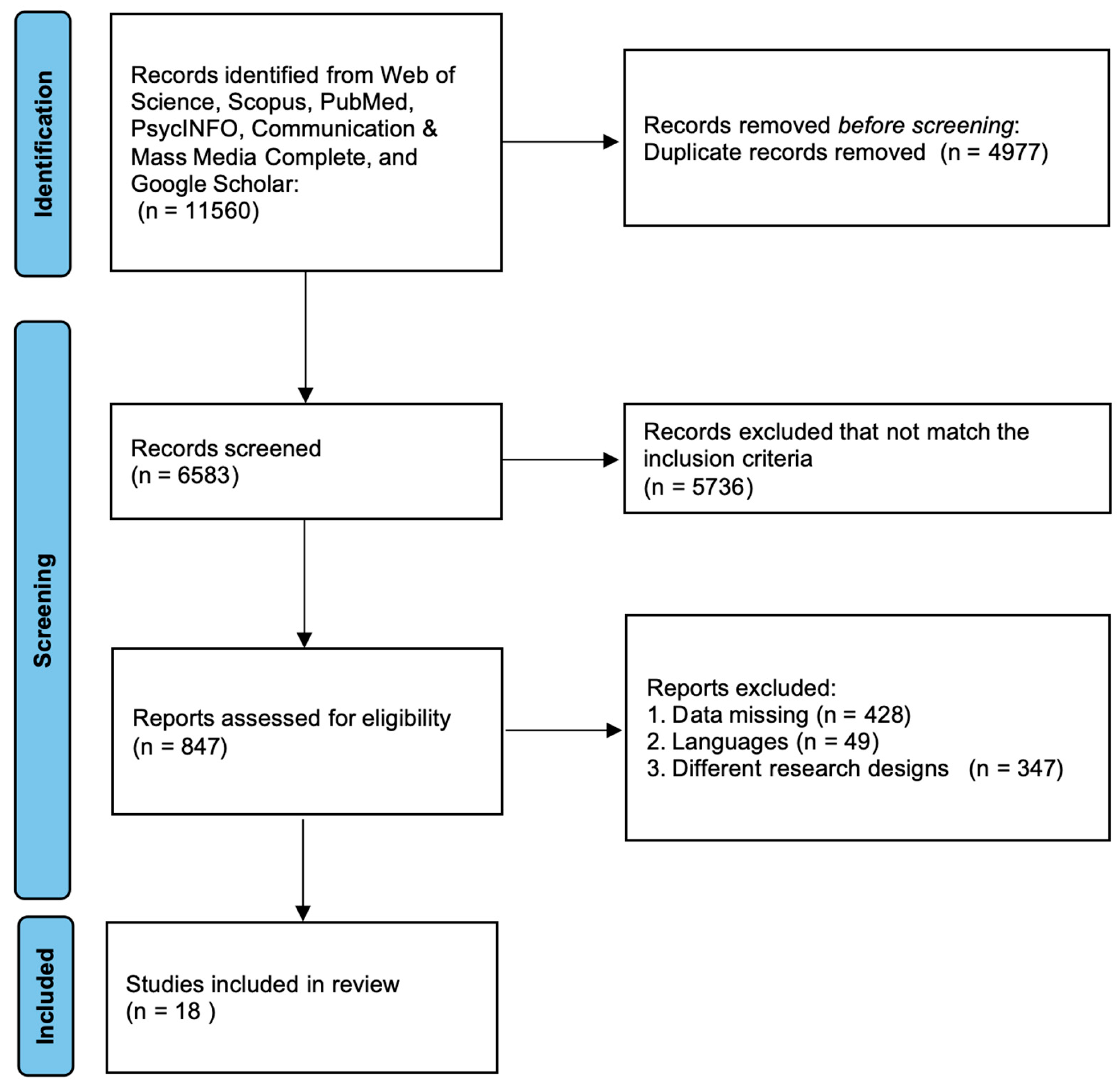
Figure 2.
Forest plot for the random-effects model.
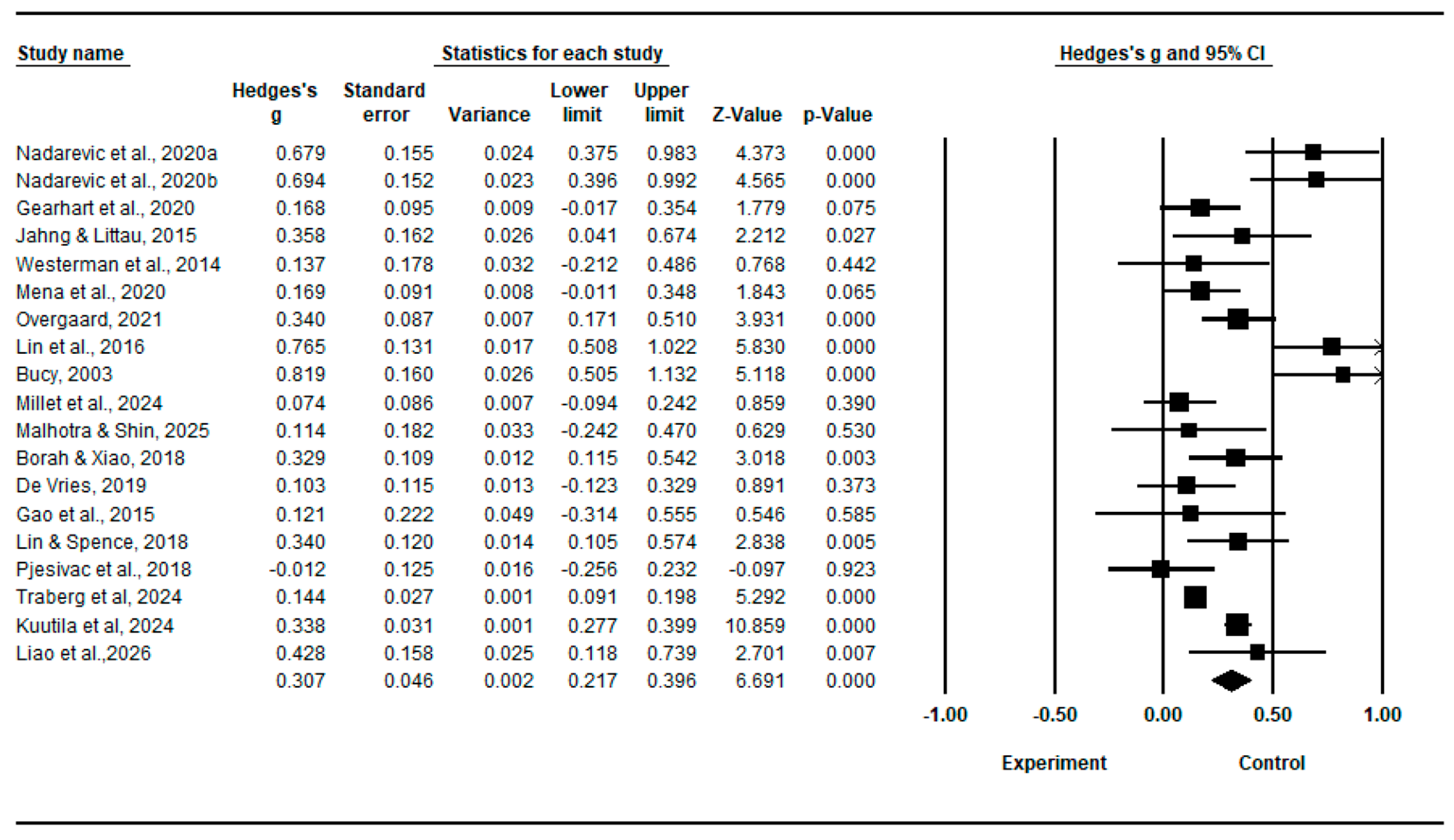
Figure 3.
Funnel plot of the overall mean effect size analysis.
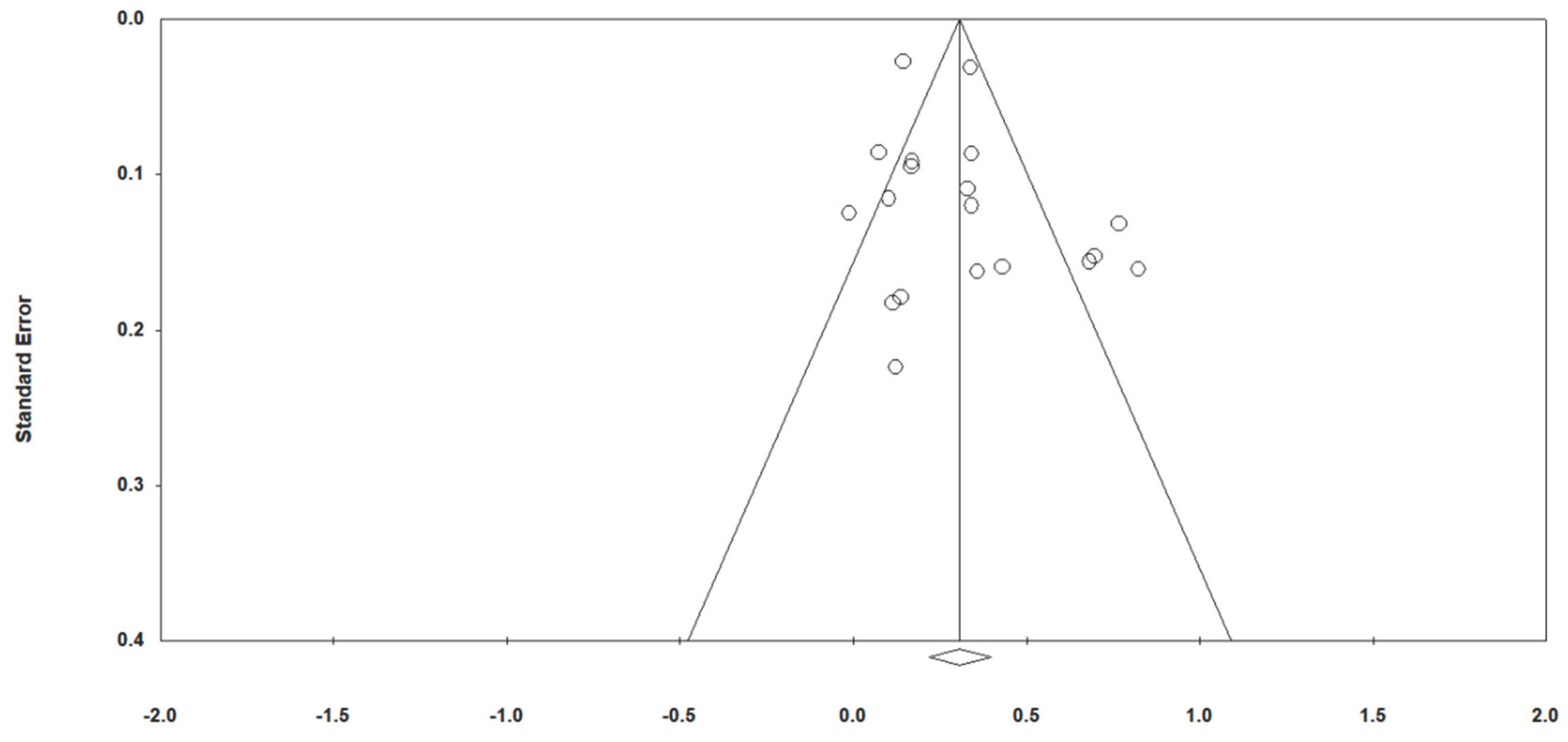

Table 1.
Inclusion and Exclusion Criteria According to the PICOS Framework.
| Parameter | Inclusion Criteria | Exclusion Criteria |
| Population | Actual social media users or ordinary internet users can provide explicit assessments of perceived credibility. | Other media users, as well as specific non-user groups. |
| Intervention | Exposure to manipulated heuristic credibility cues (e.g., source cues, social cues) on social media | No manipulation of heuristic credibility cues |
| Comparison | A valid control condition involving exposure to unmanipulated social media content (without heuristic credibility cues) | No appropriate control group, or only comparisons between different types of manipulated cues |
| Outcome | Perceived credibility/trust of social media information | Other assessments (e.g., attitudes, sharing intention, behavior) |
| Study design | Randomized controlled trials, quasi-experimental designs, or single-group pretest–posttest designs | Non-experimental studies, Qualitative research, correlational studies, surveys or reviews studies |
| Study data | Studies must report sufficient data to calculate effect sizes (e.g., means, standard deviations, sample sizes, t-values, or p-values). | Studies that did not report key statistics and for which the necessary information could not be retrieved after contacting the corresponding author. |
| Publication language | English-language publications | Non-English publications |
Table 2.
Quality assessment through QualSyst.
| No. | References | I | II | III | IV | V | VI | VII | VIII | IX | X | XI | XII | XIII | XIV | Rating |
| 1 | Nadarevic et al., 2020 | 2 | 2 | 2 | 2 | 2 | 0 | 0 | 2 | 2 | 2 | 2 | 2 | 2 | 2 | Strong |
| 2 | Gearhart et al., 2020 | 2 | 2 | 2 | 2 | 2 | 0 | 0 | 2 | 2 | 2 | 2 | 2 | 2 | 2 | Strong |
| 3 | Jahng & Littau, 2015 | 2 | 1 | 2 | 2 | 2 | 0 | 0 | 2 | 2 | 2 | 2 | 2 | 2 | 2 | Strong |
| 4 | Westerman et al., 2014 | 2 | 1 | 2 | 2 | 2 | 0 | 0 | 2 | 2 | 2 | 2 | 1 | 2 | 2 | Moderate |
| 5 | Mena et al., 2020 | 2 | 2 | 2 | 2 | 2 | 0 | 0 | 2 | 2 | 2 | 2 | 2 | 2 | 2 | Strong |
| 6 | Overgaard, 2021 | 2 | 2 | 2 | 2 | 2 | 0 | 0 | 1 | 2 | 2 | 2 | 2 | 2 | 2 | Strong |
| 7 | Lin et al., 2016 | 2 | 2 | 2 | 2 | 2 | 0 | 0 | 2 | 2 | 2 | 2 | 1 | 2 | 2 | Strong |
| 8 | Bucy, 2003 | 2 | 1 | 2 | 2 | 2 | 0 | 0 | 2 | 1 | 2 | 2 | 2 | 2 | 2 | Moderate |
| 9 | Millet et al., 2024 | 2 | 2 | 2 | 2 | 2 | 0 | 0 | 2 | 2 | 2 | 2 | 2 | 2 | 2 | Strong |
| 10 | Malhotra & Shin, 2025 | 2 | 2 | 2 | 2 | 2 | 0 | 0 | 2 | 2 | 2 | 2 | 2 | 2 | 2 | Strong |
| 11 | Borah & Xiao, 2018 | 2 | 2 | 2 | 2 | 2 | 0 | 0 | 2 | 2 | 2 | 2 | 2 | 2 | 2 | Strong |
| 12 | De Vries, 2019 | 2 | 2 | 2 | 2 | 2 | 0 | 0 | 2 | 2 | 2 | 2 | 2 | 2 | 2 | Strong |
| 13 | Gao et al., 2015 | 2 | 2 | 2 | 2 | 2 | 0 | 0 | 2 | 1 | 2 | 2 | 2 | 2 | 2 | Strong |
| 14 | Lin & Spence, 2018 | 2 | 2 | 2 | 2 | 2 | 0 | 0 | 2 | 2 | 2 | 2 | 1 | 2 | 2 | Strong |
| 15 | Pjesivac et al., 2018 | 2 | 2 | 2 | 2 | 2 | 0 | 0 | 2 | 2 | 2 | 2 | 2 | 2 | 2 | Strong |
| 16 | Traberg et al., 2024 | 2 | 2 | 2 | 2 | 2 | 0 | 0 | 2 | 2 | 2 | 2 | 2 | 2 | 2 | Strong |
| 17 | Kuutila et al., 2024 | 2 | 2 | 2 | 2 | 2 | 0 | 0 | 2 | 2 | 2 | 2 | 1 | 2 | 2 | Strong |
| 18 | Liao et al.,2026 | 2 | 2 | 2 | 2 | 2 | 0 | 0 | 2 | 2 | 2 | 2 | 2 | 2 | 2 | Strong |
I. Question/objective sufficiently described? II. Study design evident and appropriate to answer study question? III. Method of subject/comparison group selection or source of information/input variables described and appropriate? IV. Subject (and comparison group, if applicable) characteristics sufficiently described? V. If random allocation to treatment group was possible, is it described? VI. If interventional and blinding of investigators was possible, was it reported? VII. If interventional and blinding of subjects was possible, was it reported? VIII. Outcome and (if applicable) exposure measure(s) well defined and robust to measurement/misclassification bias? Means of assessment reported? IX. Sample size appropriate? X. Analysis described and appropriate? XI. Some estimate of variance is reported for the main results? XII. Controlled for confounding? XIII. Results reported in sufficient detail? XIV. Conclusions supported by the results?
Table 3.
Study characteristics of the included studies.
| No. | References | Sample size | Heuristic Cue Type | Participant Type | Perceived credibility measurement | Experiment setting |
| 1 | Nadarevic et al., 2020 | 175 | Source Cue Type (Expert source) | Student | Unidimensional | Online |
| 2 | Gearhart et al., 2020 | 447 | Social cue type (Opinion Climate)(Congruent vs. Control) | Non-student | Unidimensional | Online |
| 3 | Jahng & Littau, 2015 | 154 |
Social cue type (Structural Cue (Interactivity)) |
Student | Multidimensional | Online |
| 4 | Westerman et al., 2014 | 125 |
Social cue type (Temporal Cue (Update Recency)) |
Student | Multidimensional | Online |
| 5 | Mena et al., 2020 | 478 |
Social cue type (Bandwagon Cue) |
Non-student | Unidimensional | Online |
| 6 | Overgaard, 2021 | 540 |
Social cue type (Affective Cue) |
Non-student | Multidimensional | Online |
| 7 | Lin et al., 2016 | 249 | Source Cue Type (Official source) | Student | Multidimensional | Offline |
| 8 | Bucy, 2003 | 168 | Source Cue Type (Official source) | Student | Multidimensional | Offline |
| 9 | Millet et al., 2024 | 542 | Source Cue Type (Credible source) | Non-student | Unidimensional | Online |
| 10 | Malhotra & Shin, 2025 | 120 | Social cue type (Visibility Cue) | Non-student | Unidimensional | Online |
| 11 | Borah & Xiao, 2018 | 340 | Source Cue Type (Expert source) | Student | Unidimensional | Online |
| 12 | De Vries, 2019 | 300 |
Social cue type (Engagement Ratio Cue) |
Non-student | Unidimensional | Online |
| 13 | Gao et al., 2015 | 80 | Source Cue Type (Credible source) | Student | Unidimensional | Offline |
| 14 | Lin & Spence, 2018 | 284 | Source Cue Type (Expert source) | Student | Multidimensional | Offline |
| 15 | Pjesivac et al., 2018 | 256 | Social cue type (Affective Cue) | Student | Multidimensional | Online |
| 16 | Traberg et al., 2024 | 5400 | Source Cue Type (Expert source) | Non-student | Multidimensional | Online |
| 17 | Kuutila et al., 2024 | 4187 | Source Cue Type (Expert source) | Non-student | Unidimensional | Online |
| 18 | Liao et al.,2026 | 162 | Source Cue Type (Expert source) | Non-student | Unidimensional | Online |
Table 4.
Summary of overall mean effect size and test for heterogeneity.
| Effect Size and 95% CI | Heterogeneity Test | Tau-Squared |
Test of Null (Two-Tailed) |
|||||||
| k | g | 95% CI | Q | p | I-squared | Tau Squared | Standard Error | Tau | Z |
p |
| 19 | 0.307 | [0.217,0.396] | 84.247 | 0.000 | 78.634 | 0.025 | 0.018 | 0.158 | 6.691 | 0.000 |
Table 5.
Summary of Subgroup Analysis Results.
| Moderator Variables | k | Hedges’ g | SE | 95% CI | I-squared | QW | p |
| Heuristic Cue Type | QB=7.815 (p=0.005) | ||||||
| Source cue | 11 | 0.406 | 0.066 | [0.276-0.536] | 86.490 | 73.846 | 0.000 |
| Social cue | 8 | 0.185 | 0.043 | [0.100-0.269] | 8.475 | 7.657 | 0.364 |
| Participant Type | QB=4.367 (p=0.037) | ||||||
| Student | 10 | 0.427 | 0.093 | [0.245-0.610] | 75.558 | 36.823 | 0.000 |
| Non-student | 9 | 0.210 | 0.046 | [0.119-0.300] | 73.906 | 30.658 | 0.000 |
| perceived credibility measurement | QB=0.424 (p=0.515) | ||||||
| multidimensional measures | 8 | 0.350 | 0.092 | [0.169-0.530] | 84.665 | 45.648 | 0.000 |
| unidimensional measures | 11 | 0.280 | 0.055 | [0.172-0.388] | 67.162 | 30.452 | 0.001 |
| Experiment setting | QB=2.980 (p=0.084) | ||||||
| Online | 15 | 0.254 | 0.044 | [0.168-0.340] | 74.135 | 54.126 | 0.000 |
| Offline | 4 | 0.530 | 0.154 | [0.228-0.833] | 75.686 | 12.339 | 0.006 |
Table 6.
Meta-Regression Results for Continuous Moderators.
| Variable | Estimate | SE | 95% CI | Z | p | QM | df |
| Sample size | -0.000 | 0.000 | [-0.0001--0.0000] | -0.86 | 0.3916 | 0.73 | 1 |
| Publication year | -0.0208 | 0.0093 | [-0.0390--0.0026] | -2.24 | 0.0254 | 5.00 | 1 |
Disclaimer/Publisher’s Note: The statements, opinions and data contained in all publications are solely those of the individual author(s) and contributor(s) and not of MDPI and/or the editor(s). MDPI and/or the editor(s) disclaim responsibility for any injury to people or property resulting from any ideas, methods, instructions or products referred to in the content. |
© 2026 by the authors. Licensee MDPI, Basel, Switzerland. This article is an open access article distributed under the terms and conditions of the Creative Commons Attribution (CC BY) license.
Copyright: This open access article is published under a Creative Commons CC BY 4.0 license, which permit the free download, distribution, and reuse, provided that the author and preprint are cited in any reuse.