
Submitted:
10 June 2026
Posted:
15 June 2026
You are already at the latest version
Abstract
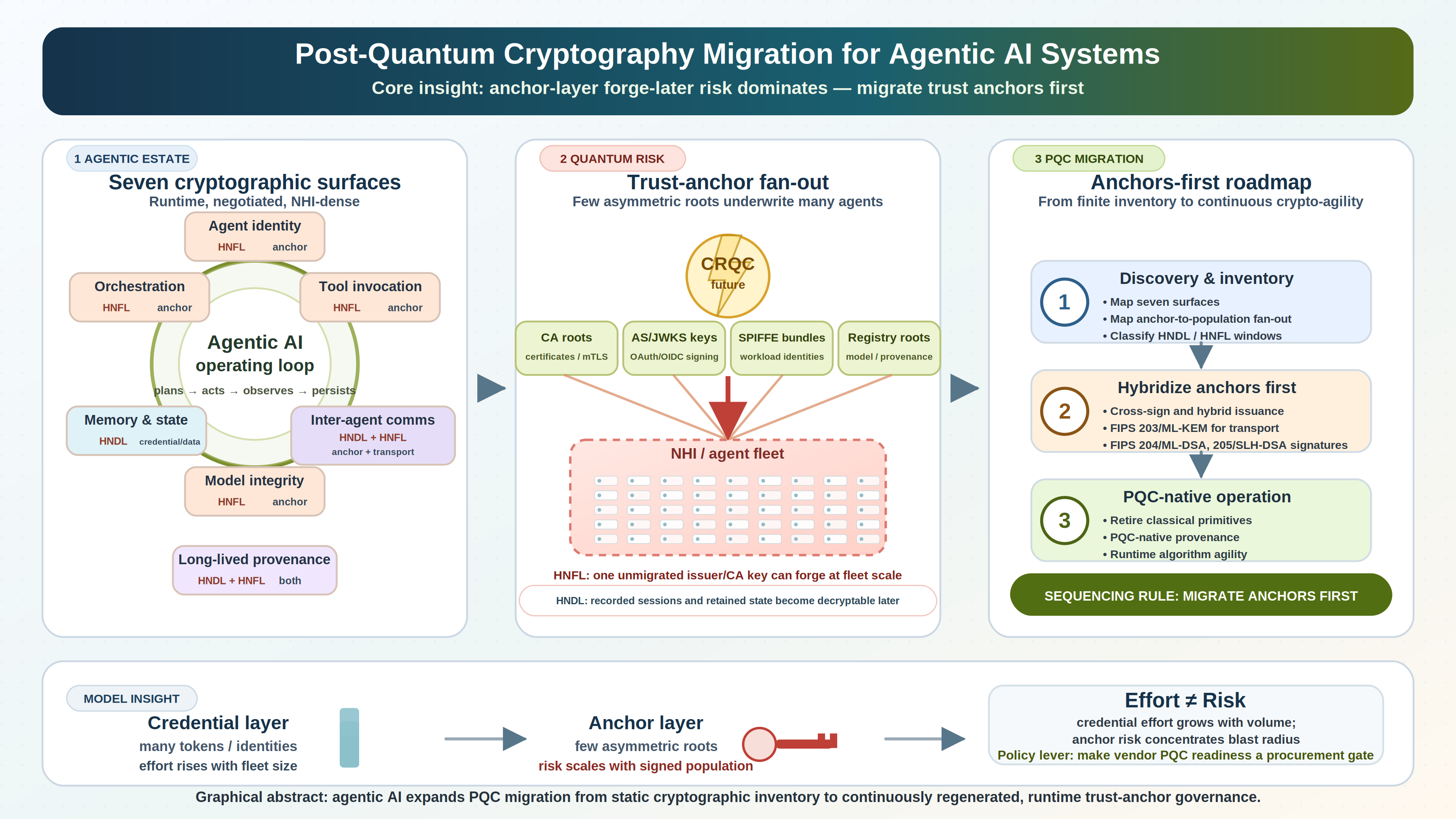
Agentic AI systems depend on classical public-key cryptography for agent identity, tool invocation, inter-agent communication, model integrity, and persistent state, exposing them to a cryptographically relevant quantum computer (CRQC) along two axes: confidentiality (harvest-now-decrypt-later) and integrity (harvest-now-forge-later). Existing post-quantum migration guidance addresses static, operator-controlled enterprise estates, while emerging agent-identity work omits post-quantum cryptography entirely; neither treats non-human-identity-dense, runtime-negotiated agentic systems as a distinct migration class. This paper develops a conceptual framework that does. It organizes agentic cryptography into seven migration surfaces and separates each identity into a credential layer (symmetric, operator-held, low-risk) and a trust-anchor layer (the asymmetric roots that underwrite the fleet). These layers scale inversely: a small set of trust anchors carries a forge-later blast radius equal to the population beneath it, so migration effort and forge-later risk rank the work in opposite orders. A migration matrix and a parametric effort-and-risk model formalize this, yielding the core sequencing rule: migrate anchors first. Because agentic adoption is ongoing, it also reframes migration from a finite inventory into a continuously regenerating problem, distinguishing remediation of the installed base from prevention of new classical-cryptographic debt in future deployments. It closes with oversight and procurement implications for federal post-quantum readiness.
Keywords:
post-quantum cryptography
; cryptographic migration
; agentic AI
; non-human identity
; trust-anchor fan-out
; harvest-now-forge-later
; crypto-agility
; zero trust
Copyright: This open access article is published under a Creative Commons CC BY 4.0 license, which permit the free download, distribution, and reuse, provided that the author and preprint are cited in any reuse.


