
Submitted:
11 June 2026
Posted:
12 June 2026
You are already at the latest version
Abstract
Plant physiology and development, ranging from leaf growth and flowering time in Arabidopsis thaliana to tuberization in potato, are profoundly influenced by ambient light con-ditions. It has been acknowledged that light significantly inhibits hypocotyl elongation. However, how light patterns affect early seedling development remains unclear. To ad-dress this, we developed a logistic model for Arabidopsis thaliana hypocotyl elongation. The model incorporated the circadian clock and the PHYTOCHROME-INTERACTING FAC-TOR (PIF)-mediated signaling pathways, capturing the biological characteristics of limited hypocotyl growth. Through numerical simulations, we identified several artificial photoperiods that can accelerate hypocotyl elongation, and thereby promote rapid growth. Compared with the conventional 12L:12D (12 h light/12 h dark) photoperiod, inserting a 4-h light pulse into the dark phase of an 8L:16D cycle advanced the elongation-rate peak by 5.5 h and shortened the growth cycle by 32%. Furthermore, under a 9L:9D photoperi-odic stress, the growth peak occurs 6 h earlier, and the growth cycle is shortened by 25%. These findings highlight the potential role of artificial photoperiods in promoting hypo-cotyl elongation, providing a potential strategy for light control of plant photomorpho-genesis and development.
Keywords:
hypocotyl elongation
; artificial photoperiod
; differential equation model
; circadian clock
MSC: 93A30; 92B05; 92C80
1. Introduction
The hypocotyl, an embryonic organ connecting the cotyledons to the root, plays a critical role in seedling establishment and is influenced by multiple environmental factors including light intensity, light quality, photoperiod, temperature, and gravity [1,2,3,4]. Among these factors, photoperiod exerts a particularly profound effect on hypocotyl elongation. In Arabidopsis, hypocotyl length exhibits a robust negative correlation with day length, such that seedlings grown under short-day conditions develop significantly longer hypocotyls than those under long-day conditions [5]. Importantly, hypocotyl elongation is not a continuous process but displays pronounced circadian rhythmicity. Over 30% of hypocotyl-expressed genes show circadian regulation [6], and even under constant environmental conditions, the hypocotyl maintains an approximately 24-h growth rhythm [7]. Disruption of the circadian clock abolishes this rhythmic pattern; for instance, the early flowering 3 (elf3) mutant exhibits arrhythmic, continuous hypocotyl growth under constant darkness [8], demonstrating that a functional circadian clock is essential for proper temporal organization of hypocotyl elongation. These observations converge on a core principle: hypocotyl elongation depends not on the absolute duration of light, but on the phase relationship between the light-dark cycle and a clock-gated growth-permissive window-light overlapping this window suppresses growth, whereas darkness overlapping it permits elongation.
The activities of PHYTOCHROME-INTERACTING FACTOR 4 (PIF4) and PIF5 are regulated by both the circadian clock and light signals. Light induces rapid phosphorylation and degradation of PIFs by activating phytochromes (PHY) [9,10]. Concurrently, core circadian clock components, such as ELF4 and LUX ARRHYTHMO (LUX), modulate the rhythm of PIF4 and PIF5 expression by directly regulating their transcriptional levels [11,12]. The evening complex (EC) suppresses PIF4 and PIF5 transcription from evening to night [13], providing a crucial molecular pathway through which the circadian clock indirectly regulates hypocotyl growth. The biological significance of this dual regulation is clearly manifested under different photoperiods. Under short-day conditions, PIFs form an activity window at dawn, coinciding with the dark-to-light transition, which explains why growth rates peak at dawn [8]. Under long-day conditions, however, light-mediated PIF degradation persists throughout much of the night, preventing the formation of a dawn growth peak. Over the long term, this results in reduced cumulative elongation under long-day conditions, providing a mechanistic explanation for why hypocotyls are longer under short-day than long-day conditions [14]. Thus, through this dual regulation at both the transcriptional and translational levels, PIF4/5 serve as a key integration node that coordinates external photoperiod cues with endogenous circadian rhythms to precisely gate hypocotyl elongation.
Previous studies have revealed that hypocotyl elongation is jointly regulated by photoperiod, the circadian clock, and PIF-mediated signaling. However, a quantitative framework is still needed to predict how these regulatory processes interact under artificial or non-24-h photoperiods. Hypocotyl growth depends not only on the total duration of light or darkness, but also on the phase relationship between external light-dark cycles and the internal circadian oscillator. Moreover, the dynamics of PIF accumulation are shaped by both circadian regulation and light-dependent protein degradation, making hypocotyl elongation a phase-dependent and nonlinear process. Existing compact mathematical models have successfully described the Arabidopsis circadian clock and its regulatory properties [15,16]. However, models that link circadian regulation to hypocotyl elongation still need to account for the finite and saturating nature of hypocotyl growth over longer developmental periods. Therefore, a dynamic mathematical model that integrates circadian regulation, PIF-mediated growth control, and long-term growth saturation is required to understand and predict hypocotyl growth under diverse light-dark cycles.
In this study, we developed a mathematical model of circadian-clock-regulated hypocotyl elongation in Arabidopsis. Based on previously established compact models of the Arabidopsis circadian clock, we incorporated a PIF-mediated growth module and modified the hypocotyl elongation equation by introducing a logistic term to characterize the saturated growth of the hypocotyl. The model was evaluated using published hypocotyl growth datasets under multiple photoperiods and clock-gene mutant backgrounds. We then used the model to predict how artificial photoperiodic perturbations and non-24-h light-dark cycles reshape PIF accumulation, elongation-rate rhythms, and the time required for hypocotyls to reach half-maximal length. Finally, parameter sensitivity and bifurcation analyses were performed to assess the robustness and dynamic properties of the model. This framework provides a quantitative basis for exploring photoperiod regimes that may accelerate early hypocotyl elongation and for understanding how external light cycles interact with the endogenous circadian clock to regulate plant growth.
2. Models and Methods
2.1. Dynamical Model of the Circadian-Clock-Regulated Hypocotyl Elongation
2.1.1. Circadian Oscillator and PIF Regulation Module
Based on the Arabidopsis circadian clock regulation model proposed by Caluwé et al. [15] and Greenwood et al. [16], a gene regulatory network for clock-regulated hypocotyl elongation is shown in Figure 1.
The model is described by the following differential equations:
where , , , , , , , , , and represent the concentrations of their respective mRNAs and proteins, respectively. denotes the activation ratio of the photosensitive protein, and HYP indicates hypocotyl length. The functions and represent light and darkness, respectively. Under light conditions, and , and under dark conditions, and
The core circadian oscillator module: Eqs. 1-8 describe the Arabidopsis core circadian clock network, which includes the key components CIRCADIAN CLOCK ASSOCIATED 1 (CCA1), LATE ELONGATED HYPOCOTYL (LHY), PSEUDO-RESPONSE REGULATOR 9 (PRR9), PRR7, PRR5, TIMING OF CAB EXPRESSION 1 (TOC1), ELF4, and LUX that constitute the transcriptional-translational feedback loop. The activity dynamics of the phytochrome protein is represented by Eq. 9. The transcription of PIF genes and the translation of their proteins are described by Eqs. 10-11, respectively.
2.1.2. Logistic Modification of the Hypocotyl Growth Equation
The original PIF-dependent growth equation proposed by Caluwé et al. [15] (Eq. 12) describes hypocotyl elongation as an increasing function of PIF protein abundance and therefore captures the positive effect of PIF accumulation on growth rate.
However, this formulation does not explicitly constrain hypocotyl length and therefore fails to represent the finite and saturating nature of organ elongation over longer developmental periods. Since hypocotyl elongation gradually slows down and eventually approaches a physiological maximum length, we modified the PIF-dependent growth equation by introducing a logistic saturation term (Eq. 13). In the modified model, PIF protein abundance still determines the growth-promoting component, whereas the logistic term limits further elongation as hypocotyl length approaches its maximum value. This modification allows the model to describe both short-term rhythmic growth and long-term growth saturation under different photoperiodic conditions.
where represents the basal growth rate, denotes the maximum PIF-dependent growth rate, indicates the PIF protein concentration required to achieve half-maximal effect, and represents the maximum length threshold of hypocotyl growth.
2.2. Parameter Estimation
The parameters of the core circadian oscillator were fixed according to Greenwood et al. [16] and are listed in Table A1, whereas only parameters associated with PIF dynamics and hypocotyl growth were estimated. To reduce the risk of overfitting and to preserve the dynamic properties of the established circadian clock model, these oscillator-related parameters were not re-estimated. Parameter estimation was restricted to the PIF-regulated hypocotyl growth module.
The unknown parameters were estimated using Sobol sequence sampling. First, 105 candidate parameter sets were generated within the range [0.1, 10]. The cost function was calculated for each candidate set by comparing simulated hypocotyl lengths with experimental observations. The candidate parameter set with the lowest cost was selected as the optimal parameter set. The cost function was defined as:
where N is the number of light-dark cycles, and and represent the experimentally measured and model-simulated hypocotyl lengths in the -th cycle, respectively.
During parameter estimation, hypocotyl length data from 7-day-old seedlings grown under nine distinct photoperiod conditions were used as the fitting targets. Because the core circadian oscillator parameters were fixed according to previous studies, parameter estimation was restricted to the PIF-regulated hypocotyl growth module. A Sobol sequence-based global sampling approach was used to generate candidate parameter sets within the predefined parameter space, and the cost function in Eq. 14 was calculated for each candidate set by comparing simulated hypocotyl lengths with experimental observations. The candidate set yielding the lowest cost was selected as the optimal parameter set. The optimized parameters of the hypocotyl growth module are presented in Table A2.
2.3. Parameter Sensitivity Analysis
To evaluate the reliability of the model, parameter sensitivity and robustness were examined. In the robustness test, each optimal parameter was perturbed by ±5%, and the resulting changes in key model outputs (period and phase) were quantitatively analyzed. The results demonstrated that under constant light conditions, the period variations of CL (CCA1/LHY) mRNA and P51 (PRR5/TOC1) mRNA were constrained within 1% and 2%, respectively, while phase shifts were maintained between 5% and 13% (Figure 2A,B), indicating good model stability.
To further quantify parameter sensitivity, the Partial Rank Correlation Coefficient (PRCC) method was employed. This approach allows for a precise assessment of the influence of individual parameters on model outputs by calculating the rank correlation between parameter perturbations (±5%) and output variables. As shown in Figure 2C, a PRCC value greater than 0 indicates a positive correlation between the parameter and the output; a value less than 0 indicates a negative correlation; and a value close to 0 suggests that the parameter has no significant influence on the output. This analysis provides an important basis for identifying key regulatory parameters within the model.
2.4. Data Sources and Processing Methods
All hypocotyl experimental data used in this study were obtained from previously published research, specifically comprising the following three datasets:
1. Hypocotyl length data at different developmental stages: Measurements of hypocotyl length at 3, 5, and 7 days after germination (DAG), obtained from the study by Niwa et al. [17].
2. Dynamic growth data under an 8L:16D photoperiod: this dataset includes chronological records of hypocotyl elongation under an 8L:16D photoperiod, sourced from Ronald et al. [18].
3. Dynamic growth data under a 12L:12D photoperiod: dynamic data involving wild-type and multiple circadian clock-related mutants, derived from research conducted by Won et al. [19].
All data were digitally extracted from figures in the original publications using ImageJ image analysis software (Version 1.53; National Institutes of Health, USA). To ensure data accuracy and comparability, the coordinate systems of the original figures were calibrated, and the scales were standardized before data extraction. Each data point was independently measured three times, and the average value was used for subsequent modeling and analysis. In the numerical simulations, the first 72 h were excluded to allow the model to reach stable photoperiod-specific dynamics and to remain consistent with the experimental design.
2.5. Numerical Simulation
Numerical simulations of the circadian rhythm model were conducted using MATLAB (R2021b) and Python 3.9. The ordinary differential equations were solved using ode15s in MATLAB and odeint from SciPy in Python. Figure 2A–C were generated in MATLAB, whereas the remaining figures were produced using Python 3.9.
3. Results
3.1. Logistic Saturation Captures the Finite Growth of the Hypocotyl
To evaluate whether the modified growth equation improves the description of hypocotyl elongation, we compared the original PIF-dependent growth equation with the logistic-modified model under the 8L:16D photoperiod. The original equation reproduced the short-term increase in hypocotyl length during the early growth phase (Figure 3A), indicating that PIF-dependent regulation is sufficient to capture rapid elongation over a limited time window. However, because this equation does not include an explicit upper constraint on hypocotyl length, it failed to describe the long-term saturation observed in experimental data and produced biologically unrealistic growth trends over extended simulations.
By contrast, the logistic-modified model accurately captured both the early elongation phase and the subsequent slowing of growth as the hypocotyl approached its maximum length (Figure 3B). The simulated growth curve gradually reached a plateau, consistent with the finite developmental nature of hypocotyl elongation. These results indicate that incorporating a logistic saturation term improves the biological realism and long-term predictive ability of the model. Therefore, the logistic-modified equation was used in all subsequent simulations to analyze photoperiod-dependent growth rhythms, PIF accumulation, and artificial photoperiodic perturbations.
3.2. Model Validation
3.2.1. Effect of Photoperiod on Hypocotyl Elongation
To quantify the effect of photoperiod on hypocotyl elongation, hypocotyl length was measured on days 3, 5, and 7 DAG under nine different photoperiod conditions. As shown in Figure 4A–C, hypocotyl length was observed to increase with extended daily dark periods, indicating that light exposure inhibits hypocotyl elongation. Notably, although darkness promotes hypocotyl elongation, its growth-promoting effect remains relatively limited until the dark period reaches a certain threshold (12 h). As the dark duration increased, only minor increases in hypocotyl length were observed (for example, at 7 DAG the difference between 12L:12D and 18L:6D photoperiods was small), suggesting the existence of a saturation threshold for the inhibitory effect of light.
When the dark period exceeded the light period (e.g., 3L:21D), rapid hypocotyl elongation was observed (with a 556% increase compared to the 12L:12D photoperiod at 7 DAG), demonstrating a typical morphological response known as “shade avoidance syndrome” [20,21]. Under continuous darkness (DD), no difference in hypocotyl length was detected between 5 DAG and 7 DAG (Figure 4B–C), indicating that hypocotyl elongation was completed before 5 DAG. In contrast, under the 3L:21D photoperiod, hypocotyl length at 7 DAG was still increased by 18% compared to that at 5 DAG, suggesting that hypocotyl elongation depends on the duration of the dark period.
The model was used to simulate hypocotyl lengths under different photoperiods at 3, 5, and 7 DAG. The simulated results showed strong agreement with experimental measurements, and hypocotyl length at 10 DAG was also predicted (Figure 4D). These results indicate that prolonged growth does not lead to further hypocotyl elongation, demonstrating that the physiological length of the hypocotyl depends on the photoperiod.
3.2.2. The Growth Rate of the Hypocotyl Depends on the Seedling Age
Hypocotyl elongation rate is an ideal parameter for quantifying growth and effectively reveals developmental patterns at different stages. Experiments demonstrated that the elongation rate decreased as seedling age increased, and this decline was particularly pronounced under photoperiods with longer dark periods (Figure 5A–D). For example, under 15L:9D, 9L:15D, 6L:18D, and DD conditions, the elongation rate was highest at 3 DAG, approximately twice that observed at 5 DAG, while the lowest rate occurred at 7 DAG. Notably, under DD conditions, hypocotyl elongation had nearly ceased by 5 DAG, resulting in an elongation rate approaching zero between 5 and 7 DAG (Figure 5D).
The model simulated elongation rates at three key developmental stages (3, 5, and 7 DAG) under different photoperiods. The simulated results agreed well with experimental observations, particularly under DD conditions, where the model reproduced the growth arrest of hypocotyls at 7 DAG (Figure 5D). These findings not only validate the reliability of the model but also support the experimental conclusion that “photoperiod-regulated hypocotyl elongation exhibits seedling age-dependent characteristics” [18].
3.2.3. Circadian Rhythmic Growth of the Hypocotyl Shaped by the Clock Gene
As a signaling hub, PIF coordinates inputs from photoreceptors and the circadian clock to shape the circadian growth pattern of hypocotyls. As shown in Figure 6A,C, under both 8L:16D and 12L:12D photoperiods, the slope of hypocotyl elongation curves exhibited a dynamic pattern characterized by an initial steep phase followed by a gradual flattening as seedlings aged. The elongation rate increased rapidly following the transition from light inhibition to dark-promoted growth, peaked before dawn, and then decreased sharply after dawn (Figure 6B,D). This circadian growth pattern diminishes as seedlings age. Furthermore, as the dark period lengthened, the peak hypocotyl elongation rate became more pronounced, enhancing the circadian rhythm. These observations indicate that the inhibitory effect of light on hypocotyl elongation diminishes with increasing dark duration.
To investigate the dynamic regulation of hypocotyl growth, we simulated growth trends and circadian rhythmic changes in hypocotyls. The simulation results demonstrated that growth trends under different photoperiods were consistent with experimental observations (Figure 6A,C). Importantly, the model captured the circadian rhythm of elongation rate and its damped oscillatory behavior as seedling age increased. Agreement was observed between the predicted results and experimental data (Figure 6B,D), validating the reliability of the model for predicting circadian growth in hypocotyls.
3.2.4. Functional Validation of Circadian Clock Mutants
Gene mutations can alter the circadian growth patterns of hypocotyls by disrupting the phase and amplitude of the core circadian oscillator. As shown in Figure 7A,C, under 8L:16D conditions, the hypocotyl length of the elf3 mutant was approximately 1.4 times that of the wild type. When grown under 12L:12D conditions, the hypocotyl length reached 2.5 times that of the wild type. Notably, the mutant not only exhibited a higher elongation rate than the wild type but also showed a broader peak in diurnal elongation rate (Figure 7B,D).
During numerical simulation, the elongation trends and circadian rhythm variations of elf3 mutant seedlings were reproduced by setting the transcription rate parameter of the EL to 25% of the wild-type optimum. The simulated results were consistent with experimentally observed trends (Figure 7A–D), demonstrating the model’s robust biological adaptability and predictive capability.
The circadian clock precisely regulates the diurnal growth rhythm of the hypocotyl through a core oscillator, such as the ELF4/LUX. The functional integrity of this oscillator is essential for maintaining the amplitude and phase of the rhythm. In this study, single, double, and triple clock-gene mutant lines exhibited not only longer final hypocotyl lengths but also a more robust circadian growth rhythm (Figure 8). This observation suggests that these mutations may disrupt the normal function of the core oscillator, particularly by weakening the inhibitory signal mediated by the ELF4/LUX. Such disruption releases transcriptional suppression of hypocotyl growth, resulting in enhanced rhythmicity and increased elongation.
3.3. Dependence of Elongation Rate on PIF Protein Levels
Research indicates that hypocotyl elongation depends on the accumulation of PIF proteins [18], with the extent of accumulation determining the daily elongation rate. To investigate this, we simulated the relationship between changes in elongation rate and PIF protein levels. As shown in Figure 9A–C, under photoperiodic conditions, the duration during which PIF protein levels remain elevated at night gradually increases as the photoperiod shortens. Simultaneously, the hypocotyl elongation rate exhibits a similar trend, with both reaching peak levels at dawn. Conversely, light exposure induces rapid degradation of PIF protein, leading to the swift clearance of accumulated proteins at dawn and maintaining PIF at low levels during the day. Correspondingly, the hypocotyl elongation rate declines rapidly after dawn and remains low during daylight hours. As PIF protein levels decrease, the hypocotyl elongation rate slows accordingly, indicating that the PIF protein level is a key factor regulating changes in elongation rate.
Further analysis revealed that under 3L:21D conditions, PIF protein maintained a consistently high level throughout the night, inducing the hypocotyl to enter a rapid and sustained growth phase (Figure 9C). Under DD conditions, PIF protein levels did not remain stably high; instead, they rapidly increased to a threshold and then declined. Surprisingly, the elongation rate of the hypocotyl did not synchronize with PIF protein levels but instead exhibited an approximately linear growth trend (Figure 9D). These findings indicate that continuous darkness alters elongation rates in a manner dependent on PIF protein levels.
3.4. Model Prediction
Non-24-h photoperiods or abrupt changes in the light period may induce photoperiodic stress in plants [22]. A shorter extension of the photoperiod reduces stress levels and is perceived as harmless, potentially even inducing eustress. Conversely, a longer extension of the photoperiod creates higher stress levels, resulting in genuine distress [23].
3.4.1. Short-Term Light Stress Can Shorten the Hypocotyl Growth Cycle
Altering photoperiods induces stress responses in plants, known as photoperiodic stress. To examine whether moderate perturbations of the light-dark cycle could alter hypocotyl elongation dynamics, we simulated brief light exposure under 8L:16D conditions and brief dark exposure under 16L:8D conditions. A 12L:12D photoperiod served as the control. To maintain an equivalent duration of light exposure, either 4 h of light stress was applied during the dark period or 4 h of dark stress was inserted into the light period to simulate variations in hypocotyl elongation responses under different photoperiod conditions.
As shown in Figure 10A, under 8L:16D conditions with 4-h light stress applied at different time points, simulations revealed that implementing the light stress at ZT19 (i.e., 8L:11D:4L:1D) minimized the time required for hypocotyls to reach half-maximal length (50% of total hypocotyl length). This treatment corresponded to the highest accumulation of PIF protein (Figure 10B) and reduced the growth time by approximately 13 h compared to the control (12L:12D) (Figure 10E, red line). Additionally, this regimen increased PIF protein accumulation by 16% relative to the control (Figure 10B, green bar).
Conversely, under 16L:8D conditions with 4-h dark stress applied at different times, simulations demonstrated that administering the dark stress at ZT1 (i.e., 1L:4D:11L:8D) resulted in the shortest time to reach half-maximal hypocotyl length (Figure 10C) and the highest accumulation of PIF protein (Figure 10D). Surprisingly, this dark stress treatment extended the growth duration by approximately 4 h compared to the control (Figure 10E, blue line), while PIF protein accumulation reached only 98% of the control level (Figure 10D).
Further analysis showed that 4 h of light stress advanced the phase of the elongation rate by nearly 5.5 h (Figure 10F, red line) and induced two rapid elongation peaks within each light cycle (bimodal pattern). These results indicate that, under equal total light duration, light stress can enhance the hypocotyl growth rate, elevate PIF protein accumulation levels, and promote hypocotyl elongation. These findings are consistent with the previously reported view that hypocotyl elongation depends on PIF protein accumulation [18].
3.4.2. Rhythmic Growth Under Abnormal Photoperiodic Stress
To explore additional lighting regimes that might accelerate hypocotyl elongation, we simulated the effects of non-24-h photoperiods (with equal light and dark durations but deviating from 24-h cycles) on dynamic hypocotyl growth.
Simulation results revealed a U-shaped trend in the time required for hypocotyls to reach half-maximal length (relative to the 12L:12D control) as the duration of darkness increased (Figure 11A). Concurrently, PIF protein accumulation exhibited a typical inverted parabolic pattern. Under 9L:9D conditions, hypocotyls reached half-maximal length in only 28.8 h approximately 25% faster (nearly 10 h) than the control (37.4 h). This photoperiod also induced the highest PIF protein accumulation, showing a 4% increase over the control (Figure 11B, green bar). These findings indicate that moderately shortened photoperiods can accelerate hypocotyl elongation by enhancing PIF protein accumulation.
Further analysis demonstrated that photoperiod regulation most prominently promoted hypocotyl development during the early stages, as evidenced by significantly steeper growth curves and the emergence of rapid elongation phases (Figure 11C). Notably, robust circadian oscillations in elongation rates were maintained even under abnormal photoperiods. Under 9L:9D conditions, the phase of peak elongation rate advanced by approximately 6 h compared to other photoperiods (Figure 11D). Dynamic regulation of PIFs adaptively shifted the phase of the peak hypocotyl elongation rate. This regulatory mechanism achieved accelerated hypocotyl elongation and shortened growth cycles by increasing PIF protein accumulation levels.
3.5. Hopf Bifurcation Analysis
Bifurcation analysis was performed to examine how changes in mRNA synthesis-rates affect the dynamic behavior of the model. As CL transcript rate increased, the system underwent a Hopf bifurcation at , where the steady state lost stability and sustained oscillations emerged (Figure 12A). For the P97 transcript rate , two Hopf bifurcation points were observed at and , indicating that the system transitioned from a stable steady state to an oscillatory regime and then returned to a stable steady state as further increased (Figure 12B). These results suggest that the synthesis-rate parameters can modulate the stability of the circadian oscillator and determine whether the model exhibits damped or self-sustained rhythmic dynamics.
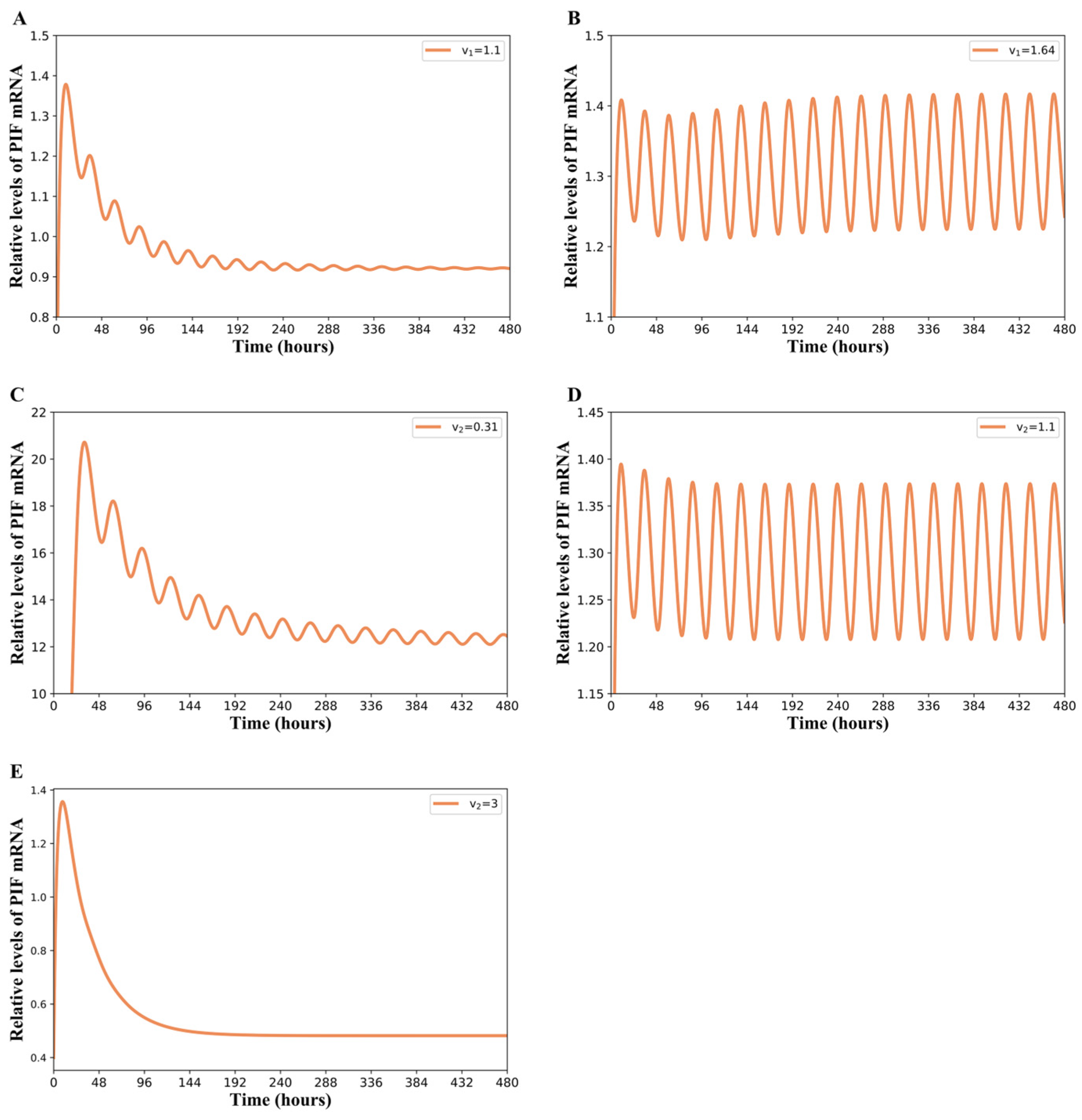
The time-series simulations further confirmed the bifurcation results. For , the system exhibited damped oscillations and gradually approached a stable steady state (Figure 13A), whereas for the system generated sustained oscillation (Figure 13B). Similarly, changes in produced distinct dynamic behaviors: for , the oscillation amplitude gradually decreased (Figure 13C); for , sustained oscillations were maintained (Figure 13D); and for , the system rapidly converged to a stable steady state (Figure 13E). These results indicate that the synthesis-rate parameters can regulate the transition between damped and self-sustained oscillatory dynamics, supporting the dynamic consistency of the Hopf bifurcation analysis.
This bifurcation analysis supports the dynamic plausibility of the model by showing that changes in synthesis-related parameters can switch the oscillator between damped and sustained rhythmic states. Such oscillatory regimes are essential for generating phase-dependent PIF accumulation and, consequently, rhythmic hypocotyl elongation under photoperiodic conditions.
4. Discussion
The growth of Arabidopsis hypocotyls is regulated by light signals through the circadian clock, with PIF-family bHLH transcription factors serving as central integrators. Research indicates that PIFs effectively promote cell elongation by directly activating the expression of genes involved in auxin and brassinosteroid (BR) biosynthesis and signal transduction [12]. This study reveals that hypocotyl elongation during early seed germination proceeds relatively slowly, potentially due to the dynamic balance of key hormones during dark morphogenesis—particularly the temporal coordination or antagonism among auxin, gibberellin (GA), and BR. Notably, auxin exhibits a characteristic biphasic, dose-dependent regulatory pattern during elongation of the etiolated hypocotyl: within the first 12 h after the radicle breaks through the seed coat, higher auxin concentrations inhibit cell elongation. Subsequently, likely due to dilution effects from expanding cell volumes, auxin concentrations gradually decline to an optimal range, thereby initiating a rapid elongation phase of the hypocotyl [24]. This dynamic process reveals a physiological strategy by which plants precisely control growth through hormone concentration gradients during early development.
Circadian rhythms, a ubiquitous endogenous regulatory phenomenon in plants, are particularly pronounced in the hypocotyl [25]. Experiments show that when seedlings germinate under photoperiodic cycles and are then transferred to constant conditions, hypocotyl growth rates peak around subjective dusk and drop to their lowest point around subjective dawn [7]. However, under short-day conditions (e.g., 8L:16D), the elongation rhythm exhibits a different pattern, with growth peaks occurring around dawn. This discrepancy primarily arises from the expression dynamics of PIF transcription factors within the circadian rhythm and their light- and circadian clock-regulated activity changes [8]. Specifically, rhythmic hypocotyl elongation rate in the hypocotyl largely depends on the accumulation of PIF proteins during the night [18]. Under short-day conditions, PIF proteins accumulate to peak levels at dawn, thereby driving the maximum elongation rate of the hypocotyl during this period [8]. This mechanism exemplifies the adaptive strategy of the circadian clock, which synchronizes plant growth with external light-dark cycles by regulating key transcription factors.
As a critical transitional organ connecting the radicle and cotyledons, the hypocotyl performs multiple biological functions during seedling establishment. Structurally, it generates the mechanical force that propels the cotyledons through the soil surface, facilitating the transition from skotomorphogenesis (dark growth) to photomorphogenesis (light growth). At the sensory level, hypocotyl cells exhibit high sensitivity to blue and red-light signals, making the hypocotyl an ideal system for studying photoreceptor-mediated signal transduction. Physiologically, the hypocotyl also serves as a temporary nutrient reservoir before cotyledon expansion, providing the energy and material foundation necessary for early seedling development. Recent studies have revealed a significant positive correlation between hypocotyl elongation capacity and seedling establishment rate. The co-evolution of its growth rhythms with the circadian clock system is recognized as a crucial strategy for plants to adapt to diurnal environmental fluctuations. Given its unique structural, functional, and regulatory attributes, the hypocotyl has emerged as a key research subject for understanding plant environmental adaptability and its potential applications in agriculture.
5. Conclusions
This study investigated the effects of different light exposure patterns on hypocotyl growth. The experiments revealed that hypocotyl elongation exhibited a significant age-dependent decline, with the maximum growth rate consistently occurring 1-3 days after germination. This age-dependent growth pattern remained consistent across different photoperiods. Under light-dark alternating conditions, extending the dark period enhanced the circadian rhythm of hypocotyl elongation, thereby promoting growth. In addition, we developed a photoperiod-regulated hypocotyl growth model to simulate and predict growth trends and circadian rhythmic changes under different photoperiods. The simulation results were consistent with experimental observations. The model also predicted growth trends and circadian rhythm variations under abnormal photoperiods. For example, a 4-h light stimulus during an 8L:16D photoperiod shortened the hypocotyl growth cycle. Similarly, an abnormal photoperiod of 9L:9D produced a comparable shortening effect on the hypocotyl growth cycle.
This modeling framework provides a quantitative basis for exploring how light-dark cycles interact with the circadian clock to regulate hypocotyl elongation. By integrating circadian regulation, PIF-mediated growth control, and logistic growth saturation, the model enables in silico screening of photoperiods before experimental validation. Although this study focuses on Arabidopsis hypocotyls, the framework could be extended to other light-regulated developmental processes by incorporating additional factors such as light quality, light intensity and temperature. These findings deepen our understanding of plant responses to photoperiods and provide a conceptual strategy of functional artificial lighting for controlled-environment plant growth.
Author Contributions
Conceptualization, X.Y.; methodology, X.Y.; software, H.L., L.W. and Y. W; validation, L.W. and Y.W.; formal analysis, H.L.; investigation, X.Y., H.L. and L.W.; resources, X.Y.; data curation, M.Y. and S.K.; writing—original draft preparation, H.L. and L.W.; writing—review and editing, X.Y. and Y.W.; visualization, H.L., L.W. and M.Y.; supervision, X.Y.; project administration, X.Y.; funding acquisition, X.Y. and L.W., S.K. and M.Y. All authors have read and agreed to the published version of the manuscript.
Funding
This study was partially supported by the Student Research Training Program of NAU (202510307022), the Primary Research Development Plan (Modern Agriculture) of Jiangsu Province (BE2023350), the National Natural Science Foundation of China (11171155), and the Natural Science Foundation of Jiangsu Province, China (BK20171370).
Data Availability Statement
The article contains all the information required to support its conclusions.
Conflicts of Interest
The authors declare no conflicts of interest.
Appendix A

Table A1.
Optimized parameter values of the core oscillator module.
| Parameter | Description | Value | Unit |
|---|---|---|---|
| CCA1/LHY synthesis | 4.58 | nM·h-1 | |
| CCA1/LHY light-induced synthesis | 3.00 | nM·h-1 | |
| PRR9/PRR7 synthesis | 1.27 | nM·h-1 | |
| PRR9/PRR7 light-induced synthesis | 5.00 | nM·h-1 | |
| PRR5/TOC1 synthesis | 1.00 | nM·h-1 | |
| ELF4/LUX synthesis | 1.47 | nM·h-1 | |
| CCA1/LHY mRNA degradation (light) | 0.53 | h-1 | |
| CCA1/LHY mRNA degradation (dark) | 0.21 | h-1 | |
| PRR9/PRR7 mRNA degradation | 0.35 | h-1 | |
| PRR5/TOC1 mRNA degradation | 0.56 | h-1 | |
| ELF4/LUX mRNA degradation | 0.57 | h-1 | |
| CCA1/LHY translation | 0.76 | h-1 | |
| CCA1/LHY light-induced translation | 0.42 | h-1 | |
| PRR9/PRR7 translation | 1.01 | h-1 | |
| PRR5/TOC1 translation | 0.64 | h-1 | |
| ELF4/LUX translation | 1.01 | h-1 | |
| CCA1/LHY degradation | 0.68 | h-1 | |
| PRR9/PRR7 degradation (dark) | 0.50 | h-1 | |
| PRR9/PRR7 degradation (light) | 0.29 | h-1 | |
| PRR5/TOC1 degradation (dark) | 0.48 | h-1 | |
| PRR5/TOC1 degradation (light) | 0.38 | h-1 | |
| ELF4/LUX degradation (dark) | 1.21 | h-1 | |
| ELF4/LUX degradation (light) | 0.38 | h-1 | |
| Inhibition of CCA1/LHY by PRR9/PRR7 | 0.16 | nM | |
| Inhibition of CCA1/LHY by PRR5/TOC1 | 1.18 | nM | |
| Inhibition of PRR9/PRR7 by CCA1/LHY | 1.73 | nM | |
| Inhibition of PRR9/PRR7 by PRR5/TOC1 | 0.28 | nM | |
| Inhibition of PRR9/PRR7 by ELF4/LUX | 0.57 | nM | |
| Inhibition of PRR5/TOC1 by CCA1/LHY | 0.46 | nM | |
| Inhibition of PRR5/TOC1 by PRR5/TOC1 | 2.00 | nM | |
| Inhibition of ELF4/LUX by CCA1/LHY | 0.36 | nM | |
| Inhibition of ELF4/LUX by PRR5/TOC1 | 1.90 | nM | |
| Inhibition of ELF4/LUX by ELF4/LUX | 1.90 | nM |
Table A2.
Optimized parameter values of the hypocotyl growth module.
| Parameter | Description | Value | Unit |
|---|---|---|---|
| PIF synthesis | 0.10 | nM·h-1 | |
| PIF mRNA degradation | 0.14 | h-1 | |
| PIF translation | 0.82 | h-1 | |
| PIF degradation (dark) | 0.34 | h-1 | |
| PIF degradation (light) | 3.90 | h-1 | |
| the basal growth rate | 0.018 | mm·h-1 | |
| the maximum PIF-dependent growth rate | 0.164 | mm·h-1 | |
| Inhibition of PIF by ELF4/LUX | 0.21 | nM | |
| Promotion of PIF by HYP | 1.68 | nM | |
| Maximum length of hypocotyl | 7.00 | mm |
References
- Krahmer, J.; Fankhauser, C. Environmental Control of Hypocotyl Elongation. Annu Rev. Plant Biol. 2024, 75, 489–519. [Google Scholar] [CrossRef] [PubMed]
- Jiao, Y.; Lau, O.S.; Deng, X.W. Light-Regulated Transcriptional Networks in Higher Plants. Nat. Rev. Genet 2007, 8, 217–230. [Google Scholar] [CrossRef]
- Legris, M.; Ince, Y.Ç.; Fankhauser, C. Molecular Mechanisms Underlying Phytochrome-Controlled Morphogenesis in Plants. Nat. Commun. 2019, 10, 5219. [Google Scholar] [CrossRef]
- Lindsay, R.J.; Sahoo, A.; Viegas, R.G.; Leite, V.B.P.; Wigge, P.A.; Hanson, S.M. Molecular Dynamics Simulations Illuminate the Role of Sequence Context in the ELF3-PrD-Based Temperature Sensing Mechanism in Plants. Revised Preprint v2. 2026. [Google Scholar] [CrossRef]
- Anwer, M.U.; Davis, A.; Davis, S.J.; Quint, M. Photoperiod Sensing of the Circadian Clock Is Controlled by EARLY FLOWERING 3 and GIGANTEA. Plant J. 2020, 101, 1397–1410. [Google Scholar] [CrossRef]
- Michael, T.P.; Breton, G.; Hazen, S.P.; Priest, H.; Mockler, T.C.; Kay, S.A.; Chory, J. A Morning-Specific Phytohormone Gene Expression Program Underlying Rhythmic Plant Growth. PLoS Biol. 2008, 6, e225. [Google Scholar] [CrossRef] [PubMed]
- Dowson-Day, M.J.; Millar, A.J. Circadian Dysfunction Causes Aberrant Hypocotyl Elongation Patterns in Arabidopsis. Plant J. 1999, 17, 63–71. [Google Scholar] [CrossRef]
- Nozue, K.; Covington, M.F.; Duek, P.D.; Lorrain, S.; Fankhauser, C.; Harmer, S.L.; Maloof, J.N. Rhythmic Growth Explained by Coincidence between Internal and External Cues. Nature 2007, 448, 358–361. [Google Scholar] [CrossRef]
- Al-Sady, B.; Ni, W.; Kircher, S.; Schäfer, E.; Quail, P.H. Photoactivated Phytochrome Induces Rapid PIF3 Phosphorylation Prior to Proteasome-Mediated Degradation. Mol. Cell 2006, 23, 439–446. [Google Scholar] [CrossRef]
- Shen, Y.; Khanna, R.; Carle, C.M.; Quail, P.H. Phytochrome Induces Rapid PIF5 Phosphorylation and Degradation in Response to Red-Light Activation. Plant Physiol. 2007, 145, 1043–1051. [Google Scholar] [CrossRef]
- Zhu, J.-K. Abiotic Stress Signaling and Responses in Plants. Cell 2016, 167, 313–324. [Google Scholar] [CrossRef]
- Martín, G.; Rovira, A.; Veciana, N.; Soy, J.; Toledo-Ortiz, G.; Gommers, C.M.M.; Boix, M.; Henriques, R.; Minguet, E.G.; Alabadí, D.; et al. Circadian Waves of Transcriptional Repression Shape PIF-Regulated Photoperiod-Responsive Growth in Arabidopsis. Curr. Biol. 2018, 28, 311–318.e5. [Google Scholar] [CrossRef]
- Nusinow, D.A.; Helfer, A.; Hamilton, E.E.; King, J.J.; Imaizumi, T.; Schultz, T.F.; Farré, E.M.; Kay, S.A. The ELF4–ELF3–LUX Complex Links the Circadian Clock to Diurnal Control of Hypocotyl Growth. Nature 2011, 475, 398–402. [Google Scholar] [CrossRef] [PubMed]
- Favero, D.S.; Lambolez, A.; Sugimoto, K. Molecular Pathways Regulating Elongation of Aerial Plant Organs: A Focus on Light, the Circadian Clock, and Temperature. Plant J. 2021, 105, 392–420. [Google Scholar] [CrossRef] [PubMed]
- De Caluwé, J.; Xiao, Q.; Hermans, C.; Verbruggen, N.; Leloup, J.-C.; Gonze, D. A Compact Model for the Complex Plant Circadian Clock. Front Plant Sci. 2016, 7. [Google Scholar] [CrossRef]
- Greenwood, M.; Tokuda, I.T.; Locke, J.C.W. A Spatial Model of the Plant Circadian Clock Reveals Design Principles for Coordinated Timing. Mol. Syst. Biol. 2022, 18, e10140. [Google Scholar] [CrossRef]
- Niwa, Y.; Yamashino, T.; Mizuno, T. The Circadian Clock Regulates the Photoperiodic Response of Hypocotyl Elongation through a Coincidence Mechanism in Arabidopsis Thaliana. Plant Cell Physiol. 2009, 50, 838–854. [Google Scholar] [CrossRef]
- Ronald, J.; Lock, S.C.L.; Claydon, W.; Zhu, Z.; McCarthy, K.; Pendlington, E.; Redmond, E.J.; Vong, G.Y.W.; Stanislas, S.P.; Davis, S.J.; et al. Hypocotyl Development in Arabidopsis and Other Brassicaceae Displays Evidence of Photoperiodic Memory. bioRxiv Prepr. 2024. [Google Scholar] [CrossRef]
- Won, J.H.; Park, J.; Lee, H.G.; Shim, S.; Lee, H.; Oh, E.; Seo, P.J. The PRR–EC Complex and SWR1 Chromatin Remodeling Complex Function Cooperatively to Repress Nighttime Hypocotyl Elongation by Modulating PIF4 Expression in Arabidopsis. Plant Commun. 2024, 5, 100981. [Google Scholar] [CrossRef]
- Kim, G.-T.; Yano, S.; Kozuka, T.; Tsukaya, H. Photomorphogenesis of Leaves: Shade-Avoidance and Differentiation of Sun and Shade Leaves. Photochem Photobiol. Sci. 2005, 4, 770–774. [Google Scholar] [CrossRef]
- Xie, Y.; Liu, Y.; Wang, H.; Ma, X.; Wang, B.; Wu, G.; Wang, H. Phytochrome-Interacting Factors Directly Suppress MIR156 Expression to Enhance Shade-Avoidance Syndrome in Arabidopsis. Nat. Commun. 2017, 8, 348. [Google Scholar] [CrossRef] [PubMed]
- Roeber, V.M.; Schmülling, T.; Cortleven, A. The Photoperiod: Handling and Causing Stress in Plants. Front. Plant Sci. 2022, 12, 781988. [Google Scholar] [CrossRef] [PubMed]
- Krasensky-Wrzaczek, J.; Kangasjärvi, J. The Role of Reactive Oxygen Species in the Integration of Temperature and Light Signals. J. Exp. Bot. 2018, 69, 3347–3358. [Google Scholar] [CrossRef]
- Du, M.; Bou Daher, F.; Liu, Y.; Steward, A.; Tillmann, M.; Zhang, X.; Wong, J.H.; Ren, H.; Cohen, J.D.; Li, C.; et al. Biphasic Control of Cell Expansion by Auxin Coordinates Etiolated Seedling Development. Sci. Adv. 2022, 8, eabj1570. [Google Scholar] [CrossRef]
- Creux, N.; Harmer, S. Circadian Rhythms in Plants. Cold Spring Harb. Perspect. Biol. 2019, 11, a034611. [Google Scholar] [CrossRef] [PubMed]
Figure 1.
Schematic gene network of hypocotyl elongation regulated by the circadian clock. Lightning symbols represent light exposure, seedling icons depict hypocotyls, arrows indicate transcriptional activation, and blunt-ended lines signify inhibition.
Figure 1.
Schematic gene network of hypocotyl elongation regulated by the circadian clock. Lightning symbols represent light exposure, seedling icons depict hypocotyls, arrows indicate transcriptional activation, and blunt-ended lines signify inhibition.
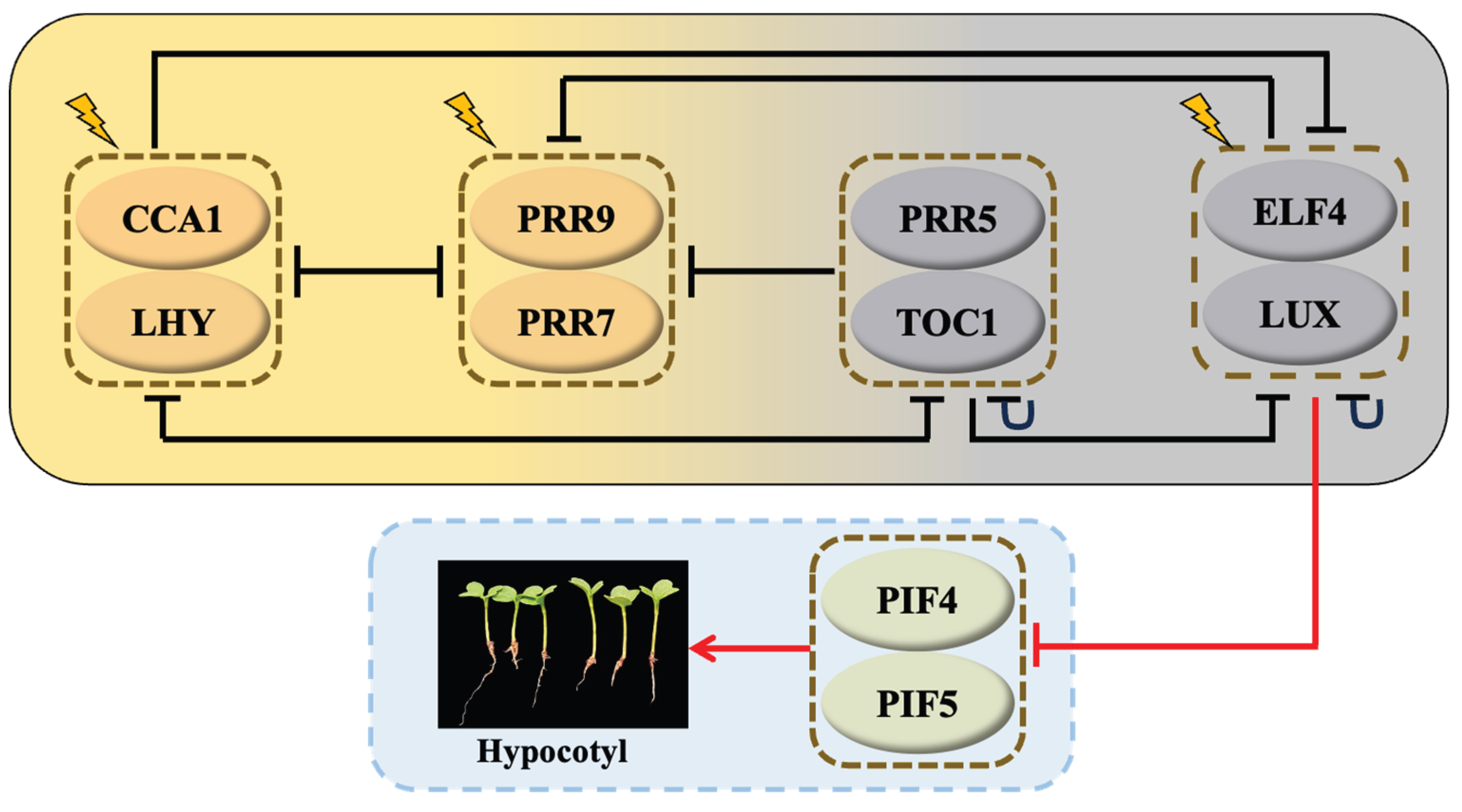
Figure 2.
Parameter sensitivity analysis. (A) Robustness analysis of the model concerning the period and phase of CL mRNA. (B) Robustness analysis of the model concerning the period and phase of P51 mRNA. (C) Sensitivity analysis of the model parameters.
Figure 2.
Parameter sensitivity analysis. (A) Robustness analysis of the model concerning the period and phase of CL mRNA. (B) Robustness analysis of the model concerning the period and phase of P51 mRNA. (C) Sensitivity analysis of the model parameters.
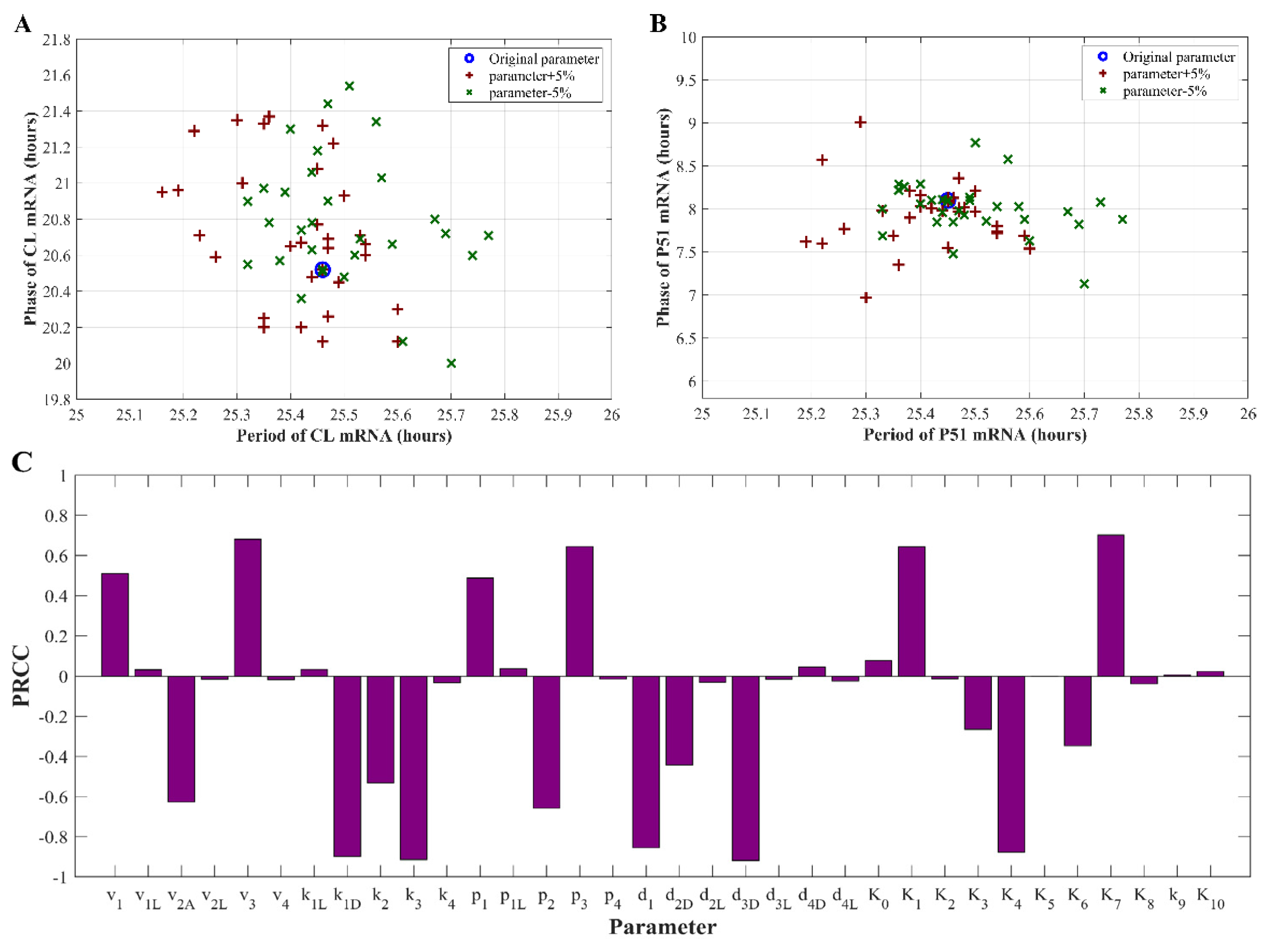
Figure 3.
Comparison between the original PIF-dependent growth model and the logistic-modified growth model under 8L:16D. (A) Hypocotyl length simulated by Eq. 12. (B) Hypocotyl length simulated by Eq. 13. Experimental data are from Ronald et al. [18].
Figure 3.
Comparison between the original PIF-dependent growth model and the logistic-modified growth model under 8L:16D. (A) Hypocotyl length simulated by Eq. 12. (B) Hypocotyl length simulated by Eq. 13. Experimental data are from Ronald et al. [18].
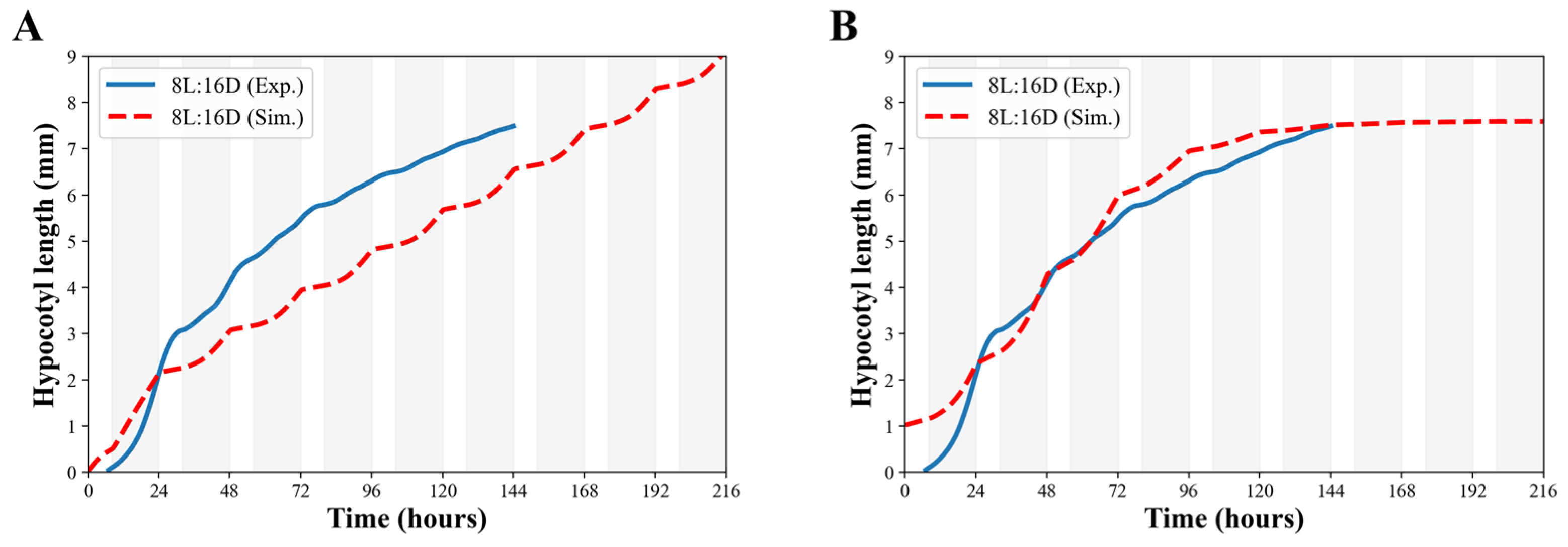
Figure 4.
Experimental and simulated hypocotyl lengths at 3, 5 and 7 DAG under different photoperiods. (A) 3 DAG. (B) 5 DAG. (C) 7 DAG. (D) Model prediction 10 DAG. Experimental data are from Niwa et al. [17] and are shown as mean ± standard deviation.
Figure 4.
Experimental and simulated hypocotyl lengths at 3, 5 and 7 DAG under different photoperiods. (A) 3 DAG. (B) 5 DAG. (C) 7 DAG. (D) Model prediction 10 DAG. Experimental data are from Niwa et al. [17] and are shown as mean ± standard deviation.
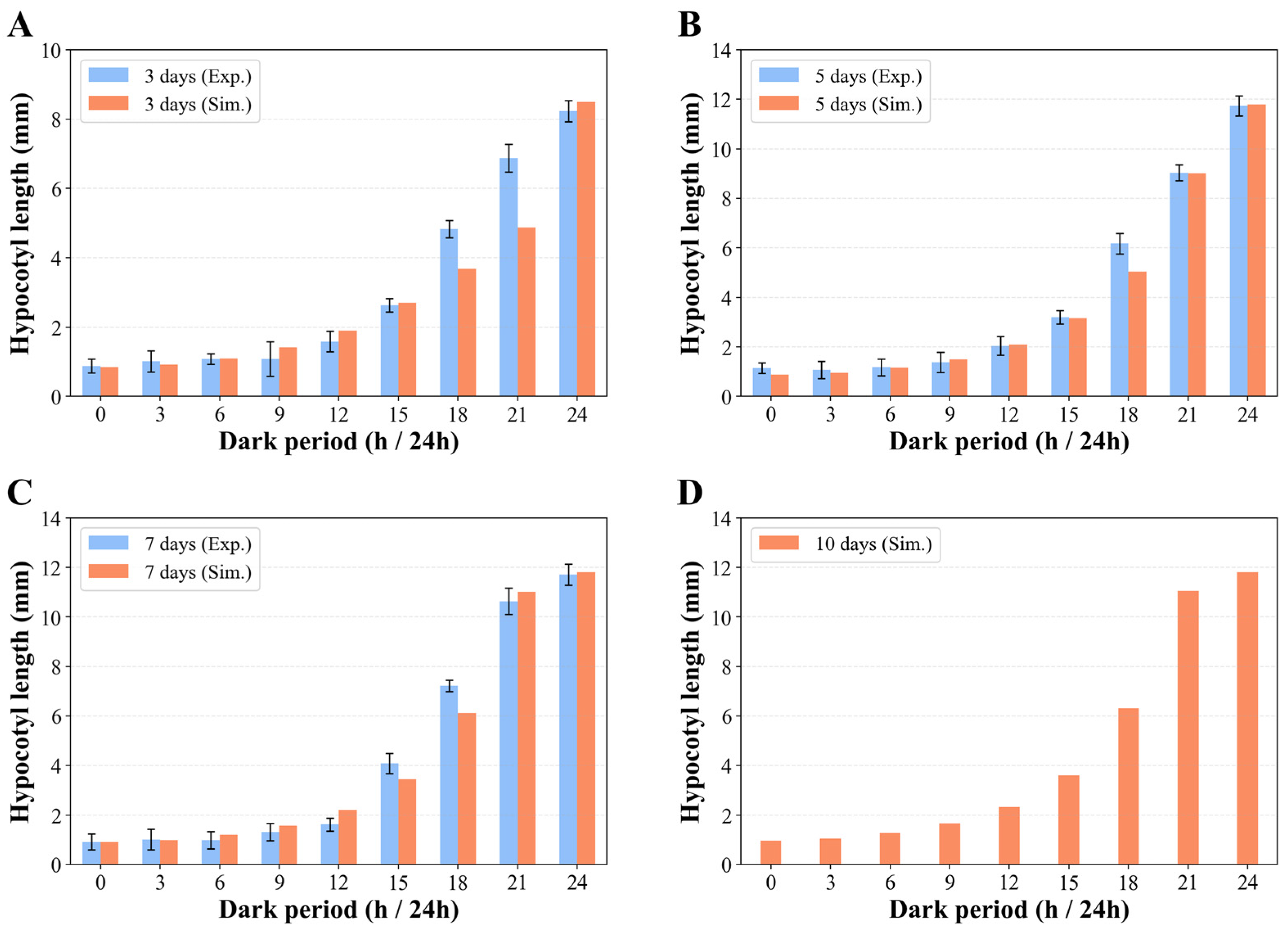
Figure 5.
Experimental and simulated hypocotyl elongation rates at different developmental stages under selected photoperiods. (A) 15L:9D. (B) 9L:15D. (C) 6L:18D. (D) DD. Experimental data are from Niwa et al. [17] and are shown as mean ± standard deviation.
Figure 5.
Experimental and simulated hypocotyl elongation rates at different developmental stages under selected photoperiods. (A) 15L:9D. (B) 9L:15D. (C) 6L:18D. (D) DD. Experimental data are from Niwa et al. [17] and are shown as mean ± standard deviation.
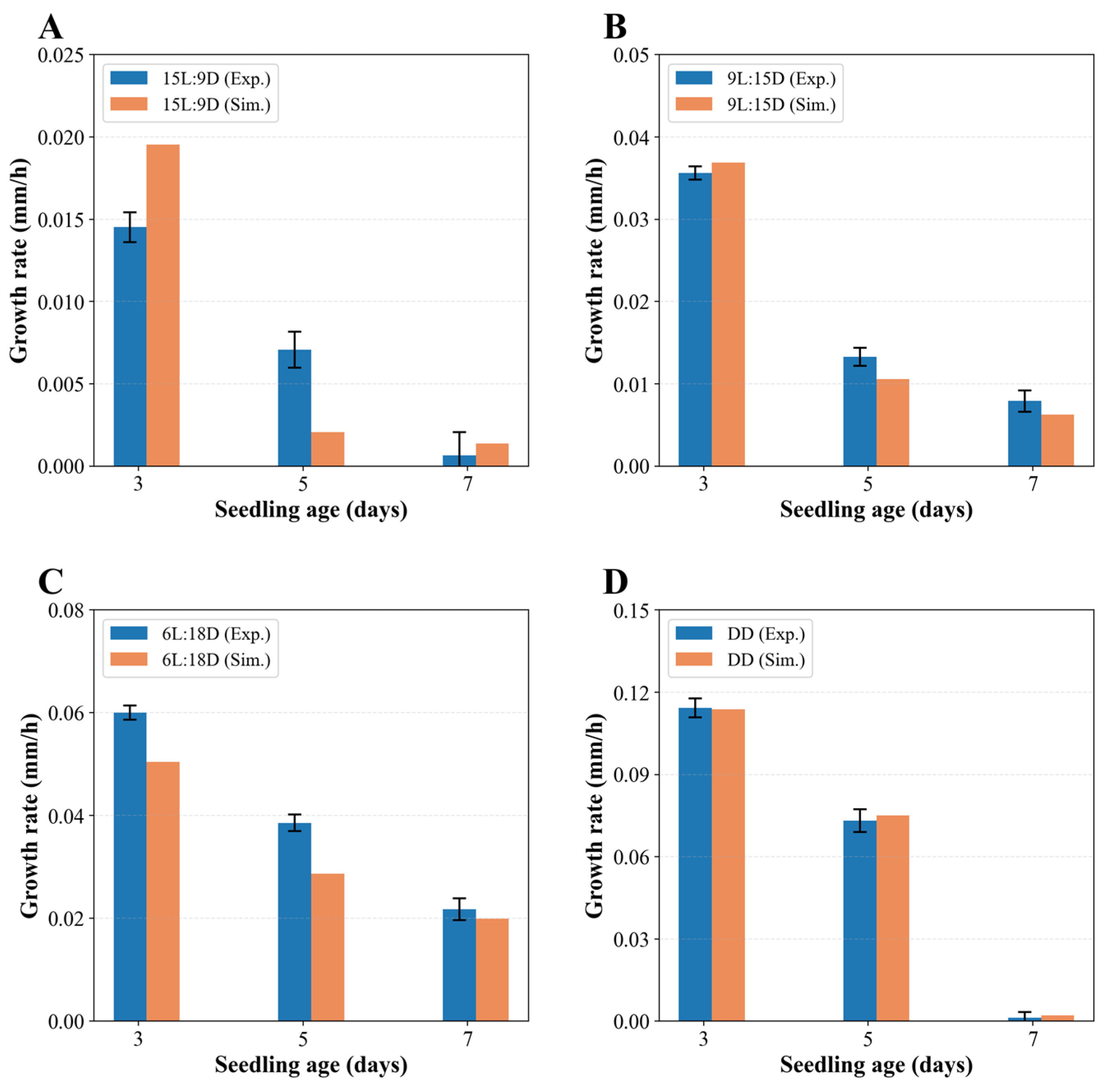
Figure 6.
Experimental and simulated hypocotyl lengths and elongation-rate rhythms under different photoperiods. (A, B) 8L:16D. (C, D) 12L:12D. Gray shaded areas indicate dark periods. Experimental data in (A, B) are from Ronald et al. [18], and data in (C, D) are from Won et al. [19].
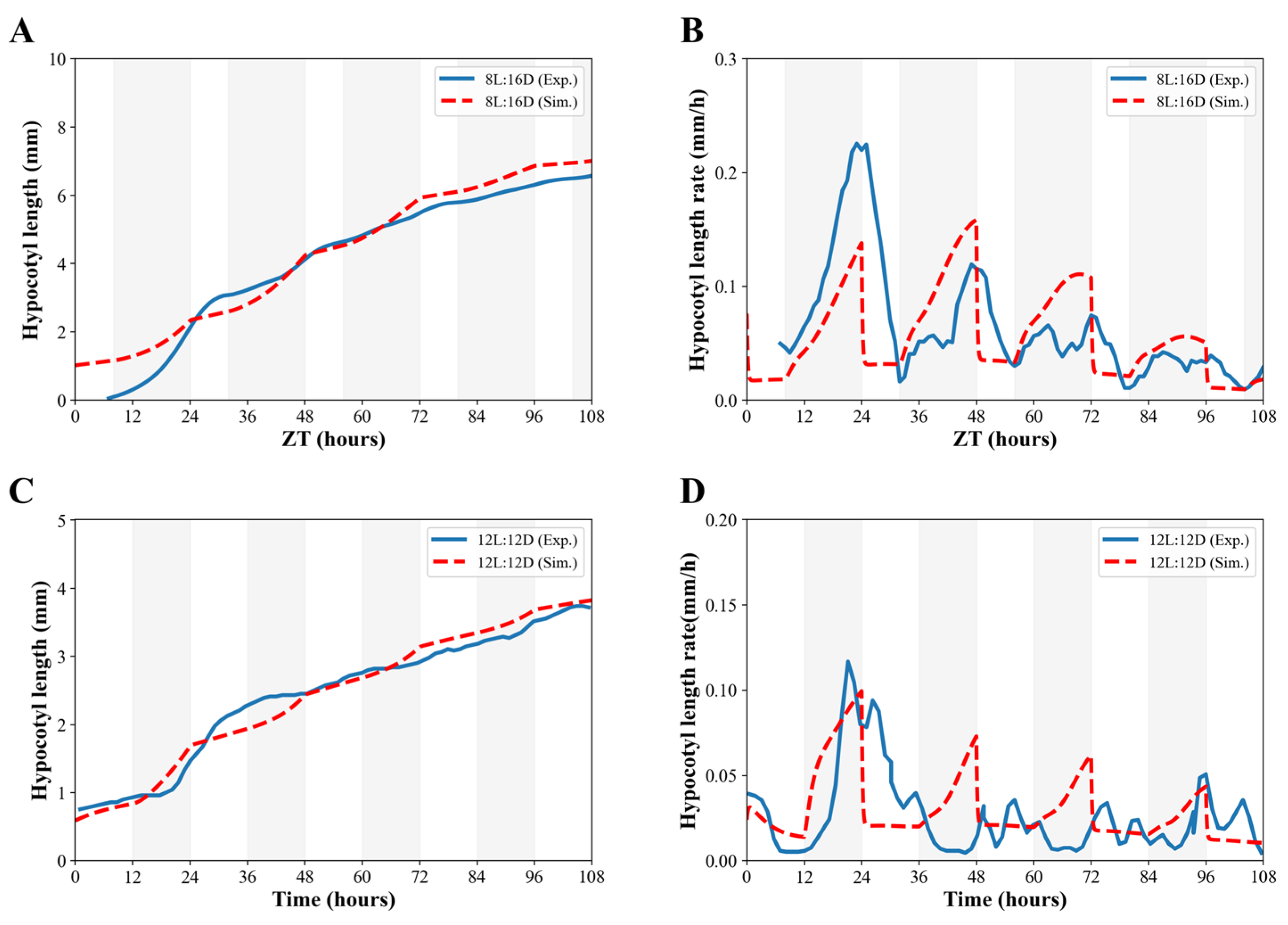
Figure 7.
Experimental and simulated hypocotyl lengths and elongation-rate rhythms in wild-type and elf3 mutant seedlings. (A, B) 8L:16D. (C, D) 12L:12D. Experimental data are from Ronald et al. [18].
Figure 7.
Experimental and simulated hypocotyl lengths and elongation-rate rhythms in wild-type and elf3 mutant seedlings. (A, B) 8L:16D. (C, D) 12L:12D. Experimental data are from Ronald et al. [18].
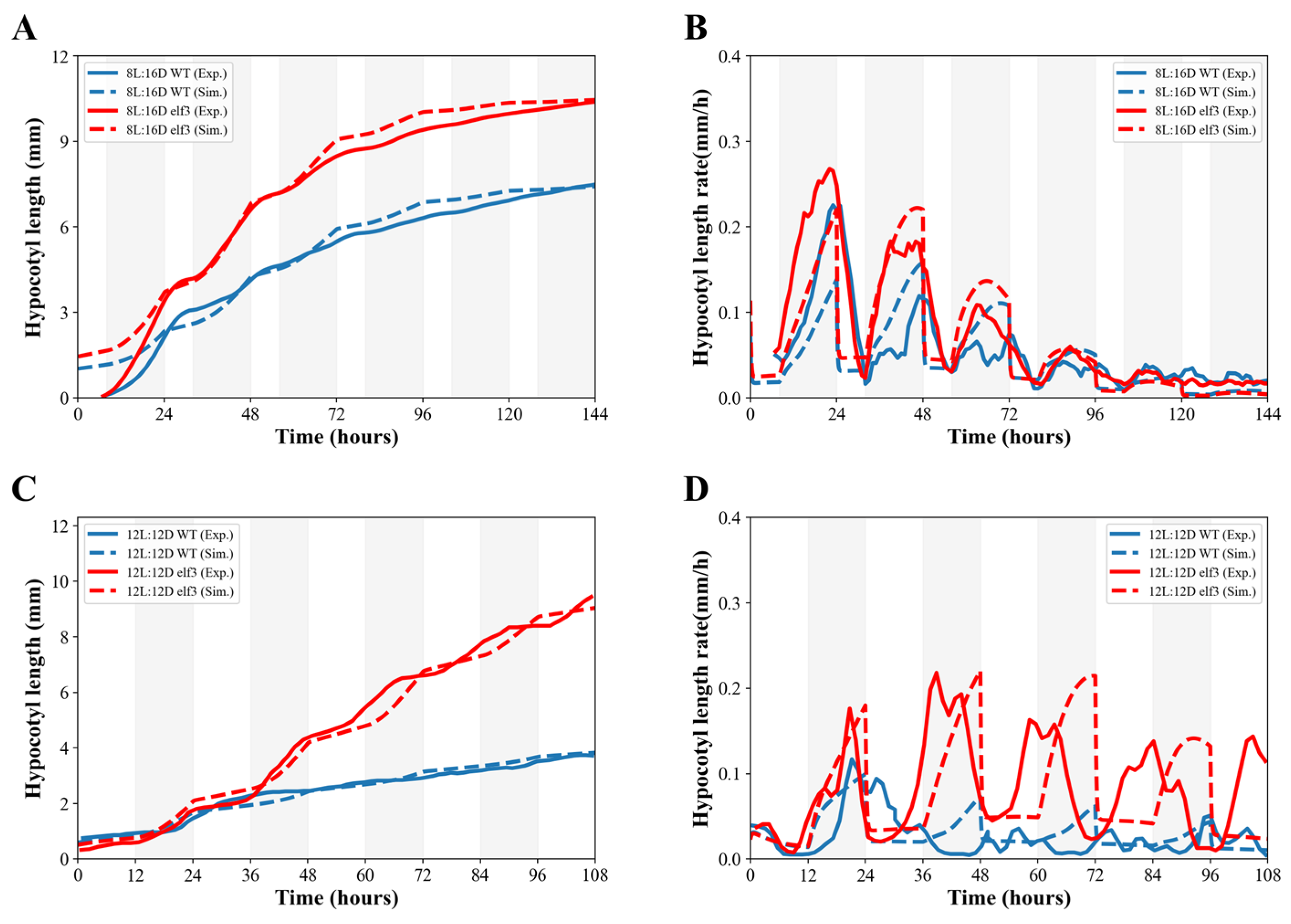
Figure 8.
Experimental and simulated hypocotyl lengths and elongation-rate rhythms in various clock gene mutants. (A, B) toc1 mutant. (C, D) toc1-elf3 double mutant. (E, F) prr5-toc1-elf3 triple mutant. Experimental data are from Ronald et al. [18].
Figure 8.
Experimental and simulated hypocotyl lengths and elongation-rate rhythms in various clock gene mutants. (A, B) toc1 mutant. (C, D) toc1-elf3 double mutant. (E, F) prr5-toc1-elf3 triple mutant. Experimental data are from Ronald et al. [18].
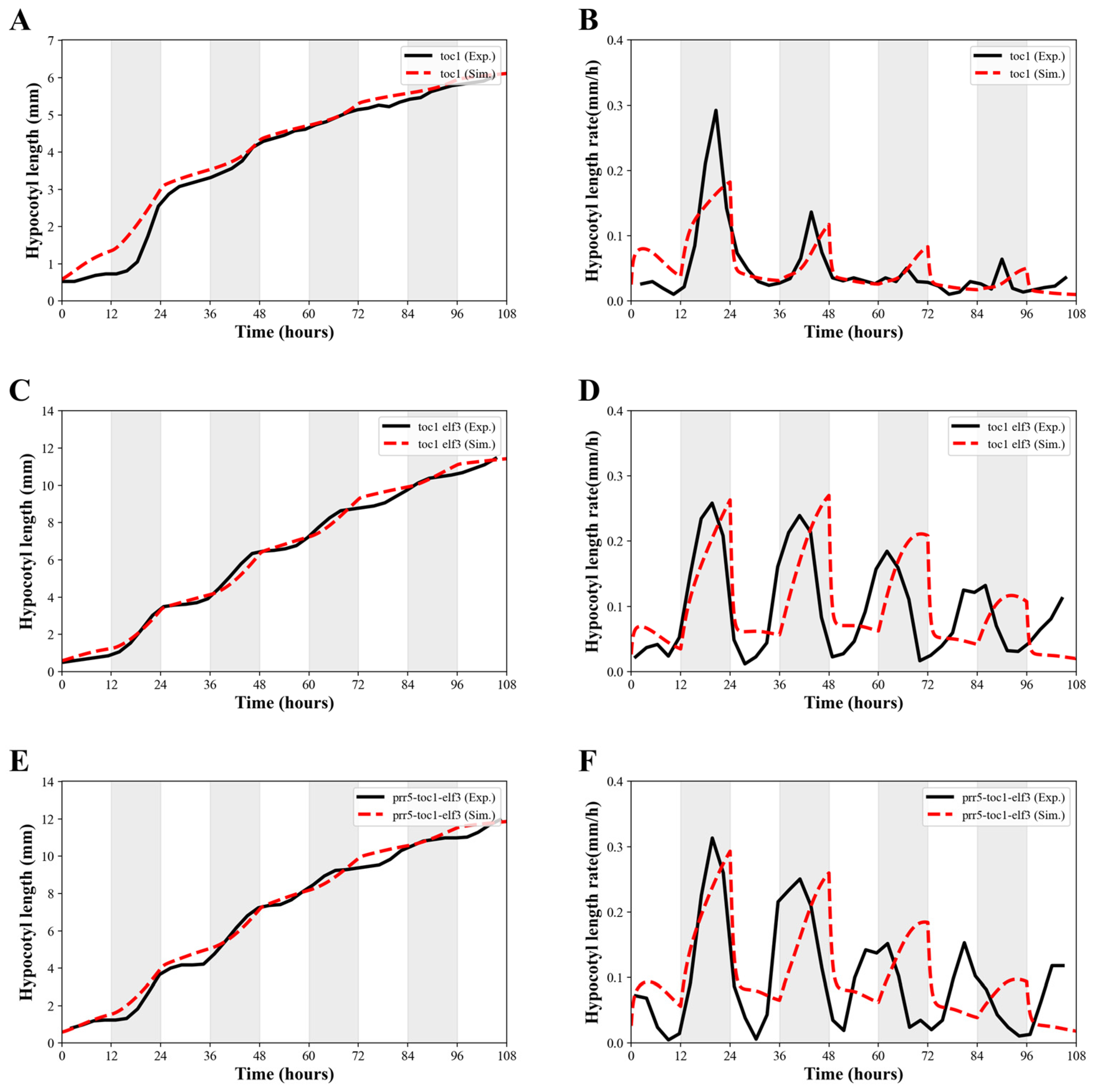
Figure 9.
Relationship between PIF protein accumulation and hypocotyl elongation rate under different photoperiods. (A) 9L:15D. (B) 6L:18D. (C) 3L:21D. (D) DD. Gray shaded areas indicate darkness.
Figure 9.
Relationship between PIF protein accumulation and hypocotyl elongation rate under different photoperiods. (A) 9L:15D. (B) 6L:18D. (C) 3L:21D. (D) DD. Gray shaded areas indicate darkness.
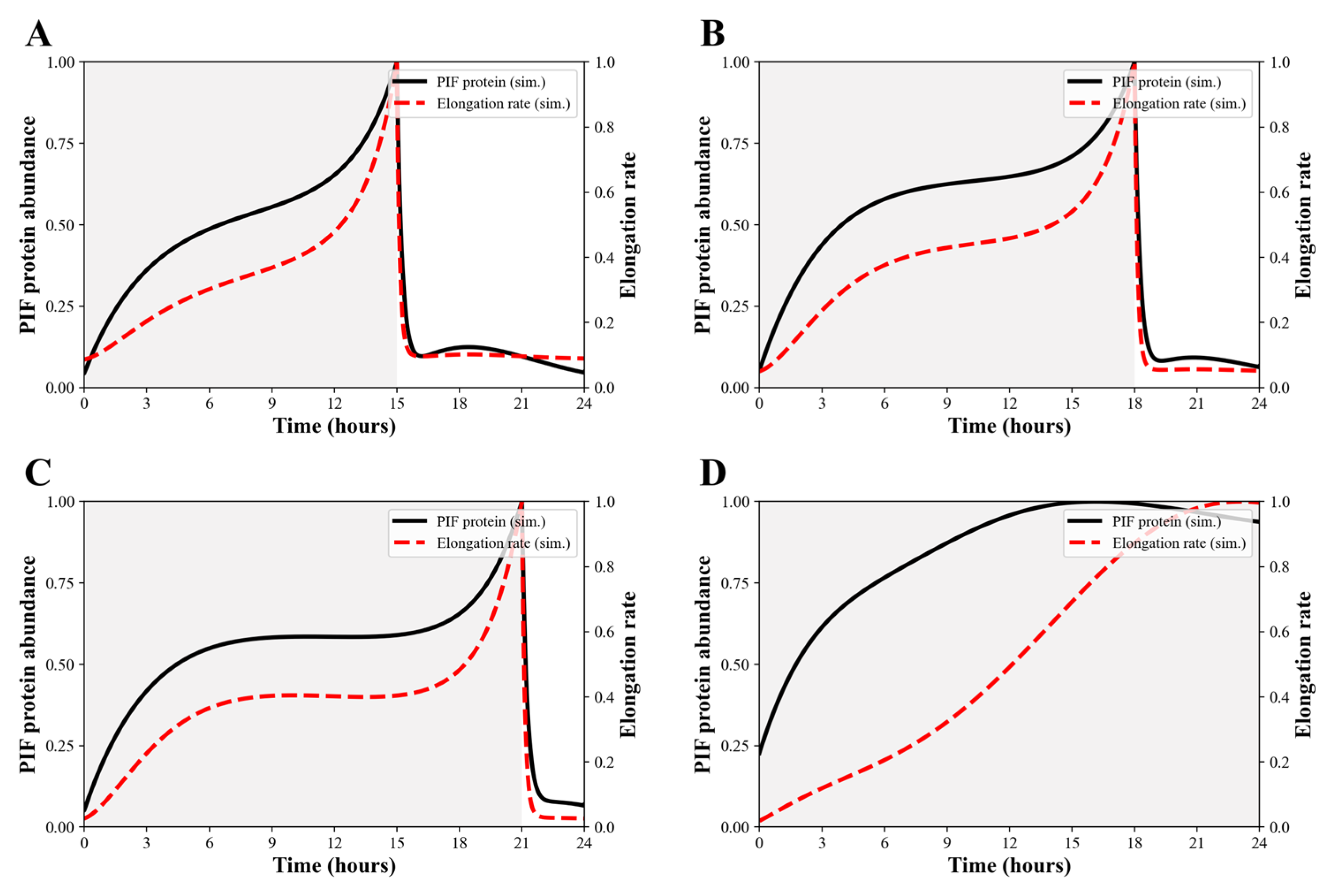
Figure 10.
Model predictions of hypocotyl elongation under 4 h photoperiodic perturbations. (A, B) Time to reach half-maximal hypocotyl length and simulated PIF protein abundance after 4 h light perturbations introduced at different times under 8L:16D. (C, D) Time to reach half-maximal hypocotyl length and simulated PIF protein accumulation after 4 h dark perturbations introduced at different times under 16L:8D. (E, F) Hypocotyl lengths and elongation-rate rhythms under selected perturbations. The green bar represents the 12L:12D control.
Figure 10.
Model predictions of hypocotyl elongation under 4 h photoperiodic perturbations. (A, B) Time to reach half-maximal hypocotyl length and simulated PIF protein abundance after 4 h light perturbations introduced at different times under 8L:16D. (C, D) Time to reach half-maximal hypocotyl length and simulated PIF protein accumulation after 4 h dark perturbations introduced at different times under 16L:8D. (E, F) Hypocotyl lengths and elongation-rate rhythms under selected perturbations. The green bar represents the 12L:12D control.
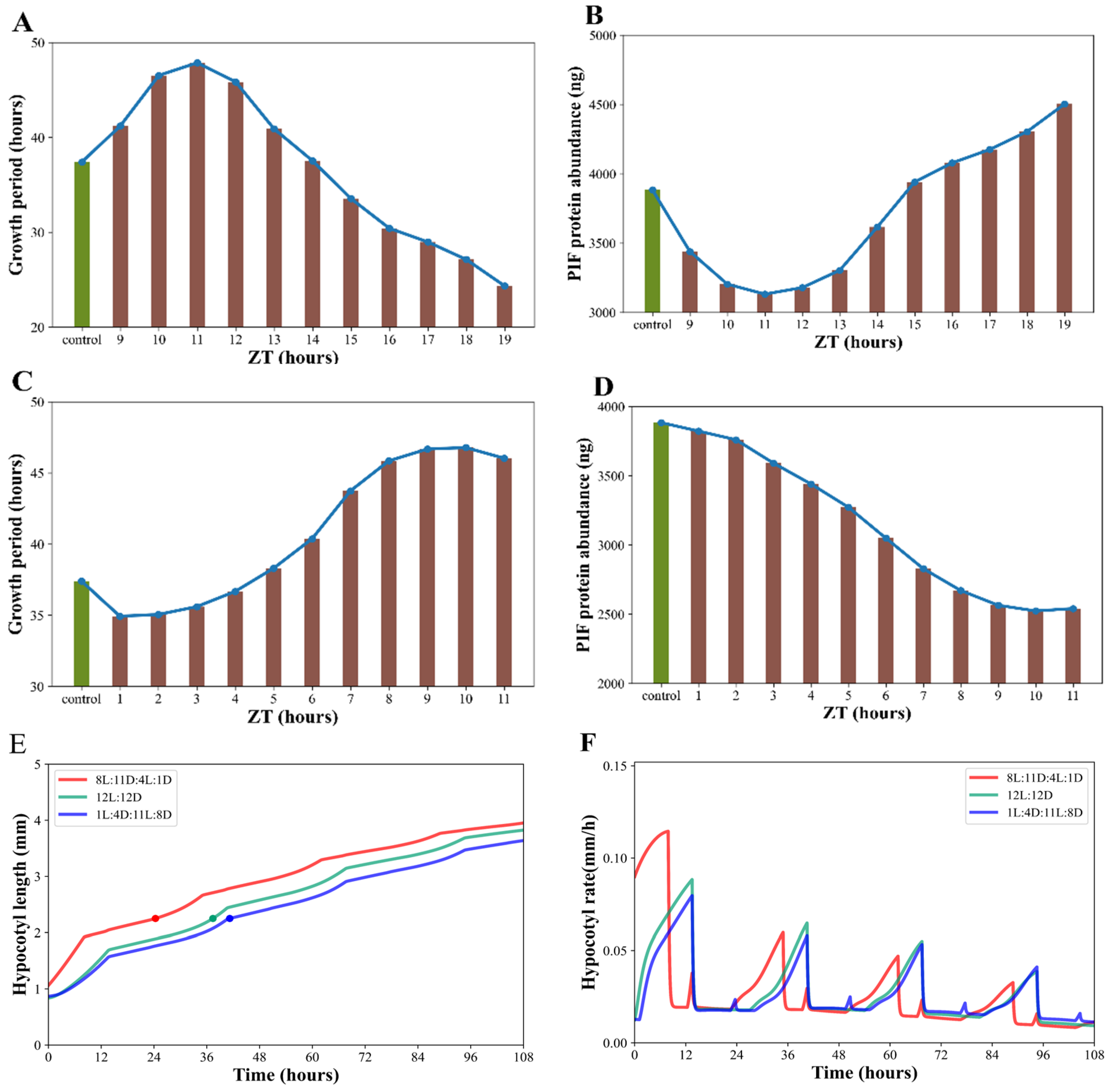
Figure 11.
Model predictions of hypocotyl elongation under non-24-h light-dark cycles. (A, B) Time required to reach half-maximal hypocotyl length Simulated PIF protein abundance under different light-dark cycles. (C, D) Hypocotyl lengths and elongation-rate rhythms under selected non-24-h cycles. The green bar represents the 12L:12D control.
Figure 11.
Model predictions of hypocotyl elongation under non-24-h light-dark cycles. (A, B) Time required to reach half-maximal hypocotyl length Simulated PIF protein abundance under different light-dark cycles. (C, D) Hypocotyl lengths and elongation-rate rhythms under selected non-24-h cycles. The green bar represents the 12L:12D control.
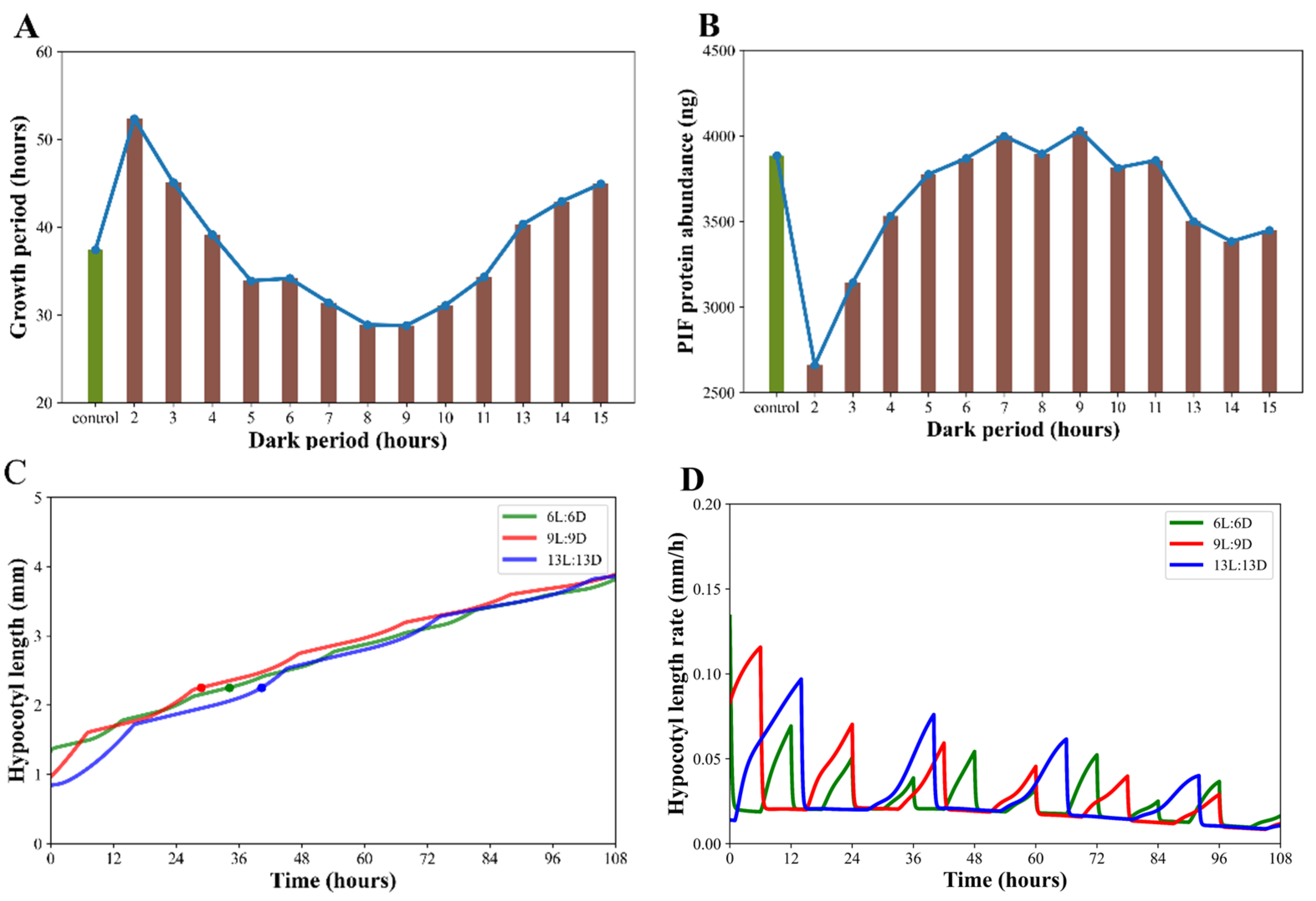
Figure 12.
Hopf bifurcation analysis of the circadian clock model. (A) Bifurcation with respect to . (B) Bifurcation with respect to . Solid and dashed curves represent stable and unstable steady states, respectively.
Figure 12.
Hopf bifurcation analysis of the circadian clock model. (A) Bifurcation with respect to . (B) Bifurcation with respect to . Solid and dashed curves represent stable and unstable steady states, respectively.
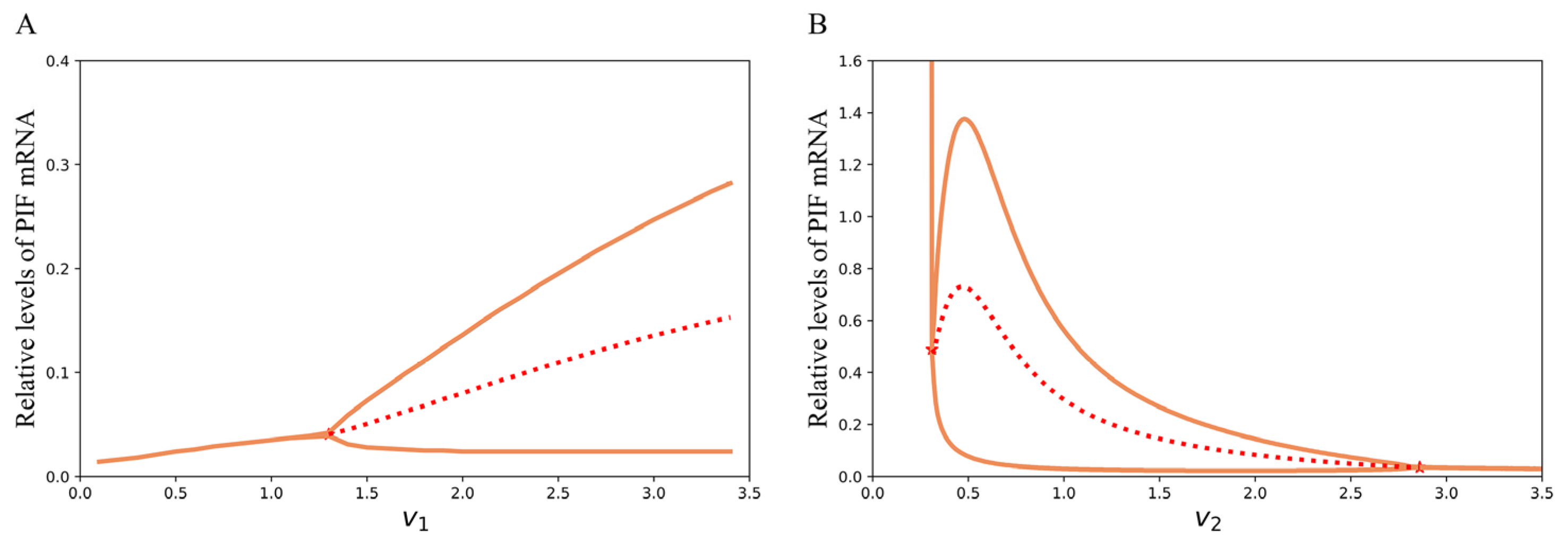
Figure 13.
Time-series simulations of PIF mRNA dynamics under different synthesis-rate parameters. (A, B) Relative levels of PIF mRNA for and , respectively. (C-E) Relative levels of PIF mRNA for , , and , respectively.
Figure 13.
Time-series simulations of PIF mRNA dynamics under different synthesis-rate parameters. (A, B) Relative levels of PIF mRNA for and , respectively. (C-E) Relative levels of PIF mRNA for , , and , respectively.
Disclaimer/Publisher’s Note: The statements, opinions and data contained in all publications are solely those of the individual author(s) and contributor(s) and not of MDPI and/or the editor(s). MDPI and/or the editor(s) disclaim responsibility for any injury to people or property resulting from any ideas, methods, instructions or products referred to in the content. |
© 2026 by the authors. Licensee MDPI, Basel, Switzerland. This article is an open access article distributed under the terms and conditions of the Creative Commons Attribution (CC BY) license (http://creativecommons.org/licenses/by/4.0/).
Copyright: This open access article is published under a Creative Commons CC BY 4.0 license, which permit the free download, distribution, and reuse, provided that the author and preprint are cited in any reuse.


