
Submitted:
10 June 2026
Posted:
12 June 2026
You are already at the latest version
Abstract
Background: Injury prevention in situational sports remains a major challenge due to the dynamic, unpredictable, and multifactorial nature of competitive environments. Existing injury-risk assessment approaches are predominantly based on reductionist and linear models that evaluate isolated predictors and may not adequately reflect complex interactions among multiple risk factors. Methods: A conceptual non-linear framework for individualized injury-risk assessment was developed based on the dynamics of the logistic (sigmoid) function. The proposed model conceptualizes the athlete as a complex open biomechanical system and integrates physiological, technical, psychological, anthropometric, historical, recovery-related, and situational factors into a composite risk index (Z), which is transformed into a bounded injury probability scale (Pinjury ∈ [0,1]). Results: The framework describes three structural phases of injury-risk progression: (1) a latent risk phase characterized by compensatory mechanisms, (2) a non-linear acceleration phase driven by synergistic interactions among risk factors, and (3) a critical saturation phase in which injury probability approaches its upper limit. The concept of a “safety window” is introduced as a practical tool for individualized monitoring and training-load management. The model provides a unified theoretical structure for integrating heterogeneous injury-related factors within a single probabilistic framework. Conclusions: The proposed framework offers a novel conceptual basis for individualized injury-risk assessment in situational sports and may support the development of future decision-support systems for injury prevention. Although empirical validation and sport-specific calibration are required, the model establishes a theoretical foundation for future research and practical applications in sports science and sports medicine.
Keywords:
injury prevention
; non-linear modeling
; situational sports
; logistic function
; complex adaptive systems
; fatigue
; training load management
; decision support systems
1. Introduction
Injury prevention in sports remains one of the core challenges in modern sports science and coaching practice, particularly in situational sports characterized by dynamic, unpredictable, and rapidly changing competitive environments (such as team games, combat sports, and sports involving the navigation of natural obstacles) [1,2,3]. Sports injuries can lead to temporary interruptions in the training process and competition participation, long-term functional impairments, or even the premature termination of an athletic career, underscoring the practical and scientific importance of effective injury prevention strategies [4,5,6].
In situational sports, the occurrence of an injury is rarely determined by a single factor; rather, it emerges from a complex interaction of physiological, technical, psychological, and anthropometric variables [7,8,9]. A substantial body of scientific literature has identified numerous factors associated with sports injury risk, including fatigue, previous injuries, overload, technical deficiencies, biomechanical asymmetry, insufficient recovery, and psychological stress [3,10,11,12,13]. However, most studies have traditionally focused on isolated predictors, whereas the occurrence of injuries in real-world sporting situations results from the combined interaction of multiple factors rather than the influence of any single variable.
Despite an extensive array of multidisciplinary research, traditional injury risk mitigation strategies demonstrate limited efficacy in situational sports [14,15,16]. This limitation stems from a methodological contradiction. For a long time, sports science has been dominated by a reductionist approach based on the linear modeling of risk factors [17,18,19]. Within this paradigm, an injury is viewed as a direct consequence of the isolated impact of individual variables (e.g., anatomical characteristics, localized strength deficits, or fatigue).
However, a living organism functioning under competitive stress represents a complex, open biomechanical system [3,6,7,9]. In sports, the relationship between internal factors (such as proprioception and joint stiffness) and external triggers (such as opponent actions or terrain architecture) is fundamentally non-linear [20,21,22,23]. The non-linear nature of how predictors influence injury risk is characteristic of each individual factor and, to an even greater extent, of their cumulative effect. The cumulative impact of these predictors intensifies the non-linear nature of their influence on injury risk. Consequently, traditional analysis overlooks the synergistic interaction of factors and the non-linearity of the link between predictors and injury risks [6,7,9,21].
Injury risk in situational sports develops as a non-linear systemic process rather than a simple linear effect of isolated variables. The interaction of fatigue, technical preparedness, psychological stress, anthropometric predisposition, and previous injury history can gradually accumulate within the athlete's functional system. Once a critical threshold is reached, compensatory mechanisms can become insufficient, leading to a rapid, non-linear acceleration in injury risk [20,22,24].
In coaching practice, injury prevention strategies are frequently based on standardized approaches, including warm-up protocols and neuromuscular preventive exercises, which have demonstrated positive effects in reducing injury rates [25,26,27,28]. However, such approaches may not fully account for the individualized and situational combinations of physiological, technical, psychological, and contextual risk factors that may interact differently within a specific athlete under competitive conditions [3,6,9,21]. This limitation is particularly pronounced in situational sports, where injury risk depends not only on the athlete's internal state but also on dynamic external circumstances. These include match intensity, contact load, decision-making pressure, unpredictable actions of opponents or teammates, environmental variability, and sport-specific situational demands [29,30,31,32]. Under these conditions, an injury can occur when situational demands exceed the athlete's adaptive, functional, technical, or psychological capacities.
An athlete may demonstrate high technical proficiency, excellent physical fitness, and an adequate capacity to maintain biomechanical stability under normal conditions, yet remain vulnerable to injury when adverse factors accumulate, such as excessive fatigue, insufficient recovery, psychological stress, elevated situational pressure, or unexpected biomechanical perturbations. Such combinations of factors may remain compensated up to a critical threshold, beyond which the risk of injury escalates non-linearly [7,9,21,22].
Despite the recognition of multifactorial injury mechanisms, relatively little attention has been paid to conceptual frameworks that integrate multidimensional physiological, technical, psychological, situational, and individual risk factors into a unified, individualized, non-linear injury risk architecture tailored for situational sports. Existing predictor-based studies frequently identify statistically significant associations but offer limited utility for real-time training management and decision-making in sports practice. In situational sports, injury occurrence depends not only on athlete-related factors but also on dynamic characteristics such as match intensity, contact load, decision pressure, and specific game-situational demands [22,33,34]. Existing models rarely integrate these domains into a single cohesive structure.
Thus, contemporary injury research has demonstrated that sports injuries are inherently multifactorial. However, authors frequently analyze individual risk factors in isolation rather than their complex interaction. Another challenge lies in the fact that sample-level findings do not allow for individualized risk assessment, even though injury risk depends heavily on the unique characteristics of individual athletes. Furthermore, situational sports involve dynamic interactions among athletes, which generates an increased risk of injury. Up to a certain point, as the values of an individual factor or the cumulative values of risk factors increase, adaptive systems successfully protect the athlete's body from injury. However, injury risk escalates non-linearly with an increase in both the isolated and cumulative effects of predictors, ultimately reaching a danger zone where the probability of injury becomes critically high.
In this regard, at the current stage of sports science development, there is a clear need for a conceptual non-linear model that views injury risk not as an isolated effect of individual predictors, but as an emergent, threshold-based process resulting from the dynamic interaction of multiple factors and their non-linear influence on injury risk. This concept could potentially serve as a structural framework for future individualized risk assessment systems and decision-support tools in sports practice. Therefore, a vital aspect of modern sports science is the development of a conceptual non-linear model of individual injury risk, in which a multitude of factors (e.g., fatigue, technical skills, psychological stress, previous injuries, and anthropometric characteristics) are integrated into a composite risk index.
The aim of this study was to develop a non-linear multifactorial model—a structural framework designed to serve as a theoretical foundation for future pilot studies, model calibration, and individualized injury risk assessment in applied sports practice.
2. Materials and Methods
2.1. Study Design
Given that this study is conceptual and methodological in nature, it did not involve human participants or experimental interventions. Instead, the research focused on constructing a theoretical framework based on published data. Unlike empirical studies that rely on direct data collection, participant observation, or experimental trials, the present study centered on theoretical model development and the structural integration of injury risk factors described in the scientific literature.
The conceptual design of the study was based on the premise that injury occurrence in situational sports is a multifactorial and dynamic process resulting from the interaction of physiological, technical, psychological, recovery-related, and situational factors, rather than the isolated effect of a single predictor. Therefore, a non-linear, system-oriented framework was adopted to develop the model.
The proposed model was constructed utilizing published data on sports injury risk factors, principles of complex systems theory, and mathematical approaches to non-linear probabilistic risk representation. The objective of this conceptual research was not to determine empirical coefficients within a specific sample of athletes, but rather to develop a structural framework capable of serving as a theoretical foundation for future pilot studies, model calibration, and individualized injury risk assessment in applied sports practice.
2.2. Theoretical Basis
The theoretical foundation of the proposed model is rooted in a systems approach to sports injury etiology, which views injury occurrence as an emergent outcome of dynamic interactions among multiple risk factors rather than the isolated impact of a single variable [3,9,20,35,36]. Within this framework, sports injuries are conceptualized as the result of multifactorial processes involving internal and external determinants that interact non-linearly under specific situational conditions.
The proposed model is also anchored in the concept of multifactorial injury risk, which recognizes that physiological, biomechanical, technical, psychological, and contextual factors collectively contribute to injury onset. The relative importance of these domains may vary depending on the individual athlete, the sport, and specific competitive situations [6,7,9].
To mathematically represent injury probability, the model employs a non-linear probabilistic transformation based on logistic modeling. This approach allows for the conversion of cumulative, multidimensional risk inputs into a bounded probability scale [20,21]. This approach reflects the assumption that injury probability remains relatively low under compensated conditions but can escalate rapidly when combinations of adverse factors exceed an individual's critical threshold.
Consequently, the proposed framework was defined as a conceptual non-linear model of individual injury risk, integrating complex systems logic, multifactorial injury etiology, and probabilistic non-linear transformations into a unified theoretical architecture for future individualized sports injury risk assessment.
2.3. Conceptual Factor Domains
The proposed model incorporates several conceptual domains of injury risk factors identified in the sports injury literature as potentially significant contributors to injury occurrence in situational sports.
Physiological Factors
This domain encompasses the athlete's functional states related to fatigue, neuromuscular readiness, recovery status, accumulated workload, and adaptive physiological capacity. These variables can influence the athlete's ability to maintain safe movement patterns under escalating situational demands [37,38,39,40].
Technical Factors
Technical determinants reflect sport-specific movement quality, motor control, biomechanical efficiency, landing mechanics, cutting techniques, and overall technical proficiency. These factors can alter the capacity to mitigate injury mechanisms under dynamic competitive conditions [18,41,42].
Psychological Factors
Psychological determinants include emotional stress, anxiety, decision-making pressure, attentional control, mental fatigue, confidence, and other psychological states that can alter neuromuscular regulation and behavioral responses in sport-specific situations [3,10,22].
Anthropometric (Individual) Factors
Anthropometric and individual factors comprise athlete-specific baseline data, including anthropometric characteristics, age, indicators of structural or functional body asymmetries, and related metrics [3,22,29]. This group of factors can either mitigate or exacerbate injury risk depending on the sport, individual athletic tasks, and contextual demands.
Injury History Factors
This indicator accounts for the presence of previous injuries and their respective severity. In the established literature, this group of factors typically increases the baseline risk of subsequent injury recurrence [44,45,46].
Situational (External) Factors
Situational determinants represent contextual external influences, such as match intensity, contact load, unpredictable opponent actions, environmental conditions, game-specific tactical demands, and other situational characteristics capable of altering injury risk exposure [1,2,35,36].
Recovery Factors
Recovery determinants consist of metrics that reflect the quality of recovery processes, which serve a protective function and reduce overall injury risk.
It was assumed that the relative contribution of each factor domain varies depending on the specific sport, athlete characteristics, and situational context, further justifying the necessity of individualized non-linear injury risk modeling.
2.4. Mathematical Formulation of the Model
The logistic function was selected to model injury risk because it is widely utilized to describe non-linear processes in biological and adaptive systems, which typically exhibit phases of relative stability, accelerated growth, and subsequent saturation. While logistic regression frequently appears in the literature to identify prominent injury risk factors, authors primarily apply this model as a static classification tool to isolate profiling variables. However, empirical findings vary significantly across studies depending on the sport, baseline athlete characteristics, input metrics, and environmental conditions. From our perspective, analyzing injury risk requires incorporating the dynamic aspects of the logistic function alongside the threshold states of the organism.
The mathematical structure of the proposed model is based on the assumption that the risk metric can be represented as the cumulative effect of several weighted factor domains contributing to an integrated risk factor index (Z).
where:
is the integrated risk factor index;
is the baseline risk level;
are the weight coefficients for individual risk factors;
are the values of the injury risk factors, representing the physiological, technical, psychological, situational, or individual characteristics of the athlete.
To transform the integrated risk factor index (Z) into a probability value bounded between 0 and 1, a non-linear logistic transformation was applied (formula 2):
where:
is the probability of injury occurrence;
e is the mathematical constant (Euler's number);
Z is the integrated risk factor index.
This non-linear transformation reflects the theoretical assumption that injury probability may increase gradually at lower levels of cumulative adverse exposure, followed by a threshold-based rapid acceleration when the combined effect of multiple risk factors exceeds the athlete's adaptive capacities.
In this conceptual study, the weight coefficients were not empirically estimated; rather, they were treated as structural elements of the proposed theoretical model intended for future calibration and validation in pilot and applied sports research.
3. Results
3.1. Proposed Non-Linear Injury-Risk Equation
As a result of the analytical work, a conceptual non-linear model of individual injury risk for athletes in situational sports was developed. Based on the logistic regression equation, the model employs a two-stage determination of injury risks (probabilities). In the first stage, the primary risk factor domains and their constituent predictors (factors) are identified. The standardized value of each factor is multiplied by a specific coefficient determined by the significance of that factor, and the resulting values are summed. This procedure yields the integrated injury risk index. Thus, we obtain a general conceptual formula for the integrated risk factor index, which is subsequently converted into an injury probability using the logistic function. These steps are detailed below.
The general conceptual formula for the integrated risk factor index is expressed as (formula 3):
where:
is the integrated risk factor index;
is the proxy value of each individual factor (fatigue, technique, psychological stress, recovery, anthropometric profile, previous injury, etc.). The positive or negative contribution of individual factors to the integrated risk index is determined by the corresponding weight coefficients ( );
is the constant coefficient specific to the sport;
is the weight coefficient specific to each factor.
Alternatively, grouped by factor domains (formula 4):
where:
is the integrated risk factor index;
is the proxy value of each individual factor (fatigue, technique, psychological stress, recovery, anthropometric profile, previous injury, etc.). The positive or negative contribution of individual factors to the integrated risk index is determined by the corresponding weight coefficients ( );
is the constant coefficient specific to the sport;
is the weight coefficient specific to each factor.
The formula for the non-linear transformation of the integrated risk index into the probability of sustaining an injury is expressed as (formula 5):
where:
is the probability of injury;
is the integrated risk factor index.
To facilitate the conceptual interpretation of the proposed non-linear relationship between the integrated risk factor index () and injury probability, the proposed model was graphically represented as an S-shaped logistic curve (Figure 1).
3.2. Graphical Representation
The conceptual non-linear model of individual injury risk is presented graphically as a logistic curve (Figure 1). As illustrated, the relationship between the cumulative value of risk factors () and injury risk is distinctly non-linear. Initially, at negative values of the composite index , the probability of injury increases slowly as rises, remaining relatively low (less than 0.10 or 10%). However, as the index approaches zero and moves into positive values—where the probability of injury approaches 0.50 (50%) and higher—the steepness of the curve increases sharply. This indicates that as the cumulative risk index escalates, it becomes increasingly difficult for the organism to compensate for the adverse effects of risk factors on the biomechanical stability of the system, thereby accelerating the rate of injury probability growth. Upon reaching near-maximal values of the cumulative risk index Z, the injury probability values approach their upper bound, and the rate of probability acceleration diminishes (Figure 1).
The graph demonstrates that while the Z index remains negative (e.g., –2 or –3), the probability of injury is low (< 10%). As soon as the Z index approaches 0, a state of "unstable equilibrium" is reached (50% risk). When the Z score corresponds to a probability above 50%, even a minimal external disturbance (a misstep, an opponent's push) at this precise point can instantly and substantially increase the probability of injury. The higher the injury probability value, the more cautious the coach and athlete must be. Depending on the predominant risk factors, individualized preventive strategies should be deployed.
Technical proficiency and the athlete's recovery status act as system stabilizers, holding the index within the negative zone even amidst rising fatigue. A decline in technical skill or excessive fatigue deprives the system of this protection, shifting it into a zone of critical threshold instability, where a random external trigger can significantly elevate the likelihood of injury.
When the probability of injury escalates, individualized decisions regarding workload reduction or substitution can be implemented. The minimum probability of injury is observed under conditions of optimal fitness, whereas a sharp increase in intensity (match stress) superimposed on diminished technical proficiency results in an exponential rise in the probability of adaptive failure and subsequent injury.
3.3. Conceptual Factor Domains
To enhance the practical interpretability of the proposed framework, representative conceptual factor domains and variable coding examples were synthesized.
The specific factor domains (or clusters) contributing to injury risk are detailed below (Table 1). The first domain (Physiological) encompasses fatigue metrics and related indicators, which primarily increase overall injury risk. The second domain (Technical) comprises indicators such as skill level, motor (athletic) qualification, and balance maintenance capabilities. This group of factors predominantly acts as a protective mechanism, serving to mitigate injury risks. The third domain is Psychological, containing variables such as emotional stress, anxiety, and decision-making pressure, which collectively elevate injury vulnerability.
The fourth domain represents Anthropometric and Individual characteristics of the athlete, including anthropometric profiles, age, and structural or functional body asymmetries. This group can either reduce or increase injury risk depending on the specific sport, athlete tasks, and related contextual demands. The fifth domain, Injury History, accounts for the presence of previous injuries and their respective severity, typically increasing the baseline risk of subsequent injury recurrence.
The sixth domain involves Situational Factors, which include contextual external metrics such as match intensity, contact load, competition stages, and specific tactical or strategic objectives. This cluster generally exacerbates overall injury risk exposure. Finally, the seventh domain, Recovery, consists of indicators that ensure the quality of recovery processes, thereby performing a protective function and minimizing injury probability.
3.4. Hypothetical Scenarios
Table 2 and Table 3 present representative examples of indicators utilized to measure the magnitude of injury risk factors. However, for integration into the composite risk index (Z), these indicator values must be standardized into arbitrary units across specific scales (e.g., from –5 to +5), where the lowest value represents the minimum risk profile ("best") and the highest value denotes the maximum risk exposure ("worst").
Examples of variables used to quantify the severity of specific risk domains include the following:
Fatigue can be quantified via the Rate of Perceived Exertion (Borg RPE scale, 0–10).
Technical proficiency can be coded using athletic rank or qualification levels.
Match intensity can be evaluated through heart rate metrics or tournament status indicators.
Even a minor alteration in a single factor (such as transitioning from a standard training session to a competitive match) under conditions of pre-existing fatigue can trigger a sharp, non-linear spike in injury probability (Figure 1). This mathematically explains why injuries frequently occur "suddenly" against a background of seemingly accustomed workloads.
3.5. Practical Application Scheme
For practical application, the logistic regression curve can be partitioned into distinct risk zones (Figure 1, Table 4). For instance, an integrated risk factor index (Z) below zero indicates a low risk of injury, reflecting the dominance of protective factors. Values of Z near or equal to zero characterize a moderate risk level, signaling a system in threshold equilibrium. Conversely, Z values greater than zero denote the dominance of variables that amplify injury probability. Highly positive Z values represent a critical state wherein the probability of an athlete sustaining an injury becomes exceedingly high (Table 4, Figure 1).
In summary, the proposed framework provides a conceptual integration of multidimensional physiological, technical, psychological, situational, and individual factors into a non-linear, individualized injury risk architecture specifically tailored for situational sports. Unlike traditional predictor-based regression studies, this model conceptualizes injury risk as a systemic, threshold-driven process emerging from dynamic factor interactions, thereby establishing a structural foundation for future research into individualized decision-support systems for sports training and competition management.
4. Discussion
4.1. Rationale for the Logistic Function in Injury Risk Modeling
The rationale for selecting the logistic function to model sports injury risk is deeply rooted in the operational characteristics of living adaptive systems. In biological organisms, changes in functional state under the influence of physical workload, fatigue, psychological stress, or other adverse factors rarely progress linearly [20,21]. Up to a certain threshold, the organism successfully compensates for negative impacts through homeostatic adaptation mechanisms, the preservation of neuromuscular coordination, load redistribution, and the mobilization of functional reserves. However, as adverse exposures accumulate, these compensatory mechanisms gradually become exhausted, causing the probability of adaptation failure to accelerate rapidly.
This dynamic aligns precisely with the properties of the logistic (S-shaped) curve, which characterizes systemic processes defined by an initial phase of relative stability, a subsequent phase of rapid non-linear acceleration, and a final asymptotic approach toward a saturation plateau [20,21,23,24]. In the context of sports traumatology, this implies that at low levels of cumulative risk factor exposure, injury probability remains relatively low because the athlete's functional systems retain their capacity for compensation. Conversely, once a specific threshold is breached, the synchronized convergence of fatigue, technical deficiencies, psychological distress, and insufficient recovery triggers an exponential escalation in injury probability.
This framework is consistent with contemporary paradigms viewing the athlete as a complex adaptive biomechanical system, where injury risk emerges not from an isolated predictor, but rather from the non-linear interaction of multiple internal and external determinants [3,6,7,9]. In contrast to traditional linear models [14,15], the logistic function effectively accounts for critical transition states, wherein a marginal incremental stressor can profoundly alter overall injury probability.
An additional mathematical justification for employing the logistic function is that injury probability represents a bounded metric restricted to a range between 0 and 1 [18,23,24]. The logistic transformation naturally maps the integrated risk index (Z) onto a probabilistic scale, enhancing model interpretability for practical applications in sports science and coaching workflows.
By mapping this biological pattern onto sports injury risks, the proposed logistic sigmoid explains the non-linear relationship between cumulative risk factor exposure and injury probability. As the volume and magnitude of injury risk factors accumulate, the system transitions through several critical thresholds, culminating in a phase of accelerated risk growth followed by a critical saturation zone where the rate of probability increase decelerates as it approaches its mathematical ceiling.
4.2. Methodological Novelty and Distinctive Dimensions
Consequently, a conceptual non-linear individual injury risk model based on the logistic function is established. Although logistic regression is widely utilized within sports science and medicine, it is conventionally treated as a "static classification tool" deployed retrospectively (i.e., analyzing "injury occurred vs. did not occur") to isolate the statistical weight of specific independent variables. The model proposed herein shifts the paradigm from static classification to the dynamic interaction of factors, distinguishing itself from existing approaches in three primary dimensions:
Shift from Additive (Linear) to Cumulative-Synergistic Risk Assessment: The majority of existing frameworks evaluate risk factors in isolation or calculate them via linear summation (e.g., scoring matrices where "sleep deprivation equals 2 points, hard playing surface equals 3 points"). The proposed model demonstrates that risk factors interact and manifest non-linearly. During Phase 1, factors accumulate latently and remain compensated by the organism. However, crossing the First Critical Threshold triggers a non-linear, synergistic amplification of risk variables. The core novelty of this study lies in the theoretical formalization of this accelerated, non-linear risk expansion.
Focus on Critical Inflection Points as Operational Variables for Training Management: While traditional epidemiological research concludes with static observations (e.g., "workload volumes exceeding N hours elevate injury risk"), the proposed framework isolates and mathematically rationalizes the boundaries of adaptation zones via the critical threshold points of the sigmoid curve. Identifying the inflection point—where the rate of risk acceleration reaches its mathematical maximum—establishes a conceptual foundation for proactive control, enabling sports practitioners to intervene before the risk reaches near-certain probability.
Characterization of the "Critical Saturation" Phenomenon (Phase 3): Standard risk paradigms assume an indefinite, infinite escalation of injury probability proportional to risk factor exposure. Conversely, the proposed model identifies an upper plateau phase, signifying that the biological system has entered a state of critically high injury vulnerability. At this advanced stage, the specific nature of the final external trigger (e.g., a minor misstep or an opponent's push) becomes irrelevant, as the probability of adaptation breakdown has already reached critical saturation. This paradigm shifts the preventive philosophy: at this juncture, conventional load-reduction protocols become ineffective, necessitating immediate, substantial restriction or temporary cessation of training exposure.
4.3. Structural Phases of Non-Linear Risk Growth
Applying the logistic sigmoid function to analyze sports injury risk and physical therapy pathways is justified from both biological and mathematical standpoints. Traditional biomechanical and sports medicine frameworks frequently conceptualize injury risk linearly (e.g., "a 10% increase in workload equates to a 10% increase in risk"). In applied practice, however, a living organism successfully neutralizes stresses up to a critical tipping point, beyond which an abrupt breakdown of adaptation occurs.
When operationalized via the critical parameters of the logistic curve, the proposed non-linear injury risk model can be structurally partitioned into three distinct phases (Figure 1):
Latent Risk Phase (Initial Lower Plateau): At this stage, adverse variables (e.g., micro-fatigue, minor sleep disturbances, sub-clinical dehydration, subtle technical errors) accumulate latently. Injury probability increases at a minimal rate due to the robust compensatory capacity of the organism. As cumulative exposure intensifies, the system converges toward the first critical point—the compensation threshold—beyond which adaptive stability begins to decay.
Non-Linear Risk Acceleration Phase (Steep Ascending Segment): Once the compensation threshold is breached, a rapid, non-linear escalation in injury probability is observed, driven by the mutual, synergistic amplification of risk variables. During this phase, the system progressively loses stability, and the inflection point of the logistic curve marks the maximum velocity of injury risk acceleration.
Critical Risk Saturation Phase (Upper Asymptotic Plateau): With the continued accumulation of uncompensated adverse factors, injury probability approaches its maximum value and exits onto a plateau. This state is characterized by critically high system vulnerability resulting from severe exhaustion of compensatory mechanisms and compromised neuromuscular stability. The deceleration of curve growth in this phase is governed by the mathematical constraint of probability values bounded between 0 and 1.
Thus, in our work, a theoretical framework detailing the non-linear accumulation of sports injury risks has been developed based on the dynamics of the S-shaped logistic function. The proposed model characterizes the system's transition from a compensated state to a phase of accelerated non-linear risk expansion through critical threshold states of adaptation. Furthermore, the model formalizes the phenomenon of "critical risk saturation," wherein injury probability plateaus at a critically high level, rendering the specific characteristics of the final external trigger irrelevant.
The model achieves a conceptual integration of multidimensional physiological, technical, psychological, situational, and individual risk factors into a non-linear, individualized injury risk architecture for situational sports. In contrast to traditional predictor-based linear regression analyses, this framework treats injury risk as an emergent, threshold-driven system process resulting from dynamic factor interactions, thereby establishing a structural blueprint for future research into individualized decision-support systems for athletic training and competition management.
4.4. Practical Implications
The practical value of representing injury risk dynamics via a logistic curve is directly tied to the predictive utility of logistic modeling. By utilizing mathematical modeling, sports scientists can calculate specific weight coefficients for multidimensional variables (e.g., acute-to-chronic workload ratios, Karolinska Sleep Index scores, heart rate variability metrics) to determine precisely which phase of the risk curve an athlete occupies on a given day.
Furthermore, the practical utility of the logistic risk model lies in its ability to define a clear "Safety Window." The "safety window" concept can serve as a functional decision-support tool in contemporary training management. The proposed model provides a scientific rationale for determining the boundaries within which the training process remains safe (Phase 1), enabling timely detection of transitions into the high-acceleration zone (Phase 2), and preventing entry into the critical saturation zone (Phase 3), where injury prevention via standard training modifications is no longer viable.
4.5. Future Research Directions
This conceptual framework establishes a rigorous methodological foundation for interdisciplinary research linking mathematical modeling, psychophysiological monitoring, and sports biomechanics.
Future investigative pathways should focus on executing pilot validation studies, calibrating weight coefficients to accommodate sport-specific demands, integrating wearable monitoring technology for real-time data streaming, conducting longitudinal injury tracking, and developing automated risk-monitoring architectures driven by artificial intelligence (AI) algorithms.
4.6. Limitations
The primary limitation of the proposed model is the absence of empirically determined coefficient values. Calculating exact coefficients is impossible without empirical experimental trials, as sport-specific demands, athlete qualification levels, and even environmental or climatic conditions significantly alter individual threshold boundaries. Relying exclusively on existing literature fails to yield an exact predictive model because published data remain highly fragmented and contingent upon the specific sports disciplines, experimental environments, data processing techniques, and research strategies selected by individual authors. Therefore, the proposed model remains conceptual in nature and requires systematic empirical validation.
5. Conclusions
1. A novel theoretical framework conceptualizing the non-linear accumulation of sports injury risks has been established based on the mathematical and biological dynamics of the S-shaped logistic function. Moving away from traditional additive and linear risk paradigms, this model systematically formalizes the complex transition of the athlete's organism from a fully compensated functional state to a phase of accelerated, synergistic risk expansion. This transition is governed by critical threshold states of adaptation, providing a new systemic perspective on sports traumatology.
2. The study formalizes and describes the phenomenon of «critical risk saturation» (Phase 3), demonstrating that at an advanced stage of cumulative uncompensated stress, the biological system reaches an asymptotic ceiling of vulnerability. At this juncture, individual risk mitigation protocols become ineffective, and the characteristics of the final external trigger become secondary, shifting the focus of sports medicine from isolated hazard prevention to comprehensive systemic stabilization.
3. The proposed framework achieves a rigorous methodological integration of multidimensional risk domains—encompassing physiological, technical, psychological, individual anthropometric, injury history, situational, and recovery factors—into a unified, individualized architecture tailored for situational sports. By isolating the mathematical inflection point where the velocity of risk acceleration is maximized, this framework introduces the operational concept of a «Safety Window.» This provides a definitive theoretical blueprint for the design of next-generation, AI-driven decision-support systems and proactive, real-time workload monitoring in applied sports training and competition management.
Funding
The research was funded by the Provincial Secretariat for Higher Education and Scientific Research (Grant No. 003878792 2025 09418 003 000 000 001).
Conflicts of Interest
The authors declare no conflicts of interest.
References
- Hidayat, R.A.; Sumaryanti, S.; Nugroho, S.; Ihsan, F. Injury prevention and rehabilitation in badminton: an evidence-based approach to player wellbeing - a systematic review. Health Sport Rehabil. 2025, 11(4), 79–99. [Google Scholar] [CrossRef]
- Arboix-Alió, J.; Aguilera-Castells, J.; Buscà, B.; Miró, A.; Hileno, R.; Trabal, G.; Peña, J. Situational variables in elite rink hockey: effect of match location, team level, scoring first and match status at halftime on the competitive outcome. Int. J. Perform. Anal. Sport 2021, 21(6), 1101–1116. [Google Scholar] [CrossRef]
- Kozin, S.; Cretu, M.; Kozina, Z.; Boychuk, Y.; Pavlovic, R.; Korobeinik, V.; Batyuk, L. Pedagogical and biomechanical aspects of injury prevention in sports with changing circumstances and coach training: a systematic review with bibliometric analysis. Health Sport Rehabil. 2026, 12(1), 128–150. [Google Scholar] [CrossRef]
- Fazackerley, L.; Hickey, J.; Johnston, R.; Tofari, P.; Timmins, R.; Roelands, B.; Russell, S. Practitioner Perspectives on the Association Between Mental Fatigue and Injury Risk in High-Performance Sport: A Mixed Methods Study. Eur. J. Sport Sci. 2025, 25(8), ejsc.70028. [Google Scholar] [CrossRef]
- Prayudho, S.; Nasrulloh, A.; Skaliy, A. Risk factor of pickleball injury: systematic review and meta-analysis. Health Sport Rehabil. 2024, 10(3), 115–124. [Google Scholar] [CrossRef]
- Lundgren, L.; Tran, T.; Nimphius, S.; Raymond, E.; Secomb, J.; Farley, O.; Sheppard, J. Development and Evaluation of a Simple, Multifactorial Model Based on Landing Performance to Indicate Injury Risk in Surfing Athletes. Int. J. Sports Physiol. Perform. 2015, 10(8), 1029–1035. [Google Scholar] [CrossRef]
- Lahti, J.; Mendiguchia, J.; Ahtiainen, J.; Anula, L.; Kononen, T.; Kujala, M.; Morin, J. Multifactorial individualised programme for hamstring muscle injury risk reduction in professional football: protocol for a prospective cohort study. BMJ Open Sport Exerc. Med. 2020, 6(1), bmjsem-2020-000758. [Google Scholar] [CrossRef]
- Edouard, P.; Lahti, J.; Fleres, L.; Ahtiainen, J.; Ulvila, J.; Lehtinen, T.; Mendiguchia, J. A musculoskeletal multifactorial individualised programme for hamstring muscle injury risk reduction in professional football: results of a prospective cohort study. BMJ Open Sport Exerc. Med. 2024, 10(1), bmjsem-2023-001866. [Google Scholar] [CrossRef]
- Eckart, A.; Ghimire, P.; Stavitz, J. Predictive Validity of Multifactorial Injury Risk Models and Associated Clinical Measures in the U.S. Population. Sports 2024, 12(5), 123. [Google Scholar] [CrossRef] [PubMed]
- Neledva, I.; Yachsie, B.T.P.W.B. Correlation between Psychophysical Indicators and Motor Skills of 15-16-Year-Old Football Players: Review article. Health Technol. 2024, 2(4), 17–27. [Google Scholar] [CrossRef]
- Suhadaq, T.A.; Sugiyanto, S.; Nugroho, H.; Riyadi, S. The effect of the interaction between the exercise method and the level of ankle sprain injury in athletes on ankle stability. Health Technol. 2024, 2(1), 24–34. [Google Scholar] [CrossRef]
- Khasanah, F.N.S.; Sugiyanto, S.; Riyadi, S. Prone plank test base core muscle strength contribution to anticipate the risk of ankle injury for soccer player. Health Technol. 2023, 1(3), 46–53. [Google Scholar] [CrossRef]
- Kozin, S.; Kozina, Z.; Korobeinik, V.; Cieślicka, M.; Radosław, M.; Ryepko, O.; Boychuk, Y.; Evtifieva, I.; Bejtka, M. Neuro-muscular training for injury prevention of students-rock climbers studying in the specialty "physical education and sports": A randomized study. J. Phys. Educ. Sport 2021, 21, 1251–1259. [Google Scholar] [CrossRef]
- Milic, V.; Radenkovic, O.; Capric, I.; Mekic, R.; Trajkovic, N.; Spirtovic, O.; Kahrovic, I. Sports Injuries in Basketball, Handball, and Volleyball Players: Systematic Review. Life 2025, 15(4), 529. [Google Scholar] [CrossRef] [PubMed]
- Schampheleer, E.; Roelands, B. Mental Fatigue in Sport-From Impaired Performance to Increased Injury Risk. Int. J. Sports Physiol. Perform. 2024, 19(10), 1158–1166. [Google Scholar] [CrossRef]
- Shitara, H.; Kobayashi, T.; Yamamoto, A.; Shimoyama, D.; Ichinose, T.; Tajika, T.; Osawa, T.; Iizuka, H.; Takagishi, K. Prospective multifactorial analysis of preseason risk factors for shoulder and elbow injuries in high school baseball pitchers. Knee Surg. Sports Traumatol. Arthrosc. 2017, 25(10), 3303–3310. [Google Scholar] [CrossRef] [PubMed]
- Perera, J.; Miller, M.; Danahy, P. Case Report Demonstrating Multifactorial Risks of Anterior Cruciate Ligament Re-tear Injuries and Appropriate Response Among Those With High Chance of Recurrence. Cureus 2022, 14(5), e24965. [Google Scholar] [CrossRef]
- Zhan, X.H.; Li, Y.H.; Liu, Y.Z.; Domel, A.G.; Alizadeh, H.V.; Zhou, Z.; et al. Predictive Factors of Kinematics in Traumatic Brain Injury from Head Impacts Based on Statistical Interpretation. Ann. Biomed. Eng. 2021, 49(10), 2901–2913. [Google Scholar] [CrossRef]
- Audini, V.A.; Doewes, M.; Sabarini, S.S.; Riyadi, S. Effect of training methods and body mass index on ankle injury in futsal players. Health Technol. 2023, 1(3), 38–45. [Google Scholar] [CrossRef]
- Yuan, J.; Zeng, Q.; Wang, A.; Zhang, Y.; Li, J. Machine Learning Applications in Non-Contact Lower Limb Sports Injury Prediction: A Systematic Review. J. Sports Sci. Med. 2026, 25(1), 172–194. [Google Scholar] [CrossRef]
- Buldú, J.; Gómez, M.; Herrera-Diestra, J.; Martínez, J. Editorial: Nonlinear dynamics and networks in sports. Chaos Solitons Fractals 2021, 142*, 110518. [Google Scholar] [CrossRef]
- Oosterhoff, J.H.F.; Gouttebarge, V.; Moen, M.; Staal, J.B.; Kerkhoffs, G.M.M.J.; Tol, J.L.; Pluim, B.M. Risk factors for musculoskeletal injuries in elite junior tennis players: a systematic review. J. Sports Sci. 2019, 37(2), 131–137. [Google Scholar] [CrossRef] [PubMed]
- Colby, M.J.; Dawson, B.; Peeling, P.; Heasman, J.; Rogalski, B.; Drew, M.K.; et al. Multivariate modelling of subjective and objective monitoring data improve the detection of non-contact injury risk in elite Australian footballers. J. Sci. Med. Sport 2017, 20(12), 1068–1074. [Google Scholar] [CrossRef] [PubMed]
- Lu, Y.; Eilen, H.; Pareek, A.; Varano, M.; Wilbur, R.; Lavoie-Gagné, O.; Krych, A.J.; Camp, C.L.; Okoroha, K.; Forsythe, B. Comparisons of machine learning models to logistic regression in orthopedic sports medicine are confounded by methodological heterogeneity: a systematic review and meta-analysis. J. ISAKOS 2026, 17, 1–11. [Google Scholar] [CrossRef]
- Wang, J.; Ying, Y.; Lu, B.; et al. Injury risk reduction programs including balance training reduce the incidence of anterior cruciate ligament injuries in soccer players: A systematic review and meta-analysis. J. Orthop. Surg. Res. 2025, 20(1), 56. [Google Scholar] [CrossRef]
- Olivares-Jabalera, J.; Filter-Ruger, A.; Dos’Santos, T.; et al. Exercise-based training strategies to reduce the incidence or mitigate the risk factors of anterior cruciate ligament injury in adult football (soccer) players: A systematic review. Int. J. Environ. Res. Public Health 2021, 18(24), 13351. [Google Scholar] [CrossRef]
- Grimm, N.L.; Jacobs, J.C.; Kim, J.; et al. Anterior cruciate ligament and knee injury prevention programs for soccer players: A systematic review and meta-analysis. Am. J. Sports Med. 2015, 43(8), 2049–2056. [Google Scholar] [CrossRef]
- García-Luna, M.A.; Cortell-Tormo, J.M.; García-Jaén, M. Acute effects of ACL injury-prevention warm-up and soccer-specific fatigue protocol on dynamic knee valgus in youth male soccer players. Int. J. Environ. Res. Public Health 2020, 17(15), 5608. [Google Scholar] [CrossRef]
- Andersson, S.H.; Bahr, R.; Clarsen, B.; Myklebust, G. Risk factors for overuse shoulder injuries in a mixed-sex cohort of 329 elite handball players: previous findings could not be confirmed. Br. J. Sports Med. 2018, 52(18), 1161–1167. [Google Scholar] [CrossRef]
- Emery, C.A.; Eliason, P.; Warriyar, V.; Palacios-Derflingher, L.; Black, A.M.; Krolikowski, M.; et al. Body checking in non-elite adolescent ice hockey leagues: it is never too late for policy change aiming to protect the health of adolescents. Br. J. Sports Med. 2022, 56(1), 12–18. [Google Scholar] [CrossRef]
- Emery, C.A.; Meeuwisse, W.H. Risk factors for groin injuries in hockey. Med. Sci. Sports Exerc. 2001, 33(9), 1423–1433. [Google Scholar] [CrossRef]
- Chandran, A.; DiPietro, L.; Young, H.; Elmi, A. Modeling time loss from sports-related injuries using random effects models: an illustration using soccer-related injury observations. J. Quant. Anal. Sports 2020, 16(3), 221–235. [Google Scholar] [CrossRef]
- Bittencourt, N.F.N.; Meeuwisse, W.H.; Mendonça, L.D.; Nettel-Aguirre, A.; Ocarino, J.M.; Fonseca, S.T. Complex systems approach for sports injuries: moving from risk factor identification to injury pattern recognition-narrative review and new concept. Br. J. Sports Med. 2016, 50(21), 1309–1314. [Google Scholar] [CrossRef]
- García-Visual, I.; Pradas, F.; Ortega-Zayas, M.; Castellar-Otín, C.; García-Giménez, A.; Lecina, M. Muscle, Neuromuscular, and Cardiac Damage in Trail Running: A Systematic Review. Muscles 2026, 5(1), 9. [Google Scholar] [CrossRef] [PubMed]
- Chandran, A.; Morris, S.N.; Boltz, A.J.; Robison, H.J.; Collins, C.L. Epidemiology of Injuries in National Collegiate Athletic Association Women's Soccer: 2014-2015 Through 2018-2019. J. Athl. Train. 2021, 56(7), 651–658. [Google Scholar] [CrossRef]
- Chandran, A.; Rao, N.; Boltz, A.J.; Garcia, R.E.; Collins, C.L.; Shafik, A.; et al. Knee and ACL injury rates in NCAA soccer players: an epidemiological study of 10 consecutive seasons. Sci. Med. Footb. 2025, 9(4), 412–421. [Google Scholar] [CrossRef] [PubMed]
- Kozina, Z.L.; Iermakov, S.S.; Kuzmin, V.A.; Kudryavtsev, M.D.; Galimov, G.J. Change of Cortisol and Insulin Content in Blood under Influence of Special Workability Recreation System for Students with High Motor Functioning Level. Res. J. Pharm. Biol. Chem. Sci. 2016, 7(2), 1068–1077. [Google Scholar]
- Jagiello, W.; Kozina, Z.L.; Marina, J. Somatic aspects of sports championship in Taekwon-Do ITF. Phys. Educ. Stud. 2015, 19(4), 51–55. [Google Scholar] [CrossRef]
- Kozina, Z. Recovery functional condition of sportsmen using individual non-traditional means of rehabilitation. J. Phys. Educ. Sport 2015, 15(4), 634–639. [Google Scholar]
- Kozina, Z.; Safronov, D.; Kozin, S.; Bugayets, N.; Peretyaha, L.; Shepelenko, T.; Grinchenko, I. Use of non-traditional recovery means to improve performance of 11-12-year-old athletes specializing in rowing and canoeing. J. Phys. Educ. Sport 2019, 19(1), 756–764. [Google Scholar] [CrossRef]
- Joksimovic, M.; Pavlovic, R.; Koprivica, V.; Plevnik, M. Dynamic strength index in athletic performance: a comprehensive analysis of theory, measurement and practical application. Health Sport Rehabil. 2025, 11(4), 17–32. [Google Scholar] [CrossRef]
- Ihsan, F.; Nasrulloh, A.; Nugroho, S.; Kozina, Z. Optimizing Physical Conditioning Programs for Badminton Athletes: A Comprehensive Review of Training Strategies - A Systematic Review. Retos 2024, 54, 488–498. [Google Scholar] [CrossRef]
- Yabroudi, M.A.; Bashaireh, K.; Nawasreh, Z.H.; Snyder-Mackler, L.; Logerstedt, D.; Maayah, M. Rehabilitation duration and time of starting sport-related activities associated with return to the previous level of sports after anterior cruciate ligament reconstruction. Phys. Ther. Sport 2021, 49, 164–170. [Google Scholar] [CrossRef]
- von Rosen, P.; Heijne, A. Previous and current injury and not training and competition factors were associated with future injury prevalence across a season in adolescent elite athletes. Physiother. Theory Pract. 2022, 38(3), 448–455. [Google Scholar] [CrossRef] [PubMed]
- Lopes, T.J.A.; Simic, M.; Chia, L.E.; Terra, B.D.; Alves, D.D.; Bunn, P.D.; et al. Trunk endurance, posterior chain flexibility, and previous history of musculoskeletal pain predict overuse low back and lower extremity injury: a prospective cohort study of 545 Navy Cadets. J. Sci. Med. Sport 2021, 24(6), 555–560. [Google Scholar] [CrossRef]
- Jönsson, F.; von Rosen, P. Is there a strong association between substantial injuries and previous injuries in adolescent elite athletes? A 1-year prospective cohort study. Physiother. Theory Pract. 2023, 39(7), 1528–1535. [Google Scholar] [CrossRef]
- Tesliuk, M.; Adamcak, S. Subjective method of control and regulation of intensity of physical activity (the rate of perceived exertion) in the training process of young basketball players aged 12-13. Health Technol. 2025, 3(3), 6–14. [Google Scholar] [CrossRef]
- Batalla-Gavalda, A.; Beltran-Garrido, J.; Garrosa-Martín, G.; Cecilia-Gallego, P.; Montoliu-Colás, R.; Corbi, F. Long-Term Analyses of the Rate of Perceived Exertion as an Indicator of Intensity in Women's Basketball during a Relegation Play-off. Biology 2022, 11(11), 1592. [Google Scholar] [CrossRef]
- Pustomelnik, O.; Kozina, Z. The impact of regulating physical activity of mixed martial arts (MMA) fighters of different fighting styles on the competitive performance of athletes. Health Technol. 2025, 3(3), 15–25. [Google Scholar] [CrossRef]
Figure 1.
S-shaped logistic curve of injury probability as a function of the integrated risk factor index (Z).
Figure 1.
S-shaped logistic curve of injury probability as a function of the integrated risk factor index (Z).
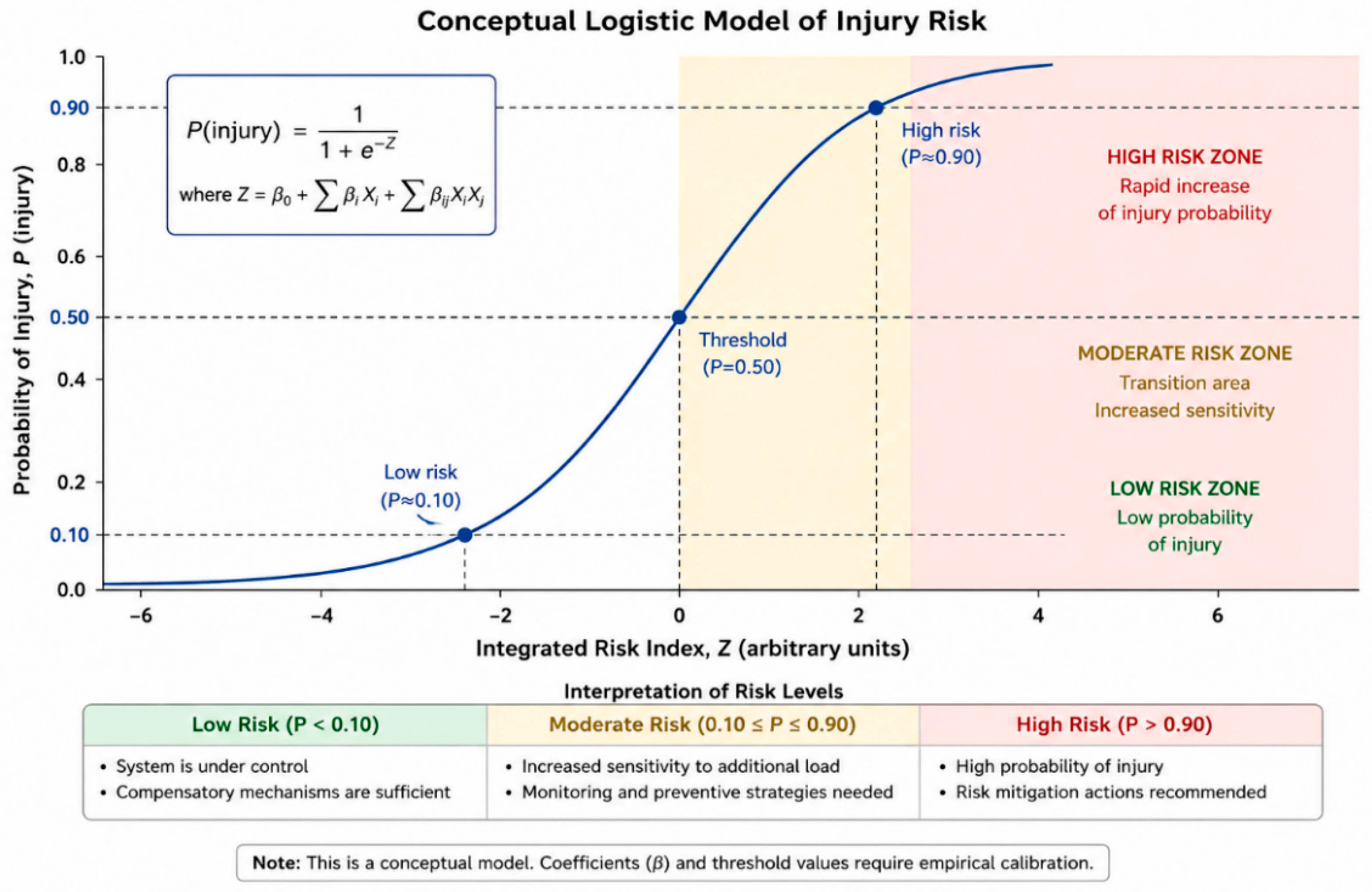

Table 1.
Risk domains and representative factors.
| Domain | Representative Factors | Expected Influence on Risk |
|---|---|---|
| Physiological | Fatigue, neuromuscular exhaustion [37,38] | Mainly positive (increases risk) |
| Technical | Skill level, movement quality, landing technique [18,41,42] | Mainly protective (reduces risk) |
| Psychological | Stress, anxiety, decision pressure [3,10,22] | Positive (increases risk) |
| Anthropometric / Individual | Sex, age, body composition, asymmetry [3,22,29] | Context-dependent |
| History-related | Previous injury, recurrence tendency [44,45,46] | Positive |
| Situational / External | Match intensity, contact load, competition stage [1,2,35,36] | Positive |
| Recovery | General well-being, sleep quality, hormonal balance [39,40] | Mainly protective (reduces risk) |
Table 2.
Examples of indicators for measuring injury risk factors.
| Variable | Measurement Indicators (from Literature) | Expected Sign in Regression |
|---|---|---|
| Fatigue (F) | Creatine kinase levels, RPE (subjective load), GPS tracking data | + (increases risk) |
| Technique (T) | Cutting Movement Assessment Score (CMAS), joint angles during landing | − (reduces risk) |
| Recovery (R) | Sleep quality, use of cryotherapy/kinesio-taping, nutritional status | − (reduces risk) |
Table 3.
Variable coding examples.
| Variable | Example Scale | Interpretation |
|---|---|---|
| Fatigue | Borg 1–10 [47,48,49] | Higher values = higher fatigue |
| Skill level | 1–5 [18] | Higher values = better technical preparedness |
| Psychological stress | 1–10 [10,15] | Higher values = greater stress |
| Previous injury | 0 / 1 [43,44,45,46] | No / yes |
| Match intensity | 1–5 [1,2] | Low to critical |
Table 4.
Interpretation of the integrated risk factor index (Z).
| Z value | Conceptual Interpretation | Expected Risk Level |
|---|---|---|
| Z<0 | Protective factors dominate | Low |
| Z≈0 | System at threshold / unstable balance | Moderate |
| Z>0 | Risk factors dominate | Elevated |
| High positive Z | Critical overload state | High |
Disclaimer/Publisher’s Note: The statements, opinions and data contained in all publications are solely those of the individual author(s) and contributor(s) and not of MDPI and/or the editor(s). MDPI and/or the editor(s) disclaim responsibility for any injury to people or property resulting from any ideas, methods, instructions or products referred to in the content. |
© 2026 by the authors. Licensee MDPI, Basel, Switzerland. This article is an open access article distributed under the terms and conditions of the Creative Commons Attribution (CC BY) license (http://creativecommons.org/licenses/by/4.0/).
Copyright: This open access article is published under a Creative Commons CC BY 4.0 license, which permit the free download, distribution, and reuse, provided that the author and preprint are cited in any reuse.


