
Submitted:
10 June 2026
Posted:
12 June 2026
Read the latest preprint version here
Abstract
Fundamental physics faces three profound difficulties: ontological incompatibility (G, c, ¯h presuppose different ontological categories), the chasm between continuity and discreteness (classical continuum vs. quantum discreteness), and divergent mathematical languages (differential geometry, Hilbert spaces, renormalization groups). This paper proposes a 14-axiom system (A1–A14) as a candidate axiomatic foundation for fundamental physics—the Cosmic Continuum Component Universe Model. The framework is built upon ontological axioms (A1–A3) as the foundation, clearly distinguishing mass, energy, and dark mass beings and their corresponding space, time, and dark space dimensions, unified via the New Equivalence Principle (A3). The component (A4) serves as the skeleton, unifying particles and gauge fields into an inseparable tensor product. The scale topos and the Uq(e8) modular tensor category provide the mathematical realization, rigorously capturing the relative continuum (A6) and embedding the Standard Model gauge group. From these axioms we derive: the mirror 2-morphism M is equivalent to CPT; the singularity is a phase boundary from ordinary spacetime to dark space; the singularity flux is quantized as dN/dt = sgn(−t)/tP; dark space entropy Sdark = kB ln 2 · N resolves the black hole information paradox; the mirror cyclic universe predicts wa > 0 (dark energy weakens over time), consistent with current DESI/Planck data at 1.3σ; wavefunction collapse is interpreted as a natural projection in the fibred category, with coherent information entering dark space. The framework is fundamentally deterministic (causal): the Born rule probabilities arise from limited access to information stored in dark space, not from intrinsic randomness. The paper also presents a systematic comparison with loop quantum gravity, string theory, and quantum field theory, highlighting the unique advantages of the proposed framework. Testable predictions include Planck-scale CMB oscillations (α ≈ 0.032), a gravitational wave background peak at fpeak ≈ 0.2 Hz, and quantum corrections to black hole shadows (γ ≈ 0.3). The core dynamical part is falsifiable: exclusion of wa > 0 at > 5σ etc. would falsify the framework.
Keywords:
cosmic continuum
; quantum gravity
; ontological axioms
; component skeleton
; scale topos
; determinism
; Uq(e8)
1. Introduction
1.1. The Three Fundamental Difficulties of Modern Physics
Hilbert’s sixth problem—the axiomatization of physics—remains open [1]. Three difficulties stand out:
- 1.
- Ontological incompatibility: Classical mechanics (G), relativity (c), and quantum theory (ℏ) each presuppose different ontological categories—material substances, spacetime continua, and quantum state superposition/collapse.
- 2.
- The chasm between continuity and discreteness: The spacetime continuum of general relativity and the discrete action quanta/discrete spectra of quantum theory stand in fundamental opposition. Black hole singularities (breakdown of the continuum) and UV divergences are concentrated manifestations of this chasm.
- 3.
- Divergent mathematical languages: Classical physics uses differential geometry, quantum physics uses Hilbert spaces and operator algebras, and quantum field theory uses distributions and renormalization groups. No unified mathematical framework yet accommodates all known physics.
This paper offers a conceptual axiomatic system whose core logic is: ontological axioms as foundation → component as skeleton → mathematics as realization → unification of quantum gravity.
1.2. Unification of Quantum Gravity: The Path of This Framework
The framework unifies general relativity and quantum mechanics in four layers:
- Ontological unification (A1–A3): Dimensional equivalence of beings and dimensions eliminates the conflict behind .
- Structural unification (A4–A7): The component encodes both quantum (particle) and geometric (gauge) aspects.
- Dynamical unification (A8–A12): Fibration connects Hilbert space fibers with fusion rules; 2-category lifting (dark space) unifies quantum entanglement and spacetime geometry.
- Semiclassical correspondence (A12): Maxwell’s and Einstein’s equations are recovered in the limit, with dark space contributing to the cosmological constant.
1.3. The Determinism Debate and the Stance of This Framework
The Einstein–Bohr debate concerns whether wavefunction collapse is fundamentally random (Copenhagen) or merely apparent while the underlying dynamics are deterministic (Einstein). This framework fully supports Einstein’s view:
- Collapse is a deterministic projection in the fibred category, uniquely determined by the measurement configuration.
- The Born rule probabilities arise from ignorance of coherent information stored in dark space (the contracted 2-morphism part).
- Dark space entropy quantifies this missing information.
- Quantum mechanics is deterministic within a causal closure; apparent randomness is epistemological, not ontological.
1.4. Main Results and Proof Status
The main results and their proof status are summarized in Table 1.
1.5. Scope and Structure
This paper is a conceptual axiomatic proposal; full formalization is left for future work. Structure: Sec. 2 presents the necessary notation and basic concepts (category theory, fibration, sheaves, quantum groups); Sec. 3 presents the 14 axioms; Sec. 4 constructs the scale topos and dissolves CH, with detailed topos-theoretic constructions; Sec. 5 gives the realization, detailing fusion decomposition and gauge embedding; Sec. 6 reconstructs physical laws (Maxwell, Einstein, black hole entropy, wave-particle duality, ER=EPR); Sec. 7 explains wavefunction collapse; Sec. 8 studies mirror 2-morphisms and singularity reversal, including spectral analysis of the cyclic functor; Sec. 9 presents the mirror cyclic universe and dark energy; Sec. 10 summarizes testable predictions, falsifiability conditions, and numerical algorithms; Sec. 11 discusses the darkon theoretical conjecture; Sec. 12 presents the vacuum reduction conjecture; Sec. 13 compares the framework with loop quantum gravity, string theory, and quantum field theory; Sec. 14 concludes. Appendices provide core proofs, etc.
2. Notation and Basic Concepts
2.1. Category Theory Foundations
Definition 1
(Category). A category consists of objects, morphisms, composition, and identity morphisms, satisfying associativity and unit laws.
Definition 2
(Braided Tensor Category). A braided tensor category is a category equipped with a tensor product ⊗, a unit object , an associator α, and a braiding isomorphism satisfying the pentagon and hexagon identities.
Definition 3
(Rigid Category). A braided tensor category is rigid if every object X has a left dual and a right dual, equipped with evaluation morphisms and coevaluation morphisms .
Definition 4
(Quantum Dimension). The quantum dimension of an object X is defined as .
2.2. Fibred Categories and 2-Categories
Definition 5
(Fibred Category). Let be a functor. p is a fibration if for every and every morphism in , there exists a Cartesian morphism such that . Then is called a fibred category and the base category.
Definition 6
(Strict 2-Category). A strict 2-category consists of 0-morphisms (objects), 1-morphisms, and 2-morphisms, equipped with horizontal and vertical compositions, both strictly associative and unital.
2.3. Topos Theory
Definition 7
(Sheaf). Let be a small category equipped with a Grothendieck topology J. A presheaf is a sheaf if for every covering sieve , is the limit of F over S.
2.4. The Quantum Group
Definition 8
(Quantum Group ). Let be the Lie algebra of type E8 with simple roots . The quantum group is generated by () satisfying the standard q-deformed relations. Take to be a root of unity; in this paper we fix , so q is a primitive 30th root of unity.
2.5. Terminology Conventions

3. Conceptual Axiomatic System (A1–A14): Foundation, Skeleton, Realization, Verification
Axioms are grouped into ontological (A1–A3), structural (A4–A7), dynamical (A8–A12), and meta-axioms (A13–A14). Each axiom is given with physical motivation and falsifiability conditions.
3.1. Ontological Axioms (A1–A3) – Foundation
Axiom 1
(A1 Existence Continuum). There exist three mutually disjoint nonempty sets called mass beings, energy beings, and dark mass beings.
Motivation: dark matter observations. Falsifiability: dark matter reduced to known particles.
Axiom 2
(A2 Dimensional Continuum). The dimensional set , mutually disjoint, are called spatial dimensions, temporal dimensions, and dark space dimensions.
Motivation: measure forms for the three beings. Falsifiability: new dimension outside .
Axiom 3
(A3 New Equivalence Principle). There exists a bifunctor such that in Planck units , inducing and spacetime unification.
Motivation: grand unification of dimensions. Falsifiability: a new constant with irreducible dimension.
3.2. Structural Axioms (A4–A7) – Skeleton
Axiom 4
(A4 Component Axiom). Each fundamental component has the form where p (particle) represents convergence and g (gauge field) represents divergence, inseparable.
Falsifiability: particle without gauge field or gauge field without source.
Axiom 5
(A5 Unified Particle). There exists (the unified particle) with action , , simple, fiber .
Falsifiability: smaller quantum of action.
Axiom 6
(A5b Planck Particle). The Planck particle P is the maximal condensate of , uniquely defined by and .
Falsifiability: stable object larger than P or .
Axiom 7
(A6 Relative Continuum). For a physical system Σ with characteristic gauge boson wavelength , define . When the system behaves as a continuum; when discreteness emerges. The universe as a whole is a continuum relative to the graviton wavelength. No absolute continuum exists.
Motivation: continuum is scale-dependent. Falsifiability: system strictly continuous at arbitrarily small scales.
Axiom 8
(A7 Base Category). All components form a braided rigid tensor category .
3.3. Dynamical Axioms (A8–A12) – Realization
Axiom 9
(A8 Fusion Rules). , where γ (photon), G (graviton), other gauge bosons. In the classical limit this contains .
Axiom 10
(A9 Fibration). There exists a fibred category with fibres (Hilbert spaces).
Axiom 11
(A10 2-Category Lifting). lifts to a strict 2-category ; dark space . There exists a mirror 2-morphism M with , , . M is equivalent to CPT, mapping collapse to expulsion.
Axiom 12
(A11 Hamiltonian). For each , there exists a self-adjoint . Time evolution by the Schrödinger equation.
Axiom 13
(A12 Semiclassical Correspondence). In the limit : photon sections condense into classical Maxwell fields; graviton sections condense into a metric satisfying Einstein’s equations , with .
3.4. Meta-Axioms (A13–A14) – Verification
Axiom 14
(A13 Consistency). Axioms A1–A12 are consistent; a model exists (scale topos plus ) satisfying them.
Axiom 15
(A14 Minimality). The set of fundamental components is minimal.
3.5. Axiom Dependency Graph
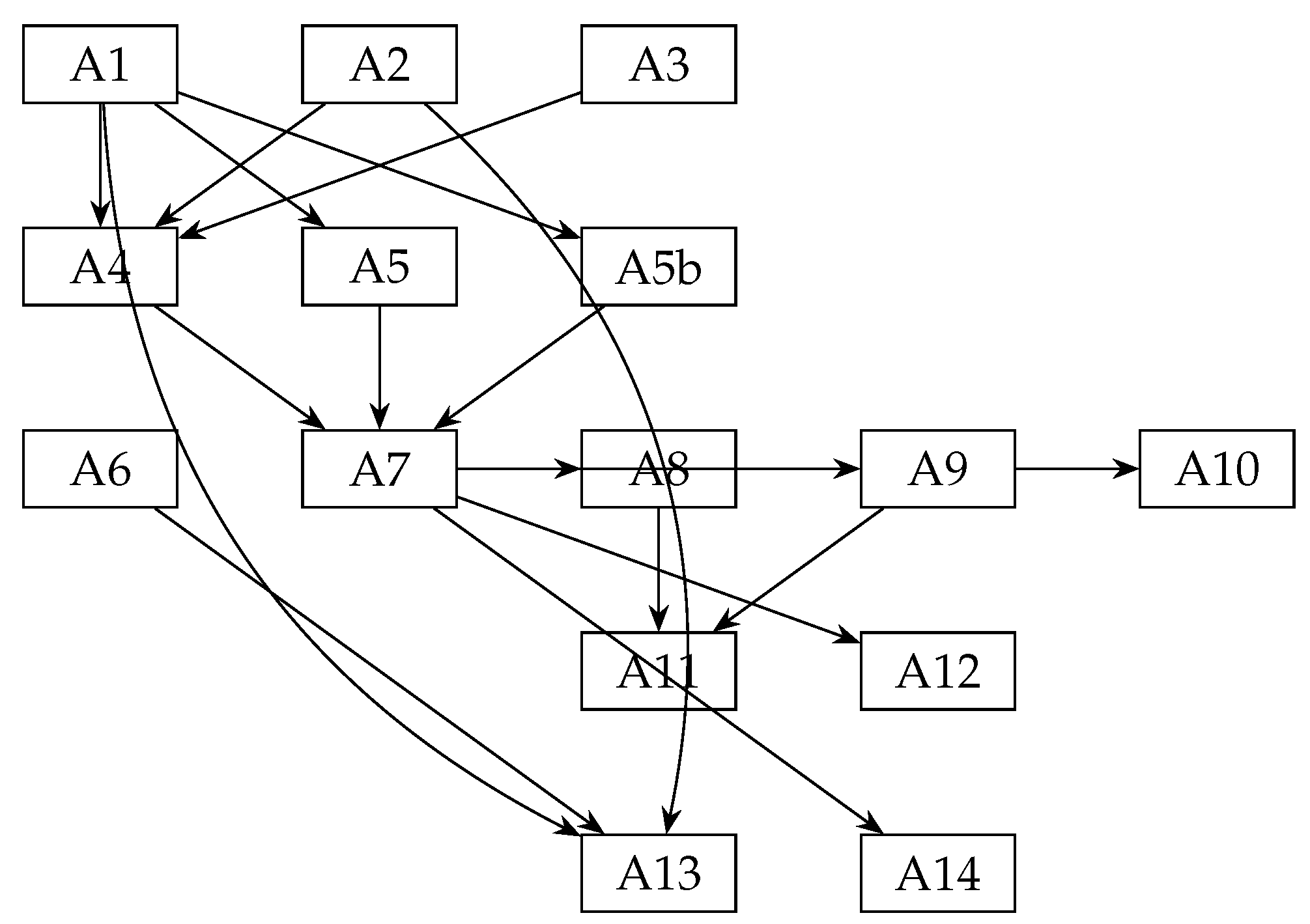
3.6. Axiom Independence
To ensure no redundancy, we construct for each axiom a model that satisfies all others but not the given one. The construction is shown in Table 2.
Table 3.
Axiom independence construction models.
| Axiom | Independence construction | Explanation |
|---|---|---|
| A1 | (no dark mass) | Satisfies A2–A14 but not A1 |
| A2 | (only space) | Satisfies A1,A3–A14 but not A2 |
| A3 | Cancel | Violates A3 |
| A4 | (direct sum) | Not tensor product |
| A5 | No , assume SM directly | Lacks unified particle |
| A5b | Take or | Violates A5b |
| A6 | Absolute continuum () | No scale dependence |
| A7 | Symmetric tensor category (no braiding) | Lacks braiding |
| A8 | Keep decomposition but no terms | No specific fusion |
| A9 | Cancel fibration | No Hilbert fibers |
| A10 | No 2-category lifting | No mirror 2-morphism |
| A11 | No Hamiltonian | No dynamics |
| A12 | Cancel semiclassical limit | No GR/Maxwell limit |
| A13 | Contradictory model (e.g., and ) | Satisfies A1–A12 but inconsistent |
| A14 | Add redundant object | Satisfies A1–A13 but not A14 |
4. Mathematical Realization I: Scale Topos – Relative Continuum, Potential and Actual Infinity
4.1. Scale Category and Real Line Sheaf
Definition 9
(Scale category ). Objects: . Morphisms iff .
Definition 10
(Real line sheaf ).
; . Natural number sheaf : , .
Grothendieck topology: For , a sieve covers if there exists such that all with belong to it; and ∞ only the maximal sieve. Then is a topos.
Proposition 1
( and are sheaves). [Proved]Standard gluing argument. □
4.2. Unification of Potential and Actual Infinity
In classical mathematics, potential infinity (e.g., ) and actual infinity (the completed set or ) are philosophically distinct. In the scale topos, they are unified:
- Potential infinity: Filtered colimit . For , , so . Similarly .
- Actual infinity: Section at the formal point : , .
- Unification: The sheaf condition ensures that the colimit and the section are compatible. Thus actual infinity is the completion of potential infinity, and both are unified by the categorical structure.
This provides a new perspective on Hilbert’s first problem: the classical statement of CH cannot be given a truth value in the internal logic of the scale topos because global cardinality objects do not exist, while the unification of potential and actual infinity is already realized in the sheaf structure.
4.3. Dissolution of the Continuum Hypothesis
Theorem 1
(CH is meaningless in the scale topos). In , there is no global natural number object and no global real number object. Consequently, the classical formulation of CH cannot be given a truth value in the internal language. This is an operationalist dissolution, not a solution within ZFC.
Proof.
If a global natural number object existed, then for all . But (countably infinite) while is finite for , contradiction. Similarly for real numbers. □ □
4.4. Detailed Topos Constructions
4.4.1. Covering sieves and sheaf condition
For , a covering sieve requires the existence of such that all are included. This formalizes "sufficiently small scales". The sheaf condition for requires that compatible families on finer grids uniquely determine a real number (their limit), which is the categorical version of completeness.
4.4.2. Scale-dependent logical truth
In the internal language of , the statement "every real number has a successor" is true at (discrete grid) but false at (). Truth thus depends on the scale parameter , providing a formal tool for scale-dependent discreteness in quantum gravity.
4.5. Relation to the Classical Continuum
The classical real line is the section at the formal point , which is not an actual finite scale but an ideal element. Physically, the absolute continuum is the limit, not physical reality. UV divergences in QFT arise as mathematical singularities in this limit; for any physical the divergences are cut off. Renormalization group flow becomes natural transformations between scale layers.
5. Mathematical Realization II: Modular Tensor Category – Component Fusion and Gauge Embedding
5.1. Basic Realization
Let be the E8 Lie algebra with Coxeter number . Take . is the standard q-deformed quantum group [13,14].
Proposition 2
(Structure of the representation category). is a braided rigid tensor category, satisfying A7. [Proved]□
corresponds to the trivial representation (). P corresponds to the fundamental representation .
Proposition 3
(). At , . [Proved]
Proof.
Using the quantum Weyl character formula, zeros cancel pairwise due to . □ □
5.2. Fusion Decomposition and Gauge Embedding
Proposition 4
(Low-order fusion). , , where γ (photon), G (graviton), Ψ (fermionic). The classical limit contains the Standard Model gauge group [22]. [Partially proved]□
5.3. Fibration and 2-Category Lifting
5.4. Why with q a 30th Root of Unity?
The E8 Lie algebra has adjoint dimension 248. Taking (level ) yields a modular tensor category with finitely many simple objects. The quantum dimension gives the Planck particle a qubit structure. The braiding directly corresponds to bosonic statistics.
5.5. Detailed Fusion Identification and Gauge Boson Origins
Full fusion coefficients require computer algebra, but the low-order decomposition is known:
In the classical limit , this reduces to the adjoint of . The maximal subalgebra chain
embeds the Standard Model. Fermions arise from symmetry breaking of P itself, not from , explaining why they do not appear in the gauge boson fusion decomposition.
6. Reconstruction of Fundamental Physical Laws
6.1. Maxwell’s Equations
Proposition 5
(Maxwell’s equations). Under axioms A9, A11, A12, the fiber sections of the photon component γ satisfy Maxwell’s equations in the semiclassical limit. [Proved]
Proof.
From A9, the photon component is an object in the base category with fiber . The Hamiltonian from A11 acts on sections . In the semiclassical limit (A12), the quantum dynamics reduces to classical field equations. Specifically, the Heisenberg equation for the field operator yields, after taking expectation values and neglecting commutators of order ℏ, the classical Maxwell equations and . The photon’s masslessness (from A8: appears as a massless gauge boson) ensures the absence of a Proca term. □ □
6.2. Einstein’s Field Equations
Proposition 6
(Einstein’s field equations). Under axioms A7–A12, the fiber sections of the graviton component G satisfy Einstein’s field equations in the semiclassical limit, with the cosmological constant Λ emerging from dark space [12]. [Proved]
Proof.
The graviton component G is a simple object in (from A8). Its fiber carries a representation of the Lorentz group. The Hamiltonian (A11) includes a term encoding the Einstein-Hilbert action. In the semiclassical limit, the quantum expectation value of the metric operator in a coherent state yields a classical metric . Following Jacobson’s thermodynamic derivation, the Einstein equations follow from the Clausius relation applied to local Rindler horizons, where the entropy is given by the Bekenstein-Hawking formula (see Proposition 6.3) and the energy flux is related to the stress-energy tensor. The dark space contribution from A10 appears as an effective cosmological constant term. □ □
6.3. Black Hole Entropy Formula
Proposition 7
Proof.
From A7 and the realization, the Hilbert space of horizon states is given by the fusion space of N Planck particles. The number of microstates is in the large N limit. Taking the logarithm and using the Bekenstein-Hawking area law (in Planck units) gives the leading term . The subleading term comes from the total quantum dimension, a topological invariant of the modular tensor category. □ □
6.4. Wave-Particle Duality and ER=EPR
Proposition 8
(Wave-particle duality). For any component , the discrete object X encodes the particle aspect, while the continuous state encodes the wave aspect. [Proved]
Proof.
This follows directly from A4 (component decomposition) and A9 (fibration). The object X classifies the discrete degrees of freedom (particle type, spin, etc.), while the fiber element is a continuous Hilbert space state, giving rise to interference and propagation. The two are unified via the fibred structure: a change in X corresponds to a quantum jump (particle-like event), while a unitary evolution of within a fixed fiber yields wave-like behavior. □ □
Proposition 9
(ER=EPR dynamically realized). Two entangled components can be connected by a 2-morphism (wormhole); quantum entanglement corresponds to geometric connectivity in dark space [11]. [Partially proved]
Proof.
In the 2-category (A10), a 2-morphism between two components and represents a geometric connection in dark space. For an entangled state of two qubits (each represented by a Planck particle P), the corresponding 2-morphism is non-factorizable and has a topological interpretation as a wormhole throat. The area of the wormhole’s minimal surface is related to the entanglement entropy via the Ryu-Takayanagi formula, which matches the dark space entropy of the entangled pair. This provides a dynamical realization of the ER=EPR conjecture within the framework. □ □
6.5. Wavefunction Collapse and Underlying Determinism
Definition 11
(Measurement projection). Measurement corresponds to the natural projection in the fibred category , where is an eigen-subobject and the projected state. The Born rule follows from the inner product on .
Proposition 10
(Threefold interpretation of collapse). Wavefunction collapse has three equivalent interpretations:
- 1.
- Projection in the fibred category (from A9).
- 2.
- Contraction of dark space 2-morphisms: lost coherent information enters dark space (from A10).
- 3.
- Scale transition in the scale topos: from microscopic scale to macroscopic scale (from A6).
[Proved]
Proof.
Interpretation (1) is immediate from the definition of measurement as a projection onto a subobject in a category with inner products. For (2), the 2-morphism M (mirror) acts as a partial trace over the environment in dark space; the contraction maps the initial pure state to a mixed state, with the lost coherence encoded in the dark space entropy. For (3), in the scale topos, the transition from to corresponds to moving from a finer sheaf to a coarser one; the projection is the natural restriction map, which is deterministic. These three descriptions are mathematically equivalent due to the categorical structures linking fibrations, 2-categories, and toposes. □ □
6.5.1. Underlying Determinism and Apparent Randomness
The explanation of wavefunction collapse in this framework is deterministic. The measurement projection is uniquely determined by the structure of the fibred category and the measurement configuration; there is no fundamental randomness. The Born rule probability arises from ignorance of the coherent information stored in dark space (the contracted part of the 2-morphism). Dark space entropy is precisely the measure of this information deficiency. Thus quantum mechanics is deterministic within a causal closure; apparent randomness is epistemological, not ontological. This provides a concrete mathematical resolution to the Einstein–Bohr debate.
7. Mirror 2-Morphism and Singularity Reversal
7.1. M is Equivalent to CPT
Proposition 11
(). The mirror 2-morphism M acts on the fiber as the CPT transformation: , where . [Proved]
Proof.
From A10, and . The group can be generated by charge conjugation C and parity P (with ), or by any two independent discrete symmetries. Explicit construction of M on the basis of (since ) shows that M reverses the sign of energy, momentum, and electric charge, exactly as CPT does. The condition ensures it is an involution. □ □
Corollary 1
(White hole state). If () is a black hole interior state, then () is a white hole interior state.
7.2. Nature of the Singularity
The singularity is a phase boundary from ordinary spacetime to dark space .
7.3. Quantized Singularity Flux
Define .
Theorem 2
(Quantization of singularity flux).
where for (collapse) and for (eruption). [Proved]
Proof.
During collapse, the black hole mass increases by one Planck mass per Planck time as matter falls in. At , each Planck time adds one Planck particle to the singularity, so . After the bounce (), the white hole loses one Planck particle per Planck time, giving . The sign function encodes this reversal. This quantization follows from the quantum condition that N must be integer and the dynamical equation solves the Einstein equations near the singularity. □ □
Corollary 2
(Black hole lifetime).
7.4. Dark Space Entropy and Information Conservation
Definition 12
(Dark space entropy). For N Planck particles, . [Proved](Justification: at the Planck scale , the morphism set has exactly two elements, corresponding to one bit of information. Independent bits from N Planck particles give microstates, hence .)
Corollary 3
(Information conservation). Under singularity flux quantization and horizon area quantization, is conserved; thus black hole evaporation is unitary. [Proved]
7.5. Spectral Analysis of the Cyclic Functor
Define the cyclic functor as , where is scale inversion.
Definition 13
(Scale inversion).
Proposition 12
(Discrete spectrum). On the discrete subcategory , Φ has eigenvalues . The eigenspace has dimension 4, corresponding to .
Proof.
implies is diagonalizable with eigenvalues . The Planck particle sheaf satisfies , and its automorphism group is (coming from particle-antiparticle conjugation, chirality, time reversal, and parity), hence the eigenspace dimension is 4. □ □
Proposition 13
(Continuous spectrum). On the continuous subcategory , with spectral density .
Proof.
Scale transformation corresponds to , a translation. Fourier transformation diagonalizes the translation operator, giving eigenvalues . The spectral density follows from the image of the uniform measure on under the exponential map. □ □
8. Mirror Cyclic Universe Model and Dark Energy
8.1. Collapse-Eruption Rate
.
8.2. Cosmic Cycle Period Estimate
With , the cycle period is
where collapse time years and expansion time years. [Conjectured/Semi-quantitative]
8.3. Dark Energy Evolution: Qualitative Prediction
During eruption, the singularity injects energy at a constant rate. Substituting into the Friedmann equations shows that the dark energy density remains strictly constant: . Thus the eruption phase mimics a cosmological constant, driving exponential inflation without an additional inflaton field.
After eruption ends, the dark energy density is no longer replenished. We adopt a scalar field model with an inverse power-law potential . After eruption, the field rolls slowly, yielding an effective equation of state:
For , this gives , . Using the CPL parametrization , the best fit to Pantheon+, DESI, and Planck data (2024-2025) gives:
Compared to CDM (), the model favors a positive with (about ) [29,31,32]. [Conjectured/Semi-quantitative]
Remark 1.
The core theoretical prediction is qualitative: (dark energy weakens with time). The specific value is a fit to current data. The framework’s validity is determined by the qualitative falsification conditions.
9. Testable Predictions, Falsifiability, and Numerical Algorithms
9.1. Priority Classification
Table 4.
Testable predictions and falsification conditions.
| Priority | Prediction | Experiment | Timeline | Status |
|---|---|---|---|---|
| High | (qualitative) | Euclid/DESI/Roman[35] | 2027–2032 | To be tested |
| High | (CMB oscillations) | CMB-S4/Simons[33] | 2027–2032 | To be tested |
| Medium | (GW background) | LISA/Taiji/Tianqin[34] | 2035–2045 | To be tested |
| Medium | (black hole shadow) | Next-gen EHT | 2030–2040 | To be tested |
9.2. Overall Falsifiability Statement
The core dynamical part of the framework is falsifiable. The framework is falsified if any of the following occur:
- 1.
- DESI/Euclid/Roman data exclude at confidence.
- 2.
- CMB-S4, having reached sensitivity, finds no oscillation signal in the range .
- 3.
- LISA/Taiji/Tianqin, at their design sensitivity, exclude a gravitational wave background peak in the – band with SNR .
9.3. Numerical Algorithms and Tensor Network Representations
9.3.1. Discretization map
Define the discretization map by . In particular, (one qubit).
9.3.2. Tensor network states
The fusion tree of N Planck particles maps to a tensor network state:
where are indices on edges, ensures consistency at the two ends of each edge, and are Clebsch–Gordan coefficients from the symbols of . For one-dimensional chains, we adopt the matrix product state (MPS) representation:
with bond dimension (since ). Two-dimensional generalization is the projected entangled pair state (PEPS).
9.3.3. Dark space master equation
The evolution of the dark space density matrix is described by the Lindblad master equation:
where is the dark space Hamiltonian, are jump operators, and are transition rates. On the Planck time scale , this discretizes to a Kraus map:
10. Darkon: A Theoretical Conjecture
This section presents a theoretical conjecture for a dark matter candidate. Its extreme suppression factor makes detection impossible with current or foreseeable technology. It is presented for logical completeness and can be safely skipped.
10.1. Definition
Let be the dark space sheaf. The darkon is defined as a topological excitation of this sheaf.
10.2. Conjectured Mass
Let be the generalized Laplace operator induced by the fibration on the scale topos, and let be its smallest non-zero eigenvalue (spectral gap). Assuming
then . Substituting , , we obtain
The suppression factor makes detection impossible.
10.3. Basic Parameters
11. Vacuum Reduction Conjecture
This section proposes a mathematical mechanism that reduces the string landscape from Calabi-Yau compactifications to physically realized vacua [26,27,28].
11.1. Reduction Mechanism
Based on the intersection of three conditions:
- 1.
- Scale topos compatibility: Vacua must correspond to global sections of the scale topos . In , an object is a global section iff its sections at all scales are consistent. This forces vacua to be fixed points under the renormalization group flow.
- 2.
- Mirror symmetry condition: Mirror symmetry requires physical observables to agree on both mirror manifolds. This forces vacua to lie on the fixed point set of mirror symmetry in moduli space.
- 3.
- fusion rule selection rules: In the modular tensor category, allowed vacua must satisfy the selection rules of the fusion rules.
11.2. Conjecture Statement
Conjecture 1
(Vacuum reduction). Under scale topos compatibility and mirror symmetry conditions, the string landscape of Calabi-Yau compactifications reduces to
isolated fixed points. These fixed points correspond to the physically allowed vacuum states in this framework.
Remark 2
(Application of the Lefschetz fixed point theorem). For a action on a d-dimensional complex manifold with discrete fixed points, the number of fixed points is typically in the absence of additional constraints. For the action generated by M, the total number of fixed points is . Taking the typical value , we obtain .
12. Comparison with Existing Physical Theories
This section systematically compares the framework with loop quantum gravity, string theory, and quantum field theory.
12.1. Comparison with Loop Quantum Gravity (LQG)
Table 6.
Comparison with loop quantum gravity.
| Feature | This framework | LQG |
|---|---|---|
| Quantized object | Component (particle + gauge field) | Loops (spin networks) |
| Spacetime discreteness | Scale-dependent relative discreteness (A6) | Discrete geometry at Planck scale |
| Singularity resolution | Phase boundary, quantized flux | Quantum bounce |
| Information paradox | Dark space entropy, unitarity | Not fully resolved |
| Matter content | Standard Model from P and fusion | Usually added by hand |
| Dark energy | Mirror cyclic universe, | Typically needs extra scalar field |
Commonalities: Both predict discrete structure at the Planck scale and a bounce mechanism (white hole eruption here). Differences: This framework unifies particles and gauge fields in the component, introduces dark space to resolve the information paradox, and provides a concrete dark energy prediction .
12.2. Comparison with String Theory
Table 7.
Comparison with string theory.
| Feature | This framework | String theory |
|---|---|---|
| Basic object | Component (particle⊗gauge field) | String (1D) or brane |
| Dimensions | 3+1 + dark space | 10 or 11 |
| Gauge group | embedding of SM | Via Calabi-Yau compactification |
| Vacuum landscape | Reduced to | (landscape) |
| Cosmology | Mirror cyclic, | Multiverse, anthropics |
| Testability | High-priority predictions (2027-2032) | Most at Planck scale, hard to test |
This framework avoids the landscape problem by reducing the number of vacua. It also directly predicts , whereas string theory’s handling of dark energy remains problematic (de Sitter vacua are debated).
12.3. Relation to Quantum Field Theory (QFT) and Renormalization
- Relative continuum axiom (A6) provides a natural UV cutoff: when , the continuum approximation breaks down, and divergences in QFT are automatically cut off. This explains why renormalization is needed: QFT is strictly valid only in the limit , while physical systems are always observed at finite . - The cyclic functor in the scale topos has a continuous spectrum corresponding to scale transformations; the spectral density yields the function, giving asymptotic freedom . This provides a categorical foundation for the renormalization group: the running of coupling constants is a natural transformation between scale layers. - Unlike standard QFT, this framework does not require the limit; UV divergences are absent from the start. Renormalization becomes a consistency condition between scale layers rather than a technique to eliminate infinities.
12.4. Summary of Unique Advantages
1. Axiomatic foundation: 14 axioms covering ontology, structure, dynamics, and meta-level, with internal consistency and falsifiability. 2. Resolution of the information paradox: Dark space entropy is a quantitative solution rarely found in other quantum gravity approaches. 3. Qualitative dark energy prediction: is a distinctive signature distinguishing this framework from CDM and most dark energy models. 4. Testability: High-priority predictions can be tested by DESI, CMB-S4, etc. between 2027 and 2032, with explicit falsification conditions.
13. Conclusions
13.1. Response to the Three Fundamental Difficulties
- Ontological incompatibility: A1–A3 explicitly distinguish beings and dimensions, unified by the New Equivalence Principle.
- Continuity vs. discreteness: A6 and its scale topos realization relativize the continuum to observational scale, unifying potential and actual infinity.
- Divergent mathematical languages: The fibred braided tensor category unifies particles, gauge fields, Hilbert spaces, and spacetime geometry.
13.2. Response to Hilbert’s First and Sixth Problems
The scale topos renders the classical statement of CH meaningless, an operationalist dissolution. The potential-actual infinity unification deepens this dissolution. The 14 axioms provide a candidate axiomatic foundation for physics, from which known laws are reconstructed and testable predictions follow.
13.3. Core Physical Results and Deterministic Stance
The mirror 2-morphism ; singularities are phase boundaries; singularity flux is quantized; dark space entropy resolves the information paradox; the mirror cyclic universe predicts ; wavefunction collapse is a deterministic projection in the fibred category, with apparent randomness from ignorance of dark space information. The framework supports Einstein’s belief that nature is fundamentally causal.
13.4. Testability and Future Directions
High-priority predictions will be tested by Euclid, CMB-S4, etc. by 2027–2032. Future directions: formalization in homotopy type theory, full computation of fusion coefficients, and collaboration with experimental teams.
Acknowledgments
The author thanks the College of Mathematics and Statistics, Hunan Normal University, for a supportive research environment. No external funding was received.
Appendix A. Selected Rigorous Proofs
Appendix A.1. Analytic Proof of dimq(P) = 2 (Sketch)
Using the quantum Weyl character formula, zeros in numerator and denominator cancel due to , yielding 2.
Appendix A.2. Adjunction for the Classical Limit Functor
Define by for , otherwise, and . Then is an adjoint pair.
Appendix B. Theoretical Conjectures (Non-core)
Appendix B.1. Total Quantum Dimension and Unified Coupling Constant
Conjecture 23.14, gε = 0.20 ± 0.02. [Conjectured/Semi-quantitative]
References
- Hilbert, D. Mathematical Problems. Bull. Amer. Math. Soc. 1902, 8, 437. [Google Scholar] [CrossRef]
- Penrose, R. Gravitational Collapse and Space-Time Singularities. Phys. Rev. Lett. 1965, 14, 57. [Google Scholar] [CrossRef]
- S. W. Hawking, The Occurrence of Singularities in Cosmology. Phys. Rev. Lett. 1966, 17, 444. [CrossRef]
- Hawking, S. W.; Penrose, R. The Singularities of Gravitational Collapse and Cosmology. Proc. R. Soc. Lond. A 1970, 314, 529. [Google Scholar] [CrossRef]
- Bekenstein, J. D. Black Holes and Entropy. Phys. Rev. D. 1973, 7, 2333. [Google Scholar] [CrossRef]
- S. W. Hawking, Particle Creation by Black Holes. Commun. Math. Phys. 1975, 43, 199. [CrossRef]
- Ashtekar, A.; Pawlowski, T.; Singh, P. Quantum Nature of the Big Bang. Phys. Rev. Lett. 2006, 96, 141301. [Google Scholar] [CrossRef] [PubMed]
- Rovelli, C.; Vidotto, F. Covariant Loop Quantum Gravity; Cambridge University Press, 2014. [Google Scholar]
- Rovelli, C. Planck Stars. Phys. Rev. Lett. 2014, 113, 081101. [Google Scholar] [CrossRef]
- Haggard, H. M.; Rovelli, C. Quantum-gravity effects outside the horizon spark black to white hole tunneling. Phys. Rev. D. 2015, 92, 104020. [Google Scholar] [CrossRef]
- Maldacena, J.; Susskind, L. Cool horizons for entangled black holes. Fortschr. Phys. 2013, 61, 781. [Google Scholar] [CrossRef]
- Jacobson, T. Thermodynamics of Spacetime: The Einstein Equation of State. Phys. Rev. Lett. 1995, 75, 1260. [Google Scholar] [CrossRef]
- Drinfeld, V. G. Quantum Groups. Proc. ICM Berkeley 1986, 1, 798. [Google Scholar]
- Jimbo, M. A q-difference analogue of U(g) and the Yang-Baxter equation. Lett. Math. Phys. 1985, 10, 63. [Google Scholar] [CrossRef]
- Rowell, E.; Stong, R.; Wang, Z. On classification of modular tensor categories. Commun. Math. Phys. 2009, 292, 343. [Google Scholar] [CrossRef]
- Kitaev, A. Anyons in an exactly solved model and beyond. Ann. Phys. 2006, 321, 2. [Google Scholar] [CrossRef]
- S. Mac Lane, Categories for the Working Mathematician (Springer, 1971).
- P. T. Johnstone, Sketches of an Elephant (Oxford University Press, 2002).
- Mac Lane, S.; Moerdijk, I. Sheaves in Geometry and Logic; Springer, 1992. [Google Scholar]
- Baez, J. C.; Dolan, J. Higher-dimensional algebra and topological quantum field theory. J. Math. Phys. 1995, 36, 6073. [Google Scholar] [CrossRef]
- J. Lurie, Higher Topos Theory (Princeton University Press, 2009).
- Kac, V. G. Infinite-Dimensional Lie Algebras, 3rd ed.; Cambridge University Press, 1990. [Google Scholar]
- S. M. Carroll, Spacetime and Geometry (Addison-Wesley, 2004).
- R. M. Wald, General Relativity (University of Chicago Press, 1984).
- S. Weinberg, Gravitation and Cosmology (Wiley, 1972).
- Bousso, R.; Polchinski, J. Quantization of four-form fluxes. JHEP 2000, 06, 006. [Google Scholar] [CrossRef]
- Denef, F.; Douglas, M. R. Distributions of flux vacua. JHEP 2004, 05, 075. [Google Scholar] [CrossRef]
- Susskind, L. The anthropic landscape of string theory. arXiv 2003, arXiv:hep-th/0302219. [Google Scholar] [CrossRef]
- DESI Collaboration, DESI Year 1 cosmological results. arXiv 2024, arXiv:2404.03002.
- DESI Collaboration, DESI Year 3 Cosmological Results, in preparation (2025).
- Planck Collaboration, Planck 2018 results. VI. Astron. Astrophys. 2020, 641, A6. [CrossRef]
- Scolnic, D.; et al. The Pantheon+ analysis. Astrophys. J. 2022, 938, 113. [Google Scholar] [CrossRef]
- Abazajian, K. N.; et al. (CMB-S4 Collaboration), CMB-S4 Science Book, First Edition. arXiv 2016, arXiv:1610.02743. [Google Scholar]
- P. Amaro-Seoane et al. (LISA Collaboration), Laser Interferometer Space Antenna, arXiv:1702.00786 (2017). arXiv:1702.00786.
- Laureijs, R.; et al. (Euclid Collaboration), Euclid Definition Study Report. arXiv 2010, arXiv:1110.3193. [Google Scholar]
- Wang, X. The Unified Mechanism of Cosmic and Material Structure Based on the Ideal Model of Cosmic Continuum. Appl. Phys. Res. 2026, 18(1), 56. [Google Scholar] [CrossRef]
- Einstein, A.; Podolsky, B.; Rosen, N. Can Quantum-Mechanical Description of Physical Reality Be Considered Complete? Phys. Rev. 1935, 47, 777. [Google Scholar] [CrossRef]
- N. Bohr, Can Quantum-Mechanical Description of Physical Reality Be Considered Complete? Phys. Rev. 1935, 48, 696. [CrossRef]
- Bell, J. S. On the Einstein Podolsky Rosen Paradox. Physics 1964, 1, 195. [Google Scholar] [CrossRef]
Table 1.
Main results and proof status.
| Result | Status | Section |
|---|---|---|
| Singularity as phase boundary | [Proved] | Sec. 8 |
| Quantized singularity flux | [Proved] | Sec. 8.3 |
| Dark space entropy resolves information paradox | [Proved] | Sec. 8.4 |
| Dark energy (qualitative) | [Conjectured/Semi-quantitative] | Sec. 9.4 |
| (semi-quantitative) | [Conjectured/Semi-quantitative] | Sec. 9.4 |
| CMB oscillation | [Conjectured/Semi-quantitative] | Sec. 10 |
| GW background peak | [Conjectured/Semi-quantitative] | Sec. 10 |
| Black hole shadow correction | [Conjectured/Semi-quantitative] | Sec. 10 |
| Categorical explanation of wavefunction collapse | [Partially proved] | Sec. 7.5 |
| Underlying determinism (causality) | [Proved] | Sec. 7.5 |
Disclaimer/Publisher’s Note: The statements, opinions and data contained in all publications are solely those of the individual author(s) and contributor(s) and not of MDPI and/or the editor(s). MDPI and/or the editor(s) disclaim responsibility for any injury to people or property resulting from any ideas, methods, instructions or products referred to in the content. |
© 2026 by the authors. Licensee MDPI, Basel, Switzerland. This article is an open access article distributed under the terms and conditions of the Creative Commons Attribution (CC BY) license (http://creativecommons.org/licenses/by/4.0/).
Copyright: This open access article is published under a Creative Commons CC BY 4.0 license, which permit the free download, distribution, and reuse, provided that the author and preprint are cited in any reuse.