
Submitted:
11 June 2026
Posted:
12 June 2026
You are already at the latest version
Abstract
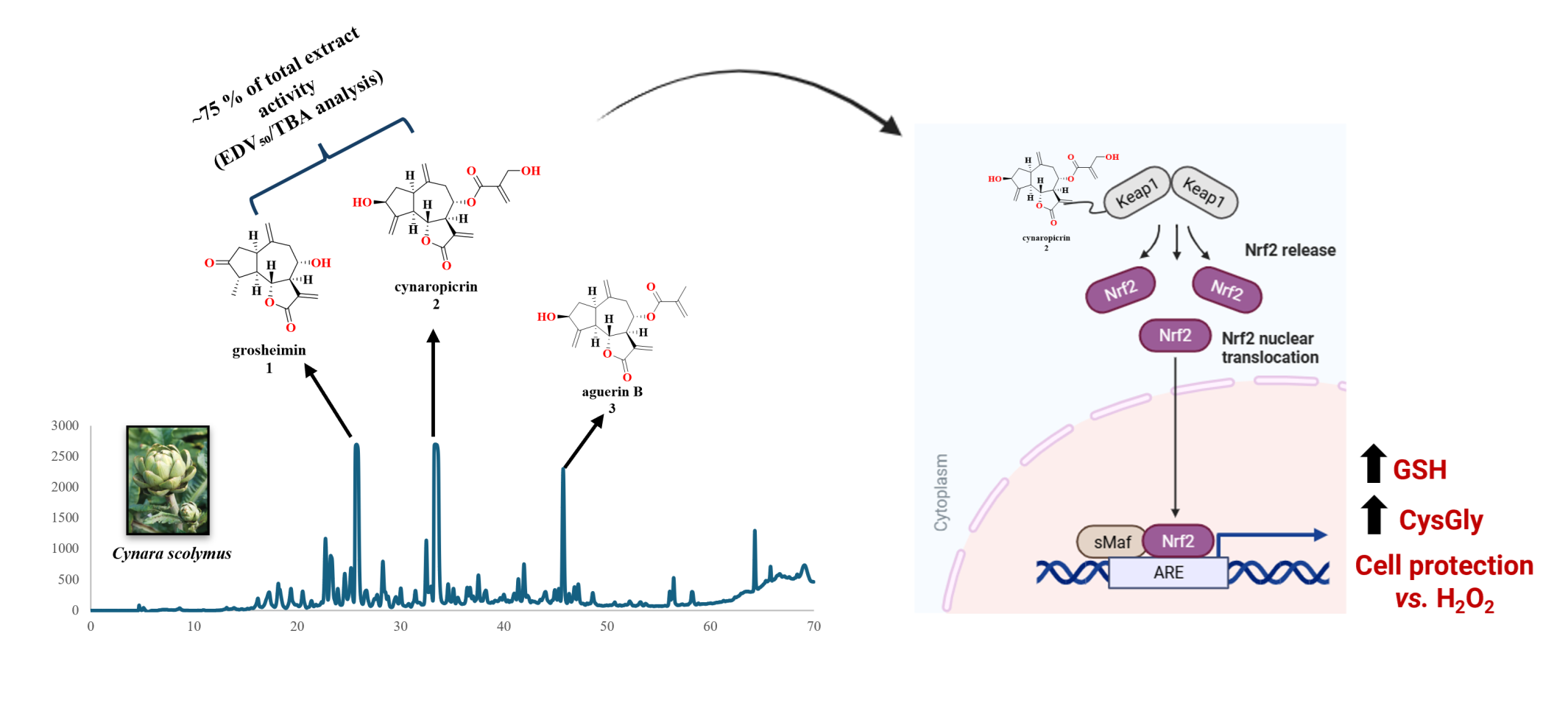
Background/Objectives: Oxidative stress is a well-established driver of neuronal dysfunction and a shared pathological mechanism across neurodegenerative diseases. Pharmacological activation of the Nrf2/ARE pathway is a validated strategy to counteract oxidative damage, as demonstrated by the clinical approval of dimethyl fumarate (DMF) and monomethyl fumarate (MMF) for relapsing forms of multiple sclerosis. These electrophilic compounds activate Nrf2 via covalent Keap1 modification. Cynara scolymus L. structurally related electrophilic metabolites; however, their contribution to Nrf2 activation remains undefined. This study aimed to identify and characterize the constituents responsible for Nrf2 activation and benchmark their potency against DMF and MMF. Methods: Bioactivity-guided fractionation combining Soxhlet extraction, Nrf2/ARE luciferase reporter screening, semi-preparative HPLC, and spectroscopic identification was employed. Functional validation included extracellular thiol quantification, H₂O₂ cytoprotection assays, and western blot analysis of heme oxygenase-1 (HO-1). Results: The dichloromethane extract exhibited the highest Nrf2-inducing activity (54.4 - fold). Fractionation yielded five guaianolide sesquiterpene lactones (1-5), four of which were active. The α-methylene-γ-lactone moiety was essential for activity. Aguerin B (3) exhibited the highest activity (39.14 ± 11.13-fold), while TBA analysis identified cynaropicrin (2) as the dominant extract-level contributor (62.9% of total activity). Notably, aguerin B and cynaropicrin (2) induced greater activation than DMF and MMF in Nrf2/ARE reporter assay. Downstream pathway activation was confirmed by concentration- and time-dependent HO-1 upregulation, elevated extracellular glutathione and CysGly levels, and significant protection against H₂O₂-induced cytotoxicity without intrinsic toxicity. Conclusions: Guaianolide sesquiterpene lactones are the primary mediators of Nrf2 activation in C. scolymus. Cynaropicrin (2) exhibited superior in vitro potency over fumarates, supporting its relevance for further pharmacological investigation.
Keywords:
Cynara scolymus
; sesquiterpene lactones
; Nrf2/ARE pathway
; oxidative stress
; glutathione
Copyright: This open access article is published under a Creative Commons CC BY 4.0 license, which permit the free download, distribution, and reuse, provided that the author and preprint are cited in any reuse.


