

Submitted:
11 June 2026
Posted:
12 June 2026
You are already at the latest version
Abstract
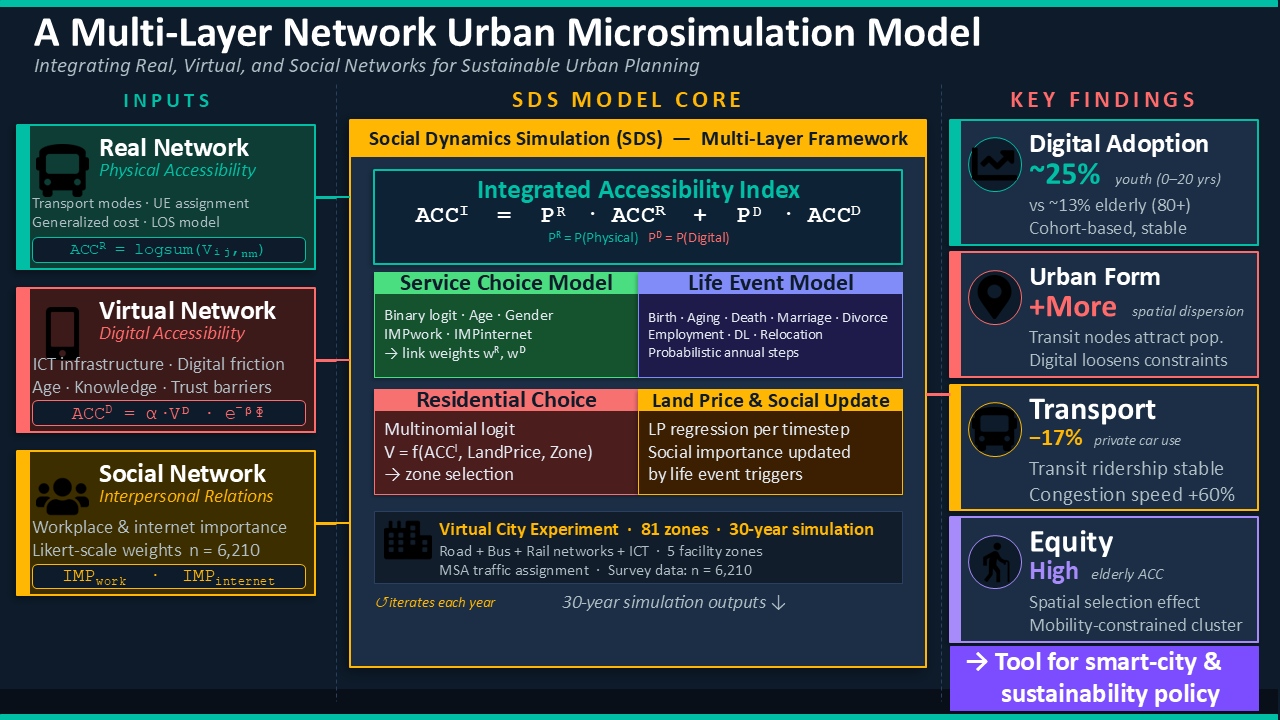
Urban accessibility is increasingly shaped by the interaction between physical mobility, digital service accessibility, and social relationships. However, most existing urban simulation models primarily focus on physical transportation networks and rarely incorporate digital accessibility or social interaction mechanisms. This limitation restricts the ability of conventional models to capture emerging behavioral patterns associated with digital service adoption and changing urban lifestyles. To address this gap, this study develops a multi-layer Social Dynamics Simulation (SDS) model that integrates three interdependent network layers: a real network representing physical accessibility, a virtual network representing digital accessibility, and a social network representing interpersonal relationships. The model introduces an integrated accessibility index that combines physical and digital accessibility based on a probabilistic service choice framework estimated using survey data (n = 6,210). The proposed model is applied to a virtual city experiment to examine how digital service usage and social interaction preferences influence long-term urban dynamics. Simulation results indicate that digital accessibility partially relaxes spatial constraints imposed by transportation networks, enabling households to maintain acceptable service access even in locations with lower physical accessibility. However, transportation accessibility remains a dominant factor shaping residential concentration around transit nodes. The results further demonstrate that digital service substitution can reduce travel demand while reinforcing accessibility differences across population groups. The proposed framework contributes to computational urban systems modeling by incorporating digital service substitution and social interaction effects into a multi-layer simulation environment. The results highlight the importance of representing non-physical accessibility processes when evaluating urban dynamics in increasingly digitalized cities.
Keywords:
multi-layer urban simulation
; integrated accessibility
; digital service substitution
; social dynamics simulation
; urban microsimulation
; land-use and transportation modeling
; service choice behavior
Copyright: This open access article is published under a Creative Commons CC BY 4.0 license, which permit the free download, distribution, and reuse, provided that the author and preprint are cited in any reuse.


