

Submitted:
10 June 2026
Posted:
11 June 2026
You are already at the latest version
Abstract
Autoimmune diseases (AIDs) are characterized by recurrent flare–remission cycles, yet a unifying explanation for these dynamics remains lacking. Here, we propose a conceptual framework in which peripheral tolerance is maintained through dynamic interactions between regulatory T cells (Treg) and stem‑like autoreactive T cells (here termed Tpex‑like cells). In this model, clinical flares arise as dual‑threshold phase transitions, occurring when regulatory stability falls below a critical threshold and immune effector activity exceeds local tissue repair capacity. The framework integrates several common but incompletely connected observations across autoimmune diseases, including age‑dependent disease onset, benign autoantibody positivity, seronegative phenotypes, and fluctuating disease activity. We further propose that long‑term persistence of autoreactive immune reservoirs may contribute to disease susceptibility and recurrence, while age‑related immune remodeling may influence the timing of transition to clinically overt disease. By linking immune regulation, tissue resilience, and autoreactive cell dynamics within a unified conceptual model, the framework provides a potential explanation for heterogeneous clinical trajectories across pediatric‑, adult‑, and late‑onset autoimmune diseases. Importantly, all mechanistic interpretations and therapeutic implications remain theoretical and require experimental validation. The model generates testable predictions regarding autoreactive T‑cell dynamics, immune oscillations, and determinants of disease susceptibility and relapse.
Keywords:
autoimmune disease
; peripheral tolerance
; Treg
; Tpex‑like cells
; immune oscillation
; dual‑threshold phase transition
; tissue repair index
; tolerance locking
1. Introduction
Autoimmune diseases (AIDs) present four unresolved puzzles: why do they exhibit alternating flares and remissions? Why does onset age vary widely (childhood peaks, young adult peaks, elderly increases)? Why do some individuals carry autoantibodies without symptoms? Why do some patients show typical clinical phenotypes but test negative for conventional autoantibodies? Traditional static tolerance models cannot systematically explain these features.
We present a unified conceptual framework that incorporates four conceptual elements: (1) a kinetic model with a bell-shaped antigen-dose effect; (2) a dual-threshold phase transition theory introducing the tissue repair index (TRI); (3) a tolerance-locking hypothesis suggesting that early high-dose self-antigen exposure might induce Treg-dominated tolerance; and (4) a theoretical phase-specific IL-2 intervention strategy. The core conclusions do not depend on specific parameter values (±50% fluctuations do not change qualitative conclusions).
Core definitions: Tpex-like cells (stem-like autoreactive memory T cells) are defined as T cells with high expression of TCF-1, PD-1, TOX, and MYB [1]; MICU (minimal immune control unit) is a threshold-interval model based on local IL-2 concentration [2,3]. The tolerance stability index S, critical threshold S_crit, and effective inhibition ratio S_eff are defined in Section 4.1.
2. Dynamic Nature of Peripheral Tolerance
2.1. Limitations of the Static Model
Static tolerance models cannot explain rhythmic relapse, benign autoantibodies, or long latency. Peripheral tolerance is likely a dynamic oscillatory negative-feedback system.
2.2. Treg–Tpex-like Cell Interactions
Peripheral tolerance operates in antigen-specific immune niches. We define the tolerance stability index S = F_Treg / N_Tpex, where F_Treg is the integrated suppressive function of Tregs (operational definition in Supplementary Material S3) and N_Tpex is the antigen-specific Tpex-like load. Higher S means more stable tolerance. As S approaches S_crit, the system becomes highly sensitive. When S < S_crit, a phase transition may be triggered, shifting the system to an effector-activated state. The abruptness of flares may arise from positive feedback.
Direct evidence for Tpex-like cells as central drivers in AIDs comes mainly from chronic infection and tumor models; their role in autoimmunity requires further validation. This framework treats Treg–Tpex-like interactions as an important component of dynamic peripheral tolerance, not a proven decisive mechanism.
2.3. Tolerance Locking and the Tpex-like Reservoir (Candidate Mechanism)
Self-antigen “chronicisation” is not simply sustained low-level stimulation. A candidate mechanism is tolerance locking induced by very high-dose exposure early in development – the immune system substitutes effector elimination with Treg-mediated regulation, forming “silent tolerance”. Conceptual analogy: this is immunologically analogous to HBV chronicity in infants, but HBV is exogenous whereas self-antigens also involve thymic selection and AIRE; the analogy is heuristic only [5]. Direct experimental evidence for self-antigen tolerance locking is lacking; the mechanism is a hypothesis requiring animal models.
Self-antigens as chronicized antigens: Self-antigens are conceptualized as low-toxicity, low-variability lifelong tolerogens. They share conceptual kinetic features with exogenous chronic antigens: early high-dose exposure → regulatory-dominant tolerance → long-term persistence of stem-like autoreactive T-cell reservoirs.
Tolerance locking strength depends on early exposure dose (very high → locking), exposure timing (immature immune system → prone to chronicity), and the antigen’s tissue-damaging property. Age-related heterogeneity may also involve CD8+ T-cell exhaustion [8]. Targeting stem-like CD4+ T cells offers new therapeutic possibilities [13].
Chronic antigen exposure and inflammatory synergy: Self-antigens are typically present at persistently high concentrations under physiological conditions, and the immune system has established active tolerance through central and peripheral mechanisms. However, in a chronic inflammatory microenvironment (e.g., sterile inflammation driven by tissue damage or metabolic stress), sustained release of DAMPs and pro-inflammatory cytokines can progressively impair Treg function. This synergy between chronic inflammation and persistent self-antigen exposure may drive the expansion of Tpex-like reservoirs, moving the system closer to the critical threshold. The precise magnitude of this synergistic effect requires experimental quantification.
Mechanistic basis of desensitization therapy: Desensitization therapy, which starts with very low allergen doses and gradually increases, exemplifies the low-dose tolerance principle. The initial very low dose induces only a limited immune response (left end of the bell-shaped curve), insufficient to trigger an effector burst, but sufficient to promote Treg expansion and T-cell anergy. As the dose is gradually increased, the established Treg reservoir effectively suppresses effector responses, preventing Teff from exceeding TRI. If high doses were used from the outset when Treg reserves are insufficient, severe immune responses or even cytokine storms could be triggered. Therefore, the core of desensitization therapy lies in using a low-dose window to preferentially expand Tregs, gradually elevate S, and ensure that even with subsequent higher doses, S remains > S_crit and Teff < TRI, thereby avoiding clinical damage.
3. Multi-Level Temporal Organisation
Immune operation is coordinated by three rhythms:
Developmental and ageing rhythm: thymic output, Treg replenishment, Tpex accumulation.
Immune oscillation rhythm (MICU five-phase cycle): based on local IL-2 concentration and Treg/Teff competition [2,3].
Circadian rhythm: regulates cytokine secretion and cell trafficking [4].
4. Immune Oscillation Framework: Dual-Threshold Phase Transition
4.1. Core Kinetics and Model
Symbols: S (tolerance stability index), S_crit (critical threshold), S_eff (effective inhibition ratio). When S_eff > 1, the system is tolerant (S > S_crit); when S_eff < 1, a phase transition occurs (S < S_crit).
S and TRI: S is a conceptual composite index, not a directly measurable biomarker. TRI is a conceptual framework for qualitative comparison of tissue repair capacities; its normalization to 0–1 is illustrative. Biologically, S and TRI may interact (e.g., lower TRI can exacerbate inflammation and indirectly lower S).
Based on S and TRI, four clinical zones are defined (Table 1). TRI qualitatively reflects tissue repair: liver/skin (high), synovium (medium), pancreatic islets/CNS neurons (low).
Simplified kinetic model (theoretical illustration): Let N be Tpex-like load, R Treg suppressive capacity, A local antigen concentration (0–1), T_n naive T cell availability.
where g(A)=4A(1-A) (bell-shaped dose effect) and P_act = A/(A+K_A). Very low or very high A favor tolerance; intermediate A gives maximal response. Parameter details in Supplementary Material S4.
dN/dt = α·g(A)·N·(1 - N/K) + η·g(A)·T_n·P_act - β·N·R - μ·N
dR/dt = γ·IL2·(R_max - R) - δ·N·R - ε·R
Phase transition threshold: S_eff = (β·R)/(α·g(A)-μ). When S_eff < 1, a phase transition is triggered. Dual-threshold coupling: In high-TRI tissues (skin), S < S_crit often occurs first, with delayed clinical flare; in low-TRI tissues (pancreatic islets), both thresholds are breached almost simultaneously, causing rapid flare.
Parameter sensitivity: ±50% fluctuations do not change qualitative conclusions. The dual-threshold phase transition is the core innovation, but its extension requires disease-specific validation.
4.2. Unified Explanation of Core Puzzles
Flare-remission alternation: During remission, S > S_crit, Tpex-like reservoir slowly expands; after S_crit is breached, a positive-feedback phase transition occurs; when Teff > TRI, flare happens; subsequent Treg negative feedback restores remission.
Heterogeneity of age-dependent incidence: Age-related immune remodeling (Treg decline, TCR compression) is one factor but not the sole determinant. Onset age depends on multiple variables:
(i) Initial autoreactive clone repertoire (genetic): High-risk HLA genotypes (e.g., HLA-DR3/DR4-DQ8 in T1D) allow many autoreactive clones to escape thymic selection, giving a high initial N0 (N_Tpex at birth) – this can bring S close to S_crit during childhood, explaining pediatric T1D, JIA, etc.
(ii) Tissue repair capacity (TRI): Very low TRI (pancreatic islets, articular cartilage) makes tissues exquisitely sensitive; even small Teff can cause irreversible damage, lowering the clinical threshold.
(iii) Self-antigen exposure in childhood: Target tissues are functionally active early, providing continuous moderate self-antigen exposure (relatively low compared to the high doses required for central tolerance) – insufficient to induce tolerance locking but enough to maintain immune ignorance. Environmental triggers (e.g., viral infection) can break ignorance and rapidly activate effectors.
(iv) Environmental triggers: EBV (MS), coxsackie B virus (T1D), UV (SLE), smoking (RA) show age-dependent incidence overlaps.
(v) Age-related immune remodeling: Treg decline, TCR diversity loss, thymic involution lower S over time, contributing more to middle-aged/elderly onset diseases (RA, SLE, psoriasis).
Thus, the time to reach the critical state depends on genetic predisposition, antigen exposure kinetics, TRI, environmental triggers, and age-related remodeling. This multifactorial view explains the diverse age patterns without over-generalizing age as a universal driver.
Additional note – pediatric-onset diseases also show flare-remission patterns (e.g., JIA, ITP, AIH), supporting the oscillatory hypothesis. Their early onset is due to high N0 and very low TRI, not rapid Tpex accumulation.
Benign autoantibodies: B-cell tolerance broken, but Tpex not at S_crit and Teff < TRI → no symptoms.
Pathways to pathogenicity: (i) immune complex deposition; (ii) cellular immune breakthrough (Tpex differentiate into Teff including Tfh, which help B cells produce high-affinity IgG [2]).
Antibody-negative phenotype: Often due to antigen modification (e.g., citrullination); no pre-existing tolerance → S initially low. Conventional tests detect native antigens poorly.
4.3. Multidimensional Classification of AIDs
Five types based on antigen origin, pre-existing tolerance, and disease course (Table 2).
5. Phase-Specific Therapy (Theoretical Derivation)
All strategies are theoretical; not clinically validated. Strictly forbidden for patient use.
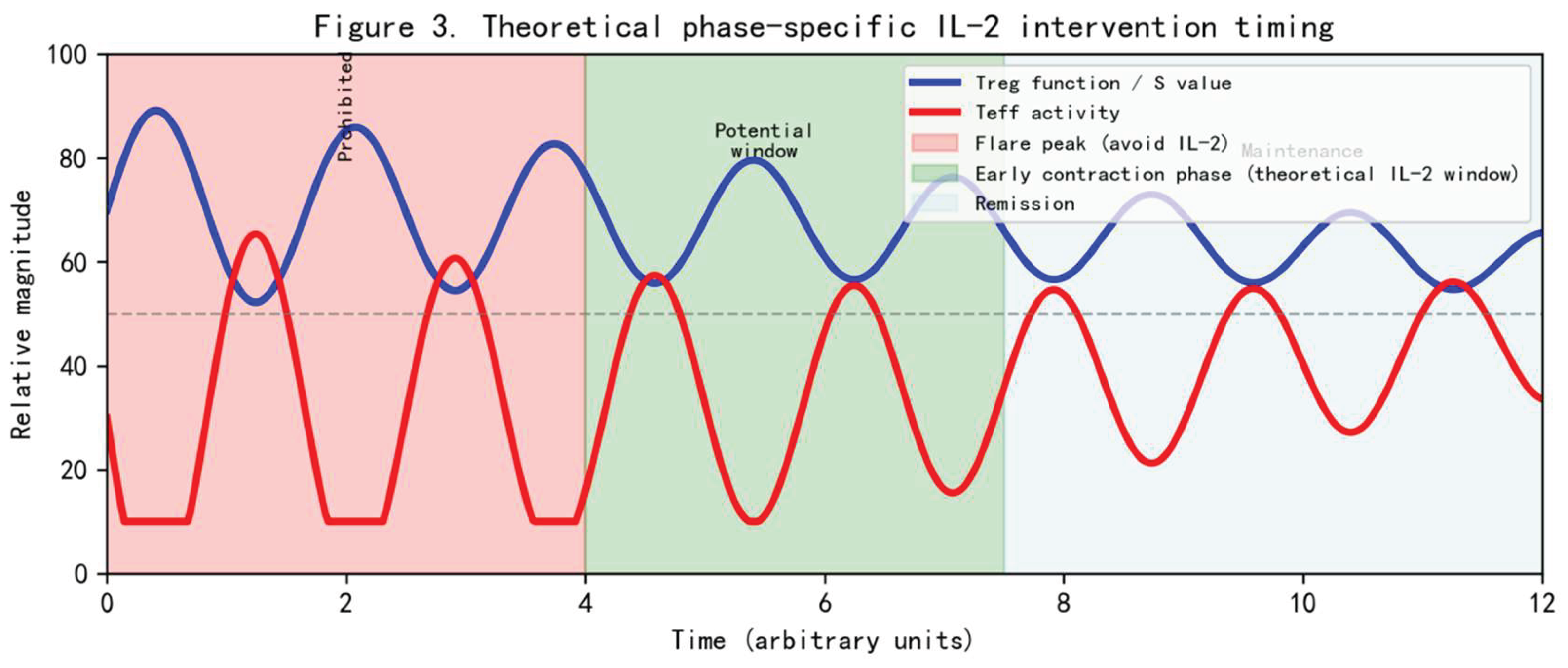
Autoimmune diseases require re-establishment of immune suppression, contrasting with cancer/infection. Intervention strategies should differ by immune phase (Table 3).
Critical warning: All strategies are theoretical. High-dose IL-2 carries CLS risk [4] and is not recommended for AIDs. Phase-specific moderate/low-dose IL-2 requires clinical trial validation.
6. Testing Pathways and Future Directions
6.1. Core Testable Predictions
| Priority | Prediction | Validation method |
| Highest | Tpex load – flare risk association (including S_crit) | Prospective cohort + TCR sequencing |
| High | Existence of subclinical oscillations | High-sensitivity TCR longitudinal tracking |
| High | Early high-dose antigen induces Treg tolerance locking | Neonatal antigen exposure animal model |
6.2. Core Limitations
Applicability: Mainly for T-cell-mediated AIDs. For type II antibody-mediated diseases, effector phase depiction is limited.
Age-dependence boundary: Age-related immune remodeling is a background factor, primarily for middle-aged/elderly onset diseases. For pediatric-onset diseases, genetic N0 and very low TRI contribute more.
Conceptual variables: S and TRI lack standardized measurement.
Technical bottlenecks: Subclinical oscillation quantification; molecular basis of S and TRI unclear.
6.3. Future Directions
Single-cell multi-omics and TCR tracking.
Prospective cohorts to validate S and TRI.
Neonatal animal models for tolerance locking.
Chronic antigen load index.
Standardized measurement for S and TRI.
Contraction-phase IL-2 clinical trials.
7. Conclusion
We present a unifying conceptual framework in which AID flare-remission dynamics emerge from Treg–Tpex-like oscillatory interactions and dual-threshold phase transitions. Peripheral tolerance is a dynamic negative-feedback system; clinical flares occur only when S < S_crit and Teff > TRI. The model accommodates age-dependent onset, benign autoantibody carriage, and seronegative phenotypes, introducing tolerance locking and subclinical immune oscillations. Self-antigens are placed within a broader spectrum of chronicized antigens, conceptually linking autoimmune disease and chronic low-virulence infections (e.g., HBV). All mechanistic inferences and phase-specific interventions are theoretical and require rigorous validation.
8. Conceptual Analogy: HBV and Autoimmune Disease (Heuristic)
Chronic HBV infection and autoimmune diseases share low-toxicity, low-variability chronic antigens that rely on host regulatory networks for persistence. Shared conceptual features may include early high-dose exposure, durable tolerance states, and persistence of stem-like autoreactive T-cell reservoirs. This analogy is heuristic only; HBV is exogenous, while autoimmunity involves thymic selection of self-antigens.
9. Limitations and Declaration
This is a theoretical conceptual framework. All mechanisms, predictions, and therapeutic derivations are unvalidated. Clinical observations are from routine follow-up without formal statistical analysis. sIL-2R is an indirect marker. This paper does not provide clinical decision guidance.
Figure 1.
Proposed framework of Treg–Tpex-like oscillation and dual-threshold phase transition in autoimmune diseases. (A) Dynamic peripheral tolerance. Peripheral tolerance is represented as a negative-feedback system involving regulatory T cells (Treg) and stem-like autoreactive T cells (Tpex-like cells). The tolerance stability index (S = F_Treg / N_Tpex) integrates Treg suppressive function and autoreactive T-cell load. Progressive expansion of the autoreactive reservoir and/or declining regulatory capacity reduce S, moving the system toward a critical state. Red arrows indicate suppression; blue arrows indicate effector differentiation and feedback. (B) Dual-threshold phase transition. Clinical disease activity is governed by two conceptual thresholds: an immune-regulatory threshold (S_crit, green dashed line) and a tissue repair threshold (TRI, orange dashed line). Immune activation may occur when S falls below S_crit, but overt clinical flares arise only when effector activity exceeds local tissue repair capacity (Teff > TRI). Four zones are highlighted: asymptomatic oscillation, benign autoantibody, subclinical activation, and clinical flare. (C) Age- and exposure-dependent modulation. Early-life high-dose antigen exposure is hypothesized to promote durable Treg-dominated tolerance (“tolerance locking”, dashed box), while age-related immune remodeling (thymic involution, TCR diversity loss, Treg decline) progressively reduces S. The blue curve illustrates S decline with age. (D) Clinical heterogeneity. Different autoimmune diseases reach the critical state through distinct combinations of initial autoreactive clone burden (N₀), tissue repair capacity (TRI), environmental triggers, and age-related immune remodeling. This generates diverse onset ages (pediatric, adult, late) and flare-remission patterns within a common immune-dynamic framework. Dashed arrows and borders indicate hypothetical mechanisms that require experimental validation. S and TRI are conceptual variables rather than directly measurable biomarkers.
Figure 1.
Proposed framework of Treg–Tpex-like oscillation and dual-threshold phase transition in autoimmune diseases. (A) Dynamic peripheral tolerance. Peripheral tolerance is represented as a negative-feedback system involving regulatory T cells (Treg) and stem-like autoreactive T cells (Tpex-like cells). The tolerance stability index (S = F_Treg / N_Tpex) integrates Treg suppressive function and autoreactive T-cell load. Progressive expansion of the autoreactive reservoir and/or declining regulatory capacity reduce S, moving the system toward a critical state. Red arrows indicate suppression; blue arrows indicate effector differentiation and feedback. (B) Dual-threshold phase transition. Clinical disease activity is governed by two conceptual thresholds: an immune-regulatory threshold (S_crit, green dashed line) and a tissue repair threshold (TRI, orange dashed line). Immune activation may occur when S falls below S_crit, but overt clinical flares arise only when effector activity exceeds local tissue repair capacity (Teff > TRI). Four zones are highlighted: asymptomatic oscillation, benign autoantibody, subclinical activation, and clinical flare. (C) Age- and exposure-dependent modulation. Early-life high-dose antigen exposure is hypothesized to promote durable Treg-dominated tolerance (“tolerance locking”, dashed box), while age-related immune remodeling (thymic involution, TCR diversity loss, Treg decline) progressively reduces S. The blue curve illustrates S decline with age. (D) Clinical heterogeneity. Different autoimmune diseases reach the critical state through distinct combinations of initial autoreactive clone burden (N₀), tissue repair capacity (TRI), environmental triggers, and age-related immune remodeling. This generates diverse onset ages (pediatric, adult, late) and flare-remission patterns within a common immune-dynamic framework. Dashed arrows and borders indicate hypothetical mechanisms that require experimental validation. S and TRI are conceptual variables rather than directly measurable biomarkers.
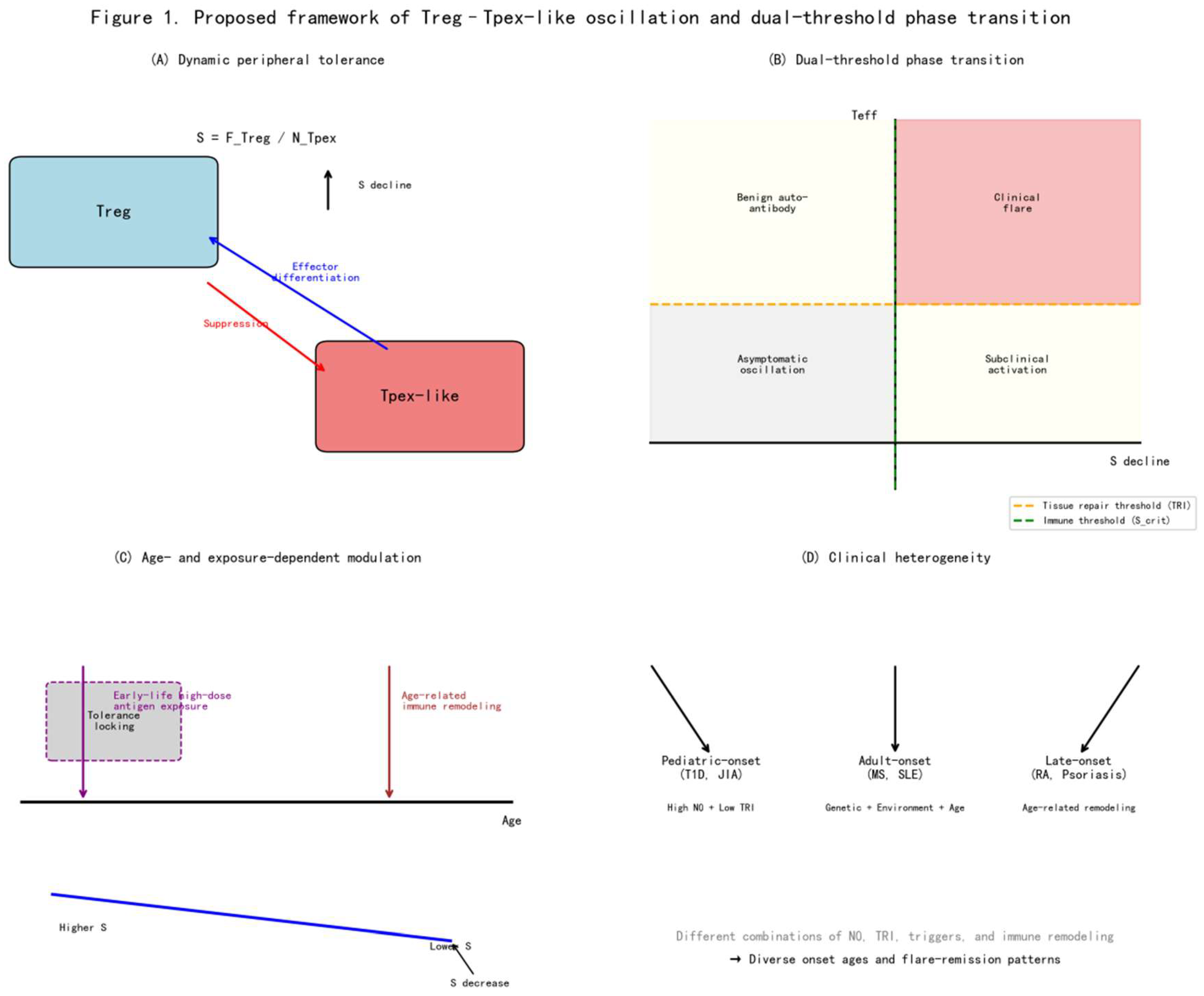
Figure 2.
S value decline and critical threshold. The graph shows the theoretical decline of the tolerance stability index (S) as a function of Tpex-like load or time. The red dashed line indicates the critical threshold S_crit. When S remains above S_crit, the system is in a tolerant state. Progressive accumulation of autoreactive cells brings S toward the threshold; once S falls below S_crit, a phase transition is triggered. The gray-shaded region denotes positive feedback where effector activation accelerates regulatory decline. This dual-threshold logic explains why immune activation may occur without clinical disease (Teff still below TRI) and why clinical flares emerge only when both thresholds are crossed.
Figure 2.
S value decline and critical threshold. The graph shows the theoretical decline of the tolerance stability index (S) as a function of Tpex-like load or time. The red dashed line indicates the critical threshold S_crit. When S remains above S_crit, the system is in a tolerant state. Progressive accumulation of autoreactive cells brings S toward the threshold; once S falls below S_crit, a phase transition is triggered. The gray-shaded region denotes positive feedback where effector activation accelerates regulatory decline. This dual-threshold logic explains why immune activation may occur without clinical disease (Teff still below TRI) and why clinical flares emerge only when both thresholds are crossed.
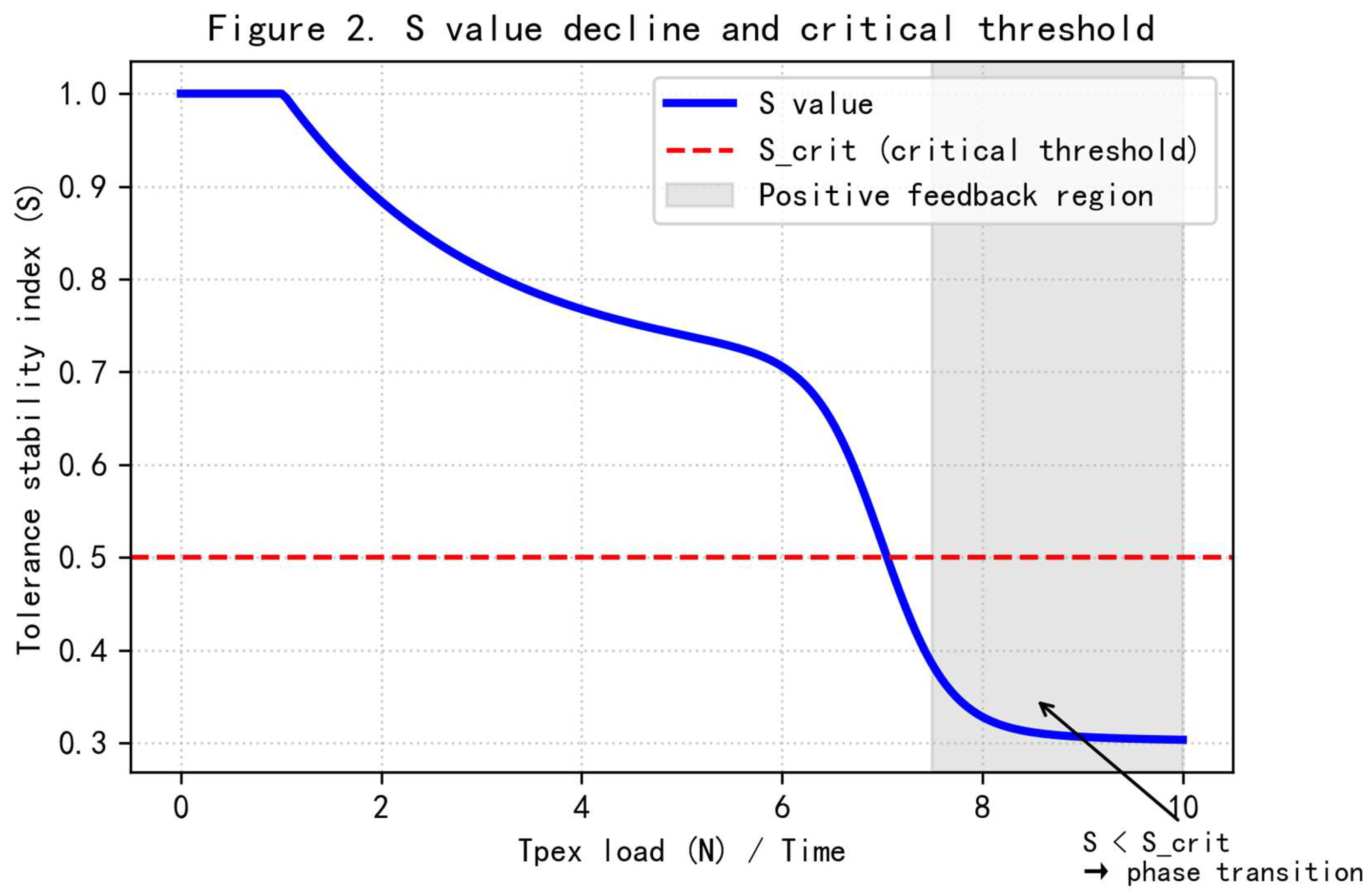
Figure 3.
Theoretical phase-specific IL-2 intervention timing. The graph illustrates conceptual dynamics of Treg function / S value (blue curve) and effector T-cell activity (Teff, red curve) over time. Three immune phases are highlighted: Flare peak (red zone): S < S_crit and Teff high; IL-2 is theoretically contraindicated to avoid amplifying effector cells. Early contraction phase (green zone): S is rising, Teff declining; this represents a theoretical window for moderate/low-dose IL-2 administration to preferentially expand Tregs and consolidate immune suppression. Remission phase (blue zone): S > S_crit, Teff low; low-dose IL-2 may be considered for maintenance of Treg stability. All therapeutic interpretations are theoretical and require clinical validation. The dashed vertical boundaries indicate that phase transitions are gradual rather than instantaneous.
Figure 3.
Theoretical phase-specific IL-2 intervention timing. The graph illustrates conceptual dynamics of Treg function / S value (blue curve) and effector T-cell activity (Teff, red curve) over time. Three immune phases are highlighted: Flare peak (red zone): S < S_crit and Teff high; IL-2 is theoretically contraindicated to avoid amplifying effector cells. Early contraction phase (green zone): S is rising, Teff declining; this represents a theoretical window for moderate/low-dose IL-2 administration to preferentially expand Tregs and consolidate immune suppression. Remission phase (blue zone): S > S_crit, Teff low; low-dose IL-2 may be considered for maintenance of Treg stability. All therapeutic interpretations are theoretical and require clinical validation. The dashed vertical boundaries indicate that phase transitions are gradual rather than instantaneous.
Supplementary Materials
The following supporting information can be downloaded at the website of this paper posted on Preprints.org.
Funding
No dedicated funding.
Institutional Review Board Statement
Not applicable.
Informed Consent Statement
Not applicable.
Acknowledgments
AI-assisted tools were used for language polishing and literature retrieval.
Conflicts of Interest
The author declares no conflict of interest.
References
- Liu, Y.; et al. Stem-like T cells: molecular regulation, functional diversity, and therapeutic implications across diseases. J. Transl. Med. 2025, 23, 1376. [Google Scholar] [CrossRef] [PubMed]
- Abbas, A.K.; et al. IL-2 receptor signaling in Treg and Teff. Nat. Rev. Immunol. 2023, 23(5), 298–312. [Google Scholar] [CrossRef] [PubMed]
- Majidpoor, J.; Mortezaee, K. Interleukin-2 therapy of cancer-clinical perspectives. Int. Immunopharmacol. 2021, 98, 107836. [Google Scholar] [CrossRef] [PubMed]
- Jiang, Y.; Liu, C.; Zhong, Y. Temporal Orchestration of Immunity: How Circadian Clocks Coordinate Immune Responses. Front Biosci. (Landmark Ed) 2025, 30(10), 39948. [Google Scholar] [CrossRef] [PubMed]
- Thimme, R.; Hofmann, M.; Bertoletti, A.; Le Bert, N. Decoding HBV-specific adaptive immunity: from natural clearance to cure. Gut 2025. Online ahead of print. [Google Scholar] [CrossRef] [PubMed]
- Xue, R.; Li, G.; Zhou, Y.; et al. Efficacy and safety of low-dose interleukin 2 in the treatment of moderate-to-severe bullous pemphigoid: a single center perspective-controlled trial. J. Am. Acad. Dermatol. 2024, 91(6), 1113–1117. [Google Scholar] [CrossRef] [PubMed]
- Desdín-Micó, G.; et al. T cells with dysfunctional mitochondria induce multimorbidity and premature senescence. Science 2023, 382(6669), eadh0210. [Google Scholar] [CrossRef] [PubMed]
- Xu, Y.; Yi, X.; Li, C.; Chen, J. CD8+ T cell exhaustion: the potential for treating autoimmune diseases. Curr. Opin. Immunol. 2025, 85, 102600. [Google Scholar] [CrossRef] [PubMed]
- Zhang, X.; Feng, R.; Wang, Y.; et al. Low dose IL-2 therapy restores regulatory T cells in patients with systemic lupus erythematosus in a dose-dependent manner: a phase IIb trial. Nat Commun. 21 Apr 2026. Online ahead of print. [CrossRef] [PubMed]
- Yan, H.; Zi, X.; Yan, H.; et al. The absolute number of circulating Treg cells is reduced in difficult-to-treat RA patients and is ameliorated by low-dose IL-2. Front Immunol. 2025, 16, 1522893. [Google Scholar] [CrossRef] [PubMed] [PubMed Central]
- Chen, J.; Liu, J.; Cao, X. Functional and Metabolic Heterogeneity of Dendritic Cells in Self-Tolerance and Autoimmunity. Immunol. Rev. 2025, 336(1), e70068. [Google Scholar] [CrossRef] [PubMed]
- Sakaguchi, S.; Yamaguchi, T.; Nomura, T.; Ono, M. Regulatory T cells and immune tolerance. Cell 2008, 133(5), 775-787. [Google Scholar] [CrossRef] [PubMed]
- Zou, D.; Li, X.C.; Chen, W. Beyond T-cell subsets: stemness and adaptation redefining immunity and immunotherapy. Cell Mol. Immunol. 2025, 22(9), 957–974. [Google Scholar] [CrossRef] [PubMed]

Table 1.
Clinical phenotype zones based on S and TRI.
| Zone | S state | Teff vs TRI | Clinical phenotype |
|---|---|---|---|
| Asymptomatic oscillation | S > S_crit | Teff < TRI | Healthy homeostasis |
| Benign autoantibody | S ≈ S_crit | Teff < TRI | Antibody-positive, no damage |
| Subclinical flare | S < S_crit | Teff < TRI | Immune activation, no symptoms |
| Clinical flare | S < S_crit | Teff > TRI | Tissue damage, flare |
Table 2.
Multidimensional classification of AIDs.
| Type | Core features | Examples | Mechanism notes |
|---|---|---|---|
| I | Autoantibody + T-cell synergy | SLE, RA | Tpex breach S_crit drive inflammation |
| II | Autoantibody as direct effector (T-cell-dependent) | Myasthenia gravis, Graves’ disease | Pathogenic IgG depends on Tfh help [2] |
| III | Benign autoantibody | Healthy individuals | B-cell tolerance broken, Tpex below S_crit, Teff < TRI |
| IV | Acute triggered by neo-antigen | Post-streptococcal glomerulonephritis | No pre-existing tolerance, S initially low |
| V | T-cell-mediated, antibody-negative | Psoriasis | T-cell dominated, conventional antibodies negative |
Table 3.
Phase-specific therapeutic strategies (theoretical derivation).
| Immune phase | S state | Autoimmune strategy (theoretical) | Cancer/infection strategy (theoretical) | Core difference |
|---|---|---|---|---|
| Flare peak | S < S_crit | Avoid IL-2, target effector cells | High-dose IL-2 activate effectors | Suppression vs activation |
| Early contraction | S rising | Moderate/low-dose IL-2 | Pause IL-2 | Enhance negative feedback vs protect effectors |
| Subclinical/ remission |
S > S_crit | Low-dose IL-2 maintain Tregs | Generally not used; theoretical comparison only | Maintain suppression vs avoid over-suppression |
*Note: In cancer/infection settings, low-dose IL-2 expands Tregs and may dampen anti-tumor or anti-pathogen immunity; therefore it is rarely used for maintenance therapy. The entry is included for theoretical comparison with autoimmune disease strategies.*.
Disclaimer/Publisher’s Note: The statements, opinions and data contained in all publications are solely those of the individual author(s) and contributor(s) and not of MDPI and/or the editor(s). MDPI and/or the editor(s) disclaim responsibility for any injury to people or property resulting from any ideas, methods, instructions or products referred to in the content. |
© 2026 by the authors. Licensee MDPI, Basel, Switzerland. This article is an open access article distributed under the terms and conditions of the Creative Commons Attribution (CC BY) license (http://creativecommons.org/licenses/by/4.0/).
Copyright: This open access article is published under a Creative Commons CC BY 4.0 license, which permit the free download, distribution, and reuse, provided that the author and preprint are cited in any reuse.


