

Submitted:
10 June 2026
Posted:
11 June 2026
You are already at the latest version
Abstract
The integrity of cold chains is critical for preserving the quality, safety, and efficacy of temperature-sensitive products, including pharmaceuticals, vaccines, and perishable goods. However, real-world cold-chain operations are subject to environmental variability, operational disturbances, and transport-related uncertainties that are often inadequately captured by deterministic models. This study presents a physics-informed stochastic framework for modeling temperature dynamics and product degradation under uncertainty. Temperature evolution is represented through a stochastic heat-transfer model incorporating random perturbations, while product degradation is quantified using Arrhenius-based kinetics that link thermal exposure to quality loss. The framework integrates stochastic simulation, degradation modeling, and machine-learning-based correction to capture nonlinear effects not explicitly represented by the governing equations. Numerical experiments based on the Euler–Maruyama method and Monte Carlo simulation are used to generate physically consistent synthetic datasets and evaluate system performance. Results indicate that stochastic variability can produce transient temperature excursions even when average operating conditions remain acceptable, leading to increased degradation and higher failure probabilities. The proposed methodology provides improved estimates of thermal risk and product quality deterioration compared with deterministic approaches. Overall, the framework offers a practical tool for uncertainty quantification, reliability assessment, and decision support in temperature-sensitive supply chains.
Keywords:
cold chains
; physics-informed modeling
; stochastic processes
; temperature dynamics
; product degradation
; uncertainty quantification
; monte carlo simulation
; Arrhenius kinetic
1. Introduction
Cold chains play a critical role in preserving the quality, safety, and efficacy of temperature-sensitive products, including pharmaceuticals, vaccines, and perishable food items. The increasing globalization of supply networks and the growing demand for biopharmaceutical products have intensified the need for robust and reliable temperature-controlled systems [1,2,3]. However, maintaining strict thermal conditions throughout transportation and storage remains a significant challenge due to environmental variability, operational uncertainties, and infrastructure limitations.
Previous research has extensively investigated optimization and decision-support strategies for cold-chain operations, particularly in the areas of distribution planning, inventory management, and transportation efficiency. For example, Perez Lechuga et al. [4] developed a real-world optimization framework combining clustering, vehicle routing, and mixed-integer programming to support large-scale pharmaceutical distribution. Such studies highlight the operational complexity of cold-chain systems and the need for advanced analytical tools capable of supporting decision-making under realistic conditions.
Similarly, subsequent studies have emphasized the importance of integrated modeling approaches that consider multiple interacting components within the cold chain, including transportation, routing, and system-level decision processes under realistic constraints. Despite these advances, most existing works focus primarily on deterministic optimization and operational efficiency, often neglecting the stochastic nature of temperature dynamics and the direct relationship between thermal exposure and product degradation. This limitation suggests the need for modeling frameworks that explicitly incorporate uncertainty, physical processes, and product-specific degradation mechanisms into cold-chain analysis [5].
Traditional approaches to cold-chain management have largely relied on deterministic models that assume stable environmental conditions and predictable operations. While these models provide useful baseline insights, they often fail to capture the variability observed in real systems, where temperature fluctuations, transportation delays, and handling disruptions may significantly affect product quality [6]. In this context, stochastic modeling has emerged as a useful tool for representing uncertainty and quantifying risk in cold-chain processes. For instance, temperature evolution during transport can be modeled using stochastic differential equations, enabling the assessment of probabilistic deviations from desired operating conditions and their potential impact on product integrity [7].
In parallel, advances in materials science have contributed to improving the thermal performance of cold-chain packaging. Insulation materials and phase change materials (PCMs) have been widely studied for their ability to stabilize internal temperatures and reduce thermal excursions [8,9]. These materials exhibit thermal properties such as low thermal conductivity and high latent heat capacity, which play an important role in maintaining temperature-sensitive products within acceptable ranges during transport. However, their effectiveness ultimately depends on the interaction between material properties, environmental variability, and operational conditions.
Another crucial aspect of cold-chain performance is the chemical stability of transported products. Many pharmaceuticals and biological products are highly sensitive to temperature variations, with degradation rates strongly influenced by thermal exposure. The Arrhenius equation has been extensively used to describe temperature-dependent reaction kinetics, providing a quantitative relationship between temperature and degradation rates [10]. Incorporating degradation kinetics into cold-chain analysis enables a more realistic assessment of product quality over time, moving beyond simple compliance with temperature thresholds.
More recently, artificial intelligence (AI) and machine learning (ML) techniques have been incorporated into cold-chain applications as complementary tools for monitoring, prediction, and decision support. Data-driven models, including time-series forecasting approaches such as Long Short-Term Memory (LSTM) networks, have demonstrated promising capabilities for capturing temperature patterns under complex and nonlinear operating conditions [11,12]. Similarly, ensemble learning methods such as Random Forest and Gradient Boosting have been applied to anomaly detection and risk classification tasks within supply-chain environments [13,14]. Reinforcement learning approaches have also been explored for adaptive decision-making under uncertainty, particularly in transportation and routing applications [15].
Recent studies have further highlighted the importance of explicitly accounting for uncertainty in logistics systems, particularly in routing and time-window problems where variability in demand, travel times, and unloading operations can significantly affect system performance [4]. These findings reinforce the broader need for analytical frameworks capable of integrating physical processes, stochastic variability, and data-driven information in the analysis of cold-chain systems.
Despite significant advances in cold-chain management, there remains a need for modeling frameworks that explicitly integrate physical processes, uncertainty, and product degradation mechanisms within a unified analytical structure. Existing approaches often emphasize either deterministic physical modeling or purely data-driven prediction, limiting their ability to accurately represent the complex interactions that govern temperature evolution and quality deterioration in real-world cold-chain systems.
This study develops a physics-informed stochastic framework for modeling temperature dynamics and product degradation in cold chains under uncertainty. The proposed approach combines stochastic representations of heat transfer and environmental variability with Arrhenius-based degradation kinetics to quantify the impact of thermal exposure on product quality. Machine learning models are incorporated as complementary predictive components capable of capturing nonlinear relationships that may not be fully represented by the underlying physical formulation. The resulting framework provides a flexible tool for analyzing thermal behavior, degradation processes, and operational risk under realistic conditions.
The main contributions of this study are fourfold.
First, we develop a unified physics-informed stochastic framework that couples temperature evolution, thermally driven degradation kinetics, and uncertainty propagation within a single mathematical formulation for cold-chain analysis.
Second, the proposed methodology explicitly quantifies the impact of stochastic variability on product quality and system reliability, demonstrating how probabilistic temperature excursions can significantly affect degradation outcomes even when average operating conditions remain acceptable.
Third, we integrate machine learning models as data-driven correction mechanisms capable of capturing nonlinear and unmodeled effects that are difficult to represent through purely physics-based formulations, thereby improving predictive performance.
Fourth, we establish a computational framework that combines stochastic differential equations, degradation modeling, machine learning, and Monte Carlo simulation to support risk assessment and decision-making in temperature-sensitive supply systems.
By bridging physical modeling, stochastic analysis, and data-driven prediction, the hybrid framework provides a comprehensive approach for evaluating uncertainty, degradation, and reliability in cold-chain operations and offers a foundation for future digital-twin and intelligent monitoring applications.
2. Theoretical Framework
This section presents the theoretical foundations underlying the proposed physics-informed stochastic framework for modeling temperature dynamics and product degradation in cold chains under uncertainty. The approach integrates stochastic processes, heat transfer mechanisms, degradation kinetics, and machine learning components within a unified analytical structure.
2.1. Notation and Definitions
This subsection introduces the notation used throughout the proposed physics-informed stochastic framework. Let
denote a filtered probability space, where is the sample space, is the associated -algebra, is a filtration satisfying the usual conditions, and is the probability measure. The stochastic perturbations are represented by a standard Wiener process adapted to the filtration .
The principal variables and parameters employed throughout the model are summarized below.
- Time (s, h).
- Product temperature at time t (K or °C).
- Drift coefficient describing the deterministic component of the stochastic temperature process (K s−1).
- Diffusion coefficient representing stochastic variability (K s−1/2).
- Standard Wiener process (s1/2).
- Thermal conductivity (W m−1 K−1).
- Heat flux (W m−2).
- Temperature gradient (K m−1).
- Reaction rate constant (s−1).
- Arrhenius pre-exponential factor (s−1).
- Activation energy (J mol−1).
- Universal gas constant (J mol−1 K−1).
- Feature vector containing relevant environmental, operational, and thermal variables.
- Machine-learning prediction or correction function.
- Critical temperature threshold (K).
- Probability measure associated with events defined on the probability space.
The notation introduced above will be used throughout the remainder of the paper in the formulation and analysis of the proposed stochastic cold-chain model.
2.2. Physics-Informed Stochastic Temperature Model
Temperature variations in cold-chain systems are inherently stochastic due to environmental fluctuations, transportation disturbances, and operational uncertainties. To represent these effects, temperature evolution is modeled within the probabilistic framework introduced in the previous subsection. Let
denote the filtered probability space on which all stochastic processes are defined. In particular, represents a standard Wiener process adapted to the filtration , providing the mathematical basis for the random perturbations incorporated into the temperature dynamics [16,17].
The deterministic component of temperature evolution is governed by the underlying heat-transfer mechanisms. In cold-chain applications, heat exchange between the product and its environment is commonly described through classical heat-transfer theory. In particular, Fourier’s law relates the heat flux to the temperature gradient according to
where q denotes the heat flux and is the thermal conductivity of the material. The thermal response of packaging systems is therefore influenced by both environmental conditions and material properties. Advanced insulation materials and phase change materials (PCMs) have been extensively investigated to improve thermal stability and reduce temperature excursions during transportation and storage [8,9]. In particular, PCMs provide latent heat storage capacity, allowing temporary thermal buffering during phase transitions.
To account for uncertainty in real operating conditions, the temperature evolution is represented by the stochastic differential equation
where represents the deterministic component of the temperature dynamics arising from the underlying heat-transfer processes, while characterizes stochastic fluctuations induced by environmental variability and operational disturbances. The Wiener process introduces random perturbations that capture the uncertainty inherent in real cold-chain systems.
This stochastic formulation enables the characterization of probabilistic deviations from nominal temperature conditions and provides a more realistic representation of cold-chain behavior than purely deterministic models. Consequently, it becomes possible to quantify the likelihood of temperature excursions and assess their potential impact on product quality and degradation [7].
2.3. Chemical Degradation Kinetics
The stability of temperature-sensitive products is strongly influenced by chemical degradation processes. Since product quality is directly affected by thermal exposure, degradation kinetics are incorporated into he integrated model through an Arrhenius-type formulation. The reaction rate constant is denoted by and is defined as
where A is the pre-exponential factor, is the activation energy, R is the universal gas constant, and T denotes the absolute temperature. This relationship provides a quantitative description of the effect of temperature on degradation rates and has been widely employed in the analysis of food, pharmaceutical, and biological products subjected to varying thermal conditions [10,18].
By coupling the stochastic temperature model with Arrhenius-based degradation kinetics, the framework establishes a direct link between thermal variability and product quality deterioration, enabling a probabilistic assessment of degradation under uncertain operating conditions.
2.4. Hybrid Modeling Framework
Although the stochastic formulation captures the dominant physical mechanisms governing temperature evolution, real cold-chain systems may exhibit nonlinear effects and operational complexities that are difficult to represent explicitly. To account for these effects, a data-driven component is incorporated into the developed model, following the general philosophy of physics-informed machine learning [19].
The hybrid model assumes that the observed temperature can be represented as the combination of a physics-based stochastic prediction and a data-driven correction term,
where denotes the prediction obtained from the stochastic temperature model and represents a machine-learning correction term based on the feature vector . The latter is intended to capture nonlinear relationships, residual patterns, and unmodeled effects that may not be fully represented by the underlying physical formulation.
In this manner, the machine-learning component acts as a complementary predictive layer rather than a replacement for the physics-based model, preserving physical interpretability while improving predictive performance.
To quantify the impact of uncertainty on system performance, Monte Carlo simulation is employed by generating multiple realizations of the stochastic temperature process defined in Eq. (2). This approach enables the estimation of probabilistic performance measures and the evaluation of risk under realistic operating conditions.
In particular, the probability of exceeding a critical temperature threshold can be estimated as
where denotes the maximum admissible temperature for the product under consideration. Such probability-based metrics provide a quantitative measure of system reliability and support risk-informed decision making in temperature-sensitive supply chains [20,21].
The resulting framework combines stochastic temperature dynamics, heat-transfer mechanisms, degradation kinetics, machine-learning enhancement, and uncertainty quantification within a unified modeling structure. This integration enables a more realistic assessment of product quality degradation and operational risk under uncertain environmental and transportation conditions.
The modeling methodology combines heat-transfer physics, stochastic temperature dynamics, Arrhenius-based degradation kinetics, machine-learning enhancement, and Monte Carlo uncertainty quantification within a unified modeling structure. Temperature evolution is governed by the stochastic process described in Eq. (2), while degradation is quantified through the Arrhenius relation in Eq. (3). The hybrid correction term introduced in Eq. (4) provides a data-driven refinement of the physics-based prediction, and Monte Carlo simulation enables the probabilistic evaluation of system performance and risk. Together, these components establish an integrated framework for analyzing temperature-sensitive products under uncertain operating conditions.
Consequently, the drift term appearing in Eq. (2) may be expressed as
which establishes an explicit connection between the stochastic formulation and the underlying heat-transfer physics.
Substituting Eq. (6) into the stochastic formulation of Eq. (2), the temperature dynamics can be expressed as
where the first term represents the deterministic heat-transfer contribution derived from the thermal balance, while the second term captures stochastic perturbations associated with environmental variability and operational disturbances. Consequently, the stochastic temperature model is directly linked to the underlying heat-transfer physics rather than being introduced as a purely phenomenological description.
Once the temperature trajectory has been obtained from Eq. (7), it can be used to evaluate product degradation. Since chemical and biochemical degradation processes are strongly temperature dependent, the Arrhenius relation in Eq. (3) defines the instantaneous degradation rate as
thereby establishing a direct connection between stochastic temperature fluctuations and the degradation dynamics of the product.
To quantify the cumulative effect of thermal exposure, let denote the degradation state of the product. Assuming that degradation accumulates continuously over time, its evolution may be represented by
subject to the initial condition
Substituting Eq. (8) into Eq. (9) and integrating over time yields
which represents the cumulative degradation resulting from the complete thermal history experienced by the product. Consequently, degradation depends not only on the average temperature level but also on transient temperature excursions generated by the stochastic dynamics. This formulation provides a direct quantitative link between temperature uncertainty and product quality deterioration.
Because is a stochastic process, the degradation rate also becomes time dependent and stochastic. Consequently, product degradation cannot be represented by a single deterministic value but must be characterized through the entire thermal history experienced by the product.
While Eq. (11) quantifies the accumulated degradation, it is often convenient to express product condition in terms of a normalized quality index. Let denote a dimensionless quality variable, where corresponds to the initial product quality. Assuming first-order degradation kinetics, the temporal evolution of quality is described by
which yields the solution
Therefore, the remaining product quality depends on the complete stochastic temperature trajectory rather than on a single temperature measurement. This formulation highlights how transient temperature excursions may accelerate degradation and reduce product quality, even when average storage conditions remain within acceptable limits.
Equation (13) is particularly important because it directly links stochastic temperature excursions to cumulative product quality loss. Even relatively small but persistent deviations from the desired thermal conditions may result in significant degradation when their effects accumulate over time.
To further improve predictive accuracy, a machine-learning component is incorporated into the framework through the hybrid formulation introduced in Eq. (4). In practice, the physics-based stochastic model may not fully capture all sources of variability associated with route characteristics, solar radiation, loading patterns, refrigeration cycling, door-opening frequency, humidity, or human handling. Consequently, the correction term is introduced as a data-driven component based on the feature vector .
Within this framework, the machine-learning model is not intended to replace the underlying physical formulation. Rather, it acts as a complementary predictive layer that captures residual nonlinear effects and unmodeled dynamics, thereby improving the representation of real operating conditions while preserving the interpretability provided by the stochastic heat-transfer and degradation models.
A practical implementation of the hybrid framework consists of using the machine-learning model as a correction to the temperature predicted by the physics-based formulation. In this case,
where denotes the temperature obtained from the stochastic heat-transfer model and represents a data-driven correction based on the feature vector . The correction term is intended to capture residual nonlinearities and unmodeled effects that cannot be fully represented by the underlying physical formulation. As a result, the hybrid model combines the interpretability of physics-based modeling with the flexibility of machine-learning techniques, providing improved predictive performance under realistic operating conditions.
The developed methodology integrates stochastic heat-transfer dynamics, Arrhenius-based degradation kinetics, and machine-learning enhancement within a unified modeling structure. The temperature trajectory is first obtained from the physics-informed stochastic model, which accounts for conductive heat transfer as well as environmental and operational uncertainties. The resulting temperature history is subsequently refined through the machine-learning correction term and then used to evaluate product quality degradation through the Arrhenius formulation. In this manner, thermal properties, stochastic disturbances, and product sensitivity are naturally coupled within a single framework, enabling the assessment of temperature evolution, degradation, and risk under uncertain operating conditions.
From an operational perspective, the proposed strategy enables the estimation of thermal failure probabilities, product quality degradation, and overall system reliability under uncertain conditions. It also provides a quantitative basis for evaluating the influence of packaging materials, environmental conditions, and transportation policies on cold-chain performance.
The framework naturally supports Monte Carlo simulation by generating multiple realizations of the stochastic temperature process and the corresponding degradation trajectories. Statistical analysis of these realizations yields probabilistic estimates of temperature excursions, quality loss, and operational risk, providing a practical tool for decision making in temperature-sensitive supply chains such as pharmaceutical, vaccine, and perishable food logistics.
In this subsection, we briefly examine the mathematical properties of the computational framework. The objective is to establish that the stochastic temperature model is well posed and that the resulting degradation dynamics remain physically meaningful.
The temperature evolution is governed by the stochastic differential equation introduced previously, whose drift term is derived from the underlying heat-transfer balance and whose diffusion term represents environmental and operational uncertainty. Under standard regularity assumptions on the model coefficients, the stochastic temperature process admits a unique solution in the sense of Itô [16].
The degradation dynamics are subsequently obtained through the Arrhenius formulation and the associated quality equation. Since the degradation rate remains nonnegative for all admissible temperatures, the quality index satisfies
ensuring physical consistency throughout the simulation horizon.
Consequently, the present methodology provides a mathematically well-defined coupling between stochastic temperature evolution and product degradation, forming a suitable basis for uncertainty quantification and Monte Carlo simulation.
2.4.1. Assumptions
To establish the well-posedness of the stochastic temperature model, we state the following assumptions. Let and denote, respectively, the drift and diffusion coefficients associated with the temperature equation.
Assumption A1 (measurability). The ambient temperature process and the feature process are progressively measurable with respect to the filtration .
Assumption A2 (Lipschitz continuity). There exist constants and such that, for all , , and ,
and
Assumption A3 (linear growth). There exists a constant such that, for all , , and ,
Assumption A4 (positive thermal regime). There exists a constant such that, almost surely,
This condition is physically natural when temperature is expressed in Kelvin and the operating regime remains bounded away from absolute zero.
Assumptions A1–A3 are standard regularity conditions for stochastic differential equations and ensure the existence and uniqueness of a strong solution under the usual Itô framework [16,17]. Assumption A4 is introduced to guarantee that the Arrhenius degradation term is well defined over the simulation horizon.
2.4.2. Existence and Uniqueness of the Temperature Process
We first analyze the stochastic temperature equation.
Theorem 1
(Existence and uniqueness of the temperature process). Suppose that Assumptions A1–A3 hold. Then, for every square-integrable initial condition , the stochastic differential equation (7) admits a unique strong solution on .
Moreover,
and
Proof.
By Assumption A1, the processes and are progressively measurable. Hence, the coefficients and are progressively measurable in time for each fixed state variable T.
Assumption A2 implies that both coefficients are globally Lipschitz with respect to the temperature variable. More precisely, there exists a constant such that, for all ,
almost surely. Assumption A3 gives the corresponding linear growth condition,
Therefore, the standard existence and uniqueness theorem for Itô stochastic differential equations applies, yielding a unique strong solution on .
It remains to justify the moment estimate. From the integral form of the SDE,
we obtain, for ,
Using Cauchy’s inequality for the deterministic integral and the Burkholder–Davis–Gundy inequality for the stochastic integral, there exists a constant depending on but not on t such that
Since , Gronwall’s inequality implies
Thus, , and the theorem follows. □
This result ensures that the stochastic thermal component of the proposed model is mathematically well posed under standard regularity assumptions.
2.4.3. Explicit Representation in the Linear Case
A particularly relevant case arises when the deterministic heat-transfer term is linear in the temperature state and the diffusion coefficient is state-independent over short time windows. Define
so that the physics-based stochastic temperature model becomes
This equation may be interpreted as a time-dependent Ornstein–Uhlenbeck-type model. By the variation-of-constants formula, its solution can be written as
Equation (22) provides a useful physical interpretation of the model. The exponential factor describes the memory decay of the thermal system: larger values of correspond to faster adjustment to ambient conditions, whereas smaller values of indicate stronger insulation and slower thermal response.
Once the physics-based trajectory is obtained, the machine-learning correction introduced previously can be applied to obtain the corrected prediction . This keeps the stochastic heat-transfer model physically interpretable while allowing data-driven residual effects to be incorporated at the prediction stage.
2.4.4. Statistical Properties of Temperature and Quality Dynamics
For the linear stochastic temperature model introduced in Eq. (21), the first two moments can be characterized explicitly. Under suitable integrability assumptions, taking expectations in Eq. (22) yields
If the diffusion coefficient is deterministic (or independent of the Wiener process), the corresponding variance satisfies
These expressions provide direct insight into the influence of insulation properties and stochastic forcing on thermal reliability. In particular, larger values of lead to faster convergence toward ambient conditions, whereas the diffusion term determines the magnitude of temperature variability.
We now consider the associated quality dynamics. Once a temperature trajectory is available, the degradation rate is determined through the Arrhenius relation, and the quality equation becomes an ordinary differential equation with random coefficient.
Theorem 2
(Quality dynamics and positivity). Assume that is an adapted process satisfying Assumption A4. Then the quality equation admits the unique solution
Moreover,
and is non-increasing in time.
Proof.
By Assumption A4, the temperature remains strictly positive, so the Arrhenius degradation rate
is finite and nonnegative for all . Consequently, the quality equation is a linear ordinary differential equation with measurable coefficient, whose unique solution is given by Eq. (25).
Since the exponent is nonpositive, it follows immediately that
Finally,
because both and are nonnegative. Therefore, is non-increasing over time. □
The preceding results establish that the temperature process possesses well-defined statistical moments and that the corresponding quality dynamics remain physically consistent. Together, these properties provide a rigorous basis for the uncertainty quantification and Monte Carlo analyses developed in the following sections.
2.4.5. Temperature Sensitivity and Risk Metrics
The Arrhenius law reveals the strong sensitivity of product degradation to temperature variations. Consider the degradation-rate function
which is strictly increasing for all . Indeed,
Therefore, higher temperatures necessarily produce larger degradation rates. As a consequence, if two temperature trajectories satisfy
then the corresponding quality trajectories satisfy
This comparison property provides a rigorous justification for minimizing temperature excursions, since any systematic reduction in the thermal profile leads to improved product preservation.
The preceding result naturally motivates the definition of reliability and risk metrics. A primary thermal reliability measure is the probability of exceeding a critical temperature threshold,
which represents a pathwise event rather than a pointwise exceedance. This distinction is particularly important in cold-chain systems because even brief temperature excursions may accelerate degradation.
Similarly, a quality-based failure event may be defined as
where denotes the minimum acceptable quality level.
Together, and provide complementary thermal and degradation-based measures of risk. These metrics form the basis for the Monte Carlo analyses presented later and enable the quantitative assessment of reliability under uncertain operating conditions.
2.4.6. Numerical Approximation and Model Implications
For simulation purposes, the stochastic temperature process can be approximated using the Euler–Maruyama scheme. Let and define . Then,
where are independent Gaussian increments. Under Assumptions A2–A3, the Euler–Maruyama approximation converges strongly with order and weakly with order 1 under standard regularity conditions. Consequently, Monte Carlo estimators based on Eq. (32) provide a mathematically justified approach for estimating expectations, reliability measures, and failure probabilities.
Once a discrete temperature trajectory has been generated, the corresponding quality evolution may be approximated by
which preserves both positivity and monotonic decay of the quality index.
The preceding theoretical and numerical results establish that the integrated approach is mathematically well posed and suitable for simulation-based analysis. The temperature process admits a unique solution, the quality dynamics remain physically consistent, degradation exhibits rigorous temperature sensitivity, and risk metrics can be evaluated through probabilistic simulation. Together, these properties provide a solid foundation for uncertainty quantification, reliability assessment, and predictive analysis in cold-chain logistics.
3. Numerical Example and Model Simulation
This section illustrates the implementation of the proposed stochastic framework under representative cold-chain conditions. The temperature dynamics are simulated using the Euler–Maruyama scheme, while product degradation is evaluated through the Arrhenius-based quality model. Monte Carlo simulation is employed to quantify temperature variability, quality loss, and reliability metrics under uncertainty.
The objective is not to reproduce a specific logistics operation but to provide a physically consistent case study for assessing the applicability of the proposed methodology.
3.1. Overview and Research Design
Cold-chain systems are inherently affected by environmental variability, operational disturbances, and limited data availability. To enable controlled experimentation while preserving the essential physical and statistical characteristics of real-world operations, a synthetic yet physically consistent dataset is employed. This approach is commonly used in stochastic modeling studies to evaluate system behavior under uncertainty.
The numerical study consists of four main stages: (i) synthetic data generation, (ii) numerical simulation of the stochastic temperature model, (iii) machine-learning-based prediction enhancement, and (iv) Monte Carlo analysis for uncertainty quantification and risk assessment.
3.2. Synthetic Data Generation
To evaluate the proposed strategy under controlled conditions, a synthetic yet physically consistent dataset was generated. This approach enables systematic experimentation while preserving the main thermal and degradation mechanisms governing real-world cold-chain systems.
The ambient temperature profile was modeled as
where is the mean ambient temperature, denotes the diurnal temperature amplitude, and is a Gaussian noise process with zero mean and variance . The sinusoidal component captures daily temperature cycles, whereas the stochastic term accounts for environmental variability and operational uncertainty [7,17,22,23].
The parameters employed in the numerical experiments are summarized in Table 1. These values represent typical cold-chain operating conditions and provide the thermal and chemical characteristics required by the proposed model.
The selected parameters represent a generic temperature-sensitive product and serve as baseline values for the simulations. The thermal parameters govern heat-transfer dynamics, whereas the Arrhenius constants determine the sensitivity of product degradation to temperature variations. The critical temperature defines the operational threshold beyond which product integrity may be compromised. Although illustrative, the adopted values are consistent with ranges commonly reported in the cold-chain and thermal-storage literature [8,9,10].
The operating conditions represented by Table 1 are broadly compatible with several cold-chain products, including vaccines, insulin and other biopharmaceuticals, fresh dairy products, chilled meat and seafood, and selected fruits and vegetables. Representative storage temperatures are summarized in Table 2.
The synthetic dataset is generated directly from the governing equations introduced in Section 2. Ambient temperature profiles act as external forcing, stochastic temperature trajectories are obtained from the heat-transfer model, degradation rates are computed through the Arrhenius relation, and product quality indices are derived from the corresponding degradation dynamics. Reliability indicators are subsequently obtained through Monte Carlo simulation. The generated variables and their corresponding mathematical models are summarized in Table 3.
3.2.1. Auxiliary Operational Features
In addition to the variables generated directly from the governing equations, a set of auxiliary operational features is introduced to support the machine-learning correction component of the framework. These variables represent environmental and logistical factors that may influence temperature evolution but are not explicitly modeled by the heat-transfer equation.
The feature vector is defined as
where denotes the ambient temperature, represents transport duration, is a route-variability index, is the counting process associated with door-opening events, and denotes the refrigeration-efficiency factor.
These variables are included to capture operational effects such as route heterogeneity, intermittent thermal disturbances, and fluctuations in cooling performance. Using this methodology, they serve as inputs to the machine-learning correction term , allowing the model to account for residual nonlinearities and exogenous influences not explicitly represented in the physics-based component.
For the synthetic experiments, the variables in are generated from probability distributions chosen to preserve physical plausibility and consistency with typical cold-chain operating conditions.
3.3. Numerical Solution of the Stochastic Model
The stochastic temperature model is solved numerically using the Euler–Maruyama method. Let denote the time step and define . The discretized temperature equation is given by
where
are independent Gaussian increments representing the stochastic forcing.
Once the temperature trajectory has been obtained, product degradation is evaluated through the Arrhenius-based quality model. The corresponding discrete update is
which preserves the positivity and monotonic decay of the quality index throughout the simulation horizon.
3.4. Monte Carlo Simulation and Machine-Learning Enhancement
The methodology combines stochastic simulation, degradation modeling, and machine-learning-based prediction enhancement within a unified computational workflow. The machine-learning component is employed to approximate the correction term introduced in the hybrid formulation, allowing the model to account for residual nonlinearities and operational effects not explicitly captured by the physics-based component.
Two machine-learning approaches are considered: Long Short-Term Memory (LSTM) networks for temporal prediction and Random Forest regressors for nonlinear regression tasks. The synthetic dataset is divided into training (70%), validation (15%), and testing (15%) subsets. The models are trained to predict temperature residuals,
where denotes the temperature predicted by the stochastic heat-transfer model. The learned correction is subsequently incorporated into the hybrid framework to improve predictive accuracy.
Figure 1 illustrates the effect of incorporating the machine-learning correction term into the stochastic thermal model. While the physics-based formulation accurately reproduces the overall temperature trend, the hybrid approach more effectively captures local fluctuations and operational disturbances. As a result, the prediction error is reduced, leading to improved estimates of both thermal reliability and product quality. These results highlight the complementary roles of physics-based and data-driven modeling within this approach.
System performance under uncertainty is evaluated through Monte Carlo simulation. For each realization, ambient-temperature and operational-feature trajectories are generated, the temperature path is simulated using the Euler–Maruyama scheme, and the corresponding quality trajectory is computed from the Arrhenius-based degradation model. Reliability and performance metrics are then estimated from the ensemble of realizations.
The developed approach is assessed through performance evaluation introduced in Section 2, including the thermal failure probability and the quality-failure probability . In addition, the expected final quality,
and the variability of the simulated temperature trajectories are used to characterize overall system performance.
The overall computational procedure consists of: (i) generating synthetic environmental and operational data, (ii) training the machine-learning correction model, (iii) simulating temperature trajectories using the stochastic thermal model, (iv) evaluating degradation through the Arrhenius formulation, and (v) estimating reliability metrics from Monte Carlo realizations. Algorithm 1 summarizes the complete implementation procedure. A Python implementation of the framework is available upon request [24].
3.5. Temperature Dynamics
This subsection analyzes the temperature behavior predicted by the proposed stochastic framework. Particular attention is given to the effects of environmental variability and random disturbances on the thermal stability of the cold-chain system.
Figure 2 presents representative temperature trajectories generated using the Euler–Maruyama discretization of the stochastic heat-transfer model. The trajectories exhibit the expected fluctuations induced by the stochastic forcing term, while remaining influenced by the deterministic heat-transfer dynamics and ambient temperature conditions.
The dispersion of the trajectories illustrates the uncertainty associated with real cold-chain operations, where environmental fluctuations and operational disturbances may lead to different thermal histories even under similar nominal conditions. The different colors correspond to independent realizations of the stochastic temperature process and are used solely to facilitate visual identification of individual trajectories. Occasional approaches to the critical threshold highlight the potential risk of temperature excursions and justify the need for probabilistic reliability assessment rather than purely deterministic analysis.
3.5.1. Mean Temperature and Variability
While individual trajectories provide insight into the stochastic behavior of the system, aggregate statistics are required to quantify its overall thermal performance. Figure 3 presents the ensemble mean temperature together with the corresponding variability envelope obtained from the Monte Carlo simulations.
The mean trajectory remains close to the expected thermal equilibrium determined by the ambient conditions and insulation properties, while the variability envelope reflects the uncertainty induced by stochastic disturbances. The gradual widening of the confidence band illustrates the cumulative effect of random fluctuations over time and provides a quantitative measure of thermal reliability.
The stochastic temperature trajectories obtained from the thermal model directly affect product quality through the Arrhenius degradation mechanism. Figure 4 presents representative realizations of the quality index computed from the simulated temperature histories.
As expected, the quality index decreases monotonically over time, reflecting the cumulative effect of thermal exposure. Differences among trajectories arise from the variability of the underlying temperature process. Realizations associated with higher temperatures exhibit larger degradation rates and consequently experience faster quality loss. These results highlight the strong coupling between thermal management and product preservation in cold-chain systems.
To quantify the cumulative impact of stochastic thermal exposure, the final quality values obtained from all Monte Carlo realizations are analyzed. Figure 5 presents the empirical distribution of the maximum temperatures obtained from the Monte Carlo simulations. The histogram provides a probabilistic characterization of thermal reliability and enables the estimation of the failure probability associated with temperature excursions beyond the critical threshold .
The distribution provides a probabilistic characterization of product preservation under uncertain operating conditions. The spread of the histogram reflects the variability induced by stochastic temperature fluctuations, while realizations located below the threshold correspond to quality-failure events. Consequently, the area of the distribution below this limit provides an estimate of the probability
which constitutes a complementary reliability metric to the thermal failure probability previously introduced.
The simulated temperature trajectories exhibit stochastic fluctuations around the mean thermal trend predicted by the heat-transfer model. As shown in Figure 2, individual realizations deviate from the average behavior due to the random perturbations introduced by the diffusion term. The dispersion of the trajectories reflects the cumulative effect of environmental and operational uncertainty, including ambient temperature variability, refrigeration fluctuations, and intermittent disturbances during transport. Moreover, the spread increases over time, indicating the progressive accumulation of uncertainty along the cold-chain process.
Several realizations approach or exceed the critical temperature threshold even when the average trajectory remains within acceptable limits. This observation highlights the limitations of purely deterministic analyses and underscores the importance of probabilistic methods for assessing thermal reliability and operational risk.
3.5.2. Interpretation and Implications
The simulation results show that cold-chain performance is strongly influenced by stochastic variability, thermal design, and degradation kinetics. While average temperatures remain within the expected operating range, uncertainty may lead to thermal excursions and quality loss.
Table 4 summarizes the statistical properties of the simulated temperature trajectories, whereas Table 5 quantifies the probability of exceeding the critical temperature threshold under different operating conditions.
As expected, increased variability raises the probability of thermal failure, whereas improved insulation substantially reduces thermal risk.
The impact of these thermal conditions on product preservation is summarized in Table 6 and Table 7. The former evaluates the effect of operating conditions, while the latter examines the sensitivity of degradation to the Arrhenius parameters.
The results indicate that both thermal variability and product-specific degradation parameters significantly affect the final quality level, emphasizing the importance of accurate calibration.
Finally, Table 8 compares the stochastic physical model with the hybrid formulation. The machine-learning correction improves predictive accuracy and is associated with lower failure probability and higher expected product quality.
Overall, the proposed hybrid framework provides a practical tool for quantifying thermal risk and evaluating strategies aimed at improving product preservation during transportation and storage.
The proposed computational framework integrates stochastic thermal modeling, degradation kinetics, machine-learning enhancement, and Monte Carlo simulation within a unified environment. The resulting numerical experiments are presented in the following section.
The generated scenarios were constructed to reflect the physical behavior and statistical variability commonly observed in cold-chain operations, thereby enabling controlled, reproducible, and physically consistent experimentation.
4. Discussion
The results suggest that cold-chain performance is governed by the combined effects of heat transfer, stochastic variability, degradation kinetics, and operational conditions. A key finding is that temperature evolution cannot be adequately characterized using deterministic models alone. While deterministic approaches describe the average thermal The stochastic formulation reveals that temperature excursions may occur even when the mean thermal trajectory remains within acceptable limits. This observation is particularly relevant for temperature-sensitive products, as brief deviations beyond critical thresholds can accelerate degradation and compromise quality. Consequently, risk assessment based solely on average temperatures may underestimate the true vulnerability of cold-chain systems, especially during long transportation and storage periods where uncertainty accumulates over time.
The results also highlight the importance of packaging design and thermal properties. Improved insulation and higher effective thermal capacity reduce temperature variability and mitigate the probability of threshold exceedance. These findings suggest that material selection represents a practical and cost-effective strategy for enhancing cold-chain reliability, complementing active refrigeration and control technologies.
From a product-quality perspective, the coupling between stochastic temperature dynamics and Arrhenius degradation kinetics provides a direct link between thermal exposure and quality loss. The simulations show that products with higher degradation sensitivity may experience significant reductions in quality despite relatively small temperature fluctuations, emphasizing the need for product-specific calibration of the degradation model.
The incorporation of machine-learning corrections further improves predictive performance by capturing operational and environmental effects that are difficult to represent explicitly through physics-based equations alone. The hybrid framework therefore combines the interpretability of mechanistic models with the flexibility of data-driven approaches, providing a more accurate representation of real cold-chain systems.
Overall, the proposed approach offers a comprehensive methodology for quantifying thermal risk, predicting product degradation, and evaluating mitigation strategies under uncertainty. These capabilities are particularly relevant for high-value and temperature-sensitive products such as vaccines, biopharmaceuticals, and perishable foods, where maintaining quality throughout the logistics chain is critical.
5. Conclusions
This study developed a hybrid stochastic framework for the analysis of cold-chain systems by integrating heat-transfer dynamics, stochastic temperature modeling, Arrhenius-based degradation kinetics, and machine-learning enhancement. The proposed approach provides a physically interpretable and computationally efficient methodology for evaluating thermal reliability and product quality under uncertainty.
The results indicate that temperature evolution in cold-chain systems is strongly influenced by stochastic variability. Although average temperature conditions may remain within acceptable limits, random fluctuations can generate thermal excursions that increase degradation risk and reduce product quality. Consequently, probabilistic analysis provides a more realistic assessment of system performance than deterministic approaches based solely on mean temperature behavior.
The simulations further show that thermal design plays a critical role in system reliability. Improved insulation and larger thermal capacity reduce temperature variability and mitigate the probability of threshold exceedance. In addition, the Arrhenius-based degradation model confirms that product quality is highly sensitive to temperature fluctuations, emphasizing the need for product-specific calibration when evaluating different cold-chain applications.
The incorporation of machine-learning corrections improves predictive accuracy by capturing residual nonlinear effects and operational factors not explicitly represented in the physics-based formulation. The resulting hybrid framework combines the interpretability of mechanistic models with the adaptability of data-driven approaches, providing a practical tool for risk assessment and decision support.
Although the present study considers a single-product scenario and relies on synthetic data, the framework can be extended to multi-product systems, real-time sensor integration, and digital-twin environments. Future research should focus on model calibration using operational datasets, advanced machine-learning architectures, and optimization strategies for dynamic cold-chain management.
Overall, the proposed methodology provides a robust foundation for analyzing temperature-sensitive logistics systems and supports informed decision-making in applications such as pharmaceuticals, vaccines, biologics, and perishable food distribution.
Appendix A. Algorithmic Implementation
The resulting framework was implemented using Monte Carlo simulation with realizations. The stochastic temperature equation was solved using the Euler–Maruyama method, while product quality was computed through the discrete Arrhenius degradation model.
The simulations employed the thermal and degradation parameters defined in Table 1. The machine-learning correction term was trained using the synthetic dataset generated from the stochastic framework.
| Algorithm A1Physics-informed stochastic simulation with machine-learning correction for cold-chain analysis. |
|
References
- Aung, M. M.; Chang, Y. S. Temperature management for the quality assurance of a perishable food supply chain. Food Control 2014, 40, 198–207. [Google Scholar] [CrossRef]
- Pérez Lechuga, G. Optimal logistics strategy to distribute medicines in clinics and hospitals. J. Math. Ind. 2018, 8(1), Article 2. [Google Scholar] [CrossRef]
- Jedermann, R.; Nicometo, M.; Uysal, I.; Lang, W. Reducing food losses by intelligent food logistics. Philos. Trans. R. Soc. A 2014, 372. [Google Scholar] [CrossRef]
- Pérez Lechuga, G. The Vehicle Routing Problem with Time Window and Randomness in Demands, Travel, and Unloading Times. Logistics 2026, 10(1), 13. [Google Scholar] [CrossRef]
- Pérez Lechuga, G.; Aguilar-Velázquez, S. L.; Cisneros-López, M. A.; Venegas Martínez, F. A model for the location and scheduling of the operation of second-generation ethanol biorefineries. J. Math. Ind. 2019, 9, Article 3. [Google Scholar] [CrossRef]
- Mercier, S.; Villeneuve, S.; Mondor, M.; Uysal, I. Time–temperature management along the food cold chain: A review. J. Food Eng. 2017, 200, 31–43. [Google Scholar]
- Chaudhuri, A.; Dukovska-Popovska, I.; Subramanian, N.; Chan, H. K.; Bai, R. Decision-making in cold chain logistics using stochastic modeling. Int. J. Prod. Econ. 2018, 195, 266–279. [Google Scholar]
- Zhang, Y.; Zhou, G.; Lin, K.; Zhang, Q.; Di, H. Application of latent heat thermal energy storage in buildings: State-of-the-art and outlook. Build. Environ. 2010, 42(6), 2197–2209. [Google Scholar] [CrossRef]
- Oró, E.; de Gracia, A.; Castell, A.; Farid, M. M.; Cabeza, L. F. Review on phase change materials (PCMs) for cold thermal energy storage applications. Appl. Energy 2012, 99, 513–533. [Google Scholar] [CrossRef]
- Labuza, T. P. Shelf-life dating of foods; Food & Nutrition Press, 1982. [Google Scholar]
- Hochreiter, S.; Schmidhuber, J. Long short-term memory. Neural Comput. 1997, 9(8), 1735–1780. [Google Scholar] [CrossRef] [PubMed]
- LeCun, Y.; Bengio, Y.; Hinton, G. Deep learning. Nature 2015, 521, 436–444. [Google Scholar] [CrossRef] [PubMed]
- Breiman, L. Random forests. Mach. Learn. 2001, 45(1), 5–32. [Google Scholar] [CrossRef]
- Friedman, J. H. Greedy function approximation: A gradient boosting machine. Ann. Stat. 2001, 29(5), 1189–1232. [Google Scholar] [CrossRef]
- Sutton, R. S.; Barto, A. G. Reinforcement Learning: An Introduction; MIT Press, 2018. [Google Scholar]
- Øksendal, B. Stochastic Differential Equations: An Introduction with Applications; Springer, 2003. [Google Scholar]
- Gardiner, C. W. Stochastic Methods: A Handbook for the Natural and Social Sciences, 4th ed.; Springer: Berlin, 2009. [Google Scholar]
- Taoukis, P. S.; Labuza, T. P. Kinetics of food deterioration and shelf-life prediction. J. Food Sci. 1991, 56(4), 1200–1207. [Google Scholar]
- Karniadakis, G. E.; Kevrekidis, I. G.; Lu, L.; Perdikaris, P.; Wang, S.; Yang, L. Physics-informed machine learning. Nat. Rev. Phys. 2021, 3, 422–440. [Google Scholar] [CrossRef]
- Metropolis, N.; Ulam, S. The Monte Carlo method. J. Am. Stat. Assoc. 1949, 44(247), 335–341. [Google Scholar] [CrossRef] [PubMed]
- Rubinstein, R. Y.; Kroese, D. P. Simulation and the Monte Carlo Method; Wiley, 2016. [Google Scholar]
- Campbell, G. S.; Norman, J. M. An Introduction to Environmental Biophysics, 2nd ed.; Springer: New York, 1998. [Google Scholar]
- Monteith, J. L.; Unsworth, M. H. Principles of Environmental Physics, 4th ed.; Academic Press: Oxford, 2013. [Google Scholar]
- Free Software, Open Standards, and Web Services for Interactive Computing Across All Programming Languages (Introduction to the JupyterLab and Jupyter Notebooks). Available online: https://jupyter.org/try-jupyter/lab/ (accessed on 15 February 2025).
- Zhang, C.; Wei, W. IoT Network for International Trade Cold Chain Logistics Tracking Based on Kalman Algorithm. Comput. Intell. Neurosci. 2022, 2022, 1–12. [Google Scholar] [CrossRef] [PubMed]
- Tao, F.; Zhang, H.; Liu, A.; Nee, A. Y. C. Digital twin in industry: State-of-the-art. IEEE Trans. Ind. Inform. 2019, 15(4), 2405–2415. [Google Scholar] [CrossRef]
- Ivanov, D.; Dolgui, A. A digital supply chain twin for managing disruption risks. Int. J. Prod. Res. 2020, 58(15), 4504–4521. [Google Scholar]
Figure 1.
Comparison between the observed temperature, the physics-based stochastic prediction, and the hybrid prediction incorporating the machine-learning correction. The hybrid model captures residual nonlinear effects and improves agreement with the observed trajectory.
Figure 1.
Comparison between the observed temperature, the physics-based stochastic prediction, and the hybrid prediction incorporating the machine-learning correction. The hybrid model captures residual nonlinear effects and improves agreement with the observed trajectory.
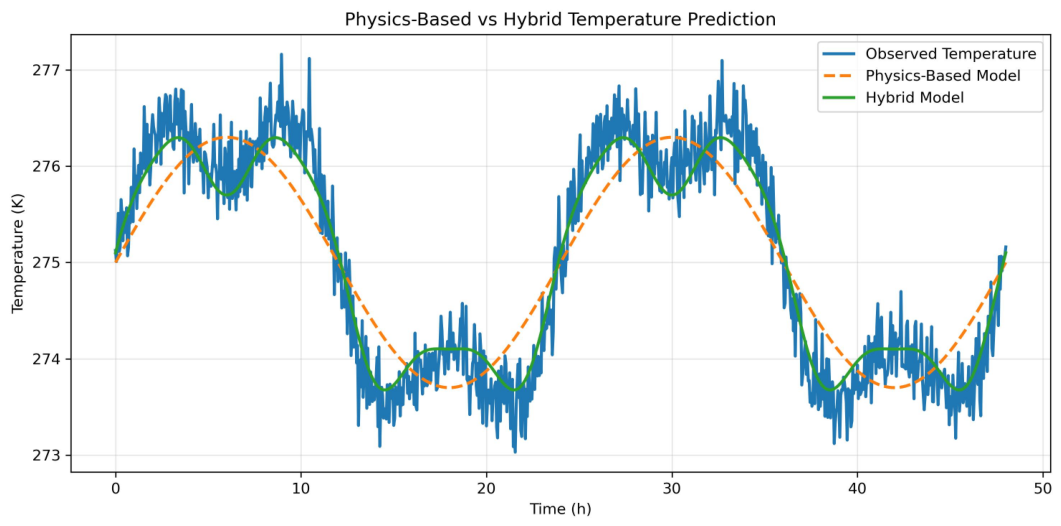
Figure 2.
Representative temperature trajectories generated from the stochastic model. The dashed line denotes the critical temperature threshold .
Figure 2.
Representative temperature trajectories generated from the stochastic model. The dashed line denotes the critical temperature threshold .
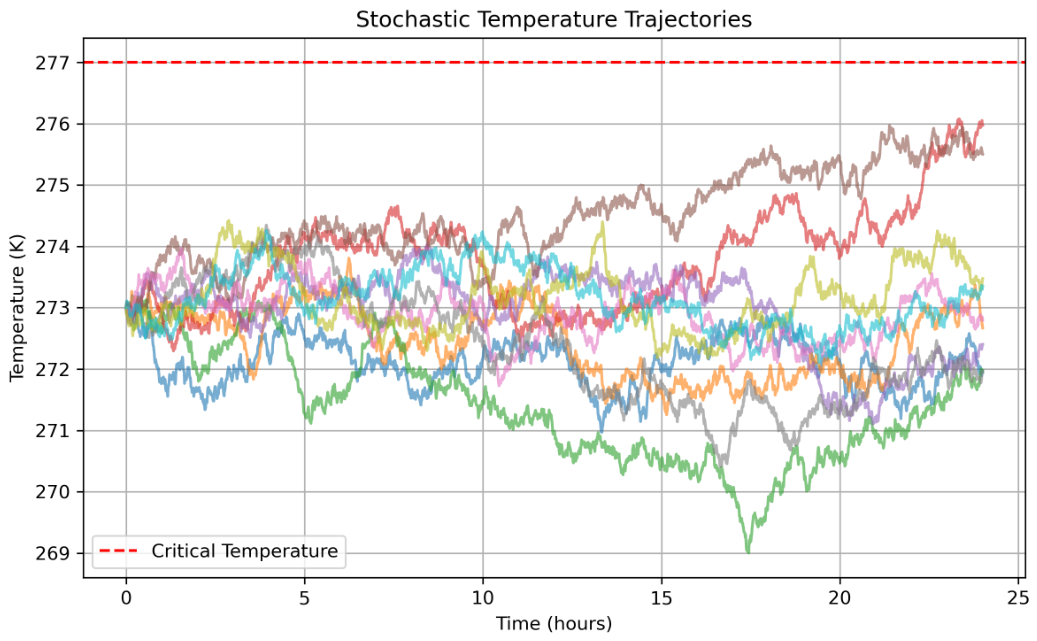
Figure 3.
Mean temperature trajectory and variability envelope obtained from Monte Carlo simulations. The shaded region corresponds to one standard deviation around the mean.
Figure 3.
Mean temperature trajectory and variability envelope obtained from Monte Carlo simulations. The shaded region corresponds to one standard deviation around the mean.
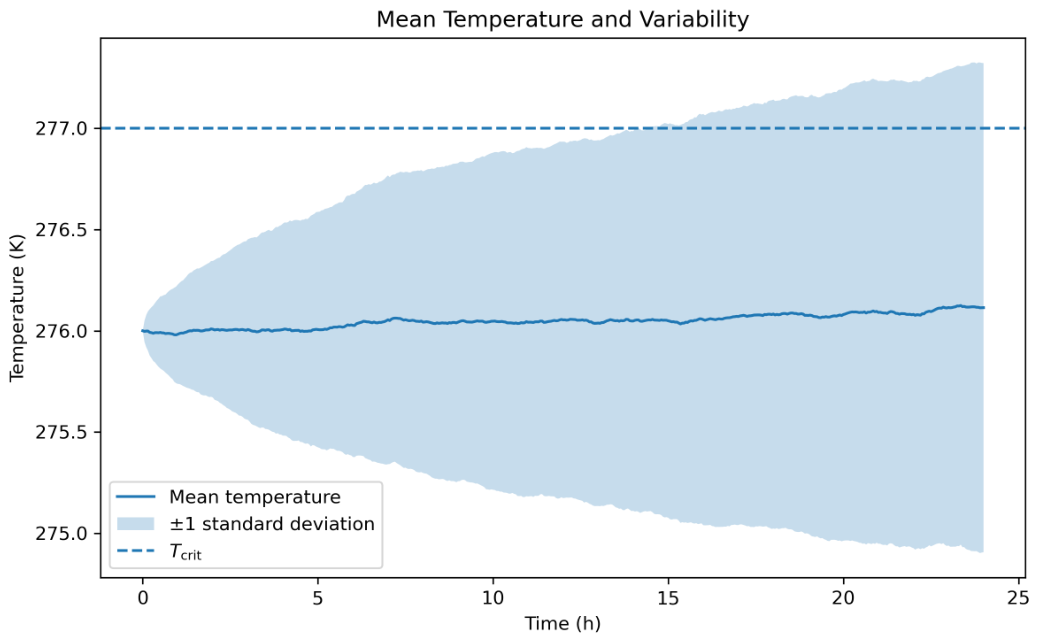
Figure 4.
Representative quality trajectories generated from the Arrhenius degradation model.
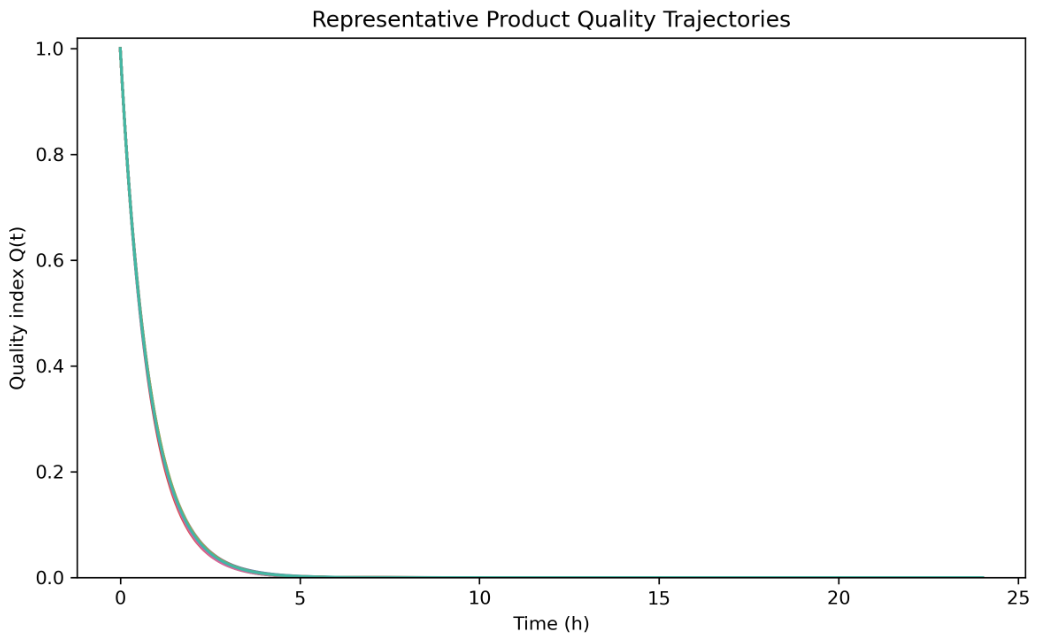
Figure 5.
Distribution of the final quality index obtained from Monte Carlo simulations. The dashed line denotes the minimum acceptable quality level .
Figure 5.
Distribution of the final quality index obtained from Monte Carlo simulations. The dashed line denotes the minimum acceptable quality level .
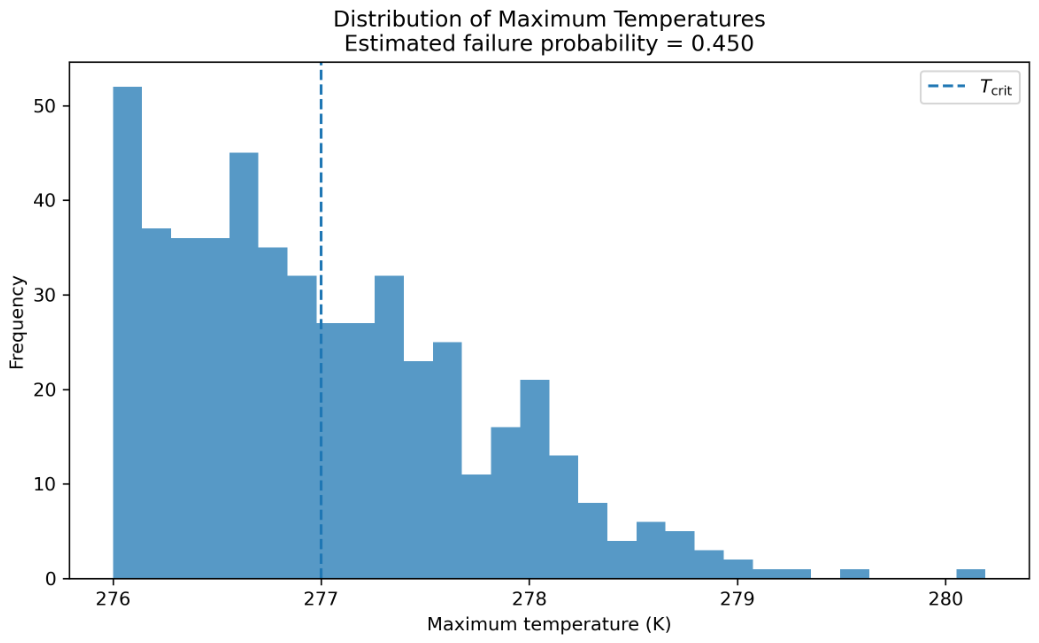

Table 1.
Representative parameters used in the numerical simulations.
| Variable | Symbol | Value | Unit |
|---|---|---|---|
| Mean ambient temperature | 298 | K | |
| Diurnal amplitude | 5 | K | |
| Thermal conductivity | 0.03 | W m−1 K−1 | |
| Heat-transfer area | A | 0.5 | m2 |
| Insulation thickness | L | 0.05 | m |
| Activation energy | J mol−1 | ||
| Pre-exponential factor | s−1 | ||
| Critical temperature | 277 | K |
Table 2.
Examples of temperature-sensitive products compatible with the simulated operating conditions.
Table 2.
Examples of temperature-sensitive products compatible with the simulated operating conditions.
| Product Category | Temperature Range (K) | Temperature Range (°C) |
|---|---|---|
| Vaccines | 275–281 | 2–8 |
| Insulin and biopharmaceuticals | 275–281 | 2–8 |
| Fresh dairy products | 274–278 | 1–5 |
| Fresh meat | 273–277 | 0–4 |
| Seafood | 273–276 | 0–3 |
| Fresh fruits and vegetables | 275–283 | 2–10 |
Table 3.
Synthetic variables generated by the algorithm.
| Variable | Symbol | Mathematical model |
|---|---|---|
| Ambient temperature | Sinusoidal profile with Gaussian perturbations (Eq. (34)) | |
| Product temperature | Stochastic heat-transfer model governed by Eq. (7) | |
| Degradation rate | Arrhenius kinetics (Eq. (8)) | |
| Quality index | Quality evolution model (Eq. (13)) | |
| Temperature failure indicator | Threshold exceedance criterion based on Eq. (30) | |
| Quality failure indicator | Quality threshold criterion based on Eq. (31) | |
| Monte Carlo realizations | Euler–Maruyama simulation and Monte Carlo sampling |
Table 4.
Statistical summary of temperature trajectories ( Monte Carlo simulations).
| Metric | Mean (K) | Std Dev (K) | Min (K) | Max (K) |
|---|---|---|---|---|
| Temperature | 296.5 | 1.8 | 292.3 | 301.2 |
Table 5.
Probability of temperature excursions ( simulations).
| Condition | Variability Level | (K) | |
|---|---|---|---|
| Baseline | Moderate | 277 | 0.18 |
| High variability | High | 277 | 0.32 |
| Improved insulation | Low | 277 | 0.07 |
Table 6.
Final product quality ( simulations).
| Scenario | Variability Level | Std Dev | |
|---|---|---|---|
| Baseline | Moderate | 0.82 | 0.05 |
| High fluctuation | High | 0.68 | 0.09 |
| Improved insulation | Low | 0.91 | 0.03 |
Table 7.
Sensitivity to Arrhenius parameters ( simulations).
| (J/mol) | (s−1) | Sensitivity Level | ||
|---|---|---|---|---|
| Low | 0.89 | 0.18 | ||
| Medium | 0.82 | 0.18 | ||
| High | 0.73 | 0.18 |
Table 8.
Comparison of physical and hybrid models ( simulations).
| Model | RMSE (K) | RMSE (%) | ||
|---|---|---|---|---|
| Physical model | 2.1 | – | 0.21 | 0.80 |
| Hybrid (with ML) | 1.3 | -38% | 0.15 | 0.85 |
Disclaimer/Publisher’s Note: The statements, opinions and data contained in all publications are solely those of the individual author(s) and contributor(s) and not of MDPI and/or the editor(s). MDPI and/or the editor(s) disclaim responsibility for any injury to people or property resulting from any ideas, methods, instructions or products referred to in the content. |
© 2026 by the authors. Licensee MDPI, Basel, Switzerland. This article is an open access article distributed under the terms and conditions of the Creative Commons Attribution (CC BY) license.
Copyright: This open access article is published under a Creative Commons CC BY 4.0 license, which permit the free download, distribution, and reuse, provided that the author and preprint are cited in any reuse.


