

Submitted:
09 June 2026
Posted:
11 June 2026
You are already at the latest version
Abstract
This research aims to study by numerical simulation the optimization of a fed batch bioreactor (FBBR). The main characteristic of this reactor is that it used to produce biomass concentration (X) or a specific product concentration (P). The study of the FBBR is carried out in order to evidence the influence of the stirrer kind on the biomass growing duration inside the reactor. So, in this study, the variable to be minimized is the biomass growing or culture duration (CD) and the parameters influencing the culture duration are some type of stirrer such as Rushton turbin, six inclined blades turbin, helix and anchor. The influence of other parameters were also studied such as the initial biomass concentration (So), the final desired biomass concentration (Xf), the velocity stirring (Vr), the initial biomass concentration (Xo) and the liquid density (mv).. The obtained results show how would be these parameters values in order to minimize the biomass culture duration.
Keywords:
optimization
; fed batch bioreactor
; biomass
; growing duration
; stirrer
1. Introduction
This research focuses on the study of the optimal conFigure uration of a fed batch bioreactor (FBB) because it is very used in the biochemical industries, particularly, the agri-food industries [1]. The FBBR is used to synthesize various important molecule such as antibiotic, antiseptic, pesticide, vitamin, vaccine or human growing hormone [1,2]. In some cases for the batch bioreactor, particularly the fed batch bioreactor, the culture duration is a key parameter governing the yield of the operation. So, the growing or culture duration of the biomass must be minimized. For example, in order to produce the yeast beer (saccharomyces cerevisiae) and commercialize it, the duration culture of the yeast must be minimized in order to prevent any delay related to the commercialization process of the biomass [3,4]. These considerations motivate the need of investigating the optimization of a FBBR system. For this purpose, the dynamic mathematical model of a FBBR was set and solved using the data related to a nominal operating point. Afterwards, the influence of the stirrer types and many other parameters was assessed in order to optimize or minimize the culture duration of the biomass in the bioreactor.
2. The FBBR Process
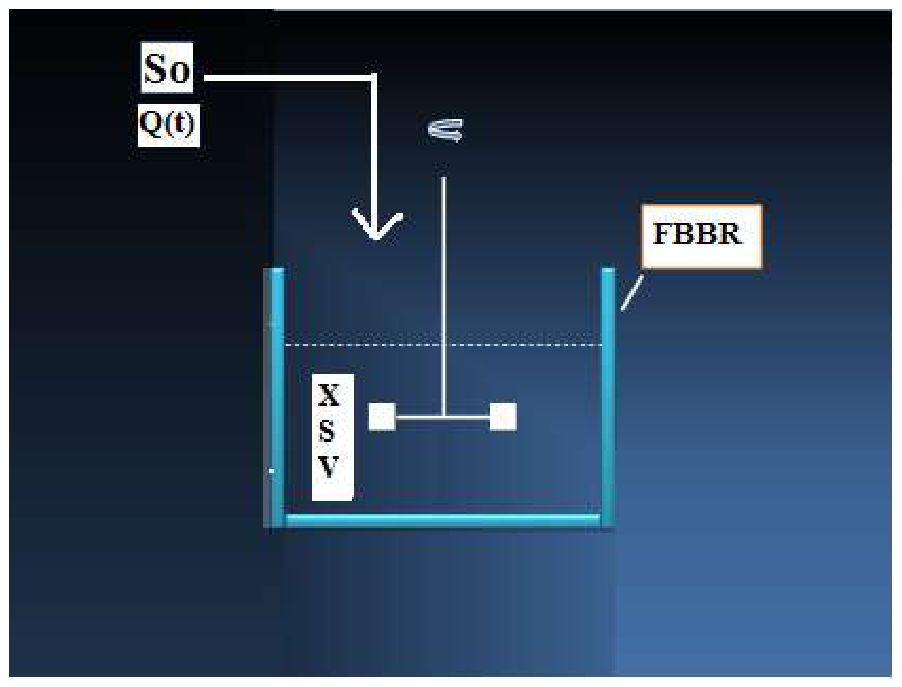
A flowsheet of FBBR process is presented in Figure .1 [1]. This unit consists mainly of a fed batch bioreactor The feed entering the reactor is a liquid containing the concentration substrate So. Inside the bioreactor, the liquid volume varies as a function of time and it contains the substrate at a concentration S and the biomass at a concentration X. During the bioreaction, the concentration of the biomass (yeast beer) evolves from an initial value (xo) to a final value (x) and the substrate (glucose) value evolves from an initial value (So) to a final value (S). Table 1 gives additional parameter values related to the studied process.
Figure 1.
Flowsheet of the FBBR unit [1].
Figure 1.
Flowsheet of the FBBR unit [1].
3. Model Assumptions
The main model assumptions are listed below:
-isothermal operation (constant temperature in the reactor);
-the biomass culture is strictly aerobic.
4. Mathematical Model
The dynamic model of a process is useful for control and steady state design purposes [5]. The FBBR can be written as follows [1]:
with
d([X]. Vl)/dt = rx. Vl
d([S]. Vl)/dt = Q. [So] –(rx.Vl/YX/S)
dVl/dt = Q
- [X] : biomass concentration (g/l)
- [S] : substrate concentration (g/l)
- [So]: substrate initial concentration (g/l)
- Vl : liquid (culture) volume inside the reactor
- rx : biomass growing rate
- Q : volume flowrate (l/s)
The dynamic mathematical model of the FBBR is used in order to compute de culture duration (CD) which must be as minimal as possible. The CD parameter is calculated by combining and solving analytically the equations (1), (2) and (3) which represent, respectively, the matter balance of biomass, the matter balance of substrate and the global matter balance. Finally, the culture duration (CD) is found by the following sequential steps:
| msugar = Xf/Yxs (amount of sugar which must be putted in the reactor, kg) |
| av = msugar /So (increasing volume during the culture, m3) |
| Vlo = 1-av (initial liquid volume, m3) |
| Fr = [((vr2).da)/9.81]0.5 (Froude number) |
| Na = 0.2 (da/dc)0.5 Fr0.5 (aeration number) |
| qa = Na.vr.da3 (aeration volume flowrate, m3/s) |
| ug = 4qa/[π*(dc)2] (gas velocity, m/s) |
| P = Np.mv.(vr)3.da5 (required stirring power in non-aerated medium, Watt) |
| Pg = P.[0.27 + (0.022/Fr)] (required stirring power in aerated medium, Watt) |
| Vl = Vlo + Xo.Vlo e(μm.t) /( Yxs.So) (culture liquid inside the reactor, m3) |
| kla = 93.6 (Pg/ Vl)0.4 ug0.5 (kla coefficient, h-1) |
| rxlim = Yxo2. kla .solo2 (biomass maximal grow rate, kg/(m3.h)) |
| Xlim = rxlim/ μm (biomass maximal concentration, kg/m3) |
| Q = μm Xo.Vlo.e(μm.t) /( Yxs.So) (volume flowrate, m3/h) |
| egt =(1/μm).Ln[ Xlim.Vlo /[ Xo.Vlo - (Xlim .Xo.Vlo.Q /(Yxs.So. rxlim))]] (exponential grow time, h) |
| Di = rxlim/(Yxs.So) (dilution rate, h-1) |
| cvgt = egt + (1/Di).Ln[(rxlim – Di. Xlim )/( rxlim–Xf.Di)] (constant velocity grow time, h) |
| CD = egt + cvgt (culture duration, h) |
5. Results and Discussion
Figure 2 shows the influence of the stirrer kind and biomass feed concentration (So) on the culture duration. It can be seen that the turbin stirrers can optimize, i.e., minimize the culture duration close to 40 h. However, the Rushton turbin is more efficient than the six inclined blades turbin since it can minimize the culture duration below 40 h.
Figure 2 shows clearly that whatever the stirrer kind (whatever the Np value), the culture duration decreases as the biomass feed concentration (So) increases. This can be explained by the fact that the increase of the biomass feed concentration can accelerate the biochemical reaction and, consequently the culture duration decreases.
Figure 3 shows the influence of the stirrer kind and the initial (or inoculation) biomass concentration Xo on the culture duration. It can be seen that the turbin stirrers can optimize, i.e., minimize the culture duration close to 40 h and the Rushton turbin is more efficient than the six inclined blades turbin since it can minimize the culture duration below 40 h. Figure 3 also shows that whatever the stirrer kind (whatever the Np value), the culture duration decreases as the initial biomass concentration (Xo) increases. This can be explained by the fact that the increase of the biomass feed concentration can also accelerate the biochemical reaction and, consequently the culture duration decreases.
Figure 4 shows the effects of the stirrer kind and the stirrer speed rotation Vr on the culture duration. It can be seen that the turbin stirrers can minimize the culture duration close to 40 h particularly the Rushton turbin. This Figure also shows that whatever the stirrer kind, the culture duration decreases as the stirrer speed rotation (Vr) increases. This can be explained by the fact that the increase of the stirrer speed rotation can also accelerate the substrate transfer towards the biomass cells inside the liquid phase and as the biochemical reaction increases the culture duration decreases.
Figure 5 shows the effects of the stirrer kind and the final or desired biomass concentration (Xf) on the culture duration. It can be noticed that the turbin stirrers can minimize the culture duration close to 40 h particularly the Rushton turbin. Figure 5 also shows that whatever the stirrer kind, the culture duration decreases as the final biomass concentration (Xf) decreases. This can be explained by the fact that as the desired or final concentration is important, as the required time to reach this concentration will be important in turn. This effect is due to the effect of the growth biomass kinetic which assesses that the final biomass concentration is proportional to the culture duration.
Figure 6 shows the effects of the stirrer kind and the liquid density (mv) on the culture duration. It can be seen that both turbin stirrers minimize the culture duration up to 40 h. Figure 6 also shows that whatever the stirrer type, the culture duration decreases as the liquid density (mv) increases. This can be explained by the fact that the increase of the liquid density can enriches the liquid phase by substrate or by biomass and this fact accelerates the biochemical reaction and so the culture duration decreases.
6. Conclusion
This research studied the optimization of a fed batch bioreactor (FBBR) process. The obtained results showed that for the studied process the culture duration which must be minimized is function of some parameters. These parameters are the type of stirrer, the biomass feed concentration (So), the initial (or inoculation) biomass concentration (Xo), the stirrer speed rotation (Vr), the final or desired biomass concentration (Xf) and the liquid density (mv). It was found that the turbin stirrer types are more efficient in minimizing relatively to anchor and helix stirrers. Furthermore, this study reveals that the culture duration is optimal, i.e., minimal when the biomass feed concentration (So), the initial biomass concentration (Xo) and the stirrer speed rotation (Vr) are maximal and when the final biomass concentration (Xf) and the liquid density (mv) are minimal.
References
- Simpson R, Sastry S K. chemical and bioprocess engineering, Springer, 2013.
- Wall JB, Hill GA (1992) Optimum CFST bioreactor design :Experimental study using batch growth parameters for S.cerevesiae producing ethanol. Can J Chem Eng 70:148-152.
- Gimpelj T, Tosic A (2025). Fed-batch bioreactor modeling, SoftwareX,32, 102358.
- Kumar M et al. (2019) Temperature control of fermentation bioreactor for ethanol production using IMC-PID controller, Biotechnology reports, 22, e00319.
- Bendjaouahdou C (2024) control of a continuous stirred tank bioreactor, preprint, Research square. [CrossRef]
Figure 2.
Culture duration as a function of power number (Np) for different stirrer kind: influence of the feed biomass concentration (So).
Figure 2.
Culture duration as a function of power number (Np) for different stirrer kind: influence of the feed biomass concentration (So).
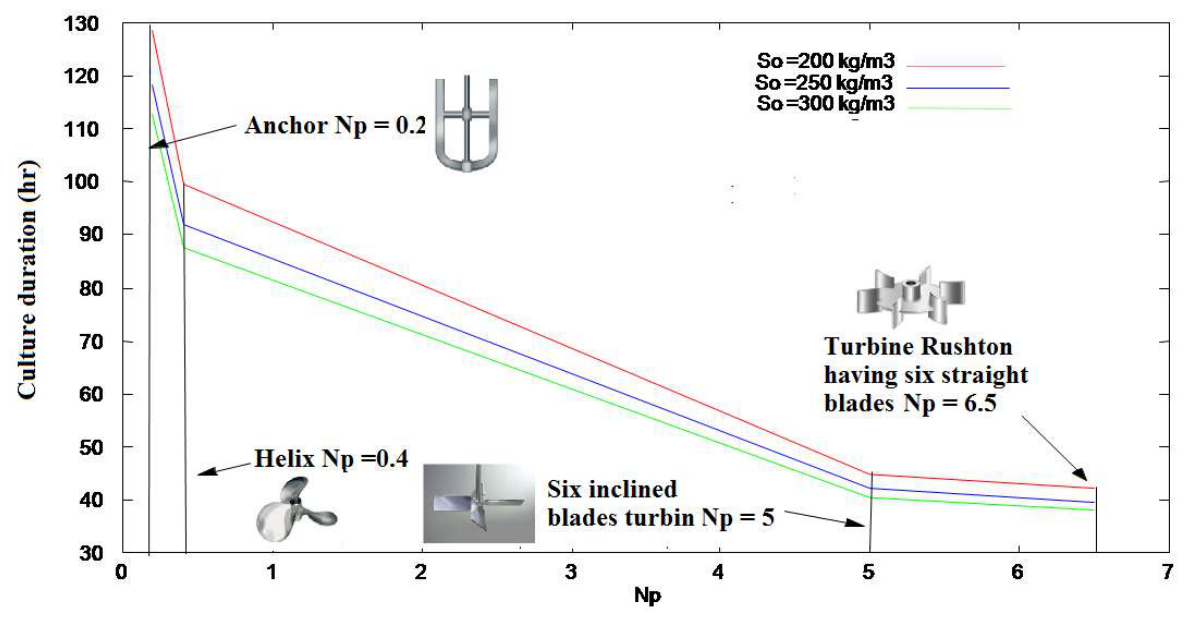
Figure 3.
Culture duration as a function of power number (Np) for different stirrer kind: influence of the initial or inoculation biomass concentration (Xo).
Figure 3.
Culture duration as a function of power number (Np) for different stirrer kind: influence of the initial or inoculation biomass concentration (Xo).
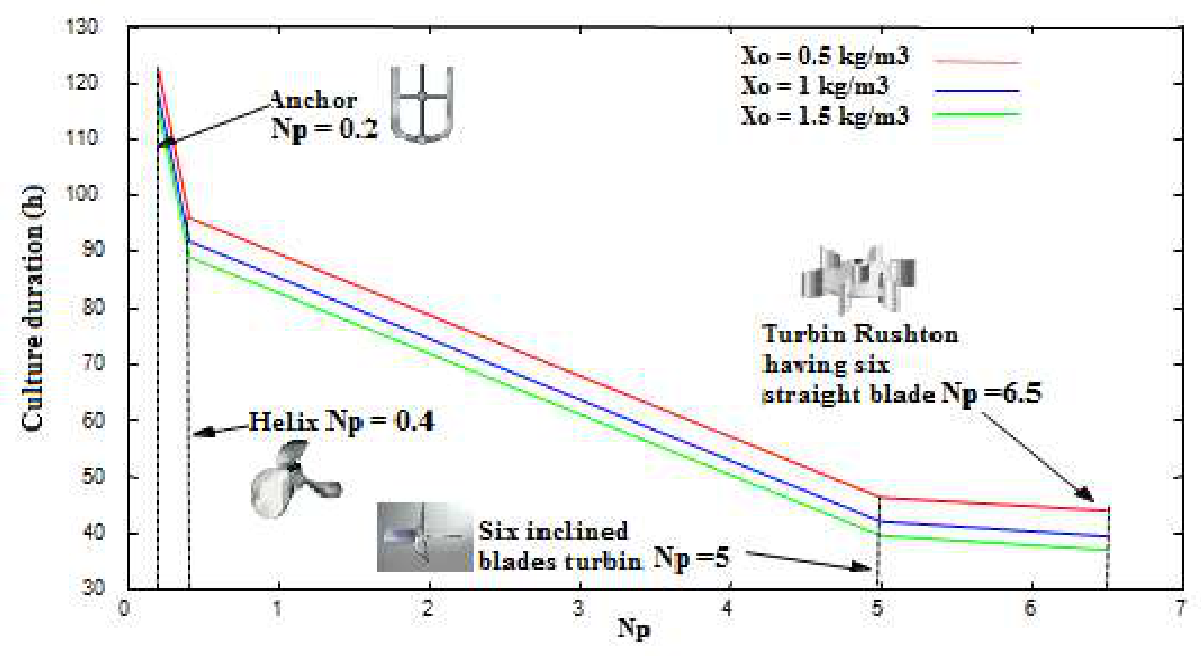
Figure 4.
Culture duration as a function of power number (Np) for different stirrer kind: influence of the stirrer speed rotation (Vr).
Figure 4.
Culture duration as a function of power number (Np) for different stirrer kind: influence of the stirrer speed rotation (Vr).
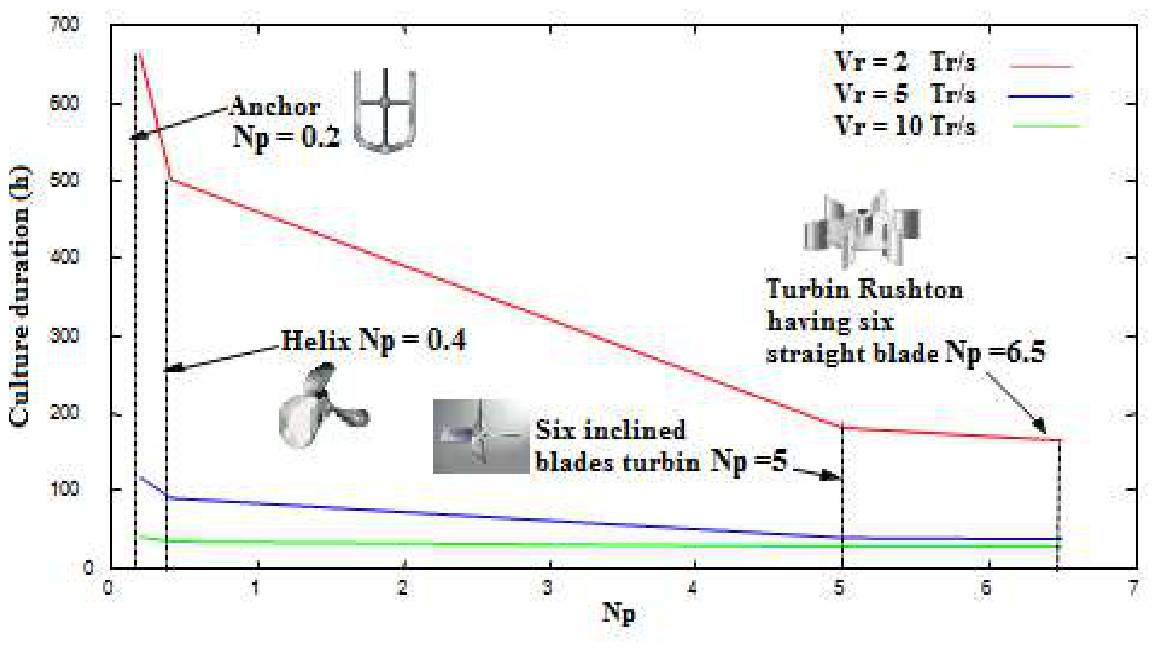
Figure 5.
Culture duration as a function of power number (Np) for different stirrer kind: influence of the final or desired biomass concentration (Xf).
Figure 5.
Culture duration as a function of power number (Np) for different stirrer kind: influence of the final or desired biomass concentration (Xf).
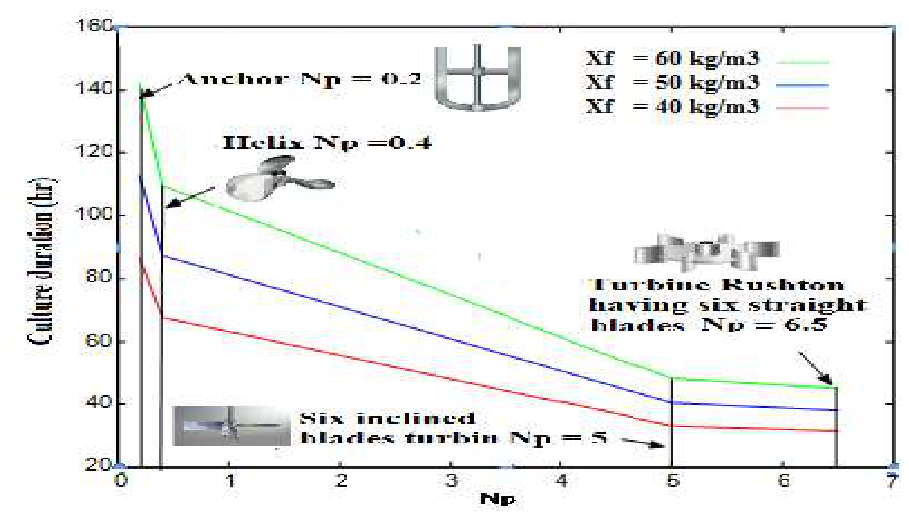
Figure 6.
Culture duration as a function of power number (Np) for different stirrer kind: influence of the liquid density (mv).
Figure 6.
Culture duration as a function of power number (Np) for different stirrer kind: influence of the liquid density (mv).
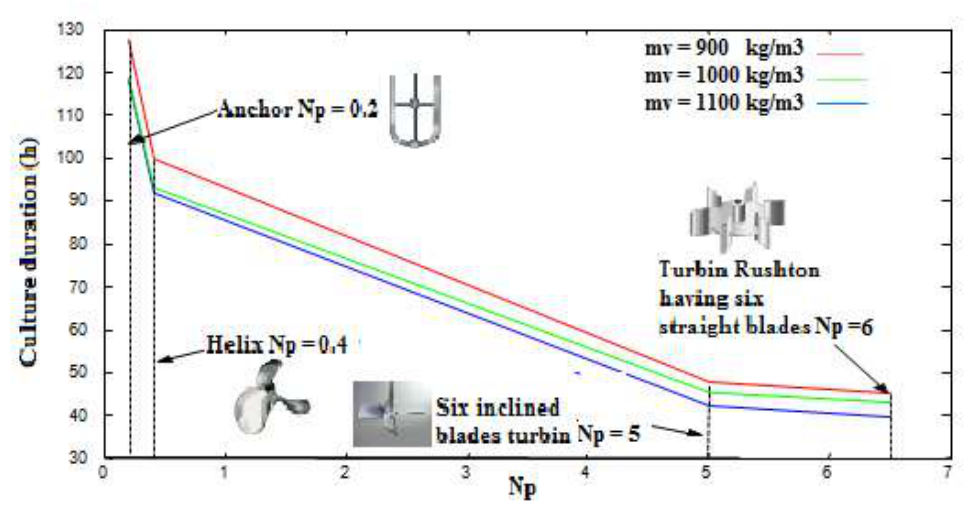

Table 1.
Parameters values for the FBBR [1].
Table 1.
Parameters values for the FBBR [1].
| Parameter | Signification | Value |
| V | reactor volume | 1 m3 |
| Qo | initial volume flowrate | 2 m3/hr |
| T | liquid temperature | 30 °C |
| μm | maximum specific grow rate | 0.3 hr-1 |
| So | inlet substrate concentration | 250 kg/m3 |
| Xf | final biomass concentration | 50 kg/m3 |
| Xo | initial biomass concentration | 1 kg/m3 |
| Yxs | biomass yield relatively to substrate (kg of yeast/kg of sugar) | 0.5 |
| Yxo2 | biomass yield relatively to oxygen (kg of yeast/kg of O2) | 1 |
| mv | liquid specific density | 1000 kg/m3 |
| Np | power number | 6.5 |
| vr | stirrer speed rotation | 600 rpm |
| dc | reactor internal diameter | 1.08 m |
| da | stirrer location from the reactor bottom | 0.36 m |
| solo2 | oxygen solubility | 7.5 10-3 kg/m3 |
| Vl | final liquid volume in the reactor | 1 m3 |
| Vl0 | initial liquid volume in the reactor | 0.6 m3 |
Disclaimer/Publisher’s Note: The statements, opinions and data contained in all publications are solely those of the individual author(s) and contributor(s) and not of MDPI and/or the editor(s). MDPI and/or the editor(s) disclaim responsibility for any injury to people or property resulting from any ideas, methods, instructions or products referred to in the content. |
© 2026 by the authors. Licensee MDPI, Basel, Switzerland. This article is an open access article distributed under the terms and conditions of the Creative Commons Attribution (CC BY) license (http://creativecommons.org/licenses/by/4.0/).
Copyright: This open access article is published under a Creative Commons CC BY 4.0 license, which permit the free download, distribution, and reuse, provided that the author and preprint are cited in any reuse.


