
Submitted:
10 June 2026
Posted:
11 June 2026
You are already at the latest version
Abstract
Objectives: This study aimed to characterize cefiderocol susceptibility distribution among Enterobacterales in Japan—specifically indigenous imipenemase (IMP)-producing strains—and explore the effect of IMP in mediating resistance. Methods: The susceptibility of 560 Enterobacterales isolates to cefiderocol was assessed using disk diffusion and broth microdilution methods based on Clinical and Laboratory Standards Institute (CLSI) guidelines. Minimum inhibitory concentration (MIC) distributions across groups were compared using Kruskal–Wallis and Mann–Whitney U tests. Results: A total of 556 isolates yielded evaluable results. The cefiderocol susceptibility rate was 99.5 and 98.7 % based on CLSI and European Committee on Antimicrobial Susceptibility Testing breakpoints, respectively. Notably, under both criteria, IMP-producing isolates exhibited a susceptibility rate of 99.6 %, whereas non-carbapenem-resistant Enterobacterales (CRE) and non-extended-spectrum β-lactamase (ESBL) exhibited 99.4 %. Statistical analysis revealed that the ESBL-only group had higher MICs than the non-CRE/non-ESBL and IMP-only groups (both p < 0.001), whereas no significant difference was observed between the latter two (p = 0.083). Notably, the ESBL-only group exhibited higher MICs than that of isolates harboring both IMP-type carbapenemase and ESBL. Conclusions: These findings indicate a non-additive effect, where the coexistence of multiple resistance enzymes does not necessarily increase cefiderocol resistance. The association between IMP and cefiderocol resistance may be limited. In specific enzyme combinations, its presence was even associated with lower MICs.
Keywords:
cefiderocol
; carbapenemase-producing Enterobacterales
; IMP-type carbapenemase
; antimicrobial susceptibility
; whole-genome sequencing
; R2 loop of AmpC
1. Introduction
Antimicrobial resistance (AMR) has emerged as a global public health crisis, threatening the efficacy of modern medical treatments [1]. The global dissemination of extended-spectrum β-lactamase (ESBL) and carbapenemase-producing Enterobacterales (CPE) has compromised the efficacy of standard therapies, resulting in increased mortality and significant healthcare burden [2]. These resistance trends require effective therapeutic alternatives.
Cefiderocol is a novel siderophore cephalosporin designed to overcome common resistance mechanisms in Gram-negative bacteria, including β-lactamase production, porin mutations, and efflux pumps [3,4]. Structurally, it combines the features of cefepime and ceftazidime with a chlorocatechol moiety that enables siderophore-mediated iron transport into bacterial cells, thereby enhancing antibiotic uptake [5,6].
Cefiderocol demonstrates stability against carbapenemases, including metallo-β-lactamases, such as imipenemase (IMP), Verona integron-encoded metallo-β-lactamase (VIM), and New Delhi metallo-β-lactamase (NDM) [7]. However, resistance to cefiderocol has been associated with multiple mechanisms, including alterations in siderophore receptor genes, porin mutations, efflux pump activation, and modifications of penicillin-binding protein 3 (PBP3) [8]. Individual mechanisms alone are usually inadequate to confer clinical resistance—resistance commonly results from combinations of multiple factors [8].
Cefiderocol was first approved in the United States in 2019 for complicated urinary tract infections and later for hospital-acquired and ventilator-associated pneumonia [9]. In Europe, it was approved in 2020 for Gram-negative pathogen-caused infections with limited treatment options [10]. In Japan, cefiderocol was approved on November 30, 2023, for various infections caused by strains resistant to carbapenem antibiotics [11].
Surveillance studies using Japan Antimicrobial Resistance Bacterial Surveillance reported cefiderocol susceptibility of 97.7 and 99.2 % for CPE and IMP-type isolates, respectively [12]. However, the effect of IMP on cefiderocol susceptibility remains unclear. Additionally, susceptibility data for common clinical Enterobacterales isolates that are neither carbapenem-resistant Enterobacterales (CRE) nor ESBL producers remain limited in Japan.
To address this knowledge gap, this study aimed to determine the cefiderocol susceptibility distribution in Japan and explore potential resistance mechanisms.
2. Results
2.1. Cefiderocol Susceptibility Among Enterobacterales Isolates
A total of 556 isolates yielded evaluable results. Using the disk diffusion (DD) method, six isolates were categorized as non-susceptible (Table 1); however, only two isolates (OU_24 and OU_186) were also classified as non-susceptible by the broth microdilution (BMD) method. Additionally, one IMP-6–producing Escherichia coli isolate (OU_551) demonstrated discordant susceptibility results, being categorized as susceptible by the DD method but resistant by the BMD method.
2.2. Genomic Analysis of Cefiderocol Non-Susceptible Isolates
To assess the molecular mechanisms underlying reduced cefiderocol susceptibility, whole-genome sequencing (WGS) was performed for the three isolates identified as non-susceptible by the BMD method.
OU_24 was an ESBL-producing E. coli belonging to ST2011 and was categorized as intermediate by both DD and BMD methods. WGS analysis identified the β-lactamase gene (blaCTX-M-55), with no mutations or deletions observed in PBP3 or colicin I receptor A (CirA). However, multiple amino acid insertions were identified in outer membrane protein C (OmpC)and outer membrane protein F (OmpF), potentially altering the outer membrane permeability.
OU_186 was identified as Enterobacter bugandensis and classified as a non-CRE/non-ESBL AmpC-producing isolate. Multi-locus sequence typing (MLST) analysis revealed a novel sequence type (ST3387) that was newly assigned by the PubMLST database. OU_186 was categorized as resistant by both the DD and BMD methods. Genomic analysis identified the presence of blaACT-77, Leu313 deletion (△L313) in the R2 loop of the AmpC β-lactamase, CirA gene deletion, and specific amino acid substitution (Y432F) in PBP3.
OU_551 was an ESBL- and IMP-producing Klebsiella aerogenes belonging to ST44231. The isolate carried blaCTX-M-2, blaIMP-6, and blaAmpC-Kaer-1 genes. Although no deletion was observed in the R2 loop of AmpC, the isolate exhibited deletions in CirA and Fiu, along with three amino acid substitutions in PBP3 (S261T, A290S, and I563V).
2.3. Cefiderocol Susceptibility Rates
Cefiderocol susceptibility across different breakpoints exhibited potent antibacterial activity. For the 556 evaluable isolates, susceptibility was 99.5 % (553/556) using Clinical and Laboratory Standards Institute (CLSI) and 98.7 % (549/556) using European Committee on Antimicrobial Susceptibility Testing (EUCAST) standards. Among the CPE isolates, the susceptibility rate of IMP-producing isolates reached 99.6 % (258/259) based on CLSI or EUCAST. The susceptibility observed in the non-CRE/non-ESBL group was 99.4 % (156/157) based on CLSI or EUCAST standards.
These results indicate that common β-lactamases, including IMP-type carbapenemases and ESBLs, have a limited effect on cefiderocol efficacy in this clinical isolate collection.
3. Discussion
3.1. Analysis of Resistance Mechanisms
β-lactamases, AmpC enzymes, efflux pumps, or PBP3 mutations alone are generally inadequate to confer cefiderocol resistance [8]. Instead, resistance commonly emerges from multifactorial mechanisms involving concurrent alterations in iron transport systems, outer membrane permeability, and enzymatic activity [8]. Our findings align with previously reported data, indicating that reduced susceptibility to cefiderocol is likely a cumulative effect of complex, multifactorial resistance mechanisms.
To date, there is no direct experimental evidence explicitly demonstrating that the L313 deletion in AmpC β-lactamase independently confers resistance to cefiderocol. However, amino acid deletions or mutations within the R2 loop of AmpC β-lactamases can result in reduced susceptibility to cefiderocol and other advanced cephalosporins [13,14]. Specifically, the Phe313Leu mutation, located in the R2 loop, contributes to ceftazidime hydrolysis [15]. It is possible that cefiderocol resistance in OU_186 arises from the synergy between the △L313 PBP3 mutation and CirA deletion.
3.2. Agreement Between DD and BMD Methods
Minimum inhibitory concentration (MIC) determination using the BMD method requires more specialized techniques than that of the DD method that remains a more practical method for routine susceptibility testing [16,17]. The agreement between the DD and BMD methods for cefiderocol susceptibility testing was assessed using heatmap correlation analysis (Figure 1). Our research indicated a strong inverse correlation between the DD zone diameter and MIC values (Spearman r = -0.64, p < 0.001), supporting the use of cefiderocol DD testing as a reliable screening method—specifically for the rapid management of infections.
However, discrepancies occurred when the inhibition zone diameters approached the susceptibility breakpoint. Certain isolates exhibited MIC values in the resistant range while remaining categorized as susceptible by DD testing. This discrepancy corresponds to very major errors, though these occurrences were extremely rare.
Overall, the two methods demonstrated a high categorical agreement (CA) for the majority of isolates. The CA between the DD and BMD methods was 99 % (550/556), indicating that DD testing provides a highly reliable screening method for cefiderocol susceptibility with a minimal risk of misclassification. However, when the inhibition zone diameters are close to the breakpoint—specifically in CRE—confirmatory MIC testing should be performed to prevent misclassification of resistance [18,19,20].
3.3. Activity Against IMP-Producing Isolates
In this study, the susceptibility rate of IMP-producing isolates was highly consistent with that observed among non-CRE/non-ESBL isolates. Similar findings have been reported previously, with studies demonstrating susceptibility rates over 99 % among IMP-producing Enterobacterales [12,21,22], indicating that cefiderocol retains excellent activity against IMP carbapenemases.
Based on the statistical analysis, cefiderocol MICs differed significantly among non-CRE/non-ESBL isolates (n = 157), only ESBL isolates (n = 102), and only IMP isolates (n = 37) (overall p < 0.001; Figure 2), indicating that the enzyme type affects cefiderocol MIC distributions. However, MICs were significantly higher in the ESBL-only group than that in the non-CRE/non-ESBL and IMP-only groups (both p < 0.001). However, the difference between the non-CRE/non-ESBL and IMP-only groups was insignificant (p = 0.083), indicating that IMP enzymes provide minimal protection against cefiderocol.
These results indicate that although ESBL production is associated with reduced cefiderocol susceptibility, IMP-type carbapenemases exert a limited effect on cefiderocol resistance.
3.4. Non-Additive Effect of Cefiderocol
Recently, bacterial resistance to cefiderocol has involved the synergistic and additive effects of multiple mechanisms [23,24]. However, an interesting observation from this study was the non-additive effect between resistance mechanisms and cefiderocol activity. Cefiderocol MICs differed significantly among IMP-only (n = 37), ESBL-only (n = 102), and IMP+ESBL (n = 222) isolates (overall p < 0.001; Figure 3), with pairwise comparisons exhibiting significant differences (all p < 0.001). The ESBL-only group exhibited a higher median MIC than that of the IMP+ESBL group, despite carrying fewer resistance determinants. This phenomenon indicates a non-additive interaction between the resistance mechanisms. The presence of specific enzymes, such as IMP does not produce a cumulative increase in resistance and may, in specific combinations be associated with reduced MICs.
4. Materials and Methods
4.1. Bacterial Isolates
A total of 560 Enterobacterales clinical isolates were screened. Of these, 302 were collected from The University of Osaka Hospital between March 2020 and October 2024, and 258 were obtained from the Osaka Institute of Public Health (collected between November 2015 and January 2016). Four isolates were excluded because of growth failure in susceptibility testing, with 556 isolates included in the final analysis (Figure 4).
Among Enterobacterales isolates, CRE was defined as those resistant to meropenem or those producing carbapenemases. Carbapenemase production was characterized using a positive modified carbapenem inactivation method and a positive NG-Test Carba 5 (or an equivalent immunochromatographic assay). Specifically, carbapenemase-producing Enterobacterales were categorized as CPE, whereas those without detectable carbapenemase were classified as non-CPE. Additionally, ESBL production was defined as isolates resistant to any of ceftriaxone, cefotaxime, or ceftazidime—together with a positive ESBL phenotypic confirmatory test based on CLSI criteria.
The cohort included 262 CPE and 294 non-CPE isolates. Among the CPE group, blaIMP was the predominant genotype (n = 259)—222 isolates co-harbored blaIMP and ESBL genes (IMP+ESBL), whereas 37 isolates carried blaIMP alone (IMP-only). The other three CPE isolates were ESBL-negative (CPE-only), including one isolate carrying blaIMI-1 and two carrying blaGES-24.
4.2. Antimicrobial Susceptibility Testing
Previous studies have demonstrated a high consistency between cefiderocol DD zone diameters and MIC values under CLSI criteria [25]. However, discrepancies have been reported in certain CRE isolates [18,19], highlighting the need for methodological validation in specific resistance genotypes, such as IMP. Therefore, in this study, all isolates were tested using both the DD and BMD methods.
DD testing was performed using 30 μg cefiderocol disks on unsupplemented Mueller–Hinton agar (BD BBL™, Becton, Dickinson and Company, Franklin Lakes, NJ, USA) with a 0.5 McFarland inoculum. Readings were performed after incubation at 35 ± 2 °C for 20 ± 2 h. For BMD testing, commercial cefiderocol panels from Shionogi & Co., Ltd., (Osaka, Japan) were used following the manufacturer’s protocol. The same 0.5 McFarland inoculum used for the DD method was used for the BMD panels.
The results were interpreted based on the CLSI M100 (34th edition) [26] and EUCAST version 16.0 breakpoints [27]. For comparability, CLSI breakpoints were used for the analysis because previous nationwide surveillance studies conducted by Japanese committees have consistently reported susceptibility rates based on the CLSI criteria [12,28]. Currently, the gold standard for cefiderocol susceptibility testing is BMD-based MIC determination using cation-adjusted iron-depleted Mueller–Hinton broth [29]. In this study, the BMD results were used as the definitive standard for categorizing susceptibility.
4.3. -WGS
For isolates identified as cefiderocol non-susceptible by BMD, WGS was performed to confirm species identification and characterize the molecular basis of resistance. Genomic DNA libraries were prepared using the Illumina DNA PCR-Free Prep kit (Illumina, San Diego, CA, USA) and sequenced on the Illumina MiSeq platform with 251-bp paired-end reads. Raw sequencing read quality was assessed using FastQC (v0.11.3). Subsequently, reads were assembled de novo using Unicycler (v0.4.4) [30] and annotated using the DFAST pipeline (v1.2.15) [31].
Antimicrobial resistance genes were identified using AMRFinderPlus (v4.0.23) [32] and the Comprehensive Antibiotic Resistance Database (CARD v4.0.1; RGI v6.0.5) [33]. Beyond the identification of beta-lactamase genes, we assessed genetic alterations in three pathways: (i) iron uptake systems, including deletions or mutations in genes encoding catecholate siderophore receptors (CirA and Fiu); (ii) target site modifications, focusing on amino acid substitutions or insertions in the PBP3; and (iii) outer membrane permeability, by assessing structural variations in porin-encoding genes (OmpC and OmpF). Sequence alignments were performed against reference wild-type strains to identify specific mutations. MLST was determined using the PubMLST database [34], including the assignment of novel sequence types.
4.4. Statistical Analysis
The correlation between DD zone diameters and MIC values was assessed using Spearman’s rank correlation coefficient. The MIC distributions were compared among groups using the Kruskal–Wallis test, and pairwise comparisons were performed using the Mann–Whitney U test.
All statistical analyses and data visualizations were implemented in Python (version 3.12.13). Specifically, the SciPy library (version 1.16.3) was used for statistical testing, whereas Pandas (version 2.2.2) and Matplotlib (version 3.10.0) were used for data management and visualization.
5. Conclusions
This study provides comprehensive baseline data on cefiderocol susceptibility among Enterobacterales isolates in Japan, specifically those producing IMP-type carbapenemases. Our findings confirm the high activity of cefiderocol against IMP-producing isolates and indicate a strong agreement between the DD and BMD methods for susceptibility testing. Additionally, the results highlight the multifactorial nature of reduced cefiderocol susceptibility and potential non-linear relationship between resistance mechanisms and cefiderocol activity.
This study has several limitations. The isolates were collected from restricted regions and specific facilities that may limit the generalizability of the results to Japan. Additionally, there is a temporal gap in the collection period between the two sources (2015–2016 vs. 2020–2024)—this difference can overlook recent shifts in resistance patterns. Moreover, because WGS was performed on only three non-susceptible strains, we could not account for the broader genetic background or other unmeasured resistance determinants in the rest of the cohort. Furthermore, variations in bacterial species and clonal lineages between the ESBL-only and IMP+ESBL groups may have affected the MIC distributions—that may have confounded the analysis.
Future studies integrating larger genomic datasets and functional analyses are necessary to clarify the mechanisms underlying cefiderocol resistance and optimize susceptibility testing strategies.
Author Contributions
Conceptualization, G.Y. and S.H.; methodology, G.Y. and Y.T.; validation, G.Y. and M.C.; formal analysis, M.C. and D.M.; investigation, M.C.; resources, A.U. and R.K.; data curation, M.C.; writing—original draft preparation, M.C.; writing—review and editing, S.K., S.H. and R.K.; visualization, M.C.; supervision, S.K., G.Y. and S.H.; project administration, G.Y.
Funding
This research received no external funding.
Institutional Review Board Statement
The requirement for informed consent was waived because the clinical bacterial isolates used in this study were completely anonymized and de-identified prior to analysis, with no access to patients' personal or identifiable data.
Data Availability Statement
The datasets supporting the findings of this study are publicly archived in the FigShare repository. The whole-genome sequencing (WGS) data and antimicrobial susceptibility test results can be accessed via the Digital Object Identifier (DOI): 10.6084/m9.figshare.32446335.
Acknowledgments
The authors highly appreciate the anonymous reviewers for their constructive comments and valuable suggestions that will help improve the quality of this manuscript.
Conflicts of Interest
The authors declare no conflict of interest.
References
- Macesic, N.; Uhlemann, A.C.; Peleg, A.Y. Multidrug-resistant Gram-negative bacterial infections. Lancet 2025, 405, 257–272. [CrossRef]
- Wilson, H.; Török, M.E. Extended-spectrum β-lactamase-producing and carbapenemase-producing Enterobacteriaceae. Microb. Genom. 2018, 4, e000197. [CrossRef]
- Karakonstantis, S.; Kritsotakis, E.I.; Gikas, A. Treatment options for K. pneumoniae, P. aeruginosa and A. baumannii co-resistant to carbapenems, aminoglycosides, polymyxins and tigecycline: An approach based on the mechanisms of resistance to carbapenems. Infection 2020, 48, 835–851. [CrossRef]
- Roustaye Gourabi, M.J.; Khanbabaei, B.; Yarahmadi Saki, Y.; Nikoo, A.; Kargar, M.; Hashemi, A.; Yasbolaghi Sharahi, J. Cefiderocol: A Comprehensive Review of Chemistry, Mechanisms of Resistance, and Clinical Applications in the Era of Multidrug Resistance. Curr. Microbiol. 2025, 83, 25. [CrossRef]
- Sato, T.; Yamawaki, K. Cefiderocol: Discovery, Chemistry, and In Vivo Profiles of a Novel Siderophore Cephalosporin. Clin. Infect. Dis. 2019, 69, S538–S543. [CrossRef]
- Aoki, T.; Yoshizawa, H.; Yamawaki, K.; Yokoo, K.; Sato, J.; Hisakawa, S.; Hasegawa, Y.; Kusano, H.; Sano, M.; Sugimoto, H.; et al. Cefiderocol (S-649266), A new siderophore cephalosporin exhibiting potent activities against Pseudomonas aeruginosa and other gram-negative pathogens including multi-drug resistant bacteria: Structure activity relationship. Eur. J. Med. Chem. 2018, 155, 847–868. [CrossRef]
- Ito, A.; Sato, T.; Ota, M.; Takemura, M.; Nishikawa, T.; Toba, S.; Kohira, N.; Miyagawa, S.; Ishibashi, N.; Matsumoto, S.; et al. In Vitro Antibacterial Properties of Cefiderocol, a Novel Siderophore Cephalosporin, against Gram-Negative Bacteria. Antimicrob. Agents Chemother. 2018, 62, e01454-17. [CrossRef]
- Karakonstantis, S.; Rousaki, M.; Kritsotakis, E.I. Cefiderocol: Systematic Review of Mechanisms of Resistance, Heteroresistance and In Vivo Emergence of Resistance. Antibiotics 2022, 11, 723. [CrossRef]
- Shionogi & Co., Ltd. Fetcroja (cefiderocol) Prescribing Information. 2019. Available online: https://www.shionogi.com/wp-content/themes/pdfs/fetroja.pdf.
- Shionogi & Co., Ltd. Fetcroja. Summary of Product Characteristics. 2020. Available online: https://www.ema.europa.eu/documents/product-information/fetcroja-epar-product-information_en.pdf.
- Shionogi & Co., Ltd. New siderophore cephalosporin antibiotic Fetroja (cefiderocol) intravenous infusion 1g vial in Japan [press release]. 2023. Available online: https://www.shionogi.com/global/en/news/2023/12/20231220.html.
- Kayama, S.; Kawakami, S.; Kondo, K.; et al. In vitro activity of cefiderocol against carbapenemase-producing and meropenem-non-susceptible Gram-negative bacteria collected in the Japan Antimicrobial Resistant Bacterial Surveillance. J. Glob. Antimicrob. Resist. 2024, 38, 12–20. [CrossRef]
- Kawai, A.; McElheny, C. L.; Iovleva, A.; Kline, E. G.; Sluis-Cremer, N.; Shields, R. K.; Doi, Y. Structural Basis of Reduced Susceptibility to Ceftazidime-Avibactam and Cefiderocol in Enterobacter cloacae Due to AmpC R2 Loop Deletion. Antimicrob. Agents Chemother. 2020, 64, e00198-20. [CrossRef]
- Shields, R.K.; Iovleva, A.; Kline, E.G.; Kawai, A.; McElheny, C.L.; Doi, Y. Clinical Evolution of AmpC-Mediated Ceftazidime-Avibactam and Cefiderocol Resistance in Enterobacter cloacae Complex Following Exposure to Cefepime. Clin. Infect. Dis. 2020, 71, 2713–2716. [CrossRef]
- Pérez-Llarena, F.J.; Kerff, F.; Zamorano, L.; Fernández, M.C.; Nuñez, M.L.; Miró, E.; Oliver, A.; Navarro, F.; Bou, G. Characterization of the new AmpC β-lactamase FOX-8 reveals a single mutation, Phe313Leu, located in the R2 loop that affects ceftazidime hydrolysis. Antimicrob. Agents Chemother. 2013, 57, 5158–5161. [CrossRef]
- Miller, L.A.; Rittenhouse, S.F.; Utrup, L.J.; Poupard, J.A. Comparison of three methods for determination of a single MIC of an antimicrobial agent. J. Clin. Microbiol. 1994, 32, 1373–1375. [CrossRef]
- Liu, Y.; Ding, L.; Han, R.; Zeng, L.; Li, J.; Guo, Y.; Hu, F. Assessment of cefiderocol disk diffusion versus broth microdilution results when tested against Acinetobacter baumannii complex clinical isolates. Microbiol. Spectr. 2023, 11, e0535522. [CrossRef]
- Morris, C.P.; Bergman, Y.; Tekle, T.; Fissel, J.A.; Tamma, P.D.; Simner, P.J. Cefiderocol Antimicrobial Susceptibility Testing against Multidrug-Resistant Gram-Negative Bacilli: A Comparison of Disk Diffusion to Broth Microdilution. J. Clin. Microbiol. 2020, 59, e01649-20. [CrossRef]
- Duggan, C.; Cantillon, D.; Lawrie, D.; Neal, T.; Cruise, J.; Graf, F.E.; Owen, V.; Fraser, A.J.; Lewis, J.M.; Brookfield, C.; et al. Comparison of multiple cefiderocol susceptibility testing methods against genomic determinants of resistance in blaNDM carbapenemase producing Enterobacterales. bioRxiv 2026, preprint. [CrossRef]
- Bonnin, R.A.; Emeraud, C.; Jousset, A.B.; Naas, T.; Dortet, L. Comparison of disk diffusion, MIC test strip and broth microdilution methods for cefiderocol susceptibility testing on carbapenem-resistant Enterobacterales. Clin. Microbiol. Infect. 2022, 28, 1156.e1–1156.e5. [CrossRef]
- Yamashiro, H.; Nakai, R.; Takemura, M.; Yamano, Y. In Vitro Activity of Cefiderocol against IMP-Producing Enterobacterales Isolated in Japan. Open Forum Infect. Dis. 2022, 9 (Suppl. 2), ofac492.1351. [CrossRef]
- Takemura, M.; Kazmierczak, K.; Hackel, M.; Sahm, D.F.; Echols, R.; Yamano, Y. In Vitro Activity of Cefiderocol Against Metallo-β-Lactamase-Producing Gram-Negative Bacteria Collected in North America and Europe Between 2014 and 2017: SIDERO-WT-2014–2016 Studies. Open Forum Infect. Dis. 2020, 7 (Suppl. 1), S643–S644. [CrossRef]
- Lasarte-Monterrubio, C.; Guijarro-Sánchez, P.; Vázquez-Ucha, J.C.; Alonso-Garcia, I.; Alvarez-Fraga, L.; Outeda, M.; Martinez-Guitian, M.; Peña-Escolano, A.; Maceiras, R.; Lence, E.; et al. Antimicrobial Activity of Cefiderocol against the Carbapenemase-Producing Enterobacter cloacae Complex and Characterization of Reduced Susceptibility Associated with Metallo-β-Lactamase VIM-1. Antimicrob. Agents Chemother. 2023, 67, e0150522. [CrossRef]
- González-Pinto, L.; Blanco-Martín, T.; Alonso-García, I.; Rodríguez-Pallares, S.; Outeda-García, M.; Gomis-Font, M.A.; Fraile-Ribot, P.A.; Vázquez-Ucha, J.C.; González-Bello, C.; Beceiro, A.; et al. Impact of transferable β-lactamases and intrinsic AmpC amino acid substitutions on the activity of cefiderocol against wild-type and iron uptake-deficient mutants of Pseudomonas aeruginosa. J. Antimicrob. Chemother. 2024, 79, 3023–3028. [CrossRef]
- Lin, Y.; Lin, H.; Chen, C.; Tseng, K.; Ho, M.; Hsueh, P. Interpretive agreement of susceptibility between broth microdilution and disk diffusion methods for cefiderocol, using criteria from the Clinical and Laboratory Standards Institute, European Committee on Antimicrobial Susceptibility Testing, and the Food and Drug Administration. J. Clin. Microbiol. 2026, 64, e01255-25. [CrossRef]
- Clinical and Laboratory Standards Institute (CLSI). Performance Standards for Antimicrobial Susceptibility Testing, 34th ed.; CLSI Supplement M100; CLSI: Wayne, PA, USA, 2024.
- The European Committee on Antimicrobial Susceptibility Testing (EUCAST). Breakpoint Tables for Interpretation of MICs and Zone Diameters, Version 16.0; EUCAST: Växjö, Sweden, 2026.
- Matsui, K.; Sakurai, A.; Matsumura, Y.; Hosoda, T.; Suzuki, M.; Saito, S.; Hase, R.; Kato, H.; Hashimoto, T.; Matono, T.; et al. In vitro activity of cefiderocol against carbapenem-resistant Gram-negative pathogens in Japan. J. Infect. Chemother. 2026, 32, 102905. [CrossRef]
- Irigoyen-von-Sierakowski, A.; Ocaña, A.; Sánchez-Mayoral, R.; Cercenado, E.; GEIRAS-SEIMC Study Group. Real-world performance of susceptibility testing for cefiderocol: Insights from a prospective multicentre study on Gram-negative bacteria. JAC Antimicrob. Resist. 2024, 6, dlae169. [CrossRef]
- Wick, R.R.; Judd, L.M.; Gorrie, C.L.; Holt, K.E. Unicycler: Resolving bacterial genome assemblies from short and long sequencing reads. PLoS Comput. Biol. 2017, 13, e1005595. [CrossRef]
- Tanizawa, Y.; Fujisawa, T.; Nakamura, Y. DFAST: A flexible prokaryotic genome annotation pipeline for faster genome publication. Bioinformatics 2018, 34, 1037–1039. [CrossRef]
- Feldgarden, M.; Brover, V.; Gonzalez-Escalona, N.; Frye, J.G.; Haendiges, J.; Haft, D.H.; Hoffmann, M.; Pettengill, J.B.; Prasad, A.B.; Tillman, G.E.; et al. AMRFinderPlus and the Reference Gene Catalog facilitate examination of the genomic links among antimicrobial resistance, stress response, and virulence. Sci. Rep. 2021, 11, 12728. [CrossRef]
- Alcock, B.P.; Raphenya, A.R.; Lau, T.T.Y.; Tsang, K.K.; Bouchard, M.; Edalatmand, A.; Huynh, W.; Nguyen, A.L.V.; Cheng, J.K.; Liu, S.; et al. CARD 2023: Expanded curation, support for machine learning, and resistome prediction at the Comprehensive Antibiotic Resistance Database. Nucleic Acids Res. 2023, 51, D690–D699. [CrossRef]
- Jolley, K.A.; Bray, J.E.; Maiden, M.C.J. Open-access bacterial population genomics: BIGSdb software, the PubMLST.org website and their applications. Wellcome Open Res. 2018, 3, 124. [CrossRef]
Figure 1.
Distribution of cefiderocol minimum inhibitory concentrations and disk diffusion inhibition zone diameters in carbapenem-resistant Enterobacterales (CRE) and non-CRE isolates.
Figure 1.
Distribution of cefiderocol minimum inhibitory concentrations and disk diffusion inhibition zone diameters in carbapenem-resistant Enterobacterales (CRE) and non-CRE isolates.
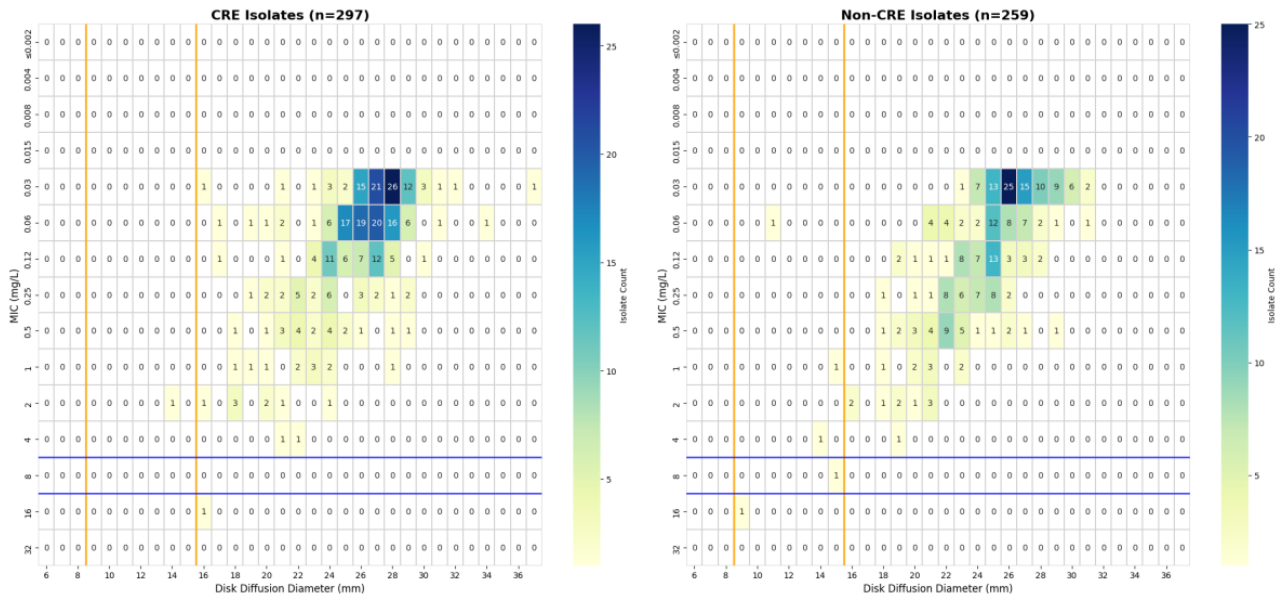
Figure 2.
Distribution of cefiderocol minimum inhibitory concentrations (MICs) among non-carbapenem-resistant Enterobacterales/non-extended-spectrum β-lactamase (ESBL), ESBL-only, and imipenemase-only isolates. Boxplots indicate the median and interquartile range, with whiskers extending to 1.5 times the interquartile range. Individual isolates are overlaid as jittered points. MIC values across groups exhibited a significant overall difference (p < 0.001). Pairwise P values are indicated above the brackets. Adjusted p-values are demonstrated; ns (not significant) indicates p > 0.05. Only isolates with available MIC data are included. Abbreviations: non-CRE/non-ESBL, isolates without ESBL and CRE classification; ESBL-only, isolates with ESBL and without CRE classification; IMP-only, isolates harboring an IMP-type carbapenemase without ESBL.
Figure 2.
Distribution of cefiderocol minimum inhibitory concentrations (MICs) among non-carbapenem-resistant Enterobacterales/non-extended-spectrum β-lactamase (ESBL), ESBL-only, and imipenemase-only isolates. Boxplots indicate the median and interquartile range, with whiskers extending to 1.5 times the interquartile range. Individual isolates are overlaid as jittered points. MIC values across groups exhibited a significant overall difference (p < 0.001). Pairwise P values are indicated above the brackets. Adjusted p-values are demonstrated; ns (not significant) indicates p > 0.05. Only isolates with available MIC data are included. Abbreviations: non-CRE/non-ESBL, isolates without ESBL and CRE classification; ESBL-only, isolates with ESBL and without CRE classification; IMP-only, isolates harboring an IMP-type carbapenemase without ESBL.
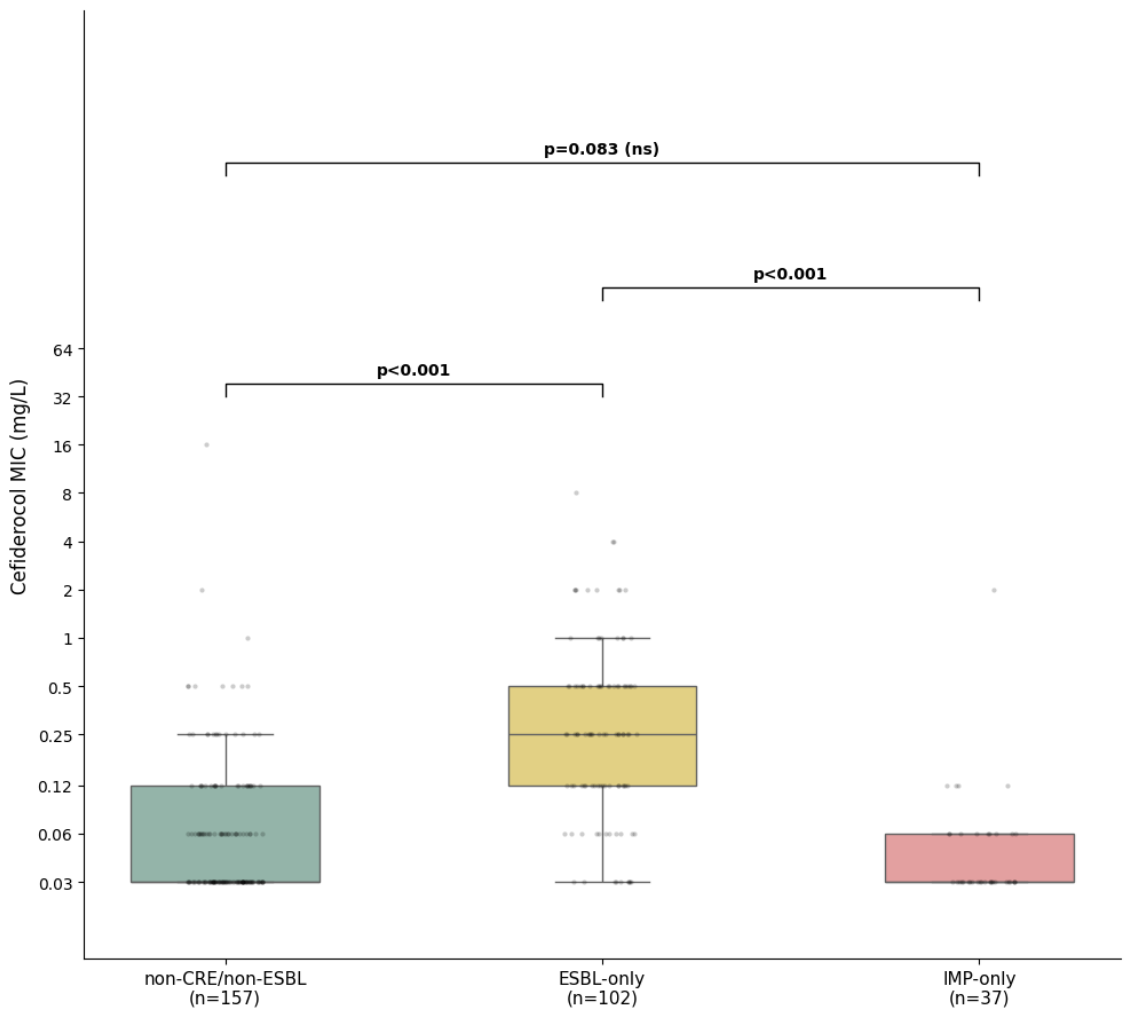
Figure 3.
Distribution of cefiderocol minimum inhibitory concentrations (MICs) among imipenemase (IMP)-only, extended-spectrum β-lactamase (ESBL)-only, and IMP+ESBL isolates. Boxplots indicate the median and interquartile range, with whiskers extending to 1.5 times the interquartile range. Individual isolates are overlaid as jittered points. MIC values compared across groups exhibited a significant overall difference (p < 0.001), Pairwise P values are indicated above the brackets. Only isolates with available MIC data are included. Abbreviations: IMP-only, isolates harboring an IMP-type carbapenemase without ESBL; ESBL-only, isolates with ESBL but without an IMP-type carbapenemase; IMP+ESBL, isolates harboring both an IMP-type carbapenemase and ESBL.
Figure 3.
Distribution of cefiderocol minimum inhibitory concentrations (MICs) among imipenemase (IMP)-only, extended-spectrum β-lactamase (ESBL)-only, and IMP+ESBL isolates. Boxplots indicate the median and interquartile range, with whiskers extending to 1.5 times the interquartile range. Individual isolates are overlaid as jittered points. MIC values compared across groups exhibited a significant overall difference (p < 0.001), Pairwise P values are indicated above the brackets. Only isolates with available MIC data are included. Abbreviations: IMP-only, isolates harboring an IMP-type carbapenemase without ESBL; ESBL-only, isolates with ESBL but without an IMP-type carbapenemase; IMP+ESBL, isolates harboring both an IMP-type carbapenemase and ESBL.
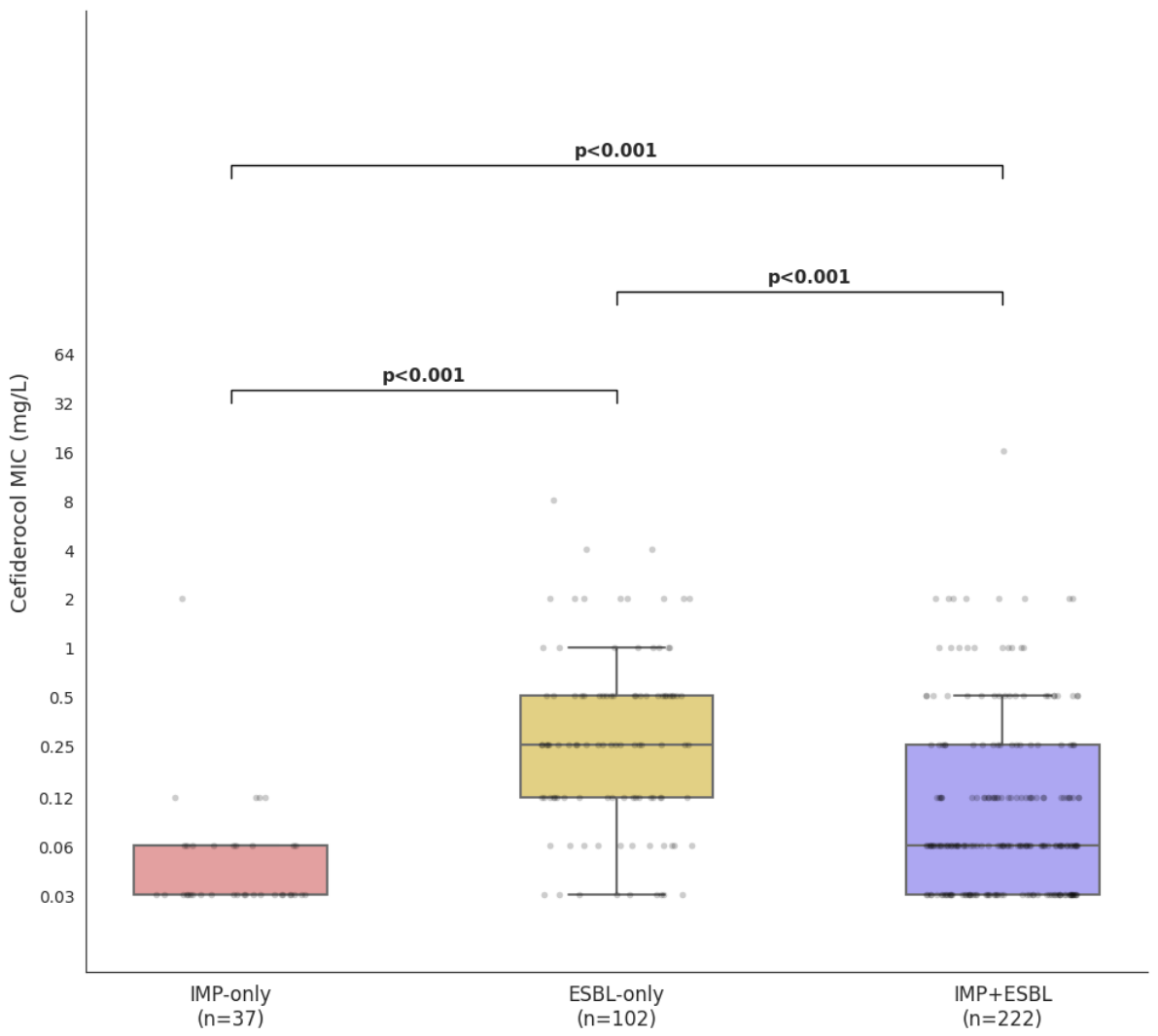
Figure 4.
Flowchart of isolate distribution. A total of 556 Enterobacterales isolates are classified based on their CRE and ESBL phenotypes, and their CPE genotypes. Note: Four isolates from the initial collection are excluded from this flowchart because of inadequate growth during testing. Abbreviations: CRE, carbapenem-resistant Enterobacterales; CPE, carbapenemase-producing Enterobacterales; CP, carbapenemase; ESBL, extended-spectrum β-lactamase.
Figure 4.
Flowchart of isolate distribution. A total of 556 Enterobacterales isolates are classified based on their CRE and ESBL phenotypes, and their CPE genotypes. Note: Four isolates from the initial collection are excluded from this flowchart because of inadequate growth during testing. Abbreviations: CRE, carbapenem-resistant Enterobacterales; CPE, carbapenemase-producing Enterobacterales; CP, carbapenemase; ESBL, extended-spectrum β-lactamase.
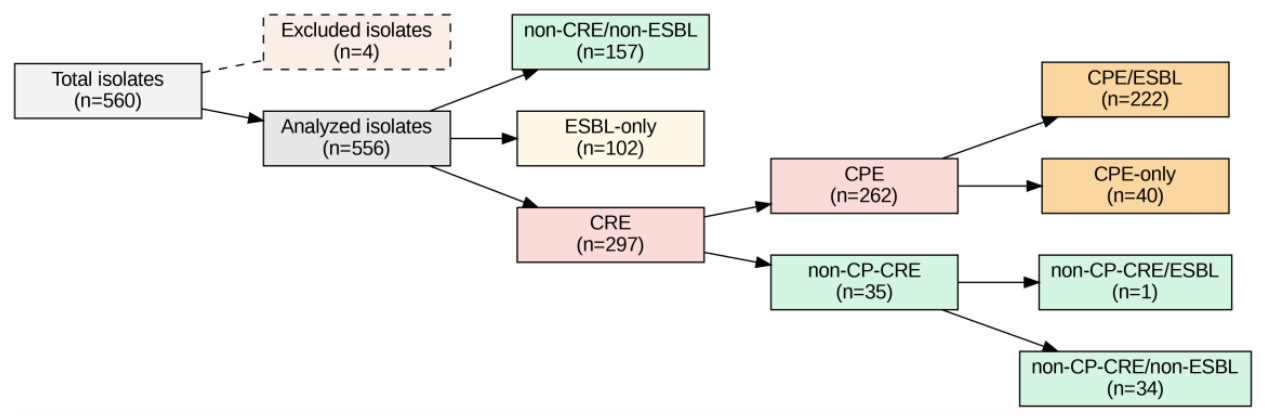

Table 1.
Isolates demonstrating non-susceptibility to cefiderocol.
| Isolate ID | Species | β-lactamases | DD method | BMD method | ||
| zone diameter (mm) | category | minimum inhibitory concentration (μg/mL) | category | |||
| OU_24 | Escherichia coli | ESBL | 15 | I 1 | 8 | I |
| OU_38 | Klebsiella pneumoniae | ESBL | 14 | I | 4 | S 2 |
| OU_46 | Klebsiella pneumoniae | ESBL | 15 | I | 1 | S |
| OU_91 | Proteus mirabilis | ESBL | 11 | I | 0.06 | S |
| OU_136 | Enterobacter cloacae | IMP | 14 | I | 2 | S |
| OU_186 | Enterobacter bugandensis | AmpC | 8 | R 3 | 16 | R |
| OU_551 | Klebsiella aerogenes | IMP+ESBL+AmpC | 16 | S | 16 | R |
1 Intermediate. 2 Susceptible. 3 Resistant.
Disclaimer/Publisher’s Note: The statements, opinions and data contained in all publications are solely those of the individual author(s) and contributor(s) and not of MDPI and/or the editor(s). MDPI and/or the editor(s) disclaim responsibility for any injury to people or property resulting from any ideas, methods, instructions or products referred to in the content. |
© 2026 by the authors. Licensee MDPI, Basel, Switzerland. This article is an open access article distributed under the terms and conditions of the Creative Commons Attribution (CC BY) license.
Copyright: This open access article is published under a Creative Commons CC BY 4.0 license, which permit the free download, distribution, and reuse, provided that the author and preprint are cited in any reuse.


