

Submitted:
09 June 2026
Posted:
10 June 2026
You are already at the latest version
Abstract
Receptors are the essential molecular gatekeepers of life, governing the flow of information across biological membranes. This review traces the evolution of the receptor concept, from the early “side-chain” hypotheses to the modern realization of receptors as dynamic probabilistic molecular machines. By mapping the transition from pharmacological characterization to atomic-level visualization, we demonstrate how dissecting receptor function has transformed molecular biology and our understanding of signal transduction. We explore the molecular architecture of disease, highlighting how mechanical failures in these relays drive pathologies ranging from oncogenic transformations and channelopathies to the sophisticated hijacking of receptors by viral pathogens. As these insights reveal the limitations of traditional, static drug design, we must pivot toward approaches that actively manipulate receptor life cycles and signalling kinetics. Furthermore, we examine the shifting paradigm in drug discovery, moving beyond simple occupancy toward event-driven modalities such as targeted protein degradation and kinetic selectivity. Crucially, we discuss the recent structural revolution fuelled by the Cryo-EM and the integration of Artificial Intelligence in decoding the dark GPCRome. Finally, we look beyond the cell to the emerging role of receptors as programmable bio-hardware in diagnosis and synthetic biology. This comprehensive overview offers new insights into these molecular machineries and provides a roadmap for the future of precision medicine and bio-digital integration.
Keywords:
protein receptors
; G-protein-coupled receptors (GPCRs)
; signal transduction
; molecular pharmacology
; receptor biology
; structural biology
; Cryo-electron microscopy (Cryo-EM)
; ternary complexes
; signalosomes
; biased signalling
; generative AI
; de novo protein design
; RFdiffusion
; bio-digital convergence
; digital twins
; miniproteins
1. History of Protein Receptors—From Concept to Atomic Structure
1.1. Early 1900s—The Birth of the Receptor Concept
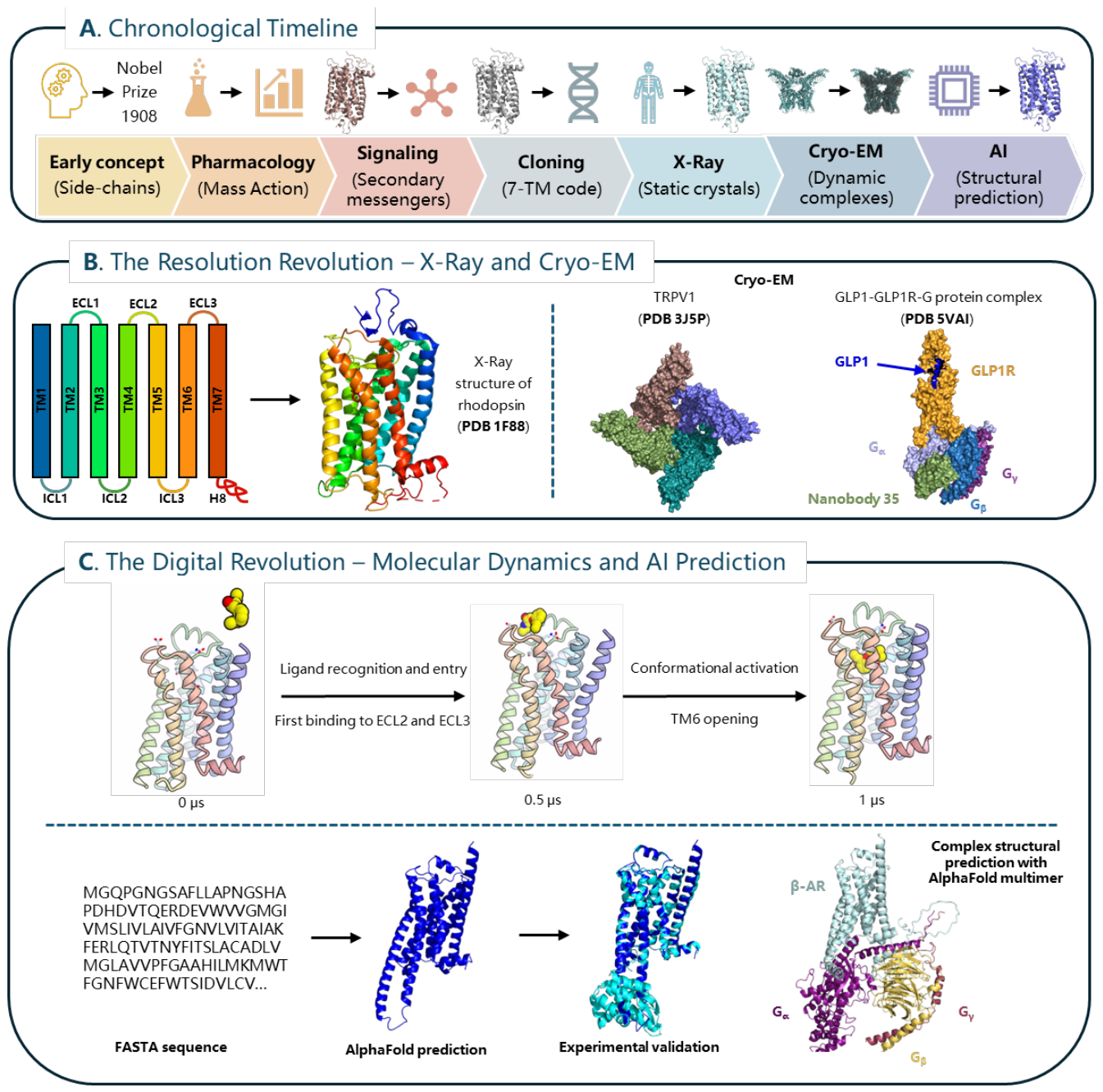
Paul Ehrlich was the first to hypothesize the existence of chemical moieties at the cell’s surface interacting with exogenous chemical agents. This theory, known as the “side-chains” theory, was born at the end of the 19th century during Ehrlich’s studies on chemical staining for infectious disease [1,2]. Switching from infection to immunology research on toxins, he described these “side-chains” as an inherent part of the immune system in 1897 [3]. In this publication, Ehrlich not only claimed the specificity of the “side-chains” to the toxins, but also postulated that their production increases in the presence of the toxins, ultimately acting as antitoxins. The groundbreaking character of this theory created skepticism in the scientific community, making Ehrlich defend it in the following years through a series of papers [2]. Notably, he employed for the first time the term “receptor” together with his colleague Julius Morgenroth during their research on immune hemolysis in their work published in 1900 [4]. Independently, the physiologist John Langley, while working on muscle responses to nicotine and curare, showed that their actions take place upon a “receptive substance” present on the muscles; [5] in line with Ehrlich’s immunity theory. Paul Ehrlich received the Nobel Prize in Physiology or Medicine in 1908 for his contribution to our immunology understanding as one of the most significant contributions in receptor research. (Figure 1A).
1.2. Mid-20th Century—Pharmacological Characterization
More than two decades later, Alfred J. Clarke, a British pharmacologist, provided the first mathematical models to describe drug-receptor interactions. In 1926, he proposed the basis of a proportionality between the biological response and the number of occupied receptors [6]. Ten years later, Clark summarized his research and presented a mathematical framework in which he applied the law of mass action to drug-receptor binding, bringing the concept of receptor occupancy as a central principle of pharmacology [7].
From this point, the scientific community completely accepted the receptor theory, and research focused on receptor characterization, especially with the appearance of more nuanced concepts such as drug affinity versus efficacy, which ultimately led to the classification of different receptor types. Notably, the work on Raymond P. Ahlquist provided the first experimental evidence for different types of adrenergic receptors [8], ultimately named α- and β-, based on their responses to various adrenergic drugs. This work led to the development of specific drugs such as beta-blockers. Following Ahlquist’s study, Everhardus J. Ariëns proposed more detailed studies depicting a drug’s ability to bind to a receptor, its ability to activate it and induce an effect, i.e., intrinsic affinity, in the context of competitive and non-competitive inhibitions. These studies led to the modern classification of drugs as agonists, partial agonists and antagonists [9,10,11,12]. At the same time, R P. Stephenson independently provided a similar concept, with a more precise mathematical model [13]. This improved Clark’s work from a linear relationship between the number of occupied receptors and the magnitude of the biological response to a more proportional response to the product of the drug’s efficacy and receptor occupancy.
Also in the mid-20th century, more specific contributions to the receptor theory appeared, illustrating that a receptor acts as a specific point of recognition that initiates a cascading biological response. Earl W. Sutherland Jr., an American physiologist, built the first deep knowledge of the role of receptors in cell-signalling during his work on the mechanisms of hormone action. More specifically, he showed that hormones such as adrenaline and glucagon bind to receptors on the cell’s surface but do not enter it. Instead, this binding induced the production of cyclic adenosine monophosphate inside the cell, relaying the signal and inducing a full cascade of intracellular events leading to different final biological responses, like the breakdown of glycogen into glucose. This work introduced the groundbreaking concept of “secondary messenger”, produced by the binding of a “first messenger” on the cell’s surface, which does not need to enter the cells to induce an effect [14]. In addition to the above-mentioned concept of pharmacological receptor, Niels Jerne and Frank M. Burnet pioneered the concept of immunological receptor. First, Jerne proposed that the body possesses a pre-existing library of potential antibodies rather than creating a new one based on the antigen as a template [15]. Later, Burnet built the “clonal selection” theory on Jerne’s concept. He proposed that an antigen selects a specific immune cell that already presents a matching receptor at its surface. This first selection stimulates the cell to multiply, forming a clone of identical cells to increase the amount of targeted immune response [16]. While Sutherland established the second messenger paradigm, the subsequent discovery of G-proteins as the essential molecular switches between the receptor and adenylate cyclase provided the necessary mechanism for this signal transduction cascade [17,18,19].
Figure 1.
Evolution of paradigms in receptor research. (A) Chronological representation of the key breakthroughs in receptor research from the 1900s to the present. (B) Transition from early structural models to high-resolution complexes: Left panel, snake plot representation and X-ray structure of bovine rhodopsin (PDB 1F88) [20]. Right panel, representative Cryo-EM structures of TRPV1 (PDB 3J5P) [21] and the GLP1-GLP1R-G protein complex (PDB 5VAI) [22]. (C) Emerging digital and predictive paradigm: Upper panel, snapshots from a molecular dynamics simulation of β-AR with alprenolol [23]. Bottom panel, from left to right: FASTA sequence of β-AR. AlphaFold predicted structure of β-AR; superimposition of predicted and X-ray structures (PDB 2RH1) [24]; and the predicted structure of β-AR in complex with G protein subunits by AlphaFold multimer [25].
Figure 1.
Evolution of paradigms in receptor research. (A) Chronological representation of the key breakthroughs in receptor research from the 1900s to the present. (B) Transition from early structural models to high-resolution complexes: Left panel, snake plot representation and X-ray structure of bovine rhodopsin (PDB 1F88) [20]. Right panel, representative Cryo-EM structures of TRPV1 (PDB 3J5P) [21] and the GLP1-GLP1R-G protein complex (PDB 5VAI) [22]. (C) Emerging digital and predictive paradigm: Upper panel, snapshots from a molecular dynamics simulation of β-AR with alprenolol [23]. Bottom panel, from left to right: FASTA sequence of β-AR. AlphaFold predicted structure of β-AR; superimposition of predicted and X-ray structures (PDB 2RH1) [24]; and the predicted structure of β-AR in complex with G protein subunits by AlphaFold multimer [25].
1.3. 1970s—First Molecular Level Receptors Characterizations
After making several conceptual models of receptor functions, the scientific community started to explore their actual physical reality. A crucial work making the bridge between these two aspects is the concept of allostery developed by Jean-Pierre Changeux. While studying regulatory enzymes from bacteria, he developed a model, known as Monod-Wyman-Changeux, on the thermal transition of different protein conformations [26,27]. This theory proposed that many proteins, including receptors, exist in at least two different stable conformations in a dynamic equilibrium. Furthermore, if a ligand binds to one site of the receptor, it can stabilize one of these conformations, potentially changing its shape and function in a distant site.
Building on this, the development of radioligand binding was the final technical breakthrough. Although radioimmunoassay was first used to measure insulin levels [28],, this technique allowed for the first time the direct measurement of receptor binding. Notably, Robert J. Lefkowitz and his team pioneered the use of this method to directly characterize the binding of radioactive adrenocorticotropic hormone to adrenal receptor [29] before focusing on β-adrenergic receptor (β-AR) in various systems [30,31,32], including human lymphocytes [33] allowing the study of receptor-related diseases in humans for the first time. Building on this technical momentum, the application of radioactive tracers led to a multitude of receptor analyses across various biological systems in the 1970s. Among the most transformative breakthroughs were the opiate receptor with the identification of specific binding sites in the brain, providing the first physical evidence of how narcotics work and implying the existence of what we know today as endorphins; [34] the nicotinic acetylcholine receptor (nAChR) which became the first isolated and purified transforming the receptor pharmacological concept into a tangible macromolecule; [35] the insulin receptor with its direct properties measurement providing the first insight into how a metabolic hormone initiates its action at the cell surface; [36] the estrogen receptor proving its translocation to the nucleus; [37] and the dopamine receptor with the first link between clinical potency of antipsychotic drugs and their ability to bind a specific receptor, founding the “dopamine hypothesis” of schizophrenia [38]. These studies collectively proved that receptors were saturable, specific and measurable, opening an era of rational drug design.
1.4. 1980s—First Insights into the Molecular Architecture of Receptors
The 1980s were characterized by the transition from identifying receptors to decoding their internal machinery, and opened with a focus on the transduction process, specifically the isolation and purification of the Gs-protein stimulating adenylate cyclase by Alfred Gilman and co-workers [39]. This work proved that these proteins are distinct entities that act as the essential transducers between receptors and the intracellular signalling pathway. At the same time, Lefkowitz and colleagues formulated the ternary complex model explaining how receptors, agonists and G-proteins interact to create high-affinity binding states [40]. This mathematical model demonstrates that the observed state of a receptor is physically caused by the formation of a stable complex between these three components.
As the decade progressed, the focus shifted toward the physical isolation of the receptor itself. In 1981, collaborative work between the Lefkowitz and Caron labs established the essential affinity chromatography for receptor enrichment [41] before refining the purification one year later for the isolation of the β-AR from frog erythrocytes [42]. They finally succeeded in applying this method for the purification and characterization of β-ARs from various mammalian cells [43], one year after Homcy et al. reported it for canine lung cells [44]. The obtention of the pure protein provided the necessary material for its molecular cloning in 1986 [45], a feat that followed three years of rapid progress in the molecular sequencing and cloning of other major protein classes. The Torpedo californica nAChR was cloned as the prototypical ion-channel, starting with the α-subunit [46] containing the acetylcholine binding site and followed by β-, δ- and γ- subunits [47,48], proving how a protein complex could physically form a pore for electrical signalling; the low-density lipoprotein (LDL) receptor cloning revealed the mechanism for cellular nutrient uptake; [49] and the glucocorticoid receptor sequencing provided the first genetic code of a nuclear receptor regulating gene expression [50]. Crucially, the cloning of the epidermal growth factor receptor (EGFR) [51] and the insulin receptor [52] represented a massive breakthrough in signalling, as they demonstrated that a receptor could act as its own enzyme (tyrosine kinase) to catalyze growth and metabolic reactions. While these earlier studies defined the architectures for ion-gates, transporters and enzymes, the β-AR sequencing finally identified the universal seven-transmembrane (7-TM) structure. By proving this receptor was structurally homologous to the visual protein rhodopsin, this discovery unified the fields of sensory perception and hormonal signalling, initiating the study of the later-called G-protein-coupled receptor (GPCR) superfamily.
1.5. 1990s—Molecular Understanding of the Receptors Biological Pathways
Following the 1986 revelation of the 7-TM structure, the 1990s expanded the GPCR story from a few hormonal triggers to a massive genomic system of sensory and regulatory control. In 1991, Linda Buck and Richard Axel cloned the olfactory receptors, proving that a substantial portion of the mammalian genome is dedicated to 7-TM sensors for odour detection [53]. This expansion initiated the “orphan receptor” revolution, as genome sequencing revealed hundreds of 7-TM proteins with no known natural ligands. The subsequent “de-orphanization” of these receptors throughout the decade led to the discovery of entirely new physiological systems. The most transformative examples include the discovery of ghrelin, a 28 residues peptide hormone binding to the growth hormone secretagogue receptor (GHS-R) and acting as the body’s primary hunger signal; [54] the identification of orexins initially found to regulate appetite [55] independently shown to be neurotransmitters under the name of hypocretins; [56] the discovery of the endogenous ligand anandamide [57] following the cloning of the cannabinoid receptor 1 (CBR1) [58,59] revealing a widespread neuromodulatory system that regulates mood, memory and pain; and the finding of Nociceptin (orphanin FQ) and the opioid receptor-like 1 (ORL-1) added a fourth branch to the opioid receptor family identifying a system that fine-tunes the volume of pain perception [60]. While GPCRs dominated the genomic landscape, the 1990s also redefined other receptor classes. The maturation of receptor tyrosine kinase (RTK) research [61] led to the 1998 approval of Trastuzumab (Herceptin), the first monoclonal antibody targeting a cell-surface receptor (paper from 2001, but FDA approval in 1998) [62]. During this same decade, the characterization of the full nuclear receptor (NR) superfamily [63] further transformed the field; the discovery of their requisite coactivators [64] and corepressors [65,66] revealed that steroid receptors were not simple DNA binders, but complex recruitment hubs for chromatin remodelling.
Back in the realm of the cell surface, the 1990s witnessed a paradigm shift as GPCR research moved beyond identification toward understanding complex regulation and signalling dynamics. The cloning of β-arrestins (β-arrs) provided the molecular explanation for desensitization, revealing how these proteins act as physical brakes to silence and internalize receptors after stimulation [67]. The clinical significance of the 7-TM architecture was further highlighted by the discovery of chemokine receptors as the essential “gatekeepers” for HIV-1 entry [68]. By the decade’s end, the traditional “on-off” switch model was replaced by a more nuanced framework. The discovery of GPCR dimerization revealed that receptors function as teams rather than isolated units [69], while the concept of constitutive activity demonstrated that receptors could signal even in the absence of a ligand [70]. This new signalling feature led to the clinical application of inverse agonists, drugs that stabilise a receptor in its inactive state [71]. Finally, the discovery that β-arrs induce their own independent signalling scaffolds dismantled the one-pathway rule of pharmacology [72]. It proved that a receptor does not only have a “on” switch for G-proteins, but also a second distinct signalling engine. This introduced biased agonism, allowing scientists to design pathway-selective drugs that can trigger a receptor’s therapeutic benefits while simultaneously blocking the pathways responsible for side effects.
1.6. 2000s—The Structural Revolution
The 21st century transitioned receptor research from indirect signalling assays to direct atomic visualization, effectively mapping the mechanics of cellular communication across all major classes. While the 1985 X-ray structure of the photosynthetic reaction center from R. viridis provided the first proof that membrane proteins could be crystallized [73], the true milestone for receptors arrived in 2000, with the first high-resolution structure of a GPCR, the bovine rhodopsin, providing the concrete universal 7-TM architecture of the entire superfamily (Figure 1B) [20]. However, other families achieved structural clarity even earlier; the ion-channel nAChR and various RTKs like EGFR provided early templates for ligand-gated and catalytic signalling. This set the stage for the 2007 breakthrough by the teams of Brian Kobilka and Raymond Stevens, who utilized innovative protein engineering to solve the first of a human non-rhodopsin GPCR, the β-AR [24]. This achievement shattered the crystallization barrier for flexible membrane proteins and provided the first visual proof of how a drug sits within a receptor’s binding pocket. While X-ray crystallography continued to provide high-resolution snapshots—including the first active-state receptor-G protein complex in 2011 [74]—it required frozen receptors in rigid and artificial states. The subsequent revolution of Cryo-Electron Microscopy (Cryo-EM) bypassed the need for crystals entirely, allowing scientists to capture receptors in near-native environments and in complex with their signalling partners.
This resolution revolution began not with GPCRs but with the 2013 structure of the transient Receptor Potential Vanilloid 1 (TRPV1) ion-channel, which proved that Cryo-EM could achieve atomic detail for membrane proteins previously considered as undruggable [21]. This paved the way for the first GPCR-G protein complexes solved by Cryo-EM, such as the Calcitonin and GLP-1 receptors (Figure 1B) [22,75,76]. By 2018, the technology had unlocked the gamma-aminobutyric acid (GABA) receptor, finally visualizing the precise binding sites for flumazenil [77]. Today, this trajectory has culminated in dynamic structural biology, where researchers use Cryo-EM to film the millisecond-scale shifts of receptors in real-time, effectively turning static photos into molecular movies of cellular life [78,79,80].
This structural explosion has rendered an exhaustive cataloguing of every receptor impossible; instead, the field had transitioned into the era of big data and predictive modelling. Since the early 2000s, molecular dynamics (MD) simulations have complemented static structures (Figure 1C), culminating with platforms like GPCR-ModSim [81] or GPCRdb [82], that map universal activation switches across the superfamily. The digital shift reached a definitive turning point in 2020, when the first iteration of AlphaFold demonstrated that deep learning could predict protein structures with unprecedented accuracy during the CASP13 competition [83]. This was rapidly replaced in 2021 by AlphaFold2, which provided high-accuracy structural models for nearly the entire human proteome [84]. By 2024, the introduction of AlphaFold3 expanded these capabilities further, allowing the computational modelling of receptors in complex with ligands, ions and nucleic acids with experimental-level precision (Figure 1C) [25]. Today, the synergy between artificial intelligence (AI) driven prediction and high-throughput Cryo-EM has transformed receptor biology from a slow and laborious search process for single structures into a rapid and automated pipeline for structure-based drug discovery.
2. The Modern Landscape: Functional and Molecular Significance
2.1. The Receptor as a Dynamic Molecular Machine
The 21st-century view of the receptor has evolved from a simple binary switch model into a sophisticated molecular machine paradigm. In the modern post-structural era, the receptor is no longer viewed as a binary switch. Instead, it is recognized as a highly flexible molecular machine that exists in a state of constant conformational fluctuation.
2.1.1. Conformational Ensembles and Probabilistic Efficacy
Building on the Monod-Wyman-Changeux model of allostery, contemporary molecular biology defines receptor activity through the conformational ensemble theory [85,86]. This theory postulates that a receptor population exists in a dynamic equilibrium of multiple structural states. Receptors are inherently flexible molecules that fluctuate between inactive, intermediate, and multiple active conformations even in the absence of a ligand [87]. Central to this model is the concept of probabilistic efficacy. A ligand does not induce an active conformation, but acts as a thermodynamic stabilizer [88]. An agonist possesses high affinity for the active state, thereby shifting the equilibrium toward an active population capable of coupling with effector proteins. Conversely, an inverse agonist preferentially stabilizes the inactive state, suppressing the receptor’s basal activity [89]. This transition between states is governed by highly conserved molecular micro-switches located within the receptor core. In GPCRs, these include the DRY (Asp-Arg-Tyr) motif in TM3, the CWxP motif in TM6 and the NPxxY motif in TM7 [90,91]. The physical manifestation of this thermodynamic shift is the movement of TM6 [74], which opens a hydrophobic cavity on the intracellular face of the receptor, allowing the binding of the G-protein α subunit C-terminus [92]. The discovery of these universal activation signatures through MD simulations and high-resolution crystallography has transformed the receptor from a black-box transducer into a predictable and tunable mechanical relay [23,93].
2.1.2. The Spatial Dimension: Endosomal and Nuclear Signalling
The classical plasma membrane paradigm concept—the long-held assumption that receptor signalling is a surface-bound event terminated by internalization—has been superseded by the discovery of location-biased signalling. We now recognize that the intracellular destination of a receptor dictates the duration, magnitude and specific nature of the downstream message [94]. Upon ligand binding, receptors are organized into signalosomes—large, multi-protein complexes that evolve as the receptor is sequestered. This sequestration is not merely a mechanism for termination, but a critical regulatory step in defining the kinetic signature of the signal by enabling a distinct, endosome-specific signalling profile. Although clathrin-mediated endocytosis (CME) remains the most studied route, receptors also utilize clathrin-independent endocytosis (CIE) pathways [95]. These CIE pathways often bypass traditional endosomal sorting, directing receptors toward rapid recycling or specific localized signalling microdomains, thereby providing a fast-track for temporal control [96].
The β-adrenergic receptor (β -AR): This is a G-protein-coupled receptor (GPCR) embedded in the plasma membrane and acts as the on switch for cellular signal-ling. When it binds its endogenous ligand (e.g., adrenaline), it undergoes a conformational change to help activate G-proteins, which start a downstream intracellular cascade.
β-arrestin (β-arr): The multifunctional scaffolding protein β-arr serves as both a brake and a secondary signalling engine. G-protein coupled receptor kinases (GRKs) phosphorylate the intracellular C-terminus of the activated β-AR generating a high affinity binding site for β-arr. In addition, recruitment of β-arr also allows the receptor to enter endosomes through clathrin-coated pits, in addition to sterically blocking further G-protein coupling, thereby desensitizing the receptor.
Functional Integration: Critically, β-arr is not simply an inhibitor but also triggers distinct signalling pathways, such as the MAPK/ERK cascade, in a G-protein-independent fashion. This dual role enables the β-AR/β-arr complex to act as an elaborate molecular switch that not only shuts down canonical signalling but also repurposes the receptor for spatiotemporal signalling diversification, including the generation of sustained signalling “megaplexes” within endosomes.
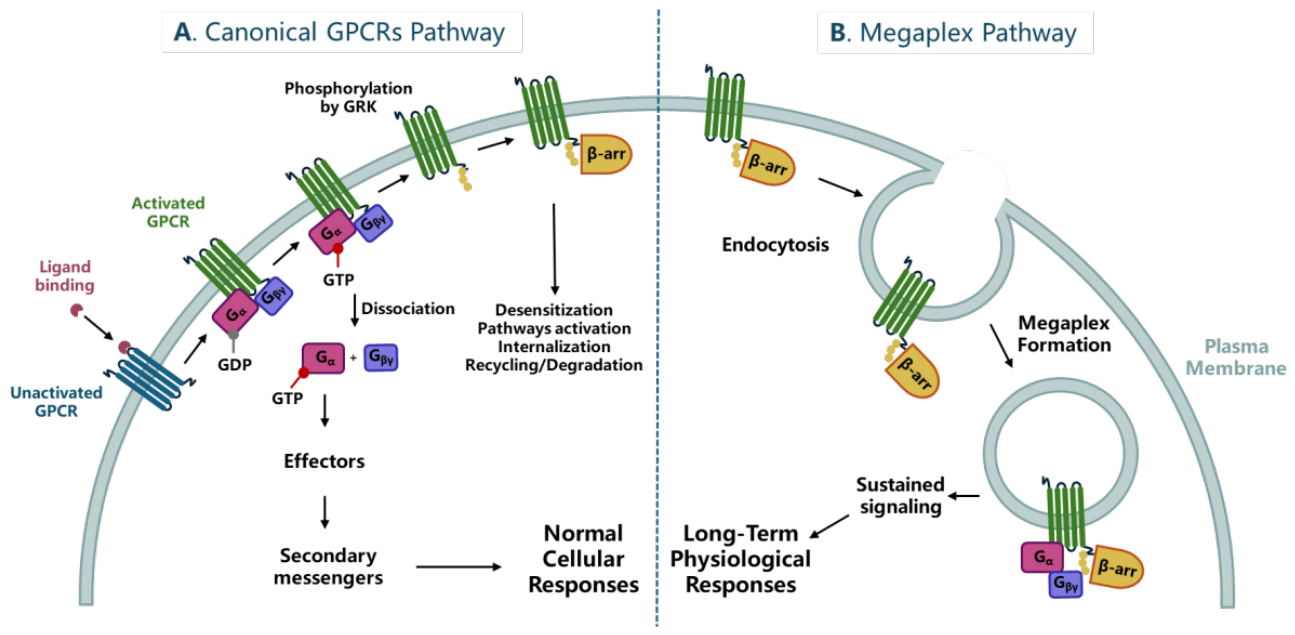
The ground breaking work on the parathyroid hormone receptor [97] and vasopressin receptor type 2 [98] receptors has demonstrated that receptors continue to generate cyclic AMP (cAMP) long after they have left the cell surface. This persistent signalling is often facilitated by the formation of a megaplex, a unique molecular architecture where a single receptor simultaneously binds a G-protein as its intracellular core and β-arr at its phosphorylated C-terminus (Figure 2) [99]. Crucially, the megaplex functions as an autonomous, location-specific signalling entity; it is not merely a transient intermediate of receptor internalization, but a distinct signalling modality that decouples intracellular pathway activation from the canonical G-protein signalling typically initiated at the plasma membrane. This arrangement allows for 1) sustained secondary messengers, as endosomal G-protein activation leads to different physiological outcomes than surface activation [100] and 2) transcriptional regulation, as the endosomal location places the signalosome in closer proximity to the nucleus, facilitating more efficient translocation of kinases like ERK1/2 to modulate gene expression [101].
Beyond the endosome, evidence suggests that certain receptors, such as angiotensin II and various lysophosphatidic acid receptors, can localize directly to the nuclear envelope. There, they regulate gene expression and chromatin remodelling directly, bypassing traditional secondary messenger cascades [102,103]. This adds a layer of spatiotemporal complexity that is now a primary focus for developing location-biased drugs designed to target specific cellular compartments to reduce off-target effects.
Figure 2.
Overview of canonical GPCRs and megaplex pathways. (A) Canonical pathway. Upon ligand binding, the GPCR activates heterotrimeric G proteins, leading to the rapid generation of second messengers and subsequent cellular responses. GPCR is then phosphorylated by G-protein-coupled receptor kinase (GRK), leading to its cellular uptake. (B) Megaplex pathway. Following its internalization, the GPCR forms a megaplex simultaneously involving the receptor, heterotrimeric G-protein and β-arr, leading to sustained G-protein signalling pathway and therefore long-term responses.
Figure 2.
Overview of canonical GPCRs and megaplex pathways. (A) Canonical pathway. Upon ligand binding, the GPCR activates heterotrimeric G proteins, leading to the rapid generation of second messengers and subsequent cellular responses. GPCR is then phosphorylated by G-protein-coupled receptor kinase (GRK), leading to its cellular uptake. (B) Megaplex pathway. Following its internalization, the GPCR forms a megaplex simultaneously involving the receptor, heterotrimeric G-protein and β-arr, leading to sustained G-protein signalling pathway and therefore long-term responses.
2.1.3. Temporal Dynamics and Receptor Kinetics
While structural ensembles and spatial localization provide the “”how” and “where” of signalling, the temporal dimension defines the “how long”. In the modern post-genomic era, pharmacological focus has shifted from static equilibrium constant (Kd) toward the dynamic parameters of binding kinetics, specifically the rates of association (kon) and dissociation (koff) [104].
The concept of residence time (τ), defined as the reciprocal of the dissociation rate constant (τ = 1/koff), has emerged as a superior predictor of in vivo clinical success compared to simple affinity. Traditional models assume a closed system where drug concentration remains constant; however, in a living organism, drugs are subject to continuous clearance. A ligand with a high residence time remains physically bound to the receptor in a conformational lock that extends the biological effect [105].
This temporal control allows for kinetic selectivity, a strategy designed to widen the therapeutic window, i. e., the concentration range between the drug’s effective dose and its toxic threshold. By engineering a drug to have a slow off-rate at the target receptor but a rapid off-rate at off-target isoforms, we can maintain efficacy while minimizing side effects. This principle was elegantly demonstrated in the development of long-acting muscarinic antagonists like tiotropium, which achieves 24-hour bronchodilatation by locking onto the M3 receptor while dissociating quickly from the M2 receptor to avoid cardiac toxicity [106]. Similarly, the modern view of corticosteroid receptors emphasizes that anti-inflammatory efficacy is governed by the duration of receptor occupancy rather than peak plasma levels. This is exemplified by fluticasone furoate, which exhibits significantly prolonged lung absorption kinetics compared to fluticasone propionate, with a lung retention time exceeding 20 hours [107].
By prioritizing residence time, modern pharmacology essentially insulates the signalling event from the fluctuations of systemic drug levels. The goal of drug design shifts from maximizing occupancy at a single time point toward maximizing the duration of the functional complex, ultimately leading to more stable dosing administration and improved patient outcomes [108].
2.2. The Molecular Architecture of Disease
If the modern receptor is a dynamic relay, then pathogenesis is the study of its mechanical failure. When the thermodynamic or spatial equilibria described previously are disrupted, the receptor transforms from a controlled transducer into a driver of pathology. It usually follows predictable patterns: the loss of conformational control, the decoupling of internal linkages, or the physical exploitation of the receptors by external invaders.
2.2.1. Constitutive Activity of Receptors
In many oncogenic transformations, the probabilistic nature of the conformational ensemble is destabilized. While a healthy receptor requires the entropic input of a ligand to shift the equilibrium toward an active state, mutations frequently lower the energy barrier for this transition or destabilize the inactive state [109]. This results in constitutive activation, a phenomenon where the receptor signals, ignoring the absence of external stimuli.
In RTKs such as EGFR or HER2, these structural failures often arise from mutations that compromise the receptor’s autoinhibitory domains [110]. A classic example is the EGFRvIII variant, where a significant deletion in the extracellular domain exposes a unique unbridged cysteine (Cys16) [111,112]. This exposed residue facilitates spontaneous covalent dimerization, physically locking the receptor into a signalling-competent conformation and inducing kinase activation in the absence of ligand.
Beyond binary on and off states, modern atomistic simulations reveal a more nuanced graded conformational spectrum. Emerging models of oncogenic variants, especially in the context of PI3Kα and similar transducers, show that mutations do not merely populate a single active state, but rather expand the protein’s conformational profile to include mutation-specific cryptic pockets [113,114,115,116]. These structural intermediates allow the machine to recruit downstream effectors with increased efficiency while potentially evading traditional inhibitory mechanisms. Furthermore, recent visualization of M2R dynamics suggests that GPCRs’ signalling efficacy is often governed by specific ring dynamics that act as the internal gears [117].
The result is a constant phantom signal for cellular proliferation. Because these autonomous receptors function independently of growth factor availability, they effectively decouple signalling from environmental control. Consequently, the focus of drug development has moved beyond traditional steric inhibitors toward more sophisticated chemicals that exploit the receptor’s dynamics. This includes induced proximity agents such as PROTACs and LYTACs, which trigger the total degradation of the dysfunctional receptor [118,119] and molecular glues, which stabilize inhibitory protein-protein interactions (PPI) to restore homeostatic control [120]. These classes represent a transition from simply blocking a signal to actively re-engineering the receptor’s cellular life cycle.
2.2.2. Signalling Decoupling and Channelopathies
The functional integrity of a receptor relies entirely on the fidelity of the allosteric bridge, the physical connection that translates an external binding event into an internal action. When this bridge collapses, we see the emergence of signalling decoupling. In this state, the receptor is no longer a cohesive relay but a fractured machine where the sensor and the effector operate in isolation. This failure is particularly illustrated in channelopathies, where the gate of the molecular pore becomes unresponsive to its regulatory inputs.
In ligand-gated ion channels, such as the nAChR or GABAA receptors, the signalling process is an exercise in precision engineering. The energy generated by a neurotransmitter binding in the ECD must be physically funnelled down through a cys-loop interface to pull open the transmembrane pore [121,122,123]. Mutations in this delicate junction result in a coupling decohesion, such as in congenital myasthenic syndromes, where the receptor’s affinity for its ligand remains perfectly intact, yet the muscle fails to contract. Because the coupling interface is frayed, the mechanical energy dissipates before the rotation of M2 helices necessary to open the gate [124,125,126]. The result is a silent receptor receiving a command but lacking the mechanical means to execute it.
This decoupling also manifests as a failure in temporal termination, where a machine stays in the open position. This is the hallmark of many cardiac and neurological channelopathies [127]. In long QT syndrome type 3, the SCN5A sodium channel suffers a structural glitch in its activation state [128]. Instead of sealing the pore after a millisecond pulse, the gate fails to close, leading to a leaky sodium current. This persistent signalling is not caused by an overabundance of stimuli, but by a mechanical failure resetting the relay, which is trapped in a perpetual activation state, causing lethal arrhythmias.
Beyond the pore-forming receptors, this decoupling extends to the complex interface of GPCRs [129,130]. For a GPCR to function, the ligand-induced movement of TM6 must create a perfect structural binding site profiled for the G-protein heterotrimer. In nephrogenic diabetes insipidus, mutations of the vasopressin V2 receptor effectively disrupt this binding site. Even when the body floods the system with vasopressin, the receptor is not able to engage the Gs protein [131,132]. The external signal is present, and the receptor may even shift its shape, but the final hand-off to the internal transducer is broken. Ultimately, these channelopathies and GPCR failures reveal that receptor health is not a matter of ligand’s presence or binding affinity, but of a structural continuity, highlighting the relevance of the allosteric framework established by Changeux [133]. When the internal linkages of the protein are altered, the receptor ceases to be a functional relay and becomes a molecular dead-end, breaking the vital flow of information from the environment to the cell.
2.2.3. Spatiotemporal dysregulation in neurobiology
While systemic diseases are often caused by global receptor failures, neurobiological pathologies are frequently defined by the misplacement and mistiming of receptor activity. In the highly polarized architecture of the neuron, the functional output of a receptor is strictly dependent on its sub-cellular location: whether it is located at the synapse, outside the synapse or confined to internal pools [134,135]. The most prominent example of this spatial failure is found in glutamate excitotoxicity. Under homeostatic conditions, NMDA receptors localized within the postsynaptic density trigger pro-survival signalling pathways, such as the activation of c-AMP Response Element-Binding protein (CREB). However, during ischemia or traumatic brain injury, the spatial equilibrium is disrupted. Glutamate spreads to extra-synaptic NMDARs, which are coupled to various cell death signalling complexes [135,136]. This spatial decoupling transforms glutamate from a fundamental unit of cognition into a neurotoxic trigger, demonstrating that the location of receptor activation determines the future of the neuron.
Furthermore, the temporal dynamics of desensitization are critical in neuropsychiatric disorders. In the context of major depressive disorder and the chronic stress model, the temporal regulation of 5-Hydroxytryptamine (5-HT) receptors is often compromised. Continuous exposure to elevated cortisol can lead to the hyperphosphorylation and premature internalization of 5-HT1A receptors by GRKs [137]. This shortened residence time of the receptor at the plasma membrane results in a temporal silencing of serotonergic activity. The receptor machine is not necessarily mutated; its operational window can be truncated by accelerated trafficking kinetics, rendering the post-synaptic neuron deaf to emotional regulation signals.
The dysregulation of endosomal signalling (the megaplexes discussed in 2.1.2) also plays a role in neurodegeneration. In Alzheimer’s disease, the trafficking of Nerve Growth Factor receptor, the tropomyosin receptor kinase A (TrkA), is impaired [138]. Instead of maintaining a sustained signalling endosome that travels from the axon tip to the soma, the receptor is prematurely degraded or is blocked in axonal traffic jams. This disruption of spatiotemporal transmission deprives the nucleus of essential trophic support, leading to the characteristic degeneration of cholinergic neurons. In such cases, the receptor’s molecular mechanism may remain intact, but its spatiotemporal trajectory is compromised, leading to neuronal atrophy.
2.2.4. Pathogenic Hijacking: The Receptor as a Portal
The previous sections focus on internal mechanical failures, but the final dimension of the modern landscape involves the use of these receptors by external pathogens. In this context, the receptor is transformed into a high-affinity portal for viral, bacterial and toxic entry [139]. This hijacking is rarely a passive binding event, but mostly a sophisticated exploitation of the receptor’s conformational ensemble and endocytic machinery. Pathogens have evolved to act as molecular mimics that not only recognize the receptor’s extracellular domain but also trigger the specific mechanical transitions required to enter the cell.
The most well-known contemporary illustration is the structural handshake between the SARS-CoV-2 spike protein and the angiotensin-converting enzyme 2 (ACE2) receptor [140,141]. The spike protein utilizes the scaffold of ACE2 to undergo a protease-triggered rearrangement from a metastable pre-fusion state to a highly stable post-fusion conformation (Figure 3A) [142,143]. Similarly, the entry of HIV-1 represents a masterclass in sequential mechanical exploitation [144]. The viral envelope glycoprotein gp120 first engages the CD4 receptor, inducing a conformational shift that exposes a high-affinity binding site for a co-receptor, typically CCR5 or CXCR4 (Figure 3B). This multi-step engagement ensures that the virus fusion machinery is only deployed in the immediate presence of a permissive host membrane.
Beyond the initial entry, pathogens frequently exploit the spatiotemporal signalosomes and trafficking pathways described in section 2.1.2 [145]. Many bacterial toxins, such as the Vibrio cholerae or Shigella toxins, do not simply adhere to the surface. They actively trigger clathrin-mediated or clathrin-independent endocytosis to gain access to the endosomal system [146,147]. Once internalized, these toxins employ molecular mimicry to hijack host trafficking signals, allowing them to bypass the degradative lysosomal pathway by diverting their transit through the Golgi apparatus and endoplasmic reticulum [148]. This allows the pathogen to reach the cytosol while shielded from the cell’s internal defences, effectively utilizing the receptor as a Trojan horse.
Furthermore, some viruses have evolved to bypass host regulation entirely by encoding their own GPCR-like proteins (vGPCRs). Classic examples are the BILF1 protein of the Epstein-Barr virus or the US28 protein of human cytomegalovirus [149,150]. These viral receptors often exhibit high constitutive activity, mimicking the active-state ensemble without the need for an endogenous ligand. By maintaining a constant activated state, these vGPCRs reorganize the host cell’s proliferation and metabolic pathways to create a niche for viral replication, while simultaneously suppressing the immune response by sequestering chemokine. In these instances, the molecular architecture of the receptor is not broken in the traditional sense, as its high-fidelity relay system is perfectly intact but has been entirely repurposed to serve a foreign genetic program. This transition from mechanical failure to mechanical exploitation represents the ultimate challenge of modern drug design: the need to develop protective treatments capable of blocking these illicit access routes without disrupting the vital homeostatic signalling they are supposed to facilitate.
2.2.5. Systemic Autoimmunity
In systemic conditions such as Systemic Lupus Erythematosus (SLE) and Rheumatoid Arthritis (RA), the receptor machine is not necessarily mutated, but its operational state is dictated by chronic immunological interference. These diseases exemplify the breakdown of the probabilistic efficacy, where the thermodynamic equilibrium is shifted toward a perpetual active state. The molecular trigger for this shift often involves the misidentification of self-antigens. During cellular stress or tissue damage, hidden segments of self-proteins, known as cryptic autoantigens, are exposed to immune surveillance for the first time [151]. Because these hidden parts were never recognized during immune development, they are treated as foreign, leading to the production of auto-antibodies.
In SLE, this failure is centred on the Toll-like receptors (TLR7/9). These endosomal machines are designed to recognize viral RNA, but in Lupus, they are fooled by self-nucleic acids [152]. This creates a state of constitutive endosomal signalling, where the receptor is mechanically trapped in an active conformation, continuously driving inflammatory pathways. Similarly, in RA, receptors for TNF and IL-6 are subjected to a constant barrage of pro-inflammatory cytokines [153]. This ligand overdrive acts as a chronic thermodynamic stabilizer, effectively keeping the receptor in its activated state and preventing the natural internalization needed to terminate the signal.
Finally, the concept of ensemble molecular mimicry explains how this misidentification occurs at a structural level [154]. It suggests that certain self-receptors share the same conformational fluctuations as viral proteins. Consequently, an immune system attacking a virus may lock a human receptor in its active or inactive state simply because these two structures share a similar mechanical signature. This transforms a normally regulated physiological relay into a factor of systemic destruction, bypassing the cell’s internal homeostatic mechanisms.
Having defined how receptor mechanical failure manifests as disease, we now pivot to how these same structural mechanics, once decoded, become the leverage points for therapeutic intervention.

Table 1.
Summary of receptors dysregulation mechanisms.
| Failure’s mechanism | Receptor system example | Molecular basis of the pathology | Clinical manifestation example |
|---|---|---|---|
| Constitutive activation | RTKs (EGFR, HER2) | Destabilization of the inactive ensemble; spontaneous dimerization | Oncogenic transformation and ligand-independent proliferation |
| Signalling decoupling | nAChR / LGICs | Decohesion of the allosteric bridge at the cys-loop junction; mechanical energy dissipation | Congenital myasthenic syndromes; muscle failure |
| Termination failure | SCN5A (Na+ channel) | Glitch the activation state resetting; failure of the gate to close | Long QT syndrome Type 3; lethal arrhythmias |
| Spatial mis-localization | NMDAR | Shift from synaptic (pro-survival) to extra-synaptic (pro-death) signalling complexes | Glutamate excitotoxicity; ischemia, brain injury |
| Kinetic silencing | 5-HT1A | Shortened residence time due to accelerated phosphorylation and trafficking kinetics | Major depressive disorder; stress-induced |
| Molecular mimicry | ACE2 / CCR5 / | Pathogen exploitation of conformational triggers to force membrane fusion | Viral entry; Lupus |
| Ligand overdrive | TLR7/9 | Blocked receptor conformation by continuous cytokines binding | Rheumatoid arthritis |
| Mechanical repurposing | vGPCRs | Encoding viral receptors with fixed activated conformations | Viral replication and immune evasion |
3. Receptors Significance in Drug Discovery
3.1. Target Identification and Validation: The Druggable Proteome
The transition of the protein receptor from a theoretical receptive substance to a decoded molecular machine has fundamentally altered the drug discovery pipeline. In modern pharmacology, identifying a receptor is only the beginning, with a true challenge in the validation step, proving that targeting this specific receptor conformational ensemble will indeed lead to a therapeutic effect without prohibitive systemic toxicity. As the definition of the “druggable” proteome expands beyond deep hydrophobic pockets to include cryptic sites, the integration of genetic and proteomic tools has become indispensable for defining the landscape of modern medicine.
3.1.1. Precision Validation with Genetic Tools
The identification of a receptor as a potential target requires rigorous proof of its necessity within a pathological pathway. Researchers use CRISPR/Cas9 gene editing and RNA interference (RNAi) to selectively knock out receptor expression, allowing for direct observation of the resulting physiological consequences [155]. Unlike traditional pharmacological inhibition, genetic ablation provides a definitive look at the loss-of-function phenotype. In the study of the chemokine receptor CCR5, genetic observations of individuals with a natural Δ32 mutation, a natural knock-out, showed resistance to HIV-1 infection without significant physiological drawbacks [156]. This validated CCR5 as a viable and safe therapeutic target, and leading directly to the development of the antagonist Maraviroc [157].
A particularly powerful application of this technology is the identification of synthetic lethal interactions, especially in oncology, where a cancer cell may become uniquely dependent on a specific receptor pathway that is non-essential in healthy tissue. By using CRISPR screens, researchers have identified vulnerabilities such as the dependence of certain EGFR mutant lung cancers on specific secondary receptors downstream transducers. This identifies targets where the loss of a specific receptor kills the malignant cells while sparing healthy ones, creating a highly specific therapeutic window. This strategy was pivotal in validating the clinical pursuit of KRASG12C inhibitors, as CRISPR-based mapping revealed the specific co-dependencies required for these mutants to drive proliferation [158,159].
Furthermore, these precision tools allow for the knock-in of disease-specific mutations to check their role as pathology drivers. In the field of cardiovascular medicine, the validation of the regulator of the LDL receptor, PCSK9, as a therapeutic target was accelerated by RNAi studies that mimicked the effects of loss-of-function mutations found in individuals with ultra-low cholesterol levels [160,161]. The reconstruction of these human genetic states in controlled cellular and animal environments ensures the causal biological evidence.
3.1.2. Chemoproteomics
Once the genetic link is established, validation must move into the realm of physical protein-ligand interactions. Chemoproteomics has emerged as a standard method for measuring target engagement within the chaotic environment of a living cell. Unlike traditional in vitro binding assays that use purified protein isolates, chemoproteomics techniques allow the use of receptors in their native forms, in a lipid bilayer environment. The Cellular Thermal Shift Assay (CETSA) [162,163] exploits the thermodynamic principle that a protein’s melting point increases upon ligand binding. Intact cells or cell lysates are subjected to a heat gradient, and the remaining soluble receptor is quantified via Western Blot or Mass Spectrometry to generate thermal melt curves. A shift in this curve provides clear proof of a physically stabilized binding between the drug candidate and its target, bypassing the noise of thousands of competing proteins. Advancements such as thermal proteome profiling (TPP) now allow for the assessment of drug-target engagement across the entire cellular proteome in a single experiment, significantly improving the identification of off-target effects
Apart from thermal stability, the evolution of Photo-Affinity Labelling (PAL) [164] allowed for the spatial mapping of the binding architecture. In this approach, bifunctional chemical probes are designed with a reversible binding element (the drug) and a chemically reactive group that forms a covalent bond upon UV radiation. When these probes are applied to living cells, they freeze the drug-receptor interaction. Subsequent LC-MS/MS analysis can identify the exact amino acid residues involved in the binding event, providing a molecular snapshot that validates the drug design.
The final frontier of chemoproteomic validation is the characterization of the off-target interactome to predict clinical toxicity [165,166,167]. Modern Activity-Based Protein Profiling (ABPP) uses broad-spectrum chemical probes to compete with a drug candidate across entire enzyme or receptor families. If a drug intended for a specific GPCR is also found to displace probes from a structurally related but functionally distinct receptor, the drug selectivity profile is immediately flagged for optimization. This comprehensive proteomic approach prevents the therapeutic response from being distorted by unwanted interactions with the dark proteome, thereby ensuring high precision in targeting the desired signalling pathway. The distinct advantages and operational logic of these genetic versus pharmacological validation strategies are summarized in Table 2.
3.2. Rational Drug Design: Navigating the Conformational Space
Once the target is validated, the focus shifts to the development of molecules that can selectively interact with the receptor’s active or inactive states. This stage is no longer dominated by random high-throughput screening but an engineering challenge that requires navigating into the receptor’s complex energy landscape.
3.2.1. Structure-Based Drug Design (SBDD)
With the exponential amount of high-resolution X-ray and Cryo-EM structures deposited, medicinal chemists can now rely on in silico docking to map the topography of binding pockets with near-atomic precision [168,169]. This computational approach allows for the virtual screening of millions of compounds, identifying those that possess high geometric and electrostatic complementarity to the targeted receptor [170]. SBDD allows researchers to target specific residues responsible for receptor activation. For example, one can intentionally stabilize an active state with an agonist or an inactive state with an antagonist by targeting the specific NPxxY motif in GPCRs [169].
In addition, SBDD is essential for overcoming drug resistance caused by mutations. If a patient develops a mutation in a receptor’s binding pocket, which commonly happens in cancer treatment, structural biology can precisely reveal how this mutation is disrupting the drug binding mode. Researchers can then redesign the drug, for instance, by adding functional groups that bypass the mutation or by using alternative residues for anchoring.
3.2.2. Fragment-Based Drug Design (FBDD)
Rather than screening complex molecules that may only partially fit a receptor’s pocket, FBDD starts with very small chemical fragments (typically < 300 Da). These fragments have high ligand efficiency, meaning each atom contributes significantly to the binding energy despite the overall low affinity. This approach is highly efficient because it explores much larger chemical space with fewer compounds, identifying small anchoring points within different sub-pockets of the receptor that traditional screening might miss [171,172]. Once these fragments are identified, they are linked together to create potent and highly selective leads [173]. FBDD is particularly powerful for identifying ligands for the cryptic pockets, which are only opened during specific conformational changes. Small fragments can slip into these transient states and stabilize them, providing a starting point for drugs that target the receptor’s dynamics rather than its static structure.
3.2.3. Allosteric Modulation
Modern design often moves beyond the primary orthosteric site to target allosteric sites distinct from the natural ligand binding pocket. Positive Allosteric Modulators (PAMs) and Negative Allosteric Modulators (NAMs) act as dimer switches. Because these allosteric sites are usually less conserved across receptor subtypes compared to the orthosteric ones, targeting them allows for very high selectivity [174,175]. A PAM can enhance the natural response of the receptor to endogenous ligand only when and where they are naturally released [176]. This physiological modulation avoids the constant activation seen with traditional agonists, often leading to receptor desensitization and tolerance. Furthermore, allosteric sites provide a ceiling effect, as once all receptors are occupied by the natural signal, adding more of the allosteric drug has no further effect. This significantly reduces the risk of toxicity compared to traditional drugs. Conversely, NAMs provide a sophisticated means of damping overactive signalling without completely blocking the orthosteric site, illustrated by their ability to treat pathological hyperactivity such as glutamate excitotoxicity while maintaining the receptor’s ability to respond to high-intensity physiological pulses (Figure 4B) [177,178]. Beyond simple magnitude control, the emergence of Biased Allosteric Modulators (BAMs) selectively stabilize specific sub-conformations within the active ensemble to favour one intracellular effector or another, such as G-protein signalling over β-arr recruitment [179].
3.3. Next-Generation Modalities: Beyond Occupancy
For decades, the goal was simply to keep a drug bound to a receptor if possible to block its function. New modalities are emerging that treat the receptor not just as a target to be occupied but as a protein to be physically manipulated, moved, or even destroyed.
3.3.1. Targeted Protein Degradation (TPD)
When a receptor machine is fundamentally broken, traditional competitive inhibition may be insufficient to stop pathology. In such cases, TPD offers a way to hijack the internal quality control of the cell to physically remove it. Proteolysis-Targeting Chimeras (PROTACs) are bifunctional molecules that simultaneously bind the target receptor and an E3 ubiquitin ligase [180]. This proximity triggers the poly-ubiquitination of the receptor, marking it for destruction by the proteasome (Figure 5A). Unlike traditional inhibitors, PROTACs act catalytically, meaning that once the degradation event is triggered, the molecule dissociates to target another receptor, allowing sub-stoichiometric dosing and reducing systemic toxicity [181]. This approach has reached clinical maturity with agents like Vepdegestant, which revolutionises breast cancer treatment by effectively erasing the oestrogen receptor from the cellular landscape [182]. Unlike conventional antagonists that only block the active site, Vepdegestant eliminates the receptor protein, thereby abolishing both its canonical signalling activity and its non-signalling scaffolding functions, which are often implicated in acquired therapeutic resistance. Recently, this PROTAC became the first to be approved by the FDA for clinical use [183].
However, while the bifunctional design of PROTACs is highly effective, it necessitates a linker to bridge two proteins. Molecular Glues offer a more compact alternative by remodelling the surface of an E3 ligase to create a de novo binding interface for a target receptor. This allows for the targeting of receptors that may lack traditional binding pockets but possess surfaces that can be glued to the cellular machinery of destruction. Furthermore, TPD is being expanded by Lysosome-Targeting Chimeras (LYTACs) and Autophagy-Targeting Chimeras (AUTACs) [184,185]. LYTACs use cell-surface shuttles like mannose-6-phosphate receptor to drag extracellular and membrane-bound receptors into the lysosomal pathway, while AUTACs direct larger receptor aggregates to the autophagosome for degradation. The frontier of this event-driven modality now includes functional chimeras such as Phosphatase-Targeting Chimeras (PhosTACs) which recruit phosphatases to remove specific post-translational modifications, effectively resetting the receptor [186,187].
3.3.2. Targeted Delivery: The Receptor as a Molecular Portal
In addition to being signalling hubs, receptors are increasingly viewed as high-precision logistics centres for the delivery of regulatory or toxic payloads. Antibody-Drug Conjugates (ADCs) are composed of a monoclonal antibody providing the guidance system to a specific receptor and a chemical linker carrying a potent cytotoxic [188]. Upon binding, the receptor-ADC complex uses the natural endocytic pathways described earlier to bring the payload into the cell, where it is released to destroy the malignant cell (Figure 5B).
This logic is further refined with Peptide-Drug Conjugates (PDCs). Using smaller amino acid sequences for targeting, PDCs offer superior tissue penetration compared to bulky antibodies [189]. A prominent clinical example of this strategy is the Nectin-4 targeting bicyclic peptide toxin conjugate BT8009. BT8009 uses a high-affinity constrained bicycle to recognize the Nectin-4 receptor, delivering the antimitotic Monomethyl Auristatin E (MMAE) payload directly to tumour cells [190].
The receptor-peptide interaction is also used for the delivery of radioactive isotopes in Peptide Receptor Radionuclide Therapy (PRRT). This is clinically exemplified by the success of 117Lu-Dotate, which leverages the high density of somatostatin receptors on tumour surfaces to achieve localized radiotherapy with minimal off-target effects [191].
3.3.3. Therapeutic Peptides and Peptidomimetics
Filling the gap between the small chemical space of traditional drugs and the large-scale architecture of biomacromolecules, therapeutic peptides offer incomparable potency and specificity. Through the development of peptidomimetics, researchers have overcome the historical metabolic instability of these molecules. Strategies such as chemical stapling and cyclization allow these ligands to resist enzymatic degradation and target the protein-protein interaction (PPI) surfaces that traditional small molecules cannot grip [192,193]. The current Incretin revolution, led by GLP-1 and GP1 receptor agonists like Semaglutide, highlights the massive clinical potential of improving natural receptor ligands to restore homeostatic balance in metabolic diseases. These therapeutic agents have transformed the landscape for obesity and type 2 diabetes, with pivotal trials demonstrating significant weight loss and cardiovascular benefits [194,195], proving peptides and peptidomimetics space of drug design is now one of the most productive areas of pharmacology.
3.3.4. Gene and RNA Therapies
The transition from using genetic tools for target validation to their application as primary therapeutics represents a significant move toward upstream intervention. These modalities allow for the modulation of receptors that were previously considered difficult to target due to the absence of defined binding pockets. For instance, therapeutic siRNA and Antisense Oligonucleotides (ASOs) intercept receptor production at the transcription level [196]. This is clinically exemplified by Inclisiran, which uses the RNAi pathway to silence the synthesis of PCSK9, regulating LDL receptor recycling, resulting in a sustained increase in surface receptor density and strong decreases in circulating cholesterol [197].
The rise of gene therapy and in vivo gene editing offers the potential for permanent modification of the receptor landscape. Viral vectors, primarily Adeno-Associated Virus (AAV), serve as delivery vehicles for functional gene sequences to replace missing or defective receptors, as seen in therapies like voretigene neparvovec [198]. In addition, the clinical entry of CRISPR/Cas9 enables the direct correction or disruption of genomic sequences. This technology is currently being used to induce protective phenotypes, such as the disruption of the CCR5 receptor to confer resistance to HIV, effectively mimicking the natural Δ32 mutation described earlier in this review [199]. These technologies provide a path toward semi-permanent to curative interventions in receptor-driven diseases.
3.4. Polypharmacology and Kinetic Selectivity
The final chapter 3 addresses the complexity of receptors within their native environments. Modern drug discovery is moving away from the “one drug, one target” model toward an understanding of how ligands behave over time and across multiple receptor types. This systems pharmacology approach acknowledges that the cell is not a collection of isolated switches, but a dynamic and interconnected network requiring a multi-dimensional therapeutic strategy.
3.4.1. Polypharmacology by Design
Many complex diseases, such as schizophrenia, depression or hypertension, are multifactorial, driven by the dysregulation of several receptor systems simultaneously. To avoid the complications of polypharmacy, where patients must manage multiple distinct medications, Multi-Target-Directed Ligands (MTDLs) can be designed. This strategy involves engineering a single molecule with a specific affinity profile to interact with several different receptors to achieve a synergistic therapeutic effect [200]. Designing a MTDL is an exercise of extreme rational design, as chemists must balance the structural requirements of different receptor binding pockets into a single drug-like molecule. When successful, this can lead to superior efficacy by blocking the primary disease driver while simultaneously inhibiting secondary escape pathways that the cell might use to resist treatment. This approach is particularly transformative in the central nervous system, where drugs like Clozapine demonstrate that tuned receptor profile can outperform highly selective agents in complex pathologies [201,202]. This concept is now formalized through the lens of Network Pharmacology, the modern computational framework that shifts the focus from individual ligand-target interactions to the systematic analysis of how multi-target drugs perturb the wider cellular network. By modelling these interventions as global topological shifts within the signalosome, network-based approaches allow us to predict the therapeutic impact of polypharmacology on systemic homeostasis with greater precision.
3.4.2. Biased Agonism in Clinical Practice
Biased agonists are engineered to selectively trigger beneficial signalling pathways while avoiding those associated with toxicity. This is particularly relevant for GPCRs, where a ligand might favour G-protein signalling over β-arr recruitment, the latter of which is frequently associated with receptor desensitization and side effects [203].. In clinical practice, this enables the development of pathway-selective drugs, as the biased analgesic Oliceridine is designed to activate G-protein pathways required for pain relief while minimizing β-arr-mediated respiratory depression and gastrointestinal distress [204]. This represents a move toward designed signalling, where the receptor’s conformational change is engineered to silence harmful messages while amplifying therapeutic ones.
3.4.3. Kinetic Selectivity and Residence Time
As established in section 2.1.3, therapeutic success is increasingly tied to the temporal dimension of binding, i.e., residence time. While traditional pharmacology prioritized Kd (affinity), kinetic selectivity focuses on the off-rate (koff), the duration for which the drug remains bound to the receptor. By designing ligands with slow off-rates, the pharmacological effect can be extended for hours or even days after the drug has been cleared from the systemic circulation [108]. This conformational lock allows for more stable patient outcomes and reduced dosing frequency. Furthermore, kinetic selectivity can be used to improve safety when drugs are designed to have a long residence time at their therapeutic target but a very short residence time at off-target receptors. This ensures that even if the drug interacts with the wrong receptor, it dissociates before a significant biological response can be triggered [205].
4. AI and the Digital Receptor
4.1. From Static Folds to Dynamic Ensembles: The AlphaFold Era
The role of AI in receptor pharmacology has matured from simple structure prediction to the modelling of entire transcellular signalling assemblies. The transition from AlphaFold 2, with single-chain modelling, to the diffusion-based multimeric modelling of AlphaFold 3 (AF3) is rewriting the rules of drug-receptor validation.
4.1.1. The AlphaFold 3 Breakthrough: Modelling the Multimeric Signalosome
The release of AF3 in 2024 marked a fundamental shift from predicting the shape of a protein (Figure 6A) to predicting its interactome. AF3 introduces a generative diffusion model that can co-fold proteins, nucleic acids, modified residues, small molecules and ions within a single unified framework (Figure 6B) [25,206]. In the context of receptor pharmacology, this breakthrough directly addresses the ternary complex problem where an agonist, a receptor, and an intracellular transducer are simultaneously interacting, without the immediate requirement for high-resolution Cryo-EM. Parallel to this, RoseTTAFold has extended its capability by providing high-resolution modelling of non-protein co-factors and synthetic ligands within the lipid bilayer, bridging the gap between structural biology and medicinal chemistry [207,208,209]. Early GPCRome-wide computational studies successfully leveraged AlphaFold2 to map interface residues and structural hallmarks driving Gs versus Gi/o specificity [210]. A recent study has utilized AF3 to generate a 3D atlas of the human GPCR-G protein transductome, covering over 180 receptors with previously unreported signalling mechanisms (Figure 6C) [211]. For the first time, researchers can model the structural basis of transducer coupling with near-experimental accuracy, revealing the precise molecular handshake between the receptor’s intracellular loops and the G-protein’s C-terminal α5-helix.
4.1.2. Decoding Conformational Ensemble and Hidden States
Receptors exist as a probability distribution of shapes. Traditional structural biology often captures a frozen thermodynamic state. AI is now being used to predict the conformational ensembles of these receptors. Techniques like Stochastic Subsampling or the perturbation of the Multiple Sequence Alignment inputs allow the researchers to force AlphaFold-based models to reveal multiple structural states [212,213]. This capability is pivotal for identifying cryptic pockets and therefore designing allosteric modulators that selectively stabilizing specific therapeutic conformations.
4.1.3. Revealing the Dark GPCRome
A significant portion of the human genome encodes orphan receptors, whose natural ligands and biological functions remain unknown. These receptors constitute a vast landscape of structural dark matter molecular entities that have long eluded traditional experimental techniques, but are now finally being illuminated through predictive structural biology. The systematic AI-driven mapping of the entire GPCRome has provided high-confidence structural models for hundreds of those [214,215]. These digital models are now being paired with Deep-Learning-driven virtual screening to decode the human receptor-metabolome interactome. The simulations of the binding of endogenous metabolites against AI-generated orphan models enable the identification of the corresponding natural ligands to their receptors. This identifies natural signalling pathways at an unprecedented pace, providing pre-validated targets for diseases where the underlying receptor-driver was previously hidden [216].
Although deep learning has the potential to revolutionize structural biology, these methods are not without limitations. Deriving useful mechanistic insights is made more difficult by the black box aspect of massive neural networks, which frequently obscures the underlying biophysical logic. Moreover, high-confidence predictions that lack physical validity under physiological settings can occasionally be produced by AI-driven docking scores due to hallucinations. Therefore, thorough experimental validation continues to be a crucial step in bridging the gap between the dynamic, multi-state landscape of receptor signalling in living systems and in silico structural snapshots.
4.2. AI-Driven Drug Discovery: From Virtual Screening to Generative Design
The integration of AI into the early stages of drug development has catalysed a shift from stochastic screening to high-precision computational design. Deep learning architectures allow us to navigate vast chemical spaces and now predict binding affinities and pharmacokinetic profiles with unprecedented speed and accuracy.
4.2.1. Generative AI and De Novo Molecular Design
Modern discovery has transitioned from a search model to a generative model. Traditionally, chemists screened libraries to find hits to optimize. Today, generative AI uses Diffusion Models and Generative Adversarial Networks to build novel chemicals from scratch [217,218]. These algorithms are trained to understand the “grammar” of drug-like molecules, using Equivariant Diffusion Models to learn the complex probability distributions of 3D molecular geometries while maintaining rotational and translational invariance [219]. Notably, this inverse design approach is powerful for receptors with difficult topographies, as AI can design ligands that satisfy specific geometric and electrostatic constraints of its binding pocket by explicitly modelling the 3D spatial relationships of the protein-ligand interface [220,221,222].
De novo design has been extended beyond tiny molecules to incorporate large peptides and miniproteins with great affinity for GPCR regulation thanks to recent advancements in diffusion models. These advanced generative frameworks now facilitate the computational construction of macrocyclic scaffolds, allowing precise design of high-affinity binders that navigate the complex, shallow interfaces typical of GPCR pockets. Additionally, by coupling generative diffusion with AlphaFold2’s structural prediction ability, researchers can now design cyclic peptides that are structurally specific for specific receptor activation states. These methods have effectively integrated rational pharmacological targeting with de novo protein creation, providing a dependable, automated pipeline to overcome the hitherto “undruggable” character of many membrane-bound receptors. The use of RFdiffusion to intricate protein structure and function is one illustration of this [223,224,225,226].
4.2.2. Ultra-Large-Scale Virtual Screening
The scale of digital screening has expanded exponentially through Graph Neural Networks (GNNs). These models treat molecules as mathematical graphs, enabling the evaluations of billions of compounds in hours with high precision [227,228]. Specialized platforms like GPCRact are now emerging to model the biophysical principles of allosteric modulation using a hierarchical architecture. In this specific case, a first-stage interaction module predicts binding events, while a second-stage allosteric propagation module uses GNN and Global Self-Attention to predict how a signal at the orthosteric site propagates to distal intracellular regions [229]. These AI-driven screens identify rates 10 to 100 times higher than traditional high-throughput screening by identifying non-obvious binding modes through large-scale sequence-to-structure learning [230,231].
4.2.3. Digital ADMET and Clinical De-Risking
The primary cause of drug failure remains poor ADMET (Absorption, Distribution, Metabolism, Excretion, and Toxicity) profiles rather than binding affinity. Current AI paradigms, including Foundation Models and Geometric Deep Learning, are used to predict these parameters before synthesis. Benchmarks have evolved to integrate physics-aware learning and uncertainty-calibrated models to simulate whether a molecule will be metabolized, its broad-range toxicity or its ability to cross the Blood-Brain Barrier [232,233,234,235]. This digital de-risking ensures that compounds moving into trials have a high probability of success, as their metabolic behaviour has already been screened against thousands of known clinical failures.
4.3. Modelling the Signalosome and System Dynamics
Modern pharmacology now focuses on the functional outcome of the ligand-receptor binding. AI is moving beyond static structural models to capture the temporal and qualitative nuances of receptor signalling.
4.3.1. Machine Learning-Accelerated Molecular Dynamics
Traditional MD simulations provide an atomic-level movie of receptor motion but are computationally expensive, often limited to nanosecond timescales. ML-Accelerated MD utilizes Machine Learned Force Fields (MLFFs) [236] to bypass slow physics calculations. These models speed up simulations by up to 30 times over standard architectures while still maintaining ab initio accuracy [237]. This allows the observation of microsecond movements of the allosteric bridge in real-time and reveals how distal binding events trigger functional changes across the membrane [229,238]. , providing the temporal resolution needed to design drugs that control receptor kinetics rather than just static occupancy [239].
4.3.2. Predicting Biased Signalling Through Shape Fingerprints
Shifting from discovery to design, the next frontier in drug development lies in decoding the structural determinants of biased signalling to design functional selectivity directly into the molecular scaffold. AI is starting to decode the complex fingerprints of these outcomes by analyzing subtle conformational shifts in the receptor’s intracellular domain. Using Latent Diffusion Models and transformer-based denoisers, deep learning models can predict whether a new molecule will favour a G-protein pathway or a β-arr pathway based on the specific structural pose the receptors adopt [240,241]. This allows for the digital selection of biased agonists with high precision, ensuring that the next generation of drugs is both more effective and significantly safer by avoiding pathways associated with off-target side effects. The key AI architectures and their transformative impact on receptor pharmacology are summarized in Table 3.
4.4. Personalizing Discovery: From Molecules to Patient Phenotypes
The final frontier of AI-driven receptor research is bridging the gap between a universal drug model and the genetic variability of individual patients. Through the integration of large-scale genomic data with structural AI, we can predict how a receptor-targeting drug will behave across a diverse population.
4.4.1. Pharmacogenomics and Receptor Polymorphisms
AI is now able to predict how common genetic variations in receptor genes alter drug binding. Modern deep learning models can simulate variant-specific binding pockets, identifying if a standard drug will lose efficacy or become toxic in a specific sub-population [242]. This variant-aware drug design enables the pre-emptive identification of responder profiles, paving the way for precision pharmacology before the first patient is even enrolled in a trial [243].
4.4.2. Digital Twins and Multi-Omics Integration
A digital twin is a multi-scale computational replica of a biological system, ranging from a single cell to an entire organ, that uses real-time data to simulate physiological responses under varying conditions [244]. AI-driven digital twins of human cells are being developed to simulate the entire signalling network of phenotype for a specific patient. These models integrate multi-omics data, including transcriptomics and proteomics, to predict how a drug will alter the broader system dynamics in a disease state rather than just its primary target [245]. This systemic perspective is particularly transformative for treating complex pathologies like cancer, where AI can identify synergistic drug combinations that simultaneously hit multiple nodes in a signalosome to bypass the compensatory mechanisms that typically drive drug resistance [246].
5. Beyond the Cell: Receptors as Programmable Bio-Hardware
Two different biotechnological paradigms are followed in the conversion of the receptor from a biological component to a programmable hardware part. First, receptors are separated from their natural membrane in ex vivo (cell-free) systems to function as very sensitive environmental and diagnostic sensors. Second, receptors are genetically rewired in in vivo (cellular) systems to provide control over biological circuits in living things. Receptors are successfully converted from passive biological structures into active, synthetic instruments by separating the recognition domain from its natural surroundings. A new frontier beyond conventional pharmaceutical modulation has been opened by this evolutionary refinement, which has developed molecular machines that can detect single-molecule events with almost perfect fidelity.
These applications rely on the ex vivo integration of receptors into abiotic substrates, effectively creating a direct interface between biological recognition and digital output.
5.1.1. Receptor-on-a-Chip Platforms and Olfactory Integration
The mammalian olfactory apparatus remains the gold standard for chemical detection, capable
of discriminating between thousands of structurally similar odorants. Recently, the electronic nose
has transitioned from a primitive array of chemical polymers to a sophisticated bio-hybrid system.
Integrating stabilised olfactory GPCRs directly onto graphene field-effect transistors has enabled the
creation of bio-hybrid chips that replicate the extreme sensitivity of a living organism.
A primary obstacle in this field was the fragility of GPCRs when removed from the lipid bilayer.
This has been overcome through Nanodisc technology and polymer-stabilized membranes, which
allow these proteins to maintain their signalling-competent conformation in non-biological
environments for extended periods (Figure 7). When a target volatile organic molecule binds, it
induces a conformational shift that alters the electrical conductivity of the graphene substrate. This
provides an instantaneous digital readout without the need for secondary messengers. Such receptoron-
a-chip platforms are being developed to detect targets including explosives, food-spoilage
volatiles, and disease-relevant biomarkers, with reported liquid-phase detection limits reaching the
picomolar–femtomolar range [247,248].
5.1.2. Receptor-Based Diagnostics and Point-of-Care Biosensors
The diagnostic potential of receptors extends beyond environmental monitoring into the realm
of rapid cell-free clinical tools [249]. Traditional antibody-based diagnostics are limited because they
rely solely on binding affinity. In contrast, receptor-based biosensors use the allosteric nature of the
protein. Modern Point-of-Care platforms now employ engineered receptors coupled to reporter
enzymes or fluorophores that glow when the target analyte is present. Recent developments in
receptor-based biosensors for cortisol or viral proteins, for example, utilize the recruitment of a split
luciferase reporter upon receptor activation. This mechanism enables the detection of low-abundance
hormones or metabolic markers in saliva or blood with the sensitivity of a cellular response, but in a
portable format [250–252]. These tools effectively place the analytical power of a living cell onto a
disposable strip, democratizing high-sensitivity diagnostics without the historical requirement for
centralized laboratory infrastructure or complex sample preparation.
5.2. Synthetic Biology and Biotechnology: Re-Wiring the Cellular Relay
Moving on to the second paradigm, in vivo (cellular) synthetic biology re-engineers the intracellular relay to give temporal and spatial control over living systems by using the cell as a functional chassis. In this discipline, the receptor is now considered a modular bio-hardware component rather than a fixed object. Rewiring the cellular relay to perform completely new tasks is made possible by the separation of the extracellular recognition domain from the intracellular signalling apparatus. This method effectively transforms the living cell into a programmable device by enabling the development of artificial signalling pathways that react to light, magnetic fields, or de-signer chemicals.
5.2.1. Chemogenetic Control and Designer Architecture
The ability to remotely control specific tissues with temporal precision has been realized through the development of Designer Receptors Exclusively Activated by Designer Drugs (DREADDs) [253]. The modification of the orthosteric pocket of a GPCR so it no longer recognizes its endogenous ligand permits the creation of new orthogonal signalling systems that respond to inert synthetic keys. This allows for the selective activation or inhibition of specific neuronal circuits or metabolic pathways without interfering with the natural signalling background (Figure 8A). These tools have transitioned from basic research into preclinical models to treat refractory epilepsy and Parkinson’s disease, where therapeutic tuning of a circuit can be achieved through a simple targeted drug administration [254].
5.2.2. Cellular Reprogramming: CAR-T and Optogenetic Precision
The highest achievement of receptor engineering is arguably the development of Chimeric Antigen Receptor T-cell (CAR-T) therapies. These synthetic constructs fuse an antibody-derived extracellular recognition domain with potent intracellular signalling motifs, re-educating the immune system to recognize and destroy malignant cells (Figure 8B) [255,256,257]. Beyond these chemical-based systems, optogenetics has introduced a layer of precision previously confined to physics. Designed light-sensitive receptors are subject to fibre-optic pulses to trigger biological signalling (Figure 8C) [258]. This bypasses the slow diffusion limits of traditional pharmacology, enabling the mapping of signalling pathways with millisecond accuracy and offering the potential for optical pacemakers that control everything from cardiac rhythms to insulin release via non-invasive targeted light [259,260].
5.3. Ethical and Biosafety Considerations
The shift to programmable bio-hardware requires a thorough assessment of the safety and ethical regulations guiding synthetic biology. As we develop the ability to “re-wire” cellular circuits, effectively transforming living systems into manipulable machines, we have to deal with the dangers of unforeseen side effects and the possibility of systemic or ecological disruption if synthetic receptors are inserted into intricate biological environments. Furthermore, the distinction between therapeutic intervention and human enhancement is called into question by the precision provided by instruments such as CAR-T treatments and DREADDs. In order to balance the transformative potential of precision medicine with the need for responsible stewardship over biological evolution, long-term biosafety necessitates the development of genetic kill-switches and strong containment strategies to prevent the unauthorized or accidental propagation of engineered signalling pathways.
6. Conclusions
The trajectory of receptor biology over the last century represents one of the most profound shifts in scientific history, marking the transition from viewing these gatekeepers as black boxes to treating them as programmable molecular hardware. This journey began with the conceptual sidechains and receptive substances in the early 1900s, ideas initially met with skepticism that eventually built the foundation for modern molecular pharmacology. Today, that foundation has expanded into a multi-dimensional landscape where receptors are no longer perceived as static locks, but as dynamic, probabilistic ensembles that dictate cellular fate through complex spatiotemporal signalosomes.
The structural revolution has reached a definitive zenith. With the integration of AlphaFold 3 and high-throughput Cryo-EM, the barrier between the known and dark proteomes is rapidly dissolving, moving beyond solitary protein structures to the atomic visualization of the transductome. This mastery of the ternary complex, capturing receptors, ligands and transducers within their native environments, has fundamentally altered drug discovery. It has enabled the rise of event-driven modalities, such as targeted protein degradation and biased allosteric modulators, which do not occupy a site but actively re-engineer the receptor’s cellular life cycle.
As we look toward the next decade, the field is moving into a new phase of bio-digital convergence and systems-level design. The detachment of receptors from the cell to create bio-hybrid sensors suggests a future where the evolutionary intelligence of biological sensing is directly integrated into silicon-based architectures. Furthermore, the ability to target location-biased signalling within specific subcellular compartments offers a path toward decoupling therapeutic efficacy from systemic toxicity. By shifting our focus from simple occupancy to modulating specific spatiotemporal signalosomes, these technologies provide the precision necessary to recalibrate the dysfunctional circuits, such as signalling decoupling and receptor misfolding, that underpin complex, systemic pathologies. However, while these computational models and bio-hybrid sensors offer unprecedented precision, the primary challenge of the next decade lies in validating these digital insights within the complex, non-linear environment of the living system and successfully translating them into clinical practice. Ultimately, as computational models evolve into whole-cell Digital twins, receptor research will bridge the final gap between universal drug models and individual genetic variability. In the early 1900s, the receptor was a mathematical necessity; in 2026, it is the master key for both understanding the molecular basis of existence and building the next generation of biotechnological tools.
Author Contributions
All authors wrote the manuscript and agreed to the published version.
Acknowledgments
Gemini was used for text editing. The authors are fully responsible for the content of their manuscript.
Conflicts of Interest
The authors declare no conflicts of interest.
Abbreviations
The following abbreviations are used in this manuscript:
| 5-HT | 5-Hydroxytryptamine |
| ABPP | Activity-Based Protein Profiling |
| ACE2 | Angiotensin-Converting Enzyme 2 |
| ADC | Antibody-Drug Conjugate |
| ADMET | Absorption, Distribution, Metabolism, Excretion, and Toxicity |
| AF3 | AlphaFold 3 |
| ASO | Antisense Oligonucleotide |
| AUTAC | Autophagy-Targeting Chimera |
| BAM | Biased Allosteric Modulator |
| β-AR | β-Adrenergic Receptor |
| β -arr | β-Arrestin |
| cAMP | Cyclic Adenosine Monophosphate |
| CAR-T | Chimeric Antigen Receptor T-cell |
| CETSA | Cellular Thermal Shift Assay |
| CIE | Clathrin-Independent Endocytosis |
| CME | Clathrin-Mediated Endocytosis |
| CREB | cAMP Response Element-Binding Protein |
| CRISPR | Clustered Regularly Interspaced Short Palindromic Repeats |
| Cryo-EM | Cryo-Electron Microscopy |
| DREADDs | Designer Receptors Exclusively Activated by Designer Drugs |
| ECD | Extracellular Domain |
| EGFR | Epidermal Growth Factor Receptor |
| ERK1/2 | Extracellular Signal-Regulated Kinases 1 and 2 |
| FBDD | Fragment-Based Drug Design |
| GABA | Gamma-Aminobutyric Acid |
| GNN | Graph Neural Network |
| GPCR | G-Protein-Coupled Receptor |
| GRK | G-protein-coupled Receptor Kinase |
| HER2 | Human Epidermal Growth Factor Receptor 2 |
| ICL | Intracellular Loop |
| koff | Dissociation rate constant |
| kon | Association rate constant |
| Kd | Dissociation constant |
| LC-MS/MS | Liquid Chromatography-Tandem Mass Spectrometry |
| LDL | Low-Density Lipoprotein |
| LYTAC | Lysosome-Targeting Chimera |
| MD | Molecular Dynamics |
| MLFF | Machine Learned Force Field |
| MTDL | Multi-Target-Directed Ligand |
| nAChR | Nicotinic Acetylcholine Receptor |
| NAM | Negative Allosteric Modulator |
| NMDAR | N-methyl-D-aspartate Receptor |
| PAL | Photo-Affinity Labelling |
| PAM | Positive Allosteric Modulator |
| PCSK9 | Proprotein Convertase Subtilisin/Kexin Type 9 |
| PDC | Peptide-Drug Conjugate |
| PI3Kα | Phosphoinositide 3-kinase alpha |
| PPI | Protein-Protein Interaction |
| PROTAC | Proteolysis-Targeting Chimera |
| PRRT | Peptide Receptor Radionuclide Therapy |
| RNAi | RNA Interference |
| RTK | Receptor Tyrosine Kinase |
| SBDD | Structure-Based Drug Design |
| siRNA | Small Interfering RNA |
| τ | Residence Time |
References
- Prüll, C.-R. Part of a Scientific Master Plan? Paul Ehrlich and the Origins of His Receptor Concept. Med. Hist. 2003, 47, 332–356. [Google Scholar] [CrossRef]
- Silverstein, A.M. Paul Ehrlich’s Passion: The Origins of His Receptor Immunology. Cell. Immunol. 1999, 194, 213–221. [Google Scholar] [CrossRef] [PubMed]
- Ehrlich, P. Die Wertbemessung Des Diphtherieheilserums Und Deren Theoretische Grundlagen. Klin. Jahrb. 1897, 2, 86–106. [Google Scholar]
- Ehrlich, P.; Morgenroth, J. Ueber Haemolysine. Dritte Mittheilung. Berl. Klin. Wochenschr. 1900, 37, 453–458. [Google Scholar]
- Langley, J.N. On the Reaction of Cells and of Nerve-Endings to Certain Poisons, Chiefly as Regards the Reaction of Striated Muscle to Nicotine and to Curari. J. Physiol. 1905, 33, 374–413. [Google Scholar] [CrossRef]
- Clark, A.J. The Antagonism of Acetyl Choline by Atropine. J. Physiol. 1926, 61, 547–556. [Google Scholar] [CrossRef] [PubMed]
- Clark, A.J. General Pharmacology. In Handbuch der experimentellen Pharmakologie; Springer-Verlag: Berlin, Heidelberg, 1937; Vol. 4, ISBN 978-3-642-80555-4. [Google Scholar]
- Ahlquist, R.P. A Study of the Adrenotropic Receptors. Am. J. Physiol.-Leg. Content 1948, 153, 586–600. [Google Scholar] [CrossRef]
- Ariens, E.J. Affinity and Intrinsic Activity in the Theory of Competitive Inhibition. I. Problems and Theory. Arch. Int. Pharmacodyn. Ther. 1954, 99, 32–49. [Google Scholar] [PubMed]
- Ariens, E.J.; Simonis, A.M. Affinity and Intrinsic-Activity in the Theory of Competitive Inhibition. II. Experiments with Paraamino-Benzoic Acid Derivatives. Arch. Int. Pharmacodyn. Ther. 1954, 99, 175–187. [Google Scholar]
- Ariens, E.J.; De Groot, W.M. Affinity and Intrinsic-Activity in the Theory of Competitive Inhibition. III. Homologous Decamethonium-Derivatives and Succinyl-Choline-Esters. Arch. Int. Pharmacodyn. Ther. 1954, 99, 193–205. [Google Scholar]
- Ariens, E.J.; Simonis, A.M.; De Groot, W.M. Affinity and Intrinsic-Activity in the Theory of Competitive- and Non-Competitive Inhibition and an Analysis of Some Forms of Dualism in Action. Arch. Int. Pharmacodyn. Ther. 1955, 100, 298–322. [Google Scholar]
- Stephenson, R.P. A Modification of Receptor Theory. Br. J. Pharmacol. Chemother. 1956, 11, 379–393. [Google Scholar] [CrossRef]
- Sutherland, E.W. Studies on the Mechanism of Hormone Action. Science 1972, 177, 401–408. [Google Scholar] [CrossRef]
- Jerne, N.K. THE NATURAL-SELECTION THEORY OF ANTIBODY FORMATION. Proc. Natl. Acad. Sci. U.S.A. 1955, 41, 849–857. [Google Scholar] [CrossRef] [PubMed]
- Burnet, F.M. A Modification of Jerne’s Theory of Antibody Production Using the Concept of Clonal Selection. Aust. J. Sci. 1957, 20, 67–69. [Google Scholar] [CrossRef]
- Pohl, S.L.; Krans, H.M.J.; Kozyreff, V.; Birnbaumer, L.; Rodbell, M. The Glucagon-Sensitive Adenyl Cyclase System in Plasma Membranes of Rat Liver: VI. EVIDENCE FOR A ROLE OF MEMBRANE LIPIDS. J. Biol. Chem. 1971, 246, 4447–4454. [Google Scholar] [CrossRef]
- Ross, E.M.; Gilman, A.G. Reconstitution of Catecholamine-Sensitive Adenylate Cyclase Activity: Interactions of Solubilized Components with Receptor-Replete Membranes. Proc. Natl. Acad. Sci. 1977, 74, 3715–3719. [Google Scholar] [CrossRef] [PubMed]
- Gilman, A.G. G PROTEINS: TRANSDUCERS OF RECEPTOR-GENERATED SIGNALS. Annu. Rev. Biochem. 1987, 56, 615–649. [Google Scholar] [CrossRef]
- Palczewski, K.; Kumasaka, T.; Hori, T.; Behnke, C.A.; Motoshima, H.; Fox, B.A.; Trong, I.L.; Teller, D.C.; Okada, T.; Stenkamp, R.E.; et al. Crystal Structure of Rhodopsin: A G Protein-Coupled Receptor. Science 2000, 289, 739–745. [Google Scholar] [CrossRef]
- Liao, M.; Cao, E.; Julius, D.; Cheng, Y. Structure of the TRPV1 Ion Channel Determined by Electron Cryo-Microscopy. Nature 2013, 504, 107–112. [Google Scholar] [CrossRef] [PubMed]
- Zhang, Y.; Sun, B.; Feng, D.; Hu, H.; Chu, M.; Qu, Q.; Tarrasch, J.T.; Li, S.; Sun Kobilka, T.; Kobilka, B.K.; et al. Cryo-EM Structure of the Activated GLP-1 Receptor in Complex with a G Protein. Nature 2017, 546, 248–253. [Google Scholar] [CrossRef] [PubMed]
- Dror, R.O.; Pan, A.C.; Arlow, D.H.; Borhani, D.W.; Maragakis, P.; Shan, Y.; Xu, H.; Shaw, D.E. Pathway and Mechanism of Drug Binding to G-Protein-Coupled Receptors. Proc. Natl. Acad. Sci. 2011, 108, 13118–13123. [Google Scholar] [CrossRef]
- Cherezov, V.; Rosenbaum, D.M.; Hanson, M.A.; Rasmussen, S.G.F.; Thian, F.S.; Kobilka, T.S.; Choi, H.-J.; Kuhn, P.; Weis, W.I.; Kobilka, B.K.; et al. High-Resolution Crystal Structure of an Engineered Human Β2-Adrenergic G Protein–Coupled Receptor. Science 2007, 318, 1258–1265. [Google Scholar] [CrossRef] [PubMed]
- Abramson, J.; Adler, J.; Dunger, J.; Evans, R.; Green, T.; Pritzel, A.; Ronneberger, O.; Willmore, L.; Ballard, A.J.; Bambrick, J.; et al. Accurate Structure Prediction of Biomolecular Interactions with AlphaFold 3. Nature 2024, 630, 493–500. [Google Scholar] [CrossRef] [PubMed]
- Monod, J.; Changeux, J.-P.; Jacob, F. Allosteric Proteins and Cellular Control Systems. J. Mol. Biol. 1963, 6, 306–329. [Google Scholar] [CrossRef]
- Monod, J.; Wyman, J.; Changeux, J.-P. On the Nature of Allosteric Transitions: A Plausible Model. J. Mol. Biol. 1965, 12, 88–118. [Google Scholar] [CrossRef]
- Yalow, R.S.; Berson, S.A. IMMUNOASSAY OF ENDOGENOUS PLASMA INSULIN IN MAN. J. Clin. Invest 1960, 39, 1157–1175. [Google Scholar] [CrossRef]
- Lefkowitz, R.J.; Roth, J.; Pricer, W.; Pastan, I. ACTH Receptors in the Adrenal: Specific Binding of ACTH-125 I and Its Relation to Adenyl Cyclase. Proc. Natl. Acad. Sci. U.S.A. 1970, 65, 745–752. [Google Scholar] [CrossRef]
- Alexander, R.W.; Williams, L.T.; Lefkowitz, R.J. Identification of Cardiac Beta-Adrenergic Receptors by (Minus) [3H]Alprenolol Binding. Proc. Natl. Acad. Sci. 1975, 72, 1564–1568. [Google Scholar] [CrossRef]
- Alexander, R.W.; Davis, J.N.; Lefkowitz, R.J. Direct Identification and Characterisation of β-Adrenergic Receptors in Rat Brain. Nature 1975, 258, 437–440. [Google Scholar] [CrossRef]
- Mukherjee, C.; Caron, M.G.; Coverstone, M.; Lefkowitz, R.J. Identification of Adenylate Cyclase-Coupled Beta-Adrenergic Receptors in Frog Erythrocytes with (Minus)-[3-H] Alprenolol. J. Biol. Chem. 1975, 250, 4869–4876. [Google Scholar] [CrossRef]
- Williams, L.T.; Snyderman, R.; Lefkowitz, R.J. Identification of Beta-Adrenergic Receptors in Human Lymphocytes by (—)[3H] Alprenolol Binding. J. Clin. Invest 1976, 57, 149–155. [Google Scholar] [CrossRef] [PubMed]
- Pert, C.B.; Snyder, S.H. Opiate Receptor: Demonstration in Nervous Tissue. Science 1973, 179, 1011–1014. [Google Scholar] [CrossRef]
- Changeux, J.-P.; Kasai, M.; Lee, C.-Y. Use of a Snake Venom Toxin to Characterize the Cholinergic Receptor Protein*. Proc. Natl. Acad. Sci. 1970, 67, 1241–1247. [Google Scholar] [CrossRef] [PubMed]
- Cuatrecasas, P. Insulin-Receptor Interactions in Adipose Tissue Cells: Direct Measurement and Properties. Proc. Natl. Acad. Sci. 1971, 68, 1264–1268. [Google Scholar] [CrossRef]
- Jensen, E.V.; DeSombre, E.R. Mechanism of Action of the Female Sex Hormones. Annu. Rev. Biochem. 1972, 41, 203–230. [Google Scholar] [CrossRef] [PubMed]
- Seeman, P.; Chau-Wong, M.; Tedesco, J.; Wong, K. Brain Receptors for Antipsychotic Drugs and Dopamine: Direct Binding Assays. Proc. Natl. Acad. Sci. 1975, 72, 4376–4380. [Google Scholar] [CrossRef]
- Northup, J.K.; Sternweis, P.C.; Smigel, M.D.; Schleifer, L.S.; Ross, E.M.; Gilman, A.G. Purification of the Regulatory Component of Adenylate Cyclase. Proc. Natl. Acad. Sci. 1980, 77, 6516–6520. [Google Scholar] [CrossRef]
- De Lean, A.; Stadel, J.M.; Lefkowitz, R.J. A Ternary Complex Model Explains the Agonist-Specific Binding Properties of the Adenylate Cyclase-Coupled Beta-Adrenergic Receptor. J. Biol. Chem. 1980, 255, 7108–7117. [Google Scholar] [CrossRef]
- Shorr, R.G.; Lefkowitz, R.J.; Caron, M.G. Purification of the Beta-Adrenergic Receptor. Identification of the Hormone Binding Subunit. J. Biol. Chem. 1981, 256, 5820–5826. [Google Scholar] [CrossRef]
- Shorr, R.G.; Heald, S.L.; Jeffs, P.W.; Lavin, T.N.; Strohsacker, M.W.; Lefkowitz, R.J.; Caron, M.G. The Beta-Adrenergic Receptor: Rapid Purification and Covalent Labeling by Photoaffinity Crosslinking. Proc. Natl. Acad. Sci. 1982, 79, 2778–2782. [Google Scholar] [CrossRef]
- Benovic, J.L.; Shorr, R.G.L.; Caron, M.G.; Lefkowitz, R.J. Mammalian.Beta.2-Adrenergic Receptor: Purification and Characterization. Biochemistry 1984, 23, 4510–4518. [Google Scholar] [CrossRef]
- Homcy, C.J.; Rockson, S.G.; Countaway, J.; Egan, D.A. Purification and Characterization of the Mammalian.Beta.2-Adrenergic Receptor. Biochemistry 1983, 22, 660–668. [Google Scholar] [CrossRef]
- Dixon, R.A.F.; Kobilka, B.K.; Strader, D.J.; Benovic, J.L.; Dohlman, H.G.; Frielle, T.; Bolanowski, M.A.; Bennett, C.D.; Rands, E.; Diehl, R.E.; et al. Cloning of the Gene and cDNA for Mammalian β-Adrenergic Receptor and Homology with Rhodopsin. Nature 1986, 321, 75–79. [Google Scholar] [CrossRef] [PubMed]
- Noda, M.; Takahashi, H.; Tanabe, T.; Toyosato, M.; Furutani, Y.; Hirose, T.; Asai, M.; Inayama, S.; Miyata, T.; Numa, S. Primary Structure of α-Subunit Precursor of Torpedo Californica Acetylcholine Receptor Deduced from cDNA Sequence. Nature 1982, 299, 793–797. [Google Scholar] [CrossRef] [PubMed]
- Noda, M.; Takahashi, H.; Tanabe, T.; Toyosato, M.; Kikyotani, S.; Hirose, T.; Asai, M.; Takashima, H.; Inayama, S.; Miyata, T.; et al. Primary Structures of β- and δ-Subunit Precursors of Torpedo Californica Acetylcholine Receptor Deduced from cDNA Sequences. Nature 1983, 301, 251–255. [Google Scholar] [CrossRef]
- Noda, M.; Takahashi, H.; Tanabe, T.; Toyosato, M.; Kikyotani, S.; Furutani, Y.; Hirose, T.; Takashima, H.; Inayama, S.; Miyata, T.; et al. Structural Homology of Torpedo Californica Acetylcholine Receptor Subunits. Nature 1983, 302, 528–532. [Google Scholar] [CrossRef]
- Yamamoto, T.; Davis, C.G.; Brown, M.S.; Schneider, W.J.; Casey, M.L.; Goldstein, J.L.; Russell, D.W. The Human LDL Receptor: A Cysteine-Rich Protein with Multiple Alu Sequences in Its mRNA. Cell 1984, 39, 27–38. [Google Scholar] [CrossRef]
- Weinberger, C.; Hollenberg, S.M.; Rosenfeld, M.G.; Evans, R.M. Domain Structure of Human Glucocorticoid Receptor and Its Relationship to the V-Erb-A Oncogene Product. Nature 1985, 318, 670–672. [Google Scholar] [CrossRef] [PubMed]
- Ullrich, A.; Coussens, L.; Hayflick, J.S.; Dull, T.J.; Gray, A.; Tam, A.W.; Lee, J.; Yarden, Y.; Libermann, T.A.; Schlessinger, J.; et al. Human Epidermal Growth Factor Receptor cDNA Sequence and Aberrant Expression of the Amplified Gene in A431 Epidermoid Carcinoma Cells. Nature 1984, 309, 418–425. [Google Scholar] [CrossRef]
- Ullrich, A.; Bell, J.R.; Chen, E.Y.; Herrera, R.; Petruzzelli, L.M.; Dull, T.J.; Gray, A.; Coussens, L.; Liao, Y.-C.; Tsubokawa, M.; et al. Human Insulin Receptor and Its Relationship to the Tyrosine Kinase Family of Oncogenes. Nature 1985, 313, 756–761. [Google Scholar] [CrossRef]
- Buck, L.; Axel, R. A Novel Multigene Family May Encode Odorant Receptors: A Molecular Basis for Odor Recognition. Cell 1991, 65, 175–187. [Google Scholar] [CrossRef]
- Kojima, M.; Hosoda, H.; Date, Y.; Nakazato, M.; Matsuo, H.; Kangawa, K. Ghrelin Is a Growth-Hormone-Releasing Acylated Peptide from Stomach. Nature 1999, 402, 656–660. [Google Scholar] [CrossRef] [PubMed]
- Sakurai, T.; Amemiya, A.; Ishii, M.; Matsuzaki, I.; Chemelli, R.M.; Tanaka, H.; Williams, S.C.; Richardson, J.A.; Kozlowski, G.P.; Wilson, S.; et al. Orexins and Orexin Receptors: A Family of Hypothalamic Neuropeptides and G Protein-Coupled Receptors That Regulate Feeding Behavior. Cell 1998, 92, 573–585. [Google Scholar] [CrossRef] [PubMed]
- de Lecea, L.; Kilduff, T.S.; Peyron, C.; Gao, X.-B.; Foye, P.E.; Danielson, P.E.; Fukuhara, C.; Battenberg, E.L.F.; Gautvik, V.T.; Bartlett, F.S.; et al. The Hypocretins: Hypothalamus-Specific Peptides with Neuroexcitatory Activity. Proc. Natl. Acad. Sci. 1998, 95, 322–327. [Google Scholar] [CrossRef]
- Devane, W.A.; Hanuš, L.; Breuer, A.; Pertwee, R.G.; Stevenson, L.A.; Griffin, G.; Gibson, D.; Mandelbaum, A.; Etinger, A.; Mechoulam, R. Isolation and Structure of a Brain Constituent That Binds to the Cannabinoid Receptor. Science 1992, 258, 1946–1949. [Google Scholar] [CrossRef]
- Gérard, C.M.; Mollereau, C.; Vassart, G.; Parmentier, M. Molecular Cloning of a Human Cannabinoid Receptor Which Is Also Expressed in Testis. Biochem J. 1991, 279, 129–134. [Google Scholar] [CrossRef] [PubMed]
- Matsuda, L.A.; Lolait, S.J.; Brownstein, M.J.; Young, A.C.; Bonner, T.I. Structure of a Cannabinoid Receptor and Functional Expression of the Cloned cDNA. Nature 1990, 346, 561–564. [Google Scholar] [CrossRef]
- Meunier, J.-C.; Mollereau, C.; Toll, L.; Suaudeau, C.; Moisand, C.; Alvinerie, P.; Butour, J.-L.; Guillemot, J.-C.; Ferrara, P.; Monsarrat, B.; et al. Isolation and Structure of the Endogenous Agonist of Opioid Receptor-like ORL1 Receptor. Nature 1995, 377, 532–535. [Google Scholar] [CrossRef]
- Ullrich, A.; Schlessinger, J. Signal Transduction by Receptors with Tyrosine Kinase Activity. Cell 1990, 61, 203–212. [Google Scholar] [CrossRef]
- Slamon, D.J.; Leyland-Jones, B.; Shak, S.; Fuchs, H.; Paton, V.; Bajamonde, A.; Fleming, T.; Eiermann, W.; Wolter, J.; Pegram, M.; et al. Use of Chemotherapy plus a Monoclonal Antibody against HER2 for Metastatic Breast Cancer That Overexpresses HER2. N Engl. J. Med. 2001, 344, 783–792. [Google Scholar] [CrossRef]
- Mangelsdorf, D.J.; Evans, R.M. The RXR Heterodimers and Orphan Receptors. Cell 1995, 83, 841–850. [Google Scholar] [CrossRef]
- Oñate, S.A.; Tsai, S.Y.; Tsai, M.-J.; O’Malley, B.W. Sequence and Characterization of a Coactivator for the Steroid Hormone Receptor Superfamily. Science 1995, 270, 1354–1357. [Google Scholar] [CrossRef]
- Hörlein, A.J.; Näär, A.M.; Heinzel, T.; Torchia, J.; Gloss, B.; Kurokawa, R.; Ryan, A.; Kamei, Y.; Söderström, M.; Glass, C.K.; et al. Ligand-Independent Repression by the Thyroid Hormone Receptor Mediated by a Nuclear Receptor Co-Repressor. Nature 1995, 377, 397–404. [Google Scholar] [CrossRef]
- Chen, J.D.; Evans, R.M. A Transcriptional Co-Repressor That Interacts with Nuclear Hormone Receptors. Nature 1995, 377, 454–457. [Google Scholar] [CrossRef]
- Lohse, M.J.; Benovic, J.L.; Codina, J.; Caron, M.G.; Lefkowitz, R.J. β-Arrestin: A Protein That Regulates β-Adrenergic Receptor Function. Science 1990, 248, 1547–1550. [Google Scholar] [CrossRef]
- Feng, Y.; Broder, C.C.; Kennedy, P.E.; Berger, E.A. HIV-1 Entry Cofactor: Functional cDNA Cloning of a Seven-Transmembrane, G Protein-Coupled Receptor. Science 1996, 272, 872–877. [Google Scholar] [CrossRef] [PubMed]
- Jordan, B.A.; Devi, L.A. G-Protein-Coupled Receptor Heterodimerization Modulates Receptor Function. Nature 1999, 399, 697–700. [Google Scholar] [CrossRef]
- Costa, T.; Herz, A. Antagonists with Negative Intrinsic Activity at Delta Opioid Receptors Coupled to GTP-Binding Proteins. Proc. Natl. Acad. Sci. 1989, 86, 7321–7325. [Google Scholar] [CrossRef] [PubMed]
- Bond, R.A.; Leff, P.; Johnson, T.D.; Milano, C.A.; Rockman, H.A.; McMinn, T.R.; Apparsundaram, S.; Hyek, M.F.; Kenakin, T.P.; Allen, L.F.; et al. Physiological Effects of Inverse Agonists in Transgenic Mice with Myocardial Overexpression of the Β2-Adrenoceptor. Nature 1995, 374, 272–276. [Google Scholar] [CrossRef] [PubMed]
- Luttrell, L.M.; Ferguson, S.S.G.; Daaka, Y.; Miller, W.E.; Maudsley, S.; Della Rocca, G.J.; Lin, F.-T.; Kawakatsu, H.; Owada, K.; Luttrell, D.K.; et al. β-Arrestin-Dependent Formation of Β2 Adrenergic Receptor-Src Protein Kinase Complexes. Science 1999, 283, 655–661. [Google Scholar] [CrossRef]
- Deisenhofer, J.; Epp, O.; Miki, K.; Huber, R.; Michel, H. Structure of the Protein Subunits in the Photosynthetic Reaction Centre of Rhodopseudomonas Viridis at 3Å Resolution. Nature 1985, 318, 618–624. [Google Scholar] [CrossRef]
- Rasmussen, S.G.F.; DeVree, B.T.; Zou, Y.; Kruse, A.C.; Chung, K.Y.; Kobilka, T.S.; Thian, F.S.; Chae, P.S.; Pardon, E.; Calinski, D.; et al. Crystal Structure of the Β2 Adrenergic Receptor–Gs Protein Complex. Nature 2011, 477, 549–555. [Google Scholar] [CrossRef]
- Liang, Y.-L.; Khoshouei, M.; Radjainia, M.; Zhang, Y.; Glukhova, A.; Tarrasch, J.; Thal, D.M.; Furness, S.G.B.; Christopoulos, G.; Coudrat, T.; et al. Phase-Plate Cryo-EM Structure of a Class B GPCR–G-Protein Complex. Nature 2017, 546, 118–123. [Google Scholar] [CrossRef]
- Liang, Y.-L.; Khoshouei, M.; Deganutti, G.; Glukhova, A.; Koole, C.; Peat, T.S.; Radjainia, M.; Plitzko, J.M.; Baumeister, W.; Miller, L.J.; et al. Cryo-EM Structure of the Active, Gs-Protein Complexed, Human CGRP Receptor. Nature 2018, 561, 492–497. [Google Scholar] [CrossRef]
- Zhu, S.; Noviello, C.M.; Teng, J.; Walsh, R.M.; Kim, J.J.; Hibbs, R.E. Structure of a Human Synaptic GABAA Receptor. Nature 2018, 559, 67–72. [Google Scholar] [CrossRef]
- Frank, J. Time-Resolved Cryo-Electron Microscopy: Recent Progress. J. Struct. Biol. 2017, 200, 303–306. [Google Scholar] [CrossRef]
- Dandey, V.P.; Budell, W.C.; Wei, H.; Bobe, D.; Maruthi, K.; Kopylov, M.; Eng, E.T.; Kahn, P.A.; Hinshaw, J.E.; Kundu, N.; et al. Time-Resolved Cryo-EM Using Spotiton. Nat. Methods 2020, 17, 897–900. [Google Scholar] [CrossRef]
- Papasergi-Scott, M.M.; Pérez-Hernández, G.; Batebi, H.; Gao, Y.; Eskici, G.; Seven, A.B.; Panova, O.; Hilger, D.; Casiraghi, M.; He, F.; et al. Time-Resolved Cryo-EM of G-Protein Activation by a GPCR. Nature 2024, 629, 1182–1191. [Google Scholar] [CrossRef]
- Esguerra, M.; Siretskiy, A.; Bello, X.; Sallander, J.; Gutiérrez-de-Terán, H. GPCR-ModSim: A Comprehensive Web Based Solution for Modeling G-Protein Coupled Receptors. Nucleic Acids Res. 2016, 44, W455–W462. [Google Scholar] [CrossRef]
- Isberg, V.; Mordalski, S.; Munk, C.; Rataj, K.; Harpsøe, K.; Hauser, A.S.; Vroling, B.; Bojarski, A.J.; Vriend, G.; Gloriam, D.E. GPCRdb: An Information System for G Protein-Coupled Receptors. Nucleic Acids Res. 2016, 44, D356–D364. [Google Scholar] [CrossRef]
- Senior, A.W.; Evans, R.; Jumper, J.; Kirkpatrick, J.; Sifre, L.; Green, T.; Qin, C.; Žídek, A.; Nelson, A.W.R.; Bridgland, A.; et al. Improved Protein Structure Prediction Using Potentials from Deep Learning. Nature 2020, 577, 706–710. [Google Scholar] [CrossRef]
- Jumper, J.; Evans, R.; Pritzel, A.; Green, T.; Figurnov, M.; Ronneberger, O.; Tunyasuvunakool, K.; Bates, R.; Žídek, A.; Potapenko, A.; et al. Highly Accurate Protein Structure Prediction with AlphaFold. Nature 2021, 596, 583–589. [Google Scholar] [CrossRef] [PubMed]
- Boehr, D.D.; Nussinov, R.; Wright, P.E. The Role of Dynamic Conformational Ensembles in Biomolecular Recognition. Nat. Chem. Biol. 2009, 5, 789–796. [Google Scholar] [CrossRef] [PubMed]
- Latorraca, N.R.; Venkatakrishnan, A.J.; Dror, R.O. GPCR Dynamics: Structures in Motion. Chem. Rev. 2017, 117, 139–155. [Google Scholar] [CrossRef]
- Deupi, X.; Kobilka, B.K. Energy Landscapes as a Tool to Integrate GPCR Structure, Dynamics, and Function. Physiology 2010, 25, 293–303. [Google Scholar] [CrossRef]
- Vaidehi, N.; Kenakin, T. The Role of Conformational Ensembles of Seven Transmembrane Receptors in Functional Selectivity. Curr. Opin. Pharmacol. 2010, 10, 775–781. [Google Scholar] [CrossRef] [PubMed]
- Milligan, G. Constitutive Activity and Inverse Agonists of G Protein-Coupled Receptors: A Current Perspective. Mol. Pharmacol. 2003, 64, 1271–1276. [Google Scholar] [CrossRef]
- Venkatakrishnan, A.J.; Deupi, X.; Lebon, G.; Tate, C.G.; Schertler, G.F.; Babu, M.M. Molecular Signatures of G-Protein-Coupled Receptors. Nature 2013, 494, 185–194. [Google Scholar] [CrossRef]
- Trzaskowski, B.; Latek, D.; Yuan, S.; Ghoshdastider, U.; Debinski, A.; Filipek, S. Action of Molecular Switches in GPCRs—Theoretical and Experimental Studies. Curr. Med. Chem. 2012, 19, 1090–1109. [Google Scholar] [CrossRef]
- Weis, W.I.; Kobilka, B.K. The Molecular Basis of G Protein–Coupled Receptor Activation. Annu. Rev. Biochem. 2018, 87, 897–919. [Google Scholar] [CrossRef] [PubMed]
- Hofmann, K.P.; Scheerer, P.; Hildebrand, P.W.; Choe, H.-W.; Park, J.H.; Heck, M.; Ernst, O.P. A G Protein-Coupled Receptor at Work: The Rhodopsin Model. Trends Biochem. Sci. 2009, 34, 540–552. [Google Scholar] [CrossRef]
- Sposini, S.; Hanyaloglu, A.C. Spatial Encryption of G Protein-Coupled Receptor Signaling in Endosomes; Mechanisms and Applications. Biochem. Pharmacol. 2017, 143, 1–9. [Google Scholar] [CrossRef]
- Mayor, S.; Pagano, R.E. Pathways of Clathrin-Independent Endocytosis. Nat. Rev. Mol. Cell Biol. 2007, 8, 603–612. [Google Scholar] [CrossRef]
- Ferreira, A.P.A.; Boucrot, E. Mechanisms of Carrier Formation during Clathrin-Independent Endocytosis. Trends Cell Biol. 2018, 28, 188–200. [Google Scholar] [CrossRef]
- Ferrandon, S.; Feinstein, T.N.; Castro, M.; Wang, B.; Bouley, R.; Potts, J.T.; Gardella, T.J.; Vilardaga, J.-P. Sustained Cyclic AMP Production by Parathyroid Hormone Receptor Endocytosis. Nat. Chem. Biol. 2009, 5, 734–742. [Google Scholar] [CrossRef]
- Feinstein, T.N.; Yui, N.; Webber, M.J.; Wehbi, V.L.; Stevenson, H.P.; King, J.D.; Hallows, K.R.; Brown, D.; Bouley, R.; Vilardaga, J.-P. Noncanonical Control of Vasopressin Receptor Type 2 Signaling by Retromer and Arrestin *. J. Biol. Chem. 2013, 288, 27849–27860. [Google Scholar] [CrossRef] [PubMed]
- Thomsen, A.R.B.; Plouffe, B.; Cahill, T.J.; Shukla, A.K.; Tarrasch, J.T.; Dosey, A.M.; Kahsai, A.W.; Strachan, R.T.; Pani, B.; Mahoney, J.P.; et al. GPCR-G Protein-β-Arrestin Super-Complex Mediates Sustained G Protein Signaling. Cell 2016, 166, 907–919. [Google Scholar] [CrossRef]
- Irannejad, R.; Tomshine, J.C.; Tomshine, J.R.; Chevalier, M.; Mahoney, J.P.; Steyaert, J.; Rasmussen, S.G.F.; Sunahara, R.K.; El-Samad, H.; Huang, B.; et al. Conformational Biosensors Reveal GPCR Signalling from Endosomes. Nature 2013, 495, 534–538. [Google Scholar] [CrossRef]
- Tsvetanova, N.G.; von Zastrow, M. Spatial Encoding of Cyclic AMP Signaling Specificity by GPCR Endocytosis. Nat. Chem. Biol. 2014, 10, 1061–1065. [Google Scholar] [CrossRef] [PubMed]
- Scholtes, C.; Giguère, V. Transcriptional Control of Energy Metabolism by Nuclear Receptors. Nat. Rev. Mol. Cell Biol. 2022, 23, 750–770. [Google Scholar] [CrossRef] [PubMed]
- Jin, P.; Duan, X.; Huang, Z.; Dong, Y.; Zhu, J.; Guo, H.; Tian, H.; Zou, C.-G.; Xie, K. Nuclear Receptors in Health and Disease: Signaling Pathways, Biological Functions and Pharmaceutical Interventions. Sig Transduct. Target Ther. 2025, 10, 228. [Google Scholar] [CrossRef]
- Copeland, R.A.; Pompliano, D.L.; Meek, T.D. Drug–Target Residence Time and Its Implications for Lead Optimization. Nat. Rev. Drug Discov. 2006, 5, 730–739. [Google Scholar] [CrossRef]
- Tummino, P.J.; Copeland, R.A. Residence Time of Receptor−Ligand Complexes and Its Effect on Biological Function. Biochemistry 2008, 47, 5481–5492. [Google Scholar] [CrossRef]
- Dowling, M.R.; Charlton, S.J. Quantifying the Association and Dissociation Rates of Unlabelled Antagonists at the Muscarinic M3 Receptor. Br. J. Pharmacol. 2006, 148, 927–937. [Google Scholar] [CrossRef]
- Allen, A.; Bareille, P.J.; Rousell, V.M. Fluticasone Furoate, a Novel Inhaled Corticosteroid, Demonstrates Prolonged Lung Absorption Kinetics in Man Compared with Inhaled Fluticasone Propionate. Clin. Pharmacokinet. 2013, 52, 37–42. [Google Scholar] [CrossRef]
- Lu, H.; Tonge, P.J. Drug–Target Residence Time: Critical Information for Lead Optimization. Curr. Opin. Chem. Biol. 2010, 14, 467–474. [Google Scholar] [CrossRef]
- Lemmon, M.A.; Schlessinger, J. Cell Signaling by Receptor Tyrosine Kinases. Cell 2010, 141, 1117–1134. [Google Scholar] [CrossRef]
- Zhang, X.; Gureasko, J.; Shen, K.; Cole, P.A.; Kuriyan, J. An Allosteric Mechanism for Activation of the Kinase Domain of Epidermal Growth Factor Receptor. Cell 2006, 125, 1137–1149. [Google Scholar] [CrossRef] [PubMed]
- Ymer, S.I.; Greenall, S.A.; Cvrljevic, A.; Cao, D.X.; Donoghue, J.F.; Epa, V.C.; Scott, A.M.; Adams, T.E.; Johns, T.G. Glioma Specific Extracellular Missense Mutations in the First Cysteine Rich Region of Epidermal Growth Factor Receptor (EGFR) Initiate Ligand Independent Activation. Cancers 2011, 3, 2032–2049. [Google Scholar] [CrossRef] [PubMed]
- Tręda, C.; Włodarczyk, A.; Pacholczyk, M.; Rutkowska, A.; Stoczyńska-Fidelus, E.; Kierasińska, A.; Rieske, P. Increased EGFRvIII Epitope Accessibility after Tyrosine Kinase Inhibitor Treatment of Glioblastoma Cells Creates More Opportunities for Immunotherapy. Int. J. Mol. Sci. 2023, 24. [Google Scholar] [CrossRef]
- Vajda, S.; Beglov, D.; Wakefield, A.E.; Egbert, M.; Whitty, A. Cryptic Binding Sites on Proteins: Definition, Detection, and Druggability. Curr. Opin. Chem. Biol. 2018, 44, 1–8. [Google Scholar] [CrossRef]
- Meller, A.; Ward, M.; Borowsky, J.; Kshirsagar, M.; Lotthammer, J.M.; Oviedo, F.; Ferres, J.L.; Bowman, G.R. Predicting Locations of Cryptic Pockets from Single Protein Structures Using the PocketMiner Graph Neural Network. Nat. Commun. 2023, 14, 1177. [Google Scholar] [CrossRef] [PubMed]
- Oleinikovas, V.; Saladino, G.; Cossins, B.P.; Gervasio, F.L. Understanding Cryptic Pocket Formation in Protein Targets by Enhanced Sampling Simulations. J. Am. Chem. Soc. 2016, 138, 14257–14263. [Google Scholar] [CrossRef]
- Jang, H.; Yavuz, B.R.; Zhang, M.; Liu, Y.; Nussinov, R. Oncogenic PI3Kα Variants Reveal Graded Conformational Spectrum with Mutation-Specific Cryptic Pockets. Commun. Chem. 2026, 9, 100. [Google Scholar] [CrossRef]
- Gong, Z.; Zhang, X.; Liu, M.; Jin, C.; Hu, Y. Visualizing Agonist-Induced M2 Receptor Activation Regulated by Aromatic Ring Dynamics. Proc. Natl. Acad. Sci. 2025, 122, e2418559122. [Google Scholar] [CrossRef] [PubMed]
- Alabi, S.B.; Crews, C.M. Major Advances in Targeted Protein Degradation: PROTACs, LYTACs, and MADTACs. J. Biol. Chem. 2021, 296. [Google Scholar] [CrossRef]
- Zhao, L.; Zhao, J.; Zhong, K.; Tong, A.; Jia, D. Targeted Protein Degradation: Mechanisms, Strategies and Application. Sig Transduct. Target Ther. 2022, 7, 113. [Google Scholar] [CrossRef]
- Schreiber, S.L. The Rise of Molecular Glues. Cell 2021, 184, 3–9. [Google Scholar] [CrossRef] [PubMed]
- Sine, S.M. End-Plate Acetylcholine Receptor: Structure, Mechanism, Pharmacology, and Disease. Physiol. Rev. 2012, 92, 1189–1234. [Google Scholar] [CrossRef]
- Bouzat, C.; Gumilar, F.; Spitzmaul, G.; Wang, H.-L.; Rayes, D.; Hansen, S.B.; Taylor, P.; Sine, S.M. Coupling of Agonist Binding to Channel Gating in an ACh-Binding Protein Linked to an Ion Channel. Nature 2004, 430, 896–900. [Google Scholar] [CrossRef] [PubMed]
- Kash, T.L.; Jenkins, A.; Kelley, J.C.; Trudell, J.R.; Harrison, N.L. Coupling of Agonist Binding to Channel Gating in the GABAA Receptor. Nature 2003, 421, 272–275. [Google Scholar] [CrossRef]
- Lee, W.Y.; Sine, S.M. Principal Pathway Coupling Agonist Binding to Channel Gating in Nicotinic Receptors. Nature 2005, 438, 243–247. [Google Scholar] [CrossRef]
- Purohit, P.; Mitra, A.; Auerbach, A. A Stepwise Mechanism for Acetylcholine Receptor Channel Gating. Nature 2007, 446, 930–933. [Google Scholar] [CrossRef]
- Grosman, C.; Zhou, M.; Auerbach, A. Mapping the Conformational Wave of Acetylcholine Receptor Channel Gating. Nature 2000, 403, 773–776. [Google Scholar] [CrossRef] [PubMed]
- Clare, J.J. Targeting Ion Channels for Drug Discovery. Discov. Med. 2010, 9, 253–260. [Google Scholar]
- Wilde, A.A.M.; Amin, A.S. Clinical Spectrum of SCN5A Mutations. JACC Clin. Electrophysiol. 2018, 4, 569–579. [Google Scholar] [CrossRef] [PubMed]
- Schöneberg, T.; Liebscher, I. Mutations in G Protein–Coupled Receptors: Mechanisms, Pathophysiology and Potential Therapeutic Approachess. Pharmacol. Rev. 2021, 73, 89–119. [Google Scholar] [CrossRef]
- Birnbaumer, M. Minireview: Mutations and Diseases of G Protein Coupled Receptors. J. Recept. Signal Transduct. 1995, 15, 131–160. [Google Scholar] [CrossRef]
- Birnbaumer, M.; Seibold, A.; Gilbert, S.; Ishido, M.; Barberis, C.; Antaramian, A.; Brabet, P.; Rosenthal, W. Molecular Cloning of the Receptor for Human Antidiuretic Hormone. Nature 1992, 357, 333–335. [Google Scholar] [CrossRef]
- Vezzi, V.; Ambrosio, C.; Grò, M.C.; Molinari, P.; Süral, G.; Costa, T.; Onaran, H.O.; Cotecchia, S. Vasopressin Receptor 2 Mutations in the Nephrogenic Syndrome of Inappropriate Antidiuresis Show Different Mechanisms of Constitutive Activation for G Protein Coupled Receptors. Sci. Rep. 2020, 10, 9111. [Google Scholar] [CrossRef]
- Changeux, J.-P. 50 Years of Allosteric Interactions: The Twists and Turns of the Models. Nat. Rev. Mol. Cell Biol. 2013, 14, 819–829. [Google Scholar] [CrossRef]
- Kennedy, M.B. Synaptic Signaling in Learning and Memory. Cold Spring Harb. Perspect. Biol. 2016, 8, a016824. [Google Scholar] [CrossRef]
- Hardingham, G.E.; Bading, H. Synaptic versus Extrasynaptic NMDA Receptor Signalling: Implications for Neurodegenerative Disorders. Nat. Rev. Neurosci. 2010, 11, 682–696. [Google Scholar] [CrossRef]
- Parsons, M.P.; Raymond, L.A. Extrasynaptic NMDA Receptor Involvement in Central Nervous System Disorders. Neuron 2014, 82, 279–293. [Google Scholar] [CrossRef] [PubMed]
- Albert, P.R.; Vahid-Ansari, F.; Luckhart, C. Serotonin-Prefrontal Cortical Circuitry in Anxiety and Depression Phenotypes: Pivotal Role of Pre- and Post-Synaptic 5-HT1A Receptor Expression. Front. Behav. Neurosci. 2014, 8. [Google Scholar] [CrossRef] [PubMed]
- Canu, N.; Amadoro, G.; Triaca, V.; Latina, V.; Sposato, V.; Corsetti, V.; Severini, C.; Ciotti, M.T.; Calissano, P. The Intersection of NGF/TrkA Signaling and Amyloid Precursor Protein Processing in Alzheimer’s Disease Neuropathology. Int. J. Mol. Sci. 2017, 18. [Google Scholar] [CrossRef]
- Dimitrov, D.S. Virus Entry: Molecular Mechanisms and Biomedical Applications. Nat. Rev. Microbiol. 2004, 2, 109–122. [Google Scholar] [CrossRef]
- Lan, J.; Ge, J.; Yu, J.; Shan, S.; Zhou, H.; Fan, S.; Zhang, Q.; Shi, X.; Wang, Q.; Zhang, L.; et al. Structure of the SARS-CoV-2 Spike Receptor-Binding Domain Bound to the ACE2 Receptor. Nature 2020, 581, 215–220. [Google Scholar] [CrossRef] [PubMed]
- Wrobel, A.G. Mechanism and Evolution of Human ACE2 Binding by SARS-CoV-2 Spike. Curr. Opin. Struct. Biol. 2023, 81, 102619. [Google Scholar] [CrossRef]
- Yu, S.; Zheng, X.; Zhou, B.; Li, J.; Chen, M.; Deng, R.; Wong, G.; Lavillette, D.; Meng, G. SARS-CoV-2 Spike Engagement of ACE2 Primes S2′ Site Cleavage and Fusion Initiation. Proc. Natl. Acad. Sci. 2022, 119, e2111199119. [Google Scholar] [CrossRef]
- Lusvarghi, S.; Vassell, R.; Williams, B.; Baha, H.; Neerukonda, S.N.; Weiss, C.D. Capture of Fusion-Intermediate Conformations of SARS-CoV-2 Spike Requires Receptor Binding and Cleavage at Either the S1/S2 or S2’ Site 2024.
- Chen, B. Molecular Mechanism of HIV-1 Entry. Trends Microbiol. 2019, 27, 878–891. [Google Scholar] [CrossRef] [PubMed]
- Williams, J.M.; Tsai, B. Intracellular Trafficking of Bacterial Toxins. Curr. Opin. Cell Biol. 2016, 41, 51–56. [Google Scholar] [CrossRef]
- White, C.; Bader, C.; Teter, K. The Manipulation of Cell Signaling and Host Cell Biology by Cholera Toxin. Cell. Signal. 2022, 100, 110489. [Google Scholar] [CrossRef]
- Sandvig, K.; van Deurs, B. Entry of Ricin and Shiga Toxin into Cells: Molecular Mechanisms and Medical Perspectives. EMBO J. 2000, 19, 5943–5950. [Google Scholar] [CrossRef]
- Dai, E.; Sun, D.; Zhao, Y.; Zhang, M.; Wu, Y.; Ding, J. Manipulation of the Unfolded Protein Response by Intracellular Bacterial Pathogens: Mechanisms of ER Hijacking and Therapeutic Implications. FASEB J. 2026, 40, e71441. [Google Scholar] [CrossRef]
- de Wit, R.H.; Mujić-Delić, A.; van Senten, J.R.; Fraile-Ramos, A.; Siderius, M.; Smit, M.J. Human Cytomegalovirus Encoded Chemokine Receptor US28 Activates the HIF1α/PKM2 Axis in Glioblastoma Cells. Oncotarget 2016, 7, 67966–67985. [Google Scholar] [CrossRef] [PubMed]
- Paulsen, S.J.; Rosenkilde, M.M.; Eugen-Olsen, J.; Kledal, T.N. Epstein-Barr Virus-Encoded BILF1 Is a Constitutively Active G Protein-Coupled Receptor. J. Virol. 2005, 79, 536–546. [Google Scholar] [CrossRef]
- Saksager, A.B.; Asmussen, S.R.; Hede, F.D.; Barra, C. Evidence of Altered Antigen Processing in Autoimmune Disease Revealed by Comparative Immunopeptidomics 2025, 2025.12.12.693959.
- Hamerman, J.A.; Barton, G.M. The Path Ahead for Understanding Toll-like Receptor-Driven Systemic Autoimmunity. Curr. Opin. Immunol. 2024, 91, 102482. [Google Scholar] [CrossRef]
- Fujimoto, S.; Niiro, H. Pathogenic Role of Cytokines in Rheumatoid Arthritis. J. Clin. Med. 2025, 14. [Google Scholar] [CrossRef]
- Wrabl, J.O.; Beale, J.; Fortunato, G.; Monsalve, A. van den B.; Hilser, V.J. Ensemble Molecular Mimicry Correlates with Antibody Cross-Reactivity in Proteome-Wide Studies. Front. Immunol. 2026, 17. [Google Scholar] [CrossRef]
- Behan, F.M.; Iorio, F.; Picco, G.; Gonçalves, E.; Beaver, C.M.; Migliardi, G.; Santos, R.; Rao, Y.; Sassi, F.; Pinnelli, M.; et al. Prioritization of Cancer Therapeutic Targets Using CRISPR–Cas9 Screens. Nature 2019, 568, 511–516. [Google Scholar] [CrossRef] [PubMed]
- OBrien, S.J. Legacy of a Magic Gene—CCR5-∆32: From Discovery to Clinical Benefit in a Generation. Proc. Natl. Acad. Sci. 2024, 121, e2321907121. [Google Scholar] [CrossRef] [PubMed]
- Dorr, P.; Westby, M.; Dobbs, S.; Griffin, P.; Irvine, B.; Macartney, M.; Mori, J.; Rickett, G.; Smith-Burchnell, C.; Napier, C.; et al. Maraviroc (UK-427,857), a Potent, Orally Bioavailable, and Selective Small-Molecule Inhibitor of Chemokine Receptor CCR5 with Broad-Spectrum Anti-Human Immunodeficiency Virus Type 1 Activity. Antimicrob. Agents Chemother. 2005, 49, 4721–4732. [Google Scholar] [CrossRef]
- Mukhopadhyay, S.; Huang, H.-Y.; Lin, Z.; Ranieri, M.; Li, S.; Sahu, S.; Liu, Y.; Ban, Y.; Guidry, K.; Hu, H.; et al. Genome-Wide CRISPR Screens Identify Multiple Synthetic Lethal Targets That Enhance KRASG12C Inhibitor Efficacy. Cancer Res. 2023, 83, 4095–4111. [Google Scholar] [CrossRef]
- Luo, J.; Emanuele, M.J.; Li, D.; Creighton, C.J.; Schlabach, M.R.; Westbrook, T.F.; Wong, K.-K.; Elledge, S.J. A Genome-Wide RNAi Screen Identifies Multiple Synthetic Lethal Interactions with the Ras Oncogene. Cell 2009, 137, 835–848. [Google Scholar] [CrossRef]
- Abifadel, M.; Varret, M.; Rabès, J.-P.; Allard, D.; Ouguerram, K.; Devillers, M.; Cruaud, C.; Benjannet, S.; Wickham, L.; Erlich, D.; et al. Mutations in PCSK9 Cause Autosomal Dominant Hypercholesterolemia. Nat. Genet 2003, 34, 154–156. [Google Scholar] [CrossRef]
- Fitzgerald, K.; White, S.; Borodovsky, A.; Bettencourt, B.R.; Strahs, A.; Clausen, V.; Wijngaard, P.; Horton, J.D.; Taubel, J.; Brooks, A.; et al. A Highly Durable RNAi Therapeutic Inhibitor of PCSK9. N. Engl. J. Med. 2017, 376, 41–51. [Google Scholar] [CrossRef] [PubMed]
- Molina, D.M.; Jafari, R.; Ignatushchenko, M.; Seki, T.; Larsson, E.A.; Dan, C.; Sreekumar, L.; Cao, Y.; Nordlund, P. Monitoring Drug Target Engagement in Cells and Tissues Using the Cellular Thermal Shift Assay. Science 2013, 341, 84–87. [Google Scholar] [CrossRef] [PubMed]
- Jafari, R.; Almqvist, H.; Axelsson, H.; Ignatushchenko, M.; Lundbäck, T.; Nordlund, P.; Molina, D.M. The Cellular Thermal Shift Assay for Evaluating Drug Target Interactions in Cells. Nat. Protoc. 2014, 9, 2100–2122. [Google Scholar] [CrossRef]
- Smith, E.; Collins, I. Photoaffinity Labeling in Target- and Binding-Site Identification. Future Med. Chem. 2015, 7, 159–183. [Google Scholar] [CrossRef]
- Cravatt, B.F.; Wright, A.T.; Kozarich, J.W. Activity-Based Protein Profiling: From Enzyme Chemistry to Proteomic Chemistry. Annu. Rev. Biochem. 2008, 77, 383–414. [Google Scholar] [CrossRef]
- Backus, K.M.; Correia, B.E.; Lum, K.M.; Forli, S.; Horning, B.D.; González-Páez, G.E.; Chatterjee, S.; Lanning, B.R.; Teijaro, J.R.; Olson, A.J.; et al. Proteome-Wide Covalent Ligand Discovery in Native Biological Systems. Nature 2016, 534, 570–574. [Google Scholar] [CrossRef]
- van Esbroeck, A.C.M.; Janssen, A.P.A.; Cognetta, A.B.; Ogasawara, D.; Shpak, G.; van der Kroeg, M.; Kantae, V.; Baggelaar, M.P.; de Vrij, F.M.S.; Deng, H.; et al. Activity-Based Protein Profiling Reveals off-Target Proteins of the FAAH Inhibitor BIA 10-2474. Science 2017, 356, 1084–1087. [Google Scholar] [CrossRef]
- Anderson, A.C. The Process of Structure-Based Drug Design. Chem. Biol. 2003, 10, 787–797. [Google Scholar] [CrossRef] [PubMed]
- Structure-Based Drug Design for G Protein-Coupled Receptors. In Progress in Medicinal Chemistry; Elsevier, 2014; Vol. 53, pp. 1–63.
- Batool, M.; Ahmad, B.; Choi, S. A Structure-Based Drug Discovery Paradigm. Int. J. Mol. Sci. 2019, 20. [Google Scholar] [CrossRef] [PubMed]
- Erlanson, D.A.; Fesik, S.W.; Hubbard, R.E.; Jahnke, W.; Jhoti, H. Twenty Years on: The Impact of Fragments on Drug Discovery. Nat. Rev. Drug Discov. 2016, 15, 605–619. [Google Scholar] [CrossRef]
- Kirsch, P.; Hartman, A.M.; Hirsch, A.K.H.; Empting, M. Concepts and Core Principles of Fragment-Based Drug Design. Molecules 2019, 24. [Google Scholar] [CrossRef] [PubMed]
- Murray, C.W.; Rees, D.C. The Rise of Fragment-Based Drug Discovery. Nat. Chem. 2009, 1, 187–192. [Google Scholar] [CrossRef]
- Jeffrey Conn, P.; Christopoulos, A.; Lindsley, C.W. Allosteric Modulators of GPCRs: A Novel Approach for the Treatment of CNS Disorders. Nat. Rev. Drug Discov. 2009, 8, 41–54. [Google Scholar] [CrossRef]
- Christopoulos, A. Allosteric Binding Sites on Cell-Surface Receptors: Novel Targets for Drug Discovery. Nat. Rev. Drug Discov. 2002, 1, 198–210. [Google Scholar] [CrossRef]
- Cao, A.-M.; Quast, R.B.; Fatemi, F.; Rondard, P.; Pin, J.-P.; Margeat, E. Allosteric Modulators Enhance Agonist Efficacy by Increasing the Residence Time of a GPCR in the Active State. Nat. Commun. 2021, 12, 5426. [Google Scholar] [CrossRef]
- Lindemann, L.; Jaeschke, G.; Michalon, A.; Vieira, E.; Honer, M.; Spooren, W.; Porter, R.; Hartung, T.; Kolczewski, S.; Büttelmann, B.; et al. CTEP: A Novel, Potent, Long-Acting, and Orally Bioavailable Metabotropic Glutamate Receptor 5 Inhibitor. J. Pharmacol. Exp. Ther. 2011, 339, 474–486. [Google Scholar] [CrossRef]
- Nicoletti, F.; Bockaert, J.; Collingridge, G.L.; Conn, P.J.; Ferraguti, F.; Schoepp, D.D.; Wroblewski, J.T.; Pin, J.P. Metabotropic Glutamate Receptors: From the Workbench to the Bedside. Neuropharmacology 2011, 60, 1017–1041. [Google Scholar] [CrossRef] [PubMed]
- Slosky, L.M.; Caron, M.G.; Barak, L.S. Biased Allosteric Modulators: New Frontiers in GPCR Drug Discovery. Trends Pharmacol. Sci. 2021, 42, 283–299. [Google Scholar] [CrossRef]
- Gadd, M.S.; Testa, A.; Lucas, X.; Chan, K.-H.; Chen, W.; Lamont, D.J.; Zengerle, M.; Ciulli, A. Structural Basis of PROTAC Cooperative Recognition for Selective Protein Degradation. Nat. Chem. Biol. 2017, 13, 514–521. [Google Scholar] [CrossRef]
- Sun, X.; Gao, H.; Yang, Y.; He, M.; Wu, Y.; Song, Y.; Tong, Y.; Rao, Y. PROTACs: Great Opportunities for Academia and Industry. Sig Transduct. Target Ther. 2019, 4, 64. [Google Scholar] [CrossRef] [PubMed]
- Hamilton, E.P.; Ma, C.; De Laurentiis, M.; Iwata, H.; Hurvitz, S.A.; Wander, S.A.; Danso, M.; Lu, D.R.; Perkins Smith, J.; Liu, Y.; et al. VERITAC-2: A Phase III Study of Vepdegestrant, a PROTAC ER Degrader, versus Fulvestrant in ER+/HER2- Advanced Breast Cancer. Future Oncol. 2024, 20, 2447–2455. [Google Scholar] [CrossRef] [PubMed]
- Mullard, A. First PROTAC Gains FDA Approval, Bolstering Targeted Protein Degradation and Induced Proximity Ambitions. Nat. Rev. Drug Discov. 2026. [Google Scholar] [CrossRef]
- Banik, S.M.; Pedram, K.; Wisnovsky, S.; Ahn, G.; Riley, N.M.; Bertozzi, C.R. Lysosome-Targeting Chimaeras for Degradation of Extracellular Proteins. Nature 2020, 584, 291–297. [Google Scholar] [CrossRef]
- Takahashi, D.; Moriyama, J.; Nakamura, T.; Miki, E.; Takahashi, E.; Sato, A.; Akaike, T.; Itto-Nakama, K.; Arimoto, H. AUTACs: Cargo-Specific Degraders Using Selective Autophagy. Mol. Cell 2019, 76, 797–810.e10. [Google Scholar] [CrossRef] [PubMed]
- Hu, Z.; Chen, P.-H.; Li, W.; Krone, M.; Zheng, S.; Saarbach, J.; Velasco, I.U.; Hines, J.; Liu, Y.; Crews, C.M. EGFR Targeting PhosTACs as a Dual Inhibitory Approach Reveals Differential Downstream Signaling. Sci. Adv. 2024, 10, eadj7251. [Google Scholar] [CrossRef]
- Chen, P.-H.; Hu, Z.; An, E.; Okeke, I.; Zheng, S.; Luo, X.; Gong, A.; Jaime-Figueroa, S.; Crews, C.M. Modulation of Phosphoprotein Activity by Phosphorylation Targeting Chimeras (PhosTACs). ACS Chem. Biol. 2021, 16, 2808–2815. [Google Scholar] [CrossRef]
- Chau, C.H.; Steeg, P.S.; Figg, W.D. Antibody–Drug Conjugates for Cancer. The Lancet 2019, 394, 793–804. [Google Scholar] [CrossRef]
- Fu, C.; Yu, L.; Miao, Y.; Liu, X.; Yu, Z.; Wei, M. Peptide–Drug Conjugates (PDCs): A Novel Trend of Research and Development on Targeted Therapy, Hype or Hope? Acta Pharm. Sin. B 2023, 13, 498–516. [Google Scholar] [CrossRef]
- Mudd, G.E.; Scott, H.; Chen, L.; van Rietschoten, K.; Ivanova-Berndt, G.; Dzionek, K.; Brown, A.; Watcham, S.; White, L.; Park, P.U.; et al. Discovery of BT8009: A Nectin-4 Targeting Bicycle Toxin Conjugate for the Treatment of Cancer. J. Med. Chem. 2022, 65, 14337–14347. [Google Scholar] [CrossRef]
- Strosberg, J.; El-Haddad, G.; Wolin, E.; Hendifar, A.; Yao, J.; Chasen, B.; Mittra, E.; Kunz, P.L.; Kulke, M.H.; Jacene, H.; et al. Phase 3 Trial of 177Lu-Dotatate for Midgut Neuroendocrine Tumors. N. Engl. J. Med. 2017, 376, 125–135. [Google Scholar] [CrossRef] [PubMed]
- Muttenthaler, M.; King, G.F.; Adams, D.J.; Alewood, P.F. Trends in Peptide Drug Discovery. Nat. Rev. Drug Discov. 2021, 20, 309–325. [Google Scholar] [CrossRef] [PubMed]
- Lau, Y.H.; de Andrade, P.; Wu, Y.; Spring, D.R. Peptide Stapling Techniques Based on Different Macrocyclisation Chemistries. Chem. Soc. Rev. 2014, 44, 91–102. [Google Scholar] [CrossRef]
- Weighing in on the Incretin Revolution. Nat. Metab. 2026, 8, 523–523. [CrossRef] [PubMed]
- Wilding, J.P.H.; Batterham, R.L.; Calanna, S.; Davies, M.; Gaal, L.F.V.; Lingvay, I.; McGowan, B.M.; Rosenstock, J.; Tran, M.T.D.; Wadden, T.A.; et al. Once-Weekly Semaglutide in Adults with Overweight or Obesity. N. Engl. J. Med. 2021, 384, 989–1002. [Google Scholar] [CrossRef]
- Crooke, S.T.; Witztum, J.L.; Bennett, C.F.; Baker, B.F. RNA-Targeted Therapeutics. Cell Metab. 2018, 27, 714–739. [Google Scholar] [CrossRef]
- Ray, K.K.; Landmesser, U.; Leiter, L.A.; Kallend, D.; Dufour, R.; Karakas, M.; Hall, T.; Troquay, R.P.T.; Turner, T.; Visseren, F.L.J.; et al. Inclisiran in Patients at High Cardiovascular Risk with Elevated LDL Cholesterol. N. Engl. J. Med. 2017, 376, 1430–1440. [Google Scholar] [CrossRef]
- High, K.A.; Roncarolo, M.G. Gene Therapy. N. Engl. J. Med. 2019, 381, 455–464. [Google Scholar] [CrossRef]
- Doudna, J.A. The Promise and Challenge of Therapeutic Genome Editing. Nature 2020, 578, 229–236. [Google Scholar] [CrossRef] [PubMed]
- Kabir, A.; Muth, A. Polypharmacology: The Science of Multi-Targeting Molecules. Pharmacol. Res. 2022, 176, 106055. [Google Scholar] [CrossRef]
- Roth, B.L.; Sheffler, D.J.; Kroeze, W.K. Magic Shotguns versus Magic Bullets: Selectively Non-Selective Drugs for Mood Disorders and Schizophrenia. Nat. Rev. Drug Discov. 2004, 3, 353–359. [Google Scholar] [CrossRef] [PubMed]
- Meltzer, H.Y. An Overview of the Mechanism of Action of Clozapine. J. Clin. Psychiatry 1994, 55, 47–52. [Google Scholar]
- Kenakin, T. Biased Receptor Signaling in Drug Discovery. Pharmacol. Rev. 2019, 71, 267–315. [Google Scholar] [CrossRef] [PubMed]
- Singla, N.K.; Skobieranda, F.; Soergel, D.G.; Salamea, M.; Burt, D.A.; Demitrack, M.A.; Viscusi, E.R. APOLLO-2: A Randomized, Placebo and Active-Controlled Phase III Study Investigating Oliceridine (TRV130), a G Protein–Biased Ligand at the μ-Opioid Receptor, for Management of Moderate to Severe Acute Pain Following Abdominoplasty. Pain Pract. 2019, 19, 715–731. [Google Scholar] [CrossRef]
- Schuetz, D.A.; de Witte, W.E.A.; Wong, Y.C.; Knasmueller, B.; Richter, L.; Kokh, D.B.; Sadiq, S.K.; Bosma, R.; Nederpelt, I.; Heitman, L.H.; et al. Kinetics for Drug Discovery: An Industry-Driven Effort to Target Drug Residence Time. Drug Discov. Today 2017, 22, 896–911. [Google Scholar] [CrossRef] [PubMed]
- Jumper, J.; Evans, R.; Pritzel, A.; Green, T.; Figurnov, M.; Ronneberger, O.; Tunyasuvunakool, K.; Bates, R.; Žídek, A.; Potapenko, A.; et al. Highly Accurate Protein Structure Prediction with AlphaFold. Nature 2021, 596, 583–589. [Google Scholar] [CrossRef]
- Baek, M.; DiMaio, F.; Anishchenko, I.; Dauparas, J.; Ovchinnikov, S.; Lee, G.R.; Wang, J.; Cong, Q.; Kinch, L.N.; Schaeffer, R.D.; et al. Accurate Prediction of Protein Structures and Interactions Using a Three-Track Neural Network. Science 2021, 373, 871–876. [Google Scholar] [CrossRef]
- Krishna, R.; Wang, J.; Ahern, W.; Sturmfels, P.; Venkatesh, P.; Kalvet, I.; Lee, G.R.; Morey-Burrows, F.S.; Anishchenko, I.; Humphreys, I.R.; et al. Generalized Biomolecular Modeling and Design with RoseTTAFold All-Atom. Science 2024, 384, eadl2528. [Google Scholar] [CrossRef]
- Lisanza, S.L.; Gershon, J.M.; Tipps, S.W.K.; Sims, J.N.; Arnoldt, L.; Hendel, S.J.; Simma, M.K.; Liu, G.; Yase, M.; Wu, H.; et al. Multistate and Functional Protein Design Using RoseTTAFold Sequence Space Diffusion. Nat. Biotechnol. 2025, 43, 1288–1298. [Google Scholar] [CrossRef]
- Matic, M.; Miglionico, P.; Tatsumi, M.; Inoue, A.; Raimondi, F. GPCRome-Wide Analysis of G-Protein-Coupling Diversity Using a Computational Biology Approach. Nat. Commun. 2023, 14, 4361. [Google Scholar] [CrossRef]
- Pasquale, M.; Marin, M.; Luca, F.; Arai, H.; Amir, N.F.L.; Chakit, A.; Gherghinescu, M.; Rosa, N.D.O.; Ryoji, K.; Gutkind, J.S.; et al. Computed Atlas of the Human GPCR-G Protein Signaling Complexes 2026, 2026.03.07.710286.
- Sampling Alternative Conformational States of Transporters and Receptors with AlphaFold2 | eLife. Available online: https://elifesciences.org/articles/75751 (accessed on 7 May 2026).
- Wayment-Steele, H.K.; Ojoawo, A.; Otten, R.; Apitz, J.M.; Pitsawong, W.; Hömberger, M.; Ovchinnikov, S.; Colwell, L.; Kern, D. Predicting Multiple Conformations via Sequence Clustering and AlphaFold2. Nature 2024, 625, 832–839. [Google Scholar] [CrossRef] [PubMed]
- Herrera, L.P.T.; Andreassen, S.N.; Caroli, J.; Rodríguez-Espigares, I.; Kermani, A.A.; Keserű, G.M.; Kooistra, A.J.; Pándy-Szekeres, G.; Gloriam, D.E. GPCRdb in 2025: Adding Odorant Receptors, Data Mapper, Structure Similarity Search and Models of Physiological Ligand Complexes. Nucleic Acids Res. 2025, 53, D425–D435. [Google Scholar] [CrossRef]
- Pándy-Szekeres, G.; Caroli, J.; Mamyrbekov, A.; Kermani, A.A.; Keserű, G.M.; Kooistra, A.J.; Gloriam, D.E. GPCRdb in 2023: State-Specific Structure Models Using AlphaFold2 and New Ligand Resources. Nucleic Acids Res. 2023, 51, D395–D402. [Google Scholar] [CrossRef]
- Qiu, Y.; Hou, Y.; Gohel, D.; Zhou, Y.; Xu, J.; Bykova, M.; Yang, Y.; Leverenz, J.B.; Pieper, A.A.; Nussinov, R.; et al. Systematic Characterization of Multi-Omics Landscape between Gut Microbial Metabolites and GPCRome in Alzheimer’s Disease. Cell Rep. 2024, 43. [Google Scholar] [CrossRef] [PubMed]
- Alakhdar, A.; Poczos, B.; Washburn, N. Diffusion Models in De Novo Drug Design. J. Chem. Inf. Model. 2024, 64, 7238–7256. [Google Scholar] [CrossRef] [PubMed]
- Tripathi, S.; Augustin, A.I.; Dunlop, A.; Sukumaran, R.; Dheer, S.; Zavalny, A.; Haslam, O.; Austin, T.; Donchez, J.; Tripathi, P.K.; et al. Recent Advances and Application of Generative Adversarial Networks in Drug Discovery, Development, and Targeting. Artif. Intell. Life Sci. 2022, 2, 100045. [Google Scholar] [CrossRef]
- Schneuing, A.; Harris, C.; Du, Y.; Didi, K.; Jamasb, A.; Igashov, I.; Du, W.; Gomes, C.; Blundell, T.L.; Lio, P.; et al. Structure-Based Drug Design with Equivariant Diffusion Models. Nat. Comput Sci. 2024, 4, 899–909. [Google Scholar] [CrossRef]
- Sanchez-Lengeling, B.; Aspuru-Guzik, A. Inverse Molecular Design Using Machine Learning: Generative Models for Matter Engineering. Science 2018, 361, 360–365. [Google Scholar] [CrossRef]
- Powers, A.S.; Yu, H.H.; Suriana, P.; Koodli, R.V.; Lu, T.; Paggi, J.M.; Dror, R.O. Geometric Deep Learning for Structure-Based Ligand Design. ACS Cent. Sci. 2023, 9, 2257–2267. [Google Scholar] [CrossRef]
- Isert, C.; Atz, K.; Schneider, G. Structure-Based Drug Design with Geometric Deep Learning. Curr. Opin. Struct. Biol. 2023, 79, 102548. [Google Scholar] [CrossRef]
- Muratspahić, E.; Feldman, D.; Kim, D.E.; Qu, X.; Bratovianu, A.-M.; Rivera-Sánchez, P.; Voss, J.H.; Hertz, E.P.T.; Jeppesen, M.; Dimitri, F.; et al. De Novo Design of Miniproteins Targeting GPCRs. Nature 2026, 1–3. [Google Scholar] [CrossRef] [PubMed]
- Rettie, S.A.; Juergens, D.; Adebomi, V.; Bueso, Y.F.; Zhao, Q.; Leveille, A.N.; Liu, A.; Bera, A.K.; Wilms, J.A.; Üffing, A.; et al. Accurate de Novo Design of High-Affinity Protein-Binding Macrocycles Using Deep Learning. Nat. Chem. Biol. 2025, 21, 1948–1956. [Google Scholar] [CrossRef]
- Rettie, S.A.; Campbell, K.V.; Bera, A.K.; Kang, A.; Kozlov, S.; Bueso, Y.F.; De La Cruz, J.; Ahlrichs, M.; Cheng, S.; Gerben, S.R.; et al. Cyclic Peptide Structure Prediction and Design Using AlphaFold2. Nat. Commun. 2025, 16, 4730. [Google Scholar] [CrossRef] [PubMed]
- Watson, J.L.; Juergens, D.; Bennett, N.R.; Trippe, B.L.; Yim, J.; Eisenach, H.E.; Ahern, W.; Borst, A.J.; Ragotte, R.J.; Milles, L.F.; et al. De Novo Design of Protein Structure and Function with RFdiffusion. Nature 2023, 620, 1089–1100. [Google Scholar] [CrossRef]
- Gentile, F.; Agrawal, V.; Hsing, M.; Ton, A.-T.; Ban, F.; Norinder, U.; Gleave, M.E.; Cherkasov, A. Deep Docking: A Deep Learning Platform for Augmentation of Structure Based Drug Discovery. ACS Cent. Sci. 2020, 6, 939–949. [Google Scholar] [CrossRef]
- Kimber, T.B.; Chen, Y.; Volkamer, A. Deep Learning in Virtual Screening: Recent Applications and Developments. Int. J. Mol. Sci. 2021, 22. [Google Scholar] [CrossRef] [PubMed]
- Son, H.; Yi, G.-S. GPCRact: A Hierarchical Framework for Predicting Ligand-Induced GPCR Activity via Allosteric Communication Modeling. Brief. Bioinform. 2026, 27, bbaf719. [Google Scholar] [CrossRef] [PubMed]
- Lyu, J.; Wang, S.; Balius, T.E.; Singh, I.; Levit, A.; Moroz, Y.S.; O’Meara, M.J.; Che, T.; Algaa, E.; Tolmachova, K.; et al. Ultra-Large Library Docking for Discovering New Chemotypes. Nature 2019, 566, 224–229. [Google Scholar] [CrossRef]
- Sun, Y.; Qin, Y.; Chen, W. MLGT: A Multimodal Graph Attention Network for Virtual Screening of Anti—Uveitis Drugs. PLoS ONE 2026, 21, e0343159. [Google Scholar] [CrossRef]
- Wu, Z.; Ramsundar, B.; Feinberg, E.N.; Gomes, J.; Geniesse, C.; Pappu, A.S.; Leswing, K.; Pande, V. MoleculeNet: A Benchmark for Molecular Machine Learning. Chem. Sci. 2018, 9, 513–530. [Google Scholar] [CrossRef]
- Li, Z.; Chen, X.; Wen, H.; Zhang, R.Q.; Li, M.; Zhang, X.; Yin, H.; Yang, Q.; Lam, K.-Y.; Lio, P.; et al. A Systematic Survey and Benchmark of Deep Learning for Molecular Property Prediction in the Foundation Model Era. J. Chem. Theory Comput. 2026. [Google Scholar] [CrossRef]
- Song, B.; Zhang, J.; Liu, Y.; Liu, Y.; Jiang, J.; Yuan, S.; Zhen, X.; Liu, Y. A Systematic Review of Molecular Representation Learning Foundation Models. Brief. Bioinform. 2026, 27, bbaf703. [Google Scholar] [CrossRef]
- Jiang, Z.; Li, P. DeepDR: A Deep Learning Library for Drug Response Prediction. Bioinformatics 2024, 40, btae688. [Google Scholar] [CrossRef]
- Unke, O.T.; Chmiela, S.; Sauceda, H.E.; Gastegger, M.; Poltavsky, I.; Schütt, K.T.; Tkatchenko, A.; Müller, K.-R. Machine Learning Force Fields. Chem. Rev. 2021, 121, 10142–10186. [Google Scholar] [CrossRef]
- Frank, J.T.; Unke, O.T.; Müller, K.-R.; Chmiela, S. A Euclidean Transformer for Fast and Stable Machine Learned Force Fields. Nat. Commun. 2024, 15, 6539. [Google Scholar] [CrossRef]
- Xiao, S.; Verkhivker, G.M.; Tao, P. Machine Learning and Protein Allostery. Trends Biochem. Sci. 2023, 48, 375–390. [Google Scholar] [CrossRef]
- Noé, F.; Tkatchenko, A.; Müller, K.-R.; Clementi, C. Machine Learning for Molecular Simulation. Annu. Rev. Phys. Chem. 2020, 71, 361–390. [Google Scholar] [CrossRef]
- Qi, X.; Zhao, L.; Tian, C.; Li, Y.; Chen, Z.-L.; Huo, P.; Chen, R.; Liu, X.; Wan, B.; Yang, S.; et al. Predicting Transcriptional Responses to Novel Chemical Perturbations Using Deep Generative Model for Drug Discovery. Nat. Commun. 2024, 15, 9256. [Google Scholar] [CrossRef] [PubMed]
- Kim, C.; Yoo, S. Predicting Condition-Aware Drug-Induced Transcriptional Responses via a Latent Diffusion Model. Bioinformatics 2026, 42, btag173. [Google Scholar] [CrossRef] [PubMed]
- Tremmel, R.; Honore, A.; Park, Y.; Zhou, Y.; Xiao, M.; Lauschke, V.M. Machine Learning Models for Pharmacogenomic Variant Effect Predictions—Recent Developments and Future Frontiers. Pharmacogenomics 2025, 26, 171–182. [Google Scholar] [CrossRef] [PubMed]
- Hauser, A.S.; Chavali, S.; Masuho, I.; Jahn, L.J.; Martemyanov, K.A.; Gloriam, D.E.; Babu, M.M. Pharmacogenomics of GPCR Drug Targets. Cell 2018, 172, 41–54.e19. [Google Scholar] [CrossRef]
- Björnsson, B.; Borrebaeck, C.; Elander, N.; Gasslander, T.; Gawel, D.R.; Gustafsson, M.; Jörnsten, R.; Lee, E.J.; Li, X.; Lilja, S.; et al. Digital Twins to Personalize Medicine. Genome Med. 2019, 12, 4. [Google Scholar] [CrossRef] [PubMed]
- Venkatapurapu, S.P.; Clegg, L.; Nowojewski, A.; Kimko, H.; Olabode, D.; Sawant-Basak, A.; Vishwanathan, K. Digital Twins for Accelerating Drug Discovery and Development: Opportunities and Challenges. Drug Discov. Today 2026, 31, 104617. [Google Scholar] [CrossRef] [PubMed]
- Adam, G.; Rampášek, L.; Safikhani, Z.; Smirnov, P.; Haibe-Kains, B.; Goldenberg, A. Machine Learning Approaches to Drug Response Prediction: Challenges and Recent Progress. npj Precis. Onc. 2020, 4, 19. [Google Scholar] [CrossRef]
- Lerner, M.B.; Matsunaga, F.; Han, G.H.; Hong, S.J.; Xi, J.; Crook, A.; Perez-Aguilar, J.M.; Park, Y.W.; Saven, J.G.; Liu, R.; et al. Scalable Production of Highly Sensitive Nanosensors Based on Graphene Functionalized with a Designed G Protein-Coupled Receptor. Nano Lett. 2014, 14, 2709–2714. [Google Scholar] [CrossRef]
- Yang, H.; Kim, D.; Kim, J.; Moon, D.; Song, H.S.; Lee, M.; Hong, S.; Park, T.H. Nanodisc-Based Bioelectronic Nose Using Olfactory Receptor Produced in Escherichia Coli for the Assessment of the Death-Associated Odor Cadaverine. ACS Nano 2017, 11, 11847–11855. [Google Scholar] [CrossRef]
- Nagpal, D.; Singh, A.; Link, J.; Mehta, A.S.; Kumar, A.; Budhraja, V. Recent Advances in Graphene-Based Field-Effect Transistor Biosensors for Disease Biomarker Detection and Clinical Prospects. Biosensors 2026, 16. [Google Scholar] [CrossRef]
- Parihar, M.; N, N.W.; Sahana; Biswas, R.; Dehury, B.; Mazumder, N. Point-of-Care Biosensors for Infectious Disease Diagnosis: Recent Updates and Prospects. RSC Adv. 2025, 15, 29267–29283. [Google Scholar] [CrossRef]
- Cell-Free Systems for Development of Biosensors. In Progress in Molecular Biology and Translational Science; Academic Press, 2026; Vol. 218, pp. 129–156.
- Green, T.P.; Talley, J.P.; Bundy, B.C. Recent Advances in Developing Cell-Free Protein Synthesis Biosensors for Medical Diagnostics and Environmental Monitoring. Biosensors 2025, 15. [Google Scholar] [CrossRef]
- Urban, D.J.; Roth, B.L. DREADDs (Designer Receptors Exclusively Activated by Designer Drugs): Chemogenetic Tools with Therapeutic Utility. Annu. Rev. Pharmacol. Toxicol. 2015, 55, 399–417. [Google Scholar] [CrossRef]
- Roth, B.L. DREADDs for Neuroscientists. Neuron 2016, 89, 683–694. [Google Scholar] [CrossRef]
- Zugasti, I.; Espinosa-Aroca, Lady; Fidyt, K.; Mulens-Arias, V.; Diaz-Beya, M.; Juan, M.; Urbano-Ispizua, Á.; Esteve, J.; Velasco-Hernandez, T.; Menéndez, P. CAR-T Cell Therapy for Cancer: Current Challenges and Future Directions. Sig Transduct. Target Ther. 2025, 10, 210. [Google Scholar] [CrossRef]
- Patel, K.K.; Tariveranmoshabad, M.; Kadu, S.; Shobaki, N.; June, C. From Concept to Cure: The Evolution of CAR-T Cell Therapy. Mol. Ther. 2025, 33, 2123–2140. [Google Scholar] [CrossRef] [PubMed]
- Srivastava, S.; Riddell, S.R. Engineering CAR-T Cells: Design Concepts. Trends Immunol. 2015, 36, 494–502. [Google Scholar] [CrossRef]
- Deisseroth, K. Optogenetics. Nat. Methods 2011, 8, 26–29. [Google Scholar] [CrossRef] [PubMed]
- Emiliani, V.; Entcheva, E.; Hedrich, R.; Hegemann, P.; Konrad, K.R.; Lüscher, C.; Mahn, M.; Pan, Z.-H.; Sims, R.R.; Vierock, J.; et al. Optogenetics for Light Control of Biological Systems. Nat. Rev. Methods Prim. 2022, 2, 55. [Google Scholar] [CrossRef] [PubMed]
- Lu, Q.; Sun, Y.; Liang, Z.; Zhang, Y.; Wang, Z.; Mei, Q. Nano-Optogenetics for Disease Therapies. ACS Nano 2024, 18, 14123–14144. [Google Scholar] [CrossRef]
Figure 3.
Pathogenic entry examples using a receptor as a portal. (A) SARS-CoV-2 entry mechanism. The spike protein first binds to the ACE2 receptor, inducing a conformational rearrangement and triggering TMPRSS2 protease, further inducing viral entry. (B) HIV entry mechanism. The glycoprotein gp120 first binds to CD4, inducing the recruitment of CCR5/CXCR4 co-receptor. The resulting conformational changes allow the exposition of gp41 to the host cell membrane, which drives membrane fusion, thereby releasing viral content into the cytoplasm.
Figure 3.
Pathogenic entry examples using a receptor as a portal. (A) SARS-CoV-2 entry mechanism. The spike protein first binds to the ACE2 receptor, inducing a conformational rearrangement and triggering TMPRSS2 protease, further inducing viral entry. (B) HIV entry mechanism. The glycoprotein gp120 first binds to CD4, inducing the recruitment of CCR5/CXCR4 co-receptor. The resulting conformational changes allow the exposition of gp41 to the host cell membrane, which drives membrane fusion, thereby releasing viral content into the cytoplasm.
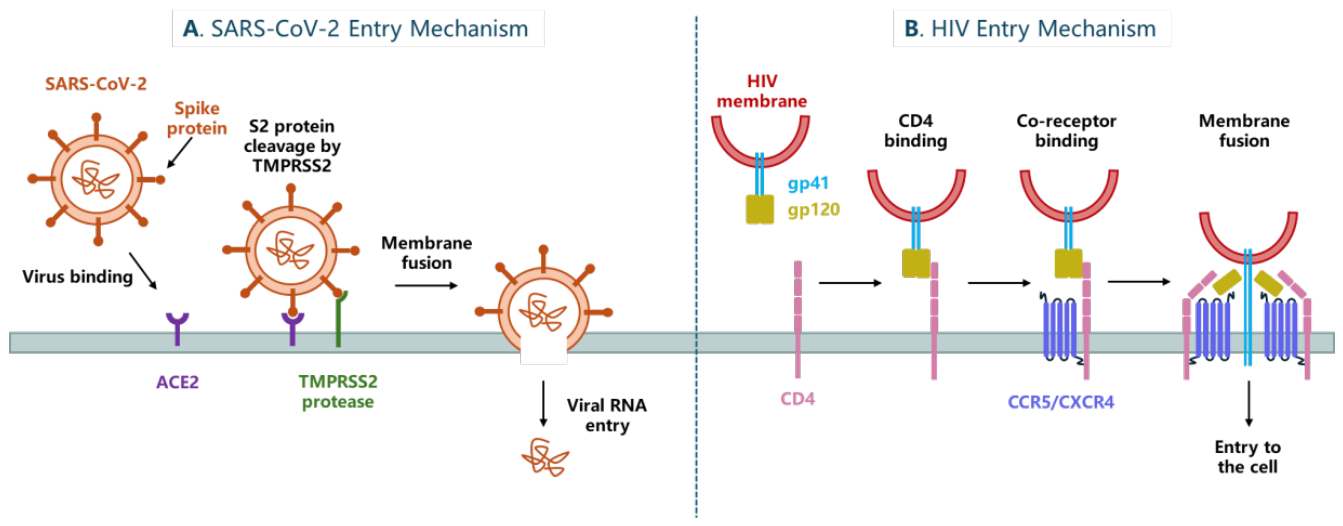
Figure 4.
Strategies of drug design and receptor modulation. (A) SBDD uses small chemical modifications (indicated in red) to improve binding affinity. FBDD identifies high-affinity fragments in the binding pocket. These fragments are chemically linked together (indicated in red) to form a larger potent ligand. (B) Allosteric modulators bind to distinct sites from the endogenous ligand, acting as a biological rheostat to increase or decrease the natural response without altering the orthosteric site.
Figure 4.
Strategies of drug design and receptor modulation. (A) SBDD uses small chemical modifications (indicated in red) to improve binding affinity. FBDD identifies high-affinity fragments in the binding pocket. These fragments are chemically linked together (indicated in red) to form a larger potent ligand. (B) Allosteric modulators bind to distinct sites from the endogenous ligand, acting as a biological rheostat to increase or decrease the natural response without altering the orthosteric site.
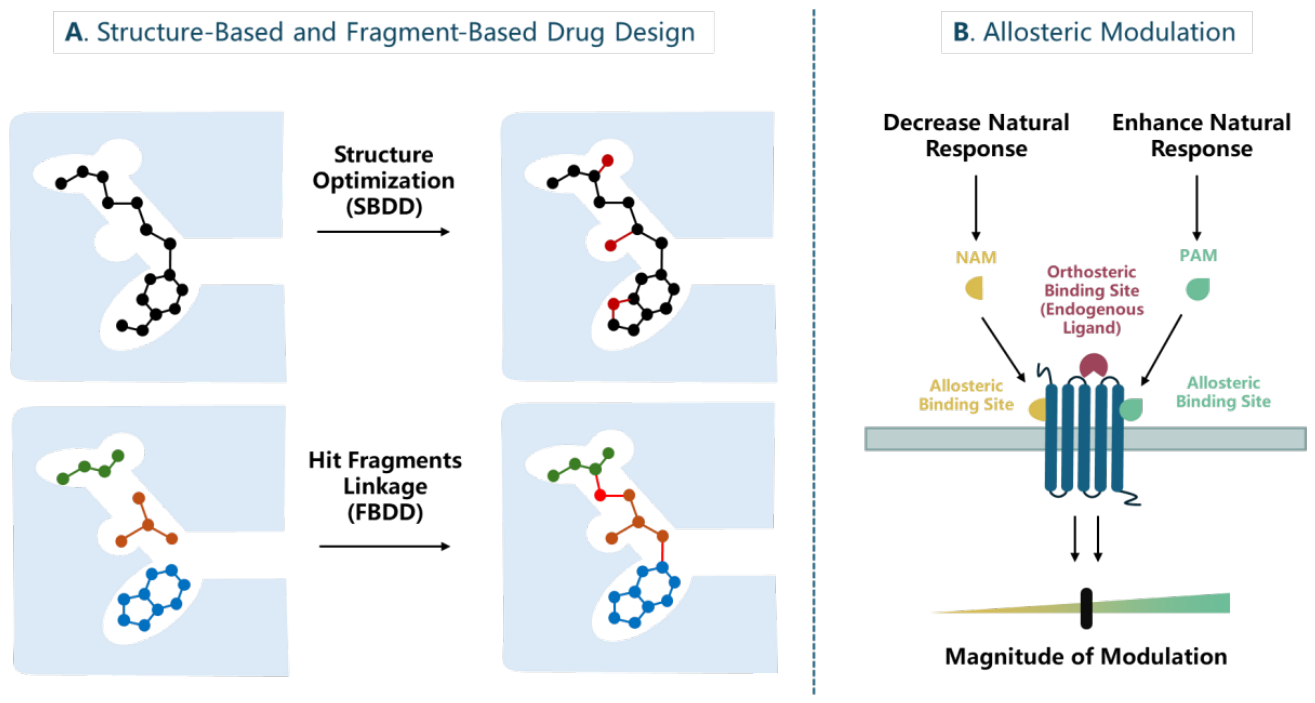
Figure 5.
Mechanisms of receptor-mediated therapeutics: degradation and internalization. (A) Targeted degradation using PROTAC. The PROTAC molecule induces the formation of a ternary complex together with the targeted receptor and the E3 ubiquitin ligase, triggering poly-ubiquitination of the receptor and its degradation by the proteasome. (B) Targeted cytotoxic payload delivery with ADC. The antibody part of the ADC provides guidance to recognize a specific receptor, while the chemical linker carries the cytotoxic payload. Upon binding, the complex is internalized through the natural endocytic pathway, inducing payload release and leading to malignant cell death.
Figure 5.
Mechanisms of receptor-mediated therapeutics: degradation and internalization. (A) Targeted degradation using PROTAC. The PROTAC molecule induces the formation of a ternary complex together with the targeted receptor and the E3 ubiquitin ligase, triggering poly-ubiquitination of the receptor and its degradation by the proteasome. (B) Targeted cytotoxic payload delivery with ADC. The antibody part of the ADC provides guidance to recognize a specific receptor, while the chemical linker carries the cytotoxic payload. Upon binding, the complex is internalized through the natural endocytic pathway, inducing payload release and leading to malignant cell death.
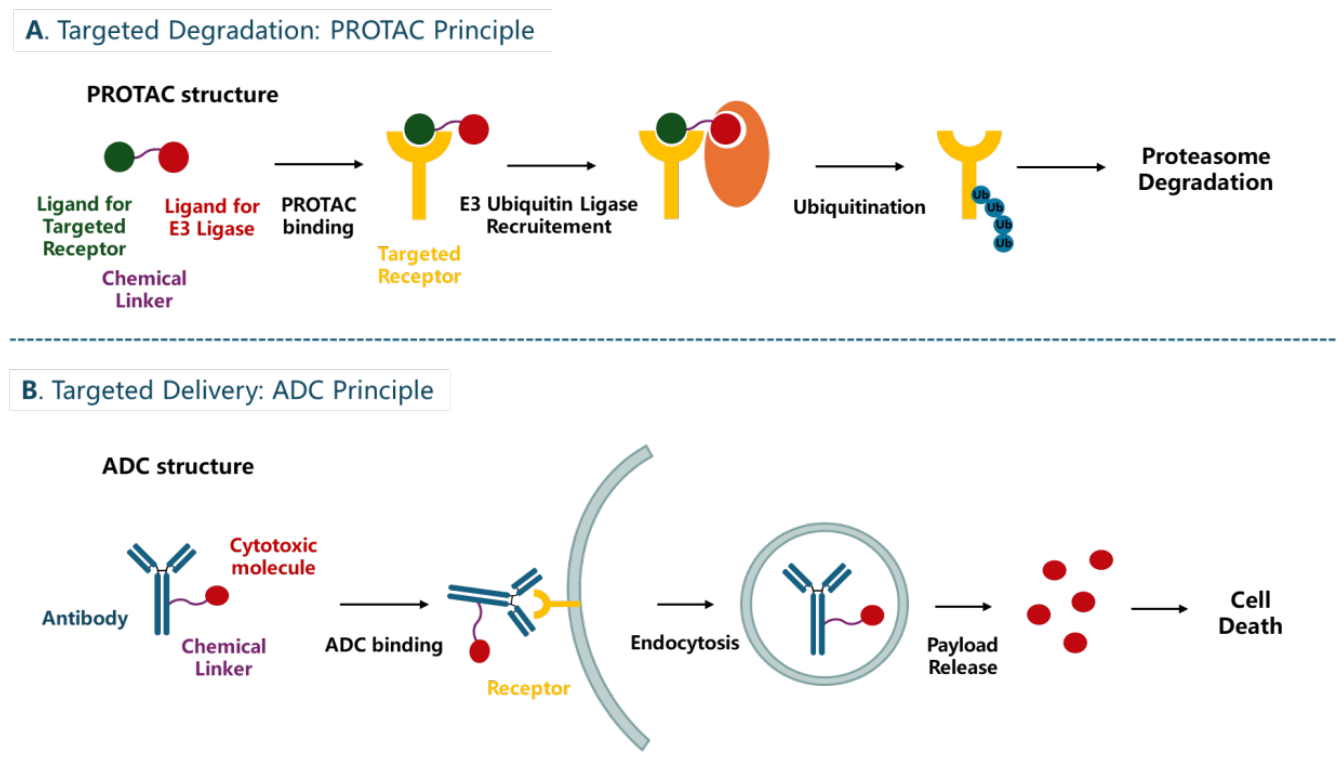
Figure 6.
The evolutionary paradigm of AI in receptor structural biology. (A) Single chain prediction: early structural modelling, which often represents receptors as static, isolated monomers in a frozen thermodynamic state. (B) Multimeric signalosome prediction: next-generation modelling utilizing diffusion-based frameworks (e.g., AlphaFold 3) to co-fold complex macromolecular assemblies and resolve structural interfaces. (C) Mapping the transductome: genome-wide application of multimeric AI modelling to generate a global transductome atlas, allowing the visualization of interactions between hundreds of receptors and their intracellular transducer partners.
Figure 6.
The evolutionary paradigm of AI in receptor structural biology. (A) Single chain prediction: early structural modelling, which often represents receptors as static, isolated monomers in a frozen thermodynamic state. (B) Multimeric signalosome prediction: next-generation modelling utilizing diffusion-based frameworks (e.g., AlphaFold 3) to co-fold complex macromolecular assemblies and resolve structural interfaces. (C) Mapping the transductome: genome-wide application of multimeric AI modelling to generate a global transductome atlas, allowing the visualization of interactions between hundreds of receptors and their intracellular transducer partners.
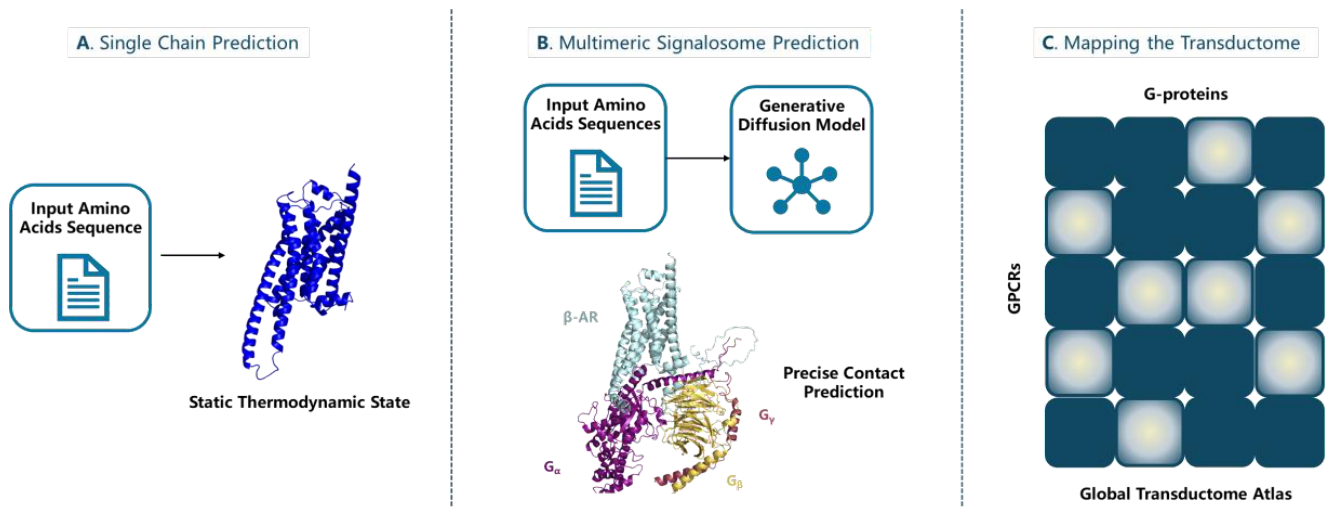
Figure 7.
Schematic of a graphene-based bio-electronic olfactory sensor. Gas-phase target ligands (top)
interface with GPCRs stabilized within synthetic lipid nanodiscs. Left: The unbound receptor remains in its
baseline conformation. Right: Specific ligand docking triggers an allosteric conformational shift within the transmembrane helices. This structural rearrangement perturbs the underlying graphene layer of the sensor
platform, altering its electrical conductivity and yielding an instantaneous digital readout without requiring
intracellular secondary messengers.
Figure 7.
Schematic of a graphene-based bio-electronic olfactory sensor. Gas-phase target ligands (top)
interface with GPCRs stabilized within synthetic lipid nanodiscs. Left: The unbound receptor remains in its
baseline conformation. Right: Specific ligand docking triggers an allosteric conformational shift within the transmembrane helices. This structural rearrangement perturbs the underlying graphene layer of the sensor
platform, altering its electrical conductivity and yielding an instantaneous digital readout without requiring
intracellular secondary messengers.
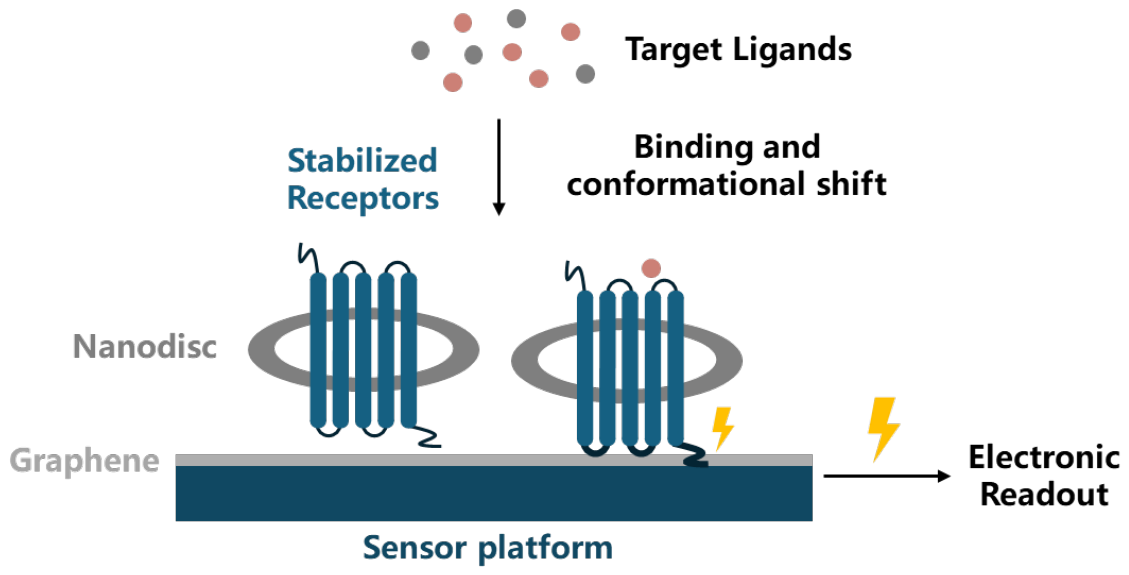
Figure 8.
Re-wiring the cellular relay via synthetic receptor engineering. (A) Chemogenetic Control (DREADDs): Genetic modification of the orthosteric pocket of a native GPCR creates a mutated endogenous binding site. This engineered pocket is insensitive to the natural ligand but selectively recognizes an inert, synthetic designer drug. Binding of the designer drug induces conformational changes that trigger selective downstream signalling, enabling targeted control of specific cellular circuits without interfering with endogenous signalling backgrounds. (B) CAR-T Cell: Reprogramming of T-cell specificity is achieved using a synthetic receptor construct. The extracellular antigen-binding domain (typically an antibody-derived single-chain variable fragment) directly engages surface antigens expressed on a target malignant cell. This interaction translocates signals through the transmembrane domain to activate the intracellular signalling domain. Activation of these signalling cascades triggers T-cell transcription, triggering a digitally programmable, location-specific immune response. This causes the synthesis and exocytosis of cytotoxic molecules that target the malignant cell, ultimately leading to its death. (C) Optogenetics example with a GPCR. Spatial and temporal precision is achieved by engineering light-sensitive chimeric receptors. In the dark state, the inactivated OptoGPCR remains coupled to an inactive heterotrimeric G-protein complex. Upon GPCR light-driven activation, the receptor undergoes a conformational transition to its activated state. This transition catalyzes nucleotide exchange (GDP to GTP) on the Gα subunit, prompting its dissociation from the Gβγ complex and inducing downstream cellular cascades to achieve selective local activation with millisecond-range temporal resolution.
Figure 8.
Re-wiring the cellular relay via synthetic receptor engineering. (A) Chemogenetic Control (DREADDs): Genetic modification of the orthosteric pocket of a native GPCR creates a mutated endogenous binding site. This engineered pocket is insensitive to the natural ligand but selectively recognizes an inert, synthetic designer drug. Binding of the designer drug induces conformational changes that trigger selective downstream signalling, enabling targeted control of specific cellular circuits without interfering with endogenous signalling backgrounds. (B) CAR-T Cell: Reprogramming of T-cell specificity is achieved using a synthetic receptor construct. The extracellular antigen-binding domain (typically an antibody-derived single-chain variable fragment) directly engages surface antigens expressed on a target malignant cell. This interaction translocates signals through the transmembrane domain to activate the intracellular signalling domain. Activation of these signalling cascades triggers T-cell transcription, triggering a digitally programmable, location-specific immune response. This causes the synthesis and exocytosis of cytotoxic molecules that target the malignant cell, ultimately leading to its death. (C) Optogenetics example with a GPCR. Spatial and temporal precision is achieved by engineering light-sensitive chimeric receptors. In the dark state, the inactivated OptoGPCR remains coupled to an inactive heterotrimeric G-protein complex. Upon GPCR light-driven activation, the receptor undergoes a conformational transition to its activated state. This transition catalyzes nucleotide exchange (GDP to GTP) on the Gα subunit, prompting its dissociation from the Gβγ complex and inducing downstream cellular cascades to achieve selective local activation with millisecond-range temporal resolution.
Table 2.
Genetic versus Pharmacological Validations.
| Feature | Genetic validation (Upstream) | Pharmacological Validation (Downstream) |
|---|---|---|
| Primary methodology | CRISPR/Cas9, RNAi, Gene Knock-in/Knock-out | Small molecule inhibitors, CETSA, ABPP, Structure-Based Drug Design |
| Operational Logic | Ablation: Removes the protein entity to observe phenotypic consequence. | Modulation: Interacts with the protein function/conformation without removing it. |
| Temporal Resolution | Chronic: Often requires days/weeks; subject to developmental compensation. | Acute: Rapid onset; allows for the study of real-time signalling dynamics. |
| Specificity Profile | Absolute: Targeted directly to the genetic sequence of the receptor. | Relative: Subject to off-target interactions across structurally related families. |
| Clinical Insight | Identifies receptor’s requirement for the disease | Identifies druggability |
| Key Limitation | May trigger cell’s alternative pathways to survive | High noise in cellular environment, requires a viable chemical lead. |
| Example | CCR5 Δ32 mutation studies in HIV resistance. | Maraviroc binding and optimization of CCR5 antagonists. |
Table 3.
AI-Driven Breakthroughs in Receptor Pharmacology.
| Breakthrough Area | Primary AI Architecture | Impact on Receptor Research | Representative example |
|---|---|---|---|
| Structural Prediction | Diffusion-Based Multimeric Models (AF3, RFdiffusion) | Near-experimental accuracy in modelling the complete signalosome. | Mapping the 3D atlas of the 180+ human dark GPCRome receptors. |
| Generative Drug Design | Equivariant Diffusion and Latent Transformers | Shift from screening libraries to generating molecules that satisfy specific 3D pocket geometries. | De novo design of allosteric modulators for transient cryptic pockets. |
| Signalling Bias Prediction | Graph Neural Networks and Self-Attention | Digital selection of biased agonists by predicting the functional fingerprint of a conformational pose. | Designing Oliceridine-like analogs that favour G-protein pathways. |
| Temporal Dynamics | Machine-Learning Force Fields | 30x accelerated of MD simulations allowing observation of microsecond-scale allosteric shifts. | Real-time visualization of the allosteric bridge movement during activation. |
| Precision Pharmacology | Multi-Scale Digital Twins | Integration of omics data to predict receptor-drug behaviour within patient-specific genetic backgrounds. | Simulating variant-specific binding for pharmacogenomic derisking in clinical trials. |
Disclaimer/Publisher’s Note: The statements, opinions and data contained in all publications are solely those of the individual author(s) and contributor(s) and not of MDPI and/or the editor(s). MDPI and/or the editor(s) disclaim responsibility for any injury to people or property resulting from any ideas, methods, instructions or products referred to in the content. |
© 2026 by the authors. Licensee MDPI, Basel, Switzerland. This article is an open access article distributed under the terms and conditions of the Creative Commons Attribution (CC BY) license (http://creativecommons.org/licenses/by/4.0/).
Copyright: This open access article is published under a Creative Commons CC BY 4.0 license, which permit the free download, distribution, and reuse, provided that the author and preprint are cited in any reuse.


