

Submitted:
09 June 2026
Posted:
10 June 2026
You are already at the latest version
Abstract
Colostrum extracellular vesicles (C-EVs) are nanoscale, bioactive vesicles with therapeutic potential. Mechanisms of action include their control of cellular and tissue homeostasis. These make C-EVs a novel means to control inflammatory and cellular dysfunctions. However, a limitation to their broad use is the ease of C-EV isolation and stability. Standard ultracentrifugation and gradient techniques used for EV isolation are costly, cumbersome, and time-consuming. Such isolation procedures require repeated ultracentrifugation. Exodus dual-frequency ultrasonic nanofiltration (UNF) isolation system can produce pure vesicles at high concentrations. Due to the need to recover C-EVs at clinical grade at high concentrations while preserving vesicle structural integrity and broad biological functions. Large-scale recovery is preserved within hours. We now affirm UNF C-EV purity by the presence of Alix, CD63, Tsg101, and Flotillin antigens. EVs’ sizes were from 50-200 nm, maintaining intact bilayer structures. Functional tests showed preservation of the vesicles’ anti-inflammatory activities with suppression of pro-inflammatory cytokines and the NLRP3 inflammasome, caspase 1, interleukin-1, and 18. These were maintained at baseline levels, sustaining cellular homeostasis. Processing time, high yields, and functional responses served to sustain cellular homeostasis. These data support that UNF-isolated C-EVs were recovered safely at high-yields and reproducibly for future clinical applications.
Keywords:
colostrum
; extracellular vesicles
; pro-inflammatory cytokines
; NLRP3
; neurodegenerative diseases
1. Introduction
“First milk,” known as colostrum, is a concentrated nutrient-rich breast milk that a mother produces in pregnancy and after giving birth [1,2]. It is a rich source of protein, fat, carbohydrates, vitamins, minerals, growth factors, immunoglobulins, proline polypeptides, and antioxidants. Each supports neonatal development and immunity [3,4,5]. Commercialized bovine colostrum is a “super food,” with nearly twice the fat and four times the protein, 250 times immunoglobulins, vitamins B2, B12, E, and D, and minerals (calcium, copper, iron, zinc, magnesium, manganese, and phosphorus) compared with mature milk. [6,7,8]. Colostrum is rich in bioactive oligosaccharides and probiotics, which benefit the gut microbiota [4]. Colostrum supplements are heavily marketed for gut health, immune support, and athletic performance. However, to date, there is scant evidence to support any of its broad nutritional claims. Nonetheless, attention was drawn to the fact that colostrum can serve as a natural therapeutic with regenerative, wound-healing, anti-inflammatory, and immunomodulatory functions [9]. Bovine colostrum can reduce intestinal inflammation by regulating IL-8. This is achieved by affecting epithelial pathogen immunity. There is also evidence for neuroprotective activities in rat models of cerebral ischemia. Reduced neuroinflammation is associated with lower levels of pro-inflammatory cytokines, such as IL-1β, IL-6, and TNF-α, and improved neurological outcomes [10].
Our research supports these claims for colostrum extracellular vesicles (C-EVs) [11]. EVs are the active components of colostrum, as they facilitate cell-to-cell communication by transferring bioactive cargoes. These include proteins, lipids, and nucleic acids [12]. While EVs demonstrate significant therapeutic potential for intestinal and hepatic health, their bioactivities are the active colostrum product. Like crude colostrum, they can reduce gut inflammation, protect against liver injury [13], and improve gut barrier function [14]. Notably, EVs can treat ulcerative colitis by suppressing inflammatory responses and restoring regulatory T cell (Treg)/Th17 immune balance, including control of TLR4/NF-κB and NLRP3 signaling [15]. Additional studies report that EVs are protective against mastitis [16], steatohepatitis [17], oxidative stress, ferroptosis [18], and rheumatoid arthritis [19]. Our previous work supports these observations by demonstrating that C-EVs are both neuroprotective and anti-inflammatory when tested in a model of Parkinson’s disease (PD) [11]. While preclinical research offers translational pathways, bulk EV isolation is limited by recovery techniques. These include size-exclusion chromatography and serial ultracentrifugation. Both provide pure exosome preparations but are often limited by low sample capacity and time [20]. Higher-yield approaches such as polymer precipitation (PEG) and tangential flow filtration are more efficient but yield lower purity and have time constraints [21,22]. Ultrasonic Nanofiltration (UNF) provides an ultrafast isolation alternative (Exodus) [23,24]. UNF employs an automated dual-membrane nanofiltration system with periodic negative-pressure oscillation (NPO) and double-coupled harmonic oscillations (HO) [25]. Comparative EV isolation techniques showed that all preserve the physical and functional properties of EVs. However, the best recovery was made by UNF, which showed equivalent vesicle size distribution with improved recoveries. Nanoparticle Tracking Analysis (NTA) showed that the UNF approach yielded optimal morphology when examined by transmission electron microscopy (TEM) and cryogenic electron microscopy (cryo-EM). Critical anti-inflammatory EV properties were preserved. Western blotting analysis for EV markers demonstrated high purity of the isolated EVs. These findings demonstrated that the UNF system enabled rapid isolation with short processing times while achieving high yields with minimal contamination by colostrum cell components.
2. Methods
2.1. EV Isolation
As a control, C-EVs were isolated by a conventional Opti-Prep method (OPT) [11]. Briefly, 50 mL of colostrum was centrifuged at 4700 × g for 20 min at 4 °C to remove fat globules and debris, followed by centrifugation at 2000 × g for 20 min at 4 °C to remove smaller fat globules. The supernatant was then filtered through Whatman grade 1 filter paper. After filtration, an equal volume of 0.25 M EDTA (pH 7) was added, and the mixture was incubated on ice for 20 min. The pH was then adjusted to 4.6 using 6 N acetic acid to precipitate the casein. Next, the samples were ultracentrifuged at 65,000 × g for 1.5 h, followed by filtration through grade 1 filter paper and 0.45- and 0.22-micron filters. 10 mL of the filtrate was diluted with phosphate-buffered saline (PBS) and centrifuged at 110000 × g for 2 h. The resulting pellets were then resuspended in PBS. Gradient ultracentrifugation was performed using 40, 30, 20, 10, and 5% Opti prep density gradients at 186,000 × g for 18 h at 10 °C using an SW 41 Ti swinging bucket rotor (Beckman Coulter, IN, USA). Each fraction was collected and washed with PBS at 110,000 × g for 90 min at 4 °C. The resulting pellets were resuspended in 1X PBS.
2.2. Ultrasonic Nanofiltration
C-EV were isolated by UNF as a comparator (Exodus system, MA, USA) [25]. Fifty ml of colostrum was centrifuged at 2,000 × g for 30 min at 4 °C to remove cells and debris. The supernatant pH was adjusted to 4.6 with 2 M HCl to reach the isoelectric point of κ-casein, then incubated on ice for 10-15 min. The samples were further centrifuged 2- times at 10,000 × g for 60 min, followed by 10,000 × g for 30 min at 4 °C to remove any remaining casein. The clarified supernatant was subsequently diluted with PBS (1:5) and filtered through 0.45 and 0.22-micron filters. Finally, the processed sample was loaded into the Exodus system for EV isolation, according to the manufacturer’s protocol.
2.3. Nanoparticle Tracking
Concentration and size distribution of C-EVs were determined by NTA using a NanoSight NS300 (Malvern Panalytical Ltd., MA, USA) at 25 °C. Nanoparticle tracking analysis [26,27,28] was performed using an NS300 Nanosight (Malvern Panalytical Ltd., MA, USA) with a green 532 nm laser. NTA 3.4 Build 3.4.4 software was used to acquire and analyze all the measurements. The system was set to the following specifications: frame rate, 24,9825 fps; Slider Gain, 219; Shutter Speed, 30.8 ms; Screen Gain, 1.8; Camera Level, 14; and Detection Limit, 5. The samples were diluted 1:1000 in particle-free PBS. The measurement chamber was flushed with 1 mL of PBS before the analysis and between samples to prevent carryover. For each run, 500 µL of the sample was loaded and videos were recorded in triplicate (3 × 60s). Independent experiments were performed in quadruplicate. Data were processed using the NTA software suite, and the C-EV concentration was expressed as EVs/mL.
2.4. Electron Microscopy
EVs were initially fixed using 2% glutaraldehyde and then deposited onto 200-mesh Formvar-coated copper grids for 5 min at room temperature. After incubation, the grids were immersed in an uranyl acetate solution for negative staining. Excess stain was removed by rinsing with PBS, and the grids were air-dried at room temperature before imaging. Transmission electron microscopy was performed using a Hitachi H-7500 microscope (Hitachi, Tokyo, Japan) at an accelerating voltage of 200 kV. Cryo-electron microscopy analysis was conducted at the contract facilities of the Hormel Institute, University of Minnesota Medical Research Center, USA.
2.5. Dynamic Light Scattering
C-EVs were diluted in PBS (1:1000) prior to characterization with Dynamic light scattering (DLS). DLS measurements were performed in triplicate for each sample using a Zetasizer Nano (Malvern Panalytical Ltd., MA, USA). The measurement parameters were set as follows: dispersant, PBS; temperature, 25 °C; viscosity, 1 cP; material refractive index (polystyrene latex), 1.590; and absorption, 0.010.
2.6. Cell Culture
The microglial cell line (BV2 cells) was maintained in Dulbecco’s Modified Eagle Medium (DMEM) supplemented with 10% (v/v) heat-inactivated fetal bovine serum (FBS) and 1% penicillin/streptomycin at 37 °C in a humidified 5% CO2 atmosphere, using 75 cm2 culture flasks for routine maintenance. For different experiments, 2.0 × 10⁵ (western blotting) or 1.0 × 10⁵ (qPCR) cells were seeded in 6-well or 24-well plates and allowed to adhere for 12 h. The experimental protocol consisted of treating cells with C-EVs (500 EVs/cell) for 22 h, followed by stimulation with 100 ng/mL lipopolysaccharide (LPS) to induce inflammation. For qPCR analysis, cells were incubated with LPS for 2h prior to RNA extraction to evaluate mRNA expression levels. For Western blot analysis, cells were incubated with LPS for 24 h before protein extraction to assess protein expression.
2.7. Western Blot
After EV isolation, an equal number of EVs (1 × 10¹⁰ EVs) were mixed with 5X Laemmli buffer. The samples were then incubated at 99 °C for 15 min. For cellular protein analysis, BV2 cells treated with EVs and LPS were lysed in RIPA buffer, followed by sonication and centrifugation, and the total protein concentration was quantified using the Pierce BCA Protein Assay kit (23227, Thermo Fisher Scientific, MA, USA). Samples were prepared and loaded at equal concentrations and electrophoresed under reducing conditions in 10–15% polyacrylamide gels. After electrophoresis, the proteins were transferred onto polyvinylidene fluoride (PVDF) membranes (Cat. No. IPVH00010 (Millipore Sigma, MO, USA) and blocked with 5% non-fat dry milk prepared in 1X Tris-buffered saline containing 0.1% Tween-20. Subsequently, the membranes were incubated overnight at 4 °C with primary antibodies. After primary antibody incubation, the membranes were treated with secondary antibodies for 1h at RT. Chemiluminescence detection was performed using SuperSignal West Pico, Dura, Femto, and Atto substrates (Cat. No. No. Nos. 34580, 34076, 34096, A38556; Thermo Fisher Scientific, MA, USA) using an iBright750 Imager (Thermo Fisher Scientific, MA, USA). Images were quantified using ImageJ Launcher software (v1.4.3.67, NIH, MD, USA), and fold changes in protein expression were normalized to β-actin as an internal control.
2.8. RNA Isolation
Total RNA was extracted using 500 µL of TRIzol™ Reagent (Thermo Fisher Scientific, MA, USA). Subsequently, 100 µL of chloroform was added, and the samples were vigorously shaken and incubated for 3 min at room temperature, followed by centrifugation at 12,000 × g for 15 min at 4 °C to achieve phase separation. The upper aqueous phase containing the RNA was carefully transferred to a new tube. RNA was precipitated by adding 250 µL of isopropanol and incubated at room temperature for 10 min. Samples were centrifuged at 12,000 × g for 10 min at 4 °C to pellet the RNA. The RNA pellet was washed with 1 mL of 75% ethanol, vortexed briefly, and centrifuged at 7,500 × g for 4 min at 4 °C. The supernatant was discarded, and the pellet was air-dried for approximately 8 min. The RNA pellet was resuspended in RNase-free water and incubated at 55 °C for 10 min to facilitate dissolution. RNA concentration and purity were measured using NanoDrop. RNA purity was confirmed by A260/A280 (1.8-2.0) and A260/A230 (2.0-2.2).
2.9. Real-Time qPCR
Purified, isolated RNA was reverse transcribed into cDNA using the Verso cDNA Synthesis Kit (Thermo Fisher Scientific, MA, USA) according to the manufacturer’s instructions. The primers (Thermo Fisher Scientific, MA, USA) used included TNF-alpha (Mm00443258_m1), IL-1β (Mm00434228_m1), and IL-6 (Mm00446190_m1). Five microliters of the generated cDNA were used in qPCR, along with 10 μL of TaqMan 2× Universal PCR Master Mix (4364337, Thermo Fisher Scientific, MA, USA), 2 μL of nuclease-free water, and 1 μL of the respective 20× TM primer. mRNA expression was quantified by normalizing to GAPDH (Mm99999915_g1), and the fold change was calculated. The specificity of RT-qPCR was verified using non-template controls. Quantitative real-time PCR was performed using a QuantStudio™ 3 Real-Time PCR System (Thermo Fisher Scientific, MA, USA).
2.10. Immunocytochemistry
BV2 microglial cells were seeded at a density of 0.1 × 10⁶ cells per well in a 24-well plate containing 1 mL of complete medium with coverslips and allowed to adhere for 24 h. The cells were then treated EVs followed by stimulation with LPS (100 ng/mL). Following the treatments, immunocytochemistry was performed using standard protocols [26]. Briefly, the cells were gently washed with PBS, then replaced with fresh PBS and incubated on a rocker for 10-15 min at room temperature. Cells were fixed with 4% paraformaldehyde (PFA) in phosphate-buffered saline (PBS) for 15 min at room temperature. After fixation, the cells were washed three times with PBS for 5 min each on a rocker. Cells were then incubated with blocking buffer for 1h at room temperature to minimize non-specific binding. Cells were permeabilized with 0.1% Triton X-100 (Thermo Fisher Scientific, MA, USA). Next, the cells were incubated with IBA1 antibody (ab283342, Abcam, MA, USA) overnight at 4 °C. The next day, the cells were incubated with 488-fluorophore-tagged secondary antibody (Alexa Fluor 488; A-11001, Invitrogen, CA, USA) for 2h at room temperature. Next, the cells were washed with PBS for 15 min at room temperature and mounted with DAPI (P36935, Invitrogen, CA, USA). Imaging was performed using a Z1 inverted microscope (Carl Zeiss, Thornwood, NY, USA), and the analysis was performed using AxioVision software (version 4.8.0.0; Carl Zeiss Microimaging GmbH). The mean fluorescence intensity was quantified using ImageJ software (v1.4.3.67; NIH, Bethesda, MD, USA).
2.11. Statistical Analysis
All grouped data are presented as mean ± standard error of the mean (SEM). A t-test for two groups and a one-way analysis of variance (ANOVA) followed by Tukey’s post hoc test for multiple comparisons were used to assess statistical significance across groups using GraphPad Prism software (version 10), and a p-value < 0.05 was considered statistically significant.
3. Results
3.1. Characterization
C-EVs were isolated by OPT and UNF (Figure 1). Isolated UNF EVs showed a significantly higher particle concentration than OPT EVs (Figure 2A). Nanoparticle tracking analysis showed that UNF EVs had a broader particle size distribution (50 to 210 nm) with a peak around 110 nm, whereas OPT EVs had lower particle counts across all size ranges, with a peak at 90 nm (Figure 2B). Dynamic Light Scattering Analysis showed a polydispersity index (PDI) of ~0.3-0.4 for both methods, indicating heterogeneous EV size (Figure 2B). Western blot analysis confirmed exosomal markers, including ALG-2 interacting protein X (Alix), cluster of differentiation (CD) - CD63, Tumor susceptibility gene 101 (TSG101), and flotillin, in EVs isolated by both methods (Figure 2D). In contrast, the ER marker calnexin (a negative EV marker) was absent in the isolated EV samples, indicating minimal contamination by cellular debris or intracellular organelles. To ensure that residual casein did not interfere with anti-inflammatory responses, western blotting using a casein antibody (ab166596, Abcam, MA, USA) was performed, and the results showed the absence of casein in the isolated EVs. TEM revealed that EVs isolated by both methods had characteristic spherical and cup-shaped morphologies with intact membrane structures (Figure 2E). Cryo-EM further confirmed the presence of well-preserved lipid bilayer vesicles in all samples (Figure 2F).
3.2. C-EV and Innate Immunity
Cytokines play a vital role in initiating innate cell inflammatory responses [29,30,31,32]. In this study, we used a microglial cell line (BV2 cells) pretreated with isolated colostrum EVs (from both methods) for 22 h, followed by LPS (100 ng/mL) for 2h to induce an inflammatory response. We then performed qPCR analysis of key proinflammatory cytokines, including TNF-α, IL-1β, and IL-6, in the different groups. Quantitative PCR (qPCR) analysis revealed that LPS stimulation significantly upregulated (p < 0.0001) TNF-α, IL 1β, and IL6 expression compared with the control group. EV pre-treatment significantly (p<0.0001) attenuated LPS-induced upregulation of IL-1β, IL-6, and TNF-α, indicating a pronounced anti-inflammatory effect of UNF and OPT colostrum EVs. Notably, EVs administered alone did not increase inflammatory gene expression, indicating that neither EV preparation elicited a pro-inflammatory effect under basal conditions (Figure 3A–C).
3.3. C-EVs Attenuate Inflammasome Activation
Next, C-EVs were assessed using western blotting to modulate inflammasome expression. LPS stimulation significantly upregulated NLRP3 expression compared to that in the control group (p<0.0001). EVs isolated by either method significantly suppressed the LPS-induced increase in NLRP3 expression (p < 0.0001) (Figure 4A). Similar results were observed for the other components of the NLRP3-signaling pathway. As shown in Figure 4B–D, LPS induced a significant increase (p<0.0001) in the expression of mature caspase-1, lL1β, and IL18, whereas C-EVs pre-treatment suppressed (p<0.0001) LPS-induced mature caspase-1, lL1β, and IL18. In contrast, treatment with EVs alone did not significantly alter NLRP3 and mature forms of caspase-1, IL-1β, or IL-18 expression compared to the control group, suggesting that EVs were not cytotoxic or pro-inflammatory.
3.4. C-EV Controls Microglial Activation
Next, to assess the comparative role of C-EVs isolated by both methods in microglial activation, we performed immunocytochemistry for the microglial activation marker Iba1 across the different groups. As shown in Figure 5A, LPS induced increased (p<0.0001) Iba1 expression, demonstrating microglial activation compared to the control, while pre-treatment with EVs significantly suppressed (p<0.0001) LPS-induced microglial activation. Furthermore, quantification data demonstrated that the mean fluorescence intensity of Iba-1 was significantly decreased (p<0.0001) upon pre-treatment with either isolation technique compared to LPS alone. In addition, treatment with EVs did not induce microglial activation (Figure 5B)
3.5. C-EV Anti-Inflammatory Activities
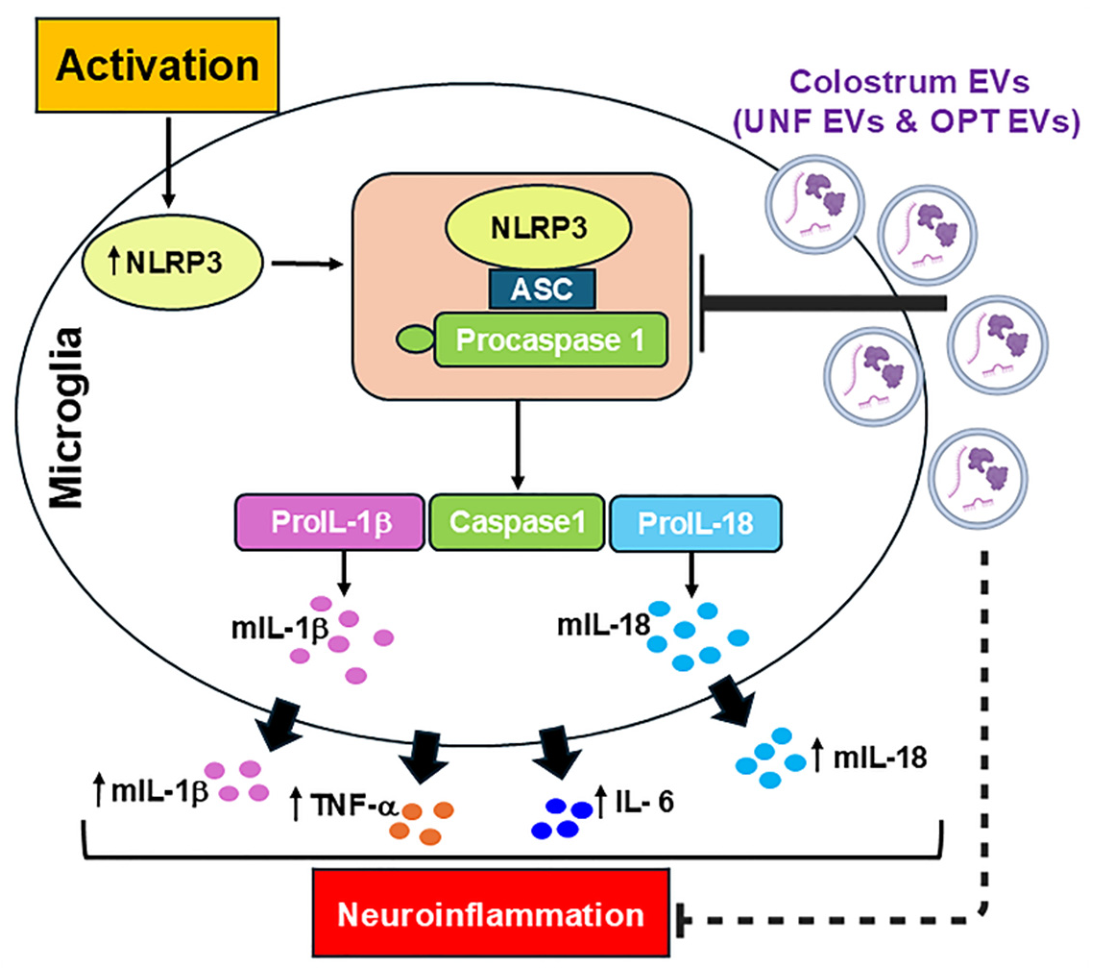
Lipopolysaccharide (LPS) stimulation activates the NF-κB signaling pathway and the formation of the NLRP3-ASC inflammasome complex in microglia. This activation increased transcription of pro-inflammatory precursors, including pro-caspase-1, pro-IL-1β, and pro-IL-18, which were subsequently cleaved by caspase-1 into their mature active forms. As a result, elevated levels of inflammatory cytokines, including IL-1β, IL-18, TNF-α, and IL-6, were observed, contributing to neuroinflammation. Pre-treatment with colostrum milk-derived extracellular vesicles (EVs), isolated from both methods, attenuated these inflammatory responses (Figure 6).
4. Discussion
The deployment of the EV isolation technique by an automated, ultrasonic nanofiltration system was a significant advantage for time, recovery, and preservation of functional immune-based anti-inflammatory properties [33]. While ultracentrifugation was similarly capable of eliciting functional responses, concerns remained about capturing pure exosomes and removing contaminants that can trigger adverse immune responses [24]. The reductions in isolation times relative to conventional 30-hour protocols led to higher yields and reduced batch-to-batch variance, which is required for clinical translational studies. Future studies will best assess protein removal and free-pure recoveries. Perhaps the most notable advance is the recovery of exosomes using a label-free approach, with no reliance on antibodies, which could compromise the biological integrity of the recovered materials [34]. The absence of particle aggregation during the extraction procedure and the potential to recover functionally intact particles all highlighted significant advantages over more commonly used techniques [24].
EVs show great therapeutic potential across a broad range of diseases [35]. Morphologically, they are characterized by a lipid bilayer membrane [36] and are reflective of the cell biology from which they were produced [37]. EVs range in size from approximately 30 nm to 10 µm [38] and are categorized into subtypes. These include exomeres, exosomes, small EVs, and apoptotic bodies [39]. EVs are released by all living cells and can be isolated from a wide range of biological fluids, including blood, saliva, urine, cerebrospinal fluid, breast milk, and bovine milk [40]. However, their biological characteristics and functions largely depend on their biogenesis pathways [12]. Among EV sources, milk-derived bovine EVs have attracted interest for their biocompatibility, low immunogenicity, and disease-fighting therapeutic potential [41]. EVs are now regarded as critical components in maintaining cellular homeostasis under normal physiological conditions due to the unique characteristics and functions of their bioactive cargo [42]. It acts as an intercellular communication vehicle, mediating paracrine, endocrine, and autocrine signaling either by cell surface interactions without cargo release, or by membrane fusion with target cells or endocytosis, whereby cargo is released into the cytoplasm or endosomal compartment, respectively; the latter necessitating escape from the endosomal compartment to exert a biological effect [43,44,45]. The variety of biological effects of EVs is broad [46,47], including modulation of pro- and anti-inflammatory immune responses [48], tissue regeneration and repair [48], and control of neurological function, particularly synaptic plasticity, myelination, and neuroprotection [11,49,50,51]. EVs have demonstrated therapeutic potential in various neurodegenerative diseases [52,53], including PD [11,54,55,56] and AD [41,57,58,59,60]. Functionally, bovine C-EVs significantly suppress the expression of apoptosis-related genes, including Bax, p53, and caspase-3, as well as pro-inflammatory cytokines, such as TNF-α, IL-6, and IL-1β, in intestinal epithelial cells [61]. In contrast, mature milk-derived EVs showed limited effects on apoptosis-related genes and primarily reduced the expression of inflammatory mediators, including TNF-α and IL-6, in intestinal epithelial cells [61], suggesting that C-EVs possess superior bioactive and therapeutic potential. Supporting this, C-EVs accelerate wound healing by promoting fibroblast proliferation and migration, enhancing angiogenesis, regulating extracellular matrix remodeling, and suppressing inflammation [62]. In addition, C-EVs exhibit anti-microbial, anti-inflammatory, and immunomodulatory activities in neonatal calf diarrhea models through reduced bacterial adherence and modulation of immune-related gene expression [63]. C-EVs also protect intestinal epithelial cells from LPS-induced injury by improving barrier integrity, enhancing cell proliferation, and reducing apoptosis and inflammatory responses, exerting stronger protective effects than mature EVs [61]. Recently, bovine colostrum EVs were reported to alleviate atopic dermatitis by modulating the gut-skin axis, restoring gut microbiota balance, regulating immune responses, and improving intestinal metabolite profiles [64]. Collectively, these findings highlight the therapeutic and regenerative potential of bovine colostrum-derived EVs as promising natural nanotherapeutics for inflammatory and immune-related disorders.
Our own work demonstrated that bovine C-EVs have anti-inflammatory and neuroprotective effects in a methyl-4-phenyl-1,2,3,6-tetrahydropyridine (MPTP) model of PD [11]. We showed that treatment with C-EVs rescued dopaminergic neurons, reduced the number of reactive microglia, and diminished inflammasome cascade expression, thereby decreasing neuroinflammation. Based on this background, we employed an upgraded UNF to isolate C-EVs using exosome detection by UNF which employs an automated dual-membrane nanofiltration system integrated by periodic negative NPO and double-coupled HO (Exodus, [25], and compared with OPT-isolated EVs for structural and functional integrity.
We accept that, as of today, clinical adoption of C-EVs remains restricted [53]. EVs have generally been avoided in human treatments due to production challenges, safety concerns, and poor targeted delivery [65]. One key limitation that has stopped widespread clinical use includes, but is not limited to, EV isolation and standardization. Simply put, it has been difficult to separate pure, uniform preparations of EVs from other cellular materials that contain proteins and lipids [66]. These challenges, amongst others, must be overcome to guarantee that each batch of vesicles isolated from diverse materials, including cells and body fluids, meets the requirements of any regulatory human drug. Without question, isolating pure, uniform EVs is technically challenging. Recurrent concerns stem from the fact that EVs are commonly derived from living cells and, as such, there remains a risk of viral, endotoxic, and other cellular contaminants [67]. Because of these contamination risks, EVs could trigger adverse immune reactions or promote cancer. There is also the need to overcome poor tissue targeting. When EVs are injected systemically, most are rapidly cleared by the liver and spleen before they even reach target tissues of interest, which requires high dosing and carries an additional potential for long-term toxicities. We also understand that no approved EV-based therapies currently exist, which means such therapies remain highly experimental. C-EVs have a strong safety profile and rarely cause systemic toxicities, primarily due to their natural origin and structural biocompatibility. This high safety margin is notable compared with other EVs derived from natural cells. First, as naturally occurring lipid-bound nanoparticles designed to cross mammals, C-EVs bypass immune clearance and prevent unwanted inflammatory or toxic responses when circulating in the body [11]. Second, C-EV payloads, which consist of beneficial microRNAs, proteins, and lipids, act as gene-expression modulators rather than toxins, allowing them to selectively alter cellular machinery without inducing notable cytotoxicity [11,64]. Third, C-EVs are engineered to withstand harsh environments, such as the gastrointestinal tract, enabling them to cross biological barriers safely without triggering systemic toxicity or off-target adverse effects [68,69]. C-EVs naturally carry high concentrations of growth- and immune-related proteins that actively suppress inflammation and reduce oxidative stress, further protecting the body from unintended toxicities. Because of these inherent protective mechanisms, C-EVs are widely studied as highly biocompatible vehicles for drug delivery and therapeutics.
To best evaluate the feasibility, efficiency, and scalability of ultrasonic nanofiltration for isolating C-EVs, we compared it with our previously optimized EV isolation gradient method. Characterization of C-EVs confirmed successful isolation using both methods, with conventional ultracentrifugation requiring extended time, while UNF isolation was completed in just a few hours. The yield of UNF C-EV was 2-3-fold higher than that of OPT-EV isolations. Western blot analysis demonstrated the presence of canonical exosomal markers (ALIX, CD63, TSG101, Flotillin) in isolation methods, while the absence of calnexin confirmed minimal contamination from intracellular organelles. In addition, the absence of casein further validated the purity of the EV preparations, indicating the effective removal of milk protein contaminants. Morphological analysis by EM confirmed the characteristic cup-shaped, membrane-bound vesicular structure with intact lipid bilayers, supporting the structural integrity of EVs isolated using both methods. Functionally, both EV preparations significantly suppressed LPS-induced neuroinflammatory responses by modulating the key pathways involved in microglial activation and inflammasome signaling. Inflammasomes. Notably, NLRP3, drive chronic inflammation by activating caspase-1, which processes IL-1β/IL-18 and triggers pyroptotic cell death [70,71]. The induction of NLRP3, along with the activation of downstream signaling molecules, included cleaved caspase-1, mature IL-1β, and IL-18. Both UNF and OPT EVs significantly suppressed NLRP3 inflammasome priming and activation. The reduction in caspase-1 activation and downstream cytokine maturation suggests that C-EVs act at an upstream regulatory level affecting inflammasome assembly and NF-Κβ-dependent priming signals [72]. The anti-inflammatory role of C-EVs was demonstrated by pre-treatment with C-EVs, which robustly attenuated this response. The results demonstrated a broad anti-inflammatory response by the C-EVs. Microglia support neural homeostasis [73]. Chronic activation drives the release of pro-inflammatory cytokines, disrupting neuron-microglia communication, impairing synaptic structure and plasticity, promoting excitotoxicity, and promoting neurodegeneration [76].
Overall, the combined results of EV characterization, cytokine profiling, inflammasome signaling, and Iba1 immunostaining provide strong, consistent evidence that bovine colostrum-derived EVs possess potent immunomodulatory properties. Their ability to suppress both microglial activation and NLRP3 inflammasome signaling highlights their therapeutic potential as natural nanomedicine candidates for treating neuroinflammatory and neurodegenerative diseases. Given the central role of chronic microglial activation [75,77,78], these findings suggest that C-EVs may represent a promising strategy for mitigating a broad range of diseases both within and outside the nervous system. Furthermore, UNF Exodus EVs yielded higher recovery and reduced isolation time, suggesting that EVs can represent an efficient approach for clinical translation.
5. Conclusions
C-EVs were isolated in bulk within hours while preserving vesicle integrity and function. The procedures effectively suppressed neuroinflammatory responses. Overall, these findings suggest that the Exodus UNF-based isolation method is a rapid, scalable, safe, and efficient platform for producing biologically active C-EVs with promising therapeutic potential. Long-term stability, storage conditions, biodistribution, and pharmacokinetic properties of isolated EVs will be determined before clinical translation is initiated.
Acknowledgments
The authors would like to acknowledge Oehlerking Farm, Omaha, Nebraska, USA, for supplying Colostrum. The authors would also like to thank Dawson Hollingsworth and Katherine Tuchez (from Exodus) for technical assistance. NeuralRegen, Inc financial project support and vibrant discussions.
Author Contributions
Samia Akter: EV-isolation, EV characterization, Cell culture, RNA isolation, qPCR analysis, western blotting, ICC imaging, Data curation, Formal analysis, Figure preparation, Writing- original draft; Nada Fayaz: Cell culture, Western blotting; Mohit Kumar: EV-isolation, Western blotting, ICC staining and imaging. Susmita Sil: Conceptualization, methodology development, investigation, Project administration, Resources, Validation, Supervision, Visualization, Figure preparation, Writing- original draft; Howard E. Gendelman: Conceptualization, Writing and editing, Project administration, Resources and software, Funding acquisition, Data analyses, Supervision of the Overall Study, Visualization, Review and editing.
References
- Arslan, A.; Kaplan, M.; Duman, H.; Bayraktar, A.; Erturk, M.; Henrick, B.M.; Frese, S.A.; Karav, S. Bovine Colostrum and Its Potential for Human Health and Nutrition. Front Nutr 2021, 8, 651721. [CrossRef]
- Thapa, B.R. Health factors in colostrum. Indian J Pediatr 2005, 72, 579-581. [CrossRef]
- Stelwagen, K.; Carpenter, E.; Haigh, B.; Hodgkinson, A.; Wheeler, T.T. Immune components of bovine colostrum and milk. J Anim Sci 2009, 87, 3-9. [CrossRef]
- Playford, R.J.; Weiser, M.J. Bovine Colostrum: Its Constituents and Uses. Nutrients 2021, 13. [CrossRef]
- Santoro, J.; Mukhopadhya, A.; Oliver, C.; Brodkorb, A.; Giblin, L.; O’Driscoll, L. An investigation of extracellular vesicles in bovine colostrum, first milk and milk over the lactation curve. Food Chem 2023, 401, 134029. [CrossRef]
- Geiger, A.J. Colostrum: back to basics with immunoglobulins. J Anim Sci 2020, 98, S126-S132. [CrossRef]
- Godden, S.M.; Lombard, J.E.; Woolums, A.R. Colostrum Management for Dairy Calves. Vet Clin North Am Food Anim Pract 2019, 35, 535-556. [CrossRef]
- Kehoe, S.I.; Jayarao, B.M.; Heinrichs, A.J. A survey of bovine colostrum composition and colostrum management practices on Pennsylvania dairy farms. J Dairy Sci 2007, 90, 4108-4116. [CrossRef]
- Dos Santos, P.R.; Kraus, R.B.; da Silva Nascente, P. Exploring the potential of bovine colostrum as a bioactive agent in human tissue regeneration: A comprehensive analysis of mechanisms of action and challenges to be overcome. Cell Biochem Funct 2024, 42, e4021. [CrossRef]
- Choi, H.S.; Ko, Y.G.; Lee, J.S.; Kwon, O.Y.; Kim, S.K.; Cheong, C.; Jang, K.H.; Kang, S.A. Neuroprotective effects of consuming bovine colostrum after focal brain ischemia/reperfusion injury in rat model. Nutr Res Pract 2010, 4, 196-202. [CrossRef]
- Hollingsworth, D.; Srivastava, S.; Akter, S.; Kumar, M.; Dey, S.S.; Panja, S.; Du, X.; Saha, A.; Yeapuri, P.; Bhattarai, S.; et al. Colostrum extracellular vesicles are neuroprotective in models of Parkinson’s disease. Theranostics 2026, 16, 4190-4223. [CrossRef]
- Kumar, M.; Ray, S.; Sil, S. Stem-cell-derived extracellular vesicles in neurodegeneration and neuroaging: therapeutic potential and challenges. Extracell Vesicles Circ Nucl Acids 2025, 6, 594-608. [CrossRef]
- Tong, L.; Zhang, S.; Liu, Q.; Huang, C.; Hao, H.; Tan, M.S.; Yu, X.; Lou, C.K.L.; Huang, R.; Zhang, Z.; et al. Milk-derived extracellular vesicles protect intestinal barrier integrity in the gut-liver axis. Sci Adv 2023, 9, eade5041. [CrossRef]
- Maghraby, M.K.; Li, B.; Chi, L.; Ling, C.; Benmoussa, A.; Provost, P.; Postmus, A.C.; Abdi, A.; Pierro, A.; Bourdon, C.; et al. Extracellular vesicles isolated from milk can improve gut barrier dysfunction induced by malnutrition. Sci Rep 2021, 11, 7635. [CrossRef]
- Tong, L.; Hao, H.; Zhang, Z.; Lv, Y.; Liang, X.; Liu, Q.; Liu, T.; Gong, P.; Zhang, L.; Cao, F.; et al. Milk-derived extracellular vesicles alleviate ulcerative colitis by regulating the gut immunity and reshaping the gut microbiota. Theranostics 2021, 11, 8570-8586. [CrossRef]
- Xiong, Y.; Shen, T.; Lou, P.; Yang, J.; Kastelic, J.P.; Liu, J.; Xu, C.; Han, B.; Gao, J. Colostrum-derived extracellular vesicles: potential multifunctional nanomedicine for alleviating mastitis. J Nanobiotechnology 2024, 22, 627. [CrossRef]
- Mun, D.; Ryu, S.; Lee, D.J.; Kwak, M.J.; Choi, H.; Kang, A.N.; Lim, D.H.; Oh, S.; Kim, Y. Bovine colostrum-derived extracellular vesicles protect against non-alcoholic steatohepatitis by modulating gut microbiota and enhancing gut barrier function. Curr Res Food Sci 2025, 10, 101039. [CrossRef]
- Liang, B.; Xiong, Y.; Cobo, E.R.; Kastelic, J.; Tong, X.; Han, B.; Gao, J. Bovine milk-derived extracellular vesicles reduce oxidative stress and ferroptosis induced by Klebsiella pneumoniae in bovine mammary epithelial cells. J Anim Sci Biotechnol 2025, 16, 24. [CrossRef]
- Aarts, J.; Boleij, A.; Pieters, B.C.H.; Feitsma, A.L.; van Neerven, R.J.J.; Ten Klooster, J.P.; M’Rabet, L.; Arntz, O.J.; Koenders, M.I.; van de Loo, F.A.J. Flood Control: How Milk-Derived Extracellular Vesicles Can Help to Improve the Intestinal Barrier Function and Break the Gut-Joint Axis in Rheumatoid Arthritis. Front Immunol 2021, 12, 703277. [CrossRef]
- Li, X.; Corbett, A.L.; Taatizadeh, E.; Tasnim, N.; Little, J.P.; Garnis, C.; Daugaard, M.; Guns, E.; Hoorfar, M.; Li, I.T.S. Challenges and opportunities in exosome research-Perspectives from biology, engineering, and cancer therapy. APL Bioeng 2019, 3, 011503. [CrossRef]
- Park, S.H.; Lee, E.K.; Yim, J.; Lee, M.H.; Lee, E.; Lee, Y.S.; Seo, W. Exosomes: Nomenclature, Isolation, and Biological Roles in Liver Diseases. Biomol Ther (Seoul) 2023, 31, 253-263. [CrossRef]
- Chen, J.; Li, P.; Zhang, T.; Xu, Z.; Huang, X.; Wang, R.; Du, L. Review on Strategies and Technologies for Exosome Isolation and Purification. Front Bioeng Biotechnol 2021, 9, 811971. [CrossRef]
- Sridharan, B.; Lim, H.G. Exosomes and ultrasound: The future of theranostic applications. Mater Today Bio 2023, 19, 100556. [CrossRef]
- Gao, J.; Li, A.; Hu, J.; Feng, L.; Liu, L.; Shen, Z. Recent developments in isolating methods for exosomes. Front Bioeng Biotechnol 2022, 10, 1100892. [CrossRef]
- Chen, Y.; Zhu, Q.; Cheng, L.; Wang, Y.; Li, M.; Yang, Q.; Hu, L.; Lou, D.; Li, J.; Dong, X.; et al. Exosome detection via the ultrafast-isolation system: EXODUS. Nat Methods 2021, 18, 212-218. [CrossRef]
- Chemparathy, D.T.; Ray, S.; Ochs, C.; Ferguson, N.; Gawande, D.Y.; Dravid, S.M.; Callen, S.; Sil, S.; Buch, S. Neuropathogenic role of astrocyte-derived extracellular vesicles in HIV-associated neurocognitive disorders. J Extracell Vesicles 2024, 13, e12439. [CrossRef]
- Ray, S.; Kumar, M.; Chemparathy, D.T.; Dash, P.K.; Sil, S. HIF-1 Targeting Intervention Renders Protection From Alzheimer’s-Like Pathology in a Humanized Mice Model of HIV Infection. J Extracell Vesicles 2025, 14, e70191. [CrossRef]
- Sil, S.; Singh, S.; Chemparathy, D.T.; Chivero, E.T.; Gordon, L.; Buch, S. Astrocytes & Astrocyte derived Extracellular Vesicles in Morphine Induced Amyloidopathy: Implications for Cognitive Deficits in Opiate Abusers. Aging Dis 2021, 12, 1389-1408. [CrossRef]
- Kany, S.; Vollrath, J.T.; Relja, B. Cytokines in Inflammatory Disease. Int J Mol Sci 2019, 20. [CrossRef]
- Sil, S.; Niu, F.; Chivero, E.T.; Singh, S.; Periyasamy, P.; Buch, S. Role of Inflammasomes in HIV-1 and Drug Abuse Mediated Neuroinflammaging. Cells 2020, 9. [CrossRef]
- Kumar, M.; Swanson, N.; Ray, S.; Buch, S.; Saraswathi, V.; Sil, S. Astrocytes in Amyloid Generation and Alcohol Metabolism: Implications of Alcohol Use in Neurological Disorder(s). Cells 2024, 13. [CrossRef]
- Bhol, N.K.; Bhanjadeo, M.M.; Singh, A.K.; Dash, U.C.; Ojha, R.R.; Majhi, S.; Duttaroy, A.K.; Jena, A.B. The interplay between cytokines, inflammation, and antioxidants: mechanistic insights and therapeutic potentials of various antioxidants and anti-cytokine compounds. Biomed Pharmacother 2024, 178, 117177. [CrossRef]
- Li, H.; Cai, R.; Zhou, Y.; Jiang, Y.; Tan, S. cGAS-STING signaling in brain aging and neurodegeneration: molecular links and therapeutic perspectives. J Neuroinflammation 2025, 22, 235. [CrossRef]
- Di Santo, R.; Romano, S.; Mazzini, A.; Jovanovic, S.; Nocca, G.; Campi, G.; Papi, M.; De Spirito, M.; Di Giacinto, F.; Ciasca, G. Recent Advances in the Label-Free Characterization of Exosomes for Cancer Liquid Biopsy: From Scattering and Spectroscopy to Nanoindentation and Nanodevices. Nanomaterials (Basel) 2021, 11. [CrossRef]
- Primorac, D.; Brlek, P.; Bulic, L.; Hrvatin, N.; Skaro, V.; Projic, P.; Glavan, M.; Oleru, I.; Rocheteau, P.; Tremolada, C.; et al. Therapeutic Potential of Extracellular Vesicles: From Biogenesis, Isolation and Molecular Characterization to Addressing Translational Gaps and Regulatory Barriers. Int J Mol Sci 2026, 27. [CrossRef]
- Jeppesen, D.K.; Zhang, Q.; Coffey, R.J. Extracellular vesicles and nanoparticles at a glance. J Cell Sci 2024, 137. [CrossRef]
- Bahmani, L.; Ullah, M. Different Sourced Extracellular Vesicles and Their Potential Applications in Clinical Treatments. Cells 2022, 11. [CrossRef]
- Johnson, S.M.; Banyard, A.; Smith, C.; Mironov, A.; McCabe, M.G. Large Extracellular Vesicles Can be Characterised by Multiplex Labelling Using Imaging Flow Cytometry. Int J Mol Sci 2020, 21. [CrossRef]
- Samanta, S.; Rajasingh, S.; Drosos, N.; Zhou, Z.; Dawn, B.; Rajasingh, J. Exosomes: new molecular targets of diseases. Acta Pharmacol Sin 2018, 39, 501-513. [CrossRef]
- Escude Martinez de Castilla, P.; Tong, L.; Huang, C.; Sofias, A.M.; Pastorin, G.; Chen, X.; Storm, G.; Schiffelers, R.M.; Wang, J.W. Extracellular vesicles as a drug delivery system: A systematic review of preclinical studies. Adv Drug Deliv Rev 2021, 175, 113801. [CrossRef]
- Marsh, S.R.; Beard, C.E.; Gourdie, R.G. Milk extracellular vesicles: A burgeoning new presence in nutraceuticals and drug delivery. Bioeng Transl Med 2025, 10, e10756. [CrossRef]
- Kumar, M.A.; Baba, S.K.; Sadida, H.Q.; Marzooqi, S.A.; Jerobin, J.; Altemani, F.H.; Algehainy, N.; Alanazi, M.A.; Abou-Samra, A.B.; Kumar, R.; et al. Extracellular vesicles as tools and targets in therapy for diseases. Signal Transduct Target Ther 2024, 9, 27. [CrossRef]
- Berumen Sanchez, G.; Bunn, K.E.; Pua, H.H.; Rafat, M. Extracellular vesicles: mediators of intercellular communication in tissue injury and disease. Cell Commun Signal 2021, 19, 104. [CrossRef]
- Ginini, L.; Billan, S.; Fridman, E.; Gil, Z. Insight into Extracellular Vesicle-Cell Communication: From Cell Recognition to Intracellular Fate. Cells 2022, 11. [CrossRef]
- Petroni, D.; Fabbri, C.; Babboni, S.; Menichetti, L.; Basta, G.; Del Turco, S. Extracellular Vesicles and Intercellular Communication: Challenges for In Vivo Molecular Imaging and Tracking. Pharmaceutics 2023, 15. [CrossRef]
- Le Lay, S.; Scherer, P.E. Exploring adipose tissue-derived extracellular vesicles in inter-organ crosstalk: Implications for metabolic regulation and adipose tissue function. Cell Rep 2025, 44, 115732. [CrossRef]
- Xiao, J.; Sluijter, J.P.G. Extracellular vesicles in cardiovascular homeostasis and disease: potential role in diagnosis and therapy. Nat Rev Cardiol 2025, 22, 883-895. [CrossRef]
- Kalluri, R. The biology and function of extracellular vesicles in immune response and immunity. Immunity 2024, 57, 1752-1768. [CrossRef]
- Kramer-Albers, E.M. Extracellular vesicles in the oligodendrocyte microenvironment. Neurosci Lett 2020, 725, 134915. [CrossRef]
- Zhang, Y.; Bai, X.; Yin, P.; Guo, Y.; Yang, L.; Li, S.; Zhao, X.; Su, J.; Zhong, A.; Zhao, L.; et al. BMSC-EVs improve post-stroke cognition by promoting regionally distinct synaptic repair via Sema3G-Nrp2/PlexinA4 Signaling. Exp Neurol 2026, 397, 115563. [CrossRef]
- Hermann, D.M.; Wang, C.; Mohamud Yusuf, A.; Herz, J.; Doeppner, T.R.; Giebel, B. Extracellular vesicles lay the ground for neuronal plasticity by restoring mitochondrial function, cell metabolism and immune balance. J Cereb Blood Flow Metab 2026, 46, 185-206. [CrossRef]
- Giovannelli, L.; Bari, E.; Jommi, C.; Tartara, F.; Armocida, D.; Garbossa, D.; Cofano, F.; Torre, M.L.; Segale, L. Mesenchymal stem cell secretome and extracellular vesicles for neurodegenerative diseases: Risk-benefit profile and next steps for the market access. Bioact Mater 2023, 29, 16-35. [CrossRef]
- Hu, G.; Gogzheyan, C.; Panja, S.; Sil, S.; Gendelman, H.E. Extracellular vesicle-based therapies for neurodegenerative diseases. NeuroImmune Pharm Ther 2025, 4, 377-390. [CrossRef]
- Leggio, L.; Paterno, G.; Vivarelli, S.; L’Episcopo, F.; Tirolo, C.; Raciti, G.; Pappalardo, F.; Giachino, C.; Caniglia, S.; Serapide, M.F.; et al. Extracellular Vesicles as Nanotherapeutics for Parkinson’s Disease. Biomolecules 2020, 10. [CrossRef]
- Sul, J.H.; Shin, S.; Kim, H.K.; Han, J.; Kim, J.; Son, S.; Lee, J.; Baek, S.H.; Cho, Y.; Lee, J.; et al. Dopamine-conjugated extracellular vesicles induce autophagy in Parkinson’s disease. J Extracell Vesicles 2024, 13, e70018. [CrossRef]
- Zheng, Y.; Jurgielewicz, B.J.; Helton, L.G.; Rideout, H.J.; Kennedy, E.J.; Stice, S.L.; Yao, Y. Extracellular Vesicle-Mediated Delivery of Constrained Peptides Disrupts the Pathogenic Interaction of LRRK2-FADD in Parkinson’s Disease. J Extracell Biol 2026, 5, e70116. [CrossRef]
- Losurdo, M.; Pedrazzoli, M.; D’Agostino, C.; Elia, C.A.; Massenzio, F.; Lonati, E.; Mauri, M.; Rizzi, L.; Molteni, L.; Bresciani, E.; et al. Intranasal delivery of mesenchymal stem cell-derived extracellular vesicles exerts immunomodulatory and neuroprotective effects in a 3xTg model of Alzheimer’s disease. Stem Cells Transl Med 2020, 9, 1068-1084. [CrossRef]
- Madhu, L.N.; Kodali, M.; Upadhya, R.; Rao, S.; Somayaji, Y.; Attaluri, S.; Shuai, B.; Kirmani, M.; Gupta, S.; Maness, N.; et al. Extracellular vesicles from human-induced pluripotent stem cell-derived neural stem cells alleviate proinflammatory cascades within disease-associated microglia in Alzheimer’s disease. J Extracell Vesicles 2024, 13, e12519. [CrossRef]
- Celik, H.; Celik, O.; Aydin, S.; Kucukler, S.; Comakli, S.; Topal, A.; Akay, R.; Gonullu, S.; Yildiz, M.O.; Alim, B.; et al. Small extracellular vesicles carrying miRNA34 in Alzheimer’s disease: effects on oxidative stress, neuroinflammation, cognitive function, and mitochondrial/ferroptosis-related protein regulation. Gene 2026, 985, 150014. [CrossRef]
- Gonullu, S.; Aydin, S.; Celik, H.; Celik, O.; Kucukler, S.; Topal, A.; Akay, R.; Yildiz, M.O.; Alim, B.; Ozdemir, S. miR-137-5p-Loaded Milk-Derived Small Extracellular Vesicles Modulate Oxidative Stress, Mitochondrial Dysfunction, and Neuroinflammatory Responses in an In Vitro Alzheimer’s Disease Model. Pharmaceutics 2026, 18. [CrossRef]
- Liu, W.; Du, C.; Nan, L.; Li, C.; Wang, H.; Fan, Y.; Zhang, S. The Difference of Milk-Derived Extracellular Vesicles from Cow Colostrum and Mature Milk on miRNAs Expression and Protecting Intestinal Epithelial Cells against Lipopolysaccharide Damage. Int J Mol Sci 2024, 25. [CrossRef]
- Kim, H.; Kim, D.E.; Han, G.; Lim, N.R.; Kim, E.H.; Jang, Y.; Cho, H.; Jang, H.; Kim, K.H.; Kim, S.H.; et al. Harnessing the Natural Healing Power of Colostrum: Bovine Milk-Derived Extracellular Vesicles from Colostrum Facilitating the Transition from Inflammation to Tissue Regeneration for Accelerating Cutaneous Wound Healing. Adv Healthc Mater 2022, 11, e2102027. [CrossRef]
- Mecocci, S.; De Paolis, L.; Zoccola, R.; Fruscione, F.; De Ciucis, C.G.; Chiaradia, E.; Moccia, V.; Tognoloni, A.; Pascucci, L.; Zoppi, S.; et al. Antimicrobial and Immunomodulatory Potential of Cow Colostrum Extracellular Vesicles (ColosEVs) in an Intestinal In Vitro Model. Biomedicines 2022, 10. [CrossRef]
- Mun, D.; Ryu, S.; Choi, H.; Kwak, M.J.; Oh, S.; Kim, Y. Bovine colostrum-derived extracellular vesicles modulate gut microbiota and alleviate atopic dermatitis via the gut-skin axis. Drug Deliv Transl Res 2026, 16, 367-380. [CrossRef]
- Fusco, C.; De Rosa, G.; Spatocco, I.; Vitiello, E.; Procaccini, C.; Frige, C.; Pellegrini, V.; La Grotta, R.; Furlan, R.; Matarese, G.; et al. Extracellular vesicles as human therapeutics: A scoping review of the literature. J Extracell Vesicles 2024, 13, e12433. [CrossRef]
- Yakubovich, E.I.; Polischouk, A.G.; Evtushenko, V.I. Principles and Problems of Exosome Isolation from Biological Fluids. Biochem (Mosc) Suppl Ser A Membr Cell Biol 2022, 16, 115-126. [CrossRef]
- Ipinmoroti, A.O.; Matthews, Q.L. Extracellular Vesicles: Roles in Human Viral Infections, Immune-Diagnostic, and Therapeutic Applications. Pathogens 2020, 9. [CrossRef]
- Karakulah, Y.S.; Yalcintas, Y.M.; Bechelany, M.; Karav, S. Therapeutic Potential of Bovine Colostrum- and Milk-Derived Exosomes in Cancer Prevention and Treatment: Mechanisms, Evidence, and Future Perspectives. Pharmaceuticals (Basel) 2026, 19. [CrossRef]
- Sanwlani, R.; Fonseka, P.; Chitti, S.V.; Mathivanan, S. Milk-Derived Extracellular Vesicles in Inter-Organism, Cross-Species Communication and Drug Delivery. Proteomes 2020, 8. [CrossRef]
- Jose, S.; Groves, N.J.; Roper, K.E.; Gordon, R. Mechanisms of NLRP3 activation and pathology during neurodegeneration. Int J Biochem Cell Biol 2022, 151, 106273. [CrossRef]
- Kannan, M.; Singh, S.; Chemparathy, D.T.; Oladapo, A.A.; Gawande, D.Y.; Dravid, S.M.; Buch, S.; Sil, S. HIV-1 Tat induced microglial EVs leads to neuronal synaptodendritic injury: microglia-neuron cross-talk in NeuroHIV. Extracell Vesicles Circ Nucl Acids 2022, 3, 133-149. [CrossRef]
- Dubey, S.R.; Turnbull, C.; Pandey, A.; Zhao, A.; Kurera, M.; Al-Zidan, R.; Shen, C.; Gautam, M.; Mahajan, S.; Jadhav, P.S.; et al. Molecular mechanisms and regulation of inflammasome activation and signaling: sensing of pathogens and damage molecular patterns. Cell Mol Immunol 2025, 22, 1313-1344. [CrossRef]
- Cao, J.; Yuan, J.; Liu, N.; Huang, K.; Guo, M. Microglial dynamics and emerging therapeutic strategies in CNS homeostasis and pathology. Front Pharmacol 2025, 16, 1577809. [CrossRef]
- Qin, J.; Ma, Z.; Chen, X.; Shu, S. Microglia activation in central nervous system disorders: A review of recent mechanistic investigations and development efforts. Front Neurol 2023, 14, 1103416. [CrossRef]
- Gao, C.; Jiang, J.; Tan, Y.; Chen, S. Microglia in neurodegenerative diseases: mechanism and potential therapeutic targets. Signal Transduct Target Ther 2023, 8, 359. [CrossRef]
- Yang, G.; Xu, X.; Gao, W.; Wang, X.; Zhao, Y.; Xu, Y. Microglia-orchestrated neuroinflammation and synaptic remodeling: roles of pro-inflammatory cytokines and receptors in neurodegeneration. Front Cell Neurosci 2025, 19, 1700692. [CrossRef]
- Bachiller, S.; Jimenez-Ferrer, I.; Paulus, A.; Yang, Y.; Swanberg, M.; Deierborg, T.; Boza-Serrano, A. Microglia in Neurological Diseases: A Road Map to Brain-Disease Dependent-Inflammatory Response. Front Cell Neurosci 2018, 12, 488. [CrossRef]
- Fan, H.; Zhang, M.; Wen, J.; Wang, S.; Yuan, M.; Sun, H.; Shu, L.; Yang, X.; Pu, Y.; Cai, Z. Microglia in brain aging: An overview of recent basic science and clinical research developments. J Biomed Res 2024, 38, 122-136. [CrossRef]
Figure 1.
EV Isolation. Schematic representation of sample acquisition, the EV isolation and characterization using Opti-prep density gradient ultracentrifugation and Ultrasonic nanofiltration. Abbreviations: EV: Extracellular vesicles, EDTA: Ethylenediaminetetraacetic acid, PBS: Phosphate Buffer Saline.
Figure 1.
EV Isolation. Schematic representation of sample acquisition, the EV isolation and characterization using Opti-prep density gradient ultracentrifugation and Ultrasonic nanofiltration. Abbreviations: EV: Extracellular vesicles, EDTA: Ethylenediaminetetraacetic acid, PBS: Phosphate Buffer Saline.
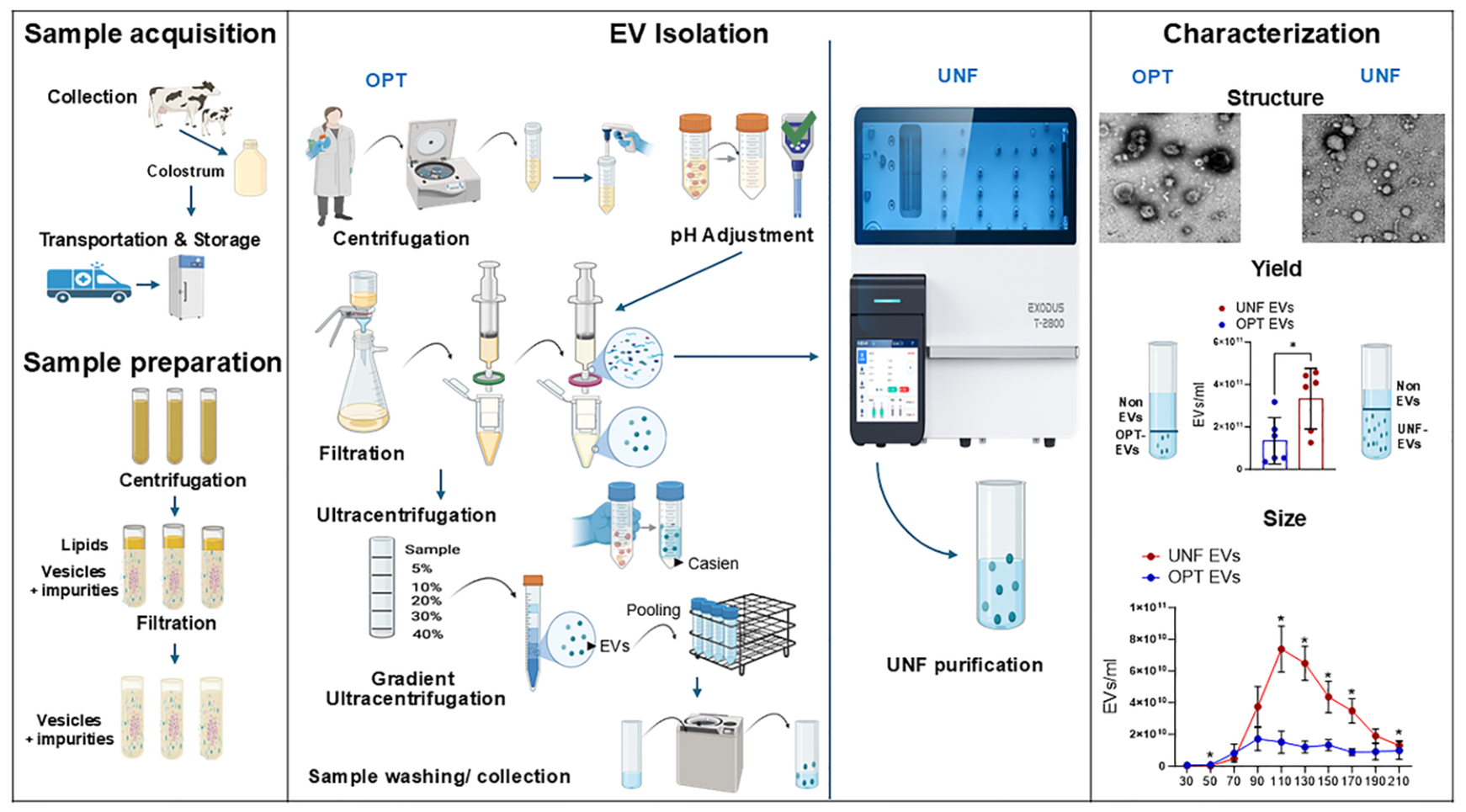
Figure 2.
EV Characterization. (A) Concentration of EVs by NTA. (B) Particle size distribution by Nanoparticle Tracking Analysis. (C) Poly-Dispersity Index by DLS. (D) Representative Western blot images of exosome markers (Alix, CD63, TSG101, Flotilin), Negative EV marker (Calnexin), and Casein (milk protein). (E) Representative Transmission electron microscope images of isolated EVs. (F) Representative Cryo-EM images of isolated EVs. Data are expressed as Mean+SEM. n=6/ group. *p<0.05 versus Opti-prep EVs. Abbreviation: EV: Extracellular vesicles.
Figure 2.
EV Characterization. (A) Concentration of EVs by NTA. (B) Particle size distribution by Nanoparticle Tracking Analysis. (C) Poly-Dispersity Index by DLS. (D) Representative Western blot images of exosome markers (Alix, CD63, TSG101, Flotilin), Negative EV marker (Calnexin), and Casein (milk protein). (E) Representative Transmission electron microscope images of isolated EVs. (F) Representative Cryo-EM images of isolated EVs. Data are expressed as Mean+SEM. n=6/ group. *p<0.05 versus Opti-prep EVs. Abbreviation: EV: Extracellular vesicles.
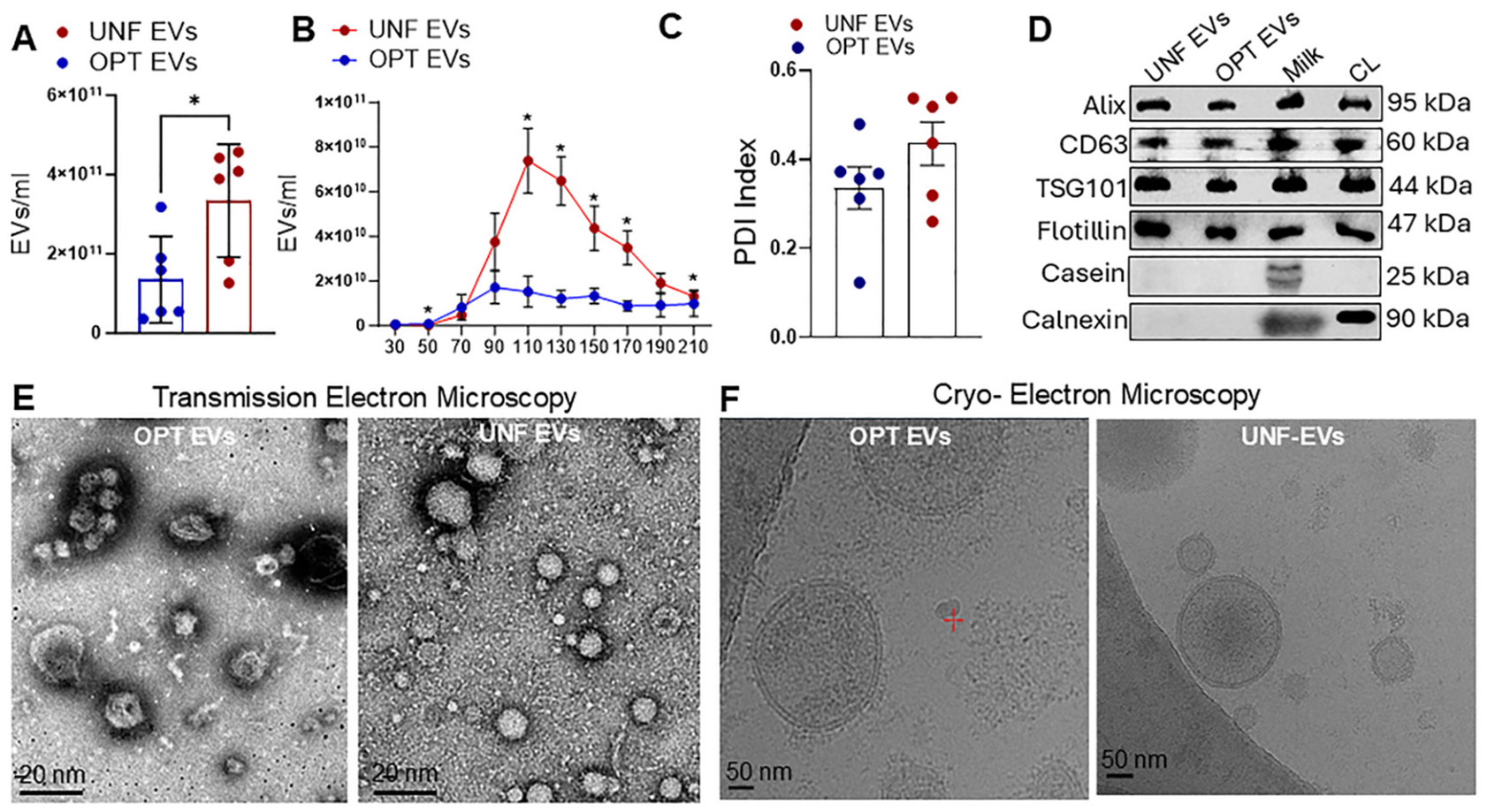
Figure 3.
Role of UNF and OPT C-EVs to protect pro-inflammatory cytokines. mRNA expression of pro-inflammatory cytokines by qPCR analysis- (A) TNF-, (B) IL-1, (C) IL-6. Data are expressed as Mean+SEM. n=6/ group. p<0.05. Abbreviations: LPS: Lipopolysaccharide, EV: Extracellular vesicles.
Figure 3.
Role of UNF and OPT C-EVs to protect pro-inflammatory cytokines. mRNA expression of pro-inflammatory cytokines by qPCR analysis- (A) TNF-, (B) IL-1, (C) IL-6. Data are expressed as Mean+SEM. n=6/ group. p<0.05. Abbreviations: LPS: Lipopolysaccharide, EV: Extracellular vesicles.
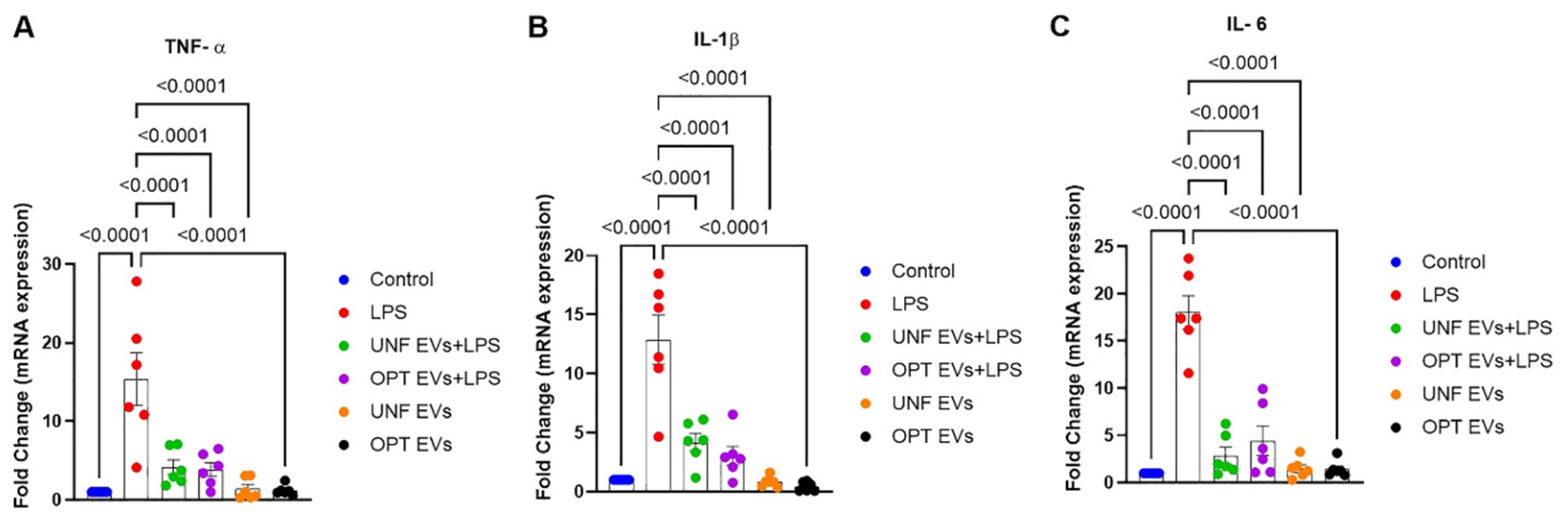
Figure 4.
Role of UNF and conventional C-EVs in deactivating inflammasomes. Representative Western blot images showing the expression of NLRP3 (A), mature Caspase 1 (B), mature IL-1β (C), and mature IL-18 (D). Data are expressed as Mean+SEM. n=6/ group. p<0.05. Abbreviations: LPS: Lipopolysaccharide, EV: Extracellular vesicles.
Figure 4.
Role of UNF and conventional C-EVs in deactivating inflammasomes. Representative Western blot images showing the expression of NLRP3 (A), mature Caspase 1 (B), mature IL-1β (C), and mature IL-18 (D). Data are expressed as Mean+SEM. n=6/ group. p<0.05. Abbreviations: LPS: Lipopolysaccharide, EV: Extracellular vesicles.
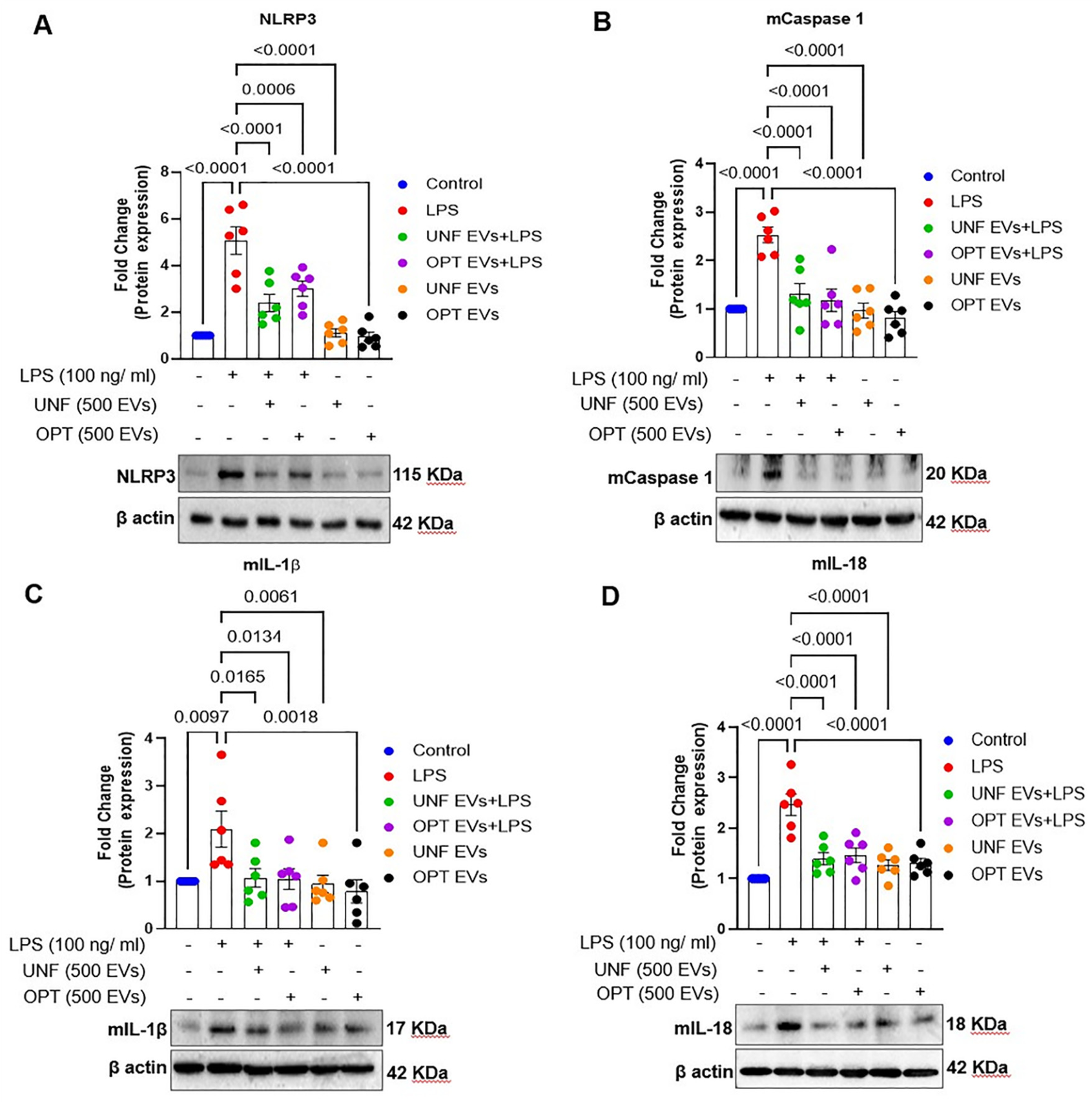
Figure 5.
Role of UNF and OPT EVs on microglial activation: Representative immunocytochemistry images of Iba1-stained BV2 cells (A) and quantification of mean fluorescence intensity (B). Data are expressed as Mean+SEM. n=6/ group. p<0.05. Abbreviations: LPS: Lipopolysaccharide, EV: Extracellular vesicles.
Figure 5.
Role of UNF and OPT EVs on microglial activation: Representative immunocytochemistry images of Iba1-stained BV2 cells (A) and quantification of mean fluorescence intensity (B). Data are expressed as Mean+SEM. n=6/ group. p<0.05. Abbreviations: LPS: Lipopolysaccharide, EV: Extracellular vesicles.
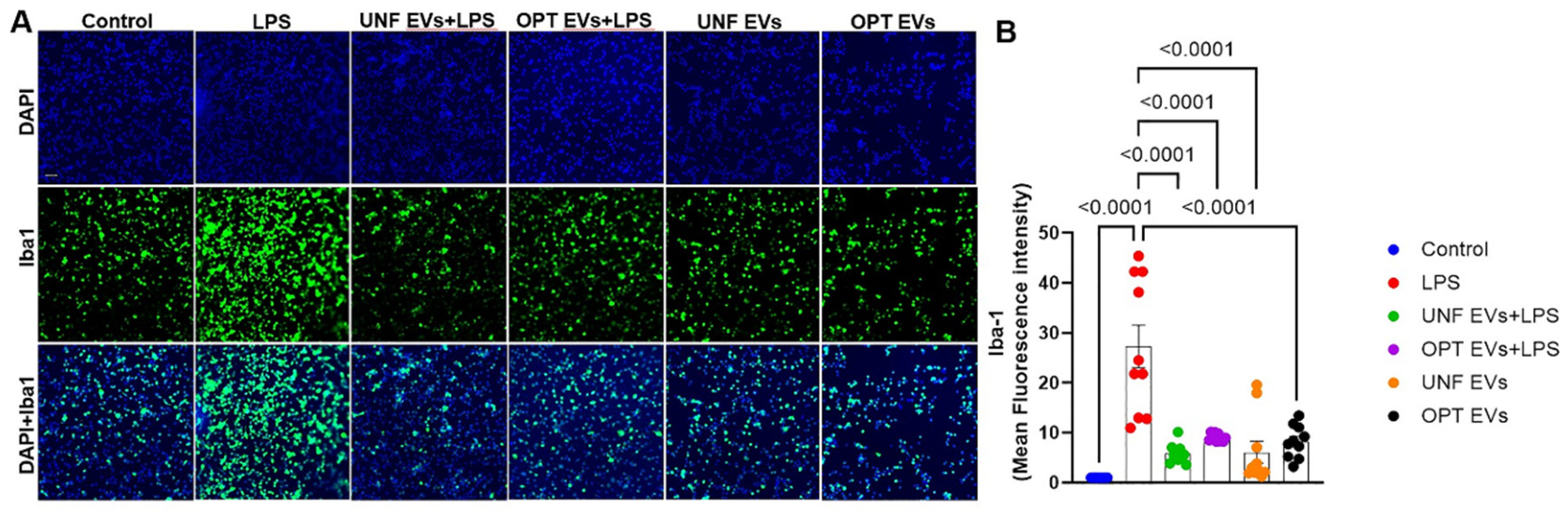
Figure 6.
Summary of the anti-inflammatory effects of EVs derived from Milk Colostrum on LPS-exposed BV2 cells.
Figure 6.
Summary of the anti-inflammatory effects of EVs derived from Milk Colostrum on LPS-exposed BV2 cells.
Disclaimer/Publisher’s Note: The statements, opinions and data contained in all publications are solely those of the individual author(s) and contributor(s) and not of MDPI and/or the editor(s). MDPI and/or the editor(s) disclaim responsibility for any injury to people or property resulting from any ideas, methods, instructions or products referred to in the content. |
© 2026 by the authors. Licensee MDPI, Basel, Switzerland. This article is an open access article distributed under the terms and conditions of the Creative Commons Attribution (CC BY) license (http://creativecommons.org/licenses/by/4.0/).
Copyright: This open access article is published under a Creative Commons CC BY 4.0 license, which permit the free download, distribution, and reuse, provided that the author and preprint are cited in any reuse.


