

Submitted:
09 June 2026
Posted:
10 June 2026
You are already at the latest version
Abstract
In recent decades, due to the rapid development and application of wireless communication, flexible electronics, and smart devices, electromagnetic interference (EMI) and radiation pollution have been intensified, creating an urgent demand for efficient EMI shielding materials. Carbon nanostructures such as graphene and carbon nanotubes are considered promising candidates due to their excellent properties, such as high electrical conductivity, low density, large specific surface area, and flexibility. This work reports our recent results in the design and testing of polymer nanocomposites with irradiated hybrid carbon nanostructure (graphene/multi-walled carbon nanotubes) used as EMI shielding materials. Five representative composites with varying filler loadings (AH of 15% and AM1 of 20 wt%), thicknesses (0.208–0.48 mm), and e-beam irradiation doses (from 50 to 400 kGy) were systematically characterized using SEM, FTIR, TGA/DSC, and vector network analyzer (VNA) measurements in the S-band (2.65–3.90 GHz). The effects of different e-beam irradiation doses and hybrid carbon content on conductive network construction, interface engineering, and porous or layered structures on EMI shielding performance are discussed. Experimental results show that all studied composites exhibited strong absorption-dominant behavior (SEA), while the multiple reflection component (SEM) was found to be negligible. Both filler loading and sample thickness significantly enhanced shielding performance, with a pronounced synergistic interaction observed between these parameters. A quadratic Response Surface Methodology (RSM) model was developed to correlate SET with thickness and filler content, yielding high predictive accuracy (R2 > 0.99). The model enables efficient optimization of composite design for targeted shielding levels.
Keywords:
EMI shielding
; graphene‐carbon nanotube
; PMMA composites
; absorption‐dominant shielding
; response surface methodology
; S‐band
1. Introduction
The rapid proliferation of electronic devices, wireless communication systems, and high-frequency technologies such as 5G and radar has led to a significant increase in electromagnetic interference (EMI). Uncontrolled electromagnetic waves not only degrade the performance and reliability of sensitive electronic equipment but also raise concerns regarding human health and information security [1,2]. Consequently, the development of high-performance EMI shielding materials has become a critical requirement across aerospace, defense, automotive, and consumer electronics industries.
Traditional metal-based shields, while effective, suffer from several limitations, including high density, susceptibility to corrosion, and reflection-dominant shielding mechanisms that can cause secondary interference. These drawbacks have driven extensive research toward lightweight, flexible, and absorption-dominant polymer composites filled with conductive nanomaterials. Polymer/carbon nanostructures (graphene, carbon nanotubes) nanocomposites represent one of the best configurations to offer acceptable absorption-based EMI shielding due to their lower weight and hydrophobicity, the high electrical conductivity, and the formation of a strong three-dimensional interconnected electrically conductive network with porous microstructures. This composite architecture provides a microstructure that allows electromagnetic waves to enter the material through impedance matching. The nature of EMI shielding phenomena in carbon-based polymer nanocomposites has been described and discussed in several review papers [2,3,4,5]. Among various fillers, carbon-based materials such as graphene and carbon nanotubes (CNTs) have attracted particular attention due to their exceptional electrical conductivity, high aspect ratio, and large specific surface area, which facilitate the formation of conductive networks and promote dielectric loss [5,6]. Hybrid fillers combining graphene flakes and carbon nanotubes (G-CNT) offer synergistic advantages over single-filler systems. The two-dimensional graphene sheets provide large interfacial areas for polarization, while the one-dimensional CNTs bridge graphene sheets, enhancing the overall conductive network and reducing the percolation threshold. Furthermore, post-processing techniques such as irradiation have shown promise in improving filler dispersion, matrix-filler interfacial bonding, and the overall electrical properties of polymer composites. Jovanović et al. [7] reviewed studies investigating various graphene-based composites as potential EMI shielding materials. Specifically, they provided an overview of polymer nanocomposites reinforced with graphene and silver nanowires due to their high EMI shielding efficiency, low production cost, and favorable mechanical properties. Pavlou and co-workers studied the EMI behavior of Graphene/PMMA nanolaminates in the THz region [8]. They produced nanolaminates with a fixed graphene content of 0.33 vol.% using an iterative ‘lift-off/float-on’ process. It was found that these thin laminate materials show high EMI shielding efficiency, reaching 60 dB at a thickness of only 33 μm, and an absolute EMI shielding effectiveness close to 3 · 105 dB cm2 g−1, which is among the highest values for non-metallic materials.
Poly(methyl methacrylate) (PMMA), as a lightweight, nontoxic, and environmentally friendly material that is ideal for the preparation of polymer composites, is a particularly attractive polymer matrix for EMI shielding applications owing to its excellent optical transparency, mechanical strength, dimensional stability, and ease of processing. However, the EMI shielding performance of G-CNT/PMMA composites is strongly influenced by multiple parameters, including filler loading, sample thickness, and processing conditions. Understanding and optimizing these interdependent variables is essential for designing materials with tailored shielding effectiveness.
Anderson and his team published a review in which they elaborated on accurate modelling techniques based on the underlying micromechanics, such as percolation, electron tunneling, agglomeration, imperfect interfaces, frequency-dependent nanocapacitance, and electron hopping. They pointed out that numerical solutions are essential in the modeling of electromagnetic waves and that all advanced modern simulation software currently relies on numerical solutions, such as the Finite Element Method (FEM), Finite Volume Method (FVM), Finite Difference Time Domain (FDTD), and Finite Integration Technique (FIT). They reported a comparison of each of these methods regarding their application to electromagnetic propagation problems. Anderson et al. [9] also worked on designing a model for predicting the electromagnetic properties of nanocomposites based on the pre-determined properties of the polymer matrix and the carbon-based filler, directing their focus specifically to a graphene nanoplatelet (GnP)/epoxy system. The research of Xia and coworkers was focused on the multi-objective optimization of highly efficient EMI shielding in porous graphene-reinforced nanocomposites [10]. First, a two-scale electromagnetic constitutive model of EMI shielding effectiveness (SE) and cost was established through the effective-medium approximation with tunneling and Maxwell–Wagner-Sillars polarization effects. Then, an NSGA-II-based multi-objective optimization was developed for high EMI SE and low cost with the assistance of crowding distance and an elite strategy.
While many studies report experimental EMI shielding data, relatively few have employed systematic statistical modeling approaches such as Response Surface Methodology (RSM) to quantify the effects of key processing and design parameters. Such models are invaluable for reducing experimental workload and enabling predictive design of composites for specific shielding targets.
The present study investigates the EMI shielding performance of hybrid G-CNT-reinforced PMMA composites in the S-band frequency range (2.65–3.90 GHz). Five representative samples with varying filler loadings (15–20 wt%), thicknesses (0.208–0.48 mm), and irradiation treatments (from 50 to 400 kGy) were fabricated and characterized using vector network analyzer (VNA) measurements. The shielding mechanisms (reflection, absorption, and multiple reflections) were thoroughly analyzed, and a quadratic Response Surface Model was developed to correlate shielding effectiveness with material design parameters. The primary objectives of this work are to evaluate the influence of filler loading and sample thickness on total shielding effectiveness (SET) and its components, to demonstrate the absorption-dominant behavior of the developed composites, and to establish a predictive RSM model for efficient material optimization.
2. Materials and Methods
2.1. Materials and Composite Preparation
Poly(methyl methacrylate) (PMMA) with a molecular weight of 150,000 g/mol was used as the polymer matrix for the prepared nanocomposites. A hybrid graphene-carbon nanotube (G-CNT) material, obtained from a supplier in China, was utilized as the conductive filler. All chemicals and dimethylformamide (DMF) solvent were of analytical grade and used as received. The solution-processing method was selected because it provides a rapid, uniform, and straightforward approach to fabricating functional materials via a simple, cost-effective, and reproducible technique. The sample designations used throughout this work are as follows: four samples containing 15 wt% hybrid filler (denoted as AH) irradiated with doses from 50 to 400 kGy, and one sample containing 20 wt% hybrid filler (denoted as AM1) irradiated at 50 kGy.
The final film thicknesses were controlled by adjusting the casting parameters (solution volume) and the dimensions of the Petri dishes, resulting in samples with thicknesses ranging from 0.208 mm to 0.48 mm. A pure PMMA film was also prepared following the same procedure to serve as a reference.
2.2. Characterization of Nanocomposites
The hybrid G-MWCNT nanostructures were irradiated with an e-beam using a linear accelerator (ELU-6, Eksma) across a dose range of 50, 100, 200, and 400 kGy determined by calibrated polymer film dosimetry (B3000, B3 WINdose Dosimeters).
TGA and DSC measurements were performed on representative samples (~20 mg) using a simultaneous TGA/DSC thermal analyzer (Themis One+, Setaram, France) under a nitrogen atmosphere, at a heating rate of 10 °C min-1 over a temperature range of 30–800 °C.
FTIR-ATR spectra were recorded in the 3500–400 cm-1 wavenumber range using a Varian 660 FTIR spectrometer (Agilent Technologies, USA).
The microstructure and morphology of the pristine and irradiated G-MWCNT carbon hybrid nanostructures and composite films were analyzed using scanning electron microscopy (SEM) (JEOL, model JT-FFX). Transmission electron microscopy (TEM) observations of the fabricated samples were carried out using an FEI Tecnai G2 Spirit TWIN transmission electron microscope equipped with a LaB6 cathode.
The electrical conductivity was determined via the four-probe method using a Jandel RM3000 instrument.
2.3. Electromagnetic Characterization
A Keysight P9370A vector network analyzer (VNA) was used to perform the EMI SE measurements. The dimensions of the samples matched the internal cross-section of the waveguide adapters used for the electromagnetic shielding measurements. The transmission and reflection coefficients were measured in the S-band frequency range (2.60–3.95 GHz) using WR-284 waveguide adapters. The waveguide adapters were connected to Ports 1 and 2 of the VNA using RF coaxial cables. The samples were clamped between the two waveguide adapters, and the scattering parameters (S11 and S21) were collected. All measurements were conducted at room temperature. The scattering parameters were recorded in both magnitude (dB) and phase (degrees).
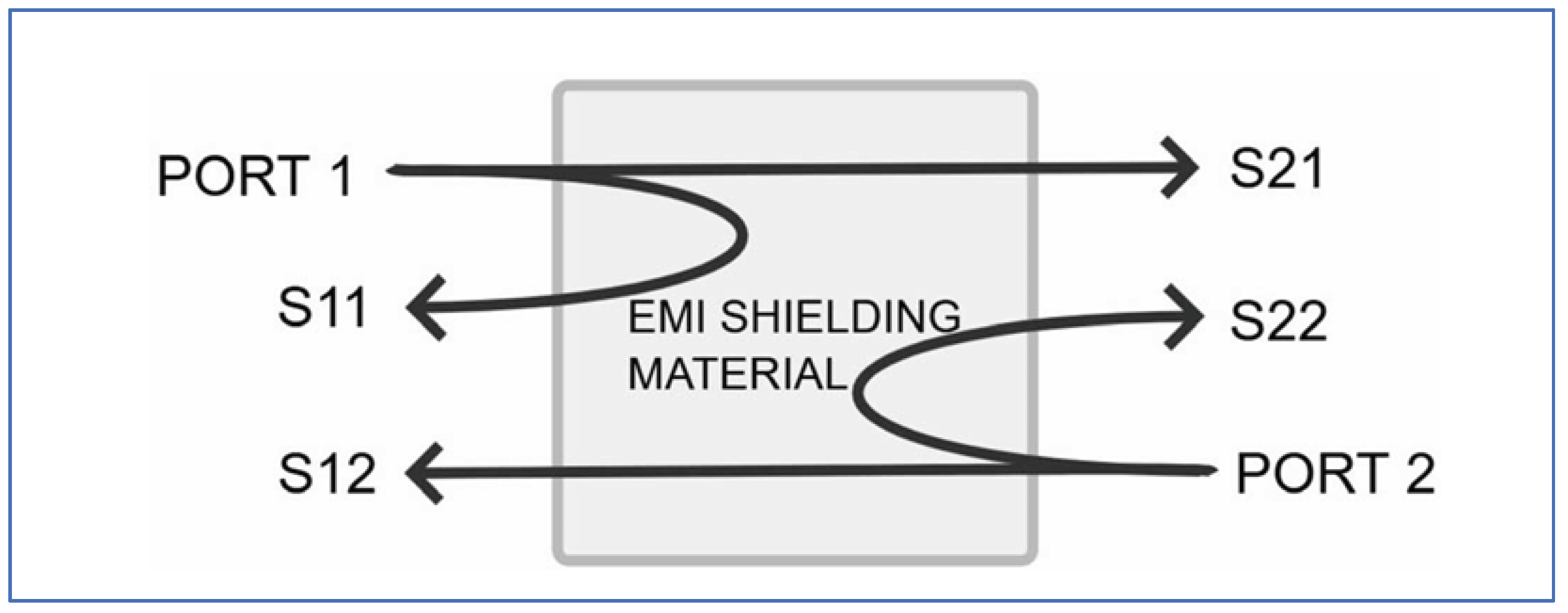
Figure 1.
Complex of scattering parameters registered for the tested EMI material from a two-port VNA.
Figure 1.
Complex of scattering parameters registered for the tested EMI material from a two-port VNA.
The EMI shielding effectiveness parameters were calculated as follows:
where R, T, and A represent the reflected, transmitted, and absorbed power coefficients, respectively. The terms |S11|, |S12|, |S21| and |S22| are the linear magnitudes of the scattering parameters converted from their respective dB values. Furthermore, SEA, SER, SEM, and SET represent the shielding effectiveness associated with absorption, reflection, multiple internal reflections, and total shielding effectiveness, respectively.
2.4. Statistical Modeling and Data Analysis
Response Surface Methodology (RSM) was employed to model the relationship between input variables (filler loading and sample thickness) and the response variable (average SET). A quadratic polynomial model was fitted using the experimental data from the five representative samples:
where d is the sample thickness (mm), W is the G-CNT loading (wt%), I is the irradiation dose (kGy), β0–β9 are the model coefficients.
Model fitting, analysis of variance (ANOVA), and three-dimensional (3D) response surface generation were performed using Python (with libraries such as Pandas, NumPy, and Statsmodels/Plotly). All data processing, including conversion of S-parameters and calculation of shielding components, was carried out using custom scripts to ensure accuracy and traceability.
3. Results and Discussion
3.1. Structural and Thermal Analysis of Pmma/g-Mwcnt Nanocomposites
Typical TGA thermograms of the studied hybrid G-MWCNT nanostructures are shown in Figure 2, while the obtained DSC curves are shown in Figure 3. It is evident that with the incorporation of G-MWCNT nanoparticles into the polymer matrix, the degradation temperature shifted slightly to higher values, indicating improved thermal stability and good dispersion of the hybrid nanostructures within the PMMA polymer chains. All tested samples exhibited a minor initial weight loss (between 1% to 4%) below 150 °C, which is usually related to the desorption of physically adsorbed moisture trapped between the high-surface-area layers.
The same tendency was obtained via DSC analysis, where the peak temperature was shifted to higher values. Furthermore, increasing the irradiation dose of the G-MWCNTs shifted the glass transition temperature (Tg) of the polymer matrix to higher values. This shift reflects restricted polymer chain mobility within the nanocomposites reinforced with G-MWCNTs irradiated at the higher dose of 400 kGy.
The FTIR spectra of the studied PMMA/AH hybrid nanocomposite films are presented in Figure 4. As is evident in Figure 4a, the PMMA polymer chains and the G-MWCNT nanoparticles interact non-covalently, as indicated by the absence of any new chemical bands. The FTIR spectra in Figure 4a reveal a broad peak at 3220 cm-1, which is assigned to the hydroxyl group (O–H) stretching vibrations in the nanocomposites containing hybrids irradiated at 100, 200, and 400 kGy. All spectra exhibit the C–H stretching band of the methylene groups at 2996 cm−1 and 2947 cm−1. The sharp peak at 1723 cm-1 is attributed to the carbonyl groups (C=O) stretching of the ester functional group. Furthermore, C–H bending vibration peaks appear around 1447 cm-1 and 1388 cm-1, while the C–O–C stretching vibrations of the ester group in PMMA show multiple peaks in the 1300–1000 cm-1 region. Various bending and stretching modes of the polymer backbone are observed below 1000 cm-1. The skeletal ring (C=C) stretching vibration of the sp2 carbon domain, characteristic of unexfoliated graphene-based sheets, is observed at 1604 cm-1. Additionally, bands at 1374 cm-1 (epoxy C–O–C stretching) and 1040 cm-1 C–O stretching) are present in the FTIR spectra, which is in agreement with literature data [8]. As shown in the magnified spectra in Figure 4b, several characteristic peaks of the PMMA/AH hybrids are visible, including the CH2 bending mode at 1646 cm-1, C–H stretching at 1604 cm-1, O–H bending at 1361 cm-1, and overlapping O–H bending and C–O (ester bond) stretching vibrations in the 1260–1000 cm-1 range.
The measured electrical conductivity data for the obtained nanocomposites are shown in Table 1. All nanocomposite films have a thickness of 0.208 to 0.280 mm. Compared to the neat PMMA matrix, all PMMA-based nanocomposite films filled with the irradiated carbon hybrid nanostructures exhibit a remarkable increase in electrical conductivity. An increase in electrical conductivity was also observed with increasing irradiation doses, except for the highest dose of 400 kGy, which resulted in a decrease in conductivity. This drop is likely attributed to severe structural degradation of the carbon network under excessive radiation. This induced structural disorder within the hybrid nanostructures subsequently leads to a lower total EMI shielding effectiveness (SET) in the corresponding nanocomposites.
The hybrid G-MWCNT nanostructures were treated with various irradiation doses (50, 100, 200, and 400 kGy) to activate the carbon nanoparticles and to enhance the conductive network within the PMMA polymer matrix. The morphology of the hybrid nanostructures was studied using TEM and SEM. A typical TEM micrograph of the G-MWCNT hybrid is shown in Figure 5. The SEM micrographs of the irradiated G-MWCNT nanostructures are presented in Figure 6, while the microstructures of the corresponding PMMA-based nanocomposite films are shown in Figure 7.
The SEM images confirm the presence of graphene flakes and carbon nanotubes. At higher irradiation doses, the graphene flakes appear highly exfoliated. The neat and low-dose polymer nanocomposites exhibit a relatively smooth cross-sectional surface, except for the nanocomposite filled with the G-MWCNT irradiated with 50 kGy, as shown in Figure 7a. The G-MWCNT carbon hybrid nanoparticles are well distributed and successfully incorporated within the polymer matrix. However, within the nanocomposites containing G-MWCNTs irradiated at higher doses (100, 200, and 400 kGy), numerous nanopores with an average diameter of 250–290 nm were formed. These nanopores are expected to influence and subsequently decrease the EMI SE of the studied nanocomposites.
3.2. Emi Shielding Performance
An RSM model was developed to predict the total EMI shielding effectiveness (SET) as a function of three key parameters: material thickness (d, mm), G-MWCNT filler loading (W, wt%), and irradiation dose (I, kGy). The estimated regression coefficients of the fitted model (Eq. 8) are given in Table 2.
The presented quadratic model has a good fitting property and achieves excellent correlation with the experimental data, which provides a robust balance between fit quality and physical interpretability while minimizing overfitting risks. However, its predictive power outside the measured experimental range remains uncertain.
A Response Surface Model (RSM) was developed to predict the total EMI shielding effectiveness (SET) using three key parameters: material thickness (d, mm), G-CNT filler loading (W, wt%), and irradiation dose (I, kGy). The obtained model produces a high correlation coefficient that corresponds to R2=0.99 and provides a good balance between fit quality and physical interpretability while minimizing overfitting risk. The initial interpretation of the influence of the studied process variables and significant interactions suggests that material thickness (d) and filler loading (W) have the strongest overall influence, particularly through their significant interaction (d∙W). The irradiation (I) produces a moderate contribution, while squared irradiation (I2) does not influence the EMI. In addition, interactions between thickness and material thickness (I∙d) and interactions between thickness and filler loading (I∙W) have also moderate contribution.
The EMI shielding effectiveness of hybrid PMMA/G-MWCNT composites was evaluated in the S-band (2.65–3.90 GHz). Five samples with different filler loadings, thicknesses, and irradiation doses were tested. The key experimental results are summarized in Table 3.
Evidently, the predicted SET values derived from the model closely match the experimentally obtained data. For the samples containing hybrid nanostructures irradiated at 50 kGy but with varying hybrid contents (15 wt% and 20 wt%) and thicknesses (0.208 mm and 0.48 mm), higher SET values were recorded for the sample combining higher filler loading with greater thickness.
The experimental EMI SE measurements yielded the curves presented in Figure 8 and Figure 9. The irradiated PMMA/AM1 (50 kGy) sample (d = 0.48 mm) and the PMMA/AH50 sample (d = 0.28 mm) exhibited the highest shielding performance, reaching values of 11–14 dB. In contrast, the pure PMMA reference provided a shielding efficiency of less than 1 dB, confirming the critical role of the conductive hybrid G-MWCNT network.
As previously indicated during the morphological analysis, the nanocomposites containing G-MWCNTs irradiated at higher doses (100, 200, and 400 kGy) developed numerous internal nanopores (average diameter of 250–290 nm). These nanopores induced structural non-homogeneity within the bulk film, which ultimately resulted in the observed decrease in EMI SE.
All prepared composites demonstrated an absorption-dominant shielding mechanism, with the absorption component (SEA) contributing 82–87% of the total SET, as shown in Figure 10. The multiple reflection term (SEM) was calculated using the relationship SEM = SET − SER − SEA and was found to be mathematically negligible (< 10-10 dB) across all samples and frequencies. This validates the standard approximation of SET ≈ SER + SEA for these lightweight materials.
Three-dimensional response surface plots (Figure 11) were generated based on the developed predictive model to visualize the functional dependence of the total EMI shielding effectiveness on the studied parameters and their interactions. The 3D response surfaces demonstrate that the two-factor interaction between the investigated independent variables has a significant impact on the SET. The results indicate that the shielding effectiveness of the studied material strongly depends on the combination of the parameters, confirming the complexity of the studied system. This implies that, through precise optimization and combination of the parameters, a satisfactory electromagnetic interference shielding performance can be achieved within the frequency range of 2.65–3.90 GHz.
The response surfaces demonstrate the strong positive interaction between thickness and filler loading. Higher irradiation doses provide additional improvement, especially at greater thicknesses. The results confirm that increasing sample thickness and G-CNT content significantly enhances EMI shielding due to greater absorption volume and denser conductive networks. The positive effect of irradiation is attributed to improved filler dispersion and interfacial bonding. The reduced RSM model successfully captures these trends and provides a practical tool for material design optimization within the studied range.
4. Conclusions
This study successfully developed and characterized hybrid graphene-carbon nanotube (G-CNT) reinforced PMMA composites for electromagnetic interference (EMI) shielding applications in the S-band (2.65–3.90 GHz). Five composites with varying G-MWCNT loading (15–20 wt%), sample thicknesses (0.208–0.48 mm), and irradiation doses (from 50 to 400 kGy) were fabricated and evaluated.
The composites demonstrated absorption-dominant shielding behavior, with SEA contributing over 82% of the total shielding effectiveness (SET). The highest performance was achieved by the 20 wt% irradiated sample (0.48 mm thickness), reaching an average SET of 10.13 dB, while the AH200 15 wt% sample (0.28 mm) exhibited the strongest overall shielding among the 15 wt% series, averaging 13.2 dB. The multiple reflection term (SEM) was found to be negligible, validating the conventional SET ≈ SER + SEA approach for these materials.
A reduced, three-factor Response Surface Methodology (RSM) model was developed using thickness (d), filler loading (W), and irradiation dose (I) as input variables. The model showed excellent correlation with experimental data (R2 = 0.99) and revealed a strong synergistic interaction between thickness and filler loading. The model equation provides a valuable predictive tool for optimizing composite design within the studied range.
Overall, the irradiated hybrid G-MWCNT/PMMA composites offer a promising combination of lightweight structure, good processability, and effective absorption-dominant EMI shielding. These materials are suitable candidates for thin, flexible shielding applications in electronics and aerospace industries.
Author Contributions
All authors have read and agreed to the published version of the manuscript.
Funding
The Ministry of Science and Education of the Republic of North Macedonia has financially supported this investigation in the frame of the project Graphene-polymer based nanocomposites for EMI shielding in smart buildings (2025-2026, Grant No. 05-923).
Institutional Review Board Statement
The authors have nothing to report.
Informed Consent Statement
The authors have nothing to report.
Conflicts of Interest
The authors declare no conflicts of interest.
References
- Deshmukh, K.; Kovarík, T.; Deep Punetha, V.; Pandey, M.; Khadheer Pasha, S.K.; Rani, P.; Kumar Sadasivuni, K. Graphene and its derivatives based polymer nanocomposites for electromagnetic interference shielding applications: A comprehensive review. Mater. Today Sustain. 2026, 33, 101256. [Google Scholar] [CrossRef]
- Sharma, G. Kumar; Pilla, S.; Raji, S.; Suresh, R.; James, N. Rachel; Rahees, M.; Prabhakaran, K. Carbon composites for electromagnetic interference shielding: Progress, challenges and perspective. Carbon 2026, 246, 120874. [Google Scholar] [CrossRef]
- Wu, N.; Hu, Q.; Wei, R.; Mai, X.; Naik, N.; Pan, D.; Guo, Z.; Shi, Z. Review on the electro-magnetic interference shielding properties of carbon-based materials and their novel composites: recent progress, challenges and prospects. Carbon N. Y. 2021, 176, 88–105. [Google Scholar] [CrossRef]
- Mikinka, E.; Siwak, M. Recent advances in electromagnetic interference shielding properties of carbon-fibre-reinforced polymer composites—a topical review. J. Mater. Sci. Mater. Electron. 2021, 32, 24585–24643. [Google Scholar] [CrossRef]
- Suchea, M.; Tudose, I.V.; Pascariu, P.; Koudoumas, E.; Joseph, K.; Wilson, R.; for, G.B. T.-M.; George, P.E.M.I.S.A. (Eds.) Chapter 12—Carbon-Based Nanocomposites for EMI Shielding: Recent Advances; Elsevier, 2020; pp. 201–211. [Google Scholar] [CrossRef]
- Grozdanov, A.; Paunovic, P.; Dimitrievska, I.; Proseva, M.; Gorgieva, A.; Castaldo, R.; Gentile, G. Structural, Thermal, and Electrical Characteristics of various Graphene/PMMA nanocomposites aimed for EMI shielding. J. Nanotechnol. 2026, 2026, 8823129. [Google Scholar] [CrossRef]
- Jovanović, S.; Huskić, M.; Kepić, D.; Yasir, M.; Haddadi, K. A review on graphene and graphene composites for application in electromagnetic shielding. Graphene 2D Mater. 2023, 8, 59–80. [Google Scholar] [CrossRef]
- Pavlou, C.; Koral, C.; Giovanna Pastore Carbone, M.; Papari, G.; Andreone, A.; Manikas, A. C.; Galiotis, C. Effective EMI shielding behaviour of thin graphene/PMMA nanolaminates in the THz range. Nat. Commun. 2021, 12, 4655. [Google Scholar] [CrossRef] [PubMed]
- Anderson, L.; Govindaraj, P.; Anga, A.; Mirabedini, A.; Hameed, N. Modelling, fabrication and characterization of graphene/polymer nanocomposites for electro-magnetic interference shielding applications. Carbon Trends 2021, 4, 100047. [Google Scholar] [CrossRef]
- Xia, X.; Liu, Y.; Pan, Y.; Zhong, Z. Multi-objective optimal design of high-efficient EMI shielding in porous graphene-reinforced nanocomposites. Int. J. Mech. Mater. Des. 2023, 19, 669–685. [Google Scholar] [CrossRef]
- Abdul Kadhim, M.; Al-Bermany, E. Enhance the Electrical Properties of the Novel Fabricated PMMA-PVA/ Graphene Based Nanocomposites. J. Green Eng. 2020, 10(7), 3465–3483. [Google Scholar]
Figure 2.
TGA thermograms of the PMMA/AH hybrid G-MWCNT nanocomposite films.
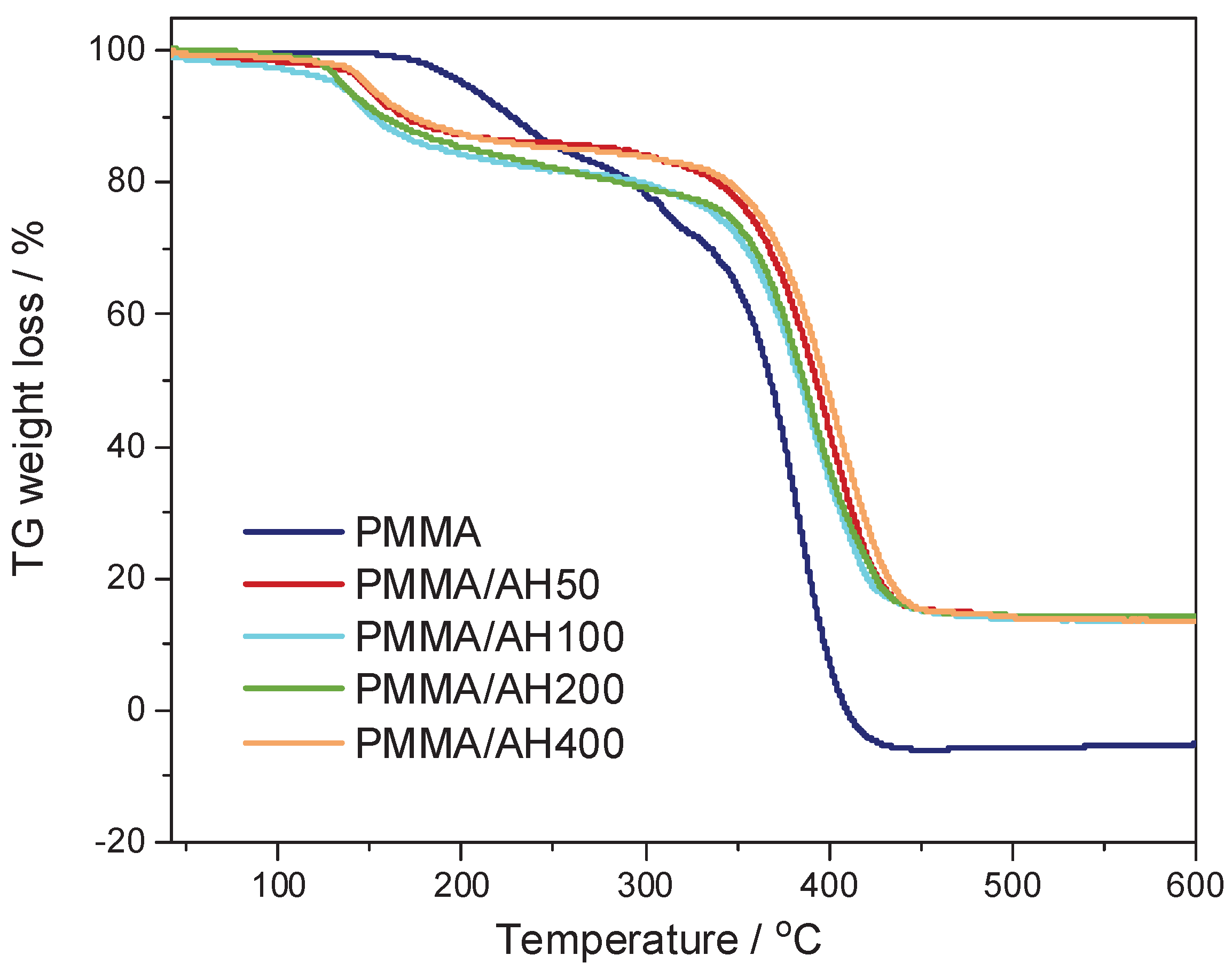
Figure 3.
DSC thermograms of the PMMA/AH hybrid nanocomposite films.
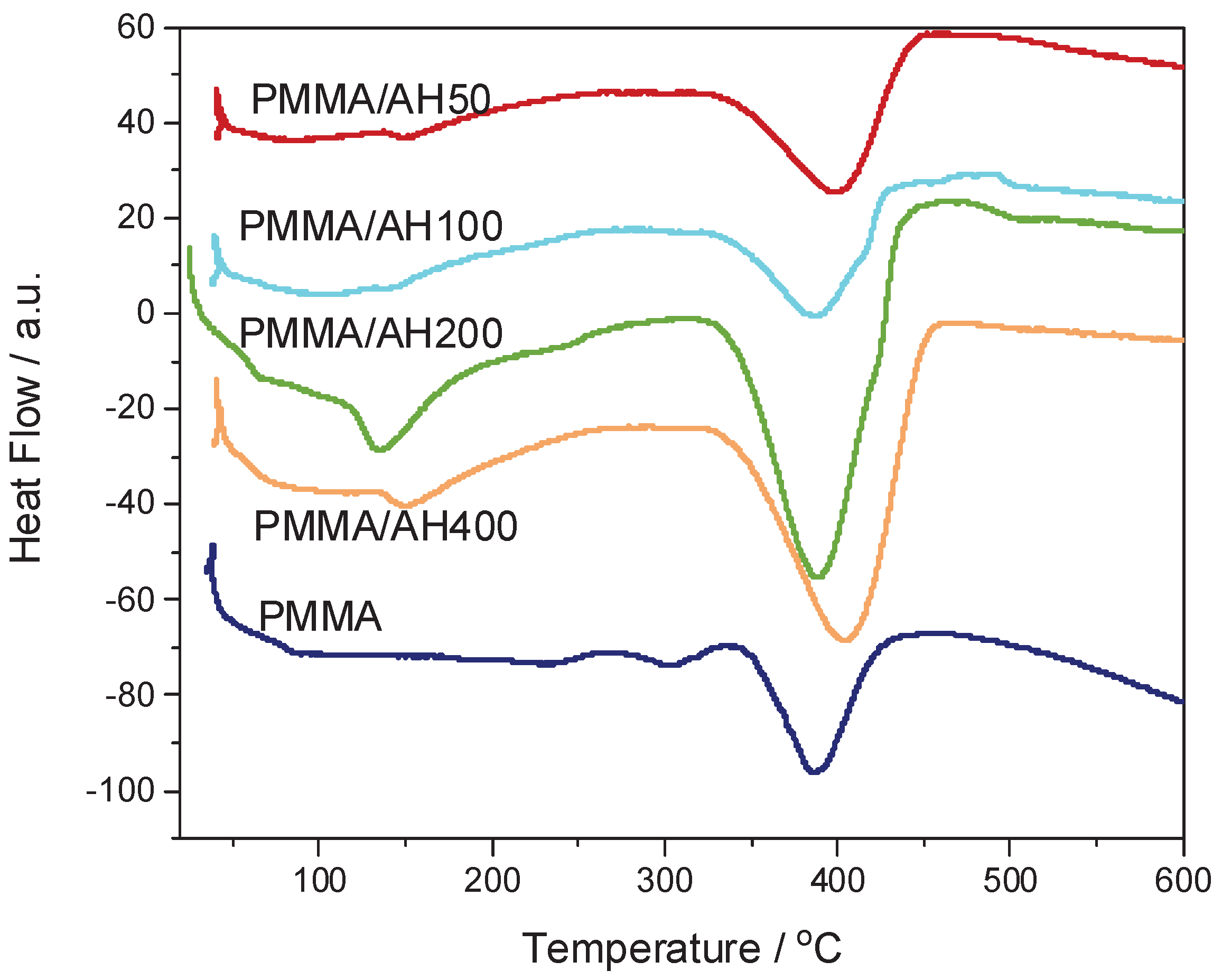
Figure 4.
FTIR spectra of the PMMA/AH hybrid nanocomposite films a) different irradiation doses, b) different % of G-CNT filler.
Figure 4.
FTIR spectra of the PMMA/AH hybrid nanocomposite films a) different irradiation doses, b) different % of G-CNT filler.
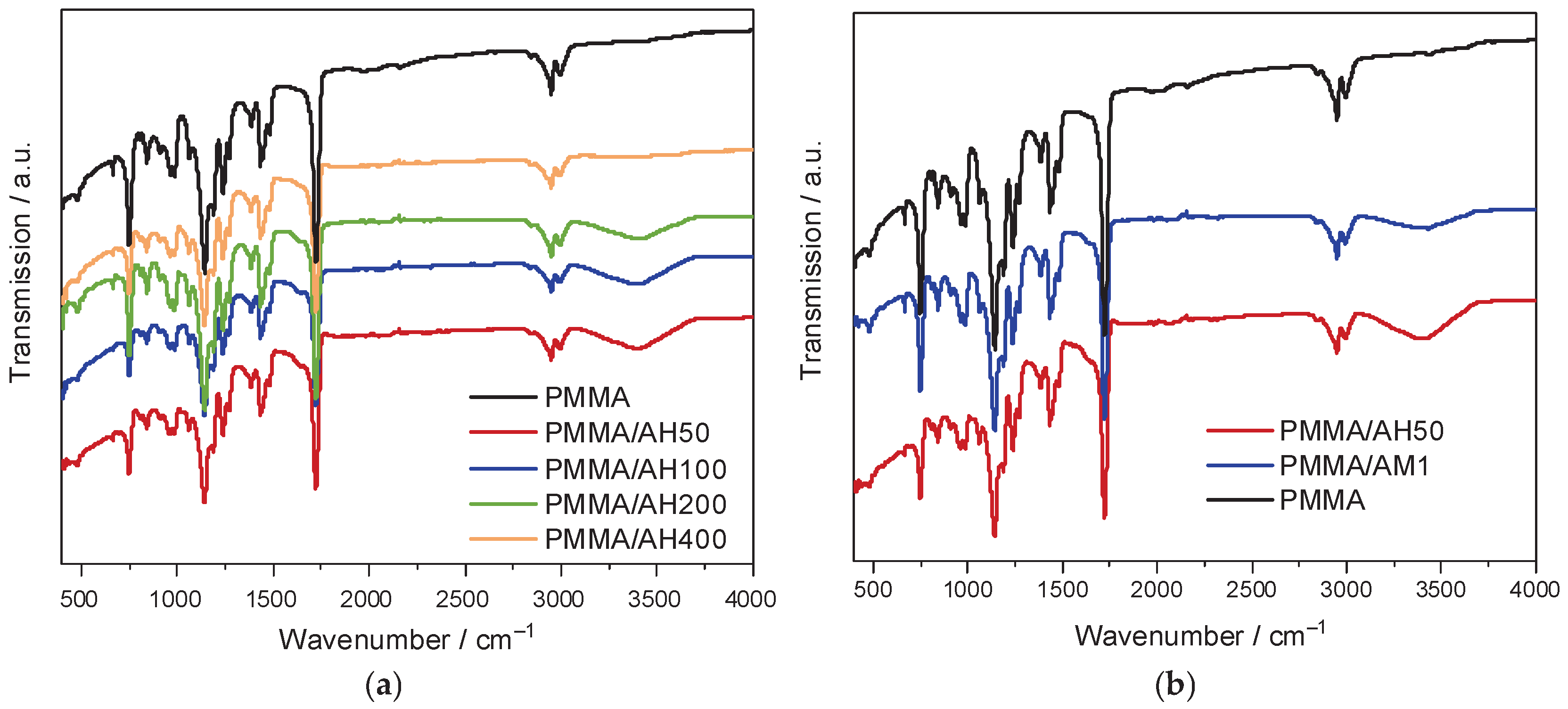
Figure 5.
TEM of the G-MWCNT carbon hybrid nanostructure.
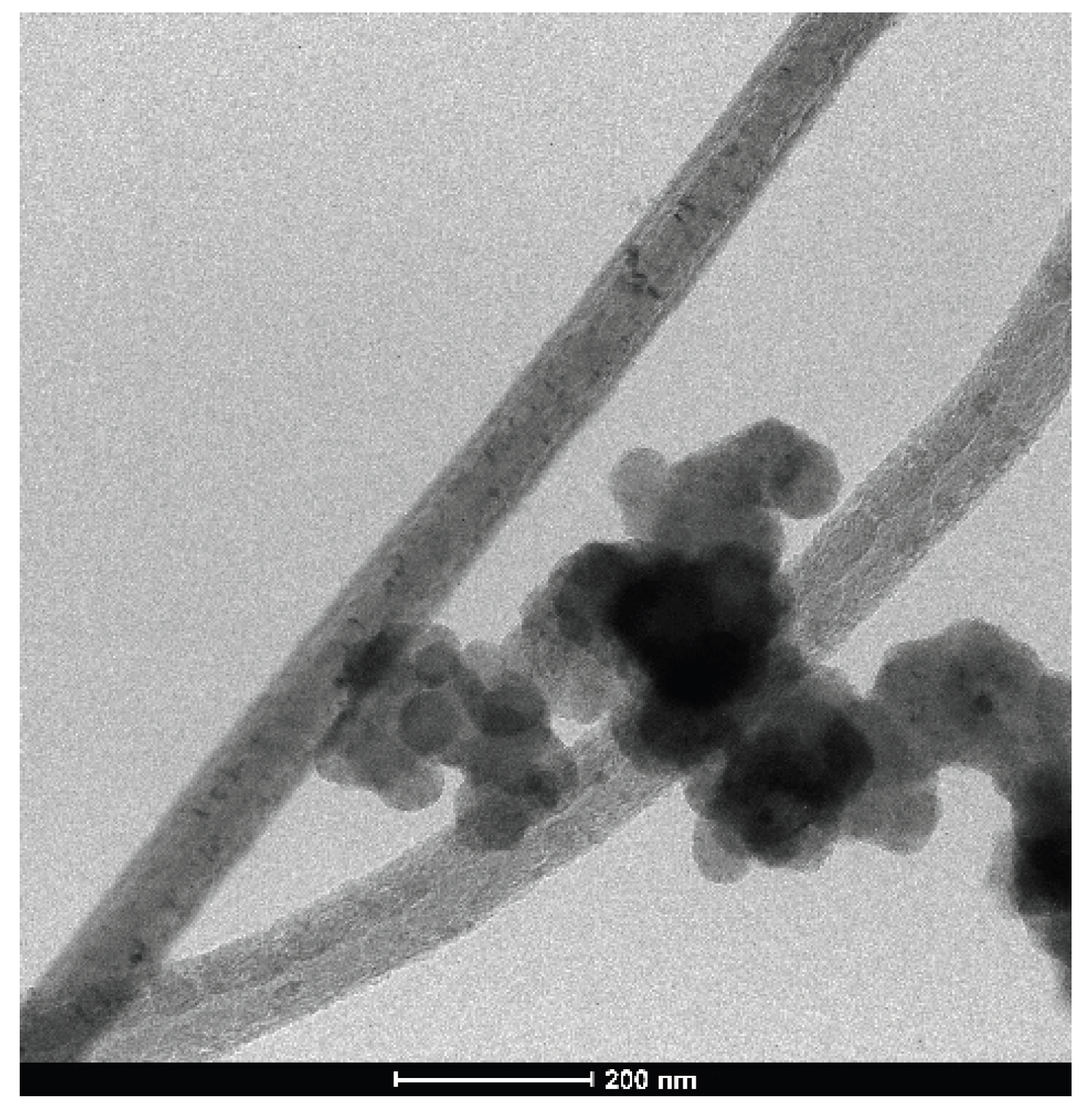
Figure 6.
SEM micrographs of irradiated G/MWCNT carbon hybrid nanostructures: a)AH 50kGy, x19000; b) AH 100 kGy, x22000; c) AH 200 kGy, x18000; d)AH 400 kGy, 16000.
Figure 6.
SEM micrographs of irradiated G/MWCNT carbon hybrid nanostructures: a)AH 50kGy, x19000; b) AH 100 kGy, x22000; c) AH 200 kGy, x18000; d)AH 400 kGy, 16000.
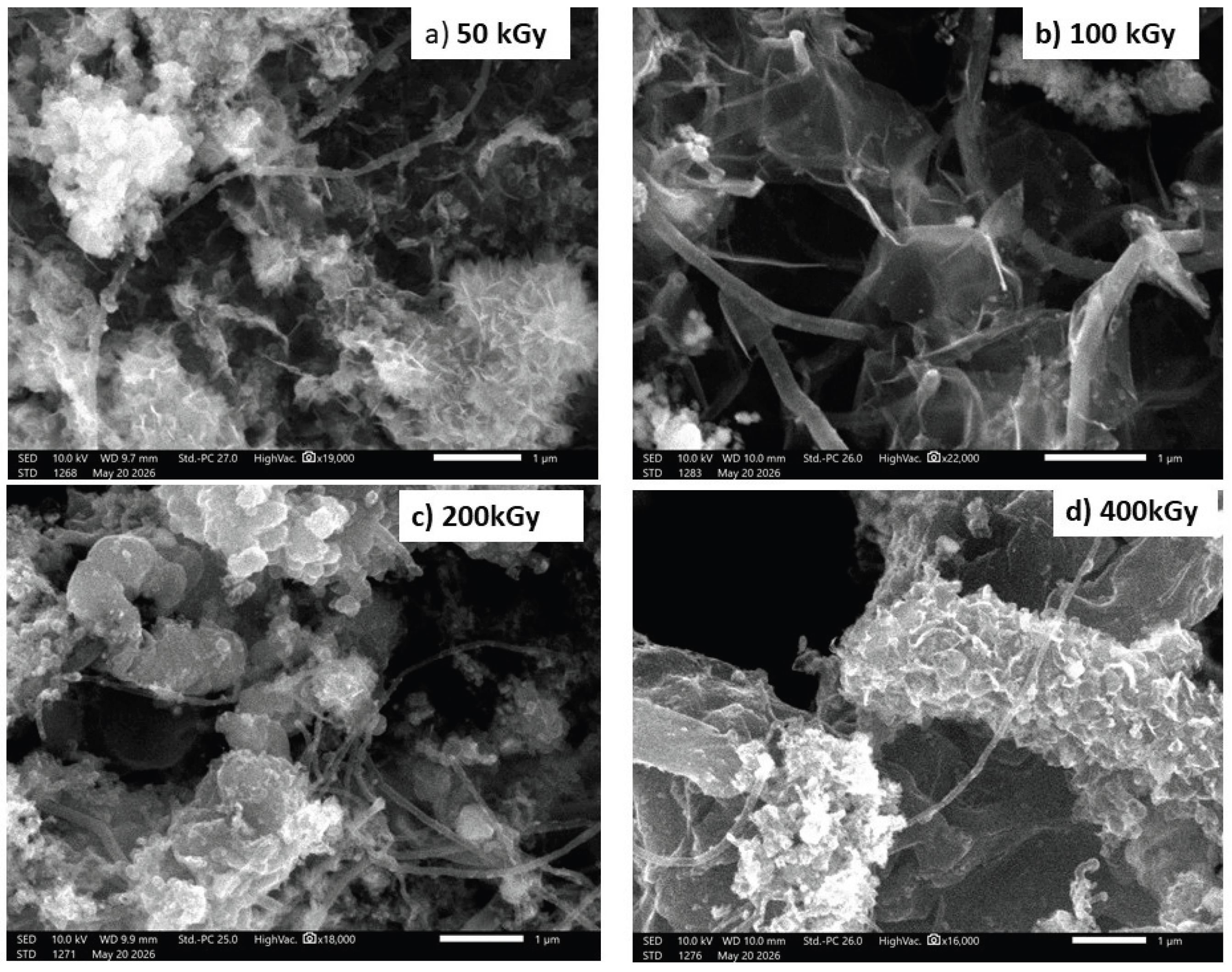
Figure 7.
SEM microphotographs of PMMA-polymer based nanocomposites with irradiated G/MWCNT carbon hybrid nanostructures: a) PMMA/AH50kGy, x8500; b) PMAA/AH100 kGy, 8500; c) PMAA/AH200kGy, x3700; d) PMAA/AH400 kGy, 1500.
Figure 7.
SEM microphotographs of PMMA-polymer based nanocomposites with irradiated G/MWCNT carbon hybrid nanostructures: a) PMMA/AH50kGy, x8500; b) PMAA/AH100 kGy, 8500; c) PMAA/AH200kGy, x3700; d) PMAA/AH400 kGy, 1500.
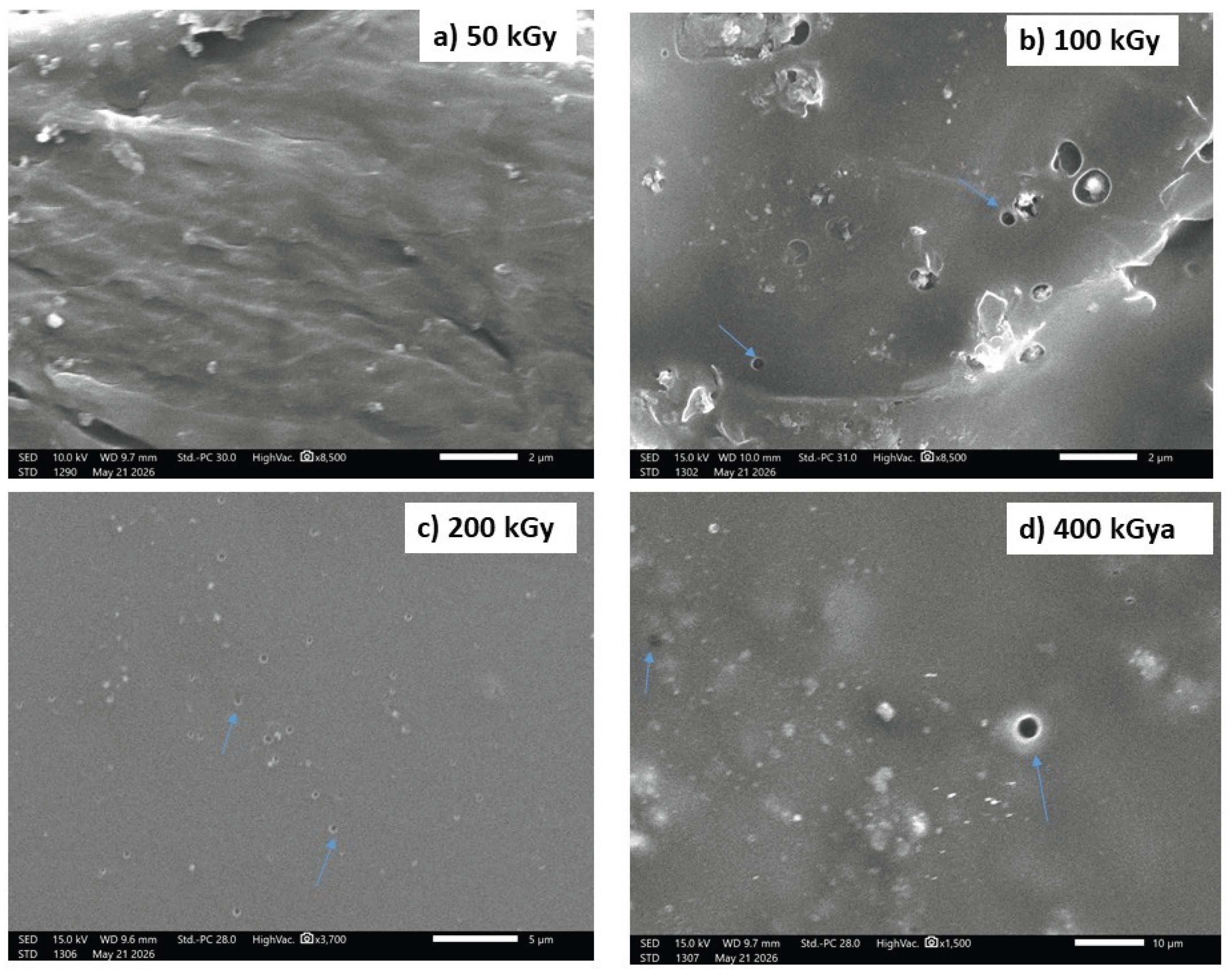
Figure 8.
Total EMI shielding effectiveness (SET) as a function of frequency for PMMA/AH and PMMA/AM1 nanocomposites and pure PMMA.
Figure 8.
Total EMI shielding effectiveness (SET) as a function of frequency for PMMA/AH and PMMA/AM1 nanocomposites and pure PMMA.
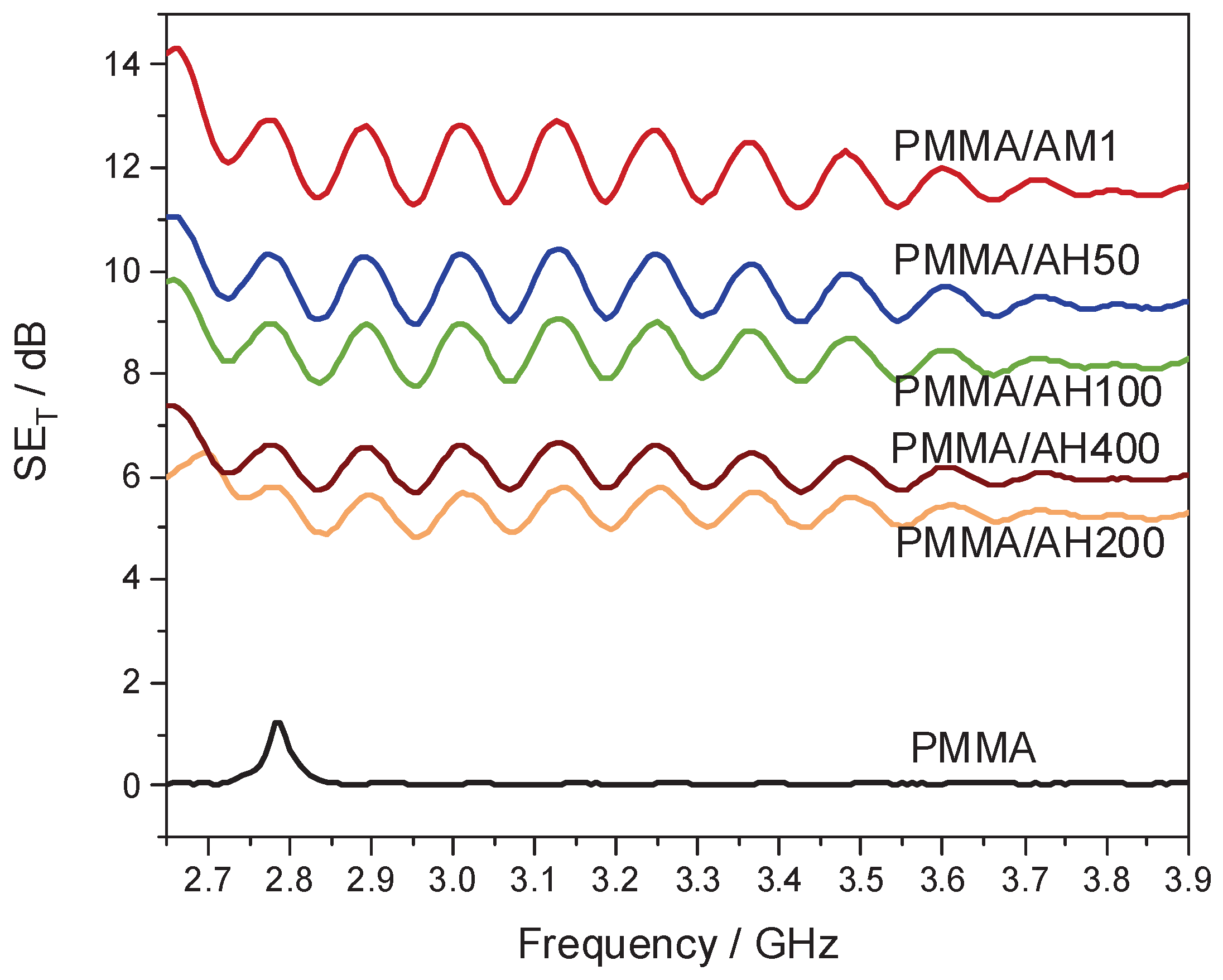
Figure 9.
EMI SE real test measurements: a) S11 scattering coefficient in dB, b) S21 scattering coefficient in dB, c) S12 scattering coefficient in dB, d) S22 scattering coefficient in dB, for the Studied Materials.
Figure 9.
EMI SE real test measurements: a) S11 scattering coefficient in dB, b) S21 scattering coefficient in dB, c) S12 scattering coefficient in dB, d) S22 scattering coefficient in dB, for the Studied Materials.
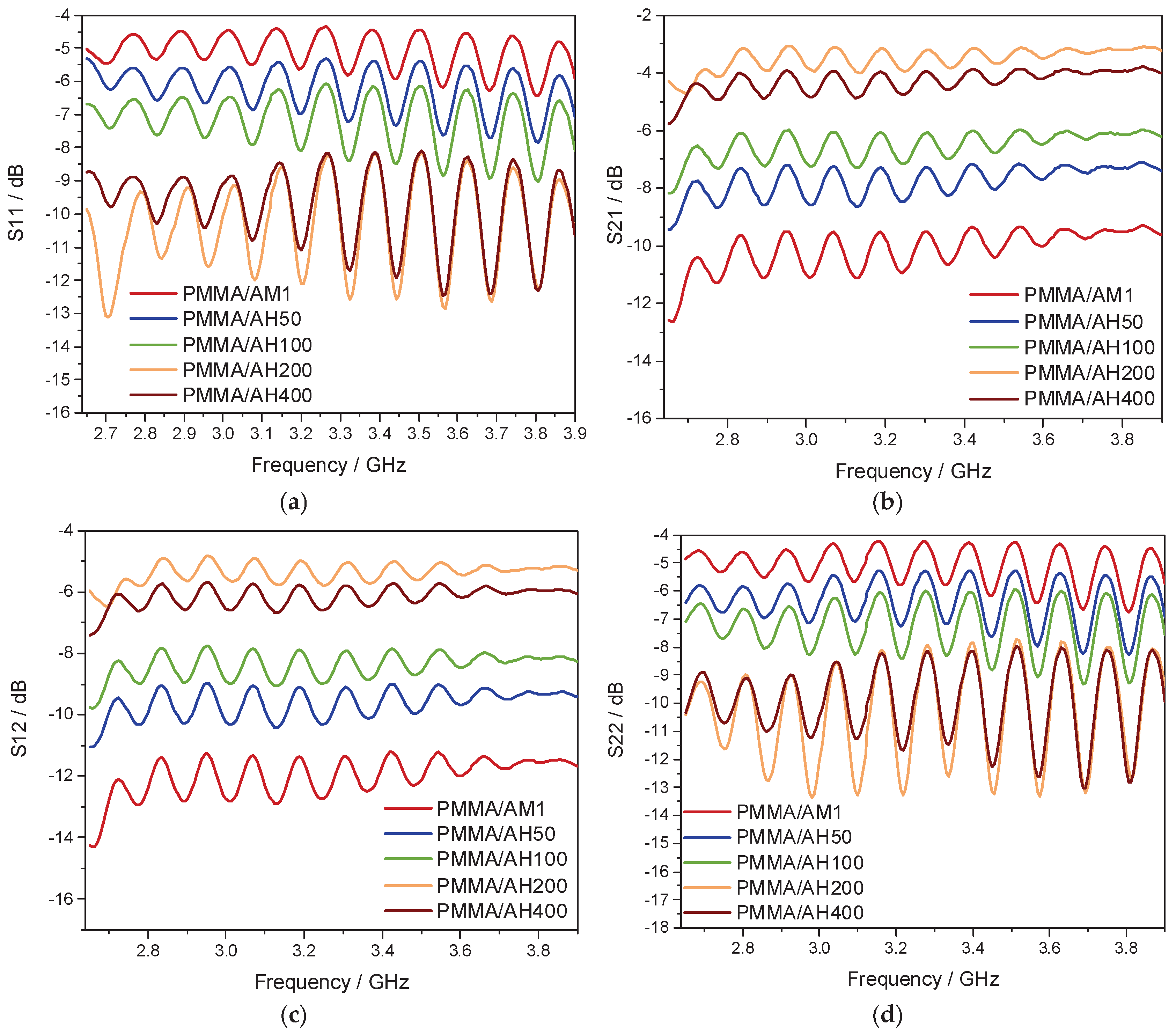
Figure 10.
Contribution of absorption (SEA) and reflection (SER) to total shielding effectiveness.
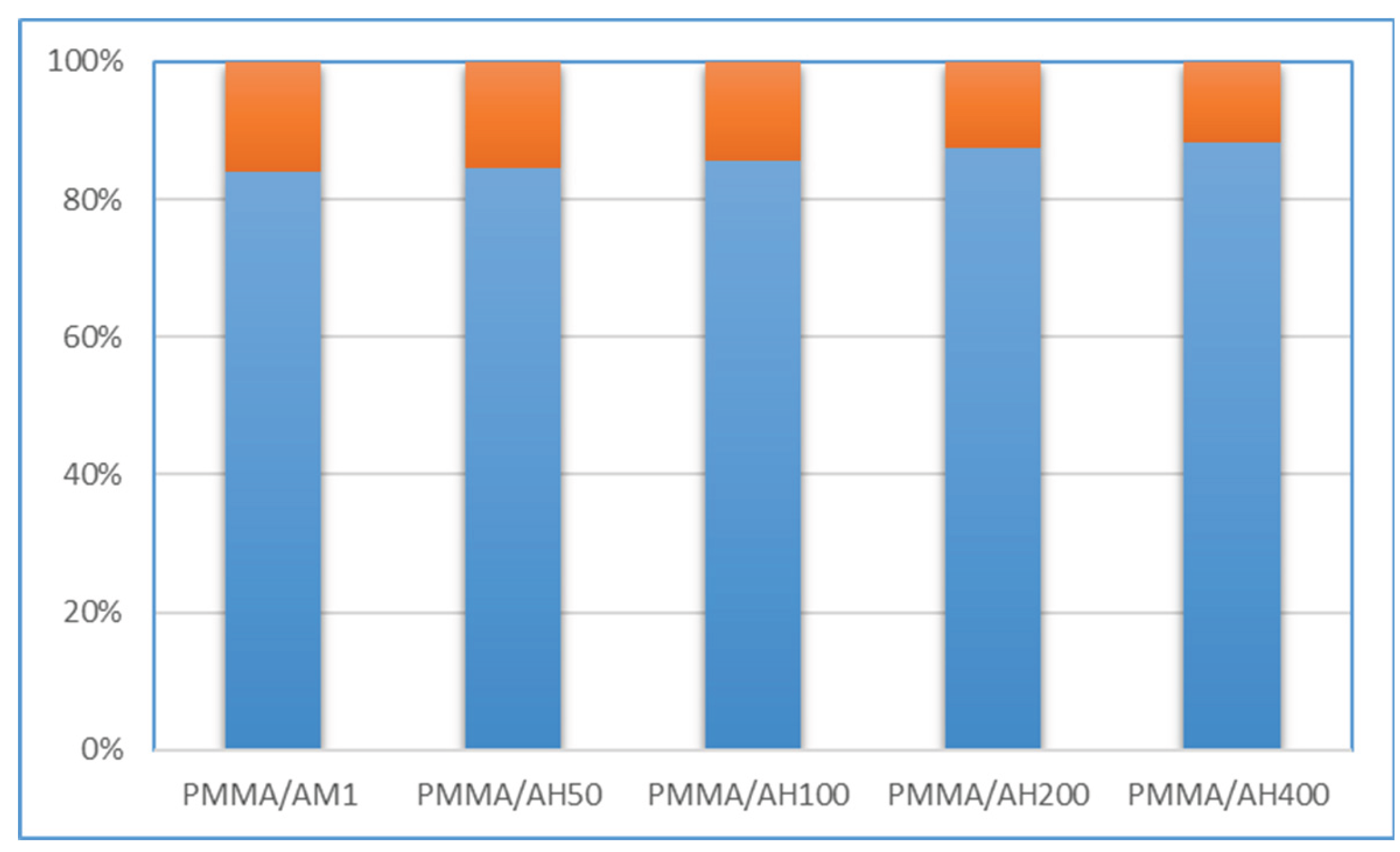
Figure 11.
3D response surface plots of predicted SET as a function of a) thickness (d) and irradiation (I) at fixed loading W = 20 wt.%, b) loading (W) and irradiation (I) at fixed thickness d = 0.48 mm and c) thickness (d) and loading (W) at fixed irradiation I = 50 kGy.
Figure 11.
3D response surface plots of predicted SET as a function of a) thickness (d) and irradiation (I) at fixed loading W = 20 wt.%, b) loading (W) and irradiation (I) at fixed thickness d = 0.48 mm and c) thickness (d) and loading (W) at fixed irradiation I = 50 kGy.
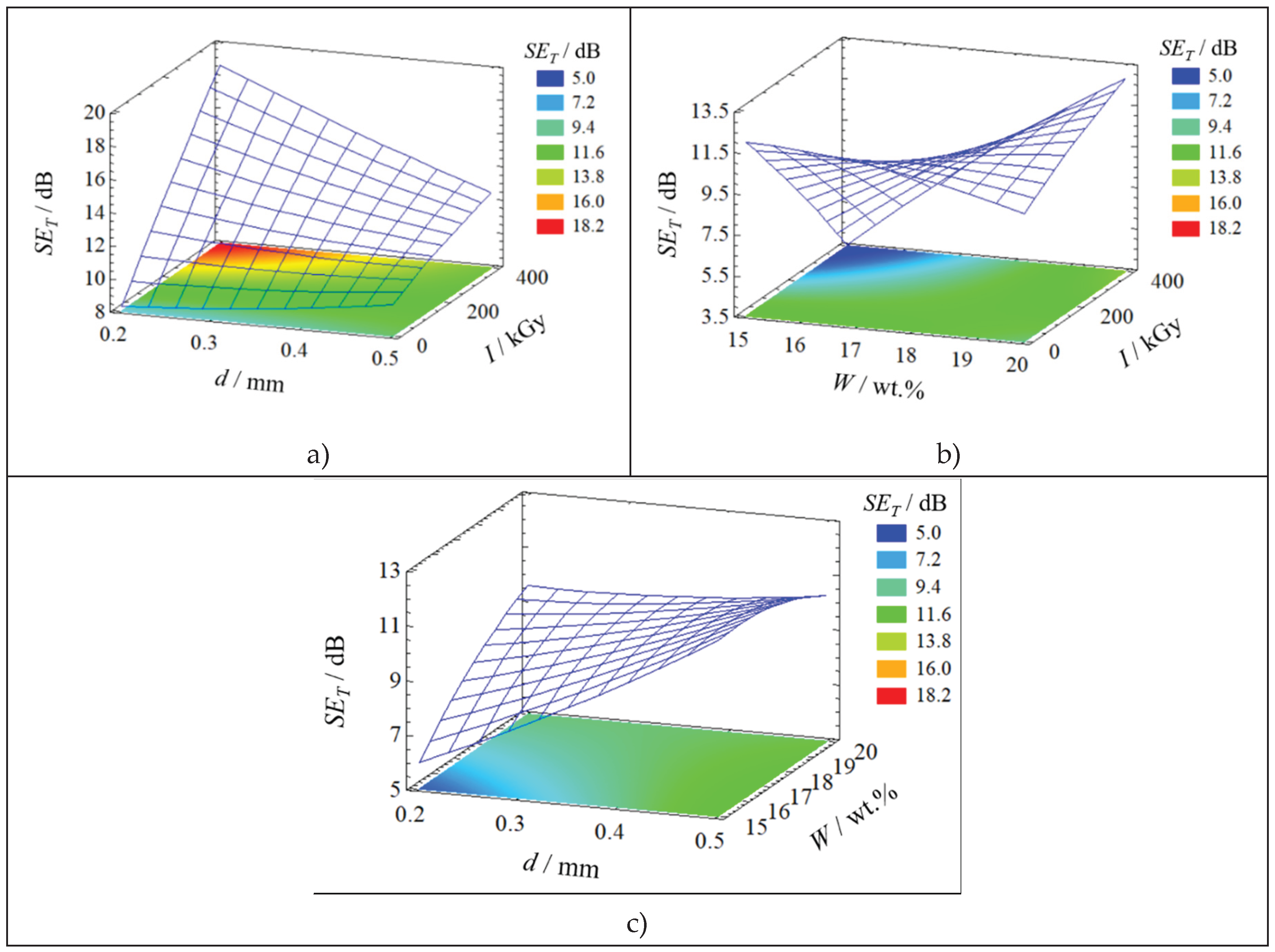

Table 1.
Conductivity of PMMA/G-MWCNT hybrid nanocomposites.
| Sample | dfilm [mm] | Conductivity [S/m] |
|---|---|---|
| PMMA | 0.190 | 2.3·10–13 |
| PMMA/AH50 | 0.280 | 0.04180 |
| PMMA/AH100 | 0.208 | 0.00813 |
| PMMA/AH200 | 0.280 | 0.00106 |
| PMMA/AH400 | 0.210 | 0.09020 |
Table 2.
Model coefficients of the quadratic model for EMI shielding effectiveness.
| Model coefficient | E values |
|---|---|
| -34.3318 | |
| 63.0837 | |
| 3.49155 | |
| -0.0748732 | |
| 9.81473 | |
| -3.23117 | |
| -0.0649753 | |
| -0.0682255 | |
| 0.00579882 | |
| -0.00000501632 |
Table 3.
Experimental vs. Predicted SET values using the reduced RSM model.
| Sample ID | d (mm) | W (wt%) | I (kGy) | Experimental avg. SET (dB) | Predicted SET (dB) |
|---|---|---|---|---|---|
| PMMA/AM1-50 (20% G-MWCNT) | 0.48 | 20 | 50 | 10.13 | 9.87 |
| PMMA/AH50 (15% G-MWCNT) | 0.28 | 15 | 50 | 7.75 | 7.68 |
| PMMA/AH100 (15% G-MWCNT) | 0.208 | 15 | 100 | 6.52 | 6.71 |
| PMMA/AH200 (15% G-MWCNT) | 0.28 | 15 | 200 | 3.51 | 3.62 |
| PMMA/AH400 (15% G-MWCNT) | 0.21 | 15 | 400 | 4.28 | 4.19 |
Disclaimer/Publisher’s Note: The statements, opinions and data contained in all publications are solely those of the individual author(s) and contributor(s) and not of MDPI and/or the editor(s). MDPI and/or the editor(s) disclaim responsibility for any injury to people or property resulting from any ideas, methods, instructions or products referred to in the content. |
© 2026 by the authors. Licensee MDPI, Basel, Switzerland. This article is an open access article distributed under the terms and conditions of the Creative Commons Attribution (CC BY) license (http://creativecommons.org/licenses/by/4.0/).
Copyright: This open access article is published under a Creative Commons CC BY 4.0 license, which permit the free download, distribution, and reuse, provided that the author and preprint are cited in any reuse.


