

Submitted:
25 June 2026
Posted:
26 June 2026
You are already at the latest version
Abstract
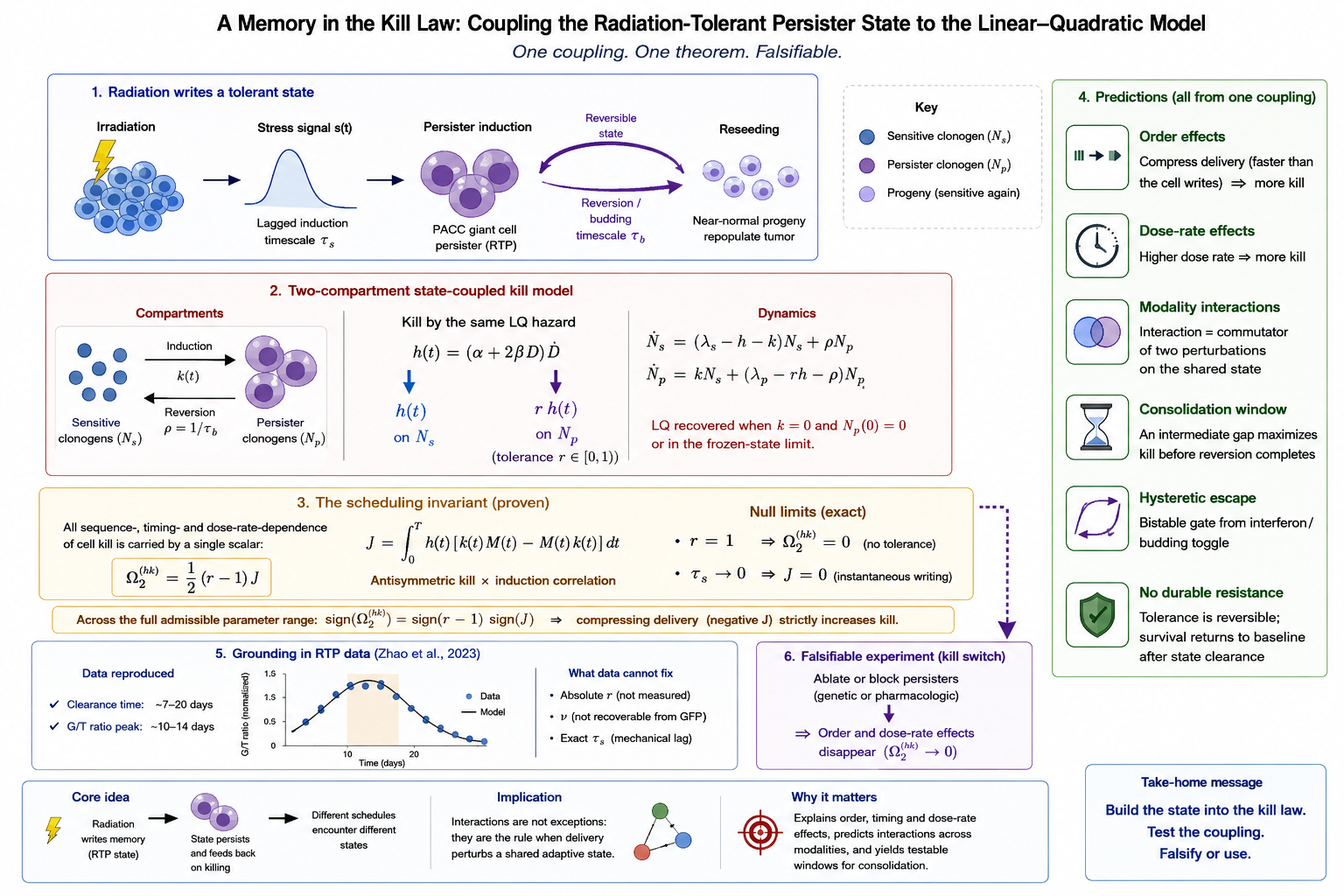
The linear–quadratic (LQ) model treats radiosensitivity as fixed: it describes how dose accumulates, but not how delivery patterns interact. That radiation response is governed by a treatment-written internal state is now a convergent view; what has been missing is a coupling between such a state and the kill law whose structure forces falsifiable results rather than fitting them. We supply one. Coupling the radiation-tolerant persister — a heritable, reversible tolerance state absent from prior state-based models — to LQ through a specific topology, a lagged write and a multiplicative tolerance back-arm on two populations, makes this the minimal non-commuting structure. From one fixed parameter set it forces, via operator-perturbation reduction, a single tolerance-gated commutator carrying all delivery-sequence, timing and dose-rate dependence; two exact nulls, one a persister-ablation kill switch; a cross-modality selection rule predicting which combinations interact from which state variables they perturb; a consolidation-timing window; and a bistable escape. The same structure makes BED, TCP and NTCP history-dependent and the latent state identifiable through designed perturbations. Grounded in published persister data, uncalibrated and qualitative by design, the framework is falsifiable at the level of structure.
Keywords:
linear–quadratic model
; delivery-pattern interaction
; adaptive state
; radiation-tolerant persister
; FLASH
; spatially fractionated radiotherapy
Copyright: This open access article is published under a Creative Commons CC BY 4.0 license, which permit the free download, distribution, and reuse, provided that the author and preprint are cited in any reuse.


