

Submitted:
09 June 2026
Posted:
10 June 2026
You are already at the latest version
Abstract
HBV infection exhibits striking age-dependent outcomes: perinatal infection progresses to chronicity in ~90% of cases, whereas >95% of immunocompetent adults spontaneously clear infection. Conventional explanations invoking immune immaturity or tolerance fail to account for prolonged disease courses, intermittent ALT flares, heterogeneous antigen trajectories, or delayed functional cure. We synthesize emerging evidence from developmental immunology, T-cell exhaustion biology, and longitudinal clinical observations into an integrated conceptual framework for understanding age-dependent HBV outcomes. Longitudinal clinical observations—including non‑monotonic HBsAg decline, dynamic sIL‑2R fluctuations, and intermittent biochemical activity—suggest that chronic HBV immunity remains dynamically active rather than statically quiescent. The framework proposes that early regulatory dominance favors viral persistence, whereas gradual Tpex enrichment and functional reorganization intermittently shift immune balance toward effector activation. Recurrent cycles of partial activation, contraction, and replenishment may contribute to long‑term antigen reduction, phase transitions, and occasional functional cure. HBV's limited immune evasion allows host developmental immune states to dominate, explaining its uniquely strong age dependence compared with other hepatotropic or chronic pathogens. Rather than viewing chronic HBV infection as a static state of immune tolerance, this framework conceptualizes HBV persistence as a slowly evolving immunodynamic process characterized by recurrent regulatory–effector rebalancing. The model generates experimentally testable predictions and provides a conceptual foundation for future longitudinal and systems‑immunology studies.
Keywords:
HBV infection
; chronic hepatitis B
; immune dynamics
; Treg
; Tpex
; immune fluctuation
; HBsAg kinetics
1. Introduction
1.1. Age-Dependent Outcomes of HBV Infection
HBV infection demonstrates marked age dependence: perinatal infection progresses to chronicity in ~90% of cases, whereas adult-acquired infection is typically self-limited [6,7]. Conventional explanations based on immune immaturity, neonatal tolerance, or high antigen exposure partially account for these differences but do not fully explain several important clinical observations, including:
prolonged decades-long transition phases;
intermittent ALT flares;
heterogeneous HBsAg decline trajectories;
delayed spontaneous HBsAg loss;
highly variable responsiveness to interferon-based therapy.
1.2. Clinical Observations Motivating the Framework
This conceptual framework was additionally motivated by longitudinal clinical observations from routine follow-up of chronic HBV patients in a real-world clinical setting. These observations derive from a subset of anonymized, retrospective follow-up data from routine clinical practice (consistent with the clinical evidence referenced in Section 9) and have not undergone formal statistical validation.
Across long-term serial monitoring, quantitative HBsAg levels in many patients did not decline monotonically. Instead, they frequently showed fluctuating downward trajectories characterized by:
intermittent partial declines;
transient plateaus or rebounds;
asynchronous ALT fluctuations;
dynamic variation in soluble IL-2 receptor (sIL-2R) levels.
In some patients, transient increases in sIL-2R (observed approximately 1-3 months prior) appeared temporally associated with subsequent HBsAg decline, whereas prolonged interferon therapy often produced an initial reduction phase followed by plateauing or rebound patterns.
These observations do not establish causality. However, they suggest that chronic HBV infection may involve recurrent low-amplitude immune fluctuations rather than static immune silence. Because these observations derive from retrospective clinical follow-up and have not yet undergone formal statistical analysis, they are presented here as hypothesis-generating empirical motivation rather than confirmatory evidence.
1.3. Emerging Immunological Evidence
Recent studies have identified stem-like progenitor exhausted CD8+ T cells (Tpex) as central regulators of persistent antiviral immunity [16]. Single-cell and longitudinal studies further suggest that HBV-specific immune activity persists even during the so-called immune tolerant phase [8,11]. A 2023 single-cell RNA sequencing study dissected coordinated immune responses across different HBV infection phases, revealing that the immune tolerant phase is not completely immunologically silent [11].
Together, these findings raise the possibility that chronic HBV infection reflects a dynamic balance between suppressive regulation and intermittent effector reactivation.
1.4. Core Proposition
We propose that age-dependent HBV outcomes emerge from long-term immunodynamic interactions between:
an early-life regulatory bias favoring persistence;
progressive expansion or relative enrichment of Tpex-associated populations;
intermittent immune activation cycles;
progressive reduction in antigen burden over time.
Within this framework, chronic infection is not interpreted as complete immunological inactivity, but rather as a slowly evolving dynamic equilibrium.
2. Conceptual Framework
2.1. Revisiting the "Immune Tolerant Phase"
The classical immune tolerant phase may instead represent a state of low-amplitude but persistent immune fluctuation dominated by regulatory networks [8,9,10]. HBV-specific T cells remain detectable, although their differentiation and effector capacity are constrained. A 2023 single-cell RNA sequencing study of paired liver and blood samples from individuals across different HBV infection phases, including immune tolerant patients, revealed that the immune tolerant phase is characterized by coordinated immune responses that are not completely quiescent, supporting the framework's reinterpretation [11].
2.2. Early Regulatory Bias and Persistence
In early childhood, developing T-cell compartments and strong regulatory signaling may favor tolerance-maintaining trajectories over durable effector differentiation. Epigenomic analysis has revealed that DNA methylation in naïve CD4+ T cells in response to activation is dynamic during infancy and adolescence, with age-specific effects that may drive variation in cytokine responses between these developmental stages [5]. A 2022 study found that monocytic myeloid-derived suppressor cells (mMDSCs) home to the thymus and contribute to age-related CD8+ T cell tolerance to HBV, providing a mechanistic basis for the age-dependent regulatory bias [21]. Persistent antigen exposure under these conditions may stabilize suppressive immune states while still permitting limited subclinical immune activity.
Importantly, this framework does not imply generalized immune deficiency in children. Rather, it proposes a relative bias toward regulatory maintenance under chronic antigen exposure.
Transition: This early regulatory bias establishes the initial immune context for HBV persistence, while simultaneously creating the conditions for the slow, progressive enrichment and functional reorganization of Tpex populations—a process that gradually tips the immune balance, as detailed in the following section.
2.3. Tpex-Associated Gradual Immune Shift
Under chronic antigen stimulation, Tpex-like populations may gradually become relatively enriched or undergo functional reorganization over time. Emerging studies suggest that stem-like exhausted CD8+ T-cell populations may contribute to sustained antiviral responsiveness during chronic infection [16]. Recent evidence from HBV/HIV co-infection studies demonstrates that individuals with well-controlled co-infection maintain more robust CD8+ T cell responses with preserved stem-like (Tpex) properties supporting ongoing antiviral function, while HBV mono-infection shows predominance of terminally exhausted cells [1]. This supports the framework's proposal that Tpex enrichment correlates with more effective antiviral immunity.
Furthermore, the transcription factor MYB has been identified as a central orchestrator of T cell exhaustion, mediating the development of CD62L+ Tpex cells and restraining the terminal differentiation of exhausted T cells. MYB regulates two fundamental aspects of exhausted T cell responses: the downregulation of effector function and the long-term preservation of self-renewal capacity [18].
Periodically, subsets of these cells may differentiate into transitional exhausted or partially functional effector states, which may potentially contribute to:
transient ALT elevations;
partial antigen reduction;
HBeAg seroconversion;
occasional long-term HBsAg decline.
Following activation, contraction of the activated compartment may occur, after which residual Tpex populations may undergo replenishment through self-renewal mechanisms inferred from chronic infection models [16].
The proposed process is irregular and non-periodic.
2.4. Longitudinal HBsAg Fluctuation as a Potential Immunodynamic Signature
In clinical follow-up, many chronic HBV patients exhibit fluctuating HBsAg decline trajectories rather than smooth monotonic decay.
Within this framework, such patterns may reflect recurrent partial immune activation cycles:
Tpex enrichment and activation → transient immune response → partial antigen reduction → contraction → replenishment.
Similarly, transient sIL-2R increases may theoretically indicate phases of heightened immune activation.
These interpretations remain speculative and require prospective longitudinal validation.
2.5. Additional Susceptibility Factors
Several additional age-dependent factors may modulate immune trajectories:
IL-21-associated immune modulation [13];
liver growth and cccDNA dilution effects [17];
thymic maturation and TCR repertoire diversification.
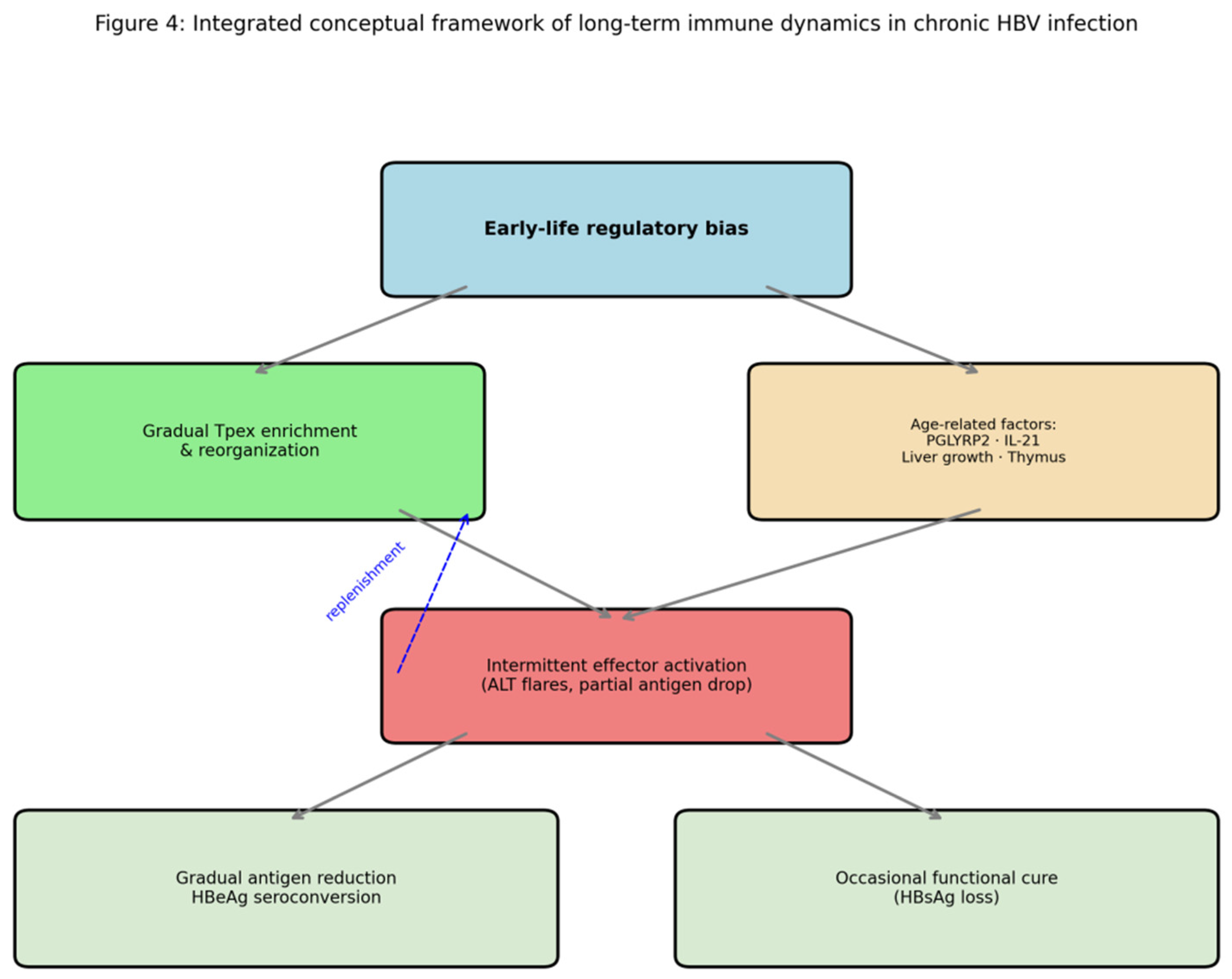
These factors are proposed as modulators rather than sole determinants. The integrated relationship among these factors, regulatory bias, Tpex dynamics, antigen load, and age-related modifiers is conceptually visualized in Figure 4.
Figure 1.
Age-dependent immunodynamic trajectories in HBV infection. Schematic showing divergent outcomes across perinatal, childhood, and adult infection. Highlights: early regulatory dominance → high chronicity risk; gradual Tpex enrichment and functional reorganization → transition toward intermittent immune activation and eventual clearance.
Figure 1.
Age-dependent immunodynamic trajectories in HBV infection. Schematic showing divergent outcomes across perinatal, childhood, and adult infection. Highlights: early regulatory dominance → high chronicity risk; gradual Tpex enrichment and functional reorganization → transition toward intermittent immune activation and eventual clearance.
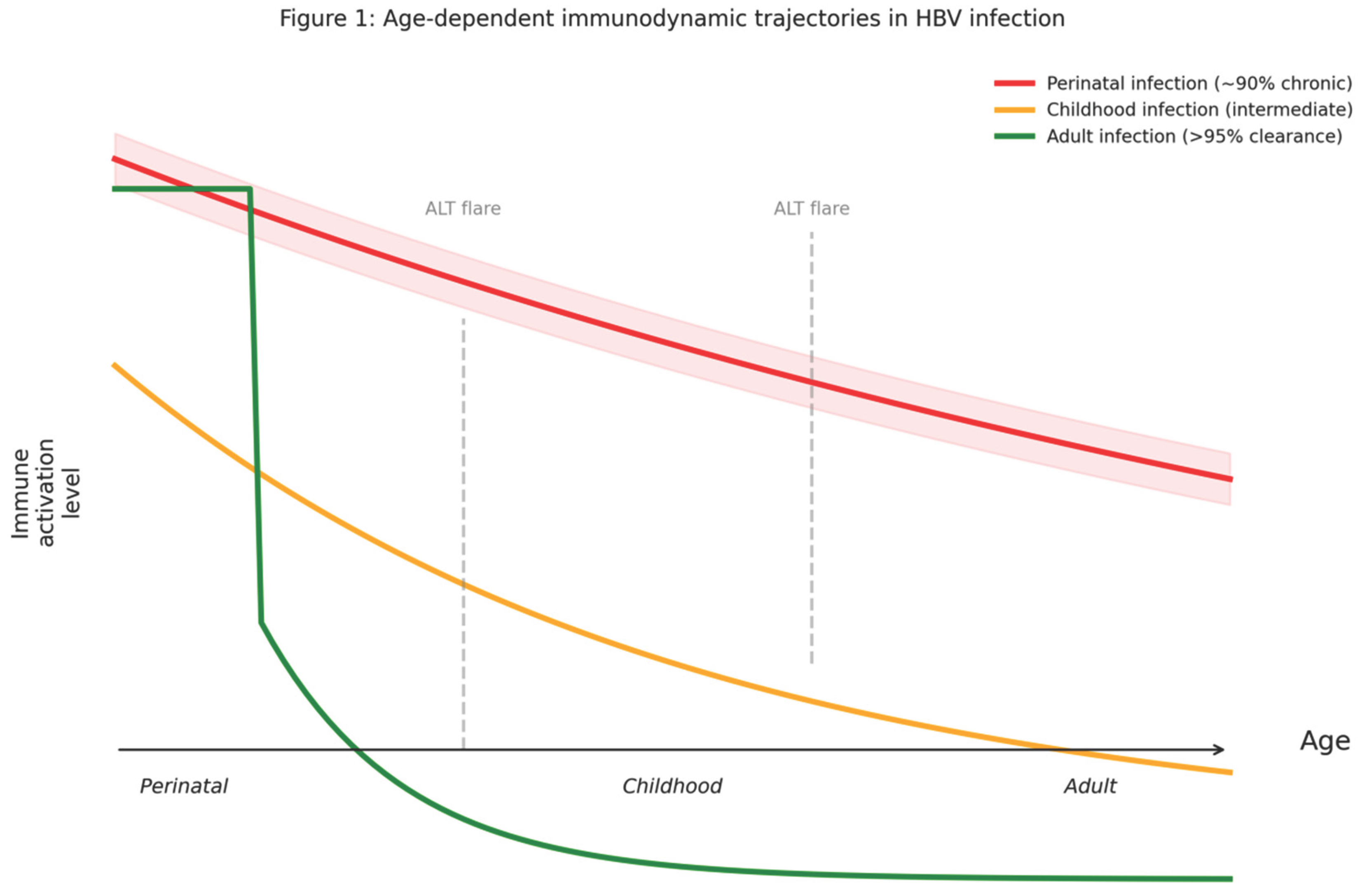
Figure 2.
Heuristic illustration of Tpex-associated cycles. Cycles of Tpex enrichment → partial effector activation → contraction → replenishment. Repeated cycles progressively reduce viral antigen burden and shift immune balance from regulatory dominance toward effector function.
Figure 2.
Heuristic illustration of Tpex-associated cycles. Cycles of Tpex enrichment → partial effector activation → contraction → replenishment. Repeated cycles progressively reduce viral antigen burden and shift immune balance from regulatory dominance toward effector function.
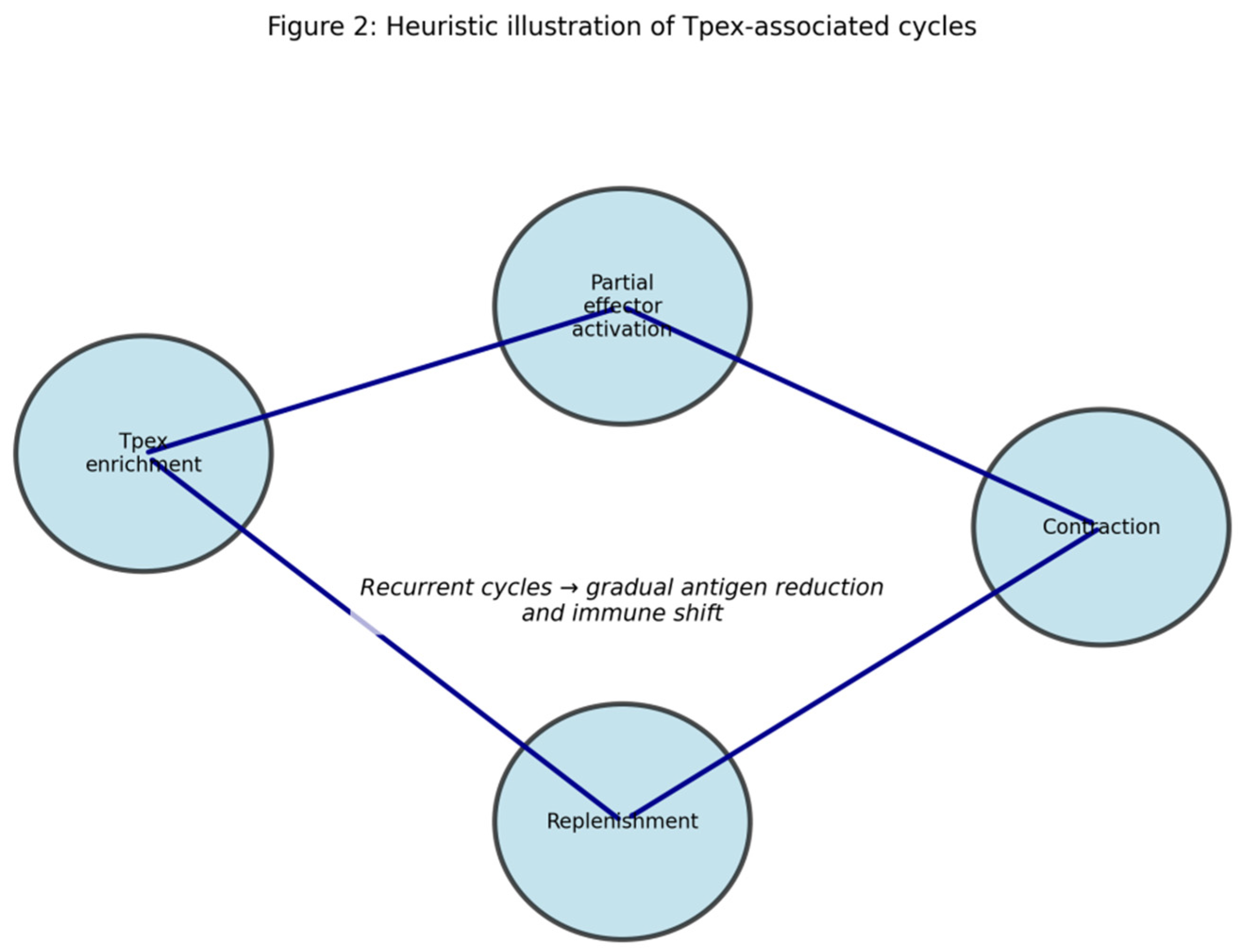
Figure 3.
Theoretical phase-dependent immune intervention windows. Timeline contrasting ascending (Tpex-enriched) versus contraction phases. Indicates periods of potentially higher responsiveness for immune-promoting therapies (conceptual illustration only).
Figure 3.
Theoretical phase-dependent immune intervention windows. Timeline contrasting ascending (Tpex-enriched) versus contraction phases. Indicates periods of potentially higher responsiveness for immune-promoting therapies (conceptual illustration only).
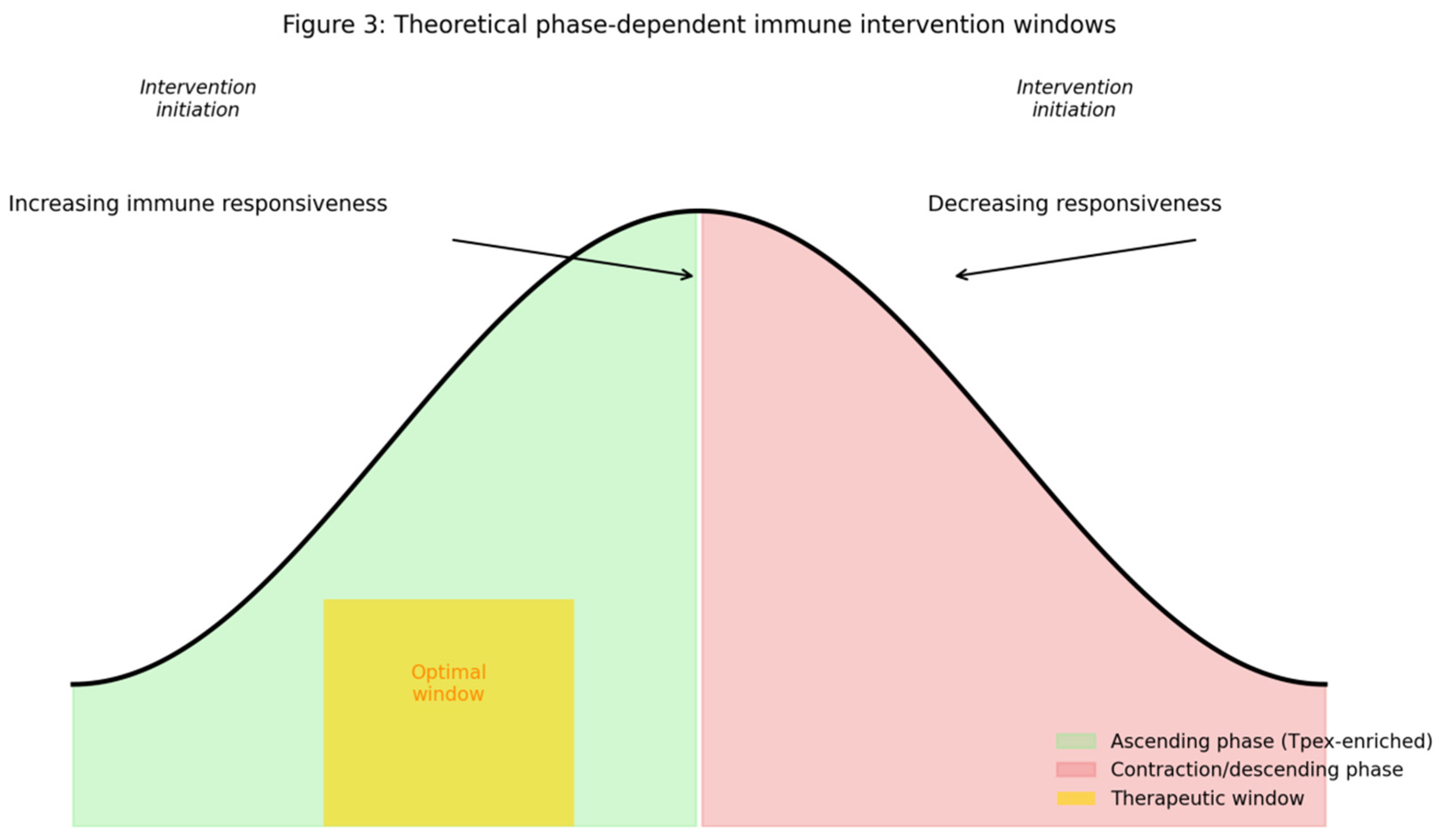
Figure 4.
Integrated conceptual framework. Flowchart integrating early regulatory bias, Tpex dynamics, antigen load, age-related factors (PGLYRP2, IL-21, liver growth, thymic maturation), and long-term immune equilibrium in chronic HBV infection.
Figure 4.
Integrated conceptual framework. Flowchart integrating early regulatory bias, Tpex dynamics, antigen load, age-related factors (PGLYRP2, IL-21, liver growth, thymic maturation), and long-term immune equilibrium in chronic HBV infection.
2.6. Factor Classification
| Category | Factor | Age dependence | Spontaneous recovery |
| Core chronicity-associated | Naive T-cell differentiation environment | Early-childhood bias | No |
| Core chronicity-associated | Long-term Treg/Tpex balance shift | Dynamic drift | No |
| Susceptibility | PGLYRP2, IL-21, gut microbiota | Increases with age | Yes |
| Bidirectional effect | Liver growth | Fast in infants, slow in adults | Conditional |
2.7. Kinetic Differences Between Acute and Chronic Infection
| Dimension | Adult acute infection | Early-childhood infection | Adult chronic infection* |
| Naive T-cell reserve | Abundant | Limited | Usually limited |
| Teff expansion capacity | Rapid, strong | Constrained | Usually constrained |
| Clearance outcome | One-time clearance, memory formed | Often chronic, may persist | Chronic (rare, special background) |
| Transition period | None | Decades | Variable |
| Therapeutic response potential | High (no intervention needed) | Better if treated early | Often requires immune correction |
| *Adult chronicity mainly immune-deficient or naive-T-limited; differs from regulatory bias-gradual shift in infants. | |||
2.8. Long-Term Balance and Clinical Guidelines
The Chinese Guidelines for the Prevention and Treatment of Chronic Hepatitis B (2022 edition) [3] recommend starting antiviral therapy for patients >30 years old with positive HBV DNA, even if ALT is normal. The framework may provide one possible conceptual interpretation of the age-related treatment considerations reflected in these guidelines.
3. The Role of Regulatory T Cells in Chronic HBV Infection
Regulatory T cells (Tregs) play a dual role in chronic HBV infection. On one hand, Tregs suppress antiviral T cell responses, contributing to viral persistence. On the other hand, Tregs may protect the liver from immune-mediated injury. In HCV, HBV, and HIV infections, the influence of Tregs ranges from suppressing antiviral T cell responses to protecting tissues such as the liver and immune cells from immune-mediated damage [14].
The balance between Treg-mediated suppression and effector T cell activation is therefore a critical determinant of disease outcome. Within the proposed framework, this balance shifts gradually over time as Tpex populations become relatively enriched and intermittent activation cycles occur, ultimately tilting the equilibrium away from regulatory dominance toward effector function.
4. Why Age Dependence Is Particularly Strong for HBV: A Comparative Pathogen Perspective
To further contextualize the core proposition that HBV's age dependence stems from host developmental immune bias rather than active immune evasion, we compare HBV with other pathogens that differ in their immune-interacting strategies.
The framework's core proposition rests on a specific set of viral properties: HBV does not directly infect or destroy immune cells, exhibits minimal antigenic variation, and does not actively sabotage the host's immune machinery beyond establishing regulatory dominance. A comparison with other pathogens that also target the liver but show markedly different age-dependent patterns supports this interpretation.
4.1. Hepatitis C Virus (HCV): High Adult Chronicity Despite Liver Tropism
HCV is also a hepatotropic virus, yet its age-dependent pattern differs strikingly from HBV. Approximately 70% (55-85%) of HCV infections in adults become chronic [10], whereas HBV chronicity in adults is only ~5%. This discrepancy might appear to challenge an age-dependent framework, but closer examination reveals that HCV actively subverts the immune system at multiple levels that HBV does not.
First, HCV directly infects and replicates in immune cells. HCV exhibits well-documented lymphotropism, infecting B cells, CD4+ T cells, and monocytes/macrophages. B-cell infection by HCV inhibits memory B-cell function and contributes to persistent infection. Lymphotropic HCV can infect primary naive CD4+ T cells and suppress their proliferation and Th1 commitment. Second, HCV has an exceptionally high mutation rate. As an RNA virus, HCV has a mutation rate approximately 100-fold higher than HBV (1 in 1,000 bases per year for HCV vs. 1 in 100,000 bases per year for HBV). This high variability enables rapid immune escape through the generation of neutralization-resistant quasispecies and T-cell epitope variants. Third, HCV actively interferes with innate immune signaling: its NS3/4A protease cleaves MAVS and TRIF, crippling RIG-I and TLR3 pathways.
These HCV-specific properties—lymphotropism, high mutation rate, and active innate immune sabotage—explain why HCV achieves high chronicity even in adults, overriding the age-dependent immunity that HBV does not fully escape. The framework's reasoning is therefore complemented, not contradicted, by the HCV example: when a pathogen directly targets the immune system or evades recognition through rapid mutation, age becomes less decisive.
4.2. Human Immunodeficiency Virus (HIV): Lifelong Infection with Weak Age Dependence
HIV directly infects CD4+ T cells, progressively destroying the very arm of the immune system required for viral control. This direct immune cell depletion fundamentally overrides any age-dependent shift in naive T-cell differentiation. In HIV-infected individuals, restoration of effective antiviral immunity is complicated by persistent immune activation, which can further exacerbate T-cell exhaustion. The HBV/HIV co-infection context provides a natural experiment: individuals with well-controlled co-infection maintain more robust HBV-specific CD8+ T cell responses with preserved stem-like (Tpex) properties, demonstrating that when HIV is effectively suppressed, the host's immune system can partially regain its ability to control HBV [1].
4.3. Epstein-Barr Virus (EBV): Lifelong B-Cell Latency
EBV establishes latency in B cells, using the host's B-cell compartment as a reservoir. This immune-cell tropism allows EBV to persist indefinitely irrespective of the age of primary infection. Although EBV infection outcomes vary with age (asymptomatic in early childhood vs. infectious mononucleosis in adolescence), chronicity itself is not age-dependent, consistent with the idea that immune-cell infection overrides age-dependent clearance mechanisms.
4.4. Mycobacterium Tuberculosis: Macrophage Infection
Mycobacterium tuberculosis (Mtb) infects and persists within macrophages, inhibiting phagosome maturation and suppressing antigen presentation, thereby evading CD4+ and CD8+ T-cell responses. The ability of Mtb to survive within professional phagocytes enables it to establish latent infection independently of the host's age-dependent regulatory T-cell bias.
4.5. HBV's Unique Position and Supporting Evidence
Consistent with the clinical observations in Section 1.2, our routine follow-up further suggests that Tpex preservation correlates with more effective antiviral immunity.
HBV is distinctive among major chronic pathogens in that it does not directly infect immune cells, does not rapidly mutate its key antigens, and does not actively sabotage innate immune signaling beyond establishing a regulatory network that exploits the host's own developmental biology. Its replication strategy relies on cccDNA persistence in hepatocytes, but the initial outcome of infection—clearance vs. chronicity—is largely determined by the host's immune state at the time of exposure.
A recent 2025 study published in Gut directly supports this framework, demonstrating that individuals with well-controlled HBV/HIV co-infection maintain more robust CD8+ T cell responses with preserved stem-like (Tpex) properties [1]. This finding aligns with our framework's core proposition. The study also found that longer treatment duration positively associates with Tpex populations and functional responses, consistent with the framework's proposal that antigen reduction over time may facilitate immune restoration [1]. These findings provide empirical evidence that Tpex preservation correlates with more effective antiviral immunity, directly supporting the framework's central proposition that gradual Tpex enrichment and functional reorganization are key determinants of long-term viral control.
This unique vulnerability makes HBV a particularly informative model for studying how developmental immunology influences infectious disease outcomes. The framework thus provides a lens through which to understand why HBV age dependence is exceptionally strong—precisely because the virus does not deploy the aggressive immune-subverting strategies that other pathogens use to circumvent host defenses.
5. Age-Dependent T Cell Differentiation and Epigenomic Remodeling
The developmental state of the T cell compartment at the time of HBV exposure is a major determinant of infection outcome. Distinct epigenomic landscapes in CD4+ T cells across different ages—from newborns to centenarians—reveal age-related transcription and methylation changes that shape T cell aging phenotypes [20]. These epigenomic differences likely contribute to the differential capacity for effector differentiation observed between infants and adults.
Furthermore, the transcription factor Foxp3 programs the development and function of CD4+CD25+ regulatory T cells, establishing a molecular basis for the regulatory bias that dominates early-life immune responses [2]. Interleukin-2 (IL-2) plays a crucial role in this regulatory network, as tolerance rather than immunity crucially depends on IL-2, with failure in CD4+CD25+ regulatory T cell production being the underlying cause of autoimmunity in the absence of IL-2 [15].
6. Testable Predictions
The framework generates several experimentally testable predictions.
6.1. Longitudinal Immune Fluctuation
Serial TCR repertoire sequencing may reveal intermittent expansion-contraction patterns of HBV-specific clones during clinically "inactive" phases. A 2023 study established an HBV-specific TCRβ chain dataset from public databases and acute hepatitis B patients, providing a resource for tracking HBV-specific T cell clonal dynamics [19].
6.2. HBsAg Fluctuation Dynamics
Longitudinal quantitative HBsAg trajectories may exhibit non-random fluctuation structures associated with immune activation markers.
6.3. sIL-2R Temporal Association
Dynamic increases in sIL-2R may precede or accompany periods of accelerated HBsAg decline.
6.4. Tpex-Associated Transitions
Higher peripheral or intrahepatic Tpex abundance (characterized by TCF-1+PD-1intCD127+ markers) may correlate with:
ALT flare probability;
HBsAg decline;
interferon responsiveness.
6.5. Phase-Dependent Therapeutic Efficacy
Immune intervention initiated during biologically "ascending" immune phases may demonstrate different outcomes compared with fixed-time intervention.
7. Potential Data Integration Strategies
To transition from conceptual hypothesis toward data-supported immunodynamic modeling, several feasible approaches may be incorporated in future work.
7.1. Longitudinal Clinical Cohort Analysis
Retrospective or prospective analysis of serial HBsAg, ALT, HBV DNA, and sIL-2R trajectories could characterize:
fluctuation frequency;
oscillatory structure;
antigen decline kinetics;
therapy-associated dynamic changes.
7.2. Public TCR Repertoire Datasets
Public HBV-related TCR sequencing datasets may be reanalyzed to investigate intermittent clonal expansion patterns. The 2023 HBV-specific TCRβ chain dataset provides a valuable resource for such analyses [19].
7.3. Single-Cell Transcriptomic Datasets
Public GEO or scRNA-seq datasets may be secondarily analyzed to assess:
Tpex enrichment;
exhaustion-state transitions;
age-associated immune composition changes.
The 2023 single-cell RNA sequencing study across different HBV infection phases provides a rich resource for understanding coordinated immune responses [11].
7.4. Interferon-Treatment Trajectory Analysis
Longitudinal HBsAg curves during interferon therapy may be categorized into:
sustained responders;
plateau patterns;
rebound patterns.
Such stratification may help evaluate the proposed phase-dependent framework.
8. Conceptual Therapeutic Implications
⚠️ All therapeutic interpretations below are theoretical, intended only to illustrate potential directions for future investigation, and are not clinical recommendations.
8.1. Phase-Dependent Responsiveness
If chronic HBV immunity indeed fluctuates dynamically, responsiveness to immune-promoting therapies may vary according to underlying immune phase. Whether periods of increasing immune responsiveness provide more favorable conditions for interferon-based therapy or checkpoint-related immune restoration remains an open question requiring prospective validation.
8.2. Antigen Reduction Followed by Immune Restoration
Long-term nucleos(t)ide analogue therapy may reduce antigen burden and suppress continuous high-level immune exhaustion. Whether subsequent immune-promoting interventions during favorable immune phases improve the probability of functional cure is a hypothesis that awaits empirical testing.
8.3. Interpretation of Interferon Plateau Phenomena
In routine clinical observation, some interferon-treated patients demonstrate initial HBsAg decline followed by later plateau formation or occasional rebound patterns. Within this framework, these patterns may reflect temporary immune activation followed by contraction or exhaustion re-equilibration, but this interpretation remains speculative.
9. Limitations
Several major limitations should be emphasized.
The framework is conceptual rather than quantitatively validated.
Most proposed mechanisms are inferred from indirect evidence.
Longitudinal intrahepatic immune data remain limited.
Clinical observations described here have not undergone formal statistical analysis.
sIL-2R is an indirect immune activation marker and cannot substitute for direct IL-2 measurements. While this limits the precision of current clinical observations, the proposed temporal association remains testable by direct IL-2 quantification in future studies, which would strengthen the framework's validity.
The proposed immune phases are currently not clinically measurable entities.
Thus, this framework is not intended to provide immediate clinical decision-making criteria, but rather to serve as a hypothesis-generating platform that integrates developmental immunology, Tpex biology, and clinical observation—guiding future empirical research to validate the proposed dynamic mechanisms. Accordingly, this framework should be interpreted as a mechanistic hypothesis-generation model rather than a clinical decision framework.
10. Conclusion
HBV exhibits one of the strongest age-dependent outcome patterns among human viral infections, yet the mechanisms linking developmental immunity to long-term viral persistence remain incompletely understood.
This conceptual framework integrates developmental immune bias, Tpex biology, and longitudinal clinical observations into a unified model of chronic HBV immunodynamics. Rather than viewing chronic infection as a static state of immune tolerance, the framework conceptualizes persistent HBV infection as a slowly evolving dynamic equilibrium characterized by gradual shifts in regulatory and antiviral immune activity over time.
By linking age-dependent susceptibility, heterogeneous HBsAg trajectories, intermittent biochemical activity, and emerging evidence on stem-like exhausted T cells, the framework provides a coherent interpretation of several previously disconnected clinical and immunological observations.
The model generates testable predictions that can be evaluated through longitudinal clinical cohorts, T-cell repertoire analyses, and single-cell immune profiling. Although conceptual and not yet quantitatively validated, the framework offers a structured platform for future investigation of HBV persistence and immune restoration.
Supplementary Materials
The following supporting information can be downloaded at the website of this paper posted on Preprints.org.
Funding
No dedicated funding was received.
Ethics statement
This manuscript is primarily conceptual and based on published literature together with anonymized longitudinal clinical observations from routine follow-up practice. No identifiable patient information is included. Formal cohort-based statistical analysis was not performed in the present manuscript. The use of these anonymized data was exempted by the Institutional Ethics Committee of Xuancheng Central Hospital under routine clinical data analysis guidelines.
AI assistance statement
AI-assisted tools were used exclusively for language refinement, structural organization, and editing support. All scientific concepts, interpretations, and conclusions were independently developed by the author.
Data availability
No new experimental datasets were generated for the present study.
Conflict of interest
The author declares no conflicts of interest.
References
- Preechanukul, A.; Alrubayyi, A.; Sun, B.; Arbe-Barnes, E.; Kokiçi, J.; Gorou, F.; et al. Stem-like CD8+ T cells preserve HBV-specific responses in HBV/HIV co-infection. Gut 2025. [Google Scholar] [CrossRef] [PubMed]
- Fontenot, J.D.; Gavin, M.A.; Rudensky, A.Y. Foxp3 programs the development and function of CD4+CD25+ regulatory T cells. Nat. Immunol. 2003, 4(4), 330–336. [Google Scholar] [CrossRef] [PubMed]
- Chinese Society of Hepatology; Chinese Medical Association; Chinese Society of Infectious Diseases; Chinese Medical Association. Guidelines for the Prevention and Treatment of Chronic Hepatitis B (version 2022). J. Clin. Transl. Hepatol. 2023, 11(6), 1425–1442. [Google Scholar] [CrossRef]
- Shi, M.; Li, Y.; Ma, H.; et al. PGLYRP2 drives hepatocyte-intrinsic innate immunity by trapping and clearing hepatitis B virus. J. Clin. Invest. 2025, 135(8), e188083. [Google Scholar] [CrossRef]
- Imran, S.; Neeland, M.R.; Peng, S.; et al. Epigenomic variability is associated with age-specific naïve CD4 T cell response to activation in infants and adolescents. Immunol. Cell Biol. 2023, 101(5), 397–411. [Google Scholar] [CrossRef]
- Rehermann, B.; Nascimbeni, M. Immunology of hepatitis B virus and hepatitis C virus infection. Nat. Rev. Immunol. 2005, 5(3), 215–229. [Google Scholar] [CrossRef]
- Kennedy, P.T.F.; Sandalova, E.; Jo, J.; et al. Preserved T-cell function in children with chronic hepatitis B virus infection. Gastroenterology 2012, 143(3), 637–645. [Google Scholar] [CrossRef]
- Wang, H.Y.; Chien, M.H.; Huang, H.P.; et al. Distinct hepatitis B virus dynamics in the immunotolerant and early immunoclearance phases. J. Virol. 2010, 84(7), 3454–3463. [Google Scholar] [CrossRef]
- D'Antiga, L.; Aw, M.; Atkins, M.; et al. Combined lamivudine/interferon-alpha treatment in "immunotolerant" children perinatally infected with hepatitis B: a pilot study. J. Pediatr. 2006, 148(2), 228–233. [Google Scholar] [CrossRef]
- Guidotti, L.G.; Chisari, F.V. Noncytolytic control of viral infections by the innate and adaptive immune response. Annu Rev. Immunol. 2001, 19, 65–91. [Google Scholar] [CrossRef]
- Zhang, C.; Li, J.; Cheng, Y.; et al. Single-cell RNA sequencing reveals intrahepatic and peripheral immune characteristics related to disease phases in HBV-infected patients. Gut 2023, 72(1), 153–167. [Google Scholar] [CrossRef]
- Smith, Z.D.; Meissner, A. DNA methylation: roles in mammalian development. Nat. Rev. Genet. 2013, 14(3), 204–220. [Google Scholar] [CrossRef]
- Publicover, J.; Goodsell, A.; Nishimura, S.; et al. IL-21 is pivotal in determining age-dependent effectiveness of immune responses in a mouse model of human hepatitis B. J. Clin. Invest. 2011, 121(3), 1154–1162. [Google Scholar] [CrossRef] [PubMed]
- Li, S.; Gowans, E.J.; Chougnet, C.; et al. Regulatory T cells in HBV and HCV infections. Front Immunol. 2018, 9, 2731. [Google Scholar] [CrossRef]
- Malek, T.R.; Bayer, A.L. Tolerance, not immunity, crucially depends on IL-2. Nat. Rev. Immunol. 2004, 4(9), 665–674. [Google Scholar] [CrossRef] [PubMed]
- Beltra, J.C.; Manne, S.; Abdel-Hakeem, M.S.; et al. Developmental relationships of four exhausted CD8+ T cell subsets reveal underlying transcriptional and epigenetic landscape control mechanisms. Immunity 2020, 52(5), 825–841.e8. [Google Scholar] [CrossRef]
- Allweiss, L.; Dandri, M. The role of cccDNA in HBV maintenance. Viruses 2017, 9(6), 156. [Google Scholar] [CrossRef]
- Tsui, C.; Kretschmer, L.; Rapelius, S.; et al. MYB orchestrates T cell exhaustion and response to checkpoint inhibition. Nature 2022, 609(7926), 354–360. [Google Scholar] [CrossRef]
- Li, X.; Zheng, A.; Liu, J.; et al. Assessing the chronic hepatitis B adaptive immune response by profiling specific T-cell receptor repertoire. Antivir. Res. 2023, 214, 105608. [Google Scholar] [CrossRef]
- Zhao, M.; Qin, J.; Yin, H.; et al. Distinct epigenomes in CD4+ T cells of newborns, middle-ages and centenarians. Sci. Rep. 2016, 6, 38411. [Google Scholar] [CrossRef]
- Fang, Z.; Zhang, Y.; Zhu, Z.; et al. Monocytic MDSCs homing to thymus contribute to age-related CD8+ T cell tolerance of HBV. J. Exp. Med. 2022, 219(4), e20211838. [Google Scholar] [CrossRef]
- Gane, E.; Verdon, D.J.; Brooks, A.E.; et al. Anti-PD-1 blockade with nivolumab with and without therapeutic vaccination for virally suppressed chronic hepatitis B: a pilot study. J. Hepatol. 2019, 71(5), 900–907. [Google Scholar] [CrossRef]
Disclaimer/Publisher’s Note: The statements, opinions and data contained in all publications are solely those of the individual author(s) and contributor(s) and not of MDPI and/or the editor(s). MDPI and/or the editor(s) disclaim responsibility for any injury to people or property resulting from any ideas, methods, instructions or products referred to in the content. |
© 2026 by the authors. Licensee MDPI, Basel, Switzerland. This article is an open access article distributed under the terms and conditions of the Creative Commons Attribution (CC BY) license (http://creativecommons.org/licenses/by/4.0/).
Copyright: This open access article is published under a Creative Commons CC BY 4.0 license, which permit the free download, distribution, and reuse, provided that the author and preprint are cited in any reuse.


