Preprint
Article

This version is not peer-reviewed.

Reference Genes for Circadian Profiling of Core Clock Genes in the Blood of Obstructive Sleep Apnea Patients

Submitted:

09 June 2026

Posted:

11 June 2026

You are already at the latest version

Abstract

Circadian rhythm disruptions are increasingly recognized in disorders such as obstructive sleep apnea (OSA), yet analysis of 24-hour gene expression patterns remains challenging due to the lack of reliable reference genes for normalization. Even commonly used housekeeping genes may exhibit circadian oscillations, which can confound rhythmic gene expression analyses and hinder biomarker identification. To address this limitation, we evaluated the gene expression stability of 11 commonly used housekeeping genes in blood collected every 6 hours over 24-hour period from 40 adults with varying OSA severity and controls. Stability ranking by analytical tools RefFinder and EndoGeneAnalyzer identified ACTB (β-actin) and RPL13A (ribosomal protein L13a) as the most consistent reference genes, with minimal intra- and inter-individual variability across sampling times and disease groups. Their suitability was assessed by personalized cosinor analysis of core clock genes (BMAL1, PER2, CRY1), demonstrating that appropriate normalization enables detection of circadian oscillations in clinical samples. Using the optimal normalization, CosinorPy analysis of the core clock genes revealed significant circadian oscillations of at least one clock gene in the studied participants. These findings establish ACTB and RPL13A as robust reference genes for blood-based circadian studies of OSA and provide an important methodological framework for future circadian biomarker research.

Keywords: 
;  ;  ;  ;  ;  

1. Introduction

Despite advances in transcriptomic technologies, quantitative reverse transcription polymerase chain reaction (qRT-PCR) remains the gold standard for low-throughput gene expression analysis. Accurate qRT-PCR measurements depend on RNA quality, reverse transcription and PCR efficiency, and particularly on the selection of appropriate reference genes for normalization [1]. Because reference gene suitability is context-dependent, circadian studies require genes with stable 24-hour expression profiles. However, this is challenging since the circadian clock regulates a wide range of physiological processes, including the expression of commonly used reference genes themselves.
Circadian rhythm is an adaptation of living organisms to the natural cycle of environmental light and darkness, with an intrinsic period of approximately 24 hours [2,3]. On a molecular level, it is controlled by the transcriptional and translational feedback loops of core clock components. The central clock involves transcription factors (e.g., BMAL1 and CLOCK) activating clock-controlled genes (PER and CRY gene families), which in turn inhibit the activators and produce self-sustained oscillations [2]. This biological clock is intrinsic to almost all life forms and has gained increasing interest, particularly due to its impact on physiology. Circadian rhythms influence a variety of physiological processes, from metabolism, regulation of body temperature, endocrine secretion and even labor onset [4]. Understanding the genetic mechanisms that drive circadian rhythms is crucial, as disruptions in these rhythms are linked to health conditions [5], such as metabolic disorders (e.g. metabolic dysfunction-associated steatotic liver disease [6,7,8], cardiovascular diseases (e.g. heart failure) [9], and sleep disturbances (e.g. obstructive sleep apnea) [10].
We aim to identify reliable circadian biomarkers in blood cells of patients with obstructive sleep apnea (OSA), a disorder characterized by repeated breathing interruptions during sleep, fragmented sleep, intermittent hypoxia, and multiple health complications [2,11] that overlap with other diseases associated with circadian rhythm disruption [3]. Accumulating evidence indicates that OSA disrupts the molecular circadian clock, and it has been hypothesized that OSA severity correlates with distinct patterns of clock gene expression in peripheral blood cells [2]. Therefore, a prerequisite for this investigation is the identification of stable reference genes from human blood cells for normalizing the circadian gene expression [12,13]. Since most validated datasets are still rodent-based, human circadian normalization studies remain scarce, which limits accurate and reproducible circadian gene expression studies in humans [12,13,14,15,16,17,18]. Therefore, the primary goal of this study was to determine which housekeeping genes exhibit the most stable expression profiles across different time points and different OSA severities. We present a 24-hour analysis of candidate reference gene expression of RNA, isolated from the buffy coat (the leukocyte-thrombocyte layer) of blood from patients with varying OSA severity. Our results identify two reference genes that are most suitable for normalizing circadian expression of core clock genes, paving the foundation for future circadian biomarker discovery in OSA.

2. Materials and Methods

2.1. Subjects and Blood Sample Collection

Forty participants (16 women and 24 men, aged 18–65 years) with clinically suspected OSA underwent overnight respiratory polygraphy (PG; Alice NightOne, Philips) in a hospital setting at the Clinical Institute of Clinical Neurophysiology, University Medical Centre Ljubljana, Slovenia. The study was approved by the Commission for Medical Ethics of the Republic of Slovenia (approval No. 0120-65/2023/3) and conducted in accordance with its guidelines. All participants were of the same ethnic background and provided written informed consent in the presence of the responsible physician. Participants were classified by apnea–hypopnea index (AHI) into four groups: control (AHI < 5), mild (AHI 5–14.9), moderate (AHI 15–29.9), and severe (AHI ≥ 30) OSA, each comprising 10 individuals.
Before the overnight respiratory PG, the participants were given instructions on timing and composition of the meal, and directions about sleep hygiene. Participants were asked to: eat dinner before 18:00 at home as fat-free as possible; not to eat before morning sampling (at 7:00); abstain from drinking coffee and alcohol throughout the study protocol. The PG started recording at 22:00 and ended at 6:00 the next day. During that time, patients were instructed not to use electronic devices, turn off the light, and to go to sleep as soon as possible. Any interaction between medical staff and patients during the night was performed using dim light.
During the study, peripheral venous blood (3 mL per draw, EDTA anticoagulant) was collected via an indwelling catheter at five time points over 24 hours: T0, 13:00; T1, 19:00; T2, 01:00; T3, 07:00; T4, 13:00 (following day). Within 30 minutes of each draw, samples were centrifuged (2000 × g, 15 min, 4 °C), plasma was removed, and 300 µL of buffy coat was collected for RNA isolation.

2.2. RNA Isolation, cDNA Preparation, and qRT-PCR

Total RNA was extracted from buffy coat using TRI Reagent LS (Sigma-Aldrich); the detailed protocol is provided in the Appendix A1. RNA quantity and purity were assessed by spectrophotometry (NanoDrop 1000, Thermo Scientific). Complementary DNA was synthesized with the QuantiTect Reverse Transcription Kit (Qiagen). qRT-PCR was performed using PowerTrack SYBR Green Master Mix (Applied Biosystems) on a QuantStudio 5 instrument (Applied Biosystems), following the manufacturer's recommended cycling conditions. All reactions were run in triplicate with no-template controls, and amplification specificity was confirmed by melt-curve analysis (single peak per primer set).

2.3. Primer Design

Eleven candidate reference genes were selected based on published literature [1,9,13,14,16,17,19,20,21,22,23,24] and previous work from our group [15]: GAPDH, SDHA, PPIB, ACTB, CDK4, HPRT1, RPL13A, TUBB2A, PPIA, UBC, and TBP. Additional primer sets were tested for selected genes (denoted '#2') to evaluate alternative splice variants or amplicon targets (SDHA #2, PPIB #2, CDK4 #2). Primers were designed with NCBI Primer-BLAST (Table S1). Amplification efficiency was determined by standard curve analysis; only primer pairs with efficiency between 90–110% were retained, and specificity was confirmed by gel electrophoresis. Primer sequences, amplicon lengths, and efficiencies are listed in Table S2. Raw quantification cycle (Cq) data were managed with QuantStudio Design and Analysis Software version 1.6.1.

2.4. Reference Gene Stability Analysis

Reference gene stability was assessed using two complementary tools. RefFinder [25] integrates four established algorithms: geNorm [26], NormFinder [27], BestKeeper [28], and the comparative ΔCt method [29]. It generates a geometric mean-based comprehensive ranking (lower score = higher stability). EndoGeneAnalyzer [30] complements RefFinder by accommodating complex, multi-factor designs. It handles multiple grouping variables (e.g., disease group, time point), removes outliers, and computes NormFinder-based stability metrics within each subgroup. This enabled evaluation not only across the full dataset but also within specific conditions (OSA severity, 24-hour intra-individual variation, and time of day). Reference gene selection followed a stepwise elimination approach guided by results from both tools (Section 3.1).

2.5. Cosinor Analysis of Core Gene Rhythmicity

To validate the selected reference genes, the rhythmic expression of core clock genes BMAL1, CRY1, and PER2 was examined by cosinor rhythmometry, a statistical method that fits a cosine function to time-series data and tests for a 24-hour oscillation. The fitted model yields three biologically meaningful parameters: the mesor (rhythm-adjusted mean expression level), the amplitude (half the peak-to-trough difference, indicating oscillation magnitude), and the acrophase (time at which expression peaks). Cq values were normalized using an efficiency-corrected relative quantity method. For each gene, the relative quantity was calculated as E^(−Cq), where E denotes the amplification efficiency factor (E = 1 + efficiency/100). To obtain a sample-scaled relative expression, each value was divided by the maximum observed expression across all samples for the respective gene. The normalization factor (NF) was computed as the geometric mean of the scaled expression values of ACTB and RPL13A, further adjusted relative to the global average geometric mean across all samples, following the multi-reference gene normalization principle described by Vandesompele et al. [26]. Normalized expression (NE) was thus defined as NE = (Etarget^(−Cqtarget) / max[Etarget^(−Cq)]) / NF. Cosine curve fitting was performed with CosinorPy [31]. Both population-level (group-averaged) and personalized (individual-level) cosinor models were constructed to capture group trends and inter-individual variation, respectively. For personalized cosinor analysis, rhythmicity was assessed separately for each participant and target gene. To account for multiple comparisons arising from testing multiple genes across multiple participants, p-values were adjusted using the false discovery rate (FDR) procedure. Adjusted p-values < 0.05 were considered statistically significant and reported as q-values.

3. Results

3.1. Reference Gene Selection

Forty participants were allocated to three OSA severity and control groups (10 per group) based on AHI. Reference gene selection proceeded through three sequential steps (Figure 1), each expanding the analytical scope while narrowing the candidate pool.
Step 1: Single time-point screening (n = 8). Eleven candidate reference genes (ACTB, GAPDH, TBP, SDHA, PPIB, TUBB2A, CDK4, RPL13A, HPRT1, PPIA, UBC), three alternative primer sets (SDHA #2, PPIB #2, CDK4 #2), and BMAL1 (representative target gene) were evaluated in 8 participants (2 per OSA group) at T0 (13:00). Because all samples were collected at the same circadian time, data were grouped by OSA severity and analyzed primarily with RefFinder. Six genes (GAPDH, SDHA, TUBB2A, CDK4, PPIA, UBC) and the SDHA #2 and PPIB #2 variants were eliminated due to high variability (Figures S1–S2, Tables S3–S4). Although the small sample size (n = 2 per OSA severity group) limits the statistical power of this screening step, Step 1 was intentionally designed as a rapid preliminary filter to exclude genes with clearly high variability before proceeding to the more resource-intensive multi-timepoint analysis in Steps 2 and 3.
Step 2: Circadian time-series assessment (n = 8, five time points). The six best-performing genes (ACTB, TBP, PPIB, CDK4 #2, RPL13A, HPRT1) were re-evaluated across all five time points in the same 8 participants using EndoGeneAnalyzer with three grouping factors: individual patient, OSA severity, and time of day. The results (Figure S3, Table S5) showed that some genes had consistently low stability in all scenarios. In particular, HPRT1 and CDK4 #2 emerged as less stable (higher variability) across conditions. RefFinder (Figure S4, Table S6) also placed these two genes in mid-to-low stability range. Therefore, we eliminated HPRT1 and CDK4 #2 at this stage.
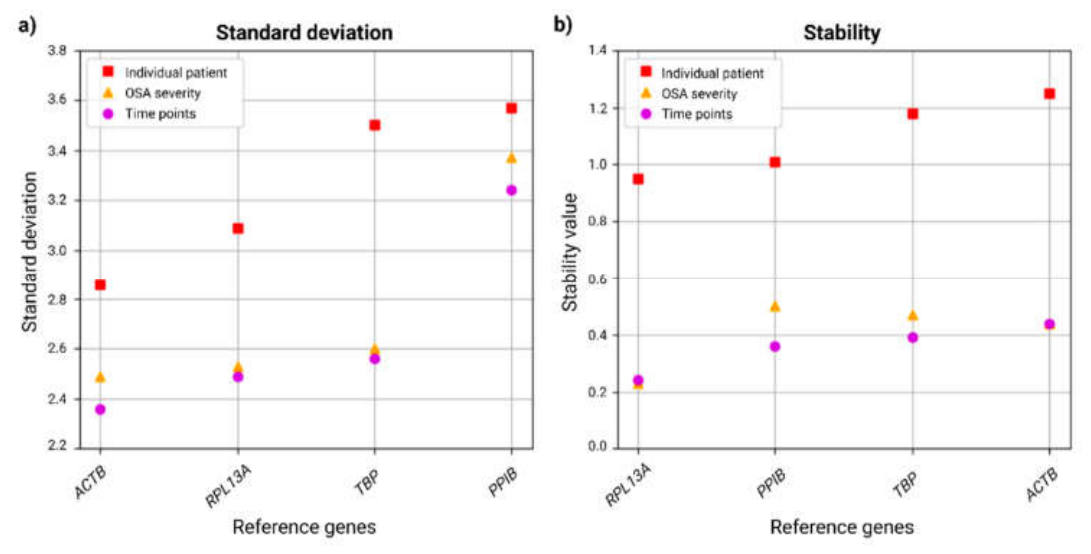
Step 3: Full cohort validation (n = 40, five time points). The four remaining genes (ACTB, TBP, PPIB, RPL13A) were assessed across all 40 participants at five time points. Three clock genes (BMAL1, CRY1, PER2) were measured concurrently for downstream rhythmicity analysis. EndoGeneAnalyzer results (Figure 2) showed that ACTB had the lowest standard deviation across all three grouping conditions (Figure 2a), while RPL13A achieved the lowest stability values (Figure 2b; lower = more stable), followed closely by ACTB. TBP ranked lowest on both metrics. Detailed values are in Table S7.
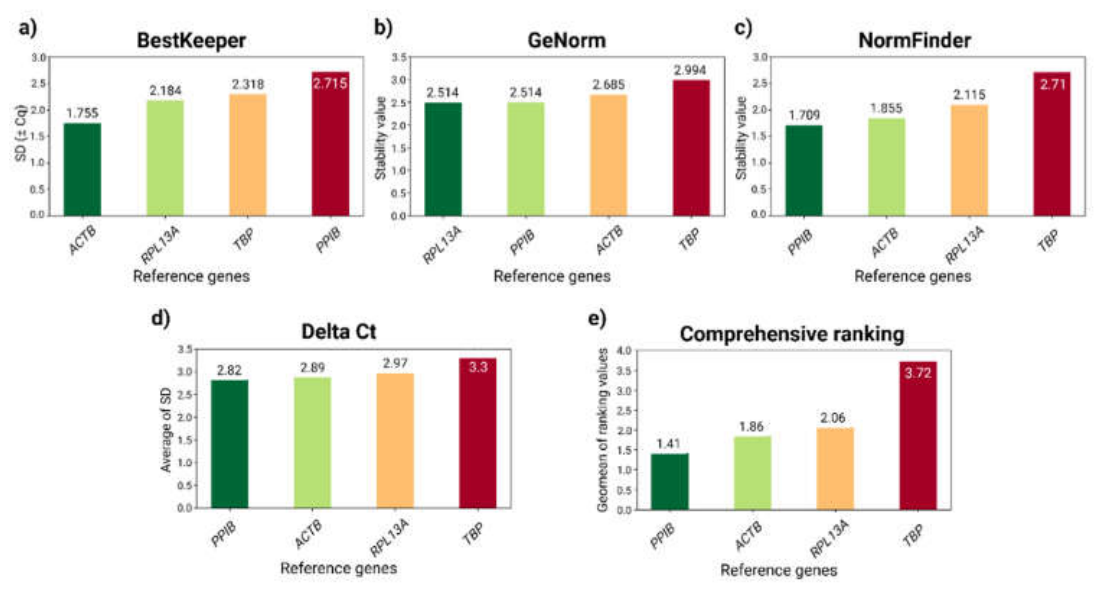
RefFinder results (Figure 3, Table S8) were consistent: ACTB ranked first by BestKeeper and second by NormFinder, the ΔCt method, and the comprehensive score. RPL13A ranked first by geNorm, together with PPIB, which scored best by NormFinder, ΔCt, and comprehensive ranking. TBP was the least stable gene by all algorithms, except BestKeeper.
Combining evidence from both tools across all grouping conditions, ACTB and RPL13A were selected as the optimal reference genes. Both showed low intra- and inter-group variability and stable expression across the circadian cycle, and were reliably detected in every sample on the first attempt. PPIB was excluded despite favourable algorithm scores because its Cq values were undetectable in a subset of 24 samples (all four groups and all time points) even after three repeated measurement, a practical limitation invisible to computational analysis alone. TBP was excluded due to poor stability across four out of five algorithms.

3.2. Assessment of Core Clock Gene Rhythmicity

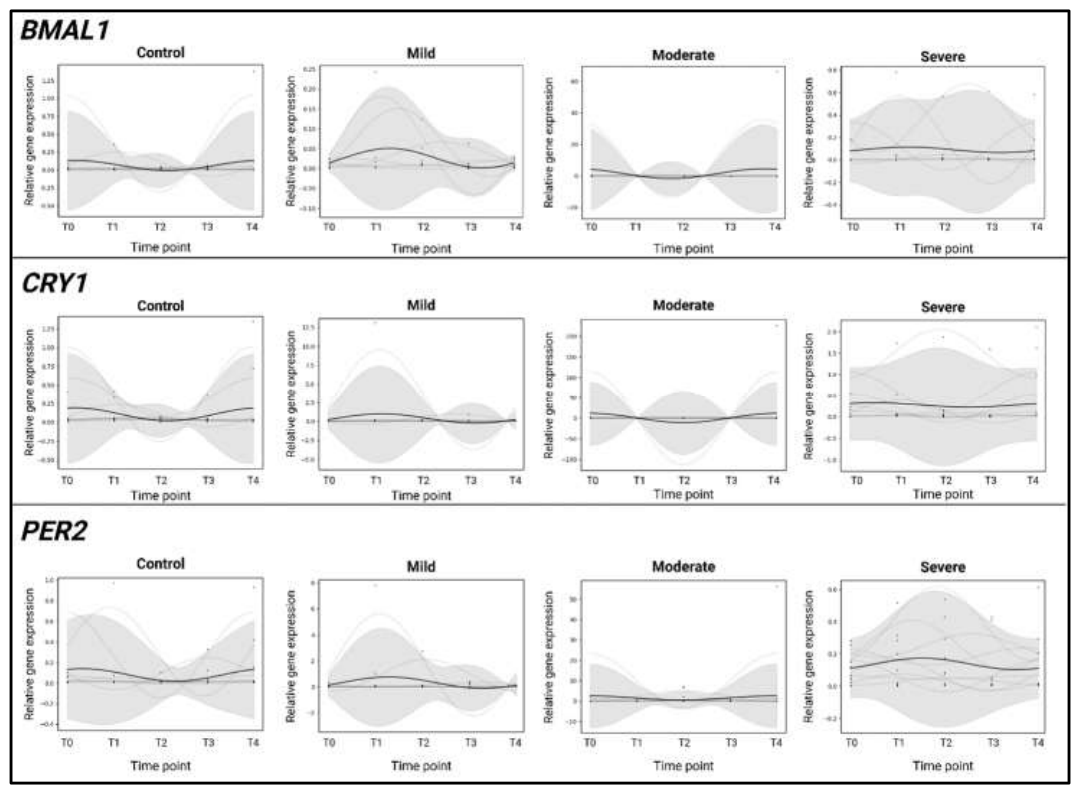
BMAL1, CRY1, and PER2 Cq values were normalised with ACTB and RPL13A using the comparative Ct method [26]. Group-specific cosinor models were built by averaging individual-level fits within each OSA severity group (Figure 4, Table S9).
Group-specific cosinor analysis showed that the core clock genes BMAL1, CRY1, and PER2 displayed detectable temporal variation across OSA severity groups, although rhythmicity did not reach statistical significance at the population level. For BMAL1, amplitudes were low (0.024–3.08) and mesors modest (0.026–1.43), indicating low-level, irregular expression. The acrophase, i.e. the time of peak expression, was later in mild (~20.8 h) and severe OSA (~20.5 h) groups than in controls (~13.9 h), suggesting a phase delay, though not statistically significant. For CRY1, amplitudes ranged from 0.05 to 11.20 (largest in the moderate OSA group) and acrophases from ~13.9 h to ~19.9 h, none significant. PER2 amplitudes were uniformly low (0.036–1.02 in most groups), and the severe OSA group had the latest acrophase (~22.2 h), consistent with a progressive phase delay at higher disease severity, but without statistical support (Table S9).
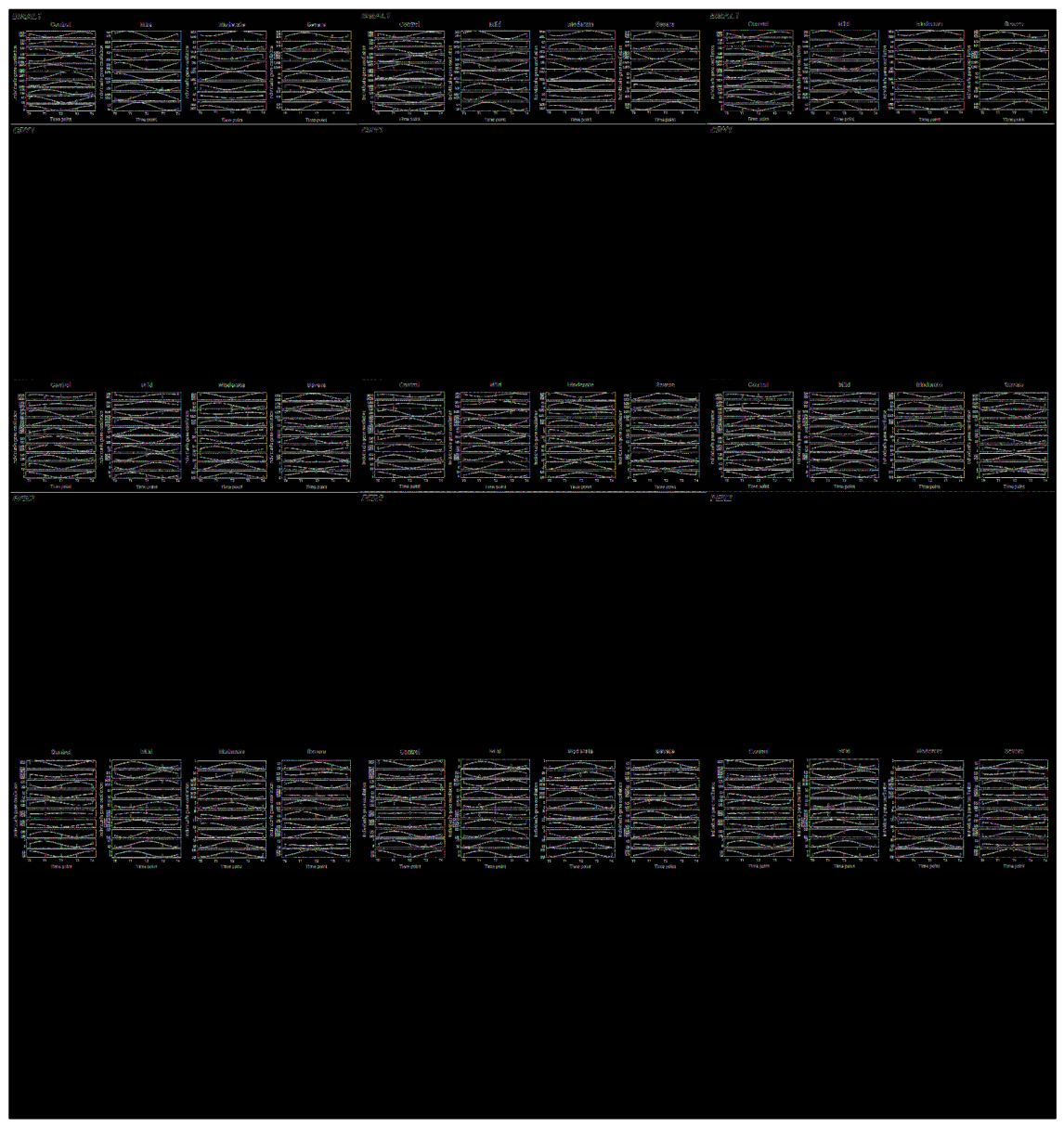
The absence of group-level significance reflects substantial inter-individual variability rather than the universal absence of rhythmicity. Inspection of individual-level cosinor fits (Figure 5) revealed that many participants displayed clear oscillatory profiles that were obscured by group averaging, which is a known limitation of population-based chronobiology analyses in heterogeneous clinical cohorts. Detailed analysis of individual expression profiles further demonstrated substantial inter-individual variability and desynchronization of clock gene oscillations across OSA severity groups.
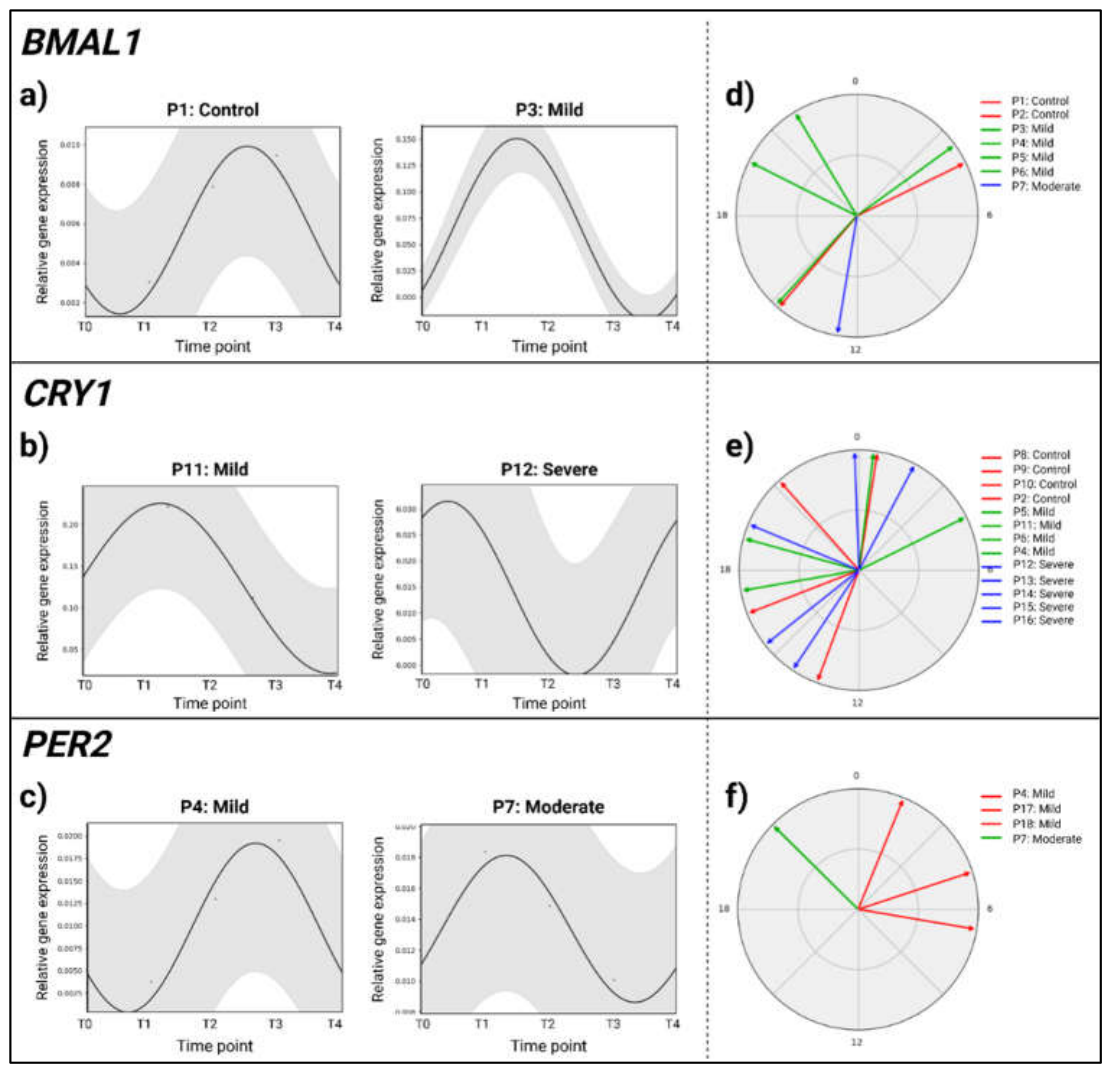
After FDR correction, personalized cosinor analysis (Figure 6; Tables S10–S11) detected statistically significant rhythmicity of BMAL1 in 7 participants, CRY1 in 13, and PER2 in 5, totaling 25 individuals with rhythmicity in at least one gene, largely independent of OSA severity, highlighting the highly individualized nature of circadian regulation in OSA. Acrophase distributions (Figure 6d–f) showed wide inter-individual spread with no consistent phase alignment within any OSA severity group, indicating that circadian disruption in OSA is not simply a graded function of disease severity. These findings emphasize the importance of patient-specific circadian assessment and suggest that personalized approaches may provide greater sensitivity for detecting circadian alterations in OSA.

4. Discussion

In this study, we addressed an important methodological challenge in circadian biology research ‒ the identification of suitable reference genes for normalization of 24-hour gene expression profiles. Accurate normalization of circadian qRT-PCR data requires reference genes that remain stable not only across disease conditions but also across the 24-hour cycle, a combination that had never been validated for peripheral blood in OSA patients. Using a three-step selection framework, two independent computational tools, and progressive narrowing of an initial panel of 11 candidate reference genes, together with three additional primer sets (CDK4, SDHA, and PPIB), we identified ACTB and RPL13A as the most stable reference genes in human buffy coat under conditions specifically relevant to OSA: 24-hour intra-patient variation, OSA severity, and the hypoxic milieu of intermittent nocturnal desaturation. This is, to our knowledge, one of the first time-resolved, blood-based reference gene validation for circadian studies in an OSA cohort.
The three-step design proved efficient. Single time-point screening (Step 1) identified and removed the most variable genes before more resource-intensive time-series work was undertaken. Extending evaluation to five time points in Step 2 revealed that HPRT1 and CDK4 #2, acceptable at a single time point, were in fact unstable across the circadian cycle. This underscores a general principle that reference genes for circadian studies must be validated under the same temporal conditions as the intended experiment. Final validation in 40 participants (Step 3) confirmed that ACTB and RPL13A maintained stable expression across individuals, disease severity groups, and time of day.
The stable performance of both genes is consistent with the existing literature [32,33,34]. ACTB has been validated as a reliable reference in blood-based circadian studies [21,35,36,37], and RPL13A has shown stable expression in human leukocytes under stimulation [38] and in blood under high-altitude hypoxia [39]. Particularly relevant to OSA, Wardaszka et al. (2025) demonstrated that RPL13A is among the most suitable reference genes in peripheral blood mononuclear cells under both normoxic and hypoxic conditions [38], which directly mirrors the intermittent hypoxia experienced by OSA patients. Together, these lines of evidence support the robustness of RPL13A in clinical blood-based settings characterized by disturbed oxygenation [38,39]. Conversely, both genes have shown instability in other contexts (ACTB in mouse lung [1] and under sleep deprivation [35]), reaffirming that reference gene suitability is tissue- and condition-specific.
Among the genes that proved unsuitable, GAPDH and TBP are particularly instructive. GAPDH, though widely used as a housekeeping gene [40], was eliminated in Step 1 due to high variability, and being consistent with reports that its expression is modulated by metabolic state and time of day [41,42,43]. TBP ranked as the least stable gene across four RefFinder algorithms in step 3 (Figure 3, Table S8), contrasting with reports of its stability in human mammary epithelial cells [12] and illustrating once more that housekeeping gene behavior cannot be assumed from the literature alone.
The case of PPIB illustrates a complementary pitfall, because it performed well computationally but was undetectable in 24 samples (in all triplicates) even after 3 repeated measurements. The number of undetected samples spread through all four groups and time points (3 controls, 4 mild, 4 moderate, and 3 severe OSA samples). This practical failure would have been invisible if selection had relied solely on algorithm output. We therefore recommend that computational ranking always be complemented by empirical quality checks (detection rate, Cq reproducibility across all samples) before finalizing the reference gene choice. Consistent with best-practice guidance [26], using two reference genes in combination (ACTB and RPL13A) further improves normalization robustness compared to a single gene.
A key methodological strength is the integration of two independent tools. RefFinder synthesizes four established algorithms into a consensus ranking, reducing reliance on any single method's assumptions. EndoGeneAnalyzer [30] was particularly well-suited to our multi-factor design, enabling simultaneous evaluation of stability across time of day, OSA severity, and intra-individual variation. The agreement between the two tools in selecting ACTB and RPL13A substantially strengthens confidence in the final gene pair.
Using ACTB and RPL13A for normalization, we assessed the rhythmicity of BMAL1, CRY1, and PER2. None showed statistically significant 24-hour rhythmicity at the group level, in contrast to studies in healthy populations [20,21,35,36,37,44,45]. Several non-exclusive explanations are possible: (i) intermittent hypoxia and sleep fragmentation in OSA may dampen or desynchronise peripheral clock gene expression; (ii) the heterogeneous cellular composition of buffy coat may dilute oscillatory signals; (iii) group sizes of 10 may be insufficient to detect modest rhythmicity in a mixed clinical cohort; and (iv) five sampling points over 24 hours may provide inadequate temporal resolution for low-amplitude waveforms. Comparisons with existing literature are further complicated by methodological differences across studies [20,21,35,36,37,44,45].
Despite the absence of statistical significance, non-significant phase trends deserve note. The acrophase of BMAL1 was earlier in moderate OSA (~11.3 h) than in controls (~13.9 h), and the acrophase of PER2 was latest in severe OSA (~22.2 h), showing a pattern consistent with a severity-dependent phase delay in the peripheral clock. These trends, although not statistically significant, could point to a progressive disruption of the molecular circadian system with increasing disease severity. In addition, these observations reinforce the rationale for future longitudinal studies with pre- and post-treatment designs using the reference gene framework established here.
After the correction for multiple testing, the personalized cosinor analysis revealed that circadian gene expression in OSA is highly heterogeneous, given that 25 participants displayed significant individual oscillations, yet these did not cluster by disease severity. Notably, CRY1 showed the greatest number of participants with significant rhythmicity (n = 13), while PER2 showed the fewest (n = 5). This gene-specific pattern, with some clock components more affected than others, parallels observations in OSA-related depression, where selective upregulation of specific clock genes rather than uniform clock suppression characterizes the circadian phenotype [46]. The wide spread of acrophase values within each severity group (Figure 6d–f) further suggests that individual factors (e.g. metabolic status, lifestyle, chronotype, and genetic variation) shape circadian gene expression in OSA more than disease severity alone [47]. These findings highlight the limitations of group-averaged analyses and support the use of personalized chronobiological approaches in both research and clinical chronotherapy [2,46,48,49].
OSA patients experience chronic intermittent hypoxia, sleep fragmentation, and sympathetic activation, all of which can perturb the molecular clock. Altered expression of core clock and clock-controlled genes in OSA blood is well documented [24,32,33,49], and these changes may mediate downstream comorbidities including cardiovascular disease, metabolic syndrome, and psychiatric disorders. The validated ACTB/RPL13A reference pair provides a reliable and practical tool for pursuing these questions in future studies.
Nevertheless, several limitations should be acknowledged. First, buffy coat is a heterogeneous mixture of cell types. Therefore, cell-type-specific circadian signals may be diluted or cancelled by this heterogeneity, and future studies using sorted leukocyte subsets or single-cell approaches may improve sensitivity. Second, the initial gene screening in Step 1 relied on only two participants per OSA severity group (n = 8 total), which limits the statistical rigor of that step in isolation. However, this was a deliberate design choice to maximize screening efficiency prior to full time-series analysis, and the final reference gene selection is grounded in the expanded cohorts of Steps 2 and 3. In addition, group sizes of 10 may limit the power to detect subtle rhythmicity. Consequently, larger cohorts are needed to characterize low-amplitude oscillations and to test whether the validated reference genes remain stable in more diverse populations. Third, five time points at six-hour intervals may insufficiently resolve waveform dynamics with non-sinusoidal shapes or shifted phases. While a 6-hour sampling interval (with an additional point at 13:00) is a logistically feasible approach for clinical cohorts, it inherently limits the statistical power of single-subject cosinor models. Consequently, the significant rhythmicity observed at the individual level in 25 out of 40 participants should be interpreted with caution, as low-density sampling schedules can elevate the risk of false-positive or false-negative rhythmic classifications. Finally, these reference genes are validated specifically for buffy coat. Hence, their stability in other blood fractions, sorted cell populations, or different tissues cannot be assumed without independent validation.
Despite these limitations, the multi-step, dual-algorithm framework presented here is transparent and reproducible, and should be directly applicable in future clinical chronobiology studies. The consistent performance of ACTB and RPL13A across all conditions tested (hypoxia, sleep fragmentation, disease severity variation) supports their adoption as reference genes for circadian qRT-PCR in peripheral blood, enabling rigorous investigation of molecular clock disruption in OSA and its comorbidities.

5. Conclusions

ACTB and RPL13A were identified as the most stable reference genes for normalizing circadian qRT-PCR data in the buffy coat of OSA patients across a full 24-hour sampling period. Their suitability was tested by personalized cosinor analysis of core clock genes (BMAL1, CRY1, PER2), which detected significant individual oscillations in 25 of 40 participants, consistent with inter-individual desynchrony that may obscure group-level rhythmicity. This underscores the value of personalized circadian assessment in heterogeneous clinical cohorts and the critical importance of validated, context-specific reference genes for such analyses. The reference gene pair and methodological framework established here lay the groundwork for future circadian biomarker studies in OSA, including pre- and post-treatment designs that may ultimately contribute to personalised chronotherapy in sleep medicine.

Supplementary Materials

The following supporting information can be downloaded at the website of this paper posted on Preprints.org; Table S1: qRT-PCR primer design criteria; Figure S1: Results of step 1 candidate reference genes using EndoGeneAnalyzer; Table S2: Primer sequences and efficiency of reference genes; Figure S2: Stability evaluation of candidate reference genes using RefFinder based on Step 1 data; Table S3: Results of standard deviation and stability from EndoGeneAnalyzer, comparing different OSA severity levels from step 1 of reference gene selection; Figure S3: Evaluation of step 2 reference gene performance under different conditions using EndoGeneAnalyzer; Table S4: Results of step 1 obtained from RefFinder representing stability values of different algorithms and standard deviation from the BestKeeper algorithm; Figure S4: Comparative assessment of reference gene stability using RefFinder based on data from Step 2; Table S5: Results of standard deviations and stability from EndoGeneAnalyzer analysis of the step 2; Table S6: Results of step 2 obtained from RefFinder representing stability values of different algorithms and standard deviation from BestKeeper algorithm; Table S7: Results of standard deviations and stabilities from EndoGeneAnalyzer analysis of the step 3; Table S8: Results of step 3 obtained from RefFinder representing stability values of different algorithms and standard deviation from BestKeeper algorithm; Table S9: The rhythmicity parameters obtained on group-specific cosinor models for each group of participants and for each of the observed genes; Table S10: The statistically significant rhythmicity parameters obtained on personalized cosinor models for each individual participant and for each of the observed genes; Table S11: Number of patients with statistically significant rhythmicity of core clock genes across OSA severity groups.

Author Contributions

Conceptualization, K.N., T.K. and C.S.; methodology, K.N., T.K., C.S.; software, K.N., A.H.V. and M. Moškon; validation, K.N., A.H.V. and M. Moškon; formal analysis, K.N., A.H.V. and M. Moškon; investigation, K.N.; resources, D.R., M. Moškon and L.D.G.; data curation, K.N.; writing—original draft preparation, K.N.; writing—review and editing, K.N., A.H.V., T.K., C.S., M. Moškon, M. Mraz, L.D.G., D.R.; visualization, K.N.; supervision, L.D.G., D.R., M. Moškon and M. Mraz.; project administration, K.N.; funding acquisition, D.R., L.D.G., M Moškon. All authors have read and agreed to the published version of the manuscript.

Funding

This research study and APC were funded by The Slovenian Research and Innovation Agency (ARIS) P1-0390, P2-0359, P3-0338, and J1-50024; The Slovenian Research and Innovation Agency (ARIS), Young Researcher grant; The infrastructure ESFRI-ELIXIR grant; The tertiary project of UMC Ljubljana, No. 20220001.

Institutional Review Board Statement

The study was conducted in accordance with the Declaration of Helsinki, and approved by the Commission for Medical Ethics of the Republic of Slovenia (approval No. 0120-65/2023/3, 14th of February 2023).

Data Availability Statement

The original contributions presented in this study are included in the article and supplementary material. Further inquiries can be directed to the corresponding author.

Acknowledgments

The figures in the manuscript were edited in the BioRender.com online tool. The authors would like to thank medical student Lucija Matijašić and Hana Rakuša, M.D., for their valuable work, sleepless nights, and assistance in this study. The authors also thank all participants for their willingness to take part in this demanding study.

Conflicts of Interest

The authors declare no conflicts of interest. The funders had no role in the design of the study; in the collection, analyses, or interpretation of data; in the writing of the manuscript; or in the decision to publish the results.

Abbreviations

The following abbreviations are used in this manuscript:
AHI Apnea-hypopnea index
Cq Quantification cycle
FDR False discovery rate
OSA Obstructive sleep apnea
PG Polygraphy

Appendix A

RNA Isolation Protocol

Total RNA was extracted using TRI Reagent LS (Sigma-Aldrich) in a 1:1 ratio to the volume of thrombocyte-leukocyte layer samples. The samples were stored at -80 °C overnight. The next day, phase separation was done following the manufacturer’s protocol. RNA precipitation was done by adding ice-cold isopropanol in a 1:1 ratio to the volume of the transferred aqueous phase. After washing the samples with 75% ethanol solution, we stored the samples at -80 °C overnight. The following day, we washed RNA two more times with a 75% ethanol solution. The RNA solubilisation was performed by drying the samples for approximately 20 minutes at room temperature and adding of appropriate volume (app. 20 µL) of RNA-free water to the RNA pellet. Then the samples were incubated for 5 minutes at 55 °C.

References

  1. Giri, A.; Sundar, I.K. Evaluation of Stable Reference Genes for qPCR Normalization in Circadian Studies Related to Lung Inflammation and Injury in Mouse Model. Sci. Rep. 2022, 12, 1764. [Google Scholar] [CrossRef]
  2. Gabryelska, A.; Turkiewicz, S.; Karuga, F.F.; Sochal, M.; Strzelecki, D.; Białasiewicz, P. Disruption of Circadian Rhythm Genes in Obstructive Sleep Apnea Patients—Possible Mechanisms Involved and Clinical Implication. Int. J. Mol. Sci. 2022, 23, 709. [Google Scholar] [CrossRef]
  3. Šmon, J.; Kočar, E.; Pintar, T.; Dolenc-Grošelj, L.; Rozman, D. Is Obstructive Sleep Apnea a Circadian Rhythm Disorder? J. Sleep Res. 2023, 32, e13875. [Google Scholar] [CrossRef]
  4. Moškon, M.; Kovač, U.; Raspor Dall’Olio, L.; Geršak, K.; Kavšek, G.; Bojc Šmid, E.; Trojner Bregar, A.; Rozman, D. Circadian Characteristics of Term and Preterm Labors. Sci. Rep. 2024, 14, 4033. [Google Scholar] [CrossRef]
  5. Kramer, A.; Lange, T.; Spies, C.; Finger, A.-M.; Berg, D.; Oster, H. Foundations of Circadian Medicine. PLoS Biol. 2022, 20, e3001567. [Google Scholar] [CrossRef]
  6. Zong, G.; Mao, W.; Wen, M.; Cheng, X.; Liu, G. Association of Sleep Patterns and Disorders with Metabolic Dysfunction-Associated Steatotic Liver Disease and Liver Fibrosis in Contemporary American Adults. Ann. Hepatol. 2025, 30, 101583. [Google Scholar] [CrossRef]
  7. Sun, J.; Mao, S.; Lu, C. Association between Circadian Syndrome and MASLD Risk: Evidence from a Large Cross-Sectional Study. BMC Gastroenterol. 2025, 25, 391. [Google Scholar] [CrossRef]
  8. Graindorge, P.-H.; Paoli, J.; Yildirim, B.; Morel, C.; Herzine, A.; Collin, M.; Gallais, I.; Boucard, S.; Pouyatos, B.; Meyre, D.; et al. Early Stage of Metabolic Dysfunction Associated Steatotic Liver Disease Disrupts Circadian Rhythm and Induces Neuroinflammation in Rats. Sci. Rep. 2025, 15, 10616. [Google Scholar] [CrossRef] [PubMed]
  9. Sun, Q.; Zhao, J.; Liu, L.; Wang, X.; Gu, X. Identification of the Potential Biomarkers Associated with Circadian Rhythms in Heart Failure. PeerJ 2023, 11, e14734. [Google Scholar] [CrossRef] [PubMed]
  10. Roenneberg, T.; Foster, R.G.; Klerman, E.B. The Circadian System, Sleep, and the Health/Disease Balance: A Conceptual Review. J. Sleep Res. 2022, 31, e13621. [Google Scholar] [CrossRef] [PubMed]
  11. Lévy, P.; Kohler, M.; McNicholas, W.T.; Barbé, F.; McEvoy, R.D.; Somers, V.K.; Lavie, L.; Pépin, J.-L. Obstructive Sleep Apnoea Syndrome. Nat. Rev. Dis. Primer 2015, 1, 15015. [Google Scholar] [CrossRef]
  12. Hadadi, E.; Souza, L.E.B.D.; Bennaceur-Griscelli, A.; Acloque, H. Identification of Valid Reference Genes for Circadian Gene-Expression Studies in Human Mammary Epithelial Cells. Chronobiol. Int. 2018, 35, 1689–1701. [Google Scholar] [CrossRef]
  13. Ledderose, C.; Heyn, J.; Limbeck, E.; Kreth, S. Selection of Reliable Reference Genes for Quantitative Real-Time PCR in Human T Cells and Neutrophils. BMC Res. Notes 2011, 4, 427. [Google Scholar] [CrossRef] [PubMed]
  14. Cai, C.; Cai, P.; Chu, G. Selection of Suitable Reference Genes for Core Clock Gene Expression Analysis by Real-Time qPCR in Rat Ovary Granulosa Cells. Mol. Biol. Rep. 2019, 46, 2941–2946. [Google Scholar] [CrossRef] [PubMed]
  15. Kosir, R.; Acimovic, J.; Golicnik, M.; Perse, M.; Majdic, G.; Fink, M.; Rozman, D. Determination of Reference Genes for Circadian Studies in Different Tissues and Mouse Strains. BMC Mol. Biol. 2010, 11, 60. [Google Scholar] [CrossRef]
  16. Nakao, R.; Okauchi, H.; Hashimoto, C.; Wada, N.; Oishi, K. Determination of Reference Genes That Are Independent of Feeding Rhythms for Circadian Studies of Mouse Metabolic Tissues. Mol. Genet. Metab. 2017, 121, 190–197. [Google Scholar] [CrossRef] [PubMed]
  17. Szczepkowska, A.; Harazin, A.; Barna, L.; Deli, M.A.; Skipor, J. Identification of Reference Genes for Circadian Studies on Brain Microvessels and Choroid Plexus Samples Isolated from Rats. Biomolecules 2021, 11, 1227. [Google Scholar] [CrossRef]
  18. Lee, K.S.; Alvarenga, T.A.; Guindalini, C.; Andersen, M.L.; Castro, R.M.; Tufik, S. Validation of Commonly Used Reference Genes for Sleep-Related Gene Expression Studies. BMC Mol. Biol. 2009, 10, 45. [Google Scholar] [CrossRef]
  19. Ando, H.; Takamura, T.; Matsuzawa-Nagata, N.; Shima, K.R.; Eto, T.; Misu, H.; Shiramoto, M.; Tsuru, T.; Irie, S.; Fujimura, A.; et al. Clock Gene Expression in Peripheral Leucocytes of Patients with Type 2 Diabetes. Diabetologia 2009, 52, 329–335. [Google Scholar] [CrossRef]
  20. James, F.O.; Boivin, D.B.; Charbonneau, S.; Bélanger, V.; Cermakian, N. Expression of Clock Genes in Human Peripheral Blood Mononuclear Cells throughout the Sleep/Wake and Circadian Cycles. Chronobiol. Int. 2007, 24, 1009–1034. [Google Scholar] [CrossRef]
  21. Lech, K.; Ackermann, K.; Revell, V.L.; Lao, O.; Skene, D.J.; Kayser, M. Dissecting Daily and Circadian Expression Rhythms of Clock-Controlled Genes in Human Blood. J. Biol. Rhythm. 2016, 31, 68–81. [Google Scholar] [CrossRef]
  22. Reszka, E.; Wieczorek, E.; Przybek, M.; Jabłońska, E.; Kałużny, P.; Bukowska-Damska, A.; Zienolddiny, S.; Pepłońska, B. Circadian Gene Methylation in Rotating-Shift Nurses: A Cross-Sectional Study. Chronobiol. Int. 2018, 35, 111–121. [Google Scholar] [CrossRef] [PubMed]
  23. Watanabe, M.; Hida, A.; Kitamura, S.; Enomoto, M.; Ohsawa, Y.; Katayose, Y.; Nozaki, K.; Moriguchi, Y.; Aritake, S.; Higuchi, S.; et al. Rhythmic Expression of Circadian Clock Genes in Human Leukocytes and Beard Hair Follicle Cells. Biochem. Biophys. Res. Commun. 2012, 425, 902–907. [Google Scholar] [CrossRef] [PubMed]
  24. Xie, T.; Guo, D.; Luo, J.; Guo, Z.; Zhang, S.; Wang, A.; Wang, X.; Wang, X.; Cao, W.; Su, L.; et al. The Relationship between HIF1α and Clock Gene Expression in Patients with Obstructive Sleep Apnea. Nat. Sci. Sleep 2022, Volume 14, 381–392. [Google Scholar] [CrossRef]
  25. Xie, F.; Wang, J.; Zhang, B. RefFinder: A Web-Based Tool for Comprehensively Analyzing and Identifying Reference Genes. Funct. Integr. Genom. 2023, 23, 125. [Google Scholar] [CrossRef] [PubMed]
  26. Vandesompele, J.; De Preter, K.; Pattyn, F.; Poppe, B.; Van Roy, N.; De Paepe, A.; Speleman, F. Accurate Normalization of Real-Time Quantitative RT-PCR Data by Geometric Averaging of Multiple Internal Control Genes. Genome Biol. 2002, 3, research0034.1. [Google Scholar] [CrossRef]
  27. Andersen, C.L.; Jensen, J.L.; Ørntoft, T.F. Normalization of Real-Time Quantitative Reverse Transcription-PCR Data: A Model-Based Variance Estimation Approach to Identify Genes Suited for Normalization, Applied to Bladder and Colon Cancer Data Sets. Cancer Res. 2004, 64, 5245–5250. [Google Scholar] [CrossRef]
  28. Pfaffl, M.W.; Tichopad, A.; Prgomet, C.; Neuvians, T.P. Determination of Stable Housekeeping Genes, Differentially Regulated Target Genes and Sample Integrity: BestKeeper – Excel-Based Tool Using Pair-Wise Correlations. Biotechnol. Lett. 2004, 26, 509–515. [Google Scholar] [CrossRef]
  29. Silver, N.; Best, S.; Jiang, J.; Thein, S.L. Selection of Housekeeping Genes for Gene Expression Studies in Human Reticulocytes Using Real-Time PCR. BMC Mol. Biol. 2006, 7, 33. [Google Scholar] [CrossRef]
  30. Teixeira, E.B.; Khayat, A.S.; Assumpção, P.P.; Casseb, S.M.; Moreira-Nunes, C.A.; Moreira, F.C. EndoGeneAnalyzer: A Tool for Selection and Validation of Reference Genes. PLoS ONE 2024, 19, e0299993. [Google Scholar] [CrossRef]
  31. Moškon, M. CosinorPy: A Python Package for Cosinor-Based Rhythmometry. BMC Bioinform. 2020, 21, 485. [Google Scholar] [CrossRef] [PubMed]
  32. Moreira, S.; Rodrigues, R.; Barros, A.B.; Pejanovic, N.; Neves-Costa, A.; Pedroso, D.; Pereira, C.; Fernandes, D.; Rodrigues, J.V.; Barbara, C.; et al. Changes in Expression of the CLOCK Gene in Obstructive Sleep Apnea Syndrome Patients Are Not Reverted by Continuous Positive Airway Pressure Treatment. Front. Med. 2017, 4, 187. [Google Scholar] [CrossRef] [PubMed]
  33. Yang, M.-Y.; Lin, P.-W.; Lin, H.-C.; Lin, P.-M.; Chen, I.-Y.; Friedman, M.; Hung, C.-F.; Salapatas, A.M.; Lin, M.-C.; Lin, S.-F. Alternations of Circadian Clock Genes Expression and Oscillation in Obstructive Sleep Apnea. J. Clin. Med. 2019, 8, 1634. [Google Scholar] [CrossRef] [PubMed]
  34. White, J.M.; Piron, M.J.; Rangaraj, V.R.; Hanlon, E.C.; Cohen, R.N.; Brady, M.J. Reference Gene Optimization for Circadian Gene Expression Analysis in Human Adipose Tissue. J. Biol. Rhythm. 2020, 35, 84–97. [Google Scholar] [CrossRef]
  35. Ackermann, K.; Plomp, R.; Lao, O.; Middleton, B.; Revell, V.L.; Skene, D.J.; Kayser, M. Effect of Sleep Deprivation on Rhythms of Clock Gene Expression and Melatonin in Humans. Chronobiol. Int. 2013, 30, 901–909. [Google Scholar] [CrossRef]
  36. Kusanagi, H.; Hida, A.; Satoh, K.; Echizenya, M.; Shimizu, T.; Pendergast, J.S.; Yamazaki, S.; Mishima, K. Expression Profiles of 10 Circadian Clock Genes in Human Peripheral Blood Mononuclear Cells. Neurosci. Res. 2008, 61, 136–142. [Google Scholar] [CrossRef]
  37. Takimoto, M.; Hamada, A.; Tomoda, A.; Ohdo, S.; Ohmura, T.; Sakato, H.; Kawatani, J.; Jodoi, T.; Nakagawa, H.; Terazono, H.; et al. Daily Expression of Clock Genes in Whole Blood Cells in Healthy Subjects and a Patient with Circadian Rhythm Sleep Disorder. Am. J. Physiol.-Regul. Integr. Comp. Physiol. 2005, 289, R1273–R1279. [Google Scholar] [CrossRef]
  38. Wardaszka, A.; Smolarska, A.; Bednarczyk, P.; Bujak, J.K. Selection of Stable Reference Genes for Gene Expression Studies in Activated and Non-Activated PBMCs under Normoxic and Hypoxic Conditions. Int. J. Mol. Sci. 2025, 26, 6790. [Google Scholar] [CrossRef]
  39. Xiao, J.; Li, X.; Liu, J.; Fan, X.; Lei, H.; Li, C. Identification of Reference Genes in Blood before and after Entering the Plateau for SYBR Green RT-qPCR Studies. PeerJ 2017, 5, e3726. [Google Scholar] [CrossRef]
  40. Takata, M.; Burioka, N.; Ohdo, S.; Takane, H.; Terazono, H.; Miyata, M.; Sako, T.; Suyama, H.; Fukuoka, Y.; Tomita, K.; et al. Daily Expression of mRNAs for the Mammalian Clock Genes Per2 and Clock in Mouse Suprachiasmatic Nuclei and Liver and Human Peripheral Blood Mononuclear Cells. Jpn. J. Pharmacol. 2002, 90, 263–269. [Google Scholar] [CrossRef]
  41. Mozdziak, P.E.; Dibner, J.J.; McCoy, D.W. Glyceraldehyde-3-Phosphate Dehydrogenase Expression Varies with Age and Nutrition Status. Nutrition 2003, 19, 438–440. [Google Scholar] [CrossRef]
  42. Shinohara, M.L.; Loros, J.J.; Dunlap, J.C. Glyceraldehyde-3-Phosphate Dehydrogenase Is Regulated on a Daily Basis by the Circadian Clock. J. Biol. Chem. 1998, 273, 446–452. [Google Scholar] [CrossRef]
  43. Zhang, J.-Y.; Zhang, F.; Hong, C.-Q.; Giuliano, A.E.; Cui, X.-J.; Zhou, G.-J.; Cui, Y.-K. Critical Protein GAPDH and Its Regulatory Mechanisms in Cancer Cells. 2015, 12, 10–22. [Google Scholar] [CrossRef]
  44. Cermakian, N.; Boivin, D.B. The Regulation of Central and Peripheral Circadian Clocks in Humans. Obes. Rev. 2009, 10, 25–36. [Google Scholar] [CrossRef] [PubMed]
  45. Teboul, M.; Barrat-Petit, M.-A.; Li, X.M.; Claustrat, B.; Formento, J.-L.; Delaunay, F.; Lévi, F.; Milano, G. Atypical Patterns of Circadian Clock Gene Expression in Human Peripheral Blood Mononuclear Cells. J. Mol. Med. 2005, 83, 693–699. [Google Scholar] [CrossRef] [PubMed]
  46. Burioka, N.; Koyanagi, S.; Endo, M.; Takata, M.; Fukuoka, Y.; Miyata, M.; Takeda, K.; Chikumi, H.; Ohdo, S.; Shimizu, E. Clock Gene Dysfunction in Patients with Obstructive Sleep Apnoea Syndrome. Eur. Respir. J. 2008, 32, 105–112. [Google Scholar] [CrossRef] [PubMed]
  47. Montaruli, A.; Castelli, L.; Mulè, A.; Scurati, R.; Esposito, F.; Galasso, L.; Roveda, E. Biological Rhythm and Chronotype: New Perspectives in Health. Biomolecules 2021, 11, 487. [Google Scholar] [CrossRef]
  48. Gabryelska, A.; Sochal, M.; Turkiewicz, S.; Białasiewicz, P. Relationship between HIF-1 and Circadian Clock Proteins in Obstructive Sleep Apnea Patients—Preliminary Study. J. Clin. Med. 2020, 9, 1599. [Google Scholar] [CrossRef]
  49. Wang, H.-M.; Shieh, K.-R.; Chang, E.-T. Correlation of the Expression of Circadian-Clock Genes with the Severity of Obstructive Sleep Apnea in Patients. Chronobiol. Int. 2025, 42, 428–439. [Google Scholar] [CrossRef]
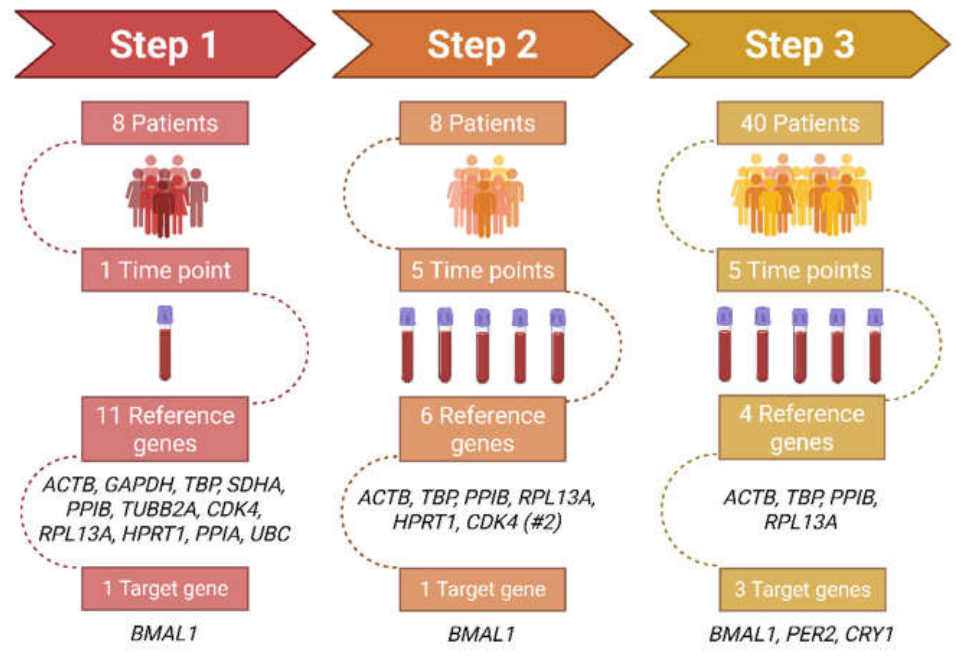
Figure 1. Schematic overview of the three-step reference gene selection process in this study. The study was conducted in three sequential steps. In each step, we increased the scope of analysis (either the number of participants, the number of blood sampling time points, and/or the number of target genes) while correspondingly narrowing down the list of candidate reference genes. At each step, the elimination of reference gene candidates was based on the stability results obtained with algorithms implemented in online tools RefFinder and EndoGeneAnalyzer. Step 1 involved 8 participants sampled at a single time-point to evaluate the expression stability of 11 candidate reference genes, using BMAL1 as a representative target gene. In step 2, we used the same 8 patients and included samples from all 5 time-points to assess circadian expression patterns and refine the selection to the 6 most stable reference genes. In step 3, the final analysis was expanded on a cohort of 40 patients, sampled at 5 time-points, using the 4 most stable reference genes (ACTB, TBP, PPIB, RPL13A) from previous steps for normalization. Expression of three core clock genes (BMAL1, PER2, and CRY1) was evaluated in this final phase. “#2” denotes an alternative primer sequence targeting a different transcript of the same gene.
Preprints 217703 g001
Figure 2. EndoGeneAnalyzer results of the four candidate reference genes in Step 3. Standard deviation (a) and stability (b) of the four best-performing reference genes (ACTB, RPL13A, TBP, PPIB) are shown based on three grouping criteria: individual patient (red squares), OSA severity (orange triangles), and time points (purple circles). Lower standard deviation and stability values indicate more consistent gene expression. ACTB consistently exhibited the lowest variability (a) within all tested conditions, while RPL13A showed the lowest stability values (b) across all grouping conditions.
Preprints 217703 g002
Figure 3. RefFinder analysis of reference gene stability in Step 3. The figure shows results from four algorithms (BestKeeper, geNorm, NormFinder, and the Delta Ct method) with additional comprehensive ranking. Each graph (a-e) represents one analysis method, plotting the stability or variability measures for ACTB, RPL13A, PPIB, and TBP. In all cases, lower values (left side) correspond to greater expression stability. ACTB was identified as the top performer by BestKeeper (a), RPL13A ranked highest by geNorm (b), and PPIB showed the best stability by NormFinder (c), lowest average of SD by ∆Ct method (d) and overall best geometric mean of ranking values by comprehensive ranking (e). TBP consistently showed the lowest stability in four algorithms (b-e).
Preprints 217703 g003
Figure 4. The circadian expression profiles of core clock genes (BMAL1, CRY1, and PER2) across OSA severity groups. Gene expression rhythms were assessed using a population-based cosinor for control, mild, moderate, and severe OSA groups. Cq values were normalized using ACTB and RPL13A as reference genes. Each subplot represents the fitted group-specific rhythm (black line), obtained by averaging individual-specific cosinor models (grey lines). Shaded areas denote 95% confidence intervals. No statistically significant rhythmicity was observed across severity groups for any of the genes analyzed. Sampling time (x-axis): T0 on day 1 at 13:00, T1 on day 1 at 19:00, T2 on day 2 at 1:00, T3 on day 2 at 7:00, and T4 on day 2 at 13:00.
Preprints 217703 g004
Figure 5. The circadian expression of core clock genes (BMAL1, CRY1, and PER2) of individual participants within each OSA severity group obtained from population-based cosinor analysis. Each panel represents the fitted cosinor curves (black lines) and raw expression data (black dots) for each individual participant. Rows correspond to different target genes, while columns correspond to OSA severity groups. Time points (x-axis) are plotted over a 24-hour period, and the y-axis represents normalized gene expression levels. Population-based cosinor was used to estimate individual mesor, amplitude, and acrophase parameters, highlighting inter-individual variability in circadian rhythmicity within each group. This approach reveals both well-defined oscillations and flattened or phase-shifted profiles, underscoring the heterogeneity of circadian rhythms in patients with OSA. Sampling time (x-axis): T0 on day 1 at 13:00, T1 on day 1 at 19:00, T2 on day 2 at 1:00, T3 on day 2 at 7:00, and T4 on day 2 at 13:00.
Preprints 217703 g005
Figure 6. Personalized cosinor analysis of core clock genes in OSA patients and controls. Panels a–c show individual cosinor fits (black lines) with 95% confidence intervals (grey areas) for representative participants, illustrating gene-specific oscillatory patterns of BMAL1 (a), CRY1 (b), and PER2 (c). Each subplot corresponds to one participant, where “P” followed by a number denotes a specific individual (e.g., P1 = Participant 1). Examples were selected as best-case examples. Panels d–f display acrophase distributions derived from CosinorPy for BMAL1 (d), CRY1 (e), and PER2 (f). Each line represents different participant denoted with P and a number. Sampling time (x-axis): T0 on day 1 at 13:00, T1 on day 1 at 19:00, T2 on day 2 at 1:00, T3 on day 2 at 7:00, and T4 on day 2 at 13:00.
Preprints 217703 g006
Disclaimer/Publisher’s Note: The statements, opinions and data contained in all publications are solely those of the individual author(s) and contributor(s) and not of MDPI and/or the editor(s). MDPI and/or the editor(s) disclaim responsibility for any injury to people or property resulting from any ideas, methods, instructions or products referred to in the content.
Copyright: This open access article is published under a Creative Commons CC BY 4.0 license, which permit the free download, distribution, and reuse, provided that the author and preprint are cited in any reuse.
Prerpints.org logo

Preprints.org is a free preprint server supported by MDPI in Basel, Switzerland.

Subscribe

Accessibility

Disclaimer

Terms of Use

Privacy Policy

Privacy Settings

© 2026 MDPI (Basel, Switzerland) unless otherwise stated