

Submitted:
09 June 2026
Posted:
10 June 2026
You are already at the latest version
Abstract
Urban public parks are vital for recreation, public health, environmental quality, and sustainable urban growth. Nonetheless, access to these parks remains uneven across many cities, disproportionately impacting low-income, marginalised, and spatially segregated communities. This study systematically examines socio-spatial disparities in park access and their effects on spatial justice. Using the PRISMA 2020 framework, 108 peer-reviewed articles published from 2000 to 2025 were analysed through thematic narrative synthesis. The results identify key factors influencing accessibility disparities, including socio-economic status, residential location, race and ethnicity, transport infrastructure, urban form, governance, and demographic vulnerability. Socio-economic status (24%), residential location and spatial distribution (20%), race and ethnicity (18%), and urban form and transport systems (17%) were the most common determinants. Limited park access exacerbates socio-economic inequality, worsens environmental injustice, contributes to health gaps, reinforces spatial segregation, hampers urban sustainability, and marginalises vulnerable populations. The review integrates Spatial Justice Theory, Environmental Justice Theory, and Urban Political Ecology into a comprehensive analytical framework and introduces a conceptual model linking accessibility factors to spatial justice outcomes. These findings underscore the importance of equitable green infrastructure planning, inclusive governance, and better access in underserved urban areas.
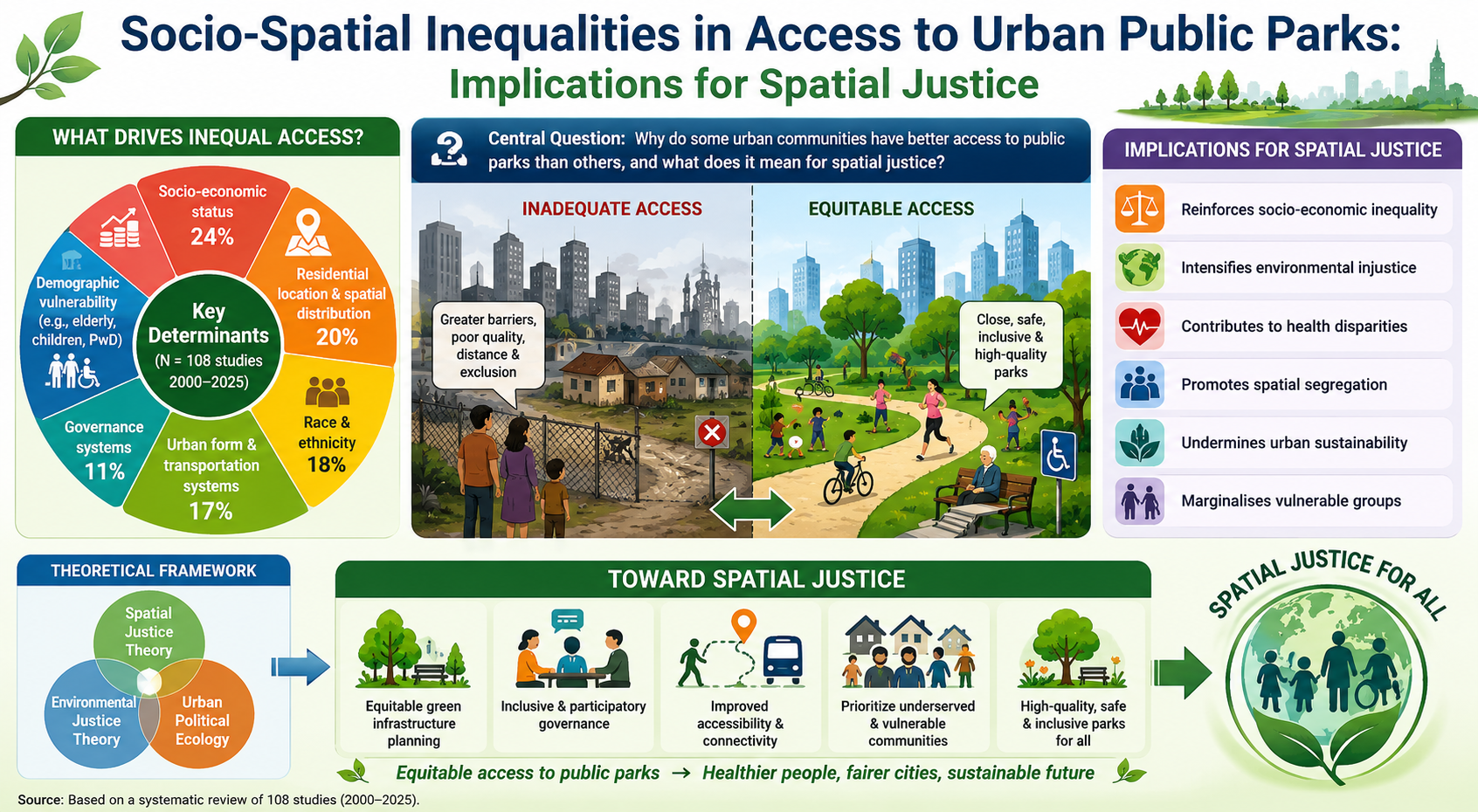
Keywords:
urban public parks
; park accessibility
; spatial justice
; environmental justice
; socio-spatial inequality
; green infrastructure
1. Introduction
Urban green spaces are increasingly vital in modern city planning due to concerns about sustainability, climate change, public health, and urban quality of life [1,2]. Public parks are particularly important, as they provide spaces for recreation, exercise, relaxation, socialising, and environmental initiatives [3,4]. They also play a key role in supporting biodiversity, cooling urban areas, improving air quality, managing floods, enhancing climate resilience, and promoting mental health, while fostering social integration and urban livability [5,87]. Nonetheless, rapid urbanisation, population growth, expanding infrastructure, and changing land use have transformed cityscapes in both developed and developing regions [6,7]. These trends have led to declines in the availability, accessibility, and quality of green spaces, especially in crowded, socio-economically deprived neighbourhoods [8,9]. In many urban areas, public open spaces have been encroached upon by residential, commercial, and infrastructural development, limiting equitable access to green recreational areas for low-income and marginalised groups [10]. As a result, ensuring fair access to public parks has become a vital issue in discussions on sustainable urban growth, environmental equity, and spatial justice [9,11].
Public park accessibility generally refers to the ease with which urban residents can reach, enter, and use public parks and recreational green spaces [12]. Accessibility extends beyond physical proximity and encompasses factors such as travel time, connectivity, safety, inclusivity, affordability, usability, environmental quality, and the cultural appropriateness of recreational spaces [13,105]. Existing studies commonly conceptualise accessibility using indicators such as walking distance, service-area coverage, travel time, network accessibility, population-to-park ratios, and GIS-based accessibility modelling approaches [14,15]. Nevertheless, accessibility inequalities remain widespread across many cities globally. Research demonstrates that socio-economic status, race and ethnicity, residential segregation, transport systems, urban morphology, governance systems, and land-use patterns significantly influence accessibility outcomes [16]. These inequalities often manifest as unequal park distribution, disparities in park quality, transport barriers, overcrowding, and exclusion from recreational opportunities, particularly among vulnerable populations, including low-income households, children, older adults, women, and people with disabilities [17,18,19,20].
Unequal access to urban public parks has significant environmental, social, and public health implications. Public parks support physical activity, social interaction, psychological restoration, biodiversity conservation, climate regulation, and urban resilience [21,22]. Consequently, limited access to parks may contribute to sedentary lifestyles, mental health challenges, social exclusion, environmental inequality, and reduced urban sustainability [23,24]. Despite growing scholarly attention, evidence on urban public park accessibility remains fragmented across regions, methods, and conceptual perspectives [25]. Many studies continue to emphasise physical proximity to parks while giving limited attention to broader dimensions such as park quality, safety, affordability, inclusivity, and functional usability [26,27]. Existing literature also shows substantial geographical disparities in research coverage. Most studies originate from North America, Europe, and East Asia. At the same time, African, Latin American, and many South Asian cities remain underrepresented [28]. This imbalance is problematic because many cities in developing regions are experiencing rapid urbanisation, expansion of informal settlements, infrastructure deficits, governance fragmentation, and increasing socio-economic inequality, all of which significantly influence access to urban public parks [29,108]. Consequently, there remains limited understanding of the nature, drivers, and implications of park accessibility inequalities within rapidly urbanising cities in developing regions [30].
Although previous studies have examined urban public park accessibility, environmental justice, and GIS-based accessibility assessment, much of the literature has focused on isolated dimensions of accessibility, such as proximity analysis, environmental exposure, or public health outcomes, without adequately integrating the broader socio-spatial processes that shape unequal access [31,32,33]. Existing reviews remain fragmented and largely focus on isolated dimensions of accessibility, with limited integration of socio-economic inequality, governance systems, transportation infrastructure, and spatial justice within a unified analytical framework. Furthermore, many studies emphasise technical accessibility measurement while paying insufficient attention to how structural inequalities, planning decisions, land markets, and urban governance processes reproduce spatial injustice in access to public parks across different urban contexts [34,35].
This review addresses these gaps by providing a systematic, integrated synthesis of socio-spatial inequalities in urban public park accessibility. Specifically, the review seeks to: (a) examine the socio-economic and spatial factors influencing accessibility to urban public parks; and (b) assess the implications of unequal access to urban public parks. This review contributes to existing scholarship by integrating Spatial Justice Theory, Environmental Justice Theory, and Urban Political Ecology to develop a multidimensional understanding of inequalities in urban park accessibility. Spatial Justice Theory explains how the spatial distribution of urban resources reflects broader social, political, and economic inequalities within cities [36]. Environmental Justice Theory emphasises equitable access to environmental benefits and protection from environmental burdens, regardless of race, ethnicity, income, or residential location [37]. Urban Political Ecology further examines how governance systems, planning decisions, land markets, and institutional power relations shape the uneven distribution of environmental amenities within urban areas [38]. Collectively, these theoretical perspectives provide an integrated framework for understanding how urban park accessibility reflects broader socio-spatial inequalities and environmental injustice. The remainder of this article is organised as follows. Section 2 describes the methodology; Section 3 presents the results; Section 4 discusses the findings; Section 5 outlines the review's limitations; and Section 6 concludes the study with key contributions, recommendations, and future research directions.
2. Materials and Methods
2.1. Review Design and Reporting Framework
This systematic review adopted the PRISMA 2020 guidelines and Okoli's systematic review framework to ensure transparency, rigour, and replicability throughout the review process. PRISMA provided a structured procedure for study identification, screening, eligibility assessment, and reporting [39]. At the same time, Okoli's framework guided the formulation of the problem, the development of the search strategy, study selection, quality appraisal, data extraction, synthesis, and the interpretation of findings [40]. The review protocol was developed prior to data collection and guided all stages of study identification, screening, appraisal, and synthesis. Although the protocol was not formally registered, methodological procedures were predefined to minimise review bias. The review employed a qualitative design using thematic narrative synthesis because the included studies applied diverse methodological approaches, including qualitative, quantitative, mixed-methods, GIS-based analyses, and accessibility modelling techniques. This approach enabled the identification and synthesis of co-occurring themes, patterns, and policy implications related to accessibility to urban public parks and spatial justice. To improve methodological rigour, the review also used the 2018 Mixed Methods Appraisal Tool (MMAT) developed by Hong et al [41] to assess the quality and credibility of the included studies. Overall, the combined frameworks strengthened the reliability, consistency, and academic validity of the systematic review findings.
2.2. Search Strategy
A comprehensive, systematic literature search was conducted to identify peer-reviewed studies examining accessibility to urban public parks and their implications for spatial justice in urban areas. The review process followed the PRISMA 2020 guidelines to ensure transparency, consistency, and methodological rigour throughout the study. Searches were conducted across four major academic databases: Scopus, Web of Science, ScienceDirect, and Google Scholar. Given the large volume of results from Google Scholar, only the first 200 results, sorted by relevance, were screened, consistent with established systematic review practice. These databases provide extensive interdisciplinary coverage in urban planning, geography, sustainability science, environmental studies, public health, and spatial analysis. They help minimise disciplinary bias and improve the thoroughness of literature searches. The search strategy combined keywords, synonyms, and Boolean operators related to urban public parks, green spaces, accessibility, spatial inequality, environmental justice, urban planning, and GIS-based accessibility analysis. Operators such as "AND" and "OR" refine search results for greater accuracy. In contrast, truncation and phrase searches account for variations in terminology across different databases and studies (see Appendix A for search strings). These search strings were developed iteratively to maximise the retrieval of relevant studies while reducing irrelevant results.
2.3. Eligibility Criteria
The year 2000 was chosen as the starting point because it marks the beginning of significant developments in environmental justice scholarship, GIS-based accessibility modelling, and sustainable urban development frameworks. These have greatly shaped current research on urban park accessibility. Only peer-reviewed journal articles in English were considered to ensure credibility and scholarly rigour. The inclusion criteria targeted relevant, methodologically rigorous studies aligned with the review's goals. Selected studies focused on accessibility to urban public parks or green spaces and explored socio-economic, spatial, environmental, transportation, governance, or demographic aspects of accessibility. The review also encompassed research on spatial justice, environmental justice, urban inequality, and green infrastructure planning that employed qualitative, quantitative, mixed methods, GIS-based, or spatial analysis techniques.
Studies were excluded if they focused solely on rural settings or private recreational areas, lacked relevance to urban park access or spatial justice, or were conference abstracts, editorials, dissertations, reports, or other non-peer-reviewed sources. Additionally, studies without a clear methodology or that were duplicates identified during screening were discarded. This process aimed to ensure that the final selection of studies directly addressed socio-spatial inequalities in urban public park access and their implications for spatial justice. The search strings used for the database queries are listed in the Appendix A. Literature searches were conducted from August to December 2025, using the same databases to maintain consistency and reduce temporal bias. For transparency and reproducibility, Table 1 summarises the databases searched and the number of records retrieved before duplicates were removed.
Using multiple databases improved the review's thoroughness by sourcing literature from various disciplinary perspectives and minimising bias from database-specific retrieval. After removing 287 duplicates, the remaining studies moved on to the screening phase, as illustrated in Figure 1.
2.3. Study Selection Process and Data Extraction
The study selection process followed PRISMA 2020 procedures, including identification, screening, eligibility assessment, and final inclusion. Duplicate studies were removed during screening, and titles and abstracts were screened before full-text assessment (Figure 1).
Data extraction was systematically conducted to ensure the consistent collection and organisation of relevant information from the selected studies. A structured framework was developed to record key details about access to urban public parks and spatial justice. The extracted data covered author(s), publication year, study location, objectives, research design, data collection methods, accessibility indicators, GIS and spatial analysis techniques, socio-economic and spatial factors influencing accessibility, and implications for spatial justice. When relevant, information on transportation, walkability, environmental justice, park distribution, demographic vulnerability, and governance issues was also gathered. The process involved documenting major findings, methodologies, and policy suggestions from each study. Studies were independently screened and assessed against predefined inclusion and exclusion criteria, with titles, abstracts, and full texts evaluated for relevance. To ensure consistency and reduce bias, the review was conducted systematically, and thematic objectives organised the information. This approach facilitated comparisons across regions, methods, and disciplines, enhancing the reliability and transparency of the synthesis. The author performed initial screening, full-text review, data extraction, and thematic coding, while an independent reviewer examined a random 20% sample of studies. Intercoder agreement was measured using Cohen's Kappa coefficient, which scored 0.84, indicating strong agreement and acceptable reliability. Any coding discrepancies were discussed and resolved through consensus.
2.4. Data Analysis and Synthesis
Data analysis and synthesis employed thematic narrative synthesis to identify recurring themes, spatial patterns, methodological trends, and policy implications across the reviewed studies. This method suited the diverse methodologies found in the literature, such as qualitative, quantitative, mixed-methods, GIS-based, and accessibility modelling studies. The data were inductively coded and categorised into themes aligned with the review goals. Themes were refined through iterative comparison to improve analytical consistency and reliability. The coding process involved three stages: first, open coding to identify recurring concepts related to park accessibility, environmental justice, governance, transportation, and socio-economic inequality; second, grouping similar codes into broader themes via axial coding; third, consolidating themes into the final framework using selective coding. From 108 studies, 42 initial codes were generated through inductive thematic coding and then grouped into six determinants and eight implications themes. All relevant text segments concerning park accessibility and spatial justice were coded and analysed using NVivo, with matrix coding queries examining theme co-occurrence across studies.
To assess the strength of thematic links, co-occurrence percentages were calculated as the proportion of times two themes co-occurred across the reviewed studies. This percentage was obtained by dividing the number of studies containing both themes by the total number of studies with either theme, then multiplying by 100. Higher percentages indicate stronger thematic connections and more frequent joint appearances in the literature. These values do not imply statistical correlation or causality; they reflect the degree of thematic relatedness among the identified factors and outcomes. For instance, a co-occurrence value of 82% means that the two themes were jointly identified in 82% of the studies where either theme appeared.
2.5. Theoretical Framework for Analysis
This review was guided by three complementary theoretical frameworks: Spatial Justice Theory, Environmental Justice Theory, and Urban Political Ecology. These frameworks shaped the coding, interpretation, and synthesis of findings related to inequalities in access to urban public parks. Spatial Justice Theory helped analyse how the spatial distribution of parks mirrors broader societal inequalities in access to urban resources and opportunities. It was especially useful for understanding issues related to residential location, park placement, distance, and mobility. Environmental Justice Theory provided insights into socio-economic, racial, and demographic disparities in park accessibility. This theory underscores the importance of equitable environmental access. It helps explain exclusion patterns affecting low-income, minority, and vulnerable groups. Urban Political Ecology offered a perspective on how governance structures, planning choices, institutional capacity, and land-use policies influence the distribution of urban green spaces. It emphasised the impact of power relations and political-economic processes on the creation of accessibility disparities. Table 2 summarises each theory's focus and its application in this review.
Together, these theories offer a unified framework for understanding how socio-economic factors, spatial arrangements, and governance influence access to urban public parks and shape broader patterns of spatial inequality.
2.6. Quality Appraisal
The quality of the 108 reviewed studies was evaluated using the 2018 MMAT, suitable for assessing qualitative, quantitative, and mixed-methods research (see Table 3). The assessment covered research objectives, study design, data collection methods, analytical rigour, sampling, validity and reliability reporting, and the integration of mixed methods. Qualitative ratings reflected the consistency with which studies met each criterion. A 'High' rating signified clear and consistent reporting across most studies, while a 'Moderate' rating indicated some methodological or reporting shortcomings. No study was rated as low in any quality dimension.
The reviewed studies generally showed good methodological quality. Most clearly outlined their objectives and employed appropriate research designs, data collection methods, and analytical techniques. According to the MMAT assessment, 76 studies (70.4%) were rated as high quality, 32 (29.6%) as moderate, with no studies rated as low quality. The main methodological issues involved incomplete reporting of sampling procedures, validity and reliability measures, and the integration of mixed methods. Nonetheless, these limitations were not viewed as significant enough to undermine the overall credibility of the evidence.
3. Results
3.1. Geographic Distribution of Reviewed Studies
Figure 2.1 shows the regional distribution of the 108 studies reviewed on accessibility to urban public parks and their implications for spatial justice. It displays the proportion of studies from various regions, including North America, Europe, East Asia, Latin America, Africa, South Asia, Australia and New Zealand, as well as global and methodological research.
The prominence of North American, European, and East Asian studies stems from stronger research funding, greater access to geospatial datasets, advanced GIS capabilities, and longer histories in environmental justice research. In contrast, the underrepresentation of African and South Asian cities highlights significant geographical knowledge gaps, despite their rapid urbanisation, environmental challenges, and rising socio-spatial inequalities. As a result, current insights into urban park accessibility are mainly based on experiences from the Global North, which may limit the extent to which existing theories and policies apply to rapidly growing cities in the Global South.
3.2. Socio-Economic and Spatial Factors Influencing Accessibility to Urban Public Parks
3.2.1. Household Income and Socio-Economic Status
Access to urban public parks is heavily influenced by household income and socio-economic status. Studies show that wealthier communities tend to have better access to parks, greener spaces, and enhanced recreational facilities than lower-income areas. This phenomenon occurs because socio-economic factors affect where people live, levels of infrastructure investment, mobility options, and political influence in urban planning [42,91,98]. For example, Abercrombie et al. [75] reported that high-income neighbourhoods in the USA had significantly more access to parks and physical activity facilities than poorer regions. Similarly, Moore et al. [43] found that parks, sports fields, and leisure facilities are more concentrated in affluent neighbourhoods. Supporting this, Boone et al. [44] showed that in Baltimore, socio-economic disparities shaped park distribution, favouring wealthier communities with better access to recreational spaces.
Beyond the sheer number of parks, socio-economic disparities also affect the quality, safety, and usability of green spaces. Rigolon [12], reviewing studies on park accessibility, noted that affluent neighbourhoods typically feature parks with better landscaping, modern recreational facilities, playgrounds, sports amenities, and higher security. In contrast, parks in low-income areas often face issues such as overcrowding, poor upkeep, vandalism, and limited recreational options. Hoffimann et al. [45] described this as "green inequality," where deprived communities face subpar green environments despite having greater environmental and social needs. Moreover, urban governance and planning often reinforce these inequalities. Wolch et al. [21] argued that urban greening projects tend to benefit wealthier communities because their residents have more political influence and capacity to attract environmental investments. Similarly, Sister et al. [13] observed that Los Angeles' planning systems historically directed more recreational resources to wealthy neighbourhoods while neglecting low-income minority areas. As a result, socio-economic disparities become embedded within urban spatial structures, influencing environmental accessibility patterns. This trend is also evident in rapidly urbanising cities outside North America. Fan et al. [46] identified significant disparities in park access across Shanghai neighbourhoods. Wüstemann et al. [102] showed that affluent districts in Beijing enjoy better park access than poorer areas. Likewise, Hosseini et al. [47] found that wealthier communities in Tehran have greater access to parks and green infrastructure compared to lower-income districts.
Socio-economic status also affects transportation options, which, in turn, influence access to parks. Wealthier households typically own private vehicles, allowing them to reach distant recreational areas more easily. Conversely, low-income households depend mainly on walking or limited public transportation. Studies by Luo et al. [49], Lee and Hong et al. [14], and Zhang and Tan [74] show that accessibility varies significantly across transportation modes and mobility opportunities. Similarly, Li et al. [20] found that residents in public housing in deprived neighbourhoods have much poorer access to parks due to concentrated poverty and insufficient recreational infrastructure. Colbert et al. [50] also observed lower levels of accessibility and park usage among public housing communities in Auckland.
3.2.2. Race, Ethnicity, and Environmental Justice
Closely linked to socio-economic inequality is the issue of race and ethnicity, which significantly affects access to urban public parks. Environmental justice scholars argue that racial and ethnic disparities in park access are deeply rooted in historical segregation, discriminatory planning, and uneven urban development [94,107]. Consequently, minority groups often have less access to parks and recreational resources compared to dominant racial groups. Boone et al. [44] found that racial segregation in Baltimore led to unequal park distribution, with mostly Black neighbourhoods having fewer recreational spaces and poorer environmental amenities than white neighbourhoods. Similarly, Dai [16] identified notable racial disparities in Atlanta, showing that African American communities had lower park accessibility despite higher population densities and greater recreational needs. Wen et al. [51] also found that neighbourhoods with large minority populations generally had less green space than affluent white areas. These disparities are perpetuated by institutional planning and historical urban development patterns. Sister et al. [13] argued that park distribution in Los Angeles was influenced by planning biases favouring wealthy white populations while marginalising minority neighbourhoods. Rigolon [12] concluded that racial inequalities in park access are widespread globally and often intersect with poverty, social exclusion, and neighbourhood deprivation.
Race and ethnicity significantly affect not just physical access to parks but also social experiences there. Byrne and Wolch [52] highlighted that minority groups may feel excluded, insecure, discriminated against, or lack a sense of belonging in recreational areas predominantly occupied by other social groups. Similarly, Germann-Chiari and Seeland [53] noted that cultural and ethnic differences influence how people perceive comfort, safety, and inclusiveness in urban green spaces. Additionally, unequal access to parks plays a key role in broader environmental health disparities affecting minority populations. Jennings and Gaither [24] argued that limited access reduces opportunities for physical activity, stress relief, social engagement, and psychological renewal. Likewise, Comber et al. [54] showed that accessibility varies among ethnic and religious groups because residential segregation and transportation systems affect mobility options differently. Similar patterns are evident in rapidly urbanising African cities; Azagew and Worku [55] found that socio-economic and ethnic disparities significantly shape park accessibility in Addis Ababa, driven by uneven infrastructure development and spatial segregation.
3.2.3. Residential Location and Spatial Distribution of Parks
Alongside socio-economic and racial inequalities, residential location and the spatial layout of parks play a crucial role in accessibility. Neighbourhoods vary greatly in their green infrastructure and environmental investment, which affects residents' ability to reach recreational spaces within reasonable distances. Oh, and Jeong [56] found that the spatial arrangement and density of parks in urban areas heavily influence accessibility. Typically, areas near multiple parks have greater accessibility than underserved districts distant from recreational facilities. Talen and Anselin [57] similarly argued that uneven park distribution leads to accessibility gaps, with some communities overserved and others underserved. This disparity often mirrors broader socio-spatial differences within cities. Jennings et al. [58] showed that affluent neighbourhoods tend to have larger parks, tree-lined streets, and better recreational environments. At the same time, low-income areas have limited green infrastructure.
Similarly, Barbosa et al. [59] identified significant disparities in park accessibility across Scottish cities, especially between wealthier and deprived neighbourhoods. The role of residential location in affecting accessibility has also been shown in Latin America and Asia. Dobbs et al. [60] noted that green spaces in Santiago are mainly located in affluent districts, leaving low-income peripheral areas underserved. Likewise, Tan and Samsudin [61] found that even in well-planned cities such as Singapore, green infrastructure is unevenly distributed across high-density neighbourhoods. Kabisch and Haase [62] observed that socially deprived districts in Berlin lack sufficient green space, despite their high population density and social needs. Méndez-Barrientos et al. [63] argued that historical urban development patterns continue to create inequalities in park access, as wealthy neighbourhoods historically received more environmental investment than marginalised communities.
3.2.4. Distance to Parks
Travel distance, closely linked to residential location, is a key spatial factor influencing access to urban public parks. Generally, residents closer to parks are more likely to visit and use them regularly than those farther away. Talen and Anselin [57] showed that access to playgrounds drops significantly as travel distance grows. Similarly, Dony et al. [64] found that residents are less inclined to use parks beyond a comfortable walking distance, especially when pedestrian infrastructure is lacking. Luo and Wang [65], along with Pham et al. [66], argued that accessibility depends on both travel distance and population demand, as distant parks pose mobility challenges for many urban residents. Distance has an especially strong impact on vulnerable groups such as children, the elderly, low-income households, and persons with disabilities, who depend heavily on walking and public transit. Witten et al. [67] linked children's physical activity levels to nearby parks and open spaces. Likewise, Zhang et al. [18] emphasised that elderly residents need parks within short walking distances due to mobility issues. Additionally, Wang et al. [68] showed that accessibility decreases gradually with increasing travel distance, particularly in densely populated urban areas. Overall, proximity remains a vital factor for ensuring effective accessibility and frequent park use.
3.2.5. Street Connectivity and Urban Form
While proximity remains important, accessibility is also strongly affected by street connectivity and urban form, as these factors influence how easily residents can navigate urban areas to reach parks. Consequently, accessibility depends not just on the parks' locations but also on the structure and efficiency of transportation networks. Frank et al. [69] found that neighbourhoods with connected street networks, mixed land use, and high intersection density promote walking and enhance park access. Similarly, Neutens et al. [70] argued that equitable urban service delivery requires urban design that reduces travel burdens and enhances pedestrian accessibility. Conversely, disconnected streets, highways, railways, cul-de-sacs, and inadequate sidewalk systems often create physical barriers that hinder access, even when parks are geographically nearby. Cracu et al. [71] showed that such barriers significantly limit pedestrian mobility and practical access to parks. Likewise, Tannous et al. [72] stressed that network connectivity is crucial for equitable pedestrian access in dense urban areas. Urban form also influences accessibility through land use patterns and development density. Compact, mixed-use developments typically improve access by integrating parks into residential neighbourhoods. At the same time, urban sprawl and segregated land uses increase travel distances and reduce pedestrian access. Recent research by Dai et al. [73] and Zhang and Tan [74] further confirms that accessibility varies depending on walking scales, modes of slow mobility, travel methods, and spatial contexts.
Figure 3 illustrates how often six key factors affecting access to urban public parks appear in the literature. The percentages indicate how often these themes are mentioned, as determined by study coding. Since many studies address multiple themes, these percentages reflect their relative importance rather than serving as exclusive categories. The figure, based on thematic analysis, highlights the emphasis on each factor in current research. This distribution reveals which issues are most linked to urban park accessibility and environmental inequality.
Socio-economic status is the most influential factor, found in 24% of the studies, highlighting that income inequality, poverty, and socio-economic deprivation are the main determinants of unequal access to parks. The literature consistently indicates that low-income communities tend to have limited park access, poorer recreational facilities, and less investment in the environment than wealthier neighbourhoods. The second key factor is residential location, distance, and spatial distribution, making up 20% of the studies, emphasising the importance of neighbourhood location and proximity to parks in influencing accessibility. Findings reveal that those living closer to parks or in urban areas with better amenities usually have greater access than those in peripheral or underserved neighbourhoods. Race, ethnicity, and environmental justice are covered in 18% of the research, reflecting significant concern about racial segregation, unequal urban planning, and environmental inequality. Studies show that minority communities often face reduced park access due to historical and structural inequalities embedded in urban development. Urban form, street connectivity, and transportation infrastructure account for 17% of the total, underscoring the role of walkability, transportation systems, street networks, and urban design in shaping accessibility. The literature also highlights that connected streets, efficient transit, and compact urban layouts greatly enhance access to recreational areas. The figure further indicates that demographic vulnerability factors, including those affecting children, older people, and gender, account for 13% of the studies. Lastly, planning, governance, and park quality are addressed in 8% of the research.
The co-occurrence matrix in Table 4 quantifies the extent to which the identified factors influencing accessibility to urban public parks co-occur across the reviewed studies. The percentages represent the proportion of reviewed studies in which two variables were simultaneously identified or discussed during thematic coding and synthesis. Because individual studies frequently addressed multiple themes concurrently, the percentages reflect relative thematic associations rather than mutually exclusive relationships. Higher percentages indicate stronger thematic interrelationships among the identified accessibility factors.
The co-occurrence analysis shows that socio-economic status has the strongest thematic connections with planning and governance (81%), race and ethnicity (82%), and residential location and spatial distribution (79%). This suggests that income inequality and socio-economic deprivation are closely tied to environmental injustice, unequal access to parks, and disparities in the governance of urban green infrastructure. The findings also reveal a strong link between race, ethnicity, environmental justice, and planning and governance factors (77%), as well as residential location (73%), pointing to the influence of historical segregation, discriminatory planning, and uneven environmental investments on access outcomes. Furthermore, residential location and urban form are highly interconnected (75%), highlighting the importance of spatial organisation, transportation networks, and walkability in park access. Demographic vulnerability is notably associated with socio-economic inequality (76%) and transportation systems (70%), demonstrating how children, older adults, women, and mobility-limited groups face compounded access challenges due to intersecting socio-economic and infrastructural issues. Overall, the matrix illustrates that accessibility inequality is complex and shaped by a web of interconnected socio-economic, spatial, infrastructural, demographic, and governance factors.
3.3. Implications of Unequal Accessibility to Urban Public Parks on Spatial Justice
3.3.1. Reinforcement of Socio-Economic Inequality
Unequal access to urban public parks significantly reinforces socio-economic disparities within cities. Wealthier neighbourhoods consistently enjoy better parks, higher-quality green spaces, improved recreational facilities, and safer environments compared to low-income areas [12,75]. This uneven distribution of environmental resources leads to disparities in recreation, physical activity, social interactions, and environmental health. The presence of superior parks in affluent areas also promotes uneven urban development, as environmental features often boost property values, attract investment, and make neighbourhoods more desirable [88,110]. Conversely, deprived neighbourhoods with limited green infrastructure tend to face declining environmental quality and less public funding. Urban greening projects can unintentionally worsen socio-economic inequality through green gentrification, which raises land prices and displaces low-income residents from upgraded areas [21,109]. Institutional barriers further hinder efforts to implement park-focused policies to reduce environmental inequities [25,96]. Therefore, unequal park access maintains cycles of urban poverty and social exclusion, as disadvantaged groups remain separated from environmental and recreational benefits. This situation undermines spatial justice by concentrating environmental amenities within socially privileged communities.
3.3.2. Intensification of Environmental Injustice
Unequal access to urban public parks worsens environmental injustice in cities. Environmental justice focuses on the equitable distribution of environmental benefits and burdens across all populations, regardless of race, ethnicity, or socio-economic status. However, many studies show that minority and marginalised communities often have less access to parks due to historical segregation, discriminatory urban planning, and uneven infrastructure investment [16,44,51]. Sister et al. [13] found that park distribution in Los Angeles reflected long-standing planning inequalities that favoured wealthy white neighbourhoods and excluded minorities from adequate recreational infrastructure. Similarly, Méndez-Barrientos et al. [63] showed that past planning decisions still influence current environmental inequalities in many cities. As a result, minority communities frequently lack access to environmental amenities that are more readily available in socially dominant neighbourhoods. Further, marginalised populations often face not only fewer parks but also lower-quality green spaces marked by overcrowding, poor maintenance, insecurity, vandalism, and limited recreational options [12,45]. Byrne and Wolch [52] also observed that racial minorities and women may feel excluded, insecure, and unwelcome in urban recreational areas.
3.3.3. Health Inequalities and Reduced Quality of Life
Another key consequence of unequal access is the widening of health disparities among city residents. Urban public parks are vital for encouraging physical activity, reducing stress, restoring mental health, and fostering social well-being [76,77]. Access to green spaces is linked to better mental health, decreased anxiety, stronger social bonds, and a lower risk of chronic diseases [76]. Exposure to natural environments notably diminishes health inequalities, especially for low-income groups [23]. Similarly, proximity to urban green spaces positively affects both physical and mental health [78,104], and proximity to parks has been associated with better mental health outcomes among city populations [79]. As a result, unequal access leads to disparities in physical and psychological health, as underserved communities have fewer opportunities for recreation, exercise, and contact with nature. Additionally, limited access to green spaces exacerbates environmental health inequalities because vulnerable groups often live in neighbourhoods plagued with pollution, overcrowding, and poor recreational infrastructure [24]. In sum, uneven distribution of parks not only represents spatial injustice but also directly fuels broader public health disparities in urban areas [80].
3.3.4. Unequal Mobility and Transportation Opportunities
Unequal access to urban public parks exacerbates spatial injustice by creating disparities in mobility and transportation options. Accessibility depends not only on the physical location of parks but also on residents' ability to reach them safely and easily. Research by Frank et al. [69], Guo et al. [49], Xing et al. [14], and Cracu et al. [71] shows that factors such as transportation infrastructure, walkability, street connectivity, and mobility systems play crucial roles in determining accessibility. Residents in neighbourhoods with disconnected street layouts, poor pedestrian facilities, limited public transit, and few mobility options often experience reduced access, even when parks are nearby [95]. This issue particularly impacts low-income groups, the elderly, children, women, and those without private vehicles, who depend heavily on walking and public transit [18,19,81].
3.3.5. Spatial Segregation and Urban Fragmentation
The literature also shows that unequal access to green spaces leads to spatial segregation and fragmentation in cities. Parks and green infrastructure tend to be concentrated in wealthy, central neighbourhoods, leaving peripheral and disadvantaged communities underserved [13,60,62]. This uneven distribution results in environmentally unequal urban landscapes, where some populations enjoy better environmental quality and recreational options than others. Such socio-spatial differences in green infrastructure contribute to fragmented urban environments, creating disparities in access to ecosystem services and environmental amenities [58]. Similarly, socio-economic differences significantly influence the distribution of parks across cities [47,86]. These patterns highlight that unequal accessibility supports residential segregation and environmental polarisation in urban areas. Additionally, peripheral neighbourhoods with limited access to parks often face broader infrastructural marginalisation, including inadequate transportation, poor public services, and environmental decline.
3.3.6. Undermining Urban Sustainability and Livability
Unequal access to urban public parks also hampers wider urban sustainability and livability goals. Parks play a key role in ecological sustainability by supporting biodiversity, cooling cities, sequestering carbon, managing stormwater, and improving air quality [82]. They also promote social sustainability by encouraging community interaction, providing recreational spaces, and fostering social cohesion. However, the uneven distribution of green infrastructure results in environmental benefits being concentrated in wealthier neighbourhoods [99]. This results in disadvantaged communities experiencing lower environmental resilience, stronger urban heat island effects, and poorer ecological conditions. Such disparities create environmentally unequal cities where sustainability benefits are not fairly shared among residents. Tannous et al [72] and Jin and Yang [73] emphasised that equitable planning of green infrastructure and connected mobility is crucial for fostering sustainable, inclusive urban development.
3.3.7. Marginalisation of Vulnerable Social Groups
Unequal access to urban public parks disproportionately impacts vulnerable social groups, exacerbating social exclusion and restricting urban inclusivity. Children, older adults, women, persons with disabilities, and public housing residents often face barriers related to mobility issues, safety concerns, reliance on transportation, and inadequate infrastructure [93,101]. Limited park access among youth presents a significant environmental justice challenge, as children in deprived neighbourhoods frequently lack safe, accessible recreational areas [48,81]. Similarly, older adults in dense urban areas encounter reduced access due to mobility challenges and insufficient pedestrian infrastructure [18,89,97]. Socio-spatial and gender-based barriers also affect seniors' use of parks [19]. Additionally, public housing residents are often at a disadvantage because these developments are typically situated in underserved neighbourhoods with poor environmental infrastructure and little green space [20,50].
3.3.8. Weakening the "Right to the City"
Finally, unequal access to urban public parks breaks the broader principle of the "right to the city," which promotes fair access to urban resources, public spaces, and opportunities for all city residents [83,103]. Providing equitable access to public amenities is a core part of socially fair urban planning [70]. Likewise, fair park provision is crucial for fostering inclusive urban citizenship and environmental justice [25]. When some social groups are routinely excluded from high-quality recreational spaces due to poverty, segregation, poor planning, or a lack of infrastructure, urban citizenship is experienced unevenly across populations. This leads to a breach of spatial justice, as environmental benefits remain largely concentrated in privileged areas [24,84,106], while marginalised groups continue to face environmental deprivation [85,92]. Figure 4 shows how unequal access to urban parks affects spatial justice. It emphasises key themes from the literature, such as socio-economic inequality, environmental injustice, health disparities, mobility inequality, spatial segregation, and reduced urban sustainability.
The figure indicates that socio-economic inequality is the leading issue, accounting for 24% of the findings. Environmental injustice follows at 20%, showing that racial minorities and marginalised groups often face limited park access due to historical segregation and biased planning. Health inequalities are 18%, linking unfair access to disparities in physical activity and mental health. Mobility and accessibility issues account for 15%. In contrast, spatial segregation, at 13%, reflects uneven park distribution, with wealthier areas more privileged and poorer areas underserved. Urban sustainability concerns make up 10%. The co-occurrence matrix in Table 5 shows how often the implications of unequal access to urban parks co-occur across studies. Percentages indicate the proportion of studies discussing two implications simultaneously. Since many studies address multiple aspects of spatial injustice, these figures reflect thematic interconnectedness rather than exclusive categories. Higher percentages imply stronger links, with over 70% indicating strong ties and 40-69% moderate relationships. The data is based on coding and synthesising all 108 studies.
The co-occurrence analysis shows that the implications of unequal access to urban public parks are closely interlinked throughout the reviewed literature. Socio-economic inequality shows particularly strong associations with environmental injustice (84%), spatial segregation (81%), and the marginalisation of vulnerable groups (79%), indicating that unequal park access disproportionately disadvantages low-income and socially marginalised populations. Environmental injustice also co-occurs substantially with spatial segregation (80%) and the erosion of the "right to the city" (79%), suggesting that historical planning inequalities and uneven environmental investment contribute to broader forms of socio-spatial exclusion. Health inequalities strongly co-occur with socio-economic inequality (78%) and environmental injustice (76%), reflecting the role of unequal park access in shaping disparities in physical activity, psychological restoration, and environmental well-being. Similarly, mobility inequality is strongly associated with spatial segregation (74%) and the marginalisation of vulnerable populations (71%), indicating that transport infrastructure and walkability significantly shape accessibility outcomes.
3.4. Conceptual Framework of Urban Park Accessibility and Spatial Justice
Figure 5 offers a conceptual framework that synthesises the evidence reviewed in this study and illustrates how inequalities in urban public park accessibility develop and influence spatial justice outcomes. The framework views park accessibility as a multidimensional concept affected by socio-economic, spatial, and governance-related factors. Instead of seeing accessibility only as physical proximity to parks, it highlights that access is influenced by wider structural conditions that determine who can reach, use, and benefit from urban green spaces.
The framework recognises three interconnected determinants. The first involves socio-economic factors such as income inequality, race and ethnicity, education, social empowerment, and demographic vulnerability. These elements shape residential choices, mobility options, and access to environmental amenities for different groups. The second category covers spatial and built-environment aspects like residential location, proximity to parks, urban design, street connectivity, transportation infrastructure, and land-use patterns. These influence how parks are physically distributed and accessible across urban areas. The third category focuses on planning and governance, including green infrastructure investments, policy enforcement, institutional capacity, and community engagement. These governance factors affect resource distribution and the prioritisation of access in urban planning.
The framework shows that these factors influence access to urban public parks through various accessibility processes. These include uneven spatial distribution of parks, poor quality in disadvantaged neighbourhoods, inadequate pedestrian and transport links, safety issues, institutional barriers, and socio-spatial exclusion. Together, these factors result in unequal access for different population groups, depending on their socio-economic status, mobility, and location. Such disparities lead to a range of spatial justice issues, including reinforcing socio-economic gaps, worsening environmental injustice, health inequalities, limited mobility options, spatial segregation, reduced urban sustainability, and the marginalisation of vulnerable groups. Ultimately, the framework highlights that accessibility inequalities go beyond environmental availability, impacting social inclusion, public health, and overall urban livability.
A key aspect of the framework is the feedback loop, which emphasises the evolving and self-reinforcing nature of accessibility disparities. Spatial justice outcomes can shape future planning priorities, investment choices, and neighbourhood development paths, thereby perpetuating existing disadvantages over time. As a result, unequal park accessibility arises both from broader socio-spatial processes and from mechanisms that sustain urban inequalities. The framework highlights the need for integrated planning and governance strategies that target the root structural causes of accessibility gaps to foster more equitable, inclusive, and sustainable cities.
4. Discussion
This review demonstrates that disparities in accessing urban public parks are influenced by a mix of socio-economic, demographic, spatial, infrastructural, and governance factors. While previous studies have identified gaps in access to green spaces [12,21,24], this review expands understanding by showing that these inequalities are complex and shaped not only by park locations but also by transportation systems, urban design, governance, and demographic vulnerabilities. Co-occurrence analysis indicates that these factors interact and reinforce one another, framing access as a matter of spatial justice rather than mere proximity. Socio-economic status is the most critical factor shaping access inequality, with low-income communities typically experiencing poorer park access, lower-quality recreational areas, and less environmental investment than wealthier neighbourhoods [12,21,44,75]. These disparities persist because socio-economic disadvantages influence residential choices, mobility, and political influence within planning processes [13,51]. Consequently, accessibility inequalities reflect broader urban development patterns and resource allocation, aligning with Environmental Justice Theory, which argues that environmental benefits are often distributed unevenly among socio-economic groups [37].
The review also highlights the persistent impact of race and ethnicity on accessibility outcomes. Minority groups frequently experience less park access due to historical segregation, discriminatory planning, and uneven infrastructure growth [16,52,63]. Similar trends have been documented across different regions [43,44,62]. On the other hand, some studies suggest a relatively equitable spatial distribution of parks, although disparities in park quality, safety, and usability remain present [12,53]. These varied findings indicate that accessibility should be judged not only by distance but also by qualitative factors that affect access.
Residential location, spatial distribution, urban form, and transportation networks all play key roles in shaping accessibility. GIS-based studies and models consistently show that residents of peripheral and underserved neighbourhoods have lower accessibility compared to those in central, well-connected areas [14,64,65]. Improvements in methodology, such as advanced floating catchment area and multimodal models, have further highlighted spatial inequalities [15,49,66]. Moreover, factors such as walkability, street connectivity, public transit, and active mobility infrastructure significantly influence accessibility outcomes [71,72]. These elements are particularly important for vulnerable groups, including children, older adults, women, persons with disabilities, and low-income families [18,19,20]. For example, children's access largely depends on neighbourhood design, safety, and parental perceptions of risk [67,93]. Overall, these findings suggest that accessibility is both spatially defined and closely linked to mobility.
The review underscores the crucial role of governance structures and planning practices. It shows that the links among socio-economic inequality, environmental injustice, and governance indicate that disparities in access are directly connected to planning choices, land-use decisions, institutional capacity, and investment focus [25,99]. This aligns with Urban Political Ecology, emphasising that environmental resource distribution is driven by political, economic, and institutional processes rather than neutral planning. As a result, unequal access to parks mirrors deeper power dynamics within urban governance [55]. The findings also highlight significant implications for spatial justice. Restricted access to urban parks fuels socio-economic inequality, environmental injustice, health disparities, and spatial segregation [23,24,77]. Poor accessibility hampers physical activity, recreation, social interaction, and psychological recovery, worsening health and well-being inequalities [23,77,79]. These issues often reinforce each other, creating cumulative disadvantages for marginalised groups. From a spatial justice standpoint, unequal access is thus more a form of socio-spatial exclusion than merely a shortage of green spaces [36]. Overall, the results strongly support the integration of Spatial Justice Theory, Environmental Justice Theory, and Urban Political Ecology. These perspectives collectively explain how inequalities in accessibility arise from the interplay of socio-economic factors, spatial arrangements, governance, and institutional power. The persistence of these disparities shows that achieving fair access requires more than simply increasing the number of parks. It calls for integrated planning strategies that concurrently address distribution, quality, connectivity, and social inclusion.
5. Limitations
This review has several limitations. It includes only English-language peer-reviewed articles, potentially missing relevant studies in other languages and introducing bias. Excluding grey literature, such as policy reports and dissertations, may result in the omission of practice-relevant evidence. Despite multiple databases, some studies might have been missed due to differences in indexing and terminology. Most studies are from North America, Europe, and East Asia, with limited input from Africa, South Asia, and Latin America, potentially biasing the results. The diversity in methodologies prevented meta-analysis and made cross-study comparisons difficult. Although efforts were made to ensure reliability, thematic synthesis involves interpretive judgment. Nonetheless, the review offers a comprehensive summary of evidence on socio-spatial inequalities in urban park access and their impact on spatial justice.
6. Conclusion
This systematic review explores the socio-economic and spatial factors that affect access to urban public parks and how unequal access impacts spatial justice in cities. It shows that various interconnected factors such as household income, race and ethnicity, residential location, transportation, urban layout, governance, and planning shape park accessibility. The results indicate that low-income communities, racial minorities, children, the elderly, and residents of marginalised neighbourhoods face disproportionate barriers, which perpetuate urban inequality and environmental injustice. The review also highlights that unequal park access leads to several spatial justice issues, including health disparities, lower quality of life, segregation, limited mobility, environmental exclusion, and challenges to urban sustainability. Although progress has been made in GIS-based accessibility and spatial equity analysis, much of the research focuses on North America, Europe, and East Asia, with few studies from fast-urbanising regions such as Africa and South Asia.
a) Contributions to Knowledge
This review enhances existing scholarship by offering a comprehensive, integrated synthesis of socio-spatial inequalities in access to urban public parks and their impact on spatial justice in cities. It advances understanding by showing that accessibility inequalities are multidimensional, shaped by interactions among socio-economic factors, race and ethnicity, residential location, transportation infrastructure, urban form, governance systems, and demographic vulnerability. Unlike many previous studies that mainly focused on physical proximity or technical accessibility, this review incorporates broader socio-spatial, infrastructural, governance, and political-economic aspects of accessibility inequality. It also contributes theoretically by combining Spatial Justice Theory, Environmental Justice Theory, and Urban Political Ecology into a unified framework for analysing unequal access to urban parks. This integration reveals how accessibility inequalities mirror larger processes of environmental injustice, uneven urban growth, governance fragmentation, and institutional exclusion. Additionally, the review develops a conceptual model illustrating the links among accessibility factors, socio-spatial inequalities, and spatial justice outcomes. It further synthesises diverse evidence from different regions, highlighting key conceptual, methodological, and geographical gaps that need more scholarly attention, especially in rapidly urbanising cities in the Global South.
b) Contributions to Practice
This review's findings have significant implications for urban planning, environmental management, public health, and governance. It shows that ensuring fair access to urban public parks goes beyond simply increasing the number of parks or their proximity; it requires integrated, inclusive planning that addresses transportation, park quality, safety, connectivity, inclusivity, and the needs of vulnerable groups. The review emphasises the incorporation of principles of spatial and environmental justice into urban development and green infrastructure. Urban planners and policymakers should focus on equitably distributing parks, especially in low-income, marginalised, and underserved neighbourhoods. It also highlights the importance of improving transportation links, walkability, and universal access to help children, seniors, women, and people with disabilities effectively reach and use parks. Additionally, the review advocates participatory, community-centred planning that involves residents in decisions about green spaces. Using GIS-based accessibility analysis, spatial equity metrics, and integrated land-use planning can enable a more evidence-based, fair distribution of green spaces. Finally, the review notes that governance, land markets, and planning institutions are crucial in shaping accessibility, underscoring the need for better institutional coordination, equitable policies, and inclusive governance frameworks.
c) Recommendations
The study suggests that urban governments and planning bodies should implement green infrastructure policies that promote spatial equity, with a focus on underserved and socio-economically disadvantaged communities. Urban planning must incorporate accessibility metrics, transportation links, demographic vulnerabilities, and park quality into green space planning and resource allocation. Policymakers are also encouraged to enhance participatory planning to actively involve local communities in decisions about park development, upkeep, and management. Furthermore, investing in transportation infrastructure, improving walkability, and adopting inclusive urban design can help address mobility barriers to park access. Planners should develop strategies to combat environmental injustice, reduce spatial segregation, and tackle the unequal distribution of green recreational spaces. In fast-growing cities, especially in the Global South, stronger governance, coordinated land-use planning, and sustainable development policies are crucial to ensuring equitable access to public parks. Urban authorities should set minimum standards, such as ensuring all residents can reach a public park within a reasonable walking distance.
d) Future Research
Future research should focus on longitudinal and comparative studies to analyse how park accessibility patterns change over time in different urban areas. More attention is needed in rapidly urbanising regions of Africa, South Asia, and Latin America, where data is limited despite growing inequalities and environmental issues. Studies should include multidimensional assessments of accessibility, such as park quality, safety, inclusivity, usability, cultural relevance, and mobility barriers. Research should also examine how governance, policies, political decisions, and community involvement influence the fair distribution of green spaces. Topics such as climate change adaptation, green gentrification, mobility justice, disability-inclusive planning, and smart-city tech need greater focus. Methodologically, combining GIS models, participatory mapping, mixed-methods, and interdisciplinary theories will help elucidate the complex socio-spatial processes that impact park access and justice.
Supplementary Materials
The following supporting information can be downloaded at the website of this paper posted on Preprints.org.
Author Contributions
The manuscript was solely written by the author.
Funding
This research received no external funding.
Institutional Review Board Statement
Not applicable.
Data Availability Statement
Data will be provided on request.
Acknowledgments
During the preparation of this manuscript, the author used Grammarly and ChatGPT for language and grammar editing. The author has reviewed and edited the output and takes full responsibility for the content of this publication.
Conflicts of Interest
The author declares no conflicts of interest in this publication.
Appendix A
- Scopus Search String
TITLE-ABS-KEY(
(
"urban public park*" OR
"urban park*" OR
"public green space*" OR
"urban green space*" OR
"urban open space*" OR
"green infrastructure" OR
"recreational green space*"
)
AND
(
access* OR
accessibility OR
"park accessibility" OR
"spatial accessibility" OR
walkability OR
connectivity OR
proximity OR
"travel distance" OR
"service area" OR
"floating catchment area" OR
GIS
)
AND
(
"spatial justice" OR
"environmental justice" OR
inequality OR
inequity OR
segregation OR
exclusion OR
marginalisation OR
deprivation OR
"social justice" OR
"socio-spatial inequality"
)
AND
(
governance OR
planning OR
"urban form" OR
transportation OR
mobility OR
"park quality" OR
"green space quality"
)
)
- 2.
- Web of Science
TS=(
(
"urban public park*" OR
"urban park*" OR
"urban green space*" OR
"public green space*" OR
"urban open space*" OR
"green infrastructure"
)
AND
(
accessibility OR
access* OR
walkability OR
connectivity OR
proximity OR
"spatial accessibility" OR
"GIS accessibility" OR
"floating catchment area"
)
AND
(
"spatial justice" OR
"environmental justice" OR
inequality OR
inequity OR
segregation OR
exclusion OR
marginalisation OR
deprivation
)
AND
(
governance OR
planning OR
transportation OR
mobility OR
"urban form" OR
"park quality"
)
)
- 3.
- ScienceDirect
(
"urban public parks" OR
"urban parks" OR
"urban green spaces" OR
"public green spaces" OR
"urban open spaces" OR
"green infrastructure"
)
AND
(
accessibility OR
"park accessibility" OR
"spatial accessibility" OR
walkability OR
proximity OR
connectivity OR
GIS OR
"floating catchment area"
)
AND
(
"spatial justice" OR
"environmental justice" OR
inequality OR
inequity OR
segregation OR
exclusion OR
deprivation
)
AND
(
governance OR
planning OR
mobility OR
transportation OR
"park quality" OR
"urban form"
)
- 4.
- Google Scholar
(
"urban public parks" OR
"urban parks" OR
"urban green spaces" OR
"public green spaces"
)
AND
(
accessibility OR
walkability OR
proximity OR
connectivity OR
GIS OR
"floating catchment area"
)
AND
(
"spatial justice" OR
"environmental justice" OR
"socio-spatial inequality" OR
segregation OR
deprivation
)
AND
(
governance OR
planning OR
transportation OR
mobility OR
"park quality"
)
References
- Bahriny, F.; Bell, S. Patterns of Urban Park Use and Their Relationship to Factors of Quality: A Case Study of Tehran, Iran. Sustainability 2020, 12, 1560. [Google Scholar] [CrossRef]
- Omollo, W.O. Conformity to Zoned Urban Green Spaces in Physical Development Plans: A Spatiotemporal Analysis of Kisii Town, Kenya. Town Reg. Plan. 2023, 82, 61–79. [Google Scholar] [CrossRef]
- Asl, S.R.; Azadgar, A. The Spatial Distribution of Urban Community Gardens and Their Associated Socio-Economic Status in Tehran, Iran. Front. Sustain. Food Syst. 2022, 6, 949075. [Google Scholar] [CrossRef]
- Raza, W.; Bojke, L.; Coventry, P.A.; Murphy, P.J.; Fulbright, H.; White, P.C.L. A Systematic Review of the Impact of Changes to Urban Green Spaces on Health and Education Outcomes. Int. J. Environ. Res. Public Health 2024, 21, 1452. [Google Scholar] [CrossRef]
- Sadeghi, A.R.; Maktabifard, Z.; Ramezani, M.; Tesoriere, G.; Campisi, T. Equity in Urban Parking Distribution: A Spatial Statistical Framework for Sustainable Transport Planning. Sustainability 2025, 17, 10774. [Google Scholar] [CrossRef]
- Derdouri, A.; Murayama, Y.; Morimoto, T.; Wang, R.; Haji Mirza Aghasi, N. Urban Green Space in Transition: A Cross-Continental Perspective from Eight Global North and South Cities. Landsc. Urban Plan. 2025, 253, 105220. [Google Scholar] [CrossRef]
- Browning, M.H.E.M.; Rigolon, A.; McAnirlin, O.; Yoon, H.V. Where Greenspace Matters Most: A Systematic Review of Urbanicity, Greenspace, and Physical Health. Landsc. Urban Plan. 2022, 217, 104233. [Google Scholar] [CrossRef]
- Wolff, M.; Scheuer, S.; Haase, D. Looking Beyond Boundaries: Revisiting the Relationship Between Urban Green Space and Environmental Justice. Ecol. Indic. 2020, 113, 106245. [Google Scholar] [CrossRef]
- Reyes-Riveros, R.; Altamirano, A.; De La Barrera, F.; Rozas-Vásquez, D.; Vieli, L.; Meli, P. Linking Public Urban Green Spaces and Human Well-Being. Urban For. Urban Green. 2021, 61, 127105. [Google Scholar] [CrossRef]
- Jennings, V.; Bamkole, O. The Relationship Between Social Cohesion and Urban Green Space: An Avenue for Health Promotion. Int. J. Environ. Res. Public Health 2019, 16, 452. [Google Scholar] [CrossRef]
- Li, S.; Zhao, Y.; Chen, X. Spatial Justice of Urban Park Green Space Under Multiple Travel Modes and Scales. Sustainability 2024, 16, 1428. [Google Scholar] [CrossRef]
- Rigolon, A. A Complex Landscape of Inequity in Access to Urban Parks: A Literature Review. Landsc. Urban Plan. 2016, 153, 160–169. [Google Scholar] [CrossRef]
- Sister, C.; Wolch, J.; Wilson, J. Got Green? Addressing Environmental Justice in Park Provision. GeoJournal 2010, 75, 229–248. [Google Scholar] [CrossRef]
- Lee, G.; Hong, I. Measuring Spatial Accessibility in the Context of Spatial Disparity Between Demand and Supply of Urban Park Service. Landsc. Urban Plan. 2013, 119, 85–90. [Google Scholar] [CrossRef]
- Li, Z.; Yang, J. Equity Study on Urban Park Accessibility. Land 2022, 11, 2045. [Google Scholar] [CrossRef]
- Dai, D. Racial Disparities in Access to Public Parks and Environmental Justice in Atlanta, Georgia. Landsc. Urban Plan. 2011, 102, 167–173. [Google Scholar] [CrossRef]
- Astell-Burt, T.; Feng, X.; Mavoa, S.; Badland, H.M.; Giles-Corti, B. Do low-income neighbourhoods have the least green space? A cross-sectional study of Australia's most populous cities. BMC Public Health 2014, 14, 292. [Google Scholar] [CrossRef]
- Zhang, W.; Gao, Y.; Li, S.; Liu, W.; Zeng, C.; Gao, L.; Li, M.; Peng, C. Accessibility Measurements for Urban Parks Considering Age-Grouped Walkers' Sectorial Travel Behavior and Built Environment. Urban For. Urban Green. 2022, 77, 127715. [Google Scholar] [CrossRef]
- Wang, S.; Yung, E.H.K.; Jayantha, W.M.; Chan, E.H.W. Elderly's Intention and Use Behavior of Urban Parks: Planned Behavior Perspective. Habitat Int. 2023, 136, 102780. [Google Scholar] [CrossRef]
- Li, Z.; Wei, H.; Wu, Y.; Su, S.; Wang, W.; Qu, C. Impact of Community Deprivation on Urban Park Access over Time: Understanding the Relative Role of Contributors for Urban Planning. Habitat Int. 2023, 141, 102930. [Google Scholar] [CrossRef]
- Wolch, J.R.; Byrne, J.; Newell, J.P. Urban Green Space, Public Health, and Environmental Justice: The Challenge of Making Cities 'Just Green Enough'. Landsc. Urban Plan. 2014, 125, 234–244. [Google Scholar] [CrossRef]
- Chen, S.; Knöll, M. Environmental Justice in the Context of Access to Urban Green Spaces for Refugee Children. Land 2024, 13, 716. [Google Scholar] [CrossRef]
- Mitchell, R.; Popham, F. Effect of Exposure to Natural Environment on Health Inequalities: An Observational Population Study. Lancet 2008, 372, 1655–1660. [Google Scholar] [CrossRef] [PubMed]
- Jennings, V.; Gaither, C.J. Approaching Environmental Health Disparities and Green Spaces: An Ecosystem Services Perspective. Int. J. Environ. Res. Public Health 2015, 12, 1952–1968. [Google Scholar] [CrossRef]
- Rigolon, A.; Németh, J. We're Not in the Business of Housing": Environmental Gentrification and the Nonprofitization of Green Infrastructure Projects. Cities 2018, 81, 71–80. [Google Scholar] [CrossRef]
- Arifwidodo, S.D.; Chandrasiri, O.; Rueangsom, P. Is Proximity to Parks Associated with Physical Activity and Well-Being? Sustainability 2025, 17, 7457. [Google Scholar] [CrossRef]
- Alnaim, A.; Dano, U.L.; Alqahtany, A.M. Framework for Enhancing Social Interaction Through Improved Access to Recreational Parks in Residential Neighborhoods in the Saudi Context: Case Study of the Dammam Metropolitan Area. Sustainability 2025, 17, 5877. [Google Scholar] [CrossRef]
- Gupta, A.; De, B.; Feng, Z. Intra-City Disparities in Urban Green Space Proximity. Remote Sens. Appl. Soc. Environ. 2025, 37, 101724. [Google Scholar] [CrossRef]
- Kaufmann, T.; Vispute, S.; Kansal, M.; et al. Variation in Access to Urban Parks Across Six OECD Countries. npj Urban Sustain. 2025, 5, 40. [Google Scholar] [CrossRef]
- Wang, Y.; Park, K.; Mau, K.H. Access for Whom? Inequality and Inequity in Multi-Modal Accessibility to Large Parks. Urban For. Urban Green. 2025, 113, 129124. [Google Scholar] [CrossRef]
- Yang, L.; Lu, Y.; Cao, M.; Wang, R.; Chen, J. Assessing Accessibility to Peri-Urban Parks Considering Supply, Demand, and Traffic Conditions. Landsc. Urban Plan. 2025, 257, 105313. [Google Scholar] [CrossRef]
- Fang, C.; Kwan, M.-P.; Zhou, L.; Chen, R.; Liu, X.; Ge, S. Quasi-Individual-Level Analysis of Urban Green Space Accessibility. Comput. Environ. Urban Syst. 2025, 118, 102256. [Google Scholar]
- Favarão Leão, A.L.; Gierbolini-Rivera, R.D.; Franco Silva, M.; et al. Spatial Indicators of Inequity in Urban Health Research: A Scoping Review. Discov. Public Health 2025, 22, 27. [Google Scholar] [CrossRef]
- Kleinschroth, F.; Savilaakso, S.; Kowarik, I.; et al. Global Disparities in Urban Green Space Use During the COVID-19 Pandemic from a Systematic Review. Nat. Cities 2024, 1, 136–149. [Google Scholar] [CrossRef]
- Xu, M.; Xin, J.; Su, S.; Weng, M.; Cai, Z. Social Inequalities of Park Accessibility in Shenzhen, China: The Role of Park Quality, Transport Modes, and Hierarchical Socio-economic Characteristics. J. Transp. Geogr. 2017, 62, 38–50. [Google Scholar] [CrossRef]
- Soja, E.W. Seeking Spatial Justice; University of Minnesota Press: Minneapolis, MN, USA, 2010. [Google Scholar]
- Mohai, P.; Saha, R. Reassessing Racial and Socio-economic Disparities in Environmental Justice Research. Demography 2006, 43, 383–399. [Google Scholar] [CrossRef] [PubMed]
- Heynen, N.; Kaika, M.; Swyngedouw, E. the Nature of Cities: Urban Political Ecology and the Politics of Urban Metabolism; Routledge: London, UK, 2006. [Google Scholar]
- Page, M.J.; McKenzie, J.E.; Bossuyt, P.M.; Boutron, I.; Hoffmann, T.C.; Mulrow, C.D.; Shamseer, L.; Tetzlaff, J.M.; Akl, E.A.; Brennan, S.E.; et al. The PRISMA 2020 Statement: An Updated Guideline for Reporting Systematic Reviews. BMJ 2021, 372, n71. [Google Scholar] [CrossRef]
- Okoli, C. A Guide to Conducting a Standalone Systematic Literature Review. Commun. Assoc. Inf. Syst. 2015, 37, 879–910. [Google Scholar] [CrossRef]
- Hong, Q.N.; Pluye, P.; Fàbregues, S.; Bartlett, G.; Boardman, F.; Cargo, M.; Dagenais, P.; Gagnon, M.-P.; Griffiths, F.; Nicolau, B.; et al. Mixed Methods Appraisal Tool (MMAT), Version 2018. Educ. Inf. 2018, 34, 285–291. [Google Scholar] [CrossRef]
- Shanahan, D.F.; Lin, B.B.; Gaston, K.J.; Bush, R.; Fuller, R.A. Socio-Economic Inequalities in Access to Nature on Public and Private Lands: A Case Study from Brisbane, Australia. Landsc. Urban Plan. 2014, 130, 14–23. [Google Scholar] [CrossRef]
- Moore, L.V.; Diez Roux, A.V.; Evenson, K.R.; McGinn, A.P.; Brines, S.J. Availability of Recreational Resources in Minority and Low-Income Neighborhoods. Am. J. Prev. Med. 2008, 34, 16–22. [Google Scholar] [CrossRef] [PubMed]
- Boone, C.G.; Buckley, G.L.; Grove, J.M.; Sister, C. Parks and People: An Environmental Justice Inquiry in Baltimore, Maryland. Ann. Assoc. Am. Geogr. 2009, 99, 767–787. [Google Scholar] [CrossRef]
- Hoffimann, E.; Barros, H.; Ribeiro, A.I. Socio-economic Inequalities in Green Space Quality and Accessibility—Evidence from a Southern European City. Int. J. Environ. Res. Public Health 2017, 14, 916. [Google Scholar] [CrossRef]
- Fan, P.; Xu, L.; Yue, W.; Chen, J. Accessibility of Public Urban Green Space in an Urban Periphery: The Case of Shanghai. Landsc. Urban Plan. 2017, 165, 177–192. [Google Scholar] [CrossRef]
- Hosseini, A.; Farhadi, E.; Hussaini, F.; et al. Analysis of Spatial (In)equality of Urban Facilities in Tehran: An Integration of Spatial Accessibility. Environ. Dev. Sustain. 2022, 24, 6527–6555. [Google Scholar] [CrossRef]
- Yan, L.; Jin, X.; Zhang, J. Equity in Park Green Spaces: A Bibliometric Analysis and Systematic Literature Review from 2014–2023. Front. Environ. Sci. 2024, 12, 1374973. [Google Scholar] [CrossRef]
- Luo, S.; Jiang, H.; Yi, D.; Liu, R.; Qin, J.; Liu, Y.; Zhang, J. PM2SFCA: Spatial Access to Urban Parks Based on Park Perceptions and Multi-Travel Modes: A Case Study in Beijing. ISPRS Int. J. Geo-Inf. 2022, 11, 488. [Google Scholar] [CrossRef]
- Colbert, J.; Chuang, I.-T.; Sila-Nowicka, K. Measuring Spatial Inequality of Urban Park Accessibility and Utilisation: A Case Study of Public Housing Developments in Auckland, New Zealand. Landsc. Urban Plan. 2024, 252, 105070. [Google Scholar] [CrossRef]
- Wen, M.; Zhang, X.; Harris, C.D.; Holt, J.B.; Croft, J.B. Spatial Disparities in the Distribution of Parks and Green Spaces in the USA. Ann. Behav. Med. 2013, 45 (Suppl. 1), S18–S27. [Google Scholar] [CrossRef]
- Byrne, J.; Wolch, J. Nature, Race, and Parks: Past Research and Future Directions for Geographic Research. Prog. Hum. Geogr. 2009, 33, 743–765. [Google Scholar] [CrossRef]
- Germann-Chiari, C.; Seeland, K. Are urban green spaces optimally distributed to act as places for social integration? Results of a geographical information system (GIS) approach for urban forestry research. For. Policy Econ. 2004, 6(1), 3–13. [Google Scholar] [CrossRef]
- Comber, A.; Brunsdon, C.; Green, E. Using a GIS-Based Network Analysis to Determine Urban Greenspace Accessibility for Different Ethnic and Religious Groups. Landsc. Urban Plan. 2008, 86, 103–114. [Google Scholar] [CrossRef]
- Azagew, S.; Worku, H. Socio-Demographic and Physical Factors Influencing Access to Urban Parks in Rapidly Urbanising Cities of Ethiopia: The Case of Addis Ababa. J. Outdoor Recreat. Tour. 2020, 31, 100322. [Google Scholar] [CrossRef]
- Oh, K.; Jeong, S. Assessing the Spatial Distribution of Urban Parks Using GIS. Landsc. Urban Plan. 2007, 82, 25–32. [Google Scholar] [CrossRef]
- Talen, E.; Anselin, L. Assessing Spatial Equity: An Evaluation of Measures of Accessibility to Public Playgrounds. Environ. Plan. A 2000, 32, 595–613. [Google Scholar] [CrossRef]
- Jennings, V.; Larson, L.; Yun, J. Advancing Sustainability Through Urban Green Space: Cultural Ecosystem Services, Equity, and Social Determinants of Health. Int. J. Environ. Res. Public Health 2016, 13, 196. [Google Scholar] [CrossRef]
- Barbosa, O.; Tratalos, J.A.; Armsworth, P.R.; Davies, R.G.; Fuller, R.A.; Johnson, P.; Gaston, K.J. Who Benefits from Access to Green Space? A Case Study from Sheffield, UK. Landsc. Urban Plan. 2007, 83, 187–195. [Google Scholar] [CrossRef]
- Dobbs, C.; Vásquez, A.; Alegría, V.; Cifuentes-Ibarra, M. Assessing Multiple Dimensions of Distributional Justice: Access, Biodiversity and Landscape Structure of Green Spaces for Multiple Social Groups of the Metropolitan Region of Santiago de Chile. Urban For. Urban Green. 2023, 84, 127948. [Google Scholar] [CrossRef]
- Tan, P.Y.; Samsudin, R. Effects of Spatial Scale on Assessment of Spatial Equity of Urban Park Provision. Landsc. Urban Plan. 2017, 158, 139–154. [Google Scholar] [CrossRef]
- Kabisch, N.; Haase, D. Green Justice or Just Green? Provision of Urban Green Spaces in Berlin, Germany. Landsc. Urban Plan. 2014, 122, 129–139. [Google Scholar] [CrossRef]
- Méndez-Barrientos, L.E.; Shah, S.H.; Roque, A.D.; MacClements, V.; Stern, A.K. Assessing Environmental Justice Contributions in Research and Public Policy: An Applied Framework and Methodology. J. Environ. Policy Plan. 2024, 26, 188–204. [Google Scholar] [CrossRef]
- Dony, C.C.; Delmelle, E.M.; Delmelle, E.C. Re-Conceptualizing Accessibility to Parks in Multi-Modal Cities: A Variable-Width Floating Catchment Area (VFCA) Method. Landsc. Urban Plan. 2015, 143, 90–99. [Google Scholar] [CrossRef]
- Luo, W.; Wang, F. Measures of Spatial Accessibility to Health Care in a GIS Environment: Synthesis and a Case Study in the Chicago Region. Environ. Plan. B Plan. Des. 2003, 30, 865–884. [Google Scholar] [CrossRef]
- Pham, T.-T.-H.; Lachapelle, U.; Rocheleau, A. Greening the Alleys: Socio-Spatial Distribution and Characteristics of Green Alleys in Montréal. Landsc. Urban Plan. 2022, 226, 104468. [Google Scholar] [CrossRef]
- Witten, K.; Hiscock, R.; Pearce, J.; Blakely, T. Neighborhood Access to Open Spaces and the Physical Activity of Residents: A National Study. Prev. Med. 2008, 47, 299–303. [Google Scholar] [CrossRef]
- Wang, C.; Wang, S.; Cao, Y.; Yan, H.; Li, Y. The Social Equity of Urban Parks in High-Density Urban Areas: A Case Study in the Core Area of Beijing. Sustainability 2023, 15, 13849. [Google Scholar] [CrossRef]
- Frank, L.D.; Schmid, T.L.; Sallis, J.F.; Chapman, J.; Saelens, B.E. Linking Objectively Measured Physical Activity with Objectively Measured Urban Form: Findings from SMARTRAQ. Am. J. Prev. Med. 2005, 28, 117–125. [Google Scholar] [CrossRef]
- Neutens, T.; Schwanen, T.; Witlox, F.; De Maeyer, P. Equity of Urban Service Delivery: A Comparison of Different Accessibility Measures. Environ. Plan. A 2010, 42, 1613–1635. [Google Scholar] [CrossRef]
- Cracu, G.-M.; Schvab, A.; Prefac, Z.; Popescu, M.; Sîrodoev, I. A GIS-Based Assessment of Pedestrian Accessibility to Urban Parks in the City of Constanța, Romania. Appl. Geogr. 2024, 165, 103229. [Google Scholar] [CrossRef]
- Tannous, H.O.; Major, M.D.; Furlan, R. Accessibility of Green Spaces in a Metropolitan Network Using Space Syntax to Objectively Evaluate the Spatial Locations of Parks and Promenades in Doha, State of Qatar. Urban For. Urban Green. 2021, 58, 126892. [Google Scholar] [CrossRef]
- Dai, W.; Yuan, S.; Liu, Y.; Peng, D.; Niu, S. Measuring Equality in Access to Urban Parks: A Big Data Analysis from Chengdu. Front. Public Health 2022, 10, 1022666. [Google Scholar] [CrossRef]
- Zhang, J.; Tan, P.Y. Assessment of Spatial Equity of Urban Park Distribution from the Perspective of Supply–Demand Interactions. Urban For. Urban Green. 2023, 80, 127827. [Google Scholar] [CrossRef]
- Abercrombie, L.C.; Sallis, J.F.; Conway, T.L.; Frank, L.D.; Saelens, B.E.; Chapman, J.E. Income and Racial Disparities in Access to Public Parks and Physical Activity Facilities. Am. J. Prev. Med. 2008, 34, 9–15. [Google Scholar] [CrossRef]
- Lee, A.C.K.; Maheswaran, R. The Health Benefits of Urban Green Spaces: A Review of the Evidence. J. Public Health 2011, 33, 212–222. [Google Scholar] [CrossRef]
- Richardson, E.A.; Pearce, J.; Mitchell, R.; Kingham, S. Role of Physical Activity in the Relationship Between Urban Green Space and Health. Public Health 2013, 127, 318–324. [Google Scholar] [CrossRef]
- Leslie, E.; Cerin, E.; Kremer, P. Perceived Neighborhood Environment and Park Use as Mediators of Walking Behaviors. J. Phys. Act. Health 2010, 7, 19–24. [Google Scholar] [CrossRef]
- Sturm, R.; Cohen, D. Proximity to Urban Parks and Mental Health. J. Ment. Health Policy Econ. 2014, 17, 19–24. [Google Scholar] [PubMed]
- Kolmes, S.A. Intended and Unintended Consequences of Urban Planning Paradigms and Their Social Justice Impacts. Environments 2022, 9, 130. [Google Scholar] [CrossRef]
- Rigolon, A.; Flohr, T.L. Access to Parks for Youth as an Environmental Justice Issue: Access Inequalities and Possible Solutions. Buildings 2014, 4, 69–94. [Google Scholar] [CrossRef]
- Chiesura, A. The Role of Urban Parks for a Sustainable City. Landsc. Urban Plan. 2004, 68, 129–138. [Google Scholar] [CrossRef]
- Harvey, D. The Right to the City. Int. J. Urban Reg. Res. 2003, 27, 939–941. [Google Scholar] [CrossRef]
- Andrade Suárez, M.; López-Mejuto, U.; García Docampo, M.; Varela-García, F.-A. Sustainability, Spatial Justice and Social Cohesion in City Planning. Urban Sci. 2025, 9, 94. [Google Scholar] [CrossRef]
- Allain, M.L.; Collins, T.; Grineski, S.; Rigolon, A. Park Inequities Between and Within Racial/Ethnic Groups in the Conterminous United States: A Micro-Scale, Individual-Level Analysis. Urban For. Urban Green. 2025, 113, 129031. [Google Scholar] [CrossRef]
- Cheng, Y.; Yang, L.; Deng, S. Nonprofit Density and Distributional Equity in Public Service Provision: Exploring Racial/Ethnic Disparities in Public Park Access Across U.S. Cities. Public Adm. Rev. 2022, 82, 473–486. [Google Scholar] [CrossRef]
- Honey-Rosés, J.; Anguelovski, I.; Chireh, V.K.; Daher, C.; van den Bosch, C.K.; Litt, J.S.; Mawani, V.; McCall, M.K.; Orellana, A.; Oscilowicz, E.; et al. The Impact of COVID-19 on Public Space: An Early Review of the Emerging Questions—Design, Perceptions and Inequities. Cities Health 2020. [Google Scholar] [CrossRef]
- Halecki, W.; Stachura, T.; Fudała, W.; Stec, A.; Kuboń, S. Assessment and Planning of Green Spaces in Urban Parks: A Review. Sustain. Cities Soc. 2023, 88, 104280. [Google Scholar] [CrossRef]
- Zong, W.; Qin, L.; Jiao, S.; Chen, H.; Zhang, R. An Innovative Approach for Equitable Urban Green Space Allocation Through Population Demand and Accessibility Modeling. Ecol. Indic. 2024, 160, 111861. [Google Scholar] [CrossRef]
- Chen, Z.; Liu, Q.; Li, M.; Xu, D. A New Strategy for Planning Urban Park Green Spaces by Considering Their Spatial Accessibility and Distributional Equity. Forests 2024, 15, 570. [Google Scholar] [CrossRef]
- Basu, S.; Nagendra, H. Perceptions of Park Visitors on Access to Urban Parks and Benefits of Green Spaces. Urban For. Urban Green. 2021, 57, 126959. [Google Scholar] [CrossRef]
- Larson, K.L.; Pittson, H.; Corley, E.A.; Lara-Valencia, F.; Haight, J.D. Recognitional and Distributive Justice in Urban Park Access: The Importance of Subjective Views. Urban For. Urban Green. 2025, 112, 128875. [Google Scholar] [CrossRef]
- Pang, R.; Xiao, J.; Yang, J.; Sun, W. Spatial Distribution Characteristics and Influencing Factors of Public Service Facilities for Children—A Case Study of the Central Urban Area of Shenyang. Land 2025, 14, 1485. [Google Scholar] [CrossRef]
- Biernacka, M.; Łaszkiewicz, E.; Kronenberg, J. Park Availability, Accessibility, and Attractiveness in Relation to the Least and Most Vulnerable Inhabitants. Urban For. Urban Green. 2022, 73, 127585. [Google Scholar] [CrossRef]
- Phillips, A.; Canters, F.; Khan, A.Z. Analysing Spatial Inequalities in Use and Experience of Urban Green Spaces. Urban For. Urban Green. 2022, 74, 127674. [Google Scholar] [CrossRef]
- Veitch, J.; Ball, K.; Rivera, E.; Loh, V.; Deforche, B.; Best, K.; Timperio, A. What Entices Older Adults to Parks? Landsc. Urban Plan. 2022, 217, 104254. [Google Scholar] [CrossRef]
- Kou, R.; Hunter, R.F.; Cleland, C.; Ferguson, S.; Schipperijn, J.; Peng, Q.; Ellis, G. Built Environment Influences on Park Visits for Older Adults: Insights from a Machine Learning Approach. Cities 2025, 165, 106143. [Google Scholar] [CrossRef]
- Xiao, Y.; Wang, Z.; Li, Z.; Tang, Z. An Assessment of Urban Park Access in Shanghai: Implications for Social Equity in Urban China. Landsc. Urban Plan. 2017, 157, 383–393. [Google Scholar] [CrossRef]
- Zhang, K.; Shang, W.L.; De Vos, J.; Zhang, Y.; Cao, M. Illuminating the Path to More Equitable Access to Urban Parks. Sci. Rep. 2025, 15, 9646. [Google Scholar] [CrossRef]
- Park, K.; Khanal, A. Park Features, Neighborhood Environment, and Time Factors Influencing Visitor Volume: A Meta-Analysis. Environ. Behav. 2025. [Google Scholar] [CrossRef]
- Poortinga, W.; Bird, N.; Hallingberg, B.; Phillips, R.; Williams, D. The Role of Perceived Public and Private Green Space in Subjective Health and Well-Being During and After COVID-19 Restrictions. Landsc. Urban Plan. 2021, 211, 104092. [Google Scholar] [CrossRef]
- Wüstemann, H.; Kalisch, D.; Kolbe, J. Access to Urban Green Space and Environmental Inequalities in Germany. Landsc. Urban Plan. 2017, 164, 124–131. [Google Scholar] [CrossRef]
- Mansour, S.; Al Nasiri, N.; Abulibdeh, A.; Ramadan, E. Spatial Disparity Patterns of Green Spaces and Buildings in Arid Urban Areas. Build. Environ. 2022, 208, 108588. [Google Scholar] [CrossRef]
- Sun, Y.; Saha, S.; Tost, H.; Kong, X.; Xu, C. Literature Review Reveals a Global Access Inequity to Urban Green Spaces. Sustainability 2022, 14, 1062. [Google Scholar] [CrossRef]
- Venter, Z.S.; Barton, D.N.; Gundersen, V.; Figari, H.; Nowell, M. Urban Nature in a Time of Crisis: Recreational Use of Green Space Increases During the COVID-19 Outbreak in Oslo, Norway. Environ. Res. Lett. 2020, 15, 104075. [Google Scholar] [CrossRef]
- Fernandez, M.; Harris, B.; Rose, J. Greensplaining Environmental Justice: A Narrative of Race, Ethnicity, and Justice in Urban Greenspace Development. J. Race Ethn. City. 2021, 2, 210–231. [Google Scholar] [CrossRef]
- Ekkel, E.D.; de Vries, S. Nearby Green Space and Human Health: Evaluating Accessibility Metrics. Landsc. Urban Plan. 2017, 157, 214–220. [Google Scholar] [CrossRef]
- Winkler, R.L.; Clark, J.A.G.; Locke, D.H.; et al. Unequal Access to Social, Environmental and Health Amenities in US Urban Parks. Nat. Cities 2024, 1, 861–870. [Google Scholar] [CrossRef]
- Lindsey, G.; Maraj, M.; Kuan, S. Access, Equity, and Urban Greenways: An Exploratory Investigation. Prof. Geogr. 2001, 53, 332–346. [Google Scholar] [CrossRef]
- Smoyer-Tomic, K.E.; Hewko, J.N.; Hodgson, M.J. Spatial Accessibility and Equity of Playgrounds in Edmonton, Canada. Can. Geogr. 2004, 48, 287–302. [Google Scholar] [CrossRef]
- Ward Thompson, C. Urban Open Space in the 21st Century. Landsc. Urban Plan 2002, 60, 59–72. [Google Scholar] [CrossRef]
Figure 1.
PRISMA-based systematic review strategy. Source: Adapted from Page et al. [39].
Figure 1.
PRISMA-based systematic review strategy. Source: Adapted from Page et al. [39].
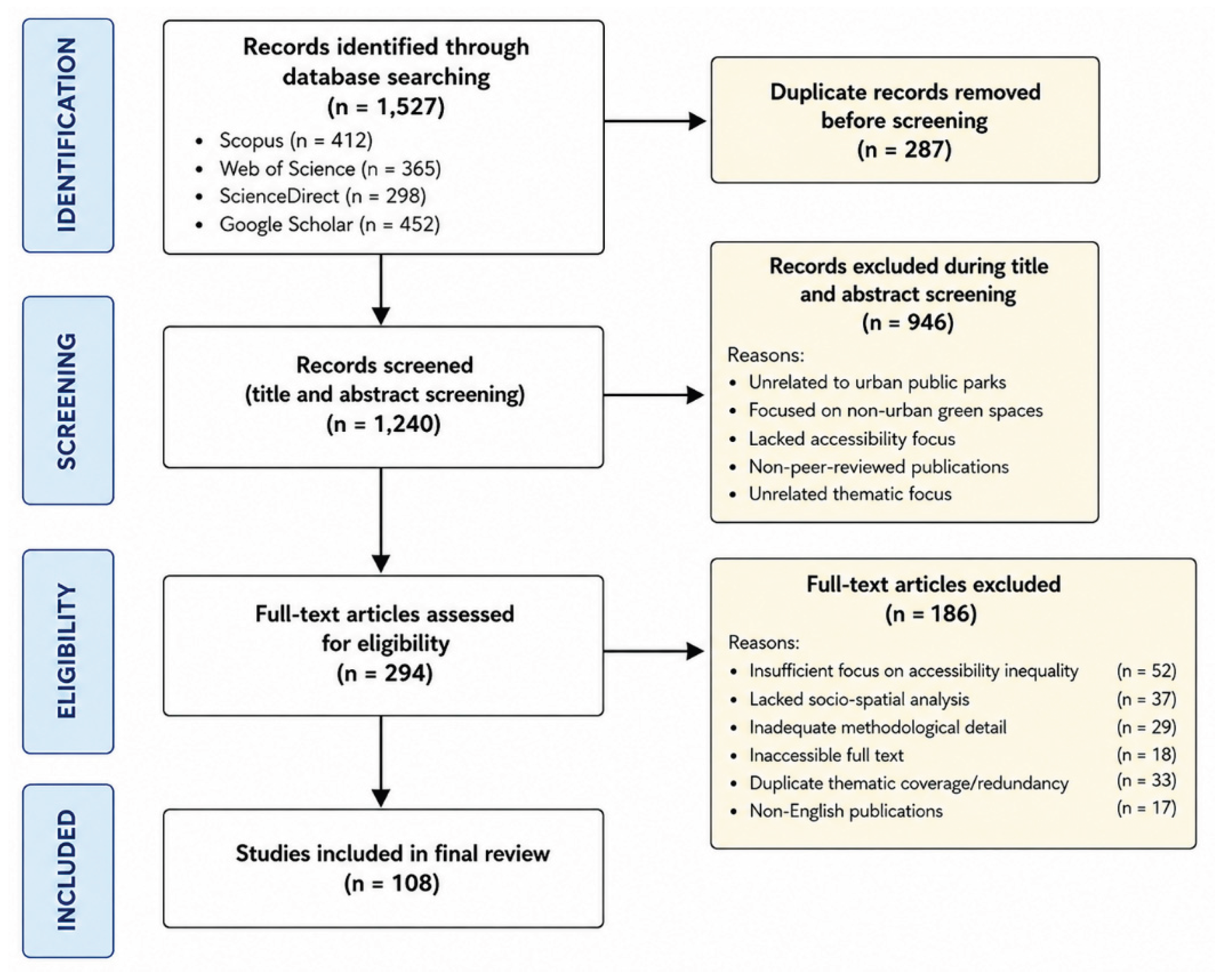
Figure 2.
Geographic distribution of the 108 reviewed studies. Source: Author's own work.
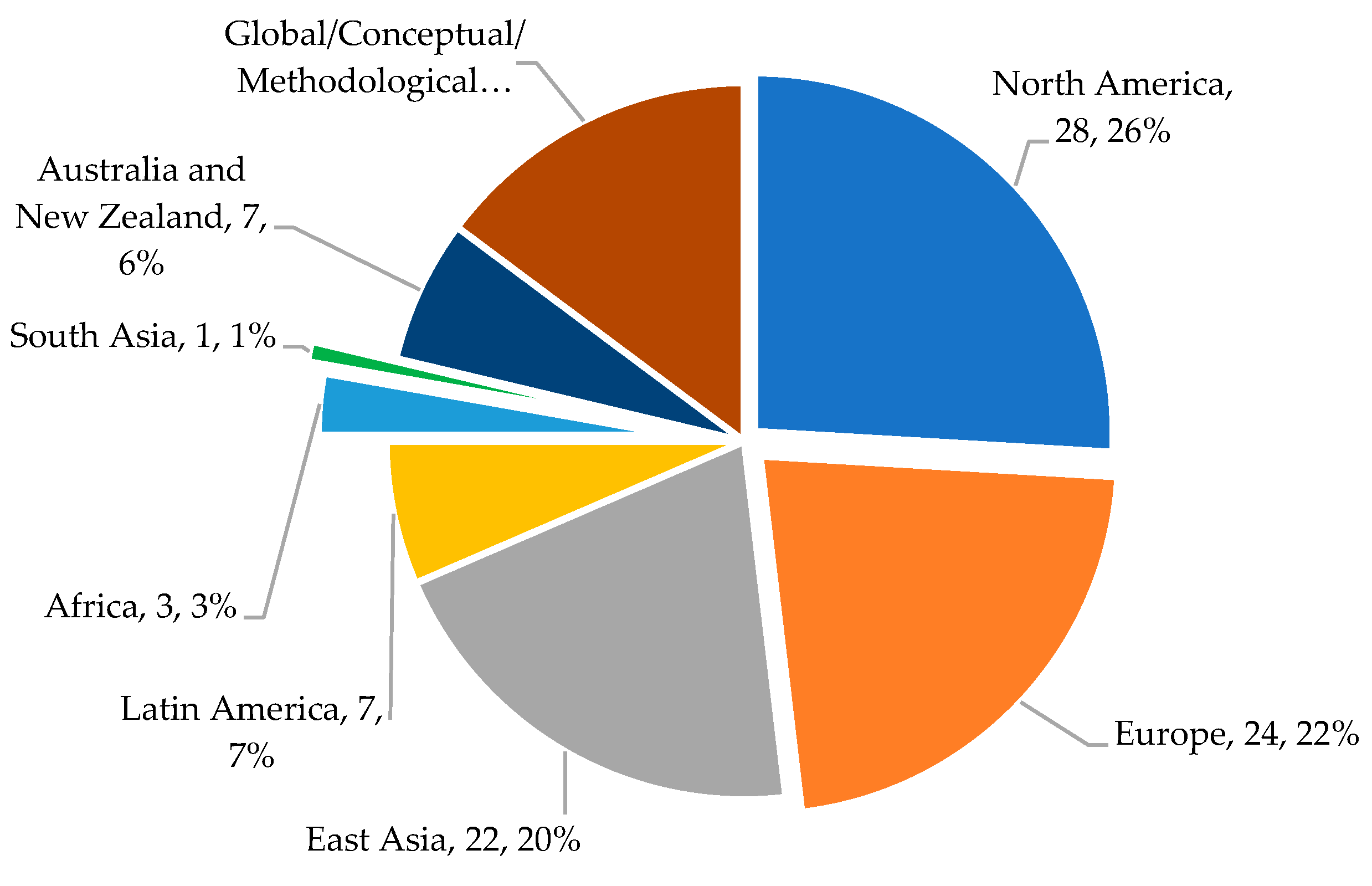
Figure 3.
Accessibility determinants identified in the reviewed literature. Source: Author's own work.
Figure 3.
Accessibility determinants identified in the reviewed literature. Source: Author's own work.
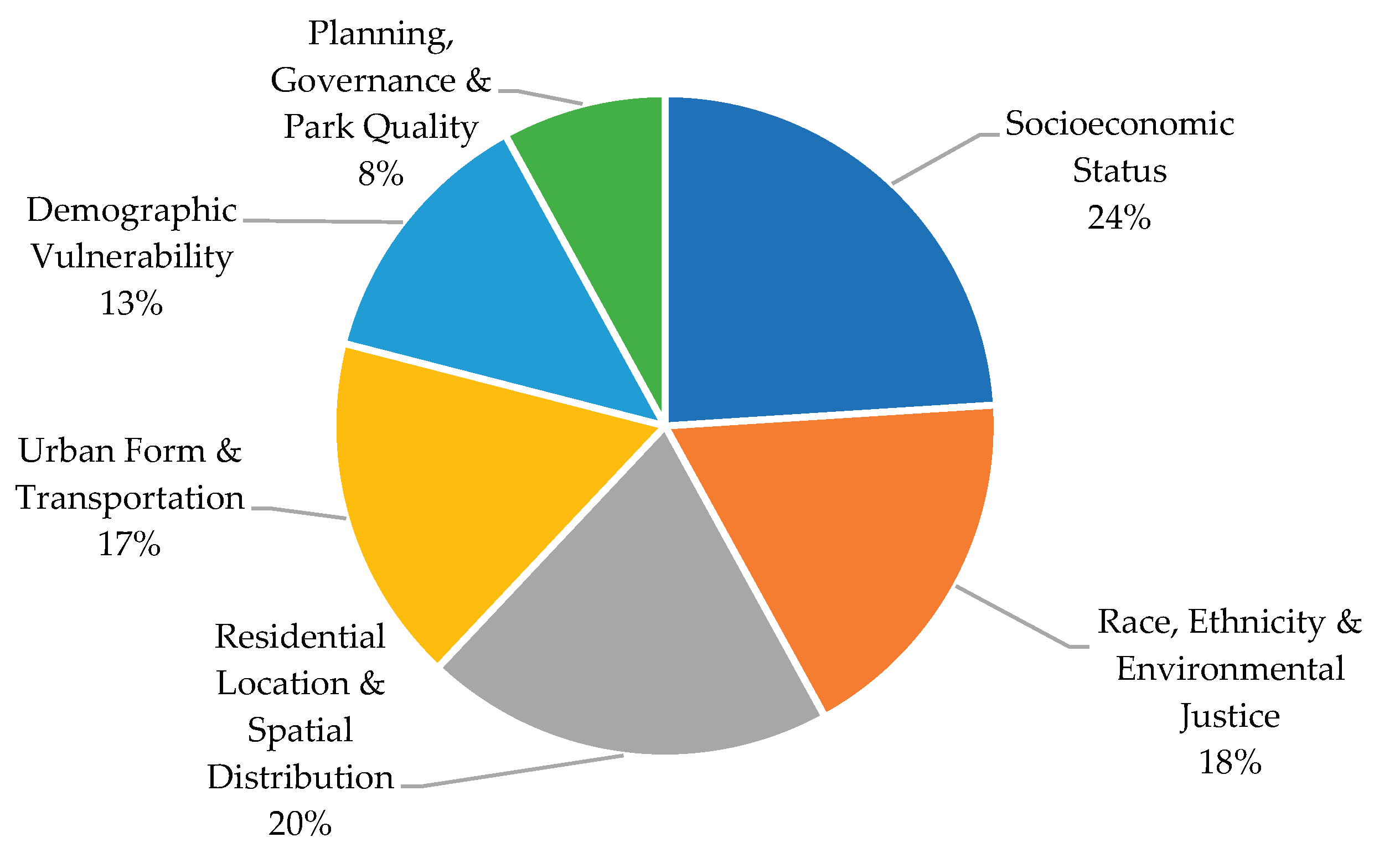
Figure 4.
Spatial justice implications of unequal urban park accessibility. Source: Author's own work.
Figure 4.
Spatial justice implications of unequal urban park accessibility. Source: Author's own work.
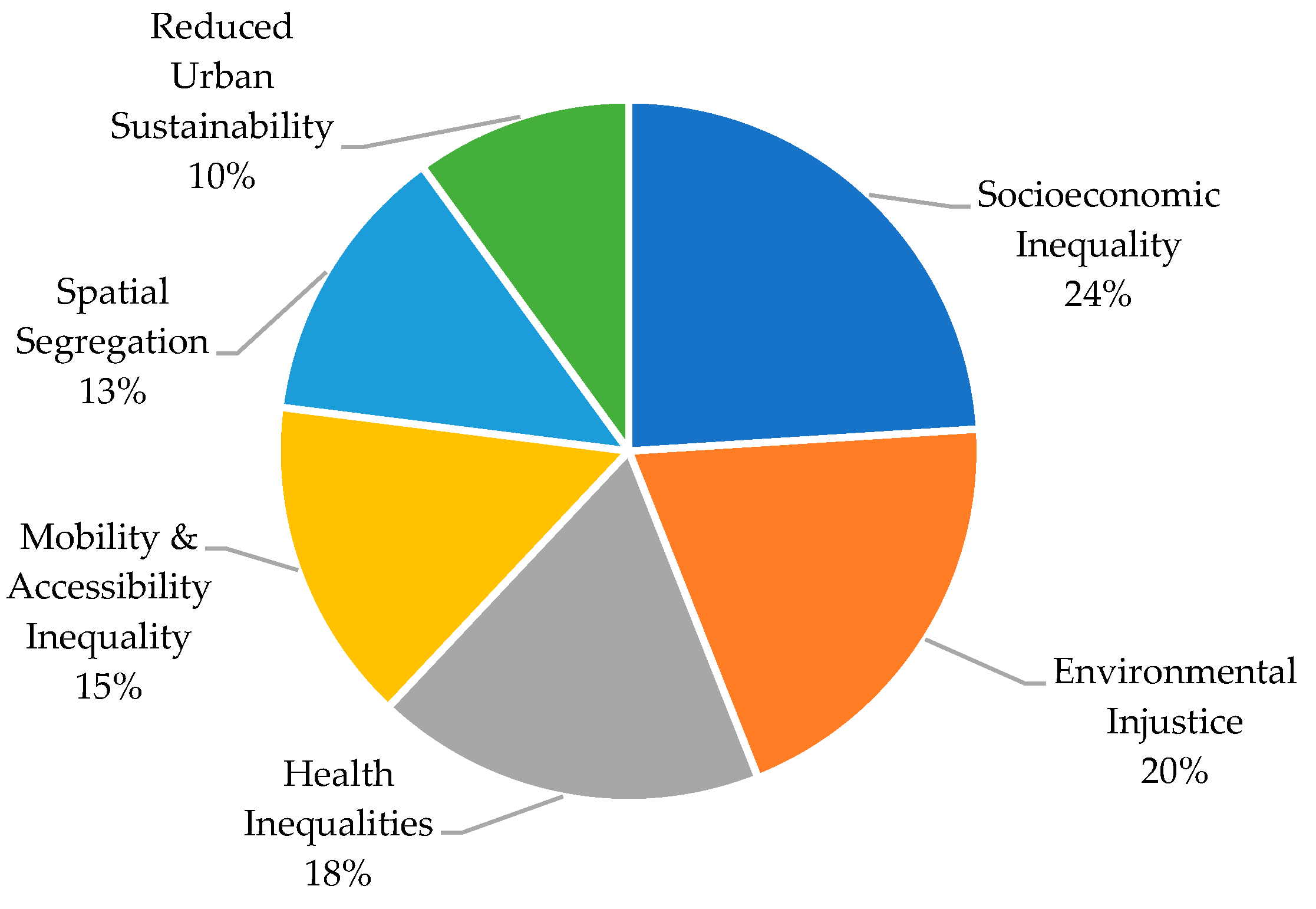
Figure 5.
Conceptual framework of urban park accessibility and spatial justice. Source: Author's own work.
Figure 5.
Conceptual framework of urban park accessibility and spatial justice. Source: Author's own work.
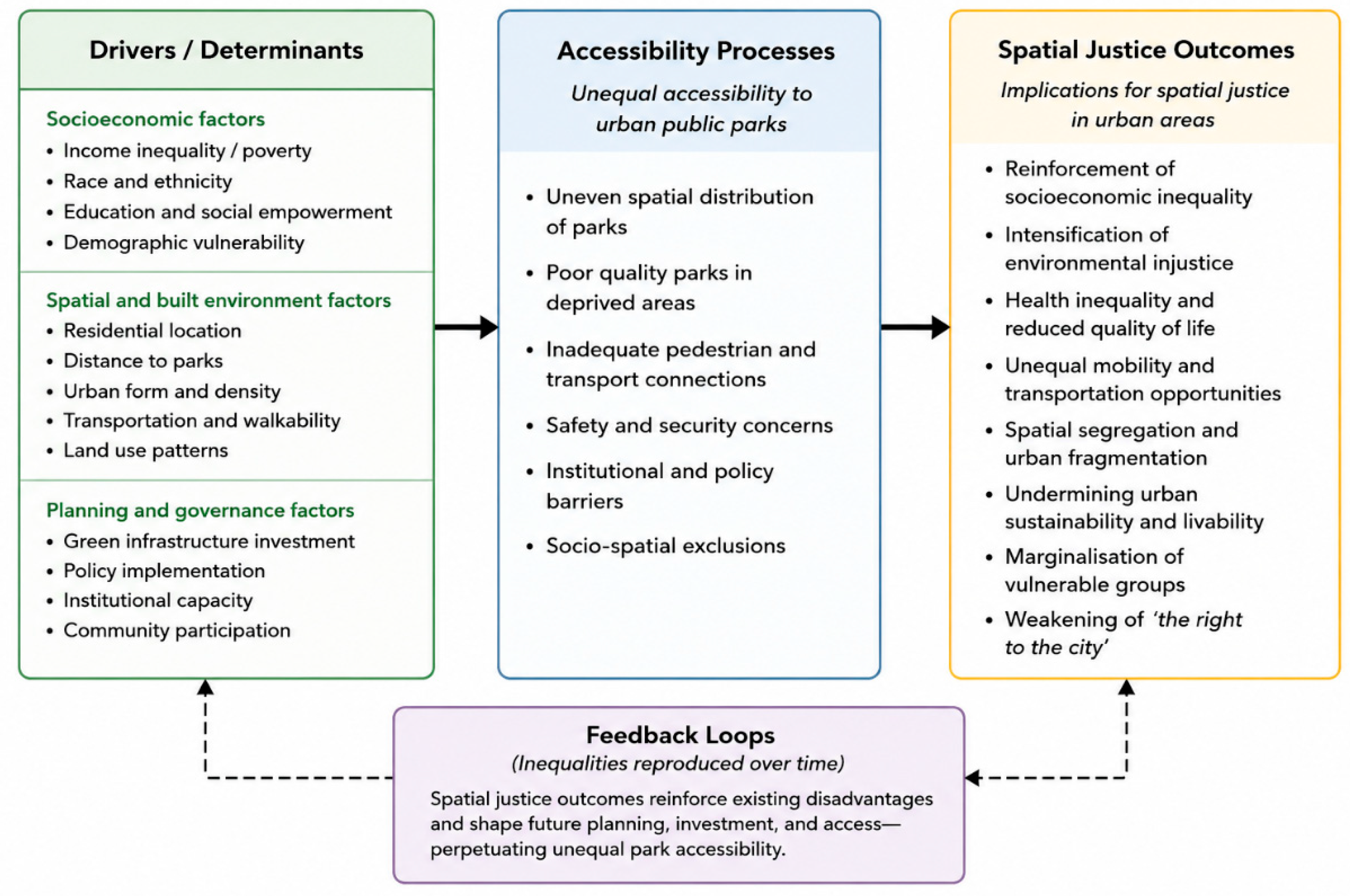

Table 1.
Databases searched and records retrieved.
| Database | Search Period | Records Retrieved |
| Scopus | August–December 2025 | 412 |
| Web of Science | August –December 2025 | 365 |
| ScienceDirect | August –December 2025 | 298 |
| Google Scholar | August –December 2025 | 452 |
| Total | 1,527 |
Source: Author's own work.
Table 2.
Application of theoretical frameworks.
| Theory | Analytical Focus | Application in Review |
| Spatial Justice Theory | Spatial distribution of resources | Interpreting unequal park accessibility and spatial exclusion |
| Environmental Justice Theory | Equity in environmental benefits | Analyzing disparities across race, ethnicity, and socio-economic groups |
| Urban Political Ecology | Governance and power relations | Exploring how institutional and planning factors affect accessibility. |
Source: Author's own work.
Table 3.
Methodological quality assessment of reviewed studies.
| Quality Dimension | Assessment | Observation |
| Research objectives | High | Most studies explicitly outlined their objectives and research questions. |
| Research design | High | Research designs were generally appropriate to the study aims. |
| Data collection procedures | High | Most studies employed suitable and clearly described data collection methods. |
| Analytical rigour | High | GIS, statistical, qualitative, and mixed-methods analyses were generally robust. |
| Sampling procedures | Moderate | Some studies provided limited information on sampling strategies and justification for the sample. |
| Validity and reliability reporting | Moderate | Reporting of validity and reliability measures was inconsistent across studies. |
| Integration of mixed-methods components | Moderate | Some mixed-methods studies inadequately integrated qualitative and quantitative findings. |
Source: Author's own work.
Table 4.
Co-occurrence matrix of accessibility determinants.
| Factors | Socio-economic Status | Race, Ethnicity & Environmental Justice | Residential Location, Distance & Spatial Distribution | Urban Form, Street Connectivity & Transportation | Demographic Vulnerability | Planning, Governance & Park Quality |
| Socio-Economic Status | — | 82% | 79% | 74% | 76% | 81% |
| Race, Ethnicity & Environmental Justice | 82% | — | 73% | 58% | 71% | 77% |
| Residential Location, Distance & Spatial Distribution | 79% | 73% | — | 75% | 61% | 72% |
| Urban Form, Street Connectivity & Transportation | 74% | 58% | 75% | — | 70% | 74% |
| Demographic Vulnerability | 76% | 71% | 61% | 70% | — | 56% |
| Planning, Governance & Park Quality | 81% | 77% | 72% | 74% | 56% | — |
Source: Author's own work. Note: Percentages indicate the proportion of reviewed studies in which two themes were identified simultaneously during coding and synthesis. Higher percentages indicate stronger thematic associations across the literature. These percentages do not represent statistical correlations or causal relationships.
Table 5.
Co-occurrence matrix of spatial justice outcomes.
| Implications | Socio-economic Inequality | Environmental Injustice | Health Inequalities | Mobility Inequality | Spatial Segregation | Reduced Urban Sustainability | Marginalisation of Vulnerable Groups | Weakening the Right to the City |
| Socio-economic Inequality | — | 84% | 78% | 73% | 81% | 62% | 79% | 76% |
| Environmental Injustice | 84% | — | 76% | 58% | 80% | 74% | 77% | 79% |
| Health Inequalities | 78% | 76% | — | 55% | 61% | 73% | 75% | 57% |
| Mobility Inequality | 73% | 58% | 55% | — | 74% | 52% | 71% | 59% |
| Spatial Segregation | 81% | 80% | 61% | 74% | — | 76% | 78% | 81% |
| Reduced Urban Sustainability | 62% | 74% | 73% | 52% | 76% | — | 57% | 72% |
| Marginalisation of Vulnerable Groups | 79% | 77% | 75% | 71% | 78% | 57% | — | 80% |
| Weakening the Right to the City | 76% | 79% | 57% | 59% | 81% | 72% | 80% | — |
Source: Author's own work. Note: Percentages indicate the proportion of reviewed studies in which two themes were identified simultaneously during coding and synthesis. Higher values indicate stronger thematic associations across the literature. The percentages do not represent statistical correlations or causal relationships.
Disclaimer/Publisher’s Note: The statements, opinions and data contained in all publications are solely those of the individual author(s) and contributor(s) and not of MDPI and/or the editor(s). MDPI and/or the editor(s) disclaim responsibility for any injury to people or property resulting from any ideas, methods, instructions or products referred to in the content. |
© 2026 by the authors. Licensee MDPI, Basel, Switzerland. This article is an open access article distributed under the terms and conditions of the Creative Commons Attribution (CC BY) license (http://creativecommons.org/licenses/by/4.0/).
Copyright: This open access article is published under a Creative Commons CC BY 4.0 license, which permit the free download, distribution, and reuse, provided that the author and preprint are cited in any reuse.


