
Submitted:
08 June 2026
Posted:
09 June 2026
You are already at the latest version
Abstract
Aerosol Jet Printing, AJP, has emerged as a versatile direct ink writing technology enabling high-resolution, non-contact patterning of diverse biomaterials across a broad viscosity range. This capability facilitates the fabrication of complex micro- and mesoscale architectures on planar and non-planar substrates, advancing applications in biosensing, microfluidics, tissue engineering, and drug delivery fields. Herein, we review the integration of this high resolution, rapid prototyping method with bioinks, including proteins, DNA, collagen, gelatin, and silk fibroin, and analyze how processing parameters influence structural and functional outcomes designed for applications for the above mentioned bechnological fields. The ability by aerosol jet printing to combine structural, electrical, and biological functionalities within single platforms supports the development of multifunctional biomedical devices with higher potential with respect to analogies produced using other direct ink writing techniques. While challenges such as bioink stability and process scalability, as well as the lack of deeper analyses about the efficiency of real applicability of aerosol jet printed biotools, still remain open, AJP demonstrates significant promise as an enabling technology for next-generation biofabrication, offering new avenues for personalized and flexible biomedical applications.
Keywords:
aerosol jet printing
; biotechnology
; bioinks
; tissue engineering
; drug delivery
1. Introduction
The Additive manufacturing (AM) pertains the set of fabrication protocols for the implementation of 3D-shaped artifacts by means of a layer-upon-layer approach. 3D printing methods, in particular, are widespread AM tools that, according to the scheme reported by Wong et al. [1], belong to the category of powder-based deposition processes in which the artifact manufacturing is promoted by binding mechanisms involving particle-based precursors. The development and evolution of 3D printing systems based on different types of precursors’ delivery mechanisms, have led to a natural extension of the above scheme to liquid dispersions of particles (inks) or more viscous extrusion pastes.
Since the beginning of 21th century, attention has been paid on 3D printing methods for fast prototyping protocols like the Direct Ink Writing (DIW) approaches, which rely on non-contact techniques and exploit inks made of conducting precursors in the form of colloidal suspensions of particles, from few to hundreds of nanometers in diameter [2,3], or are based on organic materials in solution [4,5].
DIW techniques are well suited for a ‘mask-less’ implementation of 3D printed electronic devices [6], directly fabricated on a wide set of substrates, from conventional ones (Si/SiO2 wafers, conducting oxides as ITO and FTO) to plastic supports (e.g. polyethylene terephthalate, PET, polyethylene naphthalene, PEN, polyimide, PI, and others). This is because DIW offers some peculiar advantages in terms of product design versatility, conjugating a marked flexibility for the allowed device architectures, a reduced materials consumption/cost, and a suitability for mass production of electronic devices and interconnects. Within this scenario, the most mature non-contact, DIW technique is the Inkjet Printing (IJP). IJP deposition process is based on electrostatic (piezoelectric and thermal) and electrodynamic actuators for the generation of ink droplets, at very high rate, that are directed towards the substrate once they are opportunely deflected at the nozzle outlet [7]. Although allowing rapid prototyping manufacturing, the IJP suffers from a limited capability towards the scaling down of printed features and a precluded attitude at depositing viscous inks, both reducing the set of deposable materials; for instance, IJP is suitable for the printing of inks with viscosities in the range from 20 to 40 cP [8]. A finer alternative route, the Aerosol-Jet Printing (AJP), permits to overcome such limitations, offering enhanced scaling down capability and extending the viscosity range of printable inks [9]. Even though the final outcome by AJP and IJP processes may be obtained by the same sequence of steps, i.e. the generation of ink flows made of droplets that are ejected from an orifice impacting on substrates placed on moving plates, such processes actually present intimate differences in terms of (i) the ink flow generation mode, (ii) the way in which the flow is delivered to the printing head and (iii) the ejection features at the nozzle orifice. Indeed, AJP allows the deposition of features with a higher line resolution, approaching in some cases few microns [10], in the case of a wider set of materials (viscosity ranging from 1 and 1000 cP [11]), and is also suitable for depositing colloidal inks characterized by particles size ranging between 10 and 700 nm [2]. This printing method even envisages a reduced materials consumption as a consequence of the reduced volume per area delivery of ink with respect to IJP [12]. Worth to note that the higher viscosities of allowed inks permit to enlarge the AJP applicability range to 3D structures where in-plane and out-of-plane dimensions are comparable (3D structures, for instance in a lattice form [13])
Accordingly, AJP may act as an enabling process for several applications, inter alia: (i) flexible, bendable, conformable and wearable devices based on organic conductors and inks made of nanosystems’ suspensions [14,15,16]; (ii) integrated devices and (bio)sensors [17,18,19,20,21]; (iii) bio-inspired materials and devices [22,23,24]; (iv) energy conversion by photovoltaic paints (solar cells) and light emitting devices reparation of active layers in polymer solar cells [25,26,27]; (v) storage (batteries, supercapacitors) [28,29]; (vi) integrated electronics (antennas and coils) for wireless powering/data communication [30,31,32]. Beyond 3D printed electronics, AJP allows very complex patterning and the definition of architectures on non-planar surfaces, while 3D IJP deals with low-viscosity materials, and is therefore limited to producing artifacts with a narrow range of mechanical properties; this is particularly true for polymeric precursors in which low viscosity is related to shorter, less structured, polymer chains. In addition, among DIW available techniques AJP is poised to become the best suited one to novel printing paradigms such as 4D [33], again thanks to the largest availability of printable materials.
Even if AJP shows enhanced 3D capability with respect to IJP [34], such technique is relatively young if compared to the latter; at present AJP is still not as popular as IJP, as also witnessed by the Web of Science database that, at the voice “Aerosol Jet Printing”, lists less than 1000 papers, nearly all published from 2006 to date. Nevertheless, literature already offers a wide-ranging description of the process features of AJP systems [9,35], and related issues (such as the overspray, OS, phenomenon) [15,36].
The potential of 3D printing by AJP has been explored also in applications for strategic sectors of biotechnology, such as tissue engineering, cell guidance and drug delivery (DD) [37,38]. The suitability of AJP for biotechnological applications stems from the high viscosity range of its printable inks, which enables the use of diverse material formulations and yields 3D structures with enhanced mechanical performance. This is particularly advantageous when printing on flexible or organic substrates or when engineering smart functionalities typical of 4D printing, such as electrical conductivity or shape-changing behavior, while still achieving high-definition 3D features [13].
Herein, some concrete examples and a critical evaluation of studies relating the potential of AJP in bioprinting, are reported and discussed in terms of advantages, limitations and perspectives. The analysis takes into account several aspects going beyond the mere description of processes and research products. It will consider aspects connected to materials as well, such as the features of inks realized so far.
2. The Origins of AJP and Overview of Its Working Principles
The Mesoscopic Integrated Conformal Electronics (MICE) Program, promoted by the Defense Advanced Research Projects Agency (DARPA) in 2002, indicated the 3D printing technology as a new paradigm for mesoscale electronics. Thereafter, DIW techniques began to be exploited in the manufacturing of electronic components, such as passive and active components and devices [16,39], circuits manufacturing (i.e. logic gates, amplifiers or complex circuits) [40] and integration strategies allowed by an ease to print of devices/components and related interconnects. At first, IJP took advantage from the technological solutions developed for commercial desktop printers, as indicated by the above mentioned increment of literature documents about IJP use in research. Currently, although less explored than IJP, the scientific production on AJP technique is marked increased since the first AJP system was launched on the market in 2004 by the Optomec Inc. The review by Cooper et al. [41] traces the origins of AJP to the work by M. Renn, who holds the first patent of a prototype system for direct writing (2007). After joining the Optomec (1999), Dr. Renn developed the modern versions of AJP systems under the DARPA indications; the first one was the Maskless Mesoscale Materials Deposition (M3D), whose following evolutions are available under the trademark Aerosol Jet®. Nonetheless, concepts behind such technique are quite older. One of the first documented traces of studies dealing with the operation features of a 16-way home-made aerosol jet printing system, date back to the meddle of 70s [42]. The documented activity is also supported by an analysis of the motivations at the basis of the fine stream collimation and related enhancement of line resolution by AJP systems. First applications on functional materials regard the manufacturing of ferroelectric PZT films, reported in the middle of 90s by S. Kashu and coworkers [43,44]. It is from the second decade of the current century, nearly ten years after the precepts stated by the MICE program, that AJP and electronics began to follow the same direction towards the establishment of an all-printed, large-area and flexible electronics. Pioneering studies, most of them disseminated at specific conferences on AM, show the suitability of AJP towards 3D printed electronics, implemented via deposition of electronic materials [45,46,47]. Bioinks have likewise been the subject of scientific studies dating back to the earliest investigations into the technique and its applicability [48], hence demonstrating that the use of AJP in the biotechnological sector was envisaged from the very beginning.
Currently, the introduction of novel commercial AJP systems, the objective benefits it offers with respect to other DIW (including IJP) in terms of rapid prototyping of miniaturized devices or, as opposite, large area electronics, all make such technique an emerging tool in the context of private and public research.
In the following, a brief description of AJP working principles, whose schematics is reported in Figure 1. The ink delivery by AJP systems is ruled by the simultaneous action of two gas flows, i.e. the carrier and sheath gas flow (CGF and ShGF, respectively). The former acts on the transport of aerosolized inks in the pipeline connecting the atomizer generating an aerosol of micro-droplets, and the printing head (PH); the latter forces the generated aerosol along the central axis of the stream (collimation). At the basic level, AJP operation relies on two principles of atomization as the first step of aerosolization process. AJP systems, indeed, generate an aerosol mist from ink droplets using either an ultrasonic (UA) or pneumatic (PA) atomizer. The aerosol is then transported and confined in a pipeline using the already mentioned CGF and ShGF, respectively, which help to enhance the velocity and focus the aerosol stream along the central axis to limiting droplet spreading. UAs are suitable for low-density inks with viscosities between 1 and 10 cP, while PAs can handle inks with viscosities up to 1000 cP. This allows for high ink loading and conductivity in a single-pass deposition. Equipped with a nozzle implementing a controlled ink flow through its orifice, the PH focuses the ink stream within a nozzle, and the substrate is placed on a motorized deposition stage, a plate set at a fixed distance from the patterning source and controlled by software that converts CAD designs into vector-based tool paths. Worth to note that the marked design versatility by DIW non-contact techniques, in particular AJP, essentially relies on the use of the CAD software tracing the patterns to be printed. As a process drawback, AJP line features suffer from the overspray (OS) phenomenon, a printing instability caused by droplet deposition outside the intended line profile, and suggested strategies to mitigate it, such as using larger nozzles and adding less volatile co-solvents to ink formulations, are offered by literature [10,49].
3. Biocompatible and Bioinspired Inks
In a biotechnology context, AJP poses as a versatile, maskless, direct-write biofabrication technology that bridges biology and electronics, enabling localized biofunctionalization of sensor surfaces [50] and Lab-on-Chip (LoC) components [51], even on non-planar geometries. However, evergreen trends in biotechnology are DD and tissue engineering, and the connecting link between these research areas and the AJP technique is represented by bioinks allowing ultrasonic AJP for drug-testing platforms [52] and tissue-engineered constructs [53] in which controlled cell adhesion and organization are essential, even at the cost of somewhat lower edge resolution and coating uniformity.
Literature explores the use of 3D AJP for microstructuring biocompatible and bio-based inks, highlighting its potential in biotechnology through high-resolution deposition achieved by a fine tuning of printing parameters. Bioinks made of proteins, protein-metal hybrid composites, living cells and gelatins, as well as strategies combining AJP and other manufacturing routes to impart the desired function, are the subject of (albeit few) dedicated literature work since the early appearance of the AJP technique.
A pioneering study by De Silva et al. introduced a two-step precision spraying method to micropattern living cells on both planar and complex curved substrates using focused jets of aerosolized polymer solutions [48]. In their approach, a polymer solution (adhesive, such as laminin or PEI, or non-adhesive, such as PTFE or PDMS) was aerosolized, focused with sheath gas through a 150 μm orifice, and written under CAD control to form about 25 μm-wide patterns. Cells were then simply plated, and selectively adhered only to permissive regions. Positive patterning was achieved by spraying adhesive biopolymers onto non-adhesive PDMS so that diverse cell types formed stable patterns in serum-containing media, while negative patterning was performed by spraying hydrophobic polymers onto glass so that cells occupy only the exposed glass stripes, including on tapered capillaries and other curved supports. This study is a clear demonstration of how spatially selective surface properties permitted by the direct application of coatings with AJP represent by fact one of the major advantages of this techniques when related to biotechnologies, in particular for scaffolds coatings in tissue engineering.
A very recent work by Zhou et al. reports on a single-step aerosol jet co-printing method to fabricate flexible, conductive collagen/silver electrodes, unveiling the potential of co-printing to get hybrid biopolymer-inorganic materials whose characteristics are adjustable directly in line, not by preparing novel ink solutions [54]. The authors aimed at creating biocompatible, mechanically compliant, and electrically functional bioelectronic interfaces suitable for implantable devices. They demonstrated that by co-depositing collagen and silver NP inks and optimizing curing conditions, they could produce electrodes with low resistivity (~10-6 Ω·m), maintained conductivity under mechanical flexure, and partially preserved collagen structure for weeks in physiological media. Indeed, adjusting material ratios and processing parameters allowed tuning of electrical and biological performance, revealing a processing window where moderate cytotoxicity could be mitigated by higher collagen content, although long-term biocompatibility still remains a concern.
Focusing specifically on the use of true bioinks, Grunwald et al. showed that AJP can deposit microscale protein, DNA and enzyme patterns, as well as conductive metal features, on planar and complex 3D substrates without loss of biomolecular function [55]. They formulated bioinks from fluorescently labelled BSA, DNA ladders and horseradish peroxidase, generated aerosols via ultrasonic or pneumatic nebulizers, and focused droplets with a coaxial sheath gas to produce 10–20 μm lines and spots at densities of ~1600 spots/mm², while controlling overspray by adjusting ink viscosity (e.g. by adding ethylene glycol) and gas flows. They further demonstrated that high molecular-weight DNA is damaged by ultrasonic atomization but preserved with pneumatic nebulization, that HRP remains active after printing and mild heating (up to ~80 °C), and that silver nanoparticle inks can be printed and sintered into conductive interdigital electrodes (~25% of bulk Ag conductivity), into which micrometric BSA patterns are subsequently integrated using the same system.
Williams et al. investigated the use of ultrasonic AJP to deposit biological inks, specifically proteins like Cy5-labeled bovine serum albumin (BSA), streptavidin and anti-carcinoembryogenic antigen (anti-CEA) antibody, onto nonfouling poly(oligo(ethylene glycol) methyl ether methacrylate) (POEGMA) polymer surfaces (printing parameters: 100 µm nozzle, ShGF and CGF of 16 sccm, printing plate speed and temperature 0.5 mm/s and 30°C, respectively) for in vitro diagnostic (IVD) applications [56]. Assay performance were used to demonstrate that ultrasonication does not degrade DNA and proteins or impair their biofunctionality. They found that AJP can produce sensitive immunoassays with sub-nanogram per milliliter detection limits and can print complex, multi-material structures, including biological reagents and conductive nanowires, in a single process. These findings expand the potential of AJP for fabricating low-cost, integrated biosensors, revealing that ultrasonication, does not necessarily damage proteins, as previously thought. Beyond serving as a process to pattern both biological recognition elements and electronic/microfluidic structures, which is powerful for next-generation biosensors, lab-on-chip systems, and bioelectronic devices, protein-compatible AJP represents a route towards the implementation of tissue models for lab studies (e-g- Organ-on-Chip) and applications in tissue engineering.
The studies herein presented demonstrate that by balancing UA and PA parameters, proteins of varying complexity, including antibodies and DNA, can be effectively deposited, finding applications in DD (e.g., antibody-mediated targeting [57,58]), tissue engineering, and biosensing (e.g., DNA sensors [59,60]).
While recombinant proteins and DNA-based biotechnologies offer precise control in biomedical applications, gelatin (derived through thermal hydrolysis of animal collagen) provides a natural, biocompatible biomaterial with similar structural roles in controlled release via hydrogels in DD and in 3D scaffolds for tissue engineering, as well as in medical devices like hemostatic sponges, and GelMA-based bioinks for 3D printing and biosensors [61]. The analysis presented by Phuah et al. similarly underscored how various printing parameters influence the resolution and quality of biomaterial lines produced by AJP, using gelatin as a model ink [62]. The authors systematically varied seven key parameters such as CGF, FR, print speed, stage temperature, nozzle diameter, working distance, and ink concentration to understand their effects on line width, height, and features like drop formation and the coffee ring effect. They found that these parameters primarily affect processes like material deposition, evaporation, and aerosol focusing, with optimal ranges enabling the printing of gelatin lines as narrow as 30 μm. Interestingly, the systematic change of the above parameters produces expected results for CGF (i.e. increased line width and height, but also more overspray at higher GCFs), FR (i.e. too high FR increased overspray and loss of edge definition), platen temperature (i.e. higher temperatures resulted in more uniform line cross-section, but excessively high temperature promoted overspray or other defects), nozzle diameter (i.e. smallest nozzle realized the best combination of line height and width) and working distance (i.e. increased working distance corresponded to reduced resolution due to focusing loss). On the contrary, deviations from outcomes typically found in case of printing of polymers and metallic inks, were found in case of printing speed and ink concentration; in fact, an increased print speed only induced line height reduction (less material per unit length) upon keeping line width almost unchanged, while variations in concentration produced no significant dependence of line quality.
It is noteworthy that, after deposition, gelatins exhibit pronounced swelling, so even though line width typically decreases with higher deposition speed in AJP, the observed invariance thereof with respect to printing speed may arise from a competitive interplay among process parameters as the deposition rate, the subdued temperature of the printing stage, and the herein used substrate's wetting properties. However, beyond the motivations (which clearly warrant deeper investigation), the invariance of line width in favor of an increased line thickness as a function of printing process speed represents a significant advantage, at least in the case of gelatins, toward implementing processes capable of yielding constructs with marked size in the out-of-plane direction.
Silk fibroin (SF) is another natural protein-based biopolymer widely used in biotechnology, in particular in applications for tissue engineering [63,64] and DD [65,66]. SF exhibits distinctive (bio)chemical and physical properties, featuring a high density of amino-acid functional groups and remarkable, easily tunable mechanical behavior achieved through simple and rapid strategies [67]. Despite large literature on SF deposition by AM routes as extrusion-based 3D bioprinting [68,69], 3D jet printing [70], binder jetting [71] and wet spinning/electrospinning [72,73], a few has been done in the context of DIW; literature offers just some insights related to IJP [74,75]. This is mainly due to the inherently low printability of bare SF when used as ink.
In the context of AJP, Xiao et al. developed a modified material formulation process, emphasizing precise control of degumming, dissolution, and dialysis steps, to produce stable regenerated SF solutions suitable for AJP [76]. They identified a narrow processing window defined by ShGF and CGF rates minimizing defects like overspray. Herein, the ShGF rate was varied between 20 and 150 sccm, with a maximum CGF of 50 sccm (platen temperature and speed 25°C and 2mm/s, respectively), finding an optimum focus ratio (i.e. ShGF/CGF) between 3 and 4 in terms of lower overspray width in all cases and a lower line width of about 10 µm for a CGF rate of 23 sccm. The as-showed findings demonstrated that optimizing these parameters allows overcoming the challenge of printing SF solutions without the use of additives like reagents or other biocompounds. This enables the fabrication of microscale SF patterns with improved resolution while providing new insights into the processability of biopolymer solutions via AJP, even without using additives.
Considerable challenges arise in achieving macroscopic SF structures by AJP, which are however theoretically feasible with wide-head AJP systems; however, the low thickness attainable with a single deposition pass necessitates prolonged deposition processes, which is dictated by the number of layers within the layer-upon-layer approach required to extend the size of bulk system to the third dimension. Once again, designing appropriate formulations seems to be the route to follow in order to achieve SF materials with remarkable bio/chemical/physical properties and high printing quality using AJP. In short, through different formulations of a given printable ink and/or opportune deposition parameters, it is possible to tune the dimensional characteristics of the printed features [77].
3.1. Collagen-Based Bioinks
A recent systematic review by Stepanovska et al. shows that collagen is widely used as a base hydrogel in cell-containing bioinks, often employed in extrusion, or laser-based printing systems, especially when high-fidelity scaffolds with good cell viability are sought [78]. Collagens are indeed the most extensively examined biomaterials in 3D bioprinting, owing to their biocompatibility, ability to mimic the native extracellular matrix (ECM), and seamless integration with cells and other biomaterials. For this reason, collagen bioinks deserve dedicated coverage in an independent section.
Since its emergence in the research field, AJP has proven useful as a method to produce dense, mechanically robust collagen scaffolds suitable for tissue engineering applications, particularly in replicating dense collagenous tissues like the cornea and cartilage. In this respect, Gibney et al. investigated AJP of collagen type I and II to fabricate dense, multilayered constructs with mechanical properties comparable to native collagenous tissues, particularly cartilage [79]. The authors showed that layer-upon-layer AJP can produce up to hundreds of stacked layers with effective elastic moduli in the 0.1–2 MPa range, placing printed collagen within reach of human ear, septal and alar cartilage stiffness, and significantly above corneal stroma. They highlighted collagen type II as especially suitable for AJP because its lower viscosity enables a wider printable concentration window and it is less susceptible to process-induced denaturation, while type I shows gradual structural damage under prolonged printing. SEM analysis reveals well-defined, continuous layers using an optimized printing process reducing the partial re-solubilization and the arising of amorphous regions and “pothole” topographies found in preliminary tests. Therefore, AJP emerges as a promising high-resolution biofabrication method for collagen-based tissue engineering and potential integration with conductive inks. However, drawbacks in scalability, process-induced denaturation and the need for careful control of printing/neutralization conditions have similarly emerged from this study.
In a follow-up study involving some of the authors involved in the above discussed study, it also was demonstrated the AJP printing of recombinant human collagen type III (RHCIII) with high resolution and forming multilayered, dense films [80]. Using a ShGF of 60 cc/min, and a CGF of 40 cc/min (deposition speed 11,5 mm/s), the authors fabricated AJP RHCIII constructs exhibited optical transparency with an average transmission of 87.5% across all visible wavelengths and refractive index of 1.35, which are comparable to native cornea, while mechanical characterization showed an average effective elastic modulus of 506 ± 173 kPa, significantly higher than previously reported values for pure collagen. As-found features fall within the range of human corneal tissue, despite some collagen denaturation occurred during printing. These findings suggest that AJP can produce more mechanically robust and optically suitable collagen scaffolds than previous methods, providing insights into the potential of recombinant collagen bioprinting for corneal applications.
On the other hand, the work by Nair et al. focused on the use of AJP to enhance the piezoelectric properties and control the surface potential of collagen inks. The study explored the use of both pneumatic and ultrasonic AJP atomization methods to print Type I and Type II microfibrillar collagen from different anatomical sources [81]. Key findings of this study are: (i) the characterization of the rheological properties of the collagen inks showing that they behave as fluids at high frequencies, which is relevant for the ultrasonic AJP; (ii) the high-quality collagen lines (influenced by the CGF and ShGF rates) with minimal overspray and homogeneous coverage in an optimized deposition process; (iii) better alignment and lower surface roughness for ultrasonic AJP, which also did not cause notable denaturation; (iv) piezoelectric response of AJP-printed collagen significantly higher than that of drop-cast films, with the Type I collagen over performing the Type II one. Although differences are found for the two aerosolization methods, the potential of AJP in terms of allowed materials and superior properties of as-deposited features are herein evident.
AJP deposition to fabricate collagen-based micro-structures for bone tissue engineering also has been explored; Degryse et al. characterized formulations of collagen Type I inks incorporating hydroxyapatite (HAp) to mimic bone composition, and assessed the impact of ultrasonic atomization on collagen integrity [53]. They found that while certain collagen-HAp inks could be successfully printed into 3D hollow pillars (19 ccm CGF, 40 ccm ShGF, printing speed of 0.4 mm/s, platen temperature of 30°C to achieve high-resolution printing of ~20-50µm, through inflight jet), the ultrasonic atomization caused collagen degradation. Strategies to overcome this drawback like the addition of cellulose nanocrystals (CNCs) actually have induced cytotoxicity, as shown by in-vitro tests on MC3T3 cells.
Although studies consistently affirm the feasibility of collagen-based AJP, critical drawbacks including biocompatibility concerns, unpredictable degradation profiles, and laborious cross-linking protocols, still persist. This underscores the need for meticulous optimization, particularly via refined ink formulations (whether pure collagen or related composites) to deliver stable systems that are conducive to effective 3D printing, but also via a proper tuning of process parameters.
4. From Micrsostrutcturing Approaches to Applications in Biotechnology
Evidence from the literature highlights the feasibility of AJP-enabled microstructuring for biotechnological application. Microstructuring enables precise control over scaffold architecture at the micrometric scales, enhancing cell adhesion, guided proliferation upon. dictating cell behavior through topography and porosity, and tissue mimicry for applications in regenerative medicine. It also improves nutrient diffusion and vascularization in 3D constructs, and reduces shear stress on cells via optimized bioinks, boosting viability higher than 85% [82].
Several deposition methods, such as continuous jet deposition, as well as tools offered by some of the available printers such as 5 axis motion and in-flight curing, have been proposed for 3D microstructuring [83].
In the context of AJP, Seiti et al. tested three aqueous inks, AgNPs (commercial, diluted 1:4 for smoother structures), PEDOT:PSS (custom pseudo-elastic), and collagen-hydroxyapatite (Col-HAp, with/without glycerol), using strategies like continuous jet deposition (CJD), layer-upon-layer, and point-wise (PW), in this way achieving in under 10 minutes some 3D microstructures with heights of 200-590 μm, namely pillars with aspect ratio, AR, of 12 for AgNPs and AR=4.5 for PEDOT:PSS, but also microcones with AR=19 for Col-HAp [84]. Biocompatibility assays were pivotal; AgNPs showed high cytotoxicity (zero survival of h-iPSC-derived neural stem cells at 48h), ruling out direct cell contact; PEDOT:PSS exhibited low toxicity (~20% reduced ATP vs. plastic at 72h, healthy fibroblast proliferation); Col-HAp excelled, supporting confluent MC3T3-E1 osteoblast layers by day 7 with no dead cells in live-dead staining, mimicking bone composition for tissue engineering. Key biotechnological implications of these findings include rapid prototyping of conductive scaffolds for bioelectronics based on conducting polymers like PEDOT:PSS, or osteoinductive lattices made of composites like Col-Hap, facing challenges such as ink pooling, parameter sensitivity (e.g., ShGF causing bending or process temperature), and overspray persist, all these aspects crucial for favoring repeatability in bioprinting applications through a layer-upon-layer approach.
Superhydrophobic surfaces (contact angle >150°, sliding angle <5°) also are increasingly exploited in biotechnology. The aim is to control aqueous solutions, biofluids, proteins, and cells without the need for closed channels or complex pumping systems [85]. Such surfaces are also being explored for DD and for modulating interactions with cells and tissues [86], as well as for their potential in preventing biofouling [87]. The goal of fabricating scalable, programmable superhydrophobic surfaces with controlled microstructures by means of AJP has been addressed by Zhong et al. [88], who utilized AJP to deposit polymer solutions of disulfide-polydimethylsiloxane in patterns upon exploiting solvent evaporation during droplet flight aimed to induce gelation and microgel formation. They found that solvents with high vapor pressures cause in-flight gelation, resulting in rough, superhydrophobic surfaces, while low vapor pressure solvents lead to smooth, less hydrophobic surfaces due to droplet coalescence. Additionally, heating can de-gel the polymer, allowing post-fabrication tuning of surface properties. These findings advanced the understanding of scalable methods for creating functional superhydrophobic surfaces with potential applications relevant to biotechnology, as droplet manipulation, microreactors for reactant mixing, water-oil separation, and retardation of droplet evaporation.
4.1. AJP Aerosol Jet Printing for Surface Acoustic Wave Devices in Biotechnology
AJP has emerged as a transformative additive manufacturing technique also for the fabrication of surface acoustic wave (SAW) devices, addressing longstanding challenges in traditional lithographic methods that are labor-intensive, environmentally harmful, and reliant on cleanroom facilities [89]. The pivotal role of AJP in democratizing the access to high-performance SAW sensors lies in its maskless, direct-write capability, which enables rapid deposition of functional microstructures, such as silver interdigital transducers (IDTs) on lithium niobate (LiNbO3) substrates [90] using a wide range of conductive inks, including silver nanoparticles, silver nanowires, graphene, and PEDOT:PSS.
Key demonstrations underscore AJP's versatility; sensors achieving operational frequencies of 40-87 MHz with tunable central frequencies via IDT finger/gap optimization have validated temperature sensing with coefficients closely matching theoretical predictions, offering low-cost alternatives for real-time monitoring [90]. In microfluidics, AJP streamlines SAW device production from multi-step, 40-hour cleanroom processes to a single-step, 5-minute fabrication, yielding acoustic performance comparable to conventional devices [91]. Optimized parameters (e.g., CGF/ShGF, atomization current, print speed for ~40 μm lines) have produced 20 MHz SAW thermometers with excellent linearity from 25-200°C [92]. The SAW-AJP variant integrates SAW atomization for uniform adhesive films (1.5-5 μm, ~8% RSD, shear stress up to 550 kPa), aiding multilayer piezoelectrics [93].
4.1.1. Expanded Biotechnological Applications
AJP's role extends profoundly into biotechnology, where SAW devices enable precise manipulation and sensing in complex biological environments. In acoustofluidics, AJP-fabricated SAW microfluidic platforms drive contactless particle/cell manipulation, such as acoustophoresis for size-based sorting of cells, exosomes, or biomolecules, bypassing biochemical labels and reducing biofouling risks, ideal for point-of-care diagnostics and organ-on-chip models. For biosensing, these sensors detect physical/chemical parameters (e.g., temperature, viscosity, biomarkers) in real-time via frequency shifts, with AJP enabling integration of biocompatible inks for wearable or implantable devices able to monitor the pH, glucose, or proteins in physiological fluids. In bioelectronics, SAW-AJP supports hybrid neuromorphic systems by printing conductive/shear-resistant films for flexible interfaces with biopolymers or OECTs, facilitating brain-machine interfaces or prosthetic sensors with minimal invasiveness. Furthermore, rapid prototyping via AJP accelerates translation from bench to clinic, as seen in customizable LoCs for drug screening or pathogen detection [94], where reduced fabrication time enhances iterative design for personalized medicine. Future synergies with bioinks could yield fully printed SAW-biosensors for in vivo neuromorphic computing or tissue engineering scaffolds.
Despite advances, issues related to surface roughness, shorting, and frequency limits, still persist, necessitating optimization for biocompatibility and long-term stability in biotic media.
4.2. AJP as an Enabling Technology for Microfluidics
So far, it has emerged that AJP combines a finer resolution, 3D/topographical capability, material efficiency in terms of no masks and minimal waste, and compatibility with a wide viscosity range and diverse inks, including polymers, proteins, nanoparticles, and piezoelectric materials. These features make AJP a powerful platform for LoC research, where fast iteration on device geometry and on-chip functionalization is crucial for applications such as diagnostics [95], biochemical assays [96], and particle or cell manipulation [97]. Indeed, in microfluidics, AJP has been used in two main ways. First, to print masters or molds for soft lithography, enabling rapid prototyping of PDMS devices with customized geometries such as steps, slopes, and complex channel networks, without photomasks or cleanroom processing [98]. Second, to locally deposit functional layers (e.g., hydrophilic polymers, biomolecules, conductive or piezoelectric inks) inside or on top of microfluidic channels, therefore enabling spatially resolved control of wettability [99], (bio)chemical reactivity [100], sensing elements [101], or acoustic actuation (as in SAW microfluidic devices [91]).
The article by Ćatić et al. explored a strategy for rapid prototyping of microfluidic devices combining complex geometries with precise, localized channel functionalization [98]. It showed that AJP could be used to fabricate high-resolution molds for soft lithography in an efficient and cost-effective way, yielding microfluidic channels with features down to 10 μm and enabling the selective deposition of functional coatings, such as hydrophilic PVA, at defined positions within the channels. The study highlighted that AJP supported versatile geometries, including steps and slopes, and allowed in-channel functionalization without compromising mold reusability, thus opening up new opportunities for flexible, customizable microfluidic device fabrication.
Microfluidics is the basis of the LoC concept, in which a single miniaturized chip integrates many functions typical of a conventional laboratory, such as sample preparation, chemical reactions, separations, detection, and analysis. AJP may support the realization of monolithically integrated LoC devices, from the substrate to the electronics and the microfluidic components themselves, within a rapid prototyping framework. In this context, the work by Di Novo et al. reported on a microfluidic electrochemical sensor platform entirely fabricated using AJP, providing advances understanding of AJP's potential for streamlined, integrated biosensor manufacturing [102]. The authors addressed issues related to operator-dependent reagent deposition and microfluidic integration with miniaturized sensors. They demonstrated that AJP can produce microchannels made of NOA81, a UV-curable optical adhesive deposited to form cavities (Figure 2A-D) on previously printed electrode structures, with good repeatability and minimal variability, and validated the platform by detecting glucose within a clinically relevant range. These findings reveal that AJP enables rapid, support-free microfluidic device fabrication with consistent geometries, and that directly printed mediator and enzyme layers can produce effective glucose sensing, with a limit of detection around 2.4 mM. More, Jing et al. developed low-cost, flexible, and conformable force sensors, suitable for biomedical and robotic applications, consisting of a novel microfluidic capacitive force sensor fabricated via AJP [101]. The sensor layout shared a microfluidic channel filled with a glycerol-water mixture and interdigitated electrodes on a flexible substrate. It exhibited a highly linear response to applied force up to about 9 N, with customizable performance characteristics (achievable by adjusting design parameters) in terms of tunable sensitivity and measurement range. The study demonstrated the sensor's robustness over repeated cycles, its ability to conform to curved surfaces, and its potential for real-time force feedback, such as controlling a robotic clamp.
As mentioned above, cell manipulation is another prerogative of microfluidics, and guidance through microfluidic patterns is another key factor for different research lines in biotechnology, for instance to form aligned fibers or layered structures, as well as networks that resemble native tissues [103]. Indeed, microfluidics allows to create in situ gradients aimed to study migration of tumor or immune cells, to test inhibitors of these processes [104], and to implement tissue engineering, co-culture or organ-on-chip models [105]. The work by Mancinelli et al. explored the intersection of microfluidics and cell biology, focusing on how to better mimic the physiological conditions that influence endothelial cells (ECs) behavior [100]. This has been done with an overall experimental approach involving AJP to create precise patterns of PEDOT:PSS (line width 50µm, thickness 100 nm) within microfluidic chambers (Figure 2E-G). The authors assessed the biocompatibility of the PEDOT:PSS patterns, their ability to support ECs adhesion, and the effectiveness of the patterns in promoting cell alignment under capillary flow conditions, while under static conditions, cells proliferated across the entire surface. (Figure 2H-L).
The as-discussed examples are indication of how AJP allows eliminating cleanroom PDMS casting needed in traditional microfluidic in order to (i) form 3D freeform channels, (ii) promote embedded integration of functional layers or (bio)electronic devices, and (iii) offer a room temperature processing ideal for biologics, all this in a scalable and cost effective manner. The current limitations of AJP in resolution (i.e. overspray and voids) and gas set-up complexity for reliable scalability, both require mitigation approaches on ink formulation and gas line features that are, at present, already faced and discussed in literature [99].
4.3. AJP at the Frontier of Neuroprosthetics.
Literature reports several specific examples of applications in neuroprosthetics, describing technologies directly interacting with the nervous system (whether peripheral nerves, the spinal cord, or the brain) by delivering electrical stimulation aimed at managing various medical conditions. Examples include devices like cochlear implants, cardiac pacemakers, and brain–computer interfaces [106,107,108]. Despite the currently limited use of AJP in other biotechnology sectors, this technique finds large employment in such area of applied research. In particular, studies at the frontier with bioelectronics describing different types of electrode platforms for neural recording and stimulation, may be found. Kim et al., for instance, printed platinum-based microelectrodes on flexible polyimide substrates via AJP, demonstrating probes with enhanced signal resolution, durability, and minimal tissue damage for weak neural signal detection [109], while Dijk et al. demonstrated PEDOT:PSS-coated platinum electrodes for deep brain stimulation, showing improved charge transfer and reduced impedance, aiding outcomes for Parkinson's disease treatment [110]. Finer applications are found in the work by Saleh et al., which showed the high resolution printing of a customizable neural probe consisting of a Ag microelectrode array (CMU Array) shanks, specifically fabricated via AJP on customizable substrates (alumina, Kapton, PCB) and0 achieving unprecedented densities up to 2600 shanks/cm² (200 µm pitch) with variable lengths between 0.1-3 mm and tip diameters of 10-150 µm (Figure 3A).
Shanks and multilayer routing were coated with PEDOT:PSS (Figure 3.B) for impedance reduction (~200 kΩ at 1 kHz, Figure 3.C) and parylene-C insulation, yielding robust, flexible probes with more than 98% yield and buckling forces higher than 80× insertion force in agarose brain phantom. In vivo mouse cortex recordings (Figure 2.D) demonstrated single-unit isolation (SNR 8.6, firing rates ~9 Hz), minimal tissue damage, and fast prototyping, surpassing silicon Utah arrays in customization, density, and cost. This platform enables study-specific neural targeting across brain volumes for neuroscience and brain-computer interfaces [111].
In addition, Park et al. developed ultra-thin, stretchable electrode arrays for spinal cord stimulation; their nerve-adhesive design adapted to brain/spinal tissues without mechanical stress, maintaining stable neural recording/stimulation [112].
It is worth to note that all the aforementioned studies are quite recent, being published within the past five years. This reflects the fertile ground that AJP-based electrode fabrication, long established since AJP emerging as paradigm for 3D printed electronics, now finds in the new exploratory phase driven by advances in IoT, personalized medicine, and brain-computer interfaces. On the applications side in the context of cell guidance engineering, which focuses on the design and development of advanced surfaces and architectures capable of guiding cells and tissues via cell adhesion, proliferation, and migration, Capel et al. explored AJP for the fabrication of micro-scale conductive PEDOT:PSS patterns to direct neuronal growth. By optimizing ink composition (1.04% PEDOT:PSS, 20% ethylene glycol, 1% GOPS) and printing parameters, the authors achieved uniform features with widths ranging from 15 to 50 µm and surface roughness below 3.5 nm. The patterned substrates significantly enhanced SH-SY5Y cell alignment, particularly on narrower tracks (~20 µm), and the addition of a PKSPMA polymer brush further improved cellular organization by introducing cell-repellent regions. Notably, complex patterns were produced rapidly (within 6–20 s), demonstrating AJP’s capability for high-resolution, fast prototyping of customizable neural guidance platforms [23].
In neuroprosthetics, cell guidance opens perspectives towards neural tissue engineering, which is targeted to the study of solutions for repairing, regenerating, or replacing tissues of both the central and peripheral nervous system. It impacts on peripheral nerve regeneration and spinal cord repair, on in vitro neural network models (brain-on-chip) and bioelectronic neural interfaces, as well as on 3D-printed neural networks and soft implantable neuroprostheses. The potential of AJP in cell guidance for neural tissue engineering has been studied by Seity et al. [113], who demonstrated bioelectronic interfaces on micropatterned substrates for neural tissue engineering made of printed PEDOT:PSS. The authors optimize key process parameters, including focusing ratio (~2), platen temperature (~40°C), and carrier gas flow (~40 sccm), enabling the deposition of ~33 μm thick, ~2 mm wide electrodes with low resistance (~16Ω) and impedance values of 1–2 KΩ at 1 kHz in saline. The approach was successfully transferred to Parylene-C-coated silicon scaffolds, preserving line morphology and electrical performance, although residual diethylene glycol in the ink leads to dose-dependent cytotoxicity.
4.4. Strategies for Drug Delivery and Tissue Engineering
AJP versatility (as per capability of integrating structural, electrical, and biochemical functionalities within a single platform) translates into the ability to engineer microstructured systems, tailor surface properties, and precisely control drug loading and release profiles, opening new opportunities for personalized therapies and multifunctional biomedical devices in DD systems, from platforms (e.g. MN arrays) to formulations.
MNs are a well-established and widely studied system for transdermal DD, whose implementation is primarily carried out by 3D printing methods. Microneedles are 3D printed by using, for instance, stereolithography [114], 3D printing based on digital light processing [115] and two photon polymerization [116]. To guarantee a proper penetration of the stratum corneum (100-150 µm thick), sharp MNs should be 400-600 µm in height (tip of 10-20 µm), with an aspect ratio of 3-4 (in plane dimension of 100-150 µm for shape stability) [117,118]. Taking into account that MN density in dedicated therapy-efficient arrays ranges between 100 and 1000 MN/cm2 [119], with its finer resolution AJP emerges as the optimal technique for ease MNs integration in well operating patches. Furthermore, established 3D methods for MN array implementation are based on mechanically resilient polymeric materials, while DIW also permits the deposition of metallic inks and organic blends/compounds in the form of viscous inks, with objective advantages promoted by enhanced functionalization capabilities and electrode operation useful for biosignaling and biosensing applications.
The work by Zips et al. has pursued a hybrid IJP/AJP approach to fabricate MNs using a conductive PEDOT:PSS/MWCNT composite ink, achieving conductivities on the order of ~10² S·m⁻¹. The resulting MNs exhibited well-defined micro-scale geometries (≈10 μm diameter, ≈30 μm height) and capability of partially penetrating dielectric layers, enabling vertical electrode architectures that have been tested in vitro upon recording extracellular signals from HL-1 cardiomyocyte-like cells, confirming both biocompatibility and functional performance [38].
A recent work by Ako et al. has demonstrated the successful use of an organic compound, namely a polyvinylpyrrolidone (PVP)-trehalose system, to produce microneedles with adequate mechanical strength and rapid dissolution characteristics [120]. Systematic optimization of key process parameters, including atomizer flow rate, stage temperature, print speed, and focusing ratio, was essential to achieving high-quality structures. Optimized conditions enabled the fabrication of microneedles exceeding 500 µm in height, with sharp geometries and consistent morphology. Importantly, the printed microneedles exhibited effective penetration into porcine skin models, confirming their functional capability. Physicochemical analyses indicated that the mild printing conditions preserved material integrity, supporting the potential incorporation of sensitive therapeutics. This work promotes AJP as a flexible and scalable approach for efficient microneedle fabrication, offering advantages in material compatibility and structural control.
Recent efforts have further extended AJP towards functional tissue engineering approaches and pharmaceutical formulations, demonstrating its potential to assist tissue repairing and to precisely control drug solid state and enhance dissolution performance, respectively.
Aerosolization of nanoparticles surfaces represents a valid and smart approach to impart a desirable multifunctionality to systems for tissue engineering, as 3D scaffolds, allowing to independently control surface chemistry to assist cells expression, nano-roughness for promoting their proliferation, and synergistically implementing an active molecule release, for eventual treatment, on implantable devices. AJP systems may be easily forced towards a spray coating regime, for instance by inducing turbulence in the aerodynamic sheath gas flow [36]. In this context, the work by Patelli et al. is particularly significant, as it provides insights into the use of AJP for surface control combined with release functionalities in implantable devices [121]. Herein, a two-step process combining aerosol deposition of nanoparticles with atmospheric pressure plasma jet (APPJ) coating, enabling precise tuning of submicron roughness, surface functional groups (amine or carboxyl), and drug release capabilities, even on temperature-sensitive polymers like polycaprolactone (PCL, a synthetic biopolymer widely used for scaffolds manufacturing), has been developed. The method has been demonstrated to effectively enhance cell adhesion and proliferation (by about 20% on titanium and 100% on PCL) while also demonstrating the controlled release of embedded fluorophores.
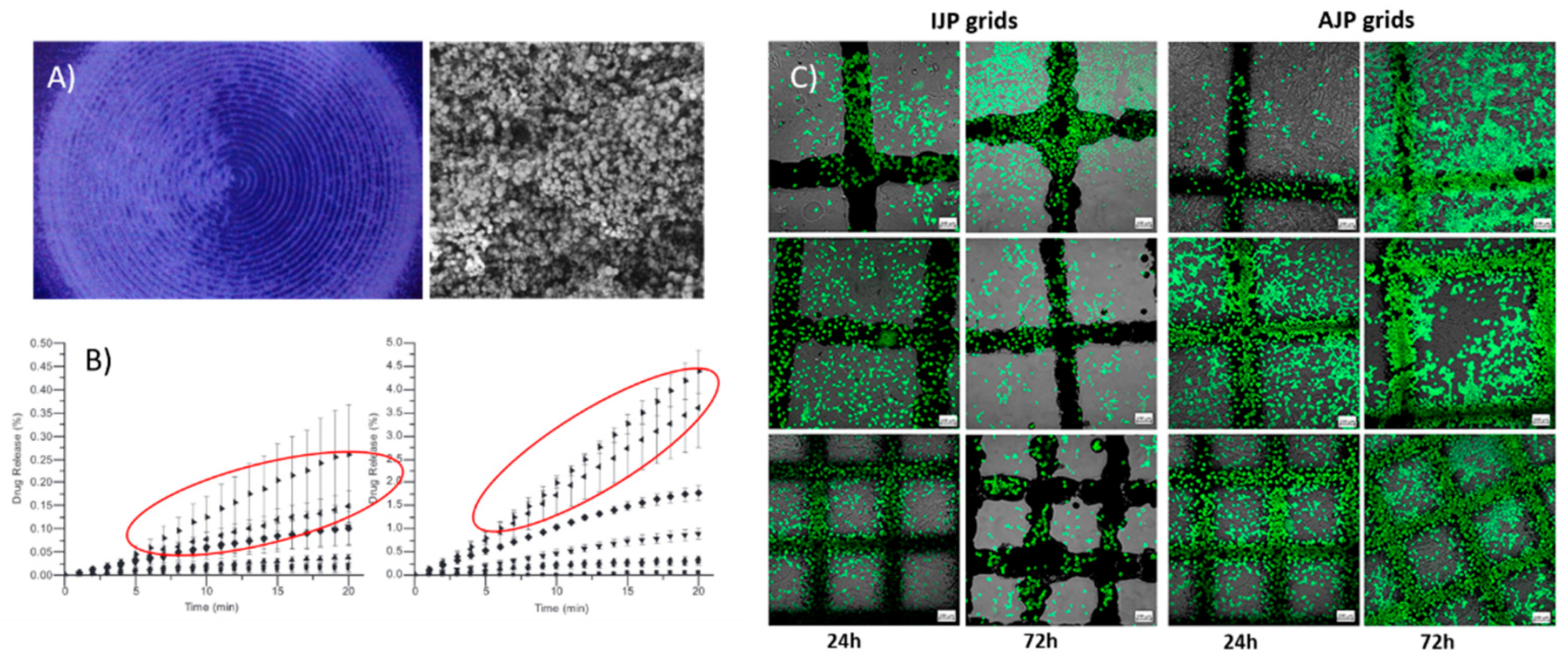
Finally, the work by Turner et al. [52] investigates AJP as a high-resolution additive manufacturing technique to produce amorphous solid dispersions of fenofibrate (a poorly soluble drug classified as class II within the Biopharmaceutics Classification System). By formulating drug-polymer inks based on poly-vinylpyrrolidone K30 (PVP K30) with high polymer content (≥75% of PVP K30), the authors achieved fully amorphous systems (Figure 3.A) with significantly enhanced dissolution, up to ~10× versus physical mixtures, Figure 3.B.
Figure 4.
A) image and SEM of printed fenofibrate-PVP K30 with 75 and 80 %(W/W) of K30 content, respectively; B) percentage of drug release from compacts (left) and printed samples (right) of fenoblate-PVP K30, red circled, regions at 75-80% of K30 content (adapted from [52]); C) morphological staining of L929 fibroblasts cultured on patterned substrates patterned with IJP (left) and AJP (right), analyzed at 24 h and 72 h, using grid geometry, demonstrating superior performance by AJP patterns.
Figure 4.
A) image and SEM of printed fenofibrate-PVP K30 with 75 and 80 %(W/W) of K30 content, respectively; B) percentage of drug release from compacts (left) and printed samples (right) of fenoblate-PVP K30, red circled, regions at 75-80% of K30 content (adapted from [52]); C) morphological staining of L929 fibroblasts cultured on patterned substrates patterned with IJP (left) and AJP (right), analyzed at 24 h and 72 h, using grid geometry, demonstrating superior performance by AJP patterns.
Hence, AJP enables precise control over drug distribution, morphology, and dose via layer-by-layer deposition, without any thermally induced stress effect. The printed formulations indeed showed good stability and reproducibility, highlighting AJP as a promising platform for tailored drug delivery, particularly in personalized and small-scale pharmaceutical applications
Current literature, although limited, also evidences the potential of AJP as a tool for tissue engineering. This emerges, in particular, from significant examples that well highlight the versatility of this technique. Indeed, AJP has been shown to play a central role in the development of tissue engineering, being accordingly used in tissue regeneration applications to implement the manufacturing of freeform alginate hydrogels enriched with cells for scaffolds manufacturing [122], and to fabricate conducting patches for cardiac tissue engineering [123]. The first example indeed showed an incapsulation strategy for cells dispensing method relying on an aerosol-spraying process for fabricating alginate scaffolds enriched with preosteoblast (MC3T3-E1) cells. Herein, the authors present a modified solid freeform fabrication approach to generate thick, porous, cell-laden alginate scaffolds with controlled internal architecture. By combining extrusion-based deposition with aerosolized CaCl₂ cross-linking, the method enables localized and immediate surface gelation during layer-by-layer assembly. Systematic optimization of key parameters, including nozzle diameter, aerosol flow rate, and CaCl₂ concentration, resulted in scaffolds with highly interconnected pores and favorable mechanical stability. Importantly, high initial cell viability (~86%) was achieved and sustained during long-term culture, supporting cellular proliferation and distribution. These findings demonstrate that controlled aerosol cross-linking significantly enhances structural integrity and biological performance, offering a promising strategy for fabricating clinically relevant hydrogel constructs for tissue engineering applications.
The second work well addresses the control of printing features and functional character offered by innovative inks, whose combination is beneficial for tissue repair applications. Aimed at addressing key limitations in cardiac tissue engineering, namely insufficient electrical conductivity and lack of structural anisotropy, the study shows the development of electrically conductive, 3D-printed cardiac patches using Ti3C2Tx MXene nanosheets patterned onto polyethylene glycol (PEG) hydrogels via AJP. The experimental results demonstrated that, while MXenes enable high-resolution patterning, their incorporation in PEG hydrogels enhances cardiomyocyte viability, alignment, and maturation, as evidenced by increased expression of cardiac markers and improved electrophysiological performance, including faster conduction and synchronized beating.
Printed structures aiding cells guidance, an approach already discussed in case of neuroprosthesis, have been demonstrated by Sosnowicz et al. and addressed to as promising for tissue engineering applications, where precise control of cell–material interactions is required [37]. They investigated the use of graphene nanoplatelet micropatterns fabricated on flexible polymer substrates to regulate cell behavior, with particular attention to the influence of printing techniques on biological performance. The authors compared IJP and AJP, observing that both methods produced stable and cytocompatible graphene patterns. However, they reported significant differences in microstructure, morphology, and surface properties between the two approaches. In particular, they found that AJP-generated patterns exhibited higher roughness, porosity, and more pronounced three-dimensional features, which promoted enhanced fibroblast adhesion, proliferation, alignment, and guided migration, being IJP patterns smoother and less effective in directing cell behavior (Figure 3.C).
This example provides further evidence that AJP, whether within a direct manufacturing [123] or a complementary a coating process using AJP as a coating technique [37,122], can be effectively employed in the development of biotechnological systems, demonstrating efficiency in DD applications and enhanced performance with respect to IJP in the field of tissue engineering. Worth to mention that, to date, there is a lack of literature examples going beyond the mere demonstration of AJP potential in DD and tissue engineering. However, in light of the advantages offered by this technique, further research should place greater emphasis on its use, aiming to demonstrate its suitability in the context of advanced biological experiments.
5. Discussion
The reviewed literature demonstrates that AJP is an emerging and versatile platform for biotechnology, enabling applications ranging from biosensing and microfluidics to tissue engineering and drug delivery. Its main strengths lie in its high resolution, broad ink compatibility, and ability to process complex biomaterials, allowing precise control over both geometry and functionality.
A key aspect is the strong interplay between printing parameters, material formulation, and biological response. Features such as surface roughness, porosity, and microstructure, directly influenced by the AJP process, have been shown to regulate cell adhesion, proliferation, and alignment, also demonstrating superior performance with respect to IJP counterparts. At the same time, AJP enables the fabrication of multifunctional systems through the integration of structural, electrical, and biochemical cues, which is particularly relevant for advanced platforms such as bioelectronics and tissue-engineered scaffolds. In this context, insights from 3D printed electronics are instructive: AJP currently acts mainly as a complementary technique rather than a fully in-line fabrication method, due to the need for optimized ink formulations and the difficulty in achieving uniform, high-quality features comparable to conventional processes. As a result, its role is more effectively framed within hybrid integration strategies, where AJP is combined with standard fabrication techniques whenever high performance and reliability are required.
In biotechnology, this limitation may be less restrictive. Hence, AJP could in principle support more integrated, in-line prototyping approaches. At present, consolidated applications of AJP may involve coating processes or the integration of printed electronics onto biomimetic systems, including neuromorphic interfaces and tissue engineering platforms. However, the fabrication of true bulk 3D structures remains challenging, as the out-of-plane thickness achieved per deposition step is still limited (a single pass ranging from hundreds of nanometers for common polymers [15] to even tens of micrometers [124]), often requiring multiple processing cycles.
Nevertheless, the wide viscosity range of printable inks enables the use of polymeric systems with tunable chain length and mechanical properties, offering opportunities for engineering structurally and functionally complex architectures. This aspect is particularly relevant for next-generation biofabrication approaches, including flexible, hybrid, and 4D systems capable of dynamic responses such as shape change [33].
Despite these promising features, several challenges remain, including overspray effects, bioink stability during atomization, and the need for formulations that simultaneously ensure printability and biological functionality. Moreover, most studies are still limited to proof-of-concept demonstrations, with limited validation in long-term or in vivo conditions. Although AJP clearly shows strong potential as an enabling technology in biotechnology, further efforts are required to consolidate its role through systematic process optimization, advanced ink design, and validation in complex biological environments.
As a final remark, similarly to what it is happening in many research fields, 3D printing routes, including AJP, are currently taking advantage from the powerful support of AI tools. Machine Learnig (ML) approaches have met AJP and DIW approaches during the last decade, shedding light on process optimal output, which is strongly influenced by complex interactions among process parameters. Through several ML approaches, for instance by combining experimental sampling, clustering, classification, and transfer learning [125], as well as by using knowledge transfer techniques [126], improved control over printed line morphology has been demonstrated and validated through case studies. Predicting process-structure relationships in bioprinting, as done for instance in case of structures deposited from filaments by Fused Deposition Modeling [127], as well as mechanical/morphological properties and cell behavior/biological performance of functional surfaces fabricated and/or treated by 3D printing routes, similarly can further ameliorate the prototyping of biotechnological tools upon using the material-wise highly versatile AJP method.
6. Conclusions
This review highlights AJP as a versatile and promising platform for biotechnology, capable of enabling applications across biosensing, microfluidics, tissue engineering, and drug delivery. AJP main strengths lie in the combination of high spatial resolution, broad material compatibility, and the ability to directly pattern functional architectures on complex substrates, also curved or extended along the out-of-plane direction. These features allow the precise control of surface properties, microstructure, and multifunctional integration, which are key to tailoring biological responses such as cell adhesion, proliferation, and guidance.
A central aspect emerging from the literature is the strong coupling between process parameters, ink formulation, and biological performance, requiring a careful optimization strategy. Although AJP has demonstrated significant potential in microstructuring and coating applications, the fabrication of bulk three-dimensional constructs remains challenging due to limited thickness per deposition step and the need for multiple layers. Additional issues, including ink stability during atomization, and process reproducibility, must be addressed to ensure scalability and reliability.
Nevertheless, these limitations are counterbalanced by the unique advantages of AJP, particularly its abilities to process several kinds of materials and to create hybrid systems that integrate electrical, mechanical, and biological functionalities. Future developments should focus on advanced bioink design, process optimization aided by ML approaches, and validation in complex biological environments.
Ultimately, despite its still limited range of applications, the scientific literature identifies AJP as a key enabling technology in next-generation biofabrication and personalized biomedical devices.
Author Contributions
conceptualization, P.D.A. and G.T.; writing—original draft preparation, P.D.A.; writing—review & editing, G.T. Both authors have agreed to the published version of the manuscript.
Acknowledgments
We wish to thank Luca Ascari for instrumental support throughout the years of our collaborative research activities and Salvatore Iannotta for the continued attention he paid to us as former PI of our research group at IMEM-CNR.
Conflicts of Interest
The authors declare no conflicts of interest.
References
- Wong, K. V.; Hernandez, A. A Review of Additive Manufacturing. ISRN Mech. Eng. 2012, 2012, 1–10. [Google Scholar] [CrossRef]
- Seifert, T.; Baum, M.; Roscher, F.; Wiemer, M.; Gessner, T. Aerosol Jet Printing of Nano Particle Based Electrical Chip Interconnects. Mater. Today Proc. 2015, 2, 4262–4271. [Google Scholar] [CrossRef]
- Zhang, P.; Sun, Q.; Fang, S.; Guo, H.; Liu, K.; Zhang, L.; Zhu, Q.; Wang, M. Fabrication of Nano Copper Highly Conductive and Flexible Printed Electronics by Direct Ink Writing. ACS Appl. Mater. Interfaces 2025, 17, 1847–1860. [Google Scholar] [CrossRef]
- Gupta, A.A.; Bolduc, A.; Cloutier, S.G.; Izquierdo, R. Aerosol Jet Printing for printed electronics rapid prototyping. Proc. - IEEE Int. Symp. Circuits Syst. 2016, 2016-July, 866–869.
- Rinaldi, G.; Vurro, D.; Cicolini, M.; Babic, J.; Liboà, A.; Tarabella, G.; D’Angelo, P.; Marasso, S.L.; Cocuzza, M.; Vigna, L.; et al. PEDOT:PSS deposition in OECTs: Inkjet printing, aerosol jet printing and spin coating. Micro Nano Eng. 2024, 24, 100272. [Google Scholar] [CrossRef]
- Goth, C.; Putzo, S.; Franke, J. Aerosol Jet printing on rapid prototyping materials for fine pitch electronic applications. Proc. - Electron. Components Technol. Conf. 2011, 1211–1216. 2011.
- D’Angelo, P.; Vurro, D. Direct Writing: Inkjet and Aerosol-Jet Printing BT - High Resolution Manufacturing from 2D to 3D/4D Printing: Applications in Engineering and Medicine; Marasso, S.L., Cocuzza, M., Eds.; Springer International Publishing: Cham, 2022; pp. 105–129. ISBN 978-3-031-13779-2. [Google Scholar]
- Bernasconi, R.; Brovelli, S.; Viviani, P.; Soldo, M.; Giusti, D.; Magagnin, L. Piezoelectric Drop-On-Demand Inkjet Printing of High-Viscosity Inks. Adv. Eng. Mater. 2022, 24, 2100733. [Google Scholar] [CrossRef]
- Secor, E.B. Principles of aerosol jet printing. Flex. Print. Electron. 2018, 3, 035002. [Google Scholar] [CrossRef]
- Ma, T.; Li, Y.; Cheng, H.; Niu, Y.; Xiong, Z.; Li, A.; Jiang, X.; Park, D.; Zhang, K.; Yi, C. Enhanced aerosol-jet printing using annular acoustic field for high resolution and minimal overspray. Nat. Commun. 2024, 15, 6317. [Google Scholar] [CrossRef] [PubMed]
- Fisher, C.; Skolrood, L.N.; Li, K.; Joshi, P.C.; Aytug, T. Aerosol-Jet Printed Sensors for Environmental, Safety, and Health Monitoring : A Review. 2023, 2300030, 1–37. [Google Scholar] [CrossRef]
- Seifert, T.; Sowade, E.; Roscher, F.; Wiemer, M.; Gessner, T.; Baumann, R.R. Additive Manufacturing Technologies Compared: Morphology of Deposits of Silver Ink Using Inkjet and Aerosol Jet Printing. Ind. Eng. Chem. Res. 2015, 54, 769–779. [Google Scholar] [CrossRef]
- Saleh, M.S.; Hu, C.; Panat, R. Three-dimensional microarchitected materials and devices using nanoparticle assembly by pointwise spatial printing. Sci. Adv. 2017, 3, 1601986. [Google Scholar] [CrossRef] [PubMed]
- Zhao, J.; Gao, Y.; Lin, J.; Chen, Z.; Cui, Z. Printed thin-film transistors with functionalized single-walled carbon nanotube inks. J. Mater. Chem. 2012, 22, 2051–2056. [Google Scholar] [CrossRef]
- Tarabella, G.; Vurro, D.; Lai, S.; D’Angelo, P.; Ascari, L.; Iannotta, S. Aerosol jet printing of PEDOT:PSS for large area flexible electronics. Flex. Print. Electron. 2020, 5, 014005. [Google Scholar] [CrossRef]
- Cooper, C.; Hughes, B. Aerosol Jet Printing of Electronics: An Enabling Technology for Wearable Devices. In Proceedings of the 2020 Pan Pacific Microelectronics Symposium, Pan Pacific 2020, 2020; pp. 1–11. [Google Scholar]
- Christenson, K.K.; Paulsen, J.A.; Renn, M.J.; McDonald, K.; Bourassa, J. Direct printing of circuit boards using Aerosol Jet®. Int. Conf. Digit. Print. Technol., 2011; pp. 433–436. [Google Scholar]
- Xu, B.; Yang, M.; Cheng, W.; Li, X.; Xu, X.; Li, W.; Zhang, H.; Zhou, M. Precision aerosol-jet micropatterning of liquid metal for high-performance flexible strain sensors. Nat. Commun. 2025, 16, 7920. [Google Scholar] [CrossRef] [PubMed]
- Vurro, D.; Pasquardini, L.; Borriello, M.; Foresti, R.; Barra, M.; Sidoli, M.; Pontiroli, D.; Fornasini, L.; Aversa, L.; Verucchi, R.; et al. Inflammatory biomarker detection in saliva samples by printed graphene immunosensors. Sens. Actuators Rep. 2024, 8, 100211. [Google Scholar] [CrossRef]
- Yi, H.; Liu, Y.; Cao, H.; Luo, J.; Dong, X.; An, J.; Chua, C.K. Material and process integrated innovations in Aerosol Jet Printing: A review. Mater. Today 2025, 91, 431–458. [Google Scholar] [CrossRef]
- Joo, S.; Baldwin, D.F. Advanced package prototyping using nano-particle silver printed interconnects. IEEE Trans. Electron. Packag. Manuf. 2010, 33, 129–134. [Google Scholar] [CrossRef]
- Geng, R.; Zhao, X.; Liu, T.; Jiang, X. High-resolution aerosol jet printing of periodic VO2 micropatterns for advanced smart windows. J. Colloid Interface Sci. 2026, 708, 139854. [Google Scholar] [CrossRef]
- Capel, A.J.; Smith, M.A.A.; Taccola, S.; Pardo-figuerez, M.; Rimington, R.P.; Lewis, M.P.; Christie, S.D.R.; Kay, R.W.; Harris, R.A.; Mccain, M.L.; et al. Digitally Driven Aerosol Jet Printing to Enable Customisable Neuronal Guidance. 2021, 9, 1–16. [Google Scholar] [CrossRef] [PubMed]
- Sajapin, R.; Vurro, D.; D’Angelo, P.; Tarabella, G.; Marasso, S.; Cocuzza, M.; Botti, M.; Buttrini, M.; Calderaro, A.; Berzina, T.; et al. Aerosol Jet Printed Organic Memristive Microdevices Based on a Chitosan:PANI Composite Conductive Channel. ACS Appl. Electron. Mater. 4, 5875–5883. [CrossRef]
- Yang, C.; Zhou, E.; Miyanishi, S.; Hashimoto, K.; Tajima, K. Preparation of active layers in polymer solar cells by aerosol jet printing. ACS Appl. Mater. Interfaces 2011, 3, 4053–4058. [Google Scholar] [CrossRef]
- Bag, S.; Deneault, J.R.; Durstock, M.F. Aerosol-Jet-Assisted Thin-Film Growth of CH3NH3PbI3 Perovskites—A Means to Achieve High Quality, Defect-Free Films for Efficient Solar Cells. Adv. Energy Mater. 2017, 7, 1701151. [Google Scholar] [CrossRef]
- Tait, J.G.; Witkowska, E.; Hirade, M.; Ke, T.-H.; Malinowski, P.E.; Steudel, S.; Adachi, C.; Heremans, P. Uniform Aerosol Jet printed polymer lines with 30μm width for 140ppi resolution RGB organic light emitting diodes. Org. Electron. 2015, 22, 40–43. [Google Scholar] [CrossRef]
- Lopez-Hallman, R.; Rodriguez, R.; Lai, Y.-T.; Zhang, Q.; Tsao, B.-H.; Deiner, J.; Fellner, J.P.; Zhu, Y. All-Solid-State Battery Fabricated by 3D Aerosol Jet Printing. Adv. Eng. Mater. 2024, 26, 2300953. [Google Scholar] [CrossRef]
- Kouchi, F.R.; Varghese, T.V.; Burgoyne, H.; Mansoor, N.E.; Seol, M.-L.; McKibben, N.; Nirantar, S.; Chinnathambi, K.; Eixenberger, J.; Maryon, O.; et al. StableTi3C2Tx MXene Ink Formulation and High-Resolution Aerosol Jet Printing for High-Performance MXene Supercapacitors. Small Methods 2025, 9, 2500499. [Google Scholar] [CrossRef]
- Verma, A.; Seiti, M.; Machiels, J.; Appeltans, R.; Geiβler, M.; Tempel, L.; Deferme, W.; Buntinx, M.; Ferraris, E. Aerosol Jet® printing of HF RFID antennas on fiber-based paper substrates for smart packaging. APL Electron. Devices 2025, 1, 26104. [Google Scholar] [CrossRef]
- Agarwala, S.; Yeong, W.Y. Aerosol jet fabricated biodegradable antenna for bioelectronics application. 2019, 1, 2–3. [Google Scholar]
- Borghetti, M.; Cantù, E.; Sardini, E.; Serpelloni, M. Preliminary Study on Wireless Passive Resistive Sensor Applied for Smart Objects. In Proceedings of the 2021 IEEE International Workshop on Metrology for Industry 4.0 & IoT (MetroInd4.0&IoT), 2021; pp. 150–155. [Google Scholar]
- Zhou, Y.; Parker, C.B.; Joshi, P.; Naskar, A.K.; Glass, J.T.; Cao, C. 4D Printing of Stretchable Supercapacitors via Hybrid Composite Materials. Adv. Mater. Technol. 2021, 6, 2001055. [Google Scholar] [CrossRef]
- Zhang, Y.; Liu, C.; Whalley, D. Direct-write techniques for maskless production of microelectronics: A review of current state-of-the-art technologies. In Proceedings of the 2009 International Conference on Electronic Packaging Technology & High Density Packaging, 2009; pp. 497–503. [Google Scholar]
- Feng, J.; Klett, J.D.; Renn, M.J. Mist Generation Behavior in Ultrasonic Atomizer for Aerosol Jet® Printing. Aerosol Sci. Eng. 2024, 8, 77–86. [Google Scholar] [CrossRef]
- Chen, G.; Gu, Y.; Tsang, H.; Hines, D.R.; Das, S. The Effect of Droplet Sizes on Overspray in Aerosol-Jet Printing. Adv. Eng. Mater. 2018, 20. [Google Scholar] [CrossRef]
- Sosnowicz, W.; Krzeminski, J.; Dominiczak, J.; Baraniecki, D.; Trzaskowska, P.; Corvo, M.C.; Żołek-Tryznowska, Z.; Jeznach, A.; Jakubowska, M.; Dybowska-Sarapuk, L. Guiding Cell Growth: Graphene-Patterned Polymeric Substrates for Enhanced Tissue Proliferation. Nanotechnol. Sci. Appl. 2025, 18, 531–552. [Google Scholar] [CrossRef] [PubMed]
- Zips, S.; Grob, L.; Rinklin, P.; Terkan, K.; Adly, N.Y.; Weiß, L.J.K.; Mayer, D.; Wolfrum, B. Fully Printed μ-Needle Electrode Array from Conductive Polymer Ink for Bioelectronic Applications. ACS Appl. Mater. Interfaces 2019, 11, 32778–32786. [Google Scholar] [CrossRef]
- Hines, D.R.; Gu, Y.; Martin, A.A.; Li, P.; Fleischer, J.; Clough-Paez, A.; Stackhouse, G.; Dasgupta, A.; Das, S. Considerations of aerosol-jet printing for the fabrication of printed hybrid electronic circuits. Addit. Manuf. 2021, 47, 102325. [Google Scholar] [CrossRef]
- Majak, D.; Fan, J.; Gupta, M. Fully 3D printed OECT based logic gate for detection of cation type and concentration. Sens. Actuators B Chem. 2019, 286, 111–118. [Google Scholar] [CrossRef]
- 41. Cooper, C.; Hughes, B. Aerosol Jet Printing of Electronics: An Enabling Technology for Wearable Devices. In Proceedings of the 2020 Pan Pacific Microelectronics Symposium, Pan Pacific 2020; SMTA, 2020; pp. 1–11.
- Pennebaker, W.B. IVB-4 aerosol jet printing. IEEE Trans. Electron Devices 1975, 22, 1064–1064. [Google Scholar] [CrossRef]
- Kashu, S.; Mihara, Y. Preparation of PZT Deposited Films by Using an Aerosol Jet Printing System and their Electric Properties. J. Jpn. Soc. Powder Powder Metall. 1995, 42, 314–317. [Google Scholar] [CrossRef]
- Kashu, S.Y.M.C.H.M.S.M.I. Preparation of Ferroelectric Films of Laminated Polyurea Thin Films onto PZT Deposited Films and their Electric Properties. J. Jpn. Soc. Powder Powder Metall. 1995, 42, 1411–1414. [Google Scholar] [CrossRef]
- Zhao, D.; Liu, T.; Zhang, M.; Liang, R.; Wang, B. Fabrication and characterization of aerosol-jet printed strain sensors for multifunctional composite structures. Smart Mater. Struct. 2012, 21. [Google Scholar] [CrossRef]
- Xia, Y.; Zhang, W.; Ha, M.; Cho, J.H.; Renn, M.J.; Kim, C.H.; Frisbie, C.D. Printed sub-2 V Gel-electrolyte-gated polymer transistors and circuits. Adv. Funct. Mater. 2010, 20, 587–594. [Google Scholar] [CrossRef]
- Liu, R.; Shen, F.; Ding, H.; Lin, J.; Gu, W.; Cui, Z.; Zhang, T. All-carbon-based field effect transistors fabricated by aerosol jet printing on flexible substrates. J. Micromechanics Microengineering 2013, 23. [Google Scholar] [CrossRef]
- De Silva, M.N.; Paulsen, J.; Renn, M.J.; Odde, D.J. Two-step cell patterning on planar and complex curved surfaces by precision spraying of polymers. Biotechnol. Bioeng. 2006, 93, 919–927. [Google Scholar] [CrossRef]
- Guyll, B.I.; Sanford, B.L.; Pint, C.L.; Secor, E.B. Controlling Droplet Evaporation in Aerosol Jet Printing to Understand and Mitigate Overspray. Small Sci. 2025, 5, 2500069. [Google Scholar] [CrossRef]
- Grunwald, I.; Groth, E.; Wirth, I.; Schumacher, J.; Maiwald, M.; Zoellmer, V.; Busse, M. Surface biofunctionalization and production of miniaturized sensor structures using aerosol printing technologies. Biofabrication 2010, 2. [Google Scholar] [CrossRef] [PubMed]
- Habermehl, A.; Strobel, N.; Eckstein, R.; Bolse, N.; Mertens, A.; Hernandez-Sosa, G.; Eschenbaum, C.; Lemmer, U. Lab-on-chip, surface-enhanced Raman analysis by aerosol jet printing and roll-to-roll hot embossing. Sensors 2017, 17, 1–11. [Google Scholar] [CrossRef]
- Turner, A.J.; Prasad, E.; Florence, A.J.; Halbert, G.W. Investigation of aerosol jet printing for the preparation of solid dosage forms. Int. J. Pharm. 2025, 671. [Google Scholar] [CrossRef]
- Degryse, O.; Bloemen, V.; Ferraris, E. Collagen composite inks for Aerosol Jet® printing in bone tissue engineering applications. Procedia CIRP 2022, 110, 180–185. [Google Scholar] [CrossRef]
- Zhou, Y.; Burgoyne Morris, G.H.; Bax, D. V.; Kar-Narayan, S.; Nair, M. Aerosol jet co-printing for flexible and conductive protein–metal electrodes. APL Electron. Devices 2026, 2, 16112. [Google Scholar] [CrossRef]
- Grunwald, I.; Groth, E.; Wirth, I.; Schumacher, J.; Maiwald, M.; Zoellmer, V.; Busse, M. Surface biofunctionalization and production of miniaturized sensor structures using aerosol printing technologies; 2010. [Google Scholar]
- Williams, N.X.; Watson, N.; Joh, D.Y.; Chilkoti, A.; Franklin, A.D. Aerosol jet printing of biological inks by ultrasonic delivery. Biofabrication 2020, 12. [Google Scholar] [CrossRef]
- Srinivasarao, M.; Low, P.S. Ligand-Targeted Drug Delivery. Chem. Rev. 2017, 117, 12133–12164. [Google Scholar] [CrossRef] [PubMed]
- Veselov, V. V.; Nosyrev, A.E.; Jicsinszky, L.; Alyautdin, R.N.; Cravotto, G. Targeted Delivery Methods for Anticancer Drugs. Cancers . 2022, 14, 622. [Google Scholar] [CrossRef]
- Hua, Y.; Ma, J.; Li, D.; Wang, R. DNA-Based Biosensors for the Biochemical Analysis: A Review. Biosensors 2022, 12, 183. [Google Scholar] [CrossRef] [PubMed]
- Peruzzi, C.; Battistoni, S.; Montesarchio, D.; Cocuzza, M.; Marasso, S.L.; Verna, A.; Pasquardini, L.; Verucchi, R.; Aversa, L.; Erokhin, V.; et al. Interfacing aptamers, nanoparticles and graphene in a hierarchical structure for highly selective detection of biomolecules in OECT devices. Sci. Rep. 2021, 11, 9380. [Google Scholar] [CrossRef]
- Jia, X.; Fan, X.; Chen, C.; Lu, Q.; Zhou, H.; Zhao, Y.; Wang, X.; Han, S.; Ouyang, L.; Yan, H.; et al. Chemical and Structural Engineering of Gelatin-Based Delivery Systems for Therapeutic Applications: A Review. Biomacromolecules 2024, 25, 564–589. [Google Scholar] [CrossRef] [PubMed]
- Phuah, E.W.C.; Hart, W.L.; Sumer, H.; Stoddart, P.R. Patterning of biomaterials by aerosol jet printing: A parametric study. Bioprinting 2020, 18, e00081. [Google Scholar] [CrossRef]
- Yin, C.; Jatoi, A.W.; Bang, H.; Gopiraman, M.; Kim, I.S. Fabrication of silk fibroin based three dimensional scaffolds for tissue engineering. Fibers Polym. 2016, 17, 1140–1145. [Google Scholar] [CrossRef]
- Matera, B.; De Giorgio, G.; Rupel, K.; Turco, G.; D’Angelo, P.; Ghezzi, B. Silk-fibroin scaffolds enriched with calcium-based fillers for bone regeneration: a systematic review. Ceram. Int. 2026, 52, 12313–12342. [Google Scholar] [CrossRef]
- D’Onofrio, I.; De Giorgio, G.; Sajapin, R.; Vurro, D.; Liboà, A.; Dembech, E.; Trevisi, G.; Botti, M.; Galstyan, V.; Tarabella, G.; et al. Inhalable drug-loaded silk fibroin carriers for pulmonary drug delivery. RSC Adv. 2024, 14, 27288–27297. [Google Scholar] [CrossRef]
- Zhao, Z.; Li, Y.; Xie, M. Bin Silk fibroin-based nanoparticles for drug delivery. Int. J. Mol. Sci. 2015, 16, 4880–4903. [Google Scholar] [CrossRef] [PubMed]
- De Giorgio, G.; Matera, B.; Vurro, D.; Manfredi, E.; Galstyan, V.; Tarabella, G.; Ghezzi, B.; D’Angelo, P. Silk Fibroin Materials: Biomedical Applications and Perspectives. Bioengineering 2024, 11, 167. [Google Scholar] [CrossRef]
- Sommer, M.R.; Schaffner, M.; Carnelli, D.; Studart, A.R. 3D Printing of Hierarchical Silk Fibroin Structures. ACS Appl. Mater. Interfaces 2016, 8, 34677–34685. [Google Scholar] [CrossRef]
- Rodriguez, M.J.; Dixon, T.A.; Cohen, E.; Huang, W.; Omenetto, F.G.; Kaplan, D.L. 3D freeform printing of silk fibroin. Biomater. 2018, 71, 379–387. [Google Scholar] [CrossRef]
- Li, K.; Zhang, F.; Wang, D.; Qiu, Q.; Liu, M.; Yu, A.; Cui, Y. Silkworm-inspired electrohydrodynamic jet 3D printing of composite scaffold with ordered cell scale fibers for bone tissue engineering. Int. J. Biol. Macromol. 2021, 172, 124–132. [Google Scholar] [CrossRef]
- Zhang, J.; Allardyce, B.J.; Rajkhowa, R.; Wang, X.; Liu, X. 3D printing of silk powder by Binder Jetting technique. Addit. Manuf. 2021, 38, 101820. [Google Scholar] [CrossRef]
- Yan, J.; Zhou, G.; Knight, D.P.; Shao, Z.; Chen, X. Wet-spinning of regenerated silk fiber from aqueous silk fibroin solution: Discussion of spinning parameters. Biomacromolecules 2010, 11, 1–5. [Google Scholar] [CrossRef]
- Zhang, F.; Zuo, B.; Fan, Z.; Xie, Z.; Lu, Q.; Zhang, X.; Kaplan, D.L. Mechanisms and control of silk-based electrospinning. Biomacromolecules 2012, 13, 798–804. [Google Scholar] [CrossRef]
- Tao, H.; Marelli, B.; Yang, M.; An, B.; Onses, M.S.; Rogers, J.A.; Kaplan, D.L.; Omenetto, F.G. Inkjet Printing of Regenerated Silk Fibroin: From Printable Forms to Printable Functions. Adv. Mater. 2015, 27, 4273–4279. [Google Scholar] [CrossRef]
- Casanova-Batlle, E.; Guerra, A.J.; Ciurana, J. A novel direct ink writing manufacturing system to 3D print highly concentrated silk fibroin. Procedia CIRP 2022, 110, 232–236. [Google Scholar] [CrossRef]
- Xiao, Y.; Kalaitzidou, K.; Yao, D.; Yeo, W.H.; Harris, T.A.L. Challenges and Advances in Aerosol Jet Printing of Regenerated Silk Fibroin Solutions. Adv. Mater. Interfaces 2020, 7. [Google Scholar] [CrossRef]
- Niu, Z.; Yi, H.; Jin, Y.; Yue, Y.; Chen, S.; Dong, Z.; An, J.; Chua, C.K.; Cao, H. Wide-Flow Aerosol Jet Printing Enables High-Throughput, Ultra-Low Aspect Ratio Patterning. Adv. Sci. 2026, 13, e12557. [Google Scholar] [CrossRef] [PubMed]
- Stepanovska, J.; Supova, M.; Hanzalek, K.; Broz, A.; Matejka, R. Collagen bioinks for bioprinting: A systematic review of hydrogel properties, bioprinting parameters, protocols, and bioprinted structure characteristics. Biomedicines 2021, 9. [Google Scholar] [CrossRef] [PubMed]
- Gibney, R.; Ferraris, E. Bioprinting of Collagen Type I and II via Aerosol Jet Printing for the Replication of Dense Collagenous Tissues. Front. Bioeng. Biotechnol. 2021, 9. [Google Scholar] [CrossRef] [PubMed]
- Gibney, R.; Patterson, J.; Ferraris, E. High-resolution bioprinting of recombinant human collagen type iii. Polymers . 2021, 13. [Google Scholar] [CrossRef]
- Nair, M.; Inwald, E.; Ives, L.; See, K.R.M.; Kar-Narayan, S. Optimising aerosol jet printing of collagen inks for enhanced piezoelectricity and controlled surface potential. JPhys Mater. 2023, 6. [Google Scholar] [CrossRef]
- Manzoli, S.; Merotto, E.; Piccoli, M.; Gobbo, P.; Todros, S.; Pavan, P.G. An Overview of 3D Bioprinting Impact on Cell Viability: From Damage Assessment to Protection Solutions. J. Funct. Biomater. 2025, 16, 436. [Google Scholar] [CrossRef]
- Vlnieska, V.; Gilshtein, E.; Kunka, D.; Heier, J.; Romanyuk, Y.E. Aerosol Jet Printing of 3D Pillar Arrays from Photopolymer Ink. Polymers . 2022, 14, 3411. [Google Scholar] [CrossRef]
- Seiti, M.; Degryse, O.; Ferraro, R.M.; Giliani, S.; Bloemen, V.; Ferraris, E. 3D Aerosol Jet® printing for microstructuring: Advantages and Limitations. Int. J. Bioprinting 2023, 9, 57–74. [Google Scholar] [CrossRef]
- Si, Y.; Dong, Z.; Jiang, L. Bioinspired Designs of Superhydrophobic and Superhydrophilic Materials. ACS Cent. Sci. 2018, 4, 1102–1112. [Google Scholar] [CrossRef]
- Falde, E.J.; Yohe, S.T.; Colson, Y.L.; Grinstaff, M.W. Superhydrophobic materials for biomedical applications. Biomaterials 2016, 104, 87–103. [Google Scholar] [CrossRef]
- Hwang, G.B.; Page, K.; Patir, A.; Nair, S.P.; Allan, E.; Parkin, I.P. The Anti-Biofouling Properties of Superhydrophobic Surfaces are Short-Lived. ACS Nano 2018, 12, 6050–6058. [Google Scholar] [CrossRef] [PubMed]
- Zhong, K.; Rozsa, J.; Patel, D.K.; Yao, L.; Fedder, G.K.; Islam, M.F. Aerosol Jet Printing of Superhydrophobic Surfaces. Adv. Mater. Technol. 2025, 10, 1–9. [Google Scholar] [CrossRef]
- Godary, T.; Binkley, B.; Liu, Z.; Awoyemi, O.; Overby, A.; Yuliantoro, H.; Fike, B.J.; Anderson, S.; Li, P. Acoustofluidics: Technology Advances and Applications from 2022 to 2024. Anal. Chem. 2025, 97, 6847–6870. [Google Scholar] [CrossRef] [PubMed]
- Morales-Rodriguez, M.E.; Joshi, P.C.; Humphries, J.R.; Fuhr, P.L.; McIntyre, T.J. Fabrication of low cost surface acoustic wave sensors using direct printing by aerosol inkjet. IEEE Access 2018, 6, 20907–20915. [Google Scholar] [CrossRef]
- Rich, J.; Cole, B.; Li, T.; Lu, B.; Fu, H.; Smith, B.N.; Xia, J.; Yang, S.; Zhong, R.; Doherty, J.L.; et al. Aerosol jet printing of surface acoustic wave microfluidic devices. Microsyst. Nanoeng. 2024, 10. [Google Scholar] [CrossRef] [PubMed]
- McKibben, N.; Ryel, B.; Manzi, J.; Muramutsa, F.; Daw, J.; Subbaraman, H.; Estrada, D.; Deng, Z. Aerosol jet printing of piezoelectric surface acoustic wave thermometer. Microsyst. Nanoeng. 2023, 9. [Google Scholar] [CrossRef]
- Gai, C.; Xie, Y.; Cheng, Y.; Liu, H.; Lei, Y.; Han, J.; Hu, H. Exploring the Surface Acoustic Wave Aerosol Jet Printing (SAW-AJP) system for highly-uniform, shear-resistant thin adhesive films. Surf. Coat. Technol. 2025, 512. [Google Scholar] [CrossRef]
- Shi, X.; Pu, H.; Shi, L.L.; He, T.-C.; Chen, J. Advancing transistor-based point-of-care (POC) biosensors: additive manufacturing technologies and device integration strategies for real-life sensing. Nanoscale 2025, 17, 9804–9833. [Google Scholar] [CrossRef]
- Borriello, M.; Tarabella, G.; D’Angelo, P.; Liboà, A.; Barra, M.; Vurro, D.; Lombari, P.; Coppola, A.; Mazzella, E.; Perna, A.F.; et al. Lab on a Chip Device for Diagnostic Evaluation and Management in Chronic Renal Disease: A Change Promoting Approach in the Patients’ Follow Up. Biosensors 2023, 13, 373. [Google Scholar] [CrossRef] [PubMed]
- Ibarlucea, B.; Munoz-Berbel, X.; Ortiz, P.; Büttgenbach, S.; Fernández-Sánchez, C.; Llobera, A. Self-validating lab-on-a-chip for monitoring enzyme-catalyzed biological reactions. Sens. Actuators B Chem. 2016, 237, 16–23. [Google Scholar] [CrossRef]
- Miled, M.A.; Sawan, M. Dielectrophoresis-Based Integrated Lab-on-Chip for Nano and Micro-Particles Manipulation and Capacitive Detection. IEEE Trans. Biomed. Circuits Syst. 2012, 6, 120–132. [Google Scholar] [CrossRef]
- Ćatić, N.; Wells, L.; Al Nahas, K.; Smith, M.; Jing, Q.; Keyser, U.F.; Cama, J.; Kar-Narayan, S. Aerosol-jet printing facilitates the rapid prototyping of microfluidic devices with versatile geometries and precise channel functionalization. Appl. Mater. Today 2020, 19. [Google Scholar] [CrossRef]
- Elsersawy, R.; Rahman, A.; Sakib-Uz-Zaman, C.; Khondoker, M.A.H. Multifunctional inks in aerosol jet printing: performance, challenges, and applications. Front. Manuf. Technol. 2025, 5, 1–19. [Google Scholar] [CrossRef]
- Mancinelli, E.; Taccola, S.; Slay, E.; Chau, C.C.C.; James, N.; Johnson, B.; Critchley, K.; Harris, R.; Pensabene, V. Stable, Conductive, Adhesive Polymer Patterning Inside a Microfluidic Chamber for Endothelial Cell Alignment. Adv. Mater. Technol. 2024, 9, 1–12. [Google Scholar] [CrossRef]
- Jing, Q.; Pace, A.; Ives, L.; Husmann, A.; Ćatić, N.; Khanduja, V.; Cama, J.; Kar-Narayan, S. Aerosol-jet-printed, conformable microfluidic force sensors. Cell Rep. Phys. Sci. 2021, 2, 100386. [Google Scholar] [CrossRef] [PubMed]
- Di Novo, N.G.; Cantù, E.; Tonello, S.; Sardini, E.; Serpelloni, M. Support-material-free microfluidics on an electrochemical sensors platform by aerosol jet printing. Sensors 2019, 19. [Google Scholar] [CrossRef] [PubMed]
- Rezaei Nejad, H.; Goli Malekabadi, Z.; Kazemzadeh Narbat, M.; Annabi, N.; Mostafalu, P.; Tarlan, F.; Zhang, Y.S.; Hoorfar, M.; Tamayol, A.; Khademhosseini, A. Laterally Confined Microfluidic Patterning of Cells for Engineering Spatially Defined Vascularization. Small 2016, 12, 5132–5139. [Google Scholar] [CrossRef] [PubMed]
- Moussavi-Harami, S.F.; Pezzi, H.M.; Huttenlocher, A.; Beebe, D.J. Simple microfluidic device for studying chemotaxis in response to dual gradients. Biomed. Microdevices 2015, 17, 1–11. [Google Scholar] [CrossRef]
- Tehranirokh, M.; Kouzani, A.Z.; Francis, P.S.; Kanwar, J.R. Microfluidic devices for cell cultivation and proliferation. Biomicrofluidics 2013, 7, 51502. [Google Scholar] [CrossRef]
- Ahmad, A.; Doshi, R.N. Leadless Pacemakers: A Contemporary Review. Curr. Cardiovasc. Risk Rep. 2025, 19, 21. [Google Scholar] [CrossRef]
- Ahmed, O.; Wang, M.; Zhang, B.; Irving, R.; Begg, P.; Du, X. Robotic Systems for Cochlear Implant Surgeries: A Review of Robotic Design and Clinical Outcomes. Electron. 2025, 14. [Google Scholar] [CrossRef]
- Gao, W.; Yan, Z.; Zhou, H.; Xie, Y.; Wang, H.; Yang, J.; Yu, J.; Ni, C.; Liu, P.; Xie, M.; et al. Revolutionizing brain‒computer interfaces: overcoming biocompatibility challenges in implantable neural interfaces. J. Nanobiotechnology 2025, 23, 498. [Google Scholar] [CrossRef]
- Kim, S.; Baek, S.; Sluyter, R.; Konstantinov, K.; Kim, J.H.; Kim, S.; Kim, Y.H. Wearable and implantable bioelectronics as eco-friendly and patient-friendly integrated nanoarchitectonics for next-generation smart healthcare technology. EcoMat 2023, 5, e12356. [Google Scholar] [CrossRef]
- Dijk, G.; Pas, J.; Markovic, K.; Scancar, J.; O’Connor, R.P. PEDOT:PSS-coated platinum electrodes for neural stimulation. APL Bioeng. 2023, 7, 46117. [Google Scholar] [CrossRef]
- Saleh, M.S.; Ritchie, S.M.; Nicholas, M.A.; Gordon, H.L.; Hu, C.; Jahan, S.; Yuan, B.; Bezbaruah, R.; Reddy, J.W.; Ahmed, Z.; et al. CMU Array: A 3D nanoprinted, fully customizable high-density microelectrode array platform. Sci. Adv. 2026, 8, eabj4853. [Google Scholar] [CrossRef] [PubMed]
- Park, J.; Seong, D.; Choi, H.; Lee, J.; Song, J.; Shin, M.; Son, D. A nerve-adhesive stretchable electrode for stable neural signal recording and stimulation. MRS Bull. 2025, 50, 9–19. [Google Scholar] [CrossRef]
- Seiti, M.; Ginestra, P.S.; Ferraro, R.M.; Giliani, S.; Vetrano, R.M.; Ceretti, E.; Ferraris, E. Aerosol Jet® Printing of Poly(3,4-Ethylenedioxythiophene): Poly(Styrenesulfonate) onto Micropatterned Substrates for Neural Cells In Vitro Stimulation. Int. J. Bioprinting 2022, 8, 50–65. [Google Scholar] [CrossRef]
- Pere, C.P.P.; Economidou, S.N.; Lall, G.; Ziraud, C.; Boateng, J.S.; Alexander, B.D.; Lamprou, D.A.; Douroumis, D. 3D printed microneedles for insulin skin delivery. Int. J. Pharm. 2018, 544, 425–432. [Google Scholar] [CrossRef]
- Bedir, T.; Sahoo, S.S.; Kadian, S.; Gunduz, O.; Narayan, R. Effect of Geometric Design on the Mechanical Performance of Digital Light Processing (DLP)-Printed Microneedles. Micromachines 2025, 16, 1221. [Google Scholar] [CrossRef]
- Lou, Y.; Leman, J.T.; Serringer, H.; Xia, K.; LaFratta, C.N.; Ullal, C.; Palermo, E.F. Polymerized Pro-Estrogen Microneedles via Two Photon Polymerization. Macromol. Rapid Commun. 2025. [Google Scholar] [CrossRef]
- Harieth Alrimawi, B.; Lee, J.Y.; Ng, K.W.; Goh, C.F. In vitro evaluation of microneedle strength: a comparison of test configurations and experimental insights. RSC Pharm. 2024, 1, 227–233. [Google Scholar] [CrossRef]
- Makvandi, P.; Kirkby, M.; Hutton, A.R.J.; Shabani, M.; Yiu, C.K.Y.; Baghbantaraghdari, Z.; Jamaledin, R.; Carlotti, M.; Mazzolai, B.; Mattoli, V.; et al. Engineering Microneedle Patches for Improved Penetration: Analysis, Skin Models and Factors Affecting Needle Insertion. Nano-Micro Lett. 2021, 13, 93. [Google Scholar] [CrossRef]
- Avcil, M.; Çelik, A. Microneedles in drug delivery: Progress and challenges. Micromachines 2021, 12, 1321. [Google Scholar] [CrossRef]
- Ako, H.; O’Mahony, J.; Hughes, H.; McLoughlin, P.; O’Reilly, N.J. A novel approach to the manufacture of dissolving microneedles arrays using aerosol jet printing. Appl. Mater. Today 2023, 35, 101958. [Google Scholar] [CrossRef]
- Patelli, A.; Mussano, F.; Brun, P.; Genova, T.; Ambrosi, E.; Michieli, N.; Mattei, G.; Scopece, P.; Moroni, L. Nanoroughness, Surface Chemistry, and Drug Delivery Control by Atmospheric Plasma Jet on Implantable Devices. ACS Appl. Mater. Interfaces 2018, 10, 39512–39523. [Google Scholar] [CrossRef]
- Ahn, S.; Lee, H.; Bonassar, L.J.; Kim, G. Cells (MC3T3-E1)-laden alginate scaffolds fabricated by a modified solid-freeform fabrication process supplemented with an aerosol spraying. Biomacromolecules 2012, 13, 2997–3003. [Google Scholar] [CrossRef]
- Basara, G.; Saeidi-Javash, M.; Ren, X.; Bahcecioglu, G.; Wyatt, B.C.; Anasori, B.; Zhang, Y.; Zorlutuna, P. Electrically conductive 3D printed Ti3C2Tx MXene-PEG composite constructs for cardiac tissue engineering. Acta Biomater. 2022, 139, 179–189. [Google Scholar] [CrossRef]
- Mahajan, A.; Frisbie, C.D.; Francis, L.F. Optimization of aerosol jet printing for high-resolution, high-aspect ratio silver lines. ACS Appl. Mater. Interfaces 2013, 5, 4856–4864. [Google Scholar] [CrossRef] [PubMed]
- Zhang, H.; Moon, S.K.; Ngo, T.H. Hybrid Machine Learning Method to Determine the Optimal Operating Process Window in Aerosol Jet 3D Printing. ACS Appl. Mater. Interfaces 2019, 11, 17994–18003. [Google Scholar] [CrossRef] [PubMed]
- Zhang, H.; Choi, J.P.; Moon, S.K.; Ngo, T.H. A knowledge transfer framework to support rapid process modeling in aerosol jet printing. Adv. Eng. Inform. 2021, 48. [Google Scholar] [CrossRef]
- Limon, S.M.; Quigley, C.; Sarah, R.; Habib, A. Advancing scaffold porosity through a machine learning framework in extrusion based 3D bioprinting. Front. Mater. 2023, 10. [Google Scholar] [CrossRef]
Figure 1.
Schematics of the AJP process, from atomization to substrate delivery (adapted from [7], with permission of Springer Nature, Copyright 2022).
Figure 1.
Schematics of the AJP process, from atomization to substrate delivery (adapted from [7], with permission of Springer Nature, Copyright 2022).
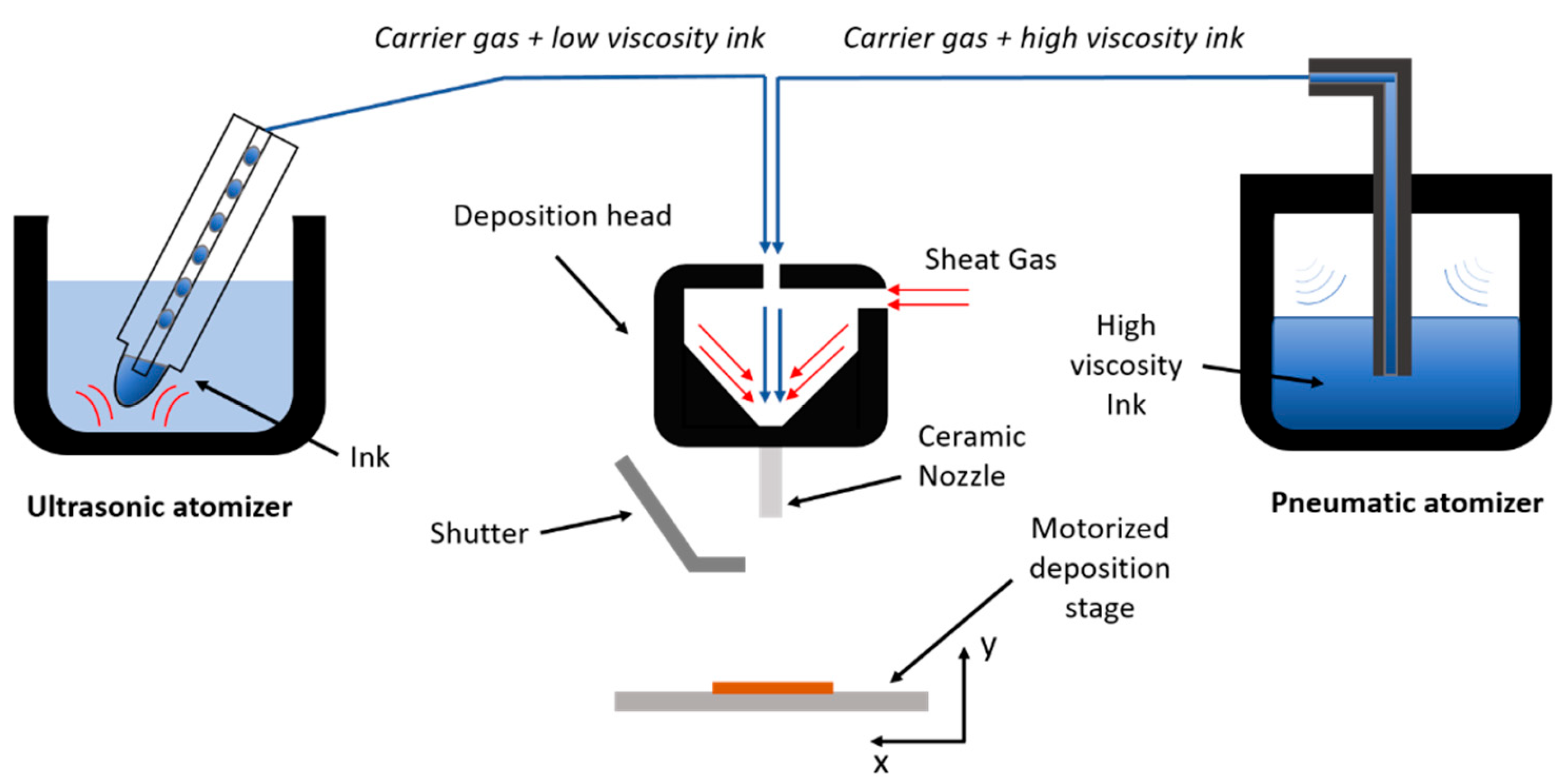
Figure 2.
Microfluidic channels manufacturing by AJP onto electrodes for biosensing: (A) schematics of the concept of critical angle for optimal 3D printing by AJP in microfluidics and (B) representation of the line offset δ for stacked cantilevered lines allowing the implementation of stable out of plane structures; (C,D) process camera images acquired during the manufacturing of a microfluidic channel (adapted from [102]). Printed PEDOT:PSS parallel lines with (E) interline spacing <1 mm (860 μm), (F) thickness ~100 nm, and (G) parabolic profile ~50 μm wide at base, ideal for single-cell accommodation while preserving fluid dynamics; EC culture and patterning on PEDOT:PSS-patterned PDMS. It is evidenced that (H) on Matrigel-coated PDMS, ECs distribute uniformly over the surface, while (I,L) on patterned substrates, ECs preferentially adhere and grow along PEDOT:PSS. Under capillary flow (L) ECs localize almost exclusively on the PEDOT:PSS lines. Bottom graphs report cell density per area (mean of 9 images from 3 devices, error bars: standard deviation), with eight regions analyzed per image; in patterned devices, the two regions containing PEDOT:PSS are labeled “PEDOT” on the lateral distance axis, and the remaining regions without polymer are labeled “NO PEDOT.” Scale bars: 200 µm; fluorescence: blue nuclei, green actin (adapted from [100]).
Figure 2.
Microfluidic channels manufacturing by AJP onto electrodes for biosensing: (A) schematics of the concept of critical angle for optimal 3D printing by AJP in microfluidics and (B) representation of the line offset δ for stacked cantilevered lines allowing the implementation of stable out of plane structures; (C,D) process camera images acquired during the manufacturing of a microfluidic channel (adapted from [102]). Printed PEDOT:PSS parallel lines with (E) interline spacing <1 mm (860 μm), (F) thickness ~100 nm, and (G) parabolic profile ~50 μm wide at base, ideal for single-cell accommodation while preserving fluid dynamics; EC culture and patterning on PEDOT:PSS-patterned PDMS. It is evidenced that (H) on Matrigel-coated PDMS, ECs distribute uniformly over the surface, while (I,L) on patterned substrates, ECs preferentially adhere and grow along PEDOT:PSS. Under capillary flow (L) ECs localize almost exclusively on the PEDOT:PSS lines. Bottom graphs report cell density per area (mean of 9 images from 3 devices, error bars: standard deviation), with eight regions analyzed per image; in patterned devices, the two regions containing PEDOT:PSS are labeled “PEDOT” on the lateral distance axis, and the remaining regions without polymer are labeled “NO PEDOT.” Scale bars: 200 µm; fluorescence: blue nuclei, green actin (adapted from [100]).
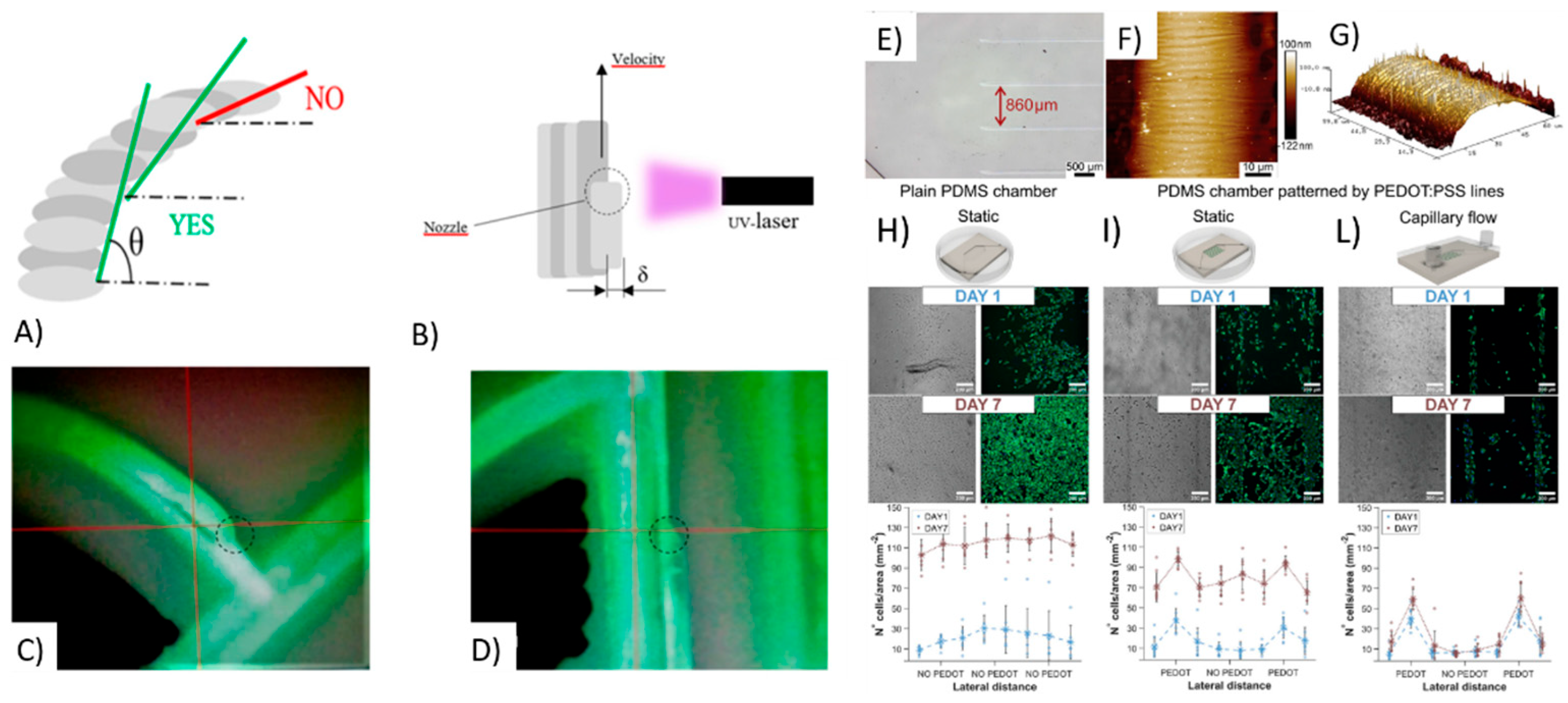
Figure 3.
A) Ag shank arrays with different pitches AJ nanoprinted on various substrates; B) parylene C and PEDOT:PSS deposition on a Ag tip of the array; C) Electrical properties and impedance of bare and PEDOT:PSS-coated Ag array (by comparison with nominal gold ones); D) trace of the implantation of 32 channels electrode on rat brain and representative of the brain activity from a single channel, together with average firing rate and SNR of neurons from three different channels (adapted from [111]).
Figure 3.
A) Ag shank arrays with different pitches AJ nanoprinted on various substrates; B) parylene C and PEDOT:PSS deposition on a Ag tip of the array; C) Electrical properties and impedance of bare and PEDOT:PSS-coated Ag array (by comparison with nominal gold ones); D) trace of the implantation of 32 channels electrode on rat brain and representative of the brain activity from a single channel, together with average firing rate and SNR of neurons from three different channels (adapted from [111]).
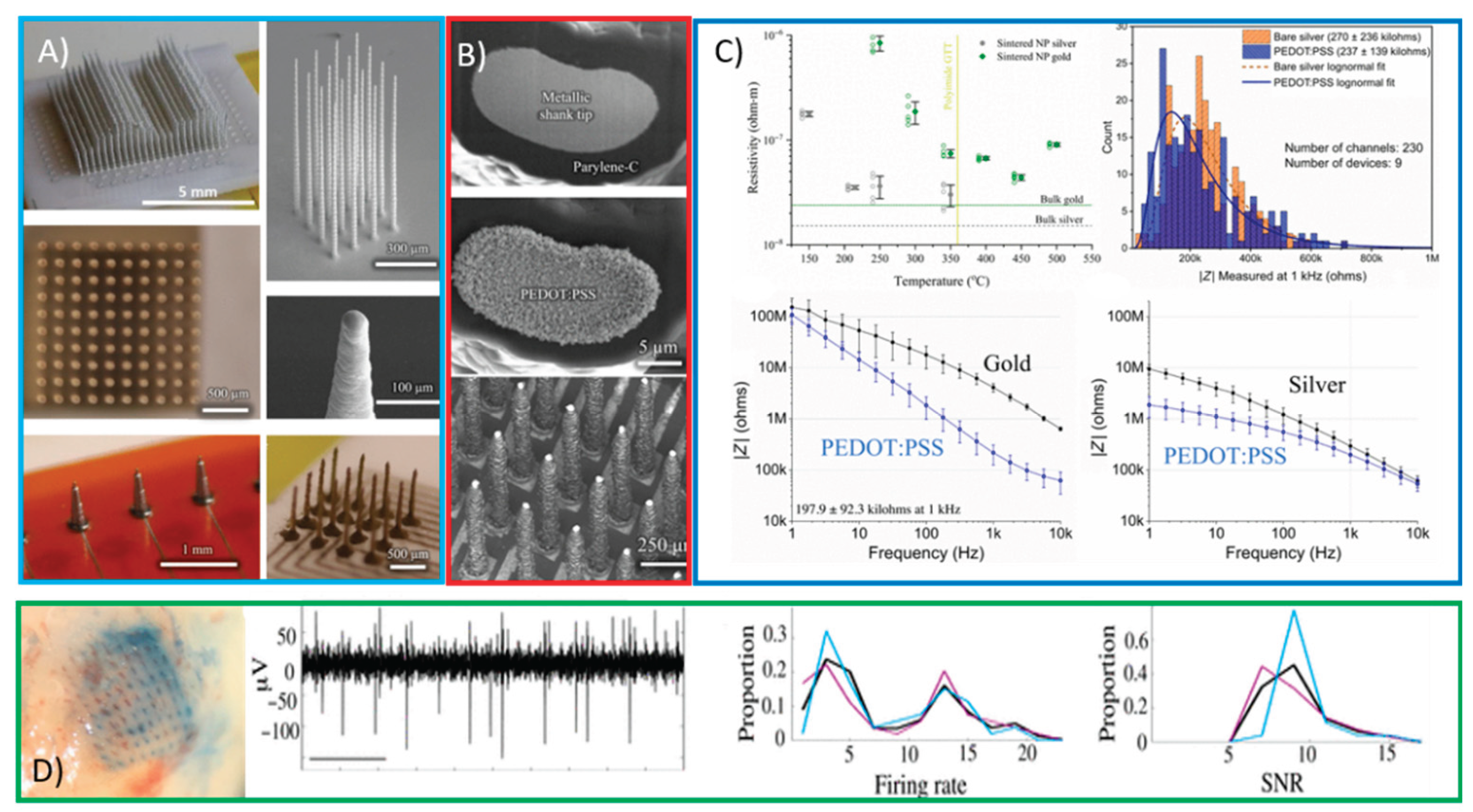
Disclaimer/Publisher’s Note: The statements, opinions and data contained in all publications are solely those of the individual author(s) and contributor(s) and not of MDPI and/or the editor(s). MDPI and/or the editor(s) disclaim responsibility for any injury to people or property resulting from any ideas, methods, instructions or products referred to in the content. |
© 2026 by the authors. Licensee MDPI, Basel, Switzerland. This article is an open access article distributed under the terms and conditions of the Creative Commons Attribution (CC BY) license (http://creativecommons.org/licenses/by/4.0/).
Copyright: This open access article is published under a Creative Commons CC BY 4.0 license, which permit the free download, distribution, and reuse, provided that the author and preprint are cited in any reuse.


