

Submitted:
09 June 2026
Posted:
09 June 2026
You are already at the latest version
Abstract
Background: Early childhood caries (ECC) is a biofilm-mediated and sugar-driven disease associated with local and systemic inflammatory responses. This study evaluated serum Interleukin-6 (IL-6) and IL-10 concentrations, hematologic inflammatory indices, and oral inflammatory parameters in children with ECC compared with caries-free sibling controls. Methods: This sibling-controlled case–control study included 155 children aged 2.5–6 years, comprising 120 children with active ECC and 35 caries-free siblings. Serum IL-6 and IL-10 concentrations were measured using enzyme-linked immunosorbent assay (ELISA). Complete blood count parameters and derived inflammatory indices, including neutrophil-to-lymphocyte ratio (NLR), lymphocyte-to-monocyte ratio (LMR), systemic immune-inflammation index (SII), systemic inflammation response index (SIRI), aggregate index of systemic inflammation (AISI), cumulative inflammatory index (IIC), and mean corpuscular volume-to-lymphocyte ratio (MCVL), were calculated. Plaque Index (PI) and Gingival Index (GI) were recorded in children with ECC. Group comparisons, correlation analyses, ROC analysis, and multivariable logistic regression were performed. Results: Children with ECC exhibited significantly higher serum IL-6 and IL-10 concentrations than sibling controls. MCVL values were significantly lower in the ECC group, whereas several inflammatory indices indicated an increased systemic inflammatory burden. Stratification by PI tertiles showed progressively higher values for WBC, NEU, NLR, SII, SIRI, AISI, and IIC with increasing plaque accumulation (all p < 0.05). PI was strongly correlated with GI (r = 0.811, p < 0.001) and moderately correlated with NLR (r = 0.536), SII (r = 0.536), SIRI (r = 0.654), AISI (r = 0.648), and IIC (r = 0.546) (all p < 0.01). Serum IL-6 and IL-10 were strongly correlated with each other (r = 0.804, p < 0.001) but not with PI or GI. ROC analysis demonstrated moderate discriminatory performance for IL-6 (AUC = 0.701) and IL-10 (AUC = 0.696). Multivariable logistic regression identified elevated IL-6 (OR = 1.32, 95% CI: 1.08–1.62, p = 0.007) and lower MCVL (OR = 0.95, 95% CI: 0.90–1.00, p = 0.048) as independent predictors of ECC. Conclusions: ECC is associated with systemic cytokine alterations and increased hematologic inflammatory burden. While IL-6 and IL-10 distinguish children with ECC from sibling controls, plaque accumulation severity is better reflected by composite hematologic inflammatory indices than by isolated cytokine concentrations. IL-6 and MCVL may be promising adjunctive biomarkers for ECC.
Keywords:
early childhood caries
; sibling controls
; IL-6
; IL-10
; inflammatory biomarkers
; oral hygiene
; plaque index
; gingival index
; hematologic inflammatory indices
; cytokines
1. Introduction
Early childhood caries (ECC) is a multifactorial, biofilm-mediated, and sugar-driven disease characterized by demineralization of primary teeth. Its development is influenced by dietary habits, oral hygiene, enamel susceptibility, microbial biofilm composition, fluoride exposure, and socioeconomic factors. Although dental caries itself is primarily a hard-tissue demineralization process, advanced lesions and associated oral conditions may coexist with local tissue responses and measurable systemic biological changes [1,2]. Recent evidence suggests that untreated dental caries may negatively affect nutrition, growth, sleep quality, school attendance, and psychosocial well-being in pediatric populations [3]. Currently, dental caries is recognized as a dynamic, biofilm-mediated, and diet-modulated disease resulting from an ecological imbalance within the oral microbiome that promotes demineralization of dental hard tissues [4].
Although dental caries is primarily a biofilm-mediated demineralization process, advanced untreated lesions may coexist with local tissue reactions and measurable systemic biological changes. In this context, cytokines such as Interleukin 6 (IL-6) and IL-10 may provide complementary information regarding the host biological response in children with early childhood caries [5]. In this context, inflammatory cytokines have gained increasing attention as potential biomarkers reflecting disease activity and host response. Among them, IL-6 is a pleiotropic pro-inflammatory cytokine involved in leukocyte recruitment, acute-phase reactions, B-cell differentiation, and osteoclast activation [6]. Conversely, IL-10 exerts predominantly anti-inflammatory and immunomodulatory effects by suppressing excessive cytokine production and limiting tissue damage [7].
Several recent studies have demonstrated altered cytokine profiles in children with active dental caries. Elevated salivary IL-6 levels have been associated with increased cariogenic activity and oral inflammatory burden, while IL-10 may reflect compensatory regulatory responses to chronic bacterial stimulation [8,9,10]. Systematic reviews and meta-analyses further support the role of inflammatory mediators as potential diagnostic biomarkers in ECC [11]. Nevertheless, most studies currently available primarily focus on salivary biomarkers, whereas relatively limited data are available on systemic inflammatory responses reflected in serum cytokine concentrations.
Accumulation of dental plaque and inadequate oral hygiene are considered key contributors to oral dysbiosis and gingival inflammation. Clinical indices such as the Plaque Index (PI) and Gingival Index (GI) are widely used to evaluate plaque accumulation, gingival inflammatory changes, and oral hygiene status [12,13,14]. Recent investigations demonstrated significant associations between poor oral hygiene indices and increased inflammatory cytokine expression in saliva and gingival crevicular fluid in pediatric populations [15,16]. However, studies simultaneously evaluating serum IL-6 and IL-10 concentrations together with multiple oral hygiene and gingival indices in children with dental caries remain scarce.
Furthermore, sibling-based control designs are rarely used in pediatric oral inflammatory research despite their methodological advantages. The use of sibling controls may reduce confounding from shared environmental exposures, dietary habits, socioeconomic background, and genetic susceptibility, thereby enabling a more reliable assessment of the association between oral inflammatory burden and systemic immune response [17,18,19,20].
Therefore, the primary aim of the present study was to compare serum IL-6 and IL-10 concentrations between children aged 2.5-6 years with ECC and caries-free sibling controls. Secondary aims were to evaluate selected hematologic parameters and derived inflammatory indices in relation to caries status and to explore whether IL-6 and IL-10 are associated with clinical oral parameters recorded in this cohort.
2. Materials and Methods
2.1. Study Design and Participants
This case–control study included 155 pediatric participants aged 2.5-6 years, recruited from the Department of Pediatric Dentistry between October 2024 and March 2026. The study group consisted of 120 children diagnosed with active dental caries, while the control group included 35 caries-free siblings of the affected patients. The sibling-control design was selected to minimize potential confounding factors related to shared environmental exposures, dietary habits, socioeconomic backgrounds, and genetic susceptibility.
All participants underwent a clinical oral examination and had blood samples collected for assessment of inflammatory biomarkers. Demographic data, oral hygiene indices, gingival status, and serum cytokine levels were recorded for all enrolled subjects.
The study protocol was conducted in accordance with the Declaration of Helsinki and was approved by the Ethics Committee of the University of Medicine and Pharmacy of Craiova, which served as the study's primary ethics authority (no. 123/15 March 2023). Written informed consent was obtained from the parents or legal guardians of all participants prior to enrollment.
The present cohort was recruited independently from the previously published sibling-controlled study and includes no participants from that study [21]. The current analysis addresses a distinct research question by focusing on serum IL-6 and IL-10 and their associations with PI and GI in children aged 2.5-6 years. The previous article is cited for transparency and to clarify that the present manuscript reports an independent dataset.
2.2. Patient Selection
Inclusion Criteria
Caries Group - children were included in the caries group if they fulfilled the following criteria:
- age between 2.5 and 6 years [22];
- presence of active dental caries diagnosed during clinical examination;
- absence of systemic inflammatory or autoimmune diseases;
- absence of acute infectious disease at the time of examination;
- no antibiotic or anti-inflammatory treatment within the previous 30 days;
- availability of complete clinical and laboratory data;
- signed informed consent from parents or legal guardians.
Control Group - children were included in the control group if they met the following criteria:
- sibling of a participant from the caries group;
- absence of clinically detectable active dental caries;
- absence of systemic inflammatory or autoimmune diseases;
- no acute infection at the time of examination;
- no antibiotic or anti-inflammatory therapy within the previous 30 days;
- signed informed consent from parents or legal guardians.
Exclusion Criteria
Participants were excluded from the study in the presence of any of the following conditions:
- systemic inflammatory, autoimmune, metabolic, or immunological disorders;
- current infectious diseases or fever;
- oral mucosal lesions, gingival conditions, or other oral findings that could interfere with reliable clinical assessment;
- use of antibiotics, corticosteroids, or anti-inflammatory medication within 30 days prior to enrollment;
- incomplete clinical or laboratory data;
- children with oral conditions or appliances that prevented reliable clinical examination;
- refusal to participate in the study.
2.3. Clinical Oral Examination
Active ECC was defined as the presence of at least one untreated cavitated carious lesion in a primary tooth. Caries status was recorded dichotomously as present or absent based on clinical examination.
Clinical examinations were performed by a single calibrated examiner under standardized conditions using dental mirrors and periodontal probes.
Oral hygiene and gingival status were assessed using the following validated clinical indices:
-
Plaque Index (PI) - In order to estimate the presence of plaque at the gingival margin of the teeth, the plaque index (PI), was used. According to the recording protocols for this index (the criteria proposed by Silness and Löe), each of the six gingival tooth surfaces was examined with a probe, and a score ranging from 0 to 3 was assigned to each. The mean of the values recorded for each tooth determines the patient's score [12,23].
- −
-
Scoring Criteria: Each surface is given a score based on the amount of plaque:
- ➢
- Score 0: No plaque.
- ➢
- Score 1: A film of plaque that is not visible to the naked eye but can be seen with a disclosing solution or a probe.
- ➢
- Score 2: Moderate accumulation of soft deposits visible without any aids.
- ➢
- Score 3: Abundant soft matter within the gingival pocket or on the tooth and gingival margin.
- ➢
-
Interpretation for scores:
- ➢
- 0: Excellent hygiene
- ➢
- 0.1-0.9: Good hygiene
- ➢
- 1.0-1.9: Fair hygiene
- ➢
- 2.0-3.0: Poor hygiene
-
Gingival Index (GI) - GI scores were assessed according to Löe and Silness criteria; they were recorded using clinical inspection and probing; the score was calculated with the ratio of the mean score of the teeth/number of teeth examined [12,14]. The occurrence of gingival inflammation at four surfaces of each tooth was assessed using the criteria of the gingival index system, as follows:
- −
- < 0.1: no inflammation;
- −
- 0.1-1: mild inflammation, slight change in color, slight edema, no bleeding on probing;
- −
- 1.1-2: moderate inflammation, redness, edema and glazing, bleeding on probing;
- −
- 2.2-3: severe inflammation, marked redness and edema, ulceration, tendency for spontaneous bleeding.
2.4. Laboratory Investigations
Sample Collection
During the biological sampling process, two blood samples were taken from each patient and placed into separate tubes:
- Two additive-free tubes collected about 5 mL of venous blood from each patient. Following standard procedures, samples were allowed to clot, then centrifuged at 3000× g for 10 minutes within 4 hours of collection using a Hermle centrifuge. Serum from one tube was aliquoted into labeled vials, sealed tightly, and stored at −20 °C to −80 °C, avoiding freeze–thaw cycles. Before analysis, frozen serum was passively thawed to room temperature. These aliquots were used for immunological tests, while serum from the second tube was used for biochemical analyses.
-
Peripheral venous blood in EDTA tubes was used for a complete blood count (CBC). We developed an extended leukocyte differential on the MINDRAY BC-6800 by analyzing five parameters, allowing us to identify and characterize hemoleucogram markers: hemoglobin (Hb), white blood cells/leukocytes (WBC), neutrophils (NEU), lymphocytes (LYM), monocytes (MON), platelets (PLT), and hematocrit (Ht). Inflammation indices such as NLR, LMR, PLR, AISI, SII, SIRI, dNLR, NMR, MCVL, and IIC were calculated from these data.
- −
- NLR = neutrophil-to-lymphocyte ratio;
- −
- LMR = lymphocyte -to-monocyte ratio;
- −
- PLR = platelet-to-lymphocyte ratio;
- −
- dNLR = derived neutrophil-to-lymphocyte ratio;
- −
- NMR = neutrophil-to-monocyte ratio;
- −
- AISI = (neutrophils × monocytes × platelets)/lymphocytes;
- −
- SII = (neutrophils × platelets)/lymphocytes;
- −
- SIRI = (neutrophils × monocytes)/lymphocytes;
- −
- MCVL = mean corpuscular volume to lymphocyte ratio;
- −
Blood samples were collected according to standard procedures under routine clinical conditions. Although efforts were made to ensure consistent sample handling, pre-analytical variables such as fasting status, collection time, and processing delay were not strictly standardized or systematically recorded for every participant.
2.5. Immunological Assessment
Serum levels of IL-6 and IL-10 were determined using commercial ELISA kits from Elabscience (Houston, TX, USA) following the manufacturer’s instructions at the Immunology Laboratory of the University of Medicine and Pharmacy of Craiova.
- -
- Human IL-6 (Interleukin 6) ELISA Kit (Cat. No.: E-EL- H6156; product Link: https://www.elabscience.com/p/human-il-6-interleukin-6-elisa-kit--e-el-h6156; Sensitivity 0.94 pg/mL; Detection Range 1.56-100 pg/mL; Specificity: Specific for Human IL-6. No significant cross-reactivity or interference with related analogs was observed; Repeatability: Coefficient of variation is < 10%; https://789.bio/ea/q9yn1O, (accessed on 10 April 2026).
- -
- Human IL-10 (Interleukin 10) ELISA Kit (Cat. No.: E-EL-H6154; product Link: https://www.elabscience.com/p/human-il-10-interleukin-10-elisa-kit--e-el-h6154; Sensitivity 0.94 pg/mL; Detection Range 1.56-100 pg/mL; Specificity: Specific for Human IL-10. No significant cross-reactivity or interference with related analogs was observed; Repeatability: Coefficient of variation is < 10%; https://789.bio/ea/affrrD),[(accessed on 10 April 2026)].
Because of limited sample volume and kit availability, each sample was tested only once. Although intra- and inter-assay coefficients of variation were not measured in this study, the assays employed are standardized kits with performance data supplied by the manufacturer. All samples were processed under uniform laboratory conditions.
Test principle
This assay is based on the sandwich ELISA technique. Human IL-6/IL-10 present in the sample is specifically bound by an immobilized capture antibody and subsequently recognized by a biotinylated detection antibody, forming a sandwich immune complex. This complex is further associated with an avidin–horseradish peroxidase (HRP) conjugate, enabling enzymatic signal amplification. Upon reaction with a chromogenic substrate, the HRP enzyme catalyzes the development of a colored product. The resulting signal intensity, measured spectrophotometrically at 450 ± 2 nm, is directly proportional to the concentration of Human IL-6/IL-10 in the sample. Quantitative determination is achieved by comparison with a standard curve generated from known concentrations.
2.6. Statistical Analysis
Using Microsoft Excel, we organized and handled patient data from medical records. For data analysis, we utilized GraphPad Prism 11.0.2 (92) (GraphPad Software, LLC, San Diego, CA, USA).
Continuous variables were tested for normality using the Shapiro–Wilk test and are presented as mean ± standard deviation (SD) for normally distributed data or median and interquartile range (IQR) for non-normally distributed variables. Categorical variables are presented as absolute numbers and percentages.
Comparisons between children with ECC and caries-free sibling controls were performed using the independent-samples t-test for normally distributed variables and the Mann–Whitney U test for non-normally distributed variables. Differences in categorical variables were evaluated using the chi-square test or Fisher’s exact test, as appropriate.
To investigate the association between plaque accumulation severity and systemic inflammatory alterations, children with ECC were stratified into tertiles according to the PI score. Comparisons among PI tertiles were performed using one-way analysis of variance (ANOVA) with Tukey’s post hoc test for normally distributed variables or the Kruskal–Wallis test followed by Dunn’s multiple-comparison test for non-normally distributed variables.
Correlations between clinical oral inflammatory parameters, serum cytokines, and hematologic inflammatory indices were assessed using Spearman’s rank correlation coefficient (r). Correlation strength was interpreted as weak (|r| < 0.30), moderate (|r| = 0.30–0.59), or strong (|r| ≥ 0.60). Correlation matrices were visualized as heatmaps.
Receiver operating characteristic (ROC) curve analysis was performed to evaluate the ability of serum IL-6 and IL-10 concentrations to discriminate between ECC patients and sibling controls. Diagnostic performance was assessed using the area under the ROC curve (AUC), and optimal cut-off values were determined according to the Youden index. Sensitivity and specificity corresponding to the optimal cut-off values were subsequently calculated.
To identify independent predictors of ECC, a multivariable logistic regression analysis was performed. The regression model included serum IL-6 and IL-10 concentrations, as well as the PLR and the MCVL. PLR and MCVL were selected as representative hematologic inflammatory markers to avoid multicollinearity among the highly correlated composite inflammatory indices. Results are presented as odds ratios (ORs) with corresponding 95% confidence intervals (95% CIs).
All statistical tests were two-tailed, and a p-value < 0.05 was considered statistically significant.
3. Results
3.1. Baseline Characteristics of the ECC and Sibling Controls
A total of 155 pediatric participants were included in the study, comprising 120 children with ECC and 35 sibling controls. Statistically significant differences were observed in the age distribution between the ECC and sibling controls, with median ages of 57 months and 67 months, respectively (IQR: 47–64 vs. 65–69 months; p < 0.0001). The caries group included 61 males and 58 females, whereas the control group included 13 males and 22 females.
Regarding hematological parameters, hemoglobin and hematocrit values were comparable between children with ECC and sibling controls (Hb: 13.13 ± 1.11 g/dL vs. 12.84 ± 0.93 g/dL, p = 0.118; Ht: 39.30 ± 3.33% vs. 38.56 ± 2.27%, p = 0.134). However, children with ECC presented significantly higher inflammatory cellular markers compared with controls, including WBC (7.38 [5.84–8.97] vs. 6.38 [5.14–6.88] ×10³/μL, p < 0.001), NEU (2.91 [2.20–4.53] vs. 2.35 [1.88–3.20] ×10³/μL, p = 0.044), and LYM count (2.94 [2.55–3.46] vs. 2.44 [2.15–3.14] ×10³/μL, p = 0.020). In contrast, erythrocyte sedimentation rate (ESR) was significantly higher in children with ECC than in sibling controls (9.00 [6.00–10.00] vs. 6.00 [5.00–8.00] mm/h, p = 0.005).
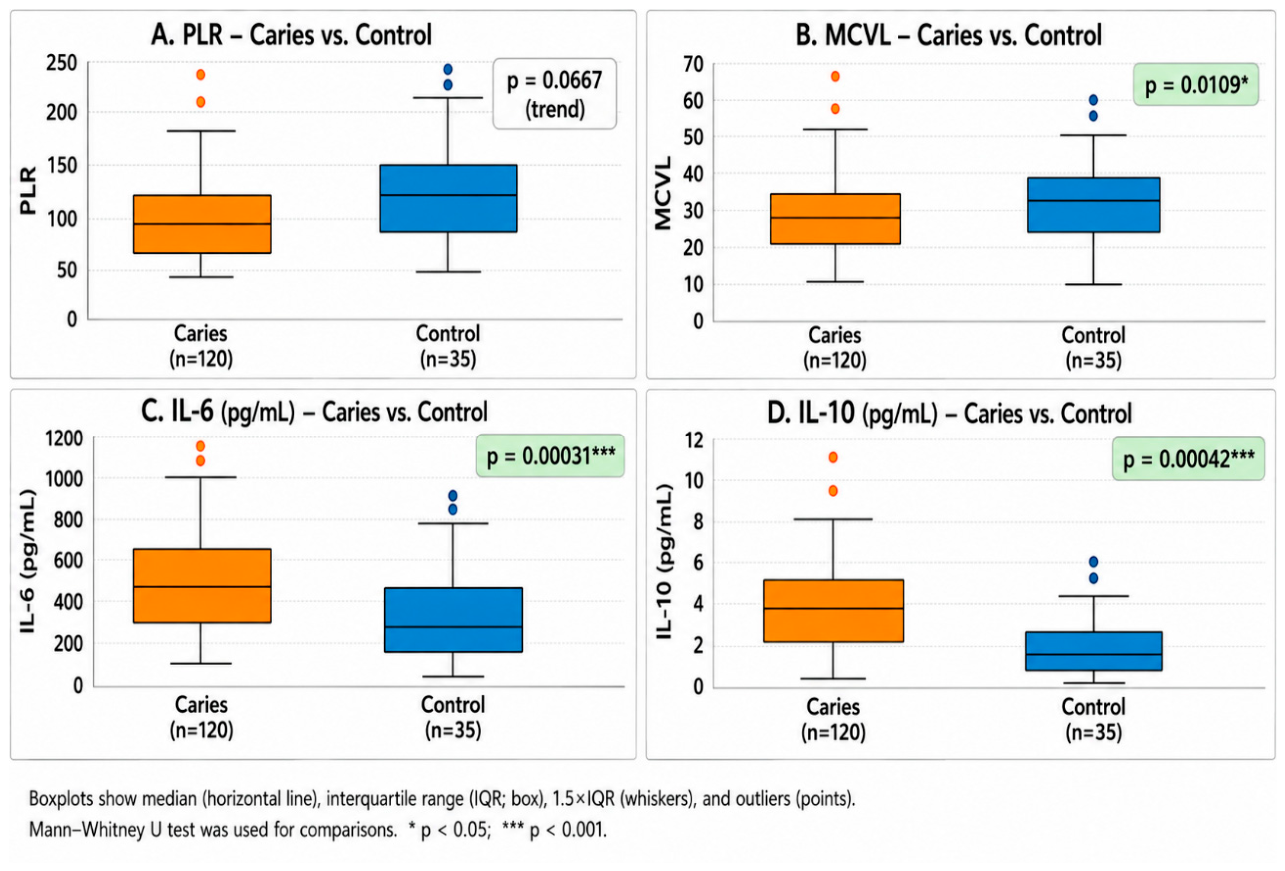
Among the hematologic inflammatory indices, most conventional composite inflammatory markers did not differ significantly between ECC patients and sibling controls. Specifically, no significant differences were observed for NLR (p = 0.350), LMR (p = 0.834), NMR (p = 0.183), dNLR (p = 0.073), AISI (p = 0.123), SII (p = 0.396), SIRI (p = 0.105), or IIC (p = 0.419). PLR demonstrated a borderline difference between groups (99.17 [80.09–125.75] vs. 128.84 [89.92–132.48], p = 0.067). Conversely, MCVL values were significantly lower in children with ECC than in sibling controls (28.51 [22.32–32.48] vs. 34.10 [26.51–38.62]; p = 0.011).
Regarding inflammatory biomarkers, serum IL-6 concentrations were significantly higher in children with ECC than in controls (20.70 [18.77–22.15] vs. 18.29 [17.17–19.54] pg/mL, p = 0.0003). Similarly, serum IL-10 levels were significantly higher in the ECC group (36.58 [30.49–41.33] vs. 30.29 [25.78–35.63] pg/mL, p = 0.0004).
Table 1 summarizes the comparative analysis between ECC and sibling controls.
Figure 1.
Comparative Boxplot Analysis of PLR, MCVL, IL-6, and IL-10 Between Children with Dental Caries and Sibling Controls. Boxplots illustrating differences in hematologic and inflammatory biomarkers between children with dental caries (n = 120) and sibling controls (n = 35). Panel (A) presents platelet-to-lymphocyte ratio (PLR), panel (B) mean corpuscular volume-to-lymphocyte ratio (MCVL), panel (C) serum Interleukin 6 (IL-6) concentrations, and panel (D) serum Interleukin 10 (IL-10) concentrations. Boxes represent the interquartile range (IQR), the horizontal line within each box indicates the median value, whiskers correspond to 1.5 × IQR, and dots represent outliers. Statistical comparisons between groups were performed using the Mann–Whitney U test. Significant differences were observed for MCVL (p = 0.0109), IL-6 (p = 0.00031), and IL-10 (p = 0.00042), while PLR showed a borderline trend toward significance (p = 0.0667).
Figure 1.
Comparative Boxplot Analysis of PLR, MCVL, IL-6, and IL-10 Between Children with Dental Caries and Sibling Controls. Boxplots illustrating differences in hematologic and inflammatory biomarkers between children with dental caries (n = 120) and sibling controls (n = 35). Panel (A) presents platelet-to-lymphocyte ratio (PLR), panel (B) mean corpuscular volume-to-lymphocyte ratio (MCVL), panel (C) serum Interleukin 6 (IL-6) concentrations, and panel (D) serum Interleukin 10 (IL-10) concentrations. Boxes represent the interquartile range (IQR), the horizontal line within each box indicates the median value, whiskers correspond to 1.5 × IQR, and dots represent outliers. Statistical comparisons between groups were performed using the Mann–Whitney U test. Significant differences were observed for MCVL (p = 0.0109), IL-6 (p = 0.00031), and IL-10 (p = 0.00042), while PLR showed a borderline trend toward significance (p = 0.0667).
3.2. Sex-Based Comparative Analysis in the ECC Group
Sex-based analysis within the caries group revealed no statistically significant differences regarding age distribution between females and males (60.50 (47.50–65.00) vs. 55.50 (47.00–63.25) months, p = 0.365). Hb and Ht values were also comparable between sexes (Hb: 12.65 ± 1.06 g/dL vs. 12.77 ± 1.15 g/dL, p = 0.548; Ht: 38.20 ± 2.54% vs. 38.51 ± 2.89%, p = 0.536).
No statistically significant sex-related differences were identified for WBC (7.24 [5.80–8.92] vs. 7.41 [5.91–9.01] ×103/μL, p = 0.864), NEU (2.88 [2.14–4.41] vs. 2.95 [2.28–4.61] ×103/μL, p = 0.771), LYM (2.99 [2.59–3.52] vs. 2.91 [2.50–3.44] ×103/μL, p = 0.618), PLT count (298.00 [248.00–360.00] vs. 291.00 [244.00–349.00] ×103/μL, p = 0.681), or ESR (9.00 [6.00–14.00] vs. 9.00 [6.00–13.00] mm/h, p = 0.941). Similarly, hematologic inflammatory indices, including NLR, PLR, SII, SIRI, AISI, and IIC, showed no statistically significant differences between female and male participants (all p > 0.05).
Regarding inflammatory biomarkers, serum IL-6 concentrations were comparable between females and males (22.81 [17.66–28.95] vs. 22.03 [17.11–28.02] pg/mL, p = 0.679). However, female participants exhibited significantly higher serum IL-10 levels compared with males (42.11 [34.25–52.36] vs. 39.80 [32.90–49.64] pg/mL, p = 0.048). Table 2 summarizes the comparative analysis between female and male participants within the caries group.
3.3. PI Stratification Analysis
To further investigate the relationship between plaque accumulation and systemic inflammatory burden, children with ECC were stratified into low- (≤ 1.2), moderate- (1.21–1.80), and high- (> 1.80) plaque accumulation groups based on PI tertiles (Table 3).
No statistically significant differences were observed regarding age distribution among the three PI groups (57.00 [49.00–62.00] vs. 62.50 [47.25–66.25] vs. 53.00 [46.00–61.50] months, p = 0.147) or sex distribution (female/male: 17/24 vs. 24/16 vs. 17/22, p = 0.191). Similarly, hemoglobin and hematocrit values remained comparable across the three subgroups (Hb: 13.13 ± 1.01 vs. 13.12 ± 1.16 vs. 13.15 ± 1.18 g/dL, p = 0.989; Ht: 39.03 ± 2.75 vs. 38.90 ± 3.51 vs. 39.99 ± 3.67%, p = 0.283).
In contrast, progressively increasing plaque accumulation was associated with significant elevations in several hematologic inflammatory parameters. White blood cell counts increased markedly from the low-PI group to the high-PI group (5.33 [4.94–5.95] vs. 7.38 [6.40–8.11] vs. 9.74 [8.53–11.56] ×10³/μL, p < 0.001). Similar trends were observed for neutrophil counts (2.00 [1.56–2.26] vs. 3.15 [2.52–3.84] vs. 5.00 [3.62–6.31] ×10³/μL, p < 0.001), monocyte counts (0.50 [0.40–0.56] vs. 0.55 [0.47–0.62] vs. 0.74 [0.56–0.90] ×10³/μL, p < 0.001), and platelet counts (276.00 [248.00–313.00] vs. 292.00 [249.75–329.50] vs. 352.00 [288.50–411.00] ×10³/μL, p = 0.002). Lymphocyte counts also demonstrated a modest but statistically significant increase across PI tertiles (2.76 [2.19–3.25] vs. 3.00 [2.60–3.47] vs. 2.98 [2.77–3.71] ×10³/μL, p = 0.046).
Red blood cell-related parameters showed less pronounced changes. Mean corpuscular volume demonstrated a decreasing trend with increasing plaque burden (84.80 [81.40–86.30] vs. 83.65 [80.72–85.45] vs. 82.00 [78.75–84.35] fL), although the difference did not reach statistical significance (p = 0.052). Conversely, RDW values increased significantly across the three groups (12.80 [12.40–13.20] vs. 12.90 [12.57–13.40] vs. 13.10 [12.65–14.20]%, p = 0.044). No significant differences were identified for ESR values (p = 0.112).
Several inflammatory hematologic indices showed strong associations with the severity of plaque accumulation. NLR values increased progressively from 0.65 (0.56–1.00) in the low-PI group to 0.91 (0.79–1.46) in the moderate-PI group and 1.54 (1.02–2.11) in the high-PI group (p < 0.001). Likewise, NMR values increased significantly (4.23 [3.06–5.50] vs. 5.45 [4.67–7.25] vs. 6.96 [6.00–8.26], p < 0.001), as did dNLR (0.54 [0.46–0.78] vs. 0.73 [0.57–1.08] vs. 1.09 [0.80–1.49], p < 0.001).
Among the composite inflammatory indices, AISI exhibited a marked progressive increase from 98.95 (57.37–138.28) to 150.76 (112.30–248.75) and 302.93 (214.44–625.04) (p < 0.001). Similar patterns were observed for SII (198.05 [113.04–276.57] vs. 267.61 [205.23–447.03] vs. 486.36 [340.87–798.35], p < 0.001), SIRI (0.34 [0.19–0.44] vs. 0.48 [0.43–0.85] vs. 0.91 [0.62–1.73], p < 0.001), and IIC (0.66 [0.60–1.10] vs. 1.00 [0.82–1.57] vs. 1.66 [1.03–2.51], p < 0.001). In contrast, LMR values decreased significantly with increasing plaque burden (5.95 [4.38–7.23] vs. 5.76 [4.54–6.66] vs. 4.61 [3.49–5.70], p = 0.011), while MCVL values also declined significantly across PI tertiles (30.72 [25.78–38.95] vs. 27.17 [23.05–31.32] vs. 27.22 [20.29–31.18], p = 0.039). PLR values did not differ significantly among the groups (p = 0.666).
Regarding inflammatory biomarkers, neither serum Interleukin 6 (IL-6) nor Interleukin 10 (IL-10) concentrations varied significantly according to plaque accumulation severity. IL-6 levels were 21.38 (18.14–22.53), 20.61 (18.24–21.82), and 20.39 (19.53–21.98) pg/mL across low-, moderate-, and high-PI groups, respectively (p = 0.663). Similarly, IL-10 concentrations were 39.89 (30.50–42.82), 36.08 (30.25–40.09), and 37.69 (31.23–40.27) pg/mL, respectively (p = 0.234).
Overall, increased plaque accumulation was associated with a progressively more pronounced systemic inflammatory profile, characterized by higher leukocyte counts and elevated composite inflammatory indices, whereas serum IL-6 and IL-10 concentrations appeared relatively stable across different plaque-burden levels. This finding suggests that hematologic inflammatory indices may be more sensitive indicators of plaque-related systemic inflammatory responses than isolated cytokine measurements in children with early childhood caries.
3.4. Correlation of Inflammatory and Hematologic Indices in the ECC Group
To further investigate the relationship between local oral inflammatory burden and systemic inflammatory responses, Spearman correlation analyses were performed between clinical oral indices, serum cytokines, and hematologic inflammatory markers in children with ECC (Table 4).
A strong positive correlation was observed between PI and GI scores (r = 0.811, p < 0.001), confirming the close relationship between plaque accumulation and gingival inflammation in children with ECC.
Increasing plaque accumulation was significantly associated with a higher systemic inflammatory burden. PI demonstrated moderate positive correlations with NLR (r = 0.536, p < 0.001), AISI (r = 0.648, p < 0.001), SII (r = 0.536, p < 0.001), SIRI (r = 0.654, p < 0.001), and IIC (r = 0.546, p < 0.001). Conversely, significant inverse correlations were identified between PI and LMR (r = −0.268, p = 0.003) as well as PI and MCVL (r = −0.261, p = 0.004).
A similar pattern was observed for gingival inflammation. GI scores showed significant positive correlations with NLR (r = 0.411, p < 0.001), AISI (r = 0.478, p < 0.001), SII (r = 0.410, p < 0.001), SIRI (r = 0.480, p < 0.001), and IIC (r = 0.385, p < 0.001). In contrast, MCVL demonstrated a significant negative correlation with GI values (r = −0.301, p < 0.001).
Regarding inflammatory biomarkers, a strong positive association was observed between serum IL-6 and IL-10 concentrations (r = 0.804, p < 0.001), suggesting coordinated activation of pro-inflammatory and anti-inflammatory immune pathways. However, neither cytokine showed a significant correlation with plaque accumulation or gingival inflammation. IL-6 showed weak negative correlations with PI (r = −0.070, p = 0.445) and GI (r = −0.033, p = 0.722), while IL-10 exhibited similarly weak and non-significant associations with PI (r = −0.157, p = 0.087) and GI (r = −0.075, p = 0.414).
Overall, these findings indicate that clinical oral inflammatory severity in ECC is more closely associated with hematologic inflammatory indices than with isolated serum cytokine concentrations. The strong correlations observed between PI, GI, and multiple composite inflammatory indices suggest that plaque accumulation and gingival inflammation may contribute to measurable systemic inflammatory responses in affected children.
To facilitate visualization of the complex interactions among local oral inflammatory burden, systemic cytokine responses, and hematologic inflammatory indices, the significant correlations identified in the ECC cohort were further summarized in a heatmap (Figure 2).
3.5. Relationship Between Serum IL-6, IL-10, and Oral Inflammatory Severity in ECC
Given the established role of dental plaque accumulation and gingival inflammation in the pathogenesis of oral inflammatory responses, additional correlation analyses were performed to further investigate the relationship between serum cytokine levels and clinical oral inflammatory indices.
Specifically, correlations between serum IL-6 and IL-10 levels and the PI and GI scores were evaluated to determine whether systemic inflammatory alterations reflect local oral biofilm burden and gingival inflammatory severity in children with ECC (Table 5).
Correlation analysis demonstrated no statistically significant associations between serum cytokine concentrations and local oral inflammatory indices within the ECC group. Serum IL-6 levels showed weak negative correlations with both PI (r = −0.070, p = 0.445) and GI scores (r = −0.033, p = 0.722). Similarly, serum IL-10 concentrations were not significantly associated with PI (r = −0.157, p = 0.087) or GI values (r = −0.075, p = 0.414), although IL-10 demonstrated a borderline inverse trend with plaque accumulation.
These findings suggest that systemic cytokine alterations observed in children with ECC may not directly parallel the severity of local plaque accumulation or gingival inflammation.
Given the weak correlations observed in the previous analyses, scatter plots were additionally generated to better illustrate the direction and magnitude of the relationships between systemic cytokine profiles and local oral inflammatory parameters. Figure 3 illustrates the distribution patterns and regression trends between serum cytokine concentrations and clinical oral inflammatory indices in children with ECC.
3.6. Diagnostic Performance of IL-6 and IL-10 for ECC
ROC curve analysis was performed to evaluate the discriminative ability of serum IL-6 and IL-10 concentrations in distinguishing children with ECC from sibling controls.
Serum IL-6 demonstrated moderate diagnostic performance, with an AUC of 0.701. The optimal cutoff value, determined by the Youden index, was 19.90 pg/mL, with a sensitivity of 65.0% and a specificity of 80.0% (Table 6).
Similarly, serum IL-10 showed moderate discriminatory ability, with an AUC of 0.696. The optimal cutoff value was 33.83 pg/mL, yielding a sensitivity of 67.5% and a specificity of 71.4%.
These findings suggest that both cytokines may serve as systemic inflammatory biomarkers associated with ECC, although their diagnostic performance remains moderate and should be interpreted as complementary rather than as standalone diagnostic markers.
3.7. Logistic Regression Analysis for Predictors of ECC
Multivariate logistic regression analysis was performed to identify independent predictors of ECC. The regression model included serum IL-6 and IL-10 concentrations, as well as PLR and MCVL values. PLR and MCVL were selected as representative hematologic inflammatory markers to avoid multicollinearity among the highly correlated composite indices (NLR, SII, SIRI, AISI, and IIC) and to provide a more parsimonious multivariable model (Table 7).
Among the variables analyzed, increased serum IL-6 levels remained independently associated with ECC (OR = 1.32, 95% CI: 1.08–1.62, p = 0.007). In contrast, higher MCVL values were independently associated with lower odds of ECC (OR = 0.95, 95% CI: 0.90–1.00, p = 0.048). Neither serum IL-10 concentrations (OR = 0.99, 95% CI: 0.95–1.02, p = 0.430) nor PLR values (OR = 1.00, 95% CI: 0.99–1.01, p = 0.940) demonstrated independent predictive significance in the multivariable model.
These findings suggest that systemic cytokine activation, reflected by elevated IL-6 concentrations, together with alterations in MCVL, may contribute to the inflammatory profile associated with ECC, whereas IL-10 and PLR appear to have limited independent predictive value.
4. Discussion
The present study evaluated systemic inflammatory alterations in children with ECC using a sibling-controlled design and investigated the relationships between serum cytokine concentrations, hematologic inflammatory indices, and clinical oral inflammatory parameters. The principal findings demonstrated significantly higher serum IL-6 and IL-10 concentrations in children with ECC than in sibling controls, along with significant alterations in selected inflammatory hematologic indices, particularly MCVL. Furthermore, increasing plaque accumulation was associated with progressively elevated systemic inflammatory burden, reflected by higher NLR, SII, SIRI, AISI, and IIC values. Correlation analyses further demonstrated significant positive associations between plaque accumulation, gingival inflammation, and multiple hematologic inflammatory indices, whereas serum cytokine concentrations remained largely independent of local oral inflammatory severity. Finally, ROC and logistic regression analyses identified IL-6 and MCVL as the most promising biomarkers associated with ECC.
From a clinical perspective, ECC should be regarded as a chronic childhood disease with consequences extending beyond the affected tooth surface. Current pediatric dentistry policy describes ECC as the result of a sustained imbalance between risk and protective factors, while global estimates indicate that the condition affects a substantial proportion of preschool children. Untreated ECC may be associated with pain, eating difficulties, sleep disturbances, impaired oral-health-related quality of life, and increased caregiver burden. These broader consequences support the interpretation of ECC as a persistent oral disease in which cariogenic biofilm activity, plaque accumulation, and local inflammatory responses may coexist with measurable systemic biological changes. In this context, serum cytokines and CBC-derived inflammatory indices should be interpreted as adjunctive markers of host response rather than substitutes for clinical caries assessment [21,28,29].
Recent evidence increasingly supports the concept that ECC represents not only a localized infectious process but also a condition capable of inducing systemic inflammatory responses. Several studies published during the last decade have demonstrated elevated salivary and serum concentrations of pro-inflammatory cytokines, including IL-6, TNF-α, and IL-1β, in children with active carious lesions, suggesting activation of host immune-inflammatory pathways in response to cariogenic biofilm activity [9,30,31]. Consistent with these observations, our results demonstrated significantly higher serum IL-6 concentrations in children with ECC, supporting the hypothesis that chronic oral inflammatory stimulation may contribute to low-grade systemic immune activation. Recent evidence suggests that IL-6 may serve as a potential biomarker of ECC activity, with higher cytokine levels being observed in children with increasing caries burden [32,33].
Interestingly, IL-10 concentrations were also significantly elevated in the ECC group. Although IL-10 is classically regarded as an anti-inflammatory cytokine, elevated circulating levels in chronic inflammatory conditions may reflect a compensatory immunoregulatory response aimed at limiting excessive tissue damage and the progression of inflammation. Similar observations have been reported in pediatric oral inflammatory diseases and severe ECC cohorts [5,6,7,8,9,10,11]. Therefore, the simultaneous elevation of both IL-6 and IL-10 observed in our study may suggest the coexistence of pro-inflammatory activation and compensatory anti-inflammatory regulation in children with active ECC.
One of the most important novel aspects of the present study is the simultaneous evaluation of serum IL-6 and IL-10 concentrations, multiple composite hematologic inflammatory indices, and standardized clinical oral inflammatory parameters in a sibling-controlled ECC cohort. While previous studies in ECC have mainly focused on salivary cytokines and conventional inflammatory markers, evidence regarding the use of composite hematologic inflammatory indices remains limited. Most available data on indices such as SII, SIRI, AISI, and related inflammatory markers originate from periodontal diseases and other chronic inflammatory conditions rather than from pediatric caries populations [34,35]. Moreover, the sibling-controlled design represents an important methodological advantage because it reduces potential confounding related to environmental exposures, dietary habits, socioeconomic background, oral hygiene practices, and shared genetic susceptibility. Consequently, the observed differences are more likely to reflect disease-associated inflammatory alterations rather than external confounding influences.
A particularly important finding of our study was the progressive increase in inflammatory hematologic indices according to plaque accumulation severity. Children belonging to the highest PI tertile demonstrated significantly increased WBC, neutrophil, monocyte, platelet, NLR, dNLR, NMR, SII, SIRI, AISI, and IIC values compared with those in the lowest PI tertile. Furthermore, PI demonstrated moderate-to-strong correlations with NLR (r = 0.536), SII (r = 0.536), SIRI (r = 0.654), AISI (r = 0.648), and IIC (r = 0.546), while inverse correlations were observed with LMR and MCVL. Similar relationships were identified for GI. These findings suggest that plaque accumulation and gingival inflammation may contribute to measurable systemic immune activation in children with ECC and support the concept that composite hematologic inflammatory indices may represent sensitive markers of plaque-related inflammatory burden.
Interestingly, despite significantly higher serum IL-6 and IL-10 concentrations in ECC patients than in sibling controls, neither cytokine showed significant correlations with PI or GI values. This observation suggests that systemic cytokine concentrations may reflect the presence of ECC rather than the local severity of plaque accumulation or gingival inflammation. A possible explanation is that cytokines reflect downstream systemic immune responses influenced by multiple host-related factors, whereas hematologic inflammatory indices may respond more directly to ongoing plaque-induced inflammation. The strong positive correlation observed between IL-6 and IL-10 (r = 0.804, p < 0.001) further suggests coordinated activation of pro-inflammatory and compensatory anti-inflammatory pathways within the systemic immune response. Previous studies have demonstrated that IL-6 concentrations may be influenced by oral hygiene status and plaque accumulation, although these associations have been inconsistent across pediatric populations [3]. Elevated IL-6 and IL-10 concentrations have also been observed in children with gingival inflammation, further supporting the relationship between oral inflammatory processes and systemic immune activation [11,36,37].
The correlation analyses provide additional support for the hypothesis that oral inflammatory burden is associated with systemic immune activation. Both PI and GI exhibited significant positive correlations with NLR, AISI, SII, SIRI, and IIC, whereas inverse correlations were identified with LMR and MCVL. Collectively, these findings indicate that worsening oral hygiene and increasing plaque accumulation are accompanied by measurable changes in systemic inflammatory profiles. Notably, the strongest associations were observed for SIRI and AISI, suggesting that composite indices that integrate neutrophil, monocyte, platelet, and lymphocyte counts may provide a more comprehensive reflection of the plaque-related inflammatory burden than individual hematologic parameters alone.
An additional strength of the study is the evaluation of the diagnostic performance of serum cytokines. ROC analysis demonstrated moderate discriminatory ability for both IL-6 (AUC = 0.701) and IL-10 (AUC = 0.696), with optimal cut-off values of 19.90 pg/mL and 33.83 pg/mL, respectively. The corresponding sensitivities and specificities were 65.0% and 80.0% for IL-6 and 67.5% and 71.4% for IL-10. Although these values do not support the use of these cytokines as standalone diagnostic biomarkers, they suggest potential utility as adjunctive indicators of systemic inflammatory activation associated with ECC. Importantly, multivariable logistic regression identified elevated IL-6 concentrations (OR = 1.32, 95% CI: 1.08–1.62, p = 0.007) and lower MCVL values (OR = 0.95, 95% CI: 0.90–1.00, p = 0.048) as independent predictors of ECC. These findings indicate that both cytokine-mediated immune activation and hematologic inflammatory alterations contribute to the inflammatory profile associated with ECC.
Although MCVL has been investigated as a novel hematologic inflammatory index in inflammatory and oncologic conditions, data regarding its use in pediatric dentistry remain limited. MCVL integrates erythrocyte size and lymphocyte count, thereby combining information on erythrocyte characteristics and immune cell distribution. In the present study, lower MCVL values in children with ECC may reflect subtle shifts in lymphocyte-related inflammatory activity, nutritional status, or erythrocyte parameters associated with chronic oral disease. However, this interpretation should be approached with caution, as MCVL is a derived index and its clinical meaning in pediatric oral inflammatory conditions has not been fully validated. Future studies should investigate whether MCVL remains associated with ECC after adjustment for nutritional markers, iron status, and broader inflammatory profiles [24,25,26,27].
The clinical implications of the present findings are noteworthy. The observed associations between plaque accumulation severity and multiple hematologic inflammatory indices suggest that ECC may serve as a source of systemic inflammatory stimulation, even in otherwise healthy children. Because indices such as NLR, SII, SIRI, AISI, IIC, and MCVL can be readily derived from routine complete blood counts, they may serve as accessible and cost-effective biomarkers for assessing the systemic inflammatory burden associated with ECC. Furthermore, the identification of IL-6 and MCVL as independent predictors of ECC highlights their potential translational relevance for future risk stratification models. Early preventive interventions aimed at reducing plaque accumulation may therefore contribute not only to improved oral health but also to reduced systemic inflammatory activation.
Several limitations of the study should be acknowledged. First, the cross-sectional design precludes causal inferences regarding the relationship between ECC and systemic inflammatory alterations. Second, although the sibling-controlled design improves internal validity, the control group remained smaller than the ECC cohort. Third, cytokine assessment was limited to IL-6 and IL-10, while other important inflammatory mediators, including TNF-α, IL-1β, IL-17, and hs-CRP, were not evaluated. Fourth, microbiological characterization of the cariogenic biofilm was not performed, preventing direct assessment of the relationship between microbial burden and systemic inflammatory responses. Another limitation concerns the age imbalance between ECC patients and sibling controls. Although all participants were within the early-childhood age range, the control group was older than the ECC group, and age-related differences may influence oral disease status, hematologic parameters, and cytokine concentrations. Sex-based analyses within the ECC group showed no broad differences in most hematologic indices, except for IL-10, which differed between females and males. Therefore, residual confounding related to age and sex cannot be fully excluded. Future studies should include larger age-matched sibling-control cohorts and age- and sex-adjusted regression models to confirm the independent value of IL-6 and MCVL. Finally, longitudinal follow-up after dental treatment was unavailable; therefore, the potential normalization of inflammatory biomarkers following successful ECC management could not be investigated.
Despite these limitations, the present study provides novel evidence linking ECC, plaque accumulation severity, systemic cytokine alterations, and hematologic inflammatory indices in a sibling-controlled pediatric cohort. The findings suggest that the plaque-related inflammatory burden is better reflected by composite hematologic inflammatory indices than by isolated serum cytokine concentrations. Future longitudinal multicenter studies incorporating larger pediatric cohorts, comprehensive inflammatory profiling, and post-treatment follow-up are warranted to further clarify the role of systemic inflammatory biomarkers in the pathophysiology, risk stratification, and clinical monitoring of early childhood caries.
5. Conclusions
Early childhood caries is associated with significant systemic inflammatory alterations, reflected by elevated serum IL-6 and IL-10 concentrations and changes in selected hematologic inflammatory indices. Increasing plaque accumulation was associated with a progressively higher inflammatory burden, with significant associations among the PI, GI, and several composite hematologic markers, including NLR, SII, SIRI, AISI, and IIC. While IL-6 and IL-10 differentiated children with ECC from caries-free sibling controls, they were not significantly associated with plaque accumulation or the severity of gingival inflammation. In contrast, hematologic inflammatory indices appeared to more accurately reflect local oral inflammatory burden. Moreover, elevated IL-6 concentrations and lower MCVL values emerged as independent predictors of ECC. Overall, these findings suggest that ECC was associated with systemic inflammatory alterations and that composite hematologic inflammatory indices may represent useful adjunctive biomarkers of plaque-related inflammatory burden. Further longitudinal studies are needed to validate their clinical utility and clarify their role in the biological mechanisms underlying ECC.
Author Contributions
Conceptualization, S.A.P., and L.B.; methodology, I.T.D., and O.A.D.; validation, L.B.; investigation, A.M.R., L.M.G., P.P., and C.D.; resources, A.M.R., L.M.G., P.P., and C.D.; data curation, A.M.R., L.M.G., P.P., and C.D.; writing—original draft preparation, I.T.D., and O.A.D.; writing—review and editing, P.P., and C.D.; supervision, L.B., M.O., and M.J.T.; project administration, M.O. and M.J.T. All authors have read and agreed to the published version of the manuscript.
Funding
The article processing charges were funded by the University of Medicine and Pharmacy of Craiova, Romania.
Institutional Review Board Statement
The study was conducted in accordance with the Declaration of Helsinki and approved by the Ethics Committee of the University of Medicine and Pharmacy of Craiova, Romania, no. 123/15 March 2023.
Informed Consent Statement
Informed consent was obtained from all subjects involved in the study. Written informed consent was obtained from the patient(s) to publish this paper.
Data Availability Statement
The authors declare that the data of this research are available from the corresponding authors upon reasonable request.
Acknowledgments
This study is part of the PhD thesis of Ștefania Alice Petrache from the University of Medicine and Pharmacy of Craiova, Craiova, Romania. Ionela Teodora Dascălu and Ștefania Alice Petrache make equal contributions and are listed as first/main authors. The authors have reviewed and edited the output and take full responsibility for the content of this publication
Conflicts of Interest
The authors declare no conflicts of interest.
References
- Peres, M. A.; Macpherson, L. M. D.; Weyant, R. J.; Daly, B.; Venturelli, R.; Mathur, M. R.; Listl, S.; Celeste, R. K.; Guarnizo-Herreño, C. C.; Kearns, C.; Benzian, H.; Allison, P.; Watt, R. G. Oral diseases: a global public health challenge. Lancet 2019, 394(10194), 249–260. [Google Scholar] [CrossRef] [PubMed]
- Kassebaum, N. J.; Smith, A. G. C.; Bernabé, E.; Fleming, T. D.; Reynolds, A. E.; Vos, T.; Murray, C. J. L.; Marcenes, W. & GBD 2015 Oral Health Collaborators. Global, Regional, and National Prevalence, Incidence, and Disability-Adjusted Life Years for Oral Conditions for 195 Countries, 1990-2015: A Systematic Analysis for the Global Burden of Diseases, Injuries, and Risk Factors. J. Dent. Res. 2017, 96(4), 380–387. [Google Scholar] [CrossRef] [PubMed]
- Pitts, N. B.; Zero, D. T.; Marsh, P. D.; Ekstrand, K.; Weintraub, J. A.; Ramos-Gomez, F.; Tagami, J.; Twetman, S.; Tsakos, G.; Ismail, A. Dental caries. Nat. Rev. Dis. Prim. 2017, 3, 17030. [Google Scholar] [CrossRef]
- Takahashi, N.; Nyvad, B. Ecological Hypothesis of Dentin and Root Caries. Caries Res. 2016, 50(4), 422–431. [Google Scholar] [CrossRef]
- Hajishengallis, G. Interconnection of periodontal disease and comorbidities: Evidence, mechanisms, and implications. Periodontol. 2000 2022, 89(1), 9–18. [Google Scholar] [CrossRef]
- Tanaka, T.; Narazaki, M.; Kishimoto, T. IL-6 in inflammation, immunity, and disease. Cold Spring Harb. Perspect. Biol. 2014, 6(10), a016295. [Google Scholar] [CrossRef]
- Ouyang, W.; O'Garra, A. IL-10 Family Cytokines IL-10 and IL-22: from Basic Science to Clinical Translation. Immunity 2019, 50(4), 871–891. [Google Scholar] [CrossRef]
- Nireeksha; Hegde, M.N.; Kumari, N.S.; Ullal, H.; Kedilaya, V. Salivary proteins as biomarkers in dental caries: In vivo study. Dent. Oral Craniofac 2017, 3(2), 1–7. [Google Scholar] [CrossRef]
- Lo Giudice, R.; Militi, A.; Nicita, F.; Bruno, G.; Tamà, C.; Lo Giudice, F.; Puleio, F.; Calapai, F.; Mannucci, C. Correlation between Oral Hygiene and IL-6 in Children. Dent. J. 2020, 8(3), 91. [Google Scholar] [CrossRef]
- Kirthiga, M.; Murugan, M.; Saikia, A.; Kirubakaran, R. Risk Factors for Early Childhood Caries: A Systematic Review and Meta-Analysis of Case Control and Cohort Studies. Pediatr. Dent. 2019, 41(2), 95–112. [Google Scholar] [PubMed]
- Alarcón-Sánchez, M. A.; Becerra-Ruiz, J. S.; Avetisyan, A.; Heboyan, A. Activity and levels of TNF-α, IL-6 and IL-8 in saliva of children and young adults with dental caries: a systematic review and meta-analysis. BMC Oral Health 2024, 24(1), 816. [Google Scholar] [CrossRef] [PubMed]
- Silness, J.; Löe, H. Periodontal disease in pregnancy II. Correlation between oral hygiene and periodontal condition. Acta Odontol. Scand. 1964, 22, 121–135. [Google Scholar] [CrossRef]
- Löe, H.; Silness, J. Periodontal disease in pregnancy I. Prevalence and severity. Acta Odontol. Scand. 1963, 21, 533–551. [Google Scholar] [CrossRef]
- Löe, H. The gingival index, the plaque index and the retention index systems. J. Period. 1967, 38(6), 610–616. [Google Scholar] [CrossRef]
- Alamoudi, A.; Alamoudi, R.; Gazzaz, Y.; Alqahtani, A.M. Role of Salivary Biomarkers in Diagnosis and Detection of Dental Caries: A Systematic Review. Diagnostics 2022, 12, 3080. [Google Scholar] [CrossRef] [PubMed]
- Kaczor-Urbanowicz, K. E.; Martin Carreras-Presas, C.; Aro, K.; Tu, M.; Garcia-Godoy, F.; Wong, D. T. Saliva diagnostics - Current views and directions. Exp. Biol. Med. 2016, 242(5), 459–472. [Google Scholar] [CrossRef] [PubMed]
- Saunders, G. R. B.; McGue, M.; Malone, S. M. Sibling Comparison Designs: Addressing Confounding Bias with Inclusion of Measured Confounders. Twin Res. Hum. Genet. 2019, 22(5), 290–296. [Google Scholar] [CrossRef]
- Frisell, T.; Öberg, S.; Kuja-Halkola, R.; Sjölander, A. Sibling comparison designs: bias from non-shared confounders and measurement error. Epidemiology 2012, 23(5), 713–720. [Google Scholar] [CrossRef]
- Engzell, Per; Hällsten, Martin. A caution on sibling comparisons in studying effects of the rearing environment. Eur. Sociol. Rev. 2025, 41(5), 808–821. [Google Scholar] [CrossRef]
- Sjölander, A.; Öberg, S.; Frisell, T. Generalizability and effect measure modification in sibling comparison studies. Eur. J. Epidemiol. 2022, 37(5), 461–476. [Google Scholar] [CrossRef]
- Petrache, Ș.A.; Boldeanu, M.V.; Diaconu, O.A.; Bugălă, A.S.; Olteanu, M.; Dascălu, I.T.; Nicola, A.G.; Beznă, M.C.; Bătăiosu, M.; Țuculină, M.J. Systemic Inflammatory and Hematologic Biomarkers in Early Childhood Caries: Clear Group Differences with Limited Independent Association with DMFT. J. Clin. Med. 2026, 15, 3558. [Google Scholar] [CrossRef] [PubMed]
- Available online: https://www.aapd.org/research/oral-health-policies--recommendations/early-childhood-caries-classifications-consequences-and-preventive-strategies/ (accessed on 10 May 2026).
- D'Elia, G.; Floris, W.; Marini, L.; Corridore, D.; Rojas, M. A.; Ottolenghi, L.; Pilloni, A. Methods for Evaluating the Effectiveness of Home Oral Hygiene Measures-A Narrative Review of Dental Biofilm Indices. Dent. J. 2023, 11(7), 172. [Google Scholar] [CrossRef]
- Poenariu, I.S.; Boldeanu, L.; Ungureanu, B.S.; Caragea, D.C.; Cristea, O.M.; Pădureanu, V.; Siloși, I.; Ungureanu, A.M.; Statie, R.C.; Ciobanu, A.E.; et al. Interrelation of Hypoxia-Inducible Factor-1 Alpha (HIF-1 α) and the Ratio between the Mean Corpuscular Volume/Lymphocytes (MCVL) and the Cumulative Inflammatory Index (IIC) in Ulcerative Colitis. Biomedicines 2023, 11, 3137. [Google Scholar] [CrossRef] [PubMed]
- Rădulescu, P.M.; Căluianu, E.I.; Traşcă, E.T.; Mercuţ, D.; Georgescu, I.; Georgescu, E.F.; Ciupeanu-Călugăru, E.D.; Mercuţ, M.F.; Mercuţ, R.; Padureanu, V.; et al. The Impact of the COVID-19 Pandemic on Outcomes in Acute Pancreatitis: A Propensity Score Matched Study Comparing before and during the Pandemic. Diagnostics 2023, 13, 2446. [Google Scholar] [CrossRef]
- Radulescu, P.M.; Davitoiu, D.V.; Baleanu, V.D.; Padureanu, V.; Ramboiu, D.S.; Surlin, M.V.; Bratiloveanu, T.C.; Georgescu, E.F.; Streba, C.T.; Mercut, R.; et al. Has COVID-19 Modified the Weight of Known Systemic Inflammation Indexes and the New Ones (MCVL and IIC) in the Assessment as Predictive Factors of Complications and Mortality in Acute Pancreatitis? Diagnostics 2022, 12, 3118. [Google Scholar] [CrossRef]
- Șerban, R.E.; Popescu, D.M.; Boldeanu, M.V.; Florescu, D.N.; Șerbănescu, M.S.; Șandru, V.; Panaitescu-Damian, A.; Forțofoiu, D.; Șerban, R.C.; Gherghina, F.L.; et al. The Diagnostic and Prognostic Role of Inflammatory Markers, Including the New Cumulative Inflammatory Index (IIC) and Mean Corpuscular Volume/Lymphocyte (MCVL), in Colorectal Adenocarcinoma. Cancers 2025, 17, 990. [Google Scholar] [CrossRef]
- Zaror, C.; Matamala-Santander, A.; Ferrer, M.; Rivera-Mendoza, F.; Espinoza-Espinoza, G.; Martínez-Zapata, M. J. Impact of early childhood caries on oral health-related quality of life: A systematic review and meta-analysis. Int. J. Dent. Hyg. 2022, 20(1), 120–135. [Google Scholar] [CrossRef]
- Uribe, S. E.; Innes, N.; Maldupa, I. The global prevalence of early childhood caries: A systematic review with meta-analysis using the WHO diagnostic criteria. Int. J. Paediatr. Dent. 2021, 31(6), 817–830. [Google Scholar] [CrossRef]
- Gur, E.; Keles, S.; Cevik, O. Concentrations of interleukin-32, interleukin−10, interleukin−6, and TNF-alfa are higher in saliva of children with early childhood caries. Pediatr. Dent. J. 2023, 33(2), 116–124. [Google Scholar] [CrossRef]
- Ribeiro, C. C. C.; Pachêco, C. J. B.; Costa, E. L.; Ladeira, L. L. C.; Costa, J. F.; da Silva, R. A.; Carmo, C. D. S. Proinflammatory cytokines in early childhood caries: Salivary analysis in the mother/children pair. Cytokine 2018, 107, 113–117. [Google Scholar] [CrossRef] [PubMed]
- Padmanabhan, V.; Islam, M.S.; Baroudi, K.; Chaitanya, N.C.S.K.; Tawfig Hashim, N.; Goud, M.; Rahman, M.M.; Sharma, D.; Haridas, S.; Baki, M.A.A.; et al. Salivary IL-6 as a Biomarker for Early Childhood and Rampant Caries: Insights from a Cross-Sectional Study. Biomedicines 2025, 13, 293. [Google Scholar] [CrossRef]
- Sharma, V.; Gupta, N.; Srivastava, N.; Rana, V.; Chandna, P.; Yadav, S.; Sharma, A. Diagnostic potential of inflammatory biomarkers in early childhood caries - A case control study. Clin. Chim. Acta 2017, 471, 158–163. [Google Scholar] [CrossRef]
- Guo, J.; Xu, R.; Liu, R.; Lai, W.; Hu, C.; He, H.; Zhang, G.; Li, G.; Zheng, W.; Zhang, R. Association between the systemic immune inflammation index and periodontitis: a cross-sectional study. J. Transl. Med. 2024, 22(1), 96. [Google Scholar] [CrossRef]
- Hu, Y.; Yao, Y.; Xie, Y.; Liu, Q.; He, H.; Li, Z.; Chen, M.; Zhu, L. Correlation between systemic immune-inflammatory index and graded diagnosis of periodontitis: a combined cross-sectional and retrospective study. BMC Oral Health 2024, 24(1), 1545. [Google Scholar] [CrossRef] [PubMed]
- Rinderknecht, C.; Filippi, C.; Ritz, N.; Fritschi, N.; Simmen, U.; Filippi, A.; Diesch-Furlanetto, T. Associations between salivary cytokines and oral health, age, and sex in healthy children. Sci. Rep. 2022, 12(1), 15991. [Google Scholar] [CrossRef] [PubMed]
- Alhumaid Hernández Cabanillas, J.C.; Patiño-Marín, N.; Martel Gallegos, M.G.; Salas Orozco, M.F.; Ubaldo Reyes, L.M.; Maldonado Cervantes, M.I.; Castillo Hernández, J.R. Difference Between Pro- and Anti-Inflammatory Interleukins in Saliva of Children with Early Childhood Caries. Oral 2025, 5, 82. [Google Scholar] [CrossRef]
Figure 2.
Heatmap of Correlations Between Oral Inflammatory Parameters, Cytokines, and Hematologic Indices in Children with Early Childhood Caries (ECC). Spearman correlation heatmap illustrating the relationships between local oral inflammatory parameters, serum cytokines, and hematologic inflammatory indices in children with early childhood caries (ECC; n = 120). Positive correlations are represented by red shades, whereas negative correlations are represented by blue shades, with color intensity corresponding to the magnitude of the correlation coefficient (r). A strong positive correlation was observed between Plaque Index (PI) and Gingival Index (GI) scores (r = 0.811, p < 0.001). Both PI and GI demonstrated significant positive correlations with several hematologic inflammatory indices, including neutrophil-to-lymphocyte ratio (NLR), systemic immune-inflammation index (SII), systemic inflammation response index (SIRI), aggregate index of systemic inflammation (AISI), and immune-inflammation composite (IIC), indicating a close association between oral inflammatory severity and systemic inflammatory activation. Conversely, mean corpuscular volume-to-lymphocyte ratio (MCVL) exhibited significant inverse correlations with both PI and GI, suggesting lower MCVL values in children with greater plaque accumulation and gingival inflammation. Serum Interleukin 6 (IL-6) and Interleukin 10 (IL-10) demonstrated a strong positive intercorrelation (r = 0.804, p < 0.001) but showed no significant associations with PI or GI scores. Statistical significance levels are indicated as follows: * p < 0.05; ** p < 0.01; *** p < 0.001.
Figure 2.
Heatmap of Correlations Between Oral Inflammatory Parameters, Cytokines, and Hematologic Indices in Children with Early Childhood Caries (ECC). Spearman correlation heatmap illustrating the relationships between local oral inflammatory parameters, serum cytokines, and hematologic inflammatory indices in children with early childhood caries (ECC; n = 120). Positive correlations are represented by red shades, whereas negative correlations are represented by blue shades, with color intensity corresponding to the magnitude of the correlation coefficient (r). A strong positive correlation was observed between Plaque Index (PI) and Gingival Index (GI) scores (r = 0.811, p < 0.001). Both PI and GI demonstrated significant positive correlations with several hematologic inflammatory indices, including neutrophil-to-lymphocyte ratio (NLR), systemic immune-inflammation index (SII), systemic inflammation response index (SIRI), aggregate index of systemic inflammation (AISI), and immune-inflammation composite (IIC), indicating a close association between oral inflammatory severity and systemic inflammatory activation. Conversely, mean corpuscular volume-to-lymphocyte ratio (MCVL) exhibited significant inverse correlations with both PI and GI, suggesting lower MCVL values in children with greater plaque accumulation and gingival inflammation. Serum Interleukin 6 (IL-6) and Interleukin 10 (IL-10) demonstrated a strong positive intercorrelation (r = 0.804, p < 0.001) but showed no significant associations with PI or GI scores. Statistical significance levels are indicated as follows: * p < 0.05; ** p < 0.01; *** p < 0.001.
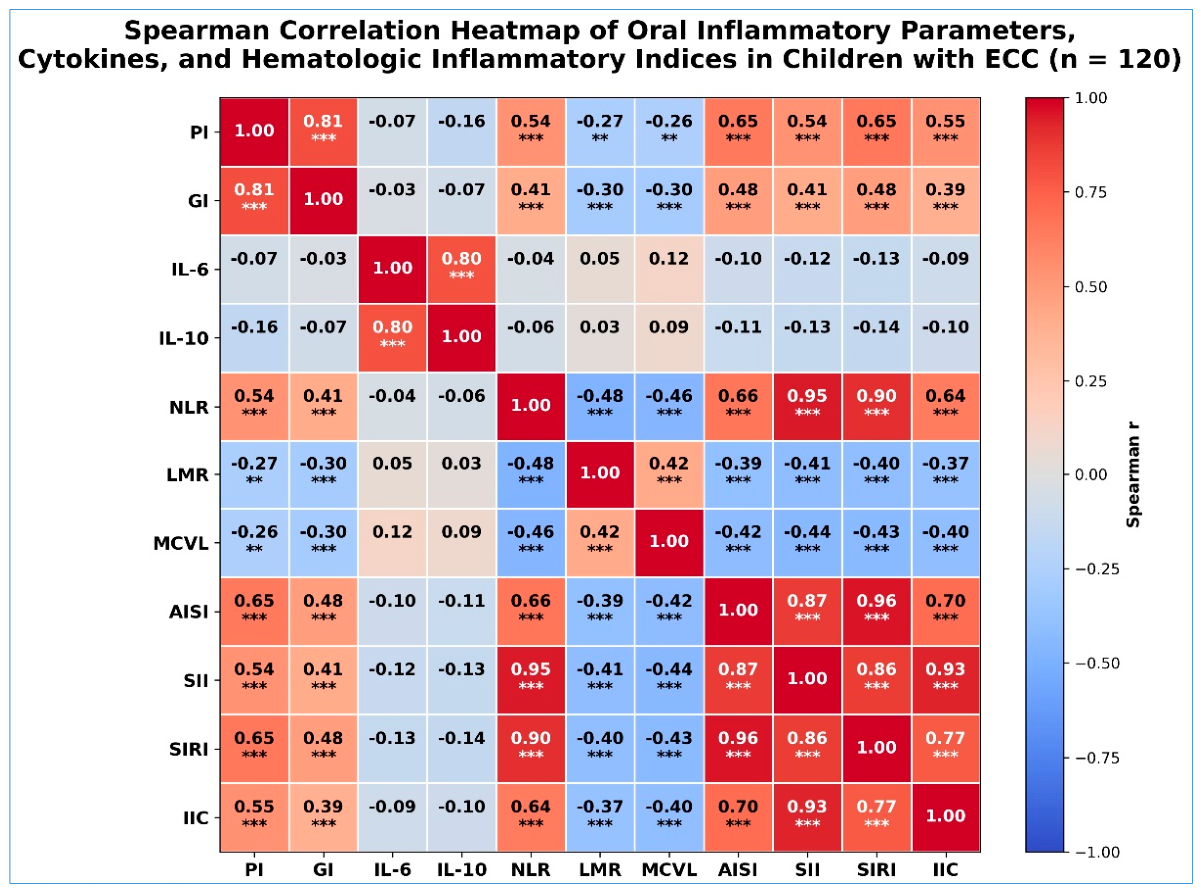
Figure 3.
Scatter plots illustrating the relationships between serum cytokine concentrations and clinical oral inflammatory indices in children with ECC (n = 120). Panel (A) presents the association between serum Interleukin 6 (IL-6) concentrations and Plaque Index (PI) scores, while panel (B) illustrates the relationship between IL-6 and Gingival Index (GI). Panels (C) and (D) demonstrate the correlations between serum Interleukin 10 (IL-10) concentrations and PI and GI scores, respectively. Scatter points represent individual study participants. Solid lines indicate the linear regression trend, whereas shaded areas represent the 95% confidence intervals. Both the horizontal and vertical axes start at zero to facilitate standardized visualization and comparison across panels. Spearman correlation coefficients (r) and corresponding p-values are displayed in the upper-right corner of each graph. Weak negative correlations were identified between serum cytokine concentrations and oral inflammatory indices. Serum IL-6 demonstrated weak inverse correlations with PI (r = −0.070, p = 0.445) and GI (r = −0.033, p = 0.722), while IL-10 exhibited weak negative associations with PI (r = −0.157, p = 0.087) and GI (r = −0.075, p = 0.414). However, none of these associations reached statistical significance. These findings suggest that systemic cytokine alterations in children with ECC may not directly reflect the severity of local plaque accumulation or gingival inflammation.
Figure 3.
Scatter plots illustrating the relationships between serum cytokine concentrations and clinical oral inflammatory indices in children with ECC (n = 120). Panel (A) presents the association between serum Interleukin 6 (IL-6) concentrations and Plaque Index (PI) scores, while panel (B) illustrates the relationship between IL-6 and Gingival Index (GI). Panels (C) and (D) demonstrate the correlations between serum Interleukin 10 (IL-10) concentrations and PI and GI scores, respectively. Scatter points represent individual study participants. Solid lines indicate the linear regression trend, whereas shaded areas represent the 95% confidence intervals. Both the horizontal and vertical axes start at zero to facilitate standardized visualization and comparison across panels. Spearman correlation coefficients (r) and corresponding p-values are displayed in the upper-right corner of each graph. Weak negative correlations were identified between serum cytokine concentrations and oral inflammatory indices. Serum IL-6 demonstrated weak inverse correlations with PI (r = −0.070, p = 0.445) and GI (r = −0.033, p = 0.722), while IL-10 exhibited weak negative associations with PI (r = −0.157, p = 0.087) and GI (r = −0.075, p = 0.414). However, none of these associations reached statistical significance. These findings suggest that systemic cytokine alterations in children with ECC may not directly reflect the severity of local plaque accumulation or gingival inflammation.
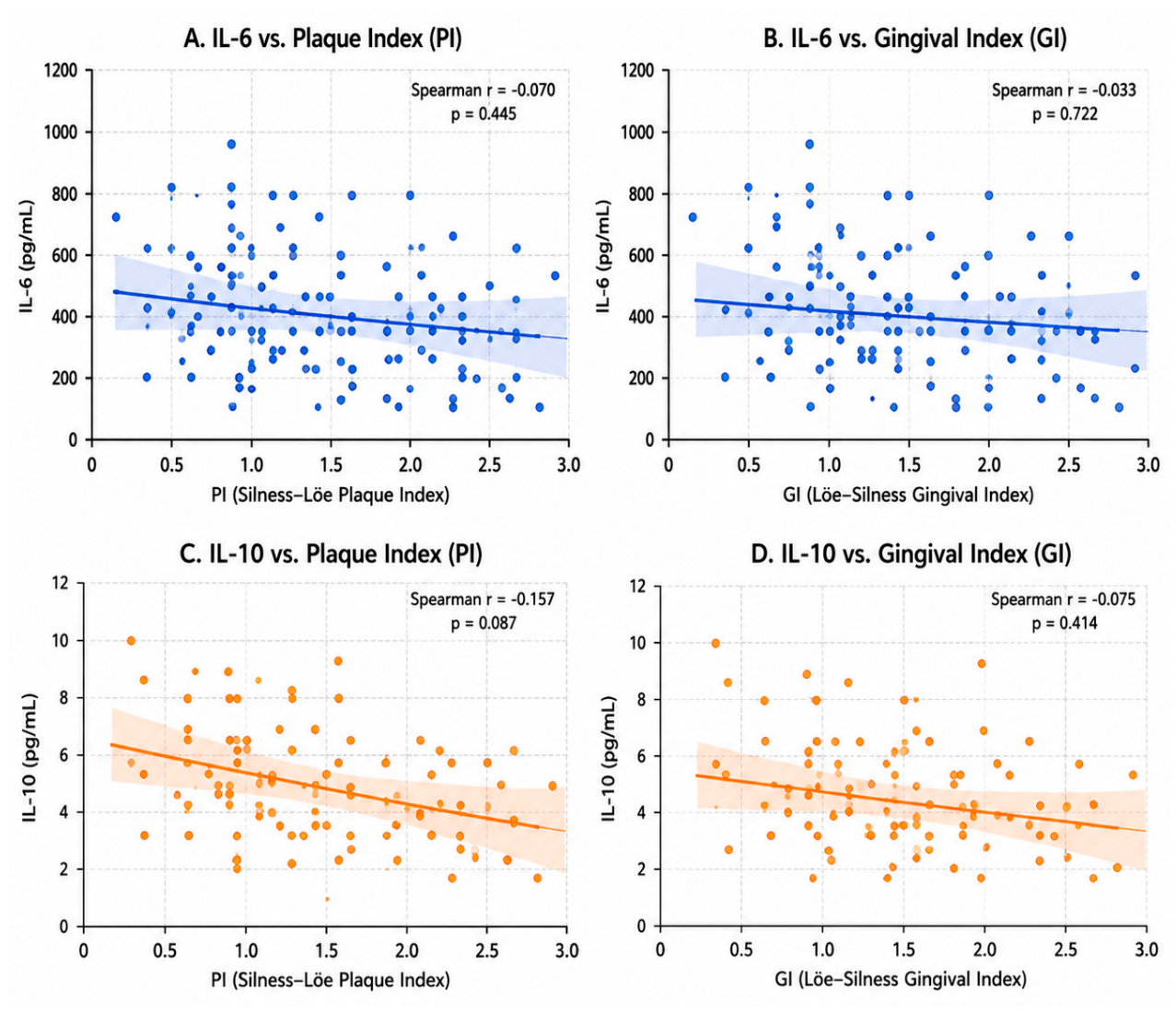

Table 1.
Comparative Analysis Between ECC and Sibling Controls.
| Variable |
ECC group (n=120) |
Control (n=35) |
p-value |
| Age (months), Median (IQR) | 57 (47–64) | 67 (65–69) | <0.0001 |
| Sex (Male/Female), n | 62/58 | 13/22 | — |
| Hb (g/dL), Mean ± SD | 13.13 ± 1.11 | 12.84 ± 0.93 | 0.118 |
| Ht (%), Mean ± SD | 39.30 ± 3.33 | 38.56 ± 2.27 | 0.134 |
| WBC (×10³/μL), Median (IQR) | 7.38 (5.84–8.97) | 6.38 (5.14–6.88) | <0.001 |
| NEU (×10³/μL), Median (IQR) | 2.91 (2.20–4.53) | 2.35 (1.88–3.20) | 0.044 |
| LYM (×10³/μL), Median (IQR) | 2.94 (2.55–3.46) | 2.44 (2.15–3.14) | 0.020 |
| MON (×10³/μL), Median (IQR) | 0.55 (0.47–0.70) | 0.51 (0.38–0.64) | 0.186 |
| PLT (×10³/μL), Median (IQR) | 294.5 (250.0–352.0) | 292.0 (276.0–321.5) | 0.603 |
| MCV (fL), Median (IQR) | 83.05 (79.88–85.40) | 83.50 (81.50–85.55) | 0.132 |
| RDW (%), Median (IQR) | 12.90 (12.50–13.40) | 12.80 (12.35–14.10) | 0.745 |
| ESR (mm/h), Median (IQR) | 9.0 (6.0–10.0) | 6.0 (5.0–8.0) | 0.005 |
| Hematologic indices | |||
| NLR, Median (IQR) | 0.98 (0.65–1.55) | 0.75 (0.61–1.21) | 0.350 |
| LMR, Median (IQR) | 5.41 (4.06–6.76) | 5.41 (4.84–6.32) | 0.834 |
| PLR, Median (IQR) | 99.17 (80.09–125.75) | 128.84 (89.92–132.48) | 0.0667# |
| NMR, Median (IQR) | 5.50 (4.36–7.12) | 4.68 (3.59–6.50) | 0.183 |
| dNLR, Median (IQR) | 0.75 (0.50–1.14) | 0.59 (0.48–0.82) | 0.073 |
| AISI, Median (IQR) | 174.46 (98.95–291.41) | 135.64 (85.54–200.95) | 0.123 |
| SII, Median (IQR) | 278.56 (199.96–497.15) | 274.37 (189.26–398.02) | 0.396 |
| SIRI, Median (IQR) | 0.50 (0.34–0.90) | 0.44 (0.32–0.51) | 0.105 |
| Novel hematologic indices | |||
| MCVL, Median (IQR) | 28.51 (22.32–32.48) | 34.10 (26.51–38.62) | 0.0109 |
| IIC, Median (IQR) | 1.01 (0.67–1.70) | 0.78 (0.74–1.43) | 0.419 |
| Biomarkers | |||
| IL-6 (pg/mL), Median (IQR) | 20.70 (18.77–22.15) | 18.29 (17.17–19.54) | 0.0003 |
| IL-10 (pg/mL), Median (IQR) | 36.58 (30.49–41.33) | 30.29 (25.78–35.63) | 0.0004 |
#: borderline difference.
Table 2.
Comparative Analysis Between Females and Males in the ECC Group.
| Variable |
Females (n=58) |
Males (n=62) |
p-value |
| Age (years) Median (IQR) | 60.50 (47.50–65.00) | 55.50 (47.00–63.25) | 0.365 |
| Hb (g/dL) Mean ± SD | 12.65 ± 1.06 | 12.77 ± 1.15 | 0.548 |
| Ht (%) Mean ± SD | 38.20 ± 2.54 | 38.51 ± 2.89 | 0.536 |
| WBC (×103/μL) Median (IQR) | 7.24 (5.80–8.92) | 7.41 (5.91–9.01) | 0.864 |
| NEU (×103/μL) Median (IQR) | 2.88 (2.14–4.41) | 2.95 (2.28–4.61) | 0.771 |
| LYM (×103/μL) Median (IQR) | 2.99 (2.59–3.52) | 2.91 (2.50–3.44) | 0.618 |
| MON (×103/μL) Median (IQR) | 0.54 (0.45–0.69) | 0.56 (0.48–0.71) | 0.490 |
| PLT (×103/μL) Median (IQR) | 298.00 (248.00–360.00) | 291.00 (244.00–349.00) | 0.681 |
| MCV (fL) Median (IQR) | 81.40 (78.10–84.40) | 81.70 (78.40–84.90) | 0.790 |
| RDW (%) Median (IQR) | 13.20 (12.70–13.70) | 13.00 (12.60–13.50) | 0.329 |
| ESR (mm/h) Median (IQR) | 9.00 (6.00–14.00) | 9.00 (6.00–13.00) | 0.941 |
| Hematologic indices | |||
| NLR, Median (IQR) | 0.94 (0.72–1.50) | 0.98 (0.74–1.57) | 0.664 |
| LMR, Median (IQR) | 5.24 (4.18–6.35) | 5.09 (4.09–6.18) | 0.747 |
| PLR, Median (IQR) | 99.34 (77.62–126.48) | 96.85 (75.11–122.33) | 0.905 |
| NMR, Median (IQR) | 5.28 (3.81–7.22) | 5.42 (3.95–7.55) | 0.824 |
| dNLR, Median (IQR) | 0.63 (0.47–0.95) | 0.65 (0.49–1.00) | 0.631 |
| AISI, Median (IQR) | 170.35 (110.44–292.15) | 165.12 (106.91–284.84) | 0.324 |
| SII, Median (IQR) | 292.60 (192.11–485.74) | 285.44 (186.52–471.60) | 0.575 |
| SIRI, Median (IQR) | 0.51 (0.33–0.86) | 0.53 (0.35–0.89) | 0.164 |
| New Hematologic indices | |||
| MCVL, Median (IQR) | 28.61 (23.18–34.20) | 27.98 (22.66–33.21) | 0.249 |
| IIC, Median (IQR) | 0.88 (0.73–1.07) | 0.86 (0.71–1.03) | 0.333 |
| Biomarkers | |||
| IL-6 (pg/mL) Median (IQR) | 22.81 (17.66–28.95) | 22.03 (17.11–28.02) | 0.679 |
| IL-10 (pg/mL) Median (IQR) | 42.11 (34.25–52.36) | 39.80 (32.90–49.64) | 0.048 |
Table 3.
Comparative Analysis According to Plaque Index Severity in Children with ECC.
| Variable |
Low PI (n = 41) |
Moderate PI (n=40) |
High PI (n=39) |
p-value |
| Age (months) | 57.00 (49.00–62.00) | 62.50 (47.25–66.25) | 53.00 (46.00–61.50) | 0.147 |
| Sex (Female/Male) | 17/24 | 24/16 | 17/22 | 0.191 |
| Hb (g/dL) | 13.13 ± 1.01 | 13.12 ± 1.16 | 13.15 ± 1.18 | 0.989 |
| Ht (%) | 39.03 ± 2.75 | 38.90 ± 3.51 | 39.99 ± 3.67 | 0.283 |
| WBC (×10³/μL) | 5.33 (4.94–5.95) | 7.38 (6.40–8.11) | 9.74 (8.53–11.56) | <0.001 |
| NEU (×10³/μL) | 2.00 (1.56–2.26) | 3.15 (2.52–3.84) | 5.00 (3.62–6.31) | <0.001 |
| LYM (×10³/μL) | 2.76 (2.19–3.25) | 3.00 (2.60–3.47) | 2.98 (2.77–3.71) | 0.046 |
| MON (×10³/μL) | 0.50 (0.40–0.56) | 0.55 (0.47–0.62) | 0.74 (0.56–0.90) | <0.001 |
| PLT (×10³/μL) | 276.00 (248.00–313.00) | 292.00 (249.75–329.50) | 352.00 (288.50–411.00) | 0.002 |
| MCV (fL) | 84.80 (81.40–86.30) | 83.65 (80.72–85.45) | 82.00 (78.75–84.35) | 0.052 |
| RDW (%) | 12.80 (12.40–13.20) | 12.90 (12.57–13.40) | 13.10 (12.65–14.20) | 0.044 |
| ESR (mm/h) | 5.00 (5.00–6.00) | 6.00 (5.00–9.25) | 6.00 (5.00–10.00) | 0.112 |
| Hematologic indices | ||||
| NLR | 0.65 (0.56–1.00) | 0.91 (0.79–1.46) | 1.54 (1.02–2.11) | <0.001 |
| LMR | 5.95 (4.38–7.23) | 5.76 (4.54–6.66) | 4.61 (3.49–5.70) | 0.011 |
| PLR | 100.61 (72.46–123.21) | 93.30 (80.09–123.12) | 101.84 (82.15–140.36) | 0.666 |
| NMR | 4.23 (3.06–5.50) | 5.45 (4.67–7.25) | 6.96 (6.00–8.26) | <0.001 |
| dNLR | 0.54 (0.46–0.78) | 0.73 (0.57–1.08) | 1.09 (0.80–1.49) | <0.001 |
| AISI | 98.95 (57.37–138.28) | 150.76 (112.30–248.75) | 302.93 (214.44–625.04) | <0.001 |
| SII | 198.05 (113.04–276.57) | 267.61 (205.23–447.03) | 486.36 (340.87–798.35) | <0.001 |
| SIRI | 0.34 (0.19–0.44) | 0.48 (0.43–0.85) | 0.91 (0.62–1.73) | <0.001 |
| New Hematologic indices | ||||
| MCVL | 30.72 (25.78–38.95) | 27.17 (23.05–31.32) | 27.22 (20.29–31.18) | 0.039 |
| IIC | 0.66 (0.60–1.10) | 1.00 (0.82–1.57) | 1.66 (1.03–2.51) | <0.001 |
| Biomarkers | ||||
| IL-6 (pg/mL) | 21.38 (18.14–22.53) | 20.61 (18.24–21.82) | 20.39 (19.53–21.98) | 0.663 |
| IL-10 (pg/mL) | 39.89 (30.50–42.82) | 36.08 (30.25–40.09) | 37.69 (31.23–40.27) | 0.234 |
Table 4.
Spearman Correlation Analysis Between Oral Inflammatory Parameters, Cytokines, and Hematologic Indices in Children with ECC.
Table 4.
Spearman Correlation Analysis Between Oral Inflammatory Parameters, Cytokines, and Hematologic Indices in Children with ECC.
| Variables | r | p-value |
| PI vs GI | 0.811 | <0.001 |
| PI vs NLR | 0.536 | <0.001 |
| PI vs LMR | −0.268 | 0.003 |
| PI vs AISI | 0.648 | <0.001 |
| PI vs SII | 0.536 | <0.001 |
| PI vs SIRI | 0.654 | <0.001 |
| PI vs MCVL | −0.261 | 0.004 |
| PI vs IIC | 0.546 | <0.001 |
| GI vs NLR | 0.411 | <0.001 |
| GI vs AISI | 0.478 | <0.001 |
| GI vs SII | 0.410 | <0.001 |
| GI vs SIRI | 0.480 | <0.001 |
| GI vs MCVL | −0.301 | <0.001 |
| GI vs IIC | 0.385 | <0.001 |
| IL-6 vs IL-10 | 0.804 | <0.001 |
| IL-6 vs PI | −0.070 | 0.445 |
| IL-6 vs GI | −0.033 | 0.722 |
| IL-10 vs PI | −0.157 | 0.087 |
| IL-10 vs GI | −0.075 | 0.414 |
Table 5.
Correlations Between Serum Cytokines and Clinical Oral Inflammatory Indices in the ECC Group.
Table 5.
Correlations Between Serum Cytokines and Clinical Oral Inflammatory Indices in the ECC Group.
| Variables | Spearman r | p-value |
| IL-6 vs. PI | −0.070 | 0.445 |
| IL-6 vs. GI | −0.033 | 0.722 |
| IL-10 vs. PI | −0.157 | 0.087 |
| IL-10 vs. GI | −0.075 | 0.414 |
Table 6.
ROC Analysis of Serum Cytokines for Discrimination Between Caries and Control Groups.
| Biomarker | AUC |
Optimal Cutoff (Youden) |
Sensitivity (%) |
Specificity (%) |
| IL-6 | 0.701 | 19.90 pg/mL | 65.0 | 80.0 |
| IL-10 | 0.696 | 33.83 pg/mL | 67.5 | 71.4 |
Table 7.
Multivariate Logistic Regression Analysis for ECC Prediction.
| Variable | OR | 95% CI | p-value |
| IL-6 | 1.32 | 1.08–1.62 | 0.007 |
| IL-10 | 0.99 | 0.95–1.02 | 0.430 |
| PLR | 1.00 | 0.99–1.01 | 0.940 |
| MCVL | 0.95 | 0.90–1.00 | 0.048 |
Disclaimer/Publisher’s Note: The statements, opinions and data contained in all publications are solely those of the individual author(s) and contributor(s) and not of MDPI and/or the editor(s). MDPI and/or the editor(s) disclaim responsibility for any injury to people or property resulting from any ideas, methods, instructions or products referred to in the content. |
© 2026 by the authors. Licensee MDPI, Basel, Switzerland. This article is an open access article distributed under the terms and conditions of the Creative Commons Attribution (CC BY) license.
Copyright: This open access article is published under a Creative Commons CC BY 4.0 license, which permit the free download, distribution, and reuse, provided that the author and preprint are cited in any reuse.


