
Submitted:
09 June 2026
Posted:
09 June 2026
You are already at the latest version
Abstract
This overview explores the development of high-entropy alloys (HEAs) over the past two decades augmented by increasing prediction and discovery strategies of artificial intelligence (AI) and related subsets such as machine learning (ML) and deep learning. The fundamental design principles involving thermodynamic parameters, atomic size, valence electron concentrations and related parameters along with elemental compositions in relation to residual mechanical properties of additively manufactured components are explored. HEAs having densities ranging from < 3 g/cm3 to > 20 g/cm3, melting points of ~ 2500 °C, and superior micro indentation hardnesses of ~ 8 GPa and corresponding yield strengths of ~ 2.5 GPa are described. As-built electron and laser beam powder-bed fusion (PBF) HEA fabricated component microstructures are generally columnar grains aligned with the build direction; consistent with contemporary alloy PBF fabricated components. The optimization of electron and laser beam PBF process parameters for HEA fabrication is described along with the use of experimental test matrix concepts augmented by artificial neural network maps using numerous HEA relational databases in AI and ML algorithm development. The dominance of laser beam powder-bed fusion (LB-PBF) especially in the emergence of multi-laser PBF machines use in fabricating large, commercial rocket and turbine components and products using pre-alloyed powders or elemental powder blends in 1000 kg or larger cassette bed feeders is described. Contemporary metallurgical strengthening mechanisms involving interstitial and dispersion strengthening of HEA compositions is described as these allow the development of superior HEA mechanical property development and applications in emerging technologies such as hypersonic vehicles, nuclear (especially fusion) reactor development and related aerospace and industrial technologies.
Keywords:
high entropy alloys (HEAs)
; powder bed fusion (PBF)
; artificial intelligence and machine learning
; mechanical properties
; multi-laser HEA PBF fabrication
1. Introduction
The first alloys were made of bronze (Cu9Sn) and developed ~ 4500 years ago, heralding the Bronze Age, followed by the Iron Age. It was not until the late 1800th century that carbon was identified as an essential element in steel development. Around the early 20th century age-hardening in Al-Cu-Mn-Mg alloys was discovered followed by other Al-alloy designs. Fe-Ni-Cr (stainless) steel development also occurred in the early 20th century followed by superalloy design and development based on Ni and Co, including the many Inconel alloy compositions. Continuous improvements in superalloy performance, especially in improved creep resistance at elevated temperatures have been achieved over the past decades [1]. Around two decades ago a new alloy design paradigm shift from conventional alloy designs emerged where multi-principal elements, usually 4 or more, were mixed equi-atomically or non-equi-atomically to maximize the configurational entropy, promoting stable FCC and BCC solid solution alloys referred to as high entropy alloys (HEAs). In more recent research high entropy alloy compositions with 3 to 10 have been described. Yen, et al. [2] and Cantor, et al. [3] simultaneously described the first HEA mixtures which lowered the alloy system free energy: AlxCoCrCuFeNi [2], and CoCrFeMnNi [3]. Since the introduction of these HEAs, the recent Thermo-Calc 2025 HEA (TCHEA 8) database (available through Thermo-Calc Software 2025b) lists 713 phases, 342 binary, 672 ternary, 54 quaternary and 3 higher-order systems. This database development is outlined in the paper by Chen, et al. [4]. Recent HEA research and development has begun to use machine learning (ML) [5] and artificial intelligence (AI) [6,7] strategies for new HEA prediction and discovery. ML involves algorithms to improve processes and tasks utilizing modelling [8]. It is a subset of AI which fundamentally involves analyzing large datasets and relational databases to identify and predict patterns and future outcomes. It is also identified with deep learning concepts interconnecting computing units that essentially simulate human brain neural networking to process complex data layers [9,10]. In principle, however, AI more correctly involves augmented intelligence which compliments and extends human intelligence as it applies to analytic skills.
At about the same time HEAs were introduced, additive (layer) manufacturing emerged as a new manufacturing paradigm employing laser and electron beams to systematically fuse/melt elemental and alloy powder bed layers to build complex geometric components and products not possible through conventional metal forming and subtractive manufacturing; including powder metallurgy processes [11,12]. The incremental layer-by-layer melting and solidification processes involving selective laser and electron beam melting (SLM and EBM respectively) also differ fundamentally from conventional, directional solidification which involves a continuously moving melt/solidification front [13,14]. Additive manufacturing (AM)/ 3D printing utilizes a variety of commercial machines which employ CAD-driven beam scanning strategies to facilitate directionally built metal and alloy products which often exhibit novel microstructures and associated mechanical and related properties [15,16,17,18,19,20,21]. It was inevitable that this novel manufacturing process would rapidly incorporate HEA powders to explore the apparent potential for producing a new generation of alloy components and products [22,23,24,25,26,27,28,29]. Zhang, et al. [24] have recently identified more than 100 HEA components fabricated by SLM, EBM and related AM processes, dominated by SLM, or laser beam powder-bed fusion (LB-PBF). This review by Zhang, et al., [24], along with other recent reviews, generally illustrate and emphasize the optimized microstructures and improved properties, especially mechanical properties, for AM-fabricated HEA components and products.
Li, et al. [30] have recently described the application of data-driven methods for LB-PBF fabrication of Ni-based superalloys while Montalbano, et al. [31] have discussed ML-enabled discovery of new LB-PBF processing domains for Ti-6Al-4V alloy. Additionally, Du, et al. [32] have reviewed deep learning generally in AM as it applies to the AM processes and the resulting component and product structures and properties. It is only natural the ML and AI would find applications not only in extending and optimizing AM processing of HEAs, but also in exploring the plethora of potential, novel microstructures, properties and performance features of AM-fabricated HEA components and products.
This overview explores prospects for utilizing AI and its subsets not only in identifying and optimizing AM process parameters unique to both laser and electron beam powder- bed fusion fabrication of HEAs, but also in the simultaneous exploration and prediction of new HEA compositions and design strategies to create specialized and high-performance AM components and products having novel applications in emerging technology arenas. This presentation also explores the optimization of AM process parameters unique to both laser and electron beam powder-bed fusion including the identification of optimum powder size and size distribution for optimum flowability and bed packing or spherical, atomized elemental powders for HEA powder blending. In addition, the novel features contributing to HEA design and development such as the entropy of mixing, valence electron concentration, atomic radii and density are presented along with detailed examples and example calculations describing these features. Comparative examples are presented to show how HEA composition adjustments are related to achieving novel and superior mechanical properties, densities and melting temperatures. Finally, the details and strategies for developing HEA components and products by AM, and primarily LB-PBF, using multi-laser, large build volume and 1000 kg or greater powder cassette machines to fabricate complex rocket and turbine products, especially advanced hypersonic vehicle development and nuclear reactor construction are described.
2. High Entropy Alloy Design Principles
It now appears that high-entropy alloys (HEAs) may be the most significant metallurgical achievement of the past several decades, although time will tell. HEAs maximize configurational entropy which is often referred to as the entropy of mixing which measures the randomness of the system at the atomic level, and given by [2,23,25]:
where ci is the atomic ratio or fraction of the ith element, n is the total number of elements composing the HEA, and R = -8.314 JK-1mol-1 is the gas constant.
According to the second law of thermodynamics, systems converge toward maximum entropy, and high entropy phases will stabilize disordered solid solution phases rather than ordered intermetallic (Im) phases. As shown in Eq. (1), the entropy mixing increases as the number of elemental (atomic) components, n, increases. Enthalpy or the enthalpy of mixing (ΔHmix) is also sometimes considered in evaluating HEAs since, according to the Gibbs free energy: ΔG = ΔH -TΔS, where ΔH measures the total heat or bond energy while the entropy, ΔS, measures disorder and is more characteristic of HEA design strategies.
The atomic sizes, or atomic radii, will also contribute to the entropy and as the concentration of atoms with larger radii is increased, the crystal lattice becomes severely distorted, driving the transition to a less densely packed structure. The overall effect of the atomic size in multi-principal element HEAs is described by:
where ri is the atomic radius of each element, i , (Figure 1) in the alloy, ci is the atomic ratio or fraction of element i, and ra is the average atomic radius:
It is generally found that when δ < 6.2 %, high entropy alloy systems tend to form stable solid solutions. Specific phase types or crystal structures: FCC, BCC, HCP can also be predicted by considering the number of valence electrons or valence electron concentration (VEC) of the alloying elements in the HEA:
where ci is the fraction of element i and (VEC)i is the valence electron concentration, or total valence electrons of element i. For example, and as shown in Figure 2, the total number of valence electrons involves the sum of the outer electrons. For Li in Figure 2, the VEC is 1 while for Be it is 2. Correspondingly for Al and Si in Figure 2 the VEC is 3 and 4, respectively. The lattice structure predictive rule for HEAs can be represented by:
VEC ≤ 8 : stable FCC structure
6.87 < VEC < 8: mixed FCC + BCC
VEC < 6.87: stable BCC structure
It is useful to examine the original Cantor [3] HEA: CoCrFeMnNi (Co20Cr20Fe20Mn20Ni20) shown in Figure 3a as a disordered, FCC structure. The (VEC)HEA according to Eq. (4) becomes (from Figure 2):
(0.2(9) + 0.2(6) + 0.2(8) + 0.2(7) + 0.2(10) = 8
Which, according to Eq. (5) is a stable (disordered) FCC structure. The atomic model in Figure 3a illustrates this FCC HEA while Figure 3b to Figure 3e show EBSD grain structure image (maps) for an original, multiremelted vacuum arc melted (in argon) ingot which was homogenized at 1150 oC for 6 h (Figure 3b), and cold-rolled and annealed at 900 oC for 2, 5, and 60 min (Figure 3c–e) [34]. Figure 3f,g typically illustrate FCC dislocation substructures in similarly prepared CoCrFeMnNi ingot deformed 5 % at 77K (Figure 3f) and 22 % at room temperature (Figure 3g) [35]. The grain equiaxed grain structure in Figure 3b–e, along with the dislocation substructures shown in Figure 3f,g are typical for FCC alloy microstructures [35]. Figure 3e illustrates FCC annealing twins in the grain structure, also typical for low stacking -fault fee energy FCC alloys [36,37]. It should be noted in respect to Figure 3b that th original cast ingot structure for this CoCrFeMnNi HEA was characterized by directional dendritic structures characteristic of cast products. The homogenization anneal which produced the large equiaxed grain structure in Figure 3b also produced characteristic FCC tensile properties: yield stress (σy) of 0.23 GPa, UTS of 0.53 GPa and elongation of 41 % [34]. The tensile properties for the rolled and heat-treated alloy (Figure 3c–e) are shown for comparison in Table 1.
3. Effects of Alloy Composition and Density on HEA Mechanical Properties
Changing the atomic fraction or elemental composition in the CoCrFeMnNi HEA will cause a structure transition according to Eqs. (6) and (7). Such composition variances can also have a significant effect on the microstructures and associated mechanical properties of HEAs. Figure 4 provides an example of this feature by illustrating aluminum content variations for cast (vacuum arc melted (Figure 3b) AlxCr0.2NbTiV HEA [38]. This alloy is BCC for all variances of Al atomic ratio (x = 0.2, 0.5, 0.8) shown in Figure 4. This is a more complex atomic structure than the original CoCrFeMnNi alloy in Figure 3 where the atomic radii of Co, Cr, Fe and Mn are 0.13 nm; Ni is 0.12 nm (Figure 1). For AlxCr0.2BbTiV, the atomic radii are Al 0.14 nm, Cr 0.13 nm, Nb 0.15 nm, V 0.14 nm (Figure 1). The Nb and Ti radii are ~ 15 % larger than Cr which contributes to an elevated disorder in contrast to CoCrFeMnNi. Table 2 compares the as-cast grain sizes, Vickers micro indentation hardness (HV) and parameters ΔSmix, δ, and VEC (from Eqs. 1,2, and 4, respectively.
Figure 5 illustrates a similar trend in grain structure evolution with an even more complex HEA compositional variance in as-cast Ti (50 - x) Zr38NbxTa8Sn4 [39]. In Figure 5, the increase in equiaxed BCC grain size for different HEA compositions shown was attributed to a decrease in diffusion rate and increased Nb atomic percent, which was previously also reported for BCC TiVZrNbx medium entropy HEA by Jiang, e al. [40]. Like the corresponding variations of hardness with grain size for Al atomic fraction variations in AlxCr0.2NbTi shown in Figure 4 and Table 2, more complex compositional variations in Ti(50-x) Zr38NbxTa8Sn4 HEA exhibited similar trends as shown in Figure 5 and Table 3. Table 3 also includes the corresponding density (ρ) values which also change systematically with the tensile properties and Vickers hardness. In this respect, Gorsse, et al. [41] have plotted the room temperature yield stress (σy) values (mostly compressive) versus density (ρ) for 370 alloy compositions which includes HEAs, and complex, concentrated alloys (CCAs) reported in the period 2004 to 2016. This graph is reproduced in Figure 6, where the alloy
members have been color coded to identify the crystal structures. The densities were estimated based on the atomic compositions using the rule of mixtures:
where xi, Mi and Vi are the atomic fraction, molar mass and molar volume of element (atom), i and ωi and ρi are the weight fraction and density, respectively for element, i.. The weight fraction, ωi can be expressed by:
ωi = xiMi/MTotal
And
Figure 7 displays a periodic chart of the elements with atomic weights ( in g/mol ) and densities (in g/cm3), along with melting points. The melting points of HEAs can be estimated from a rule of mixtures equation:
where ci is the atomic percent or atomic fraction of element, i. and Ti is the melting temperature for element, i. This provides only a rough approximation since it does not account for complex interactions between elements. It is notable in Figure 6 that the majority of HEAs have densities within a narrow range (shaded) of ~ 6 to 8 g/cm3; with compressive yield strengths, σy, within this density range extending from ~ 0.2 GPa to 2.8 GPa. Figure 6 also illustrates a maximum range of HEA densities ranging from < 3 g/cm3 to ~ 14 g/cm3. Examples of these extremes include low-density (~ 3 g/cm3) Al20Li20Mg10Sc20Ti30, where the atomic (element) densities range from 0.53 g/cm3 for Li to 4.5 g/cm3 for Ti. W35Ta35Mo10Nb10V10 n contrast has a density of ~ 14.7 g/cm3, where atomic (element) densities range from 6 g/cm3 for V to 19.3 g/cm3 for W (Figure 7). This alloy has a UTS of 2.5 GPa and a Vickers hardness of 6.5 GPa. In the database presented by Gorsse, et al. [41], AlCoCrFeMo0.5Ni, having a density of 7.1 g/cm3 and a BCC + Im crystal structure exhibited a room temperature compressive yield strength of ~ 2.8 GPa. However, as noted in Table 3, room temperature tensile yield strengths as high as 1.1 GPa have been achieved for Ti30Zr38Nb20Ta8Sn4 in the recent work of Ozerov, et al. [39]. This alloy is among the many hundreds of HEA compositions developed up to 2016 as recorded in the paper by Gorsse, et al. [41]. This performance is comparable to recent Ni-based and Co-based superalloy development where room temperature yield stress was ~ 0.8 GPa [43,44]. NASA has also introduced a medium entropy CoCrNi HEA strengthened by a novel oxide dispersion for specialized aerospace components manufactured by AM, especially LB-PBF [45]. This will be discussed in more detail later in this review. It is useful to recall that for many FCC metals and alloys the tension-compression asymmetry is minimal compared to BCC or HCP. Consequently, the compression yield strength and tensile yield strength are roughly equal. In addition, Fan, et al. [46] have shown in extensive studies that the well-established relationship between hardness, especially Vickers micro indentation hardness, HV, and yield stress: HV ~ 3σy [37,47] is also generally followed for a wide variety of high-entropy alloys, especially for compressive yield strength [46]. In fact, the relationship HV ~ 3UTS is even more closely followed [46]. However, for BCC HEAs, the relationship breaks down and HV >> 3 UTS [46].
4. Development of Ultra-High Entropy Alloys
In addition to more than 1500 HEAs identified in the Thermo-Calc 2025 HEA (TCHEA 8) database, researchers have explored what are referred to as ultra-high-entropy alloys (UHEAs) which have compositions ranging from 6 to 13 or more elements. At this writing these are largely exploratory and computational. A recent paper by Ghademi and Amin Davoudabadi [48] explores UHEA state-of-the-art using computational modeling employing CALPHAD (Calculation of Phase Diagrams) [5], DFT (Density Functional Theory) [49] and hybrid CALPHAD-DFT[50] approaches. Figure 8a compares the more traditional, multi-element (5 atoms), distorted cubic close-packed lattice model with a similar >6 atom cubic lattice model for UHEAs in Figure 8b. Figure 8c, corresponding ideally to the compositional complexity implicit in Figure 8b, shows the variationally predicted (calculated) tensile strength, σy, and thermal stability with density for 25 possible UHEAs consisting of Al-Cr-Mo-Nb-Ti-V-Zr-Ta-W-Fe-Co-Mn-Ni; thirteen elements with atomic weights and densities ranging from ~ 27 and 2.7 g/cm3 for Al to 184 and 19.3 g/cm3 for W ( Figure 7). The atomic radii for these compositional elements range from ~ 0.127 nm for Ni and Cr, to 0.16 nm for Zr (Figure 1). This represents a difference of ~ 36 %, a very large misfit in the disordered lattice (Eq. (2)) which could lead to a mixed, disordered BCC crystal structure including ordered BCC unit cells consisting of Ni or Cr corner atoms and a Zr body-centered atom (often designated a B2 (CsCl-type) structure, or other ordered phases. These UHEAs are indicated to have primarily BCC crystal structure (Eqs. (4) and (7) along with BCC + B2 and a few mixed FCC + BCC [48].
It is notable that 25 UHEA mapping in Figure 8c is a template of the extensive HEA mapping shown in Figure 6, although there are no UHEA entries having densities below about 6 g/cm3 and strengths 0f ~ 1.9 GPa, which falls in the most prolific HEA entries in Figure 6. Figure 8c shows a number of high density UHEA compositions, such as CrMoNbTaTiW having a computed density of ~ 12.5 g/cm3 and tensile strength of ~ 2.3 GPa. Hu, et al. [42] have reported W35Ta35Mo10Nb10V10 HEA composition having a density of 14.6 g/cm3, HV of 6.5 GPa and UTS of 2.6 GPa. Such alloys will have notable applications in future nuclear components and systems. At the other end of the HEA density spectrum, Lui, et al. [51] have reported a high Al-content HEA such as Al88Li5Mg5Zn5Cu5 having a density of ~ 2.9 g/cm3, UTS of 0.8 GPa and elongation of 17 %, while Sorkin, et al. [52] have newly described high Al composition HEAs: Al0.31Be0.15Mg0.14Ti0.05Si0.35 ( ρ = 2.5 g/cm3 ) and equi-atomic AlBeMgTiLi (ρ = 2.1 g/cm3) with a Youngs modulus of ~ 195 GPa and σy ~ 2 GPa. These alloys far exceed the performance of more recent, conventional superalloys such as Ni20Co16.5Cr5W2.5Al2.5Ti2.5Nb0.02 (in wt. %), having a density of ~ 8 g/cm3 and yield strength and UTS of 0.8 and 1.1 GPa, respectively at 600 oC [43]. As noted, superalloys and other conventional alloy elemental compositions are generally expressed in weight percent (wt. %). The corresponding atomic percent (At %) for element, i, is given by:
where moles (ni) = (wt. %)/Ai and Total Moles = n1 = n2 + .. and Ai is the atomic weight for element, i (Figure 7).
(At %)i = ( ni/Total Moles) x 100
Comparing Figure 6 and Figure 8c, it is difficult to conclude that a convincing argument can be made to pursue UHEA development over the more widely researched HEAs, especially considering the additional cost of more complex elemental compositions, and especially the inability to develop very low- density alloys. More compelling arguments seem plausible for 5 element HEA predictions and experimental verifications, especially considering demonstrated examples having densities ranging from~ 2.5 to 14.5 g/cm3 encompassing residual strengths from ~ 1 to 2.5 GPa [39,40,41,42,43,50,51,52].
The pursuit of UHEAs, especially those having more than 6 component elements, will certainly require AI and its subsets to explore the enormous range of potential, superior alloy compositions. It will also be useful in fabricating multiple-element UHEAs to use several pre-alloyed powders in powder-bed blending rather than blends of each element. Three different, 4-element pre-alloyed powders could form 12-component UHEA products by LB-PBF.
5. Visual/Graphic Composition-Property Relationships for HEA Design and AI Assist
Table 1, Table 2 and Table 3 list a range of parameters and properties for a variety of HEAs while Figure 6 and Figure 8c exhibit experimentally determined and predicted HEA tensile strengths as these are related to density. This information provides a glance at potential design strategies which might be applied in the production of useful and competitive commercial products in areas such as aerospace, especially turbine and rocket components, automotive, nuclear and other industries, including medical. Figure 6 represents several hundred experimentally examined HEAs up to 2018. At this writing, 2026, there have been well over 10,000 research publications dealing with HEA development, including their residual properties, with the current rate of publications exceeding ~ 3000/yr. There seems to be a dearth of comparative, graphical representations for HEA properties: hardness, yield stress, UTS, elongation and Youngs modulus, either as a function of HEA compositions (as in Table 1, Table 2 and Table 3), densities, or melting temperature. While the database of Gorsse, et al. [41] provides a large but often sparce, correlative overview, there are few visual, graphic and comparative renderings for HEAs. Figure 9, Figure 10 and Figure 11 illustrate a few representative HEAs utilizing data from Gorsse, et al. [41]. Figure 9 shows variations for σy, UTS, Youngs modulus, E and elongation, ϵ (%) for varying vanadium compositions, x (atomic fractions) for MoNbTiVxZr, all BCC crystal structures; with densities ranging from 7.3 g/cm3 at x = 0.2 decreasing to 6.9 g/cm3 for x = 3. There is a considerable difference between the yield stress and UTS for all atomic fractions of V in Figure 9 which, along with the corresponding elongation, decreases with increasing V atomic fraction. By comparison, Figure 10 shows a wide range of mechanical property variations for three, 6 element HEA composition changes. The variations of properties with V additions, Δ, in CoCrFeMnNiVΔ show extremes in properties in contrast to Nb additions, α, in AlCoCrFeNbαNi. The crystal structures for CoCrFeMnNiVΔ are primarily FCC + Im (intermetallic phases), with densities ranging from 7.7 to 7.9 g/cm3 in contrast to BCC + Im and densities ranging from 6.8 to 7.5 g/cm3 for AlCoCrFeMnNbαNi alloy. Finally, Figure 11 compares graphical variances for hardness, HV, Youngs modulus, E and density, ρ, for 4 HEAs ranging from 5 to 7 elements (ideally UHEA designation), for a range of specific element atomic fractions denoted x,y,z and Δ. While only small variances occur for Youngs moduli, extreme variations in density are observed for AlxCoCrCuFe HEA; from 6.5 g/cm3 to 5.4 g/cm3 for Al3CoCrCuFe, having an FCC + BCC crystal structure at the highest density, and a BCC structure at the lowest density.
The data plotted in Figure 9, Figure 10 and Figure 11 for only 8 representative HEAs from Table 1 of Gorsse, et al. [41] represents original research data covering the period 2006 to 2012, and only compare compositional variations (atomic fractions) for a single element in the HEA. In addition, in the more than a decade since recording this data, many thousands of additional HEA experiments have been conducted. So how does one know if even these single element compositions/variances represent the optimized composition for these HEAs? How does one approach the design and development for an optimized HEA application in producing a specialized component or product? Recent reviews by Odesala, et al. [53], Kumar, et al. [5] and Ghadami and Amin Davoudadabi [48] provide some guidance involving computational predictions, ML, and AI applications. These approaches can save enormous amounts of time and experimental expense. Figure 12 illustrates a simple approach to AI and related platforms using connected data layers resembling artificial neural networks to explore the variations in elemental composition variations (atomic fractions) for MoNbTiVZr HEA illustrated in Figure 9. Miracle, et al. [54] have described high-throughput techniques for characterizing a large number of materials such as HEAs while Wang, et al. [55] in the early part of 2026 have described a novel technique involving the high-throughput and rapid fabrication of ~ 500 compositions of W-Re-Os multi-principal element (HEA) alloy using a combinatorial additive manufacturing process involving laser powder-directed energy deposition (LP-DED). High through put micro indentation (Vickers) testing along with compression yield stress testing up to 1400 oC allowed two standout alloy compositions: W69Re12Os19 having a hardness of ~16 GPa at room temperature, and W42Re30Os28 having a yield stress of 1.8 GPa and elongation of 9 % at room temperature while dropping to 1.4 GPa at 1400 oC. It is notable that these alloying elements: W, Re and Os have the highest densities of any element in the periodic chart as well as the highest melting points (Figure 7). Using Eqs. (9) and (12), average densities and melting points for these alloy compositions ranged from 20-21 g/cm3 and 3000 to 3300 oC, respectively. While these alloy compositions represent the extremes in density and melting points, they are ideal for nuclear reactor component requirements.
The fact that HEAs can comprise tens of thousands of chemical compositions, which can contribute to tens of more thousands of physical and mechanical property variations obviously limits the ability to experimentally expose these variances as illustrated in the few examples shown in Figure 9 to 11, and implicit in the research programs such as that described by Wang, et al.[55] above. Figure 12, however, only systematically connects one element at a time. Consider the complexity or 2,3,4, or 5 simultaneous, mixed composition connections: MoxNbyTiVZr, MoxNbTiyVZr, etc.; ultimately 5! (1 x2 x 3 x 4 x 5) = 120 x Figure 12. This applies to only one 5-element HEA. Consider several thousand, a daunting task to say the least. An extensive, recent review by He, et al. [56] in fact compared predicted hardness versus experimental hardness (HV) for AlxCoyCrzCuuFevNiw; with the highest hardness ~ 9 GPa. In a similar and timely review, Lou, et al. [57] describes a physical chemical feature-integrated, interpretable ML strategy for the design of multi-component, ultra-high strength and ductility steels designated UHSDS, and fabricated by L-DED. Candidate elements alloying elements were identified using an ML-based SHAP (Shapley Additive Explorations) algorithm to identify candidate alloying elements; eventually leading to the L-DED processing and subsequent temper treatment of Fe-15Cr-3.2Ni-0.8Mn-0.6Cu-0.56Si-0.4Al-0.16C UHSD which exhibited σy ~ 1.5 GPa, UTS ~ 1.7 GPa, and elongation of 16 %. Essentially zero corrosion was experienced in 3.5 wt. percent NaCl at room temperature for this alloy [57].
The recent research efforts outlined above [48,54,55,56,57], along with extensive book narratives [8,9,10], detail the numerous calculational and predictive analytical pathways involving deep learning, deep neural networks, ML algorithm development and applications. These general AI assist principles and applications highlight the designing, predicting and experimentally exploring strategies to achieve superior properties and performance of HEAs in fabricating components and products for emerging technologies. In addition, it should be noted that AI assist regimes are specialized areas of expertise often not available to the design engineer or experimentalist tasked with the development of manufacturing strategies to achieve these ends. A practical solution would seem to involve the use of Google AI, at least as a first attempt, followed by establishing collaborations with knowledgeable theoreticians and AI specialists.
Google’s primary AI platform is Vertex AI or Gemini, a consumer AI assistant characterized as a unified platform with Google Cloud designated to build, scale and deploy machine learning models and generate AI applications. Vertex AI is a Python-first AI platform where Python is the primary language. Python is a high-level programming language developed in the 1990s with dynamic semantics serving as the primary programming language for AI. It also serves as a critical tool for additive manufacturing in automating workflow, integration of simulation data into the production process, and generating complex geometries in fabricating complex parts. Google AI already incorporates essentially all HEA and related data sets outlined in this review, encompassing more than 10,000 publications since 2004. It will perform all the HEA-related thermodynamic and property calculations necessary for exploring and optimizing HEA prospects for superior and novel applications.
6. HEA Fabrication Using Laser and Electron Beam Powder-Bed Fusion Processes
As in the case for many contemporary, high-performance alloys such as superalloys (including Inconel alloys), additive manufacturing (AM) involving laser and electron beam processing of pre-alloyed wires and powder [21,44,45] has become the process of choice especially in fabricating specialized and complex geometry components and products not possible by more conventional manufacturing technologies. After the introduction of HEAs in the early part of this century as outlined above [2,3,21,22,23]AM was also increasingly adopted in exploring and prototyping their fabrication [24]. As illustrated in the examples of HEA properties above (Figure 6 and Figure 8-11), many HEAs lack ductility and are characteristically hard, which limits their manufacturability, especially where complex component shapes are required. EBM and SLM-electron beam melting and selective laser melting also designated electron and laser beam powder-bed fusion (EB-PBF and LB-PBF) also allow elemental powder blending to achieve novel HEA compositions as well as pre-alloyed HEA powder compositions. Rapid cooling in SLM (LB-PBF) processing, ~ 103 to 105 K/s, also minimizes alloy phase separation along with the production of fine microstructures which can contribute to exceptional as-built component mechanical properties. Zhang, et al. [24] outline in their recent review roughly 85 examples of AM manufactured HEAs up to 2022. Of these studies summarized by Zhang, et al. [24], ~ 60 % involved pre-alloyed HEA powder while the remaining studies involved elemental powder blends. Figure 13 shows a graphical summary of the UTS and elongation for the AM HEAs [24], which can be compared with Figure 9 and Figure 10. The vast majority of these HEA-AM examples involved LB-PBF fabrication. Zhang, et al. [24] concluded in 2022 that, “most of the current research in AM of HEAs is essentially a trial-and-error process which is time consuming and expensive”. In contrast, it might be recalled that an article published by Wang, et al. [55] in the early part of 2026 demonstrated an ingenious process where AM powder processing allowed ~ 500 compositions of a W-Re-Os alloy to be fabricated in a single build, followed by high-throughput micro indentation testing to identify a standout HEA candidate exhibiting ultra-high strength retained up to 1400 oC.
There are currently ~ 30 LB-PBF (SLM) machine manufacturers globally and roughly 12 EB-PBF (EBM) global machine manufacturers. Additionally, there are several hundred metal and alloy powder manufacturers globally, including a few dozen producers of HEA powders, both elemental and pre-alloyed. Elemental powders such as Al and Ti, among others, cost $40 to $150/kg and $20 to $500/kg, respectively. Pre-alloyed powder such as Inconel 718 cost more than $500/kg. Pre-alloyed HEA powders tend to cost between $150 and $600/kg, depending upon the specific elemental compositions.
6.1. Examination of Laser and Electron Beam-Powder Bed Interactions
About a decade ago, the author [58] noted that the interaction of laser and electron beams with a powder bed involves fundamental and complex differences because of the coupling mechanisms between laser-beam photons and electrons with metal powder electron-phonon interactions. Metals have a high density of free electrons which contribute to large optical absorption coefficients for scanning laser beams. Photon-phonon interactions in laser beam scanning increase with heating of the powder bed, decreasing the reflectivity. The characteristics of the powder bed also influence the laser energy (hυ) absorptivity because of powder particle laser (photon) scattering which is related to the powder size and size distribution, as well as powder morphology and the packing density (packing fraction) of powder particles. While smaller powder particle sizes increase the surface area and decrease the reflectivity, the size and size distribution also influence the flowability: ~ d2, where, d, is the particle diameter.
In the case of electrons in electron beam scanning of the powder bed, a fraction of the electrons experience collisions with the atomic nuclei and are backscattered before losing significant energy (mv2/2). While there is no simple formula for backscattered electrons, the backscatter coefficient, χ, is related to the atomic number, Z, (atomic electrons); increasing with increasing Z. For a pre-alloyed or multi-element powder blend (mixture) the average atomic number, ZA, is given by:
where ci is the mass fraction of element, i and Zi is the atomic number of element, i. The backscatter coefficient for the powder bed is represented by
where fp is the packing fraction of the powder bed. For an electron beam the total absorbed energy , E(A), is given by
where Q is the incident beam power density (J/cm3):
χ (Powder) ~ fpχ (Bulk)
E(A) = Q(1 – χ (Powder))
Q = P(s)fG/2πr2λ
P(s) in Eq. (17) is the beam power (Watts) absorbed at the surface or powder-bed surface layer while fG is a Gaussian-beam distribution function for a beam spot size (radius) of r, and λ is the absorption length; related to the layer thickness. In the case of a laser beam, absorption increases with increasing Z, the reverse of electron backscatter.
Generally, the powder surface layer power absorption, or power density, Q, can be expressed in terms of the beam power and process parameters:
where v is the beam scan speed (cm/s), s is the beam scan (hatch) spacing (cm) and t is the melt layer thickness (cm). Units are also often in mm. Variations in beam focus, or spot radius, r, will change the beam absorption. Equation (18) is applicable for both electron and laser beam powder-bed fusion processes which are shown schematically in Figure 14a,b, along with an example of a Co-Cr-Mo alloy exhibiting powder morphology, size and size distribution (Figure 14c [59]. For the EBM system in Figure 14a a vacuum environment is required while for the SLM system in Figure 14b an argon or nitrogen gas environment is used. A scanning mirror scans the laser beam in the SLM process while the electron beam is scanned by magnetic scan coils. CAD software directs the beam parameters and scan strategies as well as the selective layer melting in both systems (Figure 14a,b).
Q = P(s)/vst
An over-riding feature of prime importance for both EBM and SLM involves the melted layer cooling or cooling rate which is expressed by
where G is the temperature gradient and R is the growth rate of the as-built microstructure created in the PBF process; including dendritic structures and sub-structures, “a” and A in Eq. (19) are constants and Q’ in the exponent is the linear power density (J/cm): Q’ = P/v. The cooling rate in conventional casting [13,14], (G.R), controls the dendrite microstructure size or dendrite arm spacing, d, where
and a’ is a constant and n is ~1/3 [13]. In the EBM and SLM (EB-PBF and LB-PBF) processes, d inEq. (20) becomes a generalized dimension which can also represent grain or phase size as well as dendrite size features. In this regard the mode of solidification, denoted by G/R [13,14] is also related to the microstructure evolution in the PBF processes (Figure 14a,b), and is expressed by
where k is the thermal conductivity of the melted powder layer, ΔT is the liquidus-solidus temperature difference, B is a constant, and P9s) and v are described in Eq. (18). In conventional casting [13,14], as G/R decreases the microstructure will change from columnar (often dendritic) microstructure to a cellular dendrite microstructure. In the case of laser and electron beam PBF fabrication of components from the selectively melted powder bed, as-built microstructure development for a wide range of metals and alloys exhibits columnar, directional microstructures in the build direction for high values of G/R while for small G/R an equiaxed and progressively finer grain structure emerges. Figure 15 illustrates these features for a generalized G versus R map [59,60].
G.R = AeaQ’
d = a’(G.R)n
G/R = 2πk(ΔT)2/BP(s)v
Predicting and achieving these microstructure variations through adjustments in G/R as implicit in Figure 15 can be achieved by optimizing the process parameters: P, v, s and t (Eqns. (17) and (18), where t, the melted layer thickness, can be adjusted through careful control of powder particle morphology (optimally spherical), size and size distribution (or span); along with flowability and packing fraction, both of which depend on the powder size features. Optimizing the powder morphology, as indicated, involves fabricating spherical particles. In addition, it is possible to alter both G and R by adjusting the scan strategy or beam scan path to control the microstructures and microstructural anisotropy; thereby controlling the mechanical properties of fabricated components. Typically, the scan strategy involves a raster scan where the beam moves in a linear path with optimized process parameters forming as-built columnar grains in the build direction [61,62]. Bidirectional and rotational scan patterns can limit the formation of columnar microstructures [61]. Another scan strategy involves a point-melt strategy where distinct points are melted by fixing or ramping the beam dwell time rather than linear line melting [63].
Nabil, et al. [64] have recently explored variations in point-based melt strategy patterns using different scan path movements and a print melt source to minimize microstructural anisotropy and examine microstructure evolution for EB-PBF-fabricated Inconel 718 alloy: a Ni-based superalloy. This investigation utilized four different point-based melt strategies: a randomized point melt, a single directional shifted melt, a snake-patterned melt, and a single directional point melt. In a novel variation of this build strategy, the scan strategy was changed in the middle of the build, thereby altering the building microstructure. Figure 16 illustrates this strategy where the initial, snake patterned melt -point scan (bottom) was changed to the randomized point melt scan (top): for XZ and YZ directions as shown. The original (bottom) scan in Figure 16 produced columnar grains while the interrupted scan (top) produced a mixed, irregular columnar and equiaxed grain structure. Figure 16 not only shows how the scan strategy alters the microstructure but also serves to illustrate the principal issues implicit in the G versus R map in Figure 15. The pole figure sections to the upper right of the EBSD maps in Figure 16a,b also indicate that the grain texture changes from <001> in XZ to <111> in YZ.
6.2. Optimizing Powders for HEA Fabrication by Laser and Electron Beam Powder-Bed Fusion
The preparation of powders, either elemental components or pre-alloyed powders along with their screening to provide a requisite particle size distribution (PSD) is a primary feature of EB-PBF and LB-PBF fabrication of HEA components and products. Over the past two decades, the majority of recorded PBF processes have involved LB-PBF [24]. Two powder strategies have dominated the process: elemental powder blends, or in-situ alloying, which mixes elemental powders in proportions required to achieve the desired HEA composition and pre-alloyed powder> Elemental powder blending accounts for ~ 40 % of AM fabrication of HEAs while ~ 60 % employed pre-alloyed powders. The preliminary assurance for powder and powder-bed optimization requires spherical powders although irregular, imperfect spheroidicity particles such as those shown in Figure 14c have produced good components when the build parameters are optimized. Spherical powder particles are commonly produced by gas atomization, plasma arc atomization and centrifugal atomization, while the first two dominate AM processing [66]. Another feature of powder particle optimization involves “clean” spheres, i.e. spherical particles without small satellite spheres attached. The selection of either powder blending or pre-alloyed powders often depends on process flexibility and cost along with the required outcomes. Powder blends are usually low-cost and provide rapid development and composition testing/screening flexibility while pre-alloyed, customized powders cost more and are more suitable for producing dense, homogeneous HEA components because of more uniform elemental distribution. In addition, powder blending allows for additions of reinforcing powder phases such at TiN, TiC, WC, TiO2, etc. which provide additional strengthening as in traditional alloy strengthening [25].
In powder blending as well as in the preparation of pre-alloyed powders from compositional precursors, it is necessary to determine the actual weight (mass) for each of the elemental components, or powders. An example of this process is illustrated as follows for preparing a 100 g unit, m(Total), blend for equi-atomic AlCoCrFeNi. The weight (mass), mi, of each element, i, is initially calculated from:
where ai is the atomic fraction of element, i , and the Atomic wti can be found in Figure 7. For this HEA composition, ai = 1 for all elements. Therefore, from Eqn. (22):
Eqn. (22) for each element becomes:
mAl = (27/252.5) x m(Total); and m(Total) = 100g: mAl = 10.7g
Similarly,
m Co = 23.4g; Cr = 20.7g; Fe = 22.2g; Ni = 23.3g.
For a 1kg PBF cassette sample, these values are multiplied x10. Also, note that for a non-equi-atomic composition such as: Al0.2CoCrFeNi, ai for Al is 0.2, while for the remaining elements it is 1 (Eqn. (22).
The “ideal” unisphere/uniparticle diameter, Di, for each element composing the 100g unit is given by:
where
and ρi is the density of element, i (Figure 7)., and the total volume for the 100g unit sample would be the sum of Vi.. These values are summarized in Table 4 along with the volumetric % of each element, and the unisphere diameter, Di. This diameter declines in essentially the same way the corresponding atomic radii (and diameter) decline. Note that the volumetric and unisphere diameter data in Table 4 are simply quantitative comparison and are not actual features of powder or powder-bed preparation.
Di = 2(3Vi/4π )1/3
Vi = mi/ρi
It might be noted, and as discussed in more detail later in this review, that modern trends in LB-PBF processing involve the use of multi-laser systems having nearly 4 m2 of powder-bed build area, utilizing more than 4000 kg of powder for large products or multi-product fabrication. An increasing number of aerospace and related high-tech industries are incorporating these large systems into their manufacturing arenas.
Figure 17a models the unisphere diameters in Table 4 for each element in the AlCoCrFeNi equi-atomic HEA while Figure 17b shows an ideal Gaussian particle size representation. However, the more realistic representation for the elemental powder sample size distribution is represented in Figure 17c,d: a skewed distribution in Figure 17c and a bimodal distribution in Figure 17d.
Figure 18, Figure 19 and Figure 20 illustrate many of these powder size and size distribution features for a range of elemental powders, alloy powders, and HEA pre-alloyed powders. Figure 18a shows elemental Cu powder while Figure 18b shows an Inconel 625 alloy powder having nominal composition in weight % for Ni59Cr21Mo9Fe5(Ta,Nb)4Co1(trace elements)1. The copper powder in Figure 18a exhibits a wide size distribution (span) of ~ 2 to 40 µm with a sharply skewed (narrow) larger particle size range. In contrast, the Inconel 625 alloy powder (Figure 18b) exhibits a much different size distribution feature which can be described as a small span skewed distribution (Figure 17 (c )) or a bimodal distribution feature shown in Figure 17d; with average bimodal sizes of ~ 15 µm and 50 µm. Flowability would normally favor the Inconel 625 powder in contrast to the Cu powder. Figure 19 shows atomized Ti powder (Figure 19a) and Ta powder (Figure 19b). In contrast to the powder sizes and size distributions shown in Figure 18, these powder samples exhibit somewhat different size distribution features. The Ti powder in Figure 19a exhibits a size distribution and span between the two powders in Figure 18. As shown in Figure 19a for the Ti powder, the particle size span is ~ 10 to 65 m, with the appearance of a trimodal distribution, with a flowbility similar to or better than the Inconel 625 powder in Figure 18b. Figure 19b on the otherhand shows a wide distribution (span) with an average large particle size of ~150 μm which would exhibit a very unfavorable flowability.
Figure 20 compares a non-equi-atomic HEA (Co31.5Cu7Fe30Ni31.5) powder in Figure 20a–d, with an equi-atomic HEA (VNbMoTaW) powder in Figure 20e,f. While these powders each exhibit essentially perfect sphericity, like other powder examples in Figure 18 and Figure 19, their sizes and size distributions show very different features. The size distributions for each of these powders show small size spans with particles shown in Figure 20b–d having an average size > 60 µm; with those in Figure 20d having an average size of ~ 80 µm. Considering that flowability ~ d2, these powders should flow well but having no small particles to fill the void spaces, the powder bed would not pack well, and the layers would not melt well, producing porosity and poor-quality components in PBF processing. On the other hand, the powder particles in Figure 20e,f would have a lower flowability but better overall void filling, layer packing, and melting efficiency.
Optimizing the actual powder bed for PBF processes is complex. Ti requires an optimized powder-bed packing or packing density which is related to how the spherical particles flow. Smaller particle additions are required to fill voids, implying a skewed powder particle size distribution or bimodal distribution as shown in Figure 17c,d. The addition of ~ 30 % fine particles to a coarse powder with coarse-to-fine ratio of ~ 1.1 can increase the powder-bed density by nearly 20 %. The span of the distribution is also important because larger spans lower the flowability partly because smaller particles create cohesion bridges and clump together because of Van der Waals forces. Electronic structure, even Z, as well as powder density influence beam interaction as discussed earlier. Melting point also plays a role since very high melting point elements such as W, Re, Os (Figure 7), which also have extreme densities, impose additional consideration. Powder optimization continues to be driven more by trial-and-error and anecdotal experiences. Large databases necessary for meaningful AL applications simply do not exist. In this regard, the anecdotal powder particle size optimum is ~ 53 µm while for LB-PBF the distribution or size span is ~ 15 -45 µm, and ~ 30 -75 µm for EB-PBF. These spans are influenced by the elemental properties as noted, as well as the actual AM process build parameters: P, v, s, t. As in the case of powder properties there is also a limited database for SLM or EBM build parameters. The goal in optimizing both the powder properties and the AM process parameters is to produce a porosity-free, ideally 100 % dense product. This is never attained. There is always some level of impurity present as well as the introduction of small amounts of gas during the melt/solidification process. For laser or electron beam PBF processes the complete melting of the powder-bed layer is the ultimate goal.
7. Powder-Bed Fusion Process Parameter Development and Examples of LP-PBF-Fabricated HEA Components and Products Using Large, Multi-Laser Systems
7.1. Process Parameter Measurement, Scan Strategies and as-Built Microstructures
Having developed a preliminary, optimized powder span Figure 17) to assure flowability and powder-bed packing fraction during the layer-forming process in PBF systems as described above, successful fabrication of components and products requires optimized machine process parameters, particularly beam power, P, and the scan velocity, v. In most cases the beam focus (radius) is optimized in the CAD software and is usually not altered. Ideally the power density, Q ~ p/r3 , so for small spot radii, Q increases significantly. The spacing between beam scans, or hatch spacing, s, is also only changed if the beam power and scan speed optimization do not provide complete layer-bed melting. The layer thickness, t, is usually selected to range from ~ 50 to 100 µm since the optimized powder span is ~ 15-50 µm. This thickness range provides the best powder-bed preparation. In addition, only the most spherical powders are used.
Fabrication process parameter optimization for a high-performance HEA candidate usually begins by creating an experimental sample layout configuration as illustrated in Figure 21 where 1 cm3 test cubes are built layer-by-layer in 2 x 2, 3 x 3, or 6 x 6 arrays depending on the precision required. Each test cube corresponds to a selected power level, P, and scan speed, v: P1s1, P1s2, P2s1, P2s2 for a 2 x 2 (4 cube) test array in Figure 21; which can be expanded as necessary. The completed test array of cubes is then systematically polished to allow optical metallography observations of the void content followed by chemical etching to allow grain structure observations by optical metallography, SEM and EBSD, along with micro indentation (Vickers) hardness measurements. Finally, the cube densities are measured. Optimized processing requires zero voids, ideal density based on the rule of mixtures, Eqn. (9) and highest hardness. Paraschiv, et al. [70], among others, have shown that laser power and scan speed play the determining role in optimizing density. Both high power and high scan speed or lower power and lower scan speed tend to optimize melting and densification.
As described previously, a novel, high-throughput process identifying superior HEA composition discovery was described by Wang, et al. [55] where ~ 500 HEA compositions were fabricated in a single run followed by high-throughput micro indentation hardness testing. They identified a W42Re30Os28 HEA as an exceptional high-strength, high-temperature, high-density candidate. In contrast to high density, superior strength HEA developments, Li, et al. [71] recently described the development of low-density, high-entropy superalloys guided by automated machine learning.
The test matrix concept shown in Figure 21 only provides a preliminary approach to optimizing the build parameters for a specific HEA composition for building a potentially superior component or product. Observations of the test-cube surface microstructures do not provide a complete microstructural overview. This would require polishing the cube sides parallel to the build direction. In addition, the test protocol does not include variations in the scan strategies which can have a notable effect on the residual, as-built microstructures as illustrated in the recent work of Nabil, et al. [65) and reproduced in Figure 16. HEA microstructures for LB-PBF-built components essentially follow the general guidelines for AM fabrication of metals and alloys illustrated in Figure 15, where, as noted in Eqns. 17, 18 and 20, the process parameters describe the temperature gradient/cooling rate dependence, which in turn determines the as-built microstructure evolution. Figure 22 shows some examples of this feature for LB-PBF fabrication of equi-atomic HEAs. Figure 22a–c shows AlCoCuFeNi HEA built in various directions [29] while Figure 22d–g shows CoCrFeMnNi HEA fabricated using variations in the volumetric energy density (VED), in J/mm3, or Q in Eqn. (1) [26]. These LB-PBF as-built microstructures are like those commonly observed for more contemporary metals and alloys, and similar to the EBSD maps shown for Inconel 718 alloy in Figure 16. Figure 23 shows similar LB-PBF as-built microstructures for more complex non-equi-atomic carbon interstitial strengthened Fe49.5Mn30Co10Cr10C0.5 HEA using different scan strategies [73] referred to as stripe and chessboard, with 33o rotation between consecutive layers. For the chessboard scanning, the layers were divided into multiple squares of 2 x 2 mm on a side, with scanning vectors in adjacent squares perpendicular to each other. The process parameters used were: 300 watts power, 700 mm/s scan speed, 120 µm notch spacing and 30 µm layer thickness. The corresponding volumetric energy density, Q, was 119 J/mm3 in contrast to values of 104 and 73 J/mm3 used in the HEA builds in Figure 22d,g. The residual micro-indentation hardness measured for the components in Figure 22a,b averaged ~ 2.7 GPa while for Figure 23c,d the hardness was ~ 2.8 GPa. The pre-alloyed powder had an FCC crystal structure which was preserved in the stripe scanning but changed to HCP for the more complex checkerboard scan strategy. In both cases, the columnar grains as well as the mixed grain morphologies shown did not exhibit strong <001> or <0001> textures.
7.2. Prediction for SLM-Fabricated HEA Components: Artificial Neural Network Concepts for AI and ML Applications
The color coding in Figure 1 and Figure 2 illustrate the elements already included in the many identified HEA compositions, which exhibit a vast composition space. The Thermo-Calc 2025 HEA (TCHEA8) database lists several thousand HEA compositions along with the compilations of Gorsse, et al. [41] which lists measured mechanical properties for numerous HEA compositions along with the recent summary of Zhang, et al. [24] which examines AM fabrication of numerous HEA compositions. In addition, recent applications of AI and its subsets to prediction and design of HEA compositions having superior mechanical properties corresponding to novel performance of emerging aerospace, energy and related technology components and product development have shown promising results. These include books by Neagy [9], and Hargrace, et al. [10], dealing with AI and machine learning as well as notable studies by Kumar, et al. [5], Xie, et al. [6] and Ha, et al. [7] using AI design strategies. Many additional studies of ML assisted design and development [50,56,74,75] as well as deep learning in AM generally [32,76] have been conducted. The use of artificial neural network concepts as illustrated generally in Figure 12 for establishing deep learning-based prediction models are also described in recent studies by Zhou, et al. [76 and Dewangan, et al. [77]. These approaches utilize large databases involving data-driven process parameter selection. Phan, et al. [78] have recently discussed LB-PBF process parameter selection through iterations of experiments using various design-of-experiments techniques [79,80,81]. In addition to the databases already mentioned, the NIST Additive Manufacturing Materials Database (AMMD), available at ammd.nist.gov, provides a large AM materials database [82] along with ANSYS Granta which offers software, including powder-bed fusion simulating guides (available at ANSYS, Inc. Southpointe, 2600 Ansys Drive, Canonsburg, PA) [83]. The Open-Source Quantum Materials Database (OQMD) includes a large set density function theory DFT) calculations with information on phase stability in alloy formation [84]. The Materials Project (MP) also provides information on multi-component alloy systems while the HEA Database (HEA-DB) includes data obtained through experiments and computations of properties including hardness (HV), yield stress and ductility. An Open-source Python library called Matminer also provides utilities to extract suitable data from multiple databases and prepare them in ML algorithms. Many commercial and AM service providers also maintain optimized, proprietary data structures embedded in CAD software for the fabrication of AM components and products. Phan, et al. [78] illustrate the compilation of literature data and in-house data for LB-PBF processing parameters for selected materials, using several commercially manufactured SLM machines. This data trend shows laser power levels from ~ 40 t0 1000 watts, scan speeds of ~ 100 to 3000 mm/s, and hatch spacings from 20 to 100 mm. As noted previously, the use of high beam power usually utilizes higher scan speeds: 1000 watts and 3000 mm/s while lower power utilizes lower scan speeds: 200 watts and 100 mm/s [85].
In contrast to Figure 12 which illustrates an artificial neural network (ANN)/connections map for predicting mechanical properties for various powder element compositions for HEAs, Figure 24 shows an idealized ANN map for HEA component or product fabrication considering the powder-bed properties along with the primary process parameters as these control the residual, as-built HEA mechanical properties. The example HEA compositions shown in Figure 24 characterize a range of fabricated product densities of 6.2 g/cm3, 8.9 g/cm3, 12 g/cm3 and 13 g/cm3 in descending order; using Eqn. (9). The powder properties, or powder-bed properties can be simplified by considering a flow factor of 10 (good flowability), packing factor of ~0.6, powder particle size span of 15-50 µm (ave. ~ 33µm), and a layer thickness of either 50 or 100 µm. Since the powder layer parameters are often relatively well controlled, HEA prediction using ANN design approaches as illustrated in Figure 24 are better served using more specific thermodynamic and related features [76]: ΔSmix (Eqn. (1), ΔHmix, δ (Eqn. (4) and Tm (Eqn. (12) in the powder properties ANN layer (Figure 24). The scan strategy, while having a notable effect on the fabricated product microstructures as demonstrated in Figure 16 and Figure 23, cannot be readily accounted for numerically. As noted in Figure 12, composition changes will have a significant effect on the residual, as-built mechanical properties, as these are related to the microstructures.
While the majority of current HEA development continues to depend on experimental process parameter optimization as illustrated in Figure 21, AI and ML approaches as suggested conceptually n Figure 12 and Figure 24 have begun to facilitate the predictive design of HEAs and the acceleration of novel alloy development. This especially applies to the successful fabrication of superior performing and emerging commercil components and products.
7.3. Examples of LB-PBF Fabrication of Commercial, Specialized HEA Components and Products: Multi-laser LB-PBF Fabrication
As noted above, AM and especially LB-PBF have become a manufacturing staple in many high-technology industries worldwide along with major US companies such as Tesla, Space X, NASA, G.E. and many others in fabricating a variety of commercial products and systems, especially aerospace and rocket components. Superalloys, including Inconel alloys, have played a major role in fabricating high-performance aircraft and aerospace components, especially a variety of turbine blades and other turbine components. Figure 25a illustrates an example of an Inconel 718 turbine blade fabricated by LB-PBF by a commercial AM service provider.
HEA LB-PBF component fabrication is moving rapidly from the research arena to commercial product development. Figure 25b–e illustrate several HEA prototype components fabricated from HEA compositions [85]. These include rotor blades and mesh structures in Figure 25b and small turbine blades and complex turbine blade prototypes in Figure 25c,d. NbMoTaW illustrated in Figure 25e and related HEAs have exceptional yield stress, exceeding 1 GPa; with melting points of ~ 2000 oC [85].
Some of the more notable HEA LB-PBF-fabricated components have included the many rocket components fabricated by Space X and NASA over the past decade, including the Space X Super Draco engine built by LB-PBF in 2013. A particularly interesting HEA development was undertaken by NASA around 2017 to develop high-performance rocket components having high strength and exceptional creep resistance at elevated temperatures [45,86,87,88]. One of the notable outcomes of this effort was the development of an oxide-dispersion strengthened medium entropy alloy called GRX-810 [86,87,88,89]. GRX-810 was developed in part using integrated computational materials engineering (ICME) techniques, a methodologies-driven alloy design approach by connecting processing, structures, properties and performance [89]. This alloy consists of nearly equi-atomic NiCoCr with additions of Re and Nb for interstitial strengthening and grain stabilization. However, the novel feature of this alloy was the uniform coating of pre-alloyedpowder particles with nanoparticles of yttria (Y2O3): 100-200 nm; using a novel resonant acoustic mixing (RAM) process which drives the nanoparticle yttria into the pre-alloyed powder surface [86.87]. Figure 26 compares an SEM image of a pre-alloyed NiCoCr powder particle (Figure 26a) with a similar particle after yttria nanoparticle coating (Figure 26b). The resulting Ni35Co32Cr30Re1.6Nb0.8(Y2O3)0.7 nominal composition allows for a fairly uniform dispersion of the yttria nanoparticles within the LB-PBF-fabricated component. Figure 27a illustrates the resulting GRX-810 crystal structure along with the yttria structure model. A small amount of Ti and Al is also often included in the pre-alloy composition. Figure 27b,d show EBSD/IPF maps for the LB-PBF-fabricated GRX-810, as-built in an EOS M100 commercial LB-PBF system while Figure 27c,e show EBSD maps for fabrication in a commercial EOS M280 system A STEM image showing the dispersed yttria particles in the HEA matrix interacting with dislocations is shown in the insert at the left in Figure 27d. It should be noted that both fabricated GRX-810 component microstructures (Figure 27b,d) and Figure 27c,e exhibit the characteristic columnar grain structure aligned in the build direction (Figure 15): Figure 27c,e.
The as-built GRX-810 LB-PBF-fabricated components exhibited a doubling of the tensile strength and a 1000- fold better creep resistance along with a 2-fold increase in oxidation resistance when compared to traditional Ni-based superalloys. Figure 28a–f illustrate a number of NASA rocket components and products fabricated by LB-PBF from GRX-810 alloy powder, while Figure 27g shows complex GRX-810 alloy components joined to an LB-PBF-fabricated combustion chamber using GRCop-42 alloy powder (nominally Cu94Cr3Nb3) also developed by NASA [90].
The initial GRX-810 medium entropy alloy component fabrication was performed in single laser beam commercial EOS systems as noted for Figure 27b–f. More recently, NASA and many other commercial users of GRX-810 powders have begun using EOS-M400-4 systems which employ 4–400-watt Yb-fiber lasers which use load balancing algorithms to distribute the scanning workload across the multiple lasers in synchronized powder layer building [91]. This also involves dividing the build into sections in the powder bed which effectively share a “stitching” zone strategy embedded in CAD drivers to join these scan fields. The build volume in this system is 400 mm x 400 mm x 400 mm. NASA has licensed the production of GRX-810 powder to Carpenter Technology, Elemental 3D, Inc., Powder Alloy Corp. and Linde Advanced Materials Technologies, Inc., who were the original producers of the powder. Elemental 3Dand other aerospace and AM manufacturing companies are mass-producing GRX-810 parts in multi-laser systems. Elemental 3D can produce up to 1.5 tons of GRX-810 powder per week.
The trend in higher thru-put LB-PBF machine production and use involves large, multi-laser systems employing 8 or more lasers, powder charges up to 4000kg and build volumes in excess of 2.5 m3. EOS and a partner group, AMCM currently produce machines with 9 lasers. Similarly, EPlus 3D, a Chinese multi-laser machine manufacturer has produced three 9-laser EPlus 3D-EP-M1280 machines for Aerospace Corporation in the U.S. A prototype machine, the EPlus 3D -EP-M2050, features 36 lasers in a massive build volume. EPlus 3D claims they can build massive laser beam-PBF systems with more than 100 synchronized lasers. Figure 29 illustrates the multi-laser concept based on the EPlus 3D-EP-M1250 machine. The rendering in Figure 29 uses GRX-810 powder as an example, with color-coded element weights in kg to produce a 1000 kg charge (based on Eqn. (11); at a cost of ~ $300,000. The EPlus 3D multi-laser machine is shown in the photograph at the lower left in Figure 29. The machine structure is ~ 6 m high and has a 2 m3 build volume.
8. Progress in HEA Development for Advanced Device and Product Applications
With the emergence of hypersonic vehicle design, advanced aero-engines and gas turbines and nuclear power plants, including fusion, the demand for new, superior performance materials continues to increase. Service temperatures are approaching 1800 oC or higher while the need for strengths exceeding 1 GPa at elevated temperatures has correspondingly increased. High entropy alloys as described generally in this review continue to emerge as prospects for these extreme technological environments. Figure 6 and Figure 10 and 11 show examples of HEAs with yield strengths as high as 2.5 GPa and hardnesses (HV) of 6 GPa or higher, within a density range of ~ 6 to 3 g/cm3. Han, et al. [92] have demonstrated that TiNbMoTaW equi-atomic HEA achieved a compression strength of 0.8 GPa at 1200 oC by solution hardening while Guo, et al. [93] showed that NbMoTaWSi0.25 maintained a compression strength of ~ 1.1 GPa at 1200 oC. More recently, Wen, et al. [94] described nitride reinforced NbMoTaWHfN refractory HEA to have a compressive yield strength of 1.7 GPa, 1.2 GPa, and 0.8 GPa corresponding to room temperature, 1000 oC and 1400 oC, respectively. Iyer [95] has described a deep learning framework utilizing the nonlinear relationships between structural thermodynamic and processing parameters from which two HEA compositions were discovered having a yield strength of ~ 1,9 GPa: Al10Cr40Fe20Co10Ni10Cu10 and Al13.33V6.67Cr26.67Fe20Co13.33Ni6.17Cu6.67Mo6.67. This approach is complimentary to machine learning and neural network-enabled prediction and design strategies described by He, et al. [56] and Dewangan, et al. [77].
A major area of emerging urgency for superior alloy properties is hypersonic flight where flight and aerodynamic phenomena occur above Mach 5 (5 times the speed of sound), with prospects to design aerospace vehicles for Mach 10 or greater. Figure 30a illustrates a NASA concept hypersonic aircraft, X-43A, which reached nearly Mach 10 in 2024. This effort is ongoing with NASA X-60A and other hypersonic aircraft innovations. The leading-edge structural design involves thermal protection systems requiring stability at temperatures approaching 3000 oC and higher. Peters, et al. [96] have described materials design for hypersonic flight where ceramic and composite materials are prime candidates for surface and structural components, high-performance alloys are required for engine and engine component fabrication: turboramjet, ramjet and scramjet propulsion systems. The NASA hypersonic aircraft in Figure 30a was initially conceived as a turbine-based-combined cycle (TBCC) engine concept shown in Figure 30b. In this arrangement a traditional turbojet engine initiates flight from ignition to ~ Mach 3, and then transitions to a dual-mode ramjet, or scramjet where a supersonic combustion phase achieves ~ Mach 5 and then transitions smoothly to the scramjet combustor which can achieve Mach 10 or greater speed.
Several HEA compositions have been identified by Peters, et al. [96] as hypersonic component candidates: NbMoTiVSi and MoNbTaVW, both high strength and high specific strength alloys with melting temperatures between 2300 and 2500 oC; like the NbMoTaWSi HEA identified by Guo, et al. [73]. These HEA compositions and many other high-strength HEAs can potentially be further strengthened by applying contemporary heat treatments, especially aging treatments, to precipitate strengthening phases. The development of interstitial strengthening in HEA compositions by additives of C, N, and other elements has already been established [72,73] and dispersion hardening, especially oxide dispersion strengthening (ODS) as illustrated in Figure 25 and Figure 26 is especially promising. Oxide dispersion strengthening originated in the 1960s with 2 Vol. % thoria (ThO2) particles (~35 nm) dispersed in Ni and NiCr, where the room temperature Ni hardness (HV) increased from 1.4 GPa to 2.0 GPa; an increase of ~ 43 % [97]; with a corresponding increase in yield strength. GRX-810 applications in fabricating numerous rocket components, as demonstrated by NASA and others (Figure 28) attests to this strategy. Selvam, et al. [98] have proposed fabricating Lockheed-Martin’s J-58 Blackbird, a pilotless hypersonic aircraft propulsion system, using GRX-810 alloy. The current design/manufacturing details are largely proprietary, but Inconel 718 and Ti-alloys are believed to be used in fabricating many of the related engine components using LB-PBF.
Nuclear reactor designs, especially fusion reactors such as the TOKAMAC-plasma ring reactor also presents challenges for novel alloy discovery and applications, especially where HEAs could provide superior choices in LB-PBF fabrication of critical components. The interior plasma-facing components currently use W-alloys and WNbMoTaV HEA could provide superior radiation protection as well as high strength.
9. Summary and Conclusions
In many respects, this extensive overview/review of high-entropy alloy prediction, discovery development and application has focused on the connections of academic and fundamental research, and commercial component and product manufacturing using additive manufacturing; especially laser beam powder-bed fusion processes. The many HEA compositions and mechanical property database developments over the past two decades have been explored along with electron and laser beam powder-bed fusion (PBF) fabrication of representative HEAs are explored. Graphical comparisons of representative HEA compositions and their associated mechanical properties are presented along with discussions of artificial neural network/connections maps to explore HEA prediction and discovery using AI strategies, including machine learning and deep learning approaches.
HEA fabrication, especially emphasizing electron and laser beam powder-bed fusion fundamentals and their interactions with the powder bed, along with processing parameter effects were reviewed; including effects of beam scam strategies. The role of these features plays in controlling the process temperature gradient and cooling rate, as these influence as-built HEA microstructures are described in the context of contemporary alloy fabrication. This includes process parameter selection and optimization using experimental cube-building matrices versus machine learning and related AI methodologies employing algorithm development and prediction strategies using extensive HEA composition databases and process properties are explored. These include demonstrated HEA compositions exhibiting densities < 3 g/cm3 to > 20 g/cm3, with melting temperatures exceeding 2500 oC; with hardness (HV) values > 8 GPa and corresponding yield strengths > 2.5 GPa. These properties are well more than contemporary superalloy properties and performance. HEA powder properties and powder-bed optimization, along with the use of pre-alloyed powders versus elemental powder blends to achieve desired component stoichiometries and useful products are discussed.
The evolution of multi-beam laser powder-bed fusion processing is presented along with global, commercial machine manufacturing progress. The application of historical and contemporary metallurgical strengthening mechanisms to enhance HEA residual mechanical properties was described. These include interstitial and precipitation strengthening and dispersion strengthening; especially using novel nano-oxide particle dispersion strategies especially in the context of fabricating numerous, commercial and industrial components and products. The fabrication of superior HEA compositions in the fabrication of various turbine components and other rocket engine components as well as emerging hypersonic aircraft systems able to exceed Mach 10 speeds were explored.
The major conclusions to be drawn from this extensive overview include the following:
- 1.)
- The rapid evolution of AI methodologies, especially machine learning involving relational HEA databases, is allowing enhanced prediction and discovery strategies to supplement or eliminate more traditional and time-consuming experimental AM process parameter optimization using PBF test matrix configurations.
- 2.)
- While HEA compositions have already revealed superior properties and performance: densities ranging from ~ 2 to 20 g/cm3; TM > 2500 oC, HV > 8 GPa, yield strengths > 2.5 GPa, notable additional enhancements in strength and other properties can be achieved through the application of historical and contemporary strengthening mechanisms, particularly oxide dispersion strengthening (ODS).
- 3.)
- Laser powder-bed fusion (LB-PBF/SLM) processing has become the dominant manufacturing technology for fabricating large, complex commercial components and products, especially in the aerospace arena. Multi-laser beam machine development is only possible using lasers. Four-to-none laser beam machines using more than 1000 kg HEA powder charge are in common use by NASA, Space X, G.E. Aerospace, and many others. Multi-beam laser systems using more than 30 lasers in massive build volumes are in development.
- 4.)
- Applications of superior property HEA compositions for advanced technologies such as hypersonic flight and fusion reactor design and development are promising as these exceed the performance of the most advanced superalloys. AI will assume an increasing role in prediction and discovery of these emerging HEA technology applications.
Acknowledgments
The author is grateful to the many colleagues and organizations who have allowed for the reproduction and adaptation of their work, which has been fully acknowledged as appropriate in the figure captions.
Conflicts of Interest
The author declares no conflict of interest.
References
- Sankaran, K.K.; Misrhra, K.S.; Svwes, S. Metallurgical Design of Alloys with Hierarchical Microstructures, 2nd Ed. ed; Elsevier: N.Y., USA, 2026. [Google Scholar]
- Yeh, J.W.; Chen, S.K.; Lin, S.J.; et al. Nano structural high entropy alloys with multiple principal elements. Adv. Engr. Mater. 2004, 6(5), 299–303. [Google Scholar] [CrossRef]
- Cantor, B.; Cheng, L.T.H.; Knight, P.; Vincent, A.J.B. Microstructural development in equiatomic multicomponent alloys. Mater. Sci. Engr. A 2004, 375-377, 213–218. [Google Scholar] [CrossRef]
- Chen, H.-L.; Mao, H.; Chen, Q. Database development for CapPhad calculations for high entropy alloys: challenges and strategies. Mater. Chem. Phys. 2018, 210, 279–290. [Google Scholar] [CrossRef]
- Kumar, A.; Mukhopadhyay, N.K.; Yadav, T.P. Recent progress on high- entropy alloy development using machine learning: A review. Compt. Mater. Today 2025, 8, 100038. [Google Scholar] [CrossRef]
- Xie, E.; Yang, C. AI design for high entropy alloys: progress, challenges and future prospects. Metals 2025, 15, 1012. [Google Scholar] [CrossRef]
- Ha, M.-Q.; Le, D.-K.; Nguyen, V.-C.; Kino, H.; Curtarolo, S.; Dam, H.-C. Beyond interpolation: integration of data and AI extracted knowledge for high-entropy alloy discovery. Digit. Discov. 2026, 3, 1070–1097. [Google Scholar] [CrossRef]
- Chakraborti, N. Data-Driven Evolutionary Modeling in Materials Technology; CRC Press: Boca Raton, FL, 2022. [Google Scholar]
- Nagy, Z. Artificial Intelligence and Machine Learning Fundamentals; Pakt: Birmingham, UK, 2018. [Google Scholar]
- Hargrace, M.; Fisher, D.; Frey, N. The Artificial Intelligence Playbook, 2nd Ed. ed; Corwin/Sage Publishers: Thousand Oaks, CA, 2025. [Google Scholar]
- Tempelman, E.; Shercliff, H. Manufacturing: Design, Science and Engineering of How Things are Made, 2nd Ed. ed; Butterworth-Heinemann, Elsevier, Ltd: Oxford, U.K., 2026. [Google Scholar]
- Salunkhe, S.; Prasad, M.A.; Davion, J.P. (Eds.) Powder Metallurgy: Characterization, Processing and Optimization Techniques; Woodland Publishing, Elsevier, Ltd.: U.K., 2025. [Google Scholar]
- Kurz, W.; Fisher, D.J. Fundamentals of Solidification, 4th Ed. ed; Trans Tech Publishing, Inc.: Switzerland, 1998. [Google Scholar]
- Fleming, M.C. Solidification Processing; Wiley: N.Y., 2006. [Google Scholar]
- Murr, L.E.; Martinez, E.; Amato, K.N.; Gaytan, S.M.; Hernandez, J.; Ramirez, D.A.; Shindo, P.W.; Medina, F.; Wicker, R.B. Fabrication of metal and alloy components by additive manufacturing: Examples of 3D materials science. J. Mater. Res. Technol. 2012, 1(1), 42–54. [Google Scholar] [CrossRef]
- Mellor, S.; Hao, L.; Zhang, D. Additive manufacturing: a framework for implementation. Int. J. Prod. Econ. 2014, 149, 194–205. [Google Scholar] [CrossRef]
- Zhai, Y.; Ladus, D.A.; Lagoy, J.I. Additive manufacturing: making imagination the major limitation. JOM 2014, 6, 801–816. [Google Scholar] [CrossRef]
- Frazier, W.E. Metal additive manufacturing: a review. J. Mater. Engr. Perform. 2014, 23, 1917–1928. [Google Scholar] [CrossRef]
- Murr, L.E.; Gaytan, S.M.; Ramirez, D.A.; Martinez, E.; Hernandez, J.; Amato, K.N.; Shindo, P.W.; Medina, F.; Wicker, R.B. Metal fabrication by additive manufacturing using laser and electron beam melting technologies. J. Mater. Sci. Technol. 2012, 28(1), 1–14. [Google Scholar] [CrossRef]
- Huang, J.; Cheng, X.; Hao, L.; Wang, G.; Luo, J.; Qi, L. Progress in metal additive manufacturing for space applications: A comprehensive review. Acta Astron. 2026, 241, 346–377. [Google Scholar] [CrossRef]
- Houk, Z.; Yang, L.; Medina, F.; Mireles, J.; Menon, M.; Meyer, M.; Fosonier, S.; Godfrey, D. Additive Manufacturing of Metals: Technology, Materials, Design, Production and Supply Chain, 2nd Ed. ed; Springer: N.Y., 2026. [Google Scholar]
- Guan, S.; Ren, J.; Mooraj, S.; Liu, Y.; Feng, S.; Zhang, S.; Liu, J.; Fan, X.; Liaw, P.K.; Chen, W. Aditive manufacturing of high entropy alloys: Microstructural metastability and mechanical behavior. J. Equilib. Diffus. 2021, 42, 748–771. [Google Scholar] [CrossRef]
- Moghaddam, A.D.; Shaburora, N.A.; Samodurova, M.N.; Abdullahzadah, A.; Trofimov, E.A. Additive manufacturing of high entropy alloys: A practical review. J. Mater. Sci. 2021, 77, 131–162. [Google Scholar]
- Zhang, W.; Chabok, A.; Kori, B.J.; Pei, Y. Additive manufactured high entropy alloys: A review of microstructure and properties. Mater. Des. 2022, 220, 110875. [Google Scholar] [CrossRef]
- Ren, T.; Shirizly, A.; Aghorn, E. Additive manufacturing technologies of high entropy alloys (HEAs): Review and prospects. Mater. 2023, 16(6), 2457–2480. [Google Scholar] [CrossRef]
- Atabay, S.E.; Sarafin, S.; Islem, A.; Bernier, F.; Gholipour, J.; Amos, R.; Patnaik, P.; Wanjara, P.; Brochu, M. Laser powder bed fusion printing of CoCrFeMnNi high entropy aloy: Processing, microstructure and mechanical properties. High Ent. Alloys Mater. 2024, 2, 129–173. [Google Scholar] [CrossRef]
- Hui, W.; Abdullah, J.; Nomadi, H. A review of laser additive manufacturing of high entropy aloys: Technology, properties and research perspectives. Engr. Res. Express 2025, 7, 042501. [Google Scholar] [CrossRef]
- Chen, B. Progress in additive manufacturing of high entropy alloys. Mater. 2024, 17(3), 5917–5925. [Google Scholar] [CrossRef] [PubMed]
- Cagirici, M.; Guo, S.; Ding, J.; Ramamurty, U.; Wang, P. Additive manufacturing of high entropy alloys: current status and challenges. Smart Mater. Manuf. 2024, 2, 100058. [Google Scholar] [CrossRef]
- Li, K.; Zhan, J.; Wang, Y.; Qin, Y.; Gang, N.; Zhang, D.Z.; Tan, S.; Murr, L.E.; Liu, Z. Application of data-driven methods for laser powder bed fusion of Ni-based superalloys: A review. J. Manuf. Process. 2025, 133, 285–321. [Google Scholar] [CrossRef]
- Montalbano, T.; Nimer, S.; Daffron, M.; Croom, B.; Ghosh, S.; Storck, S. Machine learning enabled discovery of new L-PBF processing domains for Ti-6Al-4V. Add. Manuf. 2025, 8, 1204632. [Google Scholar] [CrossRef]
- Du, Y.; Mukherjee, T.; Li, R.; Hou, Z.; Dutta, S.; Arnold, C.B.; Elwany, A.; Kung, S.; Tang, J.; Deb Roy, T. A review of deep learning in metal additive manufacturing: Impact on process, structure and properties. Prog. Mater. Sci. 2026, 157, 101587. [Google Scholar] [CrossRef]
- Staudhammer, K.; Murr, L.E. Atlas of Binary Alloys: A Periodic Index; Marcel Dekker, Inc.: N.Y., 1973. [Google Scholar]
- Deng, W.; Xing, S.; Chen, M. Effect of annealing on microstructure, tensile and wear properties of cold-rolled FeCoCrNiMn high entropy alloy. J. Mater. Res. Technol. 2023, 27, 3849–3859. [Google Scholar] [CrossRef]
- Laplanche, G.; Rostka, A.; Horst, O.M.; Eggler, G.; George, E.P. Microstructure evolution and critical stress for twinning in the CrMnFeCoNi high-entropy alloy. Acta Mater. 2026, 118, 152–163. [Google Scholar] [CrossRef]
- Zadech, A.; Niu, G.; Koch, C.; Irving, D. Mechanical properties and stacking-fault energies of NiFeCrCoMn high entropy alloy. J. Miner. Met. Mater. Soc. 2013, 65, 1780–1789. [Google Scholar] [CrossRef]
- Murr, L.E. Handbook of Materials Structures, Properties, Processing and Performance; Springer: N.Y., 2015; Vol.1. [Google Scholar]
- Li, R.; Li, Q.; Zhang, Z.; Zhang, R.; Xing, Y.; Han, D. Effect of Al content on microstructure and properties if AlxCr0.2NbTiV refractory high entropy alloys. Entropy 2024, 26, 435–446. [Google Scholar] [CrossRef]
- Ozerov, M.; Yurchenko, N.; Sokolovsky, V.; Nozdracheva, E.; Panina, E.; Nadezhdin, S.; Supanov, N.; Zherebtsov, S. Microstructure and mechanical properties of biomedical Ti-Zr-Nb-Ta-Sn high-entropy alloy. Metals 2023, 13, 353–369. [Google Scholar] [CrossRef]
- Jiang, Y.; Wang, X.; Jiang, Z.; Chen, M.; Sun, M.; Zhang, X. Phase transition and mechanical performance evolution in TiVZrNbx alloys. J. Alloys Compd. 2023, 937, 168458. [Google Scholar] [CrossRef]
- Gorsse, S.; Nguyen, M.H.; Senkov, P.N.; Miracle, D.B. Database on the mechanical properties of high entropy alloys and complex concentrated alloys. Data Brief. 2018, 21, 2664–2678. [Google Scholar] [CrossRef] [PubMed]
- Hu, X.; Liu, X.; Yan, D.; Li, Z. A high-density, non-equi-atomic WTaMoNbV high entropy alloy: alloying behavior, microstructure and mechanical properties. J. Alloys Compd. 2022, 894, 162505. [Google Scholar] [CrossRef]
- Wei, J.; Ma, S.; Liu, C.; Li, Y.; Gu, T.; Lu, M.; Song, M. High strength nickel-based superalloy achieved by multi-phase synergistic precipitation strengthening. J. Alloys Compd. 2025, 1038, 182792. [Google Scholar] [CrossRef]
- Yang, J.; Song, W.; Wang, P.; Hao, M.; Shi, L.; Lei, L.; Zhou, Y.; Sun, X.; Liang, J.; Li, J. A novel high-performance Co-Al-W-based superalloy for additive manufacturing. Scr. Mater. 2025, 266, 116771. [Google Scholar] [CrossRef]
- Gradl, P.; Mireles, O.R.; Katsarelis, C.; Smith, T.M.; Sowards, J.; Park, A.; Chen, P.; Tinker, D.C.; Pratz, C.; Teasley, T.; Ellis, D.I.; Kantzos, C. Advancement of extreme environment additively manufactured alloy for next generation space propulsion applications. Acta Astron. 2023, 211, 483–497. [Google Scholar] [CrossRef]
- Fan, X.; Qu, R.; Zhang, Z. Relation between strength and hardness of high-entropy alloys. Acta Metall. Sin.>, (English Letters) 2021, 34, 1461–1482. [Google Scholar] [CrossRef]
- Meyers, M.A.; Chawla, K.K. Mechanical Behavior of Materials; Cambridge Univ. Press: U.K., 2008. [Google Scholar]
- Ghadami, F.; Amin-Davoudabadi, M. Ultra-high entropy alloys: entropy driven, microstructural evolution, pathways to extreme environment resilience. J. Mater. Res. Technol. 2026, 41, 2452–2466. [Google Scholar] [CrossRef]
- del Rio, B.C.; Phan, B.; Ramprasad, R. A deep learning framework to emulate density functional theory. Comp. Mater. 2023, 9(158), 9pp. [Google Scholar] [CrossRef]
- Gao, M.C.; Gao, P.; Hawk, J.A.; Ouyang, L.; Alman, D.E. Computational modeling of high-entropy alloys: structures, thermodynamics and elasticity. J. Mater. Res. 2017, 32, 3627–3641. [Google Scholar] [CrossRef]
- Liu, L.; Zhang, Z.; Chen, X.-G. Development of light weight Al-based entropy alloys for elevated temperature applications. J. Alloys Compd. 2023, 938, 168619. [Google Scholar]
- Surkin, V.; Yu, Z.-G.; Chen, S.; Tan, T.-Z.; Aitken, Z.; Zhang, Y.-W. First principles-based design of lightweight high entropy alloys. Sci. Rep. 2023, 138, 22547. [Google Scholar] [CrossRef]
- Odetola, P.I.; Babalola, B.J.; Atolab, A.E.; Anamos, U.J.; Ulorundaisi, E.; Umba, M.C.; Phahlane, T.; Ayodale, O.O.; Olumbambi, P.A. Exploring high entropy alloys: A review on thermodynamic design and computational modeling strategies for advanced materials applications. Heliyon 2024, 10, e39660. [Google Scholar] [CrossRef]
- Miracle, D.B.; Li, M.; Zhang, Z.; Mishra, R.; Flores, K.M. Emerging capabilities for high-throughput characterization of structural materials. Annu. Rev. Mater. Res. 2021, 51, 131–164. [Google Scholar] [CrossRef]
- Wang, W.; Liu, J.; Li, C.; Lai, Y.-C.; Chen, M.; Lu, Y.; Chen, W. High-throughput discovery of ultrahigh temperature multi-principal element alloys by combinatorial additive manufacturing. Nat. Comm. 2026, 17, 668–682. [Google Scholar] [CrossRef]
- He, J.; Li, Z.; Zhou, P.; Zhang, H.; Zhang, F.; Luong, L.; Cheng, X. Machine learning-assisted design of high entropy alloys with superior mechanical properties. J. Mater. Res. Technol. 2024, 33, 260–286. [Google Scholar] [CrossRef]
- Luo, Y.; Zhou, T.; Pan, C.; Ben, X.; Wang, X.; Zhu, H. Interpretable machine learning integrated with physiochemical feature for developing additively manufactured ultra-high strength and ductility steel. Int. J. Extrem. Manuf. 2026, 8, 645001. [Google Scholar] [CrossRef]
- Murr, L.E. Metallurgy of additive manufacturing: Examples from electron beam melting. Add. Manuf. 2015, 5, 40–53. [Google Scholar] [CrossRef]
- Murr, L.E. A metallographic review of 3D printing/additive manufacturing of metals and alloy products and components. Metall. Microstruct. Anal. 2018, 7, 103–132. [Google Scholar] [CrossRef]
- Deb Roy, T.; Wei, H.; Zudark, T.J.; Mukherjee, A.M.; Elmer, J.W.; et al. Additive manufacturing of metallic components-process, structure and properties. Prog. Mater. Sci. 2018, 92, 112–214. [Google Scholar] [CrossRef]
- Murr, L.E. Metallurgy principles applied to powder bed fusion 3D printed/additively manufacturing of personalized and optimized metal and alloy biomedical implants: an overview. J. Mater. Res. Technol. 2020, 7(1), 1087–1103. [Google Scholar] [CrossRef]
- Karmi, P.; Sadeghi, E.; Algardh, J.; Olsson, J.; Collander, M.H.; Toyverkari, E.; Anderson, J. Tailored grain morphology via a unique melting strategy in electron beam powder bed fusion. Mater. Sci. Engr. A 2021, 824, 141820. [Google Scholar] [CrossRef]
- Lee, Y.S.; Kirka, M.M.; Dinwiddle, R.B.; Raghaven, N.; Turner, J.; Dehoff, R.R.; Babu, S.S. Role of scan strategies in thermal gradient and solidification role in electron beam powder bed fusion. Add. Manuf. 2018, 22, 516–527. [Google Scholar] [CrossRef]
- Plotkowski, A.; Ferguson, J.; Stump, B.; Halsey, W.; Paquit, V.; Joslin, C.; Babu, S.S.; Marquez Rossy, A.; Kirka, M.M.; Dehoff, R.R. A stochastic scan strategy for grain structure control in complex geometries using electron beam powder bed fusion. Add. Manuf. 2021, 46, 102092. [Google Scholar] [CrossRef]
- Nabil, S.T.; Banuelos, C.; Madigan, M.E.; Tin, S.; Murr, L.E.; Medina, F. Evaluation of different dynamic point melt scanning strategies on microstructure evolution for IN 718 bulk parts fabricated by EB-PBF. J. Mater. Res. Technol. 2025, 39, 8178–8200. [Google Scholar] [CrossRef]
- Zhang, S.; Guo, K.; Qing, Y.; Liu, C. Resent progress on the preparation technology of spherical alloy powders for laser additive manufacturing. Mater. 2025, 18, 3385–3396. [Google Scholar] [CrossRef]
- Fan, X.; Tian, G.; Chu, X.; Liaw, P.K.; Tong, Y.; Chen, S.; Meng, F. Microstructure and mechanical properties of Co31.5Cr7Fe30Ni31.5 high-entropy alloy powder produced by plasma rotating electrode process and its applications in additive manufacturing. J. Mater. Res. Technol. 2024, 31, 1924–1938. [Google Scholar] [CrossRef]
- Lee, W.-H.; Park, K.-B.; Yi, K.-W.; Lee, S.Y.; Park, K.; Lee, T.W.; Ma, T.-W.; Park, H.-K. Synthesis of spherical V-Nb-Mo-Ta-W high-entropy alloy powder using hydrogen embrittlement and spheroidizing by thermal plasma. Metals 2019, 9, 1296–1304. [Google Scholar] [CrossRef]
- Abdulla, H.; An, H.; Barsoum, I.; Maalouf, M. Mathematical modeling of multi-performance metrics and process parameter optimization in laser powder bed fusion. Metals 2022, 12, 2088–2115. [Google Scholar] [CrossRef]
- Parnschiv, A.; Matache, G.; Condroz, M.R.; Frigioescu, T.F.; Pambaguian, L. Laser powder bed fusion process parameter optimization for fabrication of dense IN 625. Mater. 2022, 15, 5777–5785. [Google Scholar] [CrossRef]
- Li, Y.; Pang, J.; Li, Z.; Wang, Q.; Wang, Z.; Li, J.; Zheng, H.; Jiao, Z.; Dong, C.; Liaw, P.K. Developing novel low-density high-entropy superalloys with high strength and superior creep resistance guided by automated machine learning. Acta Mater. 2025, 285, 120656. [Google Scholar] [CrossRef]
- Zhong, C.; Yian, K.; Guo, W.; Xu, S.; Liu, S.; Wu, R.; Wu, X. Uncovering the interstitial effects in the grain-refined high-entropy alloy: A comparison between nitrogen and carbon. J. Aloys Compd. 2025, 1028, 180747. [Google Scholar] [CrossRef]
- Zhong, W.; Wang, H.; Kooi, B.J.; Pei, Y. Additive manufacturing of interstitial-strengthened high-entropy alloy: scanning strategy dependent anisotropic mechanical properties. Mater. Sci. Engr. A 2023, 872, 144978. [Google Scholar] [CrossRef]
- Zhou, Y.; Zhong, Z.; Wong, B.; Xiao, W.; Ju, J.; Liu, J.; Xiao, B.; Yan, M.; Yang, T. New trends in additive manufacturing of high-entropy alloys and alloy design by machine learning, from single-phase to multiphase systems. J. Mater. Inform. 2022, 2, 18–30. [Google Scholar] [CrossRef]
- Lee, S.; Sohn, S.S.; Lee, H.-S.; Kim, D.; Kong, Y. Accelerating high entropy alloy design via machine learning: predicting yield strength from composition. Materials 2026, 19, 196–210. [Google Scholar] [CrossRef] [PubMed]
- Zhu, W.; Huo, W.; Wang, S.; Wang, X.; Ren, K.; Jan, S.; Peng, F.; Xie, Z.; Jiang, J. Phase formation prediction of high entropy alloys: a deep learning study. J. Mater. Res. Technol. 2022, 18, 800–809. [Google Scholar] [CrossRef]
- Dewangan, S.K.; Jain, S.; Lee, H.; Youn, G.; Jain, R.; Baghel, V.S.; Mohan, M.; Suri, S.K.; Choudhari, M.S.; Arya, R.; Ahn, B. Neural network-enabled predictive optimization of mechanical properties and biocompatibility in high-entropy alloys: A data driven approach to metallurgical innovation. J. Mater. Res. Technol. 2026, 42, 3313–3329. [Google Scholar] [CrossRef]
- Phan, M.A.L.; Dew, D.; Todd, I. Predictive process diagram for parameter selection in laser powder bed fusion to achieve high-density and low-cracking built parts. Add. Manuf. 2024, 85, 104145. [Google Scholar] [CrossRef]
- Huxol, A.; Villmer, F.-J. Experimental approach towards parameter evaluation in laser powder bed fusion of metals. Int. Compt. Integr. Manuf. 2021, 35(415), 556–567. [Google Scholar] [CrossRef]
- Ituarte, I.F.; Coatanea, E.; Salem, M.; Juomi, J.; Partmen, J. Additive manufacturing in production: a study case applying technical requirements. Phys. Procedia 2015, 78, 357–366. [Google Scholar] [CrossRef]
- Li, Z.; Kucukkov, I.; Zhang, D.Z.; Liu, F. Optimizing the process parameters of selective laser melting for the fabrication of Ti6Al4V alloy. Rapid Prototyp. J. 2018, 24(1), 150–159. [Google Scholar] [CrossRef]
- Yang, Z.; Lu, Y.; Yeung, H.; Lane, B.; Van Handel, N. A fully registered in-situ and ex-situ database for metal powder bed additive manufacturing data processing feature extraction, registration and uncertainties; Advanced Manufacturing Series (NIST AMS), Natl. Inst. Standards and Technol.: Gaithersburg, MD, 2025. [Google Scholar] [CrossRef]
- Rumor, L.; Andrade-Campos, A.; et al. On the need for material model databases: A state-of-the-art review. Adv. Mech. Engr. 2022, 14(10), 12 pp. [Google Scholar] [CrossRef]
- Kirklin, S.; Saal, J.; Meredij, B.; et al. The open quantum materials database (OQMD): assessing the accuracy of DFT formation energies. Comput. Mater. 2015, 1, 15010. [Google Scholar] [CrossRef]
- Jarlov, A.; Zhu, Z.; Ji, W.; Gao, S.; Hu, Z.; Viveganathan, P.; Tian, Y.; Kripalani, D.R.; Fan, H.; Seet, H.C.; Han, C.; Tan, L.; Liu, F.; Nui, M.L.S.; Zhou, K. Recent progress in high-entropy alloys for laser powder bed fusion: Design, Processing, microstructure and performance. Mater. Sci. Engr. R 2024, 161, 100834. [Google Scholar] [CrossRef]
- Smith, T.M.; Thompson, A.C.; Gabb, T.P.; Bowman, C.L.; Kantzos, C.A. Efficient production of a high-performance dispersion strengthened multi-principal element alloy. Sci. Rep. 2020, 10, 9663. [Google Scholar] [CrossRef]
- Smith, T.M.; Kantzos, C.A.; Zarvevich, M.A.; Harden, B.J.; Heczko, M.; Gradl, P.R.; Thompson, A.C.; Mills, M.J.; Cabb, T.P.; Lawson, J.W. A 3D printable alloy designed for extreme environments. Nature 2023, 617, 513–526. [Google Scholar] [CrossRef]
- Gradl, P.R.; Tinker, D.; Williams, B.; Smith, T.M.; Kantzos, C. Extreme temperature additive manufactured GRX-810 alloy development and hot-fire testing for liquid rocket engines. Proc. Amer. Inst. Aeron. Astron. (AIAA), Orlando, FL, 2024; Sci. Tech.; 2024, p. 0997. [Google Scholar]
- Luo, A.A.; Sachdev, A.K.; Apelian, D. Alloy development and process innovations for light metals casting. J. Mater. Process. Technol. 2022, 306, 117606. [Google Scholar] [CrossRef]
- Yan, Q.; Li, Y.; Wei, Y.; Shi, Z.; Chen, S.; Zhu, J.; Jia, W.; Liu, S. Superior strength-ductility-conductivity synergy of GRCop-42 alloy manufactured via electron beam powder bed fusion. J. Mater. Res. Technol. 2026, 40, 1202–1212. [Google Scholar] [CrossRef]
- Stump, B.C.; Gibson, B.T.; Reynolds, J.T.; Wede, C.C.; Barish, M.C.; Wang, P.L. Load balancing for multi-beam additive manufacturing systems. Add. Manuf. 2023, 74(3), 103708. [Google Scholar] [CrossRef]
- Han, Z.D.; Luan, H.W.; Liu, X.; Chen, N.; Li, X.Y.; Shuo, Y.; et al. Microstructures and mechanical properties of TixNbMoTaW refractory high-entropy alloys. Mater. Sci. Engr. A 2018, 712, 380–385. [Google Scholar] [CrossRef]
- Guo, Z.; Zhang, A.; Han, J.; Meng, J. Effect of Si additions on microstructure and mechanical properties of refractory NbTaWMo high-entropy alloys. J. Mater. Sci. 2019, 5(7), 5844–5851. [Google Scholar] [CrossRef]
- Wan, Y.; Chen, Y.; Chen, Y.; Zhang, Z.; Liu, Y.; Gong, H.; Shen, B.; Liang, X. A nitride-reinforced NbMoTaWHfN refractory high-entropy alloy with potential ultra-high temperature engineering applications. Engr. 2023, 30, 110–120. [Google Scholar] [CrossRef]
- Iyer, A. FORGEall: A deep learning framework to reliably predict high-yield strength high-entropy alloys for hypersonic engines. High Entrop. Alloys Mater. 2026, 4(1). [Google Scholar] [CrossRef]
- Peters, A.B.; Zhang, D.; Chen, S.; Olf, C.; Oses, C.; Curtarolo, S.; McCue, I.; Pollack, T.M.; Prameela, S.E. Materials design for hypersonics. Nat. Comm. 2024, 15, 3328. [Google Scholar] [CrossRef] [PubMed]
- Murr, L.E.; Vydyanath, H.R.; Foltz, J.V. Comparison of the substructures and properties of TD-Ni, Chromel A, Inconel 600 and TD-NiCr following explosive shock deformation. Metall. Trans. 1970, 1, 3215–3226. [Google Scholar] [CrossRef]
- Selvam, M.; Harih, K.A.; Dhisya, V.; Srinivasan, R.G.; Ganapathy, M.R. Theoretical study of GRX-810 material on a hypersonic engine: on Lockheed-Martin’s J-58 engine. Interactions 2024, 245, 172–188. [Google Scholar] [CrossRef]
Figure 1.
Periodic chart showing ionic and atomic radii for the elements. The yellow shading shows popular elements composing high entropy alloys. After Staudhammer and Murr [33].
Figure 1.
Periodic chart showing ionic and atomic radii for the elements. The yellow shading shows popular elements composing high entropy alloys. After Staudhammer and Murr [33].
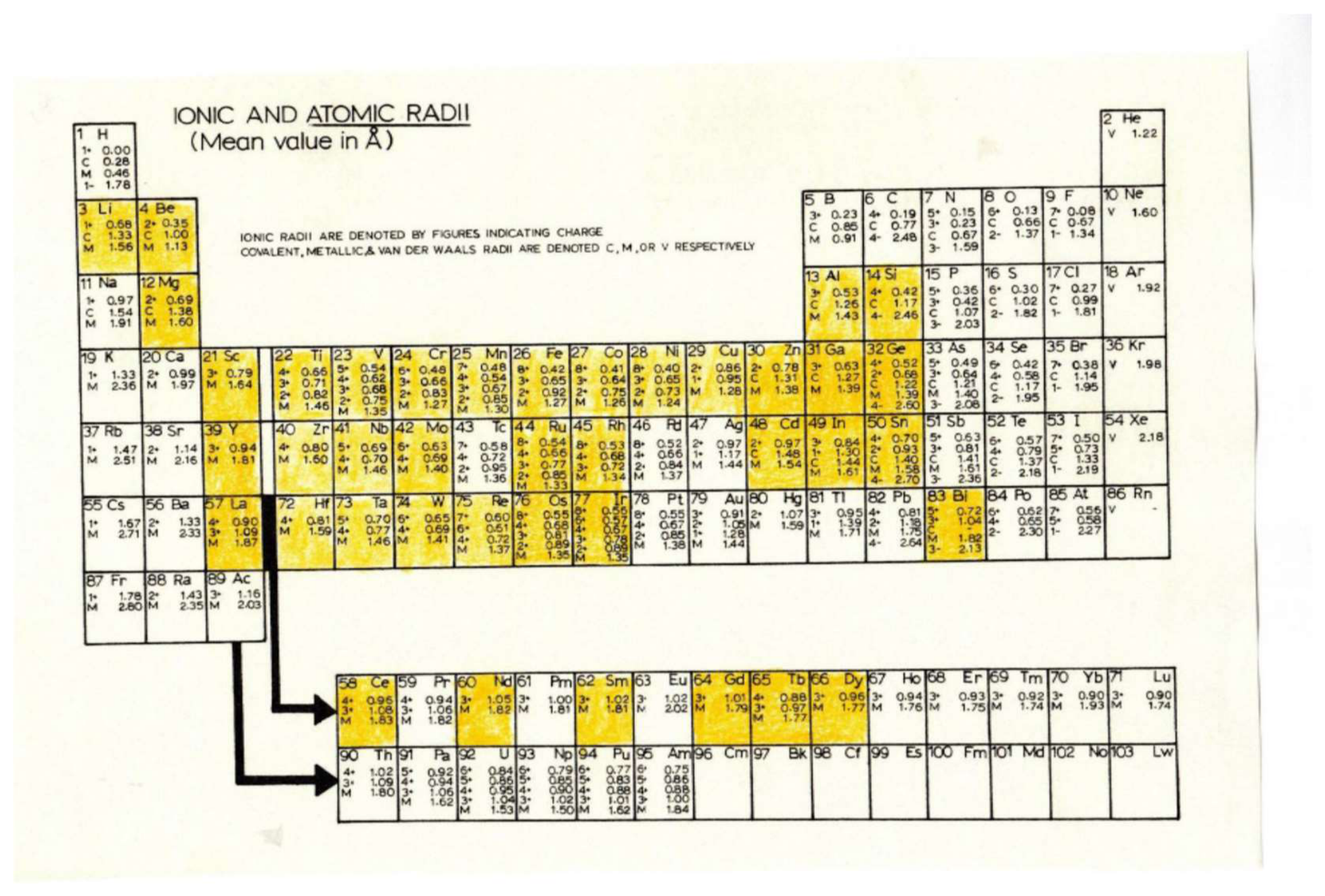
Figure 2.
Periodic chart showing valence and outer electron configuration for the elements. The blue shading shows popular elements composing high entropy alloys as in Figure 1. After Staudhammer and Murr [33].
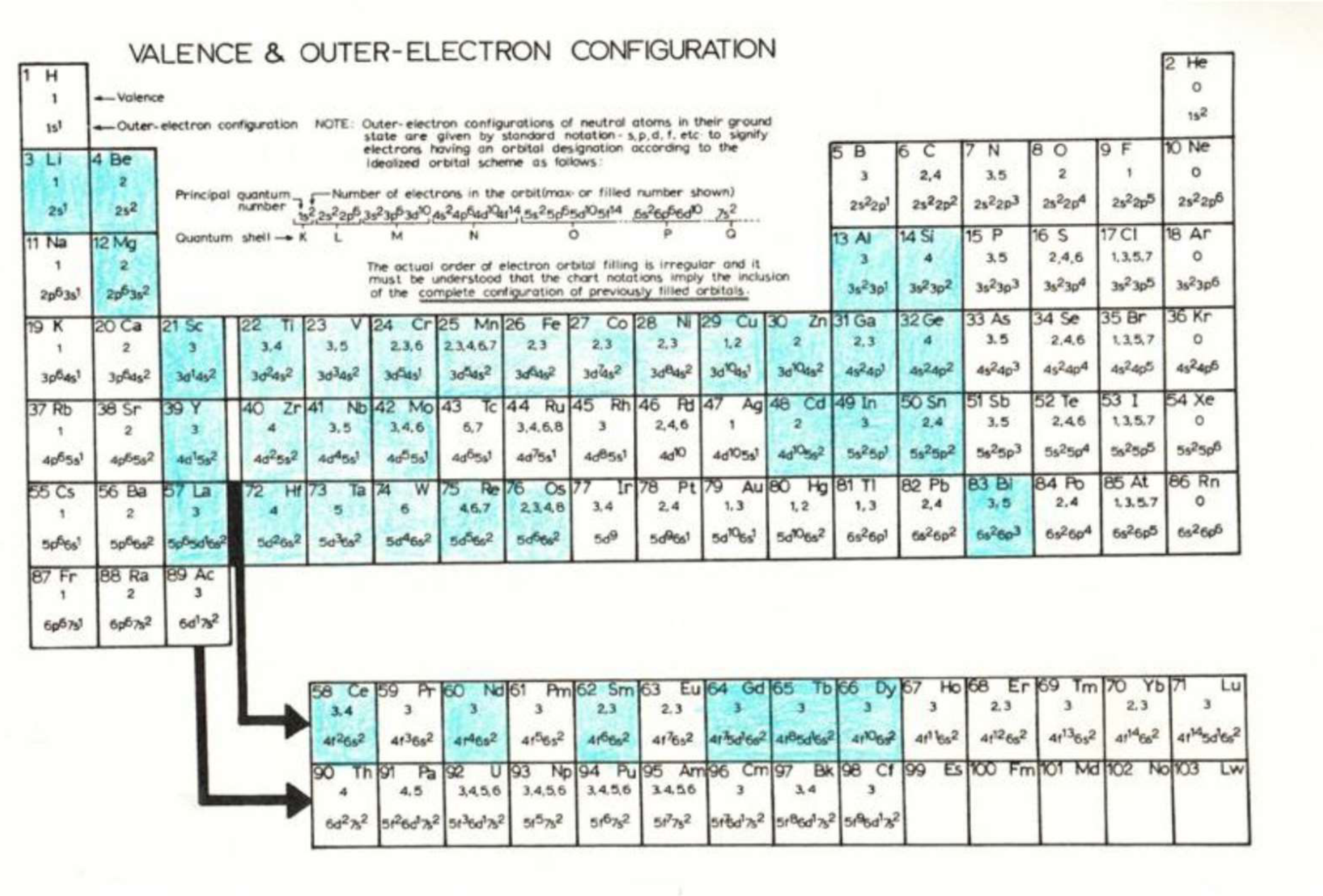
Figure 3.
Atomic model (a) and associated microstructures ((b) to (g)) for the basic Cantor [3] HEA: CoCrFeMnNi. (a) shows the characteristic, disordered FCC HEA crystal structure and unit cell face plane. (b) EBSD grain structure map for cast and homogenized HEA. (c) to (e) show the evolution of grain structure after deformation and annealing for 2, 5 and 60 minutes, respectively. (f) and (g) show bright-field STEM images for dislocation substructure in cast and deformed CoCrFeMnNi HEA corresponding to 5% at 77K, and 22% at room temperature, respectively. (b) to (e) are after Deng, et al. [34]. (f) and (g) are after Laplanche and Rostka [35].
Figure 3.
Atomic model (a) and associated microstructures ((b) to (g)) for the basic Cantor [3] HEA: CoCrFeMnNi. (a) shows the characteristic, disordered FCC HEA crystal structure and unit cell face plane. (b) EBSD grain structure map for cast and homogenized HEA. (c) to (e) show the evolution of grain structure after deformation and annealing for 2, 5 and 60 minutes, respectively. (f) and (g) show bright-field STEM images for dislocation substructure in cast and deformed CoCrFeMnNi HEA corresponding to 5% at 77K, and 22% at room temperature, respectively. (b) to (e) are after Deng, et al. [34]. (f) and (g) are after Laplanche and Rostka [35].
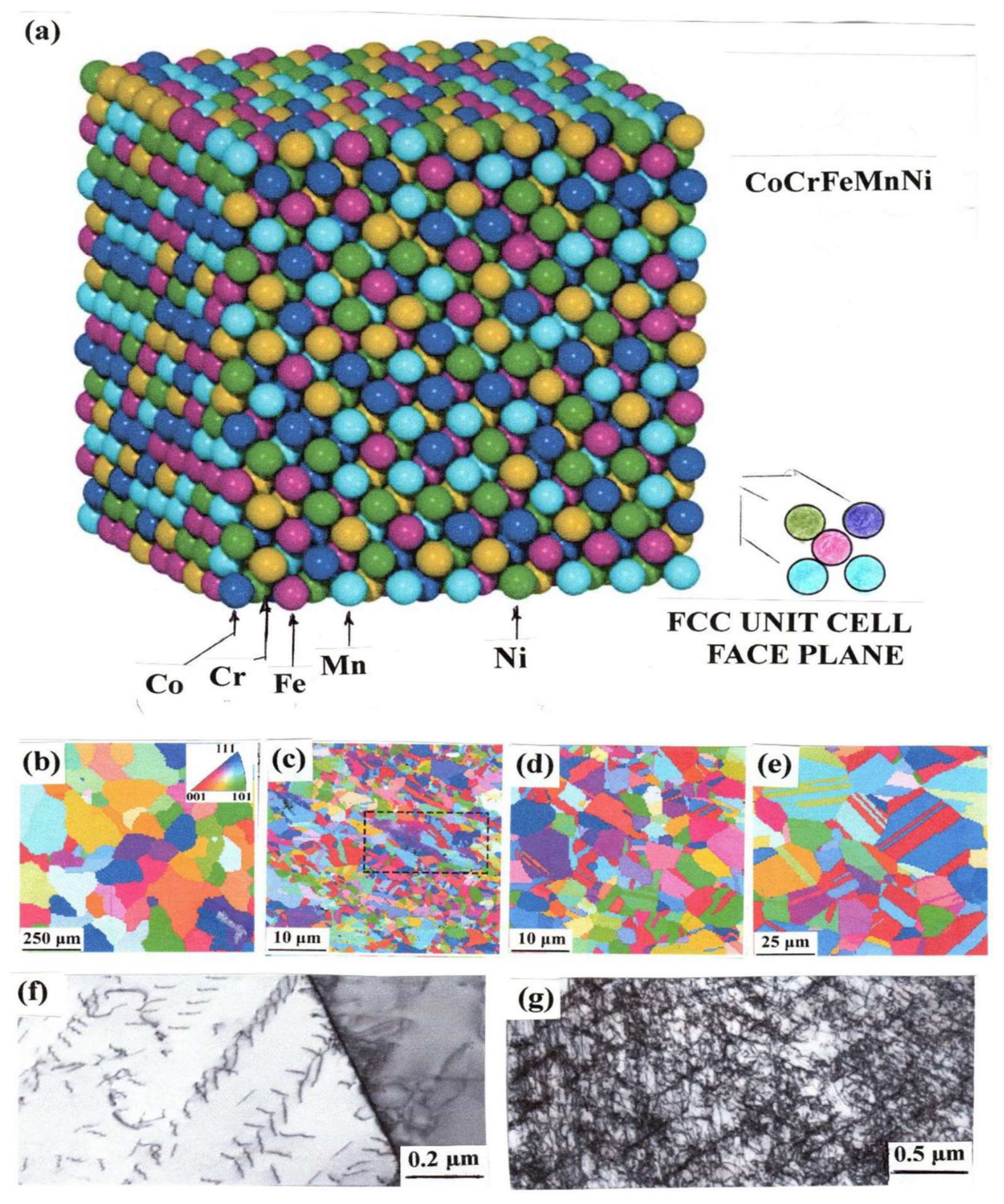
Figure 4.
EBSD grain structure maps for as-cast AlxCr0.2NbTiV HEAs. (a) x = 0.2, (b) x = 0.5, (c) x = 0.8. Adapted from Li, et al. [38].
Figure 4.
EBSD grain structure maps for as-cast AlxCr0.2NbTiV HEAs. (a) x = 0.2, (b) x = 0.5, (c) x = 0.8. Adapted from Li, et al. [38].
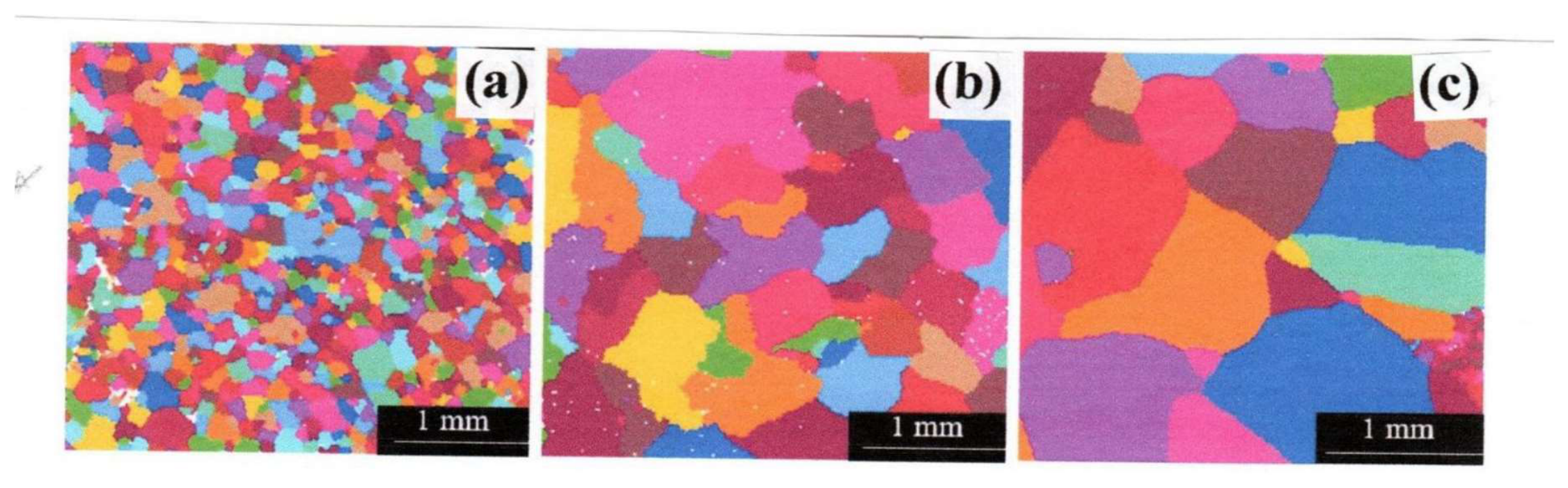
Figure 5.
EBSD grain structure maps for cast Ti(50-x) Zr38NbxTa8Sn4 HEA., (a) x = 20, (b) x = 10, (c) x = 0, where the structure is Ti50Zr38Ta8Sn4. Adapted from Ozerov, et al. [39].
Figure 5.
EBSD grain structure maps for cast Ti(50-x) Zr38NbxTa8Sn4 HEA., (a) x = 20, (b) x = 10, (c) x = 0, where the structure is Ti50Zr38Ta8Sn4. Adapted from Ozerov, et al. [39].
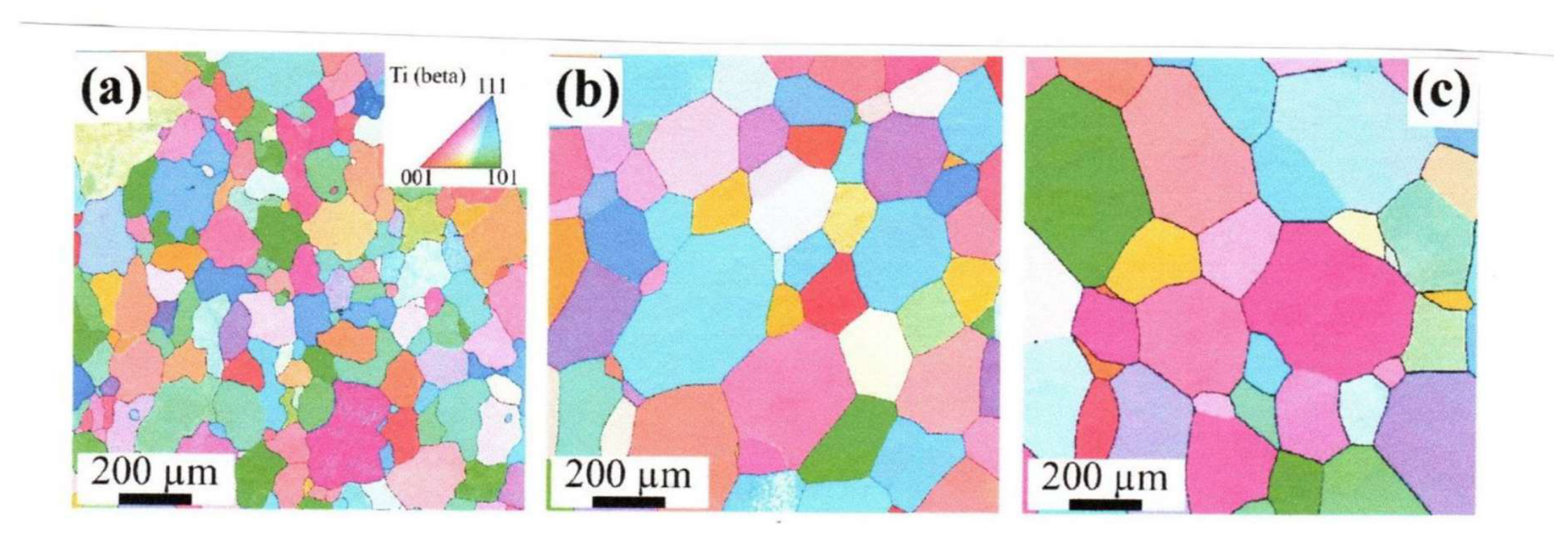
Figure 6.
Material property space showing room temperature yield strength (σy) versus density for high entropy alloys and complex concentration alloys (CCAs). Color codes identify crystal structures (where Im indicates intermetallic phase). Dotted lines indicate performance index for uniaxial loading (σy/ρ). After Corsse, et al. [41].
Figure 6.
Material property space showing room temperature yield strength (σy) versus density for high entropy alloys and complex concentration alloys (CCAs). Color codes identify crystal structures (where Im indicates intermetallic phase). Dotted lines indicate performance index for uniaxial loading (σy/ρ). After Corsse, et al. [41].
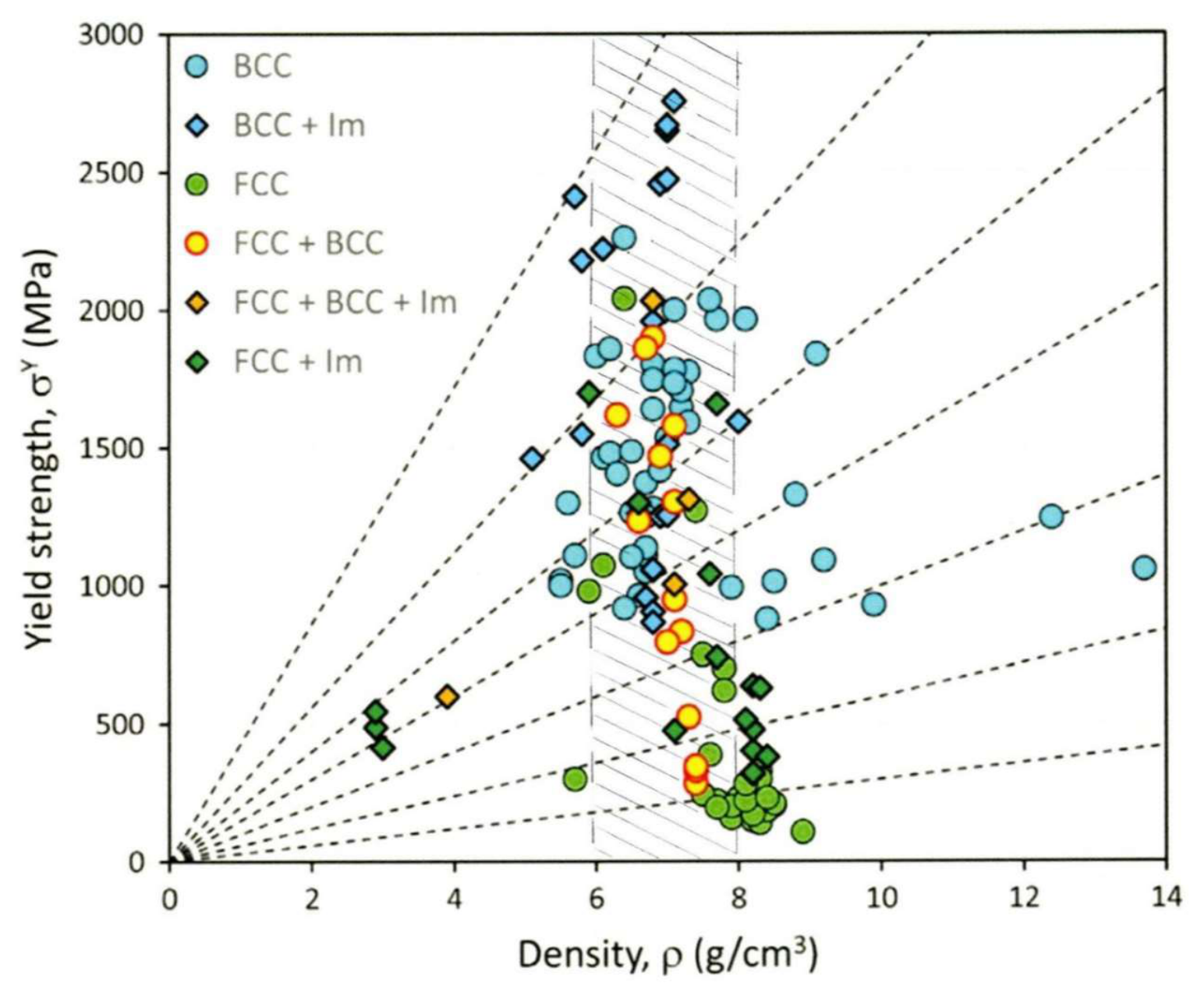
Figure 7.
Periodic chart showing atomic weight, density and melting points for the elements. The color shading shows popular elements composing HEAs. After Staudhammer and Murr [33].
Figure 7.
Periodic chart showing atomic weight, density and melting points for the elements. The color shading shows popular elements composing HEAs. After Staudhammer and Murr [33].
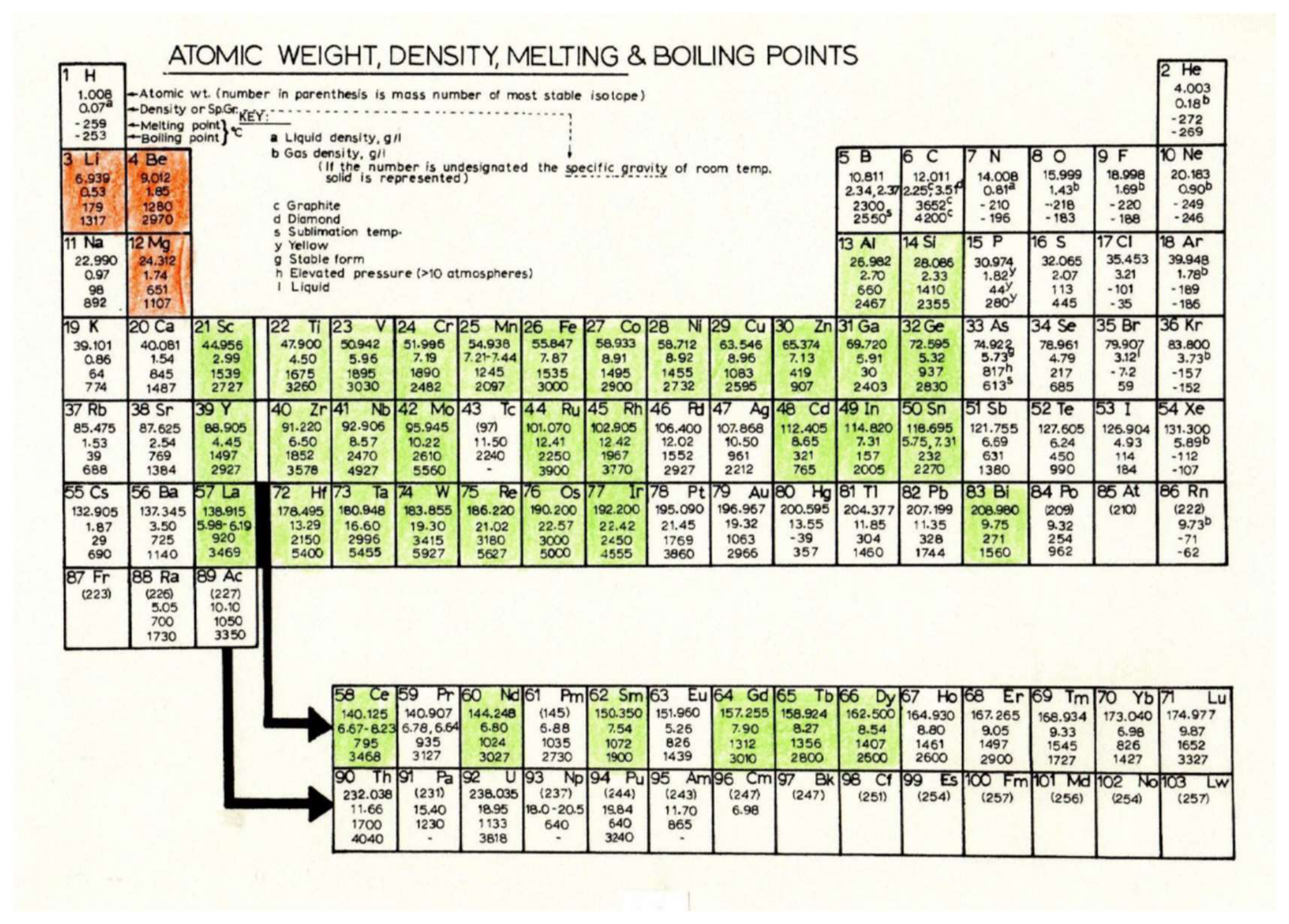
Figure 8.
Dense packed cubic lattices representing disordered HEA compositions (a) compared to extreme composition and complex and disordered UHEAs (b). (c) shows variations of predicted tensile strength (σy) and thermal stability with density (ρ) for 25 possible UHEA compositions containing 8 to 13 elements: Al-Cr-Mo-Nb-Ti-Zr-Ta-W-Fe-Co-Mn-Ni. Adapted from Ghadami and Amin Dosandabadi [48].
Figure 8.
Dense packed cubic lattices representing disordered HEA compositions (a) compared to extreme composition and complex and disordered UHEAs (b). (c) shows variations of predicted tensile strength (σy) and thermal stability with density (ρ) for 25 possible UHEA compositions containing 8 to 13 elements: Al-Cr-Mo-Nb-Ti-Zr-Ta-W-Fe-Co-Mn-Ni. Adapted from Ghadami and Amin Dosandabadi [48].
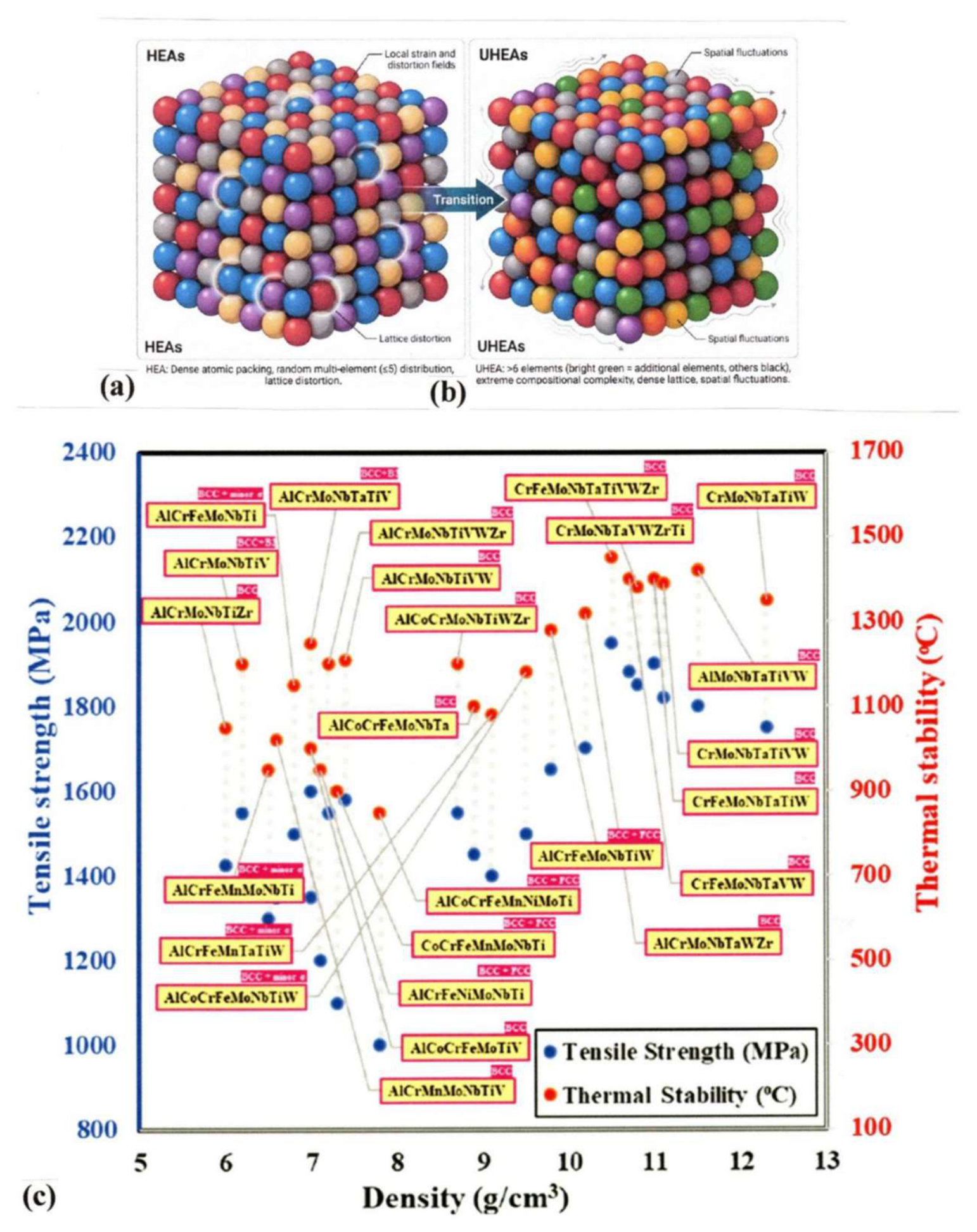
Figure 9.
Mechanical properties versus atomic fraction, V, for MoNbTiVxZr. Based on data in Gorsse, et al. [41].
Figure 9.
Mechanical properties versus atomic fraction, V, for MoNbTiVxZr. Based on data in Gorsse, et al. [41].
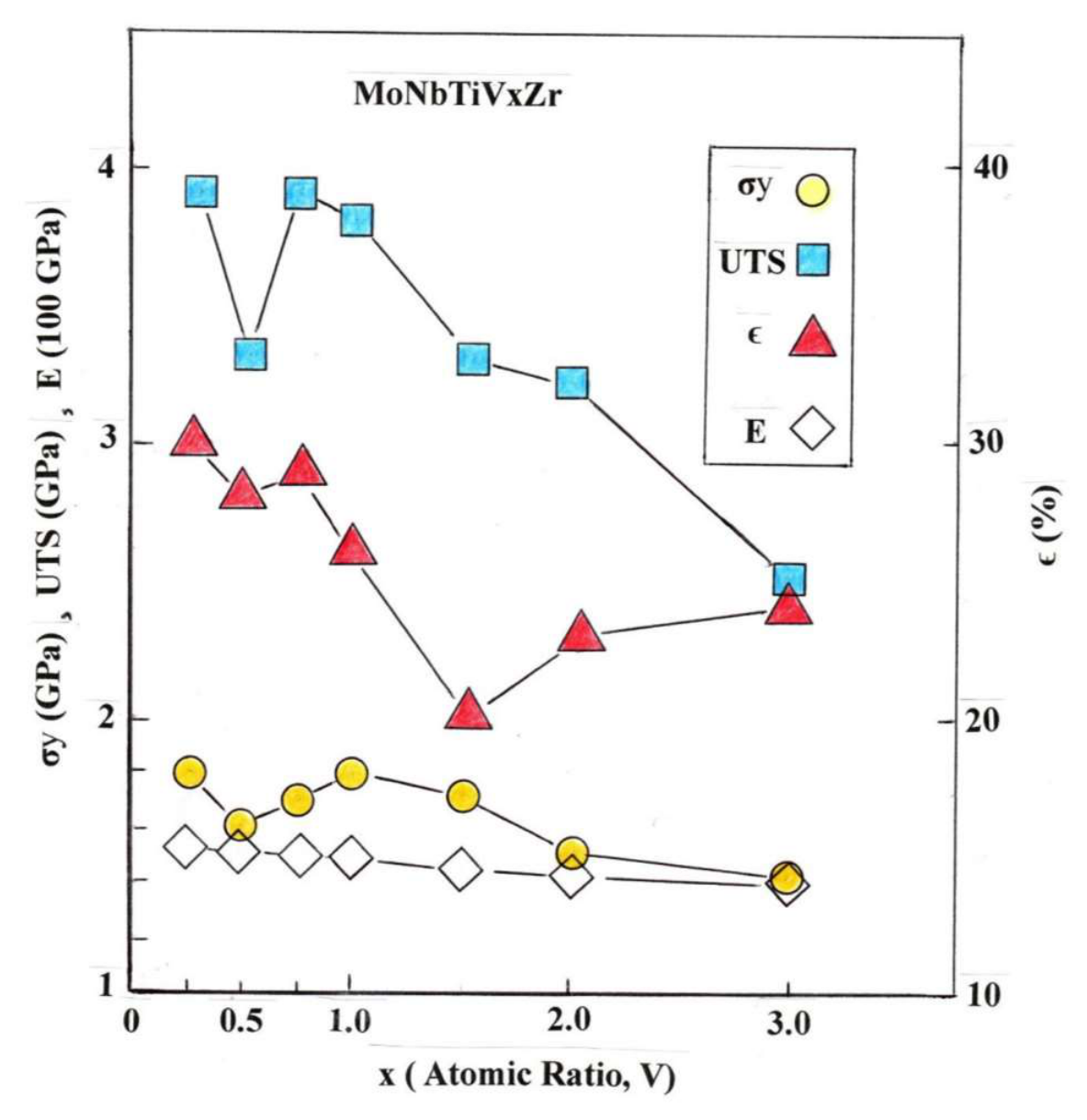
Figure 10.
Mechanical properties versus atomic fraction, Nb, V and Sn for HEA compositions shown. Based on data in Gorsse, et al. [41].
Figure 10.
Mechanical properties versus atomic fraction, Nb, V and Sn for HEA compositions shown. Based on data in Gorsse, et al. [41].
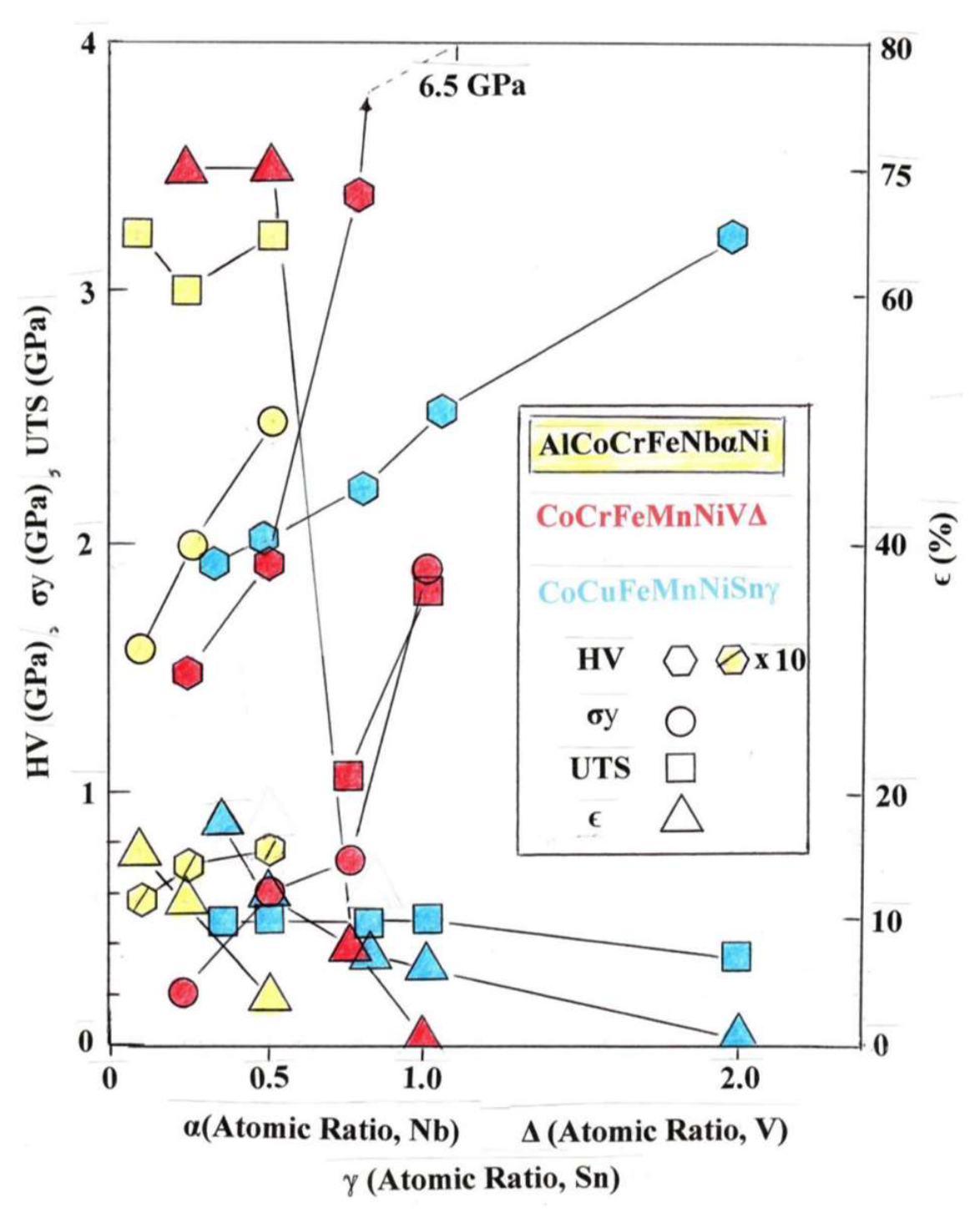
Figure 11.
Mechanical properties versus atomic fraction, Al, Ti and V for HEA compositions shown. Based on data in Gorsse, et al. [41].
Figure 11.
Mechanical properties versus atomic fraction, Al, Ti and V for HEA compositions shown. Based on data in Gorsse, et al. [41].
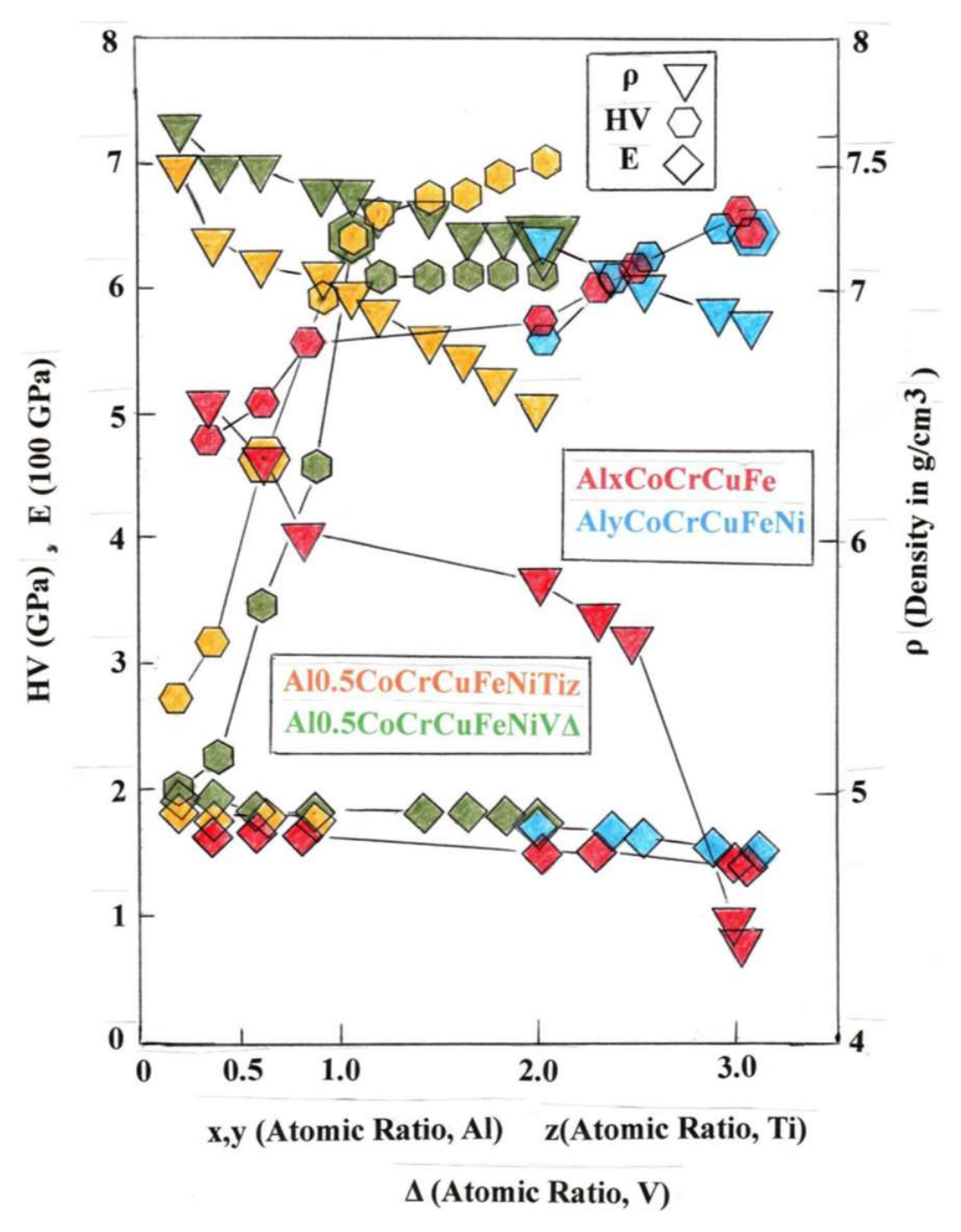
Figure 12.
Idealized, artificial neural network-connections map for atomic fractions (ratio) for elemental components in MoNbTiVZr HEA and corresponding mechanical properties.
Figure 12.
Idealized, artificial neural network-connections map for atomic fractions (ratio) for elemental components in MoNbTiVZr HEA and corresponding mechanical properties.
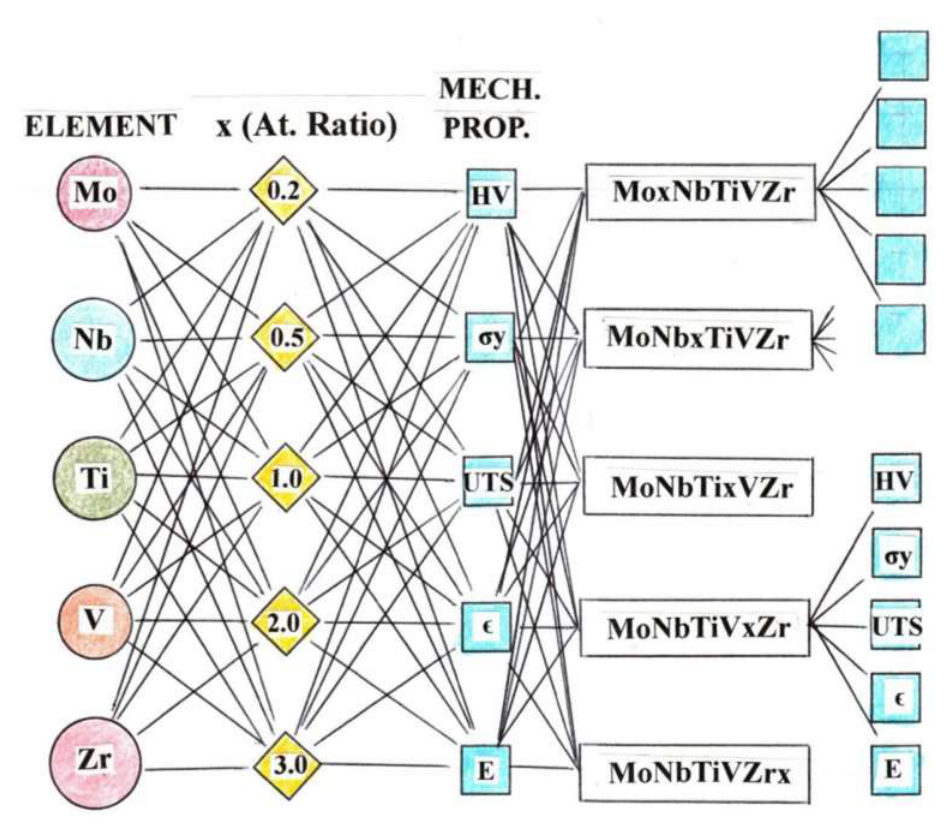
Figure 13.
UTS versus fracture elongation for a wide range of additively manufactured, as-built HEA compositions, including LLM, EBM, LMD (laser metal directed energy deposition) and WAAM (wire-arc additive manufacturing). As noted, SLM is the dominant process. After Zhang, et al. [24].
Figure 13.
UTS versus fracture elongation for a wide range of additively manufactured, as-built HEA compositions, including LLM, EBM, LMD (laser metal directed energy deposition) and WAAM (wire-arc additive manufacturing). As noted, SLM is the dominant process. After Zhang, et al. [24].
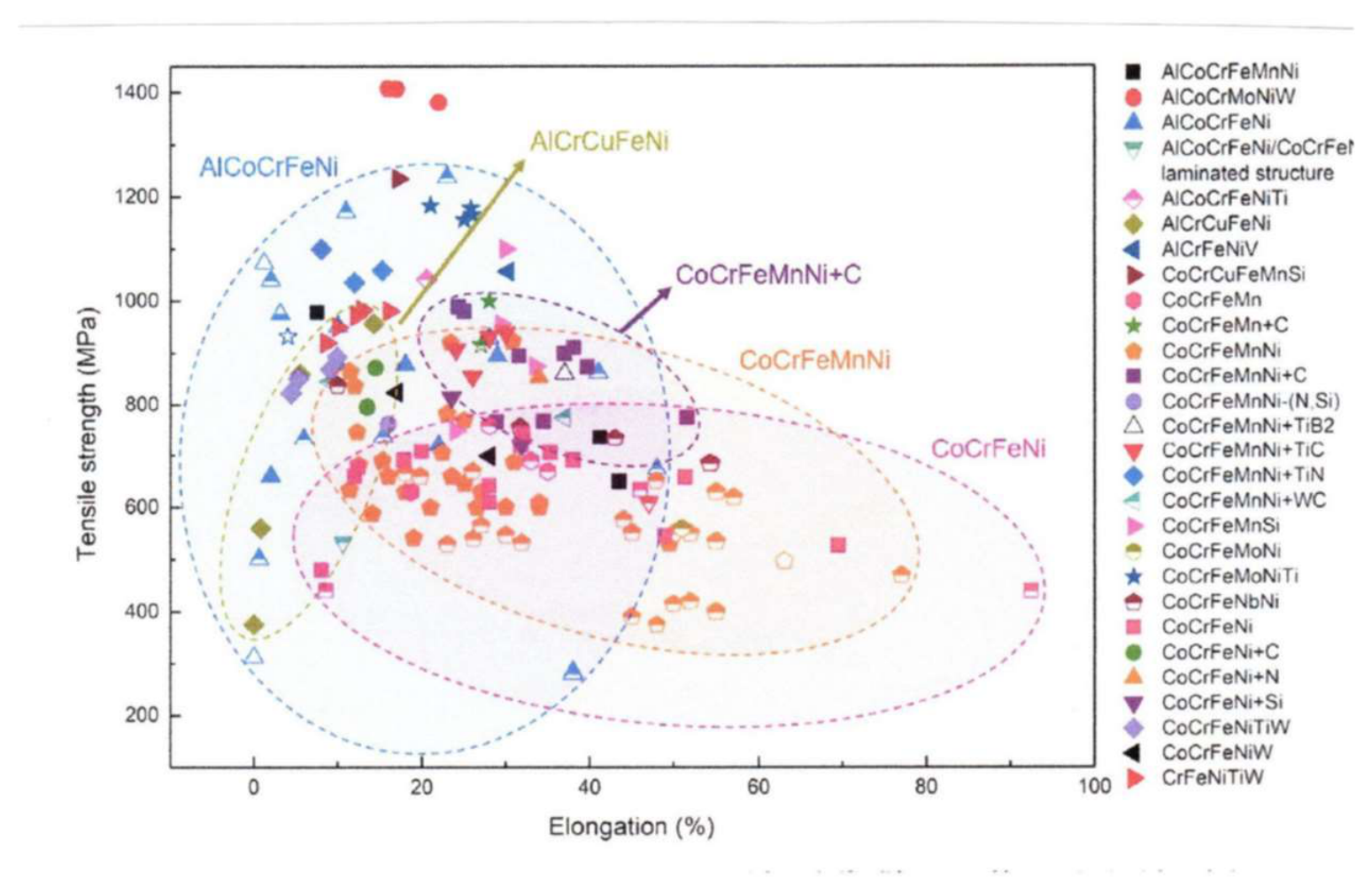
Figure 14.
Schematic representation for EBM (a) and SLM (b) PBF systems. The number components represent: (1) the beam source (electron gun/laser), (2) scan coils (electron beam), mirror for laser beam), (3) focus lens (magnetic or glass, respectively), (4) – (7) show corresponding system powder cassettes and powder bed rake of roller along with excess powder reservoirs. (c) shows a magnified SEM Co-superalloy powder particle while the inset shows a lower magnification of the particle size distribution. From Murr [59].
Figure 14.
Schematic representation for EBM (a) and SLM (b) PBF systems. The number components represent: (1) the beam source (electron gun/laser), (2) scan coils (electron beam), mirror for laser beam), (3) focus lens (magnetic or glass, respectively), (4) – (7) show corresponding system powder cassettes and powder bed rake of roller along with excess powder reservoirs. (c) shows a magnified SEM Co-superalloy powder particle while the inset shows a lower magnification of the particle size distribution. From Murr [59].
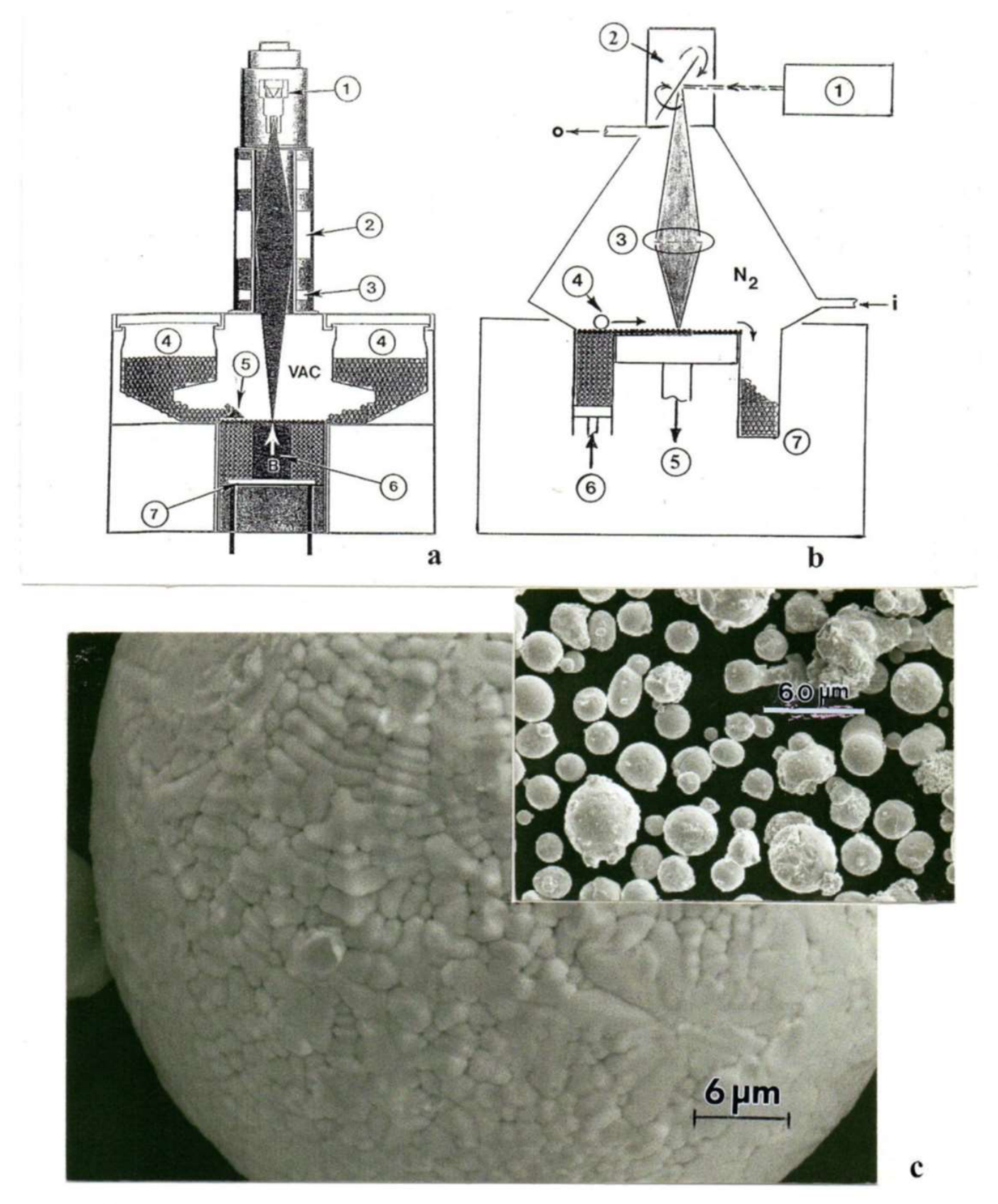
Figure 15.
Temperature gradient, G, versus microstructure growth rate, R, generalized map illustrating EBM or SLM as-built metal or alloy microstructure evolution. Microstructure sizes are variously represented by d, D1, D2. From Murr [61].
Figure 15.
Temperature gradient, G, versus microstructure growth rate, R, generalized map illustrating EBM or SLM as-built metal or alloy microstructure evolution. Microstructure sizes are variously represented by d, D1, D2. From Murr [61].
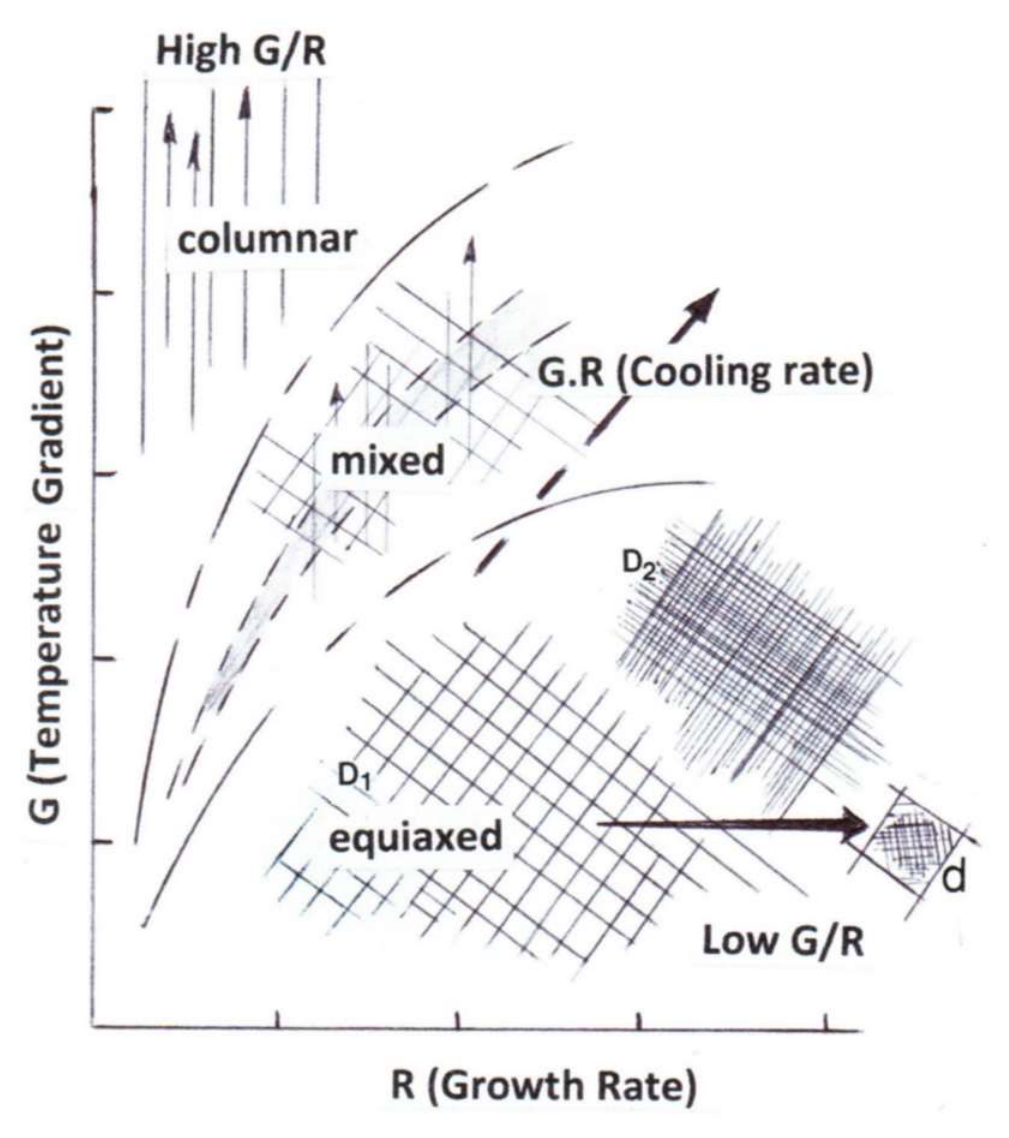
Figure 16.
EBSD maps comparing Inconel 718 EB-PBF as-built microstructures for XZ and YZ build planes while changing the melt -point scan (from bottom to top) during the alloy fabrication. From Nabil, et al. [65].
Figure 16.
EBSD maps comparing Inconel 718 EB-PBF as-built microstructures for XZ and YZ build planes while changing the melt -point scan (from bottom to top) during the alloy fabrication. From Nabil, et al. [65].
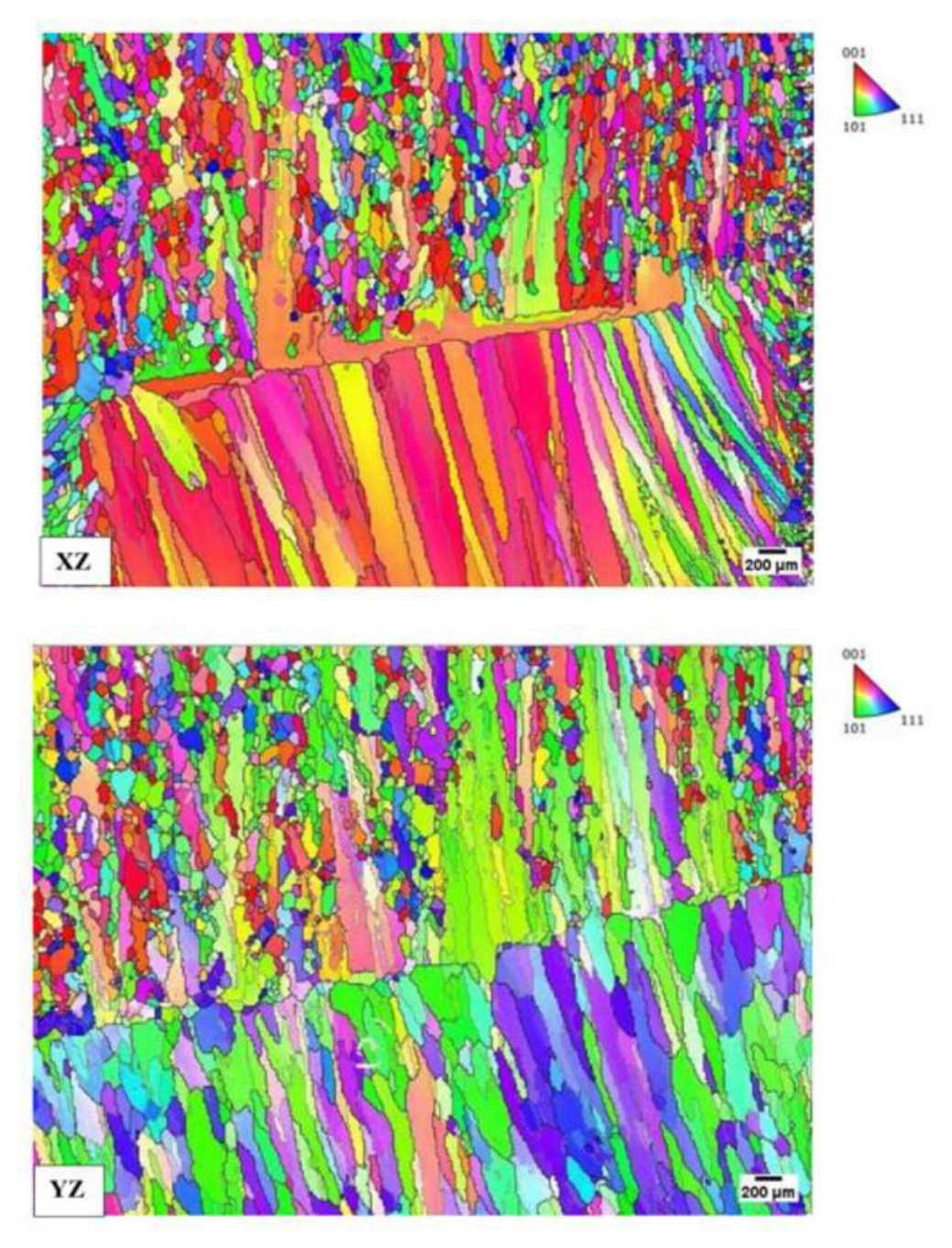
Figure 17.
Idealized powder particle characteristics for an equi-atomic HEA. (a) Scaled element diameters, D, shown in Table 4. (b) Gaussian element distributions. (c) Skewed distributions for element mass in HEA composition. Span shows distribution width. (d) Binary, skewed powder element distributions. Pre-alloyed AlCoCrFeNi equi-atomic powder can also be represented by the distributions in (c) and (d).
Figure 17.
Idealized powder particle characteristics for an equi-atomic HEA. (a) Scaled element diameters, D, shown in Table 4. (b) Gaussian element distributions. (c) Skewed distributions for element mass in HEA composition. Span shows distribution width. (d) Binary, skewed powder element distributions. Pre-alloyed AlCoCrFeNi equi-atomic powder can also be represented by the distributions in (c) and (d).
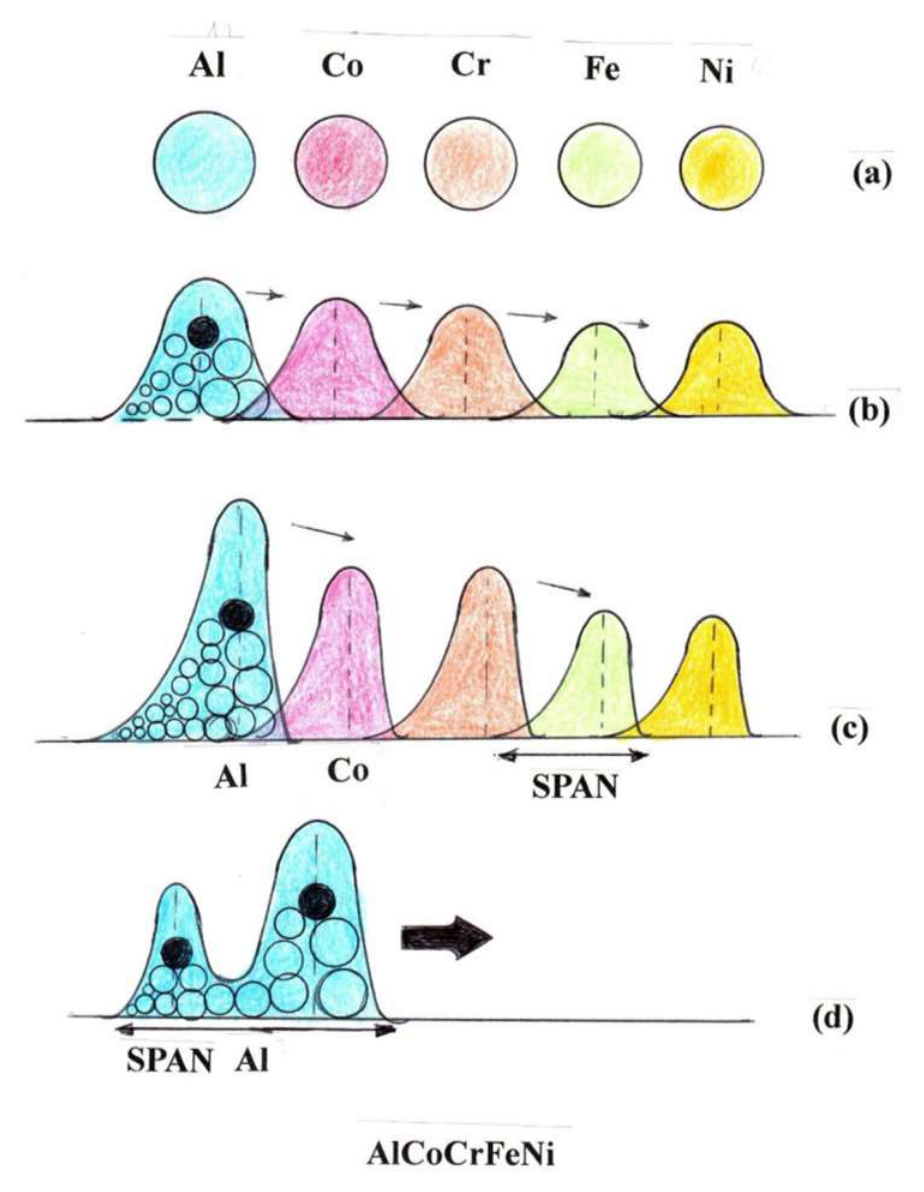
Figure 18.
Atomized Cu spherical powder (a) and Inconel 625 gas-atomized, spherical powder (b). The particle sizes and size distributions are different in (a) and (b) as described in the text. From Murr [59].
Figure 18.
Atomized Cu spherical powder (a) and Inconel 625 gas-atomized, spherical powder (b). The particle sizes and size distributions are different in (a) and (b) as described in the text. From Murr [59].
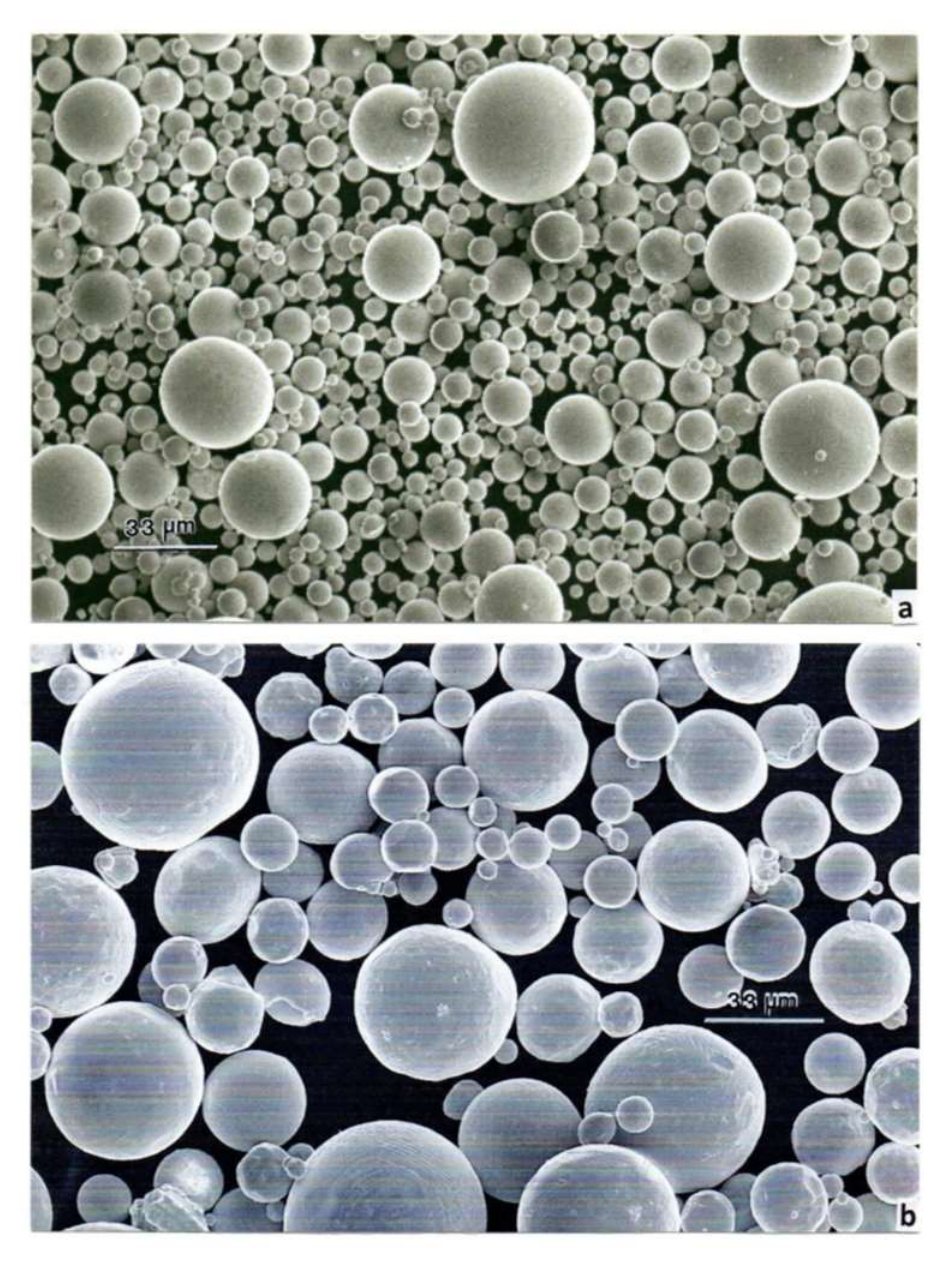
Figure 19.
Titanium (a) and Tantalum (b) spherical, plasma-atomized powders. These powder sizes and distribution are different from Figure 18. In (a) the particle sizes range from ~ 10 to 65 µm. In (b) the size range is ~ 10 to 160 µm. Courtesy of AP & C, Canada.
Figure 19.
Titanium (a) and Tantalum (b) spherical, plasma-atomized powders. These powder sizes and distribution are different from Figure 18. In (a) the particle sizes range from ~ 10 to 65 µm. In (b) the size range is ~ 10 to 160 µm. Courtesy of AP & C, Canada.
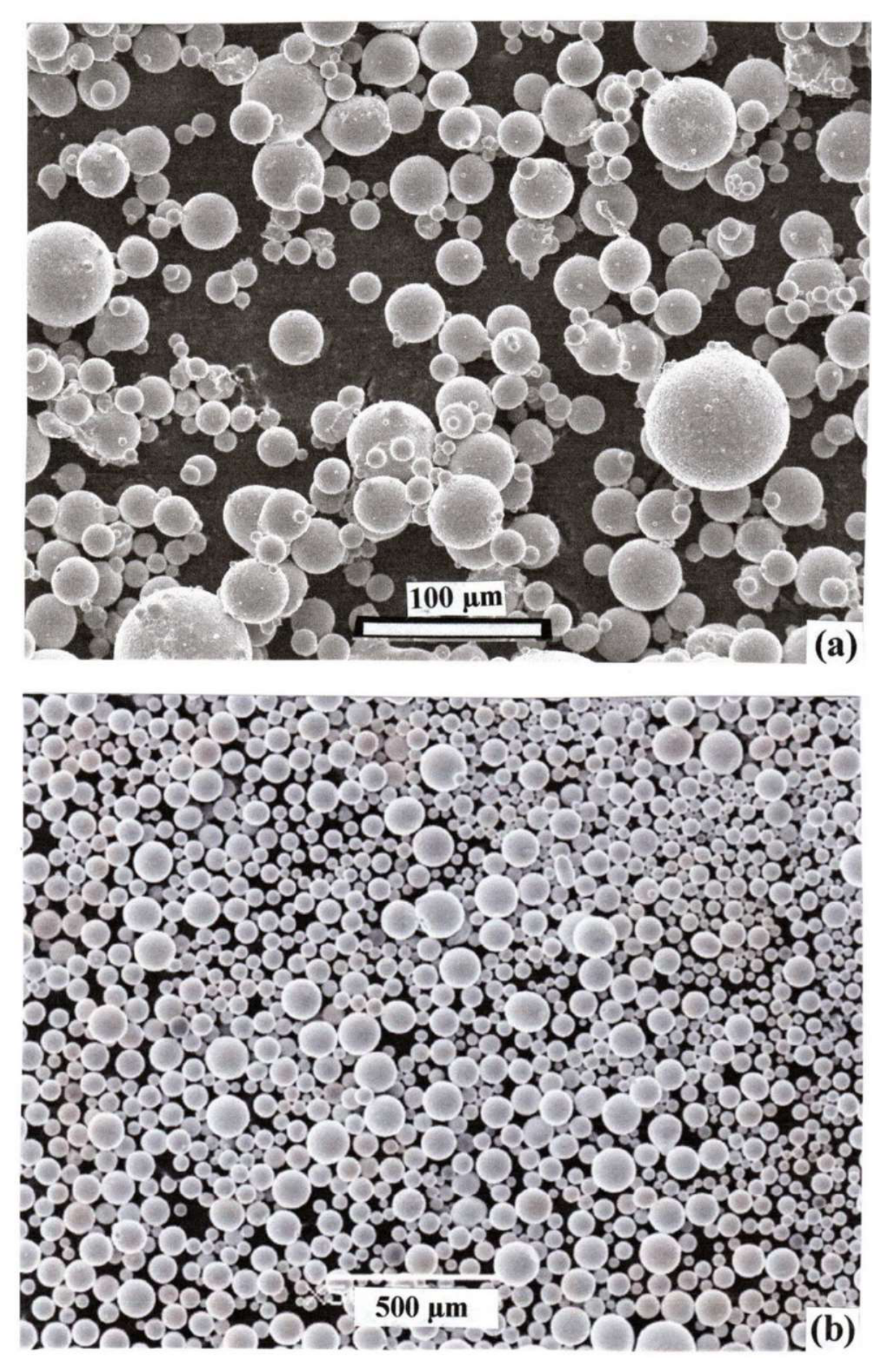
Figure 20.
SEM images showing HEA powder examples. (a) –(d) show non-equi-atomic Co31.5Cr7Fe30Ni31.5 HEA gas-atomized powers at different sizes: (a) < 50 µm; (b) 50-75 µm; (c) 75-106 µm; (d) > 106 µm. (e) and (f) show special gas-atomized equi-atomic VNbMoTaW spherical powder. (e) low-magnification image. (f) high magnification image of (e). Powder sizes range from ~ 15 – 44 µm. Note dendrite structure in (f). (a) – (d) are after Fan, et al. [67]. (e) and (f) are after Lee, et al. [68].
Figure 20.
SEM images showing HEA powder examples. (a) –(d) show non-equi-atomic Co31.5Cr7Fe30Ni31.5 HEA gas-atomized powers at different sizes: (a) < 50 µm; (b) 50-75 µm; (c) 75-106 µm; (d) > 106 µm. (e) and (f) show special gas-atomized equi-atomic VNbMoTaW spherical powder. (e) low-magnification image. (f) high magnification image of (e). Powder sizes range from ~ 15 – 44 µm. Note dendrite structure in (f). (a) – (d) are after Fan, et al. [67]. (e) and (f) are after Lee, et al. [68].
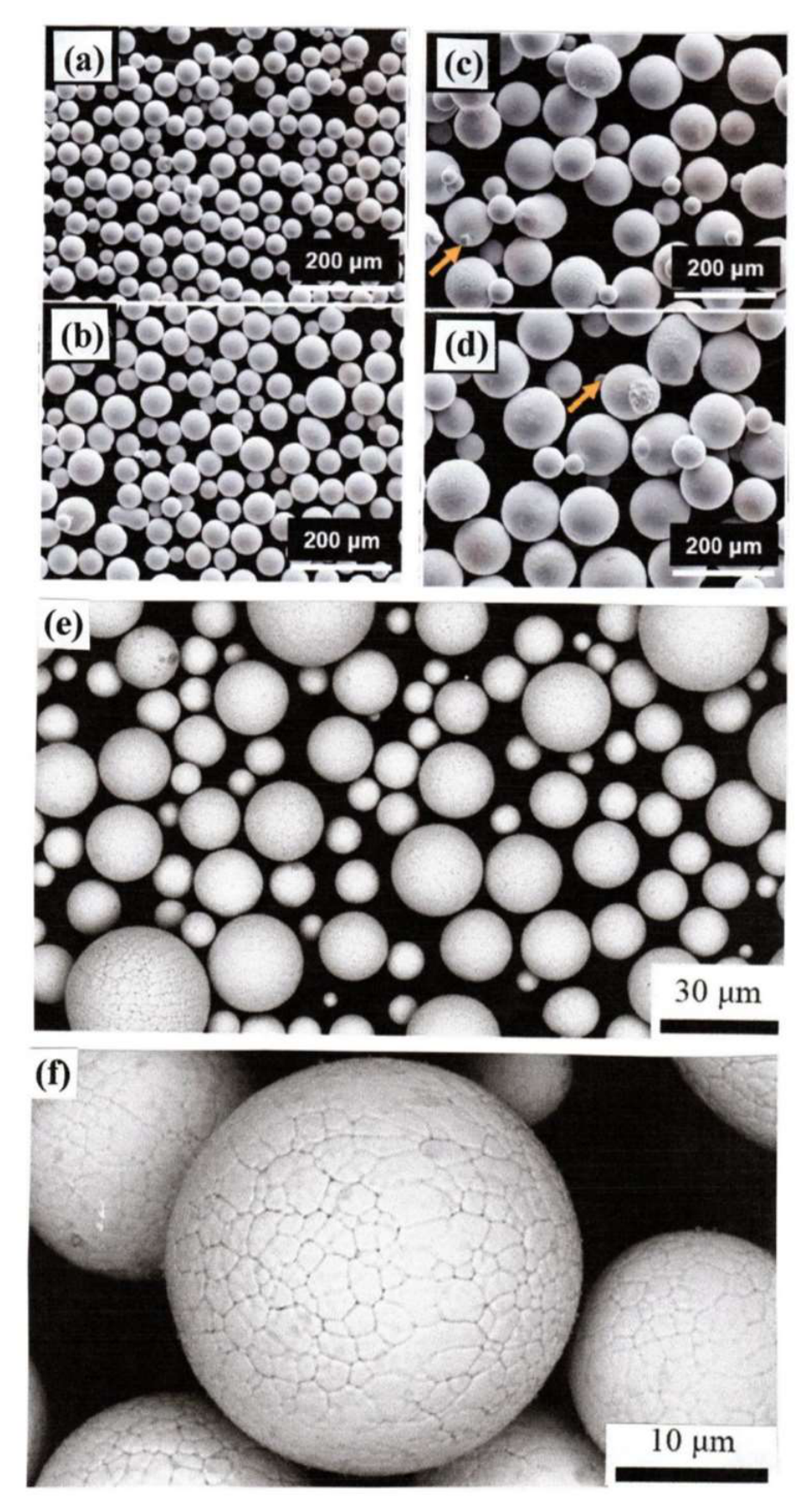
Figure 21.
Test cube layout for process parameter evaluation: Power (P), scan speed (v), hatch spacing (s). A 3 x 3 test array is shown shaded where the spacing between test cubes is ~ 3mm. Adapted from Abdulla, et al. [69].
Figure 21.
Test cube layout for process parameter evaluation: Power (P), scan speed (v), hatch spacing (s). A 3 x 3 test array is shown shaded where the spacing between test cubes is ~ 3mm. Adapted from Abdulla, et al. [69].
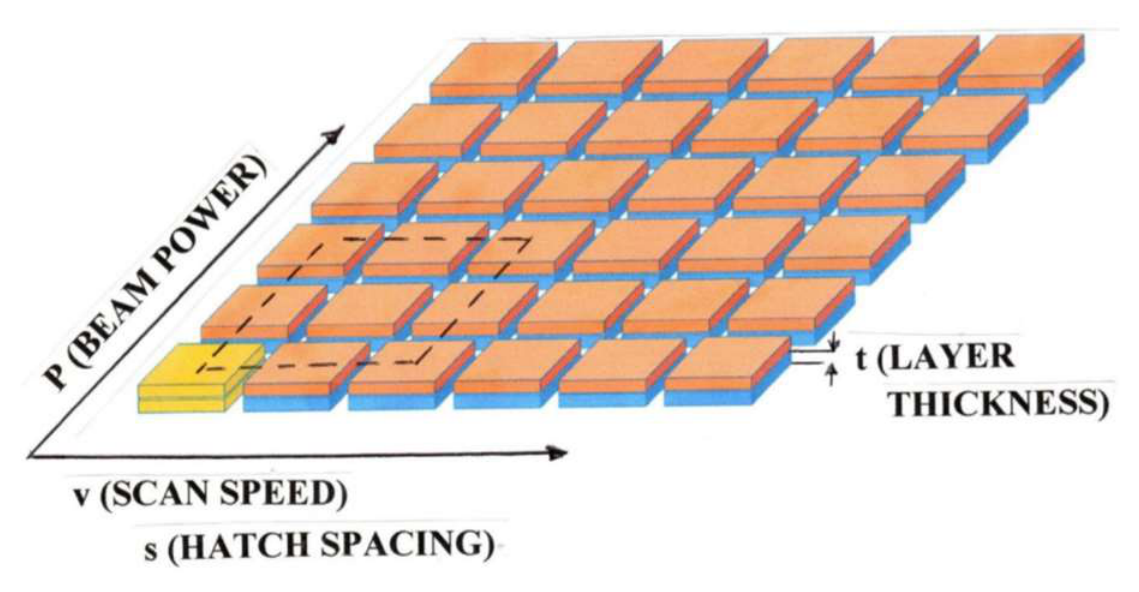
Figure 22.
LB-PBF-built AlCoCuFe HEA EBSD maps showing [001] texture development in the surface plane perpendicular to the build direction (a) and parallel to the build direction (b). (c) shows an enlarged view of the window in (b). Melt-band structure is highlighted by doted lines in (c). (d) to (g) show EBSD/IPF maps for LB-PBF as-built CoCrFeMnNi HEA using different volume energy densities (Q) for different cube sizes: (d) 73 J/mm3, 5 mm cube; (e) 104 J/mm3, 5 mm cube; (f) 73 J/mm3, 10 mm cube; (g) 104 J/mm3, 10 mm cube. After Atabay, et al. [26].
Figure 22.
LB-PBF-built AlCoCuFe HEA EBSD maps showing [001] texture development in the surface plane perpendicular to the build direction (a) and parallel to the build direction (b). (c) shows an enlarged view of the window in (b). Melt-band structure is highlighted by doted lines in (c). (d) to (g) show EBSD/IPF maps for LB-PBF as-built CoCrFeMnNi HEA using different volume energy densities (Q) for different cube sizes: (d) 73 J/mm3, 5 mm cube; (e) 104 J/mm3, 5 mm cube; (f) 73 J/mm3, 10 mm cube; (g) 104 J/mm3, 10 mm cube. After Atabay, et al. [26].
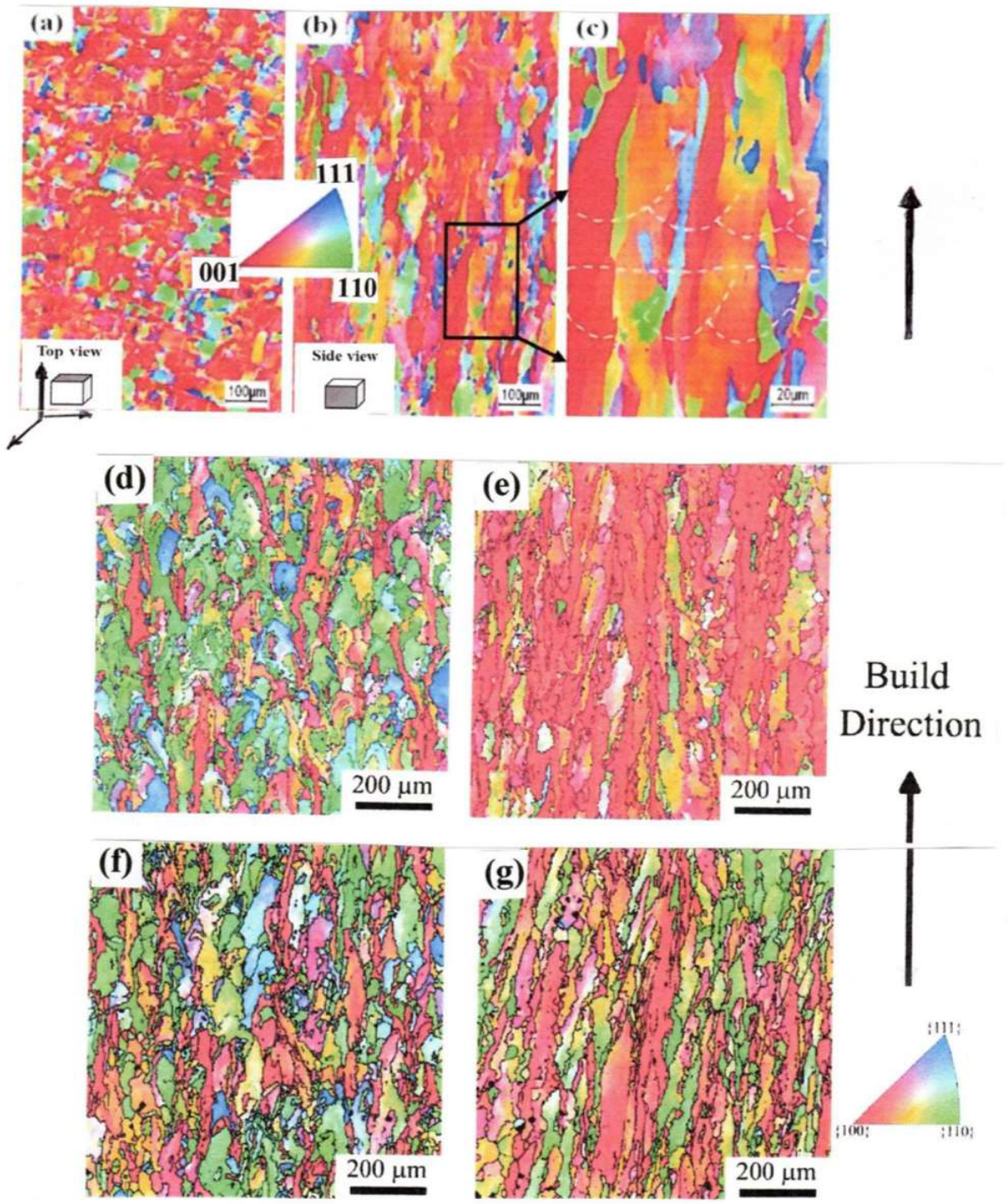
Figure 23.
EBSD orientation maps for LB-PBF as-built Fe49.5Mn30Co10Cr10(C0.5) HEA. (a) and (b) show 3D map constructions for stripe scan strategies while (c) and (d) show 3D map constructions for chessboard scan strategies. The IPFs indicate grain orientations/textures in the plane parallel to the build direction, Z. After Zheng, et al. [73].
Figure 23.
EBSD orientation maps for LB-PBF as-built Fe49.5Mn30Co10Cr10(C0.5) HEA. (a) and (b) show 3D map constructions for stripe scan strategies while (c) and (d) show 3D map constructions for chessboard scan strategies. The IPFs indicate grain orientations/textures in the plane parallel to the build direction, Z. After Zheng, et al. [73].
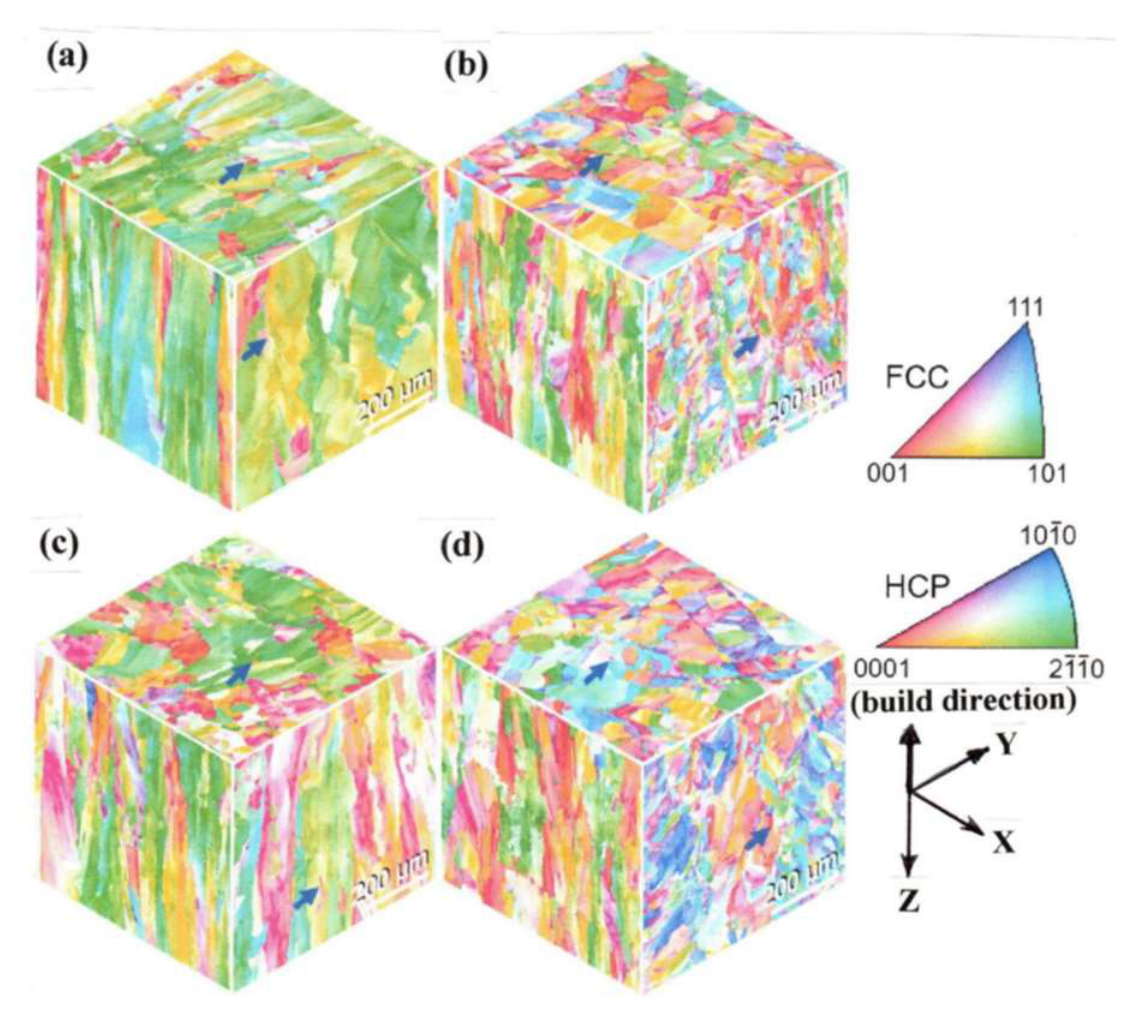
Figure 24.
Artificial neural network-connections map for AI exploration of superior performing HEA-fabricated components and products considering powder properties and process parameter effects on mechanical properties. Note TiCrNbTaWx, where x = atomic fraction.
Figure 24.
Artificial neural network-connections map for AI exploration of superior performing HEA-fabricated components and products considering powder properties and process parameter effects on mechanical properties. Note TiCrNbTaWx, where x = atomic fraction.
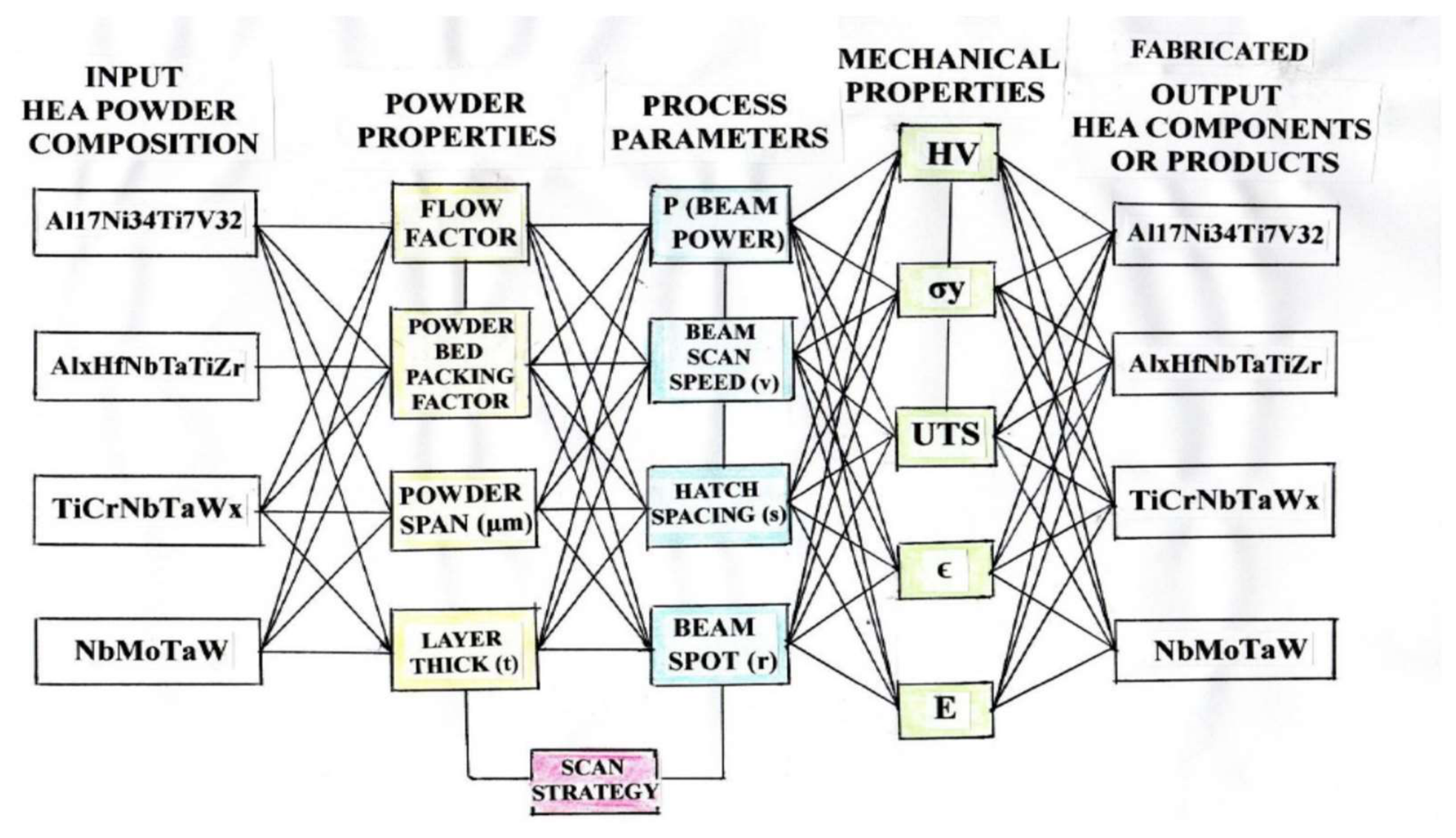
Figure 25.
(a) shows commercial Inconel 718 LB-PBF-fabricated turbine blade. (b) and (e) show various HEA LB-PBF-fabricated prototype components. (a) is courtesy of 3D-JR Technology Co, Ltd, Shenzhen, China. (b) to (e) are adapted from Jarlov, et al. [84].
Figure 25.
(a) shows commercial Inconel 718 LB-PBF-fabricated turbine blade. (b) and (e) show various HEA LB-PBF-fabricated prototype components. (a) is courtesy of 3D-JR Technology Co, Ltd, Shenzhen, China. (b) to (e) are adapted from Jarlov, et al. [84].
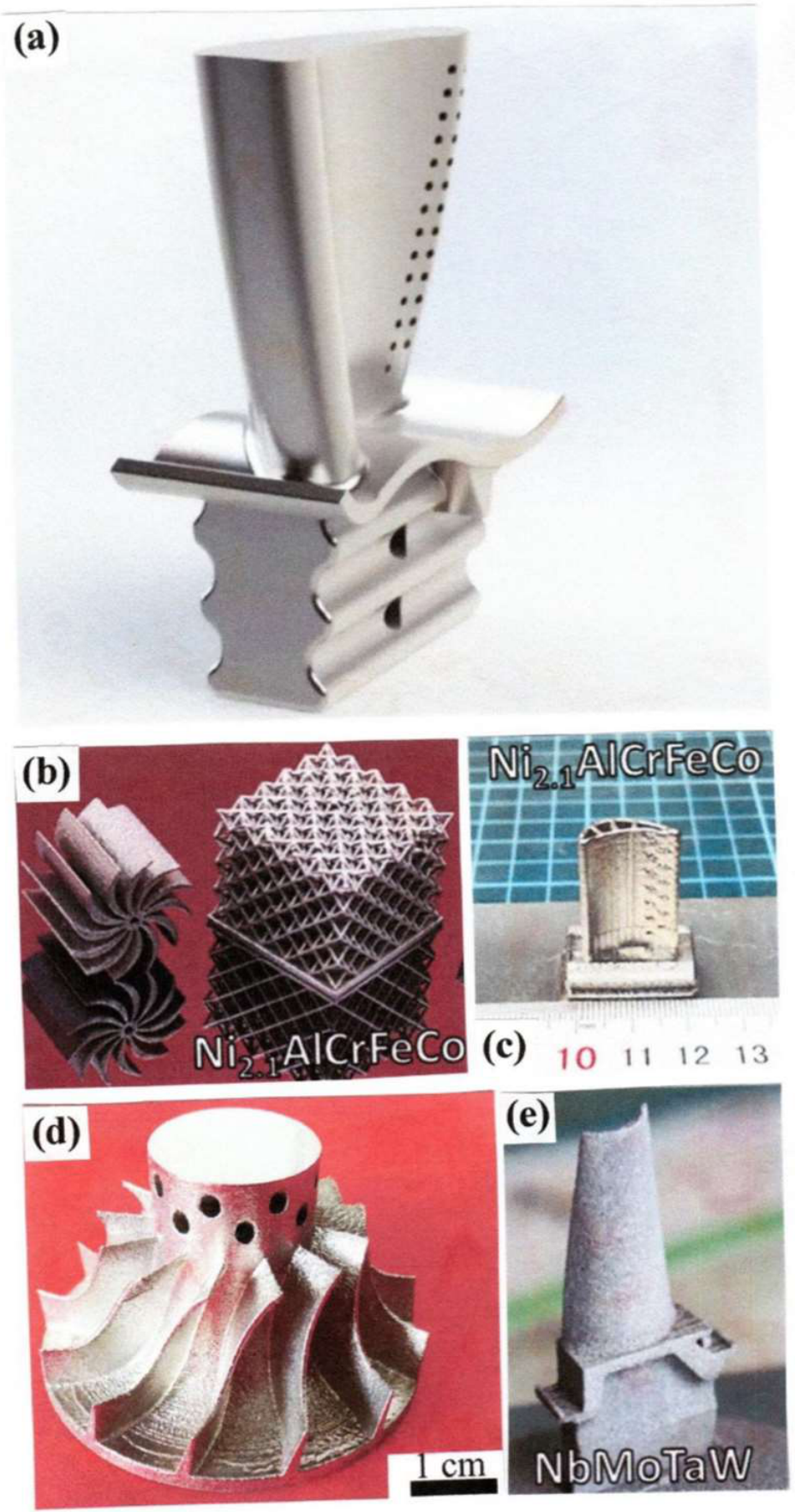
Figure 26.
SEM images of primary GRX-810 pre-alloyed powder particle prior to yttria nanoparticle coating (a) and after yttria nanoparticle coating (b). (c) shows a graphic representation of the yttria nanoparticles (solid circles) coating the pre-alloyed NiCoCr powder particles in powder bed prior to and after LB-PBF processing to create dispersed yttria nanoparticles in the GRX-810 fabricated component. (a) and (b) are adapted from Smith, et al. [86], courtesy of NASA.
Figure 26.
SEM images of primary GRX-810 pre-alloyed powder particle prior to yttria nanoparticle coating (a) and after yttria nanoparticle coating (b). (c) shows a graphic representation of the yttria nanoparticles (solid circles) coating the pre-alloyed NiCoCr powder particles in powder bed prior to and after LB-PBF processing to create dispersed yttria nanoparticles in the GRX-810 fabricated component. (a) and (b) are adapted from Smith, et al. [86], courtesy of NASA.
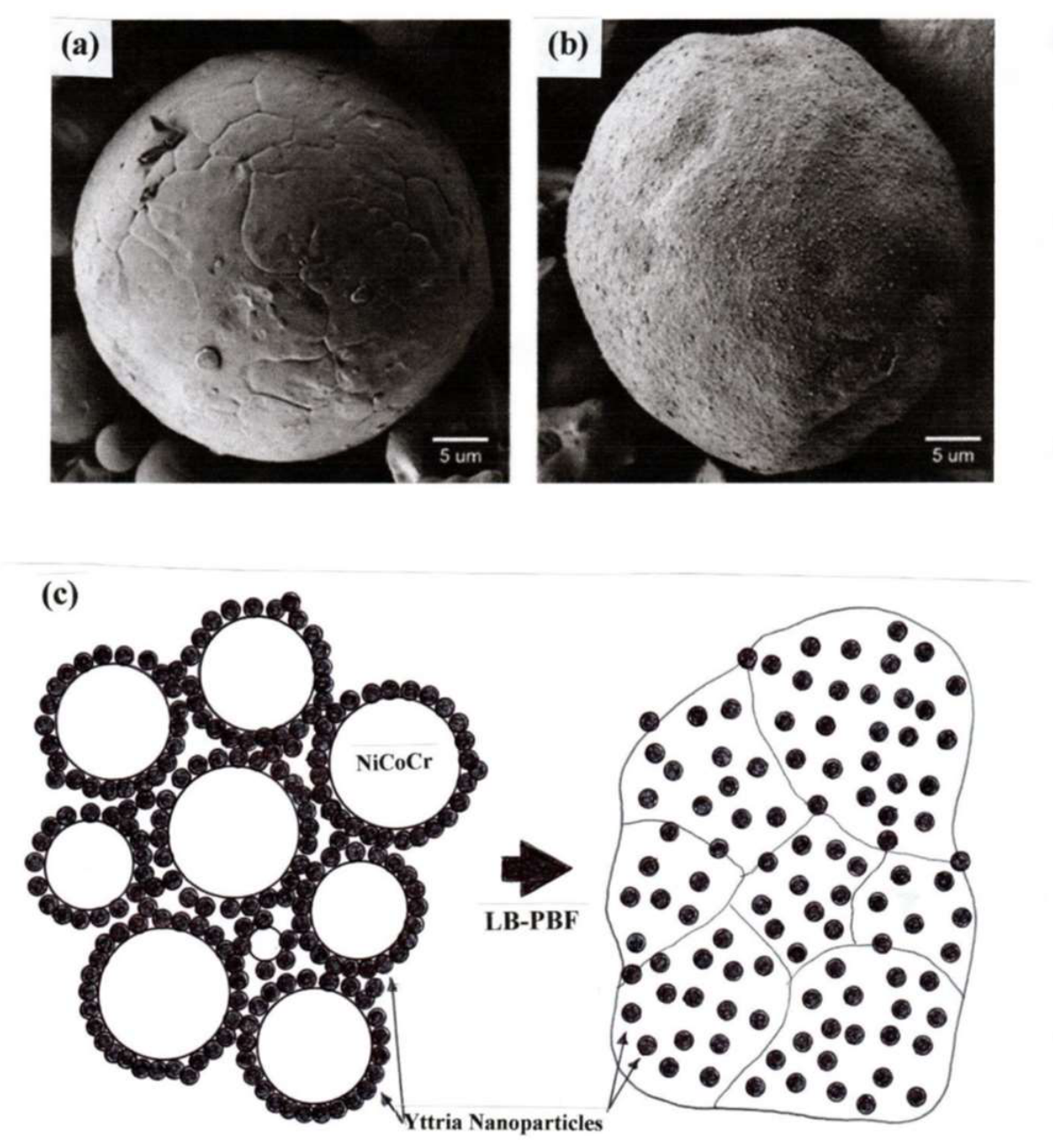
Figure 27.
GRX-810 medium entropy alloy (Ni35Co32Cr30Re1.6Nb0.8 + (Y2O3)0.7) pre-alloyed primary powder FCC crystal structure ( covalent -cubic yttria coated) shown at left in (a) and LB-PBF fabricated GRX-810 component microstructure shown in (b) to (e ), (b) and (d) show EDSD/IPF grain structure in the plane (X-Y) normal to the build direction and parallel to the build direction (Z-Y), respectively. The inset lower left shows a bright-field STEM image of the dispersed yttria nanoparticles interacting with dislocations. M100 refers to the EOS-M100 LB-PBF machine. (c) and (e) show similar microstructures for GRX-810 fabricated in an EOS-M280 machine. The grain sizes average ~ 40 µm in (b) –(d) and ~ 50 µm in (c) and (e). The crystal structures in (a) are courtesy of Google AI (Nano Banana 2). (b) to (e) are after Gradle, et al. [88]; courtesy of NASA.
Figure 27.
GRX-810 medium entropy alloy (Ni35Co32Cr30Re1.6Nb0.8 + (Y2O3)0.7) pre-alloyed primary powder FCC crystal structure ( covalent -cubic yttria coated) shown at left in (a) and LB-PBF fabricated GRX-810 component microstructure shown in (b) to (e ), (b) and (d) show EDSD/IPF grain structure in the plane (X-Y) normal to the build direction and parallel to the build direction (Z-Y), respectively. The inset lower left shows a bright-field STEM image of the dispersed yttria nanoparticles interacting with dislocations. M100 refers to the EOS-M100 LB-PBF machine. (c) and (e) show similar microstructures for GRX-810 fabricated in an EOS-M280 machine. The grain sizes average ~ 40 µm in (b) –(d) and ~ 50 µm in (c) and (e). The crystal structures in (a) are courtesy of Google AI (Nano Banana 2). (b) to (e) are after Gradle, et al. [88]; courtesy of NASA.
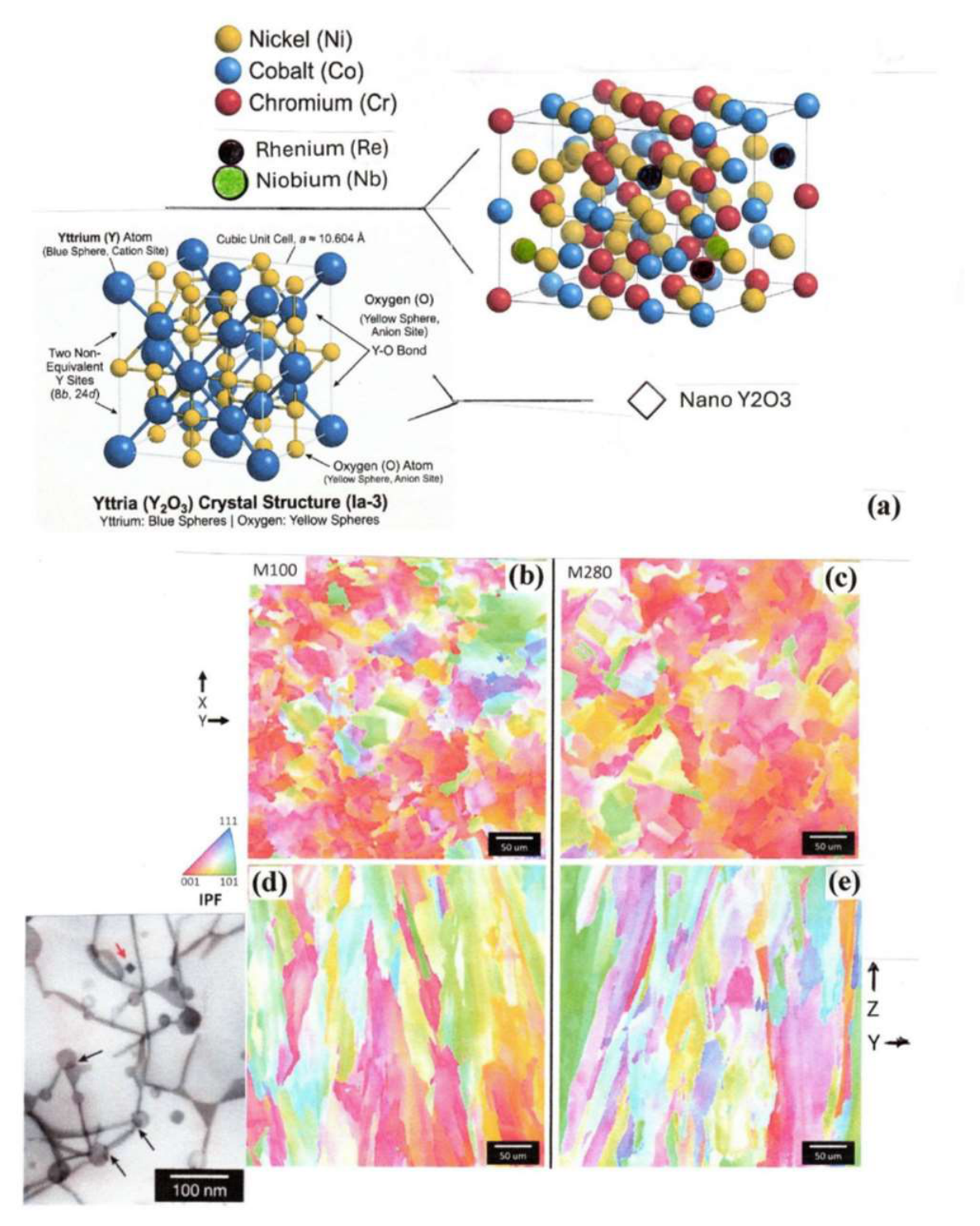
Figure 28.
Examples of NASA LB-PBF-fabricated GRX-810 alloy rocket components: (a) to (f) and a mixed GRX-810/GRCop-42 alloy LB-PBF-fabricated rocket product in (g). (a) turbine blisk, (b) inducer with internal features, (c) impinging injector, (d) regeneratively cooled nozzle, (e) shrouded turbine blisk, (f) large-scale turbine blade. Adapted from Gradl, et al. [81]; courtesy of NASA.
Figure 28.
Examples of NASA LB-PBF-fabricated GRX-810 alloy rocket components: (a) to (f) and a mixed GRX-810/GRCop-42 alloy LB-PBF-fabricated rocket product in (g). (a) turbine blisk, (b) inducer with internal features, (c) impinging injector, (d) regeneratively cooled nozzle, (e) shrouded turbine blisk, (f) large-scale turbine blade. Adapted from Gradl, et al. [81]; courtesy of NASA.
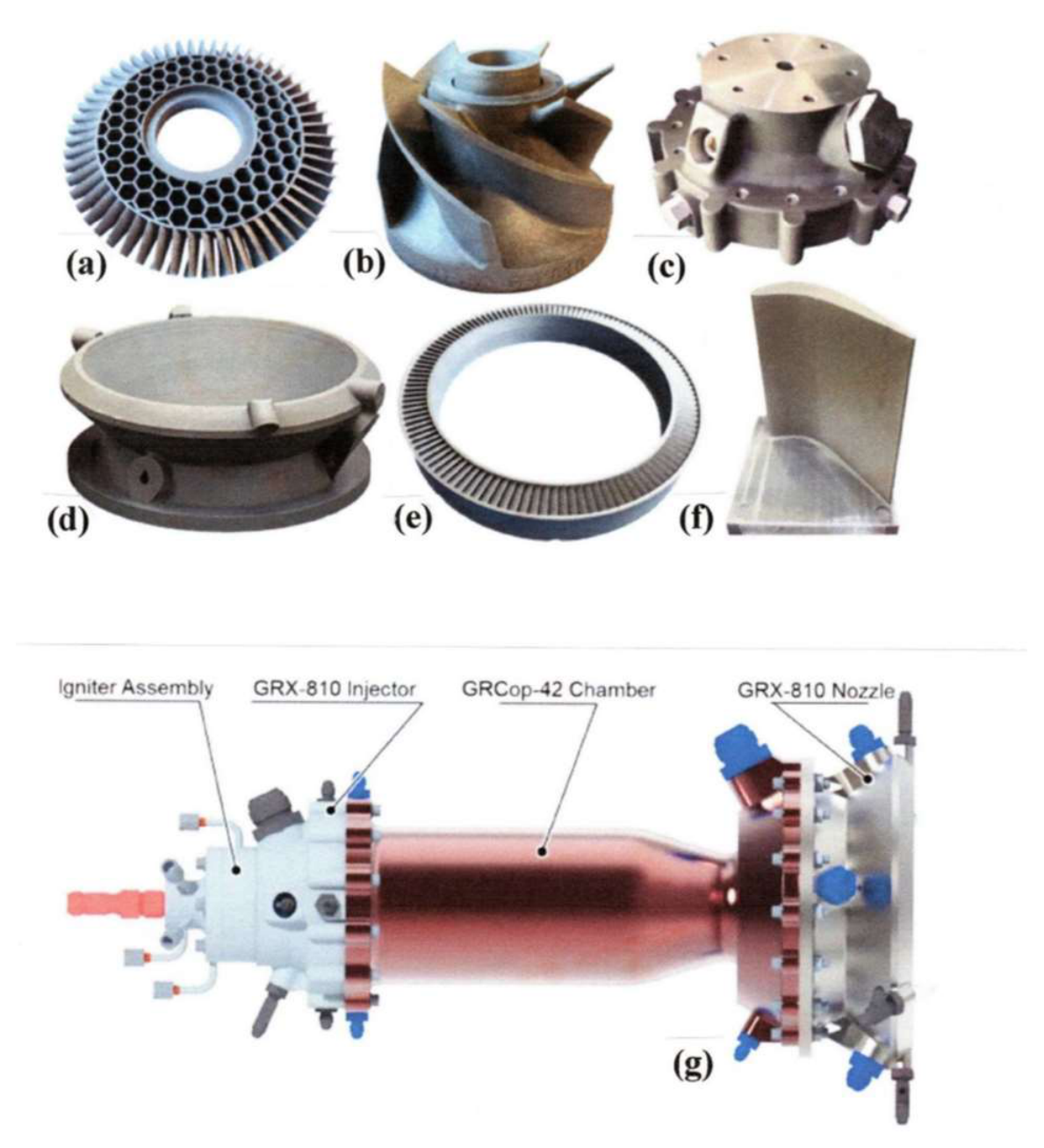
Figure 29.
Multi-laser schematic showing synchronized lasers and a powder bed/build table arrangement utilizing 1000kg GRX-810 medium entropy alloy powder. A commercial 9-laser LB-PBF machine (EPlus 3D-M1250) manufactured by EPlus 3D, Hangzhou, China is shown at lower left; courtesy of EPlus 3D, China.
Figure 29.
Multi-laser schematic showing synchronized lasers and a powder bed/build table arrangement utilizing 1000kg GRX-810 medium entropy alloy powder. A commercial 9-laser LB-PBF machine (EPlus 3D-M1250) manufactured by EPlus 3D, Hangzhou, China is shown at lower left; courtesy of EPlus 3D, China.
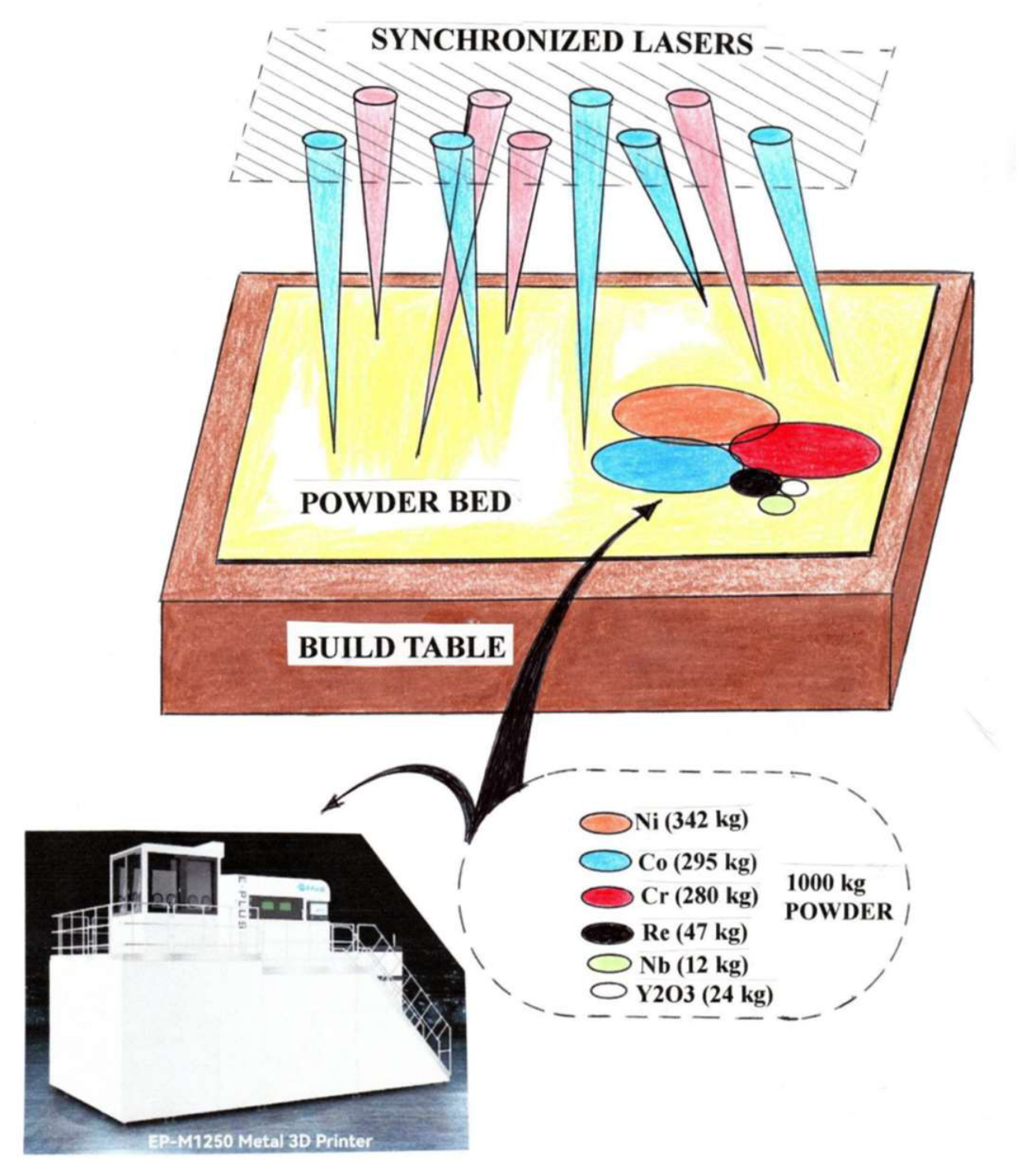
Figure 30.
NASA concept hypersonic aircraft (X-43A) (a). (b) shows an artist rendering of an early DARPA turbine-based combined cycle (TBCC) hypersonic engine concept consisting of an off-the-shelf turbojet engine (insert) and the dual-mode ramjet engine. The bottom insert shows the GE Aerospace hypersonic dual-mode ramjet rendering. NASA, G.E. Aerospace and many other aerospace companies use LB-PBF extensively to manufacture most of the turbojet components (see Figure 28). G.E. Aerospace also fabricates ramjet components using LB-PBF. Note airflow indicated by the solid arrow which is inverted for (a) versus (b). (a) is courtesy of NASA. (b) is courtesy of DARPA and G.E. Aerospace.
Figure 30.
NASA concept hypersonic aircraft (X-43A) (a). (b) shows an artist rendering of an early DARPA turbine-based combined cycle (TBCC) hypersonic engine concept consisting of an off-the-shelf turbojet engine (insert) and the dual-mode ramjet engine. The bottom insert shows the GE Aerospace hypersonic dual-mode ramjet rendering. NASA, G.E. Aerospace and many other aerospace companies use LB-PBF extensively to manufacture most of the turbojet components (see Figure 28). G.E. Aerospace also fabricates ramjet components using LB-PBF. Note airflow indicated by the solid arrow which is inverted for (a) versus (b). (a) is courtesy of NASA. (b) is courtesy of DARPA and G.E. Aerospace.
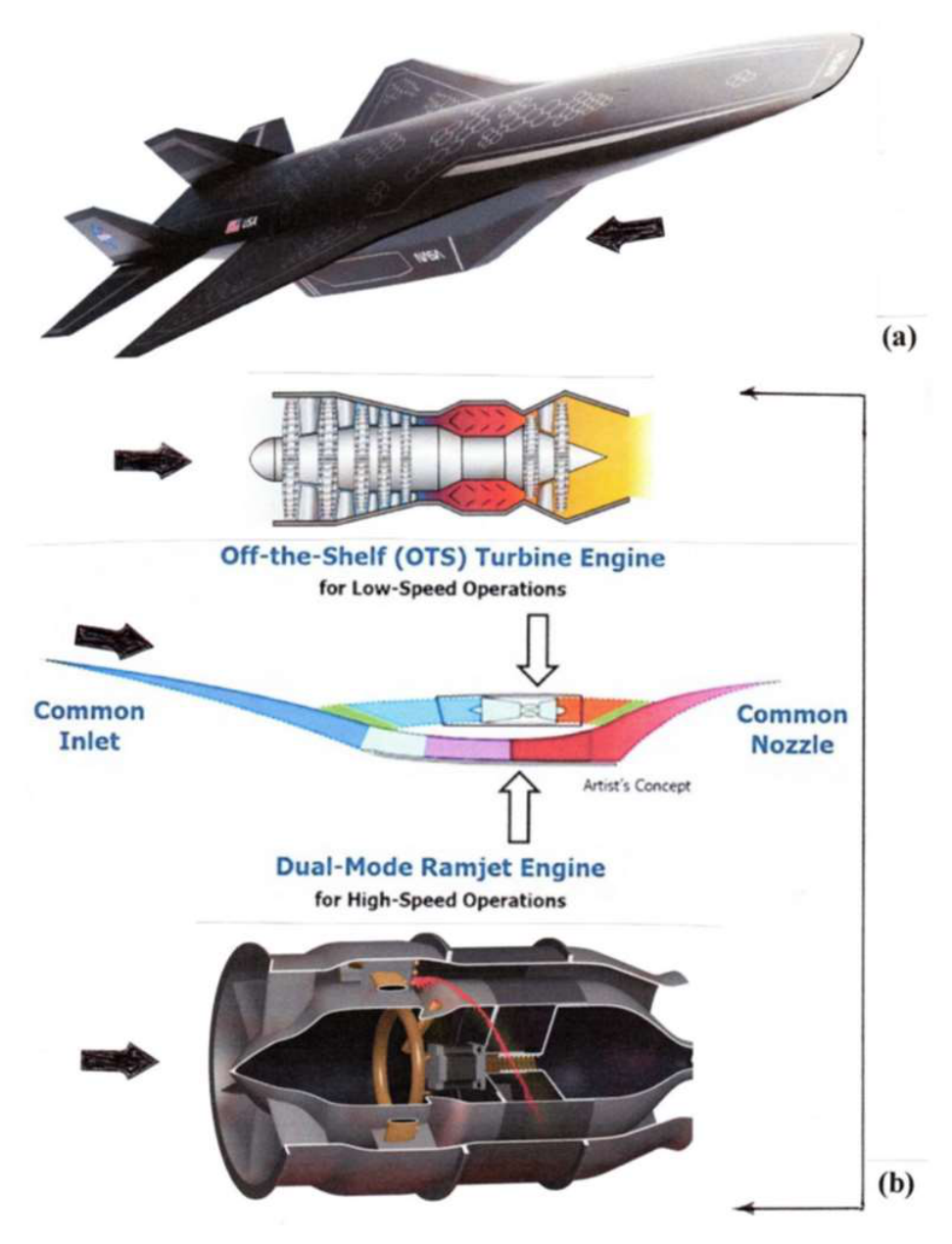

Table 1.
Grain size and tensile properties for cast and thermomechanical. Processed CoCrFeMnNi HEA (Data from Deng, et al. [34]).
Table 1.
Grain size and tensile properties for cast and thermomechanical. Processed CoCrFeMnNi HEA (Data from Deng, et al. [34]).
| Grain Size (µm) | σy (GPa) | UTS (GPa) | Elongation (%) |
| Figure 3b: 102 | 0.23 | 0.53 | 41 |
| Figure 3c: 0.75 | 0.62 | 0.78 | 32 |
| Figure 3d: 1.7 | 0.39 | 0.69 | 49 |
| Figure 3e: 5.7 | 0.26 | 0.61 | 43 |
Table 2.
Grain size, hardness and HEA structure parameters for as-cast AlxCr0.2NbTiV Compositions (Date from Li, et al. [38]).
Table 2.
Grain size, hardness and HEA structure parameters for as-cast AlxCr0.2NbTiV Compositions (Date from Li, et al. [38]).
| Al atomic ratio (x) | Grain Size (µm) | HV (GPa) | ΔSmix J.K-1mol-1) | δ (%) | VEC |
| 0.2 | 152 | 3.8 | 11.8 | 5.4 | 4.7 |
| 0.5 | 390 | 3.9 | 12.4 | 5.2 | 4.5 |
| 0.8 | 788 | 4.1 | 12.6 | 5.0 | 4.4 |
Table 3.
Grain size evolution, mechanical properties and density for varying compositions of Ti(50-x) Zr38NbxTa8Sn4 (Data from Ozerov, et al. [39]).
Table 3.
Grain size evolution, mechanical properties and density for varying compositions of Ti(50-x) Zr38NbxTa8Sn4 (Data from Ozerov, et al. [39]).
| Alloy Composition | Grain Size (µm) | E (GPa) | σy (GPa) | ϵ(%) | HV (GPa) | ρ (g/cm3) |
| Ti30Zr38Nb20Ta8Sn4 | 115 | 78 | 1.1 | 24 | 3.2 | 7.2 |
| Ti40Zr38Nb10Ta8Sn4 | 250 | 69 | 0.9 | 29 | 2.8 | 6.3 |
| Ti50Zr38Ta8Sn4 | 280 | 58 | 0.7 | 25 | 2.4 | 6.0 |
Table 4.
Physical parameters for preparing a 100 g unit AlCoCrFeNi equi-atomic HEA powder blend.
| Element | mass (g) | ρ (g/cm3) | Volume (cm3) | Volumetric % | Di (cm) |
| Al | 10.7 | 2.7 | 4.8 | 27.6 | 2.0 |
| Co | 23.3 | 8.9 | 2.6 | 18.3 | 1.8 |
| Cr | 20.6 | 7.2 | 2.9 | 20.1 | 1.8 |
| Fe | 22.1 | 7.9 | 2.7 | 19.6 | 1.7 |
| Ni | 23.3 | 8.9 | 2.6 | 18.2 | 1.7 |
| TOTALS | 100 | 14.8 | 100 |
Disclaimer/Publisher’s Note: The statements, opinions and data contained in all publications are solely those of the individual author(s) and contributor(s) and not of MDPI and/or the editor(s). MDPI and/or the editor(s) disclaim responsibility for any injury to people or property resulting from any ideas, methods, instructions or products referred to in the content. |
© 2026 by the authors. Licensee MDPI, Basel, Switzerland. This article is an open access article distributed under the terms and conditions of the Creative Commons Attribution (CC BY) license (http://creativecommons.org/licenses/by/4.0/).
Copyright: This open access article is published under a Creative Commons CC BY 4.0 license, which permit the free download, distribution, and reuse, provided that the author and preprint are cited in any reuse.


