

Submitted:
08 June 2026
Posted:
09 June 2026
You are already at the latest version
Abstract
Autoimmune rheumatic diseases are still treated predominantly through broad or targeted suppression of inflammatory pathways, yet durable restoration of self-tolerance remains a central unmet therapeutic goal. This narrative review examines restoration of immune tolerance as an emerging translational framework in rheumatology, integrating checkpoint agonism, antigen-specific immunotherapy, regulatory cell-based strategies, and immune-reset approaches within a unified therapeutic perspective. Rather than treating these strategies as isolated innovations, the review evaluates how each attempts to restore, reinforce, or reconfigure immune restraint at distinct biological levels, spanning inhibitory receptor signaling, antigen-selective non-responsiveness, dominant regulatory control, and deeper reconfiguration of pathogenic immune architecture. Their relevance is considered across rheumatoid arthritis, systemic lupus erythematosus, Sjögren’s disease, and systemic sclerosis, with emphasis on mechanistic rationale, translational maturity, disease-specific therapeutic fit, biomarkers, therapeutic timing, and major barriers to clinical implementation. Collectively, these approaches suggest a shift in rheumatology from repeated control of inflammatory consequences toward more selective and potentially durable recalibration of autoreactive immunity. Although the field remains biologically and clinically immature, restoration of immune tolerance is emerging as an important organizing principle for the development of more precise and potentially disease-modifying therapies in autoimmune rheumatic disease.
Keywords:
immune tolerance
; autoimmune rheumatic disease
; checkpoint agonism
; antigen-specific immunotherapy
; regulatory T cells
; immune reset
; biomarkers
; translational immunology
1. Introduction
Autoimmune rheumatic diseases are increasingly managed with biologic agents, targeted small molecules, and refined immunomodulatory strategies, yet durable restoration of self-tolerance remains uncommon in routine clinical practice. Many patients achieve substantial control of inflammatory activity, but relapse after treatment reduction, incomplete remission, and persistent treatment dependence remain common clinical realities across diseases such as rheumatoid arthritis, systemic lupus erythematosus, Sjögren’s disease, and systemic sclerosis. These patterns suggest that suppression of inflammatory output, although often clinically effective, does not necessarily re-establish the endogenous mechanisms that normally restrain autoreactivity [1,2].
This distinction has important therapeutic implications. The dominant treatment paradigm in rheumatology has focused on interrupting inflammatory cascades after disease has become clinically manifest, using approaches that block cytokines, deplete selected immune populations, or inhibit intracellular signaling pathways. These therapies have transformed disease management and improved outcomes in many patients, but they were not primarily designed to rebuild immune tolerance itself. As a result, clinical improvement and immunological recalibration are not always equivalent [3,4]. Patients may experience reduced disease activity while pathogenic immune memory, defective inhibitory signaling, abnormal T-cell help, or autoreactive B-cell survival remain biologically active beneath the surface of apparent control.
Recent therapeutic developments now make a tolerance-centered review especially timely. Immune checkpoint agonism has re-emerged as a serious therapeutic concept in rheumatic disease, with increasing attention to pathways such as PD-1, BTLA, and TIGIT as potential targets for restoring inhibitory immune control rather than simply dampening downstream inflammation. In parallel, antigen-specific immunotherapies have gained renewed translational interest through advances in peptide design, antigen delivery systems, and tolerogenic platforms intended to silence pathogenic responses while preserving protective immunity [3,5,6]. At the same time, regulatory cell-based strategies, including regulatory T-cell expansion and engineered approaches, together with deeper immune reset concepts such as CAR-T-based immune reprogramming in severe autoimmune disease, have brought increasing attention to interventions aimed at immune reorganization rather than additional pathway blockade.
This topic is particularly important because these therapeutic directions are often discussed in parallel rather than within a single translational framework. Existing reviews commonly focus on checkpoint pathways, antigen-specific tolerance, tolerogenic antigen-presenting strategies, regulatory cell engineering, or immune reset approaches as separate emerging domains. From a rheumatology perspective, however, these approaches can also be understood as convergent attempts to restore, reinforce, or substitute the mechanisms of immune tolerance that fail in autoimmunity. Bringing them together helps clarify a broader shift in the field, namely, a movement from repeated control of inflammatory consequences toward more selective rebuilding of immune restraint [4,7,8].
The importance of the present review lies not in suggesting that immune tolerance restoration has replaced standard immunosuppression, but in examining a therapeutic direction that is becoming increasingly visible across multiple lines of mechanistic and translational research. It also addresses a conceptual gap in the literature. Rather than reviewing one platform in isolation, this article integrates checkpoint agonism, antigen-specific immunotherapy, regulatory cell-based strategies, and immune reset approaches within a single rheumatology-focused therapeutic model [3,4,5]. In doing so, it aims to provide a more coherent framework for understanding how these strategies differ, where they converge, which diseases may be more suitable for each, and what biological and clinical barriers continue to limit their application.
The present review therefore examines restoration of immune tolerance as an emerging translational framework in autoimmune rheumatic disease. We focus on four major diseases, rheumatoid arthritis, systemic lupus erythematosus, Sjögren’s disease, and systemic sclerosis, because together they reflect distinct but overlapping architectures of chronic autoimmunity, including synovial inflammation, systemic autoantibody-driven disease, glandular immune dysregulation, and the early immune-mediated phases of systemic sclerosis in which autoreactivity and inflammatory dysregulation precede or accompany progressive fibrotic injury. Across these diseases, we evaluate the mechanistic rationale, translational maturity, biomarker logic, disease-specific therapeutic fit, and major barriers associated with tolerance-directed intervention [3,8,9]. Our aim is not to overstate the maturity of the field, but to argue that restoration of immune tolerance is emerging as an important organizing principle for the next generation of more precise and potentially disease-modifying therapies in rheumatology.
2. Immune Tolerance as a Therapeutic Framework in Rheumatic Disease
In autoimmune rheumatic disease, the concept of immune tolerance is most useful therapeutically when it is defined with precision rather than treated as a broad immunological abstraction. At its core, immune tolerance refers to the mechanisms that prevent or restrain destructive immune responses against self [10,11]. These include central processes that limit the emergence of autoreactive lymphocytes during development, as well as peripheral mechanisms that suppress, redirect, or contain pathogenic immune activity after self-reactive cells have entered the mature immune repertoire.
For the purposes of this review, however, a full account of tolerance biology is neither necessary nor desirable. What matters most is the therapeutic distinction between controlling inflammatory output and restoring the mechanisms that physiologically restrain autoreactivity. This distinction is central because clinical improvement does not necessarily indicate that immune tolerance has been re-established. Disease activity may decrease while abnormalities in inhibitory signaling, regulatory-cell function, antigen-specific unresponsiveness, or autoreactive immune memory remain incompletely corrected [12,13].
This distinction becomes clearer when tolerance is considered across several functional levels. Central tolerance limits the survival of strongly autoreactive lymphocytes during immune development, whereas peripheral tolerance restrains self-reactive cells that escape deletion through mechanisms such as inhibitory receptor signaling, dominant suppression by regulatory T cells, tolerogenic antigen presentation, and contextual control within tissues. In autoimmune rheumatic disease, these mechanisms are rarely absent in absolute terms [14]. More often, they are quantitatively weakened, functionally unstable, or selectively bypassed in ways that permit chronic autoreactivity and inflammatory persistence.
From a therapeutic perspective, this means that immune tolerance should not be equated simply with remission, low disease activity, or the pharmacologic suppression of inflammation. A therapy may reduce cytokine production, diminish immune-cell trafficking, or deplete a pathogenic population without durably rebuilding the regulatory architecture that normally constrains autoimmune responses. By contrast, a tolerance-directed therapy seeks to restore, reinforce, or substitute one or more of these physiological control systems [12,15]. In this sense, checkpoint agonism, antigen-specific immunotherapy, regulatory cell-based strategies, and immune-reset approaches can be viewed as distinct but related efforts to move beyond conventional anti-inflammatory control toward more stable restoration of immune regulation.
The therapeutic framework used in this review, including the distinction between inflammatory control and restoration of immune restraint and the levels at which the major strategy classes intervene, is summarized in Figure 1.
This framework is particularly relevant in rheumatic disease because the clinical challenge is not merely excessive inflammation, but the persistence of aberrant self-recognition and autoreactive immune memory. The therapeutic value of a tolerance-centered framework therefore lies in its ability to organize emerging interventions according to the level at which they attempt to re-establish immune control [3,16]. Rather than asking only how effectively a therapy suppresses inflammatory pathways, this perspective asks whether it can help restore inhibitory signaling, re-establish antigen-selective non-responsiveness, stabilize regulatory function, or more fundamentally reorganize pathogenic immune memory.
Accordingly, this review uses immune tolerance not as a purely descriptive immunological term, but as a practical therapeutic framework. The aim is to clarify why restoration of immune restraint may represent a more biologically meaningful objective than inflammation control alone, and why emerging rheumatologic therapies should increasingly be evaluated not only by their anti-inflammatory effects, but also by their capacity to reconfigure the mechanisms that sustain autoimmune persistence. It is at this level that checkpoint agonism, antigen-specific strategies, regulatory cell-based interventions, and immune-reset approaches become therapeutically meaningful [13,17]. The most immediate therapeutic expression of this logic lies in attempts to reinforce endogenous inhibitory signaling, which makes checkpoint agonism the clearest starting point for the strategy sections that follow.
3. Checkpoint Agonism and Inhibitory Receptor Signaling
Checkpoint agonism has emerged as a conceptually important strategy in efforts to restore immune tolerance in autoimmune rheumatic disease. Unlike conventional immunosuppressive approaches, which primarily attenuate inflammatory mediators or reduce pathogenic immune-cell activity after disease expression is established, checkpoint agonism seeks to reinforce endogenous inhibitory pathways that normally restrain autoreactive immune responses. In this respect, the therapeutic logic is not simply suppression of immune output, but restoration of physiological mechanisms of immune self-limitation [5,18,19].
Several inhibitory receptors are particularly relevant in this context, including PD-1, CTLA-4, BTLA, TIGIT, LAG-3, and related signaling axes. These pathways contribute to peripheral tolerance by limiting T-cell activation, modulating co-stimulatory balance, restraining effector differentiation, and supporting the maintenance of immune quiescence under conditions in which self-reactive cells might otherwise expand or persist. Their dysfunction, insufficiency, or contextual failure may therefore contribute to the persistence of autoreactivity in rheumatic disease [18,19]. The appeal of checkpoint agonism lies in the possibility of re-engaging these intrinsic control systems rather than only blocking downstream inflammatory consequences.
This therapeutic concept is especially relevant because autoimmune rheumatic diseases often involve chronic activation states that cannot be fully explained by inflammatory amplification alone. Aberrant T-cell help, sustained B-cell activation, persistence of autoreactive memory, and incomplete inhibitory signaling all contribute to the durability of disease. A checkpoint-based strategy is therefore attractive not merely because it may reduce inflammation, but because it may intervene at an upstream level of immune regulation [5,19]. This distinguishes checkpoint agonism from many existing therapies that interrupt final common inflammatory pathways without durably restoring inhibitory immune control.
Among these pathways, PD-1 has attracted particular interest because of its broad role in controlling T-cell activation, exhaustion, and peripheral tolerance. CTLA-4 remains equally important as a regulator of co-stimulation and T-cell priming, while BTLA, TIGIT, and LAG-3 have gained increasing attention as additional inhibitory receptors with potential therapeutic relevance in autoimmunity. Although these pathways share the common feature of restraining immune activation, they are not functionally redundant. Their biology differs across immune-cell subsets, tissue contexts, and disease states, which suggests that checkpoint agonism is unlikely to operate as a uniform therapeutic strategy across all autoimmune rheumatic diseases [18,19]. The implications of this disease-specific variation are considered later in the review.
From a translational perspective, this variability creates therapeutic opportunity because different checkpoint pathways may prove more relevant to particular immune architectures or stages of disease. At the same time, it complicates development because the effectiveness of checkpoint agonism may depend on whether inhibitory signaling is truly deficient, whether pathogenic cells remain responsive to regulatory input, and whether disease has progressed to a stage at which inflammatory circuits have become relatively autonomous [19,20,21,22]. These considerations make patient selection, disease timing, and mechanistic stratification central to the future of this therapeutic class.
The current evidence base remains promising but uneven. At present, support for checkpoint agonism in rheumatic disease derives largely from mechanistic studies, preclinical autoimmune models, and early translational investigations, whereas direct clinical evidence remains comparatively limited. This imbalance is important because it indicates that the biological rationale is increasingly credible, but the path to therapeutic implementation remains incomplete. Specific agonist biologics, fusion-protein strategies, and related pathway-engaging platforms are under early investigation, but their clinical roles in rheumatic disease are not yet established. Among the therapeutic strategies considered in this review, checkpoint agonism remains at one of the earliest stages of translational development in rheumatology. Its mechanistic foundation is strong and growing, but its direct clinical record remains more limited than that of antigen-specific immunotherapy and far less visible than that of CAR-T-based immune reset [3,5,19]. This translational position is especially important because, in contrast to oncology, where checkpoint inhibition aims to release suppressed anti-tumor immunity, rheumatologic checkpoint agonism must pursue the opposite objective by restoring inhibitory immune control without producing excessive generalized immunosuppression.
Safety considerations are therefore especially important. Because these receptors operate within complex immune-regulatory networks, therapeutic agonism may have effects that extend beyond the intended suppression of autoreactive populations. Excessive inhibitory signaling could impair protective host defense, weaken anti-infectious surveillance, disrupt mucosal immune balance, or alter tissue-resident regulatory homeostasis, whereas insufficient agonism may fail to meaningfully recalibrate autoreactivity. The therapeutic window may therefore be narrow, and it is unlikely to be identical across distinct rheumatic diseases or across different phases of the same disease [21,23,24,25].
Accordingly, checkpoint agonism should not be understood as a simple inverse version of checkpoint inhibition, but as a distinct therapeutic paradigm grounded in restoration of peripheral immune restraint. It represents one of the clearest examples of tolerance-directed therapy at the level of endogenous inhibitory signaling. Its promise lies in the possibility of re-engaging physiologic immune control, whereas its limitations highlight the need for disease-specific targeting, careful biomarker-guided application, and integration with other tolerance-restoring strategies [19,26,27,28]. In that sense, checkpoint agonism is best viewed not as a complete solution in itself, but as one important component of a broader therapeutic effort to restore immune tolerance in rheumatic disease.
4. Antigen-Specific Immunotherapy
Antigen-specific immunotherapy represents one of the most conceptually compelling approaches to tolerance restoration in autoimmune rheumatic disease because it aims to re-establish immune restraint in an antigen-selective rather than globally suppressive manner. In principle, such strategies seek to silence, redirect, or reprogram pathogenic immune responses against self while preserving broader protective immunity [12,29,30,31]. This distinguishes them from conventional immunosuppressive therapies, which may control inflammatory activity effectively but do not directly correct the underlying failure of immune discrimination that permits autoreactivity to persist.
The therapeutic rationale for antigen-specific immunotherapy rests on the premise that autoreactive immune responses can be reshaped if relevant self-antigens are presented under conditions that favor tolerance rather than activation. Depending on the platform, this may involve deletion or anergy of pathogenic lymphocytes, induction of regulatory T-cell responses, modulation of antigen-presenting cell behavior, or selective attenuation of autoreactive immune memory [10,12,32]. In this sense, antigen-specific approaches attempt to intervene at one of the most fundamental levels of autoimmune pathogenesis, namely aberrant recognition of self.
The strategies explored within this framework can be understood in several broad categories. One category includes defined antigen formulations, such as tolerogenic peptides and other autoantigen-based constructs designed to induce selective immune non-responsiveness. A second includes context-engineering delivery systems, such as nanoparticles and mucosal platforms, which aim to shape how antigens are encountered by the immune system. A third includes cell-mediated tolerogenic presentation strategies, particularly approaches that use modified or tolerogenic antigen-presenting cells to deliver self-antigen in a regulatory rather than immunogenic context [4,33,34,35]. Although these platforms differ substantially in design, they share a common therapeutic objective: to present relevant autoantigens in a manner that promotes immune restraint rather than inflammatory amplification.
The major platform categories in antigen-specific immunotherapy, and the distinct points at which they attempt to shape tolerogenic immune recognition, are summarized in Figure 2.
Despite this strong conceptual appeal, antigen-specific immunotherapy has historically struggled to achieve consistent translational success in autoimmune disease. One major challenge is that the dominant pathogenic antigens are not always known with sufficient precision. Even when candidate autoantigens are identified, their biological importance may vary across patients, across disease stages, and across tissue compartments. This problem is compounded by epitope spreading, through which autoimmune responses diversify over time and reduce the likelihood that a narrowly targeted antigenic intervention will remain sufficient as disease evolves [12,29,30,36]. In established inflammatory disease, an additional obstacle arises from the fact that chronic immune activation may make tolerogenic re-education more difficult to achieve and sustain.
These challenges are especially relevant in autoimmune rheumatic disease, where dominant autoantigens may differ across diagnoses, serologic subgroups, tissue environments, and phases of disease progression. Under such conditions, the difficulty is not simply delivering antigen, but selecting and formulating it in a way that reliably supports tolerogenic rather than immunogenic interpretation. Variables such as antigen composition, epitope choice, stability, and formulation can all influence whether the intended target is biologically relevant and whether the tolerogenic signal remains sufficiently precise over time [4,37,38,39].
A second level of difficulty concerns delivery context. Route of administration, carrier design, tissue targeting, and the activation state of antigen-presenting cells may all shape whether the immune system interprets an intervention as a cue for restraint or for further activation. For this reason, antigen-specific immunotherapy should not be regarded as a single class effect, but as a platform-dependent strategy whose success depends heavily on biological context and delivery architecture [33,40,41,42].
Recent advances have nonetheless renewed interest in this field. Improved peptide engineering, nanoparticle-based delivery systems, scaffold- or carrier-assisted antigen presentation, and strategies that co-deliver tolerogenic signals alongside self-antigens have strengthened the translational plausibility of antigen-specific immune modulation. Mucosal approaches and tolerogenic dendritic-cell strategies have also contributed to a more refined understanding of how route, context, and immune microenvironment shape the balance between activation and tolerance. Early-phase clinical investigations are also underway in selected rheumatic disease settings, although their therapeutic roles remain to be defined. These developments do not eliminate the central challenges of antigen selection and disease heterogeneity, but they suggest that earlier limitations may have reflected platform design constraints as much as weaknesses in the therapeutic concept itself [29,33,43,44,45]. Of the four therapeutic strategies examined in this review, antigen-specific immunotherapy has the longest history of clinical investigation in autoimmunity, with peptide-based tolerization and related approaches providing a clearer translational precedent than checkpoint agonism or CAR-Treg therapy, even though no antigen-specific platform has yet achieved routine clinical use in autoimmune rheumatic disease [4,29,46,47].
From a rheumatologic perspective, antigen-specific immunotherapy is especially important because it represents the clearest attempt to restore selective immune non-responsiveness rather than merely attenuate downstream inflammatory expression. Its relevance lies not only in its potential precision, but also in its mechanistic goal of re-establishing a more physiologic relationship between the immune system and self-antigen [12,29,30,39]. At the same time, its future depends on realistic recognition of the field’s unresolved barriers, including incomplete knowledge of dominant antigens, interpatient variability, stage-dependent disease biology, and the difficulty of maintaining durable tolerance in chronically inflamed tissues.
Accordingly, antigen-specific immunotherapy should be viewed neither as a failed concept nor as a near-term universal solution. Rather, it represents a strategically important pillar within the broader tolerance-restoration framework because it addresses autoreactivity at the level of antigen recognition itself [29,33,40,44]. The key translational question is not whether antigen-specific tolerance is desirable, but how it can be induced with sufficient precision, durability, and disease-specific relevance to become clinically useful in rheumatology.
5. Regulatory Cell-Based Strategies
Regulatory cell-based strategies occupy a central place within the broader effort to restore immune tolerance in autoimmune rheumatic disease because they seek to reinforce dominant mechanisms of immune restraint rather than merely suppress inflammatory output. Among these approaches, therapies centered on regulatory T cells have attracted the greatest attention, given the established role of these cells in maintaining peripheral tolerance, limiting effector immune activation, and constraining autoreactive responses across multiple immunological contexts. In therapeutic terms, their appeal lies in the possibility of rebuilding an endogenous regulatory layer that has become quantitatively insufficient, functionally unstable, or contextually ineffective in chronic autoimmune disease [17,48,49,50].
The rationale for Treg-directed therapy is particularly strong because regulatory failure in autoimmunity is often qualitative as much as quantitative. In many settings, regulatory T cells remain detectable, yet their suppressive competence, phenotypic stability, survival, or tissue localization may be insufficient to control ongoing autoreactivity. This distinction is important because it implies that therapeutic benefit may arise not only from increasing Treg numbers, but also from improving their stability, persistence, trafficking, and functional performance within inflammatory environments [51,52,53,54]. Accordingly, regulatory cell-based strategies should not be understood as a single intervention type, but as a broader class of approaches designed to restore dominant immune regulation at multiple levels.
Several therapeutic directions have emerged within this framework. One focuses on enhancing endogenous regulation in vivo by expanding or supporting native regulatory populations. A second relies on ex vivo isolation, expansion, and adoptive transfer of regulatory cells with the aim of restoring suppressive capacity more directly. A third includes engineered regulatory strategies, particularly chimeric antigen receptor regulatory T cells, which seek to combine suppressive function with greater antigen specificity, tissue targeting, or functional potency [6,7,55,56]. Although these approaches differ substantially in design and translational maturity, they share a common objective: to restore immunological control through active reinforcement of regulatory cell function.
The principal regulatory cell-based strategies, together with their mechanisms, translational maturity, major advantages, and biological constraints, are summarized in Table 1.
The therapeutic potential of this approach is substantial. In principle, regulatory cell-based strategies may offer a means of restraining pathogenic immunity while preserving broader host defense more selectively than generalized immunosuppression. They are also particularly relevant to the present review because they attempt to restore active immunological control rather than merely attenuate downstream inflammatory mediators [6,7,57,58]. In this respect, they offer a direct therapeutic test of whether reinforcement of dominant immune regulation can produce more stable long-term control of autoreactive immune behavior.
At the same time, the biological constraints are considerable. One major challenge is lineage stability. Regulatory T cells may lose suppressive identity or functional integrity under inflammatory conditions, particularly in cytokine-rich environments that favor phenotypic instability or reduced regulatory fitness. A second challenge is functional durability, since transferred or expanded cells may not persist long enough, remain sufficiently suppressive, or maintain activity within chronically inflamed tissues [50,53,59,60]. A third challenge concerns trafficking and tissue access. Even a phenotypically stable regulatory population may fail therapeutically if it does not localize effectively to the anatomical compartments in which disease is being sustained.
These limitations are especially relevant in autoimmune rheumatic disease, where pathogenic processes often reflect ongoing interaction between circulating immune cells, tissue-resident populations, stromal compartments, and chronic inflammatory signaling. In such environments, regulatory therapies do not act in a neutral setting, but within tissues already shaped by cytokine exposure, aberrant antigen presentation, and established autoreactive memory. As a result, even regulatory cells with preserved suppressive capacity may fail if the local tissue environment does not support their survival, retention, or functional activity. This means that the success of regulatory cell-based interventions may depend as much on microenvironmental compatibility and tissue-level persistence as on the intrinsic properties of the regulatory cells themselves [52,61,62,63].
Engineered regulatory approaches have emerged in part as an attempt to overcome some of these limitations. In particular, CAR-Treg strategies aim to enhance antigen specificity, improve tissue targeting, and increase suppressive efficiency by directing regulatory cells toward defined antigenic or tissue-associated contexts. This approach is conceptually relevant because it introduces the possibility of combining dominant immune regulation with selective recognition, thereby narrowing regulatory activity toward sites or pathways most relevant to disease [7,58,60,64]. However, these strategies also introduce additional complexities, including manufacturing demands, safety considerations, stability of engineered cells, and uncertainty regarding how engineered regulatory populations will behave over time in autoimmune inflammatory environments.
From a translational perspective, regulatory cell-based strategies remain highly promising but still technically and biologically demanding. Early clinical and preclinical investigations have strengthened interest in this area, but the path to routine therapeutic use remains incomplete. Key unresolved questions include how best to define the most effective regulatory cell product, how to preserve suppressive identity during expansion and after transfer, how to determine dose and persistence requirements, how to match cell-based strategies to particular disease settings, and how to evaluate efficacy when the intended effect may be gradual immune recalibration rather than immediate reduction of inflammatory biomarkers alone. Within the broader translational landscape, polyclonal Treg expansion and adoptive-transfer approaches have progressed further toward clinical evaluation than engineered CAR-Treg platforms [17,60,65]. Even so, regulatory cell-based therapy remains less clinically established in autoimmune rheumatic disease than antigen-specific immunotherapy and has generated less patient-level visibility than CAR-T-based immune reset in severe lupus.
Accordingly, regulatory cell-based therapies should be viewed as a therapeutically significant but still maturing approach within the broader effort to re-establish immune regulation in rheumatic disease. Their importance lies in addressing autoimmunity through reinforcement of active immune regulation rather than only inhibition of effector pathways [51,52,53,59]. Their future clinical value will depend not only on proof of suppressive capacity, but also on the ability to preserve stable lineage identity, achieve durable persistence, ensure effective tissue localization, and maintain regulatory function within the very inflammatory environments they are intended to correct.
If checkpoint agonism and regulatory cell-based strategies seek to restore immune restraint by reinforcing existing control systems, the next therapeutic step is to consider whether severe refractory disease may instead require more fundamental reconfiguration of pathogenic immune architecture [66,67,68].
6. Immune Reset Approaches
Immune reset approaches represent some of the most intensive strategies within the broader effort to restore immune tolerance in autoimmune rheumatic disease. Unlike therapies that primarily attenuate inflammatory mediators or reinforce specific regulatory pathways, these interventions aim to reconfigure pathogenic immune architecture more fundamentally by disrupting, depleting, or rebuilding autoreactive immune repertoires. Their therapeutic rationale rests on the premise that, in severe or refractory disease, durable control may require more than suppression of ongoing inflammatory activity and may instead depend on deeper interruption of the cellular and immunological circuits that sustain autoreactivity over time [69].
This concept is particularly relevant in patients whose disease remains highly active despite multiple lines of conventional or targeted therapy, especially when repeated use of mechanistically narrower interventions fails to produce durable benefit. In such settings, the therapeutic objective shifts from modulation of inflammatory output to more profound restructuring of immune composition and function [69,70]. From the perspective of this review, the importance of immune reset lies not simply in treatment intensity, but in its attempt to alter the immunological basis of persistence itself.
Hematopoietic stem cell transplantation has provided one of the clearest historical models for this concept in autoimmune disease. In selected severe rheumatic disease settings, it has been pursued as a strategy to ablate or profoundly suppress autoreactive immune populations and permit reconstitution of a less pathogenic immune repertoire. Conceptually, this differs from standard suppression because the aim is not only to dampen active inflammation, but to interrupt the continuity of the autoreactive system that sustains it. At the same time, this approach illustrates the central tension of immune reset strategies: the possibility of deeper and more durable disease control must be weighed against substantial procedural risk, patient-selection complexity, and uncertainty regarding long-term immunological stability [69,71].
More recently, CAR-T-based depletion and reset approaches have introduced a newer version of this therapeutic logic. In severe autoimmune disease, these strategies have attracted interest because they may allow highly directed elimination of pathogenic immune populations, particularly B-cell or plasma-cell compartments that contribute to autoantibody production, antigen presentation, and maintenance of autoimmune memory [3]. In rheumatic disease, their conceptual relevance lies in the possibility that targeted depletion may do more than temporarily reduce a pathogenic population and may instead create conditions for broader immune reorganization after removal of key drivers of disease persistence.
This possibility is conceptually distinct from conventional targeted depletion alone. The intended effect is not simply reduction of one pathogenic compartment, but emergence of a qualitatively different post-treatment immune state in which autoreactive networks are less capable of re-establishing themselves. For this reason, CAR-T-based reset strategies should be understood not merely as intensified depletion therapies, but as attempts to induce more durable immune reorganization after selective elimination of critical disease-sustaining populations [3,16].
The principal immune-reset strategies, together with their mechanisms, current evidence profile, and major translational limitations, are summarized in Table 2.
Despite this promise, the evidence base remains limited and uneven across rheumatic diseases. Current support for immune reset strategies derives largely from severe disease experience, highly selected patient cohorts, observational reports, early clinical investigations, and an expanding but still early translational evidence base. Their apparent success in some refractory autoimmune settings has generated substantial interest, but this should not obscure the fact that durability, generalizability, comparative efficacy, and long-term safety remain incompletely defined. In rheumatology, where diseases differ in their dependence on autoantibodies, tissue-resident inflammation, stromal pathology, and chronic immune memory, the degree to which immune reset can produce sustained benefit is unlikely to be uniform [3,16]. Among the strategies discussed in this review, CAR-T-based immune reset currently has the greatest patient-level clinical visibility in autoimmune rheumatic disease, particularly in severe systemic lupus erythematosus, placing it ahead of checkpoint agonism, CAR-Treg therapy, and most antigen-specific platforms in terms of recent clinical momentum, while still falling well short of the evidence required for established therapeutic use [3,16].
Clinical applicability therefore depends heavily on disease severity, prior treatment failure, organ risk, and the balance between potential benefit and procedural burden. These approaches are not likely to serve as broadly applicable early-line interventions. Rather, their current relevance lies primarily in severe, refractory, or high-risk rheumatic disease, where the limits of conventional suppression have become evident and the therapeutic threshold for intensive intervention is lower. Even in this context, careful patient selection remains essential, since the justification for immune reset depends not only on disease severity, but also on the reversibility of underlying disease biology and the likelihood that immune reconfiguration can still alter the trajectory of organ-threatening pathology [16,71].
Limitations and risks are central to any realistic evaluation of immune reset. Hematopoietic stem cell transplantation carries well-recognized toxicities related to conditioning regimens, infection risk, organ vulnerability, and procedural morbidity. CAR-T-based reset strategies introduce a different set of concerns, including manufacturing complexity, resource intensity, immune reconstitution uncertainty, and the possibility of acute or delayed toxic effects associated with profound immune-cell depletion. In both cases, the biological question extends beyond whether disease activity falls initially to whether the reconstituted immune state is sufficiently stable, less autoreactive, and clinically durable over time [3,16].
An additional challenge is that immune reset may not fully address all components of rheumatic disease pathology. Even if pathogenic immune populations are substantially reduced, tissue-resident damage programs, stromal remodeling, fibrosis, or chronically altered microenvironments may continue to sustain disease manifestations independently of the original immune drivers. This issue is especially important in rheumatology, where established tissue pathology may become partially autonomous from the initiating immune insult. Accordingly, immune reset should not be assumed to be synonymous with disease erasure. Its success may depend not only on immune depletion or reconstitution, but also on the reversibility of downstream tissue-level pathology at the time of intervention [71].
For these reasons, immune reset approaches should be regarded as therapeutically significant but still highly selective strategies within the broader framework of immune-restorative therapy. Their value lies in demonstrating that, in at least some forms of severe autoimmune rheumatic disease, meaningful clinical benefit may require disruption and reorganization of pathogenic immune architecture rather than continued downstream control of disease expression. Their future role will depend on whether they can deliver sufficiently durable immune reconfiguration to justify their risk, intensity, and procedural burden in carefully selected rheumatic disease populations [3,16].
7. Biomarkers, Therapeutic Timing, and Patient Selection
The preceding sections have shown that checkpoint agonism, antigen-specific immunotherapy, regulatory cell-based strategies, and immune-reset approaches differ not only in mechanism, but also in translational maturity, therapeutic intensity, and likely disease fit. The translational promise of tolerance-directed therapy in autoimmune rheumatic disease depends not only on the biological plausibility of the therapeutic platform itself, but also on the ability to identify which patients are most likely to benefit and at what stage of disease such interventions are most likely to succeed. This issue is particularly important because checkpoint agonism, antigen-specific immunotherapy, regulatory cell-based strategies, and immune-reset approaches are unlikely to perform uniformly across heterogeneous disease populations [13,72]. Their effectiveness may depend on the dominant immune mechanisms sustaining disease, the reversibility of underlying pathology, and the degree to which residual immune regulation remains recoverable at the time of intervention.
For this reason, biomarkers in this context should not be understood narrowly as diagnostic or prognostic tools alone. Rather, they must be considered as potential guides to therapeutic fit. A useful biomarker framework for these strategies would ideally help distinguish among several clinically relevant states, including predominant effector immune activation, defective inhibitory signaling, chronic autoantibody-producing activity, insufficient regulatory control, and downstream tissue pathology that has become relatively autonomous from the initiating immune process. Such distinctions are difficult to define with precision in current practice, but they are central to the future of rational patient selection [73,74,75].
Several broad categories of candidate biomarkers may be relevant. One group includes circulating immune-state markers, such as immunophenotypic features that may help define whether effector activation, regulatory insufficiency, or persistent memory responses dominate a given disease state. For example, the ratio of regulatory to effector T cells, the frequency of circulating plasmablasts or exhausted T-cell populations, and evidence of defective PD-1 or CTLA-4 signaling on autoreactive lymphocytes may each provide indirect information about which tolerance mechanism has failed and whether it remains therapeutically recoverable. A second includes serologic markers, particularly autoantibody profiles, which may provide indirect evidence regarding B-cell or plasma-cell-driven pathology, antigen specificity, and disease heterogeneity. Anti-CCP antibodies and rheumatoid factor in rheumatoid arthritis, anti-dsDNA and anti-Sm antibodies in systemic lupus erythematosus, anti-Ro and anti-La in Sjögren’s disease, and anti-topoisomerase I or anti-centromere antibodies in systemic sclerosis each reflect distinct serologic architectures that may influence which restorative strategy is most mechanistically relevant and which patient subgroup is most likely to respond. A third includes inflammatory and tissue-context markers, including cytokine patterns, interferon-related programs where relevant, and signals derived from affected organs or compartments. Type I interferon signatures, elevated IL-6, IL-17, or B-cell-activating factor levels, and tissue-derived markers of synovial, glandular, or fibrotic activity may each help characterize the dominant immune state and whether it reflects a phase of disease still amenable to immune recalibration or one in which tissue pathology has become relatively autonomous [74,76,77].
The major biomarker categories, together with representative examples, biological interpretation, and potential relevance to therapeutic selection, are summarized in Table 3.
Blood-based immune markers do not always reflect the biology of synovial, glandular, vascular, pulmonary, renal, or fibrotic tissues in which disease is actually being sustained. This limitation is especially important when considering tolerance-directed therapies, because the relevant therapeutic question is not simply whether inflammation is present, but whether the dominant drivers of disease remain immunologically active, biologically reversible, and accessible to recalibration. Most available biomarkers in rheumatology were developed primarily for diagnosis, disease classification, prognosis, or response to conventional therapies rather than for selecting among emerging restorative approaches. The biomarkers that will be most useful in this setting may therefore need to serve a different purpose. Rather than merely confirming disease presence or inflammatory burden, they will need to help match therapeutic mechanism to patient biology [73,78,79]. At present, however, the field still lacks robust and validated markers that can reliably guide selection among checkpoint agonism, antigen-specific intervention, regulatory cell-based therapy, or immune reset. This gap is one of the major reasons why tolerance-directed therapy remains translationally promising yet clinically immature.
Therapeutic timing is closely linked to this problem. The biological plausibility of tolerance restoration is unlikely to be constant across the disease course. Earlier phases of disease may offer a more favorable window for interventions aimed at re-establishing immune restraint, particularly when pathogenic immune circuits remain plastic and tissue injury is not yet deeply entrenched [80,81,82]. By contrast, later-stage disease may be less amenable to immune-restorative therapies if chronic inflammation has already produced stromal remodeling, fibrosis, irreversible organ injury, or self-sustaining tissue pathology that no longer depends fully on the initiating autoimmune process.
This does not mean that earlier intervention is always preferable for every mechanism-guided intervention. In practice, the optimal timing may differ substantially across therapeutic classes. Checkpoint agonism or antigen-specific immunotherapy may be more plausible when residual immune regulation can still be meaningfully reinforced or re-educated. Regulatory cell-based strategies may depend on whether transferred or expanded suppressive populations can still function within the target tissue environment [29,83,84]. Immune-reset approaches may be reserved for later, severe, or refractory disease, but even there their success may depend on whether immune reconfiguration can still alter the trajectory of organ-threatening pathology. Timing, therefore, should not be treated as a single early-versus-late question, but as a therapy-specific issue linked to disease biology and therapeutic mechanism.
Patient selection must also account for the fact that autoimmune rheumatic diseases are heterogeneous not only between diagnoses, but within them. Serologic subsets, differences in tissue involvement, variation in inflammatory intensity, prior treatment exposure, and the balance between systemic immune activation and tissue-resident pathology may all influence whether a given restorative strategy is biologically appropriate [72,85,86]. A patient with active immune dysregulation and reversible pathology may present a fundamentally different therapeutic opportunity from a patient with longstanding disease in whom fibrosis, stromal remodeling, or organ damage has become the dominant driver of clinical outcome. For this reason, a diagnostic label alone is unlikely to provide sufficient guidance for selecting among emerging immune-restorative strategies.
From a translational perspective, the central challenge is therefore not simply to discover more biomarkers, but to develop biomarker strategies that are mechanistically informative and therapeutically actionable. This requires closer integration of immunophenotyping, serology, tissue-level biology, and longitudinal clinical behavior. It also requires recognition that no single marker is likely to be sufficient [75,87,88]. Patient selection for these therapies will probably depend on composite frameworks that combine immune-state assessment, disease stage, organ context, and treatment history rather than isolated laboratory variables alone [89].
Accordingly, biomarkers, therapeutic timing, and patient selection should be viewed as enabling conditions for tolerance-directed therapy rather than secondary implementation details. The future success of these strategies in rheumatic disease will depend not only on improving the therapies themselves, but also on determining in whom, when, and under what biological conditions they can plausibly deliver meaningful restoration of immune control. The field will move forward most effectively when it can match therapeutic mechanism to patient state with greater biological precision and clinical confidence [13,73,90].
8. Disease-Specific Therapeutic Fit Across Major Autoimmune Rheumatic Diseases
Tolerance-directed therapy is unlikely to translate uniformly across autoimmune rheumatic diseases because the balance between autoreactive lymphocyte activation, autoantibody production, defective inhibitory signaling, regulatory insufficiency, tissue-resident inflammation, vascular pathology, and fibrosis differs substantially across diagnostic categories. For that reason, the therapeutic relevance of checkpoint agonism, antigen-specific immunotherapy, regulatory cell-based strategies, and immune-reset approaches should be judged not only by their general mechanistic appeal, but also by how well they align with the dominant architecture of a given disease [29,60,91]. Disease-specific therapeutic fit, therefore, depends less on autoimmune labeling alone than on which tolerance defects remain biologically active, therapeutically accessible, and still capable of meaningful recalibration.
Among the four diseases considered in this review, rheumatoid arthritis is one of the clearest settings in which tolerance-directed therapy can be mapped to persistent adaptive immune activation within a tissue-focused inflammatory compartment. The disease combines autoreactive T-cell help, B-cell participation, autoantibody formation, and highly organized synovial inflammation in a way that makes restoration of inhibitory restraint biologically plausible. This is clinically important because persistent rheumatoid arthritis activity also carries broader systemic consequences, reinforcing the value of interventions that address disease architecture rather than inflammatory output alone [92]. In this context, checkpoint agonism and regulatory cell-based strategies appear especially coherent because both are directed toward rebuilding deficient immune control within a chronic but still immunologically active synovial environment [86,93,94]. Antigen-specific approaches also remain conceptually attractive in rheumatoid arthritis, but their translational viability is likely to depend on whether disease-driving antigenic targets can be defined with sufficient precision across heterogeneous serologic and synovial states.
Systemic lupus erythematosus presents a different therapeutic architecture because disease persistence is more strongly shaped by systemic loss of tolerance, chronic B-cell and plasma-cell activity, immune-complex pathology, and broad immune dysregulation extending beyond a single target tissue. Compared with rheumatoid arthritis, this creates a stronger rationale for strategies capable of deeper immune reconfiguration, particularly in severe or refractory disease where autoreactive immune memory and pathogenic B-cell compartments appear central to persistence. The clinical importance of this architecture is further underscored by the breadth of severe systemic complications that may accompany uncontrolled lupus, including cerebrovascular involvement [95]. Under that logic, immune-reset approaches have particular relevance in lupus, whereas checkpoint agonism or regulatory cell-based strategies may be more plausible in settings where residual regulatory circuitry remains recoverable [3,96,97]. Antigen-specific immunotherapy remains mechanistically important, but the breadth of autoantigen recognition and systemic heterogeneity in lupus makes selective immune re-education more difficult than in diseases with narrower pathogenic architecture.
Sjögren’s disease occupies an intermediate position in this comparative framework. Like lupus, it involves B-cell activation and autoantibody-associated pathology, but unlike lupus it often remains centered in a glandular tissue environment in which chronic local immune infiltration, epithelial-immune interaction, and regulatory imbalance may be especially relevant. This makes Sjögren’s disease a particularly informative setting for tolerance-directed strategies aimed at restoring regulatory control within a tissue-compartmentalized but immunologically persistent disease state. Regulatory cell-based strategies and selected checkpoint-oriented approaches are therefore conceptually appealing, especially in patients whose disease remains driven by active immune dysregulation rather than predominantly established glandular dysfunction [98,99,100]. Antigen-specific approaches may also be relevant, but here as elsewhere their applicability will depend on whether the targeted autoreactive response reflects a true disease-sustaining driver rather than a broader serologic signature of autoimmunity.
Systemic sclerosis is more constrained as a target for tolerance-directed intervention because immune dysregulation is tightly interwoven with vasculopathy and fibrosis, and established tissue remodeling may become only partially reversible even if immune recalibration is achieved. For this reason, timing is likely to matter more in systemic sclerosis than in the other diseases considered here. Tolerance-directed therapy is most biologically plausible when applied to patients in whom immune and inflammatory processes still contribute materially to disease progression, rather than in later disease dominated by fixed fibrosis and vascular remodeling [101,102,103]. Under that framework, checkpoint agonism and regulatory cell-based strategies may be more coherent in earlier or more inflammatory disease states, whereas immune-reset approaches may be reserved for highly selected severe cases in which deeper immune reconfiguration is judged capable of altering subsequent tissue trajectory.
Viewed comparatively, these diseases illustrate that tolerance-directed therapy should not be mapped according to diagnosis alone. Rheumatoid arthritis is most compatible with strategies that restore inhibitory signaling or regulatory restraint within chronic synovial adaptive immune activation. Systemic lupus erythematosus offers the strongest rationale for deeper immune reset in severe disease because of its systemic and autoreactive immune architecture. Sjögren’s disease may be particularly informative for approaches that depend on restoring regulatory balance within chronic tissue-centered immune pathology [29,60,91]. Systemic sclerosis requires the strictest attention to timing because the therapeutic relevance of immune recalibration may narrow as fibrosis and vascular remodeling become more autonomous. These differences do not imply that each therapeutic class belongs exclusively to a single disease. Rather, they indicate that disease architecture should shape which tolerance-restoring strategy is biologically most plausible, when it should be used, and what barriers are most likely to limit translation.
The disease-specific therapeutic fit of the major tolerance-restoring strategies is summarized comparatively in Table 4
This comparative mapping also clarifies why cross-disease enthusiasm must remain disciplined. A strategy that appears biologically coherent in lupus may not translate directly to systemic sclerosis, and an intervention that is mechanistically attractive in rheumatoid arthritis may not perform similarly in Sjögren’s disease if antigenic breadth, tissue compartmentalization, or regulatory failure differ substantially. Disease-specific therapeutic fit should therefore be treated as a central requirement for tolerance-directed translation rather than a secondary refinement. In the end, the therapeutic logic of immune tolerance restoration in rheumatology should be determined by disease architecture, stage, and tissue context, not by diagnosis alone [29,91,103].
9. Translational Barriers and Clinical Trial Challenges
The conceptual appeal of tolerance-directed therapy in autoimmune rheumatic disease is strong, but translation into routine clinical care remains difficult because these approaches require a level of mechanistic precision that conventional suppression-based therapies often do not. Their development depends not only on whether a therapy can reduce disease activity, but on whether it can be matched to the relevant biological state, applied at an appropriate stage of disease, and shown to induce meaningful restoration of immune control rather than temporary disease suppression alone [29,57]. For this reason, the barriers to translation are not incidental obstacles to otherwise straightforward therapeutic development, but reflect the demanding biology of what these therapies are intended to achieve.
One major barrier is biological uncertainty regarding the target state that actually needs to be corrected. In antigen-specific approaches, the dominant pathogenic antigens may not be known with sufficient precision, may differ across patients, or may shift over time through epitope spreading. In checkpoint-oriented or regulatory cell-based strategies, the relevant defect may not be a simple deficiency of one pathway or one cell population, but a more distributed failure of inhibitory signaling, regulatory fitness, tissue access, or immune responsiveness [13,29]. Even when the therapeutic concept is biologically coherent, the immune abnormality that must be recalibrated may be dynamic, partially concealed, and only incompletely accessible to intervention in established disease.
A related but distinct challenge is disease heterogeneity. Autoimmune rheumatic diseases differ not only between diagnostic categories, but within them, across serologic subsets, tissue compartments, inflammatory states, and stages of progression. A strategy that is biologically coherent in one disease architecture may be poorly matched to another, and even within the same diagnosis, patients may differ in whether active immune dysregulation, autoreactive memory, stromal remodeling, fibrosis, or irreversible organ injury is the dominant determinant of outcome. This heterogeneity makes it difficult to design translational programs that assume a uniform therapeutic mechanism across clinically labeled populations [85,104,105].
Safety therefore becomes a particularly demanding issue, because these approaches seek to modify immune regulation itself rather than simply reduce inflammatory intensity. Across platforms, the central safety question is whether immune regulation can be restored without creating new forms of immune imbalance. Checkpoint agonism raises concerns about excessive inhibitory signaling and unintended impairment of host defense. Antigen-specific strategies must avoid converting a tolerogenic intervention into an immunogenic one under inflammatory conditions [17,57,106]. Regulatory cell-based therapies face risks related to instability, incomplete persistence, off-target effects, and uncertain behavior in diseased tissues. Immune-reset approaches introduce the additional burden of profound immune perturbation, procedural toxicity, and uncertainty regarding the long-term properties of the reconstituted immune state.
Durability presents a second major translational challenge. An immune-restorative strategy may produce measurable short-term biological or clinical effects without achieving stable long-term restructuring of pathogenic immune behavior. This problem is especially important because the therapeutic goal of these approaches is not simply transient disease improvement, but a more durable change in the mechanisms that sustain autoreactivity. Whether that change has truly occurred may be difficult to determine, particularly if clinical benefit wanes slowly, if concomitant therapies obscure interpretation, or if the apparent response reflects temporary immune suppression rather than deeper restoration of tolerance [3,107,108].
Manufacturing and delivery complexity further limit clinical translation, particularly for regulatory cell-based and immune-reset strategies. In these settings, product definition, scalability, cell expansion, quality control, storage, reproducibility, and delivery logistics can all become major barriers to broader implementation. These are not merely operational inconveniences [109,110,111]. They shape whether a therapy that is scientifically promising can realistically become clinically accessible. Technical feasibility alone does not ensure that a therapy can be manufactured consistently, delivered reproducibly, or integrated into routine rheumatologic care at scale. In that sense, manufacturing feasibility is not separate from tolerance restoration as a therapeutic goal, but a condition for whether such strategies can move beyond conceptual promise into real clinical use in rheumatology.
Clinical trial design is also unusually difficult in this space. Conventional rheumatology trials are often structured around relatively short-term changes in disease activity scores, biomarker reduction, or organ-specific endpoints. Immune-restorative strategies, however, may aim for a different type of outcome, namely gradual immune recalibration, reduction in relapse propensity, steroid sparing, altered treatment dependence, or sustained remission after withdrawal of other agents. These outcomes are clinically important, but they are harder to define, measure, and validate within standard trial frameworks [3,84,112]. As a result, trial design for these strategies must often address a mismatch between what the therapy is intended to do biologically and what conventional endpoints are best suited to detect.
Regulatory pathways add another layer of complexity, particularly as therapies move away from standard pharmacologic suppression toward antigen-specific re-education, engineered cellular regulation, or immune reset. In these settings, questions arise regarding product characterization, consistency, long-term follow-up, and acceptable evidentiary thresholds for approval. This is especially true for advanced cellular platforms, where potency definition, reproducibility, and delayed safety effects may complicate regulatory evaluation [110,113,114]. Translational progress therefore depends not only on therapeutic efficacy, but also on whether the therapy can be defined, standardized, and monitored in a way that is acceptable to clinical and regulatory systems.
For these reasons, these emerging therapeutic platforms should not be viewed as delayed beneficiaries of a simple innovation pipeline. Their development is difficult because they aim to do something biologically more demanding than suppress inflammation. They seek to alter the structure, behavior, or persistence of autoreactive immunity itself. The field will therefore advance most effectively when translational programs are built around mechanistic fit, careful patient selection, realistic endpoint design, manufacturing feasibility, and long-term safety logic rather than optimism alone [13,57,67].
The major translational barriers affecting the principal tolerance-restoring strategies are summarized comparatively in Table 5
Accordingly, the major translational barriers facing tolerance-directed therapy are not arguments against the field, but indicators of the degree of precision it requires. Progress will depend not only on improving therapeutic platforms, but also on designing development strategies that respect disease heterogeneity, biological timing, technical constraints, and the distinction between temporary disease control and more stable restoration of immune regulation. In that sense, these therapies will succeed clinically only if the precision of their development matches the precision of their therapeutic ambition [13,29,57].
10. Conclusions and Future Directions
The central argument of this review is that restoration of immune tolerance is emerging as an important therapeutic direction in autoimmune rheumatic disease, not because conventional immunosuppression has ceased to be useful, but because control of inflammatory output alone often falls short of durable immunological recalibration. Across rheumatoid arthritis, systemic lupus erythematosus, Sjögren’s disease, and systemic sclerosis, current therapies can reduce disease activity substantially, yet relapse, treatment dependence, incomplete remission, and persistence of pathogenic immune memory remain common clinical realities [13,29,115]. Taken together, these patterns suggest that, across the disease architectures examined in this review, the next meaningful therapeutic advance may depend on restoring rather than only suppressing the mechanisms that sustain autoreactivity.
Within this framework, the therapeutic strategies examined here can be understood as distinct but convergent attempts to rebuild immune control at different biological levels. Checkpoint agonism seeks to reinforce endogenous inhibitory signaling. Antigen-specific immunotherapy aims to re-establish selective immune non-responsiveness at the level of self-antigen recognition. Regulatory cell-based strategies attempt to restore dominant immune restraint through reinforcement of suppressive cellular networks. Immune-reset approaches pursue deeper reconfiguration of pathogenic immune architecture in settings where narrower interventions may no longer be sufficient [19,29,60]. Although these approaches differ substantially in mechanism, intensity, translational maturity, and risk, they are unified by a shared therapeutic objective: to move beyond repeated suppression of autoimmune consequences toward more stable reconfiguration of the immune processes that sustain them.
At the same time, this review has emphasized that tolerance restoration should not be regarded as an already established therapeutic paradigm. The field remains constrained by biological uncertainty, disease heterogeneity, incomplete biomarker guidance, unresolved timing questions, manufacturing complexity, endpoint mismatch, and regulatory difficulty. These barriers are not peripheral to development, but reflect the precision required to alter autoreactive immunity in a durable and clinically meaningful way [13,116]. Progress will therefore depend on greater mechanistic clarity regarding which tolerance defects remain most relevant in which diseases, at which stages, and in which tissue contexts.
Future progress in this area is likely to depend on three linked priorities. The first is sharper mechanistic precision, including better definition of the pathways, cell states, and immune architectures that remain therapeutically accessible in different rheumatic diseases. The second is stronger patient-selection logic, supported by biomarkers and composite biological frameworks capable of matching therapeutic mechanism to disease state more reliably than diagnosis alone. The third is more rigorous translational validation, including trial designs and outcome measures that can distinguish temporary disease control from genuine immune recalibration [3,58,116].
Accordingly, the future of tolerance-directed therapy in rheumatology will depend not on broad enthusiasm alone, but on disciplined alignment between biological rationale, disease-specific fit, therapeutic timing, and clinical feasibility. Selective immune recalibration should therefore be viewed as an emerging therapeutic strategy of substantial importance, but not yet as a mature or universally applicable paradigm. Its significance lies in offering a more mechanistically grounded route toward durable control of autoimmune disease across distinct rheumatic disease architectures. Whether that route becomes clinically transformative will depend on how precisely the field can translate the biology of immune tolerance into safe, targeted, and durable therapeutic practice [16,19,115].
Author Contributions
O.A.A.-E. and M.M.N. equally contributed to the design and writing of the main manuscript text. All authors have read and agreed to the published version of the manuscript.
Funding
This research received no external funding.
Institutional Review Board Statement
Not applicable.
Informed Consent Statement
Not applicable.
Data Availability Statement
The original contributions presented in this study are included in the article. Further inquiries can be directed to the corresponding author(s).
Conflicts of Interest
The authors declare no conflicts of interest.
References
- Haschka, J.; Englbrecht, M.; Hueber, A.J.; Manger, B.; Kleyer, A.; Reiser, M.; et al. Relapse rates in patients with rheumatoid arthritis in stable remission tapering or stopping antirheumatic therapy: interim results from the prospective randomised controlled RETRO study. Ann. Rheum. Dis. 2016, 75, 45–51. [Google Scholar] [CrossRef]
- Ward, M.M.; Madanchi, N.; Yazdanyar, A.; Shah, N.R.; Constantinescu, F. Prevalence and predictors of sustained remission/low disease activity after discontinuation of induction or maintenance treatment with tumor necrosis factor inhibitors in rheumatoid arthritis: a systematic and scoping review. Arthritis Res. Ther. 2023, 25, 222. [Google Scholar] [CrossRef]
- Muller, F.; Taubmann, J.; Bucci, L.; Wilhelm, A.; Bergmann, C.; Volkl, S.; et al. CD19 CAR T-Cell Therapy in Autoimmune Disease - A Case Series with Follow-up. N Engl. J. Med. 2024, 390, 687–700. [Google Scholar] [CrossRef]
- Sonigra, A.; Nel, H.J.; Wehr, P.; Ramnoruth, N.; Patel, S.; van Schie, K.A.; et al. Randomized phase I trial of antigen-specific tolerizing immunotherapy with peptide/calcitriol liposomes in ACPA+ rheumatoid arthritis. JCI Insight 2022, 7. [Google Scholar] [CrossRef]
- Tuttle, J.; Drescher, E.; Simon-Campos, J.A.; Emery, P.; Greenwald, M.; Kivitz, A.; et al. A Phase 2 Trial of Peresolimab for Adults with Rheumatoid Arthritis. N Engl. J. Med. 2023, 388, 1853–1862. [Google Scholar] [CrossRef]
- Zhang, X.; Feng, R.; Wang, Y.; Fan, W.; Gao, X.; Ma, M.; et al. Low dose IL-2 therapy restores regulatory T cells in patients with systemic lupus erythematosus in a dose-dependent manner: a phase IIb trial. Nat. Commun. 2026. [Google Scholar] [CrossRef]
- Doglio, M.; Ugolini, A.; Bercher-Brayer, C.; Camisa, B.; Toma, C.; Norata, R.; et al. Regulatory T cells expressing CD19-targeted chimeric antigen receptor restore homeostasis in Systemic Lupus Erythematosus. Nat. Commun. 2024, 15, 2542. [Google Scholar] [CrossRef]
- St Clair, E.W.; Baer, A.N.; Ng, W.F.; Noaiseh, G.; Baldini, C.; Tarrant, T.K.; et al. CD40 ligand antagonist dazodalibep in Sjogren’s disease: a randomized, double-blinded, placebo-controlled, phase 2 trial. Nat. Med. 2024, 30, 1583–1592. [Google Scholar] [CrossRef]
- Wang, W.; He, S.; Zhang, W.; Zhang, H.; DeStefano, V.M.; Wada, M.; et al. BCMA-CD19 compound CAR T cells for systemic lupus erythematosus: a phase 1 open-label clinical trial. Ann. Rheum. Dis. 2024, 83, 1304–1314. [Google Scholar] [CrossRef]
- Meng, X.; Layhadi, J.A.; Keane, S.T.; Cartwright, N.J.K.; Durham, S.R.; Shamji, M.H. Immunological mechanisms of tolerance: Central, peripheral and the role of T and B cells. Asia Pac. Allergy 2023, 13, 175–186. [Google Scholar] [CrossRef]
- Shirafkan, F.; Hensel, L.; Rattay, K. Immune tolerance and the prevention of autoimmune diseases essentially depend on thymic tissue homeostasis. Front Immunol. 2024, 15, 1339714. [Google Scholar]
- Kenison, J.E.; Stevens, N.A.; Quintana, F.J. Therapeutic induction of antigen-specific immune tolerance. Nat. Rev. Immunol. 2024, 24, 338–357. [Google Scholar]
- Song, Y.; Li, J.; Wu, Y. Evolving understanding of autoimmune mechanisms and new therapeutic strategies of autoimmune disorders. Signal Transduct. Target Ther. 2024, 9, 263. [Google Scholar]
- Georgiev, P.; Benamar, M.; Han, S.; Haigis, M.C.; Sharpe, A.H.; Chatila, T.A. Regulatory T cells in dominant immunologic tolerance. J. Allergy Clin. Immunol. 2024, 153, 28–41. [Google Scholar]
- Mohammadi, P.; Hesari, M.; Chalabi, M.; Salari, F.; Khademi, F. An overview of immune checkpoint therapy in autoimmune diseases. Int. Immunopharmacol. 2022, 107, 108647. [Google Scholar] [CrossRef]
- Scherlinger, M.; Nocturne, G.; Radic, M.; Launay, D.; Richez, C.; Bousso, P.; et al. CAR T-cell therapy in autoimmune diseases: where are we and where are we going? Lancet Rheumatol. 2025, 7, e434–e447. [Google Scholar] [CrossRef]
- Fisher, M.S.; Sennikov, S.V. T-regulatory cells for the treatment of autoimmune diseases. Front Immunol. 2025, 16, 1511671. [Google Scholar] [CrossRef]
- Burke, K.P.; Patterson, D.G.; Liang, D.; Sharpe, A.H. Immune checkpoint receptors in autoimmunity. Curr. Opin. Immunol. 2023, 80, 102283. [Google Scholar] [CrossRef]
- Kuchroo, J.R.; Goldman, N.; Sharpe, A.H. PD-1, BTLA and TIGIT as therapeutic targets for rheumatic disease. Nat. Rev. Rheumatol. 2026, 22, 89–104. [Google Scholar] [CrossRef]
- Joller, N.; Kuchroo, V.K. Tim-3, Lag-3, and TIGIT. Curr. Top. Microbiol. Immunol. 2017, 410, 127–156. [Google Scholar]
- Lovewell, R.R.; Langermann, S.; Flies, D.B. Immune inhibitory receptor agonist therapeutics. Front Immunol. 2025, 16, 1566869. [Google Scholar] [CrossRef]
- Trivedi, P.; Jhala, G.; De George, D.J.; Chiu, C.; Selck, C.; Ge, T.; et al. TIGIT acts as an immune checkpoint upon inhibition of PD1 signaling in autoimmune diabetes. Front Immunol. 2024, 15, 1370907. [Google Scholar] [CrossRef]
- Feng, Y.; Deyanat-Yazdi, G.; Newburn, K.; Potter, S.; Wortinger, M.; Ramirez, M.; et al. PD-1 antibody interactions with Fc gamma receptors enable PD-1 agonism to inhibit T cell activation - therapeutic implications for autoimmunity. J. Autoimmun. 2024, 149, 103339. [Google Scholar]
- Jiang, W.; Li, L.; Xue, W.; He, X.; Chu, X.; Song, L.; et al. Dual agonism and selective T-cell depletion activity of a PD-1-directed antibody for treating autoimmune diseases. MAbs 2026, 18, 2624881. [Google Scholar]
- Vendel, A.C.; Benichou, O.; Chang, C.Y.; Datta, G.; Ferrante, A.; Ghosh, I.; et al. Safety, Tolerability, Pharmacokinetics, and Immunogenicity of a BTLA Agonist Antibody (Venanprubart) in Healthy Participants, Patients with Systemic Lupus Erythematosus, and Patients with Psoriasis: Results From Three Phase 1 Studies. Clin. Pharmacol. Drug Dev. 2026, 15, e70014. [Google Scholar] [CrossRef]
- Kojima, M.; Suzuki, K.; Takeshita, M.; Ohyagi, M.; Iizuka, M.; Yamane, H.; et al. Anti-human-TIGIT agonistic antibody ameliorates autoimmune diseases by inhibiting Tfh and Tph cells and enhancing Treg cells. Commun. Biol. 2023, 6, 500. [Google Scholar] [CrossRef]
- Peters, K.; McDonald, T.; Muhammad, F.; Brady, A.; Dostal, J.; Lee, D.J. TIGIT stimulation suppresses autoimmune uveitis by inhibiting Th17 cell infiltration. J. Leukoc. Biol. 2024, 116, 1054–1060. [Google Scholar] [CrossRef]
- Sagrero-Fabela, N.; Chavez-Mireles, R.; Salazar-Camarena, D.C.; Palafox-Sanchez, C.A. Exploring the Role of PD-1 in the Autoimmune Response: Insights into Its Implication in Systemic Lupus Erythematosus. Int. J. Mol. Sci. 2024, 25. [Google Scholar] [CrossRef]
- Buckner, J.H. Antigen-specific immunotherapies for autoimmune disease. Nat. Rev. Rheumatol. 2025, 21, 88–97. [Google Scholar] [CrossRef]
- Cai, B.; Thomas, R. Dendritic cells and antigen-specific immunotherapy in autoimmune rheumatic diseases. Best Pract. Res. Clin. Rheumatol. 2024, 38, 101940. [Google Scholar] [CrossRef]
- Jabri, B.; Abadie, V. Restoring tolerance with antigen delivery. Science 2024, 383, 30–32. [Google Scholar] [CrossRef]
- Sakaguchi, S.; Kawakami, R.; Mikami, N. Treg-based immunotherapy for antigen-specific immune suppression and stable tolerance induction: a perspective. Immunother. Adv. 2023, 3, ltad007. [Google Scholar] [CrossRef]
- Nachod, B.E.; Thatte, A.S.; Palanki, R.; Mitchell, M.J. Nanoparticle-Based Tolerogenic Vaccines: Next-Generation Strategies for Autoimmune and Allergic Disease Therapies. Angew. Chem. Int. Ed. Engl. 2026, 65, e24097. [Google Scholar] [CrossRef]
- Yu, X.; Mai, Y.; Wei, Y.; Yu, N.; Gao, T.; Yang, J. Therapeutic potential of tolerance-based peptide vaccines in autoimmune diseases. Int. Immunopharmacol. 2023, 116, 109740. [Google Scholar] [CrossRef]
- Jonny; Sitepu, E.C.; Nidom, C.A.; Wirjopranoto, S.; Sudiana, I.K.; Ansori, A.N.M.; et al. Ex Vivo-Generated Tolerogenic Dendritic Cells: Hope for a Definitive Therapy of Autoimmune Diseases. Curr. Issues Mol. Biol. 2024, 46, 4035–4048. [Google Scholar] [CrossRef]
- Zala, A.; Thomas, R. Antigen-specific immunotherapy to restore antigen-specific tolerance in Type 1 diabetes and Graves’ disease. Clin. Exp. Immunol. 2023, 211, 164–175. [Google Scholar] [CrossRef]
- Long, E.L.; Stanway, J.; White, M.; Goudie, N.; Phillipson, J.; Morton, M.; et al. Autologous Tolerogenic Dendritic Cells for Rheumatoid Arthritis-2 (AuToDeCRA-2) study: protocol for a single-centre, experimental medicine study investigating the route of delivery and potential efficacy of autologous tolerogenic dendritic cell (TolDC) therapy for rheumatoid arthritis. Trials 2025, 26, 278. [Google Scholar]
- Qin, X.; Zhang, M.; Liang, J.; Xu, S.; Fu, X.; Liu, Z.; et al. Nanoparticles encapsulating antigenic peptides induce tolerogenic dendritic cells in situ for treating systemic lupus erythematosus. J. Control Release 2025, 380, 943–956. [Google Scholar]
- Robinson, S.; Thomas, R. Potential for Antigen-Specific Tolerizing Immunotherapy in Systematic Lupus Erythematosus. Front Immunol. 2021, 12, 654701. [Google Scholar] [CrossRef]
- Ackun-Farmmer, M.A.; Jewell, C.M. Delivery route considerations for designing antigen-specific biomaterial strategies to combat autoimmunity. Adv. Nanobiomed Res. 2023, 3. [Google Scholar] [CrossRef]
- Arve-Butler, S.; Moorman, C.D. A comprehensive overview of tolerogenic vaccine adjuvants and their modes of action. Front Immunol. 2024, 15, 1494499. [Google Scholar] [CrossRef]
- Benne, N.; Ter Braake, D.; Stoppelenburg, A.J.; Broere, F. Nanoparticles for Inducing Antigen-Specific T Cell Tolerance in Autoimmune Diseases. Front Immunol. 2022, 13, 864403. [Google Scholar] [CrossRef]
- Costello, H.; Woodcock, A.; Canavan, M. Restoring Immunological Tolerance via Dendritic Cells in Rheumatoid Arthritis. Eur. J. Immunol. 2026, 56, e70136. [Google Scholar] [CrossRef]
- Stoppelenburg, A.J.; Schreibelt, G.; Koeneman, B.; Welsing, P.; Breman, E.J.; Lammers, L.; et al. Design of TOLERANT: phase I/II safety assessment of intranodal administration of HSP70/mB29a self-peptide antigen-loaded autologous tolerogenic dendritic cells in patients with rheumatoid arthritis. BMJ Open. 2024, 14, e078231. [Google Scholar] [CrossRef]
- Naffaa, M.M.; Al-Ewaidat, O.A.; Gogia, S.; Begiashvili, V. Neoantigen-based immunotherapy: advancing precision medicine in cancer and glioblastoma treatment through discovery and innovation. Explor Target Antitumor Ther. 2025, 6, 1002313. [Google Scholar] [CrossRef]
- Faas, P.P.M.; Scharmann, S.D.; Pishesha, N. Antigen-Specific Tolerance: Clinical and Preclinical Approaches in Autoimmunity. Eur. J. Immunol. 2025, 55, e70067. [Google Scholar] [CrossRef]
- Steinman, L.; Ho, P.P.; Robinson, W.H.; Utz, P.J.; Villoslada, P. Antigen-specific tolerance to self-antigens in protein replacement therapy, gene therapy and autoimmunity. Curr. Opin. Immunol. 2019, 61, 46–53. [Google Scholar] [CrossRef]
- Sumida, T.S.; Cheru, N.T.; Hafler, D.A. The regulation and differentiation of regulatory T cells and their dysfunction in autoimmune diseases. Nat. Rev. Immunol. 2024, 24, 503–517. [Google Scholar] [CrossRef]
- Wang, J.; Zhang, S.X.; Chang, J.S.; Cheng, T.; Jiang, X.J.; Su, Q.Y.; et al. Low-dose IL-2 improved clinical symptoms by restoring reduced regulatory T cells in patients with refractory rheumatoid arthritis: A randomized controlled trial. Front Immunol. 2022, 13, 947341. [Google Scholar] [CrossRef]
- Wang, L.; Liang, Y.; Zhao, C.; Ma, P.; Zeng, S.; Ju, D.; et al. Regulatory T cells in homeostasis and disease: molecular mechanisms and therapeutic potential. Signal Transduct. Target Ther. 2025, 10, 345. [Google Scholar] [CrossRef]
- Honing, D.Y.; Luiten, R.M.; Matos, T.R. Regulatory T Cell Dysfunction in Autoimmune Diseases. Int. J. Mol. Sci. 2024, 25. [Google Scholar] [CrossRef]
- Kommoju, V.; Mariaselvam, C.M.; Bulusu, S.N.; Michael, B.N.R.; Kavadichanda, C.; Thabah, M.M.; et al. Rheumatoid arthritis autologous synovial fluid affects the plasticity and function of peripheral and induced T regulatory cells in vitro. Immunol. Lett. 2024, 267, 106859. [Google Scholar] [CrossRef]
- Kotschenreuther, K.; Yan, S.; Kofler, D.M. Migration and homeostasis of regulatory T cells in rheumatoid arthritis. Front Immunol. 2022, 13, 947636. [Google Scholar] [CrossRef]
- Wang, T.; Sun, X.; Zhao, J.; Zhang, J.; Zhu, H.; Li, C.; et al. Regulatory T cells in rheumatoid arthritis showed increased plasticity toward Th17 but retained suppressive function in peripheral blood. Ann. Rheum. Dis. 2015, 74, 1293–1301. [Google Scholar] [CrossRef]
- Dong, S.; Hiam-Galvez, K.J.; Mowery, C.T.; Herold, K.C.; Gitelman, S.E.; Esensten, J.H.; et al. The effect of low-dose IL-2 and Treg adoptive cell therapy in patients with type 1 diabetes. JCI Insight 2021, 6. [Google Scholar] [CrossRef]
- He, J.; Chen, J.; Miao, M.; Zhang, R.; Cheng, G.; Wang, Y.; et al. Efficacy and Safety of Low-Dose Interleukin 2 for Primary Sjogren Syndrome: A Randomized Clinical Trial. JAMA Netw. Open. 2022, 5, e2241451. [Google Scholar] [CrossRef]
- Bulliard, Y.; Freeborn, R.; Uyeda, M.J.; Humes, D.; Bjordahl, R.; de Vries, D.; et al. From promise to practice: CAR T and Treg cell therapies in autoimmunity and other immune-mediated diseases. Front Immunol. 2024, 15, 1509956. [Google Scholar] [CrossRef]
- Rodrigues, K.B.; Eggenhuizen, P.J.; Bacchetta, R.; Good, Z. Regulatory T cell therapies: from patient data to biological insights. Front Immunol. 2025, 16, 1675114. [Google Scholar] [CrossRef]
- Contreras-Castillo, E.; Garcia-Rasilla, V.Y.; Garcia-Patino, M.G.; Licona-Limon, P. Stability and plasticity of regulatory T cells in health and disease. J. Leukoc. Biol. 2024, 116, 33–53. [Google Scholar] [CrossRef]
- Gozalvez, E.; Lario, A.; Munoz-Sanchez, G.; Lozano, F. Regulatory T Cell-Based Adoptive Cell Therapy in Autoimmunity. Int. J. Mol. Sci. 2025, 26. [Google Scholar] [CrossRef]
- Jugder, B.E.; Park, E.; Du, L.; Jawale, C.; Popov, N.; Guo, Z.; et al. Tissue-specific roles of regulatory T cells: mechanisms of suppression and beyond along with emerging therapeutic insights in autoimmune indications. Front Immunol. 2025, 16, 1650451. [Google Scholar] [CrossRef]
- Su, Q.Y.; Li, H.C.; Jiang, X.J.; Jiang, Z.Q.; Zhang, Y.; Zhang, H.Y.; et al. Exploring the therapeutic potential of regulatory T cell in rheumatoid arthritis: Insights into subsets, markers, and signaling pathways. BioMed Pharmacother. 2024, 174, 116440. [Google Scholar] [CrossRef]
- Yan, S.; Kotschenreuther, K.; Deng, S.; Kofler, D.M. Regulatory T cells in rheumatoid arthritis: functions, development, regulation, and therapeutic potential. Cell Mol. Life Sci. 2022, 79, 533. [Google Scholar] [CrossRef]
- Muzes, G.; Sipos, F. CAR-Based Therapy for Autoimmune Diseases: A Novel Powerful Option. Cells 2023, 12. [Google Scholar] [CrossRef]
- Lorenzon, R.; Ribet, C.; Pitoiset, F.; Aractingi, S.; Banneville, B.; Beaugerie, L.; et al. The universal effects of low-dose interleukin-2 across 13 autoimmune diseases in a basket clinical trial. J. Autoimmun. 2024, 144, 103172. [Google Scholar] [CrossRef]
- Guffroy, A.; Jacquel, L.; Guffroy, B.; Martin, T. CAR-T cells for treating systemic lupus erythematosus: A promising emerging therapy. Jt. Bone Spine 2024, 91, 105702. [Google Scholar] [CrossRef]
- Li, Y.R.; Lyu, Z.; Chen, Y.; Fang, Y.; Yang, L. Frontiers in CAR-T cell therapy for autoimmune diseases. Trends Pharmacol. Sci. 2024, 45, 839–857. [Google Scholar] [CrossRef]
- Zhou, J.; Lei, B.; Shi, F.; Luo, X.; Wu, K.; Xu, Y.; et al. CAR T-cell therapy for systemic lupus erythematosus: current status and future perspectives. Front Immunol. 2024, 15, 1476859. [Google Scholar] [CrossRef]
- Xu, Y.; Wang, X.; Hu, Z.; Huang, R.; Yang, G.; Wang, R.; et al. Advances in hematopoietic stem cell transplantation for autoimmune diseases. Heliyon 2024, 10, e39302. [Google Scholar] [CrossRef]
- Greco, R.; Alexander, T.; Del Papa, N.; Muller, F.; Saccardi, R.; Sanchez-Guijo, F.; et al. Innovative cellular therapies for autoimmune diseases: expert-based position statement and clinical practice recommendations from the EBMT practice harmonization and guidelines committee. EClinicalMedicine 2024, 69, 102476. [Google Scholar] [CrossRef]
- Del Papa, N.; Cavalli, S.; Rindone, A.; Onida, F.; Saporiti, G.; Minniti, A.; et al. Long-term outcome of autologous haematopoietic stem cell transplantation in patients with systemic sclerosis: a comparison with patients treated with rituximab and with traditional immunosuppressive agents. Arthritis Res. Ther. 2024, 26, 182. [Google Scholar] [CrossRef]
- Tanaka, H.; Okada, Y.; Nakayamada, S.; Miyazaki, Y.; Sonehara, K.; Namba, S.; et al. Extracting immunological and clinical heterogeneity across autoimmune rheumatic diseases by cohort-wide immunophenotyping. Ann. Rheum. Dis. 2024, 83, 242–252. [Google Scholar] [CrossRef]
- Colina, M.; Campana, G. Precision Medicine in Rheumatology: The Role of Biomarkers in Diagnosis and Treatment Optimization. J. Clin. Med. 2025, 14. [Google Scholar] [CrossRef]
- Sahin, D.; Di Matteo, A.; Emery, P. Biomarkers in the diagnosis, prognosis and management of rheumatoid arthritis: A comprehensive review. Ann. Clin. Biochem. 2025, 62, 3–21. [Google Scholar] [CrossRef] [PubMed]
- Shi, Y.; Zhou, M.; Chang, C.; Jiang, P.; Wei, K.; Zhao, J.; et al. Advancing precision rheumatology: applications of machine learning for rheumatoid arthritis management. Front Immunol. 2024, 15, 1409555. [Google Scholar] [CrossRef]
- Drougkas, K.; Skarlis, C.; Mavragani, C. Type I Interferons in Systemic Autoimmune Rheumatic Diseases: Pathogenesis, Clinical Features and Treatment Options. Mediterr. J. Rheumatol. 2024, 35, 365–380. [Google Scholar] [CrossRef] [PubMed]
- Rodriguez-Carrio, J.; Burska, A.; Conaghan, P.G.; Dik, W.A.; Biesen, R.; Eloranta, M.L.; et al. Association between type I interferon pathway activation and clinical outcomes in rheumatic and musculoskeletal diseases: a systematic literature review informing EULAR points to consider. RMD Open 2023, 9. [Google Scholar] [CrossRef]
- Bykerk, V.P. Clinical implications of synovial tissue phenotypes in rheumatoid arthritis. Front Med. 2023, 10, 1093348. [Google Scholar] [CrossRef]
- Ketabchi, S.; Russo, E.; Benucci, M.; Infantino, M.; Manfredi, M.; Cassara, E.A.M.; et al. Biopsy-Driven Synovial Pathophenotyping in RA: A New Approach to Personalized Treatment. J. Pers. Med. 2025, 15. [Google Scholar] [CrossRef] [PubMed]
- Abraham, D.; Lescoat, A.; Stratton, R. Emerging diagnostic and therapeutic challenges for skin fibrosis in systemic sclerosis. Mol. Asp. Med. 2024, 96, 101252. [Google Scholar] [CrossRef]
- De Vriese, A.S.; Sethi, S.; Fervenza, F.C. Lupus nephritis: redefining the treatment goals. Kidney Int. 2025, 107, 198–211. [Google Scholar] [CrossRef] [PubMed]
- Komura, K.; Yanaba, K.; Bouaziz, J.D.; Yoshizaki, A.; Hasegawa, M.; Varga, J.; et al. Perspective to precision medicine in scleroderma. Front Immunol. 2023, 14, 1298665. [Google Scholar] [CrossRef]
- Sieiro Santos, C. Autologous Hematopoietic Stem Cell Transplantation in Systemic Sclerosis: Current Evidence and Future Directions. ACR Open Rheumatol. 2025, 7, e70131. [Google Scholar] [CrossRef] [PubMed]
- Xu, X.; Su, S.H. CAR-T cell therapies in autoimmune rheumatic diseases: a brief report on the clinical trial landscape, current status, and future perspectives. Front Immunol. 2025, 16, 1630569. [Google Scholar] [CrossRef]
- Gandolfo, S.; Bombardieri, M.; Pers, J.O.; Mariette, X.; Ciccia, F. Precision medicine in Sjogren’s disease. Lancet Rheumatol. 2024, 6, e636–e647. [Google Scholar] [CrossRef]
- Zhang, F.; Jonsson, A.H.; Nathan, A.; Millard, N.; Curtis, M.; Xiao, Q.; et al. Deconstruction of rheumatoid arthritis synovium defines inflammatory subtypes. Nature 2023, 623, 616–624. [Google Scholar] [CrossRef]
- Ciurtin, C.; Jury, E.C. Molecular profiling for advancing precision rheumatology. Nat. Rev. Rheumatol. 2025, 21, 73–74. [Google Scholar] [CrossRef] [PubMed]
- Xue, M.; Wang, H.; Campos, F.; Jackson, C.J.; March, L. Rheumatoid Arthritis: Biomarkers and the Latest Breakthroughs. Int. J. Mol. Sci. 2025, 26. [Google Scholar] [CrossRef]
- Al-Ewaidat, O.A.; Naffaa, M.M. Emerging AI-and biomarker-driven precision medicine in autoimmune rheumatic diseases: from diagnostics to therapeutic decision-making. Rheumato 2025, 5, 17. [Google Scholar] [CrossRef]
- Ruscitti, P.; Allanore, Y.; Baldini, C.; Barilaro, G.; Bartoloni Bocci, E.; Bearzi, P.; et al. Tailoring the treatment of inflammatory rheumatic diseases by a better stratification and characterization of the clinical patient heterogeneity. Findings from a systematic literature review and experts’ consensus. Autoimmun. Rev. 2024, 23(7-8), 103581. [Google Scholar] [CrossRef] [PubMed]
- Lin, C.M.A.; Cooles, F.A.H.; Isaacs, J.D. Precision medicine: the precision gap in rheumatic disease. Nat. Rev. Rheumatol. 2022, 18, 725–733. [Google Scholar] [CrossRef]
- Al-Ewaidat, O.A.; Naffaa, M.M. Stroke risk in rheumatoid arthritis patients: exploring connections and implications for patient care. Clin. Exp. Med. 2024, 24, 30. [Google Scholar] [CrossRef]
- Dunlap, G.; Wagner, A.; Meednu, N.; Wang, R.; Zhang, F.; Ekabe, J.C.; et al. Clonal associations between lymphocyte subsets and functional states in rheumatoid arthritis synovium. Nat. Commun. 2024, 15, 4991. [Google Scholar] [CrossRef]
- Schnell, J.T.; Briviesca, R.L.; Kim, T.; Charbonnier, L.M.; Henderson, L.A.; van Wijk, F.; et al. The ‘T(reg) paradox’ in inflammatory arthritis. Nat. Rev. Rheumatol. 2025, 21, 9–21. [Google Scholar] [CrossRef]
- Al-Ewaidat, O.A.; Naffaa, M.M. Deciphering Mechanisms, Prevention Strategies, Management Plans, Medications, and Research Techniques for Strokes in Systemic Lupus Erythematosus. Medicines 2024, 11. [Google Scholar] [CrossRef]
- Dorner, T.; Lipsky, P.E. The essential roles of memory B cells in the pathogenesis of systemic lupus erythematosus. Nat. Rev. Rheumatol. 2024, 20, 770–782. [Google Scholar] [CrossRef]
- Hoi, A.; Igel, T.; Mok, C.C.; Arnaud, L. Systemic lupus erythematosus. Lancet 2024, 403, 2326–2338. [Google Scholar] [CrossRef]
- Baldini, C.; Chatzis, L.G.; Fulvio, G.; La Rocca, G.; Pontarini, E.; Bombardieri, M. Pathogenesis of Sjogren’s disease: one year in review 2024. Clin. Exp. Rheumatol. 2024, 42, 2336–2343. [Google Scholar] [CrossRef]
- Chatzis, L.G.; Pontarini, E.; Fulvio, G.; La Rocca, G.; Bombardieri, M.; Baldini, C. Evolving mechanisms in the pathogenesis of Sjogren’s disease: one year in review 2025. Clin. Exp. Rheumatol. 2025, 43, 2020–2028. [Google Scholar] [CrossRef]
- Lim, Z.F.S.; Hoi, A.Y.; Vincent, F.B.; Ooi, J.D.; Morand, E.F.; Rischmueller, M.; et al. Regulatory T cell therapy for Sjogren’s disease: From pathogenesis to targeted treatment. J. Transl. Autoimmun. 2025, 11, 100311. [Google Scholar] [CrossRef]
- Lepri, G.; Di Battista, M.; Codullo, V.; Bonomi, F.; Sulis, A.; Guiducci, S.; et al. Systemic sclerosis: one year in review 2024. Clin. Exp. Rheumatol. 2024, 42, 1517–1528. [Google Scholar] [CrossRef]
- Sakkas, L.I.; Simopoulou, T.; Alexiou, I.; Liaskos, C.; Chikanza, I.C. Stem cell therapy in systemic sclerosis. Clin. Rheumatol. 2025, 44, 3139–3151. [Google Scholar] [CrossRef]
- Son, H.H.; Moon, S.J. Pathogenesis of systemic sclerosis: an integrative review of recent advances. J. Rheum. Dis. 2025, 32, 89–104. [Google Scholar] [CrossRef]
- Crow, M.K. Pathogenesis of systemic lupus erythematosus: risks, mechanisms and therapeutic targets. Ann. Rheum. Dis. 2023, 82, 999–1014. [Google Scholar] [CrossRef]
- Del Galdo, F.; Lescoat, A.; Conaghan, P.G.; Bertoldo, E.; Colic, J.; Santiago, T.; et al. EULAR recommendations for the treatment of systemic sclerosis: 2023 update. Ann. Rheum. Dis. 2025, 84, 29–40. [Google Scholar] [CrossRef]
- Rangel-Pelaez, C.; Martinez-Gutierrez, L.; Tristan-Manzano, M.; Callejas, J.L.; Ortego-Centeno, N.; Martin, F.; et al. CD19 CAR-T cell therapy: a new dawn for autoimmune rheumatic diseases? Front Immunol. 2024, 15, 1502712. [Google Scholar] [CrossRef]
- Mackensen, A.; Muller, F.; Mougiakakos, D.; Boltz, S.; Wilhelm, A.; Aigner, M.; et al. Anti-CD19 CAR T cell therapy for refractory systemic lupus erythematosus. Nat. Med. 2022, 28, 2124–2132. [Google Scholar] [CrossRef]
- Sayed, O.A.; Ellebedy, M.; Abu-Alsaud, M.A.; Meligy, A.I.B.; Gheita, T.A. CAR T cell therapy efficacy and safety in SLE: a systematic review and pooled analysis of 47 patients across 10 studies. Naunyn Schmiedebergs Arch. Pharmacol. 2026, 399, 1565–1588. [Google Scholar] [CrossRef]
- Lowdell, M.W. Considerations for manufacturing of cell and gene medicines for clinical development. Cytotherapy 2025, 27, 874–883. [Google Scholar] [CrossRef]
- Pikor, L.A.; Arivazhagan, S.; Mendicino, M.; Sathiamoorthy, S. Navigating the manufacturing, testing and regulatory complexities of regulatory T cells for adoptive cell therapy. Front Immunol. 2025, 16, 1626085. [Google Scholar] [CrossRef]
- Stoops, J.; Morton, T.; Powell, J.; Pace, A.L.; Bluestone, J.A. Treg cell therapy manufacturability: current state of the art, challenges and new opportunities. Front Immunol. 2025, 16, 1604483. [Google Scholar] [CrossRef]
- Chen, X.; Liu, K.; Liu, B.; Li, S.; Wang, Y.; Du, X.; et al. Challenges and strategies in clinical applications of CAR-T therapy for autoimmune diseases. J. Hematol. Oncol. 2025, 19, 1. [Google Scholar] [CrossRef]
- Abdellatif, A.; Bou Jaoudeh, M.; Zwiers, A.; Breda, G. Advancing Potency Assay Development for Advanced Therapy Medicinal Products: A Comprehensive Approach and Regulatory Insights. Hum. Gene Ther. 2025, 36(21-22), 1371–1386. [Google Scholar] [CrossRef]
- Shao, L.; Zheng, Y.; Somerville, R.P.; Stroncek, D.F.; Jin, P. New insights on potency assays from recent advances and discoveries in CAR T-cell therapy. Front Immunol. 2025, 16, 1597888. [Google Scholar] [CrossRef]
- Sharkey, P.; Thomas, R. Immune tolerance therapies for autoimmune diseases: Shifting the goalpost to cure. Curr. Opin. Pharmacol. 2022, 65, 102242. [Google Scholar] [CrossRef]
- Rao, D.A. Immune-cell profiling to guide stratification and treatment of patients with rheumatic diseases. Nat. Rev. Rheumatol. 2025, 21, 657–670. [Google Scholar] [CrossRef]
Figure 1.
Immune tolerance as a therapeutic framework in autoimmune rheumatic disease. The figure contrasts conventional anti-inflammatory control with therapeutic restoration of immune restraint and maps the four major strategy classes to the principal levels of immune tolerance they aim to reinforce, restore, or reconfigure.
Figure 1.
Immune tolerance as a therapeutic framework in autoimmune rheumatic disease. The figure contrasts conventional anti-inflammatory control with therapeutic restoration of immune restraint and maps the four major strategy classes to the principal levels of immune tolerance they aim to reinforce, restore, or reconfigure.
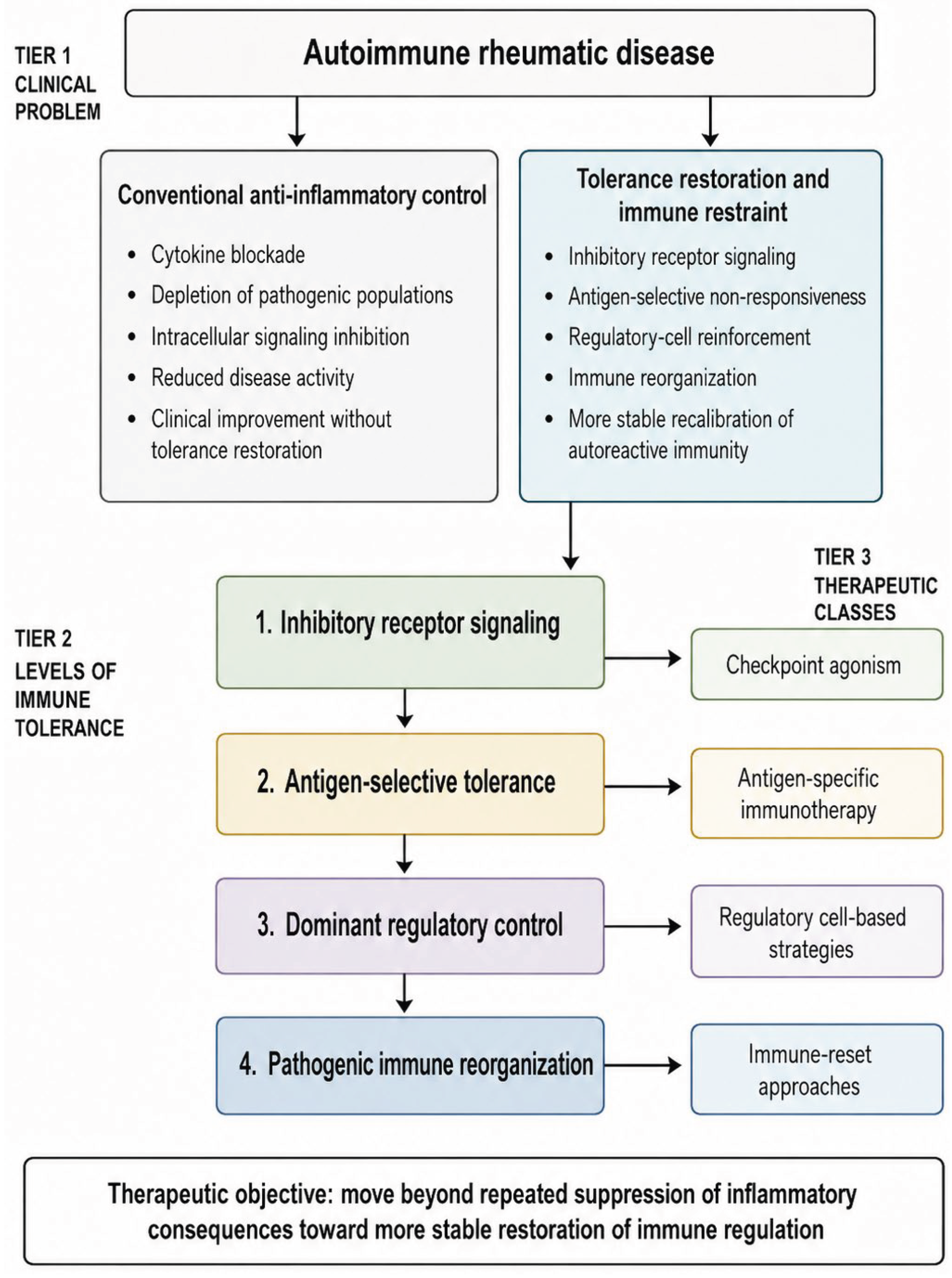
Figure 2.
Platform categories in antigen-specific immunotherapy for autoimmune rheumatic disease. Defined antigen formulations, context-engineering delivery systems, and cell-mediated tolerogenic presentation strategies differ in how self-antigen is delivered and how tolerogenic immune recognition is promoted, but share the objective of re-establishing antigen-selective immune restraint while preserving broader protective immunity.
Figure 2.
Platform categories in antigen-specific immunotherapy for autoimmune rheumatic disease. Defined antigen formulations, context-engineering delivery systems, and cell-mediated tolerogenic presentation strategies differ in how self-antigen is delivered and how tolerogenic immune recognition is promoted, but share the objective of re-establishing antigen-selective immune restraint while preserving broader protective immunity.
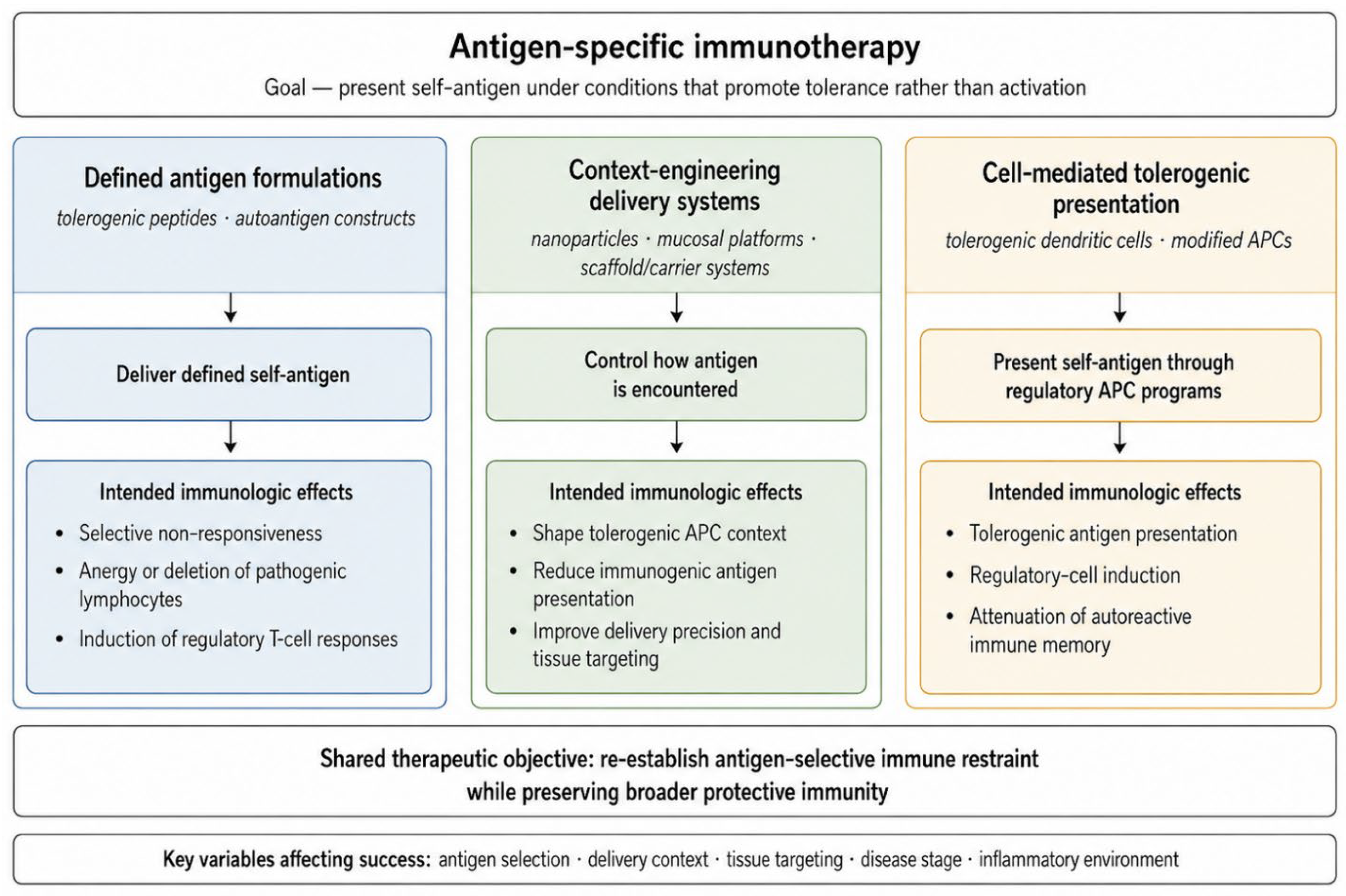

Table 1.
Comparative features of regulatory cell-based strategies in autoimmune rheumatic disease.
| Strategy | Core therapeutic mechanism | Intended biological effect | Translational maturity | Major advantages | Key biological constraints |
|---|---|---|---|---|---|
| Endogenous in vivo Treg expansion/support | Enhances or stabilizes native regulatory populations within the host | Reinforce existing dominant immune restraint without cell transfer | Earliest clinical evaluation among regulatory approaches | Avoids ex vivo cell manufacturing; may preserve physiologic regulatory networks; potentially lower procedural burden | Limited control over specificity; may be insufficient if endogenous Tregs are unstable or functionally impaired; depends on permissive inflammatory environment |
| Ex vivo polyclonal Treg expansion and adoptive transfer | Isolates, expands, and reinfuses regulatory T cells to restore suppressive capacity more directly | Increase regulatory-cell number and function in patients with insufficient endogenous control | Early clinical and translational development | More direct augmentation of suppressive function; greater control over cell product than in vivo expansion | Lineage instability; limited persistence; trafficking and tissue-access challenges; variable activity in inflamed tissue |
| Engineered CAR-Treg approaches | Genetically engineers regulatory T cells for enhanced antigen specificity, tissue targeting, or suppressive potency | Combine dominant immune regulation with selective recognition at relevant antigenic or tissue sites | Earlier than polyclonal/adoptive Treg strategies; limited autoimmune rheumatic disease-specific clinical visibility | Greater theoretical specificity; improved tissue targeting; potentially stronger local regulatory effect | Manufacturing complexity; safety uncertainty; engineered-cell stability; uncertain long-term behavior in autoimmune inflammatory environments |
Table 2.
Comparative features of immune-reset strategies in autoimmune rheumatic disease.
| Strategy | Core therapeutic mechanism | Intended disease setting | Current evidence profile | Clinical visibility | Major advantages | Major risks / burdens | Key translational limitation |
|---|---|---|---|---|---|---|---|
| Hematopoietic stem cell transplantation (HSCT) | Profound immune ablation or suppression followed by immune reconstitution to interrupt autoreactive repertoire continuity | Severe, refractory, or high-risk autoimmune rheumatic disease | Historical clinical experience in selected severe autoimmune settings; still limited by patient selection and long-term uncertainty | Established historical precedent, but selective use | Provides the clearest historical model of deep immune reset; may achieve broader immune reconstitution than narrower targeted approaches | Conditioning toxicity, infection risk, organ vulnerability, procedural morbidity, substantial treatment burden | Whether reconstituted immunity is sufficiently stable, less autoreactive, and durable enough to justify high procedural risk |
| CAR-T-based immune reset | Targeted depletion of pathogenic immune compartments, particularly B-cell or plasma-cell populations, with the goal of inducing broader post-depletion immune reorganization | Severe, refractory, or high-risk disease, especially autoantibody-driven settings such as severe lupus-spectrum disease | Early clinical investigations and patient-level reports; strongest recent visibility among the four therapeutic pillars, but still early | Highest recent patient-level clinical visibility, particularly in severe systemic lupus erythematosus | More targeted than HSCT; strong recent clinical momentum; potential for deeper reset than conventional depletion alone | Manufacturing complexity, resource intensity, immune reconstitution uncertainty, acute and delayed toxic effects | Early but still insufficient evidence base; uncertain durability, generalizability, and long-term safety across heterogeneous rheumatic diseases |
Table 3.
Biomarker categories and their potential relevance to tolerance-restoring strategies in autoimmune rheumatic disease.
Table 3.
Biomarker categories and their potential relevance to tolerance-restoring strategies in autoimmune rheumatic disease.
| Biomarker category | Representative examples | What the biomarker may indicate biologically | Potential relevance to therapeutic selection |
|---|---|---|---|
| Circulating immune-state markers | Regulatory-to-effector T-cell ratio; circulating plasmablast frequency; exhausted T-cell populations; defective PD-1 or CTLA-4 signaling on autoreactive lymphocytes | Whether disease is dominated by effector activation, regulatory insufficiency, persistent memory responses, or defective inhibitory signaling | May help identify settings in which checkpoint agonism, regulatory cell-based strategies, or deeper immune reset are more biologically coherent |
| Serologic markers | Anti-CCP and rheumatoid factor; anti-dsDNA and anti-Sm; anti-Ro and anti-La; anti-topoisomerase I and anti-centromere antibodies | Degree and pattern of autoantibody-driven pathology, antigenic architecture, disease heterogeneity, and likely B-cell/plasma-cell contribution | May help distinguish disease subsets more compatible with antigen-specific approaches, immune-reset logic, or therapies targeted to persistent autoreactive humoral architecture |
| Inflammatory and tissue-context markers | Type I interferon signature; IL-6; IL-17; BAFF; tissue-derived markers of synovial, glandular, or fibrotic activity | Whether disease remains immunologically active and reversible, or whether tissue pathology has become more autonomous; whether systemic versus compartment-specific inflammatory programs dominate | May help determine therapeutic timing, distinguish earlier versus later intervention windows, and judge whether immune-restorative therapy is still biologically plausible |
Table 4.
Disease-specific therapeutic fit of tolerance-restoring strategies across major autoimmune rheumatic diseases.
Table 4.
Disease-specific therapeutic fit of tolerance-restoring strategies across major autoimmune rheumatic diseases.
| Disease | Dominant disease architecture | Most plausible tolerance-restoring strategy or strategies | Key timing consideration | Main translational barrier |
|---|---|---|---|---|
| Rheumatoid arthritis | Persistent adaptive immune activation in a tissue-focused synovial inflammatory compartment, with autoreactive T-cell help, B-cell participation, autoantibody formation, and organized synovial pathology | Checkpoint agonism and regulatory cell-based strategies are especially coherent; antigen-specific immunotherapy remains conceptually attractive if relevant antigenic targets can be defined | Likely most plausible while synovial immune activation remains biologically active and tissue pathology is still immunologically tractable | Heterogeneous serologic and synovial states may limit precise antigen selection and biomarker-guided matching |
| Systemic lupus erythematosus | Systemic loss of tolerance with chronic B-cell/plasma-cell activity, immune-complex pathology, broad immune dysregulation, and persistent autoreactive immune memory | Immune-reset approaches have particular relevance in severe disease; checkpoint agonism and regulatory cell-based strategies may be more plausible when residual regulatory circuitry remains recoverable | Most relevant in severe or refractory disease, especially where autoreactive immune memory and B-cell-driven persistence remain dominant | Broad autoantigen heterogeneity and systemic immune complexity make selective immune re-education more difficult |
| Sjögren’s disease | Tissue-compartmentalized glandular immune pathology with chronic local infiltration, epithelial-immune interaction, B-cell activation, autoantibody-associated disease, and regulatory imbalance | Regulatory cell-based strategies and selected checkpoint-oriented approaches appear conceptually appealing; antigen-specific approaches may also be relevant if true disease-sustaining targets can be defined | Likely most plausible when active immune dysregulation still dominates over irreversible glandular dysfunction | Difficulty distinguishing true pathogenic drivers from broader serologic autoimmunity and established glandular damage |
| Systemic sclerosis | Immune dysregulation tightly interwoven with vasculopathy and fibrosis, with progressively less reversible tissue remodeling over time | Checkpoint agonism and regulatory cell-based strategies may be more coherent in earlier inflammatory states; immune-reset approaches may be reserved for highly selected severe cases | Timing is critical; most plausible earlier, before fibrosis and vascular remodeling become relatively autonomous | Established tissue remodeling and partial irreversibility may limit the impact of immune recalibration even when immune abnormalities persist |
Table 5.
Major translational barriers across tolerance-restoring therapeutic strategies in autoimmune rheumatic disease.
Table 5.
Major translational barriers across tolerance-restoring therapeutic strategies in autoimmune rheumatic disease.
| Barrier | Checkpoint agonism | Antigen-specific immunotherapy | Regulatory cell-based strategies | Immune-reset approaches |
|---|---|---|---|---|
| Biological uncertainty | Which inhibitory pathway is truly deficient, therapeutically relevant, and still recoverable in a given disease state | Dominant pathogenic antigens may be uncertain, heterogeneous, or altered by epitope spreading | Whether regulatory insufficiency is quantitative, qualitative, or tissue-restricted may be difficult to define | Which pathogenic immune compartments must be disrupted to produce durable reset may vary across diseases and stages |
| Disease heterogeneity | Pathway relevance likely differs across diseases, immune states, and disease stages | Antigenic targets and tolerogenic context may differ across patients, tissues, and stages | Product performance may vary by disease environment, inflammatory state, and tissue accessibility | Reset may be more effective in some disease architectures than others, particularly autoantibody-driven versus fibrosis-dominant disease |
| Safety | Risk of excessive inhibitory signaling, impaired host defense, and broader immune imbalance | Risk of converting a tolerogenic intervention into an immunogenic one under inflammatory conditions | Risk of lineage instability, incomplete persistence, off-target effects, or maladaptive behavior in inflamed tissue | Risk of profound immune perturbation, procedural toxicity, infection, and uncertain long-term immune reconstitution |
| Durability | Uncertain whether reinforced inhibitory signaling can produce lasting control | Difficulty sustaining antigen-specific tolerance in established or chronically inflamed disease | Uncertain persistence, lineage stability, and long-term suppressive function after transfer | Uncertain whether post-reset immune state remains durably less autoreactive over time |
| Manufacturing / delivery | Less burdensome than cell therapies but still dependent on viable agonist platform design and dosing strategy | Delivery context, formulation, carrier design, and tissue targeting remain technically demanding | Major barriers in cell isolation, expansion, product definition, reproducibility, and tissue delivery | High manufacturing complexity, resource intensity, procedural burden, and specialized delivery infrastructure |
| Clinical trial design | Hard to identify the right biomarkers, patient subsets, and proof-of-mechanism endpoints | Difficult to link antigen-specific effects to conventional rheumatologic endpoints | Difficult to measure success when intended effects may be gradual and mechanistic rather than rapidly clinical | Difficult to evaluate in small, highly selected severe-disease cohorts with high baseline complexity |
| Regulatory complexity | Requires clear potency and safety definition for pathway-agonist platforms | Requires regulatory confidence that antigen-specific modulation is reproducible and non-immunogenic | Advanced cell products raise challenges in product characterization, potency definition, and long-term monitoring | Especially high for intensive cellular or transplant-like interventions because of reproducibility, long-term surveillance, and delayed risk |
Disclaimer/Publisher’s Note: The statements, opinions and data contained in all publications are solely those of the individual author(s) and contributor(s) and not of MDPI and/or the editor(s). MDPI and/or the editor(s) disclaim responsibility for any injury to people or property resulting from any ideas, methods, instructions or products referred to in the content. |
© 2026 by the authors. Licensee MDPI, Basel, Switzerland. This article is an open access article distributed under the terms and conditions of the Creative Commons Attribution (CC BY) license.
Copyright: This open access article is published under a Creative Commons CC BY 4.0 license, which permit the free download, distribution, and reuse, provided that the author and preprint are cited in any reuse.


