

Submitted:
07 June 2026
Posted:
09 June 2026
You are already at the latest version
Abstract
Notch signaling has long been understood to be shaped by post-transcriptional regulation, yet the contribution of RNA chemical modification has only recently begun to be resolved with mechanistic clarity. In this review, an updated account of epitranscriptomic regulation of Notch signaling is provided, with emphasis placed on how RNA networks influence the processing, localization, stability, translation, and editing of transcripts encoding receptors, ligands, modulators, and downstream effectors. The available evidence is evaluated according to mechanistic strength to distinguish direct transcript-level regulation from broader pathway-associated or enrichment-based observations. Across developmental systems, stem cell states, cancer, neurological contexts, and immune or inflammatory settings, Notch activity is considered not only in terms of signaling intensity, but also through its temporal dynamics, persistence, and activation thresholds. Particular attention is given to the predominance of N6-methyladenosine (m6A)-based studies, while evidence for other RNA modifications is examined more cautiously. By integrating a fragmented and methodologically uneven body of literature, this Review proposes a framework for separating validated epitranscriptomic regulation of Notch components from correlative pathway rewiring, in order to define the experimental standards needed to strengthen mechanistic inference and translational relevance.
Keywords:
epitranscriptomics
; Notch signaling
; RNA modifications
; post-transcriptional regulation
; stem cells
; cancer
; RNA stability
; translational control
1. Introduction
Notch pathway is a developmentally conserved metazoan signaling pathway that mediates signaling between neighboring cells. The Notch receptor is activated by two families of canonical ligands including Delta-like and Serrate/Jagged. The both ligands and receptors are single-pass transmembrane proteins that usually contain large extracellular domains, relative to their intracellular portions [1,2]. Ligand binding triggers sequential proteolytic cleavages that release the Notch intracellular domain (NICD), which subsequently translocates to the nucleus and redirects transcription through a regulatory complex centered on Recombination Signal Binding Protein For Immunoglobulin Kappa J Region (RBPJ) and associated co-activators [1,2]. Canonical pathway output is commonly monitored through induction of HES and HEY family genes; however, the biological consequence of Notch activation is not ordered by this transcriptional core alone [1]. Depending on cellular composition, tissue organization, ligand availability, and signaling duration, Notch activity may instead support lineage specification, regenerative responses, tissue boundary maintenance, or malignant persistence [2,3]. Therefore, Notch is now viewed less as a linear signaling cascade than as a contact-dependent communication system whose functional output is determined by spatial and temporal cues [2,3]. The fundamental aspects of ligand–receptor interaction, sequential proteolysis, and NICD-mediated transcriptional output are depicted schematically in Figure 1, which also highlights the primary epitranscriptomic regulatory sites within the system.
The contextual plasticity of Notch signaling has long been attributed to mechanisms operating at the protein level, including receptor trafficking, ligand endocytosis, proteolytic processing, and the availability of nuclear cofactors [1,2]. Post-transcriptional control of Notch signaling had already been established through alternative splicing, RNA-binding proteins, and non-coding RNAs [4,5,6].The regulation of NUMB as a key antagonist of Notch signaling is among the best-characterized examples. Alternative isoform usage has been shown to influence the capacity of NUMB to suppress pathway activity, while translational repression of NUMB transcripts by Musashi-family RNA-binding proteins has been linked to the maintenance of stem-like states in malignancies characterized by persistent Notch activation [4,5]. By altering exon selection, intron retention, and alternative 3’-end formation, RNA modifications can change the abundance and isoform composition of Notch transcripts before protein-level feedback becomes evident[2,7,8]. Current evidence in this area is highly dominated by studies of N6-methyladenosine (m6A), whereas mechanistic data linking other RNA modifications, including m5C and adenosine-to-inosine (A-to-I) editing, to Notch signaling remain comparatively limited and less cohesive [7,8,9,10].
In this review, a transcript-centered evidentiary framework is adopted for evaluating the available evidence. “Direct evidence” is defined as evidence showing that perturbation of an RNA-modification layer changes the fate of a defined Notch-related RNA, alters a Notch signaling readout, and produces a linked phenotypic consequence. By contrast, “associative evidence” refers to studies in which modifier expression, transcriptome-wide profiling, or pathway-enrichment analysis is correlated with Notch activity, but direct target assignment or mechanistic rescue remains unresolved [7,8,9,10]. Distinguishing between these categories facilitate understanding whether Notch signaling is being directly regulated, secondarily buffered, or simply co-varied within broader cell-state transitions.
2. RNA Modification Mechanisms Shaping the Notch Transcriptome
Pre-mRNA processing and alternative splicing: RNA modifications can reshape Notch output before translation by altering exon selection, intron retention, and alternative 3′-end formation. In mammalian systems, the nuclear m6A reader YTHDC1 facilitates splice-site selection through coordinated interactions with splicing regulators, promoting recruitment of SRSF3 while limiting access of the exon-skipping factor SRSF10 to overlapping RNA regions [11,12]. Accordingly, germline deletion of YTHDC1 in mouse oocytes leads to widespread abnormalities in alternative splicing and polyadenylation [13]. These abnormalities could be rescued only by reintroduction of wild-type m6A-binding-competent YTHDC1, not by YTHDC1 mutants lacking the m6A-binding domain, which demonstrated that recognition of m6A marks is required for proper exon selection and 3′-end processing [14]. Additionally, YTHDC1 can suppress proximal alternative polyadenylation (APA) site selection through interactions with components of the cleavage machinery, including CPSF6, which favors transcripts with extended 3′ untranslated regions (UTRs) [15,16,17,18]. Through coordinated regulation of pre-mRNA splicing and polyadenylation, YTHDC1 defines the overall transcriptome landscape strictly depending on the presence of m6A marks [14,19,20]. Although Notch signaling changes are frequently observed following perturbation of the m6A machinery, most studies rely on global disruption of epitranscriptomic regulators rather than targeting individual transcripts [21,22,23]. Thus, it is often difficult to distinguish direct regulation of Notch-associated RNAs from indirect effects arising through broader signaling or metabolic networks that converge on Notch activity [24,25,26,27]. However, m6A deposition can destabilize local RNA secondary structures, such as hairpins, exposing previously inaccessible binding motifs for RNA-binding proteins such as HNRNPC and HNRNPG [12,28]. As a result of m6A switch mechanism, m6A can indirectly influence the binding landscape of splicing regulators and alter exon inclusion patterns independently of direct reader engagement in response to various environmental/external cues [29].
Across metazoans and plants, METTL16-family methyltransferases catalyse m6A formation within the conserved ACAGA motif of U6 small nuclear RNA (snRNA) [30,31]. In Arabidopsis, loss of the U6 methyltransferase FIONA1 disrupts recognition of specific 5′ splice-site configurations and causes widespread alterations in exon skipping and intron retention [32]. Structural studies further report that the modified nucleotide within U6 snRNA builds interactions with intronic +4A splice-site motifs during spliceosome assembly [32,33]. When this modification is lost, splice-site usage shifts away from +4A-containing introns toward alternative sequence configurations that can be more efficiently recognized by the unmodified spliceosome [30,34,35]. Collectively, these observations demonstrate that m6A marks on fundamental spliceosomal components can alter competition among splice sites independently of any modification on the pre-mRNA.
Unlike signaling systems that rely on enzymatic amplification cascades, Notch activity scales closely with receptor-ligand interactions occurring at the plasma membrane [36,37]. As a result, relatively modest alterations in the abundance or composition of receptors (Notch1–4) and ligands (Dll1, Dll3, Dll4, Jagged1, Jagged2) can substantially alter signaling intensity [38,39]. Moreover, developmental patterning by Notch is tightly regulated by the stoichiometry and structural diversity of its receptors and ligands, NOTCH1-4, DLL, and JAG family members, which frequently rely on complex alternative splicing programs to generate isoforms with distinct signaling properties [32,40,41,42,43].
In non-small cell lung cancer, RBM5, RBM6, and RBM10 exert opposing effects on NUMB exon 9 inclusion, which can shift the balance between isoforms with different capacities to restrain proliferation and Notch activity [44,45]. RBM10 promotes exon 9 skipping and facilitates production of a NUMB isoform that can enhance ubiquitination and degradation of the NICD, while increased exon 9 inclusion correlates with reduced NUMB function and elevated expression of Notch target genes [4,46]. Loss-of-function mutations in RBM10 further reinforce exon 9 inclusion, which is associated with enhanced Notch signaling and tumor progression [44,47].
Further layers of regulation extend this NUMB-centered splicing paradigm into other developmental and cellular contexts [40,48]. During neuronal differentiation, RBM4 promotes exclusion of NUMB exon 9 while modulating exon 3 usage and generating isoform combinations that guide neurite extension and cell-fate specification [48,49]. Furthermore, in muscle stem cells, RBFOX2-dependent alternative splicing of NUMB exon 6 has been shown to facilitate cell-cycle entry through calibration of Notch activity [40]. Accordingly, exon-specific regulation of NUMB functions as a molecular rheostat for calibrating Notch signaling strength across diverse biological settings [40,48].
Nuclear export and subcellular localization: The nuclear reader YTHDC1 promotes export of methylated RNAs by coordinating with the export factors SRSF3 and NXF1 [14,50]. This regulatory axis has been implicated in the transport of m6A-marked Notch1 and Notch2 mRNAs to the cytoplasm [51]. Within stress-responsive nuclear condensates, particularly during recovery from heat stress, m6A-marked HSATIII long noncoding RNAs recruit the METTL3/METTL14 writer complex and YTHDC1 into nuclear stress bodies (nSBs) [16,52]. This sequestration effectively acts as a molecular sponge, depleting these factors from the surrounding nucleoplasm and, in turn, suppressing global m6A-dependent pre-mRNA splicing and 3′-end processing [52]. Accordingly, m6A regulators can define narrow temporal windows for transcript maturation and export, including transcripts within the Notch pathway [51,52].
Transitions between cell states are likewise tightly regulated by the selective nuclear export and translational engagement of m6A-modified RNAs [53,54]. In pulmonary fibrosis models, YTHDC1 promotes nuclear release of the profibrotic lnc668 through assembly of an SRSF3-ALYREF-XPO5 export complex, which illustrates the reinforcement of pathological state changes via epitranscriptomic export programs [54]. In hematopoietic stem and progenitor cells (HSPCs), METTL3 and YTHDF3 support lineage progression in part by enhancing translation of Ccnd1, while METTL3-dependent methylation of Notch1 contributes to early specification of hematopoietic progenitors from endothelial cells [53,55,56]. Collectively, these findings indicate that m6A-controlled nucleocytoplasmic trafficking and translational activation help coordinate the timing of responses to lineage-defining cues.
mRNA stability and decay: The strongest evidence for epitranscriptomic regulation of Notch currently lies at the level of transcript stability. In zebrafish, the endothelial-to-hematopoietic transition (EHT) depends on METTL3-mediated m6A deposition and subsequent YTHDF2-mediated decay of notch1a mRNA [57]. High-resolution mapping approaches, including MeRIP-seq and miCLIP-seq, have shown that notch1a and rhoca mRNAs carry m6A modifications positioned near their stop codons [57,58,59]. Loss of METTL3 reduces m6A abundance, stabilizes notch1a transcripts, prolongs Notch activity in arterial endothelium, and impairs HSPCs emergence [57,60]. Comparable results in ythdf2-deficient embryos support a direct METTL3–m6A–YTHDF2 axis in controlling notch1a transcript turnover, while rescue with wild-type YTHDF2, but not an m6A-binding-defective mutant, further strengthens this interpretation [57,60,61].
A related but context-dependent pattern has been described for NOTCH1 in vascular smooth muscle cells and leukemia [62]. In human aortic smooth muscle cells, METTL3 deposits m6A within the 3’ UTR of NOTCH1 mRNA and promotes an interaction with YTHDF2, which accelerates transcript decay [63]. The reduced abundance of NOTCH1 contributes to a proliferative, dedifferentiated phenotype associated with thoracic aortic dissection [64,65]. In contrast, in T-cell acute lymphoblastic leukemia, m6A-modified NOTCH1 transcripts are recognized by IGF2BP2 rather than YTHDF2, which stabilizes the mRNA and sustains oncogenic Notch signaling [62,66]. Genetic or pharmacological suppression of IGF2BP2 reduces NOTCH1 expression and restrains leukemic growth, which reflects the functional importance of reader identity [62]. By contrast, in epithelial contexts, the YTHDF2 participates as a brake on Notch signaling by promoting degradation of Notch1 mRNA; furthermore, depletion of YTHDF2 or METTL3 stabilizes the transcript, increases NICD abundance, and elevates HES1 and HES5 expression [67].
A similar principle applies to NOTCH3 in nasopharyngeal carcinoma, where IGF2BP3 functions as a stabilising reader that preserves NOTCH3 mRNA and supports invasive behaviors [68]. Although nucleotide-level mapping is less complete than in some developmental systems, RNA immunoprecipitation (RIP), actinomycin D chase, and rescue experiments indicate that this effect depends on m6A [68,69]. By antagonizing CCR4-NOT-mediated deadenylation, IGF2BP3 extends transcript half-life and maintains Notch3 pathway activity [26,68].
Translational control: Translational control represents another direct point at which epitranscriptomic regulation can shape Notch output. In regenerating skeletal muscle, METTL3-dependent m6A deposition increases the translation efficiency of selected regeneration-associated transcripts without matching changes in mRNA abundance, consistent with a rate-setting effect on early pathway activation [70]. Conditional loss of METTL3 in muscle stem cells impairs satellite cell expansion and delays regeneration, while METTL3 overexpression accelerates myoblast proliferation and shortens the regenerative program [70]. Ribosome profiling and reporter assays indicate that this effect reflects preferential enhancement of translation rather than transcript accumulation [51]. Although the majority of the studies have focused on myogenic regulators, the same mechanism is well suited to dosage-sensitive pathways such as Notch, where relatively small changes in protein synthesis could have marked functional consequences [71,72,73].
A closely related mechanism operates in hematopoietic stem cells (HSCs), where METTL3-dependent m6A modifications influence the translational output of key cell-cycle and metabolic regulators and thereby affect fate decisions [74,75]. Accordingly, loss of METTL3 leads to a significant defect in Ccnd1 translation despite little change in mRNA abundance [53,76]. Notably, m6A modification within the 5′ UTR is interpreted by YTHDF3, which recruits translation initiation factors, including PABPC1 and eIF4G2, to promote protein synthesis [26,53,76]. Rescue experiments in which Ccnd1 re-expression restores the phenotype of YTHDF3-deficient cells, and partially corrects the METTL3-deficient state, support a direct translational role for this pathway [53]. These observations show that m6a readers selectively amplify translational output, which governs stem cell competence.
Disease models provide direct evidence that translational control intersects with Notch signaling. In hepatocellular carcinoma (HCC), YTHDF1 binds m6A-modified NOTCH1 mRNA and elevates its translational efficiency and stability, which affect tumor-initiating capacity and self-renewal [77]. Polysome profiling shows enhanced ribosome loading, while actinomycin D chase experiments indicate reduced transcript decay [77,78]. Moreover, re-expression of NOTCH1 in YTHDF1-depleted cells restores sphere formation and resistance to tyrosine kinase inhibitors, demonstrating that NOTCH1 is a proximal functional target of this reader [77]. In this context, m6A-decorated NOTCH1 serves as a direct translational substrate whose increased protein output maintains a Notch-dependent cancer stem cell population [77].
RNA editing impacts: Despite the lack of direct evidence, A-to-I RNA editing mediated by the ADAR enzymes family is capable of altering coding potential, RNA structure, splice choice, and miRNA targeting, and therefore remains mechanistically relevant to Notch biology in principle [7,79]. Large-scale sequencing studies across normal tissues and cancers have mapped millions of such editing events and consistently found that transcripts belonging to the Notch signaling network are highly enriched among edited targets [80,81,82,83]. These global patterns often correlate with stemness-related or oncogenic transcriptional programs [84]. However, site-resolved, rescue-validated evidence that a specific editing event in a canonical Notch receptor, ligand, or effector alters signalling output is still lacking [82,84,85]. Unlike m6A, which is deposited at relatively tractable sequence contexts, A-to-I editing depends on structured double-stranded RNA regions; therefore, functionally validating individual sites within large transcripts such as NOTCH1 is likely to be difficult [82,86]. Of note, editing may influence Notch indirectly by reshaping intersecting pathways, including immune and cytokine signaling modules that modulate Notch signaling indirectly [87,88].
It has been indicated that ADAR-mediated edits have the potential to rewire the epitranscriptome by creating or eliminating microRNA-binding motifs in the 3′ UTR, recoding amino acids within key functional domains, or reshaping local RNA structure to influence splicing and the recruitment of RNA-binding reader proteins [89,90]. Future investigations should combine high-resolution editome profiling with targeted analysis of core Notch components, including NOTCH, DLL, JAG, HES, and HEY transcripts [91,92,93]. Functional validation will also be needed through editing-mimic and editing-dead reporters, along with ADAR knockdown and rescue experiments, to determine direct mechanistic causality [89,94,95].
Mechanistic checklist for direct targeting: A Notch transcript should be classified as a direct epitranscriptomic target only when four elements are satisfied: site-resolved mapping of the modification on the RNA, evidence that perturbation of a writer, eraser, or reader alters transcript fate, demonstration of a corresponding change in Notch signaling output, and transcript-specific rescue or epistasis experiments confirming causality [7,57,77]. In the absence of this sequence of evidence, pathway-level association should remain provisional. In zebrafish hematopoietic development, METTL3 and YTHDF2 regulation of notch1a mRNA stability, has been supported by transcript-level mapping, functional perturbation, and rescue using m6A-insensitive reporter constructs [22,60]. Similarly, in HCC, integrated profiling approaches demonstrated that YTHDF1 directly enhances translation of m6A-modified NOTCH1, while restoration of NOTCH1 expression rescues the stem-like and drug-resistant phenotypes observed after YTHDF1 depletion [77]. In nasopharyngeal carcinoma, the stabilizing interaction between IGF2BP3 and NOTCH3 mRNA was further validated using GGAC-mutant reporters that disrupt m6A-reader recognition motifs [68]. Transcripts associated with Notch that presently satisfy or roughly approximate this four-step evidential requirement across developmental, cancer, epithelial, and immunological settings are presented in Table 1.
By contrast, mounting evidence offers only partial mechanistic coverage. In thoracic aortic smooth muscle cells, METTL3-dependent methylation and YTHDF2-mediated degradation of NOTCH1 have been mapped, yet full rescue experiments employing m6A-insensitive NOTCH1 constructs have not been reported [96,97]. In cerebral arteriovenous malformations, reduced METTL3 expression correlates with altered expression of Notch-associated ubiquitin ligases, including DTX1 and DTX3L, yet the directly modified transcripts remain unresolved at nucleotide level [98,99].

Table 1.
Overview of the most compelling transcript-resolved instances when a specific RNA alteration or reader directly influences a Notch-pathway transcript. Columns represent biological environment, changed transcript, writer/reader or enzyme, RNA destiny, downstream Notch output, functional consequence, and proof robustness. Examples include zebrafish EHT, HCC, NPC, T-ALL, epithelial cells, and γδ T-cell development.
Table 1.
Overview of the most compelling transcript-resolved instances when a specific RNA alteration or reader directly influences a Notch-pathway transcript. Columns represent biological environment, changed transcript, writer/reader or enzyme, RNA destiny, downstream Notch output, functional consequence, and proof robustness. Examples include zebrafish EHT, HCC, NPC, T-ALL, epithelial cells, and γδ T-cell development.
| Biological context | Modified transcript | Writer /Reader /Eraser |
RNA fate | RNA modification | NOTCH output | Ref |
|---|---|---|---|---|---|---|
| Zebrafish EHT | Notch1a | METTL3 (WRITER) YTHDF2 (READER) |
m6A-dependent | Block EHT/HSPC emergence | Reduced | [57] |
| HCC | Notch1 | YTHDF1 (READER) | m6A-translation | Promote cancer stemness/tumor growth/therapy resistant | Increased | [77,78,112] |
| T-ALL | Notch1 | IGF2BP3 (READER) | m6A-stability/maintenance | Proliferation/leukemia survivor | Increased | [63] |
| NPC | Notch3 | IGF2BP3 (READER) | m6A-dependent | metastatic potential/promote stemness invasion | Increased | [68,69] |
| Epithelial cells | Notch1 | METTL3/14 (WRITER) YTHDF2 (READER) |
m6A-associated | Control epithelial stem-cell homeosteosis /limit Hes1/5 | Reduced | [67,108,109,111] |
| Yδ T Cells | Jagged1/Notch2 | ALKBH (ERASER) | m6A-mediated | Expands precursors / alters host defense | Reduced | [162,163] |
3. Notch Control in Development and Tissue Stem Cell Programs
Studies on zebrafish embryos have demonstrated that METTL3-dependent m6A deposition promotes YTHDF2-mediated decay of notch1a mRNA, which leads to preventing persistent arterial-endothelial Notch activity and permitting HSPCs emergence [57]. MeRIP-seq and miCLIP-seq revealed m6A enrichment near the stop codons and within the 3′ UTR of notch1a and rhoca transcripts [57,100]. When METTL3 is lost, these mRNAs escape YTHDF2-dependent turnover, which leads to sustained Notch signaling that blocks EHT and prevents HSPC formation [57,100]. Notably, genetic ablation of ythdf2 produces a similar phenotype, while YTHDF2 overexpression restores HSPC formation [60]. A comparable principle observed in the mouse aorta-gonad-mesonephros (AGM) niche reflected that endothelial deletion of METTL3 impairs definitive hematopoiesis, reduces long-term repopulating HSPCs, and is accompanied by increased expression of Notch genes, including notch1 and hes1 [101,102,103]. Although these findings reveal an accumulation of m6A-dependent control of Notch, the underlying mammalian transcripts have yet to be resolved with the same nucleotide-level precision achieved in zebrafish [104].
A similar principle extends to adult muscle regeneration, where METTL3-dependent m6A in satellite cells promotes proliferative expansion and efficient repair after injury by enhancing translation of selected Notch-pathway transcripts through YTHDF1 [70]. After acute muscle damage, METTL3 expression and global m6A abundance elevate during the early proliferative phase and decline as myogenic differentiation progresses [23,70,105]. MeRIP-seq and polysome profiling indicate that transcripts encoding Notch2, Jag1, RBPJ, and MAML1 are among the methylated targets whose translational efficiency increases without major changes in steady-state mRNA abundance [70,105]. As a result, YTHDF1 can reinforce ribosome loading on these transcripts, while YTHDF2 participates in terminating the proliferative programme by promoting decay of selected anti-myogenic mRNAs such as TM4SF1 [106]. Collectively, these data support that m6A-dependent pathways can operate as a temporal gain module by amplifying signaling to initiate a robust regenerative response, as well as engaging selective mRNA clearance to enable terminal differentiation.
Direct epitranscriptomic targeting of Notch transcripts remains less well defined in epithelial stem compartments [107]. In the intestinal epithelium, loss of METTL3 or METTL14 disrupts stem cell homeostasis and alters both Wnt and Notch pathway activity, however, current evidence mainly supports indirect regulation through upstream negative regulators such as Grb10 and Ifrd1 rather than direct modification of Notch receptors or ligands [108,109,110]. Similarly, in the skin, m6A is clearly required for epidermal and follicular development, yet the most firmly established direct targets are chromatin regulators and lineage factors rather than major Notch components [111]. These settings are therefore best regarded as biologically plausible but still transcript-unassigned with respect to direct epitranscriptomic control of Notch [109,111].
4. Epitranscriptomic Notch Rewiring in Cancer and Cancer Stem Cells
Stemness and self-renewal: HCC provides an example of reader-dependent NOTCH1 translation, which supports stemness and sustained tumor-initiating properties. Importantly, rescue by NOTCH1 re-expression placed Notch as a proximal effector rather than a secondary correlate [77]. Related observations in colorectal cancer revealed that elevated YTHDF1 expression is similarly associated with enhanced tumor sphere formation and self-renewal capacity [77,112,113]. Additionally, pan-cancer transcriptomic surveys indicate that elevated expression of YTH family readers, particularly YTHDF1 and YTHDF2, is frequently associated with adverse prognosis and remodeled immune microenvironments across a wide range of tumor types [114,115,116,117]. However, the majority of these larger datasets remain correlative and do not establish defined transcript-level regulation of Notch components across all tumor contexts.
Therapy resistance: The YTHDF1-NOTCH1 axis in HCC can directly contribute to therapeutic resistance; depletion of YTHDF1, and enhanced sensitivity to Lenvatinib and Sorafenib, while enforced expression of NOTCH1 causes resistance [77].In other malignancies, the relationship between epitranscriptomic regulation and therapy resistance appears less straight. For instance, in acute myeloid leukemia and related hematologic cancers, m6A-associated resistance programs are more often linked to stress-response, metabolic, or DNA-repair networks that potentially influence Notch activity indirectly instead of targeting Notch transcripts [118,119,120,121,122].
Invasion and metastasis: Direct epitranscriptomic regulation of Notch can also contribute to metastatic progression. In nasopharyngeal carcinoma, IGF2BP3 binds m6A-modified NOTCH3 transcripts, which suppresses their deadenylation and prolongs transcript stability, in order to extend Notch3 signaling and promote metastatic behavior [68]. Loss of IGF2BP3 reduces stem-like properties and impairs metastatic outgrowth, which supports a direct functional connection between reader-dependent NOTCH3 stabilization and tumor dissemination [68]. Collectively, these observations highlight that under homeostatic conditions, YTHDF2 generally acts as an intrinsic brake by accelerating NOTCH1 mRNA decay [67], while pathological upregulation of readers such as IGF2BP3 can override this repressive layer, thereby sustaining oncogenic Notch activity and enabling persistent metastatic behavior [26,68].
Notch as a primary driver versus a downstream pathway: Studies on lung adenocarcinoma have indicated that IGF2BP3 can stabilize m6A-modified MCM5 mRNA, which protects NICD1 protein during partial epithelial- mesenchymal transition (EMT) and metastatic plasticity [123,124]. Elevated MCM5 protein interferes with SIRT1-mediated deacetylation of NICD1, indirectly stabilizing Notch signaling and promoting metastatic plasticity [123]. Similar upstream rewiring mechanisms may also operate through m6A-dependent regulation of ubiquitin ligases or other modulators that control NICD turnover. Epitranscriptomic circuits can influence Notch output by acting on transcripts encoding E3 ubiquitin ligases such as WWP2, which oversee proteasomal degradation and nuclear turnover of NICD [67,125,126]. In these systems, Notch signaling is clearly reshaped by epitranscriptomic regulation; however, the immediate modified transcripts lie outside the canonical pathway [125,127,128]. Identifying direct transcript targeting from indirect upstream rewiring has important therapeutic implications [129,130].
When Notch receptors or ligands constitute the primary m6A-regulated transcripts, as in HCC or nasopharyngeal carcinoma, targeting relevant readers or writers may achieve relatively focused suppression of Notch-dependent phenotypes [68,131]. By contrast, when Notch behaves as a downstream passenger of an m6A-modified regulator, manipulating the m6A machinery is likely to produce pleiotropic and less predictable effects [132,133,134,135]. In this regard, direct pharmacologic blockade of Notch signaling, including γ-secretase inhibitors or receptor-targeting antibodies, may offer a more selective approach [136,137]. Accordingly, classifying cancer studies into models of direct transcript targeting versus indirect upstream rewiring is crucial for identifying settings in which Notch serves as a primary epitranscriptomic driver rather than a secondary passenger within wider m6A-governed networks [68,136].
5. Notch Regulation in the Nervous System and Brain Disease
Glioma and glioblastoma: In glioma and glioblastoma (GBM), Notch signaling is well established as a determinant of stemness, tumor maintenance, and therapy resistance [138]. Epitranscriptomic regulators are also functionally active in glioma stem-like cells, but the mapped targets identified so far have predominantly been non-Notch RNAs, including FOXM1, LINC00900, MYC, VEGFA, SOX2, and related stemness-associated transcripts [139,140,141,142,143,144]. Accordingly, the current literature supports epitranscriptomic rewiring in a Notch-relevant disease state, but transcript-resolved evidence of direct Notch targeting in most glioma models remains limited [138,145]. One recent study suggests that METTL3 may directly influence NOTCH3, DLL3, and HES1 transcripts to promote glioma initiation [145,146,147].
Other nervous-system and brain-disease contexts: Cerebral arteriovenous malformation is one of the neurological examples in which epitranscriptomic regulation converges on a defined Notch-modulating node [99,148]. In this condition, loss of METTL3 destabilizes DTX3L transcripts, which can disrupt the DTX1-DTX3L ubiquitin-ligase complex that normally restrains Notch activity [99]. The resulting persistence of Notch signaling alters endothelial angiogenic behavior and can be partially reversed by pharmacological Notch inhibition [99]. Although the modified RNA is not a canonical receptor or ligand transcript, the effect still represents a route by which RNA methylation influences Notch-dependent vascular pathology [99]. However, neurodevelopmental studies have not yet mapped m6A sites on NOTCH1/2, DLL ligands, or HES/HEY transcripts with the same transcript-level precision achieved in hematopoietic or muscle systems, and reader-dependent rescue of specific Notch transcripts remains unproven [149,150,151].As a result, epitranscriptomic mechanisms that impact Notch during neural development are, for now, best described as associative or pathway-level interactions rather than fully transcript-resolved relationships [152].
Neurodevelopment and neurodegeneration: In Alzheimer’s disease models, reduced FTO expression has been associated with increased m6A on Notch1 mRNA along with elevated Notch1 and HES1 signaling [153,154,155,156]. This apparently paradoxical behavior suggests that m6A-mediated stabilization or improved translation of Notch1 transcripts may contribute to disease-associated gliosis and neuronal dysfunction [157,158,159]. This pattern is compatible with altered transcript stability or translation, but the available data do not include site-resolved mapping, reader identification, or transcript-specific rescue experiments [151,153,160,161].
6. Immune Cell Differentiation and Inflammatory Microenvironments
A strong example of direct evidence for epitranscriptomic control of Notch in immune-lineage specification comes from thymic γδ T-cell development. Accordingly, ALKBH5 restrains m6A accumulation on Jagged1 and Notch2 transcripts, which can preserve their stability and supporting downstream Notch signalling [162,163]. Loss of ALKBH5 increases m6A on these RNAs, accelerates their decay, weakens Notch output, and expands γδ T-cell precursors [163]. Notably, the modified RNAs are pathway components, which links RNA modification, transcript fate, and immune differentiation within a single mechanistic chain [163].
Notch-pathway genes often appear in enriched gene-set signatures after perturbation of m6A regulators; nevertheless, most immune-related association outside the ALKBH5–Jagged1/Notch2 and IGF2BP2–NOTCH1 axes are best classified as indirect [164,165,166,167]. In T-cell acute lymphoblastic leukemia (T-ALL), IGF2BP2 directly stabilizes NOTCH1 mRNA in an m6A-dependent manner, which provides a stronger example of transcript-level Notch regulation in an immune-derived malignancy [62,163,167,168,169]. By contrast, another set of studies identify alternative primary substrates such as MYC or IRF8 [164,165,166,170].
A similar caution applies to inflammatory microenvironments. Notch signaling can organize stromal, vascular, and immune crosstalk in tumors and inflamed tissues, while m6A has been implicated broadly in immune microenvironment homeostasis and immune disease [171,172]. However, cell-resolved causal chains linking RNA modification events to a defined Notch-pathway RNA across interacting stromal, vascular, and immune compartments remain limited [171,172]. In vascular inflammation, for example, m6A regulators often act through non-Notch substrates such as TNFAIP3, EGFR, PI3K, or RIP3, while Notch emerges as a downstream participant in the remodeling response [173,174,175]. Furthermore, modification of these RNAs activates downstream cascades, including NF-κB [173,174]. In abdominal aortic aneurysms and atherosclerosis, m6A machinery controls vascular smooth muscle cell phenotypic switching and inflammatory necroptosis predominantly via non-Notch transcripts such as PI3K and RIP3 [167,173,174]. These observations support biological relevance, but not yet direct assignment of Notch transcripts as the primary modified targets.
7. Mapping Causality and Therapeutic Translation
Across the systems reviewed here, the most convincing epitranscriptomic–Notch connections are those that satisfy four criteria: site-resolved mapping on a specific Notch-pathway RNA, modifier- or reader-dependent alteration of transcript fate, a matched change in Notch signaling output, and transcript-specific rescue or epistasis. Studies meeting this standard show that m6A can either attenuate or reinforce Notch signaling depending on the reader protein engaged in a given context [60,62,67,68,77]. In developmental conditions, METTL3-dependent methylation of notch1a recruits YTHDF2 to promote transcript decay during zebrafish endothelial-to-hematopoietic transition [26,60]. Similarly, in human epithelial cells YTHDF2-mediated degradation of NOTCH1 limits downstream effectors such as HES1 and HES5 [67]. In malignancies, however, the same chemical mark can support the opposite outcome. [62,68,77]. YTHDF1 stabilizes and enhances translation of m6A-modified NOTCH1 in HCC, reinforcing stem-like traits and therapy resistance [77]. In nasopharyngeal carcinoma, IGF2BP3 preserves NOTCH3 mRNA by protecting it from deadenylation, thereby sustaining metastatic behavior [68]. A similar stabilizing effect is seen in T-ALL, where IGF2BP2 maintains NOTCH1 expression; pharmacologic inhibition of IGF2BP2 with the small molecule JX5 successfully attenuates leukemogenesis [62,176,177]. In addition, removal of m6A marks by erasers can function as a key developmental checkpoint, as ALKBH5 deficiency accelerates decay of Jagged1 and Notch2 transcripts and relaxes lineage restraints during γδ T-cell development [163,178,179,180]. Taken together, these findings support a model in which epitranscriptomic machinery dynamically controls Notch signaling through reader-specific promotion of transcript decay or stabilization [60,62,68,77].
This reader-dependent hierarchy, along with the differentiation between direct Notch RNA targets and indirect upstream rewiring, can be structured into a translational landscape that emphasizes contexts in which epitranscriptomic interventions or traditional Notch-directed agents are most likely to be efficacious (Figure 2).
The direct epitranscriptomic modification of Notch transcripts opens a promising avenue for targeted therapeutic intervention [60,62,68,77]. When a Notch transcript is the direct epitranscriptomic substrate, reader-focused intervention may offer a proximal approach to modulate pathway activity compared to broad targeting of the m6A machinery [60,68,77]. The IGF2BP2 inhibitor JX5 provides a concrete example, as in T-ALL, it reduces NOTCH1 expression and suppresses leukemogenesis in vivo [62]. Given the substantial limitations and toxicities associated with classical Notch-directed therapies such as γ-secretase inhibitors, small-molecule modulators of the m6A machinery, exemplified by JX5, may represent safer alternative strategies [62]. Accordingly, incorporating these RNA-modifying interventions into preclinical pipelines could enable rational combination regimens designed to counteract Notch-driven malignancies [62,77].
8. Conclusion and Future Directions
Current evidence supports that epitranscriptomic regulation functions as a precision layer superimposed on the intrinsically dosage- and duration-sensitive Notch pathway. Studies indicated that m6A can either destabilize transcripts in development or stabilize and enhance them in cancer and immune-lineage settings, according to the reader engaged [57,60,102,181]. In a wide array of additional Notch-dependent systems ranging from intestinal and epidermal epithelia to glioma, neurodevelopment and neurodegeneration, and inflammatory microenvironments, epitranscriptomic regulation clearly influences cellular state, yet the directly modified RNAs that mechanistically connect these programs to Notch signaling remain incompletely assigned [57,60,62,68,70,77,99,163]. Notably, the main challenge is to distinguish direct transcript-level regulation from broader regulatory systems.
Looking forward, a key objective will be comprehensive mapping of the Notch epitranscriptome across tissues and disease states. Single-nucleotide-resolution modification profiling in combination with quantitative measurements of decay, export, and translation will be essential for determining which NOTCH, DLL/JAG, and HES/HEY transcripts are directly regulated under biological conditions. Applying the same four-point mechanistic checklist across endothelial, epithelial, neural, vascular, and immune compartments should also clarify whether a conserved core of epitranscriptomic Notch regulation exists or whether most interactions are fundamentally context-specific. Equally important will be defining the true contribution of non-m6A marks, including m5C and A-to-I editing.
From a translational standpoint, the most promising scenarios are those dominated by a single writer-reader-transcript triad at a pivotal decision node. Examples such as YTHDF1-m6A-NOTCH1 in HCC stemness and kinase-inhibitor resistance, IGF2BP3-m6A-NOTCH3 in nasopharyngeal carcinoma metastasis, or IGF2BP2-m6A-NOTCH1 in T-ALL, illustrate the value of directly targeting reader proteins in selective modulation of Notch output at the RNA level [62,68,77]. However, epitranscriptomic intervention will likely function best in combination with established Notch-directed approaches, including γ-secretase inhibitors, receptor-directed antibodies, or conventional anticancer therapies. As increasingly sophisticated transcript-resolved and single-cell approaches are applied to this field, a more unified framework should emerge for integrating RNA-modifying enzymes and reader proteins into strategies aimed at precise control of Notch signaling in development, regeneration, immunity, and disease.
References
- Sachan, N.; Sharma, V.; Mutsuddi, M.; Mukherjee, A. Notch signalling: multifaceted role in development and disease. Febs j 2024, 291, 3030-3059. [CrossRef]
- Bray, S.J. Notch signalling in context. Nat Rev Mol Cell Biol 2016, 17, 722-735. [CrossRef]
- Nandagopal, N.; Santat, L.A.; LeBon, L.; Sprinzak, D.; Bronner, M.E.; Elowitz, M.B. Dynamic Ligand Discrimination in the Notch Signaling Pathway. Cell 2018, 172, 869-880.e819. [CrossRef]
- Misquitta-Ali, C.M.; Cheng, E.; O’Hanlon, D.; Liu, N.; McGlade, C.J.; Tsao, M.S.; Blencowe, B.J. Global profiling and molecular characterization of alternative splicing events misregulated in lung cancer. Mol Cell Biol 2011, 31, 138-150. [CrossRef]
- Lagadec, C.; Vlashi, E.; Frohnen, P.; Alhiyari, Y.; Chan, M.; Pajonk, F. The RNA-binding protein Musashi-1 regulates proteasome subunit expression in breast cancer- and glioma-initiating cells. Stem Cells 2014, 32, 135-144. [CrossRef]
- Kałafut, J.; Czerwonka, A.; Czapla, K.; Przybyszewska-Podstawka, A.; Hermanowicz, J.M.; Rivero-Müller, A.; Borkiewicz, L. Regulation of Notch1 Signalling by Long Non-Coding RNAs in Cancers and Other Health Disorders. Int J Mol Sci 2023, 24. [CrossRef]
- Delaunay, S.; Helm, M.; Frye, M. RNA modifications in physiology and disease: towards clinical applications. Nat Rev Genet 2024, 25, 104-122. [CrossRef]
- Yang, W.; Zhao, Y.; Yang, Y. Dynamic RNA methylation modifications and their regulatory role in mammalian development and diseases. Sci China Life Sci 2024, 67, 2084-2104. [CrossRef]
- Fagre, C.; Gilbert, W. Beyond reader proteins: RNA binding proteins and RNA modifications in conversation to regulate gene expression. Wiley Interdiscip Rev RNA 2024, 15, e1834. [CrossRef]
- Zhang, Y.; Li, L.; Mendoza, J.J.; Wang, D.; Yan, Q.; Shi, L.; Gong, Z.; Zeng, Z.; Chen, P.; Xiong, W. Advances in A-to-I RNA editing in cancer. Mol Cancer 2024, 23, 280. [CrossRef]
- Patil, D.P.; Pickering, B.F.; Jaffrey, S.R. Reading m(6)A in the Transcriptome: m(6)A-Binding Proteins. Trends Cell Biol 2018, 28, 113-127. [CrossRef]
- Boulias, K.; Greer, E.L. Biological roles of adenine methylation in RNA. Nat Rev Genet 2023, 24, 143-160. [CrossRef]
- Ahi, E.P. Bridging maternal effects and epitranscriptomics: A novel perspective in developmental biology. Dev Dyn 2025. [CrossRef]
- Kasowitz, S.D.; Ma, J.; Anderson, S.J.; Leu, N.A.; Xu, Y.; Gregory, B.D.; Schultz, R.M.; Wang, P.J. Nuclear m6A reader YTHDC1 regulates alternative polyadenylation and splicing during mouse oocyte development. PLoS Genet 2018, 14, e1007412. [CrossRef]
- Gruber, A.R.; Martin, G.; Keller, W.; Zavolan, M. Cleavage factor Im is a key regulator of 3’ UTR length. RNA Biol 2012, 9, 1405-1412. [CrossRef]
- Lee, J.H.; Wang, R.; Xiong, F.; Krakowiak, J.; Liao, Z.; Nguyen, P.T.; Moroz-Omori, E.V.; Shao, J.; Zhu, X.; Bolt, M.J.; et al. Enhancer RNA m6A methylation facilitates transcriptional condensate formation and gene activation. Mol Cell 2021, 81, 3368-3385.e3369. [CrossRef]
- Yue, Y.; Liu, J.; Cui, X.; Cao, J.; Luo, G.; Zhang, Z.; Cheng, T.; Gao, M.; Shu, X.; Ma, H.; et al. VIRMA mediates preferential m(6)A mRNA methylation in 3’UTR and near stop codon and associates with alternative polyadenylation. Cell Discov 2018, 4, 10. [CrossRef]
- Chen, L.; Fu, Y.; Hu, Z.; Deng, K.; Song, Z.; Liu, S.; Li, M.; Ou, X.; Wu, R.; Liu, M.; et al. Nuclear m(6) A reader YTHDC1 suppresses proximal alternative polyadenylation sites by interfering with the 3’ processing machinery. EMBO Rep 2022, 23, e54686. [CrossRef]
- Bailey, A.S.; Batista, P.J.; Gold, R.S.; Chen, Y.G.; de Rooij, D.G.; Chang, H.Y.; Fuller, M.T. The conserved RNA helicase YTHDC2 regulates the transition from proliferation to differentiation in the germline. Elife 2017, 6. [CrossRef]
- Ivanova, I.; Much, C.; Di Giacomo, M.; Azzi, C.; Morgan, M.; Moreira, P.N.; Monahan, J.; Carrieri, C.; Enright, A.J.; O’Carroll, D. The RNA m(6)A Reader YTHDF2 Is Essential for the Post-transcriptional Regulation of the Maternal Transcriptome and Oocyte Competence. Mol Cell 2017, 67, 1059-1067.e1054. [CrossRef]
- Lin, Y.; Li, J.; Liang, S.; Chen, Y.; Li, Y.; Cun, Y.; Tian, L.; Zhou, Y.; Chen, Y.; Chu, J.; et al. Pan-cancer Analysis Reveals m6A Variation and Cell-specific Regulatory Network in Different Cancer Types. Genomics Proteomics Bioinformatics 2024, 22. [CrossRef]
- Zhao, C.; Xu, G.; Zhang, X.; Ye, Y.; Cai, W.; Shao, Q. RNA m(6)A modification orchestrates the rhythm of immune cell development from hematopoietic stem cells to T and B cells. Front Immunol 2022, 13, 839291. [CrossRef]
- Xie, S.J.; Lei, H.; Yang, B.; Diao, L.T.; Liao, J.Y.; He, J.H.; Tao, S.; Hu, Y.X.; Hou, Y.R.; Sun, Y.J.; et al. Dynamic m(6)A mRNA Methylation Reveals the Role of METTL3/14-m(6)A-MNK2-ERK Signaling Axis in Skeletal Muscle Differentiation and Regeneration. Front Cell Dev Biol 2021, 9, 744171. [CrossRef]
- Huang, Z.H.; Yang, J.Y.; Hou, C.P.; Liu, S.H.; Li, B.; Wang, J.; Huang, S.J.; Xu, J.P. Diapause termination alters the m(6)A methylation profiles and regulates gene expression associated with early embryonic development in the silkworm (Bombyx mori). J Insect Physiol 2026, 169, 104944. [CrossRef]
- Zhang, W.; Bai, Y.; Hao, L.; Zhao, Y.; Zhang, L.; Ding, W.; Qi, Y.; Xu, Q. One-carbon metabolism supports S-adenosylmethionine and m6A methylation to control the osteogenesis of bone marrow stem cells and bone formation. J Bone Miner Res 2024, 39, 1356-1370. [CrossRef]
- Ramalingam, P.S.; Rejili, M.; Haouala, F.; Hussain, M.S.; Khan, Y.; Maqbool, M.; Mekala, J.R.; Arumugam, S. The epitranscriptome meets non-coding RNA: m6A-mediated regulation in oncogenesis and therapy. Front Cell Dev Biol 2025, 13, 1681555. [CrossRef]
- Han, H.; Yang, C.; Zhang, S.; Cheng, M.; Guo, S.; Zhu, Y.; Ma, J.; Liang, Y.; Wang, L.; Zheng, S.; et al. METTL3-mediated m(6)A mRNA modification promotes esophageal cancer initiation and progression via Notch signaling pathway. Mol Ther Nucleic Acids 2021, 26, 333-346. [CrossRef]
- Liu, N.; Dai, Q.; Zheng, G.; He, C.; Parisien, M.; Pan, T. N(6)-methyladenosine-dependent RNA structural switches regulate RNA-protein interactions. Nature 2015, 518, 560-564. [CrossRef]
- Ahi, E.P.; Singh, P. Emerging Orchestrator of Ecological Adaptation: m(6)A Regulation of Post-Transcriptional Mechanisms. Mol Ecol 2025, 34, e17545. [CrossRef]
- Shen, A.; Hencel, K.; Parker, M.T.; Scott, R.; Skukan, R.; Adesina, A.S.; Metheringham, C.L.; Miska, E.A.; Nam, Y.; Haerty, W.; et al. U6 snRNA m6A modification is required for accurate and efficient splicing of C. elegans and human pre-mRNAs. Nucleic Acids Res 2024, 52, 9139-9160. [CrossRef]
- Wassarman, D.A.; Steitz, J.A. Interactions of small nuclear RNA’s with precursor messenger RNA during in vitro splicing. Science 1992, 257, 1918-1925. [CrossRef]
- Parker, M.T.; Soanes, B.K.; Kusakina, J.; Larrieu, A.; Knop, K.; Joy, N.; Breidenbach, F.; Sherwood, A.V.; Barton, G.J.; Fica, S.M.; et al. m(6)A modification of U6 snRNA modulates usage of two major classes of pre-mRNA 5’ splice site. Elife 2022, 11. [CrossRef]
- Ishigami, Y.; Ohira, T.; Isokawa, Y.; Suzuki, Y.; Suzuki, T. A single m(6)A modification in U6 snRNA diversifies exon sequence at the 5’ splice site. Nat Commun 2021, 12, 3244. [CrossRef]
- Charenton, C.; Wilkinson, M.E.; Nagai, K. Mechanism of 5’ splice site transfer for human spliceosome activation. Science 2019, 364, 362-367. [CrossRef]
- Parker, M.T.; Fica, S.M.; Barton, G.J.; Simpson, G.G. Inter-species association mapping links splice site evolution to METTL16 and SNRNP27K. Elife 2023, 12. [CrossRef]
- Nakano, Y.; Nakao, S.; Sueoka, M.; Kasahara, D.; Tanno, Y.; Sumiyoshi, H.; Itoh, T.; Miyajima, A.; Hozumi, K.; Inagaki, Y. Two distinct Notch signals, Delta-like 4/Notch1 and Jagged-1/Notch2, antagonistically regulate chemical hepatocarcinogenesis in mice. Commun Biol 2022, 5, 85. [CrossRef]
- Turetti, F.; Dokoupil, M.; Collu, G.M.; Harnos, J.; Mašek, J. Decoding ’Wntch’: the intertwined Wnt and Notch pathways in development and disease. Open Biol 2026, 16. [CrossRef]
- Li, X.; Yan, X.; Wang, Y.; Kaur, B.; Han, H.; Yu, J. The Notch signaling pathway: a potential target for cancer immunotherapy. J Hematol Oncol 2023, 16, 45. [CrossRef]
- Kuintzle, R.; Santat, L.A.; Elowitz, M.B. Diversity in Notch ligand-receptor signaling interactions. Elife 2025, 12. [CrossRef]
- Lin, K.; Liu, J.; Tse, E.H.Y.; Yin, Y.; Chan, I.T.C.; Dong, A.; Ngan, L.P.; Cheung, T.H. RBFOX2-dependent alternative splicing of Numb regulates Notch signaling during muscle stem cell activation. Stem Cell Reports 2026, 21, 102745. [CrossRef]
- Han, L.; Dong, L.; Leung, K.; Zhao, Z.; Li, Y.; Gao, L.; Chen, Z.; Xue, J.; Qing, Y.; Li, W.; et al. METTL16 drives leukemogenesis and leukemia stem cell self-renewal by reprogramming BCAA metabolism. Cell Stem Cell 2023, 30, 52-68.e13. [CrossRef]
- Hamm, K.; Clifford, E.; Kozak, K.N.; Cullison, J.; Iqbal, H.; Yan, R.; Xing, Y.; Liu, Z. Beyond transcription: RNA-binding proteins steering angiogenesis. Am J Physiol Heart Circ Physiol 2026, 330, H288-h304. [CrossRef]
- Wang, J.; Zhang, M.; Wang, D. Posttranslational modifications in regulating Notch signaling pathway and tumor angiogenesis: from molecular mechanisms to therapeutic applications. J Mol Cell Biol 2025. [CrossRef]
- Bechara, E.G.; Sebestyén, E.; Bernardis, I.; Eyras, E.; Valcárcel, J. RBM5, 6, and 10 differentially regulate NUMB alternative splicing to control cancer cell proliferation. Mol Cell 2013, 52, 720-733. [CrossRef]
- Sun, Y.; Hu, X. Aberrant alternative splicing in cancer: Splicing events and their regulatory mechanisms (Review). Int J Oncol 2024, 65. [CrossRef]
- Cieply, B.; Carstens, R.P. Functional roles of alternative splicing factors in human disease. Wiley Interdiscip Rev RNA 2015, 6, 311-326. [CrossRef]
- Hernández, J.; Bechara, E.; Schlesinger, D.; Delgado, J.; Serrano, L.; Valcárcel, J. Tumor suppressor properties of the splicing regulatory factor RBM10. RNA Biol 2016, 13, 466-472. [CrossRef]
- Tarn, W.Y.; Kuo, H.C.; Yu, H.I.; Liu, S.W.; Tseng, C.T.; Dhananjaya, D.; Hung, K.Y.; Tu, C.C.; Chang, S.H.; Huang, G.J.; et al. RBM4 promotes neuronal differentiation and neurite outgrowth by modulating Numb isoform expression. Mol Biol Cell 2016, 27, 1676-1683. [CrossRef]
- Trujillo-Paredes, N.; Valencia, C.; Guerrero-Flores, G.; Arzate, D.M.; Baizabal, J.M.; Guerra-Crespo, M.; Fuentes-Hernández, A.; Zea-Armenta, I.; Covarrubias, L. Regulation of differentiation flux by Notch signalling influences the number of dopaminergic neurons in the adult brain. Biol Open 2016, 5, 336-347. [CrossRef]
- Roundtree, I.A.; Luo, G.Z.; Zhang, Z.; Wang, X.; Zhou, T.; Cui, Y.; Sha, J.; Huang, X.; Guerrero, L.; Xie, P.; et al. YTHDC1 mediates nuclear export of N(6)-methyladenosine methylated mRNAs. Elife 2017, 6. [CrossRef]
- Qiao, Y.; Sun, Q.; Chen, X.; He, L.; Wang, D.; Su, R.; Xue, Y.; Sun, H.; Wang, H. Nuclear m6A reader YTHDC1 promotes muscle stem cell activation/proliferation by regulating mRNA splicing and nuclear export. Elife 2023, 12. [CrossRef]
- Ninomiya, K.; Iwakiri, J.; Aly, M.K.; Sakaguchi, Y.; Adachi, S.; Natsume, T.; Terai, G.; Asai, K.; Suzuki, T.; Hirose, T. m(6) A modification of HSATIII lncRNAs regulates temperature-dependent splicing. Embo j 2021, 40, e107976. [CrossRef]
- Zhang, X.; Cong, T.; Wei, L.; Zhong, B.; Wang, X.; Sun, J.; Wang, S.; Xu, M.M.; Zhu, P.; Jiang, H.; et al. YTHDF3 modulates hematopoietic stem cells by recognizing RNA m(6)A modification on Ccnd1. Haematologica 2022, 107, 2381-2394. [CrossRef]
- Chen, S.; Wang, Y.; Zhang, J.; Liu, B.; Liu, W.; Cao, G.; Li, R.; Li, H.; Zhai, N.; Song, X.; et al. YTHDC1 phase separation drives the nuclear export of m(6)A-modified lncNONMMUT062668.2 through the transport complex SRSF3-ALYREF-XPO5 to aggravate pulmonary fibrosis. Cell Death Dis 2025, 16, 279. [CrossRef]
- Liu, W.; Wang, Y.; Yao, S.; Han, G.; Hu, J.; Yin, R.; Zhou, F.; Cheng, Y.; Zhang, H. Reprogramming of RNA m6A Modification Is Required for Acute Myeloid Leukemia Development. Genomics Proteomics Bioinformatics 2025, 23. [CrossRef]
- Fang, Z.M.; Zhang, S.M.; Luo, H.; Jiang, D.S.; Huo, B.; Zhong, X.; Feng, X.; Cheng, W.; Chen, Y.; Feng, G.; et al. Methyltransferase-like 3 suppresses phenotypic switching of vascular smooth muscle cells by activating autophagosome formation. Cell Prolif 2023, 56, e13386. [CrossRef]
- Zhang, C.; Chen, Y.; Sun, B.; Wang, L.; Yang, Y.; Ma, D.; Lv, J.; Heng, J.; Ding, Y.; Xue, Y.; et al. m(6)A modulates haematopoietic stem and progenitor cell specification. Nature 2017, 549, 273-276. [CrossRef]
- Chen, X.; Li, Y.; Gan, Y.; Guo, Y.; Zhou, H.; Wang, R. Sequencing, physiological regulation, and representative disease research progress of RNA m6A modification. Pharmaceutical Fronts 2024, 6, e29-e46.
- Frye, M.; Harada, B.T.; Behm, M.; He, C. RNA modifications modulate gene expression during development. Science 2018, 361, 1346-1349. [CrossRef]
- Hsu, P.J.; He, C. Making Changes: N(6)-Methyladenosine-Mediated Decay Drives the Endothelial-to-Hematopoietic Transition. Biochemistry 2017, 56, 6077-6078. [CrossRef]
- Zhang, Y.; Geng, X.; Li, Q.; Xu, J.; Tan, Y.; Xiao, M.; Song, J.; Liu, F.; Fang, C.; Wang, H. m6A modification in RNA: biogenesis, functions and roles in gliomas. J Exp Clin Cancer Res 2020, 39, 192. [CrossRef]
- Feng, P.; Chen, D.; Wang, X.; Li, Y.; Li, Z.; Li, B.; Zhang, Y.; Li, W.; Zhang, J.; Ye, J.; et al. Inhibition of the m(6)A reader IGF2BP2 as a strategy against T-cell acute lymphoblastic leukemia. Leukemia 2022, 36, 2180-2188. [CrossRef]
- Yang, J.; Fang, M.; Yu, C.; Li, Z.; Wang, Q.; Li, C.; Wu, J.; Fan, R. Human aortic smooth muscle cell regulation by METTL3 via upregulation of m6A NOTCH1 modification and inhibition of NOTCH1. Ann Transl Med 2023, 11, 350. [CrossRef]
- Pan, L.; Bai, P.; Weng, X.; Liu, J.; Chen, Y.; Chen, S.; Ma, X.; Hu, K.; Sun, A.; Ge, J. Legumain Is an Endogenous Modulator of Integrin αvβ3 Triggering Vascular Degeneration, Dissection, and Rupture. Circulation 2022, 145, 659-674. [CrossRef]
- Ding, H.; Pan, Q.; Qian, L.; Hu, C. Differentially expressed mRNAs and their upstream miR-491-5p in patients with coronary atherosclerosis as well as the function of miR-491-5p in vascular smooth muscle cells. Korean J Physiol Pharmacol 2022, 26, 183-193. [CrossRef]
- Hu, C.; Liu, J.; Li, Y.; Jiang, W.; Ji, D.; Liu, W.; Ma, T. Multifaceted Roles of the N(6)-Methyladenosine RNA Methyltransferase METTL3 in Cancer and Immune Microenvironment. Biomolecules 2022, 12. [CrossRef]
- Lee, B.; Lee, S.; Shim, J. YTHDF2 Suppresses Notch Signaling through Post-transcriptional Regulation on Notch1. Int J Biol Sci 2021, 17, 3776-3785. [CrossRef]
- Chen, B.; Huang, R.; Xia, T.; Wang, C.; Xiao, X.; Lu, S.; Chen, X.; Ouyang, Y.; Deng, X.; Miao, J.; et al. The m6A reader IGF2BP3 preserves NOTCH3 mRNA stability to sustain Notch3 signaling and promote tumor metastasis in nasopharyngeal carcinoma. Oncogene 2023, 42, 3564-3574. [CrossRef]
- Shen, S.; Zhang, R.; Jiang, Y.; Li, Y.; Lin, L.; Liu, Z.; Zhao, Y.; Shen, H.; Hu, Z.; Wei, Y.; et al. Comprehensive analyses of m6A regulators and interactive coding and non-coding RNAs across 32 cancer types. Mol Cancer 2021, 20, 67. [CrossRef]
- Liang, Y.; Han, H.; Xiong, Q.; Yang, C.; Wang, L.; Ma, J.; Lin, S.; Jiang, Y.Z. METTL3-Mediated m(6)A Methylation Regulates Muscle Stem Cells and Muscle Regeneration by Notch Signaling Pathway. Stem Cells Int 2021, 2021, 9955691. [CrossRef]
- Lim, H.Y.G.; Plachta, N. Cytoskeletal control of early mammalian development. Nat Rev Mol Cell Biol 2021, 22, 548-562. [CrossRef]
- Bonnefont, J.; Vanderhaeghen, P. Neuronal fate acquisition and specification: time for a change. Curr Opin Neurobiol 2021, 66, 195-204. [CrossRef]
- Ahi, E.P. Regulation of Skeletogenic Pathways by m6A RNA Modification: A Comprehensive Review. Calcif Tissue Int 2025, 116, 58. [CrossRef]
- Vasilopoulou, A.G.; Kalafati, E.; Drakopoulou, E.; Anagnou, N.P. m(6)A mRNA Methylation in Hematopoiesis: The Importance of Writing, Erasing, and Reading. Cells 2025, 14. [CrossRef]
- Wang, P.; Feng, M.; Han, G.; Yin, R.; Li, Y.; Yao, S.; Lu, P.; Wang, Y.; Zhang, H. RNA m(6)A Modification Plays a Key Role in Maintaining Stem Cell Function in Normal and Malignant Hematopoiesis. Front Cell Dev Biol 2021, 9, 710964. [CrossRef]
- Mao, X.; Li, L. YTHDF3 as a new player in hematopoietic stem cell regulation. Haematologica 2022, 107, 2290-2291. [CrossRef]
- Zhang, X.; Su, T.; Wu, Y.; Cai, Y.; Wang, L.; Liang, C.; Zhou, L.; Wang, S.; Li, X.X.; Peng, S.; et al. N6-Methyladenosine Reader YTHDF1 Promotes Stemness and Therapeutic Resistance in Hepatocellular Carcinoma by Enhancing NOTCH1 Expression. Cancer Res 2024, 84, 827-840. [CrossRef]
- Wolf, D.A.; Lin, Y.; Duan, H.; Cheng, Y. eIF-Three to Tango: emerging functions of translation initiation factor eIF3 in protein synthesis and disease. J Mol Cell Biol 2020, 12, 403-409. [CrossRef]
- Nishikura, K. A-to-I editing of coding and non-coding RNAs by ADARs. Nat Rev Mol Cell Biol 2016, 17, 83-96. [CrossRef]
- Mei, Y.; Liang, D.; Ai, B.; Wang, T.; Guo, S.; Jin, G.; Yu, D. Genome-wide identification of A-to-I RNA editing events provides the functional implications in PDAC. Front Oncol 2023, 13, 1092046. [CrossRef]
- Zhu, H.; Huang, L.; Liu, S.; Dai, Z.; Songyang, Z.; Weng, Z.; Xiong, Y. REIA: A database for cancer A-to-I RNA editing with interactive analysis. Int J Biol Sci 2022, 18, 2472-2483. [CrossRef]
- John, P.; Sudandiradoss, C. Neurogenic locus notch homolog protein 1 (NOTCH 1) SNP informatics coupled with intrinsically disordered regions and post-translational modifications reveals the complex structural crosstalk of Lung Adenocarcinoma (LUAD). Front Bioinform 2025, 5, 1641521. [CrossRef]
- Liu, S.; Dou, L.; Miao, M.; Man, X.; Wei, B.; Jiang, Z.; Ouyang, Y.; Ozaki, T.; Yu, M.; Zhu, Y. HES1-mediated down-regulation of miR-138 sustains NOTCH1 activation and promotes proliferation and invasion in renal cell carcinoma. J Exp Clin Cancer Res 2023, 42, 72. [CrossRef]
- Rivera, M.; Zhang, H.; Pham, J.; Isquith, J.; Zhou, Q.J.; Balaian, L.; Sasik, R.; Enlund, S.; Mark, A.; Ma, W.; et al. Malignant A-to-I RNA editing by ADAR1 drives T cell acute lymphoblastic leukemia relapse via attenuating dsRNA sensing. Cell Rep 2024, 43, 113704. [CrossRef]
- Borkiewicz, L.; Rivero-Müller, A. Deciphering Notch signaling notch by notch. Cell Signaling 2023, 1, 51-56.
- Vlachogiannis, N.I.; Polycarpou-Schwarz, M.; Avdi, A.P.; Tual-Chalot, S.; Stellos, K. Targeting RNA adenosine editing and modification enzymes for RNA therapeutics. Mol Ther 2025, 33, 4044-4090. [CrossRef]
- Cho, C.J.; Jung, J.; Jiang, L.; Lee, E.J.; Kim, D.S.; Kim, B.S.; Kim, H.S.; Jung, H.Y.; Song, H.J.; Hwang, S.W.; et al. Combinatory RNA-Sequencing Analyses Reveal a Dual Mode of Gene Regulation by ADAR1 in Gastric Cancer. Dig Dis Sci 2018, 63, 1835-1850. [CrossRef]
- Colombo, M.; Mirandola, L.; Chiriva-Internati, M.; Basile, A.; Locati, M.; Lesma, E.; Chiaramonte, R.; Platonova, N. Cancer Cells Exploit Notch Signaling to Redefine a Supportive Cytokine Milieu. Front Immunol 2018, 9, 1823. [CrossRef]
- Almeric, E.; Karagozoglu, D.; Cicek, M.; Dioken, D.N.; Tac, H.A.; Cicek, E.; Kirim, B.A.; Gurcuoglu, I.; Sezerman, O.U.; Ozlu, N.; et al. 3’UTR RNA editing driven by ADAR1 modulates MDM2 expression in breast cancer cells. Funct Integr Genomics 2025, 25, 103. [CrossRef]
- Roberts, J.T.; Patterson, D.G.; King, V.M.; Amin, S.V.; Polska, C.J.; Houserova, D.; Crucello, A.; Barnhill, E.C.; Miller, M.M.; Sherman, T.D.; et al. ADAR Mediated RNA Editing Modulates MicroRNA Targeting in Human Breast Cancer. Processes (Basel) 2018, 6. [CrossRef]
- Eirew, P.; O’Flanagan, C.; Ting, J.; Salehi, S.; Brimhall, J.; Wang, B.; Biele, J.; Algara, T.; Lee, S.R.; Hoang, C.; et al. Accurate determination of CRISPR-mediated gene fitness in transplantable tumours. Nat Commun 2022, 13, 4534. [CrossRef]
- Naert, T.; Tulkens, D.; Van Nieuwenhuysen, T.; Przybyl, J.; Demuynck, S.; van de Rijn, M.; Al-Jazrawe, M.; Alman, B.A.; Coucke, P.J.; De Leeneer, K.; et al. CRISPR-SID: Identifying EZH2 as a druggable target for desmoid tumors via in vivo dependency mapping. Proc Natl Acad Sci U S A 2021, 118. [CrossRef]
- Kim, E.; Koo, T.; Park, S.W.; Kim, D.; Kim, K.; Cho, H.Y.; Song, D.W.; Lee, K.J.; Jung, M.H.; Kim, S.; et al. In vivo genome editing with a small Cas9 orthologue derived from Campylobacter jejuni. Nat Commun 2017, 8, 14500. [CrossRef]
- Zhang, Y.; Qian, H.; Xu, J.; Gao, W. ADAR, the carcinogenesis mechanisms of ADAR and related clinical applications. Ann Transl Med 2019, 7, 686. [CrossRef]
- Ramírez-Moya, J.; Baker, A.R.; Slack, F.J.; Santisteban, P. ADAR1-mediated RNA editing is a novel oncogenic process in thyroid cancer and regulates miR-200 activity. Oncogene 2020, 39, 3738-3753. [CrossRef]
- Ganizada, B.H.; Veltrop, R.J.A.; Akbulut, A.C.; Koenen, R.R.; Accord, R.; Lorusso, R.; Maessen, J.G.; Reesink, K.; Bidar, E.; Schurgers, L.J. Unveiling cellular and molecular aspects of ascending thoracic aortic aneurysms and dissections. Basic Res Cardiol 2024, 119, 371-395. [CrossRef]
- Liu, Z.Y.; Lin, L.C.; Liu, Z.Y.; Song, K.; Tu, B.; Sun, H.; Zhou, Y.; Mao, S.; Zhang, Y.; Li, R.; et al. N(6)-Methyladenosine-mediated phase separation suppresses NOTCH1 expression and promotes mitochondrial fission in diabetic cardiac fibrosis. Cardiovasc Diabetol 2024, 23, 347. [CrossRef]
- Akhoury, M.; Vegara, N.; Stamatovic, S.M.; Keep, R.F.; Andjelkovic, A.V. Targeting epigenetic remodeling of the blood-brain barrier: current knowledge for drug therapy. Epigenomics 2026, 1-18. [CrossRef]
- Wang, L.J.; Xue, Y.; Huo, R.; Yan, Z.; Xu, H.; Li, H.; Wang, J.; Zhang, Q.; Cao, Y.; Zhao, J.Z. N6-methyladenosine methyltransferase METTL3 affects the phenotype of cerebral arteriovenous malformation via modulating Notch signaling pathway. J Biomed Sci 2020, 27, 62. [CrossRef]
- Kang, B.; Zhang, T.; Huang, K.; Wang, T.; Li, Y.; Mai, Y.; Li, J.; Dang, S.; Zhang, Z.; Huang, W.; et al. GFI1 regulates chromatin state essential in human endothelial-to-haematopoietic transition. Cell Prolif 2022, 55, e13244. [CrossRef]
- Lv, J.; Zhang, Y.; Gao, S.; Zhang, C.; Chen, Y.; Li, W.; Yang, Y.G.; Zhou, Q.; Liu, F. Endothelial-specific m(6)A modulates mouse hematopoietic stem and progenitor cell development via Notch signaling. Cell Res 2018, 28, 249-252. [CrossRef]
- Souilhol, C.; Lendinez, J.G.; Rybtsov, S.; Murphy, F.; Wilson, H.; Hills, D.; Batsivari, A.; Binagui-Casas, A.; McGarvey, A.C.; MacDonald, H.R.; et al. Developing HSCs become Notch independent by the end of maturation in the AGM region. Blood 2016, 128, 1567-1577. [CrossRef]
- Tang, Y.; Bai, H.; Urs, S.; Wang, Z.; Liaw, L. Notch1 activation in embryonic VE-cadherin populations selectively blocks hematopoietic stem cell generation and fetal liver hematopoiesis. Transgenic Res 2013, 22, 403-410. [CrossRef]
- Chang, K.J.; Shiau, L.Y.; Lin, S.C.; Cheong, H.P.; Wang, C.Y.; Ma, C.; Liang, Y.W.; Yang, Y.P.; Ko, P.S.; Hsu, C.H.; et al. N(6)-methyladenosine and its epitranscriptomic effects on hematopoietic stem cell regulation and leukemogenesis. Mol Med 2024, 30, 196. [CrossRef]
- Gioftsidi, S.; Relaix, F.; Mourikis, P. The Notch signaling network in muscle stem cells during development, homeostasis, and disease. Skelet Muscle 2022, 12, 9. [CrossRef]
- Ru, W.; Cheng, J.; Gao, Y.; Yang, K.; Qi, A.; Zhang, X.; Qi, X.; Lan, X.; Liu, W.; Huang, B.; et al. METTL3-mediated m(6)A modification regulates muscle development by promoting TM4SF1 mRNA degradation in P-body via YTHDF2. Int J Biol Macromol 2025, 295, 139576. [CrossRef]
- Xi, L.; Carroll, T.; Matos, I.; Luo, J.D.; Polak, L.; Pasolli, H.A.; Jaffrey, S.R.; Fuchs, E. m6A RNA methylation impacts fate choices during skin morphogenesis. Elife 2020, 9. [CrossRef]
- Ding, C.; Yang, X.; Liu, H.; Roulis, M.; Chen, H.; Chen, Y.; Xu, H.; Gao, Y.; Zhong, J.; Li, H.B.; et al. METTL3 modulates colonic epithelium integrity via maintaining the self-renewal and differentiation of Lgr5+ stem cell. J Mol Cell Biol 2025, 17. [CrossRef]
- Carulli, A.J.; Keeley, T.M.; Demitrack, E.S.; Chung, J.; Maillard, I.; Samuelson, L.C. Notch receptor regulation of intestinal stem cell homeostasis and crypt regeneration. Dev Biol 2015, 402, 98-108. [CrossRef]
- Du, J.; Sarkar, R.; Li, Y.; He, L.; Kang, W.; Liao, W.; Liu, W.; Nguyen, T.; Zhang, L.; Deng, Z.; et al. N(6)-adenomethylation of GsdmC is essential for Lgr5(+) stem cell survival to maintain normal colonic epithelial morphogenesis. Dev Cell 2022, 57, 1976-1994.e1978. [CrossRef]
- López, A.M.M. METTL3 Dependent M6A Regulates Chromatin Modifiers in Epithelial Development. University of Pennsylvania, 2023.
- Cheung, H.; Chen, H.; Chen, D.; Zhou, H.; Liang, C.; Liu, W.; Cheung, A.H.; Ding, Y.; Yuan, K.; Li, X.; et al. YTHDF1 targets the chemotherapy response by suppressing NOTCH1-induced stemness in colorectal cancer. Signal Transduct Target Ther 2025, 10, 409. [CrossRef]
- Zhang, X.; Su, T.; Wu, Y.; Cai, Y.; Wang, L.; Liang, C.; Zhou, L.; Wang, S.; Li, X.X.; Peng, S.; et al. Correction: N6-Methyladenosine Reader YTHDF1 Promotes Stemness and Therapeutic Resistance in Hepatocellular Carcinoma by Enhancing NOTCH1 Expression. Cancer Res 2025, 85, 2953. [CrossRef]
- Li, L.; Tang, C.; Ye, J.; Xu, D.; Chu, C.; Wang, L.; Zhou, Q.; Gan, S.; Liu, B. Bioinformatic analysis of m6A "reader" YTH family in pan-cancer as a clinical prognosis biomarker. Sci Rep 2023, 13, 17350. [CrossRef]
- Cao, L.; Zeng, B.; Wang, Y.; Wang, X.; Qin, Y.; Zhang, C.; Wu, M.; Wang, J.; Zhang, X.; Ma, L. Integrated Clinical and Prognostic Analysis of the m(6)A RNA Methylation Regulator YTHDF3 in Pan-Cancer and its Correlation with Cancer Cell Proliferation. J Cancer 2022, 13, 3623-3639. [CrossRef]
- Hu, J.; Qiu, D.; Yu, A.; Hu, J.; Deng, H.; Li, H.; Yi, Z.; Chen, J.; Zu, X. YTHDF1 Is a Potential Pan-Cancer Biomarker for Prognosis and Immunotherapy. Front Oncol 2021, 11, 607224. [CrossRef]
- Liu, W.; Liu, C.; You, J.; Chen, Z.; Qian, C.; Lin, W.; Yu, L.; Ye, L.; Zhao, L.; Zhou, R. Pan-cancer analysis identifies YTHDF2 as an immunotherapeutic and prognostic biomarker. Front Cell Dev Biol 2022, 10, 954214. [CrossRef]
- Wang, Z.; Du, X.; Zhang, P.; Zhao, M.; Zhang, T.; Liu, J.; Wang, X.; Chang, D.; Liu, X.; Bian, S.; et al. Single-cell transcriptome profiling of m(6)A regulator-mediated methylation modification patterns in elderly acute myeloid leukemia patients. Mol Biomed 2024, 5, 66. [CrossRef]
- Liao, K.; Guo, D.; Hu, Y.; Wen, J.; Xu, Y.; Bai, X.; Cheng, J.; Zhang, B.; Wang, X. Genetic characteristics and prognosis of m6A RNA methylation regulator in acute myeloid leukemia. Genes Dis 2026, 13, 101789. [CrossRef]
- Fang, S.; Peng, B.; Wen, Y.; Yang, J.; Wang, H.; Wang, Z.; Qian, K.; Wei, Y.; Jiao, Y.; Gao, C.; et al. Transcriptome-Wide Analysis of RNA N(6)-Methyladenosine Modification in Adriamycin-Resistant Acute Myeloid Leukemia Cells. Front Genet 2022, 13, 833694. [CrossRef]
- Prajapati, S.; Jyotishi, C.; Patel, M.; Gupta, R. The role of m6A RNA methyltransferase METTL3 in drug resistance mechanisms in acute myeloid leukemia. Blood Res 2026, 61, 7. [CrossRef]
- Ahi, E.P.; Ghasemishahrestani, Z. Epitranscriptomic control of telomere maintenance. Mol Biol Rep 2026, 53. [CrossRef]
- Yang, X.; Bai, Q.; Chen, W.; Liang, J.; Wang, F.; Gu, W.; Liu, L.; Li, Q.; Chen, Z.; Zhou, A.; et al. m(6) A-Dependent Modulation via IGF2BP3/MCM5/Notch Axis Promotes Partial EMT and LUAD Metastasis. Adv Sci (Weinh) 2023, 10, e2206744. [CrossRef]
- Shi, Q.; Xue, C.; Zeng, Y.; Yuan, X.; Chu, Q.; Jiang, S.; Wang, J.; Zhang, Y.; Zhu, D.; Li, L. Notch signaling pathway in cancer: from mechanistic insights to targeted therapies. Signal Transduct Target Ther 2024, 9, 128. [CrossRef]
- Zhang, Z.; Lu, Y.X.; Liu, F.; Sang, L.; Shi, C.; Xie, S.; Bian, W.; Yang, J.C.; Yang, Z.; Qu, L.; et al. lncRNA BREA2 promotes metastasis by disrupting the WWP2-mediated ubiquitination of Notch1. Proc Natl Acad Sci U S A 2023, 120, e2206694120. [CrossRef]
- Dutta, D.; Sharma, V.; Mutsuddi, M.; Mukherjee, A. Regulation of Notch signaling by E3 ubiquitin ligases. Febs j 2022, 289, 937-954. [CrossRef]
- Wang, X.; Chen, X.; Wen, S.; Mou, Y.; Guo, X.; Jiang, Z. m(6)A readers: Promising therapeutic targets in cancer treatment. Acta Pharm Sin B 2025, 15, 6178-6198. [CrossRef]
- Wang, Z.; Kim, S.Y.; Tu, W.; Kim, J.; Xu, A.; Yang, Y.M.; Matsuda, M.; Reolizo, L.; Tsuchiya, T.; Billet, S.; et al. Extracellular vesicles in fatty liver promote a metastatic tumor microenvironment. Cell Metab 2023, 35, 1209-1226.e1213. [CrossRef]
- Wei, Y.; Wu, Y.; Zhang, C.; Yuan, M.; Sun, Y.; Li, M.; Zhang, Z.; Guo, M. The m(6)A modification in cancer: roles, implications, and its potential in therapy. Mol Biomed 2025, 6, 67. [CrossRef]
- Sun, Y.; Wu, J.; Chen, G.; Ma, H.; Li, W.; Tan, H.; Yang, K. Rewriting the RNA code: an m(6)a-centric framework to classify tumors and guide combination therapies. Front Immunol 2026, 17, 1749911. [CrossRef]
- Shpiliukova, K.; Kachanov, A.; Brezgin, S.; Chulanov, V.; Ivanov, A.; Kostyushev, D.; Kostyusheva, A. m(6)A RNA Modification: Technologies Behind Future Anti-Cancer Therapy. Molecules 2025, 30. [CrossRef]
- Yang, Y.; Chao, L.; Ao, X.; Liang, J. The dual regulatory role of METTL14-mediated m(6)A modification in tumorigenesis and its underlying mechanisms. Front Oncol 2026, 16, 1771313. [CrossRef]
- He, R.Z.; Jiang, J.; Luo, D.X. The functions of N6-methyladenosine modification in lncRNAs. Genes Dis 2020, 7, 598-605. [CrossRef]
- Zhao, Y.; Shi, Y.; Shen, H.; Xie, W. m(6)A-binding proteins: the emerging crucial performers in epigenetics. J Hematol Oncol 2020, 13, 35. [CrossRef]
- Diao, M.N.; Zhang, X.J.; Zhang, Y.F. The critical roles of m6A RNA methylation in lung cancer: from mechanism to prognosis and therapy. Br J Cancer 2023, 129, 8-23. [CrossRef]
- Han, D.; Zhou, T.; Li, L.; Ma, Y.; Chen, S.; Yang, C.; Ma, N.; Song, M.; Zhang, S.; Wu, J.; et al. AVCAPIR: A Novel Procalcific PIWI-Interacting RNA in Calcific Aortic Valve Disease. Circulation 2024, 149, 1578-1597. [CrossRef]
- Baranov, M.V.; Shalik, I.; Tsvetkova, A.; Streltsova, A.; Ovcharenko, D.; Ivanov, R.; Reshetnikov, V. RNA-Based Therapeutic Strategies in Multiple Myeloma: From Molecular Targets to Delivery and Clinical Translation. Int J Mol Sci 2026, 27. [CrossRef]
- Wang, S.; Gu, S.; Chen, J.; Yuan, Z.; Liang, P.; Cui, H. Mechanism of Notch Signaling Pathway in Malignant Progression of Glioblastoma and Targeted Therapy. Biomolecules 2024, 14. [CrossRef]
- Xie, G.S.; Richard, H.T. m(6)A mRNA Modifications in Glioblastoma: Emerging Prognostic Biomarkers and Therapeutic Targets. Cancers (Basel) 2024, 16. [CrossRef]
- Chai, R.C.; Wu, F.; Wang, Q.X.; Zhang, S.; Zhang, K.N.; Liu, Y.Q.; Zhao, Z.; Jiang, T.; Wang, Y.Z.; Kang, C.S. m(6)A RNA methylation regulators contribute to malignant progression and have clinical prognostic impact in gliomas. Aging (Albany NY) 2019, 11, 1204-1225. [CrossRef]
- Meleiro, M.; Henrique, R. Epigenetic Alterations in Glioblastoma Multiforme as Novel Therapeutic Targets: A Scoping Review. Int J Mol Sci 2025, 26. [CrossRef]
- Heck, A.M.; Wilusz, C.J. Small changes, big implications: The impact of m(6)A RNA methylation on gene expression in pluripotency and development. Biochim Biophys Acta Gene Regul Mech 2019, 1862, 194402. [CrossRef]
- Wang, L.; Dou, X.; Chen, S.; Yu, X.; Huang, X.; Zhang, L.; Chen, Y.; Wang, J.; Yang, K.; Bugno, J.; et al. YTHDF2 inhibition potentiates radiotherapy antitumor efficacy. Cancer Cell 2023, 41, 1294-1308.e1298. [CrossRef]
- Dixit, D.; Prager, B.C.; Gimple, R.C.; Poh, H.X.; Wang, Y.; Wu, Q.; Qiu, Z.; Kidwell, R.L.; Kim, L.J.Y.; Xie, Q.; et al. The RNA m6A Reader YTHDF2 Maintains Oncogene Expression and Is a Targetable Dependency in Glioblastoma Stem Cells. Cancer Discov 2021, 11, 480-499. [CrossRef]
- Cong, P.; Wu, T.; Huang, X.; Liang, H.; Gao, X.; Tian, L.; Li, W.; Chen, A.; Wan, H.; He, M.; et al. Identification of the Role and Clinical Prognostic Value of Target Genes of m6A RNA Methylation Regulators in Glioma. Front Cell Dev Biol 2021, 9, 709022. [CrossRef]
- Visvanathan, A.; Patil, V.; Abdulla, S.; Hoheisel, J.D.; Somasundaram, K. N⁶-Methyladenosine Landscape of Glioma Stem-Like Cells: METTL3 Is Essential for the Expression of Actively Transcribed Genes and Sustenance of the Oncogenic Signaling. Genes (Basel) 2019, 10. [CrossRef]
- Li, L.; Tang, P.; Li, S.; Qin, X.; Yang, H.; Wu, C.; Liu, Y. Notch signaling pathway networks in cancer metastasis: a new target for cancer therapy. Med Oncol 2017, 34, 180. [CrossRef]
- Le, N.; Li, Y.; Walker, G.; Nguyen, B.N.; Bornak, A.; Deo, S.K.; Velazquez, O.C.; Liu, Z.J. Arteriovenous Malformations (AVMs): Molecular Pathogenesis, Clinical Features, and Emerging Therapeutic Strategies. Biomolecules 2025, 15. [CrossRef]
- De Decker, M.; Lavaert, M.; Roels, J.; Tilleman, L.; Vandekerckhove, B.; Leclercq, G.; Van Nieuwerburgh, F.; Van Vlierberghe, P.; Taghon, T. HES1 and HES4 have non-redundant roles downstream of Notch during early human T-cell development. Haematologica 2021, 106, 130-141. [CrossRef]
- Tanwar, A.; Stanley, P. Synergistic regulation of Notch signaling by different O-glycans promotes hematopoiesis. Front Immunol 2023, 14, 1097332. [CrossRef]
- Sami, J.D.; Spitale, R.C.; Cleary, M.D. mRNAs encoding neurodevelopmental regulators have equal N6-methyladenosine stoichiometry in Drosophila neuroblasts and neurons. Neural Dev 2022, 17, 9. [CrossRef]
- Ji, R.; Zhang, X. The Roles of RNA N6-Methyladenosine in Regulating Stem Cell Fate. Front Cell Dev Biol 2021, 9, 765635. [CrossRef]
- Qiao, Y.; Mei, Y.; Xia, M.; Luo, D.; Gao, L. The role of m6A modification in the risk prediction and Notch1 pathway of Alzheimer’s disease. iScience 2024, 27, 110235. [CrossRef]
- Wang, S.; Feng, Z.; Wu, H.; Wang, S.; Qin, S.; Wang, X.; Zhou, F.; Zheng, K.; Huang, X.; Liu, X. The m(6)A Modification in Neurodegenerative Disease: A Cellular Perspective. Cells 2025, 14. [CrossRef]
- Chokkalla, A.K.; Mehta, S.L.; Vemuganti, R. Epitranscriptomic regulation by m(6)A RNA methylation in brain development and diseases. J Cereb Blood Flow Metab 2020, 40, 2331-2349. [CrossRef]
- Xia, L.; Zhang, F.; Li, Y.; Mo, Y.; Zhang, L.; Li, Q.; Luo, M.; Hou, X.; Du, Z.; Deng, J.; et al. A new perspective on Alzheimer’s disease: m6A modification. Front Genet 2023, 14, 1166831. [CrossRef]
- Deng, Y.; Zhu, H.; Xiao, L.; Liu, C.; Liu, Y.L.; Gao, W. Identification of the function and mechanism of m6A reader IGF2BP2 in Alzheimer’s disease. Aging (Albany NY) 2021, 13, 24086-24100. [CrossRef]
- Lathia, J.D.; Mattson, M.P.; Cheng, A. Notch: from neural development to neurological disorders. J Neurochem 2008, 107, 1471-1481. [CrossRef]
- Tamagnone, L.; Zacchigna, S.; Rehman, M. Taming the Notch Transcriptional Regulator for Cancer Therapy. Molecules 2018, 23. [CrossRef]
- Riya, P.A.; Jose, R.; Meera, V.; Basu, B.; Surya, S.; Aryasree, R.; Jyothi, N.P.; Parvathy, S.; Dhanesh, S.B.; Sanalkumar, R.; et al. Differential Hes1 activation defines neural stem cell lineage commitment and niche maintenance in embryonic and adult mouse cortex. Proc Natl Acad Sci U S A 2026, 123, e2511800123. [CrossRef]
- Liu, Y.-M.; Liu, M.; Yuan, H.; Li, B. Double-edged role of N6-methyladenosine reader YTH structural domain family protein 2 in neurological disorders: Molecular mechanisms and translational prospects. World Journal of Experimental Medicine 2026, 16.
- Ruiz Pérez, M.; Vandenabeele, P.; Tougaard, P. The thymus road to a T cell: migration, selection, and atrophy. Front Immunol 2024, 15, 1443910. [CrossRef]
- Ding, C.; Xu, H.; Yu, Z.; Roulis, M.; Qu, R.; Zhou, J.; Oh, J.; Crawford, J.; Gao, Y.; Jackson, R.; et al. RNA m(6)A demethylase ALKBH5 regulates the development of γδ T cells. Proc Natl Acad Sci U S A 2022, 119, e2203318119. [CrossRef]
- Jiang, Q.; Wang, X.; Wu, Y.; Cui, D. The m(6)A Modification in T Helper Cells Regulates the Pathogenesis of Autoimmune Diseases. J Inflamm Res 2025, 18, 13159-13172. [CrossRef]
- Xu, L.; Zhou, C.; Liang, Y.; Fan, T.; Zhang, F.; Chen, X.; Yuan, W. Epigenetic modifications in the accumulation and function of myeloid-derived suppressor cells. Front Immunol 2022, 13, 1016870. [CrossRef]
- Yan, Q.; Xu, C.; Gong, L.; Liang, D.; Yang, J.; Zheng, Y.; Wang, J. The role of ZC3H13 in promoting M2 macrophage infiltration via m6A methylation in esophageal squamous cell carcinoma tumor progression. Front Immunol 2025, 16, 1612041. [CrossRef]
- Wright, K.; Aboughdir, M.; Harky, A. The cellular uncertainty in thoracic aortic dissections: the roles of METTL3 and NOTCH1 on m6A in human aortic smooth muscle cells. Ann Transl Med 2023, 11, 162. [CrossRef]
- Kim, M.S.; Kang, H.; Baek, J.H.; Cho, M.G.; Chung, E.J.; Kim, S.J.; Chung, J.Y.; Chun, K.H. Disrupting Notch signaling related HES1 in myeloid cells reinvigorates antitumor T cell responses. Exp Hematol Oncol 2024, 13, 122. [CrossRef]
- Toribio, M.L.; González-García, S. Notch Partners in the Long Journey of T-ALL Pathogenesis. Int J Mol Sci 2023, 24. [CrossRef]
- Zhang, F.; Liu, H.; Duan, M.; Wang, G.; Zhang, Z.; Wang, Y.; Qian, Y.; Yang, Z.; Jiang, X. Crosstalk among m(6)A RNA methylation, hypoxia and metabolic reprogramming in TME: from immunosuppressive microenvironment to clinical application. J Hematol Oncol 2022, 15, 84. [CrossRef]
- Wang, M.; Yu, F.; Zhang, Y.; Li, P. Novel insights into Notch signaling in tumor immunity: potential targets for cancer immunotherapy. Front Immunol 2024, 15, 1352484. [CrossRef]
- Chen, Y.; Liu, M.; Lu, M.; Luo, L.; Han, Z.; Liu, X. Exploring the impact of m(6)A modification on immune diseases: mechanisms and therapeutic implication. Front Immunol 2024, 15, 1387582. [CrossRef]
- Dong, G.; Yu, J.; Shan, G.; Su, L.; Yu, N.; Yang, S. N6-Methyladenosine Methyltransferase METTL3 Promotes Angiogenesis and Atherosclerosis by Upregulating the JAK2/STAT3 Pathway via m6A Reader IGF2BP1. Front Cell Dev Biol 2021, 9, 731810. [CrossRef]
- Chen, J.; Yang, R.; Tan, Q.; Lai, K.; Wang, H.; Chen, Z.; Li, S.; Zheng, J. METTL3-mediated m6A modification of TNFAIP3 promotes endothelial to mesenchymal transition and atherosclerosis via the NF-κB/SNAIL signaling pathway. J Lipid Res 2025, 66, 100931. [CrossRef]
- Li, B.; Zhang, T.; Liu, M.; Cui, Z.; Zhang, Y.; Liu, M.; Liu, Y.; Sun, Y.; Li, M.; Tian, Y.; et al. RNA N(6)-methyladenosine modulates endothelial atherogenic responses to disturbed flow in mice. Elife 2022, 11. [CrossRef]
- Zhou, H.; Sun, Q.; Feng, M.; Gao, Z.; Jia, S.; Cao, L.; Yu, X.; Gao, S.; Wu, H.; Li, K. Regulatory mechanisms and therapeutic implications of insulin-like growth factor 2 mRNA-binding proteins, the emerging crucial m(6)A regulators of tumors. Theranostics 2023, 13, 4247-4265. [CrossRef]
- Pu, X.; Wu, Y.; Long, W.; Sun, X.; Yuan, X.; Wang, D.; Wang, X.; Xu, M. The m6A reader IGF2BP2 promotes pancreatic cancer progression through the m6A-SLC1A5-mTORC1 axis. Cancer Cell Int 2025, 25, 122. [CrossRef]
- Zhao, J.; Ding, C.; Li, H.B. N(6) - Methyladenosine defines a new checkpoint in γδ T cell development. Bioessays 2023, 45, e2300002. [CrossRef]
- Zhang, X.; Zhou, L.; Tian, C.; Tao, H. ALKBH5 in development: decoding the multifaceted roles of m(6)A demethylation in biological processes. Front Mol Biosci 2025, 12, 1599487. [CrossRef]
- Ou, J.; Liu, B.; Yu, Y.; He, Y.; Gao, Y.; Chen, L.; Chen, X.; Tao, H. Interactions between ALKBH5 and reader proteins in tumors: functions and molecular mechanisms. Front Oncol 2025, 15, 1611007. [CrossRef]
- Pashay Ahi, E. Epitranscriptomics as a Candidate Universal Modulator of Dormancy Transitions. Ecol Evol 2026, 16, e73007. [CrossRef]
Figure 1.
A schematic representation of classic Notch signaling between neighboring ligand-expressing and receptor-expressing cells, illustrating ligand binding, sequential S2 and S3 cleavage, NICD release, nuclear translocation, and RBPJ-mediated activation of HES/HEY transcription. The lower panel delineates RNA-level regulatory mechanisms influencing Notch-related transcripts, encompassing m6A-associated splicing and polyadenylation, nuclear export, transcript stability or degradation, translational regulation, and potential RNA editing and conceptual module for A-to-I RNA editing.
Figure 1.
A schematic representation of classic Notch signaling between neighboring ligand-expressing and receptor-expressing cells, illustrating ligand binding, sequential S2 and S3 cleavage, NICD release, nuclear translocation, and RBPJ-mediated activation of HES/HEY transcription. The lower panel delineates RNA-level regulatory mechanisms influencing Notch-related transcripts, encompassing m6A-associated splicing and polyadenylation, nuclear export, transcript stability or degradation, translational regulation, and potential RNA editing and conceptual module for A-to-I RNA editing.
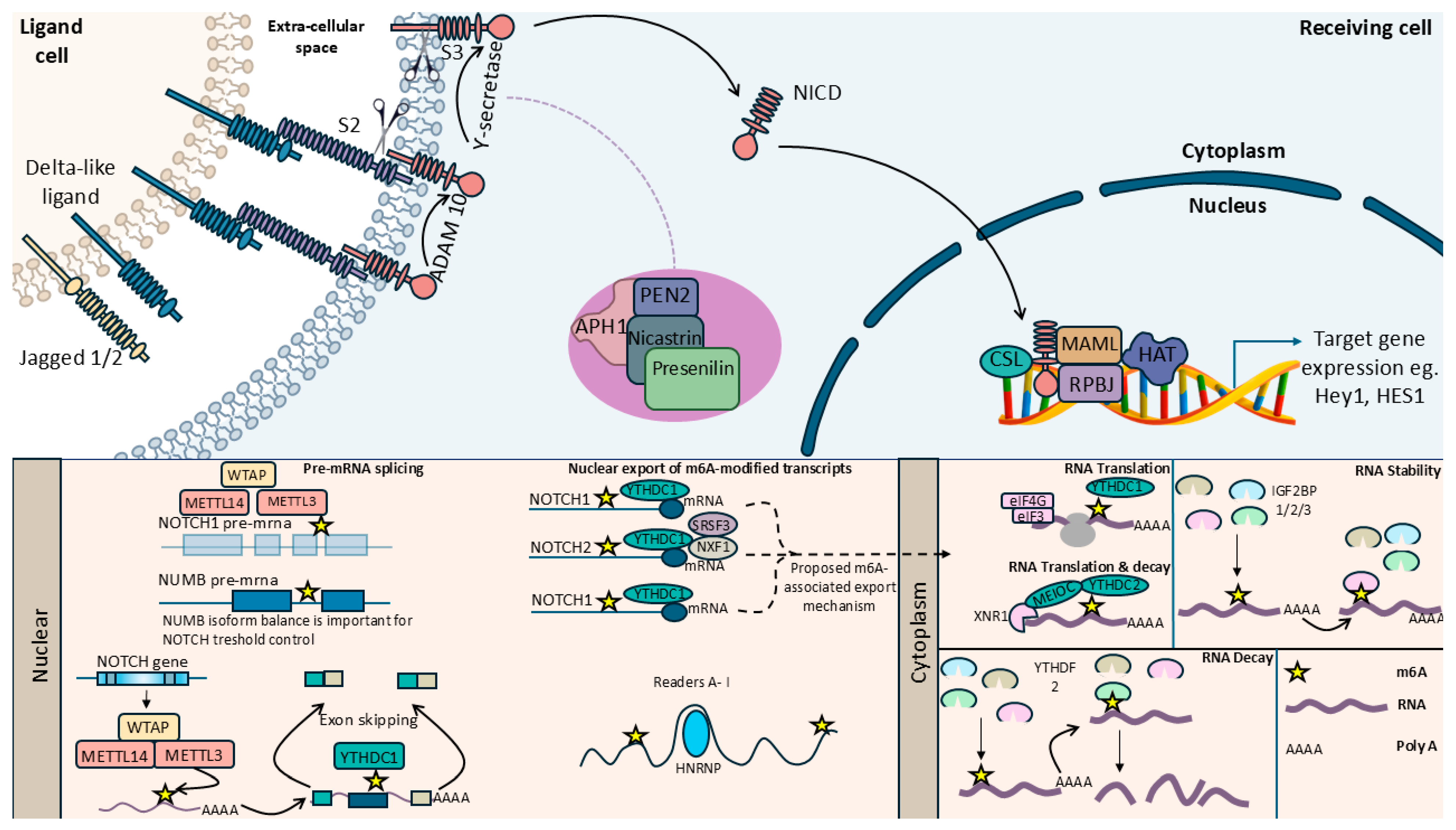
Figure 2.
Conceptual framework that connects therapeutic potential to both direct and indirect epitranscriptomic modulation of Notch signaling. Zebrafish endothelial-to-haematopoietic transition, hepatocellular carcinoma, T-cell acute lymphoblastic leukemia, nasopharyngeal carcinoma, and epithelial systems are among the typical disease settings that are displayed with direct Notch RNA targets. Potential therapies such as writer or reader inhibitors, m6A site-specific editing, γ-secretase inhibitors, anti-NOTCH antibodies, and combination methods are displayed with indirect Notch rewiring through noncanonical targets. While dashed arrows show sensitizer or combination logic, solid arrows show situations where the epitranscriptomic axis is probably a key therapeutic handle.
Figure 2.
Conceptual framework that connects therapeutic potential to both direct and indirect epitranscriptomic modulation of Notch signaling. Zebrafish endothelial-to-haematopoietic transition, hepatocellular carcinoma, T-cell acute lymphoblastic leukemia, nasopharyngeal carcinoma, and epithelial systems are among the typical disease settings that are displayed with direct Notch RNA targets. Potential therapies such as writer or reader inhibitors, m6A site-specific editing, γ-secretase inhibitors, anti-NOTCH antibodies, and combination methods are displayed with indirect Notch rewiring through noncanonical targets. While dashed arrows show sensitizer or combination logic, solid arrows show situations where the epitranscriptomic axis is probably a key therapeutic handle.
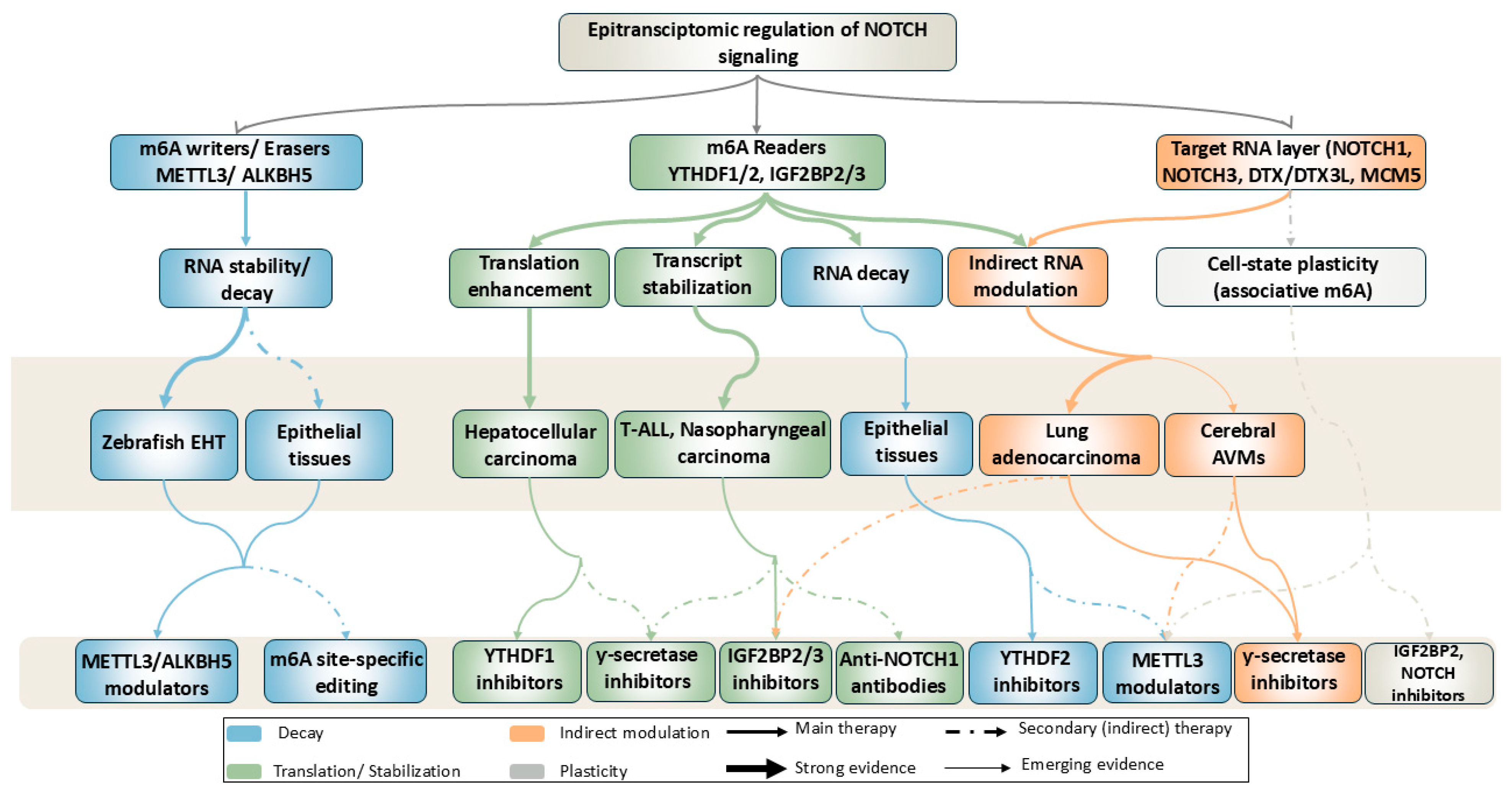
Disclaimer/Publisher’s Note: The statements, opinions and data contained in all publications are solely those of the individual author(s) and contributor(s) and not of MDPI and/or the editor(s). MDPI and/or the editor(s) disclaim responsibility for any injury to people or property resulting from any ideas, methods, instructions or products referred to in the content. |
© 2026 by the authors. Licensee MDPI, Basel, Switzerland. This article is an open access article distributed under the terms and conditions of the Creative Commons Attribution (CC BY) license (http://creativecommons.org/licenses/by/4.0/).
Copyright: This open access article is published under a Creative Commons CC BY 4.0 license, which permit the free download, distribution, and reuse, provided that the author and preprint are cited in any reuse.


