

Submitted:
08 June 2026
Posted:
09 June 2026
You are already at the latest version
Abstract
This study investigates the impact of industry training programs and innovation competitions on microelectronics graduate employability in a private university located in China's Guangdong-Hong Kong-Macao Greater Bay Area. Using two-year cohort data (N=220) with cleaned, mutually exclusive labeling of competition roles, we apply Gradient Boosting Decision Tree (GBDT) with SHAP analysis to identify which factors most strongly predict job-major match. A cross-year validation (training on the larger, higher-participation Class of 2022, N=128; testing on Class of 2021, N=92) provides more reliable estimates. The ranking of the four features remained identical across the two cohorts, with SHAP values showing only slight differences, demonstrating the stability of the analytical approach. Results show that Camp A — an intensive, project‑based, inclusive training program — is the strongest predictor of job-major match (SHAP=0.1754), followed by competition awards (0.1255) and competition participation (0.0888), while Camp B — a short, tool‑oriented program — shows minimal contribution (0.0433). Notably, unlike national competitions that primarily attract top-performing students, Camp A intentionally recruits students with diverse strengths (technical, marketing, project management), making its employability benefits more broadly accessible. This cohort‑level advantage — serving a more diverse student population — explains why a well‑designed training program can have greater overall impact than competition participation. These findings suggest that well‑designed, inclusive industry training can have greater cohort‑level employability value than competition participation in resource‑constrained private universities.
Keywords:
engineering education
; microelectronics
; employability
; educational data mining
; GBDT
; SHAP
; industry training
; innovation competition
; Greater Bay Area
1. Introduction
The global semiconductor industry faces a critical talent shortage, particularly in microelectronics engineering. In China, the government’s push for chip self-sufficiency has intensified demand for high-quality IC talents, yet the supply of qualified graduates remains insufficient (Zhuang & Zhou, 2023). While Si et al. (2025) presented the overall framework and effectiveness of this training system, the relative contribution of specific interventions—industry training versus innovation competitions—remains unquantified. This gap is especially pronounced in private universities, which produce a substantial portion of engineering graduates but often have fewer industry connections and resources than elite public institutions (Kimani et al., 2025). In parallel work, we have examined the broader resource constraints facing private universities in IC education (Pan et al., 2026b, accepted).
Two major pathways have emerged to bridge the gap between academic learning and industrial needs: industry training programs (internships, enterprise camps) and innovation competitions (e.g., the National College Student IC Innovation and Entrepreneurship Competition). While both have been widely adopted, a critical question remains: Which pathway has a greater impact on actual employment outcomes, and for which students?
This study is set in a private university located in Zhuhai, Guangdong Province, within the Guangdong-Hong Kong-Macao Greater Bay Area — one of China’s most dynamic IC industry clusters. This setting provides a unique context for applying learning analytics to engineering education. Unlike elite public research universities, this context represents a typical teaching-focused institution with limited industry connections and resources. Understanding what drives graduate employability in such settings is critical, as the majority of China’s engineering graduates come from similar institutions.
Previous research has examined the benefits of either approach separately, but few have systematically compared their relative contributions using objective, longitudinal data with cleaned, mutually exclusive labeling. Moreover, most studies overlook a key distinction: national competitions tend to attract and reward only top-performing students, while welldesigned industry training programs can benefit a broader range of students. Direct empirical studies specifically comparing industry training and innovation competitions for microelectronics graduates at private universities in the Greater Bay Area are limited. This study therefore primarily cites core methodologies, classic theories, and closely related empirical literature to establish its theoretical and analytical foundation.
In recent years, educational data mining (EDM) and learning analytics (LA) have emerged as powerful methodologies for evidence-based education research to assess graduate career outcomes (Faruque et al., 2025). They enable researchers to uncover hidden patterns in student learning and employment data, and to provide actionable insights for curriculum design and policy making (Romero & Ventura, 2020; Baker & Inventado, 2014). However, most applications of EDM have focused on predicting academic performance (e.g., course grades, dropout risk) rather than graduate employability — especially in the context of engineering education and industry-academia collaboration.
This study addresses this gap by analyzing two-year cohort data (N=220) from the Microelectronics Science and Engineering program (hereafter “microelectronics program”). Using GBDT with SHAP analysis—a machine learning interpretability technique—as an educational data mining tool (Willems et al., 2025), we rank the predictive importance of two industry training programs (Camp A: intensive, project-based, inclusive; Camp B: short, tool-oriented) and two competition-related factors (participation, awards). A cross-year validation uses the larger, higher-participation cohort as the training set for more reliable estimates. Unlike prior ML-based career prediction studies that aim to recommend suitable careers to students (Faruque et al., 2025), this study focuses on evaluating the relative effectiveness of existing educational interventions—training programs versus competitions—on actual employment outcomes. Our goal is not high prediction accuracy but ranking the relative importance of observable, policy-relevant factors.
The first author serves as the associate director of a provincial industry college and the Head of the microelectronics program, with direct involvement in the design and implementation of both training programs. This insider knowledge — combined with three provincial teaching achievement awards — provides authoritative context for interpreting the quantitative findings.
2. Data and Method
2.1. Research Context
The study was conducted in the microelectronics program at a private university in Zhuhai, Guangdong Province, within the Guangdong-Hong Kong-Macao Greater Bay Area.
Two consecutive graduating cohorts (Class of 2021, N=92; Class of 2022, N=128) from the microelectronics program were included, representing the entire graduate population in those years. The program is typical of teaching-focused institutions: limited research funding, moderate industry connections, and students from diverse family backgrounds.
This study used de-identified, routinely collected educational and employment data. It did not involve any experimental intervention or collection of sensitive personal information. Therefore, formal ethical approval was not required under the institution’s guidelines.
2.2. Data Description
Table 1 shows the four features extracted from student participation records after data cleaning.
Data cleaning: To ensure mutually exclusive labeling, students who served as competition captains were coded as participants only (member flag set to zero). This prevents the same student from contributing to multiple competition-related features.
Key distinction: National competitions are highly selective, typically attracting only top-performing students. In Class 2022, only a fraction of students participate, and fewer still win awards. In contrast, Camp A intentionally recruits students with diverse strengths, including those with strong communication, organization, or marketing skills — not just technical excellence. This inclusivity affects its cohort-level impact on employability.
The outcome variable Job-Major Match was rated on a 0–4 scale strictly following the objective classification criteria presented in Table 2. All coding was completed by the first author according to these unified rules.
Table 3 shows the distribution of the outcome variable after cleaning.
2.3. Comparison of the Two Training Programs
The key differences between Camp A and Camp B are summarized in Table 4.
This contrast is critical for interpreting the results: the effectiveness of industry training depends heavily on its design intensity and inclusivity.
2.4. Method
We employed Gradient Boosting Decision Tree (GBDT) as implemented in scikit-learn (Pedregosa et al., 2011) with parameters:
n_estimators=100, learning_rate=0.1, max_depth=4, min_samples_split=5, min_samples_leaf=3, random_state=42.
GBDT was chosen for its robustness to non-linear relationships and strong performance on small-to-medium tabular data (Friedman, 2001; Chen & Guestrin, 2016), and it has been widely adopted in analyzing student employability datasets.
To interpret feature importance, we applied SHAP (SHapley Additive exPlanations) (Lundberg & Lee, 2017), a reliable tool for interpreting educational evaluation results, which provides consistent, locally accurate attributions. SHAP values indicate each feature’s marginal contribution to the prediction. The GBDT-SHAP methodology employed in this study has been validated in our prior work on TCAD-AI integration (Pan et al., 2026a, accepted; Jeong et al., 2021).
Cross-year validation: We trained the model on Class of 2022 (N=128, larger, higher participation) and tested on Class of 2021 (N=92). This uses the more representative cohort as the training set for more reliable estimates.
Why not focus on R2? Graduate employment is influenced by numerous unobserved factors (soft skills, family background, labor market conditions). High prediction accuracy is neither expected nor our goal. Instead, we focus on ranking feature importance using SHAP, which remains interpretable even when R2 is low.
3. Results
3.1. Cross-Year Validation (2022→2021)
Table 5 presents the feature importance (mean |SHAP|) from the cross-year validation.
Prediction accuracy: The model achieved R2 = -0.0093 and MAE = 1.2878. The near-zero R2 is expected, reflecting the complex, multi-factorial nature of graduate employment. However, the SHAP rankings remain stable and interpretable for policy guidance.
3.2. SHAP Visualization
Figure 1 SHAP summary plot (based on Class of 2022 training data). Each point represents a student; the x-axis indicates the SHAP value (impact on predicted job-major match); the y-axis lists features by importance; color indicates feature value (red=1, participated/won award; blue=0, not participated).
4. Discussion
This study set out to answer a focused, policy-relevant question: for microelectronics graduates at a resource-constrained private university, which has a greater impact on job-major match—well-designed industry training (Camp A) or innovation competitions? Using a two-year cohort dataset (N=220) and a GBDT-SHAP machine learning approach, we produced two main findings. First, the method itself proved stable and replicable: the ranking of feature importance was identical across the 2022 training cohort and the 2021 test cohort. Second, Camp A consistently outperformed both competition awards and competition participation, with the highest SHAP value in both cohorts (0.1754 in training, 0.1708 in test). Below we discuss each contribution in turn.
4.1. Methodological Contribution: Stability of SHAP-Based Ranking Across Cohorts
A first contribution of this study is empirical evidence that the GBDT-SHAP pipeline can produce stable, replicable feature importance rankings in engineering education research. As shown in Table 5, the relative order of the four features was identical across two independent graduating cohorts: Camp A > Competition Awards > Competition Participation > Camp B. The absolute SHAP values differed slightly between the two cohorts (e.g., Camp B dropped from 0.0433 to 0.0158), but the ranking did not change.
This stability is important for two reasons. First, it indicates that the observed importance ordering is not an artifact of a single cohort or of overfitting. The fact that the same pattern emerged when the model trained on the larger, higher-participation 2022 cohort was applied to the smaller 2021 cohort supports the generalizability of the findings within this institutional context. Second, from a methodological standpoint, this cross-year consistency demonstrates that SHAP analysis can be used reliably in education settings where sample sizes are modest and outcome variables (such as employability) are influenced by many unobserved factors.
We therefore suggest that ranking consistency across cohorts can serve as a validation criterion for SHAP-based studies in education, complementing or even replacing traditional predictive accuracy metrics. Our goal was never to build a high-accuracy prediction model—low R2 values are expected given the complexity of graduate employment—but to provide interpretable, evidence-based rankings of policy-relevant factors. The identical rankings across years confirm that the method achieves that goal.
4.2. Empirical Contribution: The Cohort-Level Advantage of Intensive, Inclusive Training (Camp A)
The second contribution is a clear empirical answer to the “what matters more” question. Camp A—an intensive, project-based, inclusive training program—was the strongest predictor of job-major match in both cohorts. Its SHAP value (0.1754) was substantially higher than that of competition awards (0.1255), competition participation (0.0888), and the short, tool-oriented Camp B (0.0433).
Two mechanisms explain Camp A’s consistent advantage.
4.2.1. Design Intensity
Camp A embodied several features that align with well-established theories of experiential and work-integrated learning: a multi-week duration, multiple senior instructors from industry, frontier topics, and hands-on team projects that required students to integrate technical knowledge with collaboration and communication skills. These features reflect what engineering education research has long recognized as effective practice: authentic, prolonged, and supervised exposure to real-world engineering problems.
In contrast, competition participation—even when students won awards—typically involves shorter, more narrowly focused tasks. Competitions may develop deep technical skills and persistence, but they rarely offer the sustained, multi-dimensional workplace experience that Camp A provides. Camp B, with its short duration, single instructor, and absence of real projects, produced only negligible SHAP contributions, further highlighting the importance of design intensity.
4.2.2. Inclusiveness and the Cohort-Level Advantage
A more subtle but equally important mechanism is inclusiveness. National competitions are highly selective; they attract and reward a relatively small number of academically top-performing students. Camp A, by design, recruited students with diverse strengths—not only technical ability but also communication, organization, and marketing skills. As a result, Camp A served a broader and more varied student population than competition participation, even though the absolute number of Camp A participants (14) was smaller than the number of competition participants (55) in the 2022 cohort.
This difference in participant composition explains what we call the cohort-level advantage. Camp A’s high SHAP value does not necessarily mean that, for a given individual student, the training is always more effective than winning a competition award (a per-student question we could not directly estimate with our data). Rather, it reflects a cohort-level contribution: Camp A benefits a more diverse group of students, many of whom would not have been competition winners. From a policy perspective, this means that investing in a well-designed, inclusive training program may yield larger aggregate employability gains for the whole cohort than focusing resources on elite competitions that mainly serve a small, already-advantaged subset of students.
This interpretation is supported by the participation data in Table 6. In the 2022 cohort, 55 students (43.0%) participated in competitions, but only 26 (20.3%) won awards. In contrast, Camp A involved only 14 students (10.9%), yet its SHAP contribution (0.1754) was higher than that of competition awards (0.1255). The cohort-level advantage arises from the combination of moderate effectiveness on a more diverse student population, whereas competition awards, though effective for a small elite group, do not reach the broader cohort.
4.3. Why Competition Participation Has Limited Cohort-Level Impact
Our results are not an argument against competitions. For top-performing students, competitions remain valuable. They provide opportunities for deep technical learning, recognition, and networking. However, from a cohort-level employability perspective, their impact is inherently constrained by two facts. First, only a small fraction of students participate, and even fewer win awards. Second, the skills developed through competitions—while excellent for research or deep technical roles—may be less directly transferable to the wide range of positions that many graduates enter, including field application, project management, and technical marketing roles that value communication and organizational skills alongside technical competence.
Therefore, for educators and policy makers in resource-constrained private universities who seek to improve overall graduate employability, over-investing in competitions at the expense of well-designed, inclusive training programs may be suboptimal.
4.4. Why Camp B Shows Minimal Impact
Camp B’s negligible SHAP contribution (0.0433) serves as a useful negative control. Its design was weak by design: short duration (10 days), a single instructor, narrow tool-focused content, and no real project engagement. The fact that such a program produced almost no detectable association with job-major match reinforces the conclusion that not all industry training is equal. Superficial, token training programs are unlikely to move the needle on employability, regardless of how prestigious the corporate partner may appear. Engineering educators should therefore prioritize intensity, breadth, authentic project experience, and inclusiveness when selecting or designing training partnerships.
4.5. Implications for Engineering Education Reform
Based on our findings, we offer four actionable recommendations for engineering educators and policy makers in resource-constrained private universities.
First, invest in intensive, inclusive training programs. Institutions should actively seek or co-design partnerships that offer multi-week depth, real projects, and opportunities for students with diverse strengths—not only technical excellence. These programs deliver cohort-level employability benefits that outweigh those of elite competitions.
Second, recognize the value of competitions but manage expectations. Competitions are excellent for top students, but they should not be the primary vehicle for broad-based employability enhancement. Policymakers and administrators should avoid allocating scarce resources to competitions at the expense of well-structured training programs.
Third, avoid token training programs. Short, narrow, lecture-only programs with no genuine project engagement (exemplified by Camp B) show minimal return on investment. Industry partnerships should be evaluated on design intensity and inclusivity, not simply on brand recognition.
Fourth, design for inclusivity. Training programs should intentionally recruit students with diverse strengths, including communication, organization, and marketing skills. This inclusive design maximizes the cohort-level employability impact—the “cohort-level advantage” documented in this study.
4.6. Limitations and Future Research
This study has several limitations. First, the sample size is modest (N = 220) and drawn from a single private university, limiting generalizability. Second, the 0–4 job-major match scale, while rule-based, assumes equal intervals between categories; a more refined weighting scheme might better capture nuanced differences in job quality. Third, unobserved factors (soft skills, family background, labor market conditions) may also influence employability. Fourth, the study includes only four features; additional factors (GPA, internship quality) could improve explanatory power. Fifth, the “cohort-level advantage” interpretation, while plausible, would benefit from direct per-student effect estimation in future work. The findings are mainly applicable to resource-constrained private universities in the Greater Bay Area.
Future research will: (1) incorporate student and faculty perceptions to triangulate these findings; (2) include a third cohort for true out-of-sample prediction; (3) develop a more fine-grained or weighted measure of job-major match; (4) collect richer feature sets including pre-program academic performance to separate selection effects from treatment effects; (5) estimate per-student treatment effects to directly test the cohort-level advantage explanation; and (6) expand to multiple institutions. In addition, an emerging feature will be added once the next cohort graduates: whether students have obtained an industry-recognized vocational competency certificate (Digital IC Designer Level Certification, piloted by the Ministry of Industry and Information Technology (MIIT)). The first author has established the local examination center for this certification, and the first assessment is scheduled to begin within the coming month. This will allow us to examine whether such formal credentials have incremental predictive power beyond competition participation and industry training, and to assess their market recognition from an employer perspective.
5. Conclusions
Using two-year cohort data and a GBDT-SHAP approach, this study produced two main contributions. Methodologically, it demonstrates that SHAP-based ranking can be stable and replicable across cohorts (identical ranking on 2022 training and 2021 test data), offering a validation criterion that does not rely on high prediction accuracy. Empirically, it shows that an intensive, inclusive, project-based industry training program (Camp A) has a stronger association with job-major match (SHAP=0.1754) than competition awards (0.1255) or competition participation (0.0888), primarily because of its cohort-level advantage—the ability to benefit a more diverse student population.
Unlike national competitions that primarily serve top-performing students, Camp A’s inclusive design benefits a broader range of students, explaining its stronger cohort-level impact. For resource-constrained private universities, investing in such well-designed training programs may yield greater overall employability gains than focusing on elite competitions. These findings provide actionable insights: invest in intensive, project-based, inclusive training programs; recognize competition value for top students but manage expectations for cohort-level impact; and avoid token training programs with limited depth.
Funding
This work was supported by the Guangdong Provincial Quality Engineering Project (IC Industry College, 2025), the Zhuhai College of Science and Technology Quality Engineering Project (Grant No. ZLGC20251414) and the Undergraduate Innovation Training Program of Zhuhai College of Science and Technology (Grant No. 202513684003).
Use of AI Tools
During the preparation of this manuscript, the author(s) used Deepseek for language polishing and grammar correction. After using this tool, the author(s) reviewed and edited the content as needed and take(s) full responsibility for the content of the publication.
Acknowledgments
The authors thank the industry partners for providing training program data, and the career counseling office of Zhuhai College of Science and Technology for employment records. The first author acknowledges the support of three provincial teaching achievement awards, as well as her roles as the Associate Director of the Provincial IC Industry College and the Head of the microelectronics program.
Conflicts of Interest
The authors declare no competing interests.
References
- Baker, R. S., & Inventado, P. S. (2014). Educational data mining and learning analytics. Learning analytics: From research to practice (pp. 61–75). Springer. [CrossRef]
- Chen, T., & Guestrin, C. (2016). XGBoost: A scalable tree boosting system. In Proceedings of the 22nd ACM SIGKDD International Conference on Knowledge Discovery and Data Mining (pp. 785–794). [CrossRef]
- Faruque, S. H., Khushbu, S. A., & Akter, S. (2025). Decision support system to reveal future career over students‘ survey using explainable AI. Education and Information Technologies, 30(10), 14471–14509. [CrossRef]
- Friedman, J. H. (2001). Greedy function approximation: A gradient boosting machine. The Annals of Statistics, 29(5), 1189–1232. [CrossRef]
- Jeong, C., Myung, S., Huh, I., Choi, B., Kim, J., Jang, H., Lee, H., Park, D. Y., Lee, K., Jang, W., Ryu, J., Cha, M., Choe, J. M., Shim, M., & Kim, D. (2021). Bridging TCAD and AI: Its application to semiconductor design. IEEE Transactions on Electron Devices, 68(11), 5364–5371. [CrossRef]
- Kimani, S., Chemweno, P., Martinetti, A., & Lutters, E. (2025). Setting the scene for enhancing engineering curricula in resource-constrained vocational schools. In L. Louw, V. Hummel, I. de Kock, & K. von Leipzig (Eds.), Advancing learning factories: Enabling future-ready skills (CLF 2025) (pp. 223–230). Springer. [CrossRef]
- Konak, A., Kulturel-Konak, S., Schneider, D. R., & Mehta, K. (2025). Enhancing student learning in innovation competitions and programs. European Journal of Engineering Education, 50(2), 360–380. [CrossRef]
- Lundberg, S. M., & Lee, S. I. (2017). A unified approach to interpreting model predictions. In Advances in neural information processing systems (pp. 4765–4774). https://papers.nips.cc/paper/7062-a-unified-approach-to-interpreting-model-predictions.
- Pan, X., Chen, W., Qiu, Y., & Jiang, B. (2026a). From AI for course to AI for science: A case study of TCAD-Integrated Teaching in a Principles of Integrated Circuit Fabrication Course. In Proceedings of the 2026 Educational Technology and Artificial Intelligence (ETAIC 2026). (Accepted).
- Pan, X., Jiang, B., Cai, Z., Liu, F., & Xiao, D. (2026b). From constraints to excellence: A four-stage mentorship model for IC education. In Proceedings of the 2026 International Conference on Educational Management, Culture and Innovation (ICEMCI 2026). (Accepted).
- Pedregosa, F., et al. (2011). Scikit-learn: Machine learning in Python. Journal of Machine Learning Research, 12, 2825–2830. https://www.jmlr.org/papers/v12/pedregosa11a.html.
- Romero, C., & Ventura, S. (2020). Educational data mining and learning analytics: An updated survey. WIREs Data Mining and Knowledge Discovery, 10(3), e1355. [CrossRef]
- Si, Y., Liu, L., Jiang, B., & Pan, X. (2025). Exploration and practice of the training model for integrated circuit application talents that integrates four industries and five innovations in response to national urgent needs. In Proceedings of the 2025 3rd International Conference on Language, Innovative Education and Cultural Communication (CLEC 2025) (pp. 199–211). Atlantis Press. [CrossRef]
- Vygotsky, L. S. (1978). Mind in society: The development of higher psychological processes. Harvard University Press.
- Willems, T., Khan, S., Huang, Q., Camburn, B., Sockalingam, N., & Poon, K. W. (2025). To use or to refuse? Re-centering student agency with generative AI in engineering design education. In Proceedings of the 2025 IEEE International Conference on Teaching, Assessment, and Learning for Engineering (TALE). (To be published).
- Zhuang, T., & Zhou, H. (2023). Developing a synergistic approach to engineering education: China’s national policies on university–industry educational collaboration. Asia Pacific Education Review, *24*(1), 145–165. [CrossRef]
Figure 1.
SHAP summary plot showing Camp A with the widest positive SHAP distribution, followed by competition awards, competition participation, and Camp B.
Figure 1.
SHAP summary plot showing Camp A with the widest positive SHAP distribution, followed by competition awards, competition participation, and Camp B.
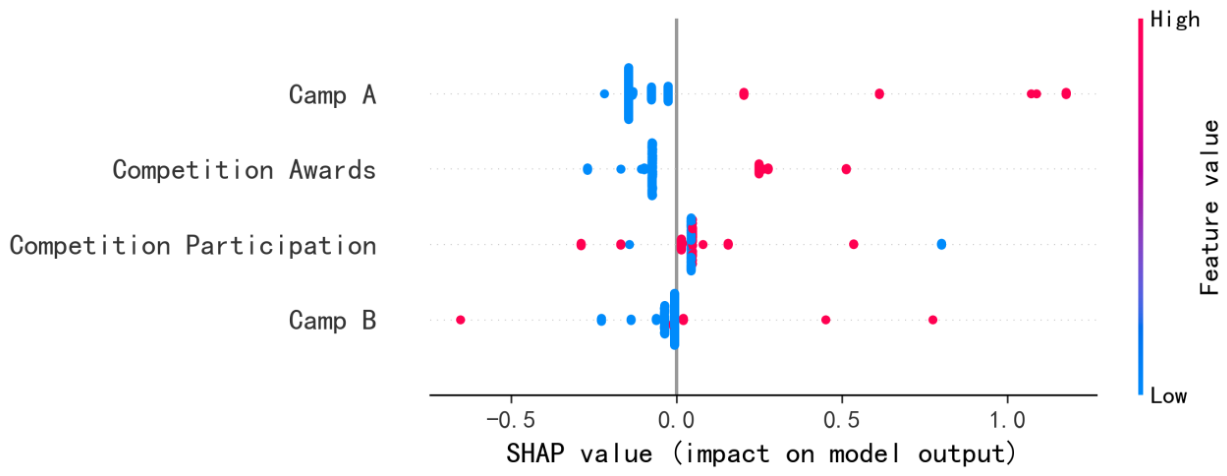

Table 1.
Feature Description.
| Feature | Description |
| Camp A | Intensive, project-based training (6-8 weeks, multiple instructors, frontier topics, hands-on team projects). Recruits students with diverse strengths (technical, marketing, project management). |
| Camp B | Short, tool-oriented training (10 days, single instructor, narrow focus, no real project). |
| Competition participation | Participated as captain or member (mutually exclusive: captain takes priority) |
| Competition awards | Won awards (provincial or national) |
Table 2.
Job-Major Match Score Definition.
| Score | Category | Definition |
| 0 | Unemployed | No employment |
| 1 | Employed but job not related to major | Non-technical position outside IC/electronics industry |
| 2 | Moderately matched | Non-technical position in an IC company |
| 3 | Matched | Engineering-technical position in an electronics/IT company (non-IC) |
| 4 | Highly matched | Engineering-technical position in an IC company; or graduate study in microelectronics or Electronic Engineering |
Table 3.
Distribution of Job-Major Match Scores (Cleaned Data).
| Score | Meaning | Class 2021 | Class 2022 |
| 0 | Unemployed | 15 | 9 |
| 1 | Mismatched | 28 | 50 |
| 2 | Moderately matched | 8 | 15 |
| 3 | Matched | 20 | 17 |
| 4 | Highly matched | 21 | 37 |
| Total | 92 | 128 |
Table 4.
Characteristics of Camp A and Camp B.
| Aspect | Camp A | Camp B |
| Duration | 6-8 weeks | 10 days |
| Instructors | Multiple senior engineers/managers | Single instructor |
| Content | Frontier topics, broad coverage | Narrow, tool-focused |
| Pedagogy | Lectures + hands-on + team projects | Lectures + tool exercises |
| Project depth | Realistic, group-based development | None |
| Participant profile | Diverse (technical + soft skills) | Primarily technical |
| SHAP contribution | 0.1754 | 0.0433 |
Table 5.
Feature Importance (SHAP Values) on Training and Test Cohorts. (Cross-Year Validation: 2022→2021, N_train=128, N_test=92).
Table 5.
Feature Importance (SHAP Values) on Training and Test Cohorts. (Cross-Year Validation: 2022→2021, N_train=128, N_test=92).
| Feature | SHAP (Class 2022 Training) | SHAP (Class 2021 Test) |
| Camp A | 0.1754 | 0.1708 |
| Competition Awards | 0.1255 | 0.1191 |
| Competition Participation | 0.0888 | 0.0729 |
| Camp B | 0.0433 | 0.0158 |
Note: SHAP values were computed from the model trained on the Class of 2022. The ranking of feature importance was identical across both the 2022 training and 2021 test cohorts: Camp A > Competition Awards > Competition Participation > Camp B. This consistent ranking indicates that the intensive, inclusive training program (Camp A) is a stronger predictor of job-major match than even winning a national competition award, supporting the cohort-level advantage of well-designed industry training.
Table 6.
Participation Rates and Estimated Cohort-Level Impact.
| Feature | Class 2022 Participants | Approx. % of Cohort | SHAP Value | Cohort-Level Contribution |
| Camp A | 14 | 10.9% | 0.1754 | High |
| Competition Awards | 26 | 20.3% | 0.1255 | Moderate |
| Competition Participation | 55 | 43.0% | 0.0888 | Moderate |
| Camp B | 9 | 7.0% | 0.0433 | Low |
Disclaimer/Publisher’s Note: The statements, opinions and data contained in all publications are solely those of the individual author(s) and contributor(s) and not of MDPI and/or the editor(s). MDPI and/or the editor(s) disclaim responsibility for any injury to people or property resulting from any ideas, methods, instructions or products referred to in the content. |
© 2026 by the authors. Licensee MDPI, Basel, Switzerland. This article is an open access article distributed under the terms and conditions of the Creative Commons Attribution (CC BY) license (http://creativecommons.org/licenses/by/4.0/).
Copyright: This open access article is published under a Creative Commons CC BY 4.0 license, which permit the free download, distribution, and reuse, provided that the author and preprint are cited in any reuse.


