
Submitted:
08 June 2026
Posted:
09 June 2026
You are already at the latest version
Abstract
Existing data center cooling optimizations primarily focus on PID set-point adjustments, which often trigger energy antagonism between actuators and suffer from a lack of interpretability and safety inherent in pure data-driven black-box models. This paper proposes a Safety-aware Direct Control Optimization (SDCO) method featuring process deconstruction and built-in safety constraints. The approach integrates three core components: interpretable feature engineering based on multi-dimensional sensitivity analysis, embedded safety-aware control policy optimization, and industrial-grade efficiency and safety evaluation. Industrial empirical results based on real-world operating data demonstrate that, while strictly adhering to temperature safety boundaries, the proposed SDCO method achieves a PUE optimization rate of up to 11.733%. This performance significantly outperforms traditional PID and classic reinforcement learning algorithms, providing a closed-loop solution with both rigorous theoretical foundations and high engineering potential for the intelligent upgrading of high-energy-consuming industrial facilities.
Keywords:
data center
; constrained Bayesian optimization
; direct control optimization
; energy efficiency
; application safety
1. Introduction
With the acceleration of global digital transformation, the computing power demand of data centers is growing exponentially, and the sharply rising energy consumption has become a severe challenge restricting the sustainable development of the industry. Statistics show that data centers account for 1–2% of global electricity consumption, with cooling systems as the major energy consumers, responsible for 30–40% of the total energy use [1]. Therefore, improving Power Usage Effectiveness (PUE) has become the core objective of global data centers in energy conservation and emission reduction. Meanwhile, the rapid development of artificial intelligence (AI) technologies is emerging as the driving engine for the transition of traditional industrial control systems toward intelligence. In complex industrial cooling scenarios, conventional control methods based on physical modeling or fixed thresholds can no longer cope with challenges posed by high nonlinearity, strong coupling, and dynamic uncertainty. The introduction of AI marks a fundamental paradigm shift in industrial control—from experience-driven heuristic regulation to data-driven intelligent collaborative optimization. By deeply perceiving multidimensional features and accurately modeling complex system evolution, AI provides a novel technical pathway for achieving refined, adaptive, and globally optimized industrial control. Under the constraints of carbon neutrality goals, developing advanced control strategies with high robustness and industrial applicability carries profound strategic significance for reducing operational costs and enabling green computing.
Data center cooling systems (including indirect evaporative cooling, chilled water systems, direct expansion cooling, and liquid cooling) leverage natural cooling sources or efficient heat exchange mechanisms, thereby demonstrating significant energy-saving potential compared with traditional mechanical compression refrigeration. However, such systems are inherently nonlinear, strongly coupled, and multi-input multi-output (MIMO). Their operating states are heavily influenced by highly dynamic outdoor weather conditions, fluctuating indoor IT loads, and complex interactions among underlying devices (pumps, fans, compressors, cooling towers, etc.) [2]. This high degree of system complexity makes it extremely challenging to identify globally optimal control sequences, particularly in addressing the issue of energy antagonism among devices—where optimizing one device’s energy efficiency often comes at the expense of another, preventing the system from achieving overall optimal efficiency.
Currently, the evolution of control strategies for data center cooling systems is primarily divided into two schools of thought. The first category is mechanism-based traditional cascade control. These methods typically follow a set-point tracking architecture, where an upper-layer strategy provides target temperatures and the underlying PID controllers manage equipment response. However, this indirect control approach often triggers energy antagonism. Furthermore, due to a lack of predictive capability regarding system dynamics, it suffers from response lag, oscillation, or overshoot, leading to significant energy loss [3]. The second category involves data-driven AI methods. While demonstrating theoretical potential in model construction and nonlinear decision-making [4], these methods face a reliability gap in practical industrial deployment [5]. Specifically, historical data in production environments often characterized by large data but small samples (limited patterns) and sensor noise, resulting in poor model robustness. Moreover, optimizations targeting PID set-points or partial equipment frequencies remain constrained by the inherent limitations of PID control and insufficient consideration of industrial safety.
To address the dual challenges of response lag in indirect set-point control and the fragility of data-driven deployment, this paper proposes a safety-aware direct control optimization method based on process deconstruction and built-in industrial safety constraints. The primary contributions of this paper are as follows:
- Establishing an interpretable multidimensional sensitivity analysis and effective feature construction mechanism: To address temporal coupling and nonlinear disturbances in industrial operating data, we integrate dynamic causal identification, parameter influence quantification, and nonlinear importance ranking to quantitatively evaluate each variable’s contribution to energy efficiency objectives. By precisely identifying key influencing factors, this mechanism overcomes the ambiguity of variable selection under traditional experience-driven approaches, reconstructing an effective direct-control feature space centered on device operating frequencies. It accurately isolates environmental disturbances and clarifies the direct mapping between bottom-level devices and system PUE, providing interpretable data support for the paradigm shift from set-point indirect control to critical parameter direct control.
- Designing a device direct-control method under industrial safety constraints: We reformulate system optimization logic from temperature set-point optimization into a black-box optimization problem with multiple hard constraints (air supply safety, physical boundaries and device smoothness). By incorporating multiple industrial safety constraints, we establish a closed-loop collaborative optimization method directly targeting compressor and fan frequencies. This breaks the response delays of traditional cascade control and resolves common oscillation issues in direct-control modes, significantly enhancing industrial applicability. Furthermore, Bayesian optimization’s high sample efficiency and the robustness of surrogate models enable low-cost mapping of optimal compressor–fan frequency combinations, achieving smooth and efficient global energy savings while ensuring thermal safety.
- Conducting industrial application evaluation of energy efficiency and safety using real data: Based on actual operating data from indirect evaporative cooling systems in industrial data centers, we perform dual-dimensional evaluations of energy efficiency and safety. Results show that the proposed secure direct-control optimization method not only meets industrial requirements for energy efficiency and safety but also effectively identifies and coordinates device coupling relationships, achieving intelligent trade-offs between air-side and liquid-side cooling capacity.
The remainder of this paper is organized as follows: Section 2 reviews related work, including PID-based control, MPC-based control, RL-based control, and BO-based control. Section 3 presents our research methodology, covering research objects and objectives, multidimensional sensitivity analysis and effective feature construction, and control strategy optimization under safety constraints, and energy saving effect and safety evaluation for industrial applications. Section 4 reports experimental results and analysis, including data description and experimental setup, sensitivity analysis and feature construction outcomes, and evaluations of energy-saving effects and safety. Section 5 concludes the paper.
2. Related Work
The control of data center cooling systems, building upon mechanism-based traditional cascade control and data-driven AI methods, can be further categorized into PID-based control [6], MPC-based control [7], RL-based control [8], and BO-based control [9]. The specific technological developments and application analyses are as follows:
- PID-based Control
Proportional-Integral-Derivative (PID) control, a classic feedback strategy, remains the mainstream low-level control method in industrial HVAC and cooling systems due to its structural simplicity and robustness. However, traditional PID control reveals significant limitations when facing the complex physical characteristics of data center cooling systems. First, PID is essentially a linear controller based on a single-input single-output structure, making it difficult to effectively handle the high-order nonlinearity, strong multivariable coupling, and large time-lag characteristics typical of cooling systems. In scenarios where multiple devices operate in parallel, the lack of global coordination often leads to energy antagonism between actuators [10]. Second, PID lacks predictive capability for system dynamic trends; its parameter tuning relies heavily on manual experience and struggles to adapt to variable operating conditions [11]. Finally, PID lacks flexibility when handling complex hard physical constraints (such as equipment frequency change rate limits and optimal efficiency boundaries). It often achieves passive tracking rather than active optimization and fails to directly optimize global energy efficiency metrics like PUE.
- MPC-based Control
Model Predictive Control (MPC) was proposed to compensate for the deficiencies of PID control. First, through model prediction and constrained optimization, MPC can coordinate multiple controlled variables while satisfying safety boundaries, thereby achieving global energy optimization. For example, Literature [12] optimized the frequencies of chilled water pumps and cooling tower fans in a multi-chiller system, using LSTM to predict cooling loads and room temperatures combined with particle swarm optimization. In simulations, this achieved a 27.77% and 18.08% improvement in temperature stability compared to PID and fuzzy control, respectively, with energy savings of 11.81% and 7.58%. Second, MPC’s rolling optimization mechanism allows it to anticipate future disturbances (e.g., weather changes, load fluctuations) and adjust control inputs in advance, enhancing dynamic response quality. Literature [13] demonstrated the effectiveness of an MPC controller based on a linear model, which performed multi-objective optimization of supply air temperature and pressure set-points within a prediction horizon while ensuring sensor data remained within safety confidence intervals. However, in practical engineering, the accuracy, interpretability, and safety of predictive models are limited by data quality, modeling complexity, and self-learning capabilities. For instance, Literature [14] proposed differentiable predictive control, attempting to combine neural networks with physical knowledge to reduce computational complexity for cold source system optimization. However, it achieved only about a 1% energy saving compared to the baseline, indicating a persistent trade-off between model accuracy and computational efficiency.
- RL-based Control
With the advancement of AI, model-free methods represented by Reinforcement Learning (RL) have provided a new path for solving complex nonlinear control in cooling systems by learning optimal policies through trial-and-error interactions between an agent and its environment. Literature [15] verified RL’s potential by significantly reducing average PUE through the optimization of set-points like room temperature and chiller load; Literatures [16,17,18,19,20] further explored RL applications in cooling control and load scheduling. However, transferring these to real-world industrial data centers faces severe deployment challenges: 1) Sample inefficiency and cold-start issues: RL typically requires millions of interactions to converge, which is impractical in industrial sites. Literature [20] notes that even with semi-analytical models as simulation environments, model generalization remains insufficient. 2) Safety exploration risks: Industrial control demands extreme stability; random actions during the RL exploration phase can lead to temperature violations or equipment oscillation, posing major safety risks [21]. 3) Policy Fossilization and safety trade-offs: In noisy, high-dimensional real environments, RL tends to converge to conservative, rigid sub-optimal policies that struggle with non-stationary environmental changes [17].
- BO-based Control
Compared to PID, MPC, and RL, Bayesian Optimization (BO) can approach global optima at extremely low sampling costs in expensive black-box and small-sample scenarios. Its natural noise tolerance and uncertainty quantification capabilities offer significant potential for industrial data centers. First, it features high sample efficiency: while RL requires millions of trials, BO can converge in dozens of evaluations, greatly reducing experimental risks. Second, it allows flexible prior fusion and robust uncertainty measurement. By designing mean or kernel functions, expert experience can be integrated into the optimization. The posterior variance provided by Gaussian Processes (GP) establishes probabilistic boundaries for safety constraints, enabling safety-aware capabilities. Recent studies have attempted BO-based approaches: Literature [22] coupled Bayesian inference with autoencoders for sensor drift calibration with >96% accuracy; Literature [23] used GP-based BO to optimize HVAC start-stop strategies; and Literature [24] proposed a safe-contextual BO method to adaptively adjust PID parameters.
However, applying BO directly to direct device control—characterized by multiple-input multiple-output properties and high-dimensional state spaces—faces the following challenges: 1) Feature redundancy and the curse of dimensionality: Existing research relies on expert experience for variable selection, lacking systematic feature engineering. This results in slow convergence in high-dimensional spaces. There is an urgent need for multi-dimensional sensitivity analysis to automatically identify key control variables and construct low-dimensional, highly representative feature spaces. 2) The leap from parameter tuning to safety direct control: Most literature limits BO to offline PID set-point optimization [24]. Few studies explore extending it into an online direct controller capable of handling multiple hard physical constraints (e.g., frequency change rates, temperature violation risks). Hardening industrial safety constraints into the internal decision-making mechanism of BO is critical for transitioning from offline tuning to online safety direct control.
In light of the current research status and based on actual operating data from industrial data center cooling systems, this paper proposes a safety-ware direct control optimization method featuring process deconstruction and built-in industrial safety constraints. Compared to existing research, this work demonstrates significant differences in the industrial representativeness of experimental data, the rigor of feature engineering, the end-to-end nature of the control mode, and the comprehensiveness of the safety evaluation system, as detailed in Table 1.
3. Methodology
3.1. Research Object and Objectives
Since the data analyzed in this study are derived from a real indirect evaporative cooling (IEC) system in an industrial data center, this section introduces the research object and development objectives based on the IEC system.
3.1.1. Research Object
Indirect Evaporative Cooling (IEC) technology leverages the latent heat of water evaporation for natural cooling, offering significant energy-saving potential compared with conventional mechanical compression refrigeration. By employing sensible heat exchange, IEC systems utilize the latent heat of water evaporation to achieve efficient cooling, making them a key technology for reducing data center Power Usage Effectiveness (PUE). As illustrated in Figure 1, the thermodynamic process of an IEC system involves two independent, isolated air streams:
- Primary Air (Indoor Side): This stream originates from the hot return air of the data center. It passes through the dry channel of the heat exchanger, where sensible heat is exchanged with the secondary air through the channel walls. Its temperature decreases while absolute humidity remains unchanged, and it is ultimately supplied back to the data hall as cooled air.
- Secondary Air (Outdoor Side): This stream is drawn from outdoor fresh air or partially from primary exhaust. It flows through the wet channel of the heat exchanger, where it is sprayed with circulating water. Evaporation of water on the wet channel surface absorbs substantial latent heat, significantly lowering the secondary air temperature and enabling efficient heat absorption from the primary air. The warmed, humid exhaust is then discharged outdoors.
To adapt to varying climatic conditions and load fluctuations, the IEC system is primarily composed of five core devices:
- Heat Exchanger: The thermodynamic core of the system, enabling non-contact energy transfer between primary and secondary air streams while fully isolating outdoor contaminants.
- Supply Fan (Indoor Fan): Regulates primary air volume, directly determining the supply airflow and cooling delivery efficiency within the data center.
- Exhaust Fan (Outdoor Fan): Controls secondary air volume, establishing negative pressure within the heat exchanger to enhance evaporation, while expelling absorbed heat to the ambient environment.
- Circulating Pump: Delivers cooling water to the spray system. Its operating frequency influences spray coverage and evaporation efficiency.
- Mechanical Refrigeration Backup (Compressor/DX Unit): Comprising a variable-frequency compressor, condenser, and evaporator, this subsystem provides auxiliary cooling when evaporative cooling alone is insufficient (e.g., under hot and humid weather). As the primary energy consumer in the system, precise frequency regulation of the compressor is critical for energy optimization.
3.1.2. Research Objectives
The objective of this study is to identify a safe and efficient direct control strategy X for data center cooling systems under dynamic environmental conditions Z (including indoor/outdoor temperature and humidity, IT load profiles, and cooling system states). The aim is to achieve optimal energy efficiency while ensuring industrial application safety. To this end, the research objectives are formulated as a constrained optimization problem, defined in terms of the objective function, decision variables, and safety constraints:
A. Objective Function
The optimization objective is to minimize the data center’s PUE. The objective function is defined as follows:
Whereis the total data center power consumption, which includes IT equipment power consumption , cooling system power consumption , and other power consumption . Considering that is generally constant, and is determined by the operation of the data center’s own servers, and optimizing PUE is equivalent to optimizing the cooling system’s power consumption .
B. Decision Variables
Unlike traditional control methods that adjust temperature setpoints, this study directly selects the operating frequencies or speed percentages of the underlying power-consuming equipment as the decision variable vector X which includes:
Where is the pump frequency, and are the indoor and outdoor fan frequencies or speed percentages, respectively, and , is the operating frequency of the i-th compressor (in this study, n=4).
C. Safety Constraints
To ensure the engineering feasibility of the control strategy and the safe operation of the data center, the optimization process is strictly limited by the following three categories of constraints:
- Boundary Constraints: The operating frequency or speed percentage of all equipment must remain within the physically allowed range:
- Rate-of-Change Constraints: To prevent frequent power-consuming equipment start-stop cycles or excessive mechanical stress, the magnitude of change in the control variables between adjacent control periods (t and t-1) is limited:
- Operational Safety Constraints: It must be ensured that critical thermal environment indicators (mainly the supply air temperature, ) are always maintained within the safety threshold. Since is a complex non-linear function of X and Z, this constraint is expressed as:
In summary, because both the objective function and the operational safety constraint function lack precise analytical expressions, and because a single evaluation (via real system operation or high-fidelity simulation) is expensive, this problem is defined as a typical constrained expensive black-box optimization problem. This provides the theoretical basis for introducing the SDCO method in this study.
3.2. Methodology Design
Based on real operational data from an industrial data center cooling system, this study designs and implements a secure direct-control energy optimization framework that integrates data acquisition and processing, multidimensional sensitivity analysis and effective feature construction, and Bayesian optimization under safety constraints, as illustrated in Figure 2.
- Data Acquisition and Processing: The dataset collected from the real data center includes external environmental data, HVAC equipment control and operational data, indoor environmental and IT load data. Data processing involves sequential parsing, anomaly detection, missing-value handling, data transformation, and data fusion.
- Multidimensional Sensitivity Analysis and Effective Feature Construction: From temporal, global, and nonlinear perspectives, dynamic causal identification, parameter influence quantification, and nonlinear importance ranking are performed. Cross-validation is then used to construct the final set of effective key features.
- Control Strategy Optimization under Safety Constraints: Industrial safety constraints are embedded into each stage of the Bayesian optimization algorithm, including dataset construction and updating, surrogate model construction and updating, acquisition function design under safety constraints, candidate point selection within dynamic feasible regions, and application feedback. Specifically,Sample set construction and updating includes initial dataset generation and iterative updates. Surrogate model construction and updating includes energy-consumption surrogate modeling and safety surrogate modeling.
- Energy Efficiency and Safety Evaluation for Industrial Applications: The principle of industrial energy optimization is to achieve energy savings under the premise of ensuring safety. Accordingly, the evaluation focuses on three key aspects: energy-saving effect evaluation, evaluation of control strategy fluctuation and composite safety index, and evaluation of temperature safety in control strategy application.
3.2.1. Multidimensional Sensitivity Analysis and Effective Feature Construction
To construct an efficient and robust control optimization model, accurately screening key features that have a decisive impact on system energy consumption from the vast amount of raw operational data is crucial. Considering the complex characteristics of industrial IEC system data—such as time variability, strong nonlinearity, and multicollinearity—a single feature selection method is often insufficient. Therefore, this study designs a feature screening framework that addresses three dimensions: temporal, global, and non-linear. This framework sequentially utilizes the Granger Causality Test to identify the temporal logic between variables, Sobol’ Global Sensitivity Analysis to quantify parameter contribution, and XGBoost to assess non-linear importance, ultimately constructing the final key features through cross-validation.
3.2.1.1. Dynamic Causality Identification (Granger Causality Test)
In thermal systems, variable responses often exhibit physical lag due to thermal inertia. To eliminate spurious correlations and determine the true temporal influence between variables, this study employs the Granger Causality Test [25] to identify the lead-lag relationship.
The Granger test is based on the vector autoregressive model. Its core hypothesis is: if the historical information of variable X significantly reduces the prediction error of the future value of variable Y (e.g., energy consumption), then X is said to be a Granger cause of Y. The testing process involves comparing a restricted model with an unrestricted model:
- Restricted Model (): Uses only the lagged terms of Y for prediction:
- Unrestricted Model (): Simultaneously introduces the lagged terms of both Y and the candidate variable X for prediction:
An F-statistic is then constructed to assess the significance of the improvement gained by introducing X:
Where and are the Residual Sum of Squares for the restricted and unrestricted models, respectively, T is the time series length, and p and q are the lag orders. If the p-value corresponding to the F-value is < 0.05, the null hypothesis is rejected, concluding that X has a significant Granger causality with respect to Y.
3.2.1.2. Parameter Influence Quantification (Sobol’ Sensitivity Analysis)
The Granger test qualitatively filters causal variables but cannot quantify the specific contribution of each variable to energy consumption fluctuations. Therefore, this study employs the variance-based Sobol’ Global Sensitivity Analysis method [26] to quantify the proportion of contribution of each input parameter to the model output variance V(Y), with a particular focus on variable interactions. The Sobol’ method decomposes the total variance V(Y) into the sum of individual terms and their interaction terms:
Where is the first-order variance caused solely by , and is the second-order variance caused by the interaction between and . This study focuses on two core indices:
First-Order Sensitivity Index (): , which measures the independent contribution of variable to the output variance.
Total Sensitivity Index ():,which measures the total effect of variable , including its first-order effect and all its interaction effects with other variables. A value of close to 0 means the variable can be considered a redundant feature and eliminated.
3.2.1.3. Non-linear Importance Ranking (XGBoost Feature Importance)
Given that XGBoost [27] can directly capture complex feature importance through its robust non-linear fitting capabilities, this study introduces the XGBoost method for supplementary validation. We use Gain as the criterion for measuring feature importance. The importance score of a feature is defined as the total average gain provided by that feature when used as a splitting node across all Boosting Trees:
Where K is the total number of trees, is the set of nodes in the k-th tree. denotes the splitting feature used by node n, represents the indicator function, and is the gain produced by the split at node n.
The Gain of a single split is defined as the structural score representing the reduction in the objective (Loss Function):
Where andrepresent the sums of the first-order gradient and the second-order Hessian matrix (Hessian) of the loss function, respectively. Subscripts L and R correspond to the left and right child nodes after the split; is the L2 regularization parameter, and is the complexity penalty term for introducing a new leaf node.
Through the above three-dimensional analysis, this study obtained a set of candidate features with multidimensional evaluation metrics in terms of temporal causality, variance contribution, and nonlinear gain.
3.2.2. Control Strategy Optimization under Safety Constraints
In response to the research objectives defined in Section 3.1.2, this study proposes a constrained control strategy optimization method. The approach explicitly incorporates hard constraints (e.g., physical boundaries, rate-of-change limits) while simultaneously handling implicit black-box constraints (e.g., thermal safety indicators). In doing so, it ensures stable operation of the data center cooling system while searching for the global optimum of system energy efficiency, expressed as Power Usage Effectiveness (PUE).The method iterative process is as follows:
Step 1: Initial Dataset Construction
To address the cold-start problem at the early stage of optimization and to ensure that the initial samples exhibit good spatial coverage and representativeness within the feasible domain, this study adopts the Latin Hypercube Sampling (LHS) method to generate the initial dataset. Let the dimension of the control variables to be optimized be denoted as d, covering key device parameters such as the speed percentages of indoor and outdoor fans, and compressor frequency.
The control vector is defined as . All control variables are jointly constrained by physical boundaries (Eq. 3) and dynamic rate-of-change limits (Eq. 4), forming the feasible domain X:
(12)
where and denote the physical lower and upper bounds of the j-th variable, and is the maximum allowable step size between adjacent control cycles.
The LHS sampling process can be mathematically described as follows: each variable’s range is evenly divided into N non-overlapping sub-intervals . Within each sub-interval, one sample is drawn independently at random, and the samples are then randomly permuted and combined to construct the initial dataset .
The system response variables include both the energy-consumption objective (e.g., PUE) and safety indicators( (e.g., supply air temperature ), expressed as:
(13)
Formally, the process can be expressed as:
(14)
where and represent the black-box mapping functions provided either by the real industrial operating system or by a high-fidelity simulation model [28].
Step 2: Surrogate Model Construction
Given that the energy-efficiency objective and the temperature safety indicator exhibit different physical response characteristics and nonlinear scales, this study constructs two independent Random Forest (RF) surrogate models for separate fitting. Compared with Gaussian Processes (GPs), RFs demonstrate stronger robustness when handling high-dimensional, non-stationary industrial data with observation noise.
- Energy surrogate model: Fits the PUE response surface and outputs the predictive mean and variance .
- Temperature surrogate model: Fits the supply-air temperature response surface and outputs the predictive mean and variance .
Since RF is a non-parametric ensemble model and does not directly provide closed-form variance, this study estimates uncertainty using the predictive distribution across the ensemble of T decision trees:
(15)
where denotes the prediction of the t-th tree, and yˉ(x) is the ensemble mean prediction.
Step 3: Acquisition Function Design under Safety Constraints
To minimize energy consumption while strictly satisfying temperature safety constraints, this study adopts the Expected Improvement with Probability of Feasibility (EIPoF) as the acquisition function.
First, the probability of feasibility (PoF) is calculated for each candidate point, representing the likelihood that the point satisfies the safety constraints:
Where is the cumulative distribution function of the standard normal distribution.
Next, the expected improvement (EI) of the energy-consumption objective is calculated. Let the currently observed optimal safe energy-consumption value be , then
(17)
Finally, the constrained acquisition function is constructed as:
In the context of this study, its specific form is:
(19)
where , ϕ(⋅) denotes the probability density function of the standard normal distribution. This function imposes a probabilistic penalty on candidate regions that may lead to temperature violations, thereby forcing the algorithm to balance exploration and exploitation strictly within the safe search space.
Step 4: Candidate Point Selection within Dynamic Feasible Region
At each iteration t, in order to ensure the smoothness of control commands and to protect hardware devices, the algorithm must maximize the acquisition function while strictly adhering to device physical boundary constraints and rate-of-change constraints. The dynamic feasible region at time t is defined as:
where denotes the actual control parameter vector executed in the previous iteration, and represents the maximum allowable single-step variation for each device dimension (e.g., frequency adjustment step limits).
Based on this definition, the optimal candidate sampling point for the next iteration is obtained by solving the acquisition function optimization problem within the dynamic feasible region:
By continuously shrinking the search space in real time, the algorithm mathematically guarantees the continuity of the control sequence and fundamentally avoids device oscillations (chattering) in industrial practice.
Step 5: Application Feedback
The recommended control command are deployed to the actual data center cooling system or a high-fidelity simulation environment, where the resulting energy consumption and safety responses are observed and recorded.
Step 6: Dataset and Model Updating
Newly observed data pairs are appended to the historical dataset, thereby triggering retraining of the surrogate models:
Steps 2 through 6 are then repeated until the system performance reaches a predefined convergence threshold or the scheduled number of optimization rounds is completed. The final output is a sequence of Pareto-optimal control strategies.
3.2.3. Energy Saving Effect and Safety Evaluation for Industrial Applications
To evaluate the engineering practicality of the proposed algorithms, this study builds upon the comprehensive assessment framework for data center energy optimization methods [29] and conducts an industrial-level evaluation of energy efficiency and safety. The evaluation encompasses several dimensions, including energy efficiency improvement rate, volatility of control strategies and composite safety index, temperature stability and constraint compliance evaluation.
1) Energy-Saving Effect Evaluation: PUE optimization rate(η) reflects the energy-saving contribution of the strategy compared with baseline PID control or the pre-optimization state:
where is the average energy efficiency under baseline PID control, and is the average energy efficiency after applying the SDCO strategy.
- 2) Evaluation of Control Strategy Fluctuation and Composite Safety Index: To quantify the impact of the control strategy on long-term hardware reliability, a dynamic composite safety index CSI(t) is adopted[31]. This index integrates six core fluctuation metrics (MAD, FII, SD, RSD, CV, CD) and introduces a load-aware weighting mechanism to reflect risk sensitivity under varying operating conditions:
(25)
(26)
(27)
(28)
(29)
(30)
Where represents the fluctuation threshold, represents the state-dependent dynamic weight coefficients, represents the above six core fluctuation metrics described .
3) Evaluation of Temperature Stability in Control Strategy Application : By analyzing the time series of supply-air temperature, two indicators are introduced to evaluate the surrogate model’s fidelity to implicit safety constraints and to ensure that server environments remain within the thermal safety envelope defined by ASHRAE standards:
- Temperature Violation Rate (TVR): Defined relative to a preset safety upper limit (e.g., 22 °C). Over the sampling horizon , TVR characterizes the frequency of departures from safe operating conditions:
(31)
where is the indicator function, equal to 1 if the supply-air temperature exceeds the upper limit, and 0 otherwise. This metric directly reflects the extent to which the SDCO algorithm infringes upon safety boundaries during exploration.
- Temperature Standard Deviation (TSD): Calculated as the standard deviation of the supply-air temperature time series, this metric evaluates the stability of the constrained surrogate model during control:
(32)
where is the mean supply-air temperature over the observation period. A lower TSD indicates effective suppression of temperature oscillations induced by abrupt control variations.
4. Experimental Results and Analysis
4.1. Data Description and Experimental Setup
- Data Acquisition
The dataset employed in this research is derived from the field operational logs of an Indirect Evaporative Cooling System (IECS) in a large-scale industrial data center. To facilitate direct and safe global optimal control of the refrigeration system, we specifically extracted operational data from May 2022 to July 2022, during which the system operated in hybrid mode—a state where all critical components, including internal/external fans, water pumps, and compressors, are simultaneously active. The raw data were sampled at 180-second intervals and comprise 396 multi-dimensional operational metrics. This dataset provides a comprehensive record of the nonlinear evolutionary processes involving environmental disturbances, equipment status, and system energy efficiency.
- Data Preprocessing
The raw data underwent a rigorous cleaning pipeline: initially, fault alarm indicators and null columns/rows were eliminated. Subsequently, the Pauta criterion (3σ3σ) was applied to reject outliers, and missing values were recovered using linear interpolation, followed by Min-Max normalization. The refined features were categorized into four functional subsets:
- ✓
- Environmental Variables (e.g., outdoor dry-bulb temperature, wet-bulb temperature/relative humidity);
- ✓
- Internal Load Variables (e.g., IT server load);
- ✓
- System Control Variables (e.g., equipment operating speeds or frequencies);
- ✓
- System State Variables (e.g., temperature, pressure, flow rate, and power consumption).
- Feature Engineering and Selection
Building upon the preprocessed data, a multi-dimensional sensitivity analysis and feature construction framework were implemented. This process integrated Granger Causality Testing for dynamic relationship identification (as detailed in Section 3.2), Sobol’ Sensitivity Analysis for parameter influence quantification, and XGBoost-based Feature Importance for nonlinear ranking. The finalized feature subset is presented in Section 4.2.
- Dataset Partitioning
The dataset was partitioned chronologically: the first 2,000 data points from each month (May to July 2022) were reserved as the Test Set, while the remaining data constituted the Training Set. The training data were utilized to construct a high-fidelity digital twin of the industrial system and to train both the baseline algorithms and the proposed SDCO strategy for energy optimization. The test set was employed to evaluate energy-saving performance and operational safety through interpretable visualizations (results are discussed in Section 4.3).
- ExperimentalEnvironment
All computational experiments were performed on a high-performance server equipped with an Intel Xeon Gold 6248R CPU, 128 GB of RAM, and an NVIDIA A100 GPU. The software stack was configured on Ubuntu 20.04 with Python 3.10, leveraging open-source libraries such as TensorFlow 2.8 and Scikit-learn 1.1. A high-fidelity simulation model of the IECS was developed following the methodology outlined in [28] and rigorously calibrated using real industrial operational data.
- BaselineAlgorithms
To evaluate the performance of the proposed SDCO, two representative control strategies were selected as benchmarks:
- ✓
- PID Control: Representing the conventional feedback mechanism most widely adopted in industry, the PID baseline reflects the standard engineering tuning level based on error regulation. As the original system under study utilizes PID control, this comparison quantifies the improvement of the proposed strategy in mitigating the inherent lag of high-inertia systems.
- ✓
- RL Control: This baseline utilizes the Deep Deterministic Policy Gradient (DDPG) algorithm. As a state-of-the-art model for continuous action spaces, DDPG represents the frontier of purely data-driven intelligent control. It is used to evaluate the advantages and disadvantages of the proposed method in terms of model generalization and policy safety.
4.2. Results of Multidimensional Sensitivity Analysis and Effective Feature Construction
4.2.1. Dynamic Causality Identification Based on Granger Causality Test
To quantitatively evaluate the temporal lead-lag relationships between candidate features and Power Usage Effectiveness (PUE), and to determine a reasonable order for physical lag terms, this study conducted multi-order Granger causality tests on four categories of energy-related parameters. The experiments utilized F-tests based on the Sum of Squared Residuals (SSR) to examine significance levels across lag orders Lag∈{1,2,3,4}(corresponding to a time span of 3 to 12 minutes). The results are shown in Table 2, with the following conclusions:
- Environmental and Load Features: Outdoor input air temperature (outdoor_input_air_temp) showed highly significant correlation across all lag orders (p<0.001), validating the immediate and continuous impact of the environment on system energy efficiency. Outdoor humidity and IT load exhibited clear time-lag effects, crossing the significance threshold at Lag≥2and Lag≥3 respectively, which aligns with the physical inertia of heat transfer and temperature control compensation in industrial cooling systems.
- Equipment Control Features: Indoor and outdoor fan speed percentages, along with the frequencies of various compressor groups (dxc01-04), remained highly significant across different lag orders, indicating that adjustments to control parameters are the primary drivers of PUE fluctuations.
- Redundant Features: Notably, the p-values for pump frequency (pump_frequency) across all observed lag orders were much greater than 0.05 (ranging from 0.5169 to 0.7384). This suggests that within this specific operating condition or data cycle, changes in pump frequency do not provide significant information regarding the future trend of PUE, indicating a lack of temporal causality. Based on this result, this study treats pump_frequency as a redundant feature and excludes it from the final feature set to reduce model dimensionality (possibly due to the pump operating at a constant state for extended periods in this system).
The analysis results show that at a significance level of α=0.05, the vast majority of candidate features (except for pump_frequency) demonstrate significant predictive capability for PUE. Through the Granger causality test, we have completed an initial time-domain screening based on physical correlations, laying the foundation for subsequent multidimensional feature fusion combined with XGBoost gain ranking and Sobol’ global sensitivity analysis.
4.2.2. Parameter Influence Quantification Based on Sobol’ Sensitivity Analysis
To further quantify the contribution of each candidate feature to the system energy efficiency metric (PUE), this study introduces the Sobol’ sensitivity analysis method to calculate the first-order sensitivity index (S1) and total-effect index (ST) for each feature, with results shown in Table 3. The analysis conclusions are as follows:
- Decisive Role of Compressor Power Consumption: As shown in Table 3, the sensitivity indices for the frequencies of the four compressor groups (dxc01-04) occupy an absolutely dominant position. The sum of their total-effect indices (ST) reaches 0.9865, indicating that in this indirect evaporative cooling system, the vast majority of PUE fluctuations are attributed to changes in compressor operating states. From an energy decoupling perspective, this result confirms that compressor frequency is the most critical controlled variable determining system energy efficiency and serves as the core entry point for energy efficiency improvement in the subsequent SDCO algorithm.
- Interaction Response Characteristics of Auxiliary Equipment: The impact of outdoor fan speed percentage (ST=0.0707) and pump frequency (ST=0.0700) on energy consumption ranks in the second tier, with sensitivity significantly lower than that of the compressors. Notably, pump frequency exhibits distinct nonlinear interaction characteristics: its interaction effect (ST−S1=0.0362) is comparable in magnitude to its first-order effect (S1=0.0338). This reflects that, in terms of physical operating logic, the pump is highly dependent on the cooling demand generated by the compressors and the heat dissipation conditions of the outdoor environment, lacking independent strong adjustment attributes. Combined with the non-significant performance of this variable in the previous Granger causality test, this validates the secondary status of pump frequency in the sequential control logic.
- Weak Sensitivity Response of Environmental Parameters and Load: Although IT load and environmental temperature/humidity showed significant time-lag lead relationships in the causality test, their ST indices in the Sobol’ transient sensitivity analysis are close to zero or even show slight negative values (statistical noise). This indicates that in steady-state fluctuations over short time scales, the direct perturbation of environmental parameters on PUE is small; their influence is manifested more indirectly by triggering control strategies (such as frequency adjustments).
By synthesizing the results of the Granger causality test and Sobol’ sensitivity analysis, this study confirms the status of the compressor and fan systems as core predictive features. Regarding pump frequency, given its high interaction dependency in the sensitivity analysis and its failure in the causality test, it will be excluded from subsequent modeling to reduce model redundancy and eliminate multicollinearity.
4.2.3. Non-Linear Importance Ranking Based on XGBoost Gain Ranking
To further verify the nonlinear contribution of each state variable to the system energy consumption (PUE), this study utilized the XGBoost algorithm to perform Gain-based feature ranking, with results shown in Table 4. The analysis conclusions are as follows:
- Dominance of Core Control Variables: Compressor frequency (especially dxc03) demonstrates a decisive influence, with an importance coefficient as high as 0.4462. Combined with the aforementioned Sobol’ global sensitivity analysis, this reinforces that compressor operating status is the core factor determining the transient energy consumption of indirect evaporative cooling systems. The prominent contribution of dxc03 may stem from it bearing the primary peak-shaving load during the data collection period, characterized by higher fluctuation frequency and regulation gain.
- Synergy between Load Drive and Fan Regulation: IT_load (0.1161) ranks at the top of the second tier, with a contribution far exceeding other environmental parameters, indicating that load fluctuation is the source inducing changes in energy consumption. Meanwhile, the importance ranking of the outdoor fan (0.0781) and indoor fan (0.0413) closely follows the compressors, reflecting that in the air-side heat exchange cycle, the adjustment of fan speed percentage has a non-negligible marginal impact on overall system efficiency.
- Identification and Removal of Weakly Correlated Features: Experimental data reveal that the importance coefficients of outdoor input air temperature (0.0015), pump frequency (0.0010), and outdoor humidity (0.0007) all approach zero. This conclusion holds significant physical meaning: within a short 3-minute sampling period, quasi-static changes in environmental temperature and humidity are difficult to reflect immediately in sharp PUE fluctuations via time-delay effects. The extremely low contribution of pump frequency corroborates its non-significant p-value (>0.05) in the Granger causality test, further confirming that this indicator can be eliminated as a redundant feature in subsequent energy consumption modeling.
4.2.4. Comprehensive Feature Identification and Feature Space Construction
This section aims to integrate the three-dimensional evaluation results from Granger causality tests, Sobol’ global sensitivity analysis, and XGBoost feature gain ranking. Through cross-validation and physical-logical dialectics, the final effective feature subset for subsequent control optimization is established. The specific screening strategies and engineering decisions are as follows:
- Synergy and Convergence of Core Control Variables: The analysis shows that compressor frequency (dxc01-04), outdoor fan speed percentage, and indoor fan speed percentage exhibit high consistency across the three evaluation dimensions. The Granger test established their temporal driving relationships (P < 0.05), the Sobol’ analysis revealed their absolute dominance over total energy consumption fluctuations (especially the high sensitivity of dxc03), and the XGBoost gain ranking further verified their critical role in high-dimensional nonlinear mapping. Consequently, these variables are defined as the core control decision variables of the system.
- Redundant Feature Elimination: Regarding pump frequency (pump_frequency), the experimental results show a certain peculiarity. Although Sobol’ sensitivity analysis yielded a moderate ST of 0.0700—reflecting that the pump’s operation itself accounts for a certain share of energy consumption—both the Granger test (P > 0.05) and XGBoost ranking (coefficient of only 0.0010) consistently indicate that this variable contributes almost nothing to dynamic response and predictive gain. This divergence suggests that under the current control logic, the pump may be operating at a constant frequency or in a passive following state, and its adjustment has an extremely weak marginal effect on the system’s total energy consumption fluctuations. Following the principle of parsimony (Occam’s Razor), it is identified as a redundant feature and excluded from subsequent modeling to reduce the dimensionality of the control space.
- Physical Analysis of Environmental and Operating Condition Features: IT_load exhibits characteristics of high predictive gain (XGBoost 0.1161) but low transient fluctuation contribution (Sobol’ 0.0007). This indicates that while IT load is not the trigger for instantaneous sharp oscillations in energy consumption, it is the core environmental variable determining the baseline energy consumption level. Combined with the causality from the Granger test, it is defined as a key operating condition disturbance variable. While experimental data show the direct predictive contribution of outdoor temperature and humidity is near zero (XGB < 0.002)—deviating from traditional physical intuition—deep engineering insight suggests that the control algorithm of this indirect evaporative cooling system has achieved a high degree of decoupling from external disturbances. However, considering the physical thermal inertia of the building and heat exchange media, the impact of the outdoor environment may involve significant lag effects.
Through the construction of these key effective features, noise variables are eliminated, and a deep alignment between control logic and physical mechanisms is achieved, laying a solid feature foundation for subsequent energy efficiency optimization based on the SDCO algorithm.
4.3. Energy Saving Effect and Application Safety Evaluation
4.3.1. Energy-Saving Effect Evaluation
Table 5 and Figure 3 provide a detailed comparison of traditional PID control, deep reinforcement learning (RL), and the proposed SDCO algorithm using actual operational data from May to July 2022. The experimental results demonstrate that the SDCO algorithm consistently exhibits significant and stable energy-saving potential across months with varying meteorological conditions and load demands:
Significant improvement in energy efficiency: From the core efficiency metric PUE, the SDCO algorithm maintained optimal performance throughout the test period. In June, characterized by high summer temperatures and severe load fluctuations, SDCO reduced PUE from the PID baseline of 1.3661 to 1.2058, achieving an energy-optimization rate of 11.733%, outperforming RL’s 8.661%.
Robust performance under complex conditions: In May and July, despite differing external environments, SDCO achieved optimization rates of 5.761% and 6.615%, respectively, consistently surpassing RL. This demonstrates the adaptability and superiority of the algorithm under dynamic operating conditions.
Mechanistic analysis: These results confirm that by precisely constructing the feature space and jointly optimizing compressor frequency and fan speed percentages, SDCO more accurately captures the system’s complex nonlinear mappings. Compared with RL, SDCO achieves deeper control decoupling, effectively resolving device interference in industrial cooling systems.
In summary, the SDCO algorithm maximizes the energy-saving potential of industrial cooling systems, providing a more efficient and sustainable control solution for energy-intensive scenarios such as data centers.
To further analyze the dynamic time-domain performance of different control strategies, operational data from the indirect evaporative cooling system in July 2022 were selected. Hourly comparisons of PUE under PID, RL, and SDCO are shown in Figure 4. Results indicate that both RL (blue curve) and SDCO (red curve) significantly reduce PUE compared with baseline PID control (black curve). However, waveform comparison reveals that the SDCO curve consistently lies below the RL curve with smaller fluctuations, indicating that SDCO achieves lower energy consumption with superior control precision and evolutionary stability. Its energy-optimization rate outperforms RL across all time periods.
4.3.2. Application Safety Evaluation
4.3.2.1. Evaluation of Control Strategy Fluctuations and Composite Safety Index
To further assess the stability and safety of PID, RL, and SDCO strategies in practical applications, quantitative analysis was conducted using indicators such as standard deviation (SD), relative standard deviation (RSD), mean absolute deviation (MAD), coefficient of dispersion (CD), fluctuation intensity index (FII), and composite safety index (CSI). Results are shown in Table 6:
PID Strategy – High-frequency oscillation and mechanical wear risk: As a traditional passive regulation method, PID exhibits significantly higher fluctuation metrics than other strategies. Experimental data show that SD values for compressors 1, 2, and 4 reach 23.842, 23.165, and 27.953, with corresponding RSD values of 2.353, 2.888, and 7.171, all at industry-high levels. Compressor 4’s CD value of 2.221 indicates output fluctuations far exceeding its mean, violating industrial rate-of-change constraints. Such oscillations not only reduce energy efficiency but also accelerate mechanical wear, increasing maintenance costs. The composite safety index (CSI) frequently falls into the risk zone, requiring optimization.
RL Strategy – Policy rigidity and lack of dynamic response: In contrast, RL exhibits extremely low fluctuation across key parameters, with SD, MAD, and CD values of 0 for indoor/outdoor fans and compressor 1. Although CSI ratings appear excellent, this reflects a rigidity problem: the algorithm fails to adapt to dynamic changes in outdoor conditions and IT load, instead converging to local optima or constant preset values. While FII (0.5–0.6) shows occasional adjustments, the minimal response prevents RL from exploiting nonlinear energy-saving opportunities. Thus, RL’s low fluctuation comes at the cost of dynamic responsiveness, posing risks in complex industrial environments.
SDCO Strategy – Intelligent fluctuation and load-shifting mechanism: SDCO demonstrates the most optimized fluctuation distribution, embodying active fluctuation management.
Stabilization of high-energy components: Compared with PID, SDCO significantly suppresses oscillations in core energy-consuming devices. Compressor 1’s SD decreases from 23.842 to 13.578, and compressor 4’s SD from 27.953 to 18.758, with MAD values converging accordingly. This ensures operation in a more efficient and stable range.
Load-shifting mechanism: Notably, SDCO shows slightly higher CD for the indoor fan (0.131) and SD for the outdoor fan (4.032) compared with PID. This reflects SDCO’s core logic: leveraging device coupling to transfer regulation tasks from high-inertia, high-energy compressors to low-energy, flexible fans.
This low-to-high substitution mechanism ensures temperature control while maximizing energy savings and extending equipment lifespan, unifying engineering safety and operational economy.
Figure 5 and Figure 6 further illustrate the dynamic evolution and statistical distribution of PID, RL, and SDCO strategies. Figure 5 shows RL outputs as flat constants for fans and compressor 1, with minimal adjustment for other compressors, confirming rigidity. In contrast, SDCO exhibits asymmetric regulation logic: suppressing oscillations in compressors 1 and 4 while expanding marginal adjustments in fans, aligning with energy-efficiency optimization.
Figure 6’s box-plot distributions reveal RL’s collapsed outputs, while SDCO shifts medians downward across parameters, directly reflecting reduced baseline energy consumption. By reshaping the control parameter search space, SDCO transforms disordered oscillations into goal-oriented fluctuations.
4.3.2.2. Evaluation of Temperature Safety in Control Strategy Applications
In the supply-air temperature control performance of the indirect evaporative cooling system, the three algorithms exhibit distinctly different regulation logics and stability characteristics, as analyzed in Table 7 and Figure 7:
Control precision and boundary compliance: The mean supply-air temperature under SDCO (22.106 °C) is extremely close to the setpoint (22.0 °C). Its maximum deviation (Max_bound) is only 0.213 °C—just 32.5% of RL’s deviation (0.656 °C) and 19.8% of PID’s deviation (1.078 °C). Statistically more significant, the temperature violation rate (TVR) of SDCO is 0.000% under both 0.5 °C and 0.25 °C thresholds, meaning fluctuations are tightly confined within the narrow interval [22.0, 22.213] °C. This near-zero violation performance reflects SDCO’s high nonlinear search precision, effectively compensating for system thermal inertia and maintaining steady-state operation around the target value.
System stability: The temperature standard deviation (TSD) of SDCO is only 0.037, far lower than PID (0.164) and RL (0.153). Although RL keeps fluctuations within a safe margin, its maximum deviation is more than three times that of SDCO, with evident bidirectional oscillations. This suggests strategy lag or search-space collapse when handling complex dynamics, undermining robustness.
Limitations of PID control: PID shows the weakest performance, with a maximum deviation of 1.078 °C and the highest mean deviation (Mean_bound = 0.131). Physically, this confirms PID’s susceptibility to environmental disturbances, leading to frequent overshoot and high-frequency oscillations. Such unstable inlet temperatures increase thermal risk for servers and accelerate mechanical wear due to frequent device adjustments, shortening equipment lifespan.
Figure 7. further illustrates the dynamic regulation effects of each algorithm on supply-air temperature. Experimental data show that SDCO outperforms both baselines across all dimensions, with fluctuations strictly confined near the target (Max_bound = 0.213 °C). This narrow band demonstrates SDCO’s precise enforcement of boundary constraints, effectively suppressing thermal runaway risks induced by load fluctuations. RL exhibits some robustness but suffers from frequent oscillations due to policy jitter in reinforcement learning, reducing stability compared with SDCO. PID, lacking predictive compensation, produces severe overshoot (1.078 °C), causing energy loss and potential thermal stress on electronic equipment. Overall, the comparison confirms that SDCO achieves high-precision anchoring of target temperature under complex operating conditions, ensuring both safety and efficiency.
4.3.3. Comprehensive Discussion
4.3.3.1. Generalizability
The proposed SDCO demonstrates significant superiority in data center cooling applications, and its underlying physical logic and control mechanisms exhibit strong industrial generalizability:
- Search precision in complex nonlinear spaces: Experimental data show that SDCO achieves a maximum deviation of only 0.213 °C in high-thermal-inertia cooling systems, far lower than traditional PID. This proves that when facing large-scale state spaces and nonlinear constraints (e.g., nonlinear coupling between compressor frequency and supply-air temperature), globally coordinated search algorithms can effectively avoid local optima and achieve precise anchoring of target temperatures. This property is highly valuable in industrial scenarios with stringent environmental control requirements.
- Device lifespan and O&M cost trade-off: Evaluation of fluctuation (TSD) reveals that SDCO not only reduces energy consumption but also mitigates compressor mechanical wear by suppressing frequency oscillations. In industrial practice, the quality of a control strategy depends not only on instantaneous efficiency but also on its impact on equipment life-cycle cost (LCC). SDCO’s ability to maintain steady operation provides a technical pathway to reducing long-term hardware failure rates in data centers.
- Effectiveness of thermal inertia compensation: SDCO incorporates lag effects of ambient temperature and humidity into feature engineering, constructing predictive regulation logic that offsets physical delays in cooling cycles. This transition from feedback regulation to predictive-collaborative regulation represents a core direction for the evolution of industrial automation.
4.3.3.2. Limitations
Despite the promising results, several limitations remain for large-scale engineering deployment:
- Potential interference from multi-compressor collinearity: When multiple compressors operate in parallel, strong collinearity among variables may cause local collapse of the search space. Under extreme operating transitions, highly correlated input signals may induce temporary decision stagnation. Further decoupling algorithms or regularization constraints are needed to enhance robustness.
- Trade-off between computational demand and response latency: Compared with the lightweight PID algorithm, SDCO and deep RL require higher computational resources. In high-frequency real-time control systems, convergence speed may become a bottleneck. Balancing search precision with reduced computational overhead is a key challenge for deployment on edge-computing devices.
- Generalization under extreme conditions: Current evaluation is based on typical meteorological data and stable load scenarios. Under sudden hot spots or extreme outdoor heat, conflicts may arise between boundary protection logic and energy-optimization logic (i.e., safety vs. efficiency prioritization). Stress testing in harsher physical simulation environments is required.
5. Conclusions
This study addresses the challenges of nonlinearity, strong coupling, and multiple safety constraints in data center cooling systems. Moving beyond the limitations of traditional PID setpoint tracking, it proposes a safety-ware direct control optimization method featuring process deconstruction and built-in industrial safety constraints. The main conclusions are:
- Feature reconstruction and selection framework for direct control: To address high redundancy in industrial data, this study innovatively integrates Granger causality (temporal identification), Sobol’ sensitivity analysis (global quantification), and XGBoost (nonlinear selection). This framework not only achieves dimensionality reduction but also reveals input-output coupling mechanisms: identifying IT load as the core feed forward disturbance variable, locking compressor and fan frequencies as core direct control variables, and eliminating redundant variables (e.g., pump frequency).
- Direct energy-saving control and multi-constraint optimization via SDCO: Energy-efficiency optimization is modeled as a black-box problem with multiple engineering constraints (physical boundaries, rate-of-change limits, temperature safety thresholds). An end-to-end safety-constrained Bayesian optimization algorithm is applied, bypassing intermediate temperature setpoints and directly optimizing device frequencies. Experiments confirm that SDCO avoids surrogate model search-space collapse and maintains high precision and stability in nonlinear, non-convex control spaces.
- Validation of superior energy savings and intelligent coordination: Under peak conditions, SDCO achieves a PUE optimization rate of 11.733%, significantly outperforming PID and RL. Its intelligent coordination logic prioritizes low-energy devices, leveraging fan-side cooling potential to reduce compressor frequency. This smooth control avoids PID’s high-frequency oscillations and RL’s response lag, simultaneously saving energy and reducing mechanical wear.
- Establishment of high temperature safety and robustness: Safety evaluation shows that SDCO exhibits strong predictive compensation under environmental disturbances and load surges. Its supply-air temperature deviation is only 0.213 °C, with TSD as low as 0.037, achieving a near-zero violation target. In contrast, PID suffers frequent overshoot due to system inertia, while RL shows instability during condition switching. By explicitly handling boundary constraints, SDCO ensures server thermal safety and demonstrates high reliability and generalization under industrial-scale complex conditions.
In summary, the proposed SDCO provides a new technical pathway for fine-grained energy optimization in data center cooling systems, with significant engineering application value.
Author Contributions
Conceptualization & Methodology, Lixia Liu and Hao Dong; Validation & Formal Analysis, Lixia Liu and Rui Liu; Investigation, Tiehang Xu and Haoran Shen; Writing, Lixia Liu; Review & Editing, Hao Dong; Resources & Project Administration, Ming Liu.
Informed Consent Statement
Informed consent was obtained from all subjects involved in the study.
Data Availability Statement
The data presented in this study are available on request from the corresponding author. The data are not publicly available due to confidentiality agreements with a prominent corporation.
Acknowledgments
This work was supported by Zhongxing Telecommunication Equipment (ZTE) Corporation.
Conflicts of Interest
The authors declare no conflicts of interest.
References
- Gao, Y.; Wang, L.; Chen, J. Energy consumption and cooling efficiency in data centers: A review. Energies 2020, 13, 1–29. [Google Scholar]
- Duan, Z.; Zhan, C.; Zhang, X.; et al. Indirect evaporative cooling: Past, present and future potentials. Renew. Sustain. Energy Rev. 2012, 16, 6823–6850. [Google Scholar] [CrossRef]
- Johnson, M.A.; Moradi, M.H. PID Control: New Identification and Design Methods; Springer: London, UK, 2005. [Google Scholar]
- Wei, T.; Wang, Y.; Zhu, Q. Deep reinforcement learning for building HVAC control. Article No. 22; Proceedings of the 54th Annual Design Automation Conference (DAC ’17). New York, NY, USA, ACM, 2017; 4, pp. 1–6. [Google Scholar]
- Dulac-Arnold, G.; Mankowitz, D.; Hester, T.; et al. Challenges of real-world reinforcement learning. arXiv 2019, arXiv:1904.12901. [Google Scholar] [CrossRef]
- Ang, K.H.; Chong, G.C.Y.; Li, Y. PID control system analysis, design, and technology. IEEE Trans. Control Syst. Technol. 2005, 13, 559–576. [Google Scholar]
- Afram, A.; Janabi-Sharifi, F. Theory and applications of HVAC control systems – A review of model predictive control (MPC). Build. Environ. 2014, 72, 343–355. [Google Scholar] [CrossRef]
- Lillicrap, T.P.; Hunt, J.J.; Pritzel, A.; et al. Continuous control with deep reinforcement learning. arXiv 2015, arXiv:1509.029718. [Google Scholar]
- Shahriari, B.; Swersky, K.; Wang, Z.; et al. Taking the human out of the loop: A review of Bayesian optimization. Proc. IEEE 2016, 104, 148–175. [Google Scholar] [CrossRef]
- Castellano, S. Investigation of Proportional Integral Derivative Control Stability for Mission Critical Cooling Equipment. In 2015 IEEE IAS Electrical Safety Workshop (ESW); IEEE: New York, NY, USA, 2015; pp. 1–8. [Google Scholar]
- Bell, G.C.; Storey, B.; Patterson, M.K. Control of Computer Room Air Conditioning using IT Equipment Sensors; UNT Digital Library: Denton, TX, USA, 2017; p. 11. [Google Scholar]
- Zhao, J.; Chen, Z.; Li, H.; et al. A model predictive control for a multi-chiller system in data center considering whole system energy conservation. Energy Build. 2024, 324, 114919. [Google Scholar] [CrossRef]
- Lazic, N.; Boutilier, C.; Lu, T.; et al. Data center cooling using model-predictive control. In Advances in Neural Information Processing Systems (NeurIPS 2018); Curran Associates, Inc.: Montréal, Canada, 2018; pp. 3818–3827. [Google Scholar]
- Hübsch, O.; Horovitz, S. Learning and Model Predictive Control Applied to Energy Optimization of Chiller Plants for Data Centers. TFRT-6291; Master’s thesis. Lund University, 2025. [Google Scholar]
- Gao, J. Machine learning applications for data center optimization. In Google White Paper; 2014; pp. 1–13. [Google Scholar]
- Gao, Y.; Xu, M.; Wang, Z.; et al. Data center cooling system energy saving using deep reinforcement learning. Appl. Energy 2020, 278, 115607. [Google Scholar]
- Gao, G.; Li, J.; Wen, Y. DeepComfort: Energy-efficient thermal comfort control in smart buildings via deep reinforcement learning. IEEE Internet Things J. 2020, 7, 8472–8484. [Google Scholar] [CrossRef]
- Du, Y.; Zandi, H.; Kotevska, O.; et al. Intelligent multi-zone residential hvac control strategy based on deep reinforcement learning. Appl. Energy 2021, 281, 116117. [Google Scholar] [CrossRef]
- Wang, Y.; Lu, Y.; Zhang, W. Adaptive energy optimization for cloud data centers: A deep reinforcement learning approach. IEEE Trans. Sustain. Comput. 2022, 7, 600–612. [Google Scholar]
- Chervonyi, Y.; Dutta, P.; Trochim, P.; et al. Semi-analytical industrial cooling system model for reinforcement learning. arXiv 2022, arXiv:2207.13131. [Google Scholar] [CrossRef]
- Chauhan, A.K. AI-driven predictive control for data center HVAC systems. Heat Pump. Technol. Mag. 2025, 43, 12–19. [Google Scholar]
- Tian, Y.; Wang, J.; Qi, Z.; et al. Calibration method for sensor drifting bias in data center cooling system using Bayesian Inference coupling with Autoencoder. J. Build. Eng. 2023, 67, 105961. [Google Scholar] [CrossRef]
- Sharma, D.; Shah, S.L. Control co-design of commercial building chiller plant using Bayesian optimization. Energy Build. 2020, 210, 109736. [Google Scholar]
- Konstantakopoulos, G.D.; Bletsas, A. Safe contextual Bayesian optimization for PID tuning. IEEE Control Syst. Lett. 2020, 4, 722–727. [Google Scholar]
- Granger, C.W.J. Investigating causal relations by econometric models and cross-spectral methods. Econometrica 1969, 37, 424–438. [Google Scholar] [CrossRef]
- Sobol, I.M. Sensitivity estimates for nonlinear mathematical models. Math. Model. Comput. Exp. 1993, 1, 407–414. [Google Scholar]
- Chen, T.; Guestrin, C. XGBoost: A scalable tree boosting system. In Proceedings of the 22nd ACM SIGKDD International Conference on Knowledge Discovery and Data Mining, New York, NY, USA; ACM, 2016; pp. 785–794. [Google Scholar]
- Wang, R.; Zhou, X.; Dong, K.S.; et al. Kalibre: Knowledge-based Neural Surrogate Model Calibration for Data Center Digital Twins. In Proceedings of the 7th ACM International Conference on Systems for Energy-Efficient Buildings, Cities, and Transportation, New York, NY, USA; ACM, 2020; pp. 220–229. [Google Scholar]
- Liu, L.X.; Dong, H.; Liu, M.; et al. Comprehensive Assessment of Data Center Energy Optimization Methods for Industrial Applications. Energy Rep. 2026, 12, 88–101. [Google Scholar] [CrossRef]
Figure 1.
Composition and airflow of indirect evaporative cooling system.
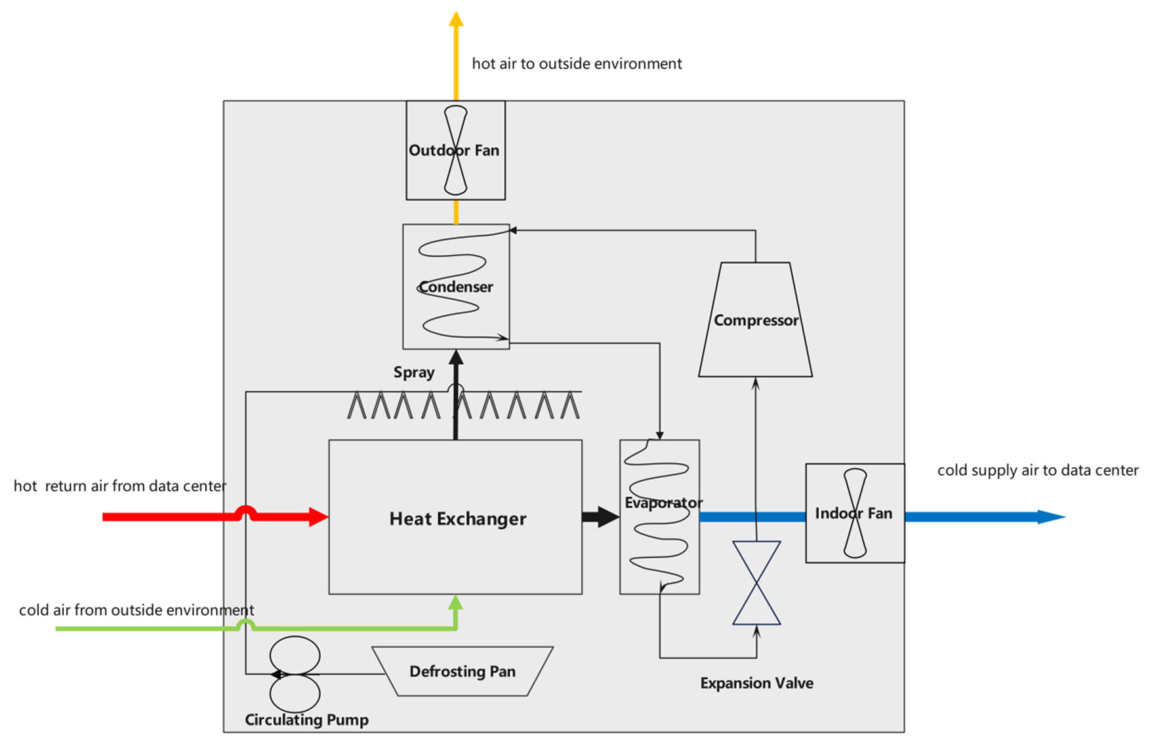
Figure 2.
A safety-aware direct control optimization method for industrial application.
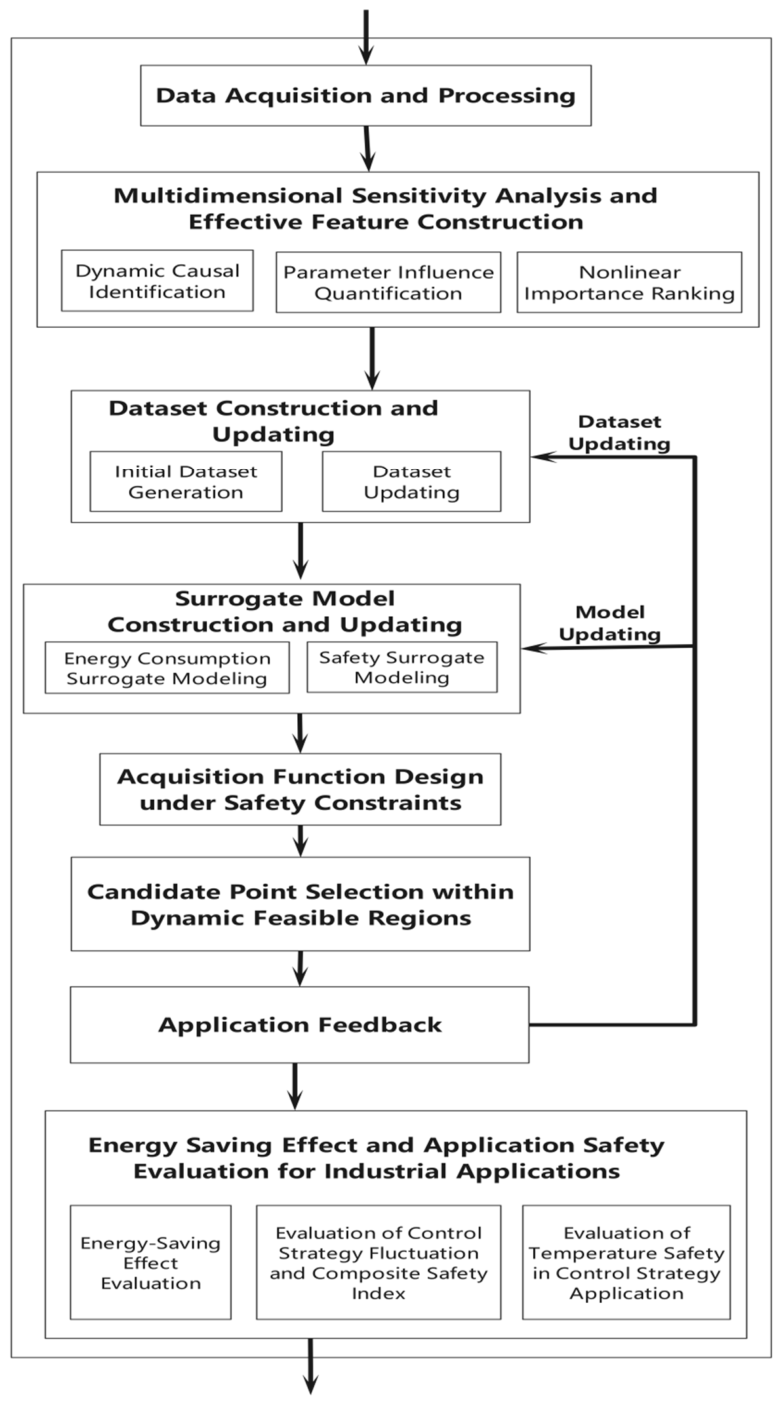
Figure 3.
Comparison of PUE and optimization rate.
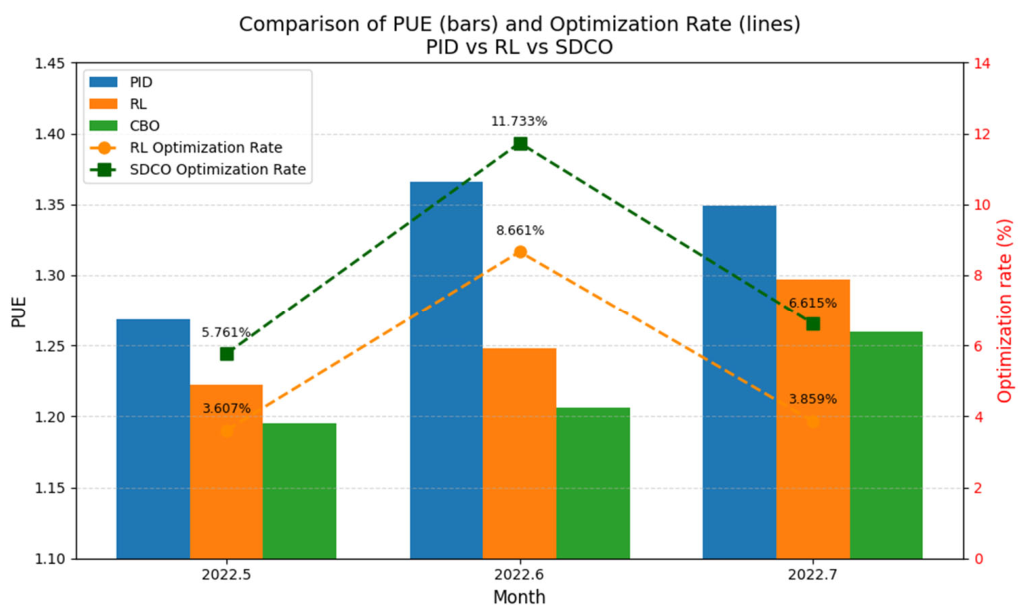
Figure 4.
Comparison of PUE optimization effectiveness.
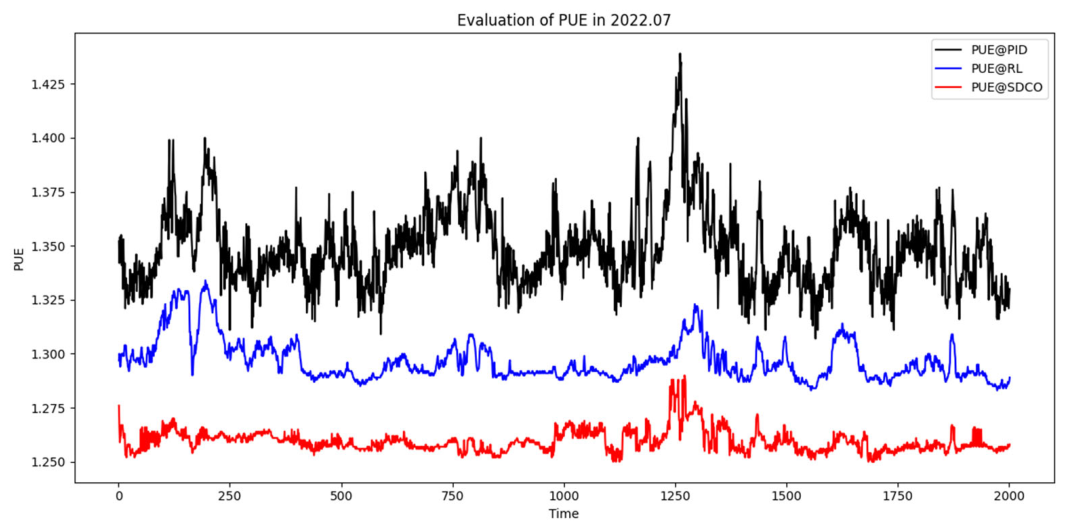
Figure 5.
Time series distribution of control strategies.
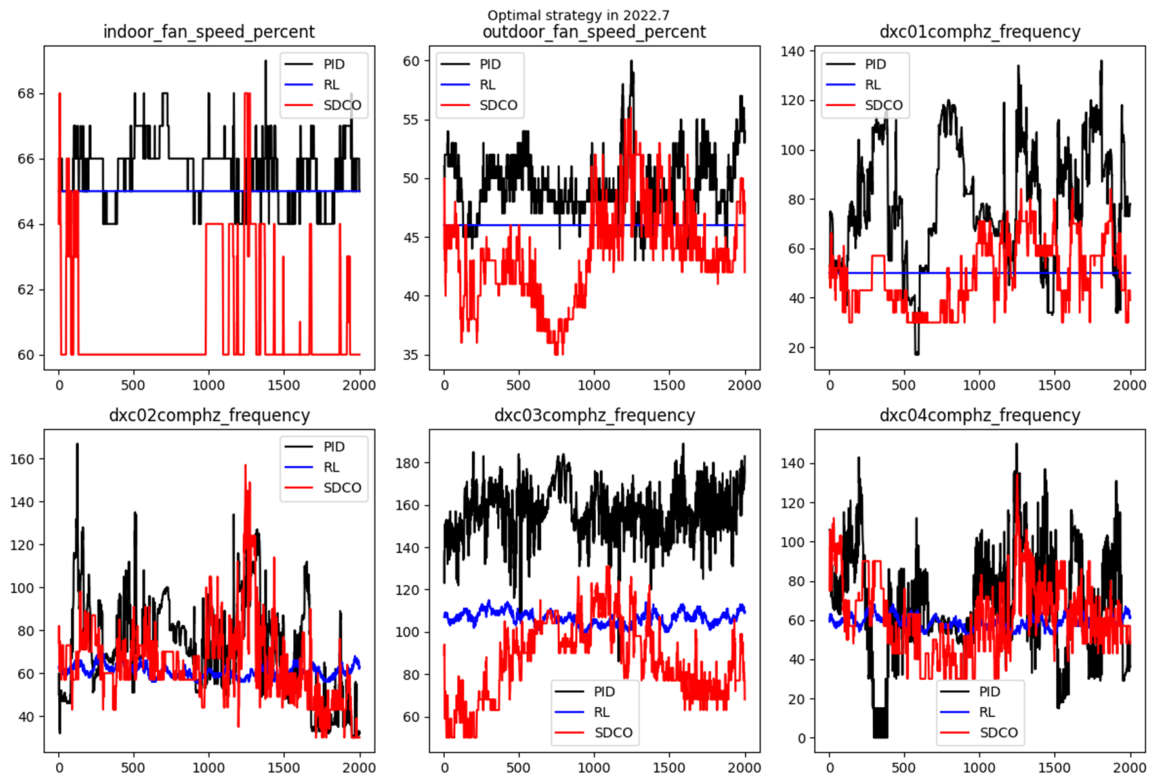
Figure 6.
Box plot distribution of control strategies.
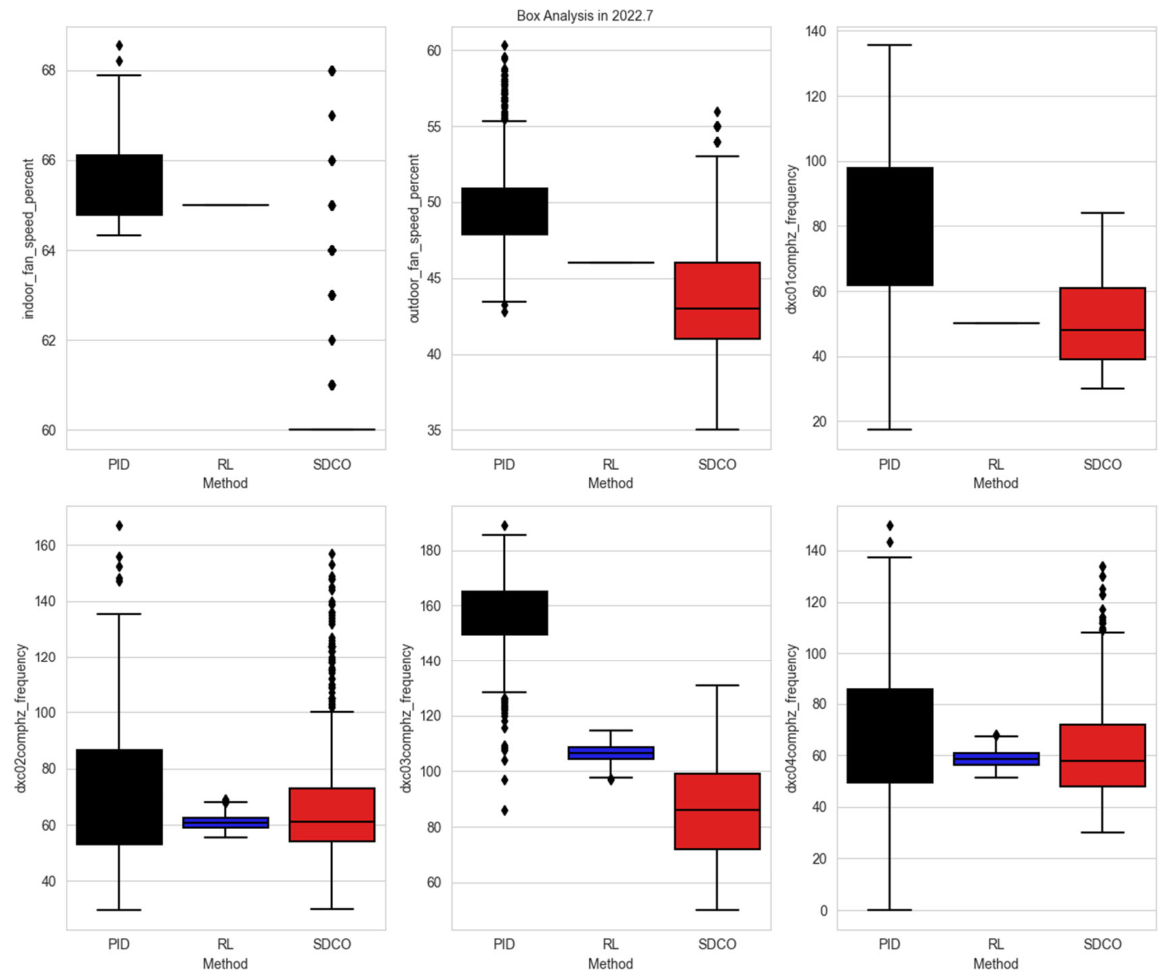
Figure 7.
Comparison of temperature control performance of control strategies.
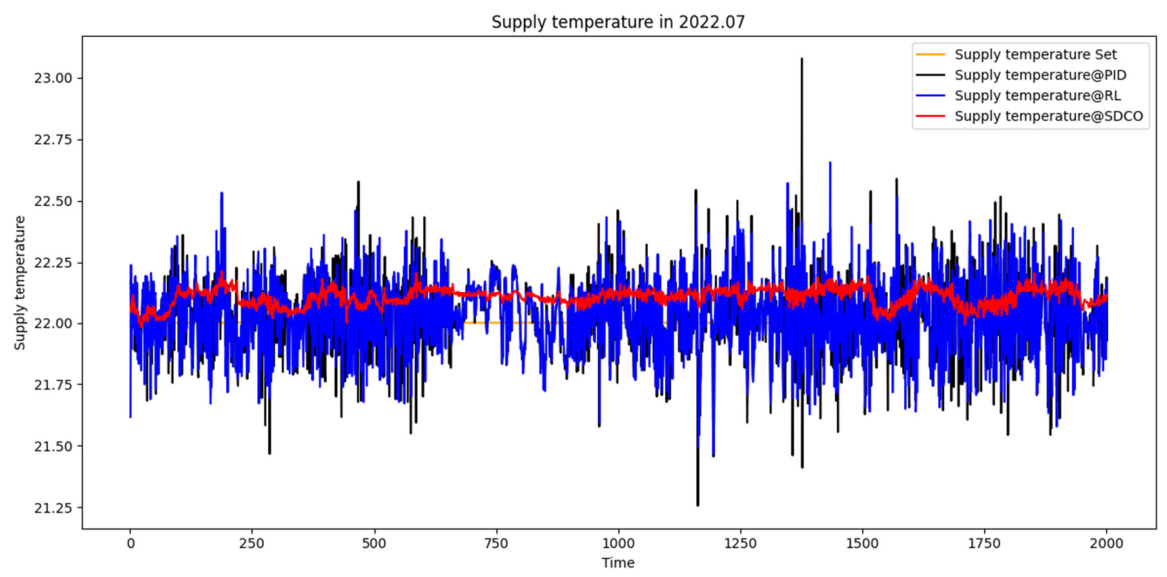

Table 1.
Comparison of existing energy-optimization methods.
| Ref. | Control Mode | Experimental Data | Feature Analysis & Construction | Optimization Type & Targets | Energy Savings Metrics | Safety / Volatility Metrics |
|---|---|---|---|---|---|---|
| [12] | MPC | Multi-chiller system (Real-world operational data) | / | Direct Device Control: Chilled water pump frequency, cooling tower fan speed | System COP, Total energy savings rate | Supply pressure fluctuation (Pressure Surge) |
| [13] | MPC | Google Data Center (Real-world data) | / | Set-point Optimization: Supply air temp, condenser water pump pressure set-point | energy savings percentage | Sensor observation bias, Data confidence intervals |
| [14] | MPC | Chiller system (Simulation data) | / | Set-point Optimization: Thermal storage thresholds, chiller supply water temp | Total cooling power, Peak load reduction rate | Storage system pressure limits, Switching frequency |
| [15] | MPC | Google Data Center (Real-world data) | / | Set-point Optimization: Target ambient temp, chiller load distribution | PUE optimization rate | Hardware lifespan loss, System failure rate |
| [16] | RL | Cooling system (Real-world operational data) | / | Direct Device Control: Compressor frequency, fan speed, pump frequency | Total Power Consumption | Indoor air temperature excursion |
| [17] | RL | Smart Buildings (Simulation data) | Feature Space Reduction: Defined state boundaries to strip redundant features and improve convergence | Hybrid Optimization: PMV target set-point, air flow rate and heater power direct control | Energy Efficiency Ratio (EER) | PMV index deviation, Dew point safety |
| [18] | RL | Multi-zone residential HVAC (Simulation) | / | Hybrid Optimization: Zone target temp set-points, VAV terminal opening direct control | Multi-zone collaborative energy savings | Zone temperature fluctuation variance |
| [19] | RL | Cloud Data Center (Real-world data) | / | Joint Optimization: Server frequency (DVFS) and cooling fan frequency | PUE, Cloud server energy efficiency ratio | Task Latency, System availability |
| [20] | RL | Industrial cooling (Semi-analytical simulation) | / | Direct Device Control: Industrial pump frequency, cooling tower speed % | / | Control action jittering |
| [21] | MPC | Data Center HVAC (Real-world data) | / | Direct Device Control: Chilled pump frequency, cooling tower fan frequency | Comprehensive efficiency, PUE optimization rate | Flow fluctuation rate, Sensor redundancy safety |
| [22] | BO | Cooling system (Hybrid Real/Simulation) | Deep Feature Extraction: Autoencoder for high-dimensional compression and non-linear reconstruction | Sensor Bias Calibration: Calibrated drifting sensors to ensure data-source-level control accuracy | Reduction in over-cooling loss due to perception errors | Sensor Health Index, Fault detection accuracy (F1-score) |
| [23] | BO | HVAC Systems (Real-world data) | / | Set-point Optimization: Min outdoor air flow, return air temp set-point | Daily average HVAC power | Dynamic response time, Duration of temp excursion |
| [24] | BO | PID Tuning (Simulation data) | / | Set-point Optimization: Adaptive tuning of PID gains (Kp, Ki, Kd) | Regulating Power | Constraint Violation frequency |
| Our Paper | BO | Industrial Data Center IECS (Real-world data) | Multi-dimensional Decoupled Analysis: Combined Granger Causality, Sobol’ Sensitivity, and XGBoost for interpretability and rigorous reduction | End-to-End Direct Control: Direct frequency/speed control of internal/external fans and compressors | PUE optimization rate, Total energy reduction | Control stability, Integrated Safety Index, Temperature Violation Rate (TVR), Temp Std Dev (TSD) |
Table 2.
Dynamic correlation analysis based on granger causality test.
| SSR Based F Test for PUE | ||||
|---|---|---|---|---|
| Variables | lag=1 | lag=2 | lag=3 | Lag=4 |
| outdoor_input_air_temp | 0.0006 | 0.0000 | 0.0000 | 0.0000 |
| outdoor_input_air_humidity | 0.2829 | 0.0139 | 0.0033 | 0.0000 |
| IT_load | 0.1240 | 0.1233 | 0.0000 | 0.0000 |
| indoor_fan_speed_percent | 0.0388 | 0.0000 | 0.0000 | 0.0000 |
| outdoor_fan_speed_percent | 0.0000 | 0.0000 | 0.0000 | 0.0000 |
| dxc01comphz_frequency | 0.0000 | 0.0000 | 0.0000 | 0.0000 |
| dxc02comphz_frequency | 0.0000 | 0.0000 | 0.0000 | 0.0000 |
| dxc03comphz_frequency | 0.0000 | 0.0000 | 0.0000 | 0.0000 |
| dxc04comphz_frequency | 0.0000 | 0.0000 | 0.0000 | 0.0000 |
| pump_frequency | 0.6779 | 0.5169 | 0.6005 | 0.7384 |
(Note: lag=N indicates a data collection granularity of 3*N minutes/instance.).
Table 3.
Parameter influence quantification based on Sobol’ sensitivity analysis.
| Variables | S1 | ST |
|---|---|---|
| dxc02comphz_frequency | 0.3088 | 0.3284 |
| dxc03comphz_frequency | 0.2540 | 0.2992 |
| dxc04comphz_frequency | 0.1408 | 0.2074 |
| dxc01comphz_frequency | 0.1225 | 0.1515 |
| outdoor_fan_speed_percent | 0.0474 | 0.0707 |
| pump_frequency | 0.0338 | 0.0700 |
| indoor_fan_speed_percent | 0.0062 | 0.0203 |
| outdoor_input_air_temp | -0.0004 | 0.0072 |
| outdoor_input_air_humidity | 0.0016 | 0.0042 |
| IT_load | -0.0003 | 0.0007 |
Table 4.
Non-linear importance ranking based on XGBoost gain ranking.
| Name | Coefficient |
|---|---|
| dxc03comphz_frequency | 0.4462 |
| IT_load | 0.1161 |
| outdoor_fan_speed_percent | 0.0781 |
| dxc01comph_frequency | 0.0725 |
| dxc04comph_frequency | 0.0612 |
| dxc02comphz_frequency | 0.0530 |
| indoor_fan_speed_percent | 0.0413 |
| outdoor_input_air_temp | 0.0015 |
| pump_frequency | 0.0010 |
| outdoor_input_air_humidity | 0.0007 |
Table 5.
PUE energy saving effect evaluation.
| Data | Method | PUE | PUE Optimization Rate |
|---|---|---|---|
| 2022.5 | PID | 1.26835 | / |
| RL | 1.22226 | 3.607% | |
| SDCO | 1.19528 | 5.761% | |
| 2022.6 | PID | 1.36608 | / |
| RL | 1.24777 | 8.661% | |
| SDCO | 1.20580 | 11.733% | |
| 2022.7 | PID | 1.34872 | / |
| RL | 1.29667 | 3.859% | |
| SDCO | 1.25950 | 6.615% |
Table 6.
Volatility analysis of control parameters for the IEC System.
| Control Strategies | Method | SD | RSD | CV | MAD | CD | FII | CSI |
|---|---|---|---|---|---|---|---|---|
| indoor_fan_speed_percent | PID | 0.847 | 0.136 | 0.013 | 0.154 | 0.064 | 0.270 | 0.832 |
| RL | 0 | 0.000 | 0.000 | 0 | 0 | 0 | 1.000 | |
| SDCO | 1.740 | 0.123 | 0.029 | 0.153 | 0.131 | 0.089 | 0.894 | |
| outdoor_fan_speed_percent | PID | 2.548 | 0.614 | 0.052 | 0.735 | 0.356 | 0.501 | 0.681 |
| RL | 0 | 0.000 | 0.000 | 0 | 0 | 0 | 1.000 | |
| SDCO | 4.032 | 0.558 | 0.093 | 0.585 | 0.483 | 0.416 | 0.680 | |
| dxc01comph_frequency | PID | 23.842 | 2.353 | 0.305 | 2.488 | 1.511 | 0.259 | 0.474 |
| RL | 0 | 0.000 | 0.000 | 0 | 0 | 0 | 1.000 | |
| SDCO | 13.578 | 1.402 | 0.274 | 1.421 | 1.090 | 0.282 | 0.558 | |
| dxc02comph_frequency | PID | 23.165 | 2.888 | 0.324 | 3.206 | 1.921 | 0.293 | 0.424 |
| RL | 2.699 | 0.561 | 0.044 | 0.676 | 0.223 | 0.579 | 0.679 | |
| SDCO | 18.453 | 2.995 | 0.286 | 3.114 | 1.968 | 0.450 | 0.393 | |
| dxc03comph_frequency | PID | 11.815 | 5.603 | 0.075 | 7.082 | 0.657 | 0.507 | 0.353 |
| RL | 3.117 | 0.638 | 0.029 | 0.761 | 0.163 | 0.603 | 0.672 | |
| SDCO | 17.793 | 2.132 | 0.207 | 2.356 | 0.941 | 0.488 | 0.454 | |
| dxc04comph_frequency | PID | 27.953 | 7.171 | 0.414 | 9.004 | 2.221 | 0.479 | 0.217 |
| RL | 3.185 | 0.659 | 0.029 | 0.788 | 0.151 | 0.586 | 0.673 | |
| SDCO | 18.758 | 3.101 | 0.307 | 3.495 | 1.706 | 0.482 | 0.374 |
Table 7.
Temperature safety evaluation of control parameters.
| Method | Mean | Max_bound | Mean_bound | TVR(0.5) | TVR(0.25) | TSD |
|---|---|---|---|---|---|---|
| PID | 22.028 | 1.078 | 0.131 | 0.400% | 6.550% | 0.164 |
| RL | 22.028 | 0.656 | 0.123 | 0.200% | 6.600% | 0.153 |
| SDCO | 22.106 | 0.213 | 0.106 | 0.000% | 0.000% | 0.037 |
Disclaimer/Publisher’s Note: The statements, opinions and data contained in all publications are solely those of the individual author(s) and contributor(s) and not of MDPI and/or the editor(s). MDPI and/or the editor(s) disclaim responsibility for any injury to people or property resulting from any ideas, methods, instructions or products referred to in the content. |
© 2026 by the authors. Licensee MDPI, Basel, Switzerland. This article is an open access article distributed under the terms and conditions of the Creative Commons Attribution (CC BY) license (http://creativecommons.org/licenses/by/4.0/).
Copyright: This open access article is published under a Creative Commons CC BY 4.0 license, which permit the free download, distribution, and reuse, provided that the author and preprint are cited in any reuse.


