

Submitted:
08 June 2026
Posted:
09 June 2026
You are already at the latest version
Abstract
Understanding how land-use change affects habitat fragmentation and connectivity is essential for assessing landscape degradation and conservation effectiveness in tropical protected areas. This study investigated long-term landscape dynamics, forest fragmentation, and structural connectivity in the Bena Mulumbu Hunting Domain, a Category VI protected area located in the miombo woodland region of southeastern Democratic Republic of the Congo. Landsat imagery acquired in 1995, 2005, 2015, and 2025 was classified using the Random Forest algorithm to quantify land-cover changes over a 30-year period. Landscape composition was assessed using land-cover proportions (PLAND), Shannon diversity metrics, and transition analyses, while fragmentation and structural connectivity of miombo woodland were evaluated along an edge-to-core gradient (0–2 km, 2–4 km, 4–6 km, and >6 km) using landscape metrics. Results showed that savanna remained the dominant land-cover type throughout the study period. However, the landscape underwent progressive reorganization characterized by recurrent transitions among miombo woodland, savanna, and agricultural land, leading to increased spatial heterogeneity. Fragmentation analyses revealed significant differences among spatial gradients for the number of forest patches (p = 0.022) and total core area (p < 0.001), indicating a gradual reduction of interior forest habitat. Despite increasing fragmentation, structural connectivity remained relatively high across the protected area. The CONNECT index increased significantly from the edge toward the core zone (p < 0.001), highlighting better-connected forest networks in interior sectors. These findings suggest that the Bena Mulumbu Hunting Domain is experiencing an intermediate stage of landscape transformation, where forest fragmentation is evident but has not yet resulted in widespread connectivity loss. Maintaining existing forest cores and connectivity corridors should therefore be prioritized to prevent further degradation of ecological integrity.
Keywords:
miombo woodland
; land-use change
; landscape fragmentation
; structural connectivity
; protected areas
; landscape heterogeneity
; edge-to-core gradient
; Democratic Republic of the Congo
1. Introduction
Land-use and land-cover change is widely recognized as one of the major drivers of landscape degradation and biodiversity loss worldwide [1]. Through agricultural expansion, infrastructure development, urbanization, resource extraction, and increasing human settlement, natural landscapes are being progressively transformed, resulting in profound modifications of habitat structure, ecosystem functioning, and ecological processes [2,3]. Beyond changes in land-cover extent, these transformations alter the spatial configuration of habitats, often leading to fragmentation, reduced core habitat availability, and changes in ecological connectivity [4,5]. Such processes are particularly critical in tropical ecosystems, where biodiversity conservation increasingly depends on maintaining functional and structurally connected landscapes [5,6].
Miombo woodlands constitute one of the largest dry forest and woodland ecosystems in sub-Saharan Africa, covering extensive areas of Central and Southern Africa [7]. These ecosystems provide essential ecological functions, including biodiversity conservation, carbon storage, nutrient cycling, soil protection, and hydrological regulation [7]. They also support millions of rural households through the provision of fuelwood, construction materials, agricultural land, and non-timber forest products [7,8]. Despite their ecological and socio-economic importance, Miombo landscapes are increasingly affected by agricultural expansion, charcoal production, timber harvesting, recurrent fires, and mining activities, resulting in substantial changes in land cover and landscape structure [9,10].
In the southeastern Democratic Republic of the Congo (DR Congo), these pressures have intensified over recent decades as a consequence of rapid population growth, urban expansion, and the development of industrial and artisanal mining activities associated with the Copperbelt region [11,12]. The provinces of Lualaba and Haut-Katanga have experienced some of the most pronounced land-use transformations in Central Africa, with increasing conversion of natural vegetation into agricultural land, settlements, and mining areas [13,14]. Several studies have documented significant reductions in woodland cover and increasing landscape fragmentation across the region [11,15]. However, relatively little is known about how these processes affect the internal spatial organization of protected areas embedded within these rapidly changing landscapes.
Protected areas represent a cornerstone of biodiversity conservation strategies and are expected to mitigate land degradation by maintaining habitat integrity and ecological processes [16,17]. Nevertheless, growing evidence suggests that legal protection alone does not necessarily prevent habitat alteration or landscape transformation, particularly in tropical regions facing strong demographic and economic pressures [16,18]. Agricultural encroachment, infrastructure development, fire disturbances, resource extraction, and human settlements frequently occur within or around protected areas, contributing to habitat degradation and increasing fragmentation [6,16]. Evaluating how landscape structure evolves within protected areas is therefore essential for assessing their effectiveness in maintaining ecological integrity [5,17].
Remote sensing and landscape ecology provide powerful tools for monitoring long-term landscape dynamics and quantifying habitat degradation over large spatial extents [19,20]. Satellite image archives such as Landsat offer consistent observations spanning several decades, allowing the reconstruction of land-cover trajectories and the assessment of changes in landscape composition and configuration [20,21]. Coupled with landscape metrics, these datasets enable the characterization of fragmentation patterns, habitat connectivity, and the spatial organization of landscape transformation [22]. Such approaches have been widely applied to tropical ecosystems but remain comparatively underutilized in Central African Miombo protected areas [12].
Most previous studies conducted in southeastern DR Congo have focused primarily on land-cover change detection and broad-scale assessments of woodland loss [11,15,23]. Although these studies have substantially improved our understanding of regional landscape dynamics, they generally treat protected areas as spatially homogeneous units and rarely investigate how transformations are distributed within protected area boundaries. Yet anthropogenic pressures are often spatially heterogeneous and may vary according to accessibility, settlement patterns, transportation networks, and resource availability [6,24]. Consequently, understanding the internal spatial organization of landscape transformation is necessary to identify areas that remain relatively intact and those that are becoming increasingly vulnerable to degradation [5,22].
The Bena Mulumbu Hunting Domain, a Category VI protected area located in Lualaba Province, offers an appropriate framework for addressing this knowledge gap. The protected area is embedded within a rapidly changing socio-economic environment while still containing substantial remnants of Miombo woodland. Its spatial configuration is particularly interesting because the National Road RN1 crosses the protected area and several human settlements occur within or near its boundaries [6,24]. These characteristics suggest that landscape transformation may not necessarily follow the classical edge-to-core pattern frequently described in protected areas, whereby anthropogenic disturbances progressively decrease from peripheral zones toward the interior [25,26]. In this context, the combined analysis of land-cover dynamics, fragmentation, and structural connectivity provides an opportunity to assess the extent to which landscape transformation processes vary along an edge-to-core gradient and how internal accessibility factors, particularly the RN1 road, may modify this expected spatial pattern.
The present study investigates land-cover dynamics, forest fragmentation, and structural connectivity within the Bena Mulumbu Hunting Domain between 1995 and 2025 using Landsat imagery and landscape metrics. We hypothesize that landscape transformation does not follow a simple monotonic edge-to-core gradient but reflects a more complex spatial pattern influenced by both boundary effects and internal accessibility factors. To specify these expectations, we propose the following hypotheses. We expect agricultural expansion to be higher in the edge zone (0–2 km) and along the RN1 corridor, leading to lower Miombo woodland cover and higher values of landscape diversity indices (SHDI and SHEI) in these areas compared to the core zones (H1). We hypothesize that Miombo woodland fragmentation (NP, PD, LPI) is higher in edge zones and decreases toward the core, but this gradient is locally disrupted in areas influenced by the RN1 road and settlements (H2). We further expect that core habitat area (TCA) is reduced in peripheral and accessible zones and better preserved in central areas (H3). Finally, we hypothesize that structural connectivity of Miombo woodland, as measured by CONNECT and COHESION, remains relatively high despite increasing fragmentation, with lower values in edge zones and higher values in less accessible core areas (H4).
2. Materials and Methods
2.1. Study Area
The study was conducted in the Bena Mulumbu Hunting Domain, a Category VI protected area located in Lubudi Territory, Lualaba Province, southeastern DR Congo [15]. The protected area extends between 25.93°–26.27° E and 9.98°–9.75° S (WGS84) and covers approximately 608 km2 (Figure 1). The area lies within the Zambezian Miombo woodland ecoregion, one of the largest tropical woodland ecosystems in sub-Saharan Africa. The climate is tropical sub-humid, characterized by a marked seasonality with a dry season lasting approximately five months, generally from April to August [27]. Mean annual temperature is around 25 °C, while annual rainfall ranges between 1200 and 1600 mm [13,28]. Vegetation is dominated by Miombo woodland interspersed with savanna formations, agricultural land, and localized anthropogenic land uses. Dominant soils include Ferralsols, Acrisols, and Arenosols, which are widely distributed across the region [29]. The protected area is embedded within a rapidly changing socio-ecological landscape. Lubudi Territory hosts an estimated population of approximately 387,000 inhabitants, most of whom depend on agriculture, fuelwood extraction, and other natural resources for their livelihoods [15,30]. These activities contribute to increasing pressure on natural ecosystems and may influence land-use trajectories within and around the protected area [31,32]. The Bena Mulumbu Hunting Domain is particularly relevant for assessing spatial patterns of landscape transformation because it combines protected status with significant internal accessibility. The National Road RN1 crosses the protected area, and several settlements, including Kayo village, occur within or near its boundaries, creating heterogeneous exposure to anthropogenic disturbances and providing an appropriate setting for examining landscape transformation, forest fragmentation, and structural connectivity along an edge-to-core gradient.
2.2. Data Sources
The analysis of land-use and land-cover dynamics in the Bena Mulumbu Hunting Domain between 1995 and 2025 was based on a multi-temporal Landsat image archive. Landsat 5 Thematic Mapper (TM) and Landsat 8 Operational Land Imager (OLI) surface reflectance products were used because they provide consistent long-term observations at a spatial resolution of 30 m, representing an appropriate compromise between spatial detail and temporal continuity for monitoring landscape dynamics over several decades [20]. Surface reflectance products were selected to ensure radiometric consistency among sensors and acquisition dates through standardized atmospheric correction procedures [33]. Four reference years (1995, 2005, 2015, and 2025) were selected according to image availability and quality. A 10-year interval was adopted to characterize long-term landscape trajectories while minimizing the influence of short-term interannual fluctuations. This temporal framework is particularly suitable for capturing gradual transformations in Miombo woodland landscapes and major phases of land-use change occurring in southeastern DR Congo [15]. For each reference year, between three and six Landsat scenes covering the entire study area were selected and combined into median composites. This approach reduced residual cloud contamination, atmospheric noise, and temporary disturbances while providing a more stable representation of land surface conditions [34]. All image processing was performed within the Google Earth Engine (GEE) cloud-computing platform. Only images acquired during the dry season (June–September) were retained to reduce cloud cover and seasonal variability in vegetation phenology. Because Miombo ecosystems are frequently affected by seasonal fires during the dry season, the use of multi-scene median composites further contributed to stabilizing spectral responses and improving classification reliability [34]. In addition to satellite imagery, vector layers describing the boundaries of the hunting domain, transportation infrastructure, and human settlements were used for spatial analyses and map production.
2.3. Land-Use and Land-Cover Classification
Land-use and land-cover (LULC) maps were produced for 1995, 2005, 2015, and 2025 using a supervised classification approach implemented in GEE. For each reference year, median dry-season composites generated from cloud-free Landsat surface reflectance images were used as classification inputs. False-colour composites combining near-infrared, red, and green bands were visually inspected to support the identification of land-cover classes and the selection of training samples [35]. The use of atmospherically corrected surface reflectance products ensured radiometric consistency among sensors and acquisition dates [33].
Classification was performed using the Random Forest (RF) algorithm, a non-parametric ensemble learning method widely recognized for its robustness, ability to handle non-linear relationships, and high classification accuracy in heterogeneous tropical environments [36]. The RF classifier was parameterized with 100 decision trees. Training data were generated through visual interpretation of Landsat composites supported by very high-resolution imagery available within GEE. Between 80 and 100 training samples were collected per class. Six land-use and land-cover classes were identified: Miombo woodland, savanna, agricultural land, mining areas, built-up/bare land, and water bodies. Gallery forests and dry dense forests were incorporated into the Miombo woodland class because their spectral signatures could not be consistently distinguished at the 30-m Landsat resolution [37].
Classification accuracy was assessed using an internal validation procedure based on a random partition of the reference dataset into training (70%) and validation (30%) subsets. Classification performance was evaluated using confusion matrices, overall accuracy, producer's accuracy, and user's accuracy, following current recommendations for land-cover accuracy assessment [38,39]. Because validation data were not fully independent from the training dataset, accuracy metrics were interpreted as indicators of relative classification performance rather than absolute measures of map accuracy [38]. Detailed confusion matrices for all four reference years are provided in the Supplementary Materials (Tables S1–S4). The resulting LULC maps were subsequently used as inputs for landscape composition, fragmentation, and structural connectivity analyses [22].
2.4. Spatial Stratification of the Protected Area
To investigate the spatial organization of landscape transformation within the Bena Mulumbu Hunting Domain, an edge-to-core gradient approach was adopted. This framework is based on the widely recognized assumption that anthropogenic pressures and associated ecological disturbances generally decrease with increasing distance from protected area boundaries [25,26]. In this study, the edge-to-core concept was not considered as an a priori condition but rather as a spatial hypothesis to be evaluated empirically. The protected area was subdivided into four concentric spatial zones according to the Euclidean distance from its boundaries: edge zone (0–2 km), outer intermediate zone (2–4 km), inner intermediate zone (4–6 km), and core zone (>6 km) (Figure 1). The 2-km interval was selected as a compromise between capturing meaningful spatial variation in landscape structure and maintaining compatibility with the spatial resolution of Landsat imagery (30 m). By partitioning the protected area into nested spatial zones, this approach provides a quantitative framework for assessing whether landscape degradation, forest fragmentation, and connectivity loss are primarily concentrated near the boundaries or whether they exhibit more complex spatial patterns associated with internal accessibility and localized human pressures [6,25].
2.5. Landscape Analysis and Statistical Procedures
Landscape composition, fragmentation, and structural connectivity were quantified using landscape metrics calculated with FRAGSTATS version 4.2 [40]. Analyses were conducted within the four edge-to-core zones defined for the Bena Mulumbu Hunting Domain and focused on changes occurring between 1995 and 2025.
Landscape Composition
Landscape composition was characterized using metrics describing the relative abundance and diversity of land-cover classes. The percentage of landscape (PLAND) was calculated for each land-cover category. At the landscape level, Shannon's Diversity Index (SHDI) and Shannon's Evenness Index (SHEI) were used to assess landscape heterogeneity [22]. Land-cover transitions between successive periods were quantified through cross-tabulation of classified maps and visualized using Sankey diagrams [41]. Detailed land-cover transition matrices are provided in the Supplementary Materials (Tables S5–S12).
Forest Fragmentation
Fragmentation analyses focused on Miombo woodland. A set of complementary metrics was selected to characterize different dimensions of fragmentation [2,19,42]. Patch Density (PD) was used to quantify the degree of woodland subdivision, whereas the Largest Patch Index (LPI) measured the dominance of the largest woodland fragment [19]. Edge Density (ED) described the extent of woodland–non-woodland interfaces, while the Aggregation Index (AI) evaluated the spatial clustering of woodland patches [22]. Total Core Area (TCA) was calculated using an edge depth of 100 m, consistent with studies showing that the strongest edge effects in tropical forest landscapes generally occur within the first 100 m from habitat boundaries [25,43].
Structural Connectivity
Structural connectivity was evaluated using metrics describing the spatial arrangement and potential interconnection of woodland fragments. The metrics used in this study describe the structural connectivity of Miombo woodland cover rather than the functional connectivity of particular species. CONNECT quantified the proportion of physically connected patches within a specified neighbourhood distance. COHESION assessed the physical continuity of woodland habitats, whereas the Proximity Index (PROX_MN) incorporated both patch size and proximity to neighbouring fragments [44]. A threshold distance of 1000 m was adopted for CONNECT and PROX_MN analyses [19]. Euclidean Nearest Neighbour Distance (ENN_MN) was used to quantify patch isolation, and the Landscape Division Index (DIVISION) was calculated to evaluate the overall degree of woodland subdivision [2].
Statistical Analyses
Statistical analyses were performed in R software to evaluate spatial and temporal variations in landscape metrics. The analyses were based on metric values calculated in FRAGSTATS for each of the four edge-to-core zones and each of the four reference years, resulting in 16 observations per metric. Prior to hypothesis testing, data distributions were assessed using the Shapiro–Wilk normality test, whereas homogeneity of variances was evaluated using Levene's test [45]. Differences among edge-to-core zones and reference years were evaluated using the non-parametric Kruskal–Wallis test [46]. When significant differences were detected, pairwise comparisons were conducted using Dunn's post hoc test with Bonferroni correction. The relationship between Miombo woodland structural connectivity and the edge-to-core gradient was additionally assessed using Spearman's rank correlation coefficient [47].
3. Results
3.1. Landscape Composition
3.1.1. Land-Use and Land-Cover Maps
The visual interpretation of land-use and land-cover maps reveals progressive landscape transformation within the Bena Mulumbu Hunting Domain between 1995 and 2025 (Figure 2). Throughout the study period, savanna remained the dominant land-cover class across all edge-to-core zones. However, the spatial distribution of Miombo woodland became progressively less continuous, particularly in peripheral and intermediate sectors. In 1995, woodland patches appeared relatively extensive and well connected, whereas agricultural areas were mainly confined to settlements and the RN1 corridor. From 2005 onwards, agricultural land expanded and became more spatially dispersed, while woodland patches showed increasing discontinuity. These trends became more apparent in 2015 and persisted in 2025, when woodland remained present in several internal sectors but exhibited lower spatial continuity than at the beginning of the study period. The maps suggest a gradual reorganization of landscape structure rather than abrupt land-cover conversion, characterized by the persistence of savanna as the dominant matrix, increasing agricultural expansion, and a progressive redistribution of Miombo woodland patches. Overall classification accuracy ranged from 85% to 91% across the study years, with lower performance observed for agricultural and mining classes. Detailed confusion matrices are provided in Tables S1–S4 in the Supplementary Materials.
3.1.2. Spatio-Temporal Dynamics of Landscape Composition along the Edge-to-Core Gradient
Figure 3 illustrates changes in the proportion of landscape (PLAND) occupied by each land-cover class along the edge-to-core gradient between 1995 and 2025. Distinct temporal trajectories were observed among land-cover categories. Miombo woodland exhibited the greatest variability throughout the study period. Woodland cover declined across most spatial zones between 1995 and 2015, particularly in edge (0–2 km) and intermediate sectors. Although woodland proportions stabilized in 2025, they remained lower than those recorded at the beginning of the study period, indicating a gradual reduction in the relative contribution of woodland habitats to the landscape. Savanna remained the dominant land-cover class across all gradients and years. Agricultural land displayed an opposite trend to that of Miombo woodland, expanding progressively across all spatial zones, with the highest values recorded in the edge zone in 2025. Built-up/bare land and mining areas remained minor landscape components throughout the study period. Despite these contrasting trajectories, landscape composition did not differ significantly among edge-to-core zones (Kruskal–Wallis: χ2 = 0.043, df = 3, p = 0.998) or among years (χ2 = 0.253, df = 3, p = 0.969).
3.1.3. Landscape Diversity and Evenness Along the Edge-to-Core Gradient
Shannon's Diversity Index (SHDI) and Shannon's Evenness Index (SHEI) revealed moderate spatial and temporal variations in landscape composition along the edge-to-core gradient (Figure 4). Overall, SHDI remained relatively stable between 1995 and 2015, with slightly higher values generally observed in edge and intermediate zones than in core areas. In 2025, SHDI increased across all spatial zones, reaching its highest values of the study period, indicating an increase in landscape heterogeneity. A similar pattern was observed for SHEI, with evenness increasing substantially in 2025 when the highest values were recorded across most gradients. Taken together, the SHDI and SHEI trajectories indicate a progressive increase in landscape heterogeneity consistent with H1, reflecting increased landscape heterogeneity associated with agricultural expansion and Miombo woodland decline across the protected area.
3.2. Land-Cover Transitions Along the Edge-to-Core Gradient
The Sankey diagrams illustrate land-cover transition pathways between 1995 and 2025 across the four edge-to-core zones of the Bena Mulumbu Hunting Domain (Figure 5). Detailed land-cover transition matrices for each period and spatial zone are provided in Tables S5–S12 in the Supplementary Materials. Overall, the results indicate substantial persistence of the major land-cover classes, accompanied by recurrent transitions involving Miombo woodland, savanna, and agricultural land. Woodland-to-savanna conversions represented the dominant transition pathway, suggesting a progressive reorganization of woody vegetation toward more open land-cover types. Savanna exhibited the highest temporal stability and remained the dominant landscape matrix. Agricultural land displayed dynamic bidirectional exchanges with both savanna and Miombo woodland. In contrast, built-up areas, mining sites, and water bodies contributed only marginally to overall landscape transitions. Although transition intensities varied slightly among spatial zones, the overall patterns were remarkably similar along the edge-to-core gradient, suggesting that landscape transformation processes are distributed throughout the protected area rather than being confined to peripheral sectors.
3.3. Miombo Woodland Fragmentation Along the Edge-to-Core Gradient
Fragmentation metrics revealed substantial temporal and spatial changes in Miombo woodland structure between 1995 and 2025 (Figure 6). Overall, the results indicate a progressive reduction in woodland patch size and core habitat area, accompanied by increased subdivision of woodland habitats. The number of patches (NP) highlights a strong temporal dynamic, with maximum values observed in 2005, suggesting a phase of intensified woodland subdivision, followed by a gradual decline toward 2025. Spatial differences were significant (Kruskal–Wallis: χ2 = 9.64, p = 0.022), particularly between the edge (0–2 km) and core (>6 km) zones (adjusted p = 0.018). The Largest Patch Index (LPI) was highest in 1995 and decreased progressively until 2015, indicating a reduction in the contribution of large woodland fragments to landscape structure, followed by a slight recovery in 2025. Total Core Area (TCA) declined substantially between 1995 and 2015 across all spatial zones, before showing a partial recovery in 2025. Differences among gradients were highly significant (χ2 = 25.34, p < 0.001), with larger core habitat areas generally maintained in more internal sectors. In contrast, the Aggregation Index (AI) remained relatively high throughout the study period, indicating that woodland patches retained a certain degree of spatial clustering despite increasing fragmentation. Other fragmentation metrics (e.g., Patch Density and Edge Density) showed similar temporal trends but did not exhibit significant spatial differences and are therefore not presented graphically. These patterns partially support H2 and H3, with higher fragmentation and reduced core habitat area in edge and more accessible zones, while larger core areas are generally maintained in more internal sectors.
3.4. Miombo Woodland Connectivity Along the Edge-to-Core Gradient
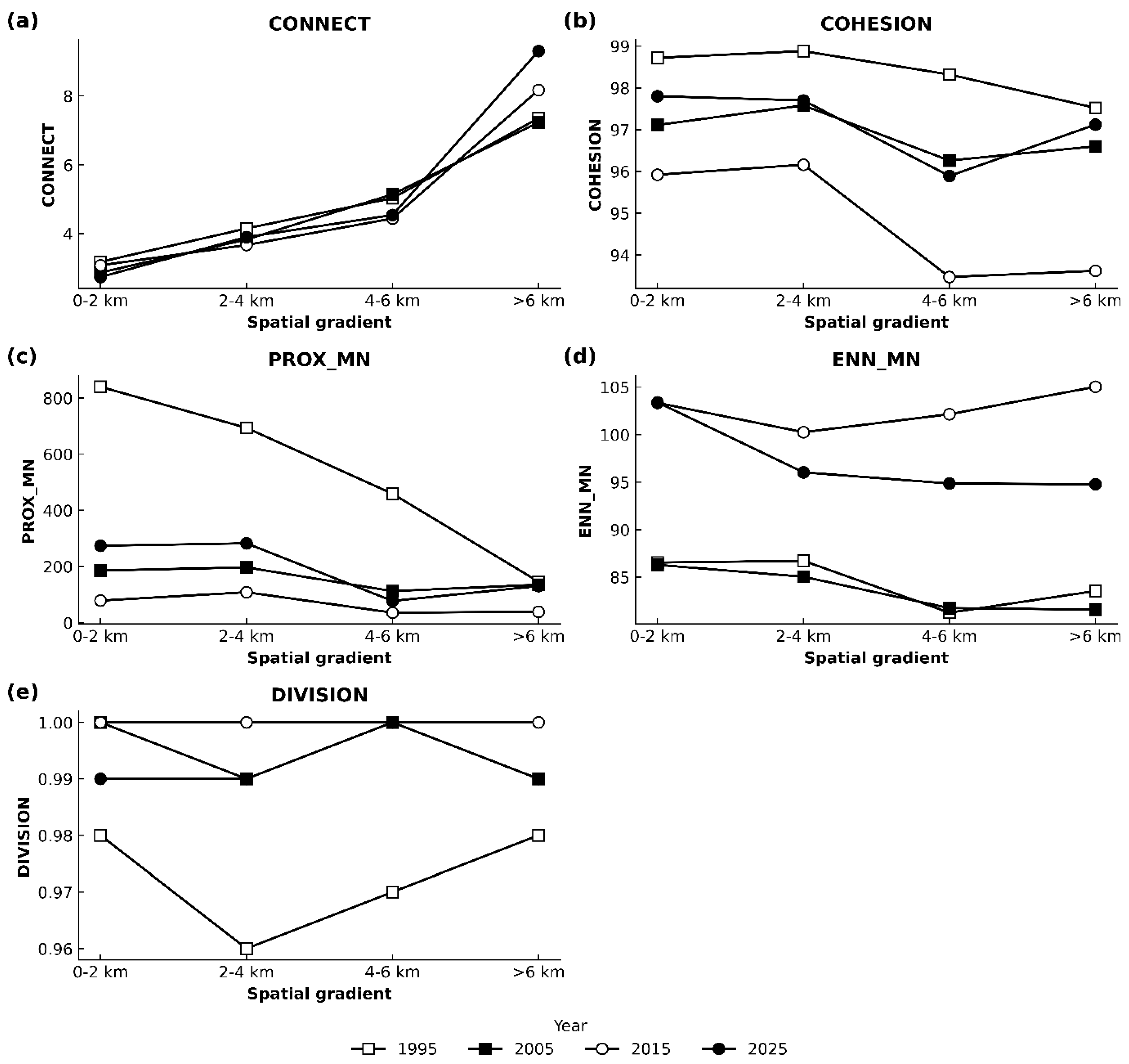
Connectivity metrics revealed contrasting spatial and temporal patterns in Miombo woodland connectivity between 1995 and 2025 (Figure 7). Among the metrics examined, only CONNECT showed a significant effect of the edge-to-core gradient (χ2 = 40.16, p < 0.001), whereas no significant temporal differences were detected (p = 0.854). CONNECT increased consistently from the edge (0–2 km) to the core zone (>6 km) throughout the study period. Post hoc comparisons indicated significant differences between the core zone and all other gradients (all p < 0.001), highlighting stronger structural connectivity within the interior of the protected area. COHESION remained consistently high (>93) across all years and spatial zones, suggesting that woodland fragments retained a high degree of physical continuity despite ongoing landscape transformation. Similarly, PROX_MN, ENN_MN, and DIVISION exhibited temporal fluctuations but showed no significant differences among gradients or years (p > 0.05). The fitted linear regression model (CONNECT = 1.2669 + 1.5589 × Gradient) revealed a significant increase in connectivity from edge to core areas (F = 134.8, p < 0.001, R2 = 0.746), corroborated by a strong positive Spearman correlation (ρ = 0.924, p < 0.001). These patterns support H4, indicating that connectivity remains relatively high despite fragmentation, with lower values near boundaries and higher connectivity in core areas.
4. Discussion
4.1. Landscape Composition Dynamics and Mosaic Reorganization
The combined analysis of land-cover maps, PLAND metrics, diversity indices (SHDI and SHEI), and transition trajectories revealed a progressive reorganization of the landscape between 1995 and 2025. Rather than reflecting abrupt land-cover replacement, the observed changes were characterized by continuous exchanges among the dominant land-cover classes, resulting in a gradual restructuring of the landscape mosaic [48]. Agricultural land expanded steadily across all edge-to-core zones, particularly after 2015. Similar trends have been widely reported across Miombo landscapes, where recurrent anthropogenic disturbances often promote the maintenance or expansion of open vegetation formations at the expense of woody cover [49]. The dominant transitions involved exchanges among Miombo woodland, savanna, and agricultural land. Woodland-to-savanna transitions were particularly frequent, consistent with trajectories reported in many tropical ecosystems undergoing gradual degradation and agricultural expansion [50,51].
An important finding is the relative similarity of transition pathways across all edge-to-core zones. This pattern contrasts with the classical expectation of landscape degradation progressing primarily from protected area boundaries toward the interior. Instead, the results suggest that landscape transformation is influenced by both external pressures and internal accessibility. In the Bena Mulumbu Hunting Domain, the relative similarity of transformation pathways across edge-to-core zones is consistent with the potential influence of the RN1 road corridor and localized settlements [6,24]. Similar effects of transportation infrastructure on habitat transformation have been documented in tropical protected landscapes worldwide [6,24,52]. The increase in SHDI and SHEI values observed in 2025 further indicates a growing landscape heterogeneity; however, in fragmented tropical landscapes, higher landscape diversity may coincide with declining ecological integrity when it results from habitat subdivision and expanding human land use [2,5,22]. These results further suggest that the edge-to-core zonation, while useful, captures only part of the spatial variability of disturbances. Complementary approaches based on accessibility gradients or distance to infrastructure could provide a more complete understanding of these dynamics.
4.2. Miombo Woodland Fragmentation
Beyond changes in landscape composition, fragmentation metrics revealed substantial modifications in the spatial organization of Miombo woodland. The significant decline in patch number (NP) from edge to core zones suggests that woodland fragmentation is spatially heterogeneous, with more subdivided woodland mosaics occurring near protected area boundaries, consistent with studies showing that edge effects and anthropogenic disturbances promote habitat subdivision in tropical ecosystems [5,25].
The strongest spatial signal was detected for Total Core Area (TCA), which differed significantly among gradients. Interestingly, larger core habitat areas were not systematically associated with the most internal sectors, indicating that the distribution of core habitats cannot be explained solely by proximity to protected area boundaries. This result contrasts with the classical assumption that habitat integrity increases monotonically from edge to core [26]. The spatial distribution of core habitats is consistent with the potential influence of internal accessibility factors, particularly the RN1 road corridor and localized human settlements [24]. Similar trajectories have been reported throughout southeastern DR Congo and other Miombo landscapes, where agricultural expansion, fuelwood extraction, and increasing accessibility drive habitat fragmentation while substantial woodland cover remains present [15,53,54]. The persistence of woodland cover does not necessarily imply the maintenance of ecological integrity; significant alterations in habitat configuration may occur before major declines in forest extent become evident [4,5,25].
4.3. Structural Connectivity of Miombo Woodland
The connectivity analysis revealed a more nuanced pattern than that observed for fragmentation. Although several fragmentation metrics indicated a progressive reduction in patch size and core habitat area, these changes were not accompanied by a generalized decline in structural connectivity. The increase in CONNECT from edge to core areas indicates that woodland fragments in the interior maintain more potential connections than those situated near boundaries. This pattern is consistent with the spatial distribution of anthropogenic pressures commonly reported in tropical protected areas [5,12,25]. In Bena Mulumbu Hunting Domain, the higher frequency of woodland–savanna–agriculture interfaces observed near the boundaries likely contributes to the lower connectivity recorded in these sectors [13].
Despite this spatial gradient, the overall level of structural connectivity remained high throughout the study period. COHESION values consistently exceeded 93%, indicating that woodland fragments retained substantial physical continuity at the landscape scale. These findings indicate that Miombo woodland within the Bena Mulumbu Hunting Domain is currently undergoing an intermediate stage of landscape transformation. Habitat fragmentation is already evident through the reduction of core areas and the reorganization of woodland patches, yet the structural connections among fragments remain largely intact. Similar patterns have been reported in Miombo landscapes of southeastern DR Congo and elsewhere in southern Africa [7,15,53].
4.4. Conservation Implications
A major contribution of this study is the demonstration that landscape degradation cannot be assessed solely through changes in woodland extent. Although Miombo woodland remains an important component of the landscape, fragmentation metrics revealed a significant reduction in core habitat areas, which are particularly important for biodiversity conservation, carbon storage, microclimatic regulation, and ecosystem resilience [5,25]. The spatial pattern of degradation observed in the Bena Mulumbu Hunting Domain does not fully conform to the classical edge-to-core model, highlighting the importance of considering both peripheral and internal accessibility factors. In particular, the RN1 road crossing the protected area and the presence of settlements such as Kayo village likely facilitate access to woodland resources and promote the spatial diffusion of human activities [24].
Agricultural expansion emerged as the dominant pathway of landscape transformation. In Miombo ecosystems, agricultural activities are frequently associated with recurrent vegetation fires used for land clearing, hunting, and resource extraction [55]. Repeated burning limits tree recruitment, promotes canopy opening, and favors the persistence of savanna formations at the expense of woodland recovery [7]. Studies conducted in southeastern DR Congo have shown that anthropogenic fires are often concentrated near roads, agricultural areas, and settlements [56]. In Kundelungu National Park, recurrent fires have been shown to limit the natural transition of savanna toward forest formations [57]. The woodland-to-savanna transitions observed in this study may therefore reflect the combined effects of agricultural expansion, recurrent burning, and increasing accessibility, although these factors were not directly measured and should therefore be interpreted with caution [58].
Despite these pressures, the persistence of relatively high structural connectivity, particularly in the core sectors, represents an encouraging finding. The landscape appears to be at an intermediate stage of transformation, offering a window of opportunity during which management interventions can still prevent the transition toward more severe and potentially irreversible forms of degradation [4]. Conservation measures should combine ecological restoration with community-based management approaches [59,60]. Particular attention should be paid to areas located along the RN1 corridor and around settlements [24]. In sectors where fragmentation is already advanced, assisted natural regeneration, enrichment planting with native Miombo species, and targeted restoration of degraded patches could help strengthen habitat connectivity and improve landscape resilience [59,61,62]. The restoration of strategic stepping stones and ecological corridors would be particularly important for maintaining habitat continuity between remaining woodland cores [63]. Comparable restoration initiatives implemented in the miombo landscapes of Tanzania and Zambia have demonstrated that assisted natural regeneration can substantially accelerate woodland recovery [64,65]. Given the importance of fire in Miombo ecosystems, conservation strategies should also incorporate fire management measures, since increasing anthropogenic burning can amplify woodland degradation [57,66]. Recent advances in drone technology offer promising opportunities for monitoring habitat degradation and post-fire vegetation recovery [67,68].
5. Conclusions
This study assessed land-use dynamics, Miombo woodland fragmentation, and structural connectivity in the Bena Mulumbu Hunting Domain between 1995 and 2025. The results revealed a progressive transformation of the landscape characterized by recurrent transitions among Miombo woodland, savanna, and agricultural land, leading to increased landscape heterogeneity. Although savanna remained the dominant landscape matrix, fragmentation analyses showed a decline in woodland core habitats and a gradual reorganization of woodland structure. A key finding is that increasing fragmentation was not accompanied by a generalized loss of structural connectivity. Woodland fragments remained relatively well connected, particularly within the interior sectors of the protected area. These results suggest that the Bena Mulumbu Hunting Domain is currently undergoing an intermediate stage of landscape degradation, where habitat fragmentation is evident but ecological connectivity is still largely maintained. The study also highlights that landscape transformation does not strictly follow a classical edge-to-core degradation pattern. Instead, the observed changes point to the influence of diffuse anthropogenic pressures associated with internal accessibility, agricultural expansion, and likely recurrent vegetation fires. From a conservation perspective, maintaining woodland core areas, limiting agricultural expansion, and preserving connectivity corridors should be considered priority management actions. The relatively high level of connectivity still observed represents a critical opportunity to implement conservation and restoration measures before fragmentation progresses toward more severe and potentially irreversible stages of degradation.
Supplementary Materials
The following supporting information can be downloaded at the website of this paper posted on Preprints.org. Table S1: Confusion matrix derived from supervised land-use/land-cover classification for the Bena Mulumbu Hunting Domain in 1995. Table S2: Confusion matrix for 2005. Table S3: Confusion matrix for 2015. Table S4: Confusion matrix for 2025. Table S5: Land-cover transition matrix for the 0–2 km zone, periods 1995–2005, 2005–2015, and 2015–2025. Table S6: Land-cover transition matrix for the 0–2 km zone, period 1995–2025. Table S7: Land-cover transition matrix for the 2–4 km zone, periods 1995–2005, 2005–2015, and 2015–2025. Table S8: Land-cover transition matrix for the 2–4 km zone, period 1995–2025. Table S9: Land-cover transition matrix for the 4–6 km zone, periods 1995–2005, 2005–2015, and 2015–2025. Table S10: Land-cover transition matrix for the 4–6 km zone, period 1995–2025. Table S11: Land-cover transition matrix for the >6 km zone, periods 1995–2005, 2005–2015, and 2015–2025. Table S12: Land-cover transition matrix for the >6 km zone, period 1995–2025.
Author Contributions
François Duse Dukuku: Conceptualization, Methodology, Formal analysis, Visualization and Writing — original draft; Médard Mpanda Mukenza: Writing — review & editing, Formal analysis, Visualization; John Kikuni Tchowa: Writing — review & editing, Visualization, Validation; Joel Mobunda Tiko: Conceptualization, Validation, Writing — review & editing; Julien Bwazani Balandi: Conceptualization, Visualization, Writing — review & editing; Jan Bogaert: Conceptualization, Visualization, Writing — review & editing; Dieu-donné N'tambwe Nghonda: Conceptualization, Visualization, Writing — review & editing; Yannick Useni Sikuzani: Conceptualization, Methodology, Supervision, Visualization, Validation and Writing — original draft. All authors have read and agreed to the published version of the manuscript.
Funding
This research received no external funding.
Data Availability Statement
The data presented in this study are available on request from the corresponding author. The Landsat data used in this study are publicly accessible through the Google Earth Engine platform (https://earthengine.google.com).
Acknowledgments
The authors express their profound gratitude to the École Régionale Postuniversitaire d'Aménagement et de Gestion intégrés des Forêts et Territoires Tropicaux (ERAIFT) for its institutional support. The authors also extend their sincere thanks to Elikya Yedidya Musangania, Bienvenu Mwale Wakila, Prince Kabey, Ntanga Mbuyi Claude, Kamala Merveille, Tissu Jospin, Jean Claude Nijimbere, Kaya Bwana Henri and Sage Weremubi for their contributions and support throughout this study.
Conflicts of Interest
The authors declare no conflicts of interest.
References
- Foley, J.A.; Defries, R.; Asner, G.P.; Barford, C.; Bonan, G.; Carpenter, S.R.; Chapin, F.S.; Coe, M.T.; Daily, G.C.; Gibbs, H.K.; et al. Global consequences of land use. Science 2005, 309, 570–574. [Google Scholar] [CrossRef]
- Fahrig, L. Habitat fragmentation: A long and tangled tale. Glob. Ecol. Biogeogr. 2019, 28, 33–47. [Google Scholar] [CrossRef]
- Turner, M.G.; O'Neill, R.V.; Gardner, R.H.; Milne, B.T. Effects of changing spatial scale on the analysis of landscape pattern. Landsc. Ecol. 1989, 3, 153–162. [Google Scholar] [CrossRef]
- Fahrig, L. Effects of Habitat Fragmentation on Biodiversity. Annu. Rev. Ecol. Evol. Syst. 2003, 34, 487–515. [Google Scholar] [CrossRef]
- Haddad, N.M.; Brudvig, L.A.; Clobert, J.; Davies, K.F.; Gonzalez, A.; Holt, R.D.; Lovejoy, T.E.; Sexton, J.O.; Austin, M.P.; Collins, C.D.; et al. Habitat fragmentation and its lasting impact on Earth's ecosystems. Sci. Adv. 2015, 1, e1500052. [Google Scholar] [CrossRef]
- Laurance, W.F.; Clements, G.R.; Sloan, S.; O'Connell, C.S.; Mueller, N.D.; Goosem, M.; Venter, O.; Edwards, D.P.; Phalan, B.; Balmford, A.; et al. A global strategy for road building. Nature 2014, 513, 229–232. [Google Scholar] [CrossRef]
- Ryan, C.M.; Pritchard, R.; McNicol, I.; Owen, M.; Fisher, J.A.; Lehmann, C. Ecosystem services from southern African woodlands and their future under global change. Philos. Trans. R. Soc. B Biol. Sci. 2016, 371, 20150312. [Google Scholar] [CrossRef]
- Nghonda, D.N.; Muteya, H.K.; Moyene, A.B.; Malaisse, F.; Sikuzani, Y.U.; Kalenga, W.M.; Bogaert, J. Socio-Economic Value and Availability of Plant-Based Non-Timber Forest Products (NTFPs) within the Charcoal Production Basin of the City of Lubumbashi (DR Congo). Sustainability 2023, 15, 14943. [Google Scholar] [CrossRef]
- Dewees, P.A.; Campbell, B.M.; Katerere, Y.; Sitoe, A.; Cunningham, A.B.; Angelsen, A.; Wunder, S. Managing the Miombo Woodlands of Southern Africa: Policies, Incentives, and Options for the Rural Poor; World Bank: Washington, DC, USA, 2011. [Google Scholar]
- Ribeiro, N.S.; Syampungani, S.; Matakala, N.M.; Nangoma, D.; Ribeiro-Barros, A.I. Miombo Woodlands Research Towards the Sustainable Use of Ecosystem Services in Southern Africa. In Biodiversity in Ecosystems—Linking Structure and Function; Lo, Y.-H., Blanco, J.A., Roy, S., Eds.; InTech: London, UK, 2015. [Google Scholar] [CrossRef]
- Sikuzani, Y.U.; Muteya, H.K.; Bogaert, J. Miombo woodland, an ecosystem at risk of disappearance in the Lufira Biosphere Reserve (Upper Katanga, DR Congo)? A 39-years analysis based on Landsat images. Glob. Ecol. Conserv. 2020, 24, e01333. [Google Scholar] [CrossRef]
- Muteya, H.K.; Mukenza, M.M.; Mwenya, I.K.; Malaisse, F.; Nghonda, D.N.; Mukendi, N.K.; Bastin, J.-F.; Bogaert, J.; Sikuzani, Y.U. Protected area creation and its limited effect on deforestation: Insights from the Kiziba-Baluba hunting domain (DR Congo). Trees For. People 2024, 18, 100654. [Google Scholar] [CrossRef]
- Muteya, H.K.; Nghonda, D.N.; Kalenda, F.M.; Strammer, H.; Kankumbi, F.M.; Malaisse, F.; Bastin, J.-F.; Sikuzani, Y.U.; Bogaert, J. Mapping and Quantification of Miombo Deforestation in the Lubumbashi Charcoal Production Basin (DR Congo): Spatial Extent and Changes between 1990 and 2022. Land 2023, 12, 1852. [Google Scholar] [CrossRef]
- Muteya, H.K.; N’tambwe, N.D.; Malaisse, F.; Bogaert, J.; Useni, S.Y. Mapping and quantifying deforestation in the Zambezi ecoregion of Central-Southern Africa: extent and spatial structure. Front. Remote Sens. 2025, 6, 1590591. [Google Scholar] [CrossRef]
- Useni Sikuzani, Y.; Mpanda Mukenza, M.; Kikuni Tchowa, J.; Kabamb Kanyimb, D.; Malaisse, F.; Bogaert, J. Hierarchical Analysis of Miombo Woodland Spatial Dynamics in Lualaba Province (Democratic Republic of the Congo), 1990–2024: Integrating Remote Sensing and Landscape Ecology Techniques. Remote Sens. 2024, 16, 3903. [Google Scholar] [CrossRef]
- Geldmann, J.; Barnes, M.; Coad, L.; Craigie, I.D.; Hockings, M.; Burgess, N.D. Effectiveness of terrestrial protected areas in reducing habitat loss and population declines. Biol. Conserv. 2013, 161, 230–238. [Google Scholar] [CrossRef]
- Watson, J.E.M.; Dudley, N.; Segan, D.B.; Hockings, M. The performance and potential of protected areas. Nature 2014, 515, 67–73. [Google Scholar] [CrossRef]
- Li, G.; Fang, C.; Watson, J.E.M.; Sun, S.; Qi, W.; Wang, Z.; Liu, J. Mixed effectiveness of global protected areas in resisting habitat loss. Nat. Commun. 2024, 15, 8389. [Google Scholar] [CrossRef] [PubMed]
- McGarigal, K.; Marks, B.J. FRAGSTATS: Spatial Pattern Analysis Program for Quantifying Landscape Structure. Gen. Tech. Rep. PNW-GTR-351; U.S. Department of Agriculture, Forest Service, Pacific Northwest Research Station: Portland, OR, USA, 1995. 1995. [Google Scholar] [CrossRef]
- Roy, D.P.; Wulder, M.A.; Loveland, T.R.; Woodcock, C.E.; Allen, R.G.; Anderson, M.C.; Helder, D.; Irons, J.R.; Johnson, D.M.; Kennedy, R.; et al. Landsat-8: Science and product vision for terrestrial global change research. Remote Sens. Environ. 2014, 145, 154–172. [Google Scholar] [CrossRef]
- Cohen, W.B.; Goward, S.N. Landsat's Role in Ecological Applications of Remote Sensing. BioScience 2004, 54, 535–545. [Google Scholar] [CrossRef]
- Uuemaa, E.; Antrop, M.; Roosaare, J.; Marja, R.; Mander, Ü. Landscape metrics and indices: An overview of their use in landscape research. Living Rev. Landsc. Res. 2009, 3, 1–28. Available online: http://www.livingreviews.org/lrlr-2009-1. [CrossRef]
- Dupin, L.; Nkono, C.; Burlet, C.; Muhashi, F.; Vanbrabant, Y. Land Cover Fragmentation Using Multi-Temporal Remote Sensing on Major Mine Sites in Southern Katanga (Democratic Republic of Congo). Adv. Remote Sens. 2013, 2, 127–139. [Google Scholar] [CrossRef]
- Barber, C.P.; Cochrane, M.A.; Souza, C.M.; Laurance, W.F. Roads, deforestation, and the mitigating effect of protected areas in the Amazon. Biol. Conserv. 2014, 177, 203–209. [Google Scholar] [CrossRef]
- Laurance, W.F.; Lovejoy, T.E.; Vasconcelos, H.L.; Bruna, E.M.; Didham, R.K.; Stouffer, P.C.; Gascon, C.; Bierregaard, R.O.; Laurance, S.G.; Sampaio, E. Ecosystem Decay of Amazonian Forest Fragments: A 22-Year Investigation. Conserv. Biol. 2002, 16, 605–618. [Google Scholar] [CrossRef]
- Kubacka, M.; Żywica, P.; Vila Subirós, J.; Bródka, S.; Macias, A. How do the surrounding areas of national parks work in the context of landscape fragmentation? A case study of 159 protected areas selected in 11 EU countries. Land Use Policy 2022, 113, 105910. [Google Scholar] [CrossRef]
- Frost, P. The ecology of Miombo woodlands. In The Miombo in Transition: Woodlands and Welfare in Africa; Campbell, B.M., Ed.; Centre for International Forestry Research: Bogor, Indonesia, 1996; pp. 11–57. [Google Scholar]
- Malaisse, F. How to Live and Survive in Zambezian Open Forest (Miombo Ecoregion); Presses Agronomiques de Gembloux: Gembloux, Belgium, 2010. [Google Scholar]
- Engelen, V.W.P.; Verdoodt, A.; Dijkshoorn, J.A.; Van Ranst, E. Soil and Terrain Database of Central Africa (DR Congo, Burundi, Rwanda) (SOTERCAF, Version 1.0); ISRIC-World Soil Information: Wageningen, The Netherlands, 2006. [Google Scholar]
- INS. Annuaire Statistique RDC 2022; Ministère National du Plan: Kinshasa, Democratic Republic of the Congo, 2022; p. 433. [Google Scholar]
- Ladewig, M. Increasing pressure on protected areas in the DR Congo. Glob. Environ. Change 2026, 99, 103167. [Google Scholar] [CrossRef]
- Muteya, H.K.; Nghonda, D.-D.N.; Malaisse, F.; Waselin, S.; Sambiéni, K.R.; Kaleba, S.C.; Kankumbi, F.M.; Bastin, J.-F.; Bogaert, J.; Sikuzani, Y.U. Quantification and Simulation of Landscape Anthropization around the Mining Agglomerations of Southeastern Katanga (DR Congo) between 1979 and 2090. Land 2022, 11, 850. [Google Scholar] [CrossRef]
- Vermote, E.; Justice, C.; Claverie, M.; Franch, B. Preliminary analysis of the performance of the Landsat 8/OLI land surface reflectance product. Remote Sens. Environ. 2016, 185, 46–56. [Google Scholar] [CrossRef] [PubMed]
- Song, C.; Woodcock, C.E.; Seto, K.C.; Lenney, M.P.; Macomber, S.A. Classification and Change Detection Using Landsat TM Data: When and How to Correct Atmospheric Effects? Remote Sens. Environ. 2001, 75, 230–244. [Google Scholar] [CrossRef]
- Phan, T.N.; Kuch, V.; Lehnert, L.W. Land Cover Classification using Google Earth Engine and Random Forest Classifier—The Role of Image Composition. Remote Sens. 2020, 12, 2411. [Google Scholar] [CrossRef]
- Belgiu, M.; Drăguţ, L. Random forest in remote sensing: A review of applications and future directions. ISPRS J. Photogramm. Remote Sens. 2016, 114, 24–31. [Google Scholar] [CrossRef]
- Lu, D.; Weng, Q. A survey of image classification methods and techniques for improving classification performance. Int. J. Remote Sens. 2007, 28, 823–870. [Google Scholar] [CrossRef]
- Pontius, R.G.; Millones, M. Death to Kappa: Birth of quantity disagreement and allocation disagreement for accuracy assessment. Int. J. Remote Sens. 2011, 32, 4407–4429. [Google Scholar] [CrossRef]
- Sathyanarayanan, S. Confusion Matrix-Based Performance Evaluation Metrics. Afr. J. Biomed. Res. 2024, 4023–4031. [Google Scholar] [CrossRef]
- Plexida, S.G.; Sfougaris, A.I.; Ispikoudis, I.P.; Papanastasis, V.P. Selecting landscape metrics as indicators of spatial heterogeneity—A comparison among Greek landscapes. Int. J. Appl. Earth Obs. Geoinf. 2014, 26, 26–35. [Google Scholar] [CrossRef]
- Pontius, R.G.; Shusas, E.; McEachern, M. Detecting important categorical land changes while accounting for persistence. Agric. Ecosyst. Environ. 2004, 101, 251–268. [Google Scholar] [CrossRef]
- Bogaert, J.; Mahamane, A. Ecologie du paysage: Cibler la configuration et l'échelle spatiale. Ann. Des. Sci. Agron. Du. Bénin 2005, 7, 1–15. Available online: https://hdl.handle.net/2268/106426. [CrossRef]
- Broadbent, E.N.; Asner, G.P.; Keller, M.; Knapp, D.E.; Oliveira, P.J.C.; Silva, J.N. Forest fragmentation and edge effects from deforestation and selective logging in the Brazilian Amazon. Biol. Conserv. 2008, 141, 1745–1757. [Google Scholar] [CrossRef]
- Taylor, P.D.; Fahrig, L.; Henein, K.; Merriam, G. Connectivity Is a Vital Element of Landscape Structure. Oikos 1993, 68, 571–573. [Google Scholar] [CrossRef]
- Zuur, A.F.; Ieno, E.N.; Elphick, C.S. A protocol for data exploration to avoid common statistical problems. Methods Ecol. Evol. 2010, 1, 3–14. [Google Scholar] [CrossRef]
- Kruskal, W.H.; Wallis, W.A. Use of Ranks in One-Criterion Variance Analysis. J. Am. Stat. Assoc. 1952, 47, 583–621. [Google Scholar] [CrossRef]
- Spearman, C. The Proof and Measurement of Association between Two Things. Int. J. Epidemiol. 2010, 39(5), 1137–1150. [Google Scholar] [CrossRef]
- Turner, M.G.; Gardner, R.H. Landscape Ecology in Theory and Practice: Pattern and Process; Springer: New York, NY, USA, 2015. [Google Scholar] [CrossRef]
- Mwitwa, J.; German, L.; Muimba-Kankolongo, A.; Puntodewo, A. Governance and sustainability challenges in landscapes shaped by mining: Mining-forestry linkages and impacts in the Copper Belt of Zambia and the DR Congo. For. Policy Econ. 2012, 25, 19–30. [Google Scholar] [CrossRef]
- Curtis, P.G.; Slay, C.M.; Harris, L.; Tyukavina, A.; Hansen, M.C. Classifying drivers of global forest loss. Science 2018, 361, 1108–1111. [Google Scholar] [CrossRef]
- Lambin, E.F.; Geist, H.J.; Lepers, E. Dynamics of Land-Use and Land-Cover Change in Tropical Regions. Annu. Rev. Environ. Resour. 2003, 28, 205–241. [Google Scholar] [CrossRef]
- Sonter, L.J.; Herrera, D.; Barrett, D.J.; Galford, G.L.; Moran, C.J.; Soares-Filho, B.S. Mining drives extensive deforestation in the Brazilian Amazon. Nat. Commun. 2017, 8, 1013. [Google Scholar] [CrossRef]
- Cabala Kaleba, S.; Useni Sikuzani, Y.; Mwana Yamba, A.; Munyemba Kankumbi, F.; Bogaert, J. Activités anthropiques et dynamique des écosystèmes forestiers dans les zones territoriales de l'Arc Cuprifère Katangais (RD Congo). Tropicultura 2022, 40, 3–4. [Google Scholar] [CrossRef]
- Nogueira Lisboa, S.; Grinand, C.; Betbeder, J.; Montfort, F.; Blanc, L. Disentangling the drivers of deforestation and forest degradation in the Miombo landscape: A case study from Mozambique. Int. J. Appl. Earth Obs. Geoinf. 2024, 130, 103904. [Google Scholar] [CrossRef]
- Ribeiro, N.S.; Katerere, Y.; Chirwa, P.W.; Grundy, I.M. Miombo Woodlands in a Changing Environment: Securing the Resilience and Sustainability of People and Woodlands; Springer Nature: Cham, Switzerland, 2020. [Google Scholar] [CrossRef]
- Useni Sikuzani, Y.; Mpanda Mukenza, M.; Khoji Muteya, H.; Cirezi Cizungu, N.; Malaisse, F.; Bogaert, J. Vegetation Fires in the Lubumbashi Charcoal Production Basin (The Democratic Republic of the Congo): Drivers, Extent and Spatiotemporal Dynamics. Land 2023, 12, 2171. [Google Scholar] [CrossRef]
- Sikuzani, Y.U.; Mukenza, M.M.; Malaisse, F.; Kaseya, P.K.; Bogaert, J. The Spatiotemporal Changing Dynamics of Miombo Deforestation and Illegal Human Activities for Forest Fire in Kundelungu National Park, Democratic Republic of the Congo. Fire 2023, 6, 174. [Google Scholar] [CrossRef]
- Buramuge, V.A.; Ribeiro, N.S.; Olsson, L.; Bandeira, R.R. Exploring Spatial Distributions of Land Use and Land Cover Change in Fire-Affected Areas of Miombo Woodlands of the Beira Corridor, Central Mozambique. Fire 2023, 6, 77. [Google Scholar] [CrossRef]
- Chazdon, R.L.; Guariguata, M.R. Natural regeneration as a tool for large-scale forest restoration in the tropics: Prospects and challenges. Biotropica 2016, 48, 716–730. [Google Scholar] [CrossRef]
- Farmer, J.R.; Ma, Z.; Drescher, M.; Knackmuhs, E.G.; Dickinson, S.L. Private Landowners, Voluntary Conservation Programs, and Implementation of Conservation Friendly Land Management Practices. Conserv. Lett. 2017, 10, 58–66. [Google Scholar] [CrossRef]
- N'tambwe Nghonda, D.; Khoji Muteya, H.; Kalenga Mupanda, G.; Duse Dukuku, F.; Kasanda Mukendi, N.; Esoma Okothomas, B.; Mpanda Mukenza, M.; Cabala Kaleba, S.; Malaisse, F.; Masengo Kalenga, W.; et al. Reforestation Initiatives in the Lubumbashi Charcoal Production Basin (DR Congo): Plant Diversity Selection, Management Practices, and Ecosystems Structure. Ecologies 2025, 6, 17. [Google Scholar] [CrossRef]
- Brancalion, P.H.S.; Niamir, A.; Broadbent, E.; Crouzeilles, R.; Barros, F.S.M.; Almeyda Zambrano, A.M.; Baccini, A.; Aronson, J.; Goetz, S.; Reid, J.L.; et al. Global restoration opportunities in tropical rainforest landscapes. Sci. Adv. 2019, 5, eaav3223. [Google Scholar] [CrossRef]
- Bastin, J.-F.; Latte, N.; Bogaert, J.; Garcia, C.A.; Berzaghi, F.; Maestre, F.T.; Svenning, J.-C.; Assede, E.; Barima, S.; Besisa, T.; et al. Global alternatives of natural vegetation cover. Nat. Commun. 2025, 16, 6484. [Google Scholar] [CrossRef]
- Chidumayo, E.N. Forest degradation and recovery in a miombo woodland landscape in Zambia: 22 years of observations on permanent sample plots. For. Ecol. Manag. 2013, 291, 154–161. [Google Scholar] [CrossRef]
- Njoghomi, E.E.; Valkonen, S.; Karlsson, K.; Saarinen, M.; Mugasha, W.A.; Niemistö, P.; Balama, C.; Malimbwi, R.E. Regeneration Dynamics and Structural Changes in Miombo Woodland Stands at Kitulangalo Forest Reserve in Tanzania. J. Sustain. For. 2021, 40, 539–557. [Google Scholar] [CrossRef]
- Ryan, C.M.; Williams, M. How does fire intensity and frequency affect miombo woodland tree populations and biomass? Ecol. Appl. 2011, 21, 48–60. [Google Scholar] [CrossRef] [PubMed]
- Yang, J.; He, Y. Automated mapping of impervious surfaces in urban and suburban areas: Linear spectral unmixing of high spatial resolution imagery. Int. J. Appl. Earth Obs. Geoinf. 2017, 54, 53–64. [Google Scholar] [CrossRef]
- Tadesse, T.; Senay, G.B.; Berhan, G.; Regassa, T.; Beyene, S. Evaluating a satellite-based seasonal evapotranspiration product and identifying its relationship with other satellite-derived products and crop yield: A case study for Ethiopia. Int. J. Appl. Earth Obs. Geoinf. 2015, 40, 39–54. [Google Scholar] [CrossRef]
Figure 1.
Geographic location of the Bena Mulumbu Hunting Domain and edge-to-core zonation framework used to investigate landscape transformation, fragmentation, and connectivity patterns.
Figure 1.
Geographic location of the Bena Mulumbu Hunting Domain and edge-to-core zonation framework used to investigate landscape transformation, fragmentation, and connectivity patterns.
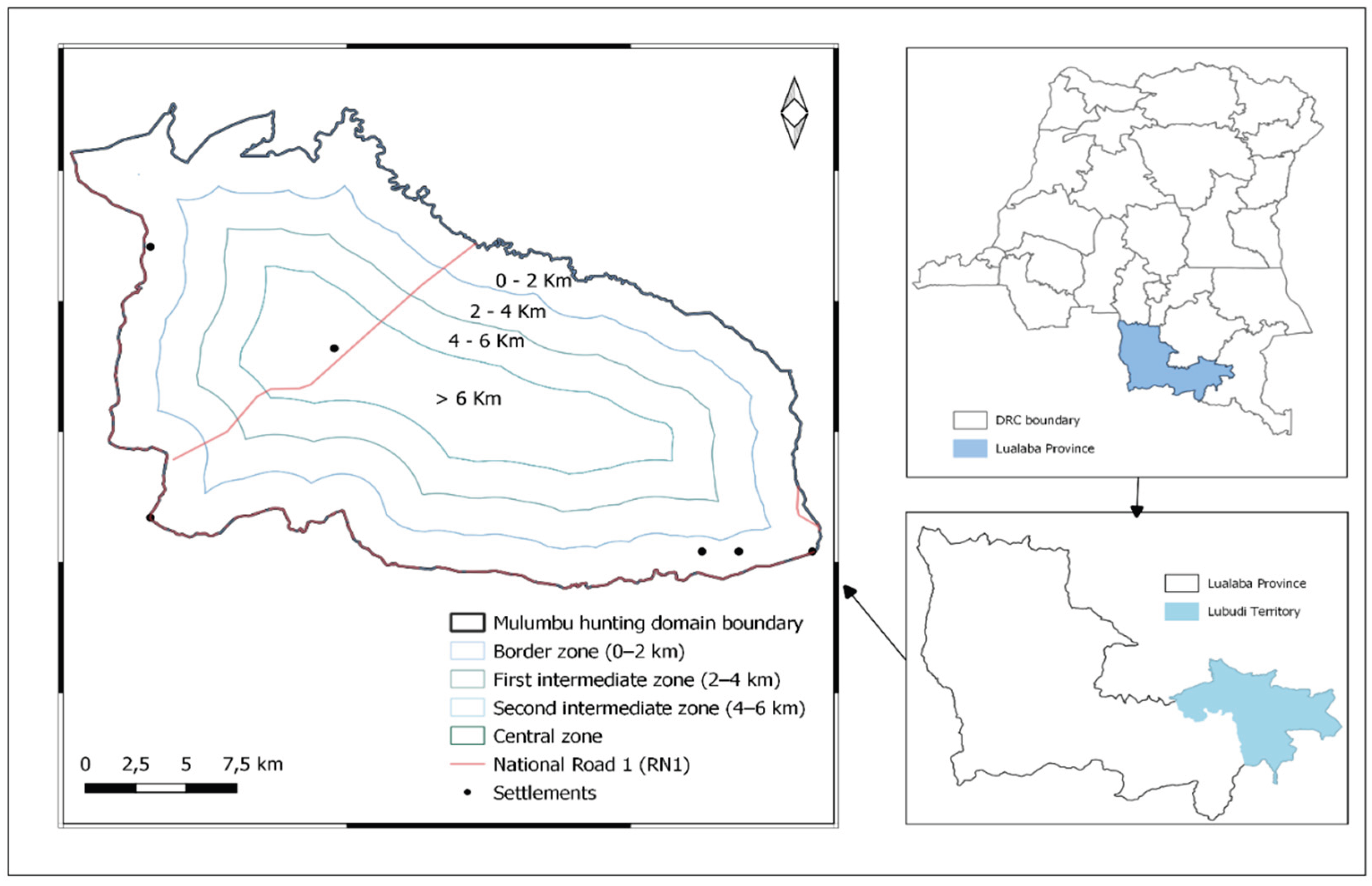
Figure 2.
Land-use and land-cover maps of the Bena Mulumbu Hunting Domain (Lualaba Province, DR Congo) in 1995, 2005, 2015, and 2025, illustrating spatio-temporal patterns of landscape transformation along the edge-to-core gradient. Overall classification accuracies (OA) for each year are provided in Tables S1–S4 in the Supplementary Materials.
Figure 2.
Land-use and land-cover maps of the Bena Mulumbu Hunting Domain (Lualaba Province, DR Congo) in 1995, 2005, 2015, and 2025, illustrating spatio-temporal patterns of landscape transformation along the edge-to-core gradient. Overall classification accuracies (OA) for each year are provided in Tables S1–S4 in the Supplementary Materials.
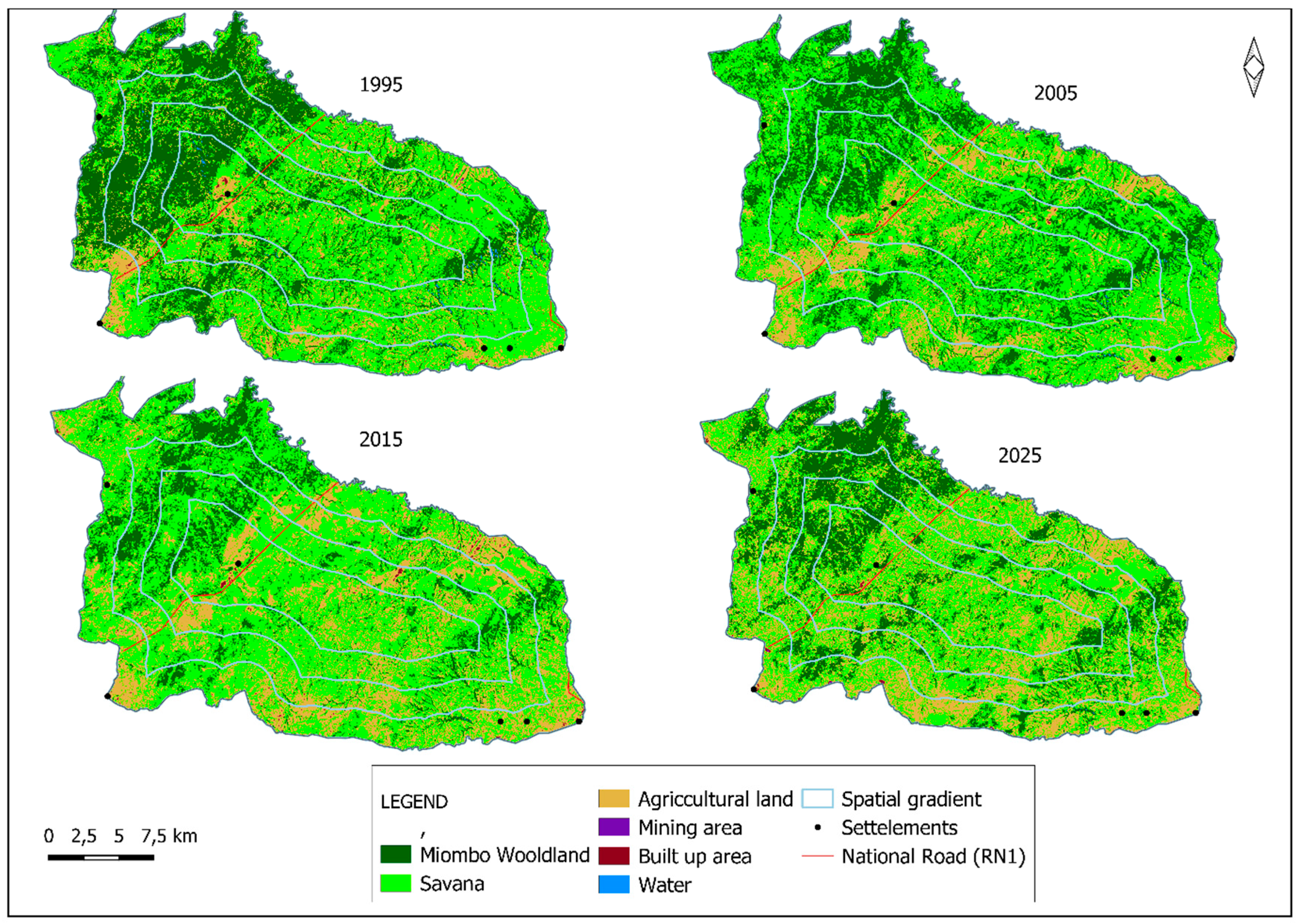
Figure 3.
Spatio-temporal dynamics of landscape composition (PLAND) along the edge-to-core gradient in the Bena Mulumbu Hunting Domain between 1995 and 2025, used to test H1 on landscape composition dynamics: (a) Miombo woodland, (b) savanna, (c) agricultural land, (d) built-up/bare land, and (e) mining areas.
Figure 3.
Spatio-temporal dynamics of landscape composition (PLAND) along the edge-to-core gradient in the Bena Mulumbu Hunting Domain between 1995 and 2025, used to test H1 on landscape composition dynamics: (a) Miombo woodland, (b) savanna, (c) agricultural land, (d) built-up/bare land, and (e) mining areas.
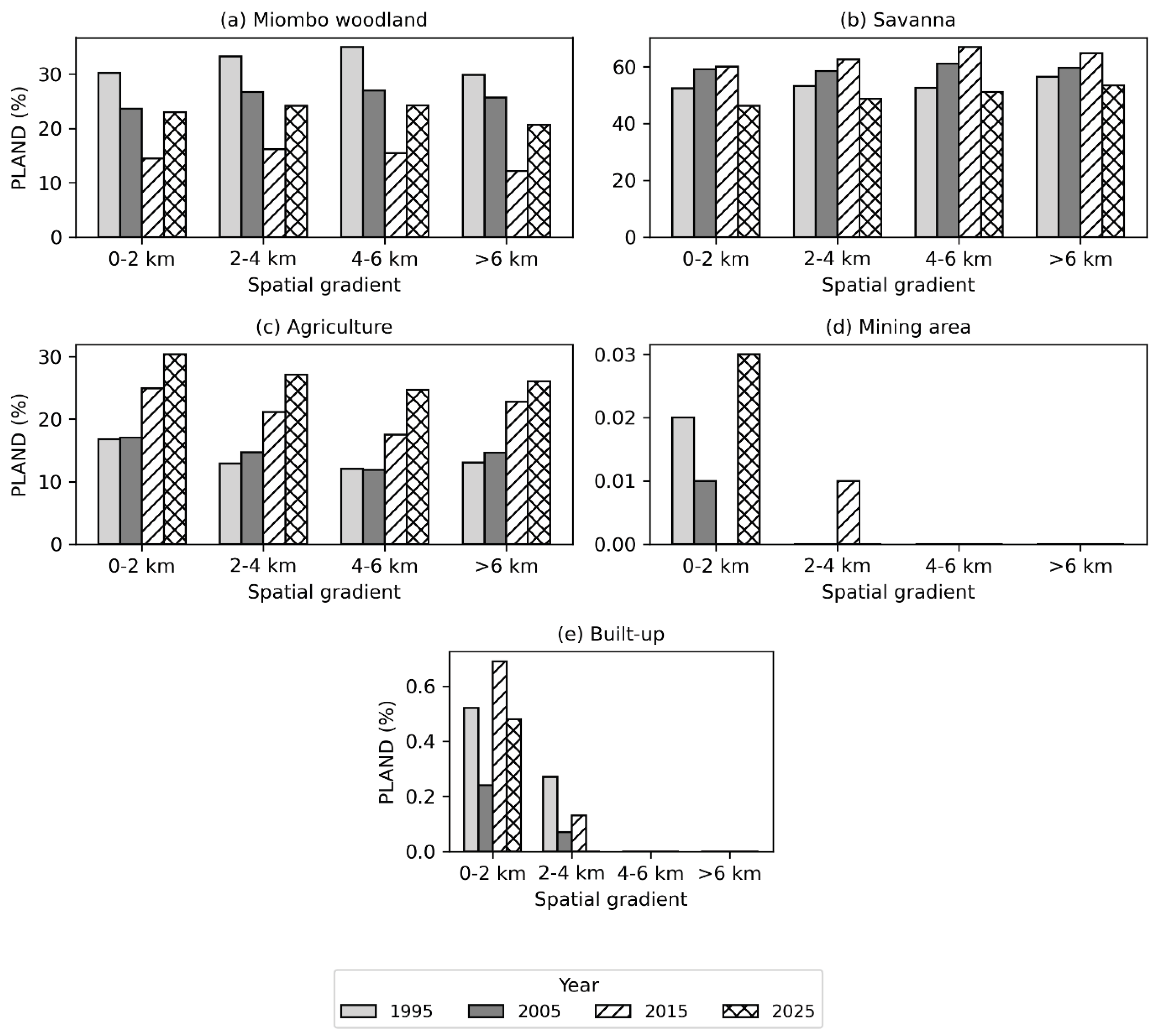
Figure 4.
Spatio-temporal dynamics of landscape heterogeneity along the edge-to-core gradient in the Bena Mulumbu Hunting Domain between 1995 and 2025, used to test H1 on landscape composition and heterogeneity: (a) Shannon's Diversity Index (SHDI) and (b) Shannon's Evenness Index (SHEI).
Figure 4.
Spatio-temporal dynamics of landscape heterogeneity along the edge-to-core gradient in the Bena Mulumbu Hunting Domain between 1995 and 2025, used to test H1 on landscape composition and heterogeneity: (a) Shannon's Diversity Index (SHDI) and (b) Shannon's Evenness Index (SHEI).
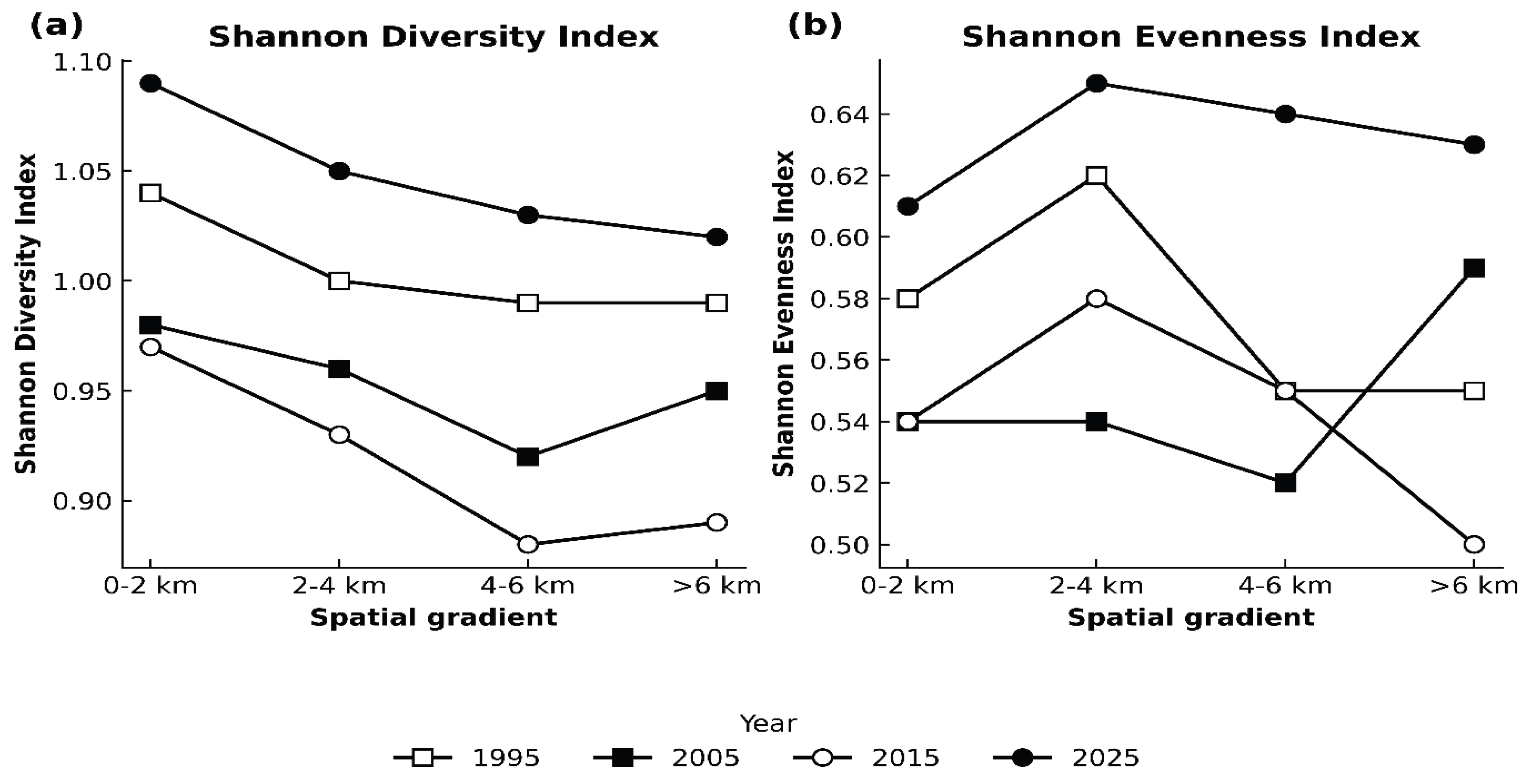
Figure 5.
Dominant land-cover transition pathways along the edge-to-core gradient in the Bena Mulumbu Hunting Domain between 1995 and 2025. Sankey diagrams illustrate the magnitude and direction of conversions among major land-cover classes across the four spatial zones: (1) 0–2 km, (2) 2–4 km, (3) 4–6 km, and (4) >6 km. Detailed transition matrices are provided in Tables S5–S12 in the Supplementary Materials.
Figure 5.
Dominant land-cover transition pathways along the edge-to-core gradient in the Bena Mulumbu Hunting Domain between 1995 and 2025. Sankey diagrams illustrate the magnitude and direction of conversions among major land-cover classes across the four spatial zones: (1) 0–2 km, (2) 2–4 km, (3) 4–6 km, and (4) >6 km. Detailed transition matrices are provided in Tables S5–S12 in the Supplementary Materials.
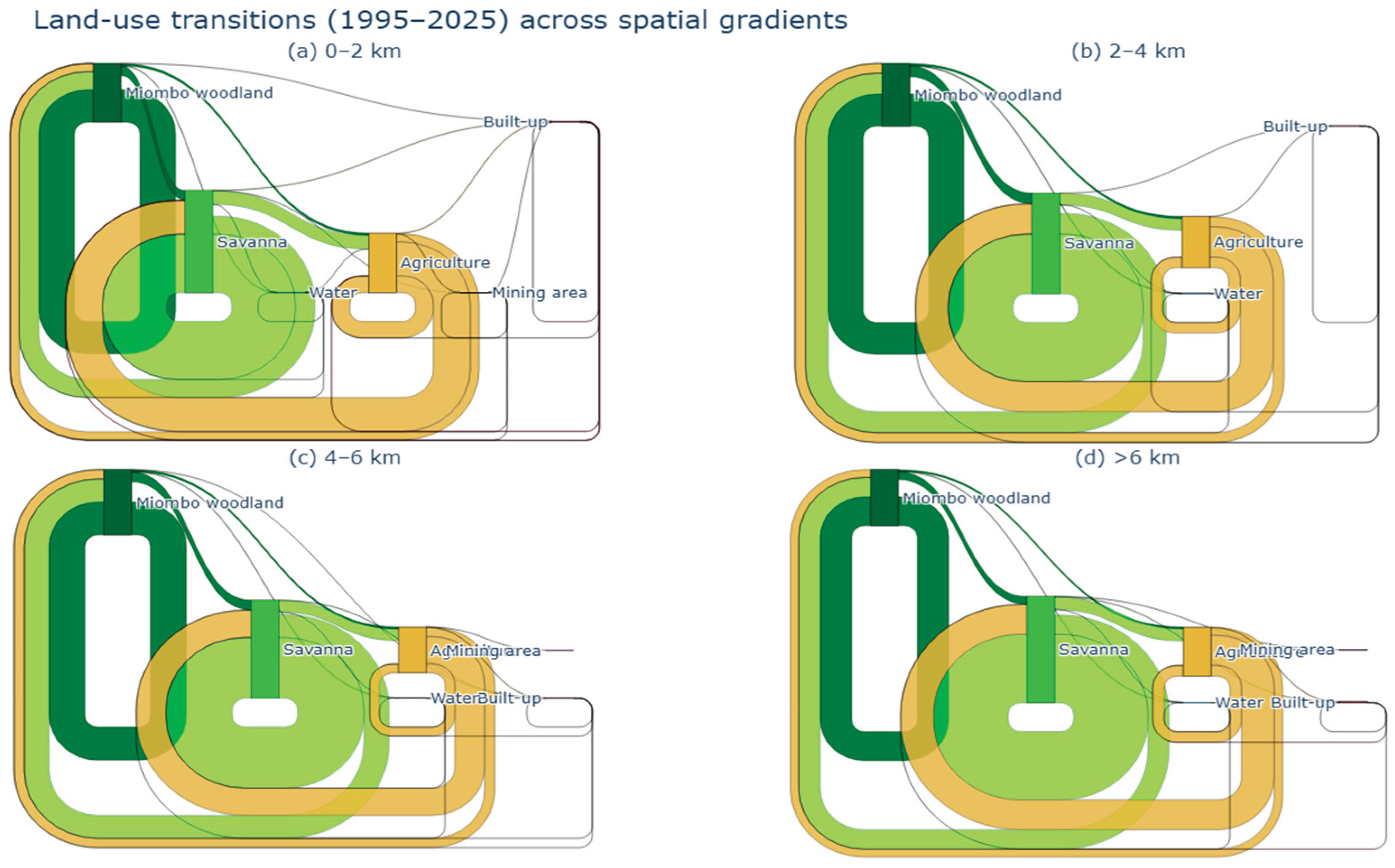
Figure 6.
Spatio-temporal dynamics of Miombo woodland fragmentation along the edge-to-core gradient in the Bena Mulumbu Hunting Domain between 1995 and 2025, used to test H2 and H3 on fragmentation and core habitat dynamics: (a) Number of Patches (NP), (b) Largest Patch Index (LPI), (c) Total Core Area (TCA), and (d) Aggregation Index (AI).
Figure 6.
Spatio-temporal dynamics of Miombo woodland fragmentation along the edge-to-core gradient in the Bena Mulumbu Hunting Domain between 1995 and 2025, used to test H2 and H3 on fragmentation and core habitat dynamics: (a) Number of Patches (NP), (b) Largest Patch Index (LPI), (c) Total Core Area (TCA), and (d) Aggregation Index (AI).
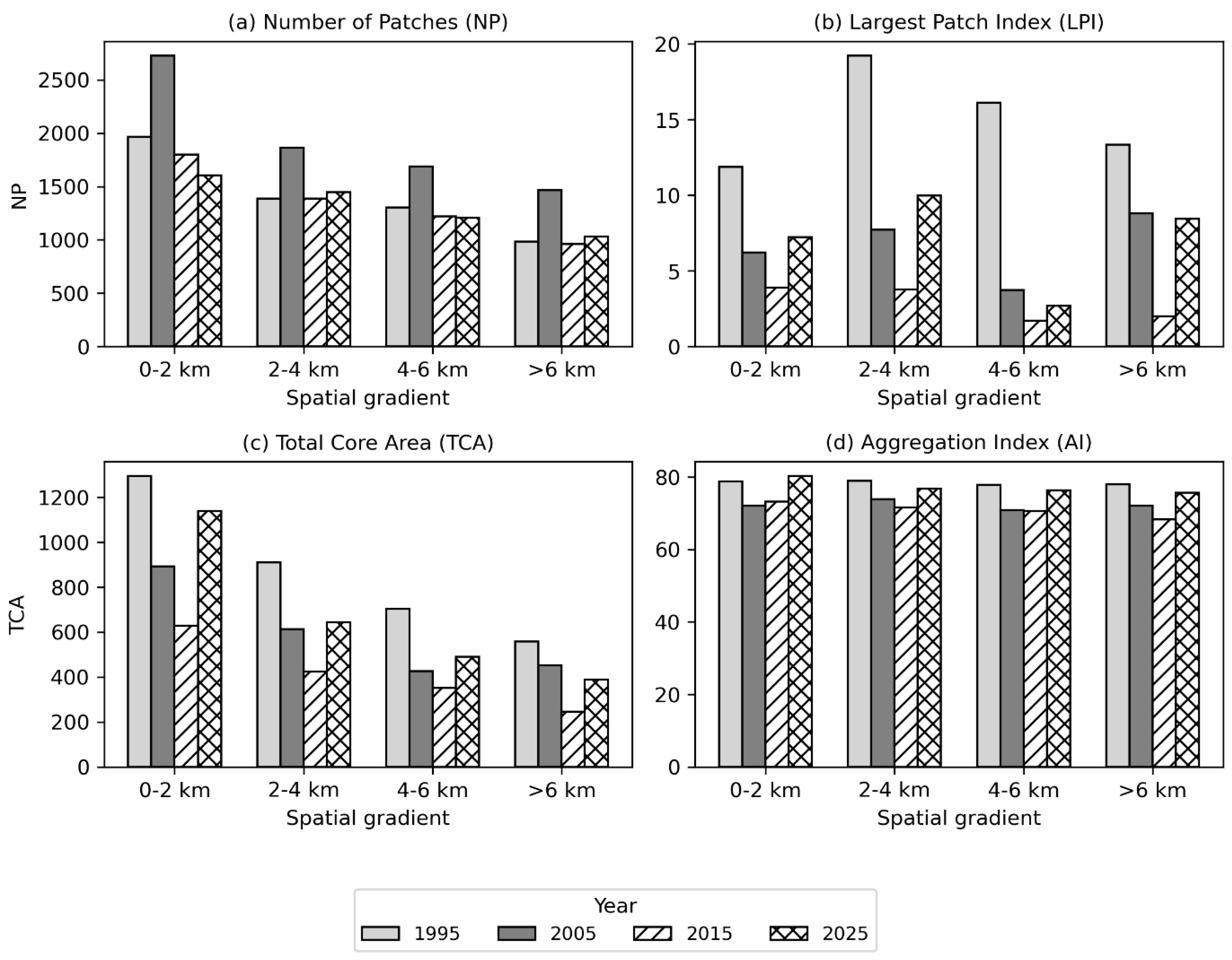
Figure 7.
Spatio-temporal dynamics of Miombo woodland structural connectivity along the edge-to-core gradient in the Bena Mulumbu Hunting Domain between 1995 and 2025, used to test H4 on structural connectivity patterns: (a) Connectance Index (CONNECT, %), (b) Patch Cohesion Index (COHESION, %), (c) Mean Proximity Index (PROX_MN), (d) Mean Euclidean Nearest Neighbour Distance (ENN_MN, m), and (e) Landscape Division Index (DIVISION).
Figure 7.
Spatio-temporal dynamics of Miombo woodland structural connectivity along the edge-to-core gradient in the Bena Mulumbu Hunting Domain between 1995 and 2025, used to test H4 on structural connectivity patterns: (a) Connectance Index (CONNECT, %), (b) Patch Cohesion Index (COHESION, %), (c) Mean Proximity Index (PROX_MN), (d) Mean Euclidean Nearest Neighbour Distance (ENN_MN, m), and (e) Landscape Division Index (DIVISION).
Disclaimer/Publisher’s Note: The statements, opinions and data contained in all publications are solely those of the individual author(s) and contributor(s) and not of MDPI and/or the editor(s). MDPI and/or the editor(s) disclaim responsibility for any injury to people or property resulting from any ideas, methods, instructions or products referred to in the content. |
© 2026 by the authors. Licensee MDPI, Basel, Switzerland. This article is an open access article distributed under the terms and conditions of the Creative Commons Attribution (CC BY) license (http://creativecommons.org/licenses/by/4.0/).
Copyright: This open access article is published under a Creative Commons CC BY 4.0 license, which permit the free download, distribution, and reuse, provided that the author and preprint are cited in any reuse.


