

Submitted:
05 June 2026
Posted:
09 June 2026
You are already at the latest version
Abstract
Backround: Musculoskeletal disorders associated with muscular strain on the neck and shoulders affect women in administration more often than men. Ergonomic guidelines have historically been derived from male models, often ignoring biomechanical differences between the sexes. The study aims to quantify the acute biomechanical response of the neck muscles of men and women to a standardized writing task. Methods: The research involved 57 healthy university students (34 women, 23 men; age 19–24 years). Muscle tone (F), stiffness (S), and viscoelastic decrement (D) in sternocleidomastoideus muscle (SCM), trapezius muscle (UT), and semispinalis capitis muscle (SSC) were assessed by the non-invasive MyotonPRO device before and after 20 minutes of continuous writing. Results: The results were statistically quantified and showed significant differences in muscle strategy between the sexes (p < 0.05). While women experienced a fatigue decrease in tone after exercise, the SCM as a superficial neck flexor and the deeper neck extensor SSC recorded a significant compensatory increase in tone, the opposite was true for men. Conslusion: These objective data show that identical office work causes a different physiological burden in women. Prevention of musculoskeletal disorders should therefore abandon a one-size-fits-all approach and move towards gender-specific solutions.
Keywords:
ergonomics
; gender differences
; muscle stiffness
; musculoskeletal disorders
; MyotonPRO
; neck pain
; static load
; women's health
1. Introduction
The current school and work-administrative environment is often designed to be ergonomically universal, with the assumption that the same working conditions will lead to a comparable physiological load for all users [1]. However, this approach implicitly ignores the biological and anthropometric differences between women and men, which can significantly affect muscle strategy, postural control, and response to static workload [2]. As a result, working conditions that are considered neutral may in fact be associated with different demands on the musculoskeletal system. Historically, ergonomic norms for sedentary work have been derived predominantly from male models of body constitution [3]. Although women now make up a substantial part of the workforce in the administrative sector [4], their specific biomechanical characteristics are not systematically taken into account in the design of workplaces. A study with 416 participants showed that women in office work have a significantly higher risk of developing cervical spine pain than men in the same work environment [5]. Epidemiological evidence suggests that women exhibit different patterns of muscle activation in comparable tasks and are significantly more prone to neck and shoulder girdle overload, leading to a higher prevalence of musculoskeletal disorders [6,7,8]. A possible explanation is that women have different motor movement control strategies and a different response to fatigue, and this may be the cause of a higher incidence of musculoskeletal problems during repetitive work tasks or static postures [9,10]. Ergonomic studies have repeatedly shown that lower imaging/writing planes and flat horizontal plates increase head flexion and alter the activity of the neck and shoulder muscles, especially the upper trapezius and neck extensors. This is already evident in normal office tasks and also when reading/writing on paper or tablet [11,12,13].
Previous research has relied mainly on subjective questionnaires or surface electromyography (EMG) [7,8,9]. The MyotonPRO device allows for objective quantification of the physical properties of tissue (tone, stiffness, viscoelastic decrement), which are critical precursors of fatigue and pain, while EMG measures current electrical activity. Previous studies using MyotonPro technology have confirmed the existence of basal differences in muscle structure between the sexes [14,15,16], so far there is a lack of data on how these predispositions determine the immediate biomechanical response to real workload. Our study complements this deficit and provides a unique perspective on gender-specific management of muscle tension. The aim is to demonstrate that women experience significantly different and earlier decompensation of mechanical properties of muscles after short-term exposure to standardized writing load.
2. Materials and Methods
In this study, the biomechanical response of three muscles with different postural functions was monitored. The superficial flexor of the sternocleidomastoideus muscle (SCM), (upper third of the muscular abdomen) was chosen as the primary indicator of the positional adjustment of the head to the torso. M. semispinalis capitis (SSC), (1 cm dorsally from the posterior margin of the SCM, below the level of the processus mastoideus) as a deep extensor, represented a key stabilizing element necessary for controlling the position of the head against gravity in both isometric and reflex tasks [17]. The third monitored muscle was the trapezius muscle (UT) (pars descendens), (the middle of the muscle abdomen in the triangle between the acromion and the C7 process) as the main postural muscle of the shoulder girdle, whose activity is highly sensitive to workplace ergonomics and which is the primary source of overload during administrative work [18]. The measurement took place exclusively on the dominant side of the body. This approach reflects the natural asymmetry of workload when operating a mouse and keyboard. Monitoring the dominant side thus not only minimizes methodological variability, but also demonstrably better captures the actual level of muscle tension [19].
The length of the static load was set at 20 minutes based on current ergonomic findings. Literature sources confirm that measurable changes in posture and muscle activity occur as early as the 10 to 20 minute time frame. In addition, continuous work on a horizontal plate exceeding this limit leads to excessive cervical flexion and extreme load on the head extensors, which is why it is not recommended in modern ergonomics [11].
2.1. Inclusion Criteria
The study included 57 university students (34 women, 23 men; age 19–24) at bachelor's and master's levels. All were free of orthopedic or neurological diseases, no history of pain or injuries to the cervical spine in the last 6 months. The body mass index (BMI) of the participants ranged from 18.5 to 30. 42 of the participants were right-handed. Sports activity was reported as medium, the subjective level of neck discomfort/pain was assessed by the visual analogue pain scale (VAS) before the experiment was 0–2. The measurements took place in the morning, in a standard university environment, at normal room temperature. Each participant signed an informed consent, the research was approved by the Ethics Committee of the Catholic University in Ružomberok, Slovakia and was conducted in accordance with the Helsinki Declaration. Data collection took place from September 2025 to November 2025.
2.2. Measurement Protocol
The measurement was carried out using the MyotonPRO device (Myoton AS, Tallinn, Estonia), which evaluates the mechanical properties of the muscle using a short mechanical pulse (0.4 N, duration 15 ms, frequency 1 Hz). It is a non-invasive, fast, handheld device [20,21]. Each muscle was measured five times; the result was evaluated as a median of five measurements, with a coefficient of variability (CV) of < 2% for all muscles, indicating high reliability.
The following parameters were recorded: F (frequency) – muscle tone [Hz], S (stiffness) – muscle stiffness [N/m], D (decrement) – logarithmic decrement, viscoelasticity indicator, any unit.
Experimental procedure: The initial measurement took place in an upright sitting position, with 90° flexion in the hip and knee joints, the upper limbs resting freely with the palms on the thighs, the soles of the feet fully resting on the ground. Proband looked at the object at eye level. The measured points were marked with markers directly on the skin. The device was placed on the markers with a probe (diameter 3 mm) perpendicular to the muscle abdomen with constant preload (0.18 N) in order to pre-compress the soft tissues. A rapid short impulse induced damped tissue oscillations. The device then calculates the parameters defining the properties of the tissue (F, S, D) [20,22]. Muscle tone (F) or muscle tension is calculated as the maximum frequency, the higher it is, the higher the muscle tension, which increases by contraction or stretching [22,23]. Stiffness (S) is the ability of a muscle to resist an external force, the higher it is, the greater the muscle is able to withstand a greater strain force [22]. A viscoelastic decrement (D) is an indicator of a muscle's ability to restore its shape and properties after deformation, the smaller it is, the smaller the subsequent dispersion and the more elastic the muscle is [22]. Subsequently, the proband underwent a 20-minute continuous load by writing a continuous text on the horizontal board (0° inclination) of the bench. When writing, the upper limbs were resting their forearms on the table. Head posture was monitored by the evaluator visually from the side, specifically the craniovertebral angle (CVA) [24], to maintain the same throughout the duration of the test. Immediately after the end of writing, the proband straightened up again to the starting position and repeated measurements of all three muscles were performed at the already marked points.
2.3. Statistical Analysis
Basic descriptive statistics (mean, median, minimum, maximum, standard deviation and interquartile range) were calculated for all monitored variables. The normality of the data distribution was verified using the Shapiro–Wilk test and further assessed visually using Q–Q graphs. In case of violation of the assumption of normality, nonparametric statistical methods were used.
To compare the values before and after exercise, a paired t-test or a Wilcoxon pair test was applied. Differences in muscle response between men and women were assessed using a two-sample t-test, or a Mann–Whitney U-test in the case of abnormal data distribution.
Statistical data processing was performed in the R environment (version 4.4.0). The level of statistical significance was set at α = 0.05.
3. Results
Common features of the biomechanical response
When analyzing data across the entire cohort, regardless of gender, a statistically significant change in the trapezius muscle in the viscoelastic decrement (D) parameter was demonstrated after a 20-minute typing load, see Table 1. This result indicates a consistent increase in the viscoelastic properties of the muscle after static work in head flexion. The parameters of tone (F) and stiffness (S) in this muscle did not show statistically significant changes for the whole group, as well as for other muscles and monitored parameters (see Table 1).
Gender differences
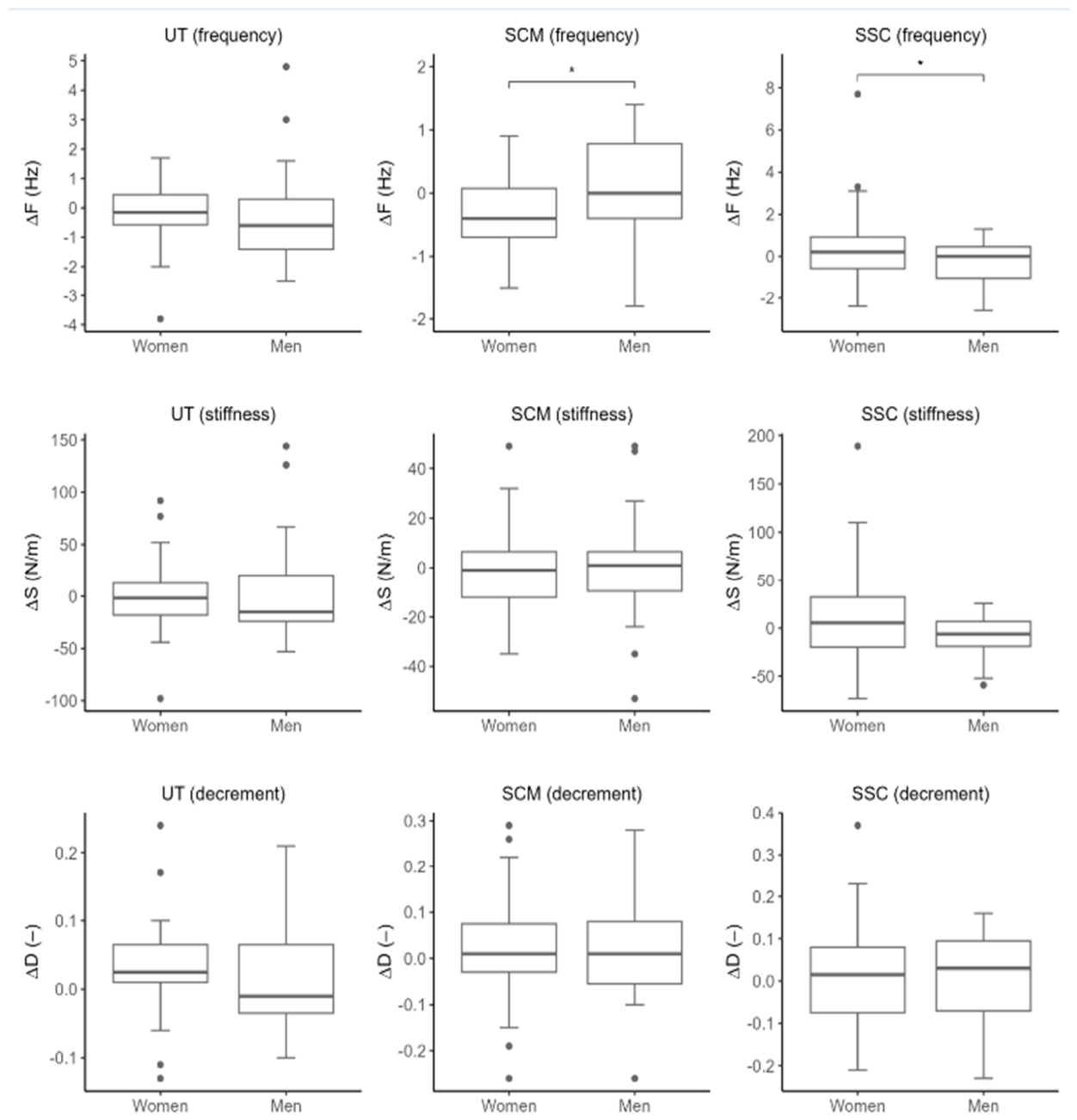
Although no statistically significant changes were demonstrated in the muscles of the sternocleidomastoideus muscle (SCM) and the semispinalis capitis muscle (SSC) for the entire group, the analysis divided by gender revealed significant and contradictory neuromuscular strategies between men and women.
In the case of muscle tone of surface flexors (SCMs), a statistically significant difference in biomechanical response between the sexes was demonstrated (p = 0.031). While men experienced an average increase in muscle tone of 0.120 Hz after exercise, women experienced an average decrease in tension of 0.294 Hz.
A compensatory reaction was observed in the deep postural muscle of the SSC. The tests revealed a statistically significant difference between the sexes (p = 0.039), in contrast to the surface structures, a significantly higher value of tone increase was recorded in women after exercise with this deep extensor compared to men (0.450 Hz for women, –0.374 Hz for men, respectively).
Figure 1.
Comparison of muscle mechanical properties (ΔF, ΔS, ΔD) between women and men for m. trapezius (UT), m. sternocleidomastoideus (SCM), and m. semispinalis capitis (SSC). Note: The boxes represent the interquartile range (IQR; 25th–75th percentiles), whiskers extend to 1.5 × IQR, and horizontal lines indicate the median. * indicates p < 0.05.
Figure 1.
Comparison of muscle mechanical properties (ΔF, ΔS, ΔD) between women and men for m. trapezius (UT), m. sternocleidomastoideus (SCM), and m. semispinalis capitis (SSC). Note: The boxes represent the interquartile range (IQR; 25th–75th percentiles), whiskers extend to 1.5 × IQR, and horizontal lines indicate the median. * indicates p < 0.05.
The relationship between BMI and parameters
As an additional analysis, the relationship between BMI and muscle biomechanical response was evaluated in the entire monitored cohort. The results revealed a statistically significant, positive correlation between BMI and increase in muscle tone (ΔF) only in sternocleidomastoideus muscle (r = 0.28; p = 0.038). This value indicates that as BMI increases, this muscle experiences a slightly higher increase in tension in response to load. For other measured muscles and parameters, a statistically significant relationship with BMI was not demonstrated.
4. Discussion
The results of our study show that even a short-term administrative load of 20 minutes induces measurable changes in the mechanical properties of the neck muscles, with the key finding being that while some manifestations of fatigue are common to the whole group, muscle activity management strategies differ between men and women.
Common features of the biomechanical response
The common denominator for all subjects was a significant increase in the decrement parameter in the trapezius muscle, suggesting an increase in tissue viscoelasticity and a reduced ability of the muscle to efficiently accumulate and release mechanical energy. This change is considered an early objective marker of incipient muscle fatigue and deterioration of blood microcirculation [22], which corresponds to earlier studies using EMG, which showed an increase in trapezius activity within 10–20 minutes of computer work [25]. The fact that these manifestations occur in both sexes in such a short time confirms the significant postural demands even in ordinary administrative tasks.
Gender differences
While the response was uniform in the trapezius muscle, in the area of other neck stabilizers, fundamental differences in neuromuscular organization were manifested, which indicate that men and women respond to static work in an opposite way. In men, an increase in muscle tension was noted in the sternocleidomastoideus muscle (SCM), which indicates active muscle stabilization of the head segment. In contrast, in women, there was a decrease in tension in the same muscle, which can be interpreted as fatigue attenuation or inhibition.
It is this rapid attenuation of anterior support in women that may be the mechanism that leads to the subsequent transfer of the load to passive structures such as ligaments and intervertebral discs. The relationship between the SCM muscle and the semispinalis capitis muscle (SSC) appears to be crucial for understanding the different female strategy, since after inhibition of the anterior SCM muscle, the deep extensor of the SSC must generate a relatively higher tension in women to maintain an upright head position. Since women generally have a smaller cross-section of the neck muscles in relation to the weight of the head [26], they experience suboptimal neuromuscular compensation and the central nervous system's effort to regulate superficial muscle failure by increased recruitment of deep structures. This may explain why chronic neck pain in the administrative sphere is more common in women [4,26,27].
The relationship between BMI and parameters
A supplementary finding of this study is a statistically significant positive correlation (r = 0.281) between BMI and an increase in muscle tone in sternocleidomastoideus muscle (SCM). The sternocleidomastoideus muscle, as a key muscle of the front of the neck, plays a significant role in stabilizing the head and cervical spine. A positive correlation suggests that individuals with a higher BMI require a greater degree of muscle activation to maintain a static postural position during writing and generate higher muscle tension. This phenomenon may be due to different biomechanics and a higher absolute load on the stabilizing muscles of the neck, or a more frequent occurrence of forward head posture in people with higher body weight. This finding underscores the thesis that universal ergonomic arrangement is insufficient and the physiological response is influenced not only by gender, but also by body constitution.
Implications for ergonomics and future direction
Based on the measurements made, it can be assumed that repetitive or long-term work of the same nature will have an even worse negative impact on the muscles. It is essential that workplace ergonomics stop being "gender blind" and start taking into account these biomechanical differences. Our findings correspond to ergonomic studies that recommend individual adjustment of the height of the work surface and a greater inclination of the writing board in women to reduce the angle of head flexion and thus the activation of the neck extensors [18,26,27]. In this context, the MyotonPRO device has proven to be a reliable and sensitive indicator of changes in muscle properties, which is clearly interpretable for the needs of research and clinical practice, following the example of other studies [28].
4. Conclusions
This study provides objective evidence that even short-term, seemingly undemanding administrative work induces a significantly different and riskier biomechanical response of the neck muscles in women than in men. Although both sexes share incipient fatigue in the trapezius muscle, the female muscular system responds to the same load with a complex change in postural strategy. Fatigue inhibition of surface stabilizers is compensated in women by an extreme increase in tension in deep extensors. Non-invasive measurements with the MyotonPRO device revealed that this hidden neuromuscular cascade represents a possible risk factor for women. It turns out that a standard universal workplace arrangement is inherently insufficient, and consistent individualisation of ergonomic measures with regard to biological and biomechanical differences between the sexes is absolutely crucial for the effective protection of women's health.
References
- Aiyegbusi, A.I.; Gbiri, C.A.; Oyeniran, T.O.; et al. Mismatch between school furniture dimensions and anthropometric parameters is a risk for spinal deformities in secondary school students in Lagos, Nigeria: a cross-sectional study. Bull. Fac. Phys. Ther. 2023, 28, 34. [Google Scholar] [CrossRef]
- Eby, S.F.; Cloud, B.A.; Brandenburg, J.E.; Giambini, H.; Song, P.; Chen, S.; Lebrasseur, N.K.; An, K.-N. Shear wave elastography of passive skeletal muscle stiffness: Influences of sex and age throughout adulthood. Clin. Biomech. 2015, 30, 22–27. [Google Scholar] [CrossRef]
- Perez, C. C. Invisible women: Exposing data bias in a world designed for men; Abrams Press, 2019. [Google Scholar]
- Eurostat. Jobs with the highest shares of women in Q3 2023 (statistic data). Available online: https://ec.europa.eu/eurostat/web/products-eurostat-news/w/ddn-20240304-1.
- Korhonen, T.; Ketola, R.; Toivonen, R.; Luukkonen, R.; Häkkänen, M.; Viikari-Juntura, E. Work related and individual predictors for incident neck pain among office employees working with video display units. Occup. Environ. Med. 2003, 60, 475–482. [Google Scholar] [CrossRef]
- Anders, C.; Bretschneider, S.; Bernsdorf, A.; Erler, K.; Schneider, W. Activation of shoulder muscles in healthy men and women under isometric conditions. J. Electromyogr. Kinesiol. 2004, 14, 699–707. [Google Scholar] [CrossRef] [PubMed]
- Fedorowich, L.; Emery, K.; Gervasi, B.; Côté, J. N. Gender differences in neck/shoulder muscular patterns in response to repetitive motion induced fatigue. J. Electromyogr. Kinesiol. 2013, 23, 1183–1189. [Google Scholar] [CrossRef]
- Shin, E.; Roh, H. Gender-based analysis of muscle activation while in a sedentary work posture. Technol. Health Care 2024, 32, 565–575. [Google Scholar] [CrossRef] [PubMed] [PubMed Central]
- Srinivasan, D.; Sinden, K.E.; Mathiassen, S.E.; et al. Gender differences in fatigability and muscle activity responses to a short-cycle repetitive task. Eur. J. Appl. Physiol. 2016, 116, 2357–2365. [Google Scholar] [CrossRef]
- Weber, Z. R.; Srinivasan, D.; Côté, J. N. Sex-Specific Links in Motor and Sensory Adaptations to Repetitive Motion–Induced Fatigue. Mot. Control 2018, 22, 149–169. [Google Scholar] [CrossRef]
- Bhuanantanondh, P.; Rungkitlertsakul, S.; Richards, J. Is neck and shoulder posture, muscle activity and discomfort influenced by tablet inclination in young adults with and without neck pain? PLoS ONE 2025, 20, e0322207. [Google Scholar] [CrossRef] [PubMed]
- Intolo, P.; Shalokhon, B.; Wongwech, G.; Wisiasut, P.; Nanthavanij, S.; Baxter, D. G. Analysis of neck and shoulder postures, and muscle activities relative to perceived pain during laptop computer use at a low-height table, sofa and bed. Work 2019, 63, 361–367. [Google Scholar] [CrossRef]
- Farias Zuniga, A. M.; Côté, J. N. Effects of Dual Monitor Computer Work Versus Laptop Work on Cervical Muscular and Proprioceptive Characteristics of Males and Females. Hum. Factors J. Hum. Factors Ergon. Soc. 2017, 59, 546–563. [Google Scholar] [CrossRef]
- Mencel, J.; Jaskólska, A.; Marusiak, J.; Kisiel-Sajewicz, K.; Siemiatycka, M.; Kaminski, L.; Jaskólski, A. Effect of gender, muscle type and skinfold thickness on myometric parameters in young people. PeerJ 2021, 9, e12367. [Google Scholar] [CrossRef] [PubMed] [PubMed Central]
- Tashiro, T.; Okugaki, T.; Abekura, T.; Kumamoto, S.; Arima, S.; Maeda, N. Sex and Side Differences in Muscle Stiffness of Lower Limb Muscles in Healthy Adults. Gait Posture 2025, 121, 240–241. [Google Scholar] [CrossRef]
- Dietsch, Angela M.; Clark, Heather M.; Steiner, Jessica N.; Solomon, Nancy Pearl. Effects of Age, Sex, and Body Position on Orofacial Muscle Tone in Healthy Adults"; Department of Special Education and Communication Disorders, 2015; Faculty Publications. 108; Available online: https://digitalcommons.unl.edu/specedfacpub/108.
- Siegmund, G. P.; Blouin, J. S.; Brault, J. R.; Hedenstierna, S.; Inglis, J. T. Electromyography of superficial and deep neck muscles during isometric, voluntary, and reflex contractions. J. Biomech. Eng. 2007, 129, 66–77. [Google Scholar] [CrossRef]
- Straker, L.; Burgess-Limerick, R.; Pollock, C.; Murray, K.; Netto, K.; Coleman, J.; Skoss, R. The impact of computer display height and desk design on 3D posture during information technology work by young adults. J. Electromyogr. Kinesiol. 2008, 18, 336–349. [Google Scholar] [CrossRef]
- Diederichsen, L. P.; Nørregaard, J.; Dyhre-Poulsen, P.; Winther, A.; Tufekovic, G.; Bandholm, T.; Rasmussen, L. R.; Krogsgaard, M. The effect of handedness on electromyographic activity of human shoulder muscles during movement. Journal of electromyography and kinesiology: official journal of the International Society of Electrophysiological Kinesiology 2007, 17, 410–419. [Google Scholar] [CrossRef] [PubMed]
- Agyapong-Badu, S.; Warner, M.; Samuel, D.; Stokes, M. Measurement of ageing effects on muscle tone and mechanical properties of rectus femoris and biceps brachii in healthy males and females using a novel hand-held myometric device. Arch. Gerontol. Geriatr. 2016, 62, 59–67. [Google Scholar] [CrossRef]
- Lee, M.-T.; Wu, C.-Y.; Chen, C.-W.; Cheng, H.-L.; Chen, C.-C.; Hsieh, Y.-W. Age and sex differences in the biomechanical and viscoelastic properties of upper limb muscles in middle-aged and older adults: A pilot study. J. Biomech. 2022, 134, 111002. [Google Scholar] [CrossRef]
- Gavronski, G.; Veraksitš, A.; Vasar, E.; Maaroos, J. Evaluation of viscoelastic parameters of the skeletal muscles in junior triathletes. Physiol. Meas. 2007, 28, 625–637. [Google Scholar] [CrossRef] [PubMed]
- Ditroilo, M.; Hunter, A. M.; Haslam, S.; De Vito, G. The effectiveness of two novel techniques in establishing the mechanical and contractile responses of biceps femoris. Physiol. Meas. 2011, 32, 1315–1326. [Google Scholar] [CrossRef]
- Yong, M.-S.; Lee, H.-Y. Does Forward Head Posture Influence Muscle Tone, Stiffness, and Elasticity in University Students? J. Clin. Med. 2025, 14, 1888. [Google Scholar] [CrossRef] [PubMed]
- Szeto, G. P.; Straker, L. M.; O'Sullivan, P. B. A comparison of symptomatic and asymptomatic office workers performing monotonous keyboard work--1: neck and shoulder muscle recruitment patterns. Man. Ther. 2005, 10, 270–280. [Google Scholar] [CrossRef]
- Vasavada, A.N.; Danaraj, J.; Siegmund, G.P. Head and neck anthropometry, vertebral geometry and neck strength in height-matched men and women. J. Biomech. 2008, 41, 114–121. [Google Scholar] [CrossRef] [PubMed]
- Côté, J. N. A critical review on physical factors and functional characteristics that may explain a sex/gender difference in work-related neck/shoulder disorders. Ergonomics 2012, 55, 173–182. [Google Scholar] [CrossRef]
- Volesky, K.; Novak, J.; Janek, M.; Katolicky, J.; Tufano, J.J.; Steffl, M.; Courel-Ibáñez, J.; Vetrovsky, T. Assessing the Test-Retest Reliability of MyotonPRO for Measuring Achilles Tendon Stiffness. J. Funct. Morphol. Kinesiol. 2025, 10, 83. [Google Scholar] [CrossRef] [PubMed]

Table 1.
Changes in biomechanical parameters of neck muscles before and after 20-minute static load for the whole group (N = 57).
Table 1.
Changes in biomechanical parameters of neck muscles before and after 20-minute static load for the whole group (N = 57).
| Sval | Parametr | Před Med(IQR) |
Po Med(IQR) |
p |
|---|---|---|---|---|
| UT | F | 16.1 (2.0) | 16.1 (2.2) | n. s. |
| UT | S | 274.0 (62.0) | 280.0 (63.0) | n. s. |
| UT | D | 0.86 (0.12) | 0.87 (0.18) | 0.021 |
| SCM | F | 13.1 (1.1) | 12.7 (1.2) | n. s. |
| SCM | S | 203.0 (28.0) | 201.0 (20.0) | n. s. |
| SCM | D | 1.19 (0.16) | 1.20 (0.20) | n. s. |
| SSC | F | 15.0 (1.7) | 14.3 (3.0) | n. s. |
| SSC | S | 247.0 (42.0) | 235.0 (84.0) | n. s. |
| SSC | D | 1.19 (0.26) | 1.26 (0.23) | n. s. |
Note: UT = m. trapezius (pars descendens); SCM = m. sternocleidomastoideus; SSC = m. semispinalis capitis; Med = median; IQR = Interquartile Span; p values represent the significance of differences between pre- and post-load measurements; n. s. indicates non-significant differences (p > 0.05).
Disclaimer/Publisher’s Note: The statements, opinions and data contained in all publications are solely those of the individual author(s) and contributor(s) and not of MDPI and/or the editor(s). MDPI and/or the editor(s) disclaim responsibility for any injury to people or property resulting from any ideas, methods, instructions or products referred to in the content. |
© 2026 by the authors. Licensee MDPI, Basel, Switzerland. This article is an open access article distributed under the terms and conditions of the Creative Commons Attribution (CC BY) license (http://creativecommons.org/licenses/by/4.0/).
Copyright: This open access article is published under a Creative Commons CC BY 4.0 license, which permit the free download, distribution, and reuse, provided that the author and preprint are cited in any reuse.


