
Submitted:
07 June 2026
Posted:
09 June 2026
You are already at the latest version
Abstract
Detection of nanoplastics in drinking-water systems is only the first analytical step toward exposure interpretation; the next challenge is source attribution. This review examines molecular fingerprinting and transformation pathways that can link nanoscale polymer signals to source waters, drinking-water treatment, distribution infrastructure, packaging materials, laboratory background, or aging processes across the potable-water chain. The synthesis evaluates how polymer identity, particle morphology, surface oxidation, additive and oligomer profiles, thermal degradation markers, and matrix context can be combined into defensible source assignments. Particular attention is given to packaging-derived PET and polyolefin particles, disinfection- and treatment-induced aging, biofilm and colloid interactions, and the analytical consequences of weathering for Raman, SERS, AFM-IR, O-PTIR, SRS, Py-GC/MS, AF4-Py-GC/MS, MALDI-TOF-MS, and chemometric workflows. The central conclusion is that source attribution cannot be inferred from polymer identity alone. Robust interpretation requires convergent evidence from particle-level chemistry, polymer-specific mass, additive or marker-ion signatures, aging state, blanks, recovery, and contextual sampling design.
Keywords:
nanoplastics
; drinking water
; source attribution
; molecular fingerprinting
; polymer aging
; packaging
; water treatment
; SERS
; Py-GC/MS
; chemometrics
1. Introduction: From Analytical Detection to Source Attribution
Nanoplastics in drinking water are no longer merely a question of detectability. Recent analytical advances have shown that polymeric particles and polymer-like nanoscale signals can be detected in bottled, tap, and other potable water, as well as in potable water treatment systems and environmentally relevant aqueous matrices [1,2,3,4,5,6,7,8,9,10,11,12,13]. Yet detection alone is scientifically incomplete. A drinking-water result is not fully interpretable until the observed particle population can be connected to a plausible source or transformation pathway. Without source attribution, numerical particle counts or polymer-specific mass concentrations remain difficult to translate into control strategies, monitoring design, or exposure reduction.
This review, therefore, moves from the question “Can nanoplastics be measured?” to the more demanding question “What does the measured signal mean?” The distinction is not semantic. A PET signal in bottled water may indicate bottle-wall abrasion, cap or liner contribution, filtration materials, source-water contamination, or analytical background. A PE or PVC signal in treated water may reflect environmental input, treatment-train transformation, membrane or pipe materials, or contamination introduced during sampling. A nanoscale particle with a Raman or SERS spectrum similar to a reference polymer may have undergone oxidation, biofilm coating, additive loss, or fragmentation that changes both its surface chemistry and its source relevance [4,7,8,9,10,11,12,13,14,15].
Source attribution is, therefore, a chemical forensic problem. It requires a chain of evidence that links polymer identity, morphology, size distribution, surface functionality, additive or oligomer markers, thermal decomposition products, matrix characteristics, and QA/QC controls. Polymer identification is necessary but not sufficient. The same base polymer can enter drinking water through several pathways, while aging and treatment can modify the diagnostic signatures that analysts use to infer origin [16,17,18,19,20,21,22].
This article is written as a critical, narrative synthesis rather than as a formal systematic review. Its scope is deliberately restricted to the source-attribution step: molecular transformation, chemical fingerprinting, packaging-derived particles, treatment-induced alteration, and data-fusion strategies. The article is organized into ten sections, including source mapping, aging mechanisms, molecular fingerprints, source-apportionment strategies, packaging contributions, treatment effects, monitoring implications, a research agenda, and conclusions.
2. Sources of Nanoplastics in Drinking-Water Systems
Drinking-water nanoplastics can originate before, during, or after treatment. Source waters may carry fragments generated by weathering, abrasion, wastewater effluent, agricultural runoff, atmospheric deposition, and the ongoing fragmentation of legacy plastic debris [1,2,3]. Treatment plants may remove a fraction of that input, but they may also alter particle size, surface chemistry, and aggregation state. Distribution systems add another layer of complexity because pipes, deposits, seals, valves, storage tanks, and biofilms can influence particle transport and retention. Bottling and consumer handling can introduce packaging-derived particles even after water has met conventional quality criteria [7,8,9,10,11,12,13,14,15].
Attribution becomes difficult because source pathways can converge into the same operational nanoscale fraction. A particle isolated below 1 µm may be a secondary fragment from aquatic debris, a stress-generated packaging fragment, a treatment-aged particle, a natural colloid with adsorbed polymeric material, or a laboratory contaminant. For this reason, source categories should be treated as hypotheses rather than as labels. The evidence needed to support each hypothesis differs. Packaging attribution requires information on polymer compatibility with bottle, cap, liner, or filtration components; treatment attribution requires sampling before and after unit operations; distribution attribution requires spatial sampling and infrastructure metadata; and source-water attribution requires upstream controls and time-resolved sampling [10,11,12,13,14,15].
The strongest evidence currently comes from studies that connect polymer identity with matrix context. PET nanoplastics identified in commercially bottled drinking water by SERS support a packaging-related hypothesis, but even then, the exact stage of generation cannot be determined automatically [7]. SRS imaging of bottled water substantially increased the detectable particle population and demonstrated the value of rapid single-particle chemical imaging, but it also reinforced that analytical selectivity and library coverage determine which particles become source-informative [8].
In treatment plants, AFM-IR and Py-GC/MS have provided complementary particle- and mass-level evidence for PE and PVC nanoplastics, suggesting that unit processes may function not only as barriers but also as transformation zones [10,13].
Figure 1 summarizes this attribution problem as a convergent chain. The observed nanoscale fraction is not a direct mirror of a single source. It is a composite analytical object resulting from environmental inputs, treatment, distribution, packaging, and laboratory handling. A source claim becomes credible only when polymer evidence is combined with condition, additive, contextual, and QA/QC controls.
Table 1 formalizes this logic by separating candidate sources, expected material signals, source-informative evidence, and the main ambiguity associated with each attribution hypothesis. The table is intended to prevent overinterpretation of polymer identity by showing why origin claims require contextual, material, and QA/QC evidence in addition to chemical confirmation.
3. Polymer Aging and Transformation Mechanisms
Source attribution must account for the chemical dynamics of polymer particles. Aging can occur in source waters, during treatment, within distribution systems, during storage, and even during sample preparation. Photo-oxidation, chlorination, ozonation, UV-based advanced oxidation, mechanical abrasion, thermal stress, and biofilm formation can modify particle surfaces, alter aggregation behavior, and change the analytical response measured by spectroscopy or mass spectrometry [17,18,19,20,21,22,23]. For attribution purposes, aging should therefore be interpreted as a process history rather than as a generic degradation label.
Polymer aging is polymer-specific. Polyolefins such as PE and PP, as well as PS, commonly develop oxygen-containing functional groups under photo-oxidative or oxidative conditions, including carbonyl, hydroxyl, and carboxyl-related signatures. PET may instead show a combination of surface oxidation, hydrolysis-related changes, chain scission, and changes in oligomer or additive release. Consequently, carbonyl indices, band shifts, and surface-chemistry markers must be interpreted in relation to polymer class, aging environment, and analytical method rather than used as universal indicators of origin [20,21,22]. Aged particles may also be retained differently by filters, react differently during digestion, or yield altered marker-ion patterns during pyrolysis [19,20,21,22].
Treatment chemistry is especially important for drinking-water systems. Ozonation and UV-based processes can oxidize polymer surfaces and may promote fragmentation or changes in hydrophilicity, whereas chlorination can react with polymer surfaces and with leached monomers, oligomers, plasticizers, stabilizers, or other organic additives. These reactions may modify the pool of potential disinfection by-product precursors, but they should not be interpreted as a simple conversion of monomers into oligomers or additives. Their magnitude and diagnostic value depend on polymer type, previous aging, disinfectant dose, pH, contact time, and matrix chemistry [17,18,19]. These processes change particle fate and can also strengthen or obscure the interpretation of the source.
Figure 2 summarizes the major transformation pathways and their analytical consequences. Aging can produce useful fingerprints, such as carbonyl formation, surface roughening, or additive loss, but it can also erase source signatures by making different polymers more similar in surface chemistry or by masking diagnostic features with matrix-derived coatings. The central analytical challenge is therefore not simply to detect aging, but to determine whether the observed aging state is source-informative, source-neutral, or source-obscuring.
Table 2 translates these mechanisms into a process-specific attribution framework. For each treatment or handling process, it distinguishes the expected transformation, the potential attribution value, and the analytical caution needed to avoid assigning a treatment origin when similar chemical changes could also arise from environmental aging, storage, or laboratory handling.
4. Molecular Fingerprints and Chemical Markers
Molecular fingerprinting converts a particle or polymer mass signal into source-relevant evidence. The fingerprint can be spectral, thermal, morphological, additive-based, or contextual. Raman and SERS provide vibrational signatures that can identify polymer classes at the particle level, while AFM-IR and O-PTIR add infrared chemical information at submicron scales when conventional FTIR lacks sufficient spatial resolution [4,22,23,24,25,26,27,28,29]. Py-GC/MS and AF4-Py-GC/MS provide polymer-specific mass and marker-ion patterns, while MALDI-TOF-MS and related mass-spectrometric approaches may contribute oligomer or polymer-fragment information [30,31,32].
The value of a fingerprint depends on specificity. PET, PE, PP, PS, and PVC can often be distinguished by characteristic spectral or pyrolysis features, but aged materials, additives, pigments, biofilms, and matrix residues complicate matching. A source-attribution workflow should therefore not treat a library match as the endpoint. It should document spectral preprocessing, match thresholds, blank correction, polymer-marker selection, recovery, and the potential for aged or additive-rich particles to deviate from pristine reference materials [4,22,30].
Additives and oligomers are underused attribution evidence. Plasticizers, stabilizers, pigments, catalysts, dyes, processing aids, and oligomeric fragments can be more source-informative than the base polymer when multiple products share the same polymer class. For example, a PET-based signal alone does not distinguish the bottle wall from the filtration material; additive or oligomer patterns, particle morphology, and storage history may improve discrimination. Similarly, colored or coated fragments may implicate caps, labels, or closure materials when their pigment or coating signatures are compatible with the packaging component [15,16].
The most defensible fingerprinting strategy is therefore tiered. First, establish that the signal is plastic rather than a natural colloid or laboratory contaminant. Second, assign polymer class using particle-level or mass-based chemistry. Third, evaluate the aging state and morphology. Fourth, compare additive, oligomer, or pyrolysis-marker patterns against plausible source materials. Fifth, use a contextual sampling design to test whether the source hypothesis survives blanks, replicates, and before/after gradients.
Table 3 maps major polymer and material classes to plausible drinking-water sources and fingerprint dimensions. It should be read as a decision aid rather than as a deterministic source key: the purpose is to identify which spectral, thermal, morphological, additive, or contextual evidence can strengthen or weaken a source hypothesis.
5. Source-Apportionment Strategies
Source apportionment should be framed as a ranking of competing hypotheses. A single polymer match rarely provides enough evidence to claim origin. Instead, the analyst should ask which source hypothesis best explains the full set of evidence: polymer class, particle size, morphology, aging state, additive or marker-ion profile, matrix context, blanks, recovery, and spatial or process-stage gradients. This approach is closer to environmental forensics than to simple polymer identification.
A practical attribution workflow has three tiers. Tier 1 is exclusionary: remove implausible interpretations by using blanks, laboratory controls, non-plastic colloid checks, and polymer-compatible sampling materials. Tier 2 is confirmatory: establish polymer identity and quantitative endpoint through independent analytical modalities, such as SERS plus AFM-IR, or particle imaging plus Py-GC/MS. Tier 3 is apportionment: compare source hypotheses using component-specific materials, treatment-stage sampling, additive markers, size-resolved fractions, and data-fusion models [31,32,33,34,35,36,37,38,39,40,41].
Machine learning and chemometrics can help, but they do not remove the need for chemically meaningful features. Automated spectral classification is useful only when training libraries include aged polymers, additives, pigments, biofilm-associated particles, and matrix interferences. Otherwise, machine learning may simply automate overconfidence. AI-assisted holographic microscopy, SRS imaging, Raman classification, and multimodal datasets are promising because they can increase throughput and standardize decision rules, but source attribution still requires transparent uncertainty reporting [33,34,35].
Figure 3 presents a toolbox for attribution. Particle-level chemistry, polymer-mass chemistry, morphology, size information, and data fusion each provide distinct types of evidence. High-confidence attribution requires agreement across several evidence classes. Low-confidence attribution results when polymer identity is asserted without source-compatible markers or contextual controls.
Table 4 operationalizes this logic as an evidence hierarchy for source-attribution claims. It separates simple detection from polymer identification, source-compatible evidence, convergent chemical evidence, process-resolved evidence, and validated attribution models, thereby providing a transparent way to qualify claim strength.
6. Packaging-Derived Nanoplastics
Packaging-derived nanoplastics are among the most important yet difficult targets for source attribution in potable water research. Bottled water is exposure-relevant because the consumer receives the final product after it has undergone source treatment, packaging, transport, storage, and opening. Particles can therefore be introduced after conventional water-quality control. Bottle walls, caps, liners, labels, closures, and filtration infrastructure may all contribute to the observed nanoscale fraction [7,8,9,15,16].
PET attribution is attractive but not trivial. SERS detection of PET nanoplastics in bottled water supports packaging relevance, while SRS imaging has shown that particle populations in bottled water can be far larger at the nanoscale than estimates based only on micrometer-scale methods [7,8]. However, a PET signal alone does not prove that particles were shed from the bottle wall during storage. PET may also enter through source water, filtration media, procedural background, or handling. Source attribution requires packaging controls, storage experiments, cap-opening controls, matched bottle-material spectra, and, ideally, additive or oligomer profiles.
Caps and closures deserve particular attention. Microplastic studies comparing water bottled in PET, recycled PET, and glass have shown that packaging components other than the bottle body may contribute particles, and that PE caps or closure systems may contain additives [15]. For nanoplastics, the same logic should be extended to submicron fractions. Closure abrasion, torque during opening, cap-liner contact, paint or coating fragments, and repeated handling can introduce particles that are chemically distinct from the bottle wall. A clean glass bottle is not necessarily a plastic-free system if it has a polymeric cap liner or painted closure.
The ideal packaging-attribution experiment would compare source water, water immediately after bottling, water after controlled storage, water after controlled opening, bottle-rinse blanks, cap-rinse blanks, and laboratory blanks. It would use both particle-level chemistry and polymer-specific mass. Without this design, packaging attribution should be written as a plausible source hypothesis rather than a confirmed origin.
7. Treatment-Induced Nanoplastic Transformation
Drinking-water treatment systems are not passive filters. They are dynamic chemical and physical environments that can remove particles, transform surfaces, redistribute size fractions, and potentially introduce polymeric material from process components. Coagulation, sedimentation, ozonation, chlorination, UV, filtration, activated carbon, membranes, and distribution interfaces can all change the particle population that later reaches the consumer [10,13,14,17,18,19].
A treatment plant should therefore be studied as a sequence of transformation environments. Sampling only final treated water can reveal exposure relevance but not source or process history. To attribute particles to treatment-induced transformation, data are needed across raw water, post-coagulation, post-ozonation, filtration, storage, distribution, and tap or bottled endpoints. AFM-IR combined with Py-GC/MS has already shown the value of linking particle-level evidence with polymer-specific mass in a treatment-train context [10].
Oxidation processes are both source-informative and source-confounding. Ozone or UV/chlorine may create oxygenated surfaces that suggest treatment exposure, but similar functional groups can also form through environmental photo-oxidation. Chlorination may increase the release of specific by-products from aged polymers, but the magnitude of transformation depends on polymer type, previous aging, disinfectant dose, pH, and matrix chemistry [17,18,19]. In other words, the treatment signature is conditional rather than universal.
For monitoring, the treatment question should not be limited to removal efficiency. A unit operation may reduce total particle counts while enriching smaller fractions or altering detectability. Conversely, a process may reduce polymer mass but generate surface chemistry that enhances colloid interaction or adsorption of other compounds. Source attribution and risk interpretation will remain incomplete unless treatment studies report polymer identity, size-resolved fractions, surface chemistry, mass endpoints, and QA/QC together.
8. Regulatory and Monitoring Implications
Regulatory monitoring cannot be built on detection alone. A defensible monitoring program must be able to distinguish source categories, identify which stages are controllable, and determine whether observed changes reflect true environmental shifts or workflow-dependent measurement variation. Official assessments have repeatedly emphasized that analytical inconsistencies and insufficient exposure data limit the robust interpretation of health risks associated with small plastic particles [1,2,5,6]. Source attribution is therefore not an academic luxury; it is required for actionable monitoring.
For drinking-water authorities, the most relevant output may not be a single number. Particle counts, size distributions, polymer-specific mass, and source confidence scores answer different questions. Particle counts may support exposure screening; polymer-specific mass may support trend analysis; source confidence may guide interventions; and aging or additive profiles may indicate treatment or packaging pathways. These endpoints should be reported as complementary descriptors rather than collapsed into a single apparently precise concentration [4,22,39].
A tiered system is the most practical near-term model. Routine laboratories could screen for particle burden and polymer mass, while reference laboratories provide confirmatory source-attribution analyses using particle-level spectroscopy, thermal methods, size-resolved separation, and data fusion. The same logic is common in trace analytical chemistry: screening is broad, confirmation is specific, and source apportionment requires the highest evidence threshold.
Monitoring protocols should also separate regulatory questions from research questions. A research workflow may use complex single-particle platforms to explore transformation pathways. A regulatory workflow may initially prioritize robust polymer-specific mass and controlled QA/QC. The two can coexist if they share reference materials, standardized reporting fields, and interlaboratory comparison exercises [42,43,44,45,46,47,48,49,50].
9. Future Research Agenda
The next generation of drinking-water nanoplastic research should move from occurrence tables to attribution experiments. Future studies should not only ask whether particles are present, but also which source hypothesis best explains the measured molecular and particulate signal. That requires experimental designs that deliberately sample along the source-to-consumer pathway and include plausible source materials as comparators.
Reference materials are the highest priority. Current pristine spherical standards are inadequate for source attribution because real particles are irregular, aged, additive-rich, and matrix-conditioned. The field needs PET, rPET, PE, PP, PS, PVC, cap-liner, coating, and membrane-derived test materials aged under realistic potable-water conditions. These materials should include defined size distributions, surface chemistry, additive profiles, and processing histories [42,43,44,45,46].
Spectral and pyrolysis libraries should evolve from polymer-class libraries to source-relevant libraries. A source-attribution library should include pristine polymers, aged polymers, packaging components, cap liners, treatment materials, procedural blanks, and matrix-conditioned particles. It should store metadata on aging conditions, matrix chemistry, particle size, morphology, sample preparation, and instrument settings. Without this metadata, library matching can become a sophisticated form of guesswork.
Interlaboratory exercises should be designed around source attribution, not only detection. A useful trial would distribute blind samples containing mixtures of source-water particles, bottle-derived fragments, cap-derived fragments, oxidized treatment-aged particles, and non-plastic colloids. Laboratories would be evaluated not only on whether they detect nanoplastics, but also on whether they assign source hypotheses with appropriate uncertainty.
Table 5 converts these priorities into an actionable research agenda. It links each gap to its relevance, a near-term action, and a long-term goal, emphasizing that source attribution will require realistic aged test materials, source-specific libraries, controlled packaging and treatment experiments, data-fusion tools, and interlaboratory validation.
10. Conclusions
The analytical field has made major progress in detecting nanoplastics in drinking-water-relevant matrices, but source attribution remains the next scientific frontier. The core challenge is that a drinking-water nanoplastic signal is not produced by a single source or detector. It is the endpoint of environmental input, treatment processes, distribution, packaging, storage, handling, and laboratory workflow.
Molecular fingerprinting provides the bridge between detection and attribution. Polymer identity, particle morphology, aging state, additive and oligomer profiles, thermal marker ions, and matrix context can collectively support source hypotheses. None of these dimensions is sufficient alone. A PET signal in bottled water, a PE/PVC signal in a treatment plant, or a Raman-classified nanoparticle in tap water becomes source-informative only when the interpretation is supported by controls, gradients, and orthogonal chemical evidence.
The practical recommendation is therefore to report source attribution as a confidence-ranked inference rather than as an unqualified conclusion. Low-confidence claims identify a polymer. Higher-confidence claims link polymer identity to source-compatible markers, aging state, treatment or packaging context, blanks, recovery, and repeated sampling. The field should move toward standardized evidence levels for attribution in the same way that it is moving toward standardized requirements for detection.
Closing this gap will require aged reference materials, source-specific libraries, controlled packaging and treatment experiments, and interlaboratory exercises that test not only whether nanoplastics can be detected, but whether their origin can be assigned with defensible uncertainty. Only then will drinking-water nanoplastic analysis progress from particle observation to actionable chemical understanding.
Author Contributions
Conceptualization, J.R.V.-B.; Methodology, J.R.V.-B. and M.L.; Writing-original draft preparation, J.R.V.-B. and F.O.; Writing-review and editing, J.R.V.-B., M.L., and F.O.; Visualization, J.R.V.-B.; Supervision, J.R.V.-B. All authors have read and agreed to the published version of the manuscript.
Funding
This research received no external funding.
Institutional Review Board Statement
Not applicable.
Informed Consent Statement
Not applicable.
Data Availability Statement
No new experimental datasets were generated for this review. All sources used for the synthesis are cited in the reference list.
Conflicts of Interest
The authors declare no conflict of interest.
Declaration of Generative AI and AI-Assisted Technologies
During the preparation of this work, generative AI was used to support drafting, language refinement, structural editing, and figure conceptualization. After using this tool, the authors reviewed, edited, and verified the content as needed and take full responsibility for the content of the manuscript.
References
- World Health Organization. Microplastics in Drinking-Water; World Health Organization: Geneva, Switzerland, 2019; Available online: https://www.who.int/publications/i/item/9789241516198 (accessed on 11 April 2026).
- World Health Organization. Dietary and Inhalation Exposure to Nano- and Microplastic Particles and Potential Implications for Human Health; World Health Organization: Geneva, Switzerland, 2022; Available online: https://www.who.int/publications/i/item/9789240054608 (accessed on 11 April 2026).
- Thompson, R.C.; Courtene-Jones, W.; Boucher, J.; Pahl, S.; Raubenheimer, K.; Koelmans, A.A. Twenty years of microplastic pollution research—what have we learned? Science 2024, 386, eadl2746. [Google Scholar] [CrossRef]
- Ivleva, N.P. Chemical analysis of microplastics and nanoplastics: Challenges, advanced methods, and perspectives. Chem. Rev. 2021, 121, 11886–11936. [Google Scholar] [CrossRef] [PubMed]
- U.S. Environmental Protection Agency. Microplastics Research. Available online: https://www.epa.gov/water-research/microplastics-research (accessed on 11 April 2026).
- National Institute of Standards and Technology. Microplastic and Nanoplastic Metrology. Available online: https://www.nist.gov/programs-projects/microplastic-and-nanoplastic-metrology (accessed on 11 April 2026).
- Zhang, J.; Peng, M.; Lian, E.; Xia, L.; Asimakopoulos, A.G.; Luo, S.; Wang, L. Identification of poly(ethylene terephthalate) nanoplastics in commercially bottled drinking water using surface-enhanced Raman spectroscopy. Environ. Sci. Technol. 2023, 57, 8365–8372. [Google Scholar] [CrossRef]
- Qian, N.; Gao, X.; Lang, X.; Deng, H.; Bratu, T.M.; Chen, Q.; et al. Rapid single-particle chemical imaging of nanoplastics by SRS microscopy. Proc. Natl. Acad. Sci. U.S.A. 2024, 121, e2300582121. [Google Scholar] [CrossRef] [PubMed]
- Huang, Y.; Wong, K.K.; Li, W.; Zhao, H.; Wang, T.; Stanescu, S.; et al. Characteristics of nano-plastics in bottled drinking water. J. Hazard. Mater. 2022, 424, 127404. [Google Scholar] [CrossRef]
- Li, Y.; Zhang, C.; Tian, Z.; Cai, X.; Guan, B. Identification and quantification of nanoplastics (20-1000 nm) in a drinking water treatment plant using AFM-IR and Pyr-GC/MS. J. Hazard. Mater. 2024, 463, 132933. [Google Scholar] [CrossRef]
- Hart, M.N.J.; Lenhart, J.J. What’s in your water? A comparative analysis of micro- and nanoplastics in treated drinking water and bottled water. Sci. Total Environ. 2026, 1011, 181148. [Google Scholar] [CrossRef] [PubMed]
- Okoffo, E.D.; Thomas, K.V. Quantitative analysis of nanoplastics in environmental and potable waters by pyrolysis-gas chromatography-mass spectrometry. J. Hazard. Mater. 2024, 464, 133013. [Google Scholar] [CrossRef]
- Xu, Y.; Ou, Q.; Wang, X.; van der Hoek, J.P.; Liu, G. Mass concentration and removal characteristics of microplastics and nanoplastics in a drinking water treatment plant. ACS ES&T Water 2024, 4, 3348–3358. [Google Scholar] [CrossRef]
- Pulido-Reyes, G.; Magherini, L.; Bianco, C.; Sethi, R.; von Gunten, U.; Kaegi, R.; Mitrano, D.M. Nanoplastics removal during drinking water treatment: Laboratory- and pilot-scale experiments and modeling. J. Hazard. Mater. 2022, 436, 129011. [Google Scholar] [CrossRef]
- Gambino, I.; Malitesta, C.; Bagordo, F.; Grassi, T.; Panico, A.; Fraissinet, S.; De Donno, A.; De Benedetto, G.E. Characterization of microplastics in water bottled in different packaging by Raman spectroscopy. Environ. Sci. Water Res. Technol. 2023, 9, 3391–3397. [Google Scholar] [CrossRef]
- Zimmermann, L.; Geueke, B.; Parkinson, L.V.; Schür, C.; Wagner, M.; Muncke, J. Food contact articles as source of micro- and nanoplastics: A systematic evidence map. npj Sci. Food 2025, 9, 111. [Google Scholar] [CrossRef]
- Liu, H.; Zhang, X.; Ji, B.; Qiang, Z.; Karanfil, T.; Liu, C. UV aging of microplastic polymers promotes their chemical transformation and byproduct formation upon chlorination. Sci. Total Environ. 2023, 858, 159842. [Google Scholar] [CrossRef]
- Li, Y.; Li, J.; Ding, J.; Song, Z.; Yang, B.; Zhang, C.; Guan, B. Degradation of nano-sized polystyrene plastics by ozonation or chlorination in drinking water disinfection processes. Chem. Eng. J. 2022, 427, 131690. [Google Scholar] [CrossRef]
- Pfohl, P.; Wagner, M.; Meyer, L.; Domercq, P.; Praetorius, A.; Hüffer, T.; et al. Environmental degradation of microplastics: How to measure fragmentation rates to secondary micro- and nanoplastic fragments and dissociation into dissolved organics. Environ. Sci. Technol. 2022, 56, 11323–11334. [Google Scholar] [CrossRef]
- Campanale, C.; Savino, I.; Massarelli, C.; Uricchio, V.F. Fourier transform infrared spectroscopy to assess the degree of alteration of artificially aged and environmentally weathered microplastics. Polymers 2023, 15, 911. [Google Scholar] [CrossRef]
- Xu, Y.; Ou, Q.; van der Hoek, J.P.; Liu, G.; Lompe, K.M. Photo-oxidation of micro- and nanoplastics: Physical, chemical, and biological effects in environments. Environ. Sci. Technol. 2024, 58, 991–1009. [Google Scholar] [CrossRef] [PubMed]
- Schymanski, D.; Oßmann, B.E.; Benismail, N.; Boukerma, K.; Dallmann, G.; von der Esch, E.; et al. Analysis of microplastics in drinking water and other clean water samples with micro-Raman and micro-infrared spectroscopy: Minimum requirements and best practice guidelines. Anal. Bioanal. Chem. 2021, 413, 5969–5994. [Google Scholar] [CrossRef] [PubMed]
- Sobhani, Z.; Zhang, X.; Gibson, C.; Naidu, R.; Megharaj, M.; Fang, C. Identification and visualisation of microplastics/nanoplastics by Raman imaging (I): Down to 100 nm. Water Res. 2020, 174, 115658. [Google Scholar] [CrossRef] [PubMed]
- Fang, C.; Sobhani, Z.; Zhang, X.; Gibson, C.T.; Tang, Y.; Naidu, R. Identification and visualisation of microplastics/nanoplastics by Raman imaging (II): Smaller than the diffraction limit of laser? Water Res. 2020, 183, 116046. [Google Scholar] [CrossRef]
- Lv, L.; He, L.; Jiang, S.; Chen, J.; Zhou, C.; Qu, J.; et al. In situ surface-enhanced Raman spectroscopy for detecting microplastics and nanoplastics in aquatic environments. Sci. Total Environ. 2020, 728, 138449. [Google Scholar] [CrossRef] [PubMed]
- Ruan, X.; Xie, L.; Liu, J.; Ge, Q.; Liu, Y.; Li, K.; et al. Rapid detection of nanoplastics down to 20 nm in water by surface-enhanced Raman spectroscopy. J. Hazard. Mater. 2024, 462, 132702. [Google Scholar] [CrossRef] [PubMed]
- Prater, C.B.; Kansiz, M.; Cheng, J.X. A tutorial on optical photothermal infrared (O-PTIR) microscopy. APL Photonics 2024, 9, 091101. [Google Scholar] [CrossRef] [PubMed]
- Belontz, S.L.; Brahney, J.; Caplan, C.E.; Dillon, E.; Yan, T.; Dominguez, G. Combining submicron spectroscopy techniques (AFM-IR and O-PTIR) to detect and quantify microplastics and nanoplastics in snow from a Utah ski resort. Environ. Sci. Technol. 2025, 59, 13362–13373. [Google Scholar] [CrossRef]
- Xie, D.; Fang, H.; Zhao, X.; Lin, Y.; Su, Z. Identification of microplastics and nanoplastics in environmental water by AFM-IR. Anal. Chim. Acta 2025, 1354, 343992. [Google Scholar] [CrossRef]
- Jung, S.; Raghavendra, A.J.; Patri, A.K. Comprehensive analysis of common polymers using hyphenated TGA-FTIR-GC/MS and Raman spectroscopy towards a database for micro- and nanoplastics identification, characterization, and quantitation. NanoImpact 2023, 30, 100467. [Google Scholar] [CrossRef]
- Hayder, M.; Veclin, C.; Ahern, A.; Chojnacka, A.; Roex, E.; Meier, F.; Gruter, G.J.M.; van Wezel, A.P.; Astefanei, A. Integrating AF4 and Py-GC-MS for combined size-resolved polymer-compositional analysis of nanoplastics with application to wastewater. Anal. Chem. 2025, 97, 15216–15224. [Google Scholar] [CrossRef]
- Wu, P.; Tang, Y.; Cao, G.; Li, J.; Wang, S.; Chang, X.; et al. Determination of environmental micro(nano)plastics by matrix-assisted laser desorption/ionization-time-of-flight mass spectrometry. Anal. Chem. 2020, 92, 14346–14356. [Google Scholar] [CrossRef]
- Wang, Z.; Pal, D.; Pilechi, A.; Ariya, P.A. Nanoplastics in water: Artificial intelligence-assisted 4D physicochemical characterization and rapid in situ detection. Environ. Sci. Technol. 2024, 58, 8919–8931. [Google Scholar] [CrossRef]
- Xie, L.; Luo, S.; Liu, Y.; Ruan, X.; Gong, K.; Ge, Q.; et al. Automatic identification of individual nanoplastics by Raman spectroscopy based on machine learning. Environ. Sci. Technol. 2023, 57, 18203–18214. [Google Scholar] [CrossRef]
- Huber, M.J.; Zada, L.; Ivleva, N.P.; Ariese, F. Multi-parameter analysis of nanoplastics in flow: Taking advantage of high sensitivity and time resolution enabled by stimulated Raman scattering. Anal. Chem. 2024, 96, 8949–8955. [Google Scholar] [CrossRef] [PubMed]
- Schwaferts, C.; Sogne, V.; Welz, R.; Meier, F.; Klein, T.; Niessner, R.; et al. Nanoplastic analysis by online coupling of Raman microscopy and field-flow fractionation enabled by optical tweezers. Anal. Chem. 2020, 92, 5813–5820. [Google Scholar] [CrossRef]
- Schmidt, R.; Nachtnebel, M.; Dienstleder, M.; Mertschnigg, S.; Schroettner, H.; Zankel, A.; et al. Correlative SEM-Raman microscopy to reveal nanoplastics in complex environments. Micron 2021, 144, 103034. [Google Scholar] [CrossRef]
- Li, G.; Yang, Z.; Pei, Z.; Li, Y.; Yang, R.; Liang, Y.; et al. Single-particle analysis of micro/nanoplastics by SEM-Raman technique. Talanta 2022, 249, 123701. [Google Scholar] [CrossRef] [PubMed]
- Caputo, F.; Vogel, R.; Savage, J.; Vella, G.; Law, A.; Della Camera, G.; et al. Measuring particle size distribution and mass concentration of nanoplastics and microplastics: Addressing some analytical challenges in the sub-micron size range. J. Colloid Interface Sci. 2021, 588, 401–417. [Google Scholar] [CrossRef]
- Nguyen, B.; Claveau-Mallet, D.; Hernandez, L.M.; Xu, E.G.; Farner, J.M.; Tufenkji, N. Separation and analysis of microplastics and nanoplastics in complex environmental samples. Acc. Chem. Res. 2019, 52, 858–866. [Google Scholar] [CrossRef]
- Blancho, F.; Quaranta, A.; Taché, O.; et al. Nanoplastics identification in complex environmental matrices: Strategies for polystyrene and polypropylene. Environ. Sci. Technol. 2021, 55, 8753–8759. [Google Scholar] [CrossRef]
- Crosset-Perrotin, G.; Moraz, A.; Portela, R.; Alcolea-Rodriguez, V.; Burrueco-Subirà, D.; Smith, C.; Bañares, M.A.; Foroutan, H.; Fairbrother, D.H. Production, labeling, and applications of micro- and nanoplastic reference and test materials. Environ. Sci. Nano 2025, 12, 2911–2964. [Google Scholar] [CrossRef]
- Wimmer, L.; Hoang, M.V.N.; Schwarzinger, J.; Jovanovic, V.; Anđelković, B.; Velickovic, T.C.; Meisel, T.C.; Waniek, T.; Weimann, C.; Altmann, K.; Dailey, L.A. A quality-by-design inspired approach to develop PET and PP nanoplastic test materials for use in in vitro and in vivo biological assays. Environ. Sci. Nano 2025, 12, 2667–2686. [Google Scholar] [CrossRef]
- Altmann, K.; Wimmer, L.; Alcolea-Rodriguez, V.; Waniek, T.; Wachtendorf, V.; Matzdorf, K.; Ciornii, D.; Fengler, P.; Milczewski, F.; Otazo-Aseguinolaza, I.; et al. Quality-by-design and current good practices for the production of test and reference materials for micro- and nano-plastic research. J. Hazard. Mater. 2025, 497, 139595. [Google Scholar] [CrossRef] [PubMed]
- Parker, L.A.; Höppener, E.M.; van Amelrooij, E.F.; Henke, S.; Kooter, I.M.; Grigoriadi, K.; et al. Protocol for the production of micro- and nanoplastic test materials. Microplast. Nanoplast. 2023, 3, 10. [Google Scholar] [CrossRef]
- McColley, C.J.; Nason, J.A.; Harper, B.J.; Harper, S.L. An assessment of methods used for the generation and characterization of cryomilled polystyrene micro- and nanoplastic particles. Microplast. Nanoplast. 2023, 3, 20. [Google Scholar] [CrossRef]
- Fang, C.; Luo, Y.; Naidu, R. Microplastics and nanoplastics analysis: Options, imaging, advancements and challenges. Trends Anal. Chem. 2023, 166, 117158. [Google Scholar] [CrossRef]
- Choi, S.; Lee, S.; Kim, M.-K.; Yu, E.-S.; Ryu, Y.-S. Challenges and recent analytical advances in micro/nanoplastic detection. Anal. Chem. 2024, 96, 8846–8854. [Google Scholar] [CrossRef]
- Wang, Z.; Pilechi, A.; Ariya, P.A. Waterborne nanoplastics and microplastics: Analytical advances, modelling, and future directions. Environ. Sci. Nano 2026, 13, 1776–1802. [Google Scholar] [CrossRef]
- Kaur, M.; Gibson, C.T.; Fraser-Miller, S.J.; Leterme, S.C.; Macgregor, M. A physical chemistry lens on environmental nanoplastics analysis challenges. Part II: Detection techniques-principles, limitations and future directions; Environ. Sci.: Nano; Advance Article, 2026. [Google Scholar] [CrossRef]
Figure 1.
Source-attribution map for drinking-water nanoplastics. The observed nanoscale fraction can integrate particles from source water, treatment operations, distribution infrastructure, packaging, and laboratory background. Defensible source attribution requires convergent evidence from polymer, condition, additive, and contextual sources rather than polymer identity alone.
Figure 1.
Source-attribution map for drinking-water nanoplastics. The observed nanoscale fraction can integrate particles from source water, treatment operations, distribution infrastructure, packaging, and laboratory background. Defensible source attribution requires convergent evidence from polymer, condition, additive, and contextual sources rather than polymer identity alone.
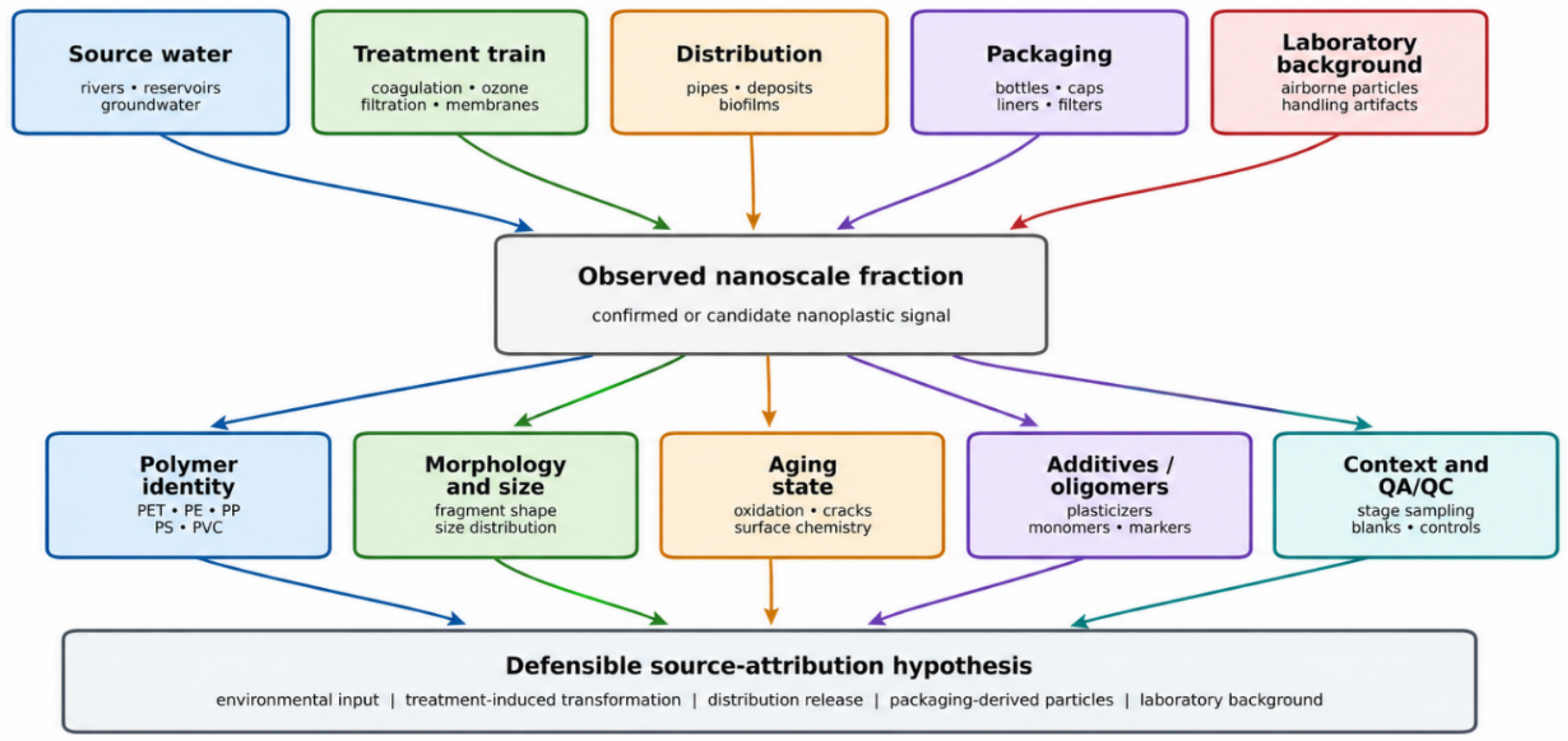
Figure 2.
Chemical aging pathways and analytical consequences for nanoplastics in drinking-water systems. Environmental, treatment-related, and packaging-related aging can produce surface oxidation, morphological change, additive or oligomer release, and altered colloidal behavior. These processes affect spectral features, pyrolysis products, and source-attribution confidence.
Figure 2.
Chemical aging pathways and analytical consequences for nanoplastics in drinking-water systems. Environmental, treatment-related, and packaging-related aging can produce surface oxidation, morphological change, additive or oligomer release, and altered colloidal behavior. These processes affect spectral features, pyrolysis products, and source-attribution confidence.
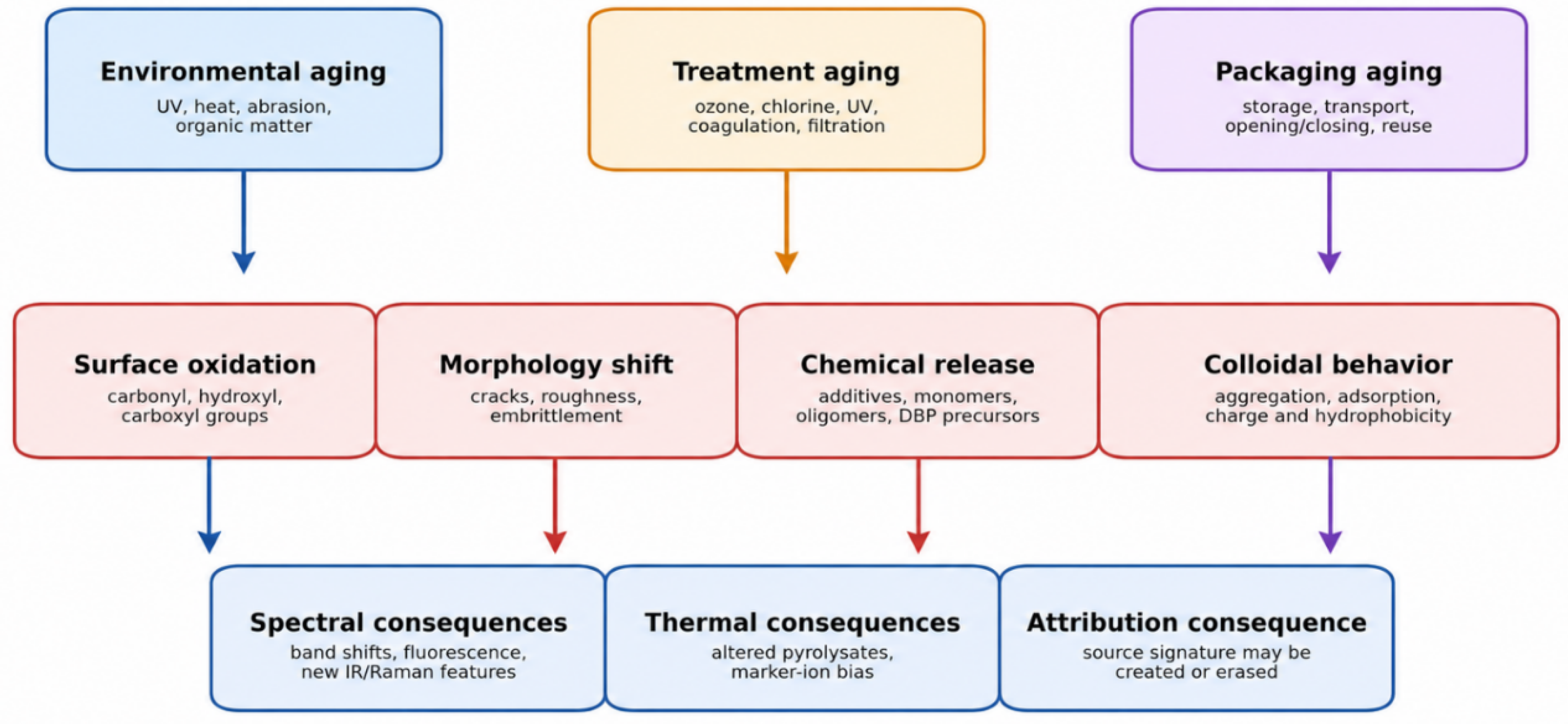
Figure 3.
Molecular fingerprinting toolbox for drinking-water nanoplastic source attribution. Particle-level chemistry, polymer-mass chemistry, morphology, and size evidence, and data fusion should be interpreted jointly to rank candidate sources. High-confidence attribution requires convergent evidence and transparent uncertainty.
Figure 3.
Molecular fingerprinting toolbox for drinking-water nanoplastic source attribution. Particle-level chemistry, polymer-mass chemistry, morphology, and size evidence, and data fusion should be interpreted jointly to rank candidate sources. High-confidence attribution requires convergent evidence and transparent uncertainty.
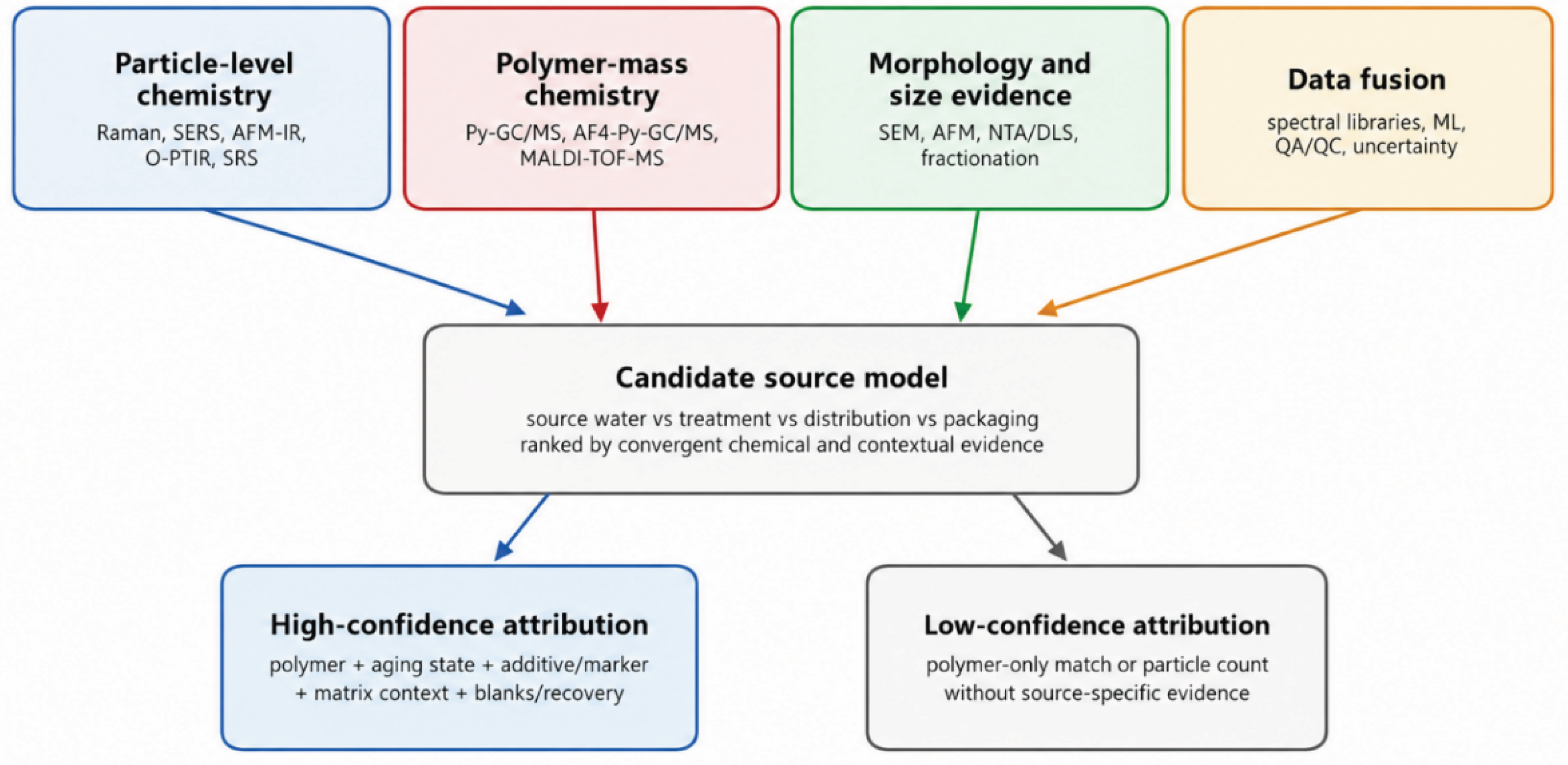

Table 1.
Potential sources of nanoplastics in drinking-water systems and expected source signatures [1,2,3,7,8,9,10,11,12,13,14,15,16].
| Candidate source | Likely polymer or material signal | Source-informative evidence | Main ambiguity |
| Source water | Mixed PE, PP, PET, PS, PVC; weathered fragments; biofilm-coated particles | Upstream detection, temporal correlation with runoff or wastewater influence, oxidized surfaces, mixed polymer spectrum | The same polymers may also appear from packaging, distribution, or laboratory background |
| Treatment materials and unit operations | PE/PVC/PP fragments, membrane-associated polymers, oxidized particles | Before/after treatment-train gradients, unit-operation mass balance, changes in surface functionality | Removal and generation may occur simultaneously |
| Distribution infrastructure | Pipe, gasket, coating, deposit- or biofilm-associated polymeric fragments | Spatial increase after treatment, pipe-material compatibility, repeated household or network sampling | Infrastructure metadata is often incomplete |
| Bottle body | PET or rPET particles, oligomers, acetaldehyde-related or packaging-compatible markers | Polymer match to bottle material, storage/handling dependence, low source-water signal | PET can also be introduced by filtration or environmental contamination |
| Caps, liners, labels, closures | PE, PP, PET, polyester coatings, pigments, or paint-related fragments | Cap-material match, opening/closing abrasion, colored particles, or additive compatibility | Particles may be transferred during manufacturing or sample handling |
| Laboratory background | Airborne fibers, procedural blank polymers, sampling container residues | Presence in blanks, batch-specific contamination pattern, absence of matrix gradient | Can mimic a true environmental signal at low particle burden |
Table 2.
Treatment and transformation processes relevant to source attribution [10,13,14,17,18,19,20,21,22].
| Process | Expected transformation | Attribution value | Analytical caution |
| Ozonation | Surface oxidation; carbonyl/carboxyl formation; potential fragmentation or altered hydrophilicity | May indicate exposure to oxidative treatment or transformation hotspots | Oxidation can also occur environmentally, so ozone attribution requires treatment-stage sampling |
| Chlorination | Polymer-specific reactions; additive/oligomer release; possible DBP precursor behavior | Can help interpret post-disinfection changes and by-product relevance | Reaction extent depends on polymer type, aging state, chlorine dose, pH, and matrix |
| UV and UV-based AOPs | Photo-oxidation, embrittlement, radical-driven surface modification | Useful for distinguishing pre-aged vs freshly generated particles | Laboratory accelerated aging may not reproduce real potable-water conditions |
| Coagulation/flocculation | Selective aggregation and removal depending on charge and colloidal stability | Before/after mass balance can identify removal or breakthrough | Coagulant residues and natural colloids may interfere with nanoscale measurements |
| Granular filtration and biofilm-coated media | Physical retention, biofilm interaction, and selective breakthrough | Retention patterns can support treatment-stage attribution | Biofilm-coated particles may mask polymer signatures |
| Membrane filtration | Retention, abrasion, and possible polymeric shedding from components | Can separate source particles from process-derived particles if controls are included | Membrane materials can become a source of contamination or a vector |
| Storage and handling | Mechanical stress, temperature effects, cap or bottle abrasion, and additive migration | Crucial for packaging attribution | Consumer and laboratory handling histories are often undocumented |
Table 3.
Molecular and analytical fingerprints for major polymers relevant to drinking-water systems [4,7,10,12,15,16,22,23,24,25,26,27,28,29,30,31,32,39,40,41].
| Polymer/material class | Potential drinking-water source | Useful fingerprint dimensions | Attribution limitation |
| PET / rPET | Bottle walls, packaging, fibers, filtration materials | Raman/SERS PET bands, PET pyrolysis markers, oligomers, bottle-compatible morphology | Base PET identity alone cannot locate the release stage |
| PE | Caps, liners, pipes, treatment components, and environmental fragments | Aliphatic spectral features, thermal markers, additive profiles, and cap compatibility | Common environmental polymer with many possible sources |
| PP | Caps, closures, packaging, filtration housings, and environmental fragments | Raman/IR aliphatic signals, pyrolysis products, pigment/additive evidence | Can be confused with packaging or procedural background without blanks |
| PS | Model nanoplastics, laboratory materials, and environmental inputs | Aromatic spectral features, styrene pyrolysis markers, and SERS sensitivity | Often used as a model material, real drinking-water relevance must be justified |
| PVC | Pipes, fittings, treatment infrastructure, and environmental fragments | C-Cl related IR features, dehydrochlorination/thermal markers, additives | Additives and weathering can dominate chemical interpretation |
| Polyamide/polyester fibers | Textiles, airborne contamination, filtration, or packaging residues | Fiber morphology, amide/ester bands, blank co-occurrence | High risk of airborne laboratory contamination |
| Paints, coatings, pigments | Caps, labels, internal coatings, and industrial contamination | Color, pigment signal, coating morphology, additive package | May be misclassified as a base polymer if pigment interference is ignored |
| Aged or biofilm-coated particles | Source water, treatment media, and distribution deposits | Carbonyl index, surface roughness, biofilm-associated signal, and altered hydrophobicity | An aging state may reflect multiple environments rather than one source |
Table 4.
Evidence levels for nanoplastic source-attribution claims [4,22,31,32,33,34,35,36,37,38,39,40,41,42,43,44,45,46,47,48,49,50].
| Evidence level | Minimum evidence | Example claim strength | Editorial interpretation |
| Level 0: detection only | Particle count, hydrodynamic size, or non-specific nanoscale signal | Nanoscale particles are present | Insufficient for nanoplastic source attribution |
| Level 1: polymer identification | Raman/SERS/IR or Py-GC/MS identifies polymer class | PET-like or PE-like particles are present | Useful occurrence evidence, weak source evidence |
| Level 2: source-compatible polymer evidence | Polymer class matches bottle, cap, pipe, membrane, or source-water materials | Packaging or treatment source is plausible | Still inferential without independent support |
| Level 3: convergent chemical evidence | Polymer identity plus aging state, additive/oligomer markers, or pyrolysis-marker pattern | Packaging-, treatment-, or distribution-related source is likely | Appropriate for cautious source hypothesis |
| Level 4: process-resolved evidence | Before/after or spatial gradient; matched source material; blanks and recovery; repeated sampling | The specific source pathway is strongly supported | High-confidence source attribution |
| Level 5: validated attribution model | Interlaboratory-tested workflow using reference materials, spectral libraries, uncertainty model, and source controls | Attribution is operationally defensible for monitoring | Regulatory-grade evidence |
Table 5.
Priority research gaps for source attribution of nanoplastics in drinking-water systems [42,43,44,45,46,47,48,49,50].
| Research gap | Why it matters | Near-term action | Long-term goal |
| Aged reference materials | Pristine spheres do not represent real source particles | Produce bottle-, cap-, pipe-, membrane-, and treatment-aged test materials | Certified or consensus reference materials for attribution workflows |
| Source-specific libraries | Polymer-class matching is not enough for origin assignment | Build Raman/SERS/IR/Py-GC/MS libraries with source metadata | Shared open libraries with uncertainty and QA/QC descriptors |
| Packaging experiments | Bottled-water particles may arise from multiple packaging components | Controlled storage, opening, cap-rinse, bottle-rinse, and source-water controls | Component-resolved packaging attribution |
| Treatment-train experiments | Treatment can remove, transform, or generate source signatures | Before/after sampling across unit operations with matched endpoints | Process-resolved transformation models |
| Data fusion and chemometrics | Source attribution requires multiple evidence classes | Develop transparent scoring systems and validation datasets | Interoperable attribution models with confidence categories |
| Interlaboratory trials | Source claims must survive method transfer | Blind samples with known mixed sources and matrix interferences | Regulatory-grade attribution protocols |
Disclaimer/Publisher’s Note: The statements, opinions and data contained in all publications are solely those of the individual author(s) and contributor(s) and not of MDPI and/or the editor(s). MDPI and/or the editor(s) disclaim responsibility for any injury to people or property resulting from any ideas, methods, instructions or products referred to in the content. |
© 2026 by the authors. Licensee MDPI, Basel, Switzerland. This article is an open access article distributed under the terms and conditions of the Creative Commons Attribution (CC BY) license (http://creativecommons.org/licenses/by/4.0/).
Copyright: This open access article is published under a Creative Commons CC BY 4.0 license, which permit the free download, distribution, and reuse, provided that the author and preprint are cited in any reuse.


