

Submitted:
06 June 2026
Posted:
09 June 2026
You are already at the latest version
Abstract
Background: Transmasculine people face distinct challenges in accessing and using contraceptive methods, influenced by gendered embodiment, healthcare systems, and identity-driven decision-making. UK-based qualitative research on this topic is minimal. This study aims to gain a deeper insight into the factors that influence transmasculine people's experiences of contraceptive methods and services in the UK.
Methods: A qualitative study of semi-structured one-to-one interviews (n=6) and a focus group (n=4) was conducted with transmasculine individuals aged 18+ in the UK. Thematic analysis followed Braun and Clarke's framework.
Findings: Three overarching themes were identified: (1) Gender Identity, Dysphoria, and Reproductive Embodiment; (2) Experiences of Healthcare Systems; and (3) Contraceptive Decision-Making and Use. Participants described profound interactions between dysphoria, bodily autonomy, and contraceptive choice, alongside widespread barriers within healthcare including misgendering, lack of knowledge, and systemic gatekeeping.
Conclusions: Contraceptive methods are not neutral — they are deeply intertwined with experiences of gender, identity, and power. Findings underscore the urgent need for non-assumptive, person-centred care and contribute new UK-based evidence to inform more equitable reproductive healthcare.
Keywords:
transmasculine
; contraception
; reproductive healthcare
1. Introduction
Recent political and social discourse have focussed attention on, and visibility of Lesbian, Gay, Bisexual, Transgender, Queer, and others (LGBTQ+) communities, including transmasculine people. The 2021 UK Census was the first to include a question on gender identity, reporting that in England and Wales, 48,000 individuals (0.10%) identified as a transgender man and 30,000 (0.06%) as non-binary [1]. Over the last century, gender-affirming care has evolved through the pioneering work of physicians like Hirschfeld and Benjamin, leading to the establishment of organisations, such as World Professional Association for Transgender Health, that continue to shape modern standards. Despite recent political and social pressures threatening this progress, ensuring equitable access to care for transgender and gender-diverse individuals remains vital to fostering a more inclusive society [2]. There are still significant gaps — including in provision for contraceptive care for transmasculine individuals [3].
Transmasculine people — those assigned female at birth who identify on the masculine spectrum, whether as transgender men, non-binary, genderqueer, or other identities — may use contraceptive methods for multiple purposes beyond pregnancy prevention, including menstrual suppression and gender affirmation. Options for menstrual suppression in transmasculine people include progestogen-only methods (pill, implant, injectable), the hormonal intrauterine system (e.g. levonorgestrel IUS), GnRH analogues[4,5]. For those on a masculinising pathway, testosterone itself might supress bleeding. Combined hormonal contraceptives are generally avoided due to their oestrogen content. Testosterone therapy does not reliably prevent pregnancy and should not be relied upon as contraception[5]. Yet contraceptive research and clinical guidance have historically centred on cisgender women [6], leaving significant gaps in understanding how transmasculine individuals navigate contraceptive care [7]. This exclusionary practice leads to the varying needs of the individual not being fully met, and a better understanding is needed so that healthcare professionals can provide holistic person-centred approach to contraceptive care.
Previous qualitative studies have explored influences on transmasculine people's experiences of contraceptive methods and services in the USA [8,9,10,11]. A 2025 systematic review by Allen et al. highlighted that research into contraceptive barriers for transgender and gender-diverse people remains scarce, with most studies conducted in high-income countries, identifying key barriers including provider knowledge gaps, financial accessibility, systemic discrimination, and gender-biased healthcare practices [12]. Notably, no UK-specific qualitative research exists exploring transmasculine contraceptive experiences within the NHS, representing a significant gap given the distinct differences in access pathways, waiting times, and cultural context compared to the US settings that dominate the current literature. This study addresses that gap, aiming to gain insight into what factors influence transmasculine people's experiences of contraceptive methods and services in the UK, and in what ways.
2. Materials and Methods
We conducted individual interviews and a focus group with qualitative analysis. Interviews were chosen as they offer a meaningful insight into participants’ lived experiences and perspectives in a private setting [13]. A focus group was carried out as a method of exploring mutual experiences and feelings surrounding a topic [13], whilst also highlighting differing views between members of the studied group. A semi-structured topic guide was developed from existing literature and a prior qualitative evidence synthesis, with open-ended questions designed to encourage flexibility and depth. The topic guide was piloted with one participant prior to data collection and minor amendments were made to improve clarity. JM had prior experience conducting qualitative interviews through undergraduate research training and had completed a qualitative research methods module as part of her medical degree. RLM is experienced in qualitative research with under-represented communities.
Ethical approval was granted by the University Research Ethics Committee (Application 063456). Inclusion criteria required participants to be aged 18 or over, can speak and understand English, on the transmasculine spectrum, currently or previously using contraceptive methods, and to have accessed contraceptive care in the UK.
Participants were recruited through purposive and snowball sampling over three months via local LGBTQ+ groups, University of Sheffield societies, and social media platforms such as LinkedIn. No relationship was established with participants prior to the study. Participants were informed that the research was being conducted by a medical student at the University of Sheffield as part of an intercalating research project, and that the study aimed to explore transmasculine people's experiences of contraceptive methods and services in the UK.
Participants were located predominantly in South Yorkshire. JM conducted six interviews and one focus group (n= 4) at a local LGBTQ+ youth support group in South Yorkshire. We restricted recruitment to trusted community networks to reduce the risk of imposter participants and maintain data integrity. We recruited ten participants: six in individual interviews and four in the focus group. The focus group lasted 45 minutes; interviews lasted between 23 and 57 minutes. One-to-one interviews were conducted remotely via video call to maximise accessibility and participant comfort. No non-participants were present during the one-to-one interviews. The focus group was conducted within a community LGBTQ+ youth group setting; no non-participants were present beyond the facilitator and participants. Reflective field notes were made by JM following each interview and focus group, capturing initial impressions, emerging ideas, and reflexive thoughts to support rigour throughout the analytical process.
Three individuals who expressed initial interest did not respond to follow-up contact and were therefore not recruited. No participants withdrew once the study had commenced. Repeat interviews were not conducted; each participant took part in a single interview or focus group only.
All participants were white British and aged between 18 and 27. Gender identities included transgender men, non-binary, agender, genderqueer, and gender non-conforming individuals (see Table 1).
Audio recordings were transcribed verbatim and anonymised. Transcripts were not returned to participants due to the risk of re-traumatisation and the preference expressed by participants during consent discussions for a single point of contact. Findings were not formally member-checked; however, reflexive journaling and regular team discussions were used throughout to interrogate interpretations and minimise researcher bias. Coding was carried out inductively, with initial codes generated from participants' language and experiences. Codes were subsequently grouped into candidate themes through team discussion, forming an overarching thematic framework. A summary coding structure is available from the corresponding author on request.
Data was managed and coded using NVivo 15. Coding was carried out inductively, following Braun and Clarke's [14] approach to thematic analysis, with codes developed directly from participants' language and experiences. Given the small purposive sample and the exploratory nature of this study, data saturation in the traditional sense was not the primary aim. Instead, we sought depth and richness of data, consistent with Braun and Clarke's reflexive thematic analysis approach, where the goal is theoretical sufficiency rather than saturation. Themes were developed from the codebook with research team JM, RLM and SB. Reflexive journaling and regular team discussions supported rigour throughout.
3. Results
Three overarching themes emerged, consistent with existing qualitative literature in this area and presented in Figure 1: (1) Gender Identity, Dysphoria, and Reproductive Embodiment; (2) Experiences of Healthcare Systems; and (3) Contraceptive Decision-Making and Use.
Theme 1: Gender Identity, Dysphoria, and Reproductive Embodiment
Participants' experiences of contraceptive methods were shaped by their gender identity and embodied relationship with their reproductive organs. For many, menstruation, fertility, and contraceptive methods triggered or intensified gender dysphoria, reflecting a disconnect between identity and the socially constructed expectations surrounding people assigned female at birth.
Several participants described menstruation as a painful reminder of their sex assigned at birth, intensifying feelings of dysphoria and disconnection from their bodies. For some, this discomfort reached crisis level:
"I would start feeling very suicidal whenever I was on my period." – Aspen, age 18
"There was a time where I thought I'd been inconsistent enough with [my pills] that a period had started, and I fully went non-verbal for a while and I haven't done that in over a year." – Aspen, age 18
Others expressed discomfort that was deeply rooted in gendered expectations:
"I think I don't see myself as a woman in that way. To have periods feels too much like that." – Morgan, age 23
Some participants went to considerable lengths to prevent menstruation altogether. One participant described how fears around bleeding influenced their eating behaviours, connecting contraceptive use to wider disordered patterns of self-management. For others, period suppression through contraception was experienced as affirming:
"I think it is kind of gender-affirming in that I feel more comfortable in my body not having to experience that every month." – Morgan, age 23
Pregnancy was similarly described as fundamentally incompatible with many participants' gender identity:
"Since realising about my gender identity, there's also been the fact that obviously pregnancy is very much associated with womanhood and so the idea of getting pregnant now and actually going through with a pregnancy, it just doesn't seem like something that I could ever handle." – Miles, age 27
In this context, permanent solutions like hysterectomy were sometimes framed as the most affirming and desirable outcome, though clinicians were perceived as resistant:
"Doctors are very resistant to permanently never having children in a way they are for almost nothing else." – Aspen, age 18
"Think less of the future children that may not be, and more of the person in front of you." – Aspen, age 18
Not all participants wished to avoid pregnancy entirely. One participant expressed a strong desire to carry children in the future, yet encountered stigma from peers who questioned whether this desire was compatible with a transmasculine identity:
"My own mate is gaslighting me a bit like 'okay you must be a woman then because you want to have a kid and carry it.'" – Cameron, age 22
Navigating visibility and stigma was a further dimension of this theme. Many described how stigma — whether experienced directly or anticipated — shaped their comfort and confidence in navigating reproductive services:
"There's a lot of stigma about it, like trans people coming in for contraception and stuff like that… if a trans guy comes in and is like 'I want the pill' or if worse comes to the worst, needs the morning after pill, there's so much stigma, like you're a guy — why do you need it?" – Kai, age 25
The emotional labour involved in deciding whether to disclose gender identity in healthcare settings was significant; for some, withholding information felt like a protective strategy:
"I think it's not something you always feel comfortable with telling a doctor that you are non-binary because then there's more questions behind that and kind of is easier to just pretend." – Morgan, age 23
Theme 2: Experiences of Healthcare Systems
Participants' narratives highlight the complexity of navigating contraceptive care within healthcare systems that often fail to recognise or affirm their gender identities. Whilst some described instances of respectful and affirming care, many reported significant barriers, including healthcare professionals' lack of knowledge, systemic gatekeeping, and discriminatory practices. Systemic gatekeeping referred to institutional policies and clinical practices that restricted access to care — for example, delays due to complex service pathways, an overreliance on binary gender categories in medical records and forms, and healthcare professionals acting as gatekeepers to certain methods.
Even when contraceptive methods were chosen for gender-affirming reasons, participants were often left to navigate their implications without sufficient support or guidance. Experiences of misgendering and deadnaming disrupted what should have been routine appointments:
"I do get misgendered. I do get misgendered though, by doctors. And deadnamed, even though it's in the 'nickname' [section on the system]." – Alex, age 22
The gendered nature of contraceptive services and information was a recurrent source of alienation:
"I think a lot of it is very gendered, and people might forget that the anatomy might not match up." – Aspen, age 18
"Everything's just very gendered and… the leaflets all just use she/her pronouns, and I don't like it." – Jack, age 20
"And you look on the NHS website and it's still using women and it's uncomfortable to read the information that's in the medication I'm taking." – Jack, age 20
One participant ultimately opted to access care privately after feeling invisible in NHS services:
“They have ignored [my identity], completely ignored it, so I went private.” – Jasper, age 20
These experiences were not isolated; participants highlighted structural issues across the healthcare system where their identities were disregarded or erased, with one noting:
“I mean, the whole NHS system isn't built with trans people in mind” – Jack, age 20
Despite these challenges, some participants reported positive encounters — especially in university-based healthcare settings, where they felt more able to be open about their identity and were met with respectful and responsive care:
"I went through the university healthcare service and they're very nice. I've had nothing but good experiences going through them for these problems." – Jack, age 20
Whilst these affirming experiences were welcomed, they also highlighted disparities in care. Some participants felt they could endure the discomfort, but resented that doing so was necessary in the first place:
"I know that I can put up with it, but I don't feel like I should have to put up with it." – Jack, age 20
Participants offered clear suggestions for improvement, centred on inclusive language and individualised care:
"I don't think I would care what gender people are. I think it's just case-by-case and you just go for what's best for that specific person. You don't really think about anything else." – Morgan, age 23
Theme 3: Contraceptive Decision-Making and Use
Participants' experiences of choosing and using contraceptive methods were shaped by a complex interplay of physical needs, gender identity, and external influences. Whilst some sought contraceptives to prevent pregnancy, others aimed to stop menstruation or reduce gender dysphoria. Choosing a method often involved weighing side effects, tolerability, and alignment with their identity.
Hormonal methods containing oestrogen were often ruled out entirely, viewed as directly incompatible with identity, both symbolically and physiologically:
"I definitely can't take oestrogen." – Jack, age 20
"I wouldn't ever want to use anything with oestrogen in." – Miles, age 27
Even progesterone-based methods or those that were not visibly feminising still carried associations with femininity that participants found emotionally difficult to navigate. The gendered marketing and language surrounding contraception further contributed to feelings of exclusion:
"I can only look at cis things and the only male ones for genetic males are condoms that I know of. So, I'm like it's all labelled as cis women stuff." – Cameron, age 22
"The pill and stuff like that, it is more gendered. So, I don't know about you lot but when I were on it when I realised I was trans, I kind of felt guilty because I felt like I was taking away a service for women because it's highly gendered." – Avery, age 21
Side effects were a significant concern and influenced decisions profoundly. Mood changes, weight gain, and physical symptoms such as prolonged bleeding were commonly described:
"I was basically having to wear sanitary towels more often than not just because if I didn't, my pants would get covered in blood… it's a year later — why is this still a problem?" – Miles, age 27
"[The dream contraceptive is] something that just didn't affect me hormonally. It's not going to affect my mood. It's not going to affect my medication. It's not going to affect my testosterone or oestrogen levels." – Jack, age 20
Pelvic procedures caused particular anxiety for some:
"I wouldn't ever consider an IUD because I would be very uncomfortable with the process to have one of those put in. I think that's just a complete no." – Aspen, age 18
Methods that allowed for discretion and minimal engagement with reproductive anatomy were often preferred. One participant described preferring the implant precisely because of its invisibility:
"With the implant, you literally don't know that it's there. And I think it just makes me more comfortable personally that only the people I'm really close to actually know I have one." – Morgan, age 23
Many participants encountered limited or unclear guidance from healthcare professionals and instead turned to peers, online communities, or other personal networks for advice. These informal sources played a key role in shaping decisions, especially when trust in professionals was low. Participants also highlighted the gendered imbalance in contraceptive side effects and responsibility:
"When we're on about side effects, it's like assigned female at birth their style contraceptive have got all the side effects and all this, whereas assigned male at birth it's like here's a condom and that's it." – Kai, age 25
Uncertainty around how contraceptives might interact with testosterone therapy was a persistent background concern:
"Is it affecting my testosterone? Because I feel like there hasn't been really that much research into it… it's always just a bit of a worry in the back of my head, but it's weighing up different things and I'd rather not get pregnant." – Jack, age 20
Overall, these accounts reflect how navigating contraceptive options is not only a matter of managing medical side effects but of managing dysphoria, autonomy, and fairness. For many, the limited range of acceptable options left them settling for less-than-ideal compromises:
"It doesn't really feel like there's many good options." – Jack, age 20
4. Discussion
To our knowledge, this is the first UK-based qualitative exploration of transmasculine and non-binary people's contraceptive experiences, drawing on interviews and a focus group with ten participants. Three overarching themes were identified, illustrating how contraceptive methods are experienced as deeply embodied, emotionally significant, and structurally constrained. These findings align with and extend prior work from the USA and other high-income countries [12], whilst contributing new insights grounded in the specific cultural and healthcare realities of the UK.
Consistent with existing literature [6,15,16,17], misgendering, healthcare professionals' incorrect assumptions, and structural exclusion emerged as pervasive barriers in reproductive healthcare [18]. This study extends those findings by demonstrating how contraceptive methods themselves carry gendered meanings that influence feelings of dysphoria or identity misalignment. These findings echo studies from the US where deterrents to care included misgendering, feminised healthcare environments and discrimination [8,9,10,11].
Participants described pills, coils, and implants as gendered objects or routines that can reinforce dysphoria, illustrating that contraceptive decisions cannot be separated from gender affirmation and embodied experiences. Community knowledge-sharing emerged as a critical supplement, and at times substitute, to professional advice, consistent with broader LGBTQ+ health findings about the importance of trusted peer networks [19].
Whilst certain themes were widely shared, such as the emotional impact of misgendering or the influence of dysphoria on contraceptive preferences, participants' views and experiences also diverged in important ways. Preferences around fertility, attitudes towards hormonal methods, and the level of comfort engaging with healthcare systems varied substantially. These differences highlight the importance of trans-informed care that avoids assumptions and treats each person as an individual with unique needs and goals.
Participants voiced uncertainty around how testosterone might impact reliability of contraception which was also described by Gomez et al in US [9]. Whilst evidence on contraceptive-testosterone interactions remains limited, clinicians can offer reassurance through individualised review, shared decision-making, and referral to specialists where appropriate (e.g. GIC or endocrinology) [4]. The paucity of research in this area itself represents a barrier to care [12].
Whilst the research in US and UK bear many similarities as defined by Allen et al. [12], there are distinct challenges for transmasuline individuals navigating UK/NHS systems. This includes the specific structural barriers posed by NHS waiting times, binary-gendered electronic records, and the absence of trans-affirming reproductive health guidelines within primary care. Mawson et al. confirmed these wider challenges of access to sexual and reproductive healthcare in primary care with similarities to this project themes [20].
Important limitations must be acknowledged. All participants were white British, and the majority completed school level education, limiting the generalisability of findings. Transmasculine individuals from racially minoritised, working-class, or disabled backgrounds may face additional or compounded challenges, including mistrust of healthcare systems, discrimination, and structural constraints, that were not fully reflected in this dataset. Additionally, as with many small-scale qualitative studies, the sample size was limited. However, the richness of the narratives obtained allowed for deep engagement with each participant's story, revealing complex dynamics of identity, power, and choice that quantitative research often overlooks [13]. JM and RM are both white and cis female, we are aware that this brings inherent bias in interpretation, although we reflected regularly and discussed how this might affect the data. We did not have anyone who was trans or non-binary in the research team which may have led to potential misunderstand and misinterpretation of the data.
Implications for Practice and Policy
Findings converge on the need for gender-affirming, identity-informed contraceptive care. Clinicians must understand that methods perceived as gendered or misaligned with masculinisation goals can be rejected, even if they are clinically effective. This requires moving beyond assumptions and creating spaces for patient-centred discussions that respect transmasculine people's embodied realities and concerns. Policy-level reforms should address the structural barriers identified in this study, such as the binary gendering of electronic medical records and the lack of trans-affirming care guidelines, guided by community voices and lived experiences.
Clinicians must be aware that safe prescribing for transmasculine patients requires knowledge of both natal sex and current gender identity, including any hormone therapy. For example, drug interactions between oestrogen-containing contraceptives and testosterone can affect both efficacy and safety[4]. This underscores the significance of creating clinical environments where patients feel safe to disclose their full medical picture.
Medical and nursing curricula and professional training should incorporate trans-specific reproductive health content to better equip clinicians. NHS services, advocacy groups, and guideline developers may use these insights to inform inclusive care delivery and training, with the potential to reduce healthcare avoidance, improve contraceptive access and satisfaction, and increase trust in services among transmasculine users. Improving contraceptive access and autonomy for transmasculine people is not only a clinical and policy imperative, but a matter of reproductive justice.
5. Conclusions
This study demonstrates that contraceptive experiences of transmasculine people are inseparable from gender identity, dysphoria, and systemic barriers within healthcare. The findings highlight that contraceptive methods are not neutral objects; they are deeply intertwined with experiences of gender, identity, and power, and can both alleviate and exacerbate gendered distress depending on how they are accessed, discussed, and delivered. By centring the voices of transmasculine people in the UK, this research contributes important new evidence to an underexplored area of reproductive healthcare and underscores the need for non-assumptive, person-centred care that affirms the full diversity of transmasculine experiences.
Supplementary Materials
The following supporting information can be downloaded at the website of this paper posted on Preprints.org.
Author Contributions
Conceptualization, JM, RLM methodology, JM, RLM; software, JM; validation, JM, SB, RLM; formal analysis, JM, RLM; investigation, JM; resources, RLM; data curation, JM; writing—original draft preparation, JM, RLM; writing—review and editing, JM, SB, RM, RLM; visualization, JM; supervision, RLM; project administration, JM, RLM; funding acquisition, RLM. All authors have read and agreed to the published version of the manuscript. RLM is responsible for the overall content of the manuscript, as guarantor.
Funding
This study was funded by University of Sheffield pump priming grant linked to The Hormone Effect project led by RLM.
Institutional Review Board Statement
The study was conducted in accordance with the Declaration of Helsinki, and approved by the Institutional Review Board (or Ethics Committee) of Ethical approval was provided by the University of Sheffield (Ref: 063456) 2025.
Informed Consent Statement
Informed consent was obtained from all subjects involved in the study.
Data Availability Statement
No new datasets were created in this research project.
Acknowledgments
Thank you to the team within the Primary Care Research team in Population Health at the University of Sheffield, who helped with academic discussions and theory testing. Thank you to Chilypep charity for their support of our project as public contributors who helped shape the design and recruitment.
Conflicts of Interest
The authors declare no conflicts of interest.
References
- Office for National Statistics. “Gender identity, England and Wales: Census 2021,” 2021. Available online: https://www.ons.gov.uk/peoplepopulationandcommunity/culturalidentity/genderidentity/bulletins/genderidentityenglandandwales/census2021 (accessed on Apr. 17 2026).
- Oles, N.; Fontenele, R.; Abi Zeid Daou, M. Transgender History, Part II: A Brief History of Medical and Surgical Gender-Affirming Care. In Behavioral Sciences and the Law; ISSUE:ISSUE:DOI, Aug 2025; vol. 43, no. 4, pp. 351–356. [Google Scholar] [CrossRef]
- Norris, M.; Borneskog, C. The Cisnormative Blindspot Explained: Healthcare Experiences of Trans Men and Non-Binary Persons and the accessibility to inclusive sexual & reproductive Healthcare, an integrative review. Sex. Reprod. Healthc. 2022, vol. 32, 100733. [Google Scholar] [CrossRef]
- Coleman, E.; et al. “Standards of Care for the Health of Transgender and Gender Diverse People, Version 8,”. Int. J. Transgend. Health 2022, vol. 23(no. S1), S1–S259. [Google Scholar] [CrossRef] [PubMed]
- FSRH CEU Statement, “Contraceptive Choices and Sexual Health for Transgender and Non-binary People,” 2017. Available online: https://www.cosrh.org/Common/Uploaded%20files/documents/contraceptive-choices-and-sexual-health-for-transgender-non-binary-people-oct-2017.pdf (accessed on 21 May 2026).
- Moseson, H.; et al. The Imperative for Transgender and Gender Nonbinary Inclusion. Obstet. Gynecol. 2020, vol. 135(no. 5), 1059–1068. [Google Scholar] [CrossRef] [PubMed]
- Krempasky, C.; Harris, M.; Abern, L.; Grimstad, F. Contraception across the transmasculine spectrum. Am. J. Obstet. Gynecol. 2020, vol. 222(no. 2), 134–143. [Google Scholar] [CrossRef] [PubMed]
- Fix, L.; et al. Stakeholder Perceptions and Experiences Regarding Access to Contraception and Abortion for Transgender, Non-Binary, and Gender-Expansive Individuals Assigned Female at Birth in the U.S. Arch. Sex. Behav. 2020, vol. 49(no. 7), 2683–2702. [Google Scholar] [CrossRef] [PubMed]
- Gomez, A. M.; Đỗ, L.; Ratliff, G. A.; Crego, P. I.; Hastings, J. Contraceptive Beliefs, Needs, and Care Experiences Among Transgender and Nonbinary Young Adults. J. Adolesc. Health 2020, vol. 67(no. 4), 597–602. [Google Scholar] [CrossRef] [PubMed]
- Agénor, M.; et al. ‘Making a Way Out of No Way:’ Understanding the Sexual and Reproductive Health Care Experiences of Transmasculine Young Adults of Color in the United States. Qual. Health Res. 2021, vol. 32(no. 1), 121. [Google Scholar] [CrossRef] [PubMed]
- Agénor, M.; Cottrill, A. A.; Kay, E.; Janiak, E.; Gordon, A. R.; Potter, J. Contraceptive Beliefs, Decision Making and Care Experiences Among Transmasculine Young Adults: A Qualitative Analysis. Perspect. Sex. Reprod. Health 2020, vol. 52(no. 1), 7–14. [Google Scholar] [CrossRef] [PubMed]
- Allen, C. L.; Muschialli, L.; Nihlén, Å.; Coates, A.; Gonsalves, L. M. Barriers to sexual and reproductive health care faced by transgender and gender diverse people: a systematic review. Reprod. Health 2025, 2025 22:1, vol. 22(no. 1), 115. [Google Scholar] [CrossRef] [PubMed]
- Gill, P.; Baillie, J. Interviews and focus groups in qualitative research: an update for the digital age. Br. Dent. J. 2018, vol. 225(no. 7), 668–672. [Google Scholar] [CrossRef] [PubMed]
- Braun, V.; Clarke, V. Using thematic analysis in psychology. Qual. Res. Psychol. 2006, vol. 3(no. 2). [Google Scholar] [CrossRef]
- Ertl, M. M.; et al. Sexual and Reproductive Justice and Health Equity for LGBTQ+ Women. J. Lesbian Stud. 2024, vol. 28(no. 4), 574–602. [Google Scholar] [CrossRef] [PubMed]
- Mkhize, S. P.; Maharaj, P. Structural violence on the margins of society: LGBT student access to health services. Agenda 2020, vol. 34(no. 2), 104–114. [Google Scholar] [CrossRef]
- Lampe, N. M.; Barbee, H.; Tran, N. M.; Bastow, S.; McKay, T. Health Disparities Among Lesbian, Gay, Bisexual, Transgender, and Queer Older Adults: A Structural Competency Approach. Int. J. Aging Hum. Dev. 2024, vol. 98(no. 1), 39–55. [Google Scholar] [CrossRef] [PubMed]
- Mikulak, M.; et al. Health professionals’ identified barriers to trans health care: A qualitative interview study. Br. J. General. Pract. 2021, vol. 71(no. 713), E941–E947. [Google Scholar] [CrossRef] [PubMed]
- Haire, B. G.; Brook, E.; Stoddart, R.; Simpson, P. Trans and gender diverse people’s experiences of healthcare access in Australia: A qualitative study in people with complex needs. PLoS ONE 2021, vol. 16(no. 1), e0245889. [Google Scholar] [CrossRef] [PubMed]
Figure 1.
Hierarchy of themes.
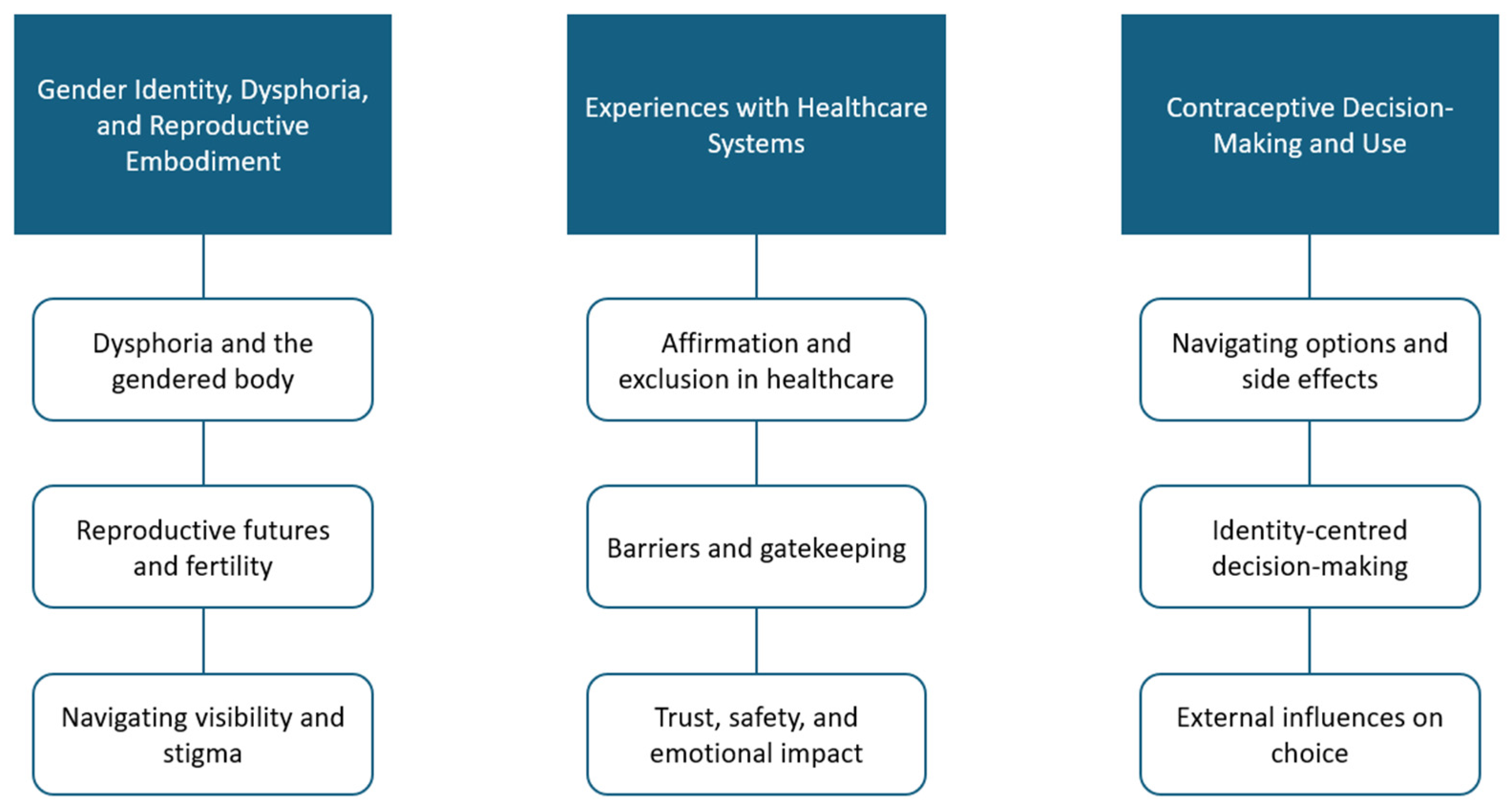

Table 1.
Participant characteristics and pseudonyms.
| Pseudonym | Age | Gender as defined by participants | Ethnicity | Currently using a contraceptive method? | |
|---|---|---|---|---|---|
| 1 | Cameron | 22 | Agender/ trans masc | White British | Yes |
| 2 | Taylor | 19 | Non-binary | White British | Yes |
| 3 | Miles | 27 | Male | White British | Yes |
| 4 | Alex | 22 | Non-binary | White British | Yes |
| 5 | Kai | 25 | Male | White British | No |
| 6 | Jasper | 20 | Male | White British | No |
| 7 | Avery | 21 | Genderqueer | White British | No |
| 8 | Morgan | 23 | Non-binary | White British | Yes |
| 9 | Jack | 20 | Male | White British | Yes |
| 10 | Aspen | 18 | Genderqueer | White British | Yes |
Disclaimer/Publisher’s Note: The statements, opinions and data contained in all publications are solely those of the individual author(s) and contributor(s) and not of MDPI and/or the editor(s). MDPI and/or the editor(s) disclaim responsibility for any injury to people or property resulting from any ideas, methods, instructions or products referred to in the content. |
© 2026 by the authors. Licensee MDPI, Basel, Switzerland. This article is an open access article distributed under the terms and conditions of the Creative Commons Attribution (CC BY) license (http://creativecommons.org/licenses/by/4.0/).
Copyright: This open access article is published under a Creative Commons CC BY 4.0 license, which permit the free download, distribution, and reuse, provided that the author and preprint are cited in any reuse.


