

Submitted:
06 June 2026
Posted:
09 June 2026
You are already at the latest version
Abstract
The rapid expansion of wearable fitness devices has generated an unprecedented volume of personal health data, promoting self-awareness and helping users make healthier lifestyle decisions. Artificial intelligence (AI) is increasingly being embedded in wearable fitness devices, thereby turning passive self-monitoring into personalised coaching with adaptable goals, real-time feedback, and behavioural nudges. Nonetheless, sustained use of these devices remains inconsistent despite their health advantages. This study adopts an interpretive socio-technical perspective to explain how social and technical factors influence sustained use of wearable fitness devices. Drawing on socio-technical theory, analysis of eighteen semi-structured interviews with users of wearable fitness devices for health and fitness tracking provided insights into their lived experiences, which are influenced by their interactions and integration into daily routines. A layered analysis revealed the dynamic complexities that emerge when the social and technical elements interplay, shaping users’ interpretations of the data provided by these devices and their consequent decision to continue using them. A visual thematic map represents a range of patterns and interpretations of social and technical factors derived from users’ lived experiences, shaped by their interplay. The study’s findings suggest that AI-driven features can be an enabler of translating health data into meaningful, actionable feedback, thereby unlocking personalised and contextual coaching capabilities for sustained use.
Keywords:
artificial intelligence
; wearable fitness devices
; socio-technical theory
; sustained use
1. Introduction
Wearable fitness devices have gained significant popularity as pervasive user information systems, enabling the monitoring of health and fitness parameters [1]. Their goal is to transform how individuals and populations manage their health lifestyle behaviours [2]. Scholars view these as devices designed to support health and fitness monitoring while reducing the high demands on healthcare systems [3,4,5]. Furthermore, users adopt these wearable fitness devices as motivational tools integrated into daily healthy behaviour routines, enabling them to track their progress.
Despite their rapid diffusion and realised health benefits, sustained use of these wearable fitness devices remains a concern, particularly after the initial adoption [6,7]. Hence, the introduction and integration of Artificial Intelligence (AI) into wearable fitness devices hold immense potential as an enabler for effective interventions to promote long-term physical activity through personalised and motivational feedback [8]. Furthermore, this integration leverages AI capabilities to enable sophisticated data analysis, predictive modelling, and pattern recognition that did not exist in traditional wearables and fitness devices [9]. While the AI integration into wearable fitness devices brings intelligent capabilities and promises to enhance long-term use through personalised coaching, sustained use remains a challenge. Thus, raising a crucial question in the Information Systems (IS) discipline: how does users’ interaction with wearable fitness devices influence their sustained use?
This question has long been a topic in the literature and across disciplines; however, attempts to address it have yielded a limited perspective. Hence, to date, various scholars have been investigating and attempting to explain the underlying factors that influence the inconsistencies and short-lived usage patterns [5,7,10]. Thus, raising contrasting concerns and interests about the perceived value of these wearable fitness devices in supporting long-term changes in health behaviour. The literature clearly shows that various aspects of wearable fitness devices have been a focus in the scholarly domain, particularly adoption and sustained use [11,12]. However, the explanation of the underlying factors influencing sustained use remains unclear [13,14].
Prior studies in the IS discipline have predominantly investigated and explained adoption using traditional technology acceptance theories, while overlooking sustained use [15,16,17]. While these efforts have provided insights into behavioural intentions to adopt these devices based on perceived usefulness and ease of use, they are insufficient for explaining sustained use [16,18]. In other studies, Lombardo et al. [19] and Ikwunne et al. [18] are of the view that the insufficiency in explaining sustained use emanates from the technical and social elements of innovative technologies investigated in silos. This concern has been long-standing, dating back to Baxter and Sommerville [20], whose work is foundational in the IS discipline. These scholars emphasise that inconsistencies in the usage patterns of any technological innovation stem from the infrequent use of socio-technical methods in system design and development. This often leads to the development of devices that remain unused despite the perceived benefits to individuals and populations [21]. As a response, Sarker et al. [22] have urged scholars to adopt a renewed socio-technical focus that integrates social and technical elements to better understand and explain complex phenomena in the IS discipline.
Drawing on the foundational work of Sarker et al. [22], scholars such as Lombardo et al. [19] and Ikwunne et al. [18] argue that factors influencing adoption and sustained use will remain unresolved without a socio-technical perspective for investigation and explanation. On the other hand, Kronlid et al. [23] concur with this view, stating that to understand how adoption and sustained use are informed, a socio-technical perspective must underpin such an investigation. In addition, wearable fitness devices are not merely functional tools but also socio-technical artefacts that shape self-awareness, social comparison, and users' interpretations of their use and integration into daily routines [24]. Their sustained use to support long-term health lifestyle changes unfolds within the complex and dynamic interplay among social norms, values, perceptions, technical capabilities, and design features [25]. Moreover, adoption extends beyond initial enthusiasm for wearable fitness devices; it involves continually choosing to use them as they align with social goals and expectations [24,25].
Initial adoption is a process driven by perceptions and expectations; however, it is a prerequisite for sustained use [26]. Thus, sustained use is driven by ongoing perceived alignment with social goals, values and expectations, and by seamless integration into daily routines [27]. However, the literature demonstrates a predominant focus on adoption and an oversight of sustained use as a socio-technical process [28]. In particular, it presents a limited interpretive epistemological perspective, focusing on perception, intention, and attitude to explain adoption. Such a focus often fails to explain how users construct meaning from wearable fitness device use, and how this meaning-making process shapes post-adoption and sustained use decisions [25].
This study problematises the predominant conceptualisation of adoption within the IS discipline. Particularly, the framing of this construct as a discrete decision driven by perceptions of usefulness and ease of use, and as an outcome of predicted satisfaction. In this study, adoption and sustained use are conceptualised as socio-technical processes informed by the complex interplay between the social and technical elements [29,30,31]. This is consistent with Baxter and Sommerville [20], who emphasised that socio-technical systems are designed to account for factors arising from social, technical, and environmental contexts. Therefore, understanding how the interplay among these factors influences adoption and sustained use requires a socio-technical lens [32].
The literature highlights a gap in understanding how wearable fitness devices are adopted and maintained in specific contexts. While various scholars in the IS discipline provide foundational insights through traditional technology acceptance models [12,33,34,35], this study critiques these perspectives for offering a narrow view of adoption and sustained use. They are limited in their ability to illuminate how users interpret the technology within their social environment. To address this gap, the study's main research question is: How do social and technical factors within a given context influence the adoption and sustained use of wearable fitness devices?
Grounded in the socio-technical and interpretivist perspective, this study explains how social and technical factors influence the adoption and sustained use of wearable fitness devices. The socio-technical lens conceptualises the social and technical as interdependent elements that mutually shape one another during interplay, thereby informing the meaning-making process. Therefore, viewing adoption and sustained use through this lens reveals how lived experiences are shaped by ongoing negotiations among these technologies’ features, social norms, and incorporation into daily routines. This study’s objective is to provide an in-depth understanding of how the social and technical factors influence the adoption and sustained use. Thus, explaining why initial adoption does not automatically translate into sustained use, despite the growing market of wearable fitness devices.
The key contribution of this study is twofold: challenging the assumptions that technological efficiency alone is the driver for adoption and sustained use of wearable fitness devices. Thus, employing a socio-technical perspective within an interpretivist stance to explain how the complex interplay between social and technical elements influences the adoption and sustained use. Furthermore, demonstrating adoption and sustained use as socio-technical processes, informed by ongoing interaction and subjective interpretation of wearable fitness devices use and integration into daily routine. From an interpretivist epistemological perspective, these subjective interpretations are illustrated in a thematic visual map that provides an in-depth analysis of the social and technical elements that mutually shape one another. Thus, explaining the inherent complexities when the social and technical elements interplay within a specific context.
Furthermore, this study expands on the existing literature by addressing the narrow focus of extant studies, which explain adoption mainly through traditional technology acceptance models and do not account for sustained use. The goal is not to undermine previous adoption studies but to deepen our understanding of how meaning-making, as a socio-technical process, influences the adoption and sustained use of wearable fitness devices in specific contexts. Seidel et al. [36]'s assertion affirms the need to understand the sensemaking of technology use as it is integrated into daily routines, shaping lived experiences and perceptions. This study investigates and explains how users of wearable fitness devices interpret social and technical factors that influence their adoption and sustained use, thereby supporting long-term changes in health behaviour.
This study accounts for the complex phenomenon whereby the interplay between social and technical elements shapes lived experiences through users' ongoing interpretations of wearable fitness devices. As such, this phenomenon required a multi-layered approach to understand the adoption and sustained use of these technologies. Therefore, this study integrates the socio-technical perspective from Sarker et al. [22] with the theory of explanation from Gregor [37] within the interpretivist epistemological paradigm. The socio-technical perspective situates technical elements within social interactions, emphasising that the use of wearable fitness devices arises from this interplay. Meanwhile, the interpretivist epistemological stance foregrounds subjective and multiple realities, informed by the meaning-making process emerging from interactions with wearable fitness devices. The theory of explanation provides a framework for understanding why initial adoption of wearable fitness devices occurs and how the interpretation of these technologies and their integration into daily routines leads to sustained use. This integration is methodologically grounded, providing a coherent framework for understanding and explaining wearable fitness device use as a complex phenomenon. Moreover, this view shaped the study's data collection, analysis, and interpretation of findings.
From an interpretivist epistemological perspective, the convergent and divergent themes reflect users’ lived experiences, offering insights into their interpretations of wearable fitness device use. As such, they also shed light on why adoption and sustained use are socio-technical processes driven by meaning-making. Therefore, this study assumes that understanding how social and technical factors influence the adoption and sustained use of wearable fitness devices requires a socio-technical perspective as the foundation of the investigation. Moreover, interaction with wearable fitness devices informs multiple subjective realities within a specific context.
2. Related Studies
The use of wearable fitness devices has become increasingly popular as users continue to realise the benefits of self-awareness through physical activity and healthy lifestyles [38]. These wearable fitness devices are a strategic response to the increasing service demands that strain healthcare systems, thereby enabling users to take control of their health through healthy lifestyle habits and physical activity monitoring [39]. It is the capabilities introduced by the Internet of Things (IoT) and AI that have extended to personalised health and fitness monitoring through sensor-infused objects, allowing the collection of real-time data, processing, and predictive analytics [17,40]. Hence, the wearable fitness devices have gained popularity within the IoT domain [1,41]. Particularly because of the real-time monitoring capabilities, behavioural feedback, and health goal settings [42].
The notion of IoT, with sensors embedded in wearable fitness devices for real-time data collection and AI-driven predictive analytics, enhances the ability to provide personalised and contextualised feedback for each user. Consequently, creating a shift from traditional human coaching or training to personalised, intelligent trainers that are available and convenient for the users’ context at a given time [43]. Although the popularity of these wearable fitness devices has emerged from the perceived benefits of self-monitoring, their expansion to support lifestyle changes, and the predicted increase in adoption has been established in the literature [44,45]. These predictions are supported by the increasing market trends tracked by platforms such as Statista [46], and the enhancements provided by AI. Wearable fitness devices, particularly those worn on the wrist (i.e., smartwatches), enable users to monitor their health and fitness parameters, as they are easy to wear throughout the day [47].
According to Cilliers [48], wearable fitness devices have enabled individuals to take control of their health by maintaining a healthy lifestyle through physical activity. Moreover, the capability of these wearable fitness devices to collect real-time data and provide insights into an individual’s health has accelerated their popularity and scholarly interest.
Hence, the literature provides evidence of considerable scholarly interest in these devices [49,50]. While the benefits of these devices are undeniably recognised in research and industry, scholars across academic disciplines have questioned their sustained use, even with the integrated AI capabilities [11]. Although these inquiries about sustained use are not new, particularly in the IS discipline, the focus has increased significantly as innovative technologies have become more pervasive. According to Lee and Lin [51], the current literature has not investigated how the integration of AI influences the sustained use of these wearable fitness devices. Arguably, the AI capabilities for data processing, predictive analytics, and contextualised feedback demonstrate a techno-centric focus, thereby potentially undermining the social aspect of interaction with these wearable fitness devices. Hence, the AI advancements do not automatically translate into sustained use.
In this study, wearable fitness devices are conceptualised as socio-technical systems, thereby focusing on the complex interplay between the social and technical elements that mutually shape one another. Therefore, postulating that factors influencing their sustained use arise from their complex, dynamic interplay. Arguably, several studies have investigated and explained factors influencing the adoption of these devices [5,52]. However, the concept of sustained use has not yet been fully explained. Hence, Ikwunne et al. [18] stated that the factors underlying inconsistencies in adoption and usage patterns will remain unresolved unless investigations are grounded in a socio-technical perspective. Furthermore, Ikwunne et al. [18] cautioned that scholars move away from explaining the adoption and sustained use of wearable fitness devices using techno-centric or socio-centric approaches.
As previously alluded to in Section 1, using traditional technology acceptance models to explain adoption reveals a research gap in understanding sustained use of wearable fitness devices for health behaviour change. For example, the Technology Acceptance Model (TAM) was developed by Davis [53] and has been widely used by various scholars to explain the initial adoption of innovative technology, including wearable fitness devices [54,55,56,57]. While TAM has been one of the widely recognised and useful models for explaining users’ intentions to accept innovative technologies, it has been limited and fragmented in explaining sustained use [45]. Although scholars have subsequently extended this model with additional constructs, the common findings provide a static view of technology use [45,58].
Similarly, Diffusion of Innovations (DOI) by Rogers [59], Theory of Reasoned Action (TRA) by Fishbein and Ajzen (60), and the revised TAM (TAM2) by Venkatesh and Davis [61], TAM3 by Venkatesh and Bala [62], Theory of Planned Behaviour (TPB) by Ajzen [63], and Social Cognitive Theory (SCT) by Bandura [64] have been explored to explain adoption in the IS field and across academic disciplines. Although these models provide a framework for explaining initial adoption from different perspectives, they remain fragmented and include overlapping determinants. Hence, Venkatesh et al. [65] developed the Unified Technology Acceptance and Use of Technology (UTAUT) after reviewing and empirically testing the prior models. The objective was to unify these models to enhance the predictive accuracy and explanatory power for technology adoption behaviours across varying contexts. In another study, Gregor [37] supports this view, stating that a combination of models to explain a phenomenon is highly valuable, complementing the limitations of each model.
The development of UTAUT identified four key determinants: Effort Expectancy (EP), Performance Expectancy (PE), Social Influence (SI), and Facilitating Conditions (FC). However, the significant increase in user technologies, such as wearable fitness devices, and the need to explain adoption in that context became topics of interest and concern across academic disciplines. Consequently, these efforts exposed the limitations of UTAUT in explaining adoption from the users’ perspective. Arguably, UTAUT was developed to explain technology adoption from an organisational perspective, not for everyday use. Hence, Venkatesh et al. [66] revised UTAUT into UTAUT2 to provide the explanation of adoption in the user context. As such, this revision incorporated additional determinants, including Hedonic Motivation (HM), Price Value (PV), and Habit (H). Consequently, improving the ability to explain the adoption of wearable fitness devices.
Nonetheless, these efforts to unify and revise traditional technology acceptance models only focused on intention to adopt and do not fully account for sustained use [49,67]. The insufficiency in explaining sustained use stems from ignoring the effects of time, evolving perceptions, and lived experiences shaped by interactions with these devices [68]. Windasari et al. [68], assert that sustained use depends on a continuous interaction and integration of wearable fitness devices into daily routines, shaping lived experiences and perceptions over time. Therefore, explaining the sustained use of wearable fitness devices requires a model that accounts for the interplay between social and technical elements, particularly how they mutually shape one another [25,45,69].
The current study draws on the studies by Ikwunne et al. [18] and Ikwunne et al. [70], who assert that the socio-technical perspective can help address shortcomings in traditional technology acceptance models and explain the sustained use of wearable fitness devices. In addition, the current study shared the view of Pancar and Yildrim [52] who stated that factors influencing not only the initial adoption but also the sustained use of these devices are inherently derived from both the social and technical elements. As such, understanding and explaining the sustained use of wearable fitness devices should be situated within complex socio-technical discussions [45,71]. Consequently, such discussions privilege neither technical nor social elements but account for the interdependence and mutual shaping that emerges from the interplay [68]. Additionally, the current study addresses concerns in the literature about techno-centric and socio-centric approaches that neglect the complex, dynamic interplay shaping sustained use [19,21].
3. Materials and Methods
Given the interpretive socio-technical grounding of this study, meanings derived from the complex interplay between the social and technical elements of wearable fitness devices are dynamic and subjective. Therefore, it became essential to gain an in-depth understanding of how the meaning-making process of using wearable fitness devices informs decisions about sustained use, thus constituting a constructed subjective reality. The interpretivist epistemological lens was appropriate for understanding and explaining the subjective meanings emerging from the use of wearable fitness devices, as well as users’ converging and diverging lived experiences and perceptions shaped by this interplay.
Accordingly, the interpretivist paradigm grounding this study posited that a qualitative approach was appropriate for understanding and explaining a complex phenomenon such as a socio-technical system [72]. Therefore, semi-structured interviews were used as a data collection strategy to acquire rich insights into this complex phenomenon. Consequently, enabling an understanding of how users’ lived experiences and perceptions are continuously shaped by their interactions with and integration of wearable fitness devices into daily routines.
3.1. Data Collection
The collection of data adhered to the approved ethics procedure issued by the University of XYZ’s (The institution’s name is anomymised for peer-review purpose.) Research guidelines. The data was collected from a group of runners who use wearable fitness devices to track their fitness and health parameters. In addition, permission to interview potential participants was granted by the runners’ club group leader. Prior to interviewing potential study participants, informed consent was obtained from each participant as evidence of voluntary participation.
Grounded in an interpretivist epistemological stance and guided by the socio-technical theoretical foundation, data in this study was collected from both primary and secondary sources. Primary data was collected through semi-structured interviews with the study participants. Thus, providing insights into their lived experiences and perceptions shaped by their interaction with wearable fitness devices. An approved interview guide was used to elicit the study’s participants’ lived experiences and perceptions shaped by their interactions with these devices.
The rationale for using semi-structured interviews to engage with the study participants was to elicit deeper insights into this phenomenon. All interviews were conducted and digitally recorded using MS Teams with each participant's permission. Each interview session lasted between 30 and 45 minutes. The recorded interviews were transcribed using an online audio transcriber tool. However, each transcribed interview was manually checked and corrected to ensure participants’ narratives were accurately captured.
The primary data was complemented by the secondary data collected from the wearable fitness devices’ technical documents. The selection of the technical documents was informed by the devices mentioned by the study participants during the interview sessions. The technical documents for these wearable fitness devices included manuals and design specifications. This combination of primary and secondary data collection enabled triangulation and provided an in-depth understanding of socio-technical misalignments and subjective convergent and divergent interpretations. In particular, comparing participants’ meaning-making of wearable fitness devices with the technical documentation to understand misalignments in interpreting the functionality of the devices.
Eighteen participants provided the primary data for this study, all with varying years of experience with wearable fitness devices. Although 23 participants were interviewed in this study, data saturation was achieved at participant 18. As a result, only interview sessions with Participants 1 to 18 were transcribed and analysed. Therefore, data collection ceased at Participant 23. Pseudonyms (e.g., P1) are used to anonymise participants' identities.
3.2. Data Analysis
The qualitative nature of the data collected from the study participants provided unfiltered insights into multiple, subjective realities informed by interactions with wearable fitness devices. However, it became essential to uncover the deeper meanings that study participants attach to using these devices, thereby providing insight into how these meanings influence decisions about sustained use [73,74]. As such, data collection progressed into the analysis phase to uncover the subjective meanings associated with this socio-technical phenomenon. According to Stuckey [75], analysis enables data to be organised and sorted to search and interpret meanings, emerging themes and patterns seen or heard during the interview sessions. In another study, Starks and Trinidad [76] assert that researchers of a study serve as an initial tool for analysis by identifying codes, themes and making judgments on the collected data. Additionally, Braun and Clarke [77] concur with this view by stating that researchers must immerse themselves in the data, as familiarity enables the identification of significant codes, themes and patterns conveying participants’ lived experiences.
As previously alluded to in Section 2, the socio-technical perspective privileges neither the social nor the technical elements but accentuates the complex dynamic interplay between the two interdependent subsystems. Therefore, positing a multi-layered data analysis approach to move from surface-level meaning to more deeply rooted meanings and interpretations of the findings. This multi-layered, triangulated data analysis combined thematic, comparative and hermeneutic approaches to uncover a deeper understanding of the phenomenon from multiple perspectives. Thus, bringing to light how socio-technical factors expressed by participants influence the sustained use of wearable fitness devices.
According to Braun and Clarke [77], thematic analysis offers a structured, yet adaptable approach for identifying, analysing and reporting on themes and patterns found in transcribed data. In this study, thematic analysis was used to identify and analyse recurring themes and patterns from the participants’ transcribed narratives [78]. This thematic analysis was systematically conducted through the six analysis phases proposed by Braun and Clarke [77]. These themes and patterns represent the socio-technical factors influencing the sustained use of wearable fitness devices.
Figure 1 illustrates the thematic analysis process followed to inductively generate codes, subthemes, and key themes from the transcribed data (study participants’ narratives) [79]. While the thematic analysis enabled the identification of significant information from the transcribed data, an inductive approach was necessary as initial codes were generated without a pre-existing framework [80]. Moreover, the socio-technical and interpretivist perspective posits that the underlying meanings participants attach to a phenomenon are to be discovered. Therefore, using a pre-existing framework or predefined categories would have limited the discovery of deeper divergent and convergent meanings.
Themes and patterns were derived directly from the transcribed data; however, they were insufficient to provide an in-depth understanding of how the social and technical interplay influences sustained use. Consequently, this necessitated a comparative analysis to substantiate the interpretivist ontological assumption that the interpretation of reality is subjective. Thus, bringing light to why divergent and convergent socially constructed realities emerge from the same phenomenon. From a socio-technical perspective, the comparative analysis was used to uncover the misalignment between the social interpretation of wearable fitness devices and their intended designed function. Thus, contributing to how various interpretations of socio-technical factors influence the sustained use of these devices. Moreover, supporting the notion that the socio-technical perspective accounts for the complex, dynamic interplay between the social and technical elements.
Seeking to move from surface-level meaning to deeply rooted meanings, hermeneutic analysis was incorporated as a technique for understanding and interpreting textual data [81]. Gadamer [82] defines hermeneutics as a practical philosophical foundation for making sense of events in everyday life. Hence, scholars taking an interpretivist stance often employ hermeneutics to interpret and explain textual qualitative data [81,83,84,85]. While the thematic analysis revealed recurring themes and patterns, the hermeneutic analysis enabled circular iteration between the whole and the part of the whole to gain an understanding of deeper meanings attached to the socio-technical phenomenon [82,84,85,86]. In particular, the hermeneutic circular approach also endorsed the idea of subjective realities, in which the same theme in the interview data held multiple and conflicting meanings. This highlights how each participant’s lived experience is shaped, the interpretations attached to it, and the context that influences it.
The analysis of the transcribed data was supported by Atlas.ti, which facilitated efficient central data management. The rationale for using Atlas.ti was its ability to effectively organise qualitative data and support thematic analysis. Additionally, it supported the six-phase approach to thematic analysis, ensuring credible, reliable, and traceable findings from participants’ narratives. According to Nowell et al. [87], maintaining an audit trail demonstrates the transparency and trustworthiness of the study findings.
4. Results
The interpretive nature of this study required uncovering deeper meaning directly from the qualitative data. Hence, it was essential that the data analysis process reflected the participants’ lived experiences and the deeper meanings they attached to their interaction with wearable fitness devices. Consequently, inductive coding was employed to generate initial codes and themes without predefined categories, but directly from the participants’ lived experiences [79]. Keywords and phrases were identified and organised to create a manageable list of codes and ensure the analysis is anchored in the transcribed data [88]. Furthermore, the initial generation of code from the transcribed data produced descriptive codes, thereby summarising the surface-level meanings. The iterative movement through the transcribed data ensured that the generated codes were grounded in the data and that similar codes were merged to reveal broader patterns.
The iterative merging and refinement of codes revealed both convergent and divergent patterns. Therefore, it became essential to engage deeply and iteratively with the transcribed data to capture the context in which participants used phrases or keywords, thereby revealing distinctive, context-specific meanings [89]. The analysis shifted from identifying descriptive codes to interpretive codes, thereby moving beyond what participants said to what was implied [77]. As such, codes were regrouped into subthemes based on their implied meanings, thereby revealing distinctive patterns across the data. These subthemes were iteratively interpreted and refined to develop key themes.
From an interpretivist stance, regrouping codes and refining them into themes based on participants’ implied and shared meanings supported the notion that multiple subjective realities exist within a given context. Although 939 codes emerged directly from the transcribed data, iterative refinement yielded 13 subthemes and four key themes. Each theme is grounded in participants’ lived experiences and shaped by interactions with wearable fitness devices and the in-depth meanings attached to them.
Drawing on the socio-technical theoretical foundation underpinning this study, each theme illustrates the complex interplay between social and technical elements within a given context. While each key theme encapsulates multiple convergent and divergent in-depth meanings, the emphasis derived from these subjective realities is on the mutual shaping of social and technical elements that influence the sustained use of these devices. Moreover, these themes collectively tell a larger narrative about how socio-technical factors can be both enablers and barriers to the sustained use of wearable fitness devices in a given context.
Figure 2 illustrates the overarching theme, four key themes, 13 subthemes and distinctive codes. Drawing on the multiple iterations of the data analysis, Socio-Technical Enablers and Barriers to the Sustained Use of Wearable Fitness Devices emerged as the overarching theme.
The subsequent subsections, 4.1 to 4.4, discuss the key themes derived from the transcribed data, reflecting the study participants’ lived experiences and perceptions shaped by their interaction with wearable fitness devices. Exemplary excerpts were selected to illustrate the link between the transcribed data and the analysis, and to iteratively generate codes, subthemes and themes.
4.1. Theme 1: Social and Behavioural Use
The ‘Social and Behavioural Use’ theme is linked to four subthemes: ‘Health goal, motivation and habitual drivers’, ‘Social influence and accountability’, ‘Emotional empowerment of continuous self-monitoring’, and ‘Psychological burden of continuous self-monitoring’. This theme encapsulates key social and behavioural patterns of meaning expressed by participants, highlighting the social relationships and behaviours that influence their engagement with wearable fitness devices. It captures these patterns of meaning as social factors that influence sustained use. Furthermore, it offers insights into factors that influence participants' initial engagement with these devices and the effects of time informing usage behaviour patterns for sustained use.
The ‘Social and Behavioural Use’ theme describes the social element of the wearable fitness devices within the socio-technical system. While these factors influence the social element, they arise from participants' interactions with these devices for health and fitness monitoring. Moreover, within a given social context, the same device informs lived experiences and perceptions differently. Hence, there are varying interpretations among participants regarding the use of the wearable fitness device.
- Health goal, motivation and habitual drivers
Participants expressed different reasons for starting to use wearable fitness devices, such as losing weight, improving fitness, managing chronic illnesses, and training for sports events. These reasons are linked to the desire to achieve measurable progress, as these devices monitor in real time and provide visualised feedback. While the reasons for initial use vary, a shared perception amongst the participants is that these devices are motivational tools that offer both assurance and reinforcement through visualised progress feedback.
Participants’ interpretation of the wearable fitness devices’ capabilities is that they align with their motivations for living a healthy lifestyle, thereby becoming the habitual driver for continued use. Participant 3 expressed the motivation for using the wearable fitness device, being informed by its perceived technical capabilities, simplifying tracking of fitness activities, thereby stating that: “I wanted to take care of myself health-wise, of course, so I joined a gym to try and lose a bit of weight and just to keep fit. But I was looking for a way to keep track of my health more easily, without having to try and remember the distance I have walked on a treadmill or even calories burnt.”
Participant 9 expressed a need to improve their health by monitoring and enforcing consistency through the integration of wearable fitness devices into their daily routine. Their interpretation of these devices is that they can help enforce discipline and foster a habit of physical activity.
“I decided to start using a fitness tracker because I wanted to improve my overall health and stay more consistent with my fitness goals. I was struggling to maintain a regular workout routine, and I thought that having a device to track my activity and health metrics would help me stay on track. […] but I can tell you this, it was hard in the beginning, well I guess I got used to it with time.”
- Social influence and accountability
Social relationships influence how participants interact with their wearable fitness devices within their social circle, including friends, colleagues, or team members from their running club. Participants felt encouraged and motivated by social influence, which helped them stay committed to their health and fitness goals. Some saw these relationships as sources of encouragement that fostered accountability, while others felt pressured when they couldn't reach their goals, perceiving judgment from peers. As a result, they used their devices only when aiming to meet specific goals.
Participant 10 expressed a sense of community created through these devices, in which sharing progress translates into encouragement for others.
“I have realised that it becomes easier when we all use the same brand, or let me say, a brand that can easily integrate into shared platforms. The majority of us on the team use Garmin Forerunners, although we have different versions. The nice thing is that we can all connect to the Garmin Connect app and share our workout progress. It was easier for me to choose Garmin, because we encourage each other by sharing our progress and that spirit of competition.”
As such, wearable fitness devices are not seen merely as a technology that records progress, but as something that fosters encouragement and a competitive spirit.
In contrast, Participant 3 perceives the capability of these devices to elicit a positive or negative emotional impact:
“It is nice to connect and share progress with others in the team, but when you are in a team like mine, it can be very challenging and very frustrating to share stats with members who are consistently making progress, and you are not. It makes you feel like you are not serious.”
This participant acknowledged the social aspect of sharing their health and fitness data within the group at a superficial level. However, their narrative reveals a tension: sharing data can impede their health and fitness improvements through social comparison. They also associate physical performance and progress with moral judgment, viewing slow progress as a sign of insufficient commitment to their goals.
The expression of accountability within the broader socio-technical context extends beyond merely being a social norm or a personal principle of discipline; it is influenced by the design, features, and functionality of these devices, which enable participants to share their workout progress with peers in their social circle. Participant 6 stated that: “I love the challenges that I set with my friend and the running club. In a way, it keeps me active and accountable for taking care of my health and staying fit. We can do weekly or monthly challenges, and we compare stats. Overall, I want to stay healthy and fit because as we age and grow, our health deteriorates.”
Similarly, Participant 4 stated that: “When everyone in the group is using the same, it is easier to compare stats, share workouts, or even compete on apps like Strava or Garmin Connect. It’s almost like having a small community of runners, and being part of it helped me stay consistent with my workouts and even push myself harder.”
Participant 16 reported that social relationships serve as a source of encouragement when sharing progress data with each other. Seeing peers' progress encourages one to improve.
“We just liked the idea of being able to compare steps and motivate each other. It made it feel more fun and less like a solo thing. Whenever I see the progress she has made for that day, I want to match it or do more.”
The participants attributed various meanings to the concepts of social influence and accountability. For some, sharing their health and fitness progress with peers or team members fostered a sense of support and encouragement, thereby helping them to remain active and health-conscious. For others, it sparked discomfort when they were not meeting their goals or were perceived as inactive. These narratives reflect a complex interplay between participants’ self-sufficiency and social expectations. Social visibility and the sense of accountability can be interpreted as either empowering or constraining, depending on the context and the relationships participants have with others.
Another factor noted in the participants’ narratives that illustrates the contrasting complexities of perspectives on social influence and accountability is the number of years they have used these devices. For instance, participants who have been running and using wearable fitness devices for two or more years perceive them as motivational tools that integrate easily into their established self-discipline practices for maintaining fitness and health. Conversely, participants who have recently joined the running community and have used these wearable fitness devices for less than a year rely on comparing statistics with peers to stay motivated. Nevertheless, the perception of motivation becomes subjective and context-dependent. Some participants felt motivated to share their workouts when they were consistent, but when they were not, they became frustrated.
- Emotional empowerment of continuous self-monitoring
Participants expressed a range of emotions when interacting with wearable fitness devices, particularly in response to feedback showing their continuous self-monitoring progress. Participants perceived these devices as motivational tools to help them progress toward their fitness and health goals. While the emotions expressed by the participants stem from the statistical data generated by these devices, the interpretation of their progress over time informs perceptions of their empowerment.
Participants described how continuous use of these devices shaped their perceptions of their fitness and health progress over time. As such, their interpretation of this progress is that these devices are motivational tools enabling them to see the improvements made. Participant 8 stated that: “Honestly, it is motivating to see my progress over time. I was not this fit and feeling healthy three years ago when I started tracking. It sure feels good.”
A similar perception is shared by Participant 9, stating that: “I do feel very happy with myself. I can see that I am making good progress, and the stats are encouraging. [...] I never thought I could do the Comrade marathon, but I did it twice already.”
Participant 13 expressed a positive feeling influenced by the progress feedback displayed on their wearable device. As such, this feedback not only triggers a positive feeling but also informs how participants perceive the possibility of achieving their next activity.
“Whenever I reach my daily goal, and I can see the information on my app and the achievement badge, I feel very positive and look forward to my next activity.”
- Psychological burden of continuous use
One of the capabilities of wearable fitness devices is the continuous, real-time monitoring of health and fitness parameters. As such, whether or not the participants are physically active, these devices continuously monitor and record daily progress. While continuous monitoring provides participants with daily progress, psychological burden emerges when daily goals are not met. Some participants expressed guilt and failure when they were unable to achieve daily goals, and others felt overwhelmed by feedback when they could not comprehend its significance.
Participant 2 highlighted their initial experience with feedback from these devices, which left them feeling overwhelmed. However, over time, they started to understand the meaning and significance of this feedback.
“At first, the feedback was overwhelming because I was not sure what the data meant. But the longer I use it, the more I get to understand it. I see myself as more health-conscious now.”
Other participants reported that psychological burdens arose from technical malfunctions in the wearable fitness devices. When users are dependent on the operation of their devices to stay motivated, adapt their fitness goals, and continuously track their progress, technical issues, such as the Global Positioning System (GPS) losing signal during exercise, trigger emotional responses. Participant 1 expressed that: “In some locations, the GPS would not work, it loses signal and might take time to catch the signal. So I will keep running until the GPS finds the signal. It can be frustrating, especially if I am running on an unknown or unfamiliar route.”
4.2. Theme 2: Perceived Technical Intent, Functionality and Barriers
The theme ‘Perceived Technical Intent, Functionality, and Barrier’ is linked to four subthemes: ‘Perceived technological reliability and performance’, ‘Application integration and customisation’, ‘Personalised and contextualised actionable feedback’ and ‘Usability and interface design’. This theme captures the technical intent and functionality of wearable fitness devices, as experienced and interpreted by the participants. It also provides insight into how the participants' experiences and interpretations align with or diverge from the technology's intentions and explains how such alignments or mismatches influence the sustained use of these devices. The continuous interpretation and sense-making of the technical functionality and intent emerge during interaction with these devices. Hence, these interpretations can be perceived as enablers or barriers to sustained use.
- Perceived technological reliability and performance
This sub-theme captures participants’ interpretations of wearable fitness devices’ functionality, focusing on their reliability and precision in monitoring activities to aid health and fitness goals. The ability to accurately and consistently record participants’ activities and produce meaningful feedback that aligns with the goals is perceived as a reliable technology. Moreover, participants perceive reliability when the feedback is not only accurate but also context-aware.
Participants reported that reliability significantly affects how they view their progress and trust the feedback they receive from their devices. Consequently, they highlighted inconsistencies and errors in the feedback, which trigger doubts in the usefulness and trustworthiness of these devices. Despite many viewing these devices as tools for tracking fitness progress, they caution against relying solely on their feedback for health or fitness decisions. Nevertheless, perceptions differ based on how each participant interprets the feedback:
Participants 2 and 3 expressed the inaccuracies in the insights provided by these devices. Participant 2 stated that “I just focus on the data it can collect, but not fully rely on it because I feel that the data might not be totally accurate.” What the participant 2 implied was that they were using the feedback only for guidance, not as a tool to be fully relied upon, due to the observed inaccuracies.
Participant 3 expressed that: “Another issue is that the sleep tracking doesn’t always feel accurate. There were nights I barely slept, but the tracker said I got a good sleep. I know very well that was not true, and that made me doubt how reliable the data is.” The technical intent of monitoring sleeping patterns is to provide participants with insights into their sleep habits so they can improve their overall rest. However, Participant 3 expressed a misalignment between the provided insights and their bodily knowledge. Participant 16 shared the same view, stating that: “It has been with the recording of sleeping patterns. Sometimes that data is a bit amiss because I know the time I slept and the time I woke up, but the data is saying something else. But in all honesty, I don’t think the entire data can be fully accurate, that is why I use it as guidance, not that it is 100 percent true about the activity I have done.”
Participants’ narratives evidence that the misalignment between the bodily knowledge and context makes the feedback questionable, thereby shaping how it is perceived. Hence, the feedback is perceived to be unreliable.
Participant 16 further stated that: “There was a day when the tracking of the heart rate was just too high, and I was just relaxing not doing anything intense.”
The meanings derived from the devices’ feedback differ. Hence, Participant 8 has a different interpretation of the data.
“Honestly, it is motivating to see my progress over time. I was not this fit and feeling healthy three years ago when I started tracking. It sure feels good.”
Participant 8's statement shows that feedback reflects their efforts, boosting their control over health and fitness goals. It reveals that these devices are seen as tools for self-image validation and for building emotional bonds, encouraging sustained use. Perceptions of reliability and performance depend on individual experiences, involving expectations, digital literacy, bodily awareness, and trust, not just metrics.
- Application integration and customisation
The study participants are athletes who use wearable fitness devices to track their physical activity. A sense of community is fostered through the sharing of insights and the creation of physical training challenges to foster friendly competitiveness and motivate each other. Therefore, this sense of community and these activities shaped how they interacted with and experienced these devices. Some participants expressed a significant impact on the community and the sharing of goal-setting. Social motivation is perceived to play a role in keeping participant motivated and accountable for their health and fitness goals.
While the community shares goals and motivates one another, some participants reported technical challenges they have experienced when integrating with other applications to share or join activities they have created. For instance, Participant 12 expressed awareness of the technical incompatibility that prevents seamless integration with third-party mobile fitness applications or with different brands by stating that: “The downside is that we can’t really share or compare data unless we use the Strava app.”
Participant 7 stated that: “We use the Garmin Connect app and also Strava because other club members do not use Garmin. With Strava, we are able to collaborate and participate in challenges regardless of the brand.”
While seamless integration is noted as a challenge, participants navigate and negotiate the technical functionalities by strategically using third-party applications that support the social community.
- Personalised and contextualised actionable feedback
Feedback from wearable fitness devices provides insights into participants’ health and fitness progress, enabling them to develop self-awareness. Moreover, this feedback aids participants in making decisions about improving their health and fitness goals. While the feedback is perceived as useful and encouraging, boosting motivation to continue using and integrating these devices into daily routines, some participants expressed dissatisfaction with it. Participant 13 stated that: “Sometimes the feedback is too general and not really clear for me. […] , but it does not tell me why or how I can improve.”
Feedback that is vague and unclear lacks significance to the participant using the devices. While the feedback provides insights into participants' current health and fitness status, it is expected to be actionable. Thus, enabling them to improve. For example, Participant 4 stated that: “Not suggesting to me what I need to do to reach my target. I expected more than that it would give me some guidance.”
These participants reported that their devices would remind them when they had not reached their daily goal; however, the reminders were not followed by suggestions for improvement to achieve the missed goal. Therefore, such feedback is not perceived as actionable, hence Participant 16 stated that: “Sometimes I am not really being active because I am recovering from intensive training, preparing for the Comrades marathon, and my watch gives me basic notification that I have not been active. But it hardly tells me what I could do better while I am recovering. It can be helpful if my previous training can be analysed and suggestions can be made to me on how to improve. It will be helpful for my training routines.”
This expression indicates that the participant sees the feedback as highlighting a gap between how the technology functions and their specific training environment. If the devices fail to take participants' context into account, the feedback might be seen as irrelevant. In physical training, recovery plays a vital role. Therefore, participants find feedback more meaningful when it is tailored to their goals and previous training data, and when it offers helpful suggestions that demonstrate support. They also consider data valuable when they can interpret its meaning within the scope of their health and fitness journey.
The participants’ experiences emphasise that they rely on feedback to determine their next moves. They do not passively observe data about finished activities; instead, their behaviours evolve through continuous interaction with these devices. Consequently, personalised, context-specific feedback providing actionable insights impacts their actions and helps them understand the reasons behind specific steps.
- Usability and interface design
To interact with the wearable fitness devices, the design interface incorporates all the features, thereby allowing participants to navigate and experience the technical functionality. Therefore, the interaction with these devices shaped how these functionalities are perceived in line with supporting the fitness and health goals. The participants described the usability of these devices from various perspectives.
Some participants associated usability with an easy-to-navigate interface, basic features that support their goals, and affordability. For instance, Participant 3 stated that the factor driving the use of these devices is simplicity and affordability: “But I found the Apple watch too expensive and a bit too complicated for what I need, and besides, I think it will require me to own an iPhone. So I went with a more affordable watch that focuses on basic features. That was all I needed.”
While the initial drivers of device use were informed by perceived simplicity and affordability, Participant 3 highlighted some challenges that only became evident when they interacted with these devices, thus shaping their lived experiences. Participant 3 further stated that: “I struggled with the interface. It’s not user-friendly for someone like me who isn’t tech-savvy. I wish it had simpler visual cues. Also, syncing with my phone sometimes fails. It’s been a bit frustrating, to be honest. Sometimes the data syncs automatically and everything shows up in the app, but other times it just doesn’t update, and I don’t know why”.
While this participant links their lived experience to their limited digital knowledge, the disconnect is evident when their perception and interpretation are shaped by the technical functionalities they have encountered.
Participant 18 stated that their prior experience with these devices enabled them to navigate the interface with ease. Therefore, this prior experience informed how they perceived the usability of these devices.
“I have used similar smart watches before, this one is just an upgraded version of my previous watch, so finding my way around is pretty easy. I just needed to know where everything is and how to enable it, then it was easy to use.”
The interpretation of usability and interface design varies with participants' technological fluency. Some see usability as preferring simple interfaces with basic functions, while tech-proficient users favour complex designs with detailed feedback. Usability also depends on how participants' goals and prior knowledge influence their understanding of the wearable fitness technology.
4.3. Theme 3: Negotiating Trust, Privacy and Consent
The theme ‘Negotiating Trust, Privacy and Consent’ is linked to three subthemes: ‘Lack of transparency in data collection practices’, ‘Loss of control over personal data’ and ‘Perceived trade-off for functionality’. This theme reflects participants’ responses to the ethical dimensions of engaging with wearable fitness devices, revealing how they negotiate trust, privacy, and consent during their interactions. It illustrates participants’ understanding of these ethical dimensions and their perceptions of the data collected and its use by developers or third parties. This theme encapsulates the interpretations of data privacy, trust and consent that inform participants’ lived experiences and perceptions. Thus, influencing how they interact and integrate these devices into their daily routines.
Some participants expressed privacy concerns over the data collection and perceived unclear usage by developers and third parties. These narratives reveal varying levels of understanding regarding data privacy and how they have navigated these concerns over time. The concepts of trust, privacy, and consent are shaped and illuminated in diverse contexts. The participants navigated trust on both social and technical levels. Trust is negotiated when participants decide whether to share their fitness or health progress with peers in their social circles.
- Lack of transparency in data collection practices
Participants consistently reported feelings of discomfort, uncertainty, and worry regarding the data handled by their wearable fitness devices. They understand that data collection is fundamental to these devices' purpose: to process and deliver useful feedback, such as workout metrics and physical activity data. However, they often struggle to comprehend how their data moves through these systems. Despite acknowledging that data is being collected, many remain unsure about exactly what data is being gathered, leading them to rely on assumptions when interpreting the data flow.
The lack of transparency is perceived subjectively, and concerns arise when participants are not given a clear explanation of how their data, collected by the wearable fitness devices, is used, particularly by third parties. Consequently, participants agree to data collection without being fully aware of the implications. They voiced concerns about data collection and sharing practices, especially with third parties. As a result, these concerns leave participants feeling that they lack control over these devices and their data.
These concerns are evident in the participants’ narratives, where Participant 6 stated that “What worries me is that I don’t have a clear idea of how that data is stored or shared, and what do they use my data for exactly.” Participant 6 acknowledges that these devices collect their data; however, they express concern that the privacy policy does not clearly explain how their data is stored, shared, and used. In contrast, Participant 10 and Participant 16 express concerns linked to third parties’ use and protection of their data. While they trust that manufacturers of wearable fitness devices protect their data, the introduction of third parties into the information-sharing ecosystem raises concerns. Particularly when the purpose of sharing is unclear and cannot be validated. Participant 10 stated, “Yes, that is my biggest concern because one cannot really prove that these brands collect what they say they collect and how they use it. I believe that they protect my data, but what about the third parties that they share my information with? It is very concerning.” On the other hand, Participant 16 stated, “I’m concerned about who gets access to my health data. I know the company says they use it for improving services, but I still worry about it being shared with third parties, […]. It will put me at ease if I get more transparency around how my data is used.”
The feeling of unease and uncertainty about the sharing of collected data with third parties has not stopped participants from interacting with these devices. However, these concerns are expressed differently, thereby informing how participants navigate these devices. While some participants expressed a lack of transparency in the privacy policies as a concern, others trusted the brand's reputation as a sign of reliability in protecting their data.
Participant 9 stated that: “I just choose to trust that Apple will protect my data. I mean, it is known to have the best security features.”
Subjectively, Participant 14 expressed no concern, as their focus was on the device functionality-driven. “I didn’t really think about privacy when I started using my watch. I just wanted to see how much weight I can lose and become healthier. But now that you ask, I guess it is weird that an app knows when I’m awake, when I run, and where I go.
It is apparent that the absence of privacy concerns about their data stems from limited technological literacy or from not fully comprehending the concept of data privacy and its personal impact. Hence, they stated that: I haven’t changed any privacy settings, mostly because I don’t know where to start or what to look out for.”
“I was looking for something easy to understand, but I didn’t want too many complicated features. I am not too much into technology.”
Participants' views on data privacy vary. Participant 14 sees data collection as minor, feeling privacy issues haven't impacted them. Participant 9 is concerned but finds understanding data safety methods difficult or impractical, relying instead on trusting the brand based on its reputation. These narratives show how the importance of transparency differs: for one, it's vital but hard to act on; for the other, it seems irrelevant.
- Loss of control over personal data
Participants expressed concerns about losing control over their data once it has been captured by their wearable fitness devices. The perception is that once their data has been captured, a detachment occurs, and it now belongs to device manufacturers and their third-party partners. Some participants expressed concern that there are no mechanisms to validate the data collected, when it is collected, how it is shared, and how third parties utilise it. Thus, reflecting that a sense of ownership has been relinquished to these devices. Participant 16 expressed this concern by stating that:
“I like using their services and features, which are helpful by the way, I just do not like the sense that I do not have control over my data, what they can do with it.”
The expression of losing control over personal data illustrates how participants perceive the power imbalance between themselves and these devices, which excludes them from deciding how their data should be used. This sense of exclusion stems from a lack of understanding of how third parties utilise their data. Furthermore, this shapes how participants understand their behaviour when interacting with these devices, and how these perceptions inform their experiences.
- Perceived trade-off for functionality
Many participants expressed concern about data privacy and unclear data collection practices. These concerns arose from the long, complex privacy policies; as such, participants do not fully understand what they are consenting to. While the participants do recognise the possible risks of data misuse, they often consider the benefits of using wearable fitness devices and accept the risks.
Participant 4 stated that “I do have some concerns with how my data will be used, which I do not have control over, but that has not stopped me from using the watch. But I can tell you one thing, I am more aware and very selective about how and with whom I share my data in the running clubs. What is important to me is that I can see my progress, and the features are very helpful, but I am not saying my information is not important and should be misused. What I mean is that there is just a little trade-off, I control what I can while using the watch and app.”
This statement demonstrates a dynamic sense-making process in which the participant views these devices as tools to support their personal health and fitness goals. Their awareness of data privacy risks enables them to decide whom to share their data with. However, the trade-off in privacy has not stopped the participant from using these devices. The acceptance of these potential risks of data misuse reflects a negotiated compromise between the participant and the devices, in which privacy concerns have not hindered their use.
Participant 6 expressed privacy concerns; however, they admitted to rarely reading these policies due to their length and complexity.
“I accepted the privacy policy when I signed up, but I didn’t read all of it. I just accept because I want to use the tracker and app.”
While this may seem contradictory, it reflects the complex design of these devices, where lengthy policies are often difficult to understand and can discourage reading. Consequently, participants make uninformed choices, assuming that sharing data is necessary for devices to function. Their perceived trust and the benefits of these devices also influence this behaviour, leading them to accept trade-offs to stay engaged.
4.4. Theme 4: Socio-Economic Constraints and Access
The theme ‘Socio-Economic Constraints and Access’ is linked to two subthemes: ‘Perceived cost and value of use’ and ‘Cost implications of continuous usage and access’. This theme illustrates how the perceived costs of using and accessing wearable fitness devices influence their sustained use. The theme provides insights into how each participant perceives the costs associated with owning a wearable fitness device and how they identify themselves within their social group and community. It highlights how access to both free and paid features, particularly subscription fees for mobile health apps, has shaped their long-term experiences.
Participants’ narratives revealed varying perspectives on the costs of owning these devices, particularly those with advanced and premium features. Some associate high costs with specific brands, models, and versions of these devices, thus linking these expenses to the value they derive from their capabilities and features. Others, however, see the costs as a possible barrier to continued use, particularly if the functionality and features of these devices do not align with their needs.
- Perceived cost and value of use
Cost interpretation typically concerns the value derived from using these wearable fitness devices, illuminating the reasons for participants' initial adoption. However, perceived cost and value extend beyond the price tag to encompass users' assessments of these devices' value relative to their personal goals, features, and financial situation. The decision to adopt depends on participants’ perceptions of its alignment with their health and fitness objectives, as well as its functionality and features.
Participant 3 linked the cost being "too expensive” with the idea that it was "too complicated", which conflicted with their personal goals. While their decision to adopt these devices is influenced by their views on cost and technical difficulty, this narrative indicates that the meaning they assign is based on their preconceptions rather than direct experience. Participant 3 had no first-hand experience with wearable fitness devices. However, they perceived this technology as expensive and complicated even before engaging with it. Nonetheless, they formed a judgement based on whether the technical features can support their health and fitness goals:
“But I found the Apple watch too expensive and a bit too complicated for what I need, and besides, I think it will require me to own an iPhone. So I went with a more affordable watch that focuses on basic features. That was all I needed.”
In some instances, Participant 1's view of value shifted as they evaluated how two different wearable fitness devices influenced their overall experience. Comparing the devices revealed that data accuracy, social features, and usefulness altered their perception of value. Initially, they considered buying a Fitbit a poor investment, calling it a “waste of money”. This perception stems from the technology's inability to provide accurate feedback. Consequently, switching from Fitbit to Garmin altered their perception of value and their experience of accuracy and social engagement through connecting with other participants in group challenges. The participants made this comparison to illustrate how their perception of value has shifted after switching to another device, thereby viewing Garmin as a worthwhile investment:
“At first I did not think it was that important, but when I heard my team talk about how easy it is to track the progress and even improve because you see your information. I thought I would try it again. Remember, I used Fitbit before, and I felt it was just a waste of money because it was not accurate. But since I bought the Garmin, it has been good, and I can easily connect with the other guys from the running clubs, and we do challenges together.”
Perceptions of cost and value differ across individuals. Some participants view value as rooted in devices’ features that match personal goals, while others' perceptions are shaped by their past experiences. Moreover, value is understood through participants’ reflections on how these devices support their goals and meet their expectations. Consequently, the meaning of value is multi-faceted and personal, influenced by personal goals, digital literacy, expectations, and prior experiences.
- Cost implications of continuous usage and access
The cost associated with using wearable fitness devices and accessing specific premium features can be significant. Participants incur additional expenses to unlock extra features, which often require subscription payments or upgrades to wearable fitness devices. While free and trial versions are available, their restricted features are intentionally limited to motivate users to purchase the full version or subscribe for comprehensive access. However, some participants who have subscribed to the paid versions of the mobile fitness application reported that value can be experienced when the paid features are aligned with and support their fitness and health goals.
Participant 17 stated that their experience with the paid version was a waste of money, as their goals could be fully achieved with the free version.
“I did not really stop using the app, I just switched back to the free version because I no longer needed the extra features. So I cancelled my subscriptions because I really didn’t see the value in them. The money was just being debited monthly for something I am not even using. Sometimes I would forget, and the debit would remind me that I have subscribed to this thing. Not that the extra features are not valuable, it is just that I was not really using them as I thought I would. For me, I still get value from the free version.”
5. Interpretation of Findings
The interpretivist paradigm and the socio-technical theoretical foundation underpinning this study provided the lens for interpreting and understanding the underlying meanings participants associated with the use of wearable fitness devices. Drawing on the hermeneutic interpretations, the deeper meanings participants attach to these devices are rooted in the complex interplay of socio-technical systems. From an interpretivist perspective, multiple subjective realities emerged from participants’ lived experiences, shaped by their interactions with these wearable fitness devices.
The participants' lived experiences encompassed the “what” factors and the “how” these factors influence the sustained use of these devices. While these factors emerge from the dynamic, complex interplay between the social and technical elements, the multiple subjective realities lie in the convergent and divergent meanings. Hence, the comparative analysis served two crucial roles: uncovering both convergent and divergent meanings and identifying the misalignment between the participants’ narratives and the technical claims made by these devices. This comparison of meanings provided insights into how participants’ lived experiences and their interpretations aligned with or diverged from the technical functionality intents.
The conceptualisation of sustained use as a socio-technical process, together with subjective realities, suggests that the complex interplay between the technical functionalities of wearable fitness devices and social interpretations arises from evolving perceptions shaped by interaction and integration into daily routines. Consequently, the thematic map (see Figure 2) provides empirical evidence of evolving perceptions and lived experiences shaped by the continuous use of these devices.
The empirical findings, grounded in a socio-technical theoretical foundation, suggested that sustained use of these devices becomes a problematised concept when initial adoption does not translate into continuous usage patterns. As such, inconsistencies in sustained use undermine the benefits these devices offer as enablers of healthy lifestyle behaviours. Moreover, these findings revealed that sustained use is a socio-technical meaning-making process. Consequently, wearable fitness devices become tools that facilitate this meaning-making process.
In addition, participants’ narratives revealed perceived barriers in these devices when they fail to account for their evolving health and fitness goals. Thus, postulating a misalignment between the technical functionality and intent and participants' interpretation of these devices. Moreover, these findings substantiate the concerns raised by Baxter and Sommerville [20], who stated that information systems continue to fail due to the lack of integration of socio-technical methods into their designs. Hence, these socio-technical factors are influencing the sustained use of these devices.
5.1. Theoretical Implications
The socio-technical theory underpinning this study offered a different perspective on the sustained use of wearable fitness devices. While the emphasis is on the complex and dynamic interplay between the social and technical elements, this theory is an enabler that accounts not only for initial adoption but also for sustained use of these devices. Thus, re-conceptualising adoption and sustained use as socio-technical processes, thereby challenging assumptions that innovative technology is relatively static. While the traditional technology acceptance model assumes that adoption is a one-time decision that translates into sustained use, findings grounded in the socio-technical perspective indicate that adoption is a continuous decision that translates into sustained use. Moreover, these decisions regarding continuous use account for expectations, perceptions, social influence, perceived technological alignment with social goals, norms, economic constraints, and negotiation with technology's functionalities.
Furthermore, the interpretivist perspective enriches the understanding of the socio-technical phenomenon through convergent and divergent interpretations of the meanings that inform this complex interplay. Moreover, positing that a complex socio-technical phenomenon encompasses multiple, socially constructed, subjective interpretations of reality.
5.2. Practical Implications
The study’s findings provided an in-depth understanding of the complexities that arise when social and technical elements interact within a given context. Consequently, this dynamic interplay shaped lived experiences and perceptions of wearable fitness device use, substantiating the notion that adoption and sustained use are socio-technical processes embedded in a given social context. Although this empirical evidence is theoretically grounded, the thematic map provides designers of these devices with a guide to consider the complex interplay and its influence on sustained use.
The findings posit that participants’ lived experiences evolve over time rather than remaining static. As such, to support sustained use, wearable fitness devices should be designed to account for the complexities of social and technical interplay. Furthermore, these lived experiences are foundational to future devices, necessitating the use of socio-technical methods during design as recommended by Baxter and Sommerville [20].
6. Artificial Intelligence-Driven Features for Sustained Use
The study’s findings emphasised the dynamic, complex interplay between the social and technical elements. Drawing on the interpretivist perspective, the deeper meanings and interpretations attached to the use of wearable fitness devices are informed by how they shape lived experiences and perception. While the technical functionality and intent of these devices are to monitor health and fitness parameters in real time, the core value lies in the interpretability of the feedback and its perception. Thus, this aligns with the social goals, values and norms through the meaning-making process. In addition, the study’s findings emphasised the key role of socio-technical factors in driving adoption and sustained use, as evidenced by data feedback from these devices. Therefore, the study posits that multiple subjective interpretations of the feedback influence decisions to adopt and continue using these devices.
In addition, the study findings indicate that social goals, expectations, and perceptions evolve over time. As such, technical functionality and intent become misaligned as social goals and expectations evolve, while technical elements remain unchanged or static. In contrast, technical functionality and intent can also be perceived as misaligned when social perceptions and expectations are not met. Arguably, the complexities of the socio-technical interplay reveal an ongoing mutual shaping between the social and technical elements, as well as the evolving interpretation of the feedback.
Drawing on the socio-technical theoretical foundation and the understanding of the mutual shaping between social and technical elements, the study’s findings suggest that Artificial Intelligence (AI)-driven features can translate feedback from wearable fitness devices into meaningful and actionable insights. The study’s findings clearly illustrate evolving perceptions and expectations as users continue to interact with these devices and make varying interpretations. While feedback is pivotal for decision-making, leveraging AI-driven features can enable these devices to produce personalised, contextualised, and actionable feedback that gets automatically tailored to users’ preferences and adapts to evolving goals [90].
Another finding from the study is that sustained use results from a consistent decision to continue using these devices. However, such consistent decisions depend on the meaning attached to the feedback, aligning with users' social goals and perceptions. From a socio-technical perspective, evolving needs demand devices that provide actionable feedback and clear steps for users to improve or achieve their goals. Hence, AI-driven features are recommended for their ability to use past and current user data to make accurate health coaching suggestions [91]. Furthermore, AI-driven features can help users identify areas for improvement and recommend specific workouts to achieve their goals [40].
7. Reflexivity in Data Analysis and Interpretation
The ontological assumption in this study is that reality is socially constructed, multiple, and context-dependent. From this perspective, multiple realities exist regarding how and why participants adopt and continue to use wearable fitness devices. These various realities encompass distinct experiences and perceptions shaped by social and technological contexts. Furthermore, the socio-technical perspective emphasises that the interaction between social and technical aspects mutually shapes the experiences and perceptions about a phenomenon. Thus, understanding the “how” and “why” necessitated engaging with the constructors of these multiple realities.
Epistemologically, the engagement between the participants and the primary researcher enabled the creation of knowledge through an understanding of these multiple, subjective realities. This understanding emerged from a dialogue with, and an interpretation of, the participants’ lived experiences and the meanings they attach to the phenomenon [73,92]. This realisation aligns with the interpretivist paradigm underpinning this study, thus emphasising that knowledge is a co-creation effort through social interaction and is shaped by the subjective experiences of both participants and the researcher [92].
A researcher conducting a qualitative study from an interpretivist perspective must acknowledge and reflect on how their role, prior experience, and assumptions influence the study process and outcomes [93]. Academically, the first author undertook a master’s research project on a related topic, thereby gaining an understanding of wearable fitness devices, their functionalities, and individual users' experiences with them. In addition, the first author has personally utilised these devices, and that experience has shaped their assumptions and understanding of this technological phenomenon.
Drawing on the guidelines provided by Lincoln and Guba [94] to ensure the trustworthiness of qualitative data and findings, self-reflexivity became vital in this study. The interpretivist epistemological paradigm and socio-technical perspective underpinning this study suggested that complexities arise when social and technical dimensions interact. Therefore, participants who had interacted with these devices were engaged in a dialogue to comprehend the intricacies of such socio-technical interactions. The dialogue produced in-depth insights into how and why the participants adopted and continued using wearable fitness devices. As such, the study derived meaning from the participants’ narrated lived experiences.
From an interpretivist perspective, deeper meanings were derived from understanding how participants’ lived experiences, perceptions, and expectations were continuously shaped during the interaction. Hence, the iterative movement between the transcribed data and the emerged themes informed my understanding and interpretation of these underlying meanings. However, to demonstrate the visibility and credibility of the interpretations of the study’s findings, the first author maintained a reflexive journal throughout data collection and analysis. This was essential to acknowledge their positioning in this meaning-making process and, therefore, to note how the interpretations evolved from surface-level meaning to deeper meanings. Thus, demonstrating the complex nature of this socio-technical phenomenon.
8. Limitations and Future Research
According to Creswell et al. [95], all research has inherent limitations. Hence, Barata et al. [96] caution that these limitations must be acknowledged and reported on to enable scholars across academic disciplines to learn from, build, validate and extend the findings. Accordingly, the findings in this study provided valuable insights; however, they were based on a small sample of study participants. Therefore, they should not be generalised in all contexts. The findings emerged directly from the study’s participants’ self-reported data, providing an in-depth understanding of how socio-technical factors influence the sustained use of wearable fitness devices. However, these findings do not reflect how long-term behavioural patterns and experiences are shaped by integrating these devices into daily routines.
The understanding of the participants’ narratives, academic backgrounds, assumptions, and personal experiences informed how the study's findings were interpreted, potentially introducing bias. However, the interpretivist stance underpinning this study posits that there are multiple interpretations of meaning and that the researcher is part of the interpretive process. Thus, substantiating the interpretivist assumptions that the interpretation of meanings is subjective. Therefore, other scholars might offer alternative interpretations of the meanings in the participants’ narratives. Academically, this limitation offers an opportunity for future research to build on these findings by examining socio-technical dynamics across different populations.
Informed Consent Statement
All study participants provided written informed consent, indicating voluntary participation and understanding of how their narratives would be used in this study. Furthermore, each participant’s written consent is kept confidential to protect their identity.
Conflict of Interest
The authors declare no conflict of interest
Abbreviations
The following abbreviations are used in this manuscript:
| AI | Artificial Intelligence |
| DOI | Diffusion of Innovation |
| EF | Effort Expectancy |
| FC | Facilitation Conditions |
| GPS | Global Positioning System |
| H | Habit |
| HM | Hedonic Motivation |
| IoT | Internet of Things |
| IS | Information Systems |
| PE | Performance Expectancy |
| PV | Price Value |
| SCT | Social Cognitive Theory |
| SI | Social Influence |
| TAM | Technology Acceptance Model |
| TPB | Theory of Planned Behaviour |
| TRA | Theory of Reasoned Action |
| UTAUT | Unified Technology Acceptance and Use Technology |
References
- Heidel, A.; Hagist, C. Potential benefits and risks resulting from the introduction of health apps and wearables into the German statutory health care system: Scoping review. In JMIR mHealth and uHealth; JMIR Publications Inc, 1 September 2020. [Google Scholar] [CrossRef]
- Mamdiwar, S. D.; Shakruwala, Z.; Chadha, U.; Srinivasan, K.; Chang, C.-Y. Recent Advances on IoT-Assisted Wearable Sensor Systems for Healthcare Monitoring. 2021. [Google Scholar] [CrossRef]
- Azodo, I.; Williams, R.; Sheikh, A.; Cresswell, K. Opportunities and Challenges Surrounding the Use of Data from Wearable Sensor Devices in Health Care: Qualitative Interview Study. J. Med. Internet Res. 2020, 22(10). [Google Scholar] [CrossRef] [PubMed]
- Butt, S. A.; Waqas Anjum, M.; Hassan, S. A.; Garai, A.; Onyema, E. M. Smart Health Application for Remote Tracking of Ambulatory Patients. In Smart Healthcare System Design; Islam, S. H., Samanta, D., Eds.; Scrivener Publishing LLC, 2021; pp. 33–56. [Google Scholar] [CrossRef]
- Kang, H. S.; Exworthy, M. Wearing the Future-Wearables to Empower Users to Take Greater Responsibility for Their Health and Care: Scoping Review. In JMIR mHealth and uHealth; JMIR Publications Inc, 1 July 2022. [Google Scholar] [CrossRef]
- Anderson, C. C.; Clarkson, D. E.; Howie, V. A.; Withyman, C. J.; Vandelanotte, C. Health and well-being benefits of e-bike commuting for inactive, overweight people living in regional Australia. Health Promot. J. Aust. 2022, 33(S1), 349–357. [Google Scholar] [CrossRef]
- Pancar, T.; Yildirim, S. O. Exploring factors affecting consumers’ adoption of wearable devices to track health data. Univers. Access Inf. Soc. 2023, 22(2), 331–349. [Google Scholar] [CrossRef]
- Gabarron, E.; Larbi, D.; Rivera-Romero, O.; Denecke, K. Human Factors in AI-Driven Digital Solutions for Increasing Physical Activity: Scoping Review. In JMIR Human Factors; JMIR Publications Inc, 2024. [Google Scholar] [CrossRef]
- Huang, G.; Chen, X.; Liao, C. AI-Driven Wearable Bioelectronics in Digital Healthcare. In Biosensors; Multidisciplinary Digital Publishing Institute (MDPI), 1 July 2025. [Google Scholar] [CrossRef]
- Attig, C.; Franke, T. Abandonment of personal quantification: A review and empirical study investigating reasons for wearable activity tracking attrition. Comput. Hum. Behav. 2020, 102, 223–237. [Google Scholar] [CrossRef]
- Hayat, N.; Salameh, A. A.; Al Mamun, A.; Alam, S. S.; Zainol, N. R. Exploring the mass adoption potential of wearable fitness devices in Malaysia. Digit. Health 2023, 9, 1–13. [Google Scholar] [CrossRef]
- Yadegari, M.; Mohammadi, S.; Masoumi, A. H. Technology adoption: an analysis of the major models and theories. Technol. Anal. Strateg. Manag. 2024, 36(6), 1096–1110. [Google Scholar] [CrossRef]
- Nayak, B.; Bhattacharyya, S. S.; Kumar, S.; Jumnani, R. K. Exploring the factors influencing adoption of health-care wearables among generation Z consumers in India. J. Inf. Commun. Ethics Soc. 2022, 20(1), 150–174. [Google Scholar] [CrossRef]
- Jacob, C.; Sanchez-Vazquez, A.; Ivory, C. Social, organizational, and technological factors impacting clinicians’ adoption of mobile health tools: Systematic literature review. In JMIR mHealth and uHealth; JMIR Publications Inc, 2020. [Google Scholar] [CrossRef]
- Saghafian, M.; Laumann, K.; Skogstad, M. R. Stagewise Overview of Issues Influencing Organizational Technology Adoption and Use. In Frontiers in Psychology; Frontiers Media S.A, 17 March 2021. [Google Scholar] [CrossRef]
- Baiyere, A.; Topi, H.; Venkatesh, V.; Wyatt, J.; Donnellan, B. The internet of things (IoT): A research agenda for information systems. Commun. Assoc. Inf. Syst. 2020, 47(1), 564–589. [Google Scholar] [CrossRef]
- Passos, J.; Lopes, S. I.; Clemente, F. M.; Moreira, P. M.; Rico-González, M.; Bezerra, P.; et al. Wearables and internet of things (Iot) technologies for fitness assessment: A systematic review. In Sensors; MDPI AG, 2 August 2021. [Google Scholar] [CrossRef]
- Ikwunne, T.; Hederman, L.; Wall, P.J. Designing Mobile Health For User Engagement: The Importance of Socio-Technical Approach. In Proceedings of the 1st Virtual Conference on Implications of Information and Digital Technologies for Development, 2021. [Google Scholar]
- Lombardo, G.; Mordonini, M.; Tomaiuolo, M. Adoption of social media in socio-technical systems: A survey. Information 2021, 12(3). [Google Scholar] [CrossRef]
- Baxter, G.; Sommerville, I. Socio-technical systems: From design methods to systems engineering. Interact. With Comput. 2011, 23(1), 4–17. [Google Scholar] [CrossRef]
- Jacob, C.; Sezgin, E.; Sanchez-Vazquez, A.; Ivory, C. Sociotechnical Factors Affecting Patients’ Adoption of Mobile Health Tools: Systematic Literature Review and Narrative Synthesis. In JMIR mHealth and uHealth; JMIR Publications Inc, 1 May 2022. [Google Scholar] [CrossRef]
- Sarker, S.; Chatterjee, S.; Xiao, X.; Elbanna, A. The sociotechnical axis of cohesion for the IS discipline: Its historical legacy and its continued relevance. MIS Q. Manag. Inf. Syst. 2019, 43(3), 695–719. [Google Scholar] [CrossRef]
- Kronlid, C.; Brantnell, A.; Elf, M.; Borg, J.; Palm, K. Sociotechnical analysis of factors influencing IoT adoption in healthcare: A systematic review. Technol. Soc. 2024, 78. [Google Scholar] [CrossRef]
- Chen, M.; Carl, K. V.; Hinz, O. Continued usage of mobile fitness applications: a systematic literature review. Manag. Rev. Q. 2025. [Google Scholar] [CrossRef]
- El-Gayar, O.; Elnoshokaty, A. Factors and Design Features Influencing the Continued Use of Wearable Devices. J. Healthc. Inform. Res. 2023, 7(3), 359–385. [Google Scholar] [CrossRef]
- Bhattacherjee, A. understanding Information Systems Continuance: An Expectation-Confirmation Model. MIS Q. 2001, 25(3), 351–370. [Google Scholar] [CrossRef]
- Beckett, D.; Curtis, R.; Szeto, K.; Maher, C. Changing User Experience of Wearable Activity Monitors Over 7 Years: Repeat Cross-Sectional Survey Study. J. Med. Internet Res. 2025, 27, e56251. [Google Scholar] [CrossRef]
- Lee, A. T.; Ramasamy, R. K.; Subbarao, A. Understanding Psychosocial Barriers to Healthcare Technology Adoption: A Review of TAM Technology Acceptance Model and Unified Theory of Acceptance and Use of Technology and UTAUT Frameworks. Healthcare 2025, 13(3). [Google Scholar] [CrossRef]
- Elbanna, A.; Newman, M. The rise and decline of the ETHICS methodology of systems implementation: Lessons for IS research. J. Inf. Technol. 2013, 28(2), 124–136. [Google Scholar] [CrossRef]
- Ropohl, G. Philosophy of Socio-Technical Systems. Soc. Philos. Technol. Q. Electron. J. 1999, 4(3), 186–194. [Google Scholar] [CrossRef]
- Trist, E. The Evolution of Socio-Technical Systems a Conceptual Framework and an Action Research Program; Van der ven, A. H., Joyce, W. F., Eds.; Ontario Min. of Labour: Toronto, 1981. [Google Scholar]
- Coiera, E. Putting the technical back into socio-technical systems research. Int. J. Med. Inform. 2007, 76(1), 98–103. [Google Scholar] [CrossRef]
- Düking, P.; Forster, A.; Wicker, P.; Van Hooren, B.; Masur, L.; Zanini, M.; et al. Global Insights on Wearable Technology Adoption by Coaches: Determinants of Current Use, Decision Making, and Future Intention To Use. Sports Med.-Open 2025, 11(1). [Google Scholar] [CrossRef]
- Portz, J.; Moore, S.; Bull, S. Evolutionary Trends in the Adoption, Adaptation, and Abandonment of Mobile Health Technologies: Viewpoint Based on 25 Years of Research. J. Med. Internet Res. 2024, 26. [Google Scholar] [CrossRef]
- Hassler, E.; Macdonald, P.; Cazier, J.; Wilkes, J. The Sting of Adoption: The Technology Acceptance Model (TAM) with Actual Usage in a Hazardous Environment. J. Inf. Syst. Appl. Res. 2021, 14(4). [Google Scholar]
- Seidel, S.; Frick, C. J.; vom Brocke, J. Regulating Emerging Technologies: Prospective sensemaking through abstraction and elaboration. MIS Q. Manag. Inf. Syst. 2025, 49(1), 179–204. [Google Scholar] [CrossRef]
- Gregor, S. The Nature of Theory in Information Systems. MIS Q. 2006, 30(3), 611–642. [Google Scholar] [CrossRef]
- Suver, C.; Kuwana, E. MHealth wearables and smartphone health tracking apps: A changing privacy landscape. Inf. Serv. Use 2021, 41(1–2), 71–79. [Google Scholar] [CrossRef]
- Seethi, V. D. R.; Bharti, P. CNN-based Speed Detection Algorithm for Walking and Running using Wrist-worn Wearable Sensors. 2020 IEEE International Conference on Smart Computing (SMARTCOMP), 2020; pp. 278–283. [Google Scholar] [CrossRef]
- Fabbrizio, A.; Fucarino, A.; Cantoia, M.; De Giorgio, A.; Garrido, N. D.; Iuliano, E.; et al. Smart Devices for Health and Wellness Applied to Tele-Exercise: An Overview of New Trends and Technologies Such as IoT and AI. Healthcare . MDPI 2023. [Google Scholar] [CrossRef]
- Yang, Y.; Wang, H.; Jiang, R.; Guo, X.; Cheng, J.; Chen, Y. A Review of IoT-Enabled Mobile Healthcare: Technologies, Challenges, and Future Trends. IEEE Internet Things J. 2022, 9(12), 9478–9502. [Google Scholar] [CrossRef]
- Zhou, X.; Krishnan, A.; Dincelli, E. Examining user engagement and use of fitness tracking technology through the lens of technology affordances. Behav. Inf. Technol. 2022, 41(9), 2018–2033. [Google Scholar] [CrossRef]
- Madrigal-Cerezo, R.; Domínguez-Sanz, N.; Martín-Rodríguez, A. Wearable Biosensing and Machine Learning for Data-Driven Training and Coaching Support. In Biosensors; Multidisciplinary Digital Publishing Institute (MDPI), 1 February 2026. [Google Scholar] [CrossRef]
- Shei, R. J.; Holder, I. G.; Oumsang, A. S.; Paris, B. A.; Paris, H. L. Wearable activity trackers–advanced technology or advanced marketing? European Journal of Applied Physiology; Springer Science and Business Media Deutschland GmbH, 1 September 2022; pp. 1975–1990. [Google Scholar] [CrossRef]
- Windasari, N. A.; Lin, F. ren; Kato-Lin, Y. C. Continued use of wearable fitness technology: A value co-creation perspective. Int. J. Inf. Manag. 2021, 57, 102292. [Google Scholar] [CrossRef]
- Statista. Fitness Trackers - Worldwide. https://www.statista.com/outlook/hmo/digital-health/digital-fitness-well-being/fitness-trackers/worldwide (accessed on 24.07.17).
- Akpan, A.; Aldabbagh, A. Remote Body Fitness Monitoring System with Inter-User/Multi-user tracking Software Applications and Social Distancing Warning Sensor. 2020 2nd International Conference on Electrical, Control and Instrumentation Engineering (ICECIE), 2020; pp. 1–8. [Google Scholar] [CrossRef]
- Cilliers, L. Wearable devices in healthcare: Privacy and information security issues. Health Inf. Manag. J. 2020, 49(2–3), 150–156. [Google Scholar] [CrossRef] [PubMed]
- Hahm, J.; Choi, H.; Matsuoka, H.; Kim, J.; Byon, K. K. Understanding the relationship between acceptance of multifunctional health and fitness features of wrist-worn wearables and actual usage. Int. J. Sports Mark. Spons. 2023, 24(2), 333–358. [Google Scholar] [CrossRef]
- Henriksen, A.; Woldaregay, A. Z.; Muzny, M.; Hartvigsen, G.; Hopstock, L. A.; Grimsgaard, S. Dataset of fitness trackers and smartwatches to measuring physical activity in research. BMC Res. Notes 2022, 15(1). [Google Scholar] [CrossRef]
- Lee, J.-C.; Lin, R. The continuous usage of artificial intelligence (AI)-powered mobile fitness applications: the goal-setting theory perspective. Ind. Manag. Data Syst. 2023, 123(6), 1840–1860. [Google Scholar] [CrossRef]
- Pancar, T.; Yildirim, S. O. Exploring factors affecting consumers’ adoption of wearable devices to track health data. Univers. Access Inf. Soc. 2023, 22(2), 331–349. [Google Scholar] [CrossRef]
- Davis, F. D. Perceived Usefulness, Perceived Ease of Use, and User Acceptance of Information Technology. MIS Q. 1989, 13(3), 319–340. [Google Scholar] [CrossRef]
- Ahmad, A.; Rasul, T.; Yousaf, A.; Zaman, U. Understanding factors influencing elderly diabetic patients’ continuance intention to use digital health wearables: Extending the technology acceptance model (TAM). J. Open Innov. Technol. Mark. Complex. 2020, 6(3), 81. [Google Scholar] [CrossRef]
- Meier, D. Y.; Barthelmess, P.; Sun, W.; Liberatore, F. Wearable Technology Acceptance in Health Care Based on National Culture Differences: Cross-Country Analysis between Chinese and Swiss Consumers. J. Med. Internet Res. 2020, 22(10), 1–15. [Google Scholar] [CrossRef]
- Thomas, H. J.; Harmse, C. P. J.; Schultz, C. Predicting wearable technology readiness in a South African government department: Exploring the influence of wearable technology acceptance and positive attitudes. Afr. J. Sci. Technol. Innov. Dev. 2025, 17(1), 1–18. [Google Scholar] [CrossRef]
- Ha, J.; Park, J.; Lee, S.; Lee, J.; Choi, J. Y.; Kim, J.; et al. Predicting Habitual Use of Wearable Health Devices Among Middle-aged Individuals With Metabolic Syndrome Risk Factors in South Korea: Cross-sectional Study. JMIR Form. Res. 2023, 7. [Google Scholar] [CrossRef]
- Siepmann, C.; Kowalczuk, P. Understanding continued smartwatch usage: the role of emotional as well as health and fitness factors. Electron. Mark. 2021, 31, 795–809. [Google Scholar] [CrossRef]
- Rogers, E. M. Diffusion of Innovations, 3rd ed.; A Division of Macmillan Publishing Co., Inc, 1983. [Google Scholar] [CrossRef]
- Fishbein, M.; Ajzen, I. Belief, Attitude, Intention and Behavior: An Introduction to Theory and Research.; Addison-Wesley Publishing Co., Inc.: London, England, 1975. [Google Scholar] [CrossRef]
- Venkatesh, V.; Davis, F. D. A theoretical extension of the technology acceptance model: Four longitudinal field studies. Manag. Sci. 2000, 46(2), 186–204. [Google Scholar] [CrossRef]
- Venkatesh, V.; Bala, H. Technology acceptance model 3 and a research agenda on interventions. Decis. Sci. 2008, 39(2), 273–315. [Google Scholar] [CrossRef]
- Ajzen, I. The theory of planned behavior. Organ. Behav. Hum. Decis. Process. 1991, 50(2), 179–211. [Google Scholar] [CrossRef]
- Bandura, A. Social Foundations of Thought and Action: A Social Cognitive Theory; Prentice-Hall, Inc, 1986. [Google Scholar]
- Venkatesh, V.; Morris, M. G.; Davis, G. B.; Davis, F. D. User Acceptance of Information Technology: Toward a Unified View. MIS Q. 2003, 27(3), 425–478. [Google Scholar] [CrossRef]
- Venkatesh, V.; Thong, J. Y. L.; Xu, X. Consumer Acceptance and Use of Information Technology: Extending the Unified Theory of Acceptance and Use of Technology1. MIS Q. 2012, 36(1), 157–178. [Google Scholar] [CrossRef]
- Sun, H.; Gu, C. Understanding Determinants of End-User’s Continuance Intention on Fitness Wearable Technology. Int. J. Human–Computer Interact. 2024, 40(3), 537–557. [Google Scholar] [CrossRef]
- Windasari, N. A.; Lin, F. Why Do People Continue Using Fitness Wearables? The Effect of Interactivity and Gamification. SAGE Open 2021, 11(4). [Google Scholar] [CrossRef]
- Lennox, A.; Müller, R. A.; Coffie, I. S. Encouraging Continuous Usage of Wearable Activity Trackers: The Interplay of Perceived Severity, Susceptibility and Social Media Influencers. Int. J. Environ. Res. Public Health 2024, 21(12). [Google Scholar] [CrossRef] [PubMed]
- Ikwunne, T.; Hederman, L.; Wall, P. J. DECENT: A sociotechnical approach for developing mobile health apps in underserved settings. Digit. Health 2023, 9. [Google Scholar] [CrossRef]
- Hermsen, S.; Moons, J.; Kerkhof, P.; Wiekens, C.; De Groot, M. Determinants for sustained use of an activity tracker: Observational study. JMIR mHealth uHealth 2017, 5(10), 1–25. [Google Scholar] [CrossRef]
- Kaplan, B.; Duchon, D. Combining Qualitative and Quantitative Methods in Information Systems Research: A Case Study. MIS Q. 1988, 12(4), 571–586. [Google Scholar] [CrossRef]
- Orlikowski, W. J.; Baroudi, J. J. Studying information technology in organizations: Research approaches and assumptions. Inf. Syst. Res. 1991, 2(1), 1–28. [Google Scholar] [CrossRef]
- Klein, H. K.; Myers, M. D. A Set of Principles For Conducting and Evaluating Interpretive Field Study In Information Systems1. MIS Q. 1999, 23(1), 67–94. [Google Scholar] [CrossRef]
- Stuckey, H. The second step in data analysis: Coding qualitative research data. J. Soc. Health Diabetes 2015, 03(01), 007–010. [Google Scholar] [CrossRef]
- Starks, H.; Trinidad, B. S. Choose Your Method: A Comparison of Phenomenology, Discourse Analysis, and Grounded Theory. Qual. Health Res. 2007, 17(10), 1372–1380. [Google Scholar] [CrossRef]
- Braun, V.; Clarke, V. Qualitative Research in Psychology Using thematic analysis in psychology. Qual. Res. Psychol. 2006, 3(2), 77–101. [Google Scholar] [CrossRef]
- Guest, G.; MacQueen, K. M.; Namey, E. E. Applied Thematic Analysis; SAGE Publications Ltd: London, 2012. [Google Scholar]
- Strauss, A.; Corbin, J. Basics of Qualitative Research Techniques and Procedures for Developing Grounded Theory, 2nd ed.; Sage Publications: Thousand Oaks, 1998. [Google Scholar]
- Fereday, J.; Adelaide, N.; Australia, S.; Eimear Muir-Cochrane, A. Demonstrating Rigor Using Thematic Analysis: A Hybrid Approach of Inductive and Deductive Coding and Theme Development. Int. J. Qual. Methods 2006, 1(5), 80–92. [Google Scholar] [CrossRef]
- Myers, M. D. Hermeneutics in information systems research. In Social Theory and Philosophy for Information Systems; Mingers, J., Willcocks, L. P., Eds.; John Wiley & Sons, Inc: England, 2004; pp. 103–128. [Google Scholar]
- Gadamer, H.-G. TRUTH AND METHOD, 2nd ed.; Seabury Press: New York; London, 1975. [Google Scholar]
- Paterson, M.; Higgs, J. Using Hermeneutics as a Qualitative Research Approach in Professional Practice. 2005, Vol. 10. http://www.nova.edu/ssss/QR/QR10-2/paterson.pdf.
- Olson, D.; Carlisle, J.; Olson, D. L. Hermeneutics in Information Systems. Americas Conference on Information Systems (AMCIS), 2001; pp. 2029–2035. [Google Scholar]
- Ramsook, L. A Methodological Approach to Hermeneutic Phenomenology. Int. J. Humanit. Soc. Sci. 2018, 10(1), 14–24. [Google Scholar]
- Crotty, M. The Foundations of Social Research; Allen & Unwin.: London ; Thousand Oaks, Calif.; Sage Publications: London, Thousand Oaks, 1998. [Google Scholar]
- Nowell, L. S.; Norris, J. M.; White, D. E.; Moules, N. J. Thematic Analysis: Striving to Meet the Trustworthiness Criteria. Int. J. Qual. Methods 2017, 16(1), 1–13. [Google Scholar] [CrossRef]
- Naeem, M.; Ozuem, W.; Howell, K.; Ranfagni, S. A Step-by-Step Process of Thematic Analysis to Develop a Conceptual Model in Qualitative Research. Int. J. Qual. Methods 2023, 22. [Google Scholar] [CrossRef]
- Locke, K.; Feldman, M.; Golden-Biddle, K. Coding Practices and Iterativity: Beyond Templates for Analyzing Qualitative Data. Organ. Res. Methods 2022, 25(2), 262–284. [Google Scholar] [CrossRef]
- Gabarron, E.; Larbi, D.; Rivera-Romero, O.; Denecke, K. Human Factors in AI-Driven Digital Solutions for Increasing Physical Activity: Scoping Review. In JMIR Human Factors; JMIR Publications Inc, 2024. [Google Scholar] [CrossRef]
- Jadiga, S. Understanding the Role of AI in Personalized Recommendation Systems, Applications, Concepts, and Algorithms. Int. J. Comput. Trends Technol. 2025, 73(1), 106–118. [Google Scholar] [CrossRef]
- Walsham, G. Doing interpretive research. Eur. J. Inf. Syst. 2006, 15(3), 320–330. [Google Scholar] [CrossRef]
- McBride, N. K. Reflexivity in the field encounter in qualitative research: learning from Gadamer. Qual. Res. J. 2022, 23(1), 27–40. [Google Scholar] [CrossRef]
- Lincoln, Y. S.; Guba, E. G. Naturalistic Inquiry; Sage Publications, Inc.: Califonia, 1985. [Google Scholar]
- Creswell, J. W.; Creswell, J. D. Research Design: Qualitative, Quantitative, and Mixed Methods Approaches; SAGE Publications, 2022. [Google Scholar]
- Barata, J.; da Cunha, P. R.; de Figueiredo, A. D. Self-reporting Limitations in Information Systems Design Science Research: Typology and Guidelines. Bus. Inf. Syst. Eng. 2023, 65(2), 143–160. [Google Scholar] [CrossRef]
Figure 1.
Iterative thematic analysis process.
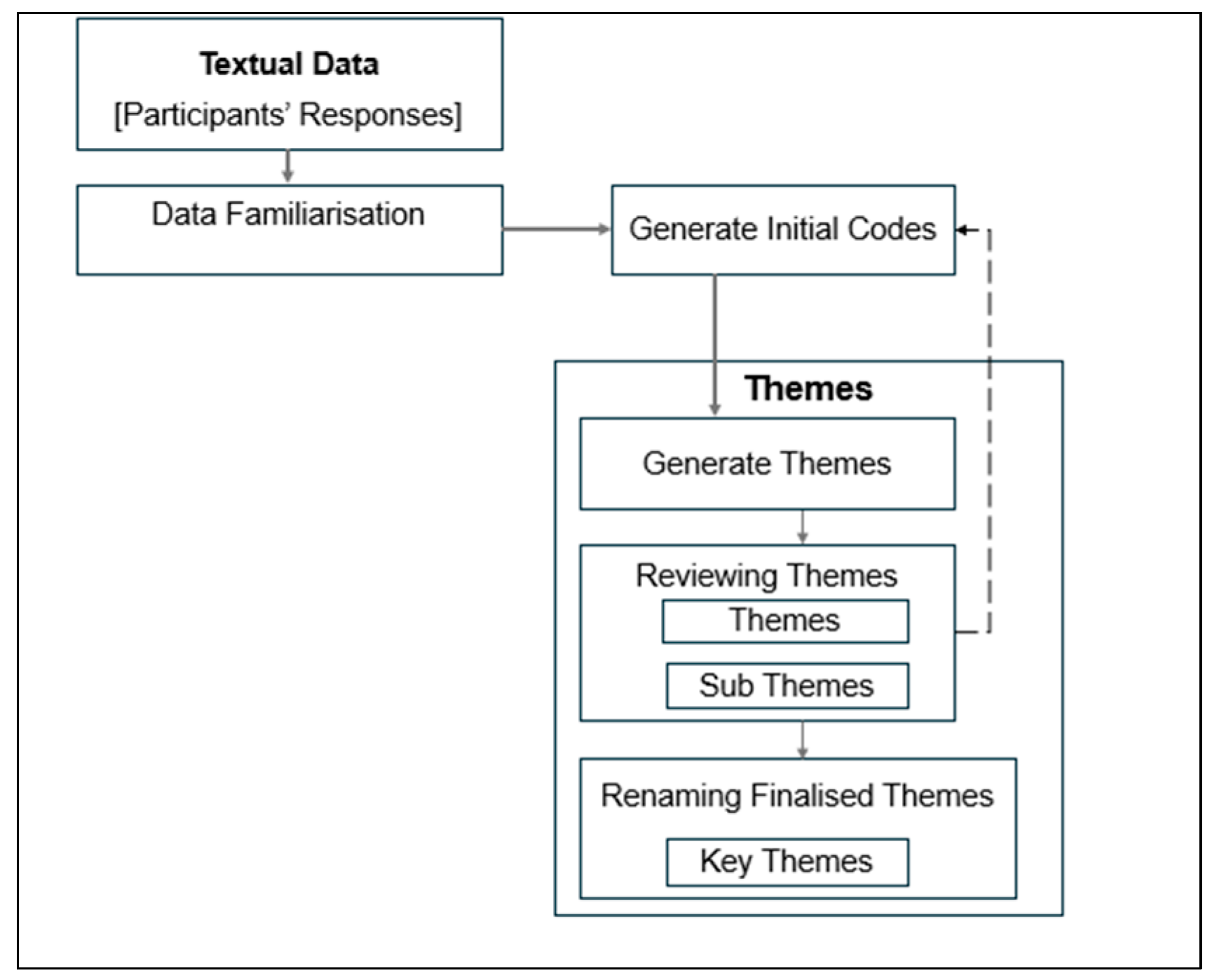
Figure 2.
Visual thematic map of themes, subthemes and codes.
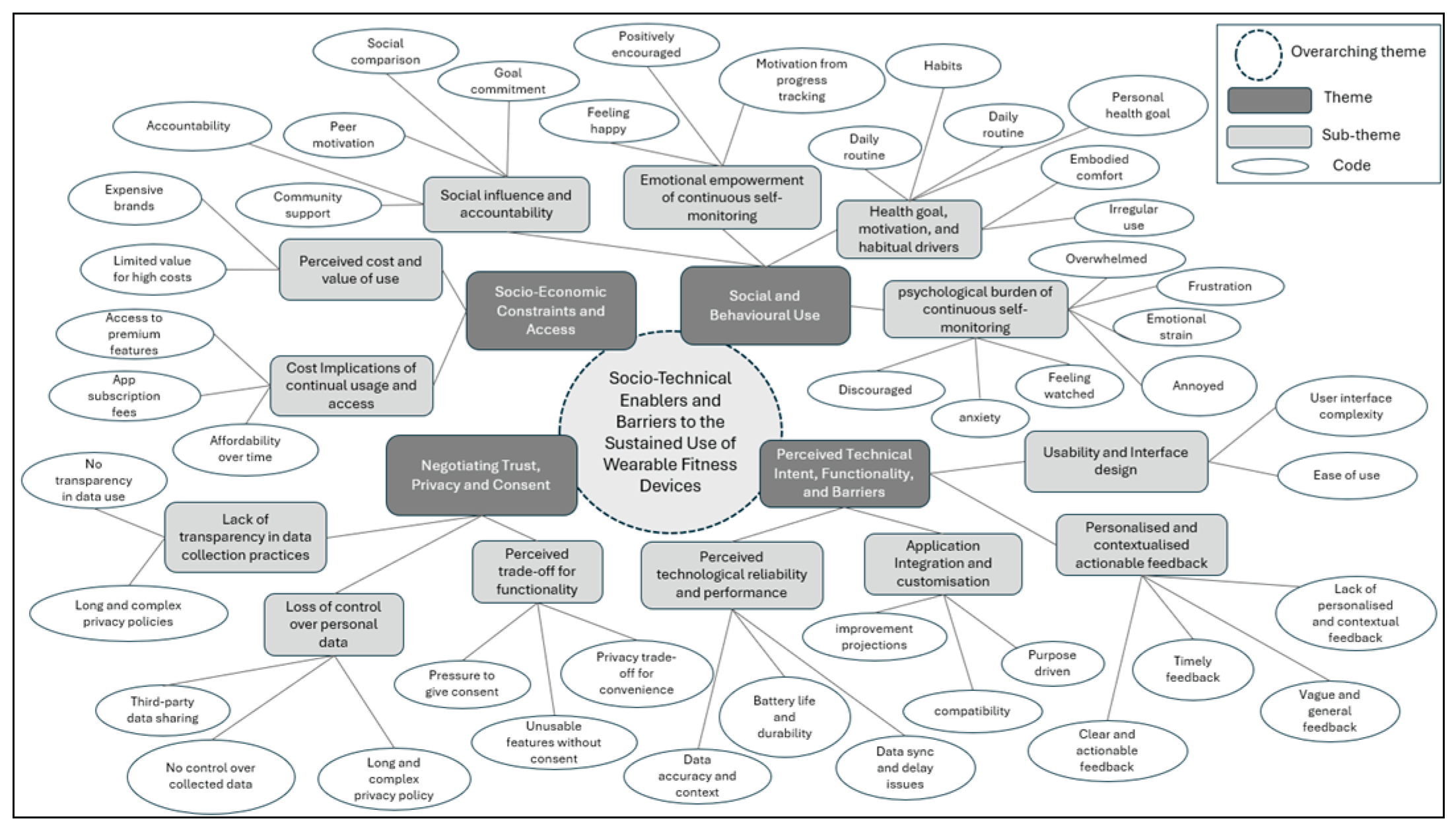
Disclaimer/Publisher’s Note: The statements, opinions and data contained in all publications are solely those of the individual author(s) and contributor(s) and not of MDPI and/or the editor(s). MDPI and/or the editor(s) disclaim responsibility for any injury to people or property resulting from any ideas, methods, instructions or products referred to in the content. |
© 2026 by the authors. Licensee MDPI, Basel, Switzerland. This article is an open access article distributed under the terms and conditions of the Creative Commons Attribution (CC BY) license (http://creativecommons.org/licenses/by/4.0/).
Copyright: This open access article is published under a Creative Commons CC BY 4.0 license, which permit the free download, distribution, and reuse, provided that the author and preprint are cited in any reuse.


