

Submitted:
07 June 2026
Posted:
09 June 2026
You are already at the latest version
Abstract
Soil microorganisms and plant residue decomposition are critical drivers of soil nutrient cycling and multifunctionality, yet their regulatory mechanisms in saline-alkali soils are not fully understood. This study selected bare land and forestland (shrub and tree stands) in Daqing, Heilongjiang, to investigate the effects of plant residue input on forest soil properties, microbial communities, keystone taxa, and multifunctionality using high-throughput sequencing and multivariate analysis. Results showed that plant residue cover significantly improved soil nutrients (SOC, TN, TP, TK, AN), enhanced alkaline phosphatase activity, and increased soil multifunctionality compared with bare land. Plant residues also increased bacterial α-diversity and shifted community composition, with elevated relative abundances of Proteobacteria, Bacteroidota, Planctomycetota, Patescibacteria, and key genera (Mycobacterium, Pseudonocardia, Bryobacter, Steroidobacter). NMDS and correlation analysis revealed microbial communities and keystone taxa were closely correlated with soil nutrients and multifunctionality. Overall, plant residues enhance forest soil multifunctionality by improving soil organic matter, optimizing microbial community structure, and stimulating keystone taxa, providing a scientific basis for understanding microbial-driven nutrient cycling and vegetation restoration in degraded saline-alkali soils.
Keywords:
plant residues
; saline-alkali soil
; soil microbial community
; soil multifunctionality
1. Introduction
Soil microorganisms are pivotal to ecosystem functioning, mediating soil nutrient cycling, plant residue decomposition, and soil nutrient retention [1,2,3]. However, the loss of microbial biodiversity, recognized as one of the key threats to soil ecosystem functions, often results from land-use change and soil nutrient depletion [4]. A large body of literatures have documented that nutrient loss in soil suppresses microbial diversity, leading to a reduction in the diversity of native microbial taxon pools [1,5]. In this context, enhancing soil organic matter sequestration is regarded as an important strategy to mitigate soil nutrient loss. Aboveground plant organic matter inputs have been identified as the dominant factor regulating soil organic matter sequestration, under the combined influence of initial litter quality and microbial community composition [6,7,8].
Biodiversity exerts a significant influence on soil ecosystem functions [9]. A growing body of work investigating soil ecosystem functionality and biodiversity has validated the link between soil multifunctionality and microbial diversity, a relationship critical for assessing integrated nutrient cycling processes across terrestrial soil systems [10]. Soil multifunctionality has been found to decline with the loss of soil biodiversity, thereby affecting vegetation diversity, plant residue decomposition, and soil nutrient cycling [7,11,12]. Indeed, as aboveground plants grow, soil microorganisms can alter multiple soil nutrient cycling processes by decomposing plant residues [13]. Thus, with the input of aboveground plant-derived carbon following decomposition, the potential of soil carbon sequestration may change accordingly. These changes exert a significant impact on soil structure and stability, particularly since soil microorganisms serve as key drivers [10]. The soil environment and microbial community composition can regulate soil multifunctionality, including the modulation of soil nitrogen (N) and carbon (C) cycling processes [14,15]. Therefore, a more in-depth assessment of the relationships between soil microbial community composition and litter cover is critical for elucidating the complex mechanisms underlying the restoration of soil ecosystem functions.
Different plant litters can alter the potential of soil microbial communities and nutrient cycling, as previous studies have indicated that soil carbon and nitrogen dynamics may be determined by differences in litter decomposition mediated by distinct microbial taxa [16,17]. Generally, plant residue decomposition is closely associated with high soil microbial diversity, which involves a wide range of microbially controlled processesP [3,18]. Previous studies have demonstrated that stable high soil microbial diversity is maintained through plant residue decomposition; thus, plant coverage may induce changes in soil nutrient status and microbial community diversity [18,19]. Such elevated levels of soil microbial diversity are functionally vital for soil ecosystem processes, given that microbial communities display functional redundancy while keystone taxa exert dominant regulatory roles in governing soil functions, independent of their relative abundance [2,20]. Consequently, aboveground plant litter can affect soil ecosystem functions by altering microbial communities and keystone taxa [21]. Elucidating how to explicitly identify the role of soil microbial keystone taxa in regulating the relationship between plant residue decomposition and soil nutrient cycling remains a core focus for the restoration of soil ecosystem functions. However, many interactions among microbial keystone taxa cannot be directly observed during the residue decomposition process. Thus, high-throughput sequencing approach can be used to investigate the relationships of microbial keystone taxa with plant residue decomposition and changes in soil nutrients.
In this study, we analyzed soil microbial community structure, keystone species composition, and soil multifunctionality in response to plant residues in a saline-alkali soil ecosystem The objectives of this study were to: (1) reveal the relationship between soil organic matter and microbial communities in soils with and without plant residue cover; (2) evaluate the responses of microbial communities and keystone species to plant residues; and (3) determine the role of keystone taxa in mediating the effects of plant residues on soil multifunctionality. We hypothesized that plant residues would enhance soil multifunctionality by increasing soil organic matter content; the role of keystone taxa in maintaining soil multifunctionality would change with the decomposition of plant residues. Additionally, we anticipated anticipated that keystone species would regulate soil multifunctionality under residue input, facilitating microbial-mediated nutrient cycling and improving ecosystem functioning. This study aimed to deepen the understanding of the effects of plant residues on soil nutrient dynamics and provide a scientific basis for formulating feasible plant coverage management strategies in nutrient-depleted areas.
2. Materials and Methods
2.1. Study Area and Soil Samples
This study was conducted in the Daqing, Heilongjiang Province, China (36°14′–36°18′ N, 110°39′–110°47′ E). The area features a temperate continental monsoon climate, with a mean annual temperature of 5.6 ℃ and mean annual precipitation of 749.3 mm. Soils are classified as saline-alkali according to the Chinese Soil Taxonomy. The land use types primarily include forestland and bare land. For the forestland samples, two vegetation types (shrubs and trees) were selected. Thus, four treatments were selected with three replicate plots established in this study, including (1) BS, bare land adjacent to shrubs; (2) BT, bare land adjacent to trees; (3) CS, forestland covered with shrub residues; (4) CT, forestland covered with trees residues.
Within each sampling plot, three 20 m² plots were established with uniform vegetation cover, and an adjacent plot with no vegetation coverage was set as the control, with a distance of more than 100 m from the sampled plots. All sampling sites were selected based on consistent geographical locations to ensure similar soil types and topographical conditions across each research block. In each plot, five soil cores were collected using a 5-cm auger after removing surface litter. Cores were composited into a single sample per plot. In the laboratory, samples were sieved to 2.0 mm and partitioned into three aliquots: one stored at −80 ℃ for molecular analysis, one held at 4 ℃ for soil enzyme assays, and one air dried for chemical analysis.
2.2. Soil Properties Analysis
Soil moisture was determined by the oven drying method. Soil pH was measured in a 1:2.5 (w/v) soil water suspension. Soil total nitrogen (TN) was quantified using an elemental analyzer. Soil organic carbon (SOC) was measured via loss on ignition. Soil total phosphorus (TP) was analyzed using a continuous flow analyzer (SKALAR SAN++, Netherlands). Soil total potassium (TK) was determined by ICP atomic emission spectrometry (ICPS 7500, Shimadzu, Japan). Soil available nitrogen (AN) was measured using alkaline hydrolysis diffusion. Soil alkaline phosphatase (ALP) activity was assayed using a modified fluorometric method [22]. These indicators were used to quantify soil fertility, microbial activity, and biogeochemical cycling for integrated multifunctionality assessment.
2.3. DNA Extraction and High-Throughput Sequencing
Total genomic DNA was extracted from all soil samples using the MO-BIO Power-Soil DNA Isolation Kit. The V3–V4 hypervariable region of bacterial 16S rRNA genes was amplified using primers 338 F (5′-ACTCCTACGGGAGGCAGCA-3′) and 806 R (5′-GGACTACHVGGGTWTCTAAT-3′). Sequencing was performed on the Illumina platform at Shanghai Majorbio Bio-Pharm Biotechnology Co., Ltd. Raw reads were processed on the Majorbio Cloud Platform, including adapter trimming and quality filtering. Operational taxonomic units (OTUs) were clustered at 97% similarity using the RDP classifier. All samples were rarefied to 34,707 reads for downstream analysis. Sequences were deposited in the GenBank Short Read Archive under accession number SRP676394.
2.4. Statistical Analyses
Alpha diversity indices were calculated in QIIME2 to characterize microbial richness and diversity. Nonmetric multidimensional scaling (NMDS) based on Bray-Curtis distance was used to visualize community divergence.
Soil multifunctionality was computed to reflect integrated soil functional capacity. Individual functions were standardized using Z score transformation following Shapiro Wilk normality testing. The mean of standardized values was used as the multifunctionality index for each sample.
One way ANOVA was performed in SPSS 27.0 to test for treatment differences in soil properties, multifunctionality, diversity indices, and keystone taxa relative abundance. Mantel tests were further used to evaluate correlations between soil properties, multifunctionality, and microbial communities. Pearson correlation analysis and heatmap visualization were used to explore associations among microbial taxa and environmental variables. All figures were plotted using SigmaPlot 13.0.
3. Results
3.1. Soil Properties and Multifunctionality
Overall, plant residue input significantly improved soil properties, with a more pronounced effect observed under vegetated cover than in bare soil (Figure 1). Furthermore, significant differences in soil properties were detected between shrub and tree plant treatments, regardless of vegetation cover status. Specifically, under vegetated cover, soil total nitrogen (TN), total potassium (TK), available nitrogen (AN), and alkaline phosphatase (ALP) activity were significantly higher at tree plant sites (CT) than at shrubland sites (CS) (Figure 1). In contrast, soil total phosphorus (TP) content exhibited the opposite pattern (Figure 1e). Notably, plant residue treatments also led to significant increases in soil C/N, N/P, N/K, and P/K stoichiometric ratios. Additionally, plant residues significantly enhanced soil multifunctionality (MF), with higher values observed in the CS treatment than in the CT treatment (Figure 1b). Collectively, plant residues improved soil nutrient status and multifunctionality, with tree forests showing a markedly greater increase in nutrient levels compared to shrubland.
3.2. Characteristics of Microbial Communities
Plant residues significantly increased the Shannon diversity index of the soil bacterial community, with values in the CS and CT treatments being 1.6% and 3.8% higher than those in the BS and BT treatments, respectively (Figure 2a). The Chao index also increased following plant residue addition relative to the bare soil treatments, with a particularly significant increase (3.9%) observed at the shrubland site (Figure 2b). Microbial beta-diversity analysis revealed that plant residues substantially altered microbial community composition. In the NMDS ordination plot (Figure 2c), microbial communities formed two distinct clusters along the NMDS1 axis, corresponding to vegetated and bare soil treatments, respectively. Furthermore, regardless of plant residue addition, significant differences in bacterial community structure were detected between shrub and tree treatments. These results demonstrate that both plant residues and tree/shrub type exerted significant effects on soil microbial community structure.
The composition of soil microbial communities was also affected by plant residues. The relative abundances of the phyla Proteobacteria, Bacteroidota, Planctomycetota, and Patescibacteria were significantly higher under vegetated cover than in adjacent bare soil (Figure 3a). At the genus level, the relative abundances of Mycobacterium, Pseudonocardia, Bryobacter, and Steroidobacter were substantially increased by plant residue addition (Figure 3b). Moreover, the magnitude of this increase was higher at tree sites than at shrub sites. Therefore, plant residues exerted a considerable impact on microbial diversity and community composition. Simultaneously, correlation analysis revealed a significant positive correlation between soil multifunctionality and the relative abundances of these phyla and genera (Figure 3c,d).
3.3. Relationship Between Microbial Communities and Soil Multifunctionality
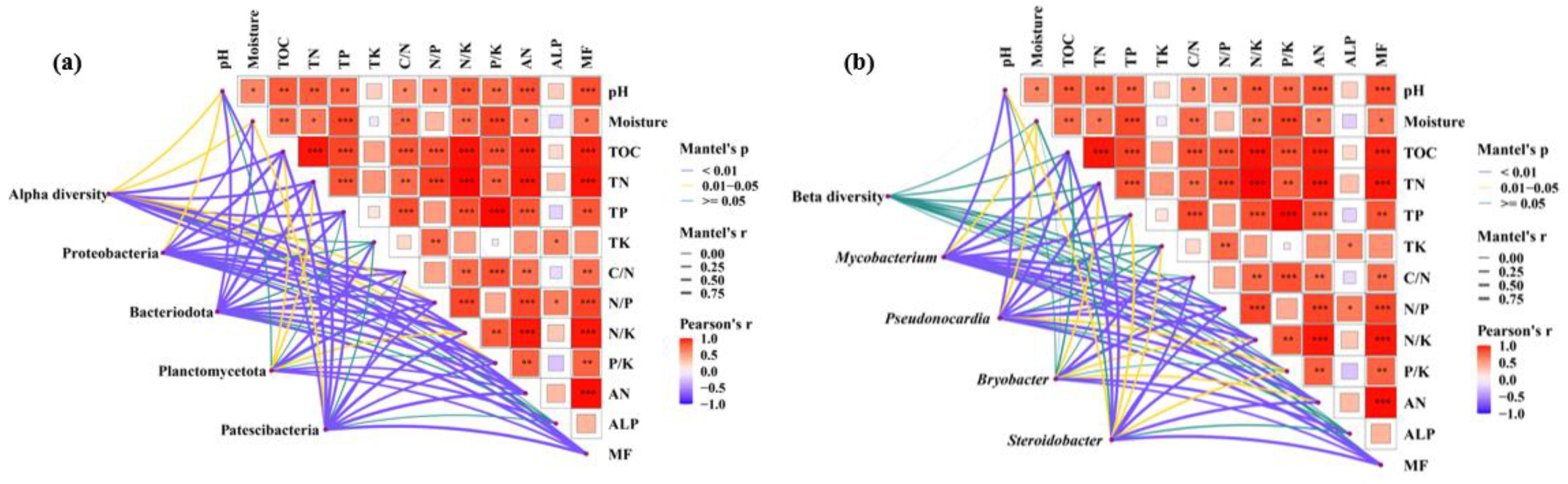
Regression analysis indicated a significant positive correlation between soil multifunctionality and microbial diversity (Figure 4), suggesting that changes in the alpha- and beta-diversity of soil bacteria positively influenced soil multifunctionality. Microbial alpha diversity was positively correlated with pH, SOC, TP, TN, N/P, and N/K (Figure 5a, Table S1). The relative abundance of Proteobacteria showed significant positive correlations with most soil properties, except for TK and ALP. Similarly, the abundances of Bacteroidota, Planctomycetota, and Patescibacteria were significantly positively correlated with most soil properties: Bacteroidota exhibited no correlation with TK and ALP; Planctomycetota showed no correlation with pH, TP, and P/K ratio; and Patescibacteria had no correlation with TK and ALP. Furthermore, microbial beta-diversity was positively correlated with most soil properties except ALP, and the abundance of keystone taxa also displayed significant positive correlations with soil properties (Figure 5b, Table S1). Specifically, Mycobacterium and Pseudonocardia showed no correlation with ALP; Bryobacter exhibited no correlation with pH, soil moisture, SOC, TP, C/N ratio, and P/K ratio; and Steroidobacter had no correlation with soil moisture and ALP. In addition, the heatmap illustrated a positive correlation between soil multifunctionality (MF) and soil properties, except for TK and ALP (Figure 5b). In summary, plant residues altered the soil microbial community, which played a crucial role in regulating soil properties and thereby modulating soil multifunctionality.
4. Discussion
4.1. Soil Properties Change with Plant Residues
The decomposition of plant residues can greatly affect soil properties. As expected, our results demonstrated that, compared with the no-vegetation coverage site, soils under vegetation—especially forest sites—exhibited significantly higher pH values and concentrations of SOC, TN, TP, AN, and ALP. These soil properties, which indicate a positive effect on soil fertility, were enhanced, likely due to greater plant litter input. This finding is consistent with previous studies [23,24,25]. In addition, litter accumulation and decay elevated soil organic matter and nutrient availability [26], explaining the observed increases in SOC, AN, and TN in both shrub and tree plots. These results indicate that plant residues effectively improve soil nutrient status of the ecosystem. Correspondingly, we must consider that plant litter varies in quality and decomposability, and its decomposition process can directly increase organic matter input into the soil [27,28]. Furthermore, the decomposition of plant residues also improves the rhizosphere [23–25microenvironment and stimulates root exudation, further enhancing ALP activity and AN availability [3,7]. Thus, plant residues can promote soil nutrient status and enzyme activity, supporting soil health and ecosystem productivity.
On the other hand, our study indicated that soil multifunctionality increased noticeably in plots with plant residues compared to the no-vegetation coverage plots. Plant residue decomposition is a multifaceted process that intricately influences soil multifunctionality in forest ecosystems [4,29]. The input of organic matter from plant litter strongly promotes soil nutrient cycling; thus, part of the variation in soil nutrient availability may stem from the reintroduction of plant residues, which directly or indirectly accelerates the biogeochemical cycles of nutrients [14,30]. These processes not only mediate soil nutrient dynamics but also enhance integrated soil functional performance. The observed increases in nutrients and enzyme activity corroborate this mechanism.
In general, ecosystems with plant residues can provide favorable microhabitats that support diverse microbial communities involved in nutrient cycling, decomposition, and organic matter stabilization [31]. In this study, the increased soil microbial diversity and abundance, combined with the nitrogen-fixing capacity of Planctomycetota (which may enhance nitrogen input and soil nutrient restoration), provide additional support for this potential causal relationship. Soil multifunctionality and associated physicochemical parameters also increased from shrubland sites to forest sites. This result is understandable, as soil ecosystems may be affected by plant residue decomposition processes, during which the ecological benefits of the soil are gradually established and stabilized.
4.2. Soil Microbial Communities Respond Positively to Plant Residues
Plant residues from shrubland sites and forest sites increased soil microbial diversity, which showed an upward trend associated with differences in plant litter types. Previous studies have shown that the degradation and loss of afforestation lead to soil erosion, reduce soil organic matter content, and thus decrease soil nutrient and microbial diversity [32,33]. Plant residues also significantly enhance soil multifunctionality, which is driven by the effects of soil resources that further influence microbial metabolism and community composition [13,15]. The decomposition of plant litter releases organic compounds into the soil, which serve as an important nutrient source for microorganisms. Obviously, due to the strong nutrient cycling capacity and availability of these organic compounds, this process has made important contributions to the improvement of microbial diversity and activity. Additionally, some studies have suggested that plant residues can effectively promote linkages between soil and plant ecosystems [29]. Consequently, plant residues may facilitate the exchange of microorganisms between plants and soil, thereby enhancing microbial diversity. More importantly, these linkages exert synergistic effects on improving microbial adaptability and soil properties.
Notably, we found that microbial community composition has changed in response to plant residues. In no-vegetation coverage sites, the relative abundances of Proteobacteria and Bacteroidota decreased, whereas those of Planctomycetota and Patescibacteria increased with the addition of plant residues. Similarly, the relative abundances of Mycobacterium, Pseudonocardia, Bryobacter, and Steroidobacter were higher in plant residue-covered sites, and these taxa effectively promoted soil multifunctionality. Planctomycetota play pivotal roles in carbon and nitrogen cycling; they also provide additional nutrient sources for the soil by decomposing litter, thereby supporting plant growth, which are critical for maintaining soil fertility and ecosystem stability [34,35]. Steroidobacter is a denitrifying bacterium that contributes to soil nitrogen cycling through its participation in denitrification, which may alter the relationship between biodiversity and denitrification under plant residue addition [36]. Consequently, the enhancement of soil nutrient levels and enzyme activities may be attributed to shifts in these key taxa, indicating that plant residues can effectively promote these soil properties. Increased litter input from plant residues enhances the availability of nutrients and resources for soil microorganisms, thereby driving the development of more complex microbial community structures [37].
4.3. Implications Between Soil Multifunctionality and Plant Residues
We also explored the effects of plant residues on soil multifunctionality, which is pivotal for better understanding the mechanisms underlying altered soil nutrient supply and resource allocation. It has been well established that there is a positive correlation between soil multifunctionality and microbial activity under plant residue coverage, as litter decomposition increases soil C and N supply for microorganisms. This indicates that soil properties are considered pivotal drivers of microbial community composition and soil ecosystem function. Additionally, we found that plant residues indirectly regulated soil multifunctionality via shifts in microbial diversity and keystone bacterial taxa. Diverse microbial communities drive nutrient cycling during litter decomposition, improving the availability of essential nutrients for plants and other soil organisms. Our study also observed that alterations in soil microbial communities can exhibit distinct responses and play crucial roles in maintaining nutrient cycling and soil multifunctionality under plant residue coverage.
Microorganisms involved in nitrogen transformation were highly responsive to plant residue and increased significantly in relative abundance [6,15]. A reasonable explanation is that plant residue conditions in soil create a favorable environment for inorganic N conversion and increase nitrogen input [7,22]. Additionally, the increase in decomposable bacteria promoted the accumulation of soil organic matter under plant residue conditions. The organic-rich soil resulting from plant residues provides sufficient organic matter for bacteria involved in carbon and nitrogen cycling, further promoting the material transformation process [20,31]. Consequently, our observations indicated that the accumulation of soil microbial groups was positively correlated with SOC and TN concentrations. Notably, these key microbial groups involved in carbon and nitrogen cycling also contribute to promoting soil nutrient availability through material exchange, thereby enhancing soil multifunctionality under plant residue conditions. These findings support the initial hypothesis, indicating that plant residues enhance soil multifunctionality by elevating soil nutrient availability and soil organic matter concentration, as well as by promoting microbial diversity and the abundance of keystone taxa.
5. Conclusions
In summary, plant residue input significantly improved forest soil nutrient concentrations (SOC, TN, TP, TK, AN), ALP activity, and integrated multifunctionality relative to bare land. Plant residues also increased soil bacterial α-diversity and restructured community composition, with enrichment of key phyla (Proteobacteria, Bacteroidota, Planctomycetota, Patescibacteria) and genera (Mycobacterium, Pseudonocardia, Bryobacter, Steroidobacter). These microbial groups were strongly associated with soil multifunctionality, indicating their critical roles in nutrient cycling. Correlation and regression analysis confirmed that microbial diversity and keystone taxa mediated the positive effects of plant residues on soil function. These findings support our hypothesis that plant residues enhance soil multifunctionality by increasing organic carbon input, promoting microbial diversity, and stimulating keystone functional taxa. This study highlights the importance of plant litter and microbial communities in restoring degraded saline-alkali soils, and provides a theoretical foundation for vegetation restoration and soil quality improvement.
Author Contributions
Conceptualization, J.S. and Y.Z.; methodology, C.Z. and Y.W.; investigation, Y.W.; data curation, Y.S.; writing—original draft preparation, J.S.; writing—review and editing, Q.Y.; supervision, Q.Y. and Y.Z.; funding acquisition, J.S. and Q.Y. All authors have read and agreed to the published version of the manuscript.
Funding
This work was supported by Heilongjiang Plant Protection Society of China (HT-2026-01-003) and Heilongjiang Provincial Natural Science Foundation of China (LH2023C075).
Data Availability Statement
Sequences were deposited in the GenBank Short Read Archive under accession number SRP676394. https://trace.ncbi.nlm.nih.gov/Traces/sra_sub/sub.cgi?subid=7792912&from=list&action=show:submission
Acknowledgments
Thanks to Associate Professor Ning Wang from the College of Horticulture and Landscape Architecture, Heilongjiang Bayi Agricultural University, for his assistance in site selection and sample collection.
Conflicts of Interest
The authors declare no conflicts of interest.
References
- Zhou, Z.; Wang, C.; Luo, Y. Meta-analysis of the impacts of global change factors on soil microbial diversity and functionality. Nat. Commun. 2020, 11(1): 3072. [CrossRef]
- Banerjee, S.; Schlaeppi K, van der Heijden MGA. Keystone taxa as drivers of microbiome structure and functioning. Nat. Rev. Microbiol. 2018, 16(9), 567-576. [CrossRef]
- Sun, B.; Wang, X.; Wang, F.; Jiang, Y.; Zhang, X. Assessing the relative effects of geographic location and soil type on microbial communities associated with straw decomposition. Appl. Environ. Microbiol. 2013, 79(11), 3327-3335. [CrossRef]
- Allan, E.; Manning, P.; Alt, F.; Binkenstein, J.; Blaser, S.; Blüthgen, N.; Böhm, S.; Grassein, F.; Hölzel, N.; Klaus, V.H.; Kleinebecker, T.; Morris, E.K.; Oelmann, Y.; Prati, D.; Renner, S.C.; Rillig, M.C.; Schaefer, M.; Schloter, M.; Schmitt, B.; Schöning, I.; Schrumpf, M.; Solly, E.; Sorkau, E.; Steckel, J.; Steffen-Dewenter, I.; Stempfhuber, B.; Tschapka, M.; Weiner, C.N.; Weisser, W.W.; Werner, M.; Westphal, C.; Wilcke, W. Land use intensification alters ecosystem multifunctionality via loss of biodiversity and changes to functional composition. Ecol. Lett. 2015, 18(8), 834–843. [CrossRef]
- Wagg, C.; Schlaeppi, K.; Banerjee, S.; Kuramae, E.E.; van der Heijden MGA. Fungal-bacterial diversity and microbiome complexity predict ecosystem functioning. Nat. Commun. 2019, 10, 4841. [CrossRef]
- Wickings, K.; Grandy, A.S.; Reed, S.C.; Cleveland, C.C. The origin of litter chemical complexity during decomposition. Ecol. Lett. 2012, 15(10), 1180-1188. [CrossRef]
- Kallenbach, C.M.; Frey, S.D.; Grandy, A.S. Direct evidence for microbial-derived soil organic matter formation and its ecophysiological controls. Nat. Commun. 2016, 7, 13630. [CrossRef]
- Zhao, Y.; Wang, M.; Hu, S.; Zhang, X.; Ouyang, Z.; Zhang, G.; Huang, B.; Zhao, S.; Wu, J.; Xie, D.; Zhu, B.; Yu, D.; Pan, X.; Xu, S.; Shi, X. Economics- and policy driven organic carbon input enhancement dominates soil organic carbon accumulation in Chinese croplands. Proc. Natl. Acad. Sci. U.S.A. 2018, 115(16), 4045–4050. [CrossRef]
- Meyer, S.T.; Ptacnik, R.; Hillebrand, H.; Bessler, H.; Buchmann, N.; Buchmann, N.; Ebeling, A.; Eisenhauer, N.; Engels, C.; Fischer, M.; Halle, S.; Klein, A.M.; Oelmann, Y.; Roscher, C.; Rottstock, T.; Scherber, C.; Scheu, S.; Schmid, B.; Schulze, E.D.; Temperton, V.M.; Tscharntke, T.; Voigt, W.; Weigelt, A.; Wilcke, W.; Weisser, W.W. Biodiversity–multifunctionality relationships depend on identity and number of measured functions. Nat. Ecol. Evol. 2018, 2(1), 44-49. [CrossRef]
- Delgado-Baquerizo, M.; Eldridge, D.J.; Ochoa, V.; Gozalo, B.; Singh, B.K.; Maestre, F.T. Soil microbial communities drive the resistance of ecosystem multifunctionality to global change in drylands across the globe. Ecol. Lett. 2017, 20(10), 1295-1305. [CrossRef]
- Tilman, D.; Isbell, F.; Cowles, J.M. Biodiversity and ecosystem functioning. Annu. Rev. Ecol. Evol. S. 2014, 45, 471–493. [CrossRef]
- Mahmoudi, N.; Caeiro, M.F.; Mahdhi, M.; Tenreiro, R.; Ulm, F.; Mars, M.; Cruz, C.; Dias, T. Arbuscular mycorrhizal traits are good indicators of soil multifunctionality in drylands. Geoderma 2021, 397, 115099. [CrossRef]
- Han, Z.; Xu, P.; Li, Z.; Lin, H.; Zhu, C.; Wang, J.; Zou, J. Microbial diversity and the abundance of keystone species drive the response of soil multifunctionality to organic substitution and biochar amendment in a tea plantation. GCB Bioenergy. 2022, 14(4), 481-495. [CrossRef]
- Zhang, W.; Liu, W.; Xu, M.; Deng, J.; Han, X.; Yang, G.; Feng, Y.; Ren, G. Response of forest growth to C:N:P stoichiometry in plants and soils during Robinia pseudoacacia afforestation on the Loess Plateau, China. Geoderma 2019, 337, 280–289. [CrossRef]
- Zheng, Q.; Hu, Y.; Zhang, S.; Noll, L.; Böckle, T.; Dietrich, M.; Herbold, CW.; Eichorst, SA, Woebken, D., Richter, A., Wanek, W. Soil multifunctionality is affected by the soil environment and by microbial community composition and diversity. Soil Biol. Biochem. 2019, 136: 107521. [CrossRef]
- Wang, Q.; Wang, S.; Huang, Y. Comparisons of litterfall, litter decomposition and nutrient return in a monoculture Cunninghamia lanceolata and a mixed stand in southern China. For. Ecol. Manag. 2008, 255(3-4), 1210-1218. [CrossRef]
- Parhizkar, M.; Shabanpour, M.; Miralles, I.; Zemac, D.A.; Lucas-Borjad, M.E. Effects of plant species on soil quality in natural and planted areas of a forest park in northern Iran. Sci. Total Environ. 2021, 778, 146310. [CrossRef]
- Schimel, J.P.; Schaeffer, S.M. Microbial control over carbon cycling in soil. Front. Microbiol. 2012, 3,348. [CrossRef]
- Delgado-Baquerizo, M.; Giaramida, L.; Reich, P.B.; Khachane, A.N.; Hamonts, K.; Edwards, C.; Lawton, L.A.; Singh, B.K. Lack of functional redundancy in the relationship between microbial diversity and ecosystem functioning. J. Ecol. 2016, 104(4), 936-946. [CrossRef]
- Banerjee, S.; Kirkby, C.A.; Schmutter, D.; Bissett, A.; Kirkegaard, J.A.; Richardson, A.E. Network analysis reveals functional redundancy and keystone taxa amongst bacterial and fungal communities during organic matter decomposition in an arable soil. Soil Biol. Biochem. 2016, 97, 188-198. [CrossRef]
- Inkotte, J.; Bomfim, B.; da Silva S.C.; Viana, R.B.; Gatto, A.; Pereira, R.S. Litter removal impacts on soil biodiversity and eucalypt plantation development in the seasonal tropics. J. For. Res. 2023, 34, 735–748. [CrossRef]
- Saiya-Cork, K.R.; Sinsabaugh, R.L.; Zak, D.R. The effects of long term nitrogen deposition on extracellular enzyme activity in an Acer saccharum forest soil. Soil Biol. Biochem. 2002, 34(9), 1309-1315. [CrossRef]
- Wilhelm, R.C.; Singh, R.; Eltis, L.D.; Mohn, W.W. Bacterial contributions to delignification and lignocellulose degradation in forest soils with metagenomic and quantitative stable isotope probing. ISME J. 2019, 13(2), 413-429. [CrossRef]
- Stewart, C.E.; Neff, J.C.; Amatangelo, K.L.; Vitousek, P.M. Vegetation effects on soil organic matter chemistry of aggregate fractions in a Hawaiian forest. Ecosystems. 2011, 14(3), 382-397. [CrossRef]
- Wang, X.; Liang, C.; Mao, J.D.; Bian, Q.; Liang, Y.T.; Chen, Y.; Sun, B. Microbial keystone taxa drive succession of plant residue Chemistry. ISME J. 2023, 17(5), 748-757. [CrossRef]
- Huang, B.; Men, X.; Bao, Y.; Zhai, D.; Cheng, X. Litter input manipulations differentially regulated CO2, CH4 and N2O emissions from subalpine coniferous and broad-leaf forest soils. J. For. Res. 2025, 36, 129. [CrossRef]
- Li, Q.; Zhao, G.; Cao, G.; Zhang, X.; Liu, Z. Non-additive effects of leaf litter mixtures from Robinia pseudoacacia and ten tree species on soil properties. J. Sustain For. 2020, 39(8), 771-784. [CrossRef]
- Li, S.; Liu, W.; Lang, X.; Huang, X.; Su, J. Species richness, not abundance, drives ecosystem multifunctionality in a subtropical coniferous forest. Ecol. Indic. 2021, 120, 106911. [CrossRef]
- Yan, Y.; Zhang, Q.; Buyantuev, A.; Liu, Q.; Niu, J. Plant functional β diversity is an important mediator of effects of aridity on soil multifunctionality. Sci. Total Environ. 2020, 726, 138529. [CrossRef]
- Wang, F.; Guo, R.; Zhang, N.; Yang, S.; Cao, W. Soil organic carbon storages and bacterial communities along a restored mangrove soil chronosequence in the Jiulong River Estuary: from tidal flats to mangrove afforestation. Fund. Res. 2022, 3(6), 880-889. [CrossRef]
- Xu, H.D.; Yu, M.K.; Cheng, X.R. Abundant fungal and rare bacterial taxa jointly reveal soil nutrient cycling and multifunctionality in uneven-aged mixed plantations. Ecol. Indicat. 2021, 129, 107932. [CrossRef]
- Lu, Z.; Wang, P.; Ou, H.; Wei, S.; Jiang, Y.; Wang, R.; Liu, X.; Wang, Z.; Chen, L.; Liu, Z. Effects of different vegetation restoration on soil nutrients, enzyme activities, and microbial communities in degraded karst landscapes in southwest China. Forest. Ecol. Manag. 2022, 508, 120002. [CrossRef]
- Hu, T.; Han, ; Köster, K.; Wang, J.; Hu, H.; Dou, X.; Sun, L.; Ding, Y. Prescribed burning alters soil microbial community structure by changing soil physicochemical properties in temperate forests of northern China. J. For. Res. 2024, 35, 141. [CrossRef]
- Xu, Y.; Li, C.; Zhu, W.; Wang, Z.; Wu, L.; Du, A. Effects of enrichmemt planting with native tree species on bacterial community structure and potential impact on Eucalyptus plantations in southern China. J. For. Res. 2022, 33, 1349-1363. [CrossRef]
- Lage, O.M.; Godinho, O.; García-Domínguez, R.; Øvreås, L.; Devos, D.P. A century of research on the Planctomycetota bacterial phylum, previously known as Planctomycetes. FEMS Microbiol. Rev. 2025, 49, fuaf056. [CrossRef]
- Huang, R.; Ge, X.; Chen, X.; Yang, S.; Zhen, C.; Wen, Z.; Li, Y.; Liu, W. Steroidobacter gossypii sp. nov., isolated from cotton field soil. Int. J. Syst. Evol. Microbiol. 2021, 71(8), 004935. [CrossRef]
- Peng, W.; Song, T.; Du, H.; Wang, F.; Zeng, F.; Wang, Y.; Chen, S.; Chen, Y. Soil properties and not plant factors affect both abundant and rare microbial taxa after thinning in a mixed stand of Cunninghamia lanceolate and Sassafras tzumu. J. For. Res. 2024, 35, 18. [CrossRef]
Figure 1.
Effect of plant residue input on forestry soil properties. SOC, TN, TP, TK, AN, ALP and MF indicate soil organic carbon, total nitrogen, total phosphorus, total potassium, available nitrogen, soil alkaline phosphatase, and soil multifunctionality, respectively. C:N ratio, N:P ratio, N:K ratio and P:K ratio indicate the ratio of soil organic carbon to total nitrogen, total nitrogen to total phosphorus, total nitrogen to total potassium and total phosphorus to total potassium, respectively. BS, BT, CS and CT indicate the treatments of bare land adjacent to shrubs, bare land adjacent to trees, forestland covered with shrub residues and forestland covered with trees residues, respectively. Different letters above columns indicate significant difference between treatments tested by one-way ANOVA (P < 0.05). The same as below.
Figure 1.
Effect of plant residue input on forestry soil properties. SOC, TN, TP, TK, AN, ALP and MF indicate soil organic carbon, total nitrogen, total phosphorus, total potassium, available nitrogen, soil alkaline phosphatase, and soil multifunctionality, respectively. C:N ratio, N:P ratio, N:K ratio and P:K ratio indicate the ratio of soil organic carbon to total nitrogen, total nitrogen to total phosphorus, total nitrogen to total potassium and total phosphorus to total potassium, respectively. BS, BT, CS and CT indicate the treatments of bare land adjacent to shrubs, bare land adjacent to trees, forestland covered with shrub residues and forestland covered with trees residues, respectively. Different letters above columns indicate significant difference between treatments tested by one-way ANOVA (P < 0.05). The same as below.
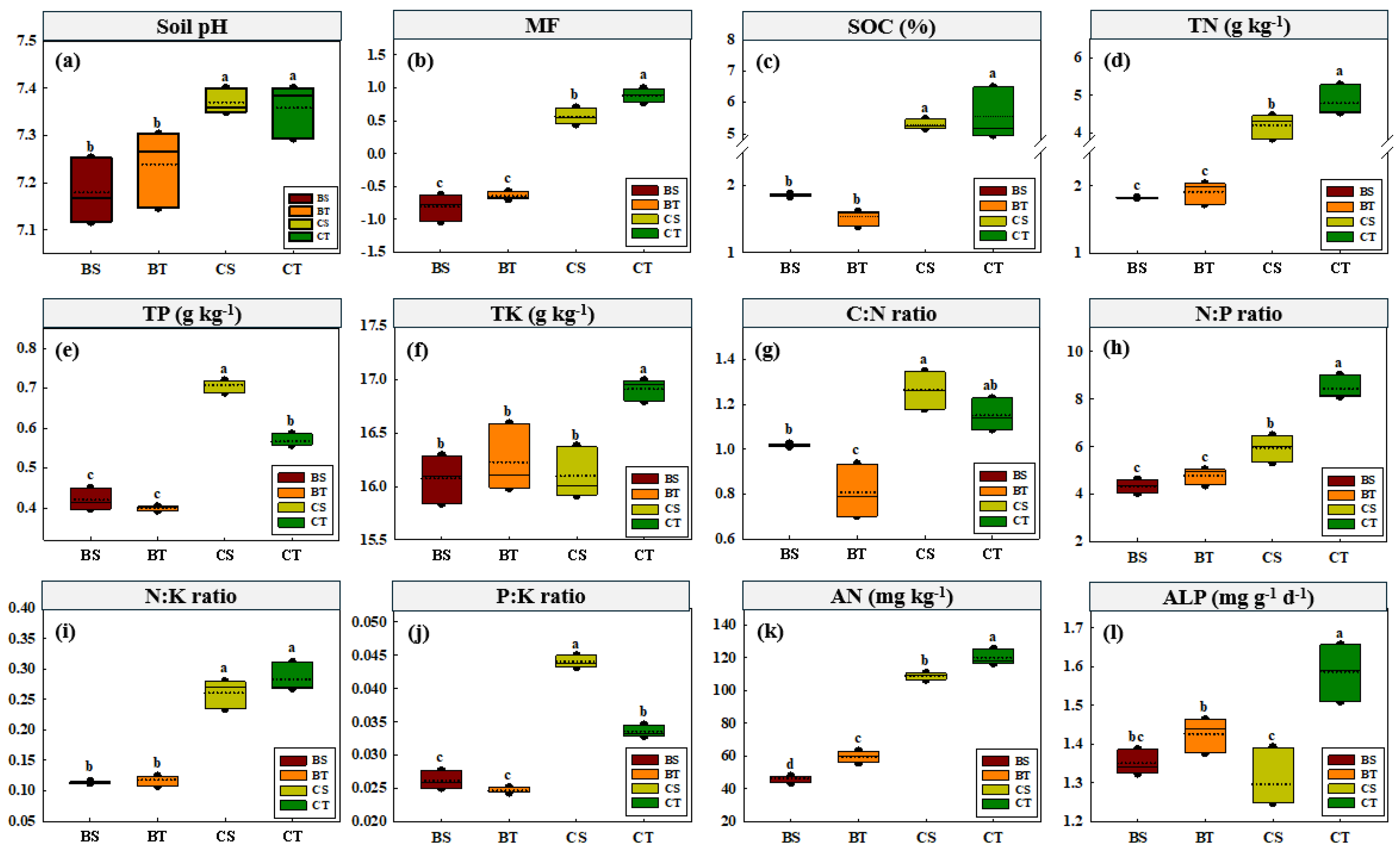
Figure 2.
Effect of plant residue input on forestry soil microbial diversity and community structure. (a) Shannon index; (b) Chao index; (c) NMDS plot. Different letters above columns indicate significant difference between treatments tested by one-way ANOVA (P < 0.05). BS, BT, CS and CT indicate the treatments of bare land adjacent to shrubs, bare land adjacent to trees, forestland covered with shrub residues and forestland covered with trees residues, respectively. The same as below.
Figure 2.
Effect of plant residue input on forestry soil microbial diversity and community structure. (a) Shannon index; (b) Chao index; (c) NMDS plot. Different letters above columns indicate significant difference between treatments tested by one-way ANOVA (P < 0.05). BS, BT, CS and CT indicate the treatments of bare land adjacent to shrubs, bare land adjacent to trees, forestland covered with shrub residues and forestland covered with trees residues, respectively. The same as below.
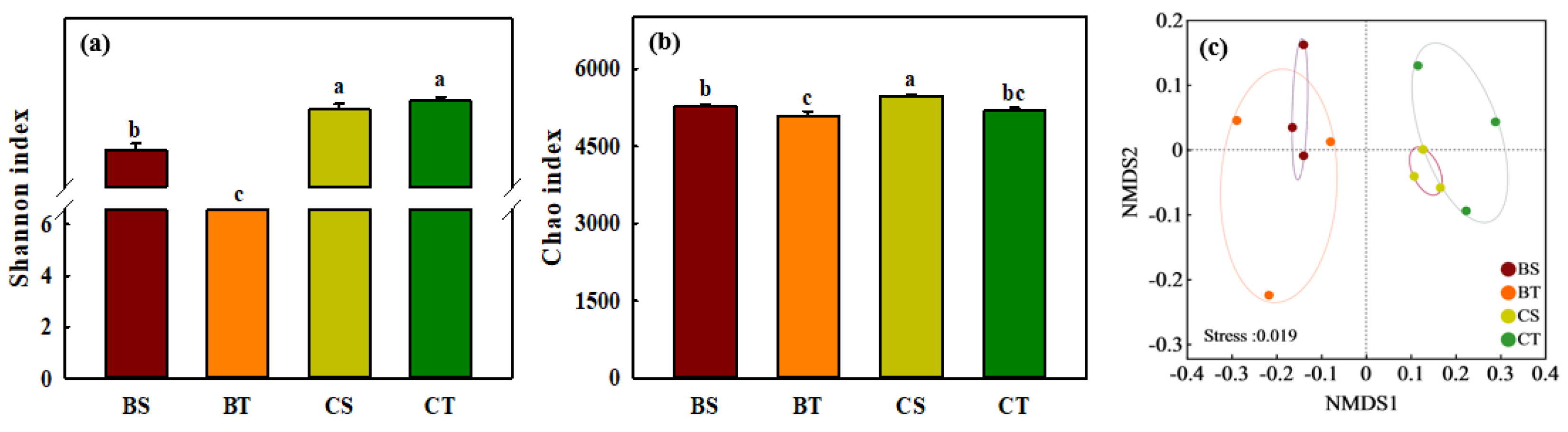
Figure 3.
Relative abundance of dominant phylum (a) and genus (b) and the relationship between their relative abundance and soil multifunctionality (c and d).
Figure 3.
Relative abundance of dominant phylum (a) and genus (b) and the relationship between their relative abundance and soil multifunctionality (c and d).
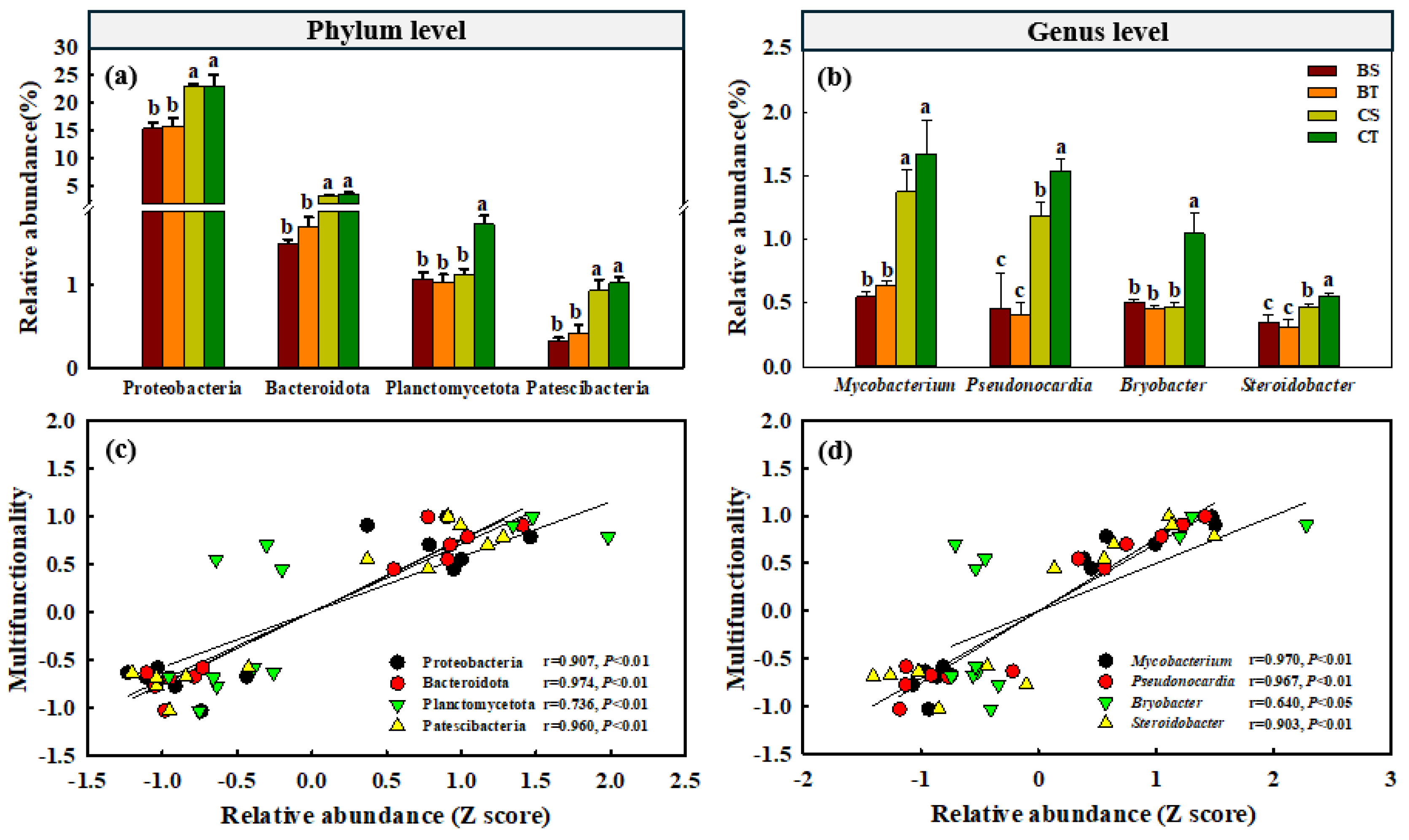
Figure 4.
Relationship between soil microbial diversity and soil multifunctionality. A, ahpha diversity; B, beta diversity.
Figure 4.
Relationship between soil microbial diversity and soil multifunctionality. A, ahpha diversity; B, beta diversity.
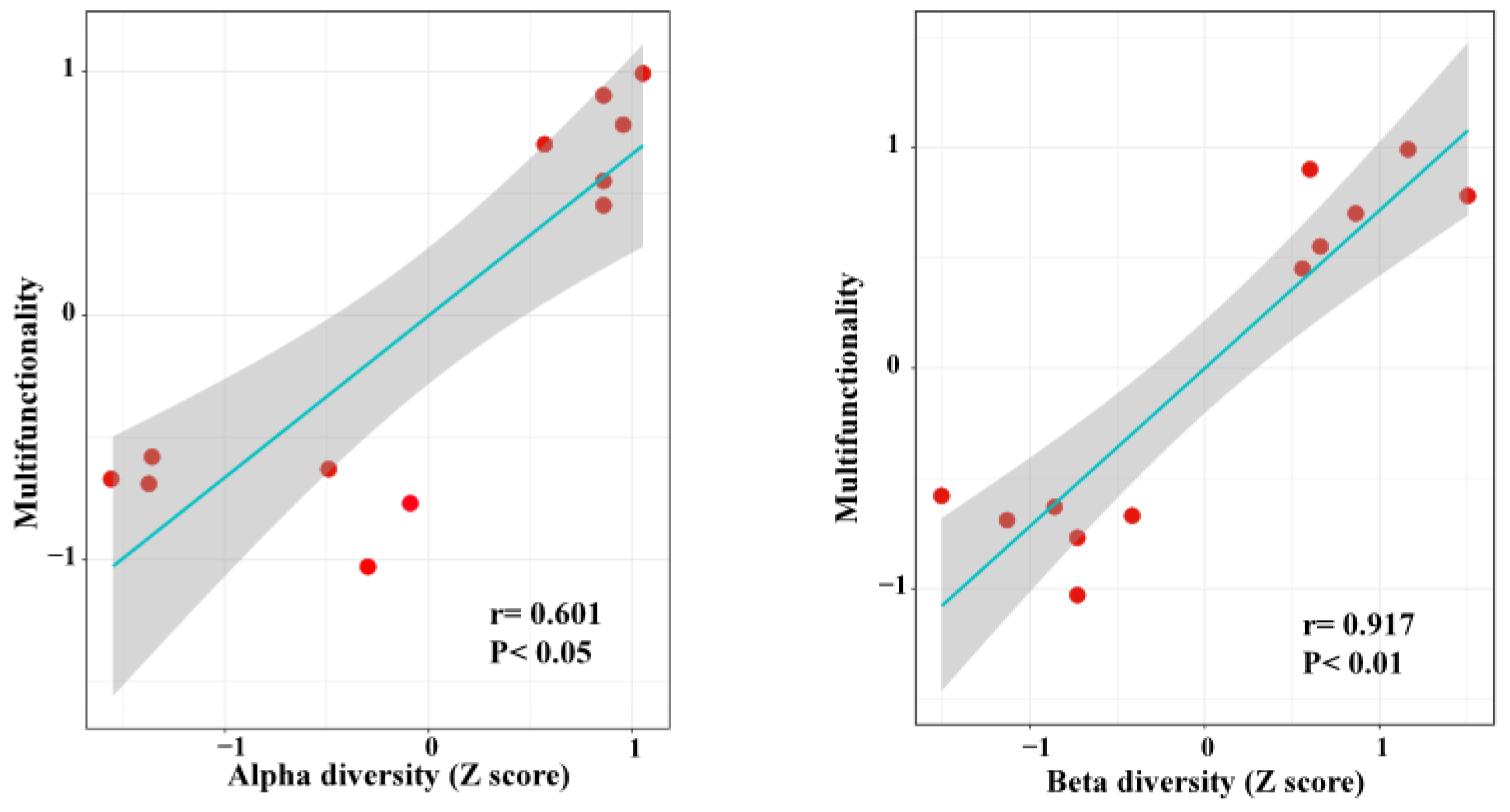
Figure 5.
Relationship between soil properties and soil microbial community structure at phylum (a) and genus level (b). The blue line and yellow line indicate the significant correlation at the level of 0.01 and 0.05. The green line indicates no significant correlation between different parameters (P>0.05).
Figure 5.
Relationship between soil properties and soil microbial community structure at phylum (a) and genus level (b). The blue line and yellow line indicate the significant correlation at the level of 0.01 and 0.05. The green line indicates no significant correlation between different parameters (P>0.05).
Disclaimer/Publisher’s Note: The statements, opinions and data contained in all publications are solely those of the individual author(s) and contributor(s) and not of MDPI and/or the editor(s). MDPI and/or the editor(s) disclaim responsibility for any injury to people or property resulting from any ideas, methods, instructions or products referred to in the content. |
© 2026 by the authors. Licensee MDPI, Basel, Switzerland. This article is an open access article distributed under the terms and conditions of the Creative Commons Attribution (CC BY) license (http://creativecommons.org/licenses/by/4.0/).
Copyright: This open access article is published under a Creative Commons CC BY 4.0 license, which permit the free download, distribution, and reuse, provided that the author and preprint are cited in any reuse.


