

Submitted:
07 June 2026
Posted:
09 June 2026
You are already at the latest version
Abstract
Regional climate models (RCMs) have become established as essential dynamical downscaling tools, providing physically consistent, high-resolution climate information where global climate models (GCMs) are unable to resolve. Added value is obtained over heterogeneous vegetation, coastal, urban or orographically complex zones. Temperature, precipitation or wind benefit whenever fine-scale processes govern the climate signal, as with extreme events. CORDEX initiative (since 2009) has further consolidated RCM research with coordinated multi-model ensembles covering all continental regions, enabling systematic uncertainty quantification of regional climate projections. PROMES RCM has been an active scientific contributor across three decades to the modelling community ensemble. This review synthesizes and documents PROMES’s development, performance across Europe, West Africa and South America, and assesses its scientific contributions. This includes climate change projections features, extreme events (droughts, heat waves, or Mediterranean tropical-like cyclones) or land surface–atmosphere studies. Its behaviour within the more relevant international multi-model ensembles (from PRUDENCE to EuroCORDEX), with structurally independent characteristics, represents a scientific asset for uncertainty characterization beyond the model’s individual results, offering a legacy argument for preserving RCM diversity in ensemble design strategies, as it is an essential and many times underappreciated key point of uncertainty analysis.
Keywords:
PROMES
; dynamical downscaling
; regional climate modelling
; climate change projections
; extreme events
; Europe
1. Introduction
Climate modelling is an essential tool for understanding the climate system, all its features, processes and mechanisms. The first step, of course, is their capability to accurately describe what the observations describe for current and past climate conditions. The huge increase of computational resources in the past decades has allowed the development of numerical and mathematical procedures to convert the physical conservation laws into a solvable and viable procedure to obtain results. Therefore, climate research groups and scientific institutions have developed numerical models able to reproduce atmospheric mechanisms, both on meteorological and climatological scales. Global climate models (GCMs) have allowed for a physically consistent description of the atmosphere, oceans and the rest of the components of the climate system. Therefore, they are the central part of the successive IPCC (Intergovernmental Panel on Climate Change) reports, the base of the climate change scientific studies [1,2].
Before CMIP7 [3] is fully ready, CMIP6 [4] is currently the reference ensemble database of GCMs for global climate studies. It has proven to improve previous intercomparison exercises when representing the main global climate features [5], including the spread and uncertainties when using a large ensemble of global climate models. The most recent IPCC Assessment Report (AR6) [2] results, analysis and findings are largely based on their results when dealing with climate projections for the XXIst century. At the same time, regional climate modelling [6] has become a perfect complementary dynamical downscaling methodology. It started in the late 1980s [7]. The aim was to try to overcome GCM limitations to resolve fine-scale processes that govern regional climate variability [8]. By using dynamic downscaling, that is, solving the same atmospheric physics evolution equations on climatic scales, nested with GCMs, and so using their large-scale fields as boundary conditions, RCMs are able to increase the spatial resolution by one order of magnitude. This physical consistency allows for a better and even explicit representation of processes related to complex orography, coastal contrasts or heterogeneous land cover conditions, that can be relevant to impact [9,10] or adaptation studies. RCM-based studies have achieved a large list of milestones, as shown in IPCC reports [11,12,13,14] or the Atlas [15], and also on many more specific regional and national studies during these years. The degree to which this additional information constitutes genuine scientific added value beyond that of the driving GCM is an active area of debate [16,17,18,19,20,21], analyzing their strengths and limitations when describing climate on regional scales [16,22,23,24,25,26]. One of the strongest assets of RCM studies has been the coordinated multi-model experiments, starting from Regionalization [27,28], PRUDENCE [29,30] and ENSEMBLES [31] EU projects in Europe, to other regions, such as North America [32], Africa [33], or South America [34,35]. These efforts become a global framework of the COordinated Regional Climate Downscaling EXperiment (CORDEX) since 2009 [36]. One of the more climatically complex regions is the Iberian Peninsula, but also with a broader focus, the Mediterranean basin [6,37]. And over these quite challenging areas, specifically EuroCORDEX [38,39,40] and MedCORDEX [41] initiatives have been developed in the past years. It is within this broader scientific context where PROMES regional climate model [42] emerged. It has contributed during more than three decades to climate research, in particular on the Mediterranean region, a well-known hot-spot for climate change studies [43]. This region represents a challenging and paradigmatic area for regional climate studies [37], due to its location in the transition zone between Atlantic and the Mediterranean oceans (from west to east), and in the transition between the mild climate above 50 degrees north and the subtropical to arid climate of northern Africa (from north to south). But it is also for its high degree of orographic complexities, that lead to a strong variety of climates [44], where the higher spatial resolution of RCMs is likely to play a relevant role.
It belongs to the pioneering ensemble of regional climate models (RegCM[45]; WRF [46]; COSMO-CLM[47]; PRECIS[48]; ETA [49]; REMO[50]; HIRHAM[51]; ALADIN[52]; RCA[53] or RACMO[54])) which have been the core of those international projects [6].
Despite its sustained scientific participation on those international projects, and also ESCENA project [55,56] (the first major spanish effort of ensemble regional climate modelling), no comprehensive synthesis of PROMES’s features, performance, and contributions has been published to date. This review aims to address it structured in the following sections: (i) document the main features of PROMES on its mature regional climate modelling configuration; (ii) validate its performance for present climate conditions (using observations), identifying both its strengths and its systematic biases on modelling ensembles; (iii) synthesize the scientific contributions of PROMES across several domains, with particular focus on western Europe; (iv) assess its role within multi-model ensemble frameworks and its contribution to the characterization ensemble regional climate projections and their uncertainties; and (v) reflect on the legacy and limitations of PROMES in the context of current and future directions in regional climate modelling.
2. PROMES Description
PROgnostic at MESoscale (PROMES) model development started around 1990 [42,57,58,59,60] at Complutense University (UCM), and since 2000s at Castilla-La Mancha University (UCLM), in the frame of MOMAC research group (MOdelling the environMent And Climate: www.uclm.es/grupos/momac). PROMES model was, in parallel, used as a meteorological prognostic model [61,62], although its main development and focus was directed towards a regional climate model. PROMES was, among other achievements, the first regional modelling exercise addressed over the Iberian Peninsula [28].
2.1. Main Model Characteristics
One major aspect of climate modelling group works is their continuous development and improvements [6,63], related to numerical methods, adaptation to different computer architectures, but specially the analysis and selection of parameterizations and schemes that are relevant for a better performance to describe regional climate features.
The more detailed and complete description of PROMES characteristics can be found in [64], with detailed numerical and parameterization aspects. It was a hydrostatic model with vertical levels and horizontal Lambert projection, using an Arakawa-C grid distribution for variables. Lateral boundary conditions were updated every 6 h from GCM fields, with a vertical interpolation to model levels following [59]. Contour zone with 8 points was used to relax external information [65]. PROMES model was also parallelized [66,67], for supercomputer usage.
The physical core of the model [68] included the following parameterizations: radiation scheme based on [69], including fractional cloud cover parameterization from [70,71]; turbulent vertical exchange for the prognostic variables at the planetary boundary layer (PBL) with a 1.5 turbulent kinetic energy closure scheme [72] and precipitation [73] and convective processes based on [74,75]. Convection processes at that 25-50 km resolution were a major issue, as it was mainly subgrid-scale, and was identified [76] as a primary source of spread for precipitation on RCMs ensembles, particularly over the Iberian Peninsula. Land-surface scheme was a major part of PROMES model and its development and modelling studies, based on ORCHIDEE scheme [77], with numerous complexities included, such as dynamical vegetation, hydrological features and vegetation characterization. Latest efforts on model development were focused on atmosphere-ocean coupling [78,79].
2.2. Principal Application Features
PROMES has been applied for multi-decadal simulations from 50 to 12 km horizontal resolution. The more frequent domain for studies was the whole European continent, although the Iberian Peninsula specifically was the subject of several analyses. Also Africa [80] and South America [81] were regions where the model has been used. One major contribution has been the participation with other RCMs in intercomparison exercises, with both the characterization of present-day climate variability and the simulation of future climate change scenarios under multiple greenhouse gas emission scenarios. Specific analysis were particularly focused on land surface–atmosphere interactions [82], PBL characterization [83] and the analysis of numerous extreme climatic events such as droughts [84] or intense precipitation episodes [68].
3. Results
An overall view of PROMES achievements, limitations and biases is presented, for a wider as possible picture of its performance during these thirty years.
3.1. Validation—Model Performance
Modelling regional climate features needs first a validation analysis, that is, the capability to describe current climate conditions. Observational available databases, typically on gridded format (therefore, with a mathematical and physical procedure to convert direct observations to cell-averaged values), such as CRU [85], E-OBS (v6) [86], Spain02 [87] or MW [88], allow a straightforward comparison with model outputs. Sometimes also point/location observations can be used against the corresponding model cells, sometimes reanalysis boundary forcing fields are also used on the validation (as it contains observational information, and also allows for the downscaling capabilities of RCMs from that boundary conditions), and finally also the ensemble comparison with the other RCMs that run with the same boundary conditions is frequently used, as it gives the opportunity to inspect common and consistent features, agreements, disagreements and spread among them when describing regional climate features. Obtained systematic biases are a major topic that has been strongly studied and analyzed [89,90] with the aim to understand the limitations of RCMs to accurately describe the regional climate, and in particular to be used for impact studies.
PROMES validation performance, including biases analysis, have been extensively studied on specific studies [27,28,91], but the main evaluation has been done within the framework of RCMs intercomparison projects: PRUDENCE over Europe [29,92], ESCENA over Spain [55], MedCORDEX over the Mediterranean [56,93], EuroCORDEX [38], CLARIS-LPB over South America [81,94] and the AMMA intercomparison over West Africa [95]. Many indices and metrics have been used for the analysis, such as seasonal fields, annual cycles, interannual variability or spatial and temporal correlations, mainly for temperature and precipitation, although some other variables, such as wind [96,97] were also inspected. Just a brief summary of the main validation results indicated that it is able to describe the main features of regional climate over all these regions, with comparable performance with the other regional climate models. A couple of examples on both behaviours can be: it performs best over the Iberian Peninsula in summer temperature, where it was formerly designed; a tendency to overestimate precipitation in convection-dominated regimes across all domains (Mediterranean coast in autumn, NE-Brazil during the rainy season, and West Africa throughout the year), probably related to model’s convection scheme, as it is not resolved by increasing horizontal resolution exercises.
3.2. PROMES and the Coordinated Ensemble Framework: From PRUDENCE to EuroCORDEX
The participation of PROMES in the main coordinated multi-model ensemble projects is one of its most significant scientific contributions, in terms of the continuous long-term contribution to merged results inside the best international regional climate groups [6]. PRUDENCE (2001–2004) [92] was the first systematic European RCM intercomparison exercise, producing end-of-century climate change projections under the SRES-A2 greenhouse gases scenario using HadAM3H as a common boundary condition for all participating models [30]. One key analysis of PRUDENCE projections [76] identified four sources of uncertainty: sampling, model formulation, boundary conditions, and natural variability. Thus, for example, in summer precipitation over southern Europe, model formulation uncertainty was dominating over boundary conditions, in which PROMES, with its specific physical parameterizations (convection, land-surface and PBL treatment) was a relevant contributor and a genuinely informative ensemble member. Then, ENSEMBLES (2004–2009) extended the PRUDENCE design significantly, combining thirteen RCMs and six GCMs under the SRES-A1B scenario. The uncertainty analysis studies [98] identified three sources of spread: simulation lengths, RCMs parameterization choices, and driving GCMs. In particular, RCM choice dominated the uncertainty in summer precipitation over southwestern Europe, rather than the GCM. Again, the specific physical formulation of PROMES significantly contributed then to the range of plausible future precipitation projections of the RCM ensemble. AMMA (2005-2009) [33] was parallel to ENSEMBLES project, but over West African region, producing the first coordinated multi-decadal RCM intercomparison over Africa, using ERA-Interim boundary conditions for 1990–2007 at approximately 50 km resolution. PROMES developed specific analysis of land-surface sensitivity to precipitation as part of the project [64]. ESCENA (2008–2012) was the Spanish national counterpart of ENSEMBLES initiative, producing an ensemble of four RCMs (PROMES, WRF, MM5 [99], and REMO), nested within ERA-Interim reanalysis at 25 km resolution and within three GCMs under multiple SRES scenarios [55,56,97,100,101]). ESCENA was specifically designed to obtain higher spatial resolution, denser observational validation, and a domain optimized for Spain, Portugal, and northern Morocco compared with ENSEMBLES. Numerous specific studies over these climatically complex and challenging regions were also made based on this project [102,103,104,105]. CLARIS (2004-2007) [106], but specially CLARIS-LPB (2008-2012) [35], an EU FP7 project, produced the first coordinated ensemble of RCM simulations over South America. PROMES showed a comparable performance with the other six RCMs. The main ensemble deviations were a warm bias relative to observations in South Eastern South America (especially for minimum winter temperatures), and overestimating convective precipitation in the tropics and orographic precipitation along the Andes and the Brazilian Highlands [81,94,107,108]. Finally, within the framework of CORDEX initiative, MedCORDEX [41,93] and EuroCORDEX [39] are the more recent ensemble studies, over Europe, where PROMES has been involved. During all these ensemble framework initiatives, PROMES has proven to contribute as a very valuable member, with consistent overall results compared with the average values of the models and the available databases. The essential objective of these projects, once models have been validated, is how they project future climate conditions. Future climate projections, based on different emissions scenarios and a matrix of the evolving CMIP GCMs that allow to construct GCM/RCM matrices, are the key procedure to contribute to climate change studies [14,29,109,110,111,112]. One major aspect of multi-model ensembles utility is the members differences. The larger the spread among RCMs with different parameterizations and numerical methods, the more relevant would be the estimated uncertainty. This is the principle that RCM diversity is essential for uncertainty characterization [98,113,114].
3.3. Scientific Applications Examples
PROMES early studies [27,28,82,115] demonstrated its capability to describe present climate over Western Europe and compare with other RCMs, becoming the earliest dynamical downscaling reference in the Spanish scientific literature. Then the participation on the major ensemble climate change regional projections described on previous section demonstrated that its signal for scenario simulations with a robust warming magnitude was broadly consistent with the ensemble of RCMs that have been the modelling reference during these years [6,14]. Now, we present three examples of different aspects of regional climate change, among the huge amount of studies where PROMES has been involved. The aim is to give an idea of the wide range of different capabilities that represents its contribution to regional climate modelling community studies during these years.
3.3.1. Characterization of Length, Start and End of Seasons
Definition of seasons based meteorological (mainly temperature) thresholds is a challenging feature [116,117,118,119], in contrast with the fixed astronomical (solstices and equinoxes) or climatological (calendar months), and is likely to be favoured by using regional information, for a more accurate relation of how temperature evolves at each location. Therefore, regional climate models, such as PROMES, allow a study on that direction, not only to propose how seasons can be defined [117,120], but also how it can evolve for future conditions, using the regional details, in contrast with GCMs [120]. An example of the results that can be obtained, based on the work [120] is shown with a polar diagram in Figure 1.
By the end of XXIst century over the whole Iberian Peninsula summers would be enlarged by a couple of months or more, both early from spring, and later towards autumn. Meanwhile, winters, defined as all the other seasons with present climate thresholds, are likely to disappear. Spring and autumn are also slightly enlarged and displaced, occupying winter time. This type of results are consistent with several other more recent studies, using similar methodologies [116,118,119].
3.3.2. Dry Spells Statistics
Dry spells (defined as the consecutive days without rain) analysis, due to the local nature of precipitation is likely to be favoured by using regional models. Thus, a first analysis over the Iberian Peninsula [84] was made with PROMES, using PRUDENCE data, which highlighted the advantage of RCMs at 25 km when compared with low resolution GCMs to describe observed dry spells from observational databases. Then, future projections of these dryness patterns were obtained and described. In Figure 2 the analysis was extended to ENSEMBLE RCM models, together with E-OBS (v6) gridded observations [86], allowing to both see how accurate RCMs were in relation to observations and among each other, in a consistent way. The north-south pattern over land can be clearly seen, with around 150 days/year over northern Africa, and less than 5 days/year for the northern part of the analyzed domain, on Central Europe. Clear coastal and orographic features were obtained. Over the Mediterranean Sea, where observations from E-OBS are not available, RCMs were able to add information about this variable.
Then, other studies took advantage of this first analysis [93,121,122,123], allowing to extend the lines of research related to the absence of precipitation features over Europe, in particular over the Mediterranean, where it is clearly a major issue from a climatological perspective, but also over other regions, such as South America.
3.3.3. South America Regional Climate Precipitation Extremes
PROMES showed its capability to describe regional climate in other regions around the world apart from Europe. It was the case of Africa, in the frame of AMMA project [64,95,124], but the larger effort, first inside CLARIS project [34], but mainly in CLARIS-LPB project, where an ensemble of RCMs modelled present and future climate over the whole South American continent [81,125], with particular attention to La Plata basin area. This project has been the base of more recent studies with a similar structure, as part of CORDEX initiative, with the aim to further study the climate of the region [126,127,128]. An exhaustive analysis of different climatic features has been made throughout a large list of studies [121,129,130]. But, in particular, a whole Special Issue [35] was conducted, where analysis of regional processes and feedbacks [131] or extremes [107], among many other works, was made. A simple example of these studies is presented on Figure 3, precipitation extremes of the RCMs ensemble in terms of monthly values is compared against the small amount of available observations.
As an example of measuring extreme precipitation conditions, Figure 3 shows the different precipitation regimes over the continent, by using fraction of monthly values above or below 50 mm, during the year, which represents the quite heterogeneous pattern that the continent presents in terms of precipitation regimes. Thus, the amazonian basin or the southern part of the continent over the Pacific ocean, monthly precipitation is always above that threshold, or the opposite behaviour, such as northeast Brazil, or larger parts of Argentina or the Atacama desert. The South Atlantic convergence zone presents an intermediate result, which is challenging for the RCMs simulations capabilities. The spread and consistency of results among the regional models depending on the region is a clear picture of the importance of using several models to analyze the regional climate features.
3.3.4. Other Relevant Regional Analysis Lines of Research
A comprehensive catalogue of regional climate studies where PROMES has been part would be too large and it is out of the scope of this review, but some brief list can be of relevance to be mentioned: extreme events [68,102,132,133]; relevant processes where regional climate could be interesting, such as thermal lows at the Iberian Peninsula [134], hurricane-like mediterranean pressure systems (medicanes) [135,136], boundary layer characterization [83], vegetation and land impact on climate [82,115,133,137,138], climate classifications [139,140,141], wind analysis [96,142,143], and numerous subregional specific analysis [144,145,146,147,148,149,150,151,152].
It is worth noting that a large number of impact studies have also been favoured by using PROMES and other RCM results, related to hydrology [144,153,154,155,156,157,158,159], health [160], climate risks [161], vegetation [162] or agriculture [163,164].
This brief list of applied studies demonstrates that PROMES has been deployed across a wide and coherent range of scientific problems. This scientific record, produced over more than three decades, is one of the basis for the legacy assessment presented here. The most scientifically distinctive PROMES contributions (land surface sensitivity studies, climate characterization over several complex regions around the globe or the focus on extreme events), reflect the specific scientific priorities of the PROMES group besides what is needed to contribute to the standard ensemble needs, underscoring the value of model-specific research programs alongside coordinated ensemble efforts. Besides, the consistency of PROMES behaviour across domains: Mediterranean, West Africa, and South America, demonstrates its capabilities in terms of describing regional climate characteristics, including the limitations and biases, that also contribute to obtain a robust RCM ensemble.
4. Discussion: Legacy, Limitations and Relevance
Some aspects of the scientific legacy of PROMES can be better understood with the following distinctive contributions made to the regional climate modelling community:
- A sustained and coherent scientific focus on the Iberian Peninsula along the ensemble RCM exercises, in particular related to the choice of parameterizations specially developed for the characteristics of the regions. The result is a consistent group of present-climate simulations, climate change projections, and sensitivity studies that can be compared across periods and scenarios.
- A pioneering research line on Mediterranean tropical-like cyclones: [135]) was one of the first RCM-based studies to address this phenomenon, followed by [132,136,165] studies. It constitutes the most internationally visible scientific contribution of PROMES to the Mediterranean high-impact weather systems in a changing climate, that has grown substantially in the recent years [166].
- A systematic investigation of land surface–atmosphere coupling at the regional scale, from sensitivity studies [82] on land degradation, deforestation [115], or vegetation description uncertainties [137] constitutes a coherent program of land–atmosphere interaction research that used PROMES for understanding how surface conditions modulate regional climate. These studies were among the first to use an RCM to quantify the non-local effects of land surface change on precipitation over the Iberian Peninsula, and anticipated land use change experiments on EuroCORDEX community [167].
A central aspect of RCM ensemble modelling is their utility as a tool for uncertainty quantification. It rests on the assumption that its members are sufficiently independent (despite sharing partly numerical methods and parameterizations) to explore different regions of the uncertainty space in a probabilistic way [113]. Uncertainties in regional climate projections come from internal variability and mode and emissions scenarios uncertainties [114], that are potentially reducible through progress in climate science. The model uncertainty component of total uncertainty is better sampled if the models in the ensemble are structurally diverse, and so PROMES then represents a relevant contribution to model diversity. The PROMES independent model development [28,42,59,82,83] made it a genuinely different model, and so a contributor to such uncertainty quantification [168]. Its divergence in some regional climatic features, inside the overall climatic coherence and consistency on the validation studies, mentioned previously on the review, is then a signature of this value and genuine added value [19] for the model ensemble analysis. The potential and interest of GCM/RCM combinations in multi-MIP ensembles for Spain was confirmed in [56].
A complete account of the PROMES legacy requires also to point that in the recent years it has been unable to follow the development of RCM community towards: convection-permitting configuration when resolution approaches to 4-5 km, where deep convection can be explicitly resolved without parameterization [169,170]; interactive ocean coupling, where just some efforts were made [79], and studies have shown their importance for a better description of climate features in areas such as the Mediterranean Sea [171]. It has not run scenario simulations with CMIP5-6 boundary conditions, the latest forcing GCMs for RCM downscaling simulations [14,40], which prevents direct comparison with the latest/current RCM ensembles, such as at the EuroCORDEX initiative.
The PROMES trajectory, with its achievements and limitations, and finally the decline as an active modelling tool contains several lessons that are relevant to the broader regional climate modelling community, independent of the scientific results it produced. The coherence and depth of the PROMES scientific record, particularly over the Western Mediterranean area, is attributable to a focused small group specialized on a challenging domain with the same model over three decades. This reinforces the importance of producing a regional-level knowledge that is difficult to replicate in a large community models where no regional expertise sometimes exists. In the recent movements in the regional modelling toward increasingly standardized community frameworks [40,172], there is a risk to lose such local experience. The maintenance costs, without a community of developers, users and infrastructure, did not allow the model to evolve at the pace required to remain competitive with community models that receive continuous updates.
5. Conclusions
The PROMES regional climate model, developed in the spanish UCM and UCLM universities from 1990 onward, represents one of the few sustained and coherent regional climate modelling programs produced by a single research group (MOMAC) in the European scientific community. This review has documented its development, performance and evaluation across multiple domains to describe present and future climate conditions on regional scales. Pleny of scientific applications and studies have been favoured from the huge modelling effort produced by the group within the framework of multi-model international initiatives. The core legacy of the PROMES research programme can be summarized with the following conclusions:
- PROMES produced physically rigorous results across its three decades of application. Its known biases are consistent, physically explicable, related to specific parameterization choices (convection, radiation, boundary layer or land-surface schemes). The cross-domain ensemble modelling consistency of PROMES behaviour makes it a scientifically reliable instrument, even when it includes limitations to describe all the regional climate aspects. It has shown to be particularly successful when representing western Mediterranean regional climate and has led specific lines of research, such as the pioneering research line on Mediterranean tropical-like cyclones.
- PROMES, as a structurally independent model, has contributed significantly to RCM ensemble uncertainties analysis, an argument that generalizes beyond this model. To lead to robust conclusions, the assessment of added value needs to be based on multiple models, over multiple domain settings, using the same metrics and simulation protocols, is crucial for uncertainty quantification. Ensemble quality is strongly proportional to the genuine structural diversity of the contributing models, as it was clearly stated in several studies [6,56].
- The full scientific value of a regional climate modelling program is acquired along the whole active lifetime, by means of individual model testing and development against observations, with several periods of study, regions of analysis, but mainly when establishing and participating in multi-model ensemble spread over the different domains, closely collaborating with other modelling groups, with a constant and strong interaction and learning process. The development of community RCMs applicable to a wide variety of studies and regional contexts, and the inception of intercomparison projects, culminating in the CORDEX initiative, are probably the main achievements in RCM research over the past thirty years, and PROMES has been part of this process from its beginning [6].
Regional climate modelling is a growing very active area of research [6,14,40,173], and it is expected to increasingly contribute to our understanding of climate on those scales, and so on other studies on the climate analysis chain [174]. At the same time, as is continuously stated in perspective works on the known deficiencies and challenging issues related to regional climate modelling [175], summarized in proposals about the future of climate modelling [176].
Author Contributions
Conceptualization, E. Sanchez; methodology, E. Sanchez and C. Gallardo; formal analysis, E. Sanchez and M.A. Gaertner; writing—original draft, E. Sanchez; writing—review and editing, E. Sanchez, C. Gallardo, M.A. Gaertner; supervision, M. de Castro. All authors have read and agreed to the published version of the manuscript.
Acknowledgments
PROMES-RCM would have been impossible without the contribution of many people along these 30 years. A full list of all the people that was part of it should necessarily include Alberto Arribas, Alba de la Vara, Marta Domínguez, Alberto Elizalde, Casimiro Fernández, Pedro Galán, Roberto García-Ochoa, Matt Garvert, Victoria Gil, Juan-Jesús González-Alemán, Claudia Gutiérrez, Edith Hagel, Ivan Hernández, Teresa Losada, Noelia López de la Franca, Elsa Mohino, Juan-Antonio Prego, Alfredo Rodríguez, Raquel Romera, Margarita Ruiz, Anna Sorensson, Maria Jesús San Isidro and Cesar Tejeda. Funding resources came from national projects in Spain and the international projects named along the manuscript.
Support from both Universities (UCM and UCLM) was also important during the lifetime of PROMES model.
Around 10 PhD thesis were completed by a direct use of PROMES model.
Conflicts of Interest
The authors declare no conflicts of interest. The funders had no role in the design of the study; in the collection, analyses, or interpretation of data; in the writing of the manuscript; or in the decision to publish the results.
Abbreviations
The following abbreviations are used in this manuscript:
| MOMAC | MOdelling the environMent And Climate |
| PROMES | PROgnostic at the MESoscale |
| RCM | Regional Climate Model |
| GCM | Global Climate Model |
| IPCC | Intergovernmental Panel on Climate Change |
| CMIP | Coupled Model Intercomparison Project |
| SRES | Special Report on Emissions Scenarios |
| AR | Assessment Report |
| PBL | Planetary Boundary layer |
| RegCM | Regional Climate Model |
| WRF | Weather Research and Forecasting model |
| COSMO-CLM | Climate Limited-area Modelling Community |
| PRECIS | Providing REgional Climates for Impacts Studies |
| ETA | Eta vertical coordinate |
| REMO | REgional MOdel |
| HIRHAM | HIRLAM (HIgh Resolution limited area model) + ecHAM (global atmospheric model) |
| ALADIN | International development for limited-area dynamical adaptation (in french) |
| RCA | Rossby Centre regional Atmospheric climate model |
| RACMO | Regional Atmospheric Climate MOdel |
| MM5 | fifth-generation Penn State/NCAR Mesoscale Model |
| CRU | Climate Research Unit |
| ECA | European Climate Assessment |
| MW | Matsuura and Willmott (U. Delaware) |
| Regionalization | Regionalization |
| PRUDENCE | Prediction of Regional scenarios and Uncertainties for Defining EuropeaN |
| Climate change risks and Effects | |
| ENSEMBLES | ENSEMBLE-based Predictions of Climate Changes and their Impacts |
| CLARIS | Europe-South America Network for CLimate change Assessment and Impact Studies |
| CLARIS-LPB | CLARIS - La Plata Basin |
| ESCENA | Desarrollo de escenarios regionalizados de cambio climático (spanish) |
| AMMA | African Monsoon Multidisciplinary Analyses |
| CORDEX | COoRDinate Regional Downscaling EXperiment |
| MedCORDEX | Mediterranean CORDEX |
| EuroCORDEX | European CORDEX |
References
- Houghton, J.T.; Ding, Y.; Noguer, M. (Eds.) Climate Change 2001: The scientific basis; Cambridge University Press, 2001; p. 881. [Google Scholar]
- Masson-Delmotte, V.; Zhai, P.; Pirani, A.; Connors, S.L.; Péan, C.; Berger, S.; Caud, N.; Chen, Y.; Goldfarb, L.; Gomis, M.; et al. Climate change 2021: the physical science basis. Contribution of working group I to the sixth assessment report of the intergovernmental panel on climate change 2021, 2, 2391. [Google Scholar]
- Van Vuuren, D.P.; O’Neill, B.C.; Tebaldi, C.; Sanderson, B.M.; Chini, L.P.; Friedlingstein, P.; Hasegawa, T.; Riahi, K.; Govindasamy, B.; Bauer, N.; et al. The Scenario Model Intercomparison Project for CMIP7 (ScenarioMIP-CMIP7). Geosci. Model Dev. 2026, 19, 2627–2656. [Google Scholar] [CrossRef]
- Eyring, V.; Bony, S.; Meehl, G.A.; Senior, C.A.; Stevens, B.; Stouffer, R.J.; Taylor, K.E. Overview of the Coupled Model Intercomparison Project Phase 6 (CMIP6) experimental design and organization. Geosci. Model Dev. 2016, 9, 1937–1958. [Google Scholar] [CrossRef]
- Bock, L.; Lauer, A.; Schlund, M.; Barreiro, M.; Bellouin, N.; Jones, C.; Meehl, G.A.; Predoi, V.; Roberts, M.J.; Eyring, V. Quantifying Progress Across Different CMIP Phases With the ESMValTool. J. Geophys. Res. Atmos. 2020, 125, e2019JD032321. Available online: https://agupubs.onlinelibrary.wiley.com/doi/pdf/10.1029/2019JD032321. [CrossRef]
- Giorgi, F. Thirty years of regional climate modeling: where are we and where are we going next? J. Geophys. Res. Atmos. 2019, 124, 5696–5723. [Google Scholar] [CrossRef]
- Giorgi, F.; Mearns, L.O. Approaches to the simulation of regional climate change: a review. Rev. Geophys. 1991, 29, 191–216. [Google Scholar] [CrossRef]
- Dickinson, R.E.; Errico, R.M.; Giorgi, F.; Bates, G.T. A regional climate model for the western United States. Clim. Change 1989, 15, 383–422. [Google Scholar] [CrossRef]
- Claro, A.M.; Fonseca, A.; Fraga, H.; Santos, J.A. Future agricultural water availability in Mediterranean Countries under climate change: A systematic review. Water 2024, 16, 2484. [Google Scholar] [CrossRef]
- Macdonald, E.; Merz, B.; Aerts, J.C.; Dewals, B.; Kwadijk, J.C.; Slager, K.; Willems, P.; Zoccatelli, D.; Vorogushyn, S. Future climate change assessment in flood risk management: A synthesis of practices in Germany and the BeNeLux countries. J. Flood Risk Manag. 2026, 19, e70173. [Google Scholar] [CrossRef]
- Giorgi, F.; Hewitson, B.; Christensen, J.; Hulme, M.; von Storch, H.; Whetton, P.; Jones, R.; Mearns, L.; Fu, C. Regional Climate Information – Evaluation and Projections. In Climate Change 2001: The Scientific Basis. Contribution of Working Group I to the Third Assessment Report of the Intergovernmental Panel on Climate Change; Houghton, J.T., Ding, Y., Griggs, D.J., Noguer, M., van der Linden, P.J., Dai, X., Eds.; Cambridge University Press: Cambridge, United Kingdom and New York, NY, USA, 2001; Volume chapter 10, pp. 583–638. [Google Scholar]
- Christensen, J.H.; Hewitson, B.; Busuioc, A.; Chen, A.; Gao, X.; Held, I.; Jones, R.; Kolli, R.K.; Kwon, W.T.; Laprise, R.; et al. Regional Climate Projections. Climate Change 2007: The Physical Science Basis. Contribution of Working Group I to the Fourth Assessment Report of the Intergovernmental Panel on Climate Change. Technical report, IPCC, WMO, 2007. [Google Scholar]
- Flato, G.; Marotzke, J.; Abiodun, B.; Braconnot, P.; Chou, S.; Collins, W.; Cox, P.; Driouech, F.; Emori, S.; Eyring, V.; et al. Evaluation of Climate Models. In Climate change 2013: The physical science basis. Contribution of Working Group I to the Fifth Assessment Report of the Intergovernmental Panel on Climate Change.; Stocker, T.F., Qin, D., Plattner, G.-K., Tignor, M., Allen, S.K., Boschung, J., Nauels, A., Xia, Y., Bex, V., Midgley, P.M., Eds.; Cambridge Univ Press: New York, NY, USA, 2013. [Google Scholar]
- Doblas-Reyes, F.J.; Sörensson, A.; Almazroui, M.; Dosio, A.; Gutowski, W.J.; Haarsma, R.; Hamdi, R.; Hewitson, B.; Kwon, W.T.; Lamptey, B.; et al. Chapter 10: Linking global to regional climate change. Contribution of working group I to the sixth assessment report of the intergovernmental panel on climate change 2021. [Google Scholar]
- Iturbide, M.; Fernández, J.; Gutiérrez, J.M.; Pirani, A.; Huard, D.; Al Khourdajie, A.; Baño-Medina, J.; Bedia, J.; Casanueva, A.; Cimadevilla, E.; et al. Implementation of FAIR principles in the IPCC: the WGI AR6 Atlas repository. Sci. Data 2022, 9, 629. [Google Scholar] [CrossRef]
- Laprise, R. Regional climate modelling. J. Comput. Phys. 2008, 227, 3641–3666. [Google Scholar] [CrossRef]
- Feser, F.; Rockel, B.; von Storch, H.; Winterfeldt, J.; Zahn, M. Regional climate models add value to global model data: a review and selected examples. Bull. Am. Meteorol. Soc. 2011, 92, 1181–1192. [Google Scholar] [CrossRef]
- Di Luca, A.; de Elía, R.; Laprise, R. Challenges in the quest for added value of regional climate dynamical downscaling. Curr. Clim. Change Rep. 2015, 1, 10–21. [Google Scholar] [CrossRef]
- Rummukainen, M. Added value in regional climate modeling. Wiley Interdiscip. Rev. Clim. Change 2016, 7, 145–159. [Google Scholar] [CrossRef]
- Molina, M.O.; Careto, J.A.M.; Gutiérrez, C.; Sanchez, E.; Soares, P.M.M. The added value of high-resolution EURO-CORDEX simulations to describe daily wind speed over Europe. Int. J. Climatol. 2022, 43, 1062–1078. [Google Scholar] [CrossRef]
- Soares, P.M.; Careto, J.A.; Cardoso, R.M.; Goergen, K.; Katragkou, E.; Sobolowski, S.; Coppola, E.; Ban, N.; Belušić, D.; Berthou, S.; et al. The added value of km-scale simulations to describe temperature over complex orography: the CORDEX FPS-Convection multi-model ensemble runs over the Alps. Clim. Dyn. 2024, 62, 4491–4514. [Google Scholar] [CrossRef]
- Leung, L.R.; Mearns, L.O.; Giorgi, F.; Wilby, R.L. Regional climate research: Needs and opportunities. Bull. Am. Meteorol. Soc. 2003, 84, 89–95. [Google Scholar]
- Wang, Y.; Leung, L.R.; McGregor, J.L.; Lee, D.K.; Wang, W.C.; Ding, Y.; Kimura, F. Regional climate modeling: progress, challenges, and prospects. J. Meteorol. Soc. Jpn. Ser. II 2004, 82, 1599–1628. [Google Scholar] [CrossRef]
- Rummukainen, M. State--of--the--art with regional climate models. WIREs Clim. Change 2010, 1, 82–96. [Google Scholar] [CrossRef]
- Rockel, B. The regional downscaling approach: a brief history and recent advances. Curr. Clim. Change Rep. 2015, 1, 22–29. [Google Scholar] [CrossRef]
- Lucas-Picher, P.; Argüeso, D.; Brisson, E.; Tramblay, Y.; Berg, P.; Lemonsu, A.; Kotlarski, S.; Caillaud, C. Convection-permitting modeling with regional climate models: Latest developments and next steps. Wiley Interdiscip. Rev. Clim. Change 2021, 12, e731. [Google Scholar] [CrossRef]
- Christensen, O.; Gaertner, M.; Prego, J.; Polcher, J. Internal variability of regional climate models. Clim. Dyn. 2001, 17, 875–887. [Google Scholar] [CrossRef]
- Gallardo, C.; Arribas, A.; Prego, J.A.; Gaertner, M.A.; De Castro, M. Multi-year simulations using a regional-climate model over the Iberian Peninsula: Current climate and doubled CO2 scenario. Q. J. R. Meteorol. Soc. 2001, 127, 1659–1681. [Google Scholar]
- Déqué, M.; Jones, R.; Wild, M.; Giorgi, F.; Christensen, J.H.; Hassell, D.C.; Vidale, P.L.; Rockel, B.; Jacob, D.; Kjellström, E.; et al. Global high resolution versus Limited Area Model climate change projections over Europe: quantifying confidence level from PRUDENCE results. Clim. Dyn. 2005, 25, 653–670. [Google Scholar] [CrossRef]
- Christensen, J.H.; Christensen, O.B. A summary of the PRUDENCE model projection of changes in European climate by the end of this century. Clim. Change 2007, 81, 7–30. [Google Scholar] [CrossRef]
- der Linden, P.V.; Mitchell, J.F.B. ENSEMBLES: Climate Change and its impacts: Summary of research and results from the ENSEMBLES project. Technical report. Met Office Hadley Centre, FitzRoy Road, Exeter EX1 3PB, UK, 2009. [Google Scholar]
- Mearns, L.O.; Arritt, R.; Biner, S.; Bukovsky, M.S.; McGinnis, S.; Sain, S.; Caya, D.; Correia, J., Jr.; Flory, D.; Gutowski, W.; et al. The North American regional climate change assessment program: overview of phase I results. Bull. Amer. Meteor. Soc. 2012, 93, 1337–1362. [Google Scholar] [CrossRef]
- Ruti, P.M.; Williams, J.E.; Hourdin, F.; Guichard, F.; Boone, A.; Van Velthoven, P.; Favot, F.; Musat, I.; Rummukainen, M.; Domínguez, M.; et al. The West African climate system: a review of the AMMA model inter-comparison initiatives. Atmos. Sci. Lett. 2011, 12, 116–122. [Google Scholar] [CrossRef]
- Menéndez, C.; de Castro, M.; Boulanger, J.P.; D’onofrio, A.; Sanchez, E.; Sörensson, A.; Blazquez, J.; Elizalde, A.; Jacob, D.; Le Treut, H.; et al. Downscaling extreme month-long anomalies in southern South America. Clim. Change 2010, 98, 379–403. [Google Scholar] [CrossRef]
- Boulanger, J.P.; Carril, A.F.; Sanchez, E. CLARIS-La Plata Basin: regional hydroclimate variability, uncertainties and climate change scenarios. Clim. Res. 2016, 68, 93–94. [Google Scholar] [CrossRef]
- Giorgi, F.; Gutowski, W.J., Jr. Regional dynamical downscaling and the CORDEX initiative. Annu. Rev. Environ. Resour. 2015, 40, 467–490. [Google Scholar] [CrossRef]
- Giorgi, F.; Lionello, P. Climate change projections for the Mediterranean region. Glob. Planet. Change 2008, 63, 90–104. [Google Scholar] [CrossRef]
- Kotlarski, S.; Keuler, K.; Christensen, O.B.; Colette, A.; Déqué, M.; Gobiet, A.; Goergen, K.; Jacob, D.; Lüthi, D.; van Meijgaard, E.; et al. Regional climate modeling on European scales: a joint standard evaluation of the EURO-CORDEX RCM ensemble. Geosci. Model Dev. 2014, 7, 1297–1333. [Google Scholar] [CrossRef]
- Jacob, D.; Teichmann, C.; Sobolowski, S.; Katragkou, E.; Anders, I.; Belda, M.; Benestad, R.; Boberg, F.; Buonomo, E.; Cardoso, R.M.; et al. Regional climate downscaling over Europe: perspectives from the EURO-CORDEX community. Reg. Environ. Change 2020, 20, 1–20. [Google Scholar] [CrossRef]
- Katragkou, E.; Sobolowski, S.; Teichmann, C.; Solmon, F.; Pavlidis, V.; Rechid, D.; Hoffmann, P.; Fernández, J.; Nikulin, G.; Jacob, D. Delivering an improved framework for the new generation of CMIP6-driven EURO-CORDEX regional climate simulations. Bull. Am. Meteorol. Soc. 2024, 105, E962–E974. [Google Scholar] [CrossRef]
- Ruti, P.M.; Somot, S.; Giorgi, F.; Dubois, C.; Flaounas, E.; Obermann, A.; Dell’Aquila, A.; Pisacane, G.; Harzallah, A.; Lombardi, E.; et al. MED-CORDEX initiative for Mediterranean climate studies. Bull. Am. Meteorol. Soc. 2016, 97, 1187–1208. [Google Scholar] [CrossRef]
- Castro, M.; Fernández, C.; Gaertner, M. Description of a mesoscale atmospheric numerical model. Math. Clim. Environ. 1993, 230–253. [Google Scholar]
- Giorgi, F. Climate change hot-spots. Geophys. Res. Lett. 2006, 33. [Google Scholar] [CrossRef]
- Lionello, P. The Climate of the Mediterranean Region. From the past to the future; Elsevier, 2012. [Google Scholar]
- Giorgi, F.; Coppola, E.; Solmon, F.; Mariotti, L.; Sylla, M.; Bi, X.; Elguindi, N.; Diro, G.; Nair, V.; Giuliani, G.; et al. RegCM4: model description and preliminary tests over multiple CORDEX domains. Clim. Res. 2012, 52, 7–29. [Google Scholar] [CrossRef]
- Powers, J.G.; Klemp, J.B.; Skamarock, W.C.; Davis, C.A.; Dudhia, J.; Gill, D.O.; Coen, J.L.; Gochis, D.J.; Ahmadov, R.; Peckham, S.E.; et al. The weather research and forecasting model: Overview, system efforts, and future directions. Bull. Am. Meteorol. Soc. 2017, 98, 1717–1737. [Google Scholar] [CrossRef]
- Rockel, B.; Will, A.; Hense, A. The regional climate model COSMO-CLM (CCLM). Meteorol. Z. 2008, 17, 347. [Google Scholar] [CrossRef]
- Massey, N.; Jones, R.; Otto, F.; Aina, T.; Wilson, S.; Murphy, J.; Hassell, D.; Yamazaki, Y.; Allen, M. weather@ home—development and validation of a very large ensemble modelling system for probabilistic event attribution. Q. J. R. Meteorol. Soc. 2015, 141, 1528–1545. [Google Scholar] [CrossRef]
- Mesinger, F.; Chou, S.C.; Gomes, J.L.; Jovic, D.; Bastos, P.; Bustamante, J.F.; Lazic, L.; Lyra, A.A.; Morelli, S.; Ristic, I.; et al. An upgraded version of the Eta model. Meteorol. Atmos. Phys. 2012, 116, 63–79. [Google Scholar] [CrossRef]
- Jacob, D.; Podzun, R. Sensitivity studies with the regional climate model REMO. Meteorol. Atmos. Phys. 1997, 63, 119–129. [Google Scholar] [CrossRef]
- Christensen, O.B.; Drews, M.; Christensen, J.H.; Dethloff, K.; Ketelsen, K.; Hebestadt, I.; Rinke, A. The HIRHAM regional climate model. Version 5 (beta). 2007. [Google Scholar]
- Colin, J.; Déqué, M.; Radu, R.; Somot, S. Sensitivity study of heavy precipitation in Limited Area Model climate simulations: influence of the size of the domain and the use of the spectral nudging technique. Tellus A Dyn. Meteorol. Oceanogr. 2010, 62, 591–604. [Google Scholar] [CrossRef]
- Samuelsson, P.; Jones, C.G.; Will En, U.; Ullerstig, A.; Gollvik, S.; Hansson, U.; Jansson, E.; Kjellstro M, C.; Nikulin, G.; Wyser, K. The Rossby Centre Regional Climate model RCA3: model description and performance. Tellus A Dyn. Meteorol. Oceanogr. 2011, 63, 4–23. [Google Scholar] [CrossRef]
- van Meijgaard, E.; Van Ulft, L.; Van de Berg, W.; Bosveld, F.; Van den Hurk, B.; Lenderink, G.; Siebesma, A. The KNMI regional atmospheric climate model RACMO, version 2.1; KNMI De Bilt, The Netherlands, 2008. [Google Scholar]
- Jiménez-Guerrero, P.; Montávez, J.P.; Domínguez, M.; Romera, R.; Fita, L.; Fernández, J.; Cabos, W.D.; Liguori, G.; Gaertner, M.A. Mean fields and interannual variability in RCM simulations over Spain: the ESCENA project. Clim. Res. 2013, 57, 201–220. [Google Scholar] [CrossRef]
- Fernández, J.; Frías, M.; Cabos, W.; Cofiño, A.S.; Domínguez, M.; Fita, L.; Gaertner, M.; García-Díez, M.; Gutiérrez, J.M.; Jiménez-Guerrero, P.; et al. Consistency of climate change projections from multiple global and regional model intercomparison projects. Clim. Dyn. 2019, 52, 1139–1156. [Google Scholar] [CrossRef]
- Castro, M.; Fernández, C.; Gallardo, C.; Gaertner, M.A. Relevance of Regional Models for Analyzing Future Climate Change in the Iberian Peninsula. In Global Change and Mediterranean-Type Ecosystems; Springer New York: New York, NY, 1995; pp. 1–34. [Google Scholar] [CrossRef]
- Fernández, C.; Gaertner, M.; Gallardo, C.; Castro, M. Simulation of a long-lived meso-β scale convective system over the Mediterranean coast of Spain. Part I: Numerical predictability. Meteorol. Atmos. Phys. 1995, 56, 157–179. [Google Scholar] [CrossRef]
- Gaertner, M.A.; Castro, M. A new method for vertical interpolation of the mass field. Mon. Weather Rev. 1996, 124, 1596–1603. [Google Scholar] [CrossRef]
- Fernández, C.; Gaertner, M.; Gallardo, C.; Castro, M. Simulation of a long-lived meso-β scale convective system over the mediterranean coast of Spain. Part II: Sensitivity to external forcings. Meteorol. Atmos. Phys. 1997, 62, 179–200. [Google Scholar] [CrossRef]
- Hagel, E.; Gil, V.; Tejeda, C.; de Castro, M. Dynamic downscaling of the NCEP EPS forecast using the PROMES limited area model. Tethys 2012, 9, 3–12. [Google Scholar] [CrossRef]
- Gaertner, M.; Gallardo, C.; Tejeda, C.; Martínez, N.; Calabria, S.; Martínez, N.; Fernández, B. The Casandra project: results of wind power 72-h range daily operational forecasting in Spain. In Proceedings of the European Wind Energy Conference, 2003. [Google Scholar]
- Dudhia, J. A history of mesoscale model development. Asia-Pac. J. Atmos. Sci. 2014, 50, 121–131. [Google Scholar] [CrossRef]
- Domínguez, M.; Gaertner, M.A.; de Rosnay, P.; Losada, T. A regional climate model simulation over West Africa: parameterization tests and analysis of land-surface fields. In Clim. Dyn.; 2010. [Google Scholar] [CrossRef]
- Davies, H. A lateral boundary layer formulation for multilevel prediction models. Q. J. R. Meteorol. Soc. 1976, 102, 405–418. [Google Scholar]
- Garrido, J.E.; Arias, E.; Cazorla, D.; Cuartero, F.; Fernández, I.; Gallardo, C. A Distributed Memory Implementation of the Regional Atmospheric Model PROMES. IAENG Int. J. Comput. Sci. 2009, 36. [Google Scholar]
- Garrido, J.E.; Arias, E.; Cazorla, D.; Cuartero, F.; Fernández, I.; Gallardo, C. PROMESPAR: A High Performance Computing Implementation of the Regional Atmospheric Model PROMES. In Electronic Engineering and Computing Technology; Springer, 2010; pp. 527–538. [Google Scholar]
- Sánchez, E.; Gallardo, C.; Gaertner, M.Á.; Arribas, A.; de Castro, M. Future climate extreme events in the Mediterranean simulated by a regional climate model: a first approach. Glob. Planet. Change 2004, 44, 163–180. [Google Scholar] [CrossRef]
- ECMWF. IFS Documentation CY28r1, Chapter IV (Physical Processes), Section 2 (Radiation); ECMWF, 2004. [Google Scholar]
- Chaboureau, J.P.; Bechtold, P. A simple cloud parameterization derived from cloud resolving model data: diagnostic and prognostic applications. J. Atmos. Sci. 2002, 59, 2362–2372. [Google Scholar] [CrossRef]
- Chaboureau, J.P.; Bechtold, P. Statistical representation of clouds in a regional model and the impact on the diurnal cycle of convection during Tropical Convection, Cirrus and Nitrogen Oxides (TROCCINOX). J. Geophys Res. 2005, 110, D17103. [Google Scholar] [CrossRef]
- Cuxart, J.; Bougeault, P.; Redelsperger, J.L. A turbulence scheme allowing for mesoscale and large-eddy simulations. Q. J. R. Meteorol. Soc. 2000, 126, 1–30. [Google Scholar] [CrossRef]
- Hong, S.; Dudhia, J.; Chen, S. A revised approach to ice microphysical processes for the bulk parameterization of cloud and precipitation. Mon. Weather Rev. 2004, 132, 103–120. [Google Scholar] [CrossRef]
- Kain, J.S.; Fritsch, J.M. Convective parameterization for mesoscale models: The Kain-Fritsch scheme. The Representation of Cumulus Convection in Numerical Models. Meteor. Monogr. (Amer. Meteor. Soc.) 1993, 46, 165–170. [Google Scholar]
- Kain, J.S. The Kain–Fritsch convective parameterization: an update. J. Appl. Meteorol. 2004, 43, 170–181. [Google Scholar] [CrossRef]
- Déqué, M.; Rowell, D.P.; Lu¨thi, D.; Giorgi, F.; Christensen, J.H.; Rockel, B.; Jacob, D.; Kjellstro¨m, E.; Castro, M.; Van den Hurk, B. An intercomparison of regional climate simulations for Europe: assessing uncertainties in model projections. Clim. Change 2007, 81(S1), 53–70. [Google Scholar] [CrossRef]
- Krinner, G.; Viovy, N.; Noblet-Ducoudré, N.; Ogée, J.; Polcher, J.; Friedlingstein, P.; Ciais, P.; Sitch, S.; Prentice, C. A dynamic global vegetation model for studies of the coupled atmosphere-biosphere system. Glob. Biogeochem. Cycles 2005, 19, GB1015. [Google Scholar] [CrossRef]
- Córdoba, M.L.; García Dopico, A.; García, M.I.; Rosales, F.; Arnaiz, J.; Bermejo, R.; Galán del Sastre, P. Efficient parallelization of a regional ocean model for the western Mediterranean Sea. Int. J. High Perform. Comput. Appl. 2014, 28, 368–383. [Google Scholar] [CrossRef]
- de La Vara, A.; del Sastre, P.G.; Arsouze, T.; Gallardo, C.; Gaertner, M.Á. Role of atmospheric resolution in the long-term seasonal variability of the Tyrrhenian Sea circulation from a set of ocean hindcast simulations (1997–2008). Ocean Model. 2019, 134, 51–67. [Google Scholar] [CrossRef]
- Paegle, J.N.; Byerle, L.A.; Mo, K.C. Intraseasonal modulation of South American summer precipitation. Mon. Wea. Rev. 2000, 128, 837–850. [Google Scholar] [CrossRef]
- Solman, S.A.; Sanchez, E.; Samuelsson, P.; da Rocha, R.; Li, L.; Marengo, J.; Pessacg, N.; Remedio, A.; Chou, S.C.; Berbery, H.; et al. Evaluation of an ensemble of regional climate model simulations over South America driven by the ERA-Interim reanalysis: Models’ performance and uncertainties. Clim. Dyn. 2013, 41, 1139–1157. [Google Scholar] [CrossRef]
- Arribas, A.; Gallardo, C.; Gaertner, M.; Castro, M. Sensitivity of the Iberian Peninsula climate to a land degradation. Clim. Dyn. 2003, 20, 477–489. [Google Scholar] [CrossRef]
- Sánchez, E.; Yagüe, C.; Gaertner, M.A. Planetary boundary layer energetics simulated from a regional climate model over Europe for present climate and climate change conditions. Geophys. Res. Lett. 2007, 34. [Google Scholar] [CrossRef]
- Sánchez, E.; Domínguez, M.; Romera, R.; de la Franca, N.L.; Gaertner, M.A.; Gallardo, C.; Castro, M. Regional modeling of dry spells over the Iberian Peninsula for present climate and climate change conditions. Clim. Change 2011, 107, 625–634. [Google Scholar] [CrossRef]
- Mitchell, T.D.; Jones, P.D. An improved method of constructing a database of monthly climate observations and associated high-resolution grids. Int. J. Climatol. 2005, 25, 693–712. [Google Scholar] [CrossRef]
- Haylock, M.R.; Hofstra, N.; Klein Tank, A.M.G.; Klok, E.J.; Jones, P.D.; New, M. A European daily high-resolution gridded data set of surface temperature and precipitation for 1950–2006. J. Geophys. Res. Atmos. 2008, 113. [Google Scholar] [CrossRef]
- Herrera, S. Desarrollo, validación y aplicaciones de Spain02: Una rejilla de alta resolución de observaciones interpoladas para precipitación y temperatura en España. PhD thesis, Universidad de Cantabria, 2011. Available online: http://www.meteo.unican.es/files/pdfs/2011_Tesis_Herrera_small.pdf.
- Matsuura, K.; Willmott, C.J. Terrestrial air temperature: 1900–2008 gridded monthly time series; Center for Climatic Research: Dep. Of Geography, University of Delaware, Newark; Available online: http://climate.geog.udel.edu/climate.
- Christensen, J.H.; Boberg, F.; Christensen, O.B.; Lucas-Picher, P. On the need for bias correction of regional climate change projections of temperature and precipitation. Geophys. Res. Lett. 2008, 35. [Google Scholar] [CrossRef]
- Teutschbein, C.; Seibert, J. Bias correction of regional climate model simulations for hydrological climate-change impact studies: Review and evaluation of different methods. J. Hydrol. 2012, 456, 12–29. [Google Scholar] [CrossRef]
- Christensen, J.H.; Machenhauer, B.; Jones, R.G.; Schär, C.; Ruti, P.M.; Castro, M.; Visconti, G. Validation of present-day regional climate simulations over Europe: LAM simulations with observed boundary conditions. Clim. Dyn. 1997, 13, 489–506. [Google Scholar] [CrossRef]
- Jacob, D.; Bärring, L.; Christensen, O.B.; Christensen, J.H.; de Castro, M.; Deque, M.; Giorgi, F.; Hagemann, S.; Hirschi, M.; Jones, R.; et al. An inter-comparison of regional climate models for Europe: model performance in present-day climate. Clim. Change 2007, 81, 31–52. [Google Scholar] [CrossRef]
- Fantini, A.; Raffaele, F.; Torma, C.; Bacer, S.; Coppola, E.; Giorgi, F.; Ahrens, B.; Dubois, C.; Sanchez, E.; Verdecchia, M. Assessment of multiple daily precipitation statistics in ERA-Interim driven Med-CORDEX and EURO-CORDEX experiments against high resolution observations. Clim. Dyn. 2018, 51, 877–900. [Google Scholar] [CrossRef]
- Carril, A.; Menéndez, C.G.; Remedio, A.; Robledo, F.; Sörensson, A.; Tencer, B.; Boulanger, J.P.; De Castro, M.; Jacob, D.; Le Treut, H.; et al. Performance of a multi-RCM ensemble for South Eastern South America. Clim. Dyn. 2012, 39, 2747–2768. [Google Scholar] [CrossRef]
- Paeth, H.; Hall, N.M.; Gaertner, M.A.; Alonso, M.D.; Moumouni, S.; Polcher, J.; Ruti, P.M.; Fink, A.H.; Gosset, M.; Lebel, T.; et al. Progress in regional downscaling of West African precipitation. Atmos. Sci. Lett. 2011, 12, 75–82. [Google Scholar] [CrossRef]
- Rockel, B.; Woth, K. Extremes of near-surface wind speed over Europe and their future changes as estimated from an ensemble of RCM simulations. Clim. Change 2007, 81, 267–280. [Google Scholar] [CrossRef]
- Gómez, G.; Cabos, W.D.; Liguori, G.; Sein, D.; Lozano-Galeana, S.; Fita, L.; Fernández, J.; Magariño, M.E.; Jiménez-Guerrero, P.; Montávez, J.P.; et al. Characterization of the wind speed variability and future change in the Iberian Peninsula and the Balearic Islands. Wind Energy 2016, 19, 1223–1237. [Google Scholar] [CrossRef]
- Déqué, M.; Somot, S.; Sanchez-Gomez, E.; Goodess, C.; Jacob, D.; Lenderink, G.; Christensen, O. The spread amongst ENSEMBLES regional scenarios: regional climate models, driving general circulation models and interannual variability. Clim. Dyn. 2012, 38, 951–964. [Google Scholar] [CrossRef]
- Jerez, S.; Montavez, J.P.; Gomez-Navarro, J.J.; Lorente-Plazas, R.; Garcia-Valero, J.A.; Jimenez-Guerrero, P. A multi-physics ensemble of regional climate change projections over the Iberian Peninsula. Clim. Dyn. 2013, 41, 1749–1768. [Google Scholar] [CrossRef]
- Herrera, S.; Gutiérrez, J.M.; Ancell, R.; Pons, M.R.; Frías, M.D.; Fernández, J. Development and analysis of a 50-year high-resolution daily gridded precipitation dataset over Spain (Spain02). Int. J. Climatol. 2012, 32, 74–85. [Google Scholar] [CrossRef]
- Domínguez, M.; Romera, R.; Sánchez, E.; Fita, L.; Fernández, J.; Jiménez-Guerrero, P.; Montávez, J.P.; Cabos, W.D.; Liguori, G.; Gaertner, M. Present-climate precipitation and temperature extremes over Spain from a set of high resolution RCMs. Clim. Res. 2012, 58, 149–164. [Google Scholar] [CrossRef]
- López-Franca, N.; Sánchez, E.; Losada, T.; Domínguez, M.; Romera, R.; Gaertner, M.Á. Markovian characteristics of dry spells over the Iberian Peninsula under present and future conditions using ESCENA ensemble of regional climate models. Clim. Dyn. 2015, 45, 661–677. [Google Scholar] [CrossRef]
- Romera, R.; Sánchez, E.; Domínguez, M.; Gaertner, M.Á.; Gallardo, C. Evaluation of present-climate precipitation in 25 km resolution regional climate model simulations over Northwest Africa. Clim. Res. 2015, 66, 125–139. [Google Scholar] [CrossRef]
- González-Alemán, J.J.; Gaertner, M.A.; Sánchez, E.; Romera, R. Subtropical cyclones near-term projections from an ensemble of regional climate models over the northeastern Atlantic basin. Int. J. Climatol. 2018, 38, e454–e465. Available online: https://rmets.onlinelibrary.wiley.com/doi/pdf/10.1002/joc.5383. [CrossRef]
- Gil, V.; Gaertner, M.A.; Gutierrez, C.; Losada, T. Impact of climate change on solar irradiation and variability over the Iberian Peninsula using regional climate models. Int. J. Climatol. 2019, 39, 1733–1747. [Google Scholar] [CrossRef]
- Boulanger, J.P.; Brasseur, G.; Carril, A.F.; de Castro, M.; Degallier, N.; Ereño, C.; Treut, H.L.; Marengo, J.A.; Menéndez, C.G.; Núñez, M.N.; et al. A Europe-South America network for climate change assessment and impact studies. Clim. Change 2010, 98, 307–329. [Google Scholar] [CrossRef]
- López-Franca, N.; Zaninelli, P.G.; Carril, A.F.; Menéndez, C.G.; Sánchez, E. Changes in temperature extremes for 21st century scenarios over South America derived from a multi-model ensemble of regional climate models. Clim. Res. 2016, 68, 151–167. [Google Scholar] [CrossRef]
- Ambrizzi, T.; Reboita, M.S.; da Rocha, R.P.; Llopart, M. The state of the art and fundamental aspects of regional climate modeling in South America. Ann. N. Y. Acad. Sci. 2019, 1436, 98–120. [Google Scholar] [CrossRef]
- Jacob, D.; Petersen, J.; Eggert, B.; Alias, A.; Christensen, O.B.; Bouwer, L.M.; Braun, A.; Colette, A.; Déqué, M.; Georgievski, G.; et al. EURO-CORDEX: new high-resolution climate change projections for European impact research. Reg. Environ. Change 2014, 14, 563–578. [Google Scholar] [CrossRef]
- Coppola, E.; Stocchi, P.; Pichelli, E.; Torres Alavez, J.A.; Glazer, R.; Giuliani, G.; Di Sante, F.; Nogherotto, R.; Giorgi, F. Non-Hydrostatic RegCM4 (RegCM4-NH): Model description and case studies over multiple domains. Geosci. Model Dev. 2021, 14, 7705–7723. [Google Scholar] [CrossRef]
- Evin, G.; Somot, S.; Hingray, B. Balanced estimate and uncertainty assessment of European climate change using the large EURO-CORDEX regional climate model ensemble. Earth Syst. Dyn. 2021, 12, 1543–1569. [Google Scholar] [CrossRef]
- Diez-Sierra, J.; Iturbide, M.; Gutiérrez, J.M.; Fernández, J.; Milovac, J.; Cofiño, A.S.; Cimadevilla, E.; Nikulin, G.; Levavasseur, G.; Kjellström, E.; et al. The worldwide C3S CORDEX grand ensemble: a major contribution to assess regional climate change in the IPCC AR6 atlas. Bull. Am. Meteorol. Soc. 2022, 103, E2804–E2826. [Google Scholar] [CrossRef]
- Tebaldi, C.; Knutti, R. The use of the multi-model ensemble in probabilistic climate projections. Philos. Trans. R. Soc. A 2007, 365, 2053–2075. [Google Scholar] [CrossRef]
- Hawkins, E.; Sutton, R. The potential to narrow uncertainty in regional climate predictions. Bull. Amer. Meteor. Soc. 2009, 90, 1095–1107. [Google Scholar] [CrossRef]
- Gaertner, M.; Christensen, O.; Prego, J.; Polcher, J.; Gallardo, C.; Castro, M. The impact of deforestation on the hydrological cycle in the western Mediterranean: an ensemble study with two regional climate models. Clim. Dyn. 2001, 17, 857–873. [Google Scholar] [CrossRef]
- Wang, J.; Guan, Y.; Wu, L.; Guan, X.; Cai, W.; Huang, J.; Dong, W.; Zhang, B. Changing Lengths of the Four Seasons by Global Warming. Geophys. Res. Lett. 2021, 48, e2020GL091753. Available online: https://agupubs.onlinelibrary.wiley.com/doi/pdf/10.1029/2020GL091753. [CrossRef]
- López-Franca, N.; Sánchez, E.; Menéndez, C.; Carril, A.F.; Zaninelli, P.G.; Flombaum, P. Characterization of seasons over the extratropics based on the annual daily mean temperature cycle. Int. J. Climatol. 2022, 42, 5570–5585. Available online: https://rmets.onlinelibrary.wiley.com/doi/pdf/10.1002/joc.7549. [CrossRef]
- Holtanová, E.; Koláček, J.; Brunner, L. A global perspective on past and future change in regional seasonal cycle shape. Earth Syst. Dyn. 2026, 17, 181–198. [Google Scholar] [CrossRef]
- Scott, T.J.; White, R.H.; Donner, S.D. Summers over land and ocean are becoming longer, transitioning faster, and accumulating more heat. Environ. Res. Lett. 2026, 21, 074009. [Google Scholar] [CrossRef]
- López-Franca, N.; Sánchez, E.; Domínguez, M. Changes in the onset and length of seasons from an ensemble of regional climate models over Spain for future climate conditions. Theor. Appl. Climatol. 2013, 114, 635–642. [Google Scholar] [CrossRef]
- Cavalcanti, I.; Carril, A.F.; Penalba, O.C.; Grimm, A.; Menendez, C.G.; Sanchez, E.; Cherchi, A.; Sörensson, A.; Robledo, F.; Rivera, J.; et al. Precipitation extremes over La Plata Basin–Review and new results from observations and climate simulations. J. Hydrol. 2015, 523, 211–230. [Google Scholar] [CrossRef]
- Seguí, P.Q.; Martin, E.; Sánchez, E.; Zribi, M.; Vennetier, M.; Vicente-Serrano, S.; Vidal, J.P. Drought: observed trends, future projections. Mediterr. Under Clim. Change 2016, 123–131. [Google Scholar]
- Raymond, F.; Ullmann, A.; Tramblay, Y.; Drobinski, P.; Camberlin, P. Evolution of Mediterranean extreme dry spells during the wet season under climate change. Reg. Environ. Change 2019, 19, 2339–2351. [Google Scholar] [CrossRef]
- Gaertner, M.; Dominguez, M.; Garvert, M. A modelling case-study of soil moisture–atmosphere coupling. Q. J. R. Meteorol. Soc. 2010, 136, 483–495. [Google Scholar] [CrossRef]
- Sánchez, E.; Solman, S.; Remedio, A.; Berbery, H.; Samuelsson, P.; Da Rocha, R.; Mourão, C.; Li, L.; Marengo, J.; de Castro, M.; et al. Regional climate modelling in CLARIS-LPB: a concerted approach towards twentyfirst century projections of regional temperature and precipitation over South America. Clim. Dyn. 2015, 45, 2193–2212. [Google Scholar] [CrossRef]
- Falco, M.; Carril, A.F.; Menéndez, C.G.; Zaninelli, P.G.; Li, L.Z. Assessment of CORDEX simulations over South America: added value on seasonal climatology and resolution considerations. Clim. Dyn. 2019, 52, 4771–4786. [Google Scholar] [CrossRef]
- Solman, S.A.; Blázquez, J. Multiscale precipitation variability over South America: Analysis of the added value of CORDEX RCM simulations. Clim. Dyn. 2019, 53, 1547–1565. [Google Scholar] [CrossRef]
- Reboita, M.S.; da Rocha, R.P.; Souza, C.A.d.; Baldoni, T.C.; Silva, P.L.L.d.S.; Ferreira, G.W.S. Future projections of extreme precipitation climate indices over South America based on CORDEX-CORE multimodel ensemble. Atmosphere 2022, 13, 1463. [Google Scholar] [CrossRef]
- Marengo, J.; Chou, S.; Mourao, C.; Solman, S.; Sanchez, E.; Samuelsson, P.; da Rocha, R.; Li, L.; Pessacg, N.; Remedio, A.; et al. Simulation of rainfall anomalies leading to the 2005 drought in Amazonia using the CLARIS-LPB regional climate models. Clim. Dyn. 2013, 41, 2937–2955. [Google Scholar] [CrossRef]
- Pessacg, N.L.; Solman, S.A.; Samuelsson, P.; Sanchez, E.; Marengo, J.; Li, L.; Remedio, A.R.C.; da Rocha, R.P.; Mourão, C.; Jacob, D. The surface radiation budget over South America in a set of regional climate models from the CLARIS-LPB project. Clim. Dyn. 2013, 1–19. [Google Scholar] [CrossRef]
- Menéndez, C.G.; Zaninelli, P.G.; Carril, A.F.; Sánchez, E. Hydrological cycle, temperature, and land surface–atmosphere interaction in the La Plata Basin during summer: response to climate change. Clim. Res. 2016, 68, 231–241. [Google Scholar] [CrossRef]
- Romera, R.; Gaertner, M.A.; Sánchez, E.; Domínguez, M.; González-Alemán, J.J.; Miglietta, M.M. Climate change projections of medicanes with a large multi-model ensemble of regional climate models. Glob. Planet. Change 2017, 151, 134–143. [Google Scholar] [CrossRef]
- Cheval, S.; Dumitrescu, A.; Birsan, M.V. Variability of the aridity in the South-Eastern Europe over 1961–2050. Catena 2017, 151, 74–86. [Google Scholar] [CrossRef]
- Hoinka, K.P.; Gaertner, M.A.; Castro, M. The Iberian thermal lows in a changed climate. Q. J. R. Meteorol. Soc. 2007, 133, 1113–1126. [Google Scholar] [CrossRef]
- Gaertner, M.Á.; Jacob, D.; Gil, V.; Domínguez, M.; Padorno, E.; Sánchez, E.; de Castro, M. Tropical cyclones over the Mediterranean Sea in climate change simulations. Geophys. Res. Lett. 2007, 34, L14711. [Google Scholar] [CrossRef]
- Gaertner, M.Á.; González-Alemán, J.J.; Romera, R.; Domínguez, M.; Gil, V.; Sánchez, E.; Gallardo, C.; Miglietta, M.M.; Walsh, K.J.; Sein, D.V.; et al. Simulation of medicanes over the Mediterranean Sea in a regional climate model ensemble: impact of ocean–atmosphere coupling and increased resolution. Clim. Dyn. 2016, 1–17. [Google Scholar] [CrossRef]
- Sánchez, E.; Gaertner, M.Á.; Gallardo, C.; Padorno, E.; Arribas, A.; de Castro, M. Impacts of a change in vegetation description on simulated European summer present-day and future climates. Clim. Dyn. 2007, 29, 319–332. [Google Scholar] [CrossRef]
- Coutinho, M.D.L.; Lima, K.C.; Santos e Silva, C.M. Regional climate simulations of the changes in the components of the moisture budget over South America. Int. J. Climatol. 2016, 36. [Google Scholar] [CrossRef]
- Castro, M.; Gallardo, C.; Jylhä, K.; Tuomenvirta, H. The use of a climate-type classification for assessing climate change effects in Europe from an ensemble of nine regional climate models. Clim. Change 2007, 81(S1), 329–341. [Google Scholar] [CrossRef]
- Gallardo, C.; Gil, V.; Hagel, E.; Tejeda, C.; de Castro, M. Assessment of climate change in Europe from an ensemble of regional climate models by the use of Köppen-Trewartha classification. Int. J. Climatol. 2013, 33. [Google Scholar] [CrossRef]
- Gallardo, C.; Gil, V.; Tejeda, C.; Sánchez, E.; Gaertner, M. Köppen-Trewartha classification used to assess climate changes simulated by a regional climate model ensemble over South America. Clim. Res. 2016, 68, 137–149. [Google Scholar] [CrossRef]
- Obermann, A.; Bastin, S.; Belamari, S.; Conte, D.; Gaertner, M.A.; Li, L.; Ahrens, B. Mistral and Tramontane wind speed and wind direction patterns in regional climate simulations. Clim. Dyn. 2018, 51, 1059–1076. [Google Scholar] [CrossRef]
- Sanabria, L.; Carril, A. Maps of wind hazard over South Eastern South America considering climate change. Clim. Change 2018, 148, 235–247. [Google Scholar] [CrossRef]
- Verant, S.; Laval, K.; Polcher, J.; De Castro, M. Sensitivity of the continental hydrological cycle to the spatial resolution over the Iberian Peninsula. J. Hydrometeorol. 2004, 5, 267–285. [Google Scholar] [CrossRef]
- Zanis, P.; Kapsomenakis, I.; Philandras, C.; Douvis, K.; Nikolakis, D.; Kanellopoulou, E.; Zerefos, C.; Repapis, C. Analysis of an ensemble of present day and future regional climate simulations for Greece. Int. J. Climatol. 2009, 29, 1614–1633. [Google Scholar] [CrossRef]
- Driouech, F.; Déqué, M.; Sánchez-Gómez, E. Weather regimes—Moroccan precipitation link in a regional climate change simulation. Glob. Planet. Change 2010, 72, 1–10. [Google Scholar] [CrossRef]
- Sanchez-Gomez, E.; Somot, S.; Josey, S.; Dubois, C.; Elguindi, N.; Déqué, M. Evaluation of Mediterranean Sea water and heat budgets simulated by an ensemble of high resolution regional climate models. Clim. Dyn. 2011, 37, 2067–2086. [Google Scholar] [CrossRef]
- Sylla, M.B.; Diallo, I.; Pal, J. West African monsoon in state-of-the-science regional climate models. In Climate variability-regional and thematic patterns; IntechOpen, 2013. [Google Scholar]
- Monjo, R.; Chust, G.; Caselles, V. Probabilistic correction of RCM precipitation in the Basque Country (Northern Spain). Theor. Appl. Climatol. 2014, 117, 317–329. [Google Scholar] [CrossRef]
- Zaninelli, P.G.; Menéndez, C.G.; Falco, M.; López-Franca, N.; Carril, A.F. Future hydroclimatological changes in South America based on an ensemble of regional climate models. Clim. Dyn. 2019, 52, 819–830. [Google Scholar] [CrossRef]
- Torma, C.Z. Detailed validation of EURO-CORDEX and Med-CORDEX regional climate model ensembles over the Carpathian Region. Q. J. Hung. Meteorol. Serv. 2019, 123, 217–240. [Google Scholar] [CrossRef]
- Szabo, A.I.; Breuer, H.; Acs, F.; Belda, M.; Feddema, J. Projected changes in Feddema climate characteristics in the Larger Carpathian Region by the end of the 21st century. Int. J. Climatol. 2022, 42, 5732–5747. [Google Scholar] [CrossRef]
- Lucarini, V.; Danihlik, R.; Kriegerova, I.; Speranza, A. Does the Danube exist? Versions of reality given by various regional climate models and climatological data sets. J. Geophys. Res. Atmos. 2007, 112. [Google Scholar] [CrossRef]
- Barranco, L.M.; Álvarez-Rodríguez, J.; Olivera, F.; Potenciano, Á.; Quintas, L.; Estrada, F. Assessment of the expected runoff change in Spain using climate simulations. J. Hydrol. Eng. 2013, 19, 1481–1490. [Google Scholar] [CrossRef]
- Fiseha, B.; Setegn, S.; Melesse, A.; Volpi, E.; Fiori, A. Impact of climate change on the hydrology of upper Tiber River Basin using bias corrected regional climate model. Water Resour. Manag. 2014, 28, 1327–1343. [Google Scholar] [CrossRef]
- Rana, A.; Madan, S.; Bengtsson, L. Performance evaluation of regional climate models (RCMs) in determining precipitation characteristics for Gothenburg, Sweden. Hydrol. Res. 2014, 45, 703–714. [Google Scholar] [CrossRef]
- Gajić-Čapka, M.; Güttler, I.; Cindrić, K.; Branković, Č. Observed and simulated climate and climate change in the lower Neretva river basin. J. Water Clim. Change 2017, jwc2017034. [Google Scholar] [CrossRef]
- Barella-Ortiz, A.; Quintana-Seguí, P. Evaluation of drought representation and propagation in regional climate model simulations across Spain. Hydrol. Earth Syst. Sci. 2019, 23, 5111–5131. [Google Scholar] [CrossRef]
- Patekar, M.; Baniček, I.; Rubinić, J.; Lukač Reberski, J.; Boljat, I.; Selak, A.; Filipović, M.; Terzić, J. Assessing climate change and land-use impacts on drinking water resources in karstic catchments (Southern Croatia). Sustainability 2021, 13, 5239. [Google Scholar] [CrossRef]
- Dessai, S. Heat stress and mortality in Lisbon Part II. An assessment of the potential impacts of climate change. Int. J. Biometeorol. 2003, 48, 37–44. [Google Scholar] [CrossRef]
- Attoh, E.M.; de Bruin, K.; Goosen, H.; van Veldhoven, F.; Ludwig, F. Making physical climate risk assessments relevant to the financial sector–Lessons learned from real estate cases in the Netherlands. Clim. Risk Manag. 2022, 37, 100447. [Google Scholar] [CrossRef]
- G. Campoy, J.; Lema, M.; Fenollosa, E.; Munné-Bosch, S.; Retuerto, R. Functional responses to climate change may increase invasive potential of Carpobrotus edulis. Am. J. Bot. 2021, 108, 1902–1916. [Google Scholar] [CrossRef]
- Oettli, P.; Sultan, B.; Baron, C.; Vrac, M. Are regional climate models relevant for crop yield prediction in West Africa? Environ. Res. Lett. 2011, 6, 014008. [Google Scholar] [CrossRef]
- Goodess, C. Comparing correction methods of RCM outputs for improving crop impact projections in the Iberian Peninsula for 21st century. Clim. Change 2016, 134, 283–297. [Google Scholar]
- Gutiérrez-Fernández, J.; Miglietta, M.M.; González-Alemán, J.J.; Gaertner, M.A. A New Refinement of Mediterranean Tropical-Like Cyclones Characteristics. Geophys. Res. Lett. 2024, 51, e2023GL106429. Available online: https://agupubs.onlinelibrary.wiley.com/doi/pdf/10.1029/2023GL106429. [CrossRef]
- Miglietta, M.M.; Flaounas, E.; González-Alemán, J.J.; Panegrossi, G.; Gaertner, M.A.; Pantillon, F.; Pasquero, C.; Schultz, D.M.; D’adderio, L.P.; Dafis, S.; et al. Defining medicanes: Bridging the knowledge gap between tropical and extratropical cyclones in the Mediterranean. Bull. Am. Meteorol. Soc. 2025, 106, E1955–E1971. [Google Scholar] [CrossRef]
- Hoffmann, P.; Reinhart, V.; Rechid, D.; de Noblet-Ducoudré, N.; Davin, E.L.; Asmus, C.; Bechtel, B.; Böhner, J.; Katragkou, E.; Luyssaert, S. High-resolution land use and land cover dataset for regional climate modelling: historical and future changes in Europe. Earth Syst. Sci. Data 2023, 15, 3819–3852. [Google Scholar] [CrossRef]
- Knutti, R.; Masson, D.; Gettelman, A. Climate model genealogy: Generation CMIP5 and how we got there. Geophys. Res. Lett. 2013, 40, 1194–1199. [Google Scholar] [CrossRef]
- Prein, A.F.; Langhans, W.; Fosser, G.; Ferrone, A.; Ban, N.; Goergen, K.; Keller, M.; Tölle, M.; Gutjahr, O.; Feser, F.; et al. A review on regional convection-permitting climate modeling: Demonstrations, prospects, and challenges. Rev. Geophys. 2015, 53, 323–361. [Google Scholar] [CrossRef]
- Coppola, E.; Sobolowski, S.; Pichelli, E.; Raffaele, F.; Ahrens, B.; Anders, I.; Ban, N.; Bastin, S.; Belda, M.; Belusic, D.; et al. A first-of-its-kind multi-model convection permitting ensemble for investigating convective phenomena over Europe and the Mediterranean. Clim. Dyn. 2020, 55, 3–34. [Google Scholar] [CrossRef]
- Gualdi, S.; Somot, S.; Li, L.; Artale, V.; Adani, M.; Bellucci, A.; Braun, A.; Calmanti, S.; Carillo, A.; Dell’Aquila, A.; et al. The CIRCE simulations: regional climate change projections with realistic representation of the Mediterranean Sea. Bull. Am. Meteorol. Soc. 2013, 94, 65–81. [Google Scholar] [CrossRef]
- Giorgi, F.; Coppola, E.; Jacob, D.; Teichmann, C.; Abba Omar, S.; Ashfaq, M.; Ban, N.; Bülow, K.; Bukovsky, M.; Buntemeyer, L.; et al. The CORDEX-CORE EXP-I initiative: description and highlight results from the initial analysis. Bull. Am. Meteorol. Soc. 2022, 103, E293–E310. [Google Scholar] [CrossRef]
- Sobolowski, S.; Somot, S.; Fernandez, J.; Evin, G.; Brands, S.; Maraun, D.; Kotlarski, S.; Jury, M.; Benestad, R.E.; Teichmann, C.; et al. GCM Selection and Ensemble Design: Best Practices and Recommendations from the EURO-CORDEX Community. Bull. Am. Meteorol. Soc. 2025, 106, E1834–E1850. [Google Scholar] [CrossRef]
- Jebeile, J. From regional climate models to usable information. Clim. Change 2024, 177, 53. [Google Scholar] [CrossRef]
- Shaw, T.A.; Arias, P.A.; Collins, M.; Coumou, D.; Diedhiou, A.; Garfinkel, C.I.; Jain, S.; Roxy, M.K.; Kretschmer, M.; Leung, L.R.; et al. Regional climate change: consensus, discrepancies, and ways forward. Front. Clim. 2024, 6, 1391634. [Google Scholar] [CrossRef]
- Bordoni, S.; Kang, S.; Shaw, T.A.; Simpson, I.; Zanna, L. The futures of climate modeling. npj Clim. Atmos. Sci. 2025, 8, 99. [Google Scholar] [CrossRef]
Figure 1.
Seasons start, end and length, using 25 and 75 percentiles of maximum and minimum temperatures from each grid cell, averaged for the whole Iberian Peninsula domain, as obtained from ENSEMBLES project ensemble of eight RCMs. Present (1961-2000) climate in the inner circle and future climate conditions (2071-2100) in the outer circle.
Figure 1.
Seasons start, end and length, using 25 and 75 percentiles of maximum and minimum temperatures from each grid cell, averaged for the whole Iberian Peninsula domain, as obtained from ENSEMBLES project ensemble of eight RCMs. Present (1961-2000) climate in the inner circle and future climate conditions (2071-2100) in the outer circle.
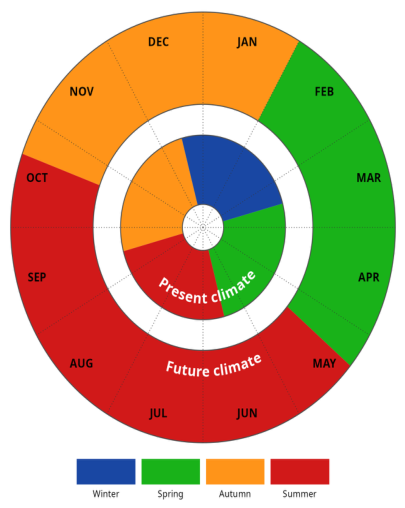
Figure 2.
Annual mean dry spell length (days/year) for 1961-2000 period. On the top, E-OBS (v6) gridded observations is presented (where only land points were available), and then 10 RCMs from ENSEMBLES project. The domain is focused over the Mediterranean basin, where this process is more relevant due to its precipitation characteristics.
Figure 2.
Annual mean dry spell length (days/year) for 1961-2000 period. On the top, E-OBS (v6) gridded observations is presented (where only land points were available), and then 10 RCMs from ENSEMBLES project. The domain is focused over the Mediterranean basin, where this process is more relevant due to its precipitation characteristics.
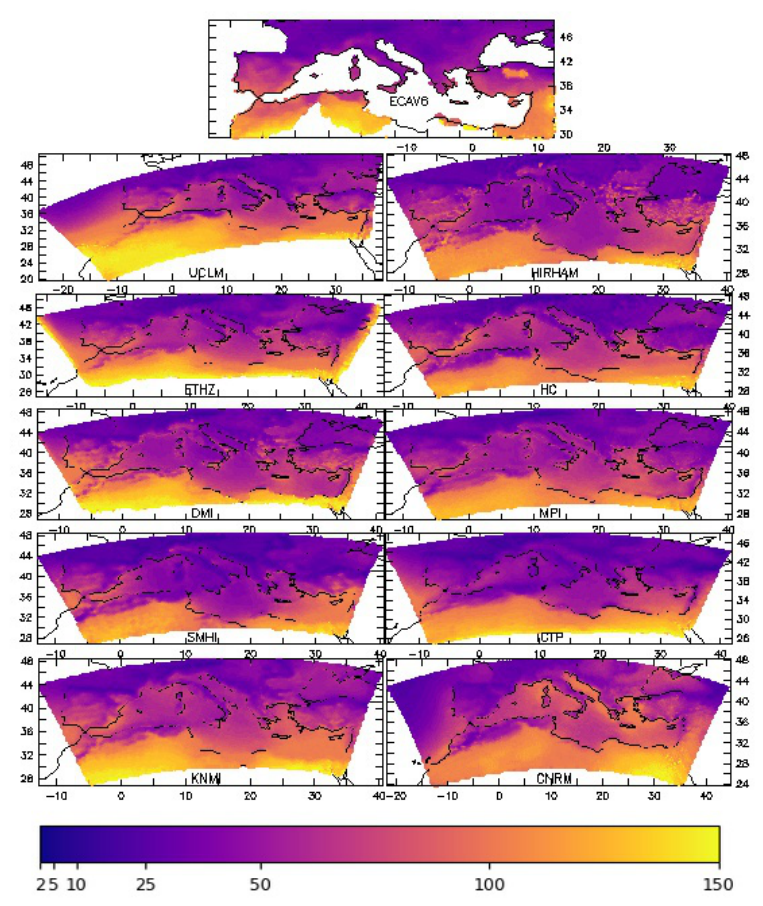
Figure 3.
South America extremes in precipitation (percentage of months where precipitation is smaller than 50 mm/month) from CLARIS-LPB project. Upper row shows CRU and MW observational gridded databases for the 1990-2006 period. Below, the seven RCMs, including PROMES.
Figure 3.
South America extremes in precipitation (percentage of months where precipitation is smaller than 50 mm/month) from CLARIS-LPB project. Upper row shows CRU and MW observational gridded databases for the 1990-2006 period. Below, the seven RCMs, including PROMES.
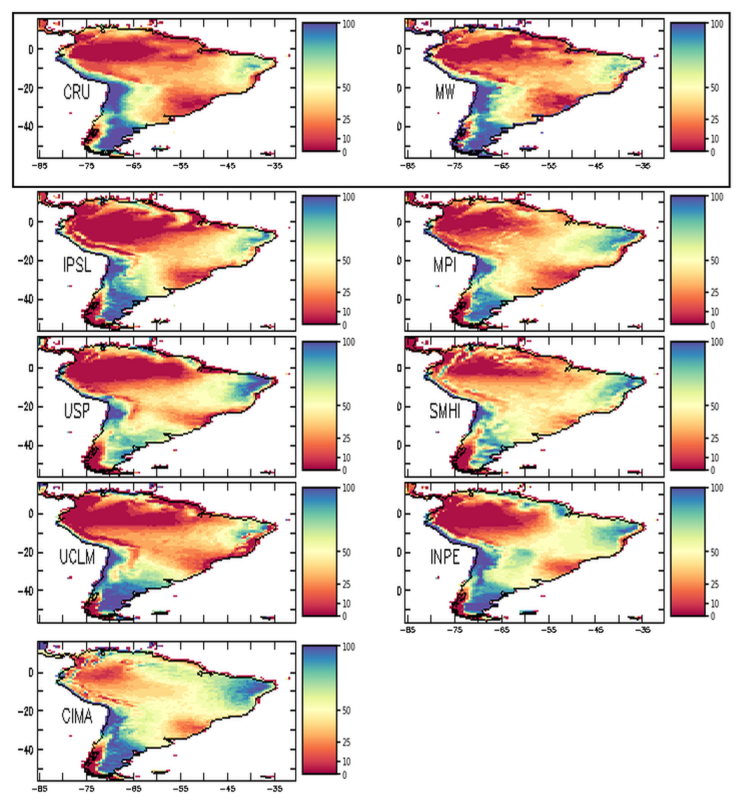
Disclaimer/Publisher’s Note: The statements, opinions and data contained in all publications are solely those of the individual author(s) and contributor(s) and not of MDPI and/or the editor(s). MDPI and/or the editor(s) disclaim responsibility for any injury to people or property resulting from any ideas, methods, instructions or products referred to in the content. |
© 2026 by the authors. Licensee MDPI, Basel, Switzerland. This article is an open access article distributed under the terms and conditions of the Creative Commons Attribution (CC BY) license (http://creativecommons.org/licenses/by/4.0/).
Copyright: This open access article is published under a Creative Commons CC BY 4.0 license, which permit the free download, distribution, and reuse, provided that the author and preprint are cited in any reuse.


