

Submitted:
05 June 2026
Posted:
08 June 2026
You are already at the latest version
Abstract
Railway transport management has changed dramatically over the past 50 years. The advent of computer technology and the capacity for information transmission brought greater safety and the ability to remotely control interlocking devices. These enable the centralisation of railway transport management, leading to higher operational efficiency and reduced staffing costs. At the same time, this technological progress has enabled the development of additional automation functions, which we can abbreviate as ARS (Automated Route Setting). The international designation Automatic Route Setting (ARS) includes actions that enable the automation tool to execute instructions to the signal box without the intervention of operating personnel (the dispatcher). Their importance increases with line speed and the size of the remotely controlled area. Thanks to them, the dispatcher gains time because the ARS can automatically resolve some operational situations or allow the dispatcher to address them in advance, thereby distributing the workload over a wider time window. However, the interlocking system itself remains the primary safety mechanism and will prevent ARS if any element of the infrastructure is occupied. At the same time, it is not possible to automate safety-critical functions that require direct assistance from the operating personnel.
In the article, the authors analysed functions in which ARS is currently widely used. In the next part, we focused on the possible expansion of the palette of these functions that could be included in the ARS regime using multi-criteria analysis. The next step was a safety-critical analysis and determination of the conditions under which they could be included in the ARS regime. The safety-critical functions are left aside. It is assumed that these will still have to be performed by the operator, not by the ARS. Detailed implementations and quantification of their impacts on the dispatcher's activities are then carried out for selected ARS functions.
The last part of the article is a look into the future, because the development in the field of safe communication between the train and the infrastructure (V2I) and the transmission of valid information provides many new challenges not only in the field of ARS itself, but also in the optimisation of the entire process of managing and organising rail transport. If we can use the ARS functions today, it is only a matter of technical development to be able, for example, to guide trains to the exact time when a train route will be built for this train. This will also enable optimising the train's energy consumption and tracking capacity use. The ideal state is when the infrastructure fully communicates with the train in GoA4 mode and optimises both the train's ride and the use of the infrastructure.
Keywords:
automatic route setting
; capacity
; railway interlocking system
; railway safety
1. Introduction
The word automation became a mantra of progress in the twentieth century. In the new millennium, it has largely been replaced by the term digitalisation. When the meanings of these two concepts are combined, they form the basis of a transport-related field commonly known as the Traffic Management System (hereinafter, TMS). There is a substantial body of scientific literature on TMS [1,2]. Some publications take the form of review studies, others focus on case studies, while a smaller number address the fundamental scientific principles underlying TMS [3,4].
From a conceptual perspective, it is essential to develop a detailed description of the TMS architecture so that every component of the system—whether human or technical—has a precise understanding of how information flows within the system, including its origin and destination. In this regard, the authors seek inspiration for their article, as the formal description of interlocking system architecture represents one of the key scientific objectives pursued at our university department.
Scientific development in TMS is inseparably linked to advances in computer and communication technologies. Although this article focuses primarily on railway transport, similar—albeit technically distinct—solutions are also applied in other modes of transport [5,6,7]. The scientific discussion surrounding the concept of Automated Route Setting (hereinafter ARS) dates to the 1990s. During this period, a study [8] was published that summarised the fundamental requirements for a modern safety-critical TMS for railway networks. In this work, ARS was presented as an integral component of TMS, emphasising that automating routine operational functions is a desirable direction for further development in this field. Subsequent research [9] conducted within the EU project SmartRAcon further addressed this issue. The study examined the application of ARS on regional railway lines supported by decentralised control systems, leading to the development of a process map for integrating these functions into the general architecture of interlocking systems.
The culmination of this technological progress is the remote control of railway operations [10]. Nevertheless, the potential of ARS remains far from exhausted. This is evidenced by publication [11], which identifies several potential applications that have not yet been implemented in practice. As demonstrated in this article, there are still numerous opportunities to implement ARS without compromising operational safety. The implementation of ARS functions is not the domain of the developed world; developing countries also use these technological means when modernising their railway networks. Proof of this is the diploma thesis [12], which implements ARS on the newly built connection between Addis Ababa and Djibouti.
Another topic closely related to ARS is the so-called technological triangle, discussed in greater detail in the literature [13,14]. This concept ensures that the approach to solving transport service problems remains genuinely systematic and comprehensive. In addition to timetable design, it is necessary to consider both transport vehicles and TMS infrastructure. The present article builds upon these principles and extends them into the domain of automation.
The ARS also plays a significant role in single-track railway lines. Their modelling was addressed in study [15], upon which this article builds, particularly in relation to ARS implementation. However, the authors of that study did not consider railway lines operated under simplified traffic management conditions without direct TMS supervision. This issue was subsequently addressed by the present author team in publication [16].
Traffic safety represents a fundamental element of railway transport systems, including both high-speed and conventional railways. The issue of enhancing safety on regional networks with decentralised traffic control from the perspective of ARS is discussed in [17]. By incorporating artificial intelligence and machine learning techniques, the proposed system (Autonomous Route Setting) enables dynamic conflict resolution and optimisation of train routing based on infrastructure capacity. Thereby improving the operational efficiency of conventional ARS systems. The implementation of optimisation procedures, real-time rescheduling, and ARS functionality enables reducing train arrival intervals at stations and train-following intervals. Furthermore, eliminating unnecessary braking, stopping, and subsequent acceleration contributes to more efficient utilisation of track capacity, as mentioned in [18]. Another means of effectively utilising capacity is Automatic Train Operation (ATO). Wang et al. (2022) analyse the architecture and functions of ATO relative to the Connected Driver Advisory System (C-DAS) in relation to TMS and recommend applying different levels of ATO (ATO-I, ATO-C, ATO-O1) for routes with different traffic types (freight, high-speed, regional, etc.). As stated in [19], qualified decision-making by dispatchers, even without the application of ARS functions, can contribute to timetable stabilisation in case of emergencies, delays, and other operational disturbances. This subsequently has a significant impact on the effective utilisation of line capacity.
The ARS function is part of the digital environment for railway traffic control. The central element is the TMS, which connects to other systems. An example of such a hardware and network architecture in a remote traffic control environment is presented in [20]. The connection of ARS with systems that guide trains to optimal time positions, and its positive impact on train operations, are described in [21]. According to [22], the resulting optimised train route may, through Automatic Train Operation (hereinafter referred to as ATO), also positively affect railway capacity utilisation. The integration of ATO with other digital railway systems (TMS, ETCS, etc.) is the subject of paper [23].
In the professional lecture [24], it is stated that the ARS function, in cooperation with train guidance to an optimal time position using ATO over ETCS, will enable a reduction in the operating costs of traction vehicles and overhead traction lines. It is also mentioned that these technologies, by eliminating the human factor at infrastructure bottlenecks, can ensure more efficient utilisation of transport route capacity. Likewise, [25] states that railway network capacity can be increased in three ways, including through advanced traffic management systems (by reducing occupation times and rescheduling trains). Conversely, according to [26], one negative influence on railway capacity is human-factor error (train drivers and personnel at the direct level of traffic control). According to [26], the impact of such negative influences on railway capacity can at least be partially mitigated through the introduction of automation tools (ARS, ATO, etc.).
From the perspective of interlocking systems, the tasks associated with automating traffic control may be divided into three fundamental categories and subsequently considered from technical, legal, and ethical perspectives.
The first category comprises tasks that can be automated most readily from technical, legal, and ethical perspectives. These involve the fundamental operational commands used by human dispatchers for traffic management and do not require significant computational power or large volumes of high-quality input data. At the same time, these functions are inherently safe, as the safety of ARS commands is ensured by the interlocking system located beneath the ARS within the control hierarchy, or by another component of the interlocking system operating at the Safety Integrity Level (SIL). Such tasks include strictly following timetable instructions to set train routes, renumbering trains, and rerouting trains to alternative platform edges in the event of disruptions or delays. The degree of automation associated with these functions in conventional ARS systems is already high, and these functions may be regarded as the primary rationale for the existence of ARS.
The second category comprises tasks that are likely to become automatable in the future. From a technical, legal, and ethical perspective, these tasks may still be considered safe operations. In comparison with the tasks included in the first category, however, they require more advanced TMS solutions equipped with higher-quality input data and continuously updated operational information.
This category primarily encompasses a broad range of routes that are currently not commonly automated, namely shunting routes. In such cases, it would be necessary to enrich the TMS’s decision-making algorithms with substantially larger volumes of information. Nevertheless, it may be envisaged that ARS could automatically establish shunting routes for locomotive run-around loops, depot transfers, or sidings movements. To achieve this, the TMS must contain operationally expected train movement data within the track layout, with adequate quality and reliability.
With respect to train routes, this category also includes entering an occupied track to couple with another train. Furthermore, it involves the ability to cancel a previously prepared train route if the TMS determines that another train will ultimately arrive at the relevant location earlier, or if another train has a higher priority. It is therefore more advantageous to allocate the route to that train.
The third category comprises tasks that are currently considered unlikely ever to be fully automated, primarily due to technical constraints, but above all because of ethical and legal issues. These tasks are associated with safety-critical operations in which at least part of the safety responsibility remains with human operators. Once such an operational command has been issued, there is no technical means to identify an incorrect dispatcher action, ideally through functions implemented with a non-zero SIL.
These situations involve decision-making processes in which operators rely not only on deterministically identifiable information but also on information containing a certain degree of uncertainty, while simultaneously applying their professional expertise and practical experience. In such cases, human operators currently make decisions based on information obtained from multiple sources, which may themselves be incomplete, while relying on years of accumulated operational experience. Consequently, full responsibility for these actions lies with the operators themselves. The objective in these circumstances is therefore to enable a mode of operation in which the dispatcher, through personal responsibility, guarantees that no damage or unsafe condition will occur.
2. Materials and Methods
As part of the research supporting decision-making on the automation of new command functions, a questionnaire survey was conducted. In the main section of the survey, respondents were asked to assign weights to the criteria for command automation on a scale of 1 to 10. The resulting criterion weights derived from the survey were subsequently used as input parameters for the weighted sum method.
In addition, the questionnaire included several optional questions aimed at identifying respondents’ attitudes toward the Automatic Route Setting system (ARS), determining whether positive or negative experiences predominated, and exploring where respondents perceived shortcomings in the current ARS configuration.
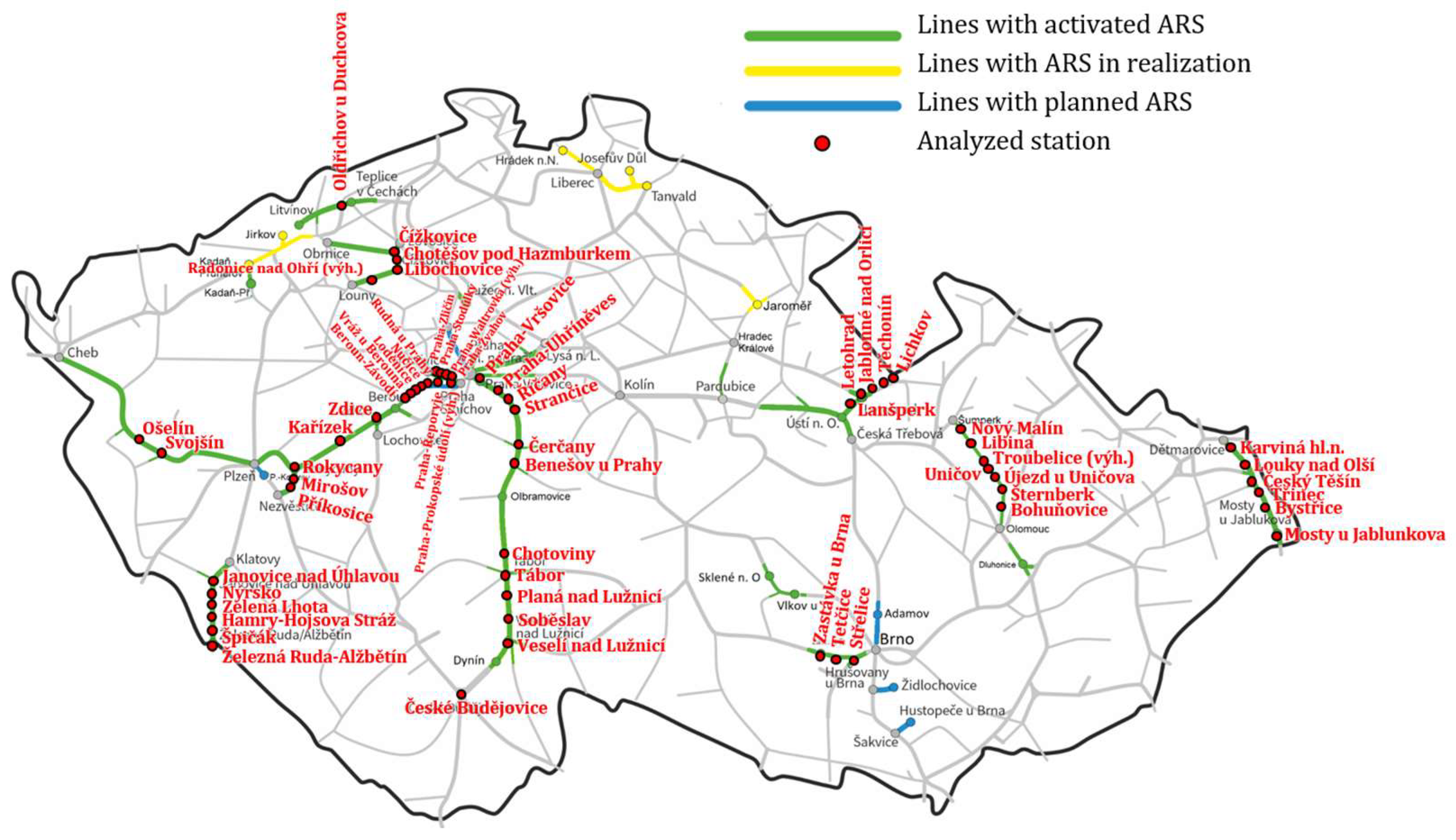
At the same time, an analysis was conducted to determine which operational tasks (i.e., interlocking system functions) constitute standard traffic control procedures, and to examine the current use of ARS in the Czech Republic. The analysis was conducted across 62 railway stations, as shown in Figure 1.
Figure 1.
Map of analysed stations and ARS on Czech Railways.
The outputs of both the questionnaire survey and the conducted analysis were used to construct the initial criteria matrix for the Weighted Sum Approach (WSA) method. Subsequently, the WSA method was applied to select interlocking system functions suitable for automation. Those interlocking system functions exhibiting the highest overall weighted utility were identified as the most appropriate candidates for automation.
The criteria of the WSA method were defined as follows:
- Frequency of use (How frequently is the interlocking system function used during routine traffic control operations?),
- Impact on railway capacity consumption (Does the interlocking system function affect capacity consumption or the smoothness of train movement?),
- Time duration (How long does it take for the interlocking system function to be carried out?),
- Number of operational actions required (How many interactions with the dispatcher control interface (JOP) are typically required for the interlocking system function to be executed?),
- Compatibility with TMS input (Does the Traffic Management System (TMS) support the command format required for input into the interlocking system?),
- Complexity of input data requirements (How much information must be available for the ARS to decide whether to apply the interlocking system function?),
- Degree of automation potential (What proportion of all applications of the interlocking system function can be performed automatically?).
The weights for the WSA method criteria were determined through a questionnaire survey in which each respondent evaluated the proposed criteria on a scale from 1 to 10. The resulting criterion weights are presented in Table 1.
The weight of each criterion was calculated using Formula (1).
where:
vi — weight of the criterion i [-],
bik — point assigned to criteria i by respondent k [-],
I — set of criteria,
K — set of respondents.
Subsequently, the authors identified interlocking system functions that are currently not impeded by automation. This implies that these functions are not yet automated and that no barriers to their automation exist, as noted in the Introduction. The outcome of this step is the following set of interlocking system functions:
- Train Route with an Extended Overlap (VCP),
- Train Route According to Sighting Conditions (VCRP),
- Train Route via Variant Element (VCVP),
- Shunting Route (PC),
- Cancel the Train Route (RC),
- Individual Point Setting (S+/S-),
- Preliminary Level Crossing Closure (PUP),
- Cancel the Preliminary Level Crossing Closure (RPUP),
- Cancel the Expected Departure (PODJ<),
- Start the Train Shunt (PRES>),
- Cancel the Train Shunt (PRES<),
- Cancel the Train Number (ZRUSv),
- Cancel the Request for Directional Control (ZTS<),
- Directional Control (UTS).
The selection of interlocking system functions for automation was carried out following the standard steps of the WSA method. First, all criteria were unified in the direction of maximisation, and the ideal and basal variants were determined. Subsequently, the criteria matrix was normalised, and finally, the overall weighted utility was evaluated for each variant (i.e., each interlocking system function).
The WSA method is used to select interlocking system commands for inclusion in the ARS command group. The objective is to maximise the overall weighted utility derived from the automated execution of the selected commands, according to the defined evaluation criteria.
3. Results
In our research, we initially focused on the issue of direct railway traffic control and the utilisation of interlocking system functions. The study revealed that 53% of all interlocking system operations involve a command to set a train route. All other interlocking system functions account for less than 10% each. The second most frequently used interlocking system function is the entry of the expected departure, which accounts for 9% of all interlocking system operations.
The second phase of the research focused on how frequently already automated commands are executed automatically versus manually. The Edit the Train Number command is most often executed automatically (96% automatically, 4% manually). With a considerable margin, the second-most-automated function is the Expected Departure, which was executed automatically in 53% of occurrences. This is followed by functions: Train Route (automatically in 43% of cases), Request for Directional Control (automatically in 39% of cases), and Train Route with Speed Restriction (automatically in 37% of cases). The function with the lowest proportion of automatic execution is the Preliminary Level Crossing Closure, accounting for 23% of all instances. This distribution is illustrated in Figure 1.
Figure 1.
Chart showing the proportion of automatic and manual command usage.
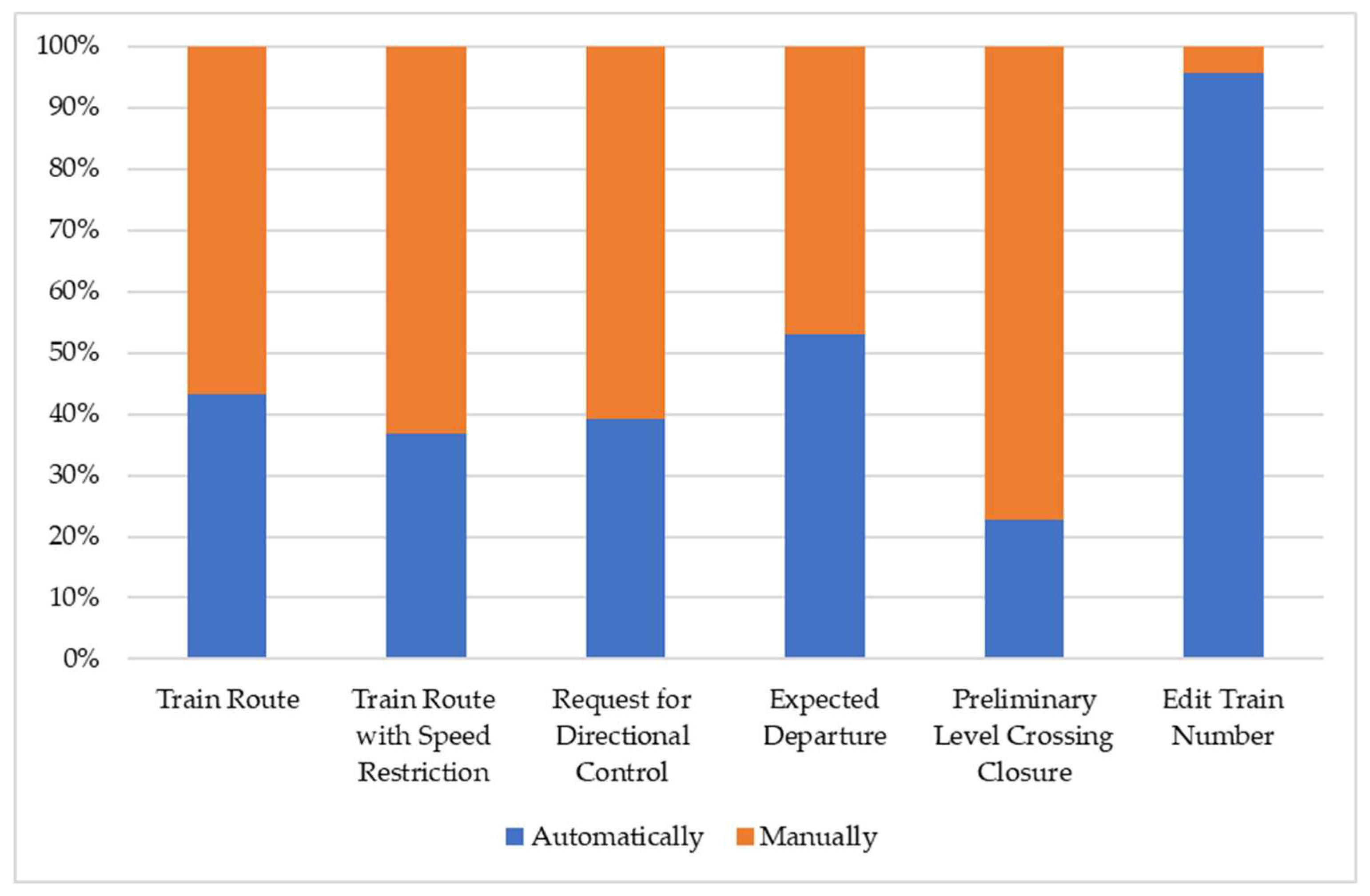
We identify the cause of the significant difference between the automatic execution of the Edit Train Number function (96%) and other automated interlocking system functions (53% or less) as the ability for each dispatcher or traffic controller in the TMS to enable the automatic execution of the Edit Train Number function independently of other ARS functions. This allows the automatic execution of the Edit Train Number command to be enabled while all other ARS functions are disabled, and vice versa. The analysis indicates that users take advantage of this option. The Edit Train Number function is enabled almost continuously and is heavily used during train turnarounds at terminal stations, whereas other ARS functions are sometimes disabled.
The rate at which ARS is enabled or disabled (excluding the Edit Train Number function) depends on several factors. According to [27], higher utilisation of ARS is observed at stations located at the edges of controlled areas, as in these stations, there is a synergy of automation benefits, ensuring the automatic departure of trains from the controlled area through the simultaneous automatic execution of the Expected Departure and Request for Directional Control commands together with the Train Route command. This is also demonstrated by the graph in Figure 1. Since the Expected Departure and Train Route commands are related—being used together for train routes exiting the controlled area—it can be asserted that the 53% value for the automatic execution of the Expected Departure command indicates that 53% of train routes at the exit of the controlled area were set automatically. In contrast, the average automatic utilisation of the Train Route command across all stations is only 43%. This means that at peripheral stations, the proportion of automatic execution of the Train Route command is 10% higher than the average across all stations.
The study of factors influencing the utilisation of ARS used correlation analysis. The analysis revealed that the greatest influence among all examined factors is the distance from the peripheral station (the above-mentioned synergy of automation benefits at the edges of the controlled area). It was observed that the further a station is from the edge of the controlled area, the lower the utilisation of ARS. For the other factors examined, a very weak inverse correlation was observed. The correlation coefficient values are close to zero, indicating that none of the other factors has a significant effect on the utilisation of ARS (see Table 2).
An important influence is each user’s attitude towards ARS, or, more generally, towards modern technologies, as revealed by the questionnaire survey. Two respondents answered “None” to the question, “Which interlocking system function would you prefer to have newly automated or significantly improved compared to the current automation?” They responded, “Automatic Route Setting” or “I don’t know, I do not use it due to its unreliability” to the question, “Which interlocking system function would you under no circumstances want to automate?” A common characteristic of these two respondents is their extensive experience in traffic management, with one indicating 31–40 years and the other 41–50 years in the field.
Functions suitable for automation were selected using the Weighted Sum Approach. First, the initial criteria matrix was established, as presented in Table 3. The input data (numerical values reported in Table 3) were obtained from a questionnaire survey [27] and an analysis of interlocking system archives from 62 stations listed in Figure 1 of this paper. The reported numerical values correspond to the mean values calculated from the 2nd to 8th deciles of the measured data.
After applying the WSA method, overall weighted utilities were determined for each function of the interlocking system. We deliberately do not present the calculation procedure here, as it involves a general application of the WSA method. It is therefore unnecessary to repeat well-known information; we provide Table 4 directly, which contains the results for each function. The functions with the highest overall weighted utility are Individual Point Setting (S+/S-), Preliminary Level Crossing Closure (PUP), and Directional Control (UTS).
An algorithm for the use of the Individual Point Setting and Preliminary Level Crossing Closure functions, which have the highest overall weighted utility, is proposed in the design section of this article. The authors considered automating the Directional Control function, which has the third-highest overall weighted utility. However, it was ultimately concluded that this function is generally not related to route setting, as it is used at the edges of controlled areas to modify track clearance and is not utilised during train route preparation. Therefore, the algorithm for Directional Control would require a separate procedure, entirely independent of the algorithms for Individual Point Setting and Preliminary Level Crossing Closure and is not proposed in this article. Conversely, an algorithm is proposed for the Train Route via Variant Element function, which, while having the fourth-highest overall weighted utility, can, in specific situations, be directly related to the use of Individual Point Setting and Preliminary Level Crossing Closure. The automation of the commands Individual Point Setting, Preliminary Level Crossing Closure, and Train Route via Variant Element can be designed within a single algorithm.
4. Discussion
The integration of new command types into the control system automation algorithms clearly increases the potential to address new traffic situations more effectively or to improve existing solutions.
Once the updated time requirements for setting train routes in specific traffic situations have been addressed, development can proceed in modelling the forward-looking railway traffic plan. Following the integration of new command types—Individual Point Setting, Preliminary Level Crossing Closure, and Train Route via Variant Element function—it is expected that the time required to set train routes will be reduced, as will the technological intervals between train runs. These new time values, incorporated into the forward-looking traffic modelling calculations, will enable the refinement of algorithms for generating the current forward-looking timetable, based on which ARS systems set train routes at more appropriate times, thereby more effectively preventing inaccurately set train routes—either too early or too late. In addition, the dispatcher always has a modified prospective timetable available, based on which they can make higher-quality dispatching decisions, such as changes to the sequence of train runs, overtaking, and so on. At the same time, when planning, they can also consider solutions enabled by the new inclusion of the Individual Point Setting, Preliminary Level Crossing Closure, and Train Route via Variant Element functions in the ARS system.
The updated timetable is also transferred to the connected rail traffic control subsystems:
- The Automatic Train Operation – Track Side (ATO-TS) module of the TMS systems, which generates the timetable for a specific vehicle. The system interfaces comply with TSI standards and are described in Subsets 131 and 132.
- Through the existing GSMR communication network (with FRMCS planned in the future), the current modified forward-looking timetables are transmitted to the target Automatic Train Operation - On Board (ATO-OB) module located on the locomotive. Data transmission is described in Subset 126.
- The target module is the ATO-OB. The locomotive control unit and the ETCS-OB unit, located on the locomotive, receive instructions from the ATO-OB module to optimise their operation based on the current timetable, established train routes, and ETCS braking curve compliance. Data transmission is described in Subsets 130 and 139 and illustrated in Figure 2.
The objective of such optimisation is to guide the train into an optimal time position (time slot), i.e., to ensure that it is at the right place at the right time with an optimal speed profile. This process involves optimising both traction energy consumption and energy dissipated during braking. In practice, a typical application involves guiding trains to capacity-constrained locations, so they pass through these sections at the maximum permissible speed. This approach minimises the consumption of infrastructure capacity while maximising its availability for subsequent train movements. At the same time, it opens a discussion about the use of precise train operation data for continuous, or more frequent, point-based adjustment of the prospective timetable, compared with current practices.
The smoothness of train operation in ATO mode is critically dependent on the quality of input data, represented by an adjusted timetable within TMS systems, implemented through ARS control systems.
Individual point setting is proposed as a command that increases capacity by allowing the ARS to set points that are no longer locked by the previous route into the position used by a subsequent (different) route for the following train. This concerns mainly situations where two train routes, or a train route and a shunting route, conflict. In large stations, one can envisage a reduction in demand on power supply equipment, enabling many points to be repositioned over a long period. Points can be gradually moved at a time when the conditions for locking the subsequent train route are not yet fulfilled, already during the run of the preceding train. In such a case, it is not necessary to wait until the train has cleared the first track section before the points for the next route start to move. In the case of point presetting, one can imagine that, given the length of such a section, all points could already be in the correct position as soon as the first train leaves the first track section. From the interlocking system perspective, it is possible to safely move a point immediately after the route is locked, as it has been released. The points are then prepared in the required positions for the subsequent train route, so that the route can be set up more quickly once the remaining conditions for its establishment are met.
The function of preliminary level crossing closure is already used in some ARS systems. The occupation of the track section of the crossing controls any closure of a level crossing. Therefore, the interlocking will not permit any operation with the level crossing that would compromise operational safety. The automation of this command can thus be considered safe.
A train route via a divergent (alternative) point is usually set up when a section of the infrastructure is unavailable, whether due to routine maintenance, a train occupying the line, or a failure of infrastructure components at that location. Any train route that the interlocking permits to be set must fulfil all conditions for train route establishment. Therefore, even if from the traffic management perspective, the route will be longer or will include different elements than would be present in the case of the shortest possible route, from the interlocking system perspective, this is an action of the first group, where safety is not endangered, since this safety level is ensured by a fully functioning interlocking.
5. Conclusions
The use of automation functions in routine operations has been common practice for more than a quarter of a century. The desired benefits from the perspective of the infrastructure manager, namely, must always accompany the expansion of their application:
- increased utilisation of capacity,
- shortening of operational intervals,
- reduction of the workload of operational staff.
Conversely, it is entirely unacceptable for such implementation to have any adverse impact on railway safety. In such cases, safety must take absolute priority. At the same time, this creates opportunities for further technological development that may enable such implementations in the future.
However, human operators are susceptible to error in the same manner as machines. If it becomes legally acceptable for machines to operate road vehicles autonomously, including the associated ethical implications in the event of accidents—as is already the case in several countries worldwide—it cannot presently be excluded that, in the future, machines may also assume such tasks within railway operations. Although these tasks may not be based entirely on deterministic data, automated systems could statistically achieve a lower failure rate than human operators. In a less advanced scenario, it may at least be envisaged that machines would perform an advisory role during operational disruptions or emergencies, if this statistically increases operational safety under those conditions.
Systems of this type may still exhibit higher failure rates than current safety-critical control systems implementing functions with the required SIL. Nevertheless, during extraordinary operational situations, stressed or overworked dispatchers may commit errors at a significantly higher rate than automated systems. The implementation of these functions, however, cannot be achieved solely through technological development. As in the automotive sector, it would also require corresponding changes in legislation, together with a redistribution of responsibility among the individual actors within the system. Such a development can no longer be excluded today.
Author Contributions
Conceptualisation, P.N. and P.K.; methodology, P.N. and M.Š.; software, P.K.; validation, T.S. and P.N.; formal analysis, J.M., P.N. and P.K.; investigation, T.S. and P.K.; resources, P.N. and P.K.; data curation, M.Š.; writing—original draft preparation, P.N.; writing—review and editing, J.M. and M.Š.; visualisation, P.K. and M.Š; supervision, J.M. and P.N.; project administration, P.N.; funding acquisition, P.N.; All authors have read and agreed to the published version of the manuscript.
Funding
The article is also supported by the “Cooperation in Applied Research between the University of Pardubice and companies in the Field of Positioning, Detection and Simulation Technology for Transport Systems (PosiTrans)” project, registration No.: CZ.02.1.01/0.0/0.0/17_049/0008394.
Institutional Review Board Statement
Not applicable.
Informed Consent Statement
Not applicable.
Data Availability Statement
The original contributions presented in this study are included in the article/Supplementary Material. Further inquiries can be directed to the corresponding author.
Conflicts of Interest
The authors declare that they have no conflicts of interest. The funders had no role in the design of the study, in the collection, analysis, or interpretation of data, in the writing of the manuscript, or in the decision to publish the results.
| 1 | ATO-I: ATO-Intermediate, ATO-C: ATO-Central , ATO-O: ATO-Onboard |
References
- Souza, A.M.; Brennard, C.; Villas, L.A. Traffic management systems: A classification, review, challenges, and future perspectives. Int. J. Distrib. Sens. Netw. 2017. [Google Scholar] [CrossRef]
- Nellore, K.; Hancke, G.P. A Survey on Urban Traffic Management System Using Wireless Sensor Networks. Sensors 2016, 16, 157. [Google Scholar] [CrossRef] [PubMed]
- Avatefipour, O.; Sandry, F. Traffic Management System Using IoT Technology - A Comparative Review. In IEEE International Conference on Electro/Information Technology (EIT); IEEE: Rochester, 2018; ISBN 978-1-5386-5398-2. [Google Scholar]
- Davitaia, A. Optimizing Real-Time Traffic Management Using Java-Based Computational Strategies and Evaluation Models. SSRN, 2025.
- Zhang, N.; He, F.; Chang, L.; Zong, J. A TSS-Compliant Ship Automatic Route-Planning Algorithm. Algorithms 2026, 19, 220. [Google Scholar] [CrossRef]
- Vivaldini, K.C.T.; col. Automatic Routing System for Intelligent Warehouses. 2010 IEEE International Conference on Robotics and Automation, International workshop on Robotics and Intelligent Transportation System; Anchorage, 2023. [Google Scholar]
- Chou, Y.H. Automatic bus routing and passenger geocoding with a geographic information system; IEEE: Seattle, WA, 1995; ISBN 0-7803-2587-7. [Google Scholar]
- Kuhn, M. Automatic route setting integrated in a modern traffic management system. In International Conference on Developments in Mass Transit Systems Conf; IEEE: London, 1998; pp. 140–145. ISBN 0-85296-703-9. [Google Scholar]
- Lamm, A.; Ayuso, F. P.; Serrano; P, D. SRC6SS Proceedings. Electronic Library. [Online] 2024. Available online: https://elib.dlr.de/212744/1/AnRS.pdf.
- Křižan, L. Přínosy dálkového řízení na trati Staré Město u Uherského Hradiště – Přerov; Univerzita Pardubice: Pardubice, 2022; Vol. bachelor work. [Google Scholar]
- Collective of authors. Computers in Railways XIV; WIT Press, 2014; ISBN 978-1-84564-766-7. [Google Scholar]
- Ahmed, M.S. Automatic Route Setting and Dynamic Rescheduling Following Disturbance; Addis Ababa University: Addis Ababa, 2018. [Google Scholar]
- Nachtigall, P.; Vyhnanovský, M.; Křižan, L.; Široký, J.; Gašparík, J. Technological Triangle—Making Public Transport Sustainable and More Accessible. Sustainability 2026, 18, 670. [Google Scholar] [CrossRef]
- Čížek, J. Hodnocení Variantních Bezbariérových Řešení Železničních Stanic na Regionálních Tratích. Výzkumný ústav železniční. 2024. [Google Scholar]
- Ricci, S.; Ľupták, V.; Chovancová, M. Baseline Model to Increase Railway Infrastructure Capacity on a Single-Track Section: a Case Study. LOGI – Sci. J. Transp. Logist. 2017, 8, 69–80. [Google Scholar] [CrossRef]
- Široký, J.; Nachtigall, P.; Tischer, E.; Gašparík, J. Simulation of railway lines with a simplified interlocking system. Sustainability 2021, 13, 1394. [Google Scholar] [CrossRef]
- Lamm, A.; Parrilla, A.F.; Paula, D.S. Increase Safety in Regional Networks with Decentralization-The Autonomous Route Setting Approach; SmartRaCon Scientific Seminar, 2024; Vol. 6. [Google Scholar]
- Wu, W.; et al. An integrated method for reducing arrival interval by optimizing train operation and route setting. Mathematics 2023, 11, 4287. [Google Scholar] [CrossRef]
- Bulíček, J. Cancellation of Delayed Trains: Passengers’ and Capacity Points of View. In MATEC Web of Conferences; EDP Science, 2018; Vol. 235, pp. 1–22. [Google Scholar]
- Kršák, E.; Bachratý, H.; Polach, V. GTN - Information System Supporting the Dispatcher and Remote Tracks Control. Commun.-Sci. Lett. Univ. Žilina 2010, 12, 65–74. [Google Scholar] [CrossRef]
- Quaglietta, E.; Pellegrini, P.; Goverde, R. M. P.; Albrecht, T.; Jaekel, B. The ON-TIME real-time railway traffic management framework: a proof-of-concept using a scalable standardised data communication architecture. Transp. Res. Part C Emerg. Technol. 2016, 63, 23–50. [Google Scholar] [CrossRef]
- Wang, Z.; Quaglietta, E.; Bartholomeus, M. G. P.; Goverde, R. M. P. Assessment of architectures for automatic train operation driving functions. J. Rail Transp. Plan. Manag. 2022, 24, 100352. [Google Scholar] [CrossRef]
- Ďuračík, M.; Kršák, E.; Meško, M.; Ružbarský, J. Software architecture of Automatic Train Operation. In IEEE 15th International Scientific Conference on Informatics; IEEE: Poprad, 2019; p. 4. [Google Scholar]
- Chrdle, Z. Moderní trendy a rozvoj technologií v železniční dopravě; Vyhne, 2023; 17. Mezinárodná konferencia železničnej oznamovacej a zabezpečovacej techniky; pp. 1–29. [Google Scholar]
- Lüthi, M.; Nash, A.; Weidmann, U.; Laube, F. B.; Wüst, R. Increasing Railway Capacity and Reliability through Integrated Real-Time Rescheduling. In 11th World Conference on Transport Research; Institute for Transport Planning and Systems, ETH Zürich: Berkley, USA, 2007. [Google Scholar]
- Lövétei, I.; Kövári, B.; Bécsi, T.; Aradi, S. Environment representations of railway infrastructure for reinforcement learning-based traffic control. Appl. Sci. 2022, 12, 4465. [Google Scholar] [CrossRef]
- Kučera, P.; Šturma, M. The Influence of Auxiliary Commands on the Use of the Automatic Route Setting Function. 4; MiS Publishing: Brno, 2025; New Railway Technology; ISSN 1210-3942. [Google Scholar]
Figure 2.
Interface diagram ATO over ETCS.
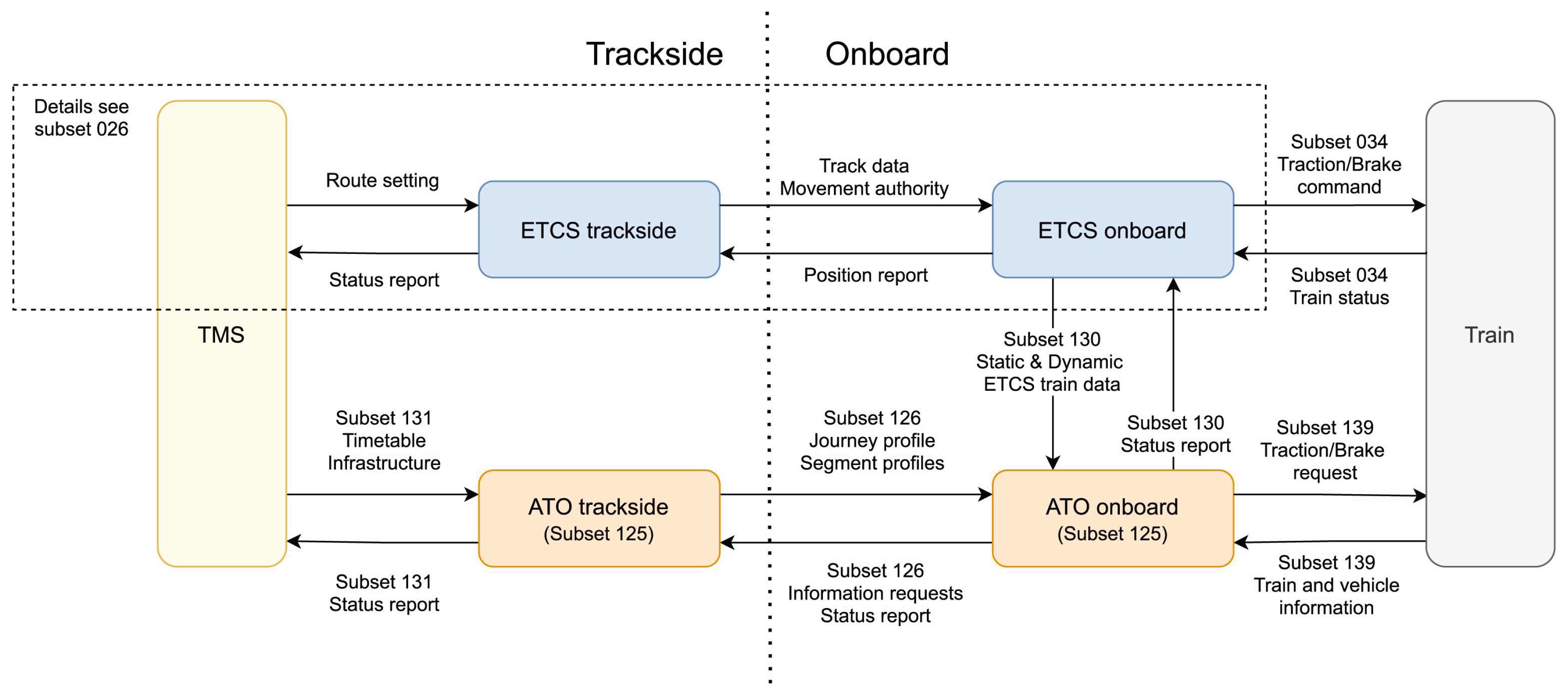

Table 1.
Criterion weights.
| Criterion | Average mark | Total sum | Weight of the criterion |
|---|---|---|---|
| Frequency of use | 7.87 | 417.00 | 0.1657 |
| Impact on the capacity consumption | 8.19 | 434.00 | 0.1725 |
| Time duration | 7.60 | 403.00 | 0.1602 |
| Number of operation actions required | 7.64 | 405.00 | 0.1610 |
| Compatibility with TMS input | 5.38 | 285.00 | 0.1133 |
| Complexity of input data requirements | 5.28 | 280.00 | 0.1113 |
| Degree of automation enhancement | 5.51 | 292.00 | 0.1161 |
Table 2.
Values of the correlation coefficient and coefficient of determination for the impact of research factors on the use of ARS.
Table 2.
Values of the correlation coefficient and coefficient of determination for the impact of research factors on the use of ARS.
| Research factor | Correlation coefficient | Determination coefficient |
|---|---|---|
| distance from the peripheral station | − 0.66 | 0.43 |
| number of station tracks | − 0.33 | 0.11 |
| number of line track outlets | − 0.43 | 0.19 |
| number of directions outlets | − 0.53 | 0.28 |
| total number of tracks (station and line tracks) | − 0.39 | 0.15 |
| day traffic intensity | − 0.21 | 0.04 |
| number of train turnrounds per day | − 0.16 | 0.03 |
| number of train turnrounds per one train route | − 0.13 | 0.02 |
| number expected departures per day | − 0.17 | 0.03 |
| number of expected departures per one train route | − 0.10 | 0.01 |
| number of requests for directional control per day | − 0.16 | 0.03 |
| number of requests for directional control per one train route | 0.12 | 0.01 |
| share of shunting during a day | − 0.38 | 0.15 |
| share of shunting per one train route | − 0.32 | 0.10 |
Table 3.
Initial criteria matrix of the WSA method.
| Interlocking system function | Frequency of use |
Impact on the capacity consumption | Time duration | Number of operation actions required | Compatibility with TMS input | Complexity of input data requirements | Degree of automation enhancement |
|---|---|---|---|---|---|---|---|
| VCP | 0.00 | 1.00 | 4.00 | 4.00 | 0.00 | 4.00 | 1.00 |
| VCRP | 0.81 | 0.00 | 4.00 | 9.00 | 0.00 | 6.00 | 0.80 |
| VCVP | 0.10 | 1.00 | 4.00 | 4.00 | 0.00 | 4.00 | 1.00 |
| PC | 26.57 | 0.00 | 4.00 | 2.00 | 0.00 | 2.00 | 0.10 |
| RC | 2.75 | 0.00 | 2.00 | 3.00 | 1.00 | 3.00 | 0.10 |
| S+/S- | 22.29 | 1.00 | 9.00 | 3.00 | 1.00 | 4.00 | 0.90 |
| PUP | 8.57 | 1.00 | 32.84 | 3.00 | 1.00 | 4.00 | 0.50 |
| RPUP | 0.11 | 0.00 | 2.00 | 8.00 | 1.00 | 3.00 | 0.50 |
| PODJ< | 0.27 | 0.00 | 2.00 | 2.00 | 1.00 | 2.00 | 0.10 |
| PRES> | 0.26 | 0.00 | 2.00 | 3.00 | 0.00 | 2.00 | 0.50 |
| PRES< | 0.02 | 0.00 | 2.00 | 2.00 | 0.00 | 2.00 | 0.50 |
| ZRUSv | 4.04 | 0.00 | 2.00 | 4.00 | 1.00 | 3.00 | 0.90 |
| ZTS< | 14.14 | 0.00 | 2.00 | 3.00 | 0.00 | 2.00 | 0.10 |
| UTS | 15.72 | 1.00 | 2.00 | 3.00 | 0.00 | 2.00 | 1.00 |
Table 4.
Results of the Weighted Sum Approach (WSA).
| Interlocking system function | Shortcut | Overall weighted utility |
|---|---|---|
| Individual Point Setting | (S+/S-) | 0.6430 |
| Preliminary Level Crossing Closure | (PUP) | 0.6296 |
| Directional Control | (UTS) | 0.5209 |
| Train Route via Variant Element | (VCVP) | 0.4012 |
| Train Route with an Extended Overlap | (VCP) | 0.4006 |
| Cancel the Preliminary Level Crossing Closure | (RPUP) | 0.3870 |
| Cancel the Train Number | (ZRUSv) | 0.3711 |
| Shunting Route | (PC) | 0.2874 |
| Train Route According to Sighting Conditions | (VCRP) | 0.2667 |
| Cancel the Train Route | (RC) | 0.2369 |
| Cancel the Expected Departure | (PODJ<) | 0.2262 |
| Cancel the Request for Directional Control | (ZTS<) | 0.2225 |
| Start the Train Shunt | (PRES>) | 0.1875 |
| Cancel the Train Shunt | (PRES<) | 0.1630 |
Disclaimer/Publisher’s Note: The statements, opinions and data contained in all publications are solely those of the individual author(s) and contributor(s) and not of MDPI and/or the editor(s). MDPI and/or the editor(s) disclaim responsibility for any injury to people or property resulting from any ideas, methods, instructions or products referred to in the content. |
© 2026 by the authors. Licensee MDPI, Basel, Switzerland. This article is an open access article distributed under the terms and conditions of the Creative Commons Attribution (CC BY) license (http://creativecommons.org/licenses/by/4.0/).
Copyright: This open access article is published under a Creative Commons CC BY 4.0 license, which permit the free download, distribution, and reuse, provided that the author and preprint are cited in any reuse.


