

Submitted:
06 June 2026
Posted:
08 June 2026
You are already at the latest version
Abstract
Investigating the suitability of land resources for different irrigation methods is increasingly becoming vital with increasing demand for food and fiber, which in turn require improved land productivity and efficient use of available water resource for irrigation development. This is because land evaluation is crucial for proper land use planning and management. Among the different methods for land suitability analysis for irrigation methods; parametric method has been become popular the recent years. In this study, GIS based land suitability mapping employing parametric method was used to assess land suitability for different irrigation methods in South Australia. The suitability analysis were carried out for three major irrigation methods, the surface irrigation, sprinkler irrigation methods, and drip irrigation methods. The result shows that South Australia has limited land resources that is highly suitable for any of the irrigation methods. Significant size of agricultural lands of the state is moderately and marginally suitable for drip and sprinkler methods. Therefore, giving priority for drip irrigation methods is crucial not only to allocate land resources properly but also to adopt to water scarcity condition in the region. It is recommended that policy makers, planners, researchers, and land owners to use the results of this land suitability study as reference for land use planning, land resource management, and irrigation development.
Keywords:
GIS
; irrigation method
; parametric method
; suitability mapping
; South Australia
Introduction
Land suitability is a part of land evaluation to examine whether unit of land under consideration is fit for particular purpose or not. According to FAO (1990) land suitability is a process of matching the qualities of unit of land with requirement for a particular form of land use. The process of land suitability study may involve a number of activities –defining the land use requirement in one side, and determining characteristics and qualities of units of land in the other side, and finally matching the requirement with the quality of land units (FAO 1983; saremi et al. 2011). Ultimately, land will be classified or re-classified so as to allocate or reallocate for a particular use to achieve physical conservation of land resources, economic, or socio-political goals (FAO 1983; Yan-Su et al. 2006).
Land suitability studies can be conducted in different ways and for different purposes. In fact, the types land features or attributes to be studied, the scale of study, techniques, tools and procedures to be used would vary from study to study. However, majority of land suitability studies are related to features such as Soils Climate, hydrology, topography, Composite environmental, and Socio-economic data related to land units at different scales (Yan-Su et al. 2006). The history of land suitability studies show that techniques and tools in land suitability studies have been consistently and significantly being changed. From late 19 th to early 20 th century, hand drawn overlay techniques have been used. Later, ‘advanced’ overlay techniques of superimposing different transparent paper maps to trace suitability areas have been employed. These techniques have, then been replaced with ‘modern overlay’ techniques in which computers have replaced manual overlay operations. Finally, at this age GIS based land suitability mapping have taken the lion share of mapping activities (Malczewski 2004).
Technical procedures behind the mapping techniques to identify the suitable sites have also been varied with in a different as well as in similar areas of studies. But, the focus in here is on land suitability studies in agriculture, in general, and irrigation development, in particular. In crop production, identifying suitable geographic and climatic locations, agro-climatic zones of crops have been the major priority in land suability studies in different countries.
GIS based Suitability for a number of crops maps have been conducted in different countries especially starting from early 2000. Some of them are by Kalogirou (2002) in UK, for general cultivation and five specific crops (wheat, barley, maize, seed cotton, sugar beet), by Saremi et al. (2011) in Iran for three major crops and apple, by Mendas & Delali (2012) in Algeria for durum wheat, by Rabia (2012) in Ethiopia for Teff, maize, and wheat , by Deng et al. (2014) in north china for Alfa Alfa, and recently by Abraham et al. (2015) in Ethiopia for vegetable crops. Majority of these studies were made based on parametric land evaluation methods described by Syset al. (1991). Parametric evaluation uses land capability index calculated for particular unit of land based on ratings to land attributes such as soil texture, slope of land surface, soil depth, soil calcium carbonate content, soil electric conductivity, soil stoniness, and drainage properties. In fact, it is one of the physical land evaluation methods described by FAO in 1983 as algebraic combinations of land quality ratings. The others being the maximum Limitation method and Ad-hoc combination of land quality ratings (FAO 1983). Maximum limitation method is used for suitability assessment based on single critically important factor related to quality of unit of land. This method is most often used to exclude a particular land unit from evaluation because of critical issues.
While Ad-hoc combination method uses a decision rule flexible with situations based on subjective assessment of the assessor (FAO 1990). Similar to crop suitability studies, parametric method is widely used in suitability studies for different irrigation methods. However, the rating scales and some of the parameters are not similar to crop suitability studies. A number of papers have been published in GIS base land suitability mapping for irrigation methods from different parts of the world. Some of them are Briza et al. (2001) in Morocco, Bienvenue et al. (2003) in Senegal, Mbodj et al. (2004) in Tunisian, Barberis & Minelli (2005) in china, and Dengiz (2006) in Turkey (drip & surface) for drip and surface irrigation methods and Ayalew (2014) in Ethiopia for sprinklers and surface irrigation, and Albaji et al. (2013) in Iran for surface, sprinklers, and drip irrigation methods. All of these studies were based on parametric methods with no or little modification. Thus, it can be understood that the GIS based parametric land suitability map is most popular and highly acceptable method to the scientific community for at least last decade.
Identifying Land suitability for particular use is crucial step for proper land use planning and management. The available land resource a country could have can only be allocated or reallocated if the potential of land resource is well identified. With growing demand for food and fibre globally, efficient and effective expansion of irrigated farms over land resources is increasingly becoming very important especially for country like Australia which exports more than 65% its agricultural products produced in water scare conditions. Despite the fact that Australian agriculture is identified as one of the leading agricultural industry globally, irrigation has not been given sufficient attention (Future water 2015). Looking at the unreplaceable role of irrigation in Australian agriculture, a number of land suitability studies for different irrigation methods might be expected to have already been conducted. However, no relevant published materials have been available. Any ways, this study is aimed at applying GIS land suitability study for different irrigation methods, in addition to giving some insight for land owners, land planners, and policy makers. To this end, popular GIS based land suitability analysis for irrigation methods has been identified through literature review. It was found that parametric method is most popular Method being used in integration with GIS. Parametric method or Ccapability index is an overall physical evaluation of land units in terms of land physical parameters such as soil texture, soil depth, soil drainage properties, land slope, soil salt and calcium carbon content (FAO 1983, Albaji et al. 2013).So the results from such evaluation can be used for longer time because the physical land attributes are relatively permanent features of the land for longer period (FAO 1983). Parametric method integrated with GIS is becoming the most popular in recent years. The objective of this study was, thus, to develop GIS based land suitability maps for South Australia for different irrigation method using parametric method. For this end, the Soil and land scape map units (LANSLU) spatial data from South Australia water, environment, and natural resources have been used among some other land uses and elevation spatial data. It was identified that South Australia has extremely limited land resources that is highly suitable to any of the irrigation methods while some meaningful potentials for drip and sprinklers irrigation at different degree of suitability, from moderately to marginally suitable.
Materials and Methods
Description of the Study Area
South Australia is widely reported as the driest region of the in the driest continent - Australia. The state covers 98,437,700 hectares. However, all agricultural districts of South Australia are contained by southern region of South Australia (SA water, environment, and natural resources 2002). Thus, the study area is limited to southern regions of South Australia which covers around 7.3 million hectares. The study area is shown in Figure 1.
Data and Methods
Data File Acquisition
In order to carry out suitability analysis, four major spatial data sets were acquired from different sources. The first spatial data set is related to land characteristics. The GIS spatial data named ‘Land and Soil Spatial Data’ of South Australia was collected from Department Environment, Water, and Natural Resource, Government of South Australia. This data set is composed of feature class data for land and soil attributes. The data covers more than 40 land and soil attributes for the whole agricultural districts of South Australia. In the dataset, those 40 attributes of landscape and soil features are indicated for respective mapping units called soil landscape map unit (known by the acronym ‘LANSLU’ in South Australia). The data set is generated at 1:50, 000 scale. The second set of spatial data is general land use feature GIS data set for South Australia. This data was downloaded from https://data.sa.gov.au/data/dataset. The third dataset is digital elevation data (DEM) which was downloaded from ArcGIS online. DEM file of 100m by 100m resolution was obtained and used. The last data set is the shape file of South Australia territory, available from https://data.sa.gov.au/data/dataset.
Data File Preparation
All the data set were checked for coordinate and projections, and converted to the same coordinate system, GDA projections. Then, data sets were adjusted to suit further analysis.
Agricultural Land Use Feature Class
The agricultural land use feature class was created from general land use shape files, by attribute selection and exporting the data as feature classes. The generated shape file was used to delineate the land under agricultural land uses.
Slope Raster
The DEM data obtained for entire Australia was masked by shape file of South Australia territory in order to adjust it for the South Australia. Slope raster was generated from DEM files using DEM to Raster tool and slope (spatial analysis) tools. Then, the slope raster was converted to point feature using raster to point tool. The field values were re-classified for values corresponding to the three irrigation methods. Accordingly, totally 3 feature class files were generated. Then, the point feature classes were returned back to raster format using point to raster tool for further analysis. The rating scale assigned for field values for respective attributes and irrigation method are shown in annex Table 1, Table 2, Table 3, Table 4, Table 5 and Table 6.
Land attribute raster
Feature classes files were generated from land characteristics data set for five land attributes: soil texture, soil depth, soil salt, drainage properties, and calcium carbonate. Then, the field values of each feature classes in the attribute table were re-classified by assigning rating scales for corresponding irrigation methods. Accordingly, 3 feature class files were generated for each soil attributes (total of 3* 5=15 files). The files were then converted to raster format for further analysis. The rating scale assigned for field values for respective attributes and irrigation method are shown in annex Tables 1-6.
Spatial Analysis and Mapping
To facilitate analysis, data base for each irrigation methods were created, each containing five raster files for land attributes, one slope raster file, and one agricultural land use file. Then, raster calculator was used to generate rasters for overall scoring-capability index files for each suitability classes and for respective irrigation method. The non-agricultural land uses were excluded from the maps. Finally, the individual suitability map of each classes were joined in to a single map for respective irrigation method.
Suitability Analysis Method and Suitability Classes
GIS based suitability analysis for irrigation purposes is dominantly based on parametric method, which involves calculation of Suitability /capability index. According to Albaji et al. (2013), the land capability index can be calculated by
Ci= A* (B/100)*(C/100)*(D/100)*(E/100)*(F/100)
where A, B, C, D, E, and F are soil texture rating, soil depth rating, calcium carbonate content rating, electrical conductivity rating, drainage rating and slope rating, respectively. The tables for rating scales are provided in the annex Tables 1-6. The most widely used suitability classes are highly suitable (denoted as S1), moderately suitable (S2), marginally suitable (S3) and currently unsuitable (N1) and permanently unsuitable (N2) based on suitability index as described in annex Table 7.
In this study, the suitability analysis were carried for three irrigation methods- surface, sprinkler, and drip irrigation.
Results and Discussions
Suitability for Surface Irrigation Method
The suitability analysis for surface irrigations shows no Soil land scape map units (LANSLU) in agricultural districts of South Australia is highly suitable for surface irrigation. However, the region consists of moderately and marginally suitable land units of around 48,355 and 95, 0758 hectares, respectively. While estimates of 376, 3016 and 2,618,079 hectares of land within the agricultural district are currently and permanently unsuitable for surface irrigation, respectively.
As it can be seen in the suitability map for surface irrigation in Figure 2, majority, around 86% of the land is currently or permanently unsuitable for surface irrigation.
Suitability for Sprinkler Irrigation Method
The suitability analysis for sprinkler irrigation shows no Soil land scape map units (LANSLU) in agricultural districts of South Australia is highly suitable for surface irrigation. However, the region consists of moderately and marginally suitable land units of around 17, 1845 and 3,638,350 hectares, respectively.
While estimates of 2,396,104 and 1,135,748 hectares of land within agricultural district are currently and permanently unsuitable for sprinkler irrigation method, respectively. As it can be seen in the suitability map for sprinkler irrigation method in Figure 3, around 52% of the land is suitable for sprinkler irrigation methods, at different levels. This shows sprinkler irrigation method has by far more suitable for South Australia than surface irrigation method. Sprinkler irrigation method has higher water efficiency than surface irrigation, so it will be suitable to water scare fresh resources in South Australia as well, owing to the fat that the state is the driest in the direst continent.
Suitability for Drip Irrigation Method
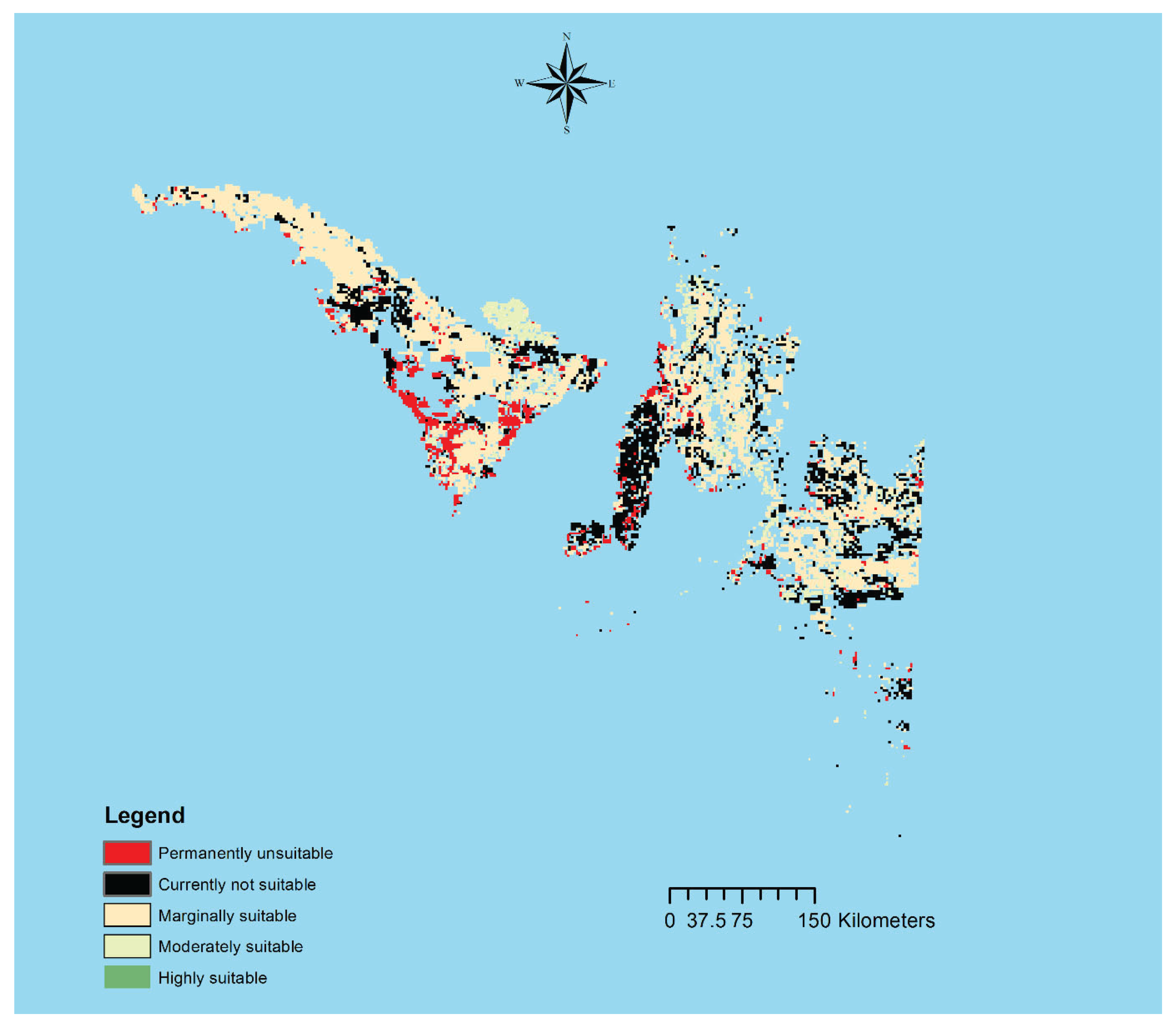
The suitability analysis for drip irrigation shows the Soil land scape map units (LANSLU) in agricultural districts of South Australia is consists of all suitability classes for drip irrigation. The region consists of 1,908, 707,283 and 4,036,982 hectares of land which are highly, moderately, and marginally suitable, respectively. Still the area highly suitable is insignificant as compared to the size of the total area, around 7,300,000 hectares.
While estimates of 1,951,132 and 615,562 hectares of land within agricultural districts are currently and permanently unsuitable for drip irrigation method, respectively. As it can be seen in the suitability map for drip irrigation method in Figure 4, around 65% of the land is suitable for drip irrigation methods, at different levels. This makes drip irrigation method the most important for South Australia added to the fact that drip irrigation is the extremely adaptive to water scare condition such as in South Australia.
Conclusions and Recommendations
It is evident that most of the land mapping units (LMUs) in agricultural districts of South Australia are dominantly unsuitable for surface irrigation method. While there is meaningful size of land suitable for sprinkler irrigation method. The largest portion of land in agricultural district is highly suitable for drip irrigation method. Drip irrigation is highly recommended as priority irrigation method not only for the highest land suitability but also for extremely highest water efficiency which makes it more suitable for the driest state in the driest continent. It is recommended to refer to the maps provided to identify the suitability classes for particular land units for each irrigation method. For practical purpose, the particular or detail description of each land suitability classes, major limitations and the corresponding land management required well documented in FAO publications can be referred.
Funding Statement
No government or private funding support was available for this research.
Acknowledgements
All sources of spatial data cited in the body are acknowledged for making the data freely available.
Conflicts of Interest
There is no conflict of interest with regard to publication of this research manuscript
References
- Albaji, M.; Golabi, M.; Boroomand, N.S.; Zadeh, F.N. ‘Investigation of surface, sprinkler and drip irrigation methods based on the parametric evaluation approach in Jaizan Plain’. J. Saudi Soc. Agric. Sci. 2015, 14(1), 1–10. [Google Scholar] [CrossRef]
- Ayalew, G. ‘Land Suitability Evaluation for surface and sprinkler irrigation Using Geographical Information System (GIS) in Guang Watershed, Highlands of Ethiopia’. J. Environ. Earth Sci. 2014, 4(22), 140–149. [Google Scholar]
- Bandyopadhyay, S.; Jaiswal, R.K.; Hegde, V.S.; Jayaraman, V. ‘Assessment of land suitability potentials for agriculture using a remote sensing and GIS based approach’. Int. J. Remote Sens. 2009, 30(no. 4), 879–895. [Google Scholar] [CrossRef]
- FAO. Guidelines: Land evaluation for rainfed agriculture; FAO Soils Bulletin 52, Italy: Rome, 1983. [Google Scholar]
- FAO. Guidelines: Land evaluation for irrigated agriculture. FAO Soils Bull. 1985, 55. [Google Scholar]
- FAO. Land evaluation for development; FAO, Italy: Rome, 1990. [Google Scholar]
- Future water, 2015, Irrigation, Australian Water Management Yearbook. Available online: http://irrigation.org.au/wp-content/uploads/2015/05/Pages-from-2165_Future-Water-2015.pdf.
- Kalogirou, S. ‘Expert systems and GIS: an application of land suitability evaluation’. Comput. Environ. Urban Syst. 2002, 26(no. 2), 89–112. [Google Scholar] [CrossRef]
- Liu, Y.; Wang, J.; Guo, L. ‘GIS-Based Assessment of Land Suitability for Optimal Allocation in the Qinling Mountains, China 1 1 Project supported by the National Basic Research Program of China (No. 2006CB400505) and the National Natural Science Foundation of China (No. 40171007)’. Pedosphere 2006, 16(no. 5), 579–586. [Google Scholar] [CrossRef]
- Malczewski, J. ‘GIS-based land-use suitability analysis: a critical overview’. Prog. Plan. 2004, 62(no. 1), 3–65. [Google Scholar] [CrossRef]
- ‘A GIS based landRabia, AH 2012, ‘A GIS based land suitability assessment for agricultural planning in Kilte Awulaelo district, Ethiopia’, The 4th International Congress of ECSSS, EUROSOIL, Bari, Italy, 2012 suitability assessment for agricultural planning in Kilte Awulaelo district, Ethiopia’.
- Roy, W.; Grealish, G. Mapping arable soils using GIS-based soil information database in Kuwait’. Manag. Environ. Qual. An. Int. J. 2004, 15(no. 3), 229–237. [Google Scholar] [CrossRef]
- Saremi, H.; Kumar, L.; Sarmadian, F.; Heidari, A.; Shaban, F. ‘GIS based evaluation of land suitability: A case study for major crops in Zanjan University region’. J. Food Agric. Environ. 2011, 9(no. 1), 741–744. [Google Scholar]
Figure 1.
Agricultural districts of South Australia (source SA water, environment, and natural resources 2002).
Figure 1.
Agricultural districts of South Australia (source SA water, environment, and natural resources 2002).
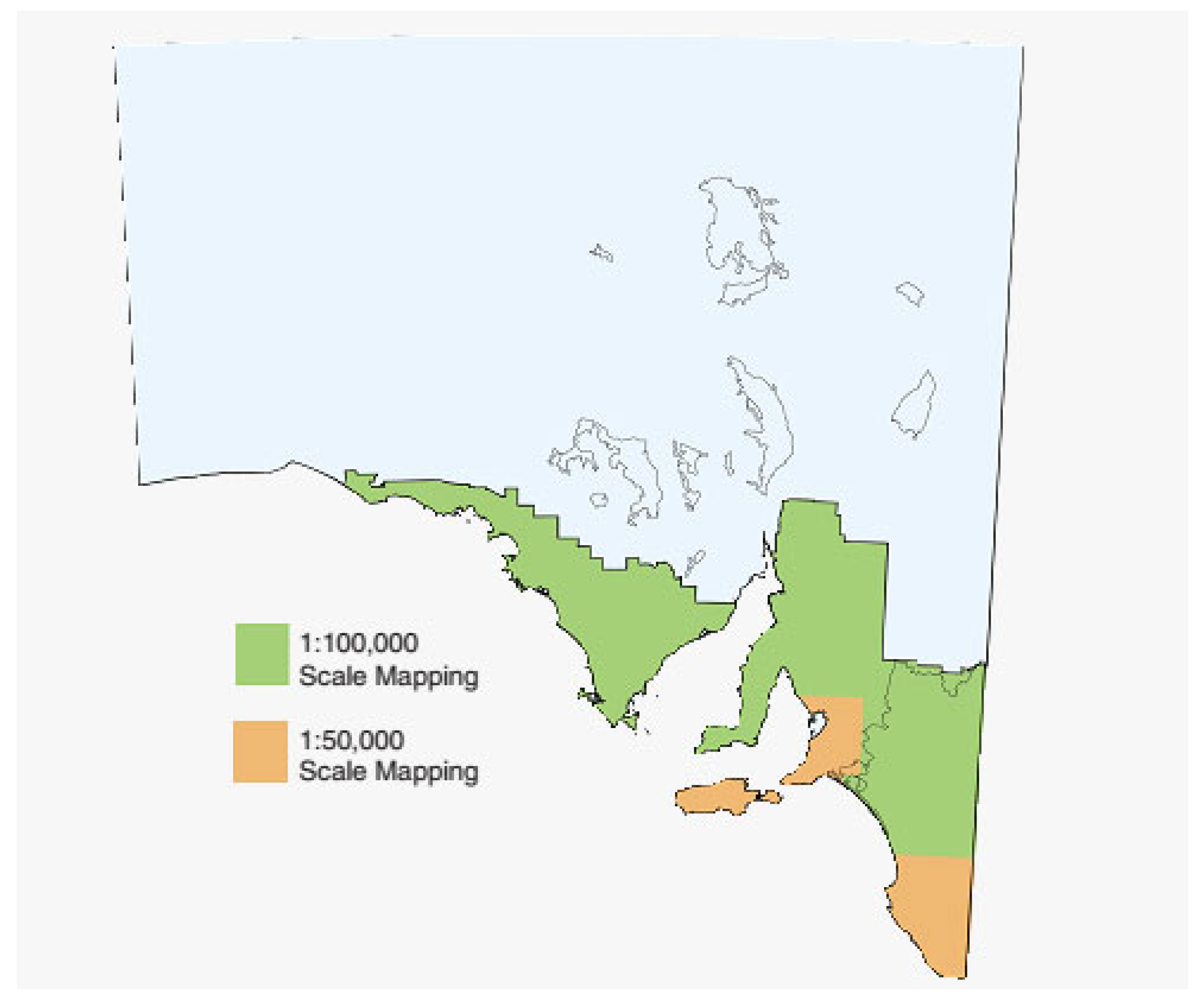
Figure 2.
suitability map for surface irrigation method.
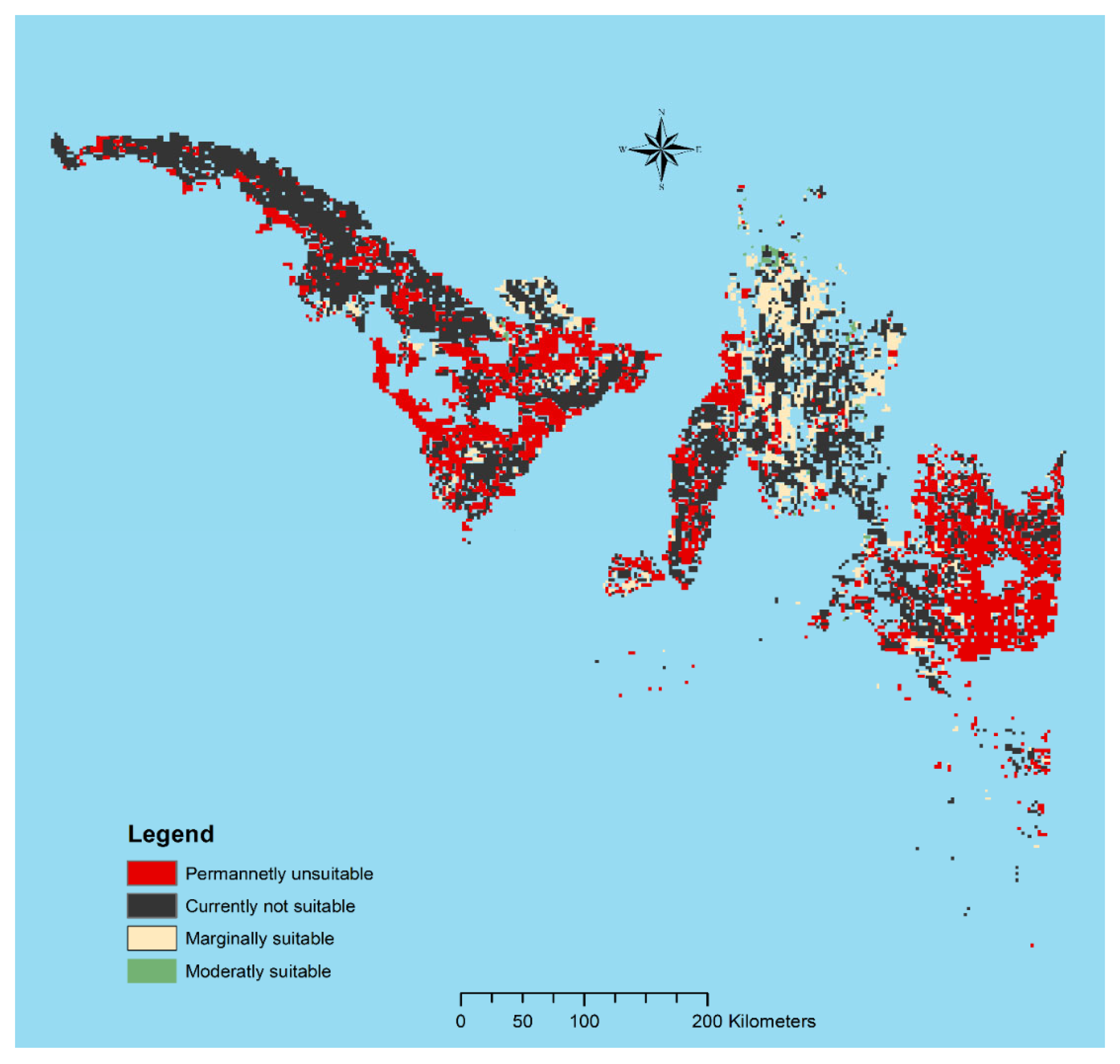
Figure 3.
suitability map for sprinkler irrigation method.
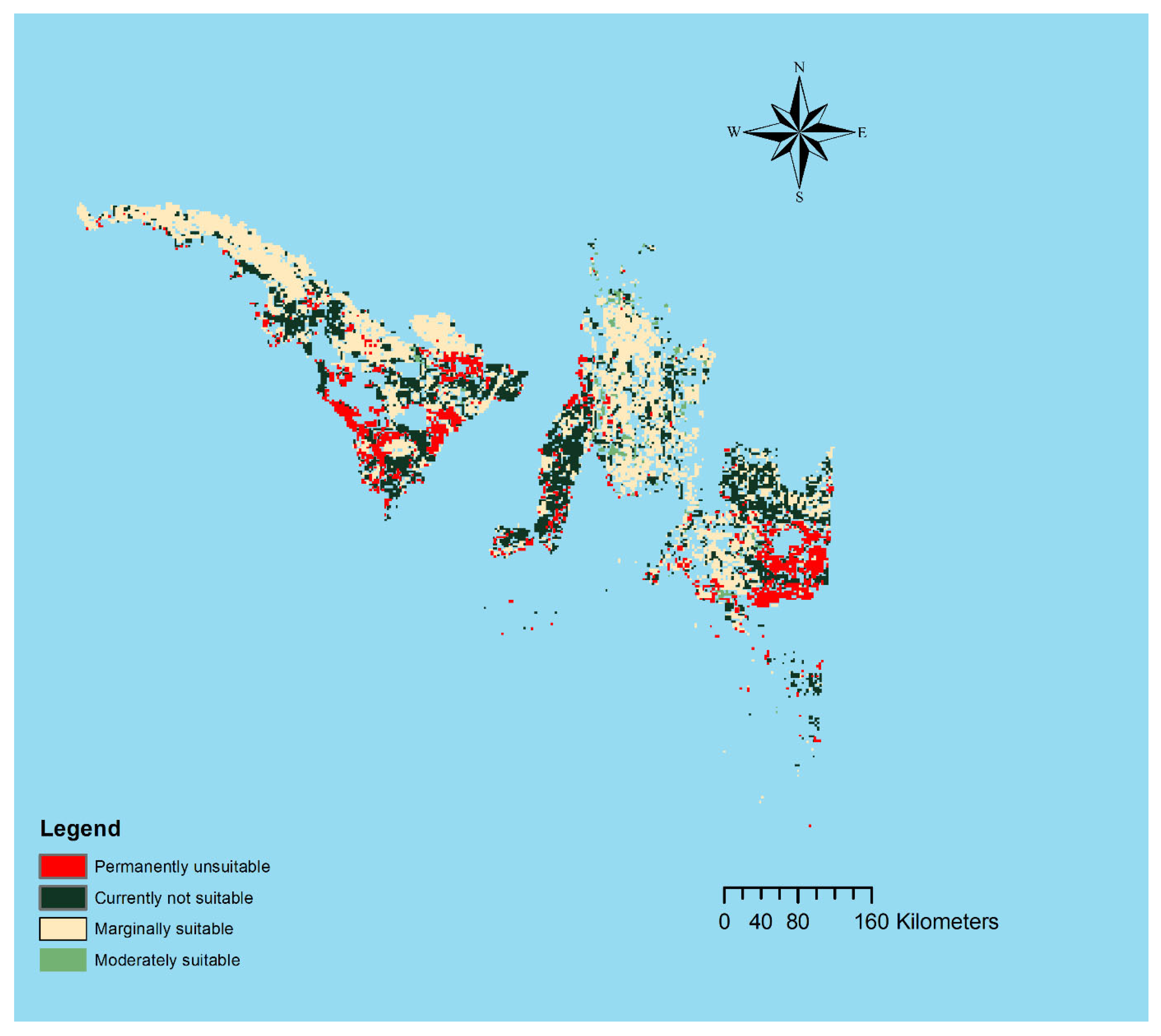
Figure 4.
Suitability map for drip irrigation methods.
Disclaimer/Publisher’s Note: The statements, opinions and data contained in all publications are solely those of the individual author(s) and contributor(s) and not of MDPI and/or the editor(s). MDPI and/or the editor(s) disclaim responsibility for any injury to people or property resulting from any ideas, methods, instructions or products referred to in the content. |
© 2026 by the authors. Licensee MDPI, Basel, Switzerland. This article is an open access article distributed under the terms and conditions of the Creative Commons Attribution (CC BY) license (http://creativecommons.org/licenses/by/4.0/).
Copyright: This open access article is published under a Creative Commons CC BY 4.0 license, which permit the free download, distribution, and reuse, provided that the author and preprint are cited in any reuse.