

Submitted:
06 June 2026
Posted:
08 June 2026
You are already at the latest version
Abstract
Foreign DNA poses a great threat to living organisms, as it can deteriorate normal cellular functions or mutate genomic sequence, consequently leading to serious health issues such as oncological conditions. About 10% of all human disorders are caused by such foreign/invader pathogenic DNAs. However, a recent study has identified a remarkable cytoplasmic strategy in eukaryotes by which organisms may deal with and get rid of such extrachromosomal DNA (ecDNA). The strategy involves the formation of a double membrane-bound novel structure in the cytoplasm called "Exclusome", that identifies and incarcerates ecDNA. Previously, the eukaryotic cells were only characterized for having their genome enclosed within the nucleus, along with certain genes carried by mitochondria and plastids. However, the discovery of an exclusome (that confines DNA fragments), has remarkably added one more name to the list of DNA-containing organelles. Exclusome is a double membrane-bound, round, spherical-shaped organelle that targets and encapsulates the ecDNA within the cytoplasm of the eukaryotic cell. The double membrane barrier of exclusome and its composition is reminiscent of the nucleus, but it lacks nuclear pore complexes (NPCs), thus averting the potential interference of confined ecDNA with the fundamental cellular functions to preserve genetic integrity. This review presents the multifaceted aspects of this newly discovered "Exclusome", elucidating its morphology and composition with a comprehensive scrutiny of the assembly mechanism and its implications in cellular defense and disease prevention.
Keywords:
exclusome
; ecDNA regulation
; DNA encapsulation
; cellular immunity
; cellular immunological memory
1. Introduction
Deoxyribonucleic acid (DNA) is the quintessential blueprint that regulates cellular operations. In prokaryotic organisms, DNA resides unbound within the cytoplasm or is compartmentalized into plasmids (circular DNA molecules distinct from chromosomal DNA) [1,2]. Conversely, in eukaryotic cells, the entire genomic content regulating cellular functions is sequestered within the nucleus by a double-membraned nuclear envelope [3,4], in addition to small personalized DNA harbored by certain organelles such as mitochondria and chloroplasts. These organelles encapsulate genes crucial for ATP production and photosynthesis (in plant cells) respectively, thereby further contributing to the cellular genetic repertoire [5,6]. Albeit in eukaryotic organisms, all DNA is sequestered within specialized double-membraned structures [3]. However, only the compartmentalization of DNA in the cell’s nucleus through the process of nuclear envelope reassembly, notably during the terminal phase of mitosis (i.e., telophase), has been the subject of extensive research, particularly in mammalian cells [4,7,8,9]. The nuclear envelope is a double-membrane structure, comprised of inner and outer nuclear membranes that enclose the cell nucleus [4]. The outer nuclear membrane is a continuum of the tubular endoplasmic reticulum (ER); a double-membraned, huge, nucleus-neighboring, tubular structure, studded with ribosomes and TIS granules [4,10]. The outer nuclear membrane encompasses several proteins common with the ER [4,9], including Sec61 complex, nesprins, ribophorin I, and ribophorin II [11,12,13], however, the inner nuclear membrane is composed of distinct proteins such as Lamina-associated polypeptide 2 (Lap2), emerin, Lem2, and MAN1, which are particular to itself only [4,9]. The rough endoplasmic reticulum (RER) differentiates into the outer nuclear membrane, which acts as a barrier and demarcates the nucleoplasm from the cytoplasm [4,9]. However, the exchange of materials across this barrier is predominantly mediated by nuclear pore complexes (NPCs), which are interspersed throughout the envelope [4,8]. Additionally, the nuclear envelope’s functionality is further refined by inner-nuclear membrane proteins, which contribute to its selective permeability and structural integrity [9]. A pivotal protein in nuclear architecture is the Barrier-to-autointegration factor (BAF), also referred to as BANF1 [8,9,14]. This evolutionarily conserved protein engages in binding with DNA and LEM domain proteins (e.g., Emerin, Lap2β, Lap2α), thereby playing an integral role in the organization and stabilization of the nuclear envelope through binding of emerin with a single LEM domain (lamin A), which is essential for preserving genomic integrity [4,15]. During early telophase of mitosis, BAF localizes to genomic material as chromosomes are segregated to opposite poles of the spindle apparatus [14,15]. Concurrently, tubular ER membranes encase each chromosomal set to form nascent nuclear envelopes (Figure 1A) [14,16]. BAF’s significance extends to chromatin structuring, where it binds DNA and orchestrates the assembly of the nuclear envelope by recruiting LEM-domain proteins such as Lap2β, Emerin, and MAN1, which are integral to the ER membrane during telophase of mitosis (Figure 1B ) [9,17,18].
Even though eukaryotic cells have intricate organization and compartmentalized nature, they are not impervious to extrachromosomal DNA (ecDNA), which may evolve from numerous sources including viral infections, bacterial invasions, or contemplative DNA recombination and transfection processes [19,20]. However, previously, it was vague whether the assembly of phospholipid bilayers is only exclusive to the chromosomal DNA or if it endows to compartmentalize the ecDNA too. Furthermore, the probable subsistence and contribution of the aforementioned particular proteins in the establishment of the membrane around ecDNA were not fully elucidated. To fill this knowledge gap and to explicit how eukaryotic cells cope with ecDNA, Schenkel et al. embarked on a research endeavor that culminated in the striking discovery of an intricate cellular mechanism entailing the creation of specialized cytoplasmic compartments, which they named “Exclusomes” [21]. An exclusome is a newly identified double membrane-bound, three-dimensional, round and spherical, DNA-containing organelle, located within the cytoplasm of a eukaryotic cell; that encapsulates ecDNA, particularly, targeting plasmid DNA introduced into the cell through transfection (Figure 1) [21]. Historically, only the nucleus was credited as the solo spherical, DNA-containing organelle, within the eukaryotic organisms [3]. However, this recent epiphany of a comparable organelle within the cytoplasm of mammalian cells has elicited widespread astonishment among the scientific community. This finding challenges preconceived notions about cellular organization and furnishes an evidence-based elucidation of the mechanism by which eukaryotic cells process and manage foreign DNA [21]. Therefore, in this review, we aim to comprehensively explore the multifaceted aspects of the newly discovered “Exclusome”, delving into the intricate details of its assembly mechanism and its role in the management of exogenous and ecDNA.
2. Historical Background of Extrachromosomal Circular DNA (eccDNA)
The eukaryotic genome is comprised of chromosomal DNA and extrachromosomal DNA (ecDNA) fragments, that are physically excised from the chromosomes [19]. These ecDNAs are typically circular, leading researchers to use the term “extrachromosomal circular DNA (eccDNA)” to describe the entire spectrum of ecDNA in eukaryotes [19,22,23]. eccDNA refers to double-stranded, circular-shaped DNA segments that are cleaved from nuclear DNA, existing as extrachromosomal constituents, encapsulated within histone-bound chromatin edifices forms and operating autonomously of the chromosomal components [23,24,25]. eccDNAs are eminent for their extensive, stochastic distribution, intricate origins, and significant roles pertinent to tumor biology [26,27]. The seminal identification of eccDNA was confirmed by Hotta et al. in 1964 through their observation of wheat embryos and porcine sperm [28]. Subsequently, Cox et al. described ecDNA in juvenile malignancies as “double-minutes” within cancer cell karyotypes via microscopic visualization after noticing their frequent manifestation in pairs [26,29]. Therefore, the functional importance of eccDNA has captivated scientific inquiry [29]. Till now, the presence of eccDNA has been ubiquitously confirmed in multiple organisms of all five kingdoms, including humans [24], Drosophila [30,31], Xenopus [32], and pigeons [33] from the kingdom Animalia; numerous bacteria from the kingdom Monera [20]; Oxytricha from the kingdom Protista [34]; budding yeasts from the kingdom Fungi [34]; and wheat [28,35], rice [36], tobacco [35,37] and Arabidopsis plants from the kingdom Plantae [38]. eccDNAs show great heterogeneity in sizes, ranging from a few hundred to a few million base pairs (bp), and encompass a variety of genomic structures, such as complete and truncated genes, intergenic regions, and repetitive sequences [24,39]. Moreover, eccDNA can also undergo transcription, resulting in mRNA that encodes both complete and truncated proteins, as well as regulatory RNAs (such as siRNA, miRNA, and lncRNA) that influence gene expression [40]. In humans, eccDNA has been detected in both healthy and cancerous cells [19,24]. In 1978, Alt et al. described the role of eccDNA within murine cells, where it was linked with the amplification of the dihydrofolate reductase (DHFR) gene, conferring resistance to methotrexate in these cells [27]. Further investigations revealed that double-minutes can harbor oncogenes such as the epidermal growth factor receptor (EGFR) gene [41,42]. A pivotal study by Verhaak et al. in 2017 which encompassed whole-genome analysis of 2572 cell lines derived from 17 different tumors, revealed that over half of human tumors contained eccDNA which are involved in tumor progression [43]. This underscored a potential role for eccDNA in carcinogenesis [43]. Albeit of ecDNA’s presence in tumor cells, a study conducted by Møller et al. in 2018, spotted tens of thousands of eccDNAs in the muscle and blood cells of healthy individuals [24]. This study disclosed that a multitude of eccDNA bearing complete genes or gene fragments could be widespread in various cell types of the normal human population too [24]. Although the involvement of eccDNA in modulating tumor progression and its contribution to disease etiology has been extensively explored, however, the precise mechanisms underlying their formation remain elusive [24,27]. Nonetheless, there is an escalating volume of research that outlines multiple genesis pathways for eccDNA, including DNA damage repair mechanisms, the breakage-fusion-bridge (BFB) cycle, the processes associated with cell apoptosis and chromothripsis [26,44,45,46].
Recent advancements in research endeavors have enabled the classification of eccDNAs based on their origin, sequence length, and function [19,24,39]. eccDNAs are primarily categorized into two major types; endogenous and exogenous eccDNAs [19,39]. Endogenous eccDNA originates within the cell and includes both organelle eccDNAs, such as mitochondrial DNAs (mtDNAs), and non-organelle eccDNAs [19,47]. Non-organelle eccDNAs may be either circular or linear DNA segments, arising from chromosomal excision and encompass double minutes, episomes, small poly-dispersed circular DNAs (spcDNAs), extrachromosomal ribosomal circular (ERC) DNA, telomeric circular DNAs (t-circles), and microDNAs [19,39,47]. While, the exogenous eccDNA is acquired through external sources, such as during pathogenic incursions of viruses and bacteria or through deliberate introduction of transfected DNA into the cellular milieu via standard DNA transfection methods [19,20,21,48]. EccDNA exhibits variability in sizes (see Table 1) and has the potential to induce distinct cellular responses, depending on the type of eccDNA encountered by the cell [19,39]. For instance, mtDNA is a significant source of eccDNA that can be released into the cytosol due to apoptotic stimuli; thereby triggering an autoimmune response, as the cell recognizes mtDNA in the cytosol as exogenous [49]. Similarly, the introduction of foreign plasmid DNA also elicits the same response [39,50]. Another incredible example of eccDNA mediating specific response is of ERCs; whose accumulation in budding yeast has been reported to reduce its lifespan [51]. The “ERC theory of yeast aging” posits that the accumulation of ERCs is a key factor in the aging process [51,52]. These ERCs are generated through homologous recombination within the highly repetitive ribosomal DNA (rDNA) locus [51,53]. During each cell cycle, ERCs are replicated and asymmetrically retained by the parent yeast cells during mitosis, facilitated by the SAGA and TREX-2 complexes [51,52,53,54,55]. This asymmetric retention leads to an exponential surge in ERC copy number as the cells age, resulting in a 30% – 40% increase in effective genome size within 24 hours [51,52,54]. Consequently, ERCs are considered bona fide “aging factors” that emerge early in the aging process and subsequently contribute to nucleolar fragmentation, resulting in yeast death [51,56]. Along with yeasts, variations in rDNA copy number have been observed during the aging processes of Drosophila, mice, as well as in human neurodegenerative diseases and cancer [51,57,58,59].
In addition to classification, contemporary research has revealed that the structural composition of eccDNA is remarkably complicated and these elements localize within distinct extranuclear bodies termed “Micronuclei” or “Howell-Jolly bodies” [65,66]. Micronuclei are small, round, nucleus-like, double membraned-bound, extranuclear bodies that usually contain the chromosomal fragments excised from chromosomes (known as eccDNA), or may rarely incorporate the entire chromosomes which fail to attach correctly to the spindle apparatus during cell division and are not incorporated into the daughter nuclei (Figure 1B) [65,66,67]. Besides cell division, micronuclei may also originate during interphase through nuclear budding [68,69]. Micronuclei are morphologically similar to the central nucleus but smaller in size (approximately 1/10th to 1/100th of the size of the nucleus) [66,67]. The incorporation of eccDNAs into these extranuclear bodies has been linked to the induction of genomic instability and mutagenesis [65,67]. Although, micronuclei have been identified in numerous organisms, such as plant hybrids, and aquatic vertebrates, however, they can be easily distinguished in mammalian erythrocytes due to the absence of a primary nucleus [66,68,70]. Micronuclei are primarily eminent by the presence of hallmark proteins and complexes associated with the nuclear envelope, including lamins and NPCs [65,71]. Furthermore, these extranuclear bodies also facilitate eccDNA to operate as a trans enhancer to alter gene expression on other ecDNAs or chromosomal loci, thus mediating transcription and replication activities within these compartments [65]. However, micronuclei undergo a degenerative process where the DNA becomes fragmented over time and the envelope deteriorates losing NPCs & lamins, ultimately leading to the ensuing reintegration of DNA segments into chromosomal DNA during subsequent mitotic proceedings [65,71]. Nevertheless, it was uncertain whether ecDNA could mediate the formation of nuclear assemblies with an enveloping membrane similar to that of a nucleus by itself or not, before the recent experiment by Schenkel et al. [21].
3. The Exclusome
3.1. Discovery of Exclusome
As discussed above, the eukaryotic cells contain two prominent forms of ecDNA, known as endogenous and exogenous [72]. To investigate the cellular response and particularly to elucidate whether a nuclear envelope is assembled around ecDNA, Schenkel et al. recently conducted a series of meticulous experimental analyses with transfected plasmid DNA in mammalian cells [21]. The researcher used standard transfection protocols and introduced plasmid vectors harboring a sequence array of 256 Lac Operator (LacO) repeats into HeLa cell lines. These cells were engineered to express a fusion protein of the Lac Repressor (LacI) linked to fluorescent tags such as Green Fluorescent Protein (GFP) or Red Fluorescent Protein (RFP) to permit the visualization of plasmid DNA through live-cell-microscopy [21,73]. Following transfection, the researchers observed the emergence of discrete plasmid DNA foci within the cellular milieu (Figure 1) [21]. The LacO/LacI tagging methodology facilitated the dynamic surveillance of plasmid localization. The researchers employed time-lapse microscopy in living cells and achieved real-time monitoring of these plasmid entities [21]. These foci manifested as distinct entities, discrete from chromosomal DNA, and exhibited stability over time [21]. It was observed that during both interphase and mitosis, a preponderance of plasmid foci materialized within the cytoplasmic compartment [21]. Remarkably, Schenkel et al. delineated this cytoplasmic compartment as an “Exclusome”, a distinct round structure characterized by a double membrane that encapsulated the circular plasmid DNA within the cytoplasmic domain (Figure 1) [21]. The exclusome’s hallmark was its persistence as stable foci across successive cellular divisions, coupled with its capacity to impede the integration of transfected plasmid DNA/ecDNA and to curtail its transcriptional activity [21], thereby rendering it an observable focus.
Although, the exclusomes may persist as stable foci, however, according to Haraguchi et al., their numbers within eukaryotic cells and the quantity of eccDNA/plasmid reduce with each subsequent cell division [20]. Haraguchi et al. observed that the membrane structure encasing the plasmids (i.e., exclusomes), disintegrates concurrently with the native nuclear envelope during the prometaphase of mitosis [20]. Consequently, the plasmids are liberated from the exclusome and disseminated into the cytoplasm of mitotic cells [20,21]. During mitosis, a subset of these plasmids associates with the chromosomes and is subsequently incorporated into the nucleus during the reformation of the nuclear envelope in telophase, ultimately finding its way to nuclear DNA and leading to genomic mutations and instability [20]. This conclusion was drawn from an experiment in which Haraguchi et al. used a plasmid containing lacO repeats and an RFP gene driven by the EF1α promoter (pLacO-pEF1α-RFP), transfected into HeLa cells expressing GFP-LacI [20]. They monitored the plasmid’s behavior and RFP expression through live-cell imaging and electron microscopy. Out of 662 transfected cell samples, 594 showed RFP expression after mitosis indicating plasmid DNA entry into the nucleus during nuclear envelope reformation at telophase. The remaining 68 cells did not express detectable RFP levels within 18 hours of observation [20]. Additionally, it is also well-established that exogenous gene expression effectively occurs in dividing cells [74]. Together, these observations imply that the exclusome is not fully conserved in the subsequent cell cycle, but only a fraction persists within the cell for an extended duration [20,21,74].
3.2. Morphology and Composition of Exclusome
The exclusome has a round, sphere-shaped morphology that encapsulates ring-shaped plasmid vectors of prokaryotes. [1,2,21]. It is enveloped by a double phospholipid membrane construction that is reminiscent of nuclear and mitochondrial membranes [4,5,21]. This double membrane configuration is crucial for the secure encapsulation of ecDNA within the cytoplasm. Exclusome may assemble through a dynamic process that can occur during both cell division and quiescent phases (Figure 1 and Figure 2) [21]. The exclusome’s membrane incorporates a plethora of imperative proteins that are primarily derived from the inner nuclear and ER membranes [9,21,75]. The nuclear membrane constituting proteins including BAF, Lap2β, Emerin, Sun1, and Sun2, alongside certain ER-membrane components such as Sec61 and LEM4, are among the prominent polypeptides implicated in the composition of exclusome membranes (Figure 2) [9,21,75]. All these proteins are pivotal for upholding the stable structure and proper working of the exclusome [21]. However, their independent roles within this newly discovered organelle require further exploration. Nevertheless, it may be assumed that their functions concerning the nuclear membrane may hold significant implications (as outlined in Table 2).
Furthermore, exclusomes also contain endogenous ecDNA cleaved from chromosomes, particularly eccDNA of telomeric origin (tDNA) [21]. Fluorescence in situ hybridization (FISH) techniques were employed to delineate and characterize these cytoplasmic DNA entities [21]. Cancer cells, particularly those employing alternative lengthening of telomeres (ALT), frequently generate circular tDNA [75]. The scrutiny of U2OS cells (ALT-positive) alongside HeLa (non-ALT), revealed two distinct categories of tDNA within the cytoplasm; micronuclear tDNA (MN-tDNA) that stains positive with Hoechst dye, possibly containing chromosomal DNA fragments with telomeres, and Hoechst negative extrachromosomal tDNA (designated as ex-tDNA) [21]. FISH techniques employed revealed that U2OS cells had a higher frequency of ex-tDNA foci (36-48%) compared to HeLa cells (7-16%) [21]. To confirm the sequestration of ex-tDNA within membrane-bound organelles, U2OS cells were subjected to immunofluorescence staining targeting membrane-associated proteins such as Sec61 and Lap2β. Overexpression of Sec61-mCherry exhibited partial colocalization with ex-tDNA foci (~47%) but consistently colocalized with MN-tDNA [21]. In contrast, Lap2β was detected at 41% of ex-tDNA foci and ubiquitously at MN-tDNA foci [21]. Intriguingly, NPCs were conspicuously absent from ex-tDNA, but present in MN-tDNA, indicating that ex-tDNA is enveloped by a membrane compositionally distinct from that of the nucleus or micronuclei [21]. Considering the observed presence of Lap2β and absence of NPCs (factors indicative of the exclusome’s membrane composition), it was inferred that MN-tDNA likely originates during mitosis and exhibits a composition distinct from that of ex-tDNA foci [21]. Consequently, it was posited that exclusomes mediate the encapsulation of ex-tDNA within the cellular cytoplasm (Figure 2) [21].
3.3. Assembly Mechanism of Exclusome
The assembly of the exclusome is commenced with ecDNA’s entry into the cytoplasm, facilitated either by transfection methodologies or endogenous cellular mechanisms [21]. This ecDNA acts as a catalytic core around which the exclusome is built [21,29]. Recent studies indicate that plasmids predominantly aggregate into clusters within the cytosol following endosomal escape, irrespective of the transfection technique employed (Figure 1 and Figure 2). Moreover, these clusters exhibit limited mobility during interphase. Although the specific cellular signals that may mediate the assembly of exclusome have not been recognized, however, a diverse array of proteins involved in its formation have been elucidated (Figure 2) [21]. The ER membrane proteins, particularly Sec6, KDEL, and LEM4, are recruited to the formation site and initiate the development of the exclusome’s dual bilayer membranes [21]. Additionally, LEM-domain proteins including Emerin and Lap2β coupled with BAF play crucial roles in tethering the ecDNA with the nascent membrane to ensure its stable integration [9,21]. BAF senses and interacts with exogenous ecDNA, including transfected and viral DNA, within the cytosol, facilitating the assembly of a nuclear envelope-like membrane enriched with LEM domain proteins, around the transfected DNA. The progressive envelopment of the ecDNA culminates in the formation of a cytoplasmic membrane-bound compartment that is continuous with the ER yet devoid of NPCs [21] as well as FG-Nucleoporins, ELYS, and nuclear envelope pore membrane 121 (POM121) [21]. Notably, the assembly of exclusome is not confined to a particular phase of the cell cycle. Rather, it may form at several cell stages, depending on when the cell requires it (Figure 1 and Figure 2) [21].
From much prior to the discovery of exclusomes assembly, the presence of ecDNA in the cytosol had been associated to activate the cyclic cGAS/STING pathway [90]. The cGAS (cyclic GMP-AMP)/ STING (stimulator of interferon genes) pathway is renowned for its potential role of initiating innate immune response in organisms against exogenous pathogenic ecDNA, triggered by the detection of cytosolic ecDNA [90,91]. cGAS is a protein composed of 522 amino acids. It comprises an unstructured, positively charged N-terminal domain and a nucleotidyltransferase C-terminal domain [91,92]. The N-terminal domain is implicated in nuclear translocation and the dissociation of cGAS-DNA complex, whereas the C-terminal domain contains two lobes with an active site that serves as the catalytic domain of cGAS [90,92]. Upon binding to DNA, cGAS forms a dimer, which is stabilized by two DNA segments, embedded into two cGAS molecules [91,93]. This dimer subsequently catalyzes the synthesis of 2′, 3′-cyclic GMP-AMP (cGAMP) from ATP and GTP, acting as a secondary messenger [91,93]. cGAMP binds to and activates STING, a 40-kDa protein localized in the ER with four transmembrane domains. This activation induces a conformational change in STING, leading to its translocation from the ER to the Golgi apparatus via COP-II vesicles [91,93]. Within the Golgi apparatus, STING recruits and activates TANK-binding kinase 1 (TBK1), which phosphorylates interferon regulatory factor 3 (IRF3) [91,93]. The phosphorylated IRF3 then translocates to the nucleus, initiating the transcription of type I interferons (IFN-I) and pro-inflammatory cytokines [90,91,93]. The cGAS/STING pathway is integral to the cellular response to DNA-related threats, often culminating in the elimination of the compromised cell [90,91]. However, the BAF-mediated assembly of a double nuclear envelope around ecDNA in the cytosol is hypothesized to compete with the formation of autophagic membranes, thereby evading the immune response induced by the cGAS/STING pathway and averting cell death [75].
3.4. Quick Comparison of Nuclear & Exclusome Membrane Constituent Profiles
Regardless of sharing several structural and compositional features, such as the presence of a double membrane and ER continuity, the exclusome displays substantial compositional differences from the nuclear envelope despite harboring many proteins that are similar to those found in the nuclear envelope [21]. BAF and LEM domain proteins (including Emerin and Lap2β) form a specific anchoring complex linked to the inner nuclear membrane of the nuclear envelope [9,14], which is also incorporated by the exclusomes [21]. However, they encompass BAF notably in higher concentration at plasmid sites compared to the nuclear envelope, which indicates a dense aggregation of plasmid DNA [21]. Likewise, Emerin exhibits a substantial enrichment at 90% of foci, implying a key function for Emerin in tethering [21,94]. Exclusomes also include minute amounts of certain ER-resident proteins such as KDEL and LEM4, which are exclusively related to the development of cytoplasmic plasmid foci [21]. However, it lacks several constituents often linked to the nuclear barrier [21]. The most crucial ones are the importin β-binding domain (IBB-GFP), POM121, and Lamin B receptor (LBR) [21]. The LBR, which is located inside the inner nuclear membrane, interacts with chromatin via heterochromatin protein 1 [9,17,21]. The privation of proteins infers a notable absence of NPCs at the exclusome, signifying its role as an impermeable compartment that segregates ecDNA from nuclear processes [21].
3.5. Compartmentalization of ecDNA and Cellular Defense Mechanisms Mediated by the Exclusome
The exclusome is characterized to mediate multi-faceted functions that are facilitated by its unique morphological and compositional constituents [21]. It can detect and discriminate between distinct forms of DNAs in the cellular milieu, including MN-tDNA and ex-tDNA [21]. The fundamental function of exclusome is to encapsulate the ecDNA in the cytoplasmic and nuclear environments [21]. This compartmentalization may include both endogenous forms (notably circular ex-tDNA) and exogenous forms, including encounters with plasmid DNA via transfection or nucleic acids through viral and bacterial invasions (Figure 2A) [21]. The exclusome enwraps the isolated DNA segments within a double membrane structure which is an extension of the ER [21]. The exclusome’s ER origin is manifested by the presence of proteins such as Sec61 and Lap2β within its membrane configuration [21]. As discussed above, the exclusome is devoid of NPCs, which are pivotal for molecular transit between the nucleoplasm and cytoplasm [9,21]. The absence of NPCs in the exclusome, confirmed by the lack of ELYS, POM121, and FG-Nucleoporins (FG-NUPs), ascertains that the compartmentalized ecDNA does not interfere with nucleo-cytoplasmic transport and other crucial cellular processes [21]. The exclusion of NPCs ensures that the newly enveloped DNA remains incarcerated in the exclusome, away from the nucleus, thereby preventing nuclear DNA mutations [21]. Moreover, the internal environment of the exclusome is known to limit the fundamental nuclear activities, mainly gene expression and transcription of enclosed DNA [21]. The ability of exclusome to curtail transcriptional activities of ecDNA is pivotal for maintaining normal cellular operations and preservation of its genomic integrity [21]. The exclusome makes sure that modulation of gene expression is only confined to nuclear DNA by preventing ecDNA from interfering with cellular processes [21]. This kind of selective regulation minimizes the chances of DNA mutations and the possibility of subsequent disease emergence. Furthermore, the physiological implications of exclusome assembly might be involved in pathogenic management at an early stage, eventually serving as a remarkable defense mechanism for cells and increasing their viability [21,95,96].
3.6. Implication of Exclusome in Cellular Immunology & Disease Prevention
The infiltration of pathogenic bacterial and viral genomes may pose serious health risks and might cause diseases in humans [97,98]. Mycobacterium tuberculosis, the causative agent of TB [99], and viral diseases such as HIV and influenza demonstrate a deleterious impact on human health [100,101]. Influenza may cause extensive respiratory illness but tuberculosis mostly affects the pulmonary system and causes serious respiratory issues [99,101]. HIV primarily targets CD4+ T lymphocyte cells, incorporates its viral DNA into the host’s genetic structure, and potentially leads to acquired immunodeficiency syndrome (AIDS) [100]. These infectious agents not only demonstrate the direct impacts of pathogenic genomic intrusion but also emphasize the critical need for comprehensive understanding and intervention strategies to safeguard public health [97,98].
Exclusome formally characterized by its ability to enclose foreign and ecDNA may play a significant role to subside such health risks [21,95,96]. Although the experimental shreds of evidence are yet to come, however, according to the founder of exclusome, it has been assumed that exclusome may be modified and employed to reduce the emergence of such infective diseases [95,96]. Ruth Kroschewski, the corresponding author of the paper detailing the discovery of exclusomes [21], posited that these entities could be implicated in autoimmune disorders [21,96]. The hypothesis is that if pathogenic DNA persists within a host cell long after the invader has injected it, this might signal to the cells that an infection is still present [21,96,102]. This detection of DNA within the cytoplasm activates a specific DNA-sensing protein known as cGAS (cyclic GMP-AMP synthase), which recognizes DNA in the cytoplasm and triggers the mammalian host cell to produce cytokines [102]. The cell then secretes specific kinds of cytokines to signal multicellular organisms about the presence of infection [96,102]. It was indicated that exclusome encapsulating DNA endures a long time in the cytoplasm of a cell (~144 hours), serving as the beginning of a signaling cascade [21,96]. Consequently, it is plausible that cytokines will continue to be generated for as long as the exclusome is present [21,95,96]. This phenomenon, referred to as the signaling hub, may be implicated in the elevated cytokine levels observed in systemic Lupus Erythematosus, a prelude to this autoimmune disorder [96,103]. However, the precise activity of cGAS is uncertain in exclusome, albeit it seems to be present [21,96].
In addition, Ruth Kroschewski suggested that the exclusome might play a role in cellular immunological memory [21,95,96]. Exclusomes serve as repositories for foreign or pathogenic DNA and preserve a record of previous pathogenic encounters to better prepare for potential future threats [21]. For example, cells with an exclusome could maintain an activated chromosomal defense system, allowing for a faster expulsion of invading DNA from the nucleus during a second infection [21]. This infers that the exclusome could play a remarkable role in the cell’s adaptive immune response [21,96]. Furthermore, the exclusome may also minimize the probability of DNA mutations and the onset of diseases [21,96] The World Health Organization (WHO) estimates that around 10% of all human diseases are caused by genetic disorders [104]. A considerable fraction of these mutations may be caused by pathogenic activities, which can subsequently lead to a variety of disorders like sickle cell anemia, cystic fibrosis, and many forms of cancer [105]. However, it is assumed that exclusome may mitigate such risks by isolating the invader’s DNA in a separate compartment during the early stages of the pathogenic attack [21,96]. By sequestering the invader’s DNA away from the nucleus, the exclusome prevents it from altering the cell’s genomic sequence, ultimately preserving critical genomic integrity and enhancing cellular life [21].
4. Discussion and Future Trajectories
The discovery of the exclusome signifies a remarkable advancement in our insight into cellular mechanisms that mediate genomic stability [21]. Exclusomes are specialized, double membrane-bound, spherical, compartments that sequester ecDNA in the cytoplasm, thus averting its potential interference with nuclear operations and maintaining genomic integrity [21]. This role is crucial, as unchecked ecDNA can lead to genomic instability and subsequently result in various disorders such as oncological conditions [21,27,43]. The presence of eccDNA in cytosol might increase the stress on cellular components. The cellular compartments tend to enhance their performance under stress conditions, to overcome the stress that might be caused by any internal or external factor [75,106]. For instance, under stress conditions, ER is known to increase the translation and localization of TIS11B protein [10]. This protein is the major constituent of TIS granules, which are self-assembled, membraneless granules intertwined with the ER tubules, and enhance protein-protein interactions and localization, consequently increasing cellular survivability by eliminating the cause of stress [10]. Similarly, under cellular stress, caused by eccDNA might, the ER might increase the localization of BAF and LEM domain protein within the cytosol, leading to the encapsulation of stress-causing hazardous eccDNA by membrane-bound compartments (i.e., exclusomes) to potentially avoid autoimmune responses (such as cGAS/STING) or autophagy, ultimately increasing the cellular life [21,75]. Kroschewski posits that the exclusome’s origins may be traced back to early eukaryotic evolution when protobacterium and archaebacterium fused to form the first eukaryotic cells [21,96,107]. The necessity to organize and protect their circular DNA from degradation resulted in the development of a protective mechanism [107,108]. This evolutionary process culminated in the formation of a membrane-bound envelope, akin to the nuclear envelope, a process now evident in the exclusome [21,96]. According to Kroschewski, it is conceivable that the exclusome might serve no distinct function but rather be a result of a default ancient evolutionary reaction to the DNA [96].
As exclusomes are newly discovered unique structures, therefore, there exists no comparable compartment in the cell except micronuclei [21,70]. Both exclusomes and micronuclei are double phospholipid membrane-bound compartments that can encapsulate eccDNA. However, the incarceration of transfected plasmid DNA is exclusive to exclusomes [21]. Unlike micronuclei, exclusomes lack NPCs in their double phospholipid membranes and appear to serve as a repository for storing and silencing ecDNA, excluding chromosomes [21,96]. It selectively sequesters genetic elements deemed hazardous or superfluous by the cell [21]. As a novel compartment for DNA storage in eukaryotic cells, distinct from mitochondria, plastids, and nuclei, the cell opts to retain rather than eliminate the collected ecDNA, probably because eliminating DNA might be detrimental to the cell [21]. However, the conditions and mechanisms for the utilization of this stored ecDNA are yet to be determined [21]. Similarly, although, the primarily structural and compositional aspects of exclusome along with the various specialized protein components (e.g., Sec61, Emerin, and Lap2β) involved in its assembly have been described [21]. Yet, the specific signaling pathways and regulatory networks mediating this process remain unclear [21]. Therefore, there is a need to elucidate the precise molecular mechanisms governing exclusome assembly and maintenance. Understanding these pathways may provide us insights into how cells detect and respond to the presence of ecDNA, which may have broader implications for cellular stress response and genomic integrity.
Additionally, the exclusome’s role across different cellular contexts and physiological conditions demands further investigation. For example, how does exclusome formation differ among distinct cell types, or how it is mediated during different phases of the cell cycle? Exploring these questions may reveal critical aspects of cell biology and potential variations in exclusome functionality that can be exploited for therapeutic purposes. Similarly, investigation of the exclusome’s role in disease prevention and treatment also awaits future research. If exclusome dysregulation is implicated in certain cancers or other diseases marked by genomic instability such as neurodegenerative disorders, it may provide new diagnostic and treatment strategies [21]. Moreover, understanding how exclusomes interact with other cellular pathways, like the autophagy-lysosome system, may be critical to deciphering cellular strategies for ecDNA management and homeostasis maintenance. In short, exclusome is the remarkable discovery of the decade in eukaryotes [21]. However, we can only gain a deeper understanding of cellular mechanisms involved in genomic stability and develop new strategies for combating diseases associated with genomic instability, with future research on exclusomes [21].
5. Conclusion
The exclusome is a round, three-dimensional, double membrane-bound, spherical compartment, that is morphologically reminiscent of the nucleus but lacks NPCs and incarcerates ring-shaped plasmid vectors. It is a specialized structure that sequesters ecDNA and is found only in the cytoplasm of eukaryotic cells. Exclusome are formed as a result of a remarkable cellular strategy to incarcerate ecDNA and limit their deleterious effects on cellular operations. The exclusomes encapsulate only those DNAs which is perceived to be hazardous for the cell. The double membrane of the exclusome shares compositional similarities with the nuclear envelope; however, it does not facilitate nucleus-like operations (e.g., gene expression and transcription). Additionally, it is devoid of NPCs, which restricts the amount of ecDNA within it and prevents its perturbing interactions with cellular mechanisms, ultimately preserving genomic integrity. Although the precise assembly mechanisms and crucial signaling pathways have not yet been elucidated, however, the presence of Sec61, KDEL, and LEM4 proteins confirms its biosynthesis from the ER membranes. However, its internal environment’s composition in which ecDNA is confined remains unclear. Exclusome may also act as a cellular immunological memory by preserving the record of past pathogenic invasions to better prepare the cell for subsequent future encounters, but their numbers in cell may decrease with each subsequent cell division. Moreover, it is posited that exclusomes may also play a significant role in inducing autoimmune disorders; however, future research will unveil the detailed mechanism and implications of its involvement. To put it briefly, the only precise aspects of exclusome that we currently understand are its structure and composition; its dimensions, internal composition, assembly mechanism, and numerous applications in disease prevention and treatment remain a mystery.
Author Contributions
Conceptualization, M.U.; literature collection and analysis, M.U; S.R.; M.A; writing-original draft preparation, M.U.; S.R.; M.A.; writing review and editing.; M.U.; S.R.; supervision, M.U. All authors have read and agreed to the published version of the manuscript.
Funding
This research received no external funding.
Institutional Review Board Statement
Not applicable.
Informed Consent Statement
Not applicable.
Acknowledgments
In this section you can acknowledge any support given which is not covered by the author contribution or funding sections. This may include administrative and technical support, or donations in kind (e.g., materials used for experiments).
Conflicts of Interest
The authors declare no conflict of interest.
Abbreviations
The following abbreviations are used in this manuscript:
| DNA | Deoxyribonucleic acid |
| ecDNA | Extrachromosomal DNA |
| NPCs | Nuclear pore complexes |
| ER | Endoplasmic reticulum |
| RER | Rough endoplasmic reticulum |
| BAF | Barrier-to-autointegration factor |
| Bp | Base pairs |
| RNA | Ribonucleic acid |
| mRNA | Messenger RNA |
| siRNA | Small interfering RNA |
| miRNA | Micro RNA |
| lncRNA | Long non-coding RNA |
| DHFR | Dihydrofolate reductase |
| EGFR | Epidermal growth factor receptor |
| BFB | Breakage-fusion-bridge |
| mtDNA | Mitochondrial DNA |
| spcDNAs | Small poly-dispersed circular DNAs |
| ERC DNA | Extrachromosomal Ribosomal Circular DNA |
| t-circles | Telomeric circular DNA |
| rDNA | ribosomal DNA |
| SAGA | Spt–Ada–Gcn5 Acetyltransferase |
| TREX-2 | Transcription-Coupled Export 2 |
| GFP | Green Fluorescent Protein |
| RFP | Red Fluorescent Protein |
References
- Rodríguez-Beltrán, J.; DelaFuente, J.; Leon-Sampedro, R.; MacLean, R.C.; San Millan, A. Beyond horizontal gene transfer: the role of plasmids in bacterial evolution. Nat. Rev. Microbiol. 2021, 19(6), 347–359. [Google Scholar] [CrossRef]
- Helinski, D.R. A brief history of plasmids, EcoSal Plus. 2022, 10(1), eESP-0028-2021. [Google Scholar] [CrossRef]
- Cooper, G.M.; Adams, K.W. The Cell: A Molecular Approach; Oxford University Press, 2023. [Google Scholar]
- De Magistris, P.; Antonin, W. The dynamic nature of the nuclear envelope. Curr. Biol. 2018, 28(8), R487–R497. [Google Scholar] [CrossRef]
- Filograna, R.; Mennuni, M.; Alsina, D.; Larsson, N.G. Mitochondrial DNA copy number in human disease: the more the better? FEBS Lett. 2021, 595(8), 976–1002. [Google Scholar] [CrossRef]
- Dobrogojski, J.; Adamiec, M.; Luciński, R. The chloroplast genome: a review. Acta Physiol. Plant. 2020, 42(6), 98. [Google Scholar] [CrossRef]
- Dey, G.; Baum, B. Nuclear envelope remodelling during mitosis. Curr. Opin. Cell Biol. 2021, 70, 67–74. [Google Scholar] [CrossRef] [PubMed]
- Kutay, U.; Jühlen, R.; Antonin, W. Mitotic disassembly and reassembly of nuclear pore complexes. Trends Cell Biol. 2021, 31(12), 1019–1033. [Google Scholar] [CrossRef]
- Ungricht, R.; Kutay, U. Mechanisms and functions of nuclear envelope remodelling. Nat. Rev. Mol. Cell Biol. 2017, 18(4), 229–245. [Google Scholar] [CrossRef] [PubMed]
- Rahim, K.; Umair, M.; Haq, I.U. The role of filamentous membraneless organelle in 3UTR-mediated Protein-Protein interfaces and localization: TIGER Domain. Supramol. Mat. 2023, 100060. [Google Scholar] [CrossRef]
- Wilhelmsen, K.; Litjens, S.H.; Kuikman, I.; Tshimbalanga, N.; Janssen, H.; van den Bout, I.; Raymond, K.; Sonnenberg, A. Nesprin-3, a novel outer nuclear membrane protein, associates with the cytoskeletal linker protein plectin. J. Cell Biol. 2005, 171(5), 799–810. [Google Scholar] [CrossRef] [PubMed]
- Rajgor, D.; Shanahan, C.M. Nesprins: from the nuclear envelope and beyond. Expert Rev. Mol. Med. 2013, 15, e5. [Google Scholar] [CrossRef]
- Hetzer, M.W. The nuclear envelope, Cold Spring Harb Perspect Biol. 2010, 2(3), a000539. [Google Scholar] [CrossRef] [PubMed]
- Jamin, A.; Wiebe, M.S. Barrier to Autointegration Factor (BANF1): interwoven roles in nuclear structure, genome integrity, innate immunity, stress responses and progeria. Curr. Opin. Cell Biol. 2015, 34, 61–68. [Google Scholar] [CrossRef] [PubMed]
- Samwer, M.; Schneider, M.W.; Hoefler, R.; Schmalhorst, P.S.; Jude, J.G.; Zuber, J.; Gerlich, D.W. DNA cross-bridging shapes a single nucleus from a set of mitotic chromosomes. Cell. 2017, 170(5), 956–972. e23. [Google Scholar] [CrossRef]
- Anderson, D.J.; Hetzer, M.W. Reshaping of the endoplasmic reticulum limits the rate for nuclear envelope formation. J. Cell Biol. 2008, 182(5), 911–924. [Google Scholar] [CrossRef]
- Bogolyubova, D. Bogolyubov. Functional interactions of BAF and LEM proteins in the formation of germ cells. Cell Tissue Biol. 2023, 17(6), 571–582. [Google Scholar] [CrossRef]
- Halfmann, C.T.; Sears, R.M.; Katiyar, A.; Busselman, B.W.; Aman, L.K.; Zhang, Q.; O’Bryan, C.S.; Angelini, T.E.; Lele, T.P.; Roux, K.J. Repair of nuclear ruptures requires barrier-to-autointegration factor. J. Cell Biol. 2019, 218(7), 2136–2149. [Google Scholar] [CrossRef] [PubMed]
- Wang, M.; Chen, X.; Yu, F.; Ding, H.; Zhang, Y.; Wang, K. Extrachromosomal Circular DNAs: Origin, formation and emerging function in Cancer. Int. J. Biol. Sci. 2021, 17(4), 1010. [Google Scholar] [CrossRef]
- Haraguchi, T.; Koujin, T.; Shindo, T.; Bilir, Ş.; Osakada, H.; Nishimura, K.; Hirano, Y.; Asakawa, H.; Mori, C.; Kobayashi, S. Transfected plasmid DNA is incorporated into the nucleus via nuclear envelope reformation at telophase. Commun. Biol. 2022, 5(1), 78. [Google Scholar] [CrossRef]
- Schenkel, L.; Wang, X.; Le, N.; Burger, M.; Kroschewski, R. A dedicated cytoplasmic container collects extrachromosomal DNA away from the mammalian nucleus. Mol. Biol. Cell. 2023, 34(11), ar105. [Google Scholar] [CrossRef]
- Møller, H.D.; Bojsen, R.K.; Tachibana, C.; Parsons, L.; Botstein, D.; Regenberg, B. Genome-wide purification of extrachromosomal circular DNA from eukaryotic cells. J. Vis. Exp. 2016, 110, e54239. [Google Scholar] [CrossRef]
- Zuo, S.; Yi, Y.; Wang, C.; Li, X.; Zhou, M.; Peng, Q.; Zhou, J.; Yang, Y.; He, Q. Extrachromosomal circular DNA (eccDNA): from chaos to function. Front Cell Dev. Biol. 2022, 9, 792555. [Google Scholar] [CrossRef]
- Møller, H.D.; Mohiyuddin, M.; Prada-Luengo, I.; Sailani, M.R.; Halling, J.F.; Plomgaard, P.; Maretty, L.; Hansen, A.J.; Snyder, M.P.; Pilegaard, H. Circular DNA elements of chromosomal origin are common in healthy human somatic tissue. Nat. Commun. 2018, 9(1), 1069. [Google Scholar] [CrossRef]
- Wu, S.; Turner, K.M.; Nguyen, N.; Raviram, R.; Erb, M.; Santini, J.; Luebeck, J.; Rajkumar, U.; Diao, Y.; Li, B. Circular ecDNA promotes accessible chromatin and high oncogene expression. Nature 2019, 575(7784), 699–703. [Google Scholar] [CrossRef] [PubMed]
- Li, R.; Wang, Y.; Li, J.; Zhou, X. Extrachromosomal circular DNA (eccDNA): an emerging star in cancer. Biomark. Res. 2022, 10(1), 53. [Google Scholar] [CrossRef] [PubMed]
- Yi, E.; Chamorro González, R.; Henssen, A.G.; Verhaak, R.G. Extrachromosomal DNA amplifications in cancer. Nat. Rev. Genet. 2022, 23(12), 760–771. [Google Scholar] [CrossRef] [PubMed]
- Hotta, Y.; Bassel, A. Molecular size and circularity of DNA in cells of mammals and higher plants. Proc. Natl. Acad. Sci. U S A 1965, 53(2), 356–362. [Google Scholar] [CrossRef]
- Cox, D.; Yuncken, C.; Spriggs, A. Minute chromatin bodies in malignant tumours of childhood. Lancet 1965, 286(7402), 55–58. [Google Scholar] [CrossRef]
- Stanfield, S.W.; Lengyel, J.A. Small circular DNA of Drosophila melanogaster: chromosomal homology and kinetic complexity. Proc. Natl. Acad. Sci. U S A 1979, 76(12), 6142–6146. [Google Scholar] [CrossRef]
- Cohen, S.; Yacobi, K.; Segal, D. Extrachromosomal circular DNA of tandemly repeated genomic sequences in Drosophila. Genome Res. 2003, 13(6a), 1133–1145. [Google Scholar] [CrossRef]
- Cohen, S.; Méchali, M. Formation of extrachromosomal circles from telomeric DNA in Xenopus laevis. EMBO Rep. 2002, 3(12), 1168–1174. [Google Scholar] [CrossRef] [PubMed]
- Møller, H.D.; Ramos-Madrigal, J.; Prada-Luengo, I.; Gilbert, M.T.P.; Regenberg, B. Near-random distribution of chromosome-derived circular DNA in the condensed genome of pigeons and the larger, more repeat-rich human genome. Genome Biol. Evol. 2020, 12(2), 3762–3777. [Google Scholar] [CrossRef] [PubMed]
- Yerlici, V.T.; Lu, M.W.; Hoge, C.R.; Miller, R.V.; Neme, R.; Khurana, J.S.; Bracht, J.R.; Landweber, L.F. Programmed genome rearrangements in Oxytricha produce transcriptionally active extrachromosomal circular DNA. Nucleic Acids Res. 2019, 47(18), 9741–9760. [Google Scholar] [CrossRef]
- Peng, H.; Mirouze, M.; Bucher, E. Extrachromosomal circular DNA: a neglected nucleic acid molecule in plants. Curr. Opin. Plant Biol. 2022, 69, 102263. [Google Scholar] [CrossRef]
- Zhuang, J.; Zhang, Y.; Zhou, C.; Fan, D.; Huang, T.; Feng, Q.; Lu, Y.; Zhao, Y.; Zhao, Q.; Han, B. Dynamics of extrachromosomal circular DNA in rice. Nat. Commun. 2024, 15(1), 2413. [Google Scholar] [CrossRef]
- Kinoshita, Y.; Ohnishi, N.; Yamada, Y.; Kunisada, T.; Yamagishi, H. Extrachromosomal circular DNA from nuclear fraction of higher plants. Plant Cell Physiol. 1985, 26(7), 1401–1409. [Google Scholar] [CrossRef]
- Wang, K.; Tian, H.; Wang, L.; Wang, L.; Tan, Y.; Zhang, Z.; Sun, K.; Yin, M.; Wei, Q.; Guo, B. Deciphering extrachromosomal circular DNA in Arabidopsis. Comput Struct. Biotechnol. J. 2021, 19, 1176–1183. [Google Scholar] [CrossRef] [PubMed]
- Yang, L.; Jia, R.; Ge, T.; Ge, S.; Zhuang, A.; Chai, P.; Fan, X. Extrachromosomal circular DNA: biogenesis, structure, functions and diseases. Signal Transduct. Target Ther. 2022, 7(1), 342. [Google Scholar] [CrossRef]
- Paulsen, T.; Shibata, Y.; Kumar, P.; Dillon, L.; Dutta, A. Small extrachromosomal circular DNAs, microDNA, produce short regulatory RNAs that suppress gene expression independent of canonical promoters. Nucleic Acids Res. 2019, 47(9), 4586–4596. [Google Scholar] [CrossRef]
- Alt, F.W.; Kellems, R.; Bertino, J.; Schimke, R. Selective multiplication of dihydrofolate reductase genes in methotrexate-resistant variants of cultured murine cells. J. Biol. Chem. 1978, 253(5), 1357–1370. Available online: https://www.jbc.org/article/S0021-9258(17)34875-5/pdf. [CrossRef]
- Zhou, Y.-H.; Chen, Y.; Hu, Y.; Yu, L.; Tran, K.; Giedzinski, E.; Ru, N.; Gau, A.; Pan, F.; Qiao, J. The role of EGFR double minutes in modulating the response of malignant gliomas to radiotherapy. Oncotarget 2017, 8(46), 80853. [Google Scholar] [CrossRef]
- Verhaak, R.G.; Bafna, V.; Mischel, P.S. Extrachromosomal oncogene amplification in tumour pathogenesis and evolution. Nat. Rev. Cancer 2019, 19(5), 283–288. [Google Scholar] [CrossRef]
- Paulsen, T.; Malapati, P.; Shibata, Y.; Wilson, B.; Eki, R.; Benamar, M.; Abbas, T.; Dutta, A. MicroDNA levels are dependent on MMEJ, repressed by c-NHEJ pathway, and stimulated by DNA damage. Nucleic Acids Res. 2021, 49(20), 11787–11799. [Google Scholar] [CrossRef]
- Wang, Y.; Wang, M.; Djekidel, M.N.; Chen, H.; Liu, D.; Alt, F.W.; Zhang, Y. eccDNAs are apoptotic products with high innate immunostimulatory activity. Nature 2021, 599(7884), 308–314. [Google Scholar] [CrossRef]
- Shoshani, O.; Brunner, S.F.; Yaeger, R.; Ly, P.; Nechemia-Arbely, Y.; Kim, D.H.; Fang, R.; Castillon, G.A.; Yu, M.; Li, J.S. Chromothripsis drives the evolution of gene amplification in cancer. Nature 2021, 591(7848), 137–141. [Google Scholar] [CrossRef] [PubMed]
- Kuttler, F.; Mai, S. Formation of non-random extrachromosomal elements during development, differentiation and oncogenesis. In Semin Cancer Biol.; Elsevier, 2007; pp. 56–64. [Google Scholar] [CrossRef]
- Husnik, F.; McCutcheon, J.P. Functional horizontal gene transfer from bacteria to eukaryotes. Nat. Rev. Microbiol. 2018, 16(2), 67–79. [Google Scholar] [CrossRef]
- Yu, C.-H.; Davidson, S.; Harapas, C.R.; Hilton, J.B.; Mlodzianoski, M.J.; Laohamonthonkul, P.; Louis, C.; Low, R.R.J.; Moecking, J.; De Nardo, D. TDP-43 triggers mitochondrial DNA release via mPTP to activate cGAS/STING in ALS. Cell 2020, 183(3), 636–649. e18. [Google Scholar] [CrossRef] [PubMed]
- Liu, J.-W.; Cheng, J. Molecular mechanism of immune response induced by foreign plasmid DNA after oral administration in mice. World J. Gastroenterol. 2007, 13(28), 3847. [Google Scholar] [CrossRef]
- Sinclair, D.A.; Guarente, L. Extrachromosomal rDNA circles—a cause of aging in yeast. Cell 1997, 91(7), 1033–1042. [Google Scholar] [CrossRef] [PubMed]
- Ganley, A.R.; Kobayashi, T. Ribosomal DNA and cellular senescence: new evidence supporting the connection between rDNA and aging. FEMS Yeast Res. 2014, 14(1), 49–59. [Google Scholar] [CrossRef]
- Cruz, C.; Della Rosa, M.; Krueger, C.; Gao, Q.; Horkai, D.; King, M.; Field, L.; Houseley, J. Tri-methylation of histone H3 lysine 4 facilitates gene expression in ageing cells. Elife 2018, 7, e34081. [Google Scholar] [CrossRef]
- Shcheprova, Z.; Baldi, S.; Frei, S.B.; Gonnet, G.; Barral, Y. A mechanism for asymmetric segregation of age during yeast budding. Nature 2008, 454(7205), 728–734. [Google Scholar] [CrossRef]
- Denoth-Lippuner, A.; Krzyzanowski, M.K.; Stober, C.; Barral, Y. Role of SAGA in the asymmetric segregation of DNA circles during yeast ageing. Elife 2014, 3, e03790. [Google Scholar] [CrossRef]
- Sinclair, D.A.; Mills, K.; Guarente, L. Accelerated aging and nucleolar fragmentation in yeast sgs1 mutants. Science 1997, 277(5330), 1313–1316. [Google Scholar] [CrossRef]
- Watada, E.; Li, S.; Hori, Y.; Fujiki, K.; Shirahige, K.; Inada, T.; Kobayashi, T. Age-dependent ribosomal DNA variations in mice. Mol. Cell Biol. 2020, 22(40), e00368-20. [Google Scholar] [CrossRef]
- Hallgren, J.; Pietrzak, M.; Rempala, G.; Nelson, P.T.; Hetman, M. Neurodegeneration-associated instability of ribosomal DNA. Biochim Biophys. Acta 2014, 1842(6), 860–868. [Google Scholar] [CrossRef]
- Valori, V.; Tus, K.; Laukaitis, C.; Harris, D.T.; LeBeau, L.; Maggert, K.A. Human rDNA copy number is unstable in metastatic breast cancers. Epigenetics 2020, 15(1-2), 85–106. [Google Scholar] [CrossRef]
- Taanman, J.-W. The mitochondrial genome: structure, transcription, translation and replication. Biochim Biophys. Acta 1999, 1410(2), 103–123. [Google Scholar] [CrossRef] [PubMed]
- Kumar, P.; Dillon, L.W.; Shibata, Y.; Jazaeri, A.A.; Jones, D.R.; Dutta, A. Normal and cancerous tissues release extrachromosomal circular DNA (eccDNA) into the circulation. Mol. Cancer Res. 2017, 15(9), 1197–1205. [Google Scholar] [CrossRef] [PubMed]
- Cohen, S.; Regev, A.; Lavi, S. Small polydispersed circular DNA (spcDNA) in human cells: association with genomic instability. Oncogene 1997, 14(8), 977–985. [Google Scholar] [CrossRef] [PubMed]
- Tomaska, L.; Nosek, J.; Kramara, J.; Griffith, J.D. Telomeric circles: universal players in telomere maintenance? Nat. Struct. Mol. Biol. 2009, 16(10), 1010–1015. [Google Scholar] [CrossRef]
- Turner, K.M.; Deshpande, V.; Beyter, D.; Koga, T.; Rusert, J.; Lee, C.; Li, B.; Arden, K.; Ren, B.; Nathanson, D.A. Extrachromosomal oncogene amplification drives tumour evolution and genetic heterogeneity. Nature 2017, 543(7643), 122–125. [Google Scholar] [CrossRef]
- Hatch, E.M.; Fischer, A.H.; Deerinck, T.J.; Hetzer, M.W. Catastrophic nuclear envelope collapse in cancer cell micronuclei. Cell. 2013, 154(1), 47–60. [Google Scholar] [CrossRef]
- Beedanagari, V. S.; Bhatia, S.; Mahadevan, B. Genetic toxicology; Academic Press, 2017. [Google Scholar] [CrossRef]
- Krupina, K.; Goginashvili, A.; Cleveland, D.W. Causes and consequences of micronuclei. Curr. Opin. Cell Biol. 2021, 70, 91–99. [Google Scholar] [CrossRef]
- Chmielewska, M.; Dedukh, D.; Haczkiewicz, K.; Rozenblut-Kościsty, B.; Kaźmierczak, M.; Kolenda, K.; Serwa, E.; Pietras-Lebioda, A.; Krasikova, A.; Ogielska, M. The programmed DNA elimination and formation of micronuclei in germ line cells of the natural hybridogenetic water frog Pelophylax esculentus. Sci. Rep. 2018, 8(1), 7870. [Google Scholar] [CrossRef]
- Utani, K.-i.; Okamoto, A.; Shimizu, N. Generation of micronuclei during interphase by coupling between cytoplasmic membrane blebbing and nuclear budding. PLoS ONE 2011, 6(11), e27233. [Google Scholar] [CrossRef]
- Gernand, D.; Rutten, T.; Varshney, A.; Rubtsova, M.; Prodanovic, S.; Bruß, C.; Kumlehn, J.; Matzk, F.; Houben, A. Uniparental chromosome elimination at mitosis and interphase in wheat and pearl millet crosses involves micronucleus formation, progressive heterochromatinization, and DNA fragmentation. Plant Cell 2005, 17(9), 2431–2438. [Google Scholar] [CrossRef] [PubMed]
- Liu, S.; Kwon, M.; Mannino, M.; Yang, N.; Renda, F.; Khodjakov, A.; Pellman, D. Nuclear envelope assembly defects link mitotic errors to chromothripsis. Nature 2018, 561(7724), 551–555. [Google Scholar] [CrossRef] [PubMed]
- Paulsen, T.; Kumar, P.; Koseoglu, M.M.; Dutta, A. Discoveries of extrachromosomal circles of DNA in normal and tumor cells. Trends Genet. 2018, 34(4), 270–278. [Google Scholar] [CrossRef] [PubMed]
- Platonova, E.; Winterflood, C.M.; Ewers, H. A simple method for GFP-and RFP-based dual color single-molecule localization microscopy. ACS Chem. Biol. 2015, 10(6), 1411–1416. [Google Scholar] [CrossRef]
- Bai, H.; Lester, G.M.S.; Petishnok, L.C.; Dean, D.A. Cytoplasmic transport and nuclear import of plasmid DNA. Biosci. Rep. 2017, 37(6), BSR20160616. [Google Scholar] [CrossRef]
- Kobayashi, S.; Koujin, T.; Kojidani, T.; Osakada, H.; Mori, C.; Hiraoka, Y.; Haraguchi, T. BAF is a cytosolic DNA sensor that leads to exogenous DNA avoiding autophagy. Proc. Natl. Acad. Sci. U S A 2015, 112(22), 7027–7032. [Google Scholar] [CrossRef]
- Consortium, T.U. The UniProtKB Proteomes – P42167-LAP2B_HUMAN, UniProt databases, 2024. Available online: https://www.uniprot.org/uniprotkb/P42167 (accessed on 26 June 2024).
- Gant, T.M.; Harris, C.A.; Wilson, K.L. Roles of LAP2 proteins in nuclear assembly and DNA replication: truncated LAP2β proteins alter lamina assembly, envelope formation, nuclear size, and DNA replication efficiency in Xenopus laevis extracts. J. Cell Biol. 1999, 144(6), 1083–1096. [Google Scholar] [CrossRef] [PubMed]
- Koch, A.J.; Holaska, J.M. Emerin in health and disease. In Semin Cell Dev Biol.; Elsevier, 2014; pp. 95–106. [Google Scholar] [CrossRef]
- Consortium, T.U. The UniProtKB Proteomes – O94901-SUN1_HUMAN, UniProt databases, 2024. Available online: https://www.uniprot.org/uniprotkb/O94901 (accessed on 26 June 2024).
- Li, P.; Stumpf, M.; Müller, R.; Eichinger, L.; Glöckner, G.; Noegel, A.A. The function of the inner nuclear envelope protein SUN1 in mRNA export is regulated by phosphorylation. Sci. Rep. 2017, 7(1), 9157. [Google Scholar] [CrossRef]
- Talamas, J.A.; Hetzer, M.W. POM121 and Sun1 play a role in early steps of interphase NPC assembly. J. Cell Biol. 2011, 194(1), 27–37. [Google Scholar] [CrossRef]
- Consortium, T.U. The UniProtKB Proteomes – Q9UH99-SUN2_HUMAN, UniProt databases, 2024. Available online: https://www.uniprot.org/uniprotkb/Q9UH99 (accessed on 26 June 2024).
- Hieda, M.; Matsumoto, T.; Isobe, M.; Kurono, S.; Yuka, K.; Kametaka, S.; Wang, J.-Y.; Chi, Y.-H.; Kameda, K.; Kimura, H. The SUN2-nesprin-2 LINC complex and KIF20A function in the Golgi dispersal. Sci. Rep. 2021, 11(1), 5358. [Google Scholar] [CrossRef] [PubMed]
- Consortium, T.U. The UniProtKB Proteomes – P61619-S61A1_HUMAN, UniProt databases, 2024. Available online: https://www.uniprot.org/uniprotkb/P61619 (accessed on 26 June 2024).
- Lang, S.; Pfeffer, S.; Lee, P.-H.; Cavalié, A.; Helms, V.; Förster, F.; Zimmermann, R. An update on Sec61 channel functions, mechanisms, and related diseases. Front Physiol. 2017, 8, 887. [Google Scholar] [CrossRef] [PubMed]
- Consortium, T.U. The UniProtKB Proteomes – P60468-SC61B_HUMAN, UniProt databases, 2024. Available online: https://www.uniprot.org/uniprotkb/P60468 (accessed on 26 June 2024).
- Consortium, T.U. The UniProtKB Proteomes – Q86XL3-ANKL2B_HUMAN, UniProt databases, 2024. Available online: https://www.uniprot.org/uniprotkb/Q86XL3 (accessed on 26 June 2024).
- Wagner, N.; Krohne, G. LEM-domain proteins: new insights into lamin-interacting proteins. Int. Rev. Cytol. 2007, 261, 1–46. [Google Scholar] [CrossRef]
- Consortium, T.U. The UniProtKB Proteomes – Q96HA1- P121A_HUMAN, UniProt databases, 2024. Available online: https://www.uniprot.org/uniprotkb/Q96HA1 (accessed on 26 June 2024).
- Decout, A.; Katz, J.D.; Venkatraman, S.; Ablasser, A. The cGAS–STING pathway as a therapeutic target in inflammatory diseases. Nat. Rev. Immunol. 2021, 21(9), 548–569. [Google Scholar] [CrossRef]
- Shen, R.; Liu, D.; Wang, X.; Guo, Z.; Sun, H.; Song, Y.; Wang, D. DNA damage and activation of cGAS/STING pathway induce tumor microenvironment remodeling. Front Cell Dev. Biol. 2022, 9, 828657. [Google Scholar] [CrossRef]
- Gentili, M.; Lahaye, X.; Nadalin, F.; Nader, G.P.; Lombardi, E.P.; Herve, S.; De Silva, N.S.; Rookhuizen, D.C.; Zueva, E.; Goudot, C. The N-terminal domain of cGAS determines preferential association with centromeric DNA and innate immune activation in the nucleus. Cell Rep. 2019, 26(9), 2377–2393. e13. [Google Scholar] [CrossRef]
- Zhang, X.; Bai, X.-c.; Chen, Z.J. Structures and mechanisms in the cGAS-STING innate immunity pathway. Immunity 2020, 53(1), 43–53. [Google Scholar] [CrossRef] [PubMed]
- Berk, J.M.; Tifft, K.E.; Wilson, K.L. The nuclear envelope LEM-domain protein emerin. Nucleus 2013, 4(4), 298–314. [Google Scholar] [CrossRef]
- Craig, M. “The Exclusome, A New Mammalian “Container”“, AZoLifeSciences, 2023. Available online: https://www.azolifesciences.com/news/20231024/The-Exclusome-A-New-Mammalian-Container.aspx (accessed on 26 June 2024).
- Rüegg, P. Cell biologists identify new organelle present in mammalian cells made of rings of DNA, Phys.org, Phys.org. 2023. Available online: https://phys.org/news/2023-10-cell-biologists-organelle-mammalian-cells.html (accessed on 26 June 2024).
- Burrell, C.J.; Howard, C.R.; Murphy, F.A. Pathogenesis of virus infections, Fenner and white’s medical virology; 2017; p. 77. [Google Scholar] [CrossRef]
- Peters, B.M.; Jabra-Rizk, M.A.; O’May, G.A.; Costerton, J.W.; Shirtliff, M.E. Polymicrobial interactions: impact on pathogenesis and human disease. Clin. Microbiol. Rev. 2012, 25(1), 193–213. [Google Scholar] [CrossRef]
- Chai, Q.; Zhang, Y.; Liu, C.H. Mycobacterium tuberculosis: an adaptable pathogen associated with multiple human diseases. Front Cell Infect. Microbiol. 2018, 8, 158. [Google Scholar] [CrossRef]
- JÚNIOR, A.J.B.; ANDRADE, A.L.V.; FERREIRA, A.A.G.; OLIVEIRA, S.; ANDRADE, M.; PINHEIRO, T.S. HUMAN IMMUNODEFICIENCY VIRUS-HIV: A REVIEW, BJSCR. 9(2). 2014. Available online: https://www.mastereditora.com.br/periodico/20150101_110250.pdf.
- Moghadami, M. A narrative review of influenza: a seasonal and pandemic disease. Iran J Med Sci. 2017, 42((1) 2). Available online: https://www.ncbi.nlm.nih.gov/pmc/articles/PMC5337761/.
- Yu, L.; Liu, P. Cytosolic DNA sensing by cGAS: regulation, function, and human diseases. Signal Transduct. Target Ther. 2021, 6(1), 170. [Google Scholar] [CrossRef] [PubMed]
- Fava, A.; Petri, M. Systemic lupus erythematosus: diagnosis and clinical management. J. Autoimmun. 2019, 96, 1–13. [Google Scholar] [CrossRef] [PubMed]
- Genehome, Understanding the genetic diseases. The Impact of Genetic Diseases genehome; 2021. [Google Scholar]
- Samir, S. Human DNA Mutations and their Impact on Genetic Disorders. Recent Pat. Biotechnol. 2024, 18(4), 288–315. [Google Scholar] [CrossRef]
- Galluzzi, L.; Yamazaki, T.; Kroemer, G. Linking cellular stress responses to systemic homeostasis. Nat. Rev. Mol. Cell Biol. 2018, 19(11), 731–745. [Google Scholar] [CrossRef]
- Moreira, D.; López-García, P. Symbiosis between methanogenic archaea and δ-proteobacteria as the origin of eukaryotes: the syntrophic hypothesis. J. Mol. Evol. 1998, 47, 517–530. [Google Scholar] [CrossRef] [PubMed]
- Horiike, T.; Hamada, K.; Kanaya, S.; Shinozawa, T. Origin of eukaryotic cell nuclei by symbiosis of Archaea in Bacteria is revealed by homology-hit analysis. Nat. Cell Biol. 2001, 3(2), 210–214. [Google Scholar] [CrossRef] [PubMed]
Figure 1.
The systematic representation of exclusome’s formation around transfected plasmid DNA vectors, during different stages of the cell cycle. (A) The cell is in the late anaphase-early telophase stage(s); the sister chromatids have been equally segregated, and the slight constriction in the plasma membrane represents the initial signs of cytokinesis. At this stage, ER tubules surround the segregated chromatids and meanwhile BAF is also localized there to initiate the reformation of the nuclear envelope. The expanded sections highlight the extrachromosomal circular DNAs (eccDNAs) excised from chromosomes/left behind after the segregation of sister chromatids. (B) The cell is in the late telophase-early cytokinesis stage(s); nuclear envelopes have been reconstructed around segregated chromatids and genetic material has been decondensed, the nucleoli are visible in each of the two daughter nuclei. The cleavage furrow is almost completed with only the midbody remaining in the center. The midbody, the central pipe-like opening, ensures equal distribution of cytoplasmic proportion and other essential organelles into both daughter cells. The magnified image in the left daughter cell indicates the prominent proteins contained by RER during the last (telophase) stage of the cell cycle. The magnified image in the right daughter cell represents the formation of a micronucleus around the cleaved eccDNA. Similar to the nucleus, the micronucleus also has NPCs (shown as tiny light-orange-colored openings). The next expanded portion in the same section expresses that the exogenous/transfected plasmids inserted into the cell, form a cluster. (C) presents the visuals after cytokinesis; the elongated cell has divided into daughter cells, and both daughter cells are now in interphase. The transfected plasmid vectors are also transferred to the daughter cells (visible in the upper daughter cell), while in the lower daughter cell, the formation of exclusome (highlighted by the red circle) is completed (due to the rapid response of BAF protein against DNA presence in the cytosol) and all the ring-shaped plasmids are incarnated by the spherical-shaped exclusome. (D) represents the transfection and insertion process of plasmid vector(s) into different stages of the cell cycle (i.e., late telophase, interphase). The formation of exclusome may occur during any stage of the cell cycle, following the presence of plasmid vectors or exogenous eccDNA in the cytosol. (E) The microscopic observation of the exclusome (the pink encircled area from the lower daughter cell of (C)). Exclusomes are visible (depicted as green spherical dots) near ER. (E) is extracted and modified from [21]. (F) The possible exclusome model, encapsulating all ring-like plasmids and other forms of eccDNA. It consists of double membranes, separated by lumen. There are no openings/NPCs in its double membrane and it may encapsulate only plasmid vectors or endogenous and exogenous eccDNAs (single or multiple forms of eccDNA) at once.
Figure 1.
The systematic representation of exclusome’s formation around transfected plasmid DNA vectors, during different stages of the cell cycle. (A) The cell is in the late anaphase-early telophase stage(s); the sister chromatids have been equally segregated, and the slight constriction in the plasma membrane represents the initial signs of cytokinesis. At this stage, ER tubules surround the segregated chromatids and meanwhile BAF is also localized there to initiate the reformation of the nuclear envelope. The expanded sections highlight the extrachromosomal circular DNAs (eccDNAs) excised from chromosomes/left behind after the segregation of sister chromatids. (B) The cell is in the late telophase-early cytokinesis stage(s); nuclear envelopes have been reconstructed around segregated chromatids and genetic material has been decondensed, the nucleoli are visible in each of the two daughter nuclei. The cleavage furrow is almost completed with only the midbody remaining in the center. The midbody, the central pipe-like opening, ensures equal distribution of cytoplasmic proportion and other essential organelles into both daughter cells. The magnified image in the left daughter cell indicates the prominent proteins contained by RER during the last (telophase) stage of the cell cycle. The magnified image in the right daughter cell represents the formation of a micronucleus around the cleaved eccDNA. Similar to the nucleus, the micronucleus also has NPCs (shown as tiny light-orange-colored openings). The next expanded portion in the same section expresses that the exogenous/transfected plasmids inserted into the cell, form a cluster. (C) presents the visuals after cytokinesis; the elongated cell has divided into daughter cells, and both daughter cells are now in interphase. The transfected plasmid vectors are also transferred to the daughter cells (visible in the upper daughter cell), while in the lower daughter cell, the formation of exclusome (highlighted by the red circle) is completed (due to the rapid response of BAF protein against DNA presence in the cytosol) and all the ring-shaped plasmids are incarnated by the spherical-shaped exclusome. (D) represents the transfection and insertion process of plasmid vector(s) into different stages of the cell cycle (i.e., late telophase, interphase). The formation of exclusome may occur during any stage of the cell cycle, following the presence of plasmid vectors or exogenous eccDNA in the cytosol. (E) The microscopic observation of the exclusome (the pink encircled area from the lower daughter cell of (C)). Exclusomes are visible (depicted as green spherical dots) near ER. (E) is extracted and modified from [21]. (F) The possible exclusome model, encapsulating all ring-like plasmids and other forms of eccDNA. It consists of double membranes, separated by lumen. There are no openings/NPCs in its double membrane and it may encapsulate only plasmid vectors or endogenous and exogenous eccDNAs (single or multiple forms of eccDNA) at once.
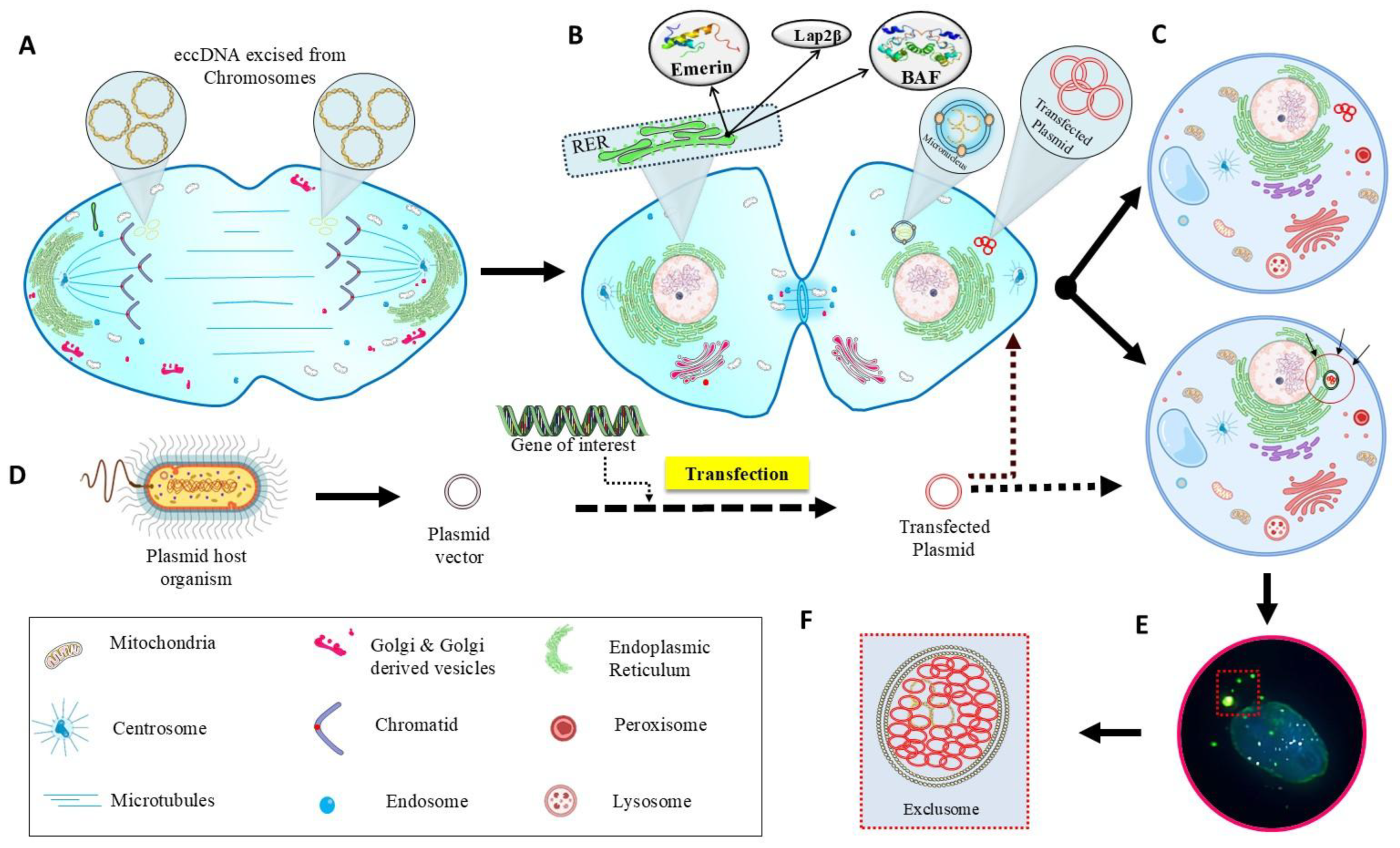
Figure 2.
Dynamics of exclusome assembly around transfected plasmid DNA vectors and exogenous DNA in animal cell. (A) Cellular encounter with exogenous transfected plasmid vectors and pathogenic DNA; the transfected plasmid vectors rapidly form a cluster in the cytoplasmic milieu of the cell. (B) The molecular response of ER to eccDNAs. Many ER-localized and synthesized proteins (e.g., Emerin, BAF, Sec61, KDEL, LEM4, etc.) are immediately released from ER tubules, following the detection of unenveloped DNA in the cytosol. BAF tends to be more responsive; it rapidly binds with and initiates the formation of a nuclear envelope-like double membrane structure around DNA segments in the cytoplasm (particularly with the longer ones). (B) depicts the BAF’s quick movement from ER towards the plasmid cluster (just after its momentary detection). The additional constituents essential for exclusome formation (such as lipids) might also come from ER tubules. (C) The formation of exclusome; double-membrane bound, green-structure, encapsulating (red) plasmid vectors, and pathogenic DNA is located near the RER. It forms and encapsulates all forms of eccDNAs within no time, due to the characteristics of its membrane proteins (i.e., BAF, Emerin, Sec61). (D) The magnified visualization of nascent exclusome. The plasmid DNA vectors and pathogenic DNA have been encapsulated inside it. The newly constructed exclusome has a double membrane (inner and outer membrane), separated by a lumen, similar to ER and nuclear membranes. However, unlike a nuclear envelope, NPCs or any other forms of openings are not present in its membranes. Therefore, the DNAs incarcerated in it have no access to cytosolic contents, subsequently limiting eccDNAs’ hazardous effects on cellular organelles and consequently increasing cellular durability and life.
Figure 2.
Dynamics of exclusome assembly around transfected plasmid DNA vectors and exogenous DNA in animal cell. (A) Cellular encounter with exogenous transfected plasmid vectors and pathogenic DNA; the transfected plasmid vectors rapidly form a cluster in the cytoplasmic milieu of the cell. (B) The molecular response of ER to eccDNAs. Many ER-localized and synthesized proteins (e.g., Emerin, BAF, Sec61, KDEL, LEM4, etc.) are immediately released from ER tubules, following the detection of unenveloped DNA in the cytosol. BAF tends to be more responsive; it rapidly binds with and initiates the formation of a nuclear envelope-like double membrane structure around DNA segments in the cytoplasm (particularly with the longer ones). (B) depicts the BAF’s quick movement from ER towards the plasmid cluster (just after its momentary detection). The additional constituents essential for exclusome formation (such as lipids) might also come from ER tubules. (C) The formation of exclusome; double-membrane bound, green-structure, encapsulating (red) plasmid vectors, and pathogenic DNA is located near the RER. It forms and encapsulates all forms of eccDNAs within no time, due to the characteristics of its membrane proteins (i.e., BAF, Emerin, Sec61). (D) The magnified visualization of nascent exclusome. The plasmid DNA vectors and pathogenic DNA have been encapsulated inside it. The newly constructed exclusome has a double membrane (inner and outer membrane), separated by a lumen, similar to ER and nuclear membranes. However, unlike a nuclear envelope, NPCs or any other forms of openings are not present in its membranes. Therefore, the DNAs incarcerated in it have no access to cytosolic contents, subsequently limiting eccDNAs’ hazardous effects on cellular organelles and consequently increasing cellular durability and life.
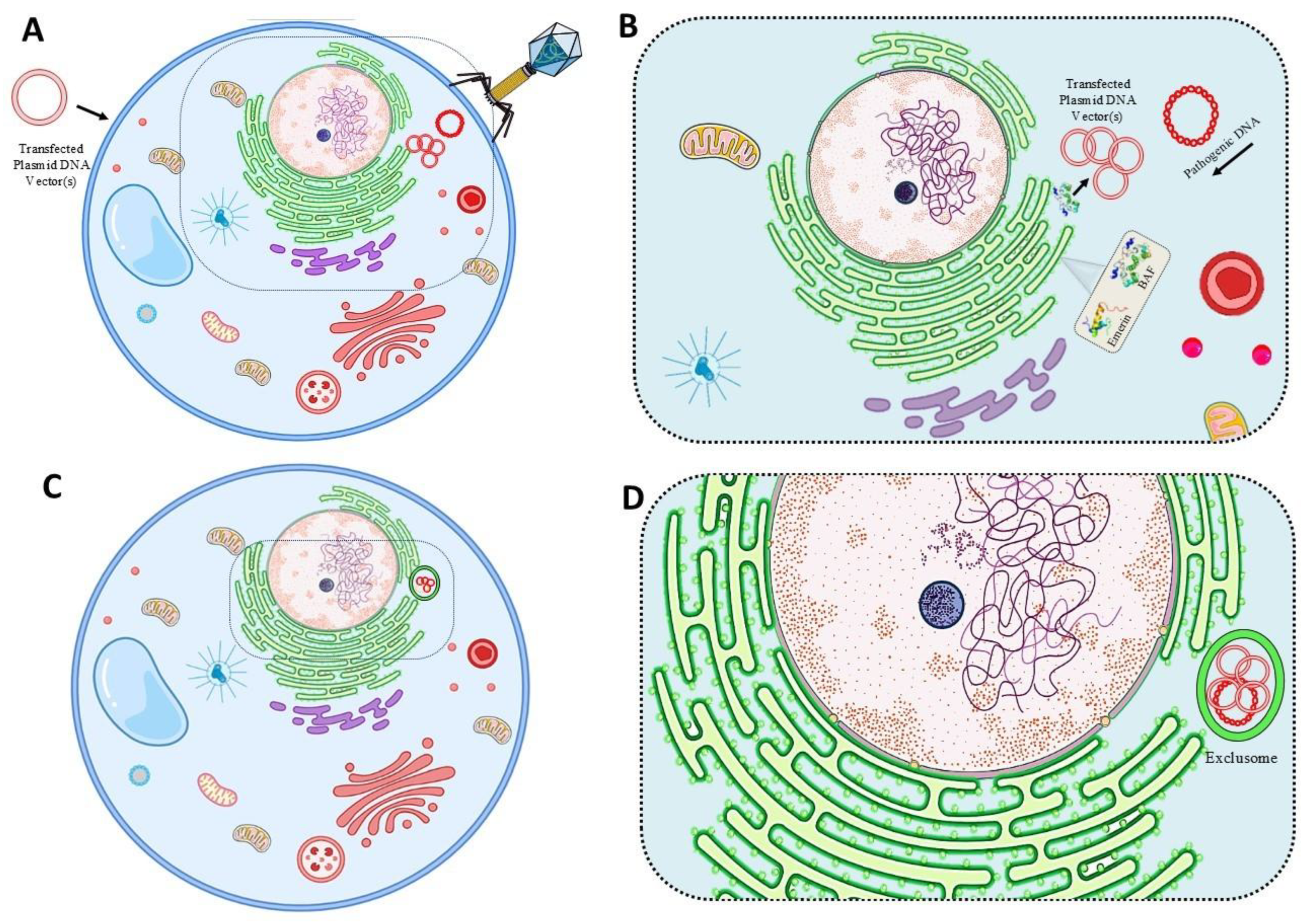

Table 1.
Classification of eccDNA and notable variations among its types.
| Type of eccDNA | Size | Common Distribution | Biological Function | Reference |
| Mitochondrial DNA (mtDNA) | 16 kb | Normal/ Apoptotic cells | Regulate normal mitochondrial functions/induce an autoimmune response | [19,60] |
| MicroDNA | 100 bp to 400 bp | Tumor cells |
Involved in regulating diverse biological processes and are integral for miRNA synthesis | [40] |
| Small polydispersed circular DNA (SpcDNA) | 100 bp-10 kb | Unstable cells | Induces and promotes genomic instability | [39,61,62] |
| Telomeric circles (t-circles) | Integral multiples of 738 bp | ALT cells * |
Contribute to restoration of telomeric length and cell proliferation | [39,63] |
| Extrachromosomal Ribosomal Circular DNA (ERC) | 19 kb to 40 kb | Normal cells |
Integral for ribosomal RNA transcription | [19,51,52] |
| Double minutes | 100 kb-3 Mb | Tumor cells | Contribute to the mechanism of extrachromosomal gene amplification | [19,64] |
Abbreviations: bp = base pair, kb = kilobase (1000 bps), Mb = Megabase (1 million bps), * ALT = Alternative Lengthening of Telomeres.
Table 2.
Specific characteristics of proteins involved in the formation of nuclear & exclusome membranes in Human (HeLa) cells.
Table 2.
Specific characteristics of proteins involved in the formation of nuclear & exclusome membranes in Human (HeLa) cells.
|
Protein (Full Name) |
Alternative Names | Length/ No. of Amino Acids | Size (kD) | Function | Ref. |
|
BAF (Barrier-to-autointegration factor) |
BANF1, Breakpoint cluster region protein 1 (BCRG1) | 89 | 10.05 |
|
[14,17,75] |
|
LAP2β (Lamina-associated polypeptide 2, isoforms beta) |
TP beta, TPRP isoforms beta | 454 | 50.67 |
|
[76,77] |
| Emerin | EMD | 254 | 28.99 |
|
[78] |
|
SUN1 (SUN domain-containing protein 1) |
Sad1, unc-84 protein-like 1 | 785 | 87.11 |
|
[79,80,81] |
|
SUN2 (SUN domain-containing protein 2) |
Protein unc-84 homolog B, Rab5-interacting protein (Rab5IP) Sad1/unc-84 protein-like 2 |
717 | 80.31 |
|
[82,83] |
|
Sec61α1 (Protein transport protein Sec61 subunit alpha isoform 1) |
Sec61 alpha-1 | 476 | 52.26 |
|
[84,85] |
|
Sec61β (Protein transport protein Sec61 subunit beta) |
Sec61 beta | 96 | 9.97 |
|
[85,86] |
|
LEM4 (LEM domain-containing protein 4) |
Ankyrin repeat and LEM domain-containing protein 2 (ANKLE2) | 938 | 104.11 |
|
[87,88] |
|
POM121 (Nuclear envelope pore membrane protein) |
Nucleoporin Nup121 | 1249 | 127.72 |
|
[81,89] |
Disclaimer/Publisher’s Note: The statements, opinions and data contained in all publications are solely those of the individual author(s) and contributor(s) and not of MDPI and/or the editor(s). MDPI and/or the editor(s) disclaim responsibility for any injury to people or property resulting from any ideas, methods, instructions or products referred to in the content. |
© 2026 by the authors. Licensee MDPI, Basel, Switzerland. This article is an open access article distributed under the terms and conditions of the Creative Commons Attribution (CC BY) license (http://creativecommons.org/licenses/by/4.0/).
Copyright: This open access article is published under a Creative Commons CC BY 4.0 license, which permit the free download, distribution, and reuse, provided that the author and preprint are cited in any reuse.


