

Submitted:
05 June 2026
Posted:
08 June 2026
You are already at the latest version
Abstract
Small penetrator probes have been proposed regularly as low(er) cost landing elements particularly for network science. This study reviews such a concept with regard to its soil penetration capability with numerical and experimental investigations. A reference Micro Mars Lander (MML) is considered to deliver a 10 kg payload to the Martian surface. It decelerates the penetrator probe with a mechanical decelerator to 40–60 m/s before impact. The remaining kinetic energy is distributed to the soil and an internal load limiter on impact, which restricts the maximum g-load acting on the payload. A semi-empirical force-displacement law and a discrete element method simulation were used to describe penetration behavior. Major impact force constituents are the velocity-dependent, drag-like displacement of the soil particles and the compaction of soil along the penetration path. Based on the simulation results, a test penetrator was designed and tested by impacting it on different soil conditions with a maximum impact velocity of 10 m/s. Cohesive Mars soil simulant, non-cohesive quartz sand, and stones of various sizes were used to assess different impact conditions. The comparison of test and simulation data identifies their respective capabilities and limitations. Recommendations for use and findings for further research are deduced therefrom.
Keywords:
penetration dynamics
; exploration probe
; Mars
; simulation
; experiments
1. Introduction
Mars penetrator probes have often been studied and developed with varying readiness levels. Only two have actually been realized and flown. During the 90s, the US American Deep Space 2 mission (DS2) [1] and the Russian Mars 96 mission [2] tried to land on Mars with penetrators, but both failed [3,4]. DS2 could not establish communication with the lander after impact [3], while Mars 96 failed to leave Earth due to problems with the upper stage of the Proton-K rocket [4]. Other European studies exist, such as the MetNet (Mars Network) study [5]. It is a Finnish study proposing a multi-stage aerobraking lander in combination with a penetrator, with the goal to establish multiple meteorological measurement points across the Martian surface. The ESA NetLander study [6] does not use a penetrator but proposes a network of small probes for various measurements on the Martian surface to answer questions about the planet’s atmosphere and geological structure. An overview of this history and the future is discussed by Lorenz [7]. The simplicity of such probes, by avoiding the need for breaking propulsion and landing GNC (guidance, navigation and control), remains attractive for small and low(er) cost vehicles to spread, particularly network scientific nodes onto the Martian surface. Hence, different projects are currently working on penetrators. In Spain, researchers concentrate on a payload to deploy a network of sensors for atmospheric measurements [8]. Researchers in China simulated and tested a penetrator similar to the one described here [9]. But it is planned for high-speed impacts above 100 m/s on the Moon and an additional encapsulant for the payload [9,10]. A Japanese project uses an inflatable decelerator [11]. The role of low(er) cost landing elements is again recently highlighted in NASA’s Mars exploration program [12].
1.1. Design Reference Mission and Penetrator Configuration
The German Aerospace Center (DLR) contributes to this with research on a new penetrator concept called the Micro Mars Lander (MML). This study focuses on the penetration dynamics in the context of impact velocity, different soil parameters and (lack of) stone coverage. While most studies examine the penetration dynamics above ≥ 100 m/s [10,13,14], the authors of this paper research the dynamics at impact velocities of 50±10 m/s for the simulation and 10 m/s for the tests. The test impact velocity was limited by the maximum drop height of 4.7 m.
The MML employs a mechanical umbrella-like decelerator [15] in combination with a load limiter for the payload. Using this method, sufficient velocity reduction for the highly integrated payload for measuring the atmosphere or the soil can be achieved. The goal is to safely land a payload of 10 kg with maximum impact loads on the payload being around 200-300 g on the Martian surface.
The concept of operation (ConOps) is shown in Figure 1. During the interplanetary transfer to Mars, the lander is separated from the spacecraft (1). The aerodynamic decelerator is deployed before entering the Martian atmosphere for the ballistic descent (2). It has no active flight controls. Before impacting the surface (subsonic configuration), an ablative cap is ejected from the nose of the penetrator. Then the penetrator is deployed for impact (4), which is beneficial for the aerodynamic behavior. While impacting at up to 60 m/s, depending on the mass of the penetrator, the velocity is reduced to zero (5). But it does not penetrate the surface completely. It is accepted that the primary structure of the lander will take damage because the payload is protected by the load limiter. This way, the g-load on the payload is predictable and limited. This approach offers reduced complexity for a more robust and reliable landing system compared to the historic missions.
After impact, communication and power systems can be deployed, enabling scientific measurements for several months (6). If it penetrates too deeply, the payload cannot operate and communicate as intended. Thus, the correct prediction of the penetration in the soil is mission-critical. In this paper, the authors focus on the impact simulation and tests. The preliminary assumption for the mass budget are 30 kg for the penetrator including the decelerator. 10 kg reserved for the payload. This is based on the mass budget of the Mobile Asteroid Surface Scout (MASCOT) [16].
1.2. Study Workflow and Objectives
The goal of this study was to better understand the impact dynamics (acceleration and penetration depth behavior over time) of the penetrator in combination with a payload protected by a load limiter. Different methods describe the penetration behavior generally in terms of forces and displacements. Several models are analytic or semi-empiric while many have their origin in research about military applications with regard to ground penetrating ammunition. The Spherical Expansion Theory (SET) [14] describes the penetration dynamics of projectiles into soil. The works of Luo et al. are based on that theory [10] as well as the works of Forrestal & Luk [13]. But SET is meant for velocities beyond 300 m/s [14] and therefore unfitting for this study. Various approaches are discussed by Ahmed et al. [17]. In a recent paper [9], researchers simulate the penetration based on the FEM-smoothed particle hydrodynamics method. Some models [18] are not physics based but employ mathematical functions to approximate experimental data to fit a force-penetration relation.
For this study, two approaches have been taken to gain hands-on experience with penetrator dynamics. A mechanically equivalent and physics-based model has been adapted. Its differential equation integrates the main contributors to the force-displacement relation which are the impact-velocity dependent displacement of soil, causing a drag-like force, and the increasing compaction of the soil underneath the penetrating body. This model is described in Section 2.1.
A discrete element method (DEM) simulation has been implemented alongside a body-shape as shown in Figure 2 and with parameters from Table 1. The input parameters, impact conditions and the simulation results are given in Section 2.2. This method is computationally expensive but provides deep insight into the interaction between the granular media and the penetrating body. The soil mechanical parameter of the aforementioned mechanically equivalent model are calibrated by the DEM data. With the numerical simulation, a test penetrator was designed for the (Earth) laboratory environment, using cohesive and non-cohesive soil. Additionally, the tests provided data on how the penetrator behaves when stones of various sizes are located on the impact site. The test set-up and test data are given in Section 2.4.
2. Modeling and Simulation
2.1. Numerical Model of the Penetration Dynamics
The soil mechanics in this paper are described by a modified algorithm originally developed by the Bendix Corporation [20] used for computing the blunt footpad-to-soil interaction of a landing system, resulting in a semi-empirical model. This model was adapted and simplified by Witte et al. [21] for use in multi-body vehicle touchdown dynamics and is used subsequently to model the penetrator dynamics beyond its original application.
Figure 3 depicts the force model of the numerical simulation. Red arrows describe the forces acting on the primary structure and the payload. They are denoted with the subscript and respectively. The diagram depicts the forces when the penetrator is moving into the soil. The payload is moving downwards as well. g is the local gravitational acceleration acting on both of the masses, with 9.80665 m/s2 for Earth and 3.73 m/s2 for Mars. p and v denote the displacement and velocity of the masses respectively.
The ground pressure of the soil causes the friction force with the friction coefficient at the soil/penetrator interface. It acts against the movement of the penetrator. To compute the force, the penetrator was idealized as a cylinder. It was assumed that the penetrator impacts vertically as a simplification. Horizontal forces were neglected. is the dispersion drag caused by the penetrator passing through the soil and can be considered a viscous dampener. It is defined by the projected area of the penetrator penetrating the soil, the density of the soil , the dimensionless coefficient and the velocity of the penetrator :
is the bearing capacity of the ground and has two cases:
or
is the stiffness of the plastic soil deformation defined by the velocity , the elastic modulus of the soil , the radius r of the penetrator, and the dimensionless mechanical strength coefficient :
behaves like a unidirectional spring. is the stiffness of the compressed soil and is defined by the Poisson ratio of the soil, and radius r of the penetrator:
Both springs and are serially connected. The cases are caused by the increased bearing capacity when the penetrator compacts the soil, which is shown in Figure 4(a). The conditions are listed in Table 2. It results in a sawtooth-like diagram of the mechanical strength relative to the penetration depth. It is computed by integrating , which is itself defined by the product of or with the velocity .
The load limiter behaves like a compressible spring and is described in Figure 4 (b). First, it compresses elastically (1) under the load of by the deceleration of the payload with the mass and the position . The stiffness during this phase is denoted by . The load limiter deforms permanently by the length of if the force exceeds the force limit . The load force plateaus (2). The elastic part of the load limiter springs back (3) when the movement of the payload and there the force stops. But the plastically deformed share of the limiter remains. If the payload moves again, the limiter behaves elastically as before (4). Thus, the maximum force acting on the payload is defined by the load limiter, but only until the whole load limiter is crushed. The simulation was computed with the ode23 [22] solver of MATLAB, which is an explicit Runge-Kutta method to solve ordinary differential equations.
2.2. DEM simulation of the Penetration Dynamics
A DEM simulation was done using LIGGGHTS [23] to estimate the penetration dynamics and to calibrate the numerical simulation. This simulation examines the dynamics for a penetrator with impact velocities of 40 m/s, 50 m/s, and 60 m/s. The dimensions of the penetrator are the same as shown in Table 1. It has a mass of 30 kg. The soil in this simulation has the properties as seen in Table 3 and is supposed to simulate the Martian soil.
2.3. Simulation Results and Test Prediction
The DEM-simulation produces data of the magnitude of the total force acting on the penetrator and the depth penetration over time. A series of pictures from the simulation for impact velocities of 20 m/s, 40 m/s, and 60 m/s is shown in Figure 5. A breakup of into the components and is shown in Figure 6 with an impact velocity of = 40 m/s. Figure 7 and Figure 8 depict the force and the position of the penetrator tip over time respectively. The and value of numerical simulation were then calibrated with the data of the DEM-simulation. They have values of = 85 and = 0.95. No load limiter was used in the DEM simulation therefore the limiter was omitted in the numerical simulation. The and values were chosen for a best fit to the force and depth behavior over time compared to the DEM-simulation as seen in Figure 7 and Figure 8. The impact and soil conditions match in both simulations.
2.4. Experimental Investigation
The objective of these tests was to measure the penetration dynamics as a function of the impact velocity (with focus on low velocities of 50±10 m/s), different soil parameters, and rock coverage. Other researchers currently focus on higher impact velocities (≫ 100 m/s) [13,14,17,18], but experiments with lower velocities exist as well [9,11]. The test penetrator was constructed with the same outer dimensions as in the DEM simulation, as seen in Table 1. A rendering of the CAD model is shown in Figure 9. The structure and payload are heavier than the DEM version to accommodate the laboratory test setup. The primary structure and the payload have a mass of = 33.2 kg and = 22.2 kg, respectively.
Several sensors are attached to the penetrator. The nose accelerometer is placed inside the penetrator’s nose. A one-axis sensor was chosen because the available space does not allow for a two- or three-axis accelerometer. The load limiter holder is hollow to allow the accelerometer to be placed along its longitudinal axis. The load limiter sits on the holder with a load limit of 6.24 kN or 3.31 kN. Both limiters have a length of 98 mm. The payload sits on the load limiter. A two-axis accelerometer is attached to the payload. It is encased by a plastic railing to guide its position during impact. A guard limits its motion at the top. An aluminum cylinder is attached to the nose. A steel lid is attached to the top end of the penetrator, where an electromagnet can be attached. For safety precautions, removable bolts can provide a form fit between the safety-ring and the lid. The penetrator can be dropped by the magnet when the bolts are removed. Below the lid is a laser distance sensor attached. It measures the position of the payload.
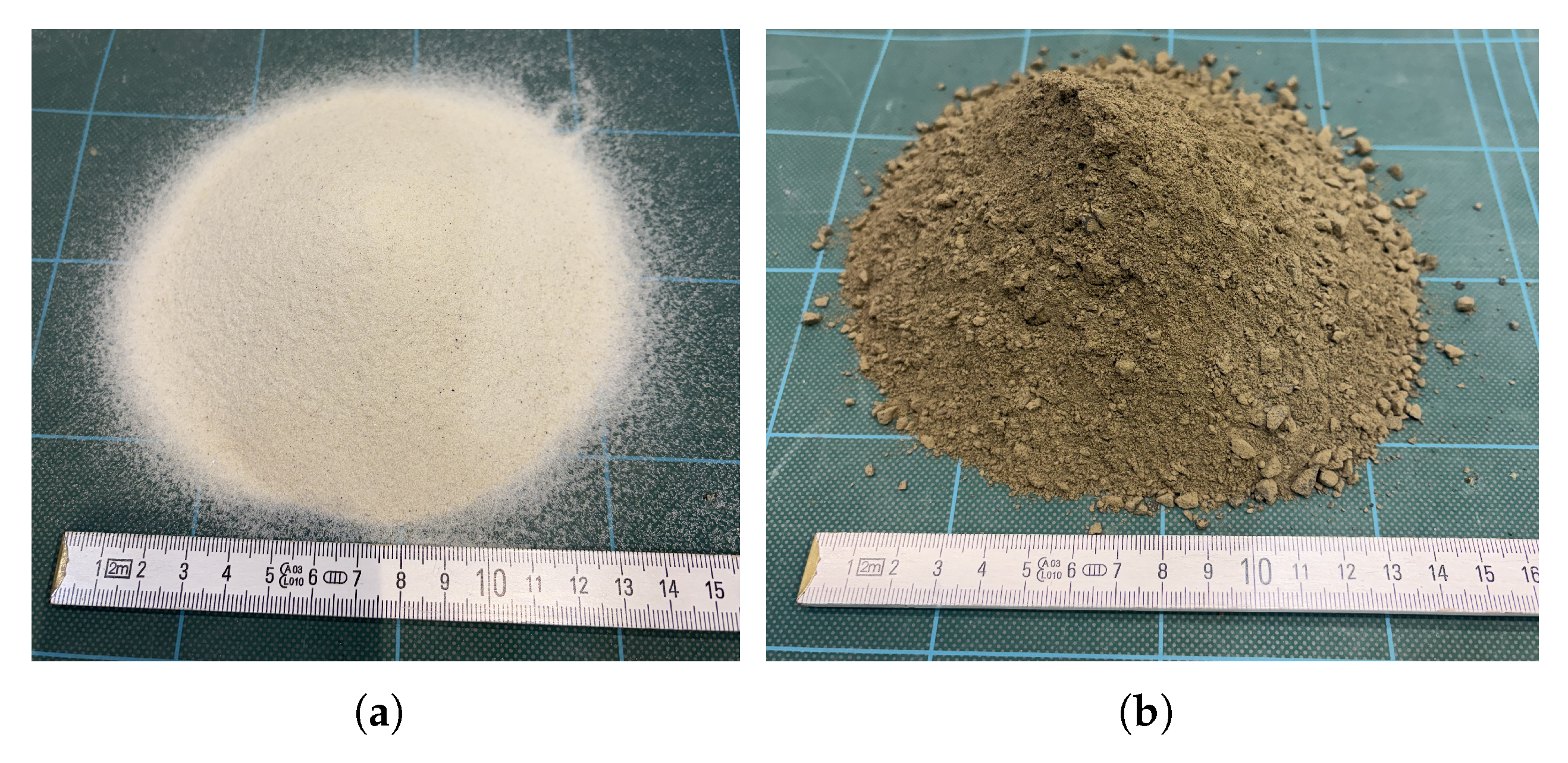
Two types of sand were used: quartz sand WF 34 and Syar sand, whose properties are shown in Table 4. WF 34 is a fine quartz sand and is almost cohesion-less [19]. It is produced by Quarzwerke GmbH. Syar, named after the company that produced it, is a high-cohesion sand produced by crushing basaltic sand and dust from Lake Herman, South Dakota, USA [19]. Since the actual soil properties on Mars are not exactly known and can vary depending on the actual landing site, different sands were employed to accommodate for different scenarios.
Figure 10.
WF 34 (quartz sand) (a) and Syar (b). The particles of the Syar sand are heterogeneous and compressible, while the quartz sand is homogeneous. It does not deform easily under pressure.
Figure 10.
WF 34 (quartz sand) (a) and Syar (b). The particles of the Syar sand are heterogeneous and compressible, while the quartz sand is homogeneous. It does not deform easily under pressure.
The tests were done in the Landing and Mobility Test Facility (LAMA) of the Institute of Space Systems in Bremen, Germany. The implemented and planned test-setup are shown in Figure 11 (a) and (b), respectively. The penetrator is anchored to a overhead crane via a electromagnet. The penetrator then drops from a height of up to 4.7 m on a sand bed. This height refers to the distance between the sand surface and the nose tip. With this drop height, the maximum impact velocity is 9.6 m/s. The sand is contained in a cylindrical container with a diameter of 0.8 m and a depth of 1 m. An overview of the tests can be seen in Table 5.
Before every test the sand bed was raked smoothly as seen in Figure 12 (a). Every drop was recorded by a high-speed camera and a conventional camera. The penetration depth was measured by determining the level of the sand bed relative to the container first. To measure the penetration depth, the length of the penetrator sticking out of the sand was recorded. Since it always sat in the sand at an angle, the lowest and highest sides of the top of the penetrator were measured. The mean was used to calculate the depth in reference to the pre-drop sand level. During most tests, if not stated otherwise, the sand was removed and then filled into the container again to ensure the same level of compaction between each test run.
Additionally, tests with stone coverage in the sand were performed as shown in Figure 12 (b) and (c). During test #4 a single layer of penetrator-radius sized stones was used. These stones were loosely laid onto the test bed. During tests #5 and #11, two layers were used with slightly larger stones. One layer was just barely covered by sand, while the upper layer lay loosely on the sand again. This was done to create an even tougher penetration target. For test #13 and #14, stones of a size similar to the 20 cm penetrator’s diameter were used.
3. Test Results
An overview of the test conditions and penetration results is shown in Table 5. More data and information about the particular tests are described in the following chapters.
3.1. Influence of Impact Velocity on Non-Cohesive Soil
Initially, tests were performed with a impact velocity of 4.4 m/s (#1), 6.2 m/s (#2), and 9.6 m/s (#3) using quartz sand without any stones to assess the repeatability of the setup and impact conditions. was approximated by the computing the required drop height with a simple free-fall calculation. Test #1 and #2 performed quite similarly with maximum loads of around 6 g for both the payload and the nose accelerometer as seen in Figure 13. Test #3 has a maximum load of 13 g for both sensors. Both accelerometers measure in the vertical direction. Positive g-values indicate a deceleration. All three tests show negative acceleration of the nose sensor, suggesting an acceleration into the ground direction. But this is unreasonable, since there are no apparent forces that could accelerate the penetrator, apart from gravity. This could be explained by the excitation of the structure during impact, inducing vibrations. A similar phenomenon was also reported by other researchers [10,18]. It is also possible that the connection of the acceleration sensor to the penetrator was not stable, which led to vibrations. The load limiter was not deformed because the forces acting on it were lower than the load limiter’s crush force.
3.2. Repeatability of Tests on Non-Cohesive Soil
In Figure 14 the acceleration data of the payload and the nose of test #3 and #4 are shown. The penetrator impacted at a velocity of around 9.6 m/s into the quartz sand. No stones were used. It is clear that the tests performed very similarly. Each of the payload and nose had an initial maximum g-load of around 13 g, indicating that the load limit was not reached. The tests also indicate vibrations for both sensors at the beginning of the penetration.
Figure 14.
Acceleration data of test #3 and #4.
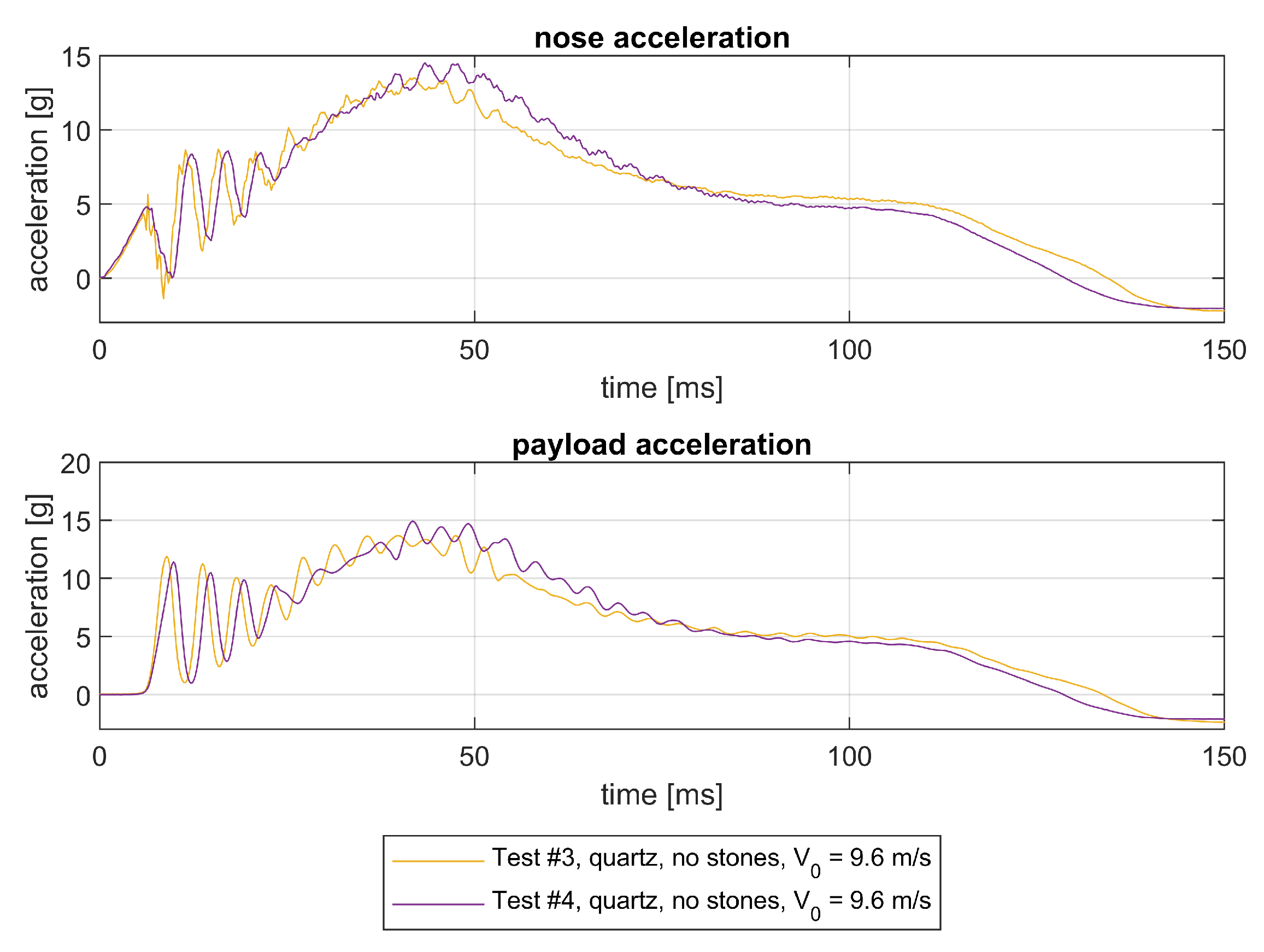
Figure 15.
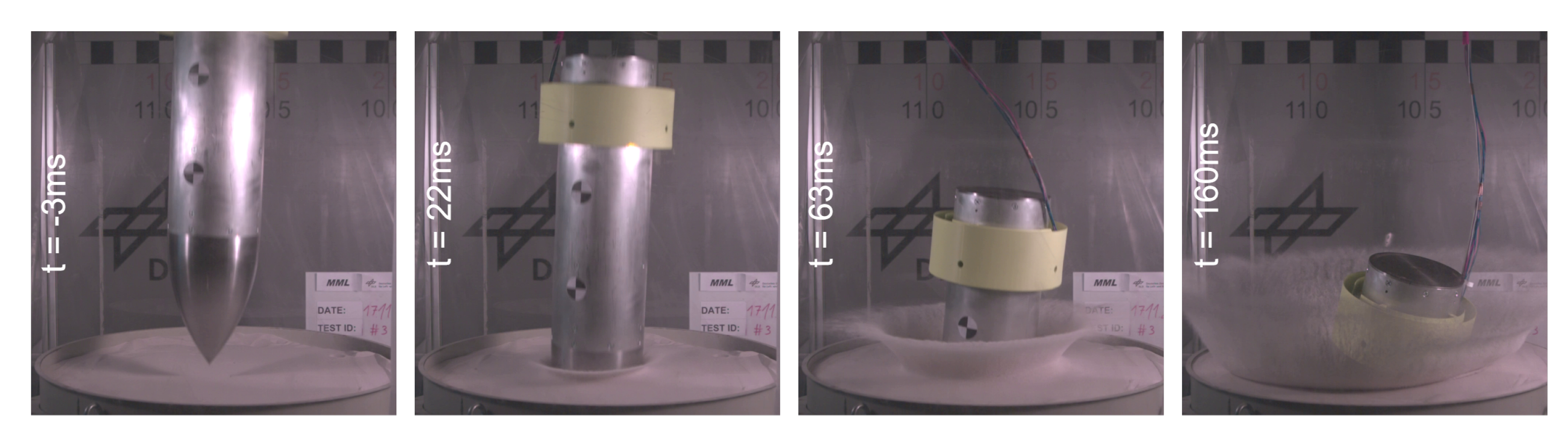
Screenshots taken from the high-speed video of test #3. The impact begins at t = 0ms with ≈ 9.6 m/s.
Figure 15.
Screenshots taken from the high-speed video of test #3. The impact begins at t = 0ms with ≈ 9.6 m/s.
3.3. Effect of Stone-Layers on Non-Cohesive Soil
In Figure 16, the stone layer tests (#5, #6, and #11) are compared to a stone-free test (#4). All tests were done with an impact velocity of roughly 9.6 m/s and quartz sand. While test #5 used a single layer of half a penetrator-diameter stone, tests #6 and #11 used a double layer of the same stones. These tests are identical for testing repeatability. The initial acceleration acting on the nose accelerometer for tests #4, #6, and #11 reaches a negative peak. Again, the initial acceleration for those tests is negative. Causes for this have been hypothesized previously. When the excitation is mostly gone, the acceleration patterns for all three stone-layer tests are similar to test #4. The penetration depth for test #5 is even deeper than for the stone-free test #4, suggesting that these stones have no significant impact on the penetration performance. Even with the double layer of the stones, the penetration depth is only slightly reduced. Frames from the high-speed video of test #5 are shown in Figure 17.
3.4. Repeatability of Tests on Cohesive Soil With Loose Compaction
Syar sand is used for tests #7 and #8, without any stones. The penetrator impacts the soil with approximately 9.6 m/s. The soil is only loosely compacted by the filling process into the test bed and its own weight. The acceleration data is shown in Figure 18. The measurements during both tests are similar, although there is a negative peak during test #8 measured by the nose sensor.
3.5. Effect of Compaction on Cohesive Soil
Syar sand was used for tests #9–#10 as well, with an impact velocity of roughly 9.6 m/s. For the following tests, the container was not emptied and refilled to avoid any compaction. Instead, the sand was intentionally left compacted to increase the deceleration of the penetrator. As seen in Figure 19, this results in increasing loads for tests #9 and #10, since the compaction of the soil intensifies with every test. The data from test #8 is shown here again for comparison. Vibrations can also be seen in the beginning of the tests. Test #10 is the first test with a deformation of the load limiter as the acceleration reaches approx. 29 g or 6.3 kN. Figure 20 shows the force displacement behavior of the payload, which is similar to the ideal behavior as seen in Figure 4. Screenshots from the high-speed camera of test #10 can be seen in Figure 21. Similar to test #3, sand is pushed upwards and to the side. But the Syar sand does not form a well-defined wave like the quartz sand. Also, the fill level does not change after impact because the Syar sand is compressed.
3.6. Center Stone Impact
For test #12 larger, stones were used with a similar diameter to the penetrator. It was dropped directly on the center stone with a velocity of roughly 9.6 m/s. The stone was pushed into the sand and broke into two pieces but did not penetrate the sand significantly and instead fell to the side. This led to large forces acting on both the penetrator and the payload, as seen in Figure 22. The deformation is clearly visible when the load limiter begins to deform in the diagram, but the signal is then distorted by vibrations, just as the nose accelerometer signal. When the load limiter was completely crushed, the payload impinged on the load limiter holder, resulting in another acceleration peak for the nose accelerometer caused by vibrations. At the same time, an acceleration peak occurred for the payload. The signal for the nose accelerometer is distorted again.
3.7. Off-Center Stone Impact Tests
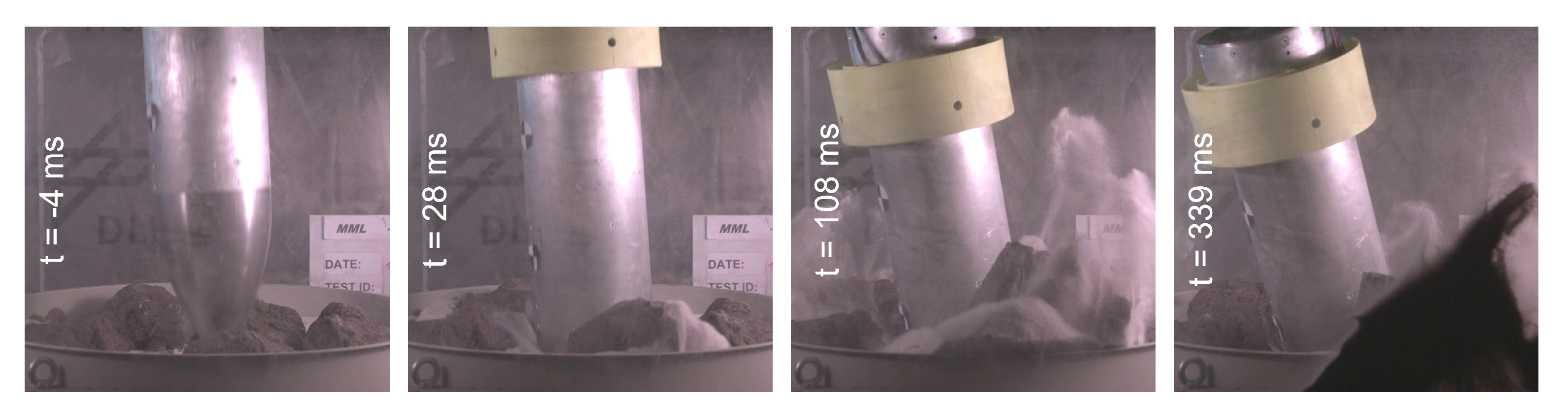
For tests #13 and #14 two different load limiters were employed with a load limit of = 3.31 kN and = 6.24 kN. The impact velocity was roughly 9.6 m/s. Multiple penetrator-diameter sized stones and a few penetrator-radius stones were arranged concentrically around the impact point on the quartz sand. The impact point is cleared, but three diameter-sized stones are arranged roughly 5 cm away from the point. This way it was ensured that the penetrator penetrates the soil but still has to push away at least one stone, depending on where the actual impact takes place. During both tests the stones closest to the impact point were moved significantly. This can be seen in the screenshots of the high-speed camera in Figure 25. Nonetheless, the penetrator could still penetrate the soil with a penetration depth of 31.5 cm for #13 and 37.7 cm for #14. The positive and negative peaks for test #13 are cut in this diagram to better show the relevant parts of Figure 23. The peaks are single points of data with accelerations of up to +440 g or -72 g. The load limiter of test #14 behaves similarly to the ideal behavior as seen in Figure 24. The load limiter of test #13 behaves less ideal. It has a force peak of 6.2 kN, but otherwise the limiter deforms at around 4 kN. The off-center stone impact could introduce forces that also act in the horizontal direction, resulting in a non-ideal behavior of the load limiter.
Figure 23.
Acceleration data of test #13 and #14.
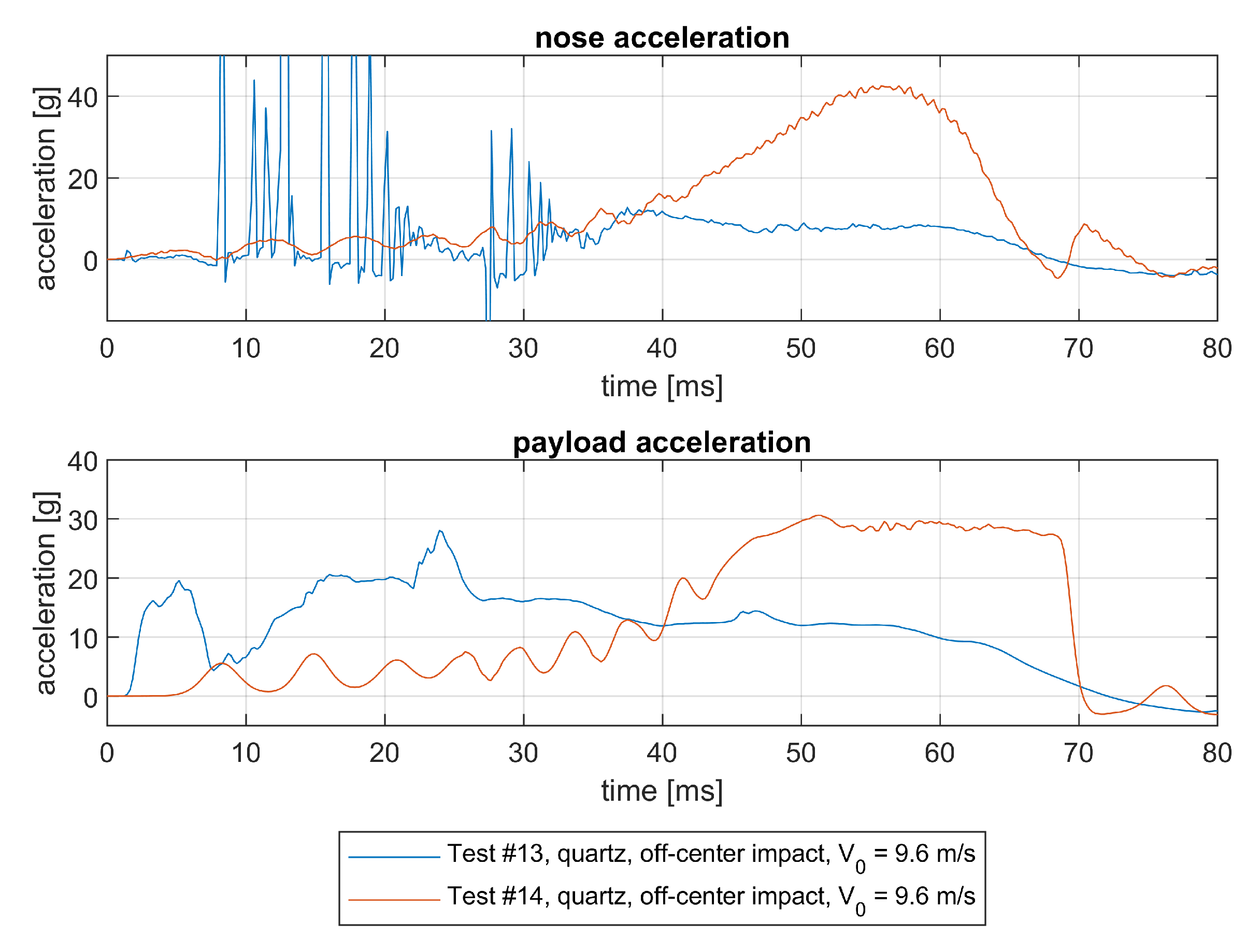
Figure 24.
Force-displacement diagram of the load limiter during test #13 and #14.
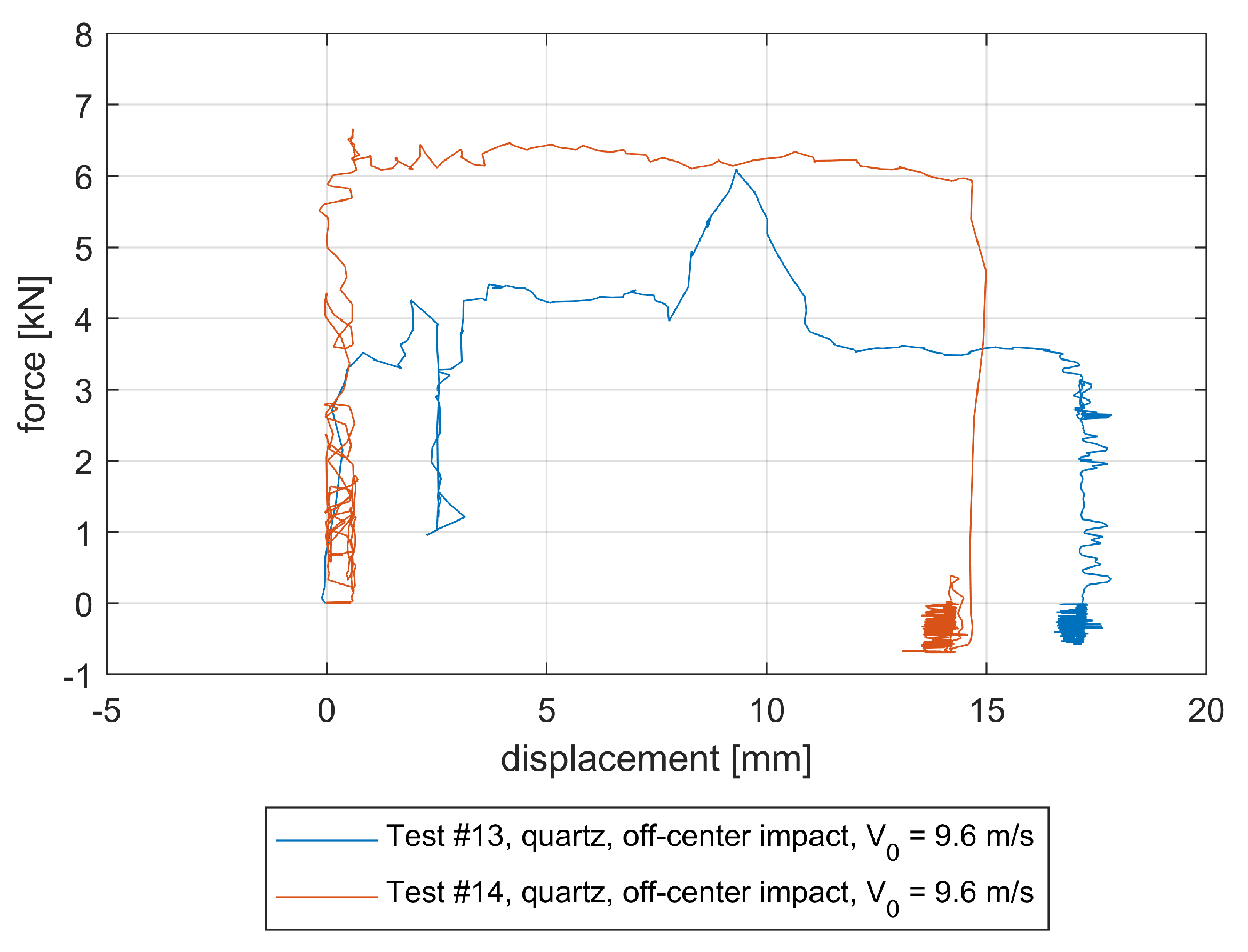
Figure 25.
Screenshots taken from the high-speed video of test #13. The impact begins at t = 0ms with 9.6 m/s.
Figure 25.
Screenshots taken from the high-speed video of test #13. The impact begins at t = 0ms with 9.6 m/s.
3.8. Test vs. Simulation
The experimentally obtained acceleration profiles of impacts into quartz and Syar soil are compared in Figure 26 to acceleration data obtained by the simulation model. The soil mechanical parameter and associated to these simulations are selected to represent the rising flank of the test data and its peak of acceleration. The values of the parameter are given in the figure’s legend.
The comparison between test and simulation of the impact into the quartz sand confirms again the peak of force being determined by the displacement drag. The penetration time until the penetrator comes to a full stop is however largely overestimated by the simulation.
Contrarily, the impact acceleration into the cohesive soil Syar is dominated by the compaction of soil, indicated by the larger - and lower -value compared to the quartz sand. The decreasing flank of the measured acceleration and peak are not well predicted by the simulation.
The discrepancy between test and simulation in the duration until the penetrator body comes to a rest indicates a v-error, although the initial kinetic energies have been identical. This is explained by the circumstance, that even in controlled lab environment with stone-free, granular soil (test cases #3, #4, #7, #8) the penetrator body start to rotate out of its vertical alignment thus introducing a lateral motion component (visible in all associated video image sequences) contributing to the actual energy absorption which is not accounted in the simple semi-empirical model.
4. Discussion/Conclusions
A Mars penetrator probe design has been taken as reference for a simulation and test campaign about its penetrator dynamics. The results of these campaigns are not meant to mature or qualify the reference design. They indicate the areas of improvement of those test and simulation campaigns for further studies: The discrete element method (DEM) simulation and the semi-empirical model correlate well with regard to their predicted force penetration depth curves. Both simulations consider the soil as quasi-continuum of particles with a size significantly smaller than the penetrator’s diameter.
The comparison generally confirms the idea that the total force acting on the penetrator body is dominated by forces from the velocity-dependent displacement of particles and the increasing soil compaction underneath the penetrator along the progressing depth.
The single-degree-of-freedom semi-empirical model is computationally comparatively cheap and is able to predict peak accelerations at impact. Consideration of the body deflection upon impact, seen even in homogeneous, granular soils, are necessary to predict the resulting penetration depth, which is otherwise overestimated. The tests were executed on a non-cohesive quartz sand and a cohesive soil with greater variety in particle size distribution. Particle sizes are generally significantly lower than the penetrator’s diameter.
Finding for continuing research: Quantitatively, the model requires a refinement to consider the pre-compaction of the soil with depth and therefore a nonlinear increase of bearing capacity along probe penetration, meaning that the parameter is a function of the penetration dept instead of being a constant value. This finding likewise applies to the setting of the DEM study. Impact on stone of size near or at the size (diameter) of the penetrator body show a large reduction in penetration capability compared to pure soil due to the added displacement energy required. The penetration fails when hitting a rock of penetrator diameter size.
Open point for continuing research is to more thoroughly investigate whether the penetrator’s diameter discriminates the penetrability and non-penetrability of terrain characterized by a certain stone-size-frequency distribution. Such confirmation would be crucial to assess landing success probabilities on certain terrains. With regard to the predictability of this observation, the semi-empirical simulation model is not able to consider this by default due to its limitation to homogenous soil conditions. Such phenomena can however be implemented as part of a DEM simulation.
Another open point for continuing research: The parameters and are functions of the soil mechanical parameter. Derivation of a mathematical relation requires a more comprehensive study with a greater variety in soil mechanical parameter such as its cohesion, friction angle and packing density. A limitation in the used test set-up is its comparatively low impact velocity. This leaves open if a higher impact kinetic energy into the cohesive soil and the resultant higher impulse transfer would have led to a higher overburden force to overcome the cohesive forces.
Open question for further research is therefore to clarify, if a higher impact energy leads to a higher displacement drag due to acceleration of loose particles that have overcome their intra-particle cohesion, showing a kind of liquefaction.
Concluding remark: the idea of using small penetrator probes as a less complex, low(er) cost alternative to soft landing vehicles relies largely on the energy absorption capability of the planetary terrain. Unlike ammunition type of penetrators, which normally need to have knowledge on their terrain- or target-specific minimum penetration depth, an exploration type of penetrator needs to know this for constrained min-max-bandwidth. The inherent uncertainty of knowledge about the, particular sub-surface, terrain properties remain therefore a major driver for mission risk despite large required test and simulation efforts to address the open questions stated above.
Author Contributions
Conceptualization, Lars Witte; methodology, Vincent Feldmann; software, Vincent Feldmann; validation, Vincent Feldmann; formal analysis, Vincent Feldmann; investigation, Vincent Feldmann, Silvio Schröder and Torben Wippermann; resources, Vincent Feldmann; data curation, Vincent Feldmann; writing—original draft preparation, Vincent Feldmann; writing—review and editing, Thomas Reimer, Isil Sakraker Özmen, Anton Schneider and Lars Witte.; visualization, Vincent Feldmann; supervision, Lars Witte; project administration, Lars Witte. All authors have read and agreed to the published version of the manuscript.
Funding
This research received no external funding.
Data Availability Statement
The raw data supporting the conclusions of this article will be made available by the authors on request.
Conflicts of Interest
The authors declare no conflicts of interest.
Abbreviations
The following abbreviations are used in this manuscript:
| ConOps | Concept of Operations |
| DEM | Discrete Element Method |
| DLR | Deutsches Zentrum für Luft- und Raumfahrt (German Aerospace Center) |
| GNC | Guidance, Navigation and Control |
| LAMA | Landing and Mobility Test Facility |
| MASCOT | Mobile Asteroid Surface Scout |
| MetNet | Mars Network |
| MML | Micro Mars Lander |
References
- Smrekar, S.; Catling, D.; Lorenz, R.; Magalhães, J.; Moersch, J.; Morgan, P.; Murray, B.; Presley, M.; Yen, A.; Zent, A.; Blaney, D. Deep Space 2: The Mars Microprobe Mission. J. Geophys. Res. Plan. 1999, 104(E11), 27013–27030. [Google Scholar] [CrossRef]
- Zakharov, A.V. The Mars-94 and Mars-96 missions. Philosophical Transactions of the Royal Society of London. Series A: Physical and Engineering Sciences 1994, 349(1690), 295–307. [Google Scholar] [CrossRef]
- Albee, A. REPORT ON THE LOSS OF MARS POLAR LANDER / DEEP SPACE 2. JPL 2000. [Google Scholar]
- Biswal, M.K.; Annavarapu, R.N. Mars Missions Failure Report Assortment: Review and Conspectus. In AIAA Propulsion and Energy 2020 Forum; 2020. [CrossRef]
- Harri, A.-M. METNET – THE NEXT GENERATION LANDER FOR MARTIAN ATMOSPHERIC SCIENCE. In Finnish Meteorological Institute; 2003. [Google Scholar]
- Harri, A.-M. Final Report Abstract - Netlander 2005 Lander Network to Mars. In Finnish Meteorological Institute; 1998. [Google Scholar]
- Lorenz, R.D. Planetary penetrators: Their origins, history and future. Adv. Space Res. 2011, 48(3), 403–431. [Google Scholar] [CrossRef]
- Gonzalo, A. The Thermal Subsystem of Mars Connect: Miniature Probes for a Meteorological Network on the Mars Surface. In 54th International Conference on Environmental Systems; 2025. [CrossRef]
- Luo, H.; Liu, Z.; Fan, C.; Li, Y. Numerical simulation and experimental study of high-speed impact penetrator for lunar subsurface. Acta Astronaut. 2025, 233, 250–265. [Google Scholar] [CrossRef]
- Luo, H.; Li, Y.; Fan, C.; Wu, X.; Liu, G. Design and experimental research on buffer protection of high-g penetrator for deep space exploration. Acta Astronaut. 2021, 189, 63–78. [Google Scholar] [CrossRef]
- Yamada, K.; Nagata, Y.; Goto, K.; Tanaka, S.; Tomiki, A.; Toyota, H.; Kimura, S.; Nakao, T.; Shiraishi, H. Conceptual Design of Compact EDL System Using Inflatable Aeroshell and Penetrator Technology for Mars Landing Exploration. IPPW. 2025. Available online: https://drive.google.com/drive/folders/1Po7-aLFmDwd9cByjNXgNTJg3Txi7Hp2B.
- NASA. Expanding the Horizons of Mars Science, A Plan for a Sustainable Science Program at Mars. NASA. 2024. Available online: https://assets.science.nasa.gov/content/dam/science/psd/solar-system/mars/campaigns/mars-future-plan/20241204_Mars_Future_Plan_Final_Print.pdf.
- Forrestal, M.J.; Luk, V.K. Penetration into soil targets. Int. J. Impact Eng. 1992, 12(3), 427–444. [Google Scholar] [CrossRef]
- Buchely, M.; Marañon, A. Spherical Cavity Expansion Approach for the Study of Rigid-Penetrator’s Impact Problems. Appl. Mech. 2020, 1(1), 20–46. [Google Scholar] [CrossRef]
- Förste, S.; Reimer, T.; Sakraker, I.; Witte, L.; Fasoulas, S. Development of a deployable decelerator concept for small Mars landers. 2nd International Conference on Flight Vehicles, 19–23 June 2022; Available online: https://elib.dlr.de/189735/.
- Ho, T.-M.; Baturkin, V.; Grimm, C.; Grundmann, J.T.; Hobbie, C.; Ksenik, E.; Lange, C.; Sasaki, K.; Schlotterer, M.; Talapina, M.; Termtanasombat, N.; Wejmo, E.; Witte, L.; Wrasmann, M.; Wübbels, G.; Rößler, J.; Ziach, C.; Findlay, R.; Biele, J.; Krause, C.; Ulamec, S.; Lange, M.; Mierheim, O.; Lichtenheldt, R.; Maier, M.; Reill, J.; Sedlmayr, H.-J.; Bousquet, P.; Bellion, A.; Bompis, O.; Cenac-Morthe, C.; Deleuze, M.; Fredon, S.; Jurado, E.; Canalias, E.; Jaumann, R.; Bibring, J.-P.; Glassmeier, K.H.; Hercik, D.; Grott, M.; Celotti, L.; Cordero, F.; Hendrikse, J.; Okada, T. MASCOT—The Mobile Asteroid Surface Scout Onboard the Hayabusa2 Mission. Space Sci. Rev. 2016, 208, 339–374. [Google Scholar] [CrossRef]
- Ahmed, M.; AlQadhi, S.; Mallick, J.; Desmukh, M.N.; Hang, H.T. Advances in Projectile Penetration Mechanism in Soil Media. Appl. Sci. 2020, 10(19), 6810. [Google Scholar] [CrossRef]
- Young, C.W. Penetration Equations. Applied Research Associates, Inc. 1997. Available online: https://digital.library.unt.edu/ark:/67531/metadc697639/m2/1/high_res_d/562498.pdf.
- Wippermann, T.; Hudson, T.L.; Spohn, T.; Witte, L.; Scharringhausen, M.; Tsakyridis, G.; Fittock, M.; Krömer, O.; Hense, S.; Grott, M.; Knollenberg, J.; Lichtenheldt, R. Penetration and performance testing of the HP³ Mole for the InSight Mars mission. Planet. Space Sci. 2020, 181, 104780. [Google Scholar] [CrossRef]
- Bendix Corporation. LUNAR MODULE (LM) SOIL MECHANICS STUDY. NASA CR 92208. 1968. Available online: https://ntrs.nasa.gov/api/citations/19680021852/downloads/19680021852.pdf.
- Witte, L.; Buchwald, R.; Schröder, S. TOUCH-DOWN DYNAMICS AND TERRAIN INTERACTION OF PLANETARY LANDING SYSTEMS. Planetary Lander Touch Down.
- The MathWorks Inc. MATLAB version:24.2.0 (R2024b). Natick, Massachusetts, United States, 2024. Available online: https://www.mathworks.com.
- Kloss, C.; Goniva, C.; Hager, A.; Amberger, S.; Pirker, S. Models, algorithms and validation for opensource DEM and CFD-DEM. Prog. Comput. Fluid Dyn. 2012, 12, 140–152. [Google Scholar] [CrossRef]
Figure 1.
Concept of operations of the Micro Mars Lander concept.
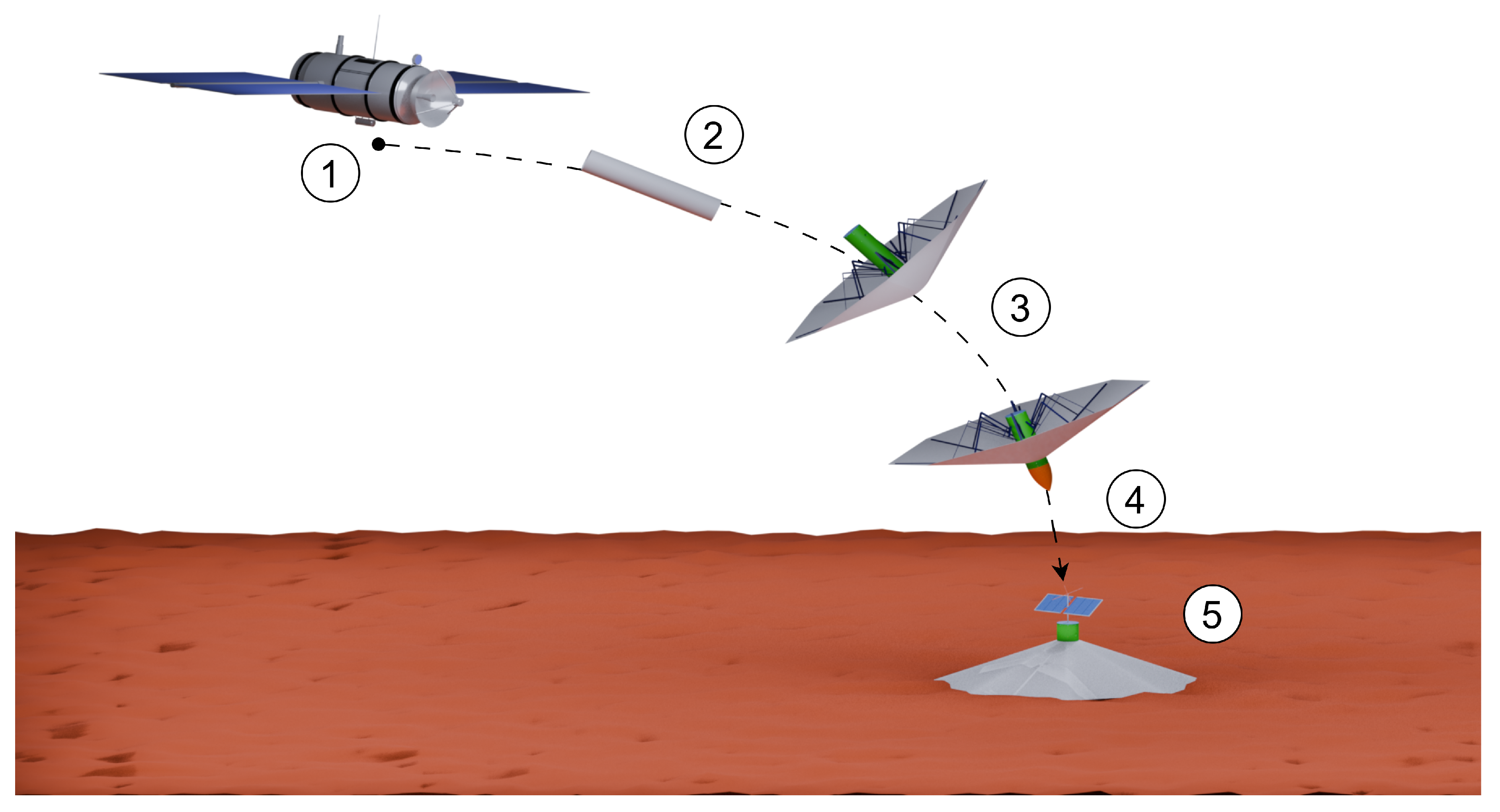
Figure 2.
Parameters used to describe the dimensions of the penetrator. The values are shown in Table 1. The nose has the shape of an tangent ogive.
Figure 2.
Parameters used to describe the dimensions of the penetrator. The values are shown in Table 1. The nose has the shape of an tangent ogive.
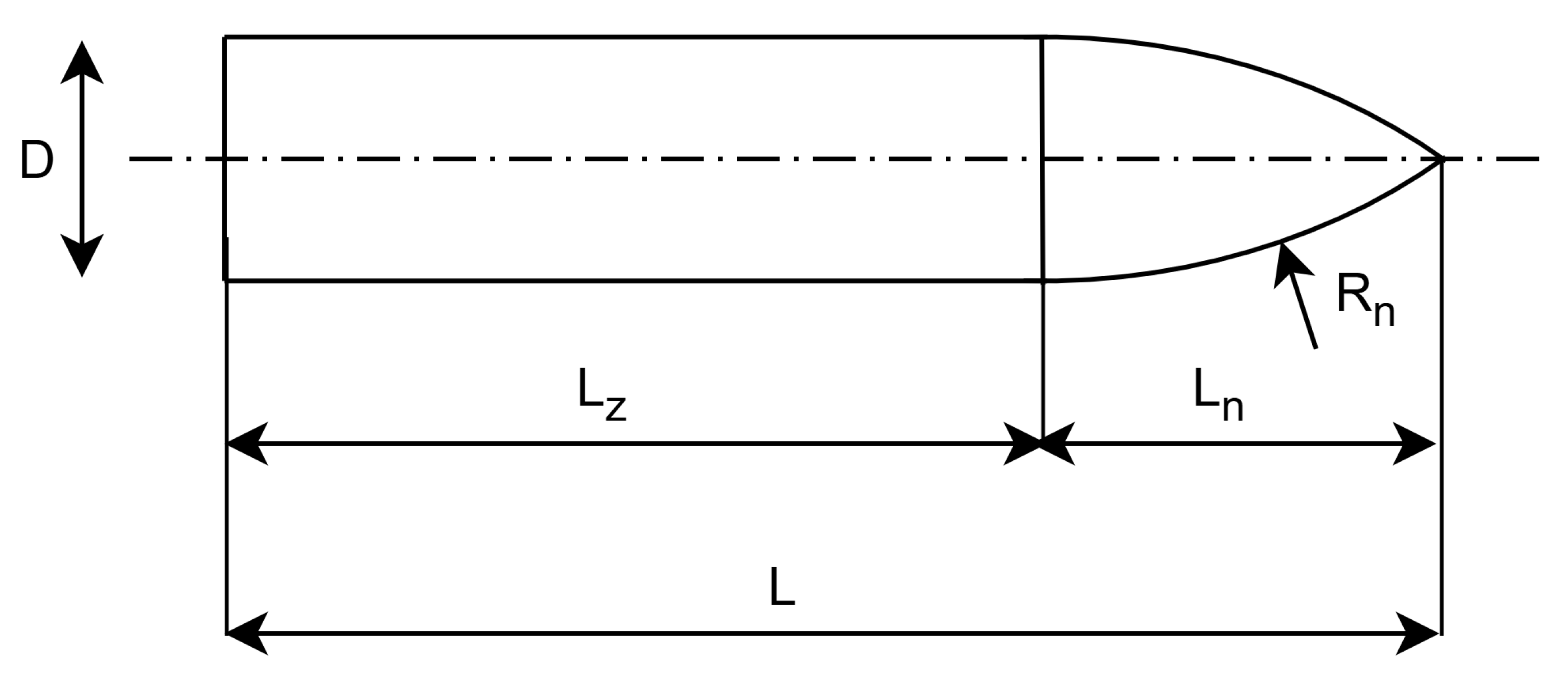
Figure 3.
Force model of the semi-empirical penetration simulation.
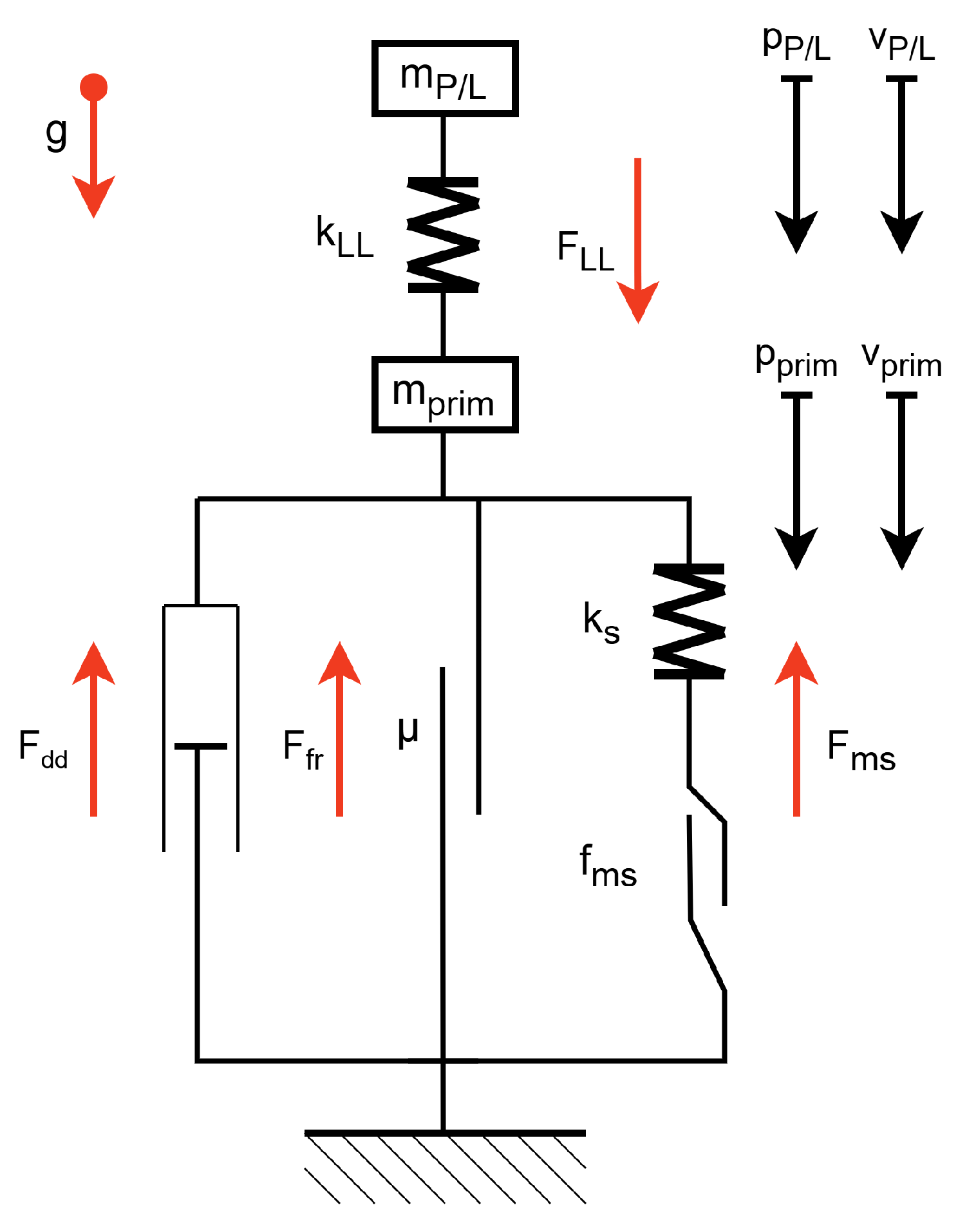
Figure 4.
(a) elastic-plastic force law and (b) force-displacement behavior of the load limiter (cases are shown in Table 2). Both are modified schematics by Witte et al. [21].
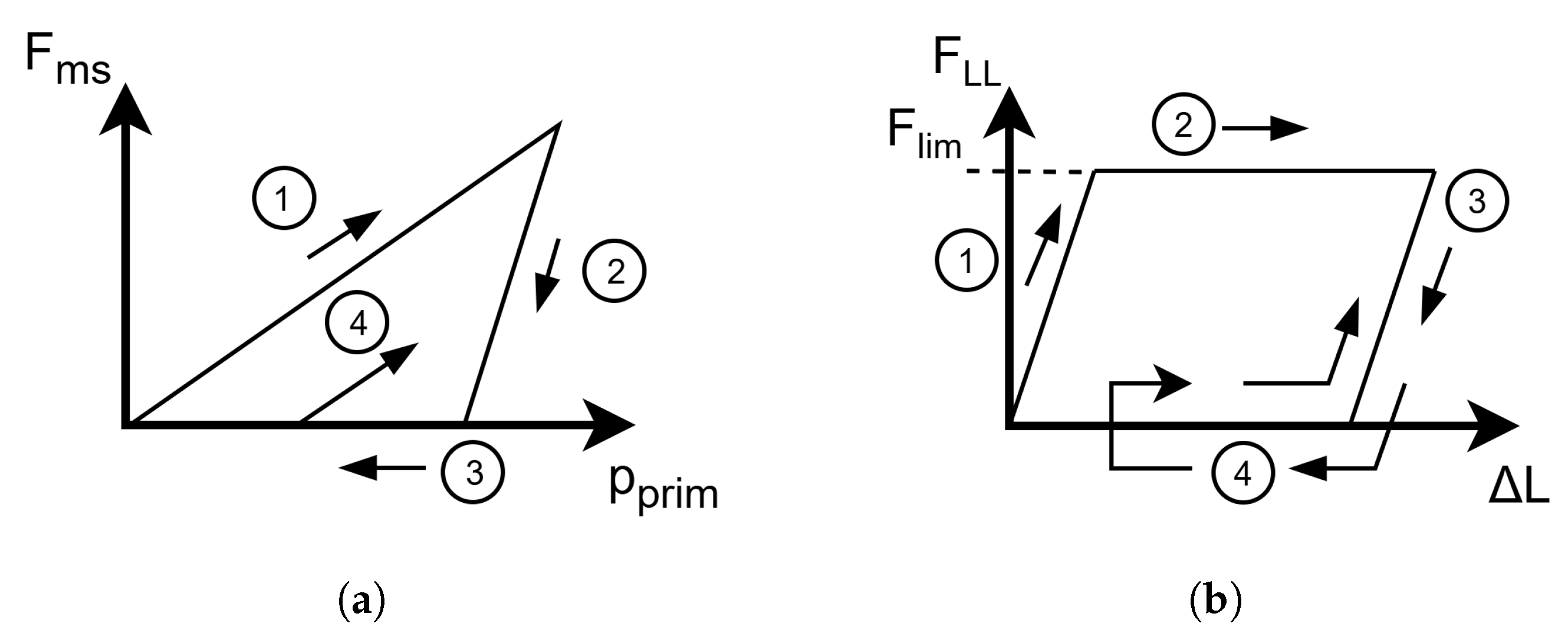
Figure 5.
Frames taken from the animation of the discrete element method impact simulation with (a) = 20 m/s, (b) = 40 m/s, and (c) = 60 m/s.
Figure 5.
Frames taken from the animation of the discrete element method impact simulation with (a) = 20 m/s, (b) = 40 m/s, and (c) = 60 m/s.
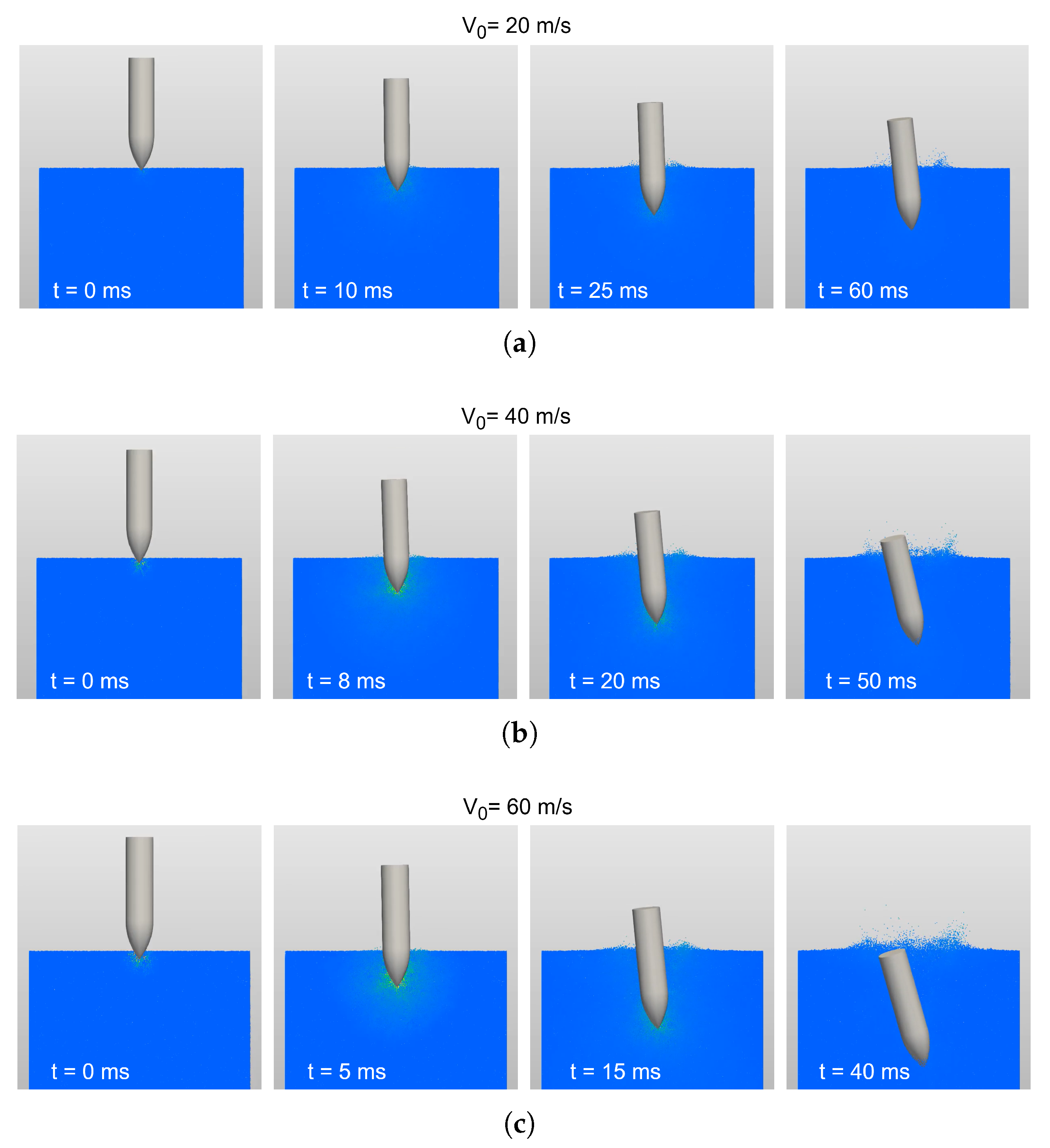
Figure 6.
Breakup of the total Force into the displacement drag and mechanical strength according to the numerical simulation. The penetrator impacts with an velocity of = 40 m/s.
Figure 6.
Breakup of the total Force into the displacement drag and mechanical strength according to the numerical simulation. The penetrator impacts with an velocity of = 40 m/s.
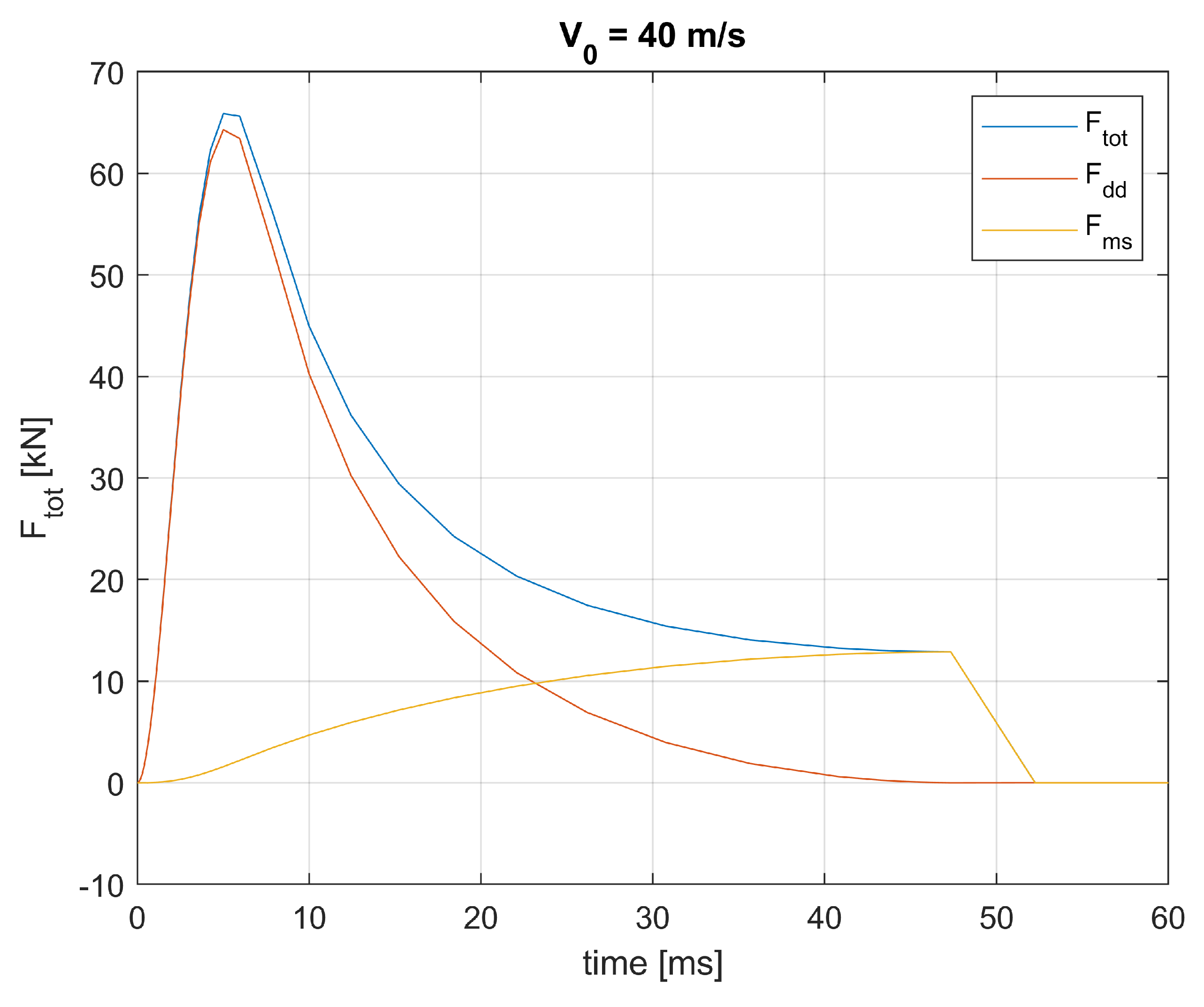
Figure 7.
The magnitude of the force acting on the penetrator over time during the penetration process by the discrete element method simulation and numerical simulation.
Figure 7.
The magnitude of the force acting on the penetrator over time during the penetration process by the discrete element method simulation and numerical simulation.
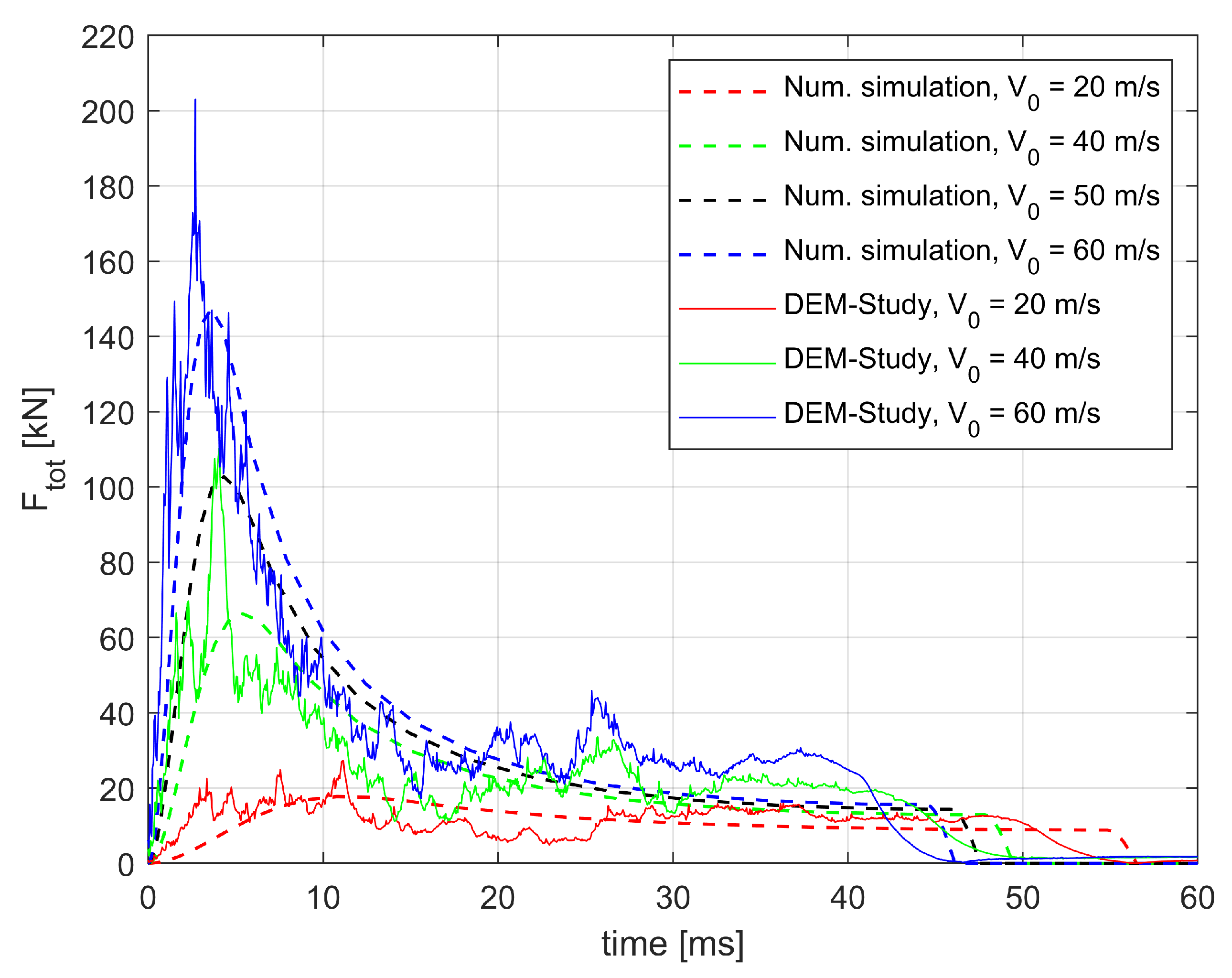
Figure 8.
The displacement of penetrator over time during the penetration process by the discrete element method and numerical simulation.
Figure 8.
The displacement of penetrator over time during the penetration process by the discrete element method and numerical simulation.
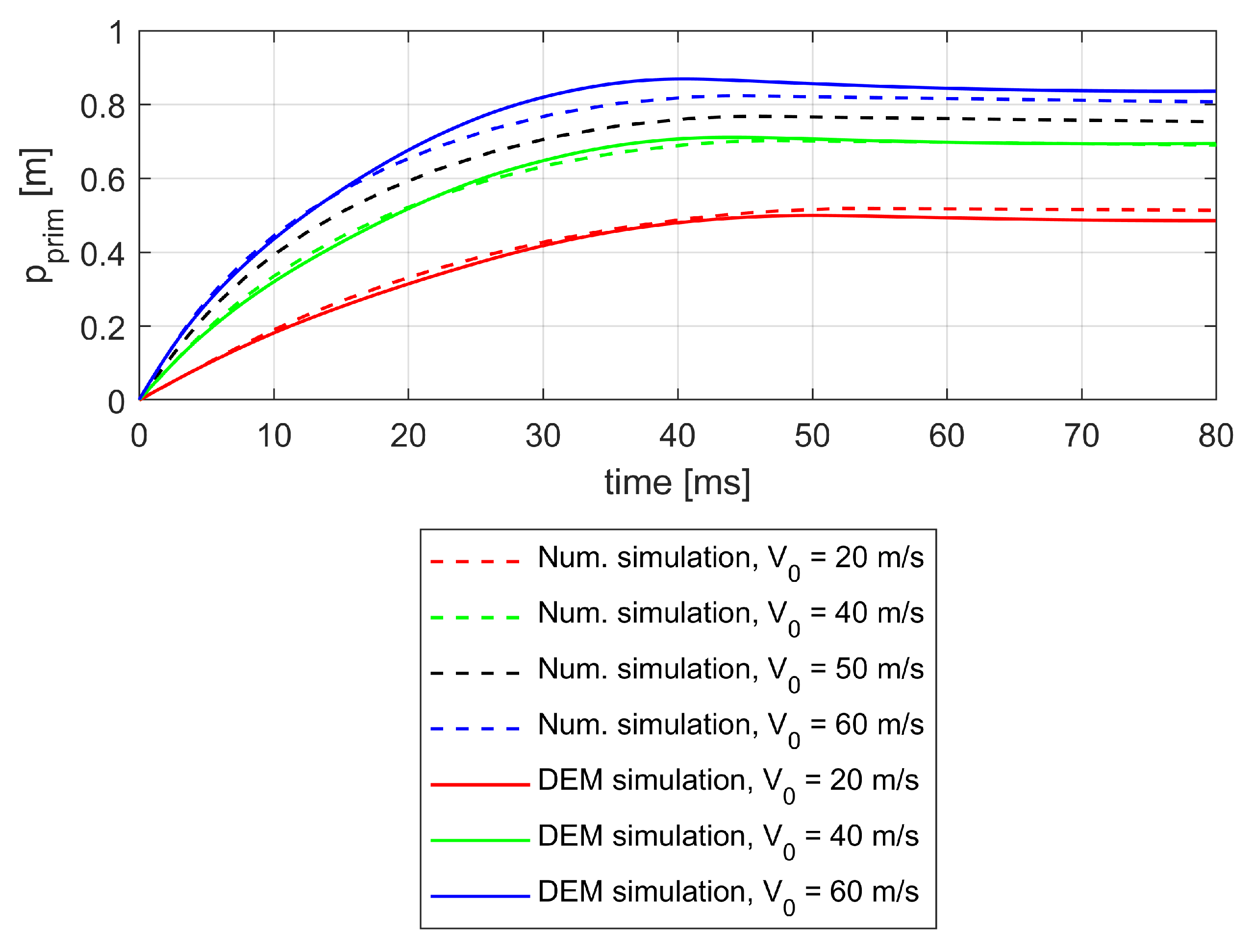
Figure 9.
Cross-section view of the test penetrator.
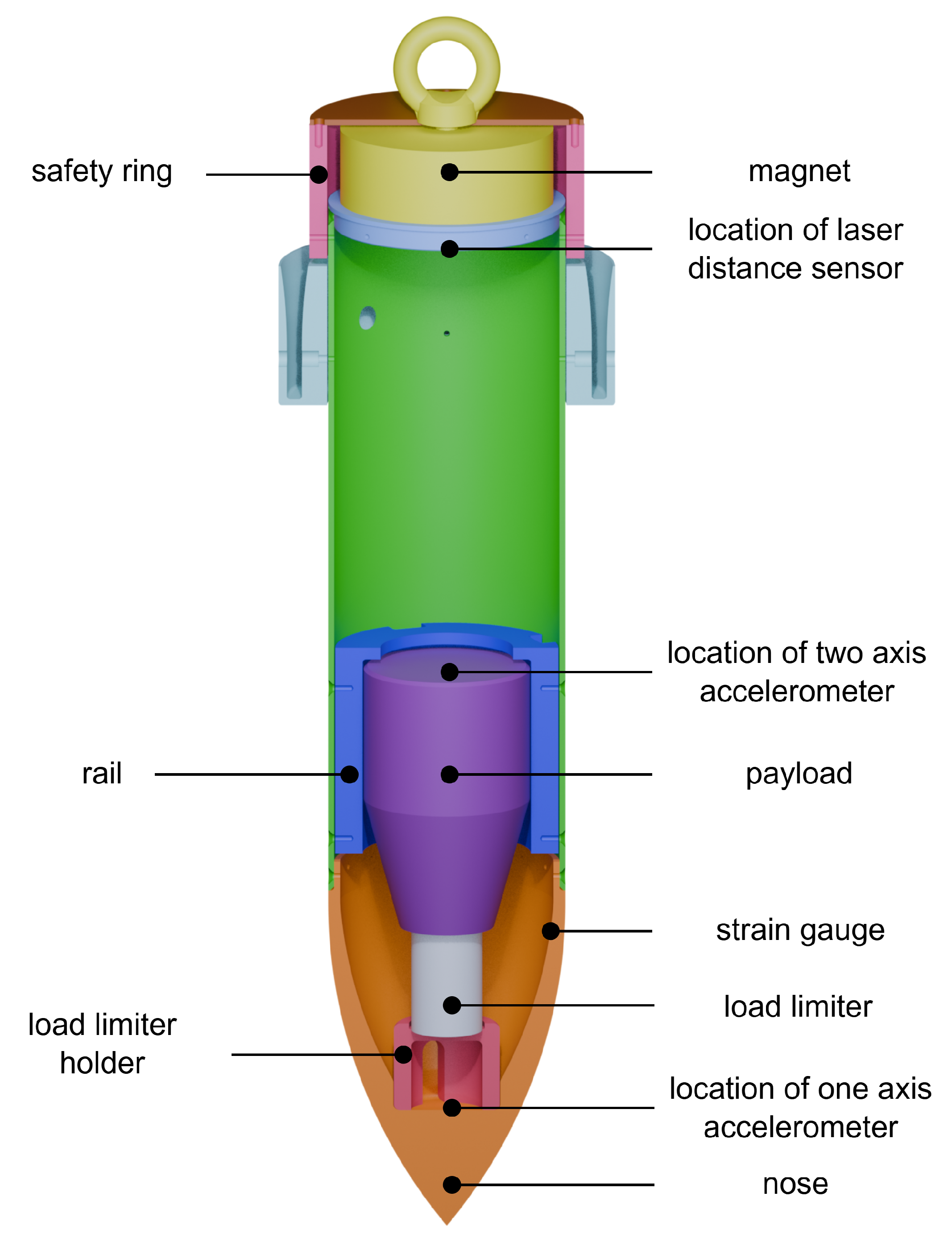
Figure 11.
Implemented (a) and planned test-setup (b).
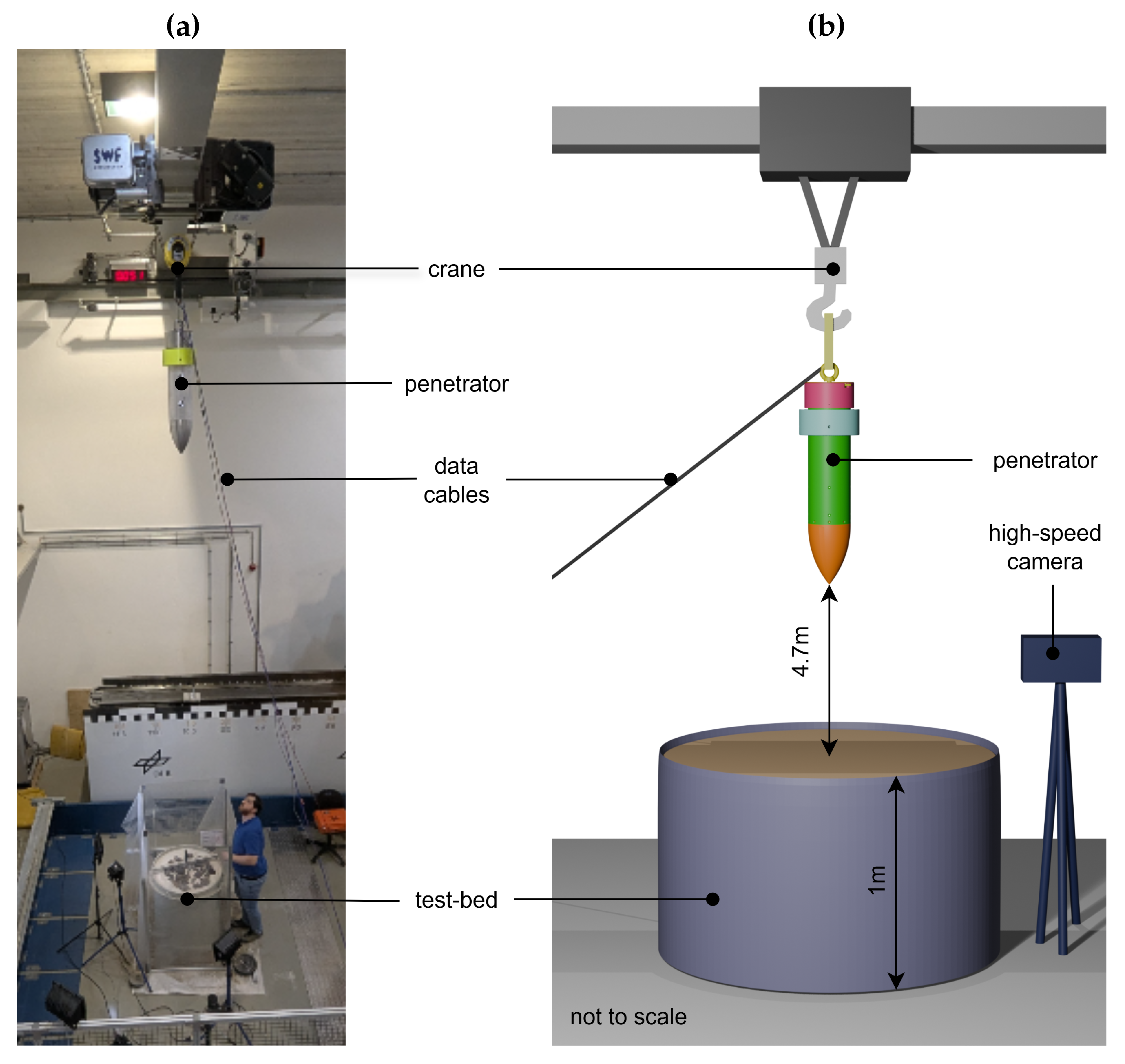
Figure 12.
Test-bed setup variants. (a) WF 34 without any stones and measuring setup for the drop height. (b) WF 34 with a single layer of penetrator-radius stones. (c) Penetrator-diameter-sized stones.
Figure 12.
Test-bed setup variants. (a) WF 34 without any stones and measuring setup for the drop height. (b) WF 34 with a single layer of penetrator-radius stones. (c) Penetrator-diameter-sized stones.
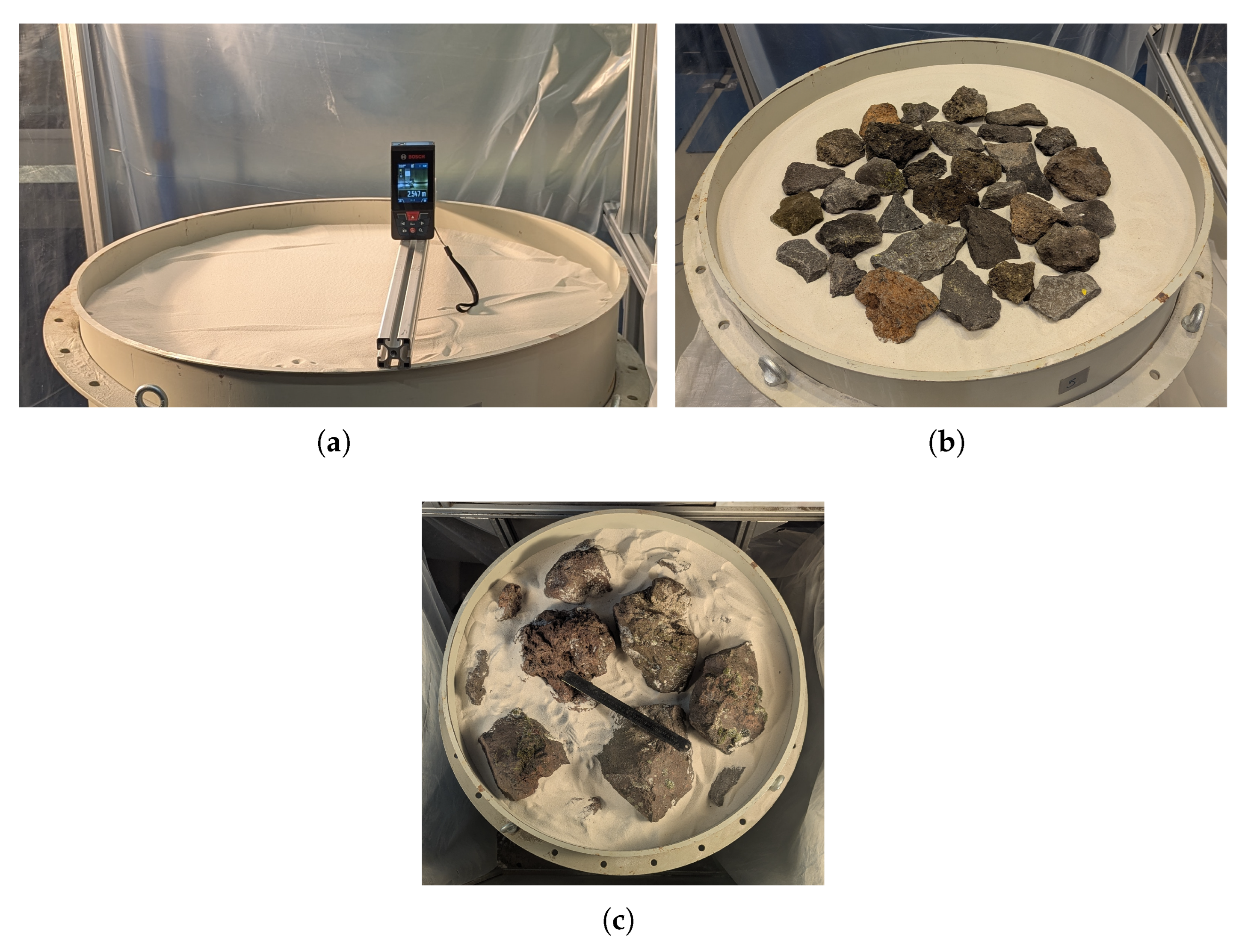
Figure 13.
Acceleration data of test #1, #2, and #3. Quartz soil without any stones were used.
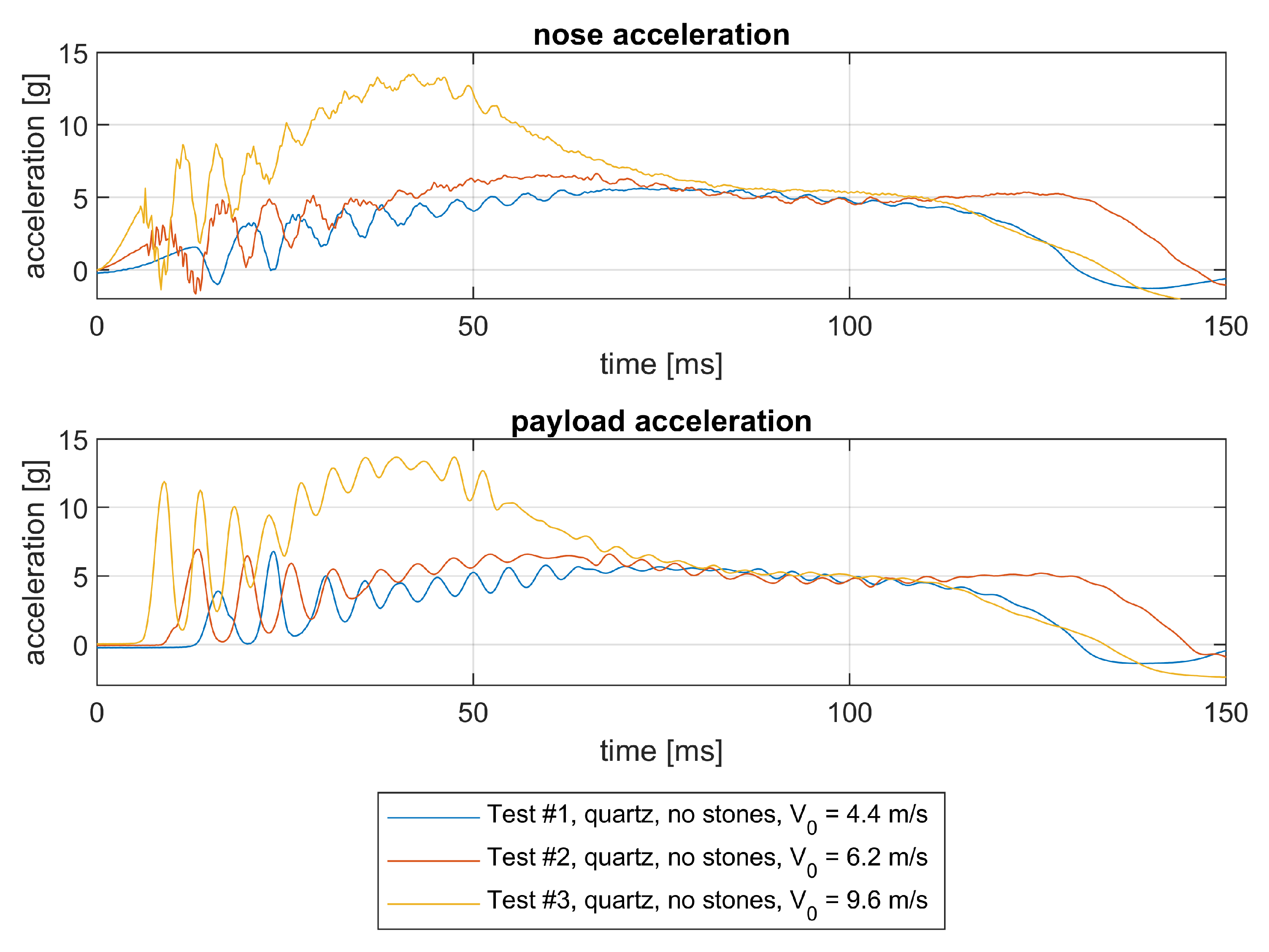
Figure 16.
Acceleration data of test #4, #5, #6, and #11. Test #11 is repetition of Test #6.
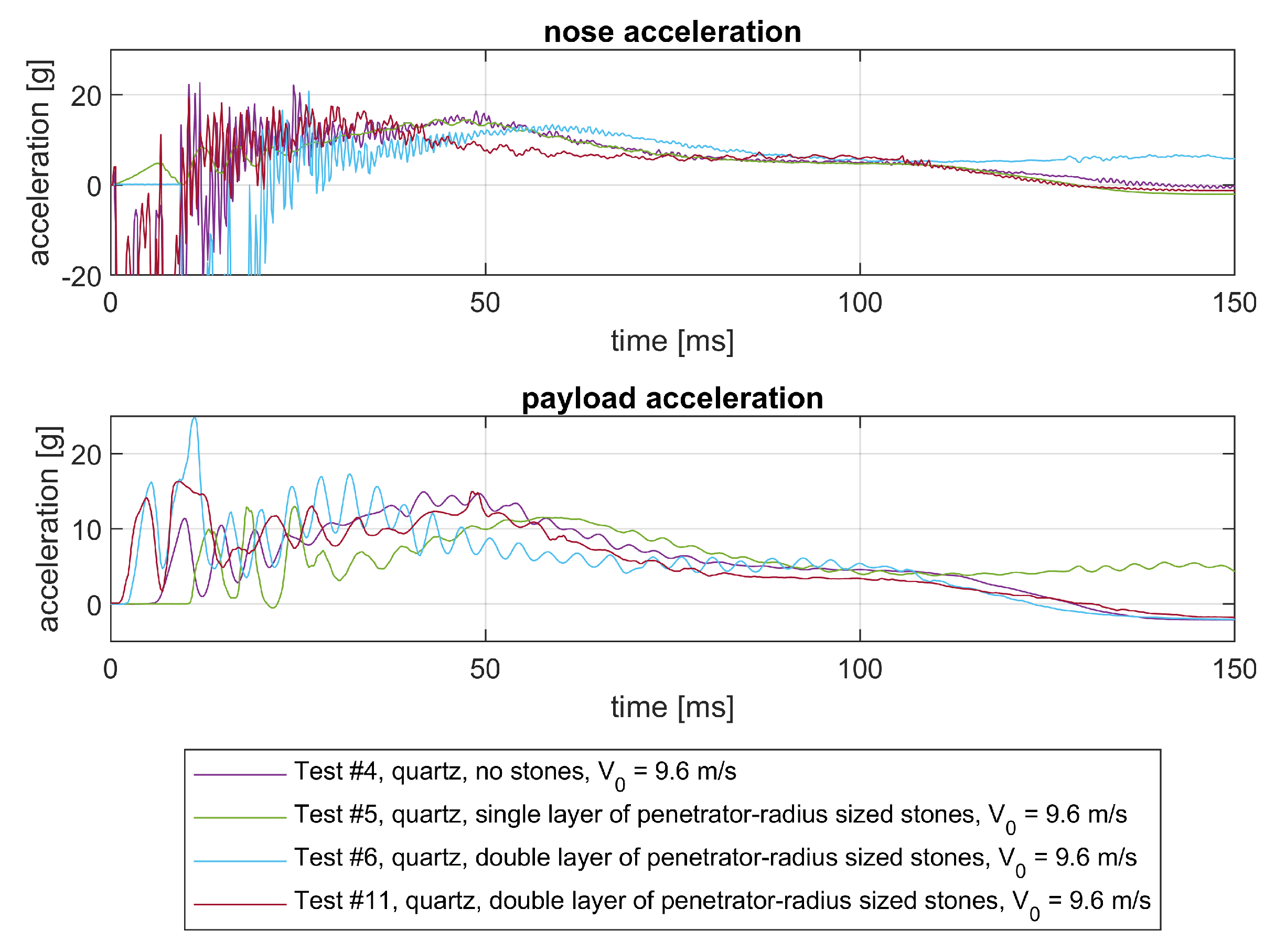
Figure 17.
Screenshots taken from the high-speed video of test #5. The impact begins at t = 0ms with ≈ 9.6 m/s.
Figure 17.
Screenshots taken from the high-speed video of test #5. The impact begins at t = 0ms with ≈ 9.6 m/s.
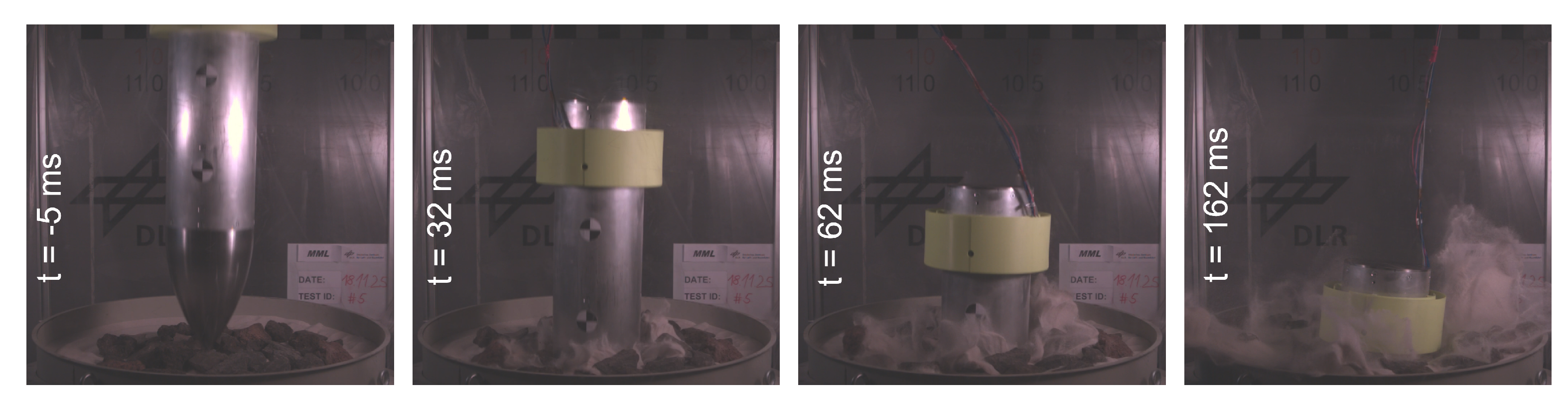
Figure 18.
Acceleration data of test #7 and #8.
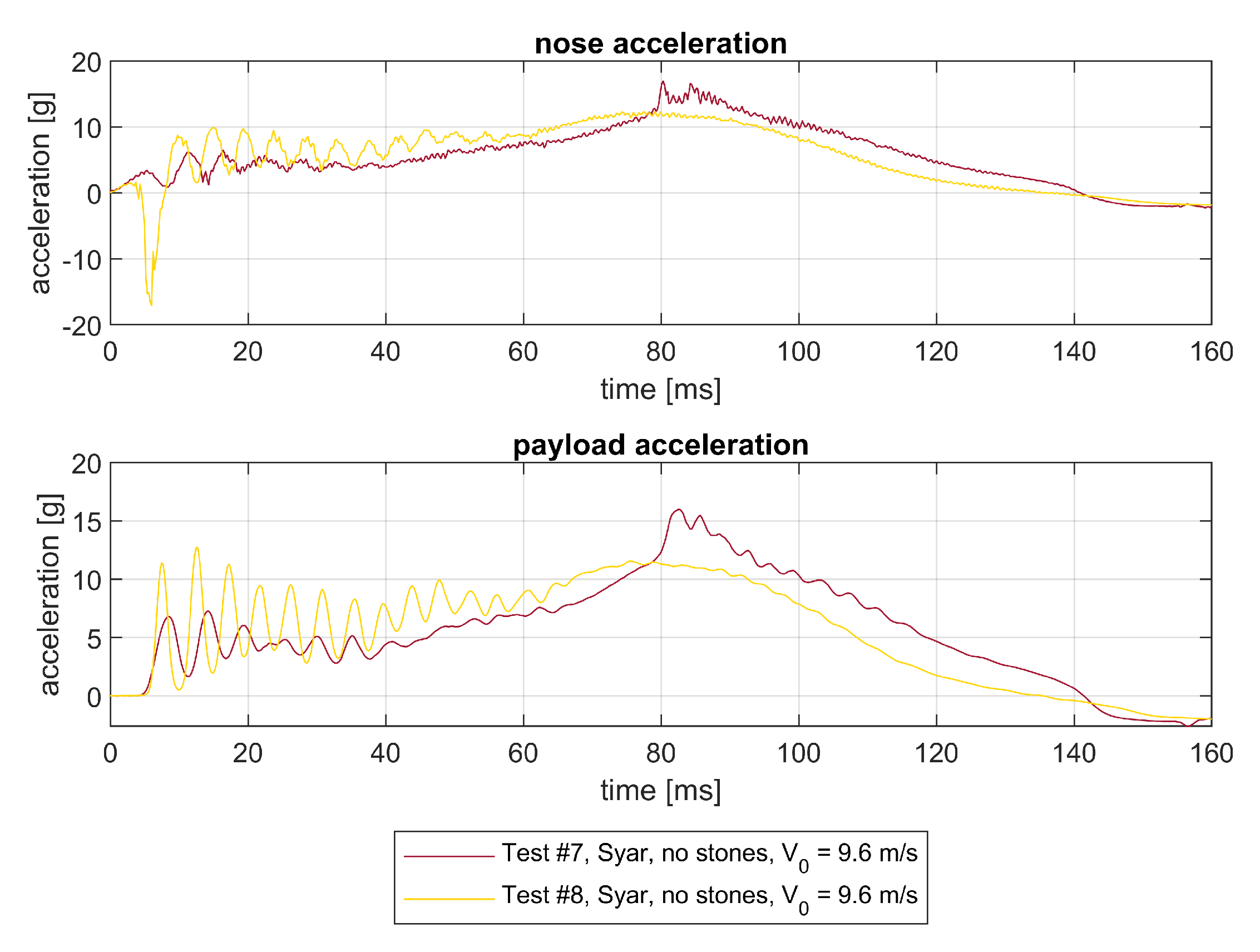
Figure 19.
Acceleration data of test #8, #9 and #10.
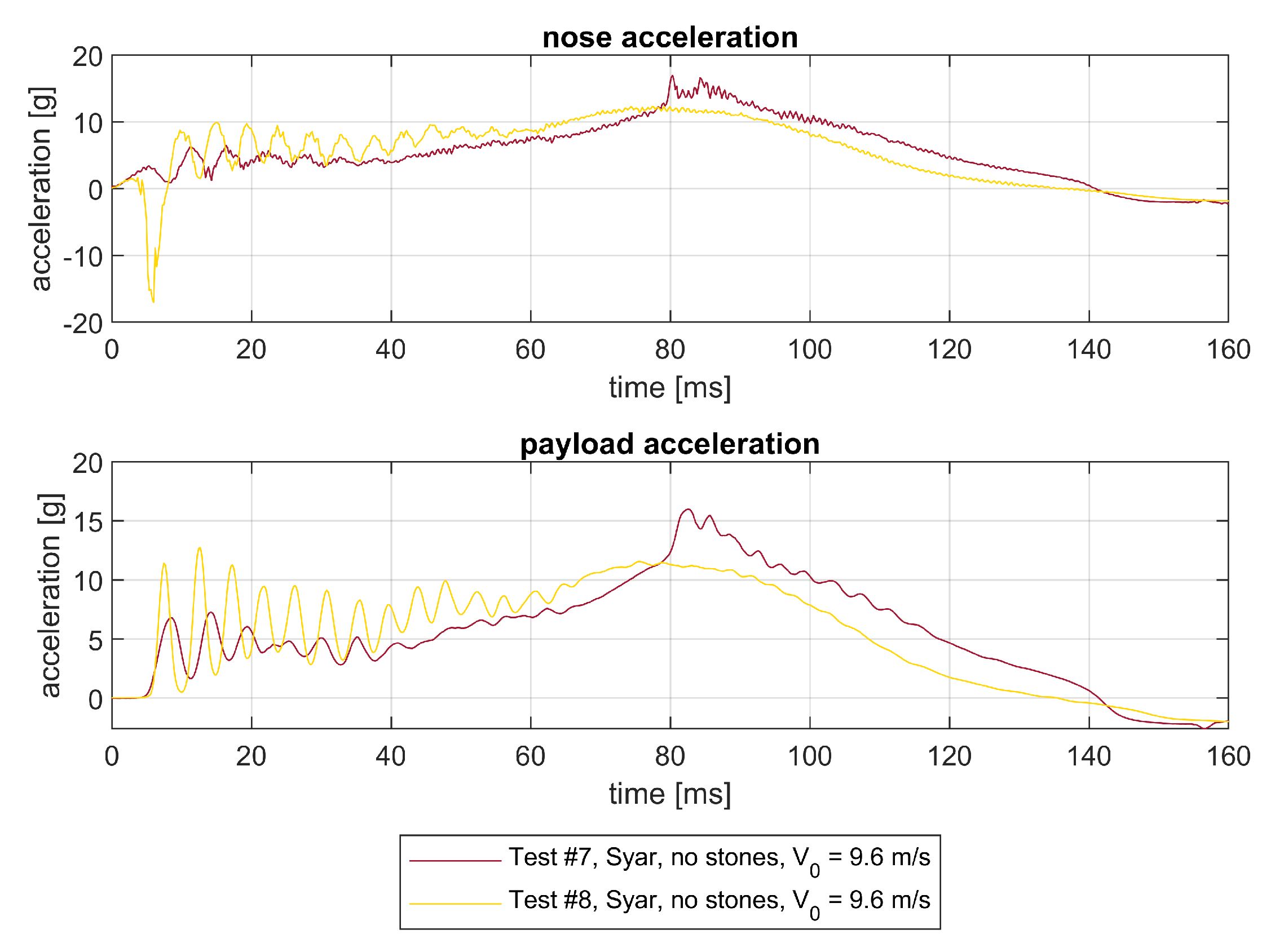
Figure 20.
Force-displacement diagram of the load limiter during test #10.
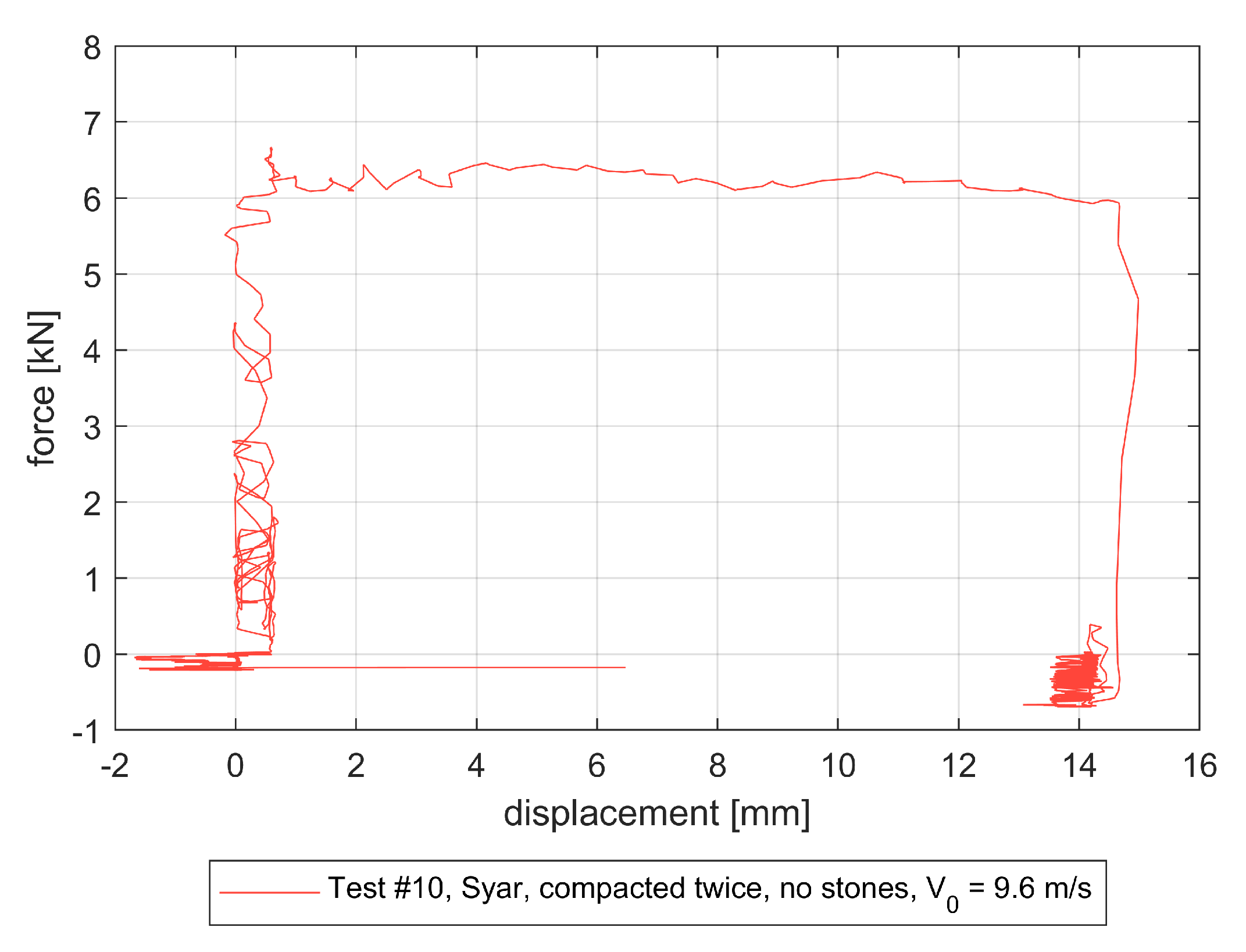
Figure 21.
Screenshots taken from the high-speed video of test #10. The impact begins at t = 0ms with 9.6 m/s.
Figure 21.
Screenshots taken from the high-speed video of test #10. The impact begins at t = 0ms with 9.6 m/s.
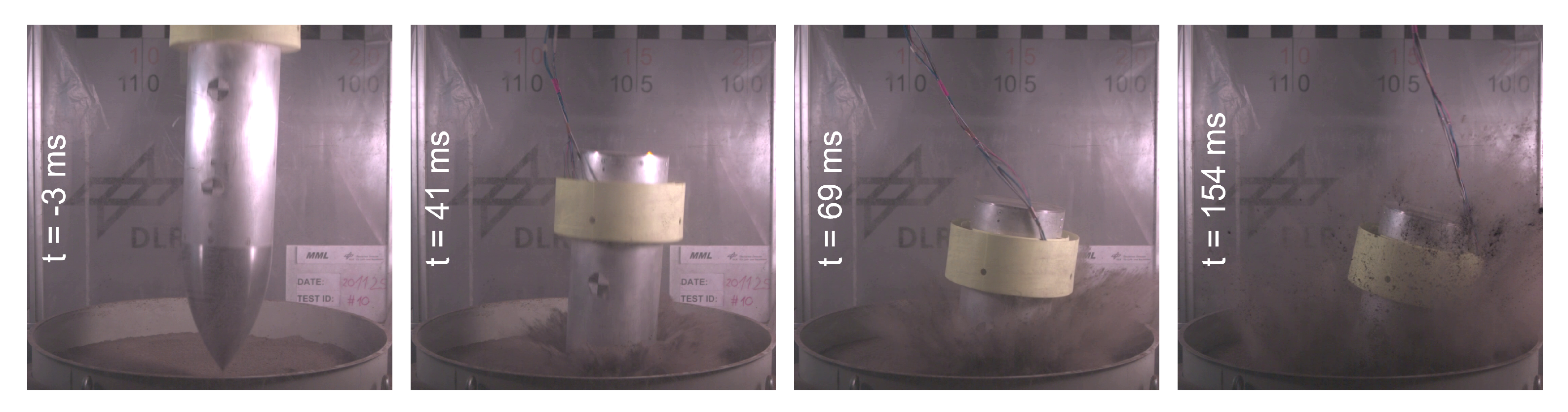
Figure 22.
Acceleration data of test #12.
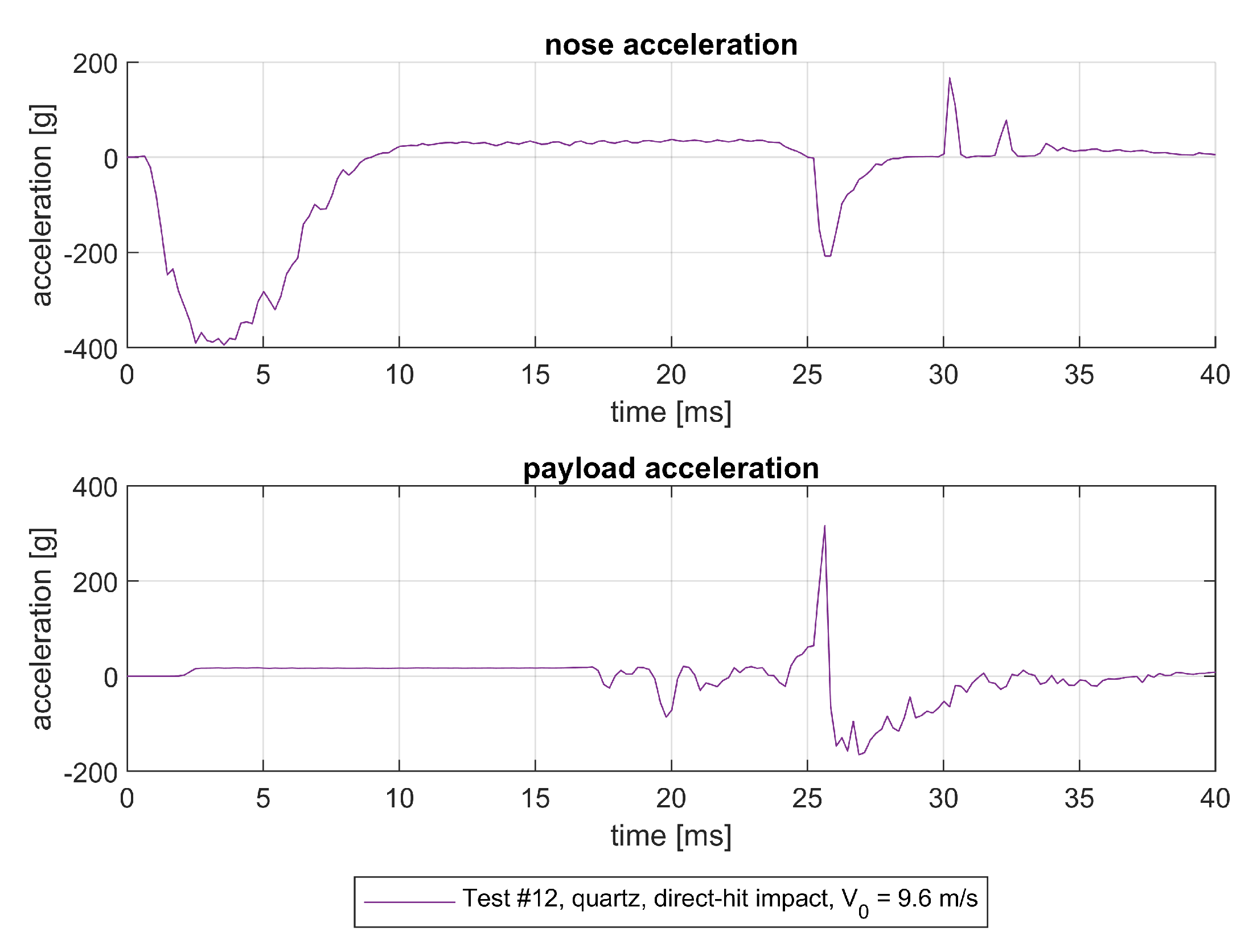
Figure 26.
Simulated and measured acceleration profiles for Syar and quartz sand.
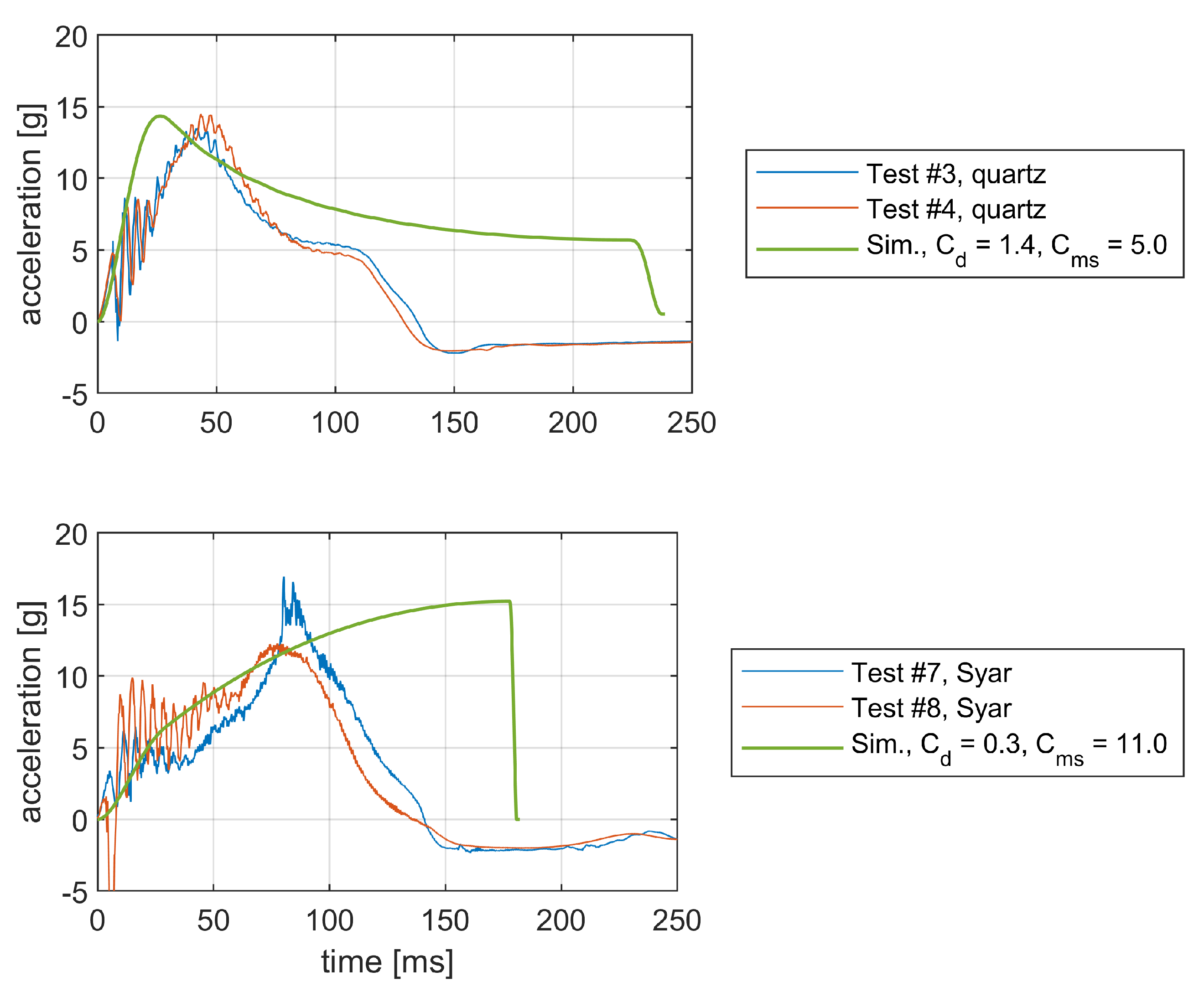

Table 1.
Parameters and their values of the outer dimensions of the penetrator. The assignment of parameters is shown in Figure 2.
Table 1.
Parameters and their values of the outer dimensions of the penetrator. The assignment of parameters is shown in Figure 2.
| Parameter | Value | Unit |
|---|---|---|
| D | 200 | mm |
| 600 | mm | |
| 280 | mm | |
| 442 | mm |
| Branch | Behavior law | |||
|---|---|---|---|---|
| (1) | elastic-plastic | |||
| (2) | elastic-plastic | |||
| (3) | 0 | elastic-plastic | ||
| (4) | full-elastic |
Table 3.
Coefficients of the soil used in the discrete element method simulation.
| Coefficient | Value | Unit |
|---|---|---|
| Density | Pa | |
| Poisson’s ratio | - | |
| Coefficient of restitution | - | |
| Coefficient of friction | - | |
| Coefficient of rolling friction | - | |
| Initial cohesive stress | Pa | |
| Maximal cohesive stress | Pa | |
| Cohesion strength | - |
Table 4.
Properties of the quartz sand WF 34 and Syar, partially by Wippermann et al.[19].
Table 4.
Properties of the quartz sand WF 34 and Syar, partially by Wippermann et al.[19].
| Property | WF 34 | Syar | Unit |
|---|---|---|---|
| Median grain size | 213 | 946 | µm |
| Effective grain size | 141 | 11 | µm |
| Uniformity coefficient | 122 | – | |
| Cohesion, failure | kPa | ||
| Friction angle, failure | 32 | ∘ | |
| Density | g/cm3 | ||
| Elastic Modulus | 15 | 124 | MPa |
Table 5.
Summary of test conditions and results.
| Test ID | Drop height [m] | [m/s] | [kN] | Soil condition | Penetration depth [m] | Crushed length [mm] |
|---|---|---|---|---|---|---|
| #0 | 6.24 | Quartz | 0 | |||
| #1 | 6.24 | Quartz | 0 | |||
| #2 | 6.24 | Quartz | 0 | |||
| #3 | 6.24 | Quartz | 0 | |||
| #4 | 6.24 | Quartz | 0 | |||
| #5 | 6.24 | Single layer of penetrator-radius sized quartz | 0 | |||
| #6 | 6.24 | Double layer of penetrator-radius sized stones with quartz | 0 | |||
| #7 | 6.24 | Syar | 0 | |||
| #8 | 6.24 | Syar | 0 | |||
| #9 | 6.24 | Syar (compacted) | 0 | |||
| #10 | 6.24 | Syar (compacted) | ||||
| #11 | 3.31 | Double layer of penetrator-radius sized stones with quartz | 0 | |||
| #12 | 3.31 | Penetrator diameter-sized stones | N/A | |||
| #13 | 6.24 | Penetrator diameter-sized stones | ||||
| #14 | 6.24 | Penetrator diameter-sized stones |
Disclaimer/Publisher’s Note: The statements, opinions and data contained in all publications are solely those of the individual author(s) and contributor(s) and not of MDPI and/or the editor(s). MDPI and/or the editor(s) disclaim responsibility for any injury to people or property resulting from any ideas, methods, instructions or products referred to in the content. |
© 2026 by the authors. Licensee MDPI, Basel, Switzerland. This article is an open access article distributed under the terms and conditions of the Creative Commons Attribution (CC BY) license (http://creativecommons.org/licenses/by/4.0/).
Copyright: This open access article is published under a Creative Commons CC BY 4.0 license, which permit the free download, distribution, and reuse, provided that the author and preprint are cited in any reuse.


