

Submitted:
04 June 2026
Posted:
05 June 2026
You are already at the latest version
Abstract
This paper proposes a new four-parameter statistical distribution based on the neutrosophic Gompertz (NGo-G) family and the extended Nadarajah-Haghighi distribution in neutrosophic logic called neutrosophic Gompertz Nadarajah-Haghighi (NGoNH) distribution to deal with uncertain and indeterminate data, known as neutrosophic data. The basic distribution functions and some properties are derived and the parameters of the proposed distribution are estimated using three different methods. To compare the performance of the different estimation methods, numerical simulations are performed using the evaluation criteria: MSE, RMSE, and bias. NGoNH distribution is applied to real data set representing the monthly minimum and maximum temperatures in Lahore, Pakistan, for the period 2016-2020. To verify the consistency of the data with the proposed distribution, the properties of the neutrosophic data are tested and the three components (True, Indeterminate, False) are plotted. In addition, the performance of the proposed distribution is compared with six other neutrosophic distributions using some information criteria and some goodness-of-fit tests. The extent to which the data fit the proposed distribution is plotted to demonstrate its effectiveness. The results indicate that the proposed distribution provides a better fit to neutrosophic data than other distributions, which enhances its effectiveness in analyzing data with uncertainty.
Keywords:
neutrosophic Gompertz family
; Nadarajah-Haghighi
; neutrosophic data
; estimation methods
; goodness-of-fit tests
1. Introduction
Statistical distributions are essential tools in data analysis and modeling random phenomena, as they provide a mathematical representation of the relationships between different variables. From this principle, quite a few continuous statistical distributions have been proposed, as well as a large group of families of continuous distributions, the most famous of which is the T-X method [1]. This method paved the way for generating continuous distribution. Example of these families are: Kw-TG [2], OEHL-G [3], EOF-G [4], GOIE-G [5], MAPW-X [6], LOG [7], NOGEE−G [8], NGLog-X [9], TIHL [10], and HOE-Φ [11].
However, uncertain and incomplete data collected in fields such as the environment, meteorology, and social sciences require models capable of dealing with these types of ambiguity. The neutrosophic logic, introduced by Smarandache 1999 [12], provides a powerful framework for dealing with uncertain data by dividing it into three components: True membership, Indeterminate membership, and False membership. Many statistical distributions have been developed and incorporated into the neutrosophic framework, examples of which appear in [13,14,15,16,17,18]. The NGoNH distribution is based on NGo-G family, whose neutrosophic cumulative probability function (NCDF) and neutrosophic probability density function (NPDF) are given by the equations below, respectively:
M_NGo (x_N,r_N,u_N )=1-e^(r_N/u_N (1-e^(u_N Φ(x_N,)/(1-Φ(x_N ) )) ) ) (1)
m_NGo (x_N,r_N,u_N )=(r_N φ(x_N ) e^(u_N Φ(x_N,)/(1-Φ(x_N ) )))/(1-Φ(x_N ))^2 e^(r_N/u_N (1-e^(u_N Φ(x_N,)/(1-Φ(x_N ) )) ) ) (2)
where Φ(x_N ), and φ(x_N ) are NCDF and NPDF respectively for any baseline distribution with shape neutrosophic parameters r_N and u_N.
Most current statistical distributions do not adequately address the neutrosophic nature of environmental data, as climate data often include uncertainty arising from sudden weather changes or inaccurate measurements. Using a new, more flexible distribution that combines the NGo-G family and neutrosophic Nadarajah-Haghighi (NNH) distribution will provide a more efficient tool for modeling these data. Although previous studies have addressed neutrosophic distributions, they have often focused on transforming the basic distribution into neutrosophic distribution. These studies have not addressed the composition of distributions or its extension and adding parameters to the basic distribution while integrating it into neutrosophic logic, to obtain a more flexible distribution, capable of adapting to different data formats. The specific research gap in this study is represented by:
The lack of previous studies that addressed the development of a four-parameter statistical distribution that combines the NGo-G family and NNH distribution.
The absence of the use of the T-X method in neutrosophic distribution composition, as previous studies were limited to one simple distribution instead of combining two distributions to create a more complex model.
Lack of studies that compared the efficiency of parameter estimation methods (maximum likelihood, least squares, weighted least squares) in neutrosophic distributions.
Failure to evaluate neutrosophic distributions using advanced goodness-of-fit criteria when applied to real environmental data.
This paper aims to develop a new four-parameter statistical distribution that combines the NGo-G family and NNH distribution, and estimating the neutrosophic parameters of new distribution using three estimation method in addition to conducting a numerical simulation to evaluate the performance of estimation methods using MSE, RMSE, and bias. Then. we apply the NGoNH distribution to monthly temperature data and compare the performance of NGoNH with six other neutrosophic distributions using information criteria, and goodness-of-fit tests.
2. Neutrosophic Gompertz Nadarajah-Haghighi (NGoNH) Distribution
Let represent any random variable, then the CDF and PDF of the Nadarajah-Haghighi distribution with shape parameters are, respectively [19,20]:
Now, we will find the neutrosophic Nadarajah-Haghighi distribution, by updating the random variable and parameters to neutrosophic random variable and neutrosophic parameters, as follows:
Definition: Let , , where , are the bottom and upper values of neutrosophic Nadarajah-Haghighi (NNH) random variable, which has an indeterminate portion , and definite part . When the NNH will simplify classical Nadarajah-Haghighi. The neutrosophic shape parameters are , , and the NCDF, and NPDF of NNH have the following form:
To get the NCDF for NGoNH substituting the equation (5) in equation (1) to get the form:
Figure 1 shows the NCDF curve of a random variable following the NGoNH distribution. The function is plotted using different intervals of parameters to illustrate their effect on the shape of the function, the curve reflects how the probability of values occurring up to a certain threshold change according to the interval parameters of the distribution. Figure 2 shows a 3D plot of NCDF of NGoNH with varying parameters. It helps to understand how different values of the distribution parameters affect the cumulative function and provides a visual representation of the variation in probability as the input values change.
To find the NPDF function for NGoNH distribution, substitute equation 5 and 6 into equation 2 to get:
Figure 3 shows how random variables are distributed according to the Npdf, the curve represent the effect of varying parameters on the shape of the distribution, it shows how the probabilities of different values of a given random variable change. Figure 4 provides a 3D view of the Npdf, and it shows how the probability density values change based on different intervals of parameters. Moreover, it allows us to see the effect of each parameter on the distribution of possible data.
The survival function is given by [21]:
Then using the equation above and substituting equation (7), we get the survival function for NGoNH by the form:
Figure 5 shows the probability that a random variable will remain above a certain value. The survival function is widely used in systems reliability studies and life data analysis, it shows how survival rates vary with different intervals parameters.
The hazard function takes the form [22]:
Then using the equation above and substitute equation (7) and (8) we get the hazard function for NGoNH by the form:
The Materials and Methods should be described with sufficient details to allow others to replicate and build on the published results. Please note that the publication of your manuscript implicates that you must make all materials, data, computer code, and protocols associated with the publication available to readers. Please disclose at the submission stage any restrictions on the availability of materials or information. New methods and protocols should be described in detail while well-established methods can be briefly described and appropriately cited.
Research manuscripts reporting large datasets that are deposited in a publicly available database should specify where the data have been deposited and provide the relevant accession numbers. If the accession numbers have not yet been obtained at the time of submission, please state that they will be provided during review. They must be provided prior to publication.
Interventionary studies involving animals or humans, and other studies that require ethical approval, must list the authority that provided approval and the corresponding ethical approval code.
In this section, where applicable, authors are required to disclose details of how generative artificial intelligence (GenAI) has been used in this paper (e.g., to generate text, data, or graphics, or to assist in study design, data collection, analysis, or interpretation). The use of GenAI for superficial text editing (e.g., grammar, spelling, punctuation, and formatting) does not need to be declared.
3. Statistical Properties of NGoNH Distribution
3.1. NCD and Npdf Expansion
Due to the difficulty of the functions for the proposed distribution, the basic distribution functions are expanded to use these expansions to derive the properties of the proposed distribution. These expansions are done using the exponential function expansion and the binomial expansion to obtain the NCDF function in the form:
where While the which has the form:
And the finally expansion for above function has a form:
where Using the same way, we can expand the Npdf to get:
where Also, due to the need for an expansion of the function in deriving some properties, the function is expanded in the same way as the functions above to obtain the from:
where
3.2. N.Quantile Function
Thus its obtained using the N.Quantile function of NGoNH in the form:
To show the method of distributing the values over the quartilies with different intervals of parameters. The table below showing that:

Table 1.
N.Quantile function values of NGoNH distribution for different intervals.
| () | |||||
|
[0.4, 1.4],[0.9, 1.9], [0.4, 1.4],[0.7, 1.7] |
[0.6, 1.6],[0.4, 1.4], [0.5, 1.5],[0.8, 1.8] |
[0.5, 1.5],[0.3, 1.3], [0.5, 1.5],[0.6, 1.6] |
[0.7, 1.7],[0.5, 1.5] [0.8, 1.8],[0.7, 1.7] |
[0.6, 1.6],[0.9, 1.9], [0.7, 1.7],[1,2] |
|
| 0.1 | [0.028291,0.88254] | [0.022418,0.42260] | [0.026837,0.67735] | [0.018603,0.24594] | [0.017491,0.22254] |
| 0.2 | [0.053782,1.72686] | [0.043547,0.85493] | [0.052051,1.37010] | [0.036108,0.47681] | [0.033515,0.42004] |
| 0.3 | [0.077338,2.53170] | [0.063897,1.29692] | [0.076159,2.07634] | [0.052867,0.69704] | [0.048507,0.59977] |
| 0.4 | [0.099522,3.30867] | [0.083669,1.75189] | [0.099620,2.80065] | [0.069180,0.91078] | [0.062787,0.76743] |
| 0.5 | [0.120994,4.07428] | [0.103349,2.22638] | [0.122845,3.55326] | [0.085367,1.12252] | [0.076720,0.92800] |
| 0.6 | [0.142297,4.85002] | [0.123397,2.73179] | [0.146455,4.35195] | [0.101816,1.33765] | [0.090676,1.08650] |
| 0.7 | [0.164360,5.66782] | [0.144564,3.28861] | [0.171284,5.22876] | [0.119148,1.56433] | [0.105160,1.24938] |
| 0.8 | [0.188588,6.58739] | [0.168293,3.93978] | [0.199047,6.25040] | [0.138527,1.81788] | [0.121200,1.42768] |
| 0.9 | [0.218907,7.77210] | [0.198471,4.80898] | [0.234227,7.60857] | [0.163117,2.14021] | [0.141309,1.65004] |
The N.Quantile function rises as increases, indicating an increasingly positive distribution. A range with higher upper limits give large values, reflecting the effect of expanding the boundaries of the distribution. Analyzing these values helps in understanding the behavior of the distribution and predicting future values based on the model used.
3.3. N.Moments Function
A strong mathematical and statistical tool for comprehending and describing the fundamental characteristics of data distribution is the neutrosophic moments (N.Moment) which is given by [8,25,26]:
Using the above expression and the Npdf for NGoNH distribution from equation (17) we get:
let when , and as then we get
Using binomial expansion for to get:
where
Table 2 shows the values of the first four moments of NGoNH distribution as well as the values of neutrosophic skewness and neutrosophic Kurtosis. The results indicate that the larger the intervals of the mean of the distribution. The results of neutrosophic Variance , neutrosophic skewness and neutrosophic Kurtosis change significantly, reflecting the effect of the intervals on the shape of the distribution. Small values such as [0.4, 1.4] give a shape and centered distribution, while large values such as [0.9, 1.9] give a more dispersed and flat distribution. At [0.4, 1.4] the is very high, indicating that the values are clustered around the mean, while at [0.9, 1.9] it is more moderate, indicating a more even distribution.
3.4. N.Moment Generating Function
The form of [26] () neutrosophic Moment generating function (NMGF) of NGoNH is derived from equation N.moment (20), to get:
3.5. Incomplete Moments
The following formula provides the neutrosophic incomplete moments (N.I.M) of a random variable for NGoNH distribution:
By substituting equation Npdf (12) and performing the integration, we get:
where
3.6. Neutrosophic Entropy
3.6.1. Neutrosophic Rényi Entropy
From the equation above and from equation (17) we get:
Then the final form of above integral is:
3.6.2. Neutrosophic Arimoto Entropy
This entropy can be calculated using the equation:
By carrying out the integral we obtain:
3.6.3. Neutrosophic Havrda and Charvat Entropy
This entropy can be calculated using the equation:
By integrating the above we get:
4. Estimation
4.1. Maximum Likelihood Estimation
4.2. Least Square Estimation
The following formula can be used to estimate the parameters using the least square estimation (LSE) method [30]:
4.3. Weighted Least Square Estimation
The following formula can be used to estimate the parameters using the weighted least square estimation (WLSE) method [30]:
Estimation of the parameters for the three previously described methods may be obtained by finding the partial derivative of the four parameters and setting their equations equal to zero. Computer software such as R language are used since it is difficult to find these values using analytical solutions.
5. Simulation
A Monte Carlo simulation is carried out for the three methods discussed in the fourth section to show the effectiveness of the estimation of the NGoNH distribution. The sizes of the generated samples were based on n=50, 100, 150, 200, 300, 400 and 500 up to 1000. The mean square error (MSE) and its root (RMSE) values were calculated, as well as the bias which have respectively the forms [31,32]:
The above formulas are used to measure the efficiency of parameter estimation for the three methods. Table 3, Table 4, Table 5 and Table 6 displays respectively the Mean value intervals, MSE value intervals, RMSE value intervals, and Bias value intervals of the Monte Carlo simulations conducted for the NGoNH distribution.
Table 3 shows the mean values of the three estimation methods (MLE, LSE, WLSE) at different sample sizes. The table shows the stability of the estimation of the basic parameters () as the sample sizes increases. At a small sample (N=25, 50), the confidence intervals of the parameters are wide, indicating high variability in the estimate. For the samples (N=100 to 500), the intervals become more compressed, indicating improved estimation accuracy and stability of the values. The MLE method shows ranges closer to the true values than LSE and WLSE, indicating that it is more accurate at large sample sizes. We note that the value , which is one of the basic parameters, tends to stabilize at large samples, but the LSE method shows greater variability compared to MLE and WLSE.
Table 4 shows that at small samples (N=25, 50), the MSE is high, indicating that the parameter estimation is unstable and contains larger error. As the sample size increases, the MSE values decrease significantly, indicating that the performance of the estimation methods improves. The MLE method shows the lowest MSE values compared to LSE and WLSE, confirming its high effectiveness, especially for large samples. The WLSE method shows similar performance to MLE in some cases, but is less stable for small samples. As the sample increases (N=500), the minimum MSE values decrease to their lowest levels, indicating that the estimates converge towards the true values of the parameters.
Table 5 shows that the high values at samples (N=25, 50) mean that the initial estimates are inaccurate, but the values decrease significantly at N=100 and above. The MLE method shows the lowest RMSE at all samples, indicating its stability and robustness. LSE shows a higher RMSE compared to MLE, indicating that this method is less efficient in estimating the parameters. WLSE shows an average performance between the other two methods, but becomes more stable at .
Table 6 shows that at N=25, the bias is high for all methods, indicating that the initial estimates are inaccurate. As the sample sizes increases, Bias values gradually decrease, indicating that the estimates converge towards the true values. The MLE shows the lowest Bias values, meaning that it is the most accurate at all sizes. LSE shows a larger deviation from the true values, making it less reliable, especially at small samples. At N=500, Bias becomes very low for all methods, meaning that all methods become more accurate with larger samples.
From the above results, it is clear that MLE is the most efficient method, showing the lowest values for MSE, RMSE, and Bias, especially at large samples, while WLSE shows an average performance between MLE and LSE, but becomes more accurate at large samples. LSE shows lower performance than the other two methods, with Bias and MSE being higher at all sizes. Increasing the sample size improves the accuracy of all methods, but MLE gives the best results even with medium samples.
6. Application
The application side serves as a foundation for illustrating the breadth of the NGoNH distribution’s quality, effectiveness, and adaptability in real-world applications. In this section, genuine neutrosophic data represented by temperatures in Lahore, Pakistan, for the period 2016-2020 [33]. The data utilized is checked to accomplish the neutrosophic qualities represent by achieving the condition before the analytic process begins. This condition is similar to the probability condition, but it is different in that the values must lie within interval [0, 1]. The following is what sets apart the neutrosophic logic in Table 7.
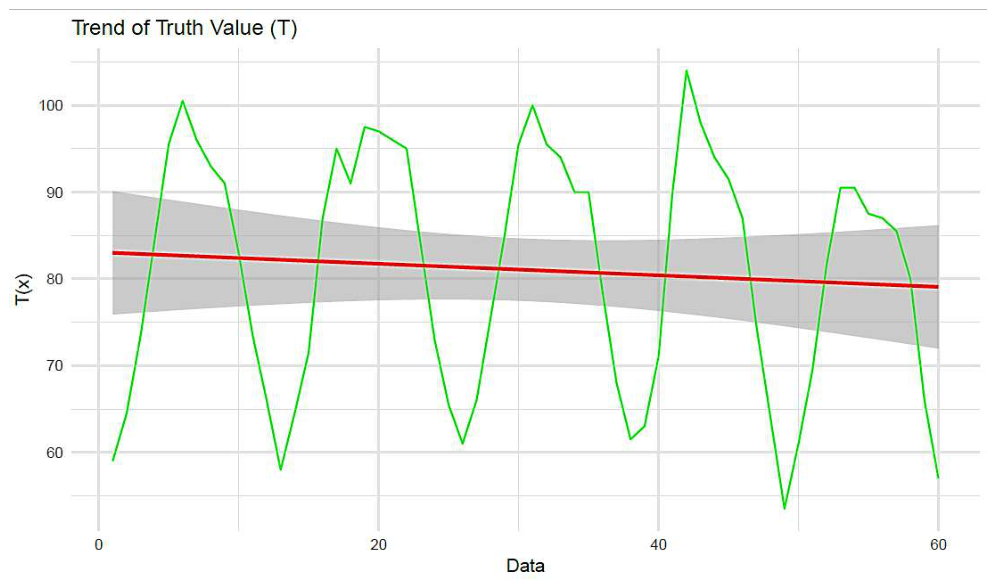
The temperatures in Lahore, Pakistan, for the period 2016-2020 is represented by actual data in Table 7. The table demonstrates that every value satisfies the requirement, demonstrating the data’s conformance to the neutrosophic logic’s characteristics. Additionally, it is seen that the values gradually decline with time, indicating a shift in real values. The table uses the neutrosophic logic to accurately depict actual data. The values show how adaptably T, F, and I may be represented by the system. The findings support the applicability of using neutrosophic logic to the analysis of complicated and ambiguous data.
The data utilized, the type of analysis, and the components of the analysis are depicted in the following figures.
Figure 5.
Plot of the intervals for the data used.
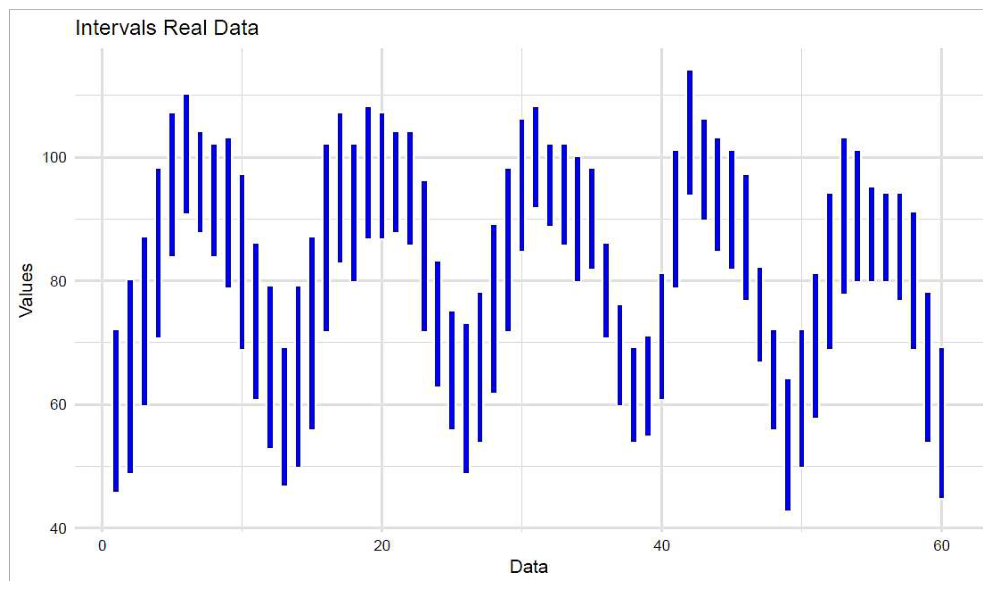
Figure 6.
Histogram of Neutrosophic Components.
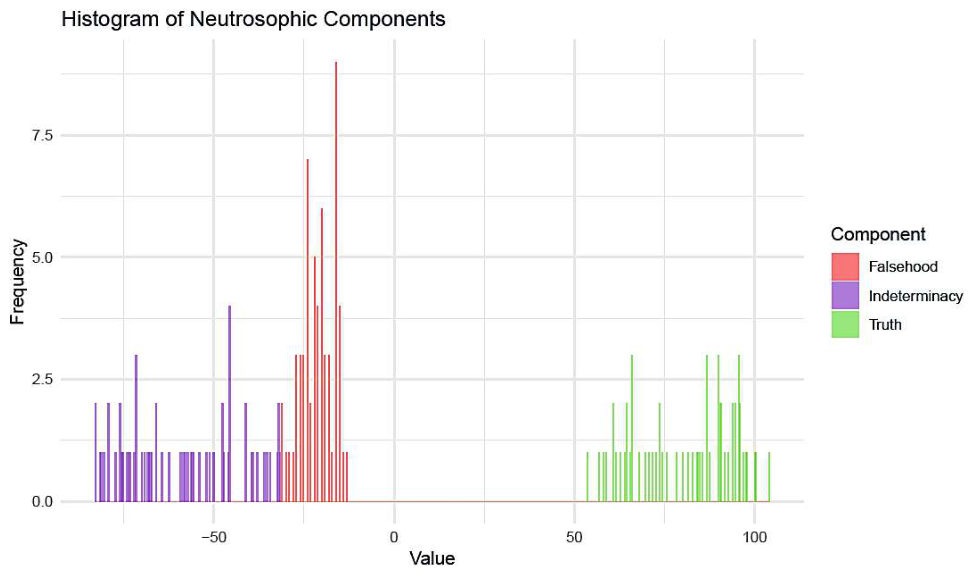
Figure 7.
Neutrosophic parts and sum of Neutrosophic Components.
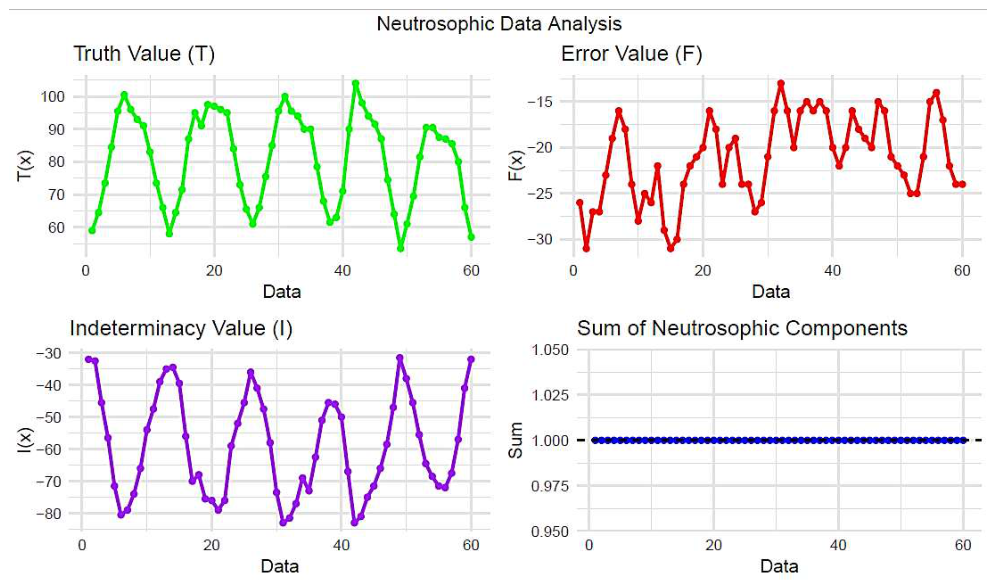
Figure 8.
Scatter plot of Truth vs Falshood.
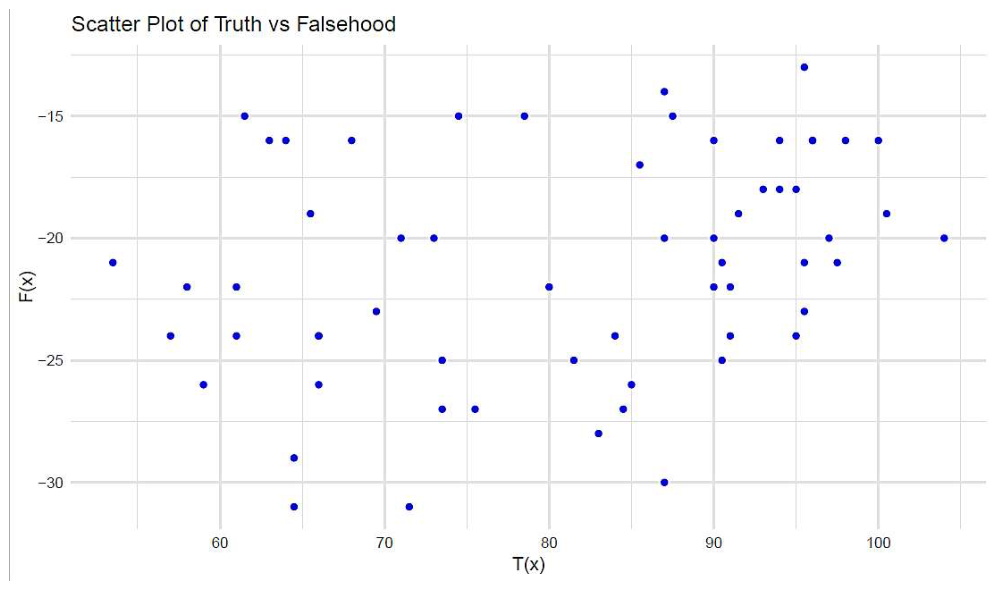
Figure 9.
Trend plot of Truth value.
The NGoNH distribution’s results are compared to six alternative neutrosophic distributions, which are:
Neutrosophic Wiebull Nadarajah-Haghighi (NWeNH)
Neutrosophic Kumaraswamy Nadarajah-Haghighi (NKuNH)
Neutrosophic Exponeted Generalized Exponential Nadarajah-Haghighi (NEGNH)
Neutrosophic [0, 1] Truncated Exponeted Exponential Nadarajah-Haghighi (NTEENH)
Neutrosophic Beta Nadarajah-Haghighi (NBeNH)
Neutrosophic Nadarajah-Haghighi (NNH)
Four information criteria AIC [33], CAIC [34], HQIC [35], and BIC [36] as well as the statistical measures such as Kolmogorov-Smirnov (KS), Anderson- Darling (A), Cramér-von Mises (W), and p-value [16,21,37] were used for this comparison. The results of the distribution’s criterion are displayed in Table 8, the values of the statistical measures are displayed in Table 9, and the estimated parameters in MLE are displayed in Table 10.
Table 8 shows the values of the different evaluation criteria for the mentioned distributions. These criteria are used to compare the quality of the statistical models. -2L represents twice the negative value of the log-likelihood function. Here, we notice that the NGoNH distribution has the lowest values, which indicates that it is the best among the distributions.
Table 9 shows the statistical values which are used to evaluate the quality of distributions, the value of W was for the NGoNH, it has the lowest values, which indicates that it is the best. The A test is used to test the distribution’s fit to the data. The smaller value is the best distribution. this is confirmed by NGoNH values. The K-S values compares the experimental distribution with theoretical distribution. NGoNH has lowest values for K-S. NGoNH has the highest values for p-value, which indicates that it is the best.
Table 10 shows the estimated parameters for the NGoNH distribution. It shows reasonable and well-defined values of parameters for the NWeNH distribution with greater variability, which may indicate that the distribution is less stable. The NKuNH parameters also show large variability, which may indicate difficulty in estimating them accurately. The NEGNH shows moderate variability, while NTEENH, NBeNH and NNH shows large variability, especially for the parameter .
Figure 10 shows the theoretical probability density (Npdf) of NGoNH compared to actual data used in study. Ff the curve fits well with the bar distribution, it indicates that NGoNH describes the data with high accuracy. NGoNH provides a good fit with the real data, as the curve approaches the peaks of the bars. This indicates that the distribution is effective in describing the real temperature values. Figure 11 shows the NCDF of NGoNH compared to the actual data distribution. The good fit between the real data and the distribution curve indicates that the NGoNH distribution can be an accurate model for predicting climate data.
7. Conclusion
A new four-parameter distribution is developed that combines NGo-G family and Nadarajah-Haghighi distribution within the framework of neutrosophic logic. This expansion contributes to providing more accurate models for representing ambiguous and uncertain data, enhancing the capabilities of statistical modeling. The underling function of many properties of the distribution are derived, providing a solid mathematical foundation for its use in various applications. The results shows that the NGoNH provides the best fit to the data compared to other distributions. According to the information criteria’s, statistical values confirm that NGoNH has lowest error, making it the most accurate model. Analysis of neutrosophic values: true values reflect well the data pattern, with a general trend that can be explained based on environmental or temporal factors. The indeterminate values and false values contribute to understanding the extent of uncertainty in the data, which supports the use of neutrosophic logic in analyzing complex phenomena. The estimation method using MLE gave more stable and accurate results compared to other methods, especially for large samples. As the sample size increased, the values of MSE, RMSE, and Bias decreased, indicating an improvement in the accuracy of the estimating with more data. The study confirms that the proposed distribution can be applied to complex climate data, which opens the door to its use in other applications such as climate forecasting, market analysis, and biological systems. The study suggests improving the model by adding supplementary variables that may help explain fluctuations in neutrosophic values, such as the effects of climate change or economic factors, in addition to using large data to verify the stability of the parameters and ensure that the model works efficiently in different contexts. The model can also be compared with other models such as neural networks or complex time series models to see how well it excels in analyzing ambiguous data. The logical limits of NGoNH distribution can be summarized as follows:
| Type of limit | Explanation | Possible solution |
| Mathematical constraints | The distribution must be non-negative, and its coefficients must be positive | Checking that mathematical conditions are met |
| Statistical constraints | Sensitivity of the estimate to sample size and initial values | Using large samples and techniques to improve the estimate |
| Application limitations | Limitations of its application in non-neutrosophic data | Verification of its suitability using goodness-of-fit tests |
| Numerical limitations | Need for approximate solutions for some properties | Use of mathematical expansions and numerical analysis |
These boundaries define the scope of distribution and guide its development to improvement of future applications.
Author Contributions
Conceptualization, R.A.A., W.A.A. and N.A.N.; methodology, R.A.A. and N.A.N.; software, R.A.A. and N.A.N.; validation, W.A.A. and N.A.N.; formal analysis, R.A.A. and N.A.N.; investigation, R.A.A., W.A.A. and N.A.N.; resources, R.A.A.; data curation, R.A.A. and N.A.N.; writing—original draft preparation, R.A.A.; writing—review and editing, W.A.A. and N.A.N.; visualization, R.A.A. and N.A.N.; supervision, W.A.A. and N.A.N.; project administration, W.A.A.; funding acquisition, R.A.A., W.A.A. and N.A.N. All authors have read and agreed to the published version of the manuscript.
Funding
This research received no external funding.
Institutional Review Board Statement
Not applicable.
Informed Consent Statement
Not applicable.
Data Availability Statement
The data supporting the findings of this study are available within the article. The neutrosophic monthly temperature data used in the application section are presented and analyzed in the manuscript. No additional data were generated.
Acknowledgments
The authors would like to acknowledge the academic and technical support provided during the preparation of this study. No generative artificial intelligence tool was used for study design, data collection, statistical analysis, simulation, interpretation of results, or manuscript writing.
Conflicts of Interest
The authors declare no conflicts of interest.
References
- Alzaatreh; Lee, C.; Famoye, F. A new method for generating families of continuous distributions. Metron 2013, 71, 63–79. [Google Scholar] [CrossRef]
- Afifya, Z.; Corderio, G. M.; Yousof, H. M.; Nofal, Z. M.; Alzaatreh, A. The Kumaraswamy transmuted-G family of distributions: properties and applications. J. Data Sci. 2016, 14, 245–270. [Google Scholar] [CrossRef]
- Afify, Z.; Altum, E.; Alizadeh, M.; Ozel, G.; Hamedani, G. G. The odd exponentiated half-logistic-G family: properties, characterizations and applications. Chil. J. Stat. 2017, 8, 65–91. [Google Scholar]
- Nasiru, S. Extended odd Frechet-G family of distributions. J. Probab. Stat. 2018, 11, 1–12. [Google Scholar] [CrossRef]
- DJIBRILA, S. The generalized odd inverted exponential-G family of distributions: properties and applications. Eurasian Bull. Math. 2019, 2, 86–110. [Google Scholar]
- Walid, E.; Tashkandy, Y. Modeling the amount of carbon dioxide emissions application: New modified alpha power Weibull-X family of distributions. Symmetry 2023, 15, 366. [Google Scholar] [CrossRef]
- Noori, N. A.; Khalaf, A. A.; Khaleel, M. A. A New Generalized Family of Odd Lomax-G Distributions Properties and Applications. Adv. Theory Nonlinear Anal. Its Appl. 2023, 7, 1–16. [Google Scholar]
- Odeyale, B.; Gulumbe, S. U.; Umar, U.; Aremu, K. O. New New Odd Generalized Exponentiated Exponential-G Family of Distributions. UMYU Sci. 2023, 2, 56–64. [Google Scholar] [CrossRef]
- Shah, Z.; Khan, D. M.; Khan, Z.; Faiz, N.; Hussain, S.; Anwar, A.; Ahmad, T.; Kim, K.-I. A new generalized logarithmic–X family of distributions with biomedical data analysis. Appl. Sci. 2023, 13, 3668. [Google Scholar] [CrossRef]
- Bello, A.; Doguwa, S. I.; Yahaya, A.; Jibril, H. M. A type I half Logistic exponentiated-G family of distributions: Properties and application. Commun. Phys. Sci. 2021, 7, 147–163. [Google Scholar]
- Mahdi, G. A.; Khaleel, M. A.; Gemeay, A. M.; Nagy, M.; Mansi, A. H.; Hossain, M. M.; Hussam, E. A new hybrid odd exponential-Φ family: Properties and applications. AIP Adv. 2024, 14. [Google Scholar] [CrossRef]
- Smarandache, F. A unifying field in logics. In neutrosophy: Neutrosophic probability, set and logic. Rehoboth; 1999. [Google Scholar]
- Alanaz, M. M.; Mustafa, M. Y.; Algamal, Z. Y. Neutrosophic Lindley distribution with application for Alloying Metal Melting Point. Int. J. Neutrosophic Sci. 2023, 21, 65–71. [Google Scholar] [CrossRef]
- Algama, Z. Y.; Alobaidi, N. N.; Hamad, A. A.; Alanaz, M. M.; Mustafa, M. Y. Neutrosophic Beta-Lindley distribution: Mathematical properties and modeling bladder cancer data. Int. J. Neutrosophic Sci. 2024, 23, 186–194. [Google Scholar] [CrossRef]
- Alanaz, M. M.; Algamal, Z. Y. Neutrosophic exponentiated inverse Rayleigh distribution: Properties and Applications. Int. J. Neutrosophic Sci. 2023, 21, 36–43. [Google Scholar] [CrossRef]
- Al-Saqal, E.; Hadied, Z. A.; Algamal, Z. Y. Modeling bladder cancer survival function based on neutrosophic inverse Gompertz distribution. Int. J. Neutrosophic Sci. 2025, 25, 75–5. [Google Scholar]
- Hammood, N. M.; Rashad, N. K.; Algamal, Z. Y. Neutrosophic Topp-Leone Extended Exponential distribution modeling with application for bladder cancer patients. Int. J. Neutrosophic Sci. 2025, 25, 239–245. [Google Scholar]
- Mustafa, M. Y.; Algamal, Z. Y. Neutrosophic inverse power Lindley distribution: A modeling and application for bladder cancer patients. Int. J. Neutrosophic Sci. 2023, 21, 216–223. [Google Scholar] [CrossRef]
- Al-Habib, K. H.; Khaleel, M. A.; Al-Mofleh, H. A new family of truncated nadarajah-haghighi-g properties with real data applications. Tikrit J. Adm. Econ. Sci. 2023, 19, 2. [Google Scholar]
- Rezaei, S.; Marvasty, A. K.; Nadarajah, S.; Alizadeh, M. A new exponentiated class of distributions: Properties and applications. Commun. Stat.-Theory Methods 2017, 46, 6054–6073. [Google Scholar] [CrossRef]
- Noori, N. A.; Khalaf, A. A.; Khaleel, M. A. A new expansion of the Inverse Weibull Distribution: Properties with Applications. Iraqi Stat. J. 2024, 1, 52–62. [Google Scholar] [CrossRef]
- Khalaf, A.; Ibrahim, M. Q.; Noori, N. A. [0,1]Truncated Exponentiated Exponential Burr type X Distributionwith Applications. Iraqi J. Sci. 2024, 65, 4428–4440. [Google Scholar] [CrossRef]
- Khaleel, M. A.; Oguntunde, P.; Al abbasi, J. N.; Ibrahim, N. A.; AbuJarad, M. H. The Marshall-Olkin Topp Leone-G family of distributions: A family for generalizing probability models. Sci. Afr. 2020, 8, e00470. [Google Scholar] [CrossRef]
- Naz, S.; Al-Essa, L. A.; Bakouch, H. S.; Chesneau, C. A transmuted modified power-generated family of distributions with practice on submodels in insurance and reliability. Symmetry 2023, 15, 1458. [Google Scholar] [CrossRef]
- Afify, Z.; Alizadeh, M.; Yousof, H. M.; Aryal, G.; Ahmad, M. THE TRANSMUTED GEOMETRIC-G FAMILY OF DISTRIBUTIONS: THEORY AND APPLICATIONS. Pak. J. Stat. 2016, 32, 139–160. [Google Scholar]
- Khan, Z.; Almazah, M. M. A.; Odhah, O. H.; Alshanbari, H. M. Generalized Pareto Model: Properties and Applications in Neutrosophic Data Modeling. Math. Probl. Eng. 2022, 1, 3686968. [Google Scholar] [CrossRef]
- Khalaf, A.; khaleel, M. The New Strange Generalized Rayleigh Family: Characteristics and Applications to COVID-19 Data. Iraqi J. Comput. Sci. Math. 2024, 5, 92–107. [Google Scholar] [CrossRef]
- Afify, Z.; Yousof, H.; Nadarajah, S. The beta transmuted-H family for lifetime data. Stat. Its Interface 2017, 10, 505–520. [Google Scholar] [CrossRef]
- Chipepa, F.; Oluyede, B. O.; Makubate, B. A New Generalized Family of Odd Lindley-G Distributions With Application. Int. J. Stat. Probab. 2019, 8, 1–23. [Google Scholar] [CrossRef]
- Bhatti, F. A.; Hamedani, G. G.; Korkmaz, M. C.; Cordeiro, G. M.; Yousof, H. M.; Ahmad, M. On Burr III Marshal Olkin family: development, properties, characterizations and applications. J. Stat. Distrib. Appl. 2019, 6, 1–21. [Google Scholar] [CrossRef]
- Noori, N. A.; khaleel, M. A. Estimation and Some Statistical Properties of the hybrid Weibull Inverse Burr Type X Distribution with Application to Cancer Patient Data. Iraqi Stat. J. 2024, 1, 8–29. [Google Scholar] [CrossRef]
- Noori, N. A. Exploring the Properties, Simulation, and Applications of the Odd Burr XII Gompertz Distribution. Adv. Theory Nonlinear Anal. Its Appl. 2023, 7, 60–75. [Google Scholar]
- Habib, K. H.; Salih, A. M.; Khaleel, M. A.; Abdal-hammed, M. K. OJCA Rayleigh distribution, Statistical Properties with Application. Tikrit J. Adm. Econ. Sci. 2023, 19. [Google Scholar]
- Ahsan-ul-Haq, M.; Zafar, J.; Aslam, M.; Tariq, S. Neutrosophic Topp Leone Distribution for Interval Valued Data Analysis. J. Stat. Theory Appl. 2024, 23, 164–173. [Google Scholar] [CrossRef]
- Khaleel, M. A.; Oguntunde, P. E.; Al Abbasi, J. N.; Ibrahim, N. A.; AbuJarad, M. H. The Marshall-Olkin Topp Leone-G family of distributions: A family for generalizing probability models. Sci. Afr. 2020, 8, e00470. [Google Scholar] [CrossRef]
- Rahman, M. M.; Gemeay, A. M.; Khan, M. A. I.; Meraou, M. A.; Bakr, M. E.; Muse, A. H.; Hussam, E.; Balogun, O. S. A new modified cubic transmuted-G family of distributions: Properties and different methods of estimation with applications to real-life data. AIP Adv. 2023, 13, 095025. [Google Scholar] [CrossRef]
- Cordeiro, G. M.; Alizadeh, M.; Ramires, T. G.; Ortega, E. M. M. The generalized odd half-Cauchy family of distributions: Properties and applications. Commun. Stat.-Theory Methods 2017, 46, 5685–5705. [Google Scholar] [CrossRef]
- Aboraya, M. A new one-parameter G family of compound distributions: copulas, statistical properties and applications. Stat. Optim. Inf. Comput. 2021, 9, 942–962. [Google Scholar] [CrossRef]
- Sharqa, H.; Ahsan-ul-Haq, M.; Zafar, J.; Khaleel, M. A. Unit Xgamma Distribution: Its Properties, Estimation and Application: Unit-Xgamma Distribution. Proc. Pak. Acad. Sci. A. Phys. Comput. Sci. 2022, 59, 15–28. [Google Scholar]
Figure 1.
Plot the NCDF for NGoNH with different interval of parameters.
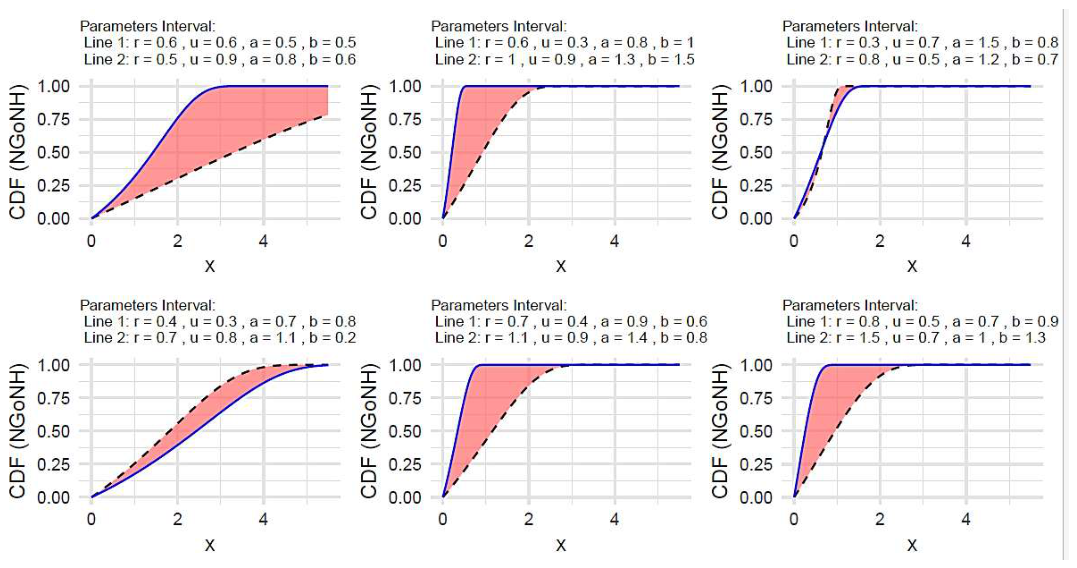
Figure 2.
3D-plot the NCDF for NGoNH with
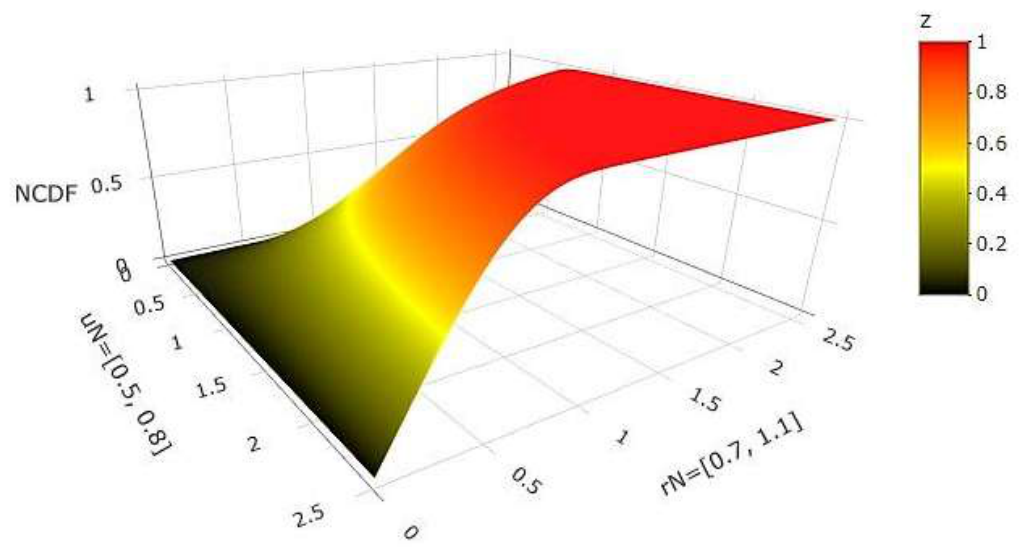
Figure 3.
plot of the NPDF for NGoNH with different interval of parameters.
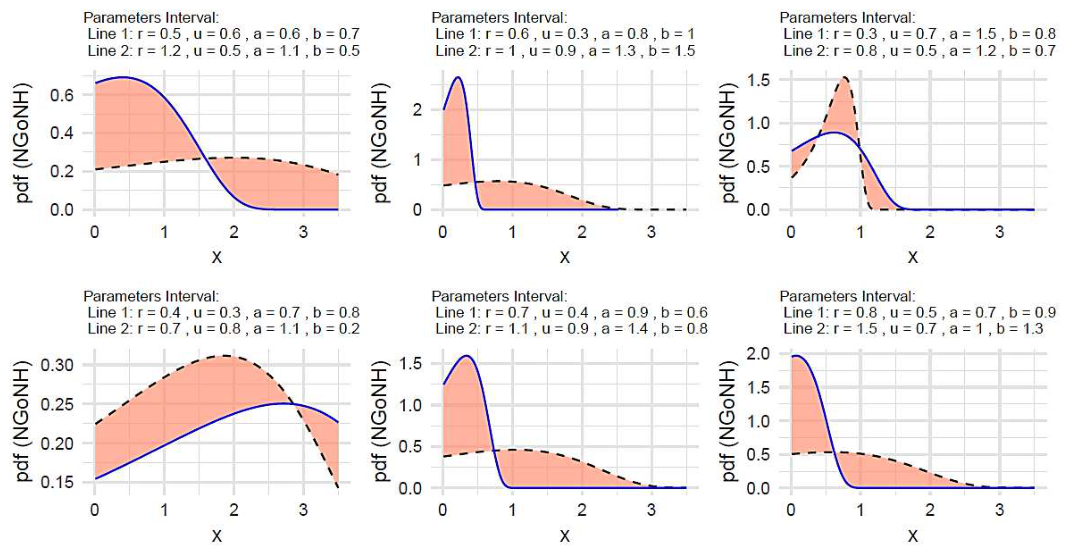
Figure 4.
3D-plot of the NPDF for NGoNH with
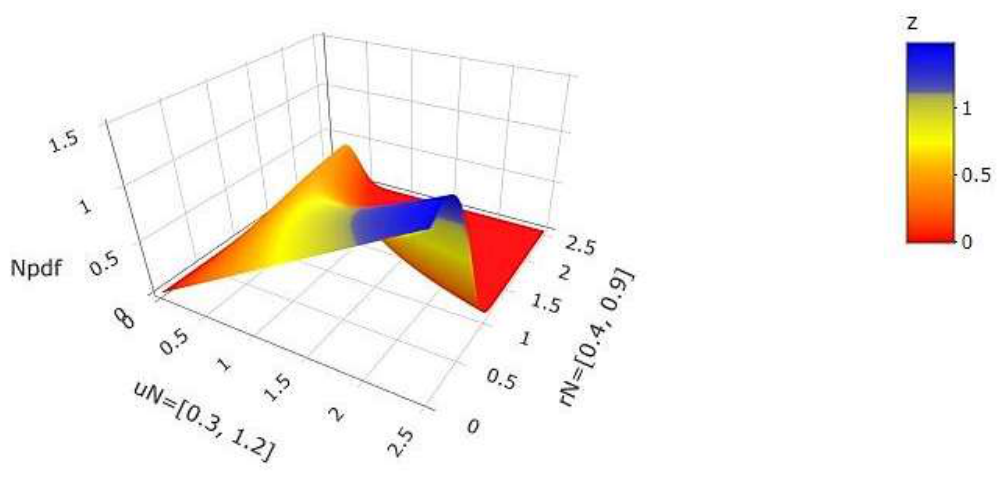
Figure 5.
plot the survival for NGoNH with different interval of parameters.
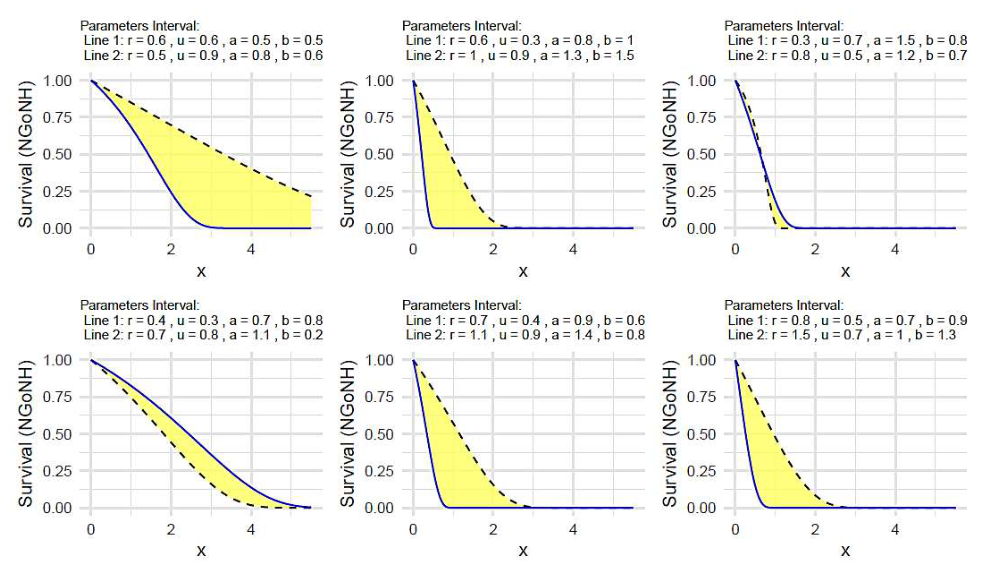
Figure 10.
The fitted Npdf with histogram of the data used.
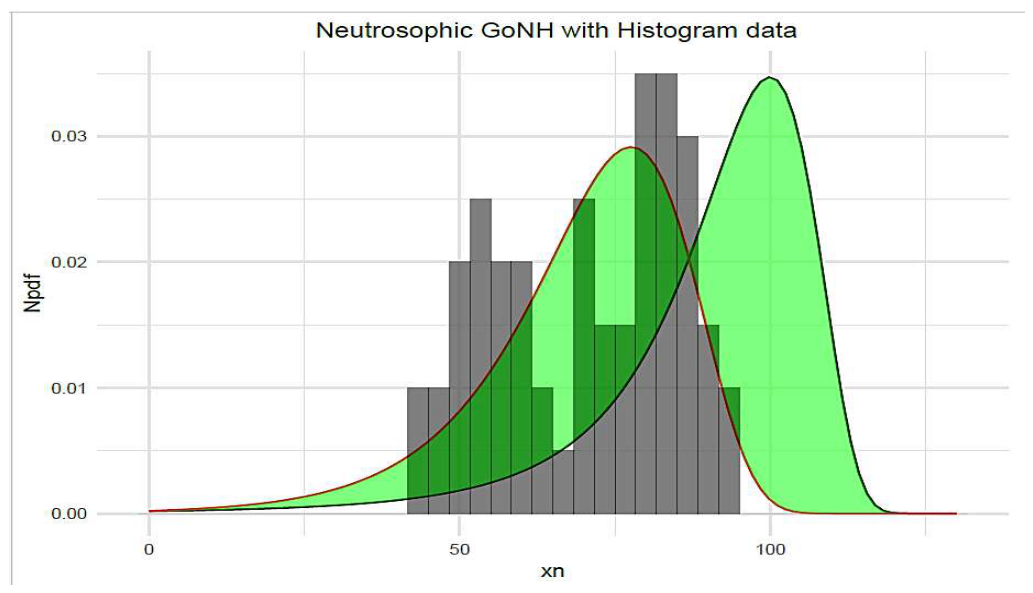
Figure 11.
The empirical fitted NGoNH NCDF.
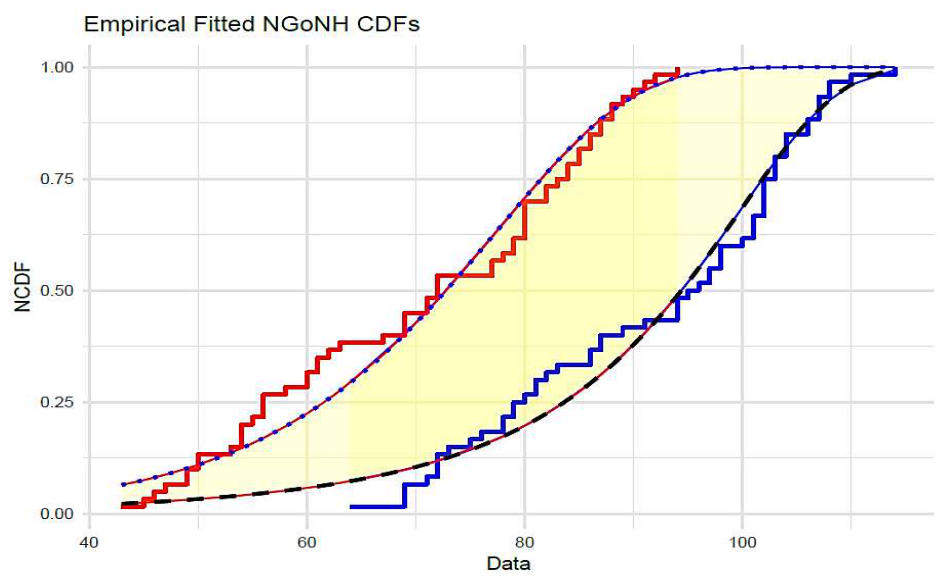
Table 2.
some intervals of N.moments for NGoNH distribution.
| [0.4,1.4] | [0.6,1.6] | [0.3,1.3] | [0.1,1.1] | [0.00587, 0.21612] | [0.00390, 0.06271] | [0.00292, 0.02095] | [0.00233, 0.00765] | [0.00387, 0.01600] | [1.33438,11.9842] | [1.94536,153.278] |
| [0.2,1.2 | [0.01151, 0.19811] | [0.00763, 0.05270] | [0.00571, 0.01614] | [0.00456, 0.00540] | [0.00750, 0.01345] | [1.33326,8.5562] | [2.04766,78.16698] | |||
| [0.5,1.5] | [0.3,1.3 | [0.03071, 0.15551] | [0.02053, 0.03229] | [0.00770,0.01543] | [0.00200,0.01236] | [0.00811,0.01959] | [1.32683,5.24347] | [2.9579,29.30875] | ||
| [0.4,1.4] | [0.04131, 0.14440] | [0.02766, 0.02784] | [0.00616,0.02079] | [0.00148,0.01666] | [0.00699,0.02595] | [1.32323,4.52152] | [1.92041,21.78839] | |||
| [0.9,1.9] | [0.7,1.7] | [0.5,1.5] | [0.09010, 0.11228] | [0.01661,0.06187] | [0.00280,0.04722] | [0.00051,0.03823] | [0.00400,0.05375] | [1.305903.06888] | [1.94335,9.98682] | |
| [0.6,1.6] | [0.10526,0.11362] | [0.01460,0.07842] | [0.00231,0.06004] | [0.00039,0.09895] | [0.00352,0.06551] | [1.403502.73416] | [1.86435,16.09007] | |||
| [0.9,1.9] | [0.7,1.7] | [0.08769,0.22536] | [0.01010,0.15967] | [0.00132,0.12412] | [0.00018,0.10166] | [0.00241,0.10888] | [1.30590,1.94536] | [1.85137,3.987623] | ||
| [0.8,1.8] | [00.08909,.20711] | [0.01047,0.14532] | [0.00140,0.11231] | [0.00020,0.09164] | [0.00253,0.10243] | [1.31132,2.02742] | [1.86904,4.339501] |
Table 3.
Mean value intervals of Monte Carlo simulations conducted for the NGoNH distribution.
| N | Ess. Par. | MLE | LSE | WLSE |
| 25 | [0.278725, 1.208506] | [0.330885, 1.77051] | [0.325109, 1.712059] | |
| [0.545109, 1.512762] | [0.529641, 0.982358] | [0.574482, 1.159052] | ||
| [0.82538, 2.26148] | [0.727016, 1.90030] | [0.6985924, 1.917410] | ||
| [0.836688, 1.871466] | [0.827649, 1.802932] | [0.884834, 1.761696] | ||
| 50 | [0.288682, 1.175954] | [0.323403, 1.455807] | [0.320551, 1.441650] | |
| [0.733040, 1.582329] | [0.488049, 1.111214] | [0.552887, 1.403803] | ||
| [0.772505, 2.09839] | [0.727572, 2.005198] | [0.726416, 1.913894] | ||
| [0.847302, 1.921580] | [0.816181, 1.710567] | [0.836340, 1.808019] | ||
| 100 | [0.2827085, 1.208919] | [0.3142788, 1.326015] | [0.3091922, 1.309548] | |
| [0.798041, 1.644623] | [0.508863, 1.408090] | [0.551583, 1.407206] | ||
| [0.735851, 1.99728] | [0.722367, 1.892478] | [0.720947, 1.881493] | ||
| [0.848726, 1.90989] | [0.8144451, 1.777535] | [0.826489, 1.8062446] | ||
| 150 | [0.2964969, 1.220680] | [0.3071746, 1.272246] | [0.3100239, 1.289856] | |
| [0.86246, 1.612384] | [0.543385, 1.30409] | [0.624793, 1.528528] | ||
| [0.717331, 1.99700] | [0.715691, 1.90893] | [0.6926641, 1.835397] | ||
| [0.836636, 1.842685] | [0.820484, 1.792420] | [0.850076, 1.801155] | ||
| 200 | [0.2920368, 1.285749] | [0.2990094, 1.278224] | [0.2989902, 1.284404] | |
| [0.856185, 1.90406] | [0.5572717, 1.23905] | [0.5965633, 1.48762] | ||
| [0.702390, 1.875348] | [0.7133606, 1.89546] | [0.7085301, 1.81871] | ||
| [0.856278, 1.862480] | [0.826951, 1.812227] | [0.837854, 1.831246] | ||
| 300 | [0.3040763, 1.282362] | [0.3016217, 1.265423] | [0.3045414, 1.298720] | |
| [0.893900, 1.819303] | [0.5513485, 1.461314] | [0.6917411, 1.634536] | ||
| [0.700084, 1.84783] | [0.719860, 1.80666] | [0.6958297, 1.770661] | ||
| [0.820012, 1.845923] | [0.814926, 1.841863] | [0.8229515, 1.828610] | ||
| 400 | [0.304597,1.311825] | [0.2933161, 1.254802] | [0.2961900, 1.2908484] | |
| [0.905151,1.857734] | [0.588903, 1.421155] | [0.630648, 1.532744] | ||
| [0.695743, 1.81612] | [0.7052426, 1.781923] | [0.7031947, 1.795610] | ||
| [0.814393, 1.857870] | [0.836268, 1.862511] | [0.827265, 1.8332795] | ||
| 500 | [0.3111381, 1.316864] | [0.2947219, 1.282619] | [0.2985773, 1.298005] | |
| [0.927286, 1.888777] | [0.589510, 1.467209] | [0.679843, 1.598864] | ||
| [0.683244, 1.789918] | [0.708064, 1.818735] | [0.687633, 1.771254] | ||
| [0.814162, 1.853697] | [0.825335, 1.808836] | [0.837494, 1.824339] | ||
Table 4.
MSE value intervals of Monte Carlo simulations conducted for the NGoNH distribution.
| N | Ess. Par. | MLE | LSE | WLSE |
| 25 | [0.023135, 0.706801] | [0.032444, 1.62494] | [0.030712, 1.31117] | |
| [4.14523,0.497087] | [0.080344, 1.063434] | [0.12249, 0.9756436] | ||
| [0.059763, 1.11365] | [0.017808, 0.37968] | [0.015584, 0.4181343] | ||
| [0.119858, 0.503096] | [0.031222, 0.2345520] | [0.063167, 0.213283] | ||
| 50 | [0.012067, 0.346669] | [0.0160610.717349] | [0.015734, 0.87509] | |
| [0.734766, 3.679494] | [0.049355, 0.57713] | [0.274055, 1.17055] | ||
| [0.058392, 0.794207] | [0.010602, 0.34445] | [0.017254, 0.31337] | ||
| [0.109587, 0.433128] | [0.027279, 0.128267] | [0.034144, 0.229846] | ||
| 100 | [0.0079689, 0.253872] | [0.009457, 0.198970] | [0.008064, 0.130369] | |
| [0.83836, 2.824828] | [0.047707, 0.61153] | [0.086030, 0.645480] | ||
| [0.038626, 0.682035] | [0.006328, 0.281991] | [0.010779, 0.210703] | ||
| [0.079480, 0.269563] | [0.019532, 0.115940] | [0.033326, 0.121073] | ||
| 150 | [0.006884, 0.191622] | [0.0055073, 0.144637] | [0.006099, 0.140694] | |
| [0.86152, 2.381664] | [0.057725, 0.62285] | [0.121972, 0.768219] | ||
| [0.035500, 0.561778] | [0.006314, 0.20831] | [0.008967, 0.16158] | ||
| [0.065723, 0.221268] | [0.014683, 0.088061] | [0.024392, 0.087131] | ||
| 200 | [0.0062275, 0.218678] | [0.004615, 0.097623] | [0.004289, 0.113431] | |
| [0.753041, 3.14446] | [0.0587917, 0.60065] | [0.1047137, 0.62307] | ||
| [0.030672, 0.49517] | [0.0061114, 0.13265] | [0.009599, 0.154766] | ||
| [0.061232, 0.214991] | [0.011810, 0.072328] | [0.020838, 0.078229] | ||
| 300 | [0.0046038, 0.148718] | [0.003744, 0.073007] | [0.003550, 0.082893] | |
| [0.72283, 2.106184] | [0.071511, 0.616261] | [0.172864, 0.725281] | ||
| [0.029830, 0.412794] | [0.006769, 0.117654] | [0.012307, 0.136178] | ||
| [0.044213, 0.161359] | [0.014176, 0.065852] | [0.017359, 0.065906] | ||
| 400 | [0.0044547, 0.147368] | [0.002093, 0.066562] | [0.002366, 0.0648016] | |
| [0.780242, 2.137328] | [0.086523, 0.404274] | [0.086714, 0.465084] | ||
| [0.026265, 0.394238] | [0.0077952, 0.072529] | [0.010696, 0.180237] | ||
| [0.041377, 0.163266] | [0.014921, 0.053476] | [0.01818, 0.073968] | ||
| 500 | [0.0045347, 0.134610] | [0.001561, 0.058319] | [0.002277, 0.0628932] | |
| [0.64707, 2.246025] | [0.073237, 0.59519] | [0.128656, 0.6032856] | ||
| [0.024108, 0.340620] | [0.0072589, 0.130788] | [0.009566, 0.1360325] | ||
| [0.037528, 0.150351] | [0.009878, 0.0543079] | [0.015243, 0.062339] | ||
Table 5.
RMSE value intervals of Monte Carlo simulations conducted for the NGoNH distribution.
| N | Ess. Par. | MLE | LSE | WLSE |
| 25 | [0.1521022, 0.840714] | [0.180122, 1.27473] | [0.175249, 1.145065] | |
| [0.705044, 2.0359839] | [0.283450, 1.031229] | [0.349994, 0.987746] | ||
| [0.244465, 1.055298] | [0.133447, 0.616186] | [0.1248374, 0.646633] | ||
| [0.346205, 0.709292] | [0.176698, 0.4843057] | [0.251330, 0.4618259] | ||
| 50 | [0.109851, 0.588786] | [0.1267339, 0.8469651] | [0.125436, 0.935467] | |
| [0.85718, 1.918200] | [0.222160, 0.759692] | [0.523503, 1.08192] | ||
| [0.241644, 0.891183] | [0.102970, 0.58689] | [0.131355, 0.559796] | ||
| [0.3310399, 0.658124] | [0.165165, 0.358144] | [0.184782, 0.47942306] | ||
| 100 | [0.0892688, 0.503857] | [0.0972493, 0.446061] | [0.089801, 0.3610666] | |
| [0.915622, 1.680722] | [0.218419, 0.782004] | [0.293309, 0.803417] | ||
| [0.1965366, 0.825854] | [0.079553, 0.531028] | [0.103825, 0.459024] | ||
| [0.281921, 0.519195] | [0.139759, 0.340500] | [0.182554, 0.3479566] | ||
| 150 | [0.0829748, 0.437747] | [0.074211, 0.3803117] | [0.0780961, 0.375092] | |
| [0.92818, 1.543264] | [0.2402606, 0.789210] | [0.349244, 0.876481] | ||
| [0.1884161, 0.749518] | [0.0794657, 0.456420] | [0.0946980, 0.4019703] | ||
| [0.256366, 0.470392] | [0.121176, 0.296751] | [0.1561804, 0.295180] | ||
| 200 | [0.0789145, 0.4676308] | [0.067934, 0.3124475] | [0.065494, 0.336795] | |
| [0.86777, 1.77326] | [0.24247, 0.775017] | [0.3235949, 0.789352] | ||
| [0.1751355, 0.703688] | [0.078175, 0.36422] | [0.097977, 0.3934033] | ||
| [0.247451, 0.463671] | [0.108677, 0.26893] | [0.144355, 0.279695] | ||
| 300 | [0.0678518, 0.385640] | [0.061196, 0.270198] | [0.0595834, 0.287911] | |
| [0.850196, 1.451269] | [0.2674172, 0.785023] | [0.415769, 0.851634] | ||
| [0.1727160, 0.64249] | [0.0822794, 0.343008] | [0.1109371, 0.369024] | ||
| [0.210270, 0.401695] | [0.1190656, 0.2566176] | [0.1317556, 0.256722] | ||
| 400 | [0.0667440, 0.383886] | [0.0457507, 0.257997] | [0.0486476, 0.25456166] | |
| [0.883313, 1.461960] | [0.2941494, 0.635825] | [0.294472, 0.681971] | ||
| [0.1620668, 0.627883] | [0.08829061, 0.2693129] | [0.103425, 0.424543] | ||
| [0.2034155, 0.404062] | [0.122153, 0.231250] | [0.1348423, 0.271970] | ||
| 500 | [0.0673402, 0.366892] | [0.0395125, 0.2414946] | [0.0477265, 0.2507853] | |
| [0.804408, 1.498674] | [0.2706251, 0.771488] | [0.3586869, 0.7767146] | ||
| [0.1552686, 0.583626] | [0.0851996, 0.361647] | [0.0978079, 0.3688259] | ||
| [0.1937220, 0.387751] | [0.0993905, 0.2330407] | [0.1234648, 0.2496794] | ||
Table 6.
Bias value intervals of Monte Carlo simulations conducted for the NGoNH distribution.
| N | Ess. Par. | MLE | LSE | WLSE |
| 25 | [0.0212749, 0.0914936] | [0.030885, 0.470514] | [0.025109, 0.412059] | |
| [0.0548905, 0.0872377] | [0.070358, 0.617641] | [0.025517, 0.440947] | ||
| [0.1253840, 0.561482] | [0.027016, 0.200302] | [0.0014075, 0.2174105] | ||
| [0.036688, 0.0714662] | [0.027649, 0.0029324] | [0.0848340, 0.0383038] | ||
| 50 | [0.011317, 0.124046] | [0.023403, 0.155807] | [0.020551, 0.141650] | |
| [0.133040, 0.0176707] | [0.111950, 0.488785] | [0.047112, 0.196197] | ||
| [0.072505, 0.398390] | [0.027572, 0.305198] | [0.026416, 0.213894] | ||
| [0.047302, 0.121580] | [0.016181, 0.089432] | [0.0080191,0.036340] | ||
| 100 | [0.0172914, 0.091080] | [0.0142788, 0.026015] | [0.0091922, 0.192793] | |
| [0.0446233,0.198041] | [0.091136, 0.191909] | [0.048416, 0.181493] | ||
| [0.035851, 0.297286] | [0.022367, 0.192478] | [0.0062446,0.020947] | ||
| [0.048726, 0.109893] | [0.014445, 0.022464] | [0.026489, 0.079319] | ||
| 150 | [0.003503, 0.012384] | [0.007174, 0.027753] | [0.010023, 0.010143] | |
| [0.262469, 0.297001] | [0.056614, 0.295905] | [0.02479, 0.0714713] | ||
| [0.017331, 0.042685] | [0.0156912, 0.208932] | [0.0073358, 0.135397] | ||
| [0.027753,0.036636] | [0.007579,0.020484] | [0.0500766, 0.0011552] | ||
| 200 | [0.0079631, 0.0142501] | [0.0009905, 0.021775] | [0.001009, 0.015595] | |
| [0.256185, 0.304060] | [0.0427282, 0.360942] | [0.0034366, 0.112378] | ||
| [0.002390, 0.175348] | [0.0133606, 0.195463] | [0.0085301, 0.1187108] | ||
| [0.056278, 0.062480] | [0.026951, 0.012227] | [0.0378548, 0.0312468] | ||
| 300 | [0.0040763, 0.017637] | [0.00162177, 0.034576] | [0.001279,0.004541] | |
| [0.219303,0.293900] | [0.0486514, 0.138685] | [0.034536,0.0917411] | ||
| [0.0000843, 0.147830] | [0.0198602, 0.106663] | [0.0041702, 0.0706614] | ||
| [0.0200124, 0.045923] | [0.014926, 0.0418630] | [0.0229515, 0.0286102] | ||
| 400 | [0.0045970, 0.0118250] | [0.006683, 0.045197] | [0.0038099, 0.0091515] | |
| [0.257734,0.305151] | [0.0110961, 0.178844] | [0.030648, 0.067255] | ||
| [0.0042561, 0.116129] | [0.0052426, 0.0819237] | [0.0031947, 0.0956105] | ||
| [0.0143930, 0.057870] | [0.036268, 0.062511] | [0.0272654, 0.0332795] | ||
| 500 | [0.0111381, 0.016864] | [0.0052780, 0.017380] | [0.0014226, 0.001994] | |
| [0.288777,0.327286] | [0.010489, 0.13279] | [0.001135,0.079843] | ||
| [0.016755, 0.089918] | [0.0080641, 0.118735] | [0.012366, 0.071254] | ||
| [0.014162, 0.053697] | [0.0088362,0.0253352] | [0.037494, 0.024339] | ||
Table 7.
Data used, Truth, False, indeterminacy values and verification condition.
| No. | intervals | Truth (T) | Falsity (F) | Indeterminacy (I) | Sum (T+F+I) | Satisfy neutrosophic condition or not |
|---|---|---|---|---|---|---|
| 1 | [46, 72] | 59.0 | -26 | -32.0 | 1 | yes |
| 2 | [49, 80] | 64.5 | -31 | -32.5 | 1 | yes |
| 3 | [60, 87] | 73.5 | -27 | -45.5 | 1 | yes |
| 4 | [71, 98] | 84.5 | -27 | -56.5 | 1 | yes |
| 5 | [84, 107] | 95.5 | -23 | -71.5 | 1 | yes |
| 6 | [91, 110] | 100.5 | -19 | -80.5 | 1 | yes |
| 7 | [88, 104] | 96.0 | -16 | -79.0 | 1 | yes |
| 8 | [84, 102] | 93.0 | -18 | -74.0 | 1 | yes |
| 9 | [79, 103] | 91.0 | -24 | -66.0 | 1 | yes |
| 10 | [69, 97] | 83.0 | -28 | -54.0 | 1 | yes |
| 11 | [61, 86] | 73.5 | -25 | -47.5 | 1 | yes |
| 12 | [53, 79] | 66.0 | -26 | -39.0 | 1 | yes |
| 13 | [47, 69] | 58.0 | -22 | -35.0 | 1 | yes |
| 14 | [50, 79] | 64.5 | -29 | -34.5 | 1 | yes |
| 15 | [56, 87] | 71.5 | -31 | -39.5 | 1 | yes |
| 16 | [72, 102] | 87.0 | -30 | -56.0 | 1 | yes |
| 17 | [83, 107] | 95.0 | -24 | -70.0 | 1 | yes |
| 18 | [80, 102] | 91.0 | -22 | -68.0 | 1 | yes |
| 19 | [87, 108] | 97.5 | -21 | -75.5 | 1 | yes |
| 20 | [87, 107] | 97.0 | -20 | -76.0 | 1 | yes |
| 21 | [88, 104] | 96.0 | -16 | -79.0 | 1 | yes |
| 22 | [86, 104] | 95.0 | -18 | -76.0 | 1 | yes |
| 23 | [72, 96] | 84.0 | -24 | -59.0 | 1 | yes |
| 24 | [63, 83] | 73.0 | -20 | -52.0 | 1 | yes |
| 25 | [56, 75] | 65.5 | -19 | -45.5 | 1 | yes |
| 26 | [49, 73] | 61.0 | -24 | -36.0 | 1 | yes |
| 27 | [54, 78] | 66.0 | -24 | -41.0 | 1 | yes |
| 28 | [62, 89] | 75.5 | -27 | -47.5 | 1 | yes |
| 29 | [72, 98] | 85.0 | -26 | -58.0 | 1 | yes |
| 30 | [85, 106] | 95.5 | -21 | -73.5 | 1 | yes |
| 31 | [92, 108] | 100.0 | -16 | -83.0 | 1 | yes |
| 32 | [89, 102] | 95.5 | -13 | -81.5 | 1 | yes |
| 33 | [86, 102] | 94.0 | -16 | -77.0 | 1 | yes |
| 34 | [80, 100] | 90.0 | -20 | -69.0 | 1 | yes |
| 35 | [82, 98] | 90.0 | -16 | -73.0 | 1 | yes |
| 36 | [71, 86] | 78.5 | -15 | -62.5 | 1 | yes |
| 37 | [60, 76] | 68.0 | -16 | -51.0 | 1 | yes |
| 38 | [54, 69] | 61.5 | -15 | -45.5 | 1 | yes |
| 39 | [55, 71] | 63.0 | -16 | -46.0 | 1 | yes |
| 40 | [61, 81] | 71.0 | -20 | -50.0 | 1 | yes |
| 41 | [79, 101] | 90.0 | -22 | -67.0 | 1 | yes |
| 42 | [94, 114] | 104.0 | -20 | -83.0 | 1 | yes |
| 43 | [90, 106] | 98.0 | -16 | -81.0 | 1 | yes |
| 44 | [85, 103] | 94.0 | -18 | -75.0 | 1 | yes |
| 45 | [82, 101] | 91.5 | -19 | -71.5 | 1 | yes |
| 46 | [77, 97] | 87.0 | -20 | -66.0 | 1 | yes |
| 47 | [67, 82] | 74.5 | -15 | -58.5 | 1 | yes |
| 48 | [56, 72] | 64.0 | -16 | -47.0 | 1 | yes |
| 49 | [43, 64] | 53.5 | -21 | -31.5 | 1 | yes |
| 50 | [50, 72] | 61.0 | -22 | -38.0 | 1 | yes |
| 51 | [58, 81] | 69.5 | -23 | -45.5 | 1 | yes |
| 52 | [69, 94] | 81.5 | -25 | -55.5 | 1 | yes |
| 53 | [78, 103] | 90.5 | -25 | -64.5 | 1 | yes |
| 54 | [80, 101] | 90.5 | -21 | -68.5 | 1 | yes |
| 55 | [80, 95] | 87.5 | -15 | -71.5 | 1 | yes |
| 56 | [80, 94] | 87.0 | -14 | -72.0 | 1 | yes |
| 57 | [77, 94] | 85.5 | -17 | -67.5 | 1 | yes |
| 58 | [69, 91] | 80.0 | -22 | -57.0 | 1 | yes |
| 59 | [54, 78] | 66.0 | -24 | -41.0 | 1 | yes |
| 60 | [45, 69] | 57.0 | -24 | -32.0 | 1 | yes |
| Mean | 81.03333 | -21.1666 | -58.86667 | |||
| Sd-values | 13.86003 | 4.588736 | 15.849361 | |||
| Max-values | 104.0 | -13.0 | -31.5 | |||
| Min-values | 53.5 | -31.0 | -83.0 | |||
Table 8.
Results of the criteria for the distributions.
| Dist. | -2L | AIC | CAIC | BIC | HQIC |
|---|---|---|---|---|---|
| NGoNH | [238.5133,244.946] | [485.026,497.892] | [485.753,498.619] | [493.40,506.2695] | [488.303,501.168] |
| NWeNH | [239.031,251.0866] | [486.062,510.173] | [486.789,510.900] | [494.439,518.550] | [489.3392, 513.45] |
| NKuNH | [240.336,247.0285] | [488.672,502.057] | [489.400,502.784] | [497.050,510.434] | [491.949,505.333] |
| NEGNH | [245.750,248.0053] | [499.501,504.010] | [500.228,504.737] | [507.878,512.387] | [502.777,507.287] |
| NTEENH | [255.7479,272.326] | [519.495,552.653] | [520.223,553.380] | [527.873,561.030] | [522.772,555.930] |
| NBeNH | [242.1966,247.903] | [492.393, 503.806] | [493.120,504.533] | [500.770,512.183] | [495.67, 507.0829] |
| NNH | [299.898,315.7357] | [603.795,635.471] | [604.006,635.681] | [607.9846,639.66] | [605.434,637.109] |
Table 9.
Values of the statistical measures.
| Dist. | W | A | K-S | p-value |
|---|---|---|---|---|
| NGoNH | [0.1631278, 0.1742447] | [1.033034, 1.076228] | [0.104354,0.109531] | [0.4677146,0.5306625] |
| NWeNH | [0.2179362,0.2454571] | [1.296429,1.415124] | [0.127022,0.144822] | [0.1613447,0.2876714] |
| NKuNH | [0.2586521,0.3033063] | [1.526916,1.73937] | [0.143952,0.152958] | [0.1662749, 0.1206781] |
| NEGNH | [0.2847026,0.3772915] | [1.671658,2.156582] | [0.155954,0.162163] | [0.08521509,0.1079987] |
| NTEENH | [0.3286531,0.3724759] | [1.920758,2.134018] | [0.194677,0.324559] | [0.021178,6.475093e-06] |
| NBeNH | [0.2819412,0.3405313] | [1.655773,1.950182] | [0.151771,0.158347] | [0.09868349,0.1517713] |
| NNH | [0.2379204,0.3124073] | [1.40662,1.789007] | [0.47210,0.5410004] | [1.11022e-15,4.8459e-12] |
Table 10.
Estimator value interval for the parameters using the MLE method.
| Dist. | ||||
| NGoNH | [0.006457,0.00810040] | [0.5863147,3.7445267] | [0.37624873,0.694243] | [0.043232,0.0654481 |
| NWeNH | [4.2912505,9.7916074] | [0.0379921,0.1424287] | [0.0552390,0.3434586] | [0.006357,0.009962] |
| NKuNH | [17.614578,31.743331] | [3.319084,11.2087923] | [1.1577578,1.4533959] | [0.018980,0.021025] |
| NEGNH | [0.164599,0.28248229] | [18.732066,54.537074] | [1.440879,2.00402975] | [0.037163,0.099447] |
| NTEENH | [19.613499,20.100419] | [26.350845,66.978545] | [0.4644331,0.5031479] | [0.005143,0.008562] |
| NBeNH | [0.126028,23.6324741] | [1.301384,41.1872412] | [2.006751,6.47165680] | [0.015163,1.305300] |
| NNH | --- | --- | [4.5300068,5.3838006] | [0.002039,0.002223] |
Disclaimer/Publisher’s Note: The statements, opinions and data contained in all publications are solely those of the individual author(s) and contributor(s) and not of MDPI and/or the editor(s). MDPI and/or the editor(s) disclaim responsibility for any injury to people or property resulting from any ideas, methods, instructions or products referred to in the content. |
© 2026 by the authors. Licensee MDPI, Basel, Switzerland. This article is an open access article distributed under the terms and conditions of the Creative Commons Attribution (CC BY) license (http://creativecommons.org/licenses/by/4.0/).
Copyright: This open access article is published under a Creative Commons CC BY 4.0 license, which permit the free download, distribution, and reuse, provided that the author and preprint are cited in any reuse.


