

Submitted:
04 June 2026
Posted:
05 June 2026
You are already at the latest version
Abstract
Agri-food byproducts and food-processing residues are increasingly considered renewable raw materials for food-tech ingredient development rather than only waste streams or sources of isolated bioactives. This review synthesizes evidence on the conversion of plant-derived and processing-related residues into fiber-rich powders, pectin and polysaccharide fractions, protein- and peptide-containing ingredients, fermented or enzymatically modified materials, color- and flavor-supporting fractions, and formulation-ready composites. Emphasis is placed on how feedstock origin, stabilization, drying, milling, fermentation, enzymatic treatment, fractionation, and formulation design shape techno-functional properties, including hydration, oil binding, emulsification, gelation, rheology, texture, sensory compatibility, storage stability, and preservation-supporting effects. The review also examines readiness requirements for safe and scalable use, including feedstock variability, quality specifications, hygienic control, contaminant and allergen risks, regulatory positioning, techno-economic feasibility, life-cycle assessment, and circular value-chain integration. Rather than treating upcycling as composition-based valorization alone, this review proposes a feedstock-processing-functionality-application-readiness framework for evaluating when byproduct-derived materials can be credibly positioned as standardized, food-relevant, and circularity-supporting food-tech resources.
Keywords:
agri-food byproducts
; food-tech materials
; upcycled ingredients
; zero-waste
; circular agri-food systems
; techno-functional properties
; ingredient standardization
; food-processing residues
1. Introduction
Agri-food supply chains generate heterogeneous residual streams during crop production, postharvest handling, milling, beverage manufacture, fruit and vegetable processing, oilseed and cereal processing, fermentation, and food manufacturing [1,2]. These streams are often described as wastes, side streams, or byproducts, but their value in a circular agri-food system depends on whether they can be converted into reproducible material resources rather than on residue origin alone. Recent upcycled-food literature identifies input heterogeneity, quality variability, regulatory fragmentation, consumer acceptance, and commercialization barriers as recurring obstacles to practical deployment [3,4,5]. These barriers indicate that byproduct valorization should be evaluated not only as waste reduction or compositional enrichment, but also as material readiness for defined food and food-tech applications.
A material-oriented perspective is needed because many byproduct streams are compositionally complex, physically heterogeneous, and unstable after generation. Attributes such as moisture, microbial status, water activity, lipid oxidation, particle-size distribution, color, odor, protein functionality, fiber structure, and contaminant profiles can change during collection, storage, drying, milling, or further processing [6,7]. These attributes determine whether a residue-derived material can be incorporated into a food matrix without compromising safety, texture, flavor, storage stability, or consumer acceptability. In this review, food-tech materialization refers to the conversion of variable residues into food-relevant ingredients or material fractions with defined source, processing history, safety boundaries, techno-functional roles, sensory limits, and application contexts. Candidate materials therefore require source traceability, stabilization, quality specifications, measurable functionality, product-specific validation, and appropriately calibrated circularity claims [4,7,8,9].
This requirement also changes the unit of evaluation. A byproduct stream should not be treated as a single ingredient category simply because it shares a crop or processing origin. The same residue can become materially different after drying, milling, fermentation, enzymatic modification, fractionation, blending, or storage, and the same measured function can be beneficial in one food matrix but limiting in another. Therefore, evidence should be interpreted across a linked source–process–material–matrix route, rather than at the level of residue name, composition, or isolated assay result alone [4,7,8,9].
Within this route-based approach, food-tech material resources are treated as application-oriented material systems rather than as residue categories or isolated bioactive sources. They may include byproduct-derived ingredient forms, structure-building components, nutritional enrichers, processing-supporting fractions, carrier systems, or other functionality-supporting materials, but only when their source, processing history, material form, intended function, and matrix context are defined. This focus distinguishes the present review from compound-centered valorization, where green extraction, chemical characterization, or recovery of isolated bioactives often constitutes the main endpoint [10,11]. The central question is therefore whether a residue-derived material can move from compositional promise to usable ingredient status through stabilization, specification, handling, formulation, matrix validation, scale-up, and readiness evidence.
On this basis, this review synthesizes evidence across feedstock classes, preprocessing gates, upcycling pathways, material forms, techno-functional properties, food-matrix applications, safety and regulatory readiness, environmental assessment, and ingredient-readiness progression. The aim is not to rank byproduct streams or to certify general food suitability, but to clarify what evidence is needed before a byproduct-derived material can be credibly positioned as a candidate material, functionality-supported material, formulation-validated material, or material with industry-ready potential.
2. Review Design, Scope, and Distinction from Compound-Centered Valorization
2.1. Review Design and Literature Strategy
This article was designed as a critical narrative review with an integrative and translational aim, rather than as a systematic review, meta-analysis, bibliometric study, or exhaustive evidence map [12,13]. The objective is to integrate heterogeneous evidence on agri-food byproduct streams, preprocessing and stabilization, ingredient functionality, food-matrix performance, and readiness for safe and circular use. PRISMA-based study enumeration, pooled effect-size synthesis, and formal study-level risk-of-bias scoring were not applied because the objective was not to answer a narrowly pre-specified effect-size question but to synthesize heterogeneous material-development evidence across diverse residues, ingredient formats, processing routes, and food matrices [14].
Literature was considered when it informed one or more synthesis questions: which byproduct stream is used; how it is generated, stabilized, modified, or fractionated; what material form is obtained; which techno-functional endpoints are measured; whether the material is tested in a food matrix; and whether safety, sensory quality, scalability, regulation, or environmental justification are addressed. Evidence was interpreted as stronger when it linked feedstock identity and processing history to material properties, application performance, and readiness constraints, rather than reporting composition, extraction yield, or in vitro activity alone. This approach supports an evidence-calibrated synthesis that remains cautious about claim strength while still identifying practical routes for ingredient development.
The review also distinguishes between evidence used for conceptual synthesis and evidence sufficient for application claims. For instance, a paper reporting high antioxidant capacity in an extract is informative for screening, but it does not by itself support a claim of shelf-life extension in a food. A study showing water-holding capacity in a powder is useful, but product-level texture, sensory quality, and storage performance are still needed before broader formulation claims are justified. This distinction is applied consistently across the manuscript to avoid treating all evidence types as equally translational.
2.2. Conceptual Scope and Inclusion Boundaries
The conceptual scope covers plant-derived, postharvest-related, and food-processing-related byproduct streams that may be converted into food-tech raw materials when they are stabilized, quality-defined, and matched to target applications [2,7,8]. Relevant streams include fruit and vegetable peels, pomace, pressing residues, cereal bran, hulls, milling fractions, legume and pulse residues, oilseed cakes and meals, starch-rich processing residues, beverage residues, fermentation side streams, and other materials generated in agricultural and food-processing value chains [2,8,15]. Candidate ingredient forms include fiber-rich powders, pectin-rich fractions, polysaccharide materials, protein- and peptide-containing ingredients, starch-rich or resistant-starch-related materials, fermented or enzyme-modified materials, color- and flavor-supporting fractions, and composite formulation-ready ingredients [6,8,15]. Broader reviews of food-industrial by-product valorization similarly describe processing by-products as resources for functional-food development, but the present review narrows that broad valorization space by requiring stabilization, material specification, application relevance, and evidence-calibrated claim boundaries [16].
The inclusion boundary is application relevance rather than compositional interest alone; therefore, studies are most relevant when they evaluate how a byproduct-derived material behaves as an ingredient, formulation component, structure-building material, or functionality-supporting fraction [8,17,18]. Techno-functional endpoints include water-holding capacity, swelling, solubility, viscosity, oil-holding capacity, emulsification, foaming, gelation, rheology, texture, oxidative stability, storage behavior, and product-specific compatibility [8,19,20]. Sensory, matrix-interaction, and digestion-related endpoints include color, aroma, bitterness, astringency, digestibility, and bioaccessibility when these properties determine product fit or claim strength [3,8,21]. The scope also includes circular value-chain integration, but circularity is treated as a claim requiring evidence across collection, stabilization, processing, transport, formulation, use, and downstream management, rather than as an automatic consequence of using a residue [22,23,24].
2.3. Exclusion Boundaries and Distinction from Chemical-Profiling-Centered Reviews
This review is deliberately positioned outside compound-centered reviews that focus primarily on green extraction, analytical characterization, chemical profiling, bioactive compound isolation, bioactivity-oriented screening, or biopesticide development from agri-food residues [10,11,25]. These topics are important within agri-food byproduct valorization, but they are not the organizing axis of the present manuscript. Chemical profiling is discussed only when it supports ingredient identity, quality control, safety assessment, or techno-functional interpretation, rather than as the central methodological focus.
Similarly, this review does not center on composting, biochar, soil amendments, or organic-fertilizer-oriented pathways as agricultural inputs [26,27,28]. The present article is instead directed toward food-tech raw-material development and upcycled food ingredients. Accordingly, soil health, nutrient cycling, and crop productivity are not evaluated as primary endpoints, but are considered as downstream cascade-use and circularity contexts where relevant to agricultural byproduct-derived biomaterials [24,27,28].
The distinction matters because a residue-derived extract can be chemically rich while still being unsuitable as a food-tech material [8,17,29]. A deployable ingredient must be physically manageable, sensorially acceptable, safe under intended use, reproducible between batches, interpretable within the relevant regulatory pathway, and compatible with manufacturing conditions [3,4,7]. Powder flowability, water activity, particle-size consistency, lipid oxidation, allergen status, off-flavor intensity, microbial quality, and matrix-specific performance can be as important as the concentration of phenolics, proteins, fibers, or pigments [7,30,31]. The manuscript therefore frames valorization as ingredient-oriented material readiness rather than compound recovery or generic waste reuse [8,17,18].
This positioning also reduces overlap with extraction-centered reviews. Extraction technology remains relevant when it produces a material with improved function, cleaner specifications, or safer use, but extraction yield is not treated as the final measure of value [8,17,18]. A low-yield fraction may be justified if it delivers a defined function at low use level, while a high-yield fraction may be weak if it is unstable, poorly accepted, or difficult to regulate [3,17,18]. The manuscript therefore evaluates processes by their contribution to material readiness.
2.4. Feedstock-Processing-Functionality-Application-Readiness Framework
The synthesis is organized around five linked dimensions: feedstock definition, processing and stabilization, techno-functional performance, food or food-tech application, and readiness for safe and scalable use. Feedstock definition addresses source, crop type, tissue, processing history, moisture, seasonality, and variability. Processing and stabilization address sorting, cleaning, drying, milling, fermentation, enzymatic modification, fractionation, packaging, and storage. Techno-functional performance covers hydration, oil binding, emulsification, gelation, rheology, texture, color, flavor, sensory compatibility, preservation support, and storage stability. Application concerns the fit between material function and product category, while readiness covers specifications, safety, regulation, scale-up, cost, environmental performance, and circular value-chain integration.
Each dimension functions as an evidence gate. A compositionally promising residue is not yet a reliable material if it remains unstable, unsafe, poorly characterized, or incompatible with the target food matrix. Likewise, a powder with attractive hydration properties may still fail if it develops off-odors, varies between batches, concentrates contaminants, or requires excessive drying energy. The framework therefore emphasizes evidence alignment across the material-development chain. Evidence for food-tech material readiness should connect source traceability, stabilization, techno-functional performance, product-matrix validation, sensory compatibility, and safety or regulatory controls [3,4,7,8]. Environmental and scalability claims should additionally be supported by explicit consideration of feedstock security, process inputs, system boundaries, cost, scale-up feasibility, and life-cycle impacts [22,32,33]. Figure 1 translates this synthesis logic into an evidence-gated framework that separates source identity, stabilization, material specification, techno-functional role, food-matrix validation, readiness boundaries, and evidence-calibrated resource positioning. The figure is intended as an organizing map for claim calibration across the review, rather than as a route-ranking, scoring, or certification scheme.
2.5. Use of Generative AI in Manuscript Preparation
During manuscript preparation, ChatGPT (OpenAI; GPT-5.5, accessed via the ChatGPT web interface in June 2026) was used only for language polishing, translation assistance, and non-substantive refinement of figure layout and caption clarity. The tool was not used for literature searching, article selection, evidence extraction, evidence weighting, interpretation, route-class definition, comparative descriptor assignment, substantive figure-content generation, data analysis, or conclusion generation. All cited literature, comparative interpretations, route-class assignments, comparative descriptors, figures, and statements were checked, revised, and approved by the authors, who take full responsibility for the content of this publication.
3. Agri-Food Byproduct Streams as Food-Tech Material Resources
3.1. Fruit and Vegetable Peels, Pomace, and Pressing Residues
Fruit and vegetable peels, pomace, and pressing residues are among the most widely discussed byproduct streams for upcycled food-material development, but they should be assessed through a material-function lens rather than through compositional richness alone [34,35]. These streams may provide dietary fiber, pectin, structural polysaccharides, phenolic-associated matrix components, pigments, organic acids, sugars, aroma-active compounds, and plant tissue fragments [15,34,36]. Their behavior differs by source: citrus peel, apple pomace, grape pomace, tomato pomace, mango peel, pomegranate peel, onion peel, carrot residues, and beet residues vary in moisture, acidity, fiber architecture, pectin quality, pigment stability, odor, bitterness, and astringency [15,34,36].
Whole pomace and peel powders may support fiber enrichment, water retention, texture modification, color contribution, and partial replacement of conventional flour or selected formulation ingredients when particle size, hydration behavior, sensory profile, and matrix compatibility are suitable [35,36,37]. Apple and grape pomace also illustrate the product-specific nature of this route: in processed meat matrices, their reported value is mainly linked to fiber and polyphenol enrichment, oxidative-stability support, and sensory outcomes rather than broad food-use suitability [38]. However, excessive incorporation can compromise texture, product volume, color, sensory quality, or storage stability [35,36,37]. Citrus peel illustrates the need for route-specific evaluation: pectin extraction, whole-peel powder, fiber-rich ingredients, and aroma-supporting fractions require different stabilization, debittering, drying, safety, and formulation strategies [36,39,40]. Across fruit and vegetable residues, quality limitations include high water activity, off-odors, pigment instability, variable sugars and acids, and oxidative change [36,41,42], while safety risks may include microbial spoilage, pesticide residues, wax-associated residues, and other contaminants [7,43,44]. Material specifications should therefore include source, batch, moisture, water activity, particle size, microbial indicators, color, odor, storage conditions, and contaminant screening where relevant [7,43,44].
3.2. Cereal Bran, Hulls, Milling Fractions, and Starch-Rich Residues
Cereal bran, hulls, milling fractions, and starch-rich residues are important candidate streams because they combine nutritional density with processing-relevant functionality [45,46,47]. Wheat bran, rice bran, oat bran, barley fractions, corn milling residues, sorghum residues, and related side streams may contain dietary fiber, arabinoxylans, β-glucans, residual starch, protein, minerals, lipids, and phytochemical-associated matrix components [45,46,47,48,49]. Their food-tech value is expressed through water absorption, dough rheology, extrusion response, viscosity, texture, soluble-fiber-oriented formulation, and product structure. These properties depend on cereal species, milling fraction, particle size, stabilization method, feed moisture, thermal history, and processing conditions [47,48,49].
The same attributes that make cereal byproducts attractive can also limit their use. Bran can disrupt gluten-network continuity, gas retention, crumb softness, and sensory smoothness; these effects are strongly influenced by bran modification, water-retention behavior, and particle-related dough rheology [47,50]. Rice bran is vulnerable to lipase- and lipoxygenase-driven rancidity if stabilization is delayed [51,52]. Soluble-fiber-rich cereal fractions may support viscosity and fiber enrichment, but performance depends on molecular structure, solubility, processing history, and matrix composition. Starch-rich residues from tuber, root, and cereal processing can provide thickening, gelation, freeze-thaw stability, extrusion performance, or structure-building, but their usefulness depends on granule integrity, gelatinization behavior, retrogradation, amylose-amylopectin balance, water binding, and interactions with proteins, fibers, lipids, salts, and acids [53,54,55].
3.3. Legume, Pulse, Oilseed, and Protein-Rich Processing Residues
Legume, pulse, oilseed, and nut-processing residues are candidate streams for plant-protein and hybrid-food development because they may provide protein-, peptide-, fiber-, lipid-, mineral-, and phytochemical-associated fractions [56,57,58]. Soybean meal, rapeseed meal, sunflower meal, sesame meal, peanut and selected nut press-cake residues, pulse hulls, chickpea and lentil residues, broken grains, and dehulling fractions may contribute to protein enrichment, emulsification, foaming, gelation, water or oil binding, and texture formation [56,57,58]. Their practical value should not be judged by crude protein content alone; prior heat treatment, solvent exposure, oil extraction, pH adjustment, drying, extrusion, and fractionation can strongly alter solubility, interfacial behavior, digestibility, gelation, and flavor [57,58,59].
Protein-rich residues require safety and quality gates before being described as food-tech ingredients. Depending on source and processing history, they may contain antinutritional factors, residual solvents or processing-aid residues, residual oil, lipid-oxidation products, source-specific toxic constituents, phenolic-associated color, or microbial risks [44,57,58]. Allergenic proteins and beany or bitter off-flavors require additional attention when these streams are positioned as alternative-protein or hybrid-food ingredients [58,60,61]. Enzymatic hydrolysis may improve solubility or digestibility, but excessive hydrolysis can create bitterness or weaken gel-forming ability [62,63,64]. Fermentation may improve flavor, digestibility, and antinutritional-factor control, but its success depends on strain identity, substrate preparation, moisture, pH, time, and post-fermentation stabilization [65,66,67]. For plant-based and hybrid foods, the decisive question is whether, after safety gates are addressed, the whole ingredient delivers reproducible structure, flavor compatibility, and process performance in the target matrix [59,61,68].
3.4. Beverage, Fermentation, and Juice-Processing Residues
Beverage, fermentation, and juice-processing residues include brewers’ spent grain, spent coffee grounds, tea residues, grape and fruit press cakes, fruit pulps, and solid or semi-solid streams from extraction, fermentation, pressing, and beverage manufacture. These materials are relevant because they are generated through defined processing operations and may contain fiber, protein, residual carbohydrates, minerals, aroma-active compounds, phenolic-associated matrix components, and fermentation-derived fractions [69,70,71]. Their suitability depends on moisture control, microbial stability, drying strategy, particle behavior, residual sugars and acids, and product compatibility [69,70,72].
Brewers’ spent grain is frequently proposed for bakery, snack, pasta, extrusion-based, fermented, dairy-like, and plant-based products [70,73,74], but its high moisture after brewing makes rapid stabilization essential [72,75]. Drying improves transportability and shelf life, yet may alter color, aroma, energy burden, and functionality [72,75]. Spent coffee grounds and tea residues may provide aroma, color, caffeine- or polyphenol-associated components, and fiber [71,76], but inclusion levels are often limited by bitterness, dark color, graininess, lipid oxidation, and sensory acceptance [3,71,76]. Juice residues such as apple, grape, citrus, berry, carrot, and beet pulps may support fiber enrichment, color development, water binding, and antioxidant-associated potential in selected matrices [34,36,42], but residual sugars, organic acids, pigments, and fermentable substrates can influence browning, microbial stability, water activity, and storage behavior [34,36,42]. Each stream therefore requires matrix-specific validation rather than generic classification as a beverage residue [3,42,70].
3.5. Matrix-to-Material Potential: Fiber, Pectin, Protein, Starch, Color, Flavor, and Functional Fractions
The material potential of agri-food byproducts can be organized by functional role. Fiber-rich fractions may support water binding, swelling, viscosity, texture modification, fiber-enriched formulation, and nutritional enrichment, but their effects depend on particle structure, soluble-to-insoluble fiber ratio, hydration behavior, and matrix interactions [77]. Pectin and other polysaccharide fractions can support gelation, thickening, stabilization, emulsion structuring, carrier functions, films, and coatings when molecular structure and processing history are suitable [40,78]. Protein-rich residues may contribute emulsification, foaming, gelation, and nutritional improvement when solubility, processing history, digestibility, and sensory constraints are considered [57,58,62,79], while starch-rich residues may deliver viscosity, pasting, extrusion, retrogradation-controlled texture, and structure-building when gelatinization behavior, retrogradation, and matrix interactions are controlled [53,54,55]. Pigment- and aroma-containing fractions may contribute product identity or color/flavor-related functionality, but they require attention to pH stability, heat tolerance, oxidation, flavor intensity, bitterness, astringency, and sensory acceptance [3,41].
This matrix-to-material view adds a decision layer to upcycling. A high-fiber pomace may be more application-relevant as a water-binding texturizer than as a source of isolated antioxidants. A protein-rich meal may become more useful after fermentation, enzymatic modification, or controlled fractionation if these processes improve solubility, digestibility, or flavor without compromising safety or reproducibility. A pectin-rich peel may support hydrocolloid-like functionality only when preparation conditions preserve gelling or stabilizing behavior. Therefore, byproduct streams should be assigned to materialization routes according to intended function, product category, processing feasibility, safety requirements, sensory constraints, and evidence level rather than according to compositional richness alone [4,8].
The same logic can help prioritize research resources. Materials with strong sensory identity may be directed toward product categories where that identity is desirable, whereas neutral-flavored fractions may be better suited to delicate matrices. High-moisture residues may be better processed or used close to the processing site unless stabilization costs are justified by ingredient value. Residues with possible contaminants or allergens may require risk-reduction steps, targeted fractionation, or non-food cascade uses when food-use evidence is insufficient. Thus, material selection should be guided by a combined assessment of function, risk, value, and feasibility [3,4,7,43].
Table 1 consolidates this source-to-material interpretation by mapping representative agri-food byproduct streams to dominant material fractions, candidate material forms, plausible food-tech roles, major limitations, application contexts, and evidence boundaries. The inventory summarized in Table 1 is then translated in Figure 2 into a matrix-to-material decision map, in which route assignment begins with dominant fraction and intended technological function but is filtered through safety, sensory boundaries, food-matrix fit, and evidence level before any application claim is made. Together, Table 1 and Figure 2 should be read as screening and decision-support tools for claim calibration rather than as route ranking or proof of general food suitability.
4. Preprocessing and Stabilization as the First Upcycling Gate
4.1. Collection, Sorting, Cleaning, and Decontamination
Preprocessing begins before laboratory transformation. Collection, segregation, sorting, cleaning, and hazard-oriented risk-reduction steps determine whether a byproduct stream can be evaluated as a candidate food-relevant material rather than only as a residue source [7,82]. Facility-generated side streams may be more traceable than mixed waste streams, but industrial origin alone does not guarantee food suitability. Cultivar, harvest season, processing line, sanitation practice, time-temperature history, interim storage, cross-contamination, and allergen-relevant cross-contact can alter quality and safety [7,29,82]. For materials intended for ingredient development, source-to-stabilized-material documentation should include origin, batch size, handling, time from generation to stabilization, sorting criteria, cleaning or washing steps, foreign-matter removal, sanitation conditions, packaging, storage, and microbial-control measures [4,7,82].
Sorting and cleaning are especially relevant for peels, pomace, hulls, bran, seed residues, and field-connected materials that may carry soil particles, damaged tissues, pesticide residues, mycotoxins, heavy metals or other source-dependent chemical hazards, cleaning- or sanitation-agent residues, foreign materials, or microbial contaminants [7,44,82]. Decontamination should be treated as a functionality-preserving and hazard-targeted risk-reduction step: it should reduce identified hazards without creating unacceptable residues, recontamination risks, excessive quality losses, or disproportionate processing burdens [7,29,82]. These operational details determine whether subsequent measurements of water activity, particle behavior, sensory quality, and functionality represent reproducible material attributes rather than artifacts of uncontrolled handling [7,29,82].
4.2. Drying, Milling, Particle-Size Control, and Powder Stabilization
Drying is one of the most decisive steps in converting wet byproducts into stable raw materials, especially for fruit pomaces, vegetable residues, brewers’ spent grain, juice residues, and fermentation side streams. These materials often have high moisture and are vulnerable to microbial growth, enzymatic degradation, browning, odor development, lipid oxidation, pigment loss, and other quality changes if stabilization is delayed [42,72,75]. Hot-air, freeze, vacuum, drum, spray, infrared-assisted, or hybrid drying should be selected and reported according to target ingredient form, application, quality requirements, energy demand, and scalability [30,72,75]. Moisture reduction alone is insufficient if drying or subsequent storage compromises color, aroma, rehydration, texture, storage stability, or techno-functional performance [30,72,83].
Milling and particle-size control are material-design variables rather than simple post-drying operations [84,85]. Fine particles can improve dispersion and smoothness but may increase oxidation, caking, dusting, viscosity, and flavor release. Coarser particles may preserve fiber-associated structure and contribute texture, but may cause grittiness, sedimentation, or uneven hydration [30,84,85]. Powder stabilization also requires control of residual moisture, water activity, packaging barrier, oxygen and light exposure, storage temperature, lipid oxidation, color stability, volatile retention, and microbial quality [30,83,86]. For lipid-containing bran fractions and high-moisture brewery residues, residual moisture, water activity, lipid oxidation, microbial quality, and storage-validation endpoints are integral to ingredient specifications rather than optional processing notes [30,52,72]. For particle-sensitive pomace or legume-derived powders, milling history and particle-size distribution should likewise be treated as specification variables because they affect dispersion, hydration, texture, and handling behavior [30,84,85].
Drying and milling choices should be reported as part of the ingredient identity because they can change the same residue into materially different products. A freeze-dried pomace, hot-air-dried pomace, drum-dried paste, and spray-dried extract may carry the same botanical source name but behave differently in water uptake, viscosity, color, aroma, flowability, and storage stability. Treating these materials as equivalent can obscure why results differ across studies [30,72,84].
4.3. Moisture, Water Activity, Storage Stability, and Microbial Control
Moisture and water activity control are central to the shelf-life and reliability of upcycled ingredients and should be interpreted together with powder structure, packaging, and storage conditions [30,83,86]. A powder can show acceptable total moisture yet still undergo local moisture migration, caking, clumping, microbial risk, oxidation, browning, or functional drift during storage if moisture distribution, package barrier, or storage temperature are not controlled [30,83,86]. Water activity influences microbial growth potential, non-enzymatic browning, lipid oxidation, powder flow, rehydration, and texture; therefore, it should be reported together with residual moisture rather than treated as interchangeable with total moisture [30,83,86]. Accordingly, water activity, residual moisture, packaging conditions, storage temperature, storage duration, and application-relevant quality endpoints should be reported for dried and semi-dry byproduct materials proposed as food-tech raw materials [30,83,86].
Microbial control is particularly important for high-moisture residues and fermentation-derived materials because composition can continue to change after generation or bioprocessing if stabilization is delayed or if post-process storage allows renewed microbial or enzymatic activity [7,65,87]. Controlled fermentation may improve flavor, digestibility, nutritional profile, and preservation potential when strain identity, substrate conditions, pH/time course, and post-fermentation stabilization are defined [65,67,69]. Conversely, uncontrolled microbial activity can produce spoilage, off-flavors, biogenic amines or other safety-relevant metabolites where relevant, or inconsistent composition [65,87,88]. Depending on intended use, drying, heat treatment, pasteurization, acidification, packaging, cold storage, or other hurdle strategies may be necessary to maintain the intended microbial and physicochemical state after preprocessing or fermentation [7,65,75]. Storage testing should connect water activity, packaging, temperature, time, microbial indicators, color, odor, lipid oxidation, viscosity, hydration, and product-relevant performance rather than relying on initial composition alone [30,83,86].
4.4. Pretreatment Effects on Color, Flavor, Texture, and Functionality
Pretreatment can improve ingredient functionality, but it may also create new limitations. Thermal stabilization and drying can be useful risk-reduction steps for selected high-moisture residues when microbial lethality, final moisture, water activity, and storage conditions are validated [30,72,75]. However, heat exposure may also promote browning and Maillard-derived notes [89], alter starch gelatinization or retrogradation [54,55], and modify protein structure or functionality depending on source and processing history [58,62]. Enzymatic treatment can increase solubility, generate soluble or peptide-rich fractions, improve interfacial behavior, or tailor texture, but poorly controlled hydrolysis may increase bitterness, reduce molecular size below the desired functional range, or complicate batch standardization [63,90]. Fermentation can reduce selected antinutritional factors and improve flavor or digestibility, but strain identity, inoculum control, moisture, pH, time, and post-fermentation stabilization determine whether it produces a reliable ingredient [65,67].
Pretreatment effects should be evaluated against intended material role. A cereal bran fraction for bread, pomace powder for snack extrusion, citrus peel fraction for pectin functionality, and oilseed meal for plant-based emulsions require different criteria. For hydration, structure, and matrix-function endpoints, water-holding capacity, viscosity, emulsification, gelation, rheology, storage behavior, and food-matrix compatibility should be selected according to the dominant material fraction and processing history [54,58,77]. For enzymatic or fermentation pretreatments, endpoints should also include solubility, peptide or molecular-size profile, bitterness, digestibility, antinutritional-factor change, and post-process stabilization [63,65,90]. Color stability and heat-derived flavor acceptability should be tracked when thermal exposure is part of the route [89]. For robust application claims, pretreatment should not be described as beneficial merely because it increases yield or releases more compounds. It should be linked to improved usable functionality while maintaining safety, sensory acceptability, reproducibility, cost feasibility, and scalability [8,18,29].
4.5. Standardized Preprocessing for Reproducible Raw-Material Quality
Standardized preprocessing is necessary because upcycled ingredients cannot be defined by source identity alone [4,29,30]. Fruit- and vegetable-pomace powders may differ substantially according to drying and milling history, particle-size distribution, residual moisture, water activity, packaging, storage conditions, storage time, and batch origin [30,83,84]. High-moisture streams such as brewers’ spent grain require route-specific drying and stabilization reporting because drying conditions can alter moisture sorption, quality retention, microbial lethality, sensory quality, and process efficiency [72,74,75]. Rice bran and cereal bran require stabilization and processing-history reporting because lipid instability, bran structure, and modification conditions can alter storage quality and food-function behavior [47,51,52]. Oilseed meals and press-cake materials require extraction, heat-treatment, residual-lipid, and extrusion-history documentation because these factors can alter protein functionality, oxidation-related quality, and formulation behavior [57,58,59]. Raw-material specifications should include source metadata, batch information, moisture, water activity, particle-size distribution, bulk density, color parameters, odor descriptors where relevant, microbial indicators, lipid oxidation indicators where relevant, storage conditions, and packaging context [4,29,30]. Application-relevant functional endpoints, such as water-holding capacity, solubility, viscosity, oil-holding capacity, emulsification, gelation, or reconstitution behavior, should be selected according to the intended matrix and reported with test conditions [20,77,91].
Reproducibility is central to industrial adoption because manufacturers require ingredients that behave predictably during formulation, processing, storage, and distribution [4,29]. If a powder changes water absorption, color, odor, flowability, viscosity, caking, reconstitution behavior, or microbial status between batches, it remains difficult to use at scale even if nutritionally attractive [30,86,91]. Standardized preprocessing therefore bridges sustainability-oriented positioning and food-manufacturing readiness by converting variable residues into specification-controlled material resources that can be compared, procured, stored, formulated, and validated [4,29,30]. Without this bridge, many upcycled ingredients are likely to remain proof-of-concept examples rather than reliable ingredient systems [4,29].
Table 2 summarizes this first-gate logic by organizing preprocessing and stabilization steps into reporting parameters, functional implications, safety considerations, and evidence boundaries for reproducible upcycled raw-material quality.
5. Upcycling Pathways for Food-Tech Ingredient Development
5.1. Direct Use as Fiber-Rich or Whole-Byproduct Powders
The most direct upcycling route is the incorporation of stabilized whole-byproduct powders [70,92,93]. This pathway can retain much of the native material and reduce processing complexity, making it attractive for low-processing or waste-reduction-oriented product development when food suitability, stability, and batch consistency are adequately controlled. Fruit- and vegetable-residue powders can contribute dietary fiber, water binding, texture modification, color, and upcycling-oriented product positioning in bakery, snack, beverage, and semi-solid matrices [36,92,94]. Cereal bran- and brewers’ spent grain-based powders are similarly relevant for fiber enrichment, water management, dough or snack structuring, and selected fermented, dairy-like, or plant-based products [70,73,93]. However, direct use is also highly exposed to sensory, technological, and safety variability [7,70,92].
Whole powders may introduce bitterness, acidity, coarse particles, color shifts, oxidized lipids, wax-associated residues, microbial concerns, or storage instability [7,44,94]. Feasible inclusion level should therefore be formulation-specific rather than a fixed enrichment target [73,94,95]. Higher addition may improve fiber content or upcycling-oriented positioning, but it can also compromise texture, aroma, mouthfeel, appearance, or storage quality [73,94,95]. Direct-use claims are strongest when the powder provides a verified function in the target matrix, such as moisture retention, dough structuring, particulate texture, color contribution, or nutritional enrichment within an acceptable sensory range [70,94,95]. Adding a powder only because it is waste-derived provides a weak product-development rationale.
Direct-use studies should therefore define both the benefit and the penalty at each inclusion level. Reporting only the best nutritional improvement can be misleading if product volume, hardness, color, flavor, or storage stability deteriorates [83,94,95]. A balanced interpretation may identify a narrower but more realistic use range, for example a low inclusion level that improves fiber and water retention without exceeding sensory thresholds [73,94,95].
5.2. Fractionation into Fiber, Pectin, Polysaccharide, Starch, and Protein-Rich Materials
Fractionation can enrich a target material class and reduce undesirable co-components without necessarily pursuing purified compounds or treating purity as the primary value metric [8,17,18]. Fiber-rich fractions may be obtained from pomace, brans, hulls, and peels [20,77]; pectin-rich fractions from citrus peel, apple pomace, and other pectin-containing residues [40,78,96]; starch-rich fractions from tuber, root, cereal, and other starch-containing processing residues [53,54,55]; and protein-rich fractions from oilseed meals, legume residues, cereal coproducts, and protein-containing fermentation side streams [58,74,97]. The purpose should be application-relevant functionality rather than compositional enrichment alone [8,17,18]. Pectin-rich fractions should be evaluated for gelling, thickening, stabilization, emulsifying, and film-forming behavior [40,78,96]; fibers for hydration, swelling, particle morphology, and texture [20,77,98]; proteins for solubility, emulsification, foaming, gelation, digestibility, and sensory profile [58,79,97]; and starches for gelatinization, viscosity, retrogradation, and structuring [53,54,55].
Fractionation is not automatically more circular or more useful than whole-powder use under a defined system boundary [18,22,33]. Additional separation, washing, drying, solvent use, or purification may increase cost, energy demand, water demand, secondary waste, and documentation requirements [18,22,33]. The decision to fractionate should be justified by measurable improvement in functionality, safety, sensory quality, storage stability, or process compatibility in the intended application context [8,17,18]. In some applications, a minimally processed powder may be more defensible when additional processing does not deliver sufficient functional or system-level benefit [8,17,18]; in others, fractionation may be necessary to reduce off-flavors, improve dispersion, or manage antinutritional, allergen, or contaminant risks [44,58,60]. Accordingly, fractionation should be framed as performance-driven rather than purity-driven [8,17,18].
5.3. Fermentation-Assisted Upcycling and Microbial Transformation
Fermentation-assisted upcycling can convert byproducts into ingredients or intermediate materials with improved sensory, nutritional, or techno-functional attributes when substrate variability and process control are addressed [69,99]. Microbial fermentation may modify carbohydrate, protein, phenolic-associated, organic-acid, and flavor-active fractions through substrate- and strain-dependent biotransformation [67,69,99]. In cereal bran, legume residues, fruit pomace, and fermentation side streams, controlled fermentation may reduce selected antinutritional factors, mitigate undesirable sensory notes, improve digestibility, increase soluble fractions, release bound phenolics, generate flavor metabolites, or create fermented ingredient systems for bakery, beverages, dairy-like products, and plant-based foods when strain selection and fermentation conditions are matched to the target matrix [66,67,100].
The risks of fermentation should be stated explicitly. Strain variability, contamination, incomplete stabilization, off-flavor formation, excessive acidification, biogenic-amine formation where relevant, inconsistent metabolite production, and scale-up limitations can constrain application [67,88]. Fermentation-derived ingredients should be standardized by strain identity, inoculum level, substrate pretreatment, moisture, pH trajectory, temperature, fermentation time, post-fermentation stabilization, microbial counts or viability where relevant, metabolite profile, antinutrient change, biogenic amine monitoring where relevant, sensory quality, storage stability, microbial safety criteria, and predefined functional outcomes [67,88,100]. Fermentation can support zero-waste strategies, but only when the resulting ingredient is stable, safe, reproducible, and acceptable in the intended food matrix [67,99,100].
Fermentation may be particularly useful when it addresses a clearly defined product-development barrier, such as poor flavor, low digestibility, high phytate content, limited solubility, or insufficient preservation. It is less persuasive when presented only as a generic sustainability tool. Future studies should compare fermented and non-fermented versions of the same material under otherwise matched formulation, stabilization, and storage conditions so that improvements in flavor, function, safety, and storage can be attributed to the bioprocess rather than to unrelated formulation changes [66,67,100].
5.4. Enzymatic Modification for Functionality Improvement
Enzymatic modification provides a targeted route for tailoring functionality. Carbohydrases such as cellulases, hemicellulases, pectinases, and related enzyme preparations can partially deconstruct plant cell-wall polysaccharides or bound components, improving solubility and releasing soluble fiber-related fractions [101,102]. Protease-based hydrolysis can also tailor protein-rich residues by modifying peptide size, solubility, digestibility, and interfacial behavior [63,90]. This approach is useful for structurally protected residues such as cereal bran, hulls, fruit or vegetable pomace, seed residues, and protein-rich meals, provided that enzyme selection is matched to the target substrate and material function. For food-tech purposes, enzymatic processing should be evaluated primarily by target ingredient performance rather than hydrolysis yield alone [63,101,102].
Controlled proteolysis may improve solubility, digestibility, and interfacial behavior when enzyme specificity and hydrolysis degree are controlled, whereas excessive or poorly matched hydrolysis may impair gel-network formation, reduce foam or emulsion stability, or produce bitter peptides [63,64,90]. Carbohydrase-based treatments, including pectinase-, cellulase-, or hemicellulase-containing preparations, can increase soluble fiber fractions or modify hydration and solubility, but over-depolymerization may reduce water or oil retention, swelling, viscosity, or stabilizing and texturizing capacity [101,102]. Enzyme type and activity, dose, time, temperature, pH, substrate moisture, and enzyme inactivation should therefore be defined in relation to intended product function. Key descriptors include degree of hydrolysis or depolymerization, molecular-weight distribution, soluble-to-insoluble ratio, viscosity, solubility, particle behavior, water- and oil-holding capacity, bitterness, sensory quality, and microbiological status.
5.5. Formulation-Ready Ingredients, Carriers, Composite Powders, and Structured Materials
A more advanced pathway is the development of formulation-ready ingredients: food-relevant material systems designed to deliver defined technological functions in target matrices [17] and to meet application-specific processing, stability, and specification requirements [29]. Examples include composite powders, encapsulated materials, carrier systems for flavors or lipids, and fiber–protein blends when component identity, processing route, intended function, dispersibility or release behavior, and matrix fit are defined [91,103,104]. Pectin-rich stabilizers and structured gels should be linked to rheological, gelling, stabilizing, or hydrocolloid-like performance rather than pectin or polysaccharide content alone [40,78,96]. Edible films and coating materials require film-forming behavior, barrier performance, release behavior, food-surface compatibility, and ingestion- or contact-relevant evidence [80,105,106]. Fermented powders or bioprocessed composite ingredients should define substrate, strain or process route, post-fermentation stabilization, and target matrix function [66,67,100]. These materials should not be evaluated only by nutrient or bioactive content or by compositional enrichment alone [6,17,29]. Reproducible behavior should first be demonstrated for basic handling and powder-use operations such as mixing, hydration, drying, and reconstitution under application-relevant conditions [30,91]. Fermented or emulsion-supporting candidates should be tested through fermentation-control and interfacial-storage endpoints rather than general compositional indicators [100,103]. Extrusion-oriented and film/coating materials require process-specific validation of expansion, structure formation, barrier properties, and surface compatibility [105,106,107].
Formulation-ready design integrates ingredient function and processing compatibility [17,29]. For powder or semi-dry ingredient systems, it should also include storage stability under defined packaging and temperature conditions [30,83,86]. A bakery ingredient should be assessed for water absorption, dough rheology, starch or gluten interactions, texture, and sensory quality [47,50,93]; browning or Maillard-related color/flavor changes should be reported when heat-induced changes are part of the product claim [89]. A plant-based emulsion ingredient should be tested for protein solubility, interfacial activity, oil binding, pH and heat stability, and compatibility with salts, sugars, and other components under realistic homogenization and storage conditions [79,103,108]. An extruded or baked snack ingredient should be tested for extrusion behavior, expansion, crispness, and sensory quality [49,73,107]. Composite ingredients may mitigate limitations of single streams when component ratios and functional roles are defined [4,17,29]. However, blending should not obscure component origin, microbial quality, or batch variability [4,7,29]. Allergen status, contaminant risk, and regulatory positioning should be managed at the final-blend level rather than assumed from individual components [44,60,109]. The final blend should be validated as a new material system with its own component ratio, batch specification, storage limits, and matrix-specific performance criteria [17,29,30].
5.6. Natural Color-, Flavor-, and Preservation-Supporting Upcycled Fractions
Some byproduct materials may provide color-, flavor-, aroma-, or preservation-supporting functions, but these roles should be treated as matrix-dependent technological effects rather than broad claims. Pigment-containing residues from tomato, berry, grape, beet, carrot, and related streams may contribute color-supporting functionality when pigment stability, pH tolerance, processing tolerance, and sensory compatibility are demonstrated [41,110,111]. Aromatic peels, coffee residues, tea residues, and other volatile-rich byproduct matrices may add flavor or aroma, but they can also impose bitterness, astringency, dark color, or dose limitations [3,71,76]. Color and flavor are therefore double-edged functions: desirable in one product category and limiting in another.
Preservation-supporting functionality should be substantiated with food-matrix outcomes, not inferred only from antioxidant or antimicrobial assays in simplified systems [19,112,113]. Relevant endpoints include lipid oxidation, color retention, microbial challenge tests where appropriate, spoilage indicators, shelf-life behavior under intended storage, and sensory acceptability over time [19,112,113]. Phenolic-containing, flavonoid-containing, and essential-oil-associated materials may support oxidative or microbial stability in selected matrices, but practical use depends on effective concentration, delivery form, stability, flavor impact, safety, and regulatory suitability [3,19,112,113]. Materials should also be checked for pesticide residues, heavy metals, mycotoxins, allergens, solvent residues when extraction is used, and volatile-compound intensity relevant to the source and application [43,44,114].
Taken together, the pathways discussed in Section 5 show that upcycling route selection is not a linear move from residue to ingredient but a process-specific decision that depends on the starting stream, stabilization history, processing intensity, intended material form, target function, and food-matrix context. Table 3 consolidates these pathways into a process-route inventory by linking representative starting streams with candidate ingredient forms, potential food-tech roles, minimum evidence needs, translational constraints, and claim boundaries. The table should be read as a route-orientation and claim-calibration tool rather than as a route ranking or proof of product suitability.
6. Techno-Functional Properties of Upcycled Food-Tech Materials
6.1. Water-Holding, Swelling, Solubility, and Viscosity
Hydration properties are among the primary techno-functional attributes determining whether an upcycled material can perform reliably in a food matrix [20,77]. Water-holding capacity, swelling, solubility, viscosity, and water-binding behavior influence dough development, texture, juiciness, syneresis control, storage behavior, reconstitution, and processing performance [20,77]. Fiber-rich powders may increase water absorption and support moisture retention, but they can also cause dense structures, graininess, sedimentation, or excessive viscosity if inclusion level, particle size, and matrix composition are not matched [20,77]. Pectin and soluble fibers may thicken or gel, whereas insoluble fibers mainly influence particle structure and textural perception [20,40,77,78].
Hydration measurements should be interpreted within a defined context. Values obtained in water or buffer may not predict behavior in matrices containing salts, sugars, proteins, lipids, acids, hydrocolloids, or heat-processing steps [20,77,115]. The same pomace powder may improve water retention in bakery products while causing sedimentation or graininess in beverages. Particle size adds another layer: fine powders may disperse rapidly but may also increase oxidation susceptibility, flavor release, viscosity, or caking depending on composition and storage conditions, while coarse particles may preserve structure but increase grittiness or sedimentation [84,91,98]. Reporting should therefore include medium, concentration, particle-size range, drying and milling history, processing conditions, and intended application [20,91,115].
6.2. Oil-Holding, Emulsification, Foaming, and Interfacial Behavior
Oil-holding and interfacial properties are relevant to sauces, dressings, creams, bakery products, snacks, meat analogues, and plant-based foods, but their value is product-dependent and should be interpreted together with the target fat level, processing route, and sensory outcome [68,79,103]. Fiber-rich materials may retain oil through capillary entrapment, porous structures, surface/interfacial interactions, or lipid-fiber interactions, and insoluble fiber particles may also contribute to emulsion stabilization in Pickering-type systems [77,103]. In meat analogues, controlled oil retention may support juiciness and lubrication when structure and sensory quality are validated [68,116]; in low-oil or crispy snack contexts, high oil uptake may be unfavorable. Oil-holding capacity should therefore be interpreted according to intended product function, processing conditions, sensory quality, and nutritional goals [68,77,103].
Protein-rich residues may contribute to emulsification or foaming when their solubility, surface charge, molecular flexibility, and interfacial adsorption support film formation at oil–water or air–water interfaces [58,79,108]. Polysaccharide-rich fractions may stabilize emulsions by increasing continuous-phase viscosity, forming weak gels, providing particle-like stabilization, or interacting with proteins [78,96,103]. However, performance depends on pH, ionic strength, oil phase, homogenization or whipping energy, heat treatment, storage conditions, and coexisting fibers or phenolics [79,96,108]. Thermal processing, extraction or fractionation history, fermentation, and enzymatic hydrolysis can improve or reduce interfacial behavior depending on protein denaturation, aggregation, hydrolysis degree, and matrix composition [62,63,79]. Claims about emulsification or foaming should therefore be linked to formulation-relevant tests such as droplet size, creaming behavior, zeta potential, foam capacity, foam stability, storage behavior, and sensory constraints, rather than total protein content alone [79,103,108].
6.3. Gelation, Texture Modification, Rheology, and Structure Formation
Gelation, rheology, and structure formation are central to the development of byproduct-derived materials for sauces, gels, plant-based dairy alternatives, edible films, and other texture-controlled foods [78,105,117]. They are also relevant to bakery, meat analogues, and 3D-printed foods when structure-building and processability are product-defining constraints [93,116,118]. Pectin-rich fractions may contribute gelation and thickening when degree of esterification, pH, soluble solids, calcium availability, and concentration are compatible with the target formulation [78,96]. Protein-rich residues may support heat- or pH-induced network formation if the protein fraction remains sufficiently soluble and reactive [62,79,97], while starch-rich residues may provide gelatinization, pasting, and retrogradation-related texture [53,54,55]. Fiber-rich powders can alter hydration, viscosity, dough behavior, extrusion response, expansion, and final texture in a matrix- and process-dependent manner [36,107,115].
Texture modification should be verified in the final or a representative food matrix whenever possible [119,120,121]. Viscosity in a simple dispersion does not necessarily translate into better texture, stability, or sensory quality in a multicomponent food. Interactions with matrix components and processing conditions, including proteins, starches, lipids, salts, acids, soluble solids, enzymes, and water distribution, can change hydration, phase behavior and network formation [55,77,115]. Rheological endpoints such as viscosity, storage modulus, loss modulus, yield stress, flow behavior, thixotropy, and texture profile analysis can bridge material properties and product behavior when matched to the application [115,117,118]. High viscosity, for example, may be desirable in sauces but problematic in beverages, while firm gels may be useful in structured foods but undesirable in soft or spoonable products [117,120,122].
6.4. Color, Flavor, Aroma, Bitterness, Astringency, and Sensory Compatibility
Sensory compatibility is a readiness criterion because sustainability value alone does not compensate for unacceptable color, flavor, aroma, mouthfeel, or aftertaste [3,5,31]. Byproducts may contain pigments, phenolic-associated bitterness or astringency, organic acids, and source-specific volatile compounds [41,42]. Processing and storage may further generate lipid-oxidation products, Maillard-derived notes, or fermentation-derived aromas [67,89,113]. These attributes may enhance product identity or become constraints depending on inclusion level, product category, processing history, storage conditions, and consumer expectations [3,5,31]. Sensory and consumer evidence are therefore important, particularly when materials are intended for consumer-facing foods rather than intermediate industrial use, and should reflect realistic inclusion levels, processing exposure, and storage context where possible [3,5,31].
Color can support product identity, but uncontrolled color shifts can reduce acceptability [41,110,111]. Pigment-rich residues such as grape pomace, berry residues, beet residues, and tomato residues can introduce red, purple, yellow, or other source-dependent hues [41,110,111]. Darker residues such as coffee residues and cereal bran may shift products toward brown tones or darker appearance [47,71]. These effects may be desirable in bakery, snacks, meat analogues, or beverages, but limiting in light-colored or delicate-flavored products. Flavor and aroma should be treated as primary constraints [3,31]. A material may be nutritionally attractive yet unsuitable at meaningful inclusion levels if it adds bitterness, astringency, rancidity, earthy notes, fermented odor, or coarse mouthfeel [3,31,98]. Controlled fermentation and enzymatic treatment may help attenuate selected flavor or functional limitations, but their effects are substrate- and process-dependent [63,67,69]. Deodorization, encapsulation, blending, dose optimization, and particle-size adjustment should be validated as matrix-specific mitigation tools rather than universal solutions [3,98,104]. Effectiveness should be confirmed through descriptive sensory analysis, consumer acceptance testing, and dose-response trials under intended processing and storage conditions [3,5,31].
6.5. Antioxidant or Preservation-Supporting Functions in Food Matrices
Many byproduct-derived materials show antioxidant or antimicrobial potential in screening assays, but preservation-supporting claims require matrix-level storage and efficacy evidence [19,112,113]. Chemical antioxidant capacity, radical-scavenging assays, and phenolic content are useful screening tools, yet they do not necessarily predict lipid oxidation, color retention, microbial stability, or shelf life in a real food because efficacy depends on matrix architecture, lipid phase, interface, water activity, pH, oxygen and light exposure, and packaging conditions [19,113]. Food systems contain proteins, lipids, carbohydrates, salts, acids, enzymes, water phases, and packaging environments that influence the location, stability, and efficacy of antioxidant or antimicrobial constituents [19,113]. A phenolic-rich pomace, volatile-rich or essential-oil-associated peel, or pigment-rich powder may function differently in meat analogues, oils, emulsions, bakery products, beverages, or dairy-like systems and should therefore be tested in the matrix and storage context for which the claim is made [19,112,113].
Preservation-supporting evaluation should include product-relevant endpoints such as peroxide value, TBARS, volatile oxidation markers, color change, microbial indicators, challenge testing where appropriate, sensory acceptability during storage, and packaging interactions [19,112,113]. It should also consider effective dose and sensory threshold, since concentrations required for preservation may exceed acceptable flavor or color levels [3,19,31]. Materials with antimicrobial or antioxidant activity may also carry source-specific risks, including contaminants, allergens, residual solvents, intense volatiles, or regulatory classification issues [7,44,109]. Accordingly, cautious wording is needed: a material may be described as supporting oxidative or microbial stability only in selected matrices when matrix-level storage and efficacy evidence is available [19,112,113]. Stronger preservative-like or food-suitability wording additionally requires sensory, safety, and regulatory evidence [3,7,109].
6.6. Digestibility, Bioaccessibility, and Food-Matrix Interactions
Digestibility and bioaccessibility are relevant when byproduct-derived materials are positioned for nutritional or health-related functionality [21,123]. Fiber, pectin, starch, protein, phenolics, pigments, and lipids can interact with each other and with the food matrix, affecting nutrient release, gastrointestinal behavior, digestive or microbial fermentation behavior, and sensory perception [21,123]. Fiber-rich materials may alter starch digestibility or nutrient release in some matrices, particularly when hydration, viscosity, particle structure, and matrix entrapment affect digestive release [21,36,123]. Protein-rich residues may show altered digestibility after heat, fermentation, or enzymatic treatment, and these effects should be interpreted together with changes in solubility, peptide profile, interfacial behavior, and sensory limits [58,62,63]. Phenolic-associated components may interact with proteins or polysaccharides, potentially influencing bioaccessibility and sensory perception; therefore, these effects should be interpreted as matrix-specific rather than composition-inferred [21,123].
Evidence should distinguish between composition, in vitro digestibility, bioaccessibility, and demonstrated physiological effect [21,123]. Screening studies can identify potential, but health-related claims should not be inferred from composition or in vitro bioaccessibility alone [21,123]. Where claims, target populations, or novel ingredient positioning are specified, regulatory substantiation should be considered separately [109,124]. For food-tech ingredient development, the practical priority is often to ensure that digestion-related effects do not undermine safety, sensory quality, or product function. For example, fiber enrichment may support nutritional positioning but also alter hydration, hardness, mouthfeel, and digestion-related tolerance [20,36]; protein hydrolysates may improve solubility but increase bitterness [63,64]; and phenolic-rich fractions may provide antioxidant-associated value while affecting color and astringency [3,19,41]. Matrix interactions should therefore be included in formulation design and claim calibration.
Digestibility-related assessment is also important for health-oriented or regulated applications. Materials intended for children, older consumers, clinical nutrition, or products with health-oriented positioning may require stricter interpretation of bioaccessibility, tolerance, and labeling [109,124]. Similarly, byproduct-derived proteins and peptides should be evaluated for digestibility, potential allergenicity, and processing-induced changes before they are framed as alternative protein ingredients [58,60]. These considerations do not prevent upcycling, but they define the evidence needed for responsible translation.
Taken together, the endpoints discussed in Section 6 show that techno-functional properties should be interpreted as matrix- and claim-dependent evidence rather than as universally positive material attributes. Table 4 operationalizes this endpoint-to-claim logic by linking each techno-functional property to core measurements, critical test conditions, plausible application contexts, interpretation risks, and evidence-calibrated wording boundaries. The table is intended to guide endpoint selection and claim calibration before moving from material screening to product-matrix validation.
7. Food and Food-Tech Application Spaces
7.1. Bakery, Cereal, and Snack Products
Bakery, cereal, and snack systems are frequent entry points for upcycled powders because they can tolerate moderate particulate structure and often benefit from fiber enrichment, color contribution, and moisture management [70,92,93]. Fruit pomace, vegetable peel powder, cereal bran, brewers’ spent grain, and selected composite powders may modify water absorption, dough rheology, crumb texture, crispness, color, flavor, and nutritional profile [36,70,95]. However, these systems are not universally permissive. High-fiber or phenolic-rich materials can reduce loaf volume, increase hardness, darken color, slow hydration, create grittiness, or introduce bitterness and astringency [70,95,98]. Extruded snacks can also be sensitive to fiber architecture, feed moisture, particle size, and starch–protein interactions [49,107].
Application evidence should therefore include product-specific endpoints such as dough water absorption, mixing tolerance, gas retention, loaf volume, hardness, crispness, crumb structure, color, flavor, shelf-life behavior, and sensory acceptance [70,94,95]. For extrusion-based cereal or snack products, process endpoints such as feed moisture, screw speed or other extrusion conditions, expansion ratio, bulk density, hardness, crispness, color, and nutrient or bioactive retention should also be reported [49,107]. A bakery or snack application is most convincing when the byproduct material has a defined function beyond “enrichment” [8,17]. For example, a fiber-rich pomace may support moisture retention in soft baked goods [92,95], a bran fraction may contribute structure or nutrition at controlled levels [93], and a pigment-rich powder may support product identity in a compatible color space [41]. Inclusion levels should be optimized around quality and acceptance, not maximized for sustainability messaging [23,94,95].
Bakery and snack matrices are also useful for comparing minimally processed and fractionated routes [17,18,92]. A whole powder may provide fiber, color, and identity, while a fractionated fiber or pectin-rich material may provide more predictable texture with less flavor impact when its functionality and sensory boundary are specified [17,77,78]. These alternatives should be compared under the same formulation conditions when possible, because the most circular route may not be the most functional and the most functional route may not be the most environmentally efficient [17,18,22].
7.2. Dairy, Fermented Foods, and Plant-Based Fermented Systems
Dairy and dairy-like systems can use byproduct-derived materials as fiber sources, texture modifiers, stabilizers, color contributors, or flavor components [119,126,127]. Fermented and plant-based fermented systems can also use these materials as fiber-rich substrates, fermentation-supporting substrates, or fermentation adjuncts [67,69,100]. Fruit pomace, olive pomace, cereal bran, pectin-rich fractions, and fermented residues may influence viscosity, syneresis, acidity, pH trajectory or starter-culture compatibility, color, and aroma, and recent yogurt- and dairy-focused studies illustrate the need to evaluate these effects together with refrigerated storage stability and sensory acceptance [119,126,127]. In plant-based fermented systems, byproduct materials may help improve body, water retention, or nutritional profile [67,69,100]. However, fermentation-specific constraints, including excessive acidity, off-flavor development, altered microbial ecology, metabolite variability, and biogenic amines where relevant, should be explicitly controlled [65,67,88]. Particulate and sensory constraints such as sedimentation, graininess, dark color, and matrix-dependent acceptability should also be assessed at the target inclusion level [3,31,98].
Fermented applications require particular attention to microbial ecology, starter compatibility, metabolite control, and post-processing stability [65,67,88]. Materials intended for yogurt-like or dairy-like products should be evaluated for pH and acidity, viscosity, syneresis, microbial counts or viability where relevant, refrigerated storage behavior, and sensory acceptance [119,126,127]. Materials intended for fermented beverages or plant-based fermented products should additionally be evaluated for water activity, microbial load, pH buffering, fermentable sugars, phenolic-associated interactions with fermentation, and compatibility with the starter culture or defined inoculum [65,67,69]. Controlled fermentation of the byproduct itself may improve digestibility or flavor before incorporation, particularly when strain identity, substrate preparation, pH/time course, and metabolite boundaries are defined, but the resulting ingredient should still be stabilized and specified before product-level claims are made [66,67,69]. Evidence should include fermentation kinetics, pH and acidity, viscosity, syneresis, microbial counts, storage behavior, and sensory acceptance in the target product matrix [119,126,127]. Where controlled fermentation is used as the upcycling route, starter or target-microbe viability and safety indicators such as biogenic amines should also be reported when relevant [65,67,88].
7.3. Meat Analogues, Hybrid Foods, and Protein-Structured Products
Meat analogues, hybrid foods, and protein-structured products are attractive but technically demanding application spaces for byproduct-derived fibers, proteins, starches, pigments, and flavor-active materials [61,68,116]. Fiber- or hydrocolloid-rich materials may support water and oil retention, juiciness, and texture, whereas protein-rich residues may contribute nutrition, emulsification, or structure when they are compatible with extrusion, shear, or other structuring conditions [68,116,128]. Starch-rich residues may provide binding and gelation, and color-rich residues may support cooked or meat-like appearance in selected matrices, but these roles should be verified under the target formulation and processing conditions [41,54,61]. However, these products are sensitive to flavor, texture, color, protein–fiber–polyphenol interactions, and consumer expectations [31,61,68]. A sustainable ingredient that introduces bitterness, beany notes, oxidized flavors, coarse particles, or unstable color can reduce acceptability [61,98,113]. Processed meat studies with apple and grape pomace provide a useful boundary case: pomace incorporation may support fiber/polyphenol enrichment and lipid-oxidation control, but its relevance depends on color, flavor, texture, dose, and sensory acceptance in the tested matrix [38].
Validation should connect material function to product outcomes such as extrusion behavior, fibrous structure formation, water and oil retention, cooking loss, hardness, chewiness, juiciness, and color stability [68,116,128]. Flavor profile, lipid oxidation, and consumer-relevant sensory descriptors should also be evaluated when byproduct-derived materials affect aroma, particle perception, color, or fat-phase behavior [31,61,113]. Protein-rich residues require particular attention to allergen status, antinutritional factors, digestibility, residual solvent or processing-aid issues, lipid oxidation, and batch variability [44,58,60]. For hybrid foods, where animal- and plant-derived components may be combined, claims should be carefully calibrated to the actual functional, nutritional, and environmental contribution of the byproduct-derived material under the tested formulation and replacement level [18,22,61].
7.4. Beverages, Sauces, Gels, and Semi-Solid Foods
Beverages, sauces, gels, and semi-solid foods offer opportunities for soluble fiber, pectin, pigment, flavor, and stabilizing fractions, but they impose strict requirements on dispersion, mouthfeel, viscosity, sedimentation, color stability, and flavor balance [78,120,122]. Pectin-rich citrus or apple fractions may thicken and stabilize sauces, gels, or spreads when their gelling and rheological behavior match product conditions [78,120,121]; pigment-rich beet, berry, tomato, or grape residues may contribute color-supporting effects when pigment stability under pH, heat, light, oxygen, and storage conditions is considered [41,110,111]; and fiber-rich powders may increase body or support fiber enrichment [20,122,129]. However, coarse particles, insoluble fibers, dark color, bitterness, acidity, and aroma intensity can constrain inclusion levels, especially in clear beverages or smooth semi-solids [91,98,129].
Application testing for beverages should include dispersion stability, sedimentation, particle perception, viscosity under relevant shear, pH stability, flavor profile, microbial stability, and storage behavior [91,122,129]. For sauces, gels, and spreads, testing should include rheology, gel strength or spreadability, syneresis, pH/heat tolerance, color, sensory texture, and storage behavior [78,120,121]. When color-supporting fractions are used, color change under light, oxygen, pH, heat, and storage exposure should also be reported [41,110,111]. Beverage and sauce systems also require careful interpretation of preservation-supporting claims because effective antioxidant or antimicrobial levels may affect flavor and appearance [3,19,112]. In these products, a fractionated or formulation-ready ingredient may be more suitable than a crude powder if smoothness, dispersion stability, or dose control is required [17,91,122].
7.5. Extrusion, 3D Food Printing, and Structuring Technologies
Extrusion and 3D food printing are relevant food-tech platforms because they rely on controlled flow, hydration, viscoelasticity, thermal or post-processing behavior, and structure formation [107,118,130]. During extrusion, byproduct-derived fibers, proteins, starches, and composite powders may alter feed rheology, melt viscosity, die pressure, expansion, porosity, density, hardness, crispness, color, flavor, and nutrient or bioactive retention [49,59,107]. During 3D food printing, these materials may alter paste rheology, nozzle extrusion, layered structure, printability, shape fidelity, dimensional stability, and post-print texture [118,130,131]. These platforms may allow upcycled materials to function as structuring components under defined process conditions, but suitability remains process-specific: extrusion is sensitive to feed moisture, thermal and shear history, starch–protein or starch–fiber interactions, and expansion behavior [49,55,107], whereas 3D food printing is sensitive to paste rheology, extrusion smoothness, shape fidelity, layer stability, and post-print setting [118,130,131].
For extrusion, relevant endpoints include feed moisture, screw speed, barrel temperature, torque or specific mechanical energy, die pressure, expansion ratio, density, hardness, crispness, color, flavor, and nutrient or bioactive retention [49,59,107]. For 3D printing, relevant endpoints include paste viscosity, yield stress, extrusion pressure or extrusion force, nozzle diameter, printing speed, extrusion smoothness, shape retention, layer adhesion, post-print stability, and texture [118,130,131]. Materials should not be described as suitable for these technologies solely because they are powders or because they contain fiber, starch, or protein [17,107,130]. They should be tested under process-relevant conditions that reflect the target product, including interactions with starch, protein, hydrocolloids, lipids, salts, and water [55,107,130].
7.6. Edible Films, Coatings, and Packaging-Adjacent Food Materials
Edible films, coatings, and packaging-adjacent materials are promising routes for pectin-rich, polysaccharide-rich, protein-containing, and phenolic-associated fractions when their biopolymer composition, film-forming behavior, and food-surface compatibility are defined [105,106]. Citrus peel pectin and citrus-waste components are particularly relevant to active and intelligent packaging design [80]. More broadly, fruit pomace polysaccharides, starch-containing residues, protein-rich meals, and composite biopolymer systems may contribute to film formation, mechanical strength, barrier properties, active-compound delivery, or surface protection in edible films and coatings [105,106]. These uses are food-adjacent and often require a different evidence set than direct ingredient incorporation because the material may be ingested with the food, remain on the product surface as a coating, or function as a food-contact-adjacent layer [105,106]. Relevant properties include film-forming ability, tensile strength, elongation, water-vapor transmission, oxygen barrier behavior, solubility, opacity or transparency, surface adhesion, migration, and release kinetics [105,106].
Active films or coatings require careful claim support [105,106]. If a byproduct-derived material is proposed to provide antioxidant or antimicrobial activity, this should be demonstrated through film/coating performance, release behavior, and intended food-surface or representative food-system testing under realistic storage conditions, using product-level oxidation, microbial, and sensory endpoints rather than chemical assays alone [19,105,106]. Sensory impact, color transfer, flavor transfer, regulatory classification, allergen status, and safety of contact or ingestion should be considered before claims such as “active,” “antimicrobial,” “preservation-supporting,” “edible,” or “food-contact suitable” are used [105,106,109]. These materials can support circularity when they use lower-value residues effectively, but environmental superiority should still be evaluated against extraction, purification, drying, film casting or coating operations, energy demand, plasticizer or solvent use, and end-of-life assumptions [18,22,33].
7.7. Matching Ingredient Function to Product Category
A recurring limitation in byproduct studies is the tendency to move from composition to application without a clear function-matrix rationale [8,17]. A more defensible approach is to start with the intended product role: hydration control, viscosity, gelation, emulsification, structure formation, nutrition, or carrier function [77,78,103]. When the intended role involves color, flavor, or preservation support, evidence should also address matrix-specific stability, effective dose, and sensory constraints [3,19,41]. The byproduct-derived material should then be selected and processed to deliver that role within the sensory, safety, regulatory, and manufacturing boundaries of the target product [3,4,82]. This logic prevents overgeneralized claims such as “suitable for food applications” and supports more precise statements such as “supports water retention in selected bakery matrices at validated inclusion levels.”
Matching also clarifies what evidence is missing. A material may be compositionally promising but still need stabilization data, particle-size control, matrix-specific functionality, or storage validation [20,30,84]. For consumer-facing or food-use applications, sensory thresholds and microbial or chemical safety boundaries should also be defined [7,44,98]. Product categories differ in tolerance. Bakery and cookie/snack matrices may accommodate color and particulate structure when inclusion level, texture, and sensory limits are controlled [94,95,98]. Beverage systems generally require stricter control of dispersibility, sedimentation, viscosity, color, and flavor [122,129]. Fermented systems require microbial compatibility and post-processing stability [67,69,100]. Meat analogues require texture, color, and flavor integration under structuring conditions [61,68,116]. Edible films and coatings require mechanical, barrier, migration/release, and food-surface compatibility data [80,105,106]. Figure 3 summarizes this application-matching logic and Table 5 lists minimum evidence requirements.
8. Quality Standardization, Safety, and Regulatory Readiness
8.1. Feedstock Variability and Raw-Material Specifications
Feedstock variability is one of the most important barriers to converting byproduct streams into specification-controlled ingredients [4,9,29]. Byproduct composition and functionality can vary with cultivar, season, maturity, agronomic conditions, processing technology, sanitation, storage time, moisture, water activity, and batch handling [2,7,29]. Variability is not only compositional; it can affect particle behavior, color, water binding, powder handling, storage stability, and process performance [30,84,86]. Microbial status, lipid oxidation, odor development, and sensory impact should also be treated as quality- and safety-relevant variables [3,7,30]. Therefore, source identity alone is not an adequate specification [4,29,30]. A defensible raw-material specification should define source, batch origin, processing history, moisture, water activity, particle size, bulk density, color, odor, storage conditions, release criteria, and functional endpoints tied to intended use [4,29,30]. Microbial indicators, contaminant monitoring, and allergen status should be added where relevant to the source, process, and intended application [7,44,82].
Specification ranges should be realistic and application-specific rather than transferred across matrices without validation [4,17,29]. A bakery ingredient may require water absorption, particle-size distribution, and flavor thresholds [47,93], whereas a beverage ingredient may require dispersion, sedimentation, and color stability [122,129]. A plant-protein residue may require solubility and emulsification specifications [58,108], together with residual-solvent status, antinutritional-factor control, and allergen-status assessment where relevant [57,58,60]. Batch-to-batch reproducibility should be evaluated before industry-ready wording is considered [4,29]. When variability remains high, the material may still be useful, but claims should be limited to candidate, screening-level, or functionality-supported roles within defined source, processing, and application boundaries [4,23,29].
8.2. Hygienic Quality, Microbial Risk, and Storage Control
Hygienic quality is central when residues are reintroduced into food or food-adjacent systems [7,43]. High-moisture materials such as pomace, pulps, spent grain, and fermentation residues can support rapid microbial growth if not stabilized promptly [7,72,75]. Field-connected residues may contain soil, foreign matter, and environmental microorganisms, while processing residues may be affected by line sanitation, time-temperature exposure, and cross-contact [7,43,82]. For materials intended for food use, microbial criteria should be defined in relation to the intended application and processing step, including total viable counts, yeasts and molds, pathogens where relevant, and storage behavior [7,43,82].
Storage control should include water activity, moisture, packaging, oxygen exposure, light exposure, temperature, microbial stability, lipid oxidation, color, odor, and functional retention [30,83,86]. A material that is acceptable immediately after drying may become unsuitable if it cakes, absorbs moisture, oxidizes, develops off-odors, or shows microbial growth during distribution [30,83,86]. Fermented materials require additional control because processing can alter pH, metabolite profiles, nutrient availability, and microbial ecology [65,67,69]. Enzyme-treated materials also require control of reaction conditions, enzyme inactivation, residual activity, microbial status, and storage behavior when relevant [63,101,102]. Safety claims should therefore refer to defined process and storage conditions rather than to the residue category in general [7,43,82].
8.3. Contaminants, Allergens, Antinutritional Factors, and Process-Derived Risks
Byproduct-derived ingredients may concentrate or introduce hazards depending on source, handling history, and processing route [7,44,114]. Chemical and physical concerns include pesticide residues, heavy metals, mycotoxins, natural toxicants, residues from solvents or processing aids, lipid oxidation products, and foreign matter [7,44,114]. Protein- or bioprocess-associated concerns include antinutritional factors, allergens, fermentation-related microbial metabolites, and source-specific changes in safety-relevant composition [58,60,88]. These hazards should be assigned to defined feedstocks and process routes rather than to byproducts as a single category [44,82,114]. Fruit and vegetable peels may require screening for surface residues, plant-protection products, or wax/surface-treatment residues where relevant, and cereal bran may require crop- and storage-dependent mycotoxin consideration [44,82,114]. Oilseed and nut residues require allergen- and oxidation-oriented control, particularly when positioned as protein-rich or alternative-protein materials [57,58,60]. Coffee and tea residues require dose- and application-specific consideration of caffeine-associated components, dark color, bitterness, and sensory constraints [3,71,76], while fermented materials require control of fermentation-related metabolites such as biogenic amines where relevant [65,67,88].
Risk evaluation should be source- and use-specific [82,109,124]. The relevant question is not whether byproducts in general are safe or unsafe, but whether a defined material prepared under a defined process meets the criteria for a defined food use [82,109,124]. Contaminant screening, residual solvent or processing-aid documentation, and process-derived risk management should be included when relevant to the source and production route [7,44,109]. Allergen declaration, antinutritional-factor reduction, and fermentation-metabolite control should be added for protein-rich, legume- or oilseed-derived, or fermented materials where applicable [58,60,88]. Stronger food-use or industry-readiness claims such as food-grade or industry-ready should be avoided unless safety and regulatory conditions are documented [4,109,124]; consumer-facing descriptors such as clean-label or natural should also not substitute for safety, sensory, or regulatory evidence [3,4,109]. Sustainable or circularity-related claims additionally require environmental and system-boundary evidence [22,23,33].
8.4. Off-Flavors, Color Instability, and Consumer Acceptance
Off-flavors and color instability are frequent reasons why upcycled ingredients fail despite promising composition or functionality [3,5,31]. Byproduct materials can introduce bitterness, astringency, acidity, roasted or coffee-like bitterness, vegetal odor, earthy tones, or other source-specific aromas depending on source material, stabilization method, processing history, inclusion level, and storage conditions [3,42,71]. Protein-rich residues may additionally introduce beany or bitter notes [58]. Processing and storage can further intensify Maillard-derived, fermentation-derived, or lipid-oxidation-related off-flavors [67,89,113]. They can also darken products, cause batch-to-batch color variation, or lose pigment intensity during processing and storage [41,110,111]. These effects are not minor aesthetic issues; they influence acceptance, use level, product positioning, and consumer response after repeated exposure or purchase consideration [3,5,31].
Consumer acceptance should be evaluated alongside instrumental quality when the material is intended for consumer-facing products [3,5,31]. Sustainability information may increase interest, but it does not reliably compensate for poor taste, aroma, texture, or appearance [3,5,31]. Product-specific sensory testing should consider dose-response, flavor masking, mouthfeel, aftertaste, and realistic inclusion levels under intended processing conditions [3,31,98]. When color-bearing fractions are used, color compatibility and processing/storage stability should also be evaluated [41,110,111]. A material may be acceptable in dark bakery products but unsuitable in light dairy-like systems; appropriate application matching is therefore a key part of sensory risk management [3,31,41].
8.5. Regulatory Positioning of Upcycled Food-Tech Ingredients
Regulatory positioning depends on source material, processing route, intended use, jurisdiction, and claim type [3,109,124]. A byproduct-derived powder, extract, fermented ingredient, protein hydrolysate, color-supporting fraction, or enzyme-processed material may fall under different interpretations as a conventional food ingredient, food additive, processing aid, flavoring or color-supporting component, novel food, contaminant-controlled material, or labeling case [3,109,124]. Edible coatings and food-contact-adjacent materials require additional interpretation of edible/contact status, migration or release behavior, allergen status, and conditions of use [105,106,109]. Regulatory feasibility should be considered early because it affects process design, documentation, safety testing, labeling, claim wording and substantiation, and market entry [4,109,124]. Materials with a history of safe food use may have a simpler pathway than novel fractions generated by new extraction, fermentation, or enzymatic processes [109,124].
For defensible regulatory language, regulatory statements should be framed cautiously. A material can be described as having a potential regulatory pathway only when source, process, composition, and intended use are clear enough for jurisdiction-specific interpretation [3,109,124]. “Natural” and “upcycled” claims should not imply safety, compliance, approval, or lower risk by default [3,4,23]. “Zero-waste,” “sustainable,” and “circular” claims require separate environmental substantiation and should not imply environmental superiority without transparent boundaries, baselines, and assumptions [22,23]. Regulatory readiness is therefore part of the ingredient-readiness framework, not an administrative afterthought. Early inclusion of safety, labeling, intended-use, exposure, and claim-substantiation considerations can prevent technically promising materials from failing during translation [4,109,124].
Regulatory positioning also affects experimental design. If a fraction is likely to be considered a novel ingredient, food-additive-like material, or enzyme-derived fraction, studies should document identity, production process, compositional range, specifications, impurities, intended use level, conditions of use, and exposure assumptions more carefully than would be required for a screening-level laboratory powder [109,124]. If the intended use involves edible coatings or food-contact-adjacent layers, film/coating status, migration or release behavior, contact or ingestion safety, and conditions of use should also be documented [105,106,109]. When the intended use is uncertain, the safest wording is to describe the material as a candidate for further evaluation under a defined jurisdiction and intended-use scenario rather than as a ready or compliant ingredient [23,109,124].
8.6. Minimum Reporting Criteria for Safe Ingredientization
Minimum reporting criteria can improve comparability, reproducibility, and interpretability when they connect source definition, safety evaluation, and circular-food-system risk assessment [4,7,82]. At the feedstock level, studies should report source, cultivar or material category where available, batch, generation step, time from generation to stabilization, handling, and storage [4,7,82]. At the preprocessing level, sorting, cleaning, decontamination, and hazard-oriented handling should be reported when relevant [7,44,82]. Drying, milling, particle-size distribution, moisture, water activity, packaging, and storage conditions should be reported as powder- and stability-defining variables [30,72,86]. At the material level, composition, microbial indicators, contaminants or allergens where relevant, and lipid oxidation indicators should be reported according to source and intended use [7,44,82]. Physical and functional descriptors such as color, odor, particle-size distribution, water-holding capacity, solubility, viscosity, and other application-relevant endpoints should be reported with test conditions [20,30,84]. At the application level, studies should report inclusion level, formulation, processing conditions, product performance, storage, and sensory or consumer evidence when appropriate [3,6,31].
Reporting should also calibrate claims to evidence [4,17,23]. Screening-level studies may identify promising streams; functionality-supported studies can show standardized material properties; and formulation-validated studies can demonstrate performance in a defined food matrix [4,17,29]. Industry-ready studies should provide batch reproducibility, quality-control planning, safety documentation, and regulatory interpretation [4,29,109]. They should also report scale-up feasibility, techno-economic assumptions, and environmental assessment when making industry-readiness or circularity claims [18,22,23]. Table 6 summarizes these reporting and readiness gates. Such criteria can make upcycled ingredient research more transparent, reproducible, and useful to researchers, processors, regulators, and ingredient developers.
For transparent reporting, minimum reporting should also include negative or limiting findings [3,4,23]. Product-level limitations such as darkening, increased hardness, grittiness, or acceptability only below a low inclusion level should be reported rather than omitted [94,95,98]. Dispersion, reconstitution, or sedimentation problems should be reported with matrix, particle-size, and storage conditions when relevant [91,122,129]. Process-level limitations such as reduced extrusion expansion, high drying or stabilization energy, or quality losses during drying should likewise be reported when relevant [49,72,133]. Transparent limitations help readers and subsequent researchers evaluate the maturity of the ingredient and avoid overextending the application space. In upcycled ingredient research, well-defined evidence boundaries are often more useful than broad claims [4,23].
Table 6 consolidates this reporting logic into a stage-gate matrix for ingredient readiness. It links feedstock traceability, stabilization, material specification, techno-functional evidence, food-matrix validation, safety and hygiene, regulatory positioning, batch reproducibility, scalability and techno-economic assessment, life-cycle and circular value-chain fit, and claim calibration to the documentation needed for stronger material or ingredient claims. The table should be read as a reporting and claim-calibration checklist rather than as a scoring system, regulatory approval pathway, or proof of general food suitability.
9. Scalability, Techno-Economic Feasibility, and Environmental Assessment
9.1. Byproduct Logistics, Seasonality, and Supply Consistency
Scalability begins with logistics and feedstock security [32,136]. Many agri-food residues are seasonal, spatially dispersed, high in moisture, and variable in composition; therefore, scalable ingredient production requires attention to supply volume, collection frequency, perishability, and stabilization windows [2,29,136]. A technically effective process may be impractical if residues must be transported long distances, stabilized immediately, stored under expensive conditions, or processed in small and irregular batches [18,32,136]. Centralized processing side streams, such as pomace from juice factories or brewers’ spent grain from breweries, may be easier to collect than field residues or mixed, less-segregated streams [2,70,136], but they still require source-to-stabilization agreements or records, collection timing, storage capacity, hygienic handling, and batch documentation [4,29,136]. Where beverage side streams such as brewers’ spent grain or spent coffee grounds are stored before valorization, industrial storage data also show that microbial ecology can change during holding, so storage duration, atmosphere, temperature, and container context should be part of the logistics specification [87].
Supply consistency affects ingredient specifications and batch-release criteria because manufacturers need predictable input quality, not only average composition [4,29]. Variability in moisture, water activity, sugars, acids, fiber, particle structure, pigments, proteins, and lipids can affect drying energy, milling behavior, storage stability, functionality, and sensory quality [30,72,133]. Microbial load and contaminant variability should be handled as batch-release and safety-specification variables rather than background feedstock descriptors [7,44,87]. Scalable systems may require blending, sorting, near-source or centralized stabilization hubs, rapid drying, cold storage, or process-adaptive specifications [18,29,136]. These strategies have costs and environmental burdens that should be included in techno-economic and life-cycle assessments rather than treated as neutral logistics assumptions [18,22,133].
9.2. Drying, Milling, Stabilization, and Energy Burden
Drying and stabilization can become major practical, economic, and environmental burdens of byproduct-to-ingredient conversion [18,72,133]. High-moisture residues may require rapid dehydration or other validated stabilization to prevent spoilage [72,75]. However, drying can be energy-intensive and may reduce pigment retention, aroma quality, techno-functional performance, or rehydration behavior [30,72,133]. Freeze-drying may preserve quality but is difficult to justify for large-volume ingredients unless the added quality or value offsets throughput and energy burdens [30,72,133]. Hot-air drying may be scalable but can affect color and flavor and, depending on material and residence time, may create environmental hotspots [72,133]. Vacuum, drum, spray, infrared-assisted, or hybrid drying may be useful depending on material form, target product, throughput, and quality-versus-impact trade-offs, but trade-offs should be stated clearly [30,72,133].
Milling, sieving, packaging, and storage add further cost and energy demand and should be included in mass- and energy-balance assumptions when scale-up or environmental claims are made [18,22,30]. Fine powders may improve dispersion or formulation performance, but particle-size reduction should be treated as a processing-intensity variable and may increase oxidation, caking, dusting, or handling risks if particle-size targets and packaging are not controlled [18,30,84]. Packaging with appropriate moisture and oxygen barriers can protect quality but adds material cost and environmental burden that should be represented within the LCA system boundary [22,30,86]. Therefore, environmental or zero-waste claims should not be based only on residue use; they should consider stabilization yield, drying energy, material losses, packaging, transport, cleaning, wastewater, downstream waste, and any avoided or displaced baseline use [22,33,133]. In some cases, using a residue as a minimally processed ingredient may be more defensible than producing a highly purified fraction; in others, fractionation may reduce use level and improve performance enough to justify the added burden when functionality, techno-economic feasibility, and life-cycle performance are assessed together [17,18,133].
9.3. Process Integration with Agricultural and Food-Processing Facilities
Integration with existing agricultural and food-processing facilities can improve feasibility by reducing transport, enabling rapid stabilization, coordinating processing configurations, and creating linked value streams [136]. Facility-generated streams such as pomace from juice plants, spent grain from breweries, bran from mills, or oilseed meals from pressing facilities may be stabilized near the point of generation [72,75,136]. For high-moisture streams, near-source stabilization is especially relevant because storage time, microbial change, drying capacity, and throughput can affect ingredient suitability [72,75,87]. Integration can also allow cascade use: higher-value food-tech uses may be evaluated first, with unsuitable or lower-value fractions redirected toward feed, fermentation substrates, composting, bioenergy, or soil applications when appropriate [18,24,137]. However, facility integration requires hygiene zoning, equipment compatibility, scheduling, storage, quality-control capacity, traceability, and clear responsibility for ingredient specification and release [7,109,136].
Process integration should not be assumed to be beneficial without mass-balance, environmental, and cost data [18,136]. Shared heat, waste heat recovery, on-site drying, water reuse, and coordinated logistics may reduce burdens, but additional cleaning, segregation, testing, wastewater management, quality-release procedures, and documentation may increase complexity [18,133,136]. The best integration model depends on volume, seasonality, material perishability, target ingredient value, stabilization window, local utility availability, and regional infrastructure [24,136,138]. Studies should therefore report assumptions about location, transport, drying, storage, and throughput, as well as mass balance, allocation choices, and facility-boundary conditions, when making scale-up or circularity statements [22,136,138].
9.4. Techno-Economic Assessment for Upcycled Ingredient Production
Techno-economic assessment (TEA) is still limited for many upcycled ingredient routes [18,32]. Laboratory studies often report yield, composition, or functionality without evaluating raw-material cost, collection, drying, milling, enzyme or culture cost, solvent recovery, labor, quality testing, packaging, storage, regulatory documentation, waste management, or market price [4,18,32]. For higher-value fractions, extraction or modification may be economically plausible when yield, product price, solvent or utility demand, and downstream processing are favorable [134,135]; for lower-value bulk ingredients, minimal processing and local use may be more realistic. Cost structure should be interpreted against expected ingredient function and value [18].
TEA should also account for feedstock variability, specification failure, and rejection rates [4,18,29]. If only part of the residue stream meets specifications, sorting and rejection costs matter [4,18,29]. If a material requires sensory masking, blending, or encapsulation, formulation costs or process complexity may increase [3,17]. If microbial or contaminant testing is frequent, quality-assurance costs may be substantial [7,18,44]. An ingredient can be scientifically interesting but economically weak if the process is energy-intensive, shelf life is short, or stabilization and drying burdens are high [18,32,133]. It can also be difficult to commercialize if yields are low, downstream processing is complex, or the target market cannot absorb the ingredient price [18,134,135]. Economic feasibility should therefore be treated as an evidence gate for industry-ready claims, not as a future detail [18,134,135].
9.5. Life-Cycle Assessment and Environmental Hotspots
Life-cycle assessment (LCA) is necessary for substantiating environmental claims because the use of a waste-derived feedstock does not automatically reduce environmental burden [22,23]. System boundaries, functional unit, allocation method, transport distance, drying energy, water use, solvent or enzyme inputs, packaging, storage, product replacement, and avoided disposal can strongly influence conclusions [22]. A process that looks circular at the material level may shift burdens to energy, water, solvents, or waste treatment [22,33]. Conversely, a relatively simple stabilization and use pathway may provide environmental benefit under defined baseline and substitution assumptions when it replaces a conventional ingredient or reduces disposal impacts [22,23].
Environmental hotspots should be identified early [33,133]. Drying high-moisture materials, solvent recovery, cold storage, long-distance transport, low process yield, and extensive purification can offset or reduce expected benefits [33,133]. LCA should be paired with functionality, because replacement ratios matter: an upcycled ingredient that performs poorly may require higher use levels or additional formulation aids [18,22]. Strong claims such as “sustainable,” “low-impact,” “zero-waste,” or “circular” should be used only when supported by transparent boundaries and assumptions [22,23]. Otherwise, cautious language such as “may support circular resource use under defined processing and system conditions” is more defensible.
A further challenge is the choice of comparison [22]. Environmental benefit may be assessed against landfill, composting, animal feed, energy recovery, or replacement of a conventional ingredient, and each comparison can lead to different conclusions [22]. If the byproduct already has an efficient existing use, diversion into a food-tech ingredient may not always be superior [22,23]. Conversely, if the current route is disposal or low-value use with high emissions, ingredient recovery may offer greater potential benefits under defined assumptions [22,23]. LCA should therefore be scenario-based and should state what is displaced, avoided, or newly added [22].
9.6. Cascade Use and Zero-Waste Process Design
Cascade use can improve resource efficiency by directing each fraction to the highest feasible and evidence-supported use route while balancing functional value, environmental–economic trade-offs, and supply-chain feasibility [18,136,138]. For example, a byproduct stream may yield a food-relevant powder or fraction under a local biorefinery or side-stream valorization model [136,137]. Remaining solids may then be redirected to secondary routes such as fermentation substrates, feed, composting, bioenergy, or soil-related applications when the route is appropriate for material composition and baseline use hierarchy [22,26,27]. Regional infrastructure, traceability, and supply-chain fit should be assessed rather than assumed [136,138]. Safety and regulatory compatibility should be checked for the defined route rather than assumed from the fact that the stream is being cascaded [7,109]. Cascade design can reduce residual waste, but it should not be presented as zero-waste unless mass balances, material losses, wastewater, packaging, rejected batches, secondary residues, and displaced or avoided baseline uses are considered [22,24,138]. Zero-waste is a process-level outcome, not a synonym for using a residue [22,23,24].
A practical zero-waste-oriented design should document input mass, recovered ingredient mass, secondary streams, process losses, water and energy demand, cleaning burden, functional unit, system boundary, baseline fate, allocation assumptions, avoided or displaced products, rejected or unsafe batches, and end-use routes for non-food fractions [22,24,138]. It should also consider whether food-use or food-ingredient recovery is always the best route, even when safety and regulatory requirements can be met [18,22,136]. Some streams may be more practical or environmentally defensible as feed, fermentation substrates, soil amendments, or bioenergy inputs [22,26,27]. Food-directed recovery should be deprioritized when it requires disproportionate stabilization, purification, safety-control, or documentation burdens relative to attainable product value [7,18,109]. The priority is not to force every residue into food, but to choose the use route that is functional, economically plausible, environmentally defensible, and compatible with the regional value chain under defined system boundaries [18,22,136].
9.7. Circular Agri-Food Value-Chain Integration
Circular agri-food value-chain integration requires coordination among growers, processors, ingredient manufacturers, food formulators, regulators, retailers, and consumers [24,136,138]. Byproduct-derived ingredients can connect agricultural production, postharvest management, processing, food formulation, and waste-reduction strategies, but this connection depends first on predictable supply, specifications, traceability, cost, and facility- or supply-chain fit [4,136,138]. For consumer-facing applications, integration also depends on sensory quality, labeling or regulatory clarity, and market acceptance [5,31,109]. Upcycled ingredients are more likely to be adopted when they solve a formulation or processing problem in addition to supporting resource-use narratives [4,18,31].
Circularity should also be communicated carefully. Terms such as upcycled, zero-waste, sustainable, and circular can be useful, but they should not imply that a material is automatically environmentally beneficial without system-boundary or LCA evidence [22,23]. They also should not imply food-use safety, regulatory readiness, or consumer acceptance without use-specific evidence [23,31,109]. Transparent sourcing, evidence-based functionality, safety management, system-boundary disclosure, and claim calibration can help prevent overclaiming or greenwashing concerns [4,22,23]. The most robust value-chain models will combine material specifications, product performance, TEA, LCA, and supply-chain boundary assumptions [18,22,138]. They should also integrate regulatory clarity and consumer-relevant quality before stronger market-readiness claims are made [5,31,109].
Value-chain integration also requires aligned incentives. Processors need a reason to segregate and stabilize residues; ingredient manufacturers need predictable supply and specifications; food companies need performance and labeling clarity; and consumers need acceptable products [4,136,138]. These incentives are more likely to align when upcycled materials are designed for specific functions and markets rather than treated as generic waste-reduction symbols [4,18,31].
10. Proposed Readiness Framework for Upcycled Food-Tech Material Resources
10.1. From Byproduct to Ingredient: A Stage-Gate Model
The proposed stage-gate model organizes byproduct materialization into a sequence of readiness steps through seven linked stages, which are expanded into more detailed reporting and readiness gates in Table 6. Stage 1 defines the feedstock: source, generation step, batch, variability, moisture, composition, and potential hazards [2,4,29]. Stage 2 stabilizes the material through sorting, cleaning, decontamination where relevant, drying, milling, water-activity control, packaging, and storage [7,30,72]. Stage 3 defines the material form, such as whole powder, fiber fraction, pectin-rich material, protein-rich fraction, fermented ingredient, enzyme-modified material, composite powder, or structured system. Stage 4 evaluates techno-functional performance under defined conditions [8,20,77]. Stage 5 validates the material in a target food matrix [3,6,126]. Stage 6 addresses safety and quality specifications, including hazard identification, contaminant monitoring, allergen management, and microbiological criteria when relevant [7,44,82]. It also defines sensory constraints and regulatory positioning according to source, process, intended use, jurisdiction, and claim type [3,109,124]. Stage 7 evaluates scalability, techno-economic feasibility, environmental performance, and circular value-chain fit, including mass balance, energy and water demand, TEA/LCA logic, and system-boundary assumptions where claims require them [18,22,136].
The model is not intended to make early-stage studies unrealistic. Instead, it clarifies the evidence level of each study and prevents overclaiming. An exploratory or screening-level study may stop after feedstock and preliminary functionality gates, while an industry-oriented study should advance through product validation, safety, regulatory interpretation, batch reproducibility, scale-up, TEA, and LCA gates [4,18,124]. Figure 4 summarizes the progression. The central principle is that a material becomes more ready when evidence is connected across gates. A strong composition profile cannot compensate for weak stabilization or untested product performance [18,29]. Poor sensory quality or unclear safety can also prevent translation even when composition is promising [3,7]. Figure 4 visualizes this stage-gate model as a reporting and claim-calibration map. Whereas Table 6 expands the detailed reporting gates, Figure 4 shows the higher-level progression from feedstock definition to industry-ready potential, including the decision point at which insufficient evidence leads to process refinement, reduced claim strength, or redirection to non-food cascade use. The figure should therefore be read as a practical guide for evidence alignment across gates, not as a scoring system, regulatory approval pathway, or proof of general food suitability.
10.2. Evidence Levels: Screening, Functionality-Supported, Formulation-Validated, and Industry-Ready
Four proposed evidence levels can help calibrate claims within the feedstock–processing–functionality–application–readiness framework. Screening-level evidence identifies promising residues through source description, basic composition, source and processing metadata, stabilization feasibility, and preliminary functional measurements [4,29]. Functionality-supported evidence adds standardized material specifications, batch-defined preprocessing information, and replicated techno-functional tests under defined conditions [17,18,29]. Formulation-validated evidence demonstrates performance in a specific food matrix, including inclusion level, processing conditions, product quality, storage behavior, safety-relevant constraints, and sensory or consumer indicators where relevant [3,29,31]. Industry-readiness evidence adds batch reproducibility, defined specifications, and scalable-processing assumptions [4,18]. Safety documentation and regulatory interpretation for the intended jurisdiction should be included when the source, processing route, or intended use requires safety or novel-food-type evaluation [109,124]. TEA, LCA, supply-chain integration, and environmental or economic justification should be reported under transparent system-boundary assumptions [18,22,23].
These evidence levels allow precise wording by aligning each claim with the corresponding evidence package. A material with only screening data should be described as a candidate or potential ingredient. A material with standardized functionality can be described as functionality-supported for specified roles and test conditions. A material tested in a food matrix can be described as formulation-validated for that product category, inclusion range, and processing/storage context. Industry-ready claims should be reserved for materials with reproducible batches, defined specifications, and scalable processing [4,18], with safety and regulatory documentation for the intended use [109,124], and with environmental and economic justification under stated system boundaries [18,22,23]. This wording policy reduces unsupported generalization and improves transparency in claim-to-evidence alignment [3,4,23].
10.3. Claim Calibration for Zero-Waste and Circularity
Claim calibration is necessary because upcycling literature sometimes uses strong sustainability or market-readiness language before sufficient evidence is available [4,22,23]. “Food-grade” or “ready for food use” should be used only when source-, process-, composition-, safety-, and regulatory requirements for the intended use and jurisdiction are addressed [7,109,124]. “Functional ingredient” should be used when the material delivers a measured technological or nutritional role in a defined context rather than when it only contains potentially valuable compounds [8,17,18]. “Sustainable,” “zero-waste,” and “circular” should be tied to system boundaries, process mass balance, energy and water inputs, avoided disposal, replacement effects, and downstream use routes [22,23,24]. Without this evidence, more cautious wording is appropriate.
A defensible, evidence-calibrated wording policy can be summarized as follows: avoid implying universal suitability; use “may,” “can,” or “has been reported to” when evidence is matrix-specific or preliminary; specify the product category and inclusion level when possible; and distinguish composition from function and function from validated application [3,4,18]. Health- or preservation-related claims should be avoided unless appropriate biological, matrix-level, storage, or regulatory endpoints are available [19,21,109]. Safety, sensory, and regulatory limitations should be stated together with intended-use and jurisdictional boundaries [3,4,109]. TEA and LCA limitations should be reported with scale-up, system-boundary, and evidence-strength assumptions [18,22,23]. This policy does not weaken the manuscript. It strengthens the argument by aligning wording with evidence strength.
This policy also applies to figures and tables [4,18,23]. Conceptual frameworks should be described as proposed decision aids or evidence maps rather than validated predictive models unless they have been empirically tested [18,23]. Tables summarizing potential applications should distinguish opportunities from demonstrated uses and should list constraints alongside benefits [4,23]. Captions should avoid overstating causality and should clarify whether a diagram represents a proposed synthesis, an evidence map, or an operational workflow. These small wording choices can substantially reduce the risk of overinterpretation.
10.4. Practical Decision Map for Researchers and Industry
A practical decision map begins with the residue source and intended function and should be interpreted as a route-selection aid rather than a universal ranking tool [8,17,18]. If the material is high in fiber, the first question is whether it should be used as a whole powder, fiber-rich fraction, water-binding ingredient, or texturizer [20,36,77]. Particle-size behavior, powder handling, and sensory limits should then guide whether direct powder use or further fractionation is more appropriate [30,84,98]. If it is pectin-rich, the question is whether gelling, thickening, stabilization, or carrier function is the priority [78,96]. If film formation or packaging-adjacent use is intended, film-forming, barrier, migration/release, and food-surface compatibility evidence should guide route selection [80,105,106]. If it is protein-rich, solubility, emulsification, gelation, digestibility, and flavor should guide the route [58,63,79]. Allergen status and regulatory positioning should be evaluated when the intended use, processing history, or jurisdiction requires them [60,109,124]. If it is pigment-rich, color stability, processing tolerance, dose, and matrix compatibility should be evaluated [41,110,111]. If it is aroma- or flavor-active, flavor intensity, sensory threshold, and consumer response should guide use level and product category [3,5,31]. Regulatory positioning should also be considered when the material is used as a color-, flavor-, or additive-like fraction [3,109,124]. If it is starch-rich, gelatinization, pasting, retrogradation, and matrix interactions should be tested [53,54,55]. If the route targets extrusion or 3D food printing, processing behavior and structure formation should be evaluated under process-relevant conditions [107,118,130].
For each route, the decision map asks whether the material can be stabilized and specified with adequate source, preprocessing, water-activity or storage, and batch-quality evidence [7,29,30]. It then asks whether functionality can be linked to a target food matrix rather than inferred from composition alone [8,17,18]. Safety, sensory quality, and regulatory positioning should be checked before food-use or industry-ready language is used [3,7,124]. Scale-up, economic feasibility, and environmental justification should be treated as route-selection gates rather than afterthoughts [18,22,136]. A negative answer does not necessarily end development; it can redirect the material to a different product category, processing route, or cascade use [18,24,138]. This decision logic supports efficient research design and helps industry avoid investing in materials whose composition is promising but whose readiness barriers are unresolved [4,18,23]. If the unresolved barrier is regulatory status, source-, process-, and use-specific interpretation should be handled separately before stronger translation claims are made [109,124].
11. Research Gaps and Future Perspectives
Several research gaps still limit the transition from byproduct valorization to food-tech materialization. A first gap is the limited connection between compositional characterization and ingredient-level performance. Many studies still prioritize composition, extraction yield, or in vitro activity, whereas fewer studies link feedstock identity, stabilization history, preprocessing route, material form, particle behavior, techno-functional endpoints, and product-matrix performance within the same evidence chain [8,17,29]. Future work should therefore move beyond “value-containing residue” descriptions and define what the material is expected to do, in which product category, at which inclusion range, and under which processing and storage conditions.
A second gap concerns reproducibility. Batch variability is frequently acknowledged but not sufficiently quantified across season, cultivar, maturity, processing line, storage condition, and stabilization window [2,4,29]. Multi-batch studies should report not only average composition but also variability ranges for moisture, water activity, particle-size distribution, color, odor, microbial indicators, contaminant-relevant parameters, lipid oxidation where relevant, and key functional endpoints [4,29,30]. Such reporting would help determine whether a byproduct-derived material can be specified as a reproducible ingredient rather than as a single-batch proof of concept.
A third gap is the limited integration of sensory and consumer evidence. Sensory constraints remain a major barrier for consumer-facing applications, especially when byproduct-derived materials introduce bitterness, astringency, acidity, dark color, graininess, beany notes, rancidity, or storage-related off-flavors [3,5,31]. Future studies should include dose-response testing, descriptive or trained-panel evaluation, consumer acceptance testing, and sensory assessment after storage when product-level claims are made. Importantly, sensory evaluation should be conducted at realistic inclusion levels and in the target product matrix, rather than inferred from composition or functionality alone.
A fourth gap is the late treatment of safety and regulatory readiness. Contaminants, allergens, antinutritional factors, residual solvents, microbial quality, processing aids, and fermentation-related metabolites where relevant should be considered as source- and process-specific safety variables [7,44,82]. Labeling implications, intended use, and exposure assumptions should also be addressed before broad food-application or industry-readiness claims are made [3,109,124]. Regulatory interpretation should also be tied to the specific source, process, material form, jurisdiction, and intended-use scenario [109,124]. When these elements are not yet defined, the material should be described as a candidate for further evaluation rather than as a ready, compliant, food-grade, or broadly applicable ingredient.
A fifth gap is the insufficient integration of techno-economic assessment and life-cycle assessment. Drying energy, milling intensity, fractionation losses, fermentation or enzymatic-treatment requirements, water and solvent use, storage, packaging, transport, rejected batches, and secondary waste-stream management can materially influence whether a route is economically and environmentally plausible [18,22,133]. Quality testing and regulatory documentation should also be considered when translating laboratory routes toward industry-oriented ingredient systems [4,124]. Future studies should report mass balance, energy and water inputs, process yield, functional unit, system boundary, baseline fate, substitution assumptions, and sensitivity to feedstock variability when making scale-up, low-impact, circularity, or zero-waste claims [18,22,136].
A sixth gap is imprecise application matching. Instead of stating that a byproduct-derived material “can be used in foods,” future studies should specify the product category, intended function, inclusion range, benchmark ingredient or control, performance metrics, sensory boundary, storage condition, and limiting factors [8,17,18]. This would make application claims more interpretable and would prevent overextension from a single matrix to broad food-use suitability.
A seventh gap is the shortage of comparative route-selection studies. Many studies evaluate one residue, one process, and one product, making it difficult to determine whether the proposed route is preferable to alternative uses of the same biomass. Future work should compare whole-powder use, fractionation, fermentation, enzymatic modification, formulation-ready blending, and cascade routes using common endpoints such as material yield, techno-functional performance, product quality, sensory acceptability, safety indicators, process energy, cost, and environmental burden [17,18,136]. Such comparisons would help identify not only whether a route performs in a defined matrix, but whether it is the most defensible route under material, application, regional, economic, and system-boundary constraints [18,24,138].
Future research would benefit from integrated stage-gate workflows. Screening-level studies can identify promising residues and preliminary functionality. Functionality-supported studies should add standardized measurements, defined material specifications, and reproducibility indicators. Formulation-validated studies should demonstrate product-specific quality, sensory acceptability, safety-relevant constraints, and storage behavior. Industry-oriented studies should further include batch reproducibility, safety and regulatory evidence [4,109,124]. They should also include scale-up assumptions, TEA, LCA, and supply-chain integration [18,22,136]. This staged progression can distinguish residues that are compositionally interesting from ingredients that are technically useful, and from material systems that have documented readiness to support safe, scalable, and circularity-relevant agri-food value chains [18,23,136].
12. Conclusions
Agri-food byproducts and food-processing residues should be assessed not by compositional richness or waste-reduction value alone, but by their readiness to function as defined food-tech material resources. Their practical value depends on the extent to which variable side streams can be traced, stabilized, specified, functionally characterized, evaluated for safe use, validated in target food matrices, and considered within realistic scale-up and circular value-chain conditions. This review therefore reframes upcycling as source-to-product material development rather than composition-based valorization alone.
The synthesis shows that feedstock origin, processing history, stabilization, drying, milling, fermentation, enzymatic treatment, fractionation, and formulation design are part of ingredient identity, not merely processing details. These factors shape hydration, oil binding, emulsification, gelation, rheology, texture, color, flavor, preservation-supporting effects, digestibility, and storage stability, but their significance depends on the target matrix, inclusion level, processing condition, storage context, and sensory boundary. Food-application claims should therefore be limited to the product categories and conditions for which material specifications, functional endpoints, storage behavior, and sensory compatibility have been demonstrated.
Translation further depends on the early integration of quality, safety, regulatory, techno-economic, and environmental evidence. Contaminant and allergen control, microbial quality, antinutritional or process-derived risks, intended use, exposure assumptions, batch reproducibility, scale-up feasibility, TEA, and LCA define the strength of claims that can be supported. Accordingly, descriptors such as food-grade, sustainable, zero-waste, circular, preservative, or industry-ready should be used only when the corresponding evidence package, system boundary, and intended-use scenario are explicit.
The main contribution of this review is the feedstock–processing–functionality–application–readiness framework and its claim-calibration logic. As a proposed synthesis, the framework should be interpreted as a decision aid rather than as a validated scoring system or a universal route-ranking tool. Screening-level materials are best described as candidates; materials with standardized and replicated functionality can be described as functionality-supported; materials tested in defined food matrices can be described as formulation-validated within those contexts; and industry-ready claims should be reserved for cases with reproducible specifications, safety and regulatory documentation, scalable processing, cost feasibility, and environmental justification. This staged approach also recognizes that food use is not always the most defensible destination for every residue. By aligning source-to-product evidence with claim strength, agri-food byproduct upcycling can progress from promising demonstrations toward more standardized, application-specific, and circularity-relevant food-tech material systems.
Author Contributions
Investigation, literature search and source organization, data curation, formal analysis, visualization, and writing—original draft preparation, H.J.W.; conceptualization, methodology, supervision, funding acquisition, and writing—review and editing, A.-J.C. All authors have read and agreed to the published version of the manuscript.
Funding
This research was funded by the Research Program for Agriculture Science and Technology Development, Rural Development Administration (RDA), Republic of Korea, grant number PJ01733201, and by the 2024–2026 RDA Postdoctoral Fellowship Program of the National Institute of Crop and Food Science (NICS), RDA.
Institutional Review Board Statement
Not applicable.
Informed Consent Statement
Not applicable.
Data Availability Statement
This review synthesizes findings from existing literature, with all sources referenced within the article. No new data were generated or analyzed in this study.
Acknowledgments
The authors would like to express their sincere appreciation to the members of the Food Tech Resources Research Division for their valuable technical support and insightful discussions throughout the study. During the preparation of this manuscript, ChatGPT (OpenAI; GPT-5.5, accessed via the ChatGPT web interface in June 2026) was used as described in Section 2.5. The authors reviewed and edited all outputs and take full responsibility for the content of this publication.
Conflicts of Interest
The authors declare no conflicts of interest. The funders had no role in the design of the review; in the literature search, analysis, or interpretation; in the writing of the manuscript; or in the decision to publish the results.
References
- Nutrizio, M.; Dukić, J.; Sabljak, I.; Samardžija, A.; Fučkar, V.B.; Djekić, I.; Jambrak, A.R. Upcycling of food by-products and waste: Nonthermal green extractions and life cycle assessment approach. Sustainability 2024, 16, 9143. [Google Scholar] [CrossRef]
- Aït-Kaddour, A.; Hassoun, A.; Tarchi, I.; Loudiyi, M.; Boukria, O.; Cahyana, Y.; Ozogul, F.; Khwaldia, K. Transforming plant-based waste and by-products into valuable products using various Food Industry 4.0 enabling technologies: A literature review. Sci. Total Environ. 2024, 955, 176872. [Google Scholar] [CrossRef]
- Melios, S.; Johnson, H.; Grasso, S. Sensory quality and regulatory aspects of upcycled foods: Challenges and opportunities. Food Res. Int. 2025, 199, 115360. [Google Scholar] [CrossRef]
- Swaraj, A.N.; Moses, J.A.; Manickam, L. Sustainable food upcycling: Perspectives on manufacturing challenges and certification requirements for large-scale commercialization. Sustain. Food Technol. 2025, 3, 648–664. [Google Scholar] [CrossRef]
- Zaman, Q.U.; Rossetto, L.; Cei, L. Upcycled foods: What influences consumer responses to a circular economy-based consumption strategy? Insights from a systematic literature review. Foods 2026, 15, 364. [Google Scholar] [CrossRef]
- Darko, H.S.O.; Ismaiel, L.; Fanesi, B.; Pacetti, D.; Lucci, P. Current trends in food processing by-products as sources of high value-added compounds in food fortification. Foods 2024, 13, 2658. [Google Scholar] [CrossRef]
- Yeo, Y.T.; Lim, C.M.; Huaco, A.I.V.; Chen, W.N. Food circular economy and safety considerations in waste management of urban manufacturing side streams. npj Sci. Food 2024, 8, 65. [Google Scholar] [CrossRef]
- Seguí, L.; Barrera, C. Functional ingredients from food waste and by-products: Processing technologies, functional characteristics and value-added applications. Foods 2025, 14, 847. [Google Scholar] [CrossRef] [PubMed]
- Ligarda-Samanez, C.A.; Huamán-Carrión, M.L.; Calsina-Ponce, W.C.; Cruz, G.D.l.; Calderón Huamaní, D.F.; Cabel-Moscoso, D.J.; Garcia-Espinoza, A.J.; Sucari-León, R.; Aroquipa-Durán, Y.; Muñoz-Saenz, J.C.; Muñoz-Melgarejo, M.; Jilaja-Carita, E.E. Technological innovations and circular economy in the valorization of agri-food by-products: Advances, challenges and perspectives. Foods 2025, 14, 1950. [Google Scholar] [CrossRef] [PubMed]
- Mir-Cerdà, A.; Núñez, O.; Granados, M.; Sentellas, S.; Saurina, J. An overview of the extraction and characterization of bioactive phenolic compounds from agri-food waste within the framework of circular bioeconomy. TrAC Trends Anal. Chem. 2023, 161, 116994. [Google Scholar] [CrossRef]
- Vicente-Zurdo, D.; Gómez-Mejía, E.; Morante-Zarcero, S.; Rosales-Conrado, N.; Sierra, I. Analytical strategies for green extraction, characterization, and bioactive evaluation of polyphenols, tocopherols, carotenoids, and fatty acids in agri-food bio-residues. Molecules 2025, 30, 1326. [Google Scholar] [CrossRef] [PubMed]
- Snyder, H. Literature review as a research methodology: An overview and guidelines. J. Bus. Res. 2019, 104, 333–339. [Google Scholar] [CrossRef]
- Torraco, R.J. Writing integrative literature reviews: Using the past and present to explore the future. Hum. Resour. Dev. Rev. 2016, 15, 404–428. [Google Scholar] [CrossRef]
- Page, M.J.; McKenzie, J.E.; Bossuyt, P.M.; Boutron, I.; Hoffmann, T.C.; Mulrow, C.D.; Shamseer, L.; Tetzlaff, J.M.; Akl, E.A.; Brennan, S.E.; Chou, R.; Glanville, J.; Grimshaw, J.M.; Hróbjartsson, A.; Lalu, M.M.; Li, T.; Loder, E.W.; Mayo-Wilson, E.; McDonald, S.; McGuinness, L.A.; Stewart, L.A.; Thomas, J.; Tricco, A.C.; Welch, V.A.; Whiting, P.; Moher, D. The PRISMA 2020 statement: An updated guideline for reporting systematic reviews. BMJ 2021, 372, n71. [Google Scholar] [CrossRef]
- Areti, H.A.; Muleta, M.D.; Abo, L.D.; Hamda, A.S.; Adugna, A.A.; Edae, I.T.; Daba, B.J.; Gudeta, R.L. Innovative uses of agricultural by-products in the food and beverage sector: A review. Food Chem. Adv. 2024, 5, 100838. [Google Scholar] [CrossRef]
- Boruah, B.; Ray, S. Current progress in the valorization of food industrial by-products for the development of functional food products. Food Sci. Appl. Biotechnol. 2024, 7, 289–317. [Google Scholar] [CrossRef]
- Lie-Piang, A.; Boom, R.; van der Padt, A. Towards low-impact food products through reverse engineering: A functionality-driven approach. J. Food Eng. 2024, 367, 111857. [Google Scholar] [CrossRef]
- How, S.; Desaulniers Brousseau, V.; Agarwal, D.; Kaye-Blake, W.; Buckow, R.; Weeks, M. Integrative modelling of fractionation, functionality, and environmental-economic trade-offs to support the transition to sustainable plant-based ingredients. Trends Food Sci. Technol. 2025, 164, 105257. [Google Scholar] [CrossRef]
- de Oliveira, I.; Santos-Buelga, C.; Aquino, Y.; Barros, L.; Heleno, S.A. New frontiers in the exploration of phenolic compounds and other bioactives as natural preservatives. Food Biosci. 2025, 68, 106571. [Google Scholar] [CrossRef]
- Karim, A.; Raji, Z.; Habibi, Y.; Khalloufi, S. A review on the hydration properties of dietary fibers derived from food waste and their interactions with other ingredients: Opportunities and challenges for their application in the food industry. Crit. Rev. Food Sci. Nutr. 2024, 64, 11722–11756. [Google Scholar] [CrossRef] [PubMed]
- Grundy, M.M.-L.; Deglaire, A.; Le Feunteun, S.; Reboul, E.; Moughan, P.J.; Wilde, P.J.; McClements, D.J.; Marze, S. Bioaccessibility and associated concepts: Terminology in the context of in vitro food digestion studies. Food Chem. 2025, 485, 144424. [Google Scholar] [CrossRef]
- Ranundeniya, R.M.N.S.; Stasinopoulos, P.; Shiwakoti, N.; Lockrey, S. A critical review of methodological aspects influencing life cycle assessment results of food waste reduction strategies. J. Environ. Manag. 2025, 393, 127152. [Google Scholar] [CrossRef]
- Thorsen, M.; Mirosa, M.; Skeaff, S.; Goodman-Smith, F.; Bremer, P. Upcycled food: How does it support the three pillars of sustainability? Trends Food Sci. Technol. 2024, 143, 104269. [Google Scholar] [CrossRef]
- Andika, A.; Perdana, T.; Chaerani, D.; Utomo, D.S. Transitioning towards zero waste in the agri-food supply chain: A review of sustainable circular agri-food supply chain. Sustain. Futur. 2025, 10, 100917. [Google Scholar] [CrossRef]
- Soares, T.F.; Alves, R.C.; Oliveira, M.B.P.P. Agri-Food biowaste bioactives for biopesticides: A circular economy solution with Industry 4.0? Molecules 2026, 31, 996. [Google Scholar] [CrossRef]
- Pradhan, S.; Parthasarathy, P.; Mackey, H.R.; Al-Ansari, T.; McKay, G. Food waste biochar: A sustainable solution for agriculture application and soil-water remediation. Carbon Res. 2024, 3, 41. [Google Scholar] [CrossRef]
- Oueld Lhaj, M.; Moussadek, R.; Zouahri, A.; Sanad, H.; Saafadi, L.; Mdarhri Alaoui, M.; Mouhir, L. Sustainable agriculture through agricultural waste management: A comprehensive review of composting’s impact on soil health in Moroccan agricultural ecosystems. Agriculture 2024, 14, 2356. [Google Scholar] [CrossRef]
- Mia, M.S.; Zzaman, W. Food waste-derived organic fertilizers: Critical insights, agronomic impacts, and pathways for sustainable adoption. Int. J. Food Sci. 2025, 2025, 1551054. [Google Scholar] [CrossRef]
- Krzywonos, M.; Difonzo, G.; Pasqualone, A. Challenges and technological requirements in agri-food waste upcycling: The case study of olive leaf extract. Future Foods 2025, 11, 100547. [Google Scholar] [CrossRef]
- Ueda, J.M.; Morales, P.; Fernández-Ruiz, V.; Ferreira, A.; Barros, L.; Carocho, M.; Heleno, S.A. Powdered foods: Structure, processing, and challenges: A review. Appl. Sci. 2023, 13, 12496. [Google Scholar] [CrossRef]
- Lu, P.; Parrella, J.A.; Xu, Z.; Kogut, A. A scoping review of the literature examining consumer acceptance of upcycled foods. Food Qual. Prefer. 2024, 114, 105098. [Google Scholar] [CrossRef]
- Caldeira, C.; Vlysidis, A.; Fiore, G.; De Laurentiis, V.; Vignali, G.; Sala, S. Sustainability of food waste biorefinery: A review on valorisation pathways, techno-economic constraints, and environmental assessment. Bioresour. Technol. 2020, 312, 123575. [Google Scholar] [CrossRef]
- Carpentieri, S.; Ghanem, A.; Khwaldia, K.; Silva, A.S.; Ferrari, G. Life cycle assessment of agro-industrial residues valorization processes to obtain phenolic-rich extracts. Front. Sustain. Food Syst. 2025, 9, 1693181. [Google Scholar] [CrossRef]
- Ciccoritti, R.; Ciorba, R.; Ceccarelli, D.; Amoriello, M.; Amoriello, T. Phytochemical and functional properties of fruit and vegetable processing by-products. Appl. Sci. 2024, 14, 9172. [Google Scholar] [CrossRef]
- Raczkowska, E.; Serek, P. Health-promoting properties and the use of fruit pomace in the food industry-A review. Nutrients 2024, 16, 2757. [Google Scholar] [CrossRef]
- Dharmaprema, G.A.D.B.S.; Senevirathne, K.M.D.A.; Jayasundara, Y.; Bandara, M.D.; Rathnayake, H.A. Fruit and vegetable by-products as a source of dietary fiber: Applications, physico-chemical impact and functional attributes. Food Bioprocess Technol. 2025, 18, 9302–9350. [Google Scholar] [CrossRef]
- Kurćubić, V.S.; Stanišić, N.; Stajić, S.B.; Dmitrić, M.; Živković, S.; Kurćubić, L.V.; Živković, V.; Jakovljević, V.; Mašković, P.Z.; Mašković, J. Valorizing grape pomace: A review of applications, nutritional benefits, and potential in functional food development. Foods 2024, 13, 4169. [Google Scholar] [CrossRef] [PubMed]
- Gracey, P.R.; Tako, E. Apple and grape pomace: Emerging upcycled functional ingredients in processed meat products, designed to increase polyphenol and fiber contents. Sustain. Food Technol. 2025, 3, 861–874. [Google Scholar] [CrossRef]
- Rațu, R.N.; Veleșcu, I.D.; Stoica, F.; Usturoi, A.; Arsenoaia, V.N.; Crivei, I.C.; Postolache, A.N.; Lipșa, F.D.; Filipov, F.; Florea, A.M.; Chițea, M.A.; Brumă, I.S. Application of agri-food by-products in the food industry. Agriculture 2023, 13, 1559. [Google Scholar] [CrossRef]
- Kaur, G.; Khan, Z.S.; Toker, Ö.S.; Bhat, M.S.; Basyigit, B.; Kurt, A.; Rustagi, S.; Suri, S.; Hatami, S.; Fayaz, S.; Aijaz, T. Innovative approaches to pectin processing: Enhancing techno-functional properties for applications in food and beyond. Bioact. Carbohydr. Diet. Fibre 2024, 32, 100437. [Google Scholar] [CrossRef]
- Wijesekara, T.; Xu, B. A critical review on the stability of natural food pigments and stabilization techniques. Food Res. Int. 2024, 179, 114011. [Google Scholar] [CrossRef]
- Hasan, M.M.; Islam, M.R.; Haque, A.R.; Kabir, M.R.; Khushe, K.J.; Hasan, S.M.K. Trends and challenges of fruit by-products utilization: Insights into safety, sensory, and benefits of the use for the development of innovative healthy food: A review. Bioresour. Bioprocess. 2024, 11, 10. [Google Scholar] [CrossRef] [PubMed]
- Socas-Rodríguez, B.; Álvarez-Rivera, G.; Valdés, A.; Ibáñez, E.; Cifuentes, A. Food by-products and food wastes: Are they safe enough for their valorization? Trends Food Sci. Technol. 2021, 114, 133–147. [Google Scholar] [CrossRef]
- van Asselt, E.D.; Dam, N.; Tao, W.; Meijer, N.; de Jongh, R.M.; Banach, J.L. Reuse of plant-based side streams in food production: Overview of chemical food safety hazards. Future Foods 2025, 12, 100736. [Google Scholar] [CrossRef]
- Nocente, F.; Gazza, L. Technological development in wholegrain food processing. Foods 2025, 14. [Google Scholar] [CrossRef]
- Sukop, U.; Zettel, V.; Boyaciyan, C.; Schönlecher, R.; Höfler, K.; D’Amico, S.; Domig, K.J.; Bender, D.; Jekle, M. Comparative Study of Fractionation Technologies and Their Impact on the Nutritional and Functional Properties of Maize and Rice Fractions. Food Bioprocess Technol. 2026, 19, 33. [Google Scholar] [CrossRef] [PubMed]
- Aluthge, S.; Gunathilake, S.; Brennan, C.S.; Farahnaky, A.; Majzoobi, M. Conventional and emerging methods for cereal by-product valorisation. J. Cereal Sci. 2025, 126, 104289. [Google Scholar] [CrossRef]
- Qin, X.; Wang, W.; Zheng, Y.; Wang, X.; Chen, Z.; Zhao, J.; Li, S. Effects of non-thermal processing techniques on cereal bran: Focus on changes in bran structure and polyphenol release. Food Chem. X 2025, 29, 102875. [Google Scholar] [CrossRef] [PubMed]
- Yadav, K.C.; Mitchell, J.; Bhandari, B.; Prakash, S. Unlocking the potential of rice bran through extrusion: A systematic review. Sustain. Food Technol. 2024, 2, 594–614. [Google Scholar] [CrossRef]
- De Bondt, Y.; Hermans, W.; Moldenaers, P.; Courtin, C.M. Selective modification of wheat bran affects its impact on gluten-starch dough rheology, microstructure and bread volume. Food Hydrocoll. 2021, 113, 106348. [Google Scholar] [CrossRef]
- Liu, X.; Li, Z.; Ouyang, B.; Wang, W.; Lan, D.; Wang, Y. Lipidomics analysis of rice bran during storage unveils mechanisms behind dynamic changes in functional lipid molecular species. Food Chem. 2024, 447, 138946. [Google Scholar] [CrossRef]
- Zhou, L.; Huang, J.; Du, Y.; Li, F.; Xu, W.; Zhou, C.; Liu, S. Non-thermal stabilization strategies for rice bran: Mechanistic insights, technological advances, and implications for industrial applications. Foods 2025, 14, 1448. [Google Scholar] [CrossRef]
- Rashwan, A.K.; Younis, H.A.; Abdelshafy, A.M.; Osman, A.I.; Eletmany, M.R.; Hafouda, M.A.; Chen, W. Plant starch extraction, modification, and green applications: A review. Environ. Chem. Lett. 2024, 22, 2483–2530. [Google Scholar] [CrossRef]
- Gong, Y.; Xiao, S.; Yao, Z.; Deng, H.; Chen, X.; Yang, T. Factors and modification techniques enhancing starch gel structure and their applications in foods: A review. Food Chem. X 2024, 24, 102045. [Google Scholar] [CrossRef] [PubMed]
- Vardhan, H.; Singhal, N.; Vashistha, P.; Jain, R.; Bist, Y.; Gaur, A.; Wagri, N.K. Starch–biomacromolecule complexes: A comprehensive review of interactions, functional materials, and applications in food, pharma, and packaging. Carbohydr. Polym. Technol. Appl. 2025, 11, 101001. [Google Scholar] [CrossRef]
- Yu, J.-C.; Wu, Y.-J.-Z.; Shin, W.-S. From waste to value: Integrating legume byproducts into sustainable industrialization. Compr. Rev. Food Sci. Food Saf. 2025, 24, e70174. [Google Scholar] [CrossRef]
- Grahovac, N.; Aleksić, M.; Trajkovska, B.; Marjanović Jeromela, A.; Nakov, G. Extraction and valorization of oilseed cakes for value-added food components—A review for a sustainable foodstuff production in a case process approach. Foods 2025, 14, 2244. [Google Scholar] [CrossRef]
- Hadidi, M.; Aghababaei, F.; Gonzalez-Serrano, D.J.; Goksen, G.; Trif, M.; McClements, D.J.; Moreno, A. Plant-based proteins from agro-industrial waste and by-products: Towards a more circular economy. Int. J. Biol. Macromol. 2024, 261, 129576. [Google Scholar] [CrossRef] [PubMed]
- Kadam, A.; Scanlon, M.G.; Koksel, F. Extrusion of oilseed-based ingredients: Unlocking new potential for sustainable protein solutions. Compr. Rev. Food Sci. Food Saf. 2025, 24, e70185. [Google Scholar] [CrossRef] [PubMed]
- Günal-Köroğlu, D.; Karabulut, G.; Ozkan, G.; Yılmaz, H.; Gültekin-Subaşı, B.; Capanoglu, E. Allergenicity of alternative proteins: Reduction mechanisms and processing strategies. J. Agric. Food Chem. 2025, 73, 7522–7546. [Google Scholar] [CrossRef]
- Jang, J.; Lee, D.W. Advancements in plant based meat analogs enhancing sensory and nutritional attributes. npj Sci. Food 2024, 8, 50. [Google Scholar] [CrossRef]
- Ahmad, T.; Esposito, F.; Rauf, M.A.; Inam-ur-Raheem, M.; Cirillo, T.; Aadil, R.M. A Review on Recent Processing and Bioprocessing Developments in Alternative Proteins: Sources, Modification Methods, Economic Feasibility, and Future Challenges. Food Bioprocess Technol. 2026, 19, 54. [Google Scholar] [CrossRef]
- Wang, M.; Ettelaie, R.; Sarkar, A. Enzymatic hydrolysis of legume proteins: Lessons on surface property outcomes. Curr. Opin. Food Sci. 2025, 62, 101259. [Google Scholar] [CrossRef]
- Yolandani; Liu, D.; Raynaldo, F.A.; Dabbour, M.; Zhang, X.; Chen, Z.; Ding, Q.; Luo, L.; Ma, H. Comparison of prediction models for soy protein isolate hydrolysates bitterness built using sensory, spectrofluorometric and chromatographic data from varying enzymes and degree of hydrolysis. Food Chem. 2024, 442, 138428. [Google Scholar] [CrossRef]
- Niyigaba, T.; Küçükgöz, K.; Kołożyn-Krajewska, D.; Królikowski, T.; Trząskowska, M. Advances in fermentation technology: A focus on health and safety. Appl. Sci. 2025, 15, 3001. [Google Scholar] [CrossRef]
- Bento, J.A.C.; Rossetti, M.F.R.; Bassinello, P.Z.; Oomah, B.D. The use of fermentation in the valorization of pulses by-products. Trends Food Sci. Technol. 2025, 159, 104957. [Google Scholar] [CrossRef]
- Sawant, S.S.; Park, H.-Y.; Sim, E.-Y.; Kim, H.-S.; Choi, H.-S. Microbial fermentation in food: Impact on functional properties and nutritional enhancement—A review of recent developments. Fermentation 2025, 11, 15. [Google Scholar] [CrossRef]
- da Silva, V.T.; Mateus, N.; de Freitas, V.; Fernandes, A. Plant-based meat analogues: Exploring proteins, fibers and polyphenolic compounds as functional ingredients for future food solutions. Foods 2024, 13, 2303. [Google Scholar] [CrossRef]
- Salas-Millán, J.Á.; Aguayo, E. Fermentation for revalorisation of fruit and vegetable by-products: A sustainable approach towards minimising food loss and waste. Foods 2024, 13, 3680. [Google Scholar] [CrossRef] [PubMed]
- Naibaho, J.; Korzeniowska, M.; Sitanggang, A.B.; Lu, Y.; Julianti, E. Brewers’ spent grain as a food ingredient: Techno-processing properties, nutrition, acceptability, and market. Trends Food Sci. Technol. 2024, 152, 104685. [Google Scholar] [CrossRef]
- Choe, U. Valorization of spent coffee grounds and their applications in food science. Curr. Res. Food Sci. 2025, 10, 101010. [Google Scholar] [CrossRef]
- Carella, A.; Lamacchia, C. Drying techniques for the valorization of brewer’s spent grains: Impacts on nutritional quality, sensory properties, and process efficiency. A review. Appl. Food Res. 2025, 5, 101429. [Google Scholar] [CrossRef]
- Eche, V.; Emenike, C.U.; Rupasinghe, H.P.V. Nutritional value of brewer's spent grain and consumer acceptance of its value-added food products. Foods 2025, 14, 2900. [Google Scholar] [CrossRef]
- Virdi, A.S.; Mahajan, A.; Devraj, M.; Sanghi, R. Brewers’ spent grains: Techno-functional challenges and opportunity in the valorization for food products. LWT 2025, 227, 117785. [Google Scholar] [CrossRef]
- Santos, M.V.; Ranalli, N.; Orjuela-Palacio, J.; Zaritzky, N. Brewers spent grain drying: Drying kinetics, moisture sorption isotherms, bioactive compounds stability and Bacillus cereus lethality during thermal treatment. J. Food Eng. 2024, 364, 111796. [Google Scholar] [CrossRef]
- Çakmak, T.G.; Saricaoglu, B.; Ozkan, G.; Tomas, M.; Capanoglu, E. Valorization of tea waste: Composition, bioactivity, extraction methods, and utilization. Food Sci. Nutr. 2024, 12, 3112–3124. [Google Scholar] [CrossRef]
- Yu, Q.; Qin, X.; Zheng, B.; Xie, M. Dietary fiber in food industry: Extraction, preparation and component interaction. Agric. Prod. Process. Storage 2025, 1, 25. [Google Scholar] [CrossRef]
- Barrera-Chamorro, L.; Fernandez-Prior, Á.; Rivero-Pino, F.; Montserrat-de la Paz, S. A comprehensive review on the functionality and biological relevance of pectin and the use in the food industry. Carbohydr. Polym. 2025, 348, 122794. [Google Scholar] [CrossRef]
- Aghababaei, F.; McClements, D.J.; Pignitter, M.; Hadidi, M. A comprehensive review of processing, functionality, and potential applications of lentil proteins in the food industry. Adv. Colloid Interface Sci. 2024, 333, 103280. [Google Scholar] [CrossRef]
- Bertolo, M.R.V.; Pereira, T.S.; dos Santos, F.V.; Facure, M.H.M.; dos Santos, F.; Teodoro, K.B.R.; Mercante, L.A.; Correa, D.S. Citrus wastes as sustainable materials for active and intelligent food packaging: Current advances. Compr. Rev. Food Sci. Food Saf. 2025, 24, e70144. [Google Scholar] [CrossRef]
- Lamonaca, A.; De Angelis, E.; Monaci, L.; Pilolli, R. Promoting the emerging role of pulse by-products as valuable sources of functional compounds and novel food ingredients. Foods 2025, 14, 424. [Google Scholar] [CrossRef]
- van der Fels-Klerx, H.J.; van Asselt, E.D.; Berendsen, B.; Focker, M.F. Framework for evaluation of food safety in the circular food system. npj Sci. Food 2024, 8, 36. [Google Scholar] [CrossRef]
- Karwacka, M.; Ciurzyńska, A.; Galus, S.; Janowicz, M. The effect of storage time and temperature on quality changes in freeze-dried snacks obtained with fruit pomace and pectin powders as a sustainable approach for new product development. Sustainability 2024, 16, 4736. [Google Scholar] [CrossRef]
- Salari, S.; Ferreira, J.; Lima, A.; Sousa, I. Effects of particle size on physicochemical and nutritional properties and antioxidant activity of apple and carrot pomaces. Foods 2024, 13, 710. [Google Scholar] [CrossRef]
- Barrial-Luján, A.I.; Camacho Vidal, M.M.; García-Martínez, E.M.; Yuste, A.; Martínez-Navarrete, N. The particle size to modulate the techno-functional properties of fava bean pod powder. Powders 2025, 4, 14. [Google Scholar] [CrossRef]
- Akbar, U.; Mondol, M.S.A.; Singh, J.; Rasane, P.; Nanda, V.; Abdi, G.; Kaur, S. Effects of various packaging materials and temperature conditions on the storage stability of Zea mays L. (baby corn) powder. Appl. Food Res. 2025, 5, 100913. [Google Scholar] [CrossRef]
- Hermansen, C.; Chong, Q.K.; Ho, S.; Natali, F.; Weingarten, M.; Peterson, E.C. Microbiome evolution of brewer’s spent grain and spent coffee ground solid sidestreams under industrial storage conditions. Appl. Sci. 2024, 14, 9759. [Google Scholar] [CrossRef]
- Saha Turna, N.; Chung, R.; McIntyre, L. A review of biogenic amines in fermented foods: Occurrence and health effects. Heliyon 2024, 10, e24501. [Google Scholar] [CrossRef]
- Qi, Y.; Wang, W.; Yang, T.; Ding, W.; Xu, B. Maillard reaction in flour product processing: Mechanism, impact on quality, and mitigation strategies of harmful products. Foods 2025, 14, 2721. [Google Scholar] [CrossRef]
- Bekiroglu, H.; Acar, Z.D.; Sagdic, O. Sustainable plant-based protein hydrolysates: Utilization of waste proteins modified by enzymatic hydrolysis in techno-functional applications. Int. J. Biol. Macromol. 2025, 333, 148823. [Google Scholar] [CrossRef]
- Jiang, H.; Zhang, N.; Xie, L.; Li, G.; Chen, L.; Liao, Z. A comprehensive review of the rehydration of instant powders: Mechanisms, influencing factors and improvement strategies. Foods 2025, 14, 2883. [Google Scholar] [CrossRef]
- Benvenutti, L.; Moura, F.M.; Zanghelini, G.; Barrera, C.; Seguí, L.; Zielinski, A.A.F. An upcycling approach from fruit processing by-products: Flour for use in food products. Foods 2025, 14, 153. [Google Scholar] [CrossRef]
- Saini, P.; Sinha, A.S.K.; Prasad, K. Upcycling wheat bran: Development of a novel fiber-rich functional ingredient. Food Humanit. 2025, 5, 100879. [Google Scholar] [CrossRef]
- Krajewska, A.; Dziki, D. Enrichment of cookies with fruits and their by-products: Chemical composition, antioxidant properties, and sensory changes. Molecules 2023, 28, 4005. [Google Scholar] [CrossRef]
- Pecyna, A.; Krzywicka, M.; Buczaj, A.; Blicharz-Kania, A.; Kobus, Z. The effect of fruit pomace addition on the color, texture and sensory properties of gluten-free bread. Sci. Rep. 2025, 15, 24510. [Google Scholar] [CrossRef]
- Assifaoui, A.; Hayrapetyan, G.; Gallery, C.; Agoda-Tandjawa, G. Exploring techno-functional properties, synergies, and challenges of pectins: A review. Carbohydr. Polym. Technol. Appl. 2024, 8, 100496. [Google Scholar] [CrossRef]
- Dodange, S.; Shekarchizadeh, H. From waste to value: Exploring applications of extracted proteins from food processing by-products. Appl. Food Res. 2026, 6, 101670. [Google Scholar] [CrossRef]
- Grygorczyk, A.; Blake, A. Particle perception: Defining sensory thresholds for grittiness of upcycled apple pomace powders. Food Qual. Prefer. 2023, 111, 104985. [Google Scholar] [CrossRef]
- Marcelli, A.; Osimani, A.; Aquilanti, L. Vegetable by-products from industrial processing: From waste to functional ingredient through fermentation. Foods 2025, 14, 2704. [Google Scholar] [CrossRef]
- Vilas-Franquesa, A.; Montemurro, M.; Casertano, M.; Fogliano, V. The food by-products bioprocess wheel: A guidance tool for the food industry. Trends Food Sci. Technol. 2024, 152, 104652. [Google Scholar] [CrossRef]
- Kairė, A.; Jagelavičiūtė, J.; Bašinskienė, L.; Syrpas, M.; Čižeikienė, D. Influence of enzymatic hydrolysis on composition and technological properties of black currant (Ribes nigrum) pomace. Appl. Sci. 2025, 15, 6207. [Google Scholar] [CrossRef]
- Díaz-Núñez, A.; López-Gámez, G.; Martín-Belloso, O.; Soliva-Fortuny, R.; Elez-Martínez, P. Optimizing enzymatic processing of apple pomace: A strategy for modifying techno-functional properties and dietary fiber. Eur. Food Res. Technol. 2025, 251, 4589–4603. [Google Scholar] [CrossRef]
- Ma, Y.; Zheng, N.; Wang, Y.; Lei, H.; Zhen, X.; Zhang, R.; Liu, T. Insoluble dietary fiber stabilized Pickering emulsions as novel food ingredients: Preparation, potential applications and future perspectives. Food Chem. X 2025, 27, 102458. [Google Scholar] [CrossRef]
- Liu, Z.; Zhang, M.; Luo, Z. Effect of wall materials on physicochemical properties and bitterness masking of freeze-dried navel orange peel powder. Food Biosci. 2025, 66, 106226. [Google Scholar] [CrossRef]
- Mariño-Cortegoso, S.; Lestido-Cardama, A.; Sendón, R.; Rodríguez Bernaldo de Quirós, A.; Barbosa-Pereira, L. The state of the art and innovations in active and edible coatings and films for functional food applications. Polymers 2025, 17, 2472. [Google Scholar] [CrossRef]
- Arshad, M.T.; Naveed, F.; Rasheed, A.; Ikram, A.; Maqsood, S.; Hossain, M.S.; Gnedeka, K.T. Biopolymer-based edible films and coatings: Toward eco-friendly and safe food packaging. Int. J. Food Sci. Technol. 2025, 60, vvaf213. [Google Scholar] [CrossRef]
- Beltrán-Borbor, K.K.; Ortega-Suasnavas, A.D.; Ordóñez-Pazmiño, M.V.; Tinoco-Caicedo, D.L. Utilization of brewer's spent grain in extrusion processing: A review. Appl. Food Res. 2025, 5, 100868. [Google Scholar] [CrossRef]
- Huamaní-Perales, C.; Vidaurre-Ruiz, J.; Salas-Valerio, W.; Cabezas, D.M.; Repo-Carrasco-Valencia, R. A review of techno-functional properties of legume proteins and their potential for development of new products. Eur. Food Res. Technol. 2024, 250, 2069–2092. [Google Scholar] [CrossRef]
- Precup, G.; Marini, E.; Zakidou, P.; Beneventi, E.; Consuelo, C.; Fernández-Fraguas, C.; Garcia Ruiz, E.; Laganaro, M.; Magani, M.; Mech, A.; Noriega Fernandez, E.; Nuin Garciarena, I.; Rodriguez Fernandez, P.; Roldan Torres, R.; Rossi, A.; Ruggeri, L.; Suriano, F.; Ververis, E.; Liu, Y.; Smeraldi, C.; Germini, A. Novel foods, food enzymes, and food additives derived from food by-products of plant or animal origin: Principles and overview of the EFSA safety assessment. Front. Nutr. 2024, 11, 1390734. [Google Scholar] [CrossRef] [PubMed]
- Magalhães, D.; Gonçalves, R.; Rodrigues, C.V.; Rocha, H.R.; Pintado, M.; Coelho, M.C. Natural pigments recovery from food by-products: Health benefits towards the food industry. Foods 2024, 13, 2276. [Google Scholar] [CrossRef]
- Kamalesh, R.; Saravanan, A.; Yaashikaa, P.R.; Vijayasri, K. Innovative approaches to harnessing natural pigments from food waste and by-products for eco-friendly food coloring. Food Chem. 2025, 463, 141519. [Google Scholar] [CrossRef] [PubMed]
- Galante, M.; Brassesco, M.E.; Maragoni Santos, C.; Beres, C.; Fai, A.E.C.; Cabezudo, I. Grape pomace as a natural source of antimicrobial agents for food preservation. Front. Nutr. 2025, 12, 1650450. [Google Scholar] [CrossRef] [PubMed]
- Hennebelle, M.; Villeneuve, P.; Durand, E.; Lecomte, J.; van Duynhoven, J.; Meynier, A.; Yesiltas, B.; Jacobsen, C.; Berton-Carabin, C. Lipid oxidation in emulsions: New insights from the past two decades. Prog. Lipid Res. 2024, 94, 101275. [Google Scholar] [CrossRef]
- van Asselt, E.D.; Arrizabalaga-Larrañaga, A.; Focker, M.; Berendsen, B.J.A.; van de Schans, M.G.M.; van der Fels-Klerx, H.J. Chemical food safety hazards in circular food systems: A review. Crit. Rev. Food Sci. Nutr. 2023, 63, 10319–10331. [Google Scholar] [CrossRef]
- Mammolenti, D.; Lupi, F.R.; Bruno, E.; D’Agostino, A.; Mileti, O.; Baldino, N.; Gabriele, D. Impact of solutes and temperature on rheological and physical properties of particle gels from insoluble dietary fiber. Food Res. Int. 2025, 221, 117256. [Google Scholar] [CrossRef] [PubMed]
- Rasul, S.; Asiz, A.T.A.; Ajith, A.; Tan, M.F.B.M.F.A.; Rahmadewi, Y.M.; Khaliq, A.; Tarique, M.; Yuliarti, O. Role of polysaccharide-based hydrocolloids on the structure and nutritional quality of meat analogues: A new outlook for vegetarian foods. Future Foods 2025, 11, 100644. [Google Scholar] [CrossRef]
- Hu, B.; Zhang, Y.; Han, L.; Zhao, Y.; Zhang, C.; Cao, J.; Yang, J.; Fang, Y. Large deformation of food gels: Influencing factors, theories, models, and applications—A review. Food Res. Int. 2025, 204, 115933. [Google Scholar] [CrossRef]
- Ritota, M.; Melloni, S.; Cianfrini, G.; Narducci, V.; Ruggeri, S.; Turfani, V. Recent Advances in Inks for 3D Food Printing: A Review. Appl. Sci. 2025, 15, 11891. [Google Scholar] [CrossRef]
- Blejan, A.M.; Nour, V.; Corbu, A.R.; Codină, G.G. Influence of bilberry pomace powder addition on the physicochemical, functional, rheological, and sensory properties of stirred yogurt. Gels 2024, 10, 616. [Google Scholar] [CrossRef]
- Nouska, C.; Ciurla, L.L.; Patras, A.; Biliaderis, C.G.; Lazaridou, A. Physicochemical and sensory evaluation of spreads derived from fruit processing by-products. Foods 2025, 14, 2224. [Google Scholar] [CrossRef]
- Viegas, Â.; Alegria, M.J.; Raymundo, A. Sustainable jam with apple pomace: Gelling, rheology, and composition analysis. Gels 2024, 10, 580. [Google Scholar] [CrossRef]
- Goli, S.A.H.; Rezvani, Z.; Chatraei, E. Characterization and storage stability of carrot pomace-fortified milk drink: Effect of carrot pomace particle size, milk-fat content, and stabilizer levels. Appl. Food Res. 2025, 5, 101316. [Google Scholar] [CrossRef]
- Aguilera, J.M. The food matrix: Implications in processing, nutrition and health. Crit. Rev. Food Sci. Nutr. 2019, 59, 3612–3629. [Google Scholar] [CrossRef]
- EFSA NDA Panel. Guidance on the scientific requirements for an application for authorisation of a novel food in the context of Regulation (EU) 2015/2283. EFSA J. 2024, 22, e8961. [Google Scholar] [CrossRef] [PubMed]
- Hua, Z.; Liu, S.; Yang, G.; Hou, X.; Fang, Y. Next-generation probiotics: Innovations in safety assessments. Curr. Opin. Food Sci. 2025, 61, 101238. [Google Scholar] [CrossRef]
- Tarchi, I.; Boudalia, S.; Ozogul, F.; Câmara, J.S.; Bhat, Z.F.; Hassoun, A.; Perestrelo, R.; Bouaziz, M.; Nurmilah, S.; Cahyana, Y.; Aït-Kaddour, A. Valorization of agri-food waste and by-products in cheese and other dairy foods: An updated review. Food Biosci. 2024, 58, 103751. [Google Scholar] [CrossRef]
- Carboni, A.; Cabizza, R.; Urgeghe, P.P.; Fancello, F.; Zara, S.; Del Caro, A. Effects of olive pomace powder incorporation on physicochemical, textural, and rheological properties of sheep milk yogurt. Foods 2025, 14, 3118. [Google Scholar] [CrossRef]
- Vargas, E.K.M.; Šalaševičienė, A.; Ramos-Diaz, J.M.; Kemppinen, A.; Jouppila, K.; Ertbjerg, P. High-moisture extrusion of hempseed and oat press cakes for formation of soy-protein-containing fibrous meat analogs: Textural and physicochemical properties. Innov. Food Sci. Emerg. Technol. 2025, 104, 104094. [Google Scholar] [CrossRef]
- Rezvani, Z.; Goli, S.A.H. Production of milk-based drink enriched by dietary fiber using carrot pomace: Physicochemical and organoleptic properties during storage. Food Hydrocoll. 2024, 151, 109834. [Google Scholar] [CrossRef]
- Bareen, M.A.; Antonio, D.; Corradini, M.G.; Rossella, C.; D'Incecco, P.; Sindaco, M.; Severini, C. Enhancing 3D printing performance and product quality through the valorization of food by-products and waste. Compr. Rev. Food Sci. Food Saf. 2025, 24, e70267. [Google Scholar] [CrossRef] [PubMed]
- Pereira, T.; Pinto, F.R.; Barroso, S.; Oliveira, L.; Pinheiro, A.C.; Vicente, A.A.; Mendes, A.C.; Gil, M.M. Valorisation of food waste through 3D printing: A sustainable approach to food production. LWT 2026, 245, 119279. [Google Scholar] [CrossRef]
- Saha, D.; Padhiary, M.; Hoque, A.; Prasad, G. 3D printing technology for valorization of food processing wastes and byproducts: A systematic review. Waste Manag. Bull. 2025, 3, 100192. [Google Scholar] [CrossRef]
- de Medeiros, F.G.M.; Pereira, G.B.C.; da Silva Pedrini, M.R.; Hoskin, R.T.; Nunes, A.O. Evaluation of the environmental performance of the production of polyphenol-rich fruit powders: A case study on acerola. J. Food Eng. 2024, 372, 112010. [Google Scholar] [CrossRef]
- Soltanipour, F.; Donsì, F.; Ferrari, G. Techno-economic evaluation of pulsed electric field technology in polyphenol extraction from red grape pomace. Food Bioprod. Process. 2025, 153, 185–199. [Google Scholar] [CrossRef]
- del Amo-Mateos, E.; Gosalvitr, P.; Cuéllar-Franca, R.M.; Dragone, G.; Mussatto, S.I.; García-Cubero, M.T.; Coca, M.; Lucas, S. An environmental and economic sustainability assessment of novel rhamnogalacturonan-I pectin production from agricultural residues. J. Environ. Chem. Eng. 2026, 14, 120786. [Google Scholar] [CrossRef]
- Remijnse, M.; Rohmer, S.U.K.; Marandi, A.; van Woensel, T. Optimising agri-food supply chains: Managing food waste through harvest and side-stream valorisation. J. Clean. Prod. 2025, 503, 145349. [Google Scholar] [CrossRef]
- Maggiore, I.; Setti, L. New biorefinery approach for the valorization of fruit processing waste at a local scale: Pomegranate pomace as case study. Waste Biomass Valorization 2025, 16, 2749–2766. [Google Scholar] [CrossRef]
- Veloso, V.; Santos, A.; Carvalho, A.; Barbosa-Póvoa, A. A comprehensive framework for assessing circular economy strategies in agri-food supply chains. In Environment, Development and Sustainability; 2025. [Google Scholar] [CrossRef]
Figure 1.
Evidence-gated feedstock–processing–functionality–application–readiness framework for upcycled food-tech material resources. This conceptual framework links agri-food side streams, source identity, stabilization, material specification, techno-functional role, food-matrix validation, readiness boundaries, and evidence-calibrated resource positioning. Each dimension functions as an evidence gate for claim calibration rather than route ranking or certification. Sufficient evidence supports progression, whereas weak or missing evidence, processing or formulation issues, and safety, sensory, or circularity mismatches require claim down-calibration, route revision, or redirection to appropriate cascade uses. Claim strength should increase from candidate to functionality-supported, formulation-validated, and readiness-assessed only when evidence is connected across gates. Abbreviations: aw, water activity; LCA, life-cycle assessment; QC, quality control; TEA, techno-economic assessment.
Figure 1.
Evidence-gated feedstock–processing–functionality–application–readiness framework for upcycled food-tech material resources. This conceptual framework links agri-food side streams, source identity, stabilization, material specification, techno-functional role, food-matrix validation, readiness boundaries, and evidence-calibrated resource positioning. Each dimension functions as an evidence gate for claim calibration rather than route ranking or certification. Sufficient evidence supports progression, whereas weak or missing evidence, processing or formulation issues, and safety, sensory, or circularity mismatches require claim down-calibration, route revision, or redirection to appropriate cascade uses. Claim strength should increase from candidate to functionality-supported, formulation-validated, and readiness-assessed only when evidence is connected across gates. Abbreviations: aw, water activity; LCA, life-cycle assessment; QC, quality control; TEA, techno-economic assessment.
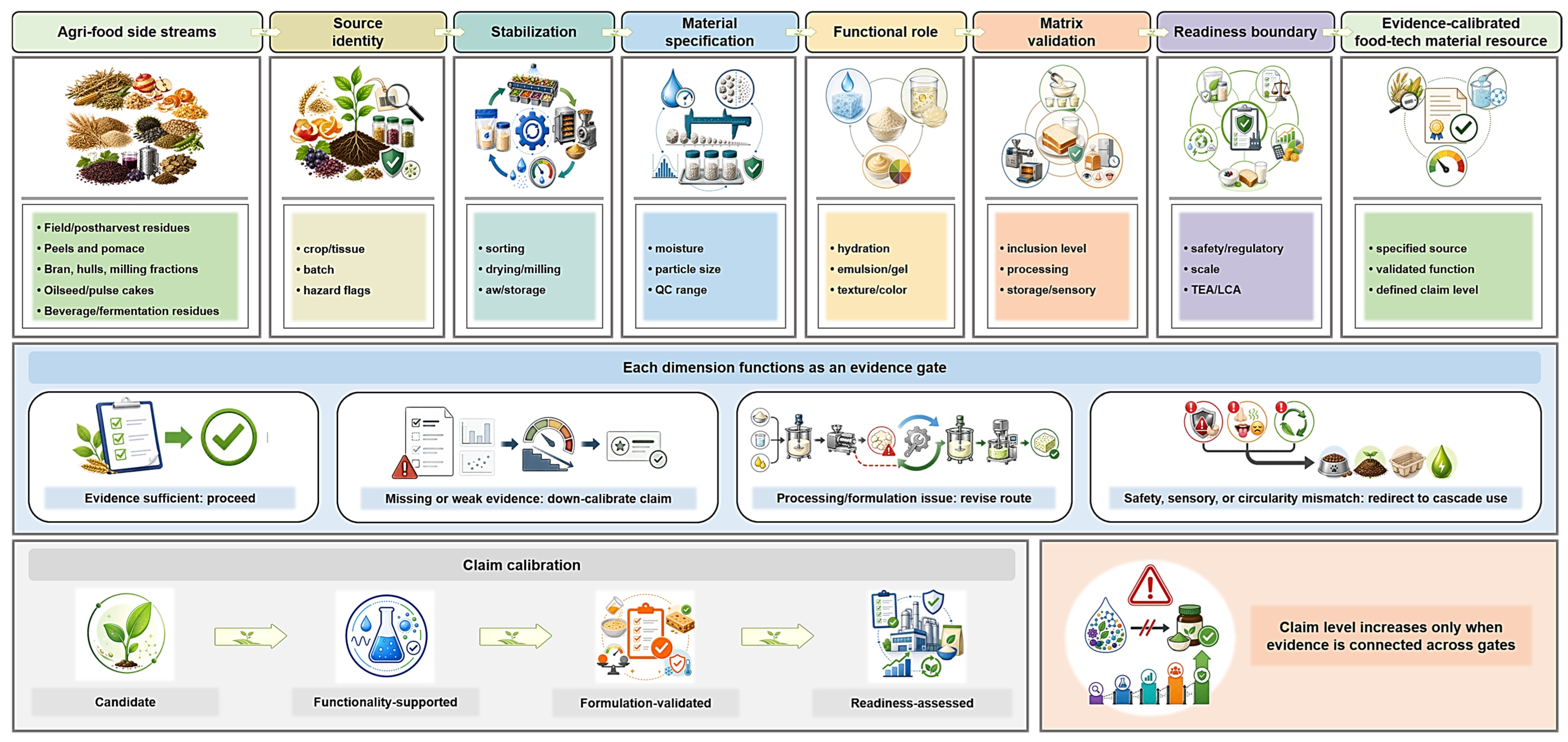
Figure 2.
Matrix-to-material decision map for assigning agri-food byproducts to candidate food-tech ingredient route classes. The map links byproduct streams to matrix diagnosis based on dominant fraction, intended function, safety and sensory boundaries, food-matrix fit, and evidence level. The route classes indicate plausible development pathways rather than automatic suitability; materials that fail food-matrix, safety, or sensory checks should be redirected to appropriate non-food cascade uses. Evidence levels indicate claim strength from candidate to functionality-supported and formulation-validated.
Figure 2.
Matrix-to-material decision map for assigning agri-food byproducts to candidate food-tech ingredient route classes. The map links byproduct streams to matrix diagnosis based on dominant fraction, intended function, safety and sensory boundaries, food-matrix fit, and evidence level. The route classes indicate plausible development pathways rather than automatic suitability; materials that fail food-matrix, safety, or sensory checks should be redirected to appropriate non-food cascade uses. Evidence levels indicate claim strength from candidate to functionality-supported and formulation-validated.
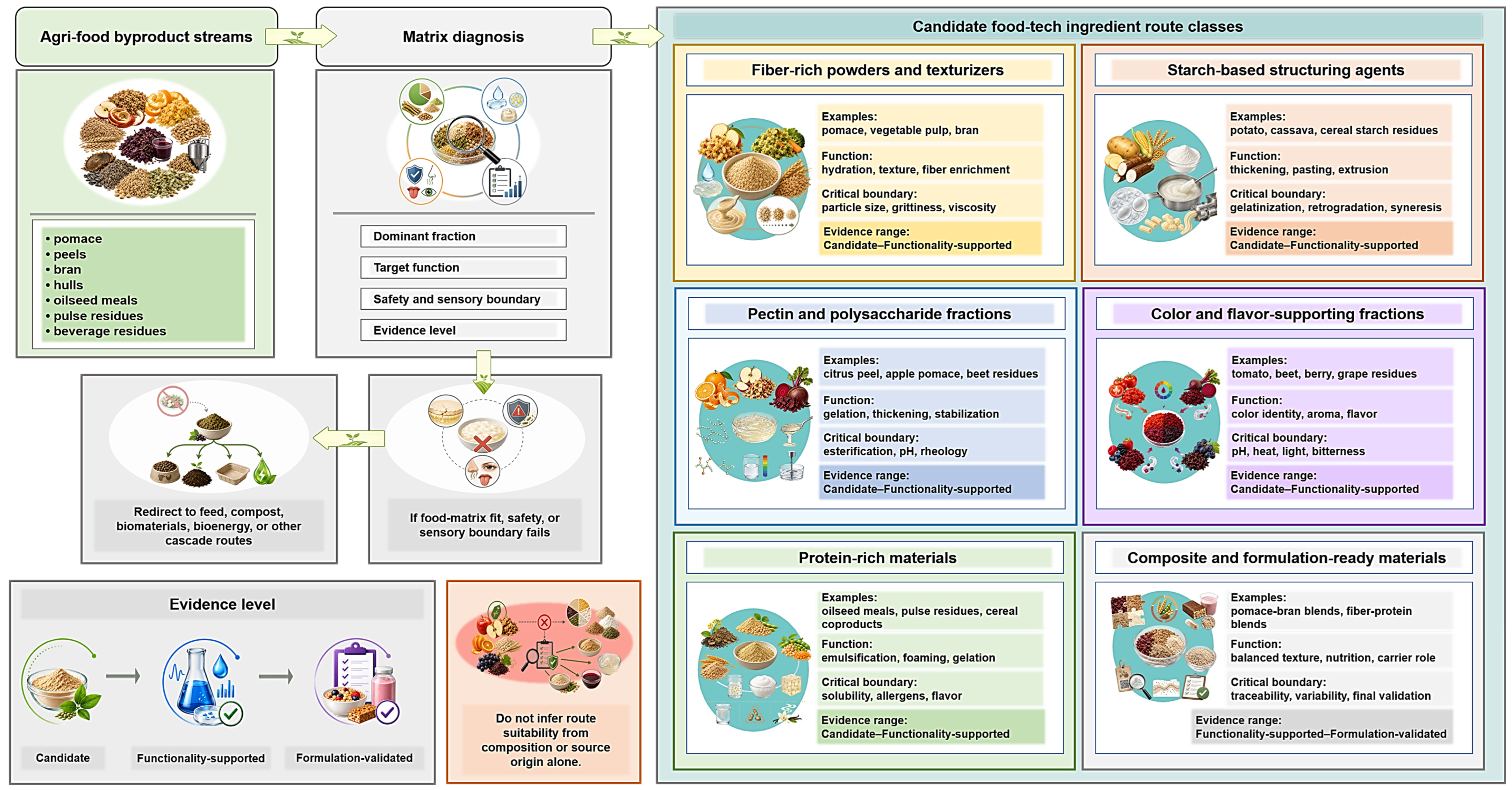
Figure 3.
Matching ingredient function roles to food and food-tech application spaces through validation filters. Representative links connect candidate upcycled materials with plausible application spaces, but they do not indicate general suitability. Product-specific validation should consider performance metrics, sensory compatibility, safety and hygiene, storage stability, regulatory positioning, realistic inclusion level, and benchmark controls before application or suitability claims are made.
Figure 3.
Matching ingredient function roles to food and food-tech application spaces through validation filters. Representative links connect candidate upcycled materials with plausible application spaces, but they do not indicate general suitability. Product-specific validation should consider performance metrics, sensory compatibility, safety and hygiene, storage stability, regulatory positioning, realistic inclusion level, and benchmark controls before application or suitability claims are made.
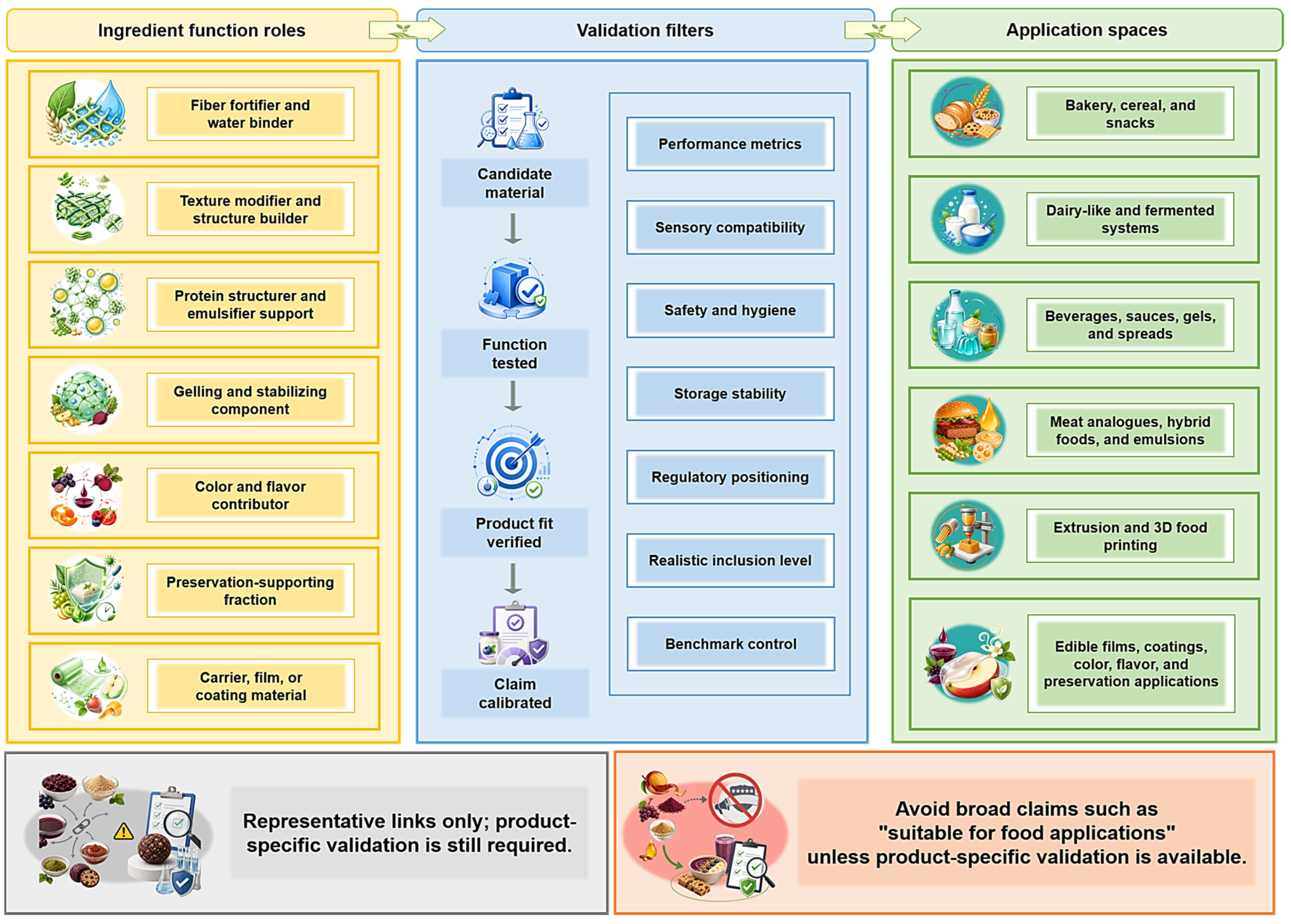
Figure 4.
Ingredient-readiness stage-gate model for upcycled food-tech material resources. The model summarizes evidence progression from feedstock definition, stabilization and preprocessing, material form and specification, techno-functional evidence, food-matrix validation, safety and regulatory readiness, and scalability, cost, LCA, and circular value-chain fit. If evidence is insufficient at any gate, the process should be refined, claim strength reduced, or the material redirected to an appropriate non-food cascade route. Claim strength should increase from candidate material to functionality-supported material, formulation-validated material, and industry-ready potential only when evidence advances across the stage-gate sequence. Detailed reporting gates are expanded in Table 6.
Figure 4.
Ingredient-readiness stage-gate model for upcycled food-tech material resources. The model summarizes evidence progression from feedstock definition, stabilization and preprocessing, material form and specification, techno-functional evidence, food-matrix validation, safety and regulatory readiness, and scalability, cost, LCA, and circular value-chain fit. If evidence is insufficient at any gate, the process should be refined, claim strength reduced, or the material redirected to an appropriate non-food cascade route. Claim strength should increase from candidate material to functionality-supported material, formulation-validated material, and industry-ready potential only when evidence advances across the stage-gate sequence. Detailed reporting gates are expanded in Table 6.
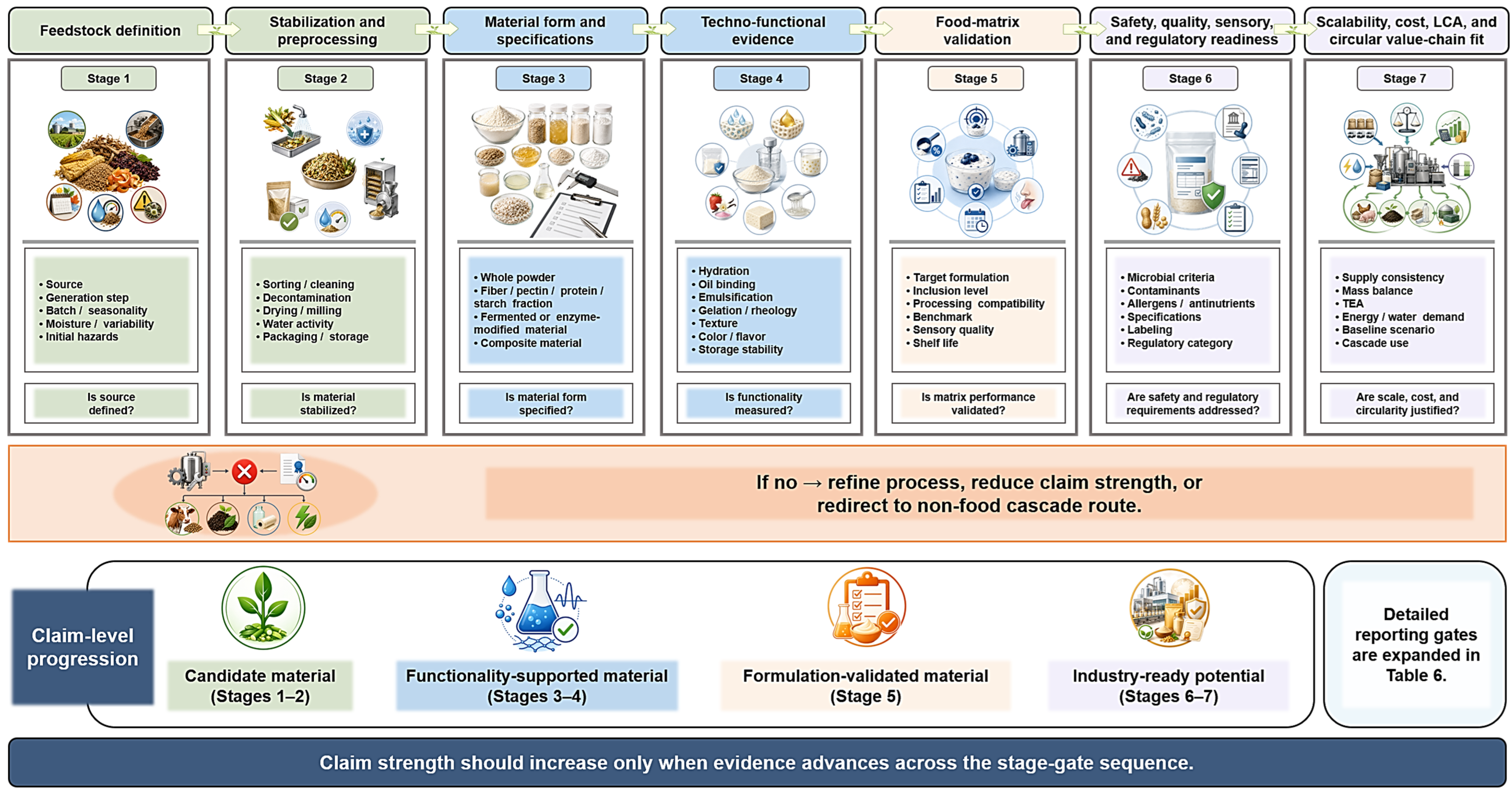

Table 1.
Representative agri-food byproduct streams and food-tech material potential.
| Byproduct stream and examples | Material fractions and components | Candidate material forms | Potential food-tech roles | Key limitations and risks | Plausible application contexts | Evidence and claim boundary | Representative references | |
|---|---|---|---|---|---|---|---|---|
| Fruit pomace and pressing residues: apple, grape, berry, mango, pomegranate | Fiber; pectin; structural polysaccharides; phenolic matrix; pigments; acids/sugars; aroma compounds | Pomace/fiber powder; pectin- or color-supporting fraction; fermented/composite ingredient | May support hydration, texture, fiber enrichment, color contribution, and oxidative-stability support where validated. | High moisture/spoilage; browning; acidity; bitterness/astringency; dark color; batch variability; contaminants. | Bakery/snacks; sauces/gels; color-compatible structured foods; fermented products. | Functionality-supported to formulation-validated in tested matrices; broader claims need dose, sensory, and storage data. | [34,36] | |
| Vegetable peels and pulps: carrot, beet, onion, tomato, potato, mixed trimmings | Fiber; pectin/non-pectin polysaccharides; carotenoids/betalains; phenolic components; starch/minerals in some streams | Peel/pulp powder; fiber-rich or color-supporting fraction; fermented/blended vegetable powder | May support water retention, viscosity, texture, color, fiber/nutrient enrichment, and consistency. | Soil/foreign matter; pesticide residues; moisture/spoilage; off-odor; pigment instability; browning; coarse particles. | Bakery/snacks; sauces/spreads; finely milled beverage systems with controlled sedimentation; fermented products. | Candidate to functionality-supported; product claims need color, flavor, dispersion/sedimentation, safety, and storage data. | [15,42,44] | |
| Citrus peel and pulp: orange, lemon, grapefruit, mixed citrus residues | Pectin; soluble/insoluble fiber; flavonoid matrix; essential-oil volatiles; pigments; acids; surface waxes | Pectin-rich fraction; peel/fiber ingredient; aroma fraction; film/coating precursor; composite stabilizer | May support gelation, thickening, emulsion/suspension stability, fiber enrichment, carriers, and coatings. | Bitterness; volatile loss; surface-treatment or pesticide residues; variable pectin quality; strong aroma/color. | Gels/sauces; selected dairy-like or acidified systems; bakery/snacks; flavor systems; edible films/coatings. | Functionality-supported when molecular/rheological features are defined; product claims need bitterness, pH, sensory, and safety controls. | [40,78,80] | |
| Cereal bran and milling fractions: wheat, oat, barley, corn, sorghum residues | Insoluble/soluble fiber; arabinoxylans; beta-glucans; starch; protein; minerals; lipids; phytochemical components | Bran powder; fiber- or beta-glucan-rich fraction; fermented bran; extrusion feed; cereal composite | May support water absorption, dough rheology, viscosity, texture, extrusion behavior, and fiber enrichment. | Gluten-network disruption in wheat matrices; lower gas retention; crumb hardening; grittiness; dark color; phytates; mycotoxins; particle variability. | Bakery; cereals; snacks; extrusion-based foods; fermented cereal products. | Functionality-supported; validation should report inclusion level, particle size, pretreatment, water adjustment, volume, texture, and sensory acceptance. | [47,48,49] | |
| Rice bran and lipid-containing cereal fractions: rice bran, rice germ, defatted bran | Fiber; protein; starch; lipids; gamma-oryzanol-associated components; minerals; phytochemical components | Stabilized or defatted bran; fiber-rich/protein-containing fraction; fermented bran | May support fiber enrichment, texture, cereal formulation, and lipid/phytochemical positioning after stabilization. | Lipase/lipoxygenase activity; free fatty acids; lipid oxidation/rancidity; storage sensitivity; microbial/mycotoxin concerns. | Bakery; cereal/snack products; fermented foods; plant-based composite ingredients. | Candidate to functionality-supported after stabilization; stronger claims need oxidation markers, storage data, and batch specifications. | [49,51,52] | |
| Byproduct stream and examples | Material fractions and components | Candidate material forms | Potential food-tech roles | Key limitations and risks | Plausible application contexts | Evidence and claim boundary | Representative references | |
| Starch-rich residues: potato, cassava, sweet potato, cereal starch residues, wet starch side streams | Starch granules; resistant-starch-related fractions; residual protein/fiber; non-starch polysaccharides; salts; minor lipids | Starch-rich powder; pregelatinized/modified structuring agent; extrusion feed; gel-forming/composite thickener | May support thickening, pasting, gelation, viscosity control, freeze-thaw behavior, extrusion, and structure formation. | Wet-stream instability; microbial risk; source-dependent gelatinization; retrogradation; syneresis; texture drift; matrix interactions. | Sauces/gels; bakery/snacks; extrusion products; 3D-printing pastes; edible films where validated. | Functionality-supported with gelatinization, pasting, viscosity, and retrogradation data; product claims need texture/stability evidence. | [53,54,55] | |
| Legume and pulse residues: chickpea, lentil, pea hulls, broken grains, dehulling/milling fractions | Protein/peptides; fiber; starch; minerals; phenolic-associated components; antinutritional factors | Protein-rich fraction; hull fiber powder; fermented pulse ingredient; enzyme-modified protein; plant-protein composite | May support protein enrichment, water binding, emulsification, foaming, gelation, texture, and digestibility after controlled processing. | Beany/bitter notes; allergen/cross-reactivity concerns; phytates; trypsin inhibitors; lectins; digestibility shifts; color impact. | Plant-based foods; meat analogue matrices; bakery/snacks; fermented systems; protein-enriched composites. | Functionality-supported for selected fractions; stronger claims need allergen, antinutrient, digestibility, sensory, and regulatory data. | [56,81] | |
| Oilseed and nut meals/cakes: soybean, rapeseed, sunflower, sesame, peanut, tree-nut press cakes | Protein/peptides; residual oil; fiber; minerals; phenolic-associated components; source-specific antinutritional or safety-relevant constituents | Protein-rich meal; defatted flour; hydrolysate; fiber-protein composite; structuring or emulsion-supporting ingredient | May support emulsification, gelation, oil/water binding, protein structuring, enrichment, and hybrid-food texture in selected matrices. | Allergens; residual solvent/aid issues where applicable; lipid oxidation; residual-oil instability; bitter/beany notes; phenolic color; source toxicants. | Meat analogues; hybrid foods; plant-based emulsions; bakery/snacks; structured protein products. | Functionality-supported with processing history; validated or industry-ready claims need safety, labeling, oxidation, and sensory limits. | [57,59] | |
| Beverage and fermentation residues: brewers' spent grain, spent coffee grounds, tea residues, fruit press cakes, fermentation side streams | Fiber; protein; residual carbohydrates; minerals; phenolic-associated components; aroma compounds; caffeine-related components | Dried spent-grain powder; fiber-protein ingredient; fermented, flavor-supporting, color-supporting, or composite powder | May support fiber/protein enrichment, water binding, texture, aroma/color contribution, and extrusion support in compatible matrices. | Spent-grain moisture/spoilage; bitterness; dark color; graininess; caffeine considerations; lipid oxidation; strong aroma; variable microbiota. | Bakery/snacks; extruded foods; fermented products; plant-based systems; flavor-compatible products; selected fermented or dairy-like matrices. | Brewers' spent grain has stronger matrix evidence; coffee/tea residues need dose-response and sensory-boundary validation. | [70,71,72,76] | |
| Composite/mixed processing residues: facility blends, pomace-bran blends, fermented side streams, multiple-residue powders | Variable fiber, protein, starch, pectin, pigments, lipids, minerals, and phenolic-associated components | Composite powder; blended ingredient; fiber-protein/starch-fiber blend; fermented composite; candidate carrier | May tailor hydration, texture, nutrient/fiber enrichment, formulation flexibility, and single-stream limitation mitigation. | Non-homogeneous supply; batch variability; traceability gaps; allergen cross-contact; mixed contaminants; regulatory uncertainty; unclear claim boundaries. | Candidate blends/premixes after component and blend validation; bakery/snacks; sauces/gels; plant-based foods; local cascade systems. | Candidate material system unless component specs and blend validation are provided; avoid industry-ready or zero-waste claims without evidence. | [2,4,29] | |
Note: This representative source-to-material inventory supports Section 3 and is not exhaustive or route-ranking. Application contexts are plausible routes requiring stream-, process-, dose-, and matrix-specific validation. Processing routes, measurement endpoints, and product-validation requirements are addressed later. Evidence terms calibrate claim strength: candidate = source-based potential; functionality-supported = measured material-function endpoints; formulation-validated = product-matrix evidence; industry-ready = specifications, safety/regulatory interpretation, scale-up, cost, and environmental assessment.
Table 2.
Preprocessing and stabilization strategies for reproducible upcycled raw-material quality.
|
Preprocessing and stabilization step |
Primary purpose |
Key parameters to report |
Potential functional implications |
Safety and hygiene considerations |
Minimum reporting requirements |
Evidence and claim boundary |
Representative references |
| Source documentation | Define source, batch, and pre-stabilization history before material or ingredient claims. | Origin; crop or source material; cultivar if relevant; tissue/fraction; facility and generation step; batch size; season; initial moisture; time to stabilization. | Enables traceability and comparison; incomplete metadata can make single-batch performance appear generalizable. | Unknown source history; allergen cross-contact; undocumented storage; unassessed contaminant exposure. | Report source metadata, batch definition, collection context, and pre-stabilization handling. | Candidate feedstock until source identity, batch definition, and pre-stabilization history are documented. | [2,4,7] |
| Collection and segregation | Maintain traceability and prevent uncontrolled mixing before stabilization. | Collection point/frequency; holding time/temperature; container; single-source or mixed-stream status; allergen-relevant separation; transport distance. | Reduces variability and supports route selection; holding delays or uncontrolled mixing may increase spoilage and functional inconsistency. | Cross-contamination; allergen cross-contact or carry-over; foreign matter; microbial growth during holding. | State stream origin, segregation method, container, holding time, temperature, and transport context. | Segregated side stream; not yet a stabilized raw material unless preservation or stabilization evidence is provided. | [7,29,82] |
| Sorting and cleaning | Remove visibly unsuitable or damaged material and reduce physical contamination. | Sorting criteria; rejected fraction; foreign-matter removal; washing medium/time; water use; visual defects; pre-/post-cleaning indicators if available. | May improve cleanliness, color consistency, and processability; excessive washing can leach soluble components or alter moisture and functionality. | Soil; stones; damaged tissues; pesticide residues; mycotoxins; cleaning residues; microbial contaminants. | Report sorting/rejection criteria, cleaning conditions, and measured changes in moisture, contaminants, or functionality where available. | Cleaned candidate material until relevant hazard reduction and stabilization evidence are available. | [7,43,44] |
| Decontamination and sanitation | Reduce targeted hazards while preserving usable material function. | Target hazard; intervention; concentration/intensity; contact time; temperature; pH; rinsing; residue checks; microbial reduction; quality impact. | May improve hygienic suitability; poorly matched interventions can introduce residues, off-flavors, pigment loss, softening, or water burden. | Insufficient pathogen or spoilage-microbe reduction; sanitation residues; wastewater handling; post-treatment recontamination. | Report intervention conditions, validation endpoints, residue checks, and functionality retention. | Risk-reduced material only for the hazards and intervention conditions actually assessed. | [7,43,44] |
| Drying | Reduce moisture and water activity for handling, milling, transport, and storage. | Method; pretreatment; equipment; temperature/time; airflow or vacuum; loading depth; final moisture/aw; yield; color/odor; energy indicator if available. | May support powder production and storage stability; heat or over-drying can alter browning, volatiles, pigments, proteins, starch, and rehydration. | Insufficient microbial reduction; post-drying contamination; heat-resistant spores; unsafe storage if aw remains high. | Report drying history, final moisture/aw, microbial indicators, and material-quality changes. | Stabilized raw material only when moisture, aw, hygiene, and quality endpoints are reported. | [30,72,75] |
|
Preprocessing and stabilization step |
Primary purpose |
Key parameters to report |
Potential functional implications |
Safety and hygiene considerations |
Minimum reporting requirements |
Evidence and claim boundary |
Representative references |
| Milling and sieving | Convert stabilized material into a defined powder or particle fraction. | Milling method/passes; speed or energy if available; sieve size; particle-size distribution; morphology; bulk density; flowability; dusting; heat generation. | Controls dispersion, hydration, texture, and dosing; fine particles may increase oxidation, caking, viscosity, or flavor release; coarse particles may cause grittiness or sedimentation in liquid systems. | Post-drying contamination; allergen spread or cross-contact; airborne dust; equipment-derived foreign particles. | Report milling/sieving conditions, particle-size distribution, powder morphology, and links to relevant functionality. | Specification-controlled powder only when particle attributes and handling properties are defined. | [84,85,91] |
| Water activity control | Define preservation status beyond total moisture. | aw target; residual moisture; equilibration time; storage temperature/RH; sampling point; sorption behavior if available; packaging state. | Helps interpret microbial risk, powder flow, caking prevention, rehydration, and shelf-life prediction; poor control permits quality drift. | Mold/yeast growth in semi-dry materials; low-aw pathogen persistence; moisture migration. | Report moisture and aw together, acceptance limits, storage context, and intended use. | Storage-stable candidate only for the defined aw, package, and storage context after supporting evidence. | [30,83,86] |
| Packaging | Limit moisture uptake, oxygen/light exposure, volatile loss, and recontamination. | Packaging material; moisture/oxygen barrier if known; headspace; pack size; sealing; light protection; opening/resealing practice. | May help maintain color, aroma, flowability, microbial quality, lipid stability, and function; poor barriers can cause caking, oxidation, volatile loss, or color drift. | Package failure; migration where relevant; post-process contamination; allergen cross-contact. | Report packaging type, barrier rationale, pack size, and storage environment used in stability testing. | Packaged stabilized material; not shelf-stable without storage validation under the defined package and conditions. | [30,83,86] |
| Storage stability | Show that quality and functionality persist under realistic storage. | Time; temperature/RH; light/oxygen; aw; microbial indicators; color; odor; lipid oxidation; caking; hydration; viscosity; reconstitution. | Defines shelf-life limits, release intervals, and functional retention; initial composition may hide flow, odor, color, hydration, or viscosity drift. | Rancidity; microbial persistence/growth; toxin formation where relevant; pigment loss; spoilage metabolites; quality drift. | Report initial and stored values and link changes to application-specific acceptance limits. | Storage-validated material only for defined time, temperature, package, and use context. | [30,51,52,83,86] |
| Batch specification | Set release criteria for reproducible raw-material use. | Acceptance ranges for source, moisture, aw, particle size, color, odor, microbial indicators, contaminants if relevant, lipid oxidation, and key functionality endpoints. | Enables purchasing, QC, formulation, batch release, and scale-up; overly broad limits weaken reproducibility, whereas overly narrow limits can reduce usable yield. | Unsafe or unsuitable batch release; hidden allergen risk; inconsistent functionality; unsupported food-grade or industry-ready claims. | Define pass/fail criteria, batch number, variability range, and limiting or rejected batches when possible. | Specification-controlled ingredient only when acceptance ranges, release criteria, and relevant safety limits are established. | [3,4,29] |
Note: This table summarizes first-gate reporting requirements for reproducible upcycled raw materials and is intended for claim calibration rather than method ranking. Not all parameters apply to every byproduct stream; relevant items should be selected according to source, process, intended matrix, and jurisdiction. Evidence terms should be used according to available data: candidate feedstock = source and batch are defined but stabilization/functionality evidence is incomplete; segregated side stream = collected and separated with traceability but not stabilized; cleaned candidate material = visibly unsuitable material or foreign matter is reduced but hazard control remains incomplete; risk-reduced material = targeted hazards have been assessed and mitigated for the reported intervention; stabilized raw material = moisture/aw, hygiene, and quality endpoints are defined; storage-validated material = quality and functionality are retained under defined time, temperature, package, and use conditions; specification-controlled ingredient = acceptance ranges, release criteria, batch variability, and relevant safety limits are established. Avoid food-grade, safe, shelf-stable, zero-waste, circular, or industry-ready unless source, stabilization, hygiene, storage, batch-specification, safety/regulatory, and scale-up or environmental evidence are available. Abbreviations: aw, water activity; QC, quality control; RH, relative humidity.
Table 3.
Upcycling pathways and ingredient forms derived from agri-food residues.
|
Upcycling pathway |
Representative starting streams |
Process route and candidate material form |
Potential food-tech role |
Minimum evidence and claim boundary |
Translational constraints and caution points |
Representative references |
| Direct whole-powder use | Stabilized fruit/vegetable powders, cereal bran, brewers' spent grain, seed residues, and other defined solid side streams. | Source documentation, sorting/cleaning, stabilization, drying, milling, and sieving; whole powder/flour used at defined inclusion levels. | May support fiber enrichment, water binding, texture adjustment, color contribution, moisture management, and product identity in selected matrices. | Report source, stabilization history, moisture/aw, particle-size distribution, microbial indicators, inclusion range, product quality, sensory response, and storage behavior; use candidate or matrix-tested wording until product evidence is available. | Off-flavors; bitterness/acidity; darkening; grittiness; wax or surface residues where relevant; oxidized lipids; microbial risk; caking; sensory-limited inclusion. | [70,92,95] |
| Fiber-rich fractionation | Pomace, vegetable residues, cereal bran/hulls, peels, seed residues, and pulse hulls. | Dry or wet separation, washing, milling/sieving, air classification, and particle standardization; fiber-rich fraction or soluble/insoluble fiber concentrate. | May support water binding, swelling, viscosity adjustment, texture modification, moisture management, and fiber enrichment where particle/matrix compatibility is validated. | Report fiber profile, soluble/insoluble ratio, WHC/OHC, swelling, particle morphology, matrix performance, sensory limits, and inclusion level; claim only measured functions. | Grittiness; sedimentation; excessive viscosity; dark color/off-flavor; lower bakery volume; higher water demand; added separation/drying burden. | [6,20,77] |
| Pectin and polysaccharide fractionation | Citrus peel, apple pomace, pomegranate/mango peel, beet residues, and other polysaccharide-rich tissues. | Aqueous/acid, enzyme-assisted, membrane-assisted, or lower-solvent extraction; filtration, concentration, precipitation or membranes, and drying; pectin-rich or hydrocolloid-like fraction, carrier precursor, or film-forming material. | May support gelation, thickening, emulsion/suspension stabilization, carrier functions, films, and coatings when molecular/rheological features are defined. | Report yield, DE where relevant, molecular weight, rheology, pH/calcium/sugar response, purity/impurities, sensory quality, and application matrix; avoid hydrocolloid-substitute claims without specifications and benchmarks. | Source variability; pH/ion dependence; extraction inputs; bitterness/color carry-over; impurities; cost; variable gel strength; regulatory documentation. | [40,78,96] |
| Protein-rich fractionation | Oilseed meals, legume/pulse residues, broken grains, cereal coproducts, nut residues, and protein-containing fermentation residues. | Dry/wet fractionation, pH extraction, precipitation/membranes, drying/milling, and optional controlled hydrolysis; protein-rich flour, concentrate, isolate, or hydrolysate. | May support protein enrichment, emulsification, foaming, gelation, water/oil binding, structure formation, and alternative-protein formulation in defined matrices. | Report protein content, solubility, digestibility/amino-acid quality, emulsion/foam/gel endpoints, heat/pH stability, sensory quality, allergen and antinutrient status, and solvent/processing-aid residues where relevant. | Allergenicity; antinutrients; beany/bitter notes; heat damage/aggregation; residual solvents or processing aids where applicable; lipid oxidation; batch variability; labeling/regulatory issues. | [79,97] |
| Starch-rich structuring materials | Potato, cassava, cereal, root/tuber, and fruit-processing residues with recoverable starch. | Separation/washing, drying, pregelatinization, heat-moisture treatment, extrusion, or enzymatic/physical structuring; starch-rich powder or candidate structuring agent. | May support thickening, viscosity control, gelation, freeze-thaw behavior, extrusion response, texture setting, and structure building where starch properties are characterized. | Report granule integrity, amylose/amylopectin ratio, gelatinization, pasting, retrogradation, water binding, freeze-thaw behavior, process history, and matrix interactions; use product data for texture/stability claims. | Retrogradation; syneresis; variable pasting; source variability; heat sensitivity; wet-stream microbial risk; matrix-specific texture failure. | [53,54,55] |
|
Upcycling pathway |
Representative starting streams |
Process route and candidate material form |
Potential food-tech role |
Minimum evidence and claim boundary |
Translational constraints and caution points |
Representative references |
| Fermentation-assisted upcycling | Cereal bran, legume residues, pomace, spent grain, vegetable residues, and fermentation side streams. | Controlled solid-state or submerged fermentation with defined strain/inoculum, substrate pretreatment, pH/time/metabolite tracking, and post-fermentation stabilization/drying; fermented powder, substrate, or flavor-/digestibility-modified material. | May support flavor adjustment, digestibility-related positioning, selected antinutrient reduction, phenolic release, acidity, preservation-supporting effects, and fermented identity when controlled and stabilized. | Report strain, inoculum, substrate, moisture/aw, pH/time, temperature, viable counts where relevant, metabolite profile, antinutrient change, relevant biogenic amines, sensory quality, storage, and safety endpoints. | Contamination; over-acidification; biogenic amines where relevant; incomplete stabilization; variable metabolites; off-flavor; scale-up control; avoid generic functionality claims without defined endpoints. | [66,67,100] |
| Enzymatic modification | Cereal bran/hulls, oilseed meals, pomace/peels, seed residues, and protein- or polysaccharide-rich streams. | Controlled carbohydrase, protease, amylase, lipase, or beta-glucosidase treatment plus inactivation; modified fiber, soluble fraction, hydrolysate, or modified polysaccharide/protein material. | May support solubility, interfacial behavior, release of soluble fractions, viscosity tailoring, digestibility-related positioning, fiber modification, and texture adjustment when reaction conditions are defined. | Report enzyme type/activity, dose, pH, temperature, time, moisture, inactivation, degree of hydrolysis/depolymerization, molecular size, soluble fraction, viscosity/function, bitterness, and microbial status. | Over-hydrolysis; bitter peptides; viscosity loss; reduced swelling/gelation; enzyme cost; incomplete inactivation; batch standardization; do not infer function from yield alone. | [63,102] |
| Composite systems and carrier candidates | Fiber, protein, starch, pectin, fermented powders, color/flavor/lipid fractions, and carrier-compatible materials. | Blending, co-drying, encapsulation, agglomeration, granulation, carrier formation, or structured gels; candidate premix, encapsulate, carrier, or structured material. | May support hydration control, dispersion, emulsion support, color/flavor delivery, texture design, processing compatibility, and storage stability where final-blend behavior is validated. | Report component identity/ratio, particle size, dispersion, hydration/release, rheology, storage, matrix performance, sensory impact, safety/allergen status, and final-blend specifications; reserve formulation-ready wording for component and blend validation. | Obscured origin; allergen/contaminant carry-over; incompatibility; inventory/QC burden; label impact; regulatory interpretation and final-blend responsibility. | [6,17,91] |
| Color and flavor-supporting fractions | Tomato/grape pomace, berry/beet/carrot residues, citrus peel, coffee/tea residues, and aromatic peels. | Stabilization, drying/milling, relevant extraction, debittering/deodorization, encapsulation, blending, and dose adjustment; color-supporting powder, pigment fraction, aroma material, or flavor carrier. | May support color contribution, product identity, flavor differentiation, aroma support, and sensory positioning in compatible matrices; antioxidant-associated identity should not be treated as preservation evidence. | Report color coordinates/change, pigment retention, pH/heat/light/oxygen stability, volatile retention, dose response, descriptive sensory, and consumer acceptance where relevant; avoid colorant/flavoring claims without stability and regulatory context. | Darkening/fading; bitterness/astringency; volatile loss; off-odor; pigment degradation; batch color variation; narrow dose window; mismatch with delicate matrices. | [3,110,111] |
| Preservation-supporting fractions | Phenolic-rich pomace/peels, essential-oil-associated residues, pigment fractions, tea/coffee residues, and aromatic plant residues. | Extraction/fractionation, encapsulation, blending, powder incorporation, coating integration, or carrier delivery; antioxidant-/antimicrobial-screening fraction, active-carrier candidate, or coating ingredient. | May support oxidative-stability, color retention, microbial-control support, spoilage reduction, and shelf-life support only in selected matrices with storage evidence. | Report matrix oxidation markers, peroxide value/TBARS, microbial load or challenge tests where appropriate, color, storage conditions, sensory quality over storage, effective dose, sensory threshold, delivery form, and safety/regulatory context. | Assay-product mismatch; effective dose above sensory limits; instability; volatile loss; residues/contaminants/allergens; regulatory classification; avoid preservative claims from screening assays. | [19,112,113] |
Note: This table is a process-route inventory for Section 5 and links plausible upcycling pathways to candidate material forms, potential food-tech roles, minimum evidence needs, and translational constraints. It is not a route-ranking tool or proof of product suitability. Table 4 and Table 5 detail measurement endpoints and product-validation requirements. Claim wording should follow evidence strength: candidate = pathway-level potential without product-matrix data; functionality-supported = measured function under defined conditions; validated in selected matrices = product-level evidence at defined inclusion levels, processing conditions, sensory/storage context, and safety boundaries; industry-ready = specifications, safety/regulatory interpretation, batch reproducibility, scale-up, cost/TEA, and environmental assessment. Avoid broad claims such as improves functionality, acts as a preservative, suitable for food applications, food-grade, zero-waste, circular, or industry-ready unless the corresponding evidence is available. Abbreviations: aw, water activity; DE, degree of esterification; WHC/OHC, water-/oil-holding capacity; QC, quality control; TBARS, thiobarbituric acid reactive substances; TEA, techno-economic assessment.
Table 4.
Techno-functional properties, measurement endpoints, and evidence-calibrated application relevance of upcycled food-tech materials.
Table 4.
Techno-functional properties, measurement endpoints, and evidence-calibrated application relevance of upcycled food-tech materials.
|
Techno-functional property |
Core measurement endpoints |
Critical test conditions and reporting needs |
Plausible application contexts |
Interpretation risks |
Evidence and claim wording boundary |
Representative references |
| Hydration and water-holding |
WHC; bound/free water; swelling; syneresis; hydration kinetics; rehydration loss. | Source/batch; stabilization; drying/milling history; particle size; medium; concentration; time/temperature; pH/ionic strength; separation method; n/statistics; benchmark control. | Doughs; gels; sauces; semi-solids; meat, plant-based, or dairy-like analogues. | High WHC is not automatically beneficial; it may increase density, firmness, grittiness, sedimentation, or excess viscosity. Water/buffer tests may overpredict food-matrix behavior. | Use "screening hydration potential" for model tests. Use "matrix-relevant water-holding" only after representative matrix testing; product-validated claims need texture, sensory, and storage evidence. | [20,36,77] |
| Solubility and dispersibility |
Soluble fraction; turbidity; sedimentation; dispersibility/reconstitution time; phase separation. | Particle-size distribution; shear or mixing protocol; medium composition; pH/ionic strength; fat/protein/sugar; holding or storage time; visual/instrumental pass-fail criteria. | Beverages; dairy-like or plant-based drinks; soups/sauces; instant powders. | Better dispersion can increase viscosity, turbidity, or flavor release. Short-term model-drink stability does not demonstrate shelf-life or consumer acceptability. | Use "matrix-relevant dispersibility" only at the intended dose and storage context. Avoid beverage-suitability claims without sedimentation, sensory, and stability data. | [91,98,122] |
| Viscosity and flow behavior |
Apparent viscosity; flow curve; yield stress; shear-thinning; thixotropy; recovery. | Concentration; hydration and thermal history; rheometer geometry; shear program; temperature; pH/ionic strength; storage before measurement; benchmark control. | Sauces; gels; beverages; spoonables; extrusion or 3D-printing pastes. | High viscosity may stabilize sauces but impair beverages, pumping, extrusion, or printing. A single shear-rate value gives weak transferability. | Use functionality-supported wording with flow curves and controls. Use "process-relevant rheology" only under defined processing conditions; product validation also needs sensory/process evidence. | [115,117,118] |
| Oil-holding and cooking retention |
OHC; oil retention after heating; cooking loss; oil release; oxidation markers when lipid-rich. | Oil type; assay protocol; heating/salt conditions; particle size; protein/fiber ratio; use level; intended product role; nutrition rationale; control material. | Meat analogues; hybrid foods; bakery; sauces; fried or baked snacks. | Oil retention may support juiciness or lubrication but can add greasiness, oxidation risk, or energy density; it may be undesirable in low-oil products. | Use "oil-holding potential" for assays. Use "matrix-relevant cooking retention" after intended-product or close-model testing; avoid "juiciness" without cooking and sensory evidence. | [68,77,103,116] |
| Emulsification and foaming |
EAI/ESI or equivalent; droplet size; creaming/coalescence; zeta potential; foam capacity/stability; overrun. | Oil phase; pH/ionic strength; homogenization or whipping energy; temperature; biopolymer ratio; co-ingredients; storage or aging; replicate testing. | Dressings; sauces; plant-based emulsions; creams; desserts; aerated foods; meat analogues. | Protein content alone is insufficient. Fibers, phenolics, or hydrolysis can support or destabilize interfaces, and model systems may not translate to food matrices. | Use "may support emulsification or foaming" only under food-like conditions. Product claims need droplet/foam stability, storage, texture/mouthfeel, and sensory evidence. | [63,79,103] |
| Gelation and network formation |
Minimum gelation concentration; gel strength; G'/G''; setting time; syneresis; fracture/texture. | pH; calcium; sugar/solids; concentration; ionic strength; heat-cool cycle; DE/molecular weight where relevant; rheology mode; benchmark hydrocolloid when relevant. | Fruit gels; sauces/spreads; dairy-like gels; structured foods; edible films. | Simple gels may fail in multicomponent foods. Strong gels may be unsuitable for soft or spoonable products; pH and ion dependence can limit transferability. | Use "matrix-relevant gelation" after product pH, solids, and texture tests. Use hydrocolloid-like or substitute wording only with benchmark and sensory/use-context evidence. | [40,78,96] |
|
Techno-functional property |
Core measurement endpoints |
Critical test conditions and reporting needs |
Plausible application contexts |
Interpretation risks |
Evidence and claim wording boundary |
Representative references |
| Texture and structure formation |
TPA; hardness; cohesiveness; chewiness; crispness; expansion; microstructure; anisotropy. | Formulation; inclusion level; water adjustment; particle size; temperature/shear; baking, extrusion, or printing settings; control; storage/staling; benchmark. | Bakery; snacks; meat analogues; extruded foods; 3D printing; gels. | Structure gains in one matrix may reduce loaf volume or expansion, increase hardness, or create graininess in another matrix. | Use product-validated wording only with final or representative matrix texture, relevant microstructure, sensory descriptors, and storage data. Avoid broad "texture-improving" claims. | [115,117,119] |
| Color compatibility | L*a*b*; Delta E; pigment retention; browning index; storage color stability; visual acceptability. | Raw-material and product color; pH; light; oxygen; heat; metal ions; packaging; time; benchmark; instrument settings. | Colored bakery; snacks; beverages; meat analogues; gels; sauces. | Strong color may fit dark products but reduce acceptance in light or delicate matrices. Initial color does not establish processing or storage stability. | Use "color-supporting fraction" only with processing and storage color data. Product validation needs visual or sensory acceptance at the intended dose. | [41,110,111] |
| Flavor and aroma compatibility |
Descriptive sensory; liking; bitterness/astringency; volatile profile; off-flavor; acceptance threshold; aftertaste. | Inclusion level; processing/storage history; masking or blending strategy; panel type/training; information condition; benchmark/control; dose response; storage time. | Consumer foods; fermented products; bakery; beverages; flavor-supporting fractions. | Functional or nutritional value does not offset strong bitterness, rancidity, beany notes, graininess, or off-odor. Small panels do not prove broad consumer acceptance. | Use product-validated wording only with sensory evidence at realistic use levels and after storage where relevant. Avoid consumer-accepted or clean-flavor claims from limited panels. | [3,5,31] |
| Preservation support |
Peroxide value; TBARS; volatile oxidation; microbial counts/challenge; color retention; shelf-life indicators; sensory over storage. | Target matrix; lipid/aqueous phase; aw; pH; package; storage temperature/time; effective dose; controls; microbial endpoints; sensory over time; regulatory context. | Lipid foods; meat analogues; sauces; coatings; beverages; bakery. | Radical-scavenging or antimicrobial screening assays do not prove shelf-life extension. Effective doses may exceed sensory or regulatory limits. | Use "may support oxidative or microbial stability in selected matrices" only after food-matrix storage outcomes. Assays alone are screening; avoid natural-preservative wording. | [19,112,113] |
| Digestibility and bioaccessibility |
In vitro digestibility; released/soluble/dialyzable fraction; bioaccessible phenolics; protein digestibility; relevant enzyme inhibition. | Recognized digestion model; matrix format; processing; inclusion level; particle size; pH/enzyme conditions; method; endpoint definition; comparator; claim scope. | Fiber-enriched foods; alternative-protein products; health-oriented formulations. | Composition does not equal bioaccessibility or physiological effect. Processing may alter release, binding, tolerance, sensory quality, or allergen-related interpretation. | Use screening or nutrition-positioning wording unless recognized digestion models plus biological/regulatory support justify stronger health-related wording. Avoid health effects from in vitro data alone. | [21,123,125] |
| Storage stability | aw; moisture migration; caking; microbes; lipid oxidation; color/odor drift; reconstitution; functional retention. | Time; package barrier; temperature/RH; light/oxygen; product form; aw/moisture; microbial and oxidation markers; repeated function tests; batch. | Powders; semi-dry ingredients; rice bran; oilseed meals; pigment- or aroma-rich materials. | Initial functionality may drift. Low moisture does not ensure pathogen absence, oxidative stability, flowability, or batch reproducibility. | Use "storage-validated" only for defined package/time/temperature and use context. Use industry-ready only after storage stability, batch reproducibility, and specification limits are established. | [30,83,86] |
Note: This table supports Section 6 by linking measurement endpoints to application-relevant interpretation and claim calibration. It is not a ranking of functions, and a single assay does not establish product suitability. Claim wording should follow evidence strength: screening = model-system or single-endpoint evidence; matrix-relevant = representative matrix evidence under defined conditions; product-validated = final or target-product evidence at stated inclusion levels with processing, sensory, and storage context; industry-ready = specifications, batch reproducibility, safety/regulatory interpretation, and storage/scale-up evidence. Avoid broad statements such as improves functionality, natural preservative, consumer-accepted, shelf-stable, suitable for food applications, or industry-ready unless target-matrix performance, sensory evidence, storage behavior, safety context, and batch specifications support them. Abbreviations: aw, water activity; DE, degree of esterification; EAI, emulsifying activity index; ESI, emulsion stability index; OHC, oil-holding capacity; RH, relative humidity; TBARS, thiobarbituric acid reactive substances; TPA, texture profile analysis; WHC, water-holding capacity; 3D, three-dimensional.
Table 5.
Food and food-tech application spaces and minimum evidence requirements.
|
Application context |
Candidate material roles |
Key performance metrics to validate |
Key sensory, safety, and use constraints |
Minimum product-level validation endpoints |
Evidence and claim wording boundary |
Representative references |
| Bakery and leavened products |
Fiber-enrichment component; water-binding powder/fraction; dough or crumb modifier; color-supporting fraction; partial flour-replacement candidate. | Water absorption; dough rheology; gas retention; loaf volume; crumb hardness; staling; water adjustment. | Darkening; dense crumb; reduced volume; bran, bitter, or gritty notes; microbial or allergen concerns; gluten-network and crop/storage-related mycotoxin context where relevant. | Dose response; water correction; baking loss or yield; loaf/crumb texture; color; storage or staling; sensory acceptance; benchmark/control. | Use "matrix-relevant bakery support" only at tested inclusion levels with validated dose, volume, texture, color, storage, and sensory limits. | [70,93,95] |
| Cookies, crackers, and snack products |
Fiber-enrichment component; particulate texture contributor; color/flavor differentiator; upcycled product-identity component where sensory fit is confirmed. | aw; moisture; spread; hardness/crispness; fracture; color; lipid oxidation where relevant; storage stability. | Excess hardness or grit; strong color; bitter/roasted notes; low-moisture hygiene; contamination/allergen risks; oxidation or rancidity. | Texture/crispness during storage; aw/moisture; color stability; dose-response sensory; benchmark/control; package context. | Use "validated in selected snack formats" only when texture, aw, color, storage, and sensory quality remain acceptable at the tested dose. | [70,92,94] |
| Extruded snacks and cereal products |
Structure-modifying candidate; fiber-fortifying component; starch/protein structuring component; expansion-modulating candidate. | Feed moisture; screw speed, SME, or torque; expansion; bulk density; hardness/crispness; color; nutrient or bioactive retention. | Reduced expansion; dense or burnt product; dark color; coarse mouthfeel; thermal history; low-aw storage; mycotoxin and input-consistency considerations. | Stable extrusion run; defined process window; expansion/density; texture/color; nutrient retention; sensory after storage; input specification. | Use "supports extrusion structure" only under defined feed-moisture, particle-size, and process-window conditions; avoid general extrusion-suitable wording. | [49,73,107] |
| Dairy and yogurt-like products |
Texture-modifying or stabilizing candidate; fiber fortifier; color/flavor-supporting adjunct; yogurt-like matrix component. | pH/acidity; viscosity; syneresis; WHC; gel firmness; starter or viable counts where relevant; refrigerated storage. | Color mismatch; graininess; acid imbalance; vegetal notes; reduced smoothness; starter compatibility; microbes, refrigeration, allergen, and label context. | Acidification kinetics; syneresis; texture/rheology; microbial counts or viability; color; sensory during cold storage. | Use "validated in dairy/yogurt-like systems" only when acidification, texture, syneresis, microbiological behavior, storage, and sensory outcomes are tested. | [119,126,127] |
| Fermented plant-based systems |
Fermentation substrate or co-substrate; flavor-modifying adjunct; fiber fortifier; digestibility-supporting candidate after controlled processing. | pH trajectory; titratable acidity; fermentation kinetics; viscosity; viable counts; metabolites; antinutrients where relevant; storage. | Over-acidification; fermented odor; bitterness; sediment or grit; color shift; strain identity; contamination; relevant biogenic amines; post-fermentation stabilization. | Defined strain/inoculum; substrate specification; pH/acidity curves; microbial safety; non-fermented control; metabolites or biogenic amines where relevant; storage and sensory. | Use "may support fermented systems" only when strain, substrate, stabilization, safety endpoints, and product outcomes are defined. | [67,69,100] |
| Beverages and ready- to-drink systems |
Soluble-fiber candidate; suspension-aid candidate; low-dose color/flavor-supporting component. | Dispersibility; sedimentation; turbidity; use-level viscosity; particle perception; pH/color stability; storage. | Sediment; turbidity mismatch; grit; bitterness/acidity; strong aroma or color drift; RTD exposure; microbes; caffeine; preservative-claim control. | Particle specifications; use-level viscosity; sedimentation/storage; color/flavor acceptance; microbial/storage context; package where relevant. | Use "candidate for selected beverages" only when dispersion, sedimentation, viscosity, color, flavor, and storage behavior are controlled; avoid broad beverage-suitability claims. | [122,129] |
|
Application context |
Candidate material roles |
Key performance metrics to validate |
Key sensory, safety, and use constraints |
Minimum product-level validation endpoints |
Evidence and claim wording boundary |
Representative references |
| Sauces, gels, and spreads |
Thickening or gel-forming candidate; texture/spreadability modifier; stabilizing candidate; color-supporting component. | Relevant-shear viscosity; yield stress; gel strength; spreadability; syneresis; pH/heat stability; storage stability. | Too thick or thin; graininess; opacity; dark color; off-flavor/astringency; heat treatment; microbial stability; acid/sugar context; preservative-claim limits. | Rheology under relevant shear; syneresis; spreadability; color/sensory texture; hydrocolloid or product benchmark; storage. | Use "stabilizer" or "gel-forming candidate" only with rheology, syneresis, sensory, storage, and benchmark controls; avoid substitute claims without benchmarks. | [78,120,121] |
| Meat analogues and hybrid foods |
Water/oil-retention candidate; protein/structure support; fiber texturizer; color/flavor-balancing component. | Water/oil retention; cooking loss; cutting force; chewiness; fibrous structure; color; lipid oxidation; extrusion/shear performance where relevant. | Beany/bitter notes; coarse particles; oxidized flavor; color drift; reduced juiciness; allergen, antinutrient, solvent/aid, microbial, and labeling context. | Structuring performance; microstructure; texture; cooking loss; color/oxidation; sensory texture/juiciness; safety/labeling checks. | Use "validated in selected meat-analogue or hybrid matrices" only with structure, retention, texture, flavor, storage/safety evidence at the tested replacement level. | [61,116,128] |
| Plant-based emulsions and cream-like systems |
Emulsifier-support candidate; stabilizing candidate; viscosity modifier; oil-binding protein/polysaccharide fraction. | Droplet size; creaming/coalescence; emulsion stability; viscosity; pH/salt/heat tolerance; storage. | Chalkiness; phase separation; beany/bitter flavor; excessive thickness; off-color; protein allergens; residual solvent/process-aid issues; microbes; label impact. | Realistic homogenization; storage; pH/thermal challenge; mouthfeel; benchmark comparison; droplet stability in the target formulation. | Use "emulsion-stabilizing potential" only when droplet stability and sensory/mouthfeel behavior are validated in the target formulation; avoid replacement claims without benchmarks. | [79,103,108] |
| Three-dimensional food printing |
Printable-paste candidate; structuring powder; fiber/starch/protein/hydrocolloid modifier; texture-tuning material. | Rheology; yield stress; nozzle extrusion; layer adhesion; shape fidelity; dimensional stability; post-processing texture. | Poor extrusion; collapse; rough surface; grit; strong color/flavor; drying cracks; paste microbiology; post-process safety; composite regulatory status. | Rheological profile; printability window; nozzle/formulation details; shape retention; heating/setting; texture; sensory quality. | Use "printable under defined conditions" only when formulation, nozzle, rheology, shape fidelity, post-processing, and storage/safety context are reported. | [130,131,132] |
| Edible films and coatings |
Film-forming biopolymer candidate; coating matrix; active-carrier candidate; barrier layer; surface-protection material. | Tensile strength; elongation; WVT/WVTR; oxygen barrier; adhesion; solubility; transparency/opacity; release or migration. | Color/odor/flavor transfer; stickiness; opacity; surface texture change; edible/food-contact status; migration/release safety; allergens; residual solvent/plasticizer. | Mechanical/barrier tests; adhesion; release/migration; food-surface trial; storage; sensory impact; contact/ingestion context. | Use "edible coating candidate" or "film-forming candidate" only with film formation, barrier performance, release/migration, safety, and food-surface compatibility; avoid active claims without food-matrix evidence. | [80,105,106] |
| Color and flavor applications |
Color-supporting fraction; aroma/flavor component; identity-building or masking/balancing candidate. | L*a*b* or Delta E; pigment retention; volatile profile; sensory threshold; dose response; pH/heat/light/oxygen stability. | Darkening/fading; bitterness/astringency; overpowering aroma; aftertaste; batch color variation; pesticide, caffeine, solvent, or labeling issues. | Processing/storage stability; dose-response sensory; benchmark color/flavor control; target-matrix acceptance; regulatory context where relevant. | Use "color-supporting" or "flavor-supporting" only at intended use levels with stability, sensory, and regulatory-context evidence; avoid colorant/flavoring claims without classification support. | [104,110,111] |
| Preservation-supporting applications |
Oxidative-stability-supporting fraction; antimicrobial-screening fraction; active-coating candidate; storage-stability-supporting candidate. | Oxidation markers; color retention; microbial counts/challenge; spoilage indicators; sensory over storage; package context. | Effective dose may cause bitterness, aroma, discoloration, or texture change; preservative-like regulatory status; contaminants/allergens; residual solvents; essential-oil exposure. | Food-matrix storage outcomes, not assays alone; intended package; oxidation/microbial endpoints; sensory over time; safety/regulatory context. | Use "may support preservation in selected matrices" only after product shelf-life endpoints are demonstrated; screening assays alone do not justify preservative wording. | [19,112,113] |
Note: This application-specific evidence matrix supports Section 7 and is not a proof of general food suitability or a ranking of application categories. Process-route details and measurement endpoints are addressed in Table 3 and Table 4. Application claims should be calibrated to product-level evidence at defined inclusion levels, processing conditions, storage behavior, sensory quality, and safety/regulatory context. Evidence terms may be used as follows: candidate application = plausible role based on source or material properties; matrix-relevant = representative product-matrix evidence under defined conditions; product-validated = target-product data with dose, process, storage, sensory, and safety outcomes; industry-ready = specifications, batch reproducibility, safety/regulatory interpretation, scale-up/TEA, and environmental assessment. Avoid broad claims such as suitable for food applications, industry-ready, preservative, sustainable, zero-waste, consumer-accepted, or clean-label unless the corresponding evidence package is available. Abbreviations: aw, water activity; Delta E, color difference; RTD, ready-to-drink; SME, specific mechanical energy; TEA, techno-economic assessment; WHC, water-holding capacity; WVT/WVTR, water vapor transmission/water vapor transmission rate.
Table 6.
Evidence gates for quality, safety, regulatory, scalability, and circularity readiness of upcycled food-tech materials.
Table 6.
Evidence gates for quality, safety, regulatory, scalability, and circularity readiness of upcycled food-tech materials.
| Readiness gate | Minimum documentation | Supporting evidence | Translation risk | Evidence and claim boundary |
Representative references |
|
Gate 1. Feedstock traceability |
Source/crop; tissue/fraction; generation step; supplier/facility; batch/season; volume; initial moisture; time to stabilization; hazard flags. | Source metadata; batch/facility records; collection and stabilization logs; preliminary risk screen. | Single-batch bias; seasonality; cross-contact; non-repeatable supply. | Candidate feedstock or traceable stream only; avoid standardized, food-grade, or year-round supply without records. | [2,4,29] |
|
Gate 2. Stabilization and preprocessing |
Sorting/cleaning; decontamination if used; drying/cooling; milling; final moisture/aw; time-temperature history; package/storage. | Process records; final moisture/aw; microbial indicators; particle-size data; storage context. | Spoilage; browning; recontamination; volatile loss; caking; function drift. | Stabilized raw material only under defined conditions; avoid shelf-stable or food-grade without microbial and storage evidence. | [7,72,75] |
|
Gate 3. Material specification |
Composition range; particle-size distribution; bulk density; color/odor; microbial status; relevant oxidation, contaminants, allergens; key functions. | Analytical/physical specifications; acceptance ranges; release criteria; limiting-batch handling if available. | Non-comparable studies; variable formulation behavior; unclear identity; weak release control. | Specification-defined material only; avoid standardized ingredient without ranges, QC criteria, and release limits. | [29,30,84] |
|
Gate 4. Techno-functional evidence |
WHC/OHC; swelling; solubility; viscosity; emulsification/foaming; gelation/rheology; texture; color/flavor; stability endpoints. | Replicated assays with source/process, medium, pH, temperature, concentration, particle size, hydration time, and controls. | Screening overclaims; weak transfer to food matrices; poor comparability. | Functionality-supported only for measured functions under defined test conditions; avoid broad food-application suitability from isolated assays. | [8,20,77] |
|
Gate 5. Food-matrix validation |
Target product; inclusion level; formulation adjustment; process settings; benchmark control; storage; sensory/consumer endpoints. | Product trials; instrumental quality; dose response; processing, storage, and sensory data. | Function does not translate; processing mismatch; sensory or storage failure. | Selected-matrix validated at stated dose only; avoid general food suitability or cross-category formulation-ready claims. | [3,6,126] |
|
Gate 6. Safety and hygiene |
Microbial criteria/pathogens as relevant; yeasts/molds; aw; contaminants; allergens; antinutrients; residual solvents/aids; exposure. | Hazard identification; microbiological testing; contaminant/allergen/process-risk assessment; exposure scenario. | Unsafe reintegration; underestimated exposure; regulatory or consumer risk. | Safety-assessed only for stated source, process, and use; avoid food-grade, safe, clean-label, or preservative without use-specific evidence. | [7,43,44] |
|
Gate 7. Regulatory positioning |
Ingredient category; source/use history; process/specification; intended use level; exposure; jurisdiction; labeling; claim wording. | Jurisdiction-specific interpretation for ingredient, novel food, additive, flavoring, coating, or food-contact route. | Wrong category; dossier gaps; labeling gaps; unsupported compliance or approval claims. | Defined regulatory interpretation only; avoid approved, compliant, novel-food-free, or universally permitted unless confirmed. | [3,109,124] |
|
Gate 8. Batch reproducibility and QC |
Batch/lot ID; acceptance ranges; batch-to-batch function; QC plan; release criteria; storage stability; rejected/limiting batches. | Multi-batch data; stability tests; control charts where relevant; release specifications; variability limits. | One-batch proof; unpredictable manufacturing; specification drift. | Reproducible within specified ranges only; avoid industry-ready without representative batches and QC plan. | [2,4,29] |
|
Gate 9. Scalability and TEA |
Feedstock availability; yield/throughput; equipment/labor; utilities; energy/water; packaging; testing/regulatory costs; price assumptions. | Mass and energy balances; preliminary TEA; sensitivity or scenario analysis; scale assumptions. | Low yield; high inputs; unrealistic scale/equipment; price mismatch. | Scalable potential under stated assumptions only; avoid commercially viable, low-cost, or industry-ready without TEA. | [18,134,135] |
|
Gate 10. Environmental and circularity assessment |
System boundary; functional unit; baseline fate; allocation; transport; stabilization/drying burden; water/solvent demand; substitution; end-use. | LCA/footprint data; hotspot and scenario analysis; cascade mass balance; sensitivity to baseline and allocation. | Burden shifting; greenwashing; weak zero-waste or circularity claims. | May support circularity within defined boundaries; avoid sustainable, zero-waste, low-impact, or circular without system-level evidence. | [22,32,33] |
|
Gate 11. Claim calibration |
Evidence level; claim wording; uncertainty; missing or negative data; use boundary; remaining validation needs. | Claim-evidence matrix; wording policy; documented limitations; gate checklist. | Overstatement; unsupported readiness; reviewer concern. | Use candidate, may support, functionality-supported, selected-matrix validated, specification-controlled, or industry-ready only when relevant gates are met. | [4,23,109] |
Note: One-page readiness-gate summary for Section 8. The gates calibrate claim strength, not certification or method ranking. Use candidate for screening evidence; functionality-supported for replicated material-function data; selected-matrix validated for product-level evidence at stated dose; specification-controlled for defined release criteria; and industry-ready only when specifications, safety/regulatory interpretation, reproducibility, scalability/TEA, and environmental evidence are documented. Avoid broad claims such as food-grade, safe, clean-label, preservative, sustainable, zero-waste, circular, commercially viable, or industry-ready unless the corresponding evidence package is explicit. Abbreviations: aw, water activity; LCA, life-cycle assessment; QC, quality control; TEA, techno-economic assessment; WHC/OHC, water-/oil-holding capacity.
Disclaimer/Publisher’s Note: The statements, opinions and data contained in all publications are solely those of the individual author(s) and contributor(s) and not of MDPI and/or the editor(s). MDPI and/or the editor(s) disclaim responsibility for any injury to people or property resulting from any ideas, methods, instructions or products referred to in the content. |
© 2026 by the authors. Licensee MDPI, Basel, Switzerland. This article is an open access article distributed under the terms and conditions of the Creative Commons Attribution (CC BY) license (http://creativecommons.org/licenses/by/4.0/).
Copyright: This open access article is published under a Creative Commons CC BY 4.0 license, which permit the free download, distribution, and reuse, provided that the author and preprint are cited in any reuse.


